

Snake Tattoo Ideas
Are you slithering across the internet on your search for the perfect Tattoo Clues? Well, you’re in the right place, as we’ve go some truely Sssensational Snake Tattoo designs that are irre-hiss-tible. Let’s sidewind our way in.
What does a Snake Tattoo Mean
Snake tattoos are among the oldest and most symbolic tattoo designs in the world carring many meanings from life and death, wisdom and temptation, protection and danger.
The most common meaning of a snake tattoo is transformation. Because snakes regularly shed their skin, leaving behind the old and emerging renewed, they simbolise personal growth, starting over, overcoming hardship, and a new chapter in life.
Having existed for millions of years and thrive in deserts, forests, mountains, and oceans. Snakes often represent inner strength, adaptability, endurance, independence, and self-reliance.
Unlike animals that rely on speed or brute force, snakes survive through patience and intelligence, making them a powerful symbol for people who overcome challenges through determination rather than force.
Many cultures associate snakes with hidden wisdom and ancient knowledge. Their quiet, observant nature has led them to become symbols of intelligence and insight, making them represent wisdom, knowledge, and intuition.
One of the oldest snake symbols is the Rod of Asclepius, associated with healing and medicine. Because snakes shed their skin and were seen as symbols of renewal, they became associated with healing, recovery, and health.
Having been feared for millions of years, snakes can symbolize power, fearlessness, confidence and dominance. Lastly, the ancient symbol known as the Ouroboros depicts a serpent eating its own tail. This represents infinity, eternal life, the cycle of creation and destruction, life, death, and rebirth, and the interconnectedness of all things.
Top snake tattoo artists


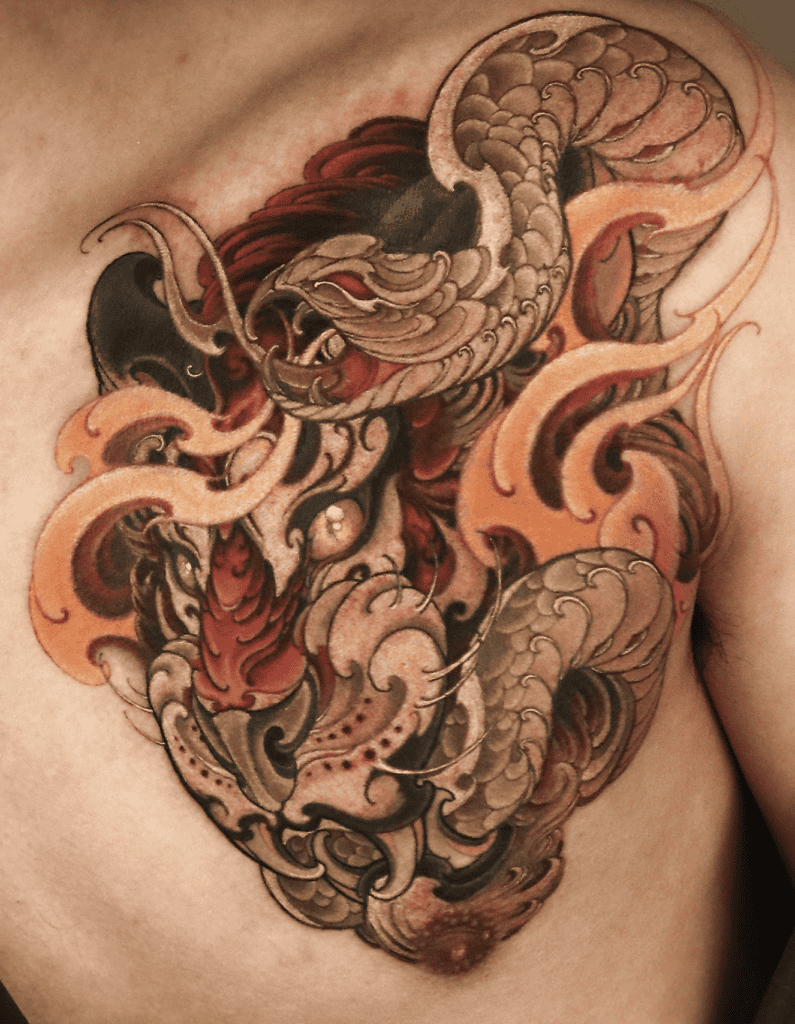
choseung ink
Melbourne based Korean Tattoo artists specialisng in Snake Tattoos and more.

Best Snake Tattoo Ideas
Now that we know a little about Snake Tattoo meanings, let’s take a look at some of the best Snake Tattoo designs the internet has to offer.
King Cobra Snake Tattoo
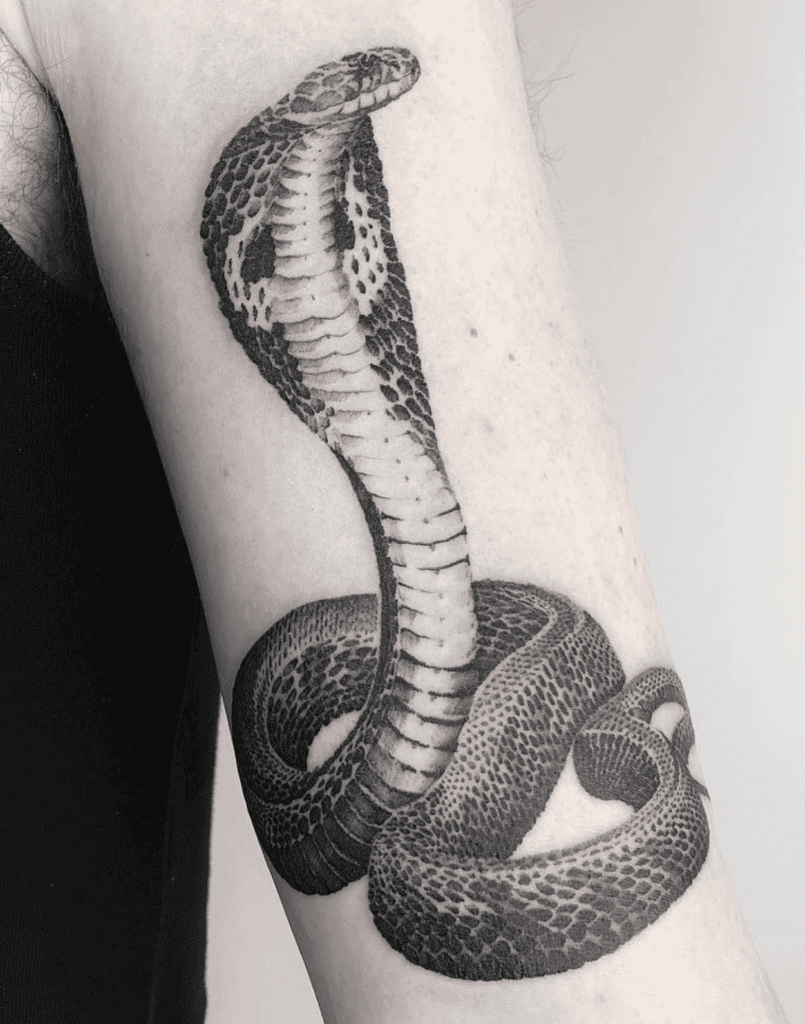
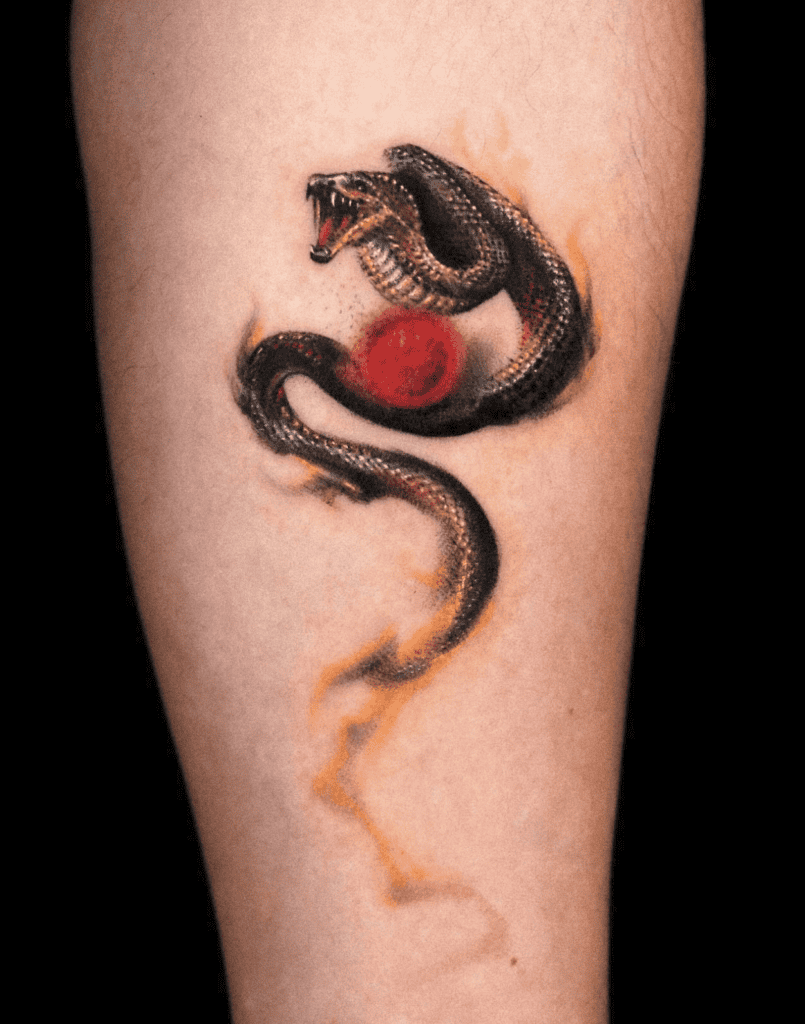
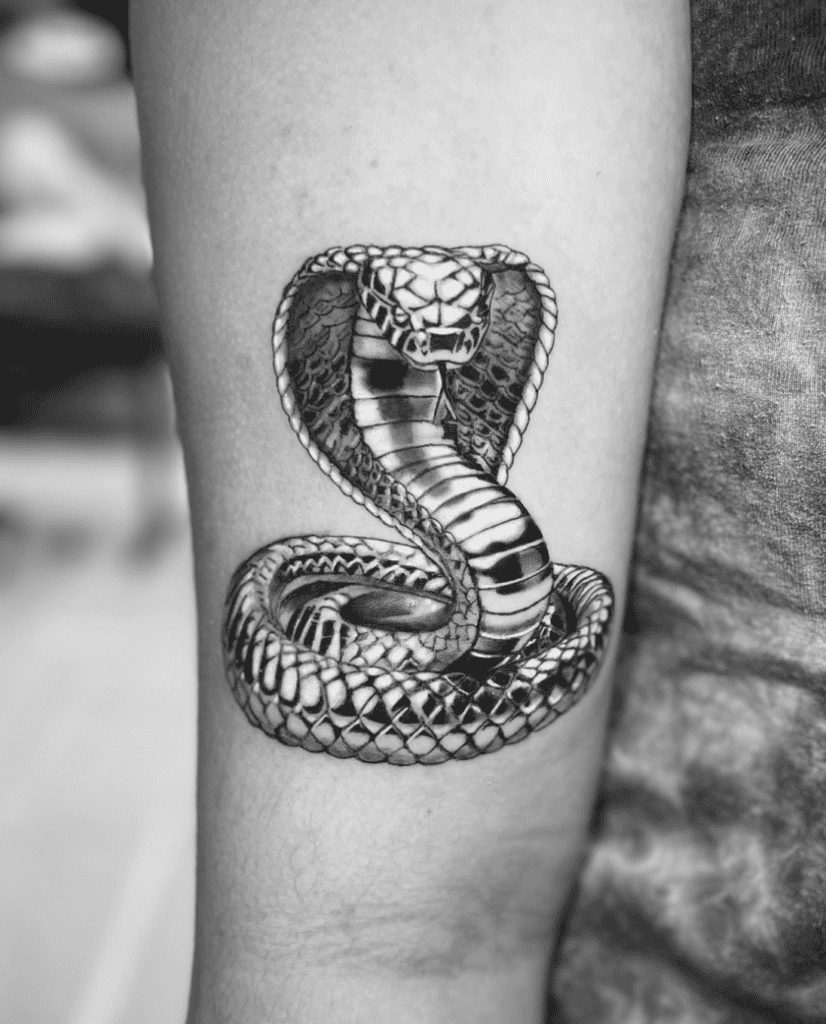
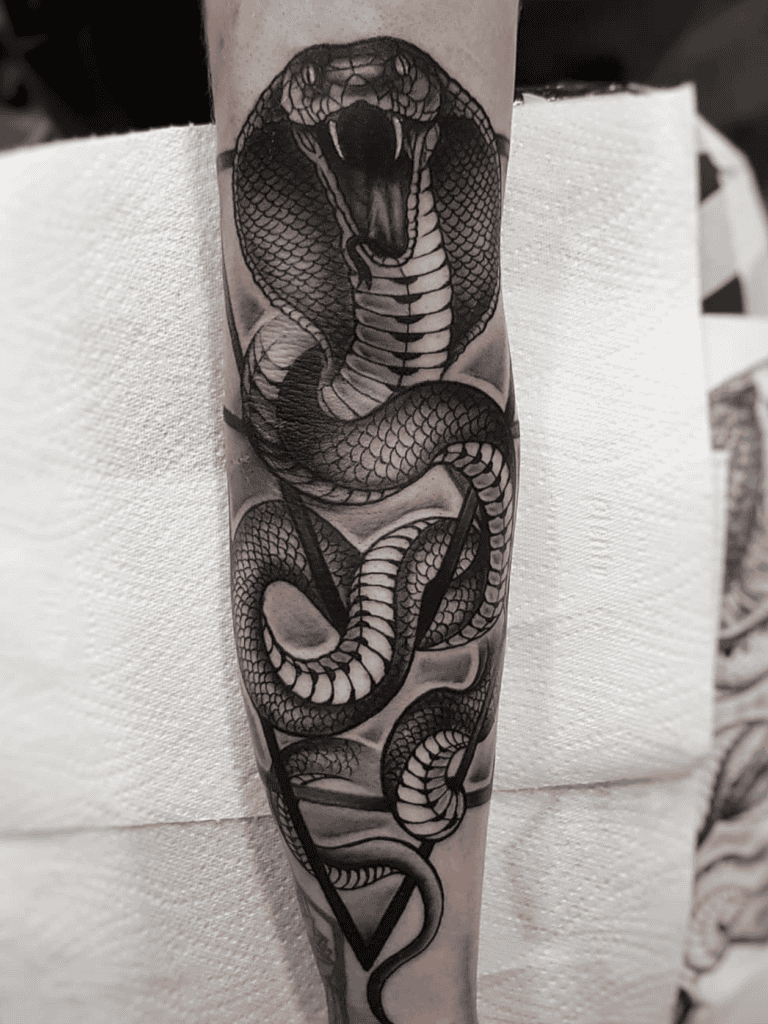
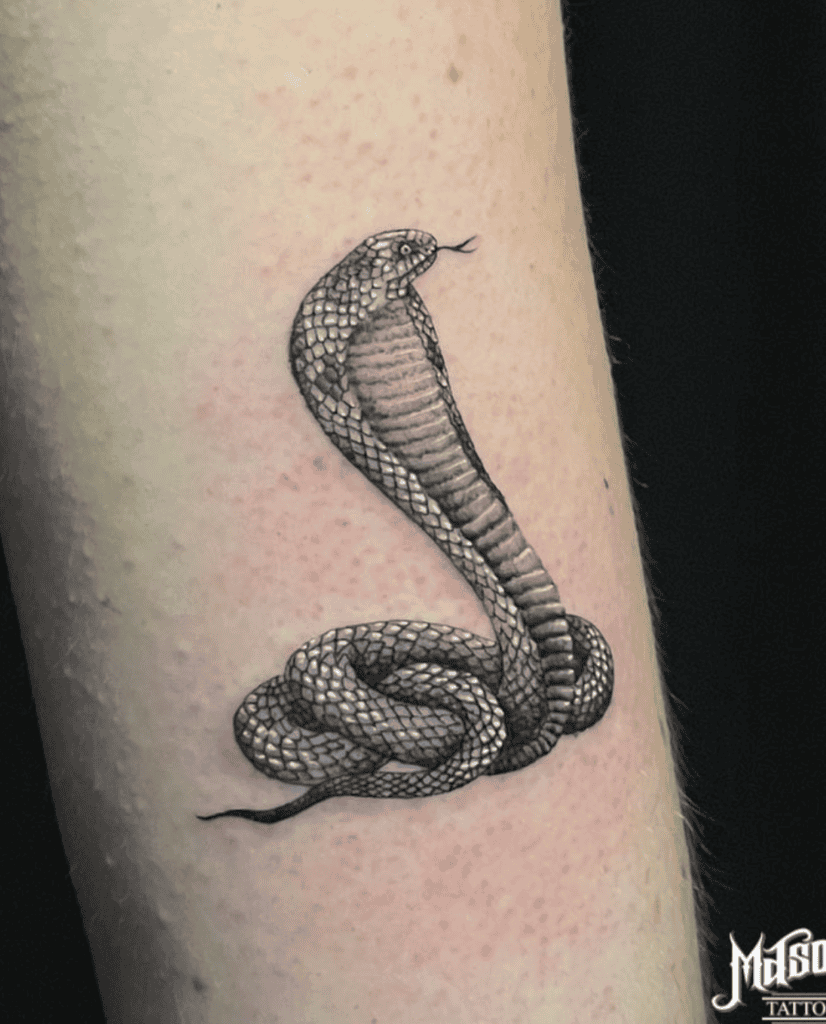
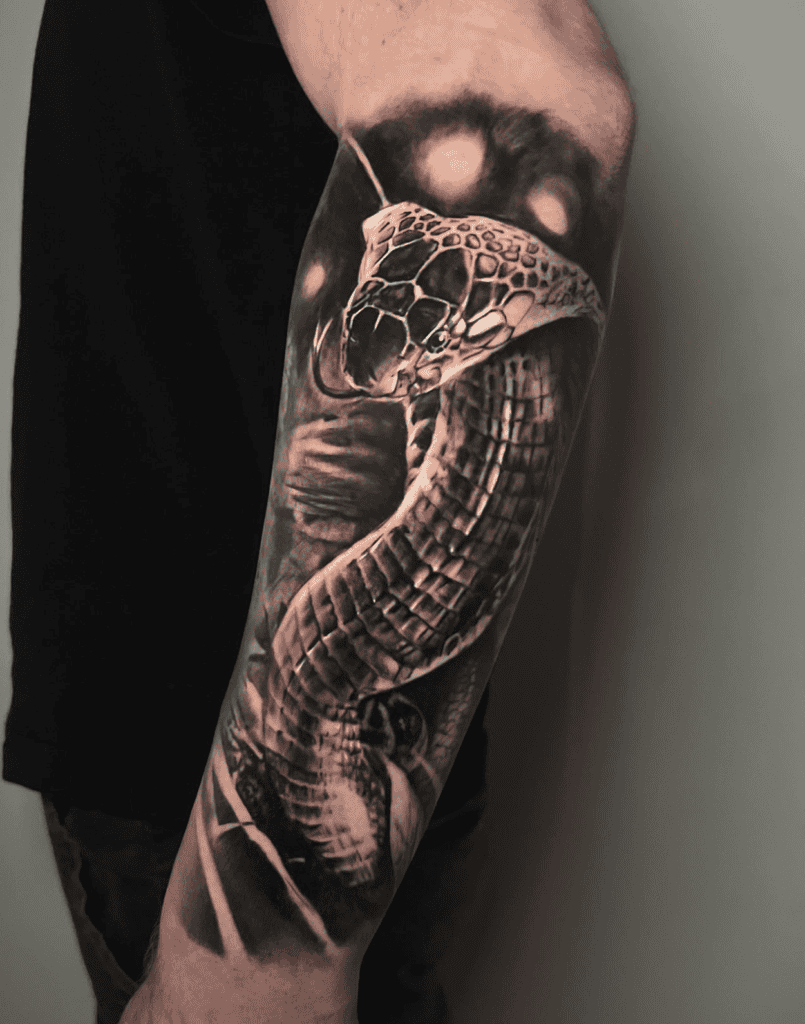
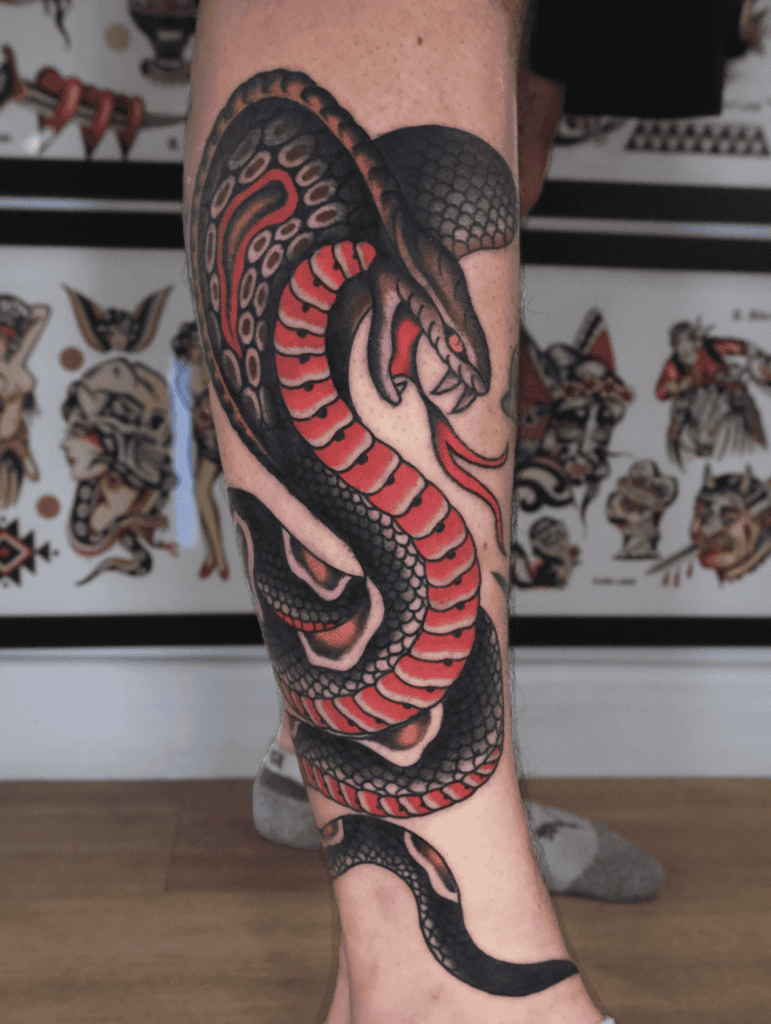
The King cobra is the longest venomous snake on Earth, reaching lengths of up to 5.5–6 metres (18–20 feet) in rare cases. Despite its name, it is not a true cobra species, but belongs to its own genus because it has unique traits that set it apart. Unlike most snakes that eat rodents or birds, the King cobra primarily eats other snakes and occasionally lizards, earning it the scientific name Ophiophagus, which literally means “snake eater.”
The venom of the King cobra is primarily neurotoxic, and while it is not the most toxic per drop compared to some other snakes, it is delivered in very large quantities, capable of causing paralysis and stopping its victims breathing. King can recognise movement patterns, build nests, with females guarding their eggs aggressively. They can be found across India, southern China, and Southeast Asia including Thailand, Vietnam, Malaysia, and Indonesia.
Indian Cobra Snake Tattoo
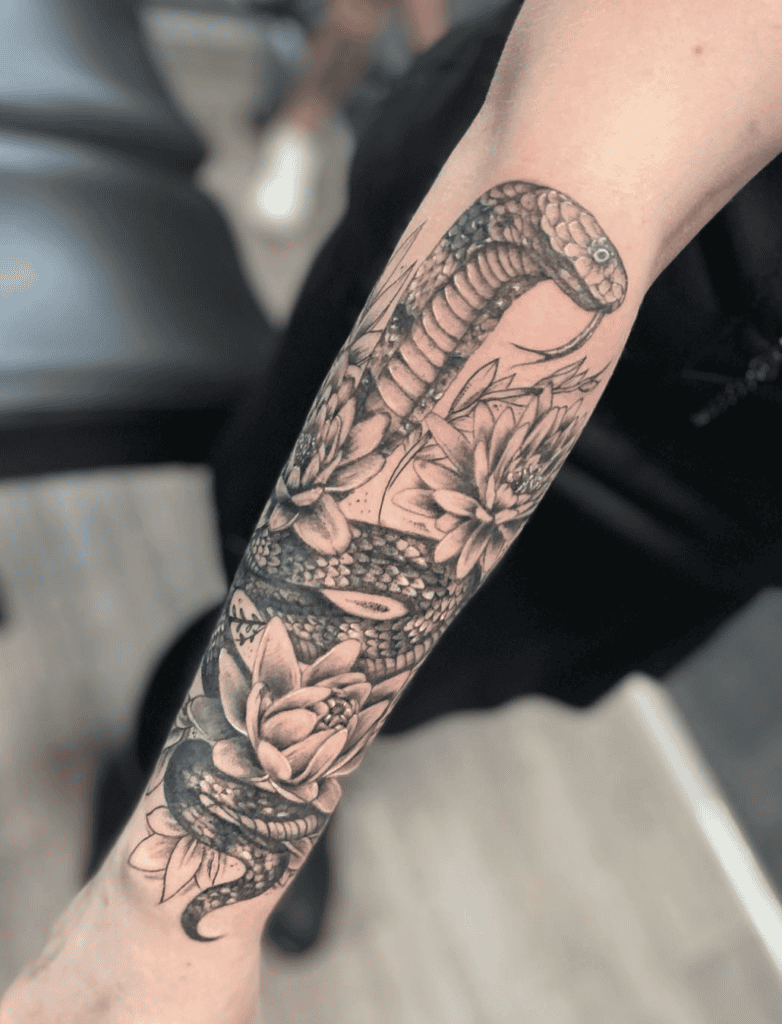
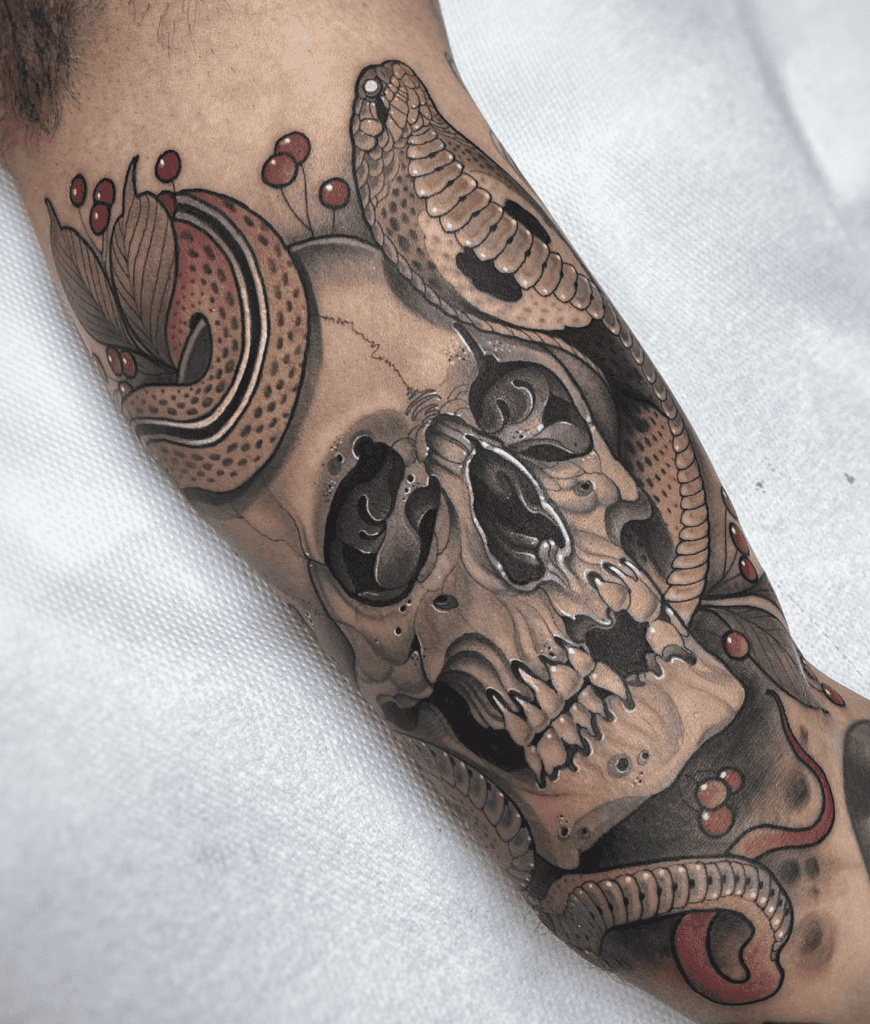
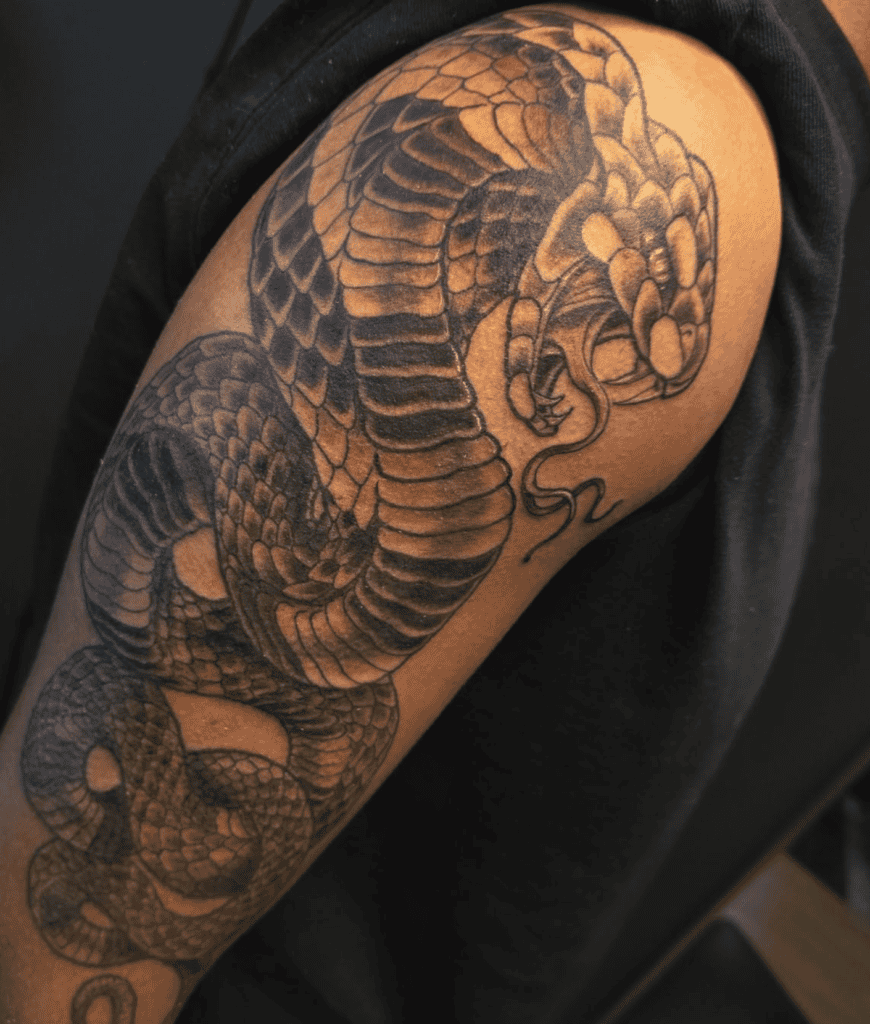
The Indian cobra is a highly venomous cobra species native to South Asia, being one of the “Big Four” snakes responsible for most snakebite cases in India. It’s also one of the most culturally significant snakes in the world, especially in Hindu traditions.
The Indian cobra produces neurotoxic venom, which affects the nervous system. Bites will cause difficulty breathing, muscle paralysis, and vision problems. However, most bites happen when it is accidentally stepped on or provoked, and antivenom is widely available in its native range.
The Indian cobra is found across India, Pakistan, Sri Lanka, Bangladesh and Nepal. It’s very adaptable, which is why humans often encounter it, but despite its reputation, this snake is usually shy and cautious, quick to flee and defensive only when cornered.
Black Mamba Snake Tattoo
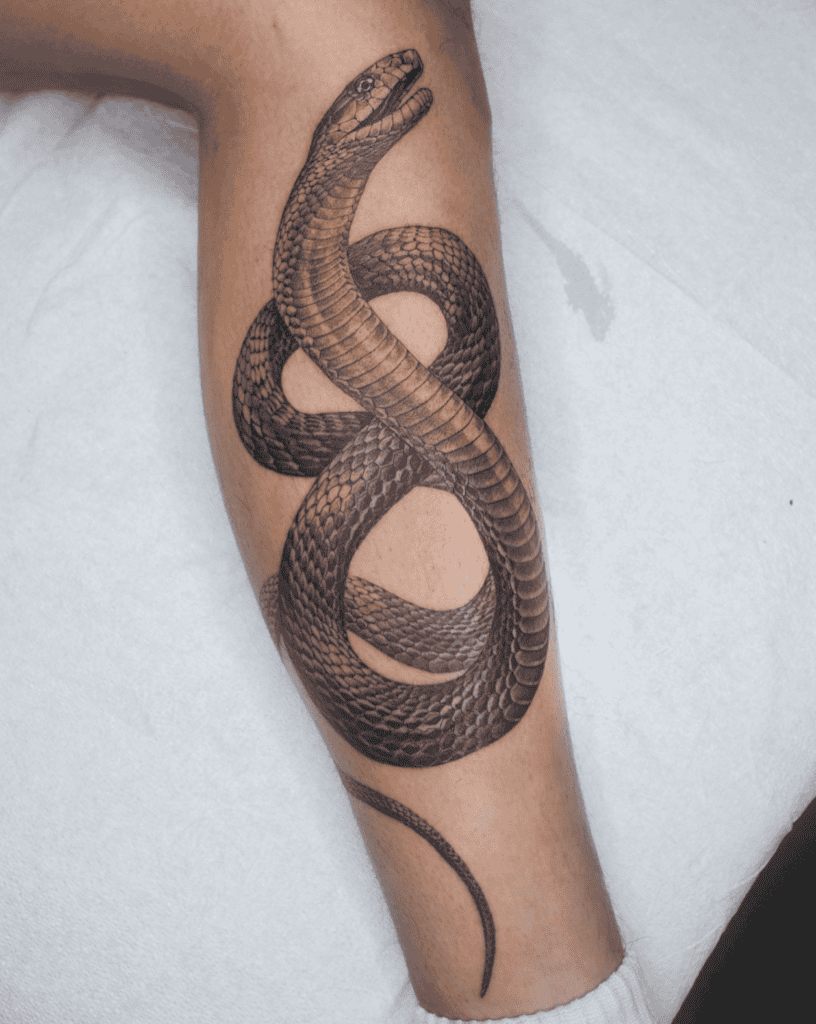
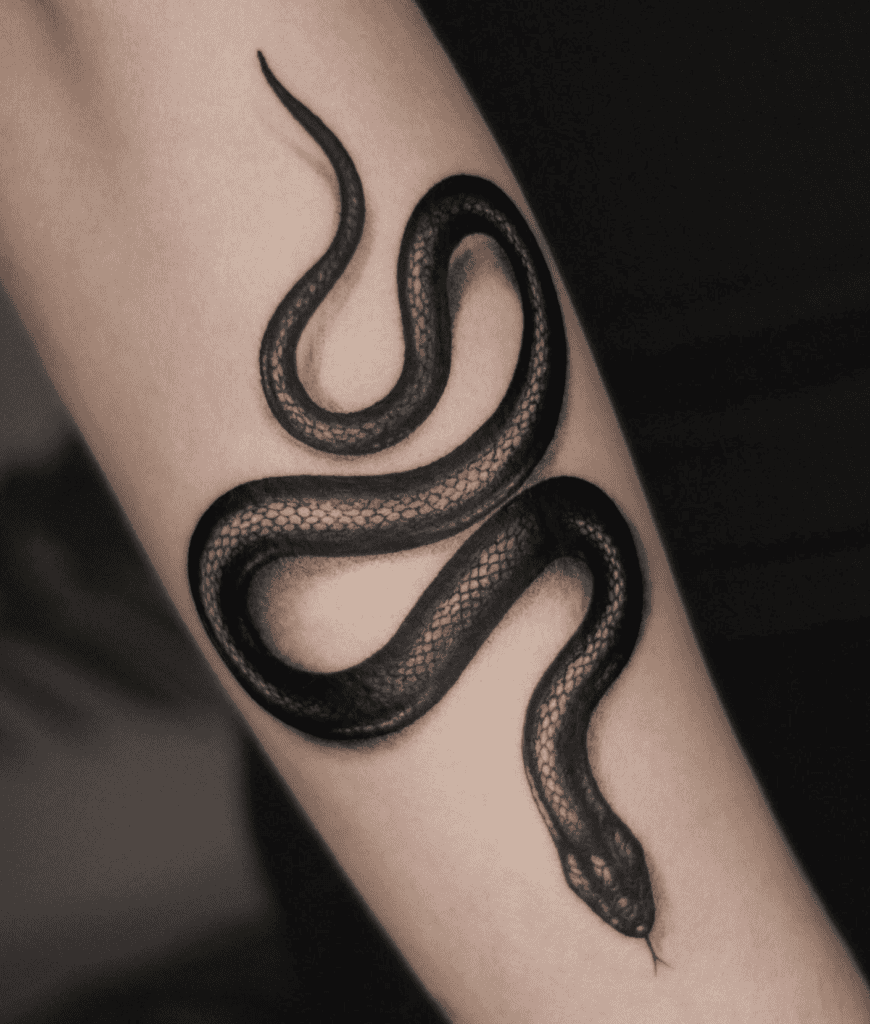
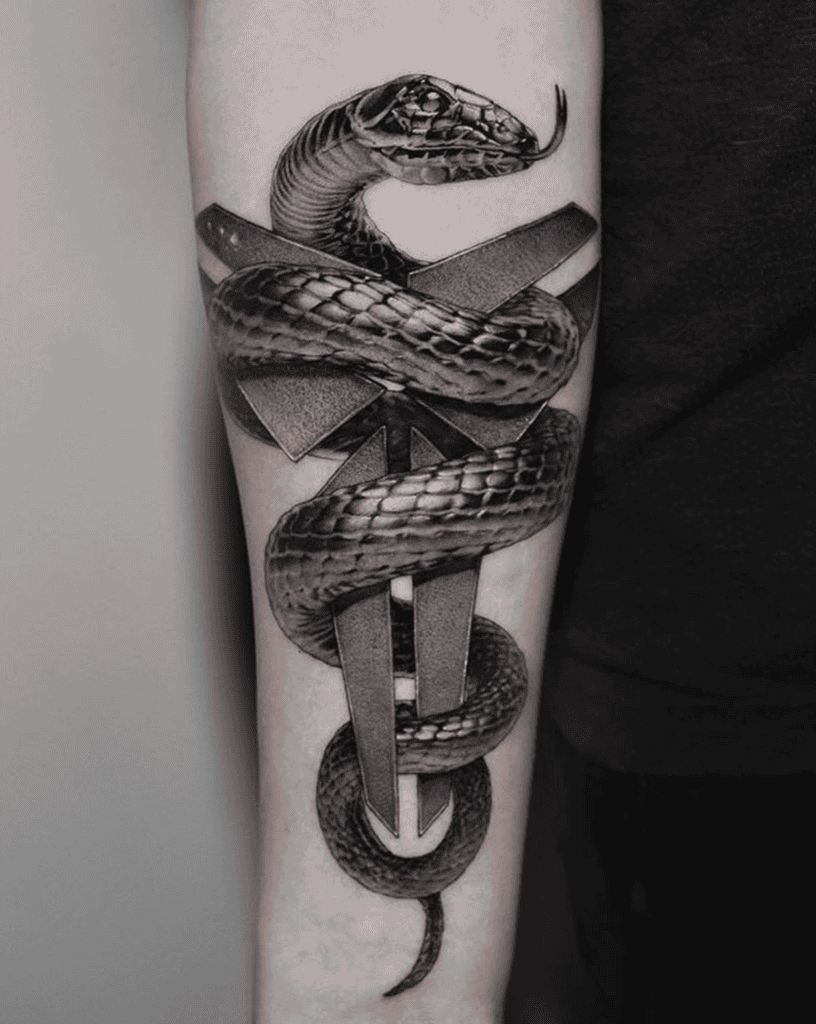
The Black mamba is a highly venomous snake native to sub-Saharan Africa, widely considered one of the most dangerous snakes in the world. The “black” in its name refers to the inky dark colour inside its mouth, which it displays when threatened.
The black mamba has built a legendary reputation because of extreme speed, highly potent neurotoxic venom, aggressive defensive display when threatened, and ability to strike multiple times quickly It can move at speeds of up to 20 km/h (12 mph) over short distances.
The venom of the black mamba is neurotoxic, being fast-acting and extremely potent. Without treatment, a bite can lead to paralysis, respiratory failure and death within hours in severe cases. The Black mamba is found across Kenya, Tanzania, Mozambique, South Africa, Zimbabwe, Botswana, and Namibia, prefering savannas, rocky hills, and woodland areas.
Green Mamba Snake Tattoo
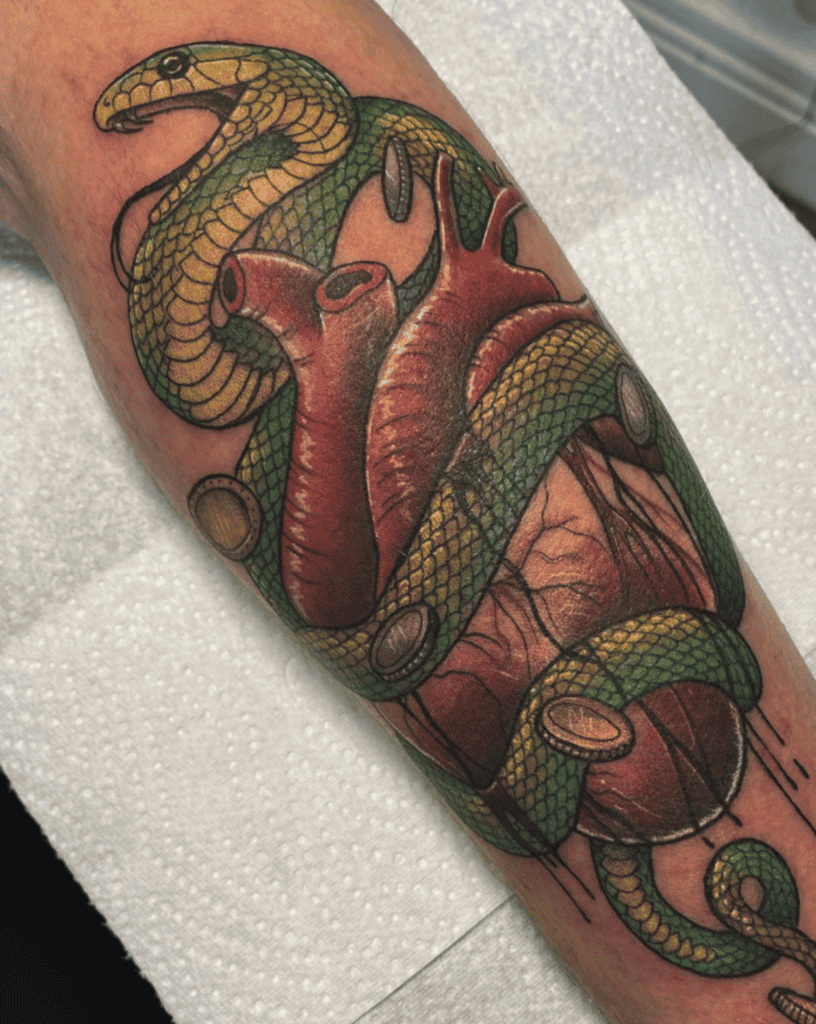
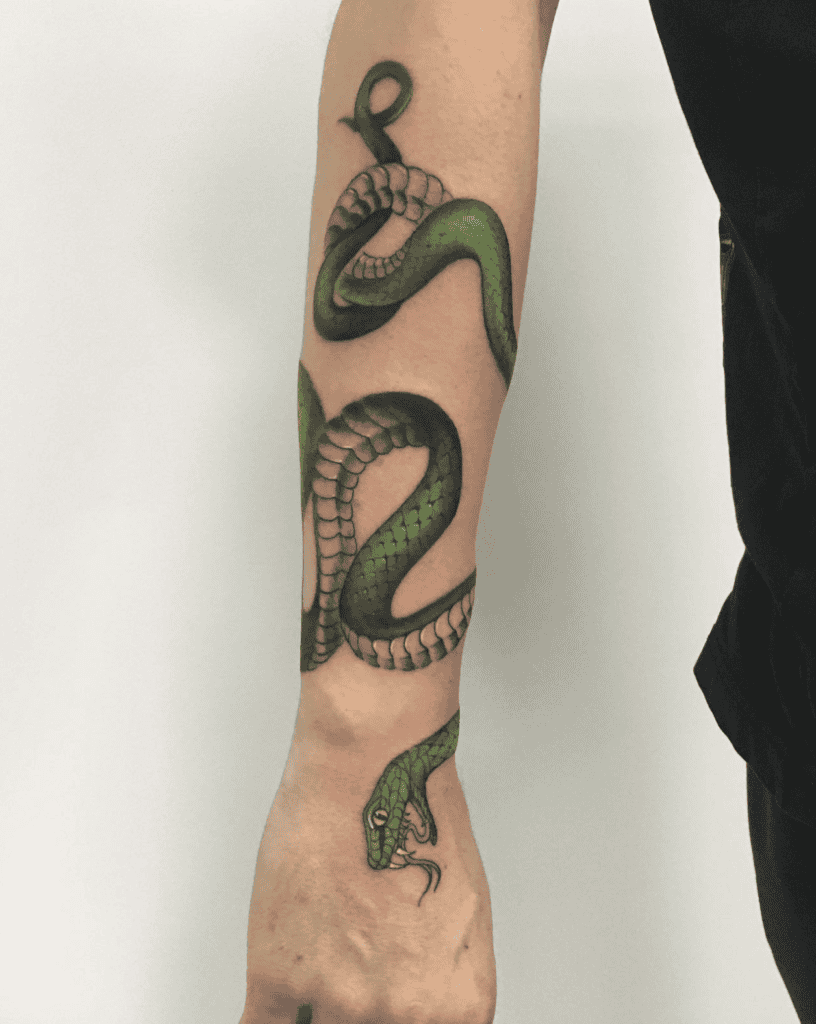
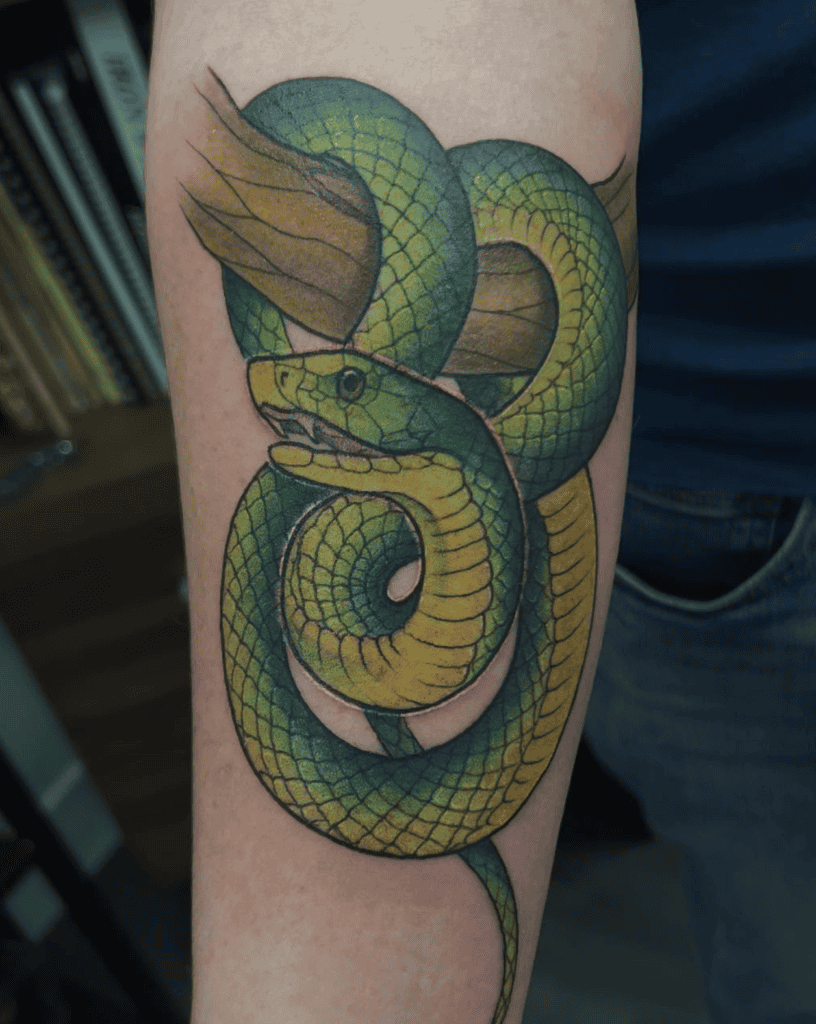
The Green mamba is a highly venomous, arboreal snake native to East Africa, which is closely related to the black mamba, but behaves very differently. The green mamba gets its name from its bright emerald-green colour, leaf-like camouflage, and tree-dwelling lifestyle. This colouring helps it blend perfectly into dense coastal forests and tropical vegetation.
The Green mamba is found in Kenya, Tanzania, Mozambique, Malawi, and eastern South Africa. It is very shy and elusive, excellent at hiding in foliage, fast-moving in trees, and rarely seen by humans. They avoid confrontation completely, staying motionless when threatened, and escape quietly instead of displaying aggressively. It is considered less dangerous in terms of encounters, even though its venom is still very potent.
Eastern Diamondback Rattlesnake Tattoo
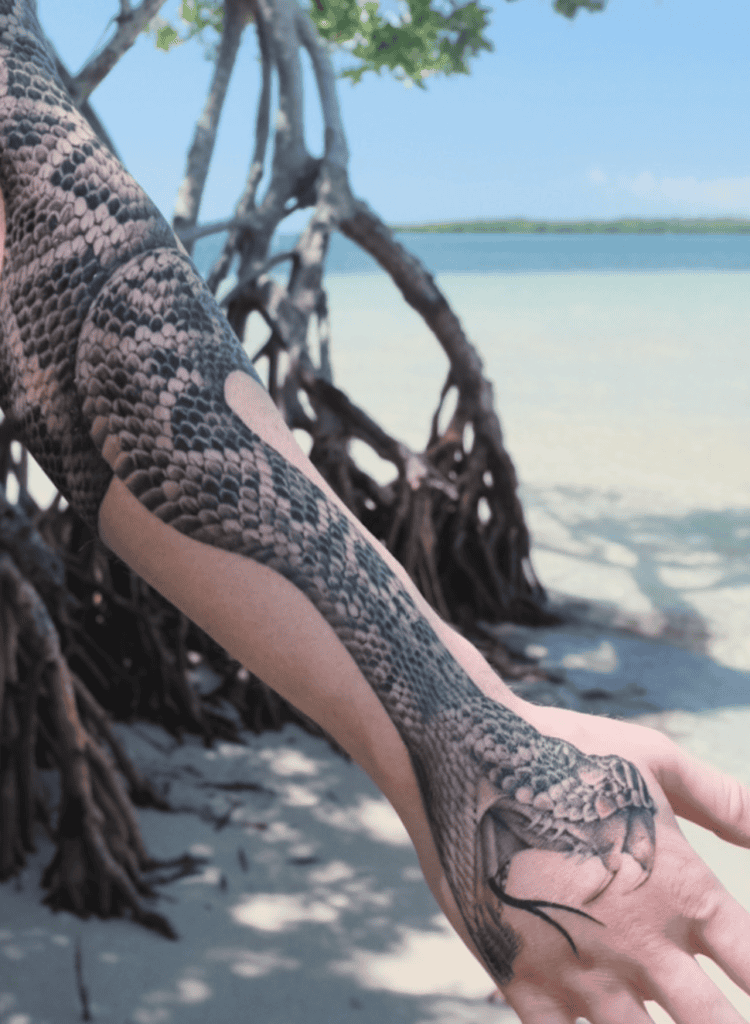
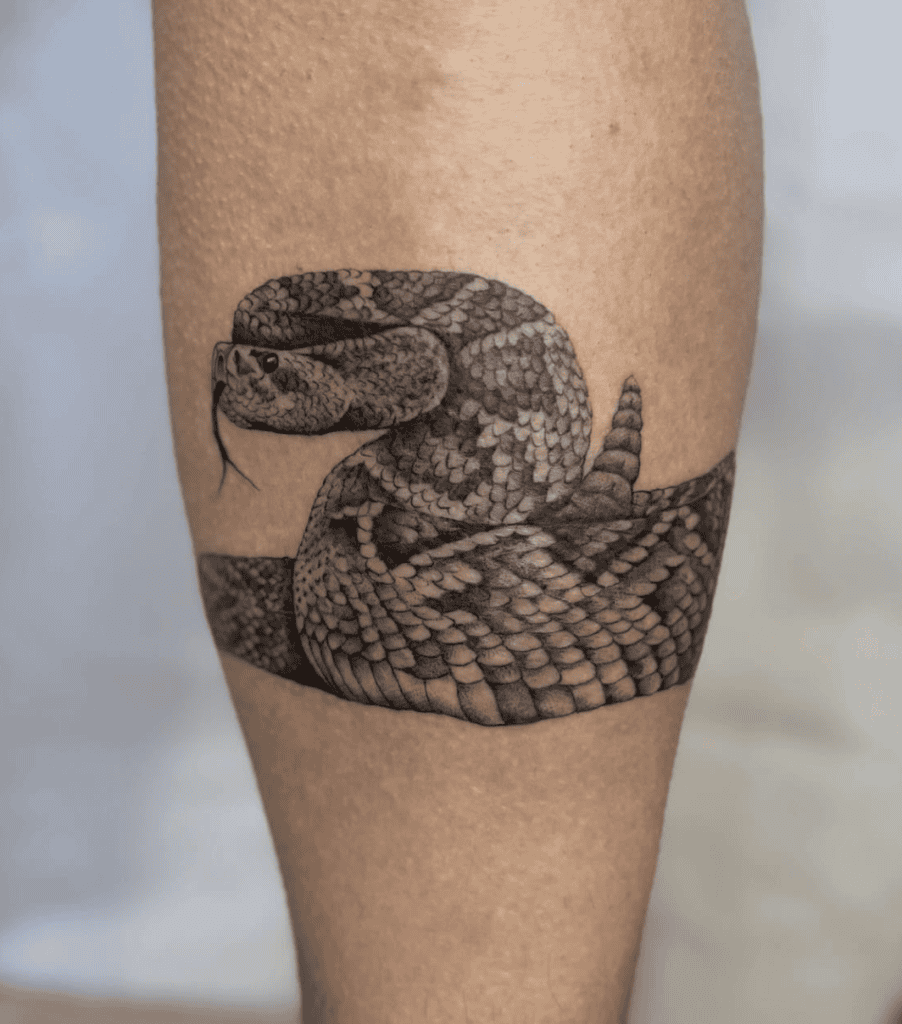
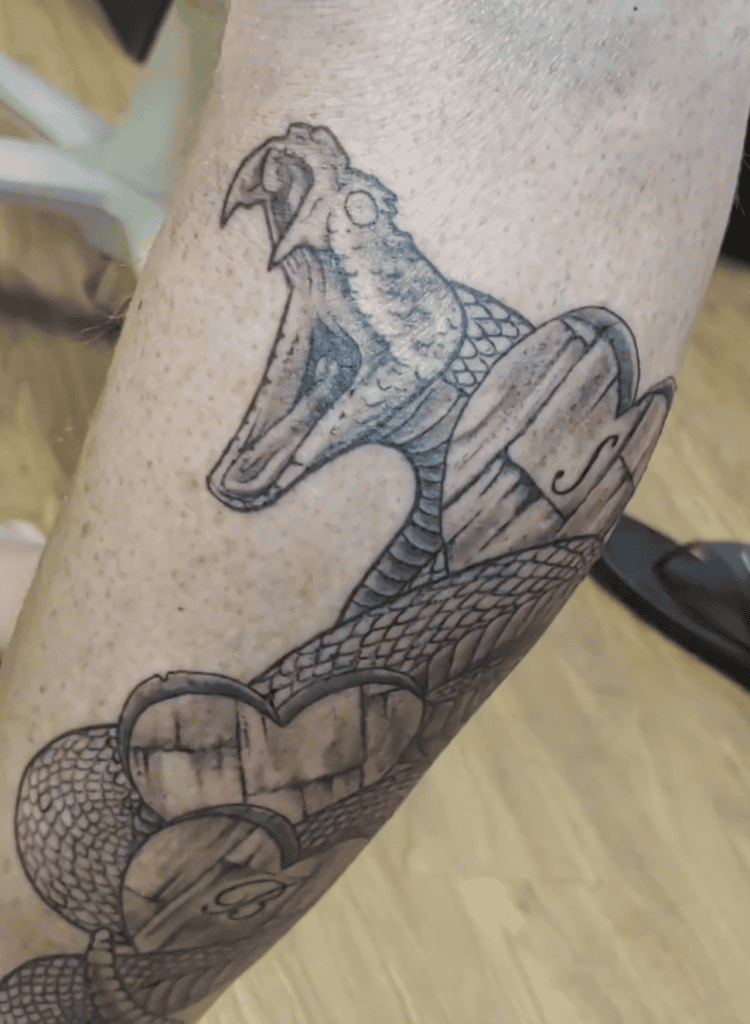
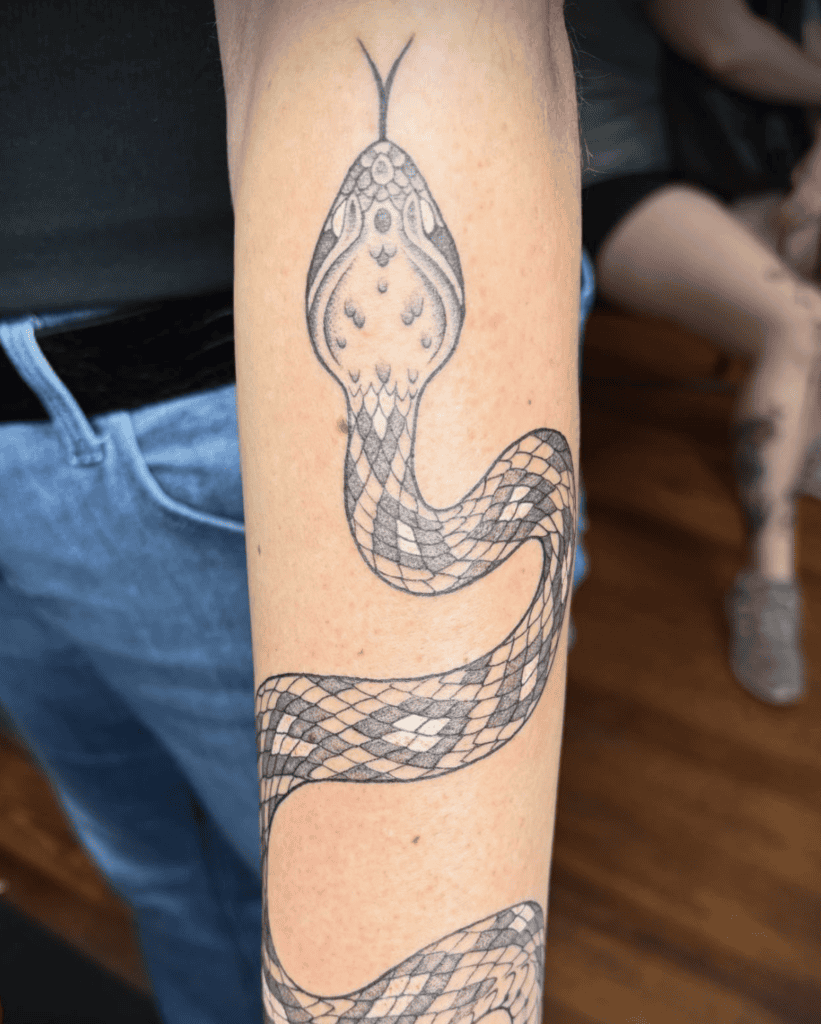
The Eastern diamondback rattlesnake is a large, heavy-bodied pit viper native to the southeastern United States. It’s often seen as the “classic rattlesnake” of American wilderness imagery, famous for being the largest rattlesnake species in the world.
The Eastern diamondback rattlesnake is found in Florida, Georgia, Alabama, Mississippi, and South Carolina, where it prefers, pine forests, sandy coastal plains, dry grasslands, and scrub habitats. This snake has hemotoxic venom, which affects the blood and tissue. Effects can include severe pain, swelling and tissue damage, blood clotting issues, and is possible fatal without treatment.
The rattle of the Eastern diamondback is made of interlocking keratin segments. It uses it to warn predators and avoid unnecessary conflict. When it vibrates its tail, it produces a loud buzzing sound that can be heard from a distance.
Western Diamondback Rattlesnake Tattoo
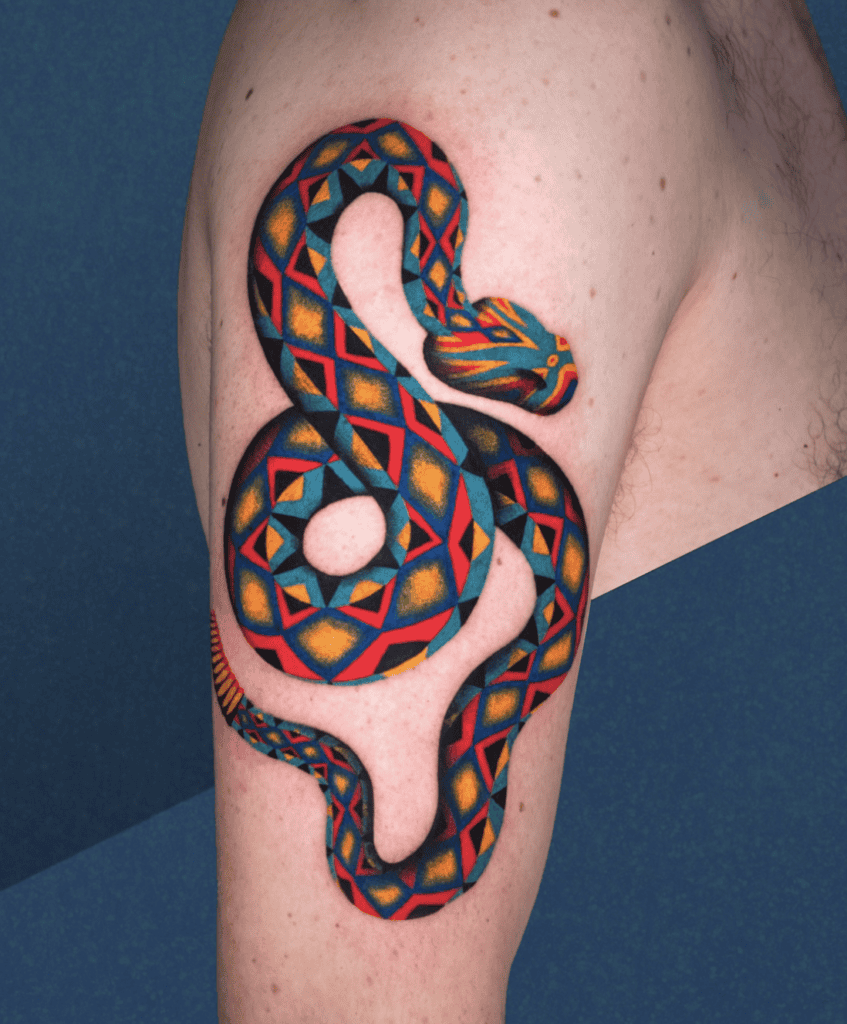
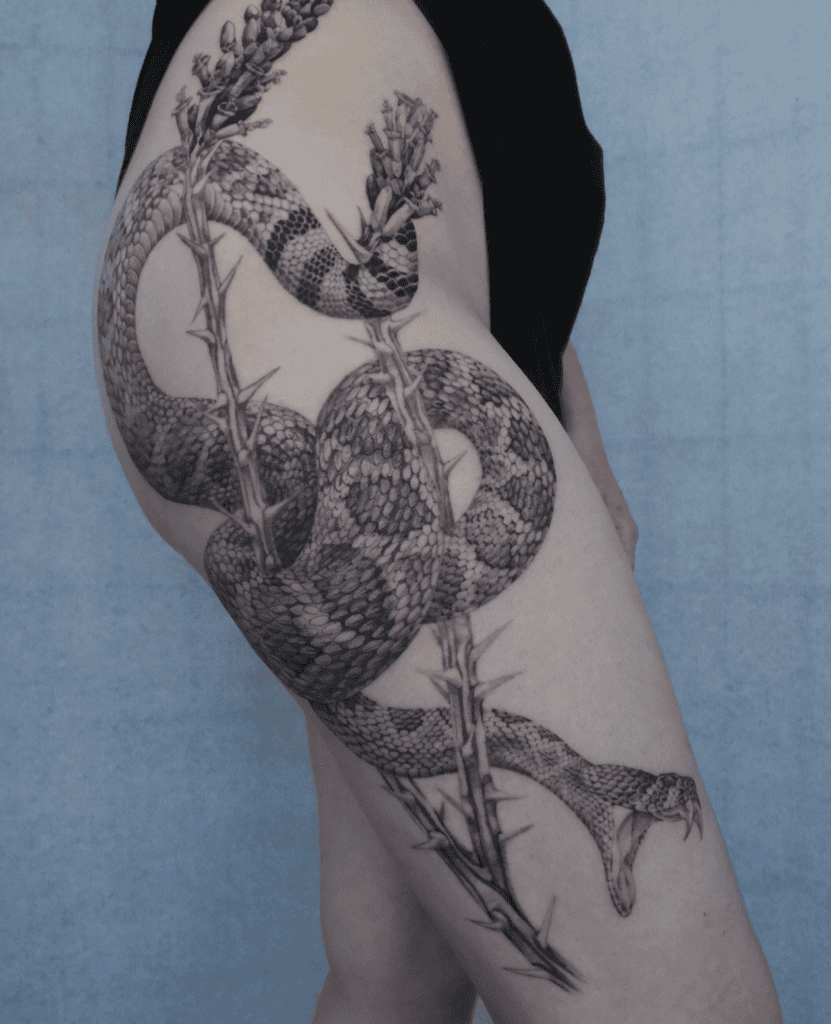
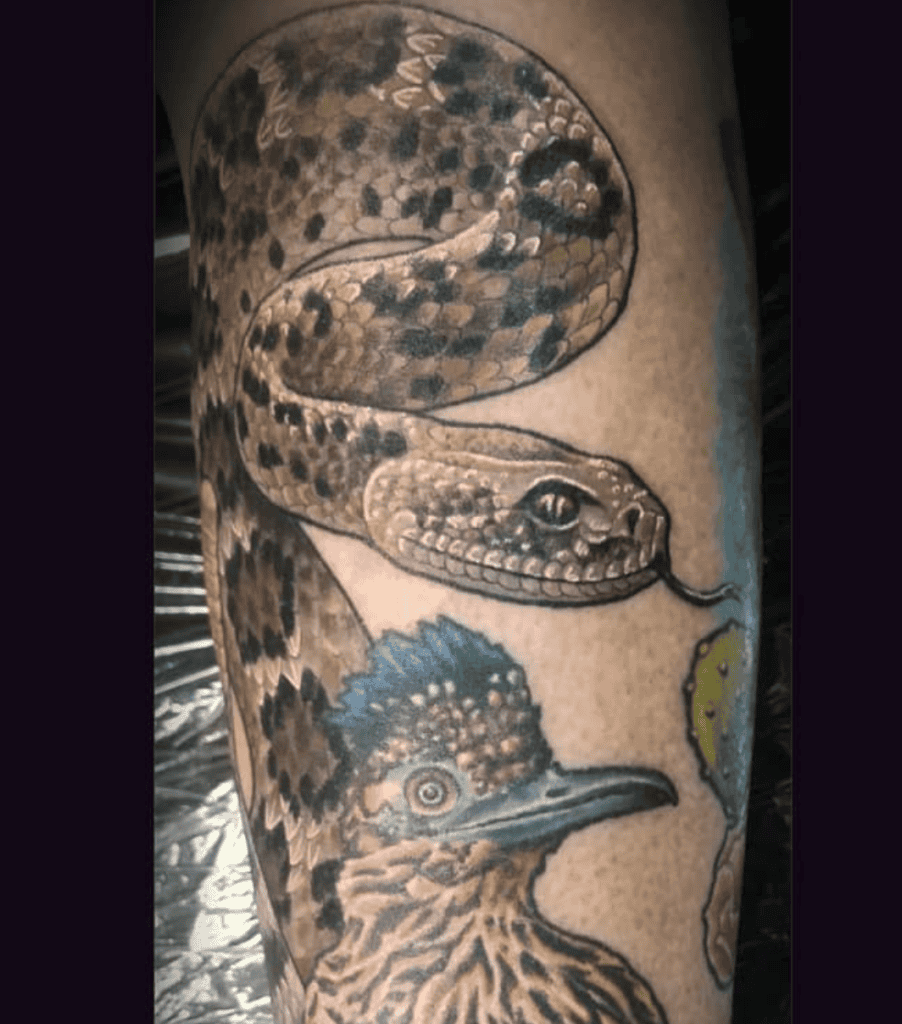
The Western diamondback rattlesnake is a large pit viper native to the southwestern United States and northern Mexico, and is one of the most frequently encountered rattlesnakes in North America. Tis snake species is iconic because of its loud, unmistakable rattle, its striking dark diamond pattern, and for being responsible for many snakebite incidents in its range.
The Western diamondback rattlesnake is found in Texas, Arizona, New Mexico, Oklahoma, Southern California, and Northern Mexico. This species has hemotoxic venom, which affects the blood and tissue. Effects can include intense pain, swelling and bruising, tissue damage, and blood clotting issues.
Mexican West Coast Rattlesnake Tattoo

Mexican West Coast Rattlesnake is one of the largest rattlesnakes in Mexico and is sometimes nicknamed the “Mexican Giant Rattlesnake. It is one of the biggest rattlesnakes in the world, typically being about 1.2–1.8 metres, with larger individuals growing to over 2 metres.
This species is found along Mexico’s Pacific coast, particularly in Sinaloa, Nayarit, Jalisco, and Sonora. Unlike some desert rattlesnakes, it often inhabits areas with seasonal vegetation and forest cover.
Mexican West Coast Rattlesnake possesses potent venom that is primarily hemotoxic, though the exact composition can vary. The venom helps immobilise prey, begin digestion, and defend against predators. While dangerous, this snake generally prefers to avoid humans and will often rely on its rattle before striking.
Red Diamond Rattlesnake Tattoo

The Red Diamond Rattlesnake is a large pit viper native to the southwestern United States and northwestern Mexico. These snakes can be found in Southern California and Baja California, where they prefer coastal sage scrub, desert edges, rocky canyons, chaparral habitats, and semi-arid hillsides.
The red colouring is what makes this species special. Individuals can range from pinkish-tan, rust-red, brick-red, or orange-brown, helping them blend into red soils, rocky terrain, and dry vegetation.
The Red Diamond Rattlesnake possesses venom used to subdue prey and defend itself. Its venom is primarily hemotoxic and tissue-damaging. While bites are medically significant, this species is generally considered less dangerous than some of its larger relatives, such as the Western Diamondback Rattlesnake.
Timber Rattlesnake Tattoo
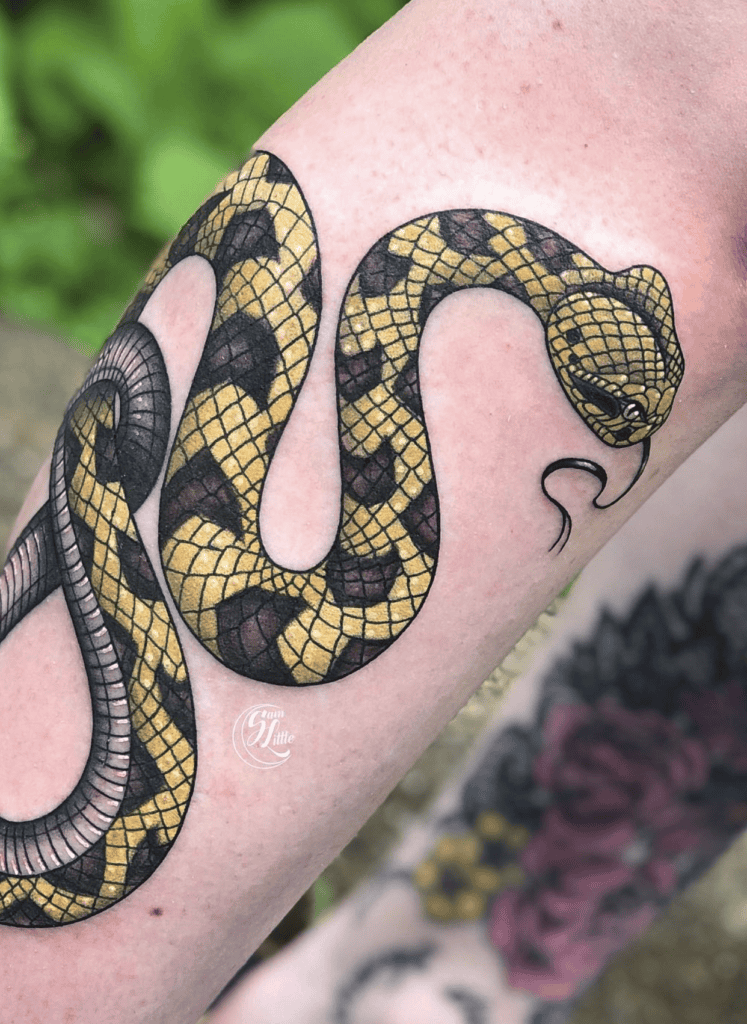
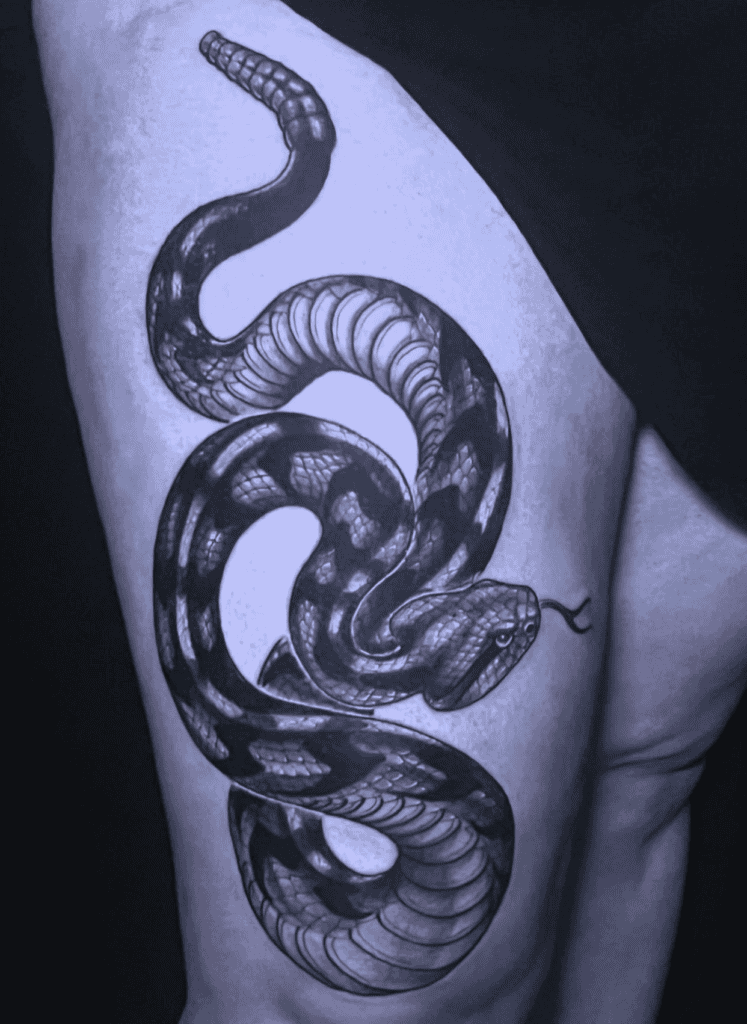
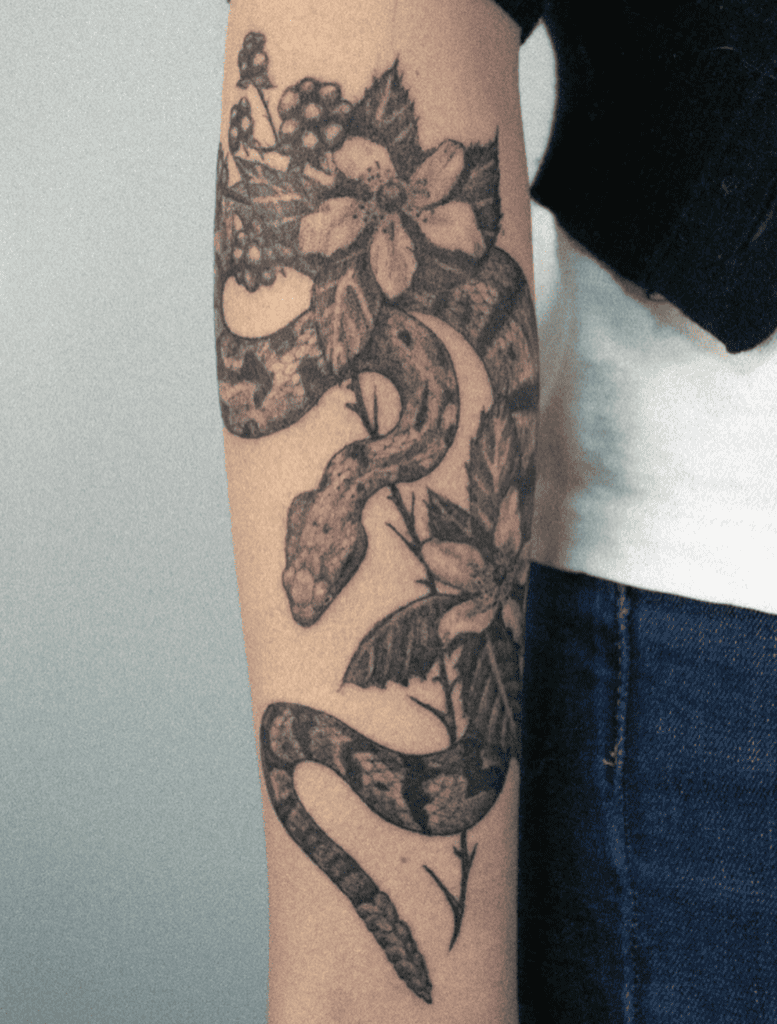
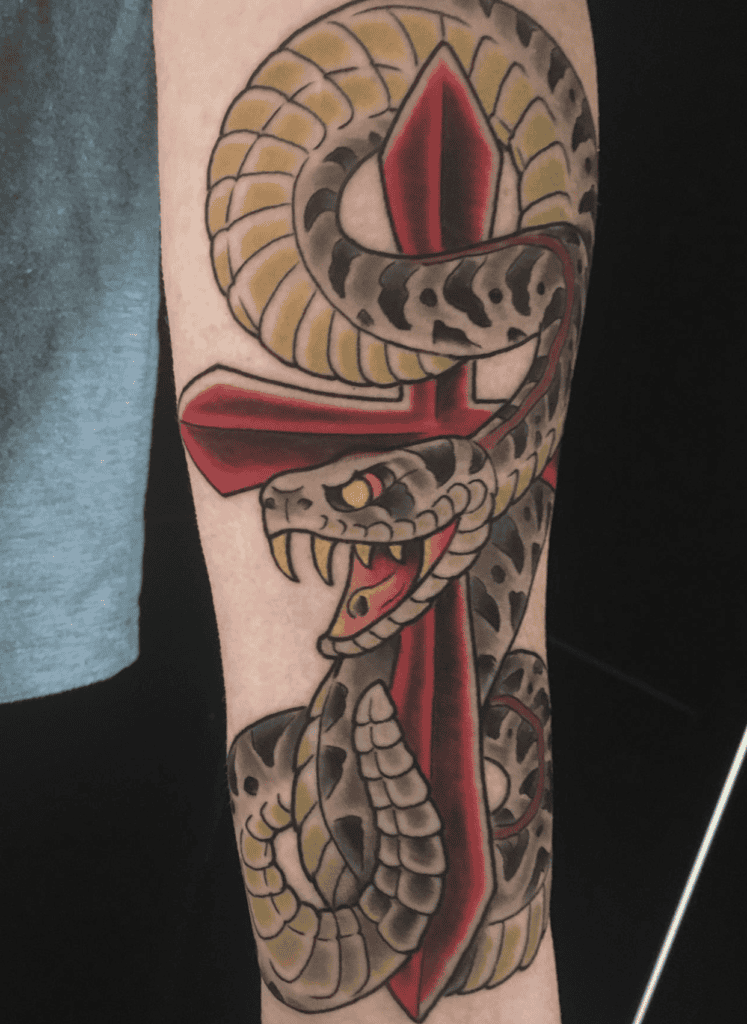
The Timber Rattlesnake is a large pit viper found throughout much of the eastern United States, often considered one of the more docile rattlesnake species when left undisturbed. Its scientific name, horridus, means “terrifying” or “dreadful,” though its behaviour is usually much calmer than the name suggests!
The Timber Rattlesnake has one of the largest ranges of any rattlesnake, capable of being found in the eastern United States, the Appalachian Mountains, the Great Lakes region, northeastern forests, and parts of the Southeast. Unlike desert rattlesnakes, this species is strongly associated with forests and mountains.
One of the most beautiful features of the Timber Rattlesnake is its camouflage. The snake typically has tan, grey, yellow, or brown background colours, dark chevron-like crossbands, a dark tail, and reddish or rust-coloured stripes down the back in some individuals.
The Yellow Phase Timber Rattlesnake has a yellow, gold, or tan body with dark bands. It is common in many northern populations, while the Black Phase has a much darker appearance with a pattern that may be difficult to see, being more common in some mountainous regions.
Timber Rattlesnake possesses potent venom that varies somewhat between populations. Its venom may contain Hemotoxic components and Tissue-damaging compounds, with Neurotoxic elements in some populations. While bites are medically serious, the species is not known for seeking confrontation.
Ball Python Snake Tattoo
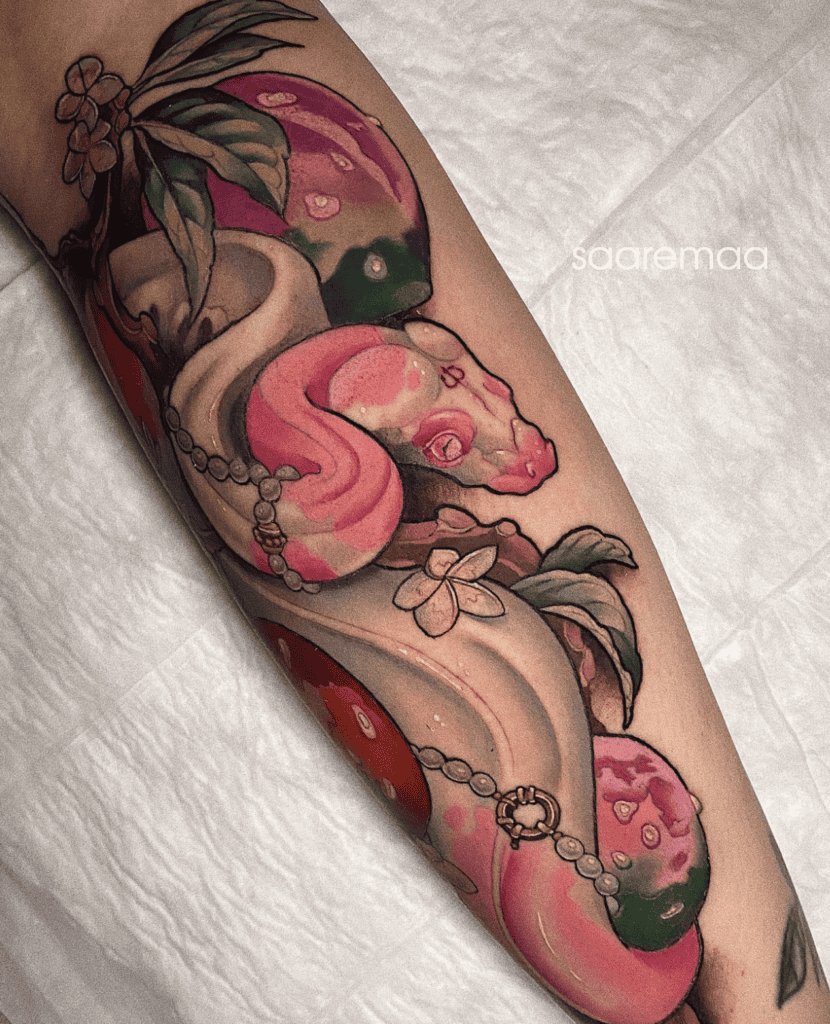
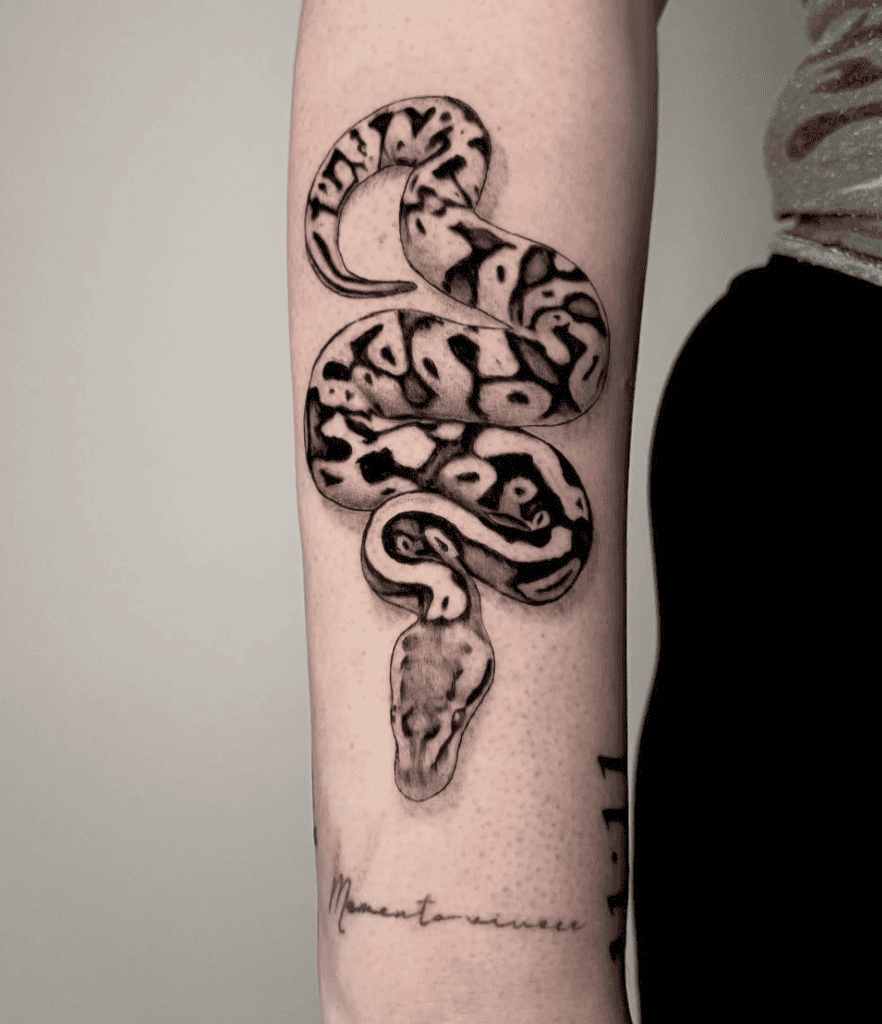
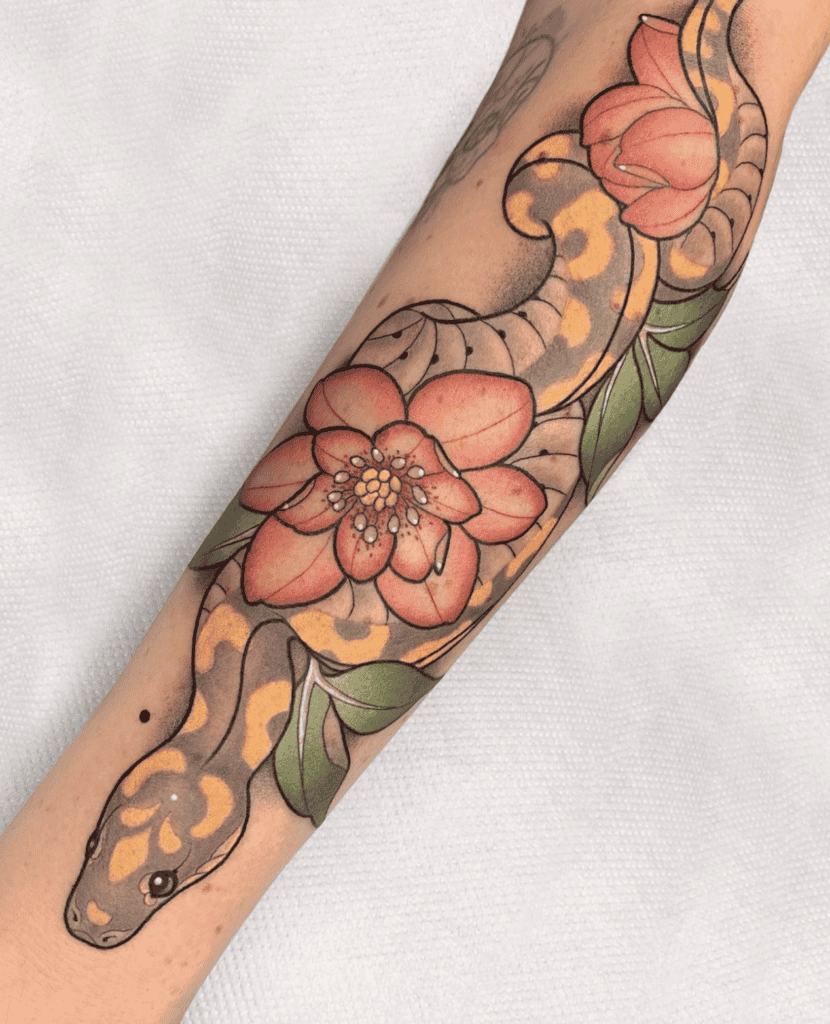
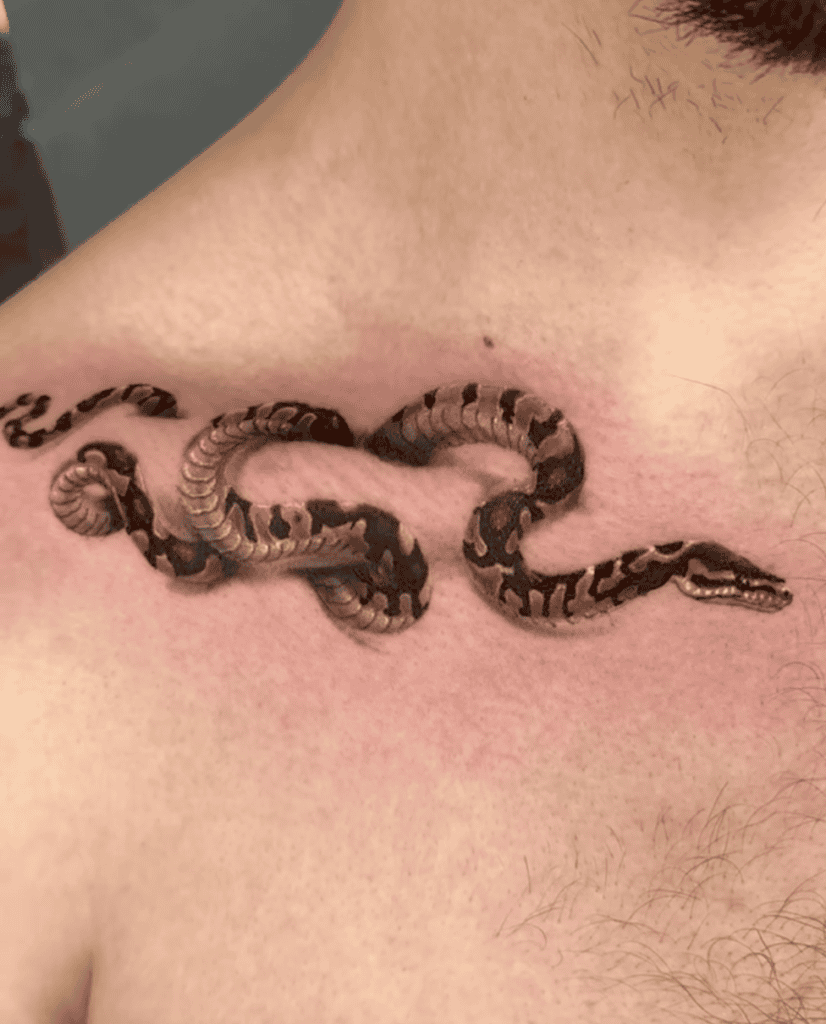
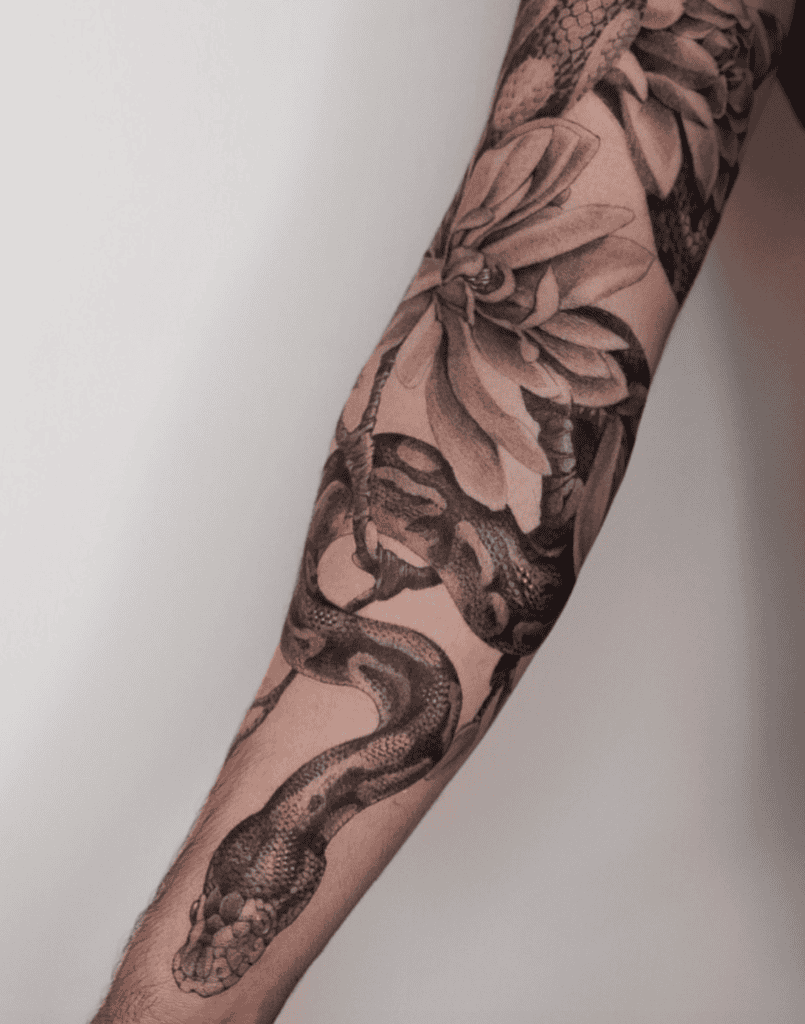
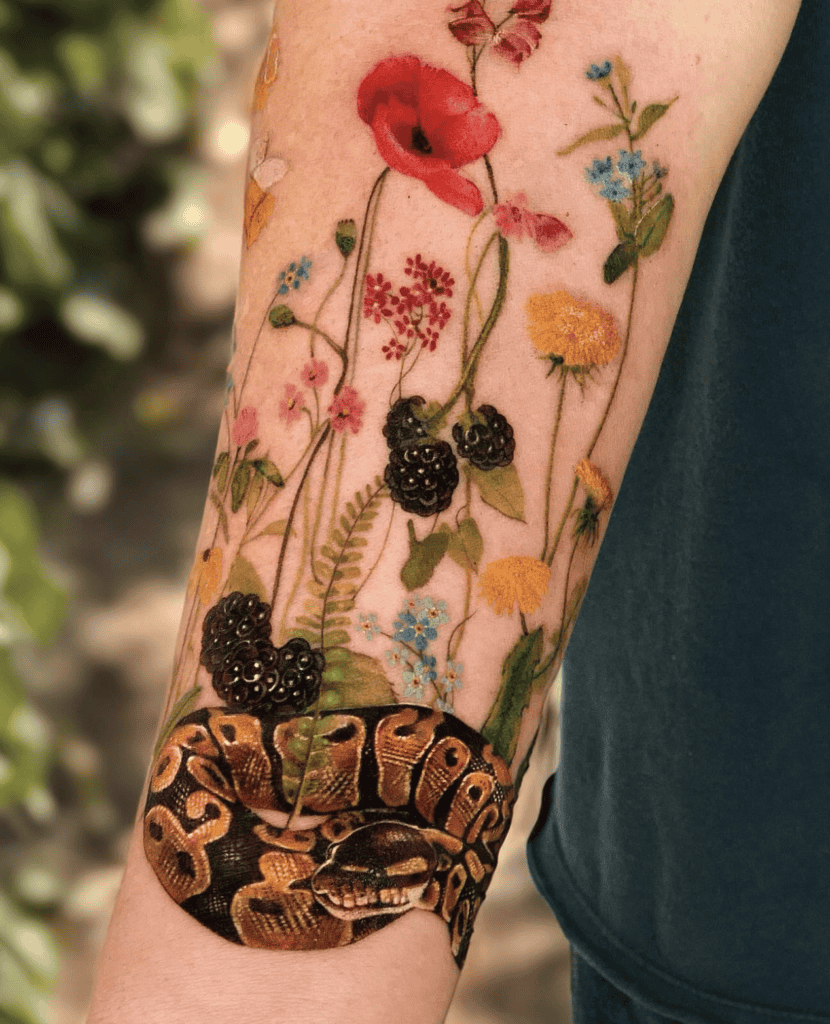
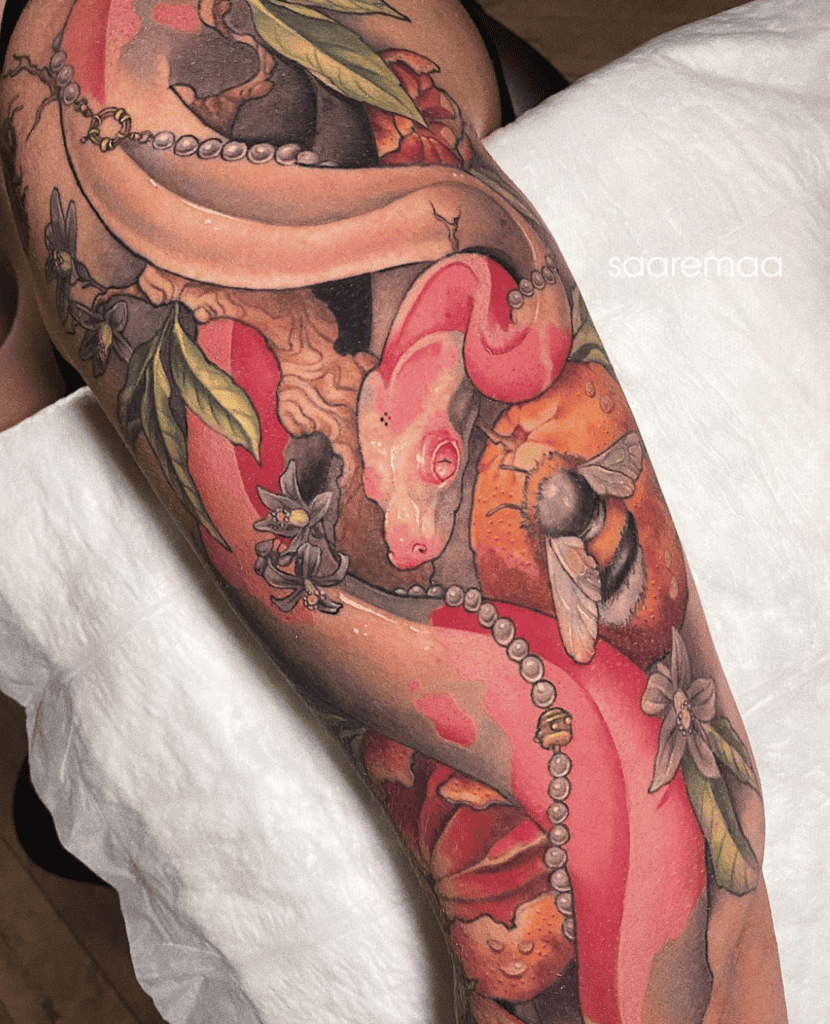
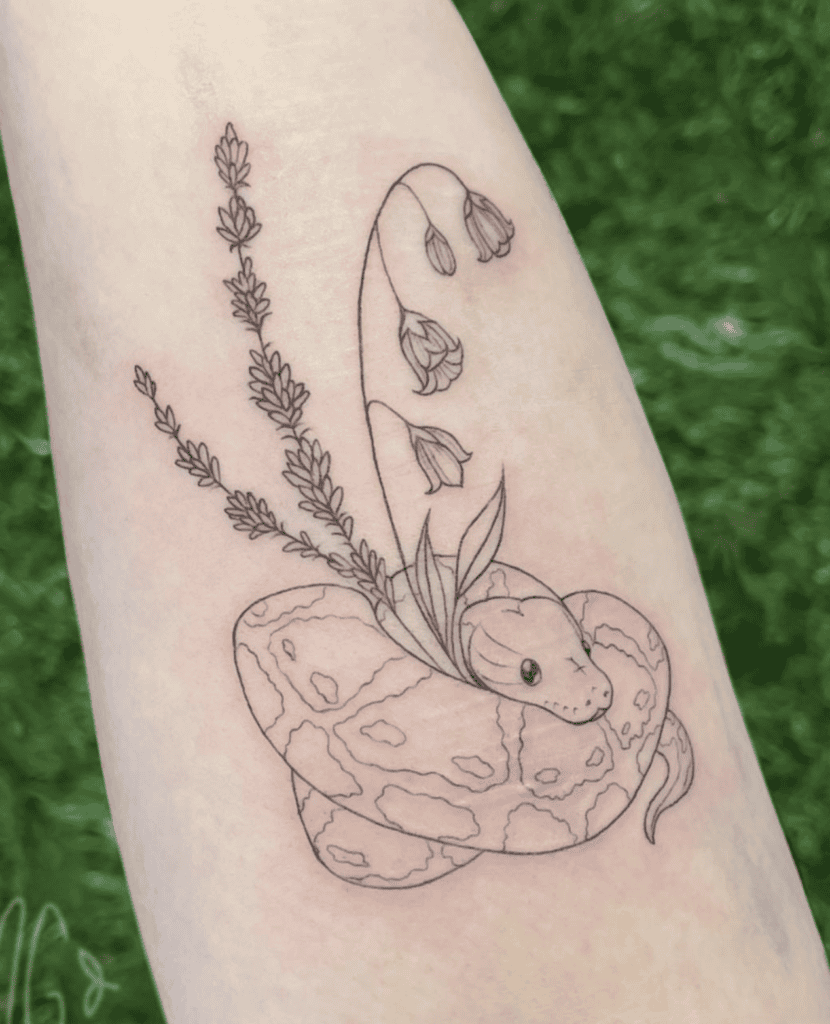
The Ball Python is a non-venomous constrictor native to West and Central Africa. It is famous for its calm temperament and unique defensive behaviour. When frightened, instead of striking, it often curls into a tight ball with its head protected in the centre.
Ball pythons are found across Ghana, Togo, Benin, Nigeria, Cameroon, and other parts of West and Central Africa. They spend much of their time hidden in burrows, hollow logs, or abandoned termite mounds.
Ball pythons are famous for their incredible variety of captive-bred colour morphs. Some popular examples include albino, pied, banana, clown, mojave, blue-eyed leucistic, axanthic, and pastel. Today, there are hundreds of recognised morph combinations, making them one of the most diverse pet snake species.
Burmese Python Snake Tattoo


The Burmese Python is a non-venomous constrictor native to Southeast Asia. It belongs to the python family and is closely related to other giant snakes such as the Reticulated python and the Ball Python. Although it lacks venom, its sheer size and strength make it one of the most formidable snakes in the world.
The Burmese Python is gigantic, with large females growing to 5–6 metres (16–20 feet) and often weighing between 45–90 kg. Historically, Burmese pythons are native to Myanmar, Thailand, Vietnam, Laos, Cambodia, southern China, and parts of Indonesia.
Burmese pythons are known for their beautiful markings, with many breeders having developed many morphs similar to the Ball Python.
Reticulated Python Snake Tattoo


The Reticulated Python is a non-venomous constrictor found throughout Southeast Asia. The name “reticulated” comes from the Latin reticulum, meaning “little net”, referring to the snake’s complex, web-like markings.
The Reticulated Python is the longest snake on Earth, with larger individuals measuring over 6 metres, and exceptional specimens measuring over 7 metres. While the Green anaconda is generally heavier, the Reticulated Python is the longest living snake species known.
Reticulated pythons are found across Indonesia, Malaysia, Thailand, Vietnam, the Philippines, Myanmar, and Singapore. They are excellent swimmers and have even been observed travelling between islands.
Boa Constrictor Snake Tattoo
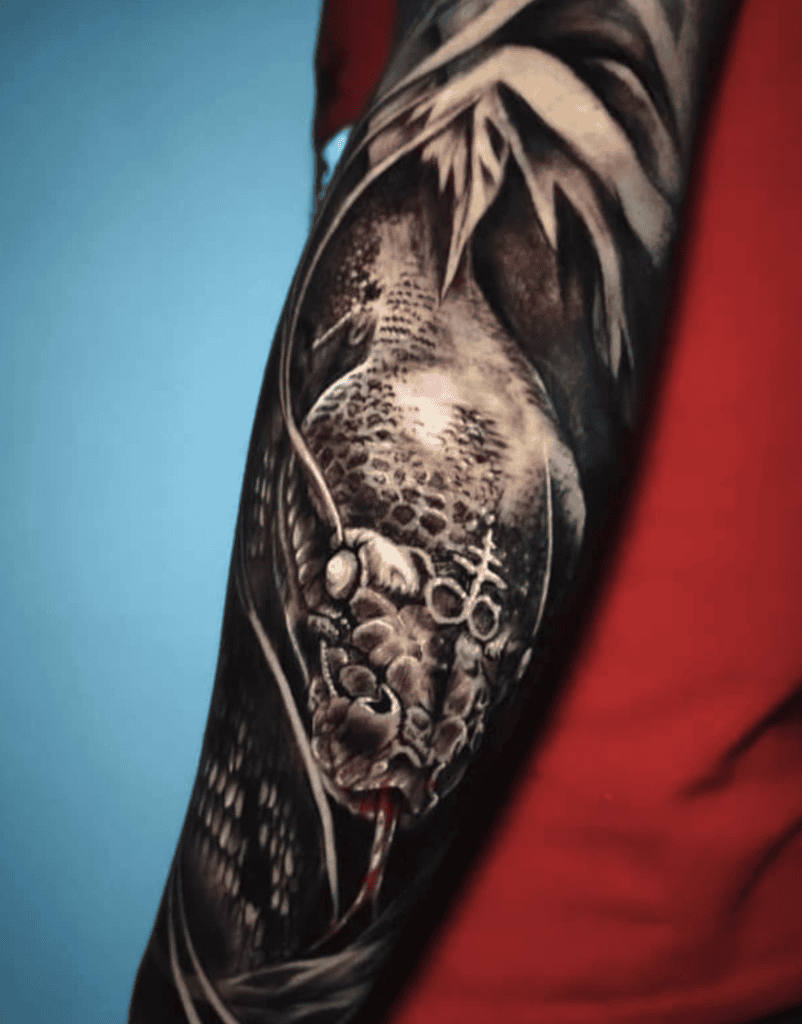
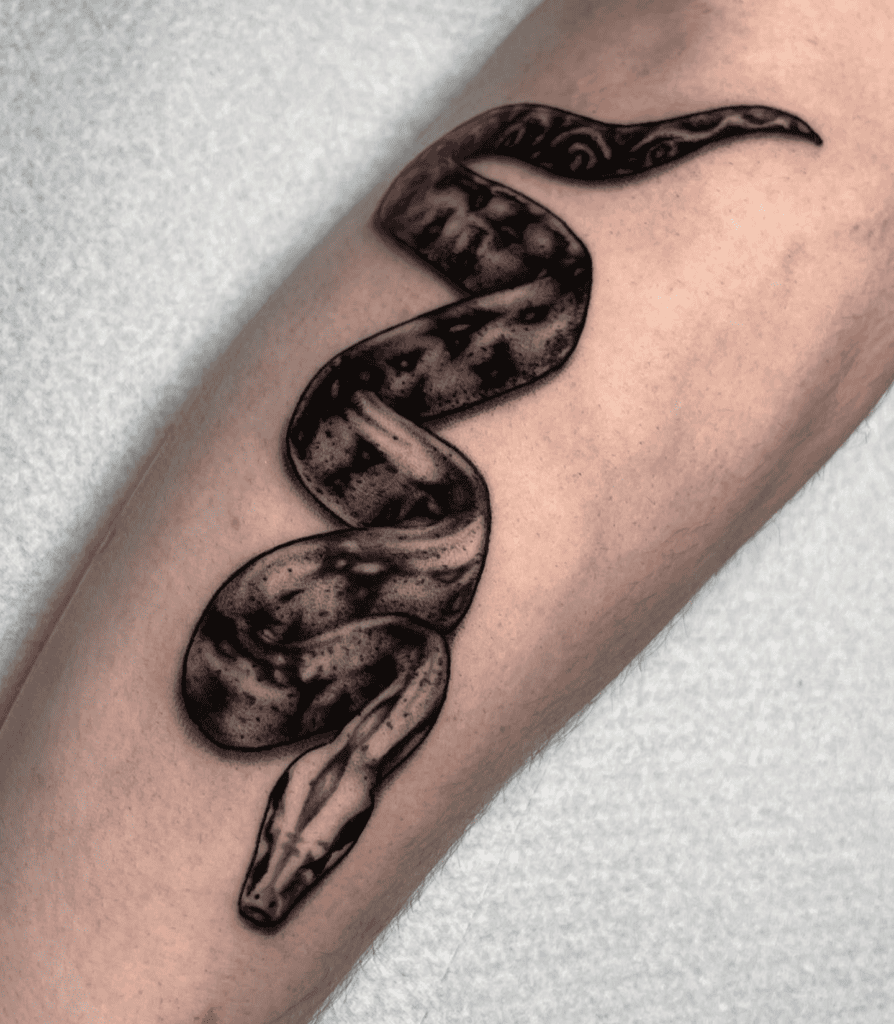
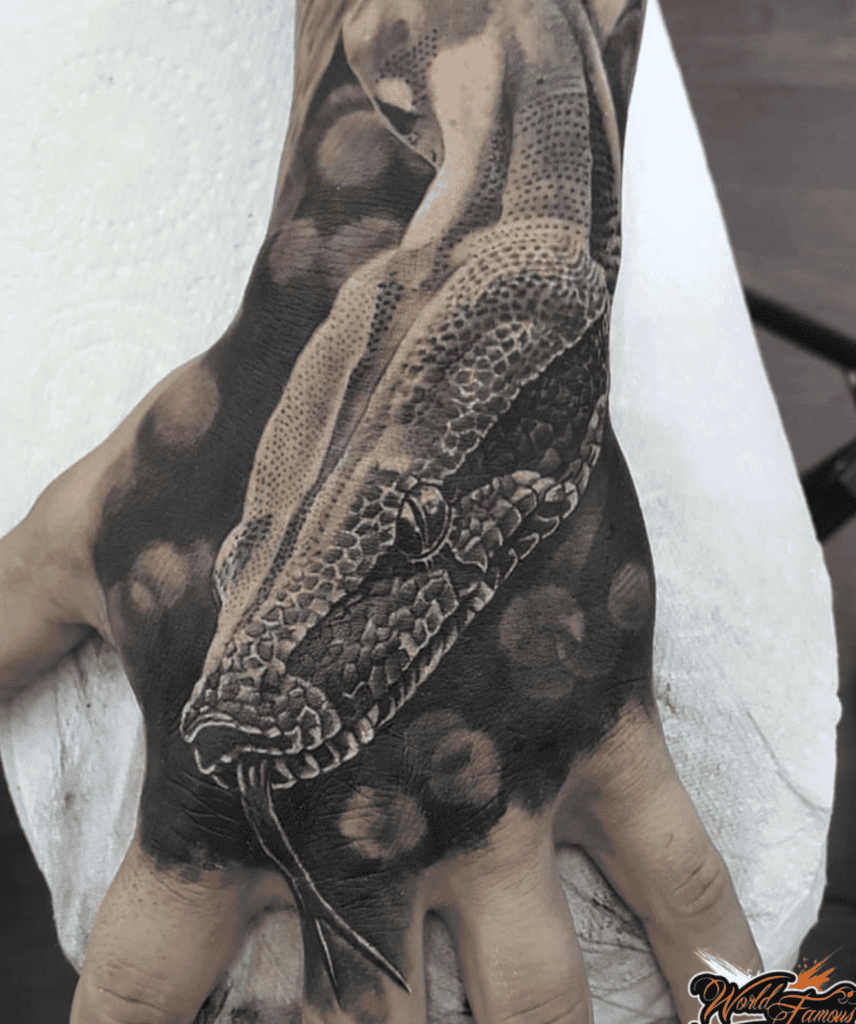
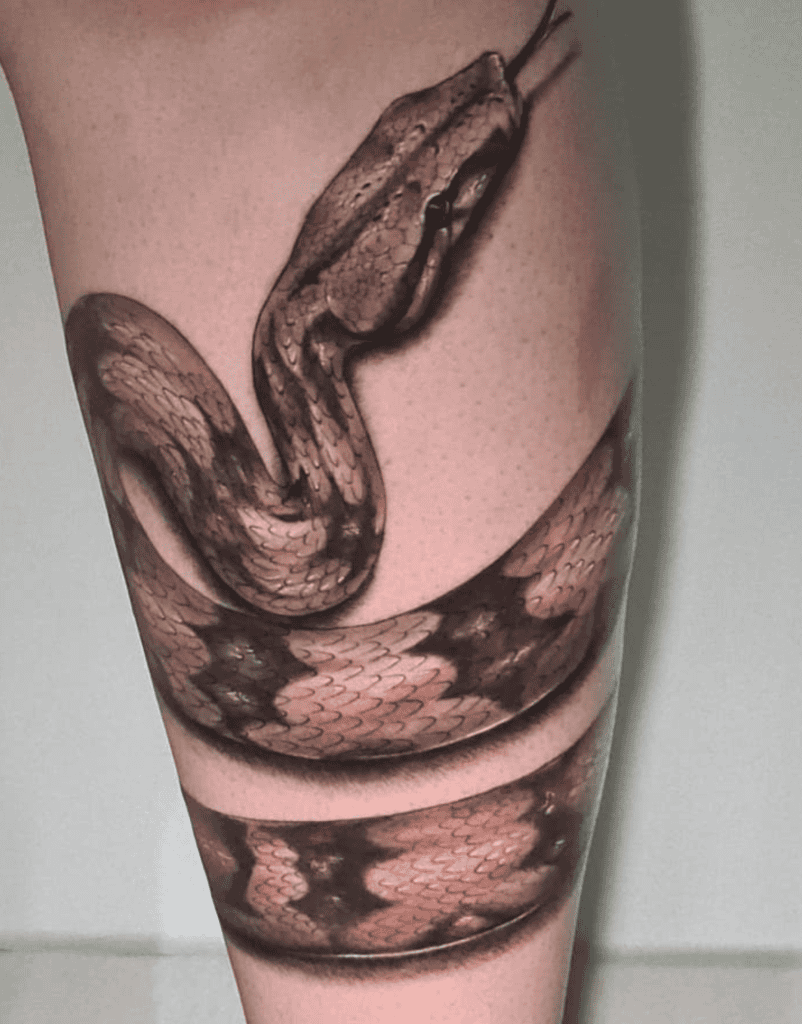
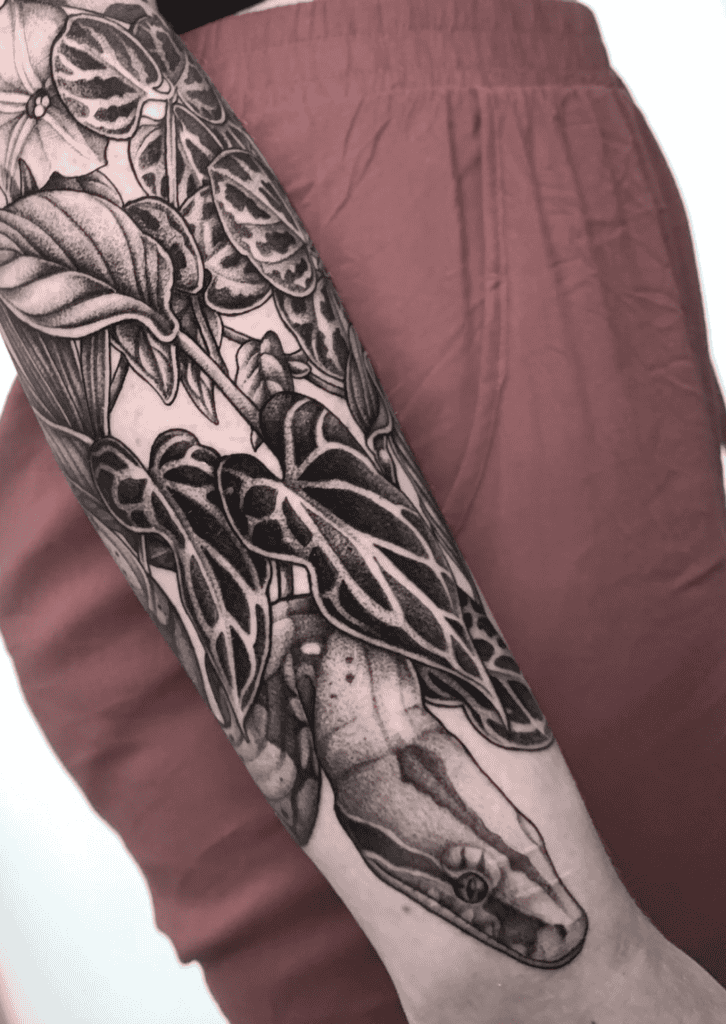
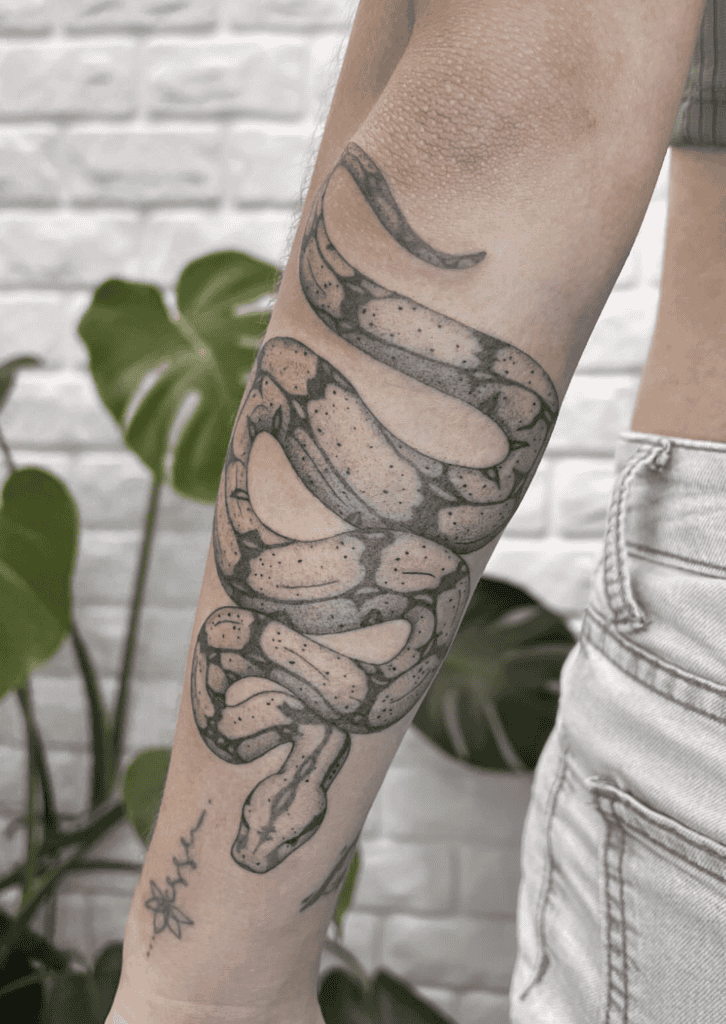
The Boa Constrictor is a large, non-venomous constrictor native to Central and South America. It is one of the best-known members of the boa family and is often called the Common Boa. Unlike pythons, boas give birth to live young rather than laying eggs.
The boa constrictor has a huge range across the Americas. It can be found in Mexico, Belize, Costa Rica, Panama, Colombia, Venezuela, Ecuador, Peru, Brazil, and Bolivia. This adaptability has helped it become one of the most successful large snakes in the Americas.
Boa constrictors are generally calm, curious, slow-moving, and primarily nocturnal. Young boas spend much of their time in trees, while adults become more terrestrial as they grow heavier. The name “constrictor” often leads people to believe boas crush their prey. In reality, they strike and grab prey, wrap coils around it and restrict breathing and blood flow before swallowing it whole.
Green Anaconda Snake Tattoo


The green anaconda is a massive, non-venomous constrictor native to South America, which belongs to the boa family. It spends much of its life in water, earning it the scientific name, Eunectes murinus, which roughly translates to “good swimmer.”
The Green Anaconda is the heaviest living snake species on Earth, with large females being over 6 metres in length and weighing between 100–200 kg, and exceptional individuals weighing even more. This snake is found throughout tropical South America, including Brazil, Venezuela, Colombia, Ecuador, Peru, Bolivia, Guyana, preferring swamps, marshes, slow-moving rivers, flooded forests, and wetlands.
Unlike many giant snakes, Green Anacondas are highly aquatic. They have eyes positioned high on the head, nostrils positioned near the top of the snout, and powerful swimming muscles, allowing them to remain almost completely submerged while watching for prey. Green anacondas are generally solitary ambush predators, spend hours or days waiting motionlessly for prey to approach.
Banded Krait Snake Tattoo
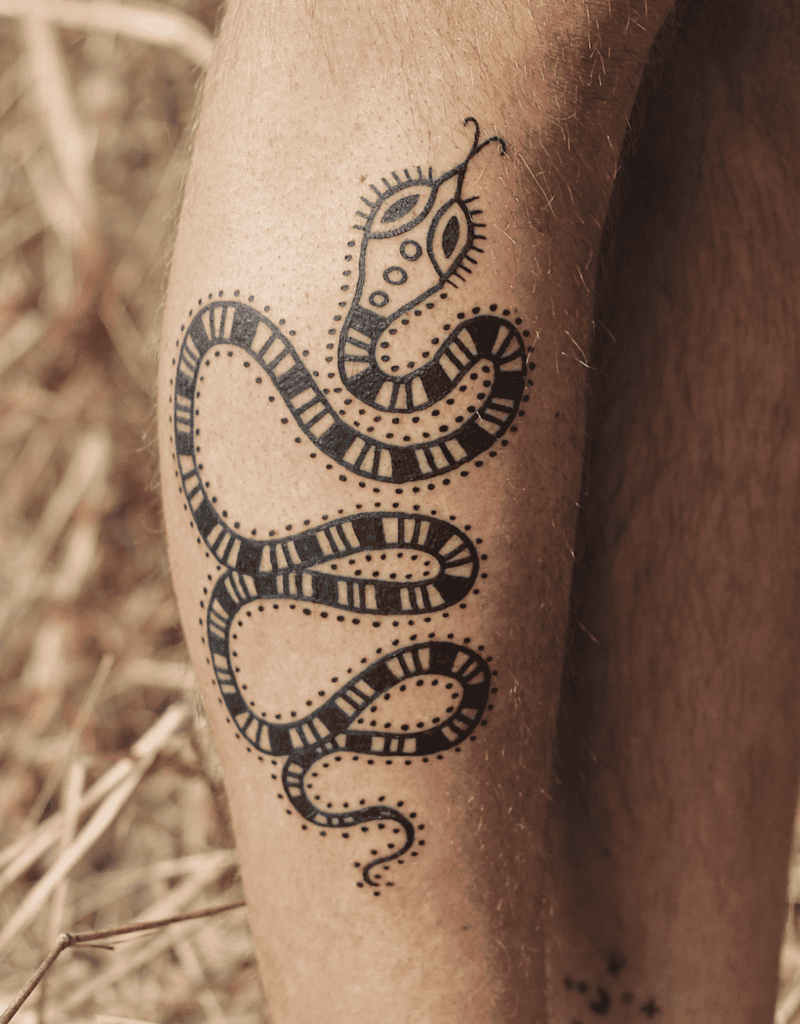
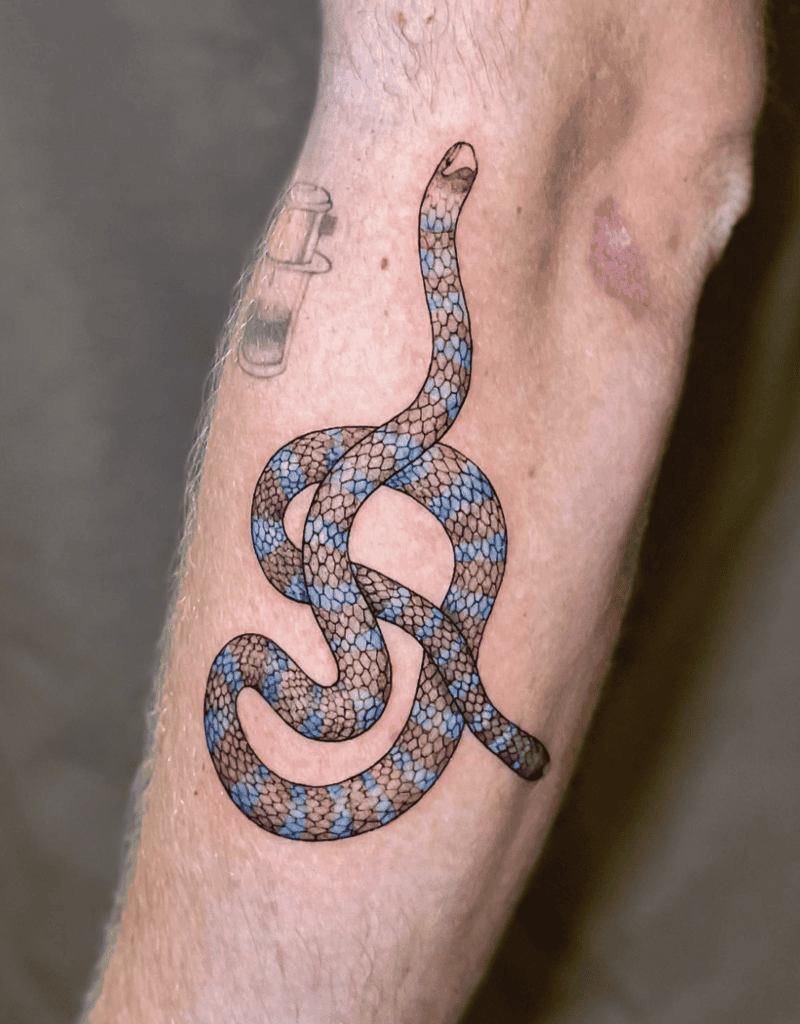
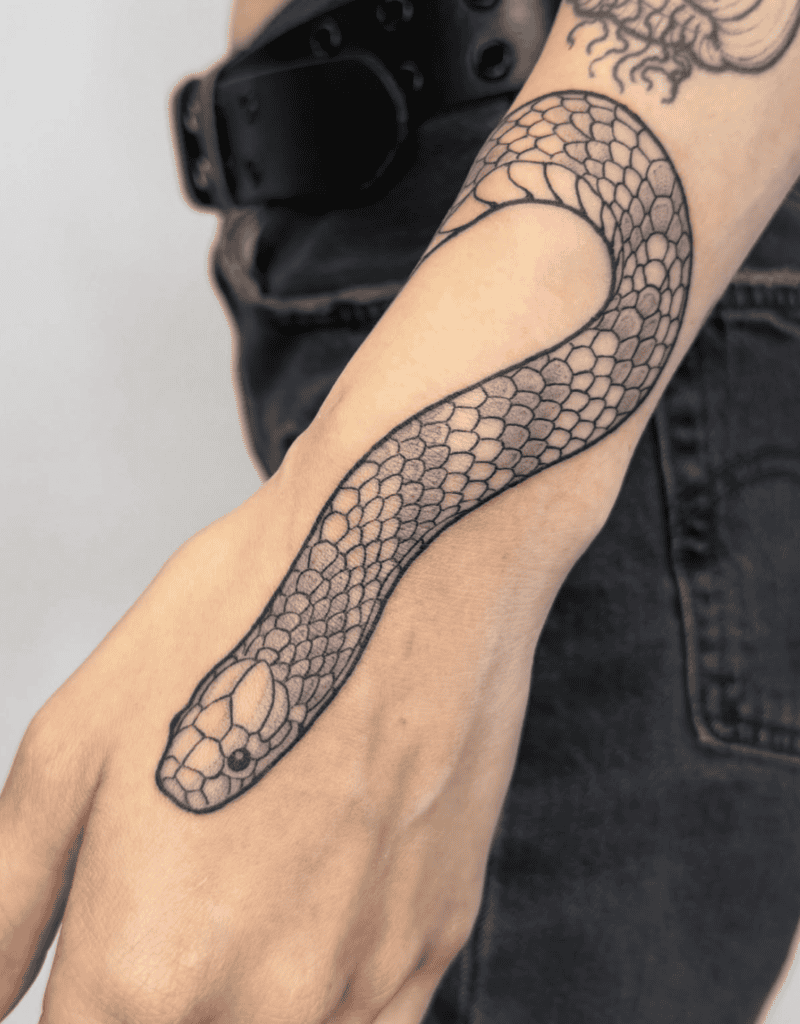
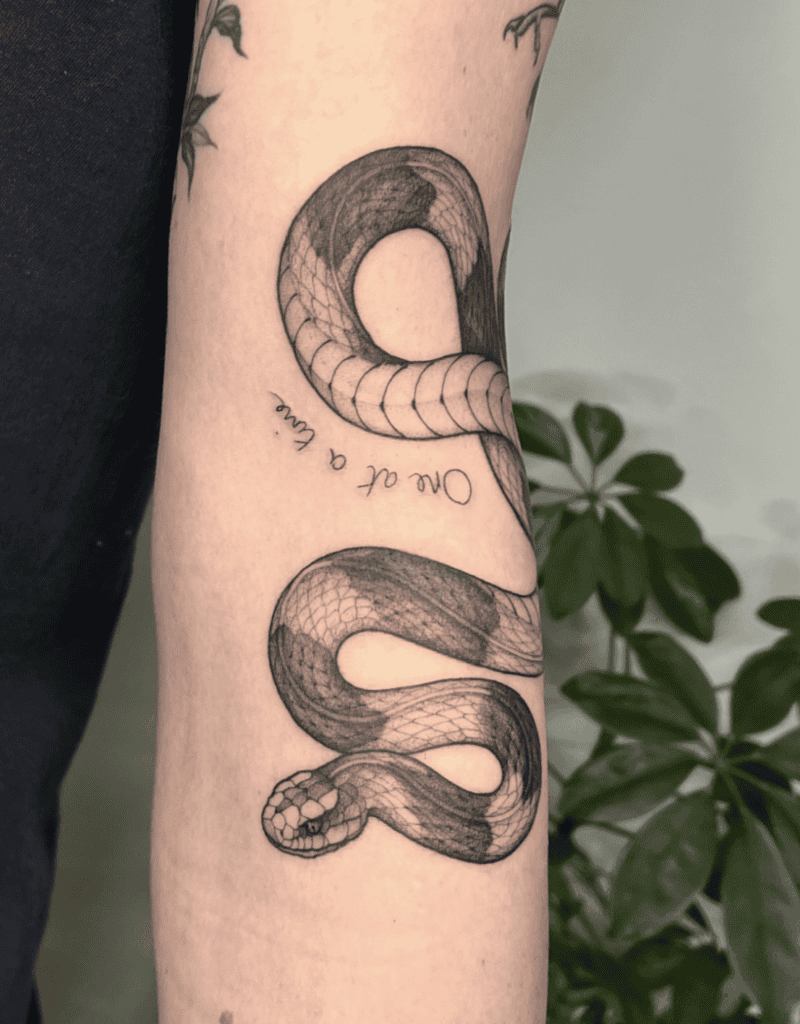
The Banded Krait is a highly venomous snake found throughout South and Southeast Asia. It belongs to the same genus as the famous kraits and is closely related to the deadly Common Krait. Its most recognisable feature is its alternating black and yellow bands that wrap completely around its body.
Banded Kraits can be found across India, Nepal, Bangladesh, Myanmar, Thailand, Vietnam, Laos, Cambodia, Malaysia, and southern China, where they prefer grasslands, forest edges, rice fields, wetlands, and any areas near water. Because of its wide range, it is one of the most familiar kraits in Southeast Asia.
Despite looking intimidating, it is generally calm, slow-moving, shy, and reluctant to bite. During the day, it often hides in burrows, leaf litter, under logs, or dense vegetation, and becomes much more active at night.
Taipan Snake Tattoo
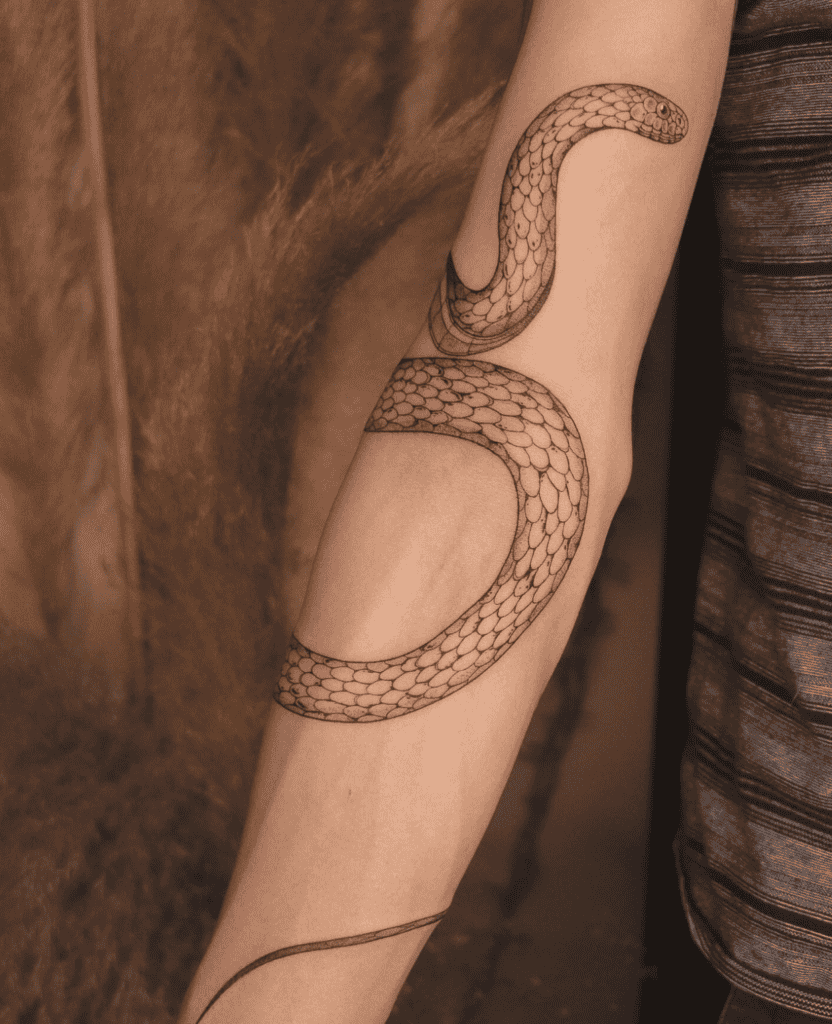
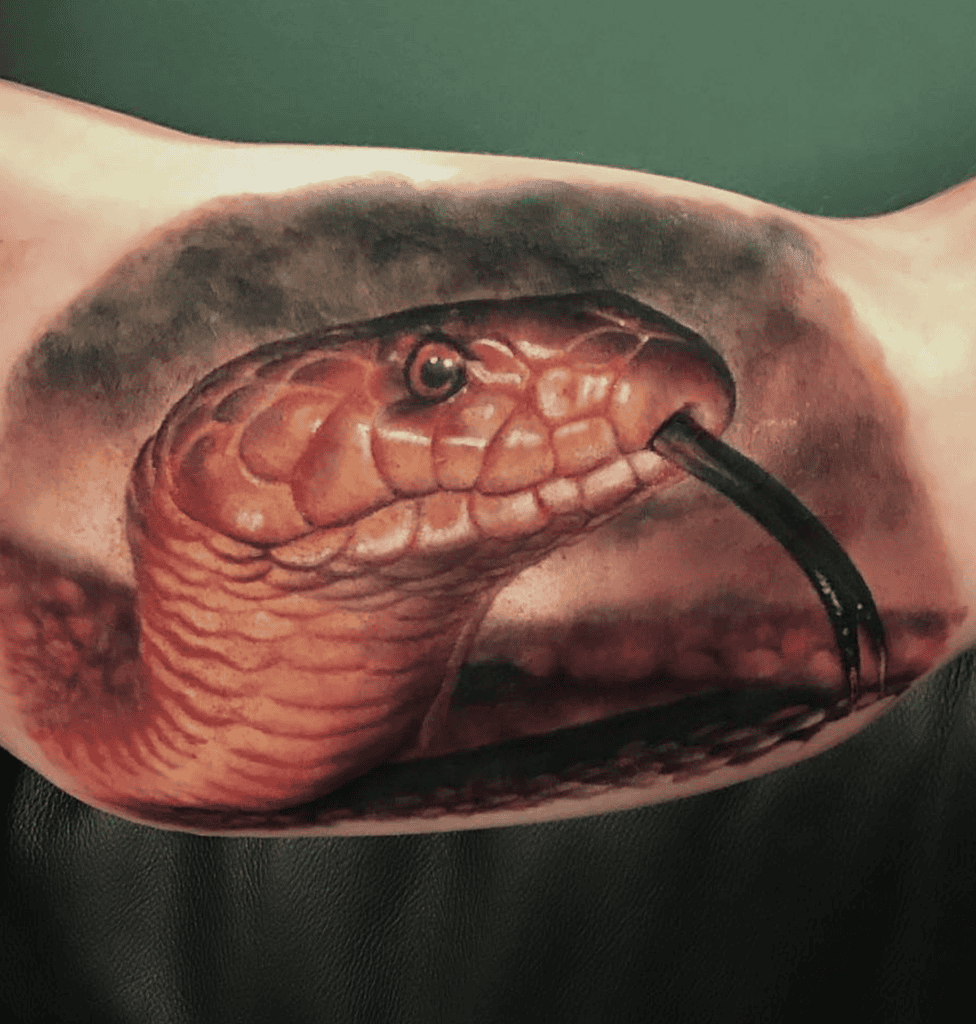
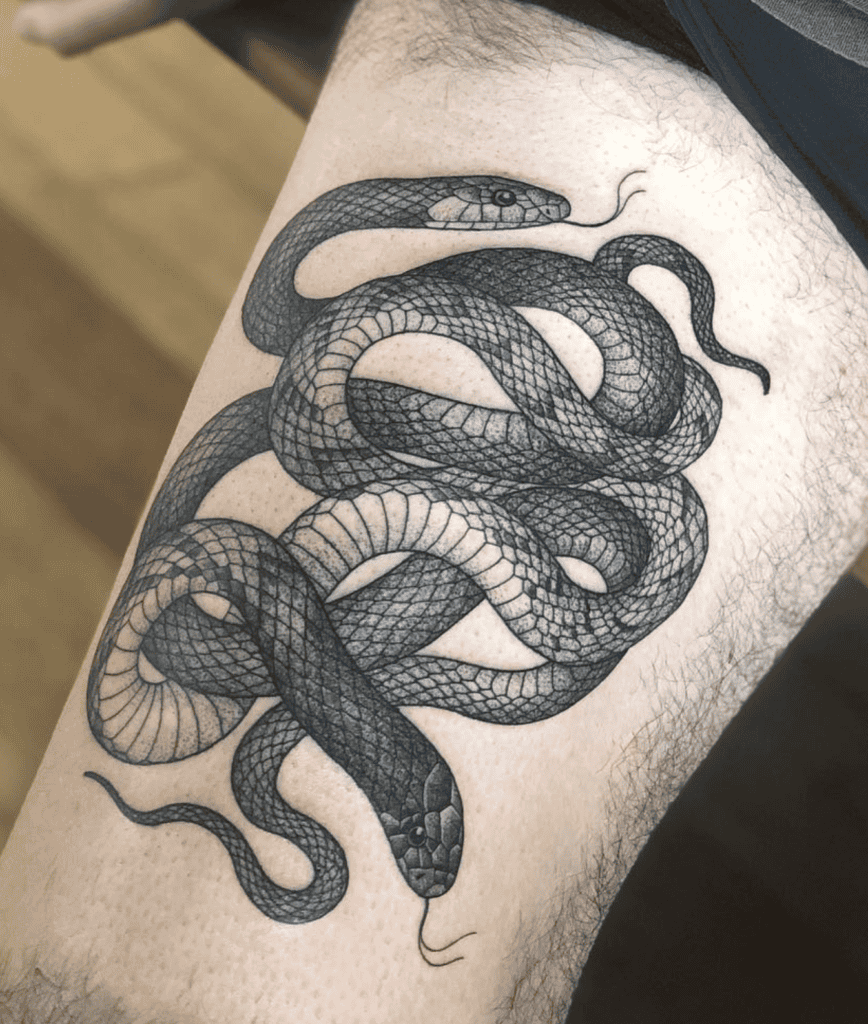
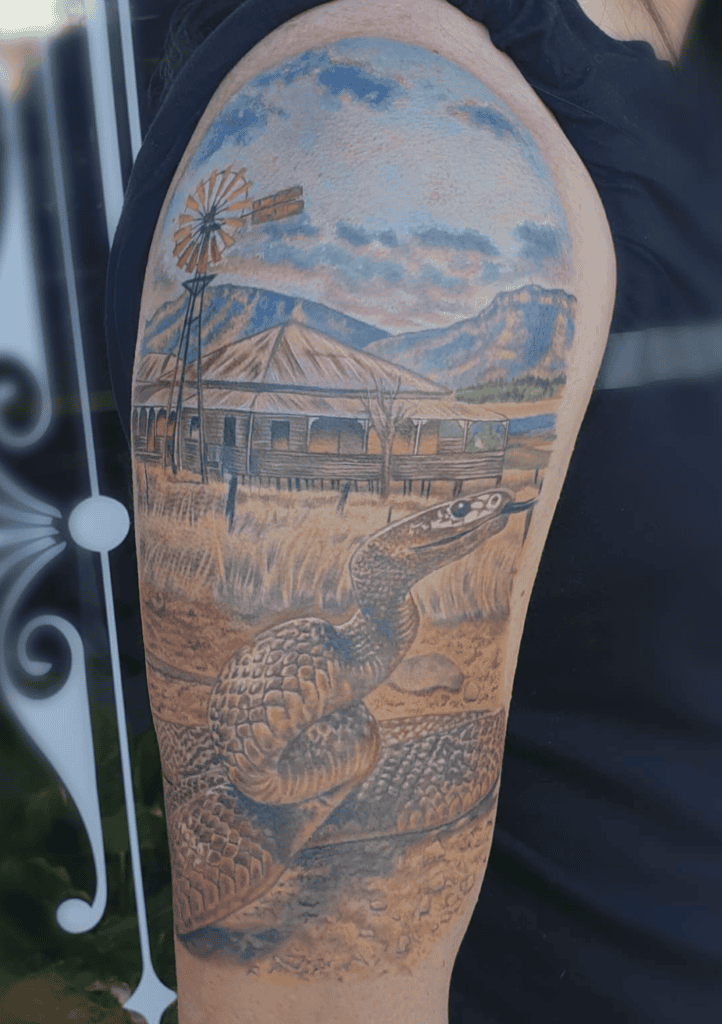
Taipans are often regarded as the elite predators of the snake world, referring to a small group of Australian snakes belonging to the genus Oxyuranus.
The Inland Taipan, often called the “Fierce Snake”, is famous for having the most toxic venom of any land snake known to science, with a single bite containing enough venom to kill many adult humans. However, bites are exceptionally rare because the species lives in remote regions of Australia.
The Coastal Taipan is the largest and most commonly encountered taipan, which, unlike the Inland Taipan, lives closer to populated areas. This is a fast, alert, and powerful snake that is extremely efficient at hunting rodents.
Lastly, the Central Ranges Taipan is the least-known species, only discovered in 2007, and remains one of Australia’s most mysterious snakes. Scientists are still learning about its ecology, behaviour, and population size.
Tiger Snake Tattoo


The Tiger Snake is a highly venomous snake native to southern Australia and its nearby islands. It belongs to the elapid family, making it a relative of cobras, taipans, and mambas. Its common name comes from the dark bands that resemble the stripes of a tiger.
While many Tiger Snakes display dark crossbands, yellow, olive, or brown backgrounds, and bold striped patterns, earning their tiger-like appearance, some populations are nearly solid black, dark brown, or olive green.
Tiger Snakes occur across Victoria, Tasmania, South Australia, Southern Western Australia, and coastal New South Wales. Unlike many Australian snakes that favour arid environments, Tiger Snakes often thrive around wetlands.
Death Adder Snake Tattoo

The name “Death Adder” refers to several species within the genus Death Adders, with the best-known being the Common Death Adder. Unlike most Australian venomous snakes, which actively hunt prey, Death Adders are ambush predators that rely on camouflage and patience.
Early European settlers thought it resembled the adders of Europe because of its thick body, broad triangular head, and short tail, but these snakes are more closely related to cobras, taipans, tiger snakes, and mambas.
The Death Adder is famous for its strike speed. When prey approaches, it can strike in a fraction of a second, delivering venom. It then releases the prey and waits for its venom to take effect. For many years, it was considered one of the fastest-striking snakes ever studied.
Death Adders possess a caudal lure at the tip of their tail. They hide beneath leaves, wiggling their tail to mimic a worm or insect. Once it attracts curious prey, it strikes instantly, making it one of the few snakes that actively uses bait.
Copperhead Snake Tattoo
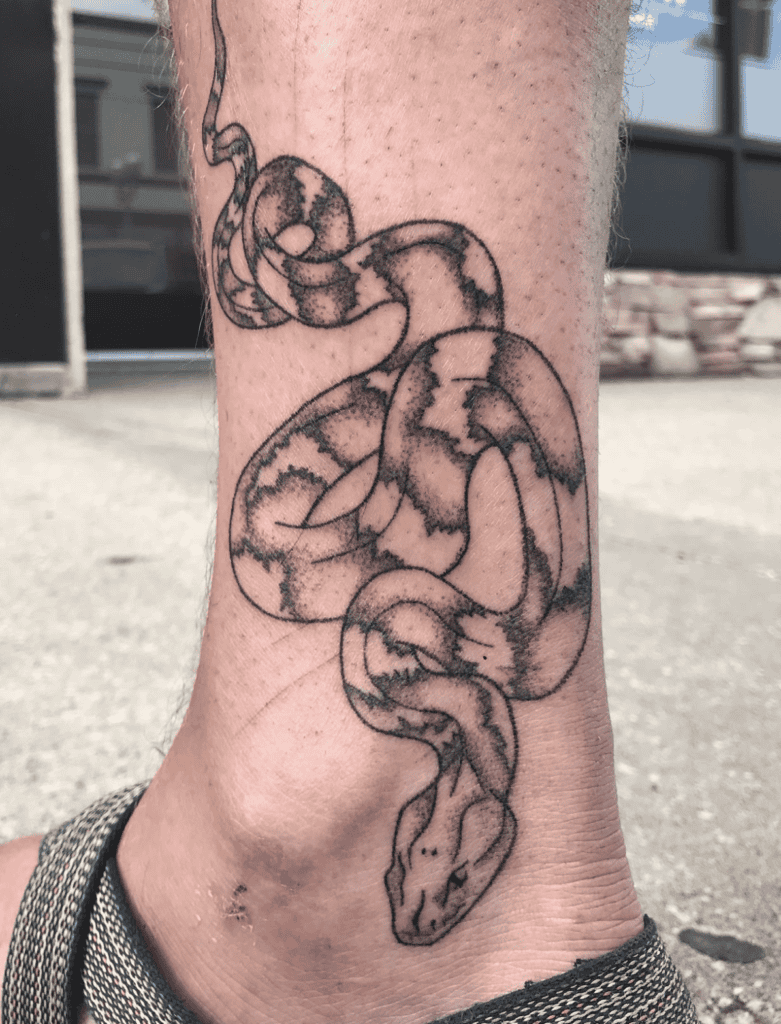
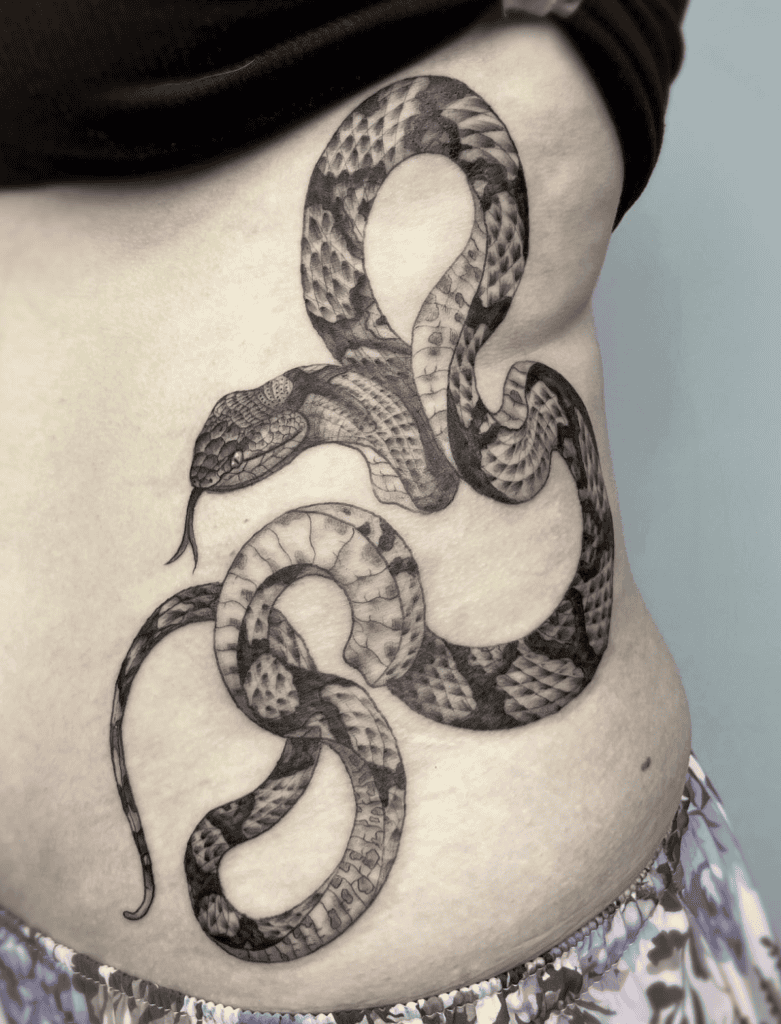
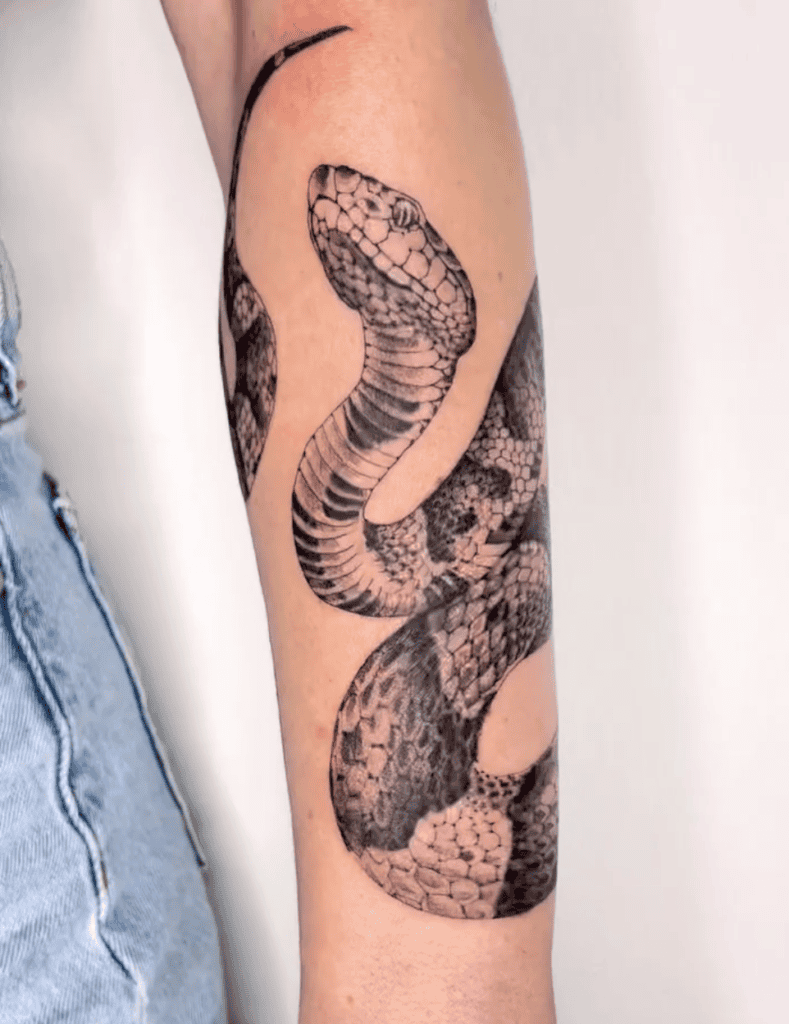
Copperhead is a venomous pit viper native to eastern and central North America. It belongs to the same group as rattlesnakes and cottonmouths. It gets its name from its distinctive copper-coloured head, which often shines with reddish, bronze, or copper tones.
The Copperhead is found throughout the eastern, central, and parts of the southeastern United States, where it inhabits deciduous forests, rocky hillsides, woodland edges, swamps, farmland, and suburban areas.
When threatened, the Copperhead blends into dead leaves, the forest floors or fallen branches, with its colouring helping to blend into the environment. This camouflage is so effective that many bites occur because people accidentally step near or on a snake they never saw.
Copperheads possess hemotoxic venom, which primarily affects tissues. Symptoms may include pain, swelling, bruising, and tissue damage. However, its venom is generally considered less potent than that of many other North American pit vipers.
Cottonmouth Snake Tattoo
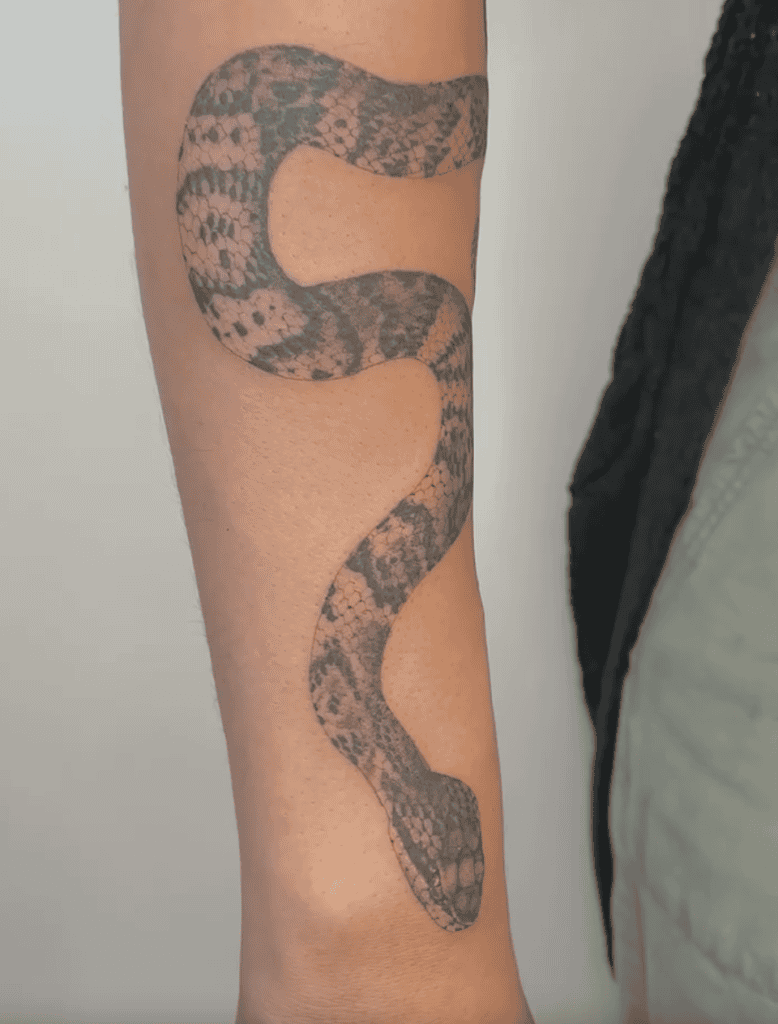
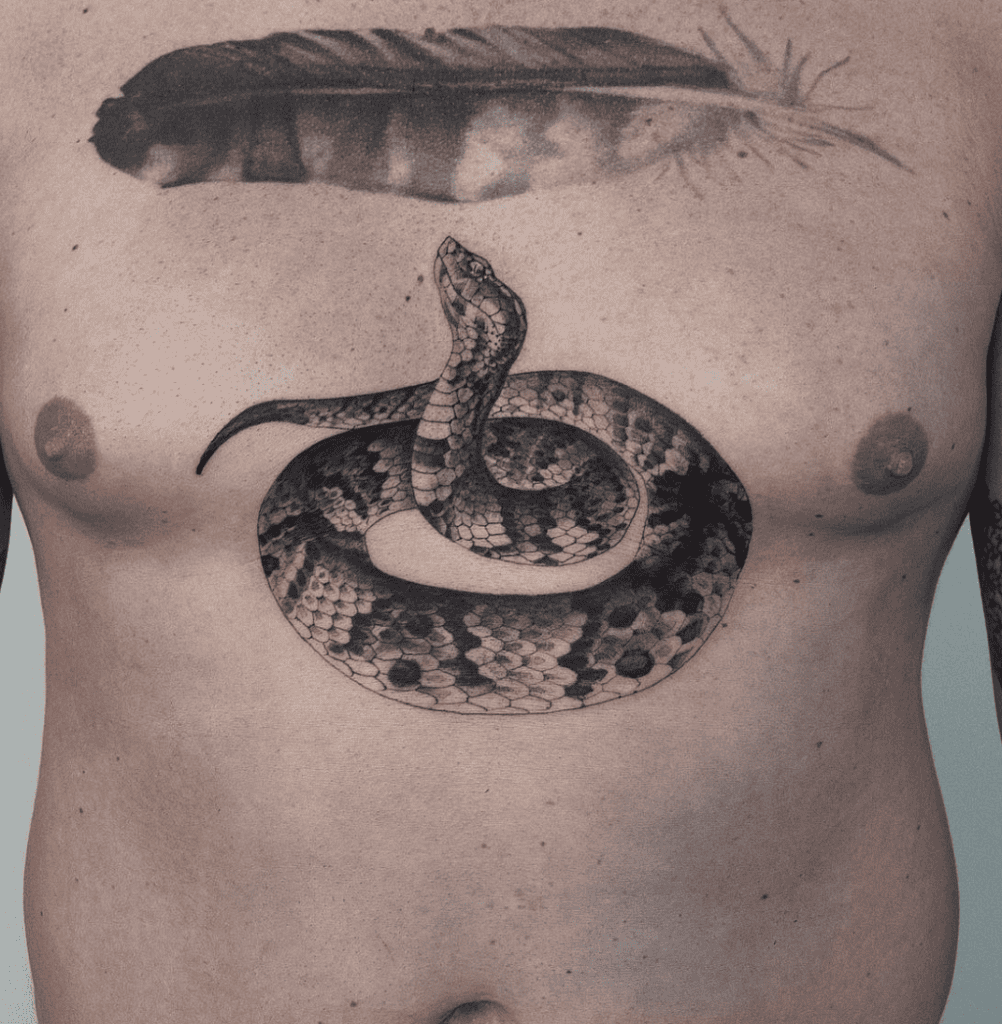
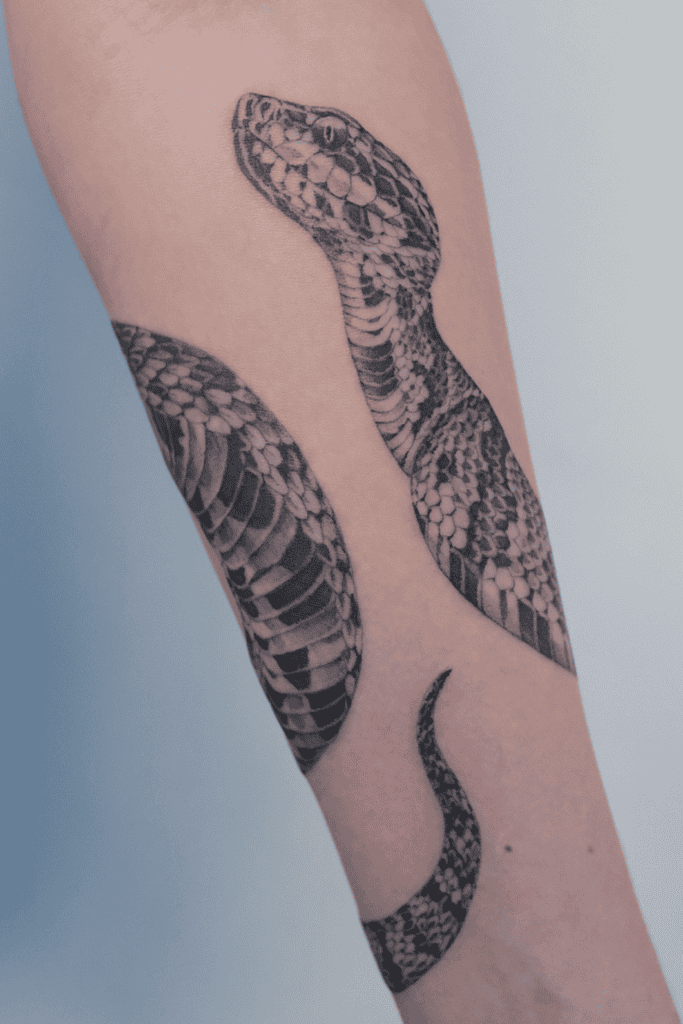
The Cottonmouth is a venomous pit viper found in the southeastern United States. It is the only semi-aquatic pit viper in North America and is closely related to the Copperhead.
When threatened, a Cottonmouth may coil its body, open its mouth wide and reveal a bright white interior, earning it its name. The Cottonmouth is also known as the Water Moccasin. Unlike many snakes, it is strongly associated with swamps, marshes, lakes, rivers, and wetlands. It is an excellent swimmer and often spends time both in and out of the water.
Fer-de-lance Snake Tattoo


The Fer-de-lance is a highly venomous pit viper found throughout Central America and parts of northern South America. It belongs to the same family as copperhead, cottonmouth, and the Eastern Diamondback Rattlesnake. However, the Fer-de-lance is often considered one of the most medically significant pit vipers in the New World.
The name “Fer-de-lance” means “spearhead” in French, with the name coming from its sharply triangular head and pointed appearance of its snout. This species occurs throughout Mexico, Belize, Guatemala, Honduras, Nicaragua, Costa Rica, Panama, Colombia, Ecuador, and Venezuela.
The Fer-de-lance possesses extremely potent hemotoxic venom, and because the species is so widespread, it is responsible for a significant number of snakebite cases in parts of Latin America. While modern antivenom has greatly improved outcomes, bites remain serious medical emergencies.
Gaboon Viper Snake Tattoo


Gaboon Viper is a massive venomous viper native to the rainforests and woodlands of sub-Saharan Africa. It belongs to the genus Bitis, which also includes the famous Puff Adder. Among snake enthusiasts, the Gaboon Viper is often considered one of the most beautiful venomous snakes in the world thanks to its complex mosaic of browns, purples, creams, tans, and black.
Because its pattern resembles dead leaves, forest shadows and sunlight filtering through foliage, many people can stare directly at one and still fail to spot it. This snake occurs throughout much of sub-Saharan Africa, where it inhabits tropical rainforests, woodland regions, forest edges, and dense vegetation.
The Gaboon Viper is one of the largest vipers in the world, with the longest fangs of any snake species, with its fangs capable of reaching around 5 cm in length. Its venom contains hemotoxic components, cytotoxic compounds, and tissue-damaging enzymes, with bites causing severe pain, massive swelling, tissue destruction, and blood clotting problems. Fortunately, bites are uncommon because the species is generally reluctant to strike.
Spiny Brush Viper Snake Tattoo

The Spiny Bush Viper is a small, highly venomous viper native to the tropical forests of Central Africa. It belongs to the genus Atheris, a group of arboreal (tree-dwelling) vipers famous for their striking colours and unusual scale textures.
Unlike the smooth scales of a cobra or python, the Spiny Bush Viper scales are strongly keeled, raised, and pointed, sticking out from the body, creating a spiky appearance. These snakes can be found in the Democratic Republic of the Congo, Uganda, Kenya, Rwanda, and Tanzania, where they prefer tropical rainforests, montane forests, and dense vegetation.
The Spiny Bush Viper is highly adapted to life in vegetation, spending much of its time coiled on branches, hidden among leaves, and resting in shrubs. Its prehensile tail helps it maintain balance while moving through dense vegetation.
Puff Adder Snake Tattoo
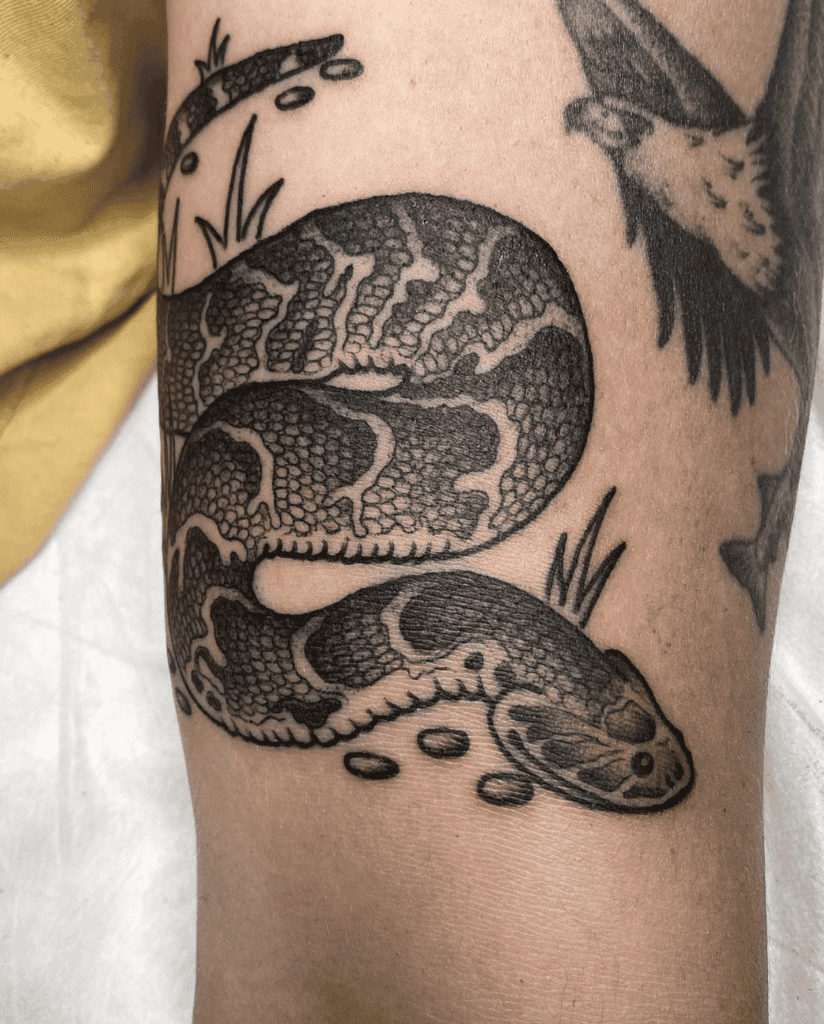
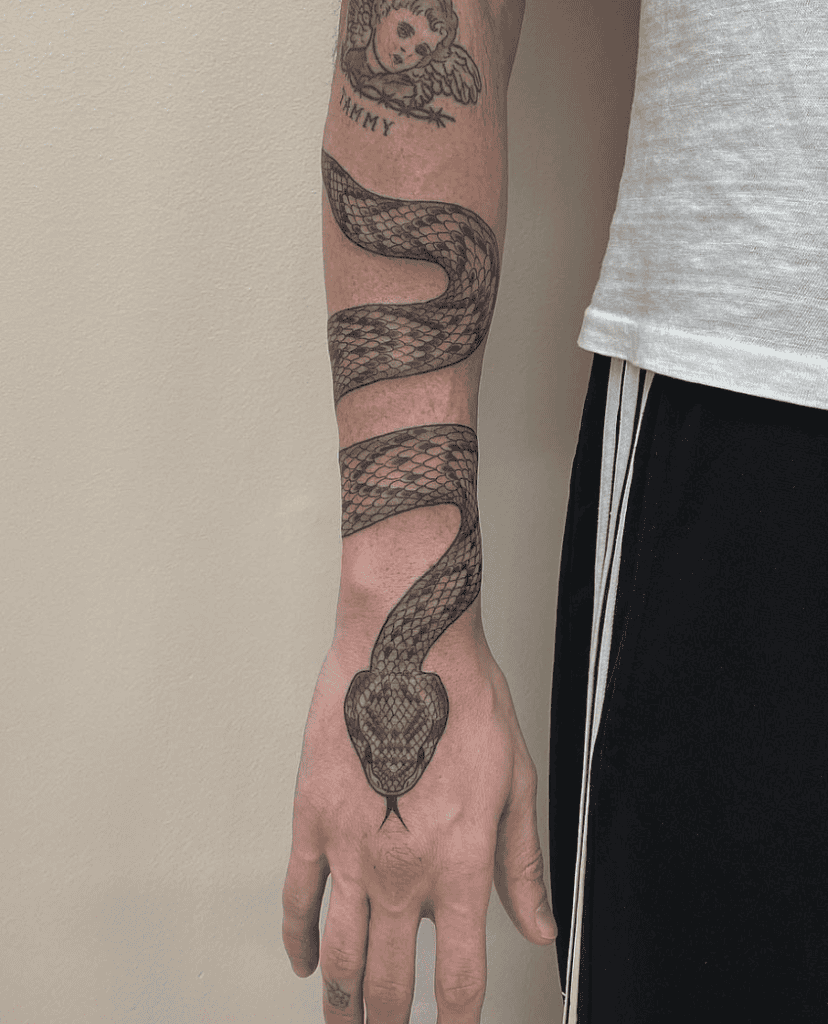
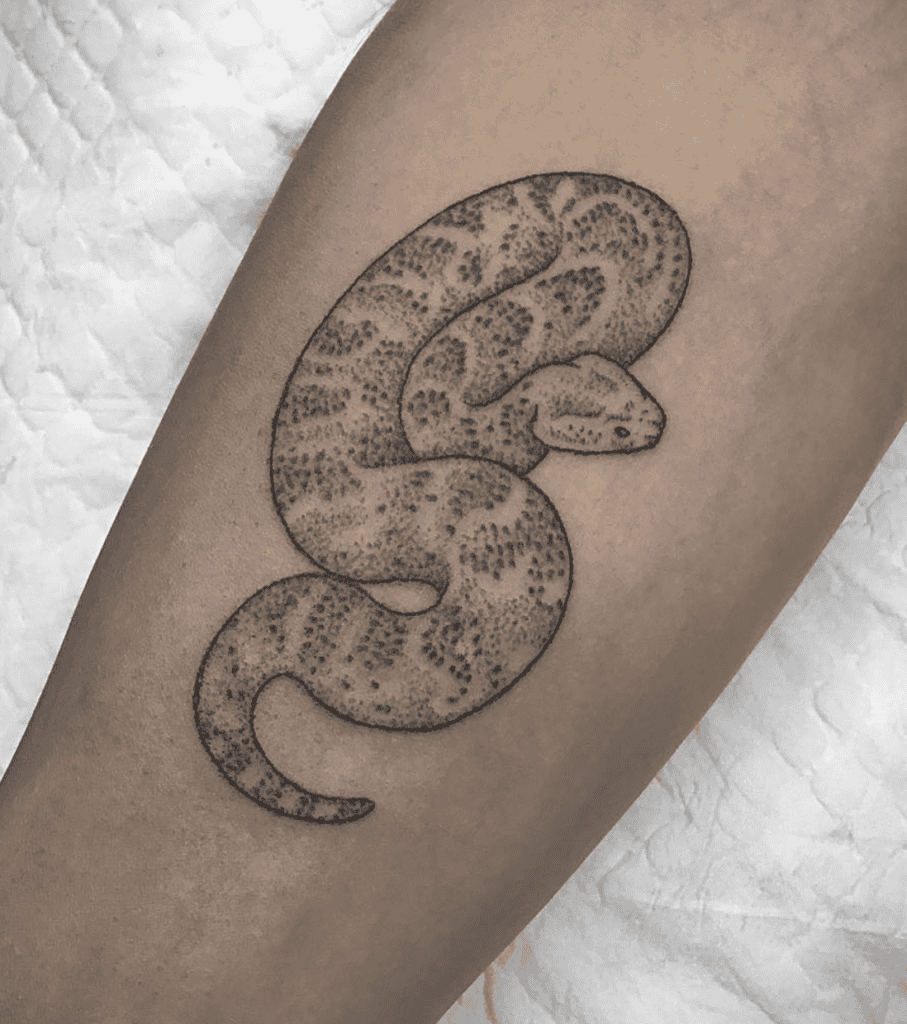
The Puff Adder is a highly venomous viper found across much of sub-Saharan Africa and parts of the Arabian Peninsula. It is responsible for more snakebite incidents in Africa than almost any other species due to its wide range and excellent camouflage. It belongs to the same genus as the Gaboon Viper, making it a close relative of one of the heaviest vipers in the world.
The Puff Adder is not the most venomous snake in Africa, but it is one of the most dangerous in practical terms due to being so widespread. It is highly camouflaged, often lying in paths or open ground, and it does not move away quickly when approached.
The Puff Adder has a potent hemotoxic venom that causes severe pain, swelling and blistering, tissue damage, blood clotting issues, and, in severe cases, life-threatening complications. It injects a large volume of venom per bite, which increases its medical significance.
Common European Adder Snake Tattoo

The Common European Adder is a venomous viper found across much of Europe and parts of northern Asia. It is the most northerly-distributed snake in the world, meaning it lives farther north than almost any other snake species. It is also sometimes simply called the European Adder or Common Adder.
The Common European Adder is found across the United Kingdom, Scandinavia, France, Germany, Italy, Eastern Europe, and Russia, thriving in heathlands, forest edges, meadows, moorlands, rocky hillsides, and cool temperate forests. Unlike many snakes, it is very tolerant of cold environments.
The Common European Adder has mild to moderate venom potency compared to many other vipers. Its venom is primarily hemotoxic, being designed to subdue small prey. Being bitten by one can cause pain, swelling, bruising, and nausea in some cases. Serious outcomes are rare, and fatalities are extremely uncommon, especially with modern medical care.
Rhinoceros Viper Snake Tattoo


The Rhinoceros Viper is one of the most visually striking snakes in Africa. Despite its dramatic appearance, it is a secretive forest ambush predator that prefers staying hidden in leaf litter rather than showing off.
The Rhinoceros Viper is a highly venomous viper found in the rainforests of West and Central Africa. It is one of the most colourful snakes in the world and belongs to the same genus as the Gaboon Viper and Puff Adder. It is sometimes called the “river jack” or “horned viper”, though “rhinoceros viper” is the most popular name, due to the horn-like scales on its nose.
The Rhinoceros Viper is considered one of the most beautiful snakes in the world, featuring colours of bright green, blues, purples, yellows, and black outlines. The pattern is made up of triangles, diamonds, and zigzag shapes. These snakes can be found in Nigeria, Ghana, Cameroon, Gabon, the Congo, the Democratic Republic of the Congo, and Uganda, living in dense rainforests, swampy forest areas, riversides and wetlands.
Boomslang Snake Tattoo
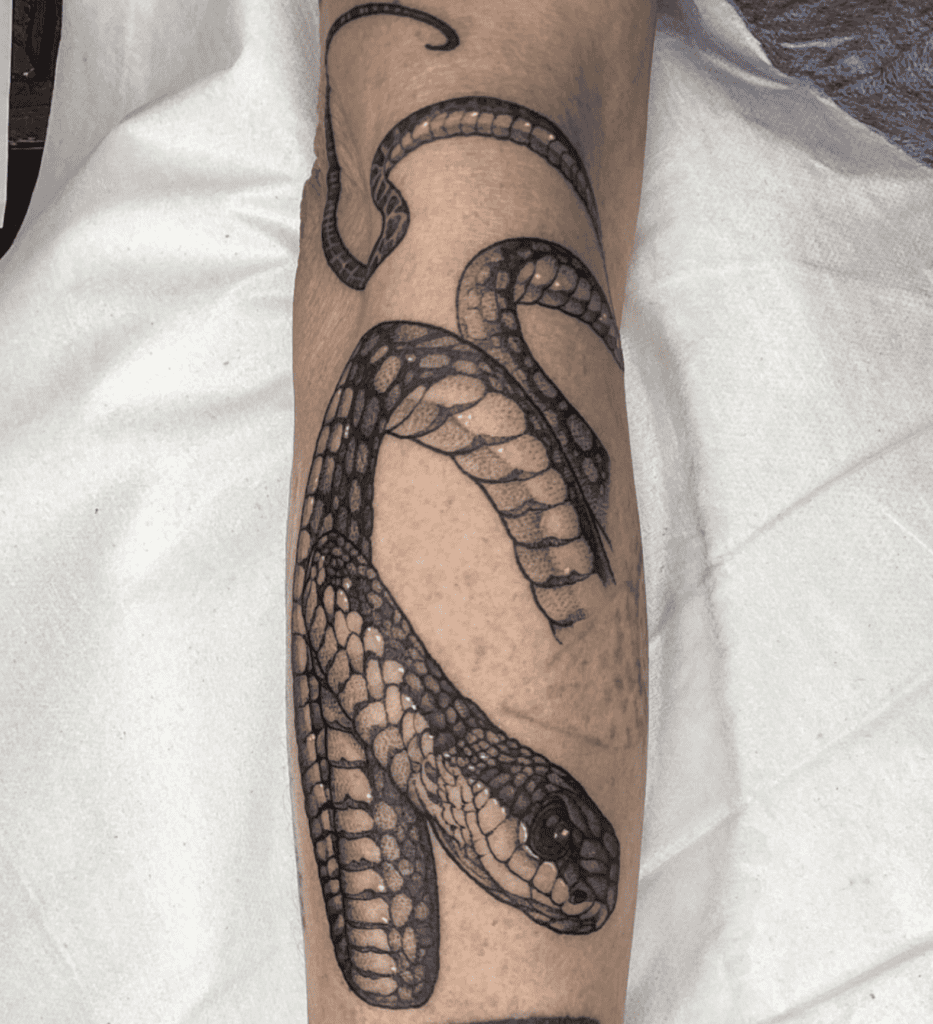
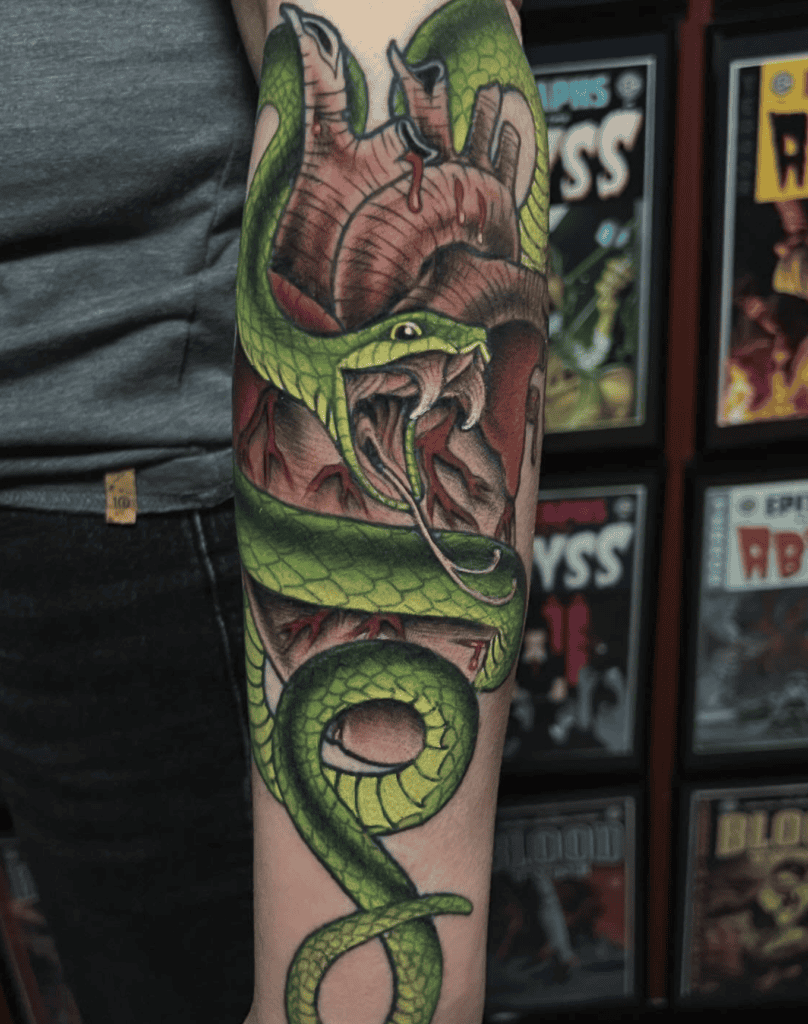
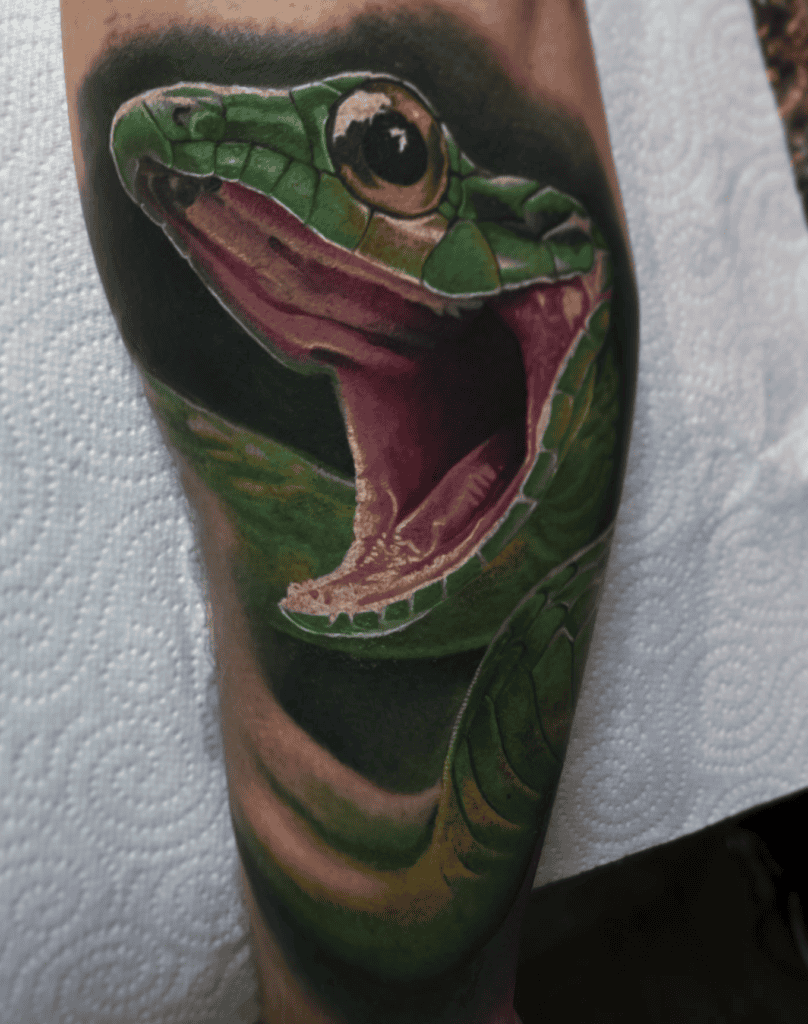
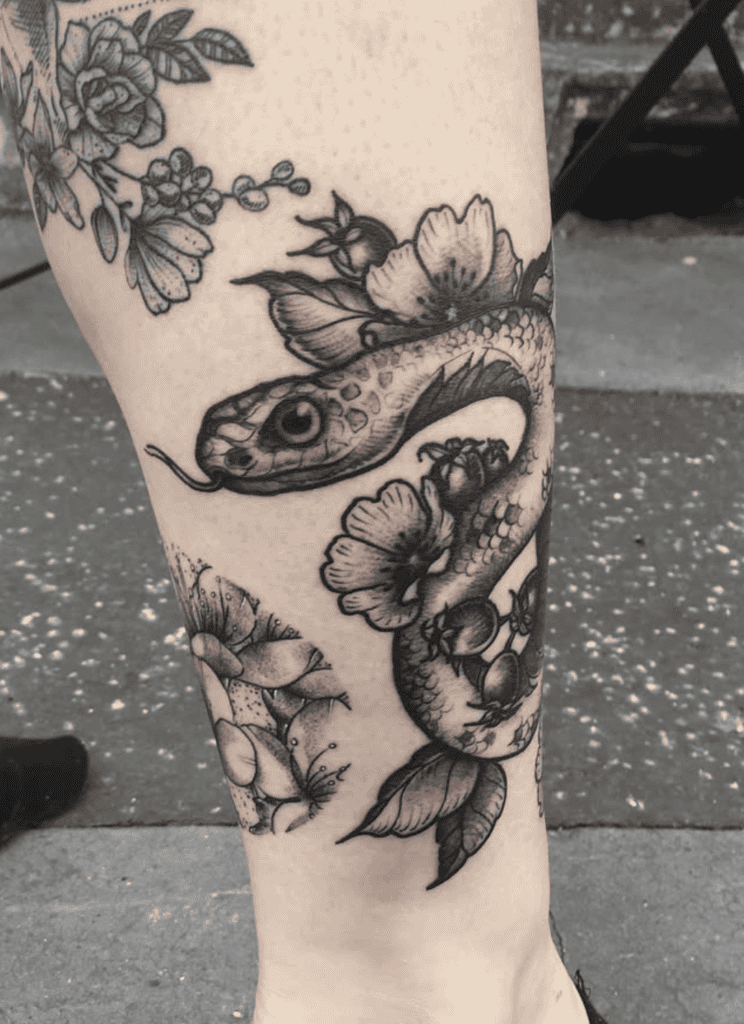
The Boomslang is a highly venomous tree-dwelling snake native to sub-Saharan Africa. It is the only species in its genus (Dispholidus) and belongs to a group of snakes known as rear-fanged colubrids. Its name comes from Afrikaans, with “Boom” meaning tree and “Slang” meaning snake, as it is one of Africa’s most skilled tree climbers, where it spends most of its life, rarely coming to the ground.
The Boomslang has highly potent hemotoxic venom, which can cause internal bleeding, bleeding from gums or wounds, organ damage, or severe systemic complications. However, bites are rare because the snake is shy, avoiding confrontation, and because it has rear fangs, envenomation is less immediate.
Vine Snake Tattoo
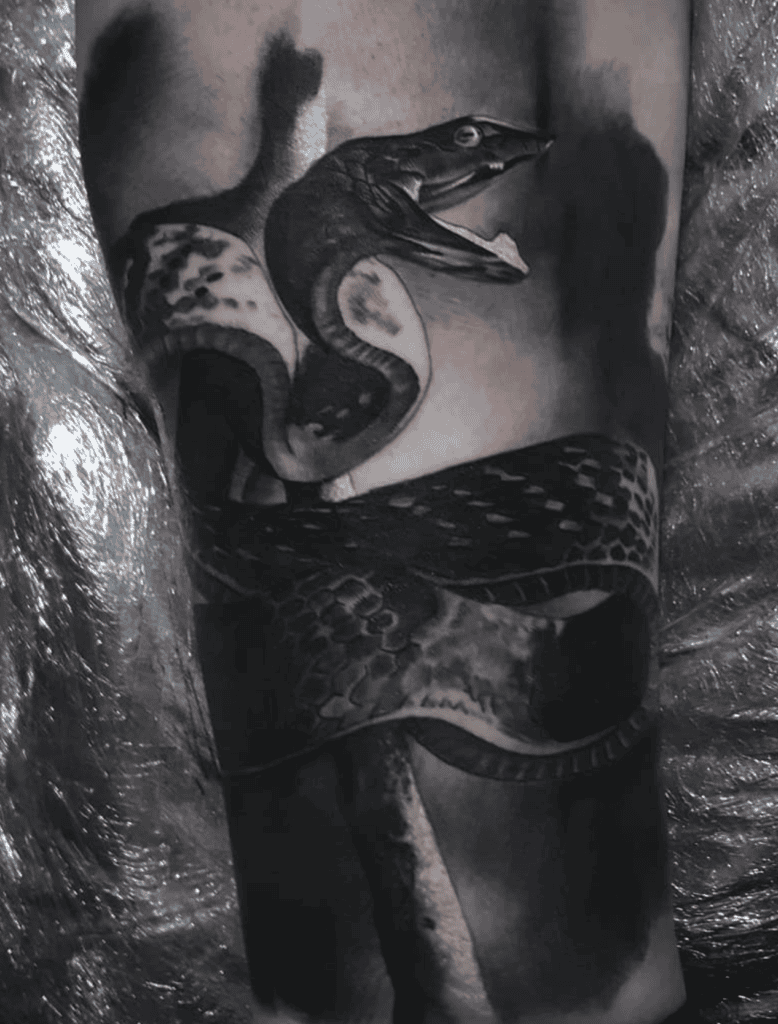
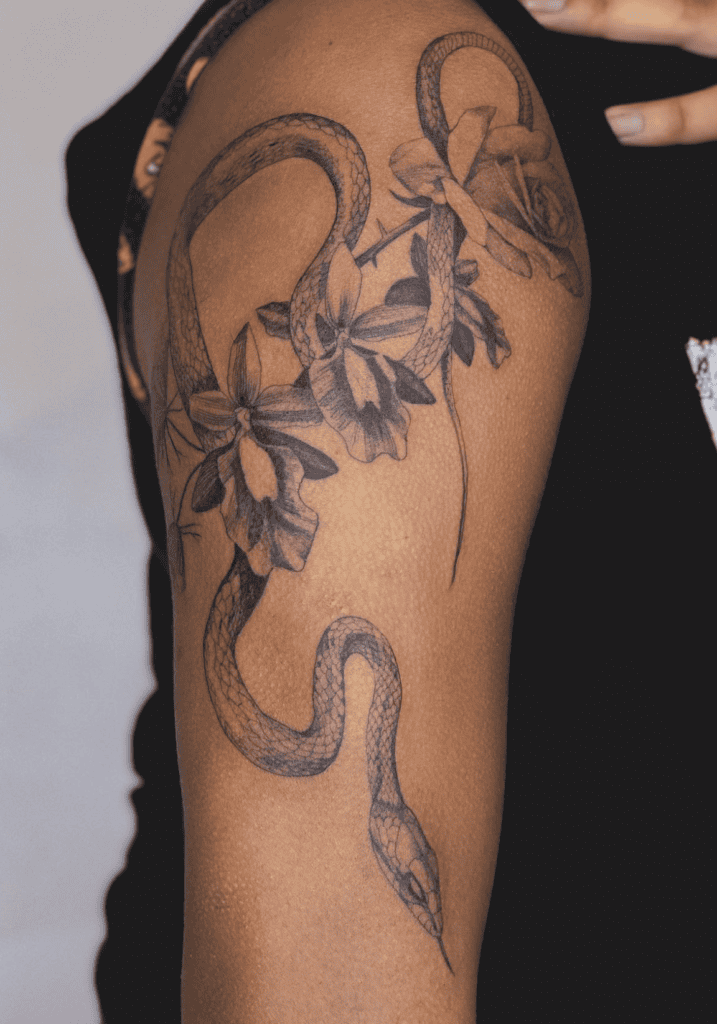
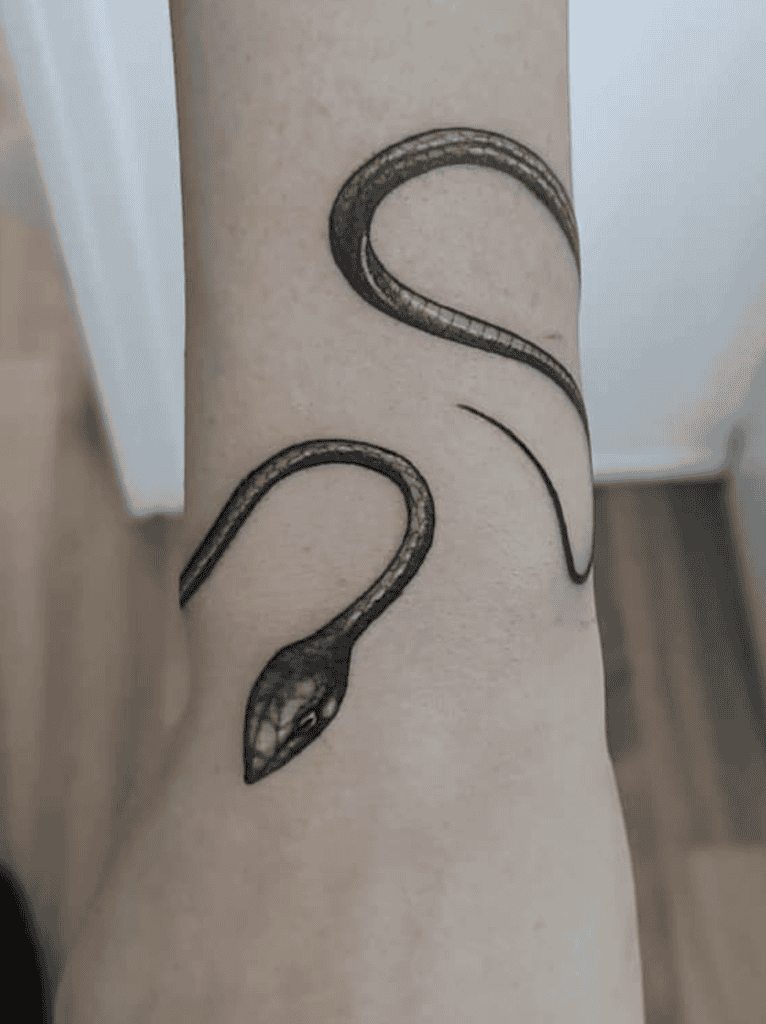
Vine Snake refers to a group of highly slender, arboreal snakes found across Asia, Africa, and the Americas (depending on species). The most well-known are Asian vine snakes in the genus Ahaetulla.
Vine snakes look and behave like a vine thanks to their extremely thin body, bright green colouration, and slow, swaying movement like a branch in the wind. Some species even gently sway side to side to mimic vegetation moving in the breeze. Unlike most snakes, they have horizontal, keyhole-shaped pupils, which give them excellent depth perception, allowing them to be very precise when targeting and striking.
Vine Snake species are found in India, Sri Lanka, Southeast Asia, parts of Africa, Central and South America. This Snake species is a rear-fanged snake, meaning they must chew slightly to deliver venom, which is generally mild to moderate for humans.
Rat Snake Tattoo


Rat Snake refers to a large group of non-venomous (or mildly venomous in some cases) snakes found across Asia and North America. Different species belong to different genera, but they all share the trait of being excellent rodent hunters.
Some well-known examples of Rat Snakes include the Eastern Rat Snake (North America) and the Indian Rat Snake (South & Southeast Asia). They are extremely effective at keeping rodent populations under control, especially around farms and villages.
Rat Snake species are found across North America, South Asia, Southeast Asia, China, and parts of Europe, where they live in forests, grasslands, farms, and urban areas. They are extremely adaptable and often live close to humans.
Corn Snake Tattoo
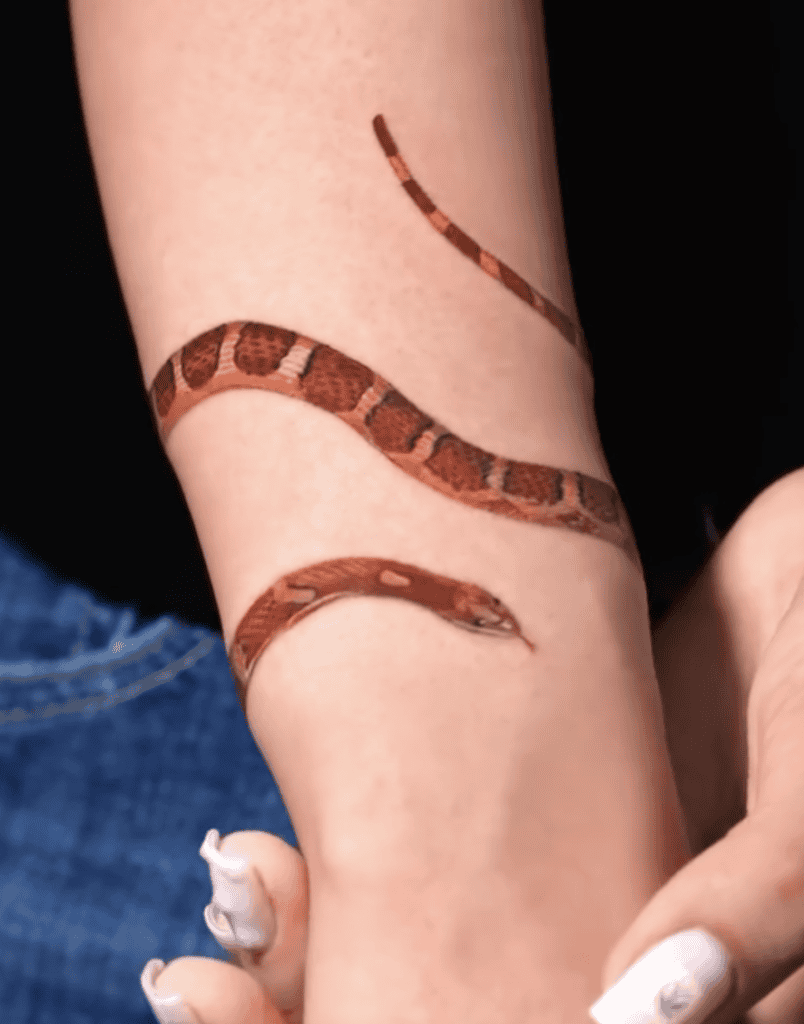
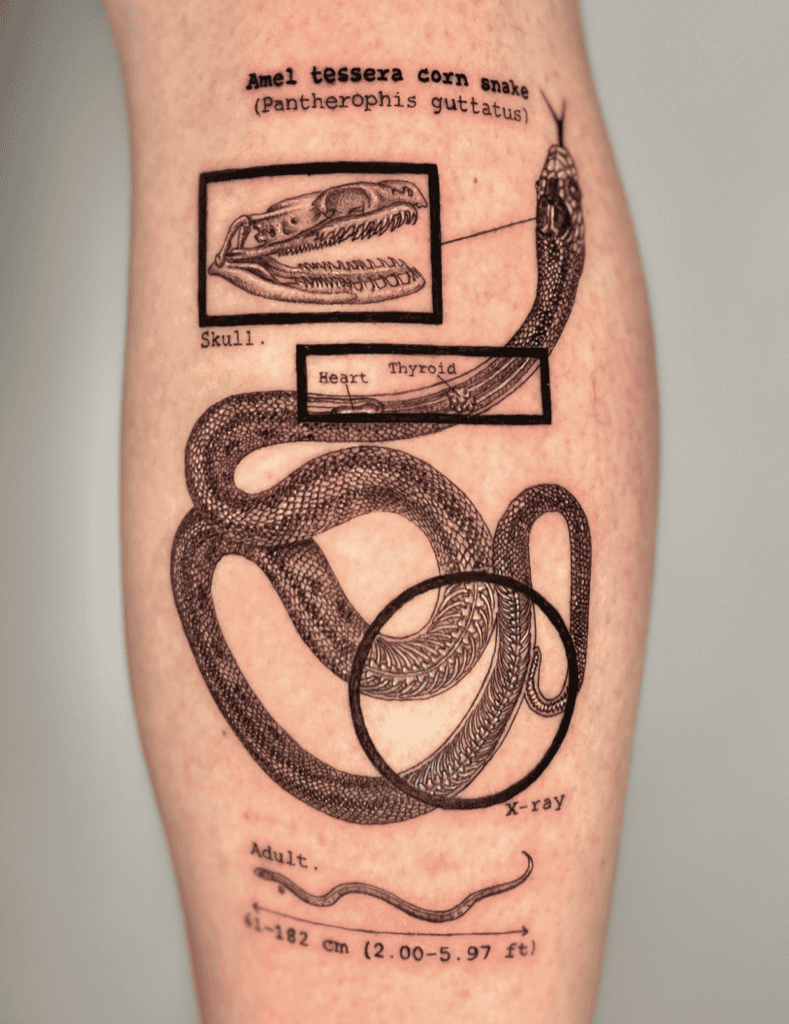
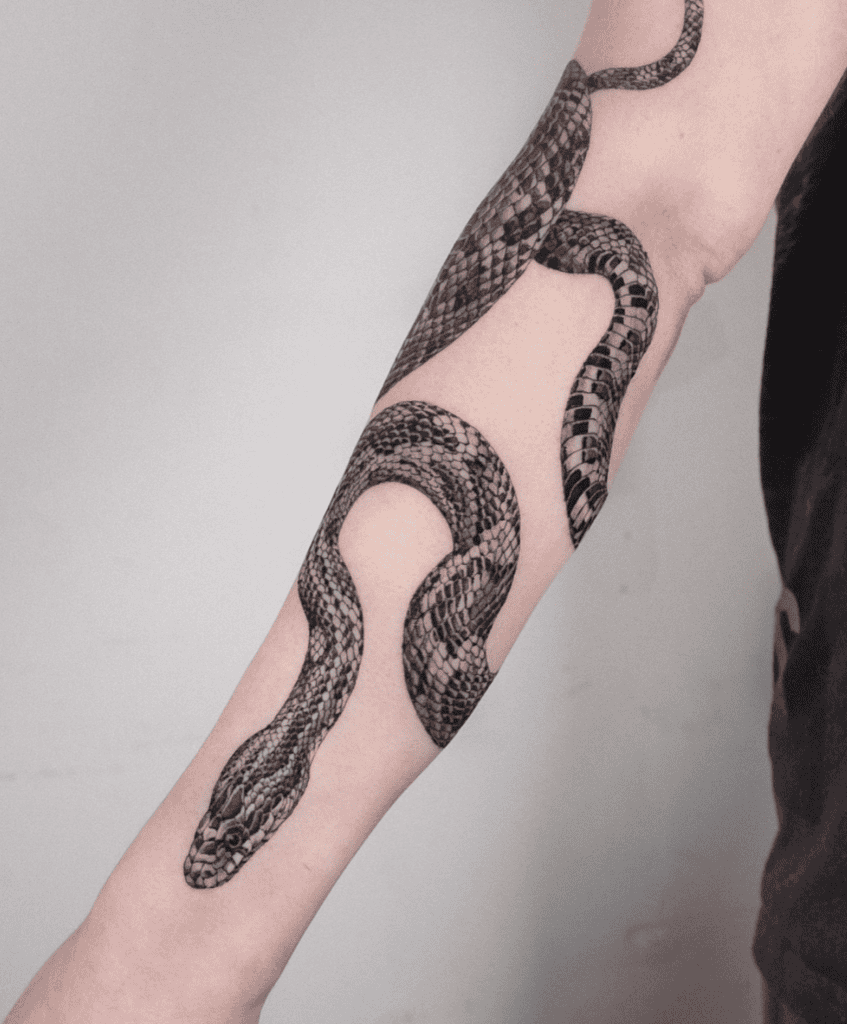
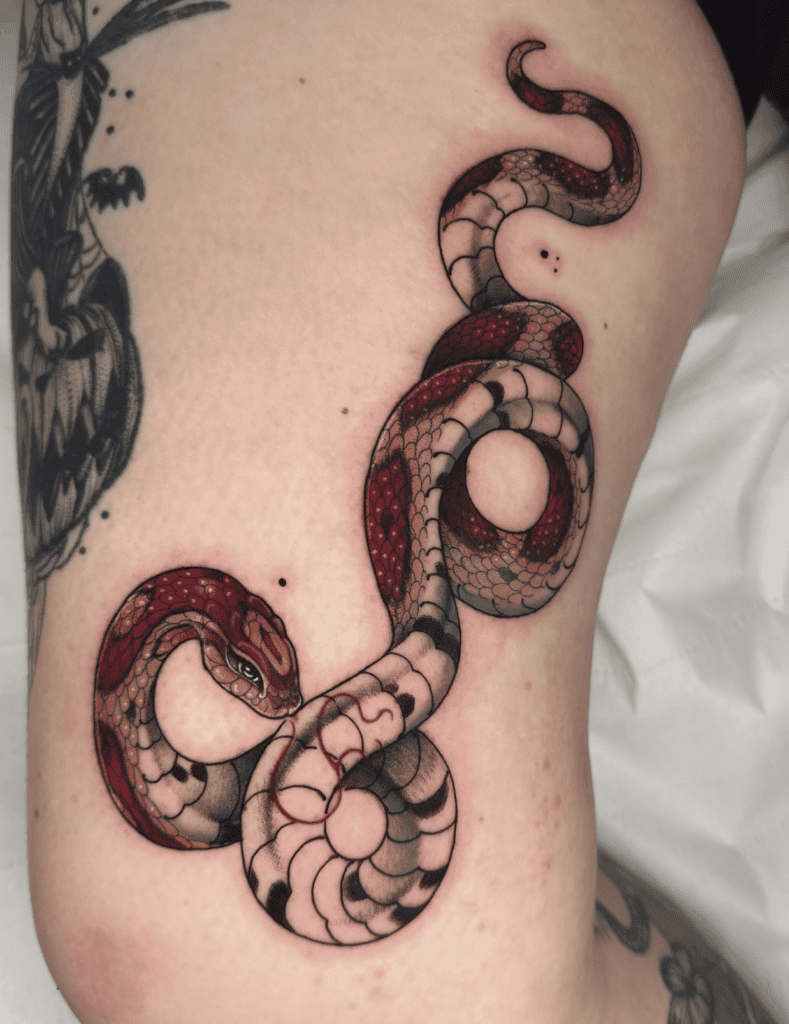
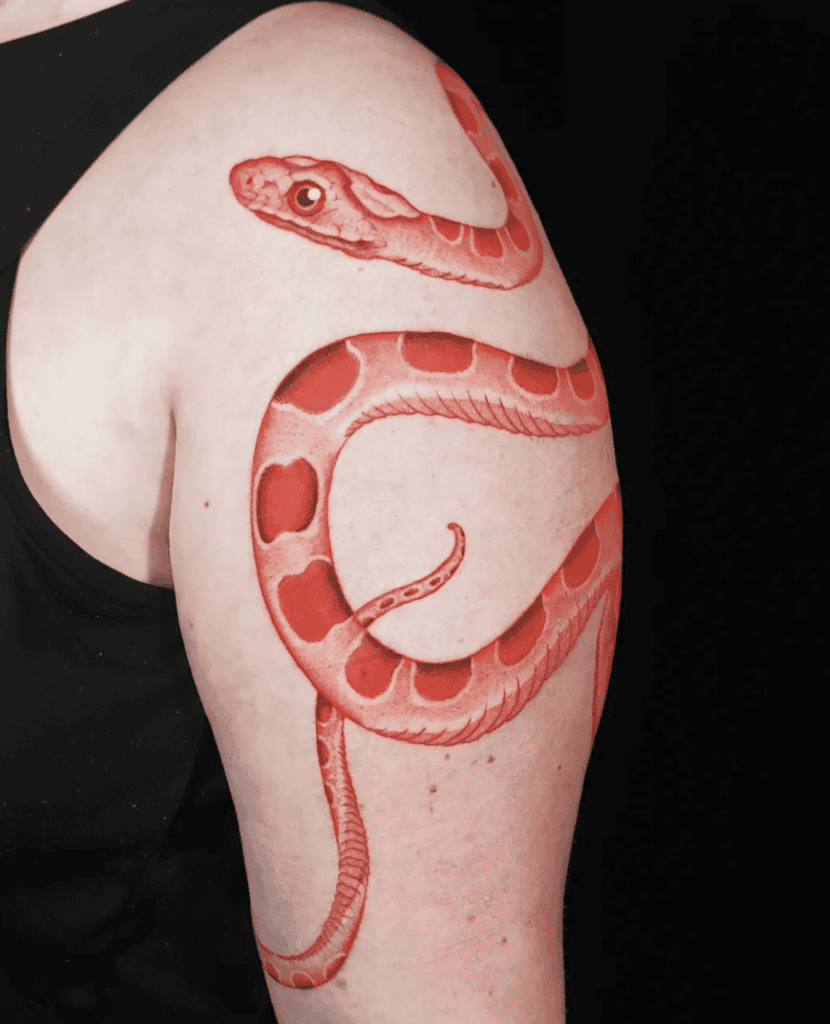
The Corn Snake is a non-venomous constrictor native to the southeastern United States. It belongs to the same broader group as rat snakes and is closely related to them. It is theorised to get its name from its traditional association with corn storage areas and barns, where it was often found hunting rodents, or because its belly scales have a pattern that resembles multicoloured corn kernels.
Corn Snakes are found in the southeastern United States, such as Florida, Georgia, Alabama, Mississippi, Louisiana, and North Carolina. These snakes are constrictors and feed on mice, rats, small birds, bird eggs, and occasionally frogs. They are completely non-venomous, relying on constriction, quick striking, and swallowing prey whole.
Garter Snake Tattoo
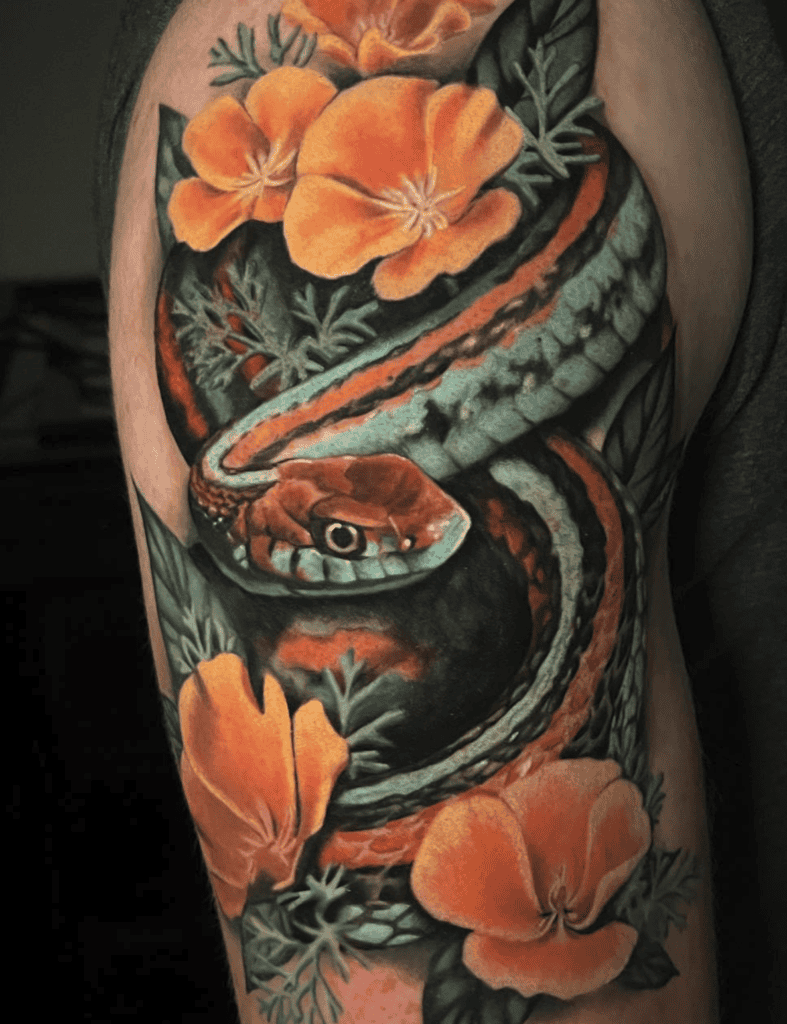
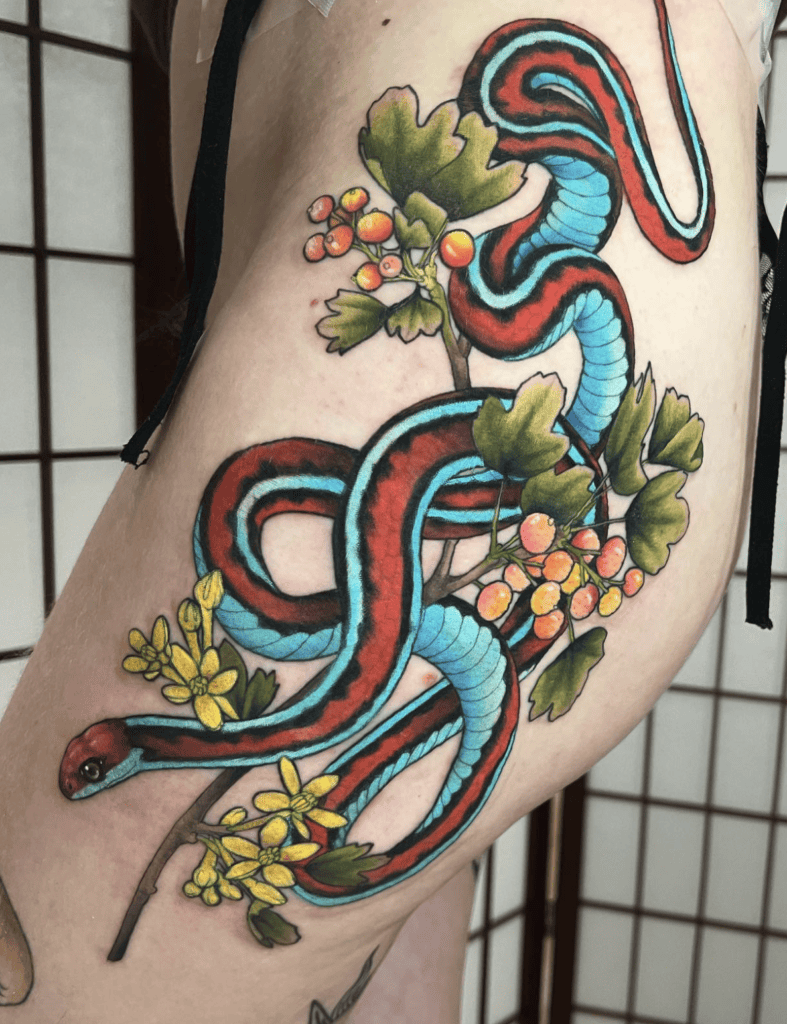
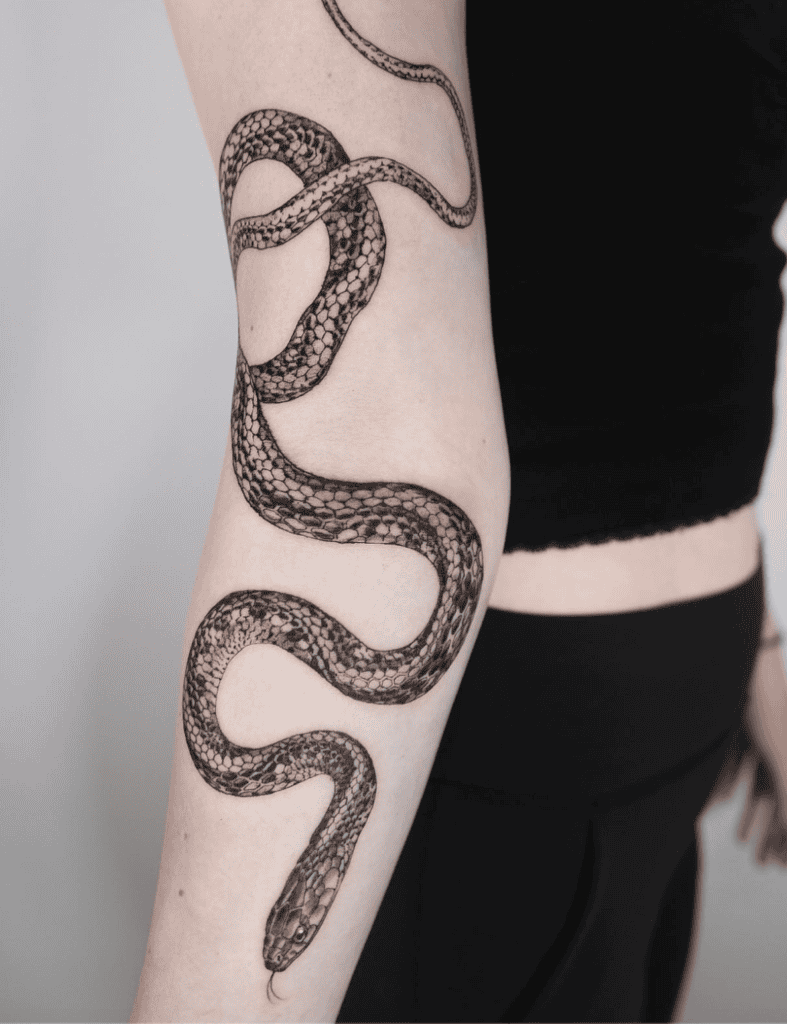
Garter Snake refers to a group of small-to-medium non-venomous snakes in the genus Thamnophis, found primarily in North and Central America. The most common species is the Common Garter Snake. They are named after the old-fashioned “garter” clothing straps because of their long, striped appearance.
Garter Snakes are found across the United States, Canada, and Mexico, living in gardens, grasslands, and forest edges, wetlands, streams and ponds. They are one of the few snakes that thrive in both land and water environments.
One of the most interesting traits of garter snakes is their love of water. They can swim very well, hunt in ponds and streams, stay submerged for short periods, and chase amphibians underwater. The Garter Snake is not dangerous to humans, but do have mild saliva toxins in some species that are not medically significant to people.
Milk Snake Tattoo


The Milk Snake is a non-venomous colubrid snake found across North, Central, and parts of South America. It belongs to the kingsnake family (Lampropeltis), known for its strength and immunity to some snake venoms. There are many subspecies with different patterns and colours, but the most famous is the brightly banded form.
The name comes from an old myth when people once believed Milk Snakes would sneak into barns and suck milk from cows. In reality, Milk Snakes go into barns, which are often inhabited by mice and rats.
Milk Snakes are often confused with the highly venomous Coral Snake, leading to a famous rhyme: “Red on yellow, kill a fellow; red on black, friend of Jack.” Milk Snakes mimic coral snakes to scare predators, being a classic example of Batesian mimicry.
Eastern Kingsnake Tattoo

The Eastern Kingsnake is a non-venomous colubrid snake native to the eastern United States. It belongs to the kingsnake group (Lampropeltis), which is known for strength, adaptability, and snake-eating behaviour. Its name, “king”, comes from its reputation as a snake that can overpower and eat other snakes.
The Eastern Kingsnake earned the title because it eats other snakes, can resist some snake venoms, is an aggressive predator relative to its size, and often dominates other reptiles in its environment.
The Eastern Kingsnake is found in the southeastern United States, Florida, Georgia, Alabama, South Carolina, North Carolina, and parts of the Gulf Coast. It is highly adaptable and can tolerate both wet and dry environments, and is one of the few snakes that regularly prey on other snakes, including venomous species like copperheads and rattlesnakes.
Black Kingsnake Tattoo


The Black Kingsnake is a non-venomous colubrid snake found primarily in the southeastern United States. It was once considered a subspecies of the Eastern Kingsnake but is now widely recognised as its own species.
Black Kingsnakes are found mainly in Mississippi, Alabama, Tennessee, Georgia and some regions of Florida. Like all kingsnakes, they are famous for snake-eating behaviour, including venomous species in some cases. The Black Kingsnake is completely non-venomous, killing prey by constriction, meaning it poses no danger to humans.
California Kingsnake Tattoo

The California Kingsnake is a non-venomous colubrid snake native to the western United States and parts of Mexico. It is sometimes considered one of the most successful kingsnake species due to its wide range and flexibility.
California Kingsnakes’ typical features include a glossy black body, clean white or cream bands (sometimes brown or tan variation), and smooth, shiny scales. Some populations have reduced banding or different regional patterns.
California Kingsnake is found in California, Arizona, Nevada, Oregon, Baja California, and Mexico. It is one of the most adaptable kingsnakes in North America, extremely well-suited to dry environments.
Coral Snake Tattoo
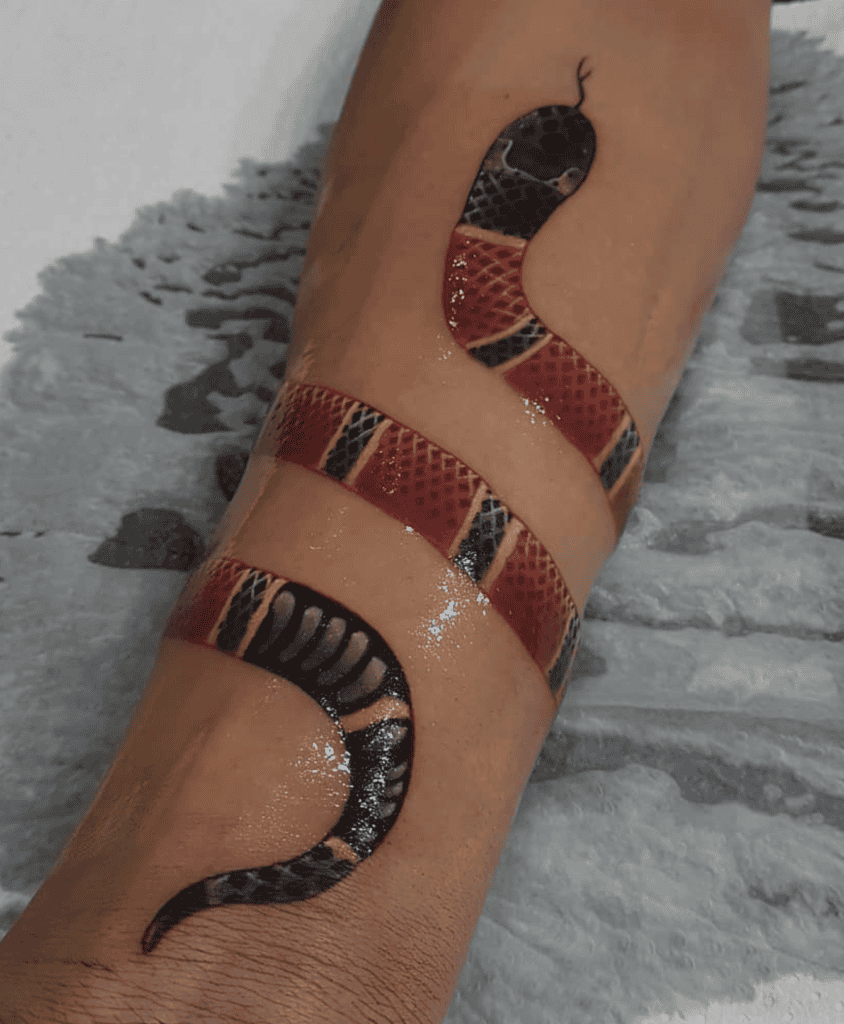
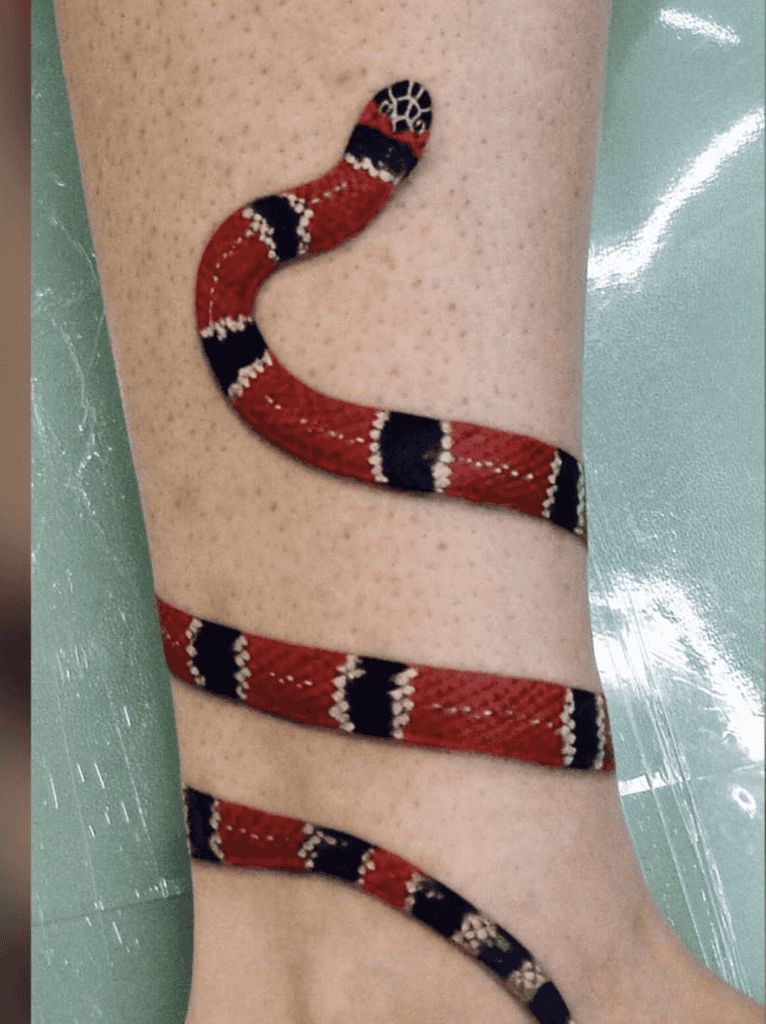
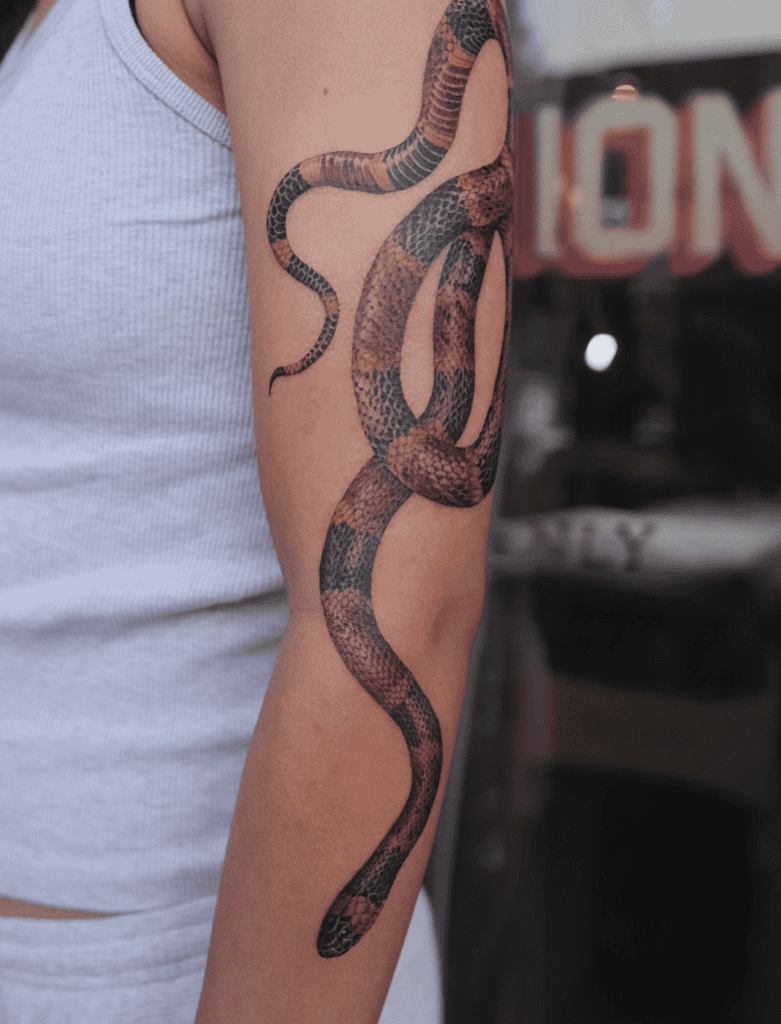
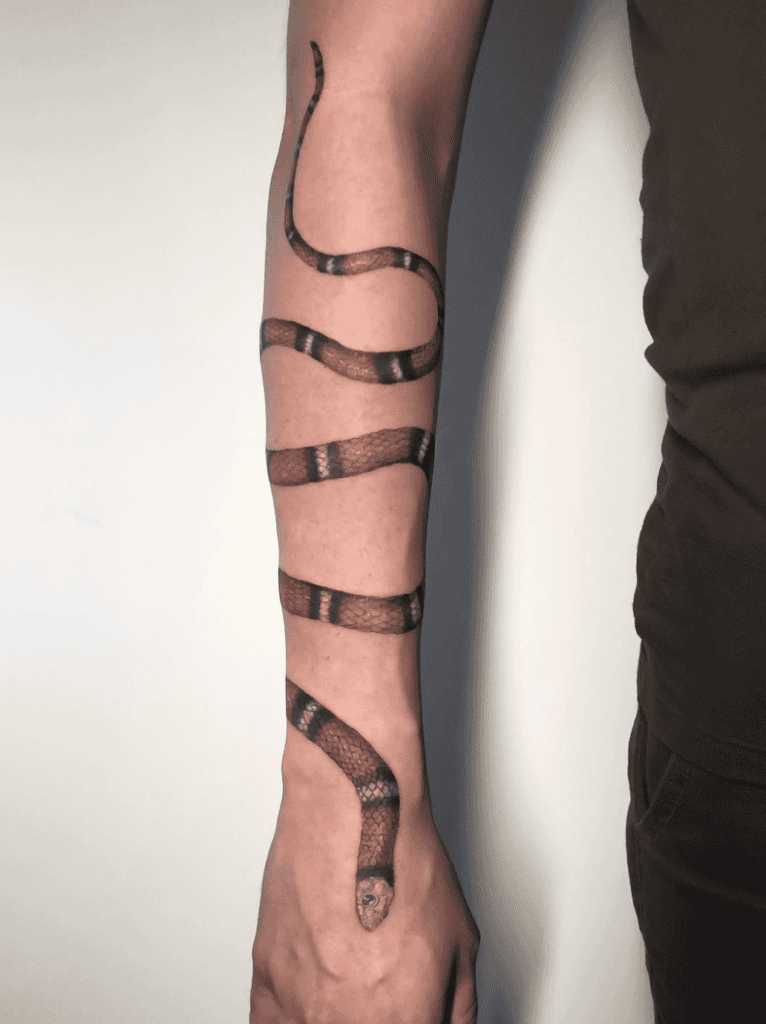
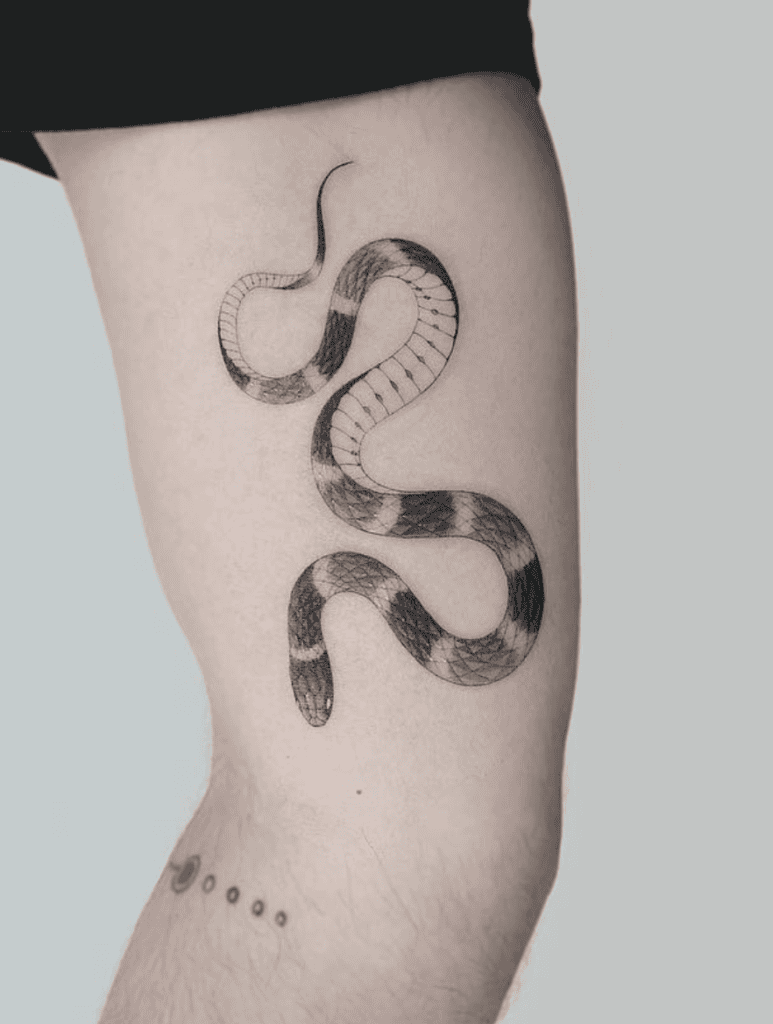
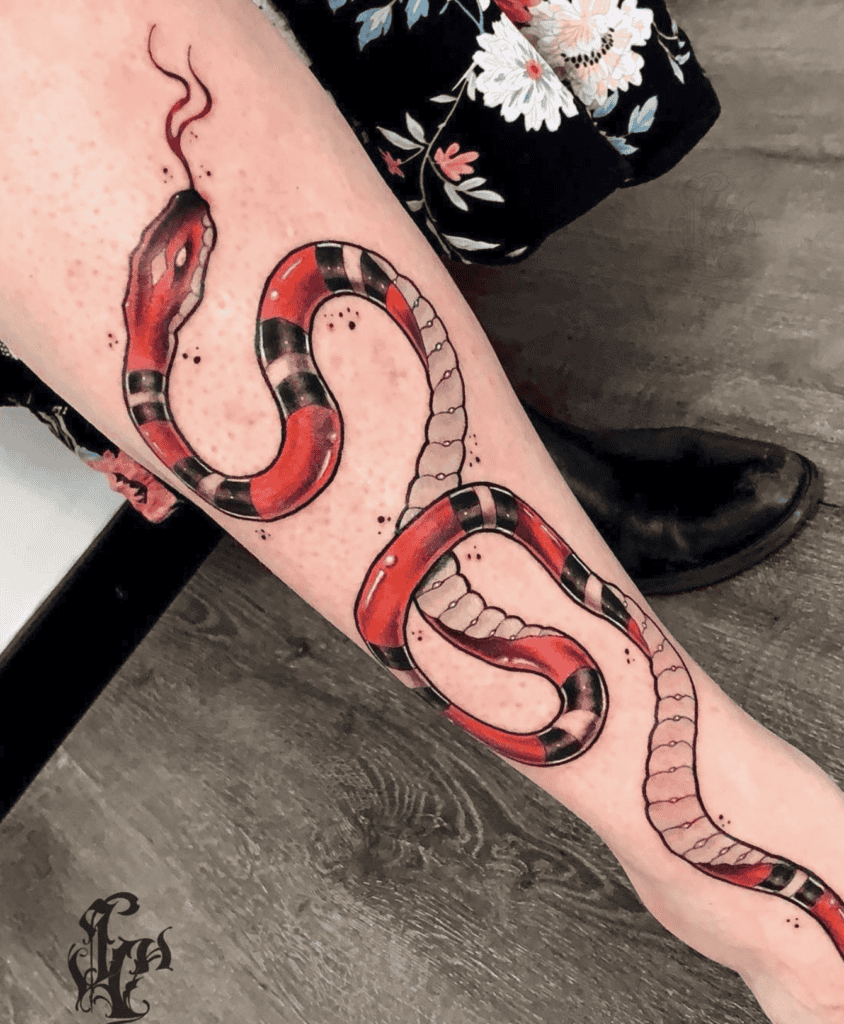
The Coral Snake is a group of highly venomous elapid snakes found in North and South America, best known for their vivid red, yellow (or white), and black banding. The Coral Snake has an extremely potent neurotoxic venom. Unlike vipers (which damage tissue), coral snake venom attacks the nervous system, causing muscle paralysis, difficulty breathing, speech impairment and respiratory failure in severe cases.
Coral Snakes can be found in the southeastern United States, Mexico, Central and South America. They are extremely shy, secretive, slow-moving, and non-confrontational. When threatened, they try to hide immediately and rarely bite unless handled or stepped on.
Sea Krait Snake Tattoo
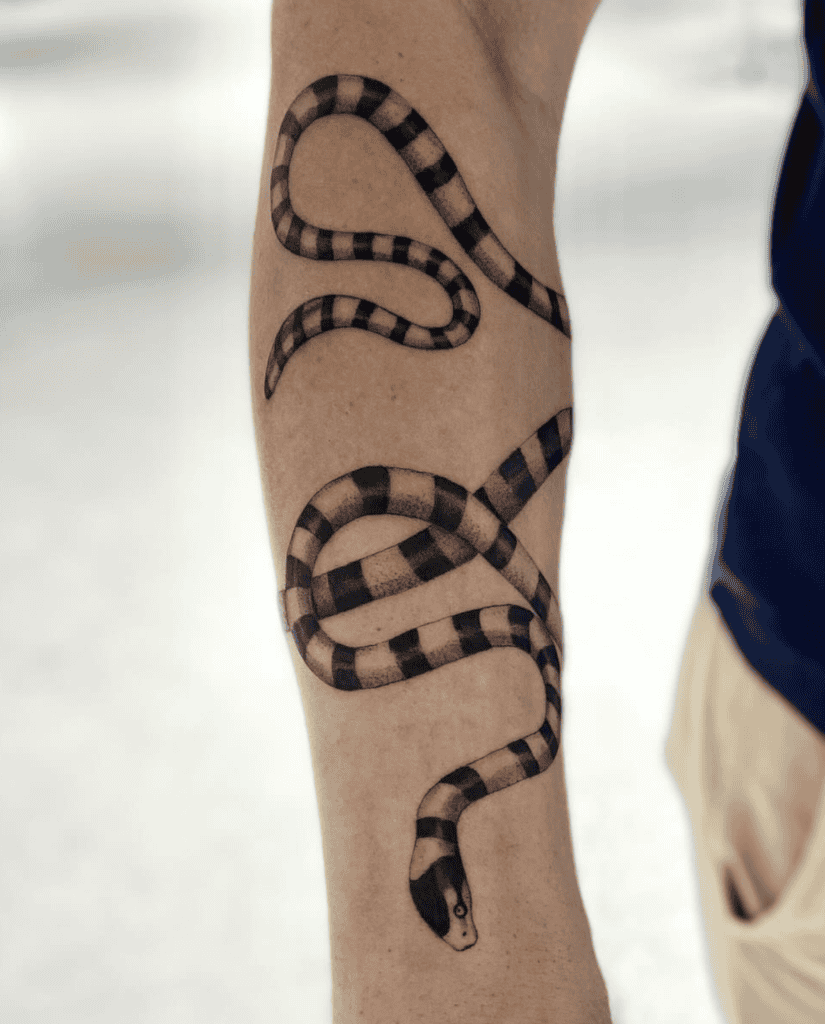
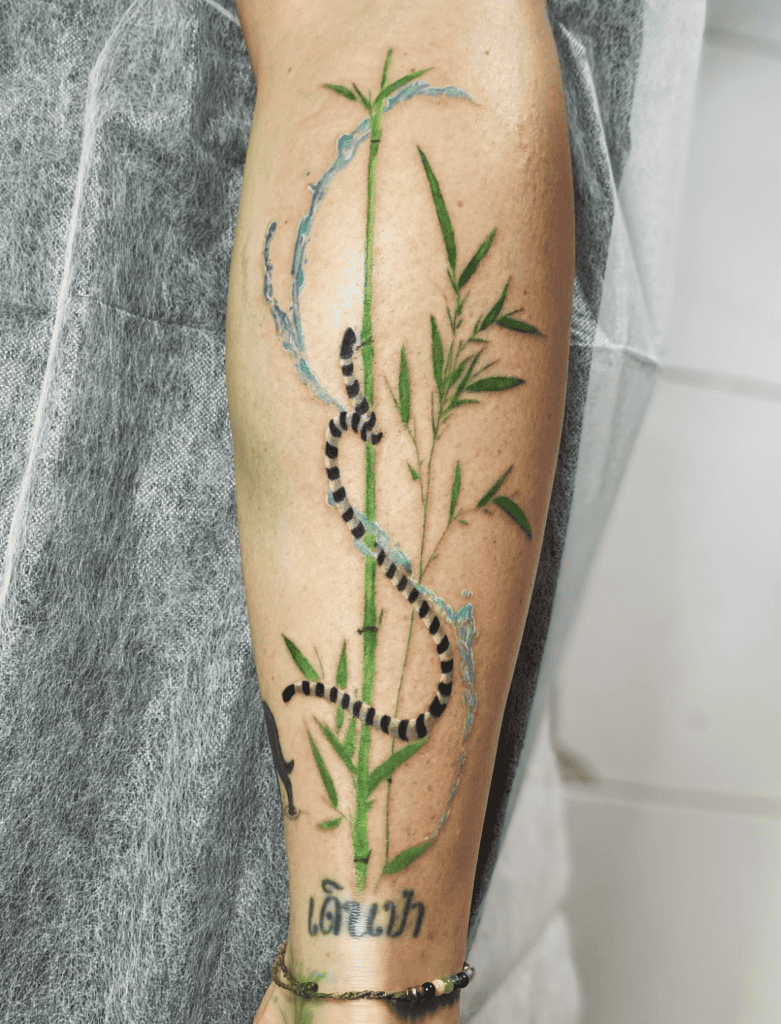
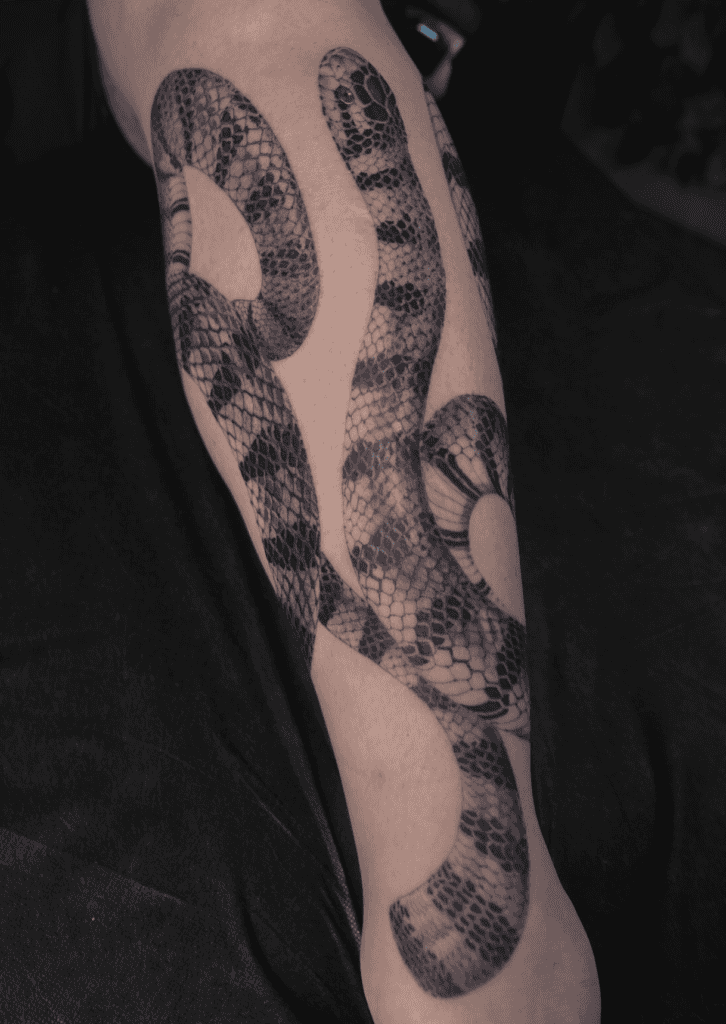
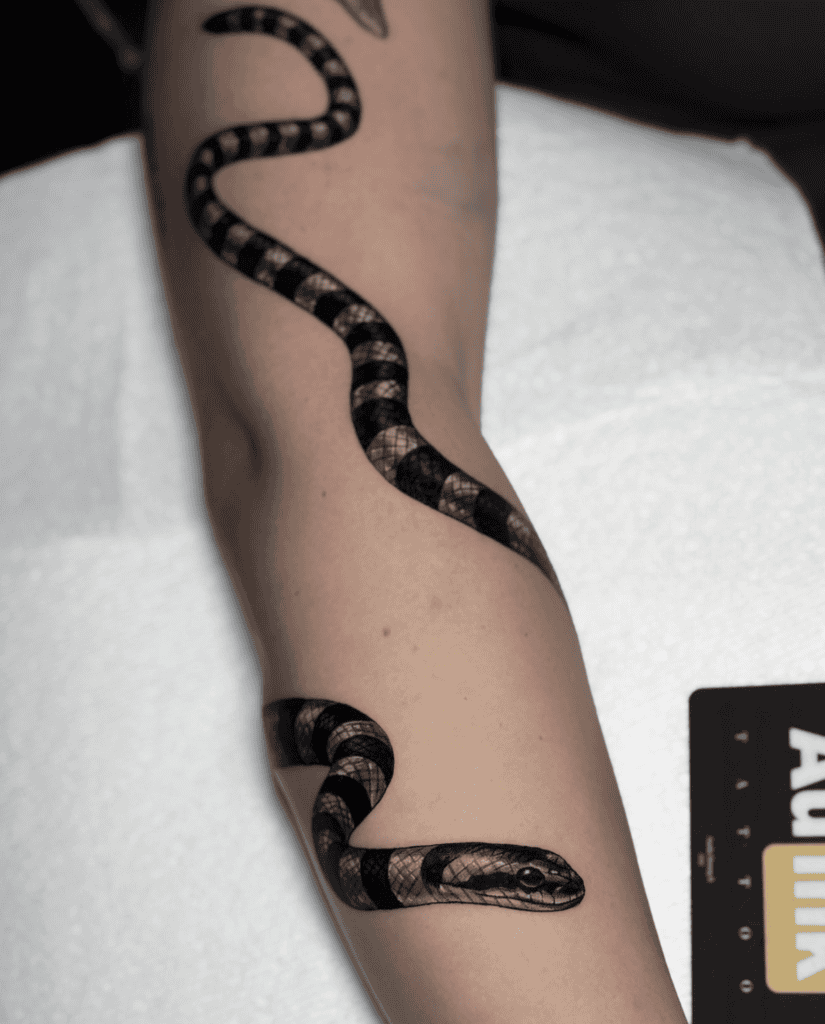
The Sea Krait is a highly venomous marine snake found in the Indo-Pacific region. Unlike most sea snakes, it is amphibious, meaning it lives both on land and in the ocean. It belongs to the group of true sea snakes (Hydrophiinae), which are closely related to cobras and other elapids.
Sea Kraits are unique because they hunt in the ocean, but rest, digest, and mate on land. Most sea snakes almost never leave the water, but Sea Kraits still depend on land for survival.
Sea Kraits are found across the Indo-Pacific, including India, Sri Lanka, Southeast Asia, Indonesia, Papua New Guinea, Northern Australia and Pacific Islands. They are excellent swimmers and can dive deep into reef crevices to hunt.
Yellow-lipped Sea Krait Snake Tattoo

The Yellow-lipped Sea Krait is a highly venomous marine snake found throughout the Indo-Pacific. It is one of the most recognisable sea kraits due to its bright yellow snout and bold black-and-blue banding.
The name comes from its distinctive facial marking, as it has a bright yellow upper lip and snout that contrasts with its black head pattern. This species is widespread across the Indo-Pacific, including India, Sri Lanka, Thailand, Indonesia, the Philippines, Papua New Guinea, Northern Australia, and the Pacific Islands, where they live in coral reefs, coastal waters, rocky shorelines, and small tropical islands. It must return to land regularly, unlike fully marine sea snakes.
Horned Sea Snake Tattoo

The Horned Sea Snake, Hydrophis peronii, is a venomous marine snake species in the sea snake family (Elapidae). It is commonly called Peron’s sea snake or the horned sea snake due to the distinctive raised scales above its eyes.
Its horned structures may help to break up the outline of the head underwater, improve camouflage in shifting reef light, or possibly reduce glare in bright shallow water. This species is found across the Indo-Pacific region, including northern Australia, Indonesia, Papua New Guinea, the Philippines, New Guinea and the surrounding waters of coastal Southeast Asia.
African Rock Python Snake Tattoo


The African Rock Python is a large, non-venomous constrictor native to sub-Saharan Africa. It belongs to the python family (Pythonidae) and is the largest snake in Africa, as well as one of the largest snake species on Earth.
African Rock Pythons are commonly found among rocky outcrops, caves, cliffs, riverbanks and abandoned burrows. The rocks provide shelter, basking spots, and excellent ambush locations. The African Rock Python is found across much of sub-Saharan Africa, including Kenya, Tanzania, Uganda, Ethiopia, South Africa, Botswana, Zambia, Zimbabwe, Namibia, and many other African nations.
These snakes lie perfectly still in ambush and strike with incredible speed. They grab prey using backwards-curved teeth and wrap several coils around the victim. They then tighten each time the prey exhales, and swallow the animal whole, starting with the head. Modern research suggests constriction primarily stops blood circulation rather than simply preventing breathing, allowing prey to lose consciousness within minutes.
Carpet Python Snake Tattoo

The Carpet Python is a large, non-venomous python native to Australia, Papua New Guinea, and parts of Indonesia. It belongs to the python family (Pythonidae) and is one of Australia’s most widespread and variable snake species.
Rather than being a single uniform snake, the Carpet Python is a species complex, with several recognised subspecies and regional forms that differ in colour, pattern, and size.
The ‘Carpet’ name comes from its beautiful markings, as its body is covered in intricate diamonds, irregular blotches, interwoven stripes, rich browns, blacks, creams, olives, and golds. These patterns resemble the ornate designs found on traditional woven carpets, giving the species its common name.
Children’s Python Snake Tattoo

The Children’s Python is a small, non-venomous python native to northern Australia. It belongs to the python family (Pythonidae) and is one of four species in the Antaresia genus, often called the dwarf pythons.
This snake was named in honour of John George Children, a British zoologist who made important contributions to natural history during the 1800s, and not a name to suggest it is suitable for children. The Children’s Python is found across northern Australia, including the Northern Territory, Western Australia, and Queensland.
Hognose Snake Tattoo
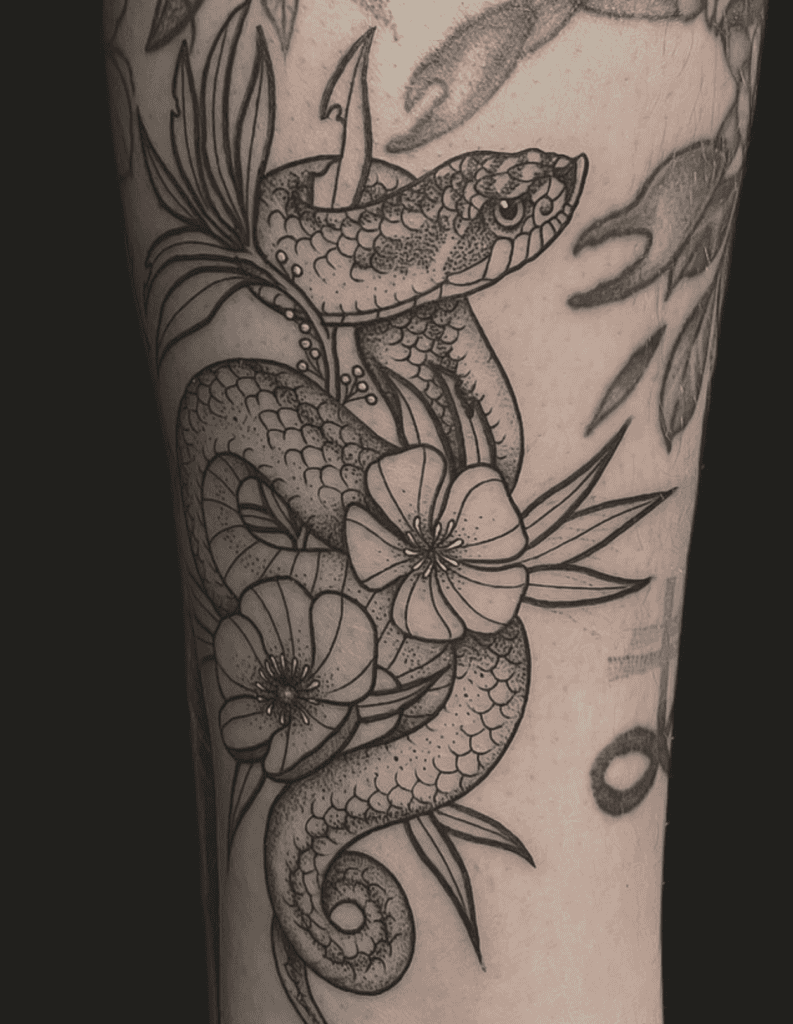
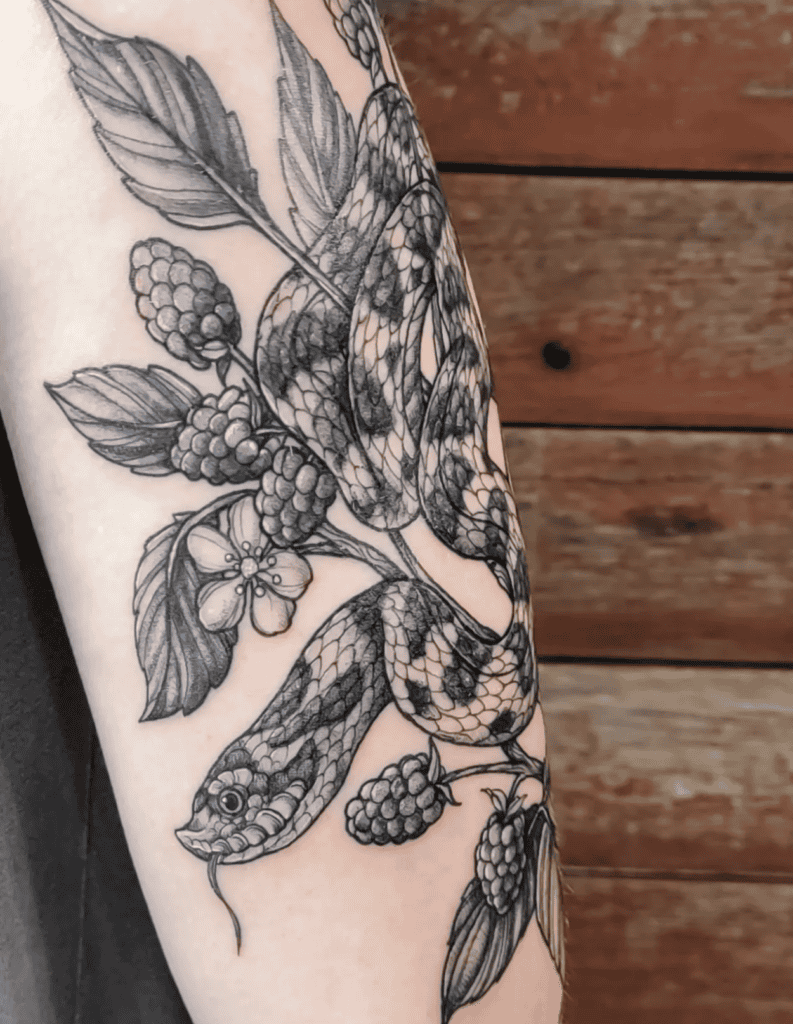
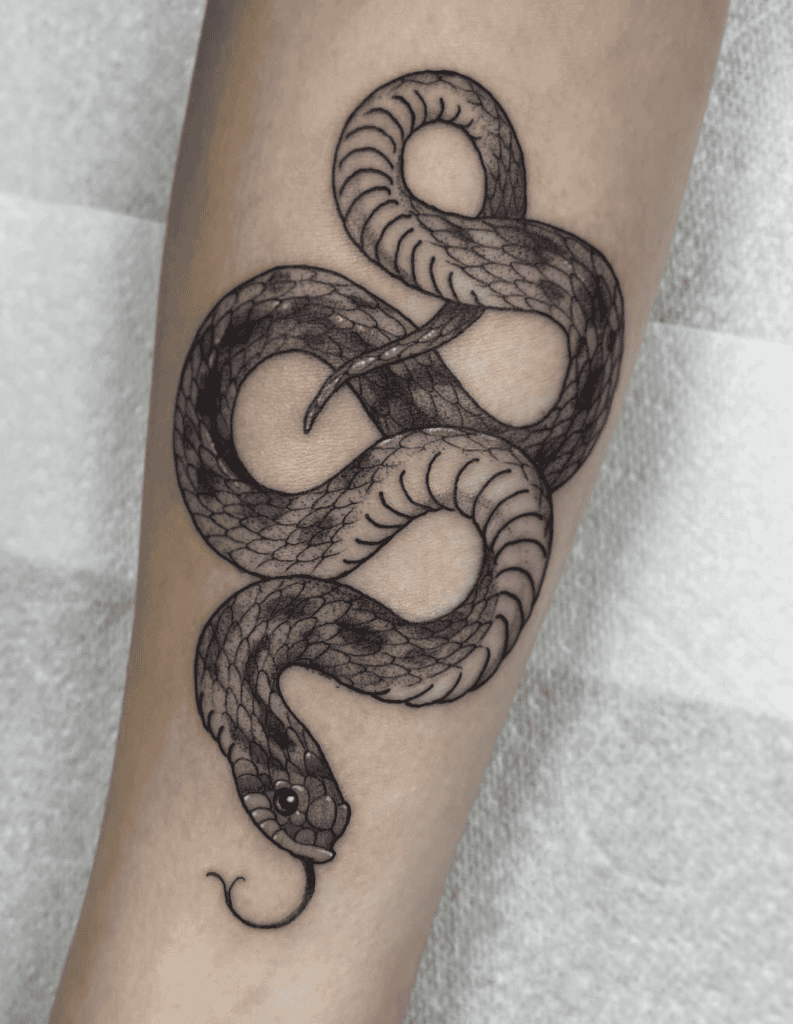
The name Hognose Snake refers to several species in the genera Heterodon (North American hognose snakes) and Leioheterodon. The most well-known species is the Western Hognose Snake, which has become one of the world’s most popular pet snakes.
Their name comes from an upturned snout that looks remarkably like a pig’s nose that they use to burrow into loose soil, dig up prey, and hide beneath sand or leaf litter. North American hognose snakes are found across Canada, the United States, and Mexico.
Most hognose snakes possess mild rear-fanged venom, with the Western Hognose Snake using this venom mainly to subdue amphibians and help digest prey. Because their fangs are at the back of the mouth, they must chew to deliver much venom.
Hognose snakes are legendary for their defence displays, where they flatten their neck, raise the front of the body, and hiss loudly, looking remarkably similar to a tiny cobra. If the threat continues, they strike repeatedly, often with a closed mouth. If the bluff still doesn’t work, the snake will roll onto its back, open its mouth, let its tongue hang out, and emit a foul-smelling musk while it lies completely limp, pretending to be dead.
Sidewinder Snake Tattoo

The Sidewinder is a small but highly venomous rattlesnake found in the deserts of the southwestern United States and northwestern Mexico. It belongs to the pit viper family (Viperidae) and is best known for its unusual sideways movement, which gives the species its common name.
Unlike most snakes, the Sidewinder doesn’t move in a straight serpentine motion across soft sand. Instead, it uses sidewinding locomotion, where it lifts most of its body off the ground, touches the sand at only two small points at a time, and throws its body sideways in a looping motion.
This helps it to avoid sinking into loose sand and reduce contact with the hot desert surface. The result is a series of distinctive J-shaped tracks that are easy to recognise in the desert. Sidewinders can be found in California, Arizona, Nevada, Utah, New Mexico, Baja California, Sonoran and Mojave Deserts.
Bushmaster Snake Tattoo


The Bushmaster is a genus of highly venomous pit vipers found in the rainforests of Central and South America. The best-known species is the South American Bushmaster, which is also the largest viper in the Western Hemisphere. Unlike many vipers, Bushmasters are egg-layers, making them unusual among their relatives.
The name comes from its habitat and reputation. It lives deep in the “bush” of the Americas and is regarded as a master ambush predator. Throughout history, its rarity and large size have inspired numerous legends, with some local stories exaggerating its aggression. In reality, Bushmasters are typically reclusive and avoid human contact.
The South American Bushmaster is found throughout parts of Brazil, Peru, Colombia, Ecuador, Venezuela, Bolivia, Guyana, Suriname, and French Guiana, with other Bushmaster species occurring in Costa Rica, Panama, and Nicaragua.
Mangrove Snake Tattoo

The Mangrove Snake, also known as the Gold-ringed Cat Snake, is a rear-fanged, mildly venomous snake native to Southeast Asia. It belongs to the cat snake genus (Boiga), a group known for their excellent climbing ability, large eyes, and nocturnal hunting habits.
Its common name comes from one of its favourite habitats. It is frequently found in mangrove forests, coastal swamps, tropical rainforests, riverbanks, and wetland forests. But, despite the name, it isn’t limited to mangroves and can be found in many forested habitats.
The Mangrove Snake is found throughout Southeast Asia, including Thailand, Malaysia, Singapore, Indonesia, Brunei, the Philippines, and Myanmar. It spends much of its life in trees but also hunts on the ground, primarily hunting at night. Their large eyes help them detect movement in low light, hunt among branches, and navigate dense forests. During the day, they usually rest in trees or dense vegetation.
Horned Viper Snake Tattoo
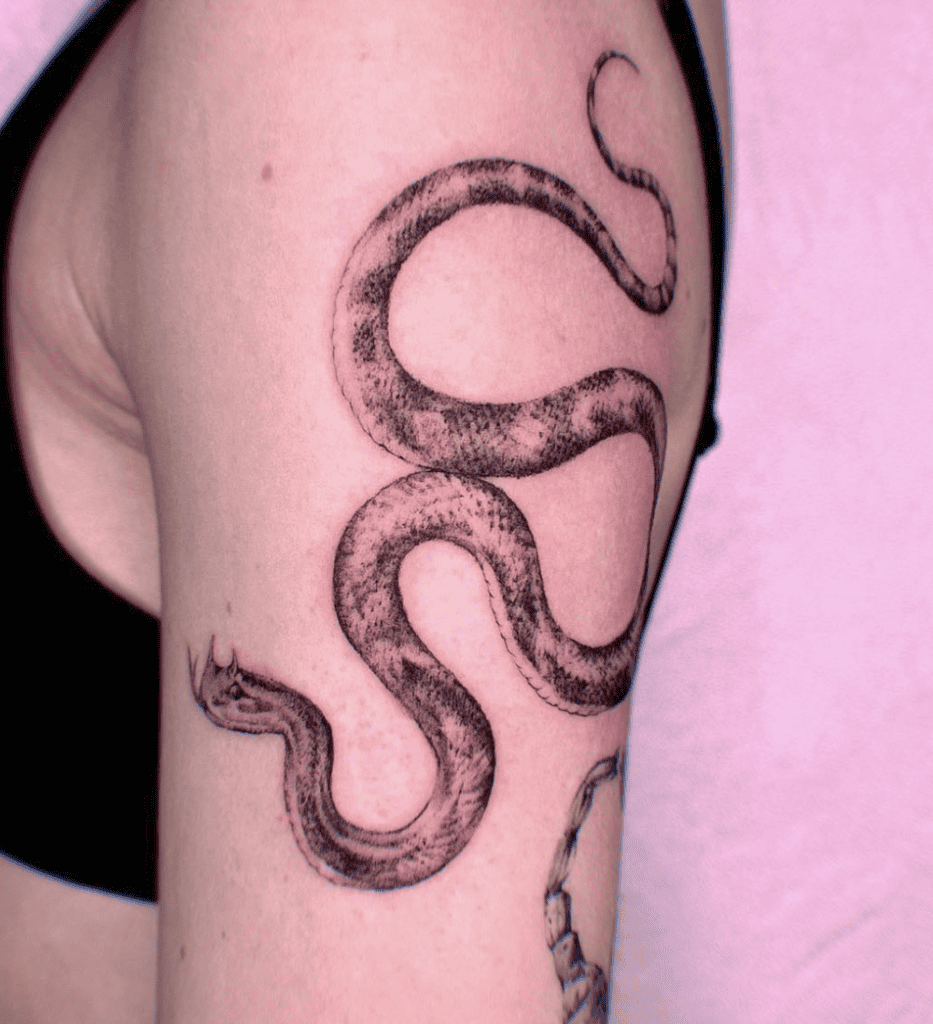
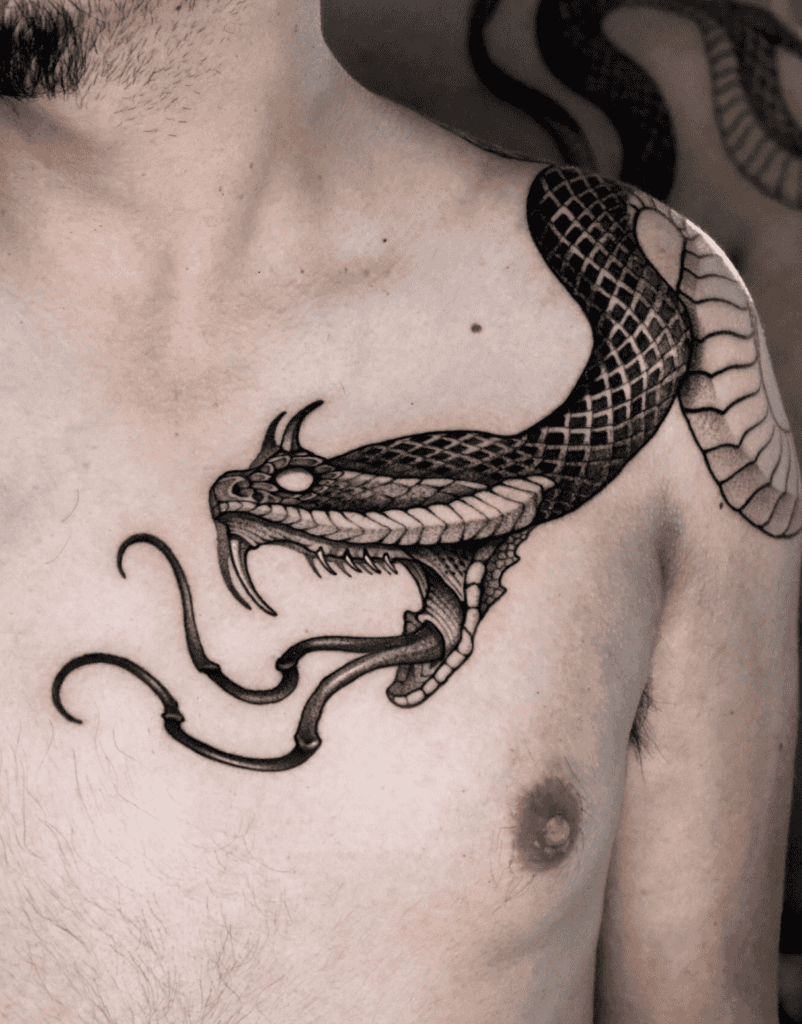
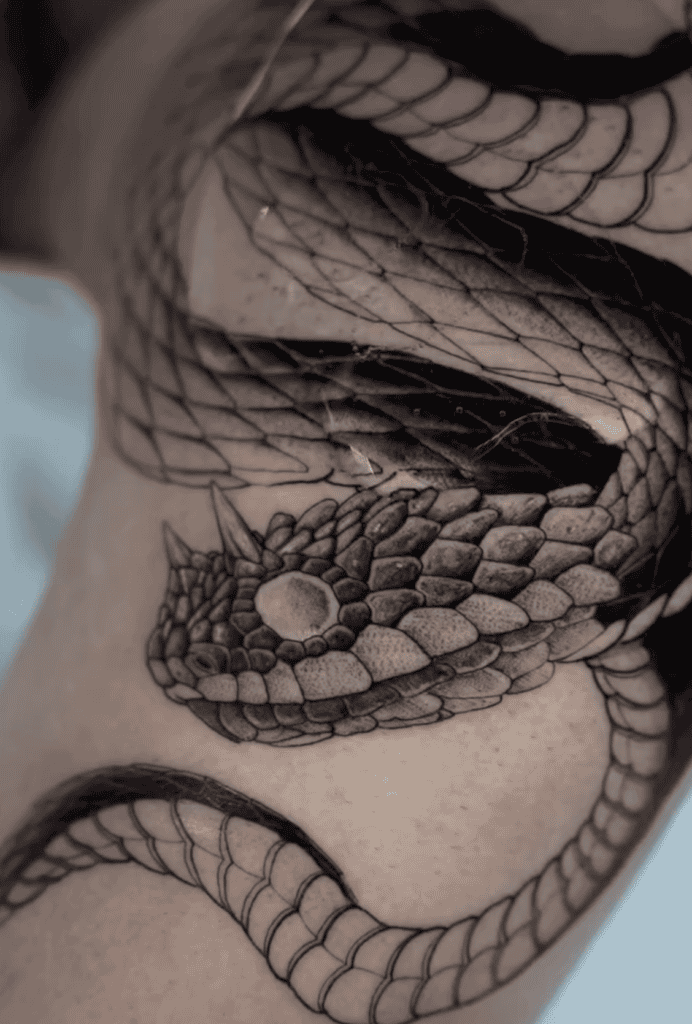
The Saharan Horned Viper is a highly venomous pitless viper belonging to the family Viperidae. It is best known for the pair of horn-like scales above its eyes, although some individuals naturally lack these “horns.”
The Horned Viper’s “horns” are actually modified scales. Scientists believe they help by breaking up the outline of the eyes for camouflage, protecting the eyes from blowing sand, or helping conceal the snake when buried. Interestingly, not every Horned Viper has horns, with some populations having reduced or even absent horns.
Saharan Horned Viper is found throughout Morocco, Algeria, Tunisia, Libya, Egypt, Mauritania, Mali, Niger, Chad, Sudan, and parts of the Arabian Peninsula. Living in deserts, they have evolved numerous adaptations, including sidewinding, burrowing beneath the surface, having pale camouflage, being mostly nocturnal, and having efficient water conservation.
White-lipped Pit Viper Snake Tattoo

The White-lipped Pit Viper is a species of snake found in Indonesia. While most are green, this species is known for an extraordinary electric blue or turquoise form that has made it famous worldwide.
Unlike many brightly coloured reptiles, the blue colour isn’t caused by blue pigment. Instead, it’s produced by microscopic structures in the scales that reflect light, creating vivid shades of turquoise, sky blue, teal, and aqua. This phenomenon is known as structural colouration, similar to the way some butterfly wings and bird feathers produce brilliant colours.
The Blue Insular Pit Viper is found on several Indonesian islands, including Komodo, Flores, Timor, Lombok, Alor, and nearby islands, where it spends most of its life in trees and bushes.
Spotted Python Snake Tattoo

The Spotted Python is a small, non-venomous python native to northeastern Australia. It belongs to the python family (Pythonidae) and is one of four species in the genus Antaresia, commonly known as the dwarf pythons.
Its common name comes from its distinctive pattern. Unlike many pythons that have large blotches or bands, the Spotted Python’s body is covered in numerous small dark spots, speckles, and irregular markings. These markings become more numerous towards the tail, creating an attractive, mottled appearance. Although often seen on the ground, the Spotted Python is an agile climber. This allows it to hunt birds, bats, and arboreal mammals while also escaping predators.
Emerald Tree Boa Snake Tattoo


The Emerald Tree Boa is a non-venomous boa native to the tropical rainforests of South America. It belongs to the boa family (Boidae) and is famous for its vivid green colouration, elegant arboreal lifestyle, and exceptionally long front teeth.
Young snakes look completely different from adults, as they are usually bright yellow, orange, and occasionally reddish. As they mature over several months, they gradually change into their famous emerald-green adult colour. Scientists believe this colour change helps juveniles camouflage in different parts of the forest than adults.
The Emerald Tree Boa possesses some of the longest teeth of any non-venomous snake, which can exceed 4 centimetres. These long teeth help it securely grab birds and mammals that might otherwise escape from the branches.
Tiger and Snake Tattoo
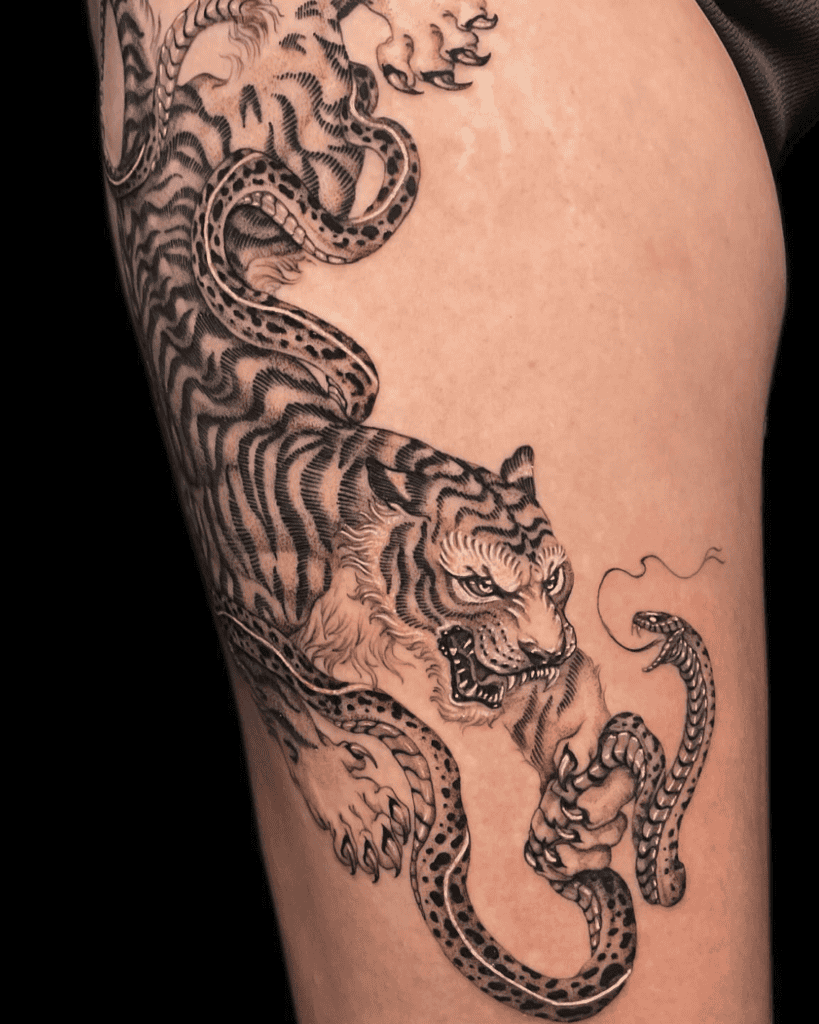
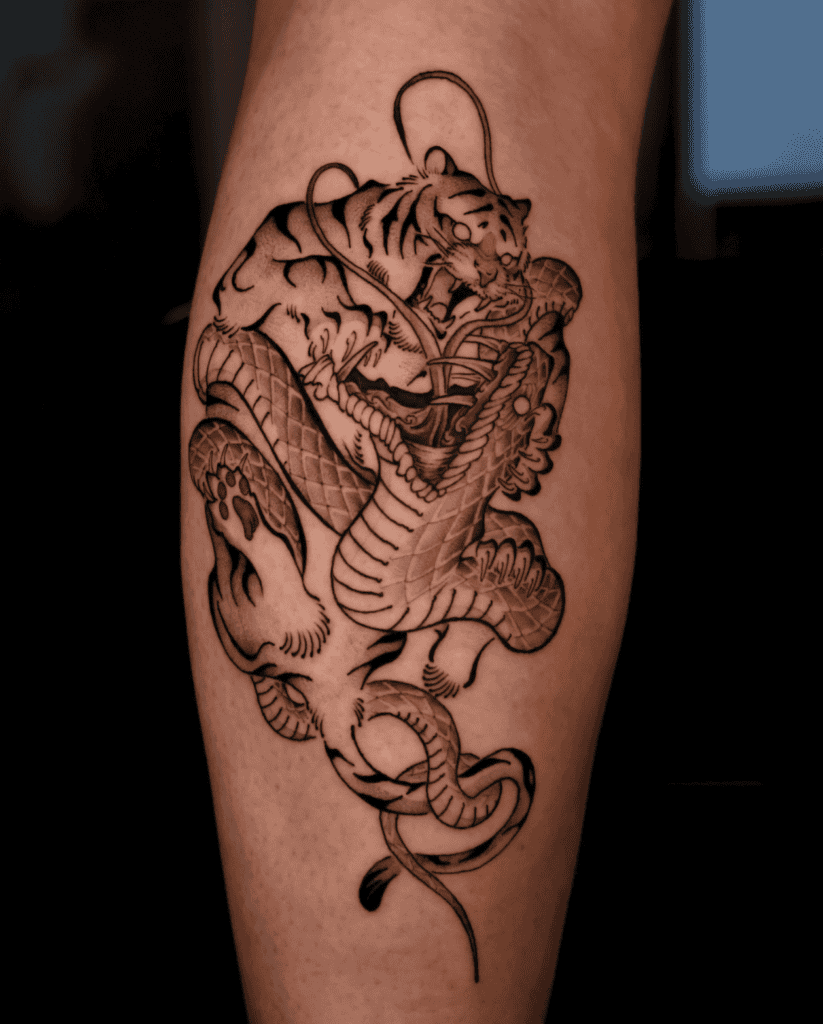
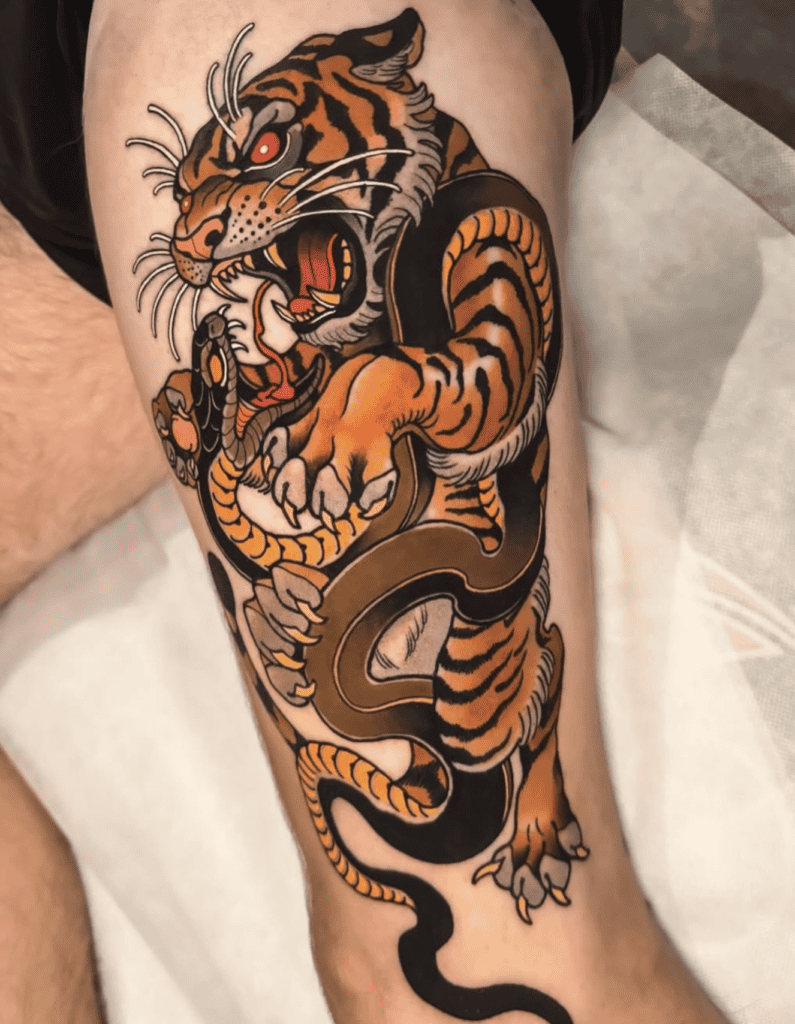
A Tiger and Snake tattoo represents the balance between strength and strategy, power and patience, or instinct and wisdom. This pairing appears in Japanese, Chinese, and modern Western tattoo styles, with each culture adding its own interpretation.
The tiger has long represented fearlessness, raw power, leadership, and independence, seen as a guardian against evil spirits and bad fortune. While the snake represents wisdom, patience, transformation, and healing. Together, they can also represent Yin-Yang from Chinese Philosophy.
Goga Maharaj Snake Tattoo
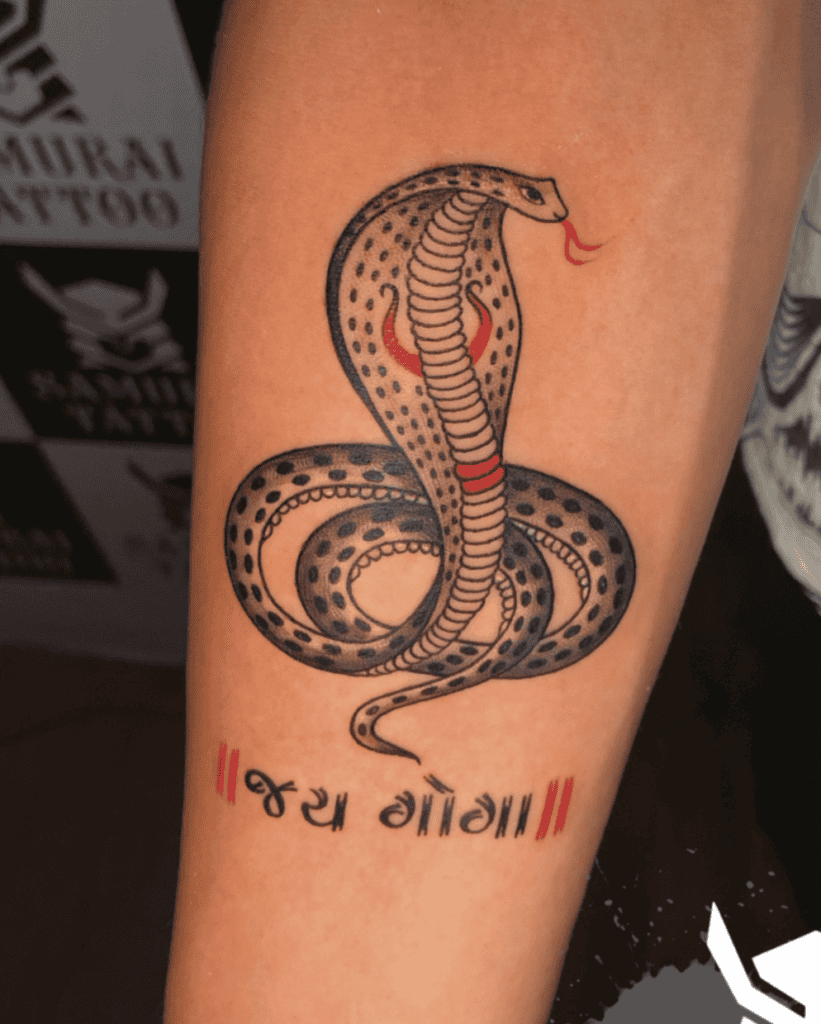
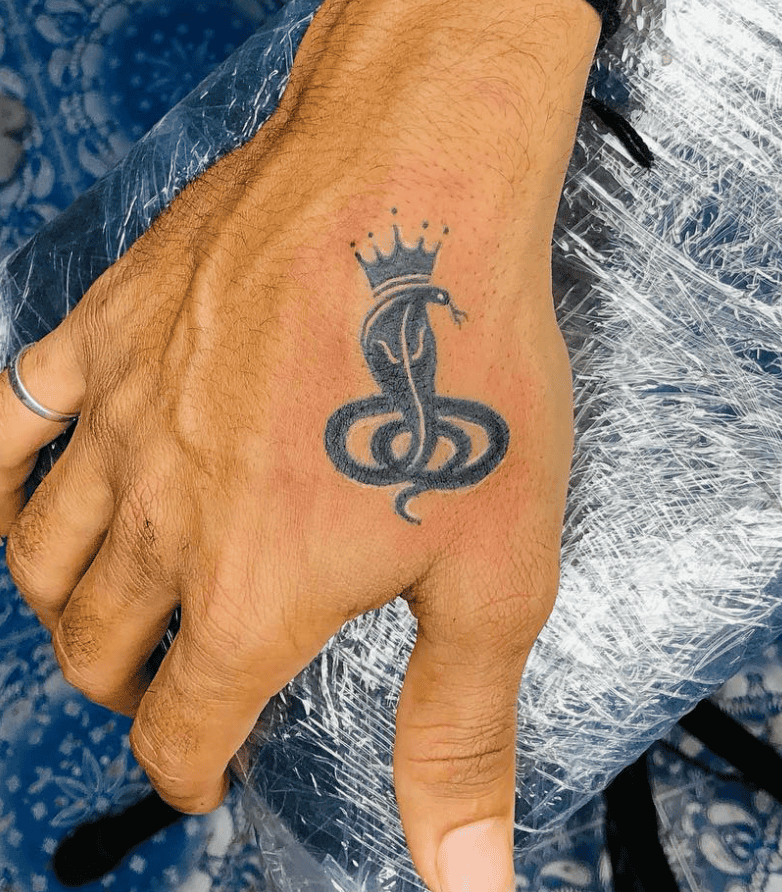
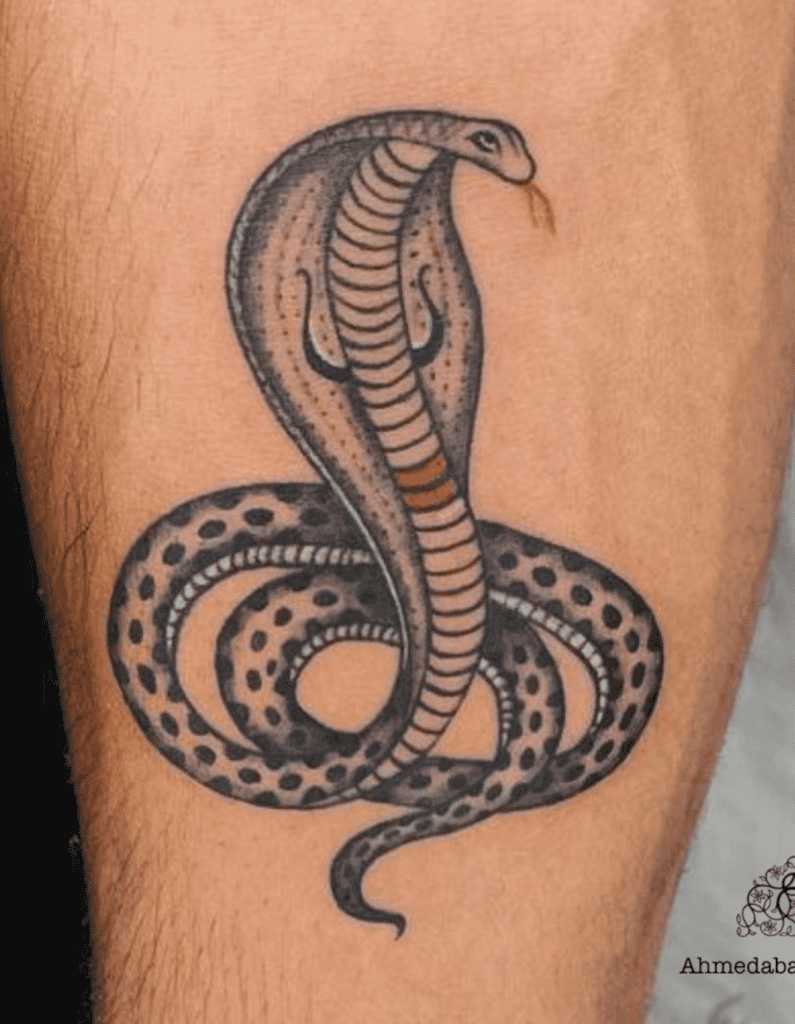
Goga Maharaj, also known as Gogaji, is one of the most fascinating folk heroes in India, revered as the protector against snakebites and the lord of serpents. Gogaji (often respectfully called Goga Maharaj, Gugga Pir, or Jahar Veer Gogga) is a revered folk hero and saint, especially in the Indian states of Rajasthan, Haryana, Punjab, Himachal Pradesh, Gujarat, and Uttar Pradesh. He is worshipped by both Hindus and Muslims, making him an important symbol of shared faith and cultural harmony.
According to tradition, Gogaji was born around the 10th or 11th century in the region now known as Rajasthan. He was born into a Rajput family and became renowned for his courage, leadership, compassion, and sense of justice. Legends tell that he was blessed by a great spiritual master and received extraordinary powers over snakes. Because of this divine blessing, he became known as the protector of people from snakebites.
He is believed to possess the power to control snakes, heal snakebite victims, protect villages from venomous snakes, and remove fear associated with serpents. Many people still pray to Gogaji for protection before entering forests, fields, or areas where snakes are common.
Hydra Snake Tattoo
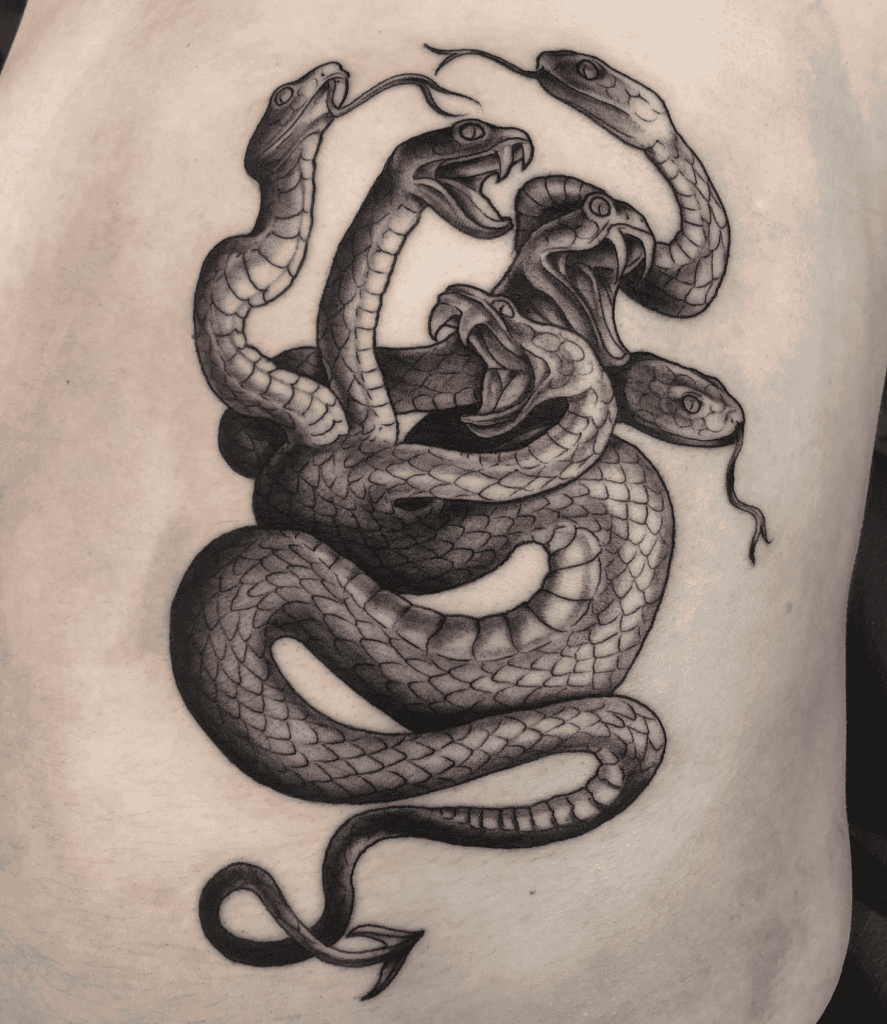
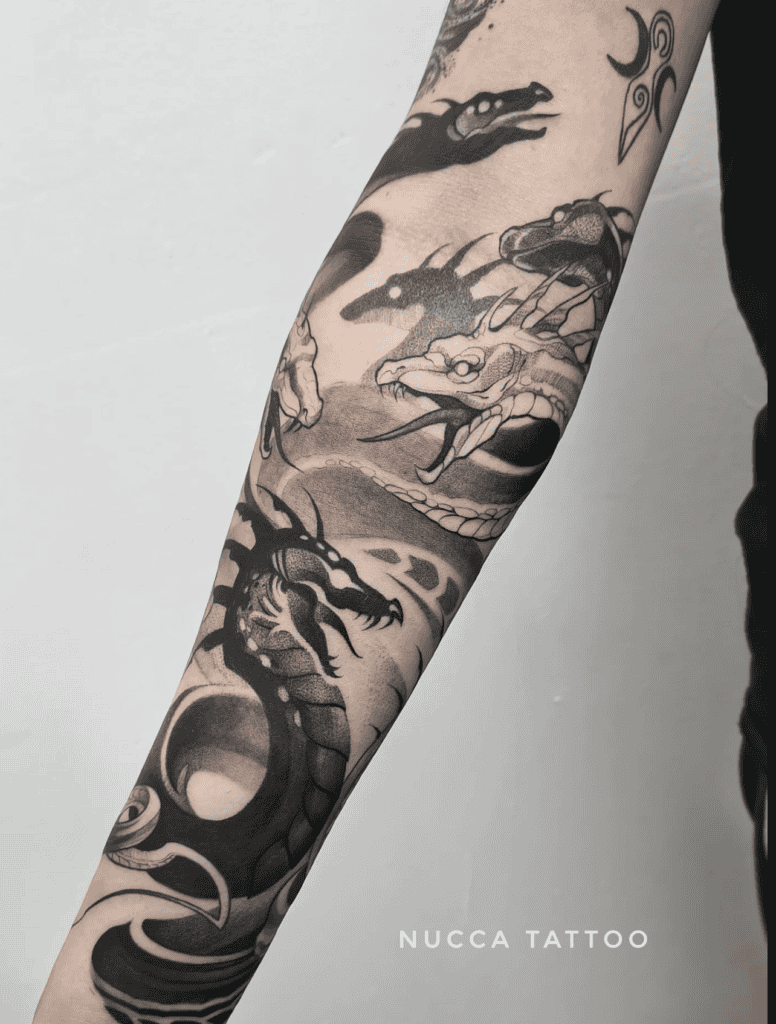
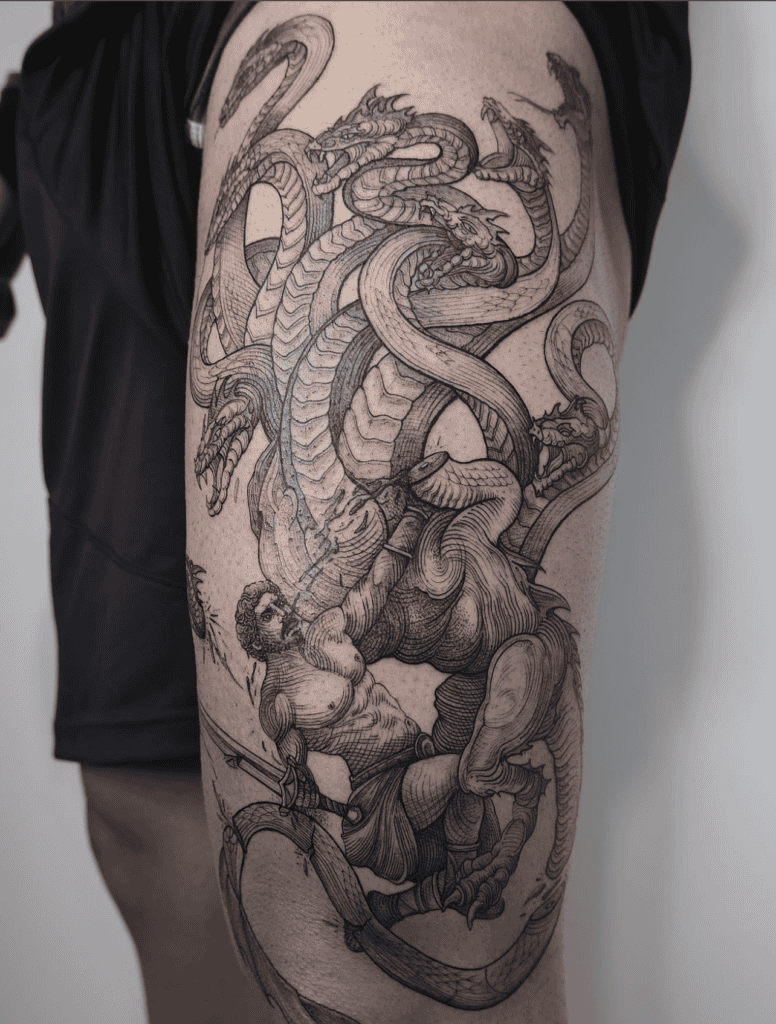
The Lernaean Hydra was a gigantic, many-headed serpent that lived in the swamps near the ancient city of Lerna in Greece. Although many modern depictions show the Hydra with seven or nine heads, ancient sources vary widely. Some describe as few as five heads, while others claim it had fifty, one hundred, or even countless heads.
The Hydra was the offspring of two of Greek mythology’s most terrifying monsters, Typhon and Echidna. Its siblings included some of mythology’s greatest creatures, such as Cerberus, Chimaera, Orthrus, and the Nemean Lion.
The Hydra’s most famous power was head regeneration. Whenever one head was cut off, two new heads grew in its place. Though defeated by Heracles, he could not destroy it completely, and instead, buried the immortal head beneath a massive rock, where it was said to remain trapped forever.
Medusa Snake Tattoo
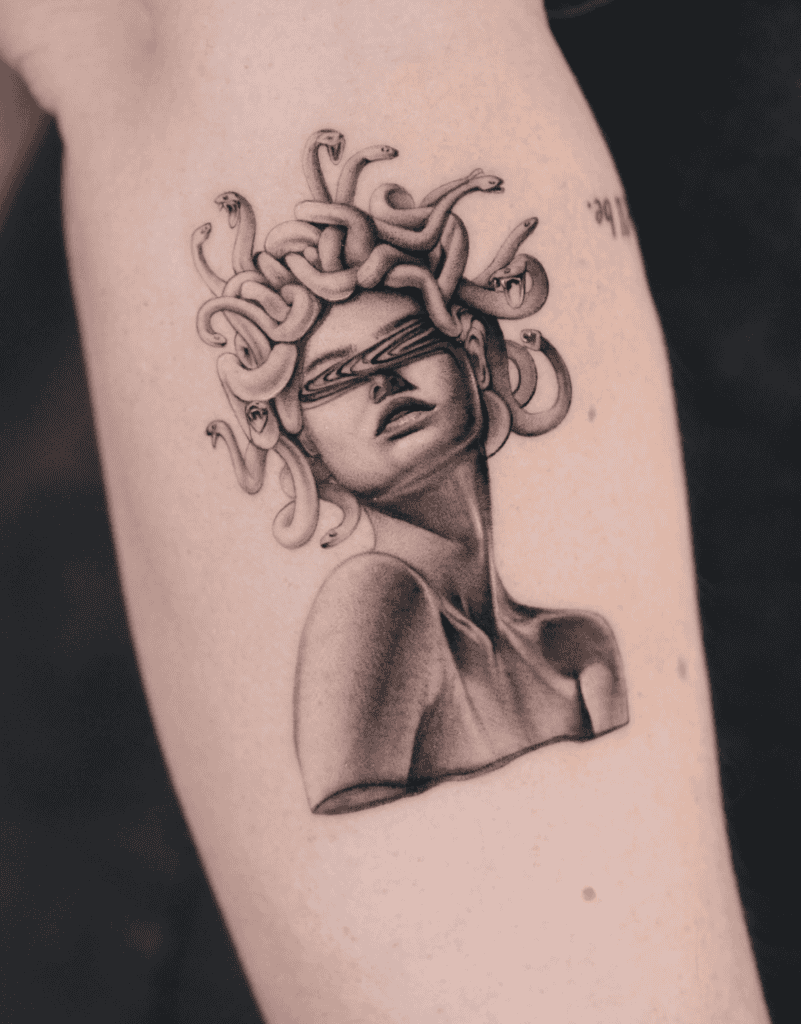
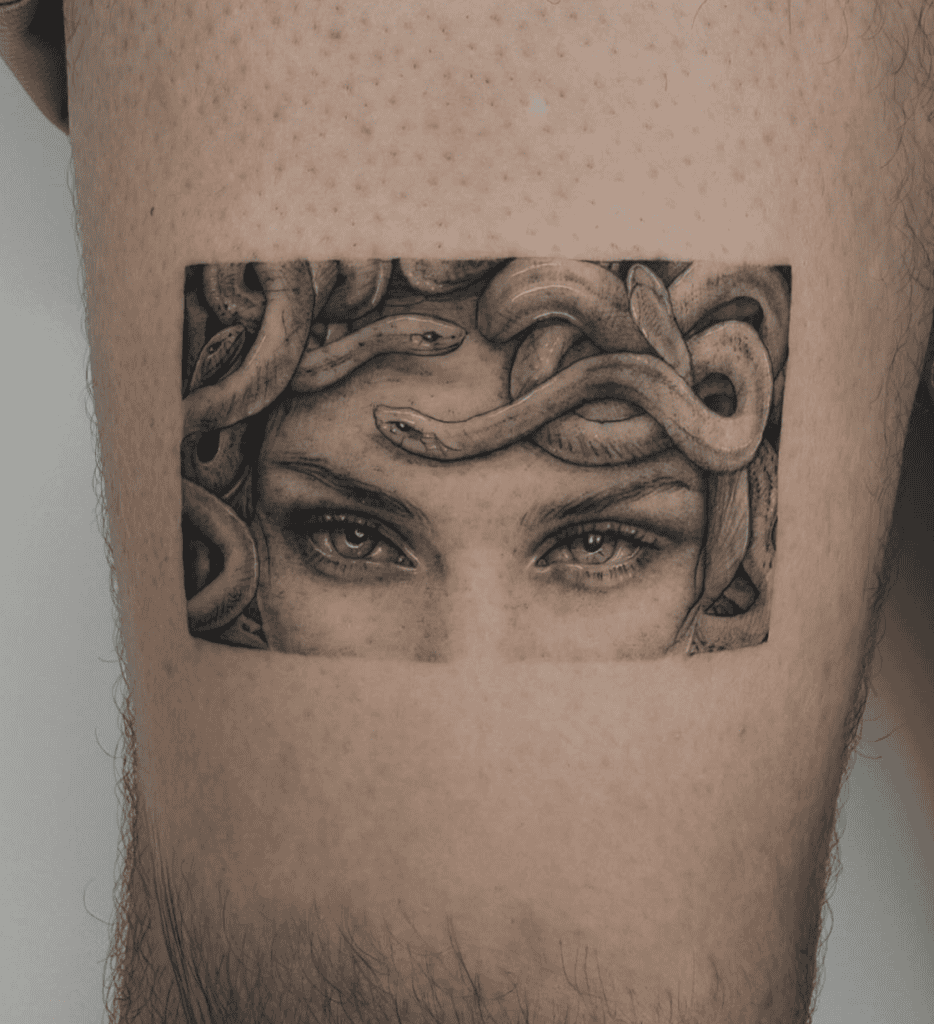
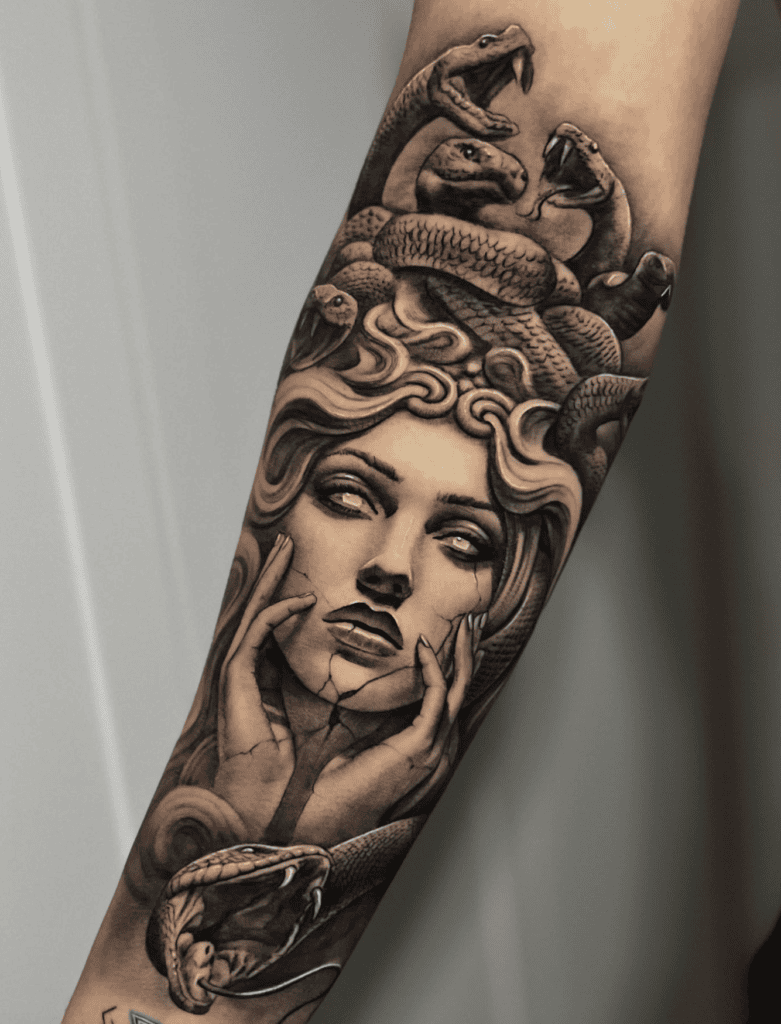
Medusa was one of the three Gorgons, monstrous sisters from Greek mythology who had snakes as hair. Unlike her immortal sisters Stheno and Euryale, Medusa was mortal, making her unique among the Gorgons.
In early Greek mythology, Medusa was born as a Gorgon and was the daughter of Phorcys and Ceto, but in the later Roman Version, Medusa was originally a beautiful young woman, renowned for her extraordinary hair. After being assaulted by Poseidon in the temple of Athena, Athena transformed Medusa into a Gorgon with snakes for hair and a gaze that turned people to stone.
Jörmungandr Snake Tattoo
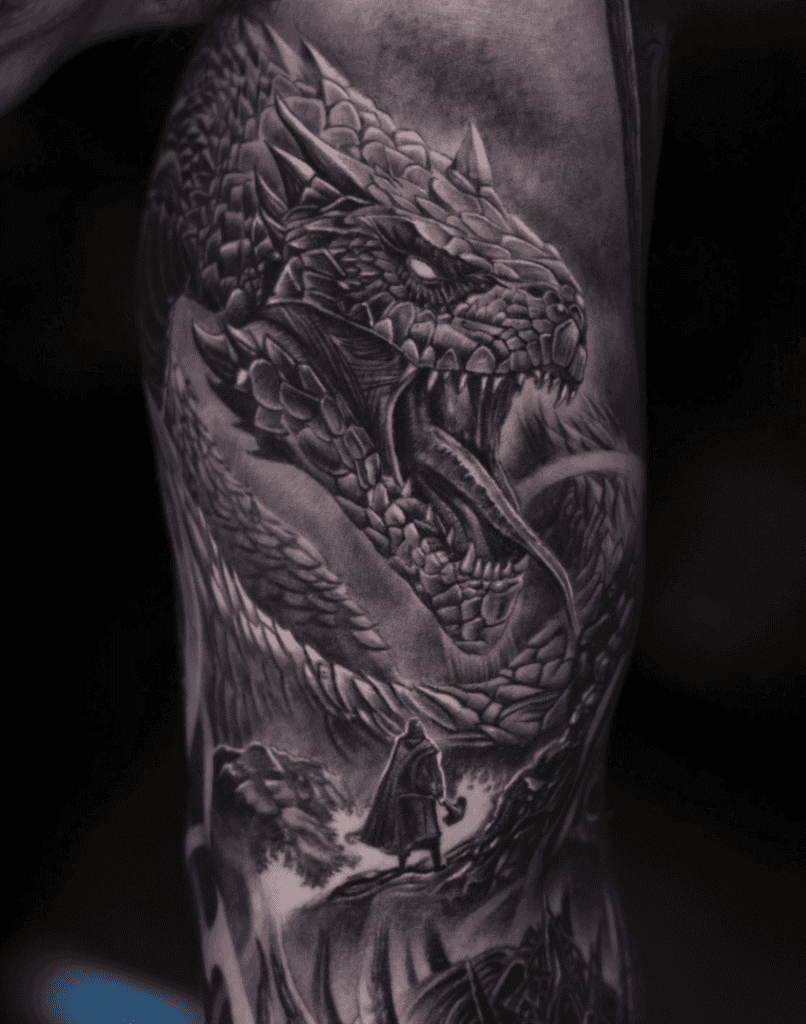
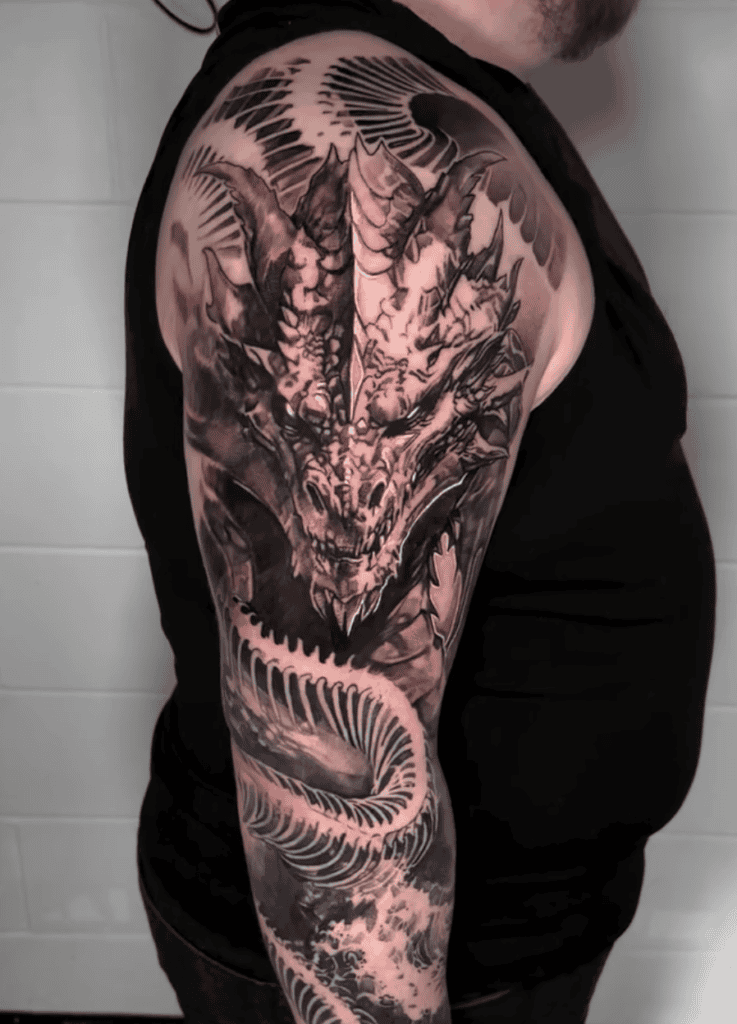
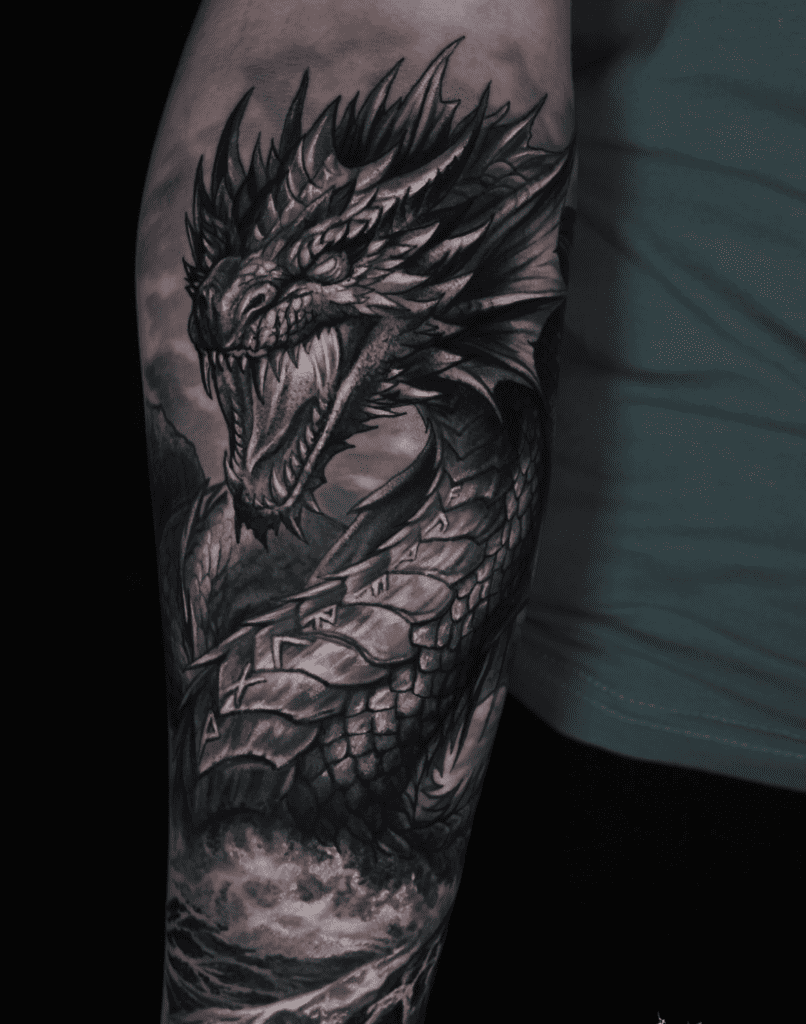
Jörmungandr is a gigantic sea serpent from Norse mythology. He is one of the three famous children of Loki and Angrboða, and the sibling of Fenrir and Hel. According to the myths, the gods feared Jörmungandr’s immense potential, so Odin cast the young serpent into the great ocean that surrounds Midgard.
There, Jörmungandr grew so large that he eventually encircled the entire world and bit his own tail, forming a living ring around Midgard, an image that became one of the most iconic symbols in Norse mythology.
Apep Snake Tattoo
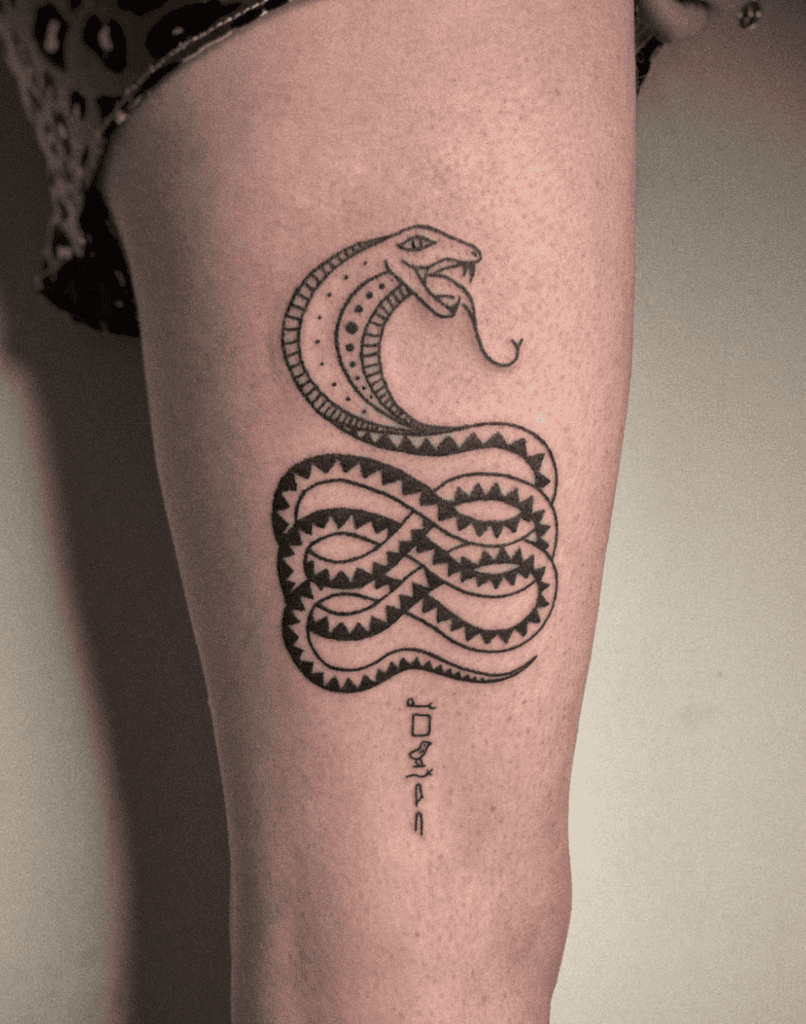
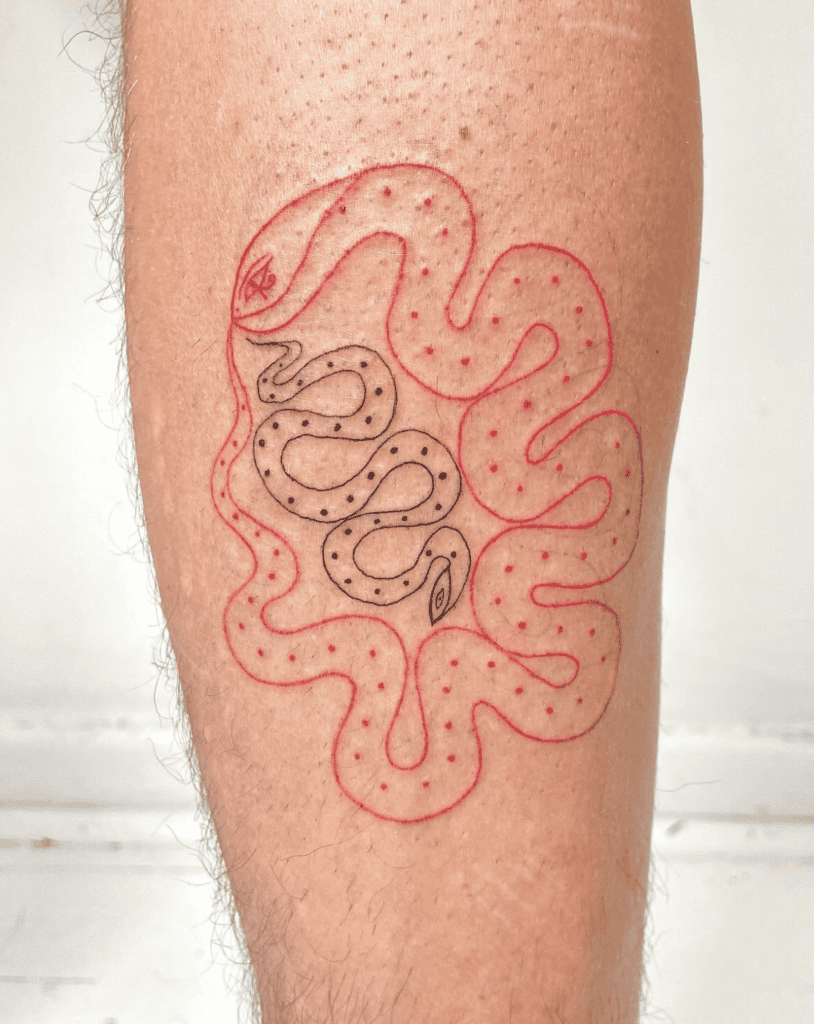
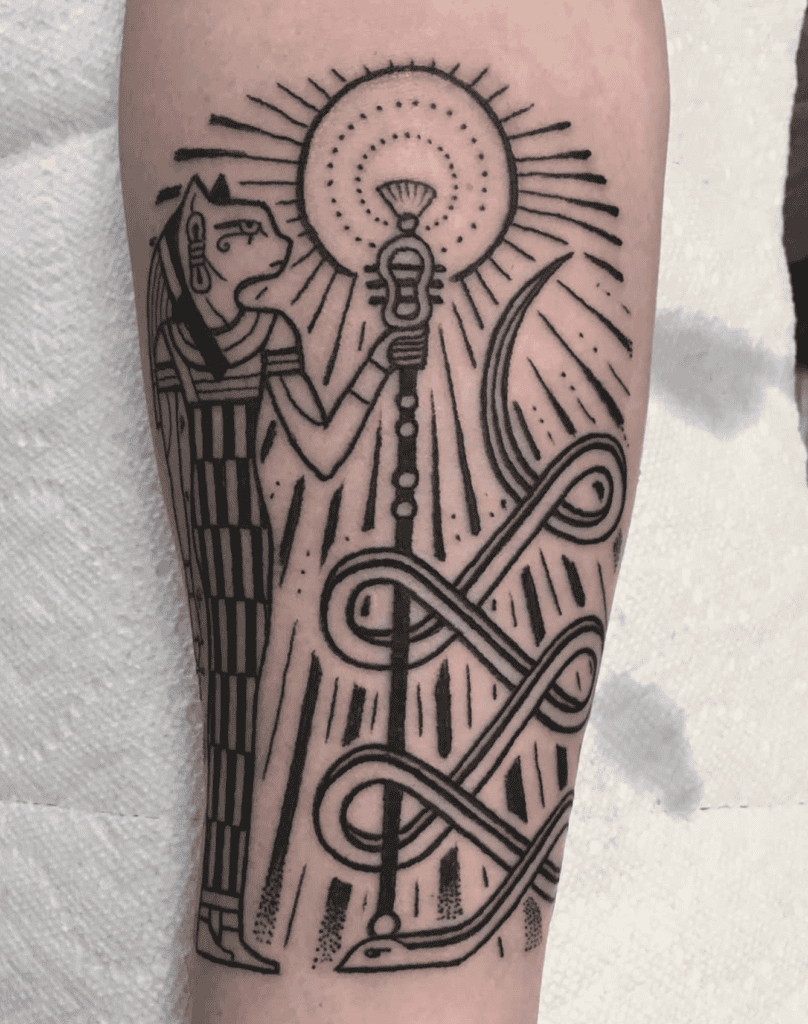
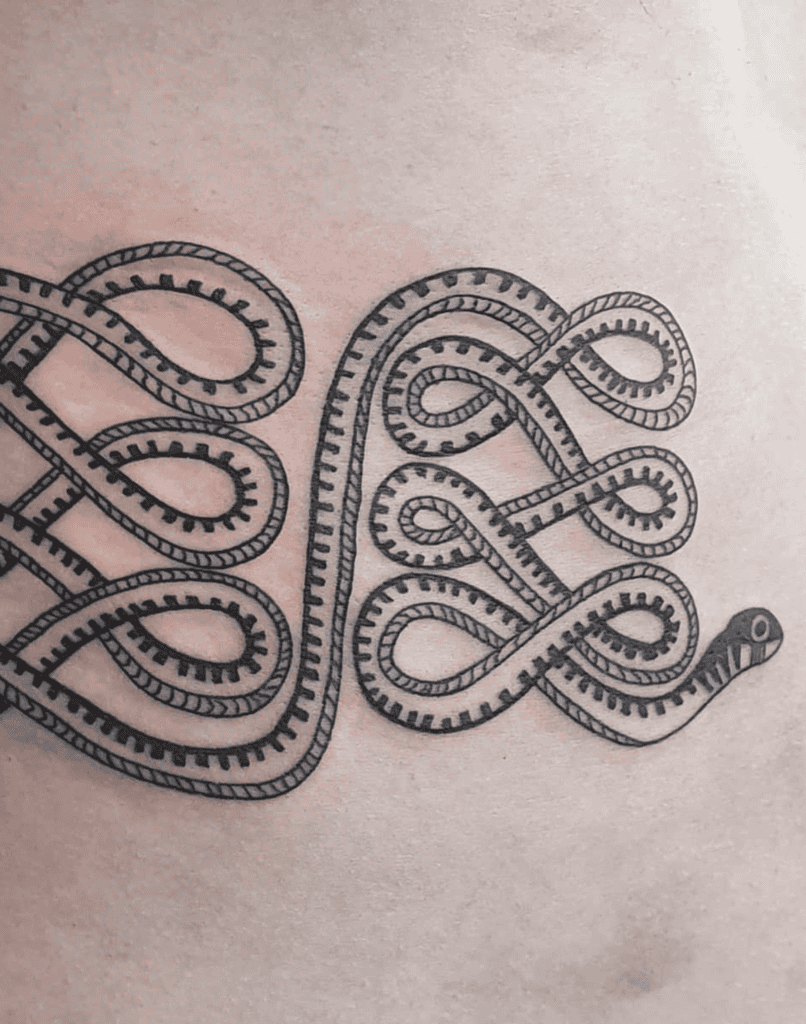
Apep is a gigantic serpent from Egyptian mythology who personified chaos, darkness, disorder, destruction, and the forces opposed to creation. Every evening, after the sun set, the sun god Ra travelled through the underworld aboard his solar barque.
Each night, Apep would emerge from the darkness to attack. His goal was to swallow the sun, destroy creation, and end the cycle of day and night. If Apep ever succeeded, the world would be consumed by eternal darkness.
Nehebkau Snake Tattoo
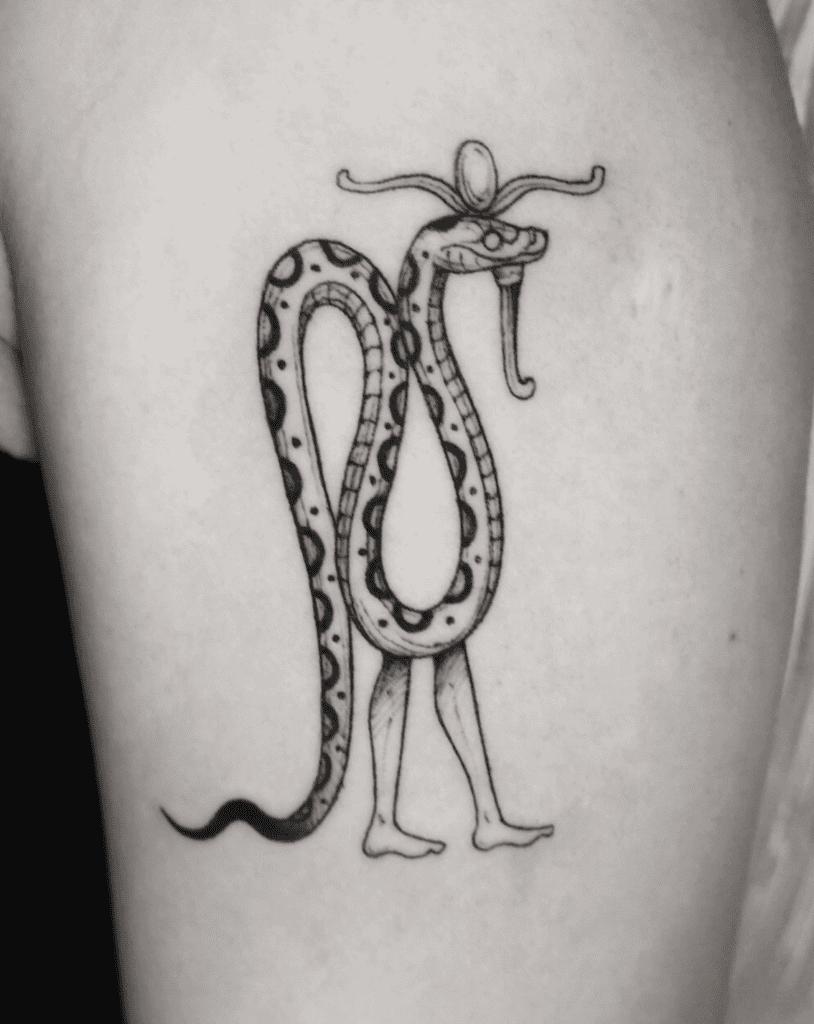
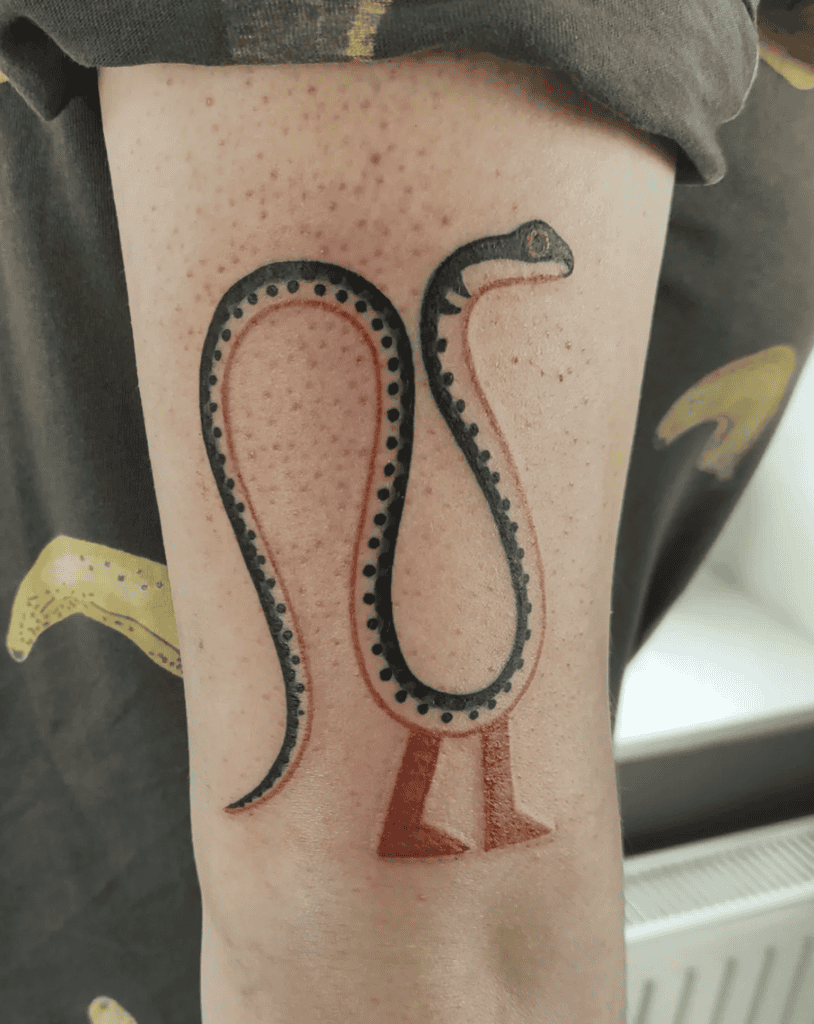
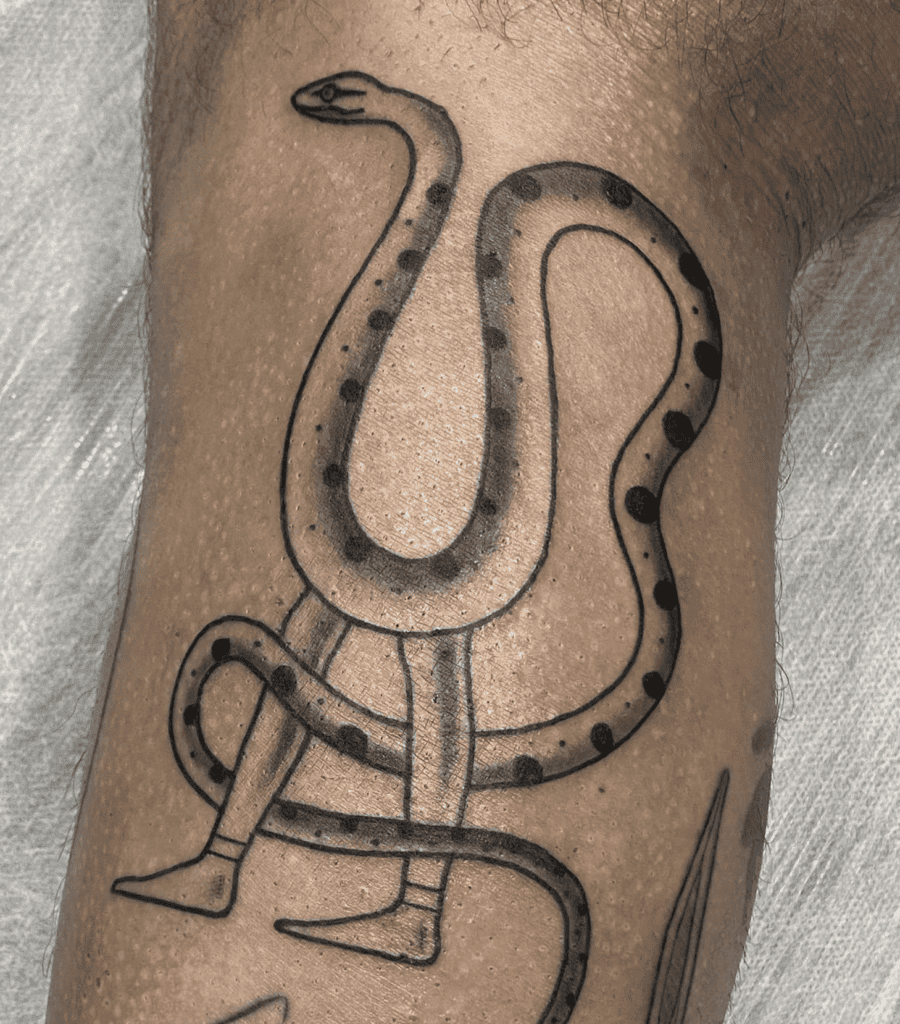
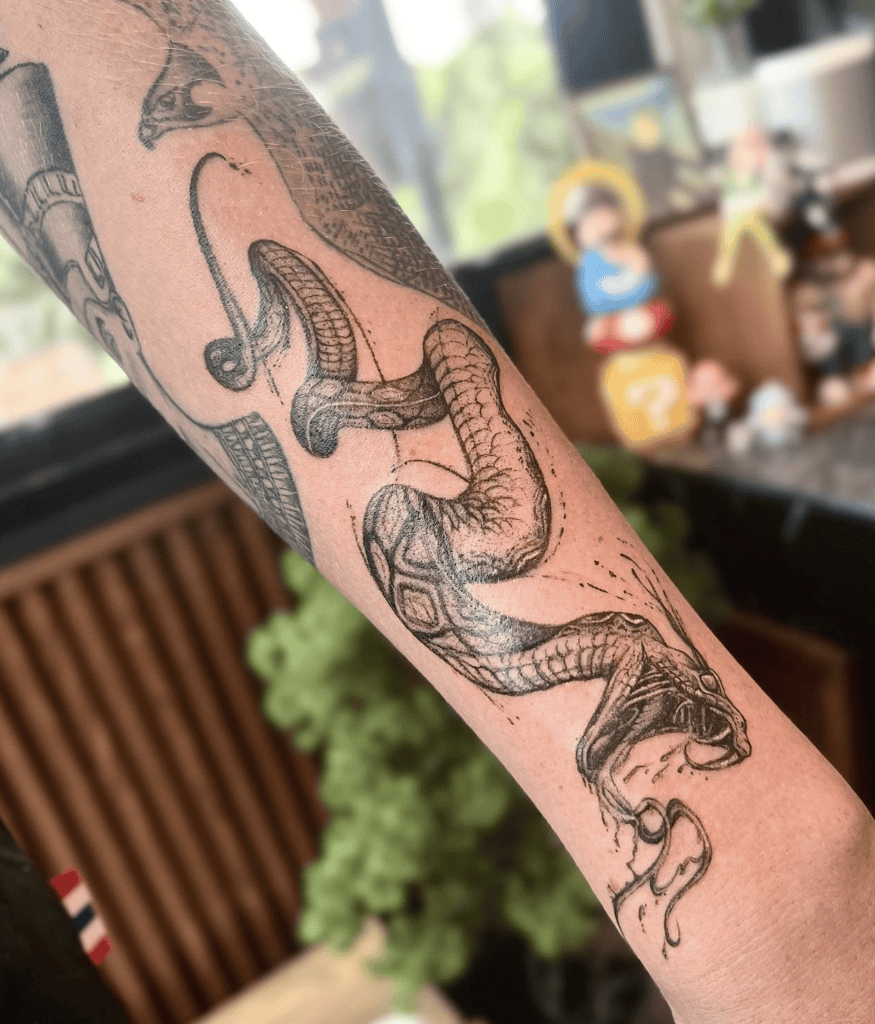
Nehebkau was an ancient Egyptian serpent deity whose name is often translated as “He Who Harnesses the Kas” or “He Who Unites the Spirits.” In Egyptian belief, the ka was a person’s vital life force or spiritual essence, and Nehebkau was thought to have the power to bind this life force to both the body and the soul. Rather than representing fear or destruction, he symbolised stability, protection, nourishment, and spiritual continuity.
Nehebkau appears in some of Egypt’s oldest religious texts, including the Pyramid Texts, where he is described as a powerful primordial being. Unlike many Egyptian gods with detailed origin stories, Nehebkau’s beginnings remain mysterious.
Different traditions describe him as a primordial serpent that existed before much of creation, a powerful deity created by the sun god Ra, or the son of the scorpion goddess Serket in some later traditions.
Shesha Snake Tattoo
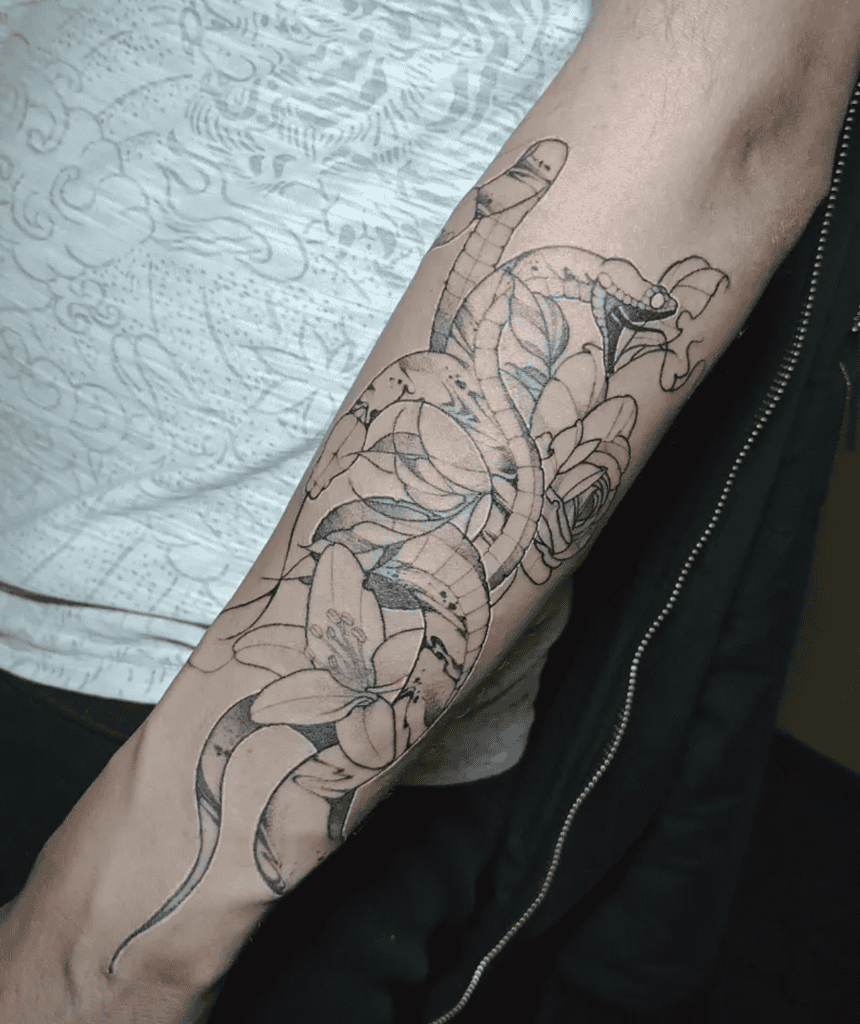
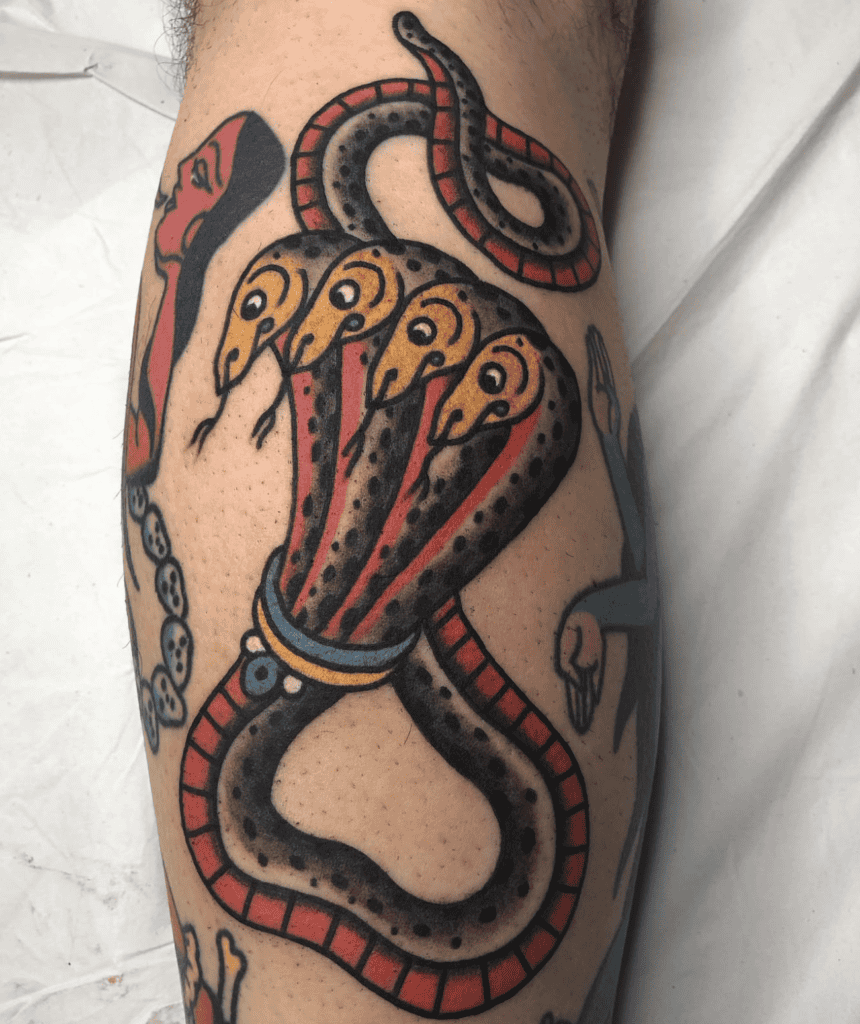
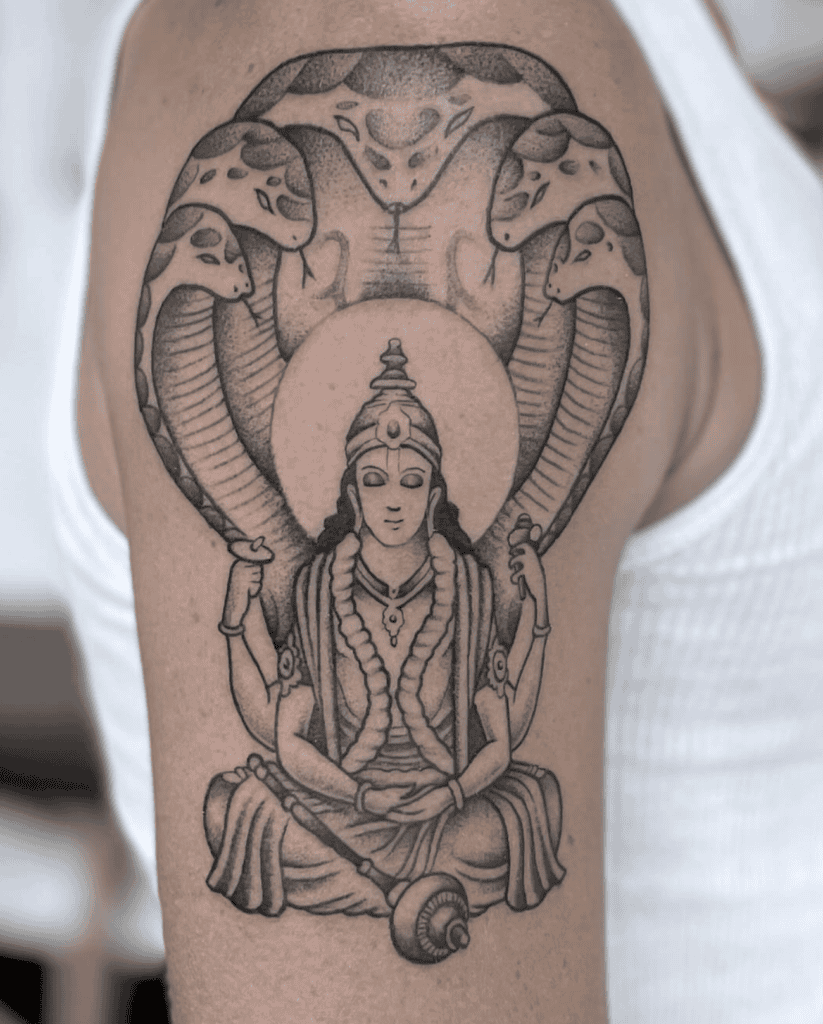
Shesha, often called Ananta Shesha, is the king of the Nāgas (divine serpents) and one of the most important beings in Hindu cosmology. His name carries deep meaning, with Shesha meaning “that which remains and Ananta meaning “endless” or “infinite.” Together, they describe the eternal being who remains after each cycle of creation and destruction.
Shesha is believed to exist beyond time itself. When the universe ends, he remains, and when a new universe begins, he is still there. This makes him a symbol of infinity, eternity, timeless wisdom, and cosmic continuity.
The most famous image of Shesha is of the god Vishnu reclining peacefully upon his coils. Between cosmic cycles, Vishnu rests upon Shesha while the universe sleeps and a new creation awaits. This imagery symbolises perfect balance, peace, and the eternal rhythm of existence.
Vasuki Snake Tattoo


Vasuki is the king of the Nāgas, the race of divine serpents that inhabit the underworld realm known as Nagaloka. He is renowned for his leadership, loyalty, wisdom, immense strength, and self-sacrifice. Although he is sometimes described as a fearsome serpent, he is generally viewed as a benevolent figure who protects both the gods and the natural world.
As ruler of the Nāgas, Vasuki governs a powerful race of serpent beings associated with rivers, lakes, fertility, rain, hidden treasures, and wisdom. Nāgas are not simply snakes, but supernatural beings that can often take both serpent and human form. Vasuki is one of their greatest kings, alongside Shesha.
Kaliya Snake Tattoo

Kaliya is a massive, multi-headed Nāga (serpent being) who lived in the river Yamuna. He is most famous for poisoning the river so severely that fish died instantly, birds avoided the area, and the water became toxic and dark.
Kaliya made his home in the deep waters of the Yamuna River, where he released his deadly venom into the water and terrified nearby villagers. The river, once sacred and life-giving, became dangerous and uninhabitable.
When the situation became unbearable, Krishna came to the riverbank and fearlessly entered the water despite the danger. Kaliya rose from the depths with furious aggression and a great battle began in the waters of the Yamuna.
Krishna leapt onto Kaliya’s massive heads and danced upon him gracefully, subduing his violent energy. Instead of killing Kaliya, Krishna chose mercy. Kaliya and his family were spared on the condition that they leave the Yamuna and never poison it again.
Uwabami Snake Tattoo

Uwabami (often written as うわばみ) is a Japanese term that literally means “great snake” or “giant serpent.” In folklore, it usually refers to a massive, monstrous snake, or a yōkai-like entity rather than a single fixed mythological being.
The Uwabami is capable of swallowing large animals or even humans, and in some stories, it is so large it is mistaken for a hill, fallen tree, or riverbank until it moves. Uwabami isn’t only mythological, but a Japanese slang term. It can describe a person who drinks a lot of alcohol or consumes large amounts of food or drink. This comes from the idea that the mythical serpent “swallows everything.”
Xiangliu Snake Tattoo


Xiangliu is a monstrous nine-headed serpent or dragon-like creature from ancient Chinese mythology, famous for causing floods and devastation, poisoning land and water and having nine heads, each with its own will. In some descriptions, Xiangliu is considered a servant or subordinate of a chaotic water deity, while in others it is an independent disaster spirit.
Xiangliu’s most famous myth involves its conflict with Yu the Great, the legendary founder of the Xia dynasty. Yu the Great was tasked with controlling floods, restoring order to the land, and saving humanity from constant water disasters.
According to myth, Xiangliu’s poison made land unusable even after death, and its blood flooded entire valleys, so Yu had to reshape rivers and terrain to contain the damage. Eventually, Yu’s forces defeated Xiangliu, but the land remained scarred, and the poison lingered for generations, so new rivers had to be redirected to purify the area.
Quetzalcoatl Snake Tattoo
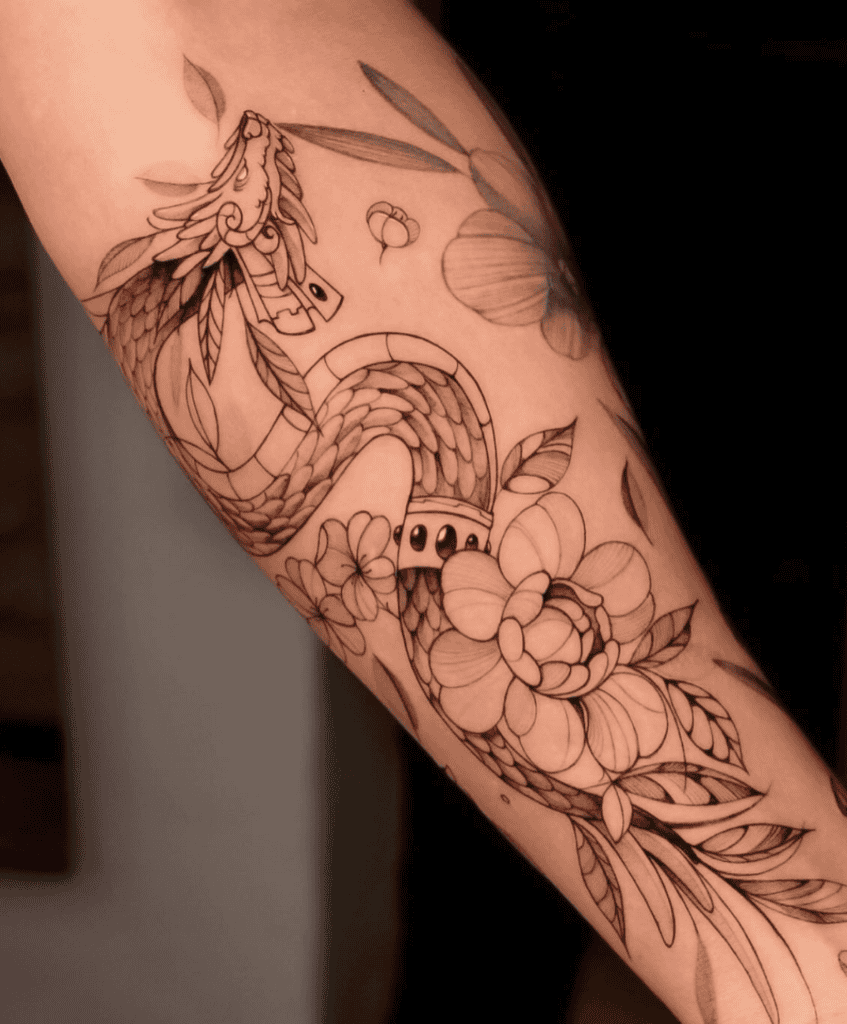
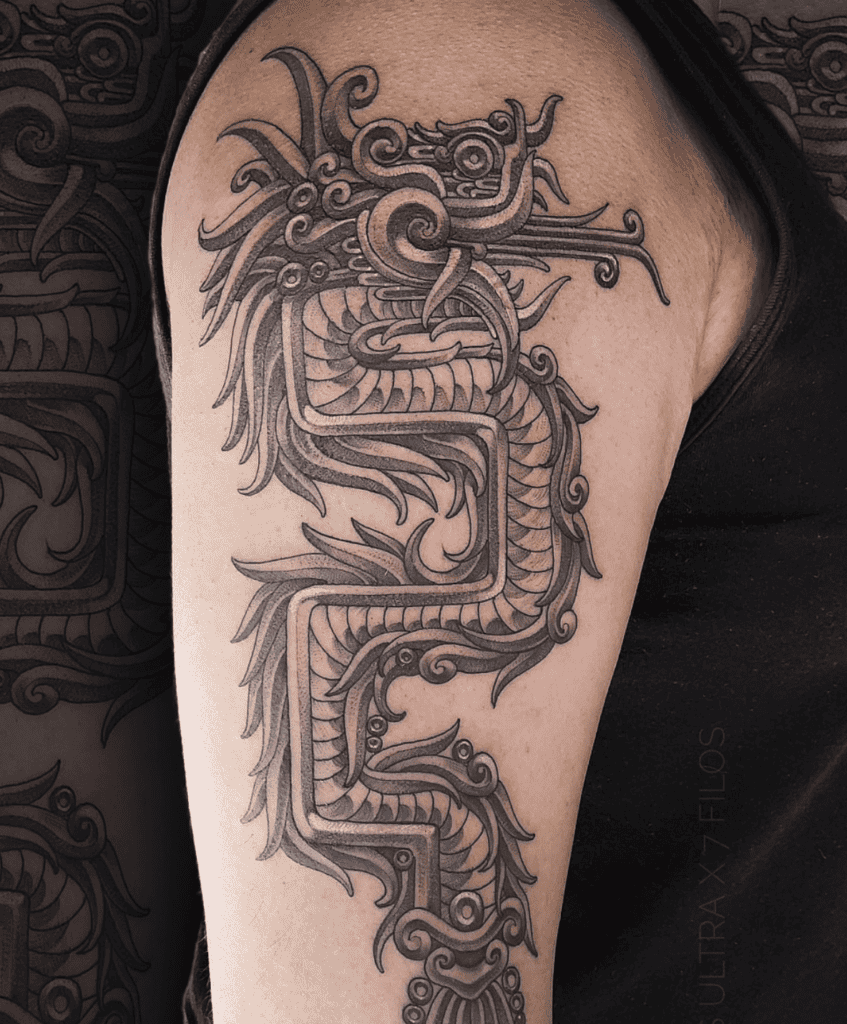
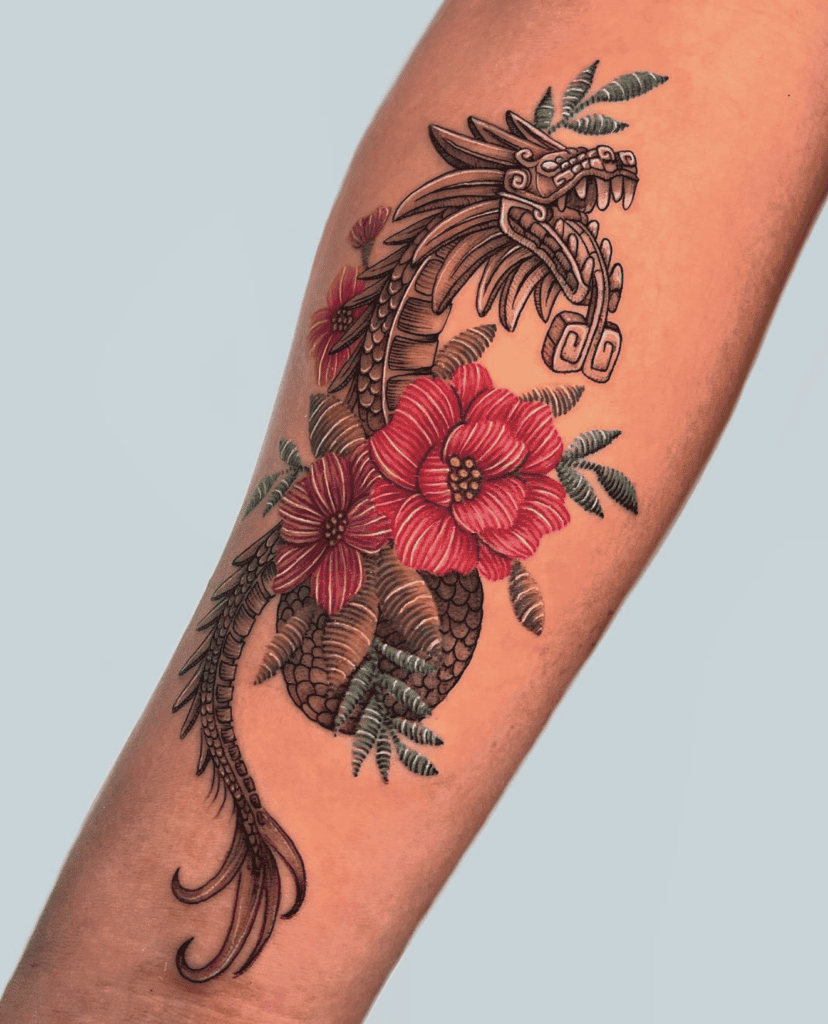
Quetzalcoatl is the Feathered Serpent god worshipped in many ancient Mesoamerican cultures, especially the Aztecs and Toltecs. His name comes from Quetzal, meaning a brightly coloured sacred bird, and Coatl, meaning serpent.
Quetzalcoatl is associated with winds, knowledge, arts, agriculture, the creation of humanity, and the morning star (Venus). In Aztec mythology, Quetzalcoatl journeys to the underworld and collects bones from previous worlds, with his own blood used to bring humans to life.
Kukulkan Snake Tattoo
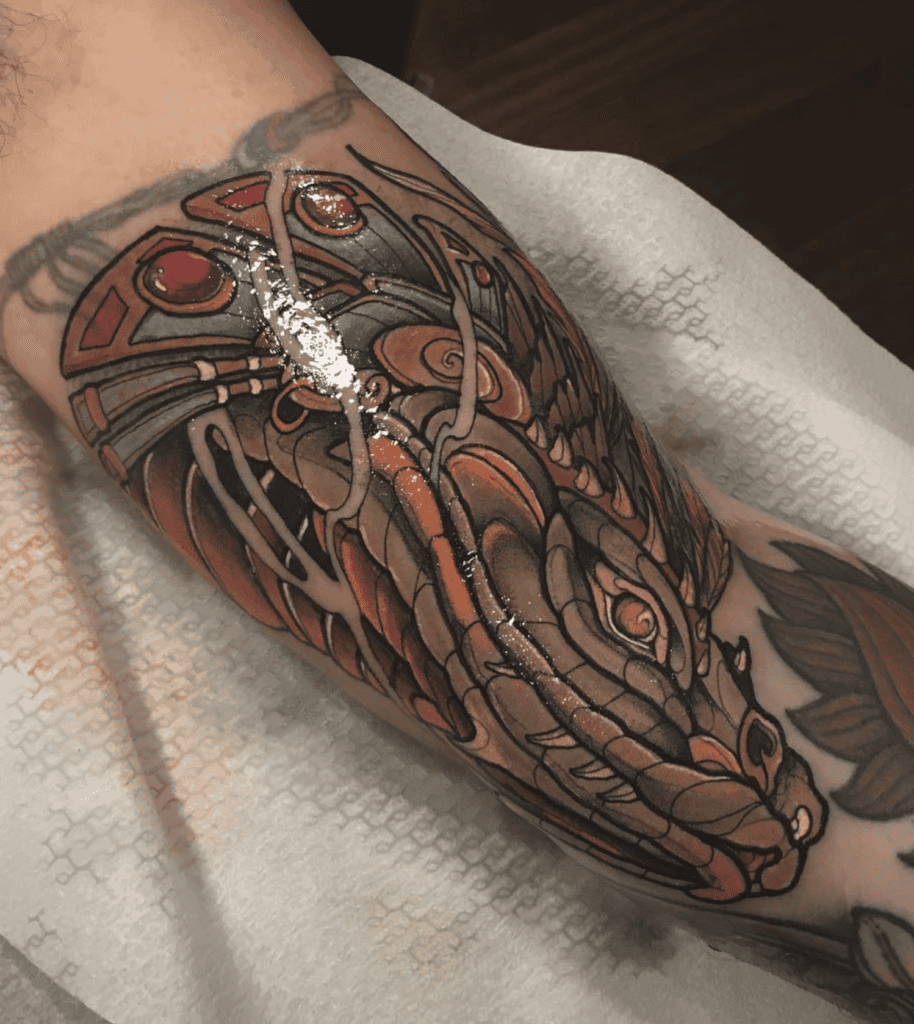
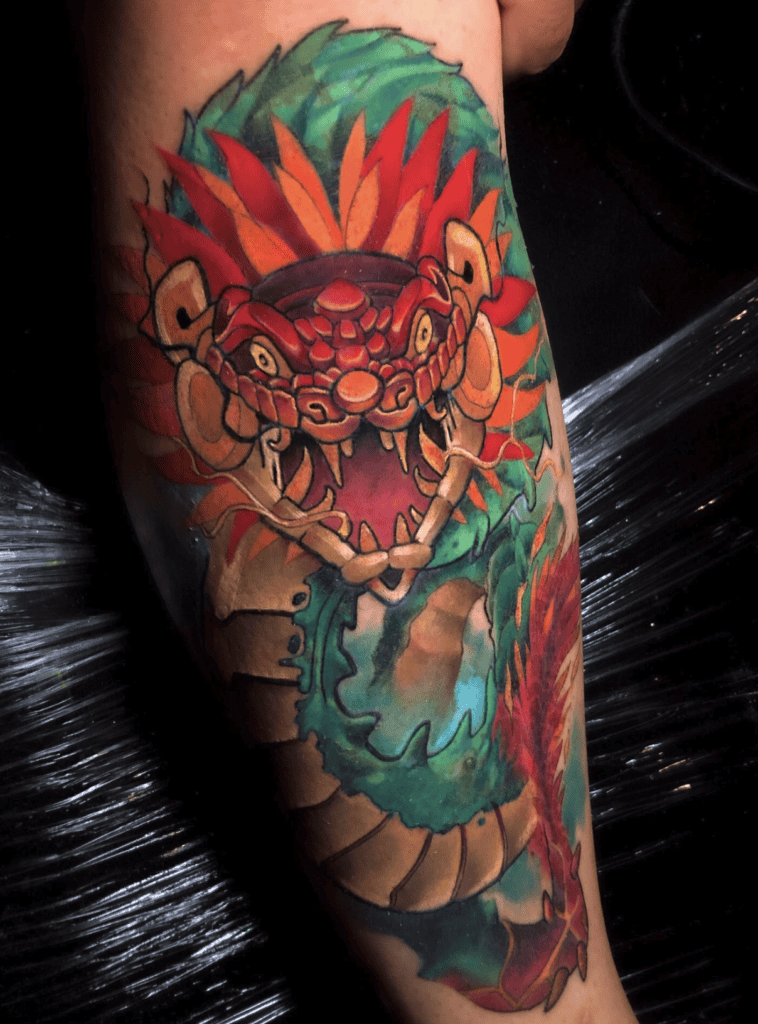
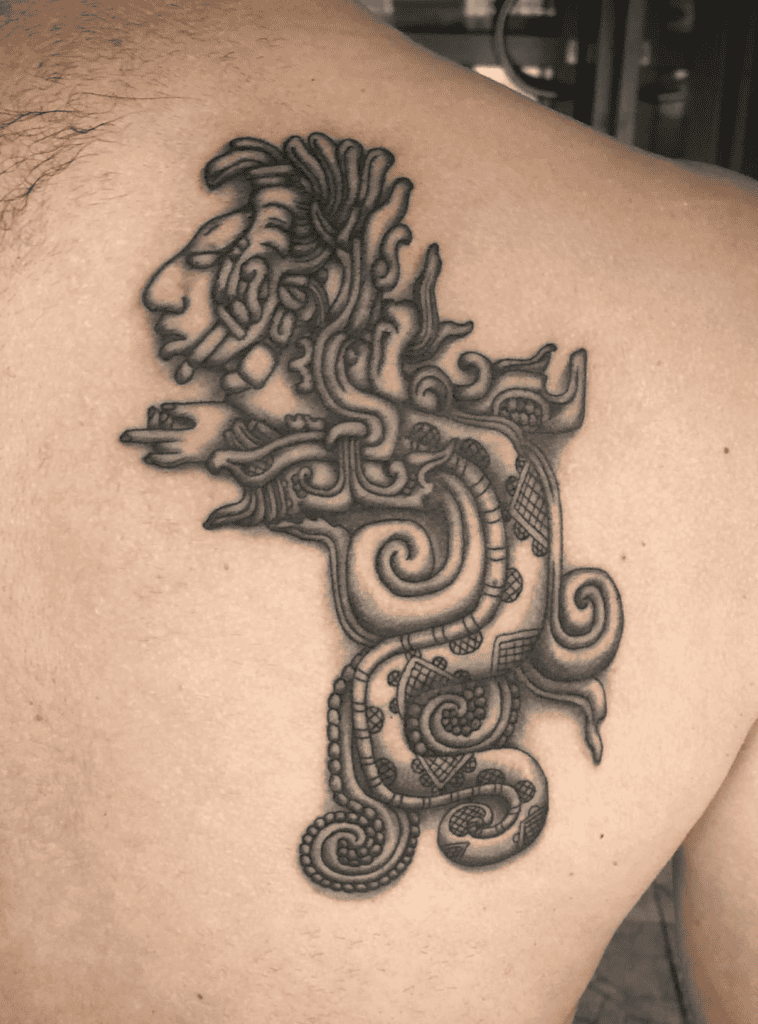
Kukulkan is the Feathered Serpent god of the Maya civilisation, worshipped across the Yucatán Peninsula, especially by the Itzá people. His name is often interpreted as Kuk meaning feather and K’an meaning serpent.
Like his later incarnation Quetzalcoatl, Kukulkan is associated with winds, rains, agriculture, wisdom, and divine authority. He is a civilising deity, helping humans live in harmony with nature and the cosmos.
One of the most famous monuments in the world, Chichén Itzá, is dedicated to him, specifically the pyramid known as El Castillo. During the spring and autumn equinoxes, shadows fall across the pyramid’s steps, and a moving serpent shape appears, which looks like Kukulkan is descending from the sky.
Rainbow Serpent Snake Tattoo
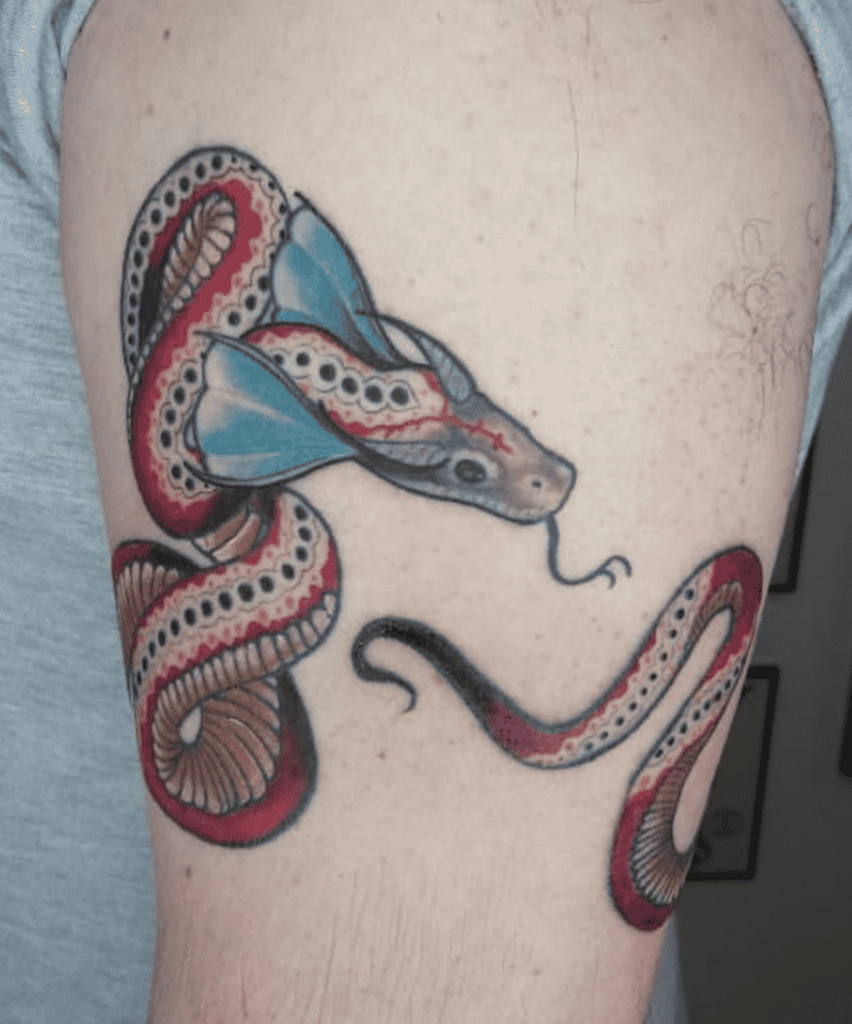
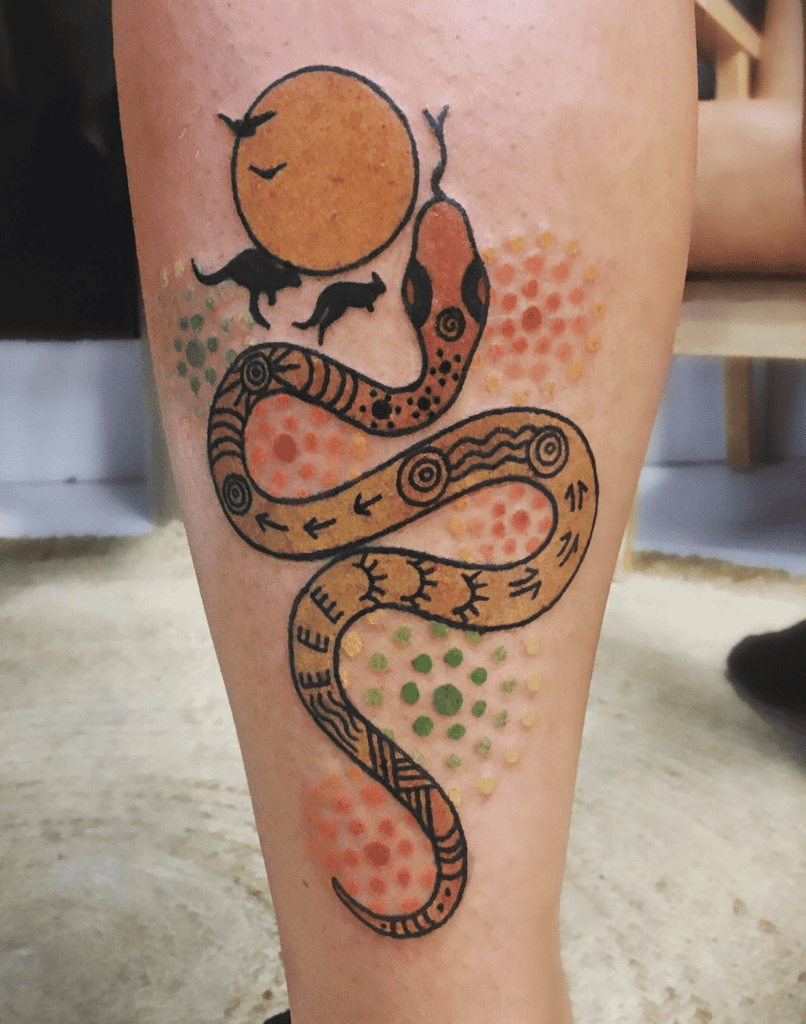
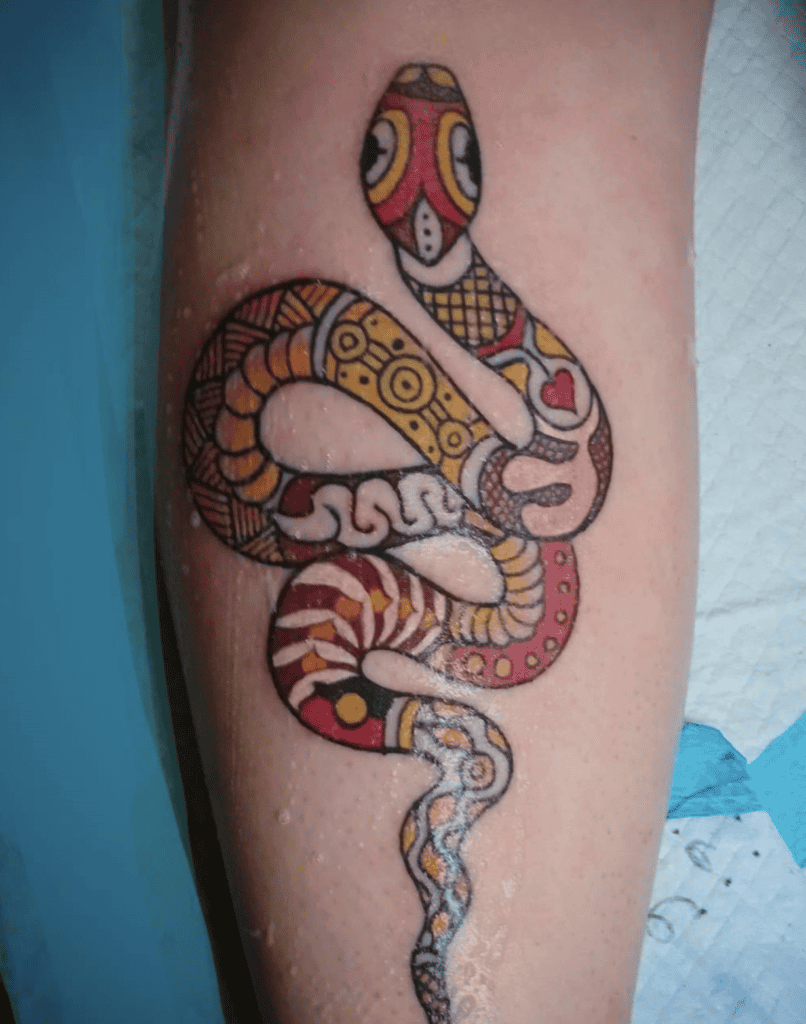
The Rainbow Serpent is one of the most important beings in Aboriginal Australian mythology, a powerful creation spirit tied to land, water, life, and the shaping of the world itself.
Across different Aboriginal Nations (which each have their own languages and traditions), the Rainbow Serpent appears in many forms and names, but the core idea of it being a life-giving and world-shaping force connected to water and rainbows is consistent.
The Rainbow Serpent is a creation being from the Dreamtime (Dreaming), a foundational spiritual framework of Aboriginal Australian cultures. It is deeply connected to water systems, as in many Aboriginal cultures, water is sacred, with the Rainbow Serpent being its spiritual source and protector.
The rainbow aspect is important because it symbolises rain after storms, the connection between sky and earth, a reflection of water and sunlight and cycles of renewal. The rainbow is often seen as the Serpent’s visible form when moving between waterholes or across the sky.
Damballa Snake Tattoo
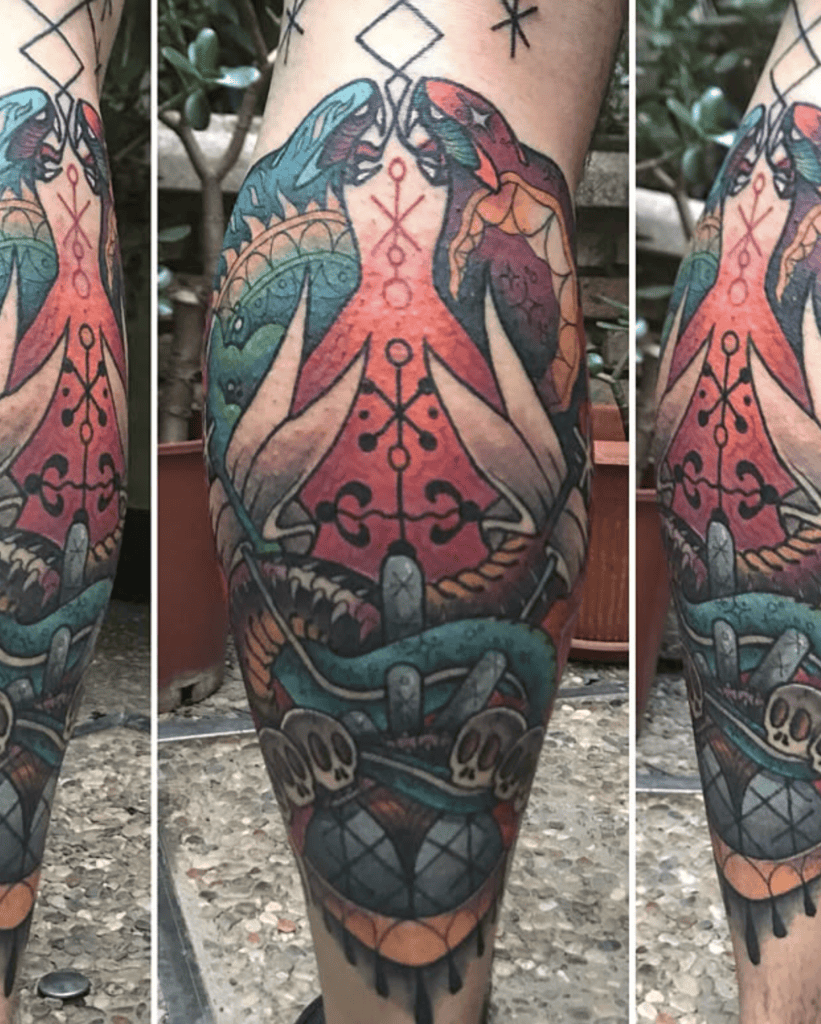
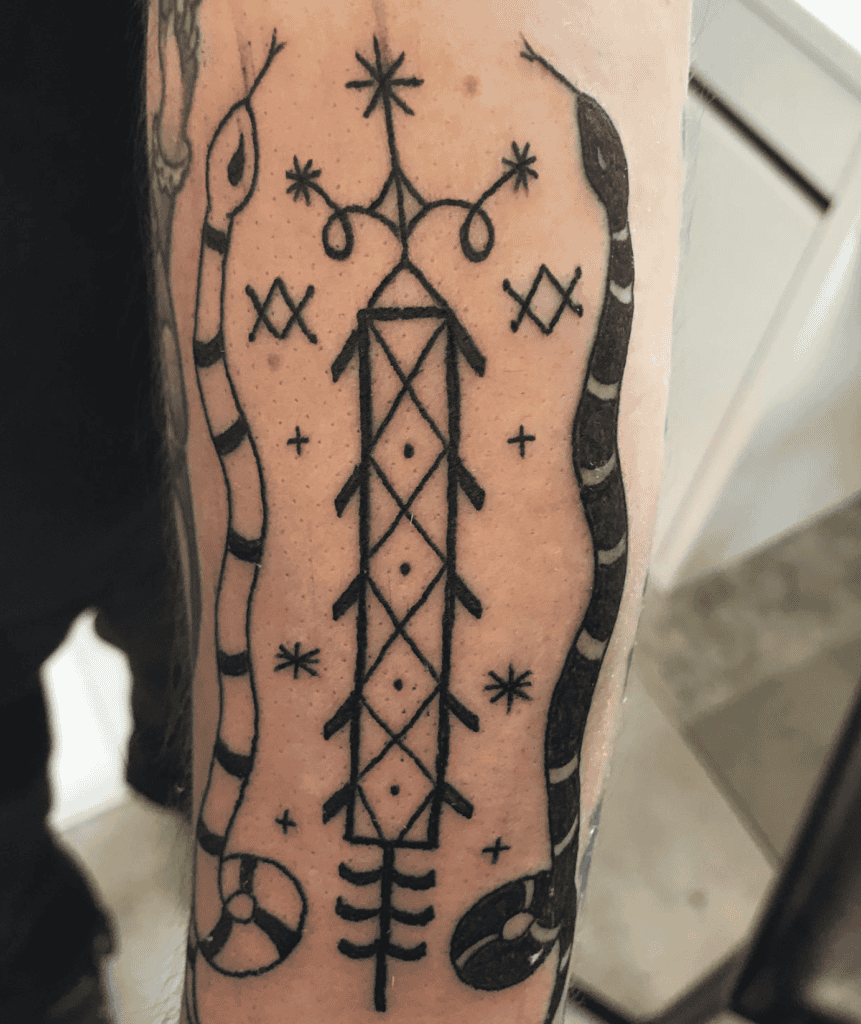
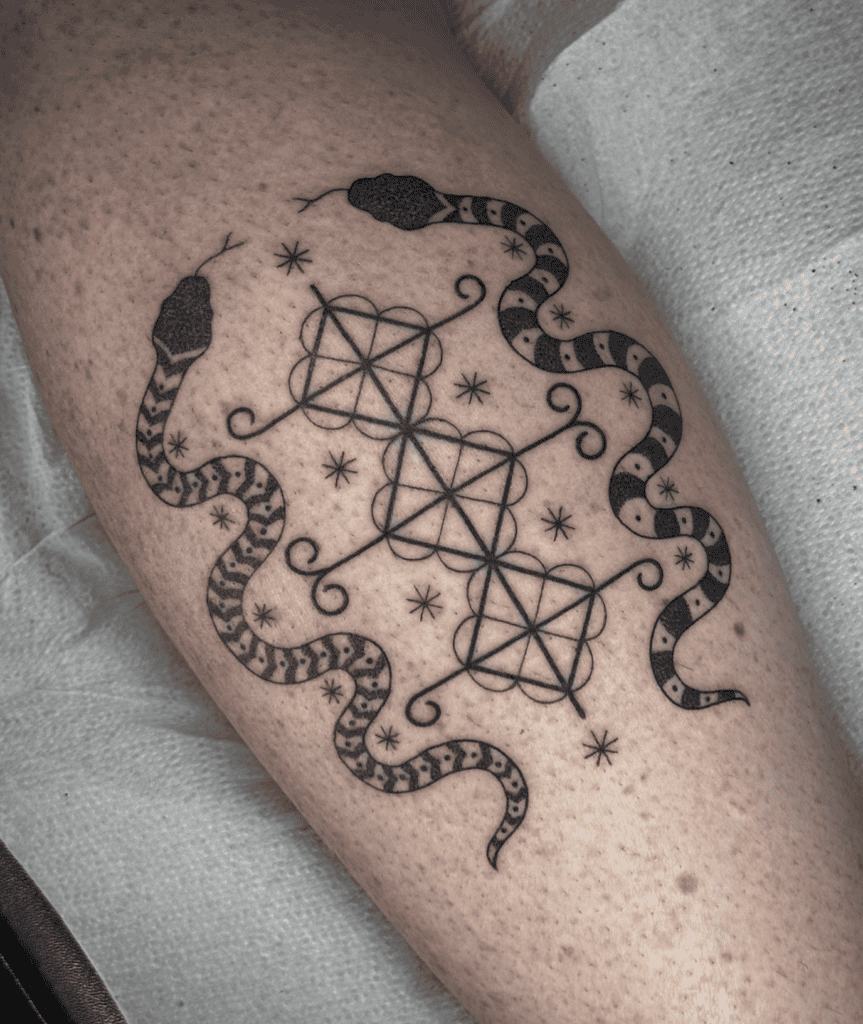
Damballa (also spelt Damballah, Damballah-Wedo, or Danbala) is one of the most important and oldest spirits in Vodou (Vodun) traditions, especially in Haiti and West African-rooted spiritual systems. He is a serpent lwa (spirit) associated with creation, purity, wisdom, and the sky.
Damballa is often described as a giant white serpent, creator spirit, bringer of peace and purity, and a celestial force linked to the sky and stars. In many traditions, he is considered one of the oldest and highest spirits in the Vodou pantheon.
In many stories, he existed before the world and helped shape the universe. He is linked to the birth of life and order, and is often seen as a cosmic serpent coiled around the universe, holding creation together.
Olliphéist Snake Tattoo

Olliphéist is a monstrous serpent or dragon-like creature from Irish folklore typically described as a massive sea or lake serpent that dwells in deep water, rivers, or the ocean. The name is often interpreted as something like “great serpent” or “terrible beast of the waters.” In folklore, sightings of the creature were often used to explain sudden drownings, strange water movements, dangerous currents, or stormy weather over lakes.
One of the most famous legends involving the Olliphéist connects it to Saint Patrick. According to folklore, Saint Patrick was preaching in Ireland and encountered or symbolically confronted serpents before banishing them all from the island.
In some interpretations, the “snakes” are symbolic of Pagan beliefs or mythic monsters like the Olliphéist, with one famous tale saying the Olliphéist fled through the landscape so violently that it carved out riverbeds while escaping.
Afanc Snake Tattoo

The Afanc is one of the most famous monsters in Welsh mythology, a water-dwelling serpent/beast tied to lakes, rivers, and destructive natural forces. It is often portrayed as a lake monster that terrorises entire regions until it is finally subdued by heroes or magical intervention.
One of the most famous locations linked to it is Llyn Llion, a mythical lake sometimes said to be its home. The Afanc causes sudden flooding, drownings, and destruction of nearby settlements, representing the fear of unpredictable lake environments in ancient Wales.
Different Welsh legends describe different attempts to defeat the Afanc. One famous version involves King Arthur or heroic figures like Peredur or other Celtic warriors. In one popular story, the Afanc terrorises a lake and nearby land. A young woman (sometimes named Peredur’s sister or a maiden) volunteers to lure it by sitting on the monster’s back, calming it. Warriors or heroes then bind or kill it, while in other versions, it is trapped or driven away using magical means.
Leviathan Snake Tattoo
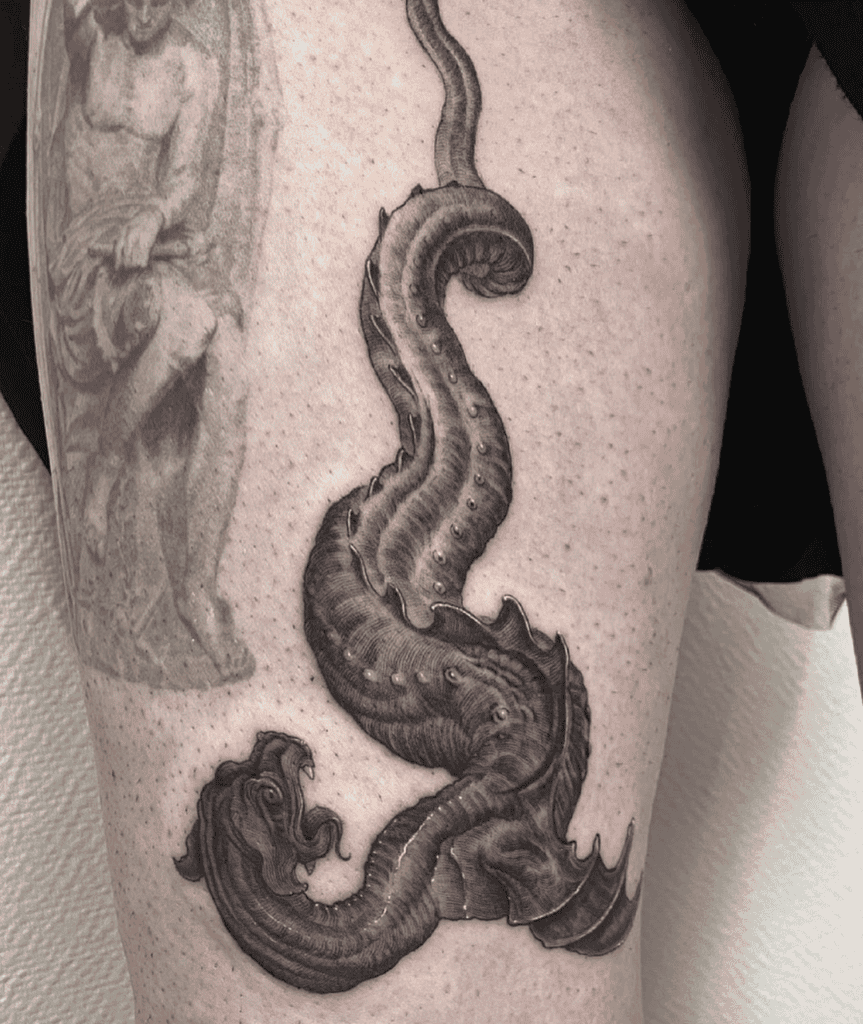
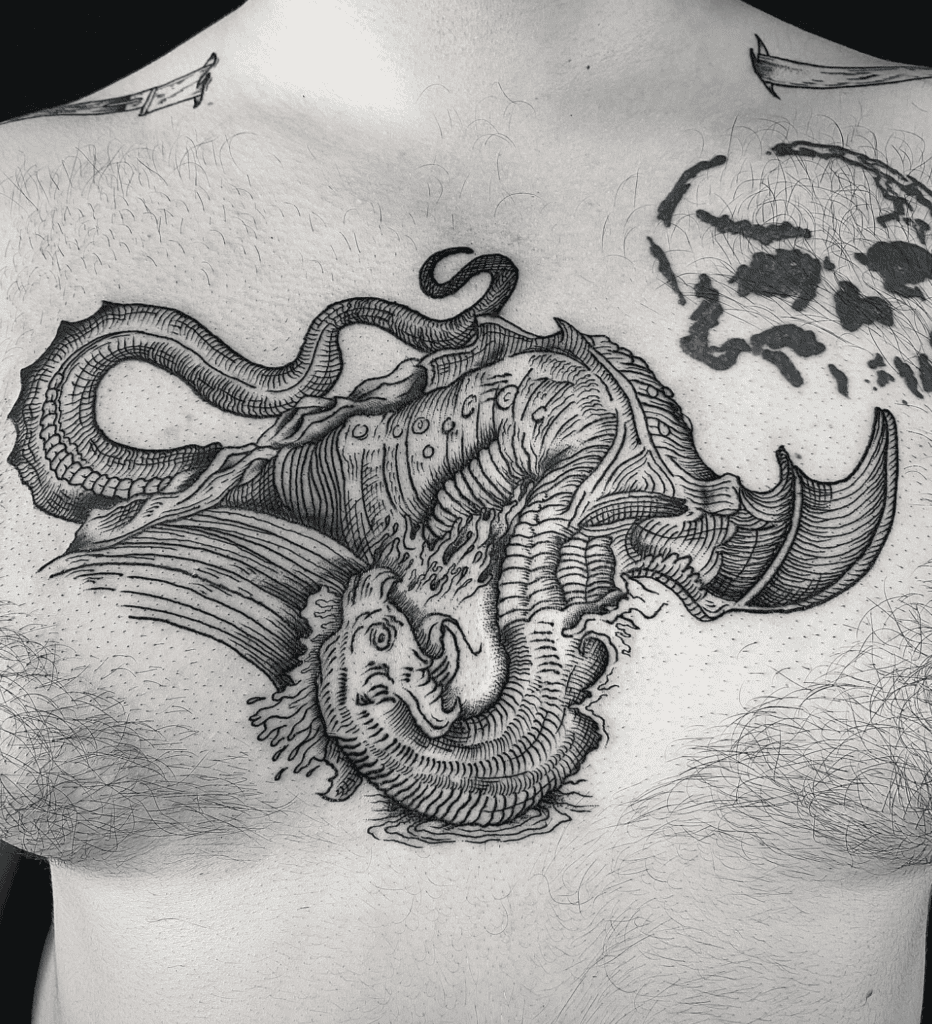
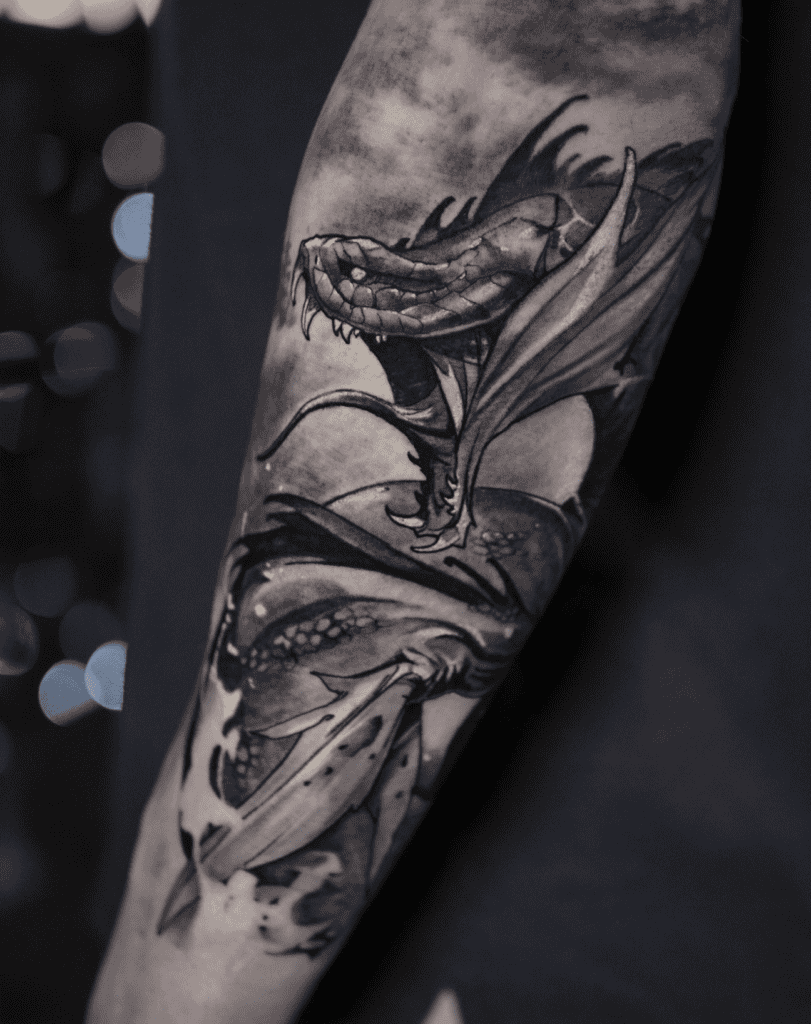
The Leviathan is a gigantic sea serpent or dragon-like monster described in ancient Hebrew texts, especially in the Book of Job. It is often portrayed as a massive sea serpent or dragon that lives in the ocean and is a symbol of chaos and destruction.
Leviathan appears in several places in the Hebrew Bible, especially the Book of Job, Psalms, and Isaiah. In these texts, Leviathan is described as impossible for humans to defeat, as it represents forces beyond human control. However, it is always shown as being under the authority of Yahweh, the God of Israel. This creates a key theme that chaos exists, but it is not equal to divine power.
Serpent of Eden Snake Tattoo


The Serpent of Eden is the snake that appears in the Garden of Eden story in Genesis. It tempts Eve to eat the forbidden fruit by lying or persuading her about the “Tree of Knowledge of Good and Evil.”
He causes the fall of humanity from innocence, introducing moral awareness and consequence, leading to the banishment of Adam and Eve from the garden. The text does not fully describe its form, but interpretations include a literal snake, a disguised evil spirit or demon, or in later tradition, it is often associated with Satan.
Nehushtan Snake Tattoo

Nehushtan is the name given to a bronze serpent made by Moses in the wilderness, later described in the Bible as an object that was destroyed during religious reforms. The story comes from the Book of Numbers. When the Israelites are wandering in the desert, they complain against God and Moses. Poisonous snakes begin biting the people, and many die. In response, Moses is instructed to create a bronze serpent and place it on a pole.
Anyone bitten by a snake could look at the bronze serpent, and once they looked at it, they would be healed. Later in the biblical narrative, the bronze serpent was still being worshipped by some people. A religious reformer king (often identified as Hezekiah) destroyed it and called it “Nehushtan”, meaning something like “just a piece of bronze.” This marked a shift from a sacred object, to a rejected idol.
Bakunawa Snake Tattoo
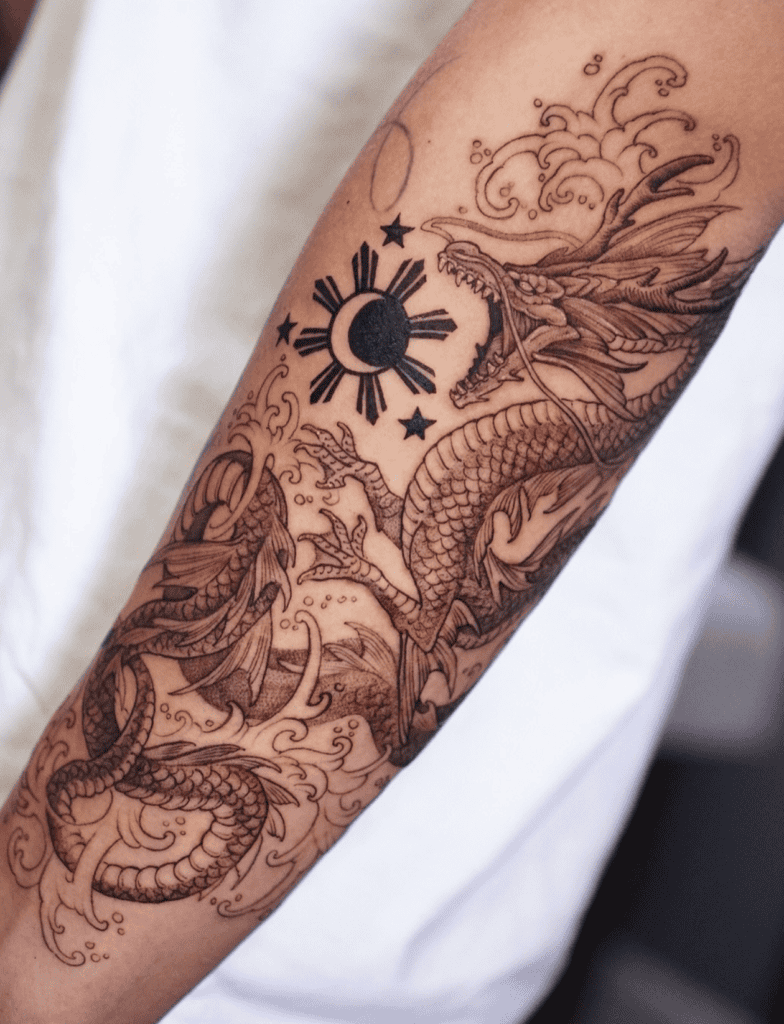
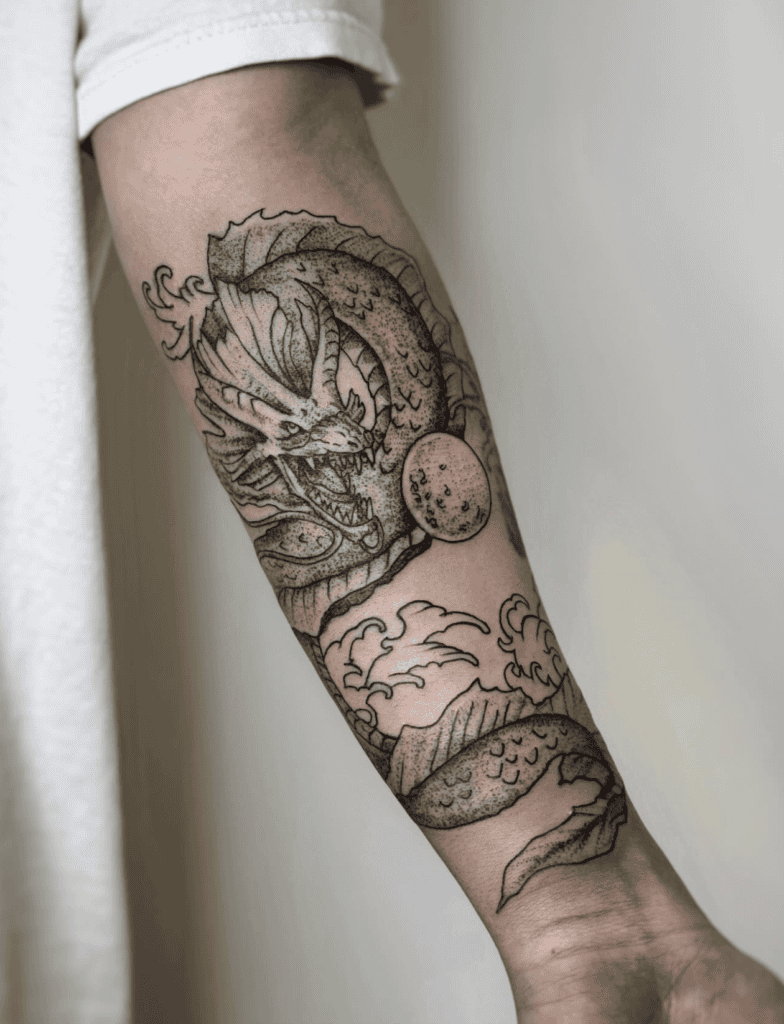
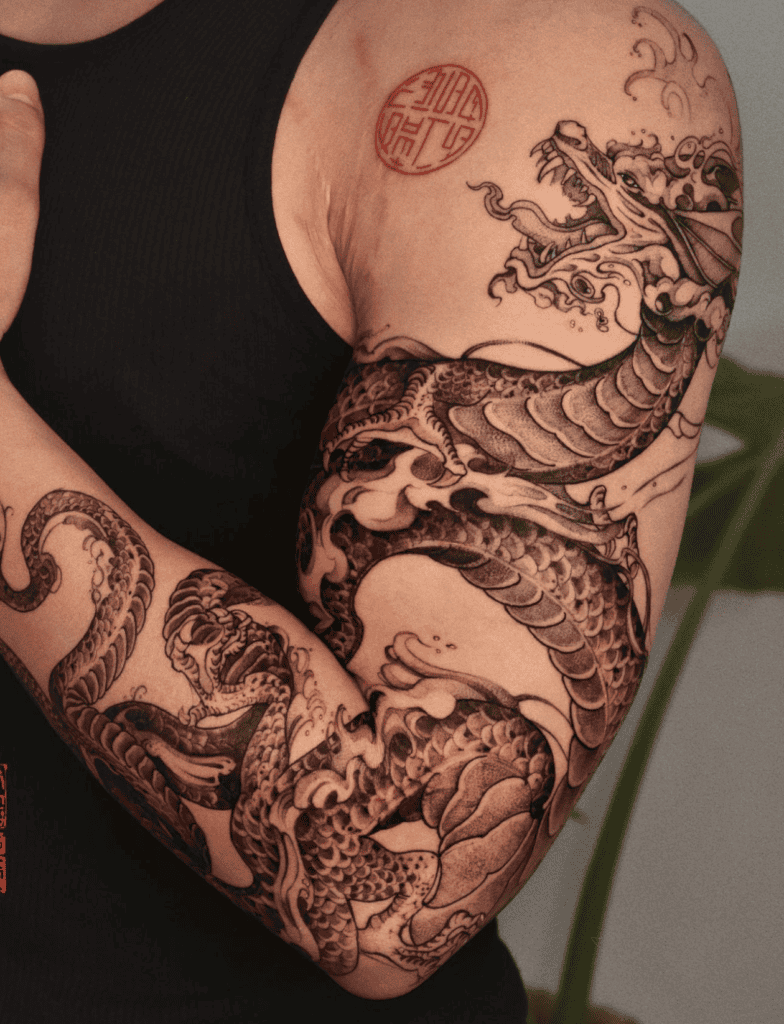
Bakunawa is a gigantic serpent or dragon from Visayan mythology in the Philippines, commonly described as a colossal sea serpent or dragon which is obsessed with the Moon.
The most famous Bakunawa legend tells of a time when there were seven moons in the sky. These moons illuminated the Earth every night, making the world endlessly beautiful. However, Bakunawa became enchanted by their brilliance, and one by one, the serpent rose from the sea and swallowed them until only one Moon remained.
The gods and humanity feared eternal darkness if Bakunawa succeeded in devouring the last moon, so whenever Bakunawa attacked, people would beat drums, ring bells, blow horns, or shout as loudly as possible. The tremendous noise frightened the serpent, causing it to spit the Moon back into the sky. This tradition became an explanation for lunar eclipses, when the Moon appears to disappear before returning.
Illuyanka Snake Tattoo

Illuyanka is a gigantic serpent or dragon from Hittite mythology, dating back over 3,000 years. Its name literally means “serpent”, and it is portrayed as one of the greatest enemies of the Storm God.
The best-known story involves the Hittite Storm God, often identified as Tarḫunz (also called Tarhunna or Tarhunt). The Storm God fights Illuyanka, but is defeated, losing his heart and eyes. Without them, the Storm God loses much of his divine power.
However, the Storm God later devises a plan and while there are different versions of the story, one famous version says the Storm God’s son marries Illuyanka’s daughter and secretly retrieves the Storm God’s stolen heart and eyes. Once restored, the Storm God challenges Illuyanka again, and this time he kills the serpent.
Naga Snake Tattoo

Naga (from the Sanskrit word nāga, meaning “serpent”) refers to a class of powerful serpent beings commonly portrayed as giant cobras, humans with serpent features, and shape-shifters who can alternate between serpent and human forms
Across Asia, Nagas are closely associated with water, and because water is essential for agriculture, Nagas became symbols of fertility, rainfall, and prosperity. In many cultures, a healthy relationship with the Nagas meant abundant harvests.
Rather than being solitary monsters, Nagas live in organised kingdoms. Their mythical realm is often called Nāgaloka, an underground or underwater world filled with precious jewels, royal palaces, and magical treasures.
Basilisk Snake Tattoo
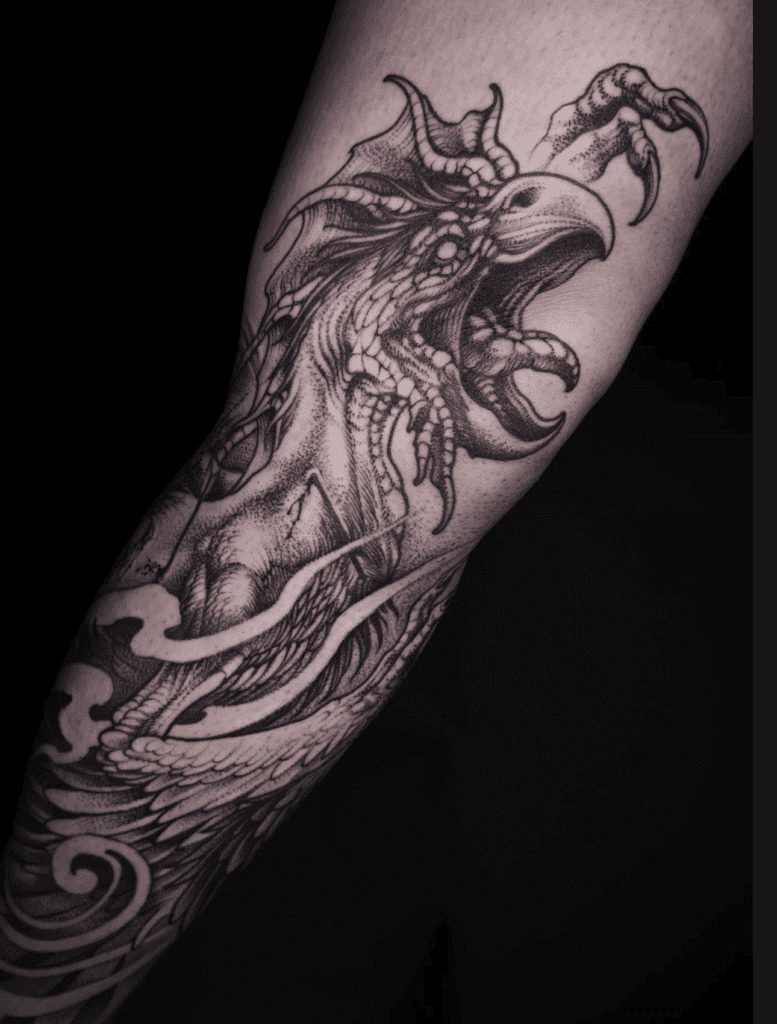
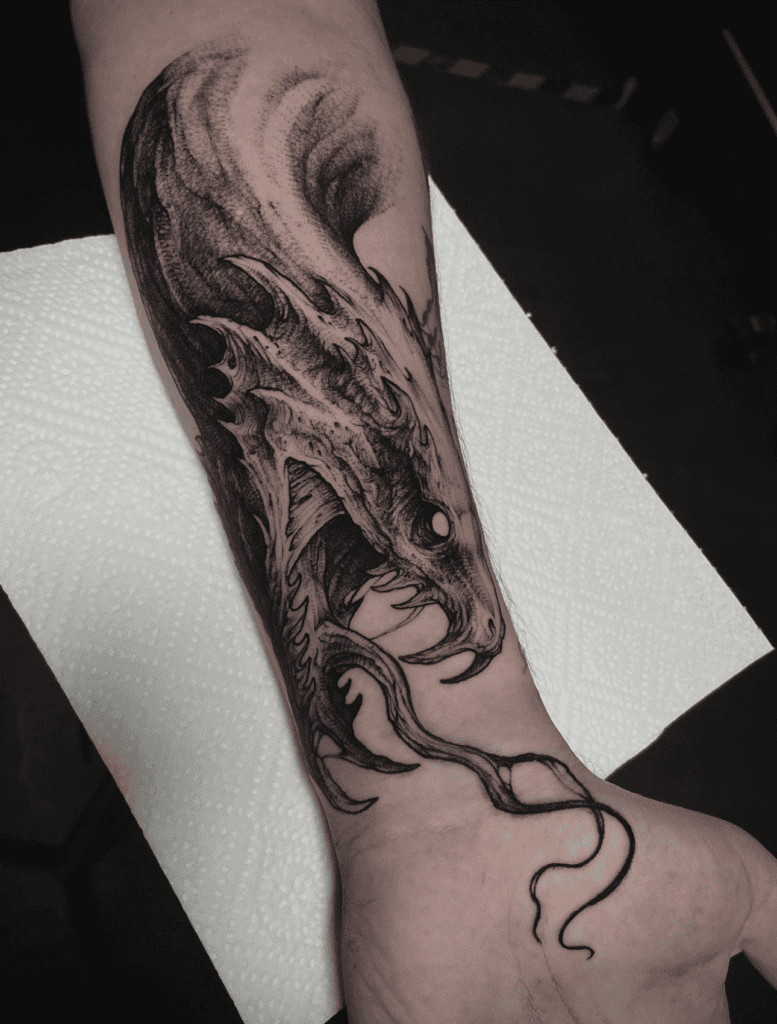
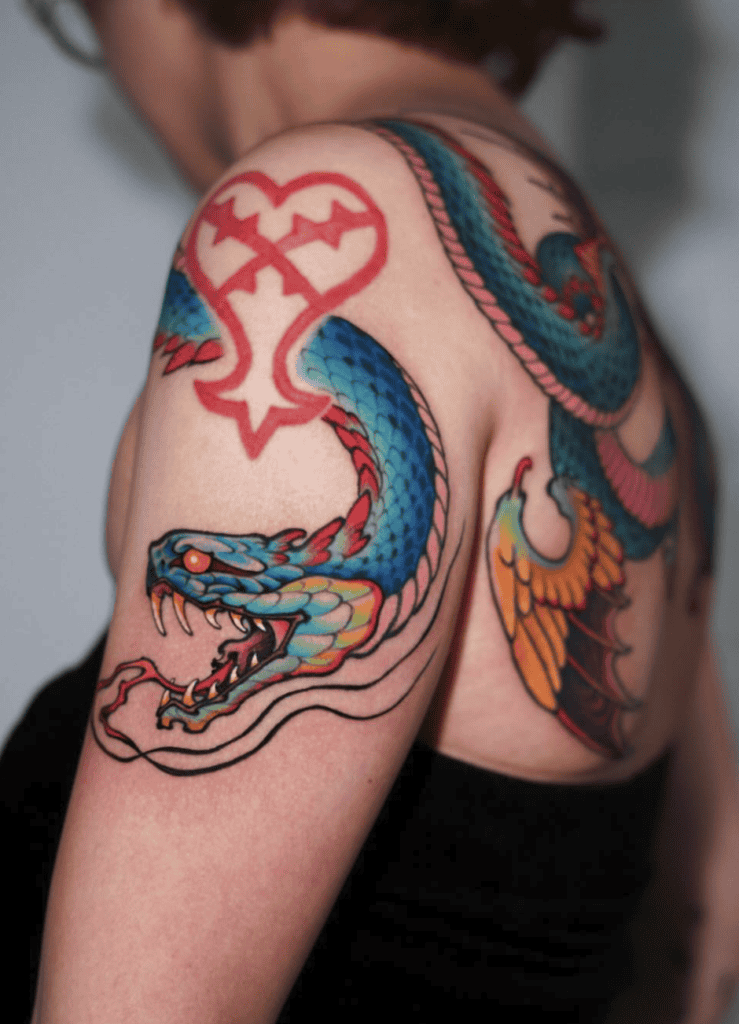
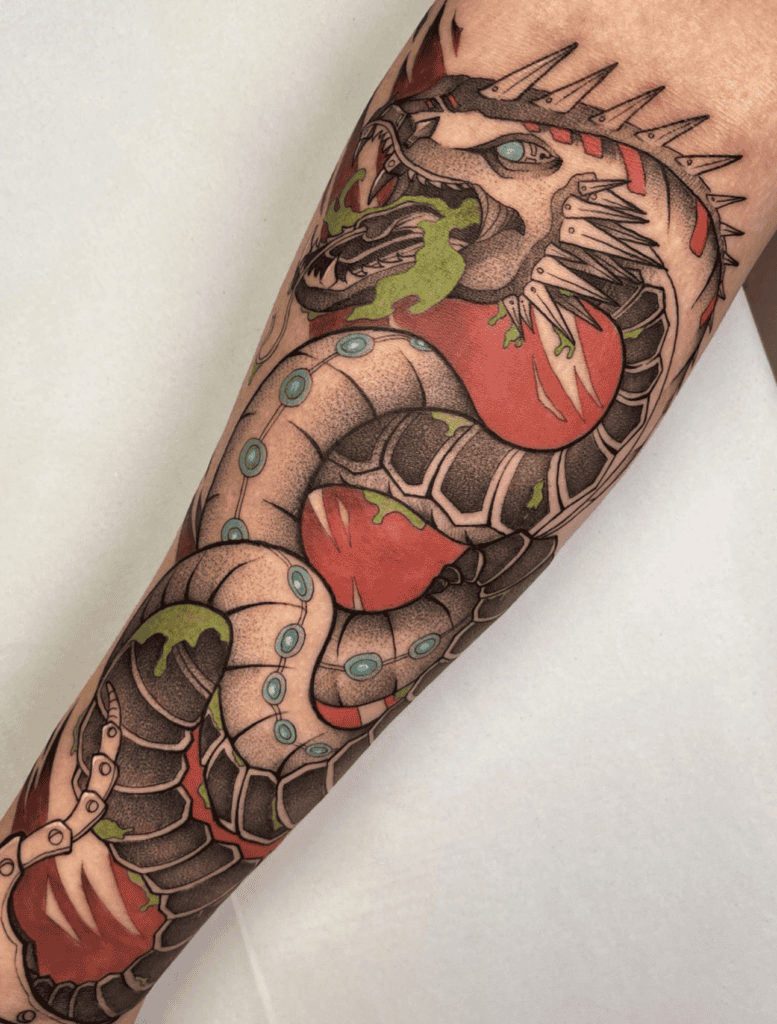
The Basilisk is a legendary creature from ancient Greek and medieval European folklore. Its name comes from the Greek word basilískos, meaning “little king”, because it was believed to rule over all serpents.
Early descriptions portray it as a small but incredibly deadly serpent wearing a crown-like crest on its head. It possesses a lethal gaze and produces venom capable of killing plants, animals, and humans.
earliest written descriptions come from ancient authors such as Pliny the Elder in the 1st century CE. According to these accounts, the Basilisk was relatively small and moved by raising part of its body above the ground. Other snakes fled from its presence, and its venom was so potent that it poisoned the earth wherever it travelled.
Kaa Snake Tattoo
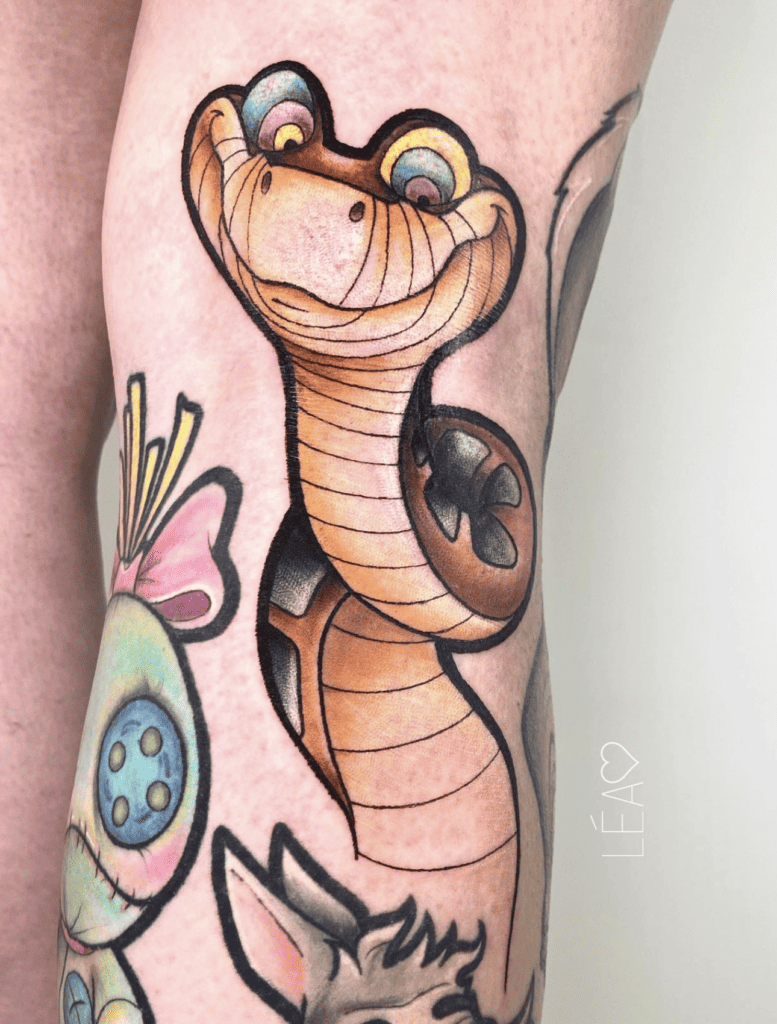
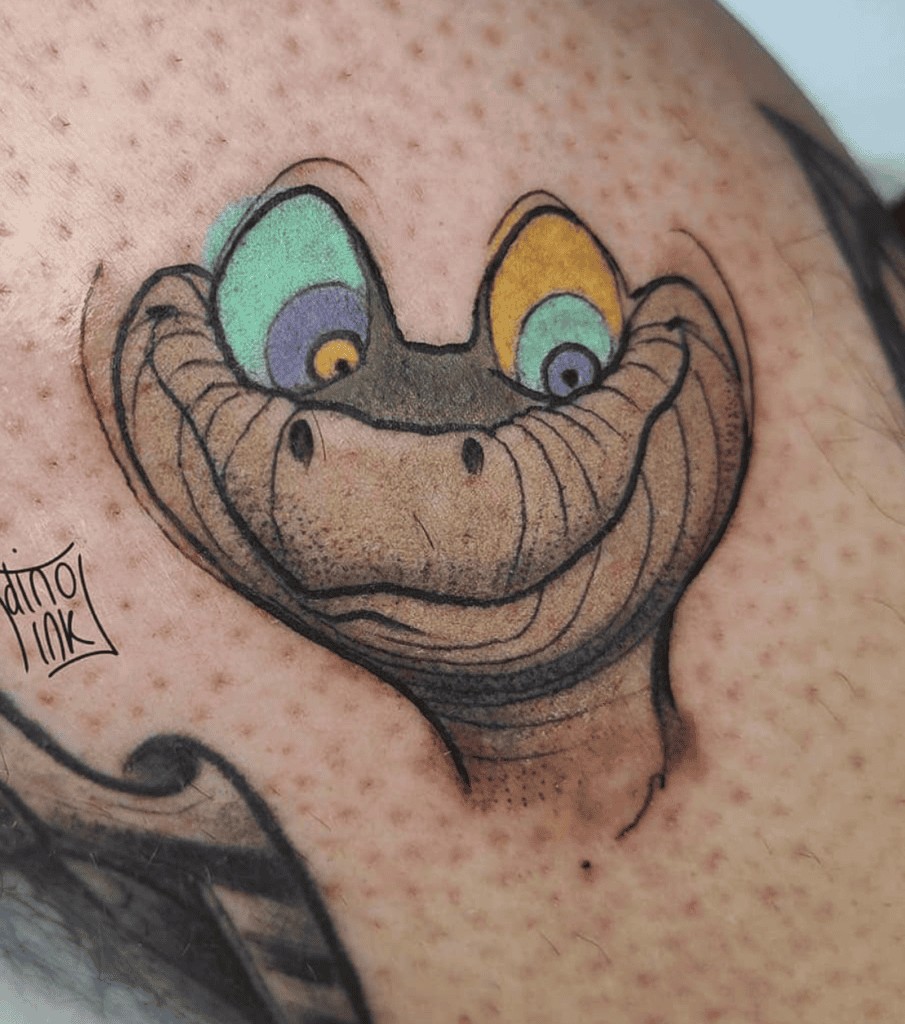
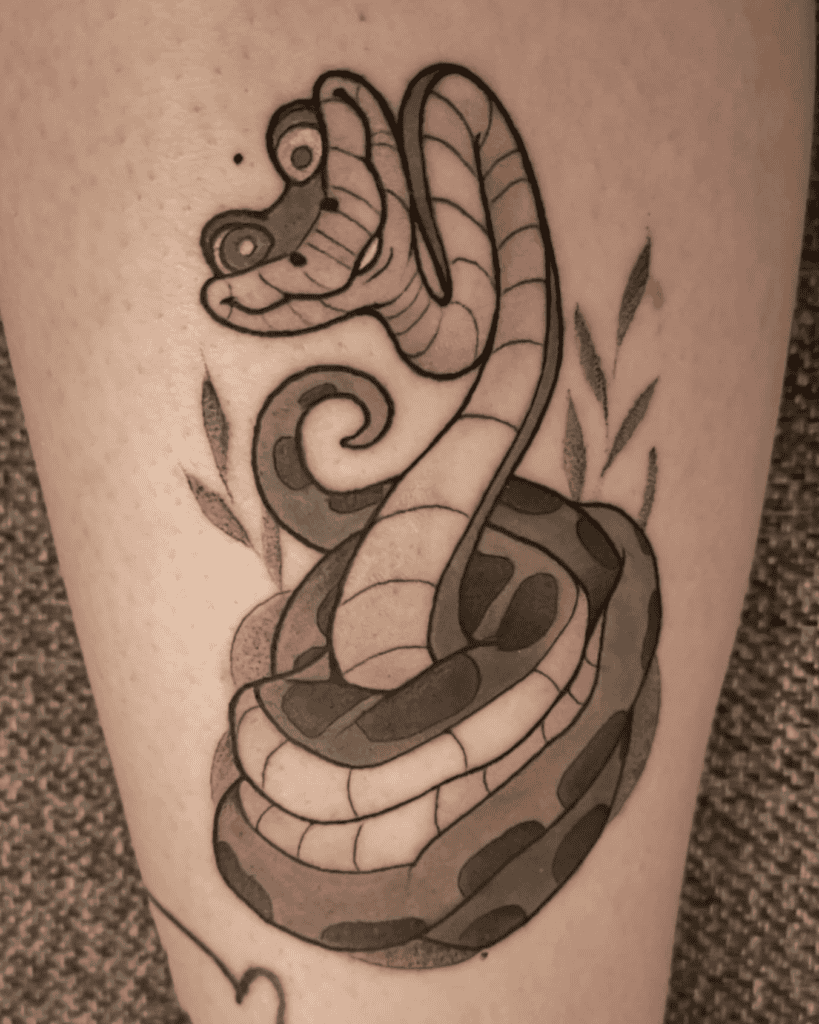
Kaa is one of the most recognisable snakes in literature, originating from The Jungle Book (1894) by Rudyard Kipling. Although many people know Kaa as a hypnotic villain from Disney’s adaptations, the original character is far more complex and is actually an ally and protector of Mowgli rather than his enemy.
Kaa is an enormous python living in the jungles of India. Although feared by nearly every creature, Kaa is respected because of his wisdom and immense power. In the original The Jungle Book, Kaa is a trusted ally of Mowgli, friend of Baloo, and companion of Bagheera.
Disney’s version transformed Kaa into a comic villain who uses his spinning eyes to hypnotise and try to eat Mowgli.
Sir Hiss Snake Tattoo
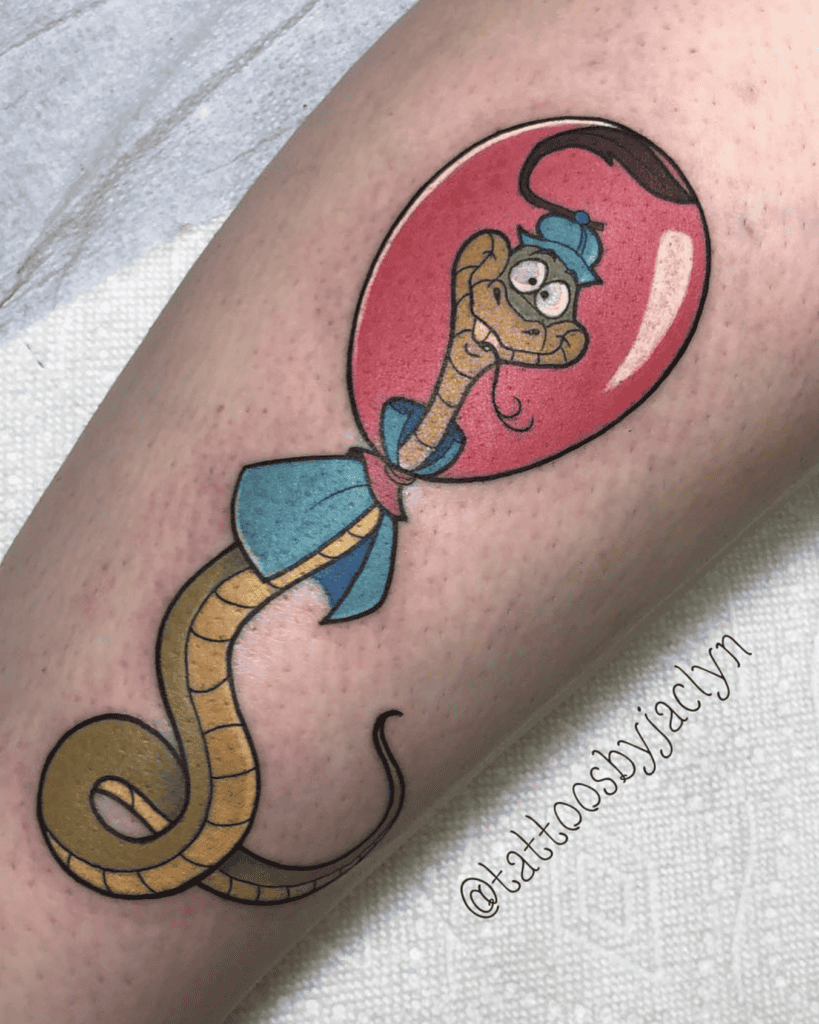
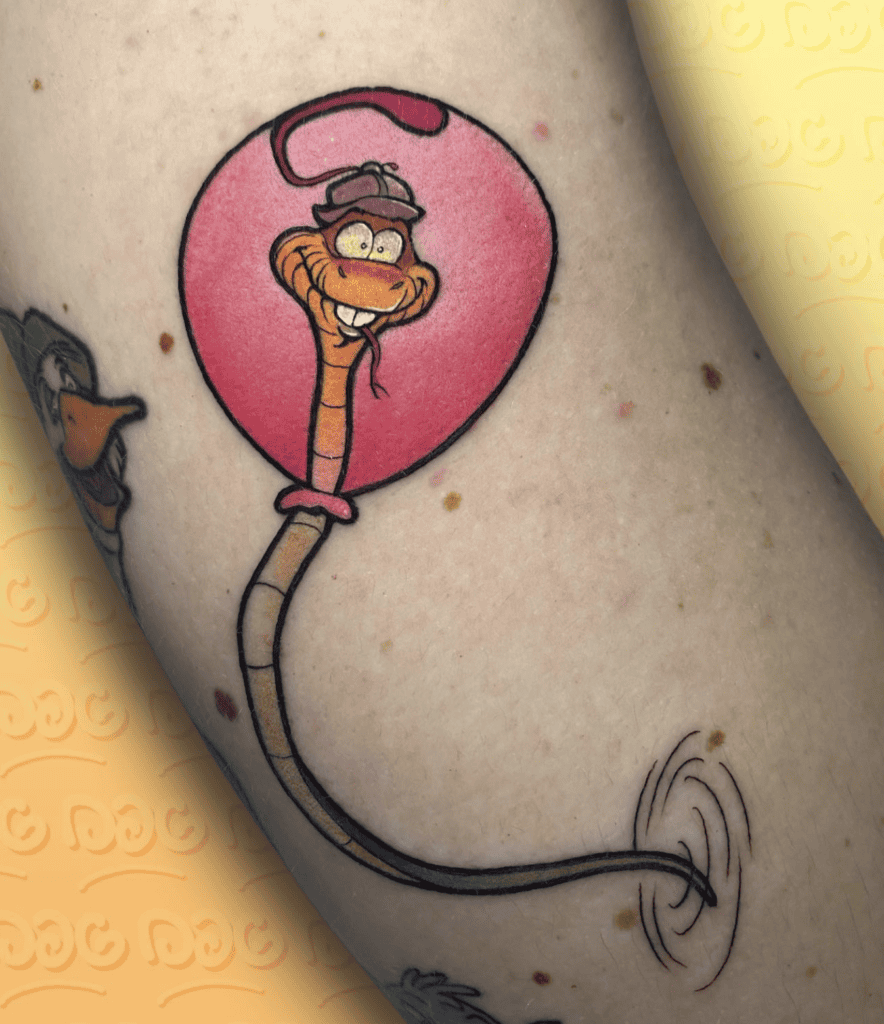
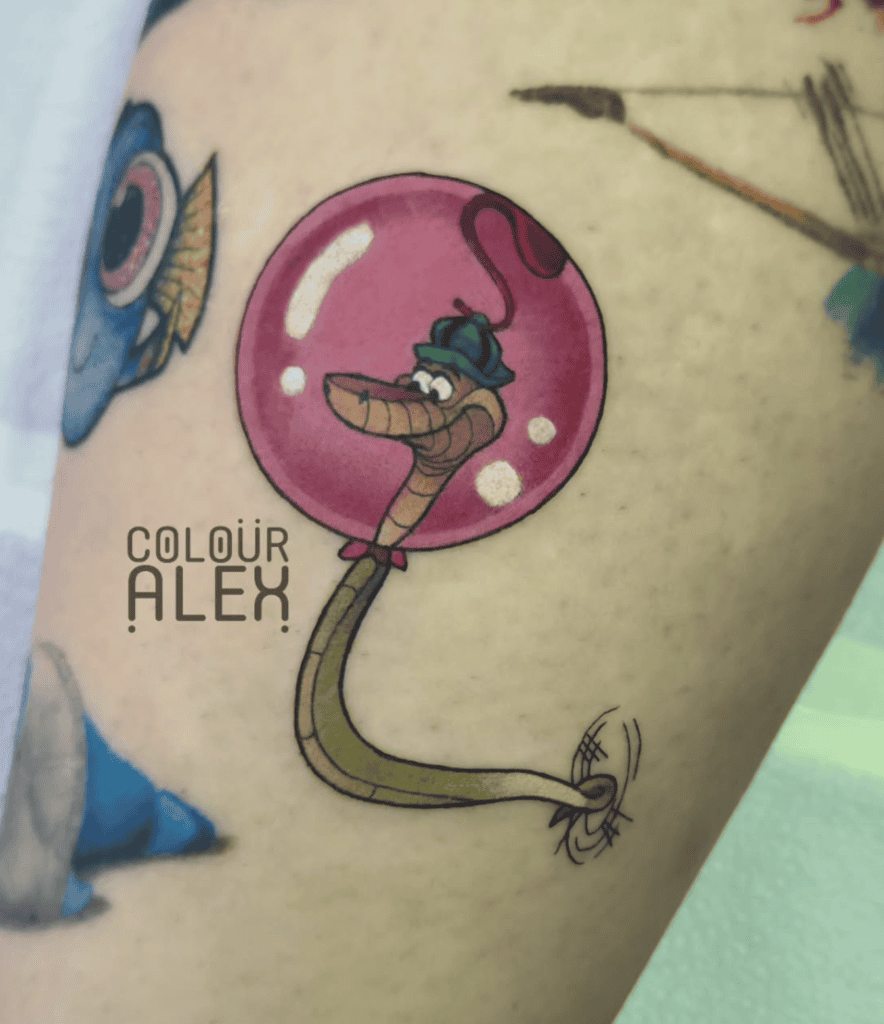
Sir Hiss is one of Disney’s most lovable snake characters, a loyal but bumbling adviser whose exaggerated cowardice and constant misfortune make him one of the standout personalities in Disney’s Robin Hood.
Although he dreams of being intimidating, Sir Hiss usually ends up being the victim of his own bad luck, making him an unforgettable mix of charm, humour, and loyalty.
Nagini Snake Tattoo
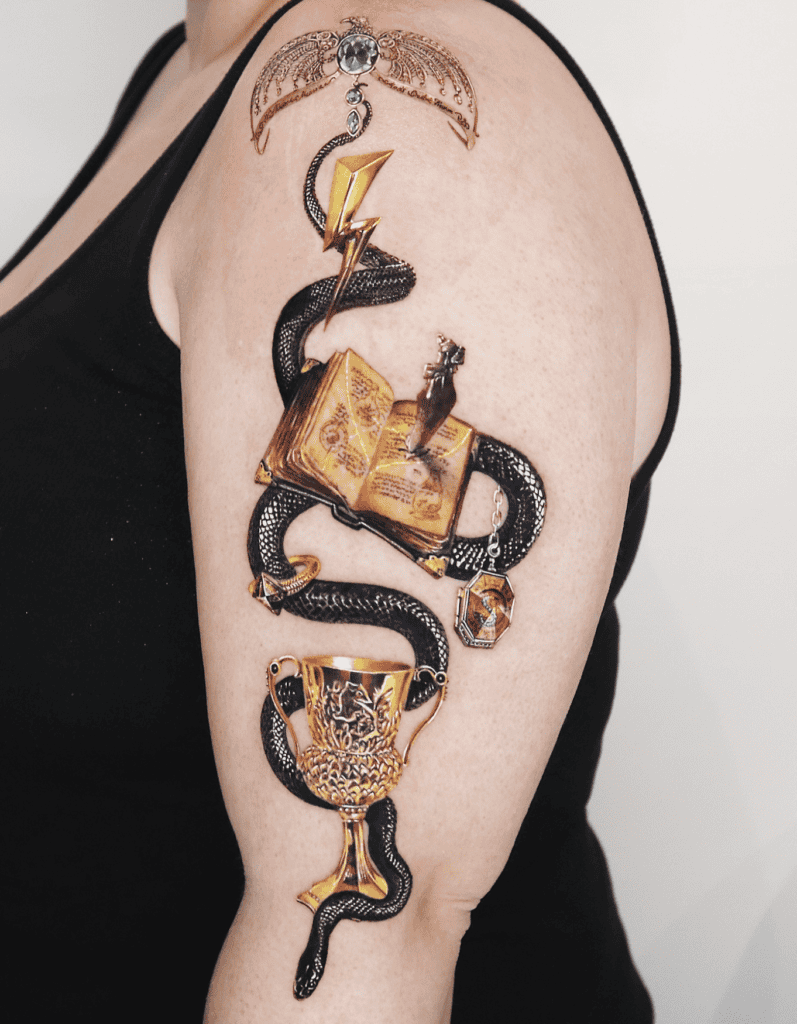
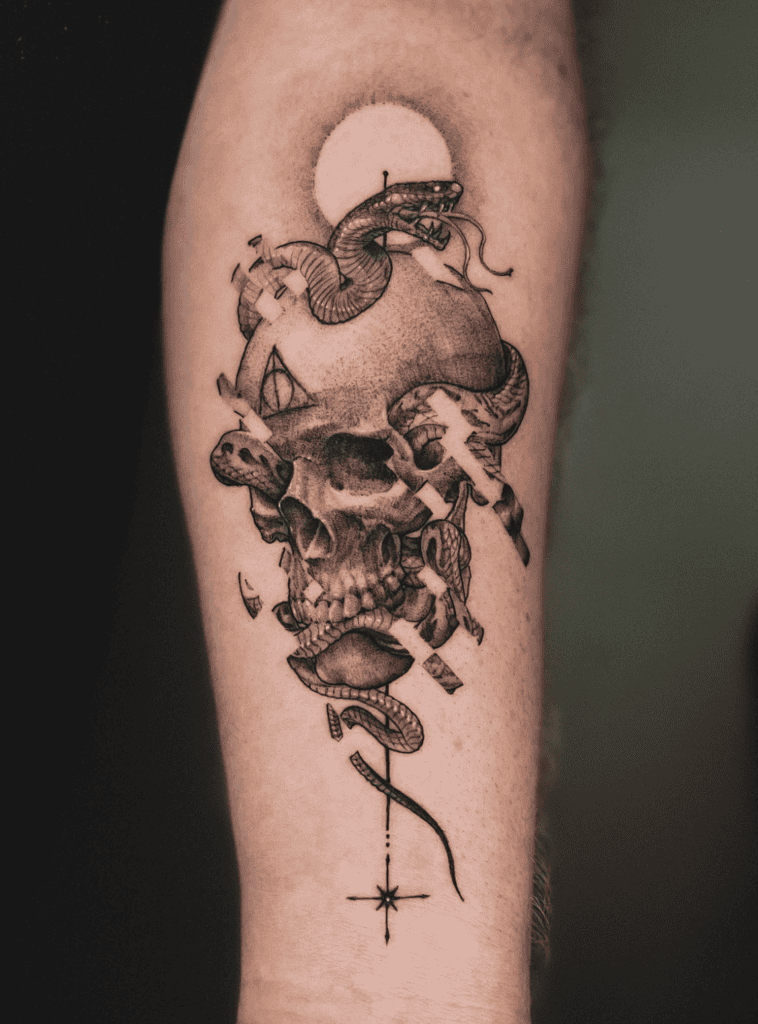
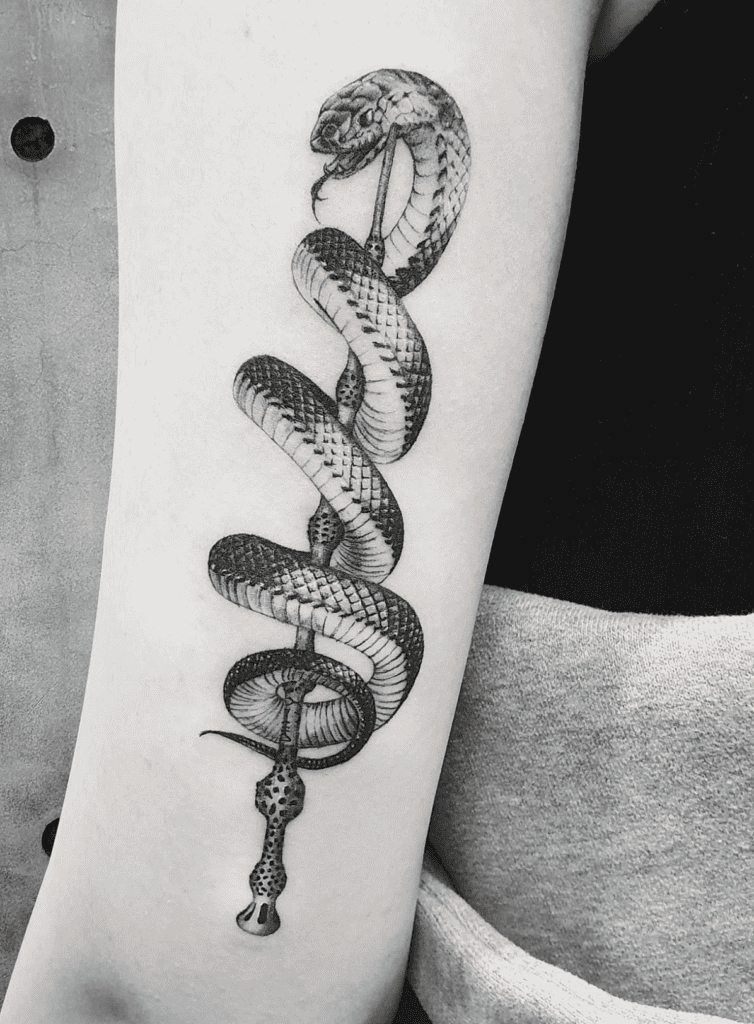
Nagini is one of the most famous snakes in modern fantasy. Introduced in the Harry Potter series by J. K. Rowling, she begins as the loyal companion of the Dark Lord but later gains a much deeper backstory. Depending on the era of the story, Nagini is either a cursed human capable of transforming into a snake or a permanently transformed magical serpent who becomes one of the most dangerous creatures in the wizarding world.
Rattlesnake Jake Snake Tattoo

Rattlesnake Jake is the primary antagonist of the 2011 animated Western Rango and is famous for his intimidating presence, razor-sharp wit, and the terrifying Gatling gun mounted on the end of his tail. Unlike many cartoon villains, Jake is genuinely menacing, combining the stealth of a rattlesnake with the swagger of an Old West gunslinger.
Pokémon Snake Tattoo
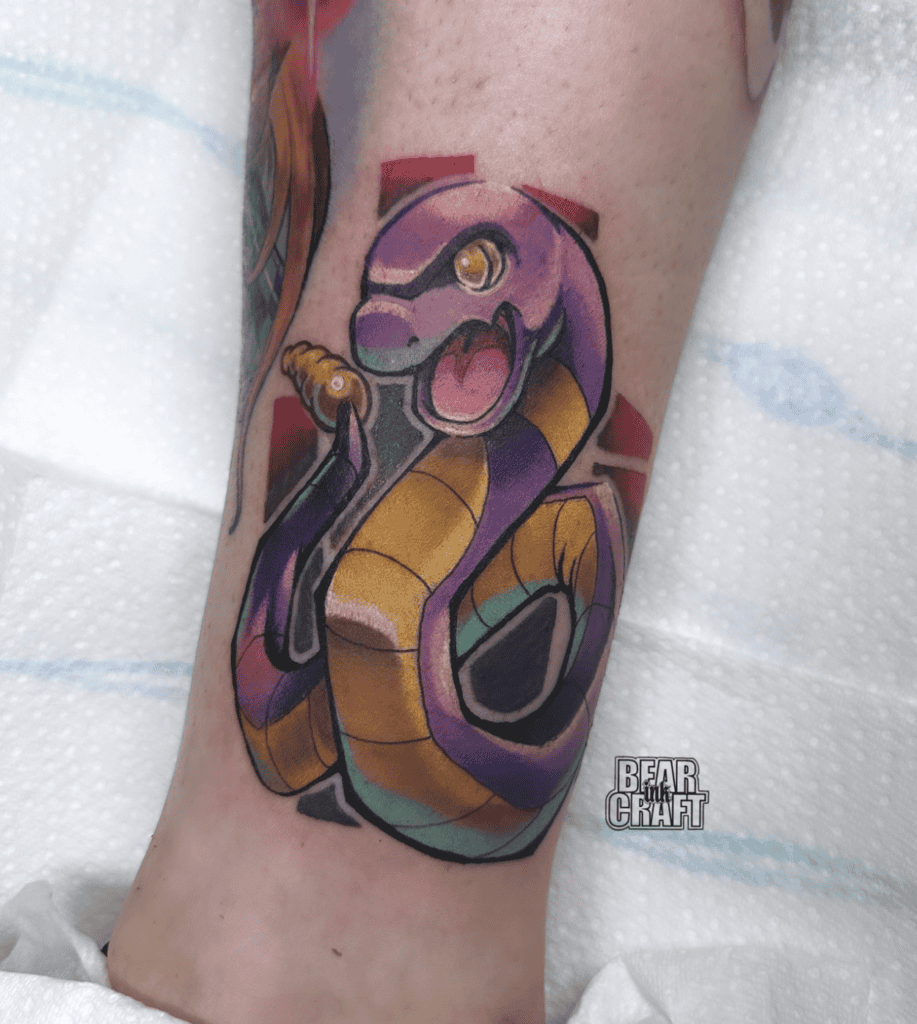
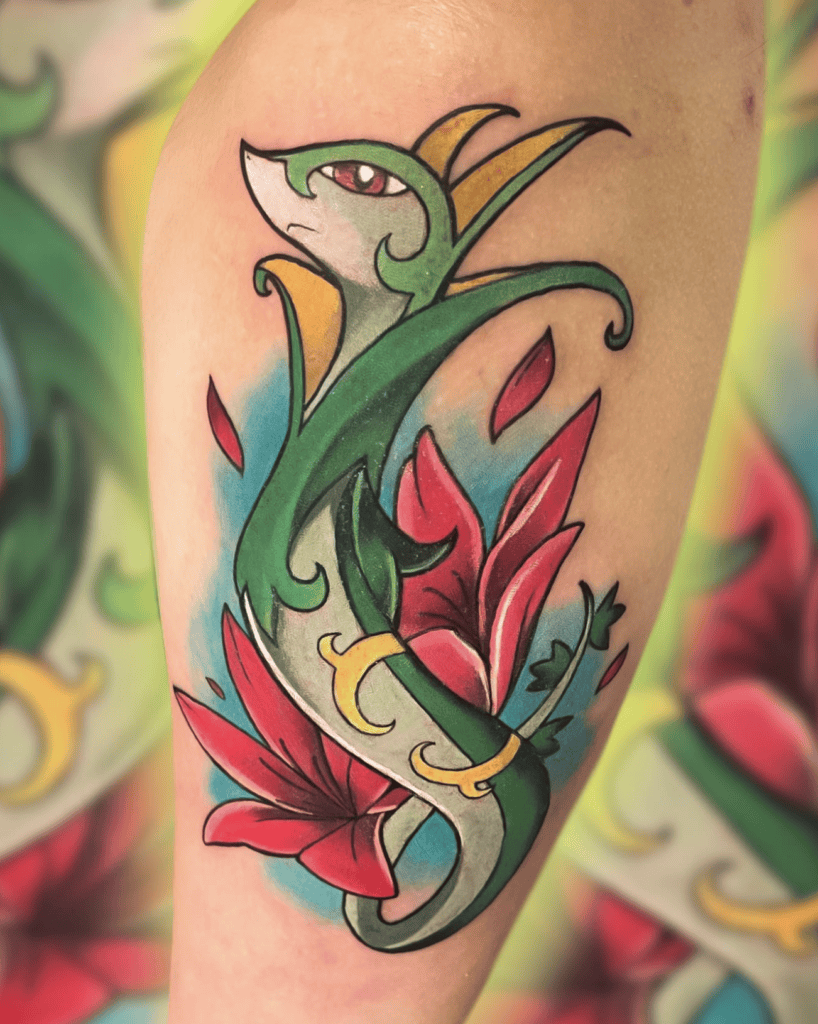
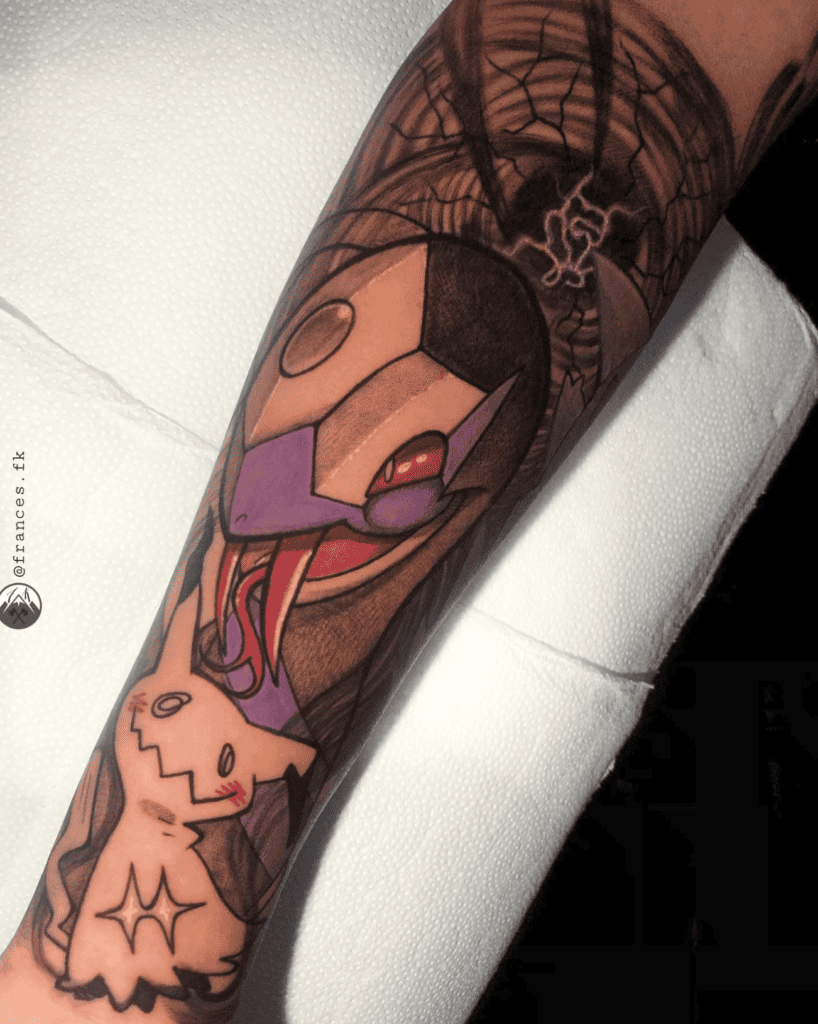
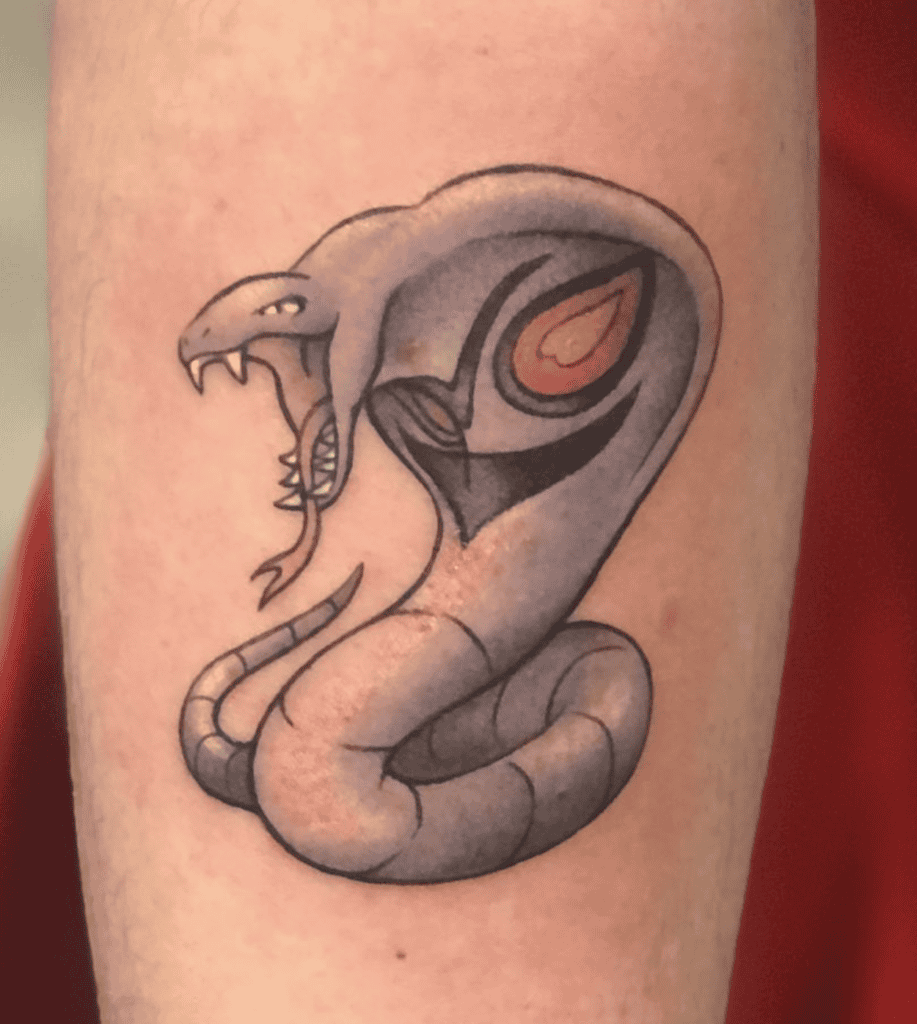
The Pokémon franchise has a variety of snake Pokémon, with the very first appearing in the first generation.
Ekans and Arbok debuted in the original Pokémon, being two snakes whos names are simply Snake and Kobra (Cobra) reversed, Ekans, and Arbok. They are poison type Pokémon who are most famously used by Jessie from Team Rocket.
Seviper is a 3rd generation Pokémon introuced in Pokémon Ruby and Sapphire. This Pokémon, like Ekans are Arbok is a poison type, and best known for its rivalry with the Pokémon Zangoose.
Serperior is a pure Grass-type Pokémon introduced in Generation 5, and the final evolution of the Snivy line. It is known for its high Speed and defensive bulk, and is particularly famous for its Hidden Ability, Contrary, which reverses stat changes.
Great Serpent Snake Tattoo


The Great Serpent is a giant white snake from Sekiro: Shadows Die Twice. It is an ancient divine beast that embodies the raw, untamed power of nature. Throughout the game, the Great Serpent serves as both a terrifying obstacle and a symbol of the mystical world hidden within Ashina.
Unlike many serpent gods that speak or rule kingdoms, the Great Serpent is silent, primal, and awe-inspiring. Its presence alone reminds players that there are forces in the world far older and more powerful than humans.
Orochimaru Snake Tattoo

Orochimaru is a legendary ninja whose obsession with immortality and forbidden knowledge transforms him into Naruto’s most fascinating and morally complex antagonists.
His connection to snakes goes far beyond aesthetics as throughout the series, snakes symbolise rebirth, transformation, hidden knowledge, patience, and the shedding of one’s old self, all central themes in Orochimaru’s character.
Sir Pentious Snake Tattoo


Sir Pentious is one of the most entertaining and surprisingly heartfelt characters from Hazbin Hotel. Initially introduced as an over-the-top, failed supervillain obsessed with world domination, Sir Pentious gradually develops into one of the series’ most sympathetic characters. His journey explores themes of redemption, belonging, self-worth, and the possibility of change, making him far more than just comic relief.
Miscellaneous Snake Tattoo
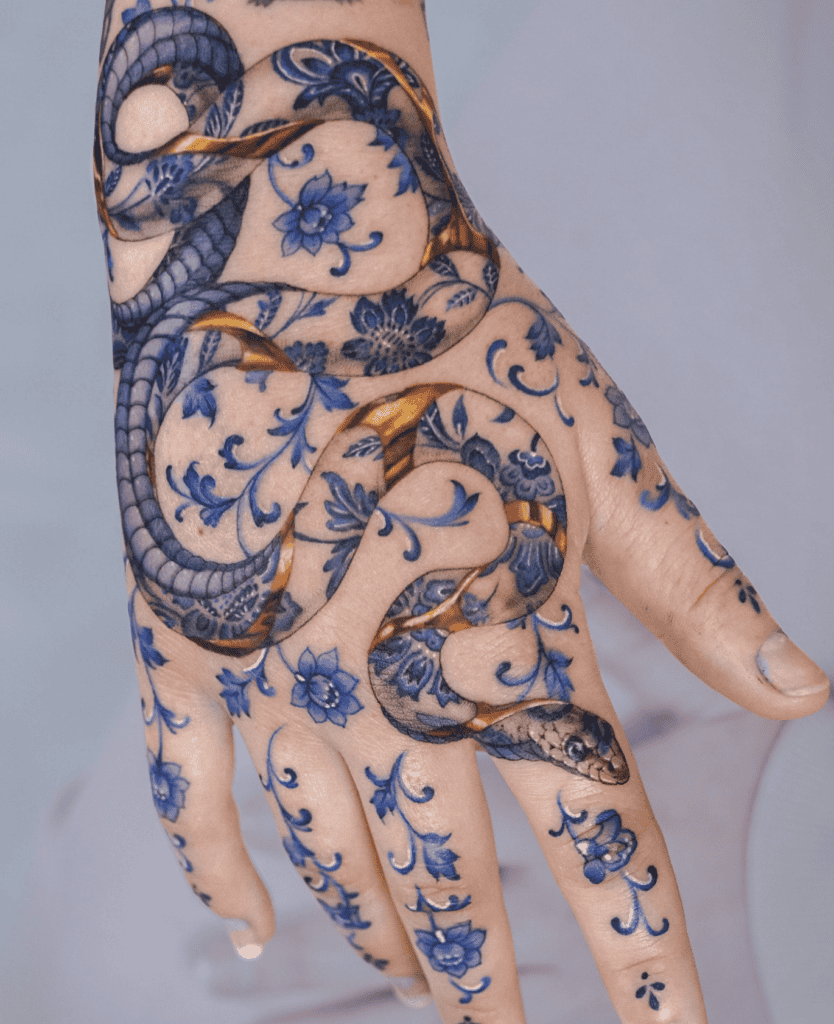
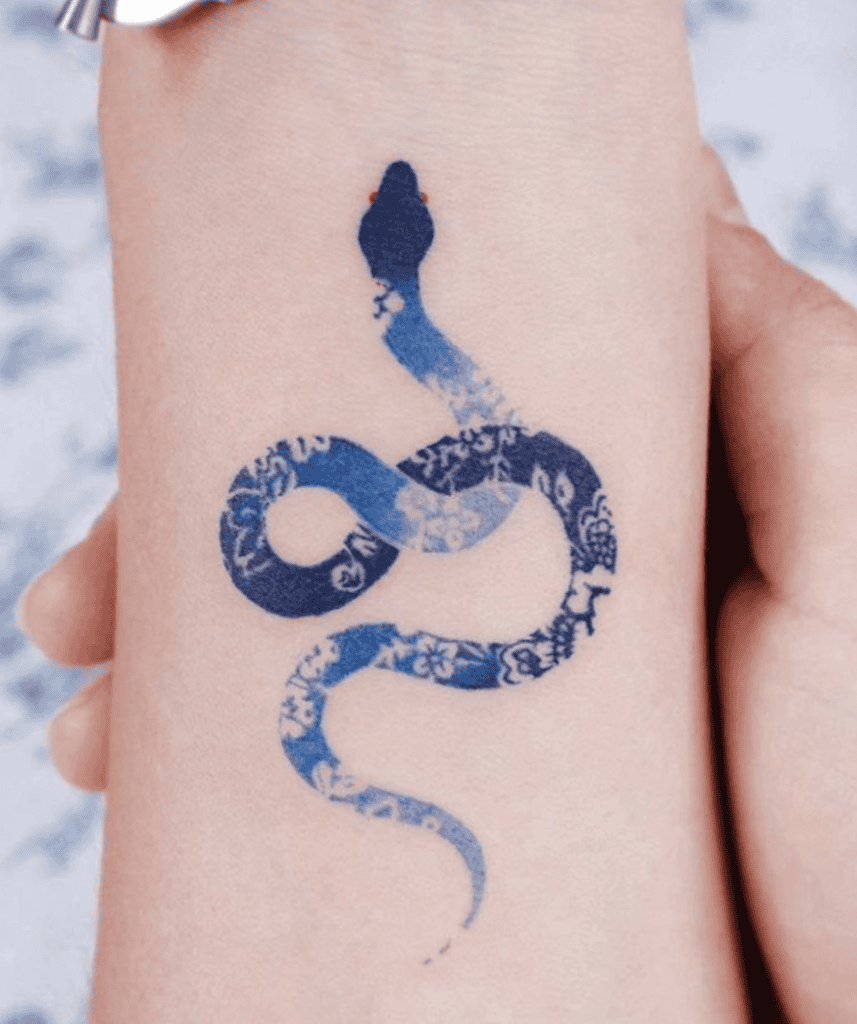
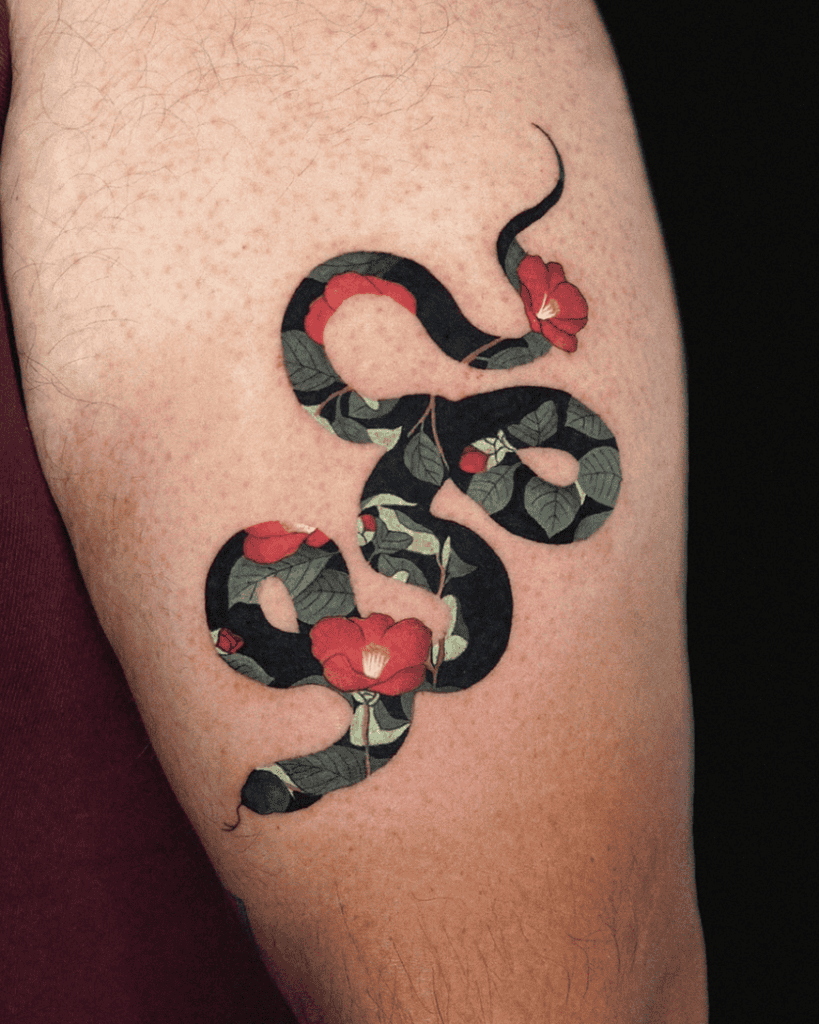
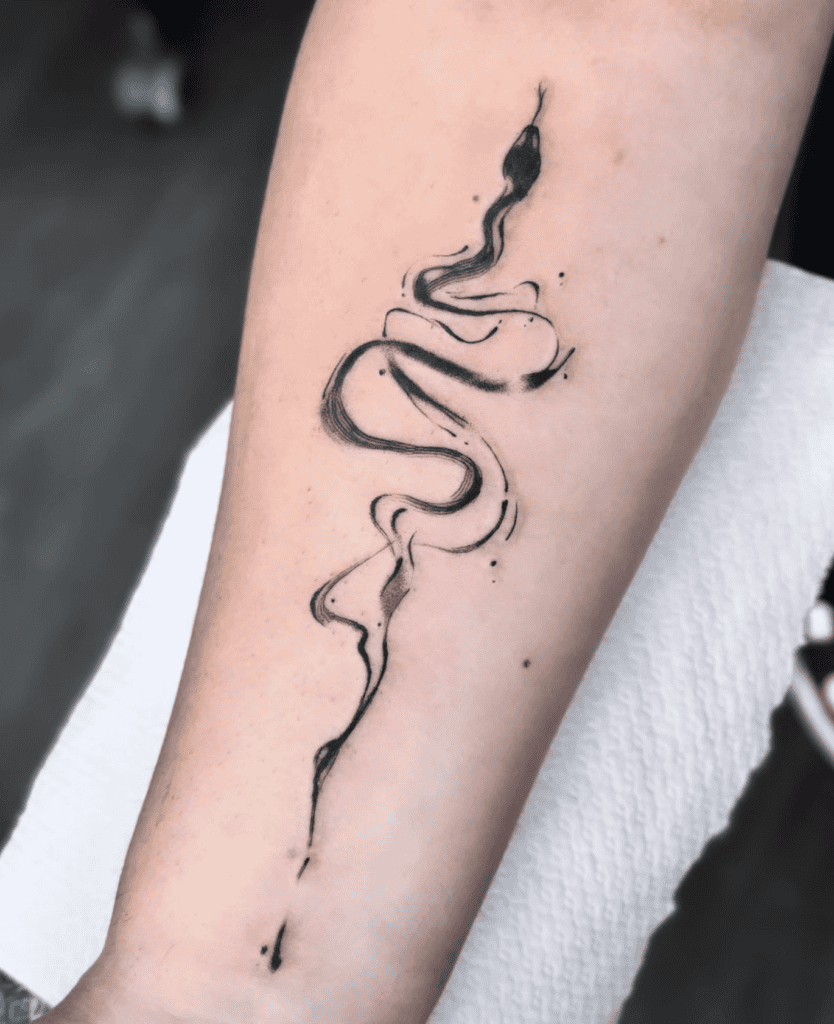
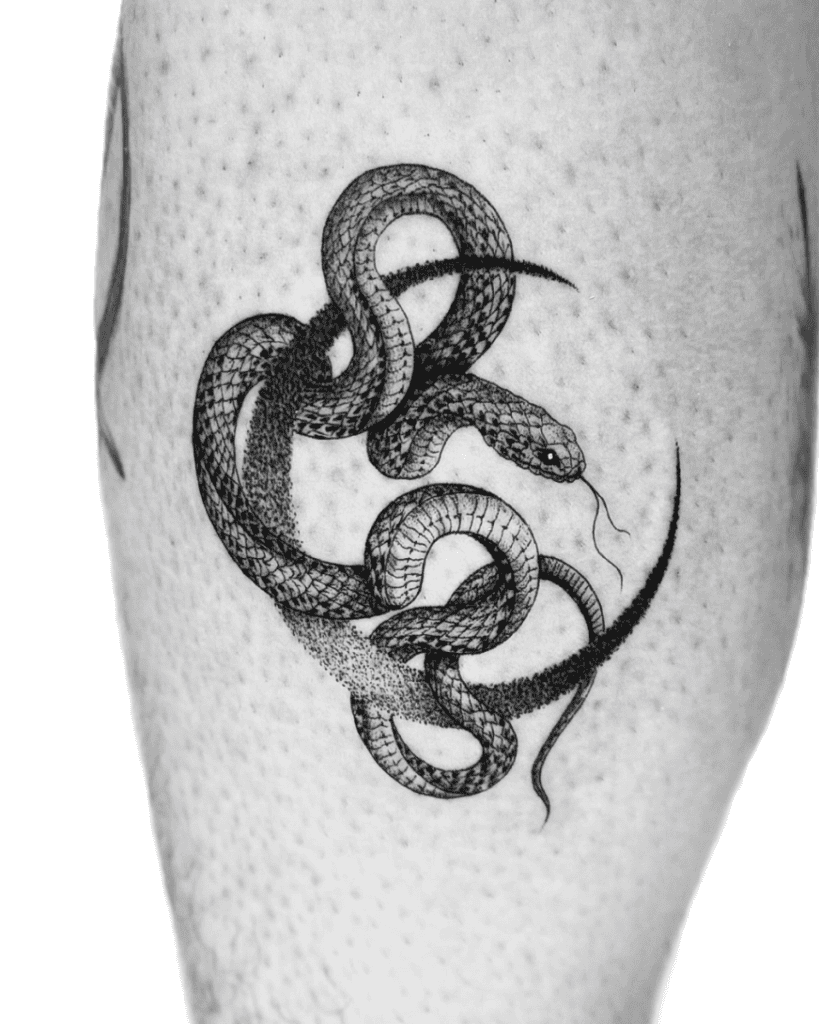
If none of these Snake Tattoos interest you, check out some of these miscellaneous Snake Tattoos to add some style to your ink.
Conclusion
Thanks for slithering your through these striking Snake Tattoo Designs. We hope you’ve shed your doubts and have the inssspiration you need to ssstart your next tattooing adventure. But if Snake Tattoos still don’t hiss the spot, why not strut your way into these Chicken Tattoo designs, charge your way into these Bovine Tattoo Ideas, or swing your way through these Monkey Tattoos.
- Bear Tattoo Ideas - October 22, 2026
- Lion Tattoo Ideas - October 19, 2026
- Persona Tattoo Ideas - October 15, 2026