
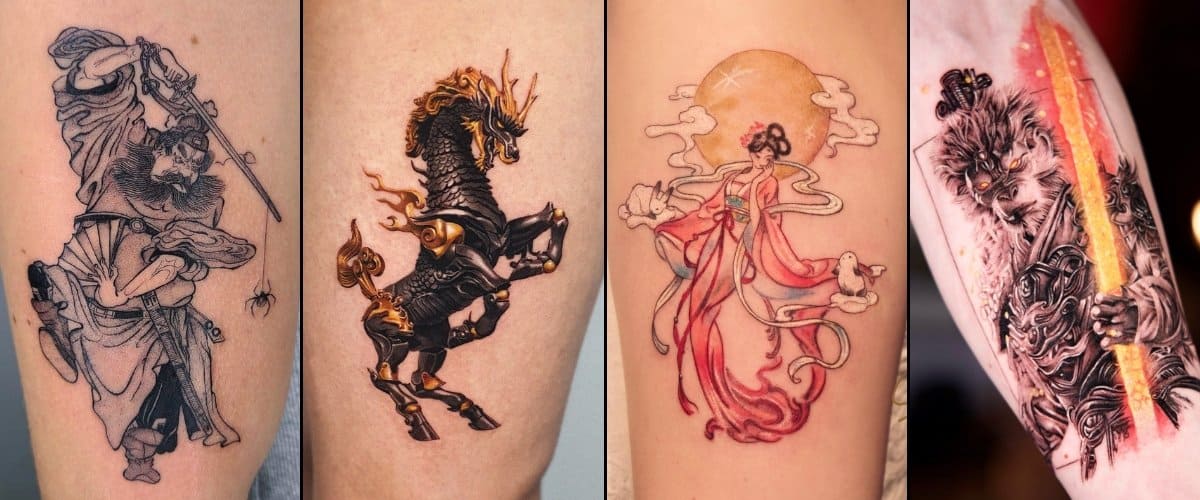
Chinese Mythology Tattoo ideas
Do you feel like you’re missing the Yin to your Yang on your search for the perfect Tattoo Clues? Well, worry not, we’re about to Chang’e your faith as we go on a Journey to the East with some of the best Chinese Mythology Tattoo ideas.
What is Chinese Mythology
Chinese mythology is a vast collection of ancient stories, legends, gods, heroes, spirits, and cosmic beliefs that developed across thousands of years of Chinese civilisation. It blends early folk traditions with philosophical and religious influences from Daoism, Confucianism, and Buddhism, creating one of the richest mythological systems in the world.
Unlike Greek or Norse mythology, Chinese mythology isn’t one single fixed canon. It evolved across dynasties, regions, and belief systems, meaning different versions of the same story often exist.
Best Chinese Mythology Tattoo Artists


Best Chinese Mythology Tattoo Designs
Now that we know a little about Chinese Mythology, let’s take a look at some of the best Chinese Mythology Tattoos the internet has to offer.
Pangu Chinese Mythology Tattoo


Pangu is one of the most important creation figures in Chinese mythology. He is the primordial giant credited with separating heaven and earth and shaping the physical world itself.
In the beginning, the universe was said to be a swirling mass of chaos, like a giant cosmic egg. Inside that egg, Pangu slept for 18,000 years. When he finally awoke, he stretched and cracked the egg open. The lighter elements (yang) rose upward to form the sky, while the heavier elements (yin) sank to become the earth. However, heaven and earth kept trying to merge back together, so Pangu stood between them.
Every day, the sky rose a little higher, the Earth grew a little thicker, and Pangu grew taller to keep them apart. Eventually, after holding the cosmos apart for millennia, Pangu died from exhaustion, but his death wasn’t an ending; it was a transformation.
According to legend, his breath became the wind and clouds, his voice became thunder, his left eye became the sun, his right eye became the moon, his blood became rivers, his muscles became land, his bones became mountains, and his hair became trees and stars.
Jade Emperor Chinese Mythology Tattoo

Jade Emperor (Yù Huáng Dàdì) is the supreme ruler of Heaven in Chinese mythology and Daoist belief. He governs heaven, earth, the underworld, gods, spirits, immortals, and even human destiny.
Unlike some mythological rulers who are born divine, the Jade Emperor is often described as once being a virtuous mortal prince who cultivated wisdom and compassion over countless lifetimes. Through spiritual refinement and merit, he ascended to become ruler of the heavenly realm.
Buddha Chinese Mythology Tattoo
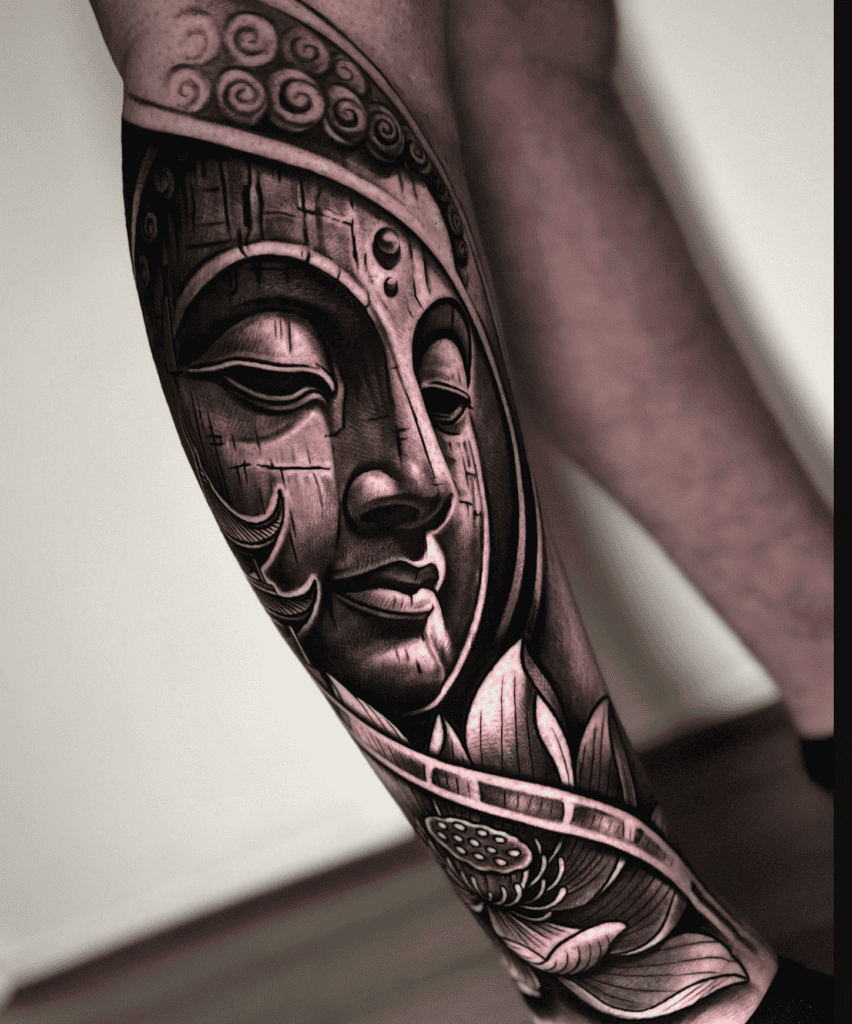
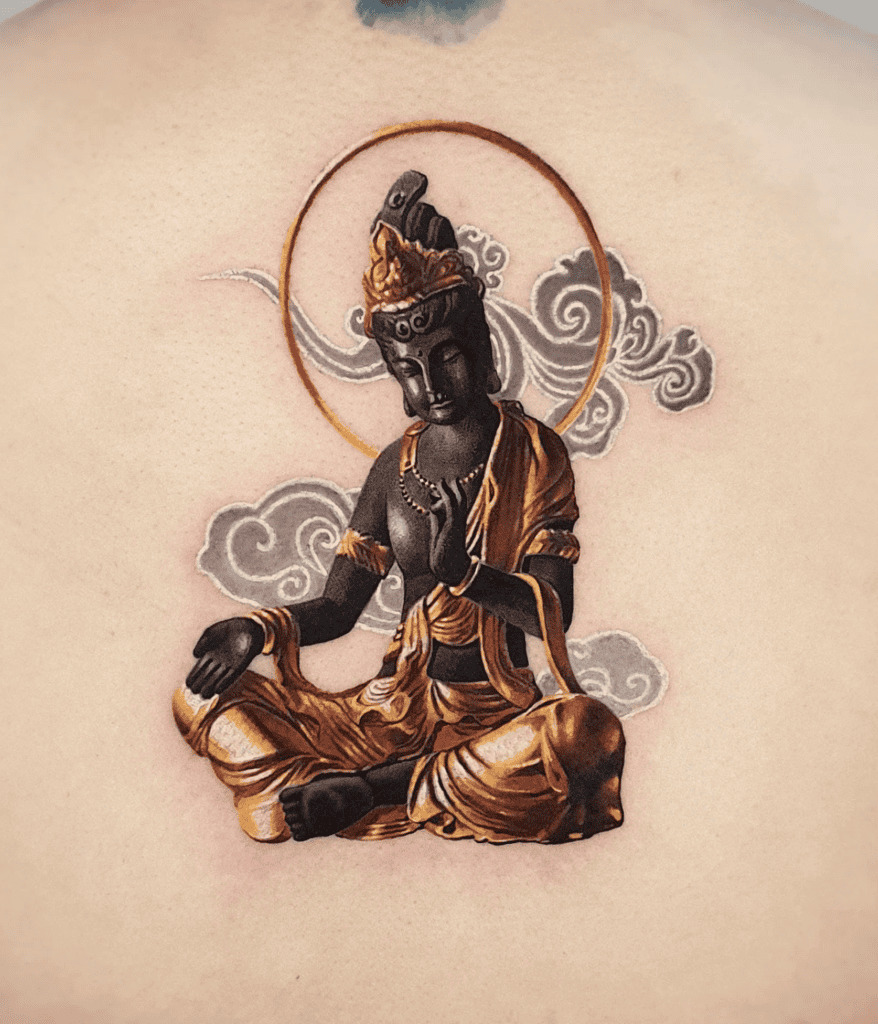
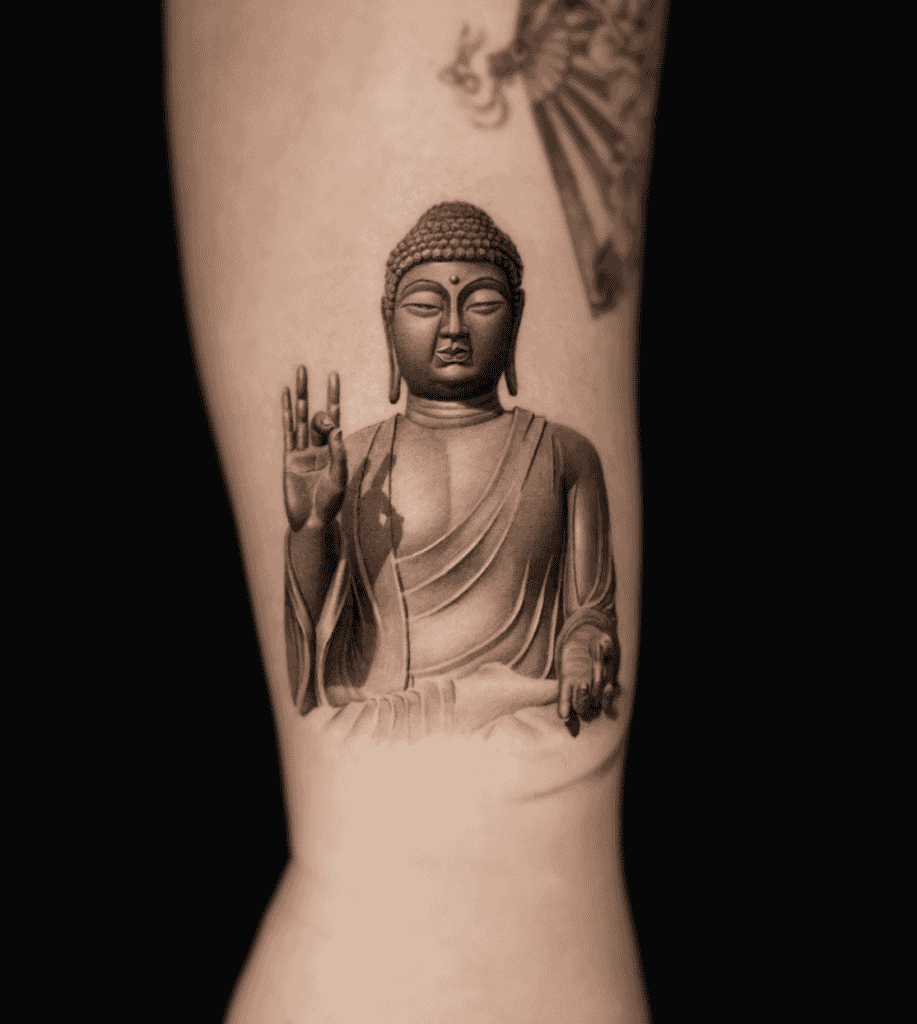
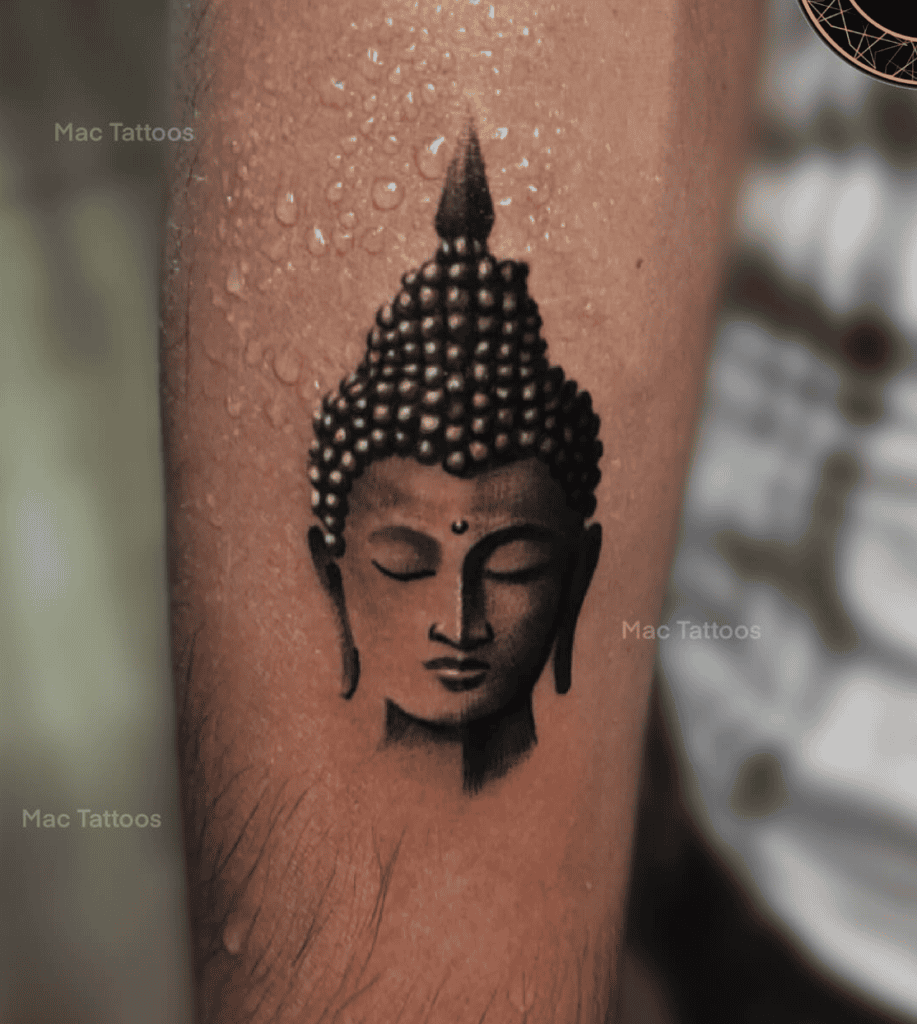
Gautama Buddha, commonly known simply as the Buddha, was a historical spiritual teacher who lived in India around the 5th–4th century BCE. The word Buddha means “the Awakened One” — someone who has achieved complete enlightenment.
While Buddhism began in India, it deeply influenced Chinese mythology, religion, philosophy, and folklore. Buddha was born as Siddhartha Gautama, a prince. He lived in luxury, shielded from suffering, but one day, he encountered old age, sickness, and death. Shocked by suffering, he left his palace to seek truth.
After years of meditation and spiritual practice, he attained enlightenment beneath the Bodhi Tree, and at that moment, he became the Buddha.
When Buddhism entered China (around the 1st century CE), it blended with Daoism and Confucian thought. In Chinese mythology and folklore, the Buddha often appears as a cosmic figure with immense spiritual authority, capable of subduing even powerful immortals.
Xiwangmu Chinese Mythology Tattoo
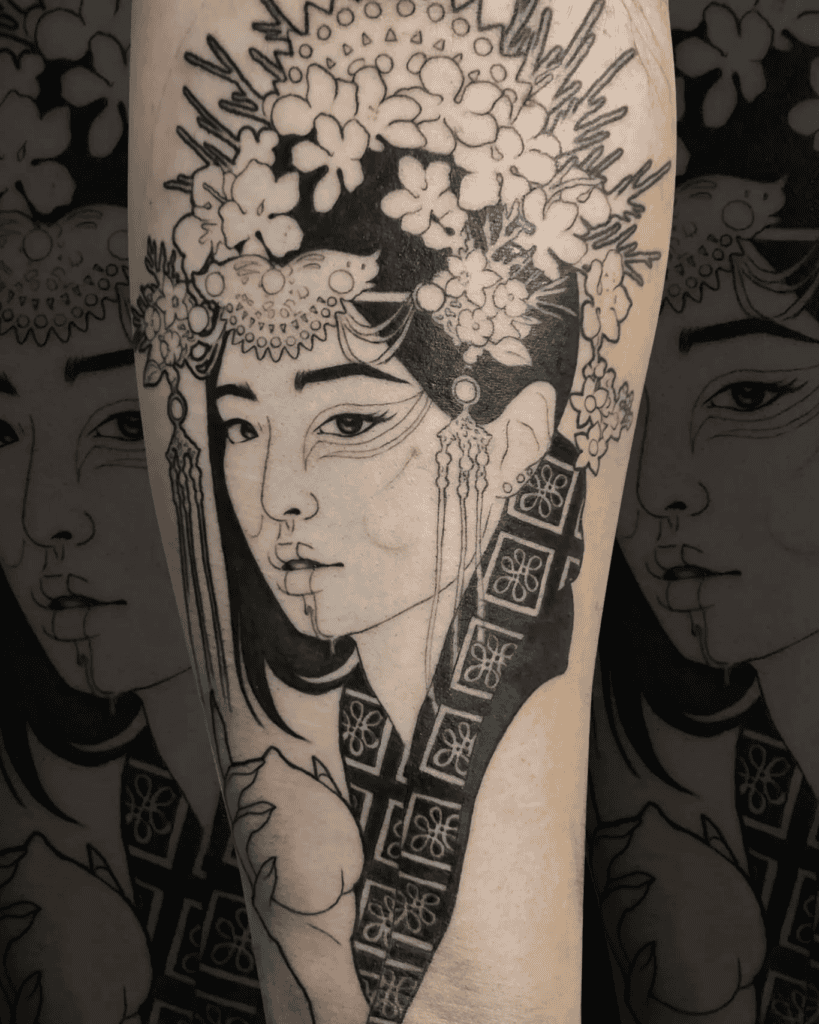
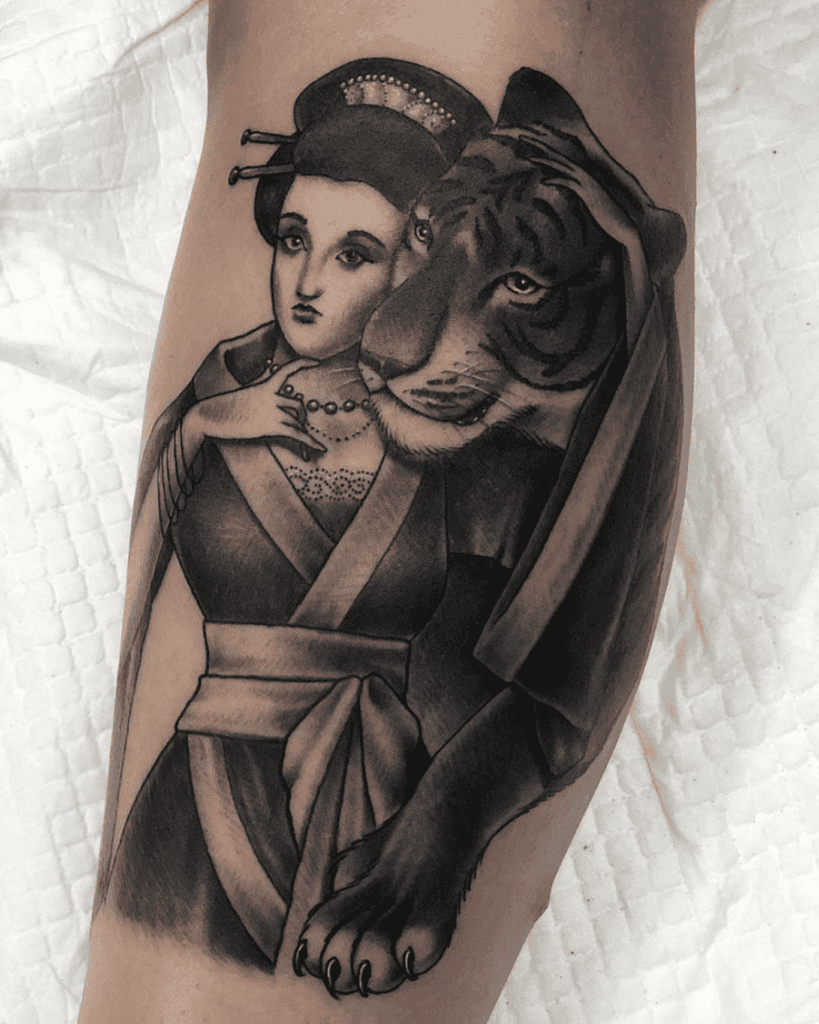
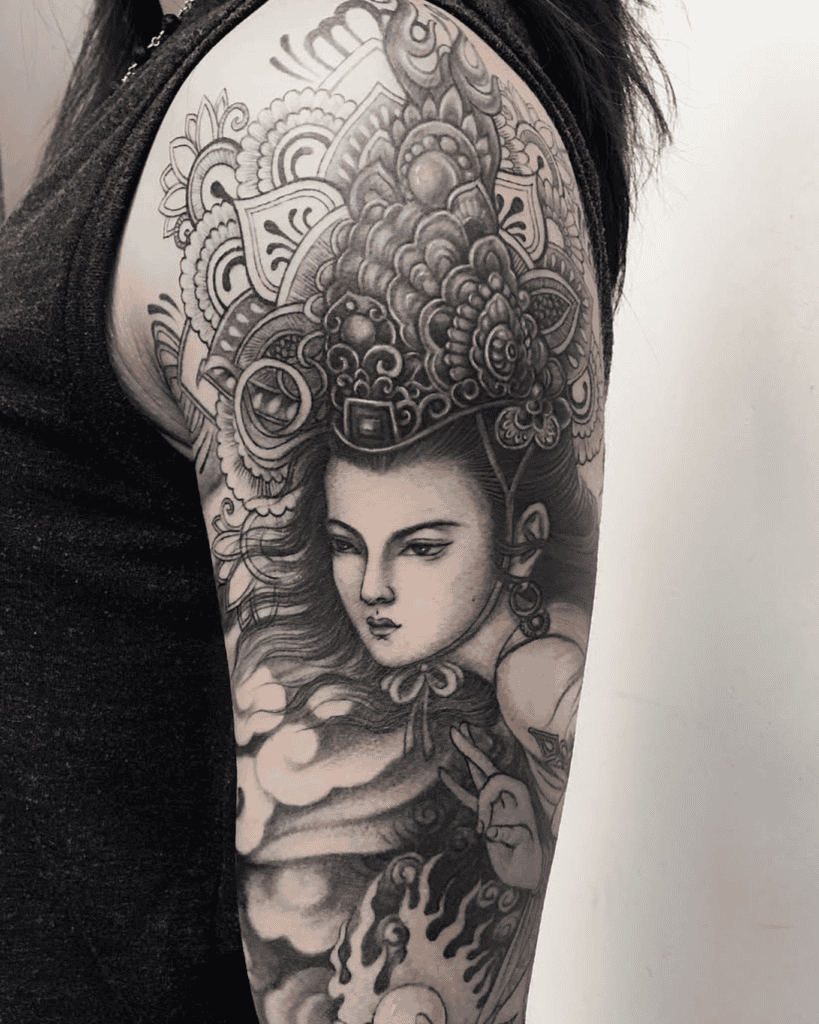
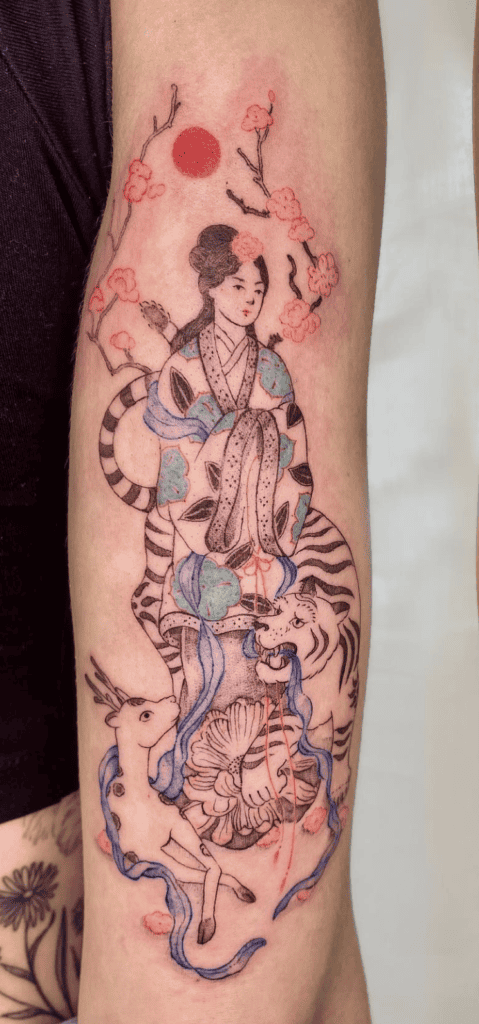
Xiwangmu (西王母) is one of the most powerful and ancient female figures in Chinese mythology. Known as the Queen Mother of the West, she rules over immortality, divine peaches, and the sacred realm of Mount Kunlun.
Xiwangmu dwells on Mount Kunlun, a spiritual axis between heaven and earth and
a mythic mountain paradise often described as a heavenly realm where immortals gather.
One of her most famous symbols is the Peaches of Immortality. These peaches bloom only once every 3,000 (or 6,000/9,000) years in some versions. They grant immortality to those who eat them and are served at grand celestial banquets
In Journey to the West, Sun Wukong famously steals and eats the peaches, causing chaos in Heaven. In later Daoist traditions, she is sometimes portrayed as a counterpart to the Jade Emperor; however, she is not subordinate and operates with independent authority over immortality.
Nüwa Chinese Mythology Tattoo


Nüwa (Nǚwā) is one of the most ancient and powerful figures in Chinese mythology. She is the creator of humanity and the goddess who repaired the heavens after a catastrophic cosmic disaster.
According to legend, after the world was formed, Nüwa felt lonely. So she knelt by a riverbank and began shaping figures from yellow clay. She carefully sculpted the first humans by hand, and later, tiring from the detailed work, dipped a rope into mud and flicked droplets into the air. Each droplet became a person.
One of her most famous myths involves a cosmic catastrophe. A fierce battle between gods caused the sky to crack and collapse. Fires raged, floodwaters rose, and the world tilted. Nüwa stepped in to restore balance by melting five-coloured stones to patch the sky, cutting off the legs of a giant turtle to support the heavens, slaying a black dragon causing destruction, and stopping the floods.
Even after she repaired the heavens, the sky remained slightly tilted, which explains why rivers in China traditionally flow southeast in mythic symbolism.
Fuxi Chinese Mythology Tattoo

Fuxi (Fúxī) is one of the earliest and most important culture heroes in Chinese mythology. While Nüwa created humanity, Fuxi is credited with teaching humans how to live as a civilised society.
Like Nüwa, Fuxi is frequently depicted with a human upper body and serpent or dragon lower body, symbolising cosmic balance and unity between heaven and earth. In many artworks, Fuxi and Nüwa are shown intertwined, holding tools of civilisation.
Fuxi’s most famous contribution is the creation of the Bagua, the Eight Trigrams. These trigrams are symbolic patterns made of broken and unbroken lines that represent natural forces such as Heaven, Earth, thunder, water, fire, wind, mountain, and lake.
The Bagua later became foundational to the I Ching (Book of Changes) and influenced Daoist philosophy, feng shui, martial arts theory, and Chinese cosmology. Legend says Fuxi discovered these patterns after observing the markings on the back of a mystical dragon-horse emerging from the Yellow River.
Shennong Chinese Mythology Tattoo


Shennong (神农, “Divine Farmer”) is one of the legendary culture heroes of ancient China and is traditionally counted among the Three Sovereigns. He is credited with teaching humanity agriculture, discovering medicinal herbs, and laying the foundations of traditional Chinese medicine.
Before Shennong, people were said to live by hunting and gathering. Shennong taught humans how to cultivate crops, use farming tools, clear fields, and trade goods. He introduced the plough and organised marketplaces, helping shift society from nomadic living to agricultural civilisation.
One of the most famous legends says Shennong personally tested hundreds of plants to discover their medicinal properties. He would taste herbs daily, sometimes encountering poison multiple times in one day.
His body was transparent, allowing him to see how herbs affected his organs, and he discovered tea when leaves fell into boiling water and neutralised poison. Eventually, he died after tasting a deadly toxic plant, sacrificing himself in the pursuit of healing knowledge.
Zhong Kui Chinese Mythology Tattoo
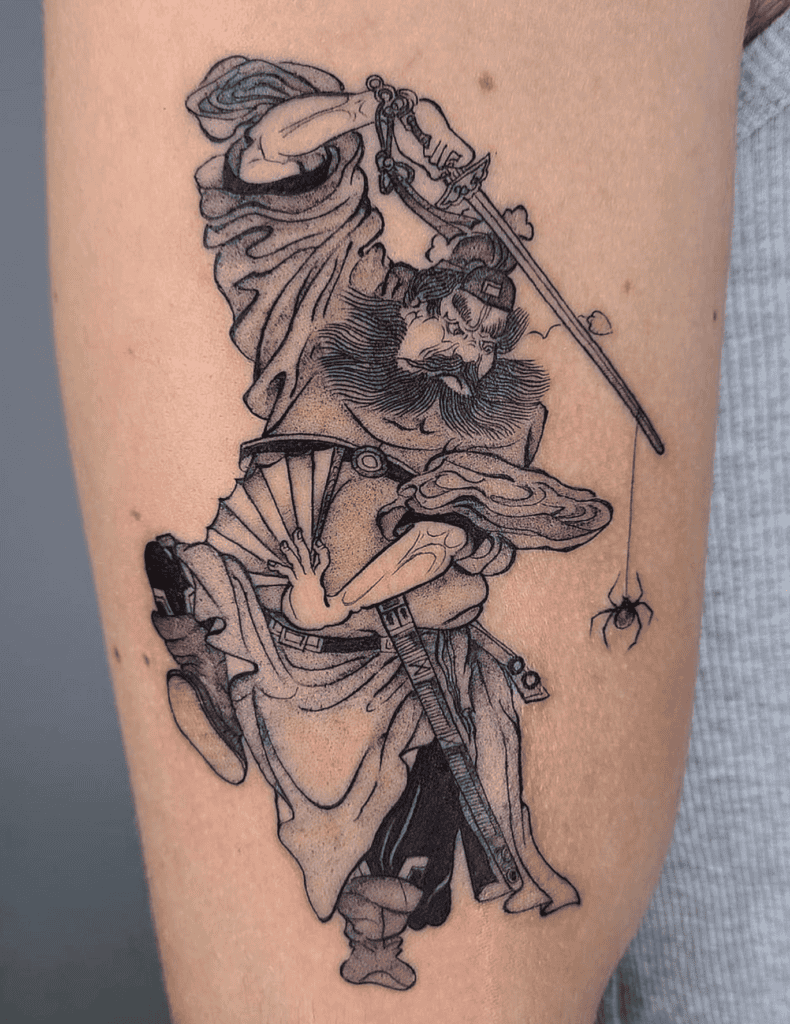
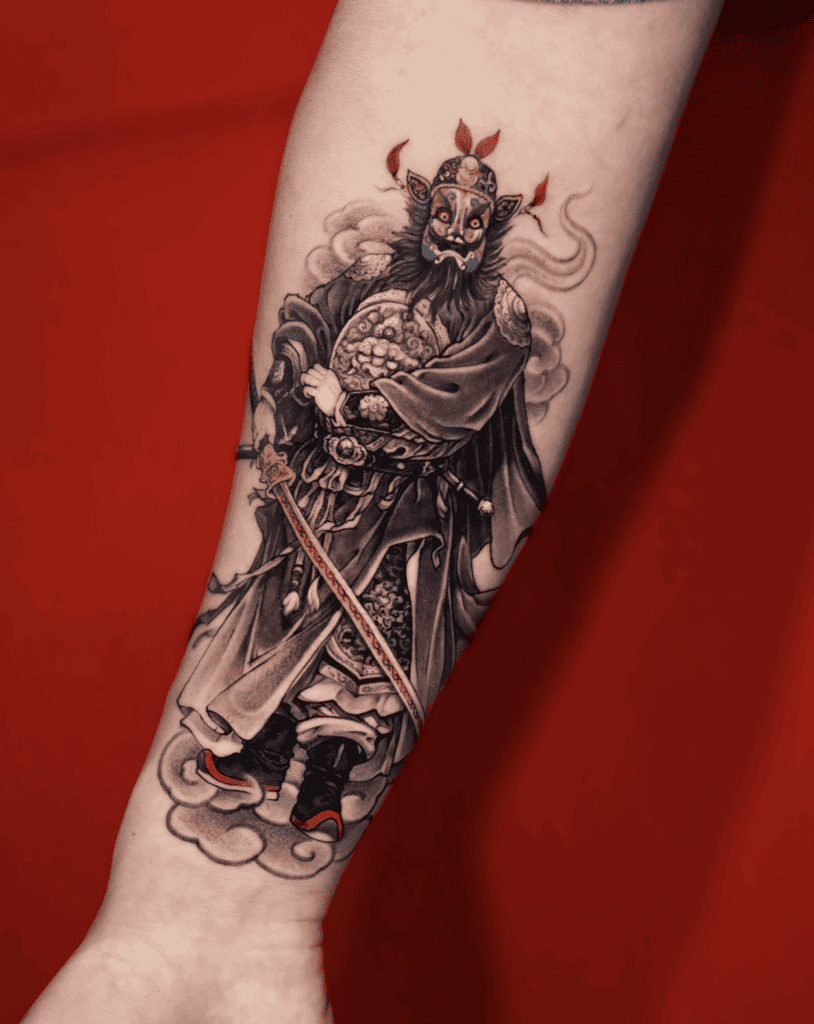
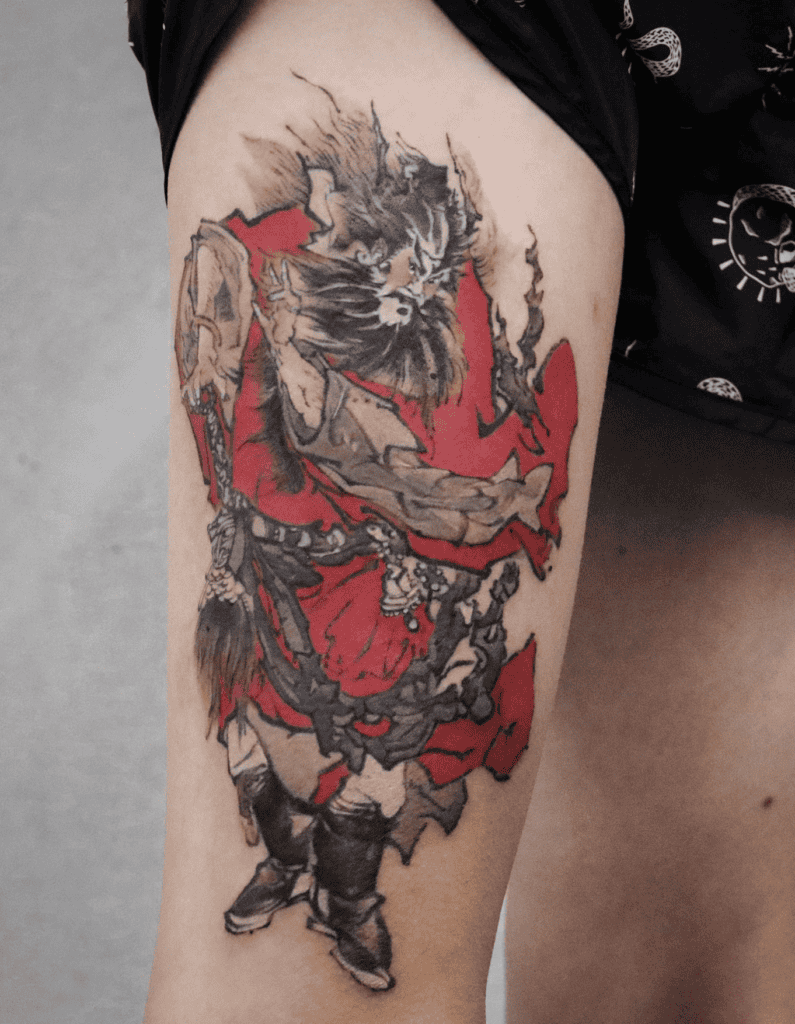
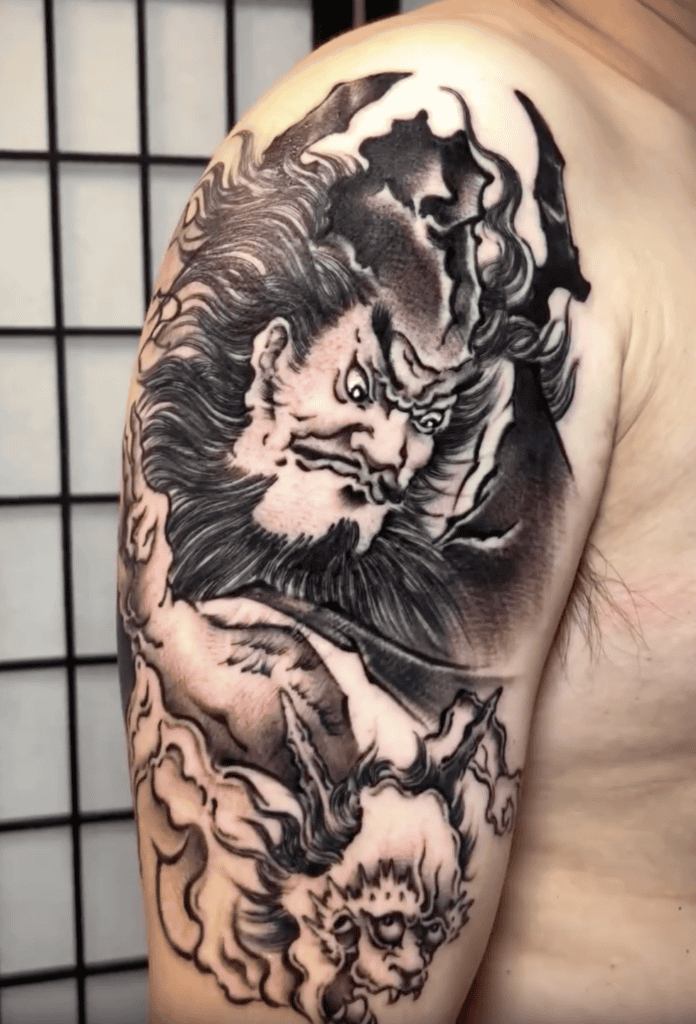
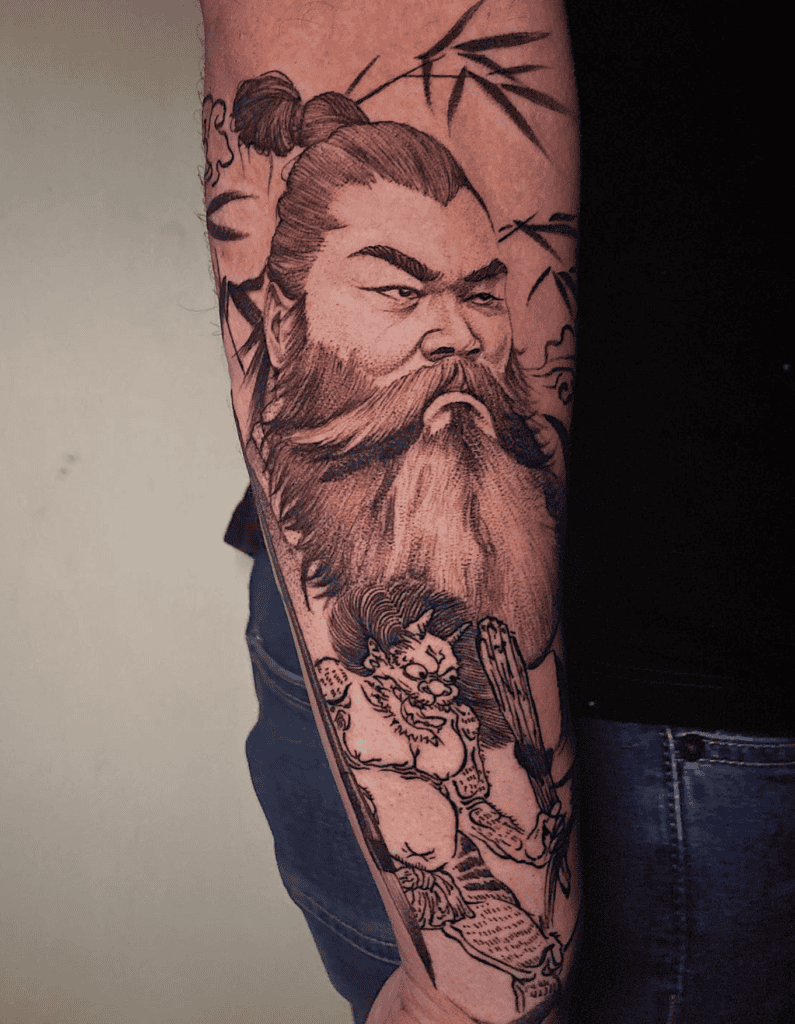
Zhong Kui is one of the most visually striking and beloved figures in Chinese folklore. Known as the “King of Ghosts” or “Demon Queller,” he protects the living from evil spirits and commands supernatural forces with fierce authority.
Unlike primordial gods like Pangu or divine rulers like the Jade Emperor, Zhong Kui begins as a mortal. He was a brilliant scholar who travelled to the imperial capital to take the civil service examination. He achieved the highest score, but when the emperor saw his frightening, ugly appearance, he was denied his rightful title.
Humiliated and devastated, Zhong Kui took his own life on the palace steps. However, in the spirit world, the Jade Emperor recognised Zhong Kui’s loyalty and injustice. He appointed him as the King of Ghosts, giving him authority over demons and spirits. From that moment on, Zhong Kui hunted evil relentlessly.
Guan Yin Chinese Mythology Tattoo
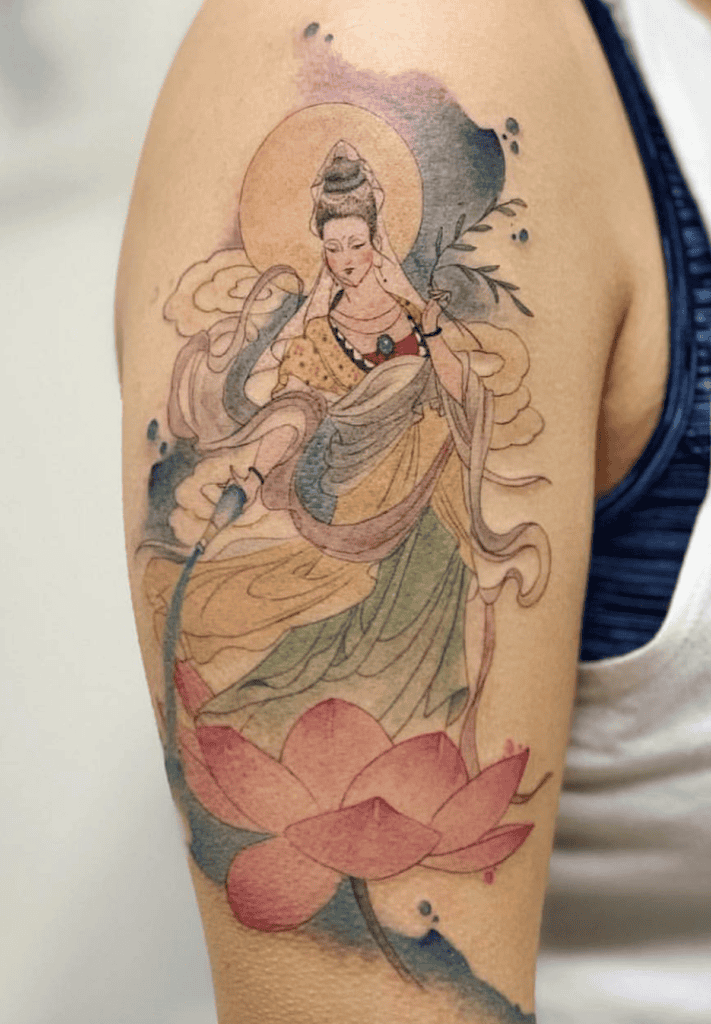
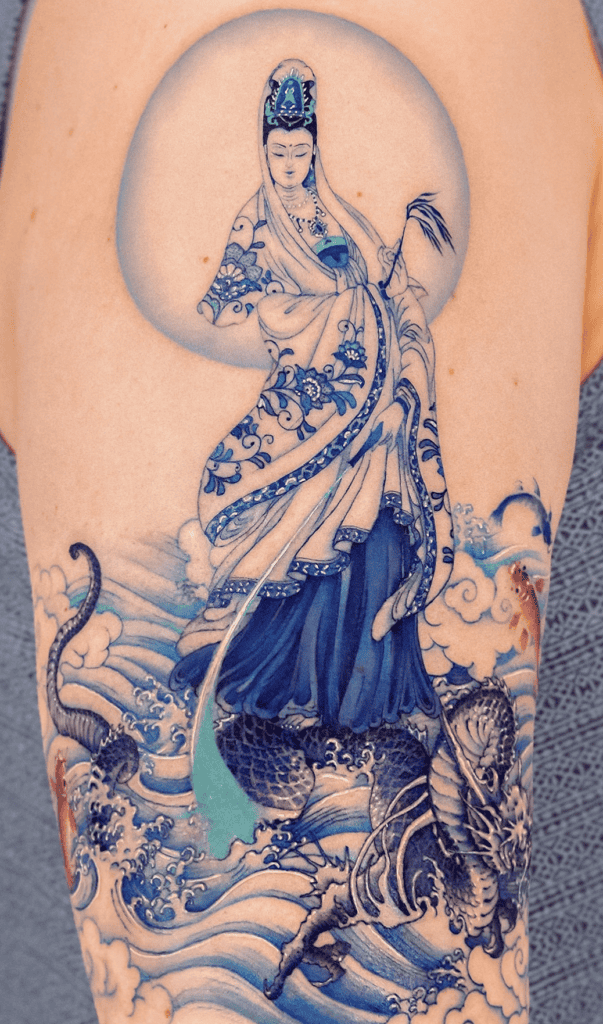
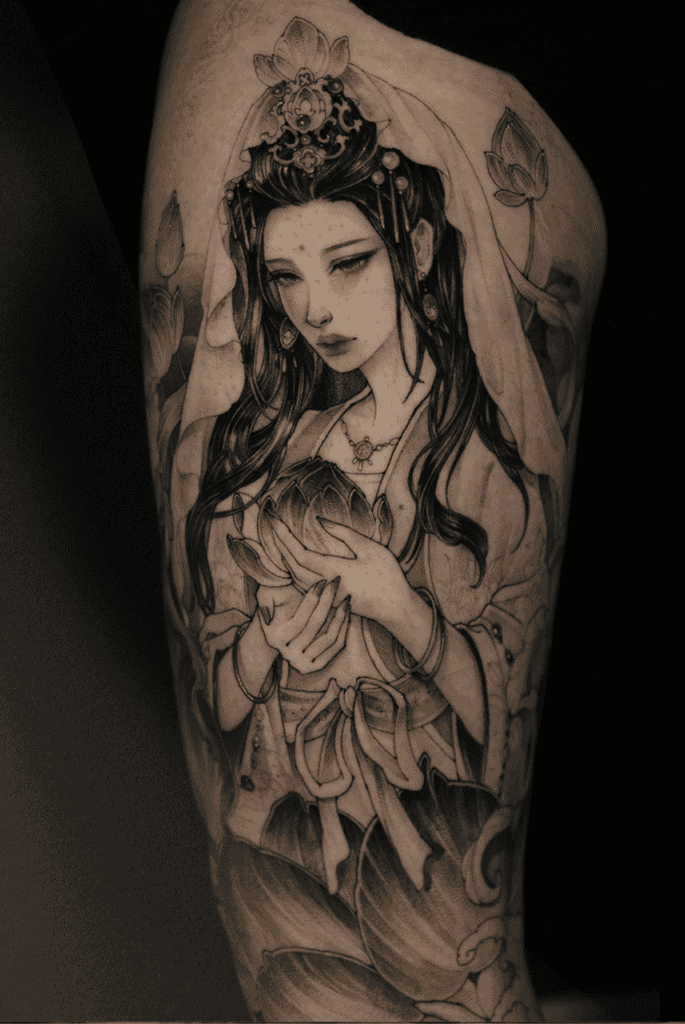
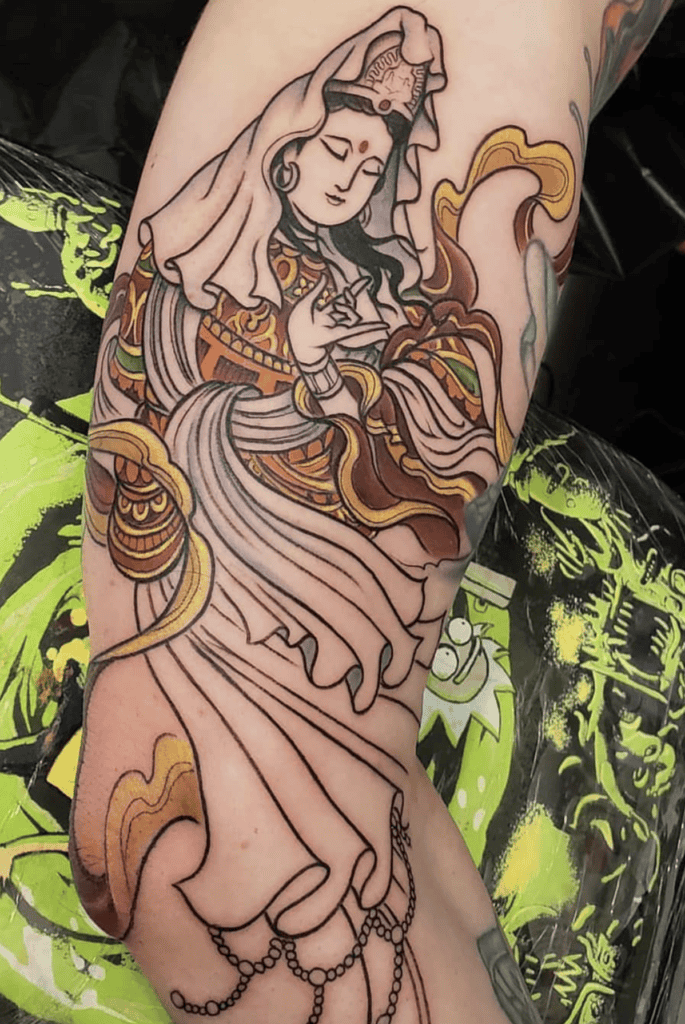
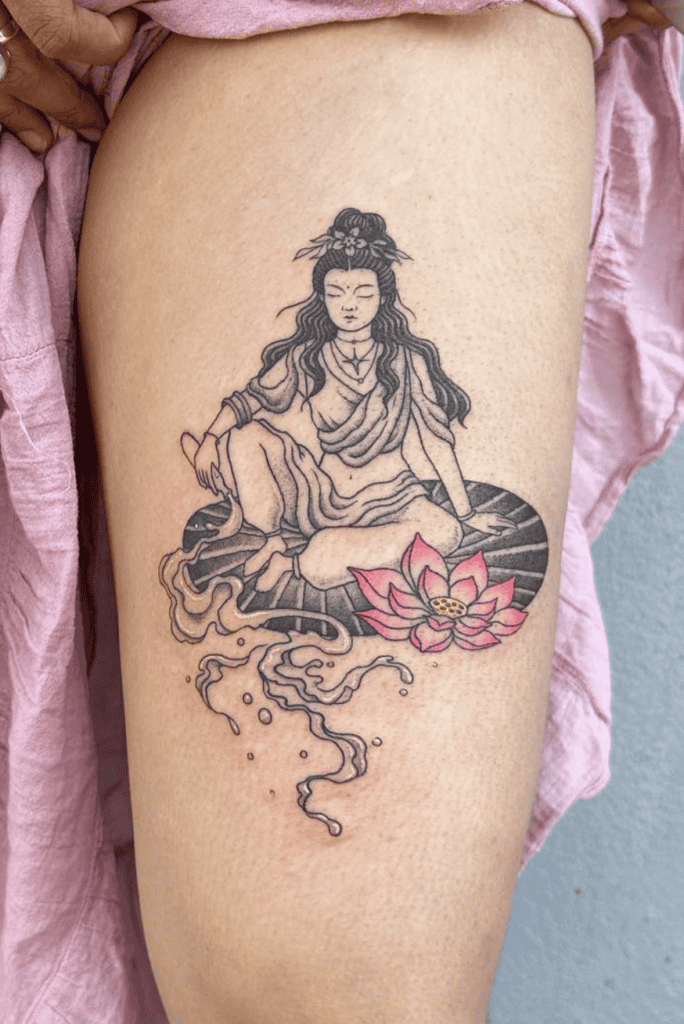
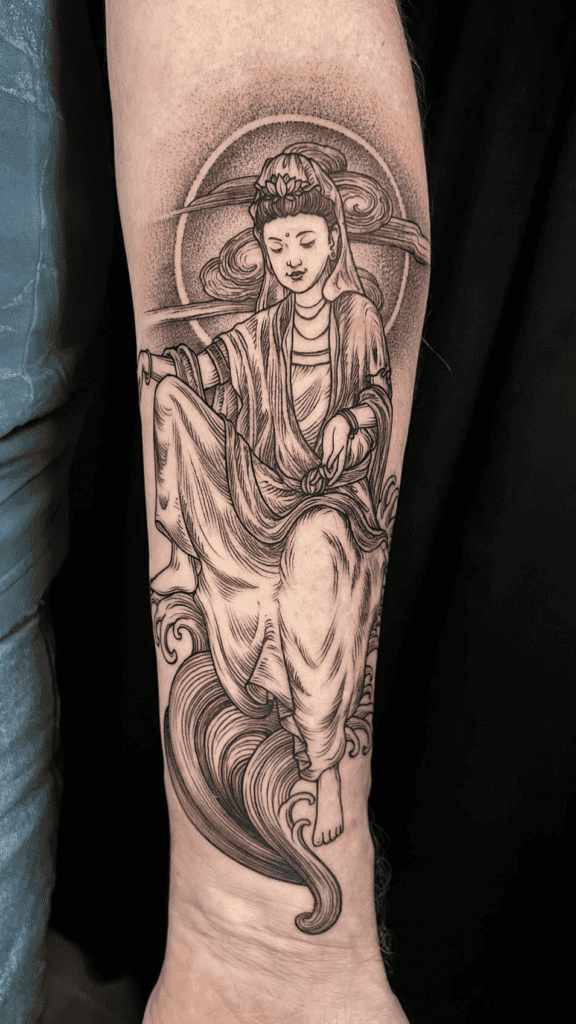
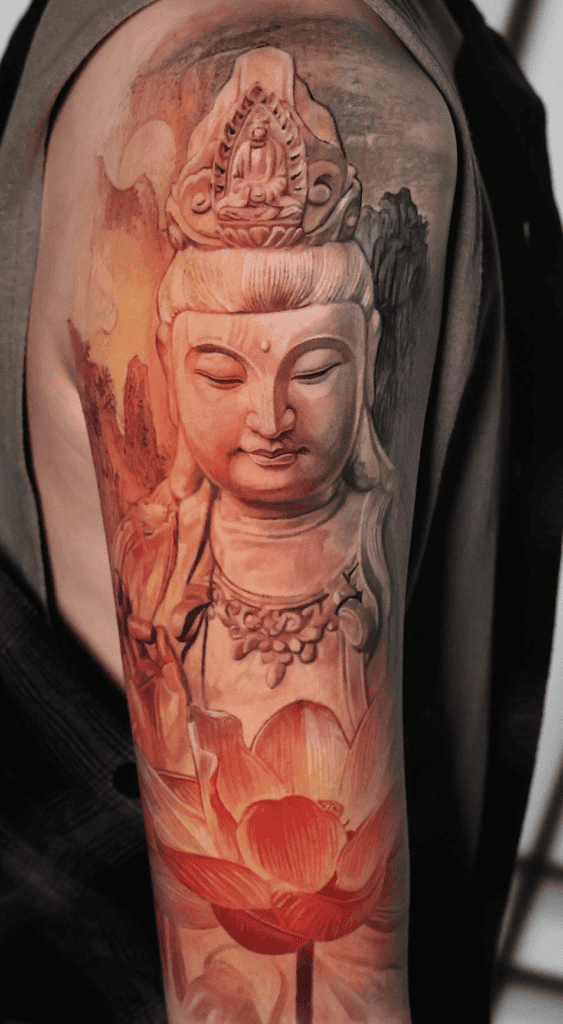
Guanyin (also spelt Guan Yin or Kuan Yin) is one of the most beloved and widely worshipped figures in Chinese religious tradition. She is the embodiment of compassion, mercy, and unconditional love.
Her name means “She Who Hears the Cries of the World.” While she originates from Buddhism as a bodhisattva, she became deeply integrated into Chinese mythology and popular religion.
Guan Yin is the Chinese form of Avalokiteshvara, a major bodhisattva in Mahayana Buddhism. Originally depicted as male in Indian Buddhism, Avalokiteshvara gradually transformed in China into a feminine figure associated with motherly compassion.
By the Tang and Song dynasties, Guan Yin was widely portrayed as a serene goddess in flowing white robes. This transformation reflects how Buddhism blended with Chinese cultural values.
A bodhisattva is an enlightened being who chooses to delay entering final nirvana in order to help others reach enlightenment. Guan Yin made a vow: She would not rest until all suffering beings were saved. That is why she listens to the prayers of the distressed, the sick, the fearful, and the lost.
Li Tieguai Chinese Mythology Tattoo

Li Tieguai (李铁拐, “Li of the Iron Crutch”) is one of the most famous members of the legendary Eight Immortals in Daoist folklore. Instantly recognisable by his ragged appearance, iron crutch, and gourd bottle, he represents compassion, healing, and the idea that spiritual power has nothing to do with outward beauty.
According to legend, Li Tieguai was once a handsome scholar or Daoist adept who could project his spirit from his body to travel the heavens. Before leaving on one such journey, he told his student to guard his body and burn it only if he did not return within seven days.
The student, believing his mother was dying, panicked and cremated Li’s body before his master returned. When Li’s spirit came back, he found his body gone. Desperate, he entered the nearest available body, that of a recently deceased beggar.
Now trapped in a lame and frail body, he roams the world healing the sick and aiding the poor.
He Xiangyu Chinese Mythology Tattoo

He Xiangu (何仙姑) is the only woman among the legendary Eight Immortals in Daoist folklore. She represents purity, health, spiritual refinement, and feminine grace. While some immortals are eccentric wanderers like Li Tieguai, He Xiangu is calm, elegant, and serene.
There are several versions of He Xiangu’s story, but most agree on a few key elements. She was born during the Tang dynasty, and as a young girl, she received divine instruction in a dream. She consumed powdered mica (a mineral believed to grant lightness and immortality) and vowed to remain celibate, and devoted herself to spiritual cultivation. After years of discipline and purity, she ascended to immortality.
He Xiangu is almost always depicted holding a lotus flower. The lotus symbolises purity, enlightenment, and rising above suffering. Because the lotus grows from mud yet blooms beautifully, it represents spiritual growth despite worldly hardship.
Erlang Shen Chinese Mythology Tattoo
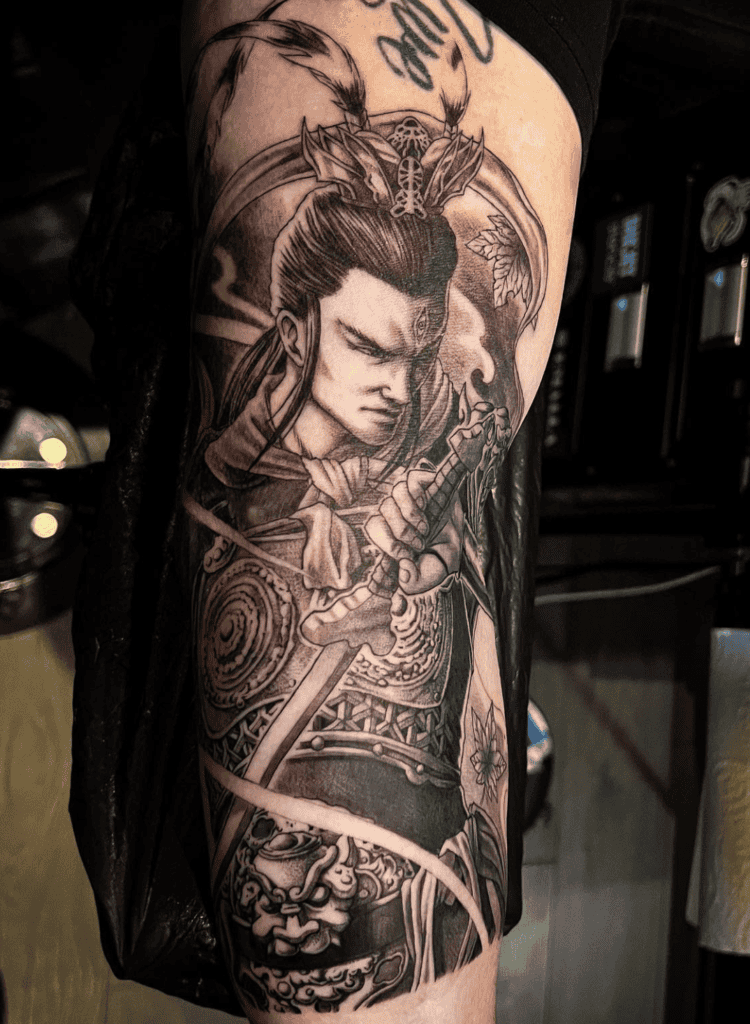
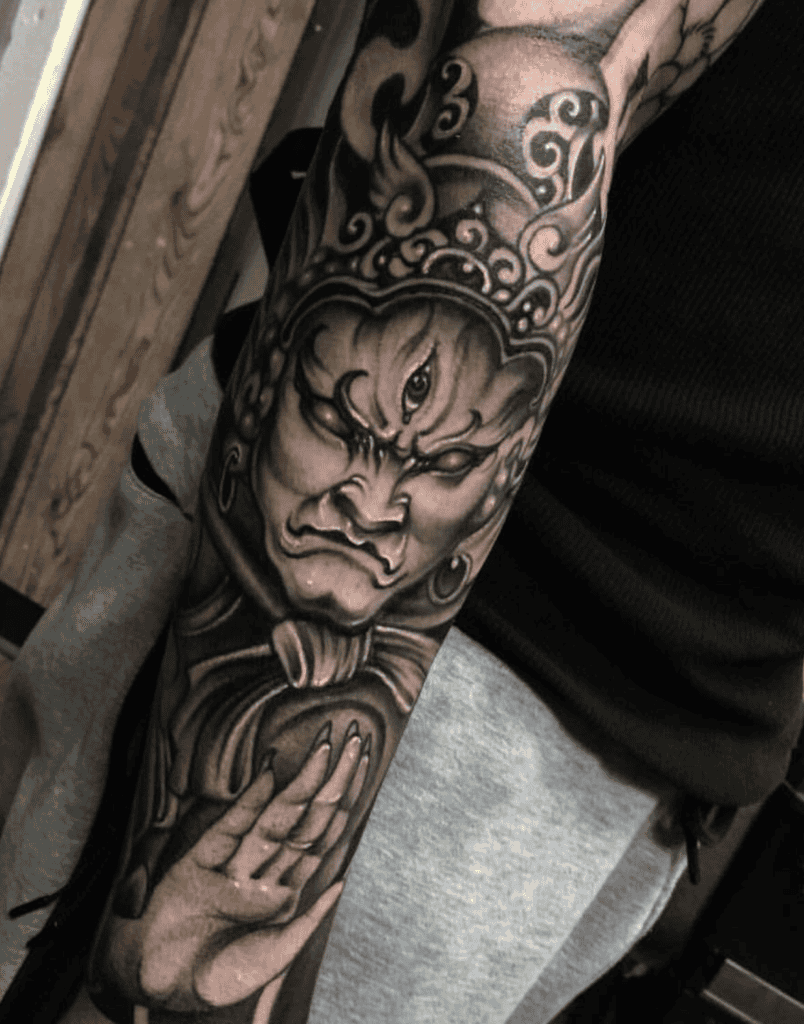
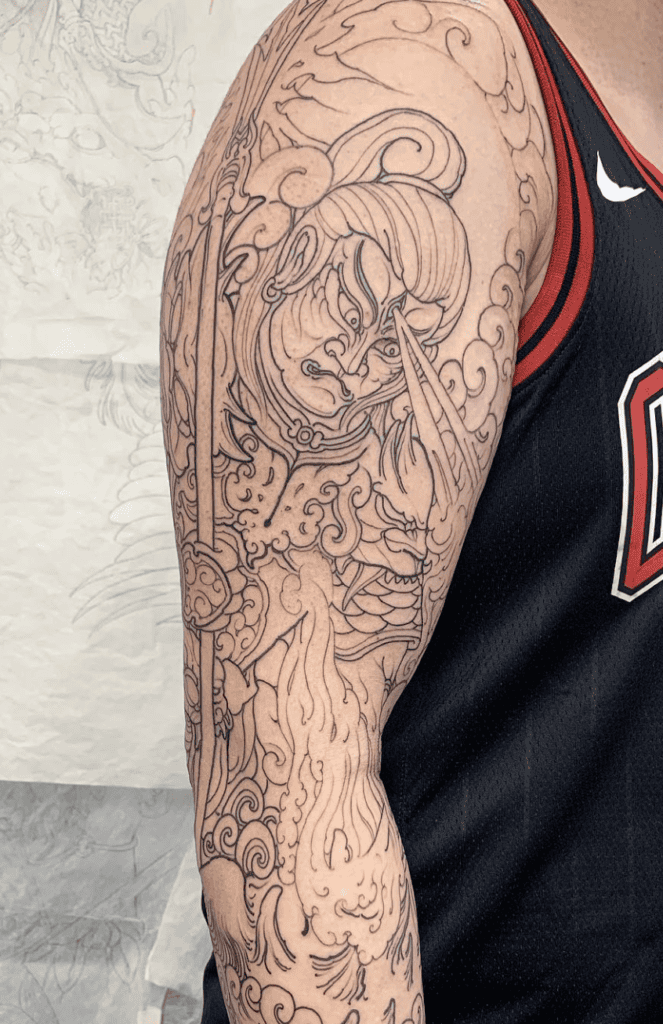
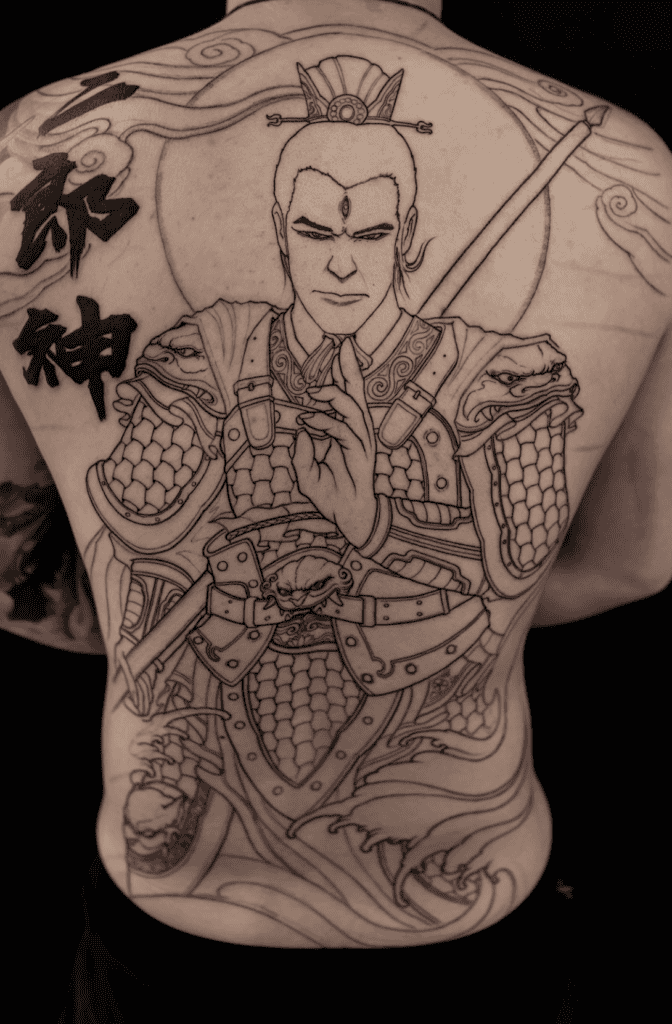
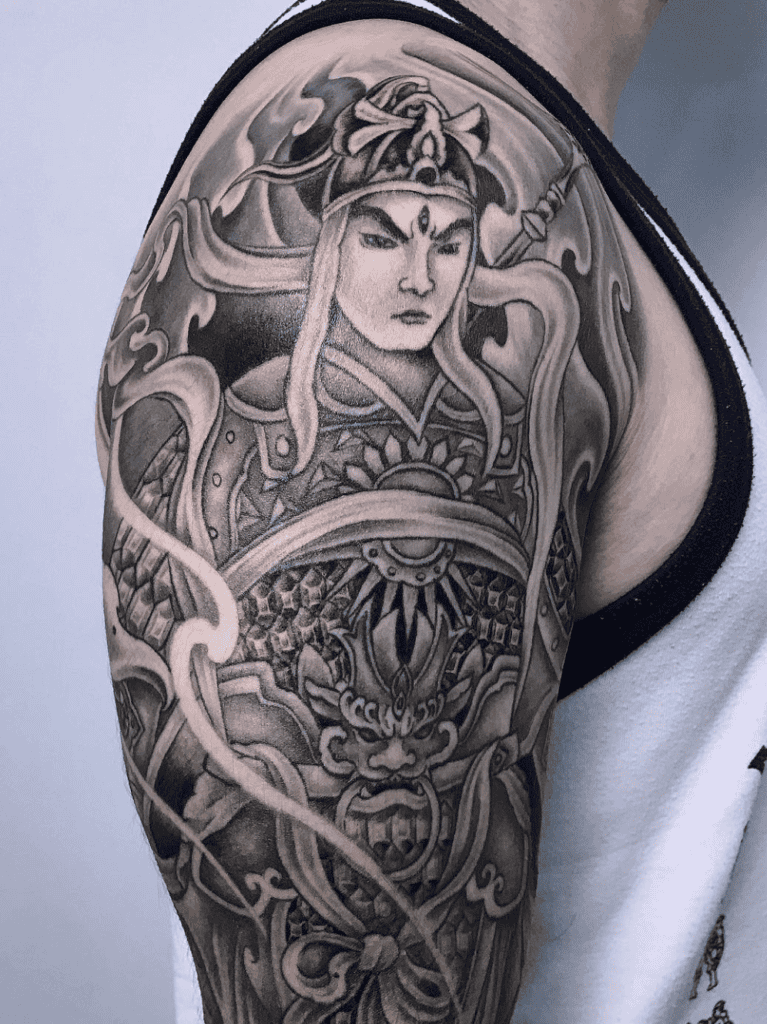
Erlang Shen (二郎神) is a powerful warrior god in Chinese mythology, famous for his third eye, unmatched combat skills, and loyal celestial hound. He is one of Heaven’s greatest generals, being disciplined, sharp, and nearly unstoppable.
Erlang Shen’s most distinctive feature is the third eye in the centre of his forehead. This eye allows him to see through illusions, detect demons in disguise, perceive hidden truths, and pierce deception.
In Journey to the West, Erlang Shen famously battles Sun Wukong; however, Erlang ultimately helps subdue Wukong, showing that discipline and clarity can counter chaotic brilliance.
Chang’e Chinese Mythology Tattoo
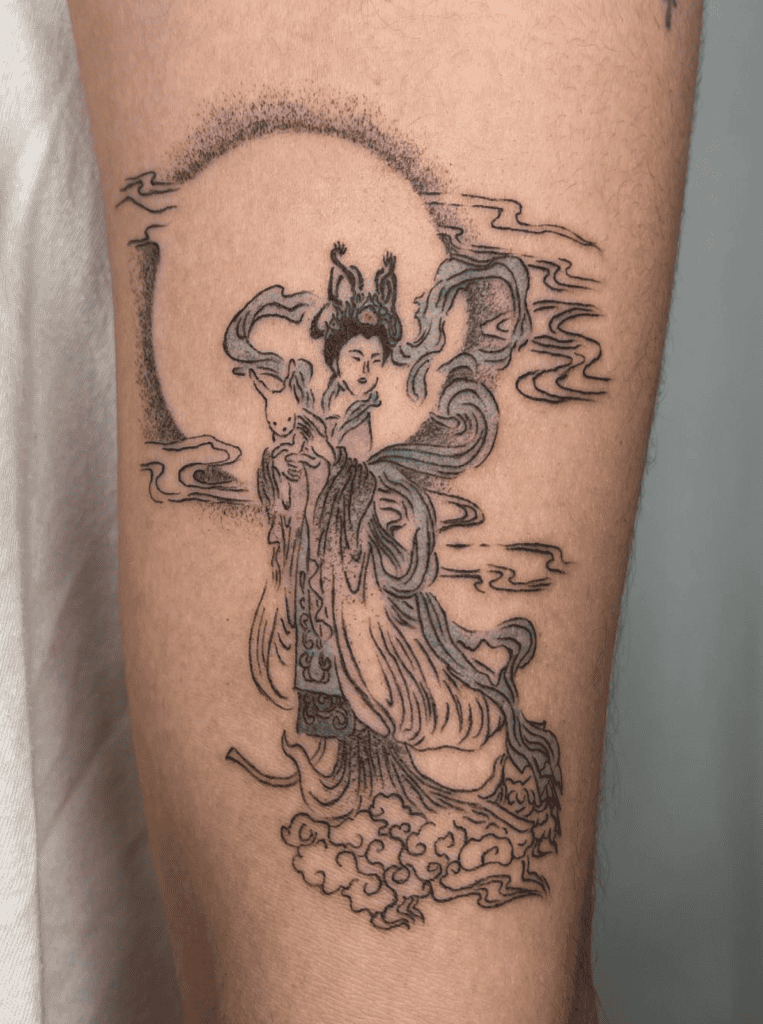
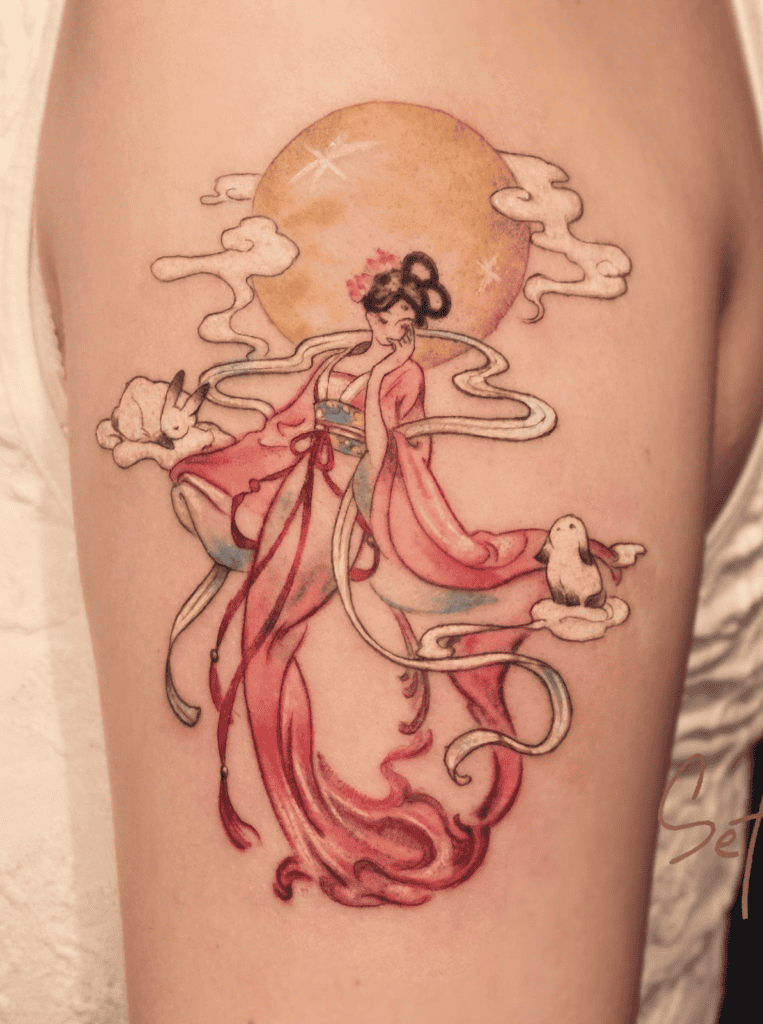
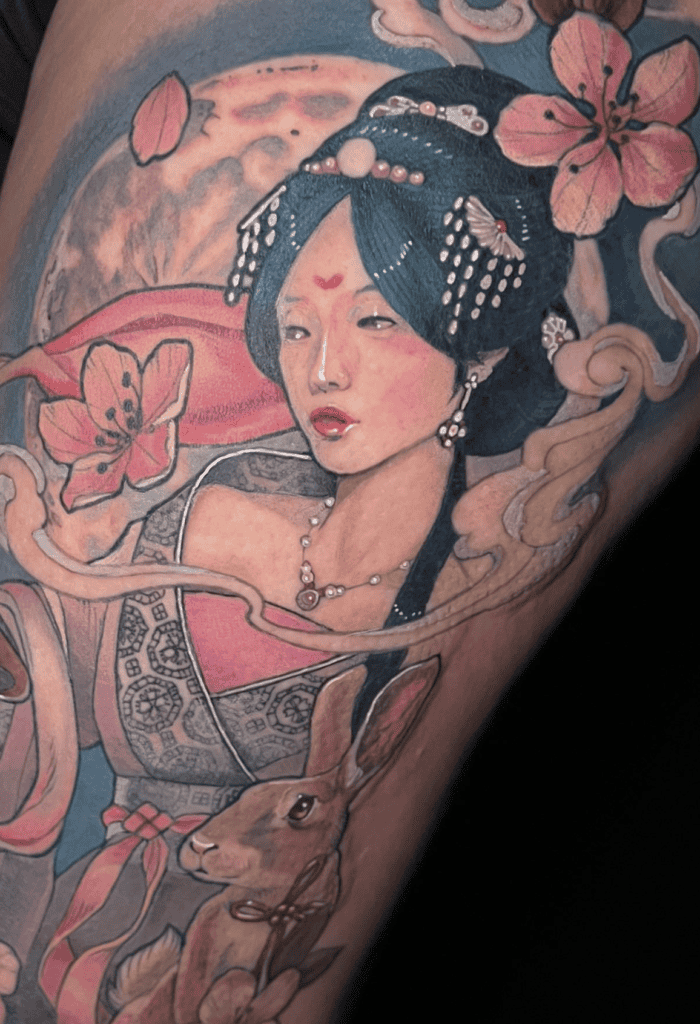
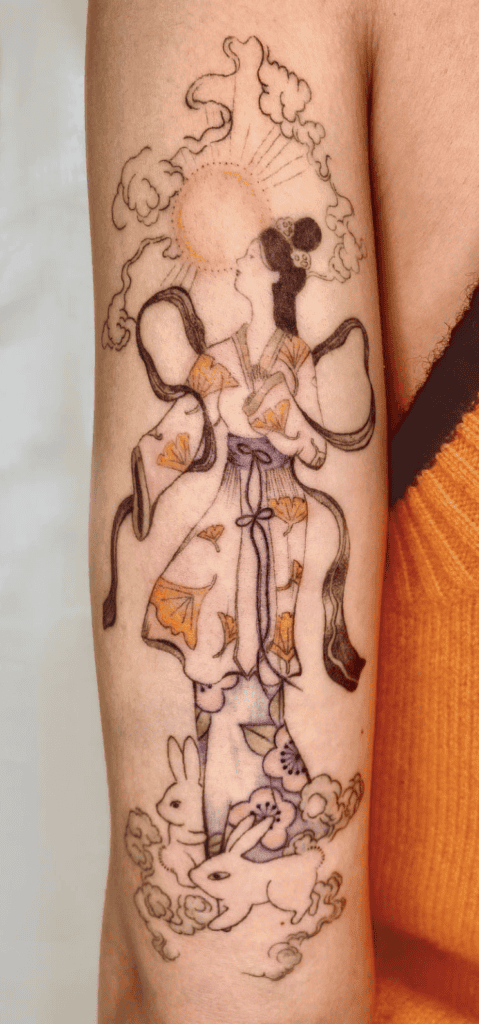
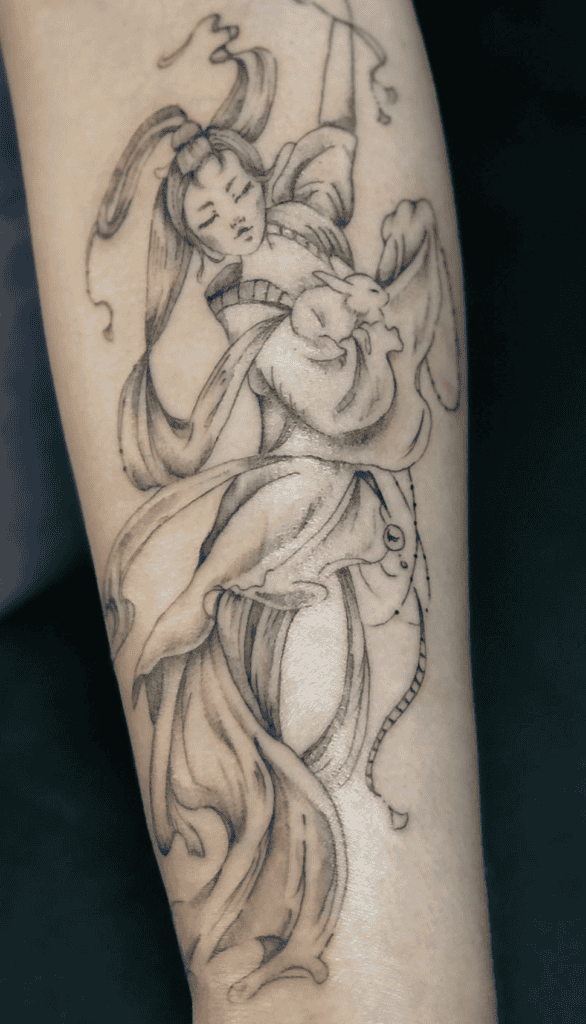
Chang’e (嫦娥) is one of the most beloved figures in Chinese mythology. She is the goddess who lives on the Moon, eternally associated with longing, beauty, immortality, and the Mid-Autumn Festival.
Chang’e’s story is closely tied to her husband, the legendary archer Hou Yi. Long ago, ten suns rose into the sky at once, scorching the earth and causing disaster. Hou Yi shot down nine of them, saving humanity.
As a reward, he was given an elixir of immortality, but there was only enough for one person. Different versions tell the story differently, but the most famous version says that while Hou Yi was away, Chang’e consumed the elixir herself.
Some say she did this to prevent it from falling into the wrong hands, and others say she feared death. After drinking the elixir, she became weightless and floated all the way to the Moon. There, she took residence in the Moon Palace, separated from her husband forever.
Hou Yi Chinese Mythology Tattoo


Hou Yi is one of the greatest heroes in Chinese mythology. He is the legendary archer who saved the world by shooting down nine of the ten suns that once scorched the earth.
According to legend, there were once ten suns, often described as the sons of the Heavenly Emperor. Each sun was meant to take turns crossing the sky, but one day, all ten rose at once.
Crops burned, rivers dried up, people suffered, and the world was on the brink of destruction. Hou Yi stepped forward, and with divine skill and unshakeable aim, he shot down nine suns, leaving only one to light and warm the world. This act restored balance and saved humanity.
As a reward, Hou Yi was given an elixir of immortality. But he faced a difficult choice, as if he drank it, he would ascend to heaven and leave his wife behind. He chose love over immortality and kept the elixir instead of drinking it; however, fate intervened, and Chang’e eventually consumed the elixirascending to the Moon, separating them forever.
Son Wukong Chinese Mythology Tattoo
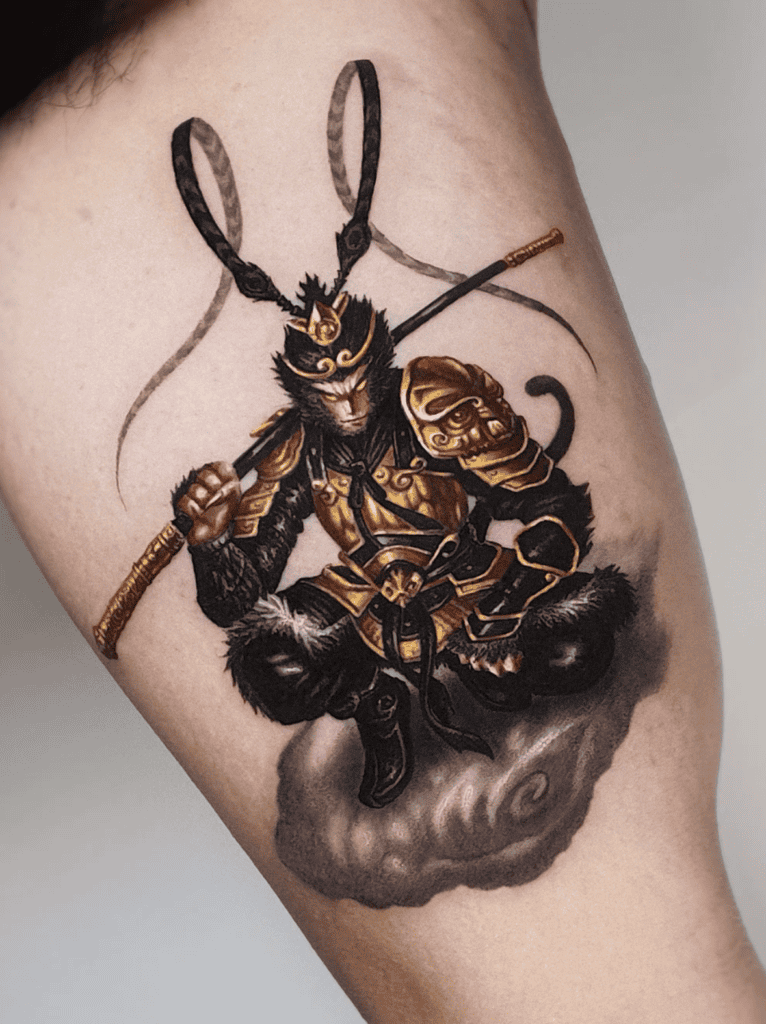
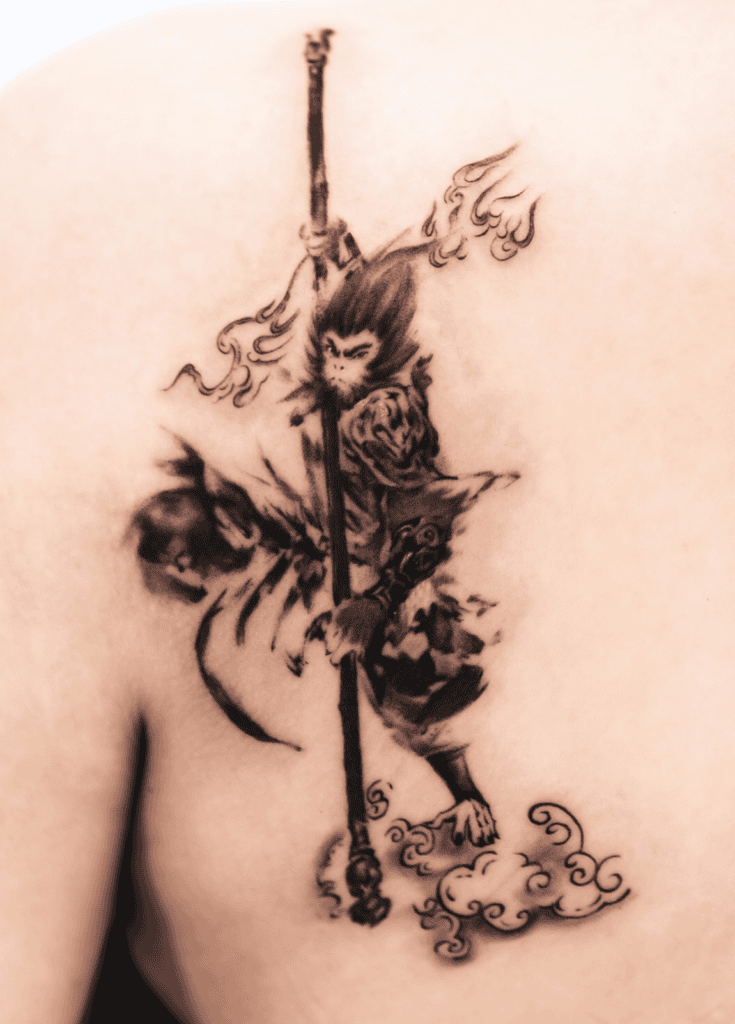
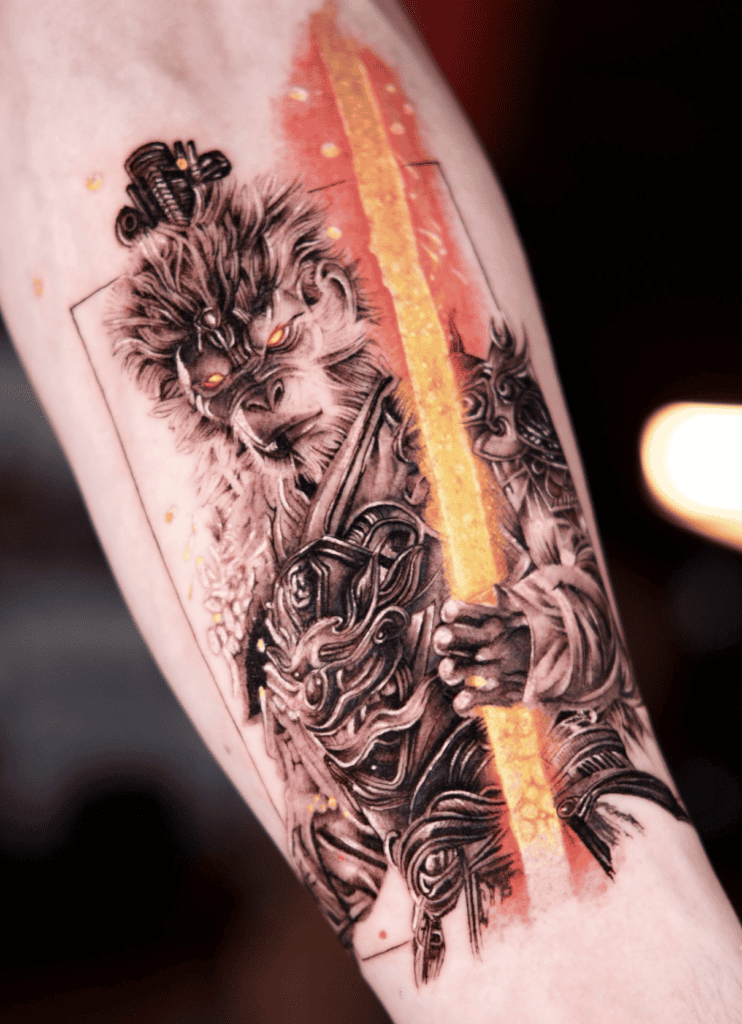
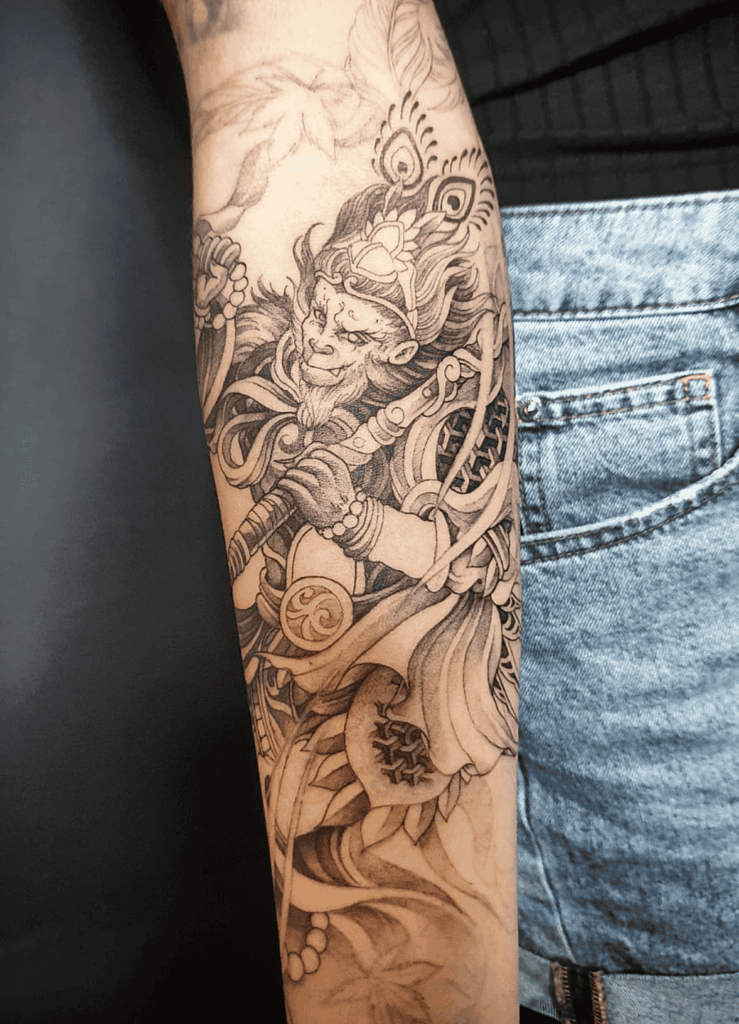
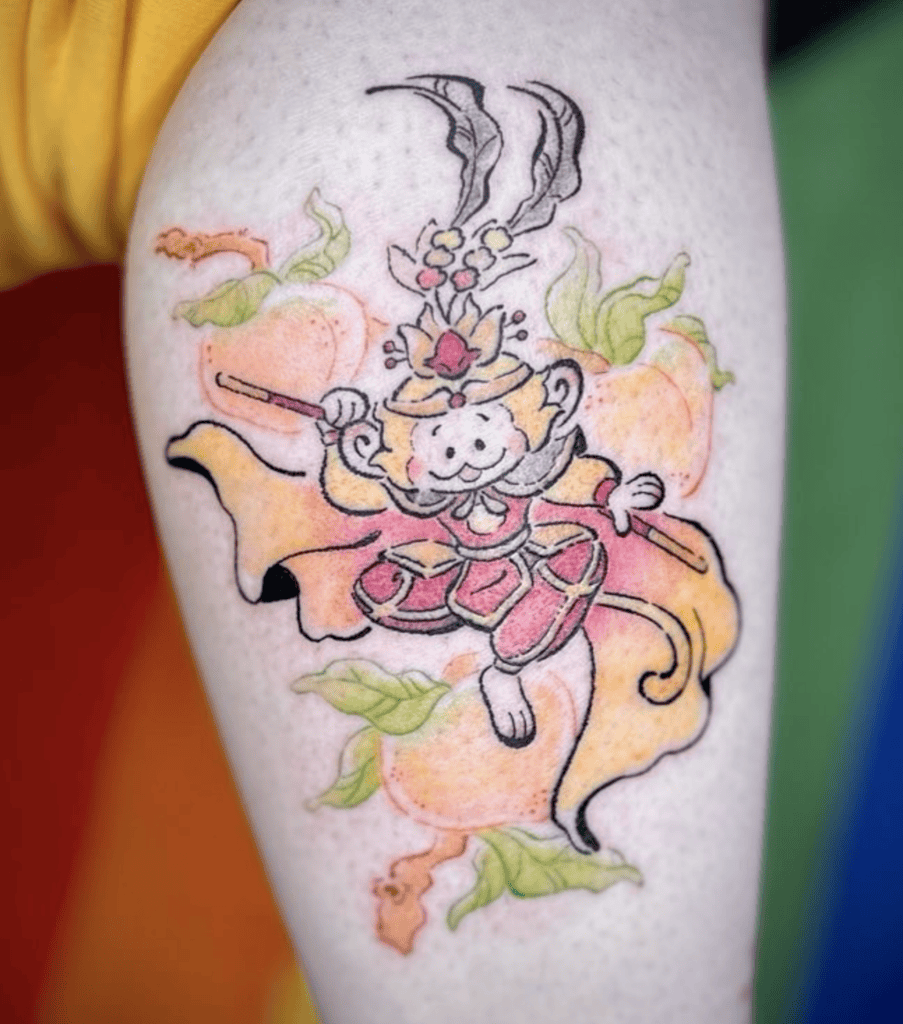
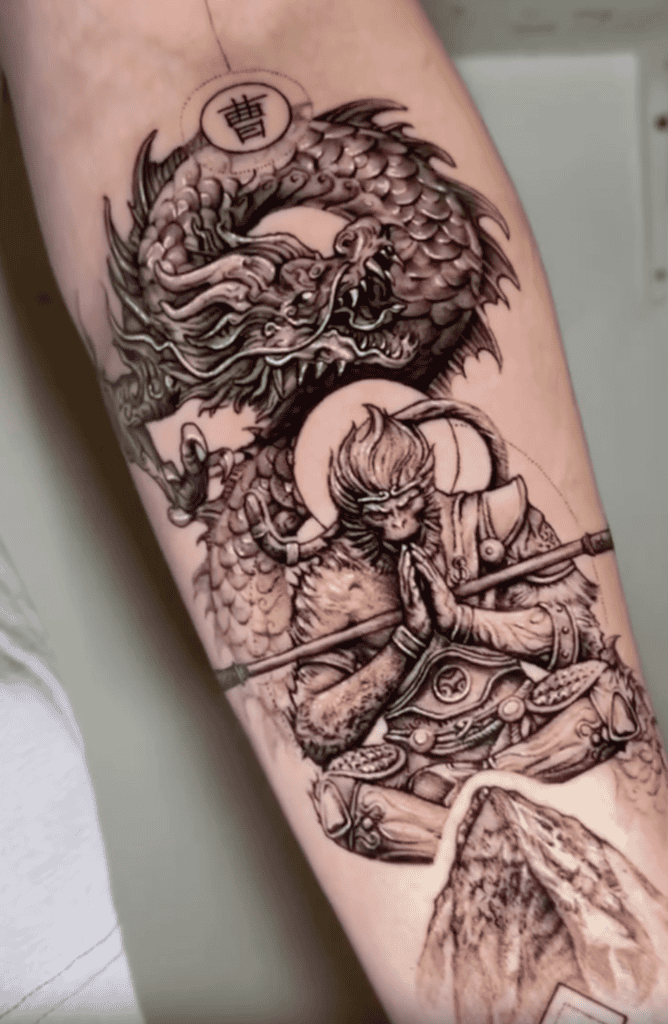
Sun Wukong is one of the most iconic characters in Chinese mythology and literature. Known as the Monkey King, he is rebellious, clever, immensely powerful, and endlessly entertaining. Sun Wukong was not born; he hatched from a magical stone atop the Mountain of Flowers and Fruit. The stone absorbed the energies of heaven and earth for thousands of years before cracking open. From the beginning, he was supernaturally gifted, fearless, curious, and restless, quickly becoming king of the monkeys.
Terrified of death, Wukong left his mountain to seek immortality. He trained under a Daoist master and learned 72 transformations, cloud-somersault travel (108,000 li in one leap), magic spells, and combat skills. But that wasn’t enough. He later erased his name from the Book of Death in the underworld, ate the Peaches of Immortality, drank celestial wine, and consumed divine pills.
When Heaven tried to control him, they gave him a minor title. He demanded something better and declared himself “Great Sage Equal to Heaven.” Chaos followed, and he fought celestial armies, defeating many heavenly generals, including Erlang Shen, in one of mythology’s most legendary battles (though ultimately he was subdued). Despite his immense strength, Wukong could not defeat Gautama Buddha. The Buddha trapped him beneath a mountain for 500 years, marking the turning point in his story.
Eventually, Wukong is freed to escort the monk Tang Sanzang on a pilgrimage to retrieve sacred scriptures. Throughout the journey, he fights demons, protects his master, learns discipline, and gradually matures. By the end, he achieves enlightenment and becomes a Buddha himself.
Nezha Chinese Mythology Tattoo
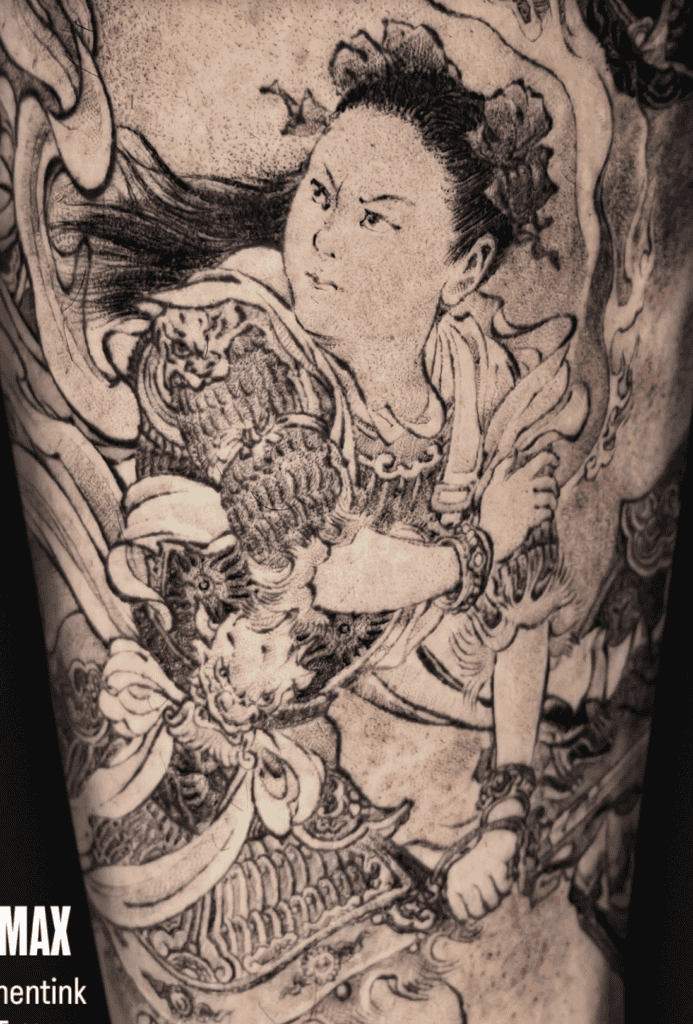
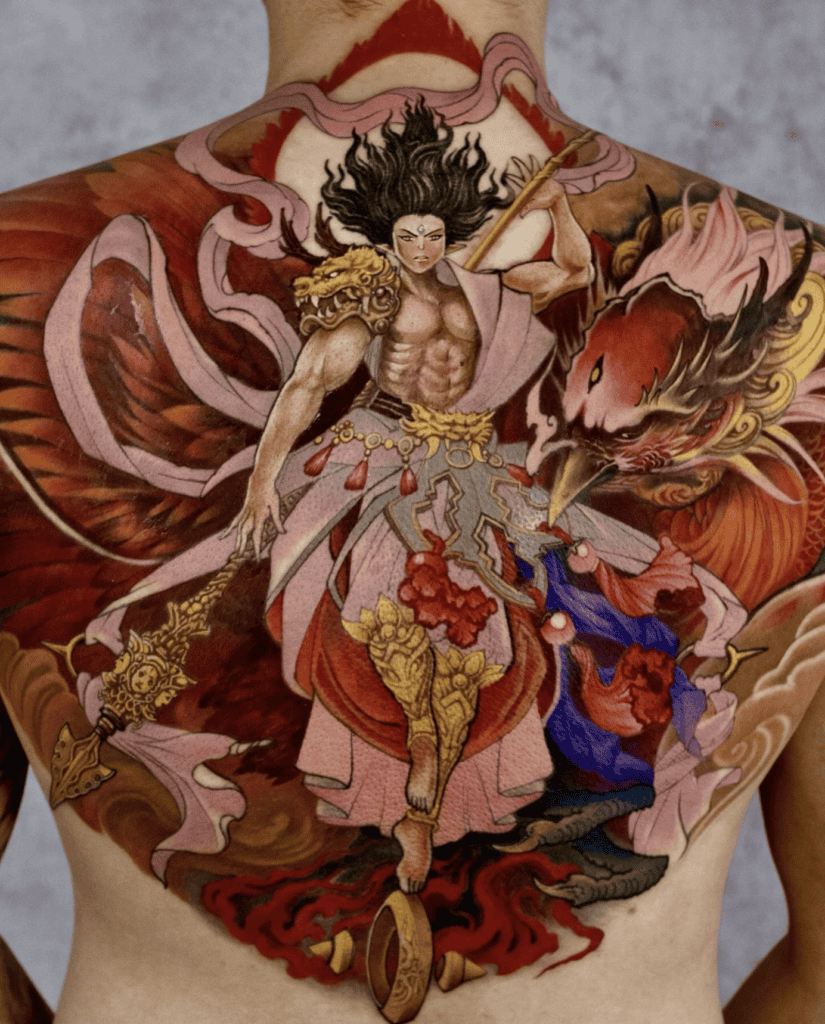
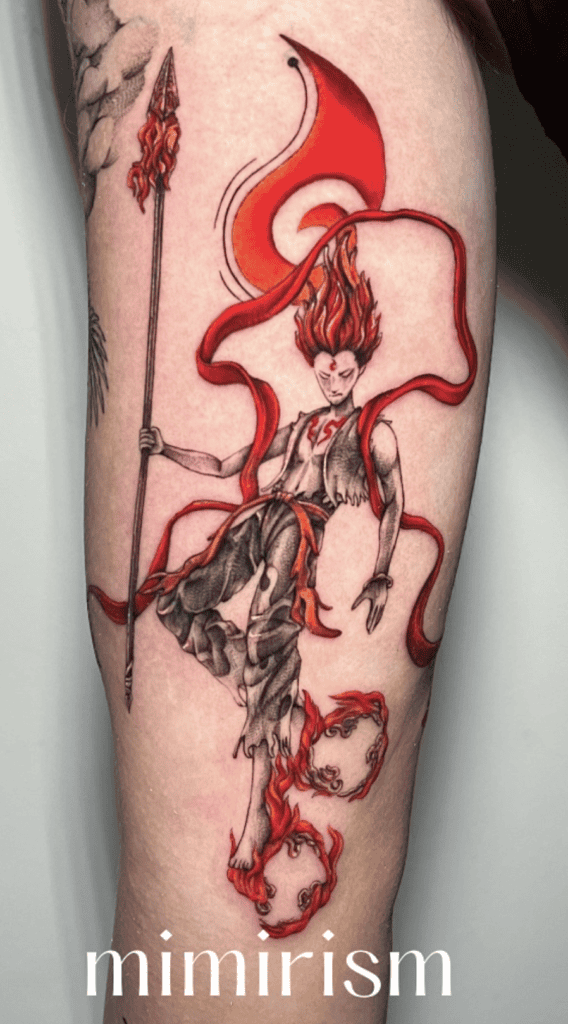
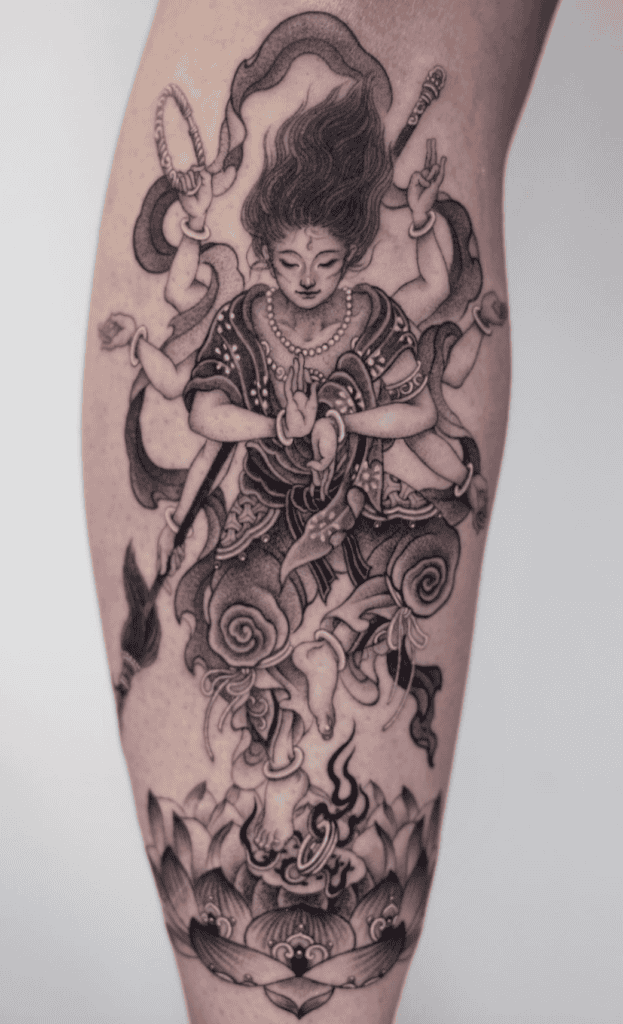
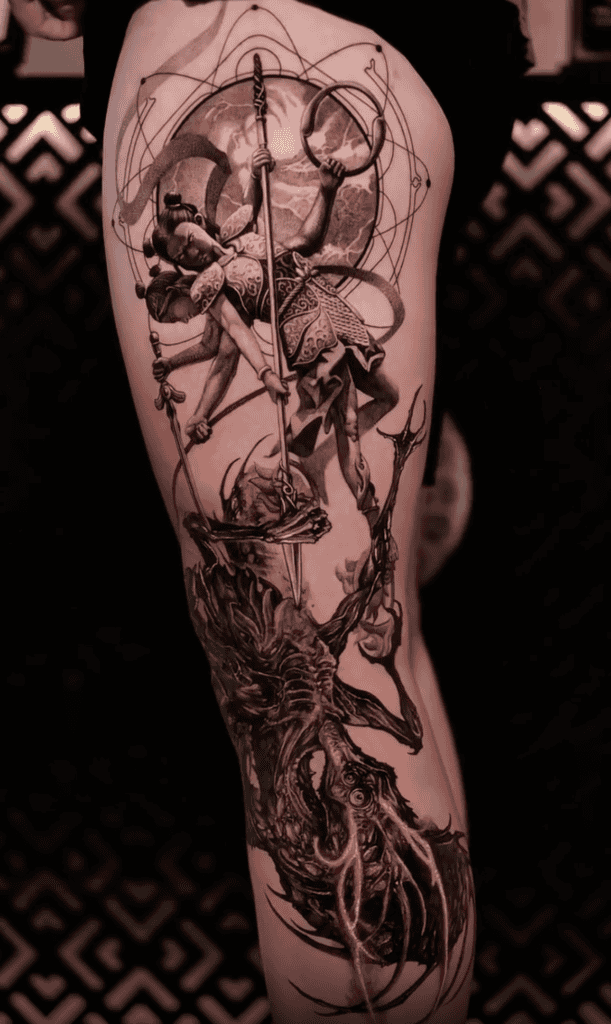
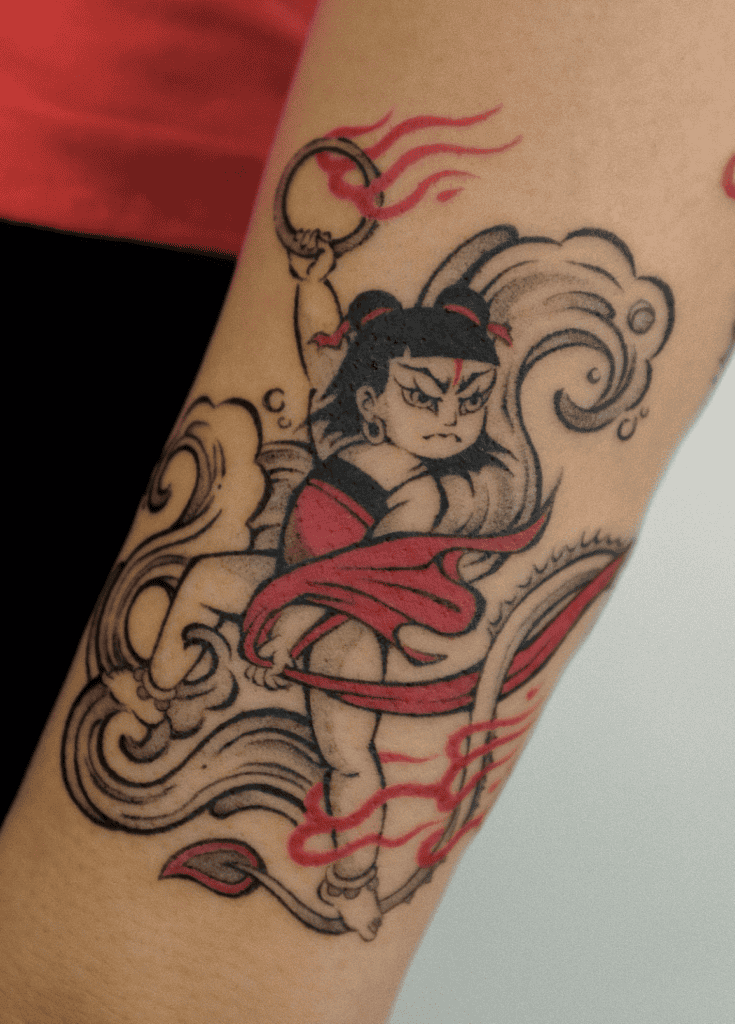
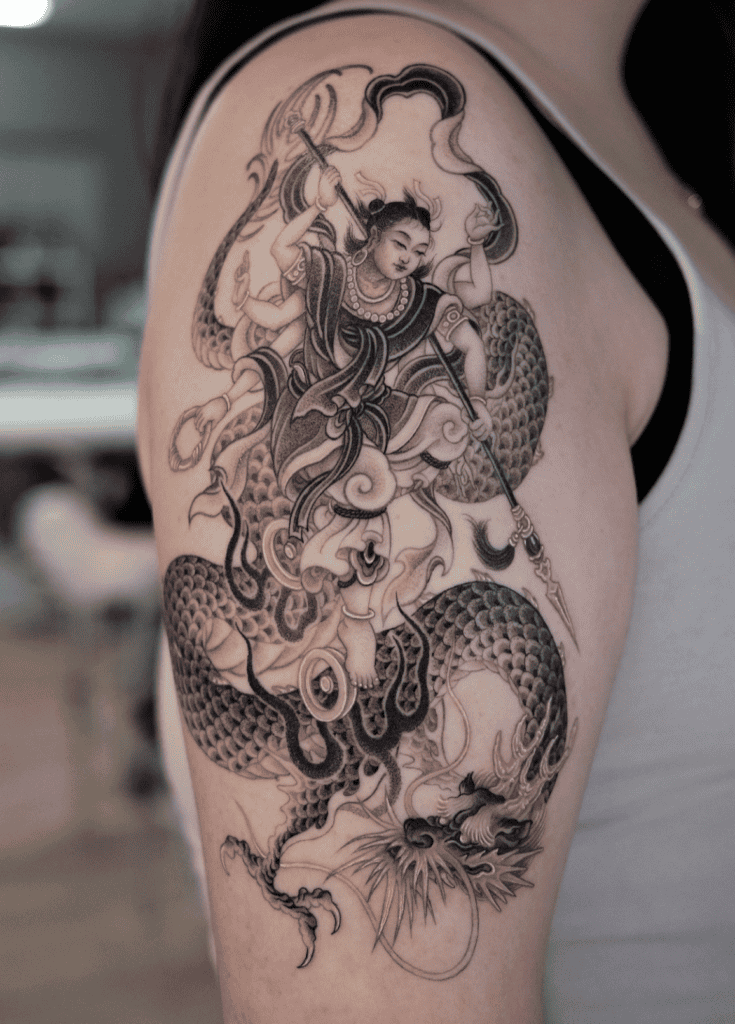
Nezha (哪吒) is one of the most dynamic and beloved figures in Chinese mythology. A warrior deity with fiery powers, wind-and-fire wheels, and a rebellious spirit, Nezha represents defiance, sacrifice, and redemption. Nezha’s story begins unusually. His mother carried him for three years and six months, eventually giving birth not to a baby, but to a fleshy ball. When the ball was cut open, a radiant child emerged.
From birth, Nezha was no ordinary human. He was gifted with divine weapons, such as wind-fire wheels that allow him to fly, a red armillary sash that binds his enemies, the Universe Ring, and a fire-tipped spear. Nezha’s most famous early story involves the Dragon King of the East Sea. While playing near the ocean, Nezha accidentally killed the Dragon King’s son, Ao Bing. The Dragon King demanded punishment from Nezha’s father.
To spare his family from divine wrath, Nezha returned his flesh to his mother and his bones to his father, ending his life voluntarily. Later, Nezha’s spirit was restored by his master, who rebuilt his body from lotus roots and flowers. This rebirth made him stronger, spiritually transformed, and less bound by mortal limitations.
Ao Bing Chinese Mythology Tattoo
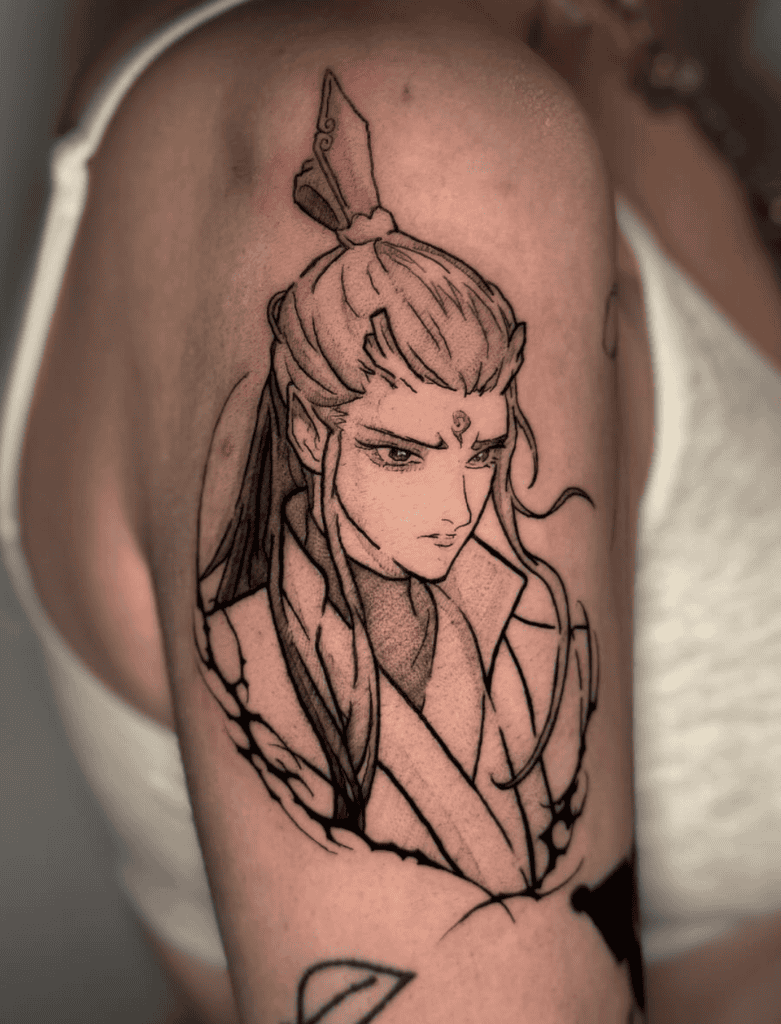
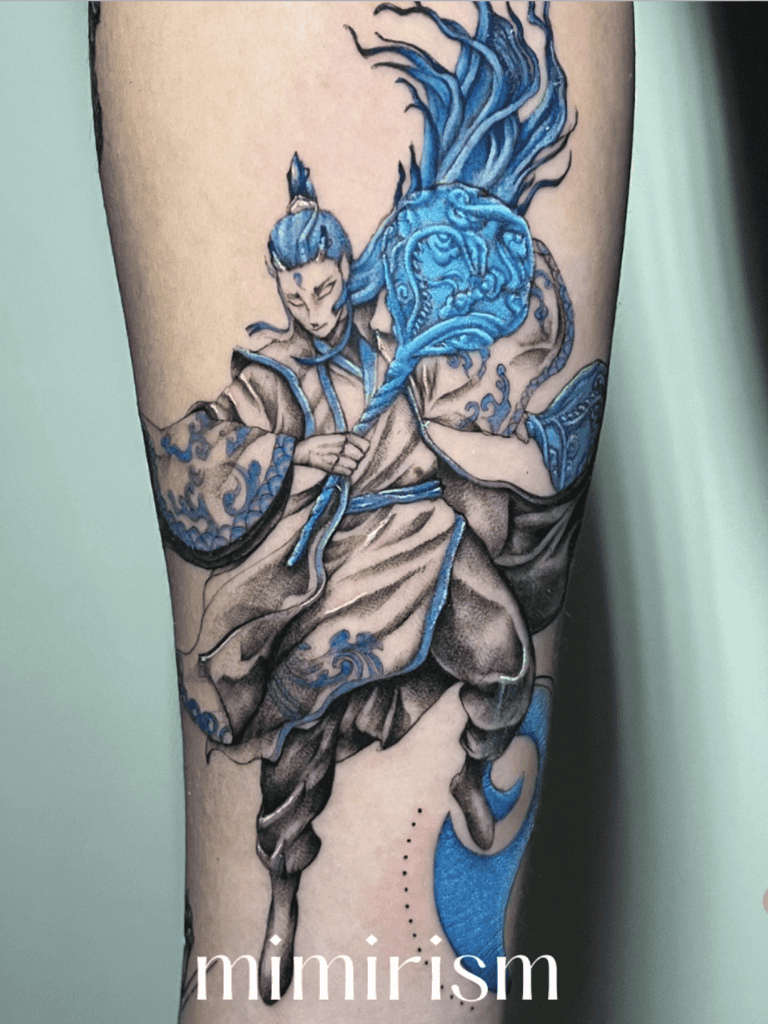
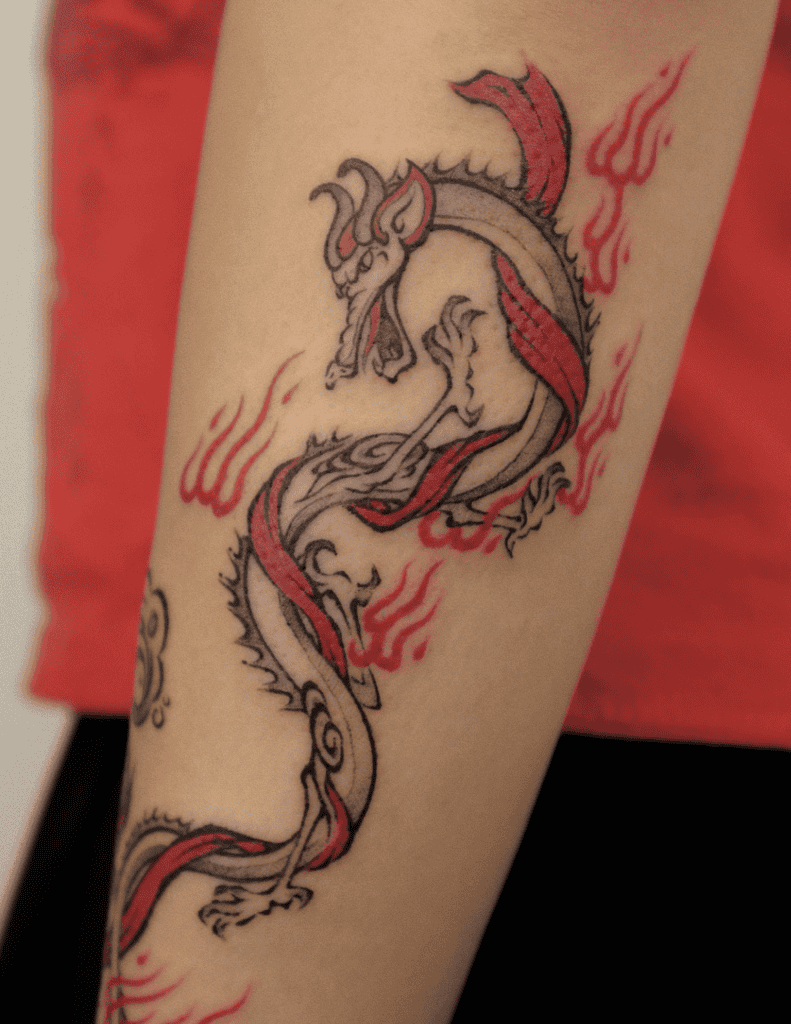
Ao Bing is the son of the Dragon King of the East Sea and one of the most important figures in the legend of Nezha. Though sometimes portrayed as an antagonist, Ao Bing is ultimately a tragic and complex character caught between duty, pride, and fate.
Ao Bing is the third son of the Dragon King of the East Sea, ruler of the oceans and storms. In the classic tale (from Investiture of the Gods), Nezha plays near the sea and disturbs the waters.
Ao Bing confronts him, and what begins as a dispute escalates into battle. Nezha ultimately kills Ao Bing, a shocking act that triggers divine consequences. The Dragon King demands justice, leading to Nezha’s famous self-sacrifice.
His death sets off a chain reaction that shapes Nezha’s transformation. Without Ao Bing’s fall, Nezha’s rebirth would not have occurred.
Jiutian Xuannü Chinese Mythology Tattoo


Jiutian Xuannü (九天玄女), often translated as the Mysterious Lady of the Nine Heavens, is a powerful Daoist goddess associated with warfare, strategy, esoteric knowledge, and divine guidance.
Despite her graceful title, she is a celestial strategist and spiritual warrior. Her name breaks down as: Jiutian (九天) – “Nine Heavens,” referring to the highest celestial realms, and Xuannü (玄女) – “Mysterious / Dark Lady,” implying deep cosmic wisdom
She is often portrayed as a divine teacher who descends from heaven to guide heroes during times of chaos. One of her most famous legends involves the Yellow Emperor (Huangdi). When the Yellow Emperor struggled in battle against the warlord Chiyou, Jiutian Xuannü descended from the heavens and taught him military strategy, tactical formations, mystical arts, and cosmic knowledge. With her guidance, he achieved victory and established order.
Four Heavenly Kings Chinese Mythology Tattoo
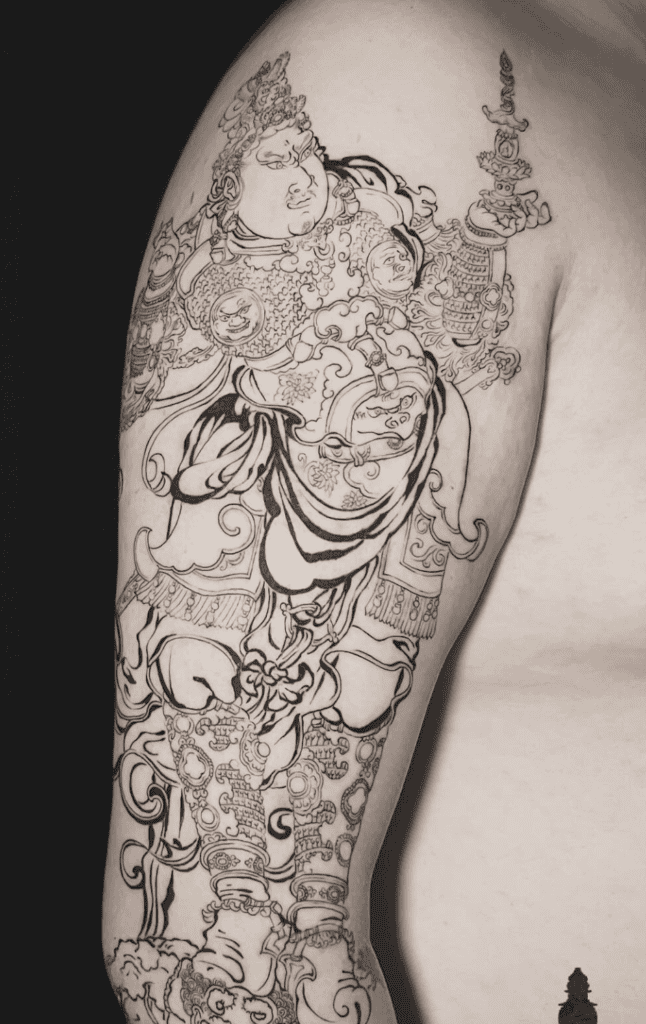
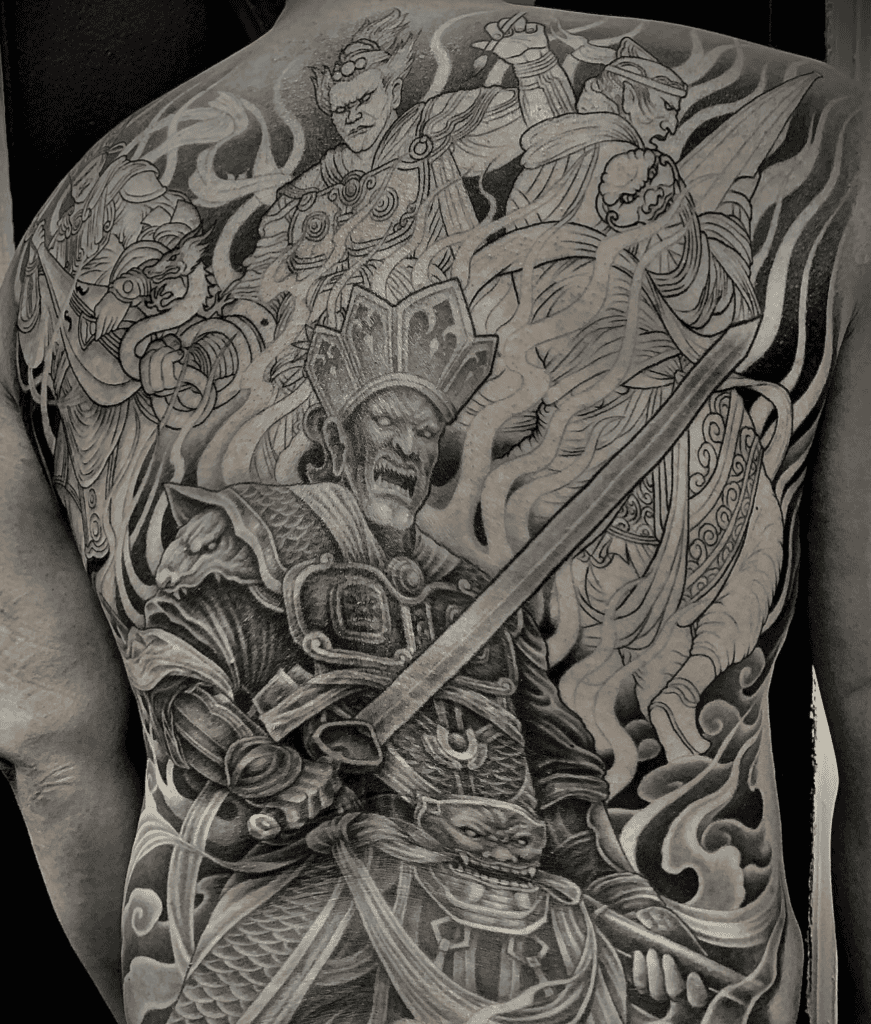
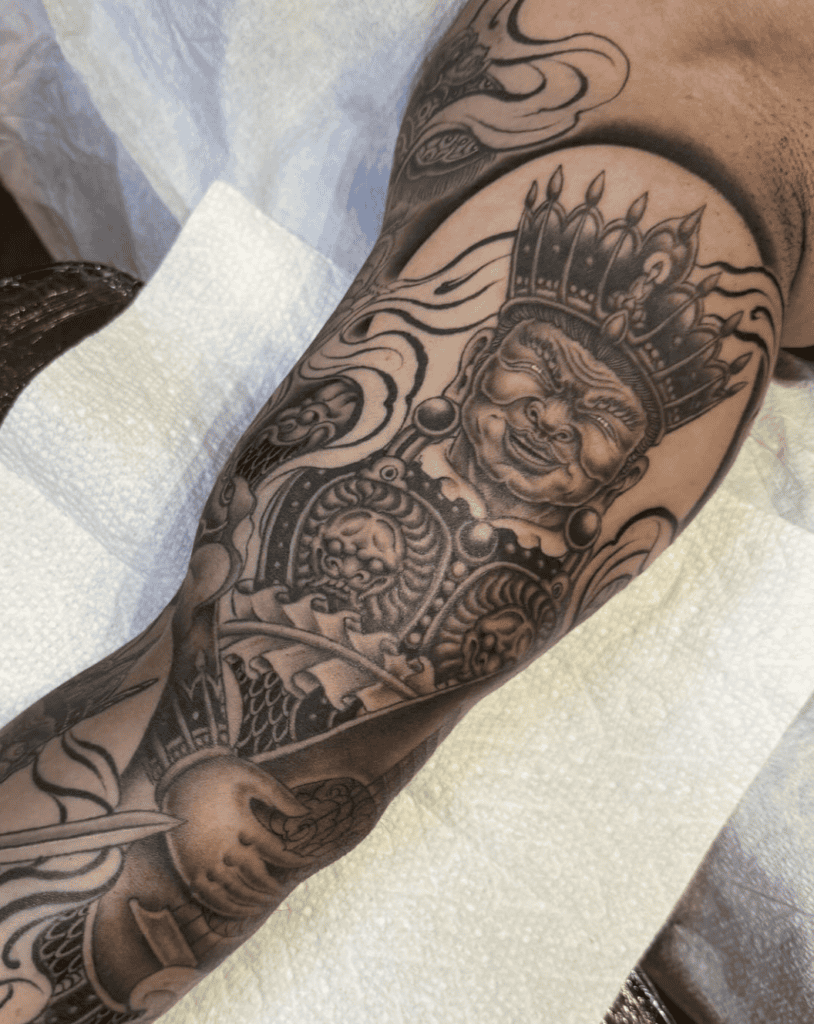
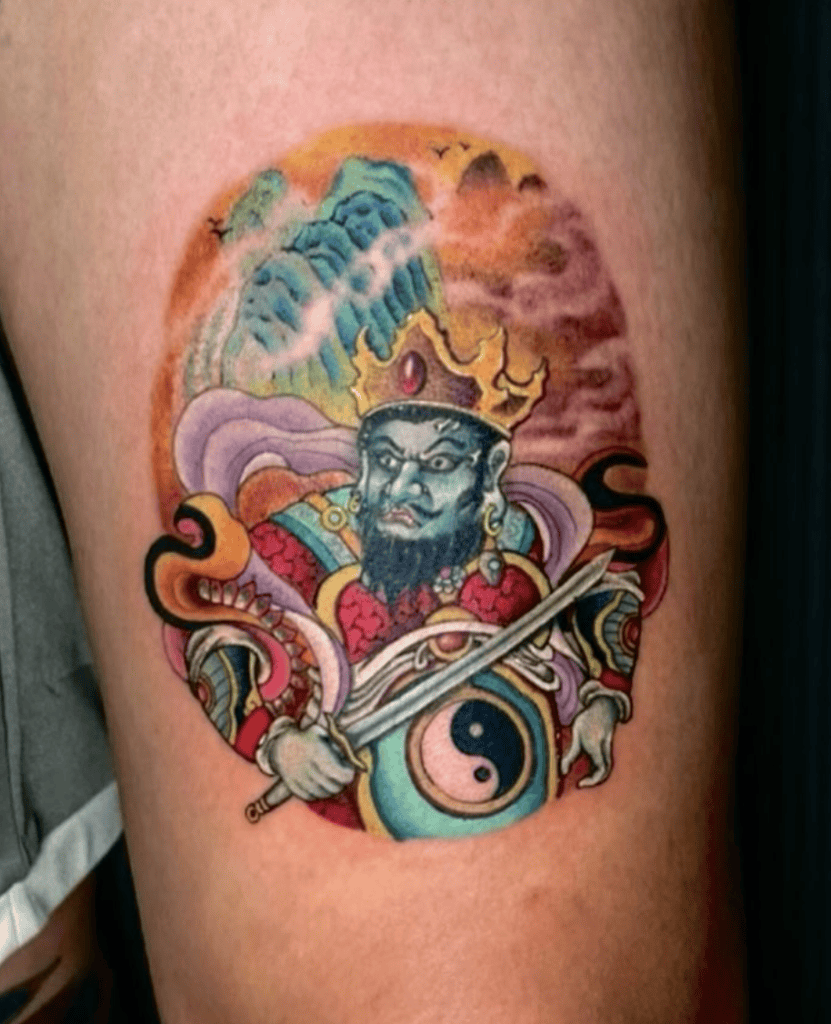
The Four Heavenly Kings are powerful guardian deities found in Chinese Buddhist mythology. They protect the world from evil spirits and watch over the four cardinal directions.
In Chinese tradition, they are often called the Four Great Heavenly Kings (四大天王) and stand at temple entrances, acting as divine protectors. They originated in Indian Buddhism but became fully integrated into Chinese religious culture.
Each king rules one direction and commands supernatural beings. Dhṛtarāṣṭra – Guardian of the East, Virūḍhaka – Guardian of the South, Virūpākṣa – Guardian of the West, and Vaiśravaṇa – Guardian of the North.
In Chinese Buddhist temples, they stand near the entrance hall symbolising protection from evil influences. Their fierce expressions are meant to intimidate negative forces and not the worshippers.
YanLuo Wang Chinese Mythology Tattoo


Yanluo Wang (阎罗王), often simply called King Yan, is the ruler and chief judge of the Chinese underworld. He presides over Diyu, the realm where souls are judged after death.
In Chinese belief, the afterlife is a court of justice, not eternal chaos. Yanluo Wang is based on the Indian god Yama, who entered Chinese tradition through Buddhism. Over time, Chinese culture reshaped him into a bureaucratic judge within a structured underworld system. Instead of ruling alone, Yanluo became part of the Ten Kings of Hell, each overseeing different courts and punishments.
In later Chinese folklore, Diyu (the underworld) is divided into ten courts. Each court judges specific sins, assigns punishments, and determines reincarnation. Yanluo Wang is often portrayed as the Fifth King, though in popular imagination, he is seen as the main ruler.
Guan Yu Chinese Mythology Tattoo
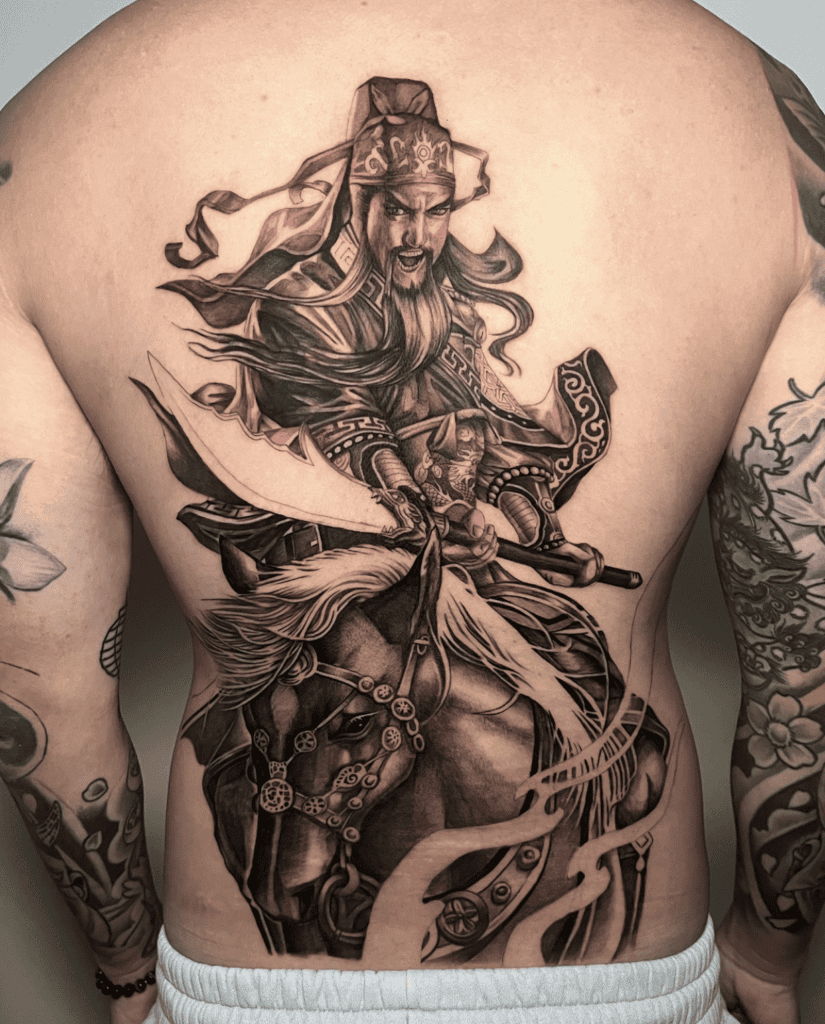
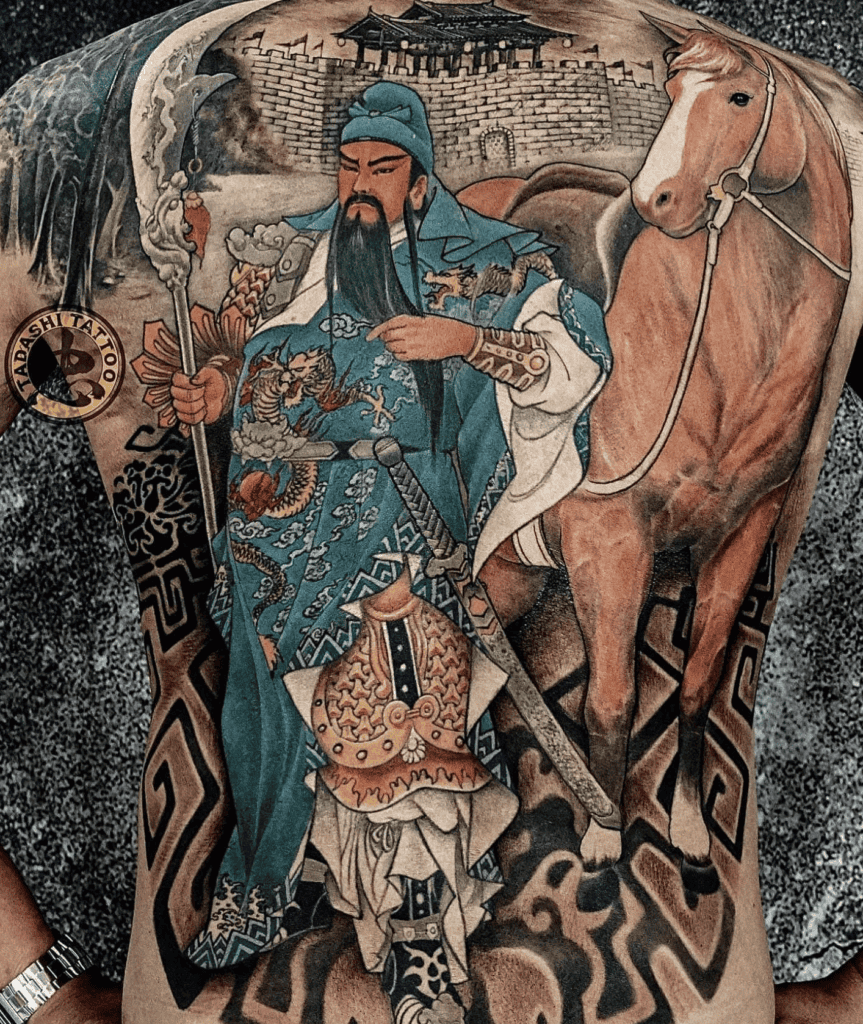
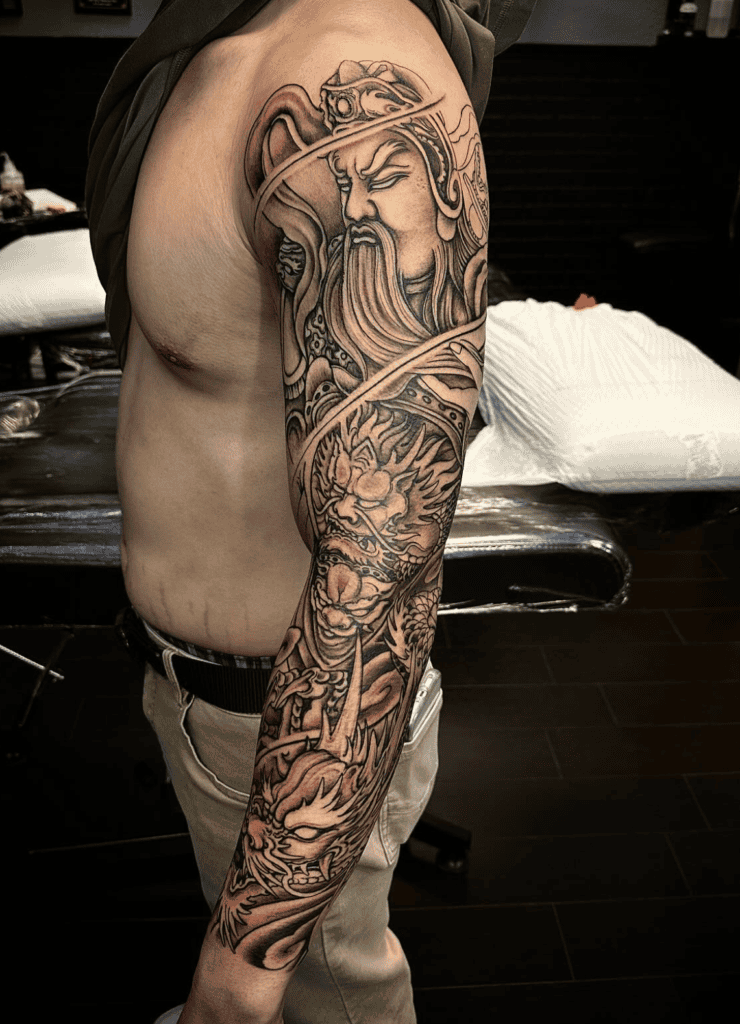
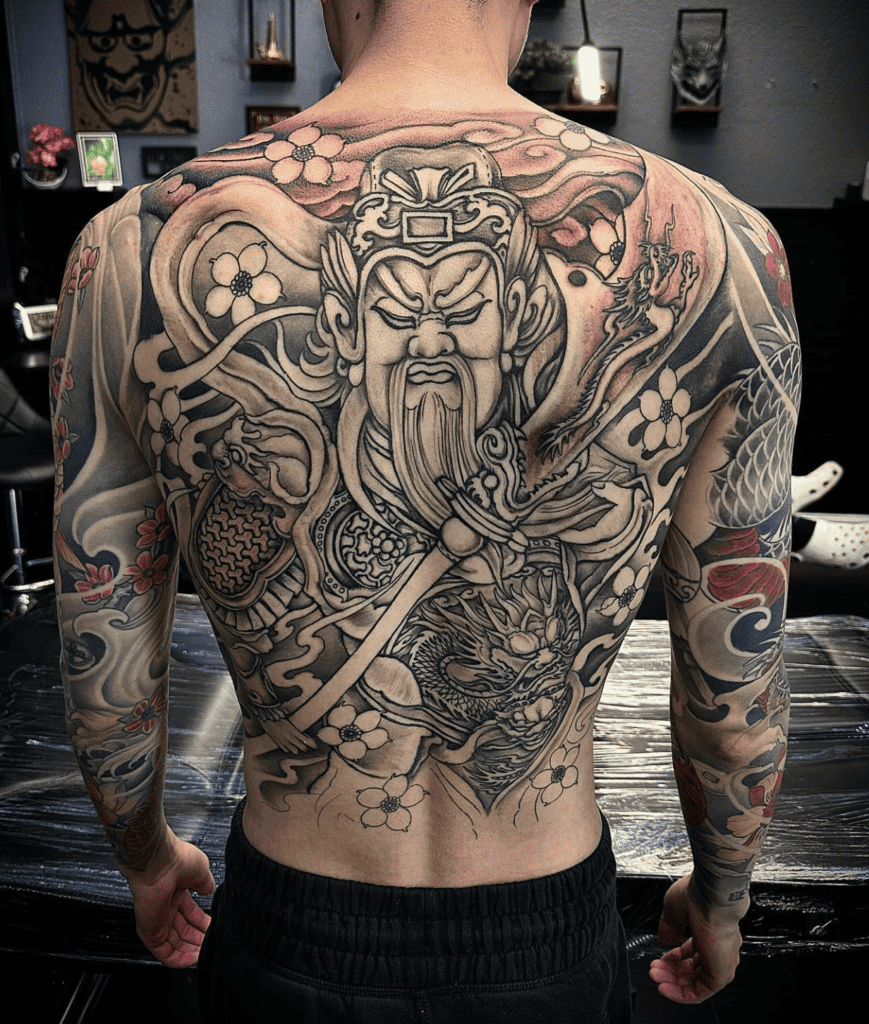
Guan Yu (关羽), also known as Guan Gong (“Lord Guan”), is one of the most revered figures in Chinese history and mythology. Originally a real general during the late Eastern Han dynasty, he later became deified as a symbol of loyalty, righteousness, courage, and honour.
Guan Yu lived during the turbulent Three Kingdoms period (2nd–3rd century CE). He served under the warlord Liu Bei and became famous for unshakable loyalty, martial prowess, moral integrity, and refusing betrayal even under pressure. His deeds were later romanticised in the classic novel “Romance of the Three Kingdoms”.
After his death, Guan Yu’s legend grew. Over centuries, emperors officially honoured him with divine titles. He became a protector god, a war deity, and a guardian of justice.
Zhu Rong Chinese Mythology Tattoo

Zhu Rong (祝融) is one of the ancient deities of Chinese mythology, associated with fire, the south, summer, and cosmic order. He is a powerful and sometimes stern figure, representing both the life-giving and destructive power of flame.
In early myths, Zhu Rong is described as a god of fire, a celestial official, and a ruler of the southern direction. In some traditions, he is considered a descendant of the flame emperor lineage and part of early mythic rulers of China.
One of Zhu Rong’s most famous myths involves his clash with the water deity Gong Gong. According to legend, Gong Gong rebelled against the heavens, and Zhu Rong defeated him.
In rage, Gong Gong smashed his head into Mount Buzhou, causing the sky to tilt, and chaos to follow. This myth explains cosmic imbalance and the need for restoration.
Meng Po Chinese Mythology Tattoo

Meng Po (孟婆), often called the Old Lady of Forgetfulness, is a haunting and essential figure in Chinese underworld mythology. She serves in Diyu, the realm of the dead, ensuring that souls forget their previous lives before reincarnation.
After a soul is judged in the courts of Yanluo Wang, it must cross the Naihe Bridge (Bridge of Helplessness). Before crossing, every soul must drink Meng Po’s soup.
This soup erases memories of past lives, removes pain and attachment, and prevents recognition after rebirth. Without it, reincarnation would carry emotional chaos forward. In some stories, souls who resist drinking it are forced to comply because memory would disrupt karmic cycles.
Shen Shu and Yulü Chinese Mythology Tattoo


Shenshu and Yulü (神荼 & 郁垒) are two of the earliest recorded door guardian spirits in Chinese mythology. They appear in the Classic of Mountains and Seas (Shan Hai Jing) and are associated with protection against demons and wandering spirits.
According to ancient legend, Shēn Shū and Yù Lǜ lived on a sacred peach tree on Mount Dushuo. Beneath this tree was a gateway through which ghosts entered the human world. The two spirits monitored the passage of wandering souls, and if they caught an evil spirit causing harm, they would bind it with reeds and throw it to the tigers.
Because of their protective role, people began carving their names or images into peach wood boards and hanging them on doors. Peach wood was believed to have strong spiritual power against evil. Over time, this practice evolved into the tradition of New Year door gods (Menshen).
Wu Song Chinese Mythology Tattoo
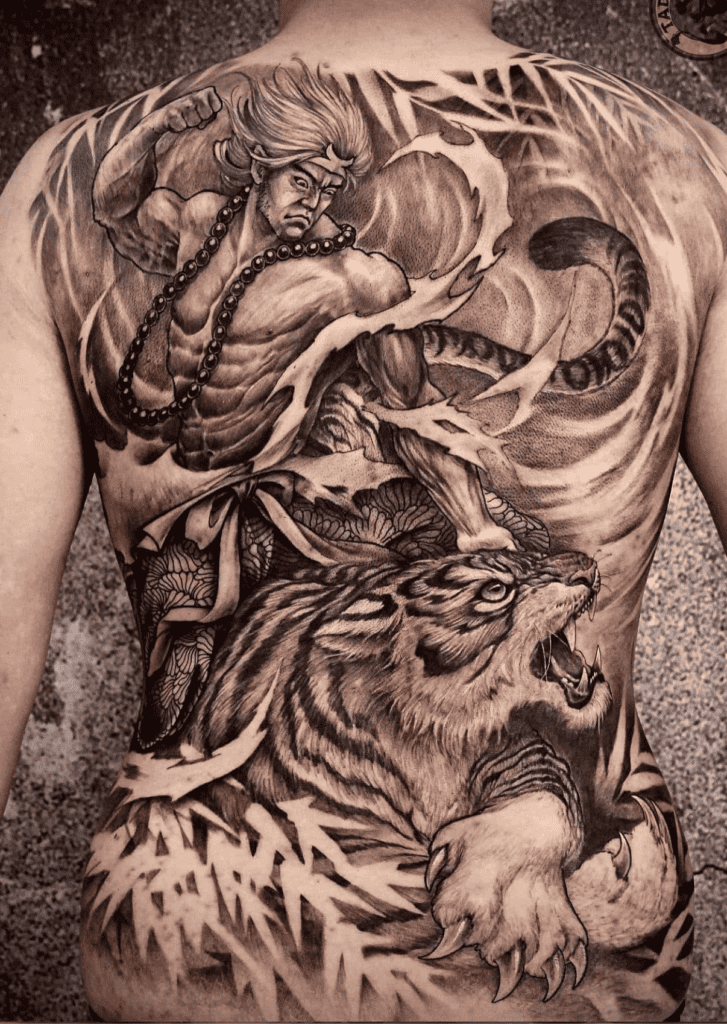
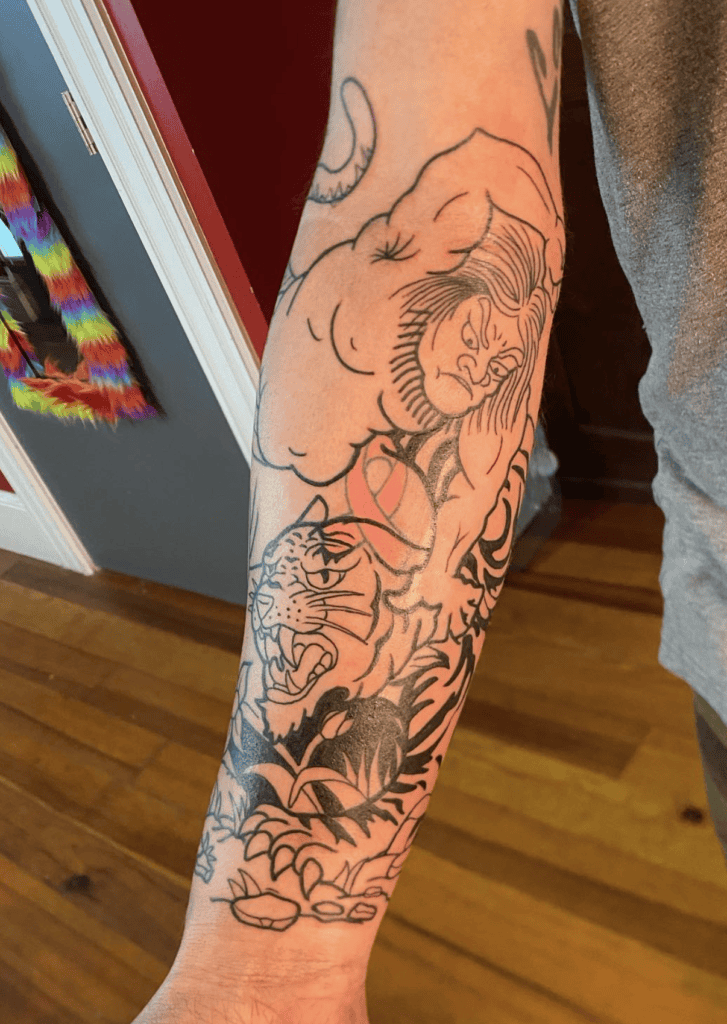
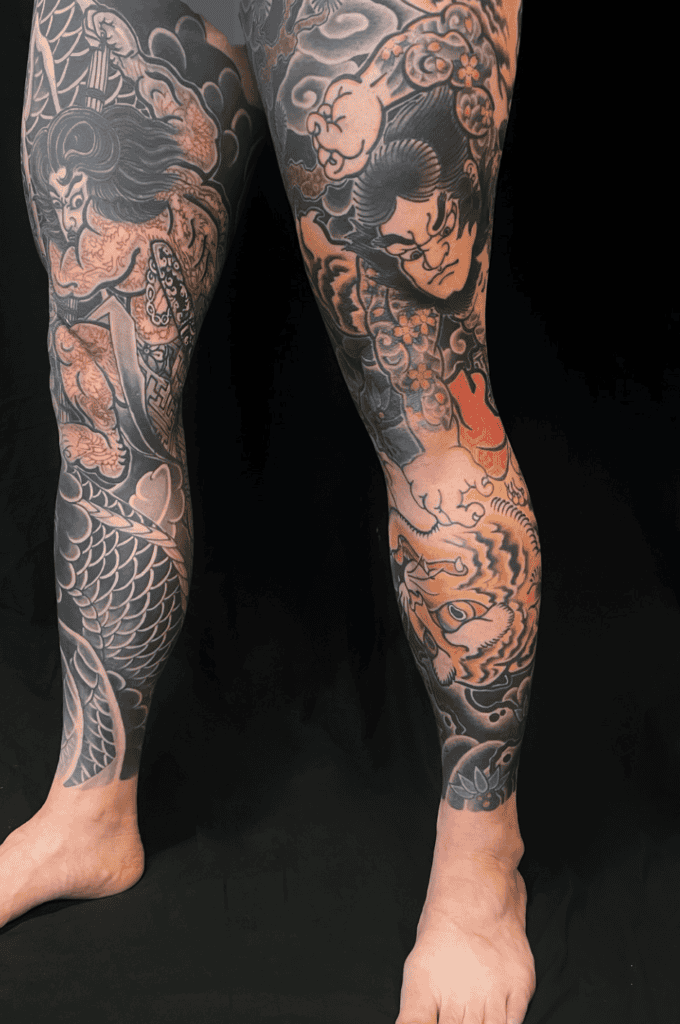
Wu Song (武松) is one of the most famous heroes from the classic Chinese novel Water Margin (also known as Outlaws of the Marsh). He is legendary for killing a man-eating tiger with his bare hands and for living a life driven by loyalty, vengeance, and fierce honour.
If some Chinese heroes rule Heaven, Wu Song rules the wild frontier. Wu Song’s most famous story takes place on Jingyang Ridge. After drinking multiple bowls of strong wine (despite warnings), he insists on crossing the mountain path alone, even though a tiger has been terrorising travellers.
When the tiger attacks, Wu Song dodges its first strike, but loses his weapon. He fights it bare-handed and beats it to death with sheer strength. This moment cemented his reputation as the Tiger-Slaying Hero.
Lóng Chinese Mythology Tattoo
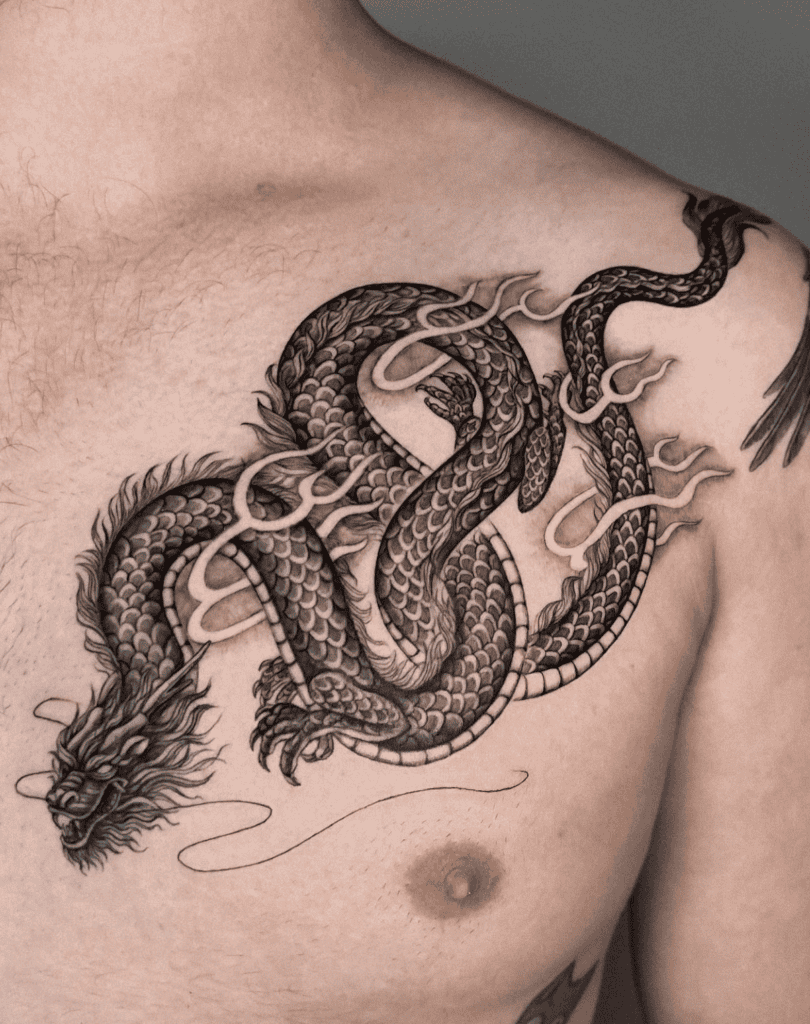
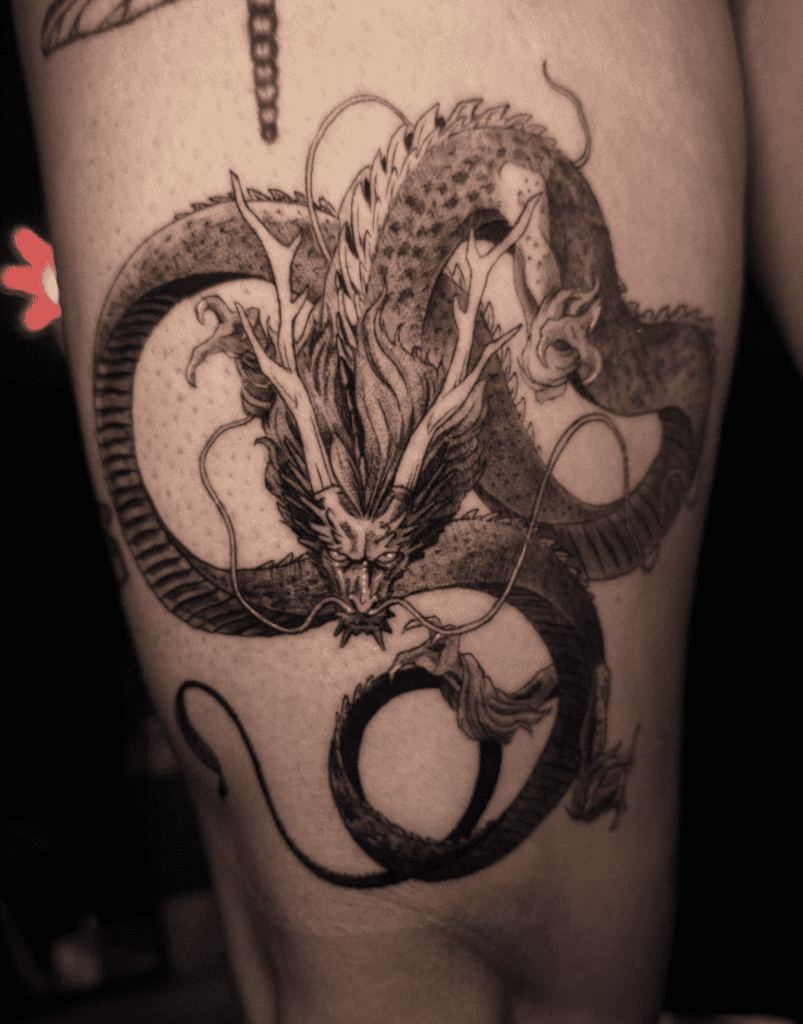
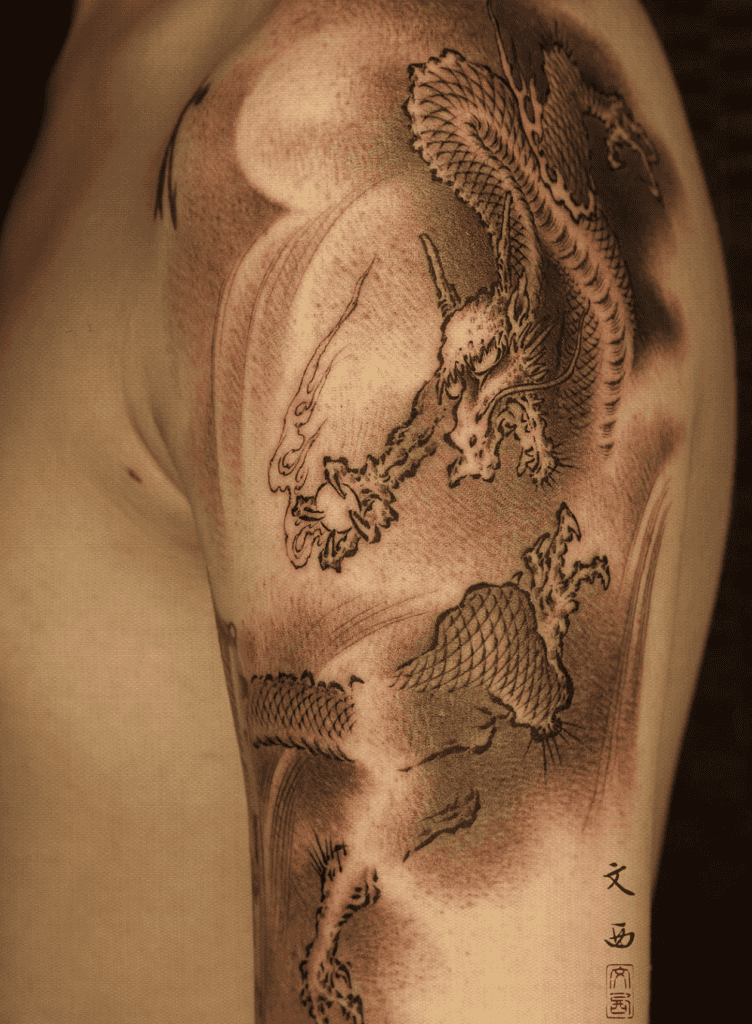
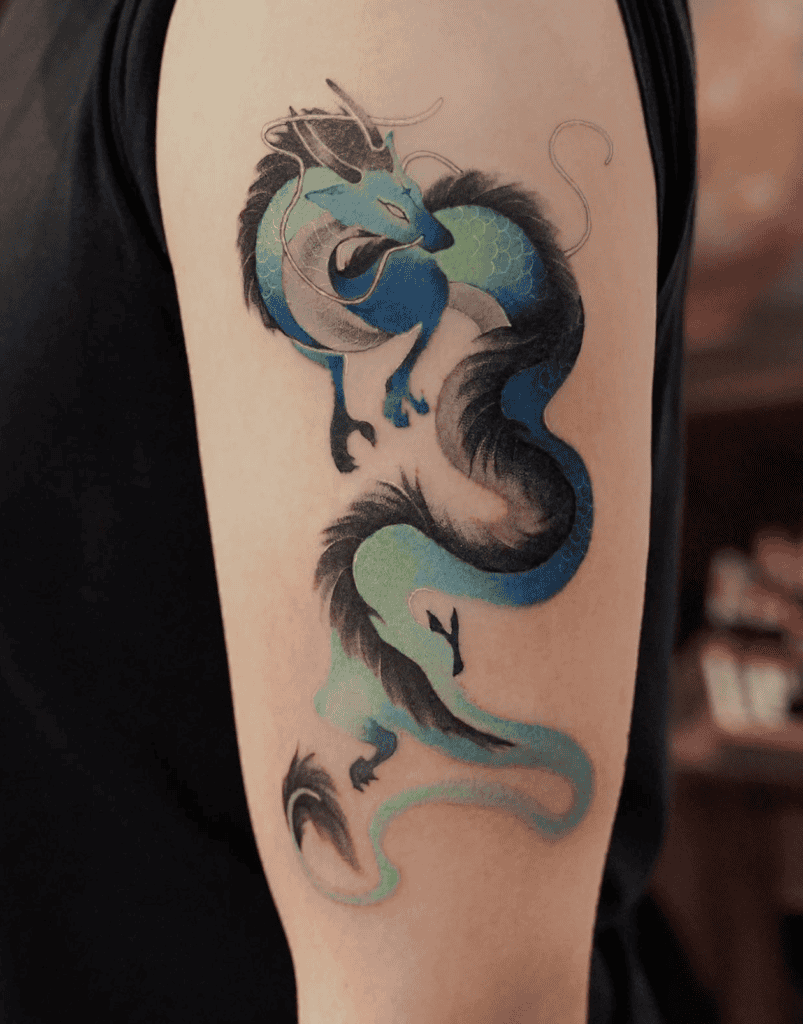
The Lóng (龙) — the Chinese dragon — is one of the most powerful and sacred symbols in Chinese mythology. Unlike Western dragons, which are often destructive beasts, the Chinese dragon is wise, benevolent, and associated with prosperity, rain, and imperial authority.
Chinese dragons are strongly connected to rain, rivers, seas, storms, fertility, and agricultural prosperity. In agrarian China, rainfall was essential to survival, so dragons were revered as controllers of water and weather.
Huli Jing Chinese Mythology Tattoo
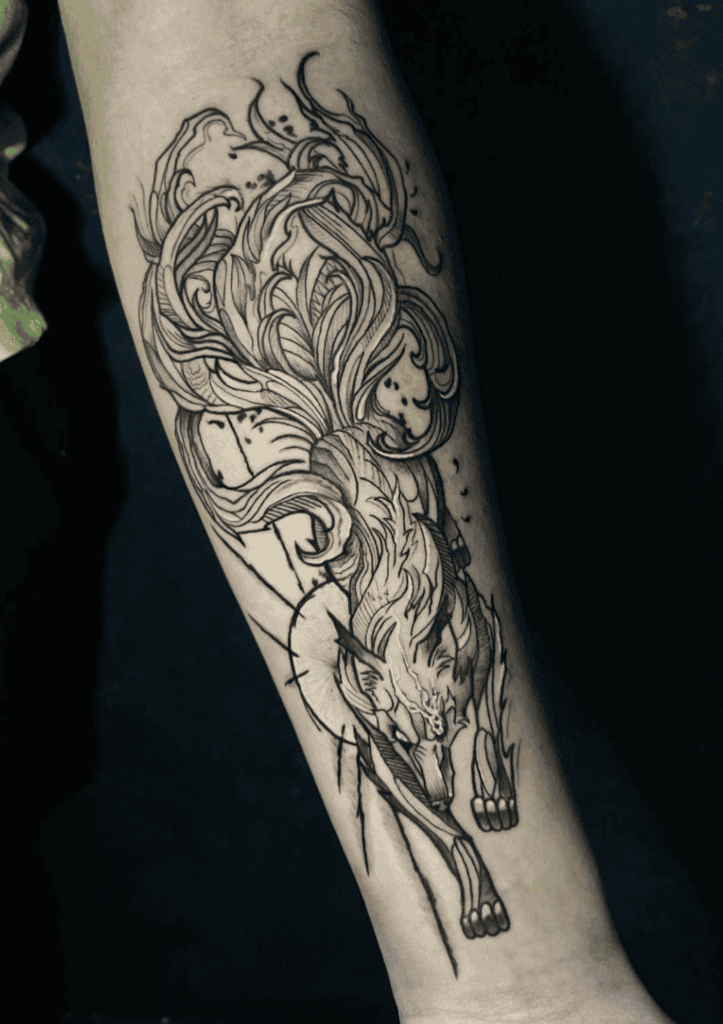
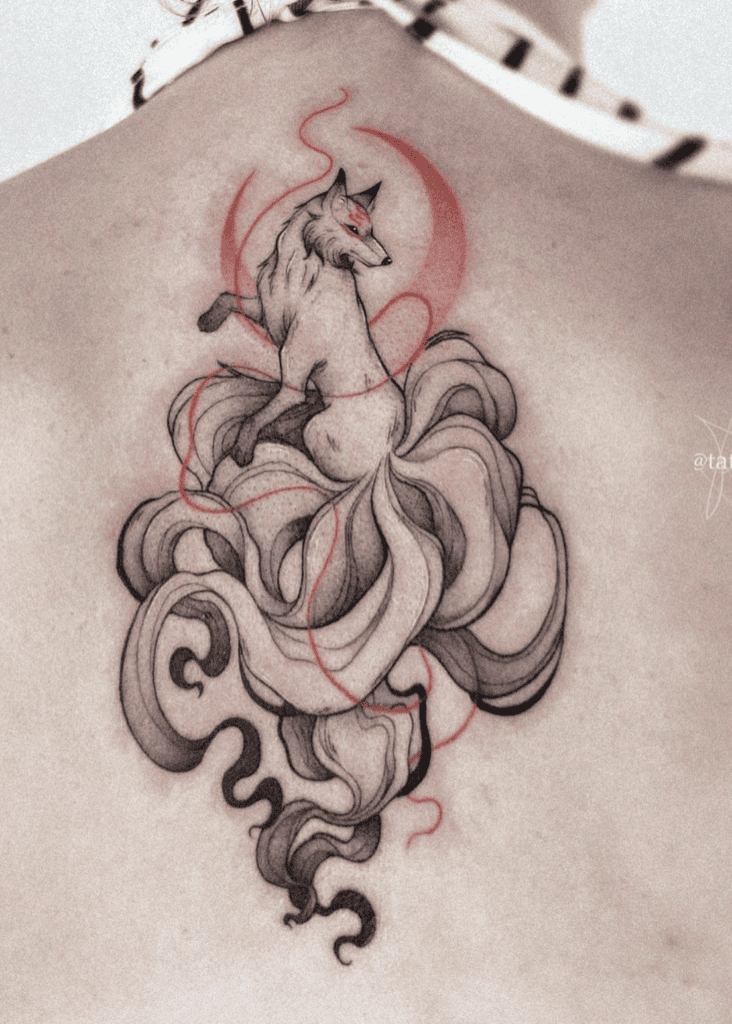
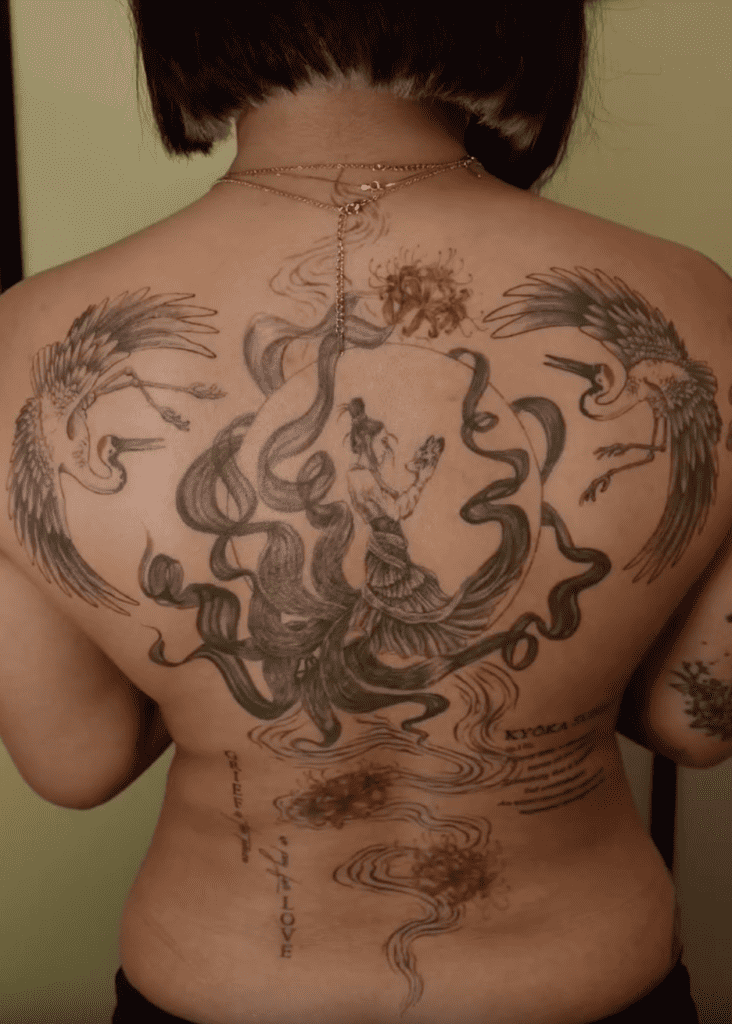
Huli Jing (狐狸精) is a shape-shifting fox spirit in Chinese mythology and folklore. She is mysterious, seductive, intelligent, and often morally ambiguous. Sometimes she is a dangerous temptress, sometimes a loyal lover, and sometimes simply misunderstood. The Huli Jing is not purely good or evil, she represents transformation, desire, and spiritual power.
A Huli Jing is a fox that has lived long enough to gain supernatural abilities. In many legends, after 50 or 100 years, a fox gains magical powers, and after 1,000 years, it may grow nine tails.
The nine-tailed fox can transform into beautiful women (or men), possess people, create illusions, influence emotions, and, in darker forms, drain life energy. In many stories, a Huli Jing takes the form of a beautiful woman who charms powerful men, especially emperors or scholars.
Denglong Chinese Mythology Tattoo

Denglong (灯龙 / 蹬龙 depending on regional usage) is a lesser-known but fascinating auspicious creature in Chinese folklore. It is typically described as a guardian beast associated with protection, good fortune, and warding off evil. While not as universally famous as dragons or phoenixes, the Denglong appears in temple art, stone carvings, and regional myths as a symbol of prosperity and vigilance.
Descriptions vary by region, but the Denglong is often portrayed as a dragon-like or lion-like creature, with a fierce expression. It is sometimes winged with a single horn and stands guard at entrances. Because Chinese mythological creatures often overlap in symbolism, the Denglong sits within this family of protective hybrid beasts.
Mo Chinese Mythology Tattoo
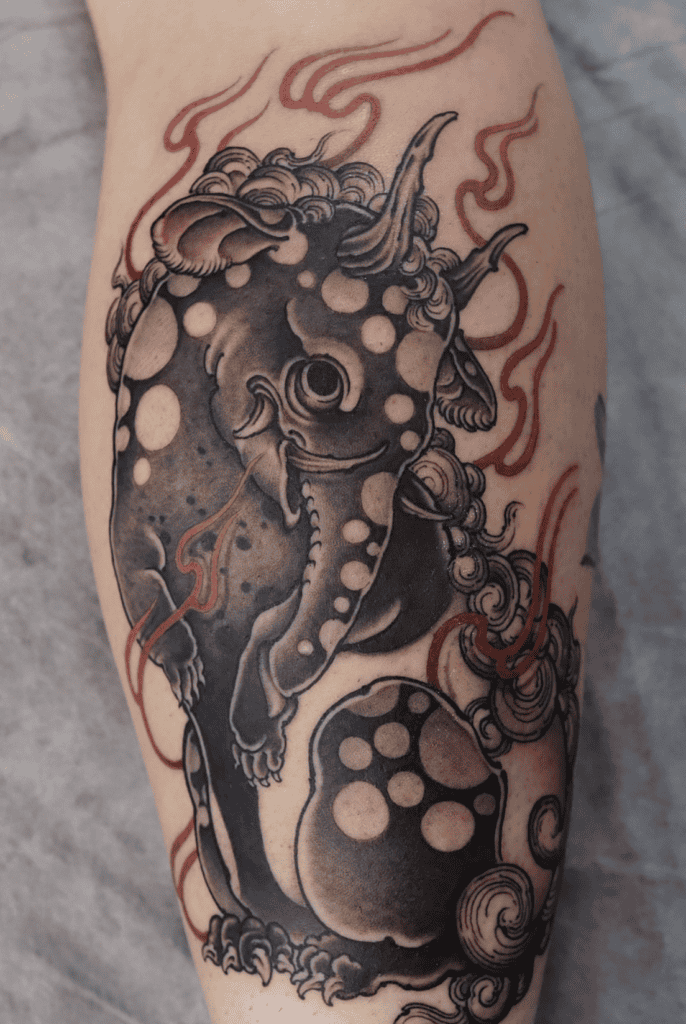
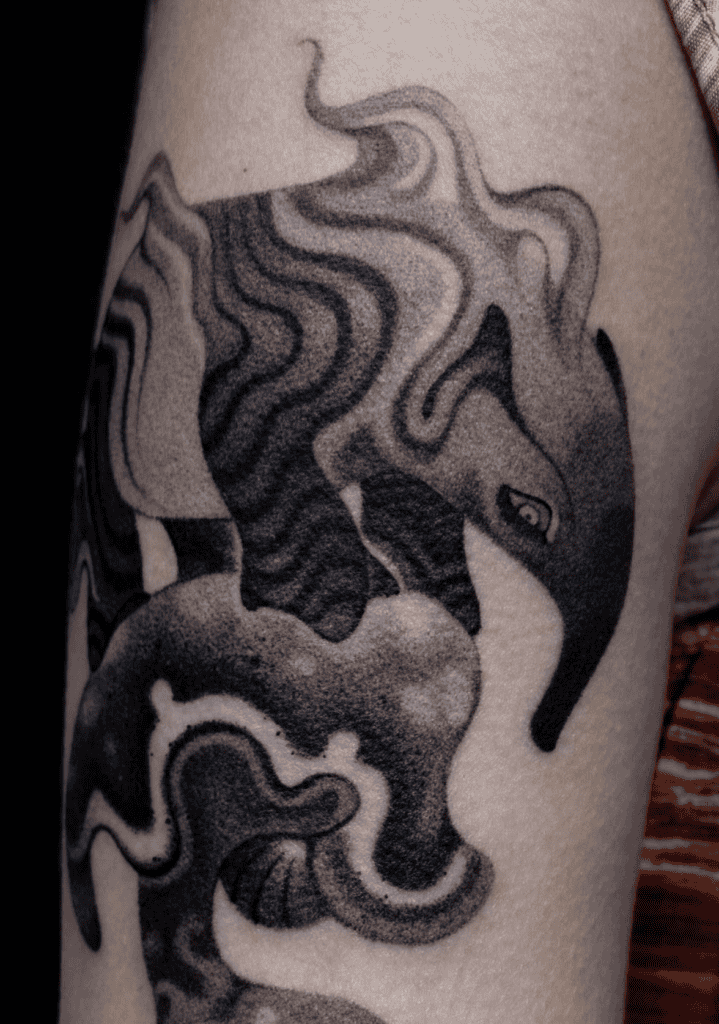
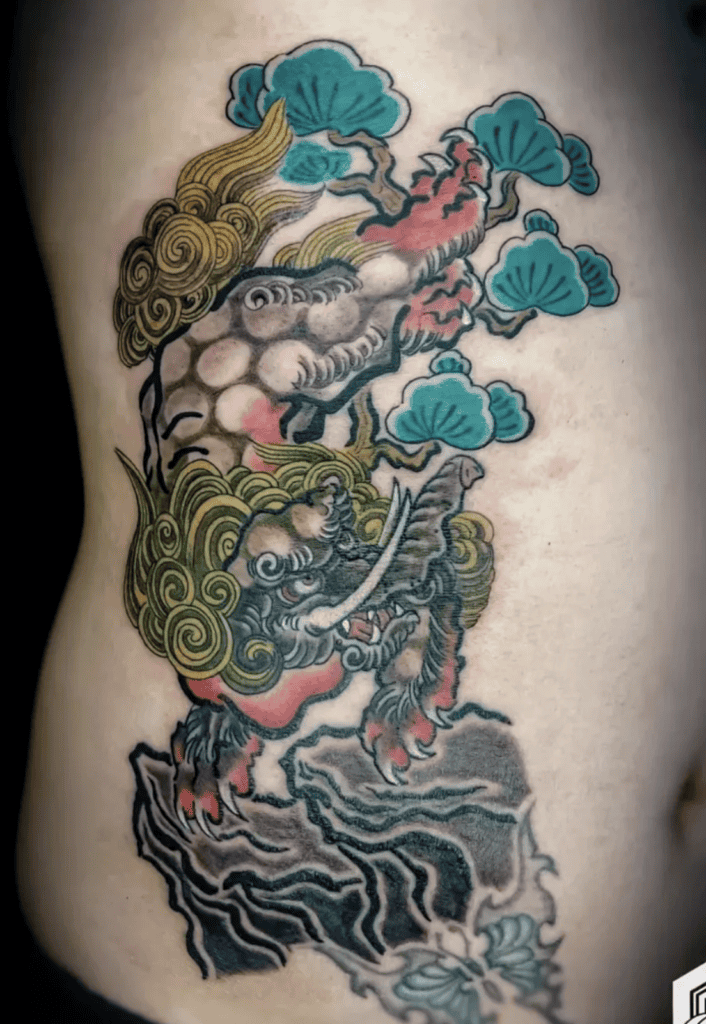
The Mo (貘) is a fascinating and lesser-known creature in Chinese folklore. Traditionally described as a strange, composite animal, the Mo became associated with eating nightmares and protecting sleepers from bad dreams.
It is sometimes translated loosely as a “Chinese tapir,” but the mythological Mo is far more symbolic than zoological. In folklore, the Mo is said to devour nightmares, protect people while they sleep, guard against evil spirits, and absorb negative dream energy.
Because of this, images of the Mo were sometimes placed near beds or embroidered into textiles to ward off bad dreams.
Jin Chan Chinese Mythology Tattoo
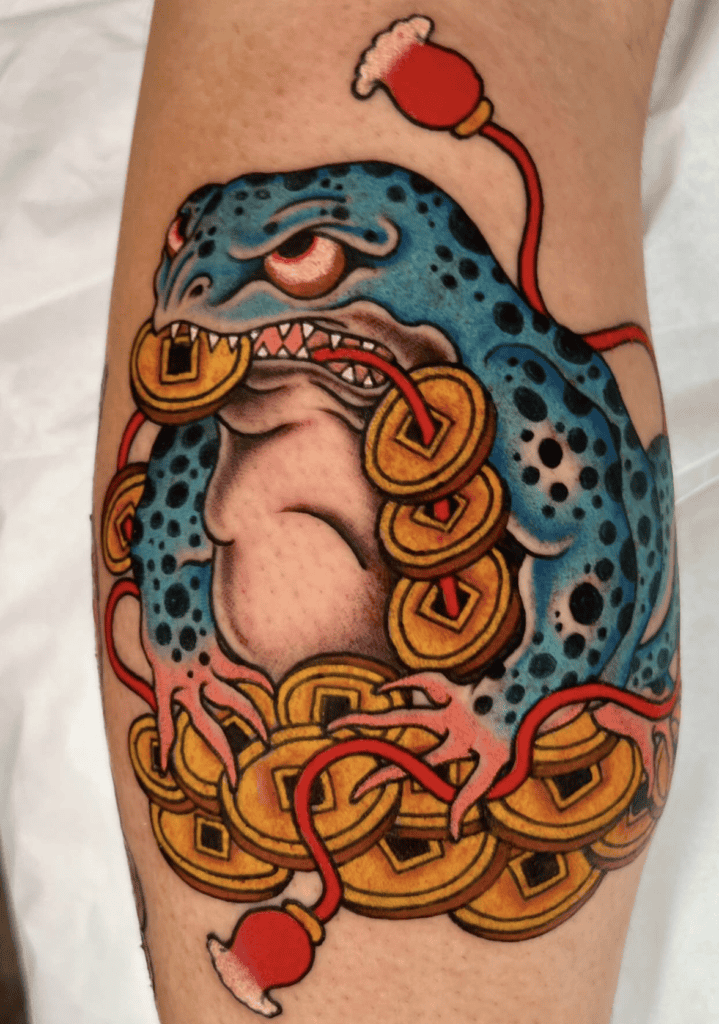
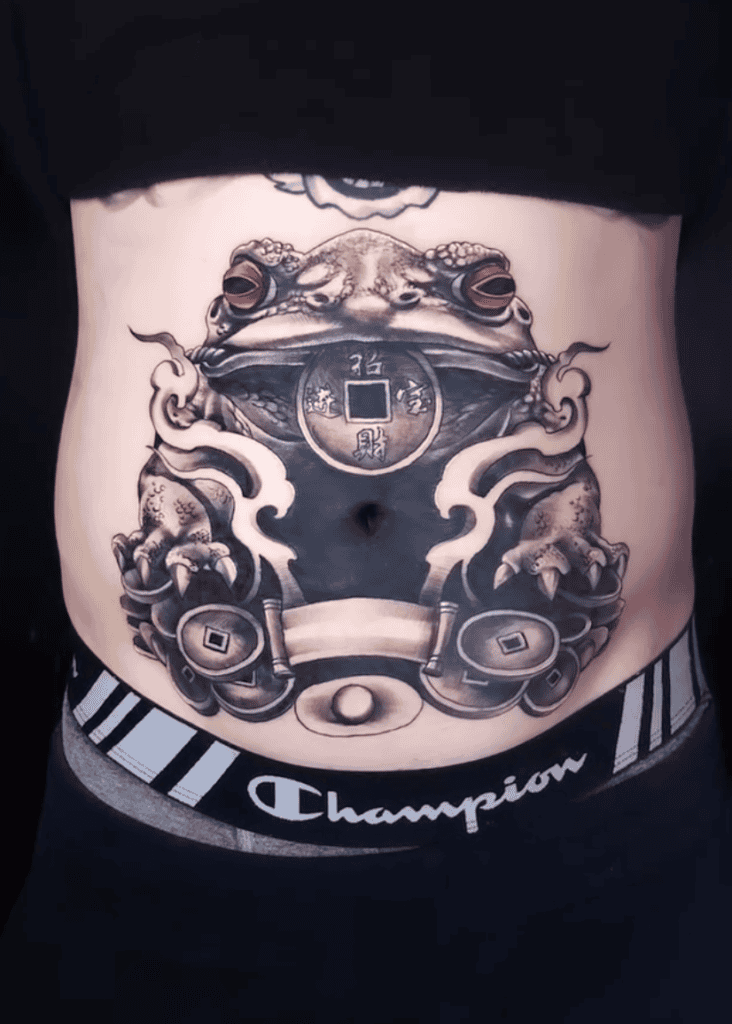
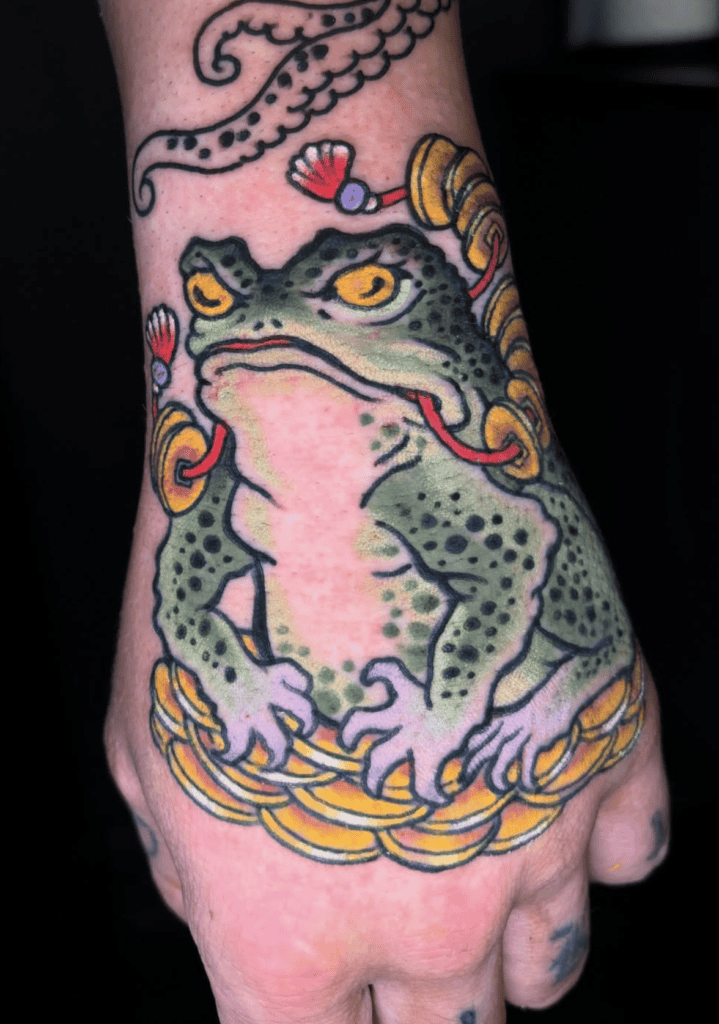
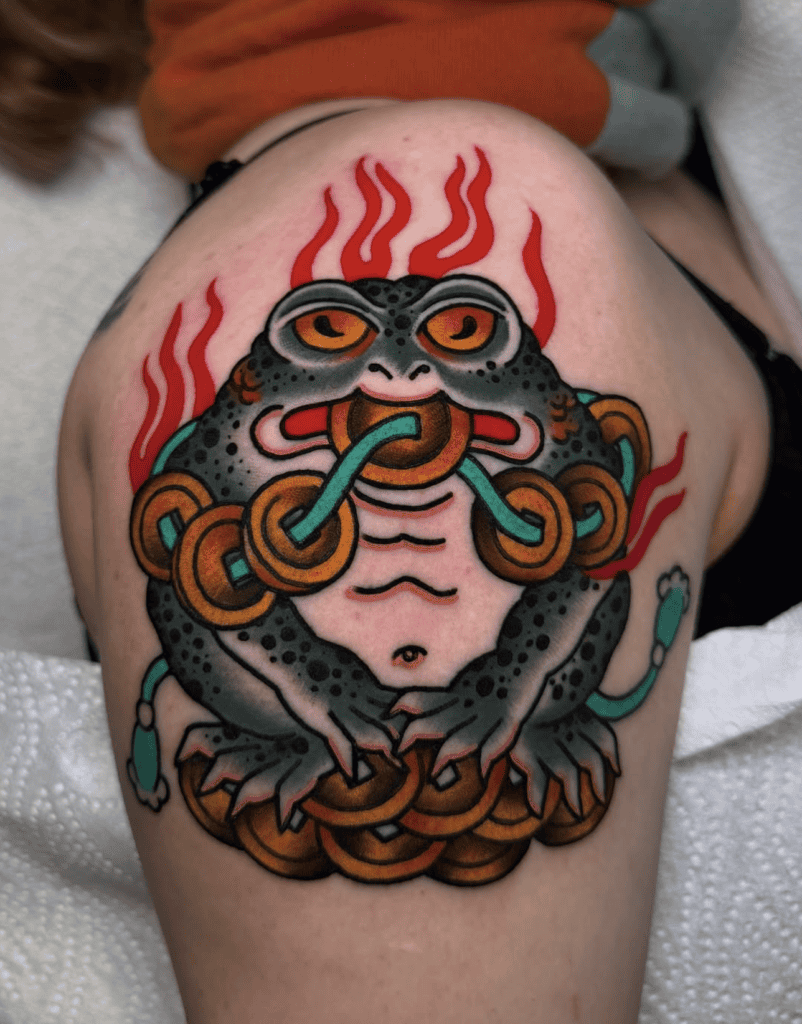
Jin Chan (金蟾) — also called the Golden Toad or Money Toad — is a popular prosperity symbol in Chinese folklore and Feng Shui. Recognisable by its three legs and a coin in its mouth, Jin Chan is believed to attract wealth and protect against financial loss.
Jin Chan is often linked to the Daoist immortal Liu Haichan. In one legend Liu Haichan encounters a mischievous three-legged toad. The toad originally causes trouble and greed, but through spiritual influence, it is subdued and becomes a bringer of wealth rather than misfortune.
The three legs are symbolic rather than biological. They represent heaven, earth, and humanity, or sometimes wealth, longevity, and prosperity. In Chinese symbolism, odd numbers often carry mystical meaning.
Jin Chan is usually depicted holding a Chinese coin inscribed with square holes. The coin symbolises continuous wealth flow, financial stability, and protection against poverty. In Feng Shui practice, Jin Chan is often placed near entrances facing inward (to symbolise money entering). It is traditionally not placed facing outward as that would symbolise money leaving.
Longgui Chinese Mythology Tattoo
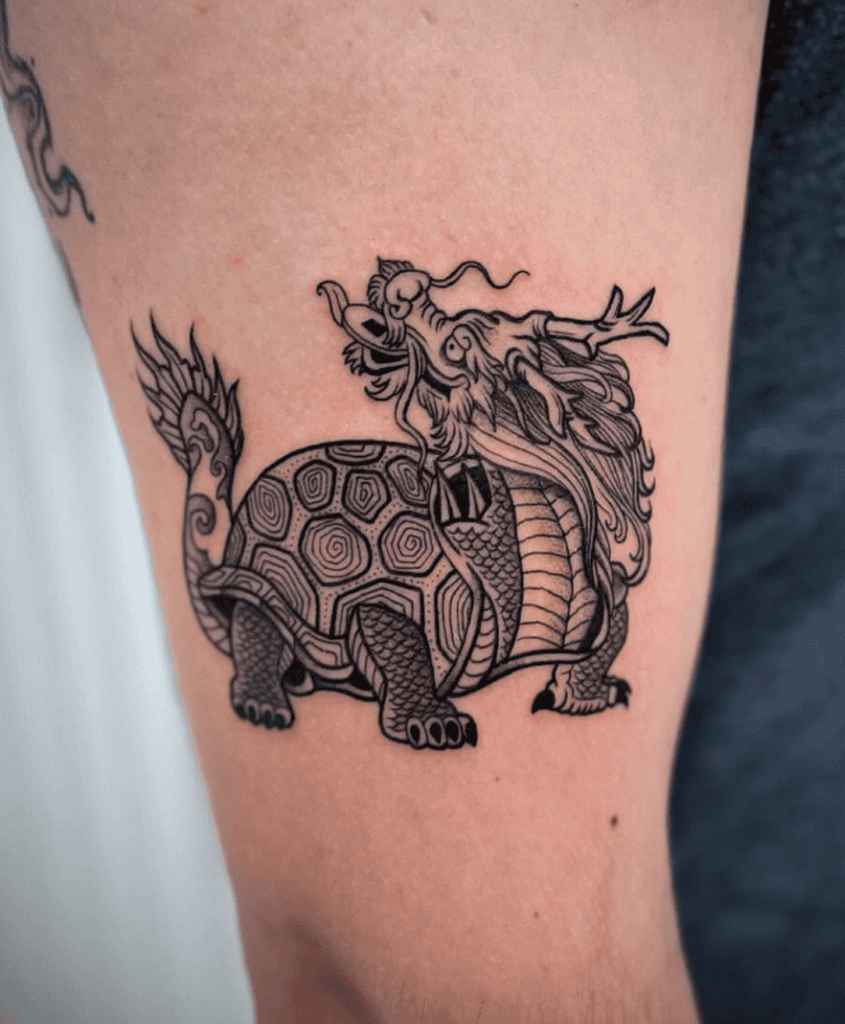
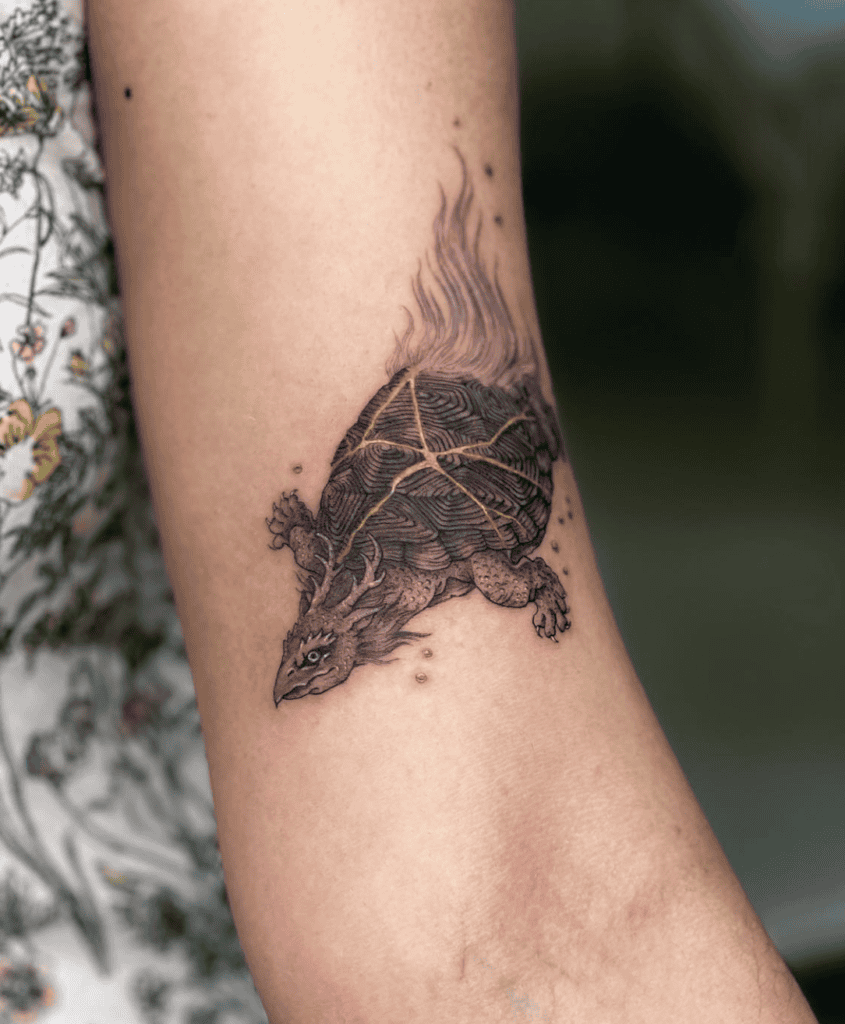
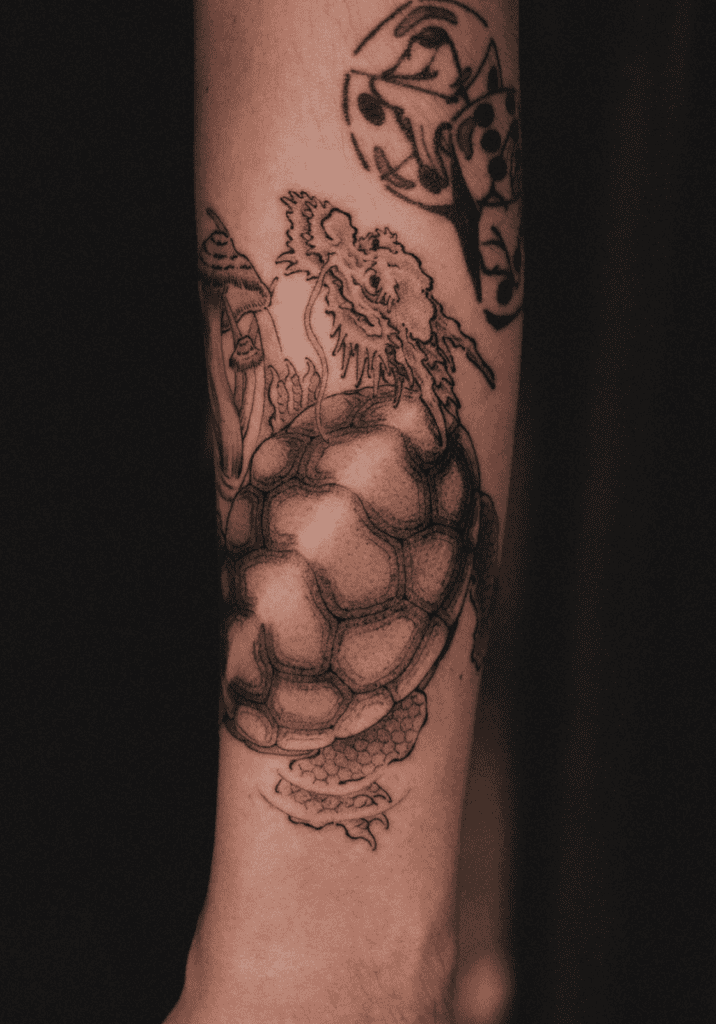
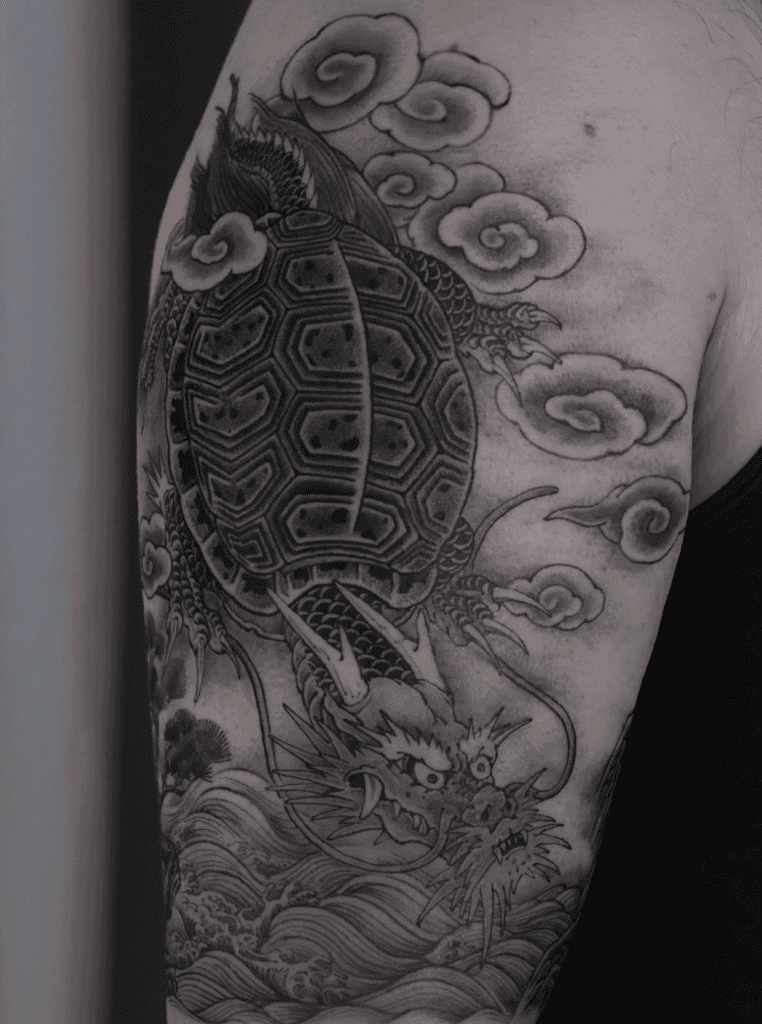
Longgui (龙龟) — literally “Dragon Turtle” — is a powerful hybrid creature in Chinese mythology and Feng Shui. As its name suggests, it combines the head of a dragon with the body of a turtle.
The Longgui is sometimes connected to ancient turtle symbolism in Chinese cosmology. In early myth, giant turtles supported cosmic pillars, turtle shells were used for divination, and the turtle symbolised the structure of the universe. Over time, the fusion with dragon imagery amplified its power and auspicious meaning.
The Longgui is especially popular in Feng Shui practice. It is believed to attract career advancement, stabilise wealth, protect against negative energy, and support authority and leadership. It is often placed behind desks (for support and power), near entrances, or in business spaces as the turtle’s grounded nature provides stability, while the dragon’s energy brings opportunity.
Qilin Chinese Mythology Tattoo
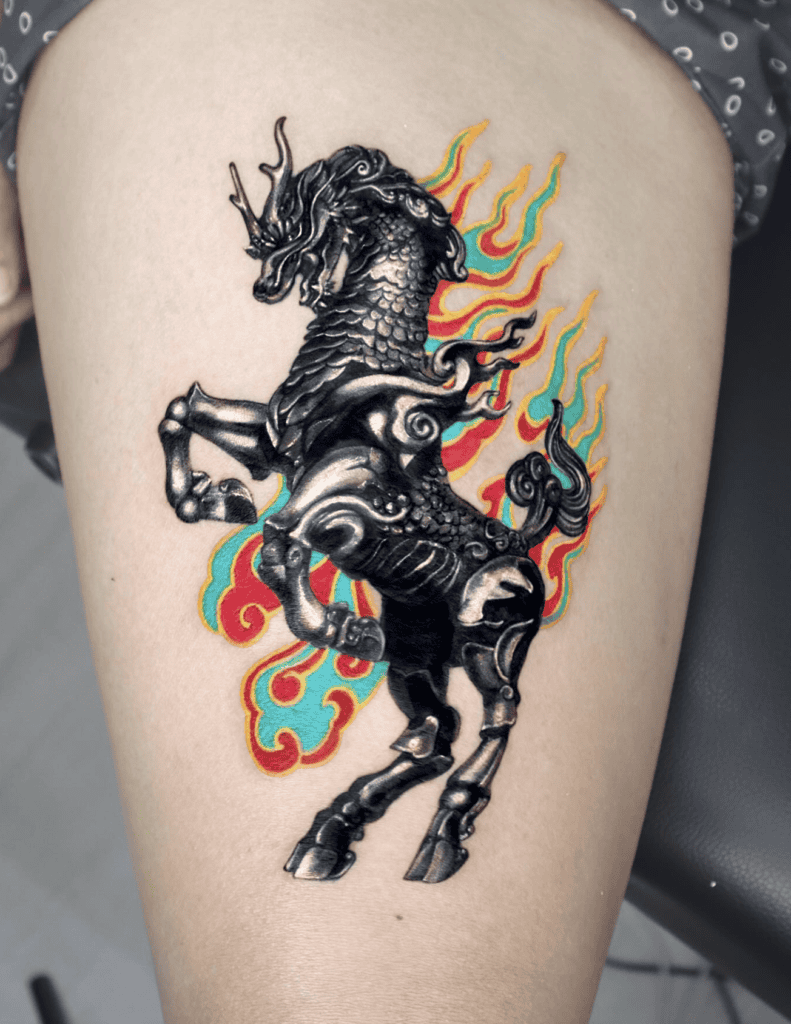
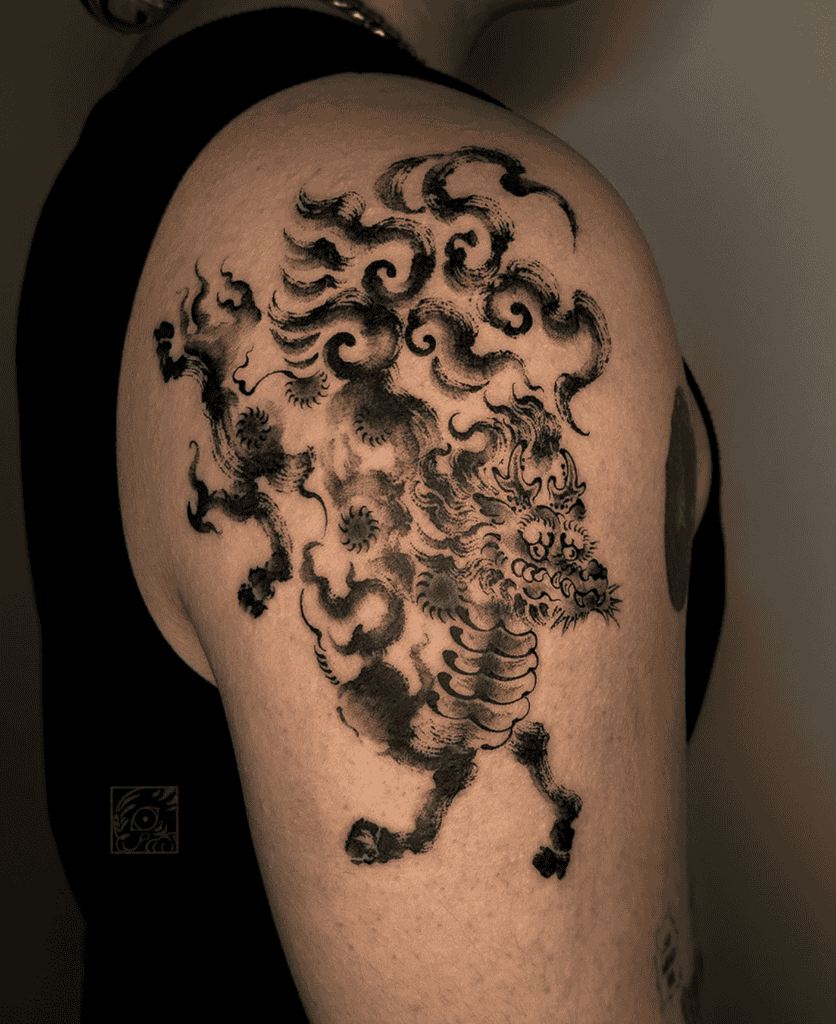
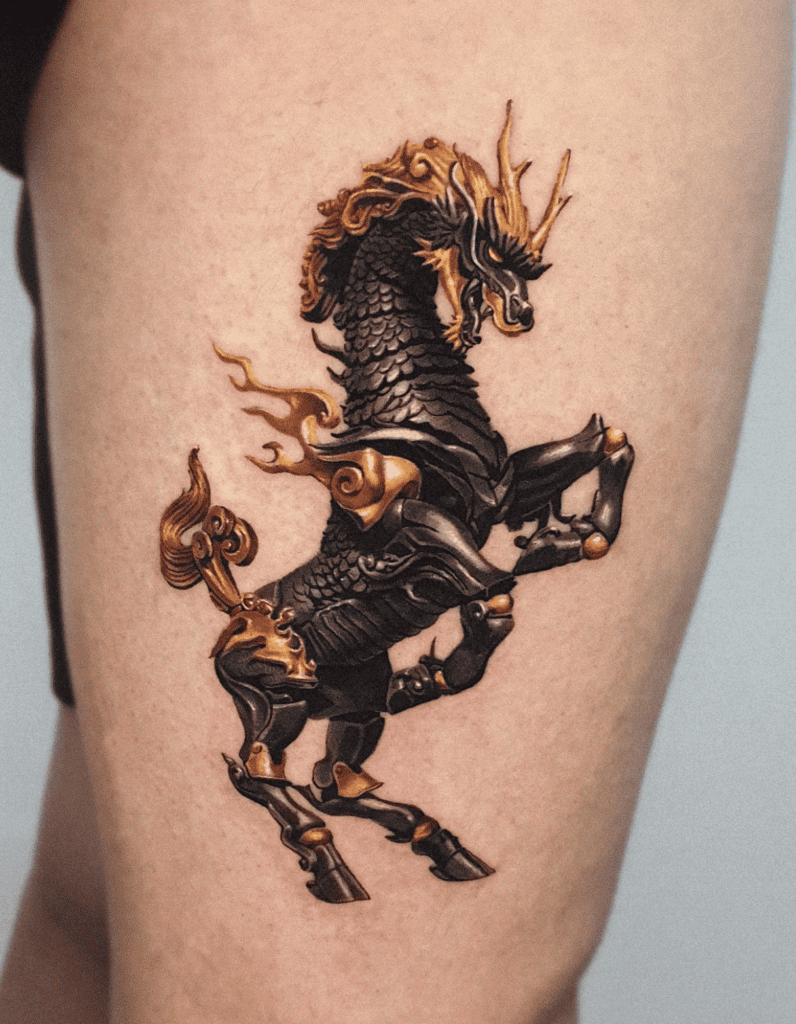
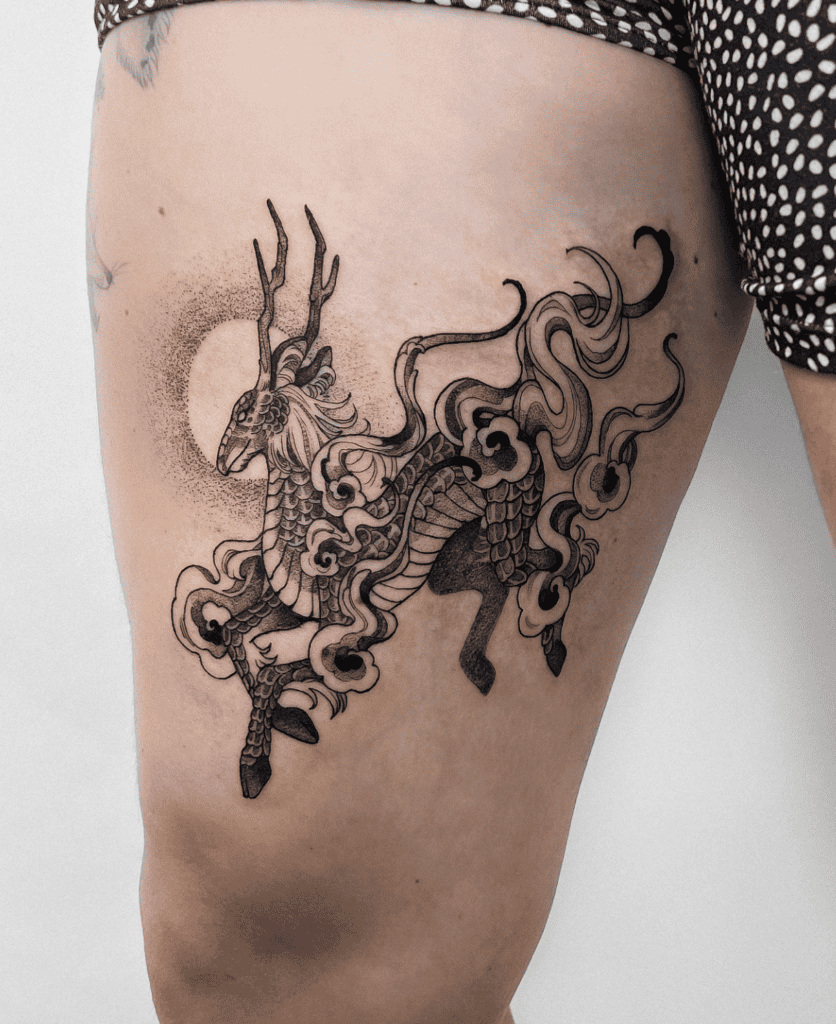
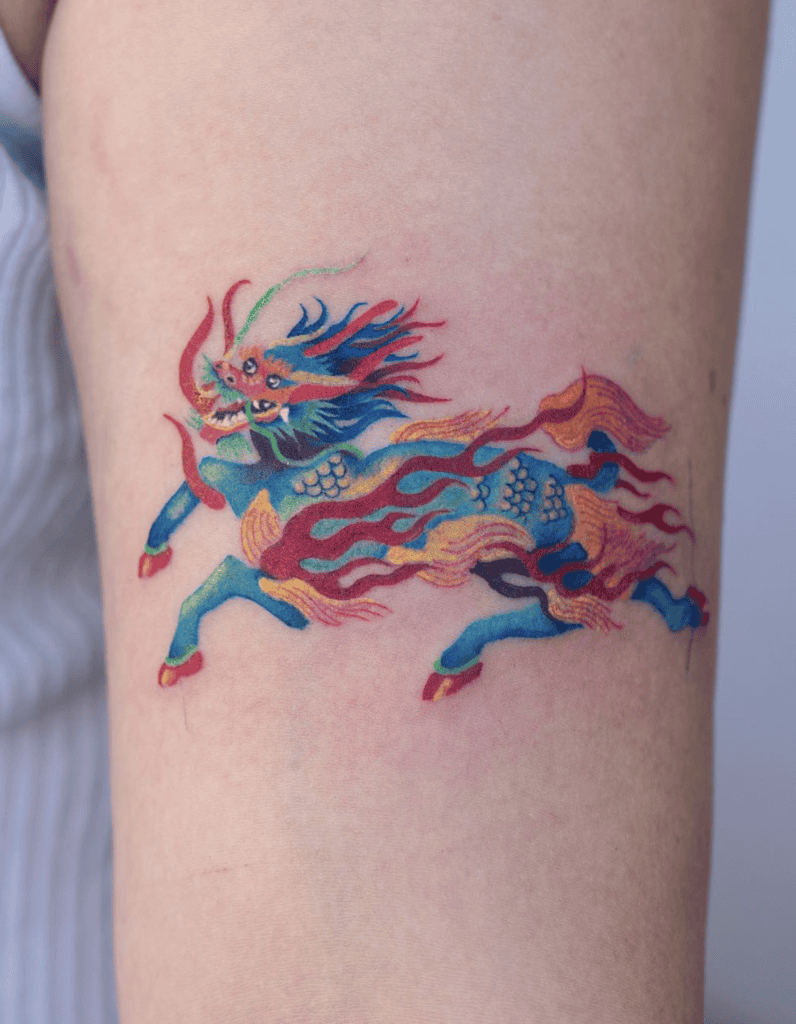
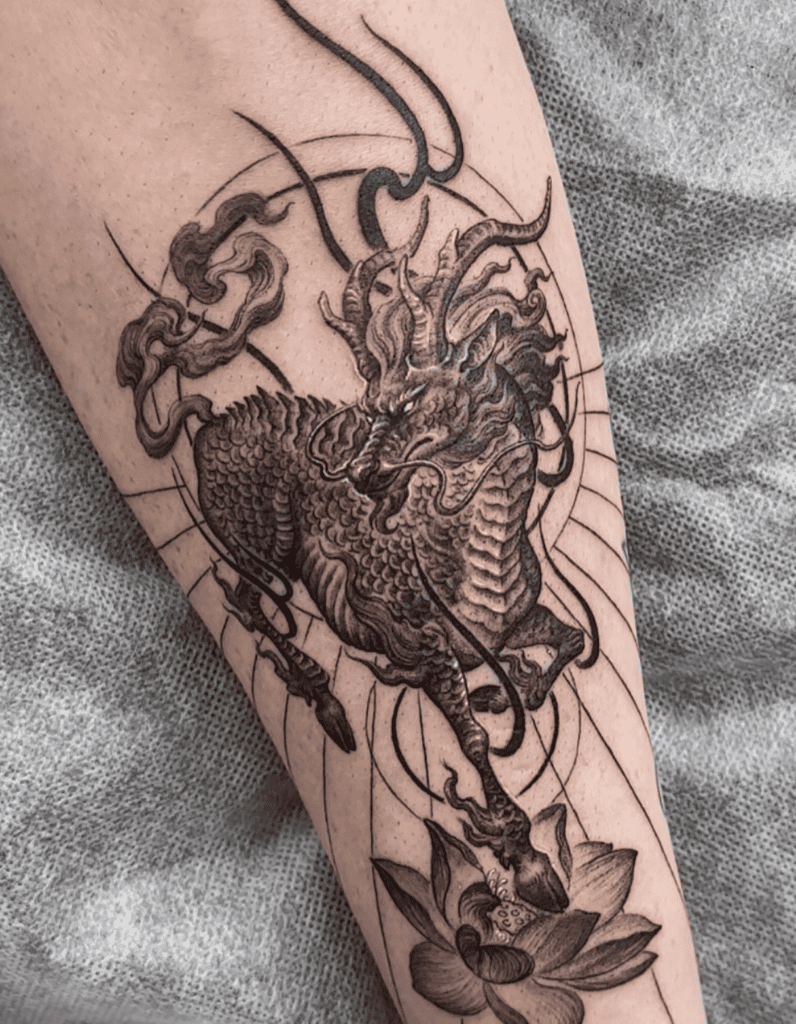
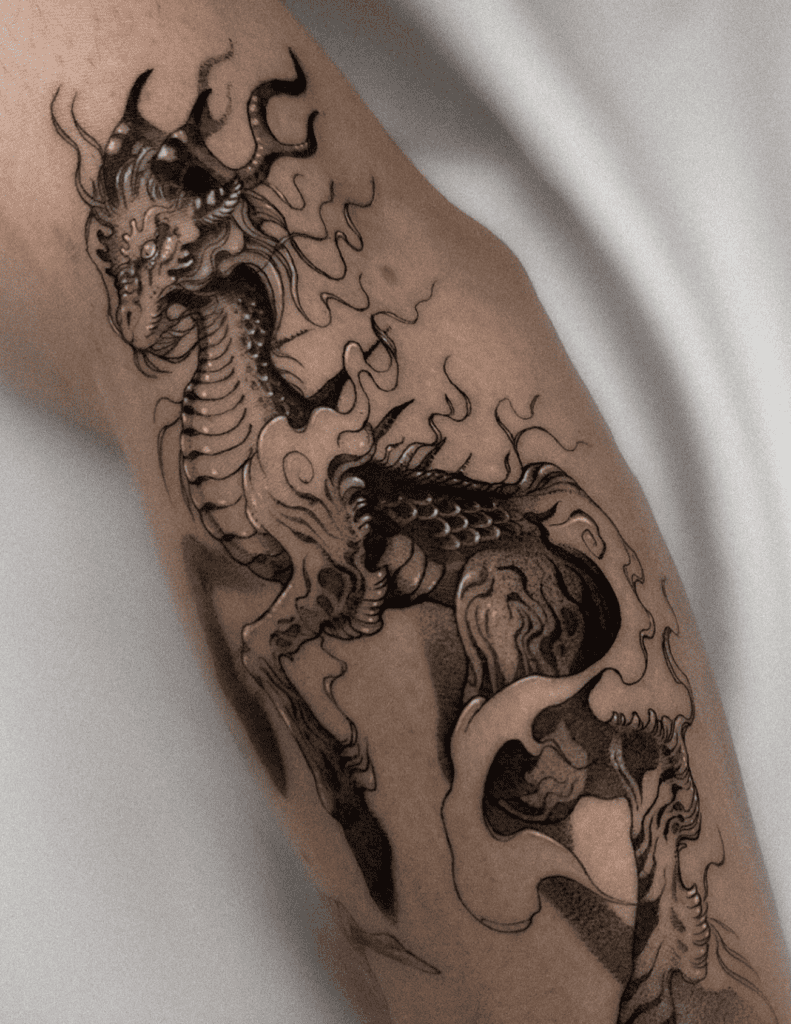
The Qílín (麒麟) is one of the most revered mythical creatures in Chinese mythology. Often described as a gentle, dragon-like unicorn, the Qilin symbolises prosperity, wisdom, justice, and the arrival of great leaders.
The Qilin is known for its extreme gentleness. Legends say it will not step on grass or insects, will not harm any living being, and will only appear during times of peace and righteous rule. Because of this, it became a symbol of virtuous governance.
The Qilin is said to appear at the birth or death of a great sage. In some traditions, a Qilin appeared before the birth of Confucius, signalling the arrival of a wise teacher.
Shíshī Lion Chinese Mythology Tattoo
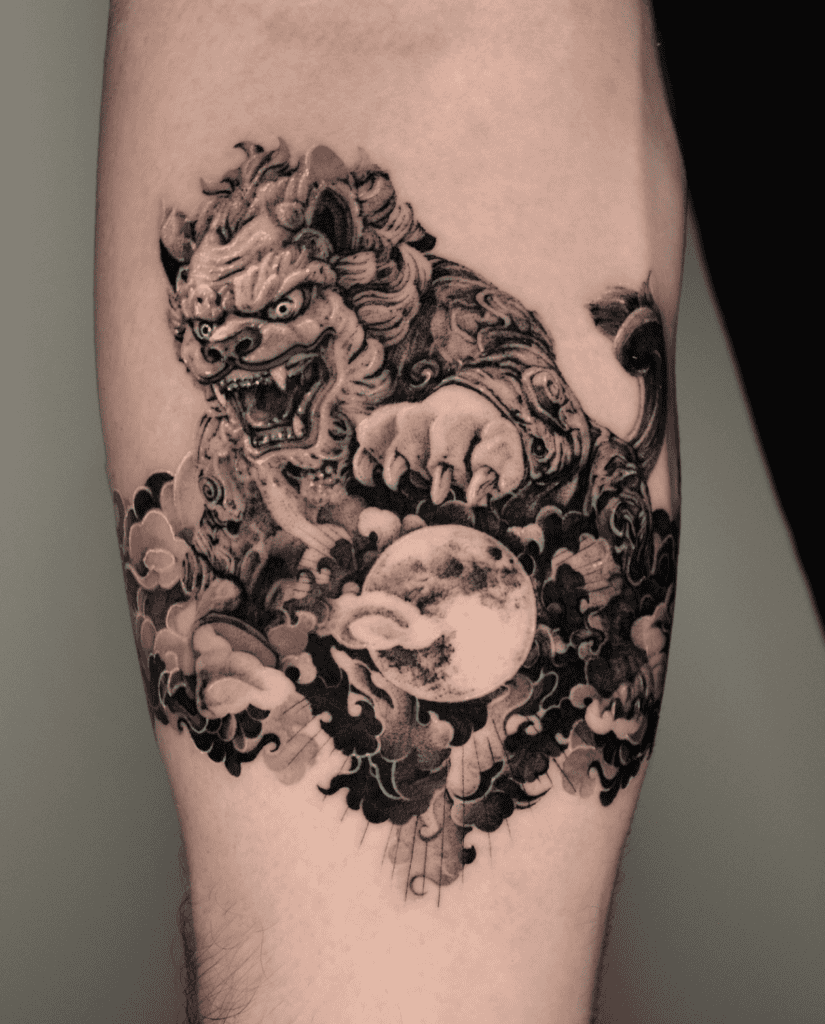
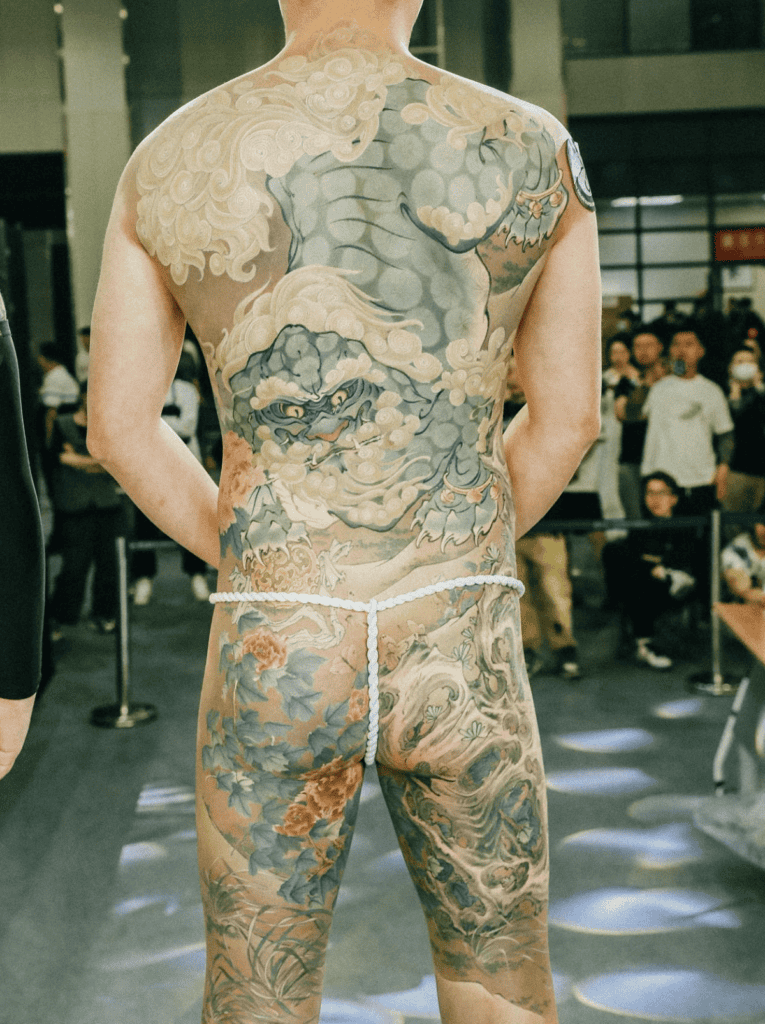
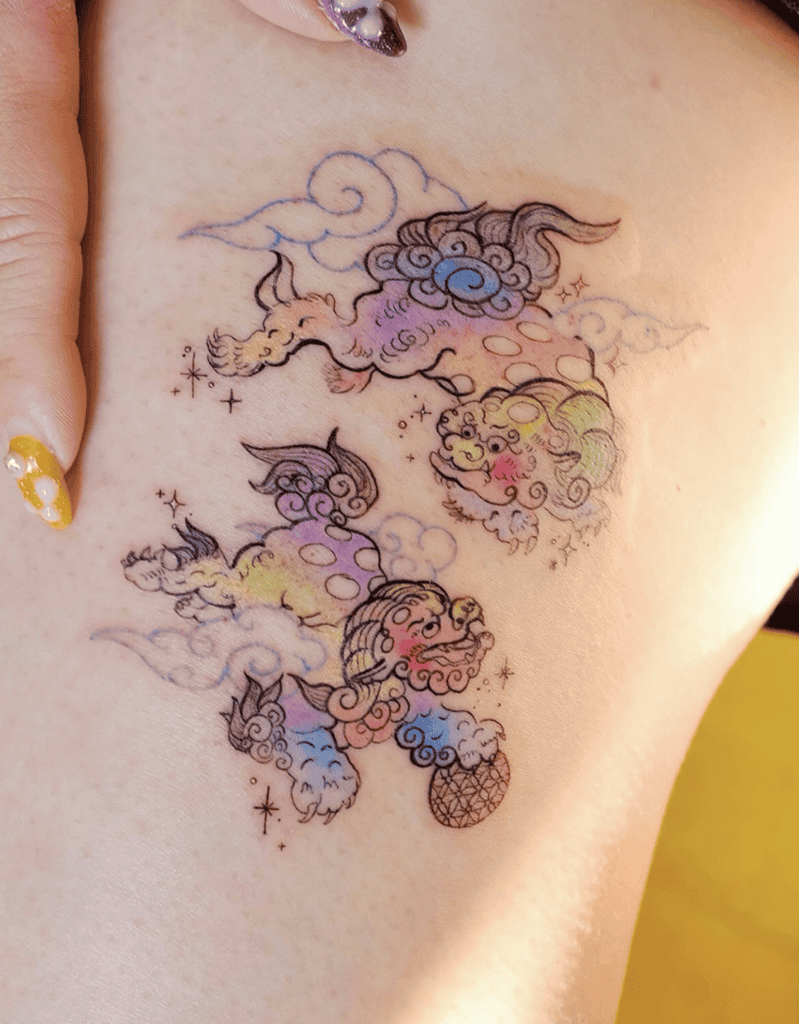
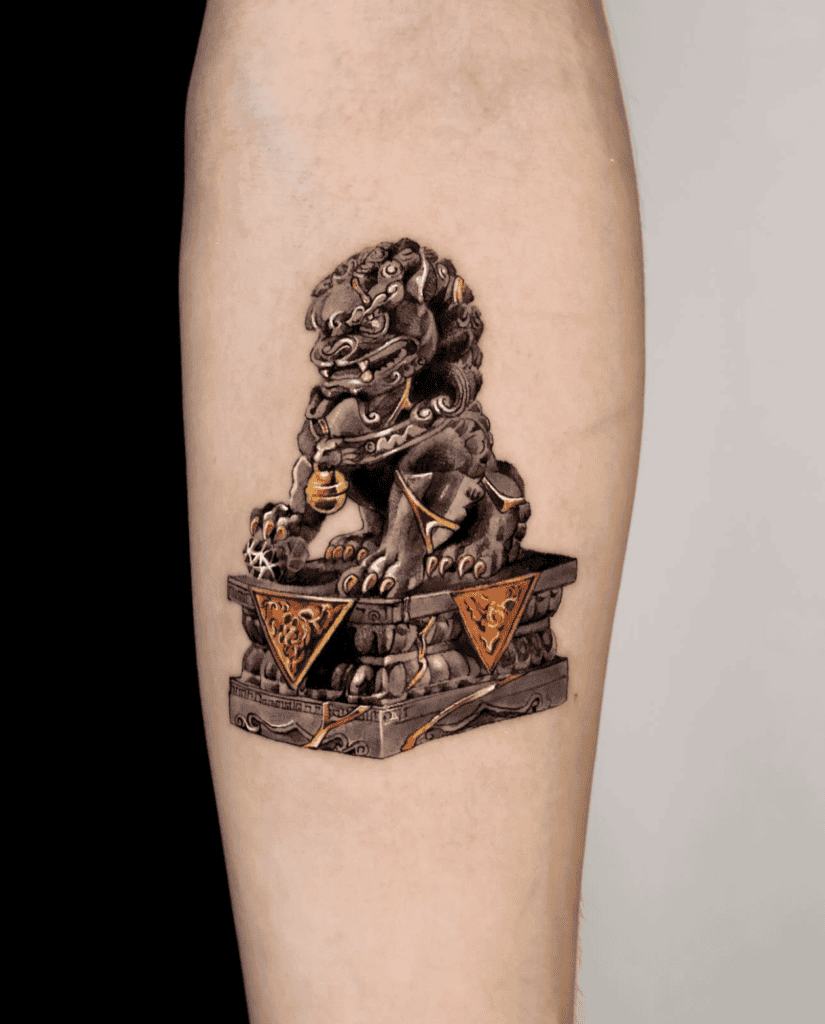
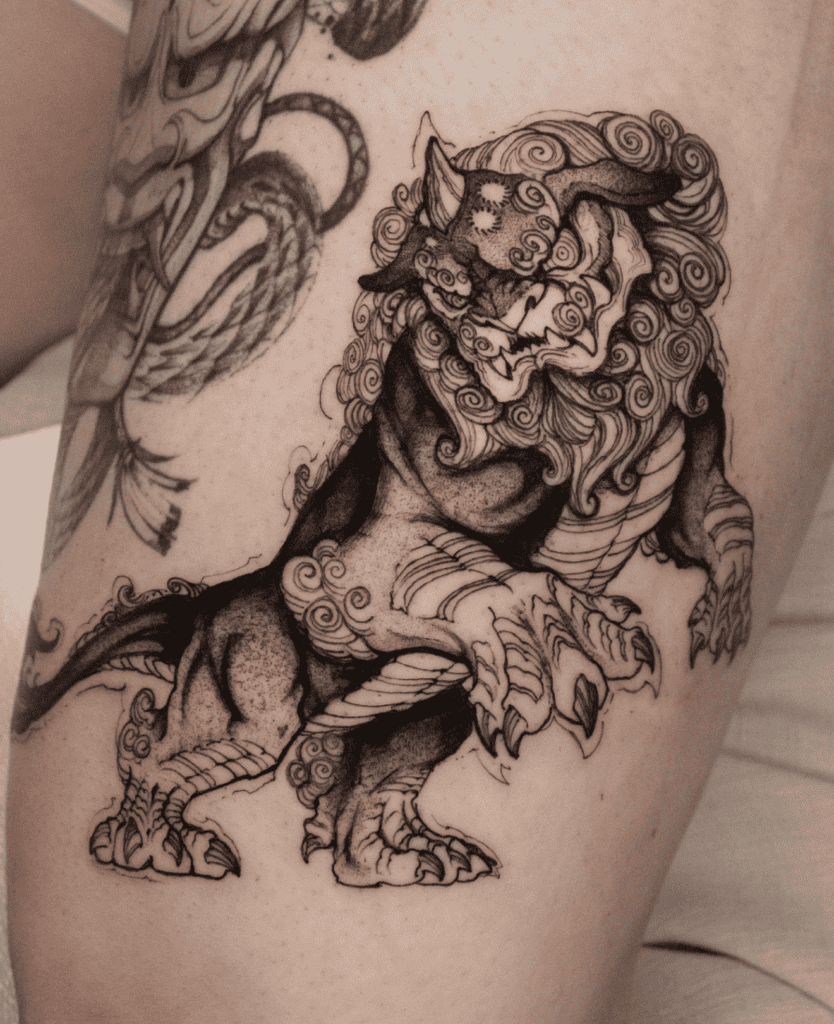
The Shíshī (石狮), often called Chinese guardian lions or sometimes “Foo Dogs” in the West, are powerful protective creatures placed at entrances of temples, palaces, tombs, and important buildings.
Lions are not native to China. The image of the lion entered China through Buddhist influence from India around the Han dynasty. Over time, Chinese artists stylised the lion into a more mythical, exaggerated form. The result was the Shíshī, which became architectural guardians rather than wild beasts.
Shíshī are almost always displayed in male–female pairs. The Male Lion is placed on the right (as you face outward) and holds a decorative ball under his paw, symbolising power, authority, and protection of the structure.
The Female Lion is placed on the left, holding or restraining a playful cub, symbolising nurturing, protection of family, and continuity. Together, they represent balance and harmony — strength and care.
Lion Dance Chinese Mythology Tattoo
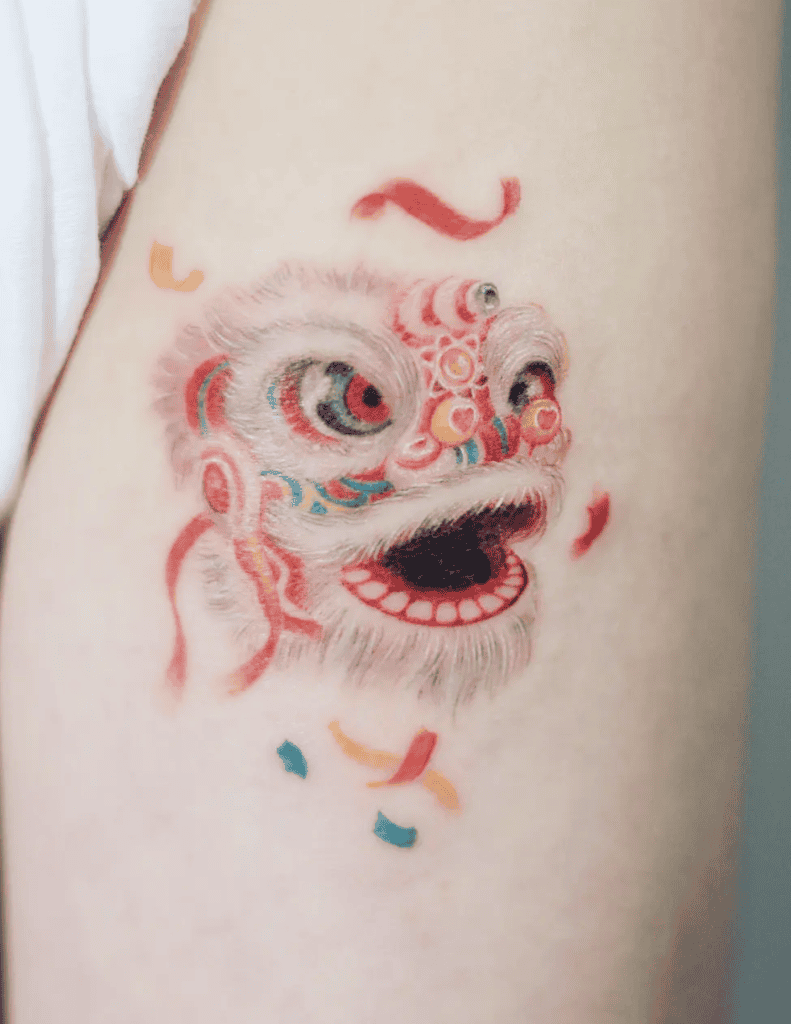
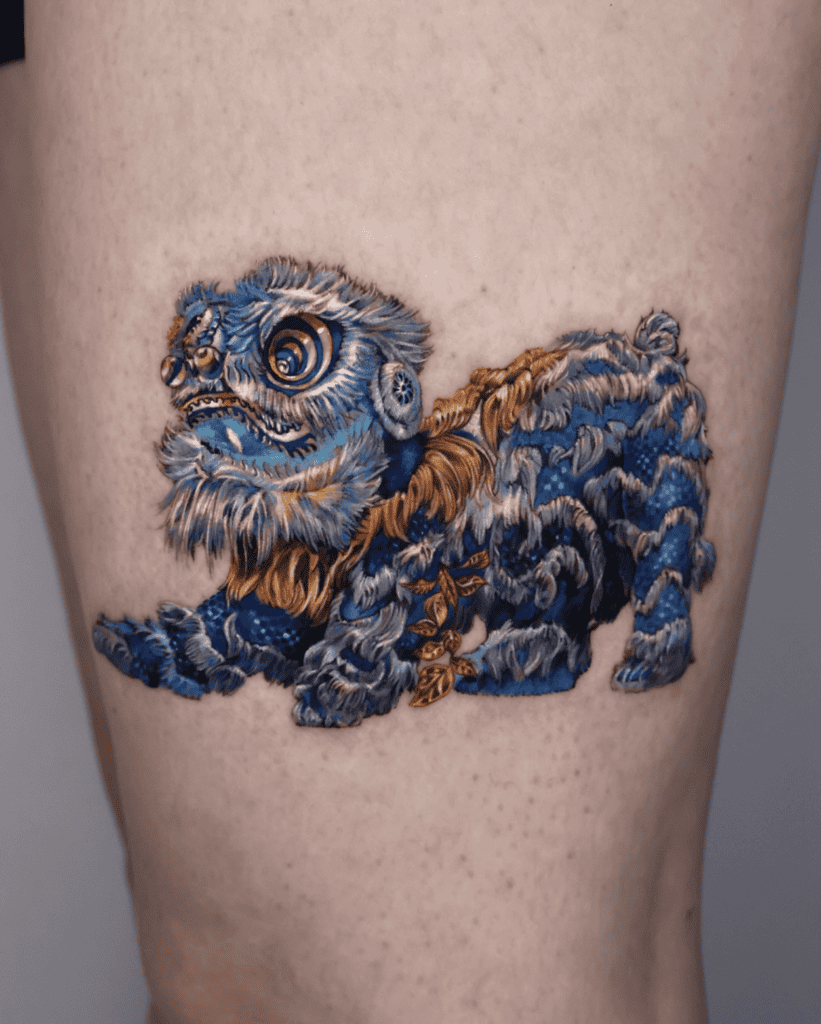
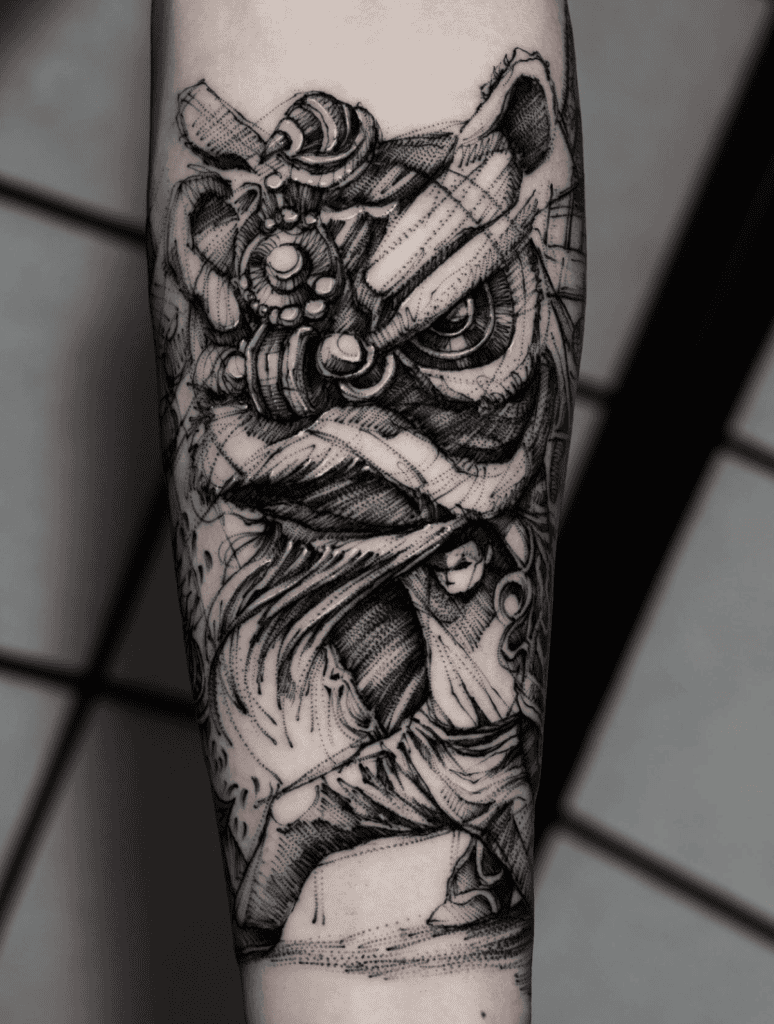
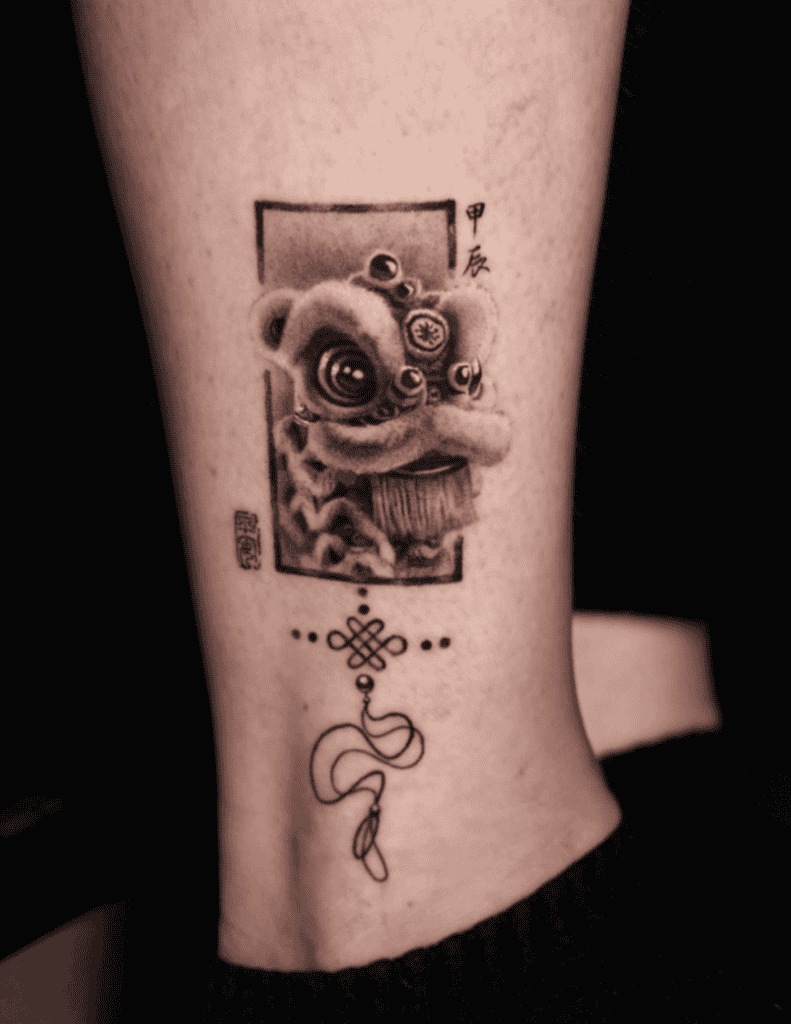
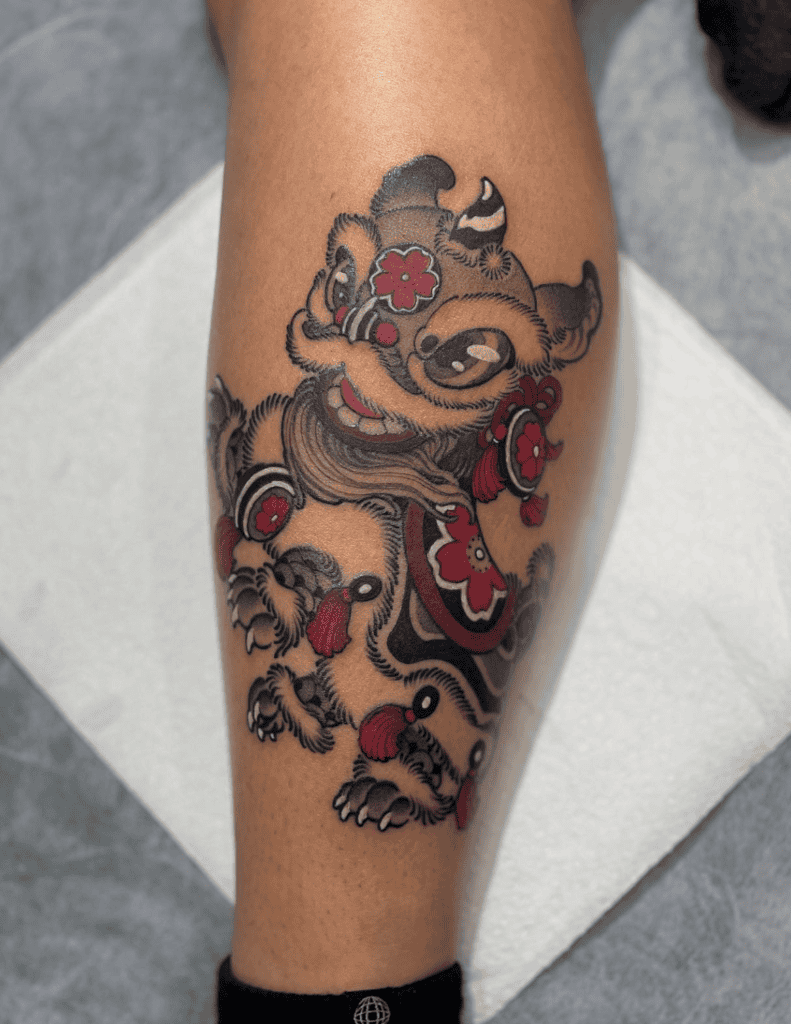
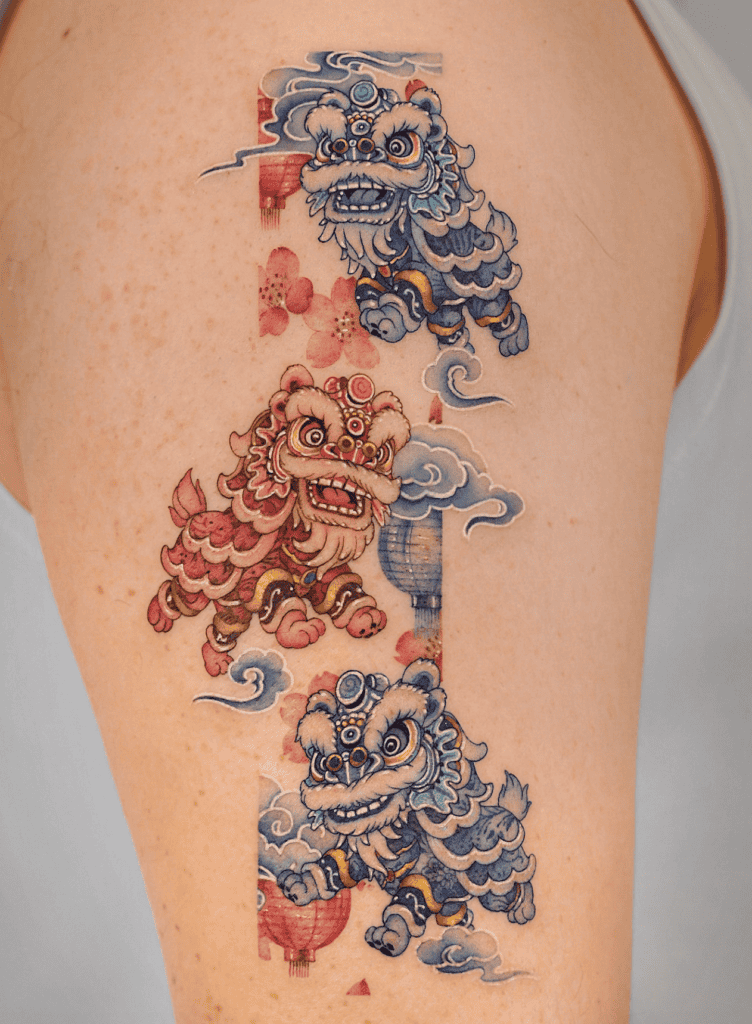
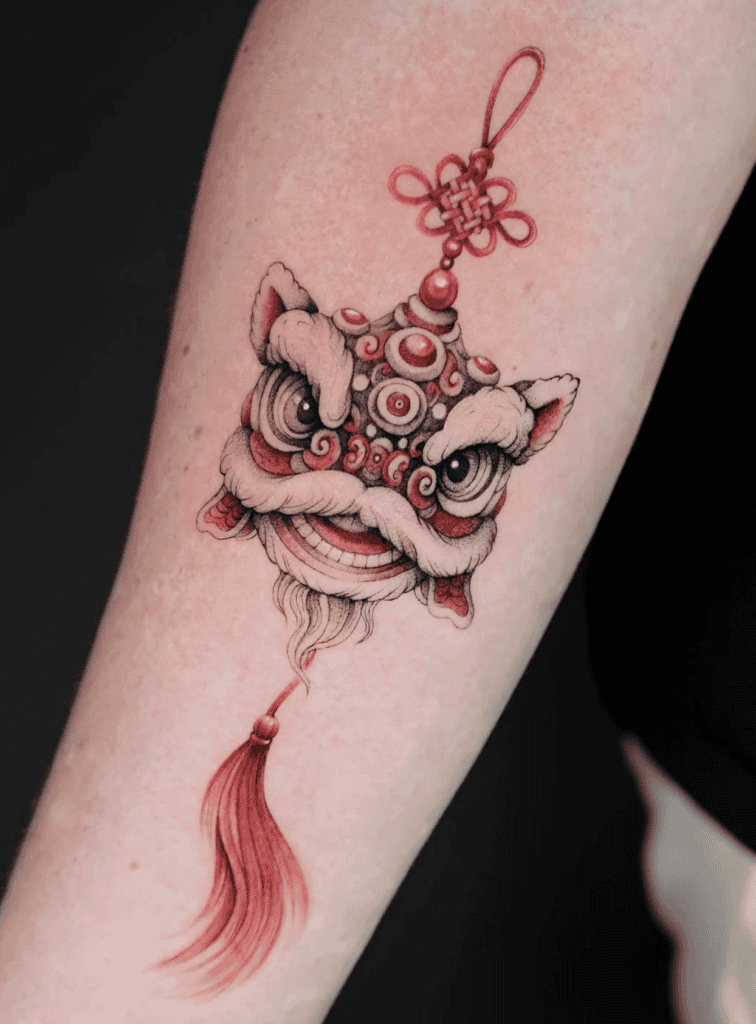
The Lion Dance is a living performance tradition rooted in Chinese folklore and martial arts culture. It symbolises good luck, prosperity, protection, and the driving away of evil spirits.
The Lion Dance likely entered China through Buddhist and Central Asian cultural exchanges during the Han and Tang dynasties. Because lions were exotic animals in ancient China, they became associated with strength, royal authority, and spiritual protection. Over time, the lion became a festive guardian rather than a temple statue.
The Lion Dance is believed to chase away evil spirits, invite prosperity, and bless a new beginning. During business openings, the lion often “eats” lettuce (a ritual called cai qing) and then spits it out, symbolising the spread of wealth.
Qīnglóng Chinese Mythology Tattoo
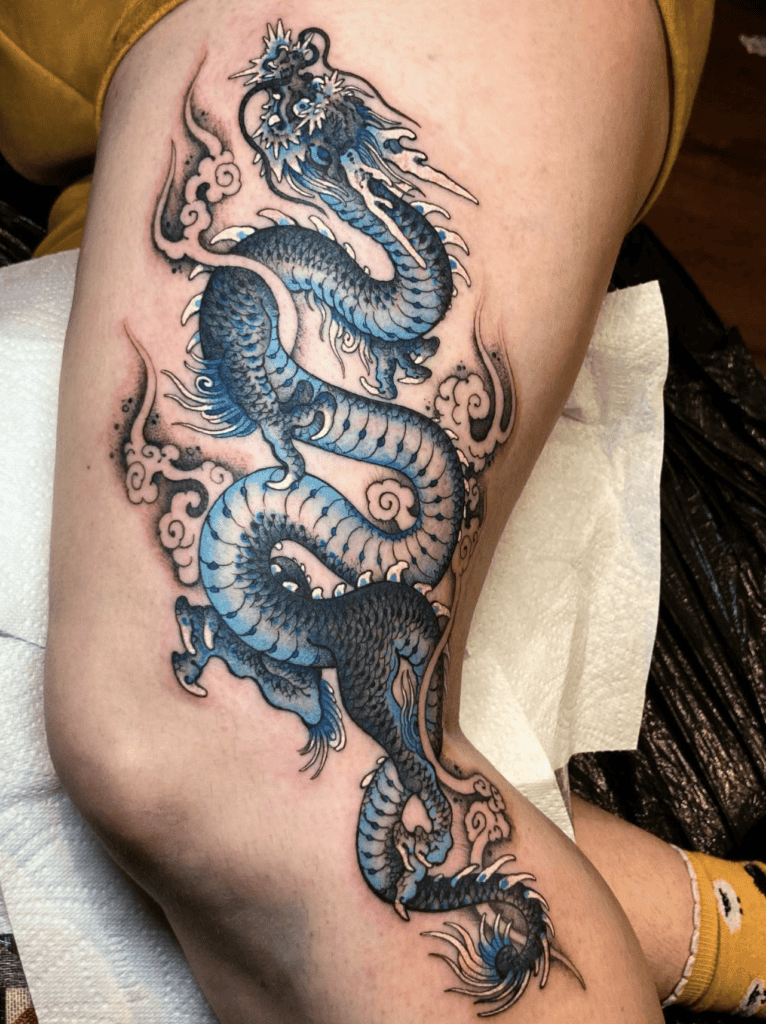
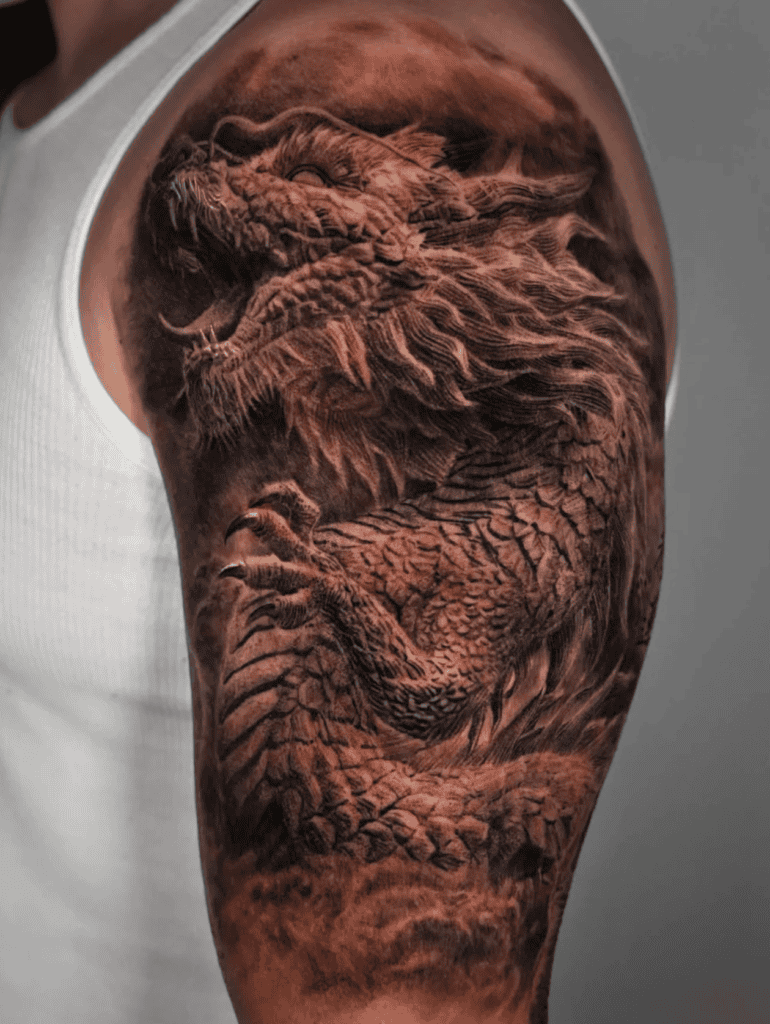
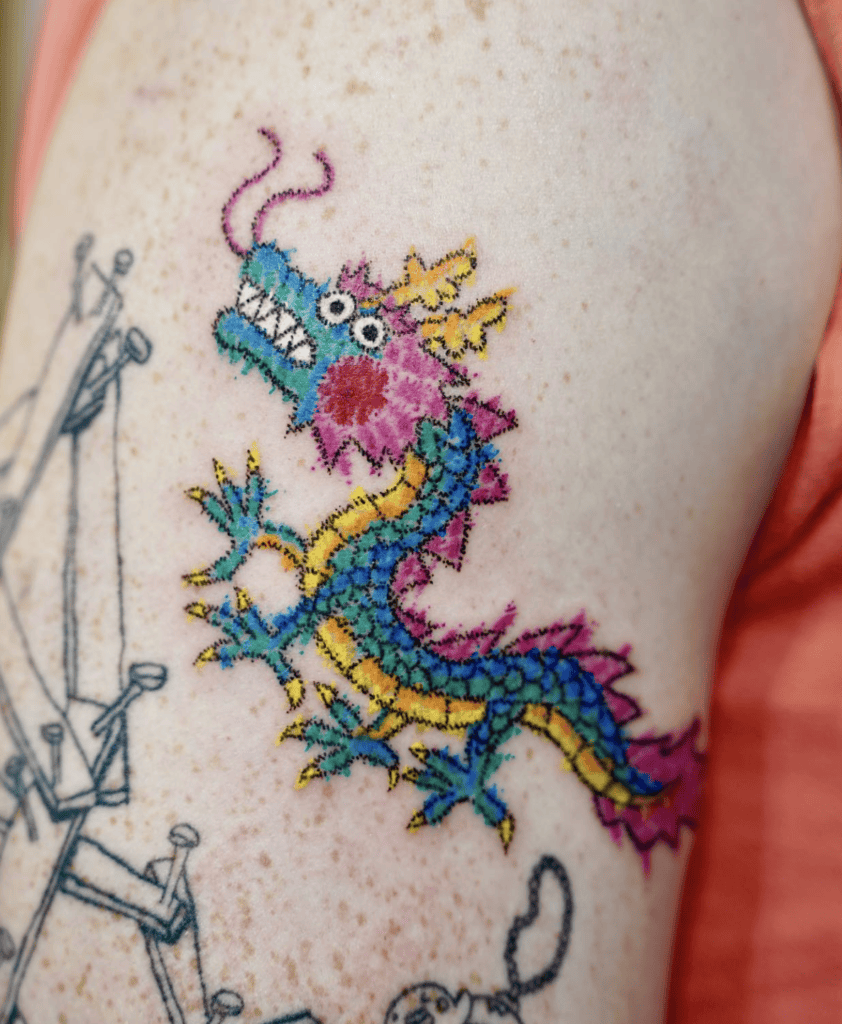
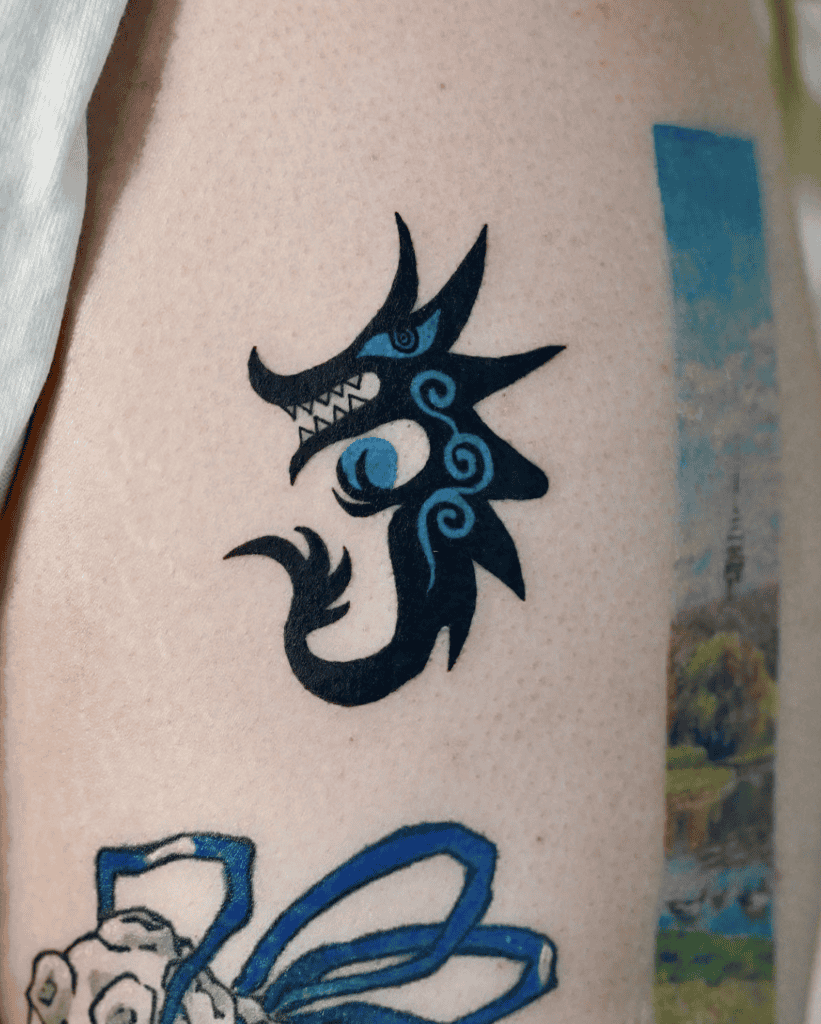
Qīnglóng / 青龙), also known as the Azure or Blue-Green Dragon, is one of the Four Symbols in Chinese cosmology representing the East, the season of spring, and the element of wood.
The Azure Dragon corresponds to seven lunar mansions (constellations) in traditional Chinese astronomy. Ancient Chinese scholars mapped the night sky into four celestial quadrants, each ruled by one symbolic guardian. The Azure Dragon’s stars appear in the eastern sky during spring.
Báihǔ Chinese Mythology Tattoo
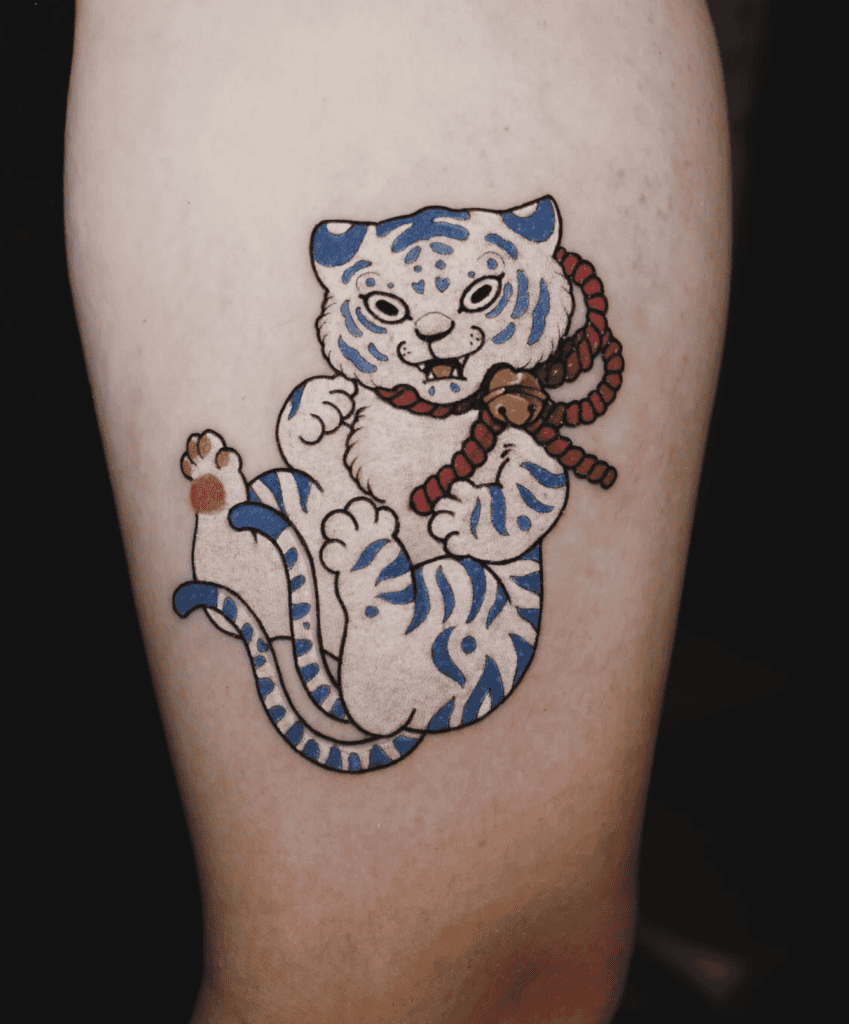
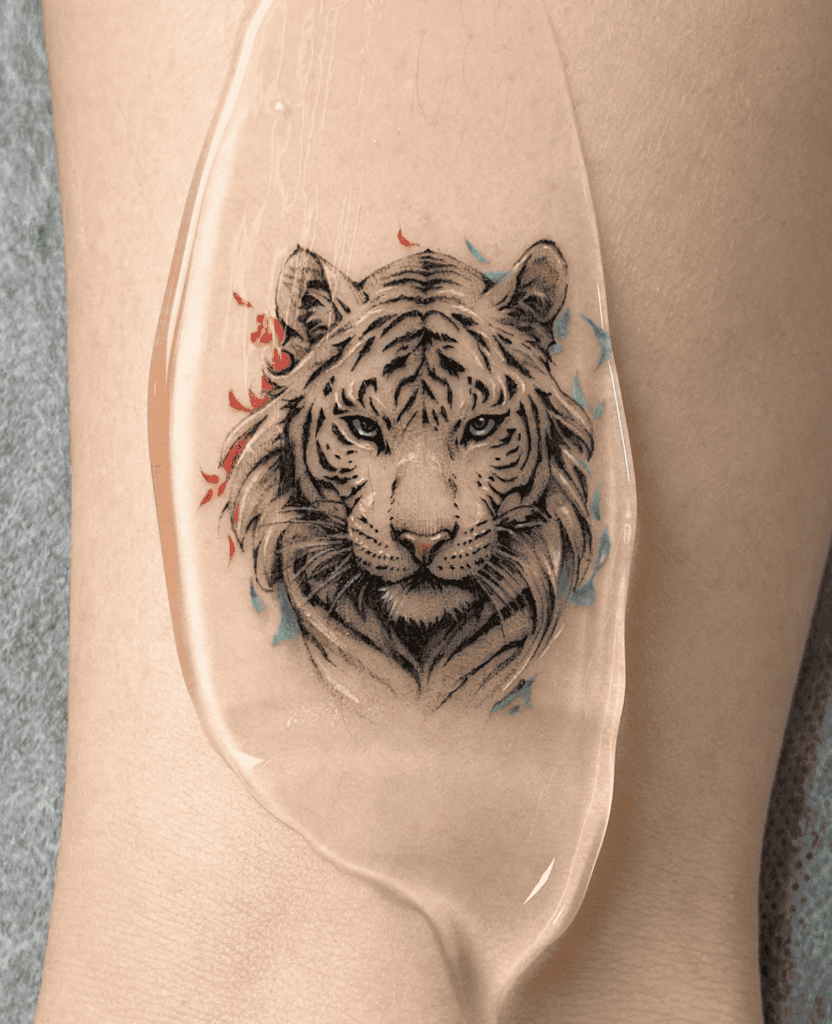
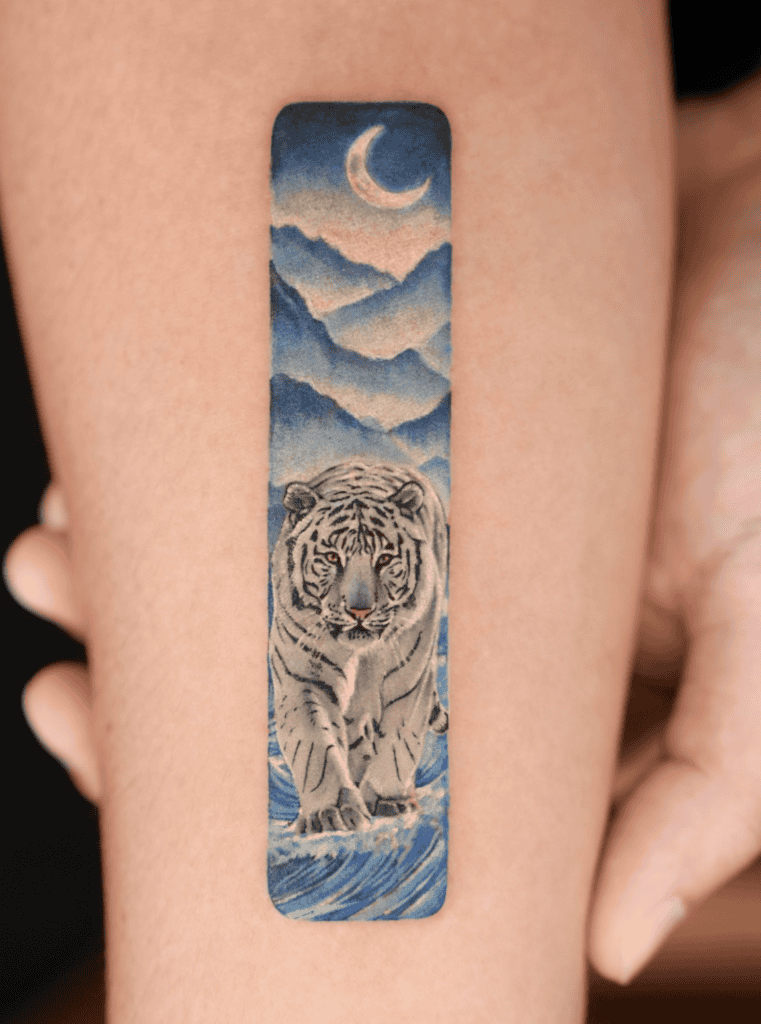
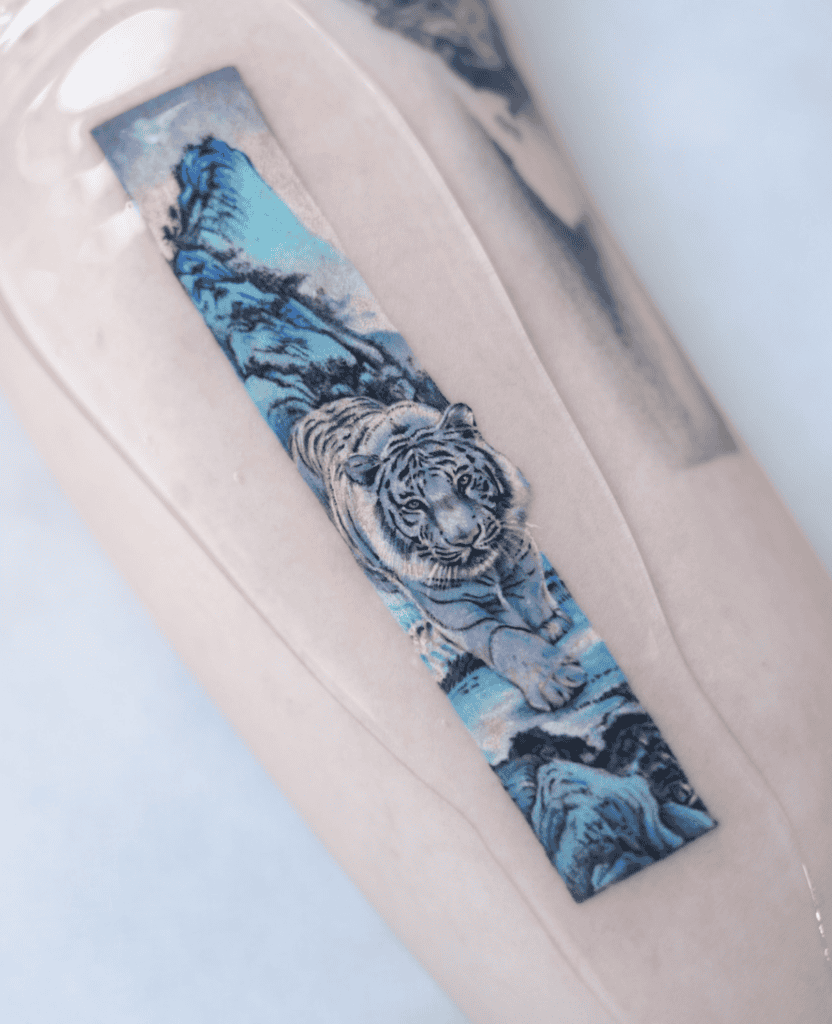
The Báihǔ / 白虎 is one of the Four Symbols of Chinese cosmology. Known as White Tiger, it represents the West, the autumn season, and the metal element. Fierce, noble, and disciplined, the White Tiger is a celestial guardian rather than a wild beast.
The White Tiger is one of the Four Symbols (Sì Xiàng) and represents the West, and is said to appear only when a virtuous ruler governs, peace prevails, and the world is in balance.
Zhuque Chinese Mythology Tattoo


Zhuque (朱雀), known as the Vermilion Bird, is one of the Four Symbols in Chinese cosmology representing the South, the season of summer, and the element of fire.
Zhuque is usually depicted as a large, elegant red bird, surrounded by flames with sweeping, feathered wings. Like the other Four Symbols, Zhuque corresponds to specific constellations in traditional Chinese astronomy.
The “Vermilion Bird of the South” spans seven lunar mansions in the southern sky. Ancient Chinese scholars used these star patterns for navigation, calendar systems, agricultural timing, and cosmic symbolism.
Xanwu Chinese Mythology Tattoo
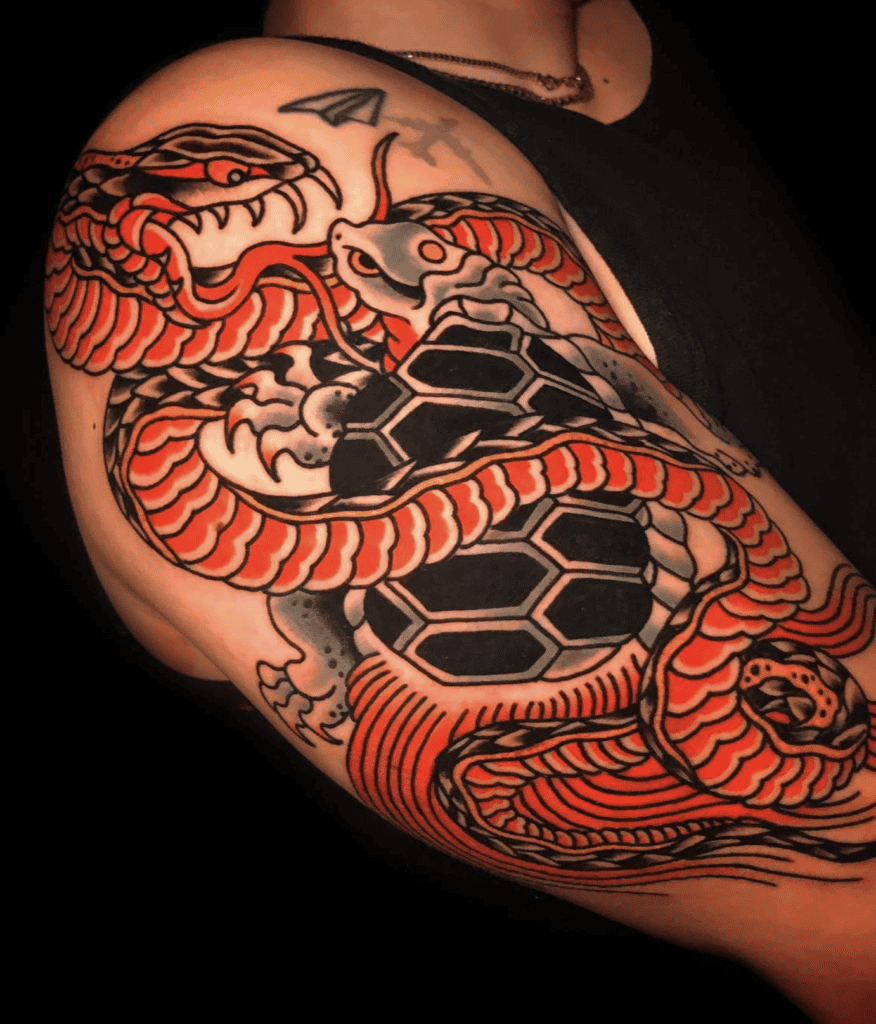
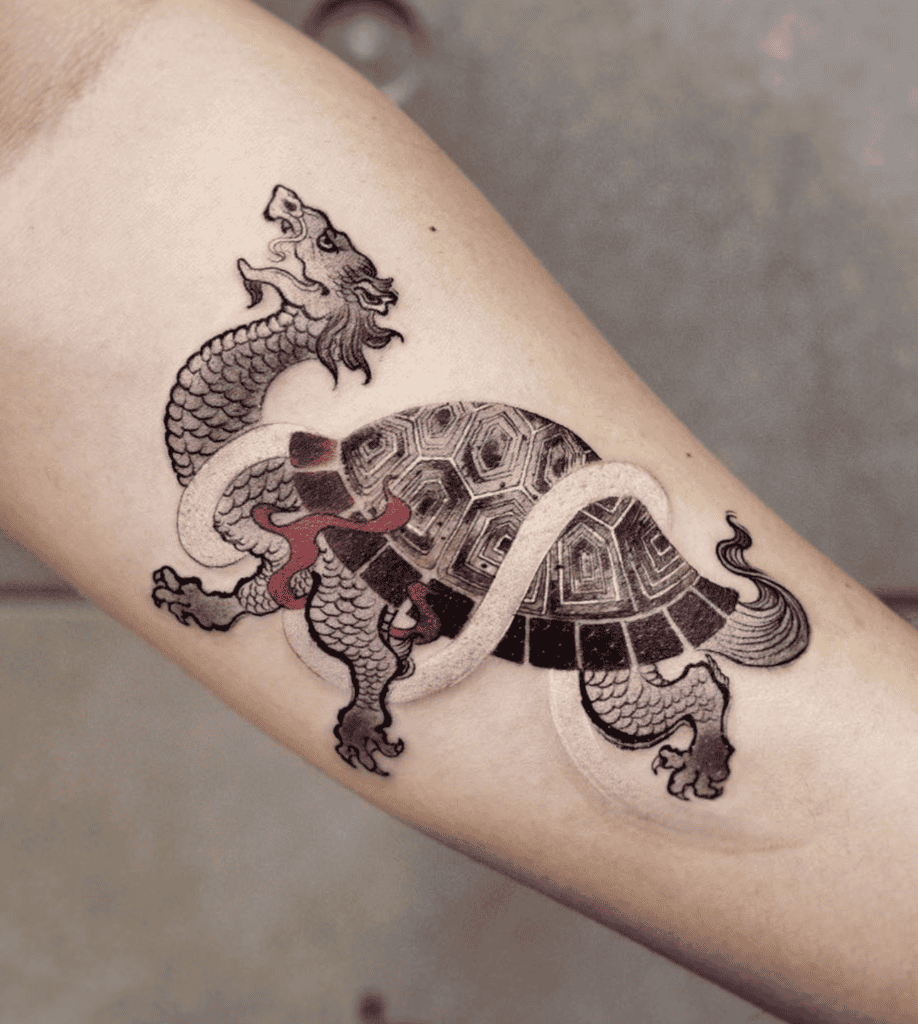
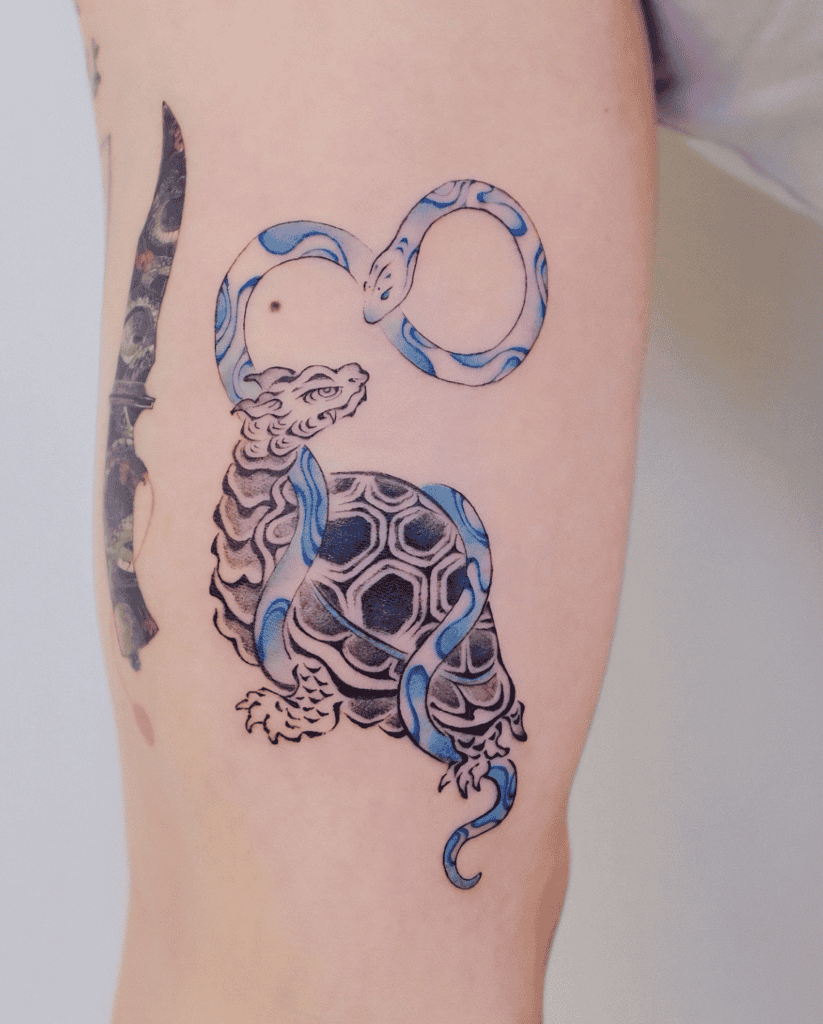
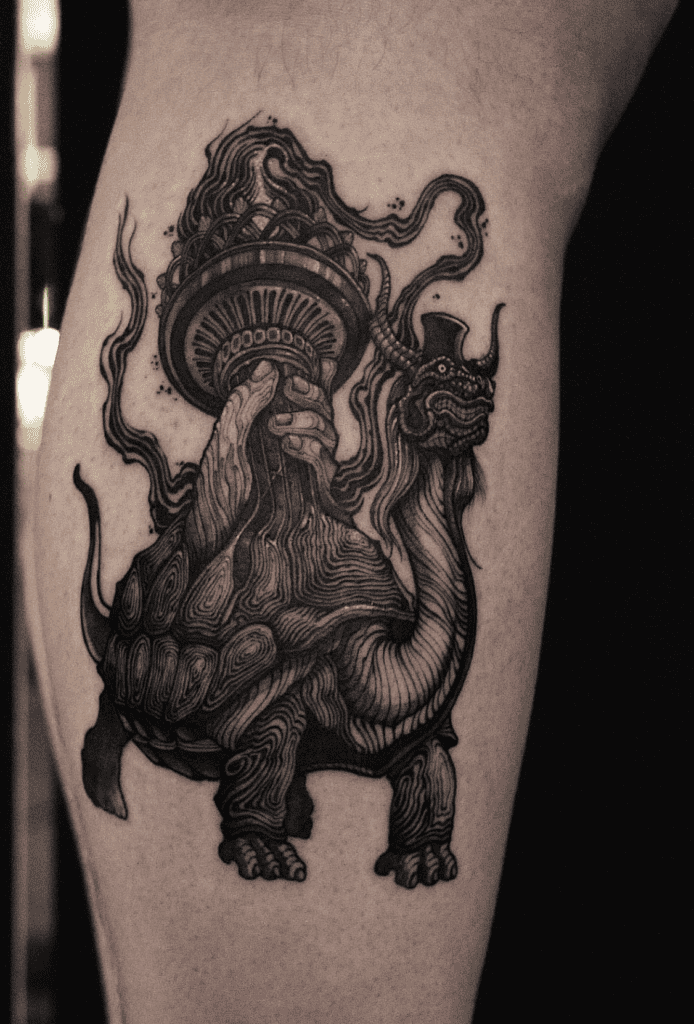
Xuanwu (玄武), often translated as the Black Tortoise, is one of the Four Symbols of Chinese cosmology. It represents the North, the season of winter, and the element of water.
Unlike the fiery Zhuque or the fierce White Tiger, Xuanwu embodies endurance, protection, and deep spiritual power. Xuanwu is usually depicted as a tortoise with a snake coiled around it.
The pairing symbolises longevity (tortoise) and transformation and renewal (snake shedding its skin). Together, they represent resilience through change.
Fenghuang Chinese Mythology Tattoo
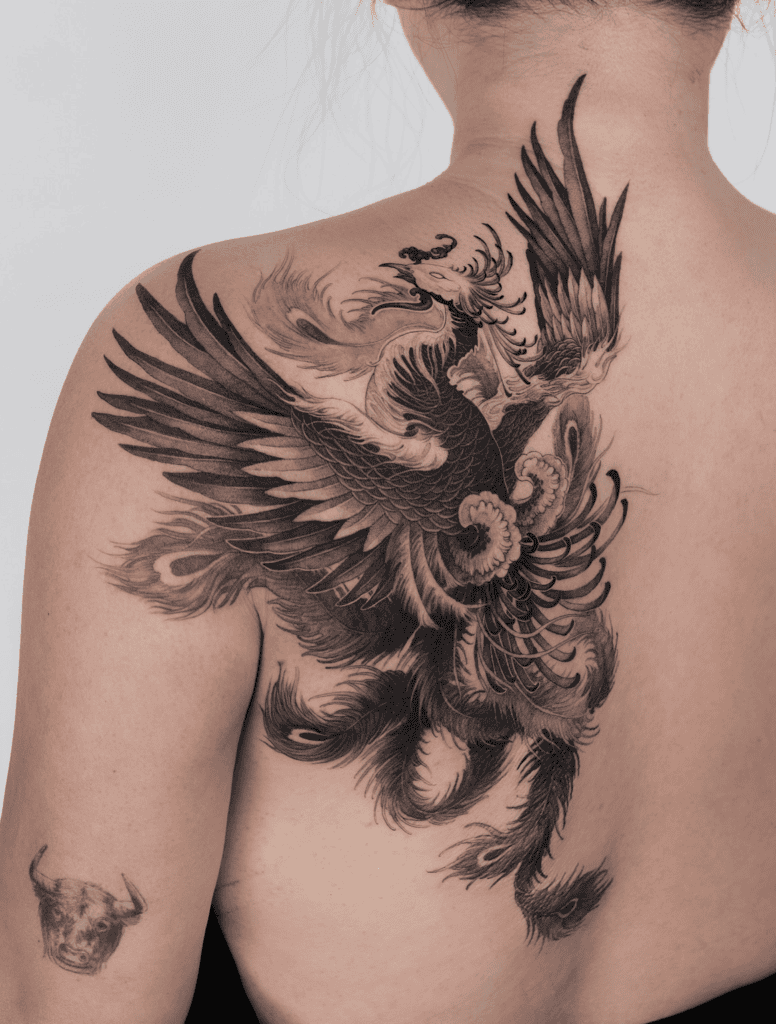
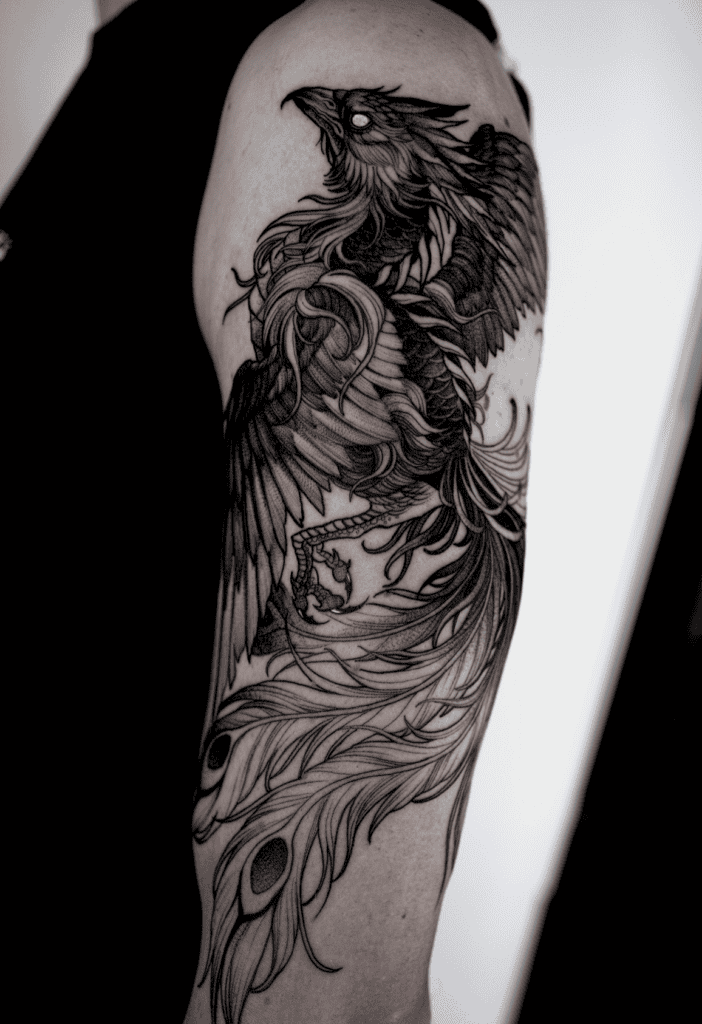
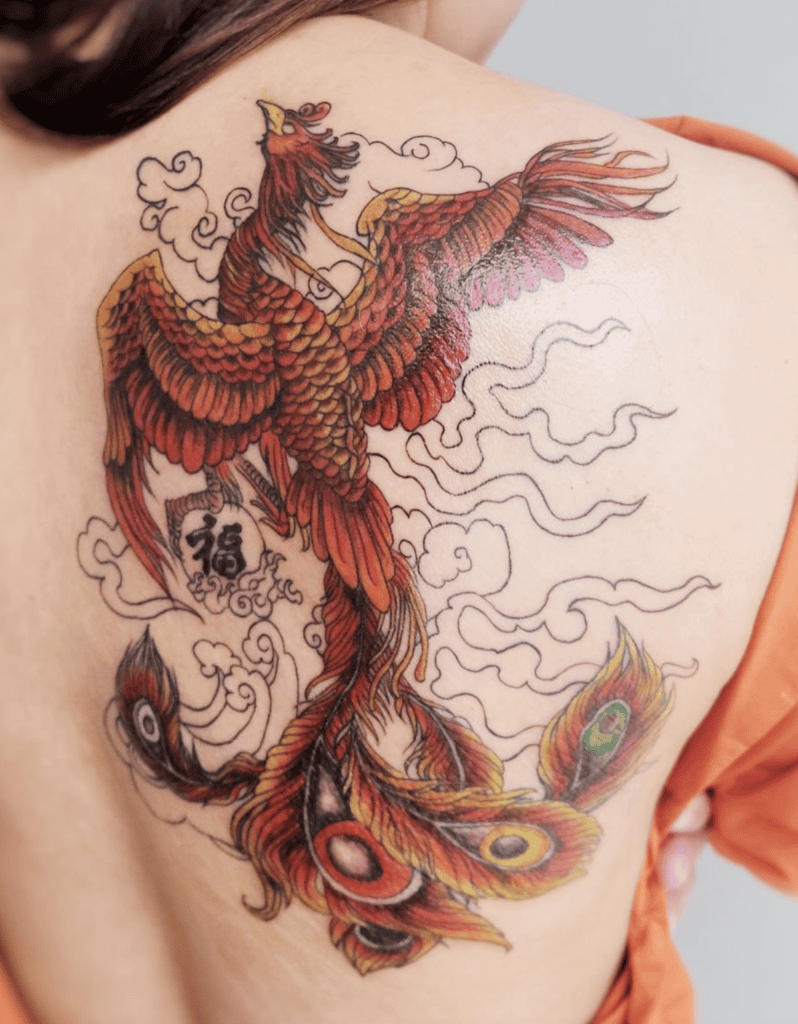
The Fenghuang (凤凰) is a majestic symbol of virtue, harmony, grace, and imperial balance in Chinese mythology. It is a composite bird with features from multiple animals reflecting unity and cosmic balance, whose feathers are often said to contain the five fundamental colours, symbolising the Five Elements (Wood, Fire, Earth, Metal, Water).
In imperial symbolism, the Dragon represented the Emperor, and the Fenghuang represented the Empress. Together, dragon and phoenix symbolised yin and yang, masculine and feminine harmony.
Jiangshi Chinese Mythology Tattoo
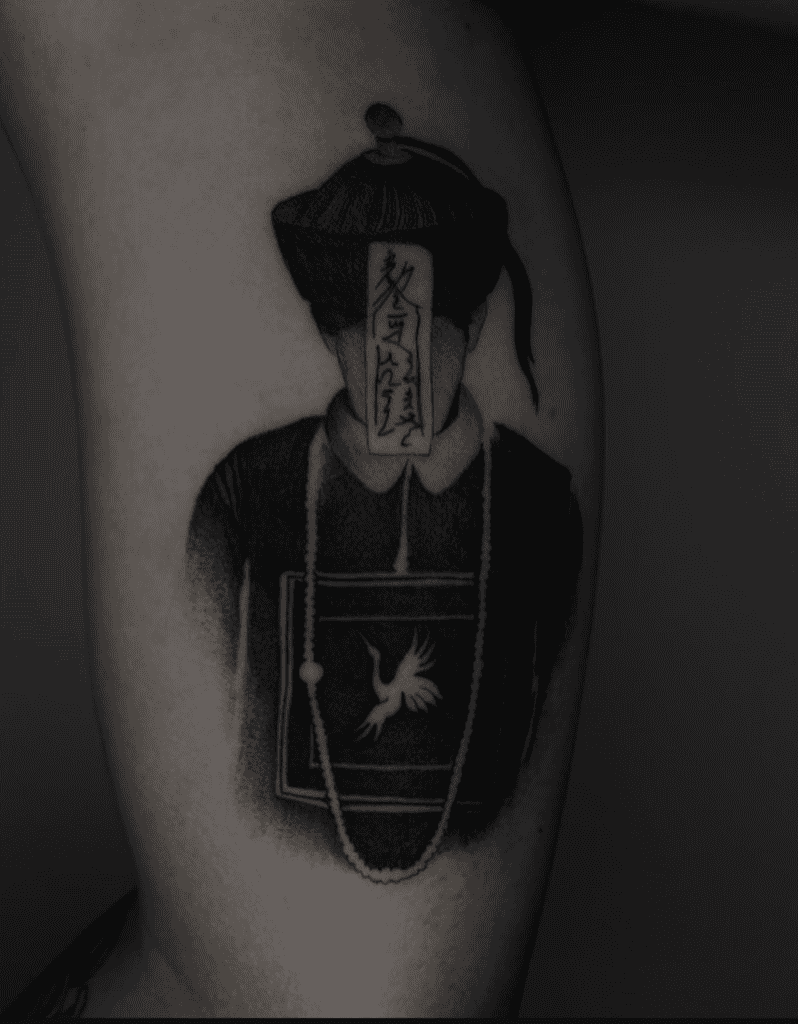
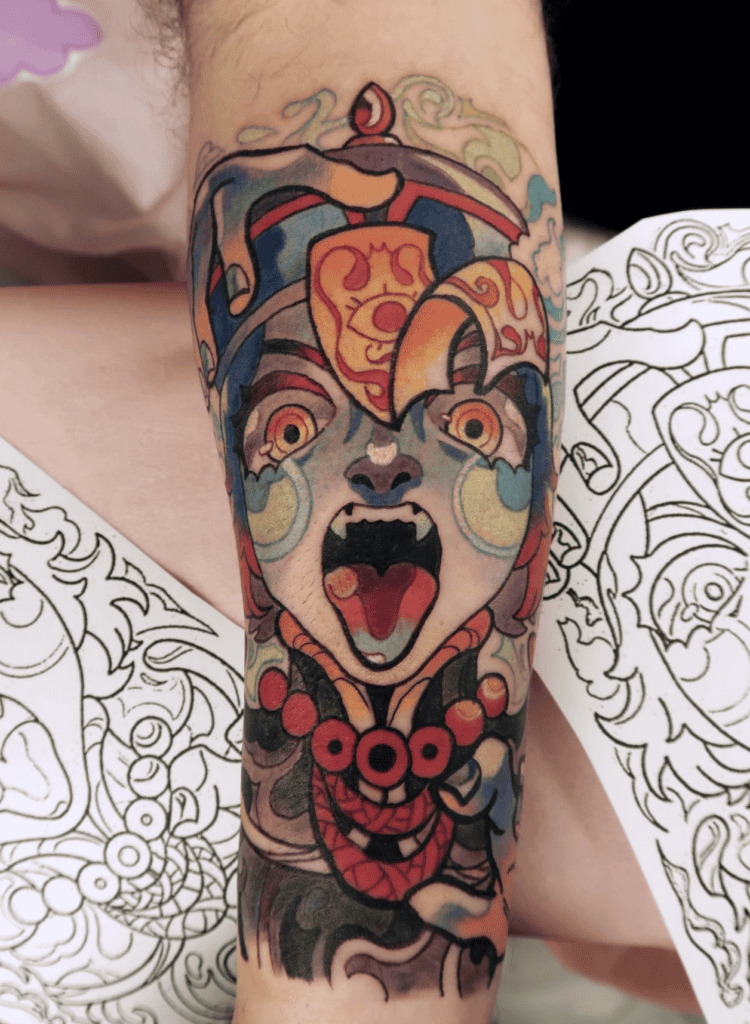
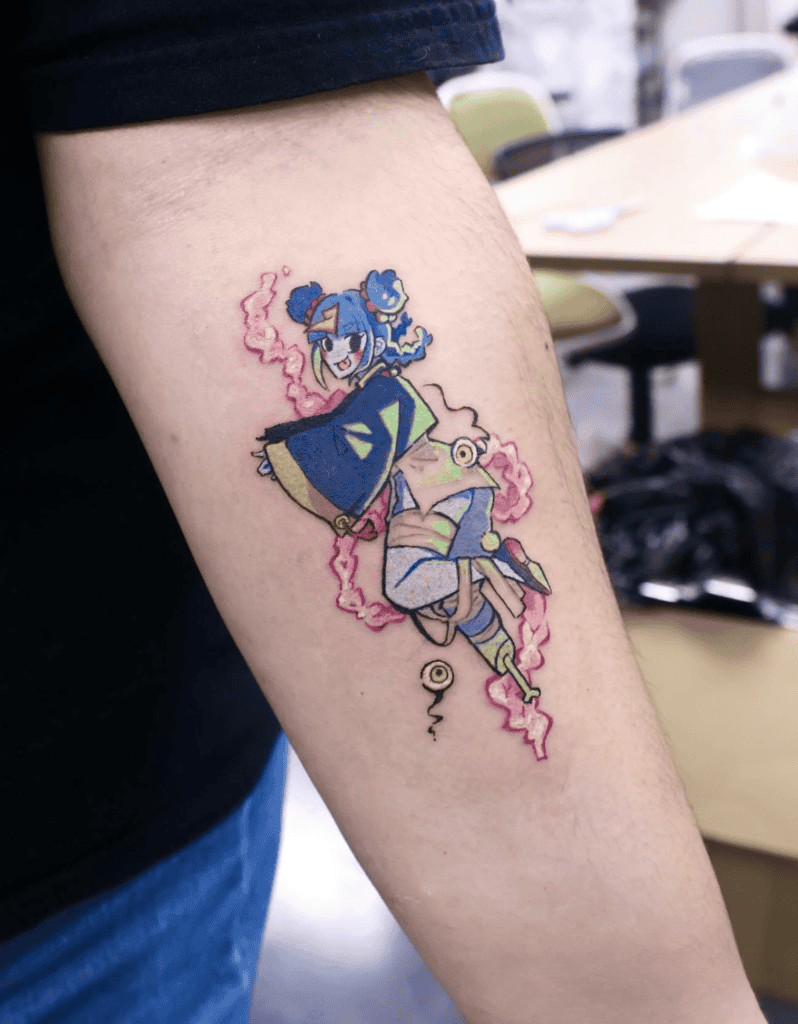
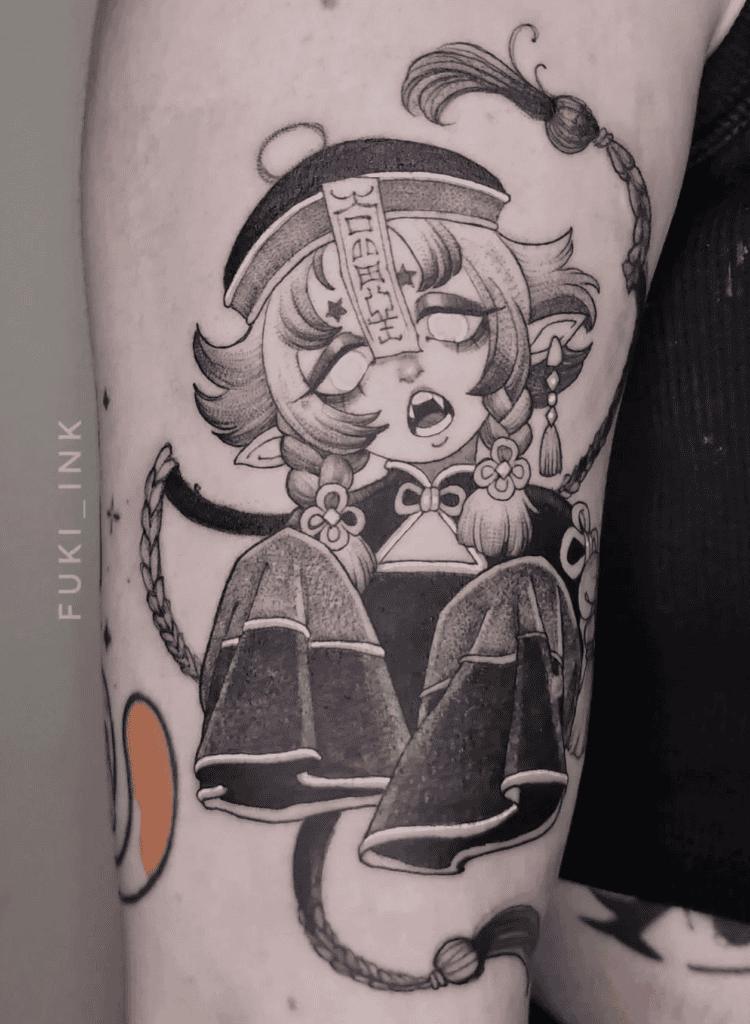
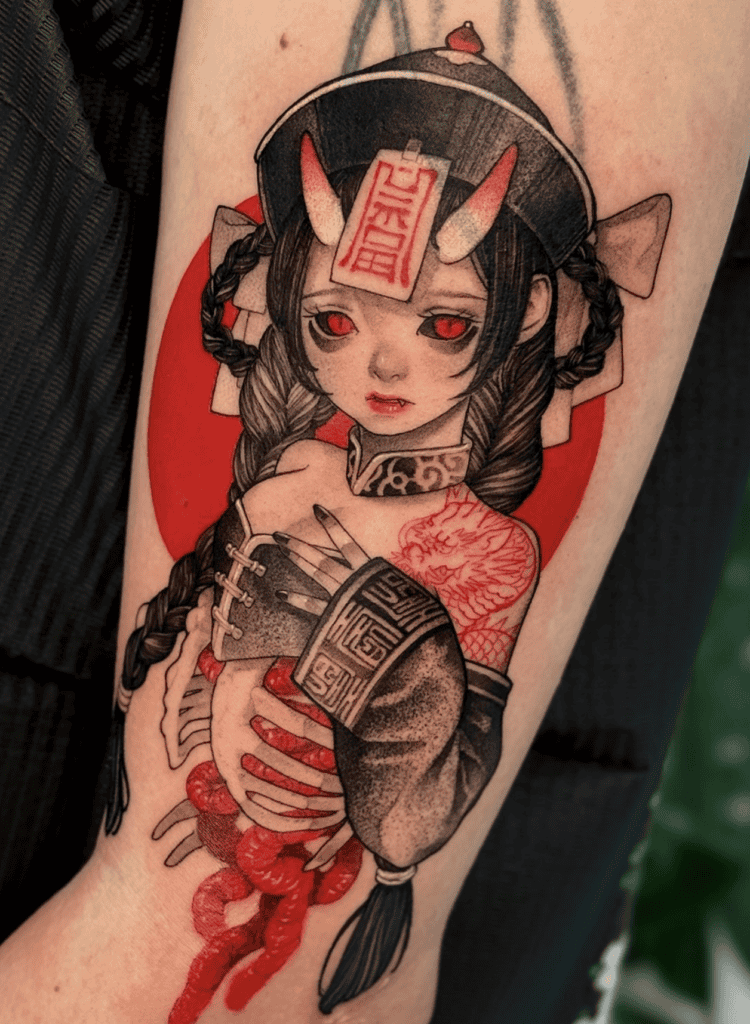
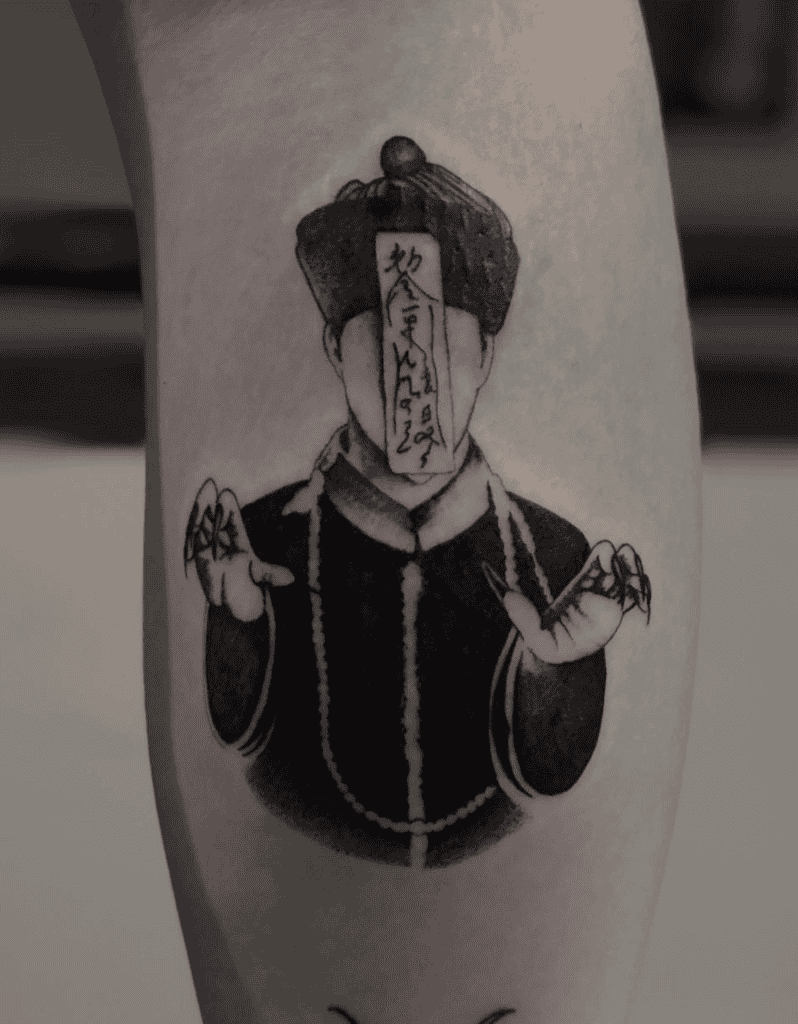
The Jiangshi (僵尸) is one of the most famous creatures in Chinese folklore. Often translated as “hopping vampire” or “stiff corpse,” the jiangshi is a reanimated body that moves by hopping with outstretched arms and drains the life energy (qi) from the living.
The word jiangshi literally means “stiff corpse.” In legend, a jiangshi forms when a person dies violently or unjustly, a corpse is not properly buried, or a spirit cannot leave the body making dark energy to accumulate.
Qiongqi Chinese Mythology Tattoo


Qiongqi (穷奇) is a terrifying creature from ancient Chinese mythology, first recorded in the Shan Hai Jing (Classic of Mountains and Seas). It is one of the legendary Four Perils, monstrous beings symbolising moral corruption and chaos.
In some traditions, Qiongqi devours the righteous, protects the wicked, rewards criminals, and punishes the innocent.
Taotie Chinese Mythology Tattoo


Taotie (饕餮) is one of the most mysterious and visually striking creatures in Chinese mythology. Known as a symbol of gluttony and insatiable greed, Taotie is also one of the legendary Four Perils.
Taotie is most commonly seen on Shang and Zhou dynasty ritual bronze vessels. These vessels were used in ancestral sacrifices, royal ceremonies, and ritual offerings. Scholars debate whether Taotie was originally a mythological creature or simply a symbolic design, but later folklore transformed it into a beast of legend.
In later mythological interpretation, Taotie became known as a creature with an endless appetite, no self-control, and a greedy desire. In some versions, it was said to have devoured everything, even itself.
Taowu Chinese Mythology Tattoo

Taowu (梼杌) is one of the infamous Four Perils. While Taotie represents greed and Qiongqi represents inverted justice, Taowu embodies stubborn ignorance and violent chaos.
Taowu appears in early mythological compilations, particularly the Classic of Mountains and Seas and is said to represent ignorance, stubbornness, recklessness, and blind violence.
Hundun Chinese Mythology Tattoo

The last of the Four Perils, Hundun (混沌), is one of the most fascinating and abstract beings in Chinese mythology. The word Hundun literally means “chaos” or “muddled confusion.”
In early Daoist philosophy, Hundun symbolised the undifferentiated state before creation, the formless beginning of the cosmos, and the unity before separation. In some myths (particularly from the Daoist text Zhuangzi), Hundun is described as a creature with no eyes, no ears, no mouth, and no openings.
Two other deities, representing order, decided to “help” him by carving openings into his body, one each day. After the seventh opening was created, Hundun died.
Mazu Chinese Mythology Tattoo


Mazu (妈祖), also known as Tianhou (“Empress of Heaven”), is one of the most beloved and widely worshipped goddesses in Chinese folk religion. She is the protector of sailors, fishermen, and all who travel by sea.
Mazu was originally named Lin Mo (or Lin Moniang), born during the Song dynasty in Fujian province. Legends say she could predict storms, had spiritual visions, saved sailors during dangerous weather, and possessed extraordinary calm and wisdom.
One famous story tells that during a storm, her spirit left her body to rescue her father and brothers at sea. She later died young, but her protective miracles continued, and over time, she was deified.
Bai Ze Chinese Mythology Tattoo
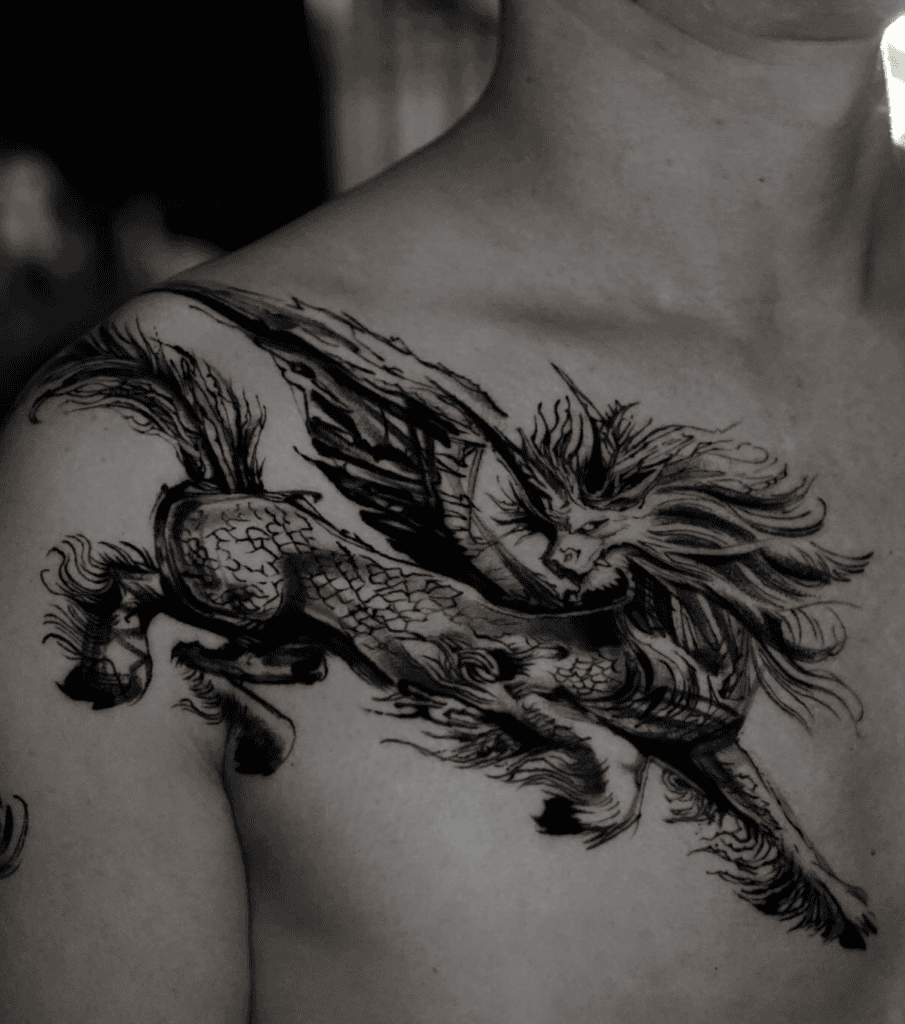
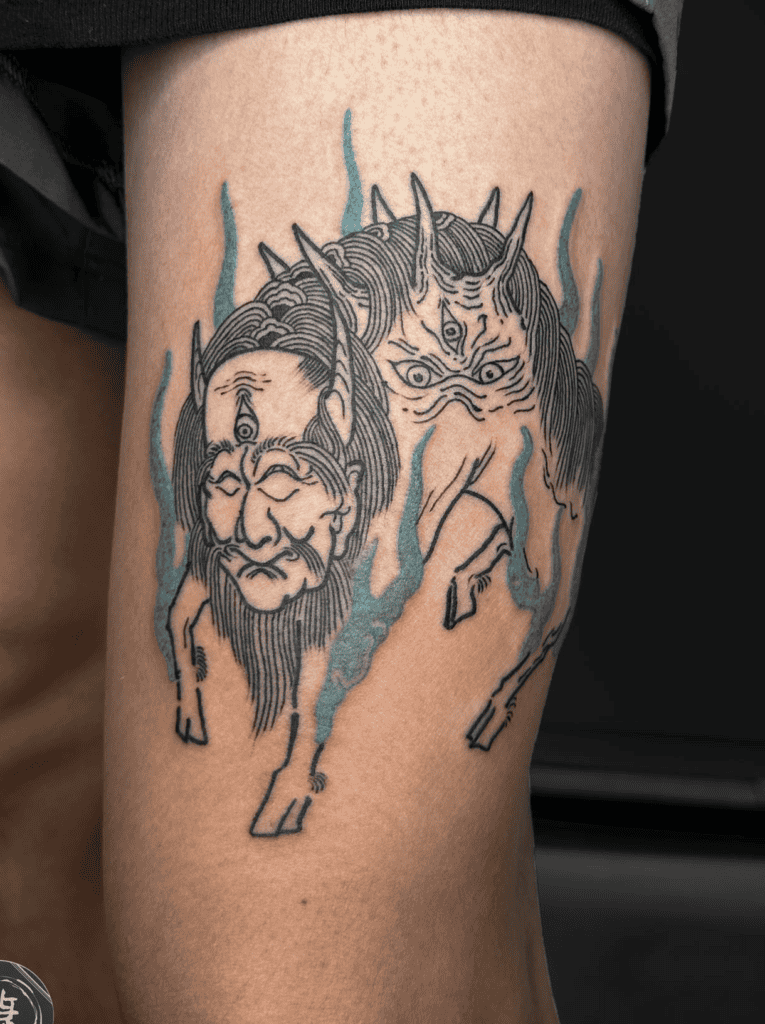
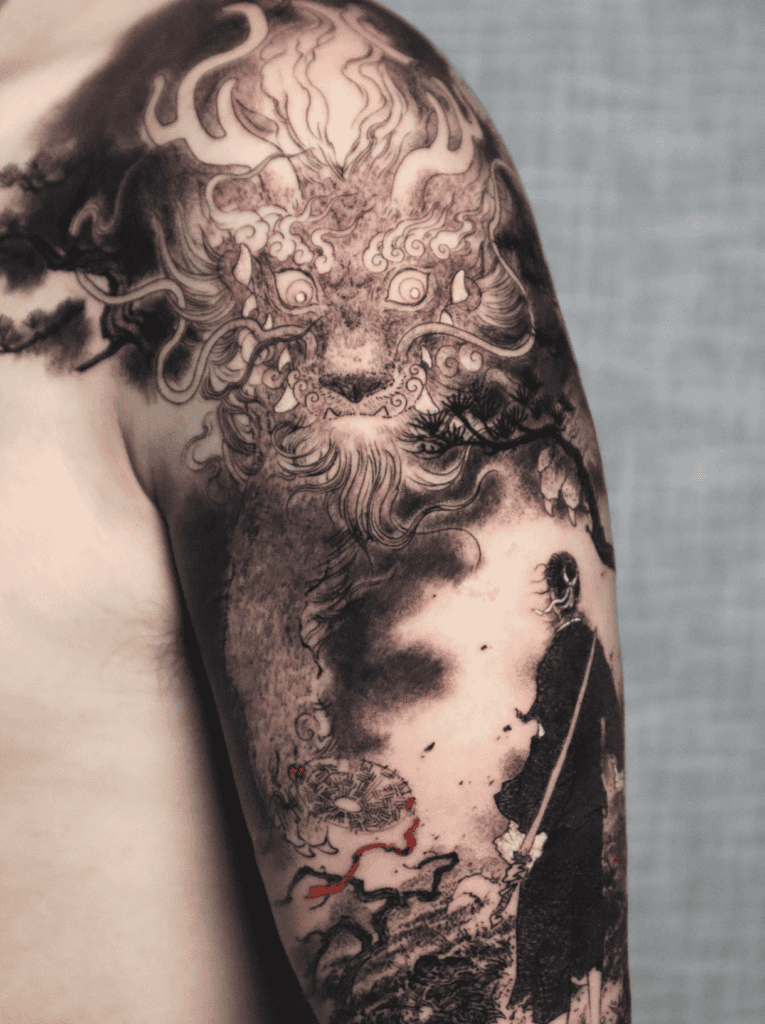
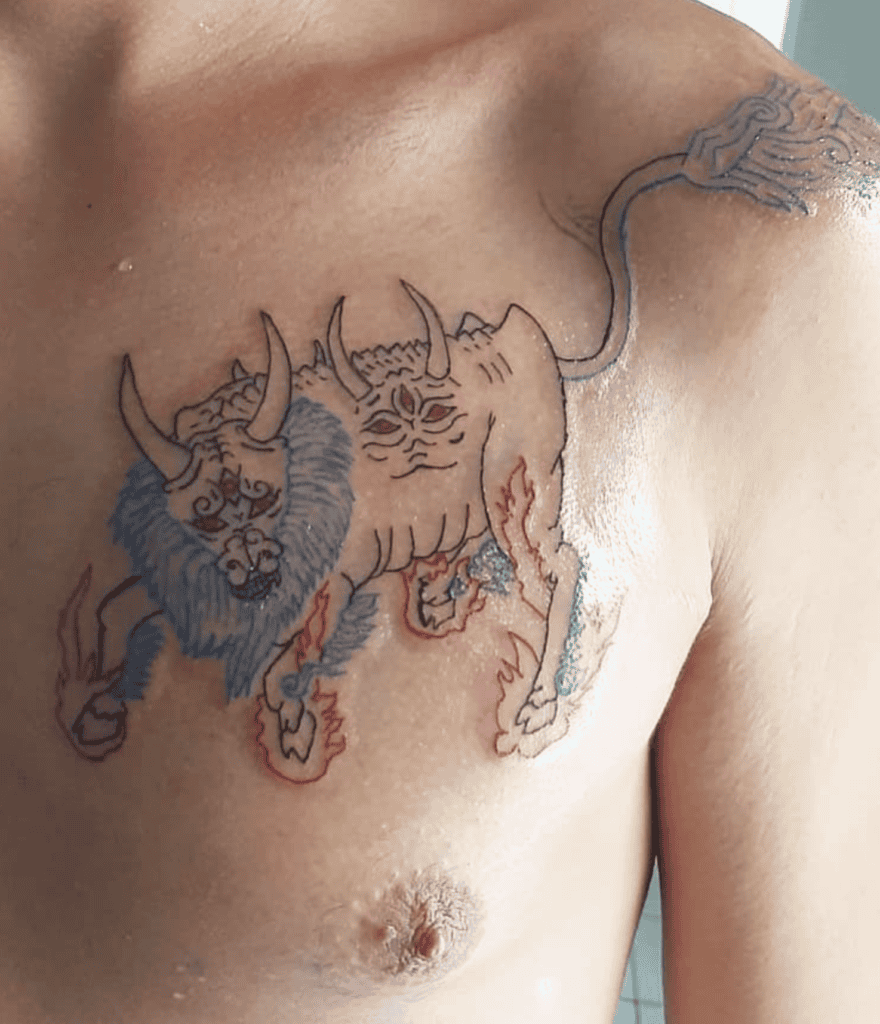
Bai Ze (白泽) is a legendary creature in Chinese mythology, renowned not for destruction, but for knowledge. Bai Ze is a wise, divine beast said to know the identities, habits, and weaknesses of thousands of spirits and demons.
Descriptions vary, but Bai Ze is often depicted as a white, ox-like or lion-like creature, sometimes with multiple eyes, occasionally shown with horns, and radiating a calm, sage-like presence
According to legend, Bai Ze appeared before the Yellow Emperor (Huangdi), one of China’s earliest cultural heroes. During this meeting, Bai Ze described over 11,000 types of supernatural beings, explained how to recognise them, and revealed how to defeat or avoid them.
Fūzhū Chinese Mythology Tattoo

The Fuzhu (夫諸) is a mythical, gentle four-horned white deer appearing in the ancient Chinese text Shanhaijing (Classic of Mountains and Seas). It lives on Ao’an Mountain and acts as a harbinger of severe floods, appearing during times of natural disaster. It is associated with bringing water to parched land, but also portents of destruction.
Pixiu Chinese Mythology Tattoo
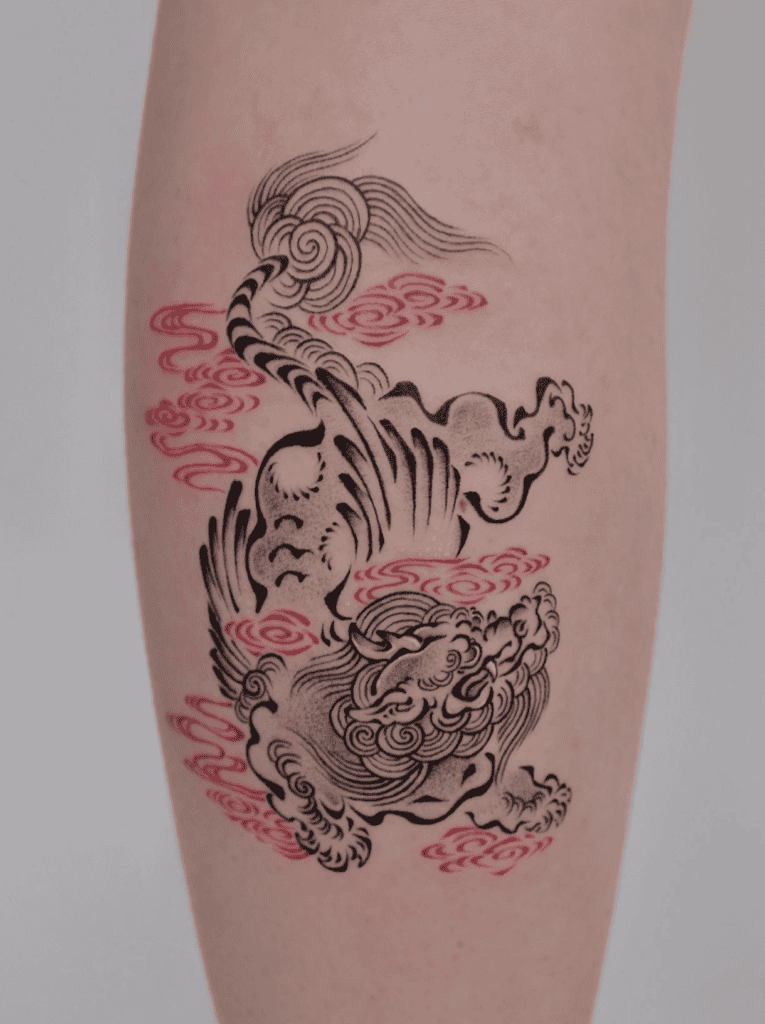
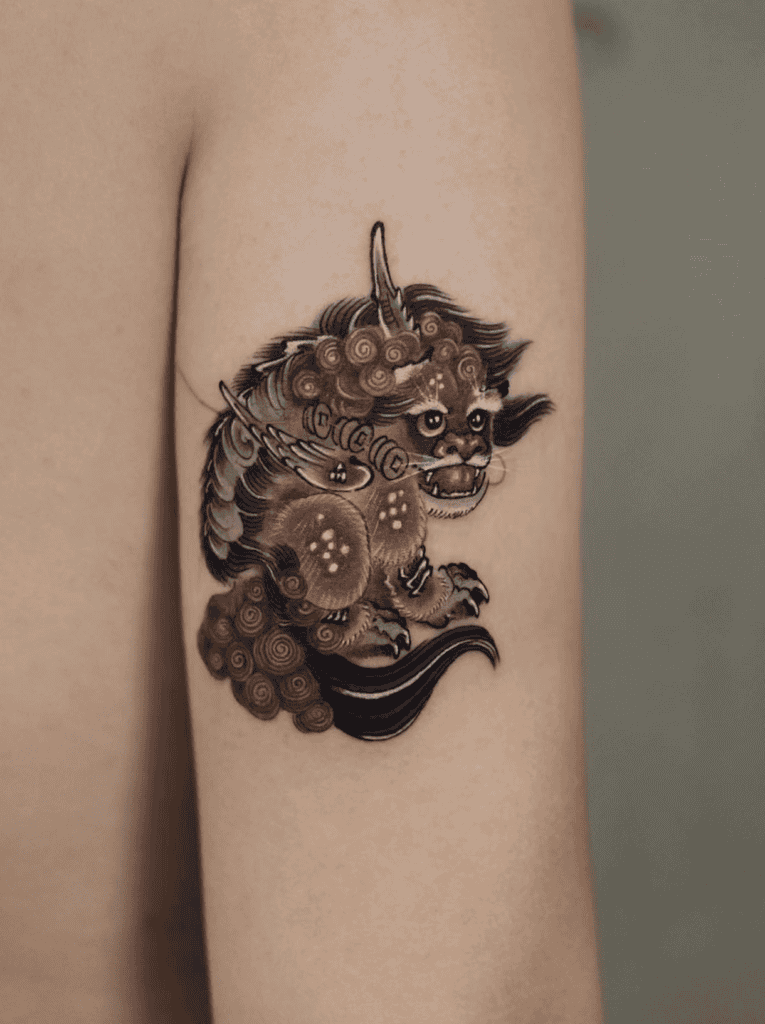
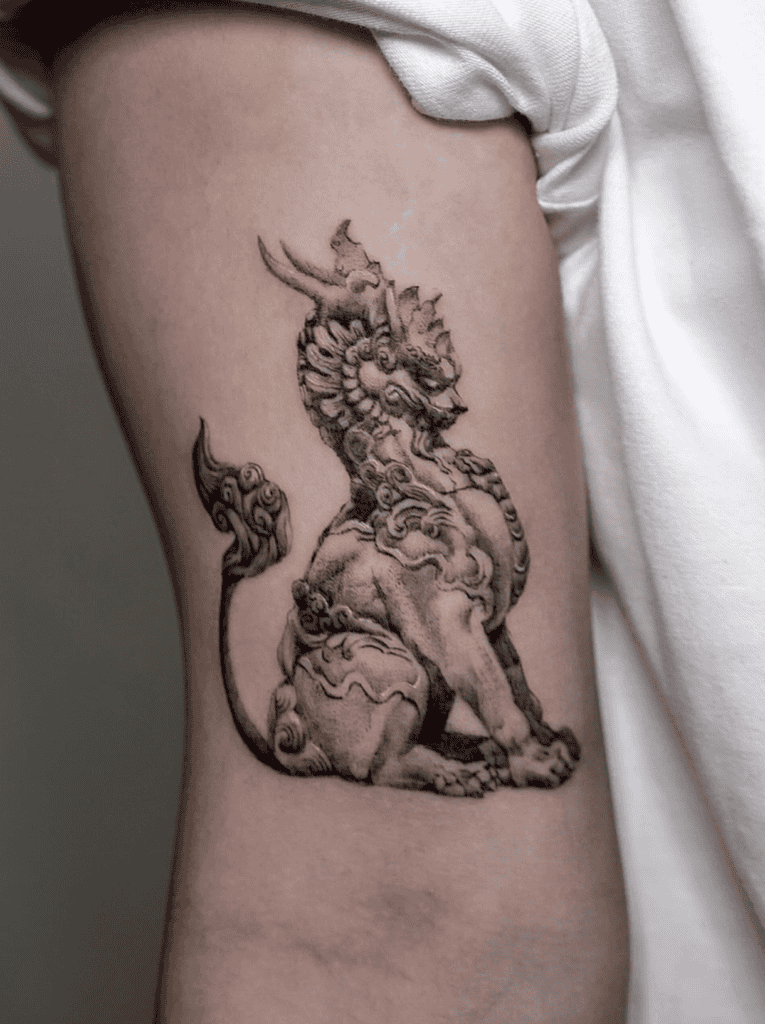
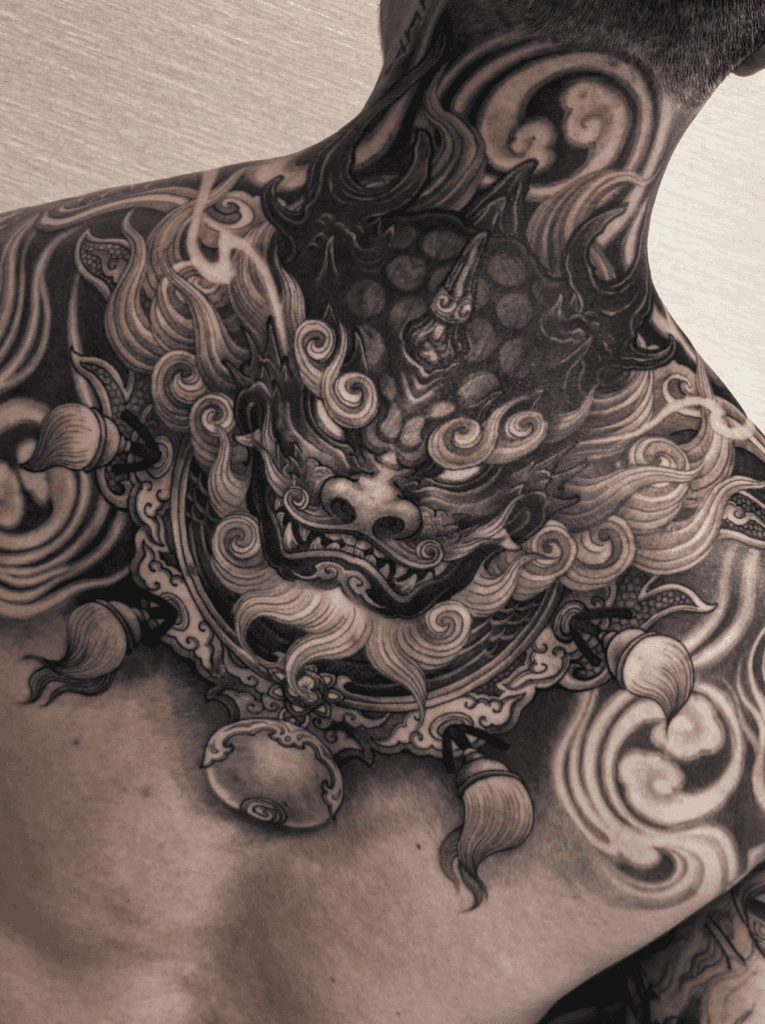
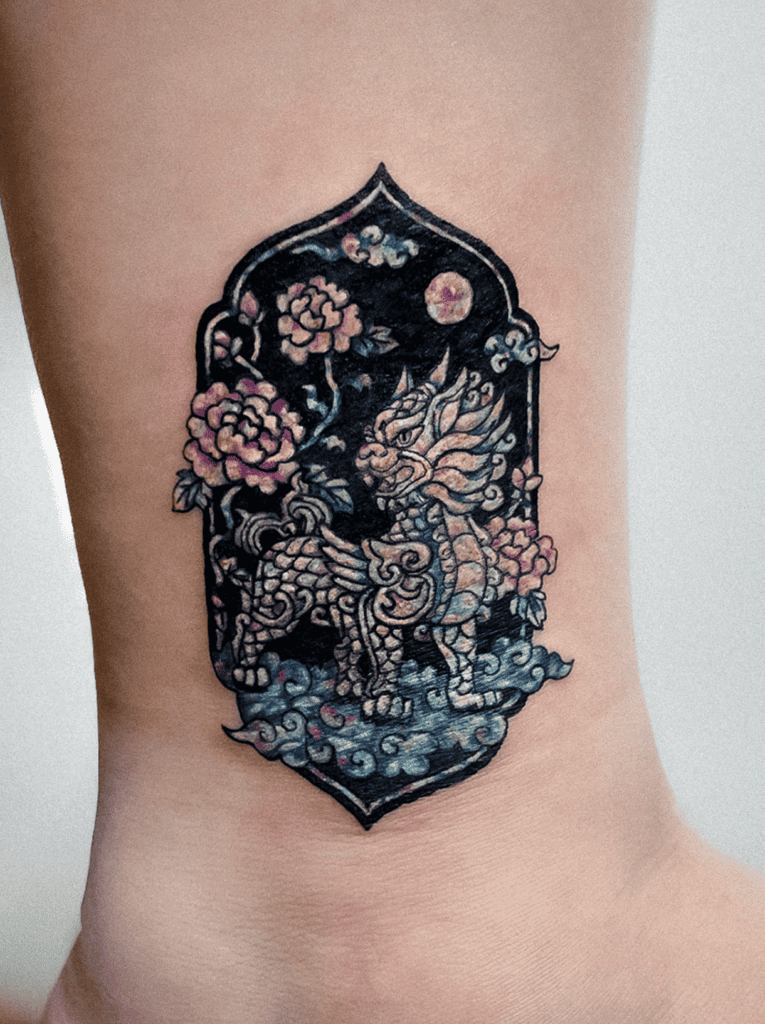
Pixiu (貔貅) is one of the most popular and powerful creatures in Chinese folklore and Feng Shui. It is a fierce, lion-dragon hybrid believed to attract wealth, guard fortune, and ward off evil spirits.
Pixiu is strongly associated with financial fortune, protection of assets, business success, and gambling luck. According to legend, Pixiu has a bottomless appetite for gold and treasure, but with one key detail: It is said to have no anus.
The Pixiu symbolises wealth entering, but never leaving, which is why Pixiu is considered a powerful wealth-retention charm.
Chīwěn Chinese Mythology Tattoo


Chiwen (鸱吻), sometimes spelt Chiwen or Chīwěn, is one of the legendary Nine Sons of the Dragon in Chinese folklore. Unlike fearsome dragons of the sea or sky, Chīwěn is best known for perching on the ridges of rooftops, guarding buildings from fire and misfortune.
Chīwěn is typically depicted as a dragon-like creature, often with a fish-like body or tail. Its open mouth appears as though it is swallowing something, sometimes said to be swallowing evil spirits, sometimes water.
One of Chīwěn’s main symbolic roles is protection from fire. Because it is associated with water and rain (as a dragon descendant), placing Chīwěn on rooftops symbolically invites rain, wards off flames, and protects wooden buildings.
Caishen Chinese Mythology Tattoo
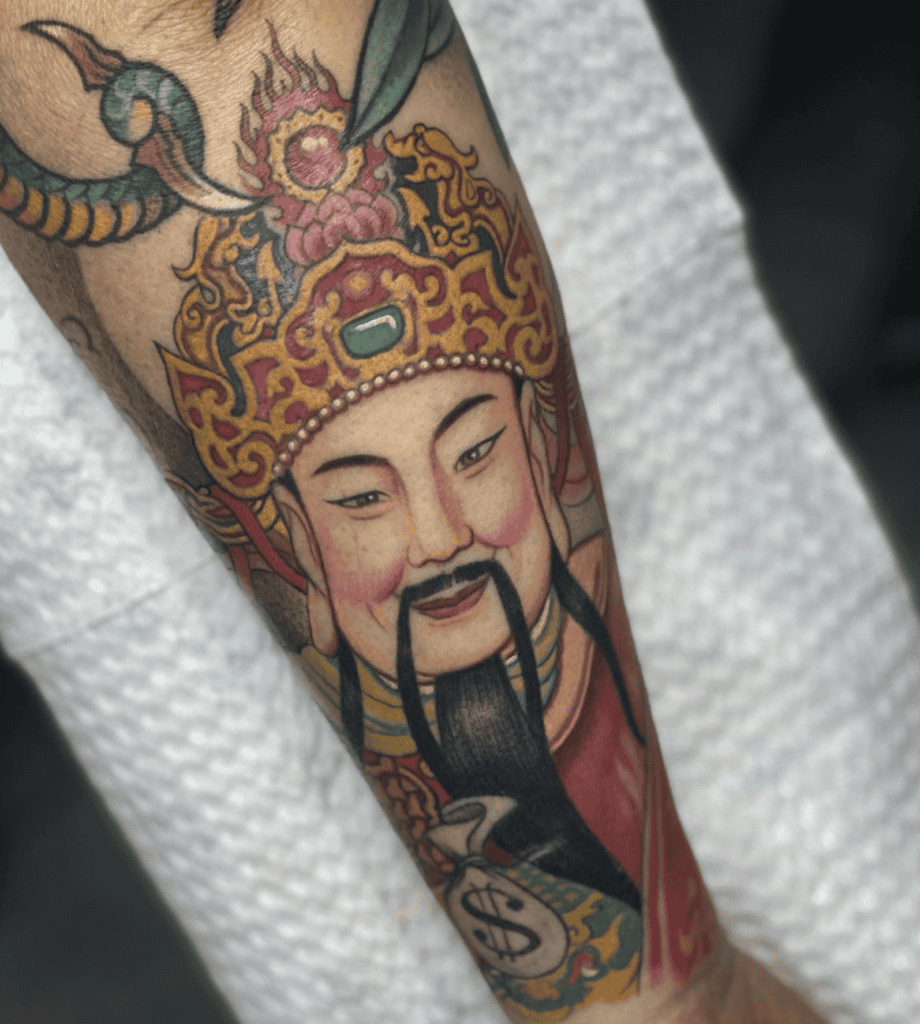
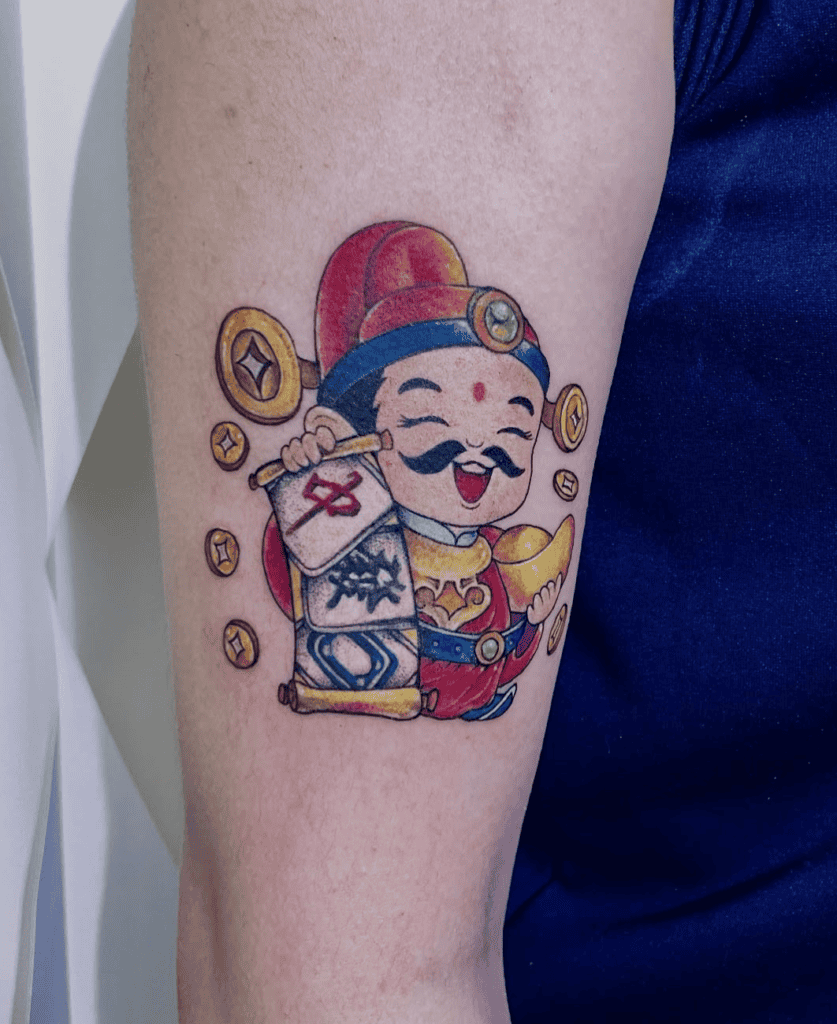
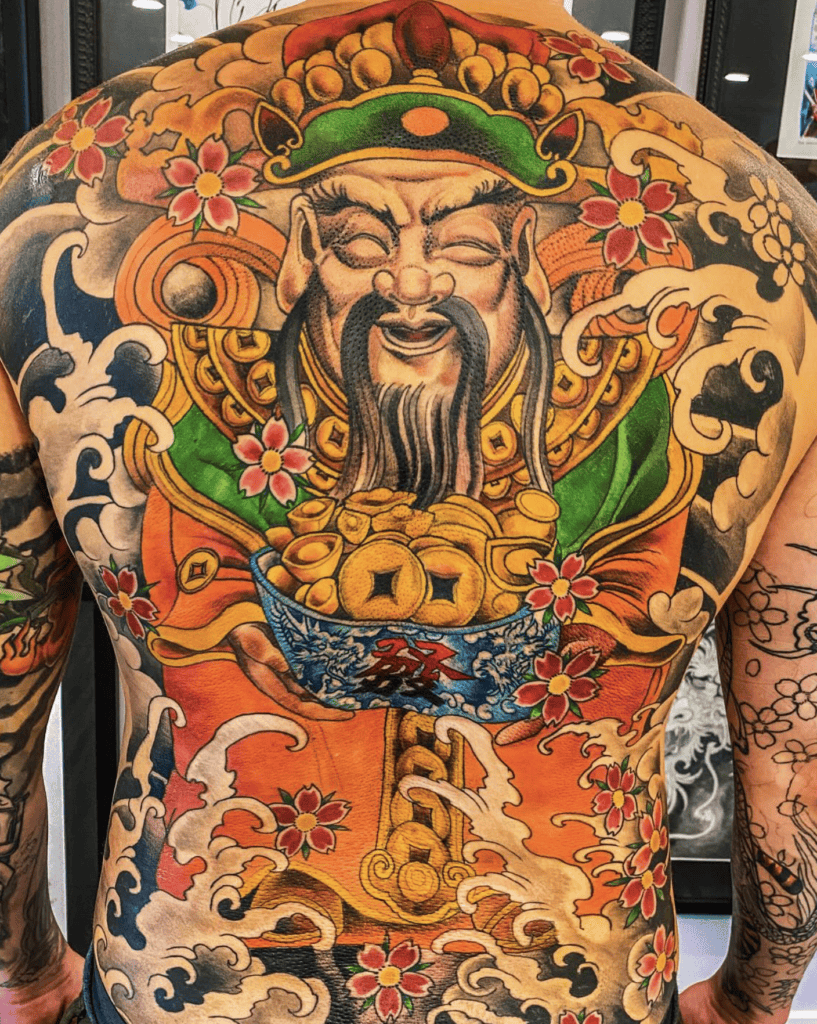
Caishen (财神) is the Chinese God of Wealth, one of the most widely worshipped deities in Chinese folk religion. He is especially honoured during Lunar New Year, when families pray for prosperity, success, and good fortune in the coming year.
“Caishen” literally means “Wealth God”, but there are multiple versions of him across different traditions. Two of the most famous historical figures associated with Caishen are Zhao Gongming, a powerful Daoist wealth deity, and Bi Gan, a loyal minister later deified as a god of wealth. Over time, these figures merged into the broader identity of Caishen.
During Chinese New Year, households display Caishen images, firecrackers are set off to welcome him, and offerings of incense, fruit, and gold-coloured sweets are made. There is even a specific day known as “Receiving the God of Wealth,” when people symbolically invite him into their homes.
Peng Chinese Mythology Tattoo
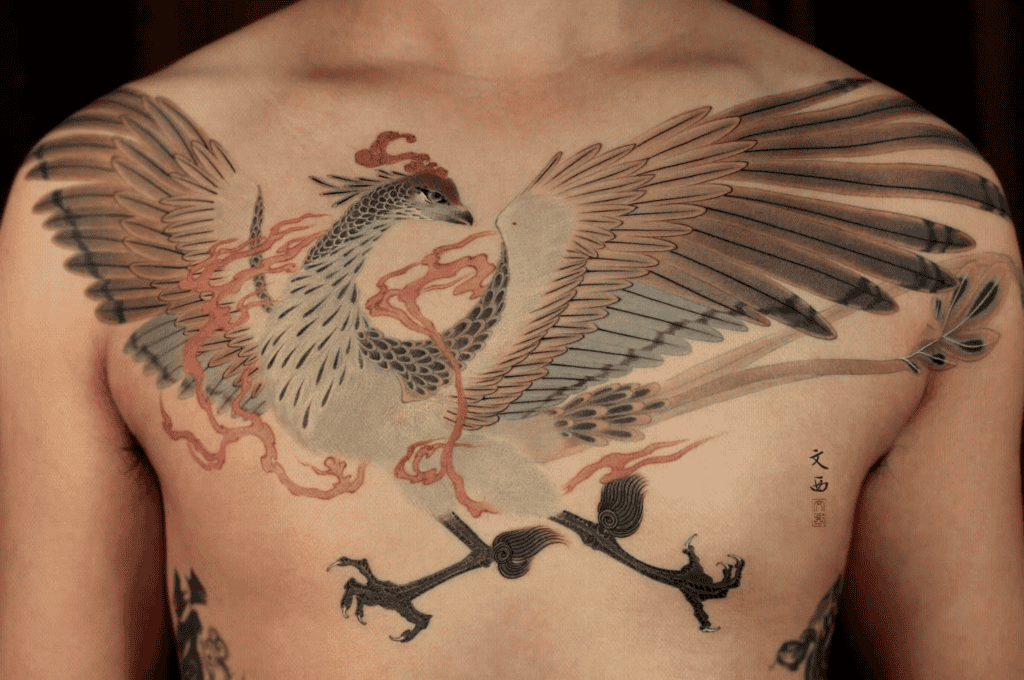
Peng (鹏 / 鵬) is a colossal mythological bird in Chinese philosophy and legend, most famously described in the Daoist classic Zhuangzi. The Peng is unimaginably vast, symbolising freedom, transcendence, and the boundless potential of transformation.
The story begins with a gigantic fish named Kun. Kis is so enormous that its size cannot be measured. One day, Kun transforms into the Peng, a bird whose wings stretch across the heavens.
When it takes flight, it rises 90,000 li into the sky, riding the winds and journeying across vast distances. This transformation is one of the most famous metaphors in Daoist literature.
Yin Yang Chinese Mythology Tattoo
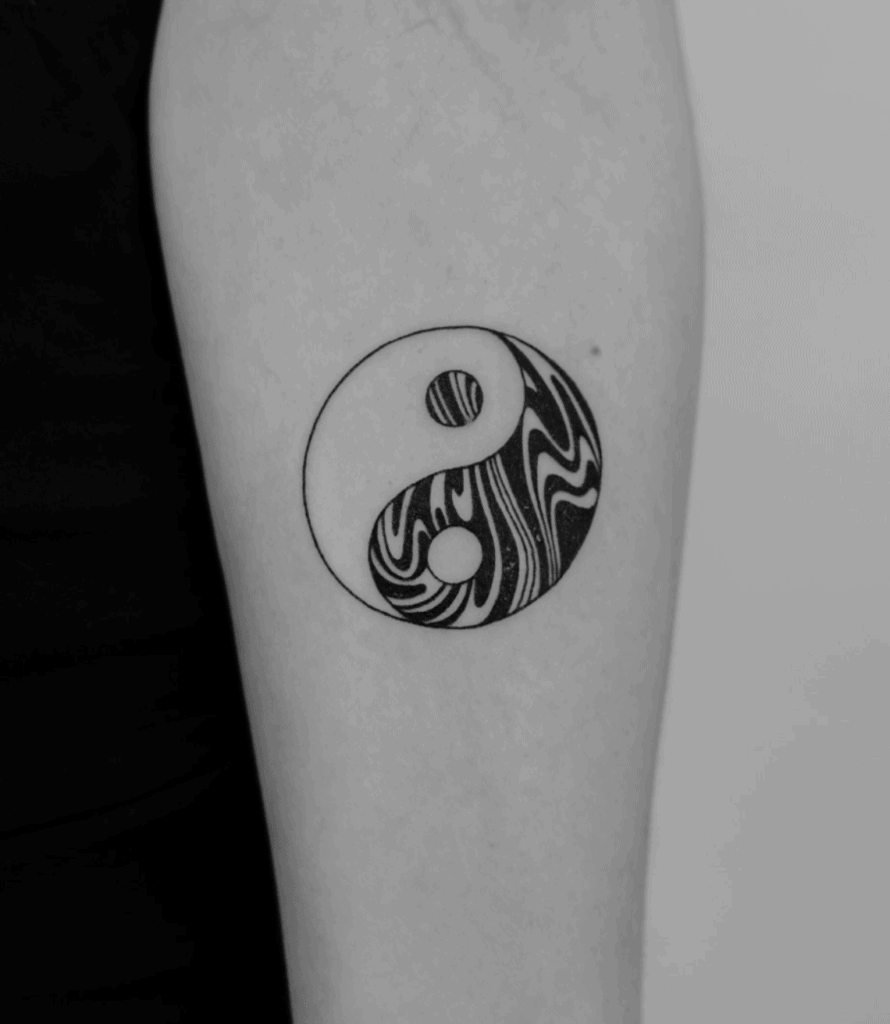
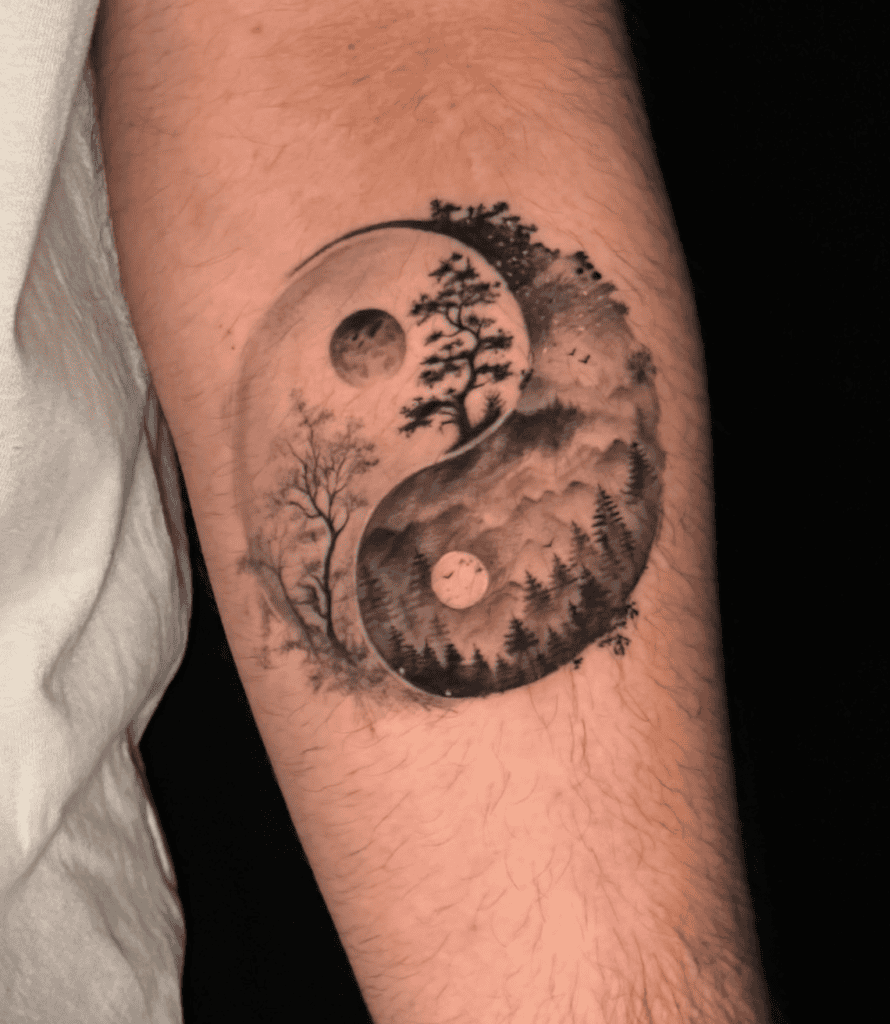
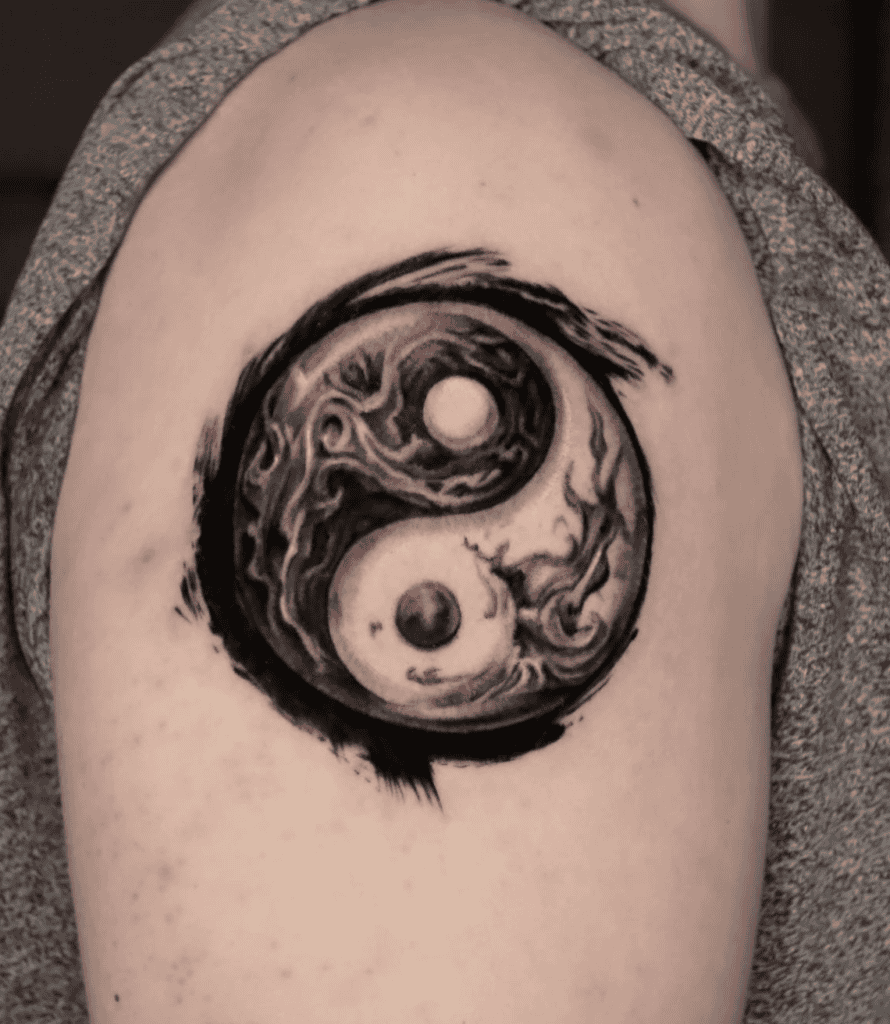
Yin and Yang (阴阳) is one of the most fundamental concepts in Chinese philosophy. It describes how opposite forces are interconnected, interdependent, and constantly transforming into one another.
Yin contains the seed of Yang, and Yang contains the seed of Yin; nothing is purely one or the other. It is not about good vs evil; it is about balance.
Tang Sanzang Chinese Mythology Tattoo


Tang Sanzang (唐三藏), also known as Tripitaka, is the spiritual heart of
Journey to the West. He is the monk tasked with travelling to India to retrieve sacred Buddhist scriptures for China. While his disciples are powerful and chaotic, Tang Sanzang represents faith, purity, and moral discipline.
Tang Sanzang is based on the real monk Xuanzang, who travelled from China to India in the 7th century to study Buddhist texts. While in reality, Xuanzang’s journey was scholarly and diplomatic, in the novel, it becomes a mythic quest filled with demons and gods.
In the story, he is compassionate, devout, gentle, and often naïve, believing even demons can be redeemed, sometimes to the frustration of Sun Wukong. Tang Sanzang is often too trusting, easily deceived by demons, and unable to fight, but this is intentional. He symbolises the fragile yet essential human spirit, and without him, the pilgrimage has no purpose.
Zhu Bajie Chinese Mythology Tattoo


Zhu Bajie (猪八戒), often called Pigsy, is one of the four main companions in
Journey to the West. He is the comic relief of the group, being greedy, gluttonous, flirtatious, and often lazy, yet surprisingly loyal when it truly matters.
Before becoming a pig demon, Zhu Bajie was the Marshal of the Heavenly Reeds, a powerful celestial commander. However, after drunkenly harassing the Moon Goddess (in most versions Chang’e), he was banished from Heaven.
During his fall to Earth, he landed in the wrong womb and was reborn partially as a pig. He became a monster wandering the countryside, but by the end of the journey, Zhu Bajie became a Cleaner of Altars.
Sha Wujing Chinese Mythology Tattoo

Sha Wujing (沙悟净), often called Sandy or the Sand Monk, is one of the four main companions in Journey to the West. Quiet, disciplined, and loyal, he is the calmest member of the group.
Originally, Sha Wujing was the Curtain-Lifting General in Heaven. However, after accidentally breaking a celestial vase during a banquet, he was banished to Earth. As punishment, he became a river demon dwelling in the Flowing Sand River, where he devoured travellers, lived in isolation, and endured suffering.
Eventually, the bodhisattva Guanyin offered him redemption through service on the pilgrimage. On the journey, Sha Wujing carries the luggage, guards Tang Sanzang, and keeps peace between Wukong and Bajie, stepping in during battles when needed.
At the end of the journey, Sha Wujing is granted a celestial title (often translated as Golden Arhat or similar enlightened status).
Bai Long Ma Chinese Mythology Tattoo

Bai Long Ma (白龙马), known as the White Dragon Horse, is one of the companions in
Journey to the West. Though quieter than Sun Wukong or Zhu Bajie, Bai Long Ma plays a crucial and symbolic role in the pilgrimage.
Bai Long Ma was originally Ao Lie, the third son of the Dragon King of the West Sea. After burning a sacred pearl (in some versions out of recklessness), he was sentenced to death.
However, the bodhisattva Guanyin intervened and gave him a chance at redemption. He was transformed into a white horse to serve the monk on the sacred journey.
Conclusion
As our Lóng story comes to an end, I Azure you that these were some of the very best Chinese Mythology Tattoos the world has ever seen. But before you fly off into the sunset, why not scale Mount Olympus with these Greek Mythology Tattoo Ideas, be reborn with these Egyptian Mythology Tattoo Designs, or find the truth with these Persian Mythology Tattoos.
- Bear Tattoo Ideas - October 22, 2026
- Lion Tattoo Ideas - October 19, 2026
- Persona Tattoo Ideas - October 15, 2026