
Celtic Mythology Tattoo Ideas
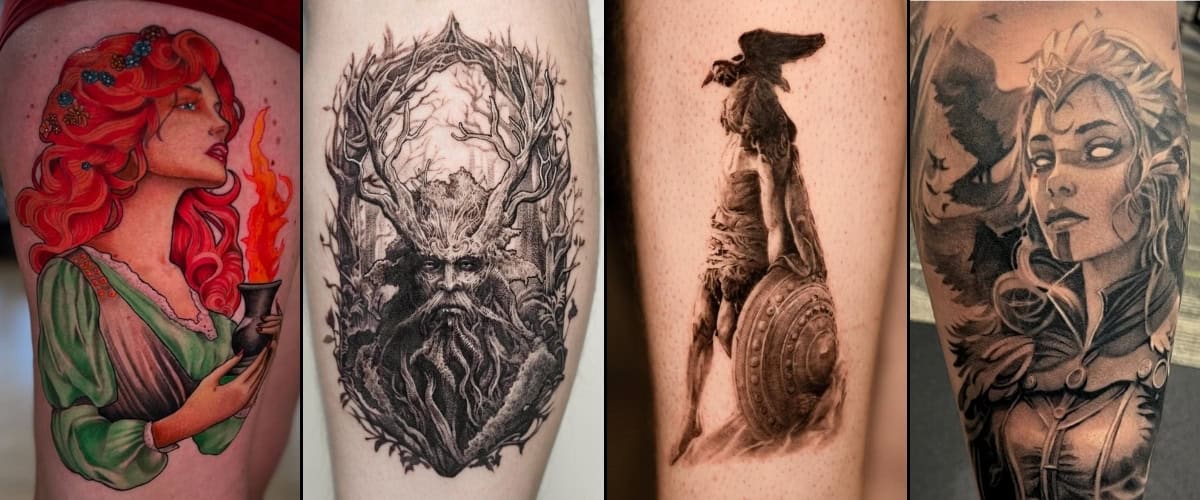
Do you feel like you’re stuck in a never-ending spiral on your search for the perfect Tattoo Clues? Well, knot to worry, we’ve weaved our way through the tangles of the internet to bring you the very best Celtic Mythology Tattoos the land of promise has to offer.
What Is Celtic Mythology
Celtic mythology is the collection of myths, legends, and spiritual beliefs from the ancient Celtic peoples of Ireland, Scotland, Wales, and parts of Western Europe. These stories were originally passed down orally by druids and storytellers before being written in medieval texts.
Celtic mythology explores the relationship between humans, nature, and the Otherworld, a mystical realm that exists alongside our own and has several regional traditions – Irish Mythology, Welsh Mythology, Scottish & Breton Folklore. These stories evolved over time, blending pagan beliefs with later Christian influences.
Key Elements of Celtic Mythology include the deep spirituality of forests, rivers, animals, and seasons, with trees like oak and ash seen as gateways between worlds. The Otherworld is a magical realm of eternal youth, beauty, and danger, often reached through water, mist, or ancient mounds. Life, death, and rebirth are constant themes, with many stories involving shape-shifting or long transformations, and warriors face destiny head-on, often with tragic outcomes.
Best Celtic Mythology Tattoo Artists

badger king tattoo
Nordic and Celtic Freehand Tattoo based in Rugby, United Kingdom.

Sacred knot tattoo
Welsh Tattoo Artist specialising in Nordic and Celtic Tattoos, inspired by ancient Northern and Western European arts.

Shogantattoo
Jersey, United Kingdom Tattoo artist specialising in Nordic & Celtic Tattooing.
Best Celtic Mythology Tattoo Ideas
Now that we know a little about Celtic Mythology, let’s take a look at some of the best Celtic Mythology Tattoos the Otherworld has to offer.
Tuatha Dé Danann Celtic Mythology Tattoo

The Tuatha Dé Danann are one of the most important and powerful groups in Celtic mythology, often described as a race of gods or supernatural beings who once ruled Ireland.
Their name means “The People of the Goddess Danu,” and they are a race of magical, semi-divine beings, masters of knowledge, art, and supernatural power, and associated with the Otherworld. The Tuatha Dé Danann arrived in Ireland through mist or clouds, with some legends stating that they burned their ships, so they could never leave.
Fomorians Celtic Mythology Tattoo

The Fomorians are one of the most feared groups in Celtic mythology, often portrayed as monstrous beings who represent the darker side of nature. They are a race of supernatural beings or monsters, often linked to the sea, storms, and darkness.
They are opposed to the Tuatha Dé Danann, sometimes described as giants or deformed beings with features like one eye, one arm, or one leg, and a twisted or unnatural appearance.
The Dagda Celtic Mythology Tattoo
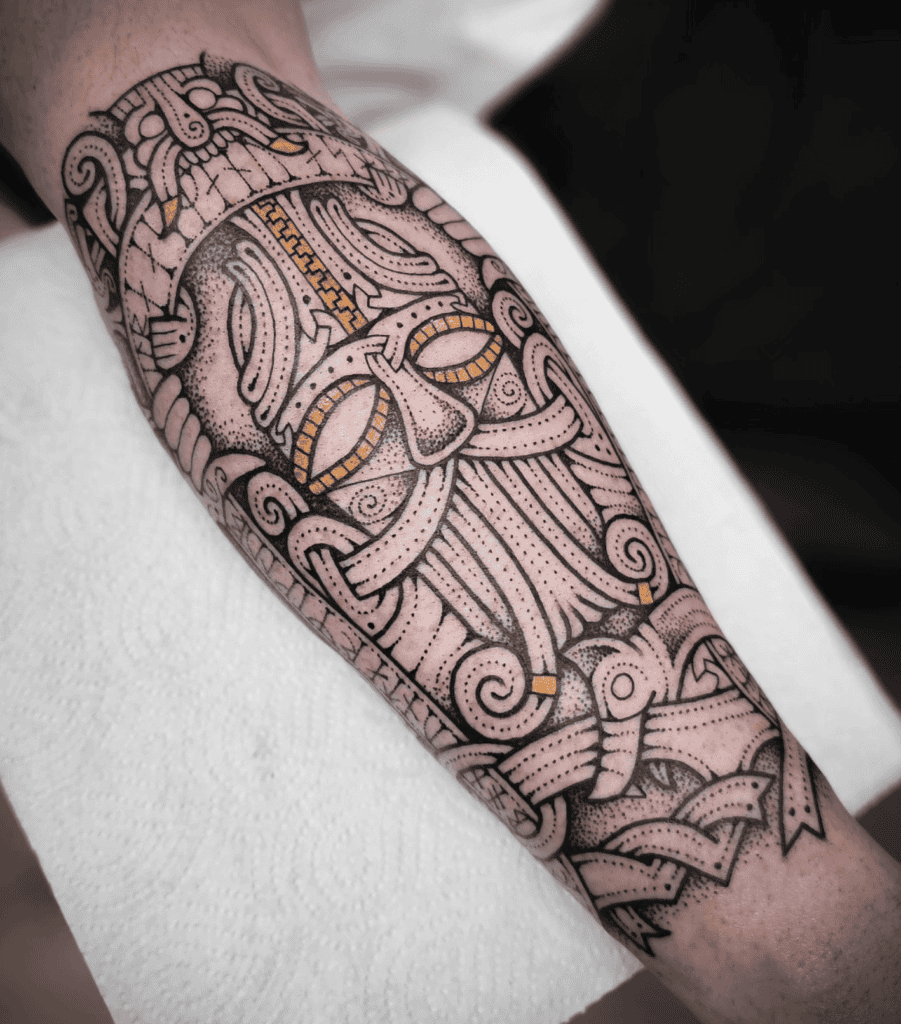
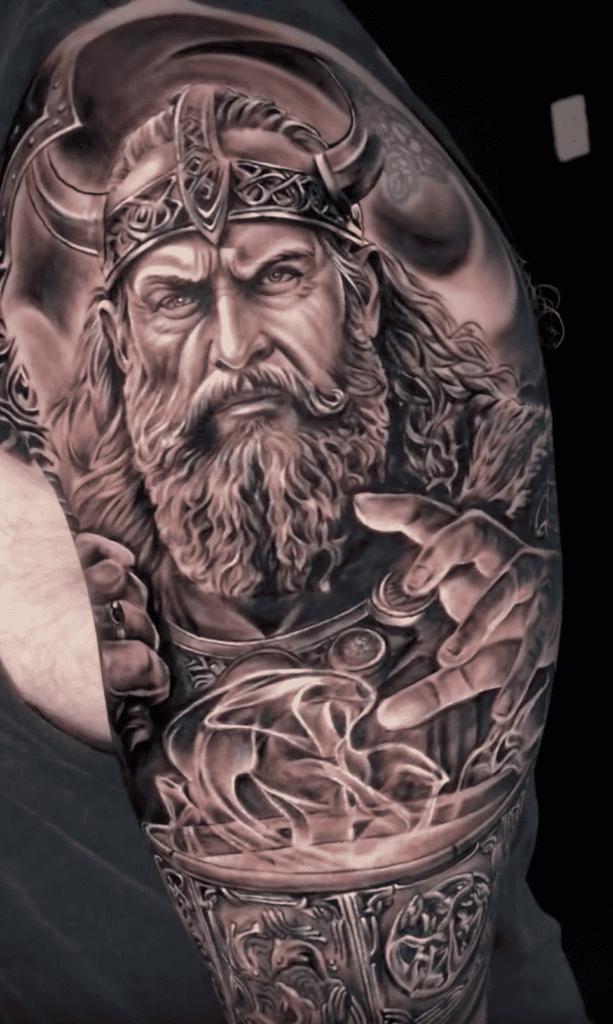
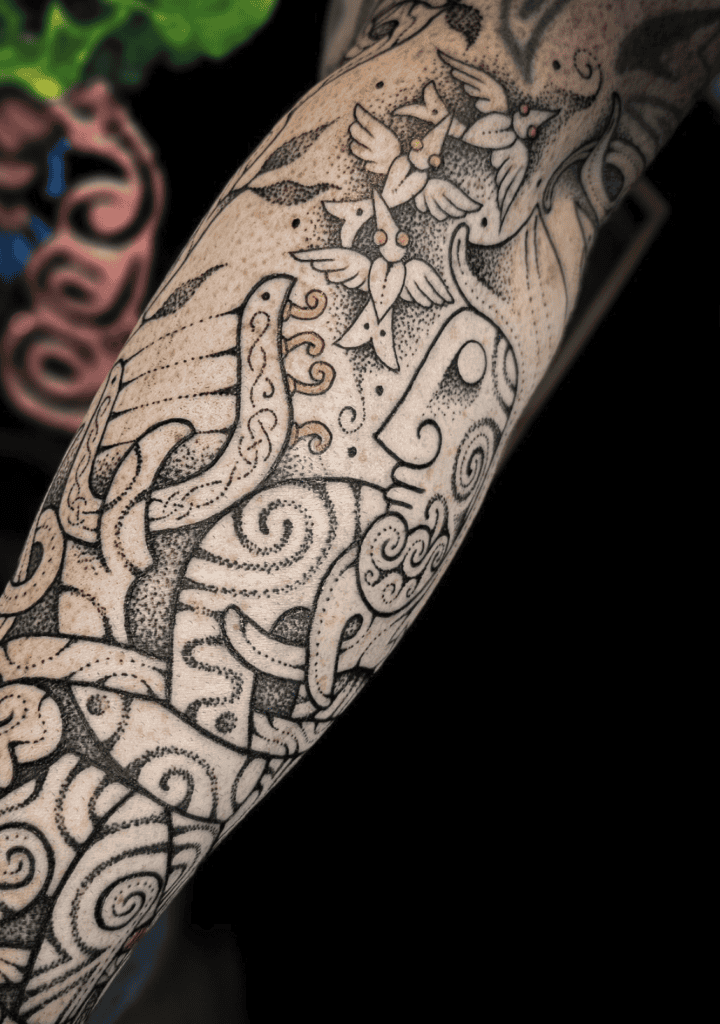
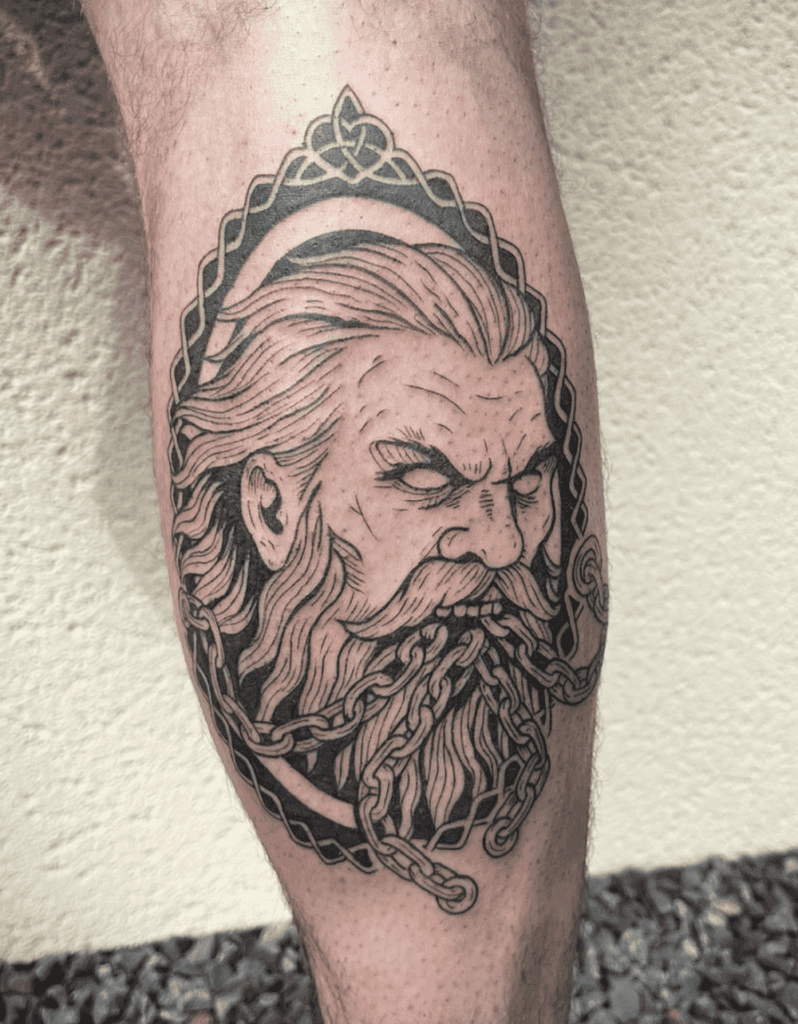
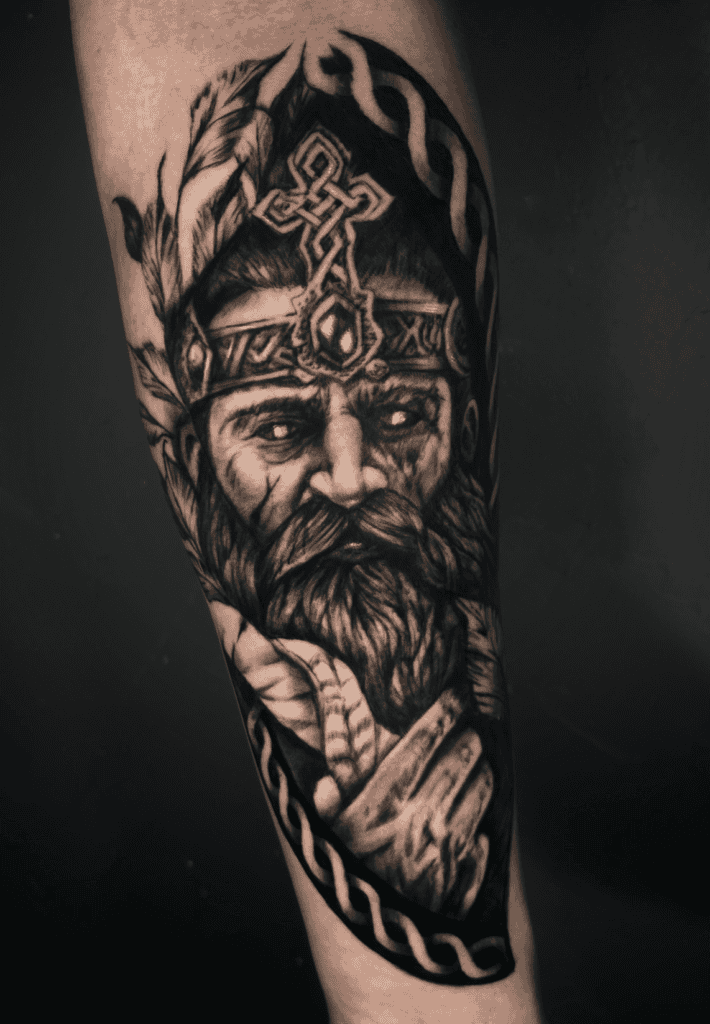
The Dagda is one of the most powerful figures in Irish mythology, who is a central god of the Tuatha Dé Danann, often described as a father figure who rules over life, death, magic, and abundance. His name roughly translates as “The Good God” because he was good at everything from strength, magic, leadership, and wisdom.
The Dagda is often portrayed as a giant, bearded man with immense strength, a leader and protector of his people, and a god connected to fertility, the earth, and prosperity. He’s rough, earthy, and deeply tied to the natural world, making him feel more human than many other deities.
The Dagda is famous for owning powerful artefacts such as The Club of Life and Death, The Cauldron of Plenty, and The Harp of Seasons. One end of his club could kill instantly, while the other could bring the dead back to life. His magical cauldron never runs empty, with nobody leaving unsatisfied, and his living harp could control emotions and the seasons, bringing joy, sorrow, or sleep with its music.
The Dagda had relationships with several goddesses, including The Morrígan, and he’s often portrayed as earthy, humorous, and even a bit crude. Despite this, he is deeply protective and wise, being a mix of strength, imperfection, and warmth.
Danu Celtic Mythology Tattoo
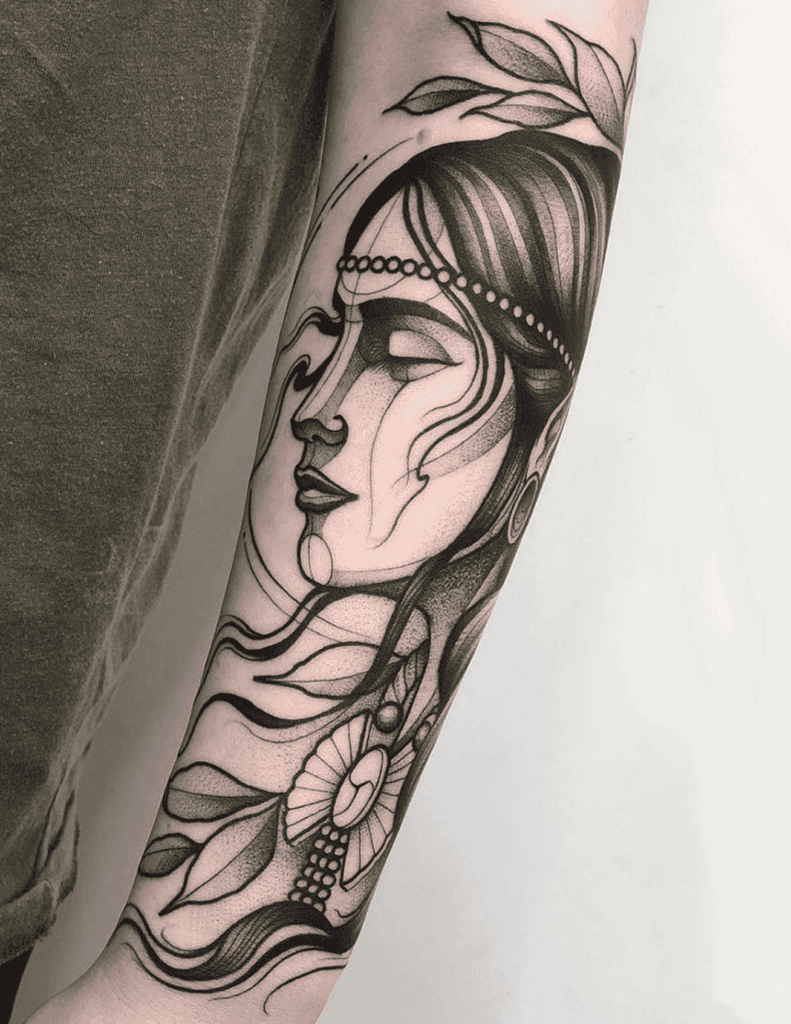
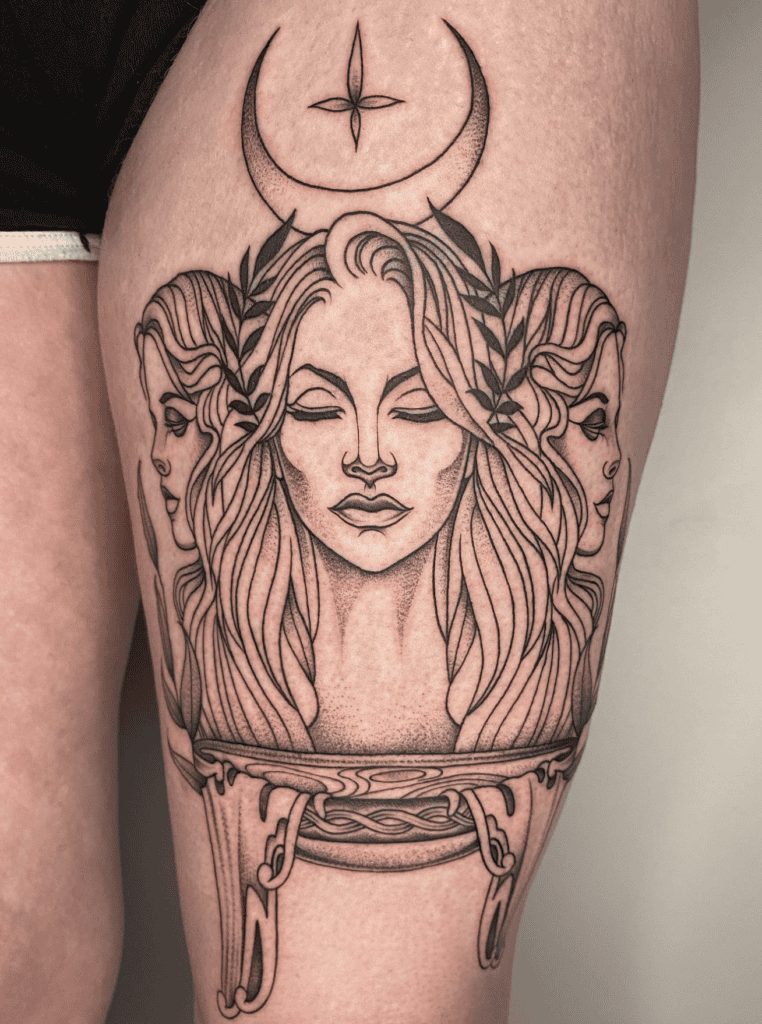
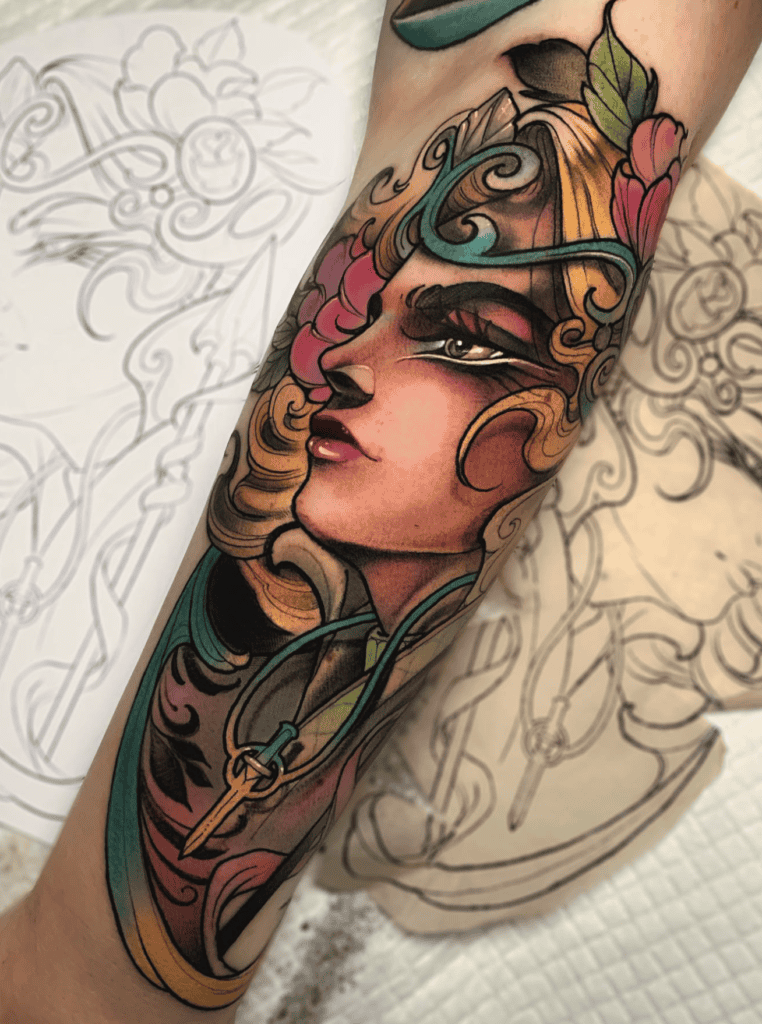
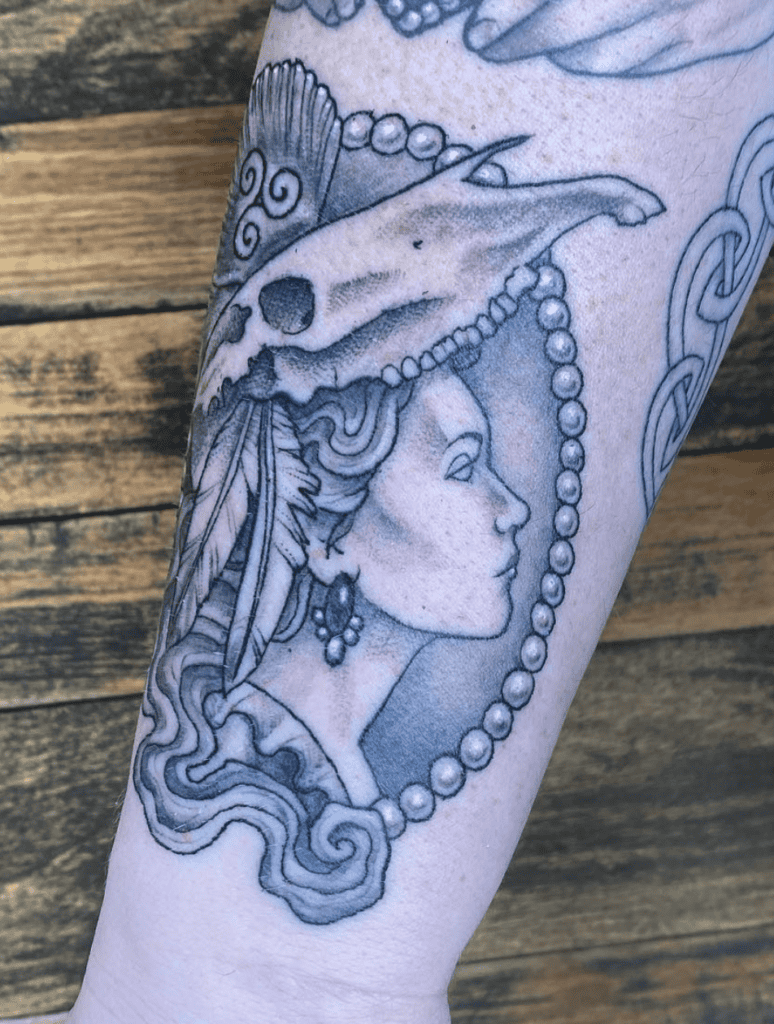
Danu is considered the primordial mother of the divine race known as the Tuatha Dé Danann, whose name literally means “the people of Danu.” She is often seen as a mother goddess connected to creation, a symbol of nature, fertility, and abundance, and a figure linked to rivers, water, and the earth.
Danu is less of a character in stories and more of a presence behind everything, representing the origin of life itself.
The Morrígan Celtic Mythology Tattoo
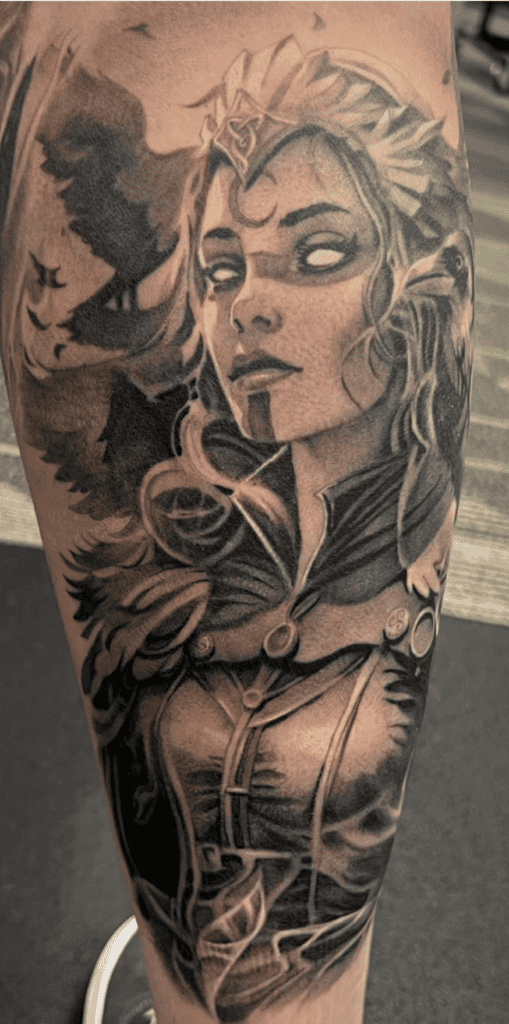
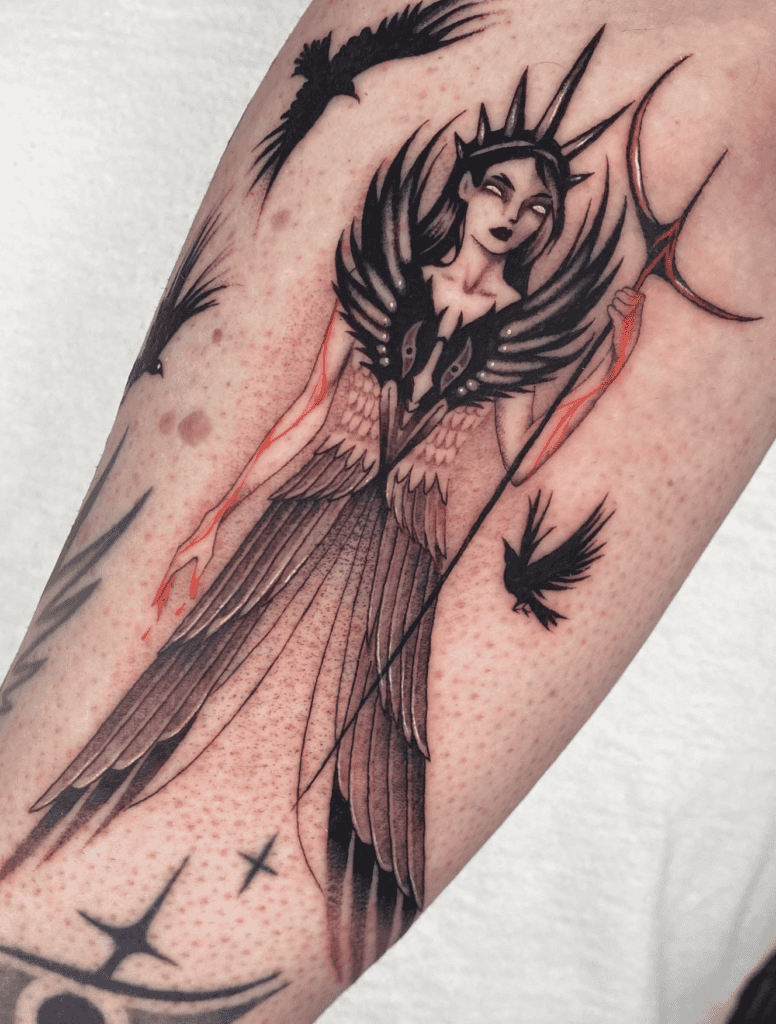
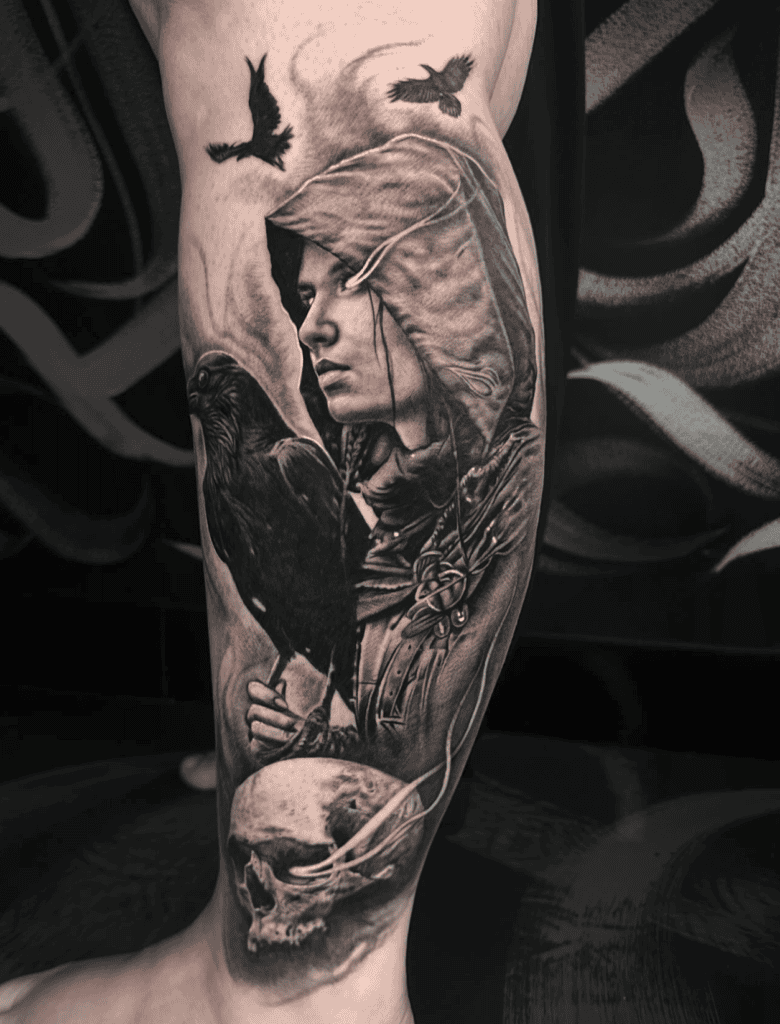
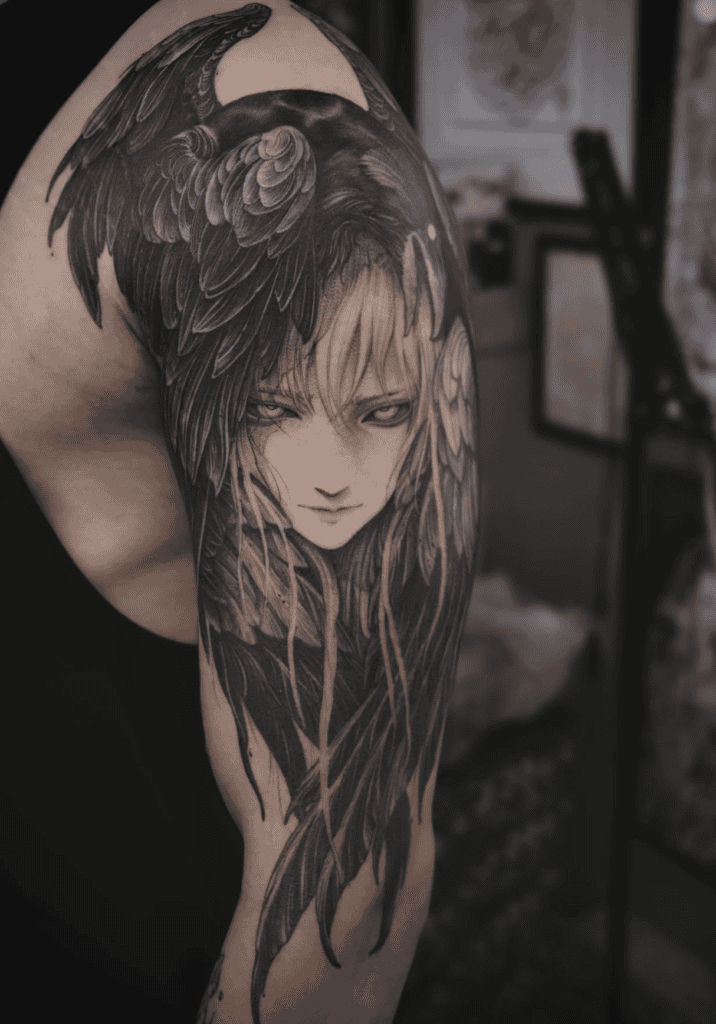
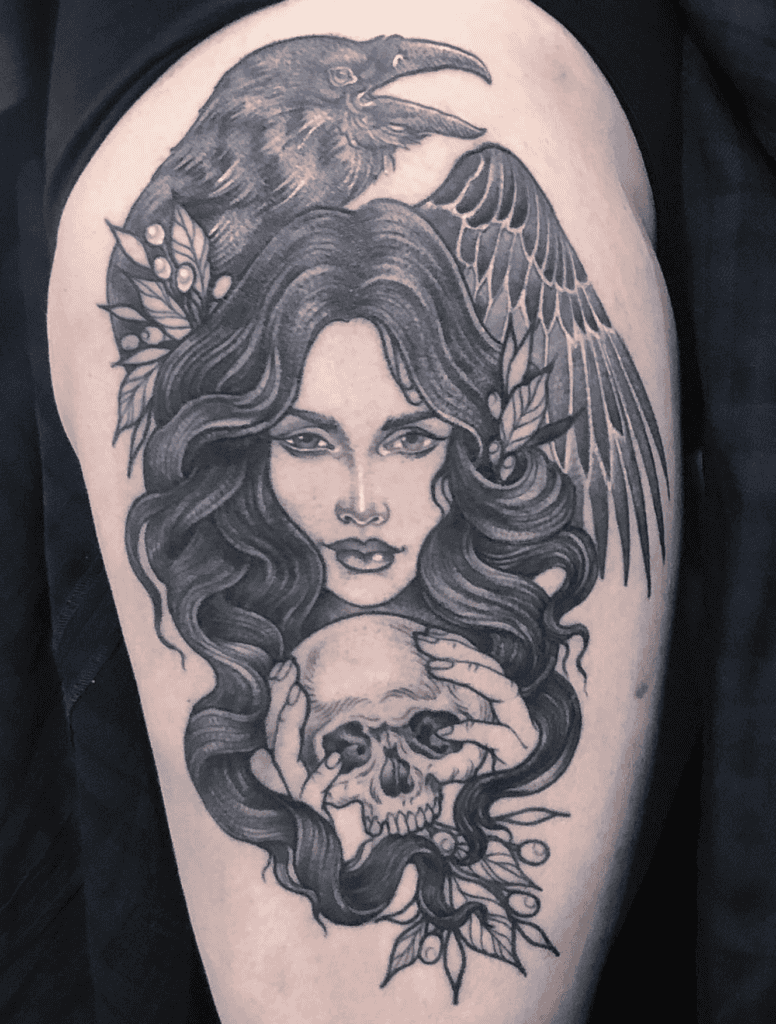
The Morrígan, also known as the Phantom Queen, is a goddess of war, fate, death, and prophecy, often appearing before battles to influence their outcome. Not just a bringer of death, she’s the one who decides who lives and who dies.
Not always a single figure, she is often seen as a triple goddess, appearing as three aspects (sometimes sisters), such as Badb (battle frenzy & chaos), Macha (sovereignty & power), and Nemain (panic & confusion in war)
The Morrígan’s most iconic form is a crow or raven, often seen perched above battlefields, watching warriors before they die, and feeding on the fallen. In Celtic belief, seeing a crow could mean that The Morrígan is near and fate is already decided.
The Morrígan appears in several major stories. In one tale, she approaches Cú Chulainn, offering love and support, but is rejected. She then interferes in his battles, shape-shifting into animals to hinder him. Later, she appears as a crow when he is dying, confirming his fate.
Brigid Celtic Mythology Tattoo
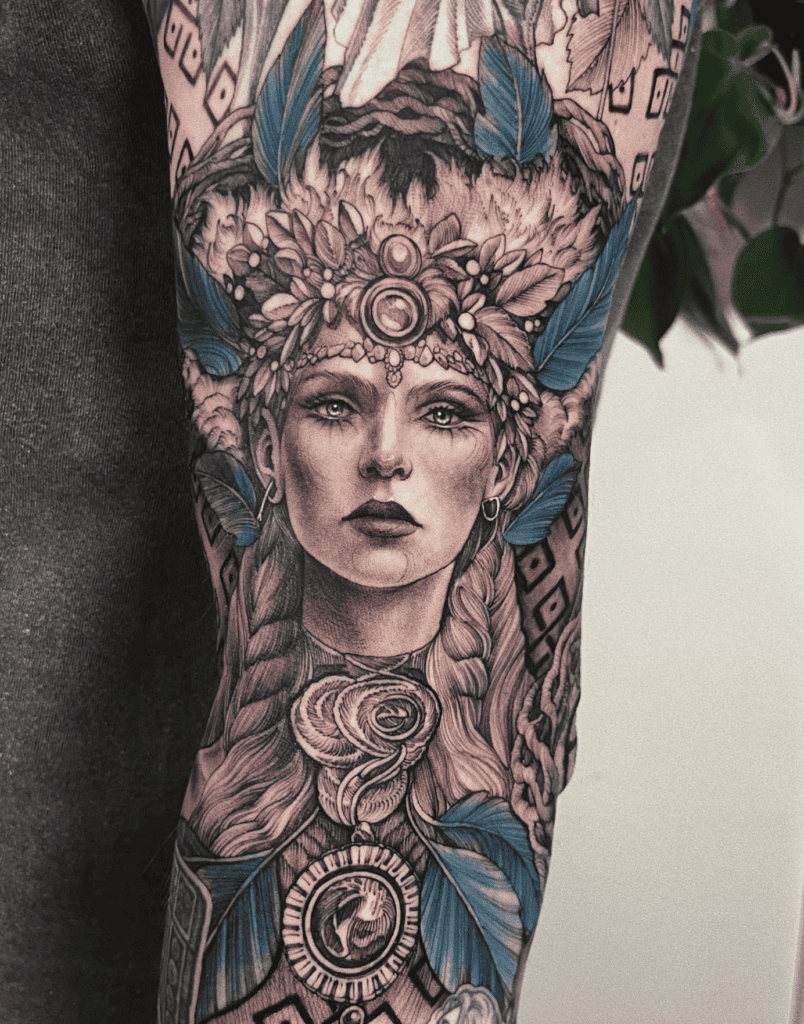
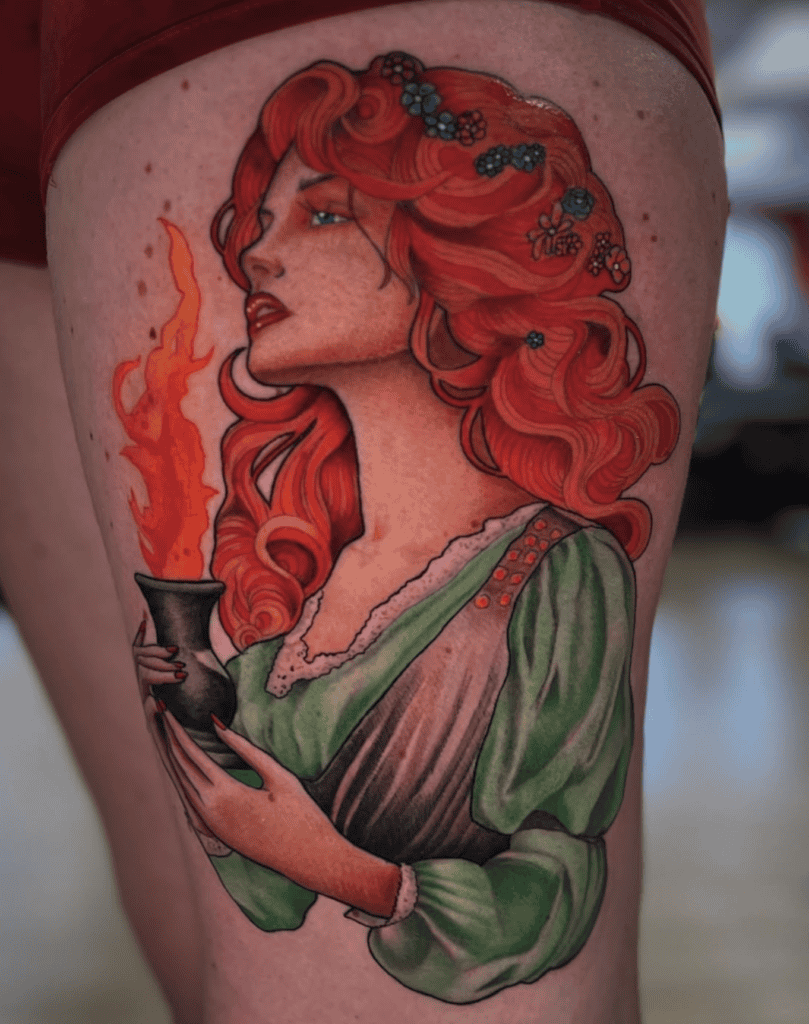
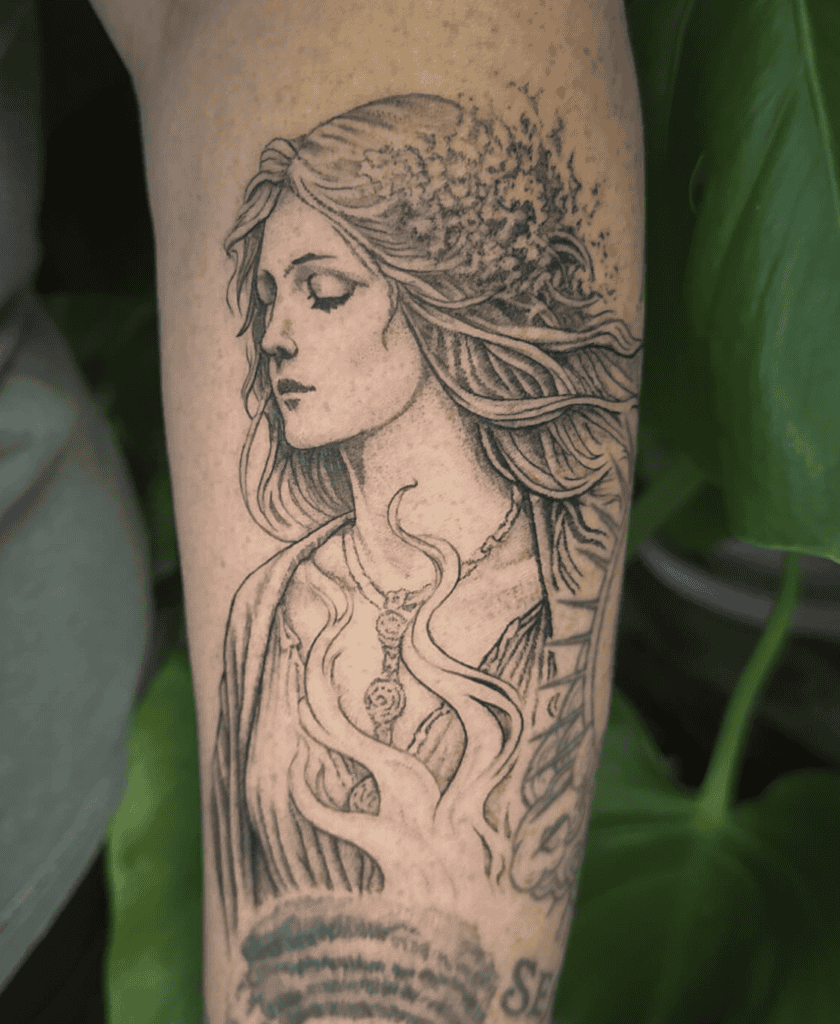
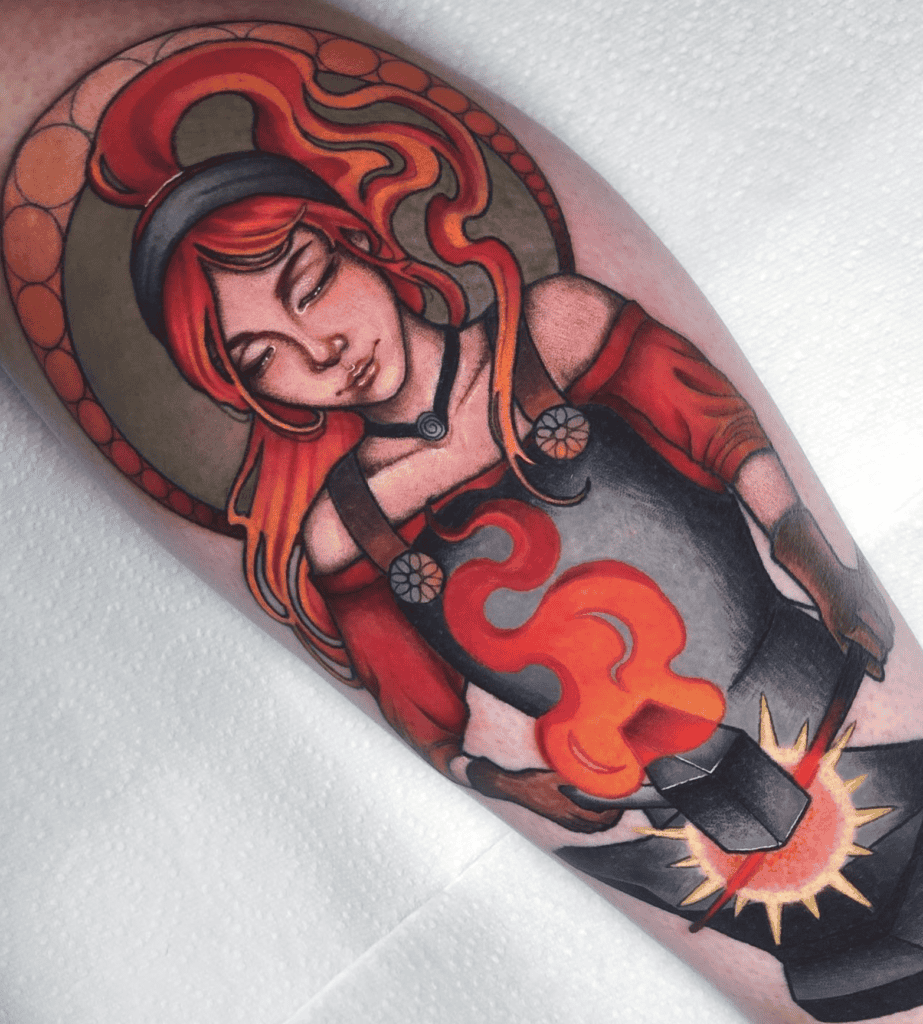
Brigid is a goddess of fire, healing, poetry, and creativity, who later became closely associated with Saint Brigid in Irish Christianity. Brigid is part of the Tuatha Dé Danann, often described as a triple goddess, linked to three core aspects. She is a symbol of feminine strength and nurturing power, and a bridge between pagan and Christian traditions.
Brigid is often seen as three-in-one, representing different forms of creative and life-giving power, being poetry & inspiration, smithcraft & fire, healing & fertility. She is strongly connected to Imbolc, a Celtic festival marking the end of winter and the return of light and life.
Niamh Celtic Mythology Tattoo

Niamh, often called Niamh of the Golden Hair, is a princess of Tír na nÓg (Celtic Otherworld), a place of eternal youth, beauty, and joy. The daughter of Manannán mac Lir, a powerful sea god, she is a radiant, otherworldly woman associated with beauty, love, and immortality.
Niamh’s most famous story is her romance with the hero Oisín, son of Fionn mac Cumhaill. Niamh falls in love with Oisín and invites him to join her in Tír na nÓg. He agrees and travels with her across the sea on her enchanted horse and lives in the Otherworld, where time stands still.
However, longing to return home, Oisín asks to return home. Niamh agrees, but warns him not to touch the ground when he returns. When he comes back to Ireland, centuries have passed, and everything he knew is gone. As he helps a passerby to lift a stone, he falls from the horse and touches the earth, instantly ageing into an old man.
Lugh Celtic Mythology Tattoo
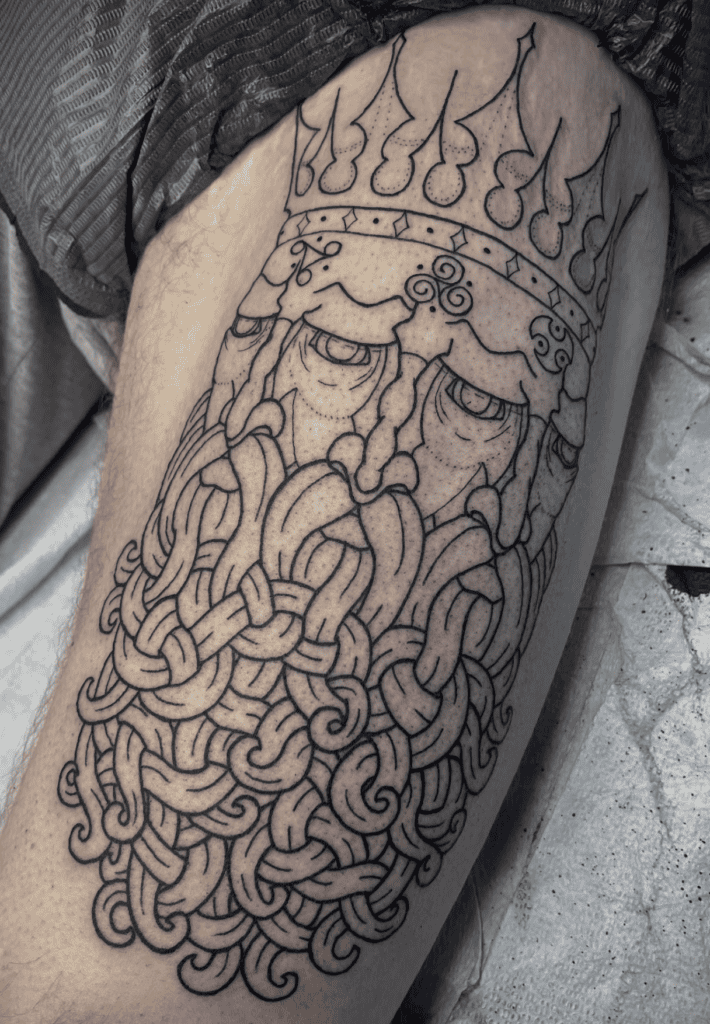
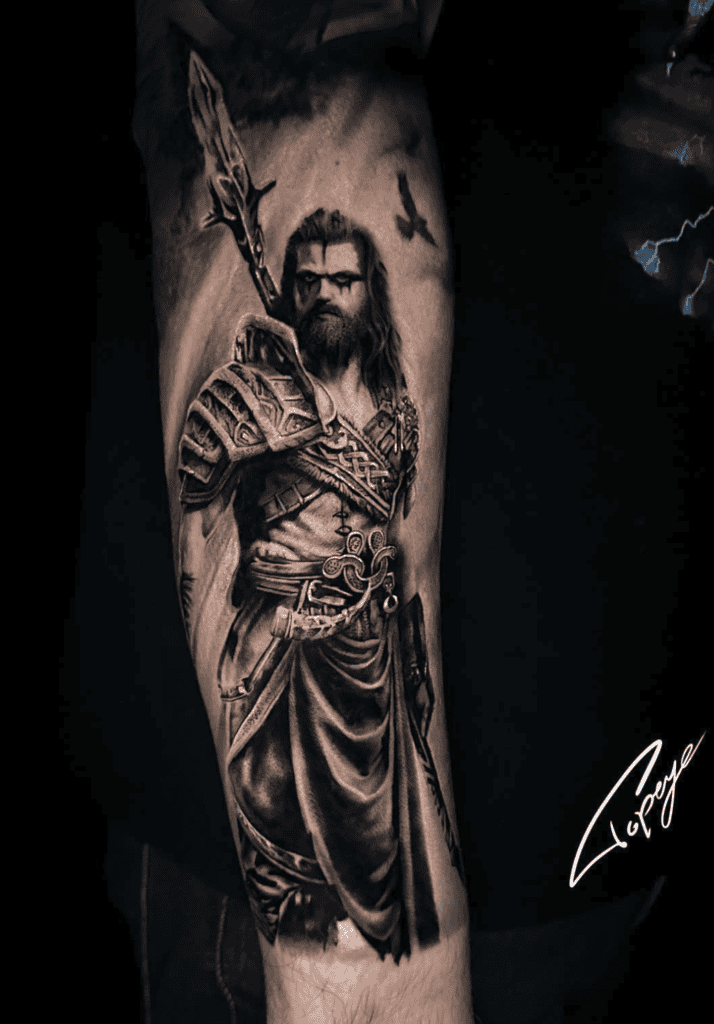
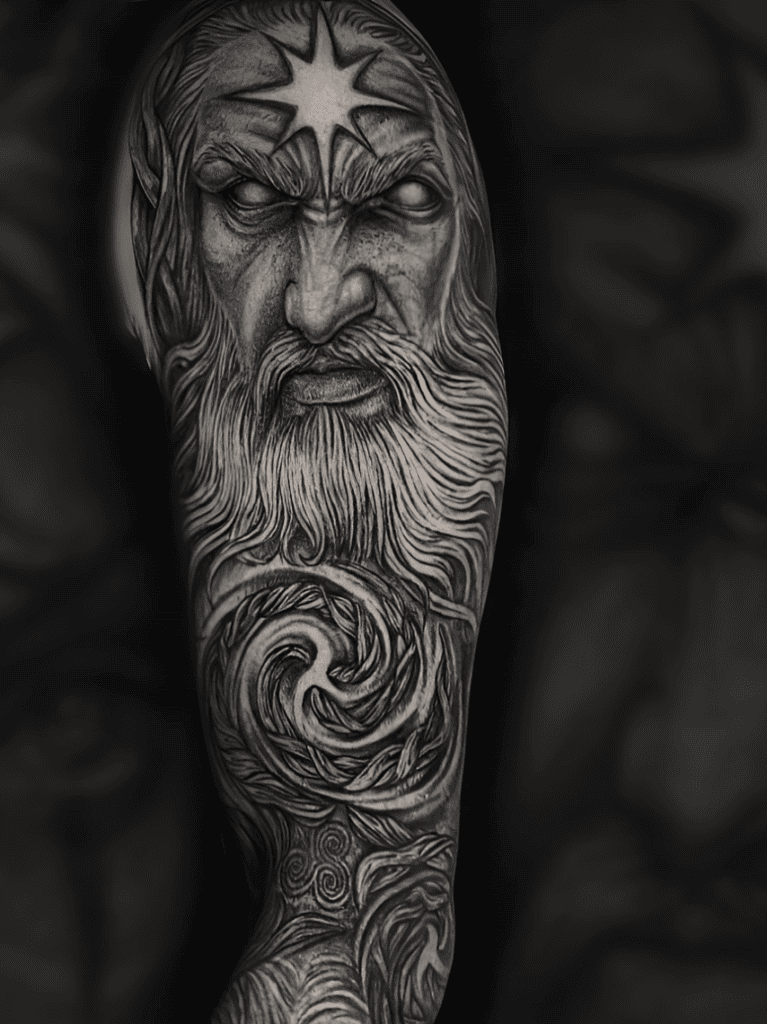
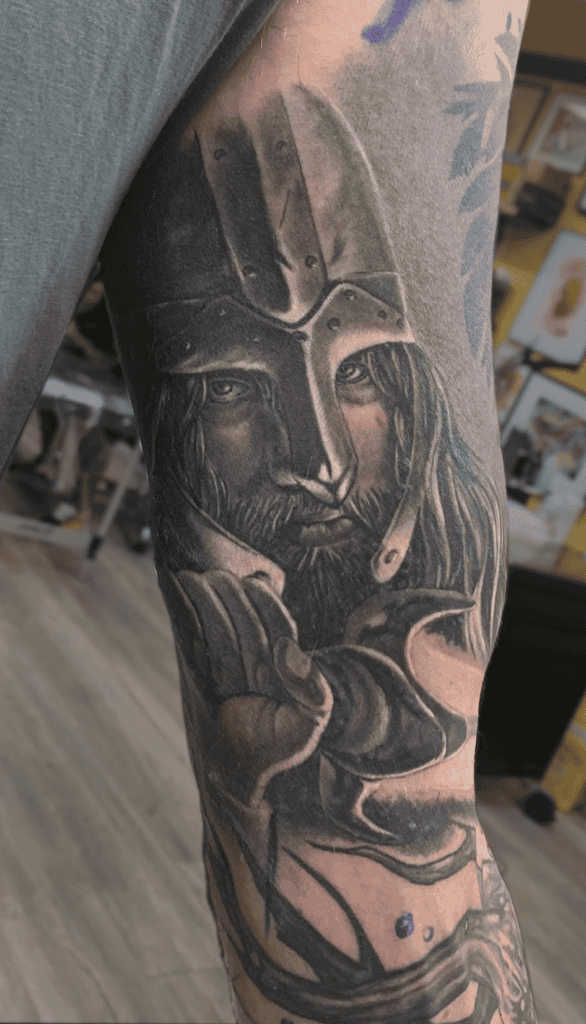
Lugh is a god from Irish Mythology, and a brilliant warrior, king, and craftsman of the Tuatha Dé Danann. He’s often called “Lugh Lámhfhada” (Lugh of the Long Arm) and “Samildánach” (Master of All Skills), because he was said to be good at everything.
Lugh is a god of light & the sun, war & strategy, craftsmanship & skill, and leadership & kingship. His grandfather, the tyrant Balor, was told he would be killed by his grandson. To prevent this tragedy, Balor tried to control fate, but nonetheless failed.
To stop the prophecy, Balor locked his daughter Ethniu in an isolated tower to ensure she would never meet a man to bear a child. However, she was secretly visited by Cian and became pregnant, giving birth to Lugh. Balor attempted to kill the child immediately by wrapping him up and throwing him into the sea, but he was saved by Manannán mac Lir, the powerful god of the sea and the Otherworld, growing up in secret.
In the great battle between the Tuatha Dé Danann and the Fomorians, Lugh faces his grandfather, whose deadly eye could destroy armies instantly. Using his legendary skill, Lugh strikes Balor’s eye, killing him and turning the tide of the war.
Nuada Celtic Mythology Tattoo
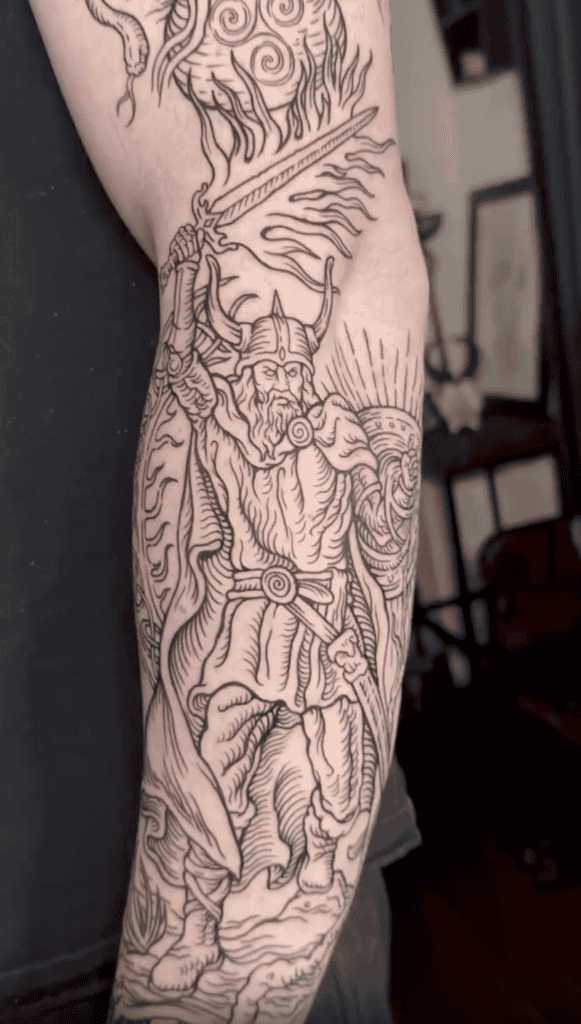
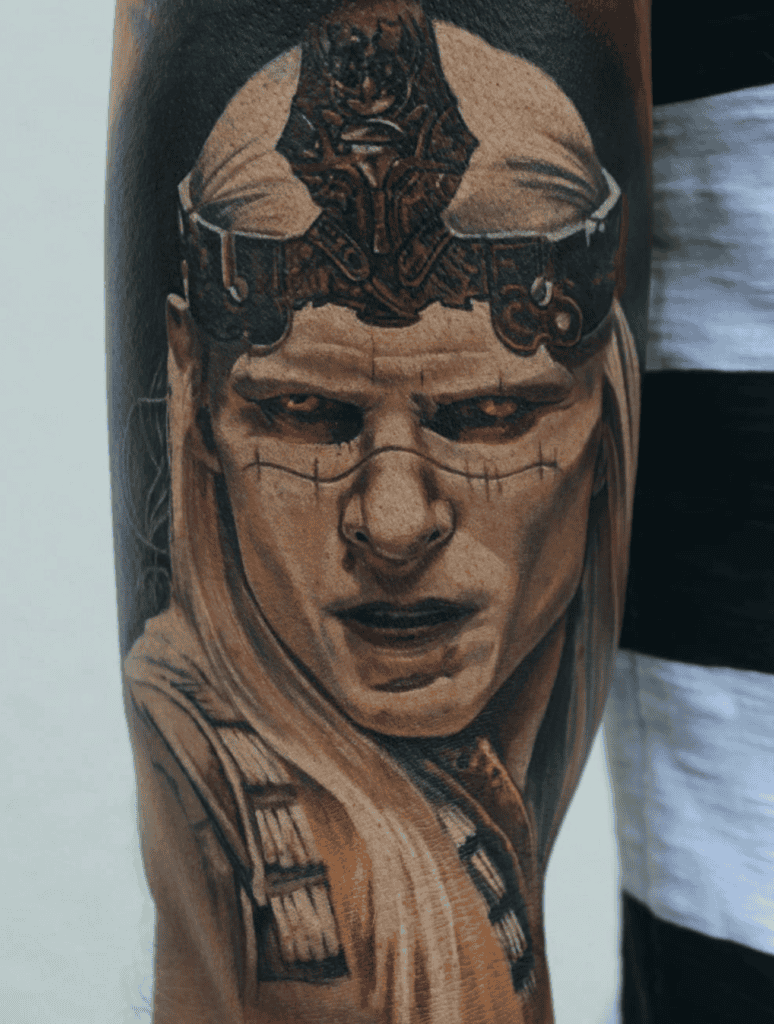
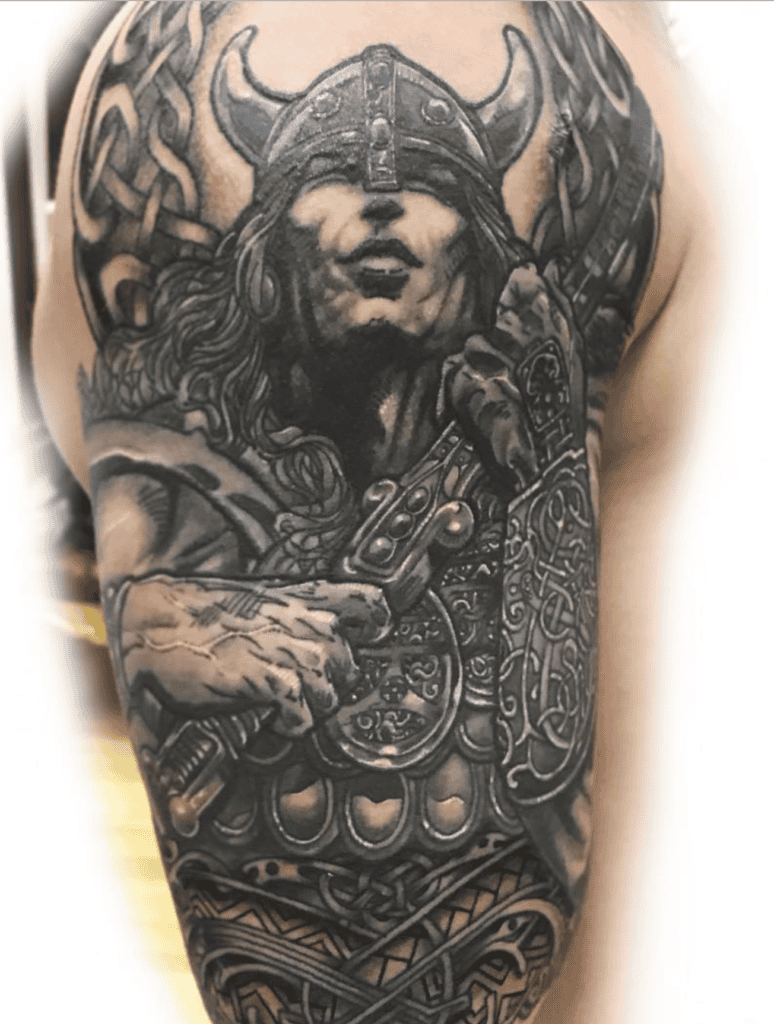
Nuada, often called Nuada Airgetlám, meaning “Nuada of the Silver Hand,” is a legendary king of the Tuatha Dé Danann who is known for losing his arm in battle, but coming back stronger because of it.
Nuada is the first king of the Tuatha Dé Danann in Ireland, a warrior and leader during the great battles against the Fomorians, and a symbol of rightful rule and physical perfection.
Aengus Celtic Mythology Tattoo

Aengus Óg, meaning “Young Aengus,” is a god of love, youth, dreams, and poetic inspiration, known for his beauty and gentle power. The son of The Dagda and the river goddess Boann, he is a youthful figure associated with beauty, charm, and emotional power.
His most famous myth is his love story with Caer Ibormeith. Aengus dreams of a mysterious, beautiful woman and becomes obsessed with finding her. After a long search, he discovers she is Caer, someone who transforms into a swan every other year.
To be with her, Aengus must transform himself into a swan as well, and when he does, they fly away together, singing a song so beautiful it puts all who hear it into a deep sleep.
Manannán mac Lir Celtic Mythology Tattoo


Manannán mac Lir is an Irish sea god who rules over the sea, mist, and the boundary between worlds. He is often portrayed as a calm but powerful ruler of the sea, a master of illusion, mist, and invisibility, and a guide to Tír na nÓg.
Manannán is known for possessing powerful artefacts such as the Cloak of Mist, allowing him to become invisible or surround areas in fog, his self-sailing boat, which moves without sails or oars, the Sword of Truth, which never misses and cannot be resisted, and an enchanted horse that can ride across both land and sea.
He controls access to mystical realms such as Tír na nÓg, appearing in stories to guide or test heroes. He can hide entire lands in mist, keeping them out of reach, deciding who is allowed to cross between worlds and who isn’t.
The Cailleach Celtic Mythology Tattoo

The Cailleach, often known as the Divine Hag, is a primal force of winter, storms, and the wild landscape who brings cold, darkness, and transformation through hardship. The Cailleach is typically described as an old, blue-skinned woman with wild hair, a wielder of a staff or hammer that controls the weather, and a giantess-like figure who shapes mountains and valleys.
The Cailleach is said to have formed the land by dropping stones from her apron to create mountains and hills and carving the terrain as she moves across it. She rules winter, bringing storms, frost, and darkness with power beginning around Samhain (start of winter) and fading at Beltane, when warmer forces return. In some traditions, she transforms into a younger goddess in spring or is replaced by one. The Cailleach is also a guardian of wild animals, especially deer, and a protector of the natural balance who destroys to maintain order through hardship.
Goibniu Celtic Mythology Tattoo

Goibniu is the legendary blacksmith of the Tuatha Dé Danann whose creations were said to be perfect, unbreakable, and deadly accurate. He is a part of a trio of artisan gods alongside Credne and Luchta, who together forged the weapons and tools that gave their people an edge in battle.
Every weapon Goibniu forged was flawless, such as spears that always hit their target, blades that never dulled, and weapons that guaranteed deadly precision. Goibniu’s power wasn’t just about war, as he also hosted a magical feast. Known as Goibniu’s Feast, those who drank his ale gained immortality or rapid healing, and warriors could return to battle again and again.
Cernunnos Celtic Mythology Tattoo
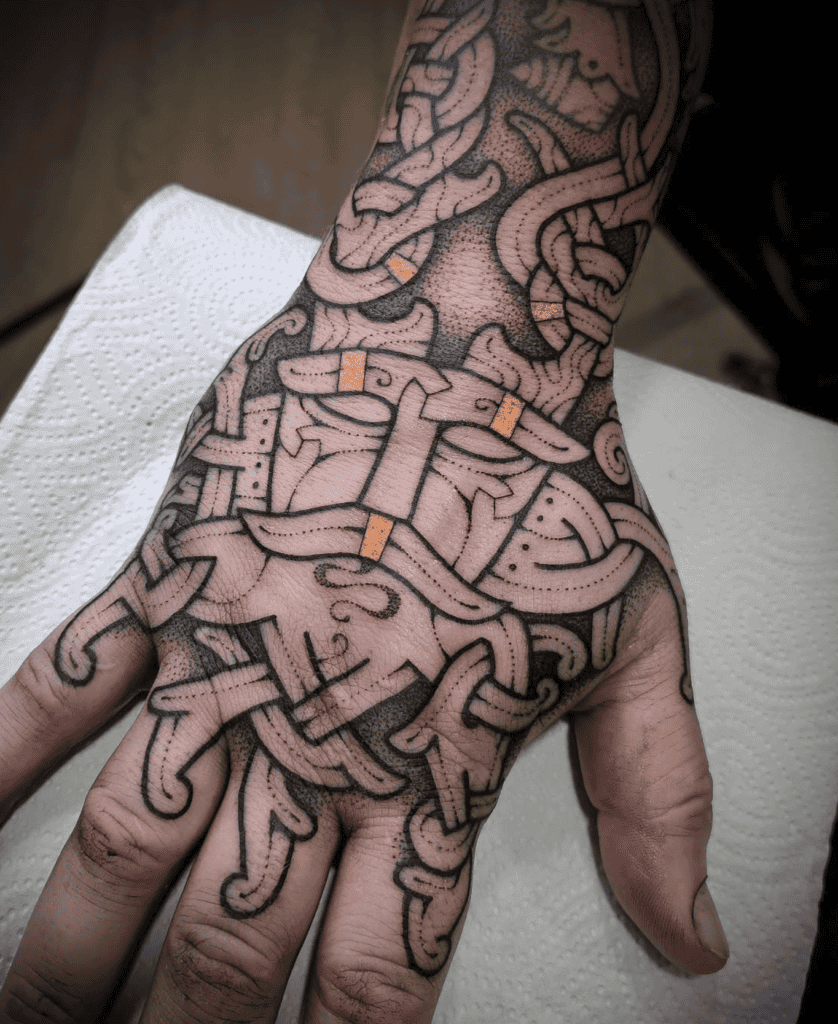
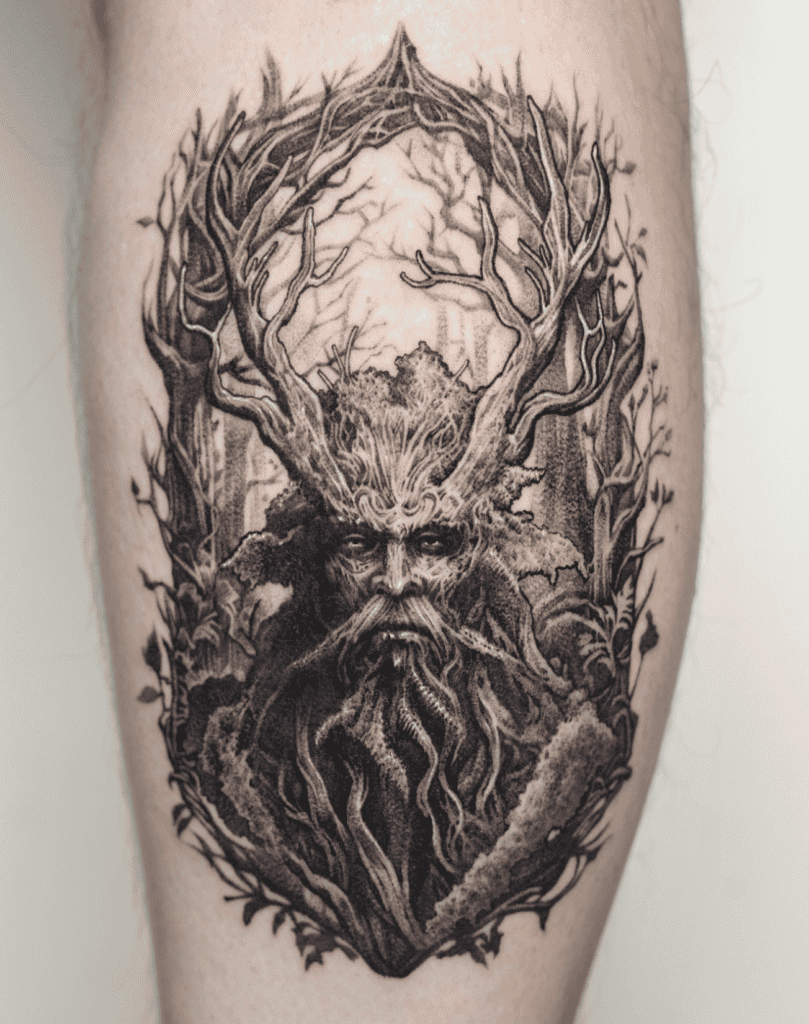
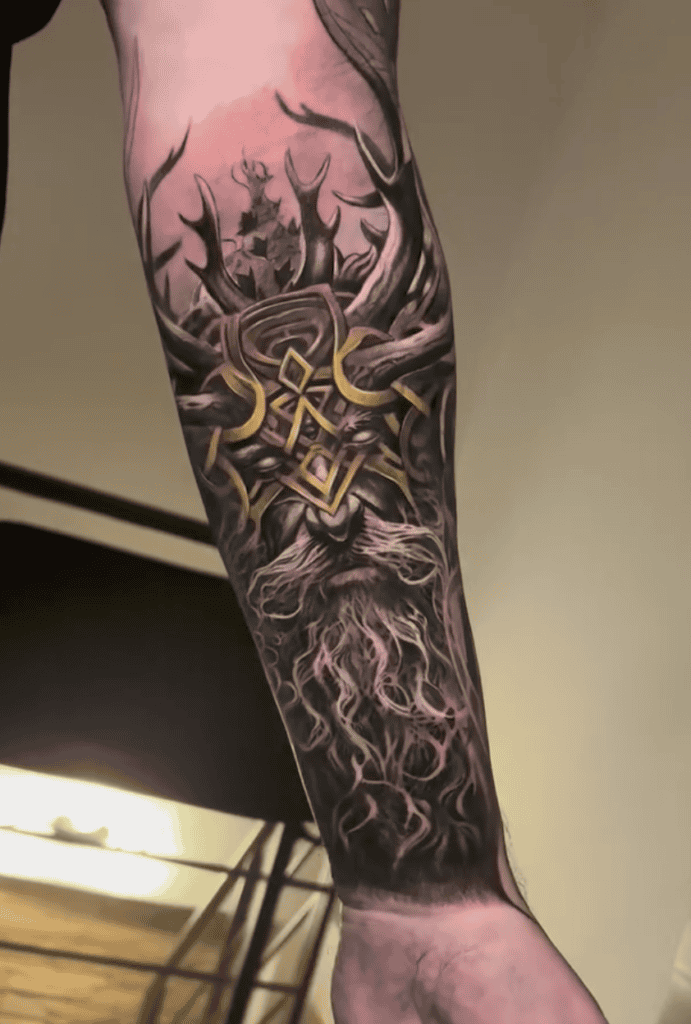
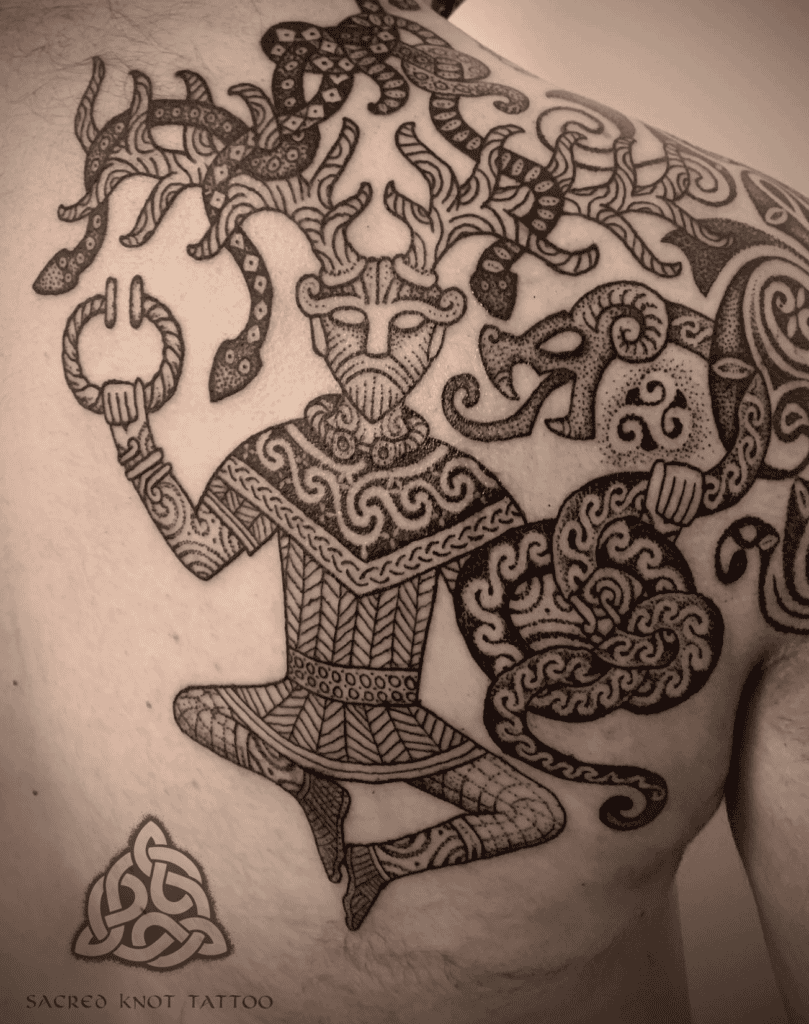
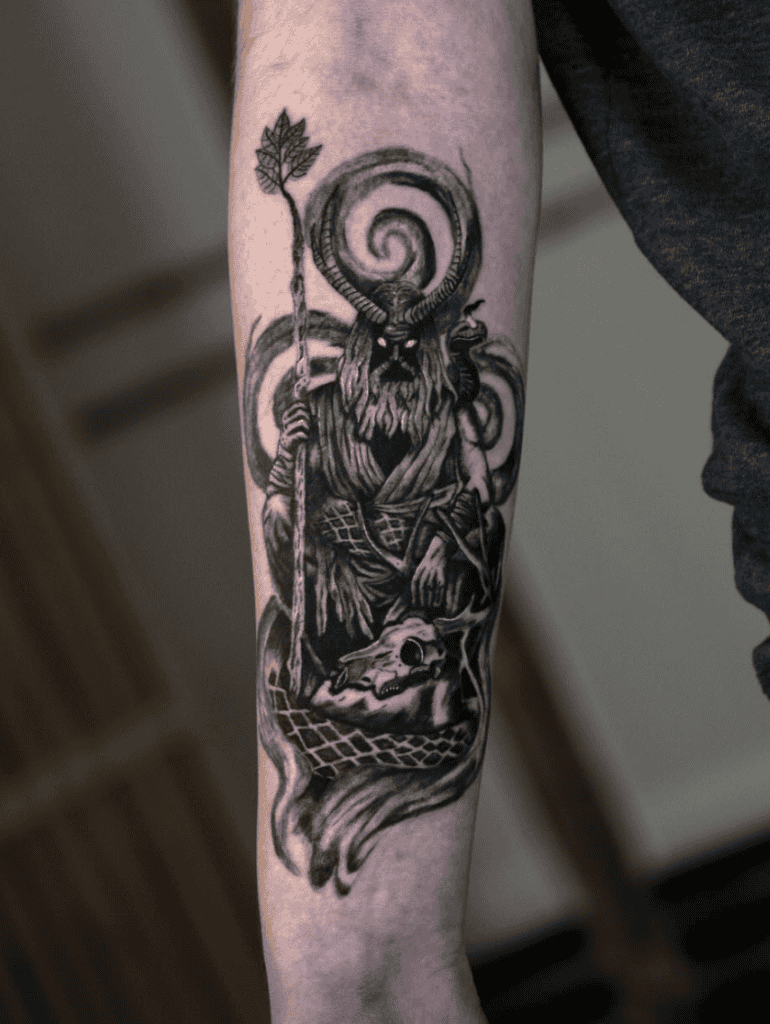
Cernunnos is a god of nature, animals, fertility, and the untamed wild. He’s a guardian of the natural world often depicted as a horned man with large stag antlers, sitting in a cross-legged, meditative pose, and surrounded by animals like deer, wolves, and serpents.
Cernunnos is frequently shown holding powerful symbolic items such as a Torc (Neck Ring), a Celtic symbol of wealth, status, and power, a horned serpent representing rebirth, transformation, and primal energy, and stag antlers that symbolise fertility, growth, and the cycle of life. Cernunnos represents the balance between life and death, the connection between humans and the wild, and the idea that nature is both nurturing and dangerous.
Epona Celtic Mythology Tattoo

Epona is a widely worshipped figure in Celtic mythology, being a goddess of horses, fertility, protection, and safe journeys. Epona was so important that her worship spread beyond Celtic lands and was even adopted by the Romans.
Epona is typically portrayed as a woman riding or standing beside a horse, surrounded by mares, foals, or symbols of abundance, with a calm, protective presence. Her name comes from a Celtic word meaning “great mare”, directly tying her to horses and their sacred role.
In Celtic culture, horses were incredibly important for travel, farming, and warfare and were seen as symbols of status and power. Epona became their divine protector, watching over horses, riders, and anyone who relied on them. She also protected people, with Ttravellers and riders praying to her for safe journeys, and Roman soldiers honouring her to protect their cavalry units.
Belenus Celtic Mythology Tattoo


Belenus is a god of light, the sun, and healing. His name is often linked to brightness, sometimes translated as “The Shining One.” He is often associated with the sun and its life-giving power, healing & purification, growth, vitality, and health. He was worshipped across parts of Gaul, Britain, and Ireland, making him one of the most widely recognised Celtic gods.
Belenus is closely linked to sacred fire rituals, especially the Beltane festival, which marks the beginning of summer and celebrates light overcoming darkness, involving bonfires for protection and cleansing.
Belenus was also often connected to healing springs & sacred waters, restoration of health and vitality, and spiritual & physical cleansing. In some regions, he was even associated with Apollo, the Greek god of healing and light, showing how similar their roles were.
Taranis Celtic Mythology Tattoo


Taranis is the Celtic god of thunder, lightning, and the sky, worshipped widely across ancient Gaul and Britain. His name, “Taran”, means thunder, and he is often depicted as a sky god wielding lightning, a figure associated with storms and raw power, and a deity connected to the cosmic forces of nature.
He is often shown alongside a wheel and lightning, which represent the sun, cycles, and cosmic order. He governs thunder and lightning, storms and sky energy, or sudden, uncontrollable forces.
Balor of the Evil Eye Celtic Mythology Tattoo
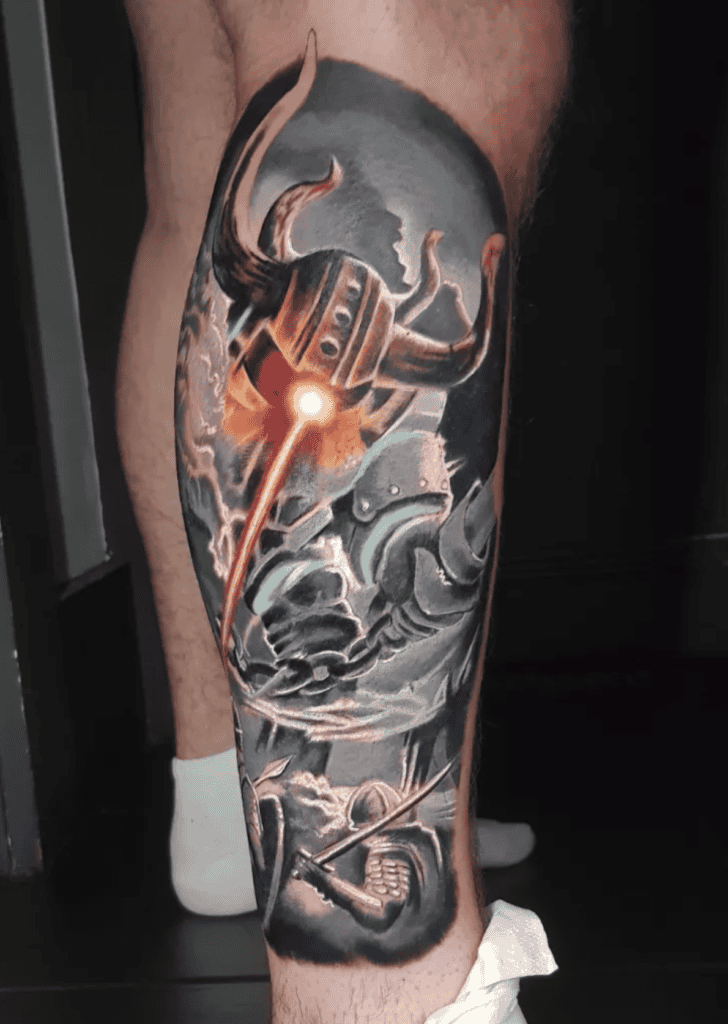
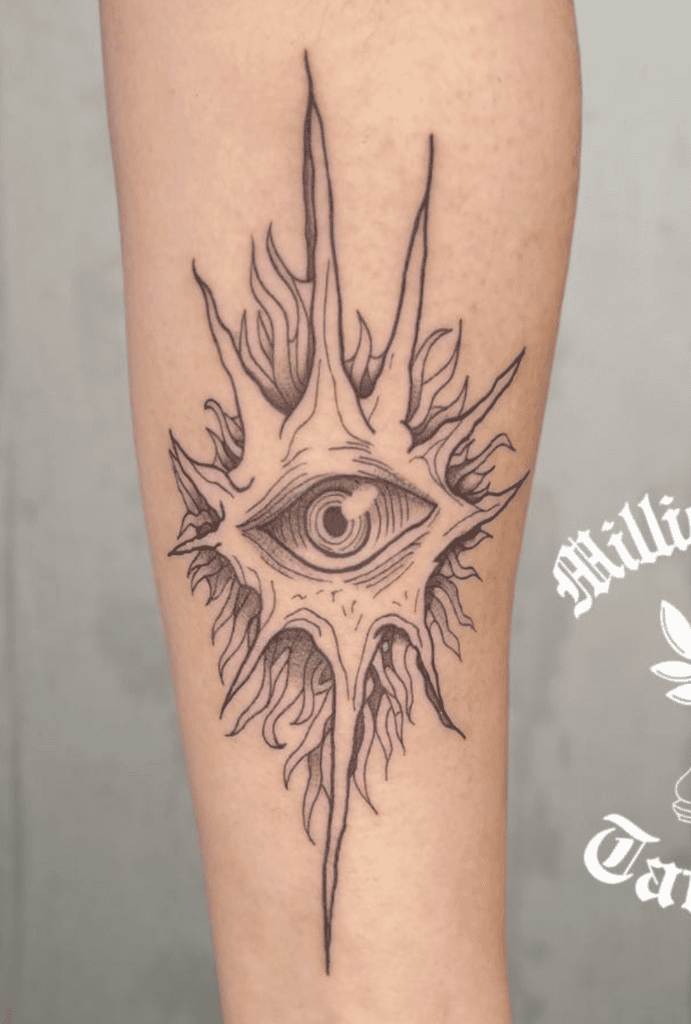
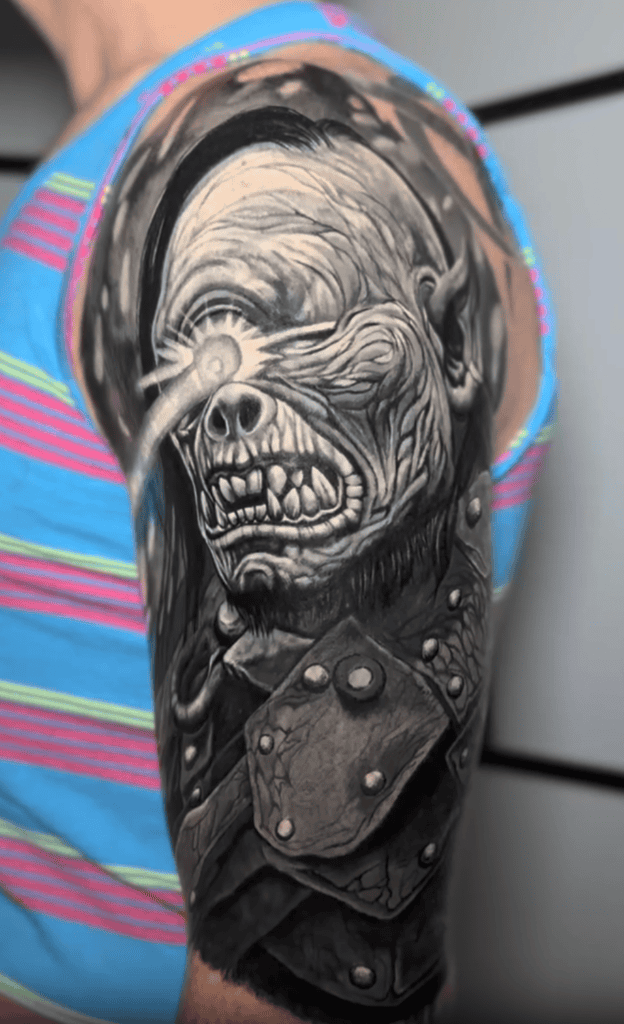
“Balor of the Evil Eye” is the leader of the Fomorians, representing chaos, destruction, and oppressive power. He is described as a giant-like warrior king, possessing a single, terrifying evil eye, and a ruler associated with darkness, tyranny, and fear
When his eye opens, it can kill or destroy entire armies. It was so powerful that it often had to be kept closed or covered, and while in battle, others would sometimes lift the eyelid for him.
When Balor was told he would be killed by his own grandson, he imprisoned his daughter Ethniu to keep her from becoming pregnant. His efforts failed, and her son Lugh was raised in secret until he grew to confront and strike him down.
Cú Chulainn Celtic Mythology Tattoo
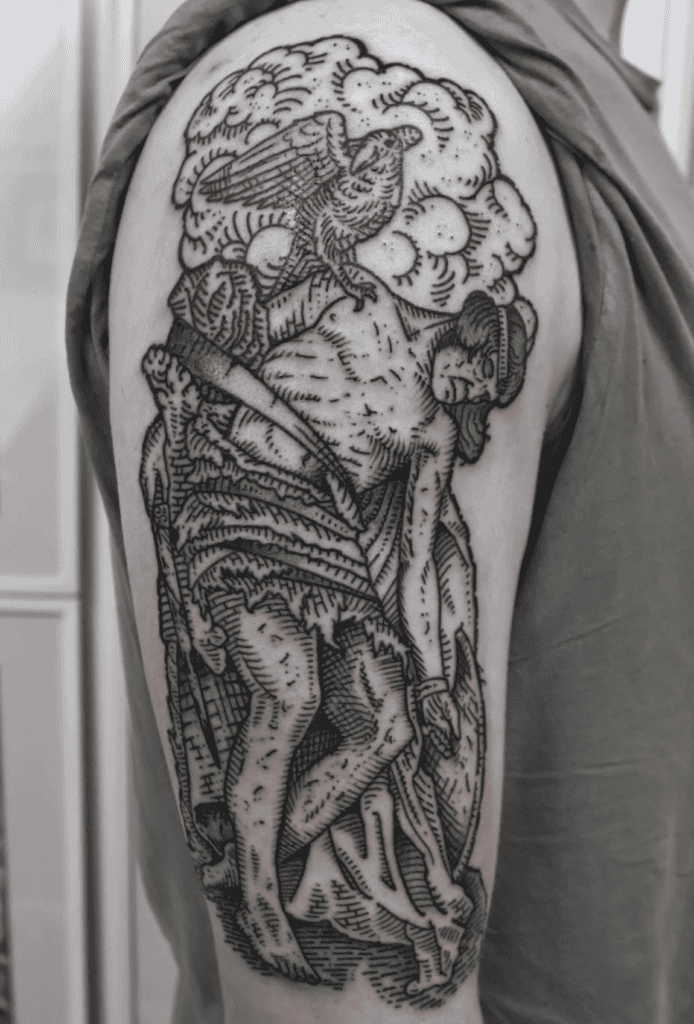
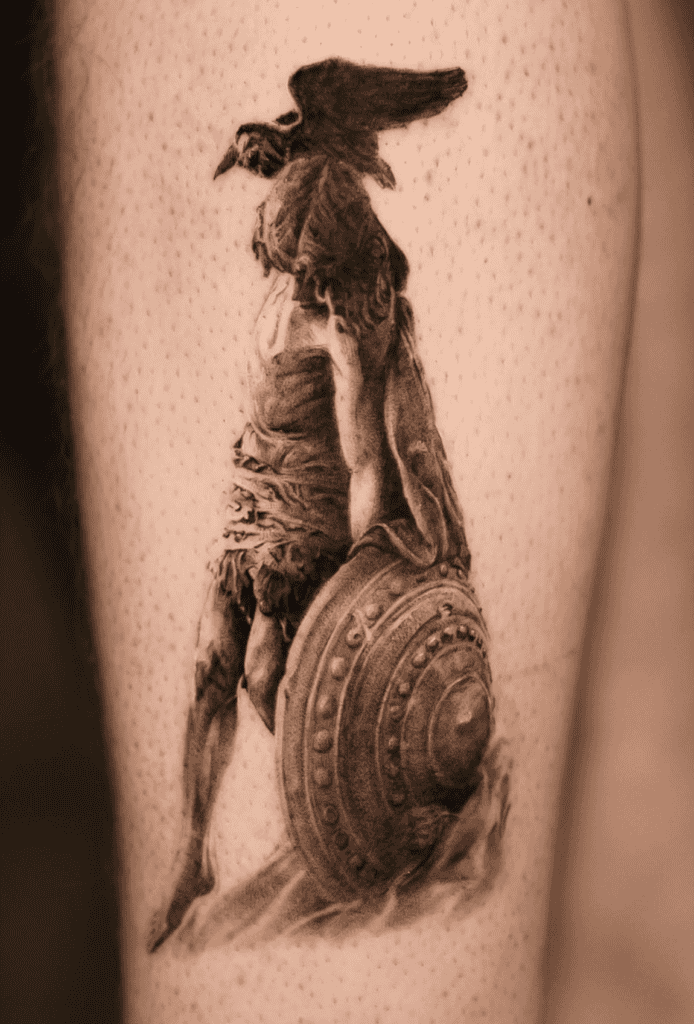
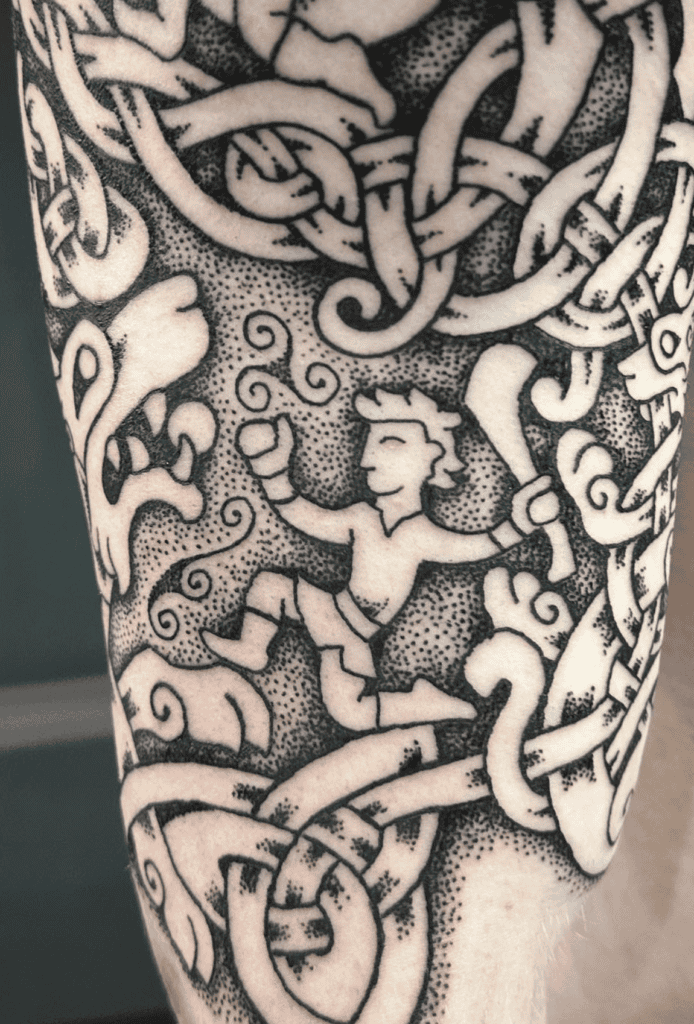
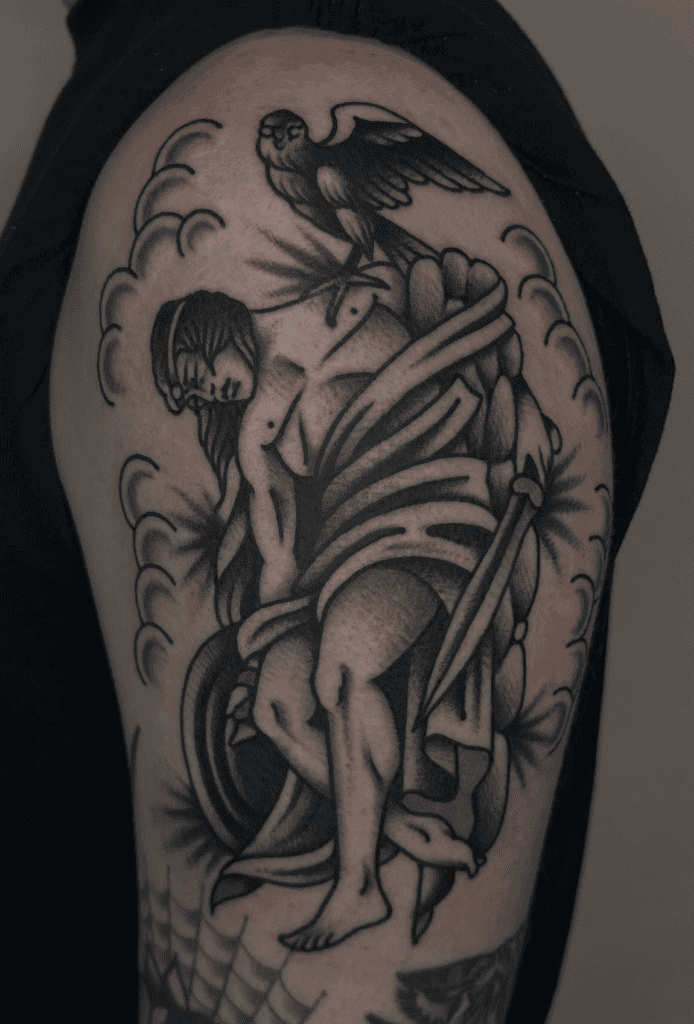
Cú Chulainn is one of the greatest heroes in Celtic mythology, known for his superhuman strength, tragic fate, and unstoppable courage. Born Setanta, he killed the fierce guard dog of the smith Culann in self-defence by shooting a sliotar (ball used in Irish sports) down its throat. To make amends, he offered to take the dog’s place, becoming “Cú Chulainn,” “The Hound of Culann.”
Cú Chulainn is famous for fighting entire armies alone, defending Ulster during invasions, and wielding the deadly spear Gáe Bolg. He becomes the central hero in the epic Táin Bó Cúailnge, where he holds off Queen Medb’s forces almost single-handedly.
One of his most terrifying traits is the warp-spasm (ríastrad), where his body would twist and transform into something monstrous. One eye would shrink, while the other bulged outward, and his strength became almost uncontrollable.
The Morrígan offered him love, but he rejected her and she later interferes in his battles, testing him. Mortally wounded, he refused to fall, tying himself to a standing stone to die on his feet. Only when a crow sent by The Morrígan lands on him do his enemies realise he’s dead.
Fionn mac Cumhaill Celtic Mythology Tattoo


Fionn mac Cumhaill is one of the greatest heroes in Celtic mythology and the leader of the legendary band known as the Fianna, and a hero of the Fenian Cycle (a major group of Irish myths).
His most famous story is tied to the Salmon of Knowledge. This magical salmon gained all the world’s wisdom, and after being caught by his master, Fionn was asked to cook it for him. Fionn burned his thumb while cooking, instinctively sucking it to soothe his burns, but, in that exact moment, he gained the fish’s infinite knowledge.
From then on, whenever he touched his thumb to his mouth, he could access deep insight and understanding. Fionn led the Fianna, a group of skilled hunters and warriors who lived between civilisation and the wild, protecting the land. Under his leadership, they became legendary for loyalty, bravery, and independence.
In some later legends, Fionn is portrayed as a giant, with one famous tale linking him to the Giant’s Causeway in Northern Ireland. He was said to have been built as a path to Scotland, connecting him to larger-than-life folklore.
Deirdre Celtic Mythology Tattoo

Deirdre of the Sorrows was a woman of extraordinary beauty and grace, and a central figure in the Ulster Cycle. At her birth, a druid foretold that she would grow up into a woman whose extreme beauty would bring war, exile, and destruction.
Because of this, King Conchobar mac Nessa decided to raise her in isolation with a plan to marry her himself when she came of age. However, Deirdre falls in love with the warrior Naoise and together, they flee Ireland with his brothers, living in exile while being hunted.
Eventually, they are promised safe passage back to Ireland, but it was a trap. Naoise and his brothers are killed, and Deirdre is taken back against her will. She is forced to live under the control of the king, who caused it all.
Unable to live with her loss and captivity, she chooses death over a life without freedom or love. In some versions, she takes her own life, while in others, she dies of grief or is killed.
Queen Medb Celtic Mythology Tattoo


Medb (often spelt Maeve) is a queen of Connacht, known for her ambition, independence, and fierce leadership, as well as her central role in the epic Táin Bó Cúailnge.
Medb is a warrior queen who leads armies into battle, a ruler defined by power, pride, and control, and a figure who challenges traditional roles of women in mythology. Her most famous story begins with a competition between her and her husband over who possesses greater wealth.
Medb realises she is missing a legendary bull, so she launches a full-scale invasion to steal it from Ulster. This becomes the legendary conflict of the Táin, where she faces the hero Cú Chulainn.
She leads her army personally, commanding respect through authority and strategy, using both strength and manipulation to achieve her goals. She is ambitious and determined, but also prideful and relentless, valuing power, equality, and independence.
Rhiannon Celtic Mythology Tattoo

Rhiannon is a Welsh goddess of sovereignty, horses, magic, and the Otherworld, known for her calm strength and quiet resilience. She is often portrayed as a beautiful woman riding a white horse who is connected to the Otherworld.
Rhiannon is strongly linked to horses, much like Epona, and no matter how fast others ride, they can never catch up to her, unless she allows it. She also has a magical connection to birds, as her birds can sing the living to sleep or awaken the dead with their song.
After giving birth, her child mysteriously disappears, and she is falsely accused of killing it. As punishment, she is forced to carry visitors on her back like a horse, and despite the humiliation, she endures it with patience and dignity. After 7 years, the child is found alive, and her innocence is proven.
Blodeuwedd Celtic Mythology Tattoo

Blodeuwedd was a woman crafted from flowers by magicians Math ap Mathonwy and Gwydion in Welsh Mythology. She was made to be a wife for Lleu Llaw Gyffes, who was cursed to never marry a human woman.
Despite her magical purpose, she fell in love with another man, Gronw Pebr, and together, they plotted to kill her husband, Lleu. However, Lleu cannot be killed normally and can only die under very specific, almost impossible conditions.
Using trust and love, Blodeuwedd tricks him into revealing them. Lleu could only be killed if he was neither indoors nor outdoors, neither on horseback nor on foot, and had to be struck with a specially crafted spear. When he was tricked into standing with one foot on a goat and one on a bath, the conditions were met, and he was struck by the spear prepared by Gronw.
Severely wounded, he transforms into an eagle and escapes. Once healed, he takes his revenge by transforming Blodeuwedd into an owl, where she is condemned to live in the night, feared and shunned by other birds.
Failinis Celtic Mythology Tattoo

Failinis is a legendary hound in Celtic mythology, most often associated with Lugh. He is a massive, powerful hound or wolf-like creature who has origins from the Otherworld and is a companion to Lugh, often accompanying him in battle.
Failinis bark alone could subdue armies, and he could defeat enemies with overwhelming strength and speed, with some versions stating that he could even emit light or fire.
Celtic Tree of Life Celtic Mythology Tattoo
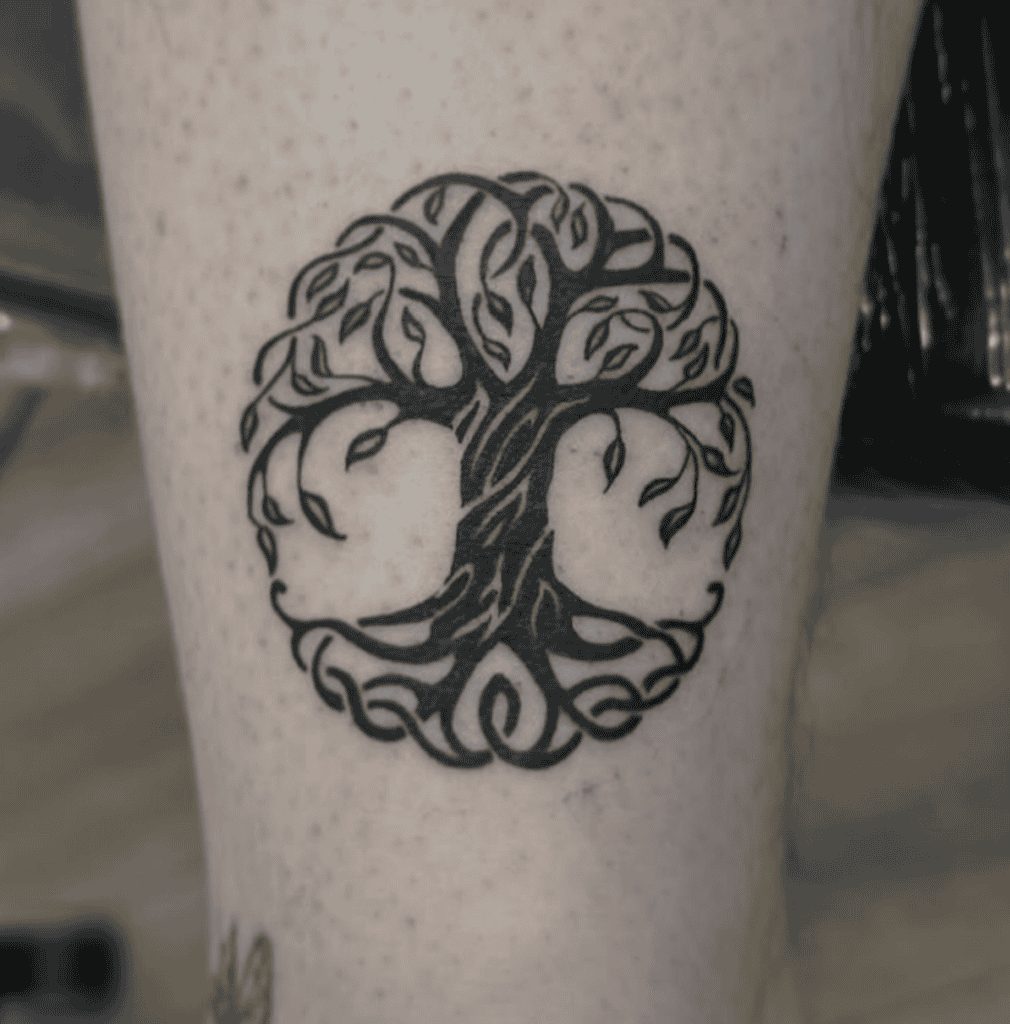
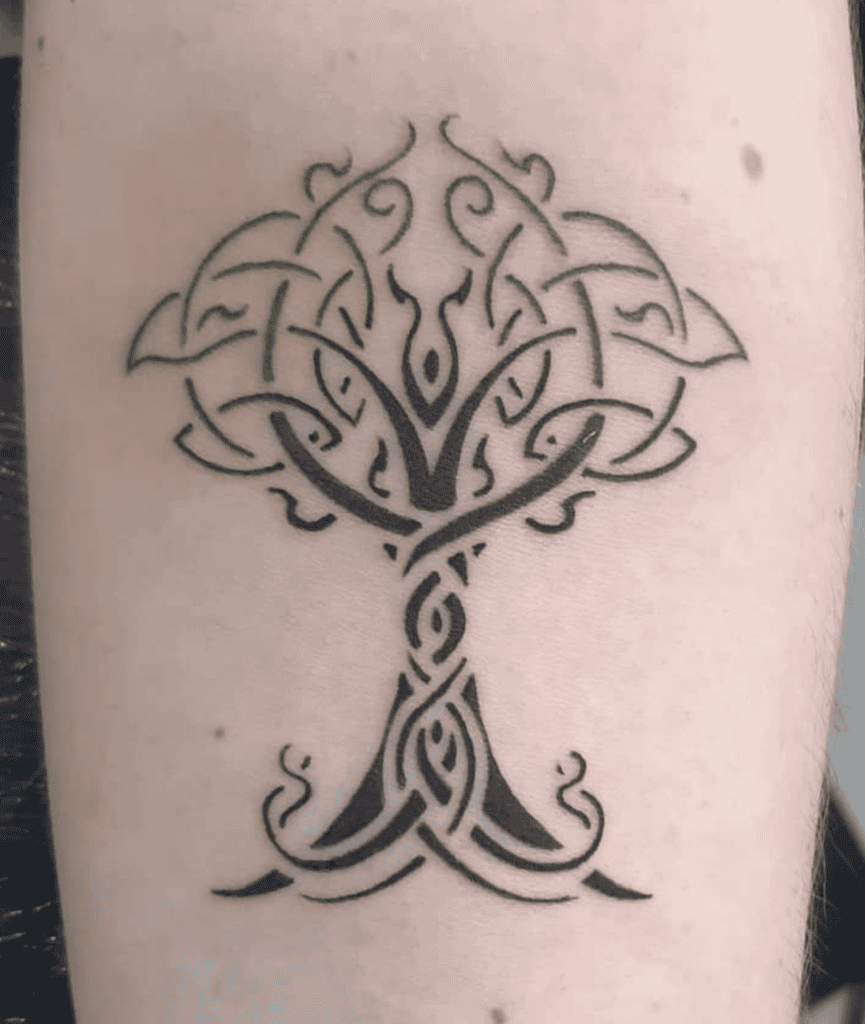
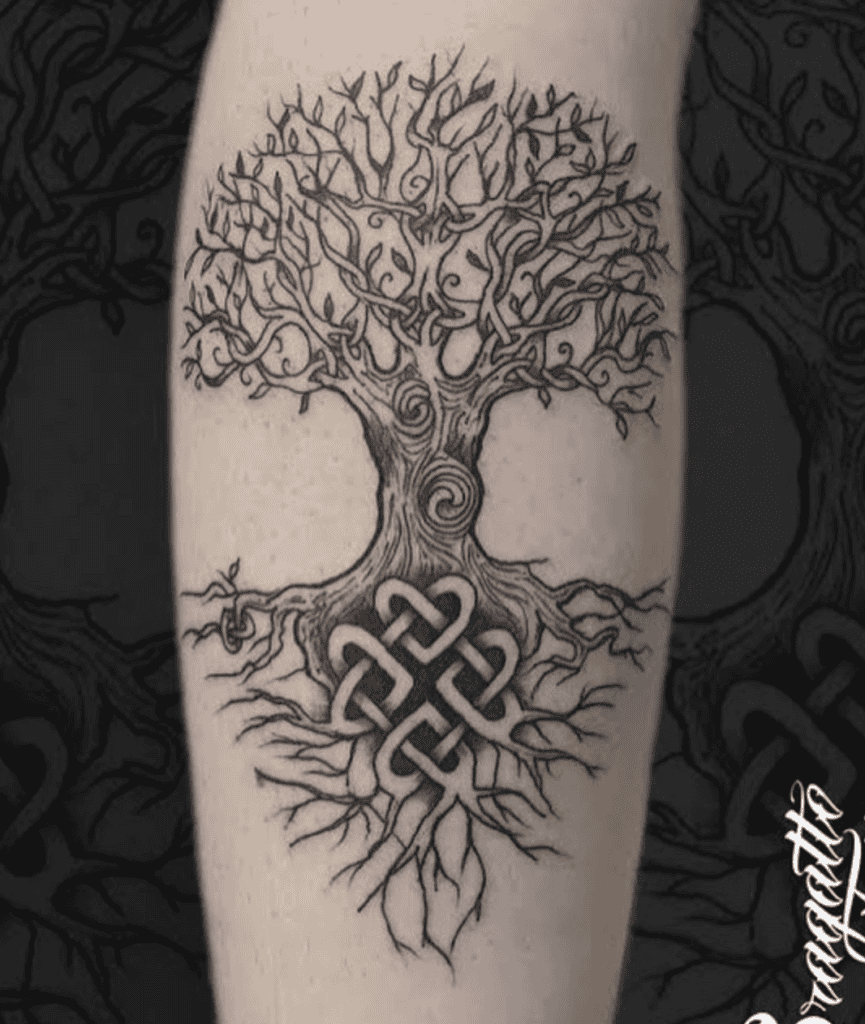
The Celtic Tree of Life (Crann Bethadh in Irish) represents the deep connection between all living things and the balance between earth, sky, and the spiritual world, whose design reflects a core Celtic belief: “As above, so below.”
The Tree of Life connects the three main realms:
Roots (Underworld) – ancestors, past, hidden knowledge
Trunk (Earth) – present life, growth, stability
Branches (Sky) – future, spirit, higher awareness
The tree also symbolises the seasons, growth in spring, strength in summer, change in autumn, and rest in winter. The mirrored roots and branches show how everything is connected, life exists in balance, and what happens in one realm affects another.
Celtic Dragon Celtic Mythology Tattoo
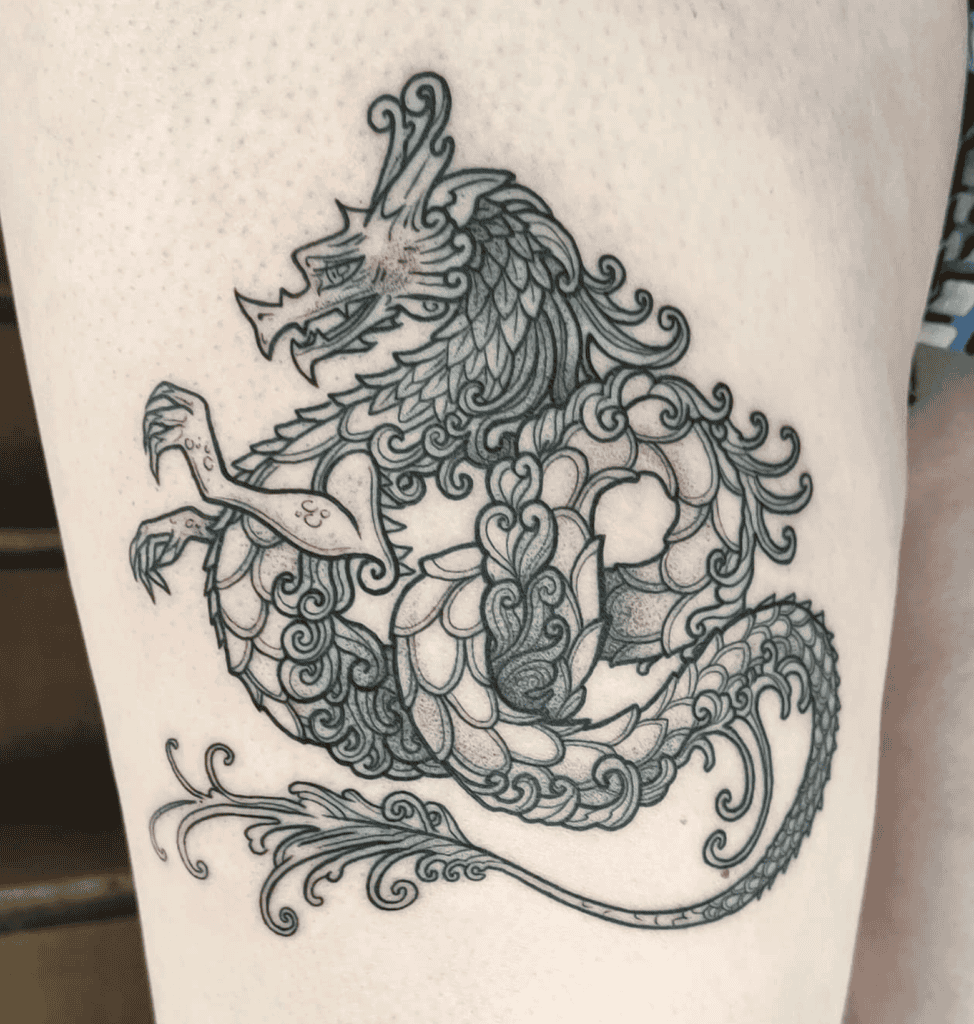
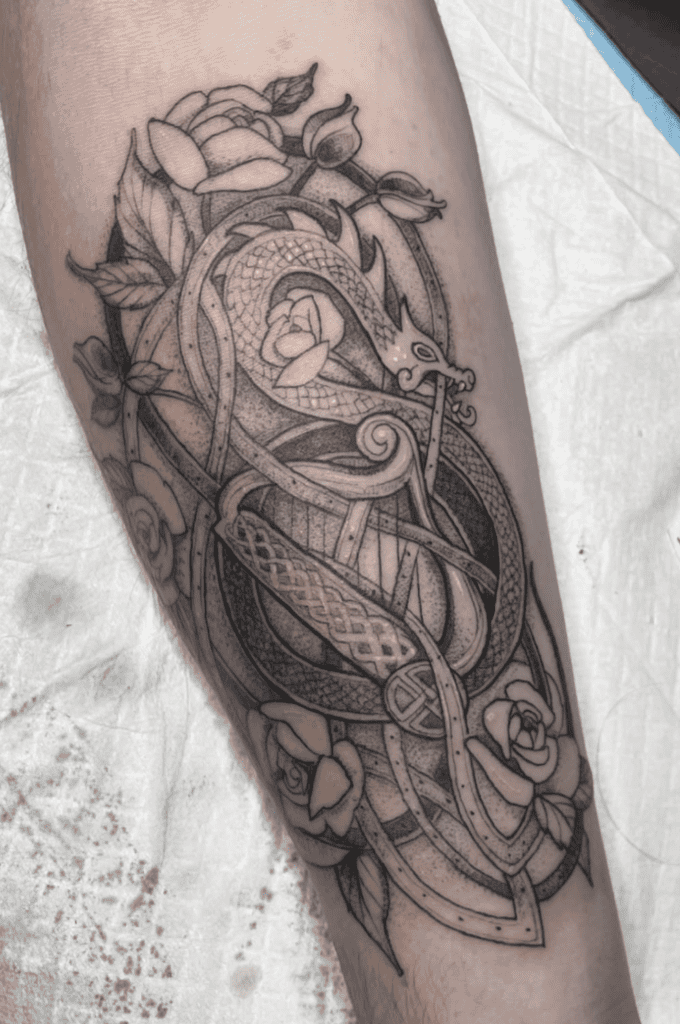
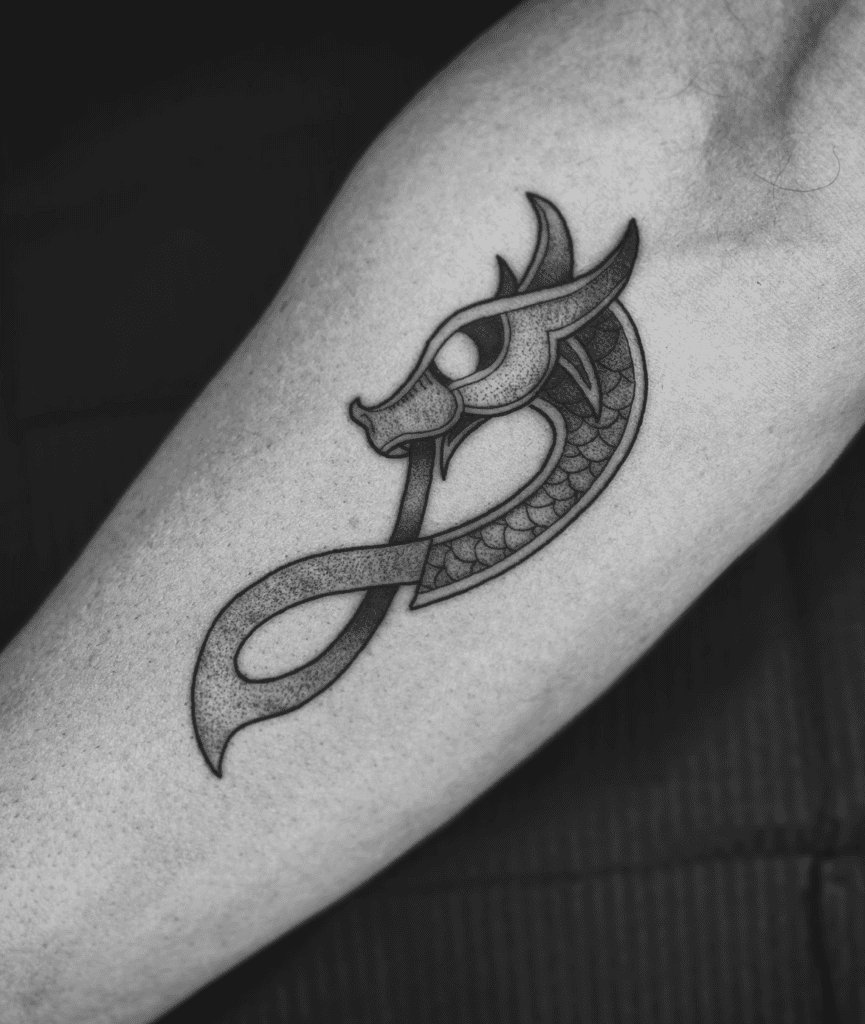
The Celtic Dragon is seen as a protector, guardian, and source of ancient wisdom. These creatures are long, serpentine creatures, interwoven with Celtic knotwork, forming endless loops, reflecting the idea of eternity and continuous flow.
In Celtic belief, dragons were protectors of sacred places and treasures, guardians of the land’s energy and power, and linked to kingship and authority. In some traditions, a dragon symbolised the strength of a nation or ruler.
The Welsh Red Dragon is one of the most famous examples. This dragon is red, representing Wales, and symbolises strength, resistance, and identity. It is tied to legends of battles between dragons representing opposing forces and is still used today as a national symbol.
Kelpie Celtic Mythology Tattoo
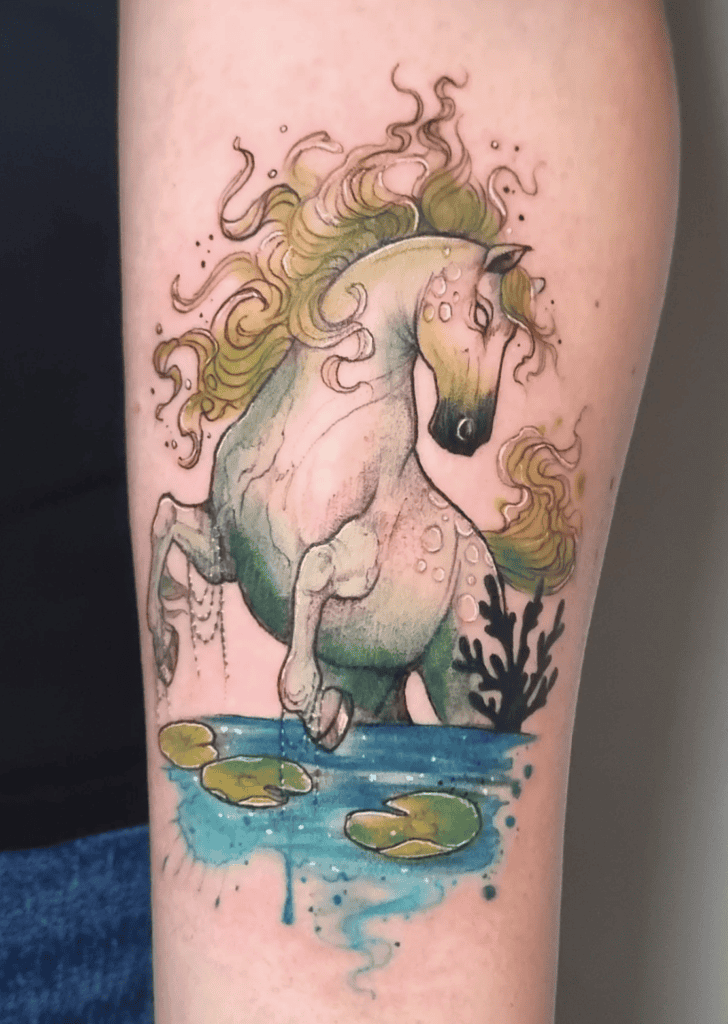
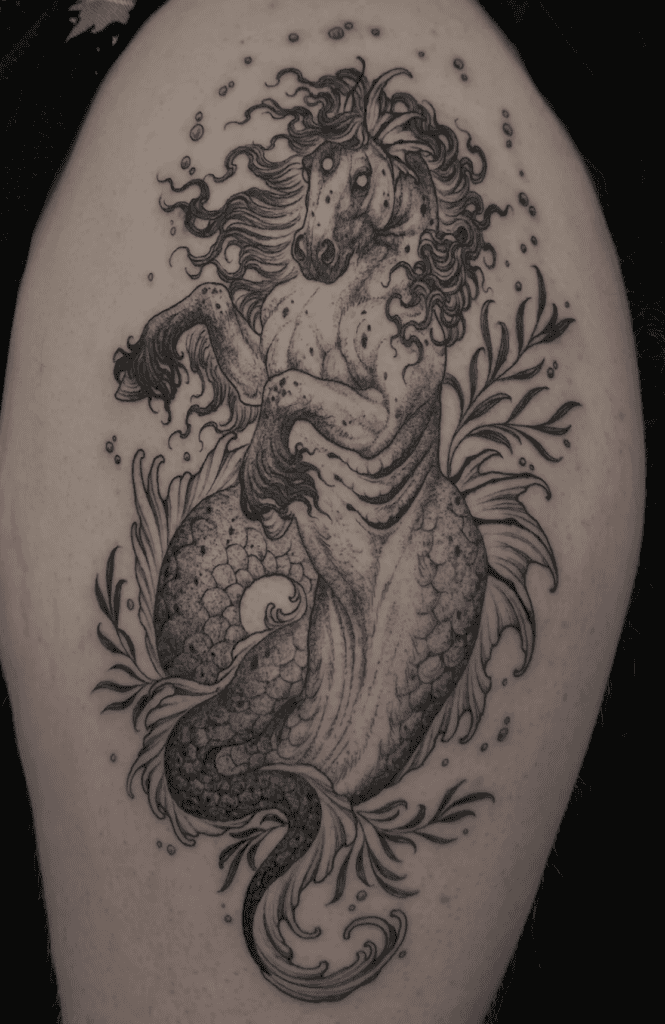
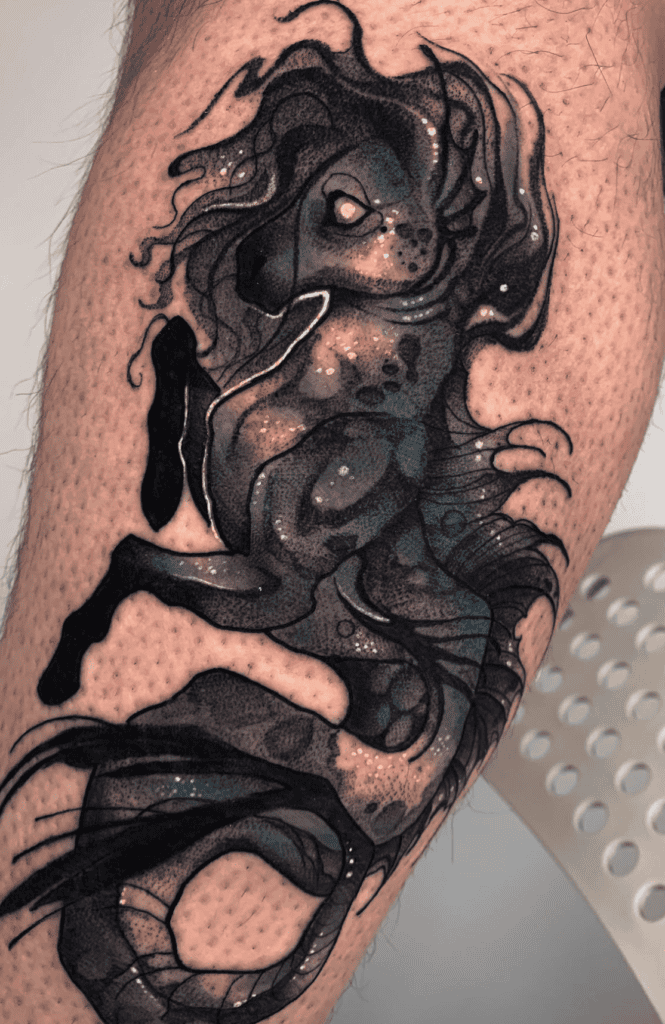
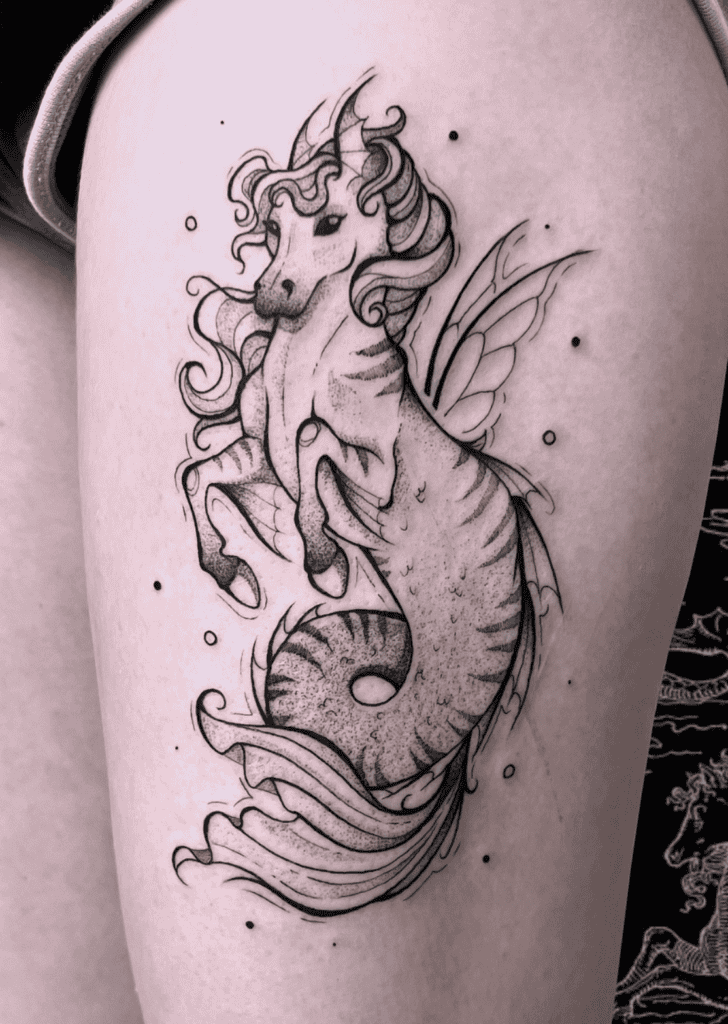
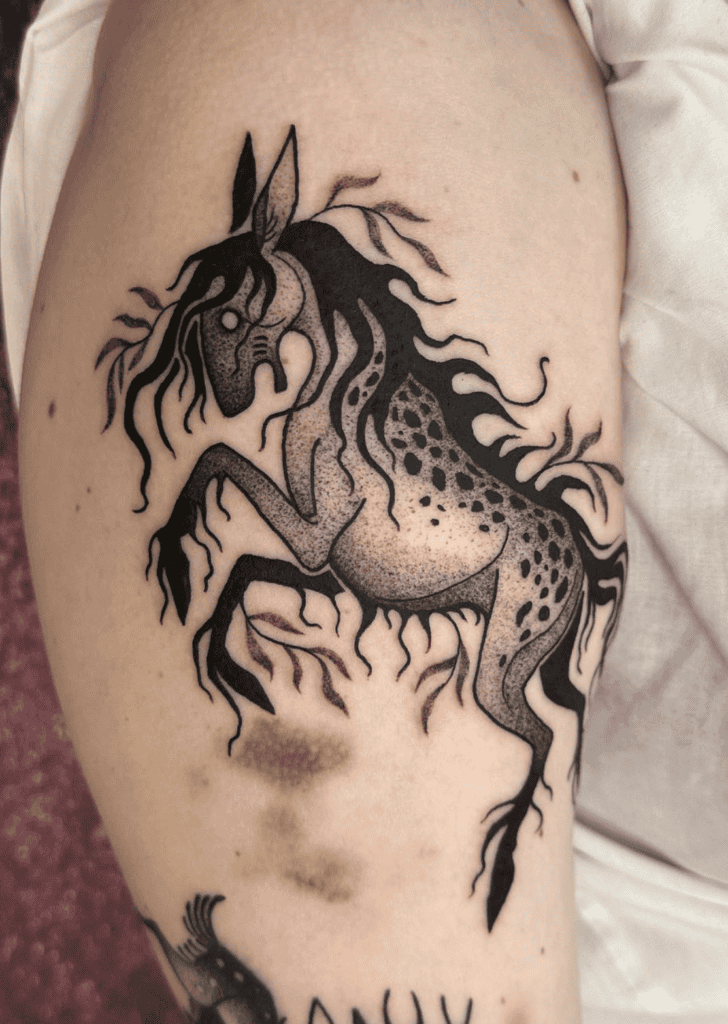
The Kelpie is a creature from Scottish myth, a shape-shifting spirit that lives in rivers and lochs and appears as a beautiful horse to lure victims to their doom. The Kelpie appears as a tame, inviting horse near the water’s edge, tempting people to climb onto its back. Once they do, they become stuck and unable to get off, and the Kelpie dives into the water, drowning them.
In some stories, the Kelpie can appear as a handsome man or beautiful woman near the water, often with a giveaway where its hair is tangled or has reeds in it.
Selkie Celtic Mythology Tattoo
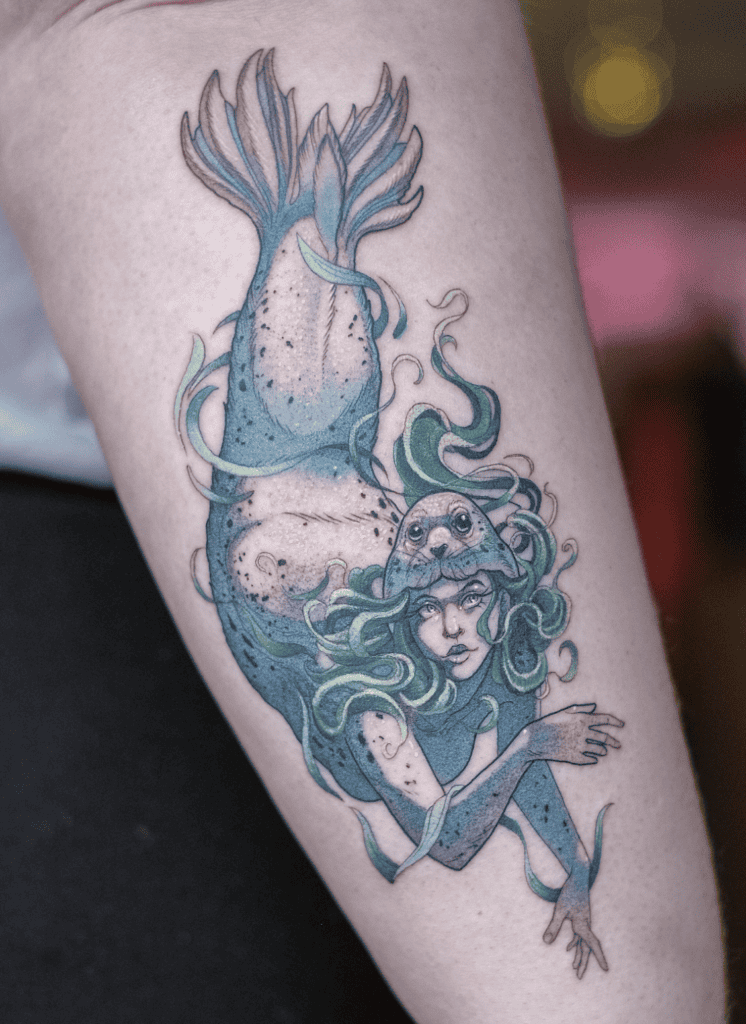
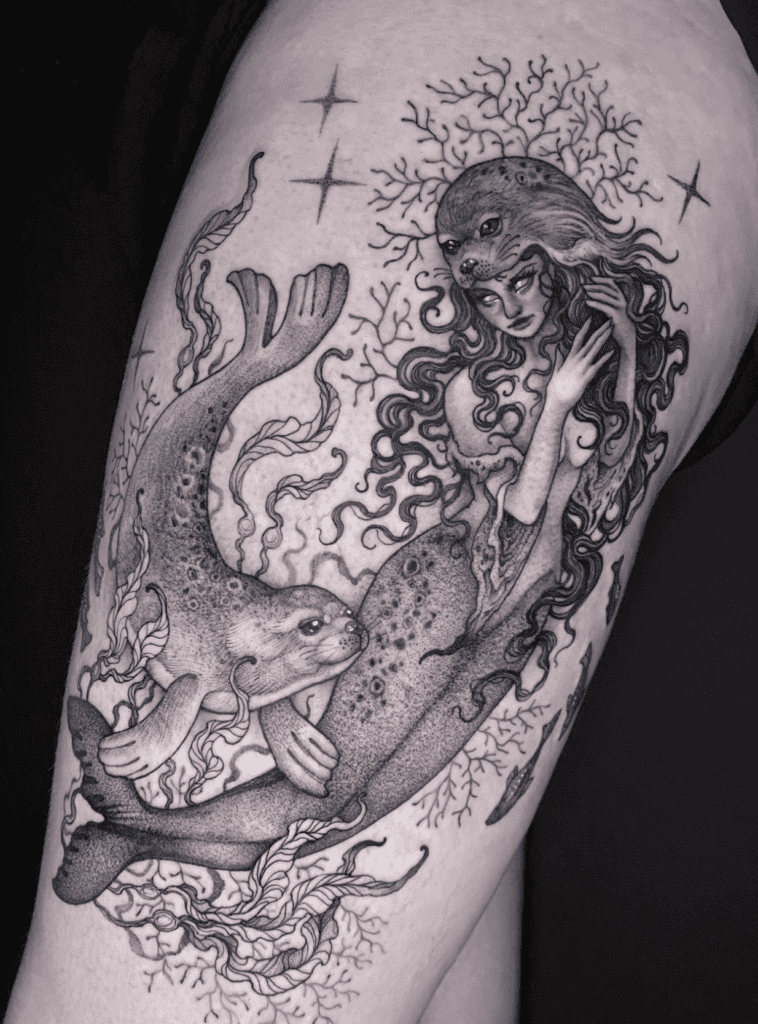
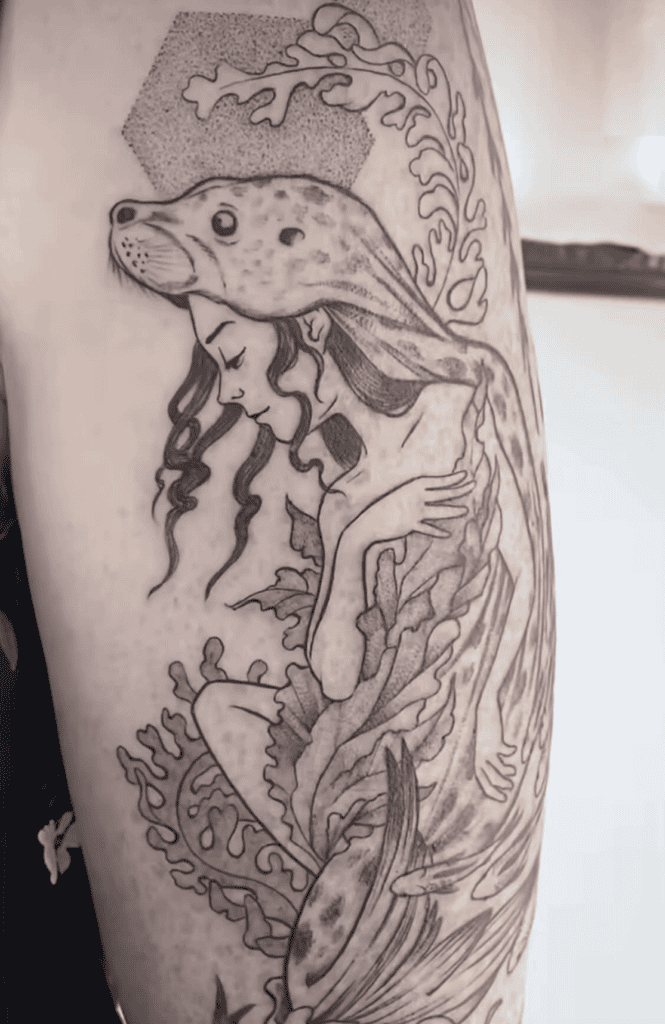
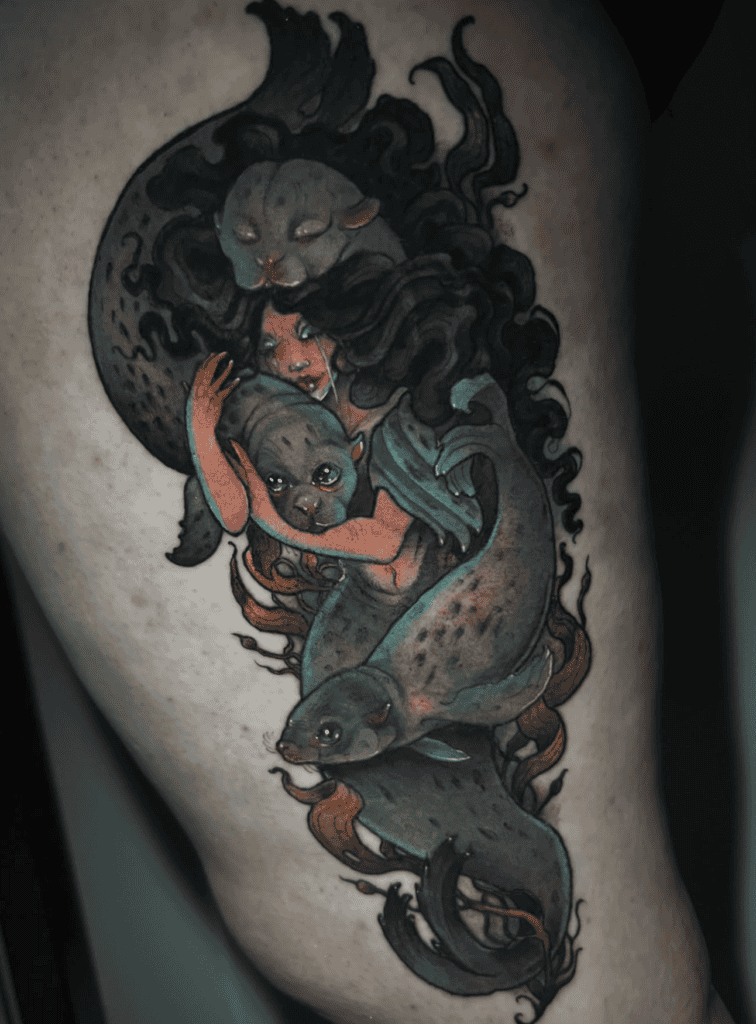
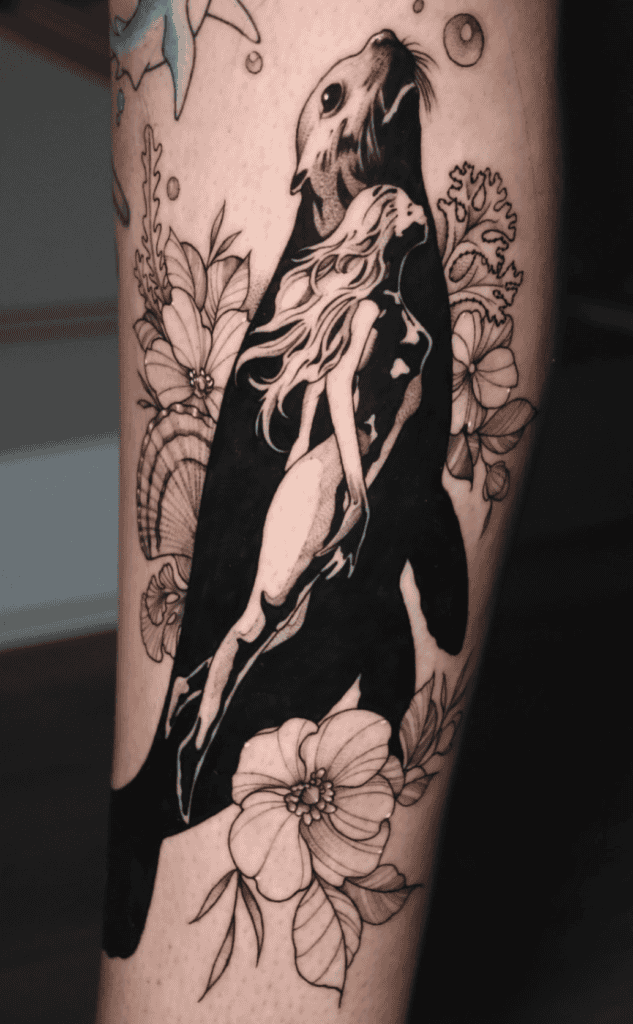
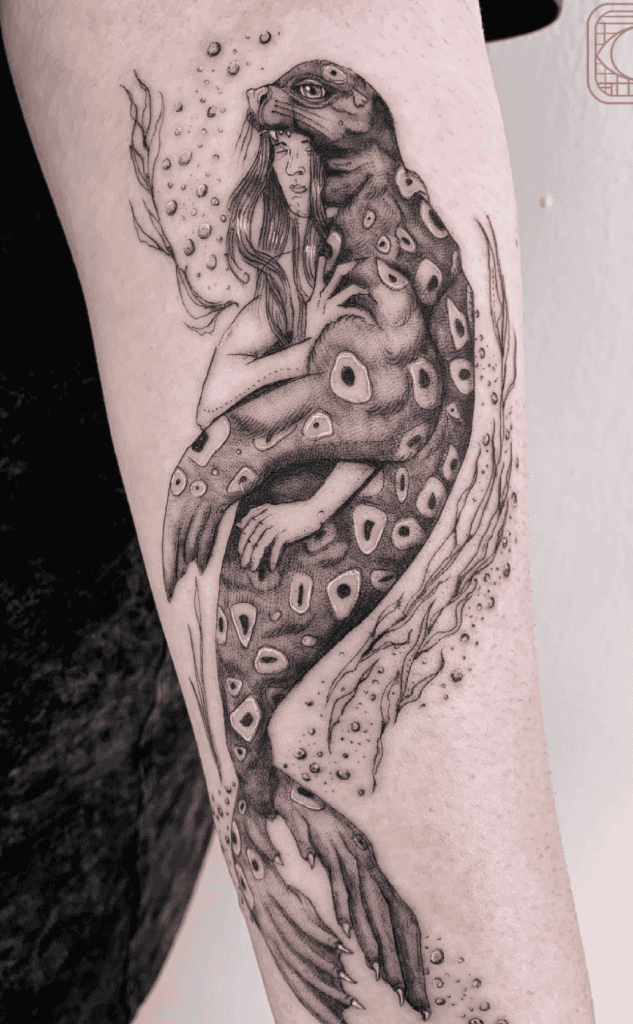
The Selkie is a creature from Celtic and Norse folklore, a seal-people who can shed their skins to become human on land. These shape-shifting creatures move between seal and human form and can be found in coastal regions of Scotland, Ireland, and Iceland.
Selkies have a seal skin. When wearing it, they are a seal in the sea, but when removed, they become human on land. If someone steals their skin, they cannot return to the ocean.
Many Selkies are found by a man on the shore, who hides her seal skin, to force her to stay with him. They live together, sometimes even raising a family, but she never stops longing for the sea; one day, finding her hidden skin, she returns to the ocean, leaving everything behind.
Merrow Celtic Mythology Tattoo
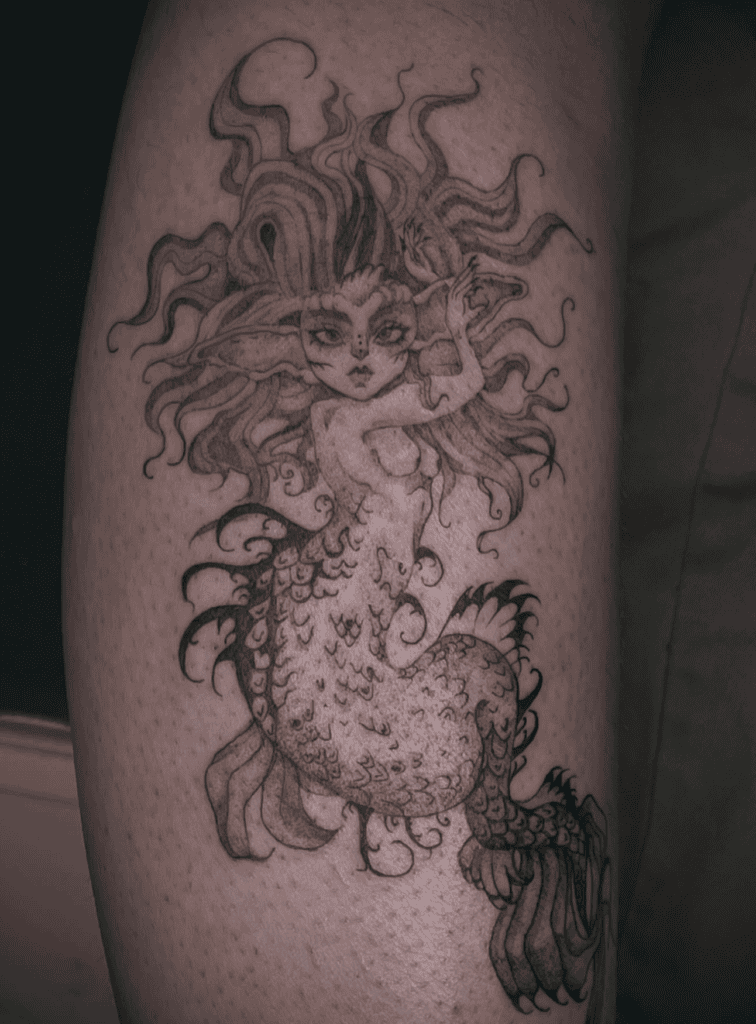
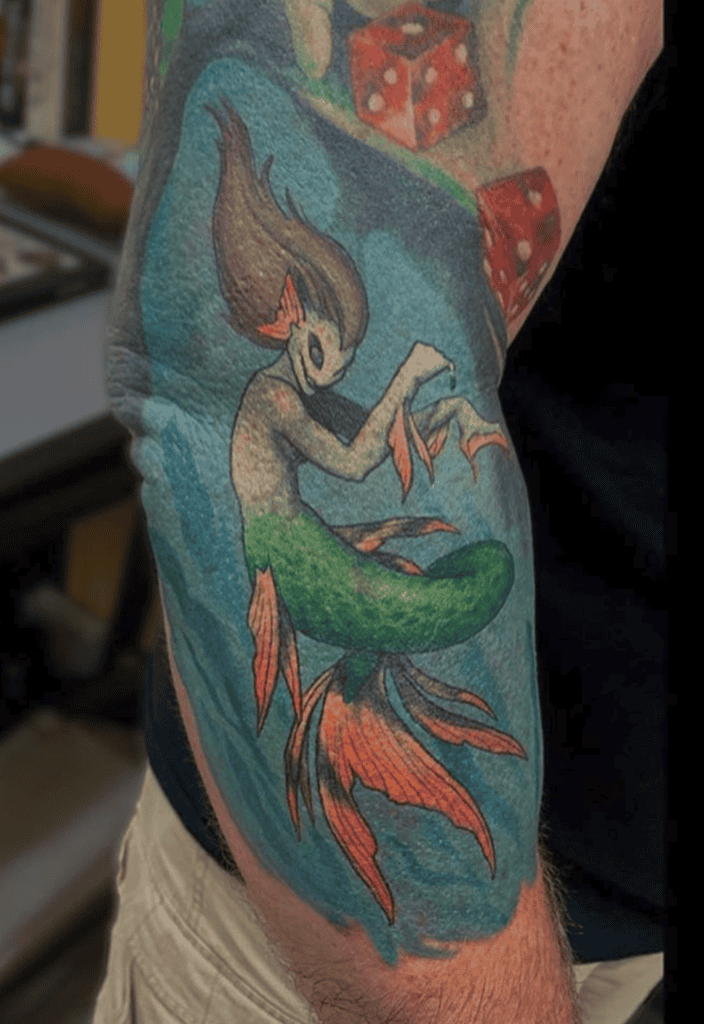
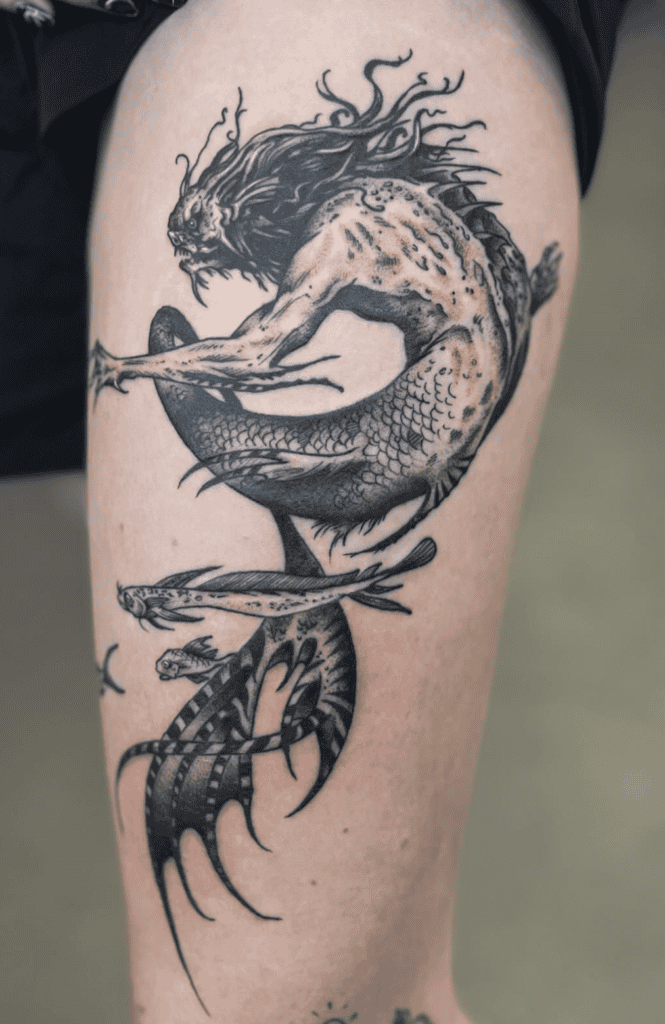
The Merrow are sea-dwelling beings from Irish folklore who live beneath the ocean in hidden kingdoms, moving between sea and shore. Merrows are half-human, half-fish known for both beauty and strangeness, depending on the type.
Female Merrows are often described as Mermaid-like, being gentle, beautiful and human-like, with long hair and enchanting voices. They wear a magical cap called a cohuleen druith (red cap), which allows them to travel between sea and land. Male Merrows are often described as grotesque or fish-like, with green skin, sharp features, and a wild appearance.
Púca Celtic Mythology Tattoo
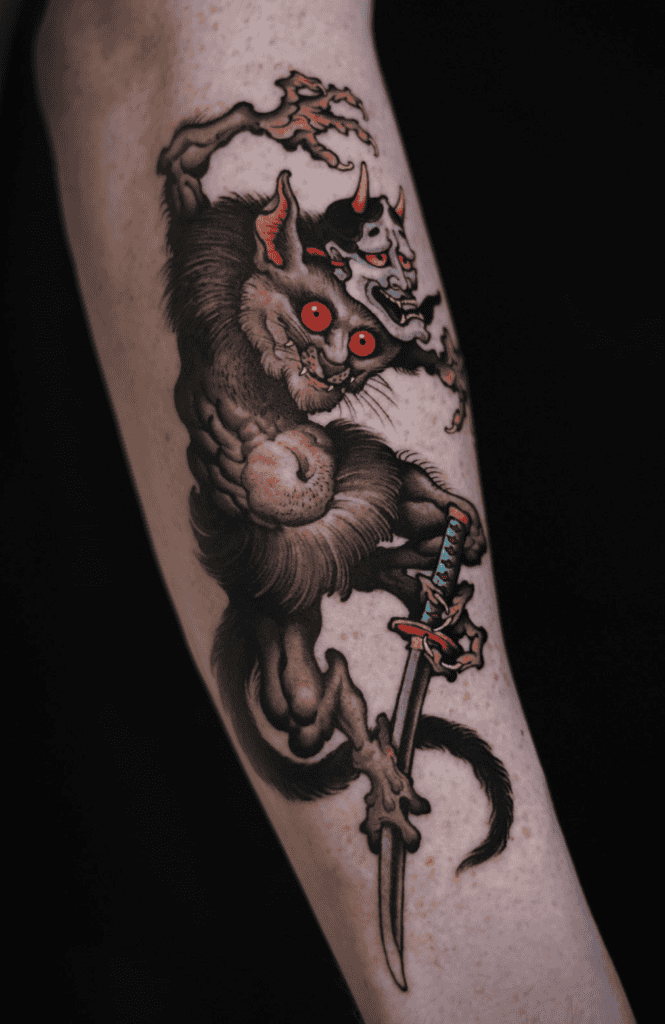
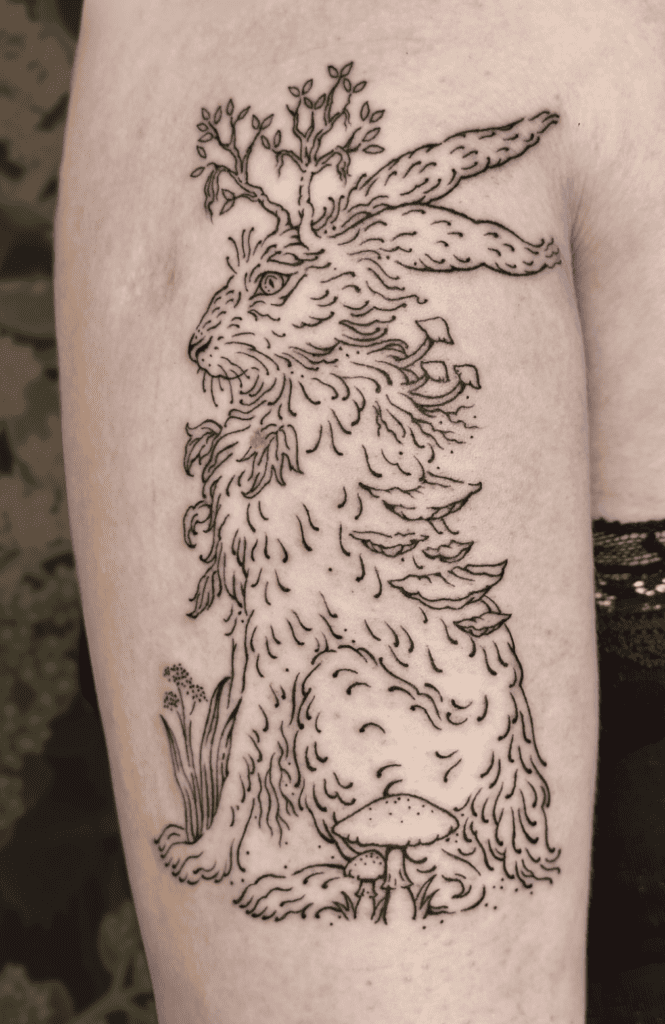
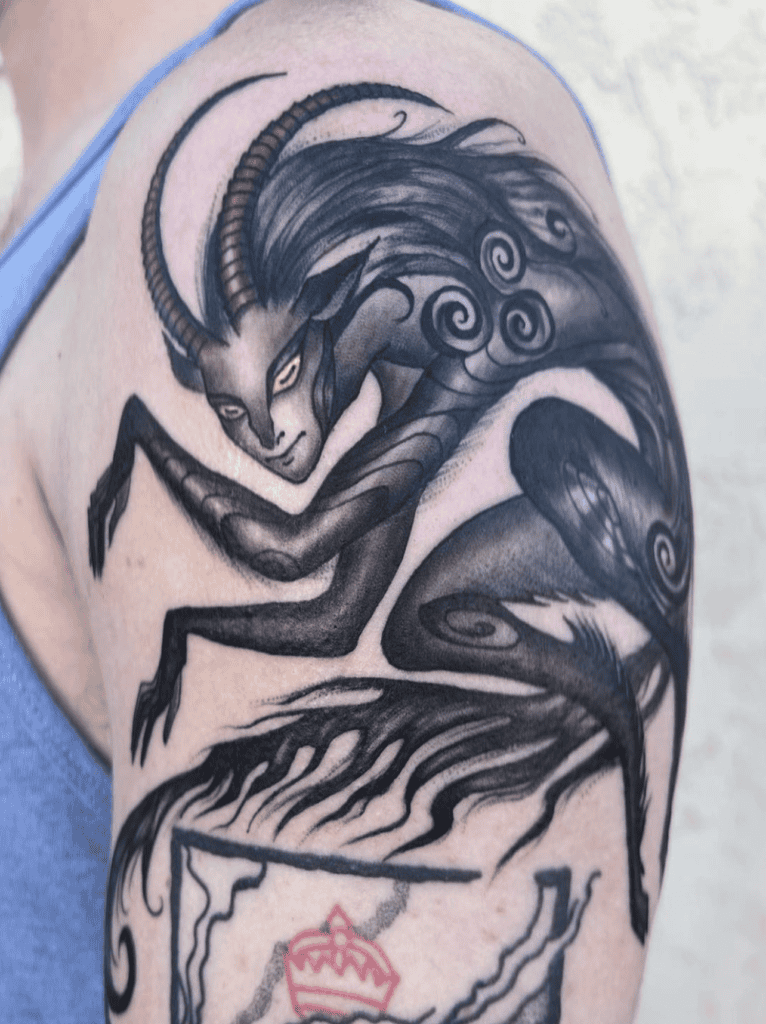
The Púca is a shape-shifting trickster spirit who can be helpful one moment and be dangerous the next. It is a part of the Otherworld beings, found mainly in Irish folklore, appearing in many forms, including a black horse with glowing eyes, a goat, a dog, or a rabbit, and even a human-like figure. However, no matter what form it takes, something always feels off.
The Púca is famous for helping farmers by blessing crops or ruining harvests out of spite. It can give advice and prophecy, or lead travellers completely astray, so you’ll never quite know which version you’ll encounter.
One of the most well-known Púca stories is when it appears as a horse and invites someone to ride. Once they climb on, they can’t get off, and the Púca takes them on a terrifying, uncontrollable ride through the countryside. Unlike the Kelpie, the Púca usually doesn’t kill, preferring to scare its victims for its own satisfaction.
The Púca is strongly linked to Samhain, the Celtic festival marking the end of harvest and the beginning of winter. It’s believed to roam freely during this time, with some crops left behind as an offering to appease it.
Leprechaun Celtic Mythology Tattoo
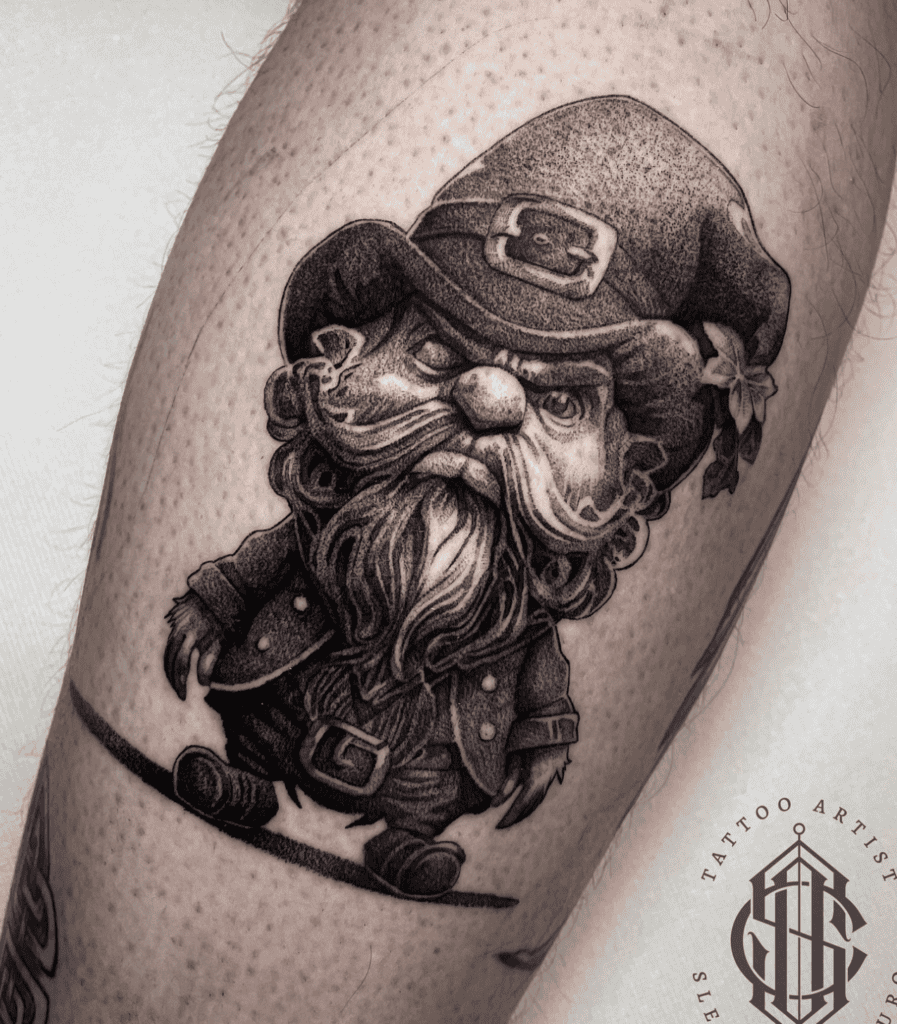
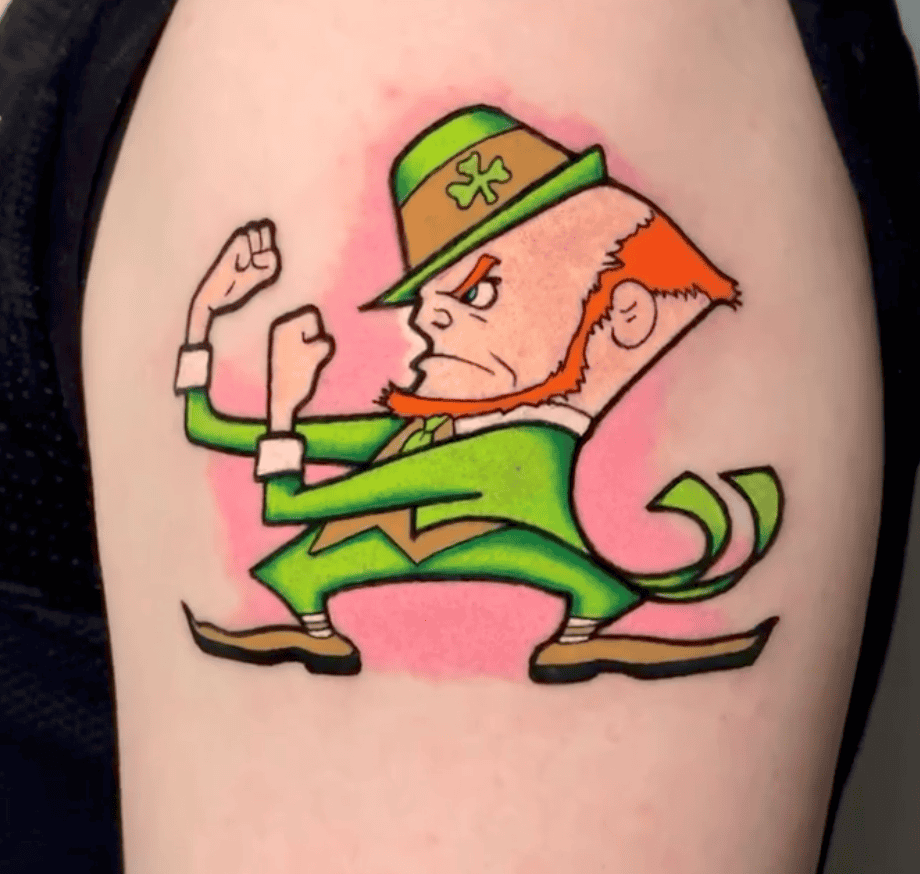
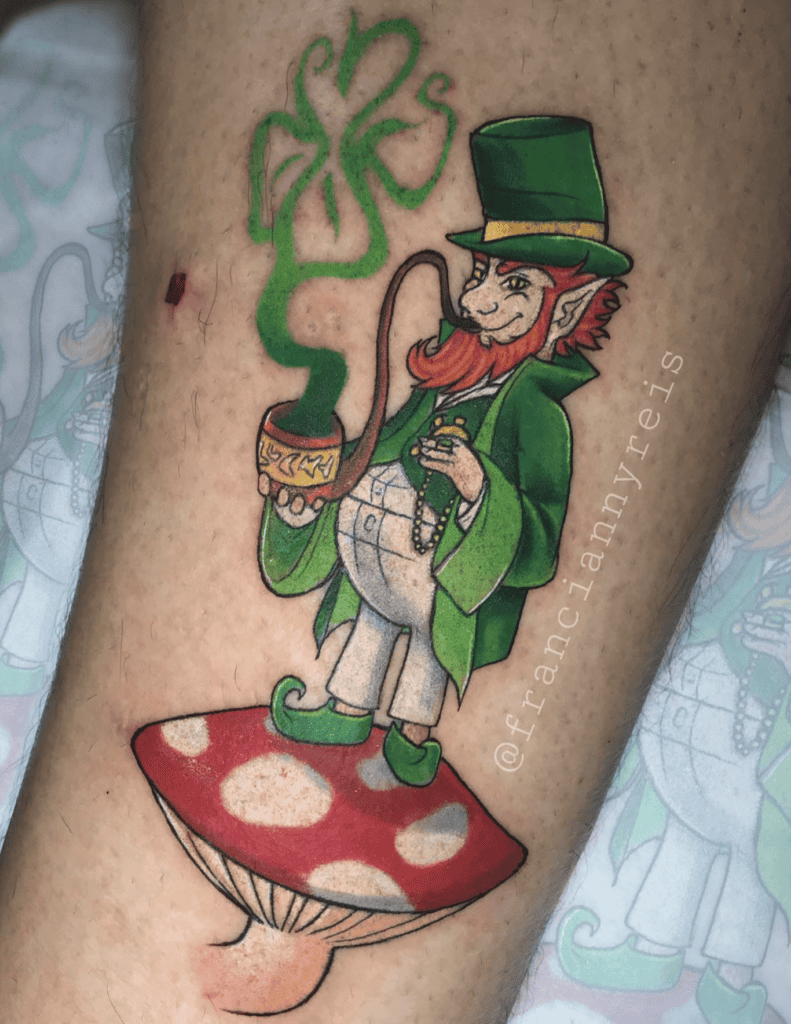
The Leprechaun is a small, clever, and often mischievous fairy known for guarding hidden treasure and outwitting humans in Irish myth. They are part of the fae (fair folk), usually depicted as small, solitary old men dressed in coats and living alone rather than in groups.
Leprechauns are shoemakers (cobblers), with the tapping of their hammer said to reveal their location. Leprechauns are most well-known for their hidden treasure, which is a pot of gold you can find at the end of the rainbow.
If you can catch a leprechaun, it may be forced to reveal where its treasure is hidden. However, Leprechauns are masters of deception and will use distraction, illusions, or clever tricks to prevent you from finding it. If you look away, even for a second, they’ll disappear.
Salmon of Knowledge Celtic Mythology Tattoo
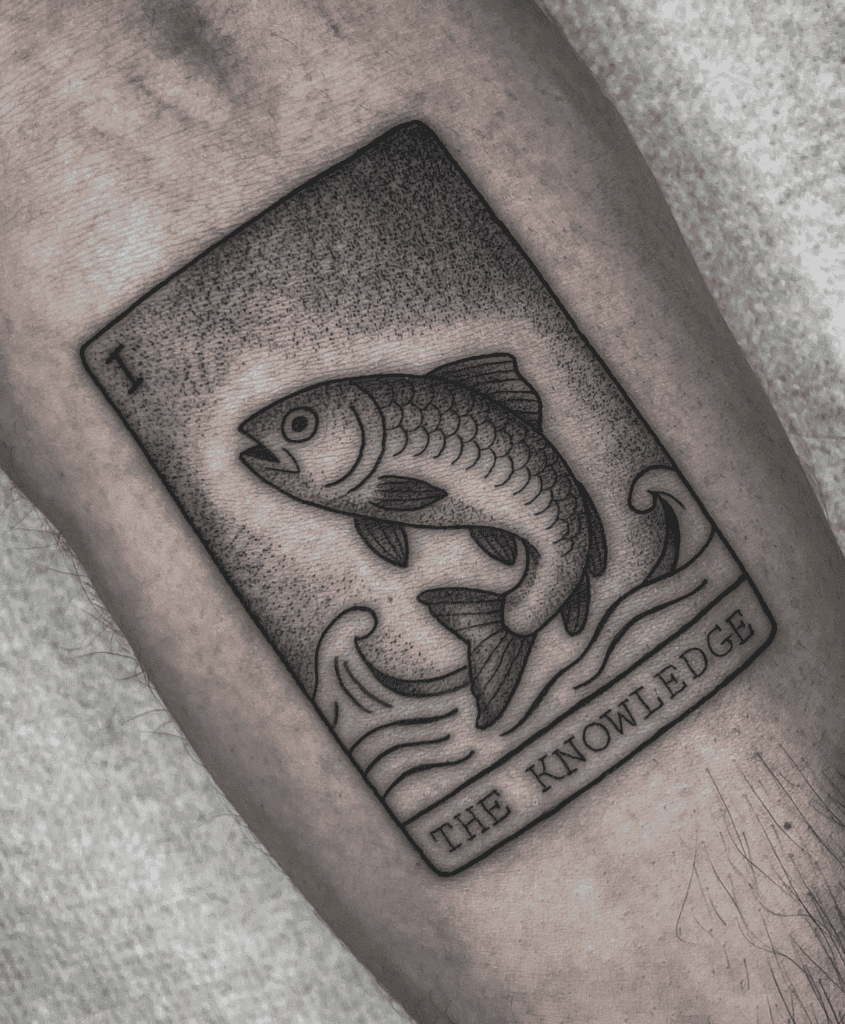
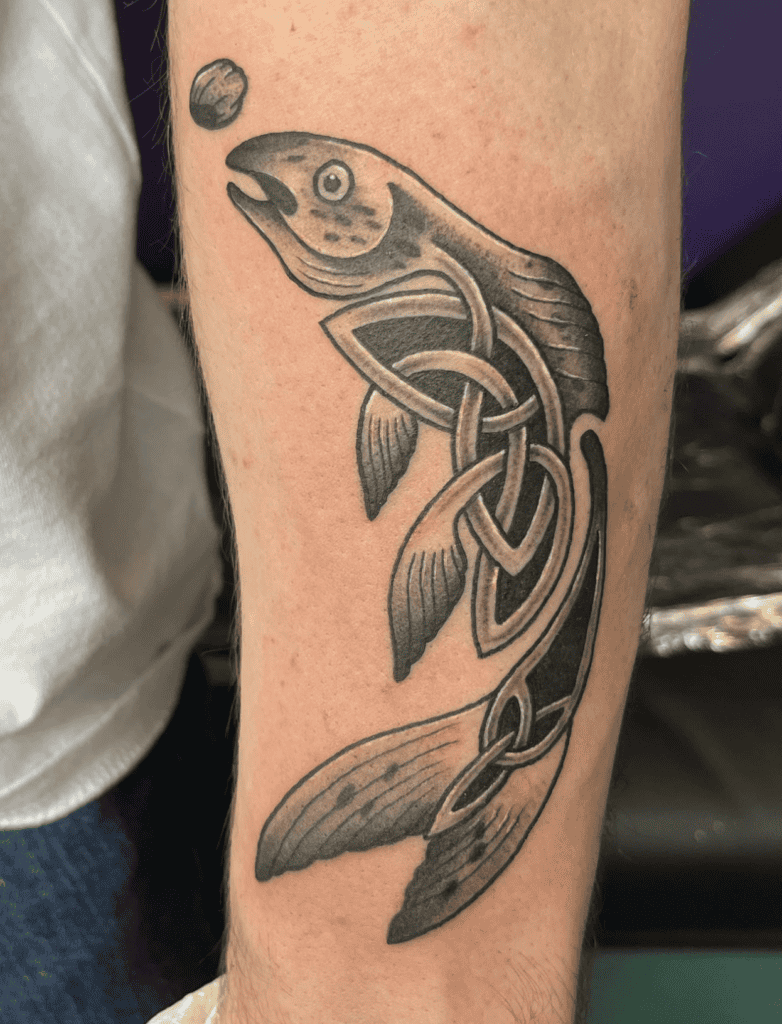
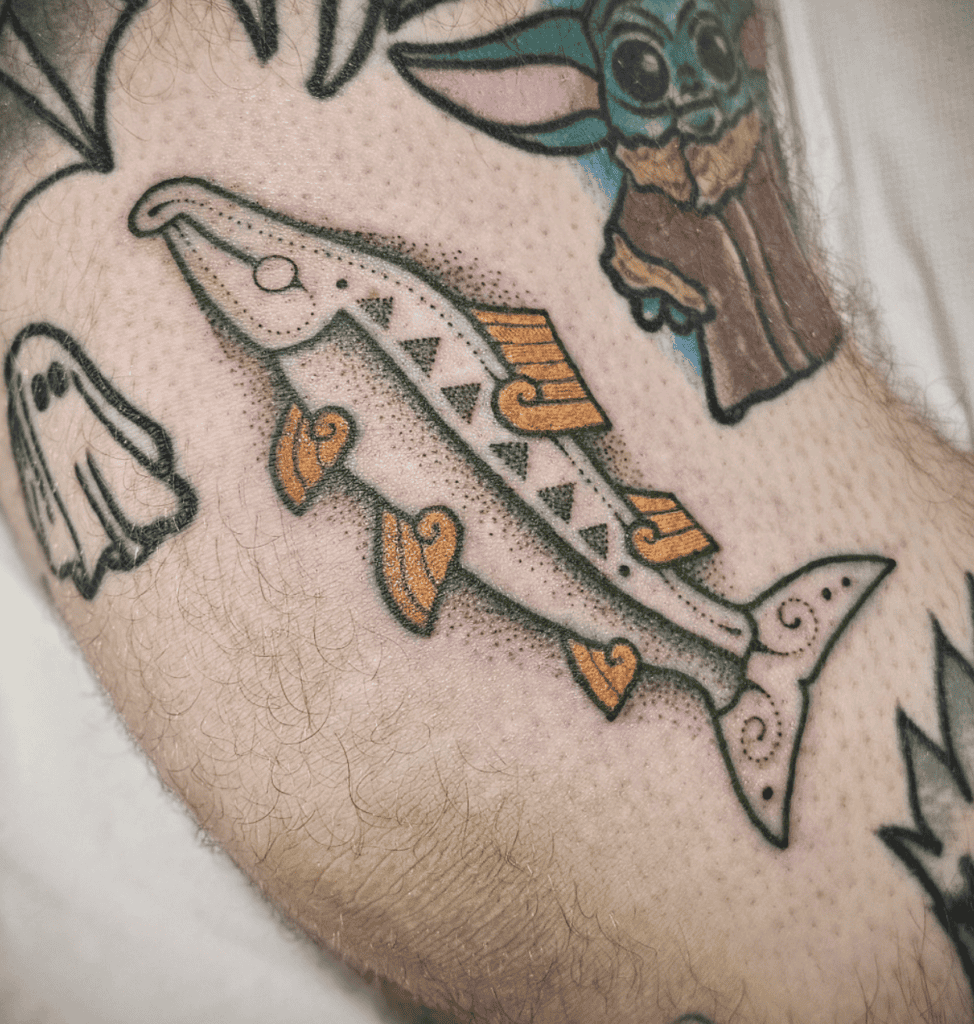
The Salmon of Knowledge is one of the most famous symbols in Celtic mythology, representing wisdom, insight, and destiny. According to legend, there was a sacred hazel tree that grew near a mystical well, which contained all the world’s knowledge. When its nuts fell into the water, a salmon ate them, gaining all knowledge and wisdom.
A poet named Finnegas spent years trying to catch the salmon, and when he finally did, he told a young Fionn mac Cumhaill to cook, but not to eat it. However, while cooking, Fionn burned his thumb on the fish and instinctively sucked it, absorbing the salmon’s wisdom.
Banshee Celtic Mythology Tattoo
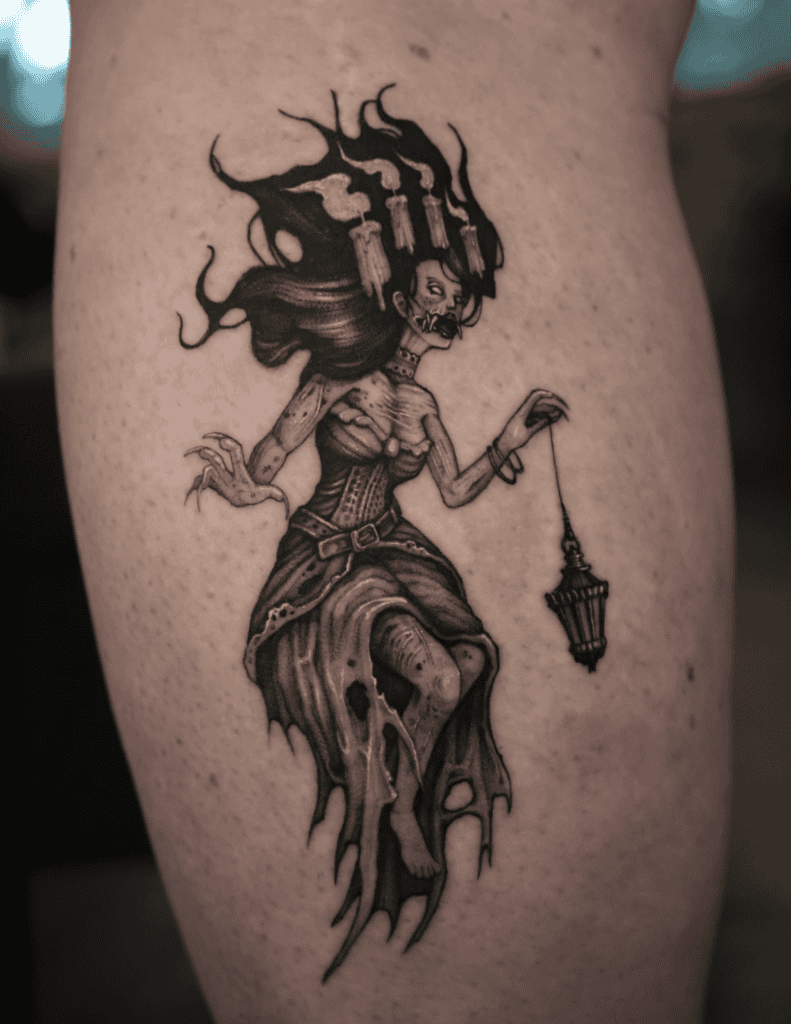
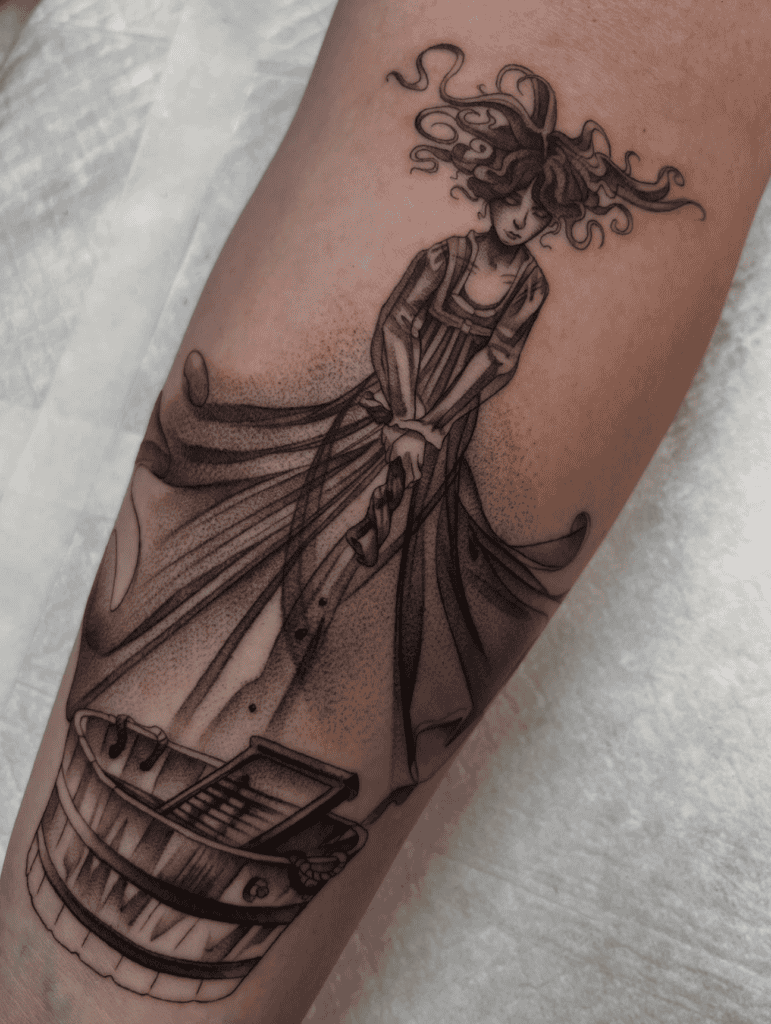
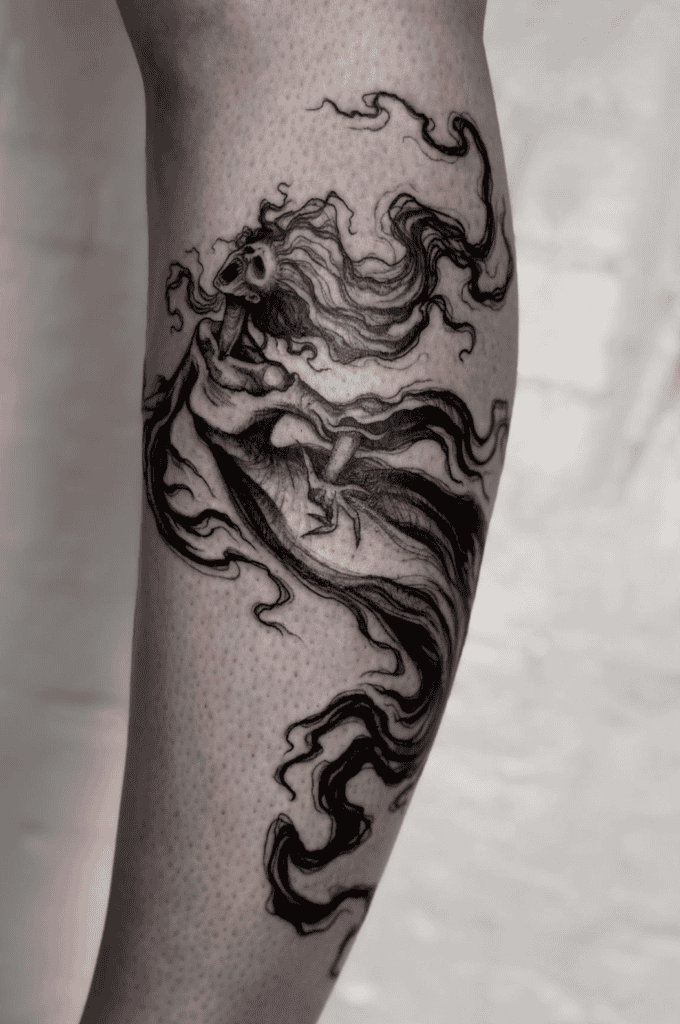
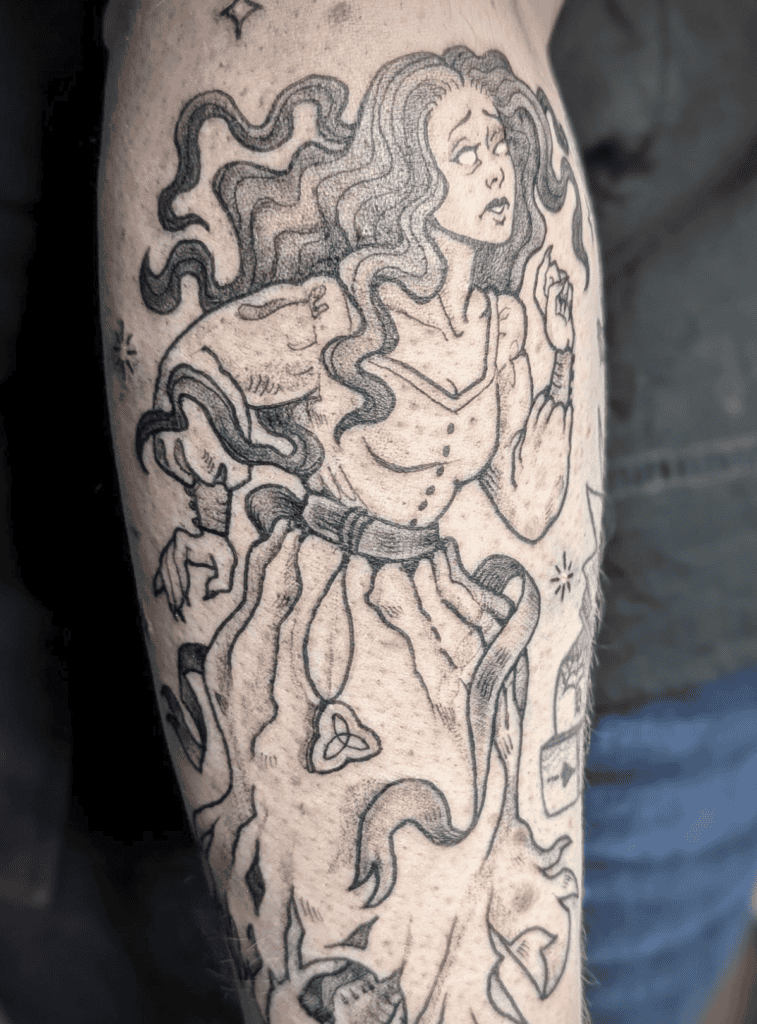
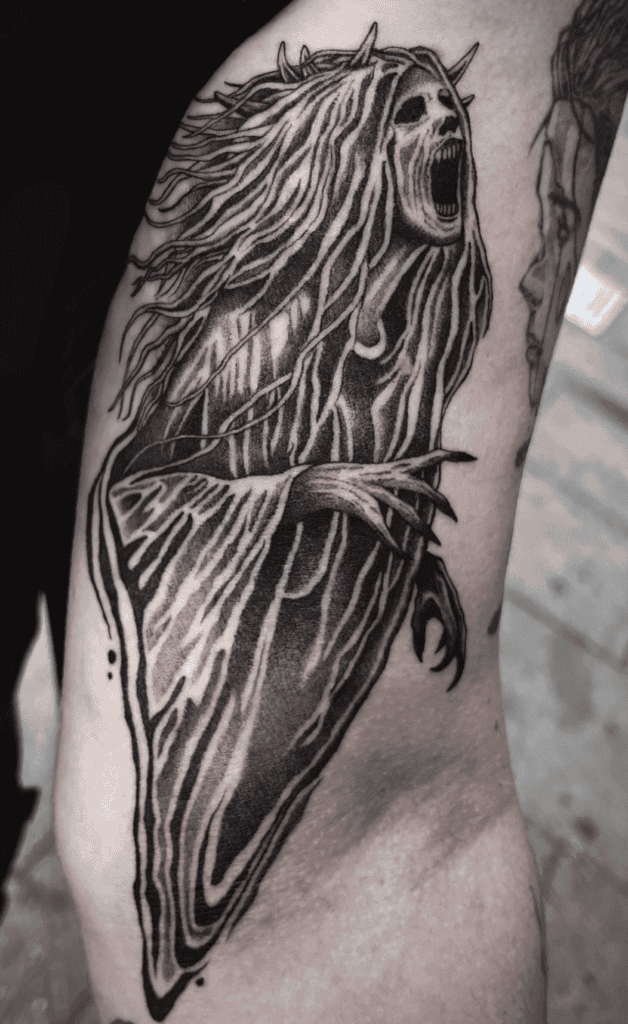
The Banshee (from bean sídhe, meaning “woman of the fairy mound”) is a messenger of death, whose cry warns that someone is about to die. A female spirit linked to the Otherworld, she is part of the fae, associated with ancient Irish families.
The Banshee’s terrifying scream, known as a keening, is a long, sorrowful wail heard in the night. It is said to echo through hills, wind, or mist and is a sign that death is near. Hearing this wailling means someone in your family may soon pass.
The Banshee can appear as a young, beautiful woman, a pale, grieving figure, or an old crone with wild hair, often washing blood-stained clothes, or crying near a home or in the distance.
The Sluagh Celtic Mythology Tattoo

The Sluagh are believed to be the restless souls of the dead, who were denied peace. They are a host of spirits or lost souls, often described as flying together like a dark flock in the sky, found mainly in Scottish and Irish folklore.
They travel through the air like a storm of spirits, sweeping across the land at night, entering homes through open windows or doors. The Sluagh can actively harm the living, trying to capture souls, taking the spirit of someone who is weak or dying.
Dullahan Celtic Mythology Tattoo
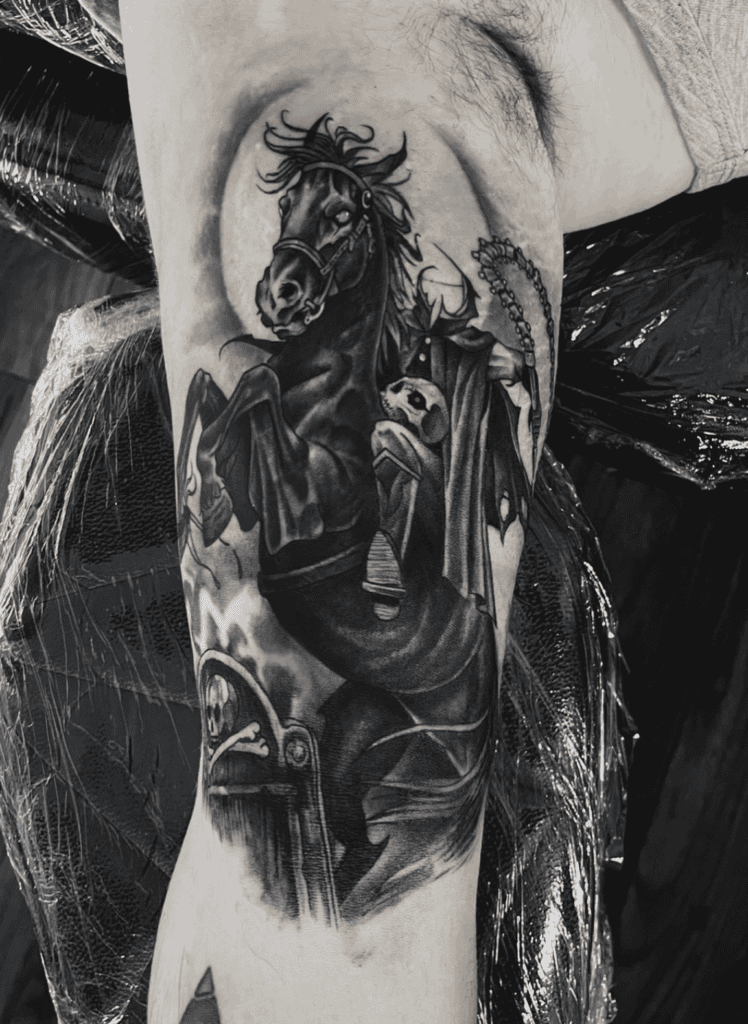
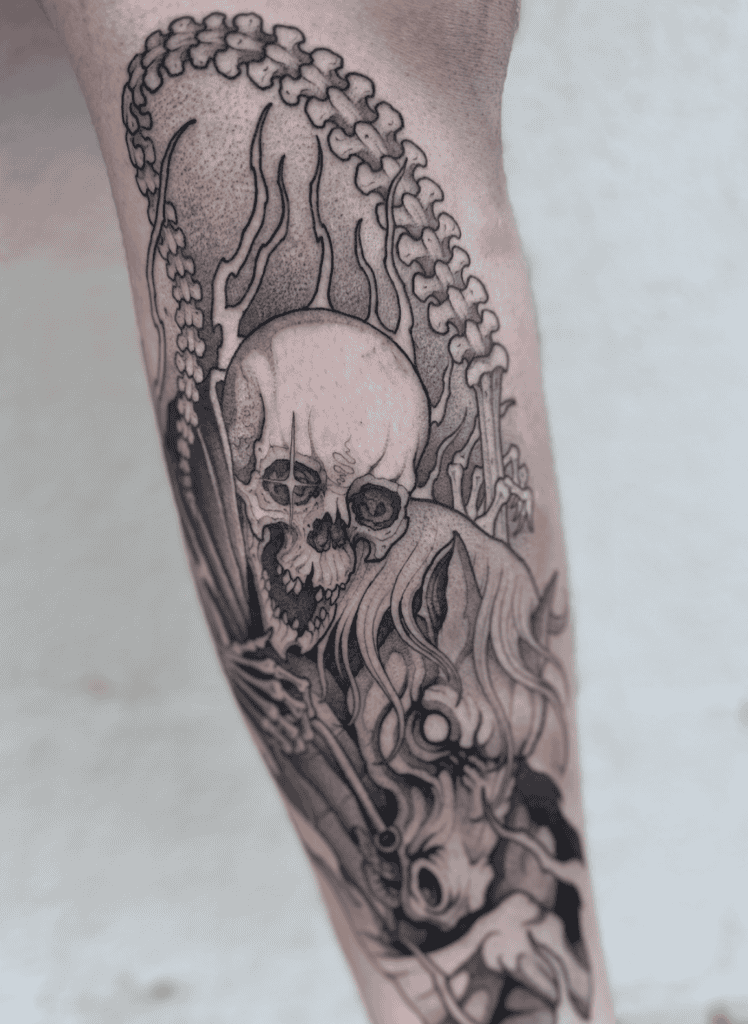
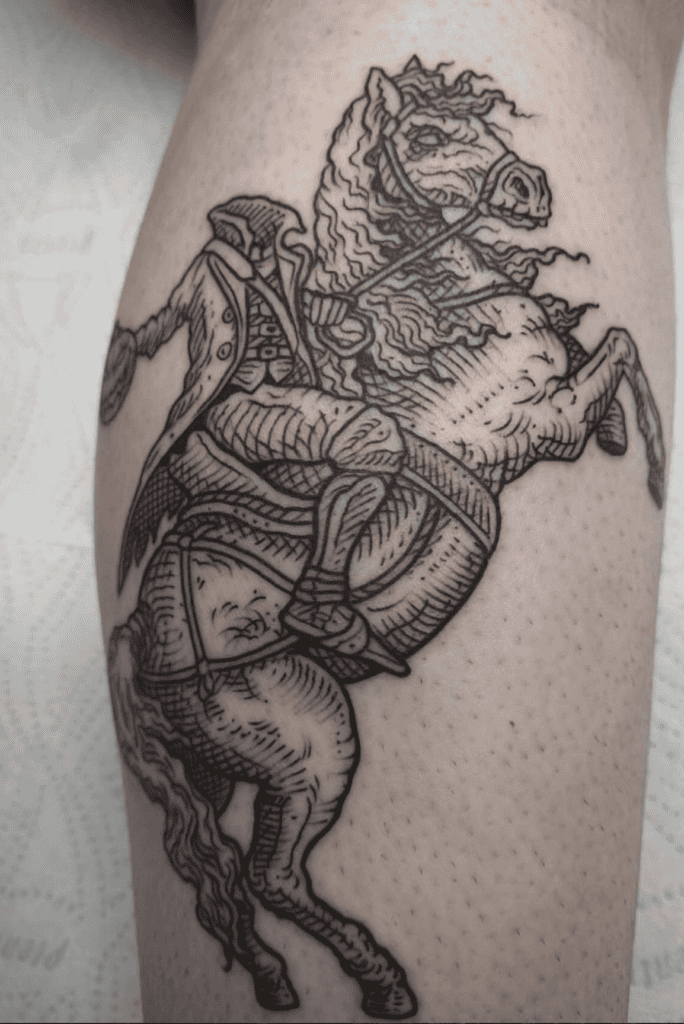
The Dullahan is an omen of death who rides through the night, calling out the names of those about to die. The Dullahan is a headless rider on a black horse who often carries his own head, and when he arrives, death is already certain.
The head he carries has a grotesque, grinning expression, and its eyes can see across vast distances. It also wields a whip made from a human spine, and rides silently through the night, stopping when someone nearby is about to die. When they call out a person’s name, that person dies instantly.
Once you are its chosen target, nothing can stop it. Locks, doors, and walls cannot keep the Dullahan out, and they can appear anywhere once they’ve chosen their target. Gold is said to be the only known method for driving them away.
Aos Sí Celtic Mythology Tattoo

The Aos Sí are the mysterious “fair folk” of Irish mythology who live alongside our world, but just out of sight. This race of supernatural beings or spirits is often linked to the Tuatha Dé Danann after they retreated from the human world, and are said to live in fairy mounds (sídhe), hills, or hidden realms.
The Aos Sí inhabit burial mounds and ancient hills, hidden landscapes that act as gateways to the Otherworld, and places where the veil between worlds is thin. While these places may look ordinary, they are anything but.
They are capable of both kindness and cruelty and are highly sensitive to respect (or disrespect) from humans. If you treat them well, they may bless you, but if you cross them, things can go very wrong. Stories often involve people accidentally entering their realm, with time passing differently (a few hours = many years), and gifts that come with hidden consequences.
Traditionally, people would leave milk, food, or small offerings, avoid disturbing fairy mounds, and never speak disrespectfully about them.
There have been many modern Irish folklore tales where roads were rerouted to avoid fairy forts or mounds. In 1999, plans for the M18 motorway in County Clare, Ireland, were altered to avoid destroying a “fairy bush” (a sacred hawthorn tree) at Latoon, believed to be a meeting point for fairies. Folklorist Eddie Lenihan led the campaign, warning of bad luck, causing planners to reroute the road around the tree.
Redcap Celtic Mythology Tattoo

The Redcap is a dark creature, particularly from Scottish Border folklore, who is a vicious goblin-like being that haunts ruined castles and battle sites. They are a malevolent fae or goblin, known for their cruel and bloodthirsty nature, usually described as small but unnaturally strong, with sharp teeth, claws, and wild hair, and wearing heavy iron boots.
The Redcap gets its name from dyeing its hat in fresh human blood, as it must be kept wet with blood to maintain its power. If it dries out, the Redcap becomes weaker, so it attacks travellers who wander too close, luring victims into isolated ruins and killing them quickly and brutally.
Cat Sìth Celtic Mythology Tattoo


The Cat Sìth is a mysterious creature from Scottish and Irish folklore, which is a large black cat with a white spot on its chest, believed to be a fae spirit. This creature is a supernatural feline linked to the Aos Sí, said to roam the Scottish Highlands and wild countryside.
It could steal a person’s soul before it reached the afterlife, so at funerals, people would keep watch over a body before burial, avoiding letting the Cat Sìth come near by setting up games, music, or activities to distract it from approaching the body.
Cu Sith Celtic Mythology Tattoo


The Cù Sìth (pronounced koo shee) is a creature from Scottish Gaelic folklore, being a huge, supernatural hound tied to the Aos Sí and the Otherworld and a harbinger of death that hunts in silence.
The Cù Sìth is a massive dog, as large as a calf or even a small horse, covered in dark or eerie green fur with glowing eyes and a ghostly presence. It moves through the Scottish Highlands, in remote hills, forests, and misty landscapes.
You won’t hear it until it lets out a terrifying bark. The Cù Sìth gives three loud, booming barks, and legend states that if anyone hears the first bark must run, as when they hear the third bark, they will die from pure terror.
Oilliphéist Celtic Mythology Tattoo

The Oilliphéist is a giant serpent, dragon, or lake monster that lurks in rivers, lakes, and the sea from Irish Mythology. In many legends, the Oilliphéist attacks villages or travellers, devastating land and water routes. It must be defeated by a hero or saint, being a challenge that must be overcome to restore balance.
Different regions of Ireland have their own versions. Some stories link it to lakes where it still “lurks,” while others tell of heroes slaying it to protect communities. In certain tales, it behaves more like a dragon guarding territory.
Children of Lir Celtic Mythology Tattoo
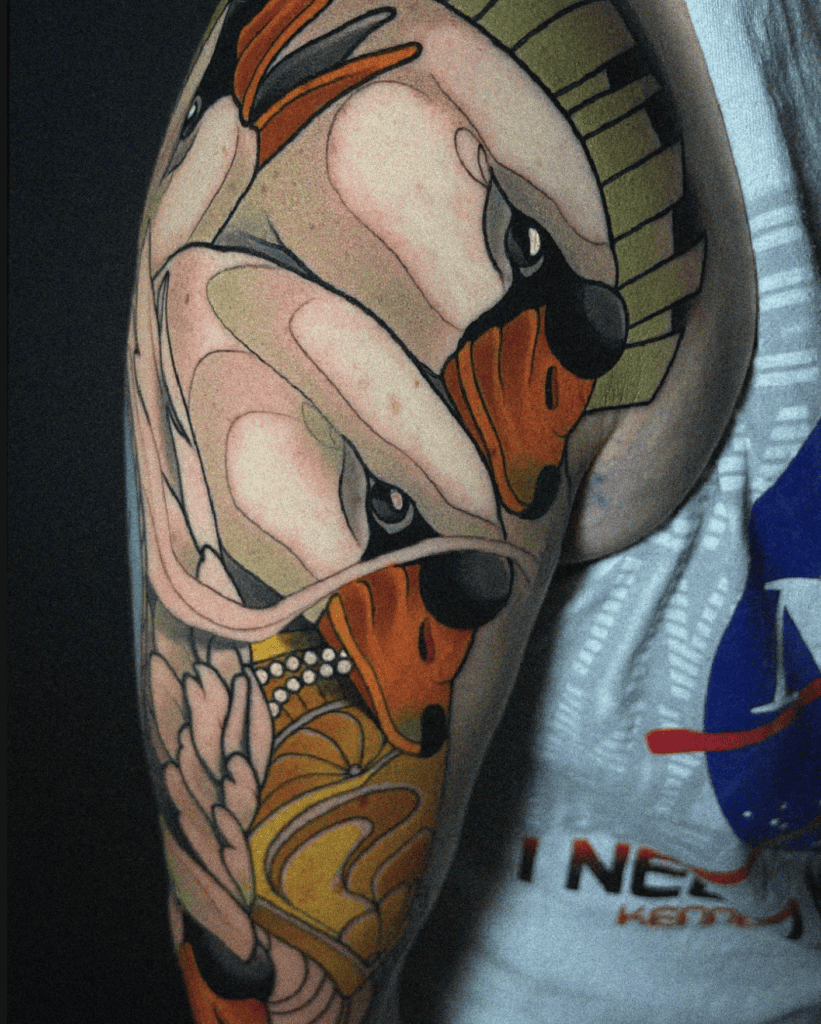
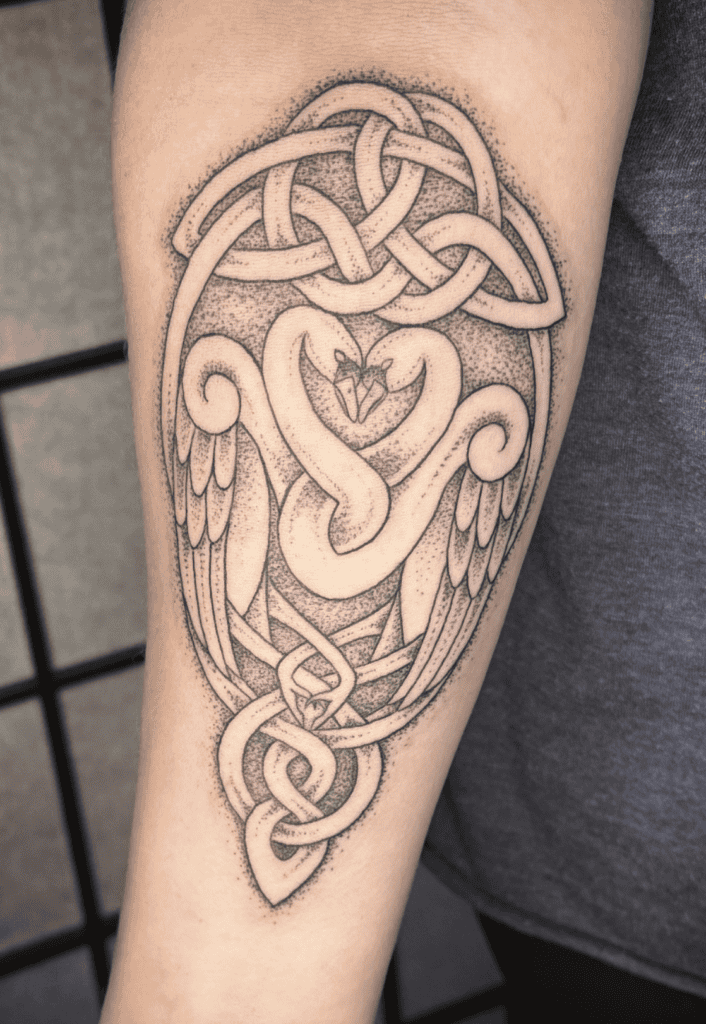
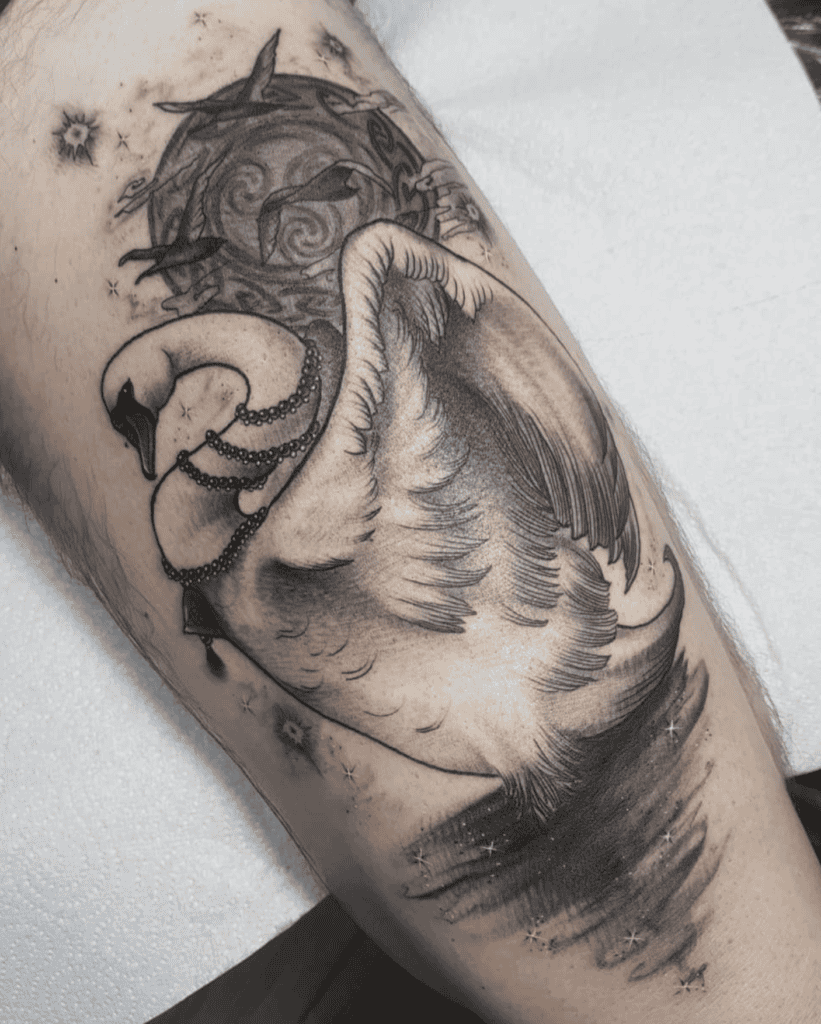
The Children of Lir, Fionnuala, Aodh, Fiachra, and Conn are the beloved children of Lir, a noble figure of the Tuatha Dé Danann. When their mother dies, Lir remarries Aoife, and at first, she loves the children, but grows jealous of their bond with her husband.
Consumed by envy, she casts a spell that transforms the children into swans, forcing them to spend 300 years on one lake, 300 years on a stormy sea, and 300 years on another distant shore, all while retaining their human minds and emotions.
They can still speak and sing, and their voices are said to be hauntingly beautiful. After centuries, the arrival of Christianity breaks the spell, and the children briefly return to human form, but they have aged all those years in an instant. They are baptised by a monk before their deaths, and their souls are reunited in heaven.
Triquetra Celtic Mythology Tattoo
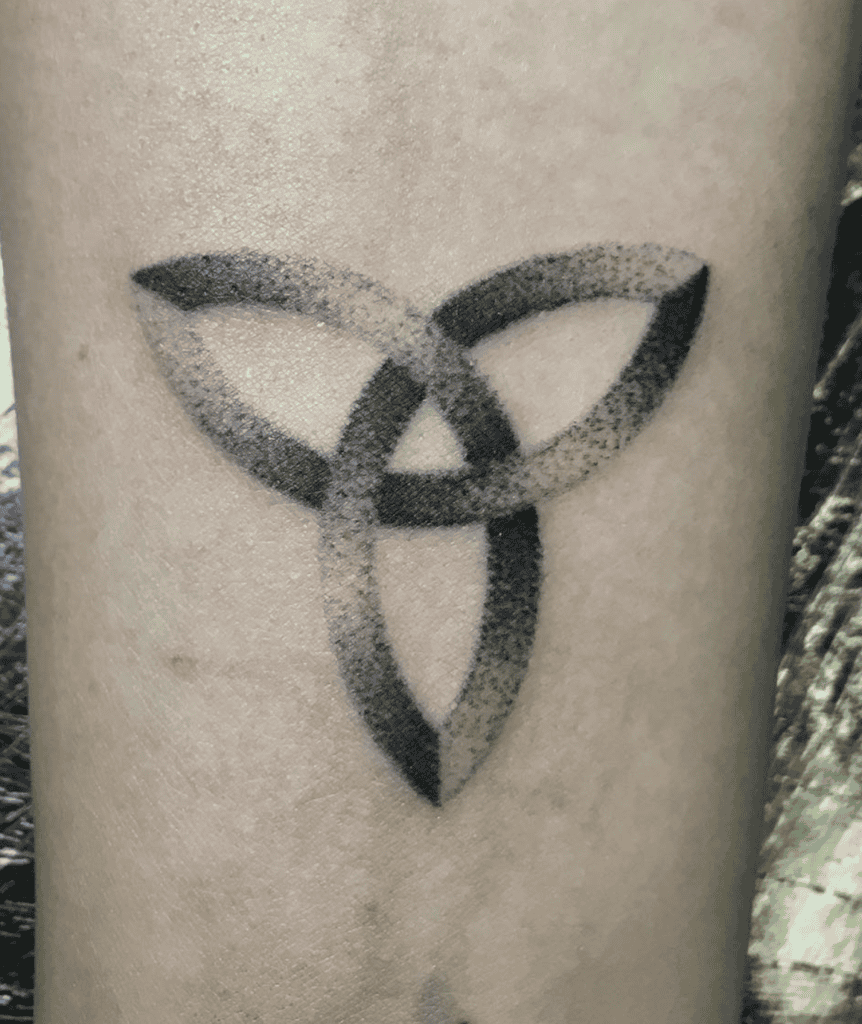
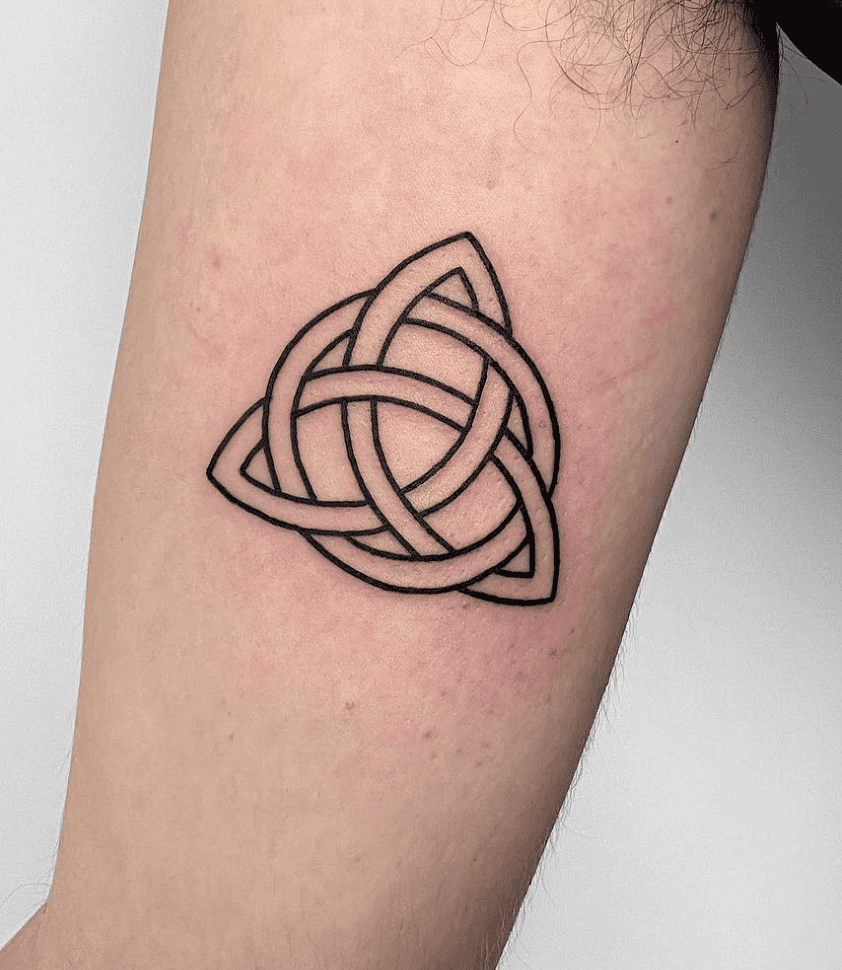
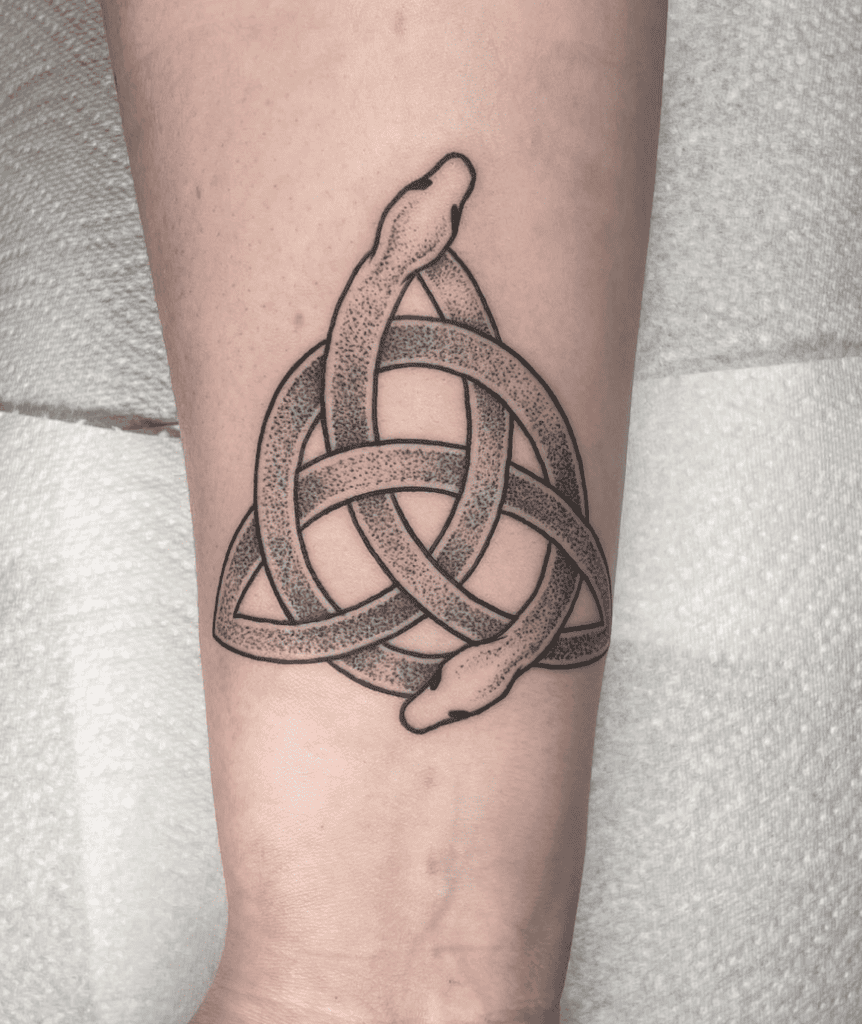
The Triquetra, or Trinity Knot, is a symbol made of three interlocking loops with no beginning or end, representing eternity, unity, and the power of three. It symbolises eternity and endless cycles, the interconnection of all things, and the balance between three forces.
The number three was sacred in Celtic belief, so the Triquetra can represent many different “trinities,” such as Earth, Sea, Sky; Birth, Life, Death; Maiden, Mother, Crone; and Mind, Body, Spirit.
When Christianity spread through Celtic regions, the Triquetra was adopted to represent the Holy Trinity of the Father, the Son, and the Holy Spirit.
Triskele Celtic Mythology Tattoo
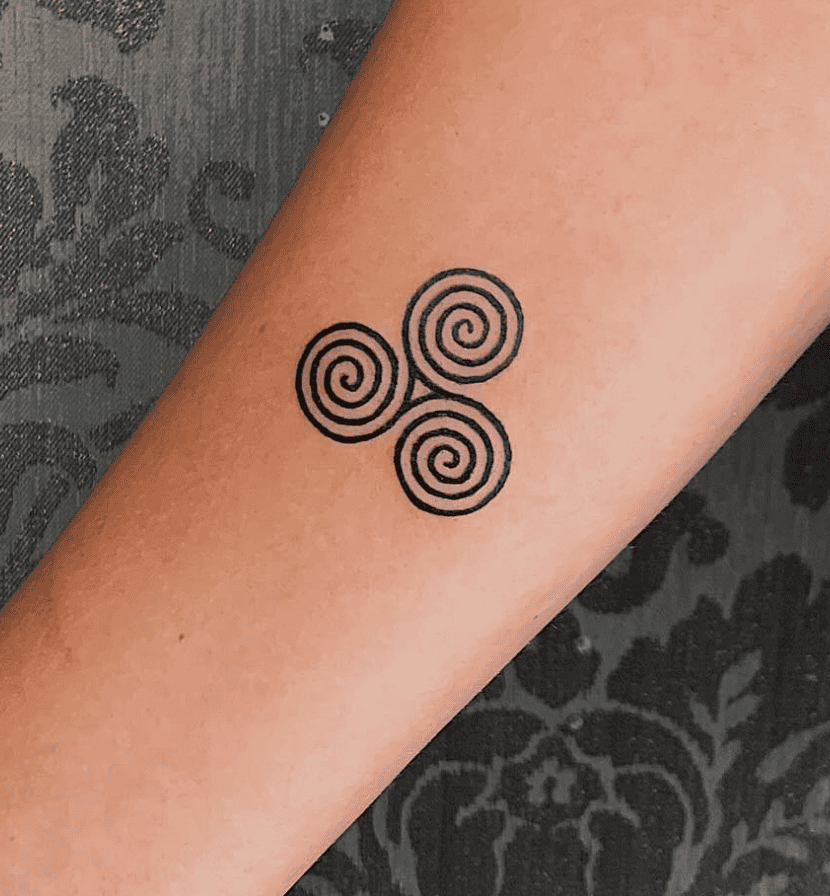
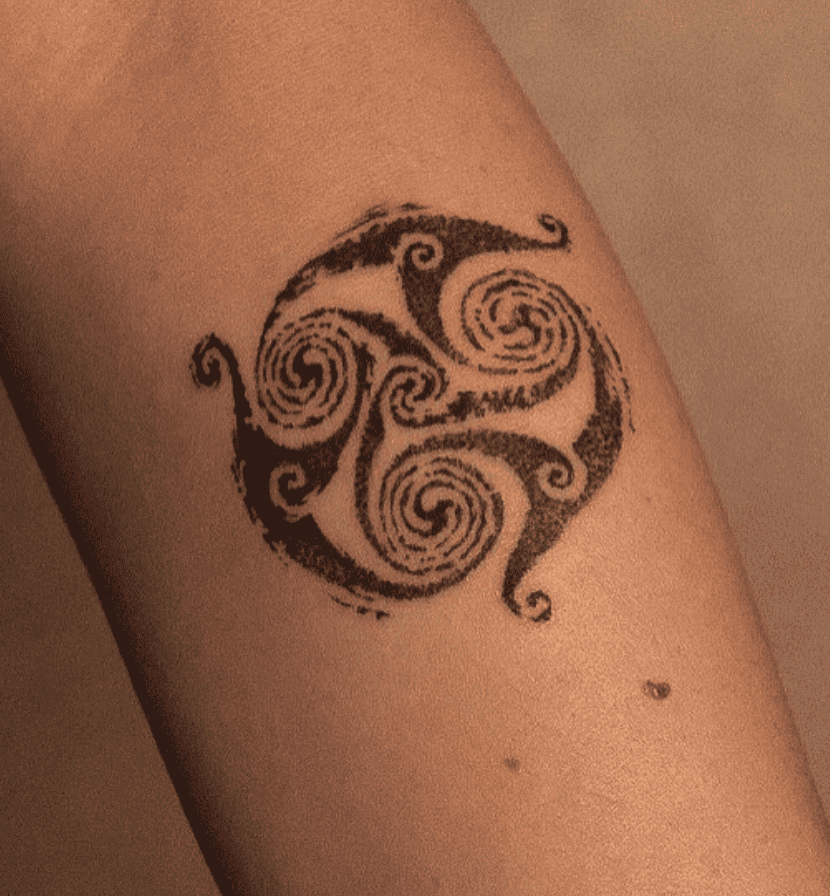
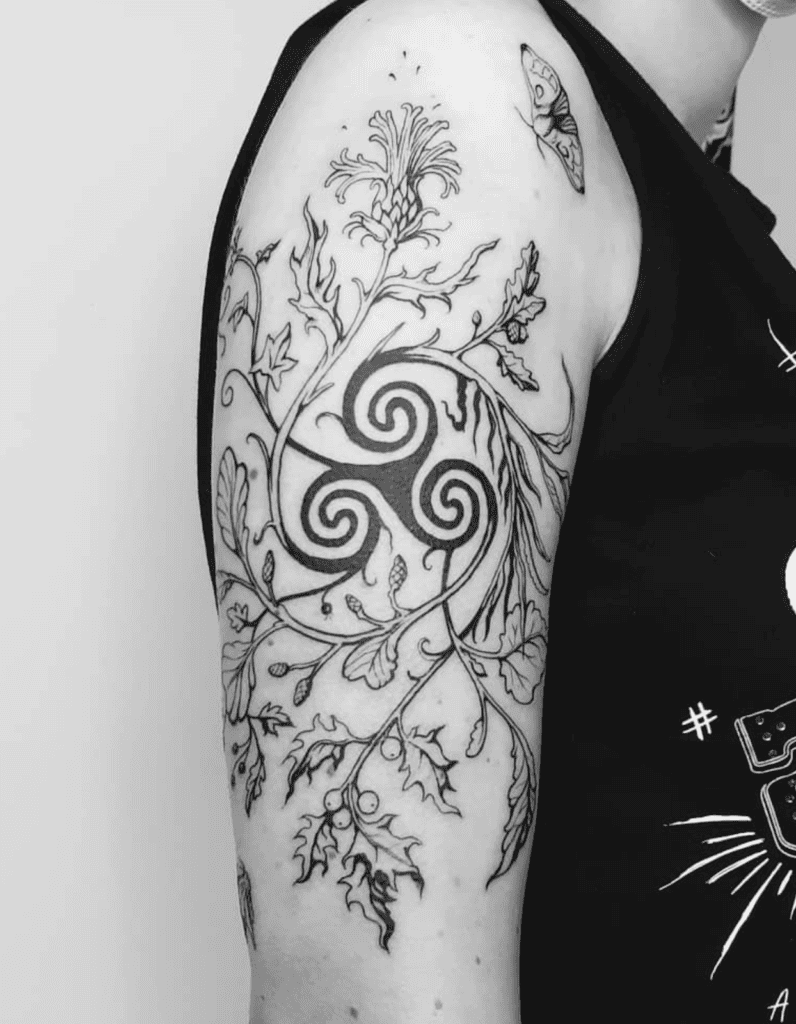
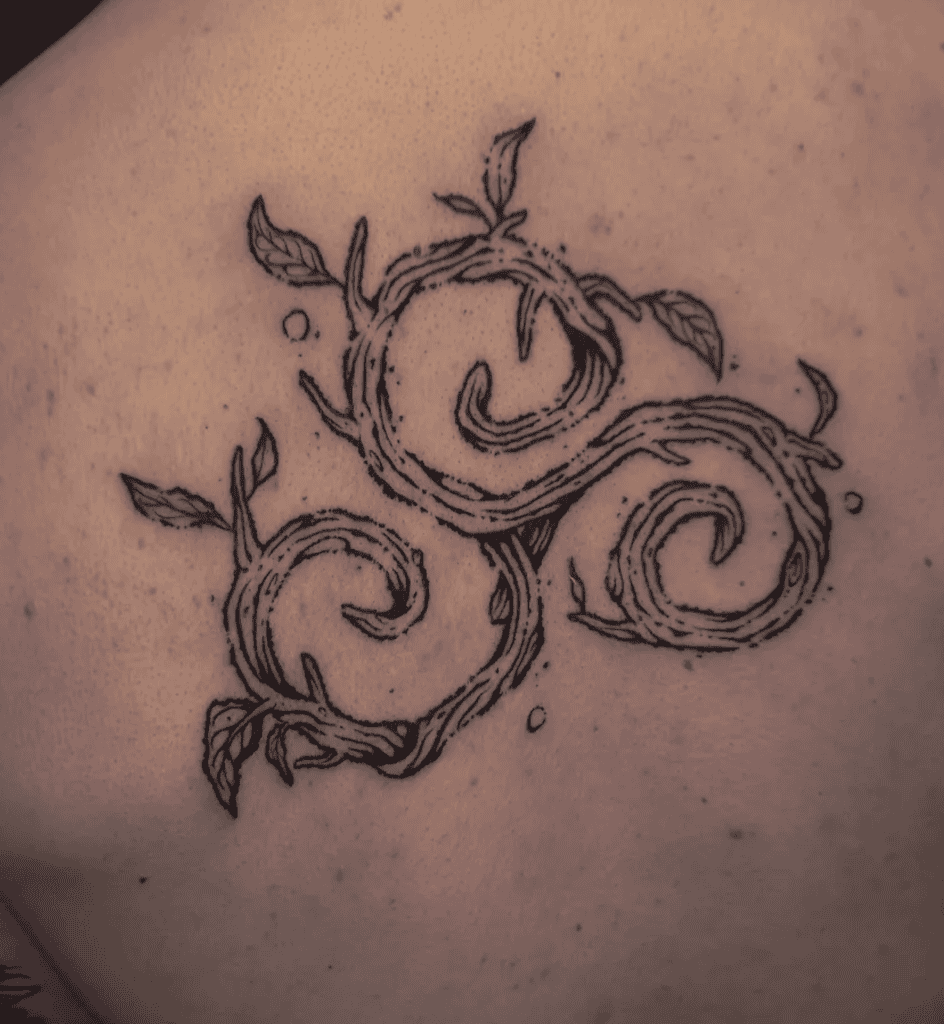
The Triskele or Triskelion is one of the oldest symbols in Celtic culture, made of three spirals radiating from a central point, representing movement, progress, and the power of cycles.
It symbolises continuous movement and change, growth and evolution, and the balance between three forces. The spirals flow outward, suggesting that life is always moving forward, even when it feels circular.
Dara Knot Celtic Mythology Tattoo
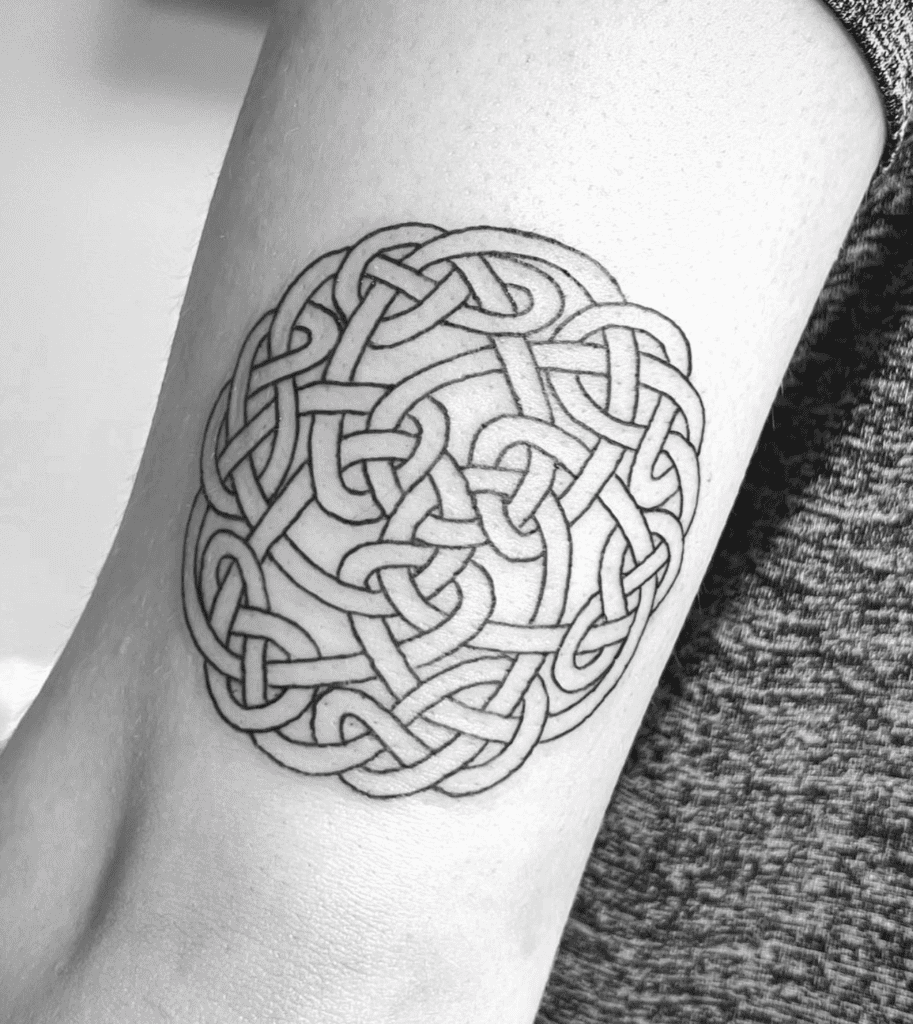
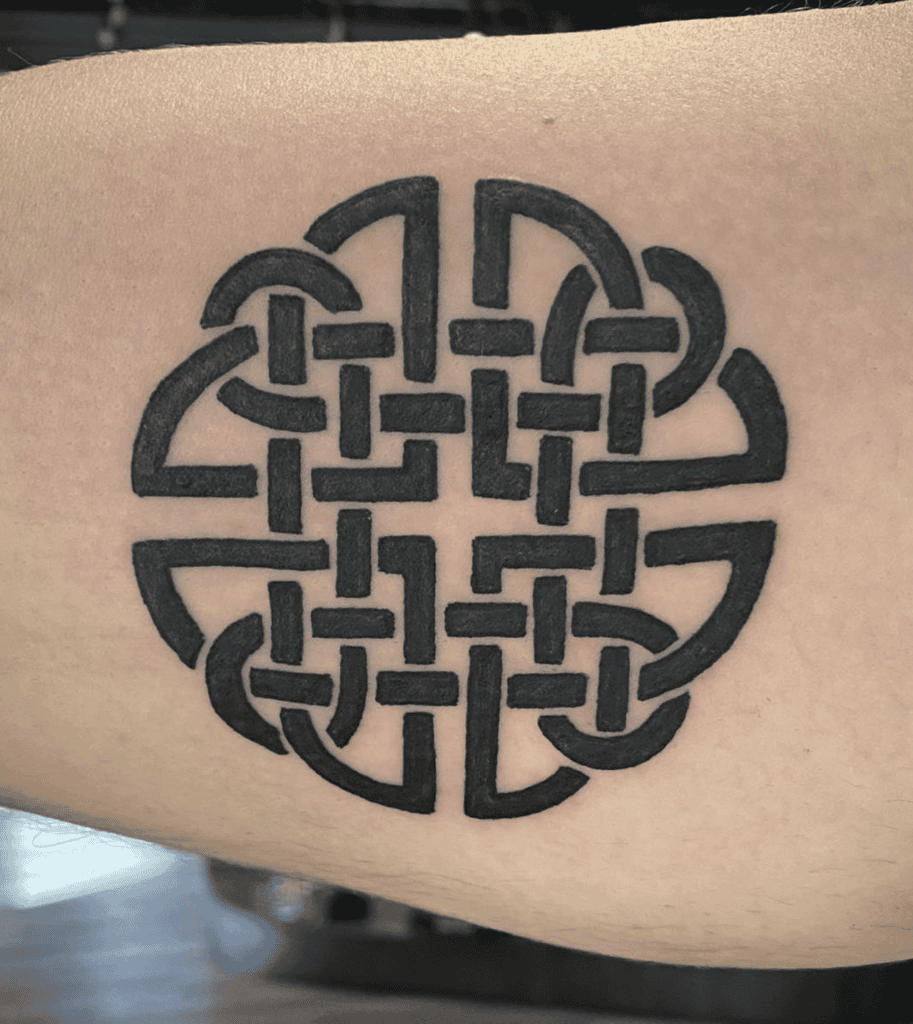
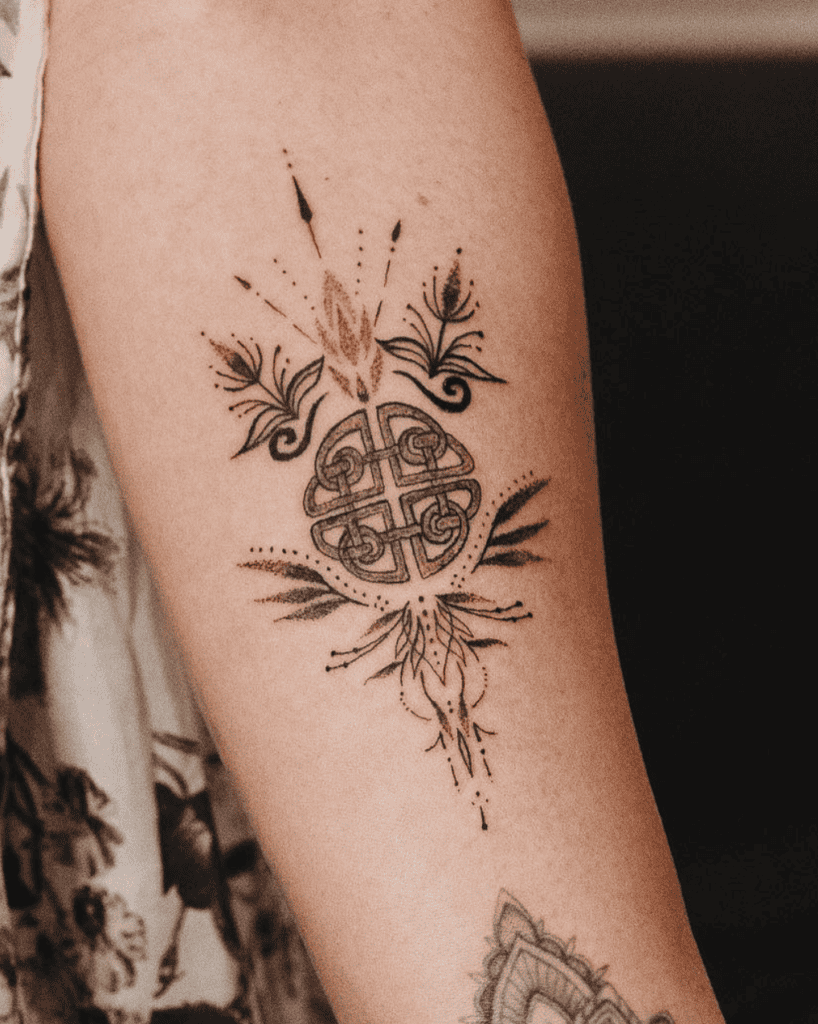
The Dara Knot is a Celtic-inspired symbol representing strength, resilience, and deep roots. While not as ancient or formally standardised as symbols like the Triskele, it draws its meaning from one of the most sacred trees in Celtic culture, the oak tree.
The name “Dara” comes from the Irish word “Doire”, meaning Oak tree. In Celtic belief, the oak symbolised strength & endurance, wisdom & knowledge, protection & stability. It is inspired by the oak tree’s complex root system, representing inner strength, a strong foundation, staying grounded during challenges, and drawing power from your roots (family, past, identity).
Claddagh Ring Celtic Mythology Tattoo
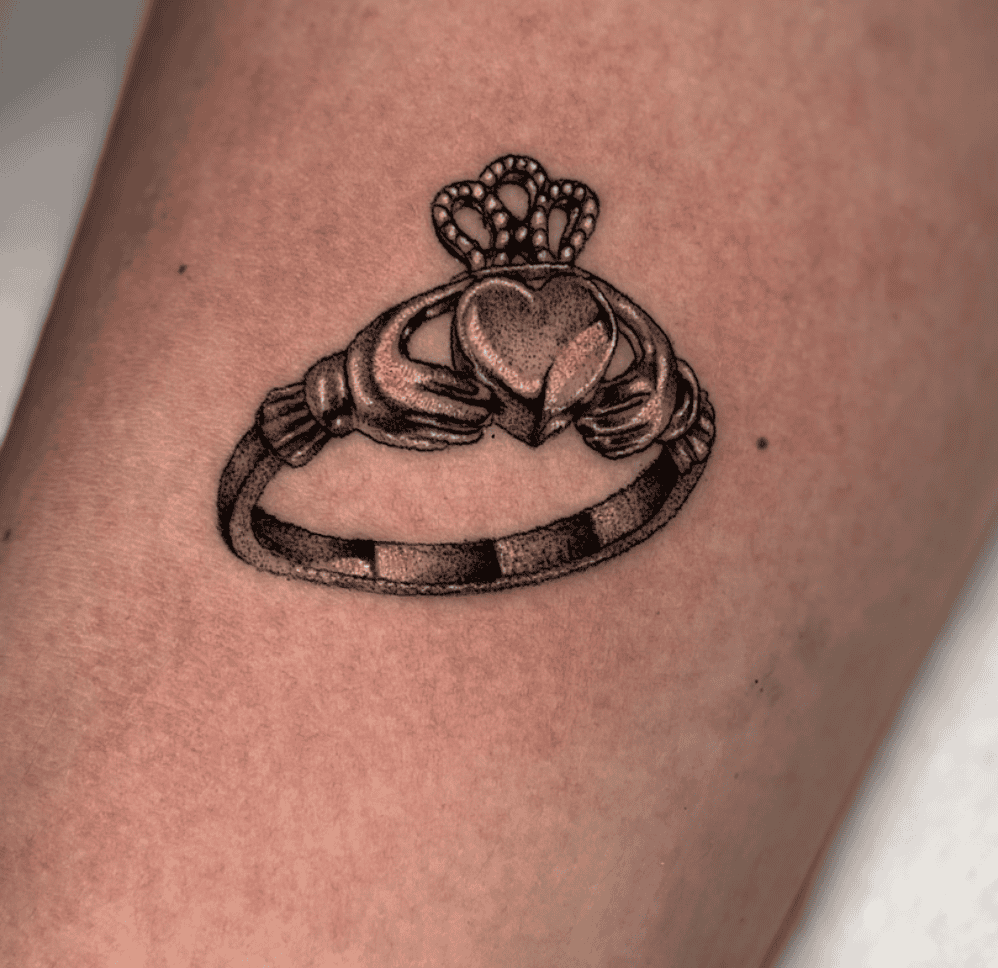
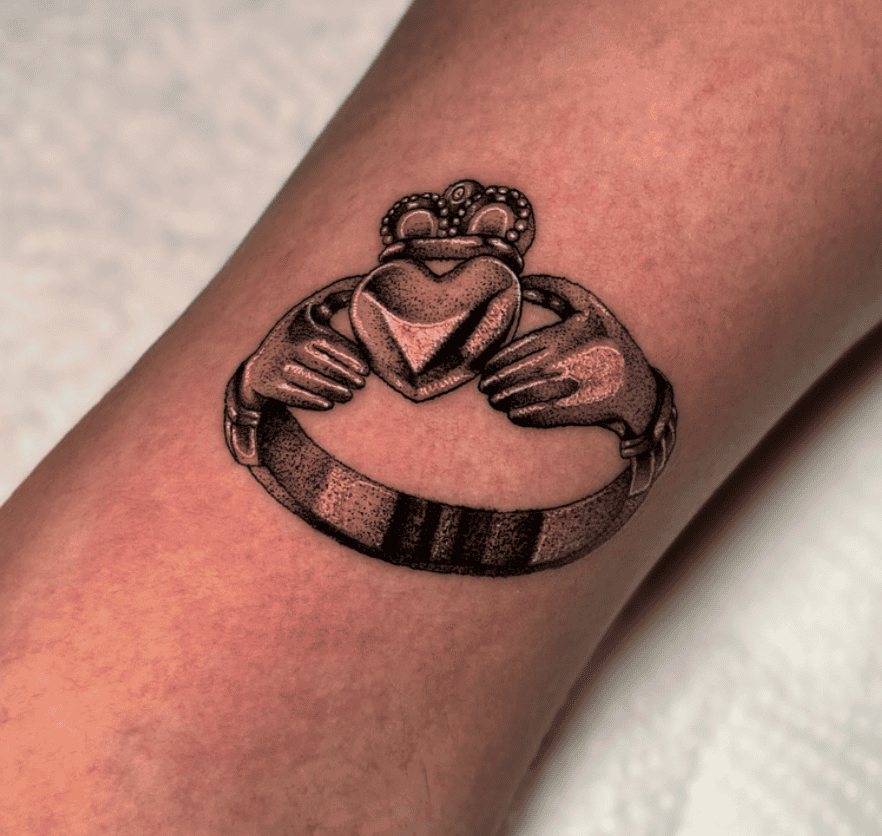
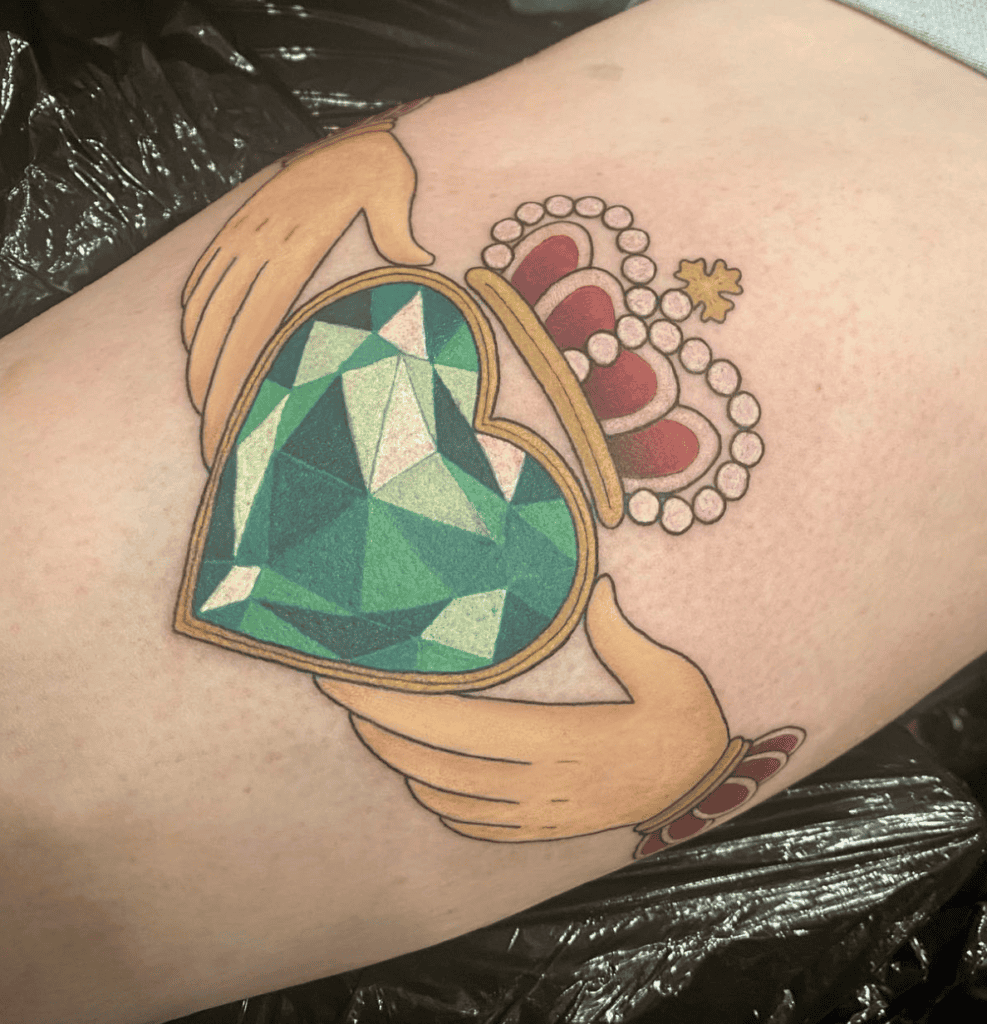
The Claddagh Ring is one of Ireland’s most iconic symbols, being a timeless design representing love, loyalty, and friendship. The design comprises three elements: a heart for love, hands for friendship, and a crown for loyalty.
Together, they form a powerful message – “Let love and friendship reign.” The ring comes from a small fishing village called Claddagh in Galway. According to legend, a man named Richard Joyce was captured and sold into slavery. While away, he learned goldsmithing and created the ring, and when he returned home, he gave it to his true love, who was still waiting for him.
Celtic Motherhood Knot Celtic Mythology Tattoo


The Celtic Motherhood Knot is a design that represents the eternal bond between a mother and her child. While it’s often associated with Celtic knotwork, this symbol is actually a modern interpretation inspired by traditional Celtic designs.
The design usually features interwoven loops forming a continuous knot and a shape resembling a mother and child embracing, sometimes with a heart or an infinity-style pattern. Because the lines never break, it symbolises an unending connection that cannot be separated.
Celtic Cross Celtic Mythology Tattoo
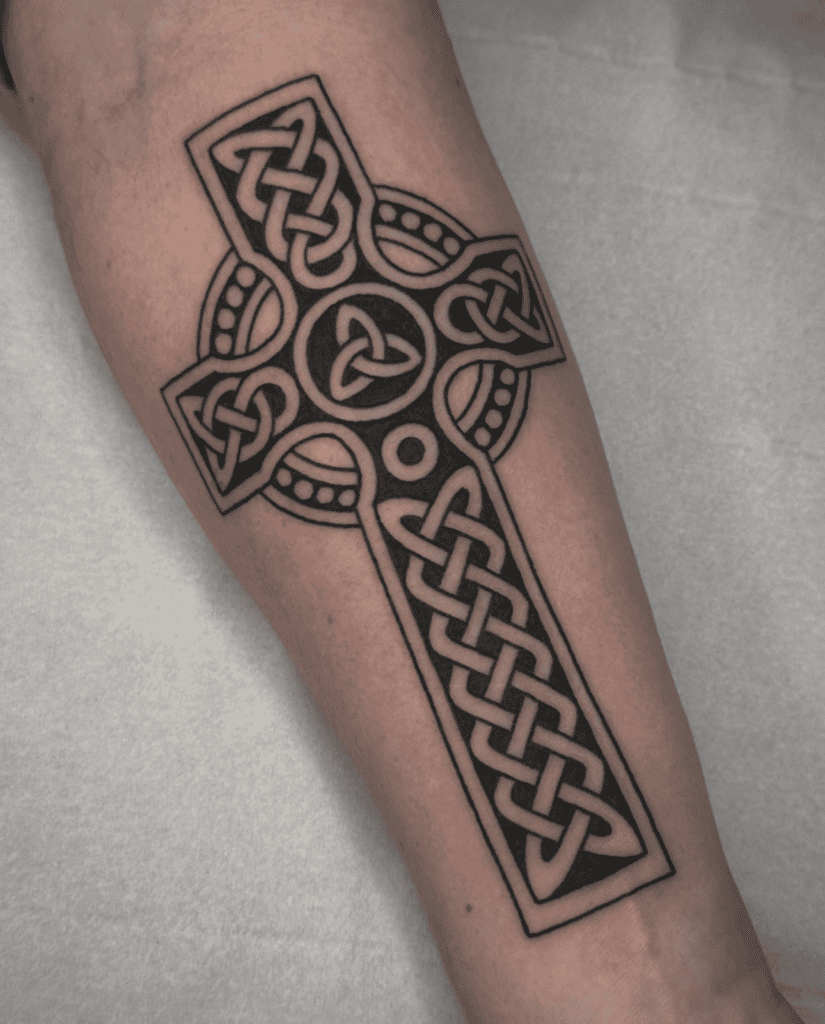
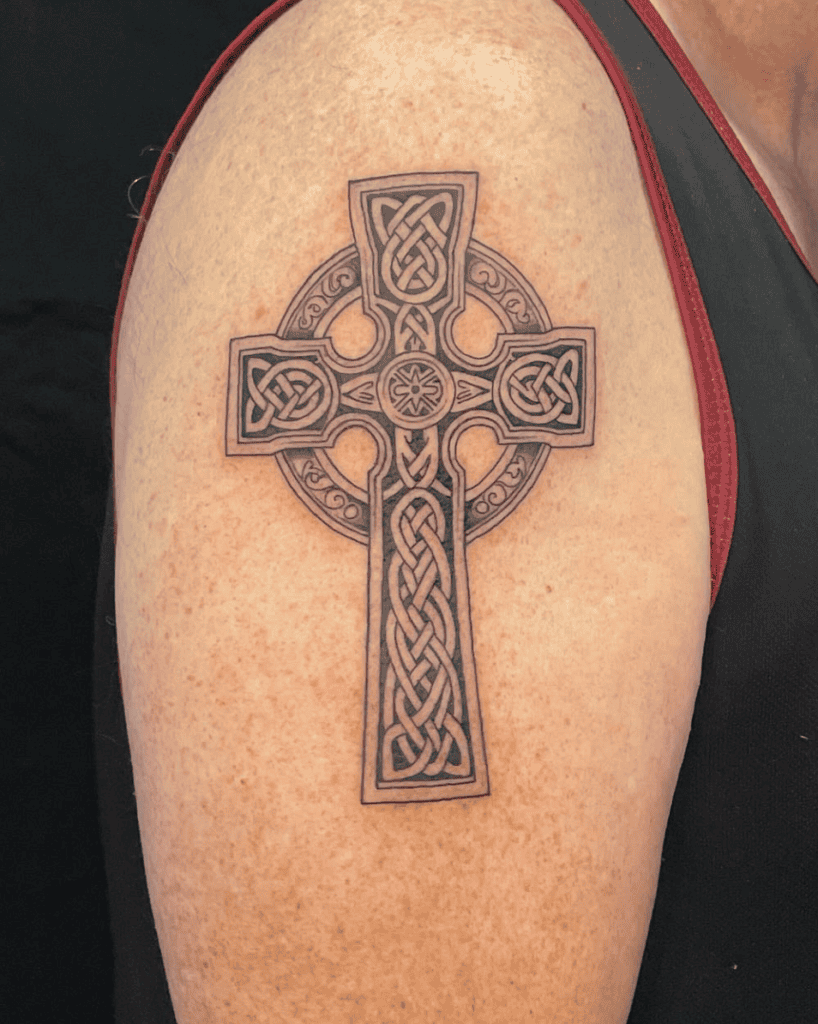
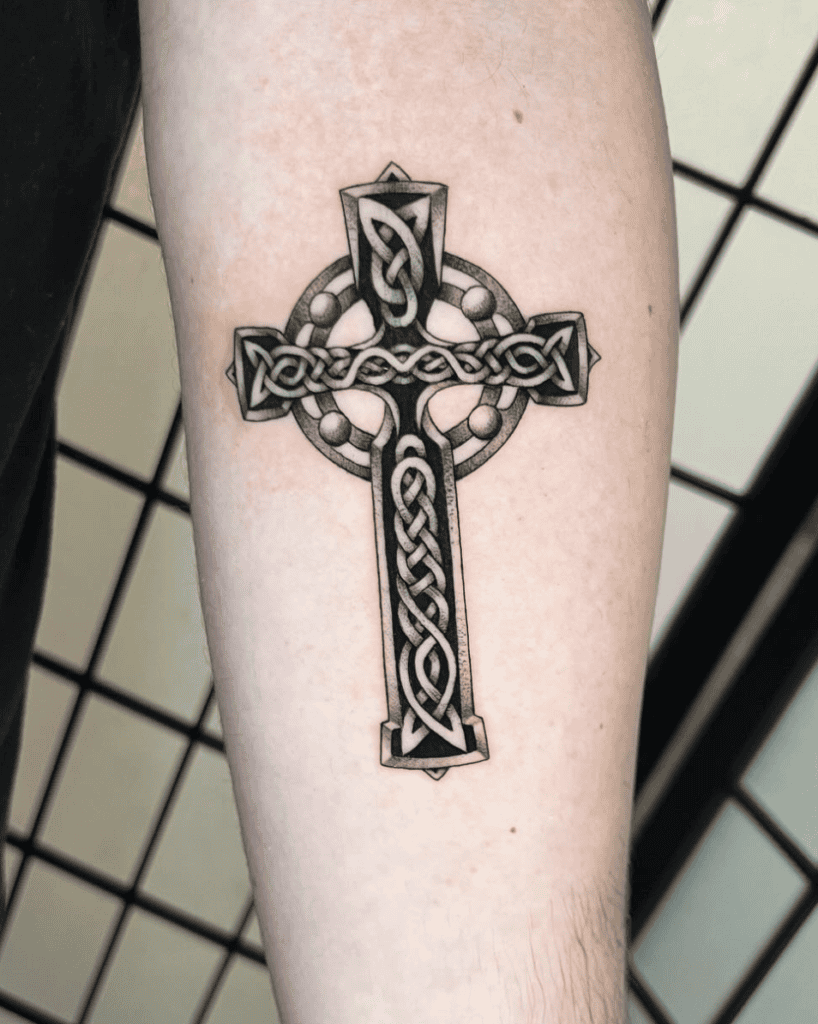
The Celtic Cross is one of the most iconic symbols in Celtic culture, acting as a bridge between old Celtic traditions and later Christian influence. The Celtic Cross combines the Cross representing faith, spirituality, sacrifice, and the Circle, representing eternity, unity, and the cycle of life.
Before Christianity, similar designs may have represented the sun, the four directions, and the balance of natural elements. When Christianity spread through Celtic lands, the cross became a symbol of Christ and faith, with the circle remaining, reinforcing ideas of eternity and divine unity.
St. Brigid’s Cross Celtic Mythology Tattoo


The St. Brigid’s Cross is a traditional Irish symbol made from woven rushes or straw, known for its connection to protection, home, and the coming of spring. It is a handmade woven cross, usually from rushes, recognisable by its square centre with four arms, which is traditionally placed in homes for protection. It is closely linked to Brigid, who later became St. Brigid in Christian tradition.
Before it became a Christian symbol, the cross was believed to represent the sun or fire, protection against evil or harm, and the Celtic festival of Imbolc (marking the start of spring)
With the spread of Christianity, the symbol became associated with St. Brigid of Kildare, who was said to have created the cross while explaining Christianity. From then on, it symbolised faith, blessing, and divine protection.
Awen Celtic Mythology Tattoo


The Awen is a spiritual symbol representing inspiration, creativity, and divine flow. Often associated with Druidic tradition, it is less about physical power and more about inner energy, insight, and creative awakening.
The word Awen comes from Welsh and roughly means “inspiration” or “poetic spirit.” In ancient tradition, it referred to the creative force that inspires poets and artists. The Awen symbol usually features three vertical rays, with three dots above them. Each element carries meaning, with the rays representing flowing energy or inspiration, and the three dots symbolising balance and harmony between forces.
Shamrock Celtic Mythology Tattoo


The Shamrock is one of Ireland’s most famous symbols, representing luck, unity, and spiritual meaning. The shamrock is a young clover plant with three leaves that is native to Ireland and deeply tied to its identity.
Like many Celtic symbols, the shamrock reflects the importance of three. It can represent Past, Present, Future – Life, Death, Rebirth – Mind, Body, Spirit – Earth, Sea, Sky.
The shamrock is famously linked to Saint Patrick, who was said to have used it to explain the Holy Trinity as each leaf represented one part, while still being part of a single plant. Over time, the shamrock became a symbol of good fortune and positivity, protection against bad luck, hope and new beginnings.
Conclusion
Thanks for joining us on this sham-rocking journey through the spiralling world of the Celtic Tattoo Design. We hope you’ve found the inspiration you need to go on your own mythical tattooing adventure. But if Celtic Tattoos still don’t inspire you, why not check out these Chinese Mythology Tattoo Ideas, these Persian Mythology Tattoo Designs, or these Egyptian Mythology Tattoos.
- Bear Tattoo Ideas - October 22, 2026
- Lion Tattoo Ideas - October 19, 2026
- Persona Tattoo Ideas - October 15, 2026