

Japanese Mythology Tattoo Ideas

Do you feel like you’re scaling the depths of the internet on your search for the perfect Tattoo Clues? Well, worry not, let’s out-fox the algorithm and not drag-on any longer as we dive into some of the best Japanese Mythology Tattoo Designs.
What is Japanese Mythology
Japanese mythology is a sprawling system of beliefs that explains how the world, the islands of Japan, and everything in nature came to be. Unlike some mythologies that come from a single holy book, Japanese mythology is a vibrant blend of two main traditions: Shinto (Japan’s native, nature-focused religion) and Buddhism (which arrived from China and India, bringing its own rich lore).
In Japanese myth, gods called Kami are everywhere, and in Shinto tradition, it says there are Yaoyorozu-no-Kami—literally, “eight million gods” (a number used to mean “infinity”). Kami can be powerful sky deities like Amaterasu (the Sun Goddess), but a Kami can also be a majestic mountain (like Mt. Fuji), a powerful river, an old sacred tree, or even a sudden gust of wind. While Kami are the divine spirits, Yokai are the trickster spirits and monsters that inhabit the edges of human civilisation. They range from mischievous to terrifying, either playing pranks on unsuspecting humans or killing them.
According to the ancient texts (the Kojiki and Nihon Shoki), the traditional Imperial family of Japan is directly descended from Amaterasu herself, weaving myth straight into history. The driving philosophy behind these stories is animism—the belief that everything has a spirit. Because of this, Japanese myths rarely focus on a strict, black-and-white battle between “Absolute Good” and “Absolute Evil.” Instead, the stories are about maintaining harmony and purity between humans, nature, and the spirit world. When humans disrespect nature, the spirits get angry, and when humans show respect, they are protected.
Top Japanese Mythology Tattoo Artists

taehaiii
Tokyo based Tattoo Artist specialising in Black and Grey Japanese Tattoos.

merve ustunalp tattoo
Istanbul based Tattoo Artist specialisng in Japanese Art Tattoos.


jin_qchoi
Seoul based Tattoo Artist specialising in custom Coloured Japanese Tattoos.

saskia brightson tattoo
Leipzig based Tattoo Artist specialising in Japanese Tattoos.
Best Japanese Mythology Tattoo Ideas
Now that we know a little about Japanese Mythology, let’s take a look at some of the best Japanese Mythology Tattoos the Yaoyorozu-no-Kami have to offer.
Amaterasu Ōmikami Japanese Mythology Tattoo
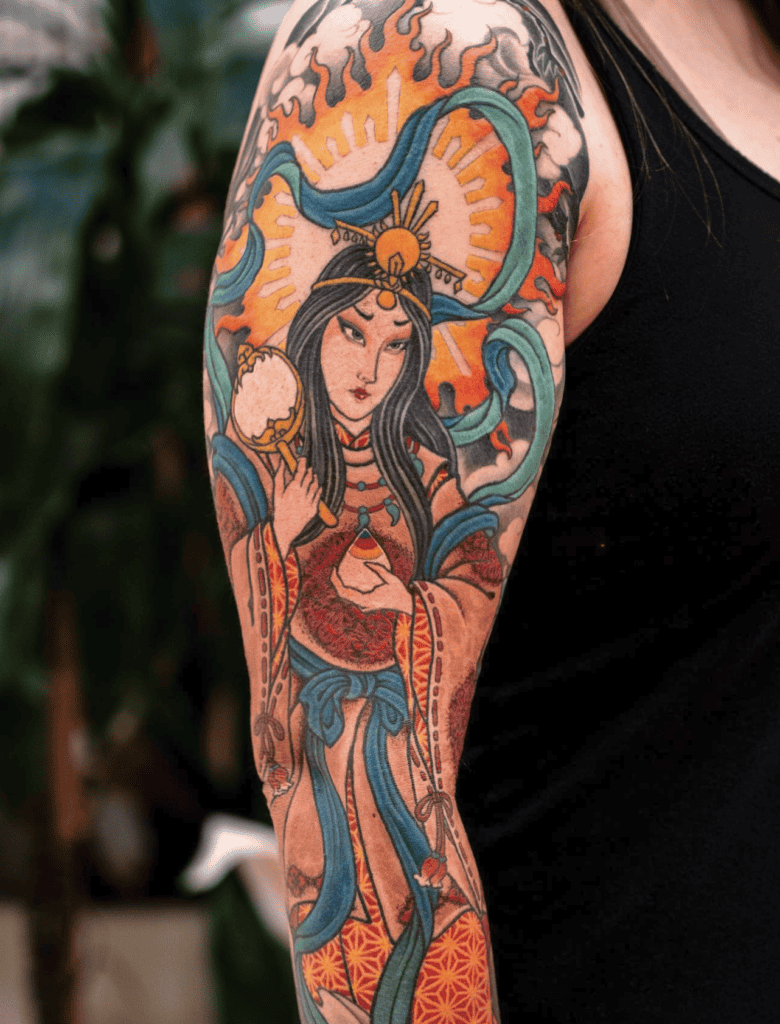
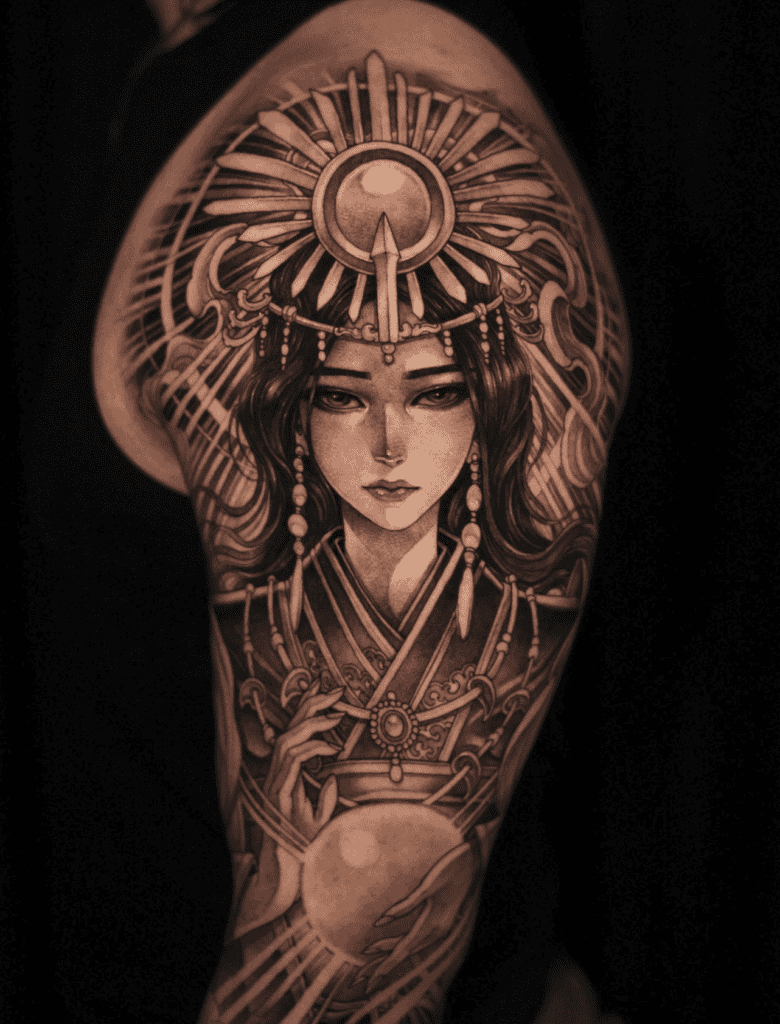
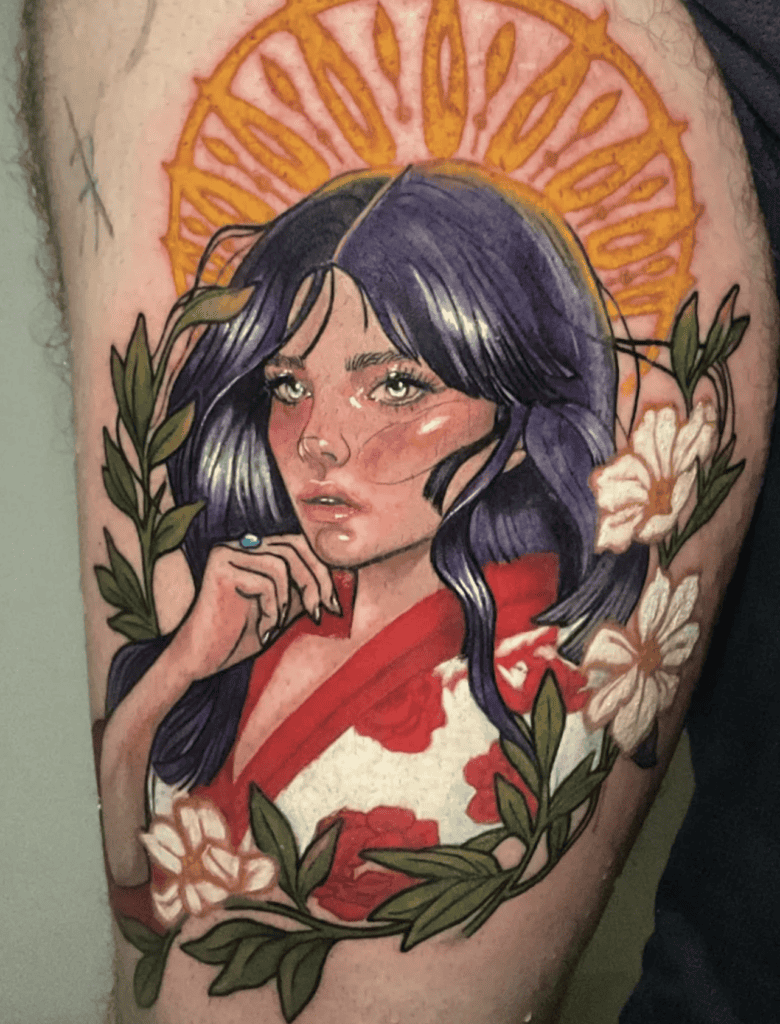
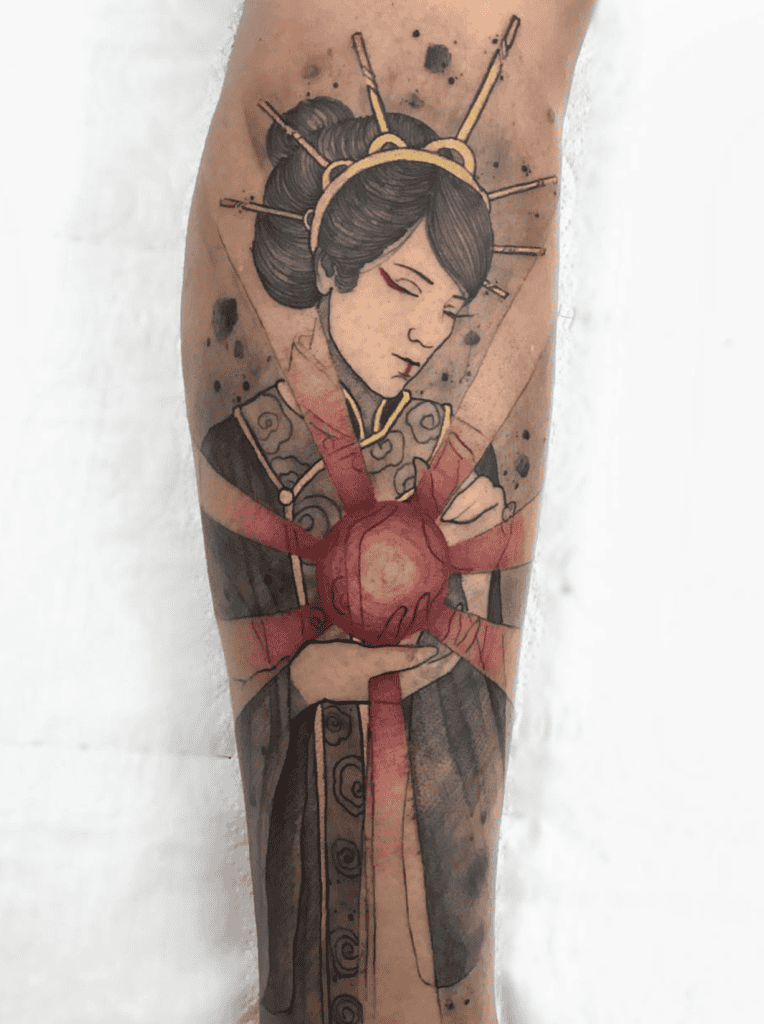
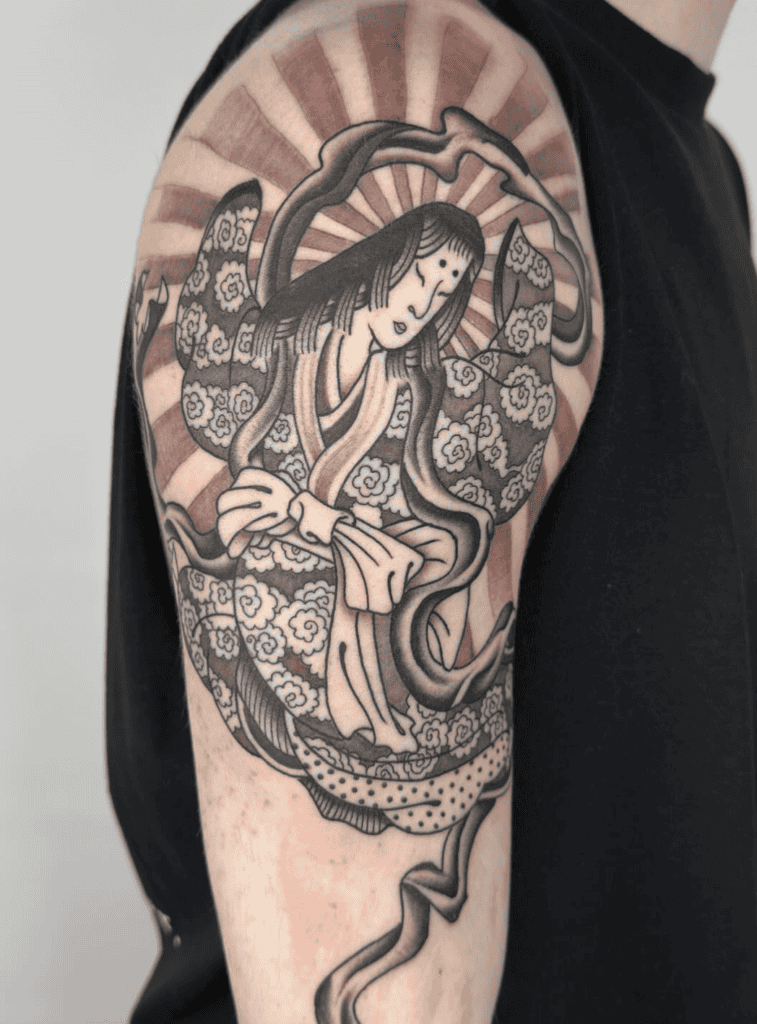
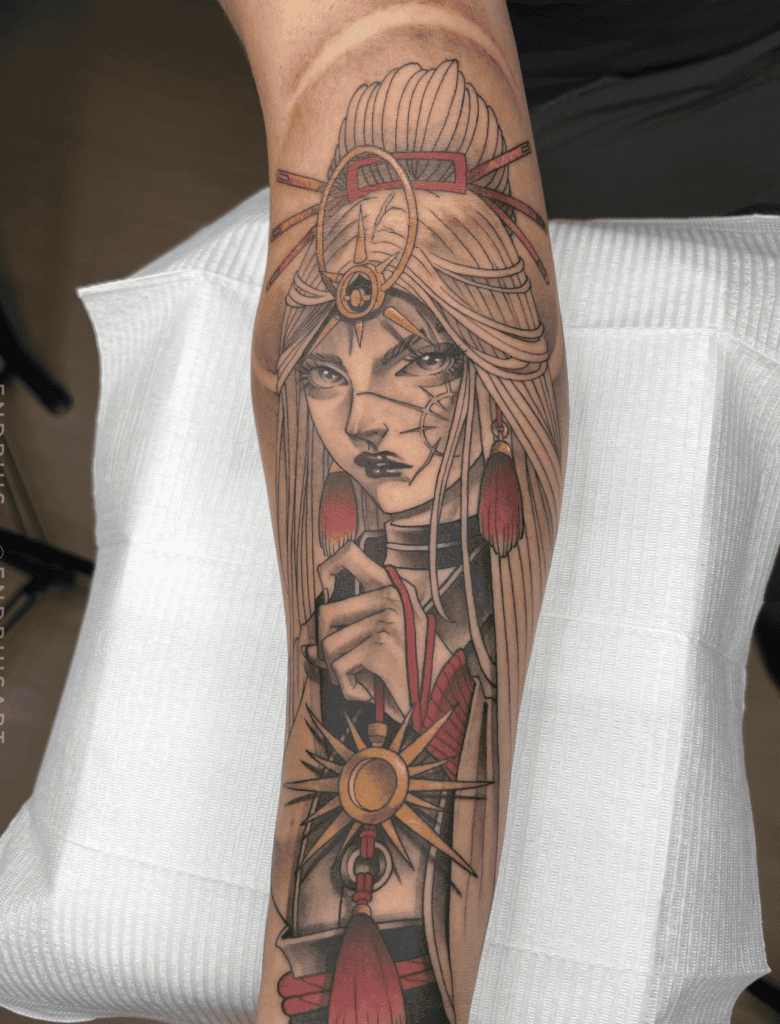
Amaterasu Ōmikami (天照大御神) is arguably the most important deity in all of Japanese mythology. Her name beautifully translates to “The Great Kami Who Shines in Heaven,” and she rules over the High Celestial Plain (Takamagahara) as the Goddess of the Sun, light, agriculture, and the universe. As the central figure of the Shinto faith, she represents order, purity, and the life-giving warmth necessary for growing rice.
Amaterasu’s birth story is deeply tied to the Shinto concept of spiritual purity. After the creator god, Izanagi, escaped from the dark, polluted underworld (Yomi), he washed his face in a river to cleanse himself. Amaterasu was born from his left eye as he washed it, shining so brightly that Izanagi immediately handed her the keys to the heavens. Her brothers were born right after: Tsukuyomi (the Moon God) from his right eye, and Susanoo (the Storm God) from his nose.
Susanoo-no-Mikoto Japanese Mythology Tattoo
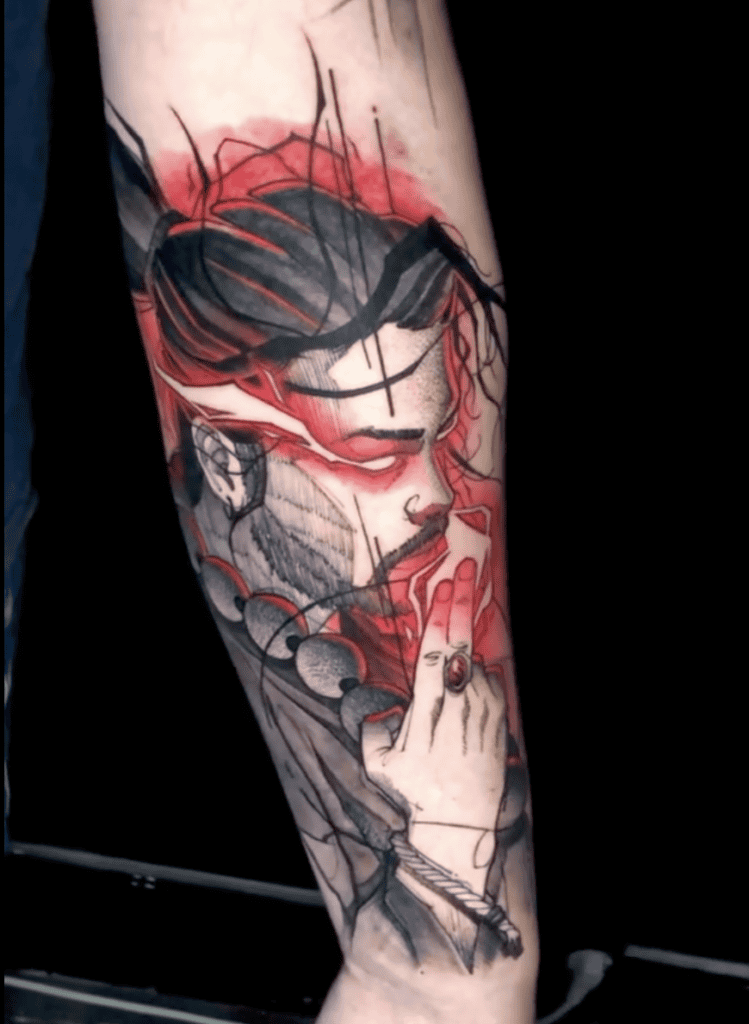
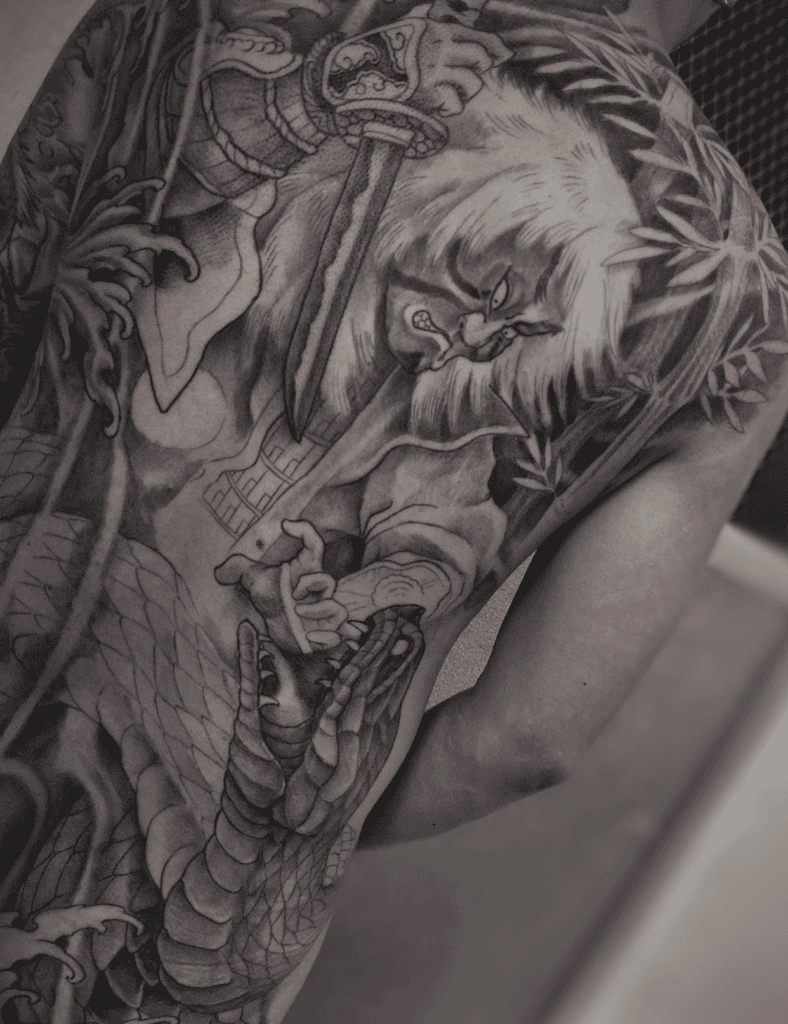
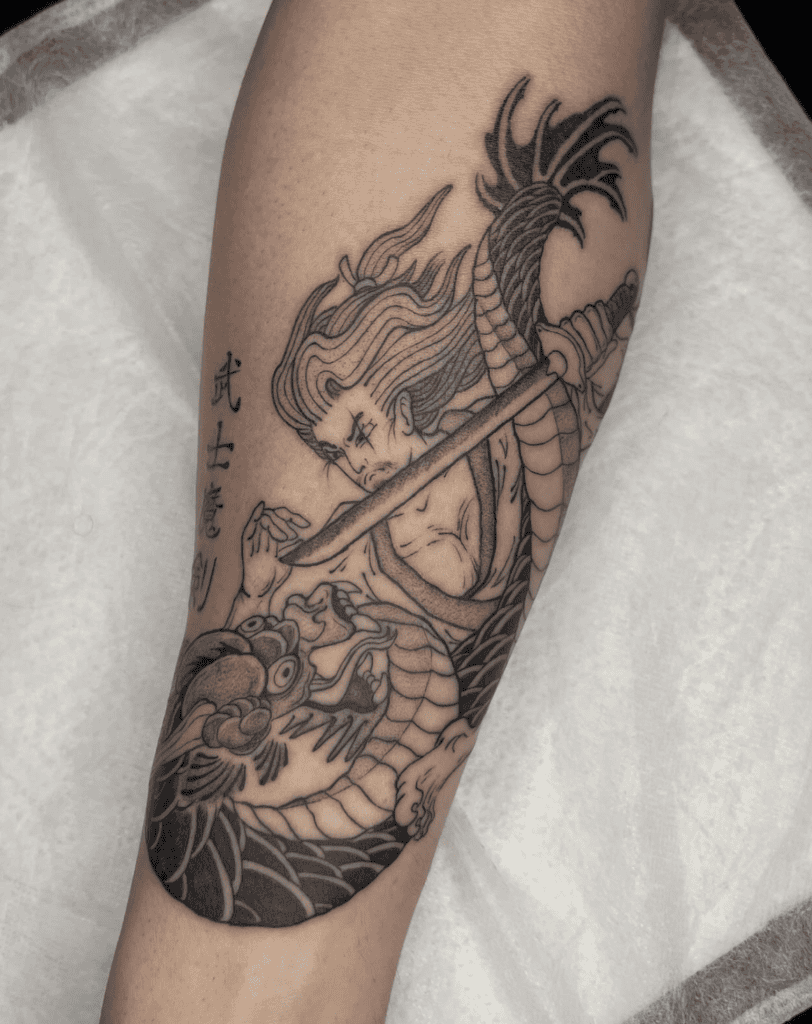
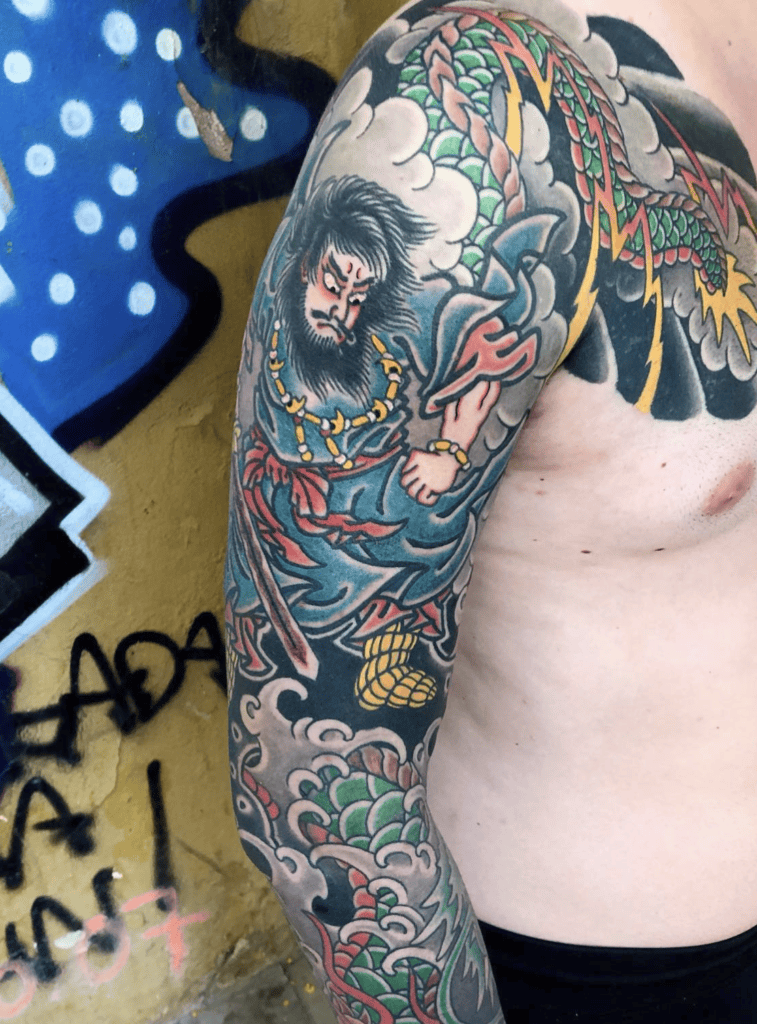
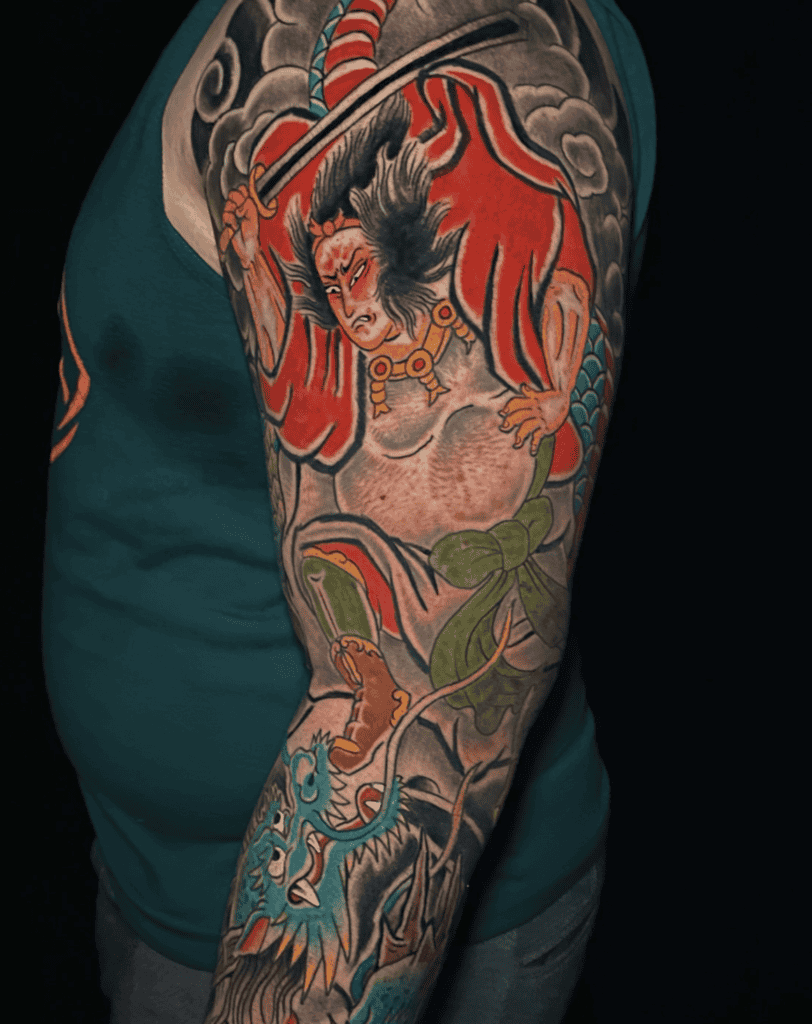
Susanoo-no-Mikoto (素戕嗚尊) is the God of Storms, the Sea, and earthquakes, a chaotic deity whose mood swings shake the universe, whose name roughly translates to “The Impetuous Male.” He has one of the greatest redemption arcs in mythology, starting as an exiled troublemaker and ending up as a legendary, monster-slaying hero.
Susanoo was born from the nose of the creator god Izanagi. He was given dominion over the seas, but instead of ruling, he threw endless temper tantrums, weeping so loudly that he dried up green mountains and killed rivers. When Izanagi asked why he was crying, Susanoo said he just wanted to go to the underworld to be with his deceased mother, Izanami. Frustrated by his son’s complete lack of responsibility, Izanagi banished him.
Before leaving, Susanoo went up to heaven to say goodbye to his sister, Amaterasu. Suspecting he was there to take over her kingdom, she challenged him to a ritual contest to prove his intentions. While he technically won the challenge, he celebrated by going on a massive, destructive rampage that ultimately drove Amaterasu into the cave and threw the universe into darkness. For this ultimate crime, the other gods stripped Susanoo of his beard, pulled out his fingernails, and permanently banished him from the heavens down to the earthly realm of Izumo.
Exile changed Susanoo. When walking along the Hi River in Izumo, he encountered an elderly couple weeping over a young girl. They explained that they used to have eight daughters, but every year, a terrifying monster named Yamata no Orochi came to eat one. Only their last daughter, Kushinada-hime, remained, and the serpent was coming for her.
Susanoo agreed to slay the beast on the condition that he got to marry Kushinada-hime. They happily agreed. Instead of trying to fight an eight-headed dragon with raw muscle, Susanoo used his wits. He turned the girl into a comb and hid her safely in his head, and ordered the couple to build a fence with eight gates. Behind each gate, they placed a platform holding a vat filled with highly potent, eight-times-refined sake.
When Orochi slithered down, each of its eight heads smelled the alcohol, dipped into a separate vat, and drank deeply. Within minutes, the giant serpent passed out drunk. Susanoo drew his massive sword and chopped the helpless monster to pieces, turning the river red with its blood.
While cutting through one of the serpent’s tails, Susanoo discovered a legendary, indestructible sword named the Kusanagi-no-Tsurugi (the Grass-Cutting Sword). To apologise to his sister for his past behaviour, he gifted the sword to Amaterasu. It later became one of the Three Imperial Regalia of Japan.
Tsukuyomi-no-Mikoto Japanese Mythology Tattoo

Tsukuyomi-no-Mikoto is the god of the Moon in Japanese mythology and one of the most important deities in the religion of Shinto. Like his siblings, Tsukuyomi was born from the creator god Izanagi after he returned from the underworld and purified himself. While Amaterasu was born from Izanagi’s left eye and Susanoo from his nose, Tsukuyomi was born from his right eye.
One of Tsukuyomi’s most famous myths explains why day and night are separate. The Moon God was sent to visit Uke Mochi, the goddess of food. To provide a feast, she magically produced food from her mouth and other parts of her body. Tsukuyomi found this disgusting and, believing it to be an insult, killed her.
When Amaterasu learned what had happened, she was horrified and declared that she would never look upon Tsukuyomi again. As a result, the Sun and Moon became separated in the sky, creating the cycle of day and night.
Izanagi-no-Mikoto Japanese Mythology Tattoo
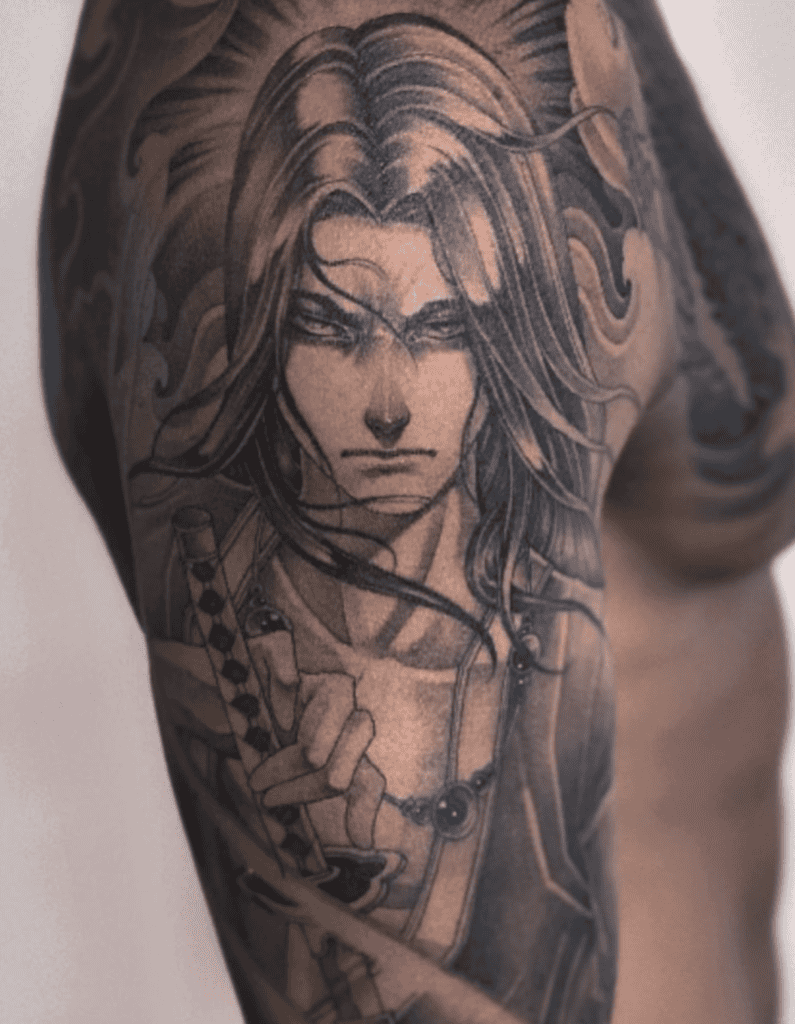
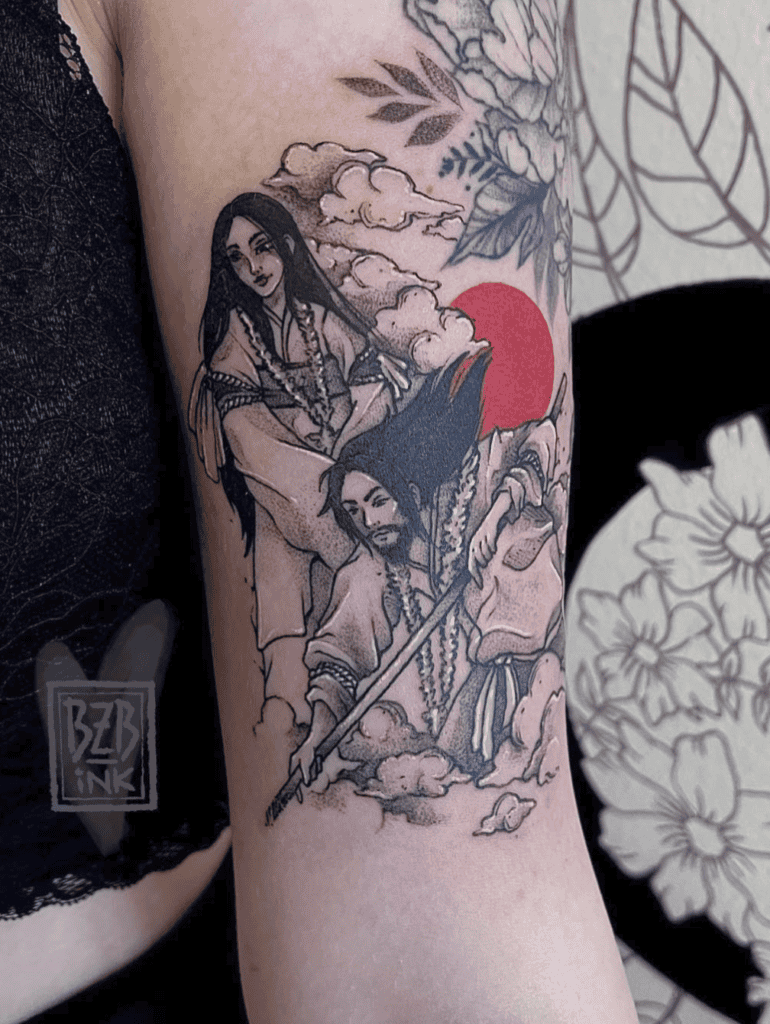
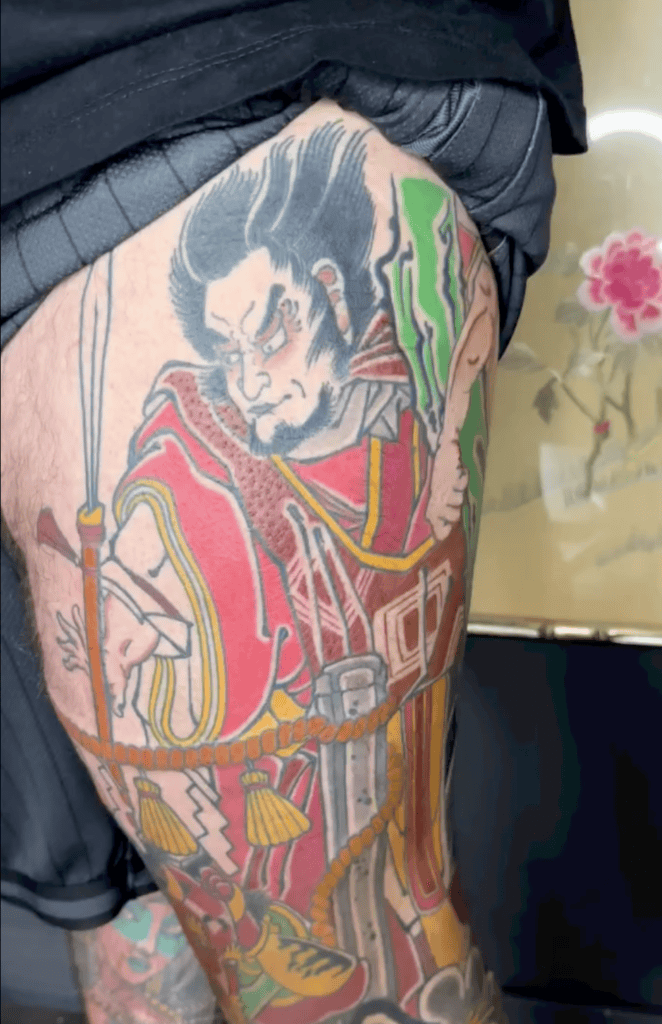
Izanagi-no-Mikoto (“He Who Invites”) is one of the most important gods in Japanese mythology. Along with his wife and sister, Izanami, he is credited with creating the islands of Japan and giving birth to many of the gods who would shape the world.
According to the Kojiki and the Nihon Shoki, the world was once a chaotic ocean of swirling matter. The heavenly gods gave Izanagi and Izanami a sacred spear known as the Ame-no-Nuboko (“Heavenly Jewelled Spear”) and instructed them to create land.
Standing on the Floating Bridge of Heaven, they stirred the sea with the spear. When droplets fell from its tip, they hardened and formed the first island, known as Onogoro Island. The divine couple descended to this island and began creating the Japanese islands and numerous deities.
As Izanagi and Izanami created the world, they gave birth to many kami. However, tragedy struck when Izanami gave birth to the fire god Kagutsuchi, a birth that severely burned her, causing her death.
Heartbroken, Izanagi travelled to Yomi, the land of the dead, hoping to bring Izanami back. When Izanagi found Izanami, she warned him not to look at her while she sought permission to return to the world of the living. Unable to resist, he lit a comb as a torch and looked upon her. He discovered that she had become a decaying corpse inhabited by dreadful spirits. Terrified, he fled.
An enraged Izanami chased Izanagi from the underworld with monstrous beings and spirits. After a dramatic escape, Izanagi sealed the entrance to Yomi with a massive boulder, and the couple exchanged final words: Izanami vowed to take a thousand lives every day, and Izanagi replied that fifteen hundred people would be born each day. This myth is often viewed as an explanation for the cycle of life and death.
Izanami-no-Mikoto Japanese Mythology Tattoo


Izanami-no-Mikoto (“She Who Invites”) is one of the most important goddesses in Japanese mythology. Alongside her husband and brother, Izanagi, she helped create the islands of Japan and gave birth to countless gods. While she begins as a creator deity associated with life and birth, her story eventually transforms her into a powerful figure connected with death and the underworld.
When Izanami gave birth to the fire god Kagutsuchi, the intense heat of the birth fatally burned her. Despite being a goddess, she succumbed to her injuries and descended to Yomi, the land of the dead. Her death marked the first major tragedy in Japanese mythology and introduced death into the world.
Unable to accept her loss, Izanagi journeyed to Yomi to retrieve Izanami. When he found her, she told him she had already eaten the food of the underworld, making it difficult for her to return. She asked him not to look at her while she sought permission from the rulers of Yomi. Unfortunately, Izanagi saw that Izanami’s body had decayed and become covered with terrifying creatures and spirits. Humiliated and enraged by his reaction, Izanami pursued him as he fled the underworld.
Kagutsuchi Japanese Mythology Tattoo


Kagutsuchi (迦具土神), also known as Homusubi or Kagutsuchi-no-Kami, is the powerful god of fire in Japanese mythology. He is one of the most important and tragic figures in the Shinto creation myths because his birth forever changed the world.
While fire is essential for warmth, light, and civilisation, it can also bring destruction. Kagutsuchi embodies both sides of this force, making him a symbol of creation and devastation at the same time.
After his birth, Kagutsuchi’s fiery nature was so intense that it fatally burned his mother, Izanami, during childbirth. Her death became the first great tragedy in Japanese mythology and introduced death into the world.
Devastated by the loss of his wife, Izanagi was overcome with sorrow and anger. In his fury, he drew his sword and killed Kagutsuchi. Yet even in death, the Fire God’s body continued to shape the world. From his blood and body parts sprang numerous new deities, including gods associated with mountains, volcanoes, thunder, metalworking, and other natural forces.
Thus, Kagutsuchi’s death became another act of creation, reflecting a recurring theme in Japanese mythology: destruction often gives rise to new life.
Gozanze Myoo Japanese Mythology Tattoo

Gozanze Myōō (降三世明王), known in Sanskrit as Trailokyavijaya, is one of the Five Great Wisdom Kings of Japanese Esoteric Buddhism. He is a protector deity whose fierce appearance symbolises the destruction of ignorance, arrogance, and evil. His name is often translated as “Conqueror of the Three Worlds” or “Victor Over the Three Realms.”
Gozanze Myōō is one of the Godai Myōō (Five Great Wisdom Kings). These wrathful deities serve enlightened Buddhas and use fierce methods to overcome obstacles that prevent spiritual awakening.
The “Three Worlds” in Buddhism generally refer to the world of desire, the world of form, and the formless world. Gozanze Myōō’s role is to overcome attachment, ignorance, and delusion that trap beings within these realms. Rather than destroying people, he destroys the negative emotions and illusions that keep them from attaining enlightenment.
Inari Ōkami Japanese Mythology Tattoo
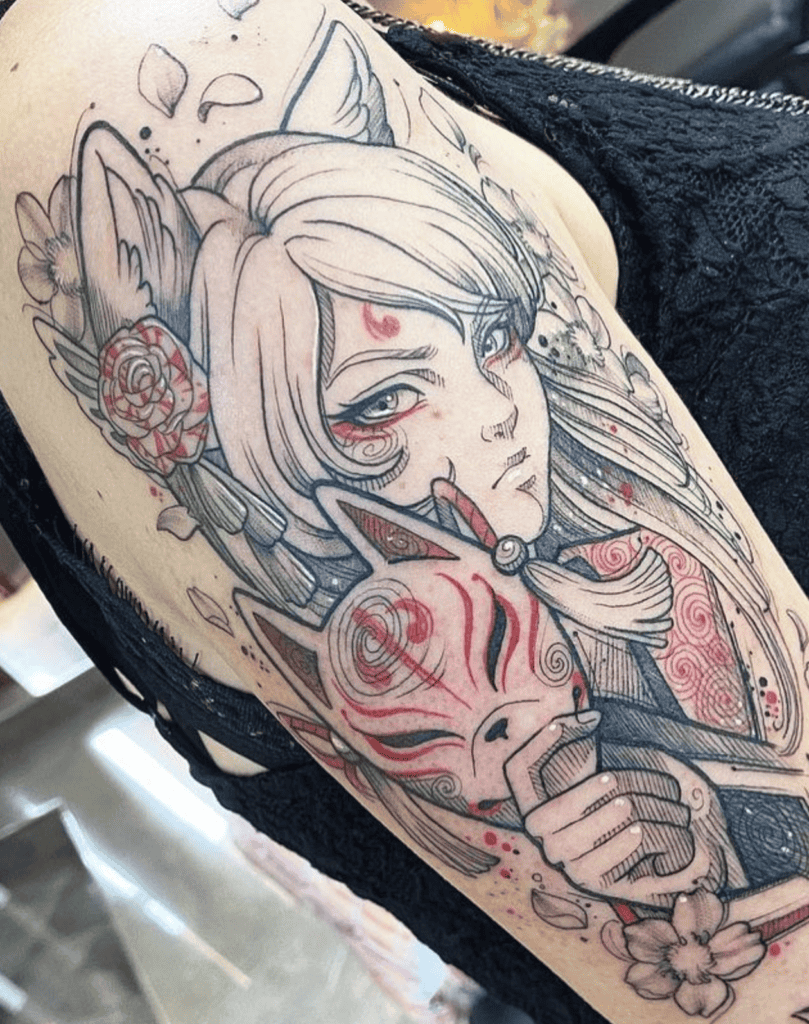
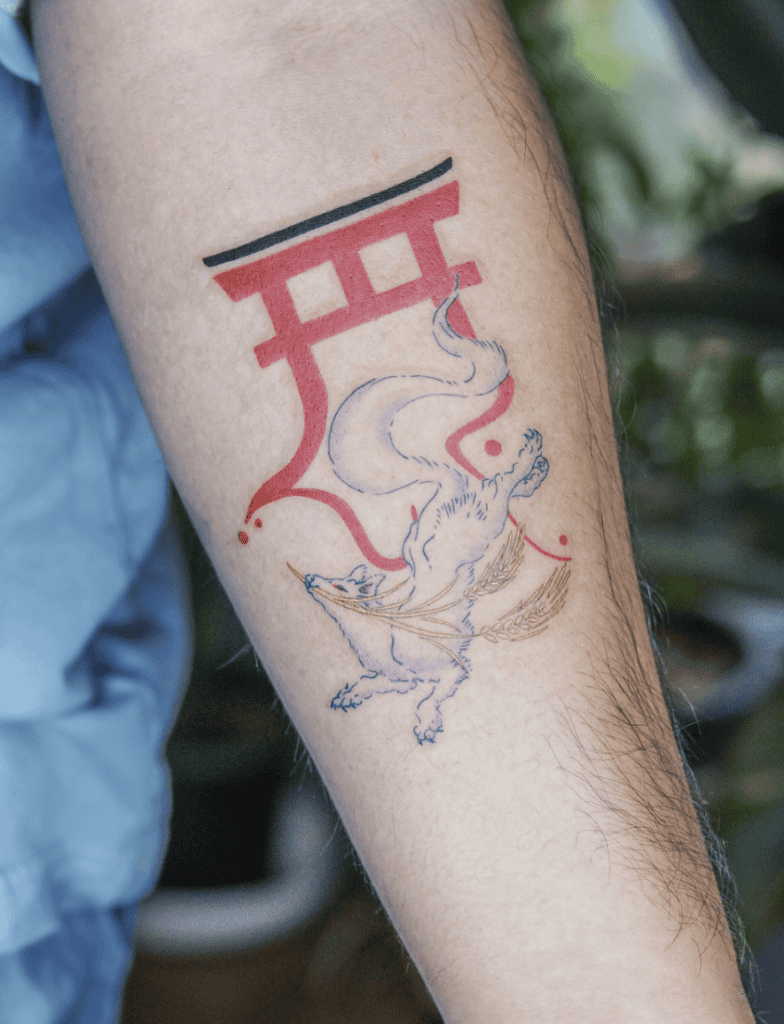
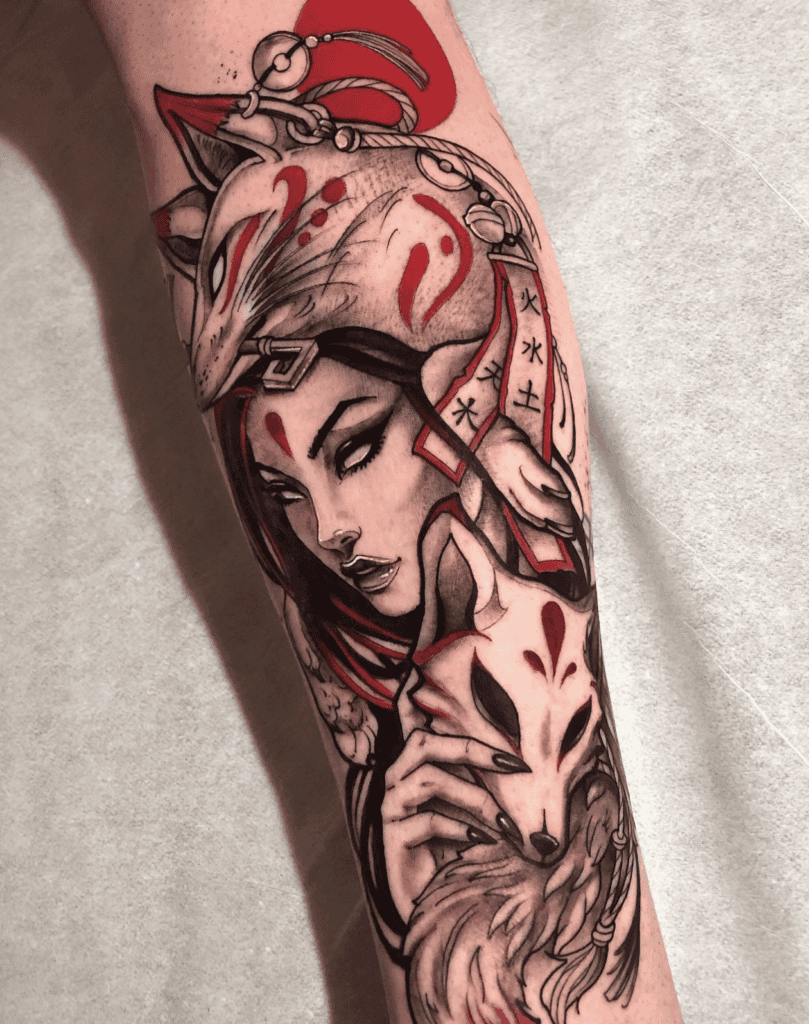
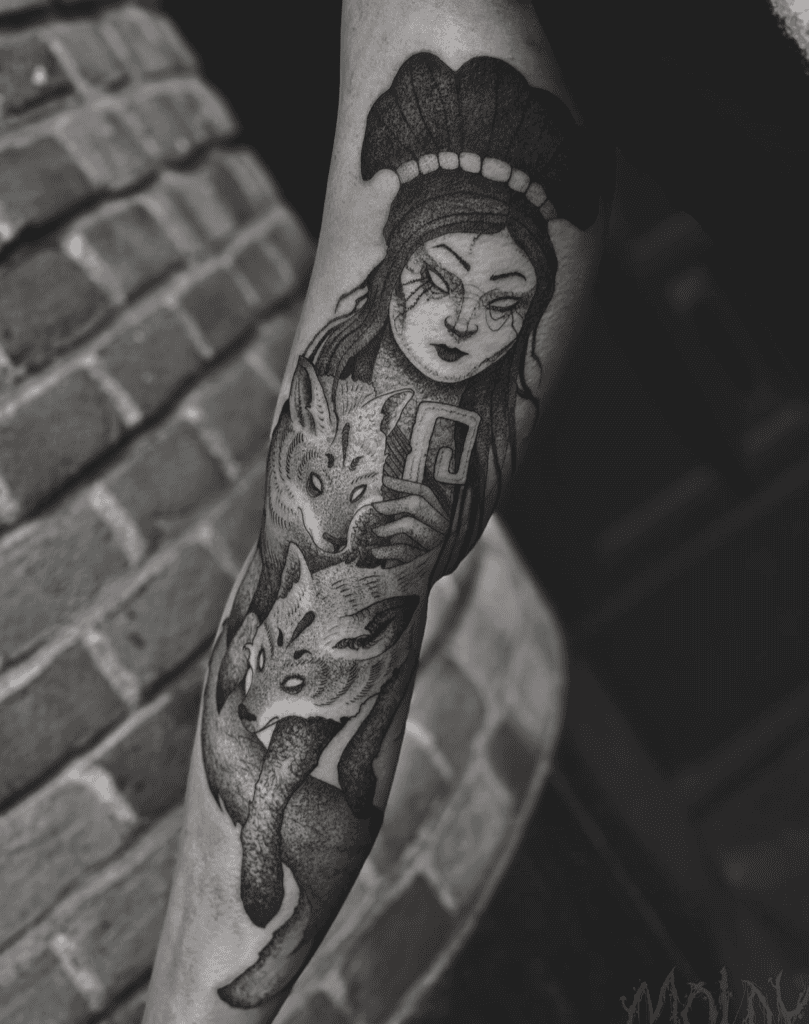
Inari Ōkami (稲荷大神) is one of the most beloved and widely worshipped deities in Japan. Inari is the kami of rice, agriculture, prosperity, business success, fertility, and abundance. Over the centuries, Inari’s influence expanded far beyond farming, and today many people pray to Inari for wealth, good fortune, and success in their careers.
The name “Inari” is often associated with rice because rice was once the foundation of wealth and survival in Japan. As society changed, Inari became connected with agriculture, prosperity, business success, fertility, industry, merchants and craftsmen, and general good fortune. Inari is worshipped in both Shinto and some Buddhist traditions, making the deity’s history especially rich and complex.
Inari may be depicted as a male or female deity, an androgynous figure, or a group of several kami working together. This flexibility has contributed to Inari’s widespread appeal across different regions and periods of Japanese history.
Many people mistakenly think Inari is a fox deity. In reality, foxes, known as Kitsune, are considered Inari’s messengers rather than the deity itself. At Inari shrines throughout Japan, you will often see fox statues holding keys, scrolls, rice sheaves, and sacred jewels. These objects symbolise prosperity, wisdom, and the protection of harvests.
Ryūjin Japanese Mythology Tattoo


Ryūjin (龍神), meaning “Dragon God” or “Dragon King,” is one of the most famous and powerful deities in Japanese mythology. He is the ruler of the seas, the master of storms and tides, and the divine king of dragons.
Unlike the fire-breathing dragons often seen in Western mythology, Japanese dragons are usually wise, benevolent, and associated with water, rain, and good fortune. Ryūjin is considered the greatest of them all.
Ryūjin rules the oceans from a magnificent underwater palace known as Ryūgū-jō (“Dragon Palace”). According to legend, this palace lies beneath the sea and is built from coral and precious jewels. It is described as a place of incredible beauty where magical treasures and sea creatures gather under Ryūjin’s rule.
Tamatori-hime Japanese Mythology Tattoo

Tamatori-hime (玉取姫), meaning “Princess Jewel-Taker” or “Princess Jewel Retriever,” is a legendary heroine from Japanese folklore. Her story is one of the most dramatic tales involving the Dragon King’s underwater realm and a stolen magical jewel.
According to legend, Tamatori-hime was a humble ama, one of Japan’s traditional female pearl divers. Ama divers have existed in Japan for centuries, free-diving without breathing equipment to collect pearls, shellfish, and other treasures from the sea.
The story centres around a magical jewel that had been stolen and taken to the underwater palace of Ryūjin. Because the treasure rested within the Dragon King’s domain beneath the sea, recovering it seemed nearly impossible.
Tamatori-hime volunteered to retrieve the jewel, and using her diving skills, she descended into the depths of the ocean, reached the magnificent underwater palace, Ryūgū-jō, and successfully obtained the precious jewel.
After taking the treasure, Tamatori-hime was pursued by sea creatures and dragon servants sent to recover it. Knowing she might not survive, she made a desperate decision. In the most famous version of the story, she cut open her own breast and hid the jewel inside her body so her pursuers could not reclaim it.
Tamatori-hime succeeded in bringing the jewel back, but the effort cost her life. Her sacrifice allowed the treasure to be returned to its rightful owners and secured her place in Japanese folklore as a symbol of bravery and devotion.
Hachiman Japanese Mythology Tattoo
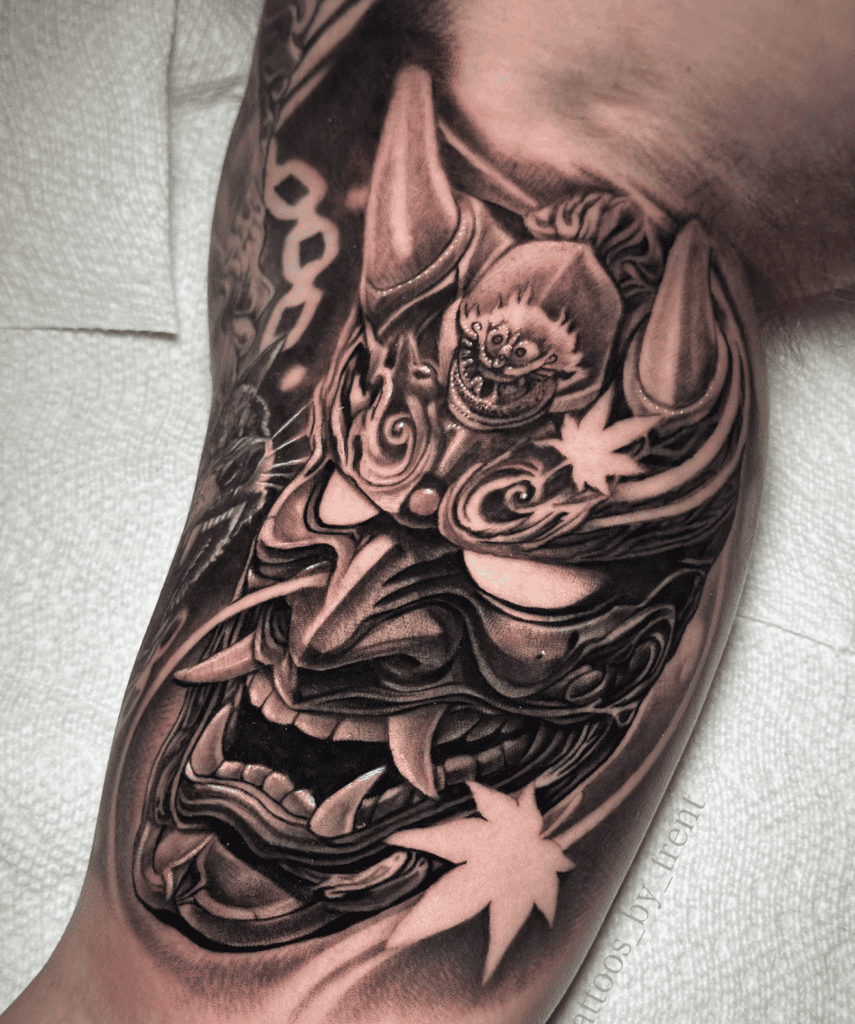
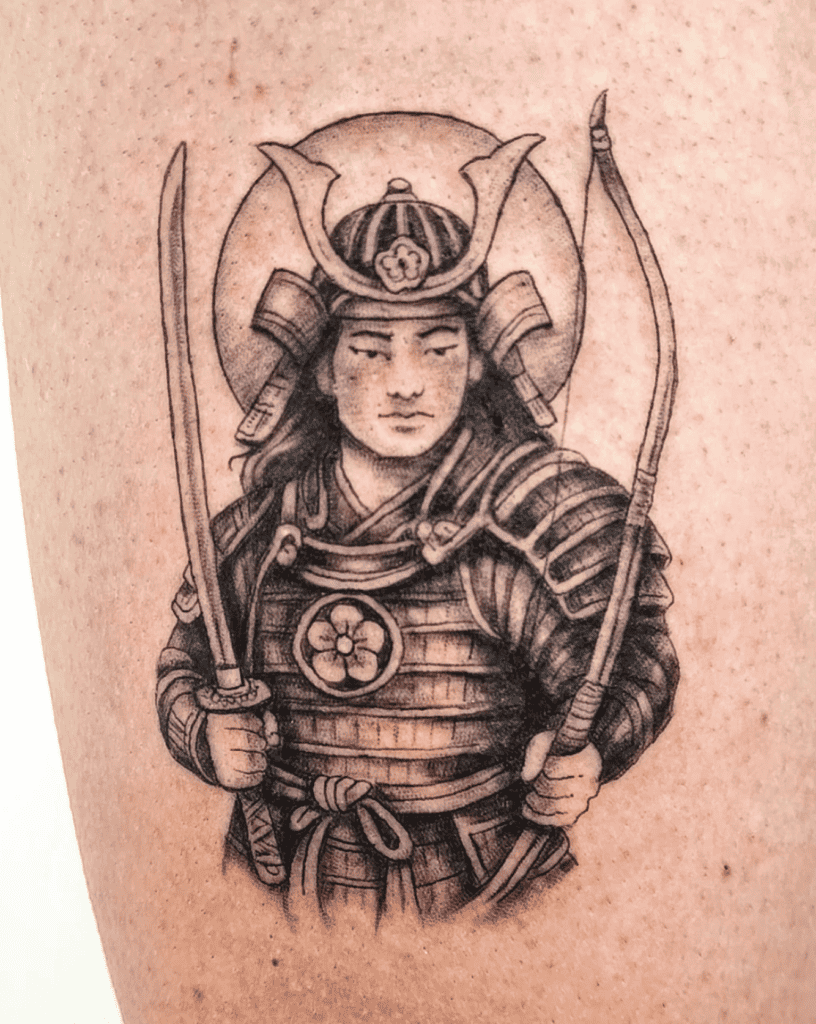
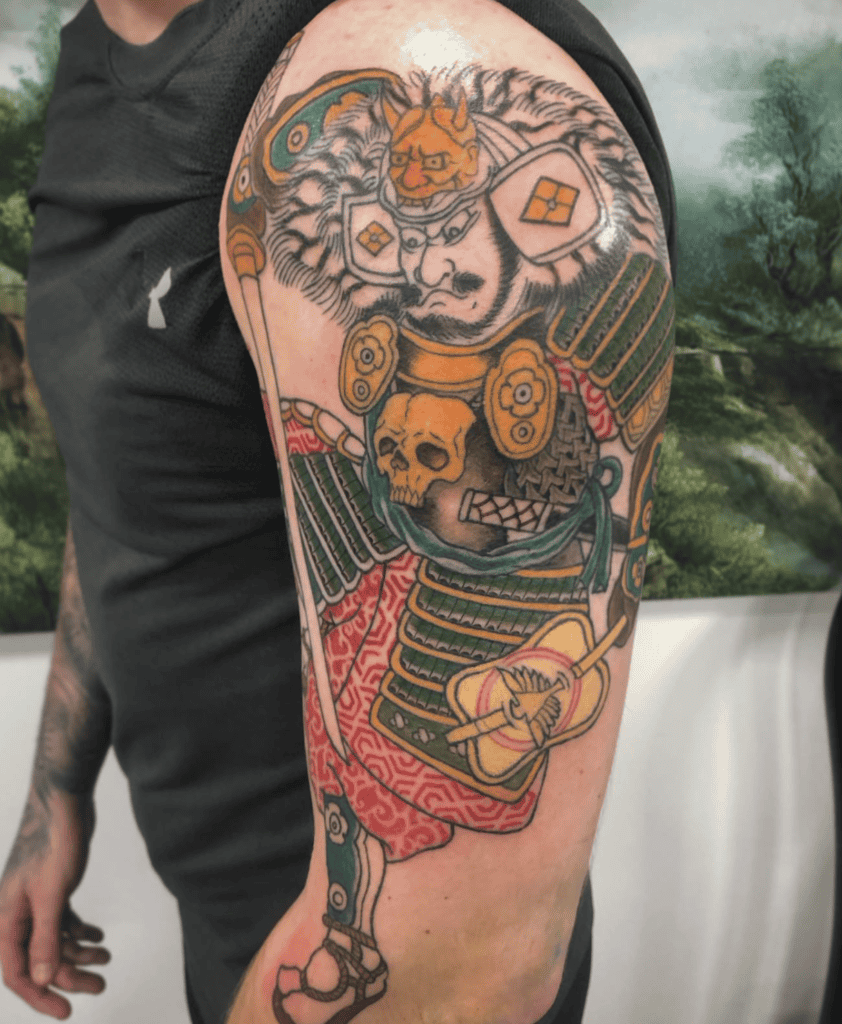
Hachiman (八幡神) is one of the most important and widely worshipped deities in Japan. He is best known as the god of war, archery, warriors, and divine protection, but his role extends far beyond battle. Over the centuries, Hachiman became a protector of the Japanese people, guardian of the nation, and patron deity of the samurai. Despite his martial associations, Hachiman is often regarded as a benevolent protector who uses strength to preserve peace rather than seek conflict.
Hachiman is a fascinating deity because he blends mythology, religion, and history. Many traditions identify him with Emperor Ōjin, who, after his death, was believed to have become the divine spirit known as Hachiman. Over time, worship of Hachiman spread throughout Japan, and his identity evolved into that of a powerful guardian kami.
Hachiman’s most famous role is as the patron deity of the samurai. Powerful warrior clans, especially the Minamoto clan, considered Hachiman their divine protector, praying to him for victory in battle, courage, honour, protection, and strategic wisdom.
Konohanasakuya-hime Japanese Mythology Tattoo
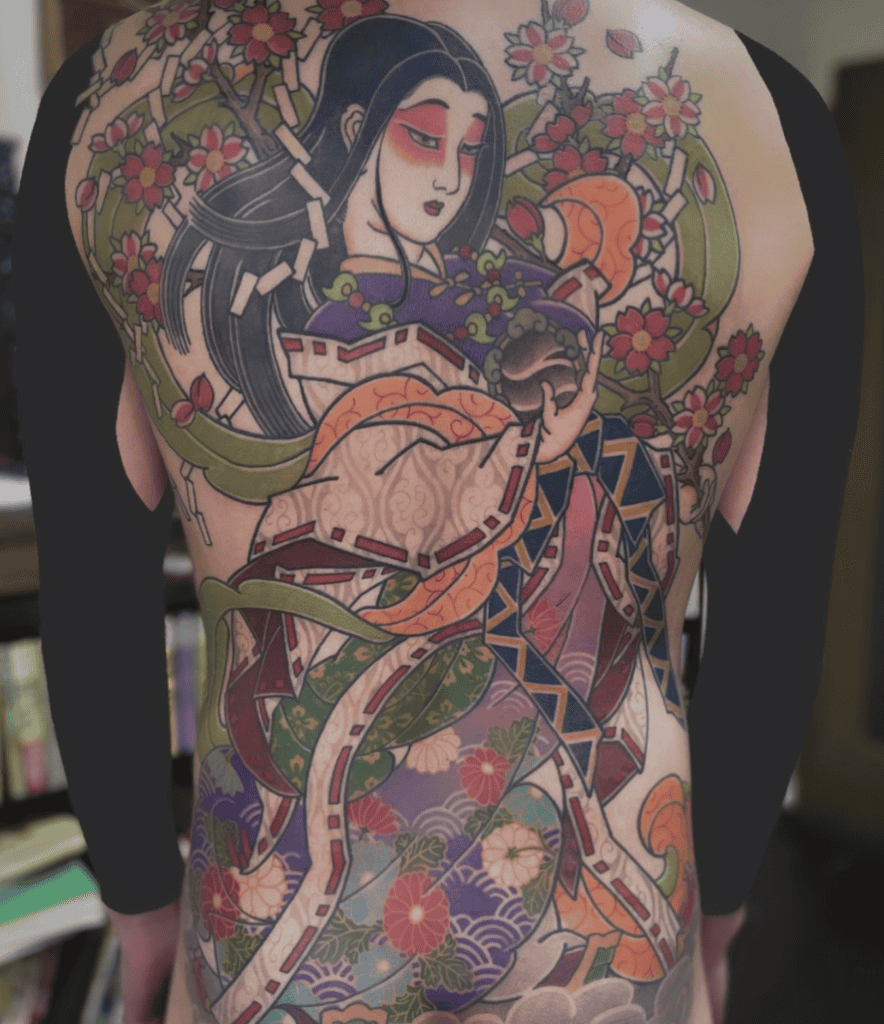
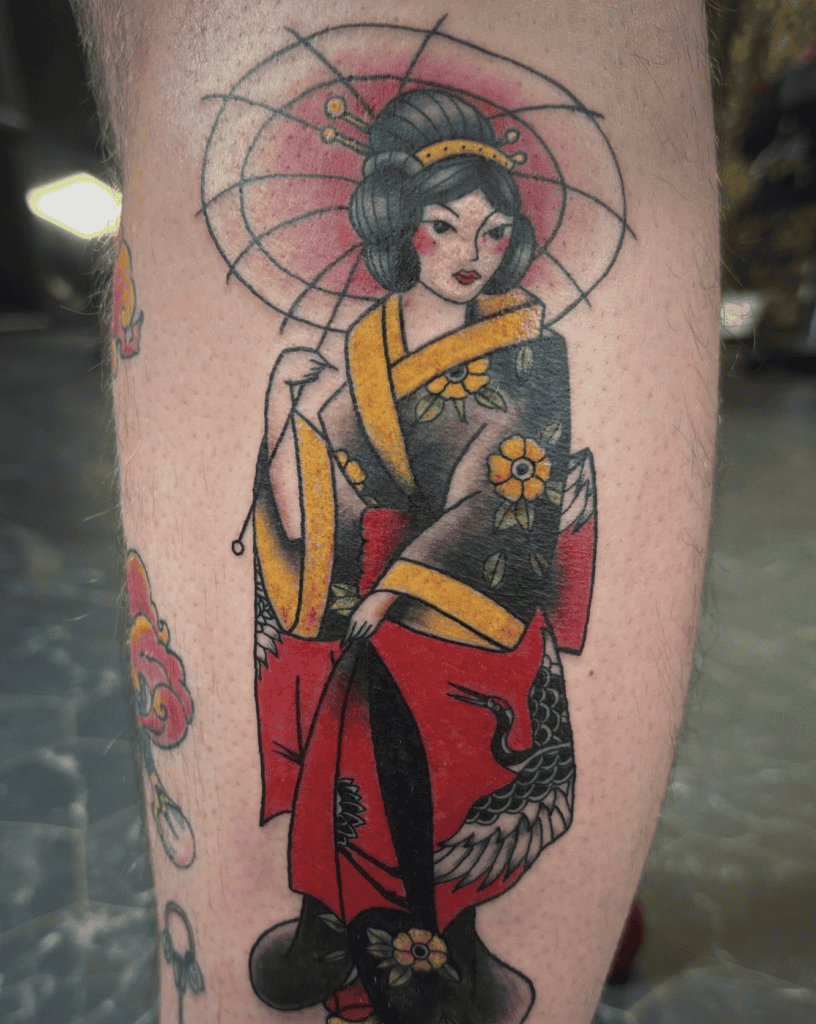
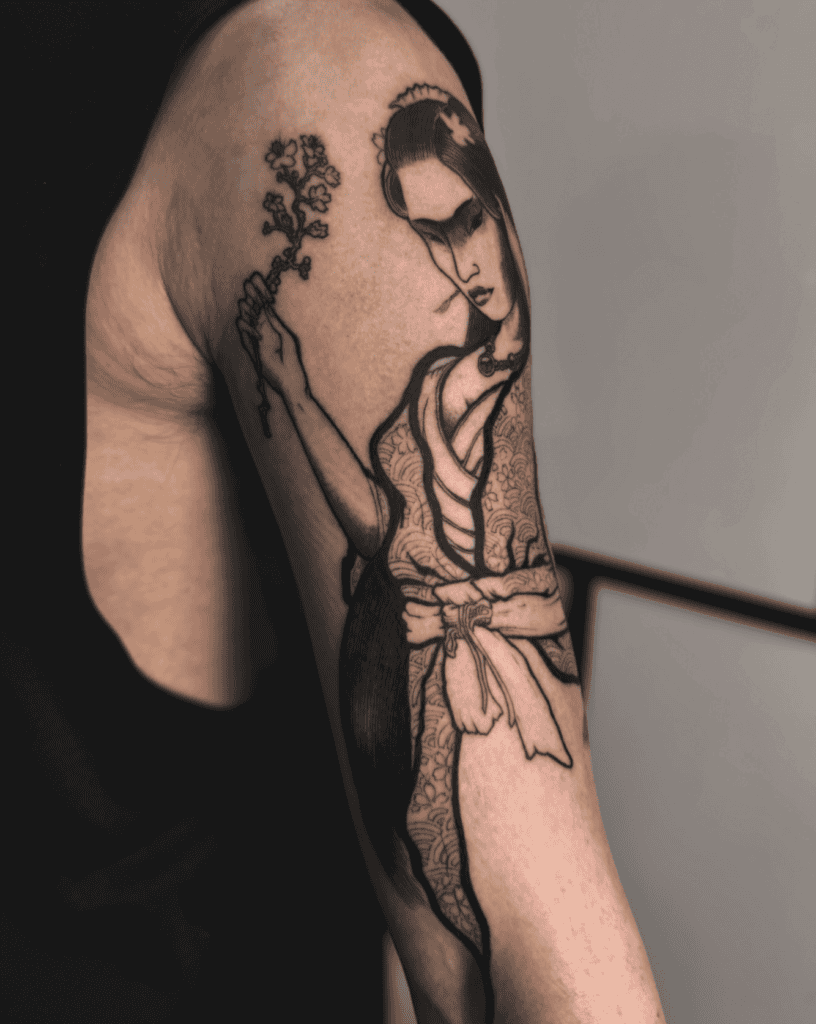
Konohanasakuya-hime (木花咲耶姫), often shortened to Sakuya-hime, is the Shinto goddess of cherry blossoms, beauty, life, and Mount Fuji. Her name is often translated as “Princess Who Makes the Trees Bloom”, making her one of the most graceful and beloved figures in Japanese mythology. She is closely associated with the fleeting beauty of cherry blossoms (sakura), which have become one of Japan’s most iconic symbols.
Konohanasakuya-hime is the daughter of Ōyamatsumi, the powerful god of mountains. She is often contrasted with her older sister, Iwanaga-hime, whose name means “Rock Princess.” While Iwanaga-hime represented permanence and endurance, Konohanasakuya-hime embodied beauty, growth, and the brief splendour of life.
One of the most famous stories involving Konohanasakuya-hime concerns her marriage to Ninigi-no-Mikoto, the grandson of Amaterasu. When Ninigi descended from Heaven to rule the earth, he fell in love with Konohanasakuya-hime and wished to marry her. Her father agreed and offered both daughters in marriage.
However, Ninigi accepted only Konohanasakuya-hime and rejected Iwanaga-hime. According to legend, Ōyamatsumi was disappointed by Ninigi’s decision, as he had intended for the two sisters to complement each other.
Iwanaga-hime would grant eternal endurance like stone, while Konohanasakuya-hime would grant beauty and flourishing like blossoms. Because Ninigi rejected Iwanaga-hime, humanity inherited the short lifespan of cherry blossoms rather than the permanence of stone.
Toyotama-hime Japanese Mythology Tattoo

Toyotama-hime (豊玉姫), meaning “Princess Abundant Jewels” or “Princess Luxuriant Pearls,” is a sea goddess and dragon princess in Japanese mythology. She is best known as the daughter of the mighty sea god Ryūjin and as the wife of the legendary hero Hoori.
Toyotama-hime lived in Ryūgū-jō surrounded by treasures, magical creatures, and divine wonders. As a dragon princess, Toyotama-hime was no ordinary mortal, but belonged to a powerful divine lineage connected to the ocean and its mysteries.
When Hoori accidentally loses a magical fishhook belonging to his brother, he travels beneath the sea and arrives at Ryūgū-jō. There, he meets Toyotama-hime, and the two quickly fall in love. They marry and spend several years together in the Dragon King’s palace.
Eventually, Hoori wishes to return to the surface world, so Ryūjin helps him recover the lost fishhook and sends the couple back with gifts, including the legendary Tide Jewels that control the sea.
After returning to the surface, Toyotama-hime became pregnant. When the time came to give birth, she made one important request that Hoori must not watch her during childbirth. Unfortunately, curiosity got the better of Hoori.
Ignoring her request, Hoori secretly watched and to his astonishment, he discovered that Toyotama-hime had transformed into a gigantic sea dragon. Ashamed that her husband had seen her true nature, she could no longer remain among humans and, heartbroken, she returned to the sea and her father’s kingdom.
Ōkuninushi Japanese Mythology Tattoo

Ōkuninushi (大国主神), often translated as “Great Land Master” or “Master of the Great Country,” is one of the most important deities in Japanese mythology. He is associated with nation-building, agriculture, medicine, magic, relationships, and prosperity and plays a central role in many of Japan’s oldest myths. Unlike many gods known primarily for warfare or natural forces, Ōkuninushi is often remembered as a wise ruler, healer, and builder of civilisation.
One fascinating thing about Ōkuninushi is that he has many titles and names throughout Japanese mythology, including Ōnamuchi-no-Kami, Ashihara no Shikoo, and Yachihoko-no-Kami. These different names often reflect various aspects of his character and adventures.
One of Ōkuninushi’s most famous stories involves the White Rabbit of Inaba. According to the legend, a rabbit tricked a group of sharks into helping it cross the sea. After the sharks discovered the deception, they stripped away the rabbit’s fur. When the rabbit sought help, Ōkuninushi’s many brothers mocked it and gave harmful advice.
Ōkuninushi, however, showed compassion and instructed the rabbit to wash in fresh water and rest among healing plants. The rabbit recovered and rewarded Ōkuninushi by predicting that he would win the hand of a beautiful princess.
Ebisu Japanese Mythology Tattoo
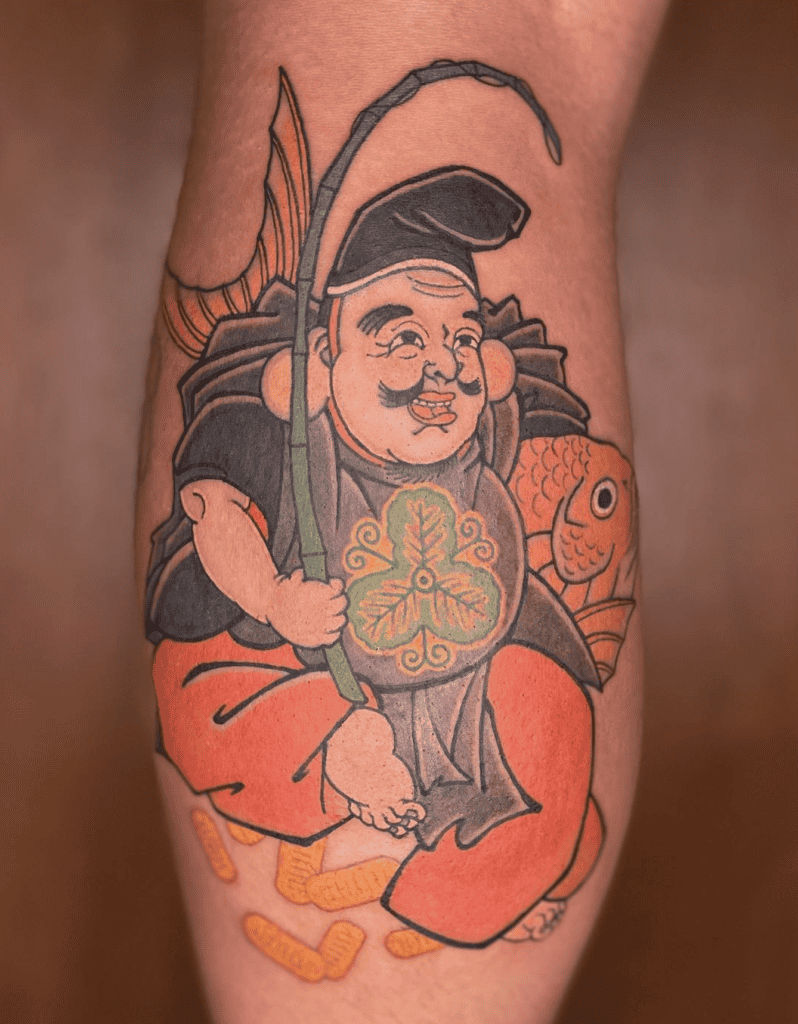
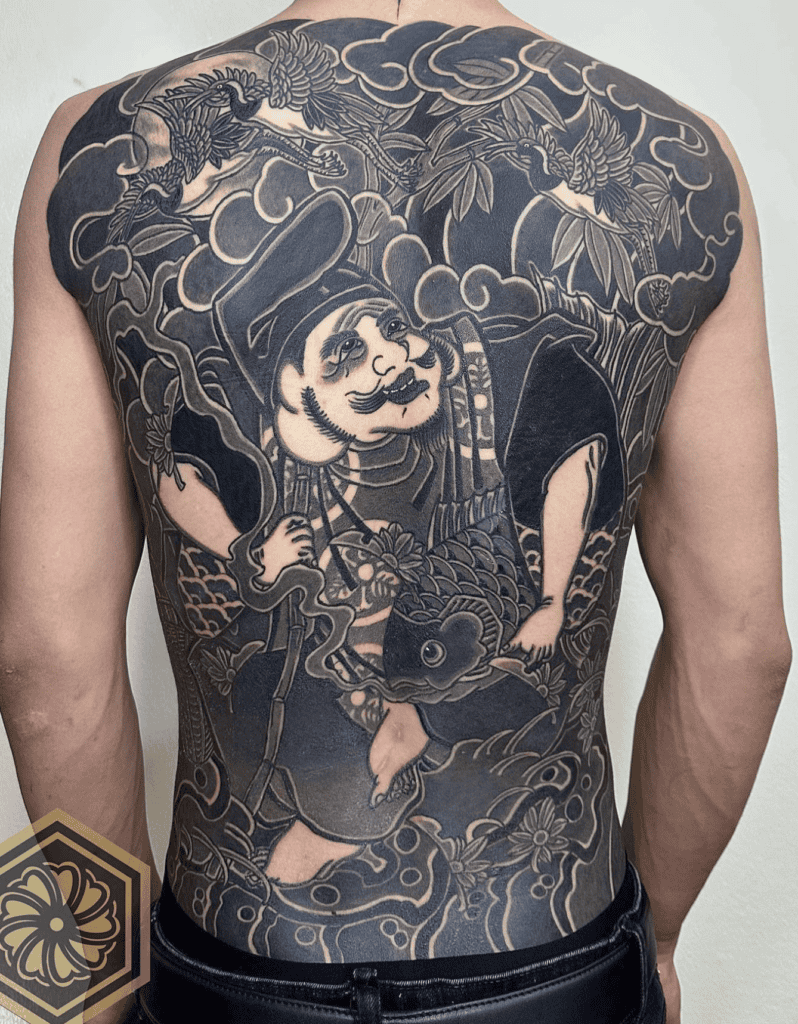
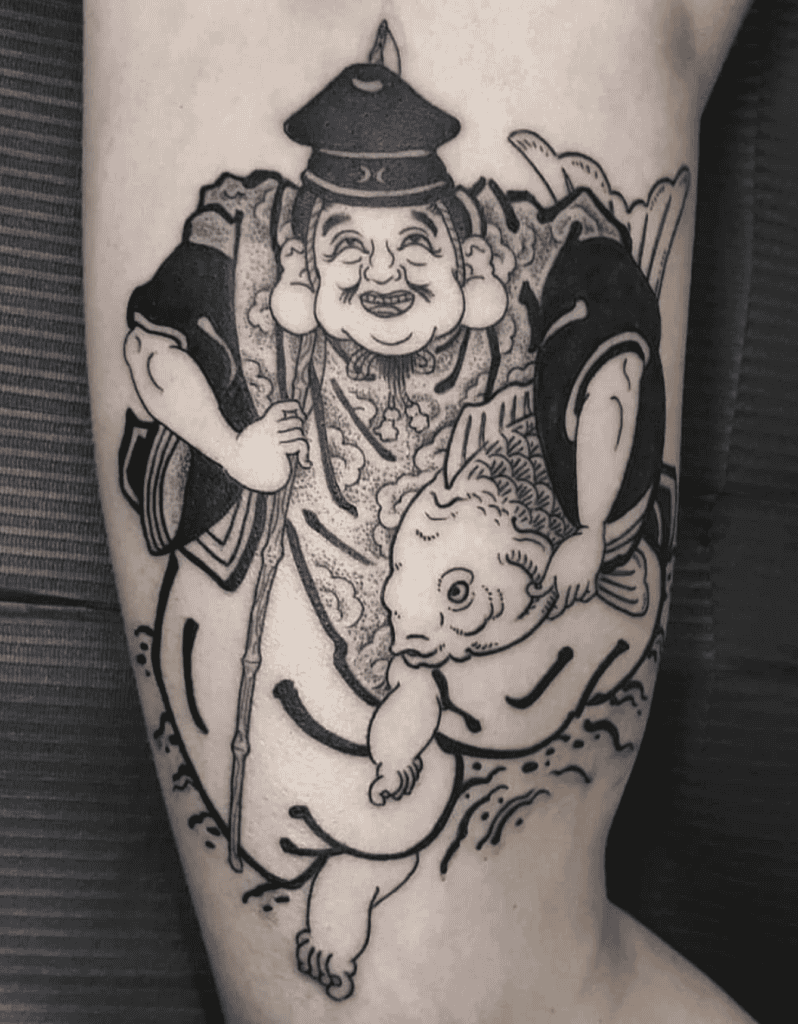
Ebisu (恵比寿) is one of Japan’s most cheerful and beloved deities. He is the god of prosperity, fishermen, merchants, good fortune, and honest labour, and is one of the famous Seven Lucky Gods (Shichifukujin).
Unlike many gods associated with epic battles or cosmic events, Ebisu is known for bringing success in everyday life. His smiling face and friendly personality have made him one of the most approachable deities in Japanese folklore.
Ebisu’s origins vary depending on the tradition. In one famous myth, he is identified with Hiruko, the first child born to the creator deities Izanagi and Izanami. Because their marriage ritual was performed incorrectly, Hiruko was born weak and was set adrift at sea in a reed boat.
Rather than perishing, later traditions say he survived and eventually became Ebisu, a benevolent god of fortune and prosperity. This transformation from an abandoned child into a lucky deity is one of the most uplifting stories in Japanese mythology.
Daikokuten Japanese Mythology Tattoo
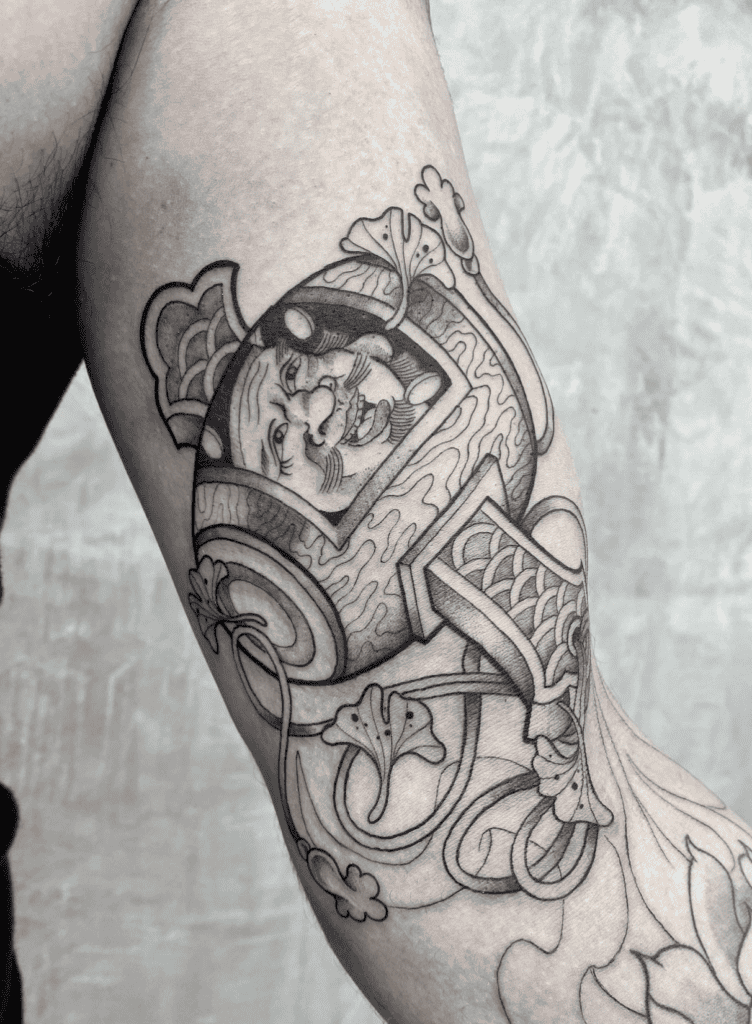
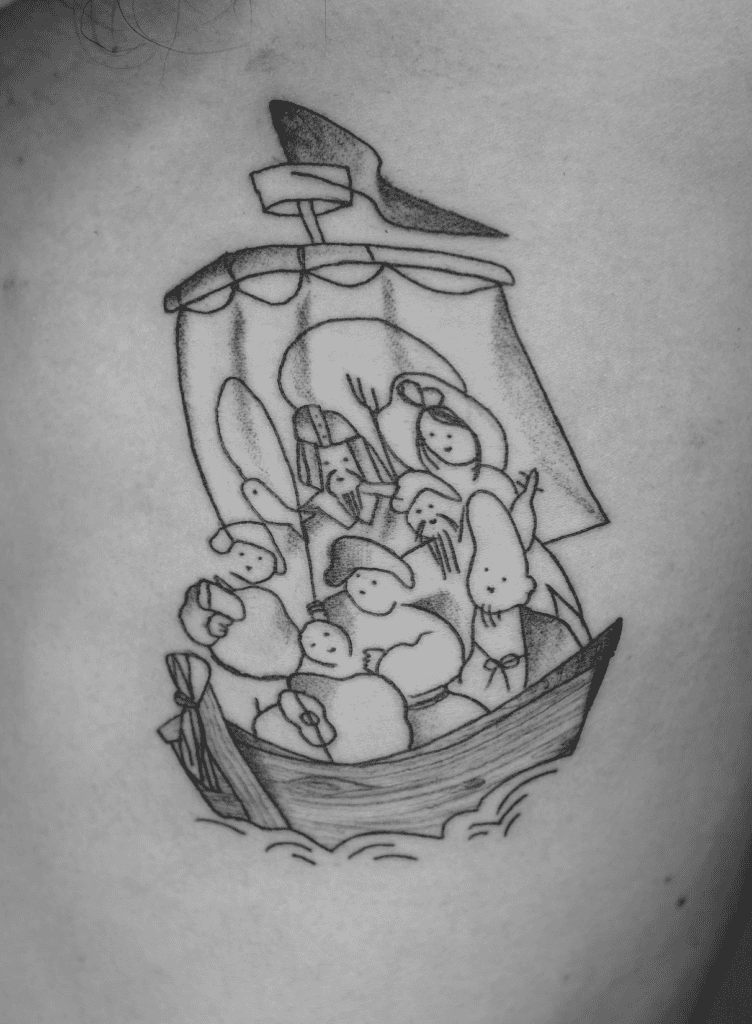
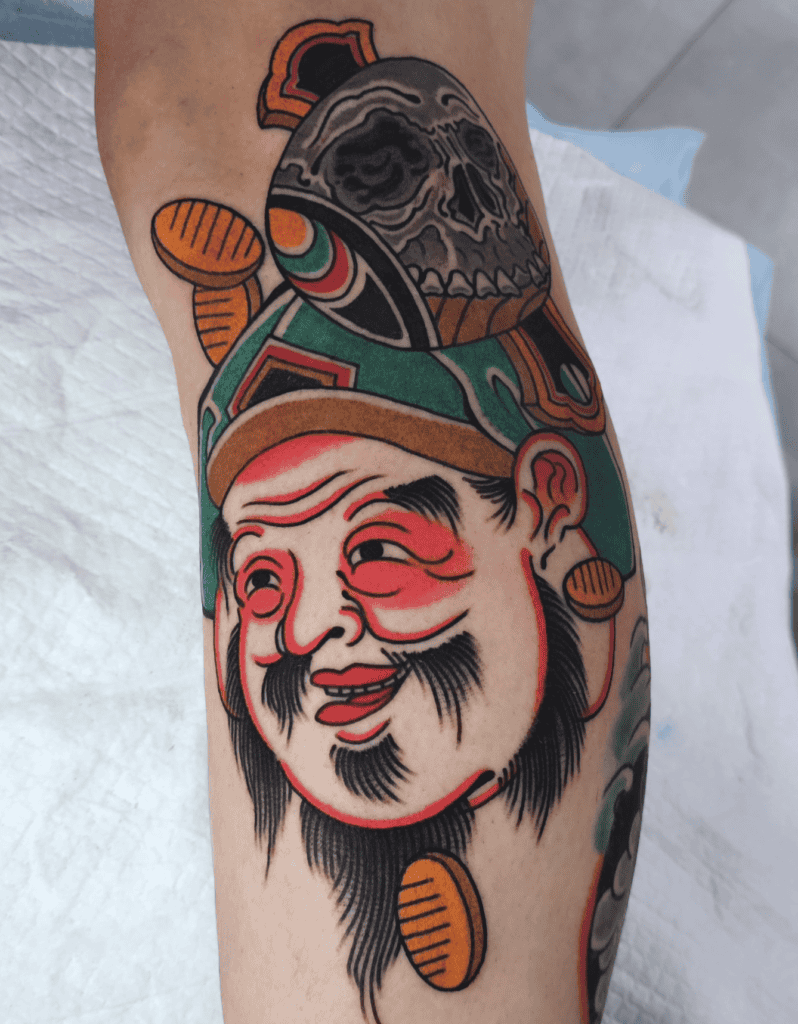
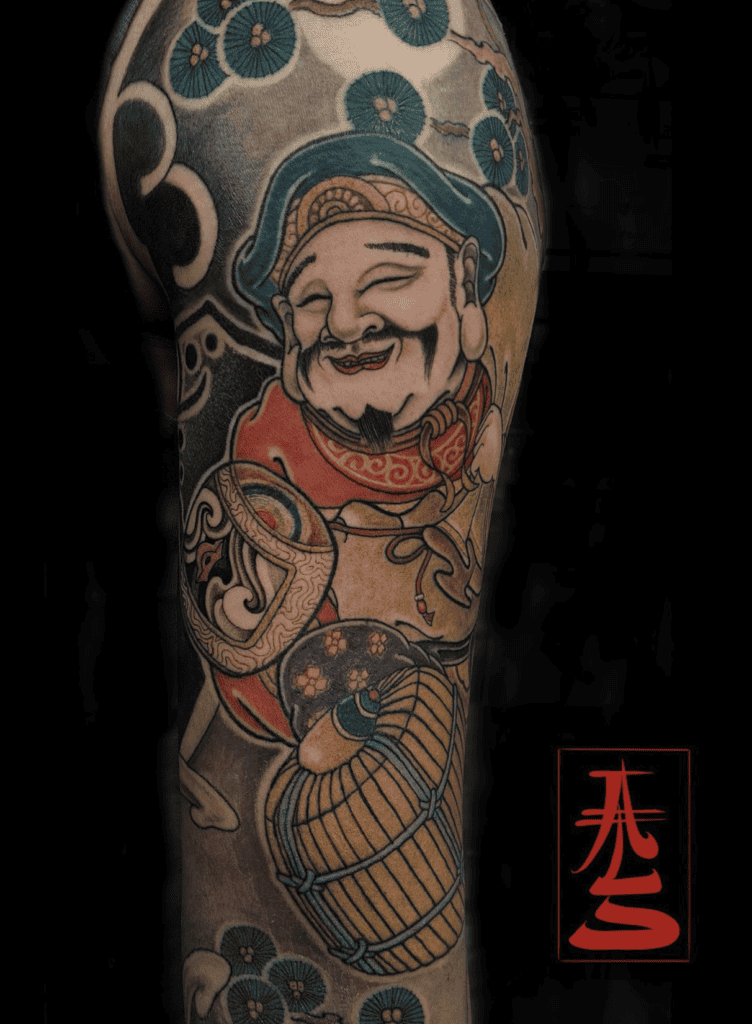
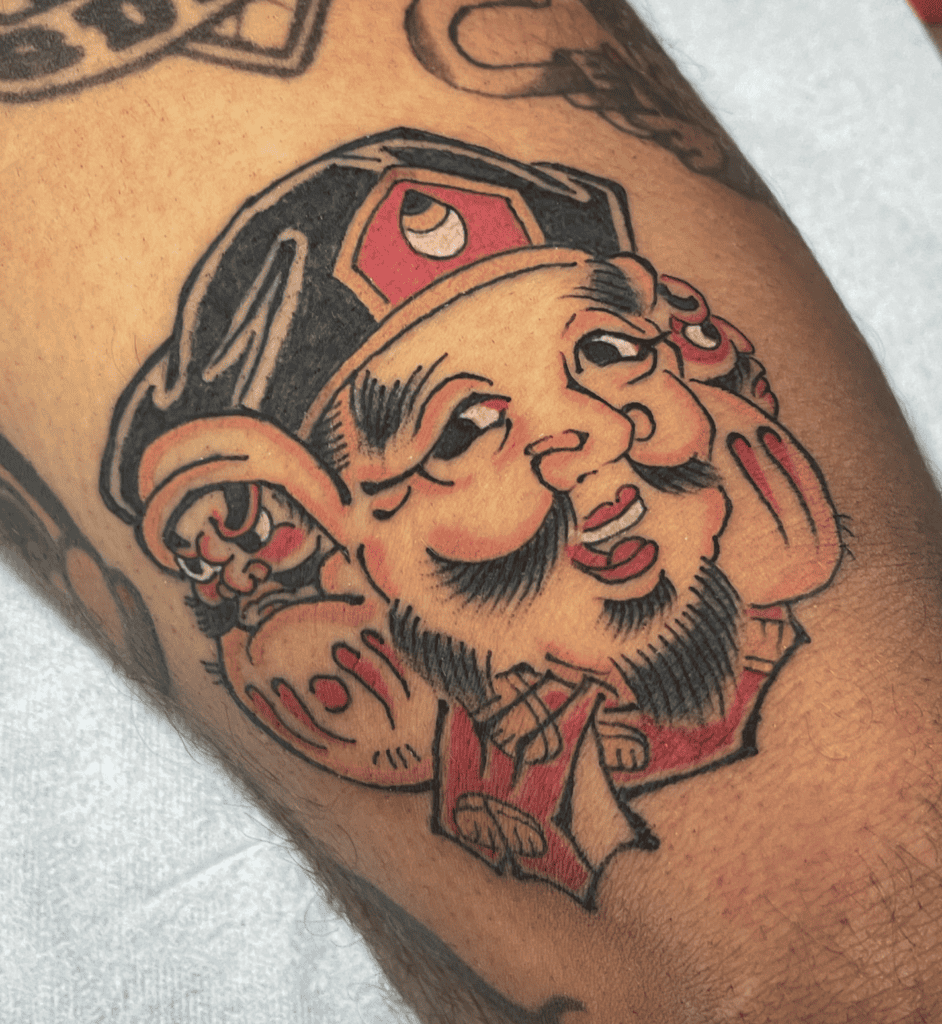
Daikokuten (大黒天) is one of Japan’s most popular gods of wealth, prosperity, abundance, agriculture, and good fortune. He is also one of the famous Seven Lucky Gods, and is often portrayed as a cheerful, smiling figure standing atop rice bales while carrying a magical treasure mallet.
Today, Daikokuten is widely regarded as a bringer of prosperity and happiness, but his origins are surprisingly complex, combining elements from Indian, Buddhist, and Japanese traditions.
Daikokuten traces his roots back to the Hindu deity Mahākāla, whose name means “Great Black One.” When Buddhism spread to Japan, Mahākāla evolved into Daikokuten and gradually merged with aspects of Ōkuninushi, the Shinto god of agriculture, prosperity, and nation-building. Because of this blending, Daikokuten inherited associations with both divine protection and earthly abundance.
Benzaiten Japanese Mythology Tattoo
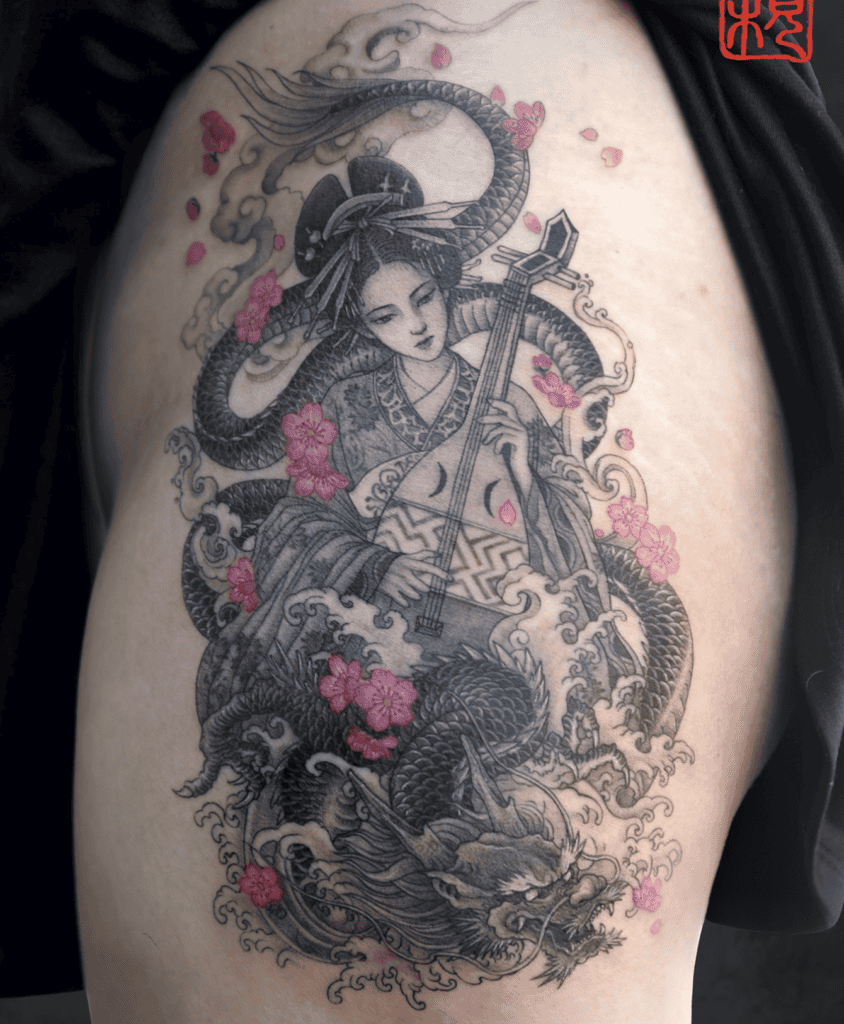
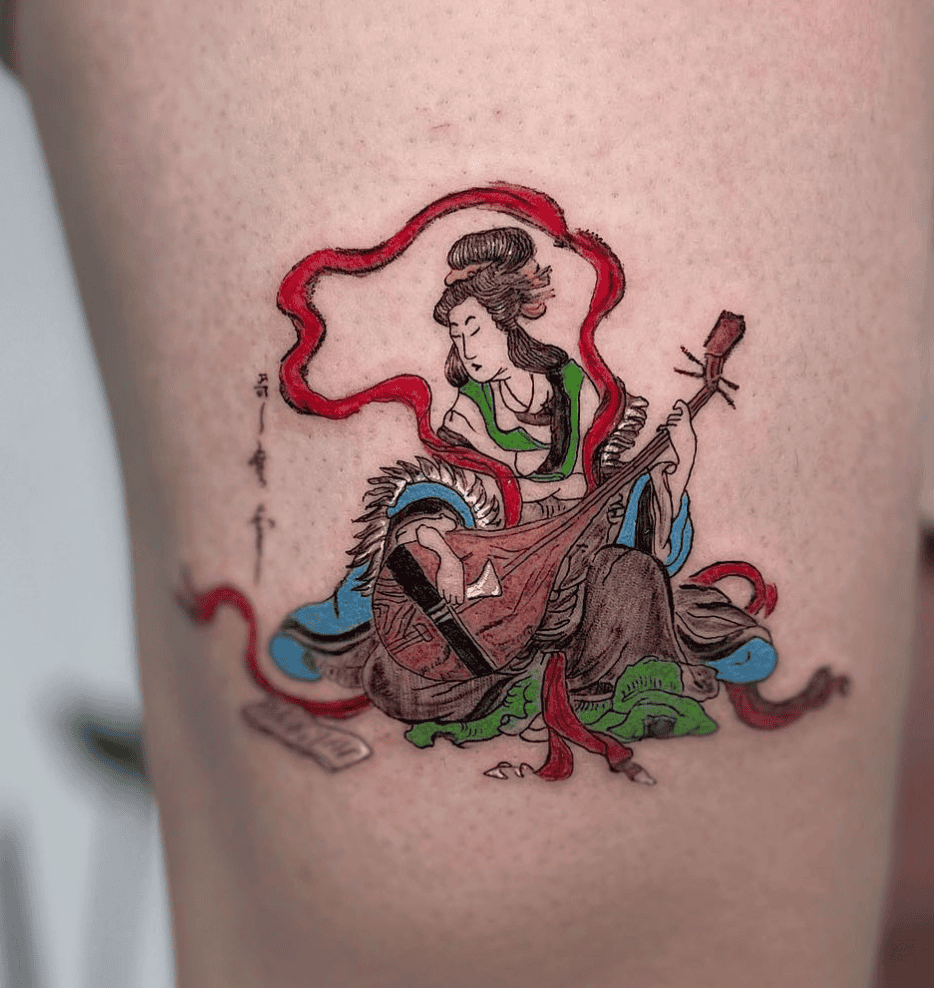
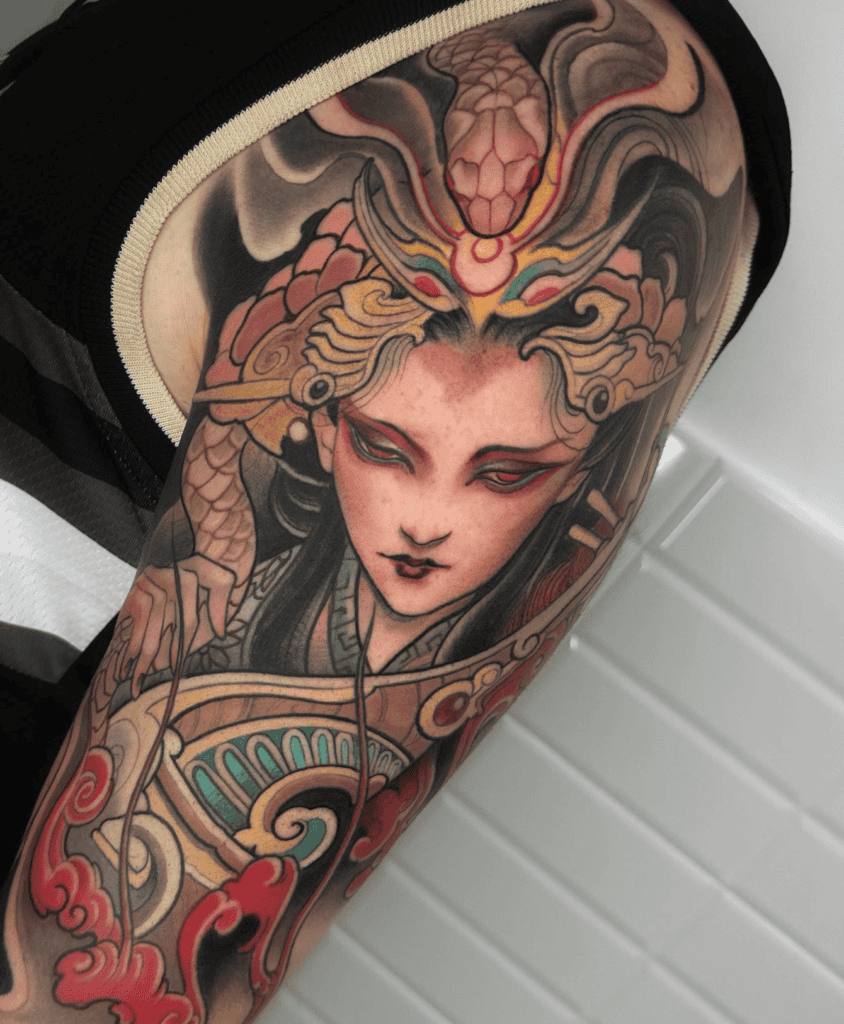
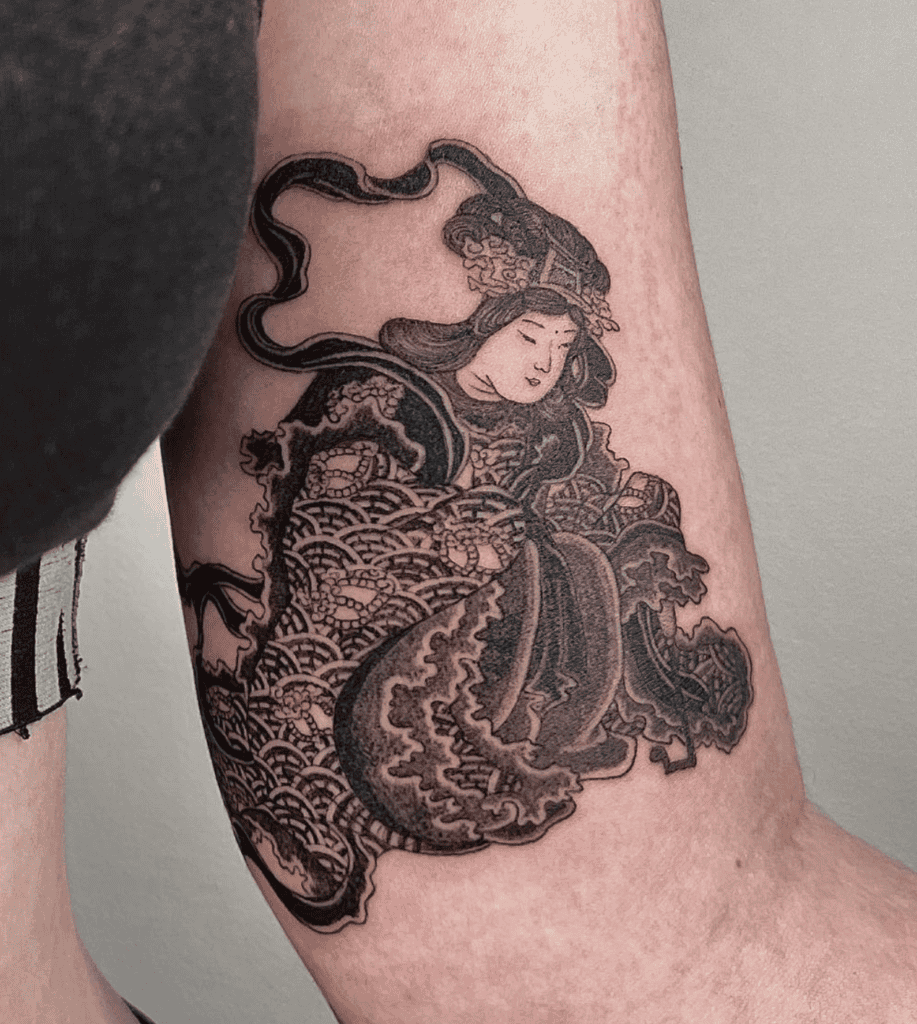
Benzaiten (弁才天), often shortened to Benten, is the Japanese goddess of music, eloquence, wisdom, knowledge, beauty, and good fortune. She is one of the famous Seven Lucky Gods and is unique among them because she is usually the only female member of the group.
Benzaiten originated from the Hindu goddess Saraswati. As Buddhism spread across Asia, Saraswati’s worship travelled to China and eventually Japan, where she became Benzaiten. Over time, Japanese traditions blended Buddhist, Shinto, and local folklore influences into her character, creating the goddess known today.
Benzaiten is most famously associated with music. She is often shown holding a Biwa (Japanese lute), which became her signature symbol representing artistic expression, creativity, and harmony. Musicians, performers, and artists have long prayed to Benzaiten for inspiration and skill.
Enma Japanese Mythology Tattoo


Enma (閻魔), often called Enma-Ō (“King Enma”), is the fearsome judge of the dead in Japanese Buddhism and folklore. He is the ruler who determines the fate of souls after death, deciding whether they are rewarded, punished, or sent to be reborn. Enma is not an evil figure, but serves as an impartial judge whose duty is to ensure that justice is carried out in the afterlife.
Enma originated from the Hindu deity Yama. As Buddhism spread across Asia, Yama became integrated into Buddhist traditions and eventually evolved into Enma in Japan. Over time, Japanese folklore added its own interpretations, making Enma one of the most recognisable figures of the underworld.
When a person dies, their soul is said to appear before Enma’s court. There, Enma reviews the deeds they performed during life. He considers good actions, bad actions, honesty, kindness, and harm done to others. Based on this judgment, he determines the soul’s next destination.
Oni Japanese Mythology Tattoo
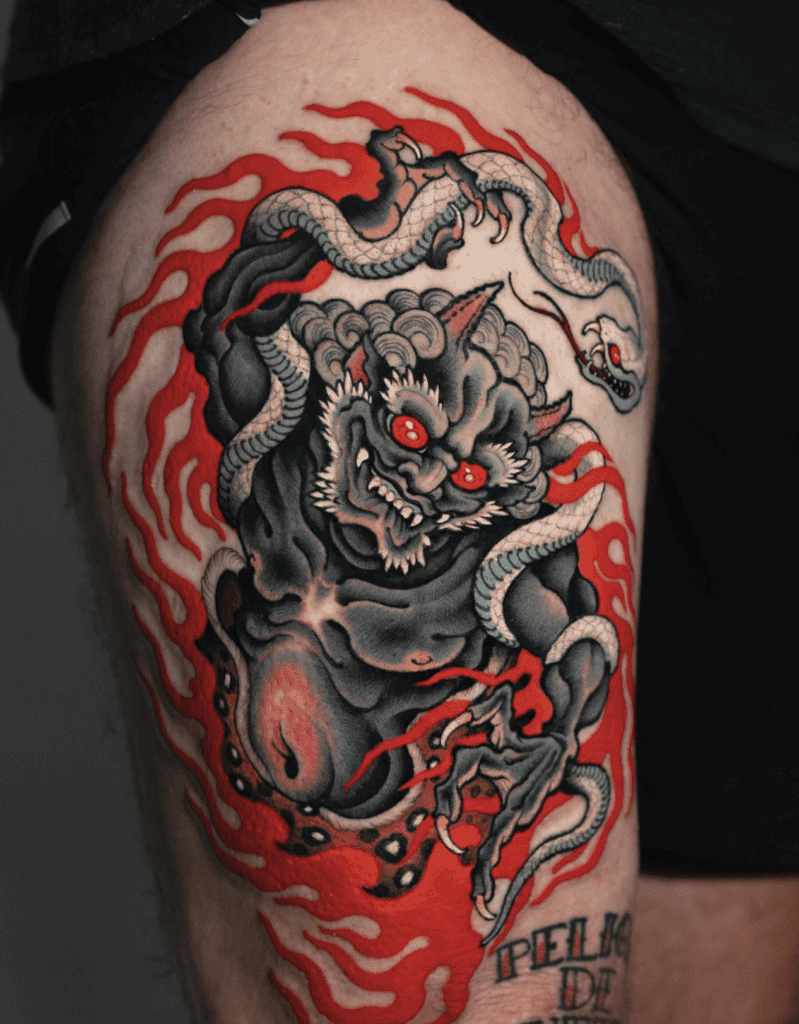
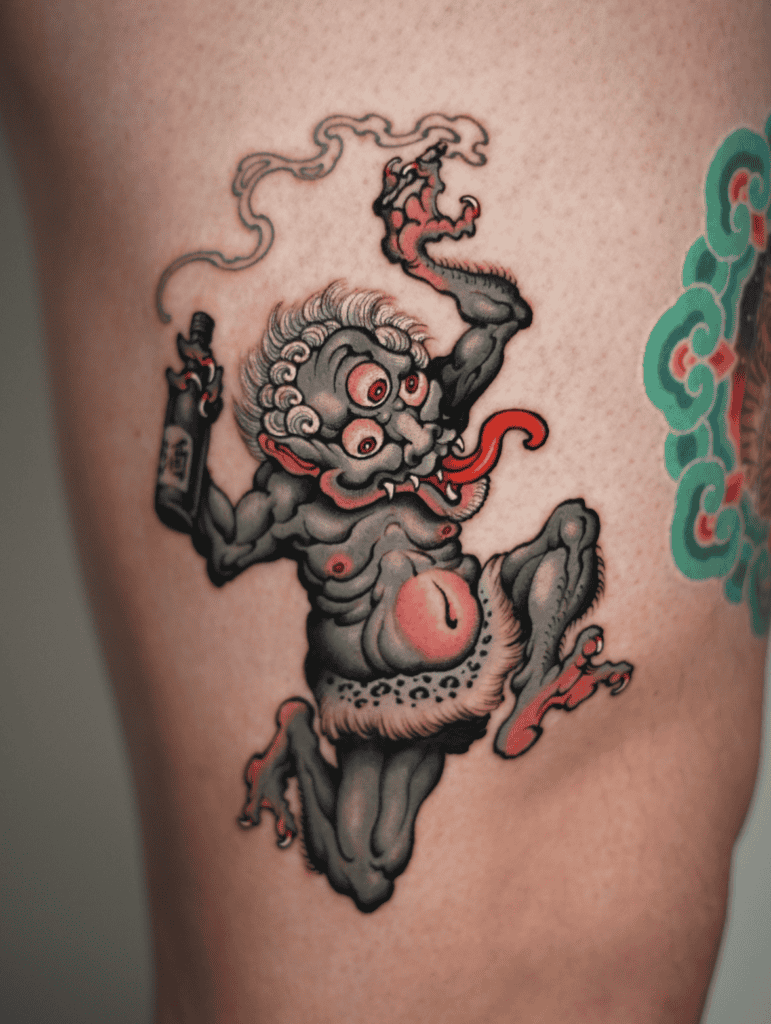
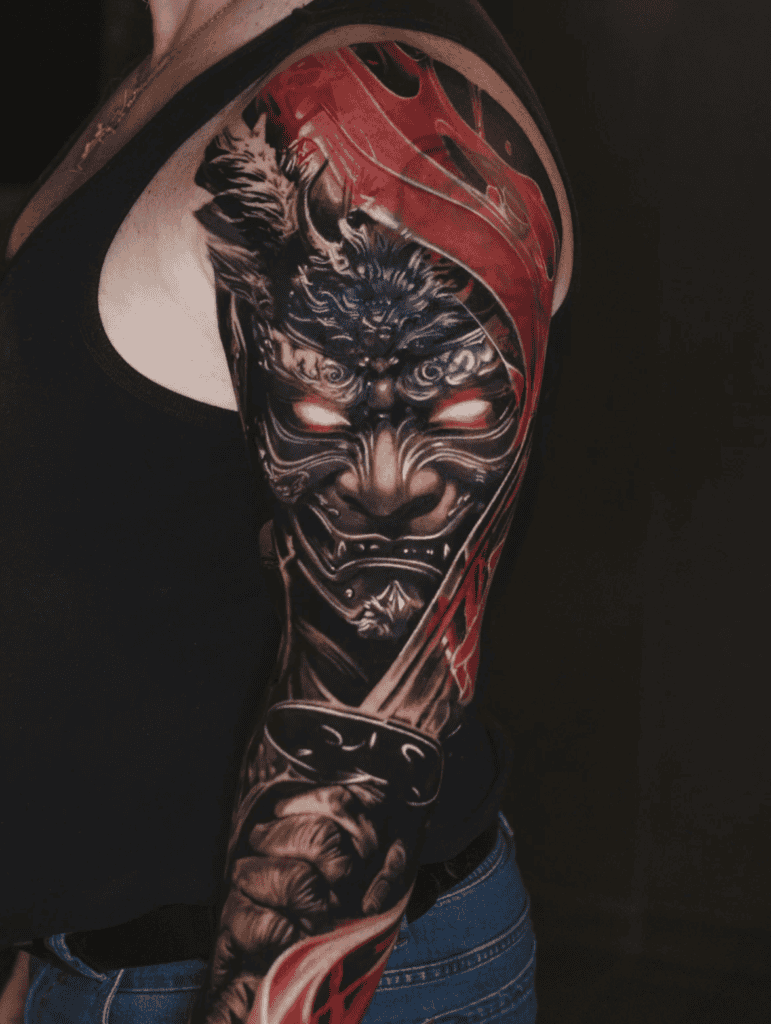
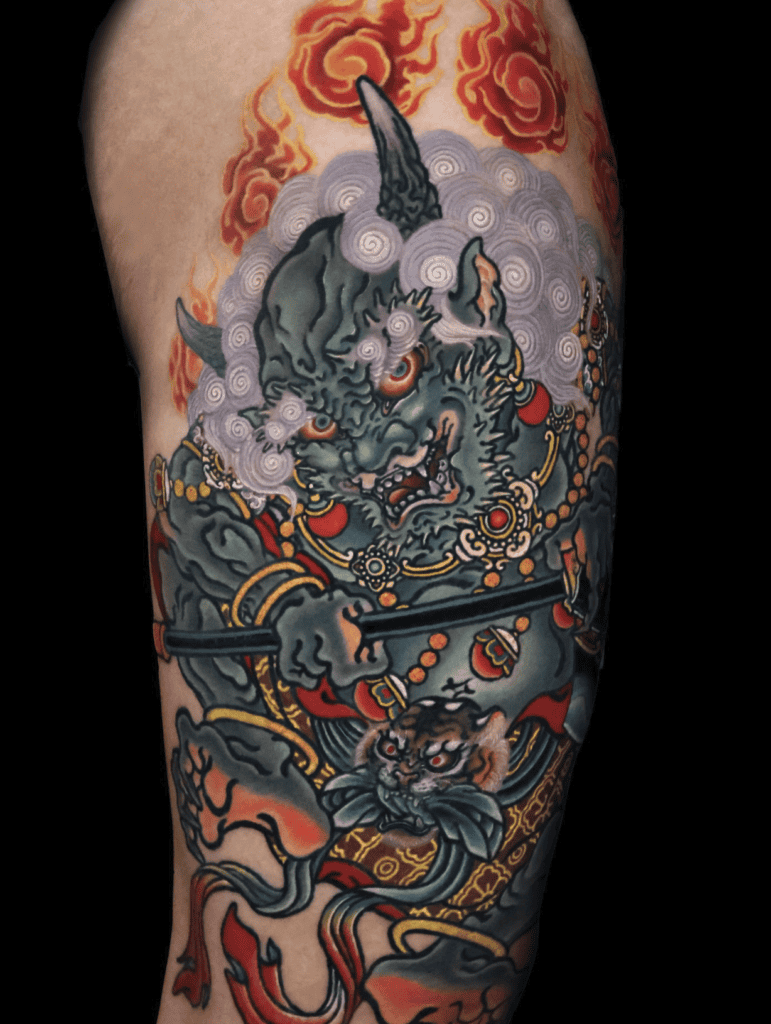
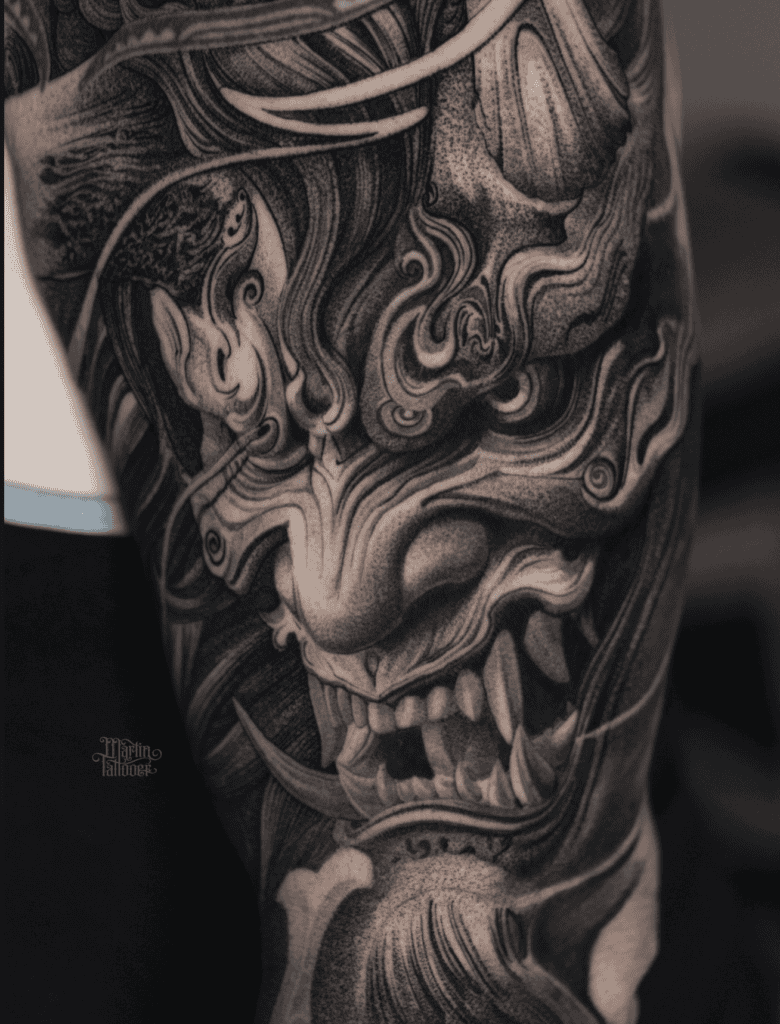
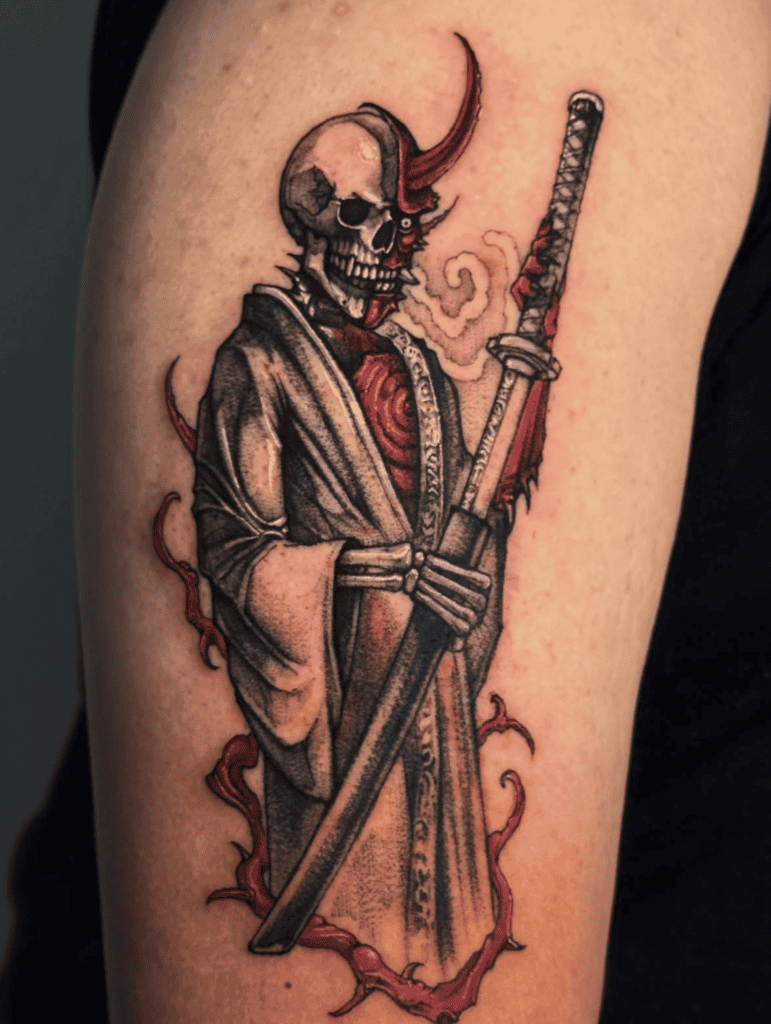
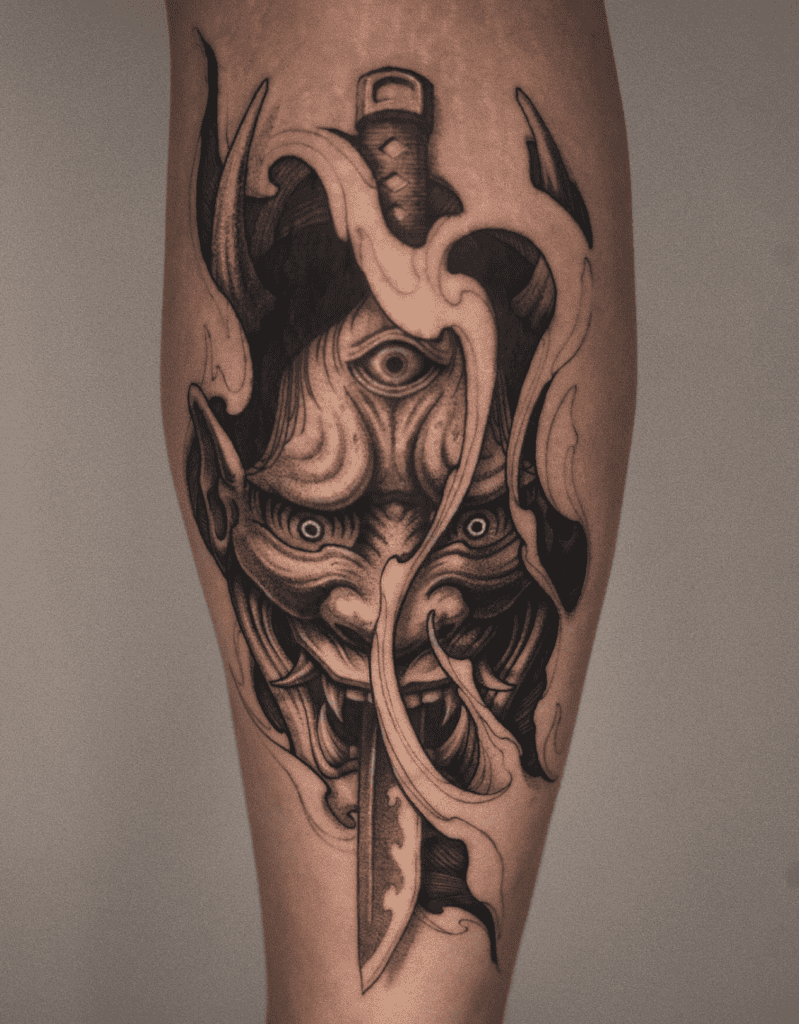
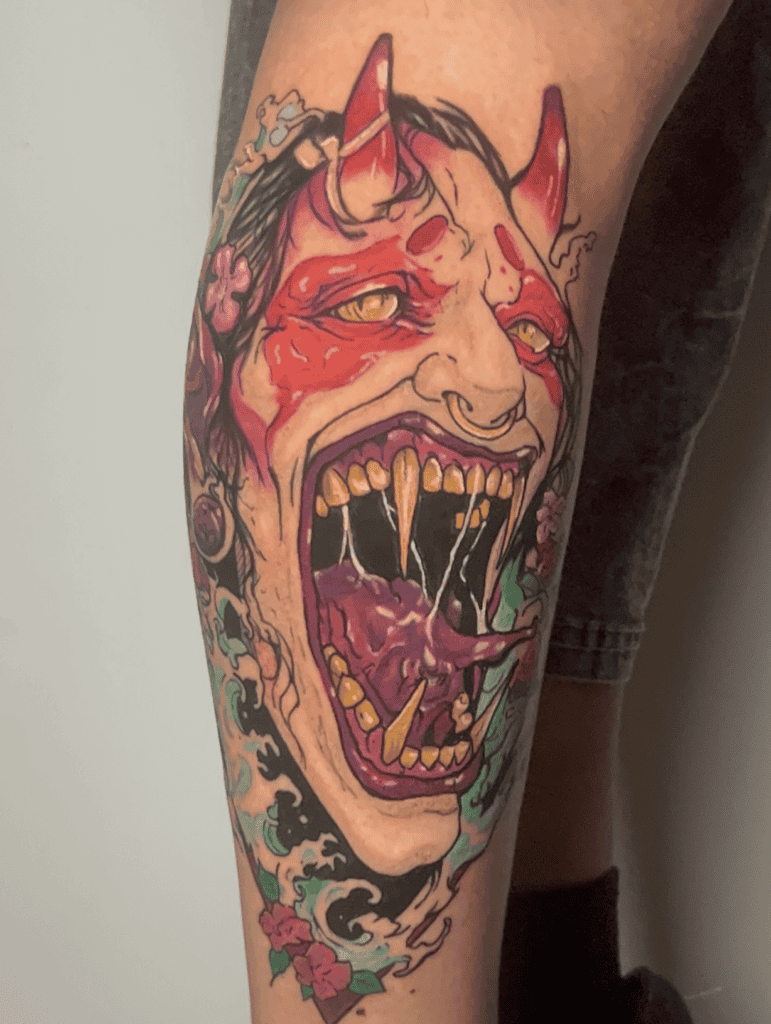
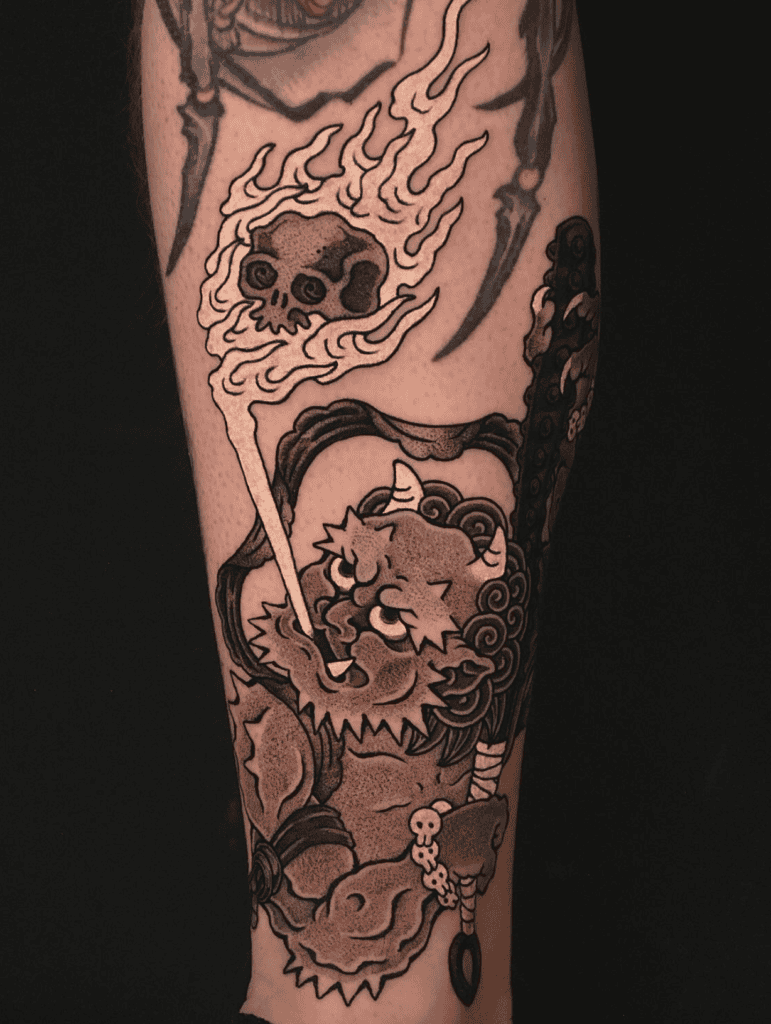
The Oni (鬼) are among the most famous creatures in Japanese mythology and folklore. They are often described as giant ogres, demons, or monsters with incredible strength, fearsome appearances, and supernatural powers.
Oni are supernatural beings that traditionally dwell in mountains, caves, the remote wilderness, the underworld, and hell-like realms. In folklore, they often serve as punishers of evil deeds, tormentors of the wicked, or dangerous monsters that heroes must overcome.
However, not all Oni are purely evil. Some stories portray them as protectors, guardians, or even reformed beings. A famous Japanese saying is “Oni with an iron club,” referring to giving even more power to someone who is already incredibly strong.
In Buddhist-influenced folklore, Oni are often servants of Enma. In these stories, Oni punish wrongdoers and carry out the sentences imposed upon the wicked. Because of this role, they are often viewed as terrifying but necessary agents of cosmic justice.
Sōjōbō Japanese Mythology Tattoo

Sōjōbō (僧正坊) is the legendary King of the Tengu, one of the most powerful and respected supernatural beings in Japanese folklore. He is said to rule the Tengu of Mount Kurama, a sacred mountain north of Kyoto long associated with mysticism, martial arts, and spiritual training.
Wise, powerful, and awe-inspiring, Sōjōbō is often portrayed as a master swordsman, teacher, and guardian of mountain secrets. Among all Tengu, Sōjōbō is frequently considered the greatest, and unlike many yōkai that are simply monsters, Sōjōbō is usually portrayed as intelligent, disciplined, and deeply wise.
Tengu Japanese Mythology Tattoo
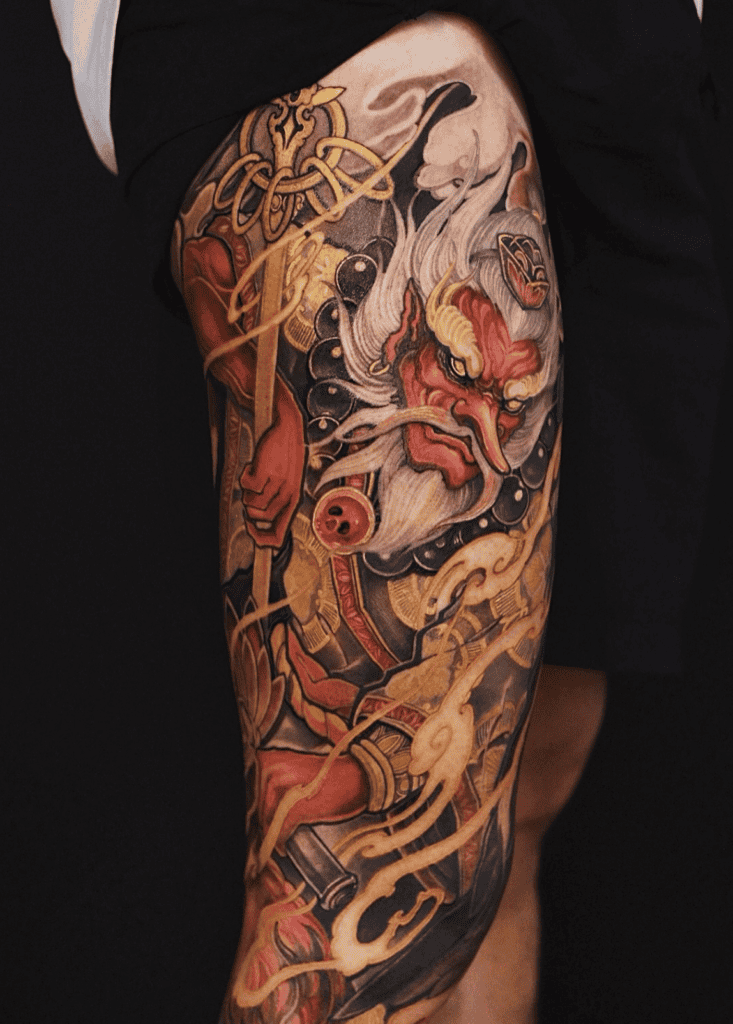
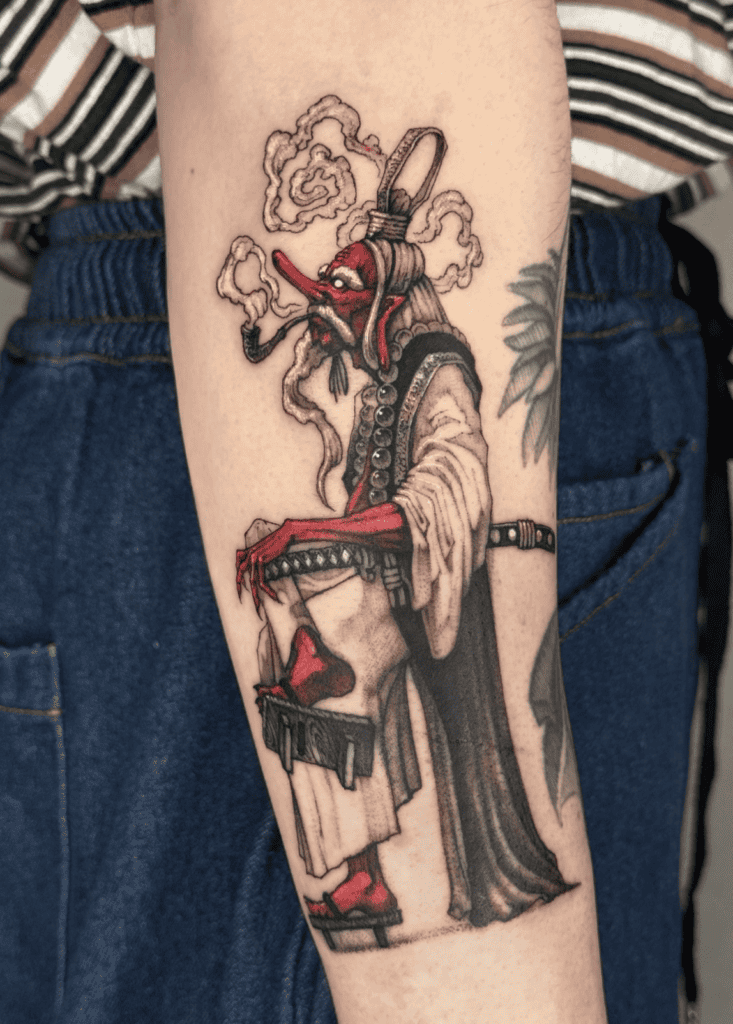
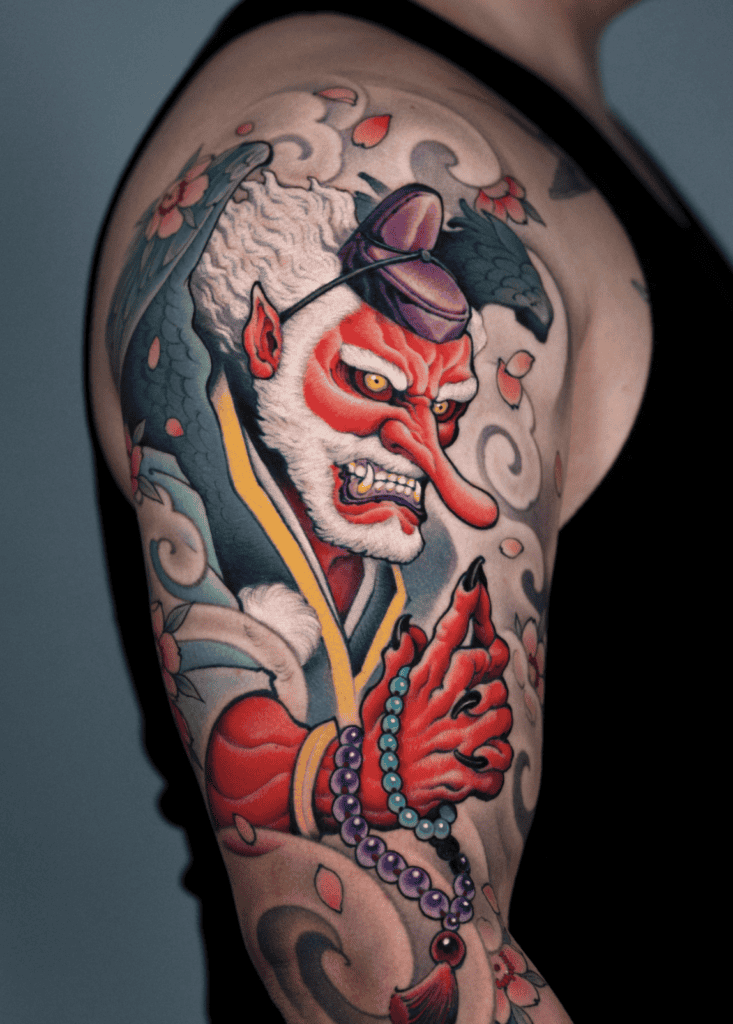
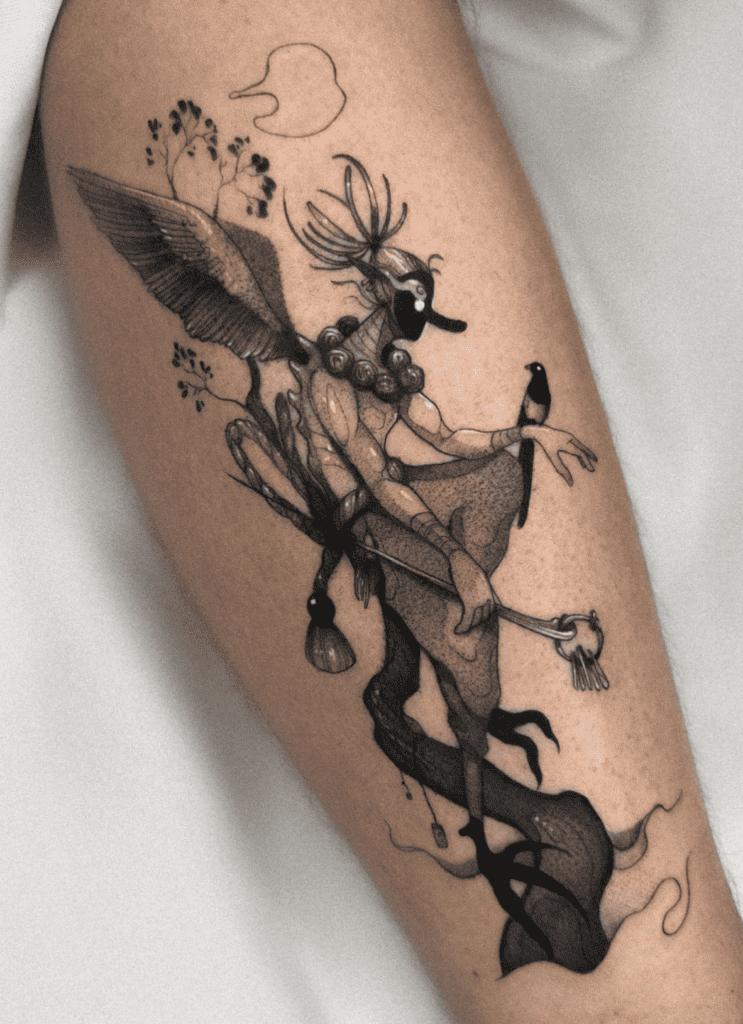
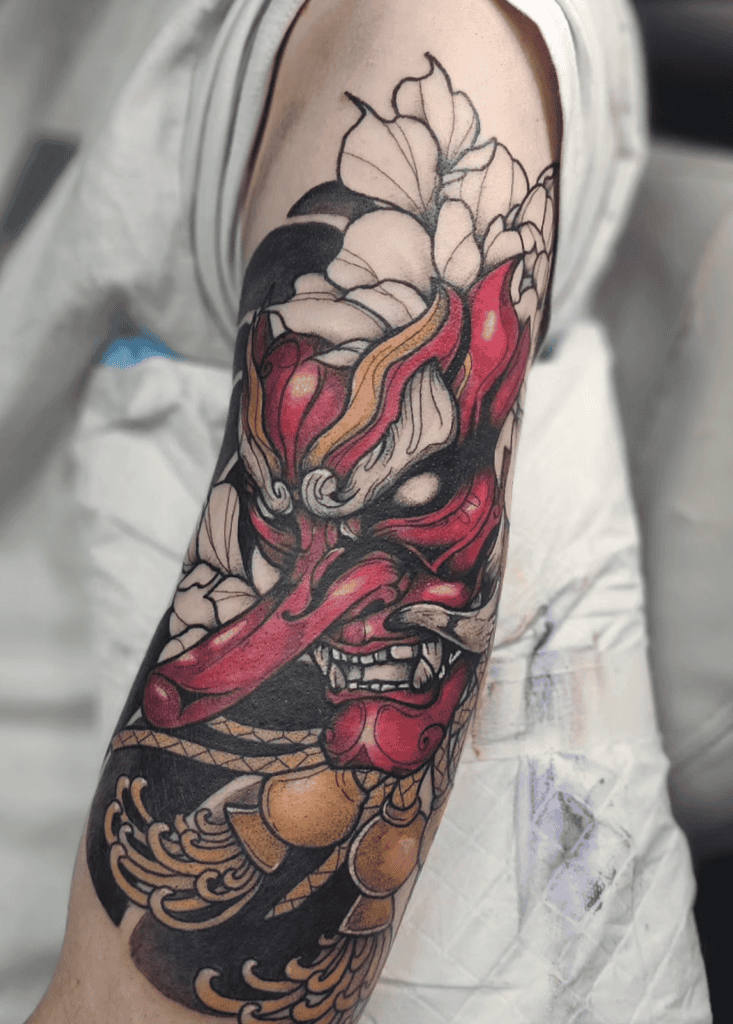
The Tengu (天狗), whose name means “Heavenly Dog,” are some of the most famous and fascinating creatures in Japanese mythology and folklore. Despite their name, they are not dog-like at all, but supernatural mountain spirits often depicted as bird-like beings, master swordsmen, tricksters, and guardians of sacred places. Over the centuries, the Tengu evolved from feared demons into respected, and sometimes even protective, supernatural beings.
Tengu are powerful yōkai that traditionally dwell in mountains, deep forests, remote temples, and sacred wilderness areas. They are often associated with ascetic mountain monks known as yamabushi, which is why many depictions show them wearing yamabushi clothing.
The Daitengu are the iconic long-nosed Tengu most people recognise today. This long nose became a symbol of pride, wisdom, and supernatural power. Tengu are legendary swordsmen with many myths claiming they taught martial arts and swordsmanship to famous heroes.
One of the most famous legends involves Minamoto no Yoshitsune, who was said to have learned extraordinary sword skills from the Tengu of Mount Kurama. Whether taken literally or symbolically, the story helped cement the Tengu’s reputation as masters of combat.
Karasu Tengu Japanese Mythology Tattoo
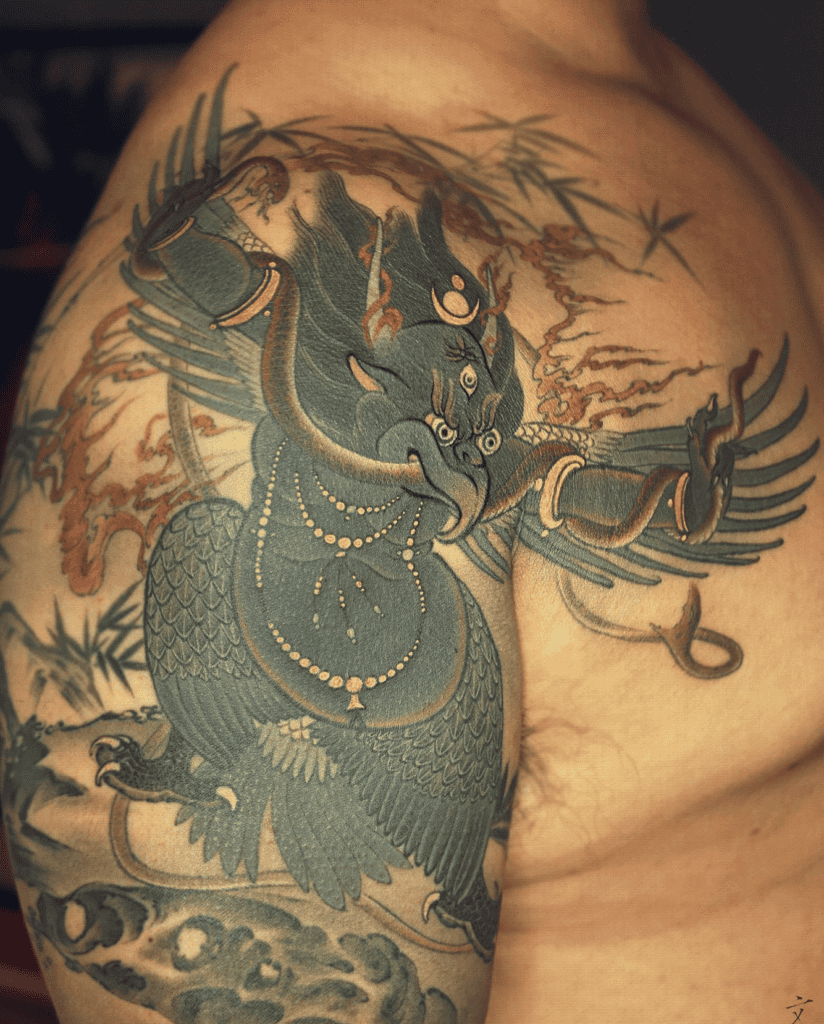
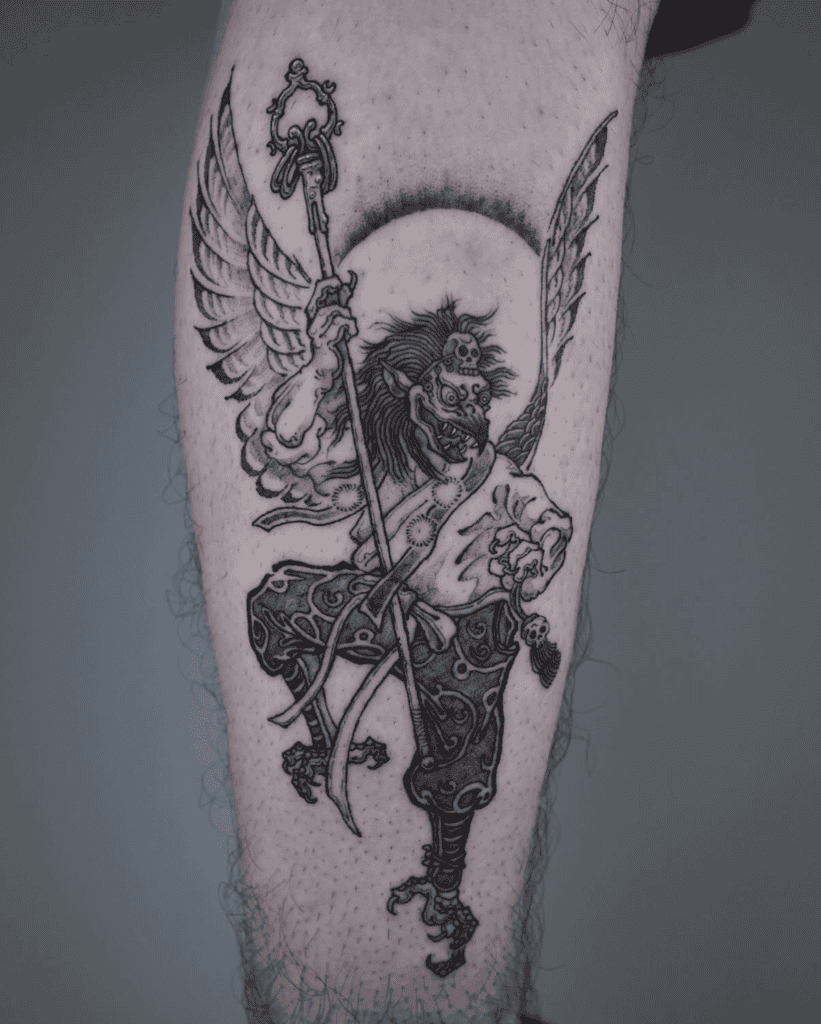
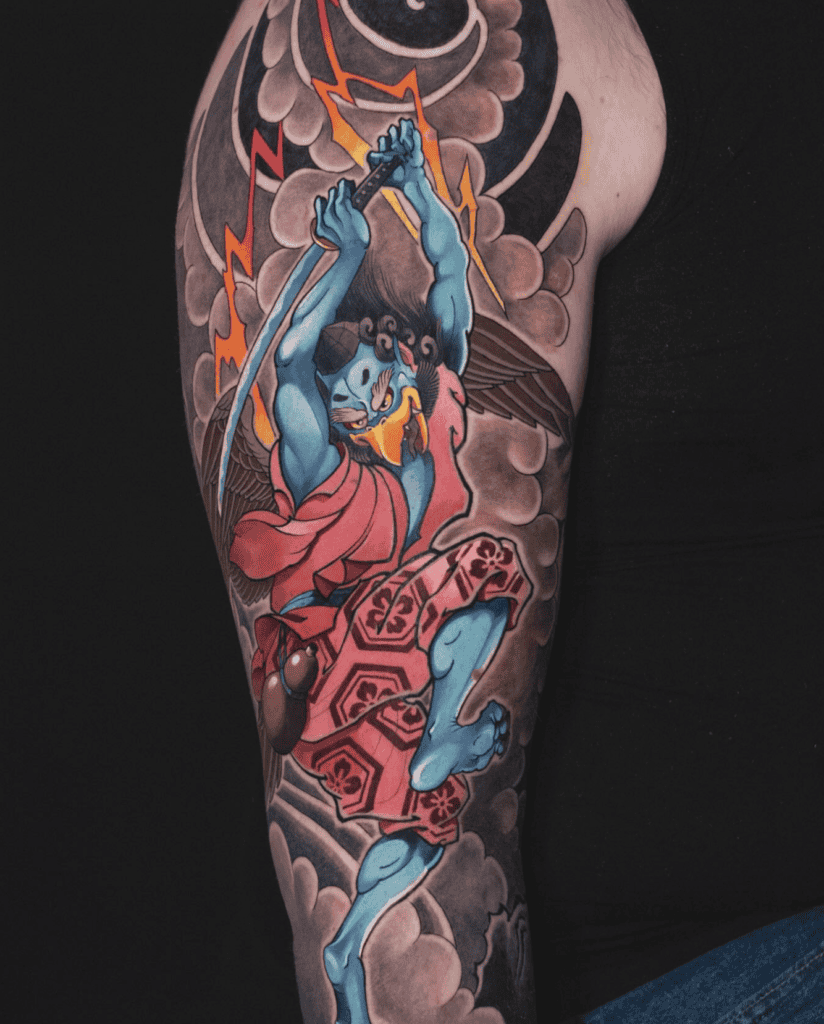
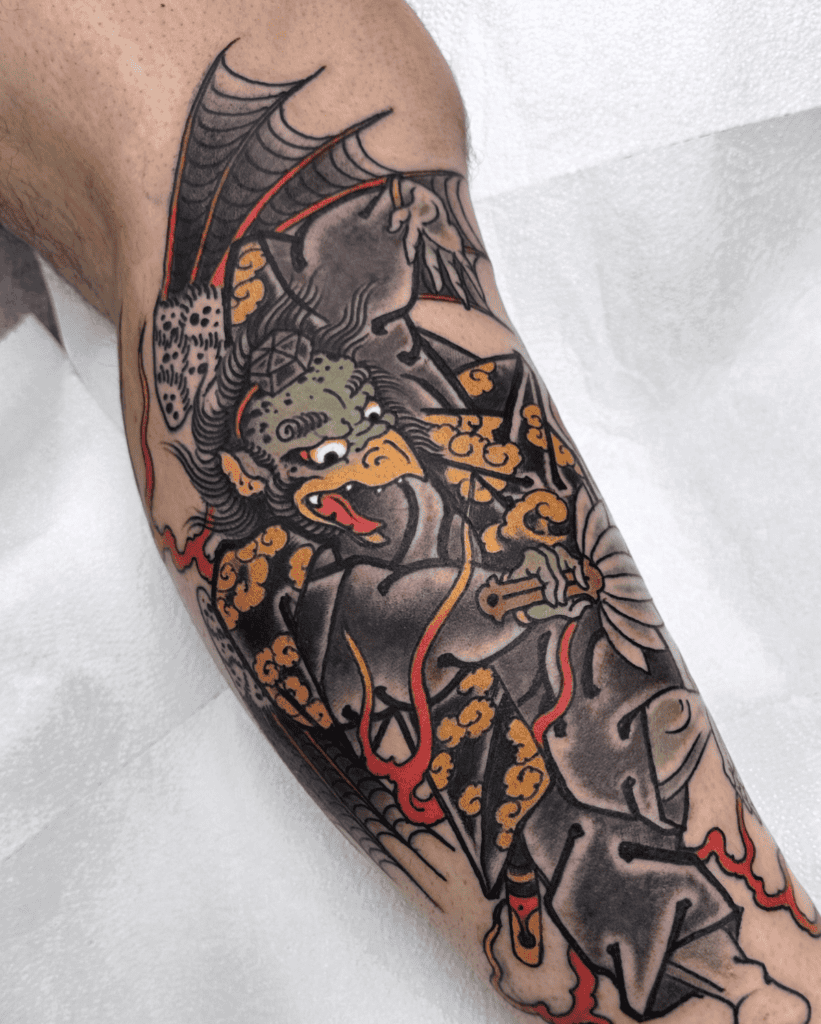
The Karasu Tengu (烏天狗), meaning “Crow Tengu”, are one of the most famous types of Tengu in Japanese folklore. Unlike the long-nosed red-faced Tengu, Karasu Tengu are much more bird-like, often possessing beaks, wings, feathers, and talons. They are powerful mountain spirits known for their martial skill, supernatural abilities, and role as servants, warriors, or messengers of the greater Tengu lords.
Some depictions show these creatures as almost entirely bird-like, while others combine human and avian features. Because they are closer to the earliest forms of Tengu, many scholars believe Karasu Tengu preserve aspects of the original Tengu legends.
The earliest Tengu were often portrayed as bird-like supernatural beings. Over time, Japanese folklore gradually developed the famous Daitengu with their red faces and long noses. Karasu Tengu retained much of the older avian appearance and are sometimes viewed as the “classic” form of Tengu.
Kappa Japanese Mythology Tattoo
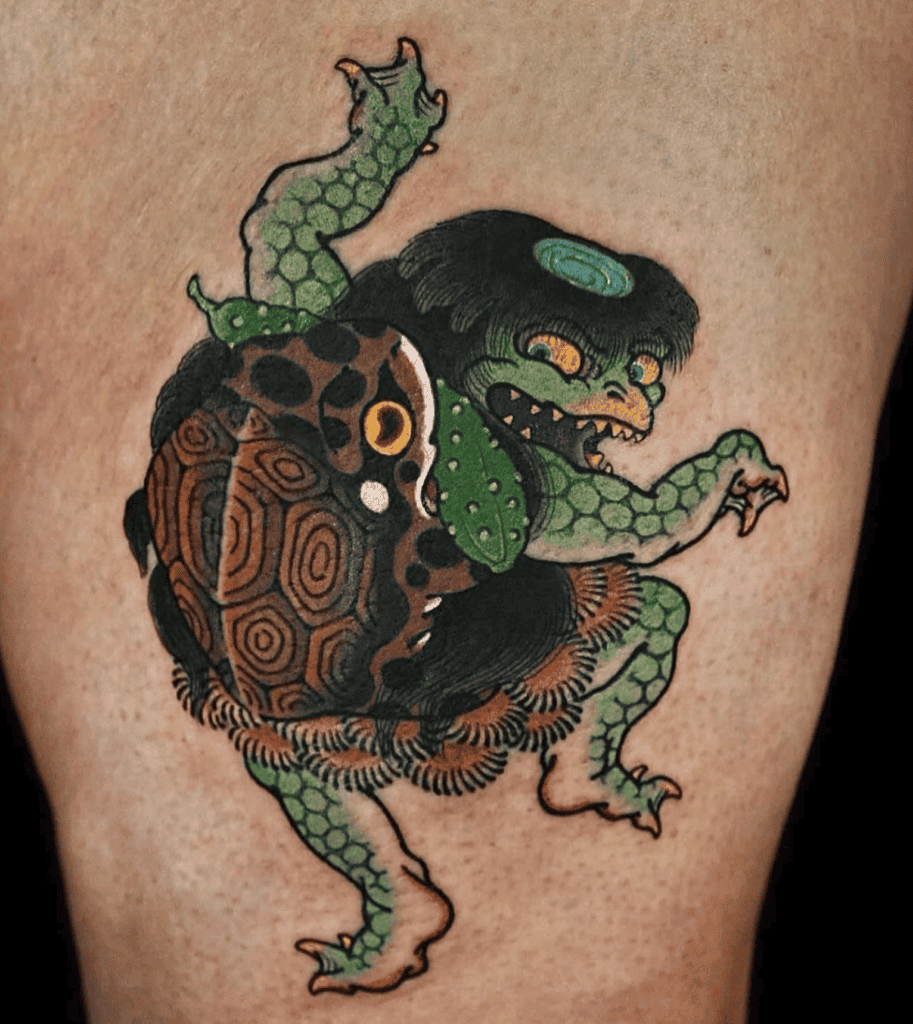
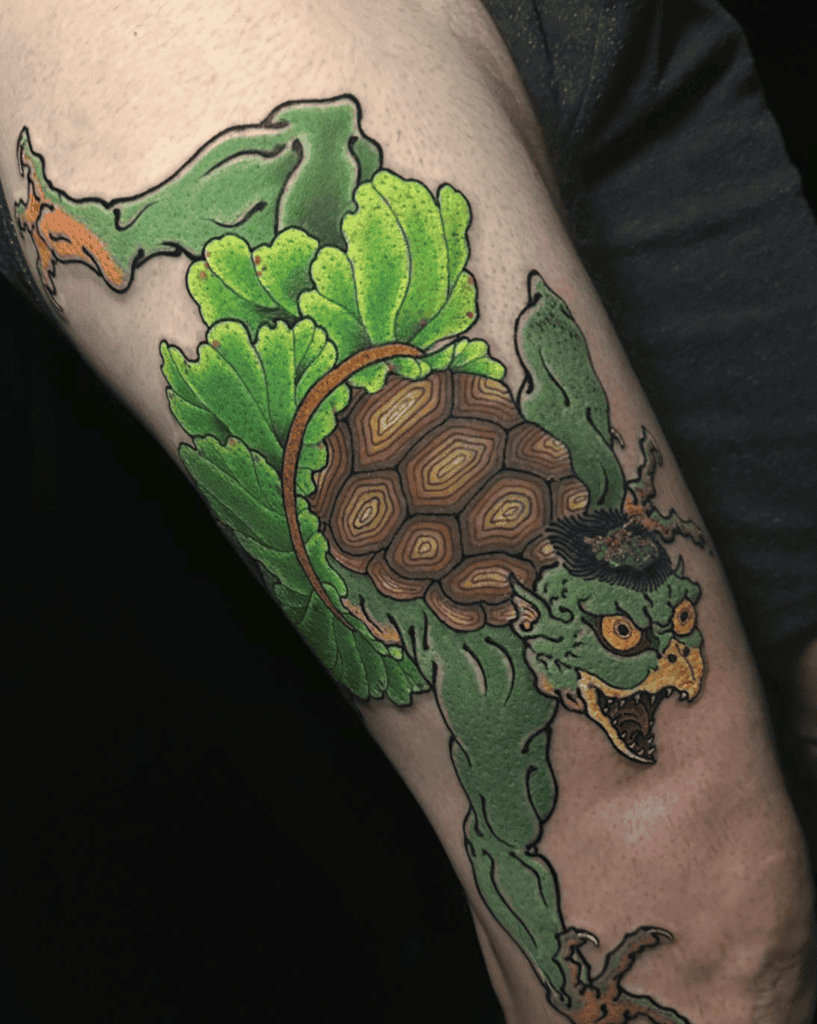
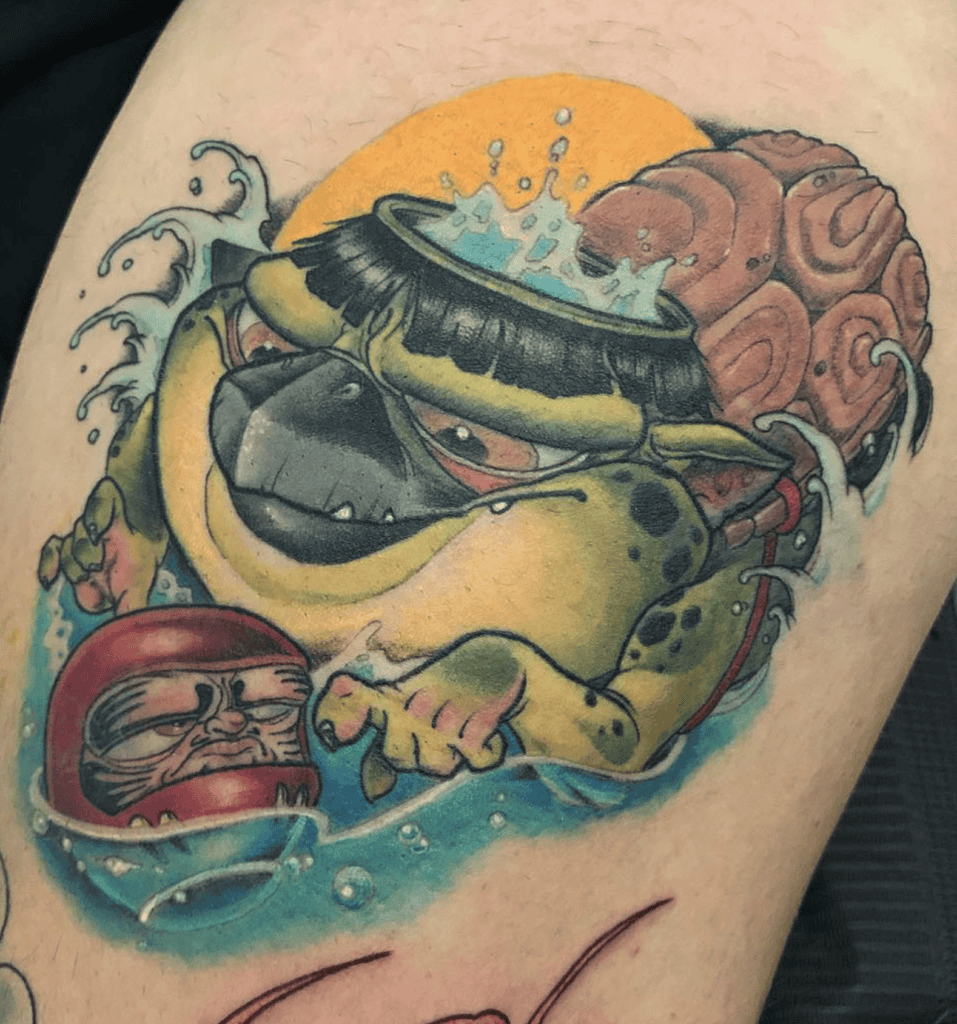
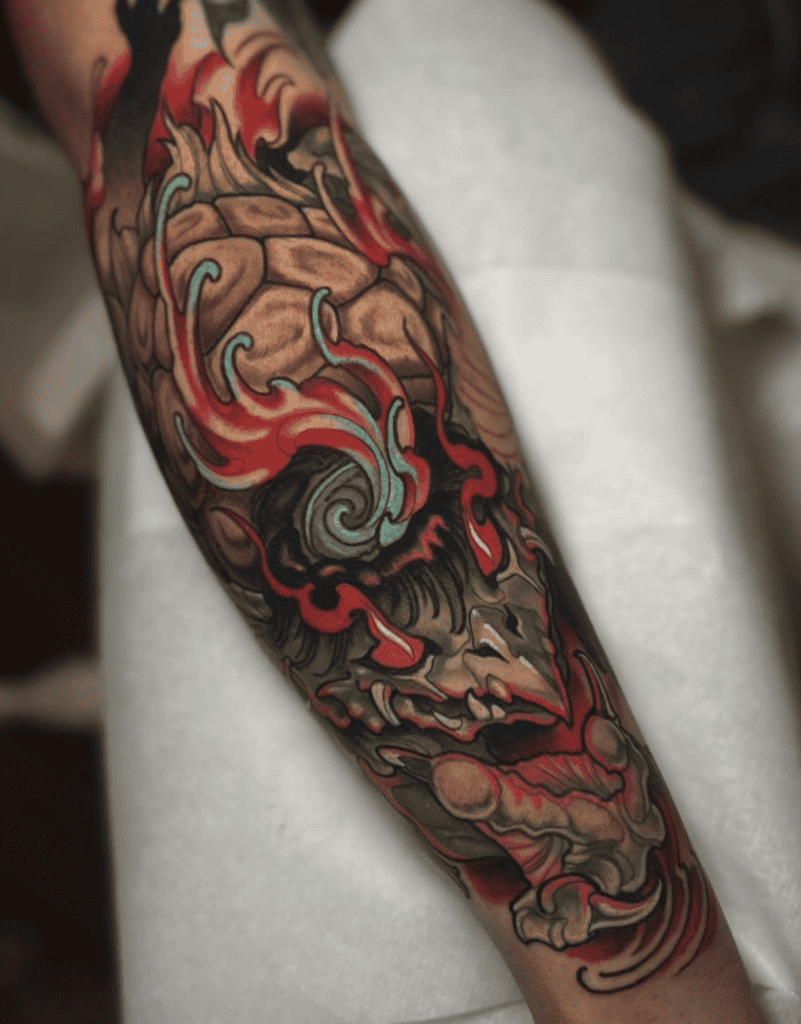
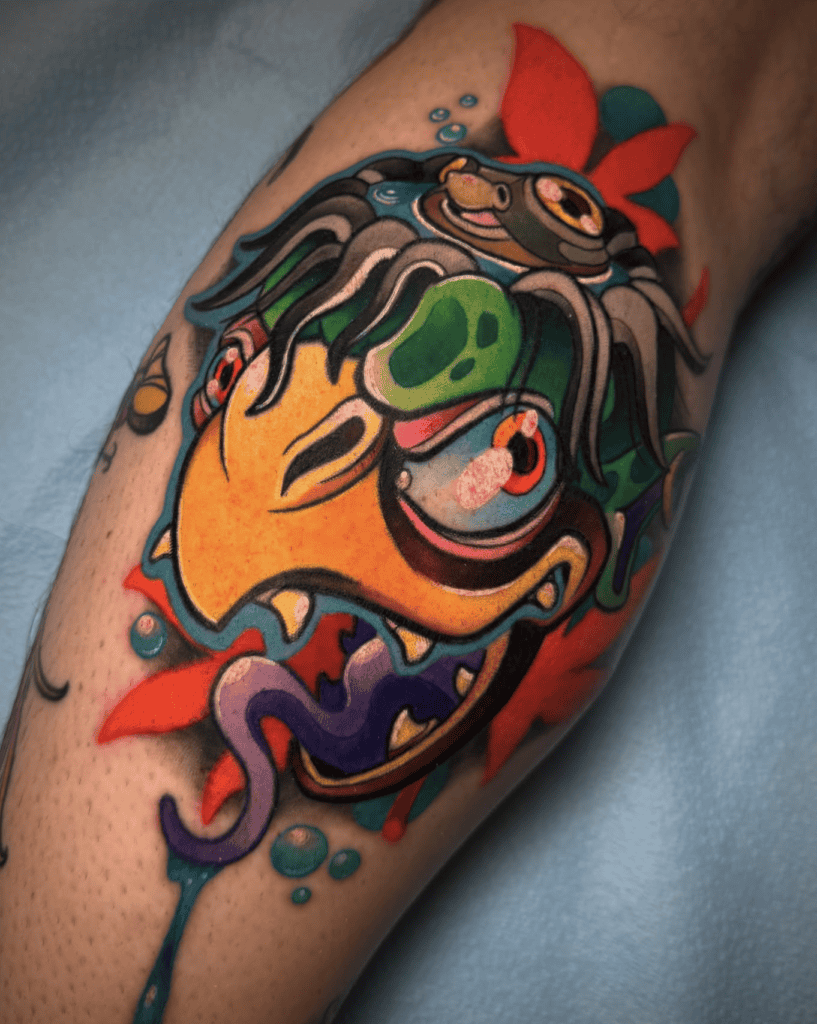
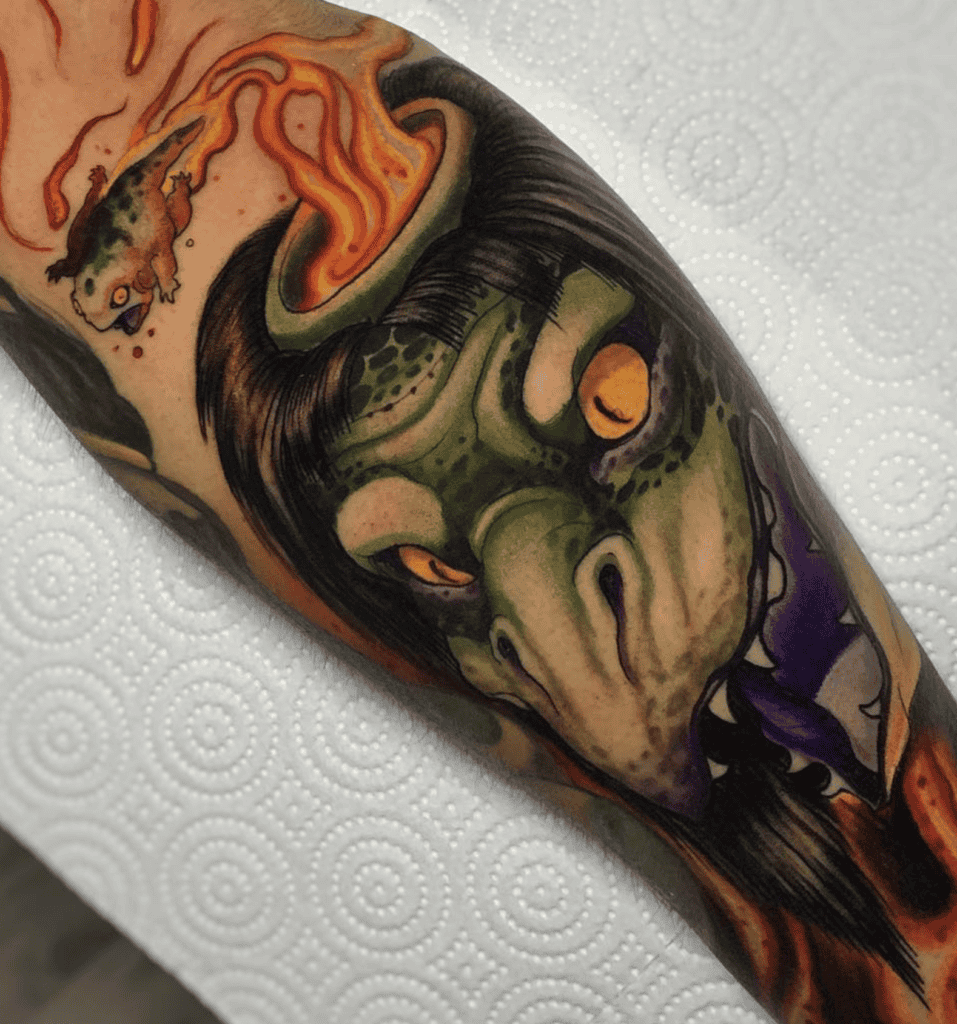
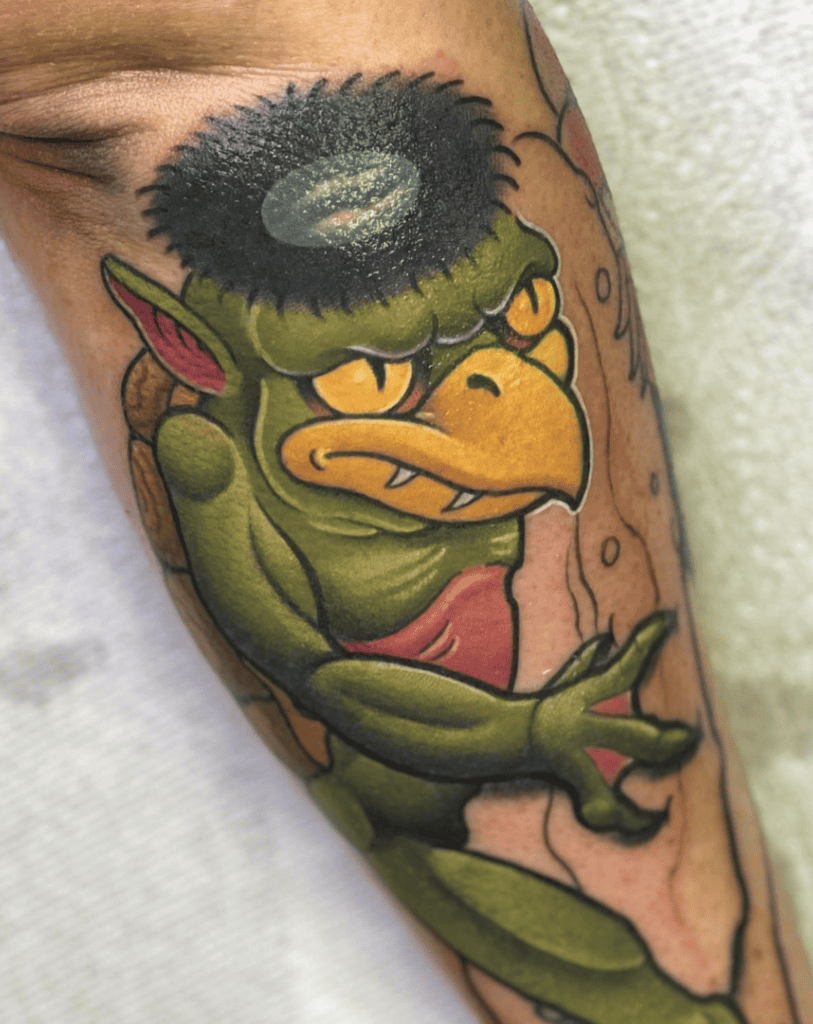
The Kappa (河童), whose name literally means “river child,” are among the most famous yōkai in Japanese folklore. They are water-dwelling beings known for their mischievous behaviour, strange appearance, love of cucumbers, and surprising sense of etiquette. Depending on the story, a Kappa can be a dangerous river monster, a prankster, or even a helpful friend.
Kappa have one of the most distinctive appearances in Japanese folklore. They are typically described as green or blue-green in colour, with webbed hands and feet, a turtle-like shell, a beak-like mouth, and a dish-shaped depression on their head filled with water.
This water-filled “plate” is the source of a Kappa’s strength and magical power. If the water spills out, the Kappa becomes weakened. This leads to one of the most famous Kappa stories. Because Kappa are extremely polite, if a person bows to one, the Kappa will often bow back, and when it does, the water spills from its head, leaving it helpless.
Tanuki Japanese Mythology Tattoo
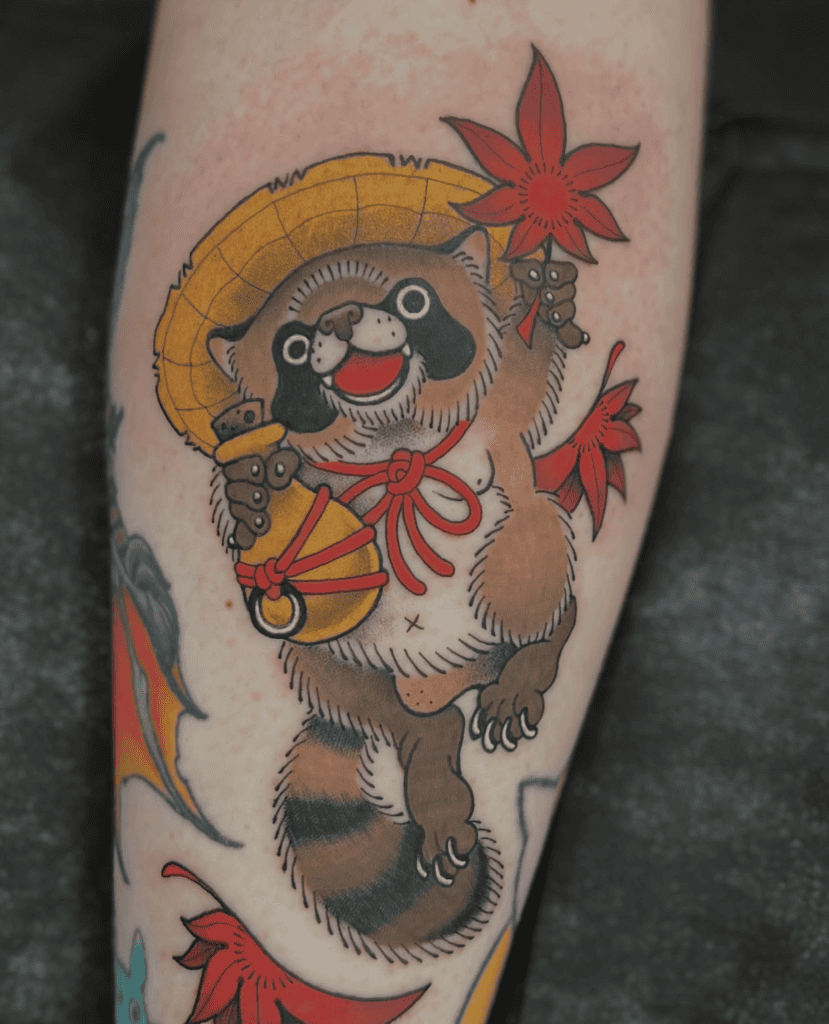
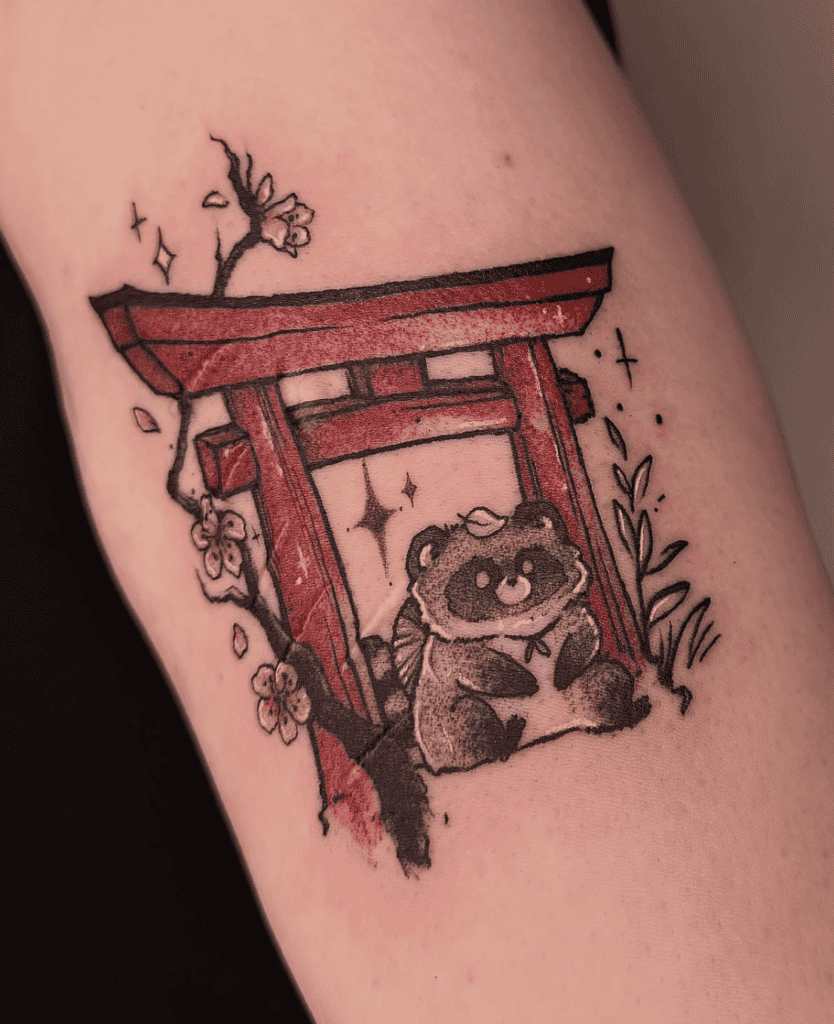
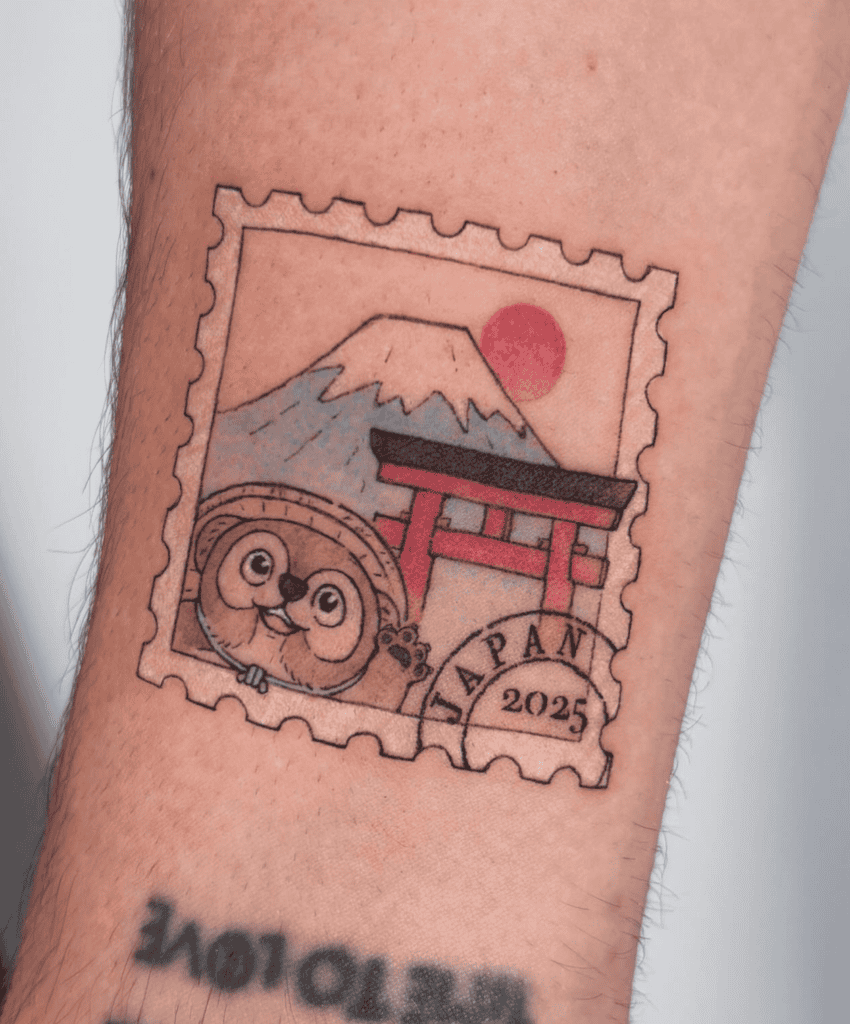
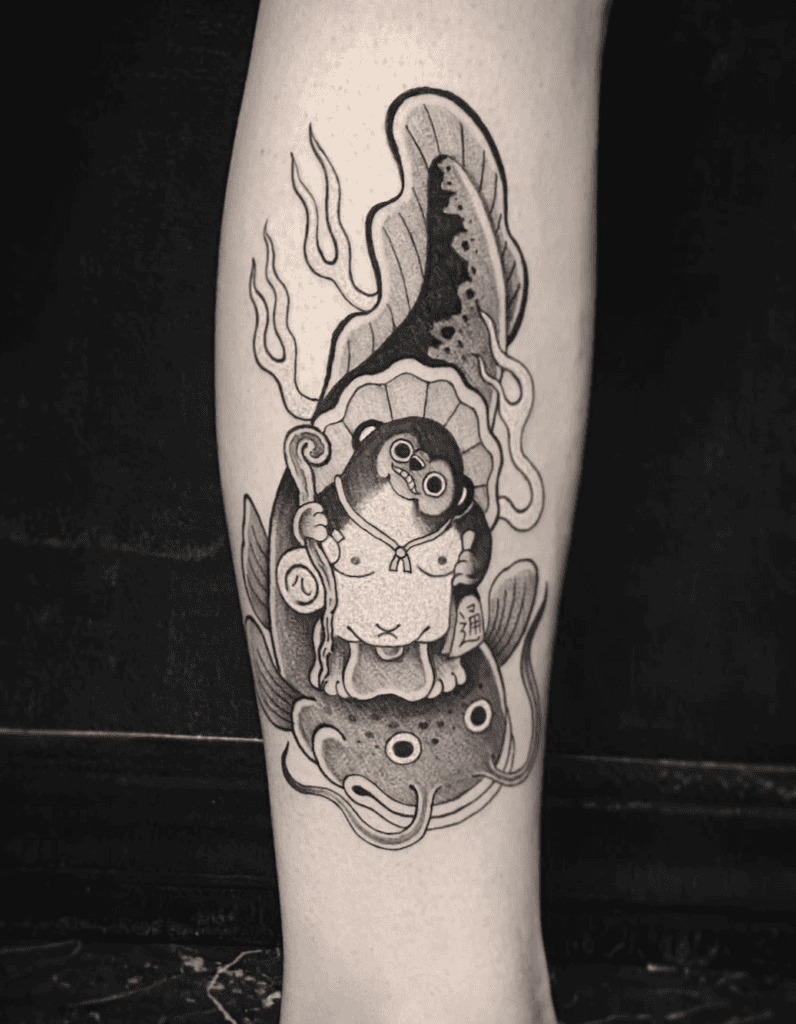
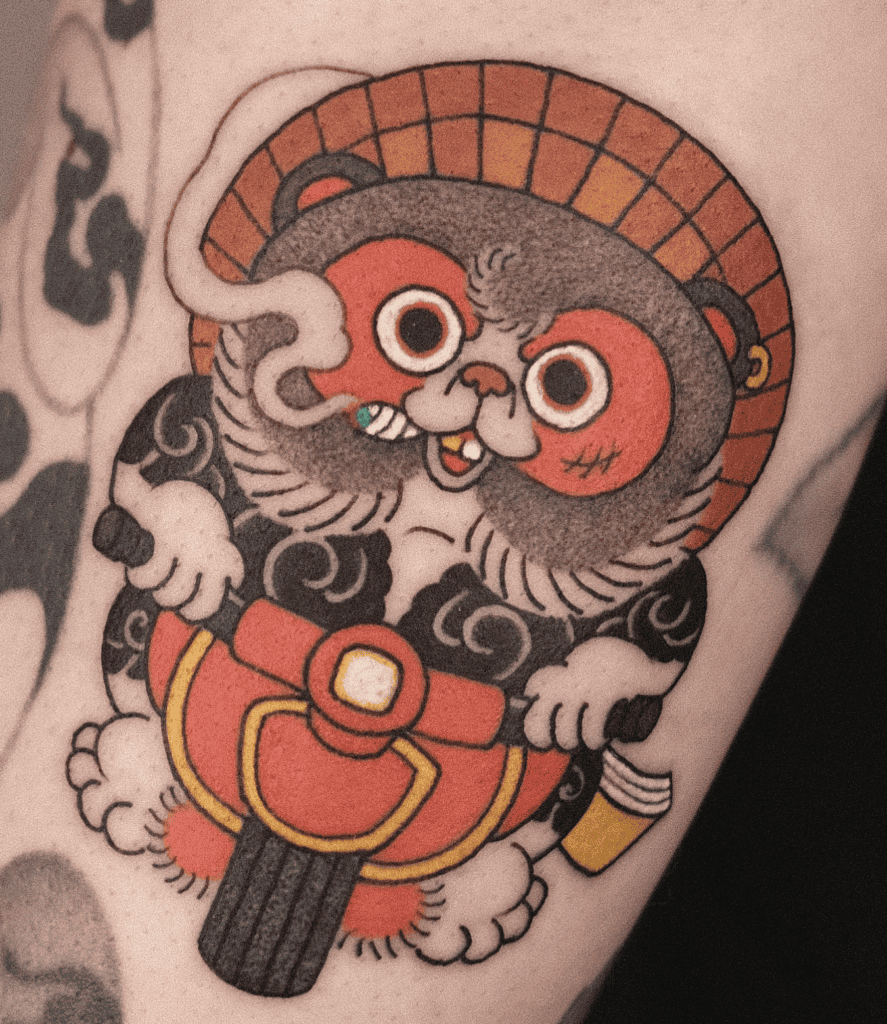
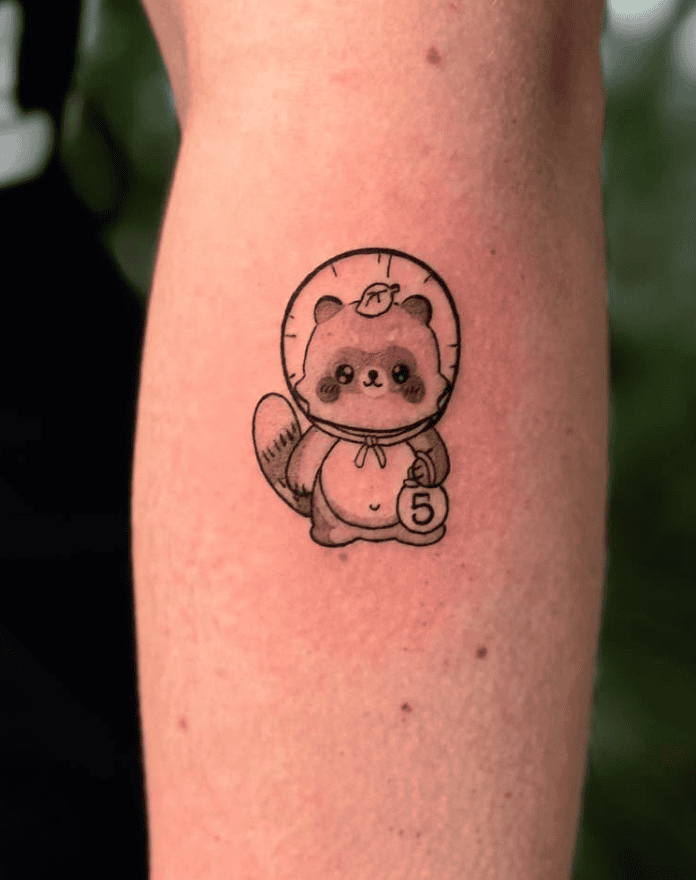
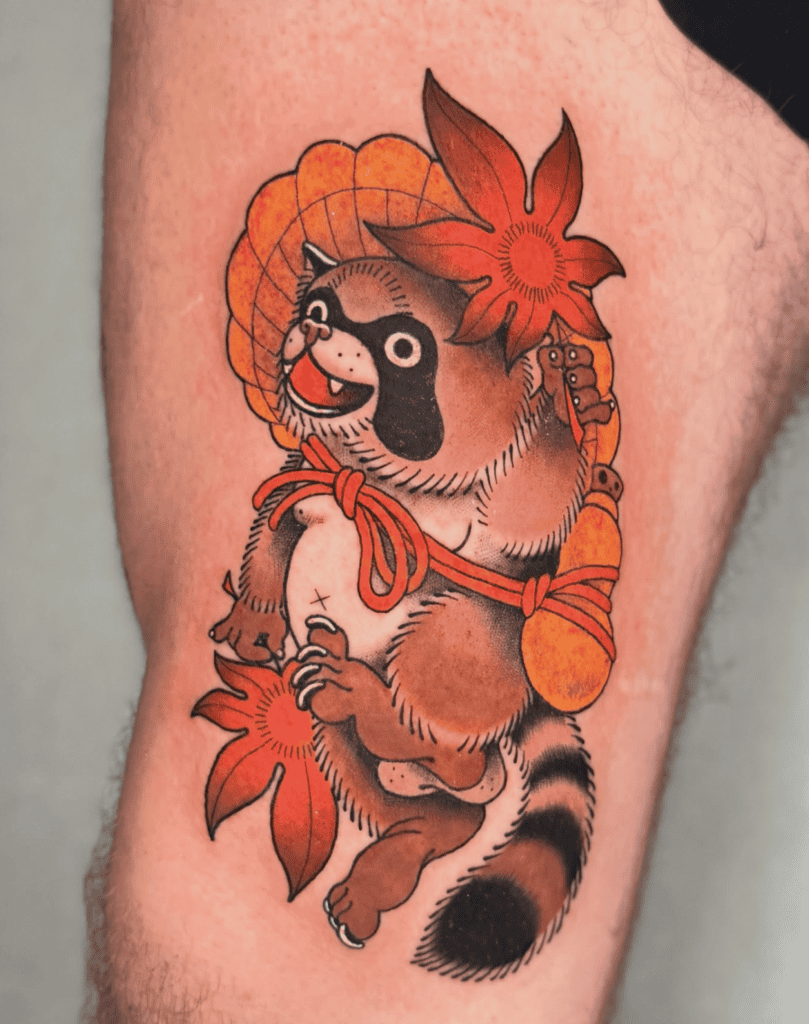
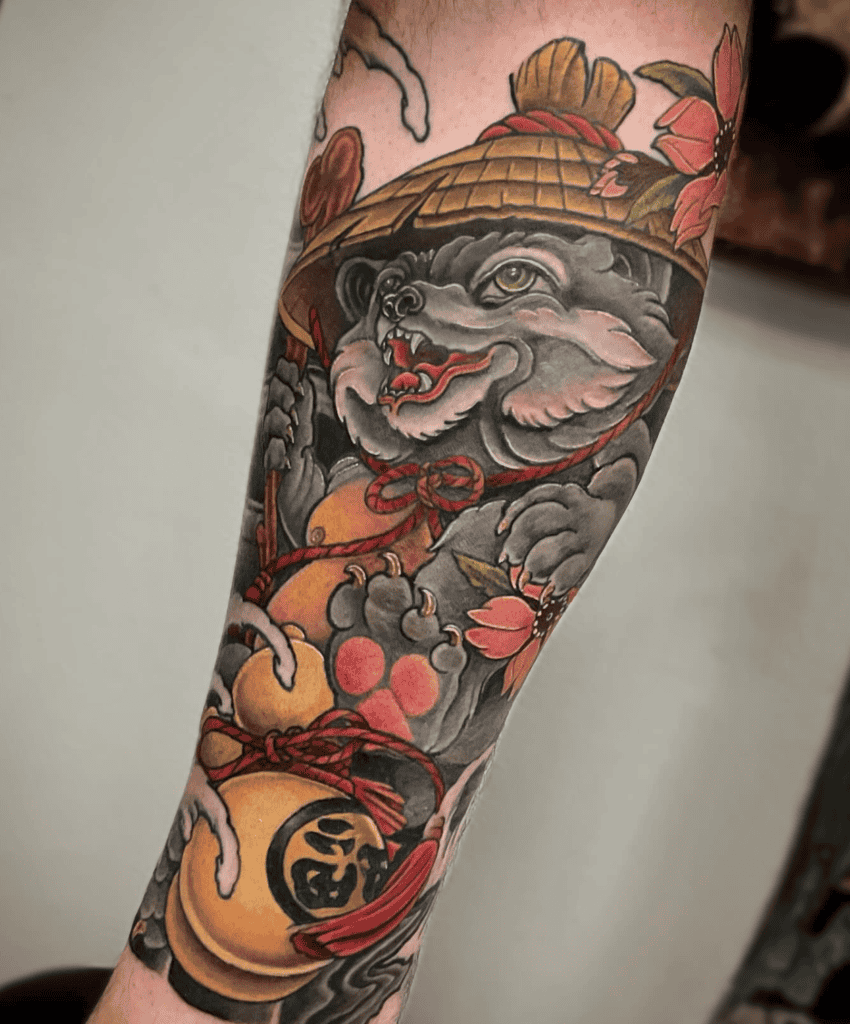
The Tanuki (狸) are among the most beloved and humorous creatures in Japanese folklore. Based on the real-life Japanese raccoon dog, Tanuki are magical shape-shifters known for their love of fun, tricks, food, drink, and good fortune. Unlike many yōkai that are frightening or dangerous, Tanuki are usually portrayed as cheerful pranksters who enjoy confusing people but rarely mean serious harm.
The folklore Tanuki is inspired by the real animal of the Japanese Raccoon Dog, which, despite being called a “raccoon dog,” is neither a raccoon nor a dog. It belongs to the Canidae family and is native to Japan.
Like the Kitsune, Tanuki are famous shape-shifters, with many stories involving Tanuki disguising themselves to play tricks on unsuspecting travellers. However, their pranks are usually more silly than malicious.
Bakeneko Japanese Mythology Tattoo
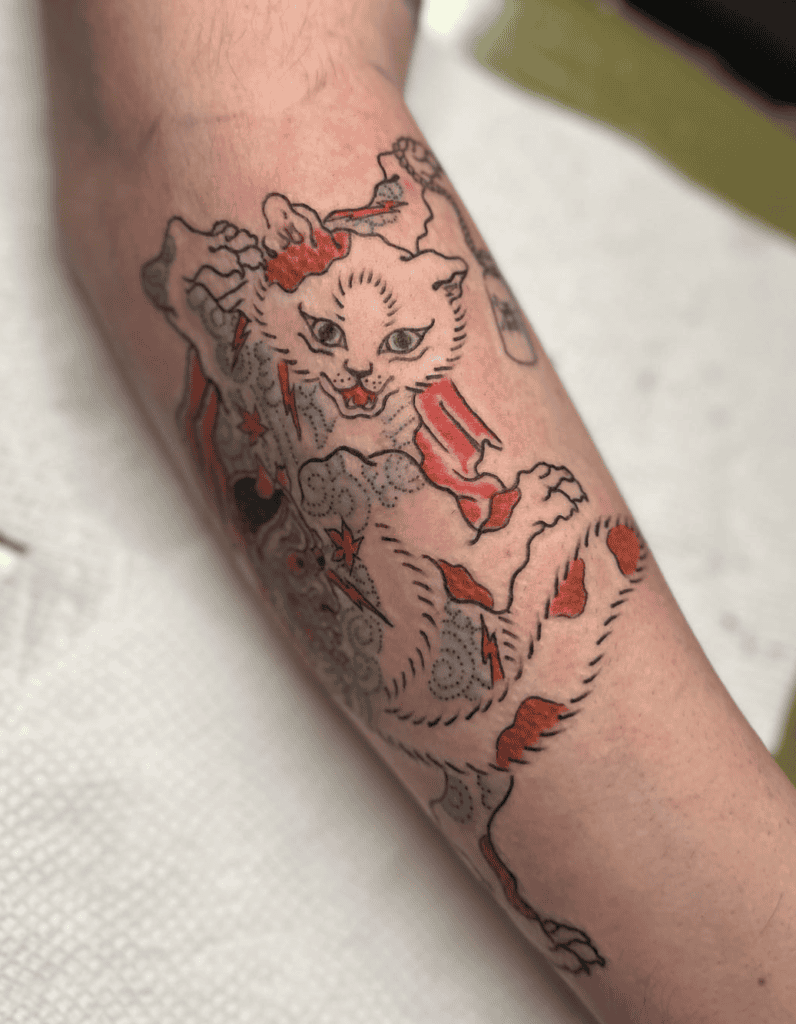
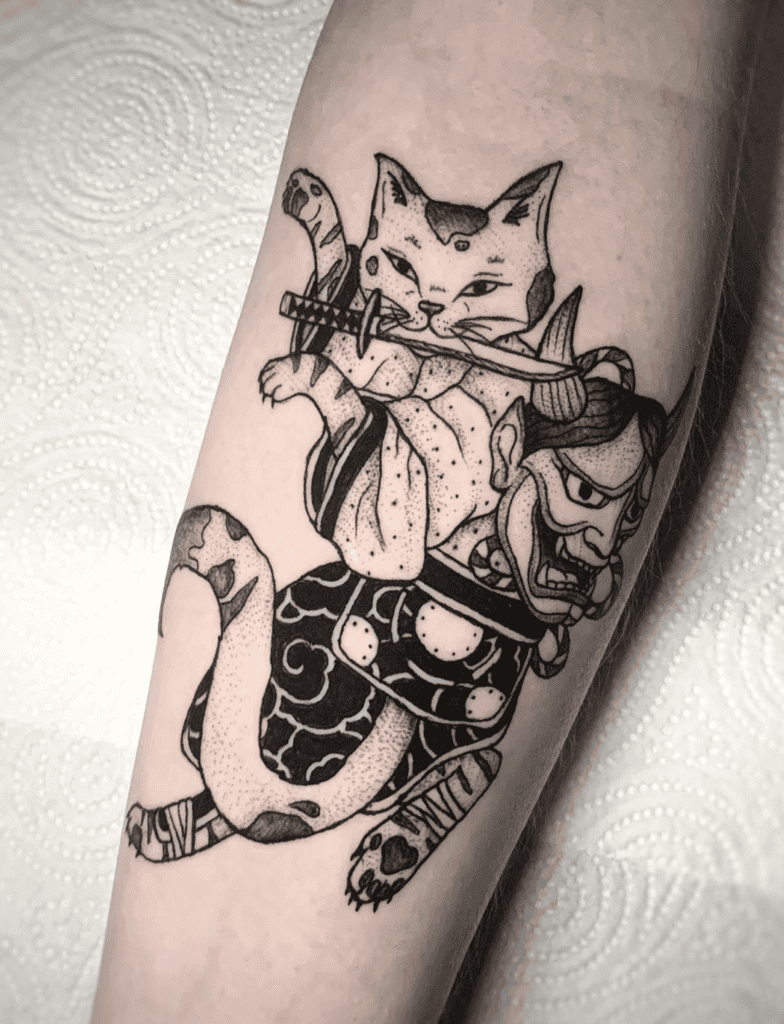
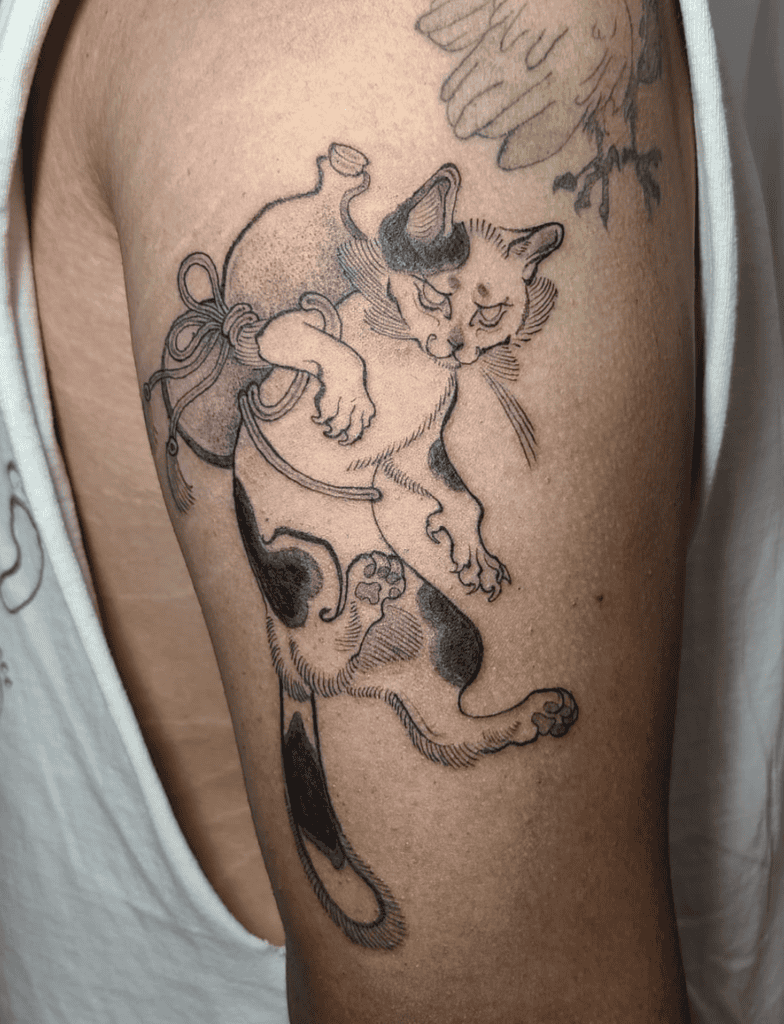
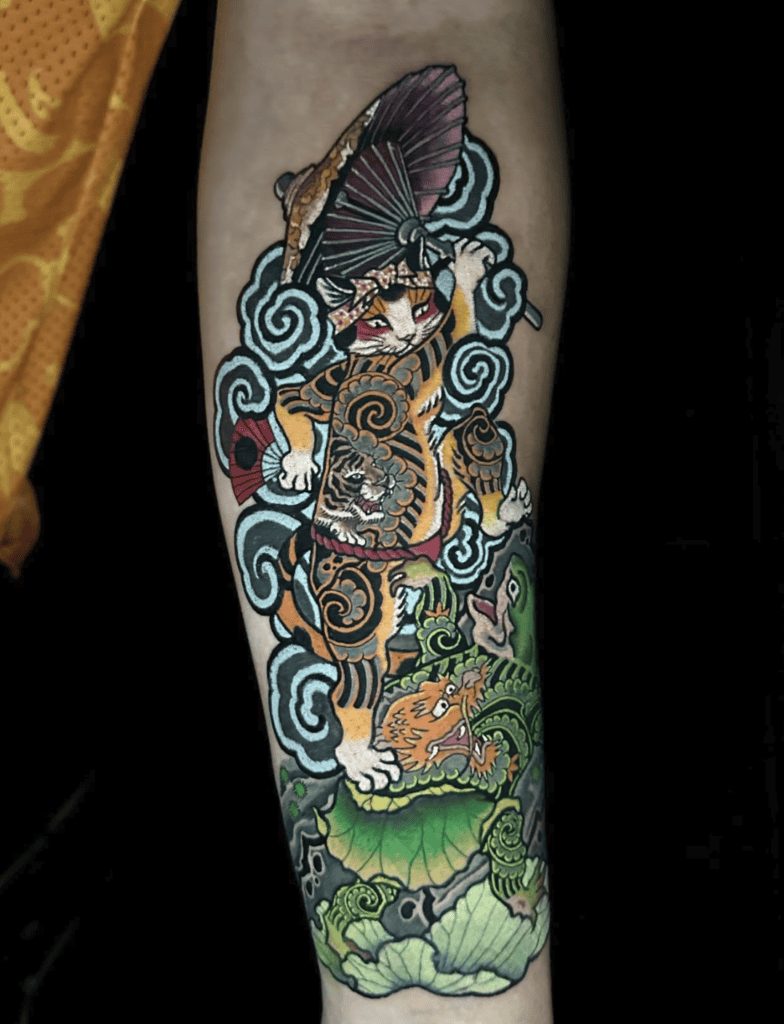
The Bakeneko (化け猫), meaning “changed cat” or “monster cat,” is one of the most famous feline yōkai in Japanese folklore. These supernatural cats are ordinary domestic cats that have gained magical powers through age, size, wisdom, or unusual circumstances.
Bakeneko are mysterious creatures that can be playful, protective, mischievous, or downright terrifying, depending on the story. Their legends helped shape Japan’s rich tradition of supernatural cat folklore.
According to folklore, a normal cat may become a Bakeneko if it lives for many years, grows unusually large, or develops supernatural wisdom. Once transformed, a Bakeneko gains magical abilities and becomes a yōkai. This belief may have originated because cats were often viewed as mysterious animals whose behaviour seemed strange or uncanny to people in earlier centuries.
Nekomata Japanese Mythology Tattoo
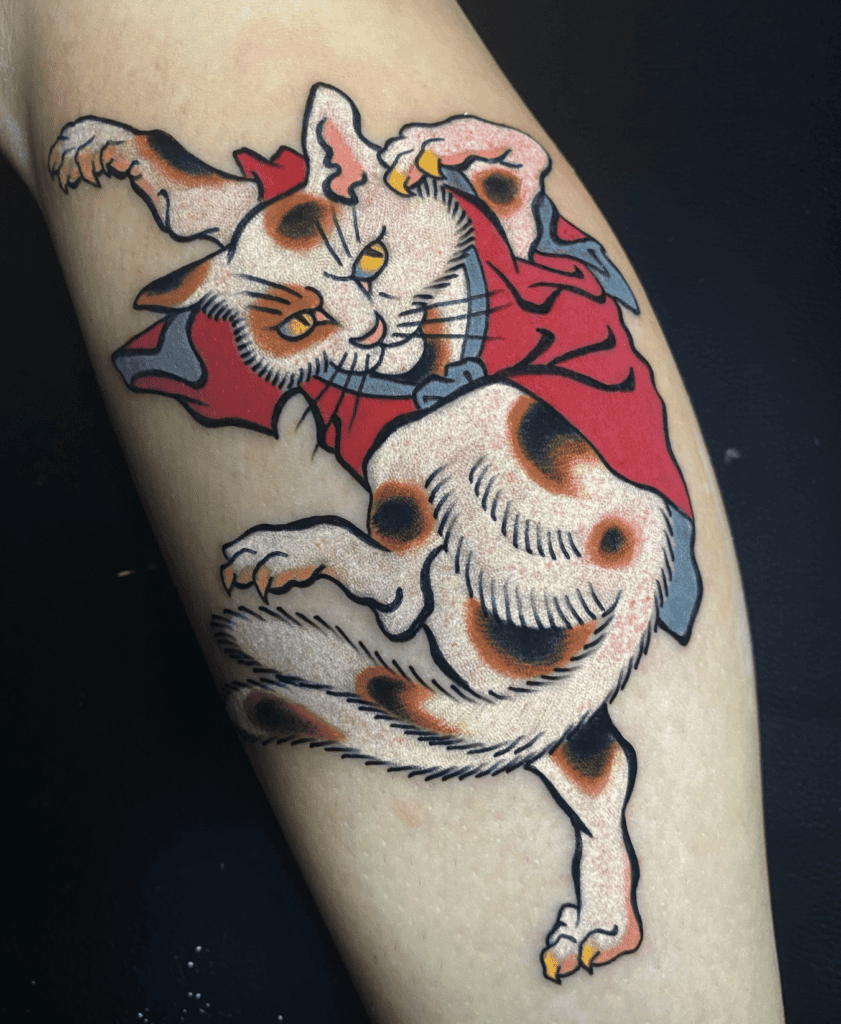
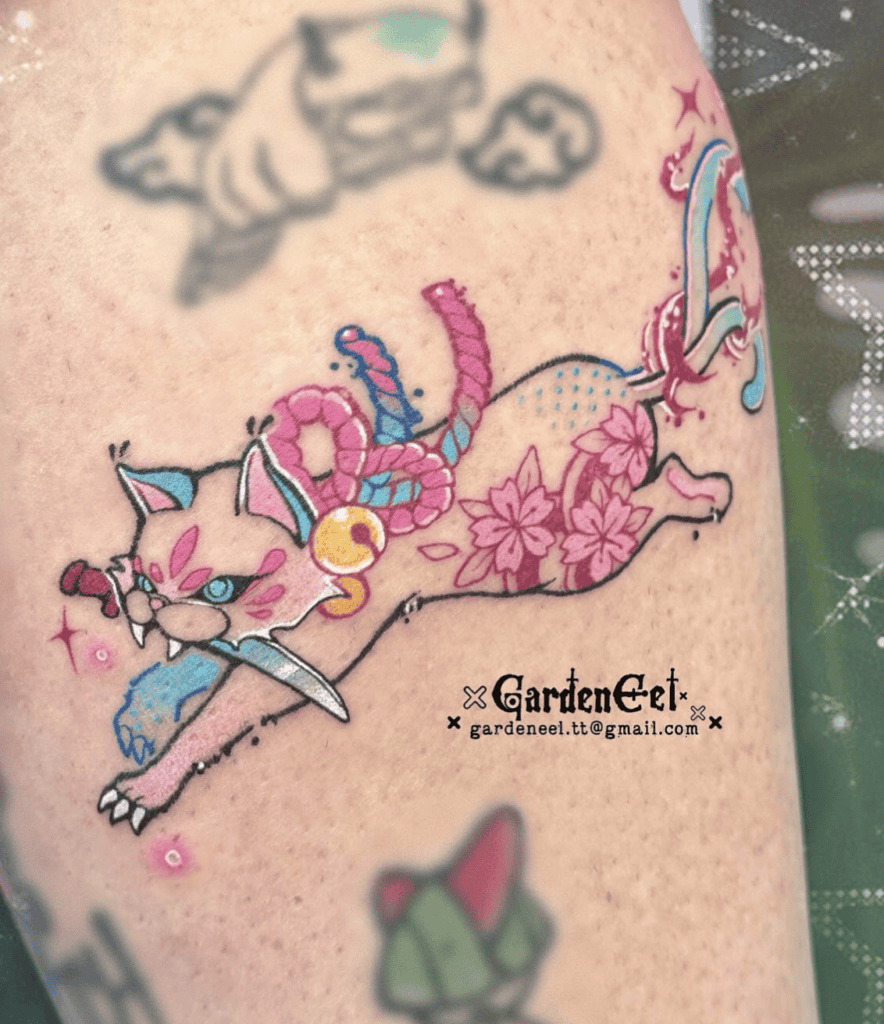
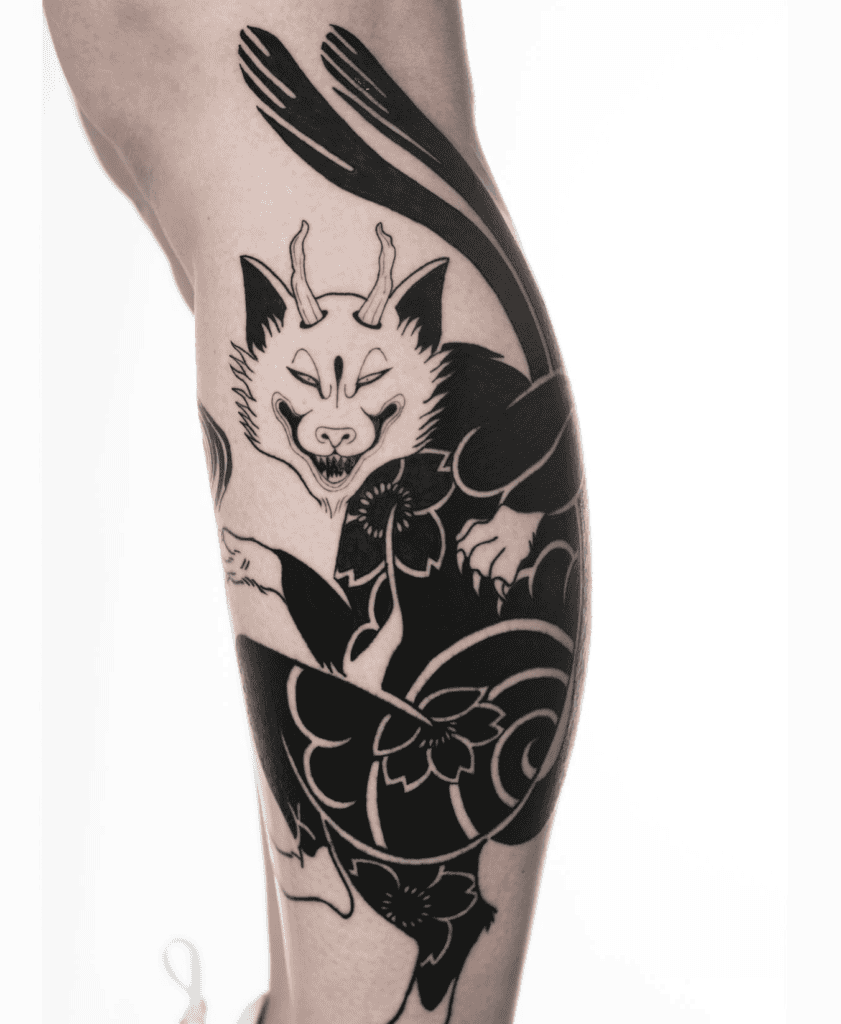
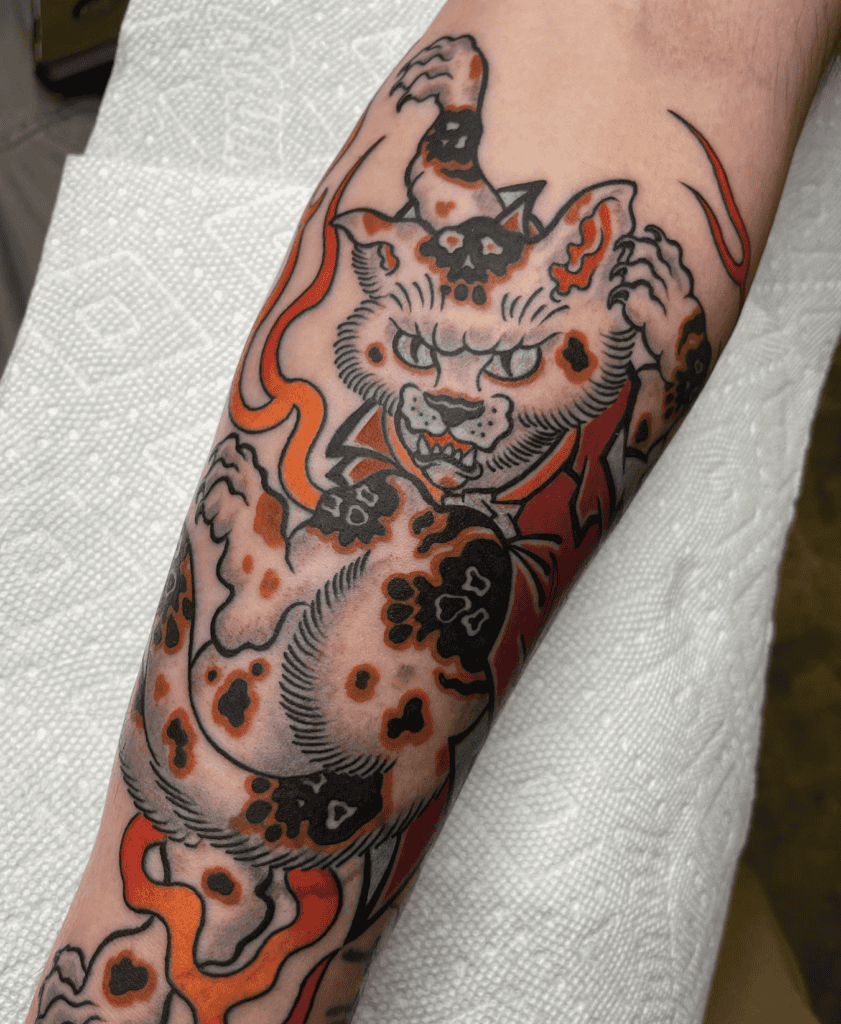
The Nekomata (猫又) is one of the most famous and feared cat yōkai in Japanese folklore. Often depicted as a cat with two tails, the Nekomata is considered a more powerful and supernatural relative of the Bakeneko.
While some stories portray Nekomata as mischievous or even friendly, many traditional legends describe them as mysterious beings with ghostly powers and a strong connection to the spirit world.
According to folklore, a Nekomata begins life as an ordinary cat. As the cat grows extremely old, powerful, or large, it may undergo a transformation and become a supernatural being, with the most famous sign of this transformation being that its tail splits into two. This forked tail became the defining feature of the Nekomata and a symbol of its magical abilities.
Folklore generally describes two main varieties. The Mountain Nekomata that live deep in remote forests and mountains, and domestic Nekomata, which are former household cats that transformed after living for many years.
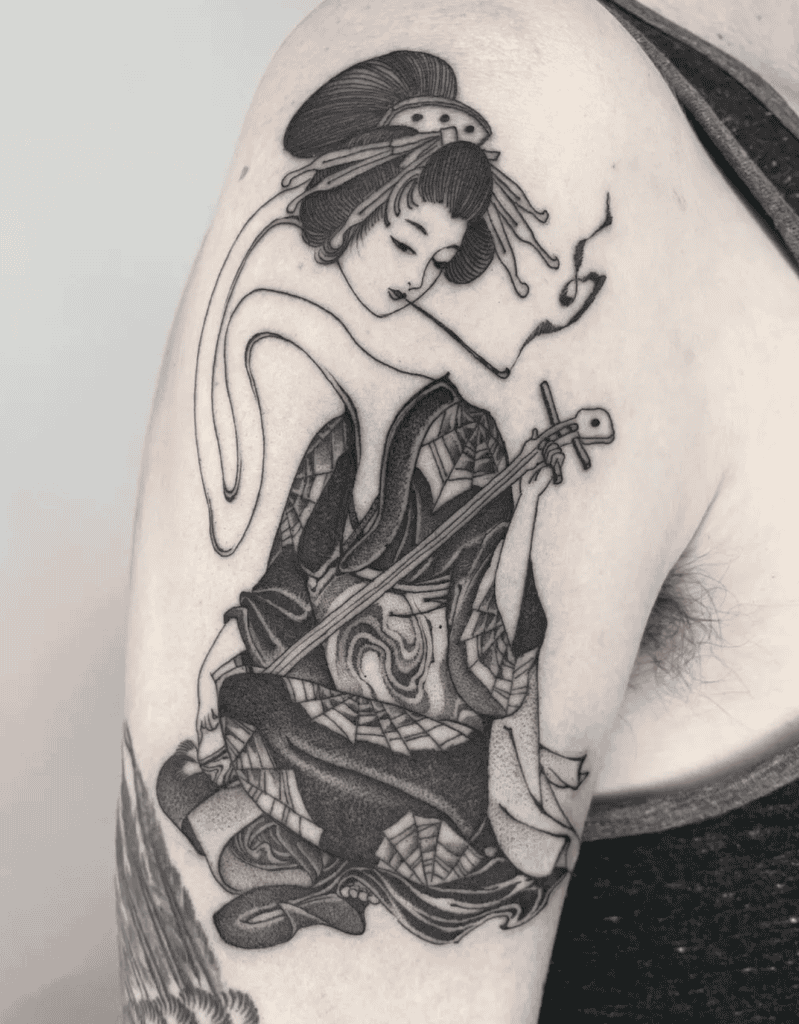
Jorōgumo Japanese Mythology Tattoo
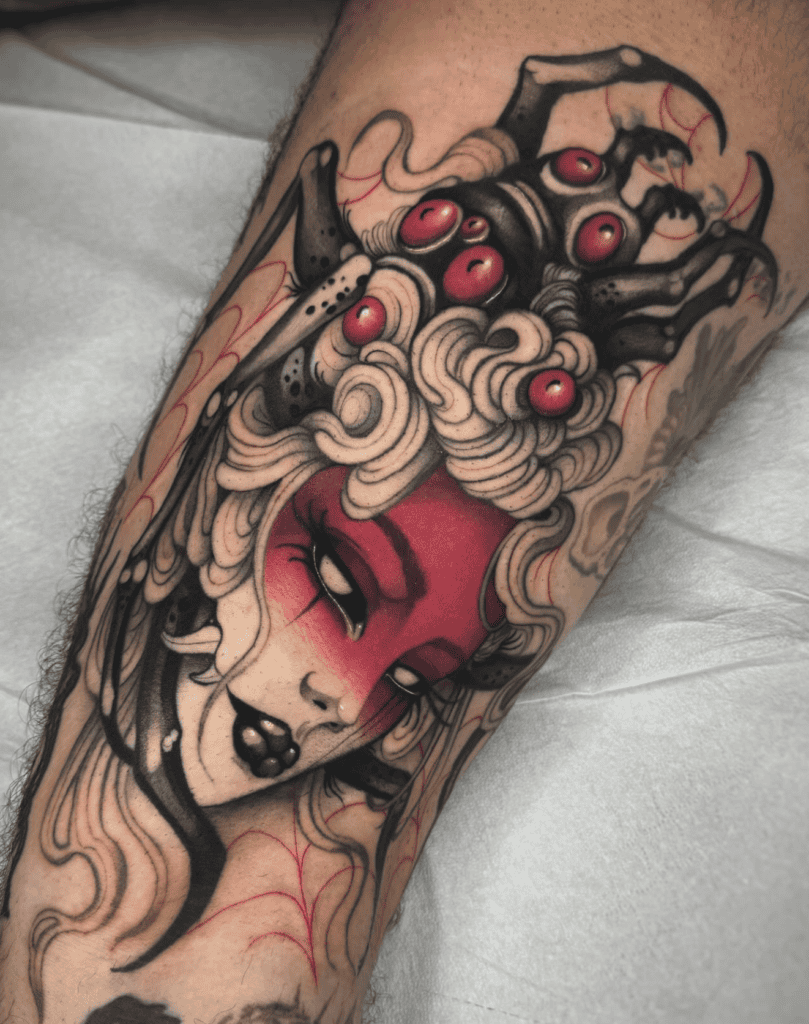
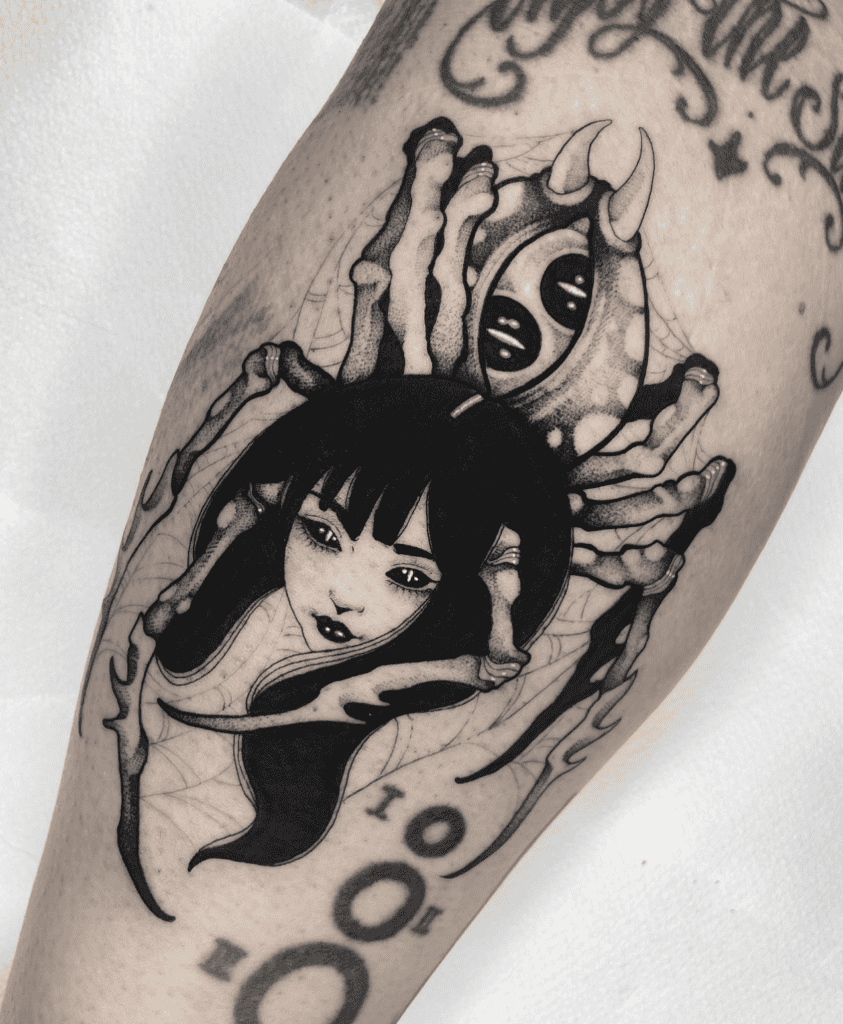
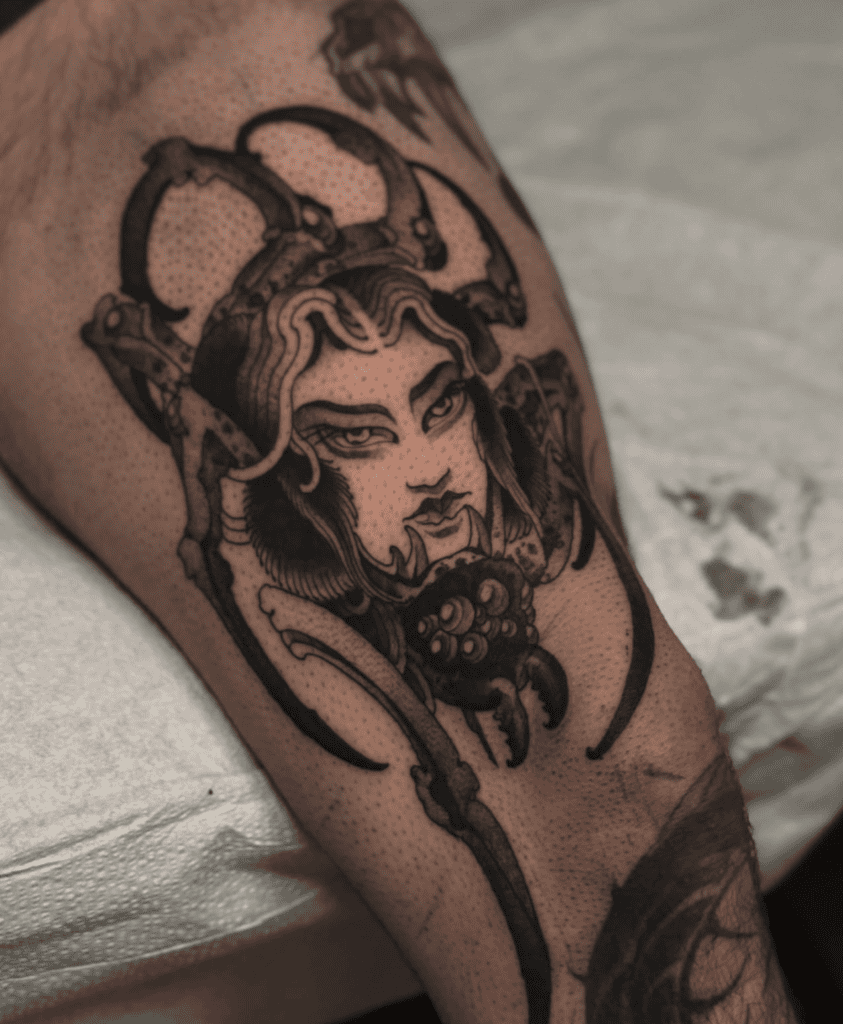
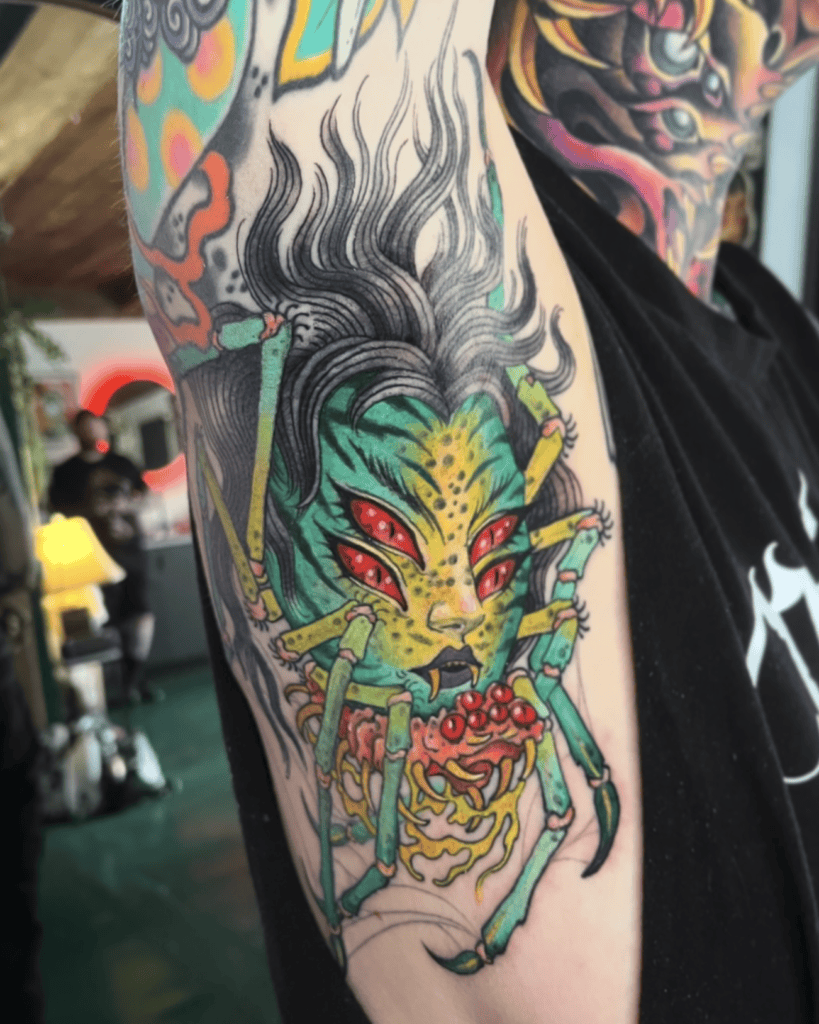
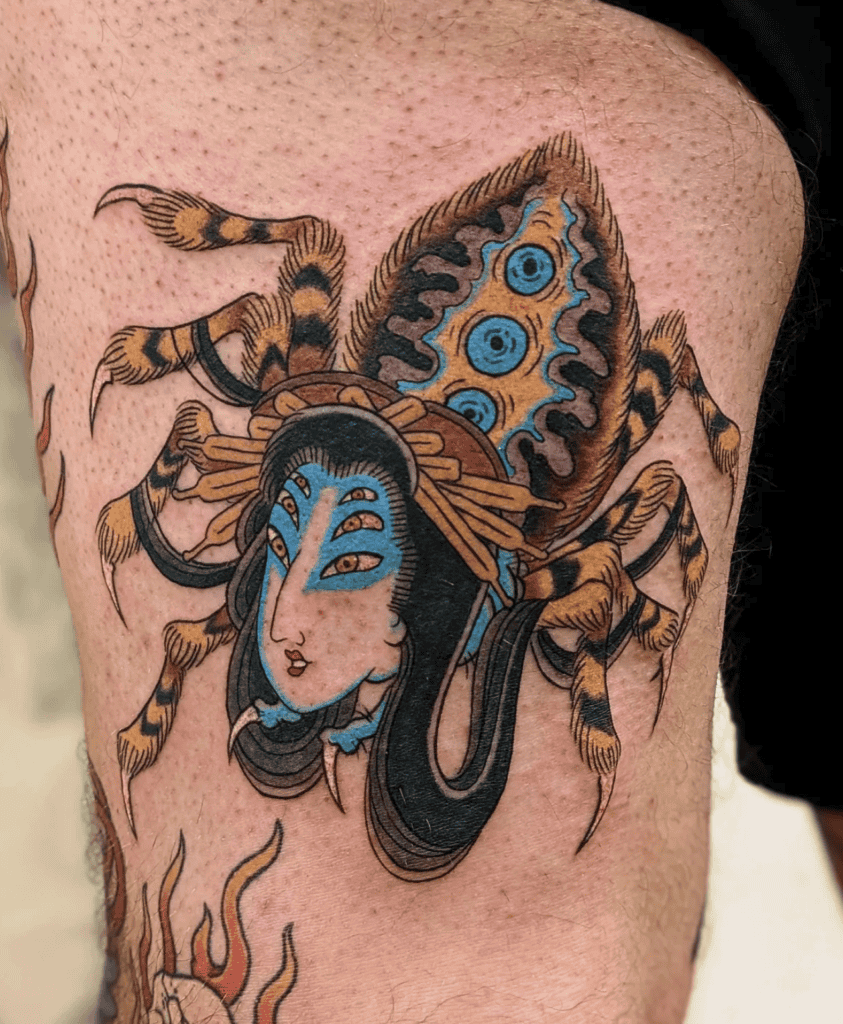
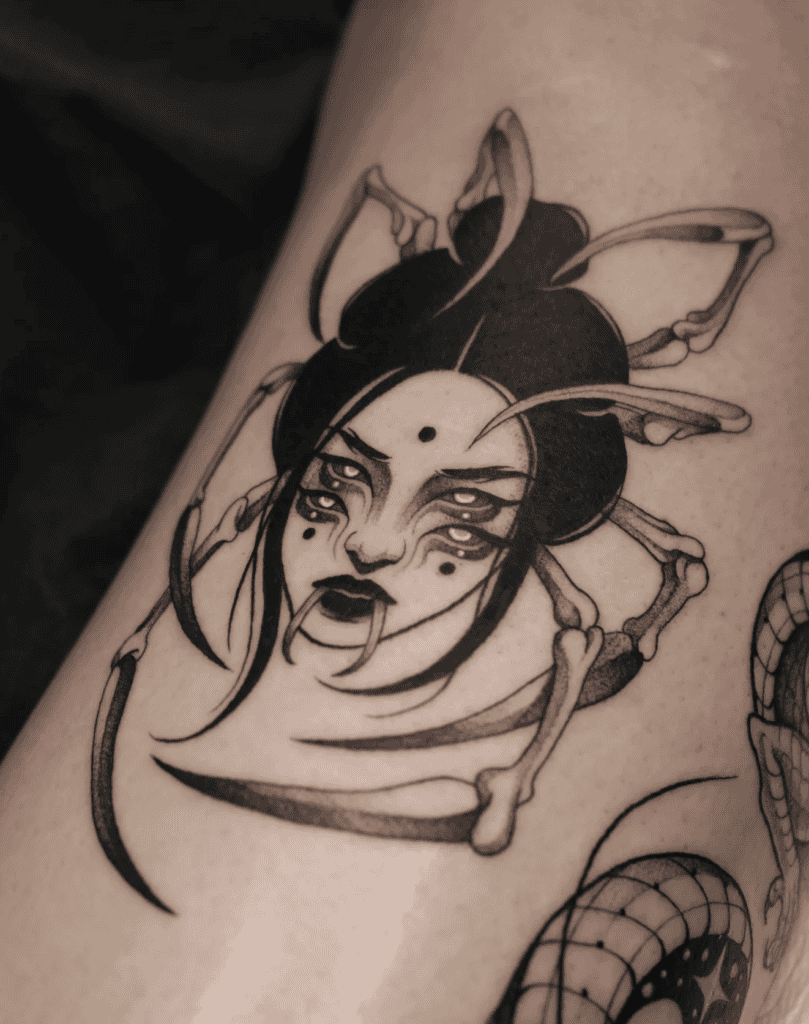
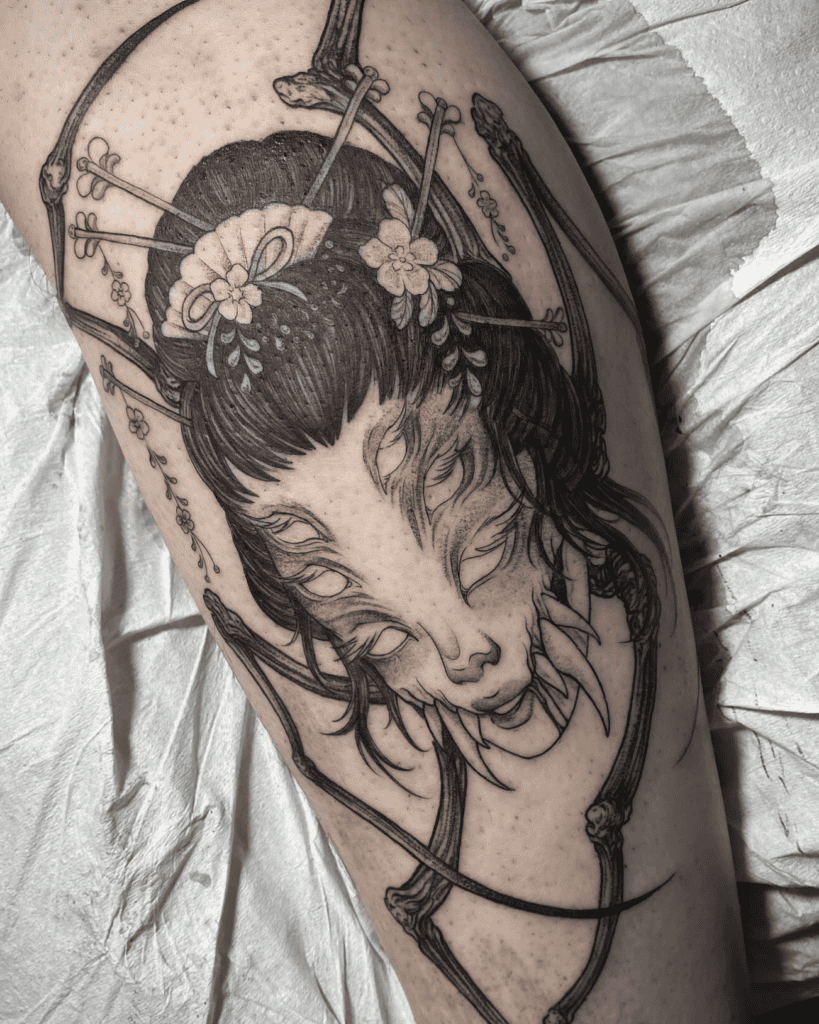
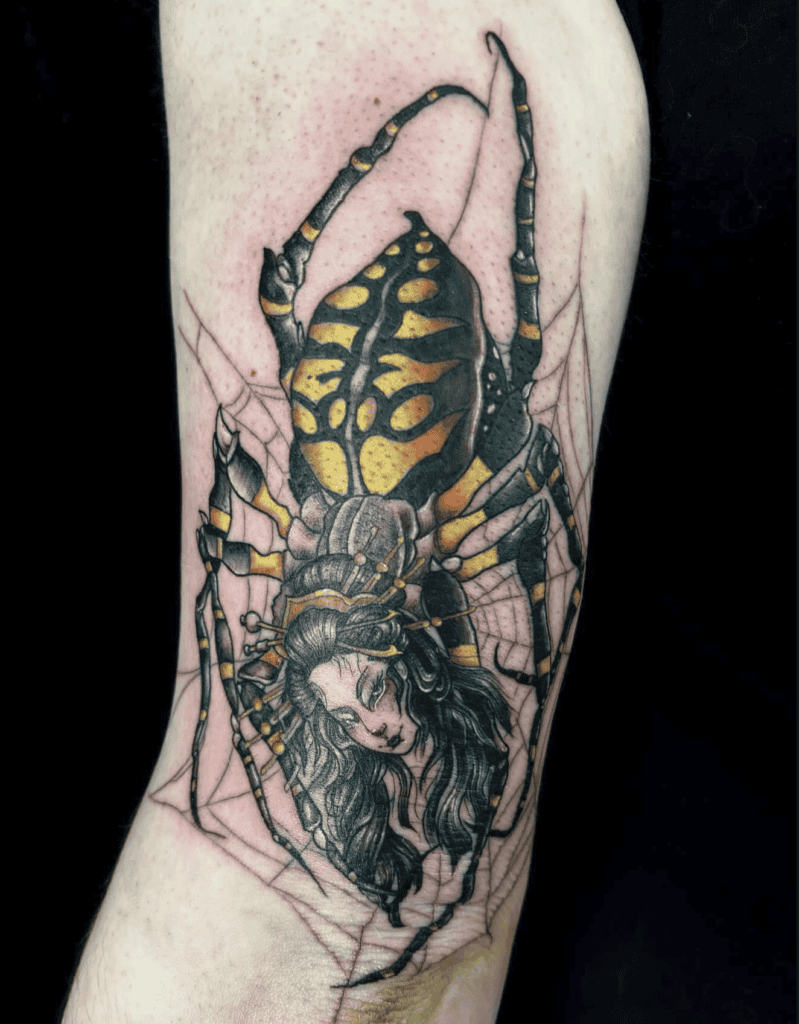
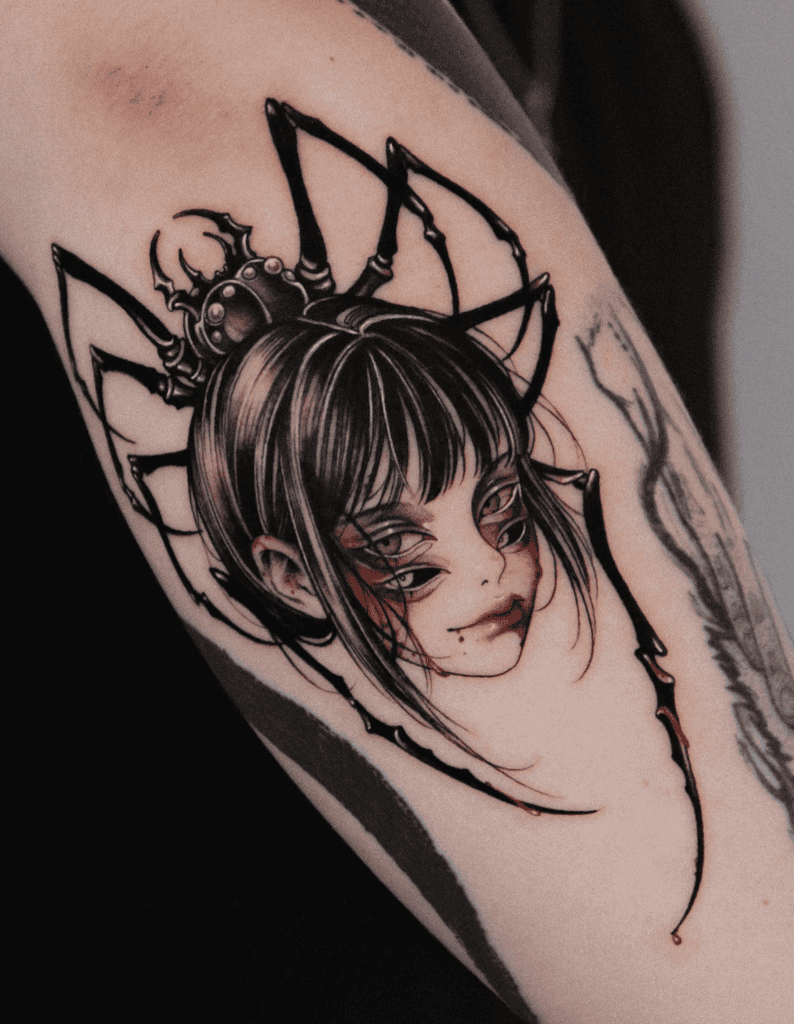
The Jorōgumo (絡新婦 or 女郎蜘蛛) is one of the most famous and haunting yōkai in Japanese folklore. Her name is often translated as “Binding Bride” or “Spider Woman,” and she is typically depicted as a giant spider that can transform into a beautiful woman. Jorōgumo legends blend beauty, deception, danger, and supernatural mystery, making her one of Japan’s most enduring folkloric figures.
According to folklore, an ordinary spider that lives for many years can gain magical powers and transform into a yōkai. After reaching a great age, the spider may become a Jorōgumo, gaining abilities such as shape-shifting, illusions, hypnosis, magical webs, and human speech. The Jorōgumo’s most famous ability is transforming into a beautiful woman to attract unsuspecting victims.
Many Jorōgumo stories follow a similar pattern. A traveller encounters a beautiful woman living alone who charms the traveller and lures them into her home to be feasted upon. These tales often served as warnings about deception and temptation.
Noppera-bō Japanese Mythology Tattoo


The Noppera-bō (のっぺらぼう), often called the “Faceless Ghost,” is one of the eeriest yōkai in Japanese folklore. At first glance, they appear completely human, until you notice their face has no eyes, nose, or mouth at all. Noppera-bō are usually not violent monsters, but supernatural pranksters that use fear and confusion as their main “weapon.”
Most Noppera-bō stories follow a simple pattern. A traveller meets a seemingly normal person and they talk or walk together peacefully, but when the person suddenly turns around, their face is completely blank, shocking the victim.
Rokurokubi Japanese Mythology Tattoo
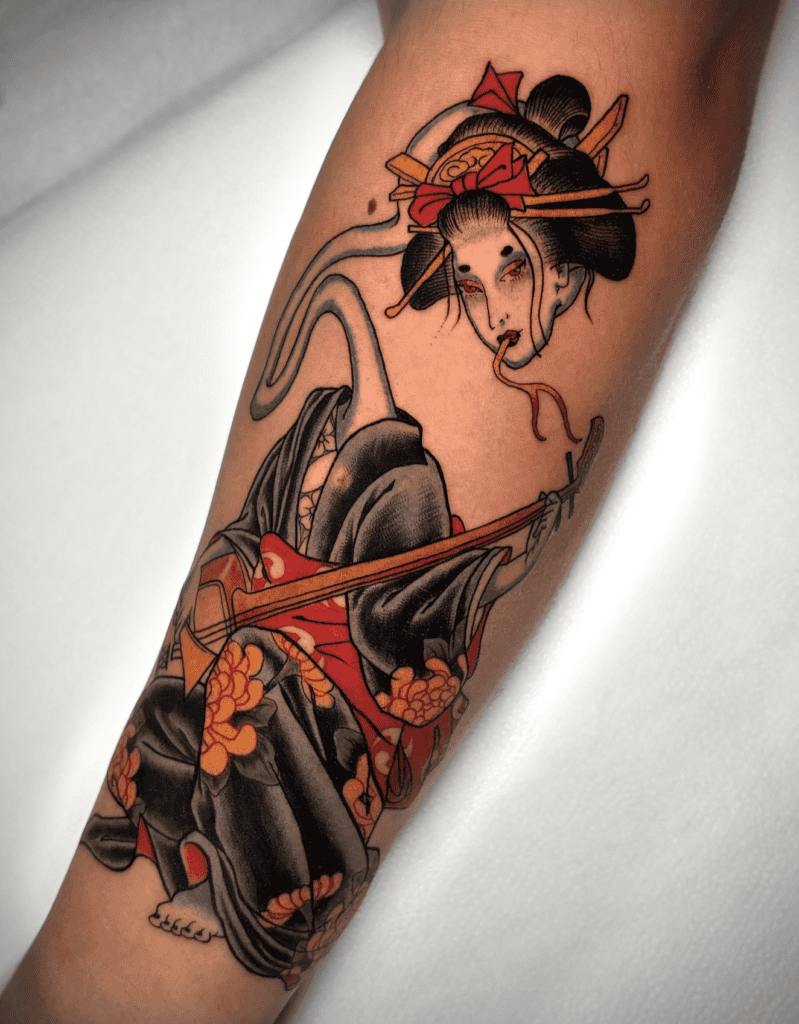
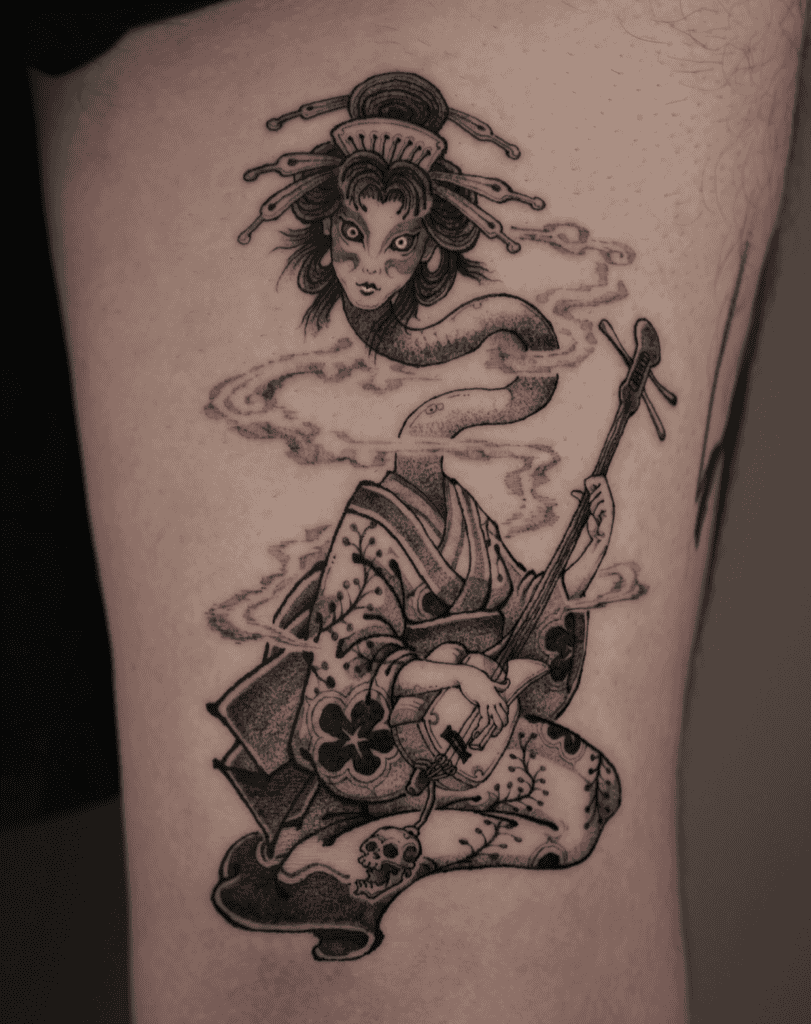
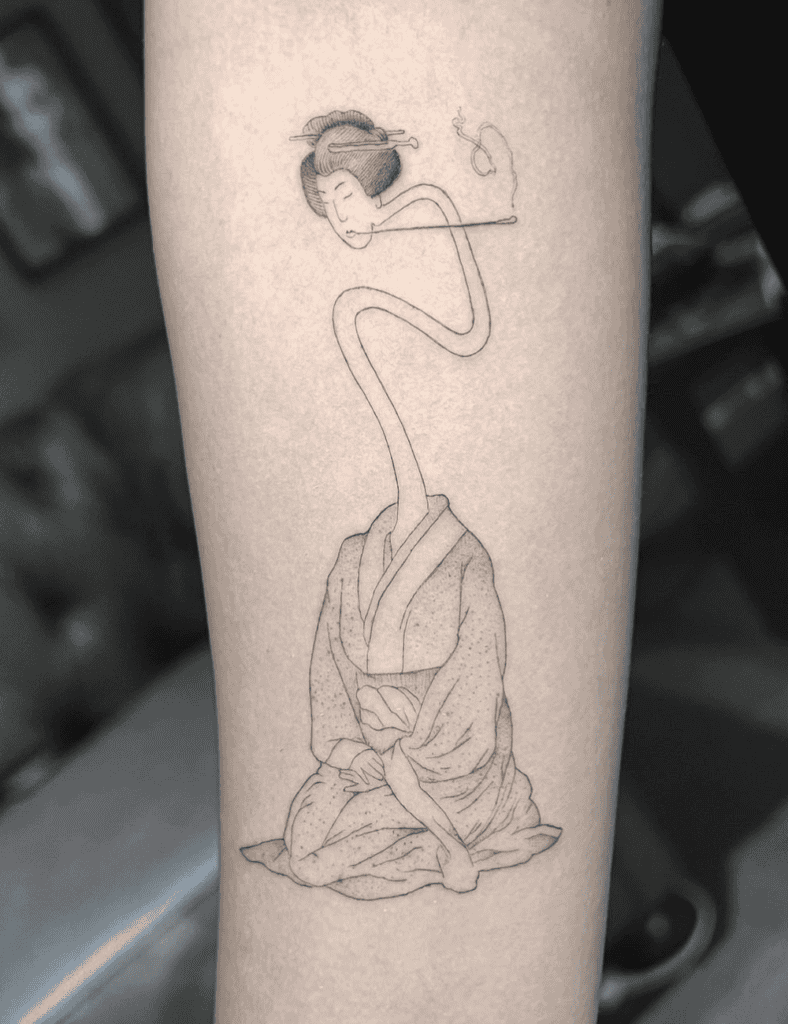
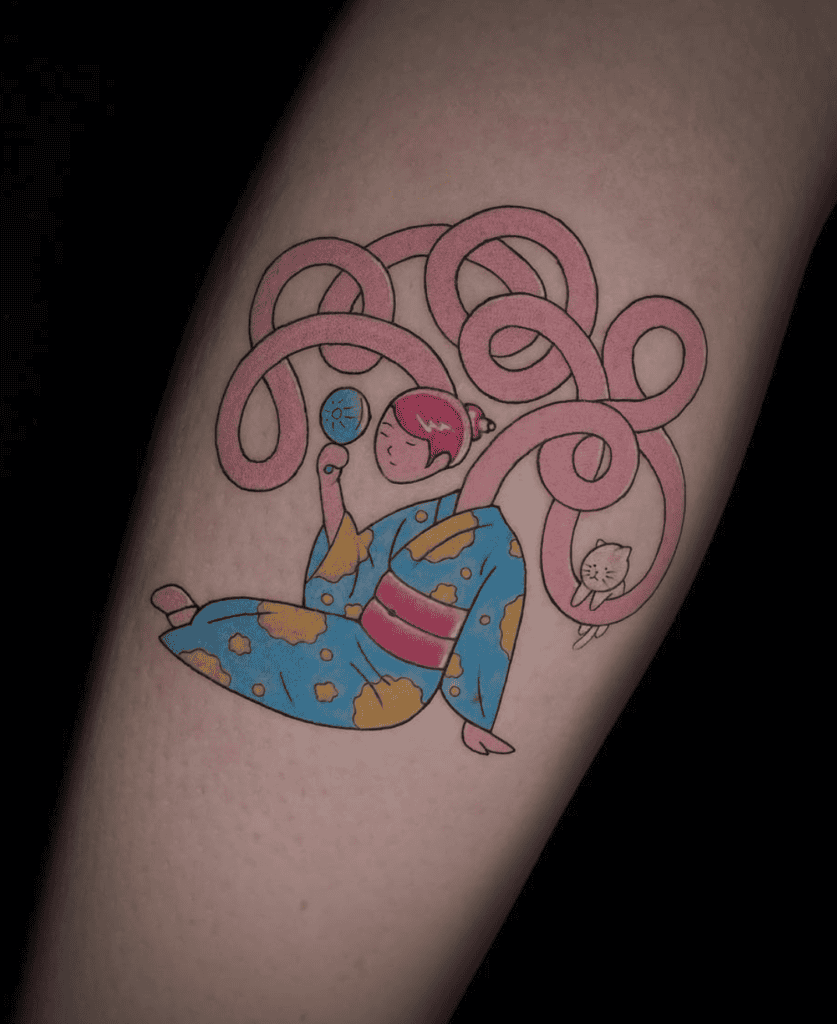
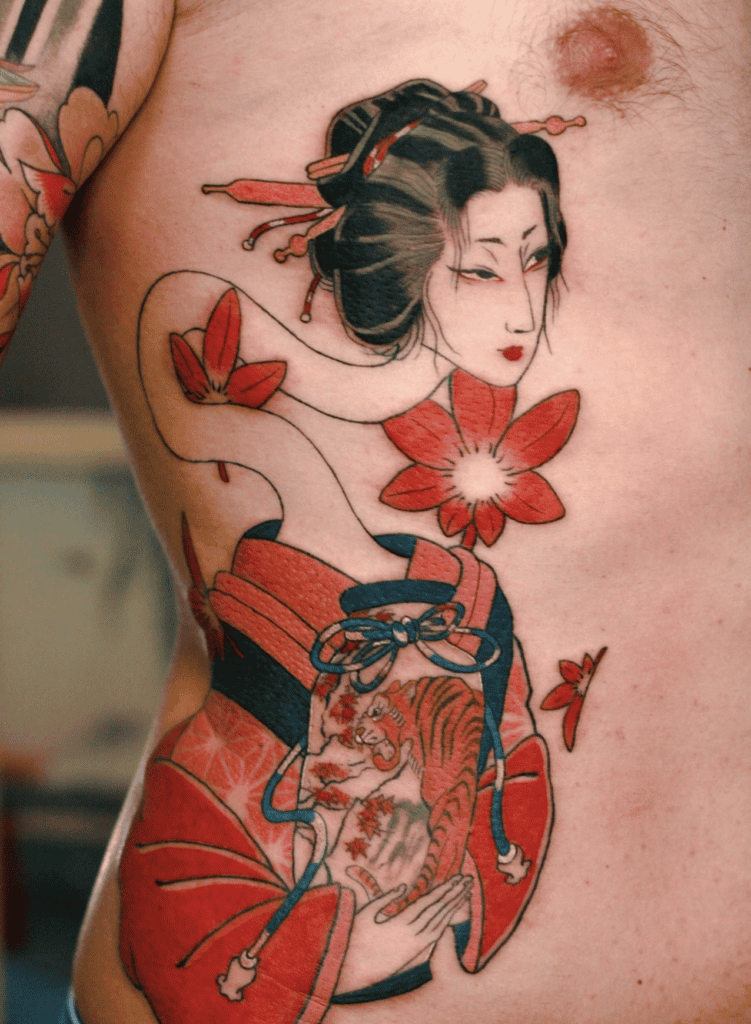
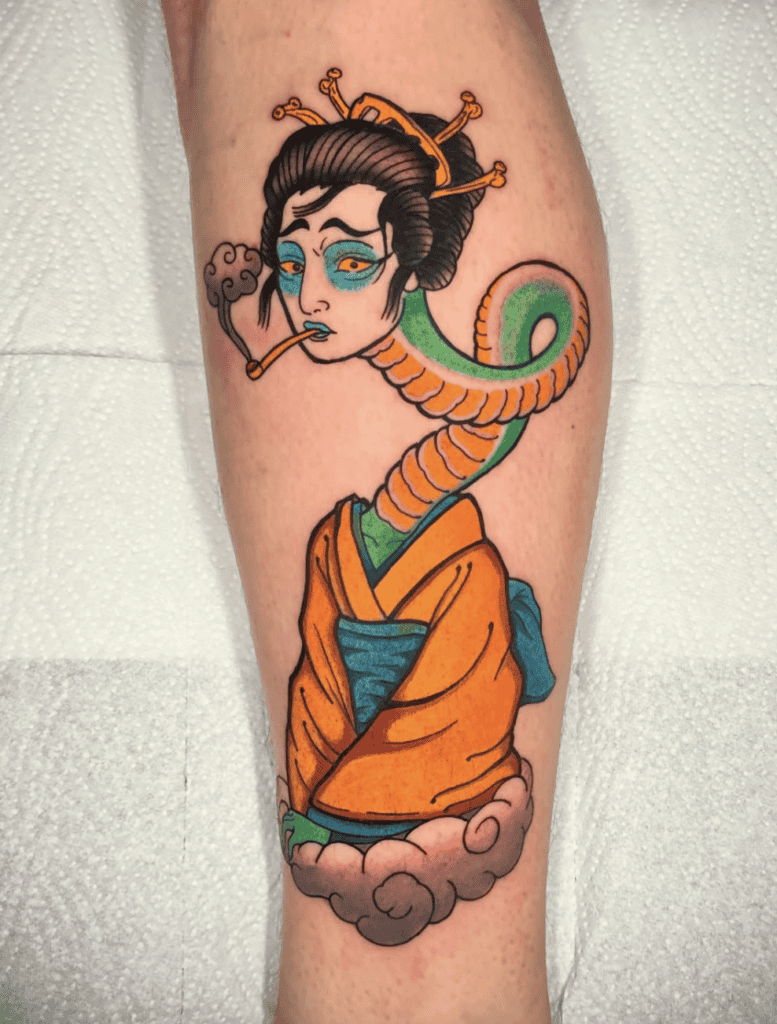
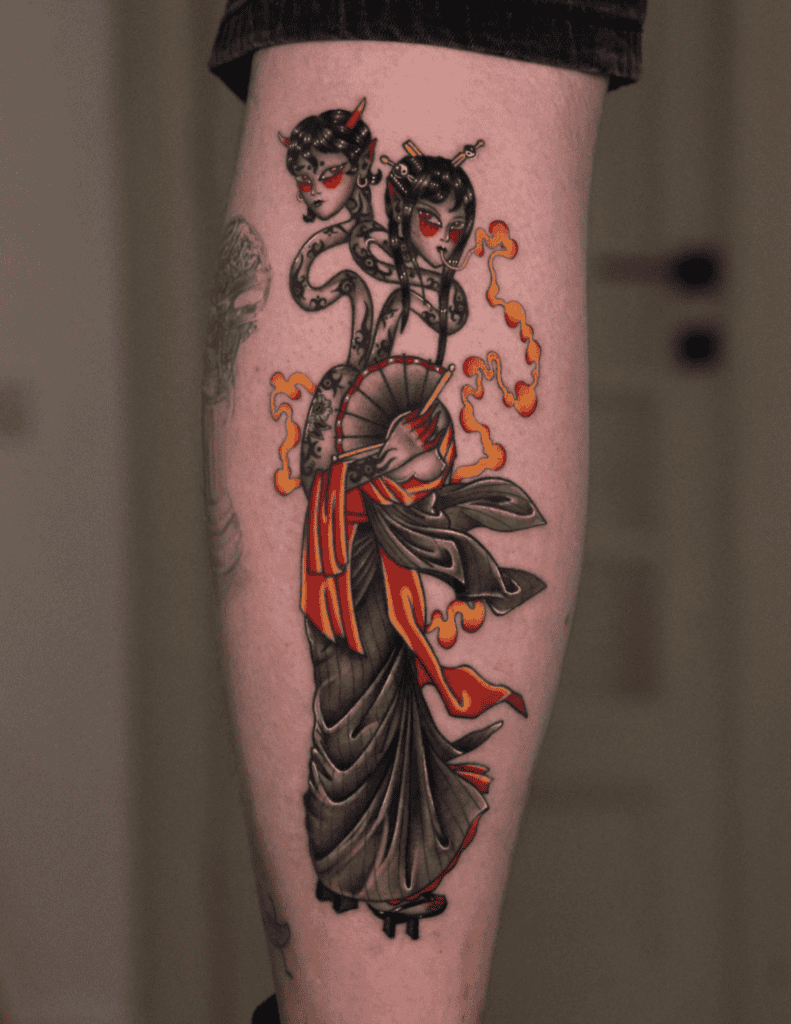
The Rokurokubi (ろくろ首) are one of the most famous and unsettling yōkai in Japanese folklore. At first glance, they look like ordinary women, but at night, their necks stretch to impossible lengths, allowing their heads to wander freely. They are closely tied to ideas of hidden identity, dual lives, and the eerie feeling that something “normal” might not be what it seems.
Rokurokubi appear completely human during the day, but at night, their necks stretch like elastic, their heads can move independently, and they may wander while their bodies stay still. Some versions describe them as unaware of their condition, while others portray them as fully conscious shape-shifters.
Folklore actually describes two variations. The classic neck-stretching Rokurokubi, and the Nukekubi (Head-Splitting Type), a more dangerous variation whose flying head may attack or bite victims.
Hitotsume-kozō Japanese Mythology Tattoo
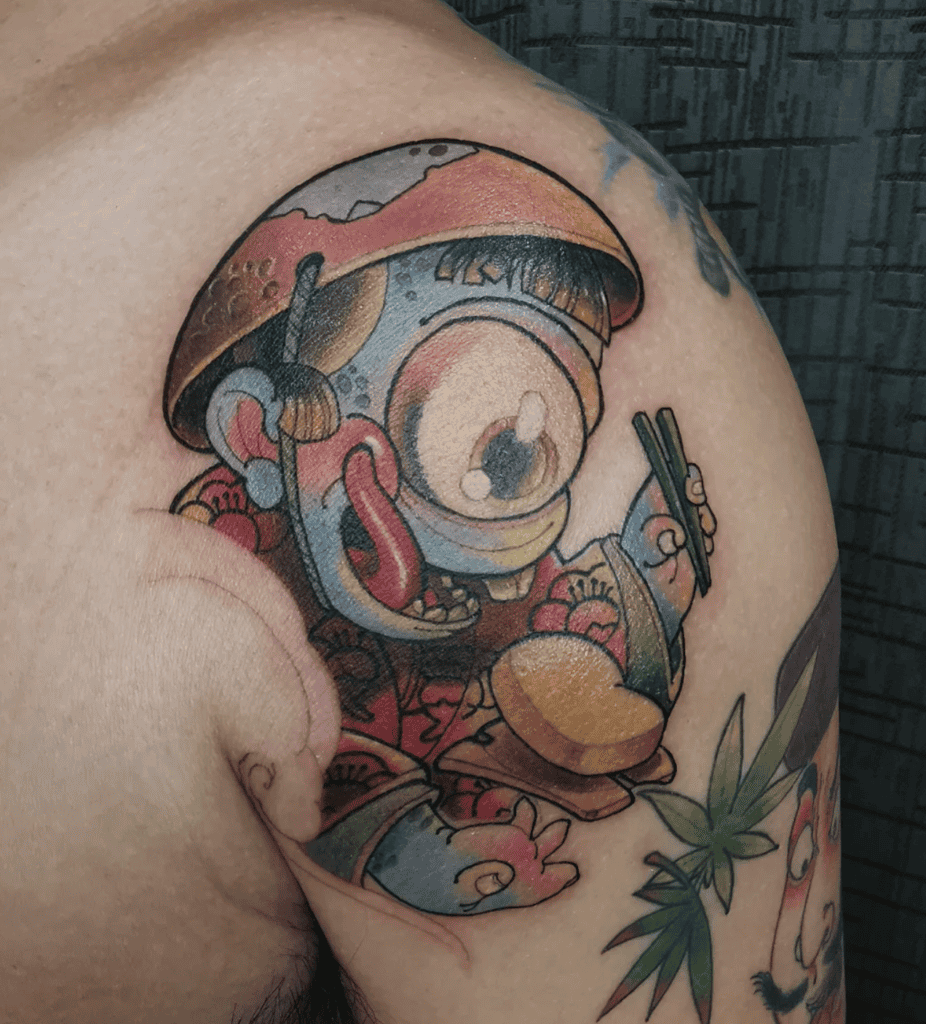
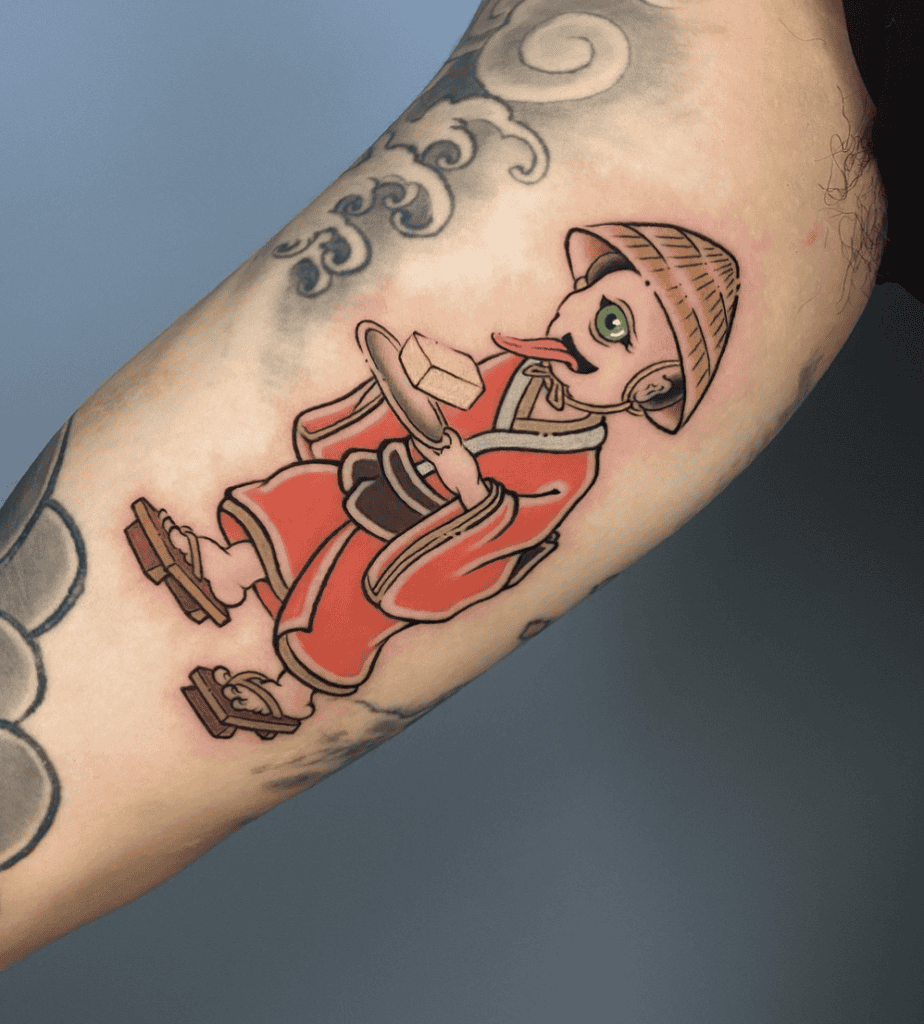
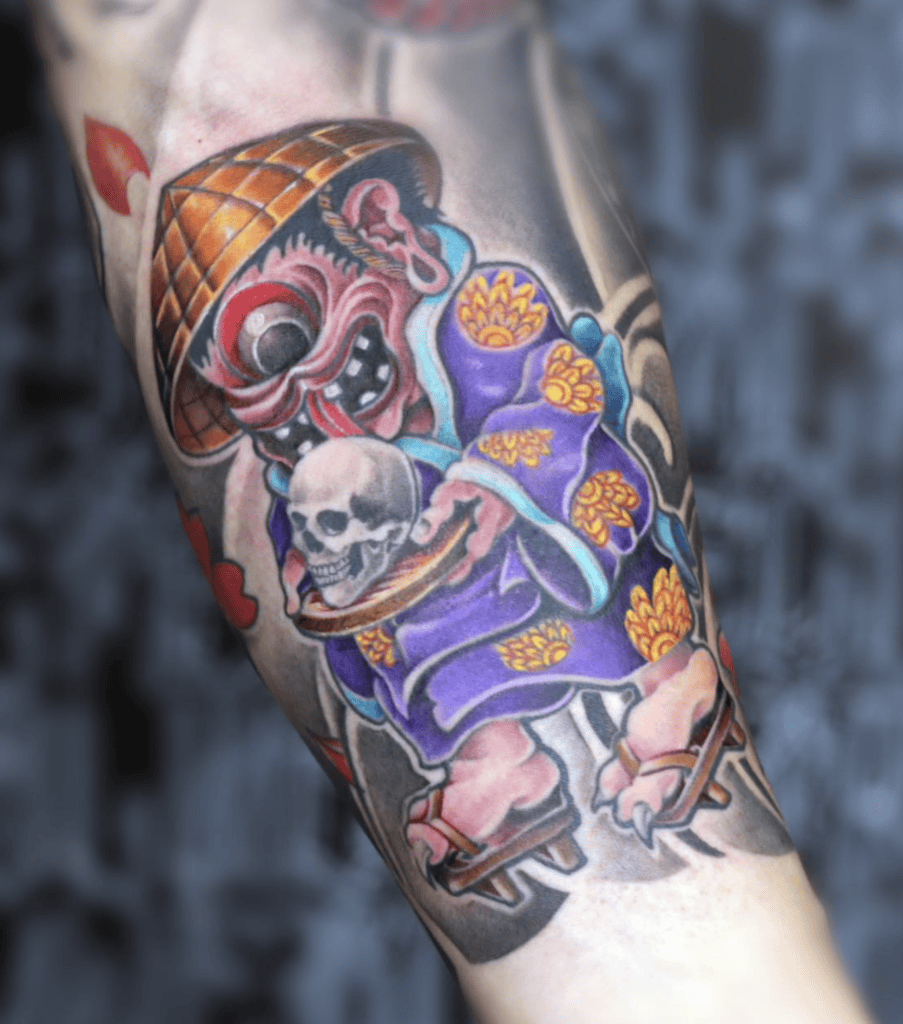
The Hitotsume-kozō (一つ目小僧) is a well-known and often surprisingly friendly yōkai from Japanese folklore. Their name literally means “one-eyed little monk boy,” and they are a supernatural being that appears as a small boy or child monk, wearing simple Buddhist robes and a large eye in the centre of the face
Unlike many scary yōkai, Hitotsume-kozō are usually mischievous and playful, who like surprising travellers and disappearing just as quickly as they arrive.
Nurarihyon Japanese Mythology Tattoo


The Nurarihyon (ぬらりひょん) is one of the most intriguing yōkai in Japanese folklore. He is usually depicted as an elderly, aristocratic-looking man with a gourd-shaped head, who quietly slips into homes and behaves as if he owns the place.
Nurarihyon typically enters human homes uninvited, sits down comfortably, drinks tea, and acts like the master of the home, having made no explanation or introduction. The humans often assume he is an important guest or even the homeowner himself, and because of his calm confidence, no one questions him.
Yuki-onna Japanese Mythology Tattoo
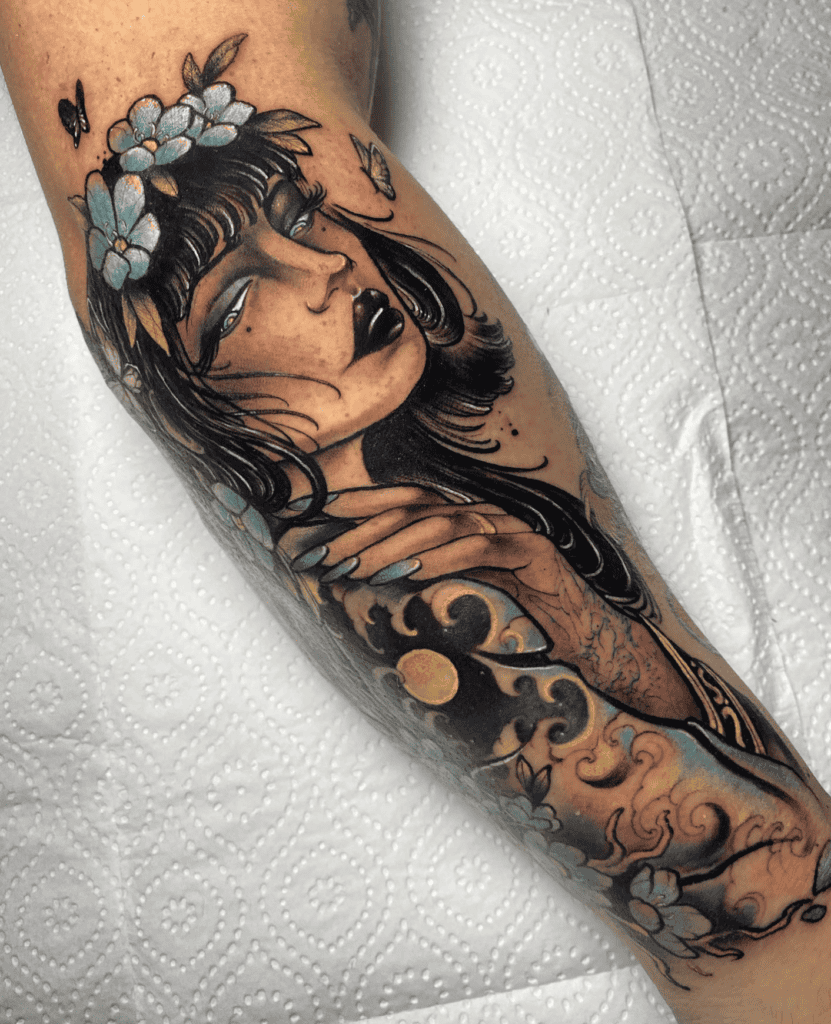
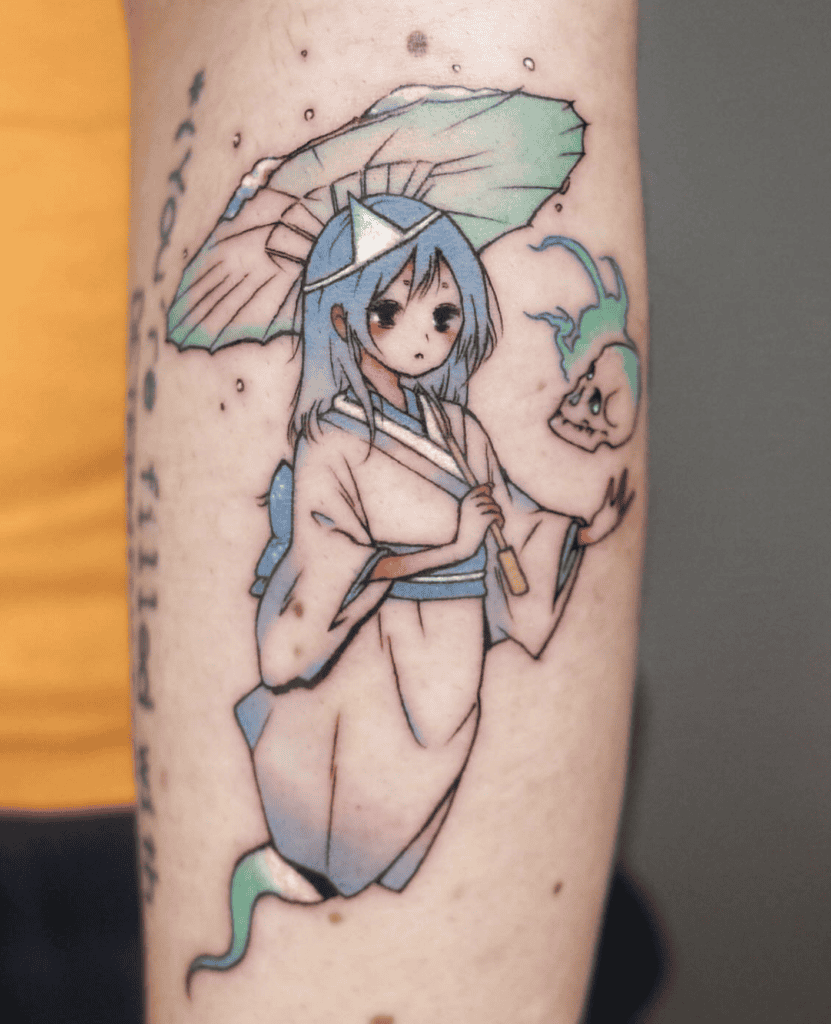
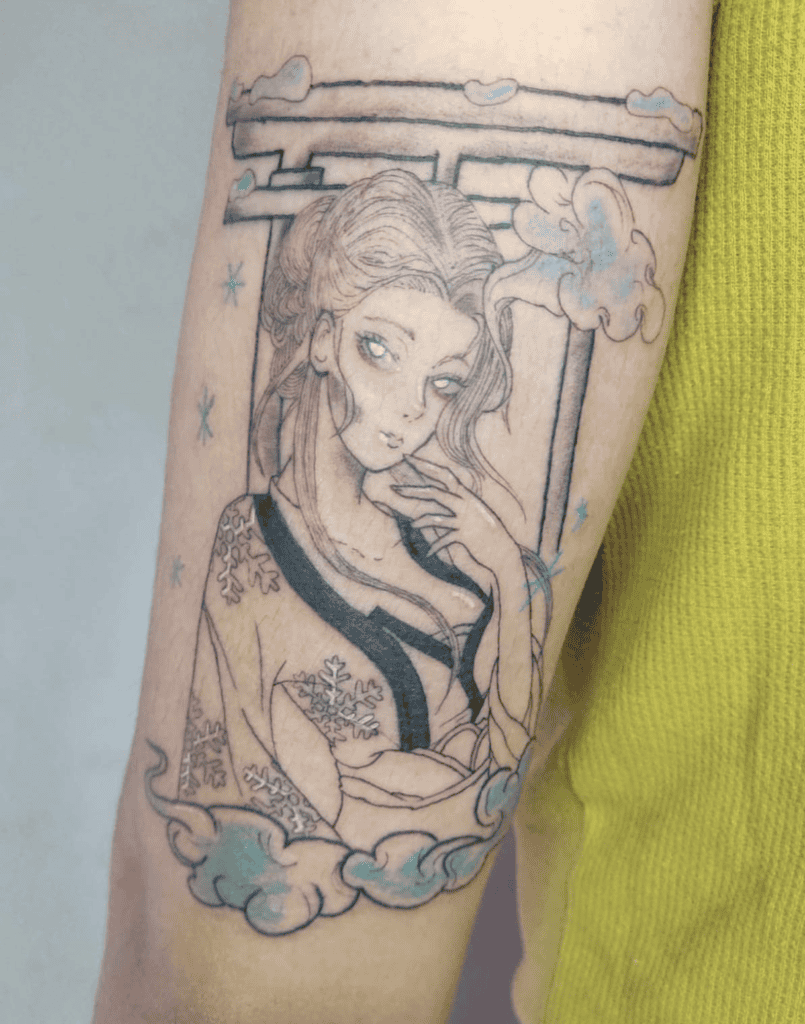
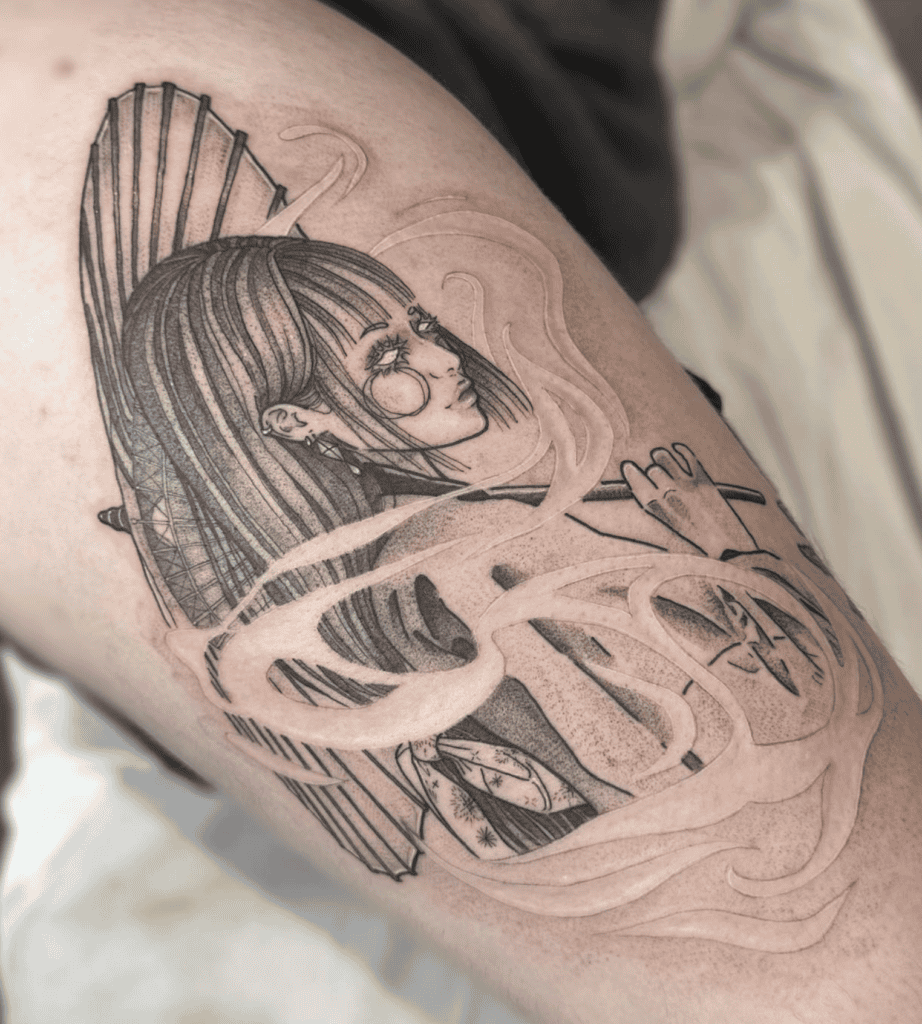
The Yuki-onna (雪女), meaning “Snow Woman,” is one of the most beautiful and haunting figures in Japanese folklore. She is a supernatural spirit who appears during blizzards and snowy nights, often described as a pale woman in a white kimono who silently glides across the snow without leaving footprints. Depending on the story, Yuki-onna can be a cold-hearted killer, a tragic spirit, or even a being capable of love and mercy.
Many Yuki-onna tales follow a common pattern. A traveller becomes lost in a snowstorm, and they encounter a beautiful woman who may guide them, ignore them, or silently observe them. In some versions, she helps them survive, but only if they do not speak of what they saw. If they break that promise, she returns.
One of the most famous Yuki-onna stories involves a warning. She spares a man’s life on the condition that he never tells anyone about her. He agrees, but years later, he tells his wife, and she reveals herself to be Yuki-onna. Instead of killing him, she leaves because of their children or her lingering affection.
Ubume Japanese Mythology Tattoo


The Ubume (産女 or 姑獲鳥) is one of the most emotional and haunting figures in Japanese folklore. She is the spirit of a woman who died during childbirth, often appearing as a grieving mother still desperately trying to care for her child. Unlike many yōkai that are mischievous or monstrous, the Ubume is defined by sorrow, love, and tragedy.
One of the most famous parts of the Ubume legends is the baby she carries. In some stories, the baby is real and alive (a spirit child), while in others, it is an illusion or a bundle of rocks. Sometimes it disappears when someone tries to take it, but in darker versions, it becomes heavier the longer it is carried.
Many Ubume stories follow a similar pattern. A traveller encounters a woman on a lonely road at night. She appears distressed and asks the traveller to hold her baby for a moment. When the traveller agrees, the baby becomes impossibly heavy, and the woman disappears. In some versions, refusing her request can bring misfortune, but accepting it can also be dangerous.
Akaname Japanese Mythology Tattoo

The Akaname (垢嘗), literally meaning “filth licker,” is one of the more strange yōkai. The Akaname is usually described as a small, goblin-like creature with a long, sticky tongue and clawed hands and feet that appears only in unclean, abandoned, or poorly maintained bathrooms.
The Akaname licks dirt and grime from bathtubs and feeds on leftover water and filth. It creeps around at night when no one is watching, avoiding human contact. In traditional Japan, where public bathhouses were common, cleanliness was very important, so this yōkai likely reinforced hygiene habits.
Kasa-obake Japanese Mythology Tattoo
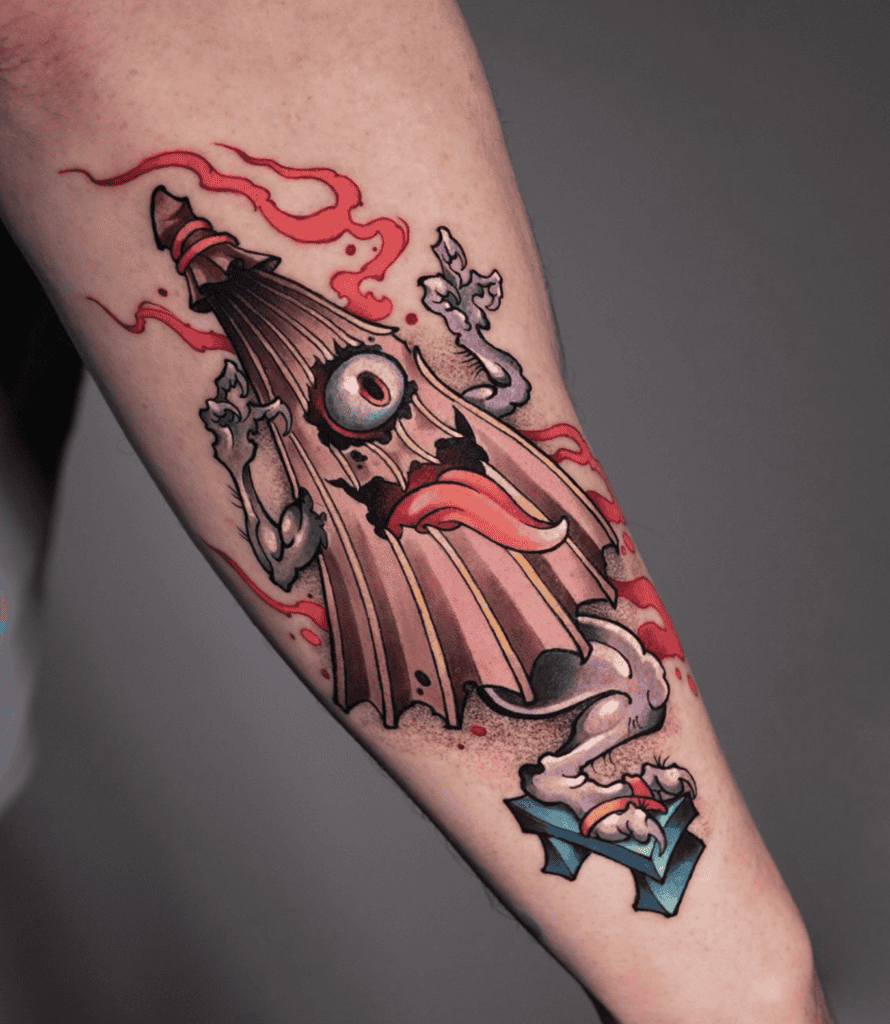
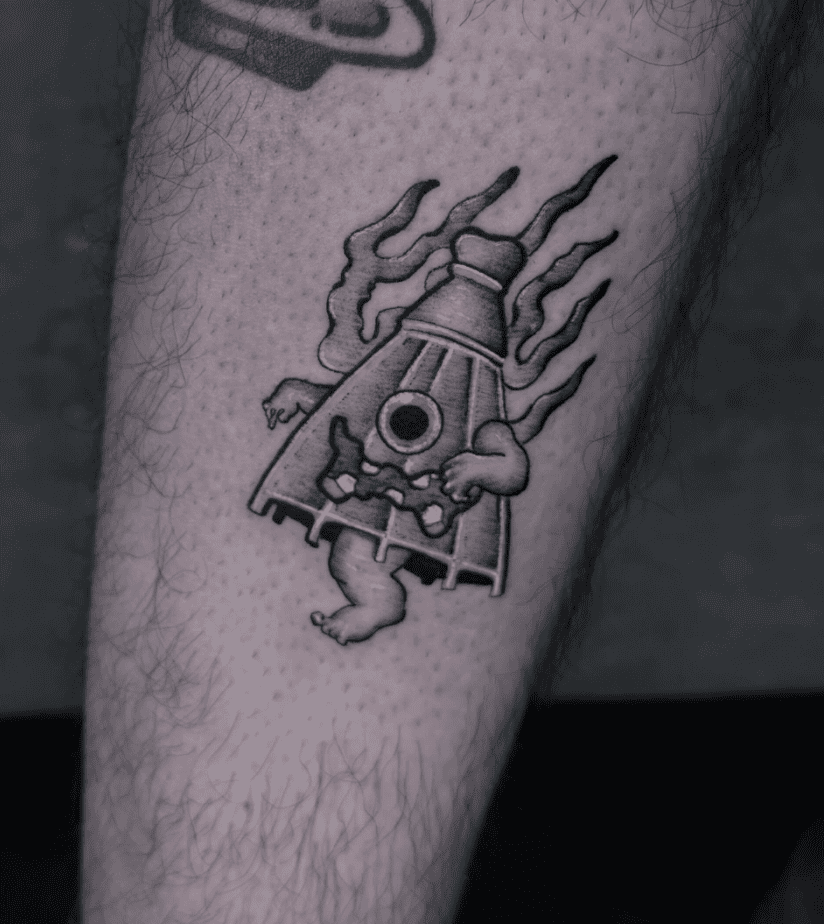
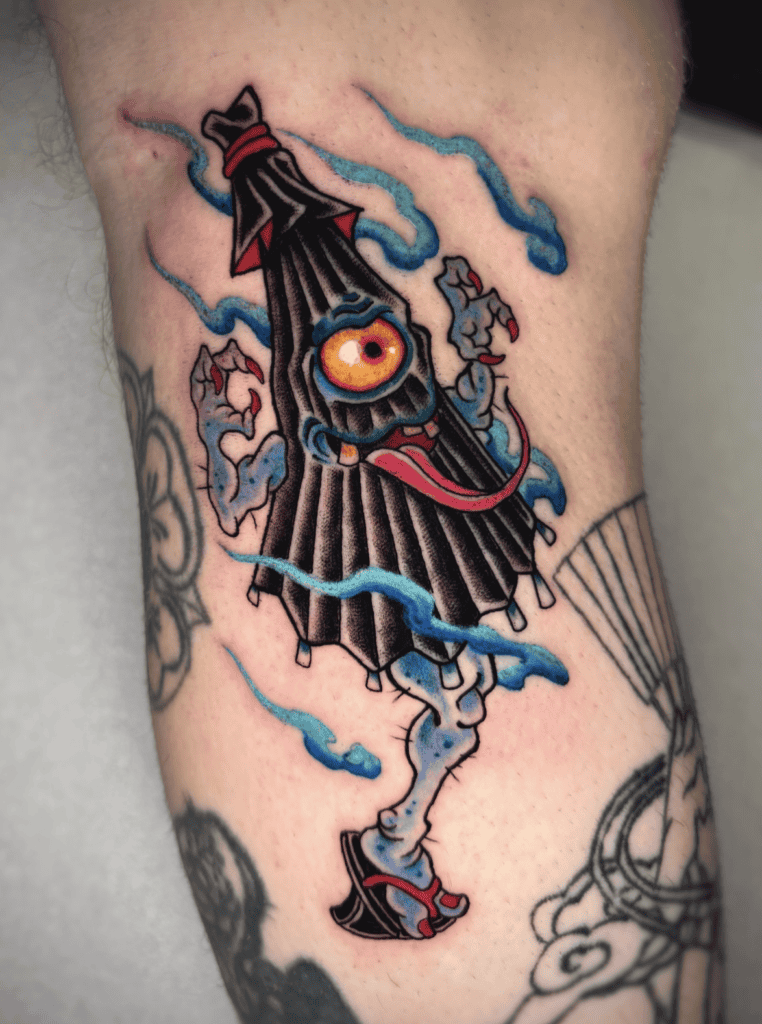
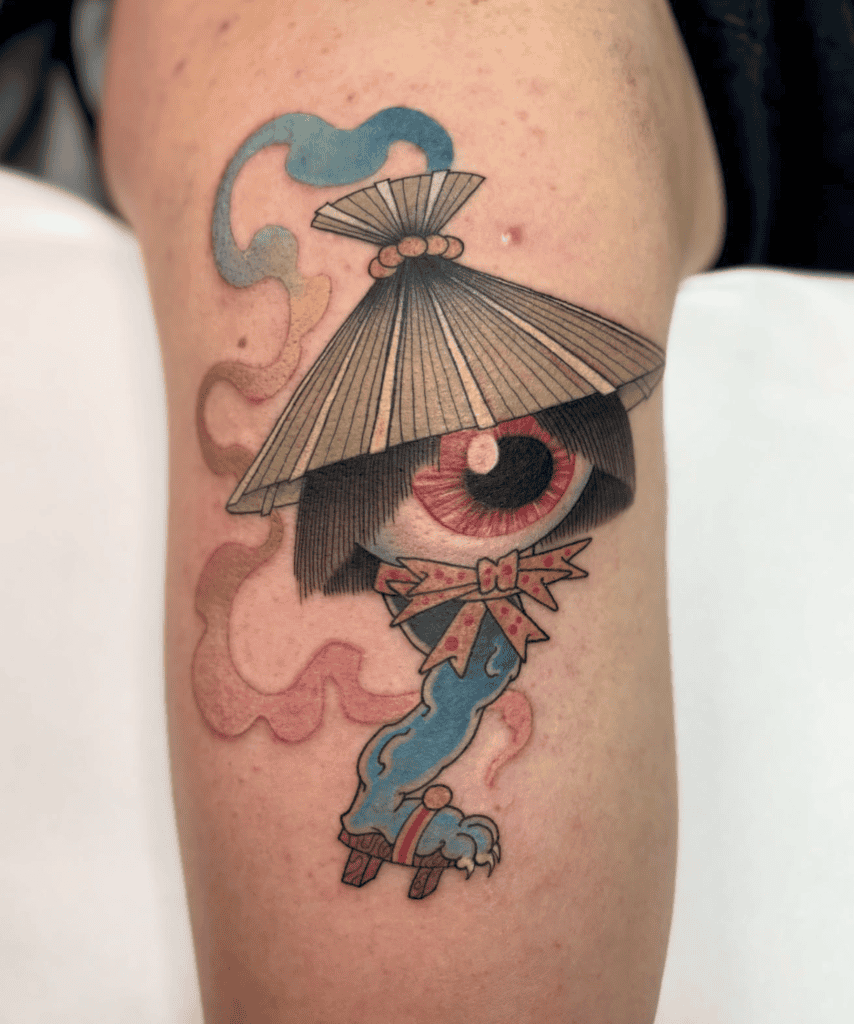
The Kasa-obake (傘おばけ), often called Karakasa-obake, is one of the most iconic and playful yōkai. It’s a haunted umbrella that comes to life, usually depicted as hopping on one leg, with a single eye, a long tongue, and a mischievous personality.
In Japanese folklore, everyday objects can gain spirits when they reach great age. These are known as tsukumogami, and the Kasa-obake is one of the most famous examples. It often looks more silly than scary, almost like a cartoon ghost umbrella.
Ushi-oni Japanese Mythology Tattoo
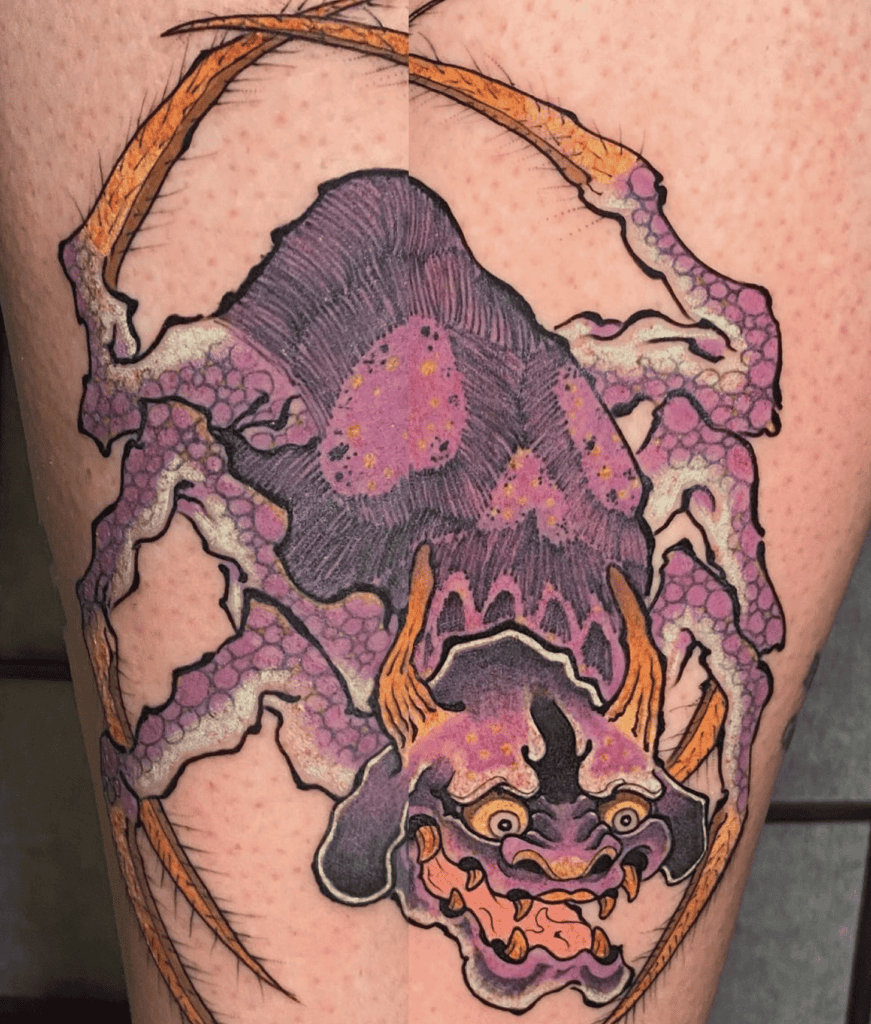
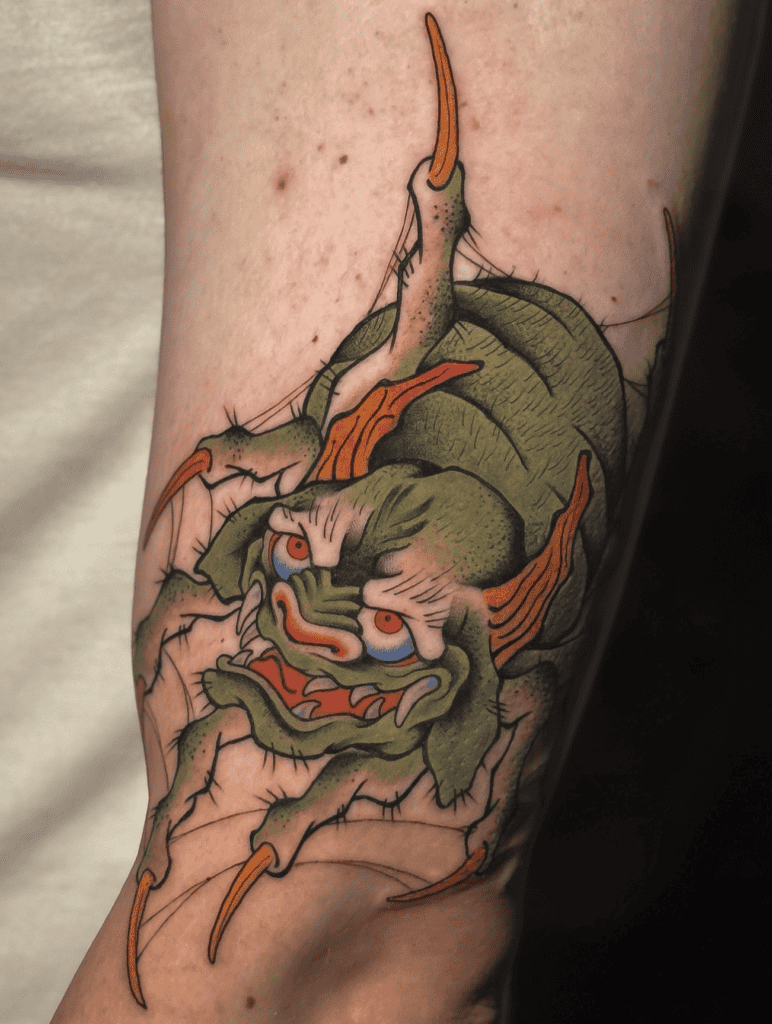
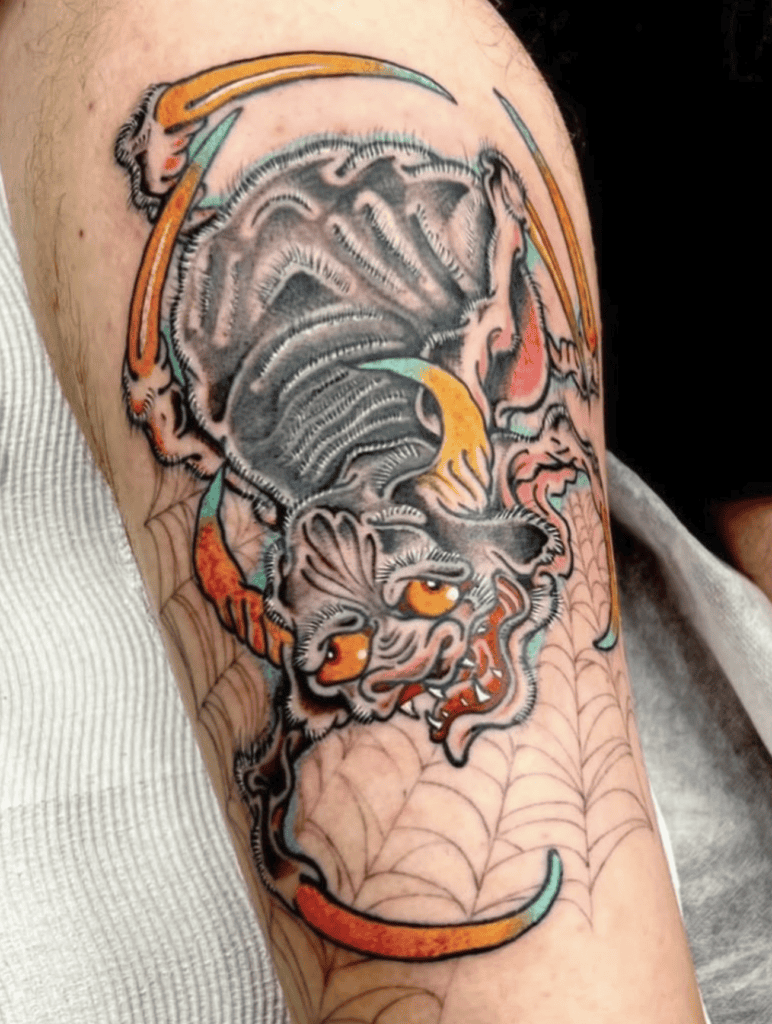
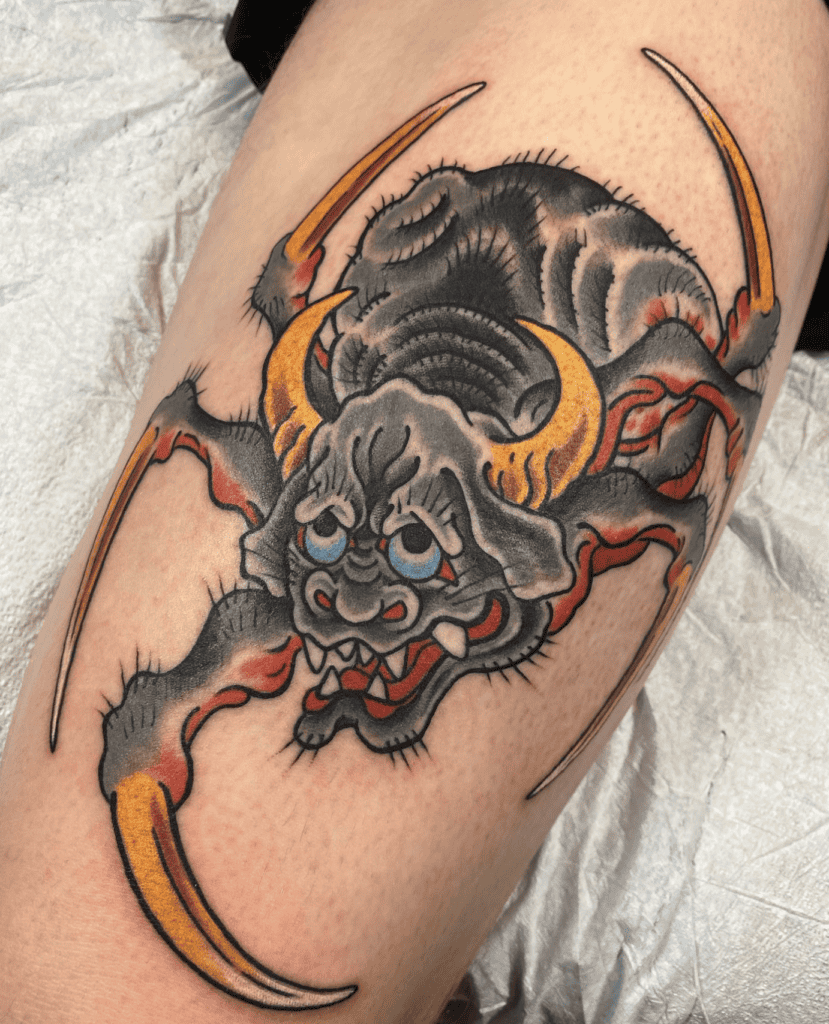
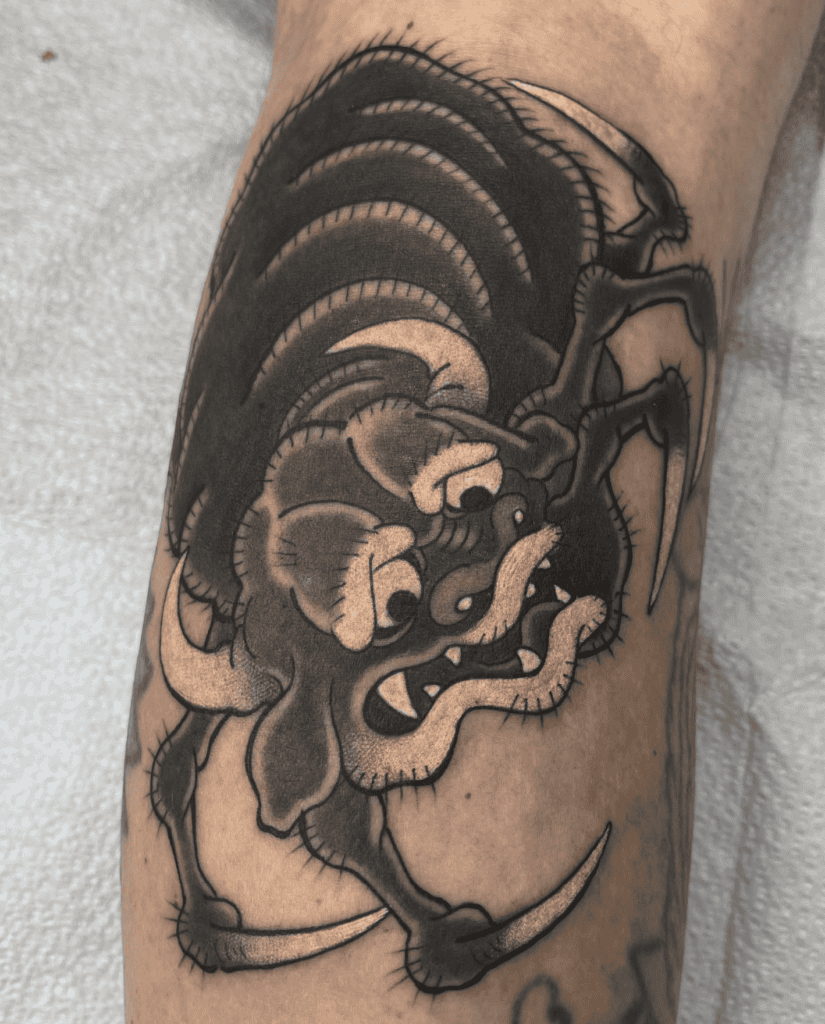
The Ushi-oni (牛鬼), often translated as “cow demon” or “bull demon,” is one of the most terrifying and chaotic yōkai, usually described as a monstrous creature with a bovine head, but its body can vary wildly depending on the region, ranging from that of a giant spider to a crab-like sea beast.
The Ushi-oni is associated with coastal regions, sea cliffs and beaches, foggy, dangerous shorelines and nighttime encounters. One of the most interesting things about the Ushi-oni is that it is not a single fixed creature. In some legends, it appears as a bull mixed with a spider, while in coastal myths, it may look like a giant crab, sea serpent, or a monstrous fish-like creature.
Some stories also describe it as a towering, horned demon, muscular and humanoid, and covered in armour-like hide. This variety makes the Ushi-oni feel like a category of monsters rather than a single being.
Bakotsu Japanese Mythology Tattoo

The Bakotsu (馬骨, often interpreted as “horse bone”) is a fearsome yōkai, usually depicted as a flaming skeletal horse that roams battlefields or haunted places at night. Unlike playful spirits like Kasa-obake or Akaname, Bakotsu belongs to the darker side of yōkai, being closer to a wandering omen of death, war, and unrest.
The Bakotsu is not always a “mindless monster,” as in many interpretations, it is the lingering spirit of a warhorse tied to tragedy. Bakotsu likely comes from Battlefield myths in feudal Japan, the suffering of horses used in war, Buddhist ideas about restless spirits, and the fear of places where many died violently.
Itsumade Japanese Mythology Tattoo

The Itsumade (いつまで) is a terrifying and mysterious yōkai often depicted as a gigantic ghostly bird with a screaming human face, sharp beak, and blazing wings. It is one of the more eerie “omen” creatures in Japan’s mythological tradition. Unlike trickster spirits, the Itsumade is strongly associated with death, fear, and lingering unrest, especially in places affected by war or disaster.
The Itsumade often appears at night, hovering silently over dark landscapes. Its name is believed to come from the Japanese phrase meaning “Until when?” This is linked to one of the most famous legends about the creature.
One of the core stories states that after a great disaster, war, or famine, many bodies remain unburied. The spirits of the dead grow restless, and a monstrous bird appears and cries out, “Itsumade? Itsumade?” (“Until when? How long will this continue?”). It continues to appear until the dead are properly buried and honoured. This makes the Itsumade less of a random monster and more of a manifestation of suffering and unresolved death.
Wani Japanese Mythology Tattoo

The Wani (鰐) is a mysterious creature from Japanese mythology, who, depending on the source,is described as either a giant sea monster, a crocodile-like beast, or a dragon-like ocean spirit. Because ancient texts vary, the Wani is often seen as a blend between myth and early interpretations of foreign or unknown animals.
The Wani appear in some of Japan’s oldest mythological records, including early chronicles like the Kojiki and Nihon Shoki. Because Japan does not have native crocodiles, many scholars believe early Japanese people may have encountered foreign crocodile or alligator descriptions.
The Wani may have been inspired by misunderstood sea creatures or imported stories
Over time, it became a mythical ocean monster in its own right. In some stories, Wani are creatures that transport or challenge gods, beings inhabiting the boundary between sea and land, and guardians or obstacles during mythic journeys.
Chōchin-obake Japanese Mythology Tattoo
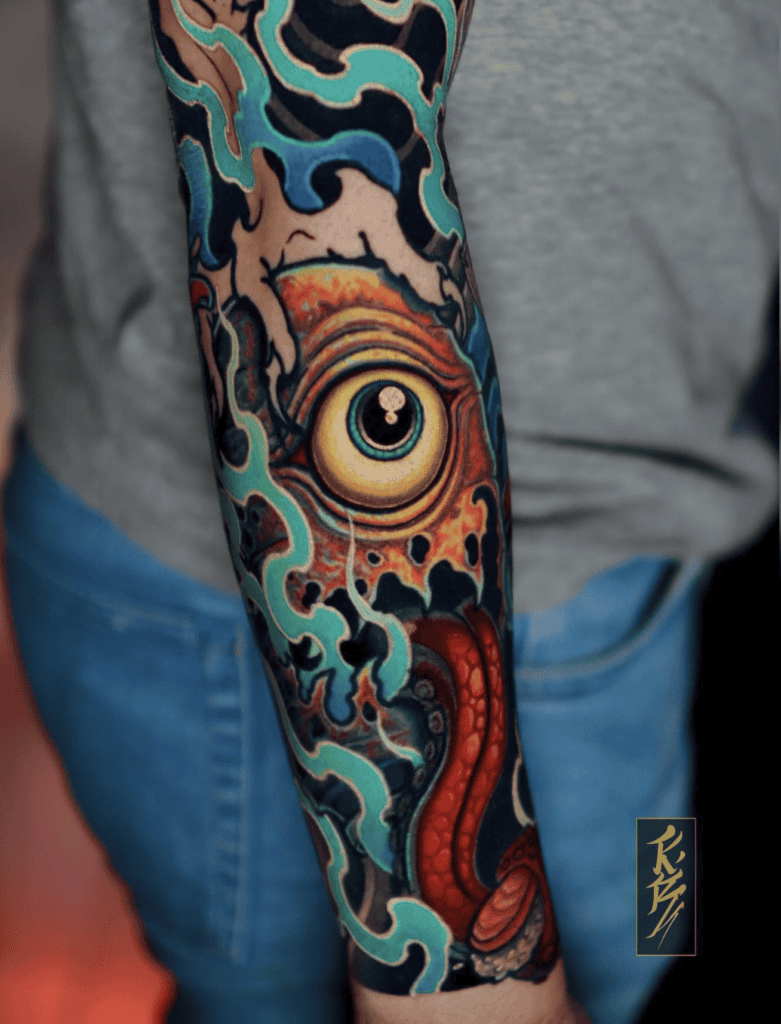
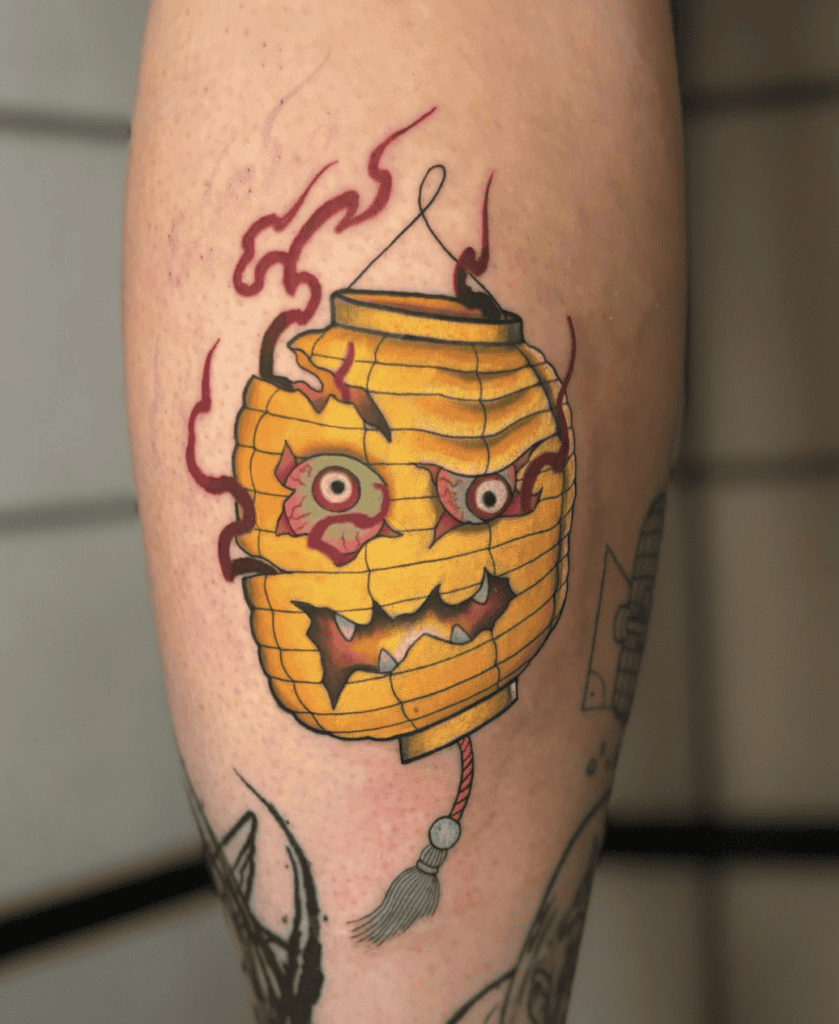
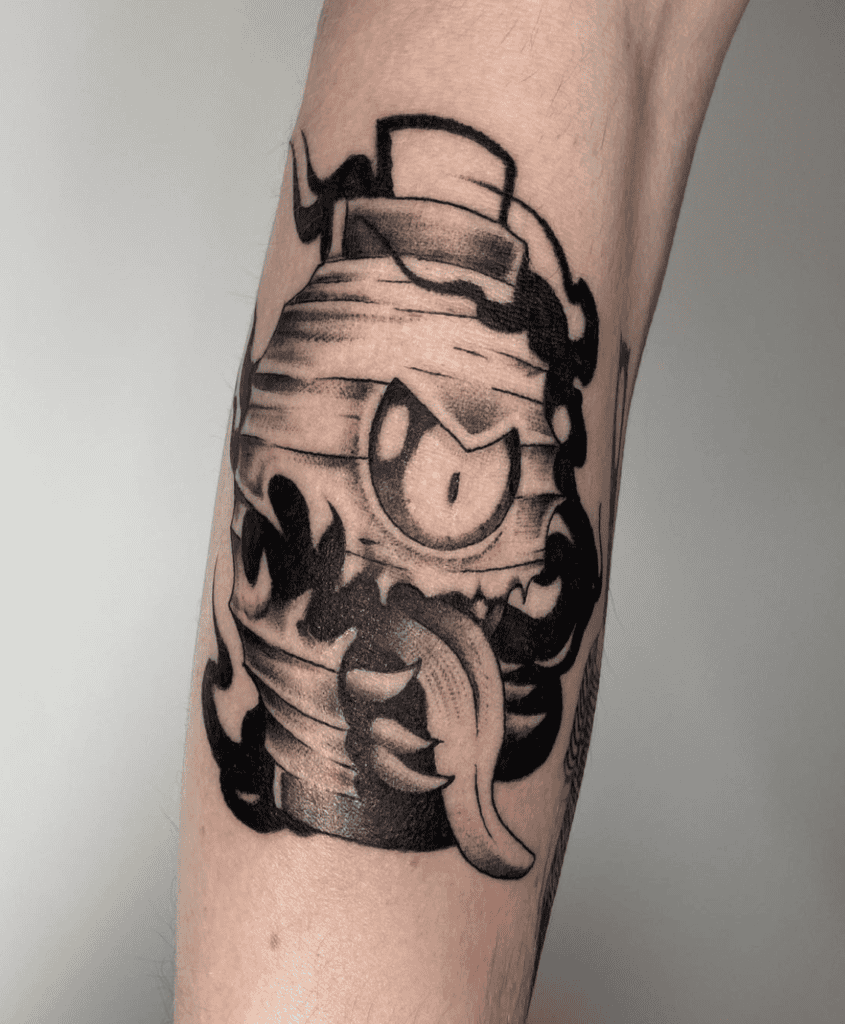
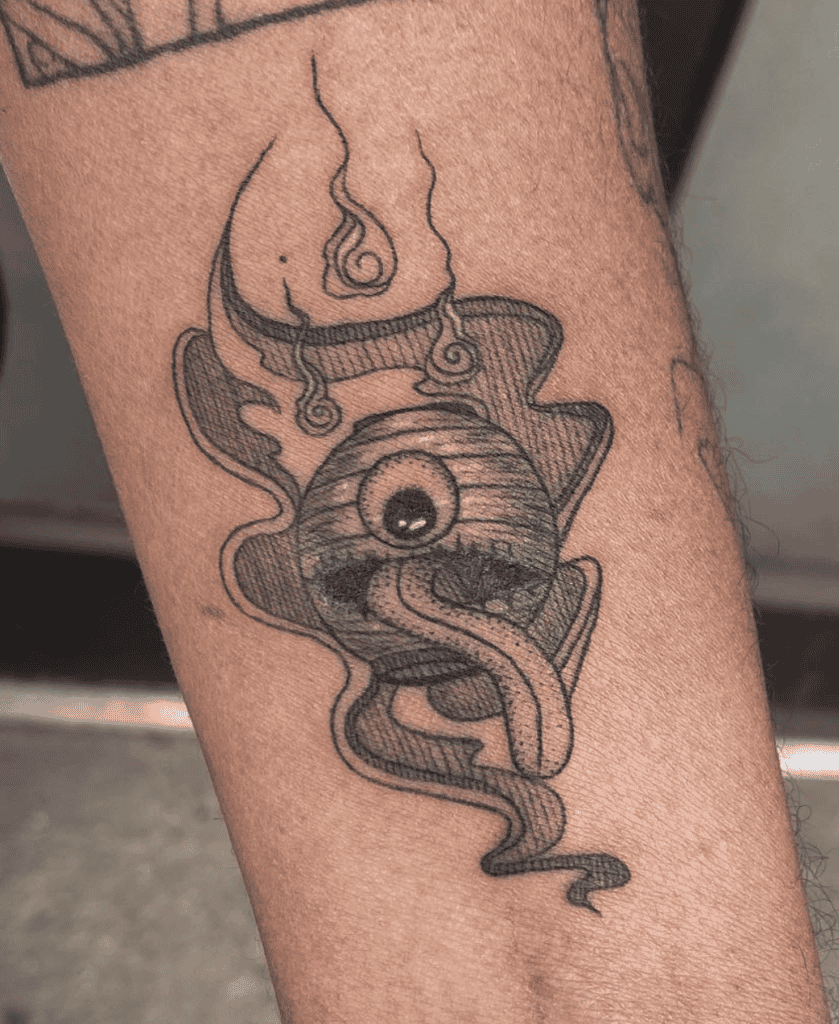
The Chōchin-obake (提灯お化け) is one of the most iconic and playful examples of a tsukumogami. In this case, it is a haunted paper lantern that transforms into a mischievous spirit after being used for many years.
Instead of being terrifying, the Chōchin-obake is usually more comical, quirky, and atmospheric, often appearing with a big eye, a long tongue, and a wide grin emerging from the torn paper lantern.
Tsuchigumo Japanese Mythology Tattoo
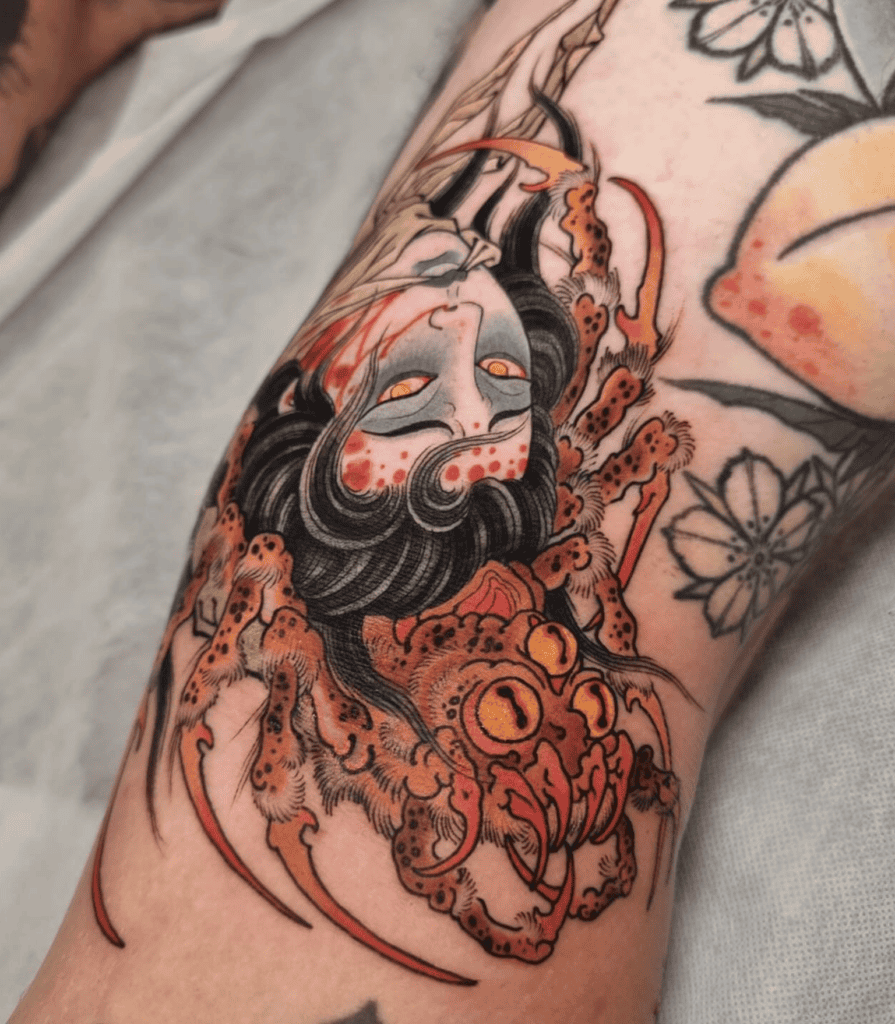
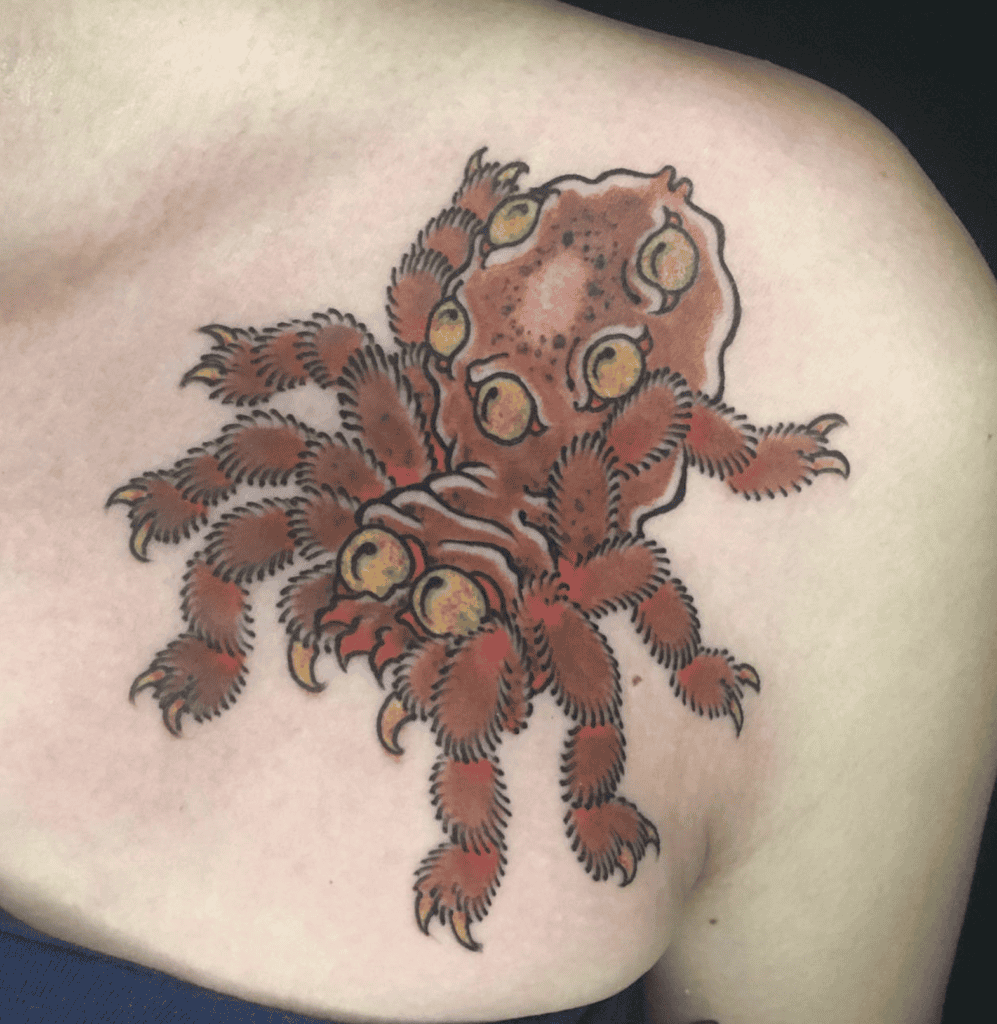
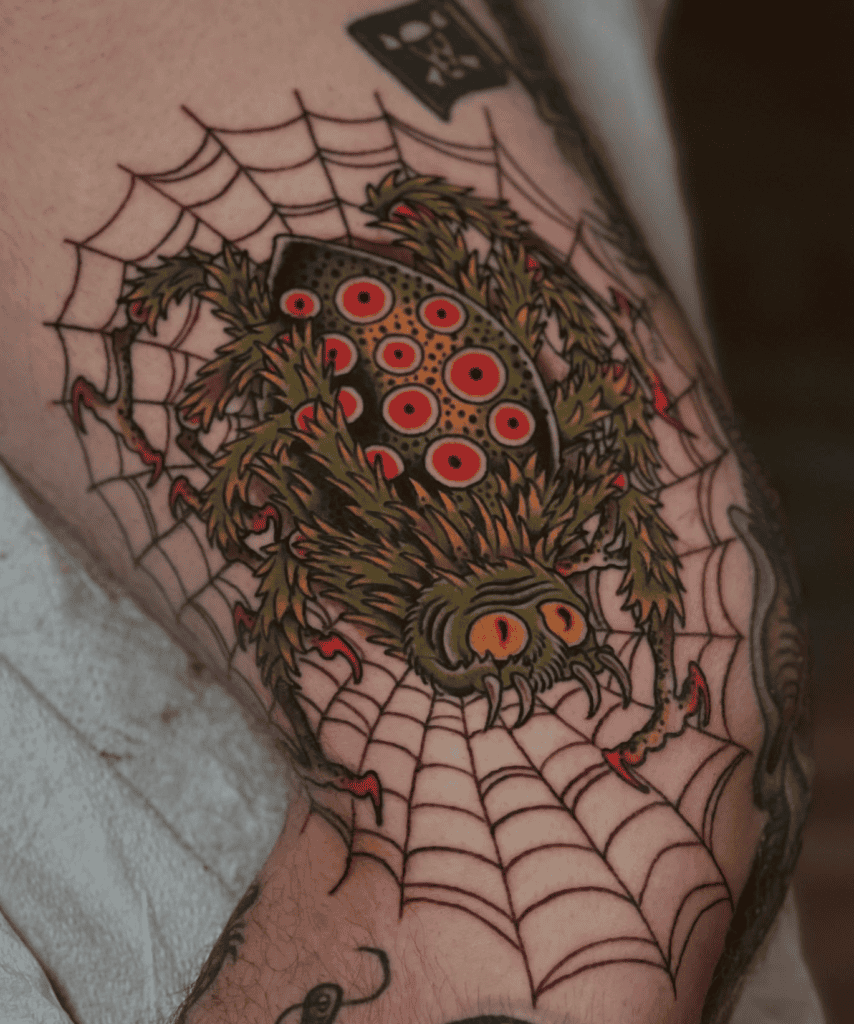
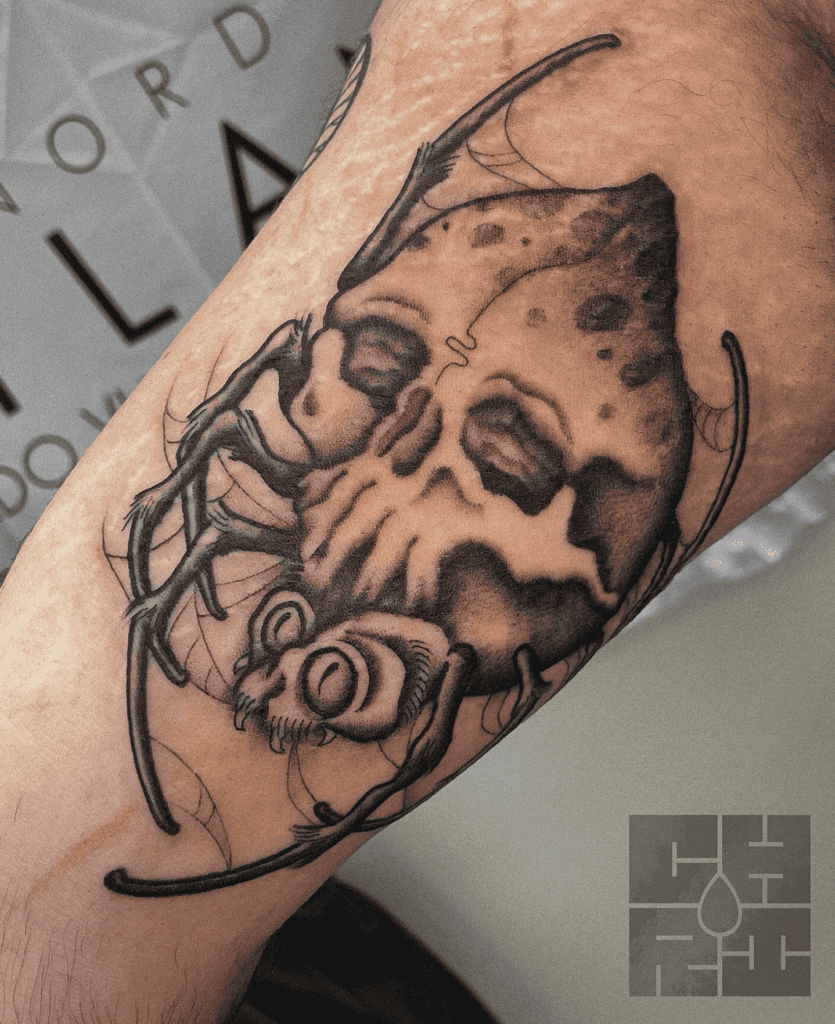
The Tsuchigumo (土蜘蛛), meaning “earth spider,” is one of the most ancient and fearsome yōkai in Japanese folklore. It is usually described as a gigantic spider-like monster that lives in caves, mountains, or deep underground, spinning massive webs and attacking unsuspecting humans.
In ancient Japan, “Tsuchigumo” was also used as a political insult for rebellious local clans who resisted the imperial court. Over time, these groups were mythologised into literal spider monsters in folklore.
Mokumokuren Japanese Mythology Tattoo


The Mokumokuren (目目連) is a creepy and clever yōkai from Japanese folklore that appears in old, abandoned houses. Its name roughly means “many-eyed gaze”, and it describes a phenomenon where eyes suddenly appear in damaged paper walls or sliding doors staring back at anyone who notices them.
Mokumokuren is usually described as a spirit inhabiting old houses that watches silently from walls and sliding doors, only revealing itself when a house is neglected or abandoned.
The Mokumokuren is often explained as a manifestation of neglect, a spirit born from damaged or uncared-for homes, or a warning that a place has been abandoned too long.
Shuten-dōji Japanese Mythology Tattoo


The Shuten-dōji (酒呑童子) is one of the most famous and terrifying figures in Japanese folklore. He is often called the “Drunken Demon Child,” but = is described as a massively powerful oni king who terrorised the capital and kidnapped people, especially noblewomen.
Shuten-dōji’s story is one of Japan’s most famous demon-slaying tales. He is said to have lived in a mountain fortress filled with oni who kidnapped women from Kyoto and the surrounding areas. He devoured humans or used them for cruel purposes, causing fear throughout the imperial capital.
Minamoto no Yorimitsu, along with his four legendary retainers, were ordered to destroy Shuten-dōji. They disguised themselves as monks or travellers and brought poisoned sake into Shuten-dōji’s lair. They gained his trust by offering alcohol (his weakness) and waited for him to become intoxicated.
Once the demon was weakened, they struck. In the final battle, Shuten-dōji revealed his true monstrous form, and a massive fight erupted in the demon fortress. Yorimitsu decapitated him, but even after losing his head, the demon tried to bite back.
Yamata no Orochi Japanese Mythology Tattoo
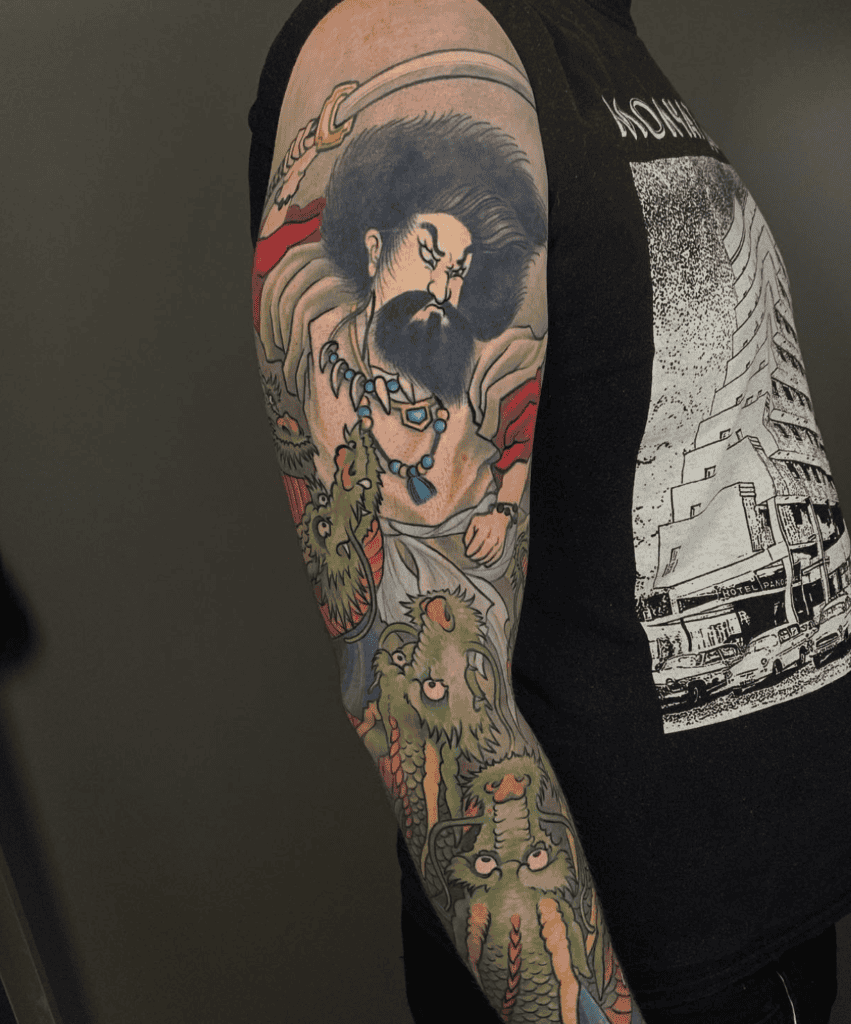
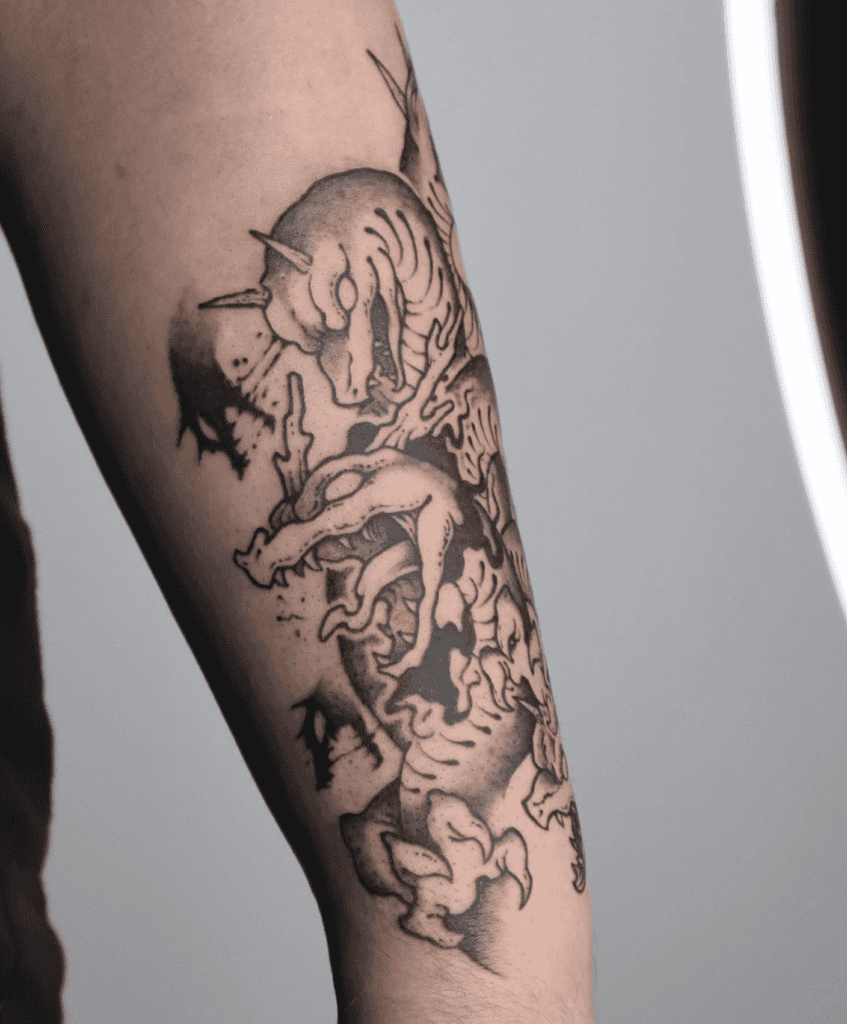
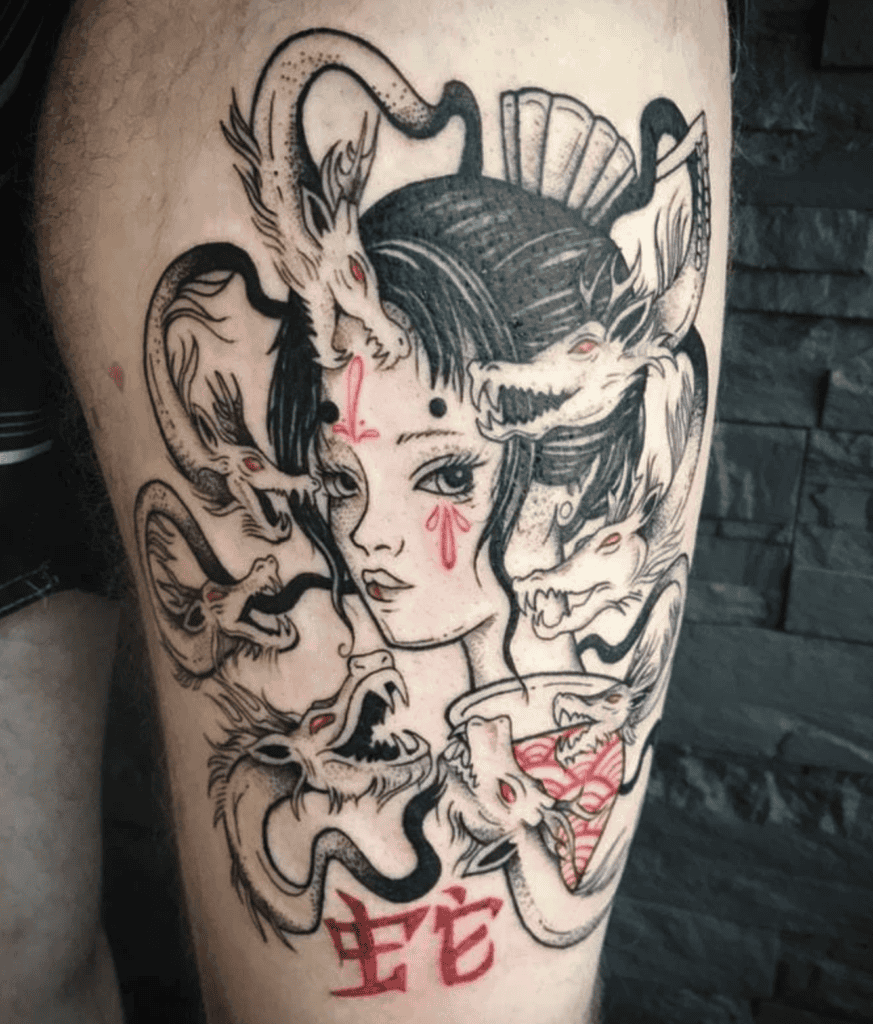
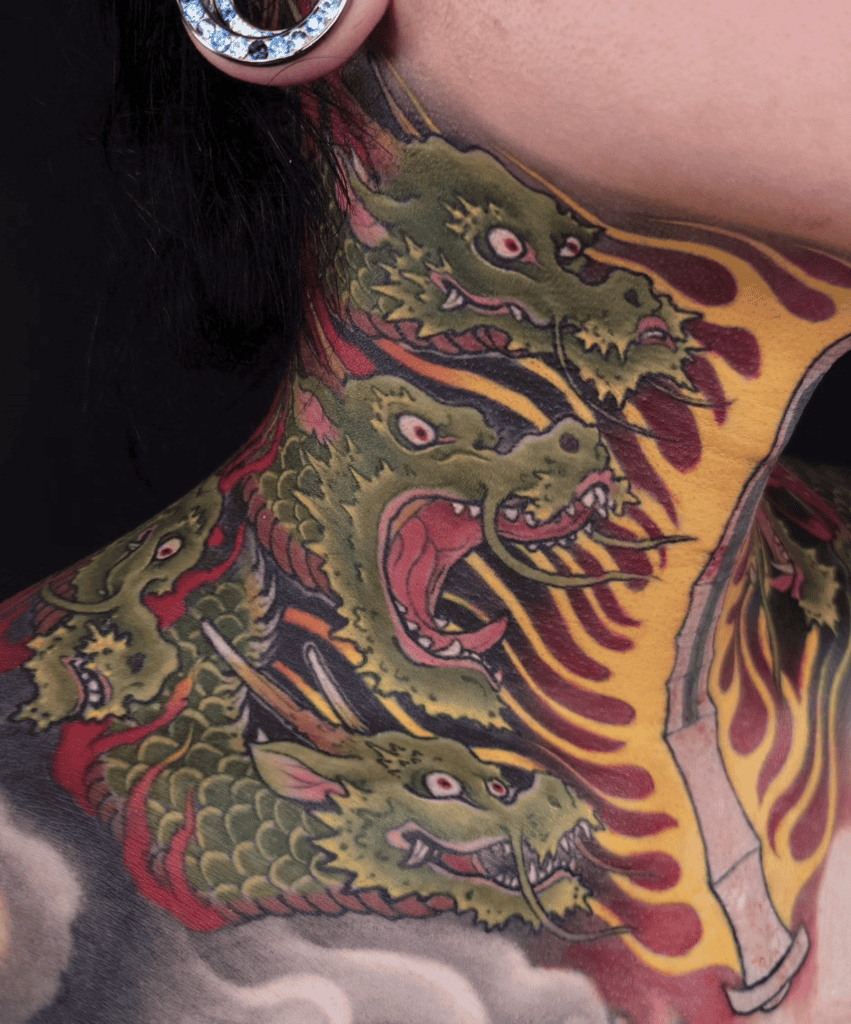
Yamata no Orochi (八岐大蛇) is one of the most legendary and fearsome monsters in Japanese mythology. It is a colossal snake-dragon creature with eight heads, eight tails, red glowing eyes, a body covered in moss, trees, and forests, and an enormous size spanning mountains and rivers
The story of Yamata no Orochi appears in the ancient Japanese chronicle Kojiki and also in Nihon Shoki. The tale begins when the storm god Susanoo-no-Mikoto is wandering after being exiled from Heaven. He encounters an elderly couple who explain that Yamata no Orochi has been devouring one of their daughters every year.
The serpent will soon return to claim her, so Susuanno decides to help. Using trickery, he manipulated the beast to consume alcohol into each of its eight heads, and once drunk, Susuanno struck.
Nue Japanese Mythology Tattoo
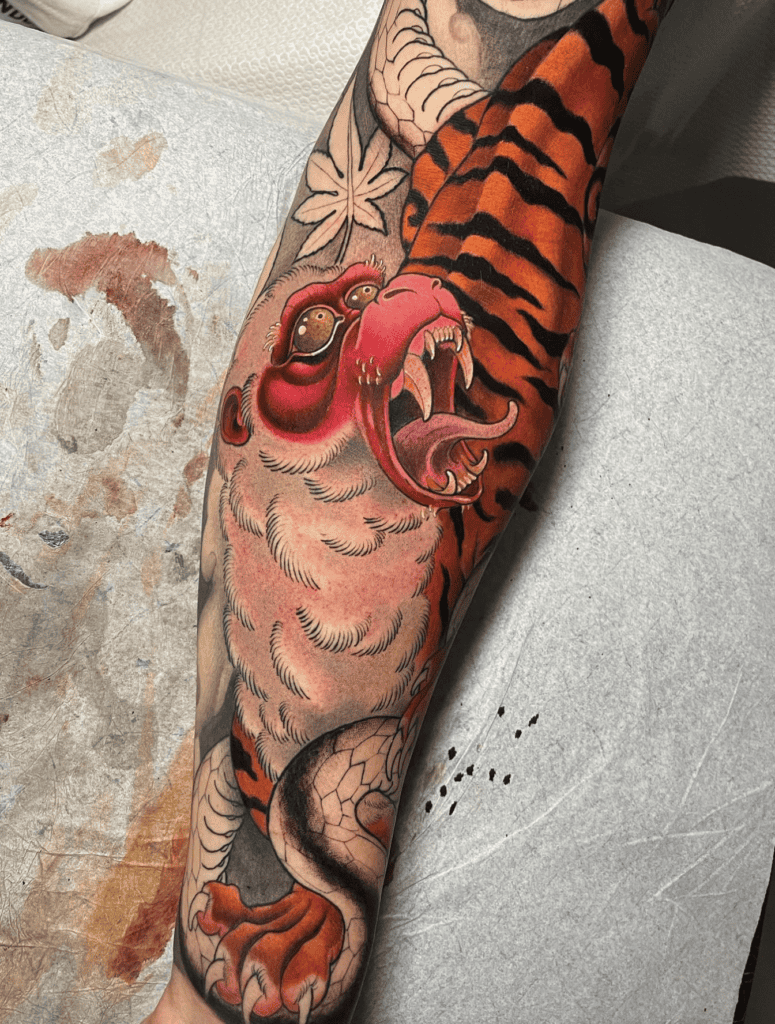
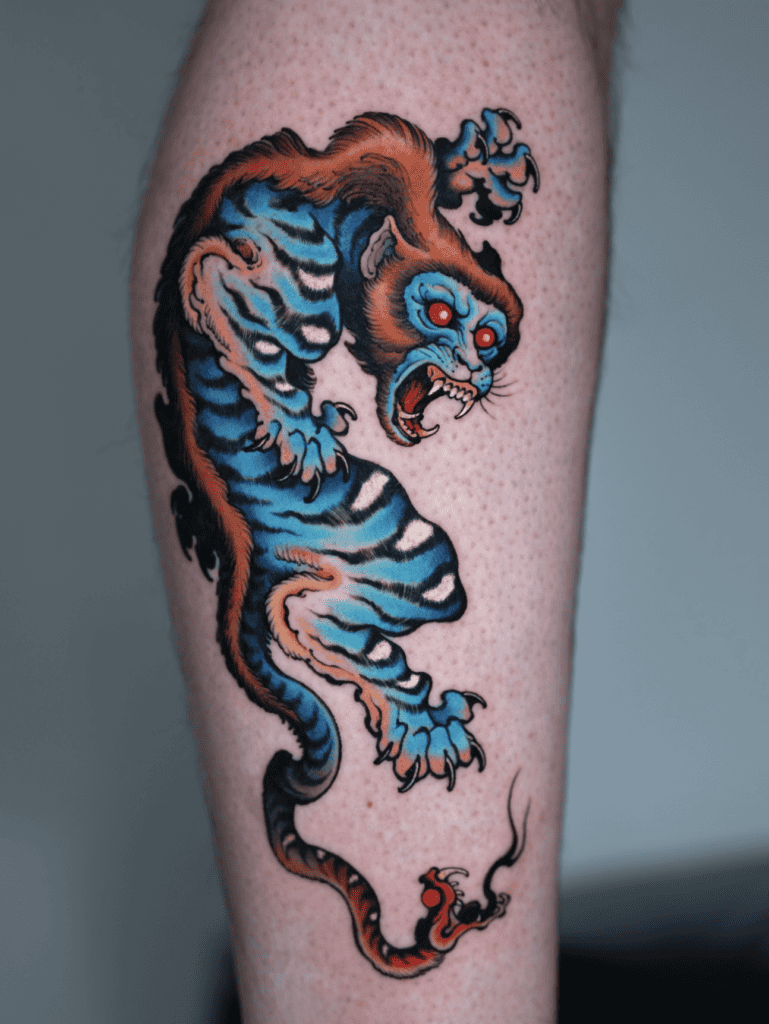
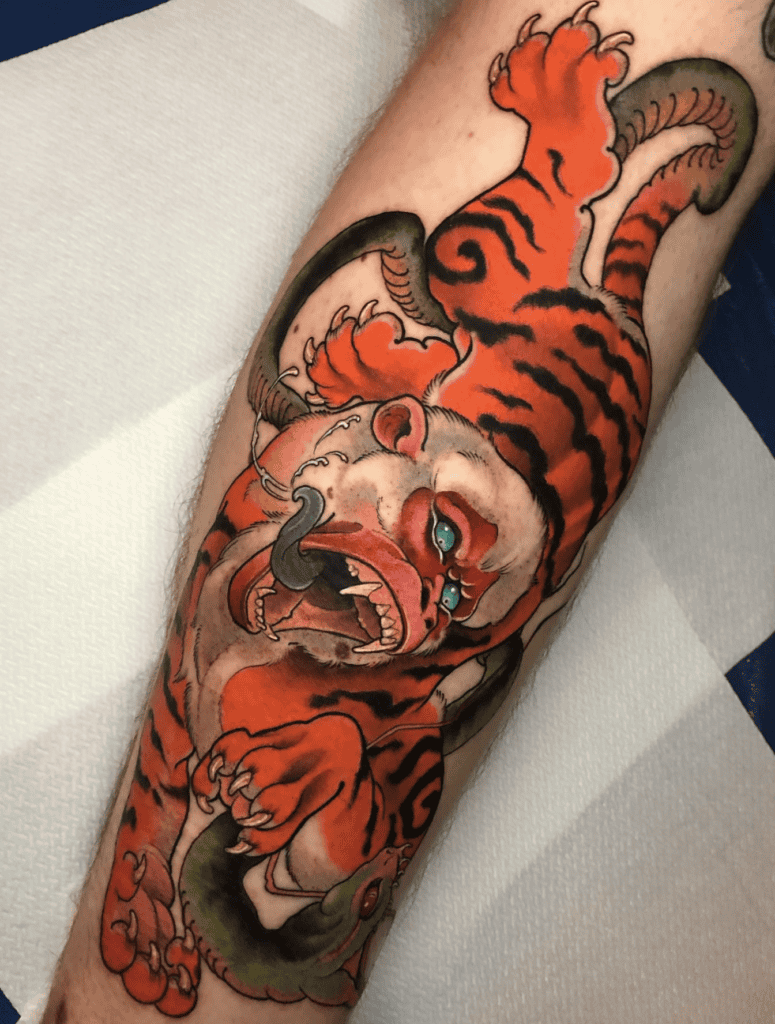
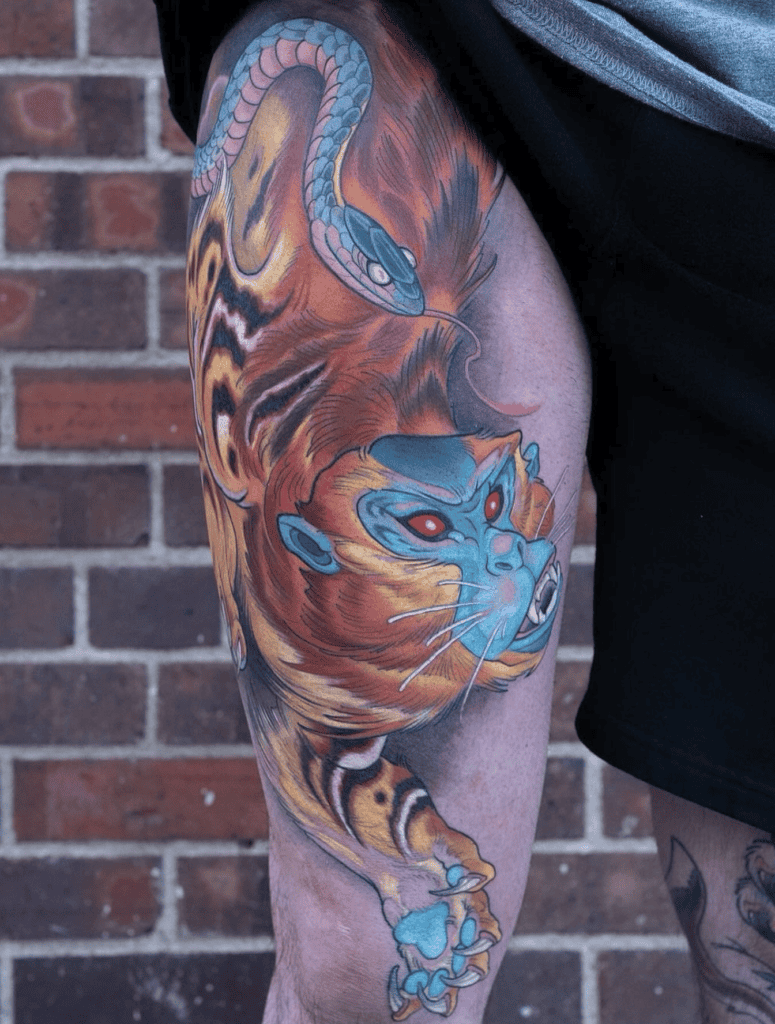
The Nue (鵺) is a chimaera from Japanese mythos mixing the head of a monkey, the body of a tiger, the tail of a snake, and the limbs of a tiger. Feared as an omen of disaster and illness, the Nue is famous for haunting the Imperial Palace and being defeated by a legendary samurai. This creature is often surrounded by dark storm clouds, unnatural fog, and calls out with eerie cries in the night.
The most famous Nue story takes place during the Heian period. The reigning emperor became mysteriously ill, and every night a dark cloud appeared above the palace. Strange cries echoed through the darkness, and the emperor’s condition worsened
No one could identify the cause, so Minamoto no Yorimasa was called upon to investigate. Yorimasa waited for the creature to appear, and when the dark cloud formed above the palace, he drew his bow and fired a sacred arrow into the cloud. The Nue was struck and fell from the sky, leading to the emperors’ recovery, and the monster’s curse ended.
Kirin Japanese Mythology Tattoo
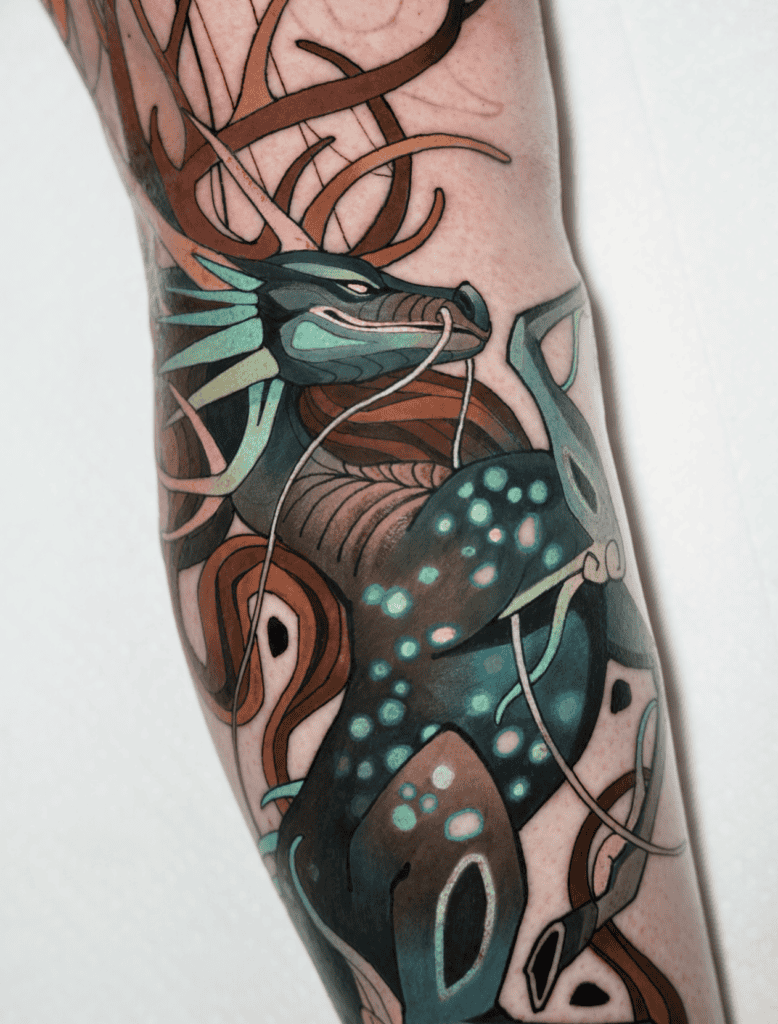
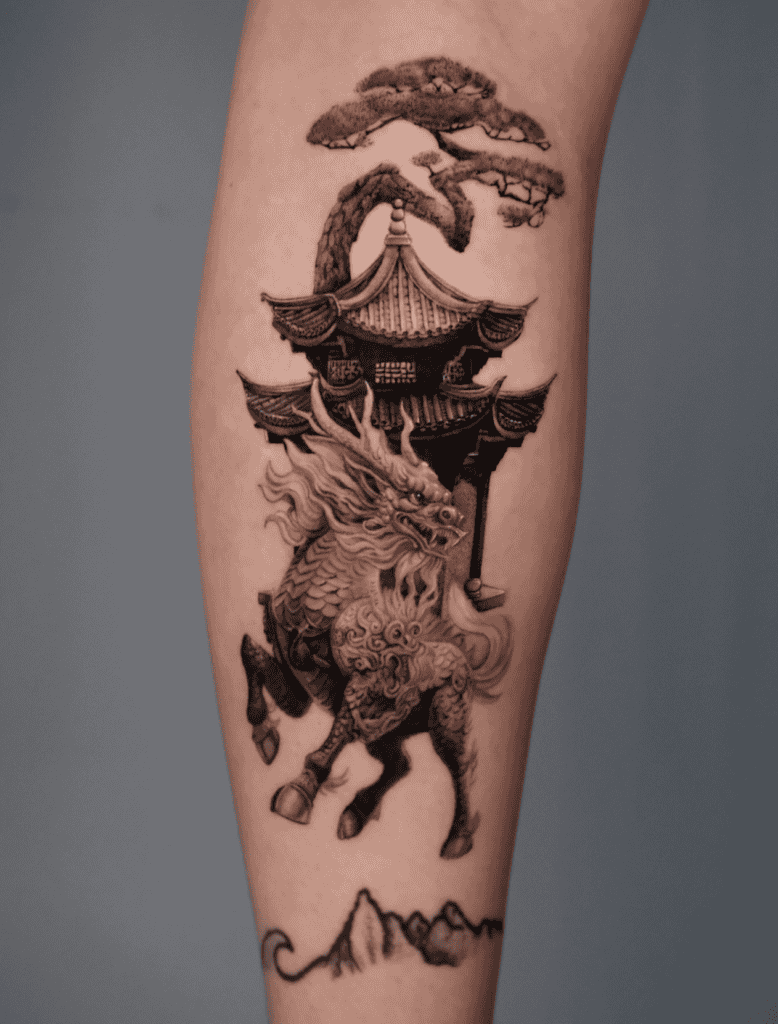
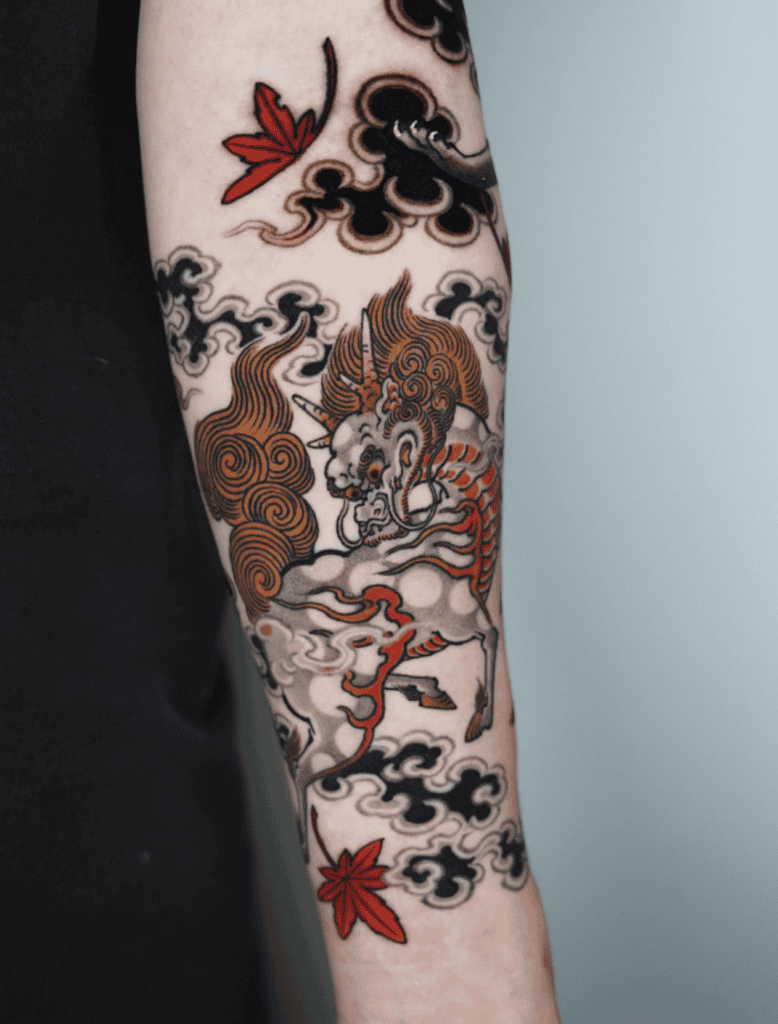
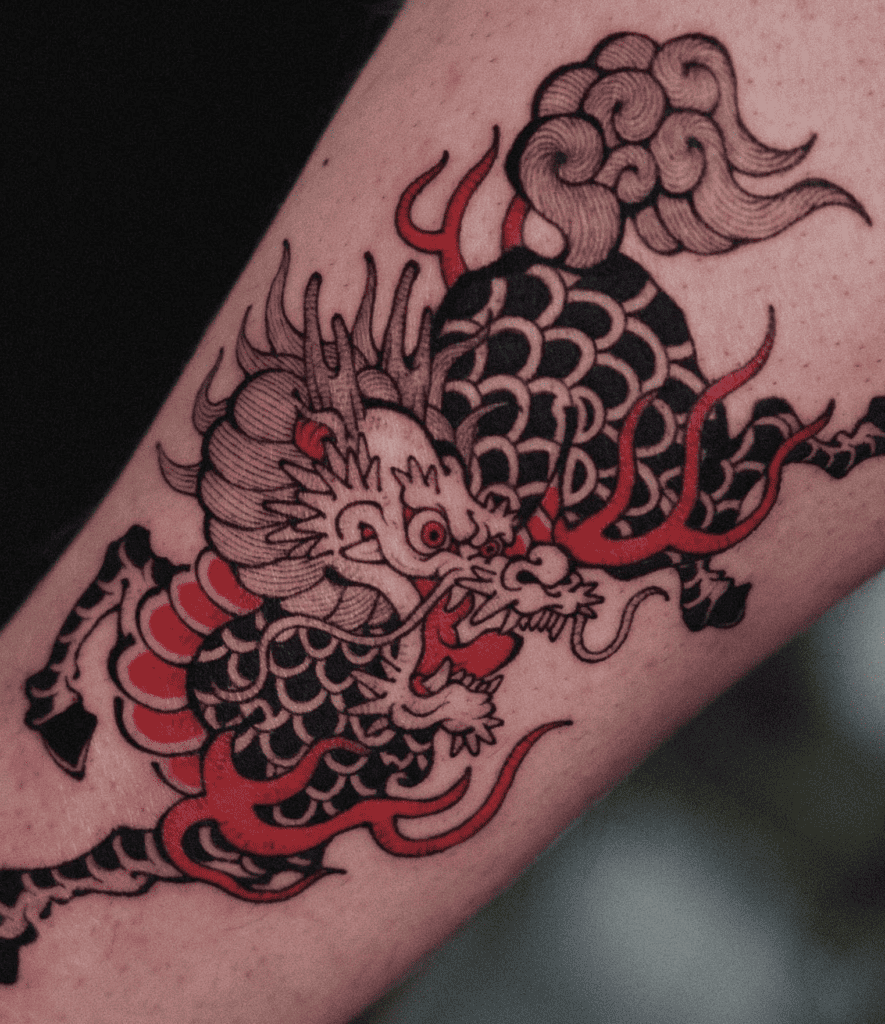
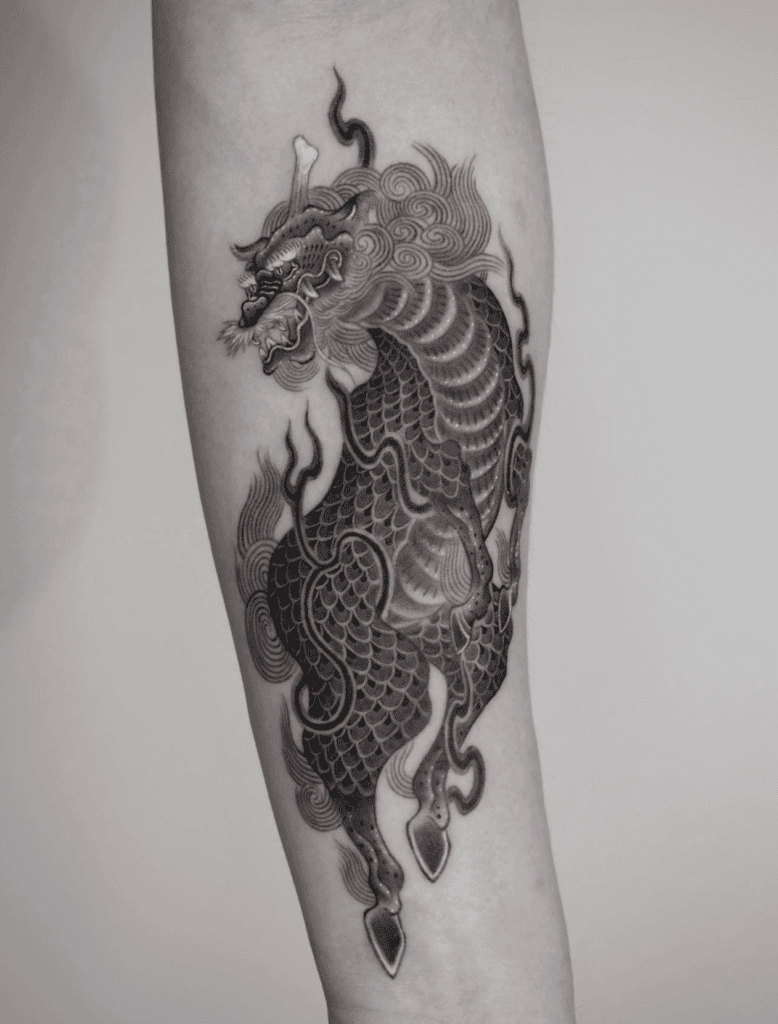
The Kirin (麒麟) is one of the most revered and benevolent creatures in Japanese mythology, being a symbol of wisdom, prosperity, justice, and peace. It is considered so gentle that it is said to avoid harming even a single blade of grass when it walks.
The Kirin originated from the Chinese Qilin, but developed its own place in Japanese mythology and folklore. It is often described as a hybrid creature combining features of several animals, such as a deer-like body, dragon-like scales, a flowing mane, an ox-like tail, hooves like a horse, and sometimes has one or two horns. Its appearance varies depending on the artist and era, but it is always depicted as majestic and supernatural.
Legends claim it refuses to step on insects, avoids damaging plants, never harms the innocent, and only appears during times of peace and good leadership. In many traditions, the Kirin appears when a wise ruler ascends the throne, a great sage is born, an era of peace begins, or divine approval is being shown.
Genbu Japanese Mythology Tattoo
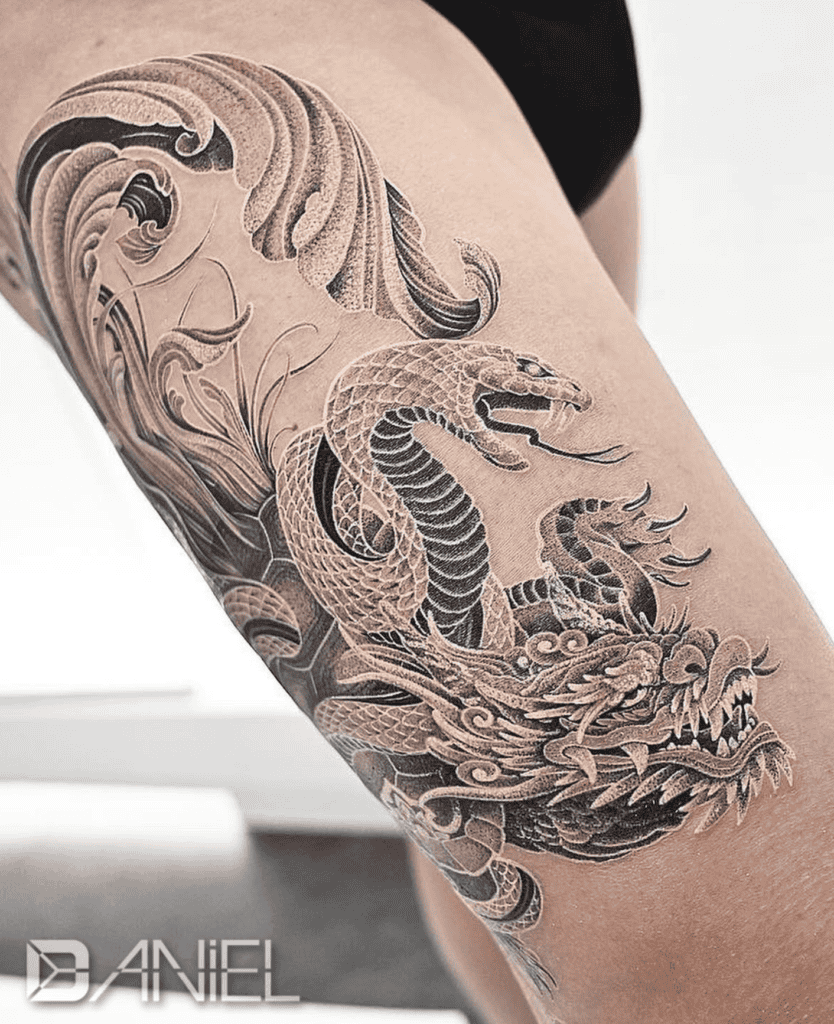
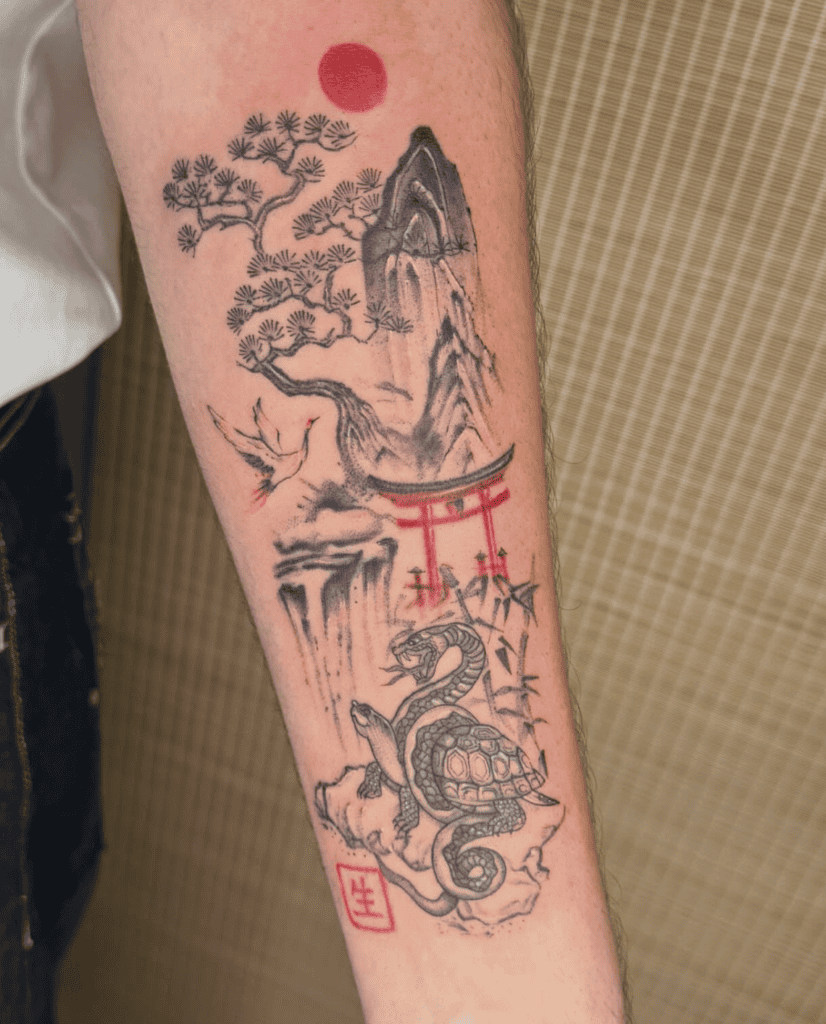
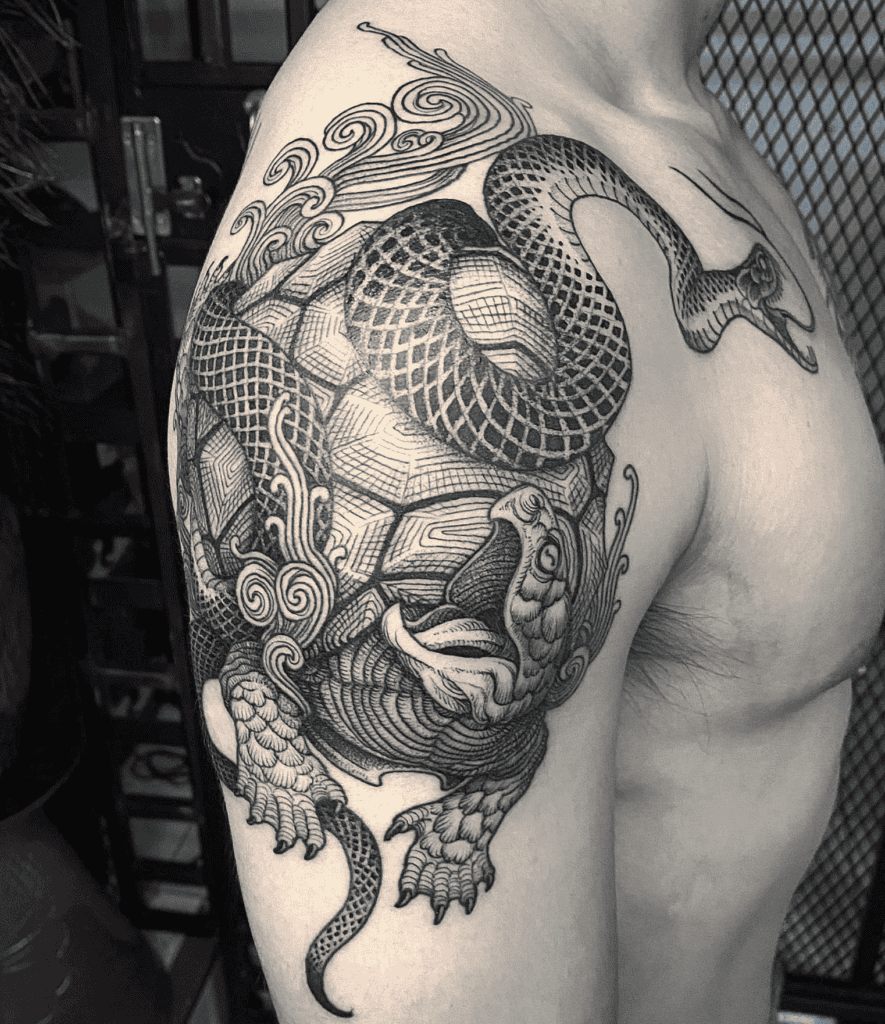
The Genbu (玄武), often translated as the Black Tortoise, is one of the most important sacred creatures in Japanese mythology and cosmology. It is a celestial guardian associated with the north, winter, water, endurance, and protection.
Genbu originated from ancient Chinese astronomy as one of the Four Symbols (Four Celestial Guardians), but became deeply integrated into Japanese mythology, religion, and folklore. Genbu is almost always depicted as a large black tortoise with a snake wrapped around its body. This combination symbolises longevity and resilience.
In traditional cosmology, Genbu rules the North, Winter, water, and the night sky of the northern heavens. Because winter can be harsh and dangerous, Genbu became associated with surviving hardship and enduring difficult times.
Byakko Japanese Mythology Tattoo
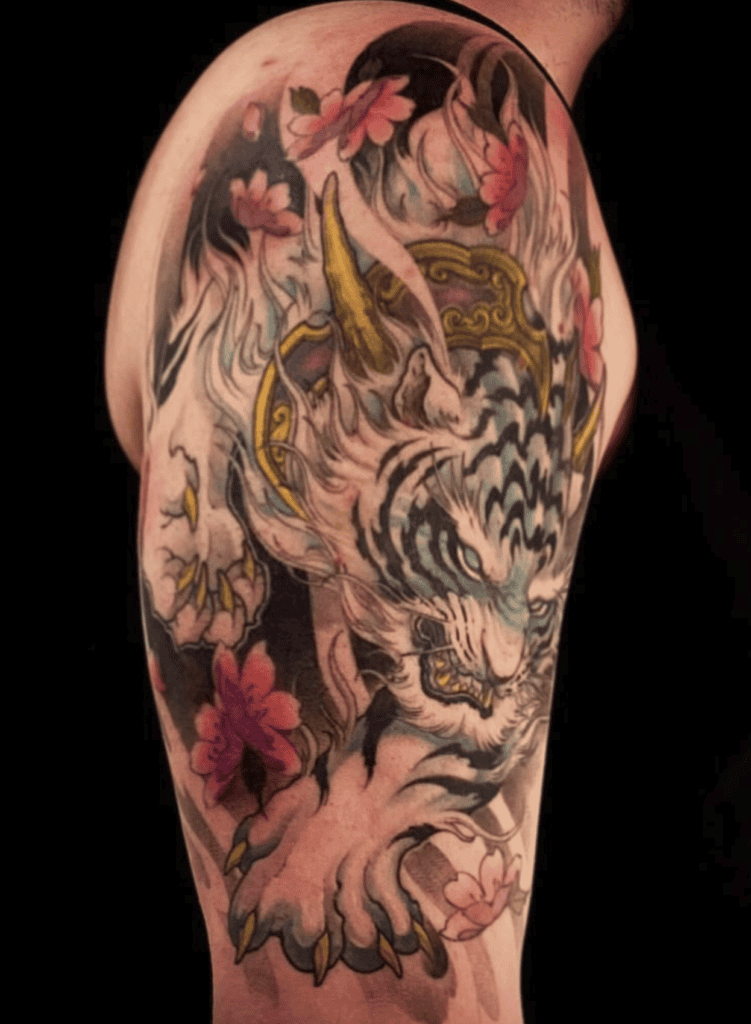
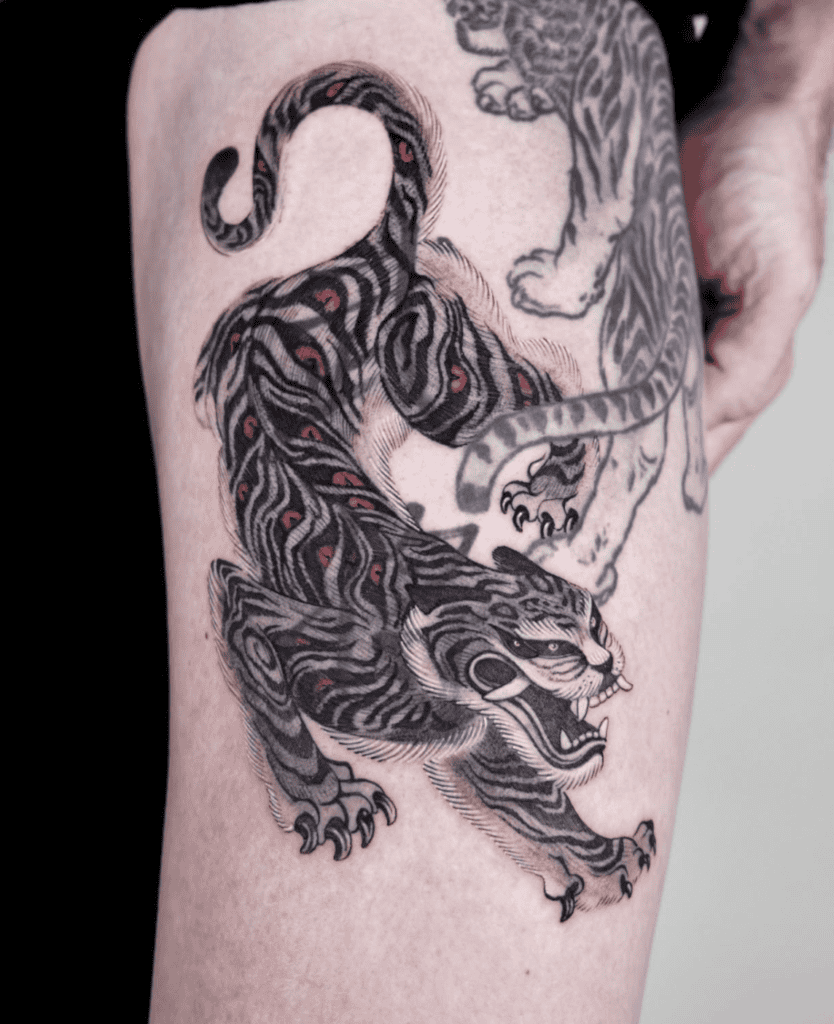
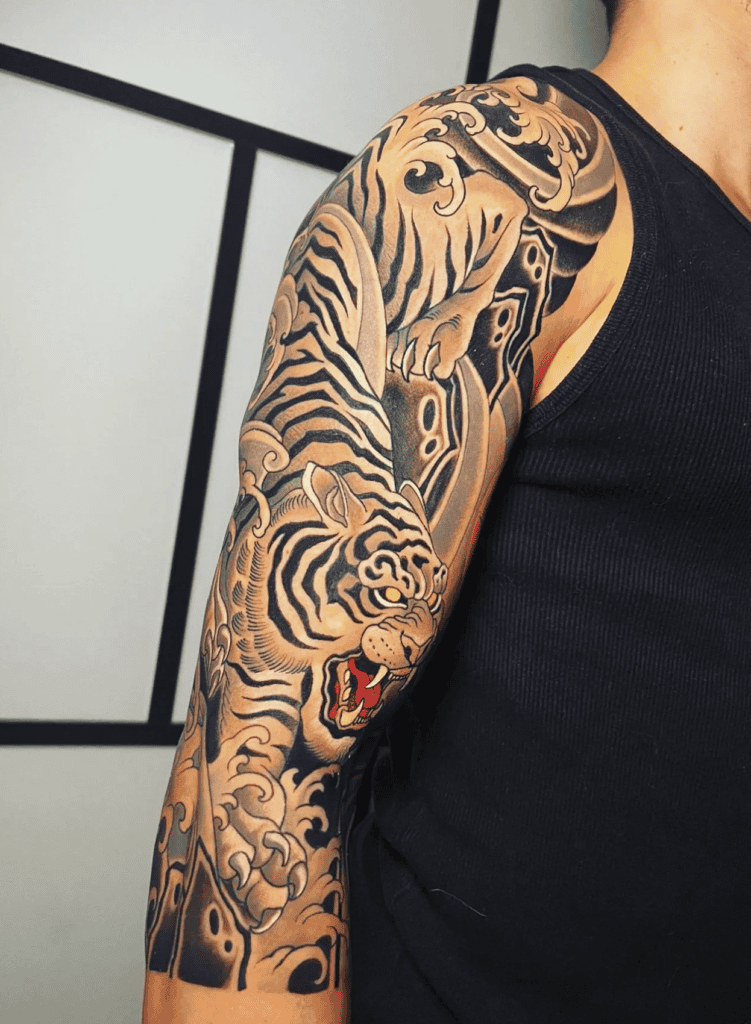
The Byakko (白虎), meaning “White Tiger,” is one of the Four Sacred Beasts of East Asian mythology and one of the most revered celestial guardians in Japanese tradition. Associated with the West, Autumn, Metal, and martial strength, Byakko is often seen as the embodiment of courage, righteousness, and noble power.
Byakko originated in ancient Chinese astronomy and mythology before becoming an important figure in Japanese cosmology. It is usually depicted as a magnificent white tiger, larger than any normal tiger, possessing supernatural strength, and surrounded by clouds, wind, or celestial energy.
In East Asian symbolism, white is associated with purity, spiritual power, autumn, the metal element, and divine authority. Because autumn is associated with harvest but also the approach of winter, Byakko symbolises both achievement and preparation for future challenges.
Seiryū Japanese Mythology Tattoo
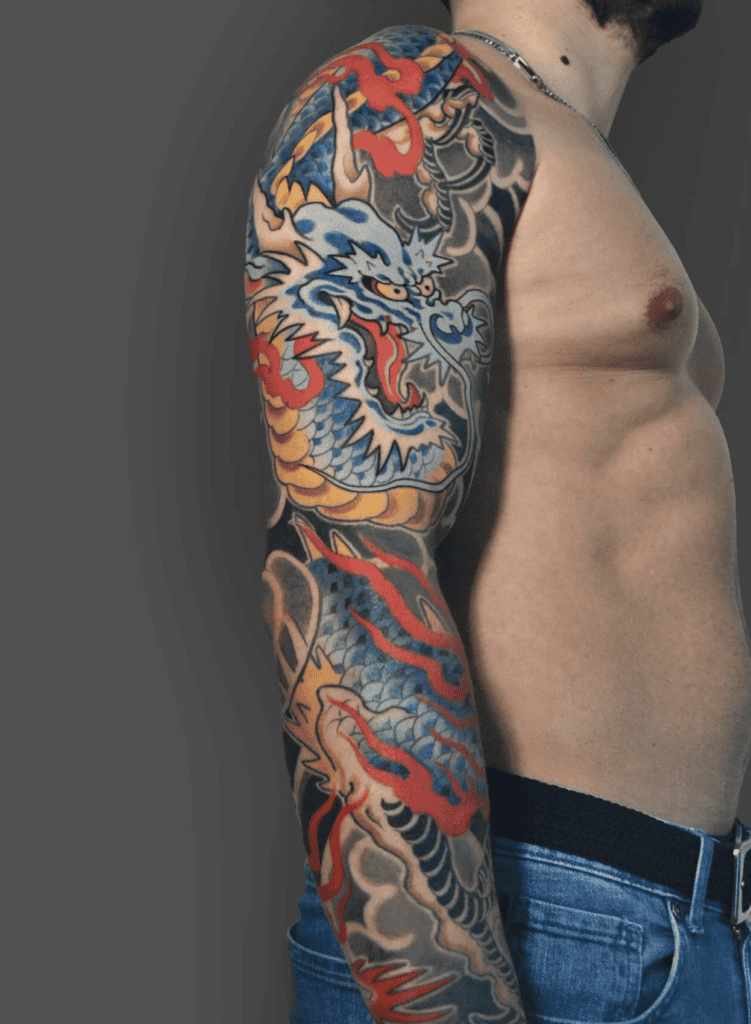
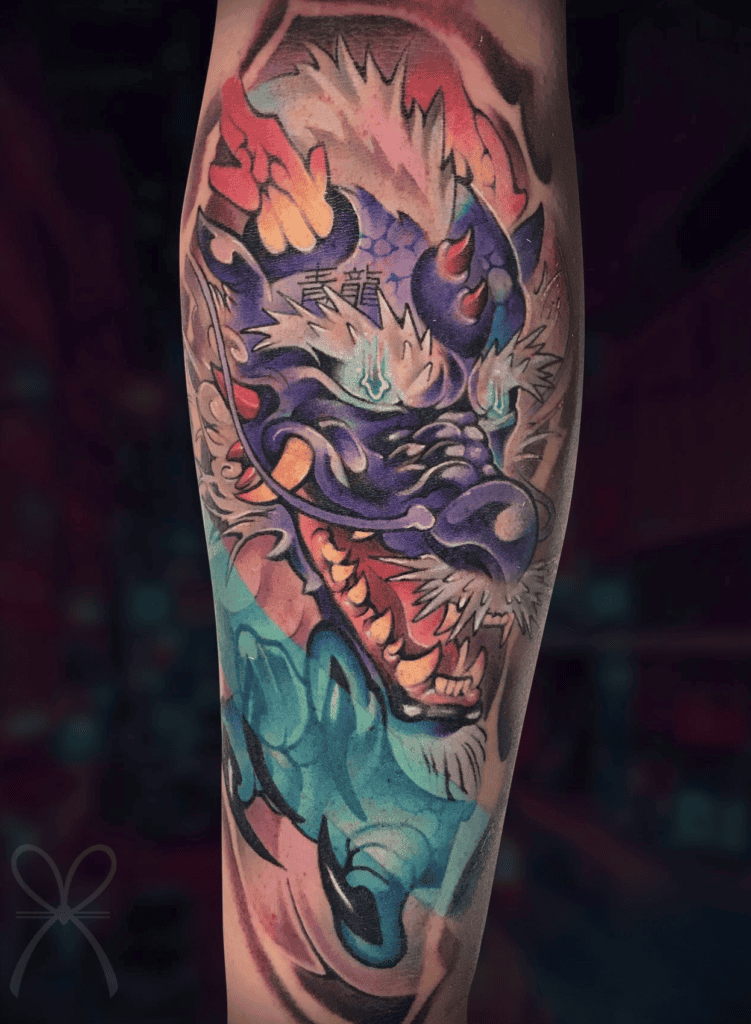
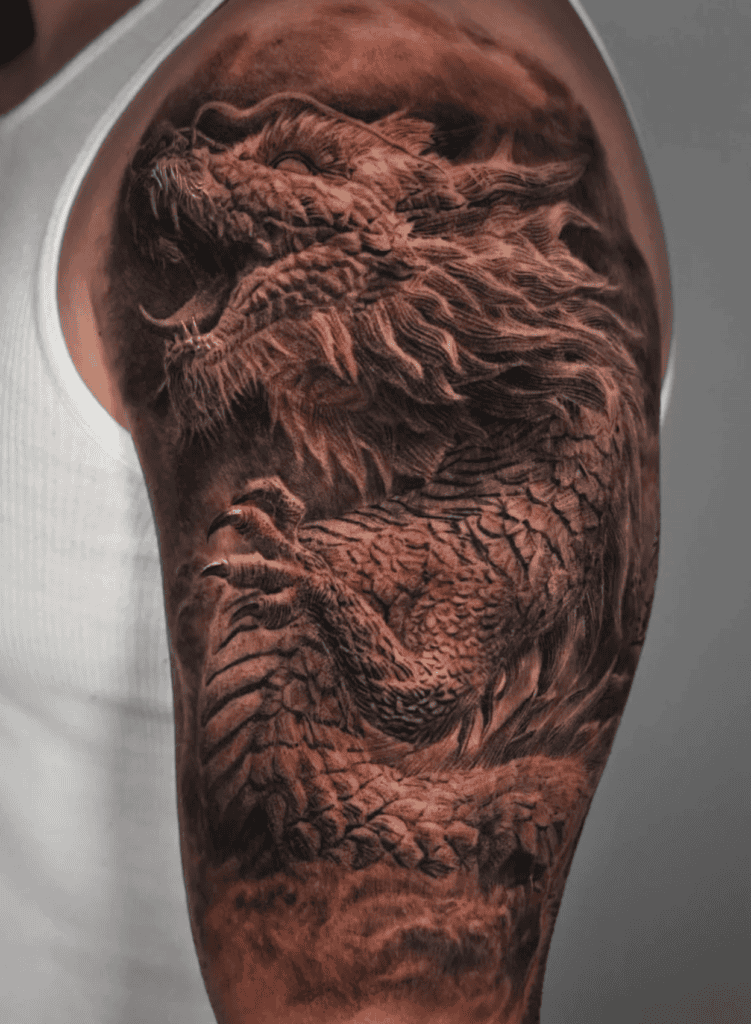
The Seiryū (青龍), meaning “Azure Dragon” or “Blue-Green Dragon,” is one of the most important and revered creatures in Japanese mythology. As one of the Four Sacred Beasts, Seiryū serves as the celestial guardian of the East, the Spring season, and the Wood element. Among the Four Guardians, Seiryū is often seen as the most majestic and powerful, embodying growth, vitality, wisdom, and divine authority. 🐉✨
Seiryū originated from ancient Chinese astronomy before becoming a central figure in Japanese cosmology and folklore. It is usually depicted as a long, serpentine dragon, covered in azure, blue, or blue-green scales, possessing antler-like horns, long whiskers and a flowing mane, sharp claws, and surrounded by clouds, rain, or lightning
Seiryū rules over the east, Spring, the Wood element, dawn and new beginnings. Because the sun rises in the east, Seiryū is associated with renewal, life, and growth.
Suzaku Japanese Mythology Tattoo
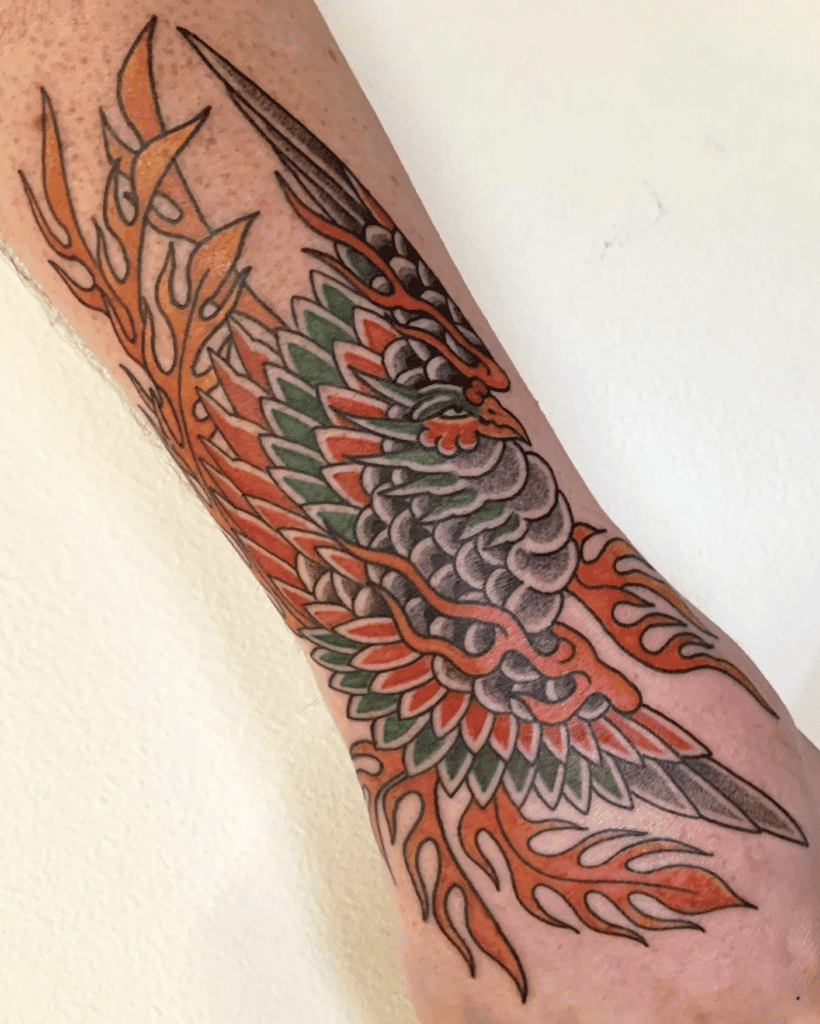
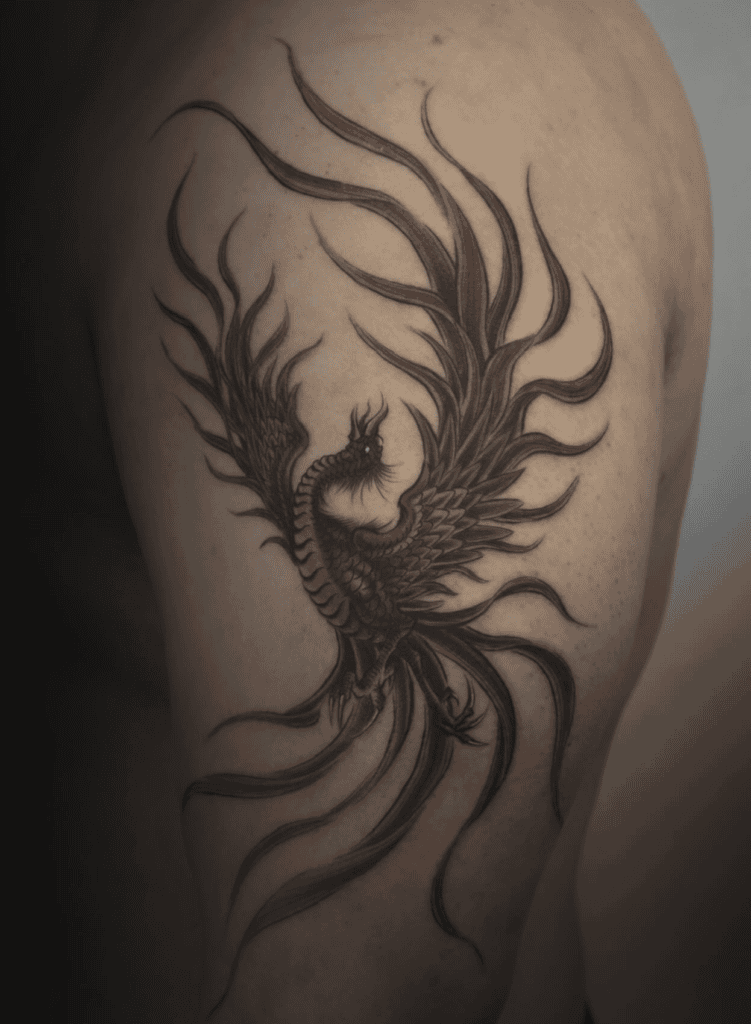
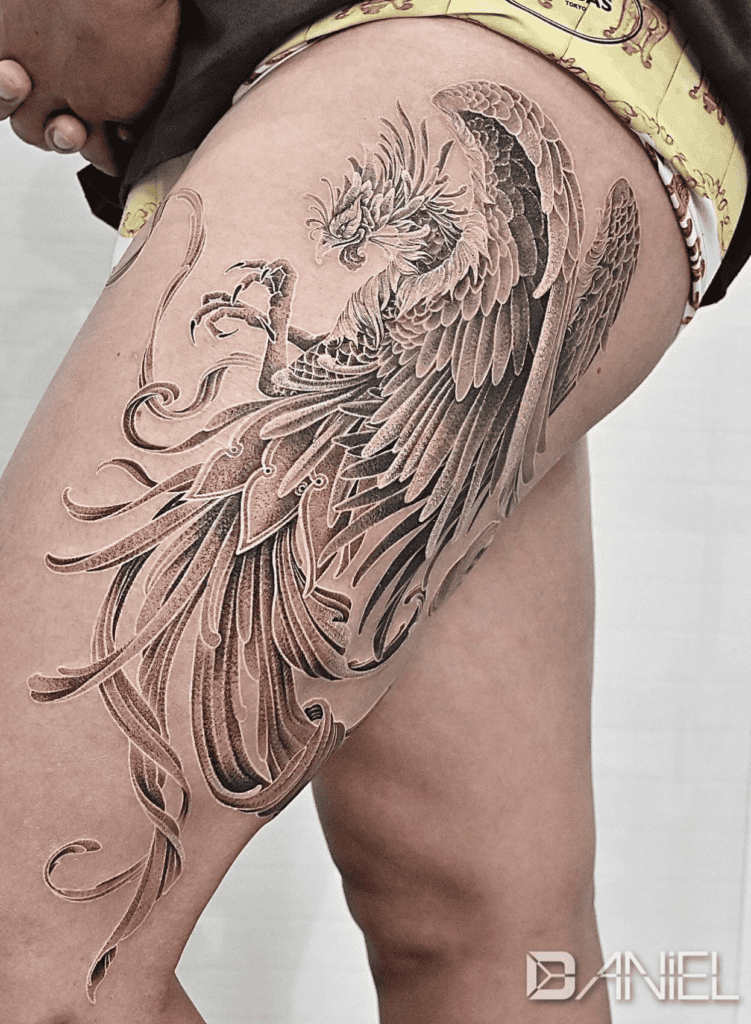
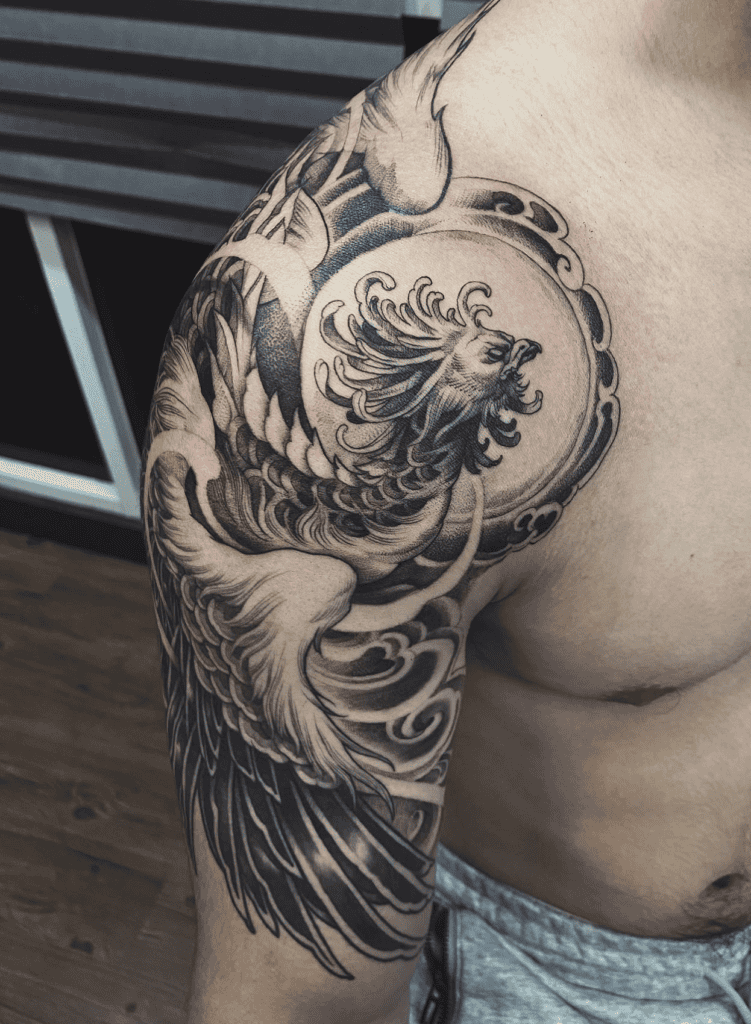
The Suzaku (朱雀), meaning “Vermilion Bird,” is one of the Four Sacred Beasts of Japanese mythology and one of the most beautiful celestial creatures in East Asian tradition. Associated with the South, Summer, Fire, and the heavens, Suzaku is a symbol of passion, vitality, protection, and renewal. While many people compare Suzaku to a phoenix, it is actually a distinct mythological being with its own unique history and symbolism.
Suzaku originated from ancient Chinese astronomy and mythology before becoming an important part of Japanese cosmology. It is usually depicted as a magnificent red or crimson bird, covered in brilliant vermilion feathers, surrounded by flames, flying through clouds and sunlight, and possessing a long, elegant tail.
Suzaku rules over the south, Summer, fire, warmth and vitality. Because summer is associated with abundance, growth, and energy, Suzaku became a symbol of life at its peak.
Baku Japanese Mythology Tattoo
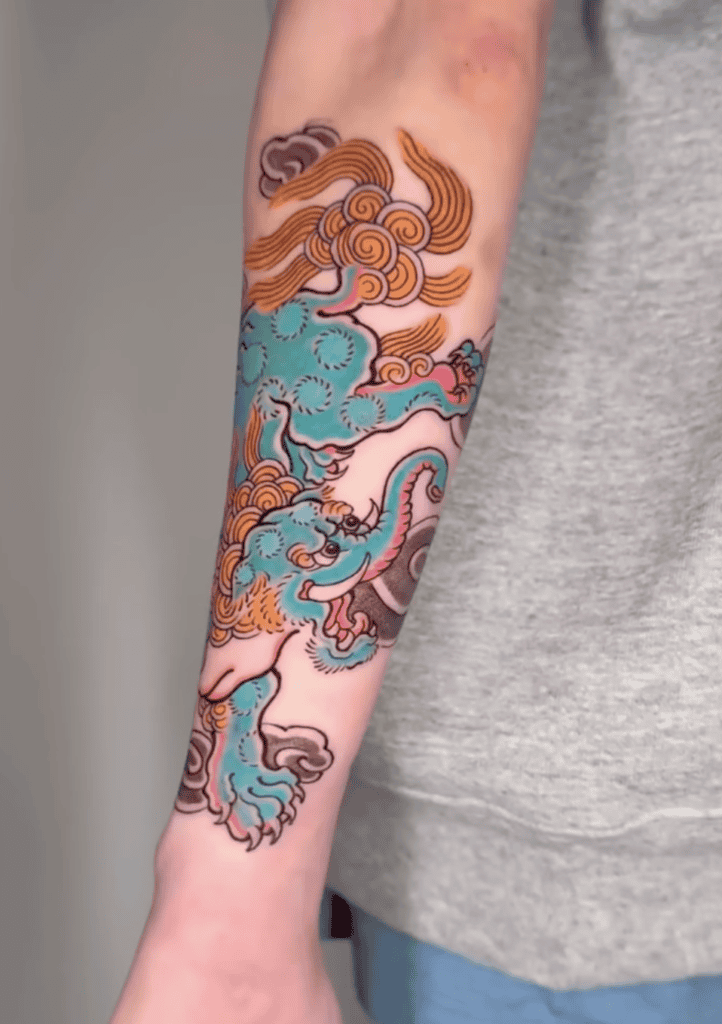
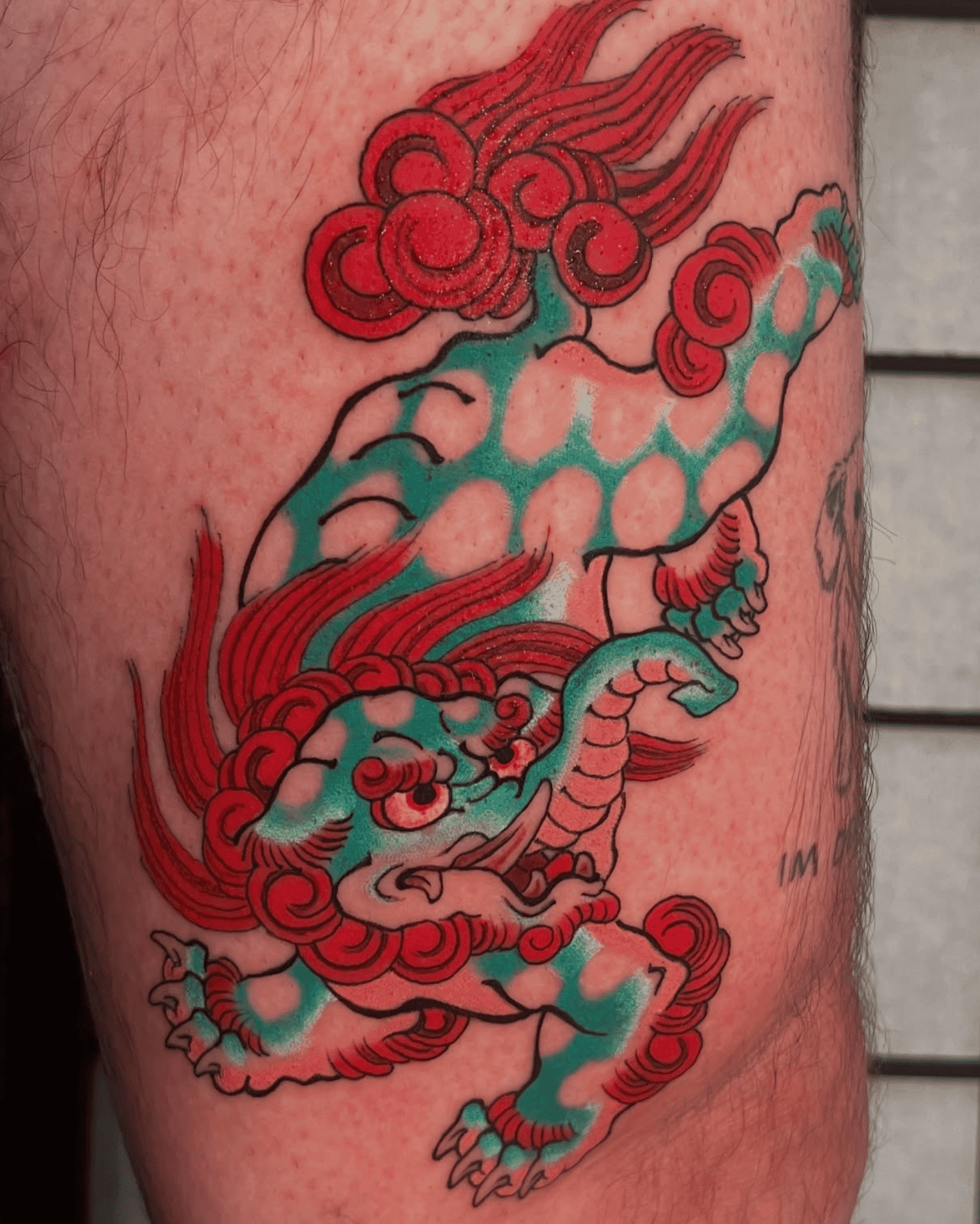
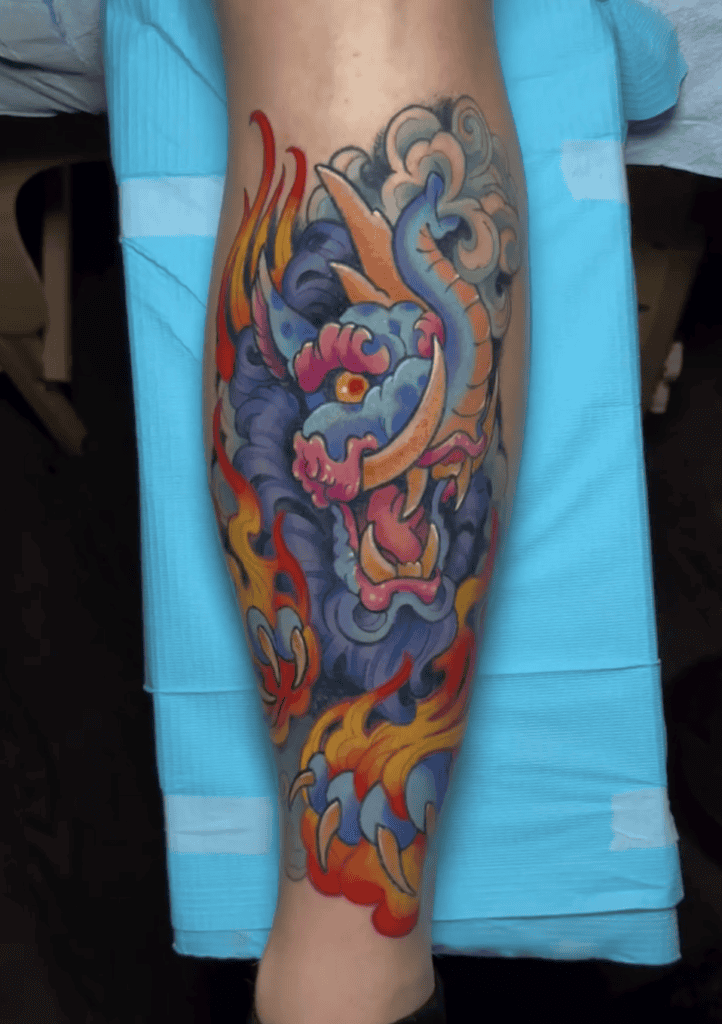
The Baku (獏) is one of the most beloved creatures in Japanese folklore, famous for eating nightmares. For centuries, people have called upon the Baku to protect them from bad dreams, making it one of the most benevolent supernatural beings in Japanese mythology. Traditionally, if someone woke from a nightmare, they could call out “Baku, come eat my dream!” and the creature would consume the bad dream before it could cause harm.
The appearance of the Baku has changed over time. Traditional descriptions often combine features of several animals, including an elephant’s trunk, rhinoceros-like eyes, tiger’s paws, an ox tail, and a bear-like body. In later centuries, many artists began depicting it more like a tapir, because real tapirs somewhat resembled the older mythical descriptions.
The Baku originated from China, where a similar dream-eating creature existed in mythology. Over time, the legend spread to Japan, where it became deeply integrated into folklore and popular belief.
Interestingly, in some versions, if the Baku finishes eating the nightmare and remains hungry, it may continue eating hopes, desires, ambitions, and good dreams, so people were encouraged to summon a Baku only when truly needed.
Kamaitachi Japanese Mythology Tattoo
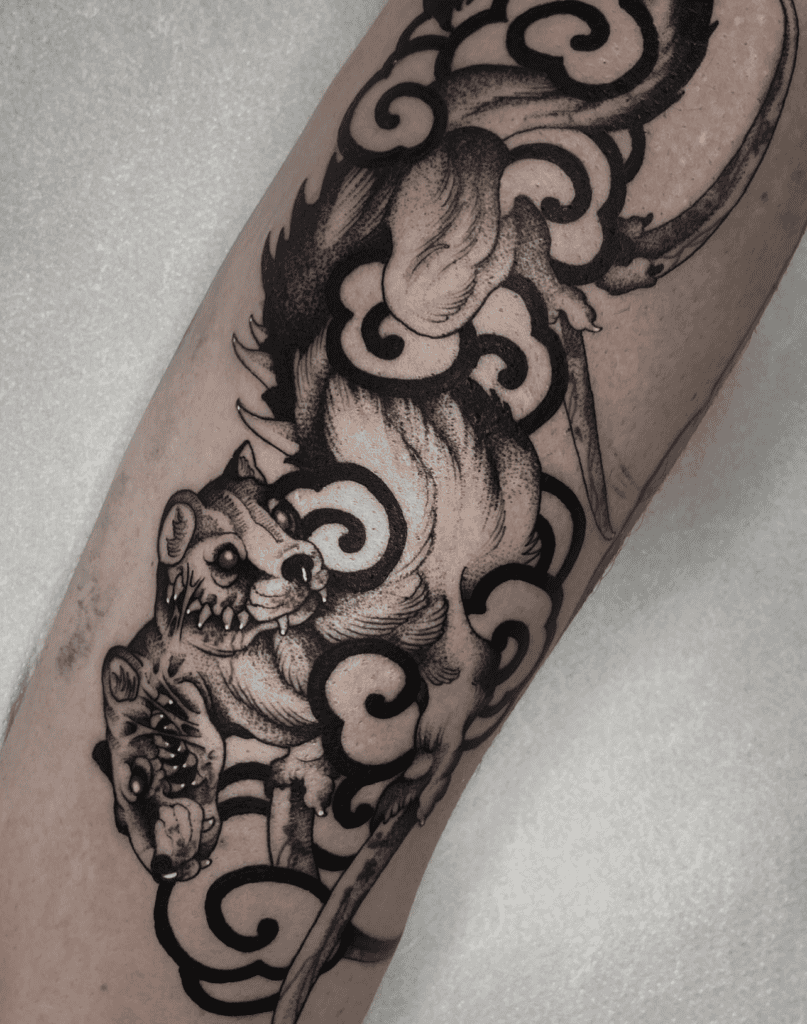
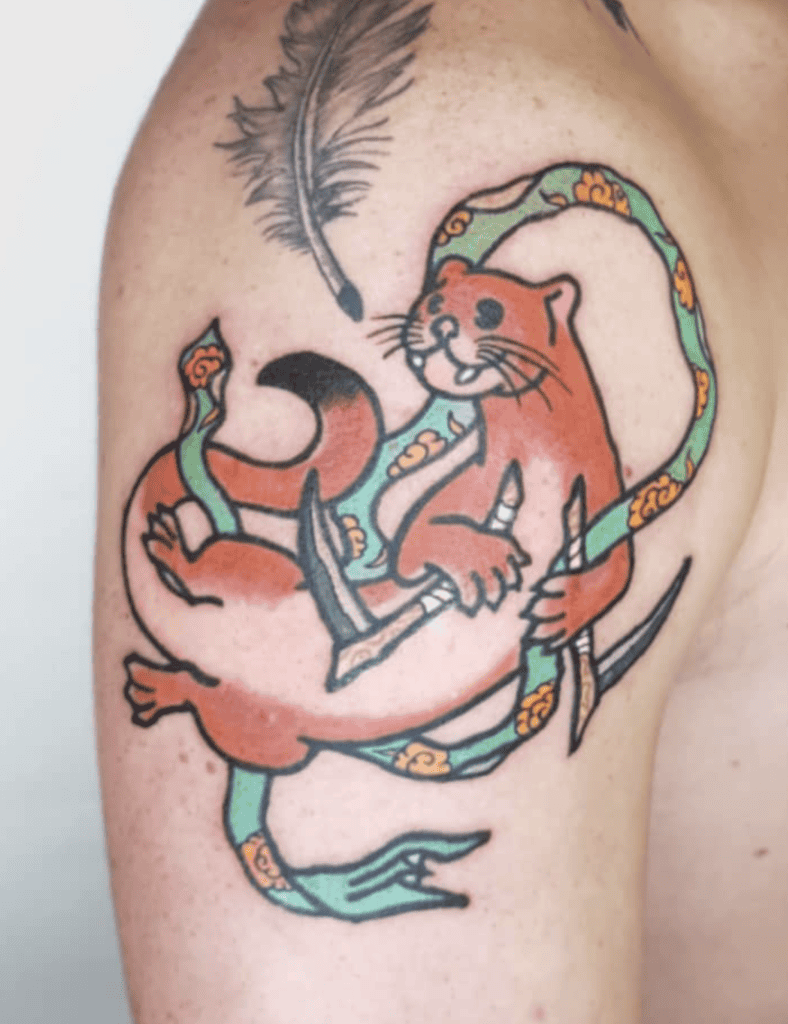
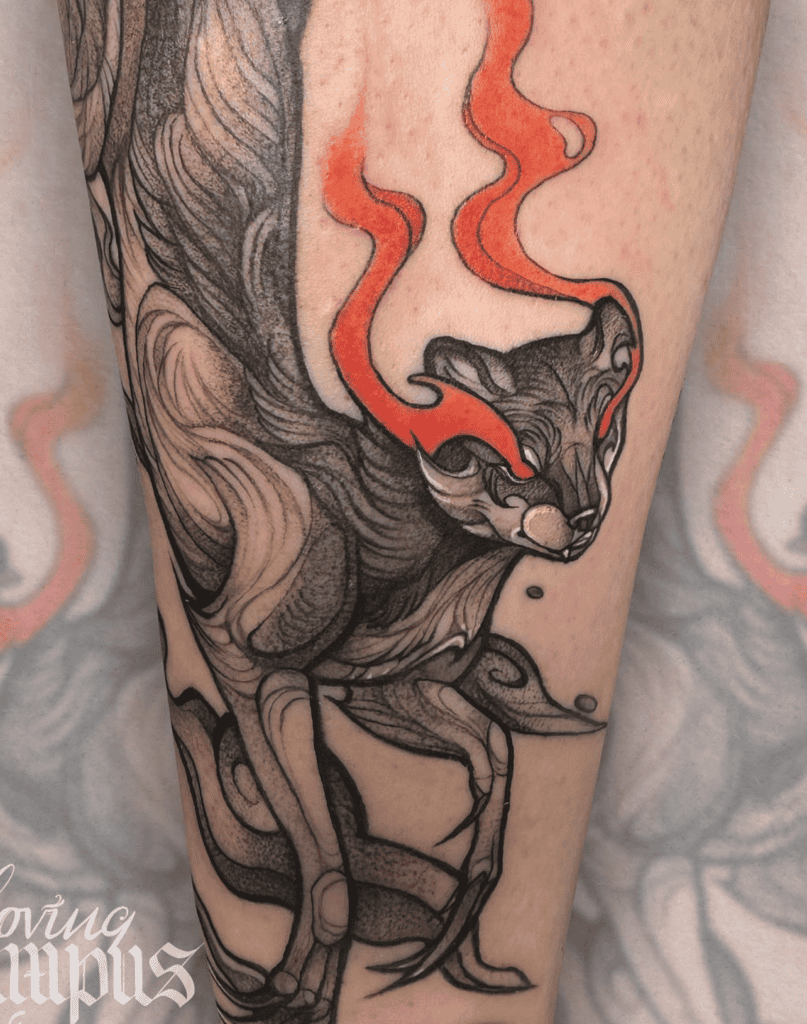
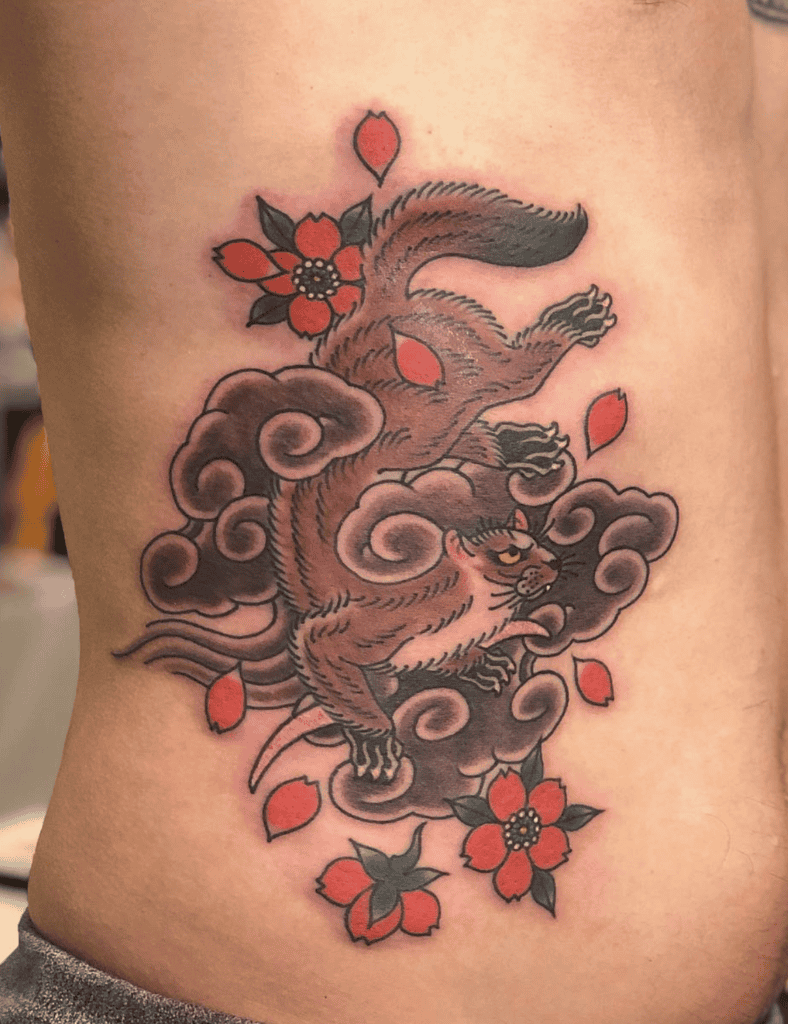
The Kamaitachi (鎌鼬), meaning “sickle weasel,” is one of Japan’s most fascinating yōkai. It is a supernatural creature associated with whirlwinds, sudden cuts, and mysterious injuries. According to folklore, a Kamaitachi can race through the wind so quickly that its victims don’t even realise they’ve been struck until moments later.
A Kamaitachi is usually described as a weasel-like yōkai possessing razor-sharp sickles for claws. It can move at supernatural speed as it travels inside whirlwinds and gusts of wind. People believed that if a mysterious cut appeared on their skin without explanation, a Kamaitachi might be responsible.
One of the most famous versions of the legend describes not one creature, but three Kamaitachi working together. The first Kamaitachi knocks the victim down, the second slices the victim with sickle-like claws, while the third applies a magical medicine. This explains why the wound may not hurt immediately.
Gashadokuro Japanese Mythology Tattoo
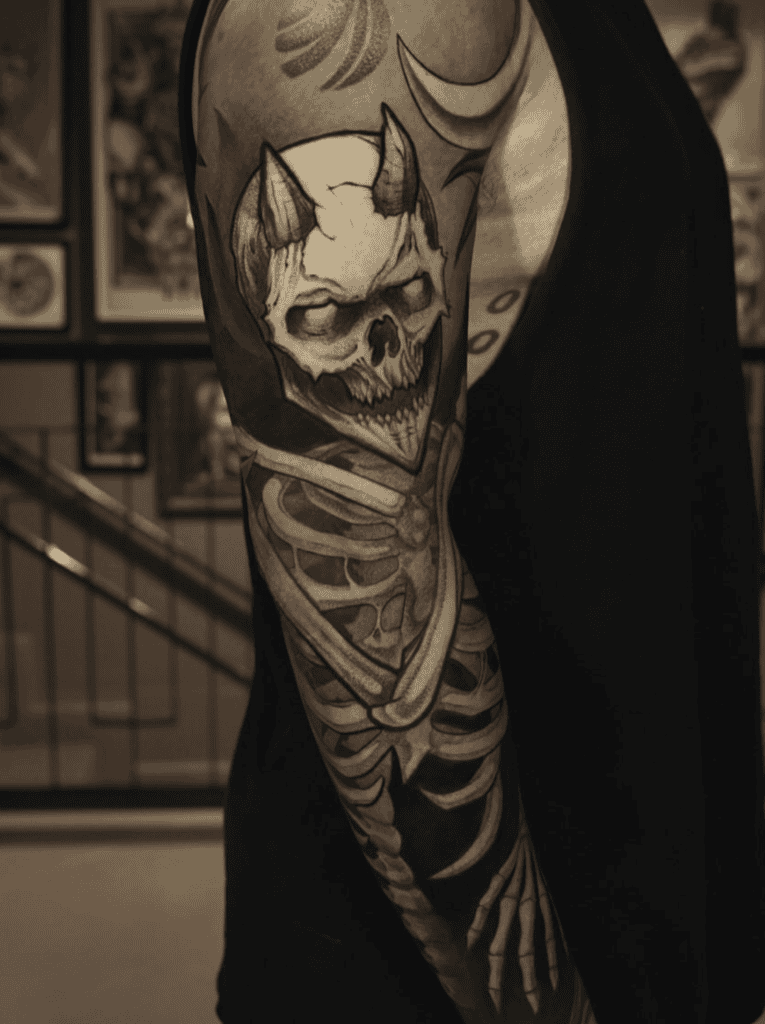
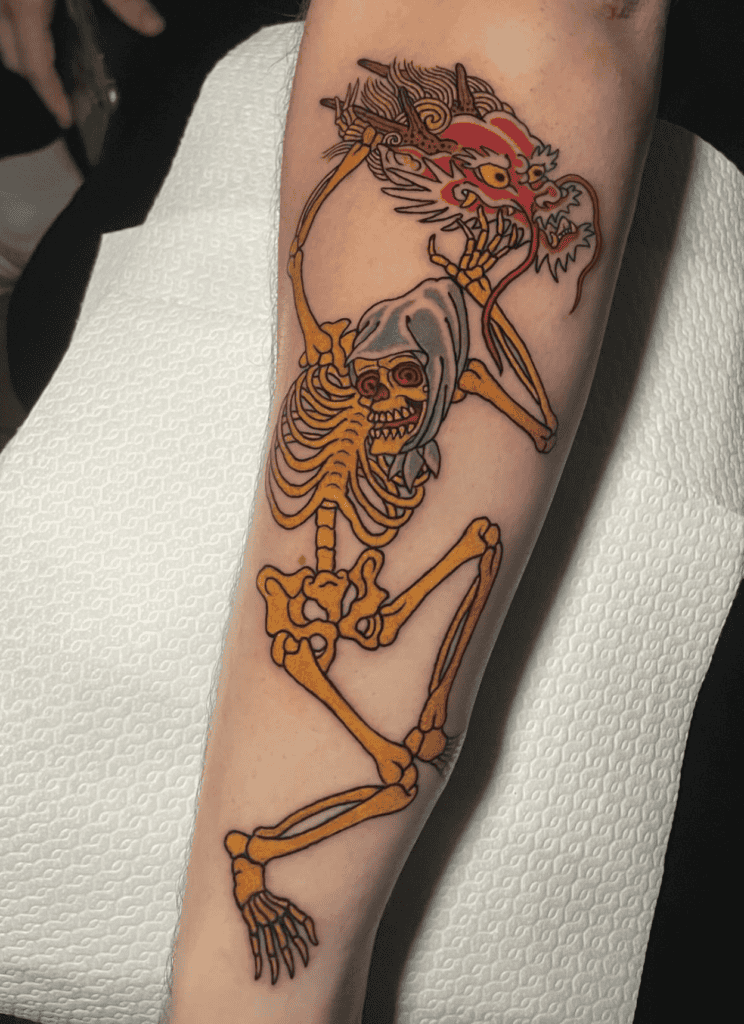
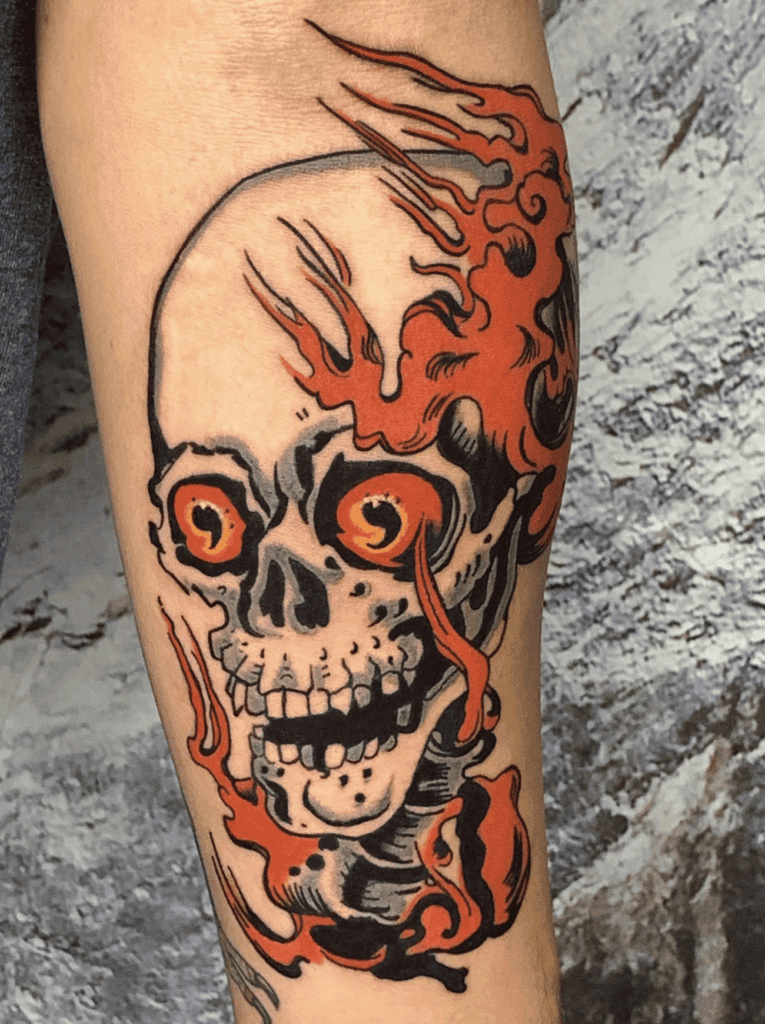
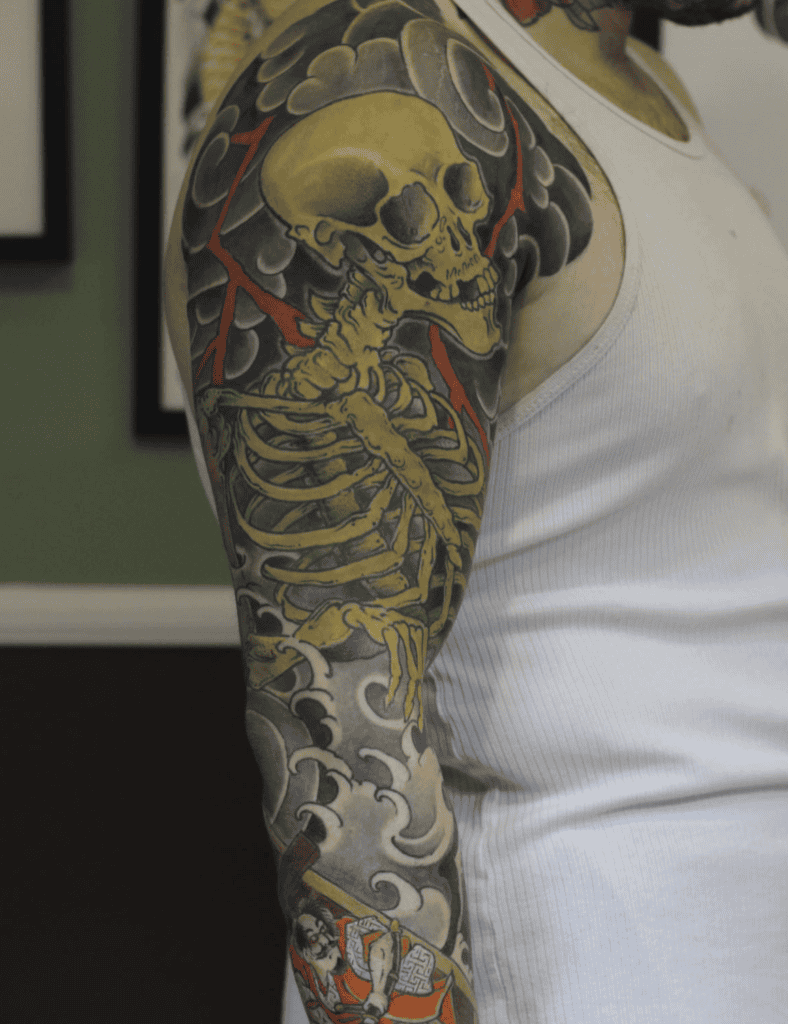
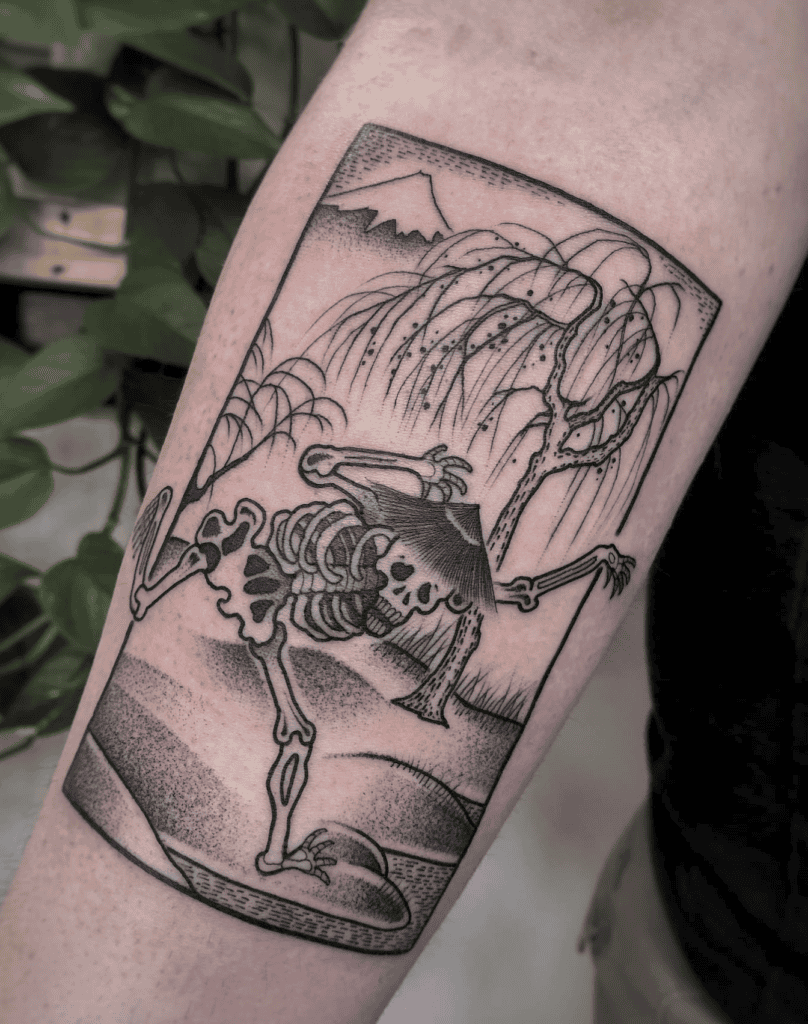
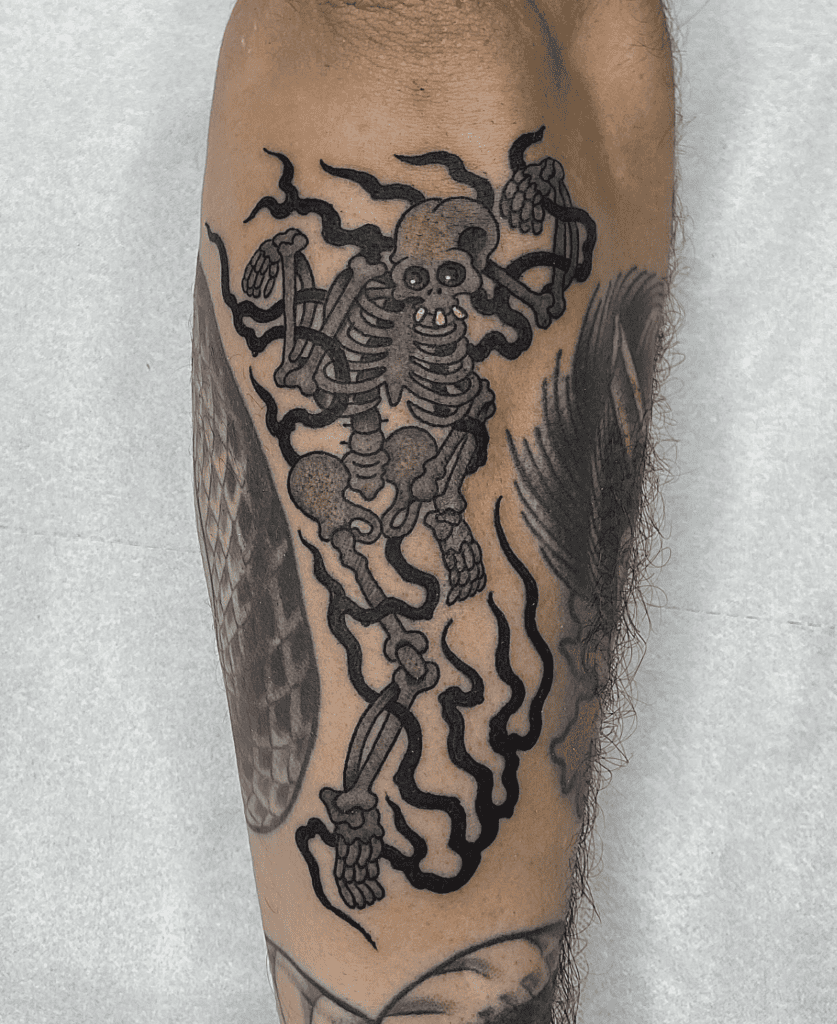
The Gashadokuro (がしゃどくろ) is an iconic yōkai in Japanese folklore. A Gashadokuro is a gigantic skeleton formed from the bones of people who died from war, famine victims, or individuals who died without proper burial rites. Their resentment and suffering combine into a single enormous monster.
The Gashadokuro is usually fifteen times larger than a normal person, with glowing eyes or empty eye sockets, and despite its size, it can move surprisingly quietly.
Momotarō Japanese Mythology Tattoo
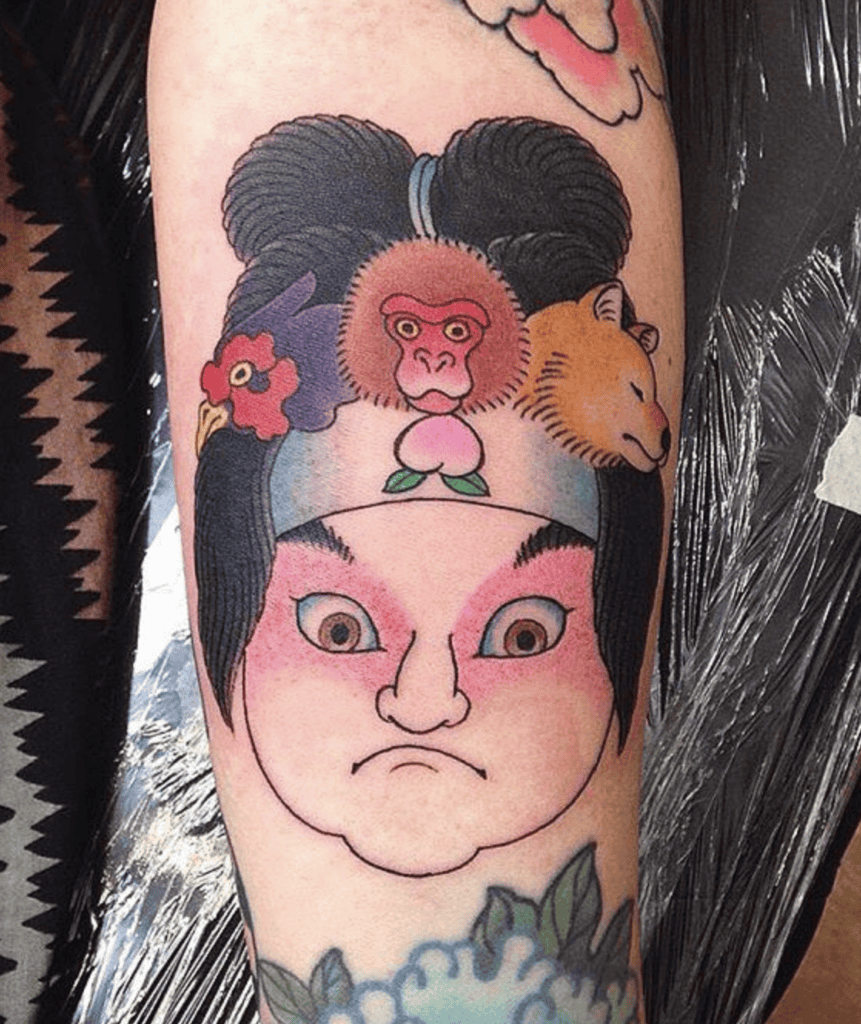
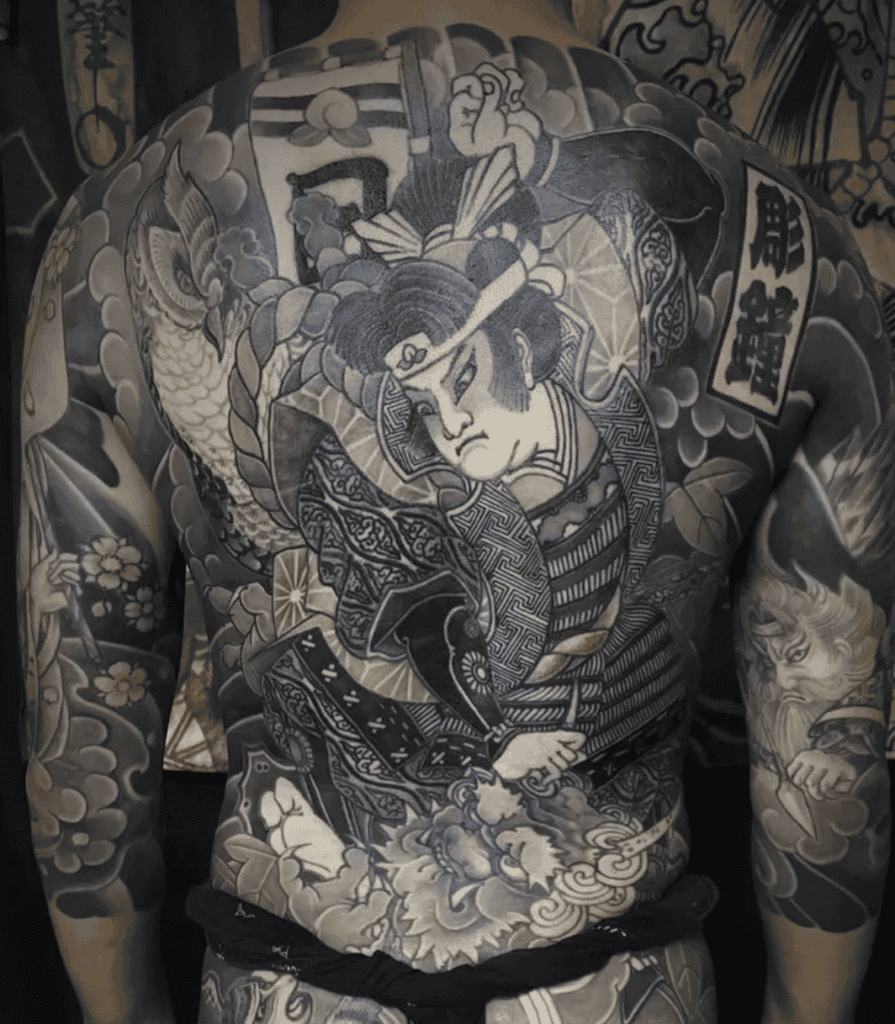
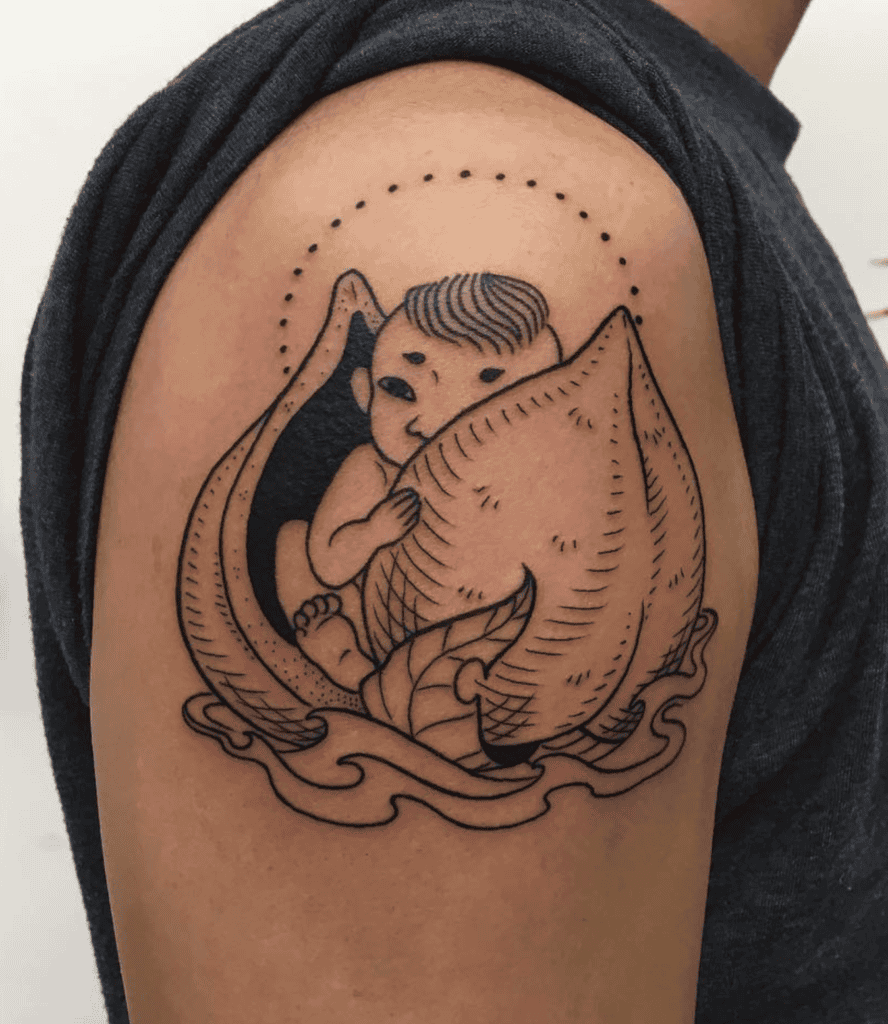
Momotarō (桃太郎), or “Peach Boy,” is one of the most famous heroes in Japanese folklore. His story is often told to children in Japan and is considered a classic tale of good triumphing over evil.
Momotarō is a boy who was born from a giant peach. According to legend, an old, childless couple finds a floating peach in a river, and when they cut it open, a baby boy is inside. They name him Momotarō (“Peach Boy”), and he grows up strong, brave, and kind.
In Momotarō’s world, trouble comes from the island of demons called Onigashima, home to terrifying Oni, pirates or bandits, and monsters who steal treasure and terrorise villages, so Momotarō decides to stop them.
Before leaving, Momotarō’s elderly parents prepare him food called Kibi dango which help him recruit companions. On his journey, Momotarō meets three loyal animal companions, the monkey, the dog, and the pheasant, all joining him after being offered a kibi dango.
Momotarō and his companions sail to Onigashima and attack the demon fortress. Eventually, they defeat the oni and reclaim stolen treasures. After defeating the demons, the treasure is returned to the villagers, peace is restored, Momotarō becomes a celebrated hero, and he returns home with his animal friends and lives peacefully with his adoptive parents.
Yamato Takeru Japanese Mythology Tattoo

Yamato Takeru (日本武尊) is one of the greatest legendary heroes in early Japanese mythology. He is a semi-divine prince-warrior whose life is filled with daring battles, divine weapons, disguise, tragedy, and heroic sacrifice.
Yamato Takeru was a prince of the early imperial line, believed to be the son of Emperor Keikō. He is described as fierce in battle, extremely intelligent, sometimes ruthless, and deeply loyal to his father.
One of the most famous early stories tells that the emperor feared Yamato Takeru’s strength, so he sent him on dangerous missions instead of ruling at court. Yamato Takeru was ordered to eliminate his own brother, defeating him in a brutal encounter, showing his loyalty to his father and his ruthlessness as a swordsman.
Yamato Takeru goes on many adventures, defeating opponents wherever he goes, but he ultimately becomes sick during his journeys and dies far from home. He is said to turn into a white swan after death in some versions, with his final words expressing a longing for his homeland.
Minamoto no Yoshitsune Japanese Mythology Tattoo
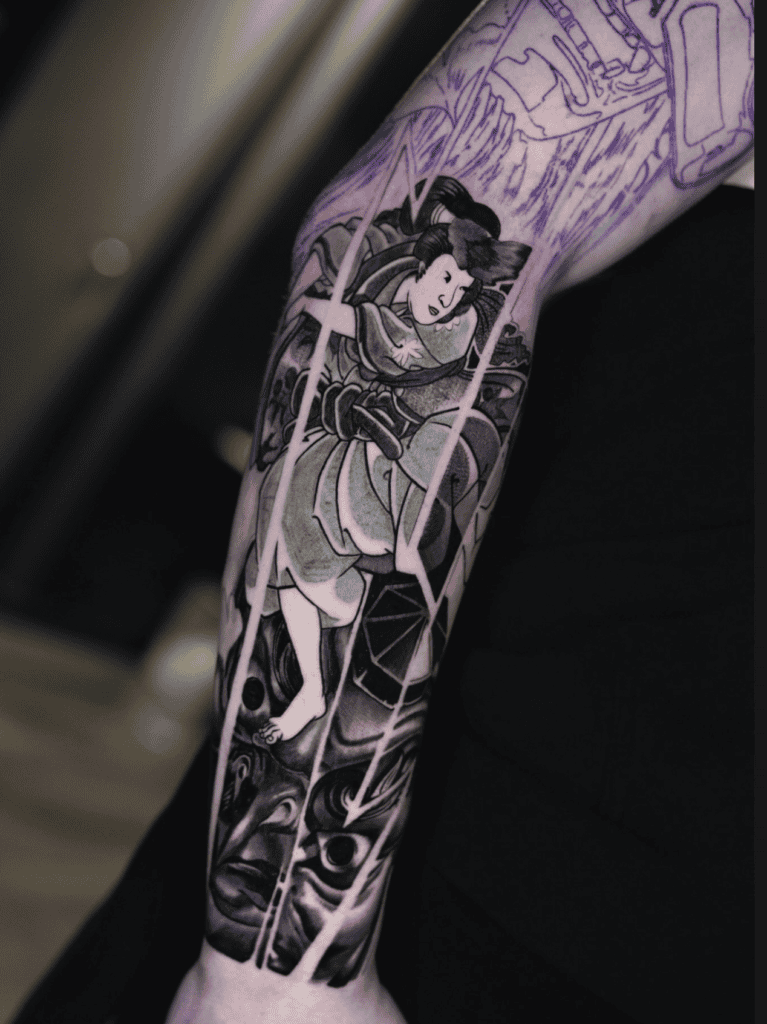
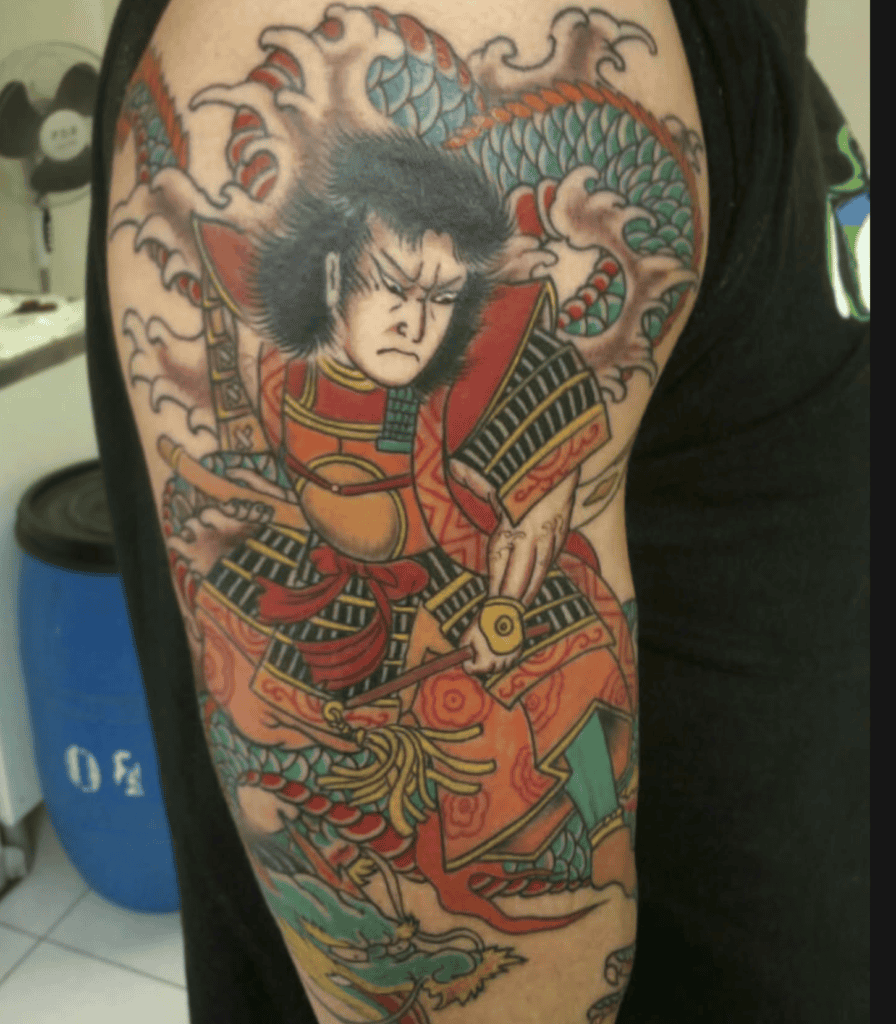
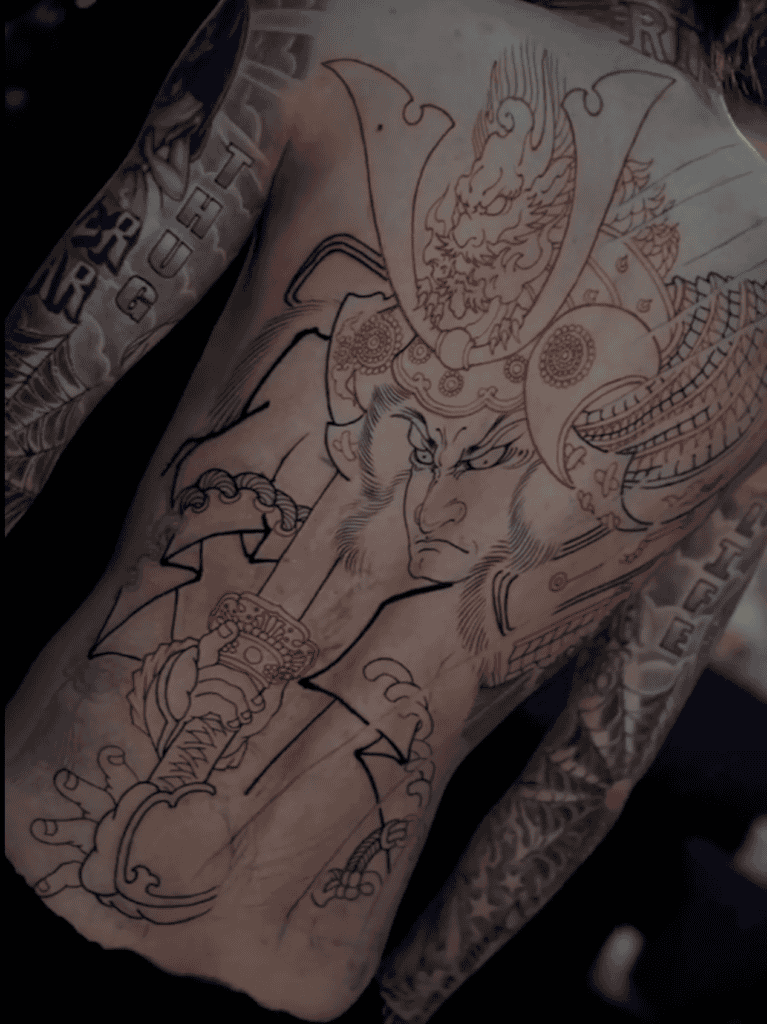
The Minamoto no Yoshitsune (源義経) is one of the most legendary and beloved samurai in Japanese history and folklore. Even though he was a real historical figure, his life became so dramatic, romanticised, and tragic that he’s often treated like a mythic hero rather than just a man.
Yoshitsune was a warrior of the late Heian period, born into the powerful Minamoto clan. He was the younger half-brother of Minamoto no Yoritomo who later became the first shogun of Japan, but Yoshitsune was the one who made the military victories possible.
Kintarō Japanese Mythology Tattoo
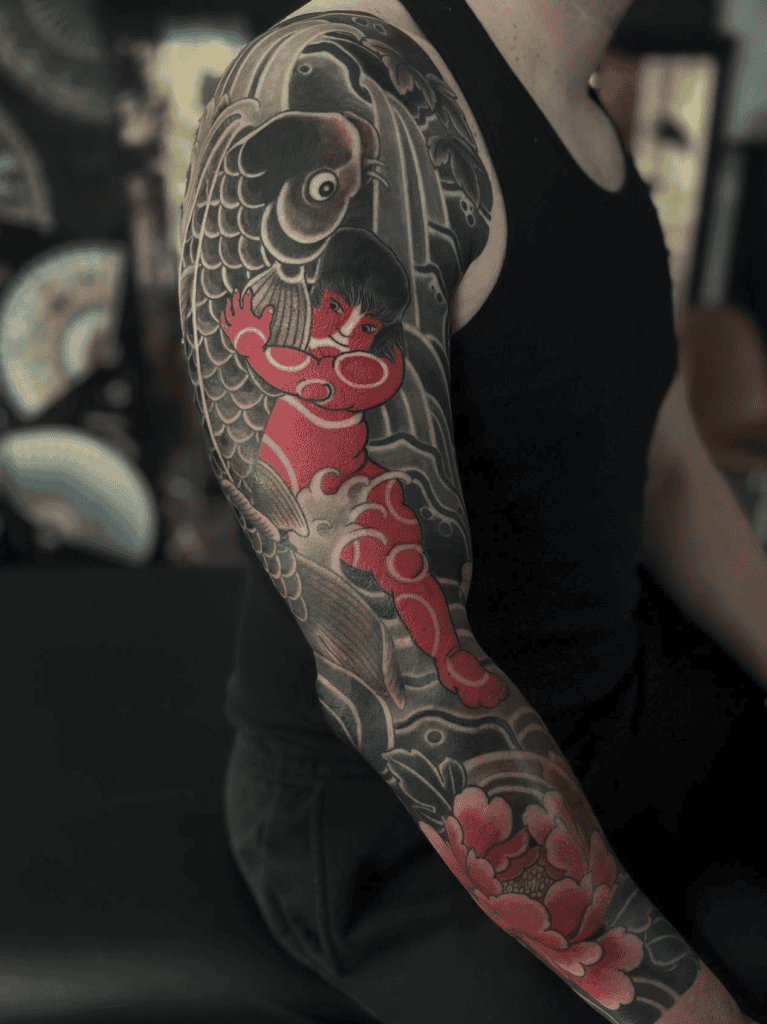
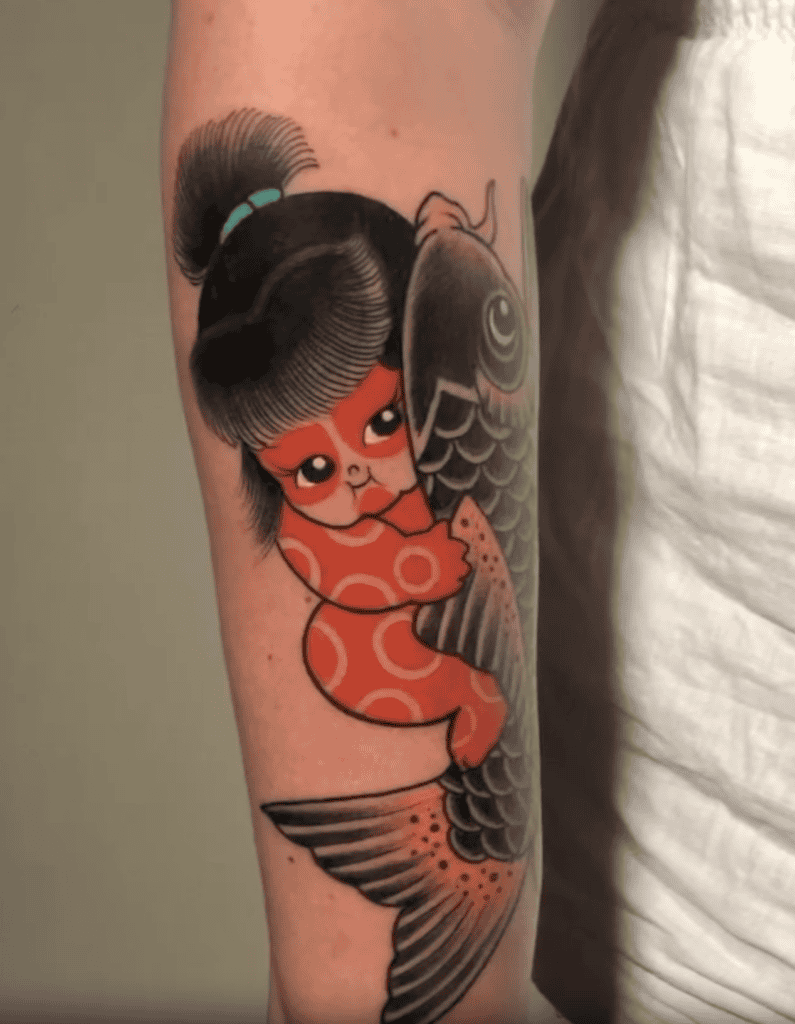
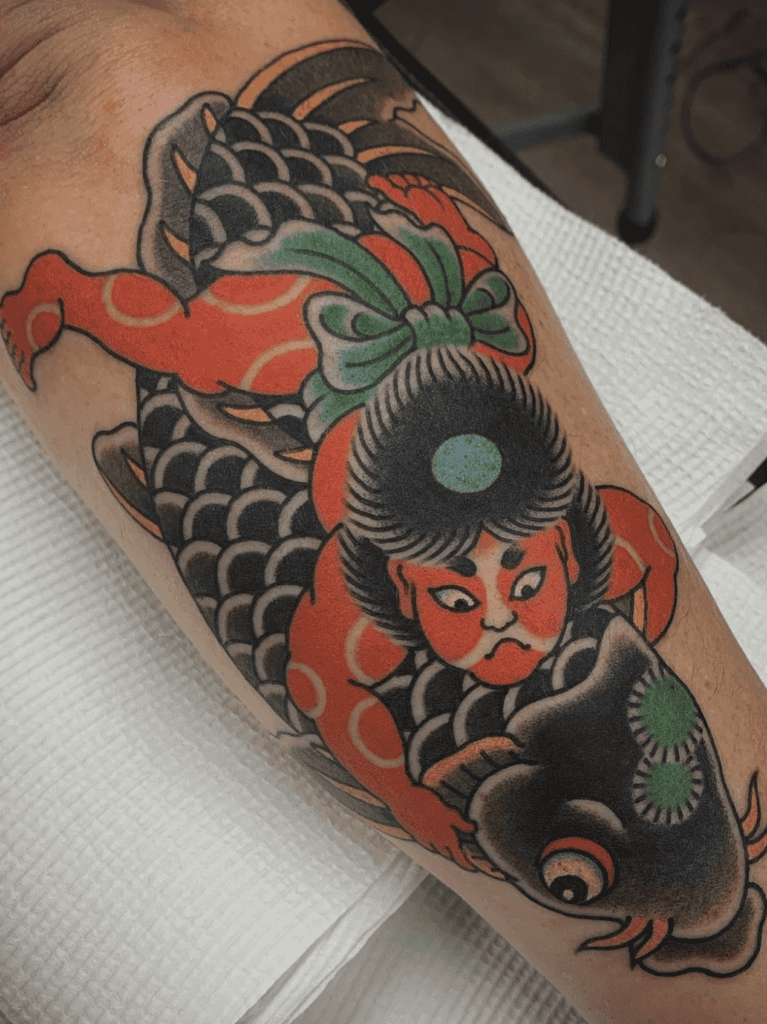
Kintarō (金太郎), often called the “Golden Boy,” is one of Japan’s most famous folk heroes. He is a supernaturally strong child raised in the mountains, known for wrestling animals and growing up to become a legendary samurai. He represents raw natural strength, innocence, and the idea that greatness can be born anywhere, even in the wilderness.
According to legend, he was raised by his mother deep in the mountains of Mount Ashigara, far from human society. Even as a child, Kintarō had superhuman strength and was friendly with the forest’s creatures.
Kintarō is often shown carrying a large axe given by his mother. It represents his connection to the forest, raw physical power, and future as a warrior. Unlike refined samurai swords, his axe reflects his wild upbringing. Kintarō is later discovered by a warrior named Sakata no Kintoki, and he becomes a loyal samurai retainer and grows into a respected hero.
Urashima Tarō Japanese Mythology Tattoo


The Urashima Tarō (浦島太郎) story is one of Japan’s most famous and haunting folktales. It’s a story about a fisherman who visits an underwater dragon palace and returns to a world that has moved on without him.
Urashima Tarō is usually described as a kind young man who helps animals and people. One day, Urashima Tarō sees children tormenting a turtle on the beach and intervenes to save it. Later, the turtle returns, but this time it speaks and transforms into a messenger of the sea.
It invites him to visit the underwater world and carries him beneath the ocean to a magical palace called Ryūgū-jō, which is the palace of the sea dragon god Ryūjin. Inside the palace, Urashima experiences endless feasts, beautiful courtyards under the sea, music and dancing, and the company of Princess Otohime.
Urashima enjoys the palace for what feels like a few days, but eventually decides to leave. Before he goes, Otohime gives him a mysterious box called the tamatebako and tells him never to open it.
When Urashima returns home, his village and all its people are gone and the world feels unfamiliar. He realises that he has been gone for hundreds of years, and while he experienced only days underwater, centuries passed on land. Overwhelmed with grief and confusion, Urashima opens the tamatebako, and white smoke pours out, taking his youth and ageing him into an old man.
Conclusion
Thanks for joining us on this epic, terrifying, and sometimes kami-cal adventure through the amazing world of the Japanese Mythology Tattoo. Before you disappear into the wind like a Kamaitachi, why not slice your way through these Celtic Mythology Tattoo Ideas, these Egyptian Mythology Tattoos, or these Persian Mythology Tattoos.
- Cartoon Tattoo Ideas - September 7, 2026
- Courage the Cowardly Dog Tattoo Ideas - September 3, 2026
- JoJo’s Bizarre Adventure Tattoo Ideas - September 1, 2026