
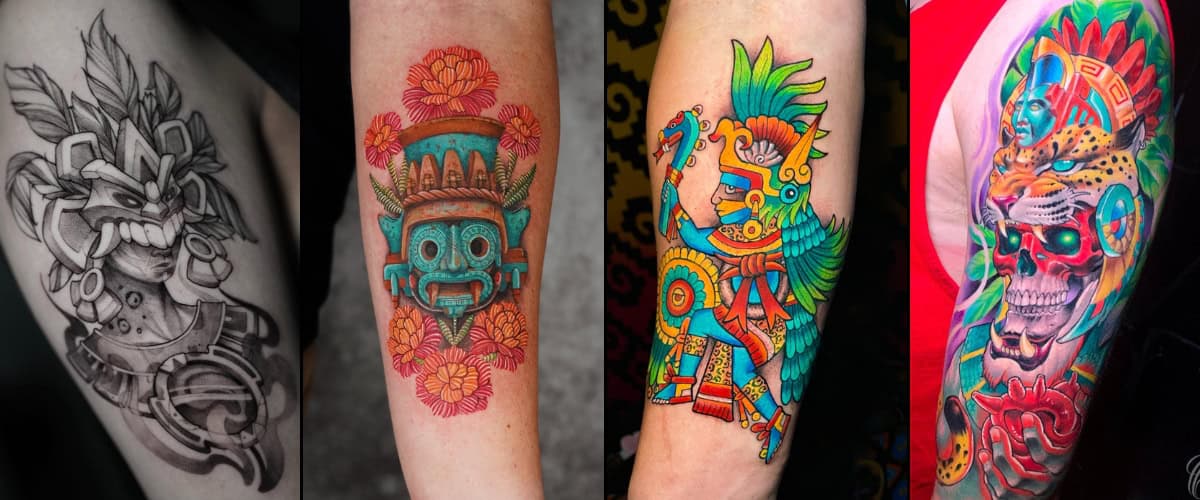
Aztec Mythology Tattoo Ideas

Are you on a search for some of the most az-tounding Tattoo Clues? Well, worry not! There’s no need to sacrifice your heart, as we’ve got some of the best Aztec Tattoo Ideas that will rain down some inspiration.
What is Aztec Mythology
Aztec mythology is the belief system, stories, and spiritual worldview of the Aztec (Mexica) civilisation, which thrived in central Mexico before the arrival of the Spanish in the 16th century. The Aztecs believed that the universe exists only because of how the gods sacrificed themselves for it.
According to the myth of the Five Suns, the world has been created and destroyed multiple times throughout the universe’s history. Each “sun” (or era) ended in some kind of catastrophe, before a new one began.
Our current world exists because a humble god, Nanahuatzin, threw himself into a fire to become the sun. Because of this, humans were expected to repay the gods through offerings and sacrifice, keeping the universe in balance.
Everything in Aztec mythology revolves around the concept of balance. Day vs night, Life vs death, and Creation vs destruction. If the balance was broken, the world could end, just like it had before. That’s why rituals, offerings, and ceremonies were so important, as they were believed to literally keep the universe alive.
Best Aztec Mythology Tattoo Artists


Mazahua art
Mexico City based Tattoo artist honouring Mexican history and culture through tattoos.

Coyoteviejo ink
Guadalajara based Black and Grey Tattoo artists with a range of designs including Aztec Tattoos.
Best Aztec Mythology Tattoo Ideas
Now that we know a little about Aztec Mythology, let’s take a look at some of the best Aztec Mythology Tattoos the 5 eras have to offer.
Quetzalcoatl Aztec Mythology Tattoo
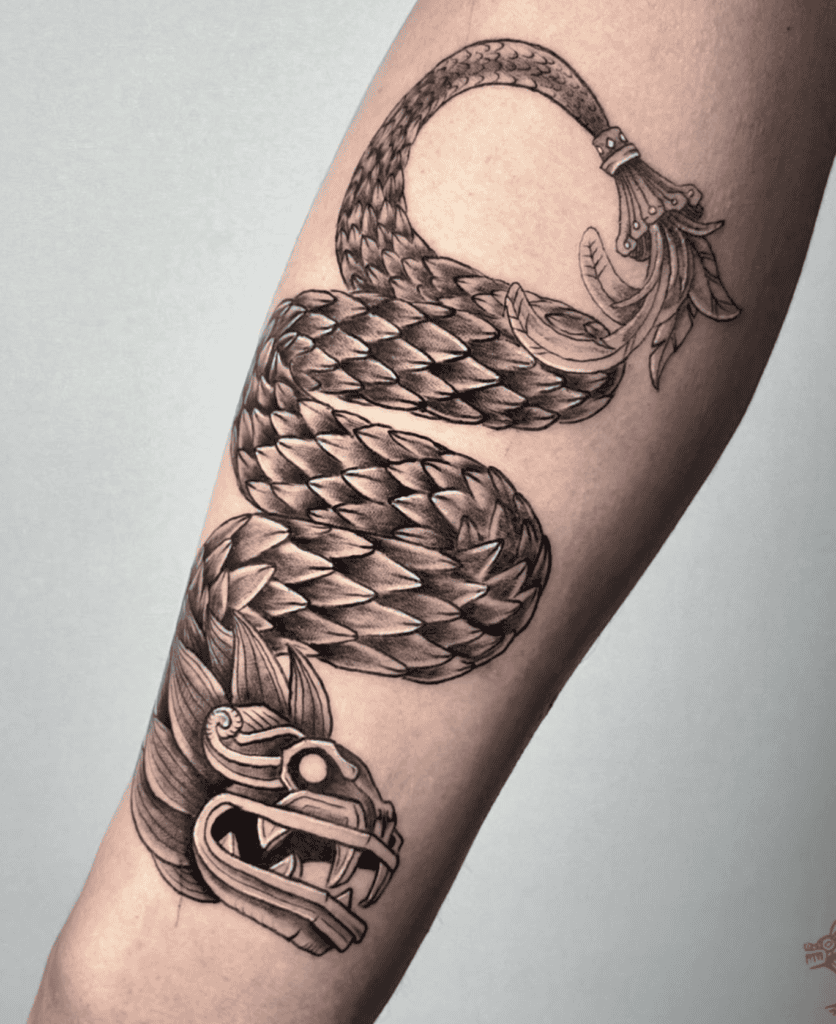
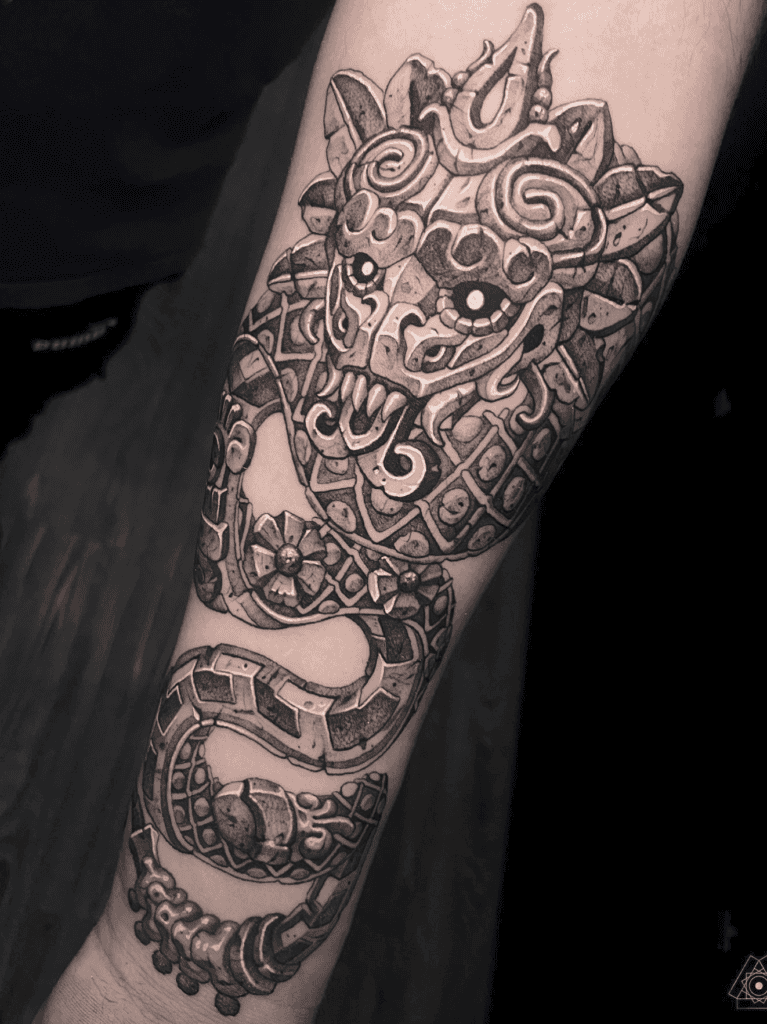
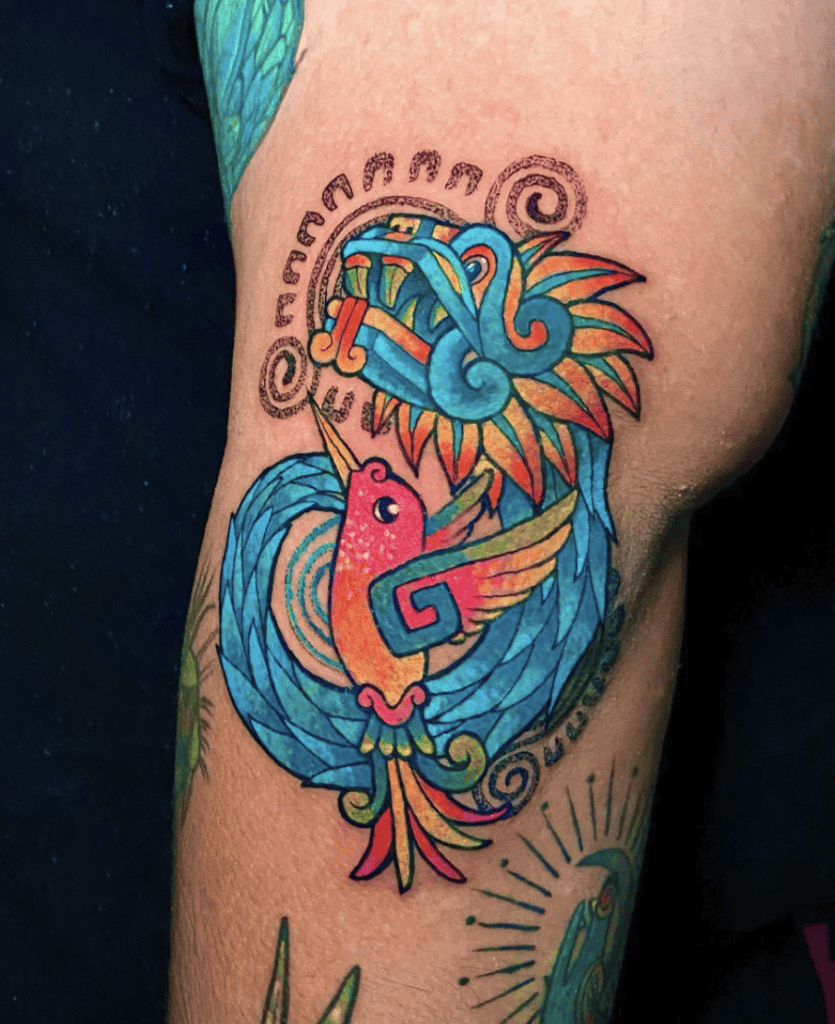
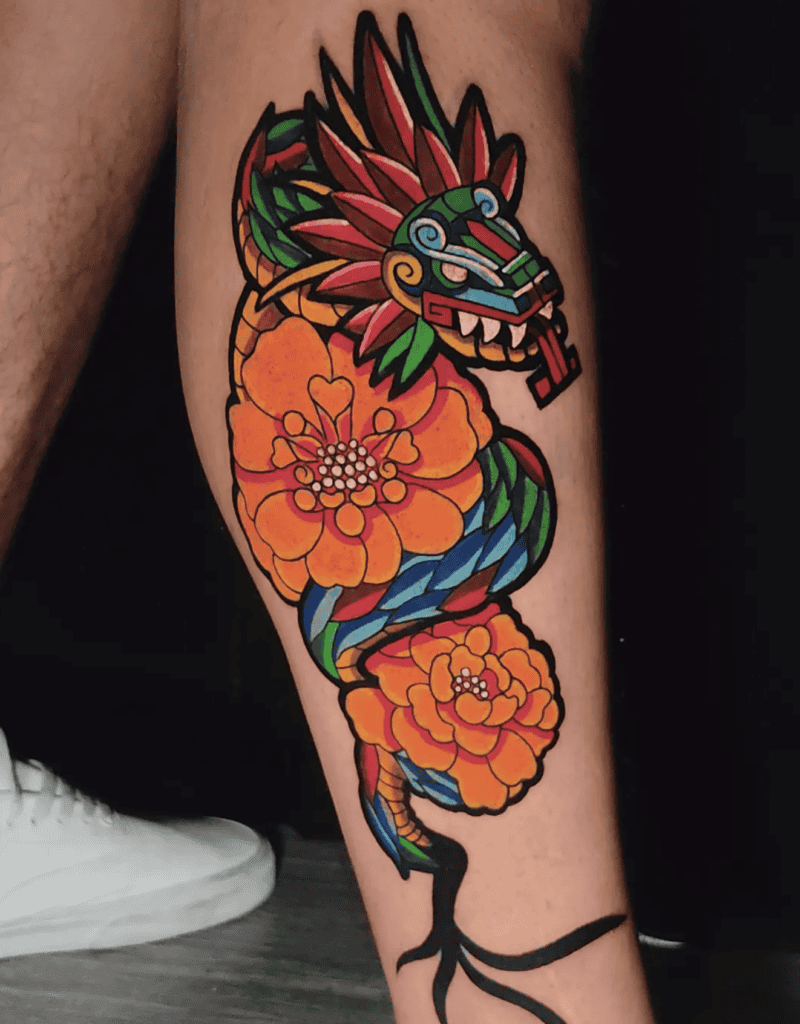
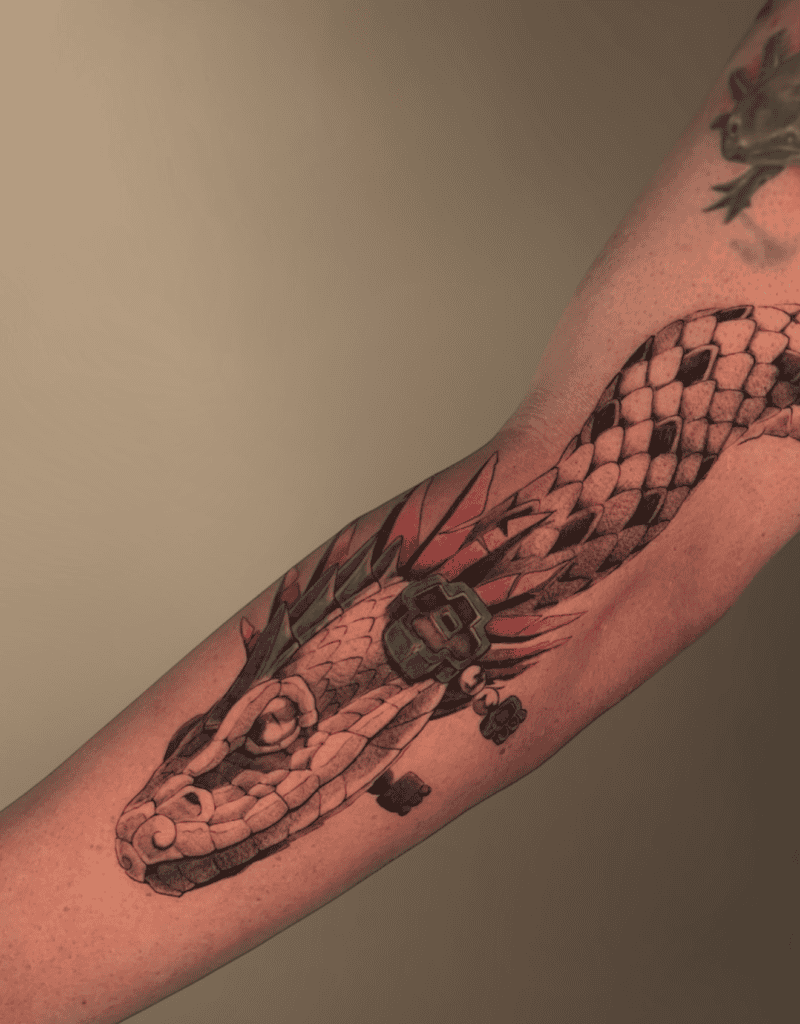
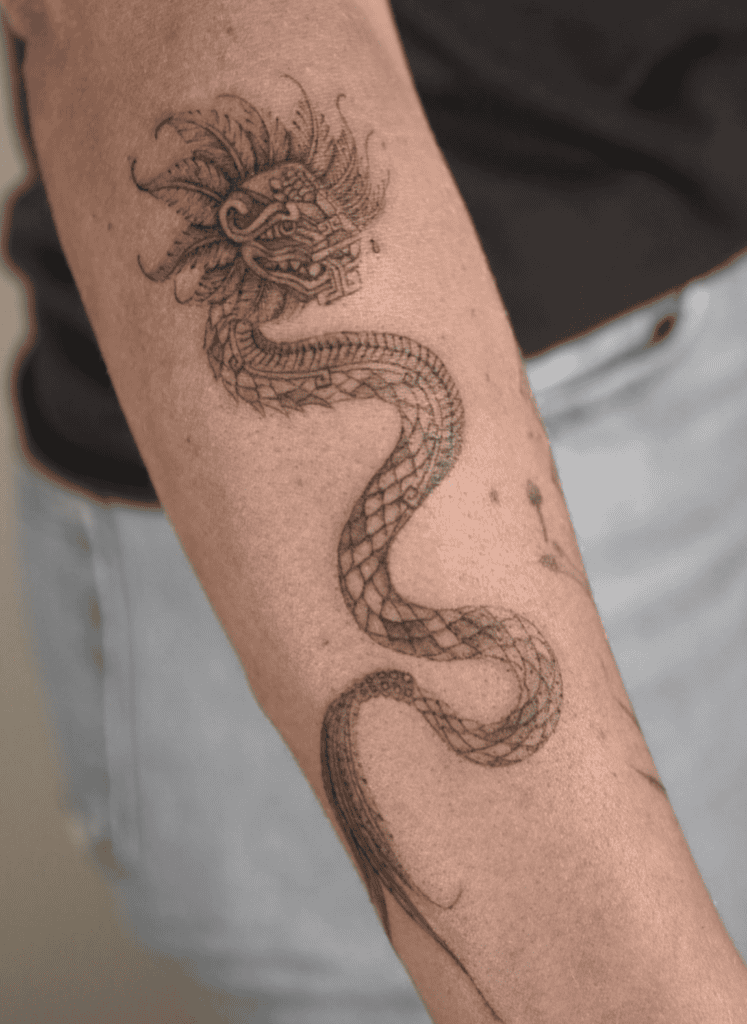
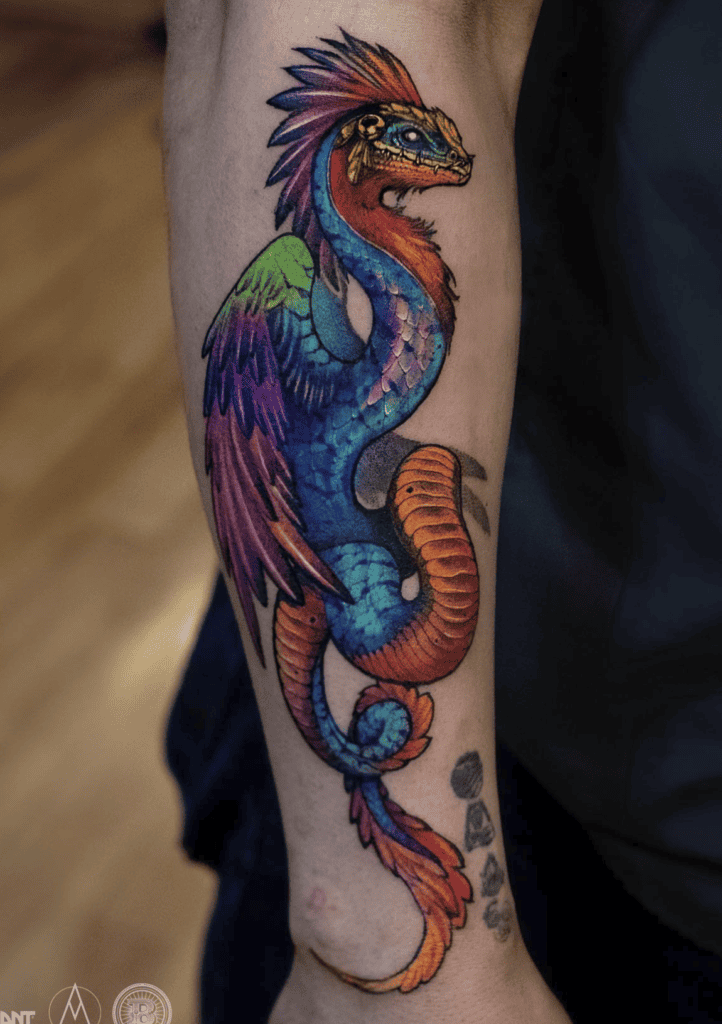
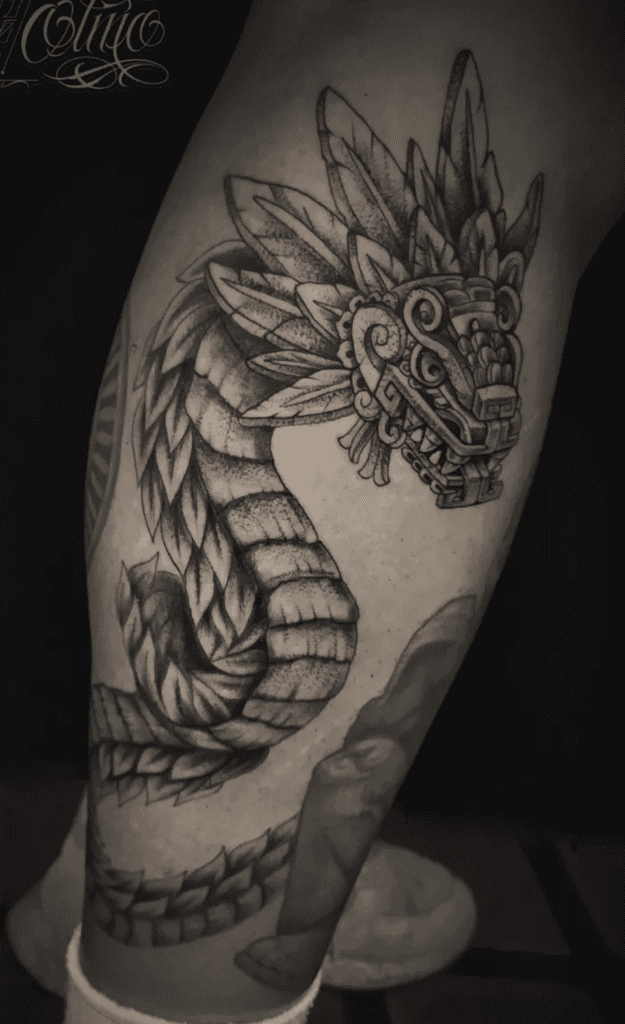
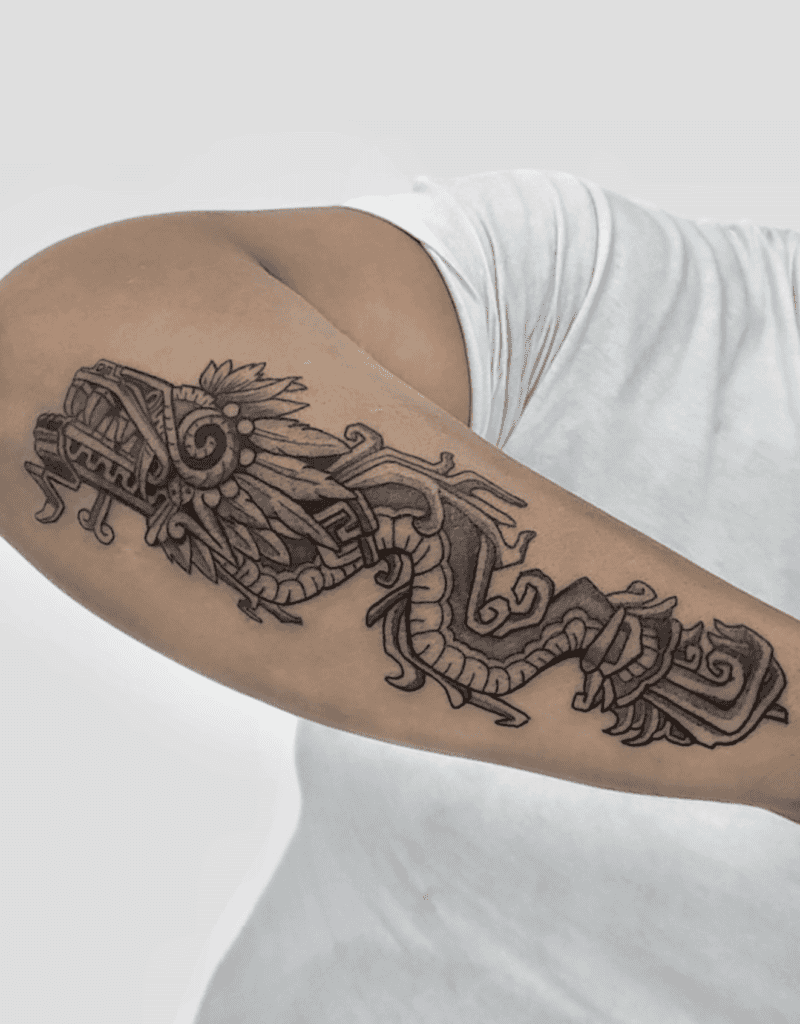
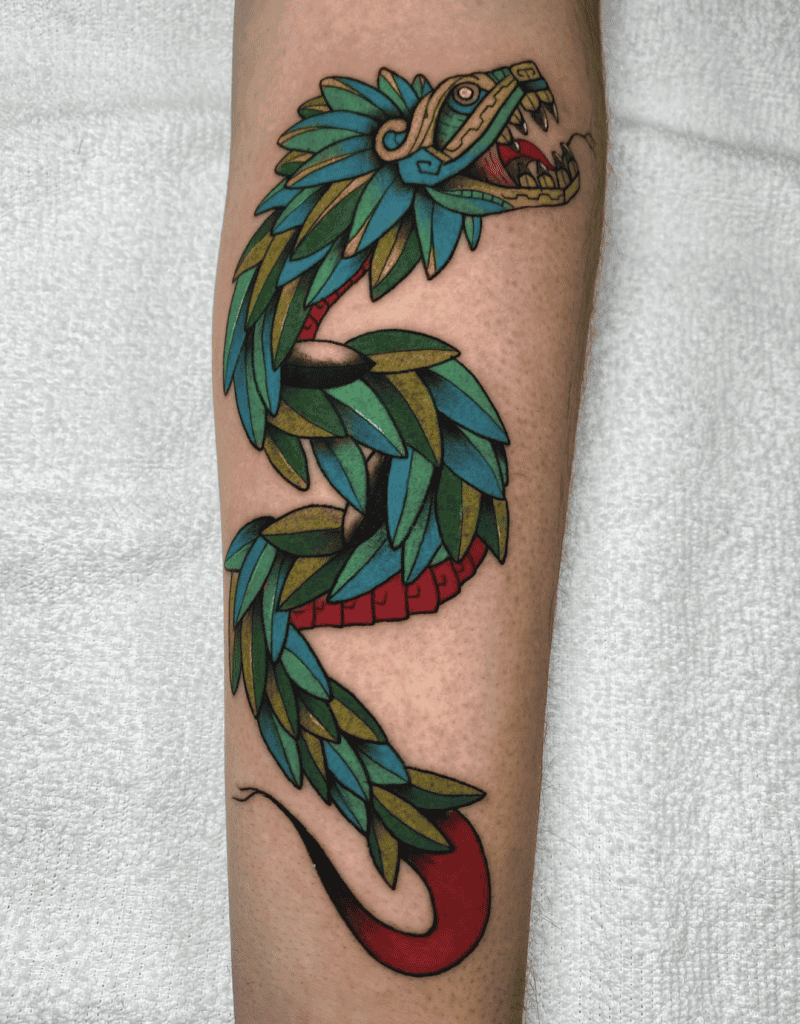
Quetzalcoatl, meaning the “Feathered Serpent”, is an Aztec god who represents the connection between heaven and earth, spirit and body, the divine and the human. He is a multi-layered god tied to many aspects of life, such as wind & air, knowledge & wisdom, creation, and the morning star (Venus). He’s often seen as a civilising force, bringing order, culture, and knowledge to humanity rather than chaos.
One of Quetzalcoatl’s most famous myths explains how humans were created in the current world. After previous worlds were destroyed, Quetzalcoatl travelled to the underworld, Mictlan, ruled by Mictlantecuhtli, where he retrieved the bones of past humans, but escaped with difficulty, falling and breaking them. To bring humanity back to life, he mixed the bones with his own blood, sacrificing himself.
Unlike many Aztec gods, Quetzalcoatl is often associated with opposition to excessive human sacrifice (in some traditions), peace, learning, morality, and guiding humanity rather than controlling it.
Xolotl Aztec Mythology Tattoo
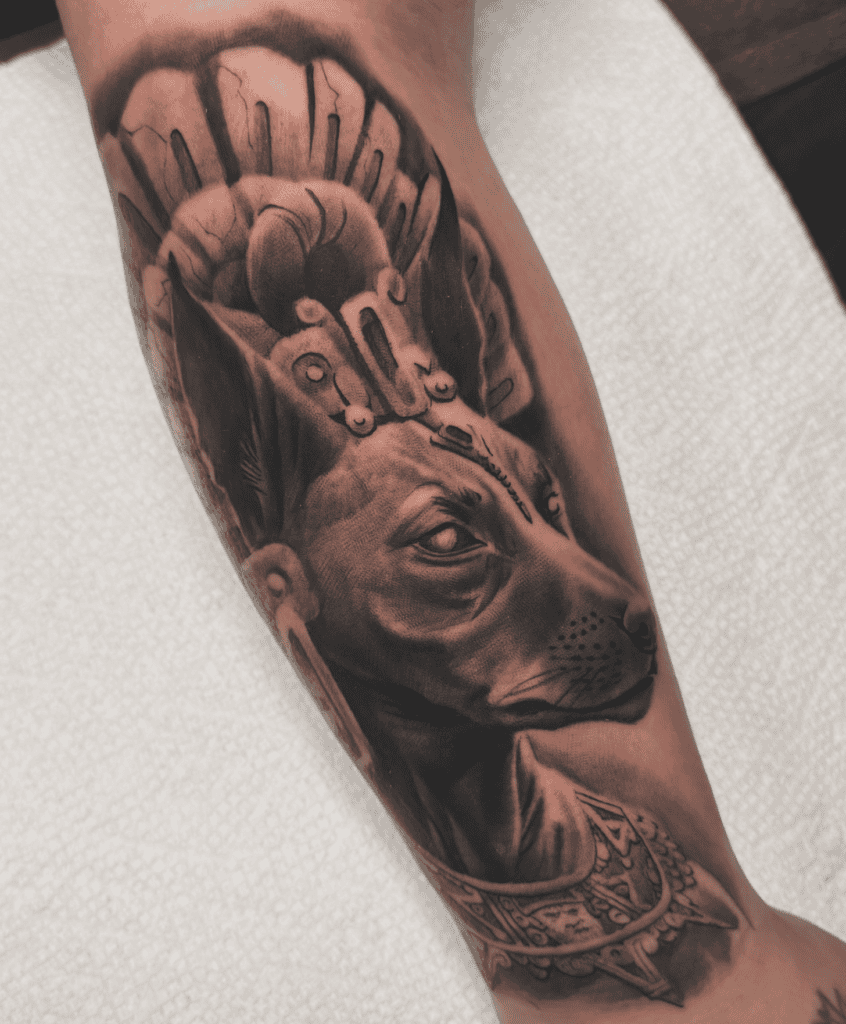
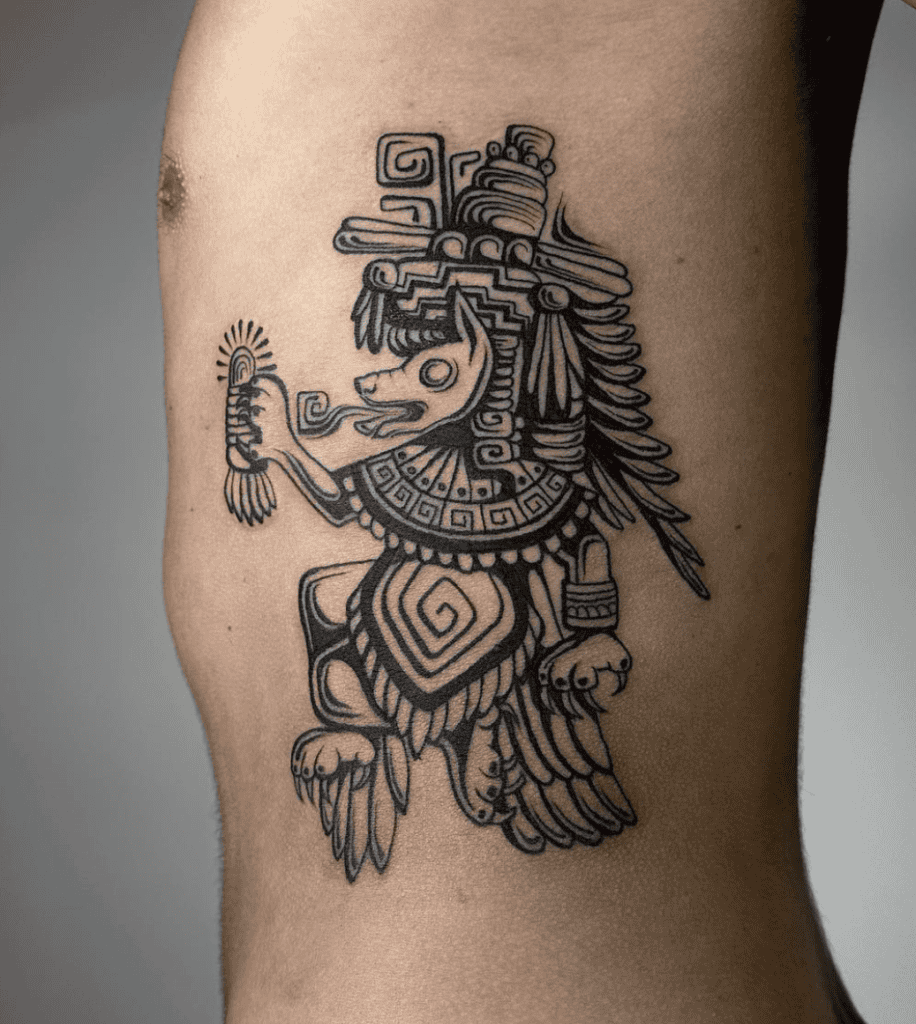
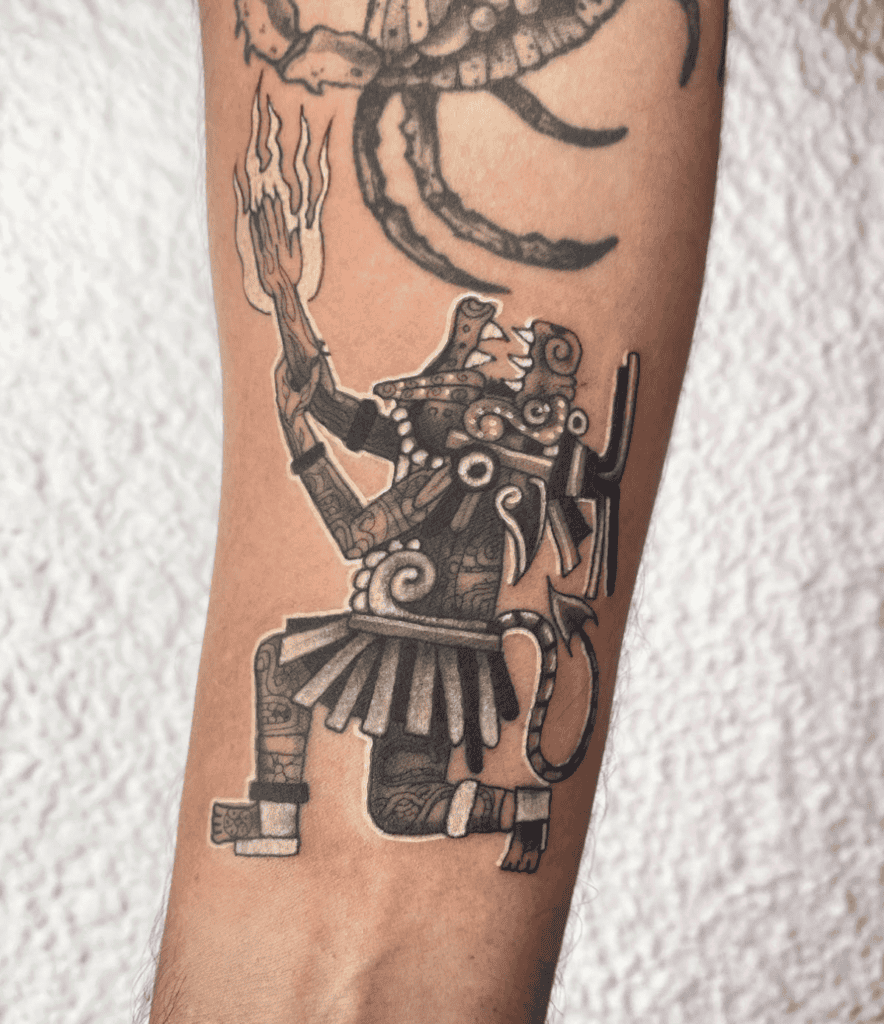
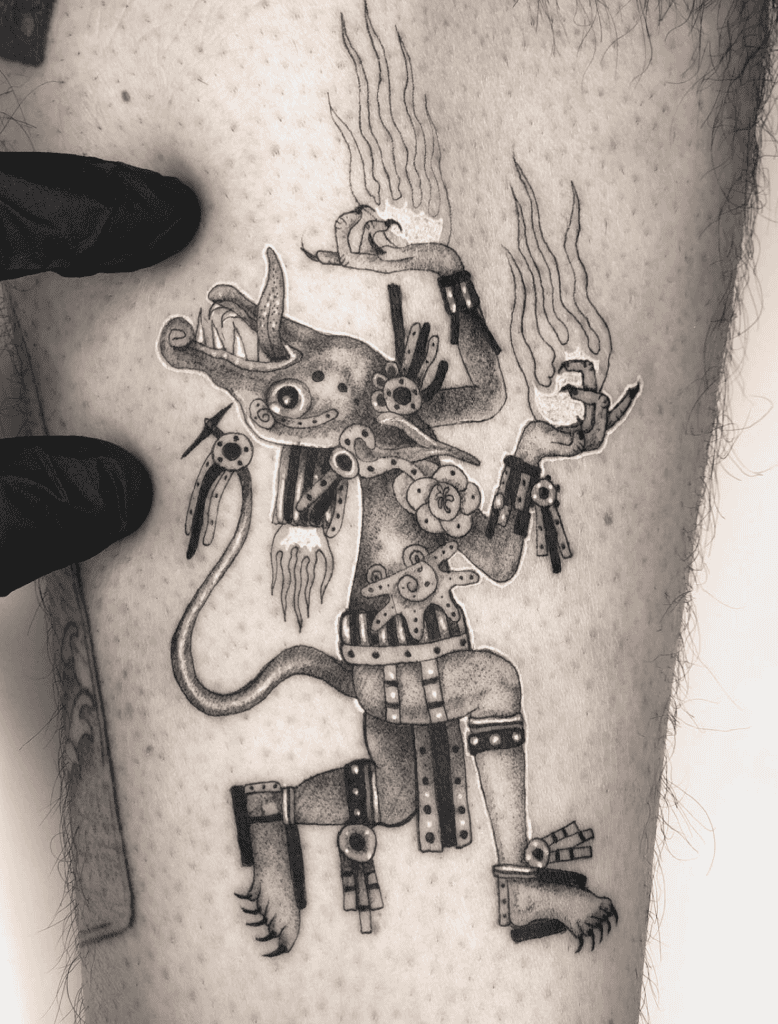
Xolotl is a deity of death, transformation, lightning, and the underworld, often depicted as a skeletal dog-headed figure and the twin brother of Quetzalcoatl. While Quetzalcoatl represents light and life, Xolotl represents darkness, endings, and the hidden side of existence.
Xolotl’s most important role is guiding souls to Mictlan. He helps the dead navigate dangerous paths, assists in crossing rivers, and protects them during their journey. He is closely linked to the spirit dog Itzcuīntli, reinforcing his role as a companion through darkness and ensuring that even in death, no one has to walk the path alone.
Xolotl is famous for his ability to transform into different forms. In one myth, he tries to avoid sacrifice by shapeshifting into a maize plant, a maguey plant, then finally, an axolotl, which is where the animal gets its name. Despite his attempts, he is eventually found, showing that you can delay fate, but not escape it.
Tezcatlipoca Aztec Mythology Tattoo
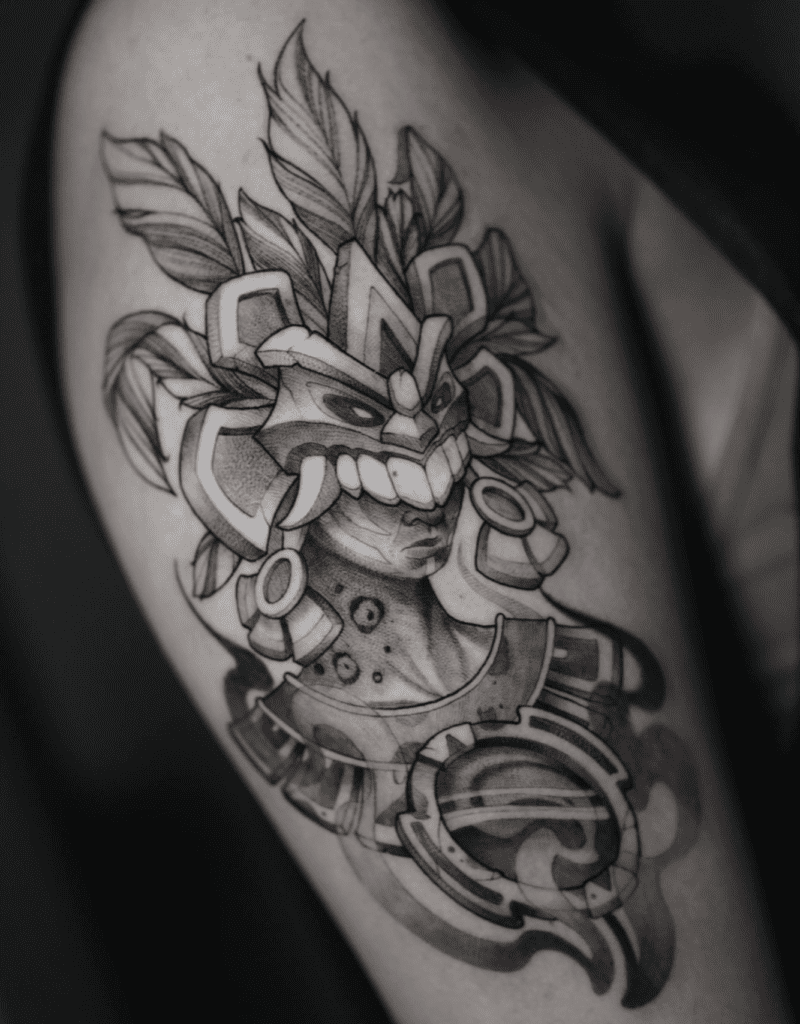
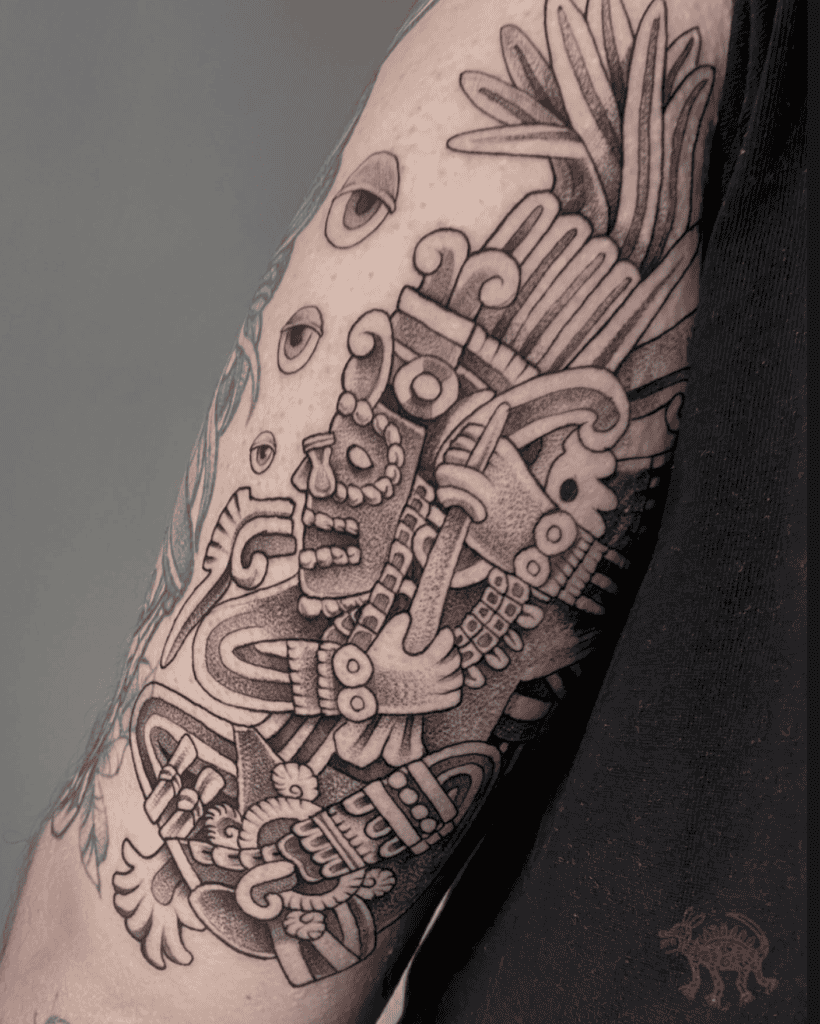
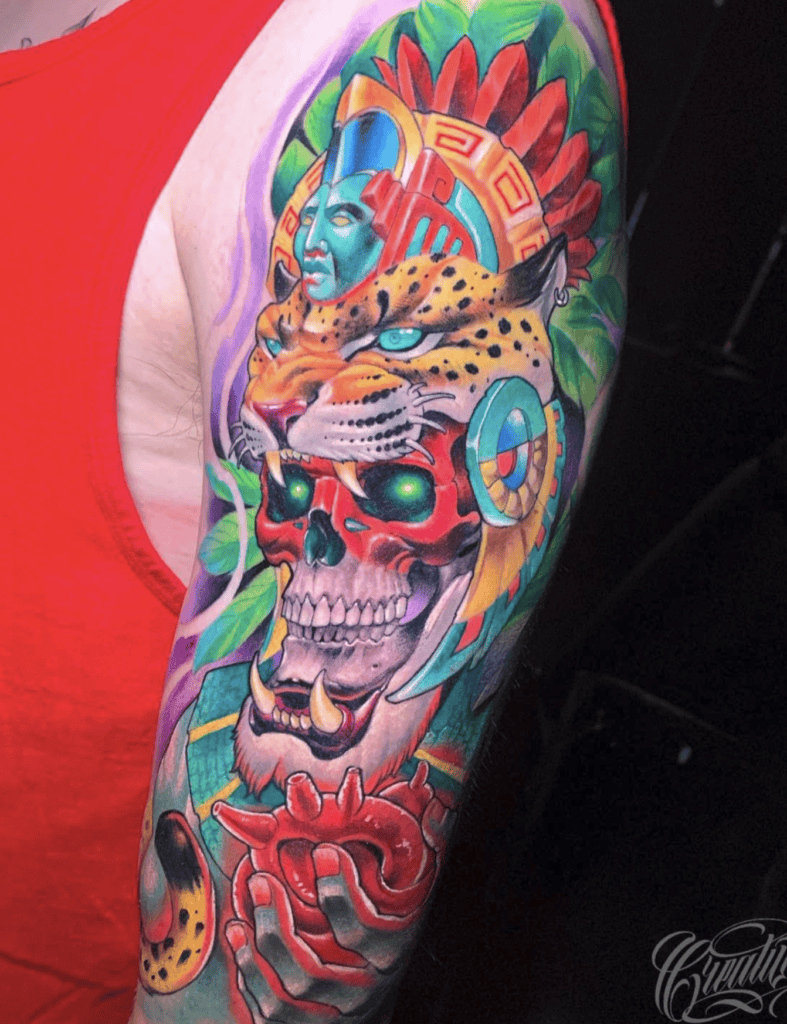
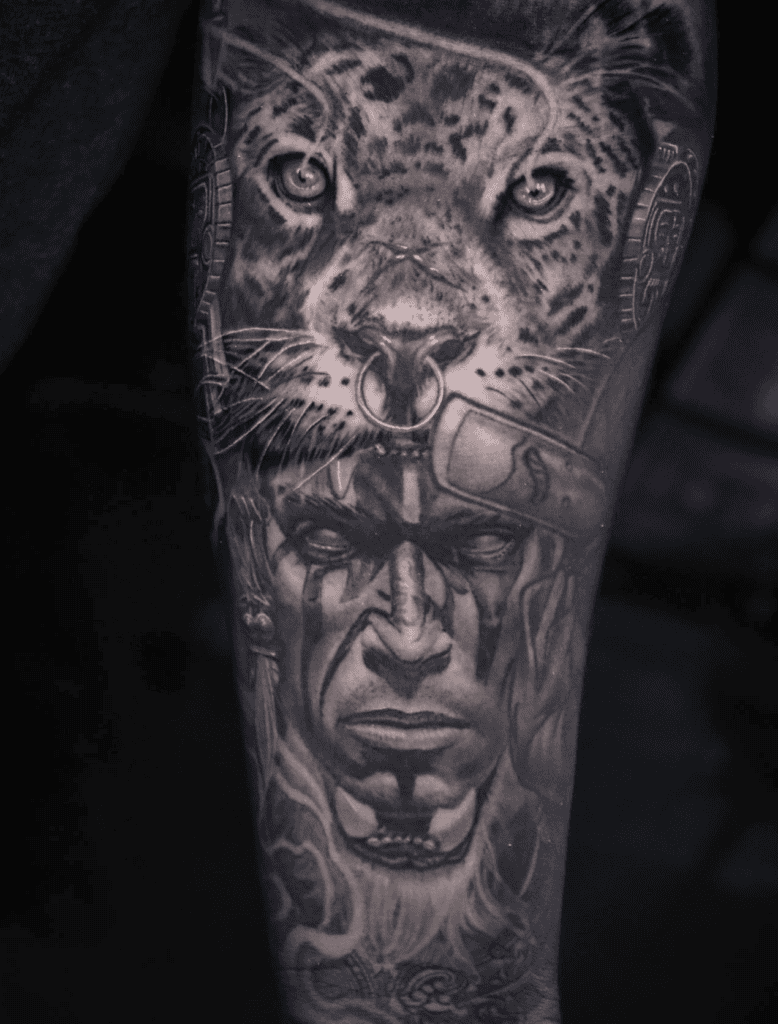
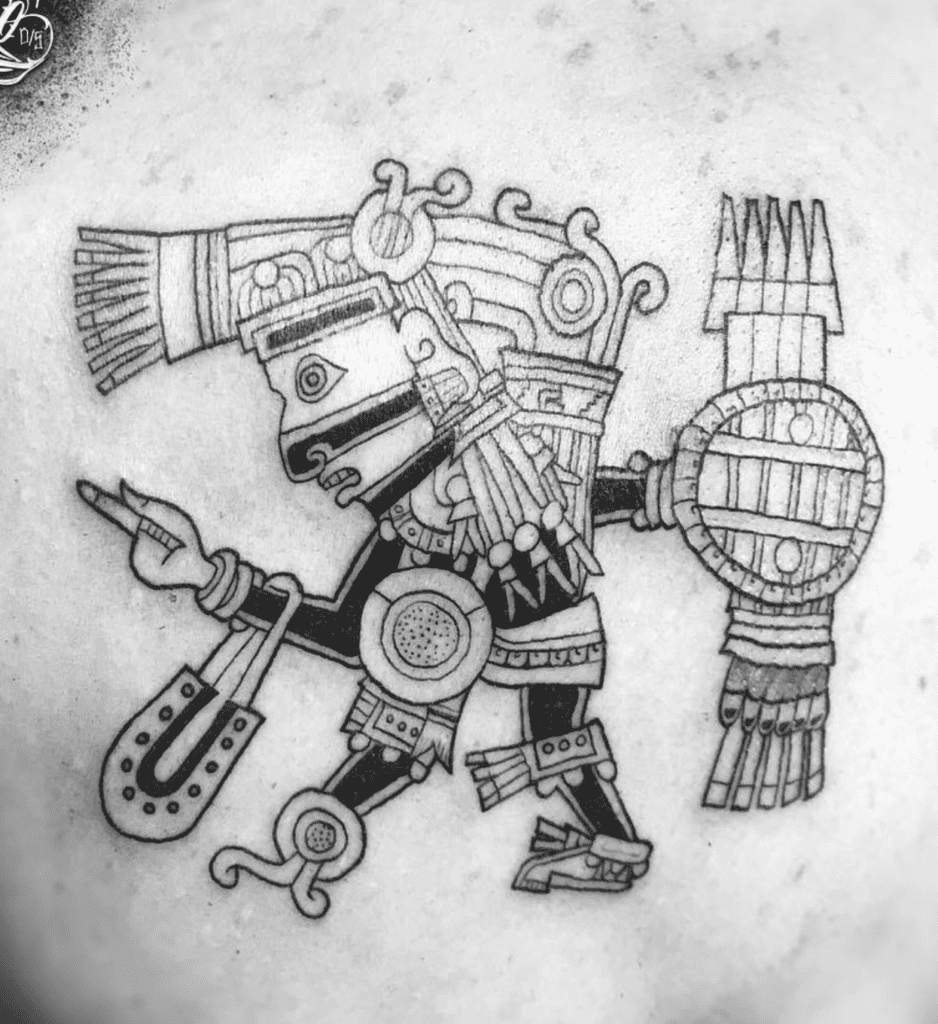
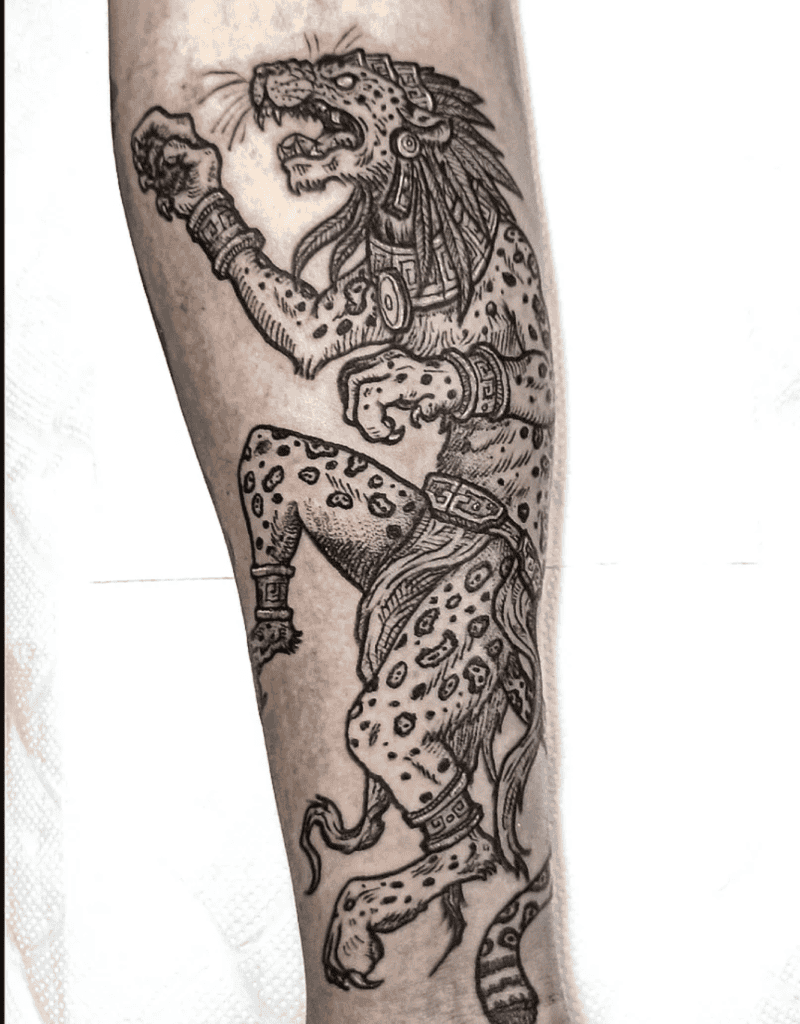
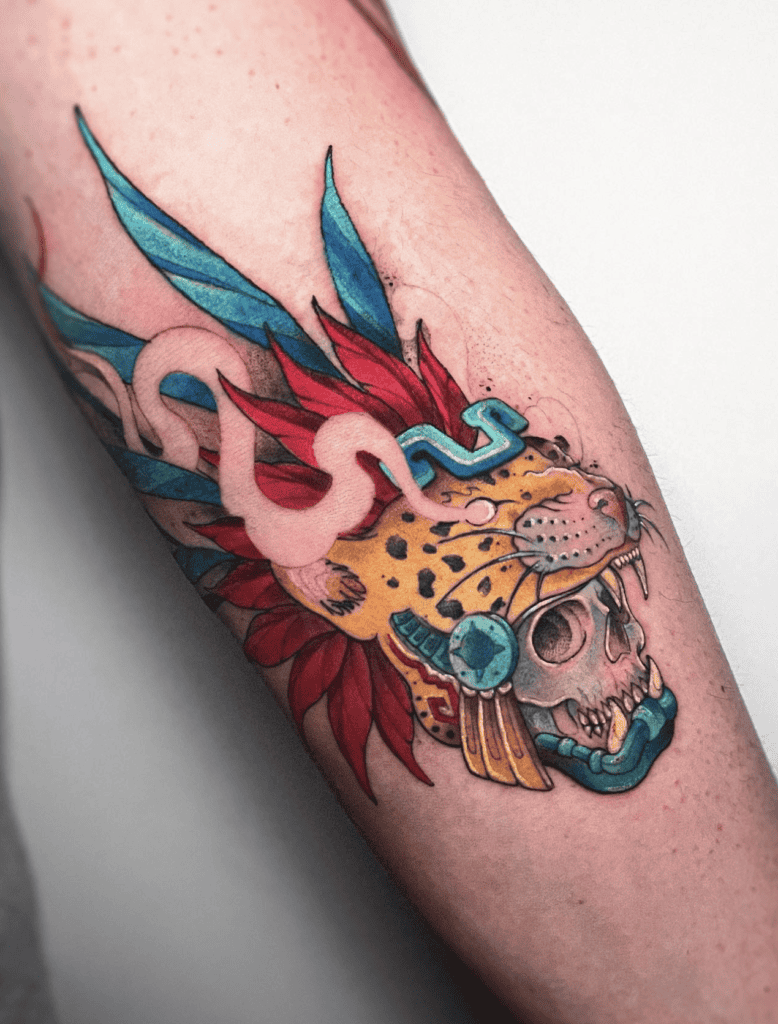
Tezcatlipoca, whose name means “Smoking Mirror, ” refers to a polished obsidian mirror said to emit smoke. This mirror symbolises his ability to see everything, reveal hidden truths, and manipulate reality.
Tezcatlipoca is a force of unpredictability, believed to test people, often through hardship or temptation, to reveal their true nature. His most famous rivalry is with Quetzalcoatl, with their conflict representing order, knowledge, creation (Quetzalcoatl), vs chaos, power, destruction (Tezcatlipoca). In some myths, Tezcatlipoca tricks or defeats Quetzalcoatl, showing that even wisdom can fall to illusion and pride.
Tezcatlipoca played a major role in the creation myths, especially the first world (First Sun). He ruled as the sun in the first age, but after a conflict with Quetzalcoatl, he was knocked from the sky. In revenge, he unleashed jaguars to devour humanity, ending the first world.
Huitzilopochtli Aztec Mythology Tattoo
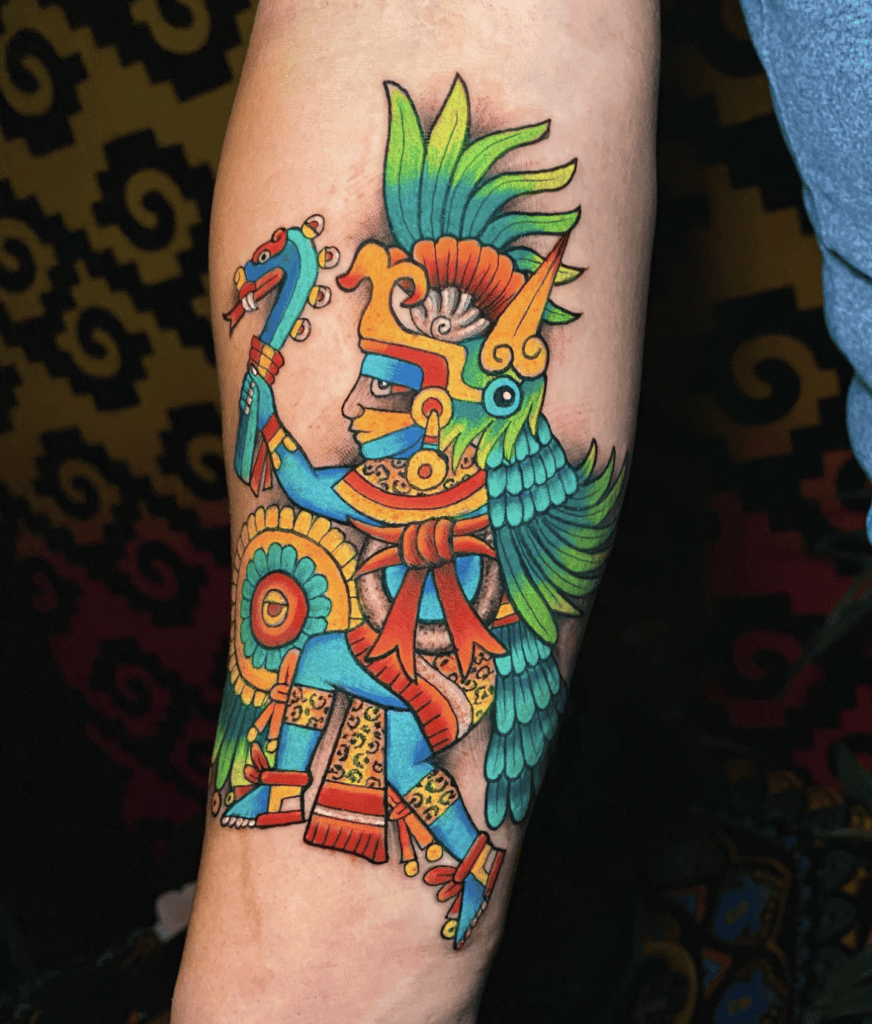
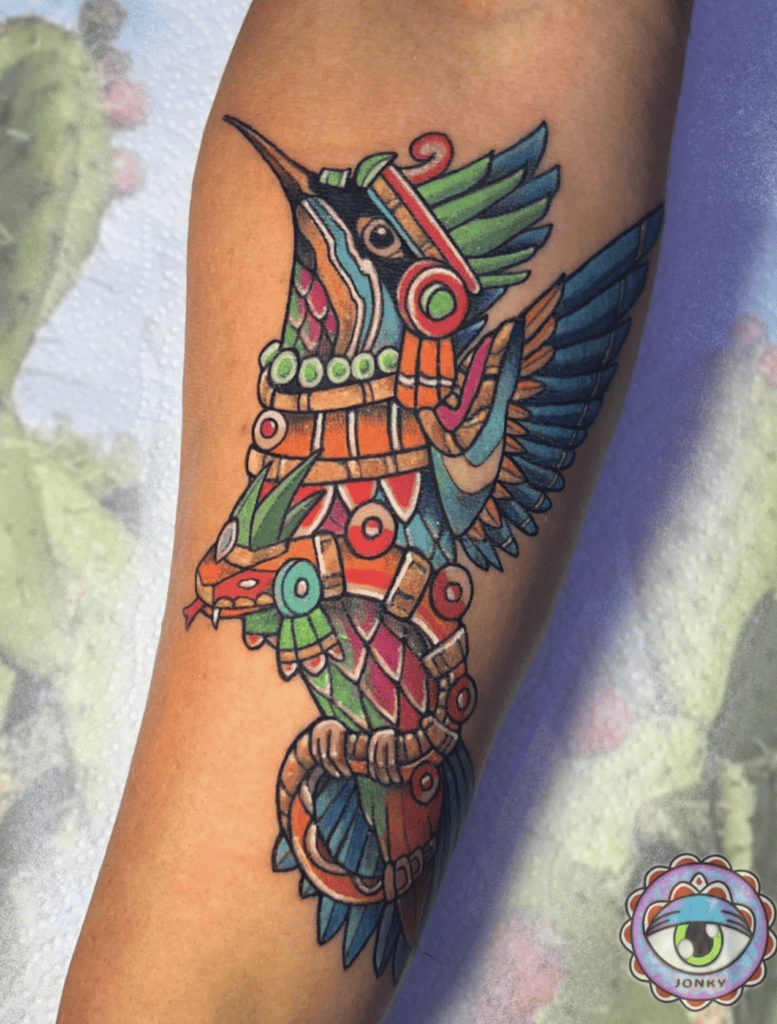
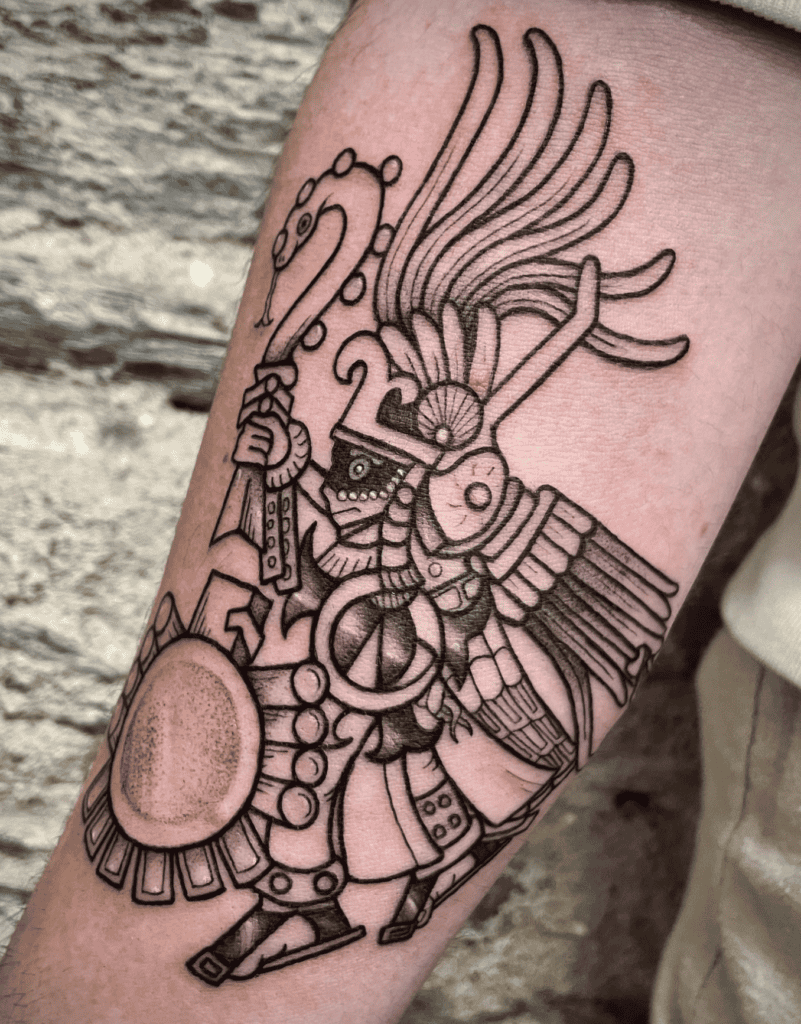
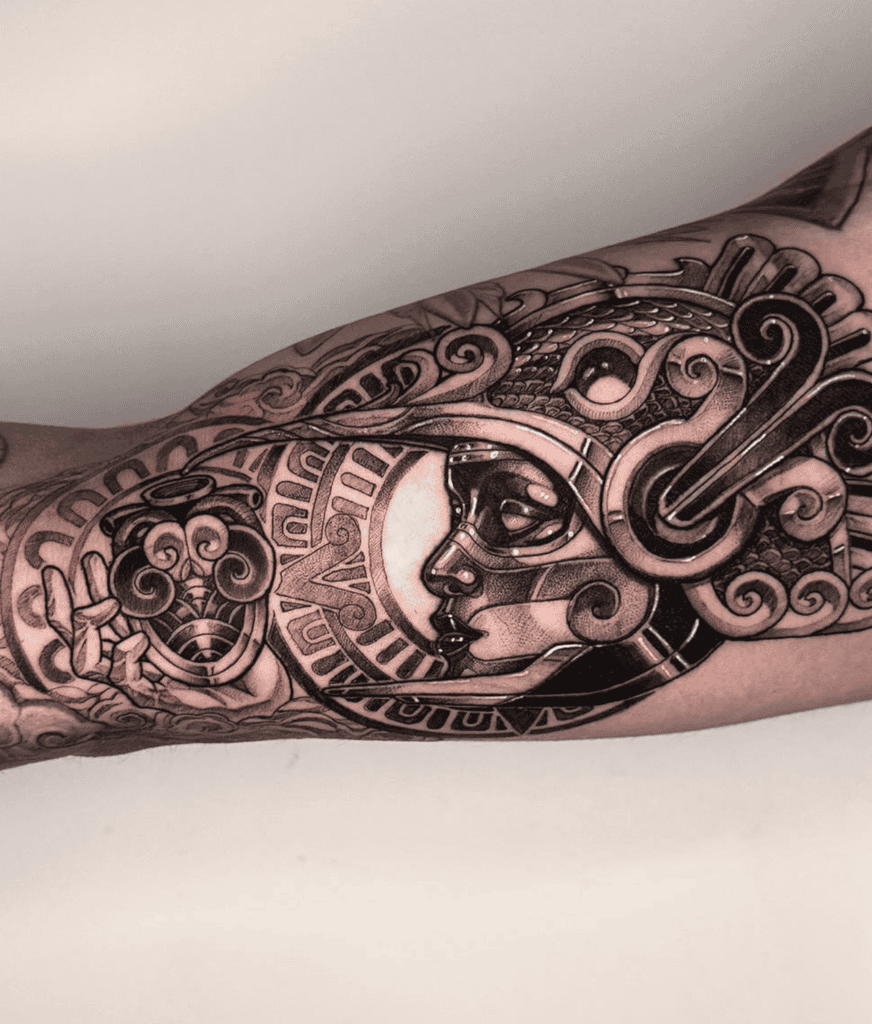
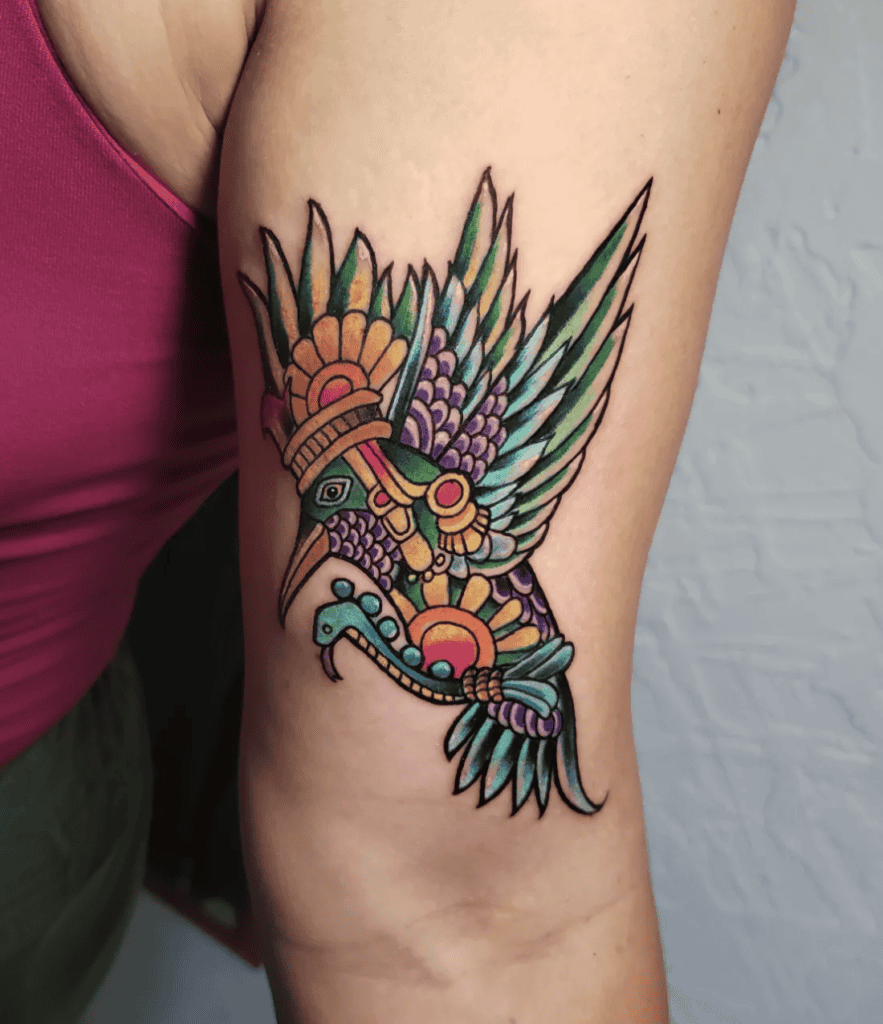
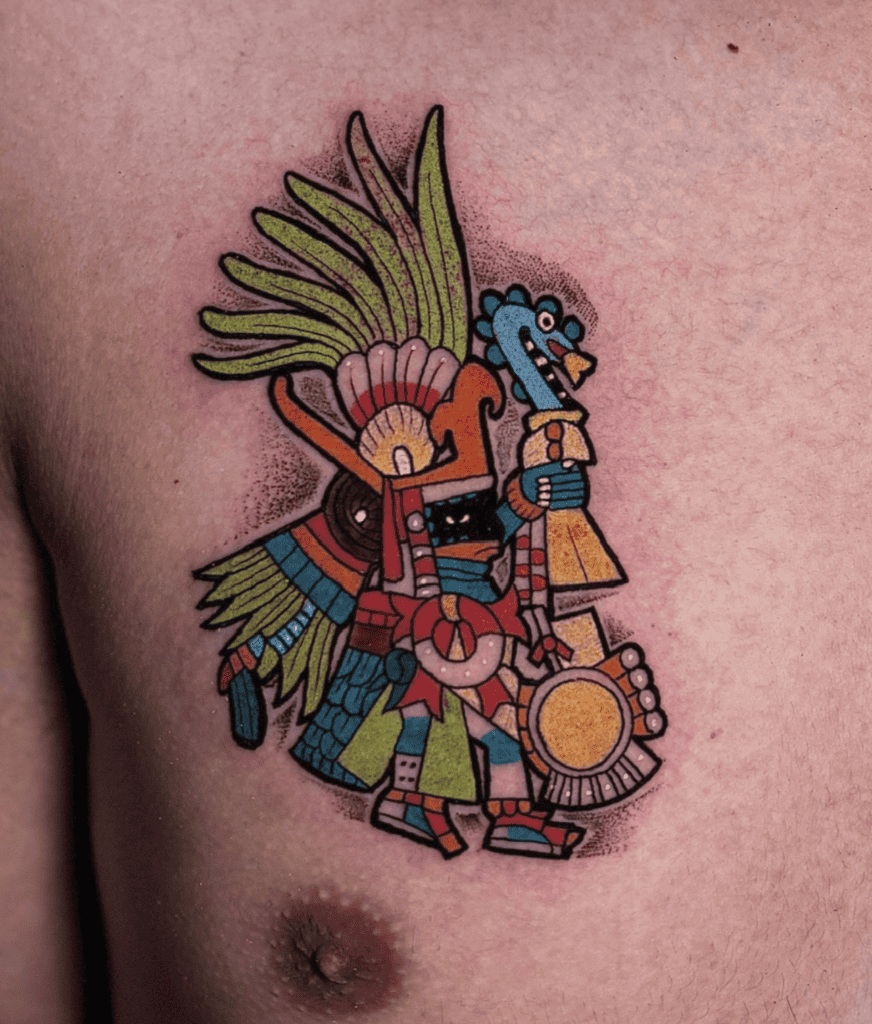
Huitzilopochtli is a fierce deity of the sun, war, and destiny, and the patron god of the Aztec capital, Tenochtitlan. His name is often translated as “Hummingbird of the South” (or “Left-Handed Hummingbird”), with Aztecs believing hummingbirds symbolised warriors’ souls and relentless energy.
Huitzilopochtli represents the Sun, war & conquest, guidance & destiny, and the warrior spirit. The Aztecs believed that the sun wasn’t passive and was fighting to survive every day, with Huitzilopochtli as that fighter.
When Coatlicue became mysteriously pregnant, her daughter, Coyolxauhqui, became angry, and her 400 brothers (representing the stars), plotted to kill her. The moment they attacked, Huitzilopochtli was born fully grown, armed, and ready for battle. He defeated his siblings, dismembering Coyolxauhqui and casting her body down a mountain. This myth symbolises the sun (Huitzilopochtli) defeating the moon and stars every dawn.
Because the Aztecs believed that the sun fought every day to rise and survive the night, Huitzilopochtli needed strength (energy) to win this battle. Human hearts and blood were believed to fuel the sun, so a ritual sacrifice ensured the sun would rise again tomorrow.
Tlaloc Aztec Mythology Tattoo
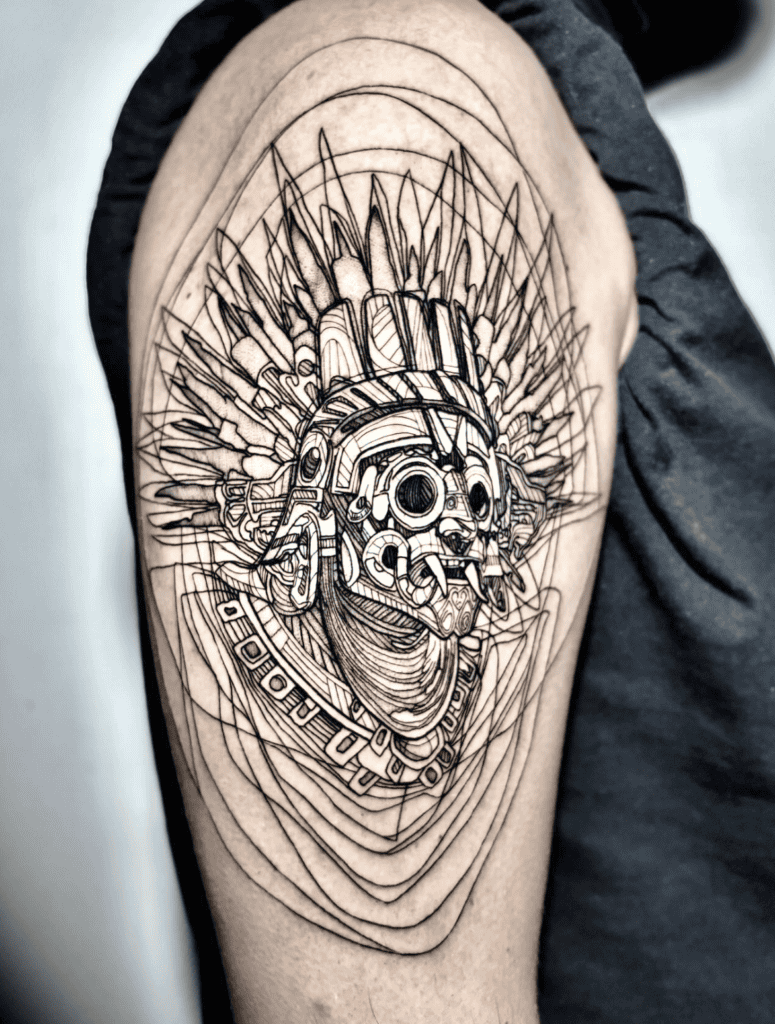
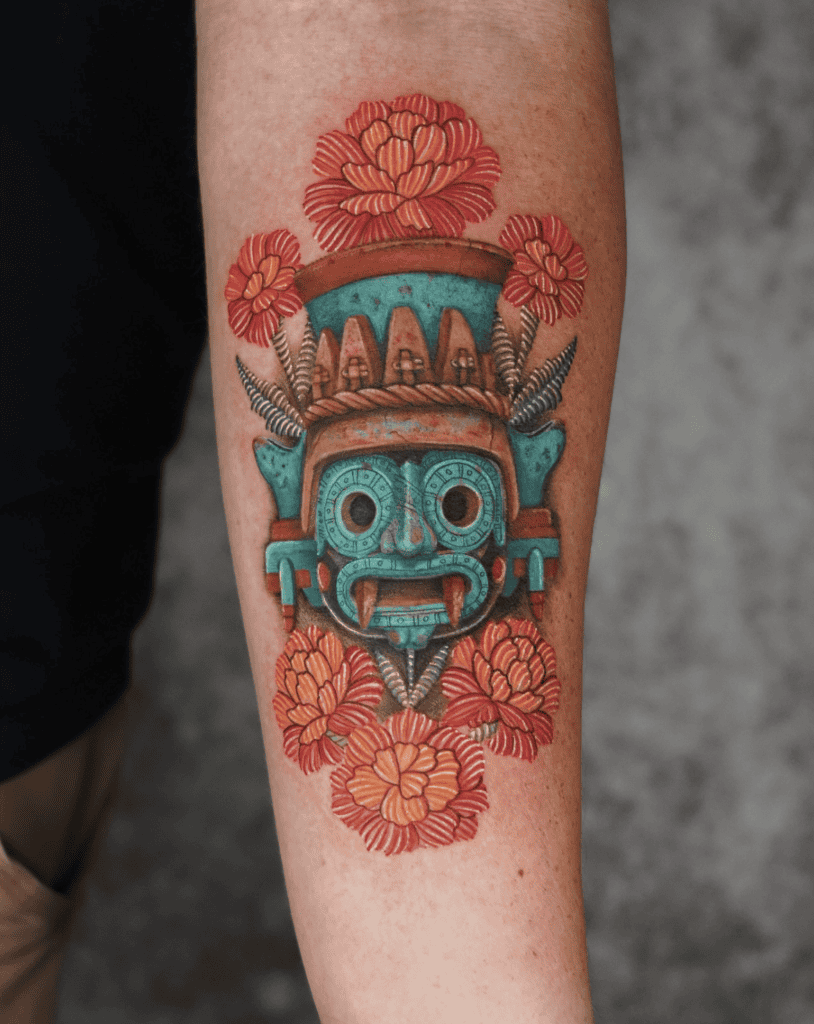
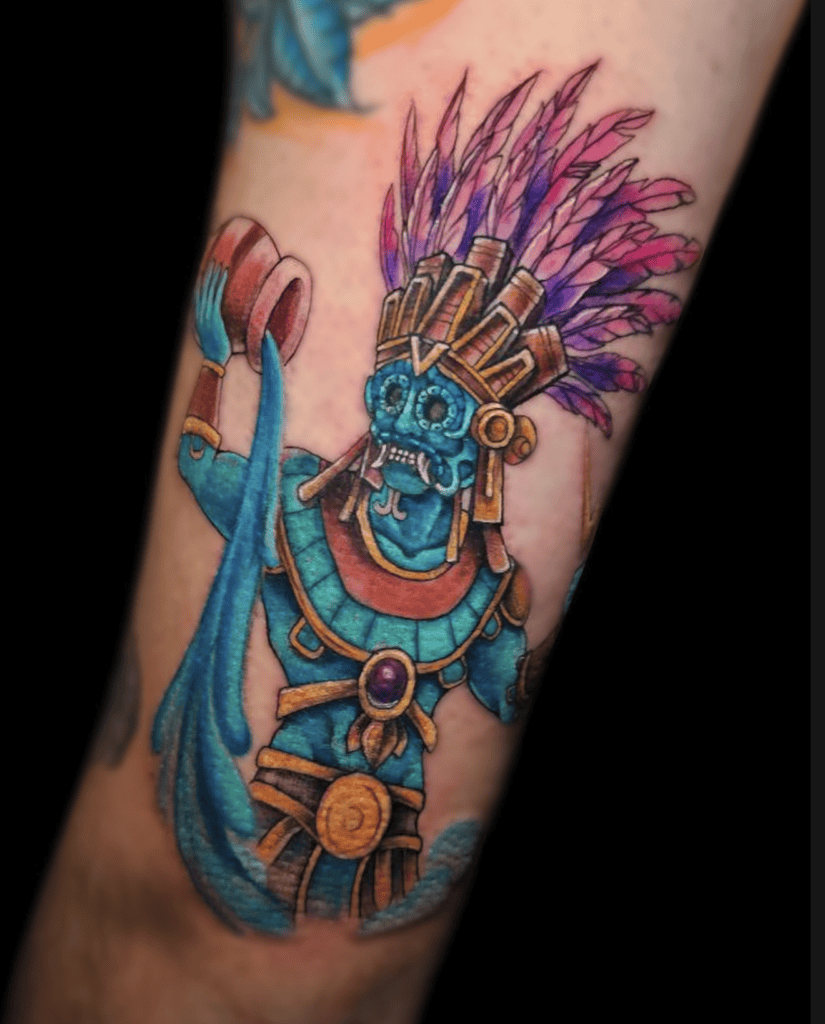
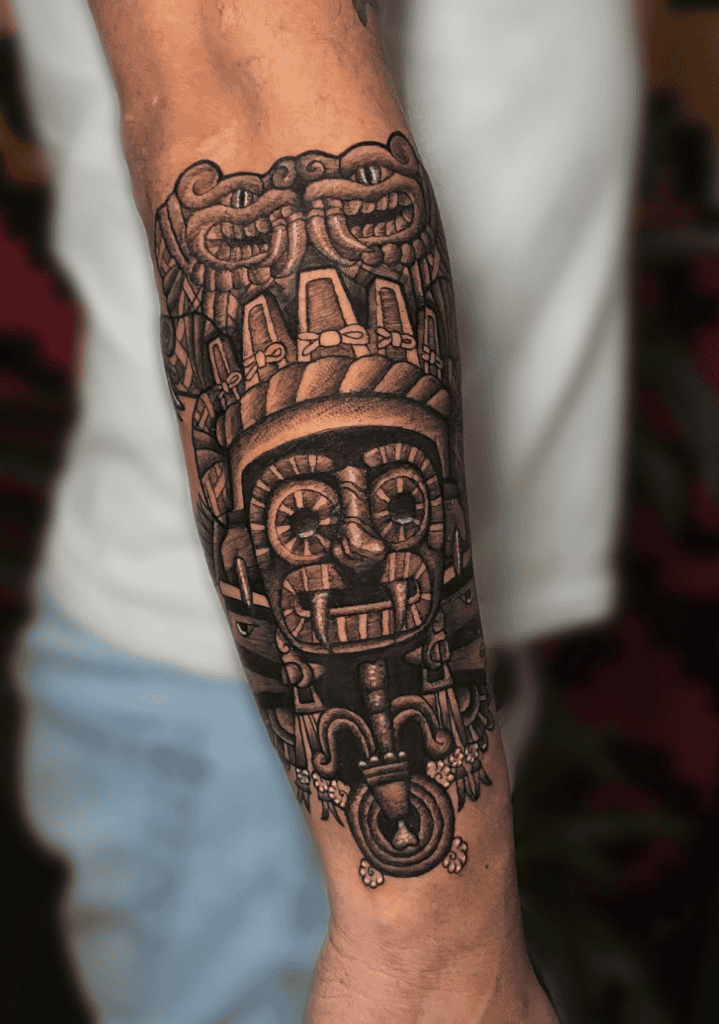
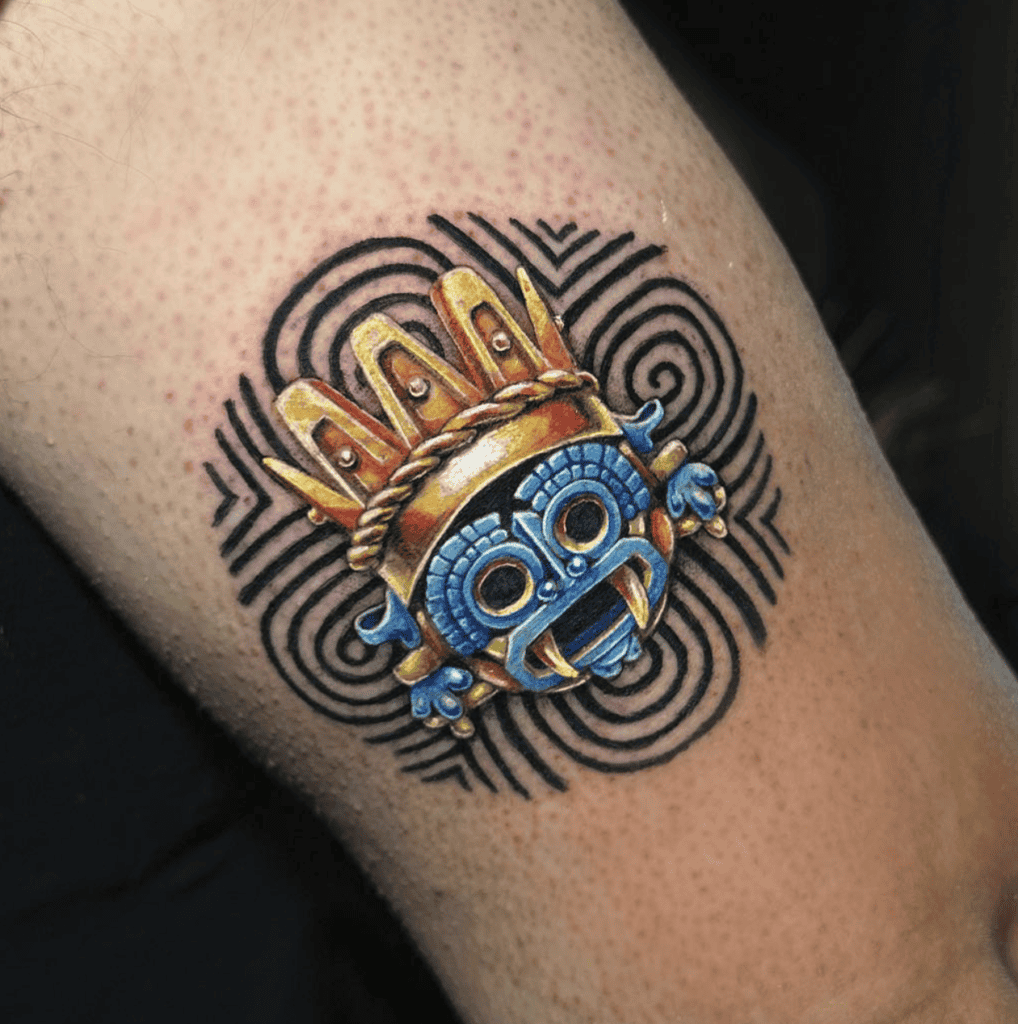
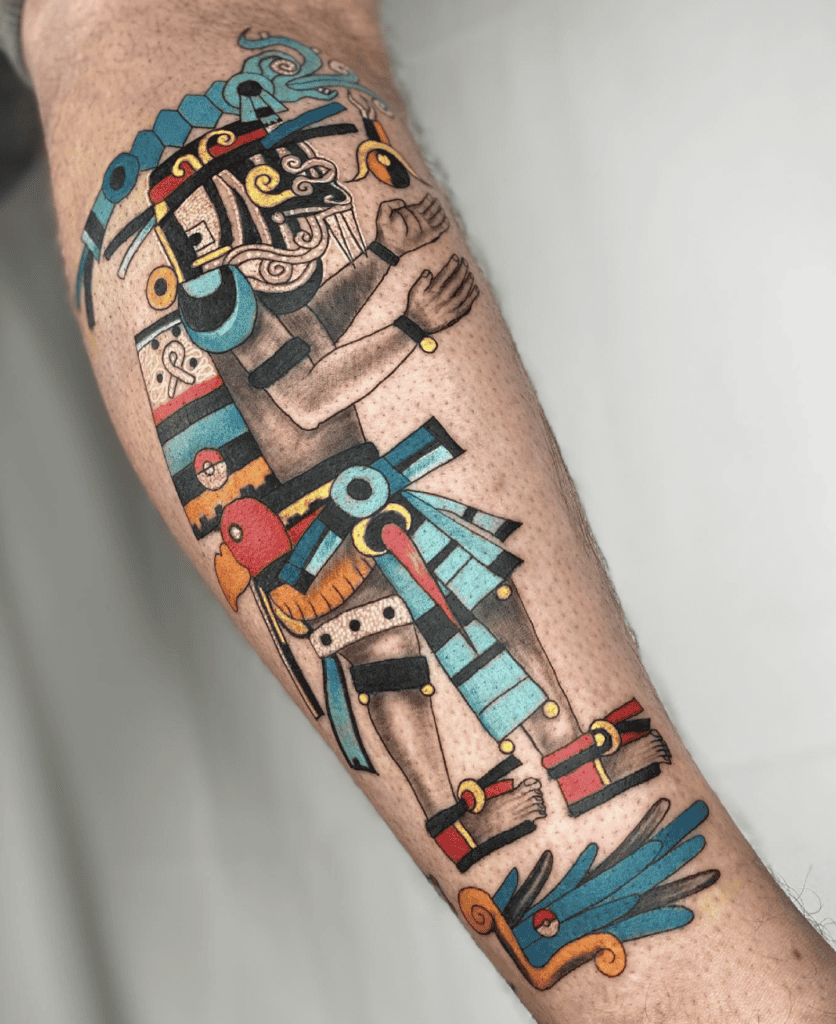
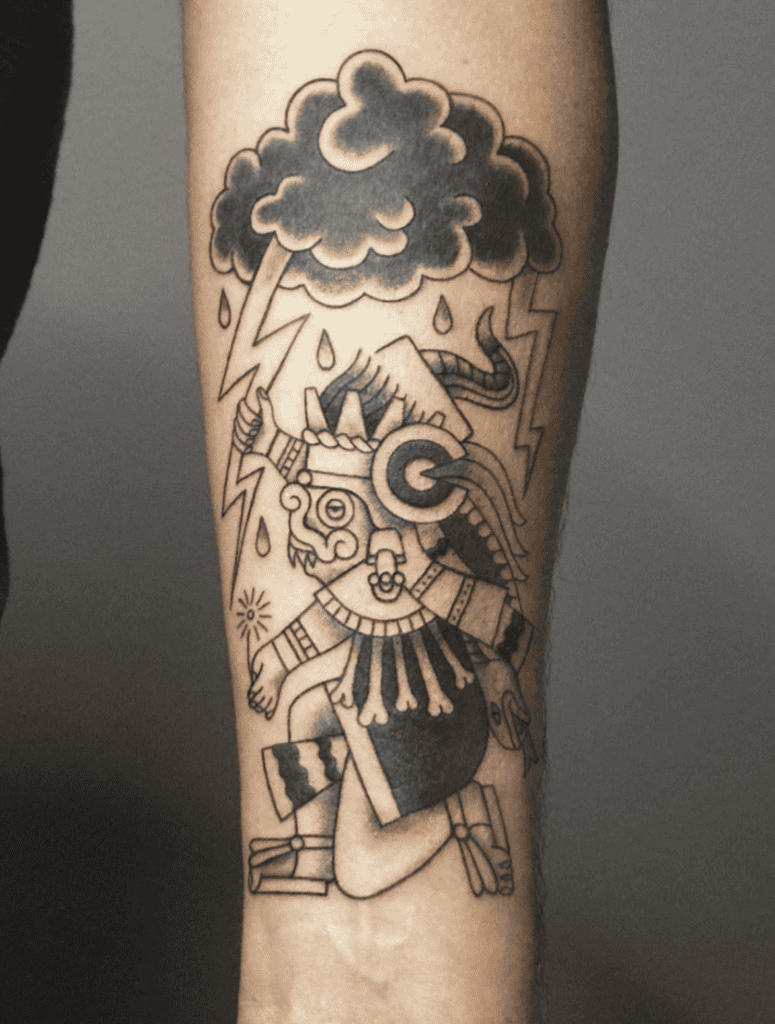
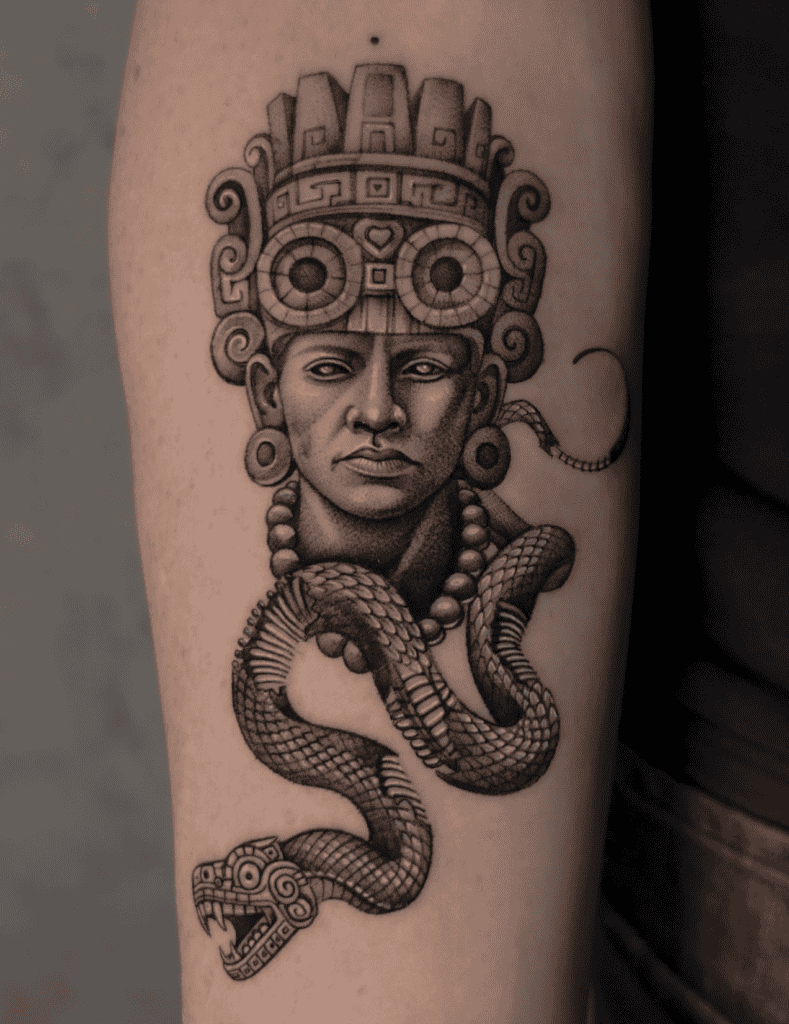
Tlaloc is the Aztec deity of rain, storms, water, and fertility, controlling all forms of water in the natural world, such as rain & storms, agriculture & fertility, thunder & lightning, and mountains & springs.
Tlaloc has large goggle-like eyes, sharp fangs, and is often coloured in blue and green tones representing water and life. He could send life-giving rain or unleash hail, floods, and lightning. Because of this, people both worshipped and feared him deeply.
Tlaloc ruled a special afterlife realm called Tlalocan, which, unlike the harsh underworld, was a lush, beautiful paradise filled with flowing rivers, green plants, and eternal abundance, where people believed to have died from water-related causes (like drowning or lightning) went.
To ensure rain and good harvests, the Aztecs made offerings to Tlaloc, including food and valuables, ritual ceremonies, and, in some cases, human sacrifices, especially children, as children’s tears were believed to be especially powerful, symbolising rain.
Xipe Totec Aztec Mythology Tattoo
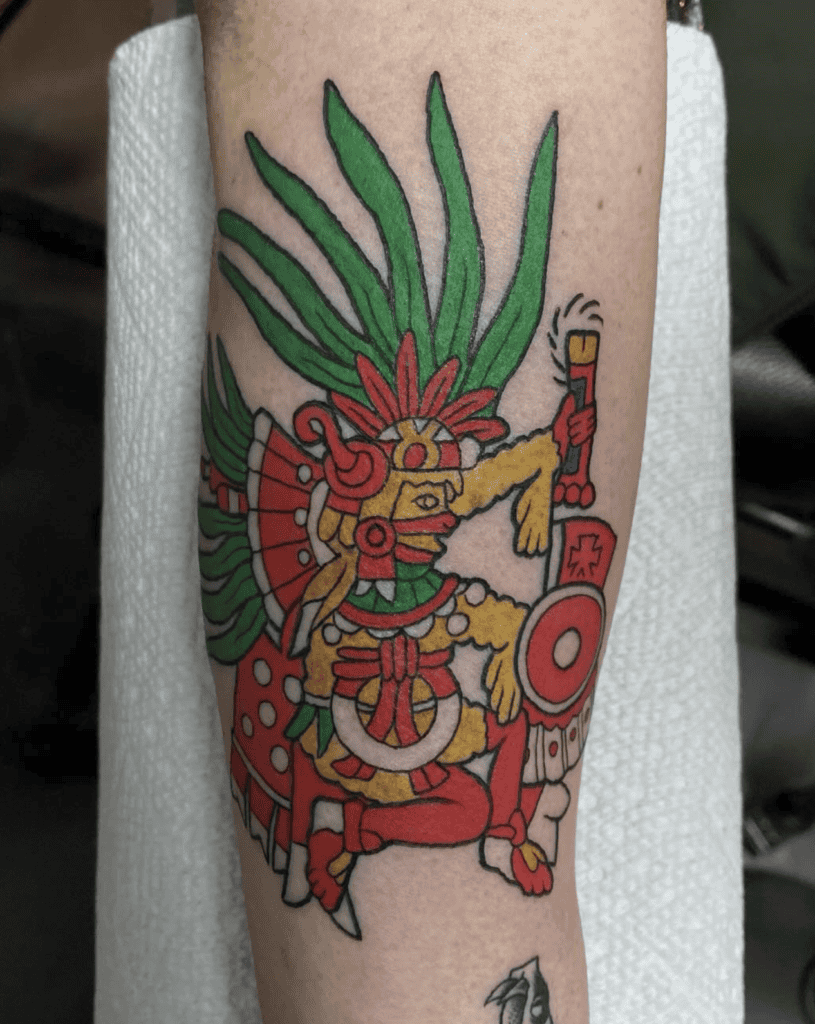
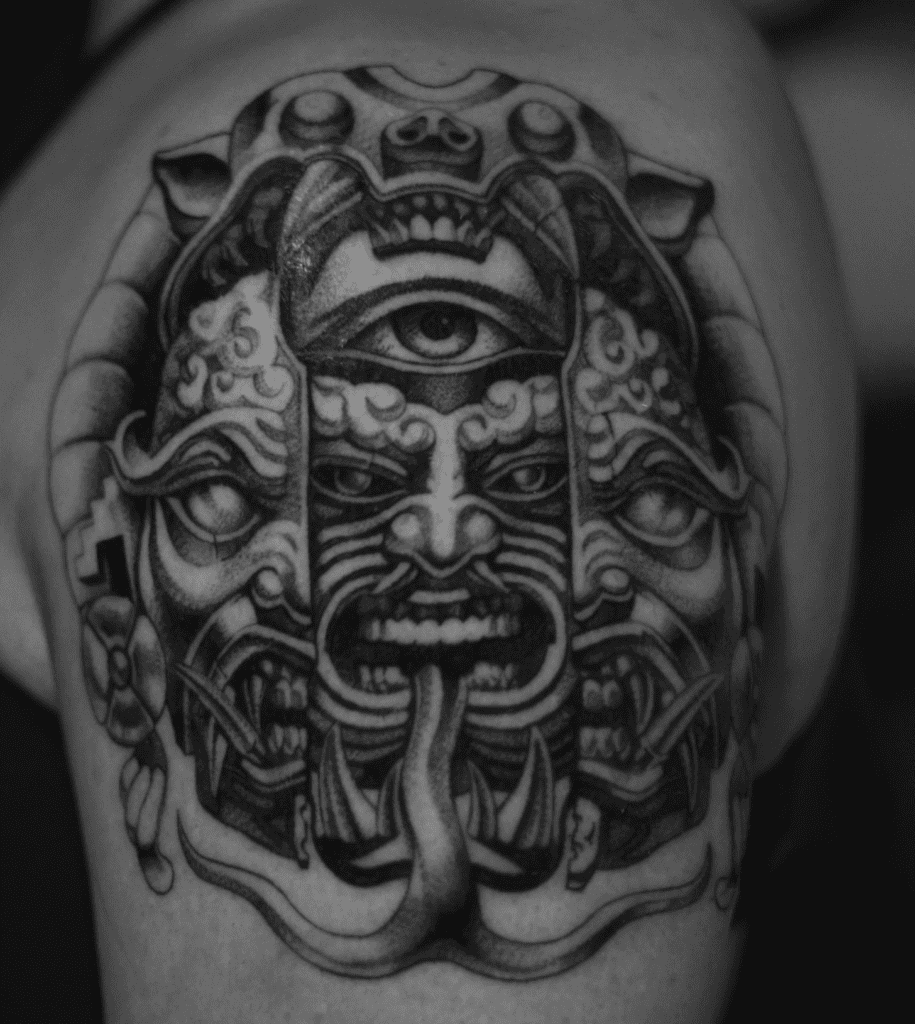
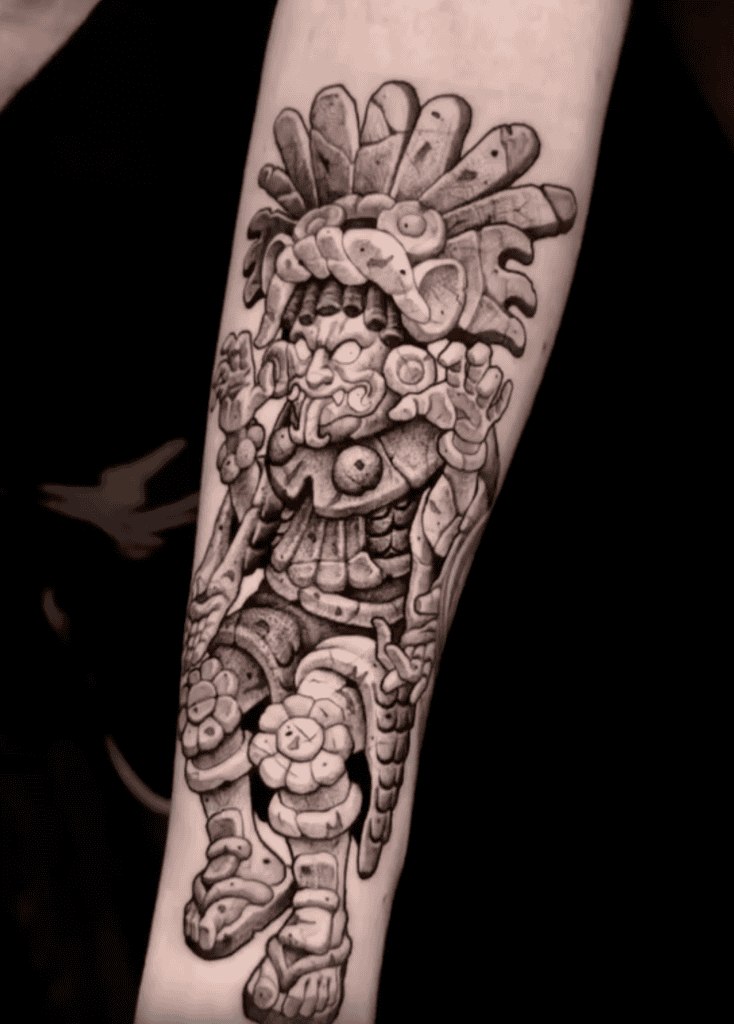
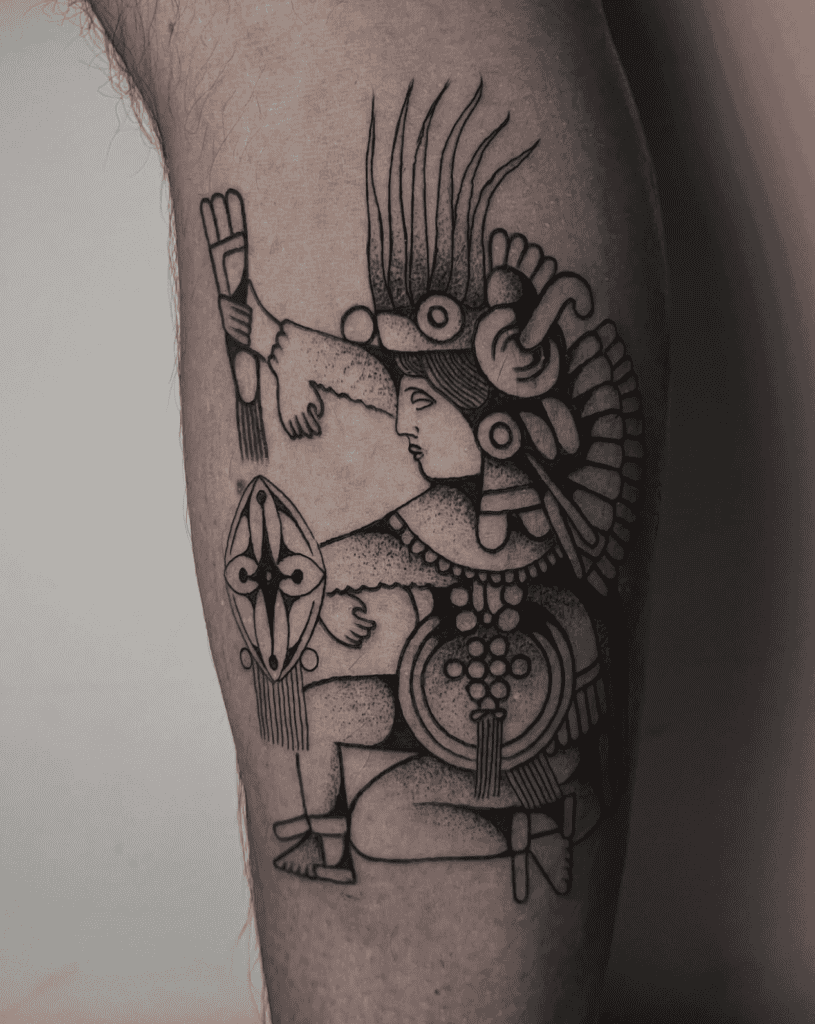
Xipe Totec, known as the “Flayed Lord,” is a deity of renewal, agriculture, and rebirth. He is typically depicted wearing the flayed (removed) skin of another person, representing the old layer of life being shed so something new can grow.
Xipe Totec is a life-giving god who represents agriculture, renewal & rebirth, growth & transformation, and war & sacrifice. He symbolises the core idea that life only continues because something else ends.
His flayed skin symbolises how a seed sheds its outer layer before it can grow, how the earth “loses” its dry surface before crops emerge, and how old life must be removed for new life to begin.
Xipe Totec was honoured during a major festival called Tlacaxipehualiztli (“The Flaying of Men”). During this time, captured warriors were sacrificed, priests wore their skins for days, and the rituals symbolised renewal of life and crops.
Mictlantecuhtli Aztec Mythology Tattoo
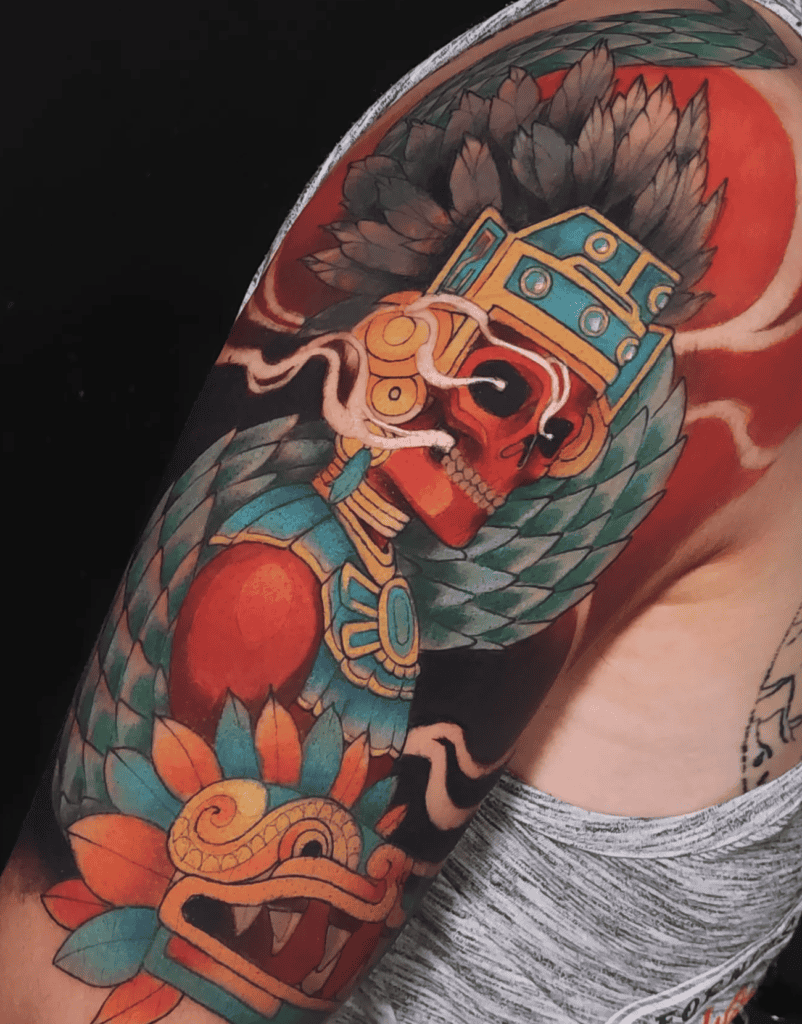
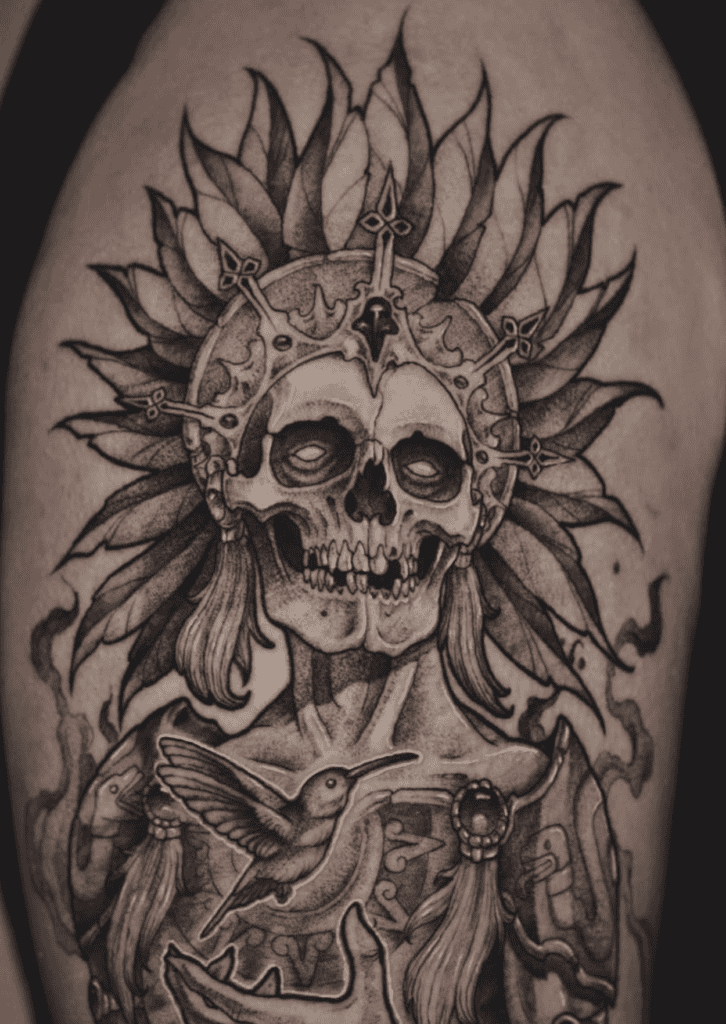
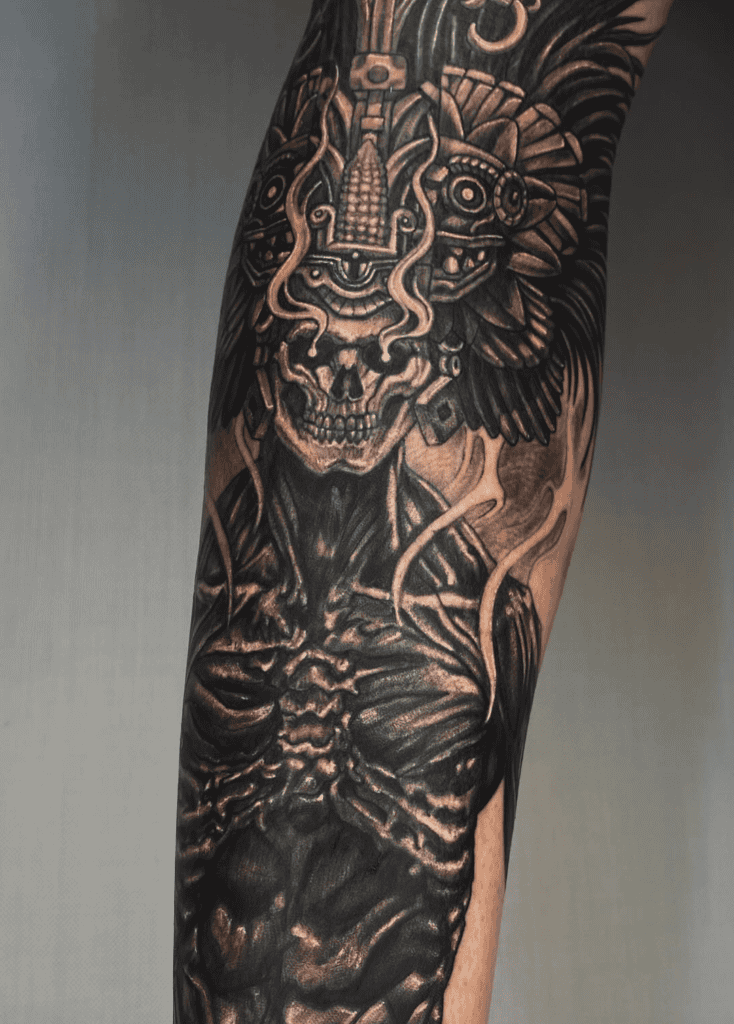
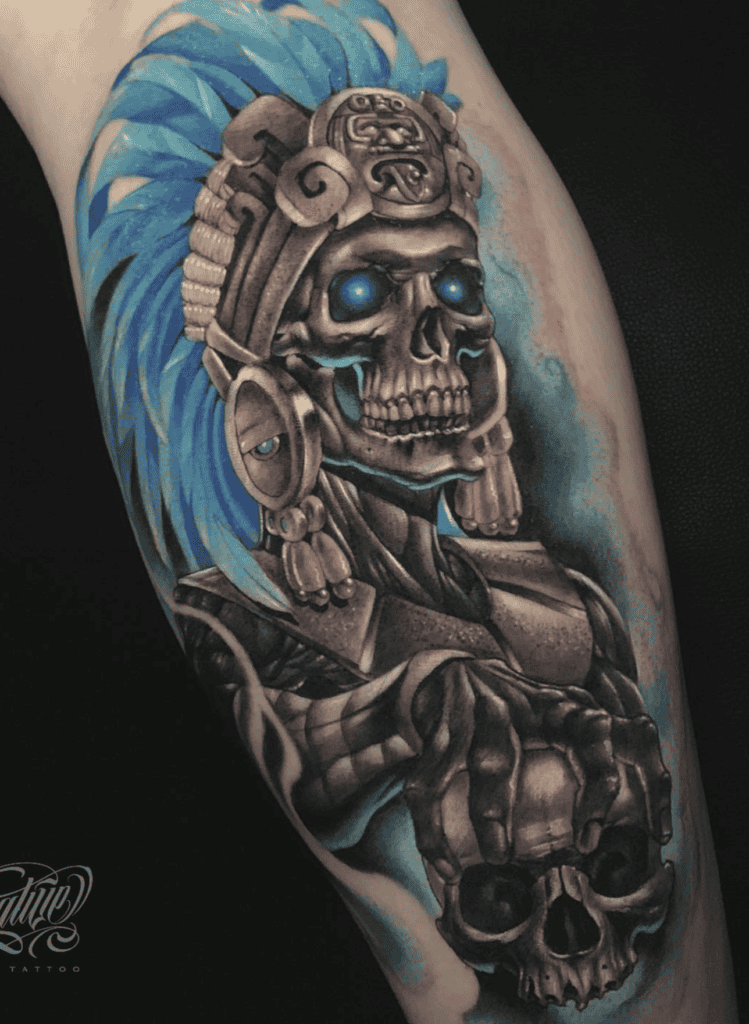
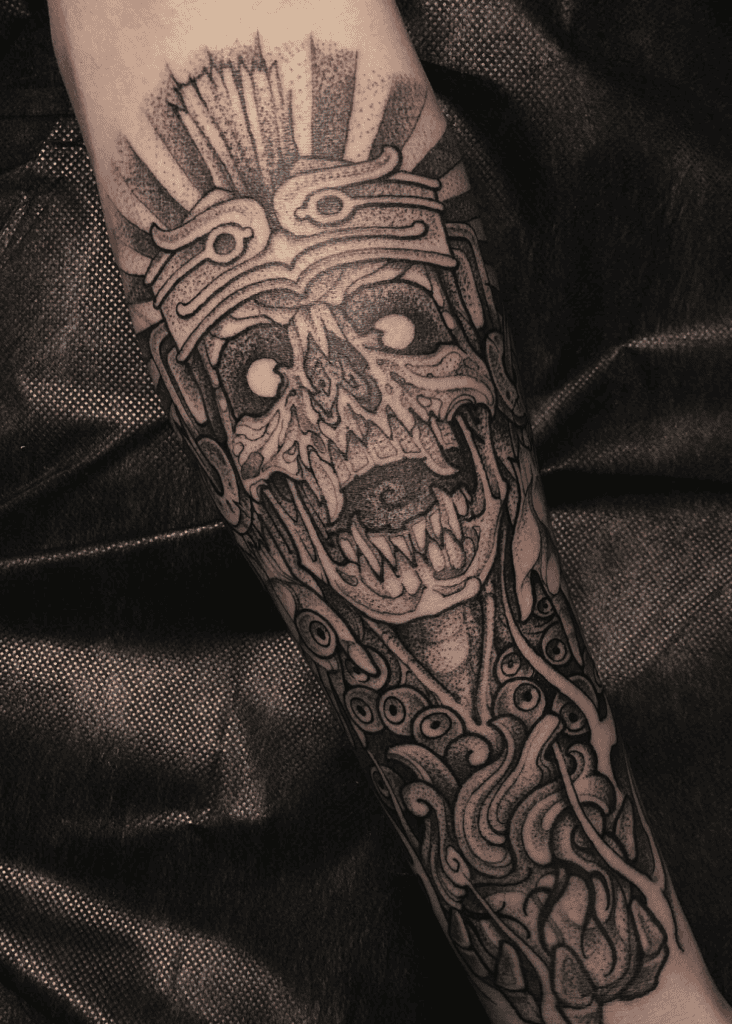
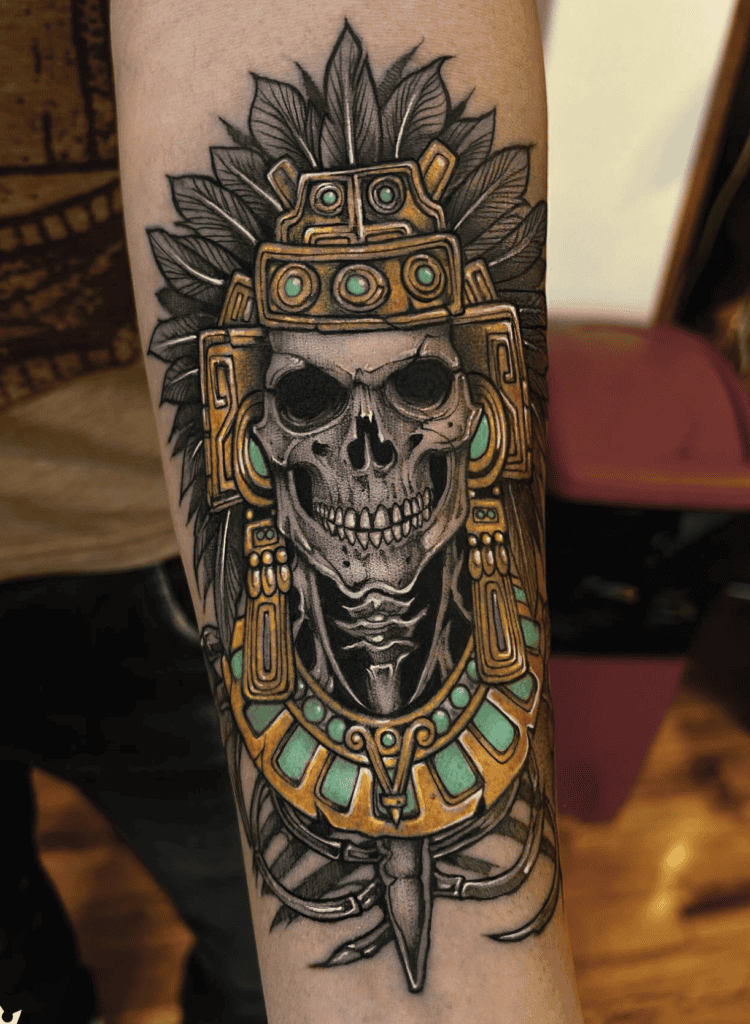
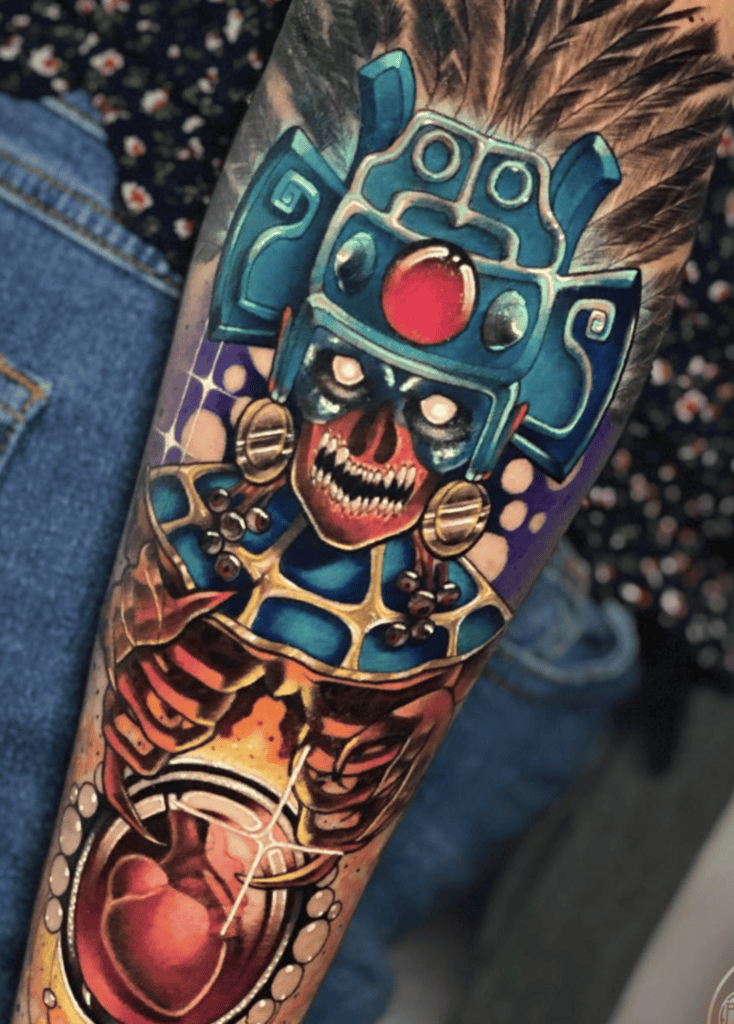
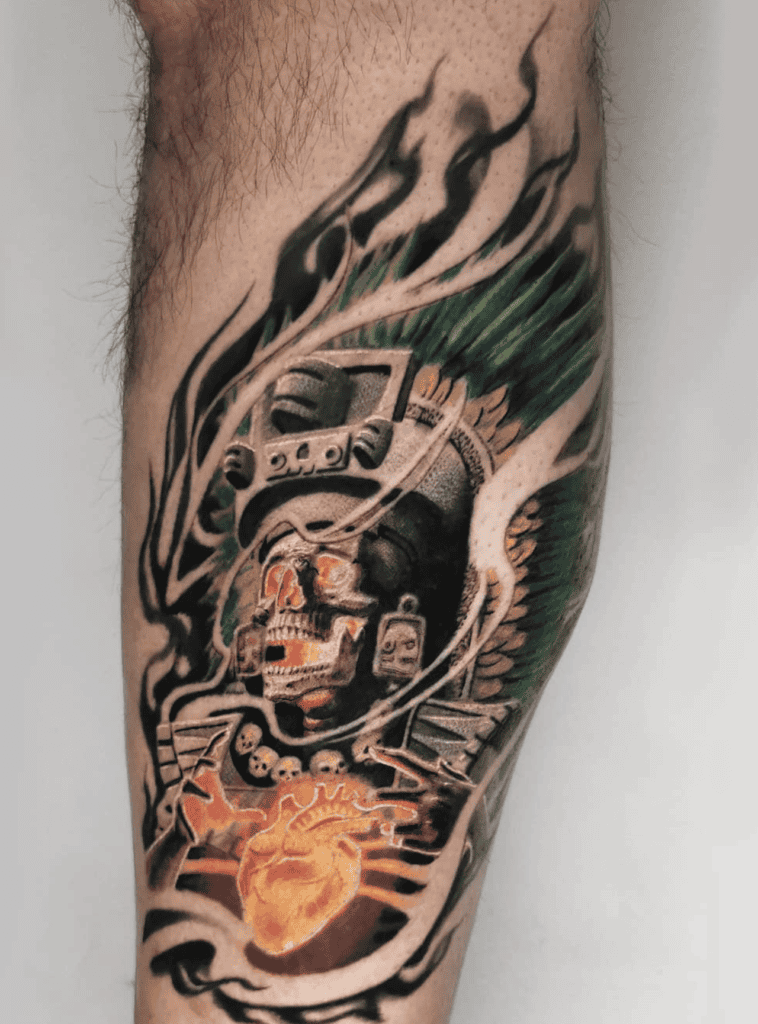
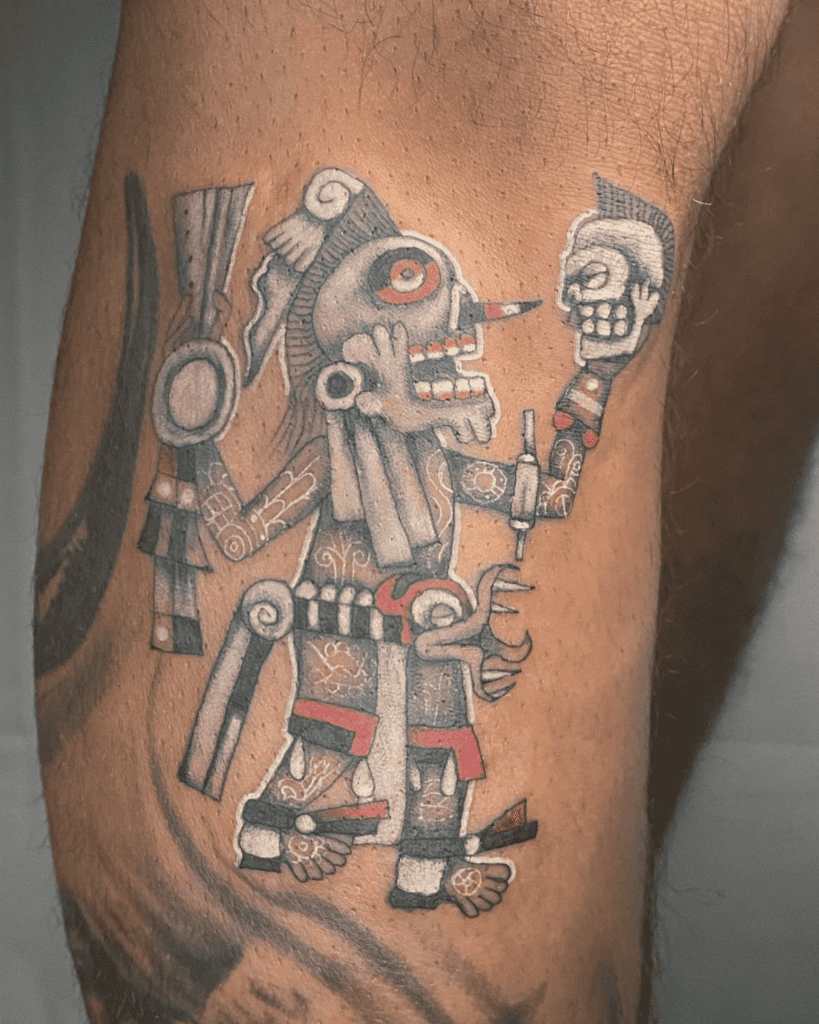
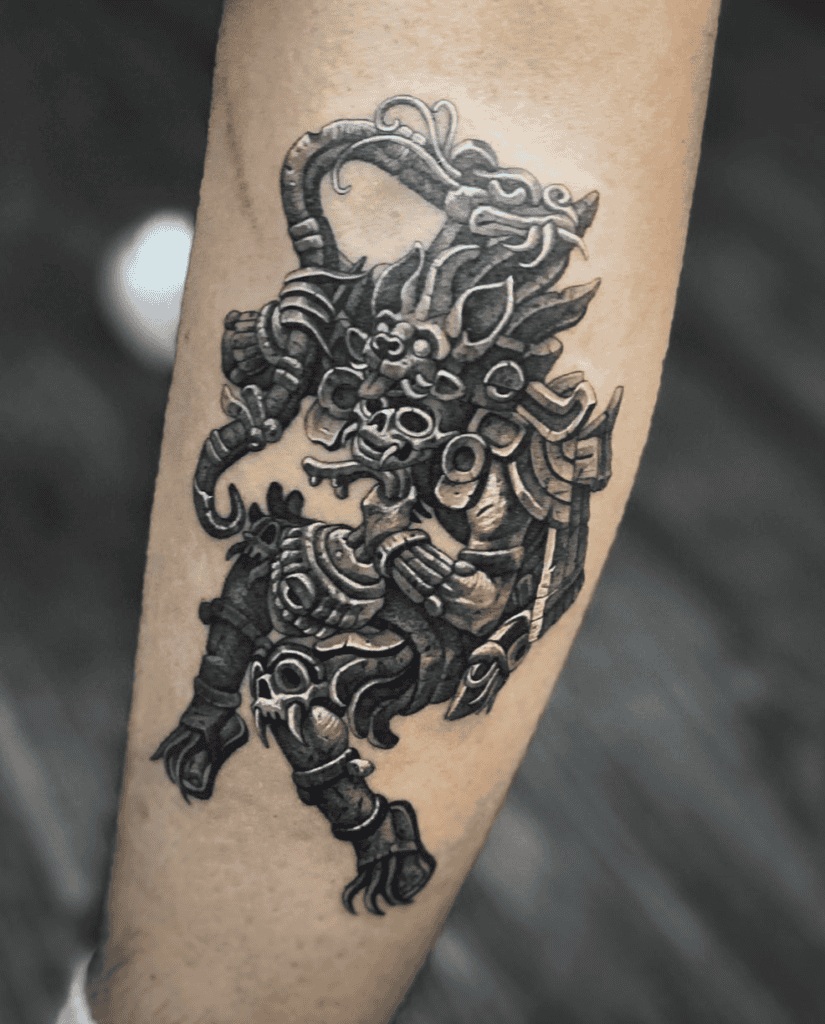
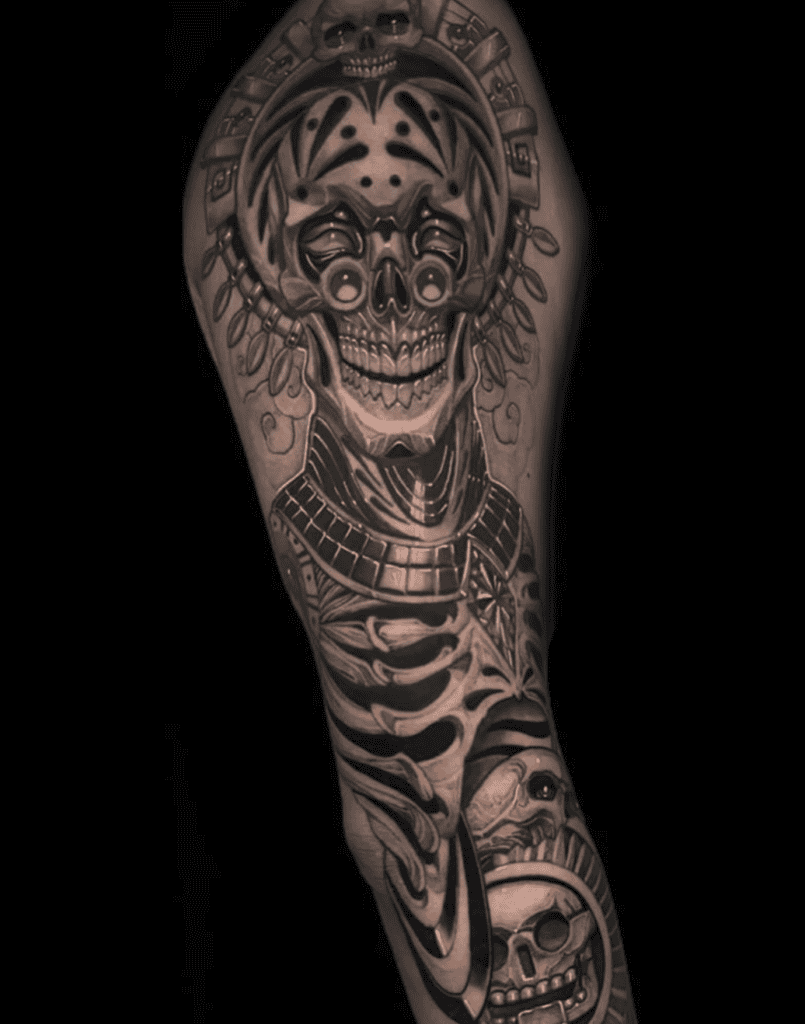
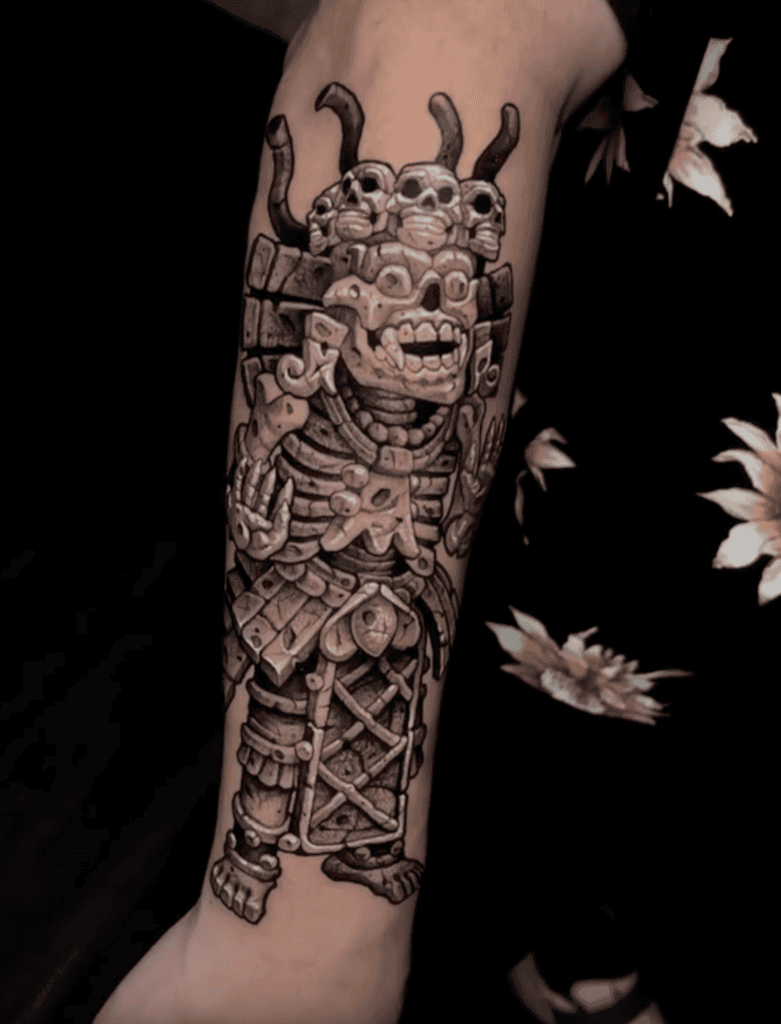
Mictlantecuhtli is the ruler of Mictlan, the Aztec underworld where most souls travel after death. He is a god of death, darkness, and the afterlife and a guardian of the natural end of life.
Most people in Aztec belief travelled to Mictlan, a long and difficult journey through nine levels, filled with obstacles such as strong winds, colliding mountains, and rivers to cross. Souls often needed help from guides like Xolotl to reach their final rest, with journeys taking years, reflecting the Aztecs’ serious view of death.
Mictlantecuhtli is usually depicted as a skeletal figure with an open jaw (ready to swallow souls) and sometimes adorned with bones, blood, or owls. When Quetzalcoatl descended into Mictlan to retrieve the bones of past humans, Mictlantecuhtli tried to stop him by setting traps and challenges. However, Quetzalcoatl escaped, and those bones were used to create humanity in the current world.
Tonatiuh Aztec Mythology Tattoo
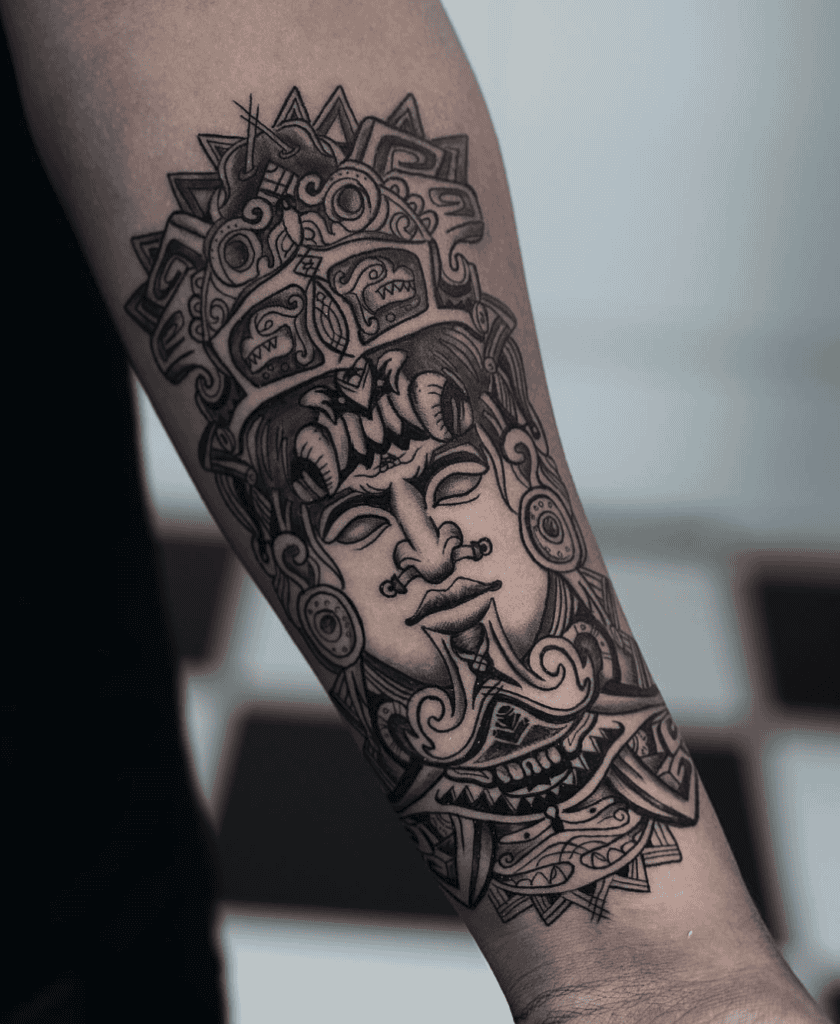
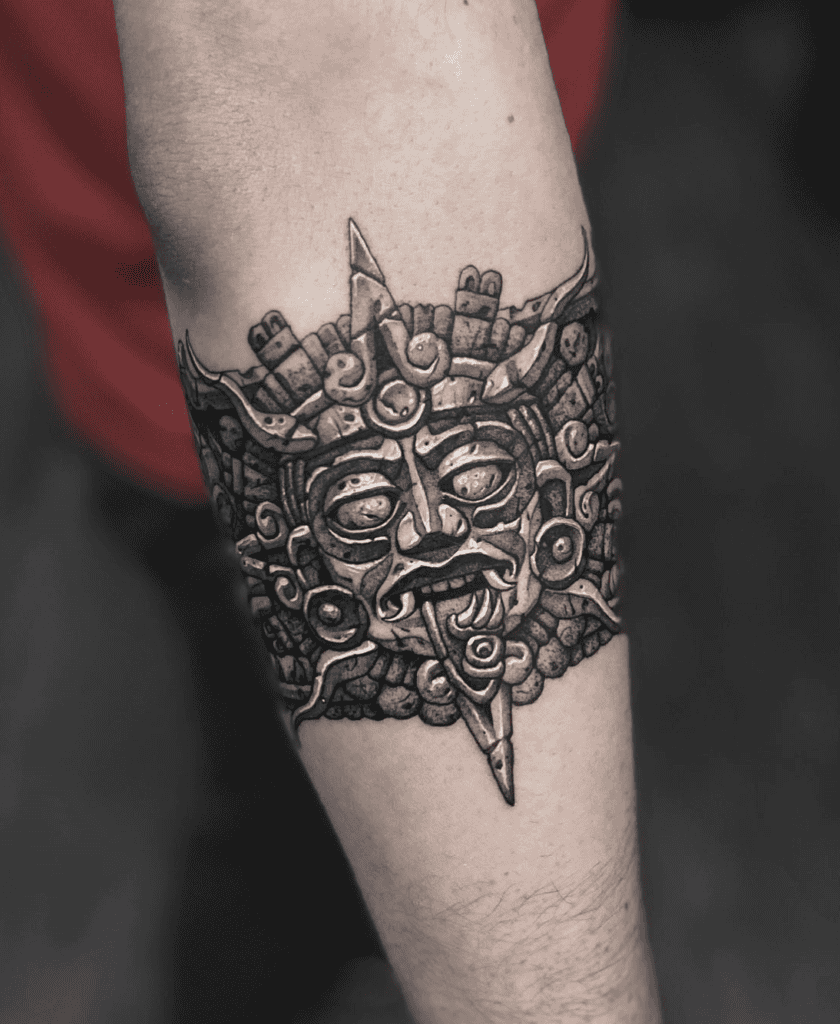
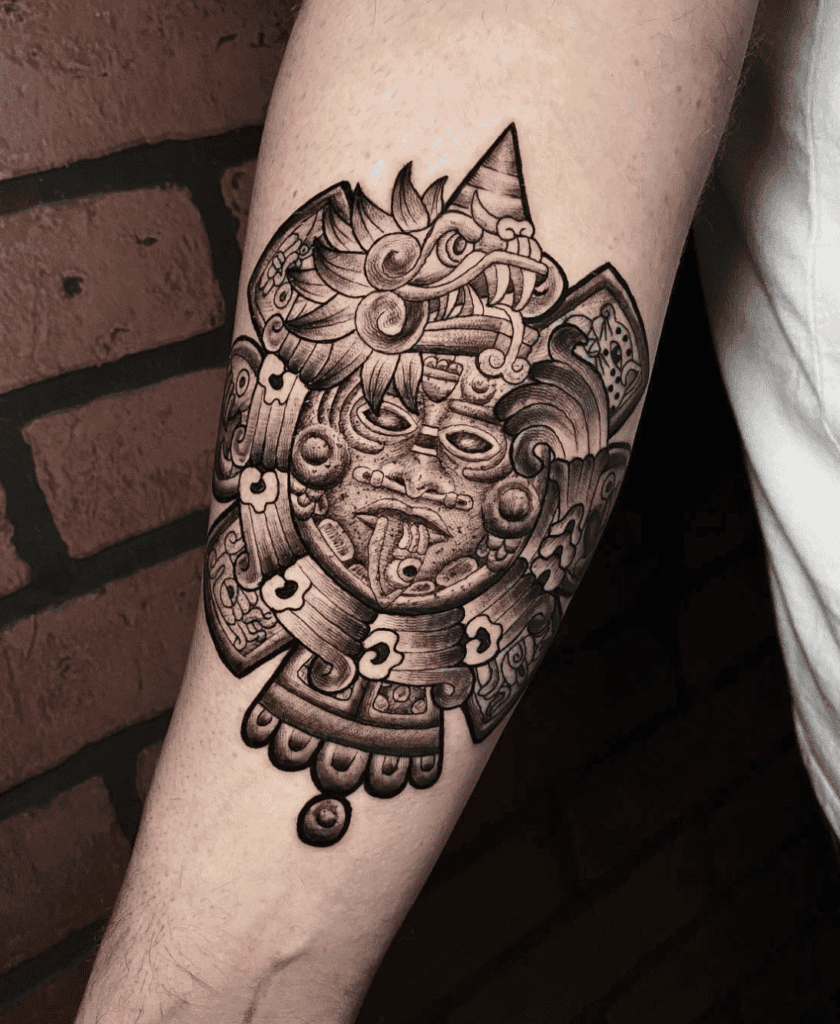
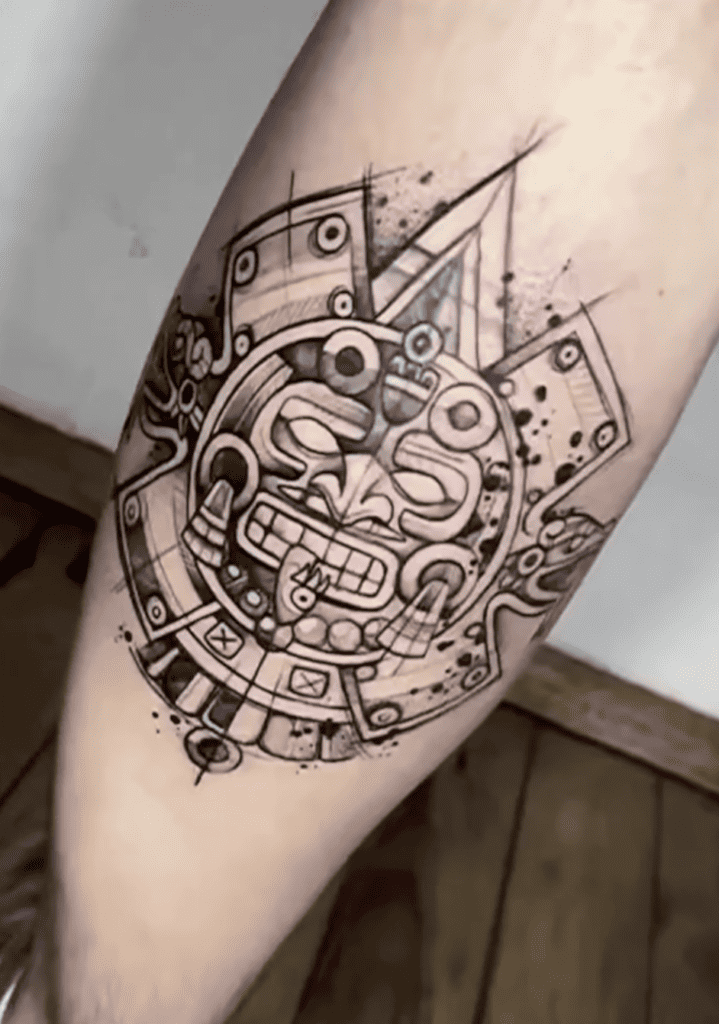
Tonatiuh is the current sun god in Aztec mythology who rules the present age, often called the Fifth Sun (part of the Five Suns). According to Aztec belief, the world has existed through multiple cycles, with each “sun” (world) being destroyed, and a new one created through sacrifice.
The current sun, Tonatiuh, exists because of the sacrifice of Nanahuatzin, who threw himself into fire to become the sun. However, Tonatiuh refused to move across the sky until he was fed with sacrifice. He required human hearts and blood, so these offerings gave him the strength to rise and travel across the sky.
Tonatiuh is famously depicted at the centre of the Aztec Sun Stone (Calendar Stone). His face sits at the very middle, with a tongue shaped like a sacrificial knife, and hands clutching human hearts, symbolising how the sun gives life, but demands it in return.
Yacatecuhtli Aztec Mythology Tattoo

Yacatecuhtli is the Aztec god of merchants, trade, and safe journeys. His name roughly translates as “Lord of the Nose” (or “Guide”), symbolising someone who leads the way forward. He was a god that people trusted when they were on the road, taking risks, and chasing opportunity, representing the idea that progress only happens when you move forward.
Yacatecuhtli was especially important to the pochteca, the elite merchant class of the Aztecs. These traders were long-distance travellers, skilled negotiators, and were sometimes even spies who gathered information. They carried valuable goods like cacao beans, feathers, jade, and textiles, and before setting out, they would pray to Yacatecuhtli for protection and success.
Toci Aztec Mythology Tattoo

Toci, whose name means “Our Grandmother,” is a goddess of healing and the wisdom of age, but like many Aztec deities, she also has a darker, more complex side. Toci is both a nurturer and a powerful earth force, embodying life, death, and everything in between.
She represents motherhood & midwives, healing & medicine, earth & fertility, and the cycles of life, reflecting how life is guided by those who came before us. She isn’t purely gentle, as she is also tied to sacrifice and the harsher side of existence. In some traditions, she is associated with Tlazolteotl, sharing themes of cleansing, renewal, and the balance between purity and impurity, reflecting that even care and healing come with sacrifice and struggle.
Ometeotl Aztec Mythology Tattoo


Ometeotl is one of the most abstract and philosophical deities in Aztec mythology, being a dual creator force that represents the balance of all existence. Unlike other gods who rule specific elements (like rain or war), Ometeotl is the source of everything.
Ometeotl isn’t a single being made up of two aspects, Ometecuhtli (the male principle) and Omecihuatl (the female principle), who together form a perfect balance. This dual nature represents light & darkness, creation & destruction, energy & calm, and masculine & feminine, how nothing exists without its opposite.
Ometeotl is believed to dwell in the highest heaven, called Omeyocan. From there, Ometeotl created the other gods, set the universe into motion, and exists beyond direct human interaction.
Ometeotl has no major temples dedicated to it, few rituals are directly focused on it, and it is rarely depicted in detailed mythology, as Ometeotl isn’t a god you pray to, but a force you exist within.
Coatlicue Aztec Mythology Tattoo
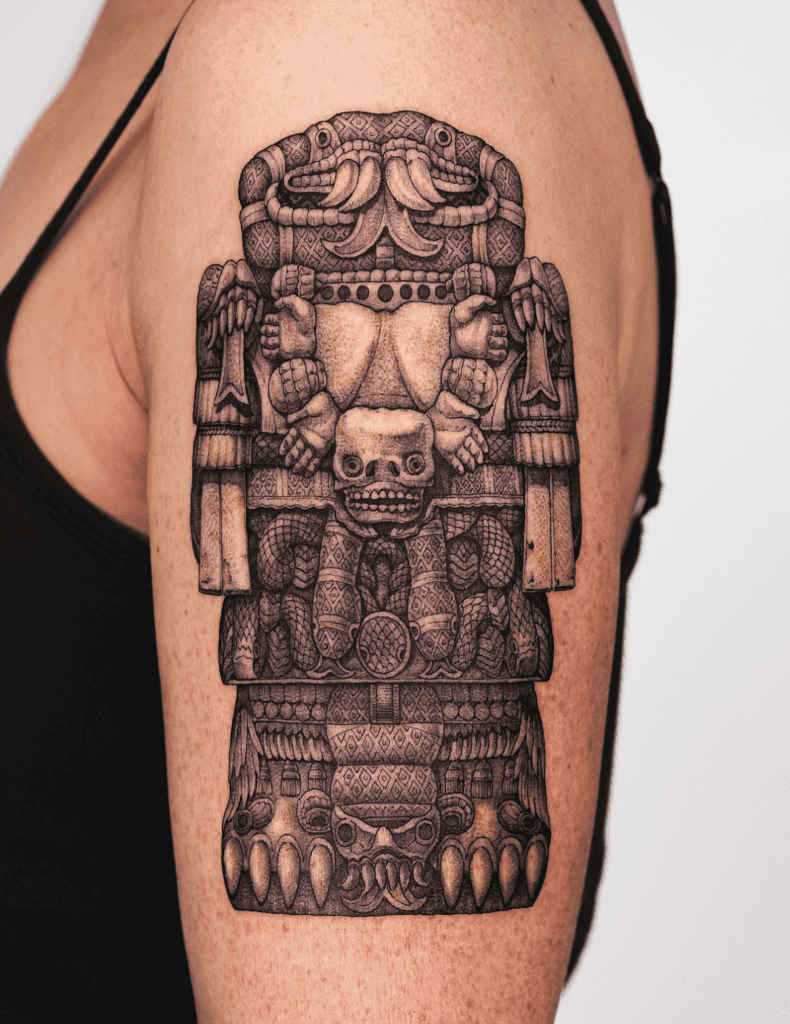
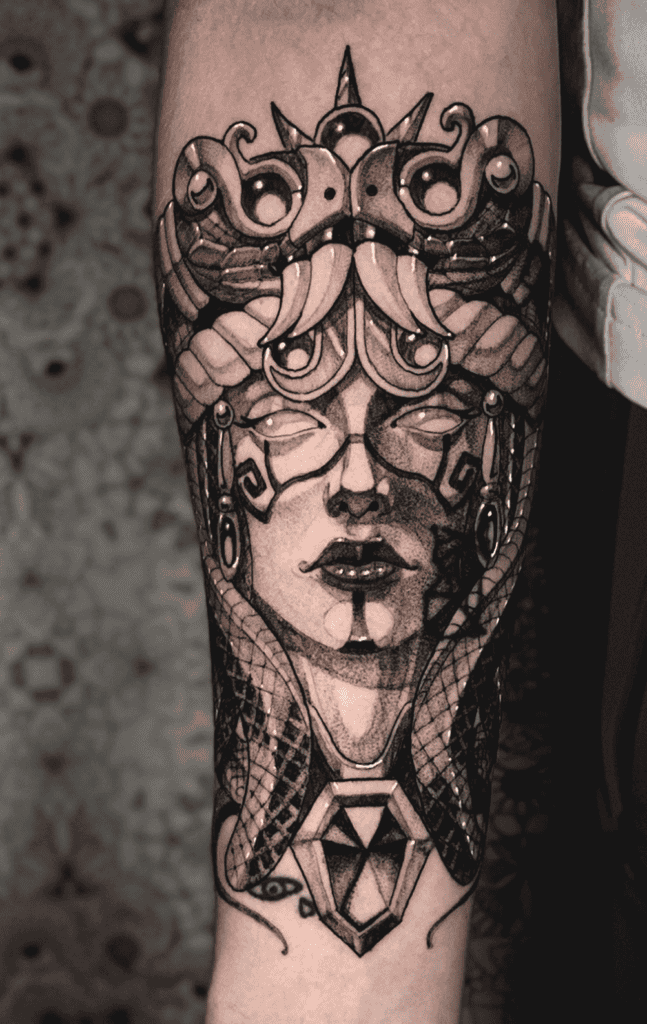
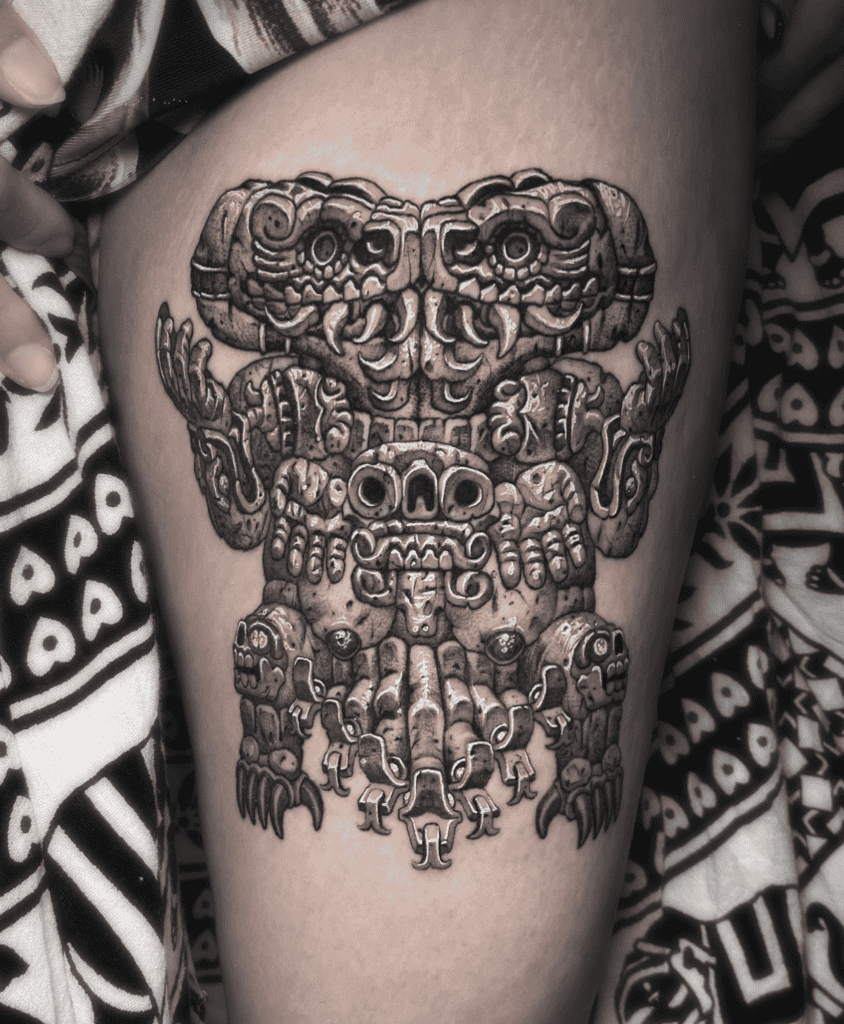
Coatlicue is one of the most powerful figures in Aztec mythology, being the Earth Mother, giver of life, and taker of it. Her name means “She of the Serpent Skirt,” referring to the writhing snakes that form her clothing, and embodies the idea that the earth gives life but also consumes it.
Coatlicue is a symbol of life cycles, such as fertility & birth, the Earth Itself, death & decay, and rebirth, reflecting how creation and destruction are inseparable. Coatlicue has a skirt made of snakes (life, death, transformation), a necklace of hearts, hands, and skulls (sacrifice and life force), two serpents forming her head, representing blood flowing from a severed neck, and clawed hands and feet, reflecting the raw reality of nature and survival.
Coatlicue is the mother of several major deities, including Huitzilopochtli, Coyolxauhqui, and the 400 stars.
Coyolxauhqui Aztec Mythology Tattoo
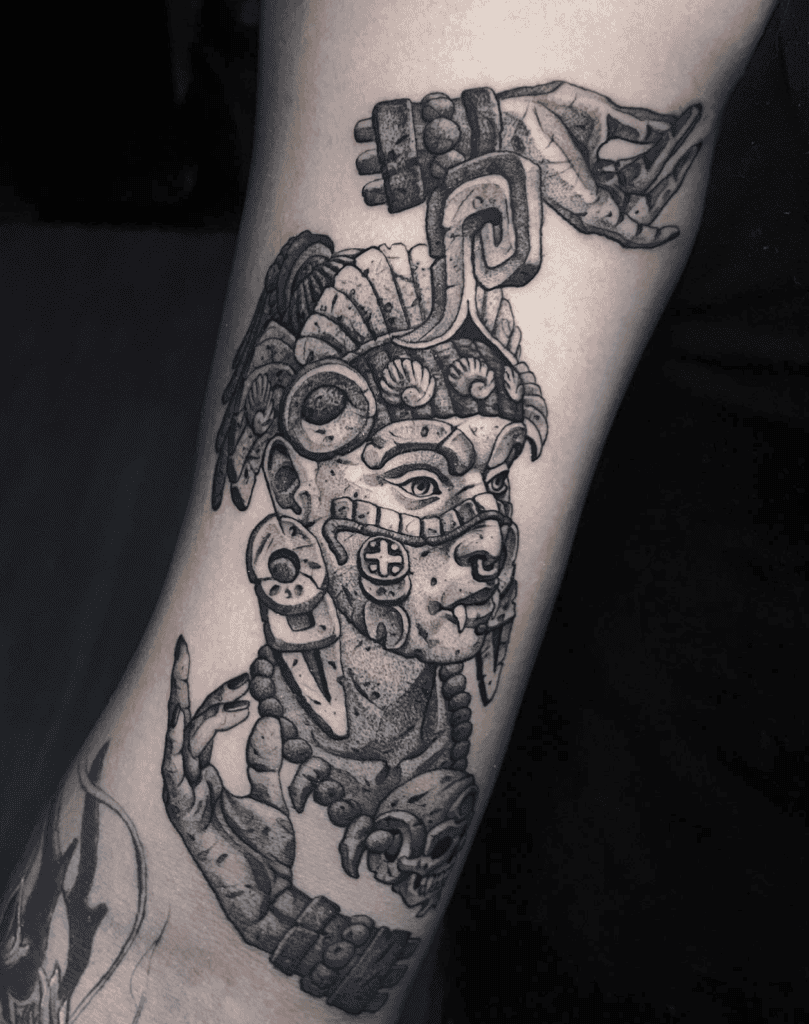
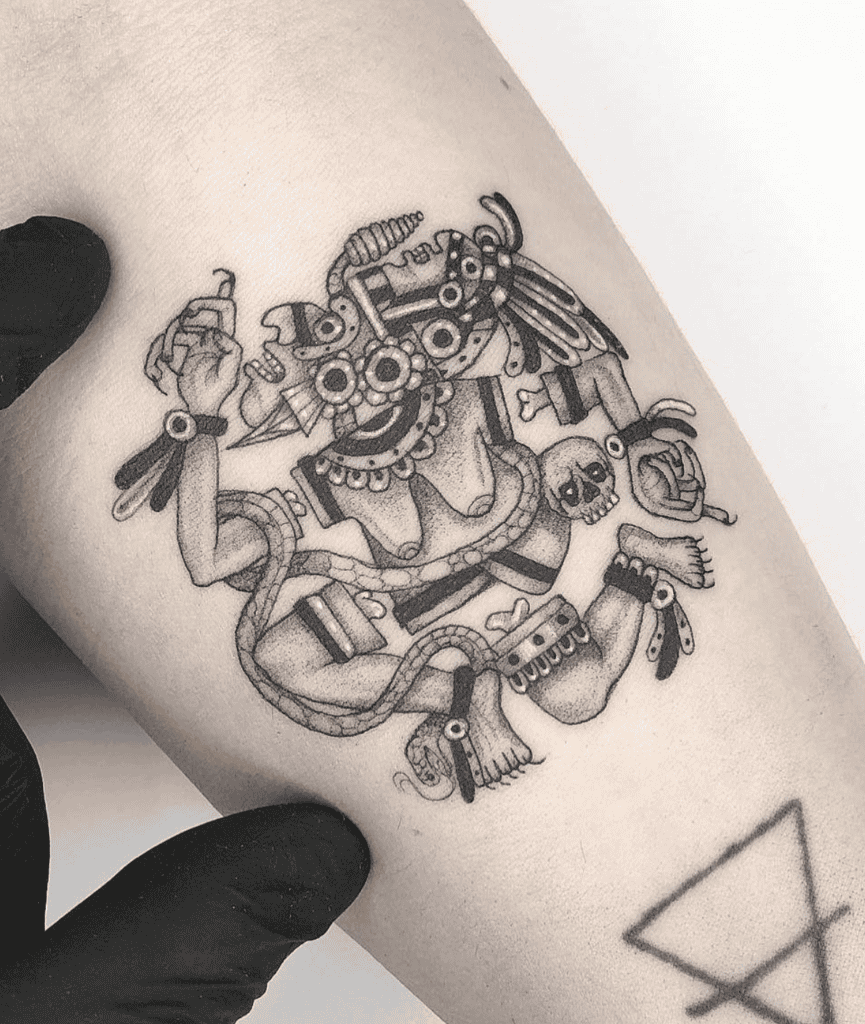
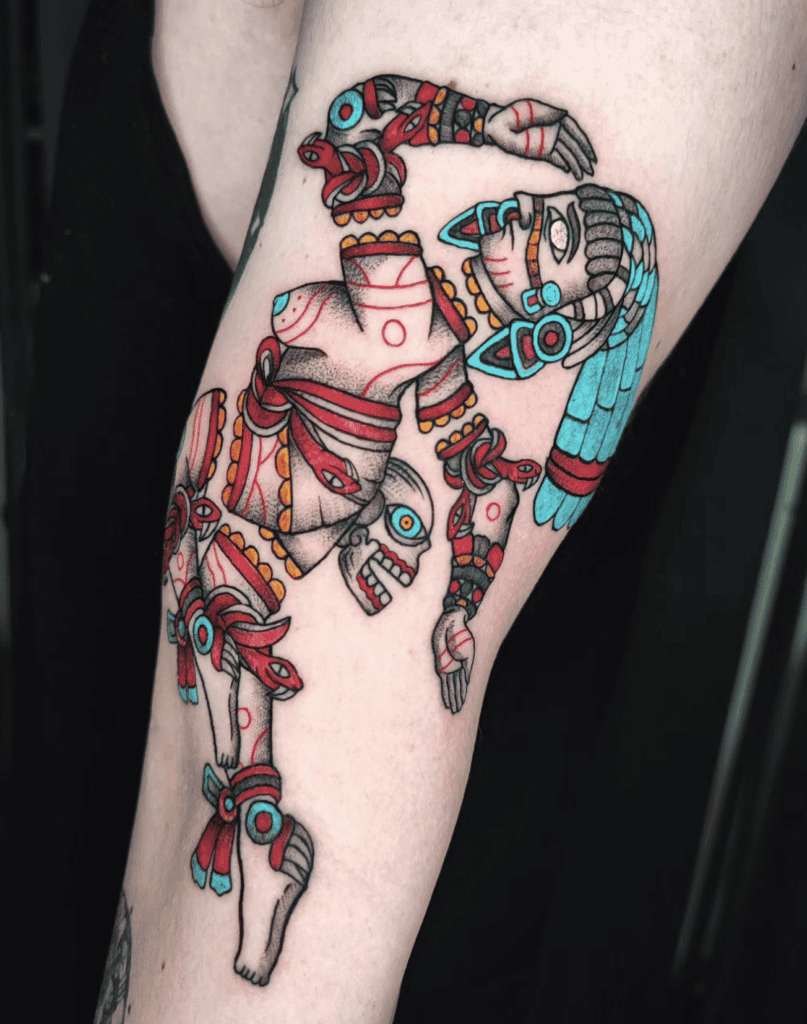
Coyolxauhqui is the Aztec moon goddess, whose name means “She of the Bells on Her Cheeks,” referring to the decorative bells often shown in her artwork. She represents the moon, rebellion, and the cycles of destruction and renewal.
Coyolxauhqui’s most famous story is tied to her mother, Coatlicue. When Coatlicue becomes mysteriously pregnant, Coyolxauhqui sees this as dishonour and leads her 400 brothers to kill their mother. When the attack begins, Huitzilopochtli is born fully grown and armed and defeats Coyolxauhqui by dismembering her and throwing her body down the mountain. This story is symbolic of how the sun defeats the moon and stars, bringing daylight each day.
Tlazolteotl Aztec Mythology Tattoo
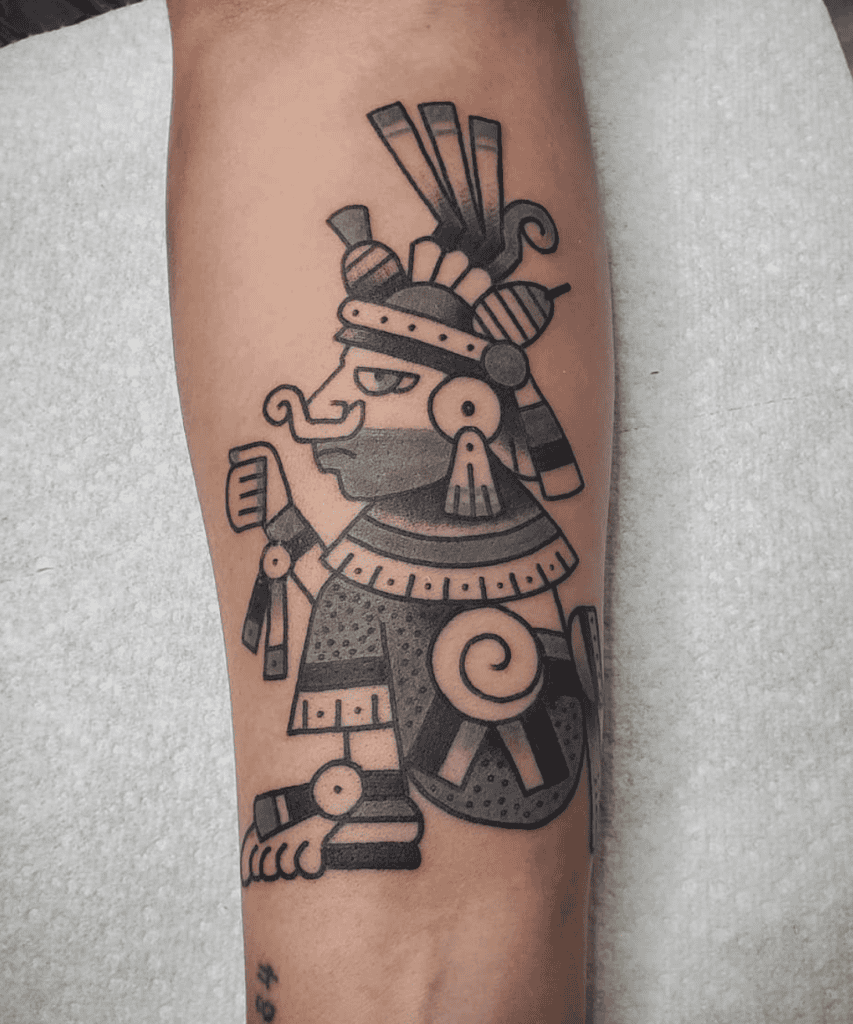
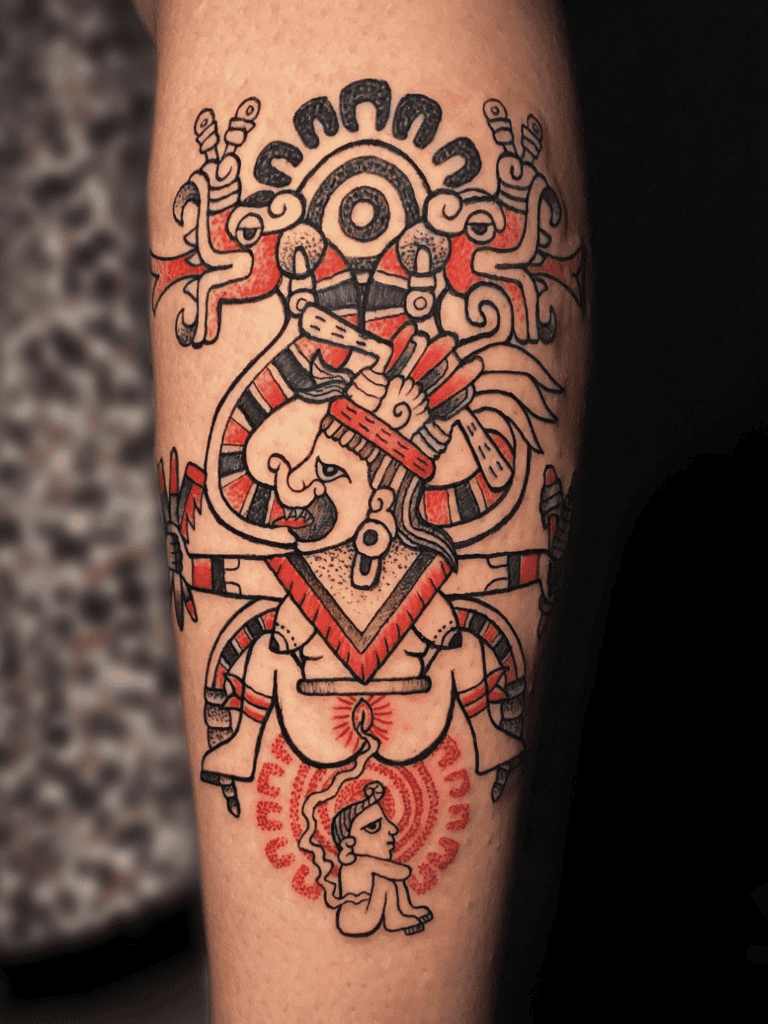
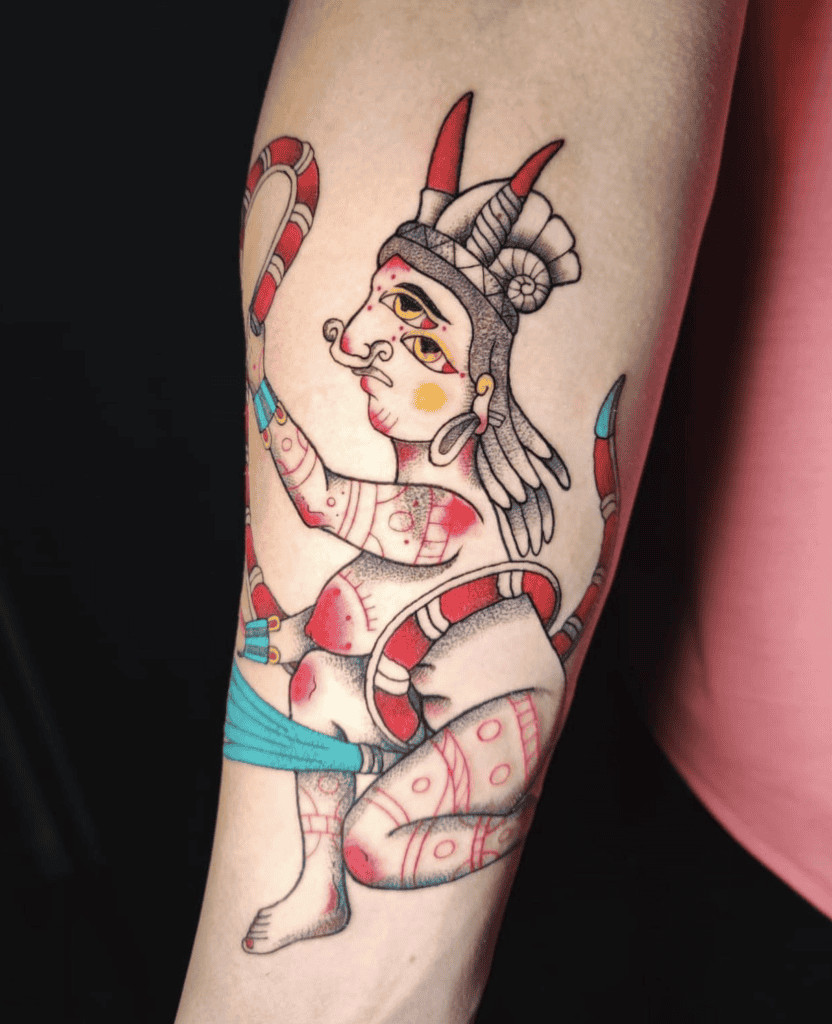
Tlazolteotl is the Aztec deity of sin, desire, purification, and rebirth. Her name is often translated as “Eater of Filth”, symbolising how she absorbs and cleanses it. She embodies the full spectrum of human experience from desire & temptation, sin & excess, purification & forgiveness, and childbirth & life.
Tlazolteotl was believed to consume sin. When people would confess their wrongdoings, Tlazolteotl would “devour” the impurity, and the person would be cleansed and forgiven; however, you could only be forgiven once in your life.
Tlazolteotl is also strongly associated with childbirth. She is often depicted giving birth, as she is a protector of midwives and mothers, connected to both creation and physical struggle.
Metztli Aztec Mythology Tattoo

Metztli is an Aztec moon deity, associated with the night, the moon’s changing phases, and the rhythm of time. Unlike Coyolxauhqui, Metztli is a quieter, more cosmic presence focused on cycles, light in darkness, and balance.
In Aztec belief, the moon is said to contain the image of a rabbit. This comes from a myth involving Quetzalcoatl, as while travelling, he became weak from hunger, and a rabbit offered itself as food. Touched by this sacrifice, Quetzalcoatl placed the rabbit’s image on the moon, linking the moon (and Metztli) to sacrifice & kindness, memory & reflection, and the Meaning of the Moon’s Phases.
Xochiquetzal Aztec Mythology Tattoo
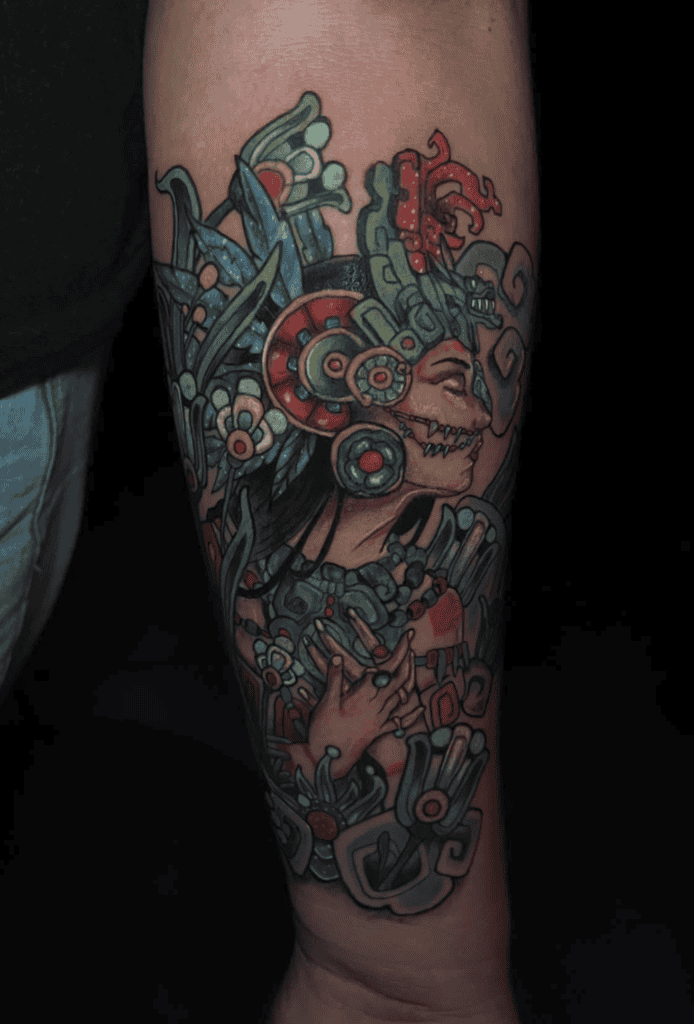
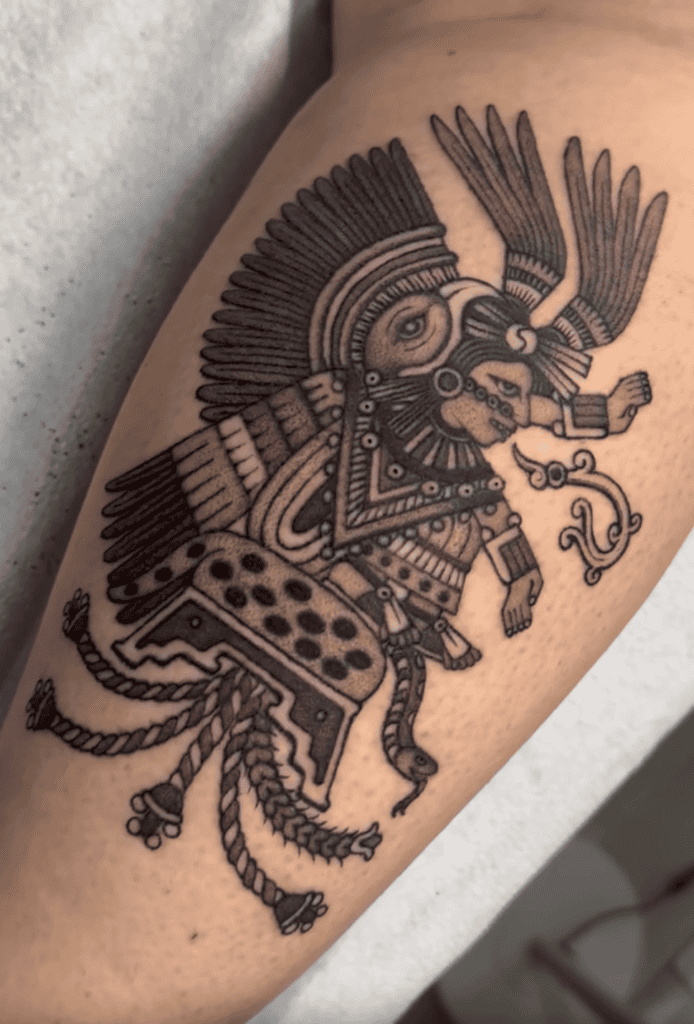
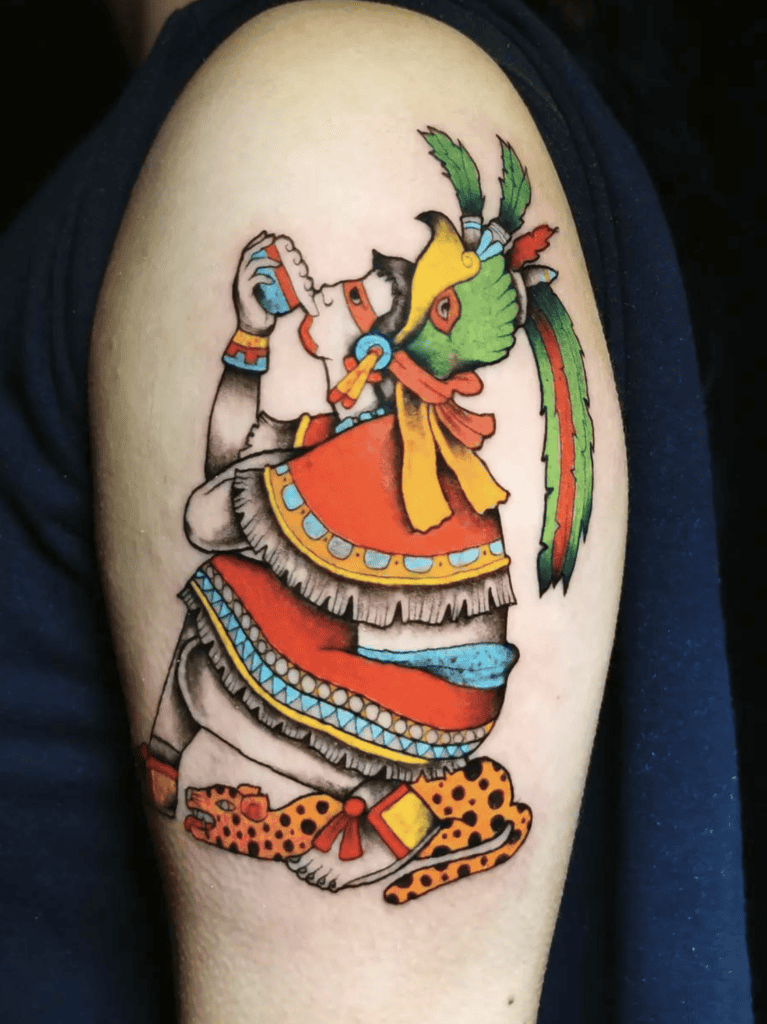
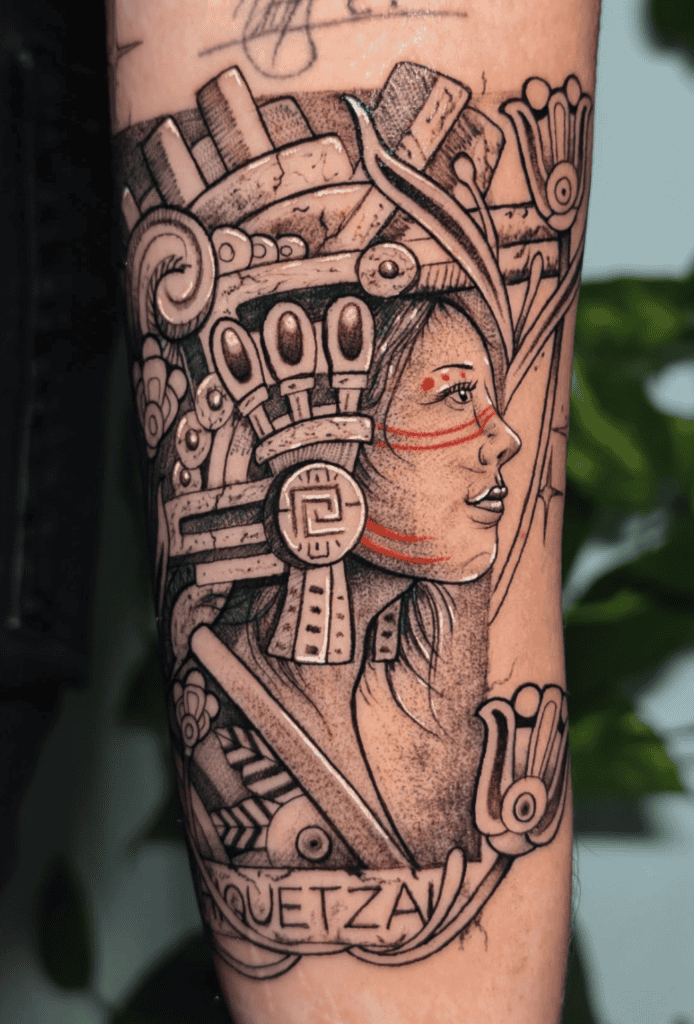
Xochiquetzal is the Aztec goddess of beauty, love, flowers, and fertility. She is a vibrant, youthful deity associated with joy, creativity, and the pleasures of life. Her name means “Precious Flower” or “Flower Feather,” reflecting her connection to nature’s beauty and delicate, fleeting moments.
Xochiquetzal embodies the lighter, more joyful side of existence, representing the idea that beauty isn’t just appearance, it’s creation, expression, and life itself. She was especially important to artists and creators, including weavers, embroiderers, painters and craftspeople.
She symbolised skill, creativity, and the ability to turn simple materials into something beautiful. Like many Aztec deities, Xochiquetzal had another side, as she was linked to desire and temptation, and was sometimes associated with forbidden love or indulgence.
Chalchiuhtlicue Aztec Mythology Tattoo
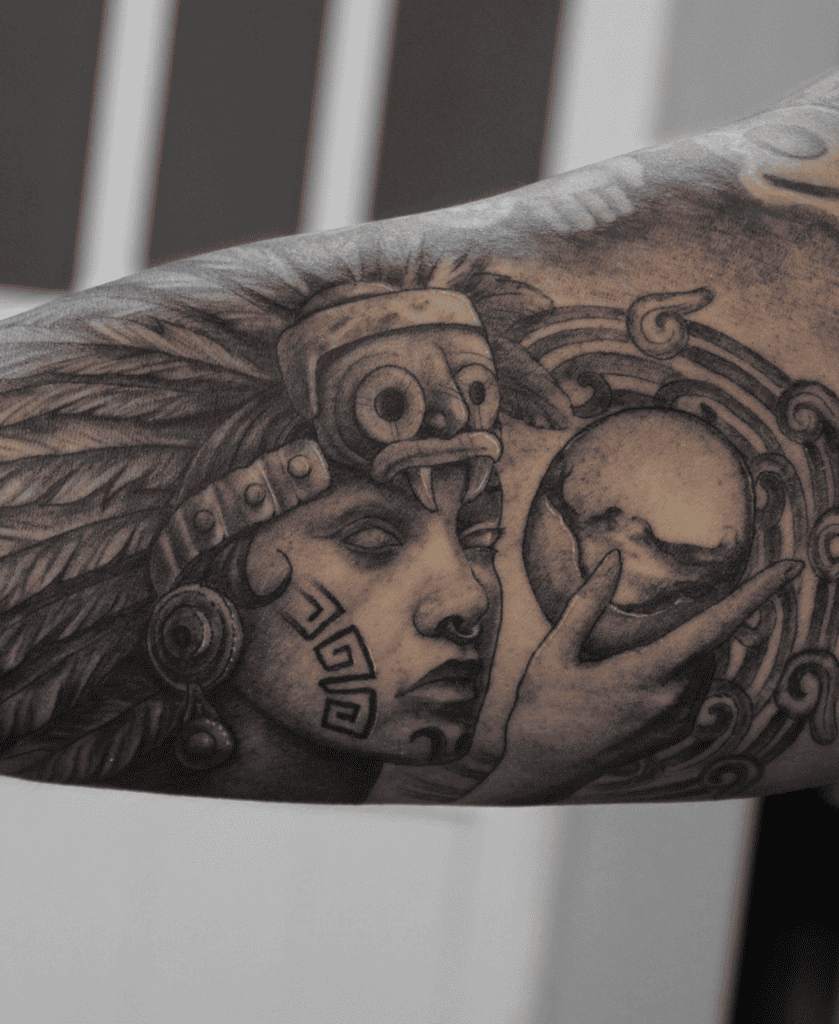
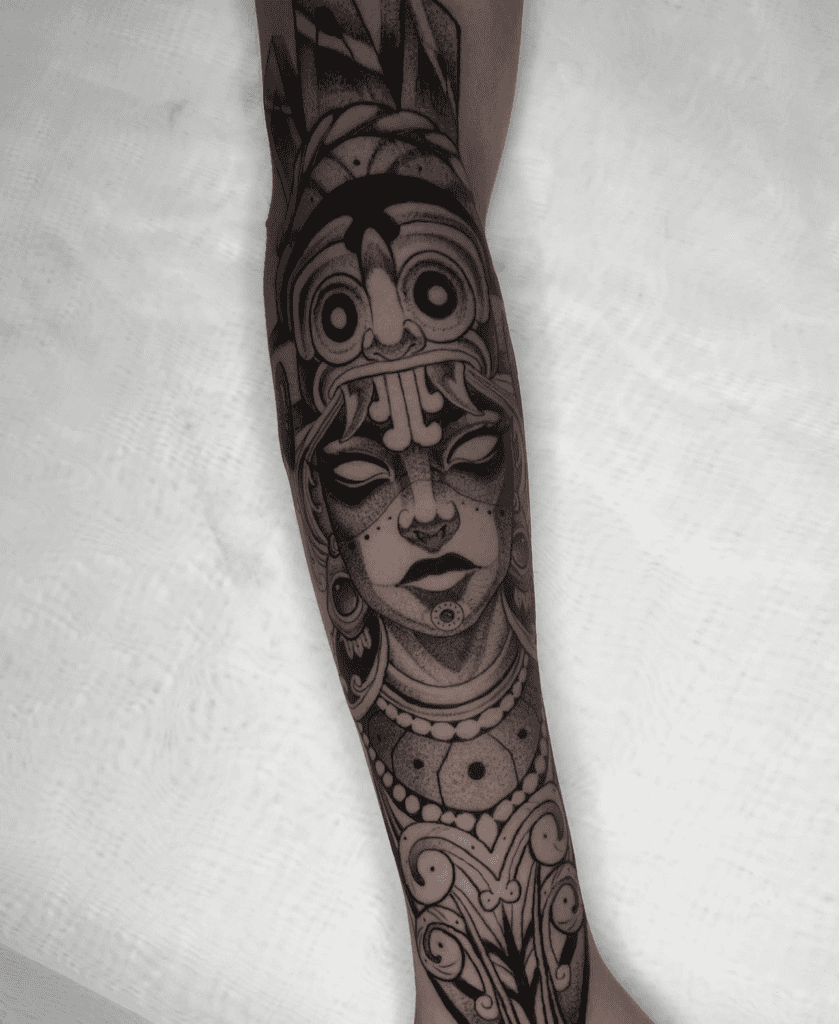
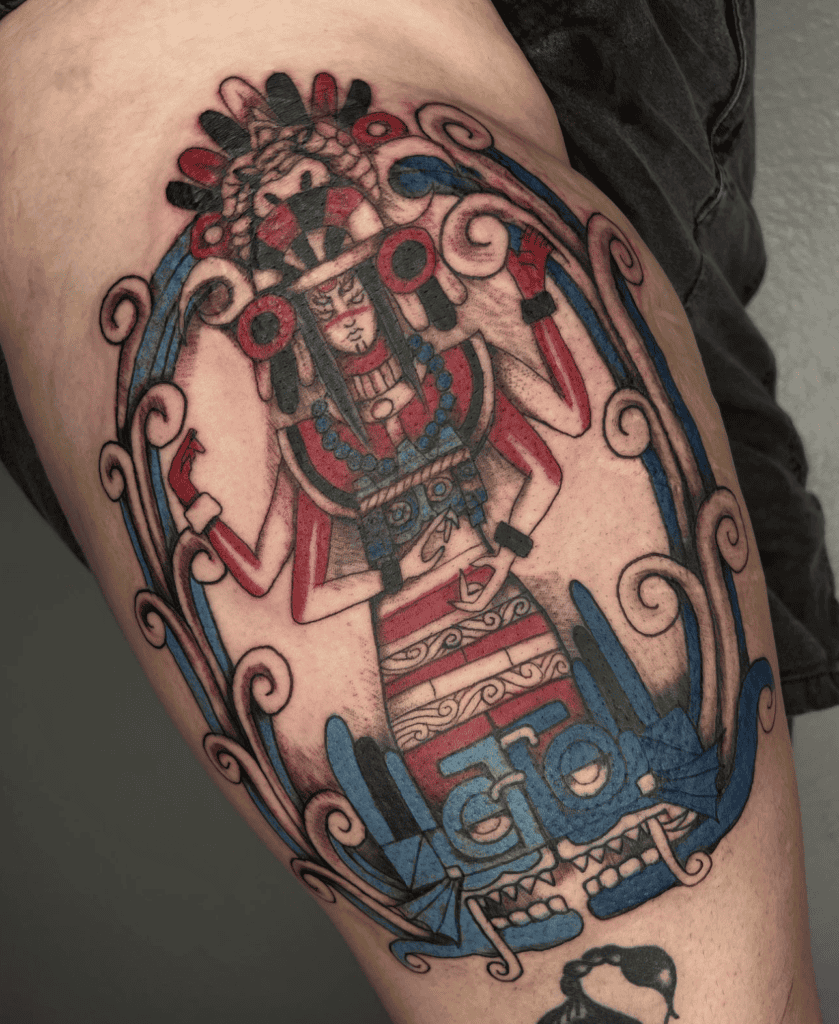
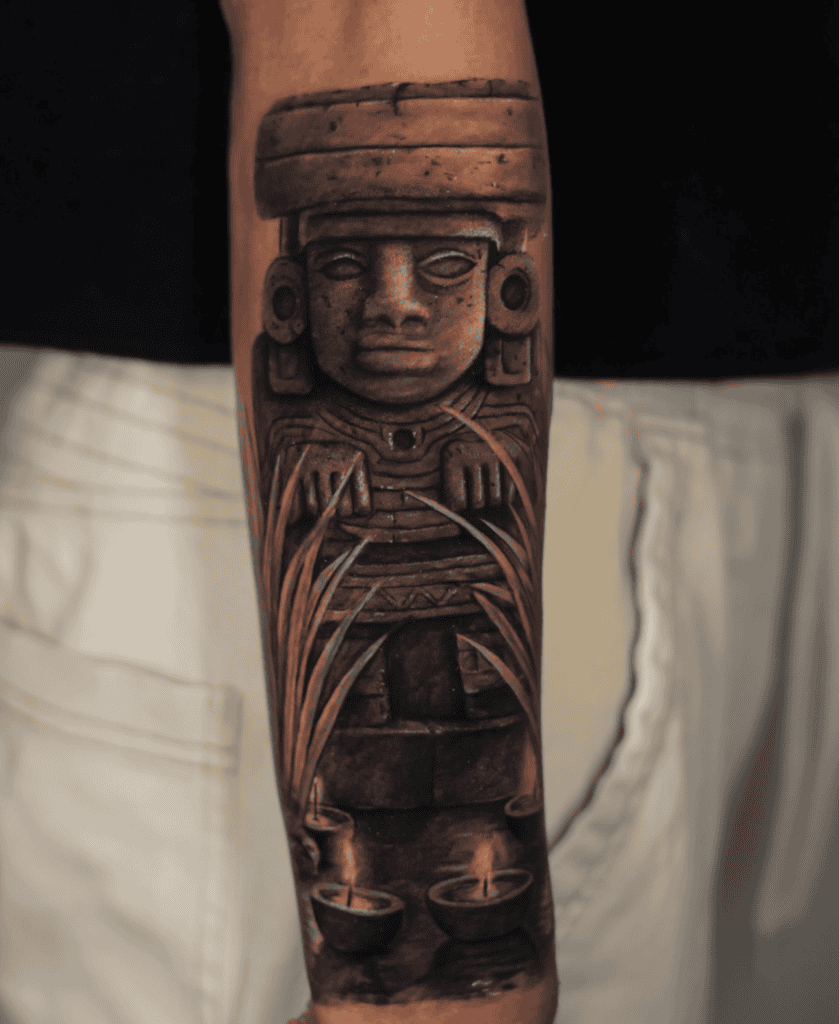
Chalchiuhtlicue is the Aztec goddess of water, rivers, lakes, and childbirth whose name means “She of the Jade Skirt,” as jade symbolised preciousness, water, and life in Aztec culture. She represents the gentler side of water, but like all natural forces, she can also become overwhelming and destructive.
Chalchiuhtlicue played an important role in childbirth and early life. Midwives prayed to her for safe deliveries, and newborns were often ritually bathed in water as she was believed to protect children.
Chalchiuhtlicue also played a major role in the myth of the Fourth Sun (one of the Five Suns). She ruled over that era, but eventually, the world was destroyed by a great flood, and humans were transformed into fish.
Itzpapalotl Aztec Mythology Tattoo
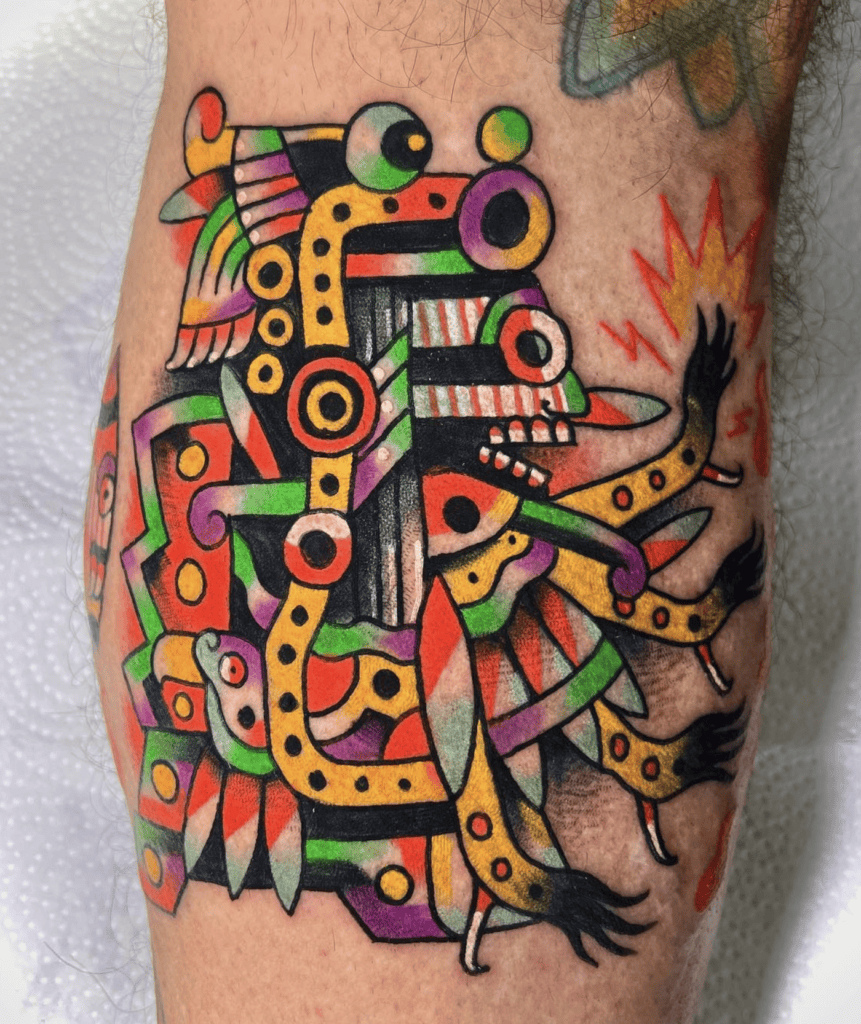
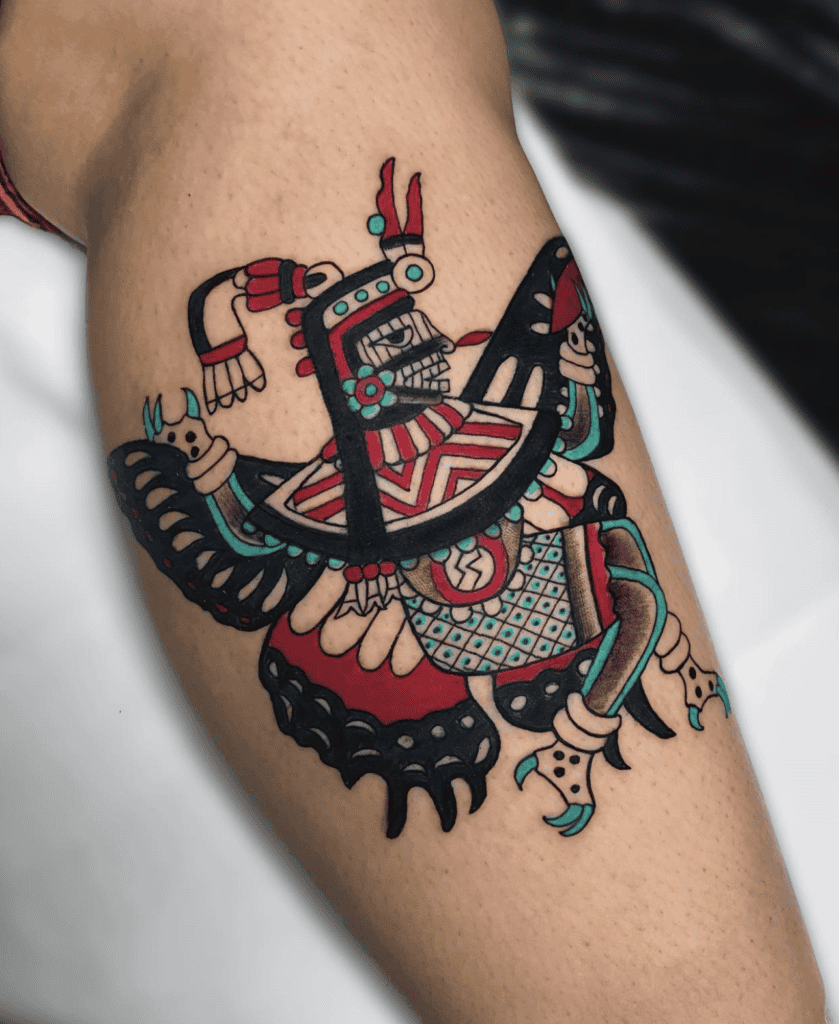
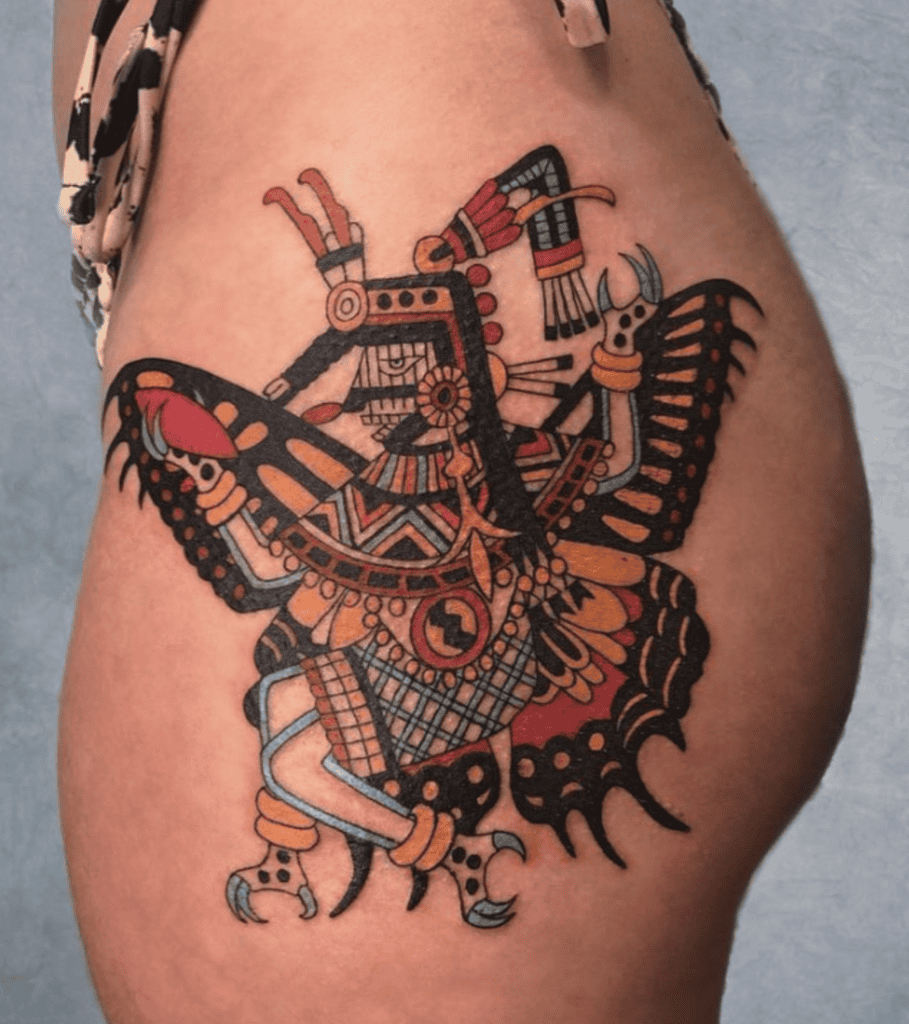
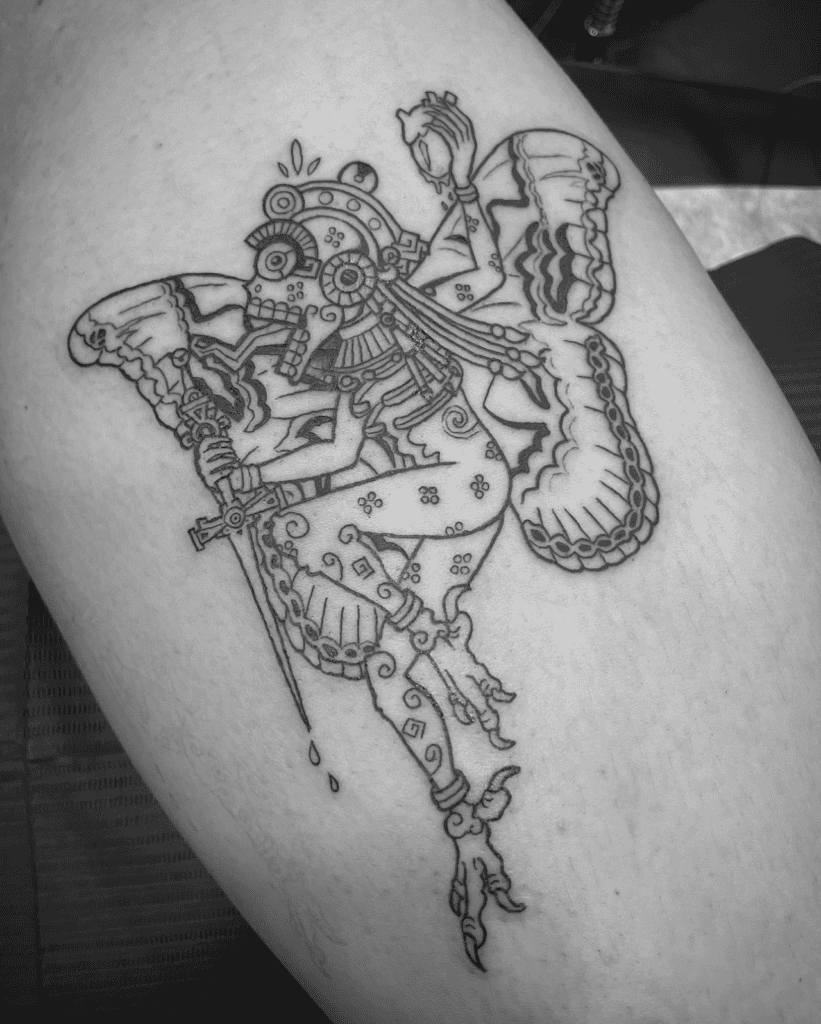
Itzpapalotl is one of the most mysterious figures in Aztec mythology, being a fearsome deity known as the “Obsidian Butterfly,” representing a contrast between beauty and fragility.
Itzpapalotl is tied to the darker, more cosmic aspects of Aztec belief, such as night & darkness, transformation, war & sacrifice, and stars & the sky. She is often counted among the Tzitzimimeh, sky beings who could descend to destroy the world during moments of cosmic instability (such as eclipses).
She is usually depicted as a skeletal or skull-faced figure with butterfly wings edged in obsidian blades, and sometimes with jaguar claws. Her design symbolises the sharp edge of transformation, the danger hidden within beauty, and the inevitability of death.
Mictecacihuatl Aztec Mythology Tattoo
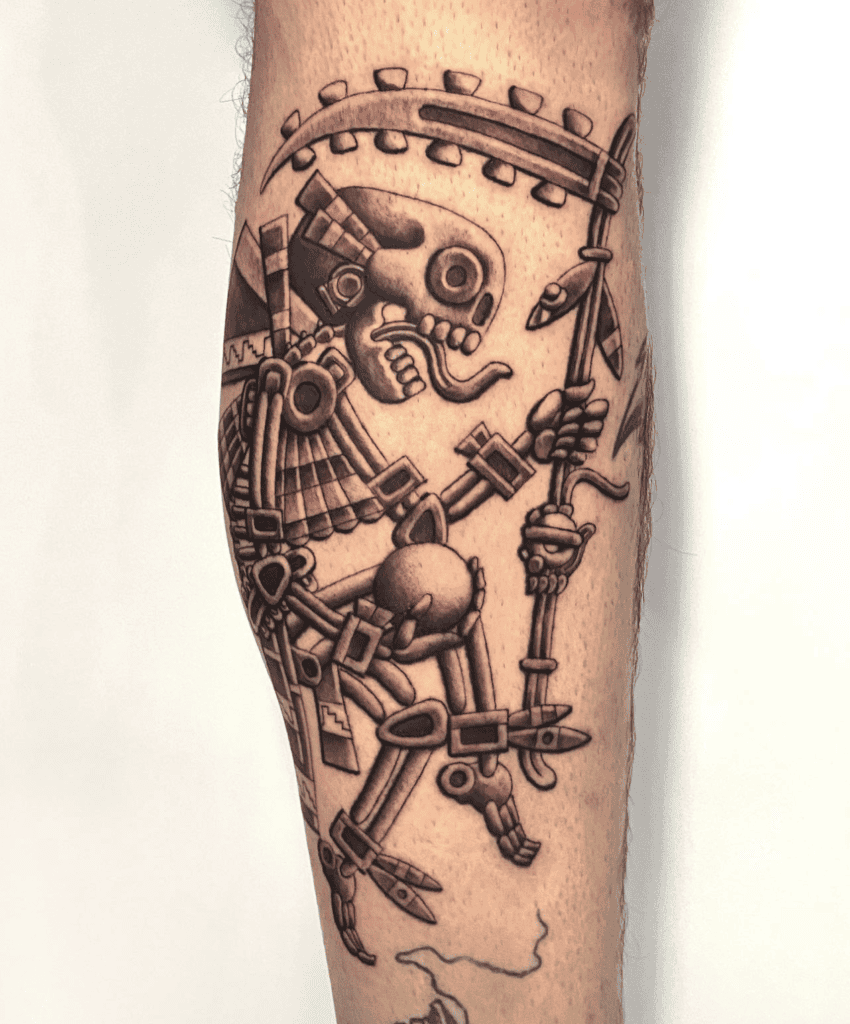
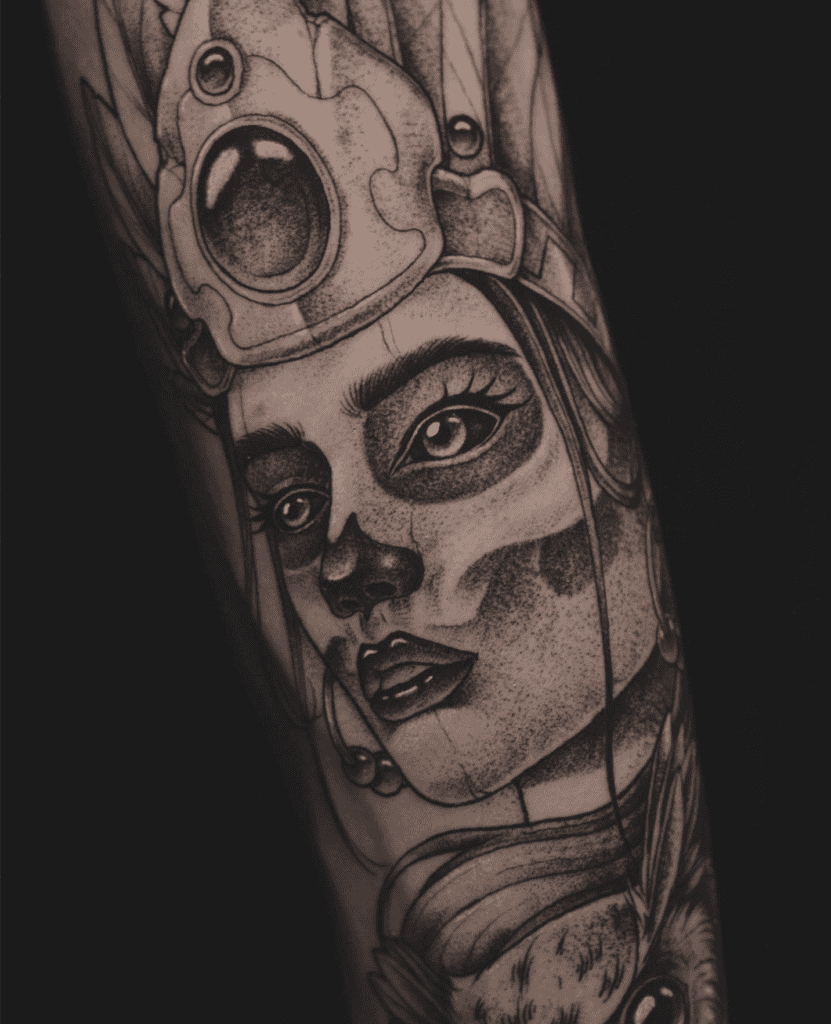
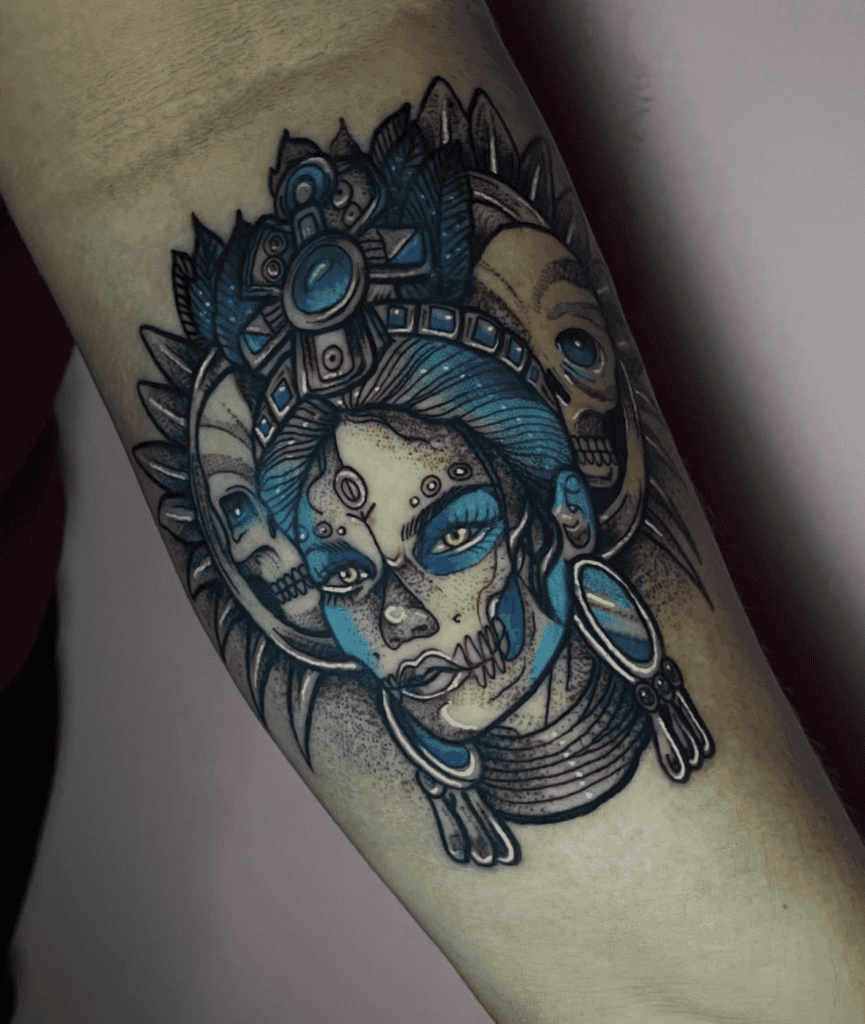
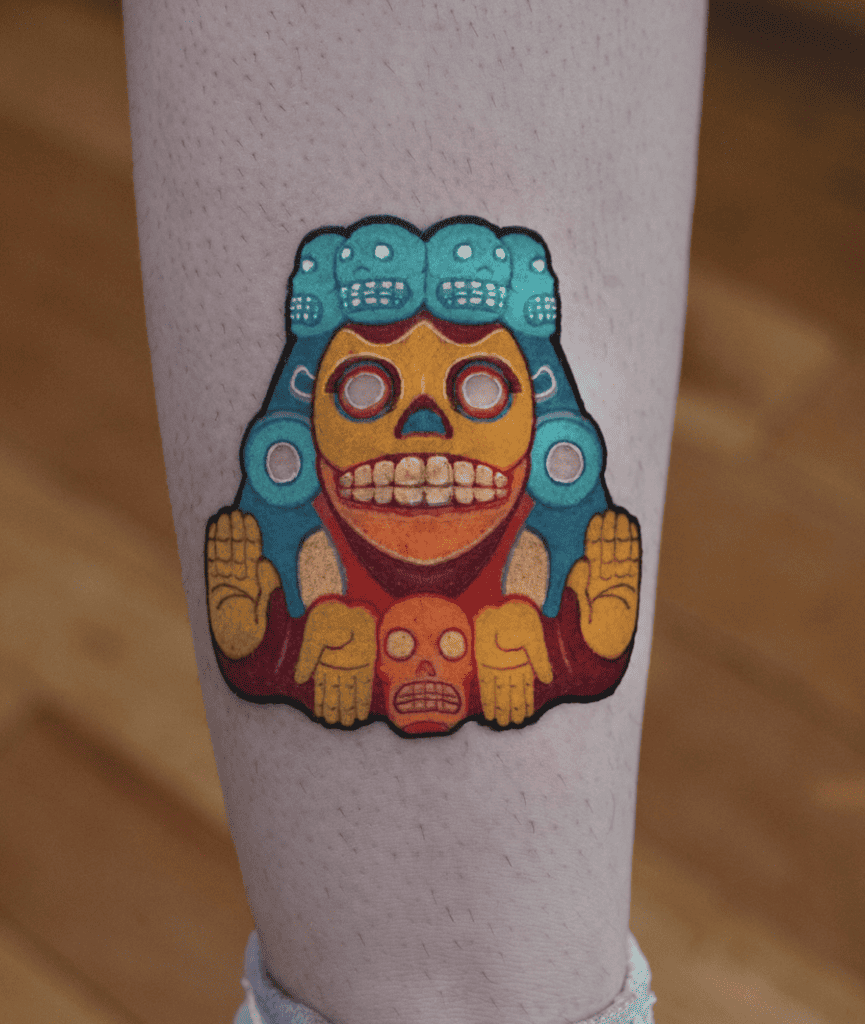
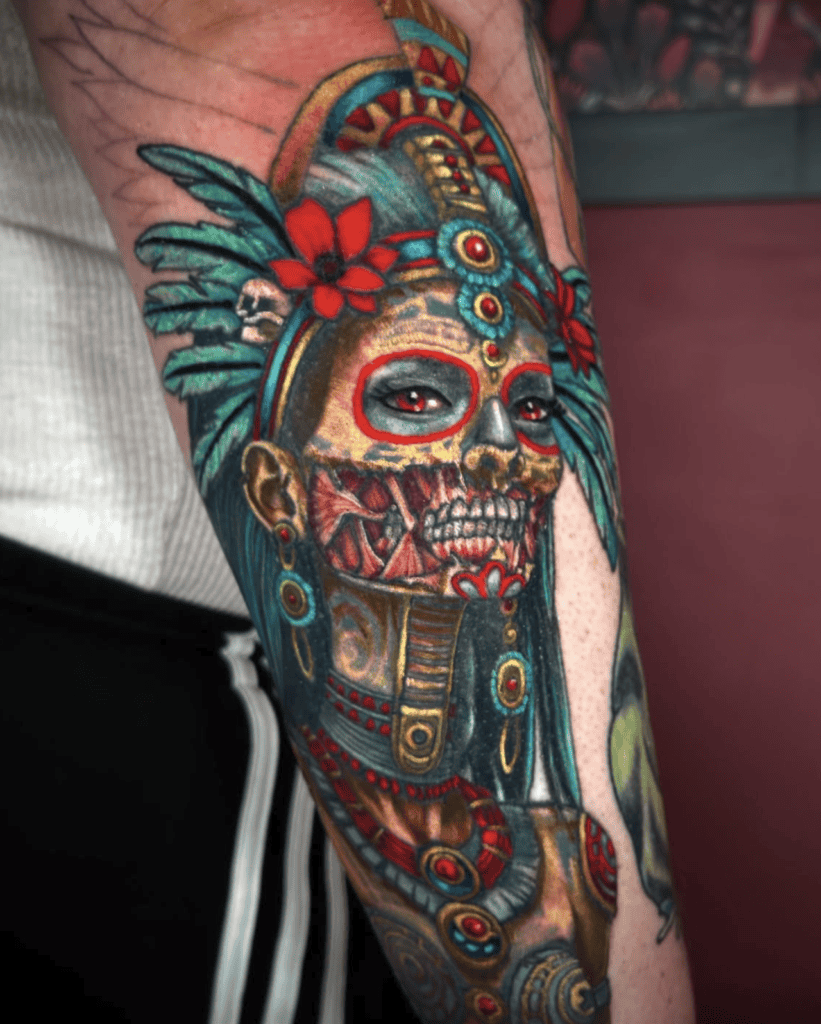
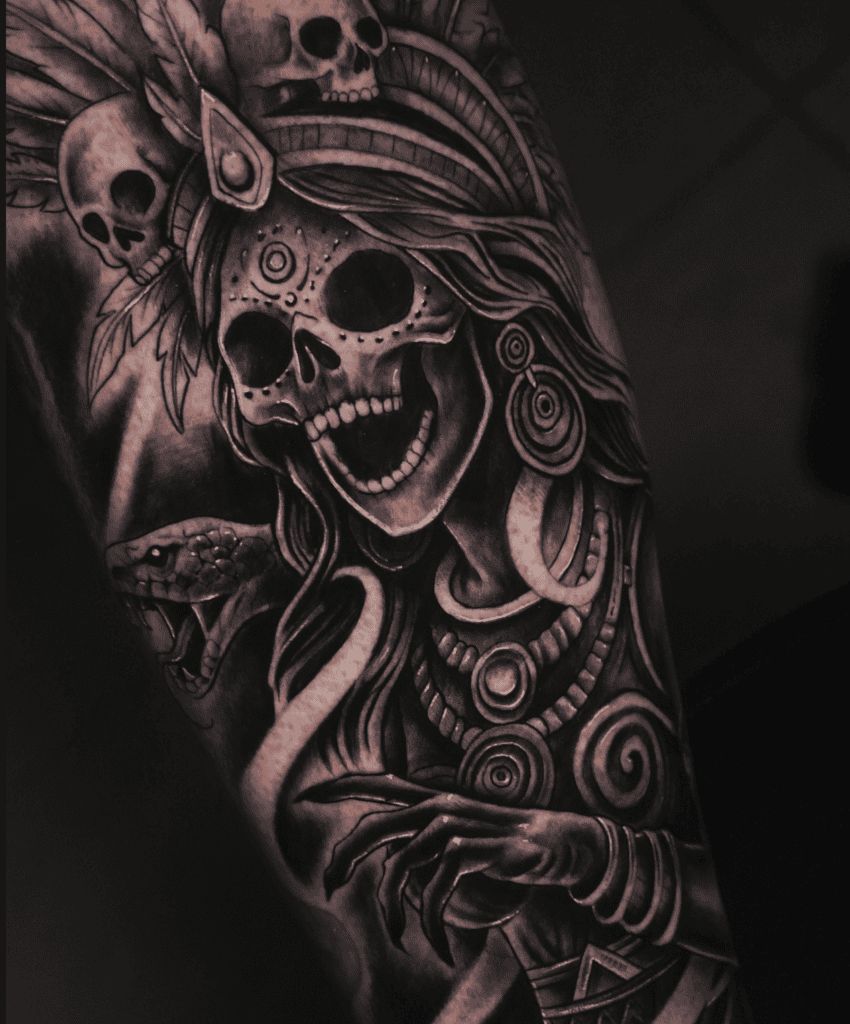
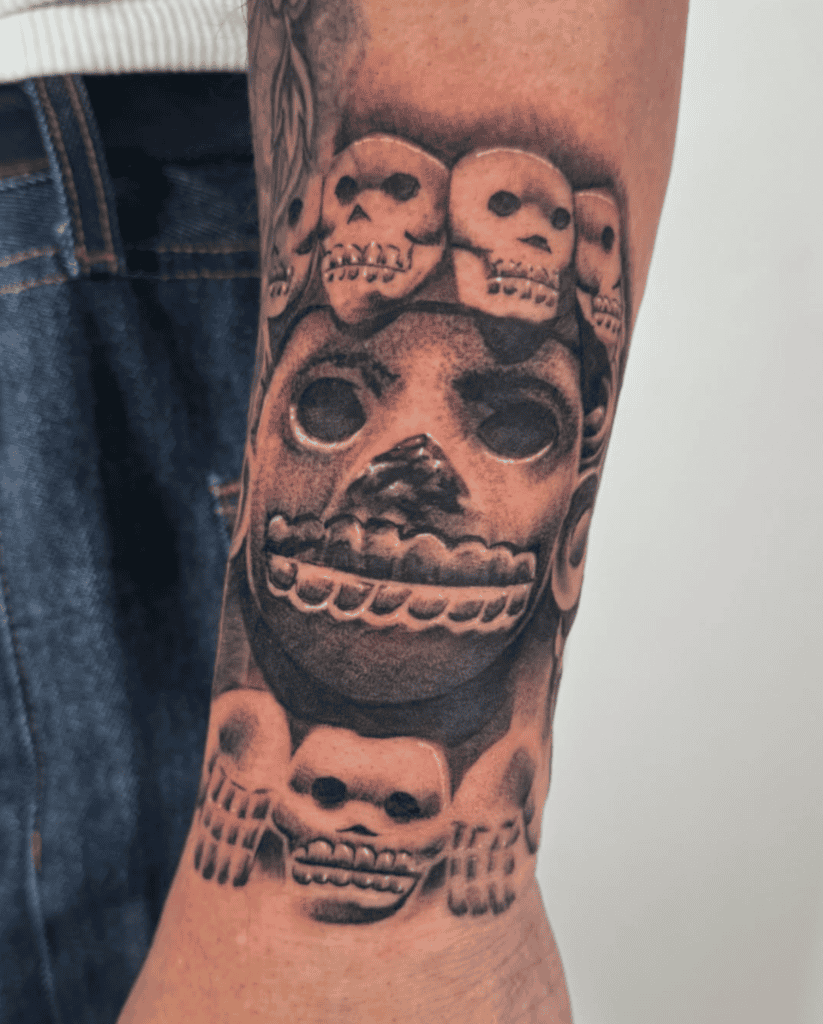
Mictecacihuatl is the Aztec Queen of the Underworld, the guardian of the dead, their bones, and their memory, watching over souls in Mictlan alongside her husband, Mictlantecuhtli.
She isn’t evil, but rather represents how death is a natural and necessary part of life. In Aztec belief, most people travelled to Mictlan after death, and Mictecacihuatl’s role was to watch over the bones of the dead, help maintain order in the underworld, and ensure the cycle of life and death continued. Souls often endured a long journey before reaching her realm, sometimes guided by Xolotl.
Cipactli Aztec Mythology Tattoo
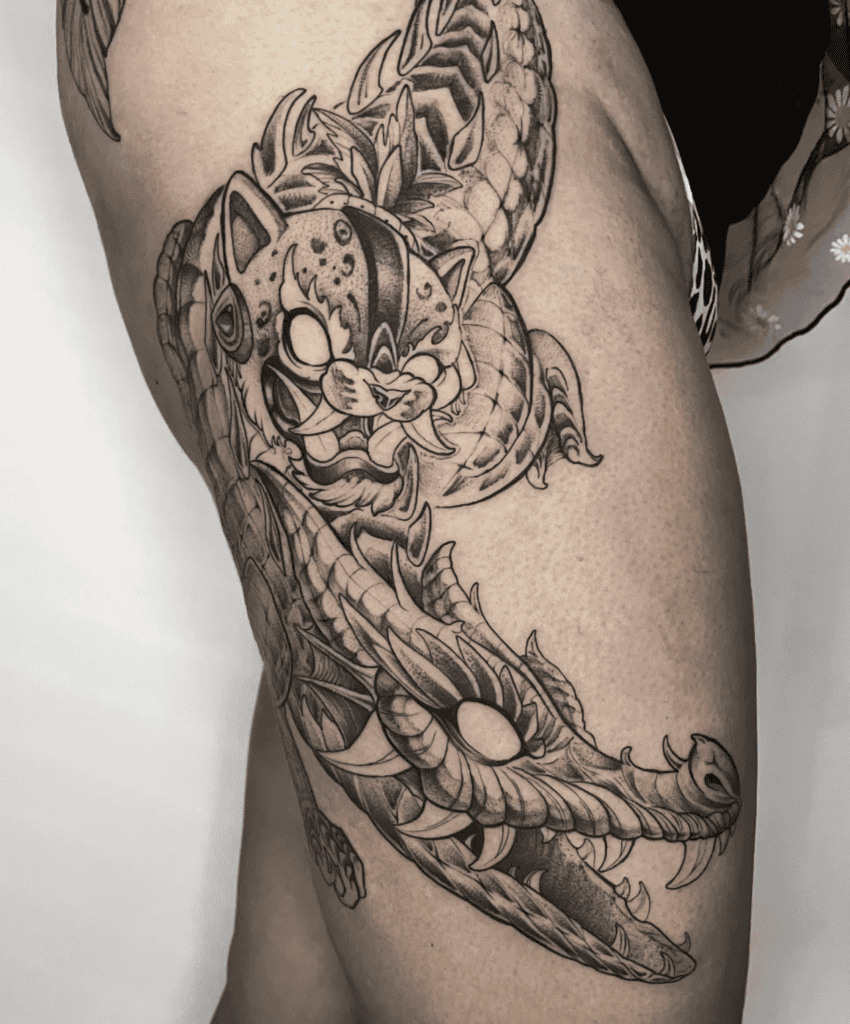
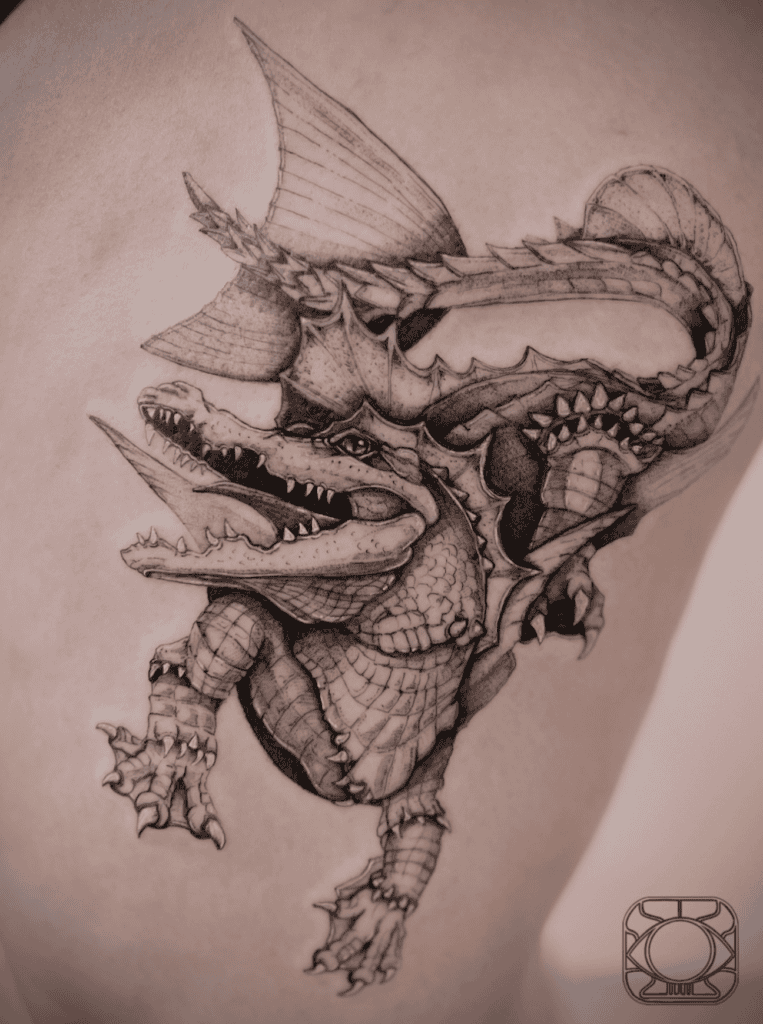
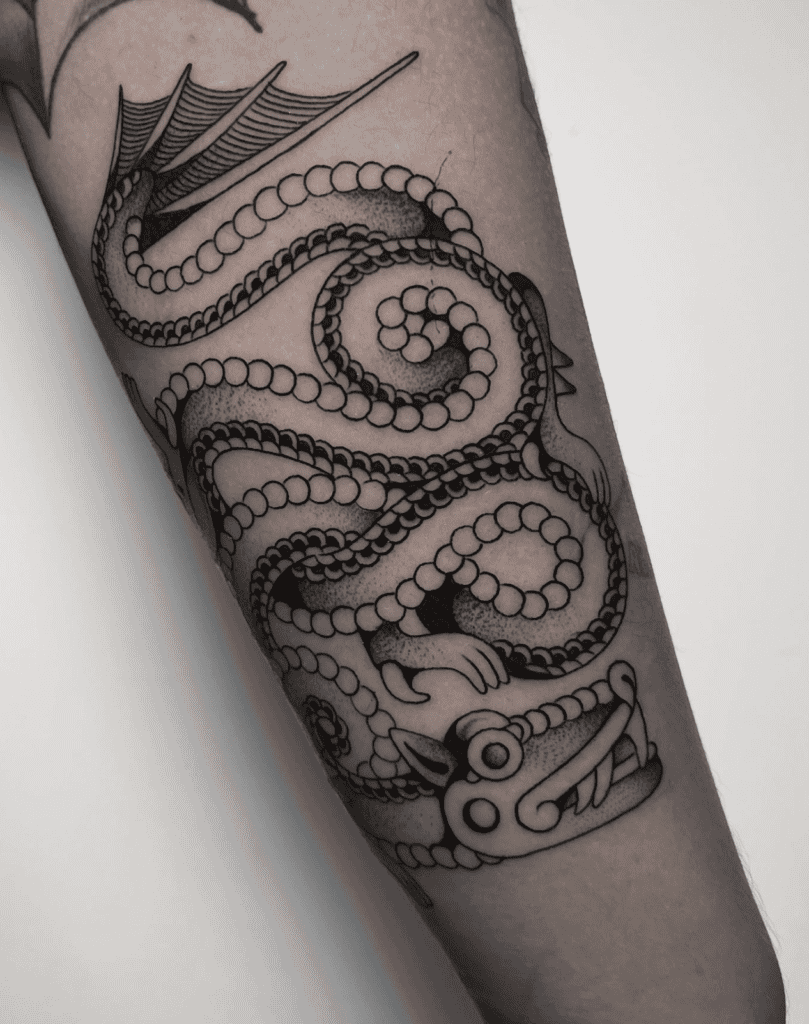
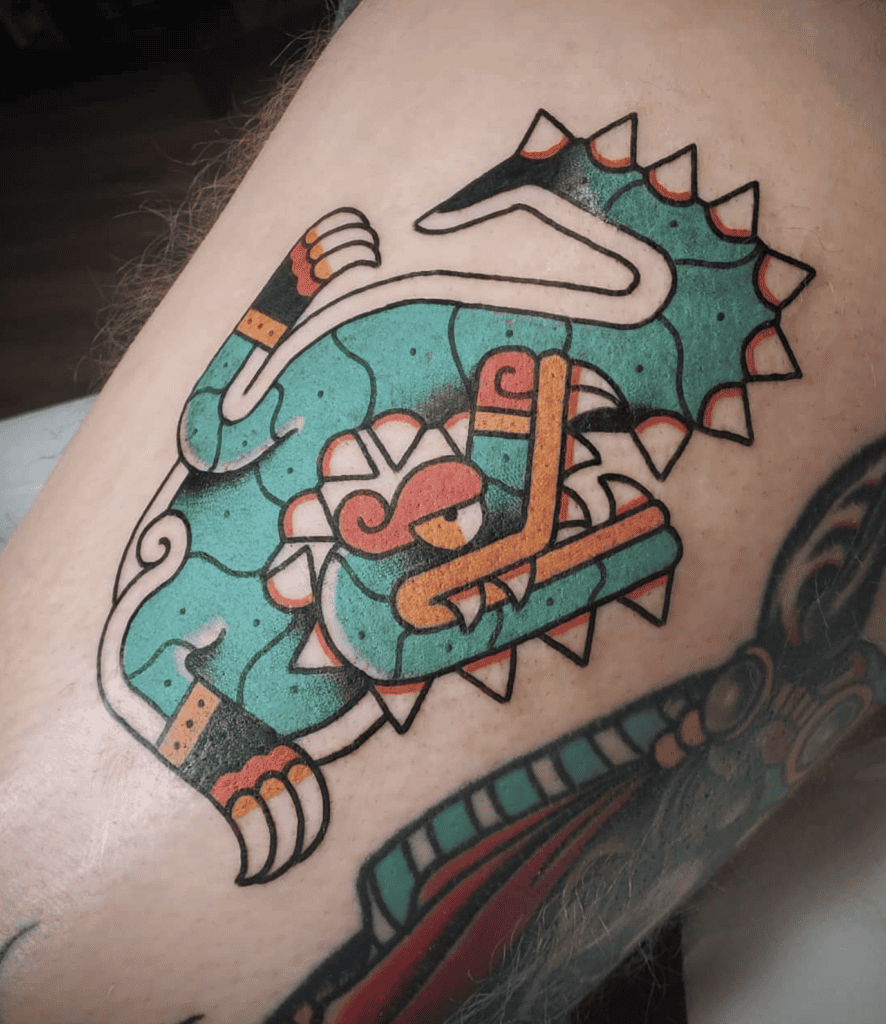
Cipactli is a primordial monster that existed before the world as we know it. It is often described as a crocodile-like or fish-like creature that floated in the cosmic waters of chaos at the beginning of time.
When the gods Quetzalcoatl and Tezcatlipoca decided to create the world, they first had to defeat Cipactli. Tezcatlipoca used his foot as bait, and Cipactli bit it off so that the gods could capture it and tear it apart.
From her body, they created the world, with her back becoming the earth, her body forming mountains, rivers, and land. Even after being transformed, Cipactli wasn’t considered “dead,” as the earth itself was believed to still be alive and hungry, demanding nourishment through sacrifice.
Ahuizotl Aztec Mythology Tattoo
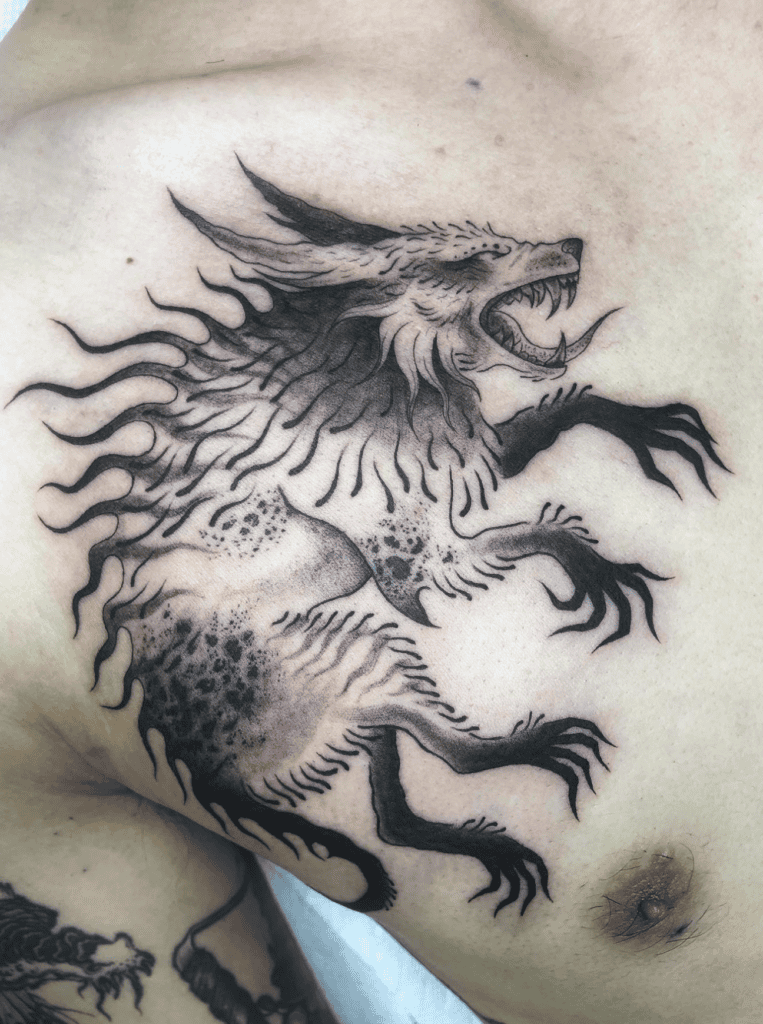
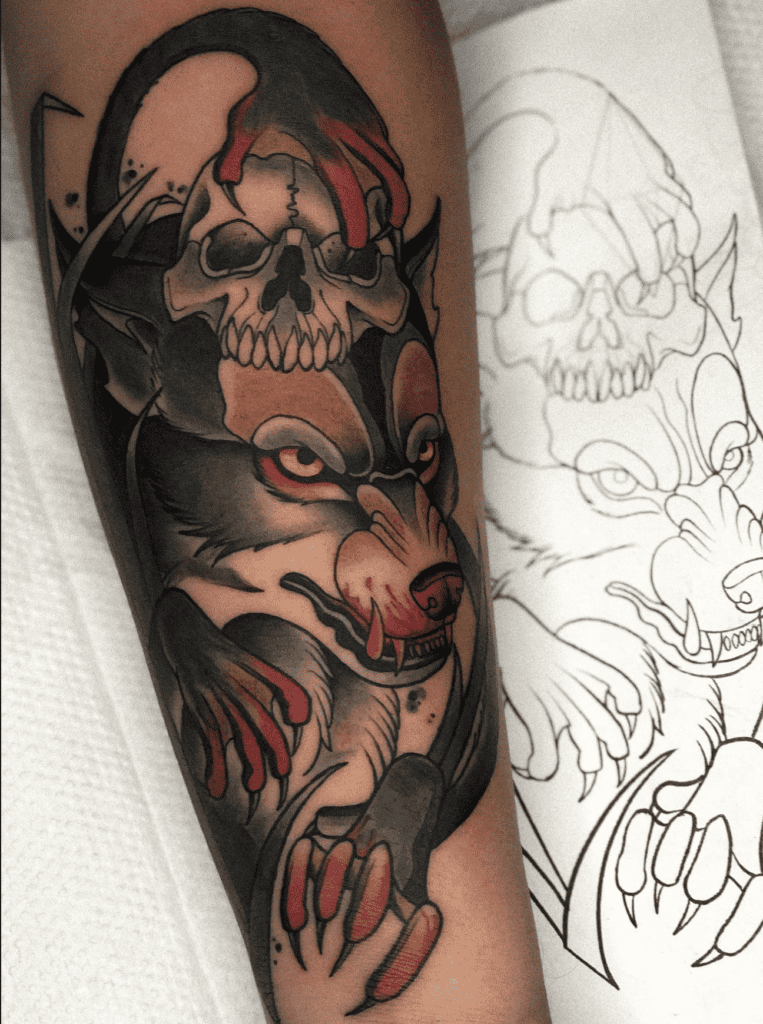
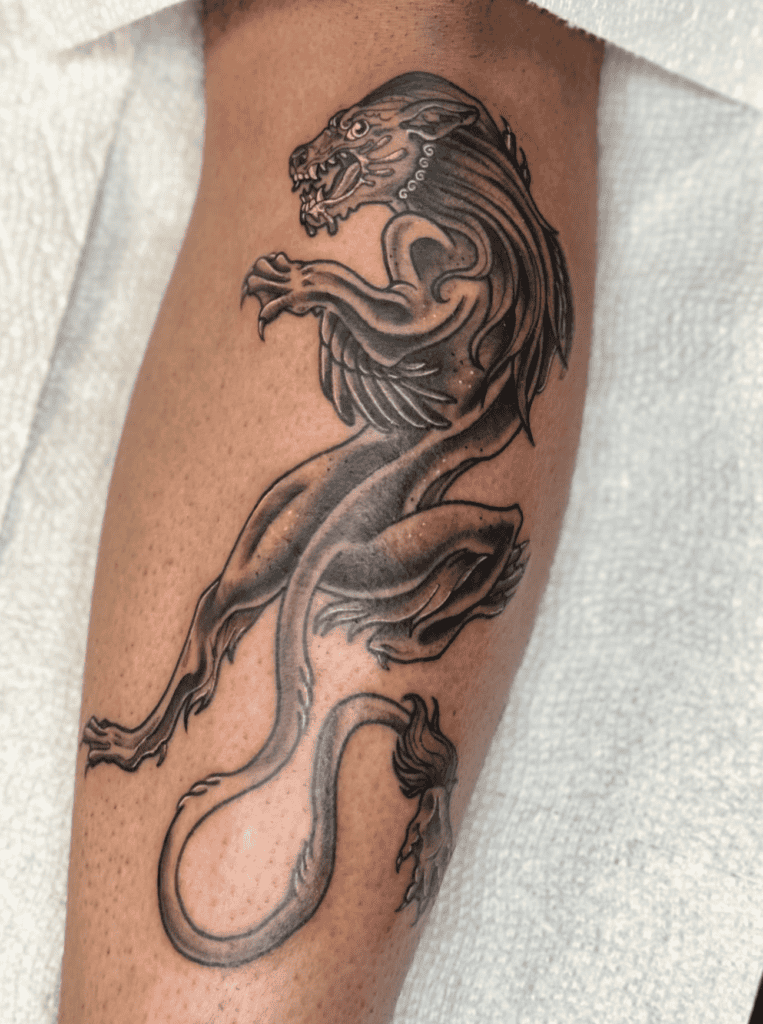
Ahuizotl is one of the most feared creatures in Aztec mythology, whose name roughly means “thorny water creature” or “spiny dog of the water,” hinting at both its animal-like form and its dangerous nature.
Ahuizotl is usually described as a dog-like or monkey-like body with dexterous paws for grabbing prey, sharp teeth, spiky fur, and a hand at the end of its tail. According to Aztec stories, Ahuizotl would lurk quietly beneath the water, mimicking the sound of a crying baby or a struggling person. When someone came to help, it grabbed them and dragged them to their death.
Victims were often found with no eyes, missing teeth, or missing nails, and these body parts were believed to be offerings to the gods, especially Tlaloc. Ahuizotl was sometimes seen as a servant or agent of Tlaloc who delivered souls to the water god, with those taken by Ahuizotl considered chosen or claimed.
Xiuhcoatl Aztec Mythology Tattoo
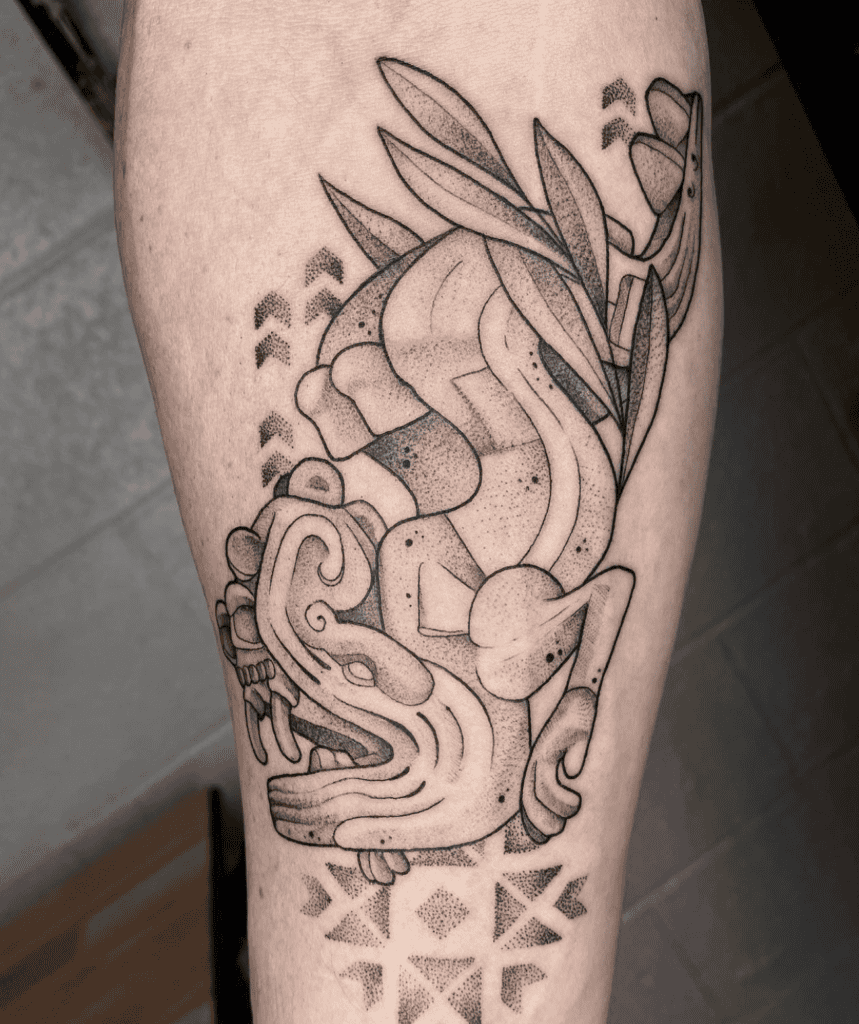
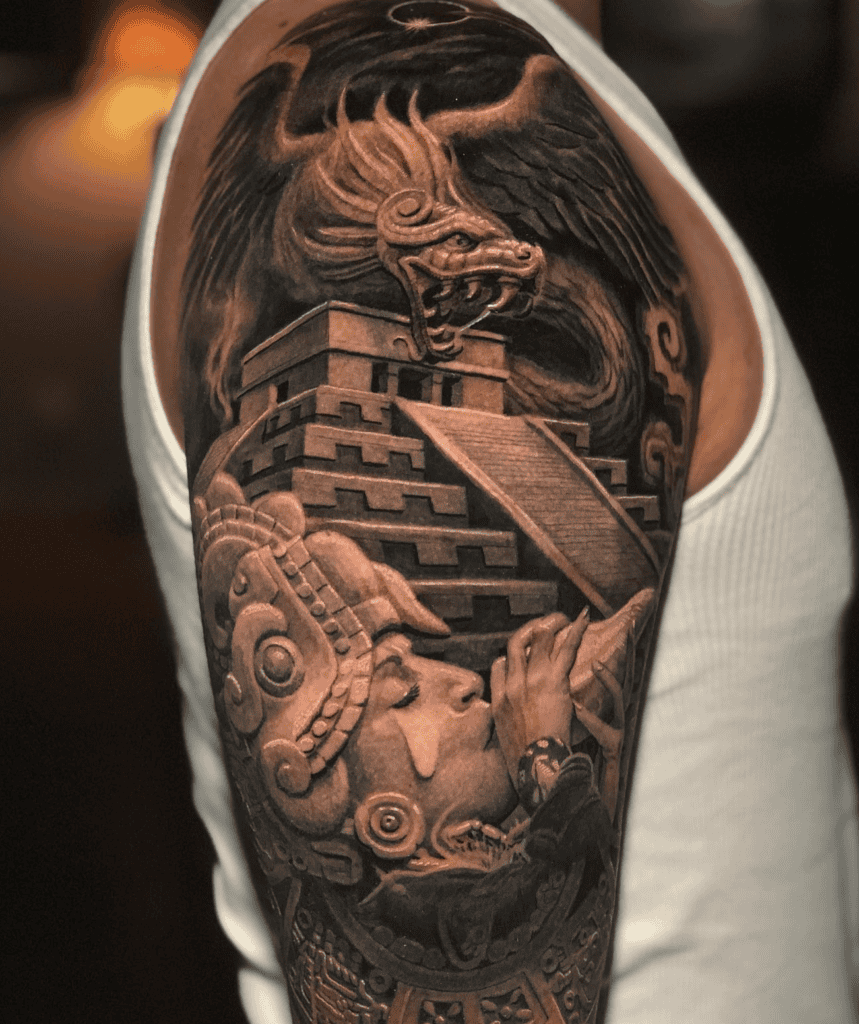
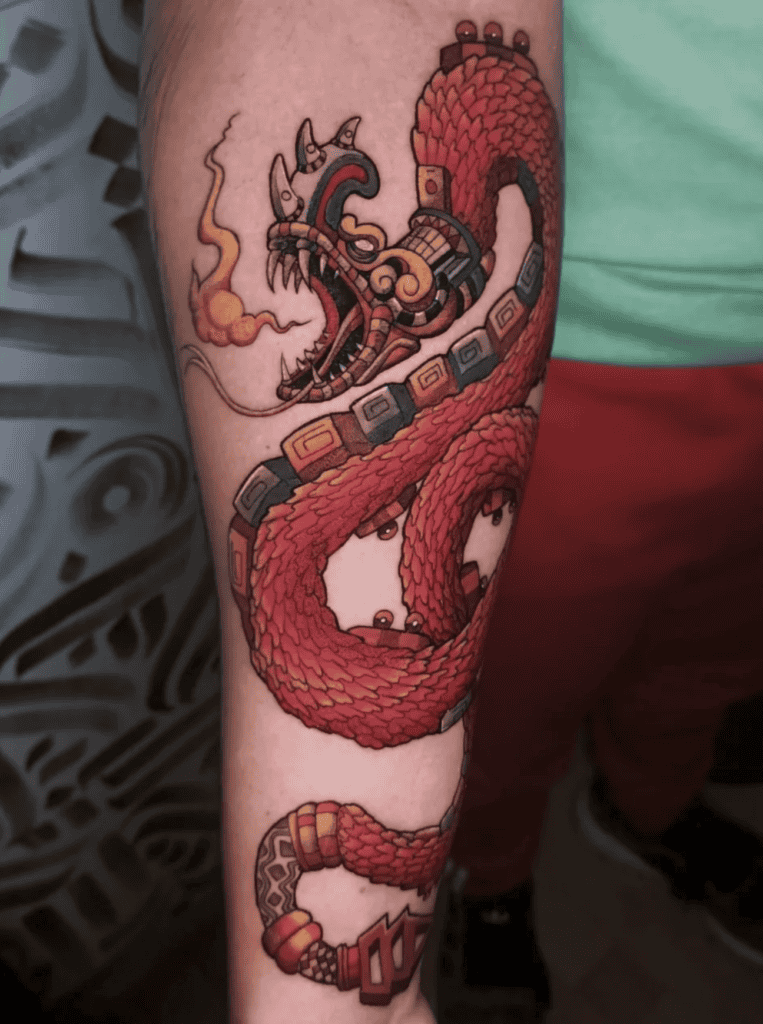
Xiuhcoatl is the legendary Fire Serpent of Aztec mythology whose name can mean “turquoise serpent” or “fire serpent,” blending destruction, energy, transformation (Fire), and preciousness, divine authority (Turquoise).
Xiuhcoatl is most famously linked to Huitzilopochtli. In the myth of his birth, when Huitzilopochtli emerges fully armed, he wields Xiuhcoatl as a weapon of fire and light, which he uses to defeat Coyolxauhqui and the stars. Symbolically, this represents the sun (fire) defeating the moon and stars at dawn.
Tzitzimimeh Aztec Mythology Tattoo

The Tzitzimimeh are celestial beings in Aztec mythology, often described as skeletal, clawed star demons who dwell in the heavens. They are harbingers of destruction, waiting for the right moment to descend upon the world, symbolising how the universe is not guaranteed to last and can all fall apart.
The Tzitzimimeh were most feared during eclipses, as when the sun disappeared, even briefly, it was believed that the sun might have lost its battle, darkness would take over, and the Tzitzimimeh would descend from the sky to devour humanity.
Itzcuīntli Aztec Mythology Tattoo
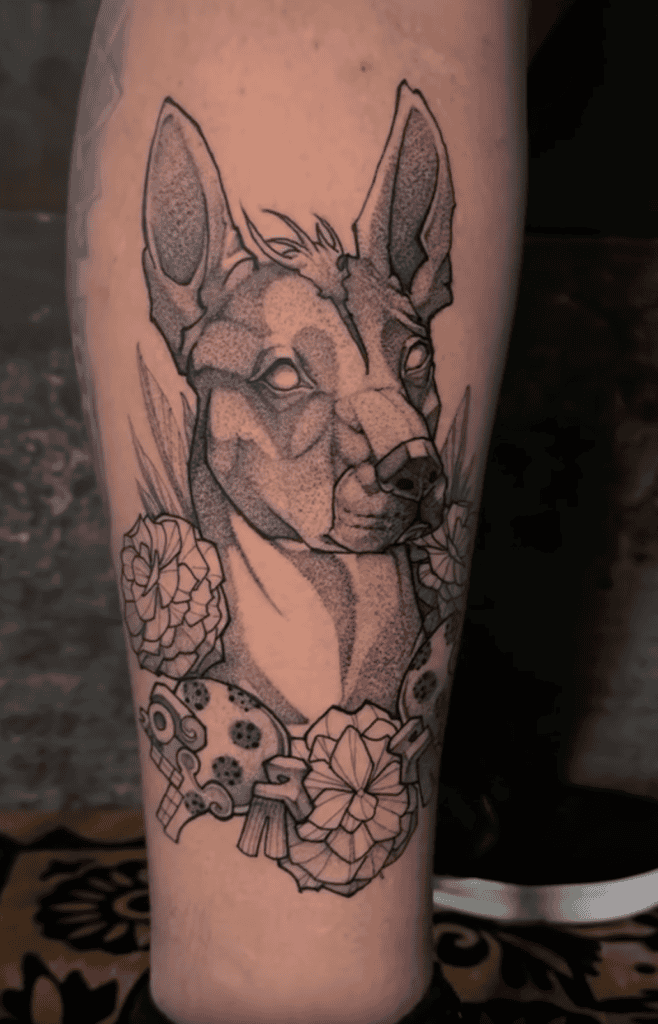
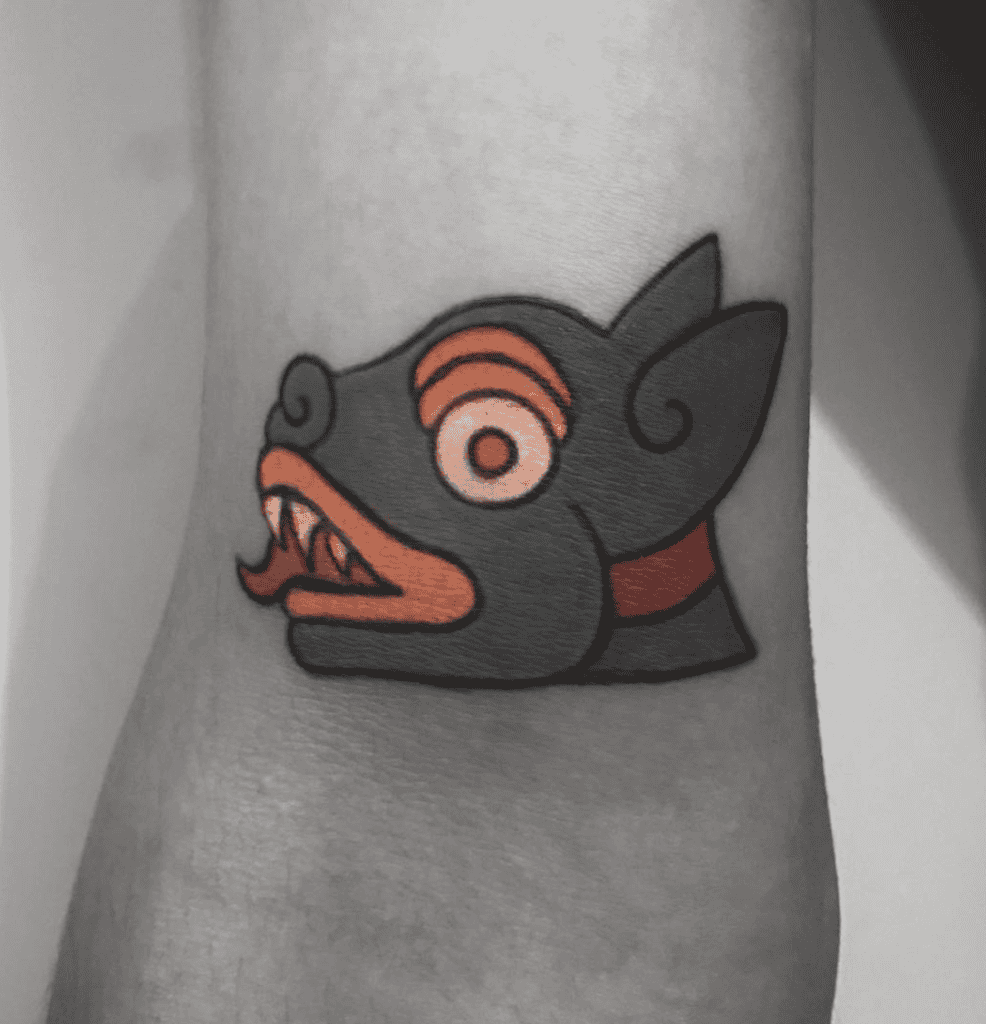
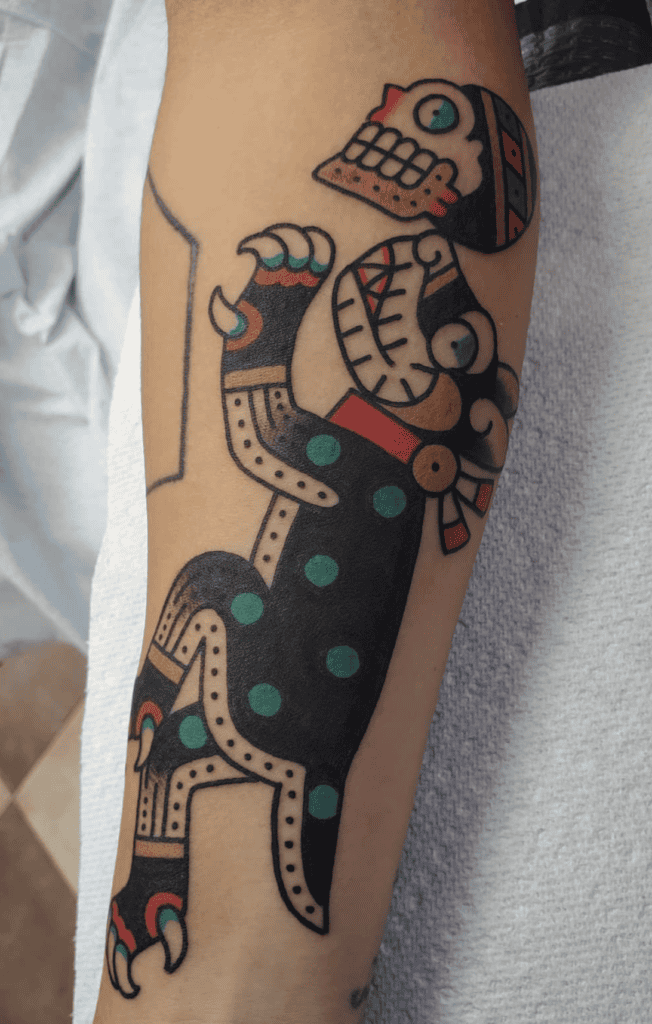
Itzcuīntli is a sacred dog figure in Aztec mythology and a loyal companion believed to guide souls through the afterlife. In Aztec belief, most souls travelled to Mictlan after death, which was a long and difficult journey through dangerous obstacles.
Itzcuīntli was said to help souls cross rivers in the underworld, guide them through the path safely, and act as a companion, not just a guide. Without the dog’s help, a soul might never complete the journey.
The Itzcuīntli is often associated with a real dog breed, the Xoloitzcuintli (Mexican hairless dog), which is one of the world’s oldest dog breeds, kept by ancient Mesoamerican cultures as it was believed to have spiritual significance. These dogs were sometimes buried with their owners so they could guide them in the afterlife.
Cihuateteo Aztec Mythology Tattoo


The Cihuateteo are powerful female spirits in Aztec mythology, believed to be the souls of women who died during childbirth. In Aztec culture, childbirth was seen as a battle, just like war, so women who died giving birth were honoured as fallen warriors. Their spirits didn’t simply pass on, are returned as mysterious and sometimes dangerous beings.
The Cihuateteo were believed to escort the sun during part of its journey. Fallen warriors accompanied the sun from sunrise to noon, and the Cihuateteo guided it from noon to sunset. Once night fell, their role changed, as they were believed to descend to earth, haunt crossroads and lonely places, or pose a danger, especially to children.
Nanahuatzin Aztec Mythology Tattoo


Nanahuatzin is a god whose self-sacrifice brought the sun into existence. His name is often translated as “the humble” or “the afflicted one,” and he is usually described as poor, sick or covered in sores, and overlooked compared to other gods, yet, despite his hardships, he became the sun.
In the creation of the current world, the gods needed a new sun. Nanahuatzin (humble and poor) and Tecciztecatl (wealthy and proud) were chosen. They were asked to jump into a sacred fire, but when Tecciztecatl hesitated, Nanahuatzin stepped forward without fear, leaping into the flames and becoming the sun.
After seeing Nanahuatzin’s courage, Tecciztecatl finally jumped into the fire too and became the moon, but because he hesitated, his light was dimmed.
Tlahuizcalpantecuhtli Aztec Mythology Tattoo
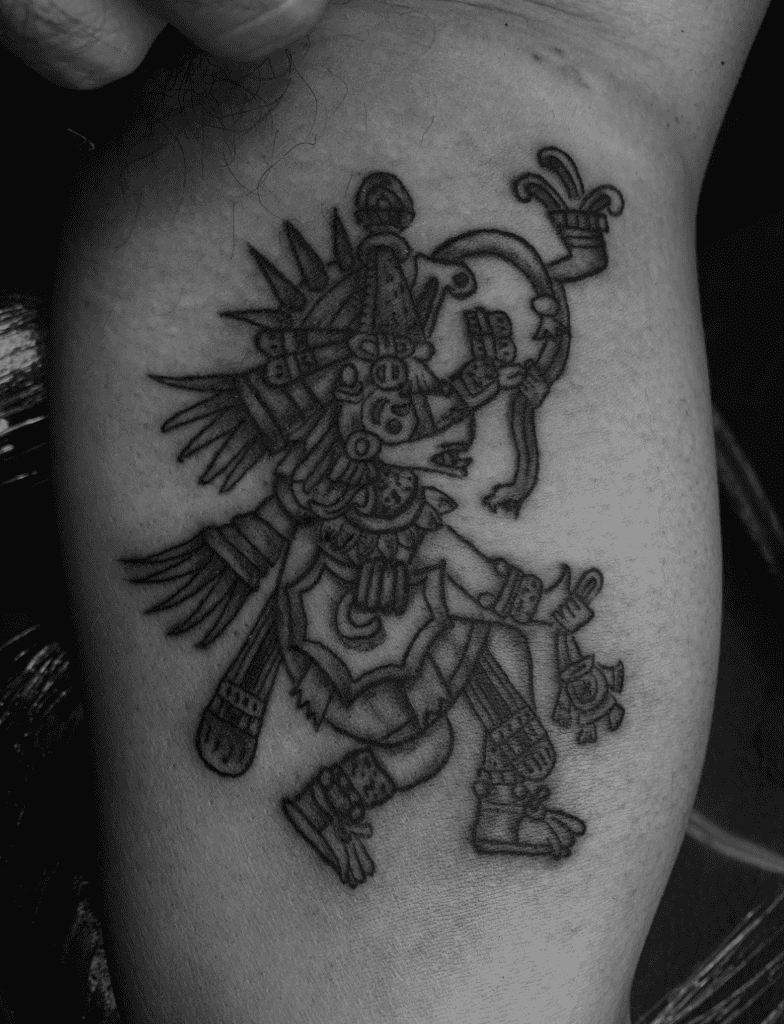
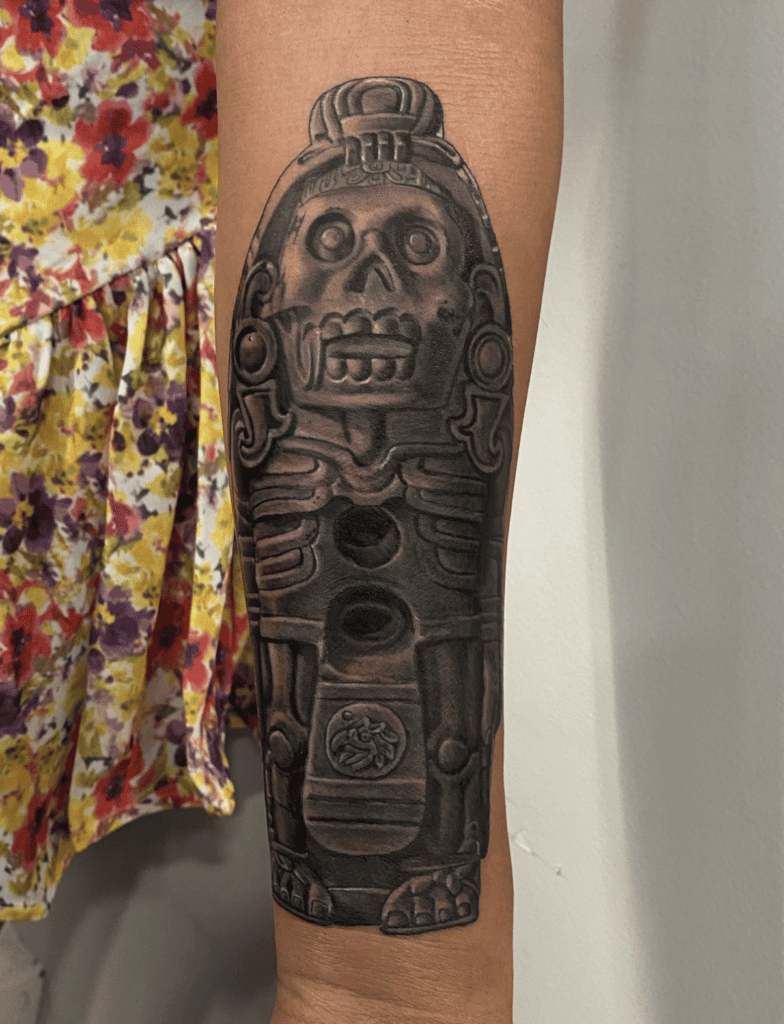
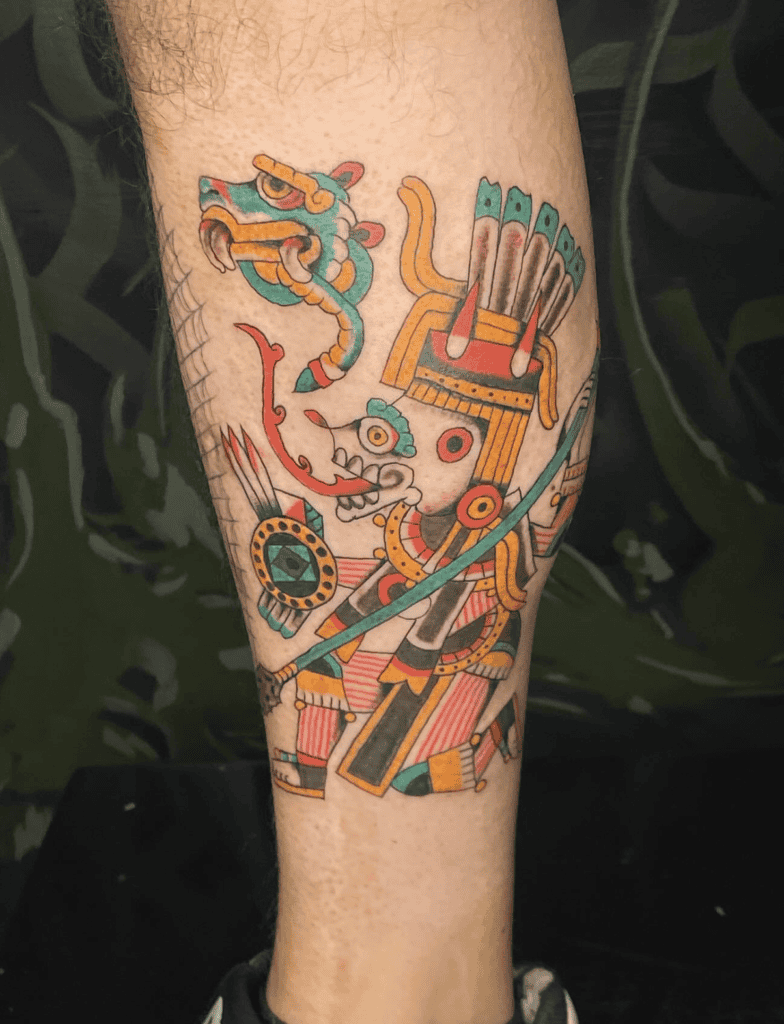
Tlahuizcalpantecuhtli is the Aztec god of the Morning Star (Venus), whose name means “Lord of the Dawn” or “He Who Comes at First Light.” In many traditions, Tlahuizcalpantecuhtli is linked to, or even considered a form of, Quetzalcoatl. After Quetzalcoatl’s death or departure, he transforms into the Morning Star.
Despite being associated with light, Tlahuizcalpantecuhtli could be destructive. In one myth, he attempts to attack the sun, Tonatiuh, by firing darts at it (rays of light or energy). The attack fails, and he is struck down in return.
Mixcoatl Aztec Mythology Tattoo


Mixcoatl is a powerful Aztec god of hunting, the night sky, and the Milky Way. His name means “Cloud Serpent,” referring to the Milky Way stretching across the sky like a luminous, serpent-like path.
Mixcoatl is closely tied to the Milky Way, which the Aztecs saw as a celestial road or path, a guide through the night, and a connection between worlds. As a hunting god, Mixcoatl was essential for survival. Hunters prayed to him for success and skill, and he was associated with bows and arrows, representing precision, patience, and focus.
Jaguar Warriors Aztec Mythology Tattoo
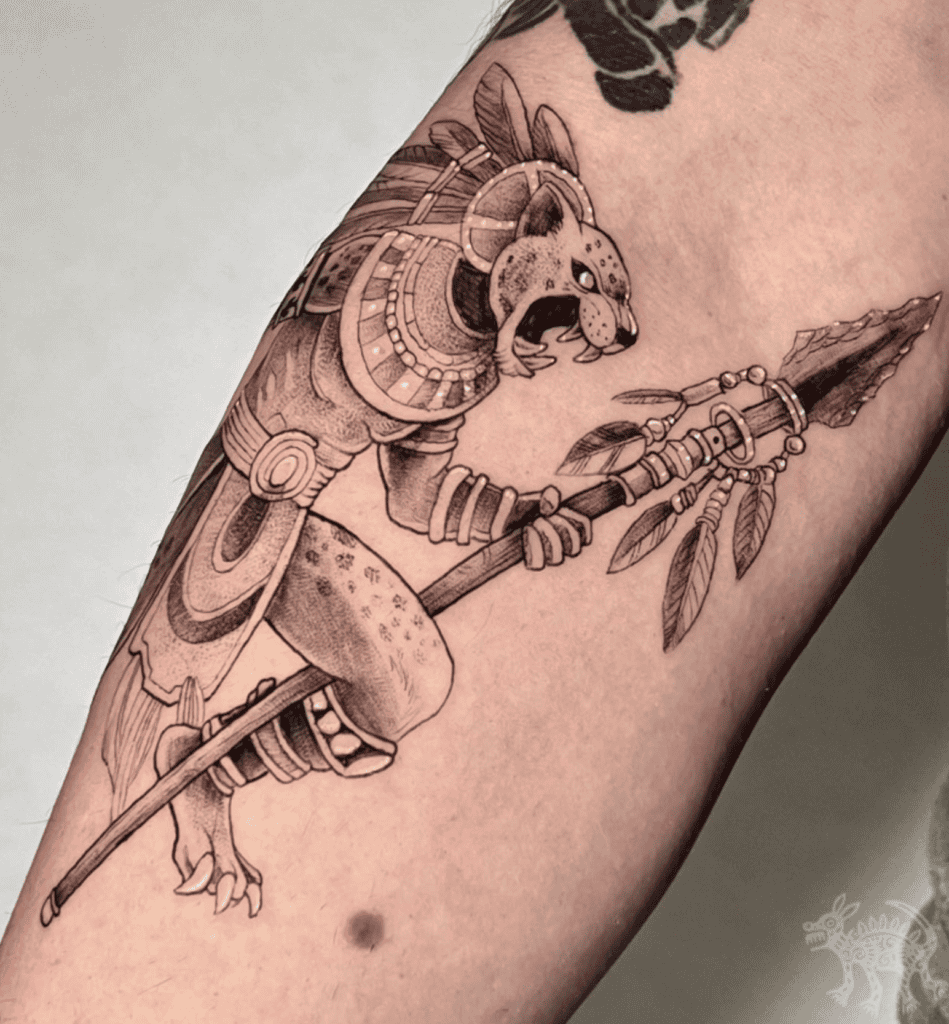
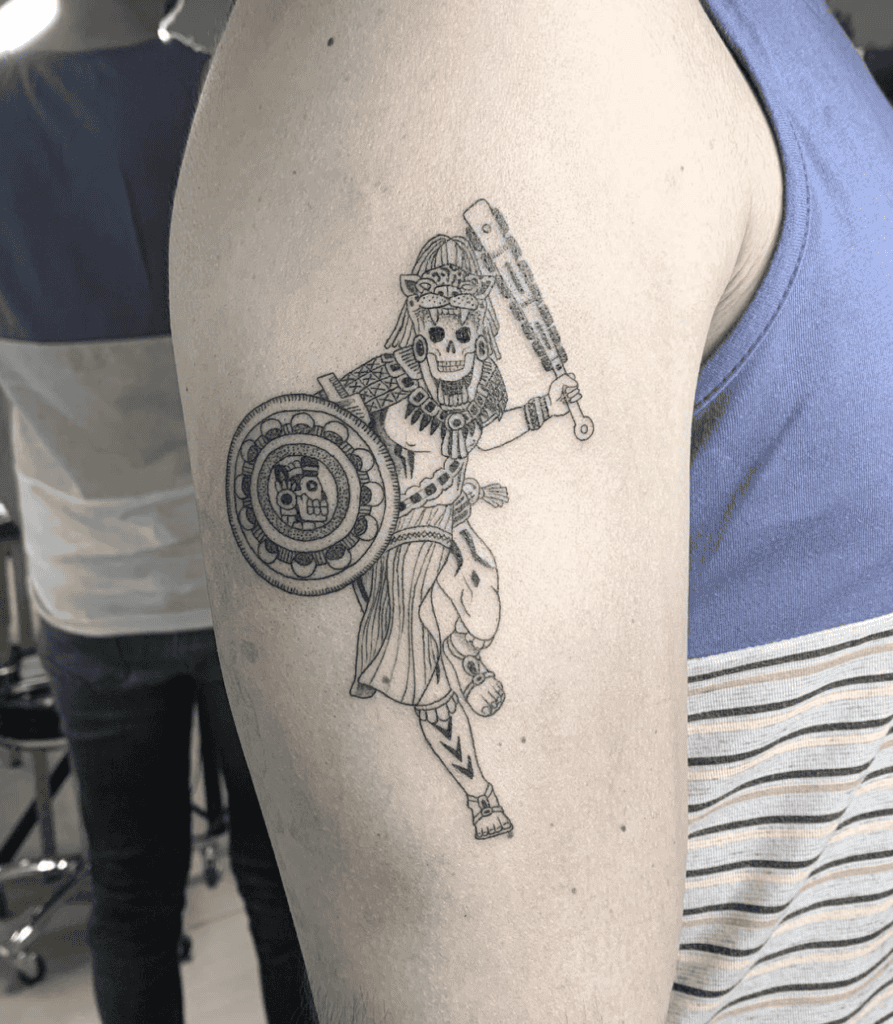
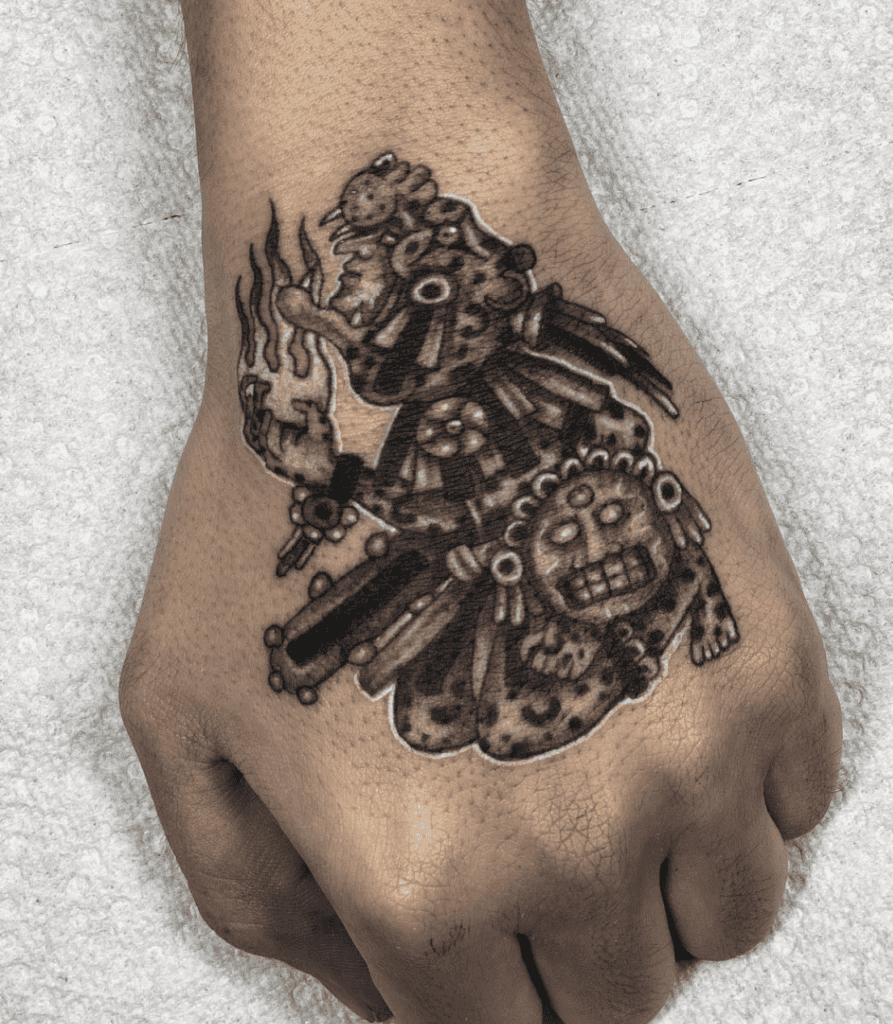
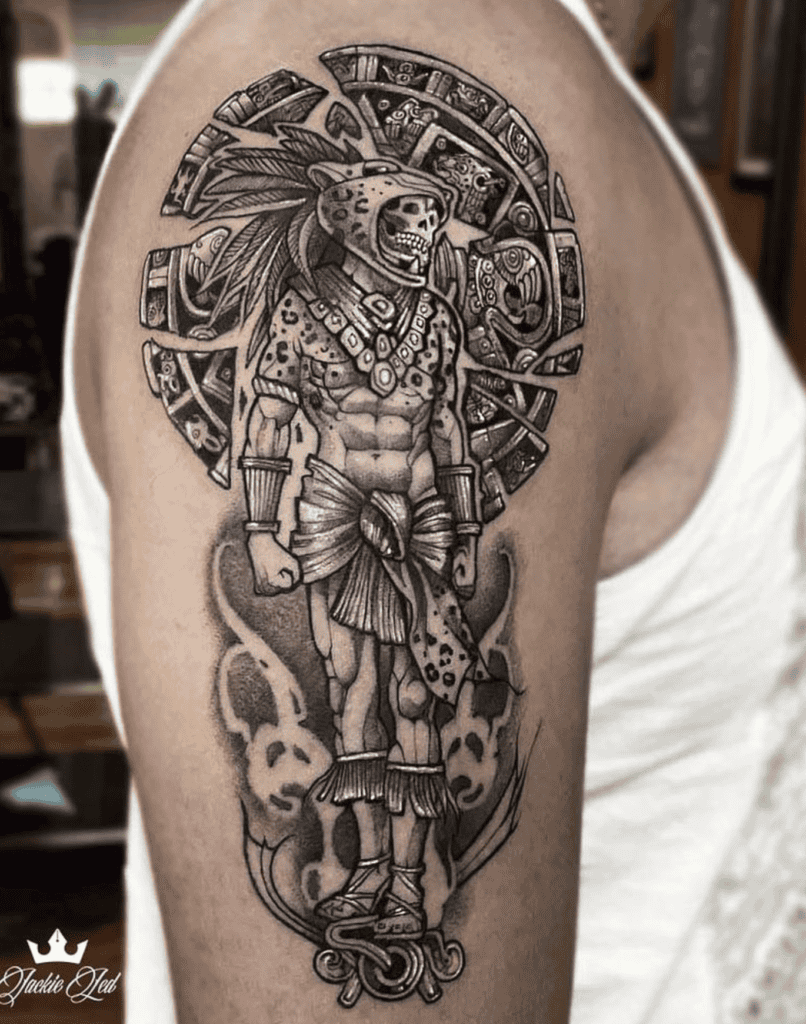
The Jaguar Warriors were one of the most elite and feared military orders in Aztec society, real warriors who carried deep symbolic and spiritual meaning. These men were dedicated fighters who wore jaguar-inspired armour, embodying the jaguar’s strength, stealth, and ferocity.
The jaguar was one of the most important animals in Aztec belief, associated with night and the underworld, and a symbol of strength, stealth, and dominance. By becoming Jaguar Warriors, these fighters were believed to take on the spirit and power of the jaguar itself.
Jaguar Warriors were elite frontline fighters, tasked with capturing enemies alive for ritual sacrifice to sustain the gods. To become a Jaguar Warrior, you had to capture multiple enemies in battle, requiring skill, courage, and discipline.
Eagle Warriors Aztec Mythology Tattoo
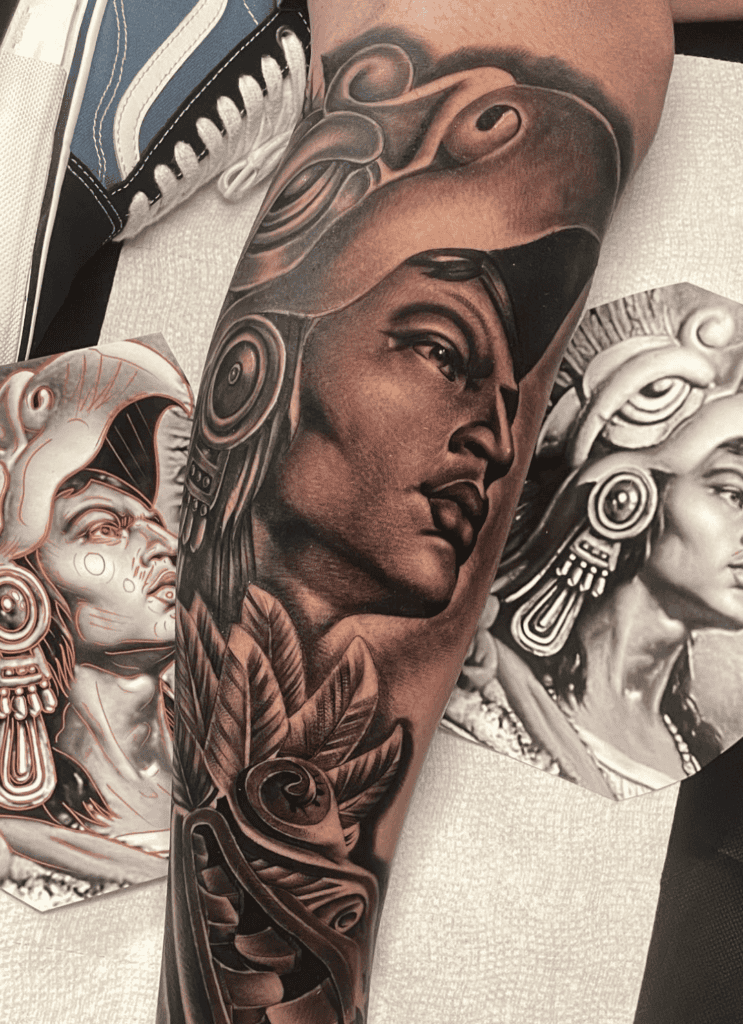
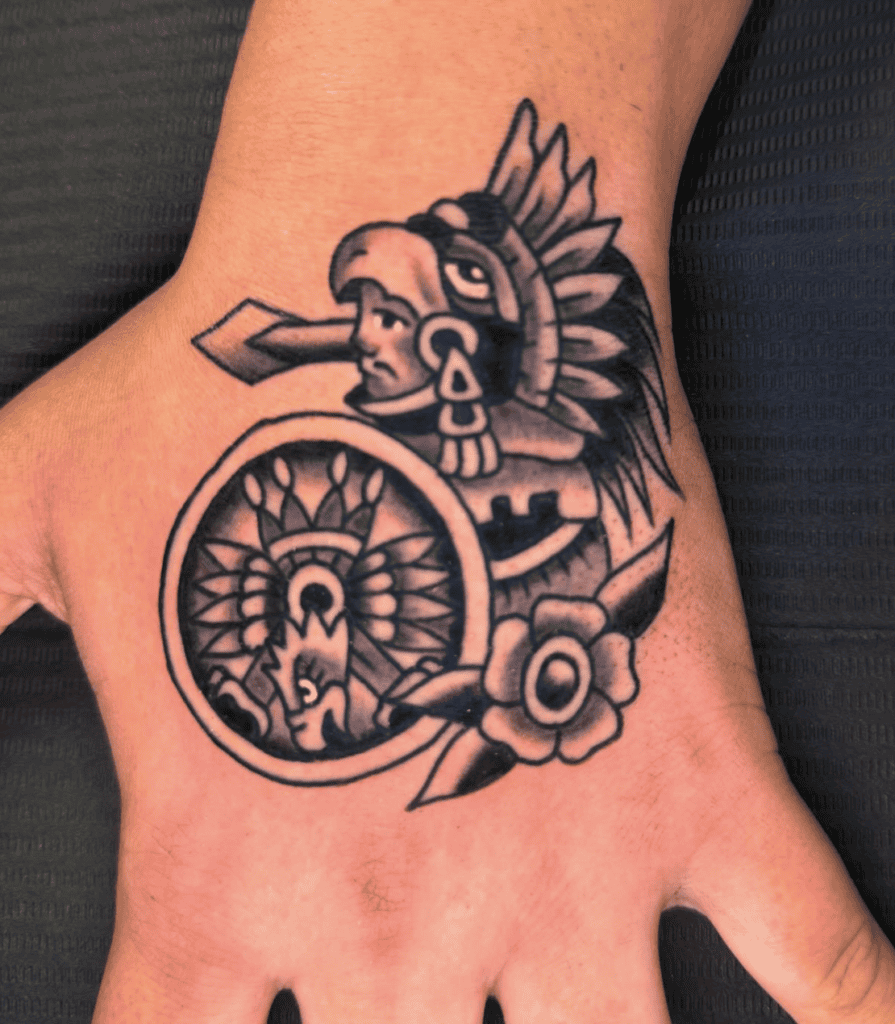
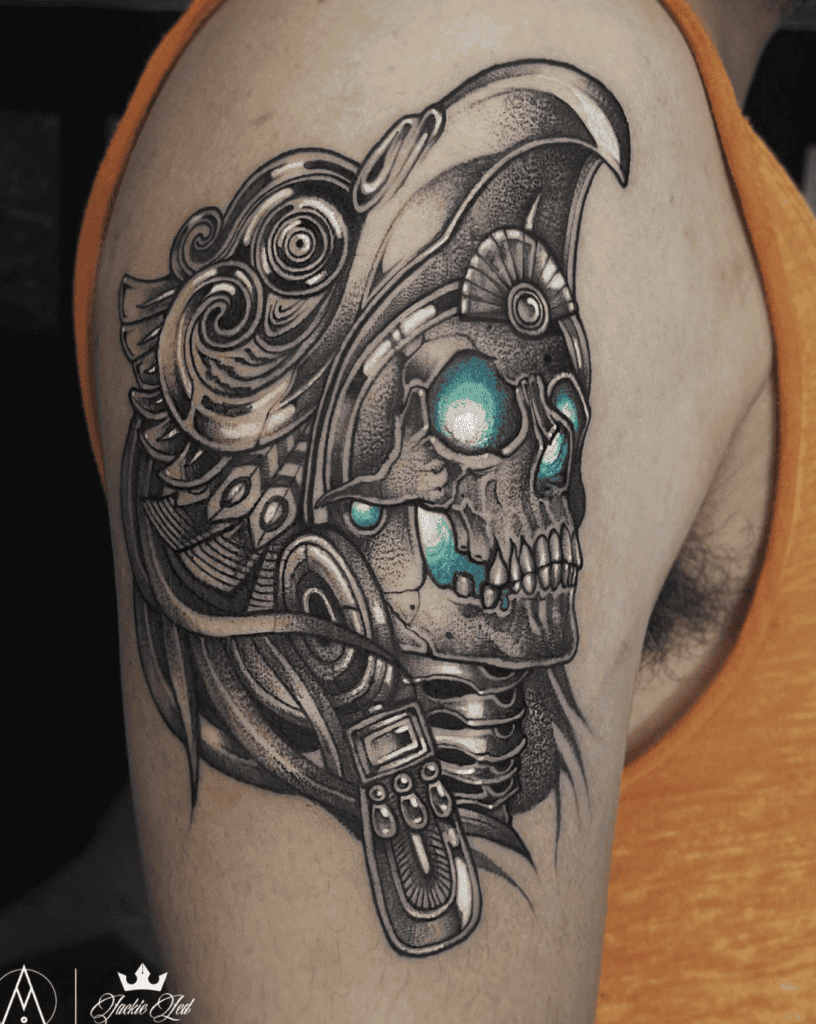
The Eagle Warriors were one of the most prestigious and elite military orders in Aztec society, known for their courage, discipline, and connection to the sun. Like the Jaguar Warriors, they were real historical warriors, but Eagle Warriors were deeply tied to mythology and symbolism, representing the power of light, the sky, and divine purpose.
These warriors were seen as embodiments of the sun in human form. In Aztec belief, the eagle was a sacred animal connected to the sun and daylight, and symbols of vision, clarity, and power. By becoming Eagle Warriors, these fighters represented the strength and dominance of the sun itself.
Eagle Warriors were among the most important fighters in battle, who were elite frontline warriors, focused on capturing enemies alive for ritual sacrifice. Like Jaguar Warriors, becoming an Eagle Warrior required skill and achievement by capturing multiple enemies, with promotion based on merit, not just birth.
Jaguar Aztec Mythology Tattoo


Jaguars were one of the most powerful and sacred symbols in the entire Aztec belief system. Feared, respected, and deeply spiritual, the jaguar represented night, strength, the underworld, divine power, and the embodiment of raw, untamed force. They were closely tied to powerful deities, especially Tezcatlipoca, who is often depicted as a jaguar or able to transform into one.
Eagle Aztec Mythology Tattoo


In Aztec mythology, the eagle is one of the most powerful and revered symbols, representing the sun, the sky, and divine strength. Eagles were seen as creatures of the sun and the heavens with keen vision, representing how true power comes from clarity, vision, and bold action.
They were closely tied to solar deities, especially Huitzilopochtli. Warriors who died in battle were believed to accompany the sun and be reborn as birds, especially eagles. One of the most famous Aztec symbols comes from a divine vision. An eagle perched on a cactus, eating a snake. This sign, sent by the gods, told the Aztecs where to build their capital, Tenochtitlan, which is modern-day Mexico City. This image is still on the Mexican flag today, making the eagle a symbol of destiny, guidance, and divine approval.
Huehuecoyotl Aztec Mythology Tattoo
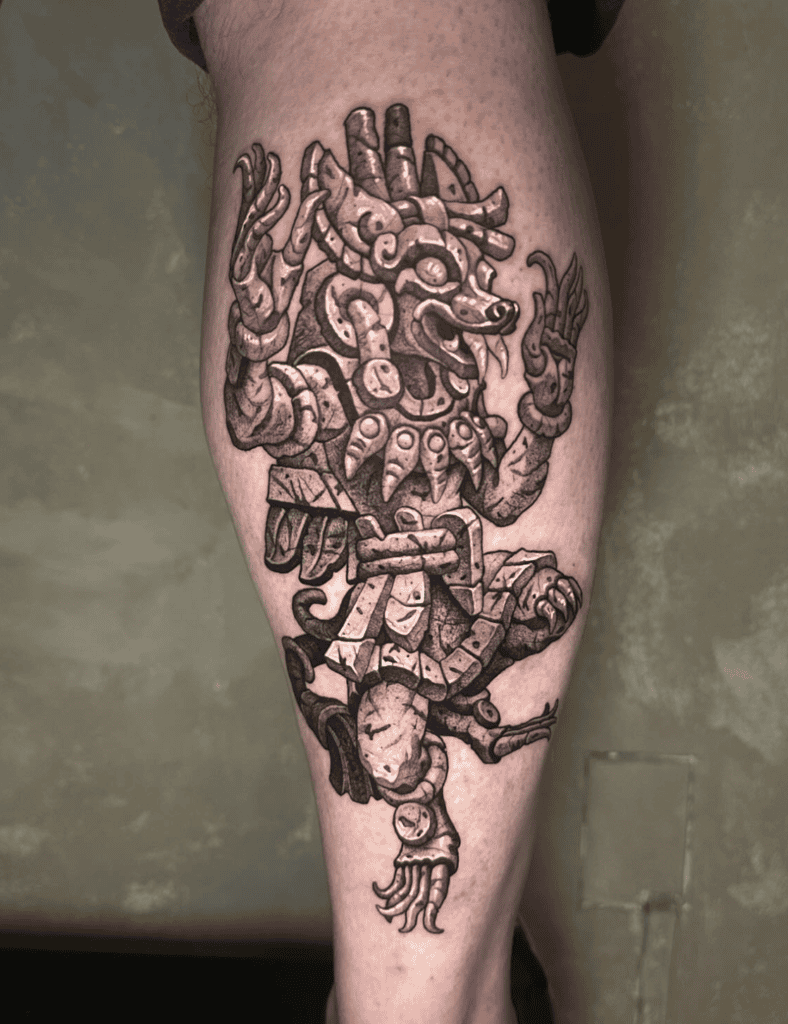
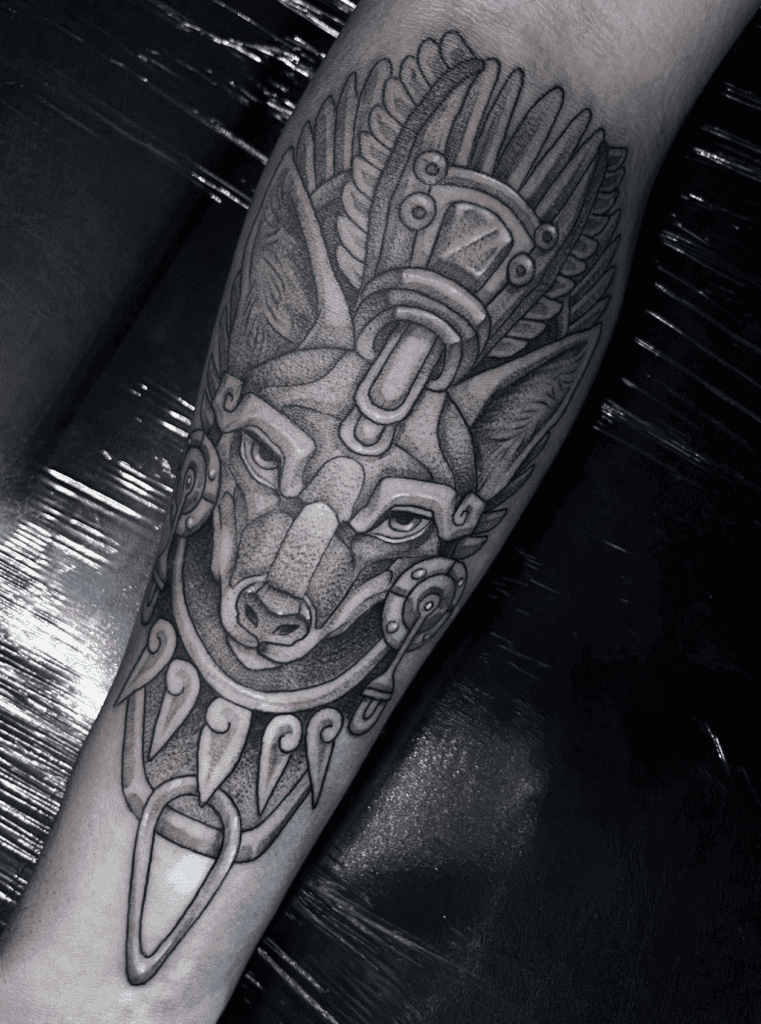
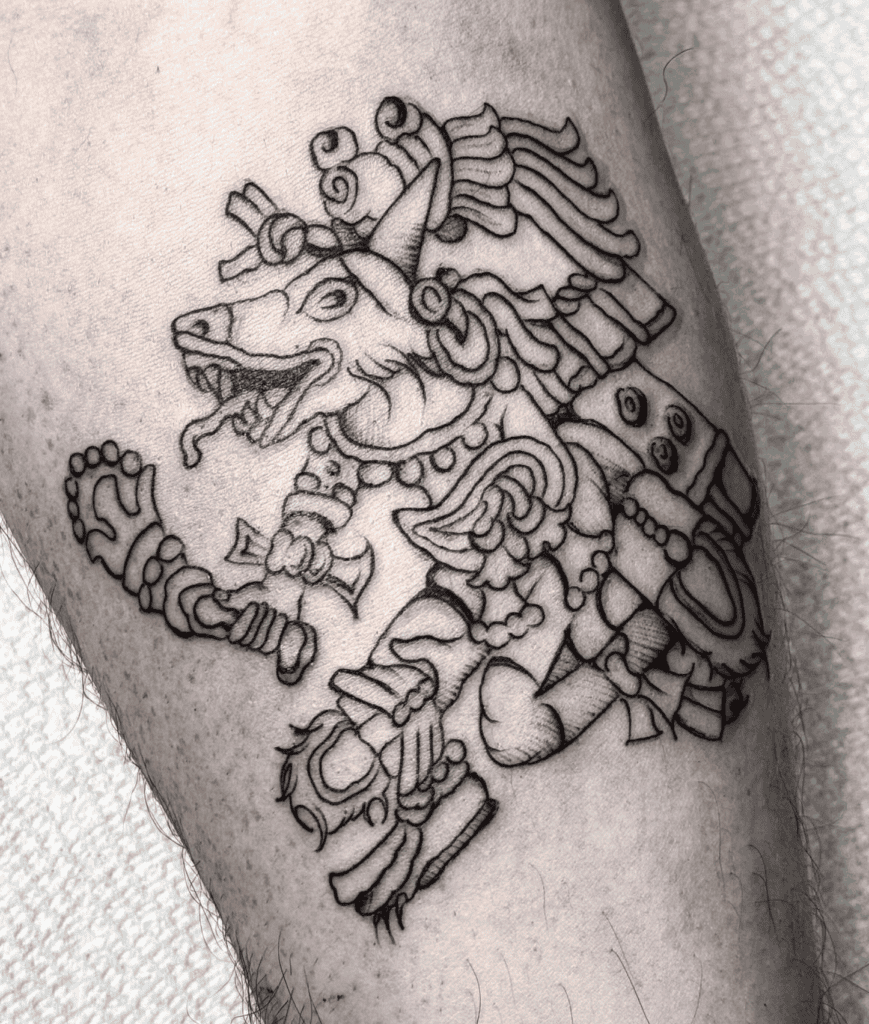
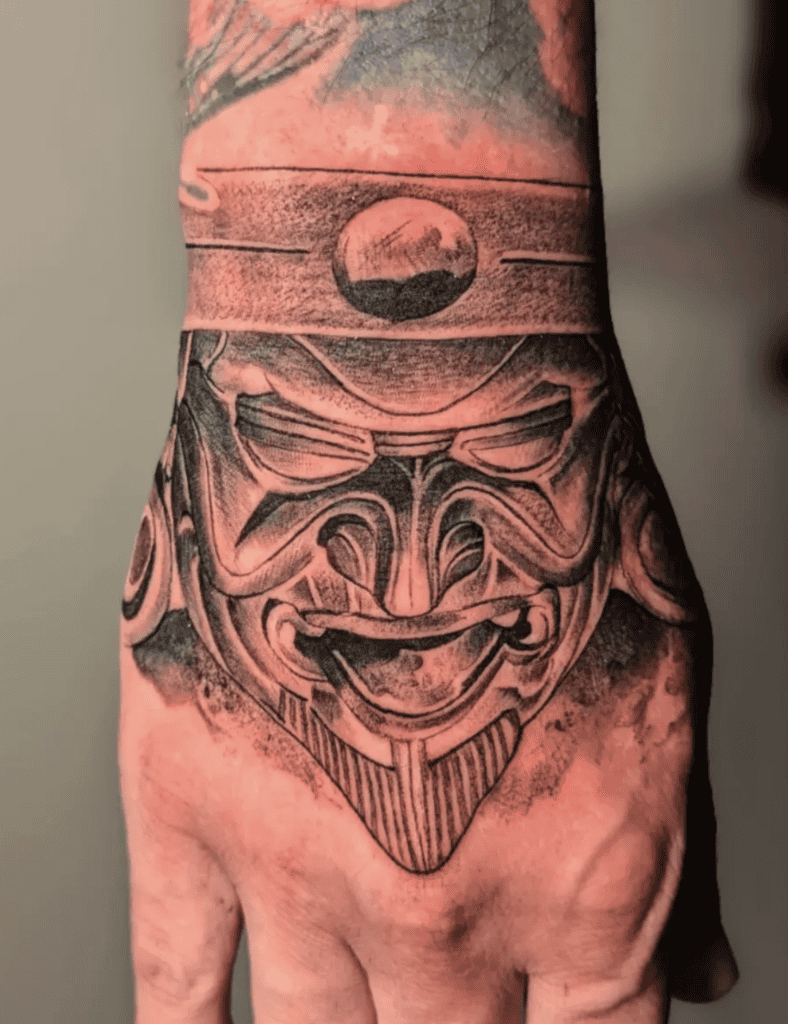
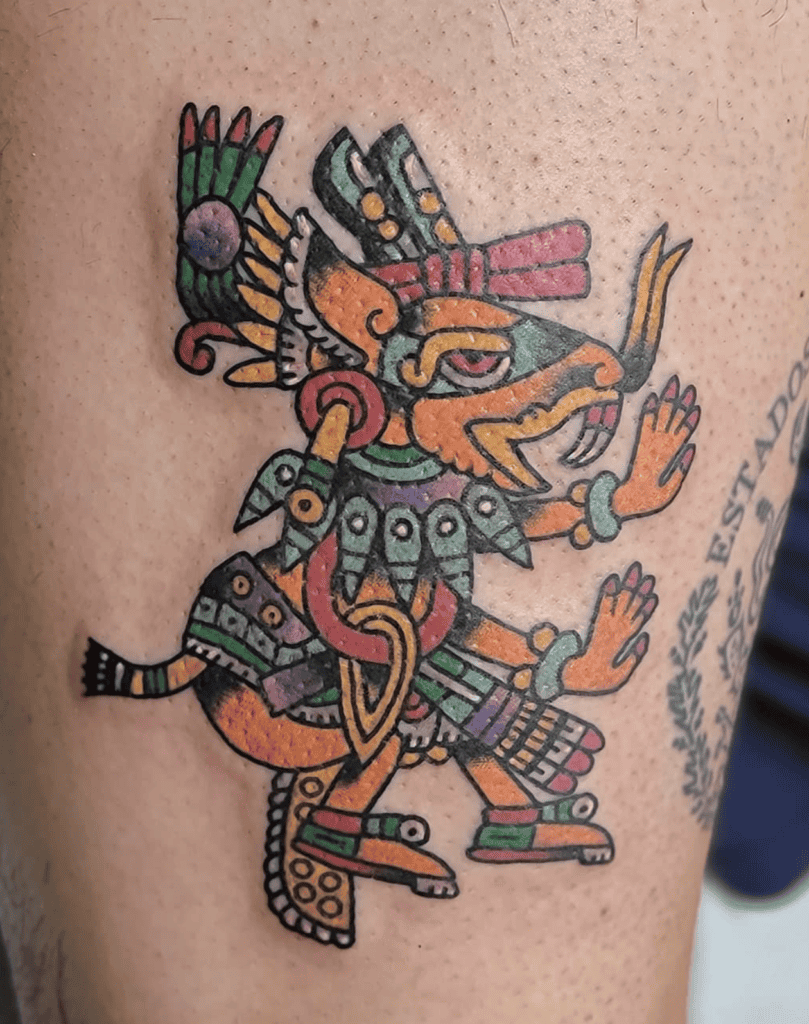
Huehuecoyotl is the Aztec trickster god of music, dance, mischief, and storytelling who is a playful yet unpredictable deity. Huehuecoyotl, whose name means “Old Coyote,” is not a god of order or destruction like many others, but a god of chaos, humour, and unexpected consequences, representing the idea that life doesn’t always follow rules.
Despite his playful nature, Huehuecoyotl was believed to be very old and wise, showing that wisdom doesn’t always come from seriousness, and can come from experience and humour.
Macuilxochitl Aztec Mythology Tattoo

Macuilxochitl is an Aztec god of games, pleasure, music, dance, and excess, whose name means “Five Flower.” He’s often considered an aspect (or closely related form) of Xochipilli, sharing themes of beauty, joy, and indulgence.
Macuilxochitl embodies the thrill of life’s pleasures and their consequences, representing the idea that enjoyment is part of life, but it always comes with a price. He was strongly associated with patolli, one of the most popular Aztec gambling games played with beans and a cross-shaped board where players could win or lose everything they owned.
The name “Five Flower” carries deep symbolism, as Flowers were viewed as beauty, art, and pleasure, while the number five was viewed as excess, imbalance, and unpredictability.
Centeotl Aztec Mythology Tattoo


Centeotl is the Aztec god of maize (corn) and was one of the most important deities in the Aztec belief system. As maize was seen as life itself, Centeotl was the source of survival, nourishment, and human existence.
Maize was central to Aztec civilisation as it was used to make tortillas, tamales, and daily food, was grown across vast farming systems, and was considered sacred and life-giving. In some traditions, humans were even believed to be created from maize. Centeotl is sometimes depicted as both male and female, reflecting the idea that fertility and growth require balance and unity.
Ixtlilton Aztec Mythology Tattoo


Ixtlilton is the gentle Aztec god of healing, medicine, sleep, and dreams, whose name is often translated as “Little Dark Face,” referring to the black markings used in his depictions. He represents the idea that healing isn’t just physical, but that it’s emotional and spiritual too.
Ixtlilton was especially important for children. Parents prayed to him for their child’s health as he was believed to watch over and protect them, and helped guide them through illness and recovery.
Patecatl Aztec Mythology Tattoo


Patecatl is an Aztec god of fertility, healing, and sacred intoxication, closely associated with the maguey (agave) plant and the alcoholic drink pulque. He represents the deeper connection between nature, medicine, pleasure, and transformation, and how the things that can heal you can also overwhelm you.
Patecatl is deeply connected to the maguey plant, one of the most important plants in Aztec life. It was used for making pulque (a fermented drink), fibres for textiles and rope, and medicinal purposes.
Patecatl is often linked to Mayahuel, goddess of the maguey plant, and together, they are connected to the Centzon Totochtin (“400 Rabbits”), a group of deities representing different forms of drunkenness.
Mayahuel Aztec Mythology Tattoo
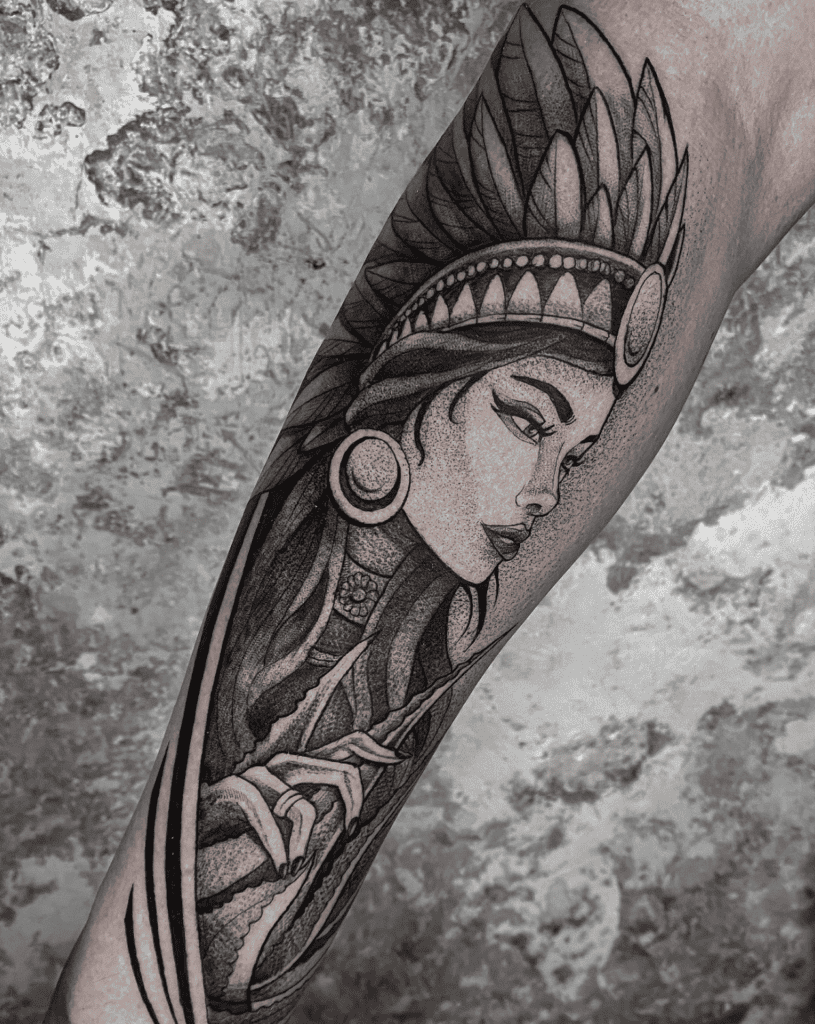
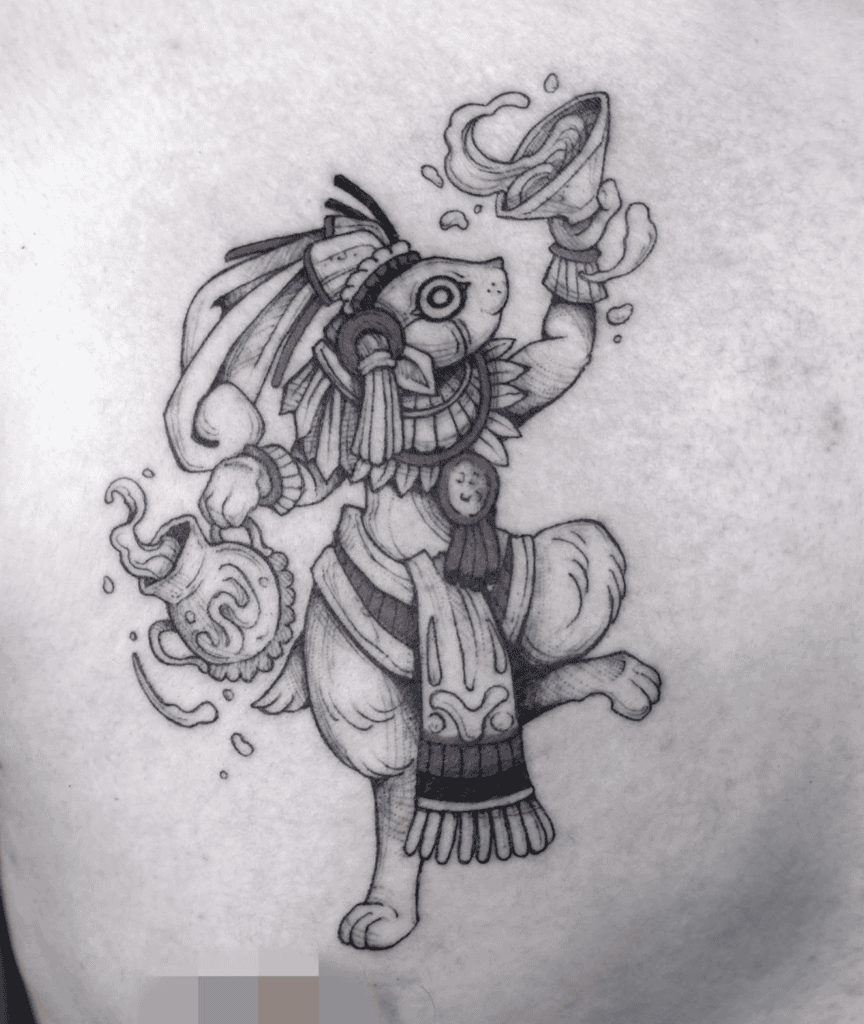
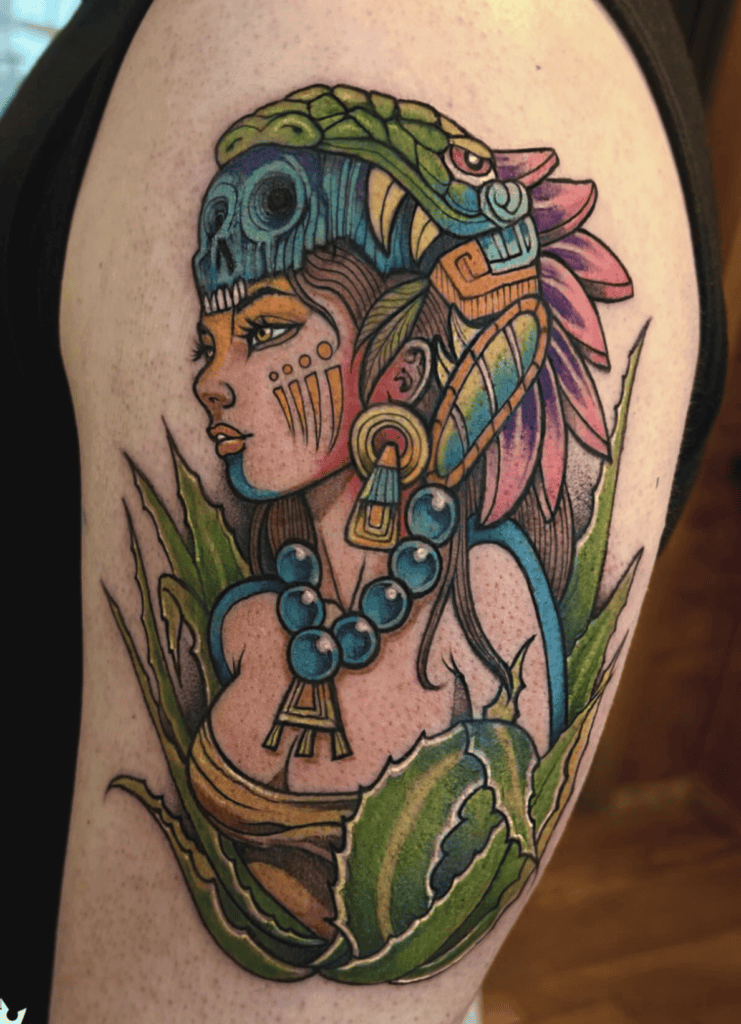
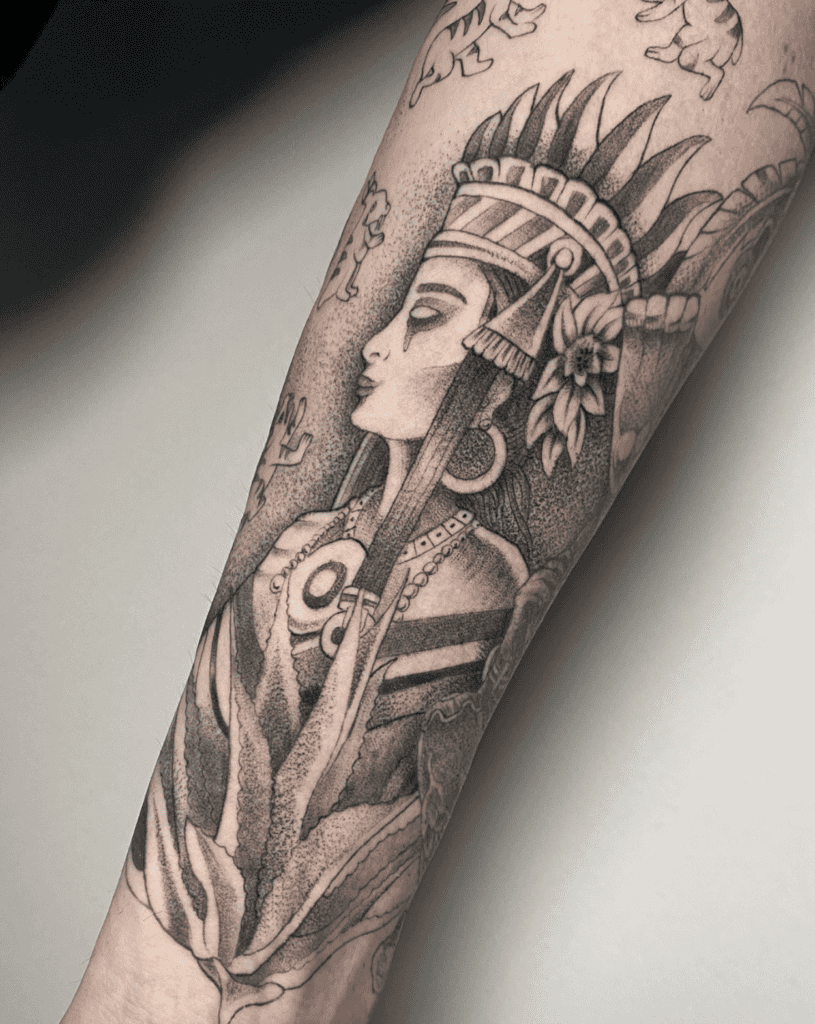
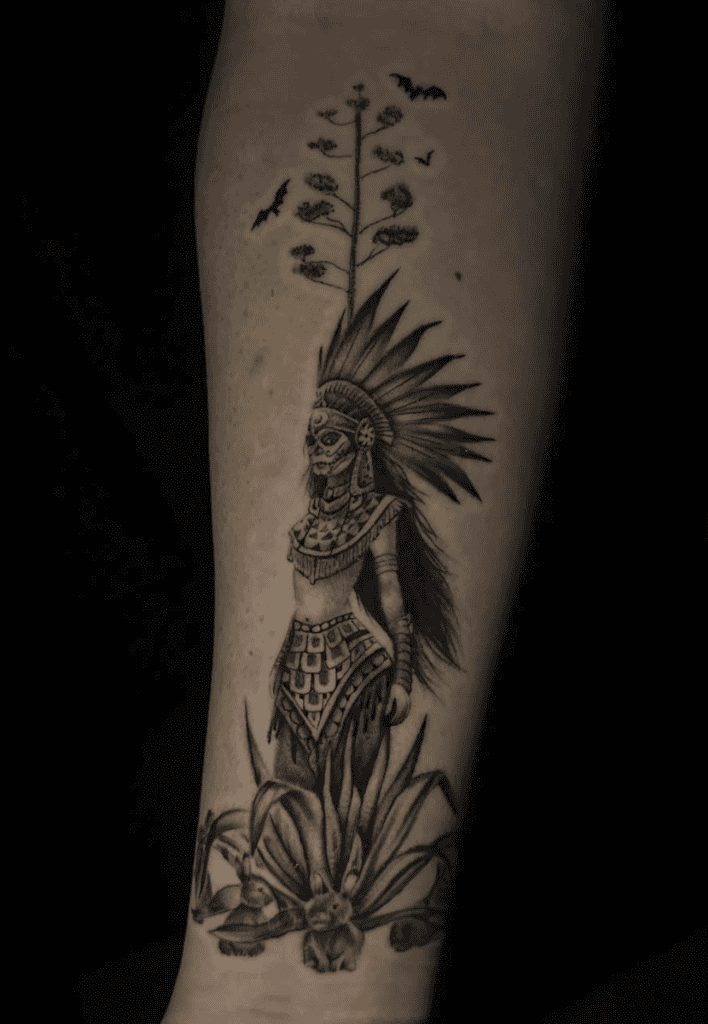
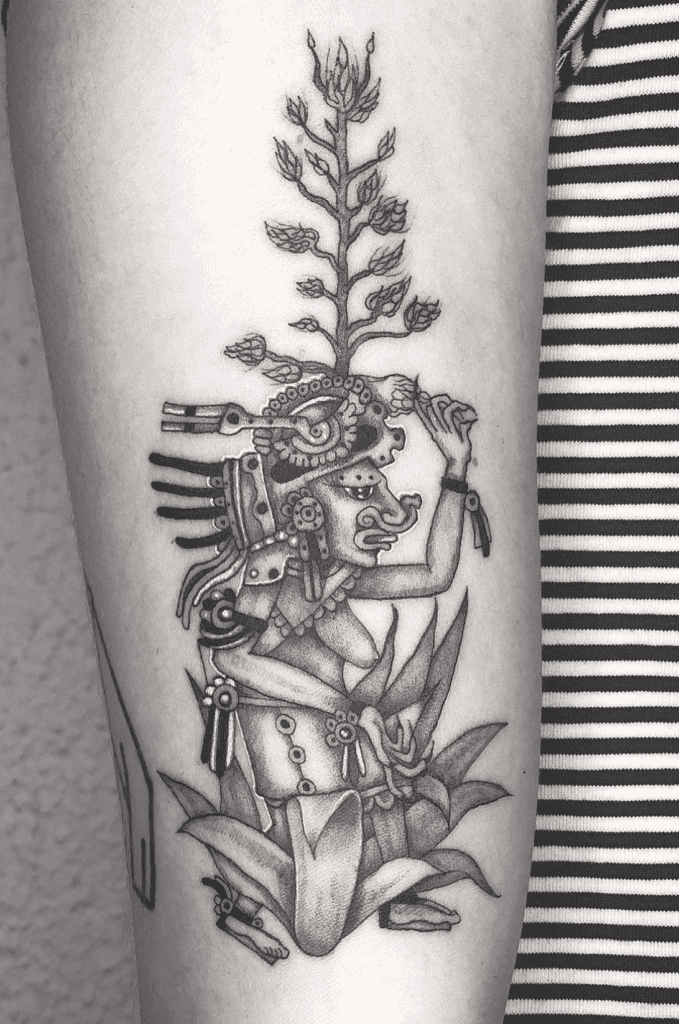
Mayahuel is the Aztec goddess of the maguey (agave) plant, fertility, and nourishment and is one of the most important figures connected to life, sustenance, and transformation. Through her, the Aztecs understood how a single plant could provide food, drink, fibre, and medicine.
The maguey plant was essential in Aztec life, used to make pulque, a ritual drink, provided fibres for clothing and rope and used in their medicines. Because of this, Mayahuel became a symbol of everything needed to sustain a civilisation.
Mayahuel fell in love with Quetzalcoatl, and they fled together to escape danger, transforming into a tree to hide. However, she is discovered and destroyed by celestial beings like the Tzitzimimeh, and from her remains, the maguey plant grows.
Mayahuel is sometimes depicted as having multiple breasts that are feeding many children. This symbolises nourishment, care, and abundance.
Tzilacatzin Aztec Mythology Tattoo

Tzilacatzin is a legendary Aztec warrior hero, remembered for his bravery and defiance during the Spanish conquest of Tenochtitlan (1521). Unlike many mythological figures, he is rooted in historical accounts, though his story has taken on a mythic, larger-than-life quality over time.
Tzilacatzin is most famous for his actions during the Battle of Tlatelolco, the final stage of the Aztec resistance. According to accounts, he fought fiercely against Spanish forces and their allies by throwing stones and weapons with incredible strength, while advancing boldly, even under heavy attack.
While Tzilacatzin was likely a real warrior, his story has been elevated into a symbol of Aztec resistance, a reminder of the fall of a civilisation, and he became an icon of courage under pressure, standing at the line between history and legend.
Aztec Sun Stone Aztec Mythology Tattoo
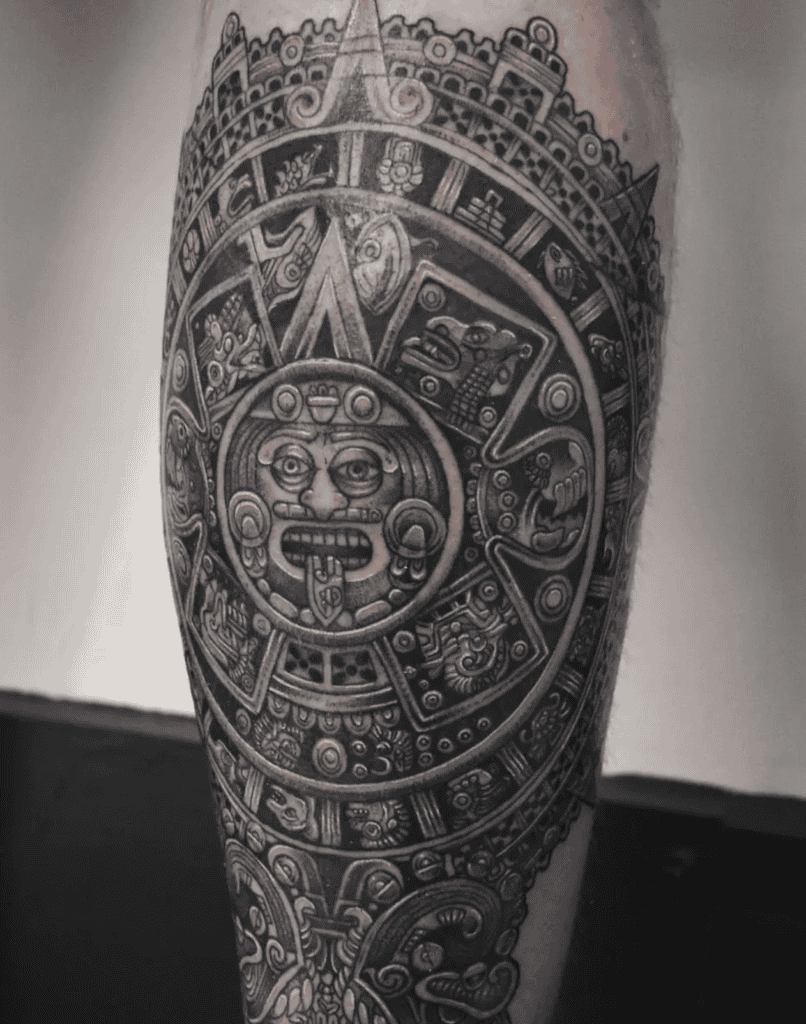
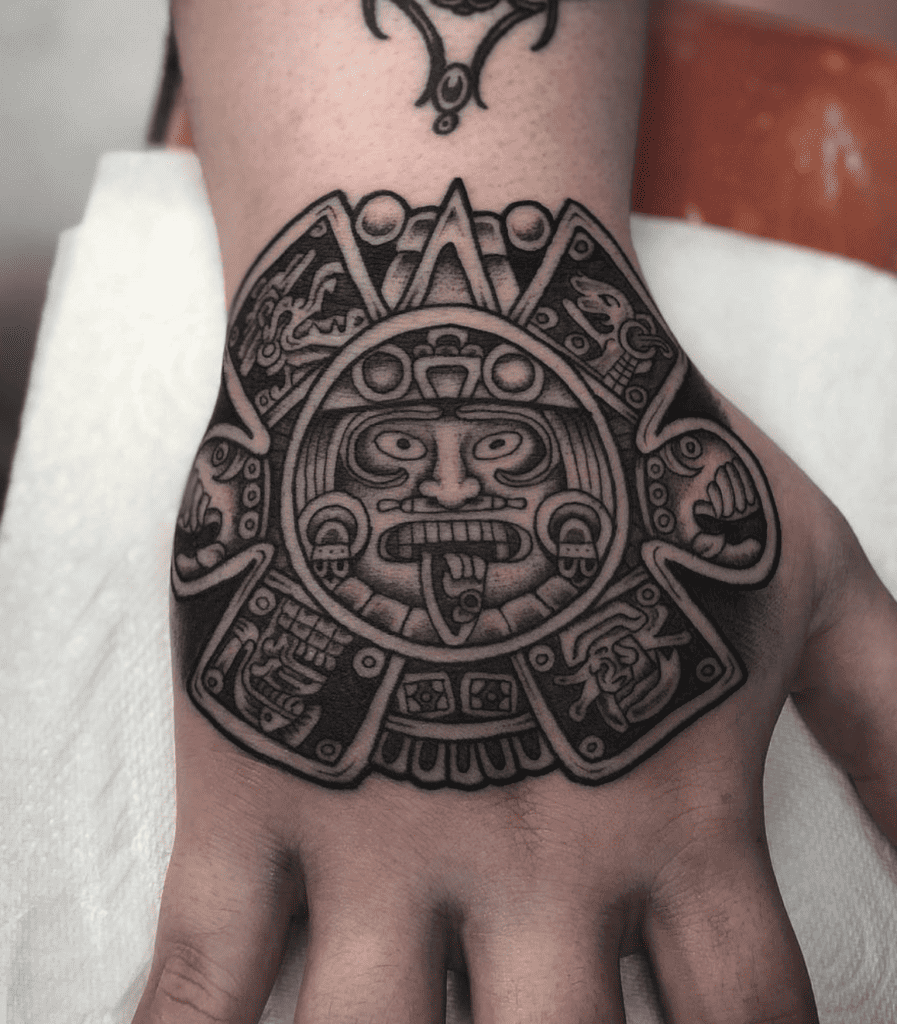
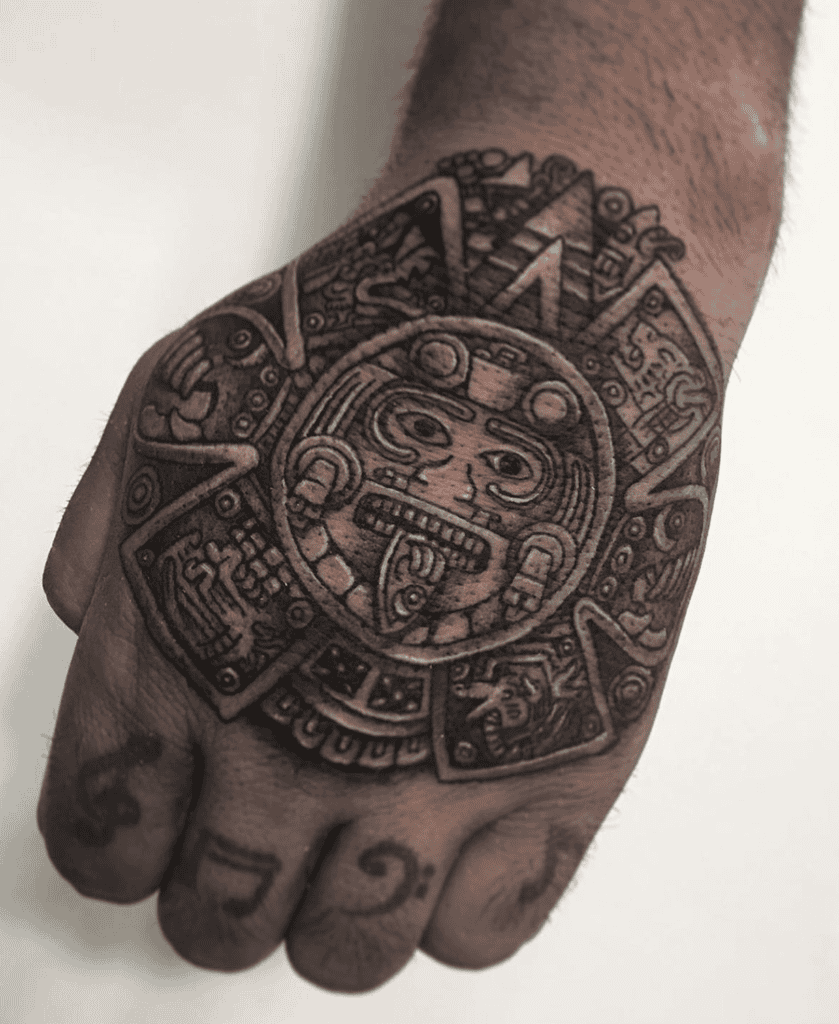
The Aztec Sun Stone is one of the most famous artefacts from Aztec civilisation that was carved in the 15th century. This massive stone sculpture represents Aztec cosmology, time, and the creation of the world.
At the centre is the face of Tonatiuh, the sun god, surrounded by symbols that tell the story of the universe. The Sun Stone is a cosmic map, representing the current sun (Tonatiuh), and the other four Suns (representing previous worlds that were destroyed), day signs & time cycles, and the fire serpents (symbolising time and cosmic movement). It tells the story of creation, destruction, and the ongoing need to sustain the sun.
One of the most common misconceptions is that people mistake the Aztec Sun Stone for the Mayan Calendar. The Aztec Sun Stone belongs to the Aztec (Mexica) who lived in what is now modern-day Mexico, while the Mayan calendar belonged to the separate Maya civilisation who lived in modern-day Guatemala, Belize, western Honduras, and western El Salvador.
The Sun Stone was symbolic, ritual, and cosmological, while the Mayan calendar was an actual timekeeping system.
Conclusion
Thanks for joining us on the az-tounding, journey through the az-mazing world of Aztec Mythology Tattoo Ideas. But before the Fifth Sun begins to set, why not continue your mythical journey with these Chinese Mythology Tattoo Ideas, these Persian Mythology Tattoo Designs, or these Celtic Mythology Tattoos.
- Monster Hunter Tattoo Ideas - July 27, 2026
- Horse Tattoo Ideas - July 23, 2026
- My Hero Academia Tattoo Ideas - July 20, 2026


