
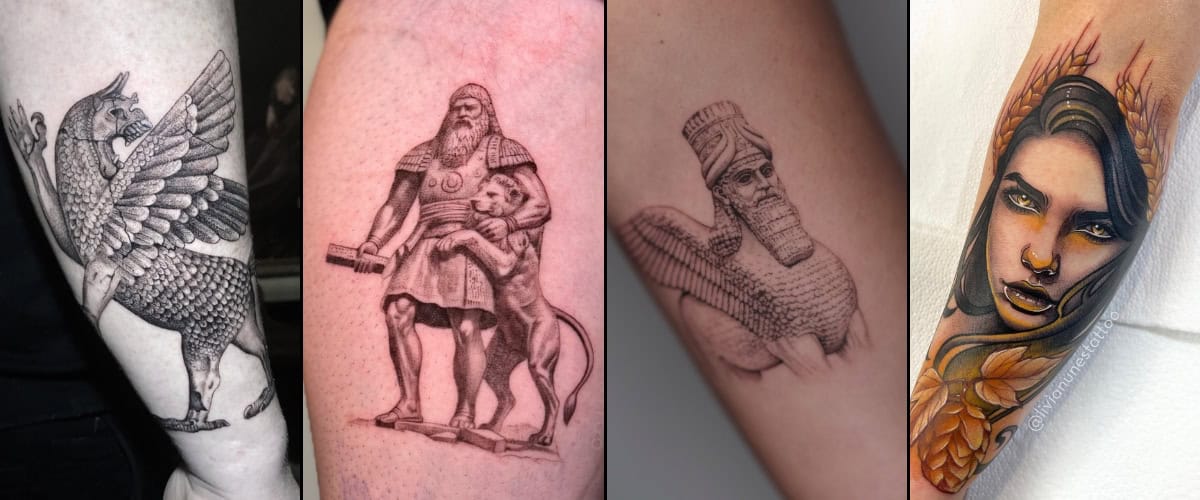
Mesopotamian Mythology Tattoo Ideas

Do you feel like you’re wandering the desert on your search for the perfect Tattoo Clues? Worry not, we won’t Babyl-on, and dive straight into some of the best Mesopotamian Mythology Tattoos that are carved in stone.
What is Mesopotamian Mythology?
Mesopotamian mythology is the collection of religious beliefs, legends, creation stories, and heroic tales developed by the ancient civilisations of Mesopotamia, a region located between the Tigris and Euphrates rivers in what is now mostly modern-day Iraq. The word Mesopotamia itself comes from Greek and means “land between the rivers.”
These myths were created over thousands of years by cultures such as the Sumer, Akkad, Babylonia, and Assyria. Although each civilisation had its own traditions, many of their gods and stories overlapped or evolved over time.
The Mesopotamians believed that the world was governed by numerous powerful gods and goddesses who controlled different aspects of life, nature, and society. People built temples called ziggurats, offered prayers and sacrifices, and performed rituals to gain divine favour and avoid the gods’ anger.
Unlike some later religions that focused heavily on the afterlife, Mesopotamian religion was often more concerned with maintaining order and prosperity in the present world. Humans were thought to have been created to serve the gods by maintaining temples and carrying out their duties.
The earliest versions of Mesopotamian myths were written on clay tablets using cuneiform, one of the world’s oldest writing systems. Thousands of these tablets have survived for over 4,000 years, allowing historians and archaeologists to reconstruct the stories that ancient Mesopotamians told around their temples and cities.
Best Mesopotamian Mythology Tattoo Designs
Now that we know a little about Mesopotamian Mythology, let’s take a look at some of the best Mesopotamian Mythology Tattoos the sands of time have to offer.
Anu Mesopotamian Mythology Tattoo


Anu, also known by his Sumerian name An, was the god of the sky and heavens in Mesopotamian mythology. He was regarded as the supreme deity in the earliest Sumerian traditions and was considered the father of the gods. Although later Mesopotamian religions elevated other deities, such as Marduk or Ashur, Anu remained an important and highly respected figure throughout Mesopotamian history.
As the ruler of the heavens, Anu represented authority, kingship, and divine order. Mesopotamians believed that earthly kings derived their right to rule from the gods, and Anu was often seen as the ultimate source of that legitimacy.
While Anu was the most exalted of the gods, he was often portrayed as a distant figure who delegated many day-to-day matters to other deities. This means that although he held immense power, he appeared less frequently in myths than gods like Ishtar or Enki.
Enlil Mesopotamian Mythology Tattoo
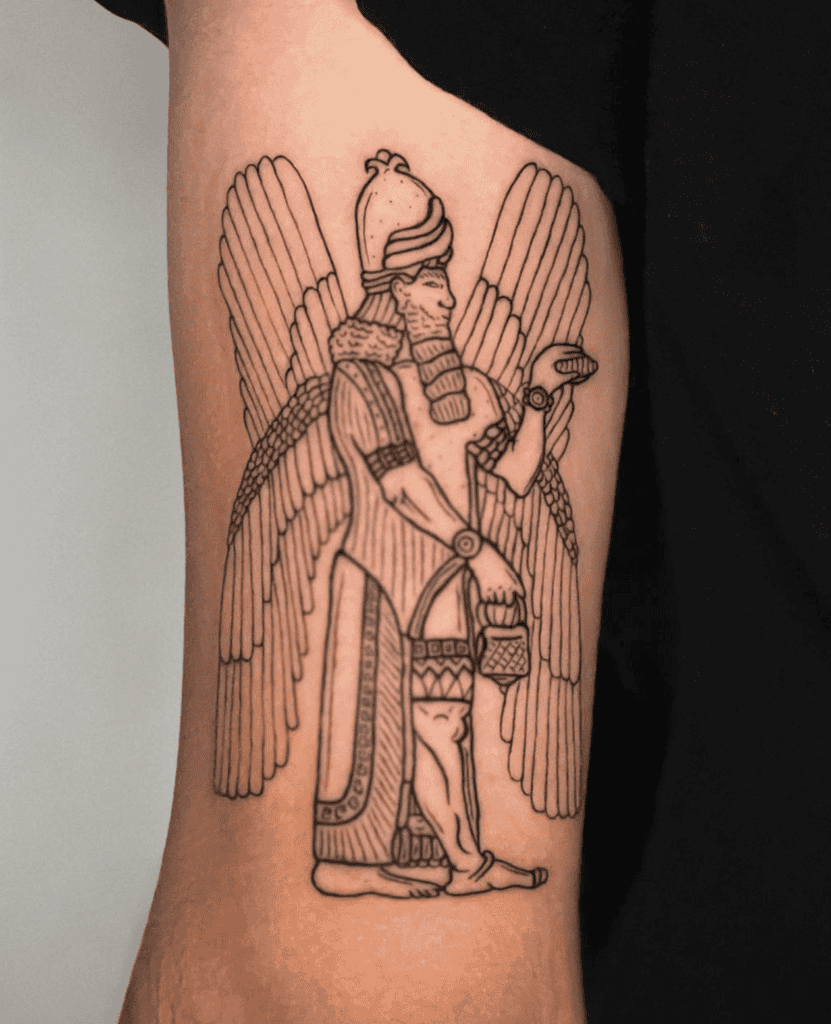
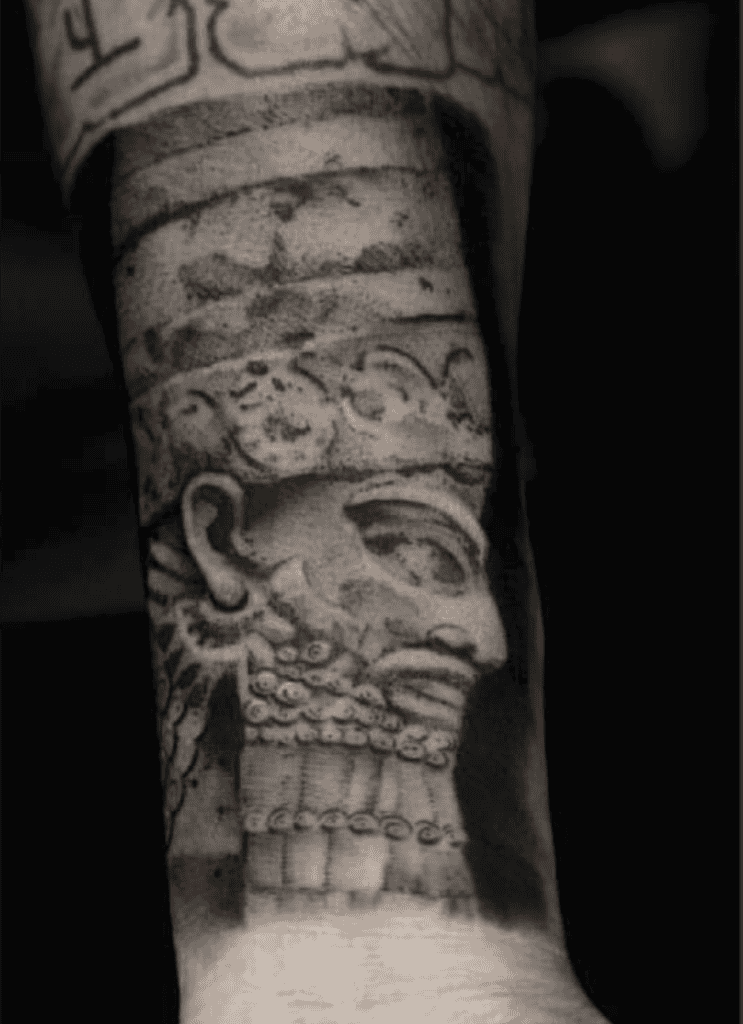
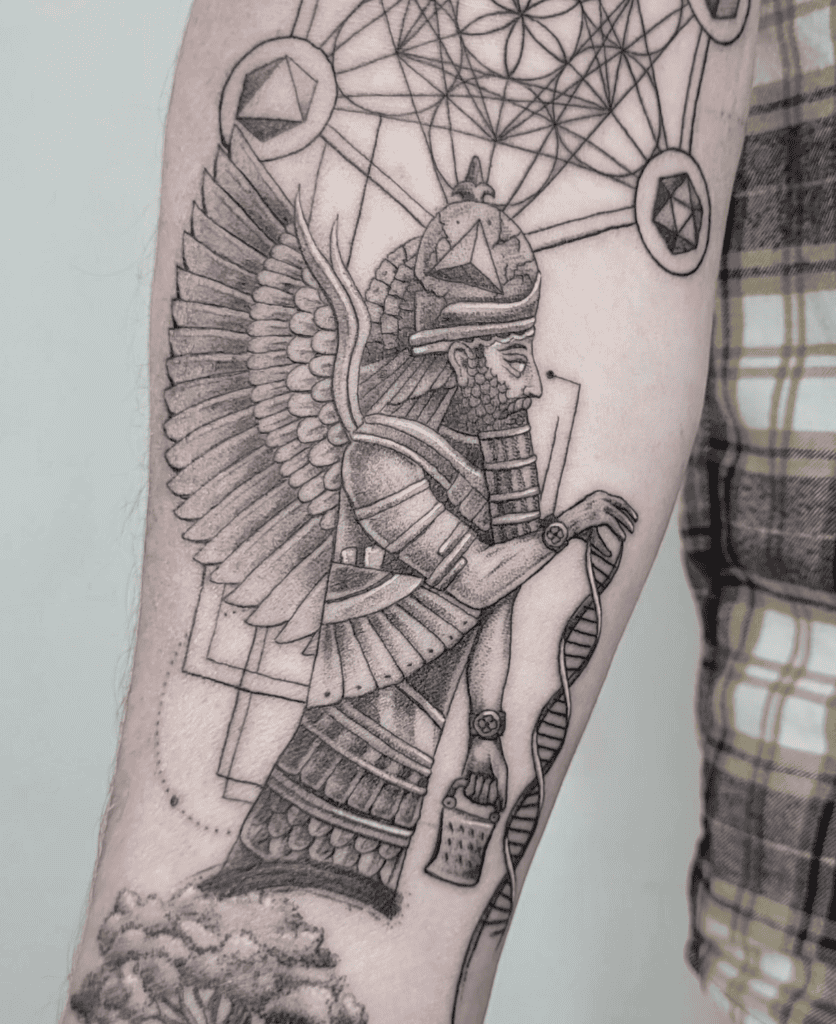
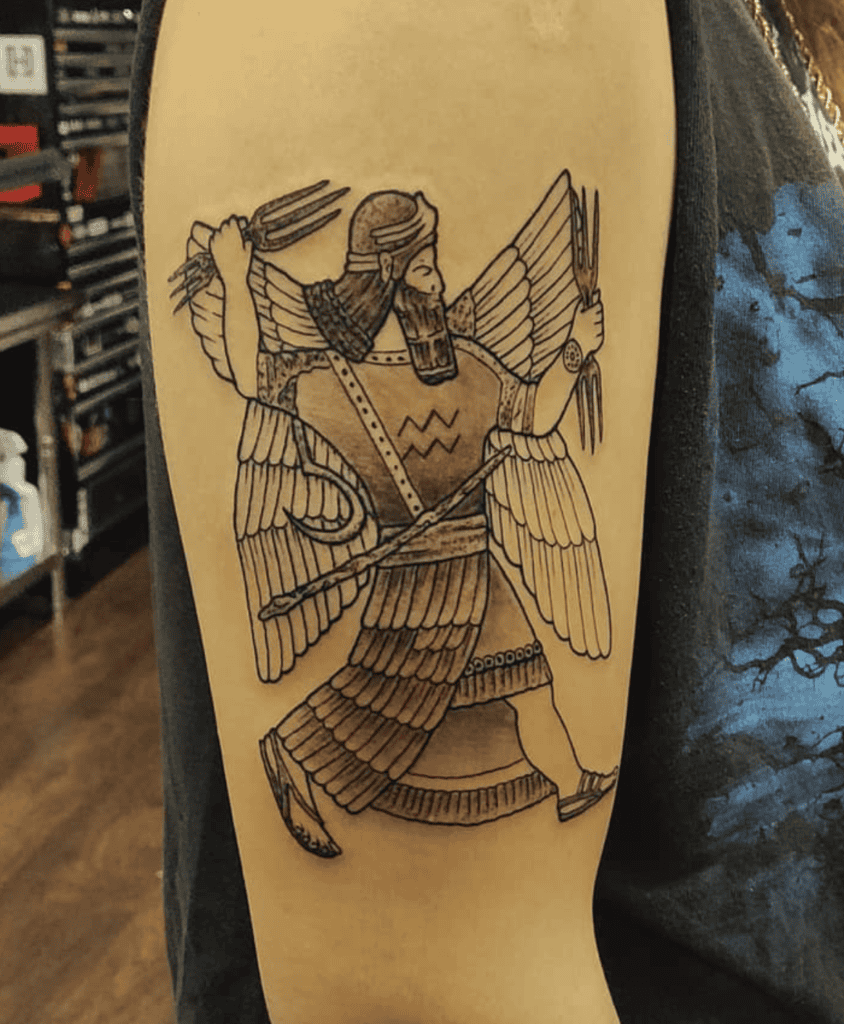
Enlil was one of the most powerful and important gods in Mesopotamian mythology, the god of wind, air, storms, and kingship, often regarded as the ruler of the world after the sky god Anu. In many traditions, Enlil acted as the chief executive of the gods, enforcing divine laws and maintaining cosmic order.
His name is commonly interpreted as meaning “Lord Wind” or “Lord Air,” reflecting his connection to the atmosphere and the invisible forces that shape the world. In Mesopotamian belief, the universe was divided into different realms. Anu ruled the heavens, Enki (Ea) governed freshwater, wisdom, and magic, and Enlil oversaw the earth, the winds, and the authority to rule.
Because of this position, Enlil became closely associated with royal power, with Mesopotamian kings often claiming that their right to govern had been granted by Enlil himself. He was especially revered during the Sumerian period and remained influential even as later civilisations rose to prominence.
Enlil’s principal cult centre was the sacred city of Nippur. There stood the Ekur Temple, often translated as “Mountain House.” This temple was considered one of the holiest sites in Mesopotamia. Even rulers from distant cities sought recognition from Nippur because of Enlil’s authority. Although Nippur was not usually a political capital, it was an enormously important religious centre.
Enki Mesopotamian Mythology Tattoo
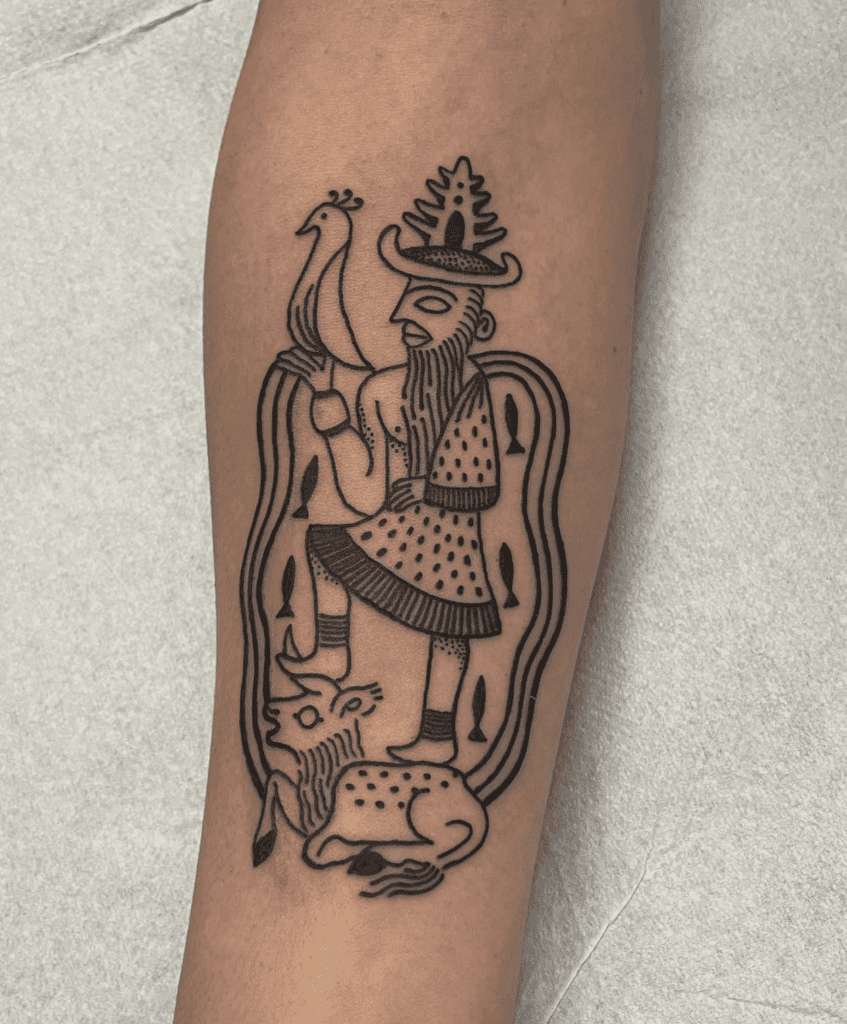
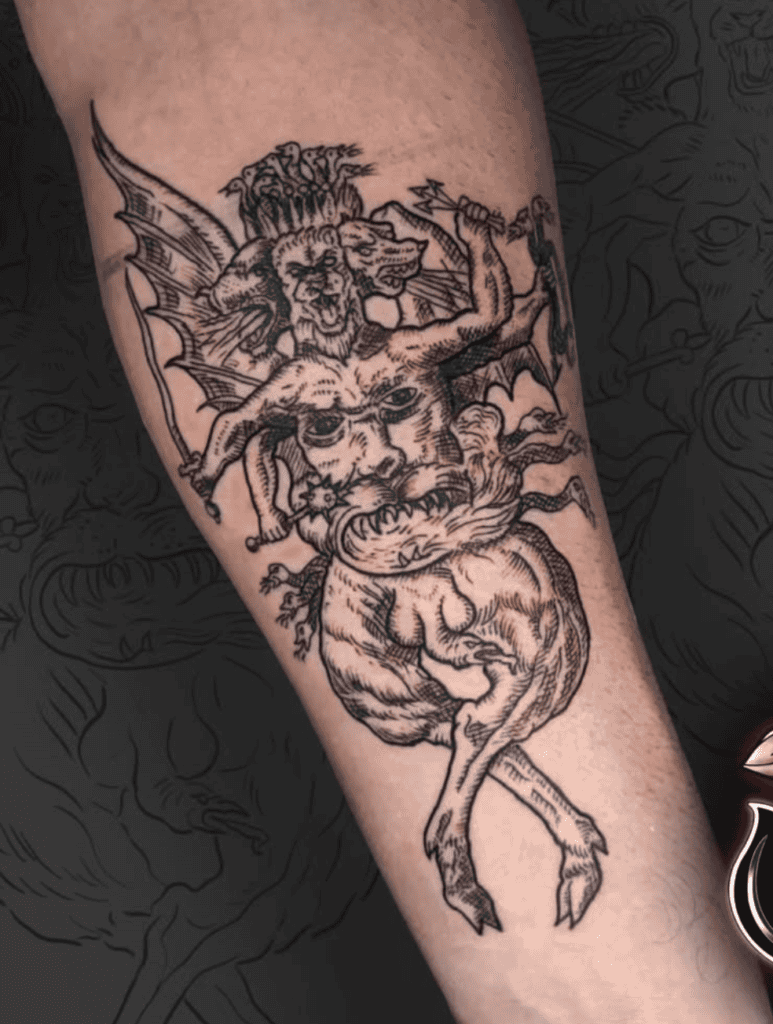
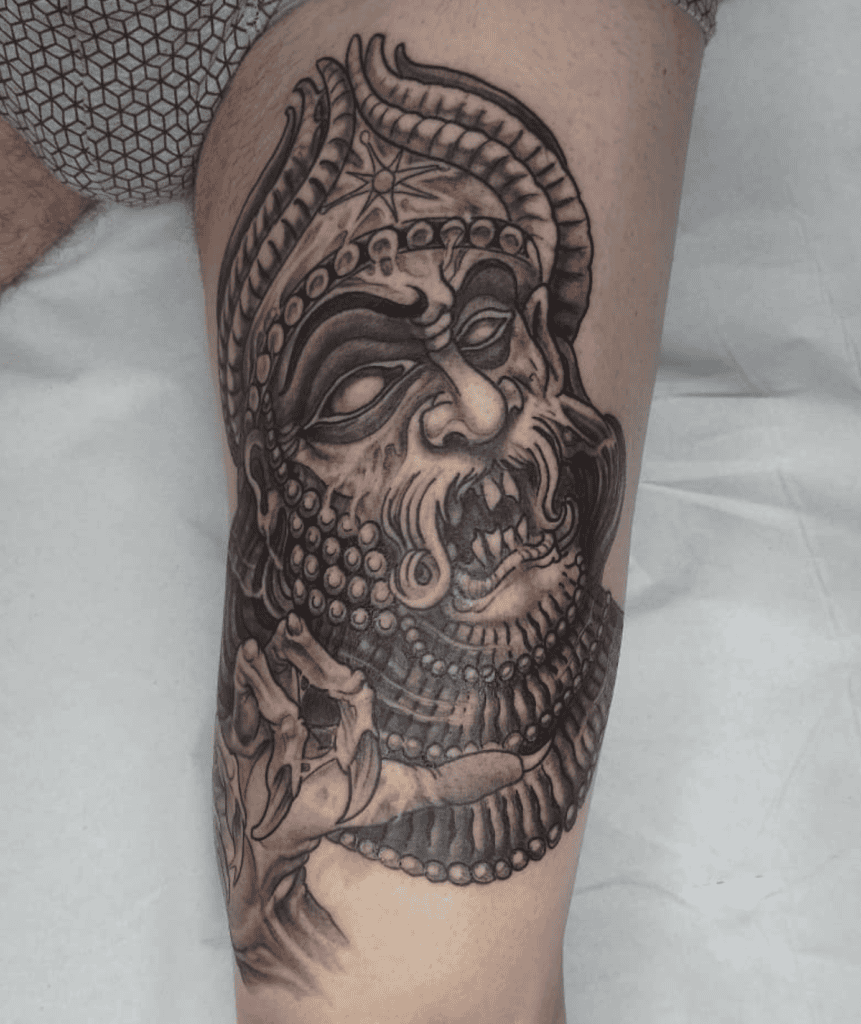
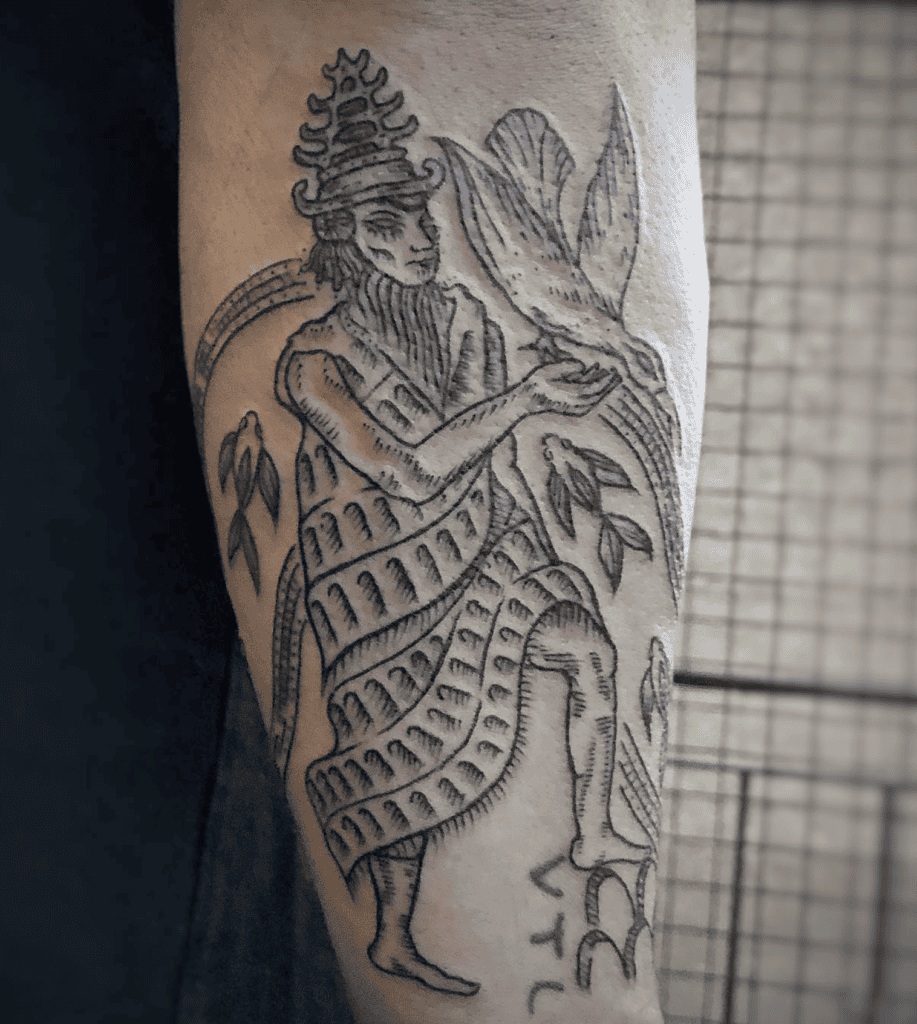
Enki, known as Ea in Akkadian mythology, was one of the most beloved and fascinating gods in Mesopotamian religion. He was the god of wisdom, freshwater, magic, craftsmanship, knowledge, and creation. Unlike some of the stricter or more distant deities, Enki was often portrayed as clever, compassionate, and willing to help humanity.
He was one of the principal gods of the Mesopotamian pantheon and formed an important divine triad alongside Anu and Enlil. Because he embodied knowledge and problem-solving, Enki frequently appeared in myths as the deity who found creative solutions to difficult situations.
One of Enki’s most important associations was with the Abzu, the vast subterranean ocean of fresh water believed to exist beneath the earth. Mesopotamians depended heavily on rivers and irrigation for agriculture, so freshwater symbolised life, fertility, and prosperity. As lord of these life-giving waters, Enki became an essential deity for human survival, with ancient artworks often depicting him with streams of water flowing from his shoulders, sometimes filled with fish.
According to several Mesopotamian traditions, Enki played a role in the creation of humankind. In the Atrahasis, humanity was created from clay mixed with divine essence so that people could perform labour on behalf of the gods. Enki was often involved in shaping or advising during these acts of creation, reflecting his role as a wise and nurturing figure.
When Enlil decided that humanity should be destroyed by a massive flood, Enki disagreed with the plan. Since he could not directly oppose the divine decree, he cleverly found a loophole. Speaking through the wall of a reed house, he warned a righteous man known as Atrahasis or Utnapishtim, depending on the version of the story, to build a boat and preserve life, and thanks to Enki’s intervention, humans and animals survived the catastrophe. This flood narrative predates several other famous flood traditions and highlights Enki’s reputation as a protector of humanity.
Another well-known tale is “Inanna and Enki.” In this myth, the goddess Inanna visits Enki in the city of Eridu. During a feast, Enki gives her the me, divine decrees that represent the foundations of civilisation, including kingship, music, craftsmanship, wisdom, and social order. When Enki later regrets his decision, he attempts to reclaim them, but Inanna successfully carries them to Uruk, helping civilisation flourish there.
Ninhursag Mesopotamian Mythology Tattoo
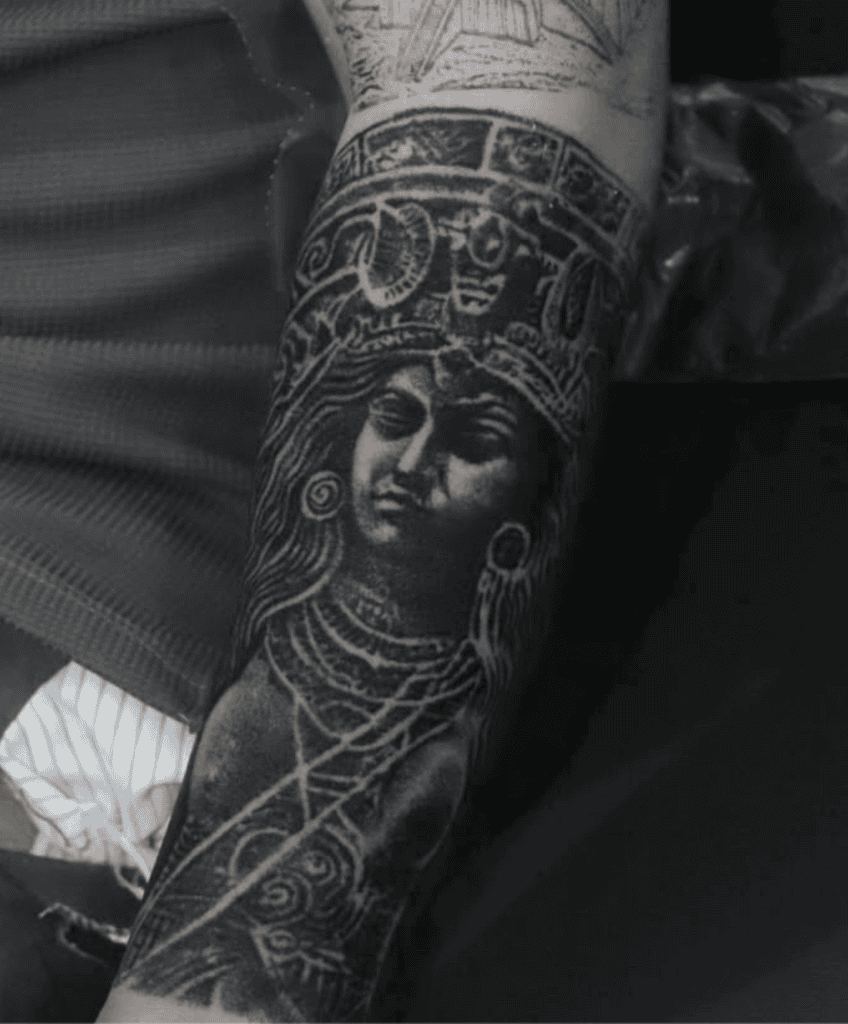
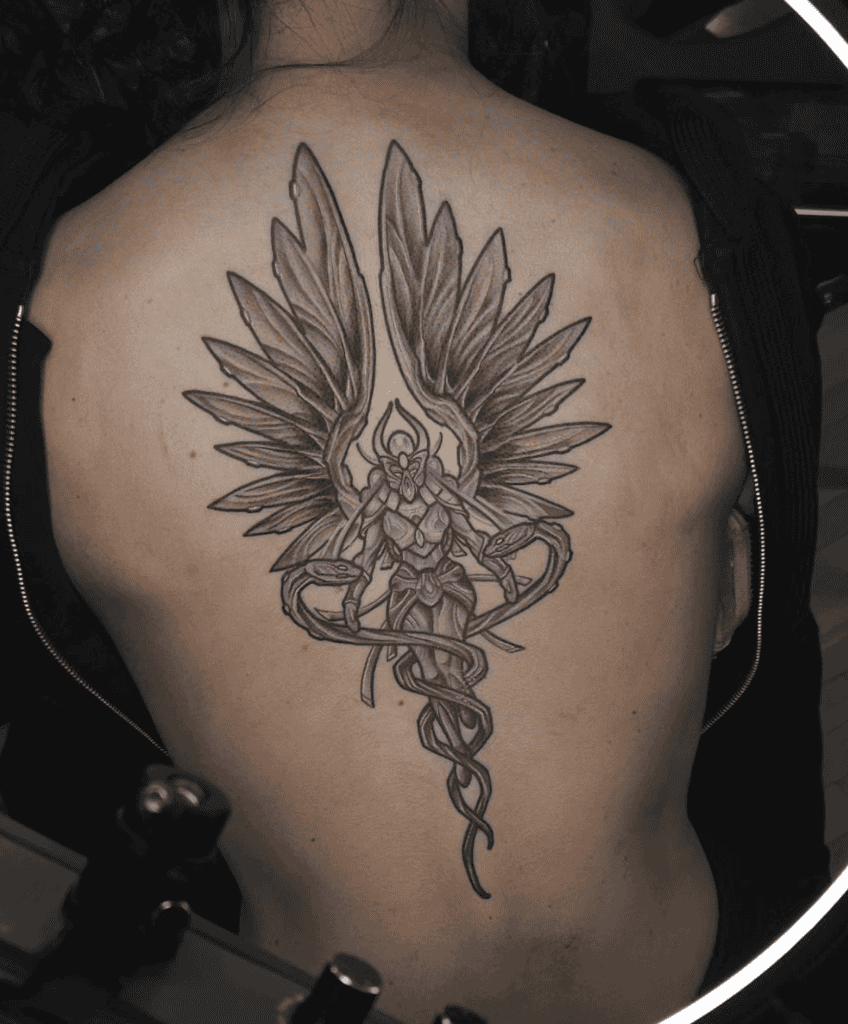
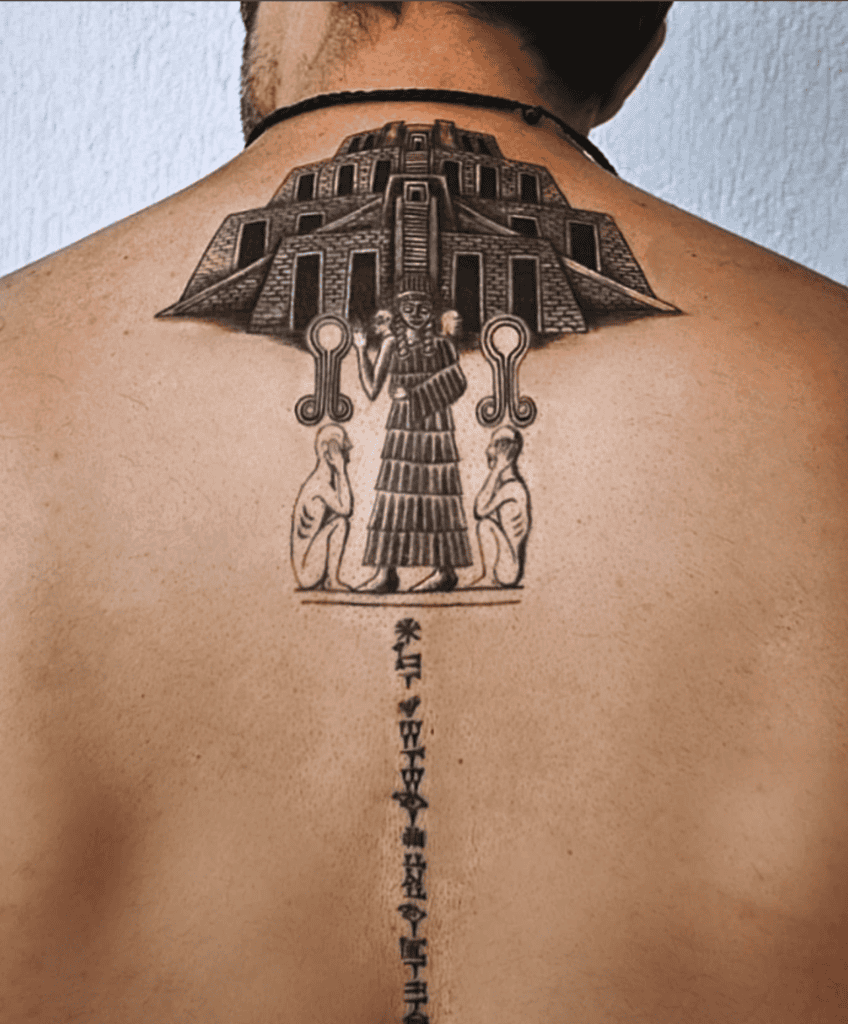
Ninhursag was one of the most important mother goddesses in Mesopotamian mythology, associated with fertility, birth, motherhood, nature, and the earth, and was often regarded as a divine creator who helped shape both gods and humans.
She was especially prominent in Sumerian religion, where she was honoured as a nurturing figure responsible for sustaining life. Her name is usually translated as “Lady of the Mountain”, although she was known by several other names throughout Mesopotamian history.
As a maternal figure, she represented the nurturing side of divine power. While gods such as Enlil ruled through authority and storms, Ninhursag embodied growth, care, and renewal.
In several Mesopotamian myths, she worked alongside Enki in the formation of human beings. In some versions, humans were fashioned from clay, with Ninhursag acting as the divine midwife who shaped them and brought them to life. Because of this connection, she became closely associated with pregnancy and childbirth, and women may have invoked her protection during labour.
One of the best-known stories involving Ninhursag is the Sumerian myth “Enki and Ninhursag.” In this tale, Enki consumes a number of sacred plants, causing him to fall seriously ill. Ninhursag eventually returns to heal him by creating a series of deities, each responsible for curing a different part of his body.
Inanna Mesopotamian Mythology Tattoo
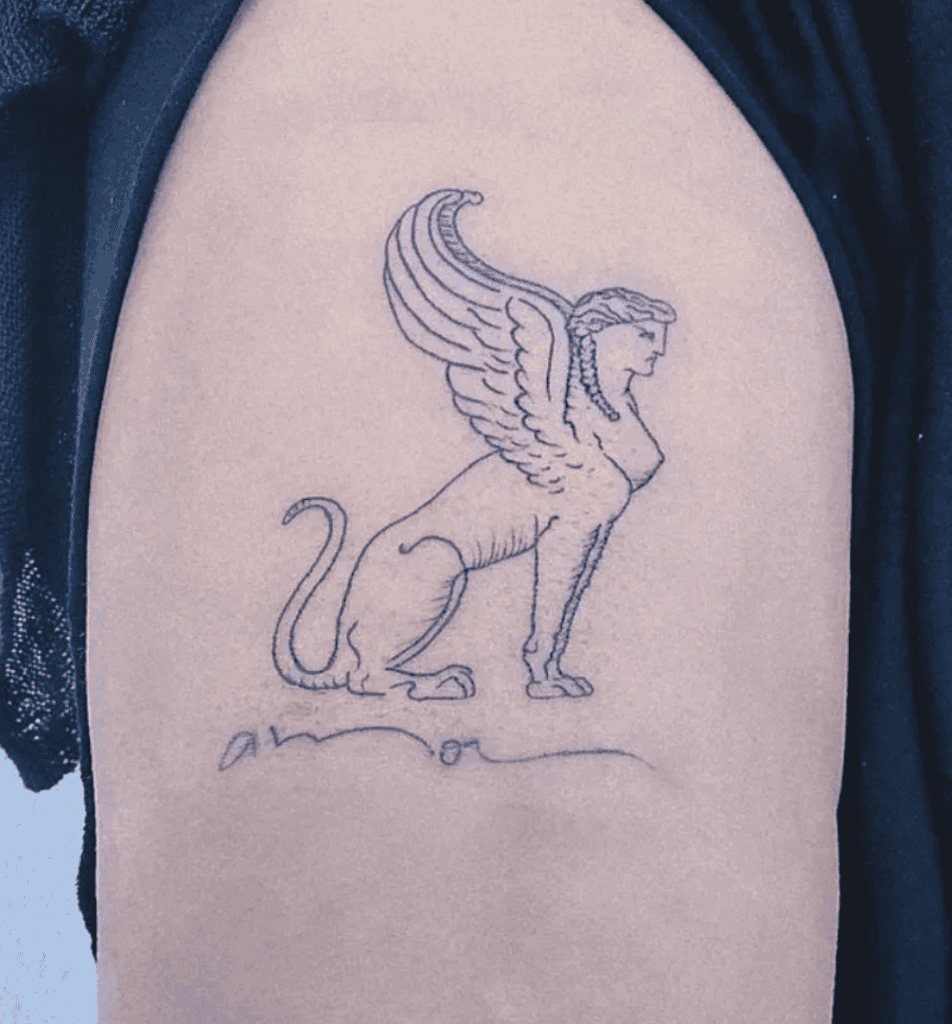
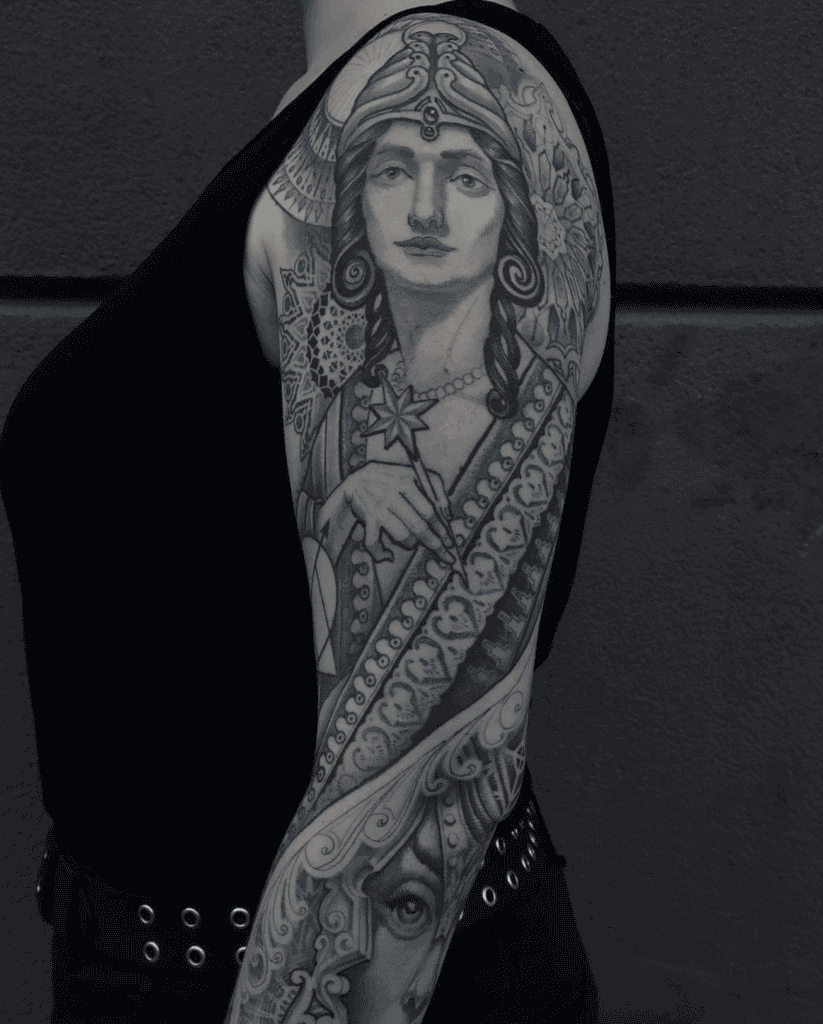
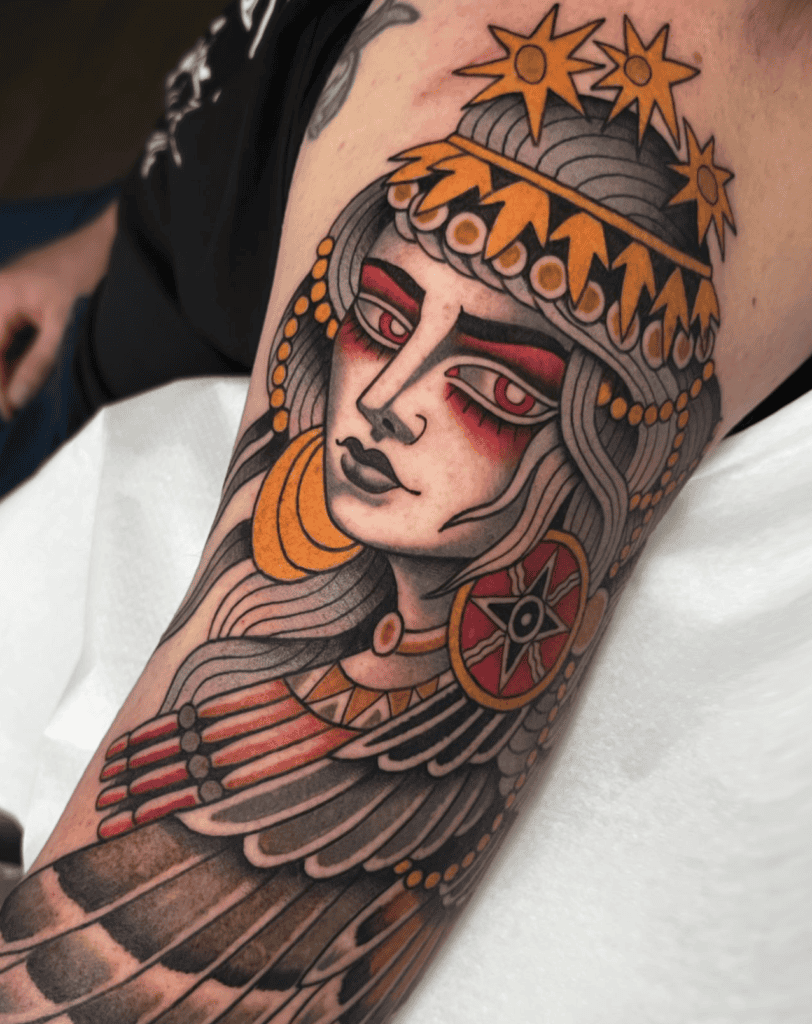
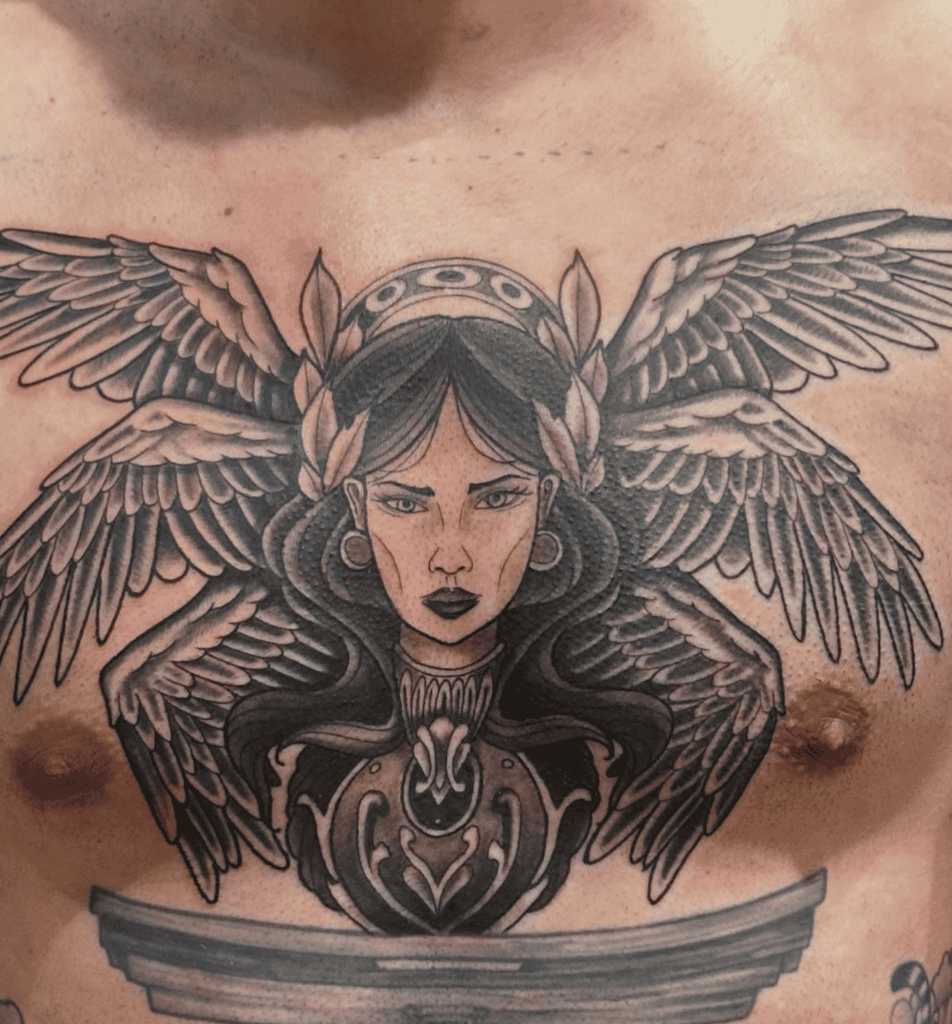
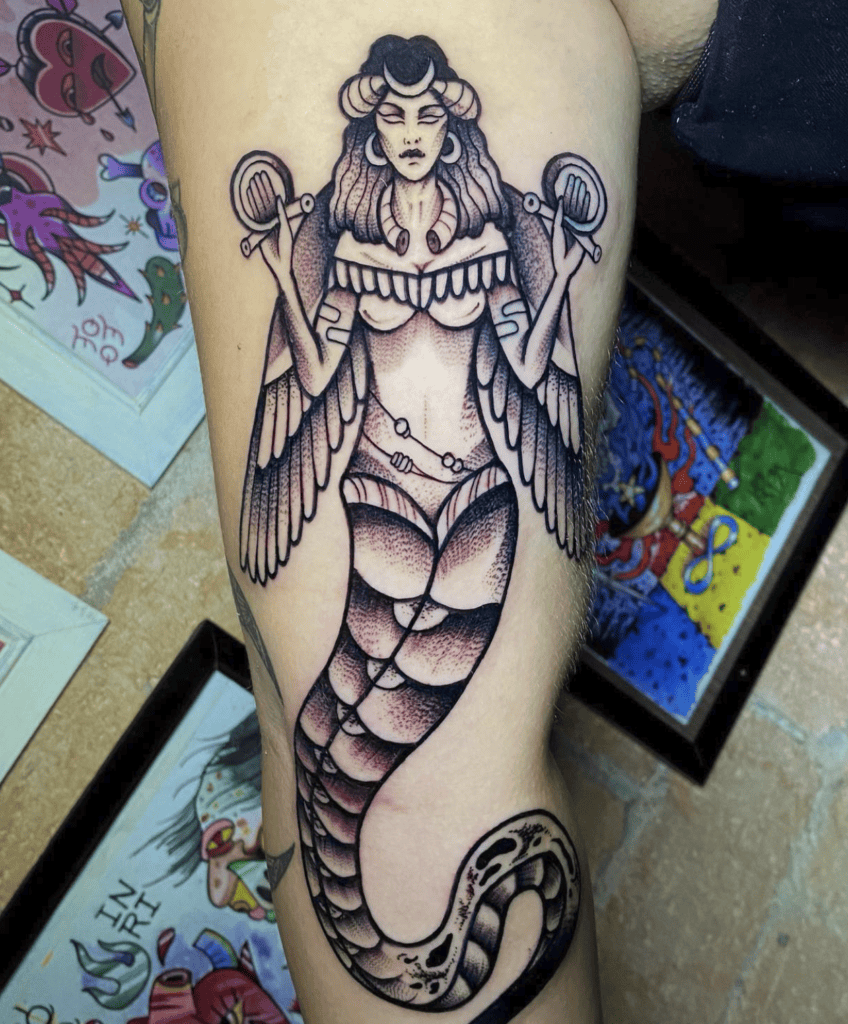
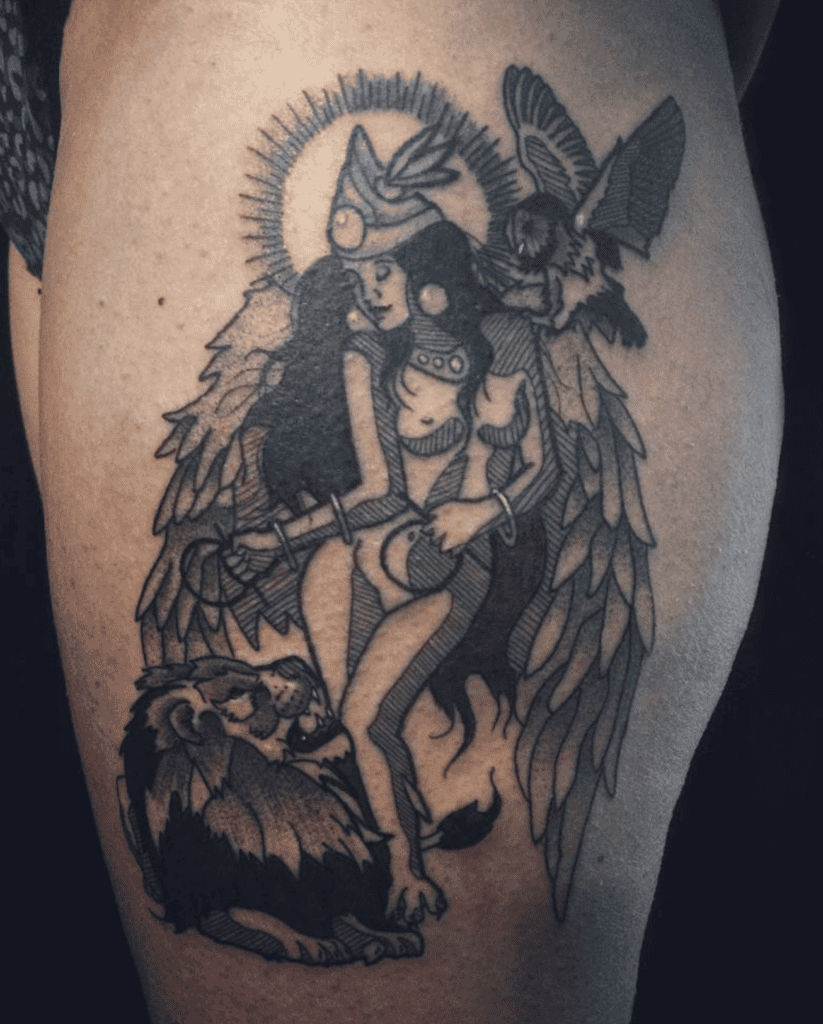
Inanna was originally worshipped by the Sumerians as the goddess of love, beauty, fertility, war, political power, and the planet Venus, but over time, she became closely identified with the Akkadian and Babylonian goddess Ishtar, with the two figures merging in many traditions.
Unlike many gods who represented only one aspect of life, Inanna embodied both creation and destruction. She could inspire love and passion, but she was equally capable of unleashing war and chaos.
Inanna was associated with many different domains, including love and desire, fertility and sexuality, war and victory, political authority and kingship, justice and divine power, and the planet Venus.
One of the most famous Mesopotamian myths is “The Descent of Inanna.” In this story, Inanna decides to travel to the underworld, ruled by her sister Ereshkigal. To enter, she must pass through seven gates, removing an item of clothing or jewellery at each one until she stands powerless before the queen of the dead.
Ereshkigal judges Inanna and has her killed, hanging her body on a hook. However, through the intervention of other deities and clever planning, Inanna is eventually restored to life. The myth has been interpreted in many ways, including as a story about death and rebirth, the changing seasons, the balance between power and humility, or the transformative nature of suffering.
Another important myth is “Inanna and Enki.” The divine me were sacred decrees that governed civilisation itself. They included concepts such as kingship, wisdom, craftsmanship, music, and social order. During a visit to Enki in the city of Eridu, Inanna obtained these divine powers and brought them to Uruk, helping establish the foundations of civilisation there. This story reflects Inanna’s connection with cultural advancement and political authority.
Ishtar Mesopotamian Mythology Tattoo
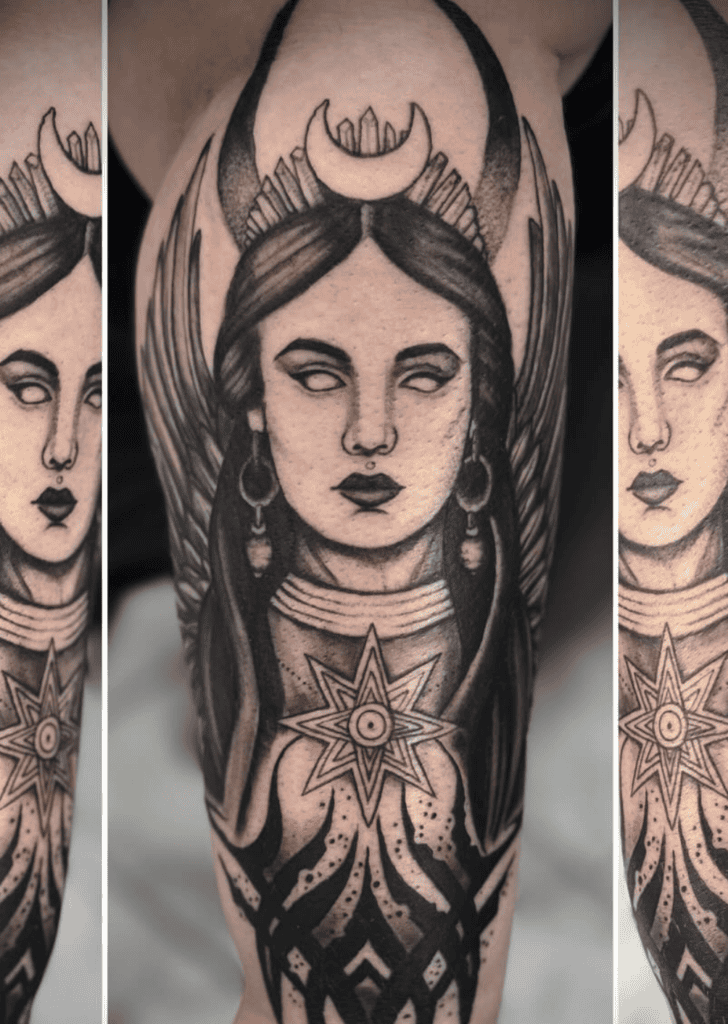
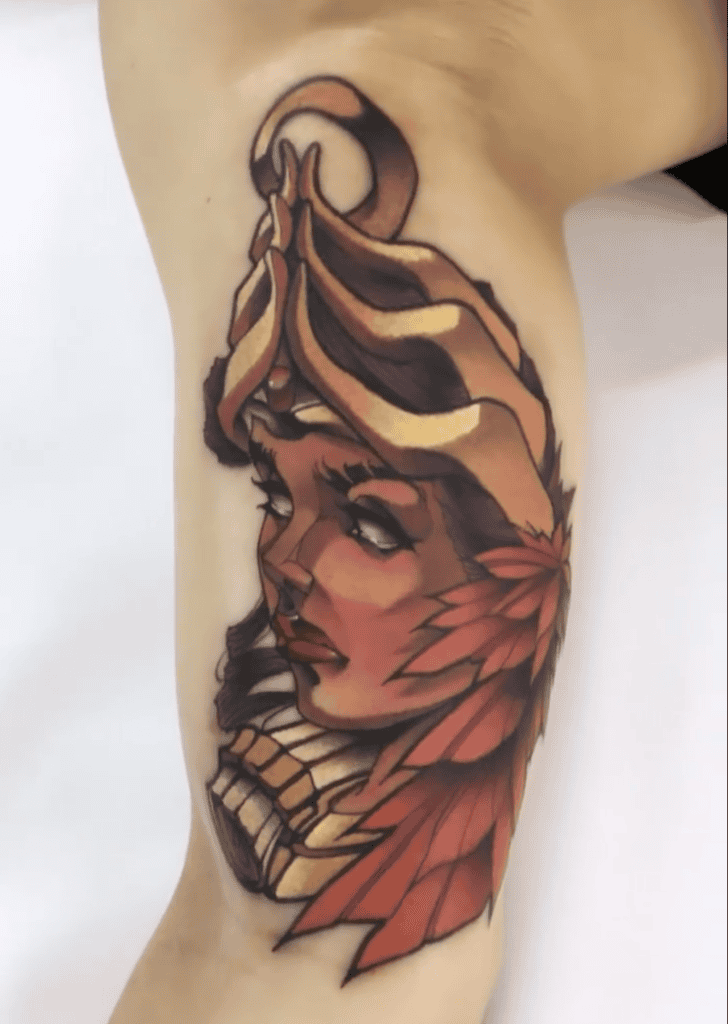
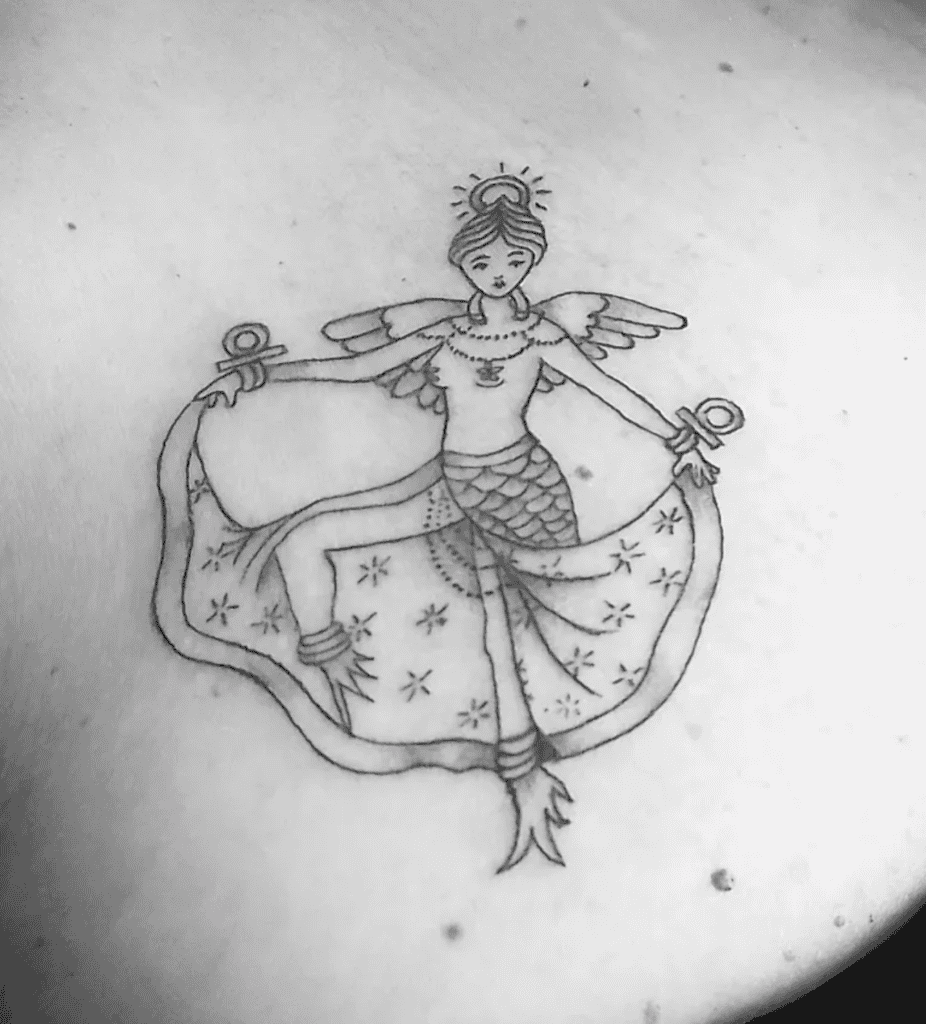
Ishtar was the Akkadian, Babylonian, and Assyrian counterpart of the Sumerian goddess Inanna, and over time the two deities became so closely connected that they were often treated as the same divine figure.
Ishtar was the goddess of love, passion, fertility, war, political power, and the planet Venus. She embodied both the nurturing and destructive aspects of life, making her one of the most dynamic and complex figures in the ancient world.
Originally, Inanna was worshipped by the Sumerians, while Ishtar emerged among Akkadian-speaking peoples. As Mesopotamian cultures interacted and evolved, their myths blended together. By the Babylonian and Assyrian periods, many of Inanna’s stories, symbols, and attributes had become associated with Ishtar. Today, scholars often refer to them together as Inanna/Ishtar, although they began as distinct traditions.
Shamash Mesopotamian Mythology Tattoo


Shamash was the Mesopotamian god of the Sun, justice, truth, and divine law, worshipped by the Akkadians, Babylonians, and Assyrians, while the Sumerians knew him by the name Utu.
Because the Sun illuminates everything, the Mesopotamians believed that Shamash could see all human actions. This made him the perfect divine judge, capable of distinguishing truth from lies and rewarding righteousness while punishing wrongdoing. Unlike some deities who embodied chaos or destruction, Shamash was generally viewed as wise, fair, and compassionate.
One of Shamash’s most important responsibilities was overseeing legal matters. Mesopotamians believed that because Shamash crossed the sky every day, nothing escaped his gaze. Judges, rulers, and ordinary people prayed to him for honest verdicts, protection against deceit, guidance during disputes, and the courage to act justly.
Shamash’s most famous appearance is on the Stele of Hammurabi. The monument depicts Hammurabi standing before Shamash, who presents him with symbols of authority. This imagery emphasised that the king’s laws were sanctioned by divine justice.
Although people often summarise the Code of Hammurabi as “an eye for an eye,” the legal code actually covered a wide variety of topics, including trade, family matters, property rights, and professional responsibilities. Shamash’s presence reinforced the idea that law should uphold order and fairness within society.
Ninurta Mesopotamian Mythology Tattoo
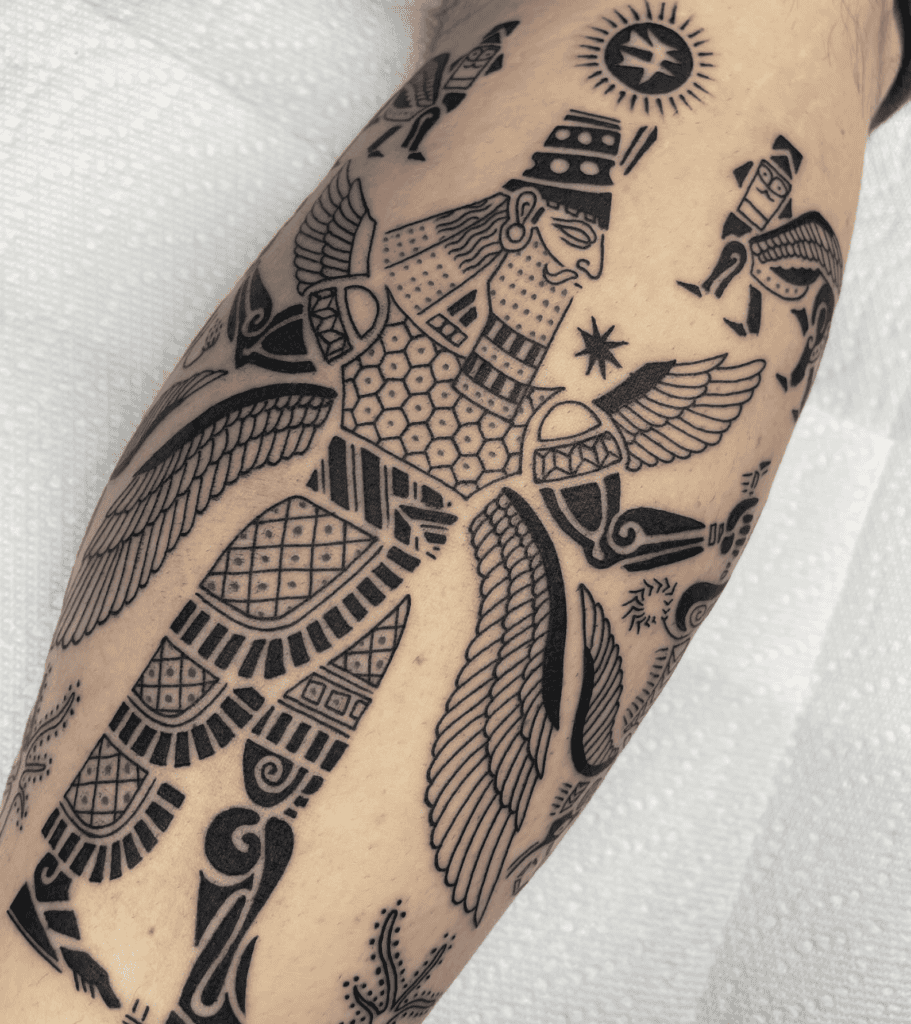
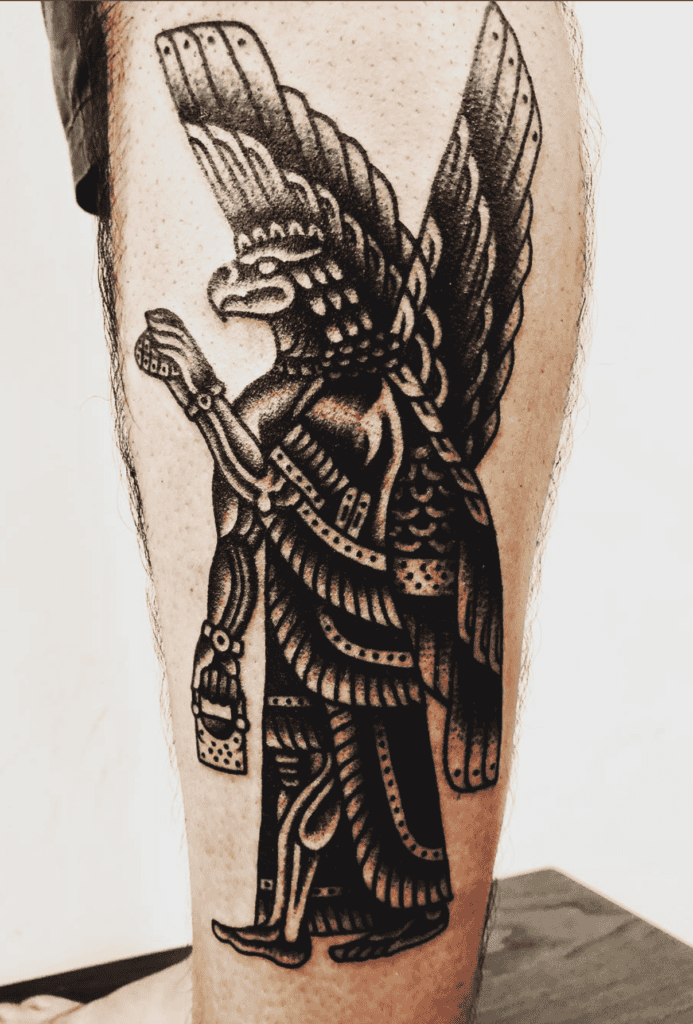
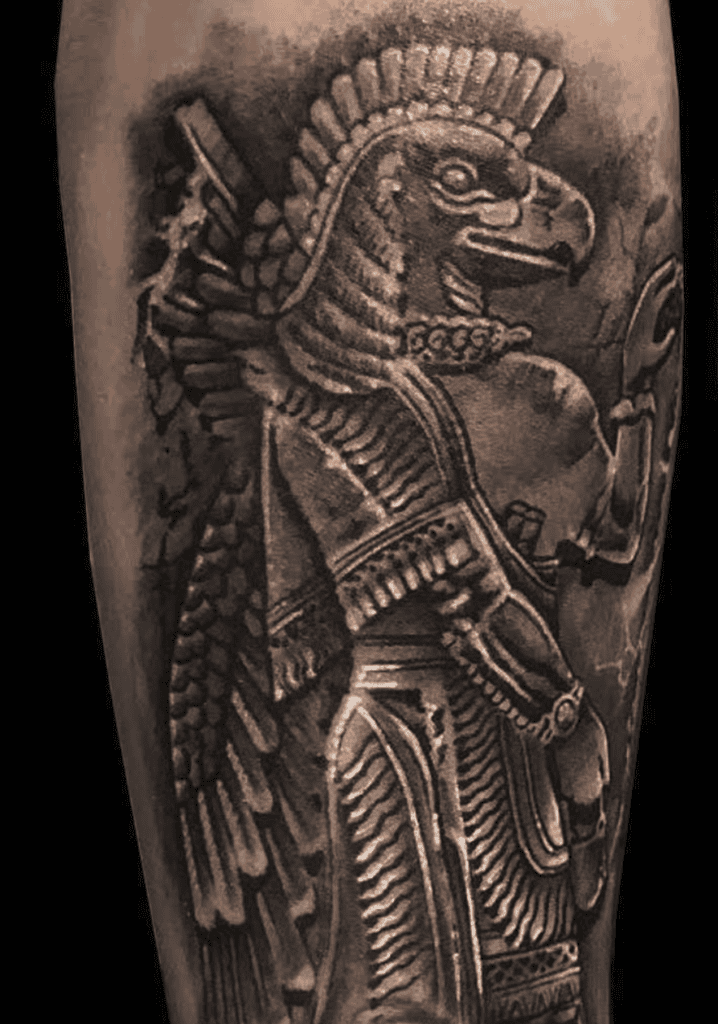
Ninurta was a Mesopotamian god of war, hunting, agriculture, and protection. He was especially important in Sumerian religion, where he was celebrated as a heroic warrior who defended both the gods and humanity from the dangerous forces of chaos.
Ninurta combined two very different roles. On one hand, he was a fearsome warrior and monster-slayer; on the other, he was a fertility deity associated with farming and irrigation. To the people of Mesopotamia, these roles complemented each other, as protecting civilisation was necessary for crops and communities to thrive.
One of Ninurta’s most famous roles was that of a champion against chaos. In the Sumerian poem “Lugal-e” (also called The Exploits of Ninurta), he battles a monstrous demon known as Asag.
Asag’s presence causes rivers to dry up and threatens the stability of the world. Armed with divine weapons, Ninurta defeats the creature and restores order. After his victory, he uses stones from the mountains to build barriers that help regulate rivers and support agriculture.
Ninkasi Mesopotamian Mythology Tattoo
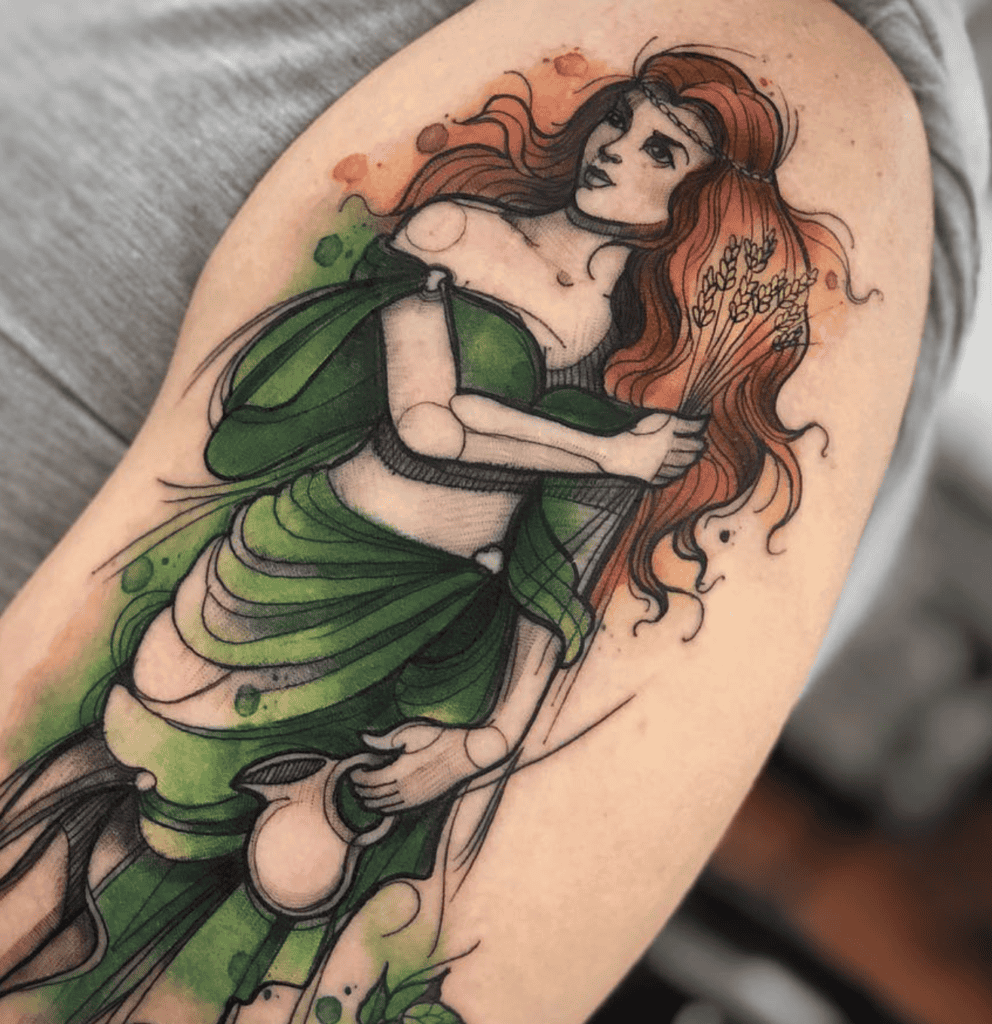
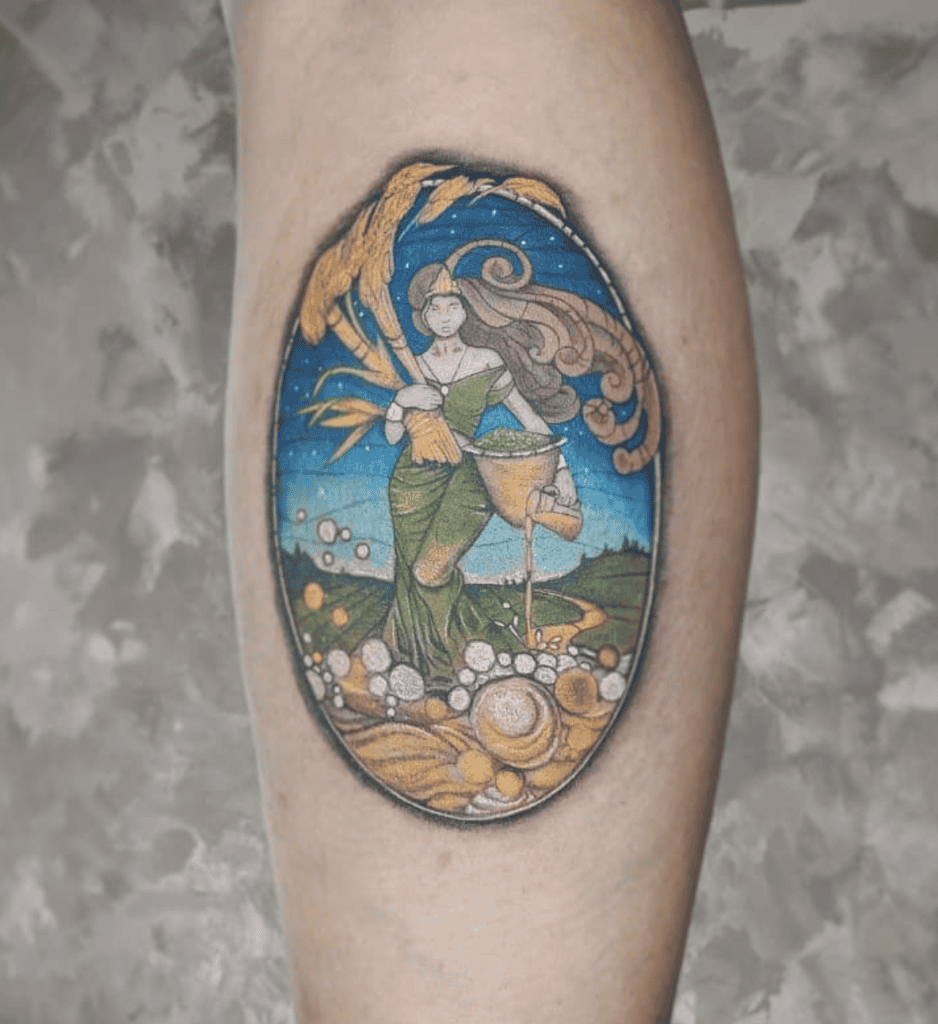
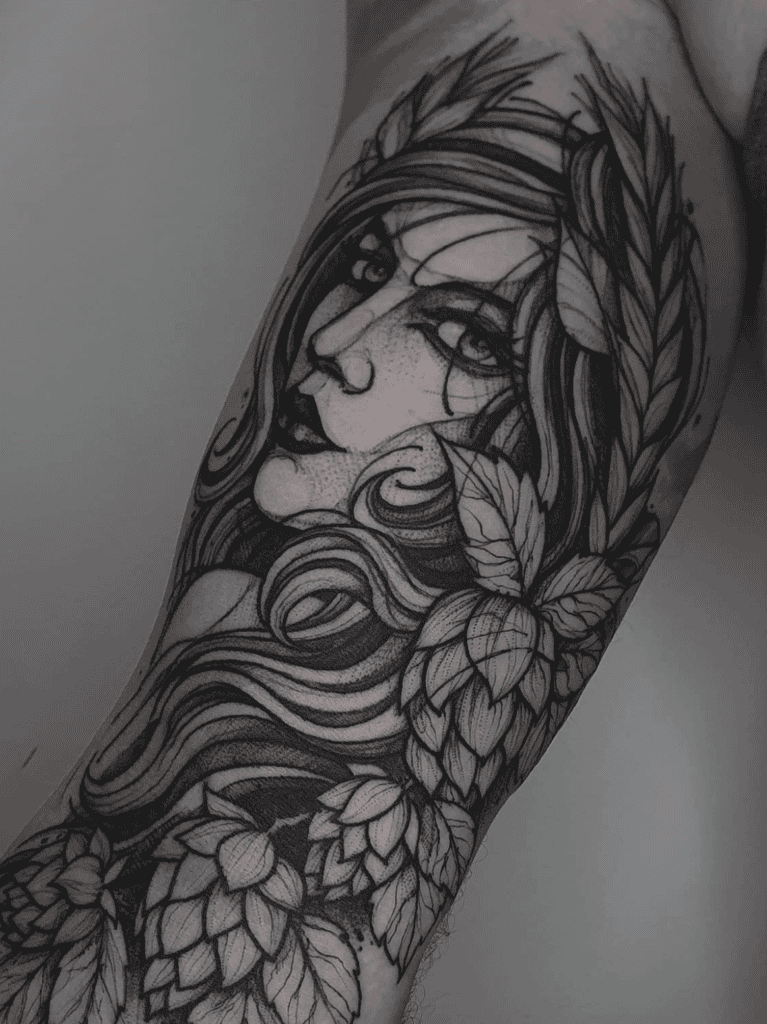
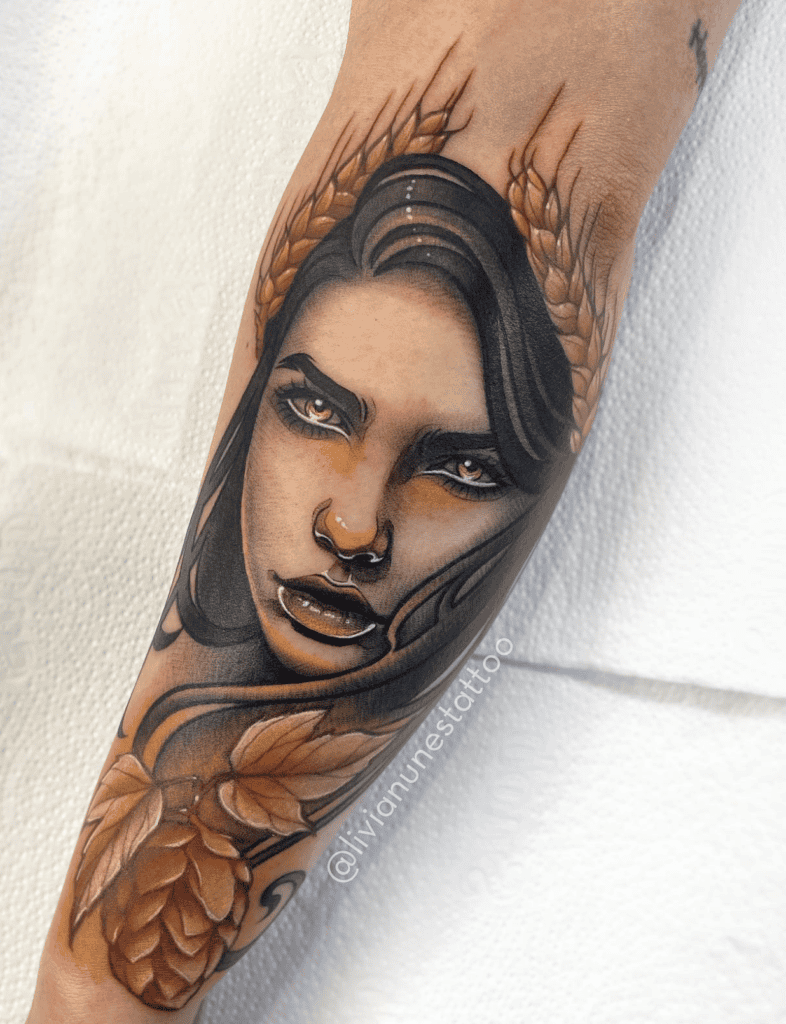
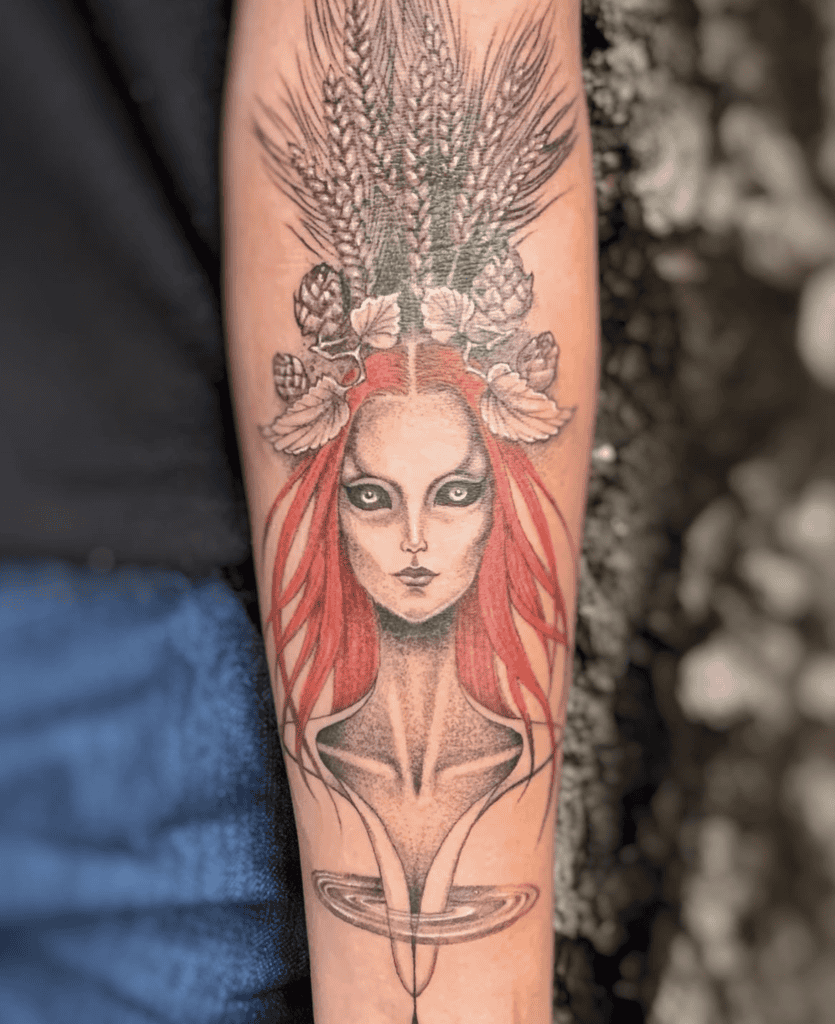
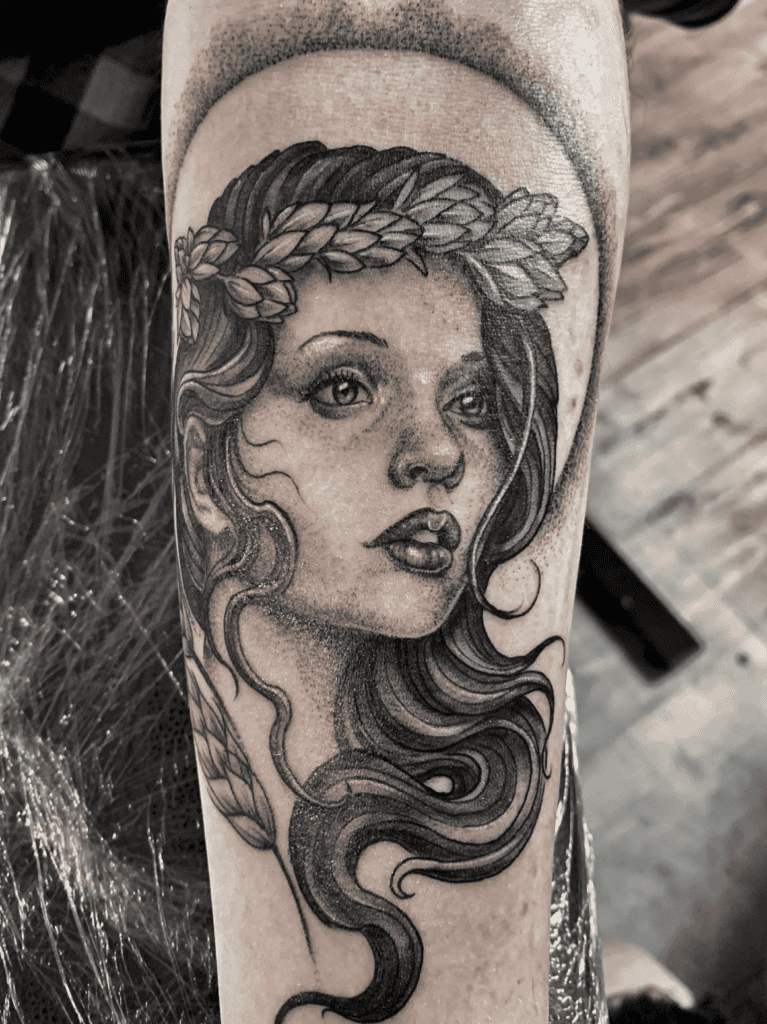
Ninkasi was the Sumerian goddess of beer, brewing, and celebration. She was worshipped as the divine patron of brewers and was believed to oversee the production of one of the most important beverages in ancient Mesopotamian society. Her name is often translated as “Lady Who Fills the Mouth”, a fitting title for a goddess associated with feasting and drink.
Because beer was a staple food and drink in Mesopotamia, Ninkasi occupied a surprisingly significant role in everyday life. While it might seem unusual for an ancient civilisation to have a goddess of beer, in Mesopotamia, beer was incredibly important as it was a common daily beverage, which was often safer to consume than untreated water. Beer was primarily made from barley and used as a form of payment for workers, and served during religious festivals and celebrations.
In the Sumerian poem Hymn to Ninkasi, there are praises to the goddess while also describing the brewing process. Scholars believe it may have served as a mnemonic device to help brewers remember the steps involved in making beer. The hymn mentions ingredients and methods used in ancient brewing, including barley, malt, beer bread known as bappir, and fermentation techniques.
Unlike some major deities connected with kingship or warfare, Ninkasi’s worship was closely tied to ordinary people and everyday activities. Brewing was often carried out within households and temples, and women played a significant role in this process. As a result, Ninkasi was likely an especially relatable figure for many Mesopotamians.
Ereshkigal Mesopotamian Mythology Tattoo
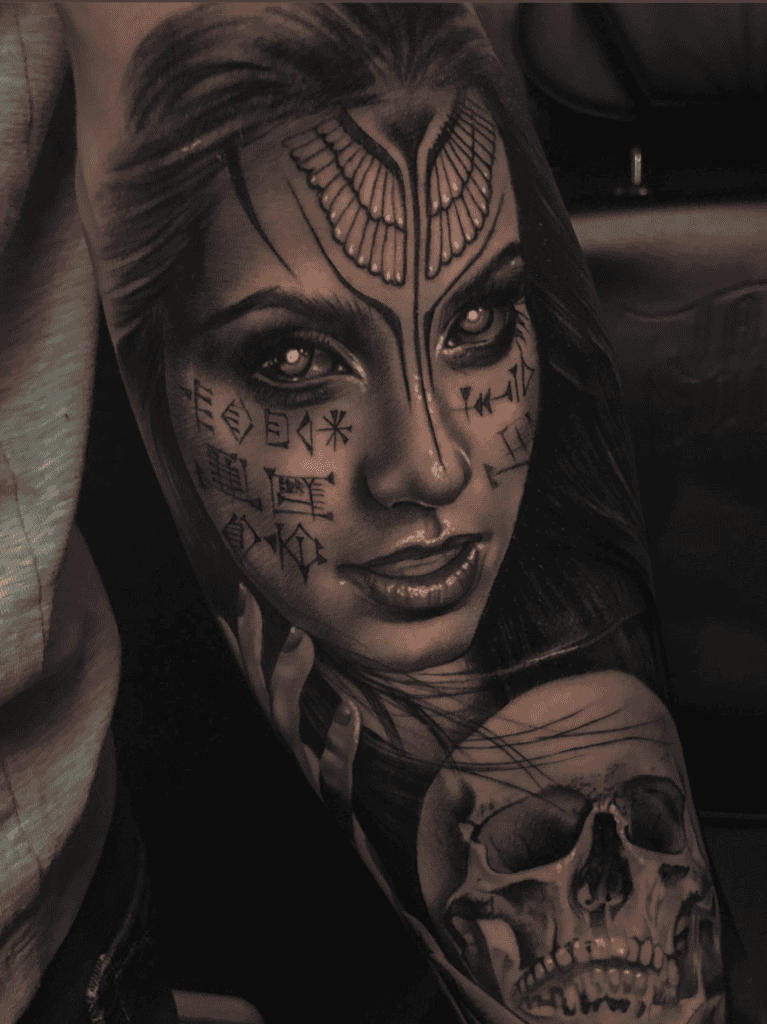
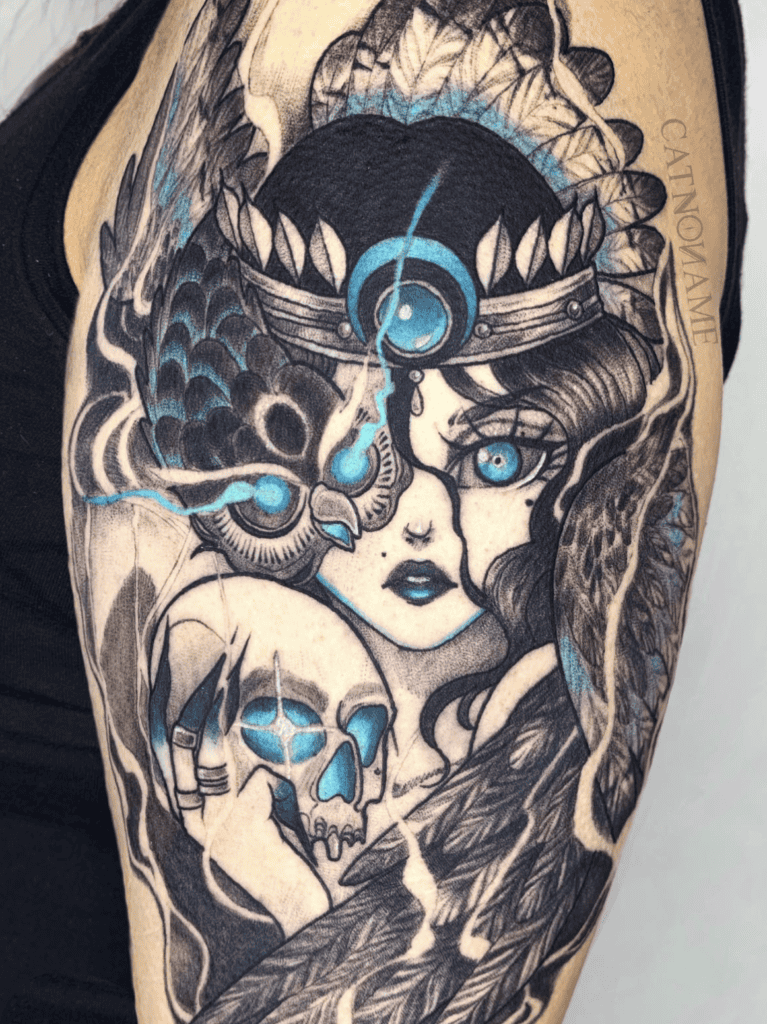
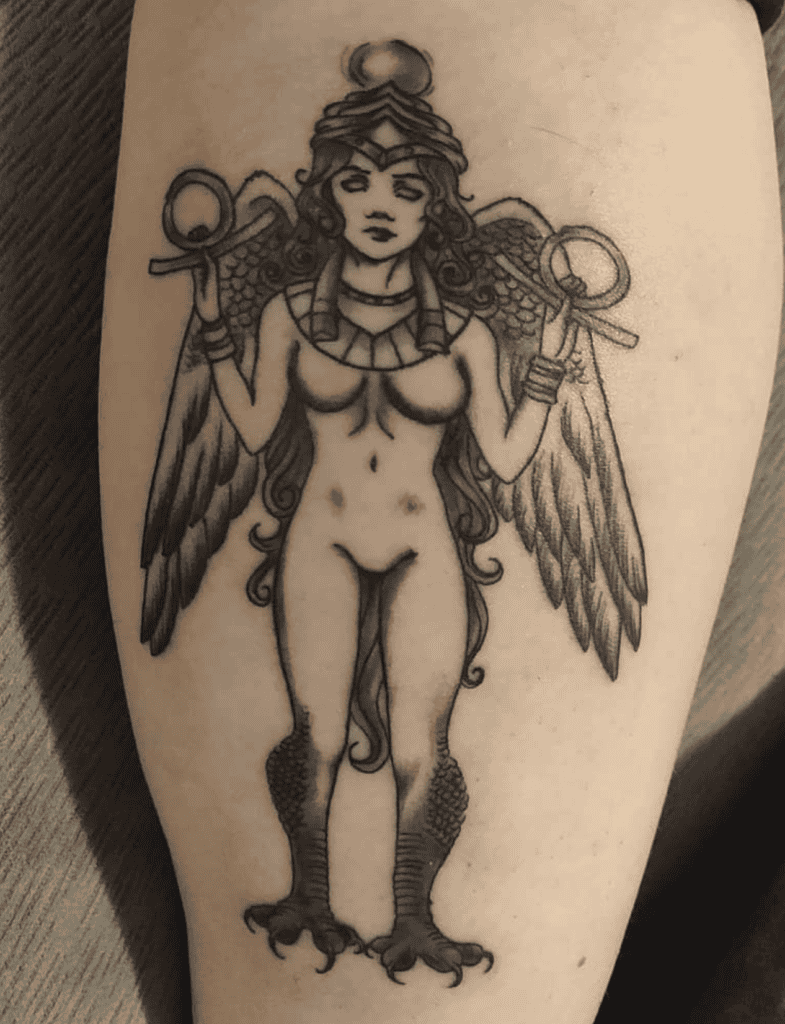
Ereshkigal was the Mesopotamian goddess and queen of the underworld, ruling over the realm of the dead known as Kur, Irkalla, or simply the Great Below. She was one of the oldest and most important deities in Mesopotamian mythology and represented the inevitability of death and the mysteries of the afterlife.
Unlike many modern portrayals of underworld deities as purely evil, Ereshkigal was not considered malevolent. Instead, she was the rightful ruler of a realm that every mortal would eventually enter. Her name is often translated as “Lady of the Great Earth” or “Queen of the Great Below.”
Ereshkigal was associated with Nergal, the god of war, plague, and the underworld, who eventually became her husband and co-ruler in later myths. The Mesopotamian afterlife was very different from the concepts of heaven and hell found in some later religions.
This underworld was generally viewed as a shadowy and dusty realm where the dead continued to exist regardless of their actions in life. Seven gates separated it from the world above, there was a lack of sunlight, and spirits were sustained by offerings from the living. The underworld was not necessarily a place of punishment, but the destination awaiting all mortals.
Ereshkigal plays a central role in one of Mesopotamia’s most famous myths: The Descent of Inanna. When Inanna enters the underworld, she passes through seven gates, surrendering a piece of her regalia at each stage until she stands powerless before Ereshkigal. The queen of the underworld judges Inanna and has her killed, hanging her body upon a hook.
However, through divine intervention, Inanna is eventually restored to life and permitted to return to the world above, though not without consequences. This story explores themes of death and rebirth, the limits of power, transformation through suffering, and the relationship between life and death. Ereshkigal’s actions demonstrate that even the gods must respect the laws of the underworld.
Nergal Mesopotamian Mythology Tattoo

Nergal was the Mesopotamian god of war, plague, pestilence, death, and the underworld. Feared yet respected, he embodied the destructive forces of nature and human conflict, especially those associated with the scorching summer sun, disease, and warfare. Like Ereshkigal, he was not viewed as a purely evil figure but rather as representing necessary aspects of the natural order, including mortality and the inevitability of death.
According to the tale of “Nergal and Ereshkigal”, Ereshkigal sends a representative from the underworld to attend a banquet of the gods. Nergal fails to show the messenger proper respect, offending the queen of the dead.
To resolve the matter, Nergal descends into the underworld. Depending on the version of the myth, he either falls in love with Ereshkigal, forces his way into power before reconciling with her, or willingly agrees to remain beside her. Ultimately, the two become husband and wife, ruling the underworld together.
Gilgamesh Mesopotamian Mythology Tattoo
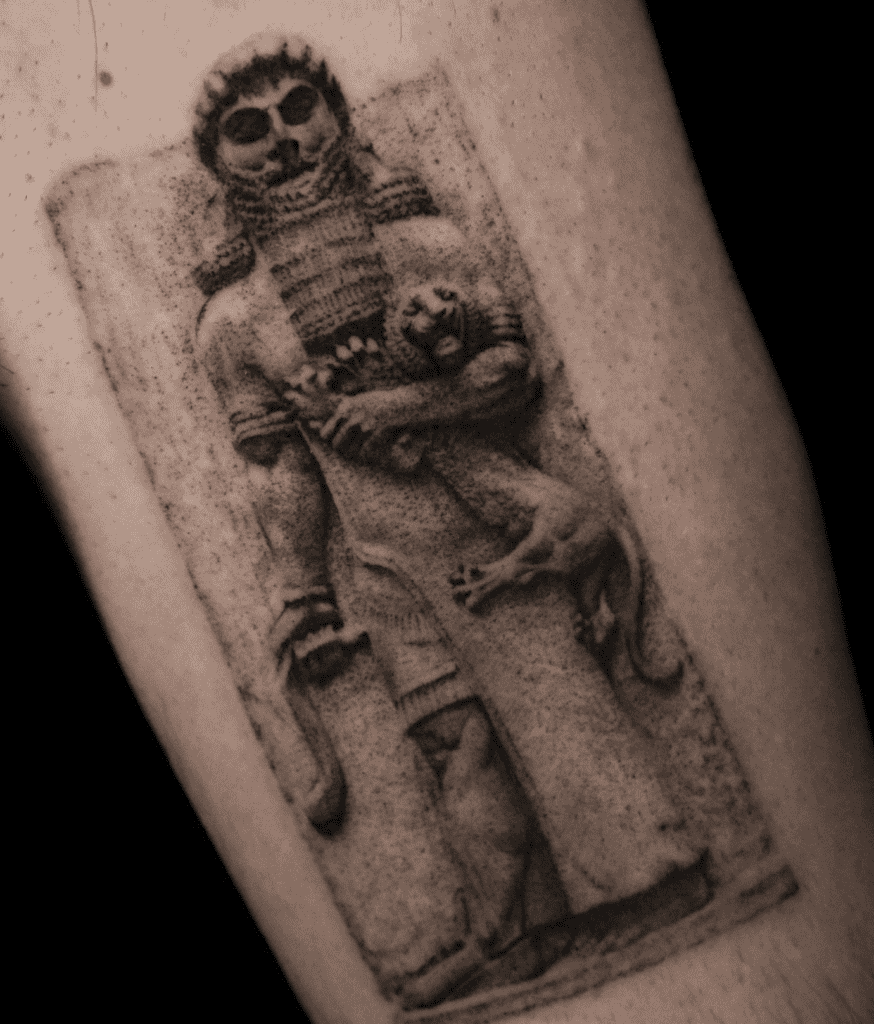
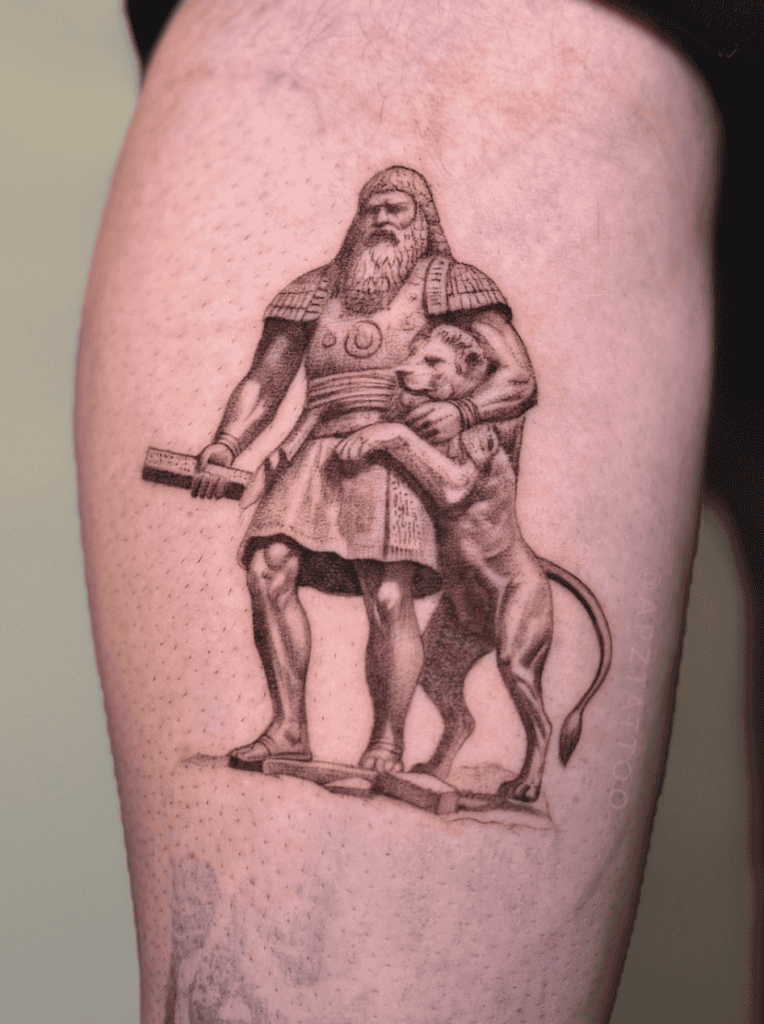
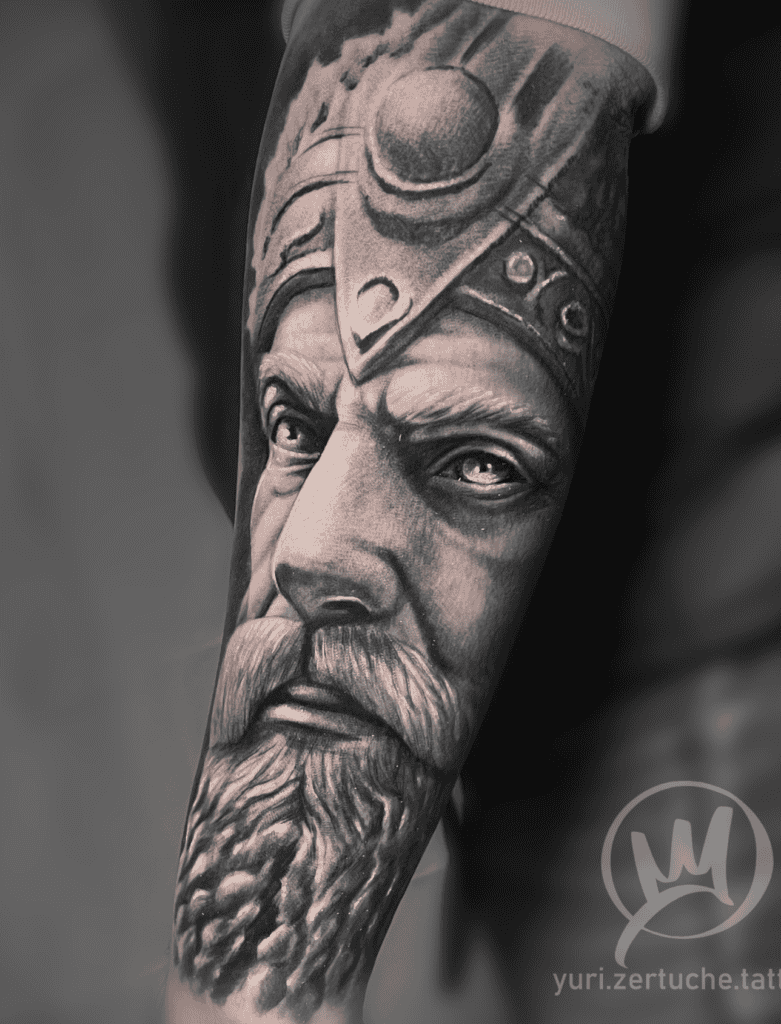
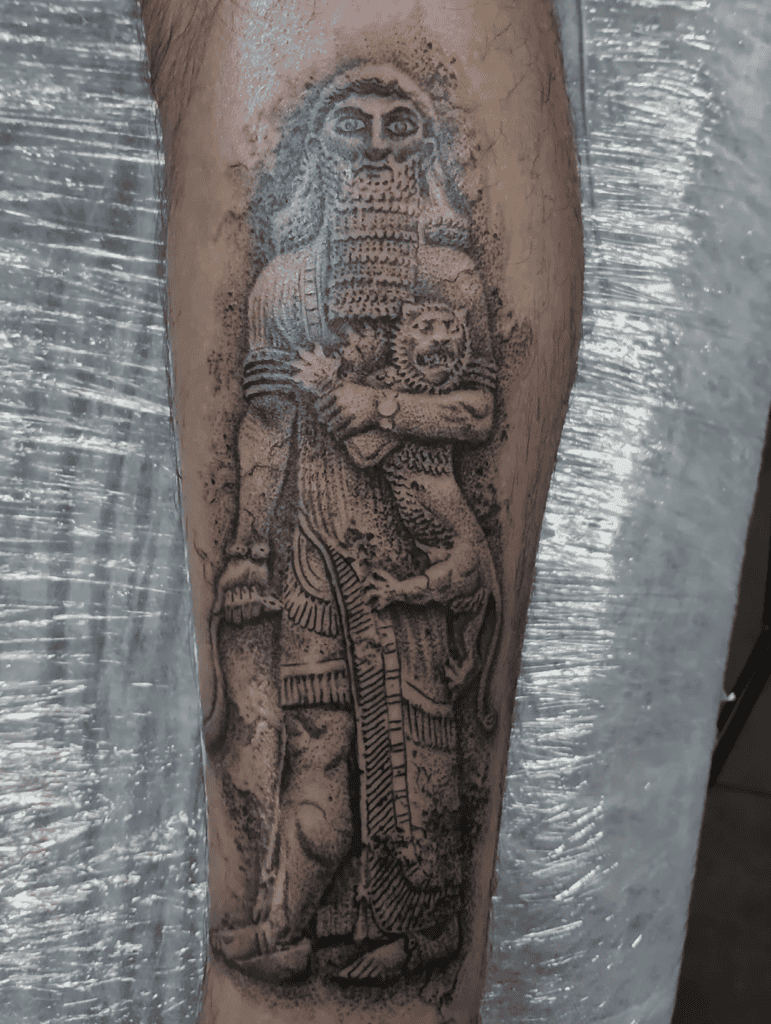
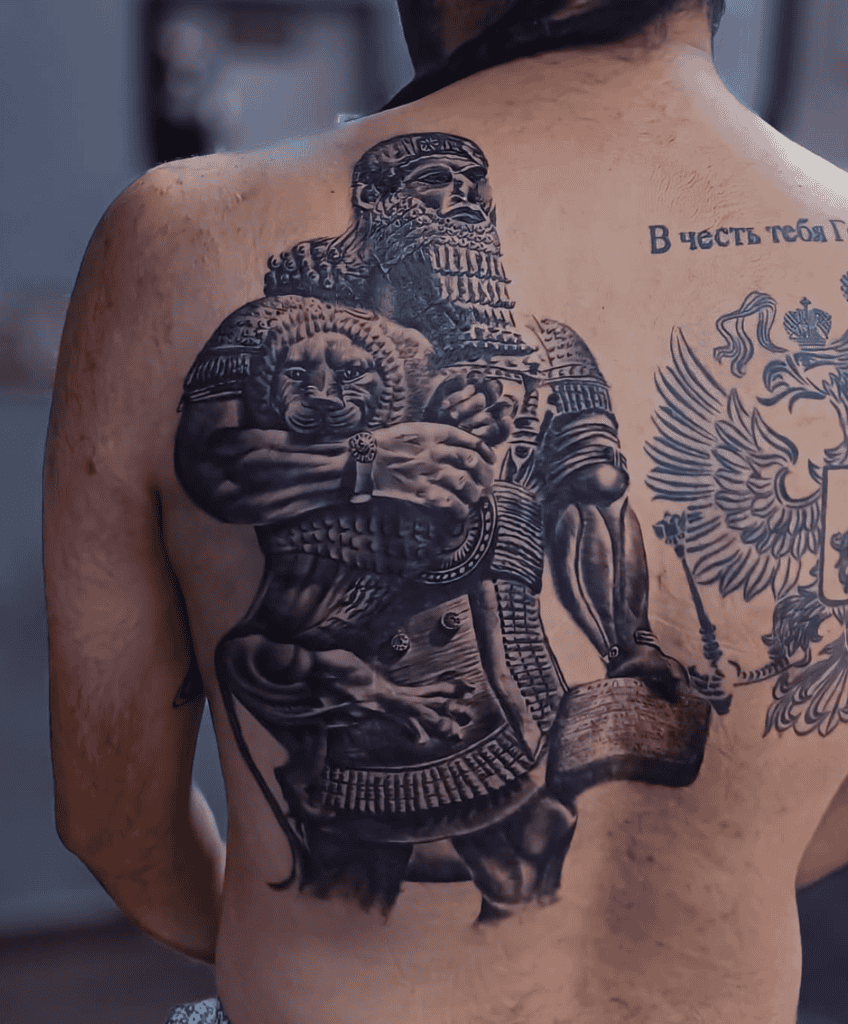
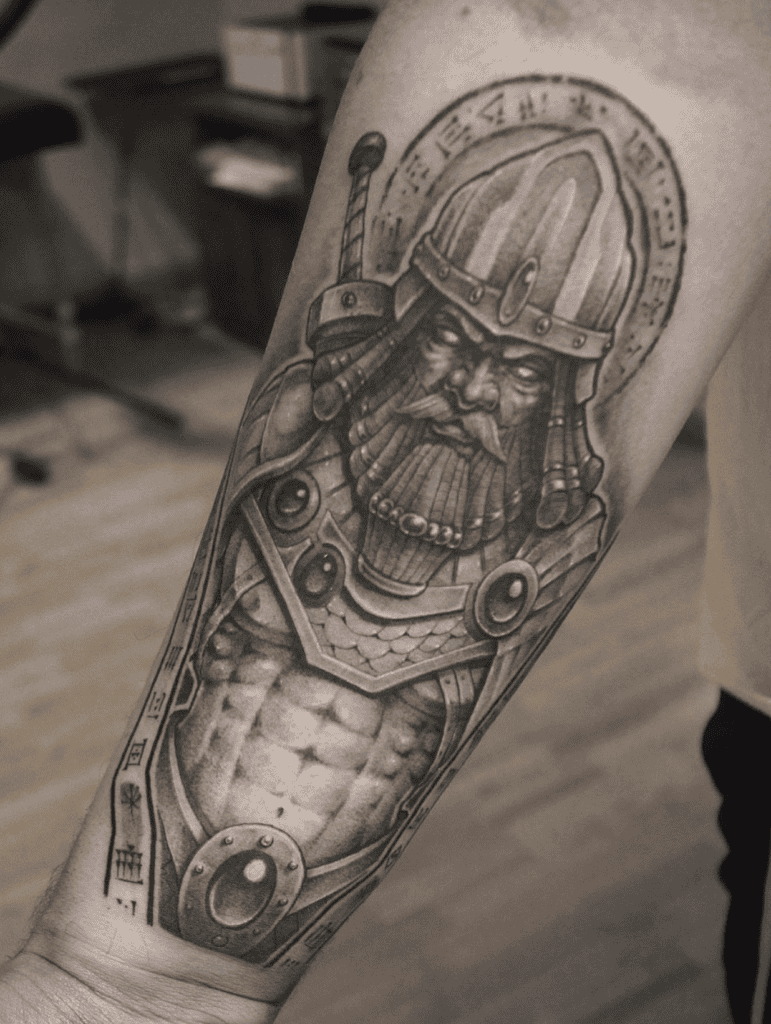
Gilgamesh was the legendary king of Uruk and the hero of the Epic of Gilgamesh, one of the oldest surviving works of literature in the world. According to Mesopotamian tradition, Gilgamesh was a mighty warrior, an ambitious ruler, and a great builder, described as being two-thirds divine and one-third human.
Over the course of his story, Gilgamesh transforms from a proud and sometimes tyrannical king into a wiser ruler who comes to understand the meaning of friendship, loss, and what it means to be human.
Many scholars believe that Gilgamesh may have been based on an actual king who ruled the city of Uruk sometime around 2700–2500 BCE. Ancient Sumerian king lists mention a ruler named Gilgamesh, although the fantastic adventures described in later stories are almost certainly legendary.
Earlier Sumerian poems about Gilgamesh were eventually combined into the version most people know today: the Standard Babylonian Epic of Gilgamesh, traditionally attributed to the scribe Sin-leqi-unninni. The story follows Gilgamesh through a series of adventures that ultimately become a profound exploration of mortality.
At the beginning of the epic, Gilgamesh rules Uruk harshly, and in response to the people’s prayers, the gods create Enkidu, a wild man who lives among animals. After becoming civilised, Enkidu challenges Gilgamesh to a duel, but rather than remaining enemies, the two develop a deep friendship and become inseparable companions.
Together, they undertake great adventures, including defeating Humbaba, guardian of the Cedar Forest and slaying the Bull of Heaven, sent by Ishtar. After Gilgamesh returns from his victories, Ishtar proposes marriage to him. However, Gilgamesh refuses, pointing to the unfortunate fates of Ishtar’s previous lovers.
Insulted by his rejection, Ishtar persuades Anu to release the Bull of Heaven against Uruk. Gilgamesh and Enkidu defeat the beast, but the gods decide that one of the heroes must pay for this act of defiance and decree that Enkidu must die.
Enkidu’s death devastates Gilgamesh, who struggles to accept the loss of his closest friend, and for the first time, Gilgamesh confronts the reality that even great heroes cannot escape death.
Terrified by his own mortality, Gilgamesh embarks on a quest to find Utnapishtim, the only human granted eternal life after surviving the Great Flood. Along the way, Gilgamesh encounters numerous challenges and learns important lessons about the limits of human ambition. Utnapishtim eventually reveals the story of the flood and explains that immortality is a gift reserved for the gods.
Although Gilgamesh briefly obtains a plant said to restore youth, it is stolen by a serpent before he can use it. By the end of the epic, Gilgamesh returns to Uruk with a new understanding of life. He realises that humans achieve a kind of immortality not through endless existence, but through the relationships they build, the communities they serve, and the legacies they leave behind.
Enkidu Mesopotamian Mythology Tattoo


Enkidu was the wild-man companion and closest friend of Gilgamesh. Where Gilgamesh begins the story as a powerful but arrogant king living within civilisation, Enkidu starts as a man of nature, living among the animals of the wilderness. Through their friendship, both heroes grow and change, making Enkidu central to the epic’s emotional and philosophical themes.
According to the epic, when the people of Uruk prayed to the gods because King Gilgamesh had become oppressive and abused his power, they fashioned Enkidu from clay, intending Enkidu to be a rival strong enough to challenge Gilgamesh.
A hunter who encountered Enkidu sought help from Gilgamesh. Following advice, the temple woman Shamhat was sent to meet the wild man. Through spending time with Shamhat, Enkidu gradually became civilised, marking his transition from the wilderness into the world of people.
After hearing of Gilgamesh’s behaviour, Enkidu travelled to Uruk to confront the king. The two heroes engaged in an enormous wrestling match, and despite their tremendous strength, neither could gain a decisive advantage. Instead of becoming enemies, they recognised one another as equals and formed a deep friendship, going on adventures until Enkidu’s eventual death at the hands of the gods.
Mušḫuššu Mesopotamian Mythology Tattoo
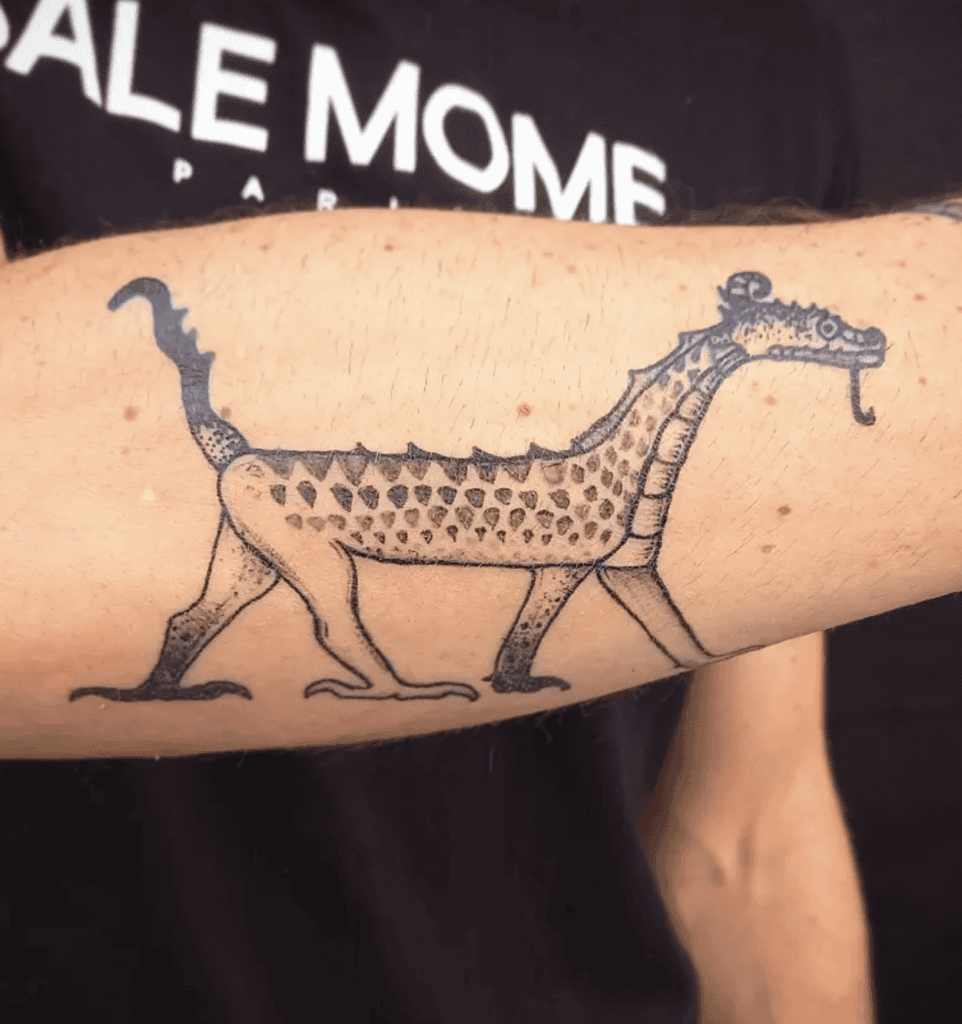
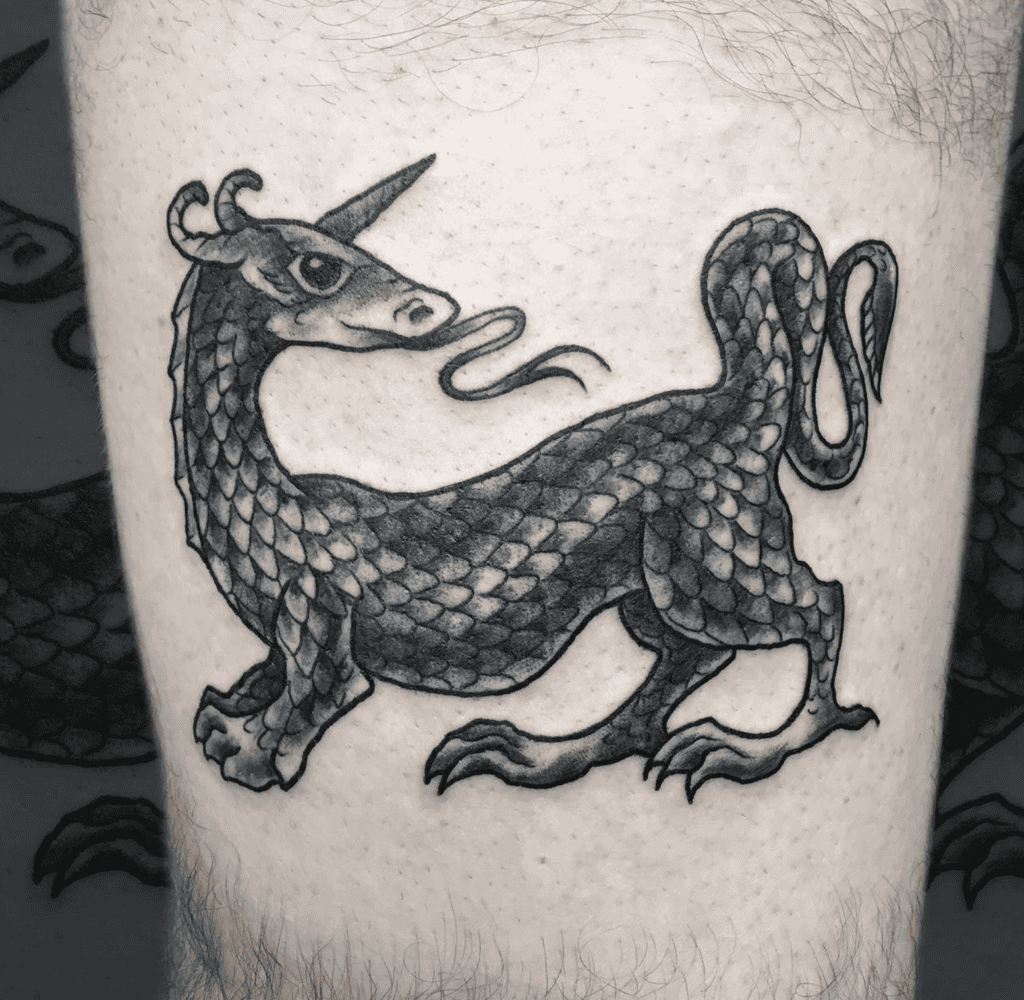
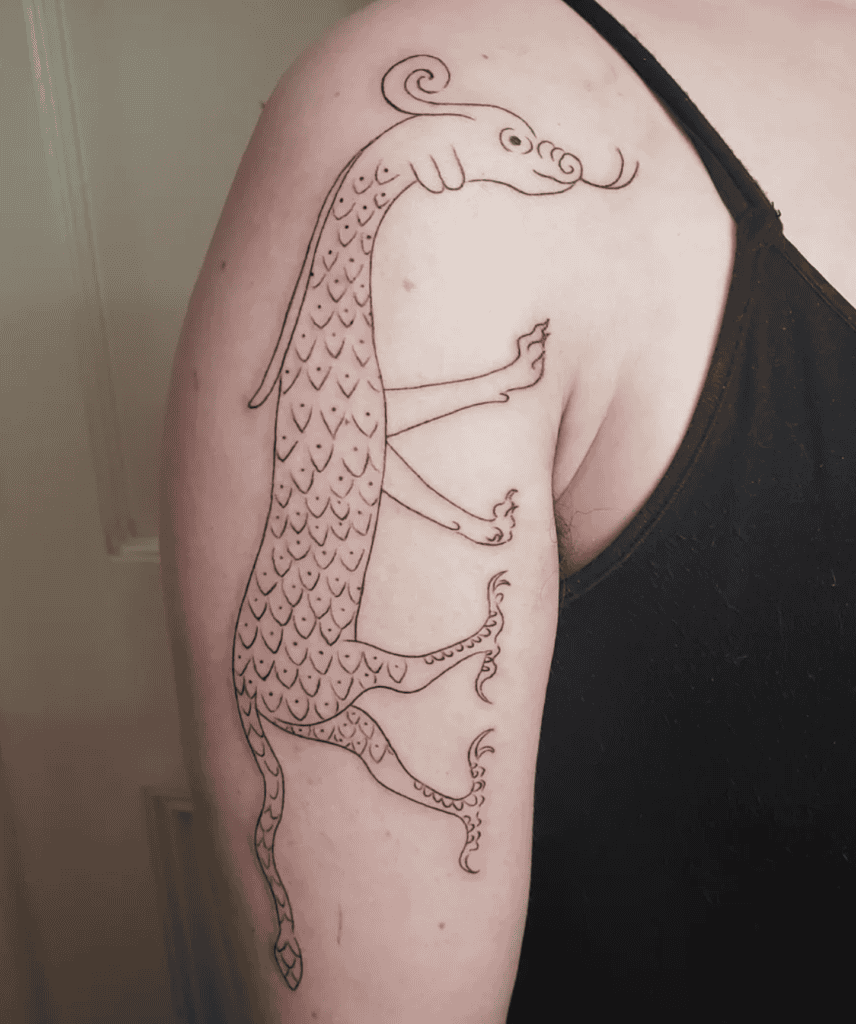
Mušḫuššu (also written as Mushussu or Sirrush) was a mythological dragon-like creature in Mesopotamian mythology whose name is usually translated as “furious serpent” or “splendour serpent,” and served as a sacred symbol associated with powerful Mesopotamian gods, especially Marduk and Nabu.
The Mušḫuššu had a truly unique appearance, combining features from several different animals. It was typically depicted with a long, scaly serpent-like body and neck, the forelegs of a lion, the hind legs of a bird of prey, complete with talons, a long tail, sometimes ending in a scorpion-like tip, a horned head with a crest, and a forked tongue.
The creature became the sacred animal of Marduk, the patron god of Babylon. As Marduk rose to prominence in Babylonian religion, the Mušḫuššu increasingly became one of his symbols representing divine authority, power over chaos, and the protection of the city of Babylon.
The Mušḫuššu was also associated with Nabu, the Babylonian god of wisdom, writing, and scribes. Because Nabu was Marduk’s son, the sharing of this symbol reflected their close relationship.
One of the most famous surviving representations of the Mušḫuššu appears on the Ishtar Gate, constructed during the reign of Nebuchadnezzar II around the 6th century BCE. The gate was decorated with rows of glazed brick animals, including aurochs associated with the storm god Adad, lions associated with Ishtar, and Mušḫuššu dragons associated with Marduk.
Tiamat Mesopotamian Mythology Tattoo
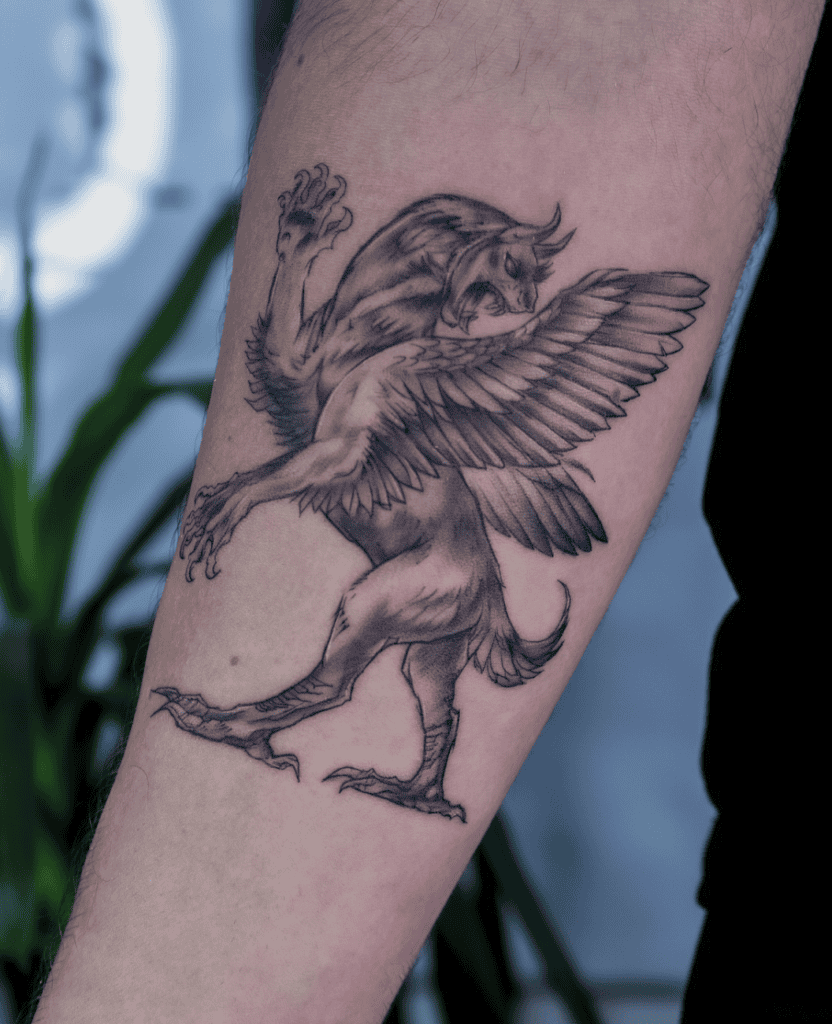
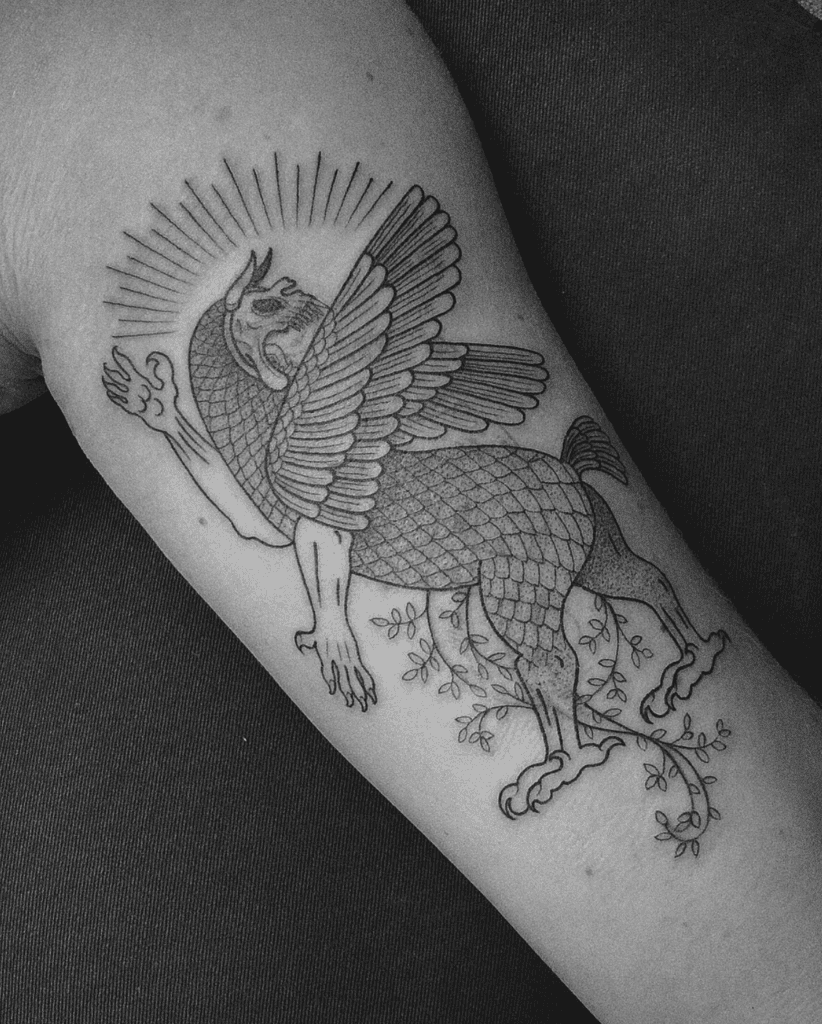
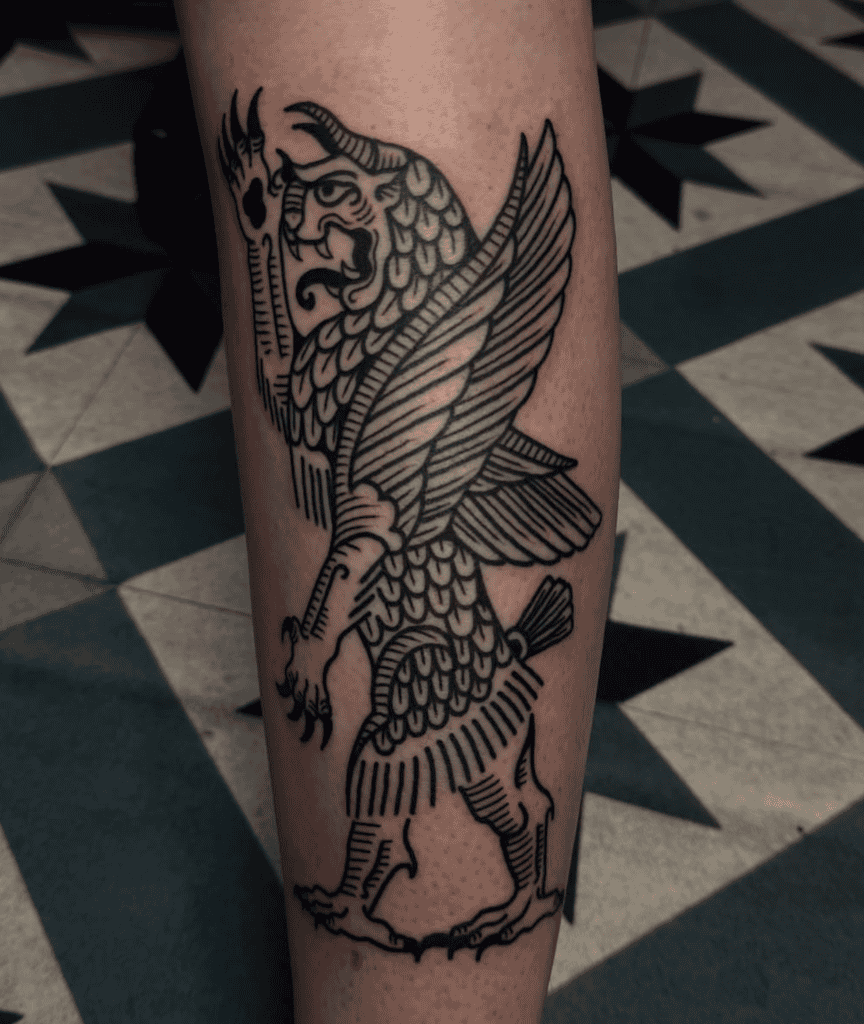
Tiamat was the primordial goddess of the salt sea, appearing most prominently in the Babylonian creation epic, the Enuma Elish, where she serves as both the mother of the gods and the embodiment of primordial chaos.
Although modern retellings often portray Tiamat simply as an evil dragon, the original myths present a much more nuanced figure. Before becoming an adversary to the younger gods, Tiamat was a creative force associated with the origins of the cosmos itself.
According to the Enuma Elish, in the beginning, there were two primordial beings: Tiamat, representing the salt waters of the sea, and Apsu (Abzu), representing the fresh waters beneath the earth.
Their waters mingled, giving rise to successive generations of gods. However, the younger gods became noisy and disruptive and annoyed by the disturbance, Apsu planned to destroy them.
The god Enki discovered Apsu’s intentions and acted first. Using his wisdom and magical abilities, Enki defeated Apsu and established his dwelling place within the Abzu. At first, Tiamat did not seek revenge. However, after being encouraged by some of the older gods, she eventually chose to confront the younger generation.
In preparation for war, Tiamat created a host of terrifying creatures and elevated Kingu, one of her offspring and consorts, as the commander of her forces. Tiamat entrusted Kingu with the Tablet of Destinies, a powerful object granting authority over the cosmos.
The younger gods were terrified by Tiamat’s might, but eventually, Marduk, the patron god of Babylon, agreed to fight her on the condition that if he succeeded, he would become king of the gods.
Armed with divine weapons and aided by powerful winds, Marduk confronted Tiamat in an epic battle, trapping her with the winds and striking her down. After defeating Tiamat, Marduk used her body to create the universe.
Anzu Mesopotamian Mythology Tattoo
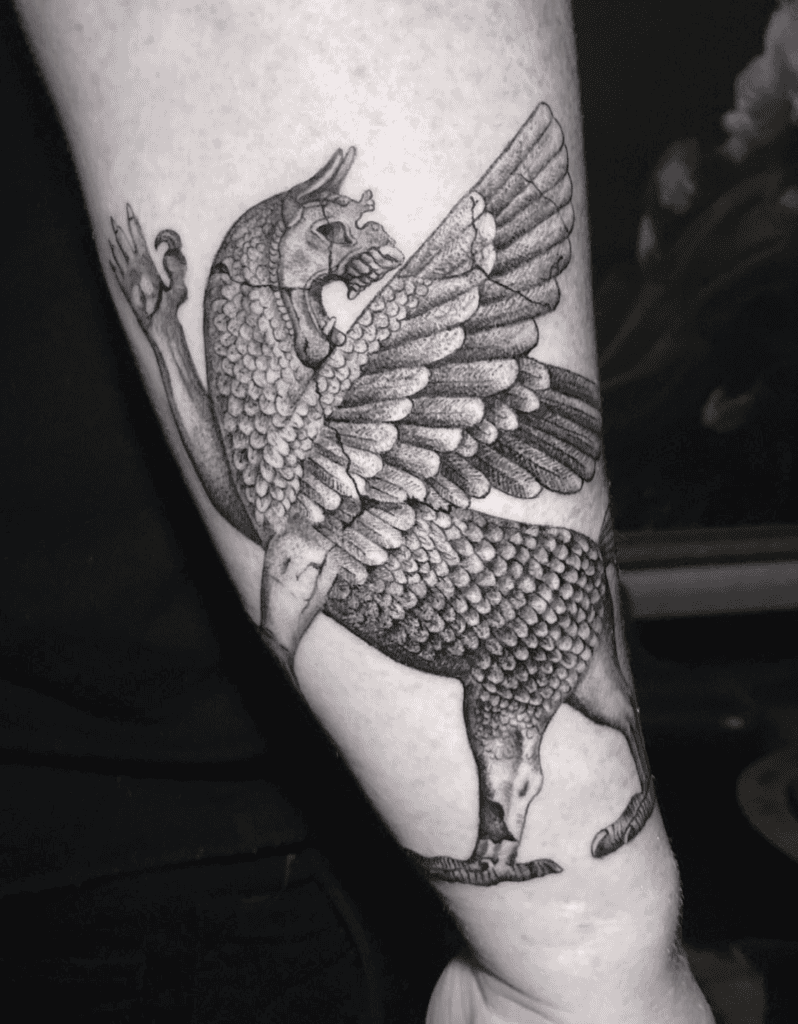
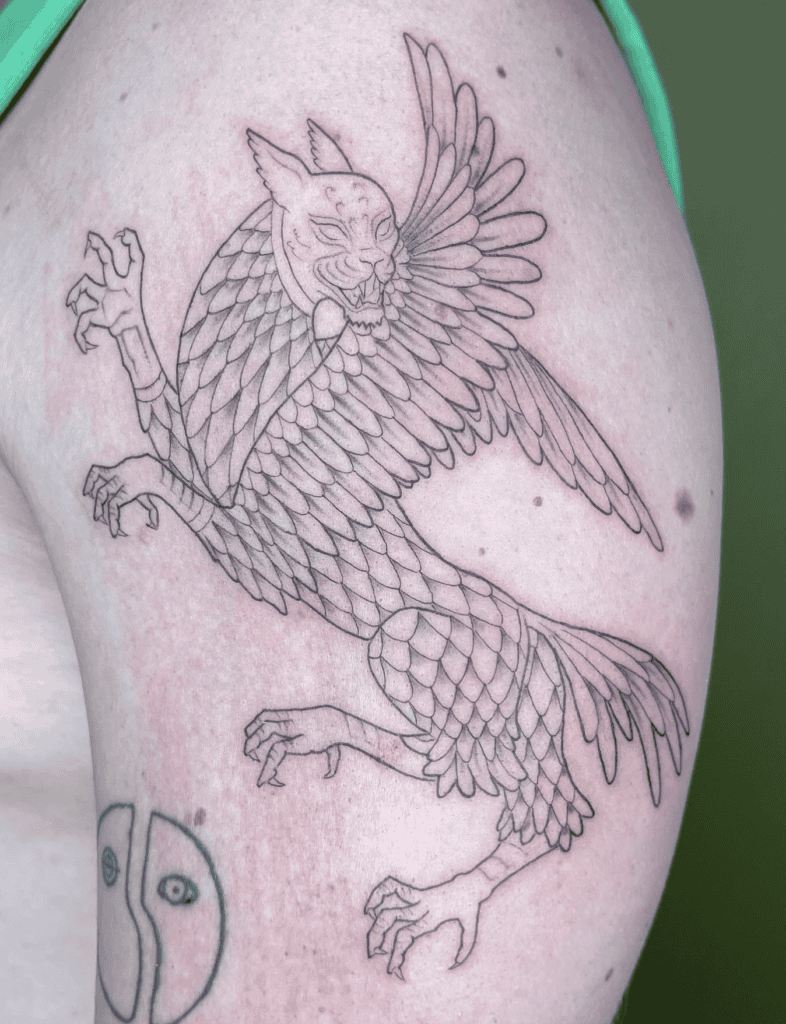
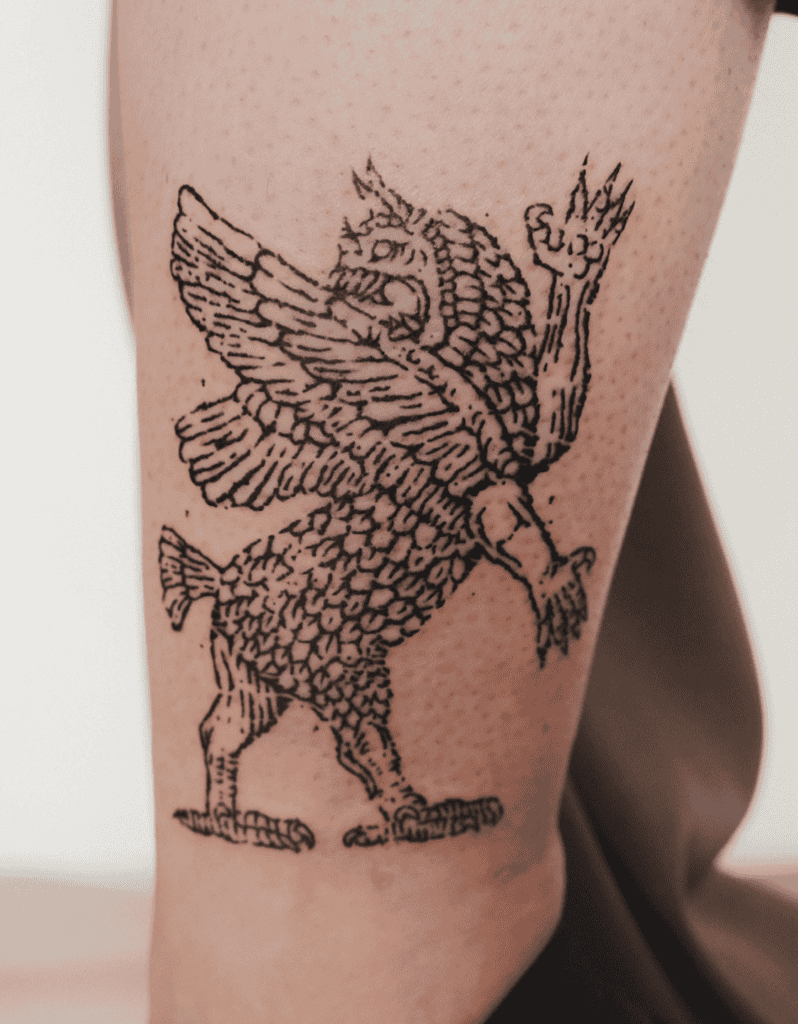
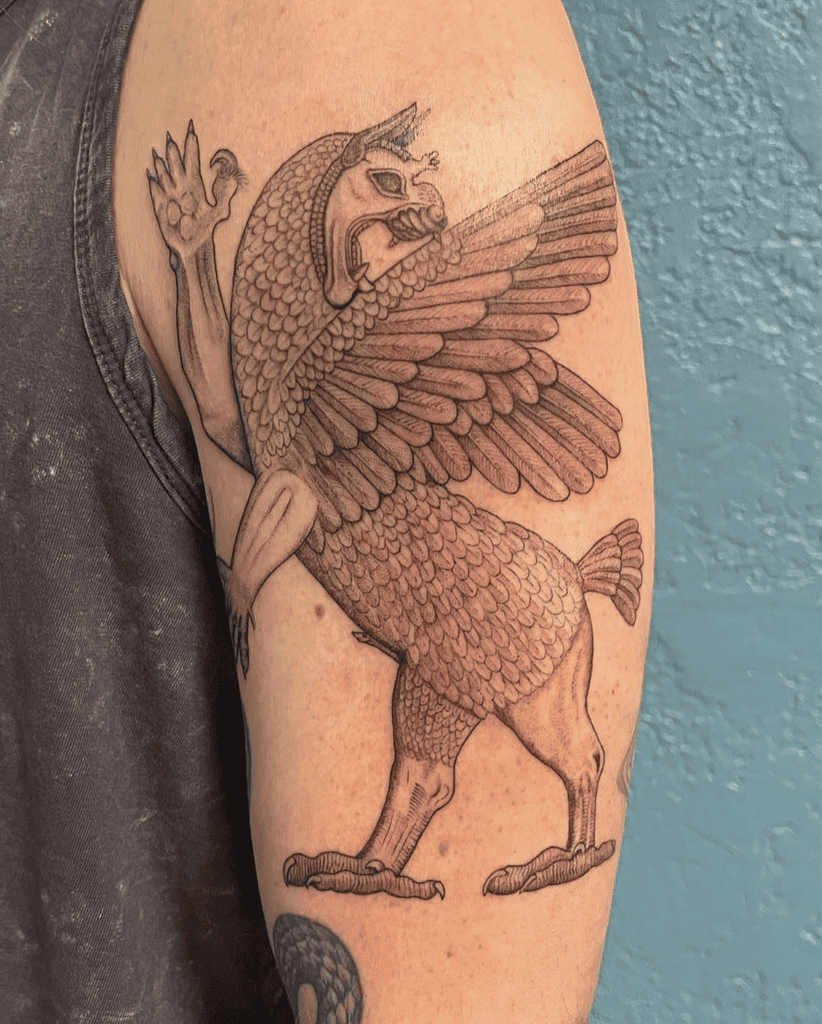
Anzû (also spelt Anzu, Imdugud, or Zu) was a powerful mythological bird creature most famous for stealing the Tablet of Destinies, an act that threatened the very order of the universe.
In different traditions, Anzû could appear as a guardian, a servant of the gods, or a rebellious force challenging divine authority. His story explores themes of power, legitimacy, and the consequences of ambition. He was often portrayed as a massive eagle-like bird, a creature with the head of a lion and the body of a bird, and a being associated with storms and powerful winds. In Sumerian tradition, the creature was known as Imdugud, whose name may have referred to a thundercloud or storm bird.
The most famous myth involving Anzû centres on the Tablet of Destinies. This tablet granted its holder the authority to decree fate, exercise divine kingship, and maintain cosmic order. According to the myth, Anzû served the god Enlil, one of the chief deities of Mesopotamia. One day, Anzû seized an opportunity. After observing Enlil setting aside the Tablet of Destinies while bathing, Anzû stole the tablet and fled to the mountains.
Without the Tablet, divine decrees lost their power, the gods became disorganised, and cosmic order was thrown into chaos. The gods desperately searched for a champion willing to confront Anzû, and eventually, Ninurta, the heroic son of Enlil, accepted the task.
Armed with divine weapons and aided by wise counsel, Ninurta pursued Anzû into the mountains. A fierce battle followed, and although Anzû initially proved difficult to defeat because of the power granted by the Tablet, Ninurta ultimately overcame him and recovered the Tablet of Destinies.
Lamassu Mesopotamian Mythology Tattoo
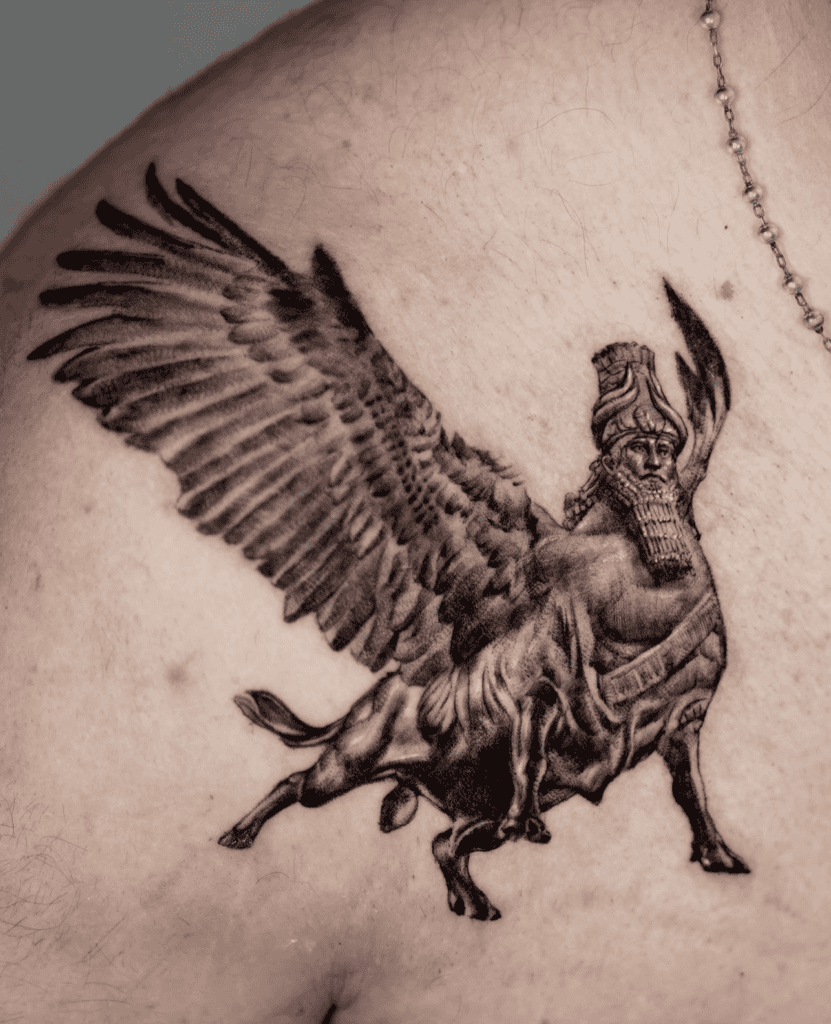
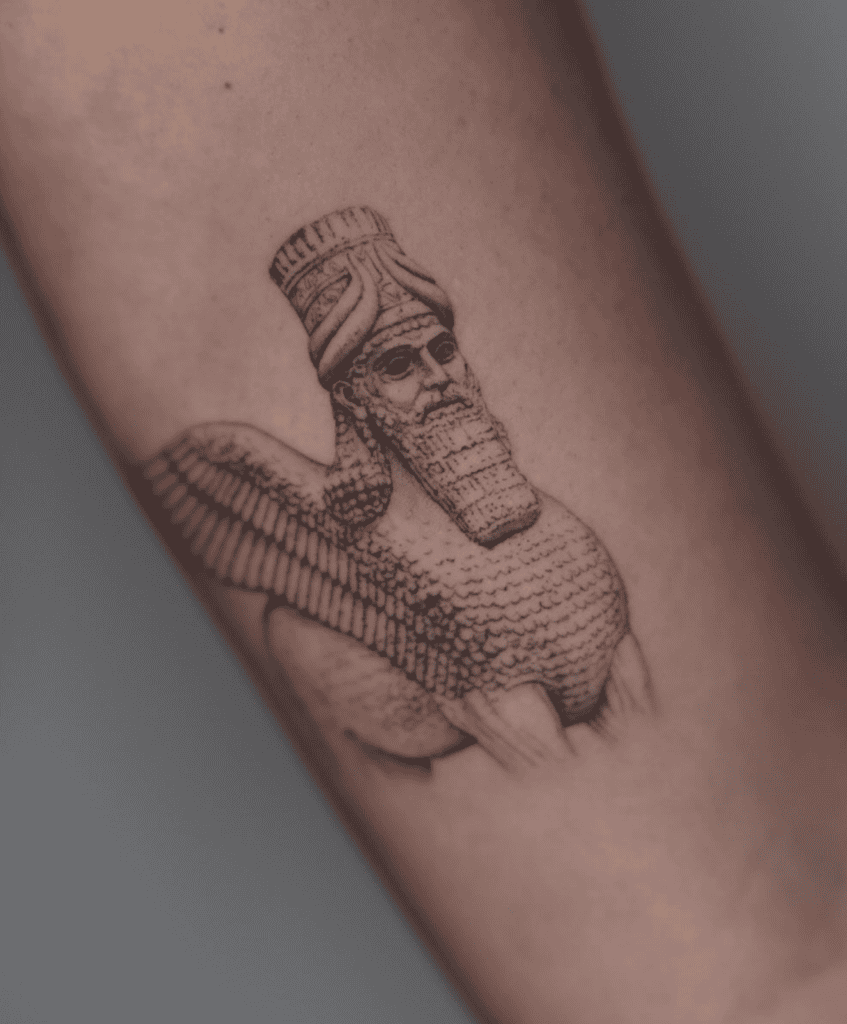
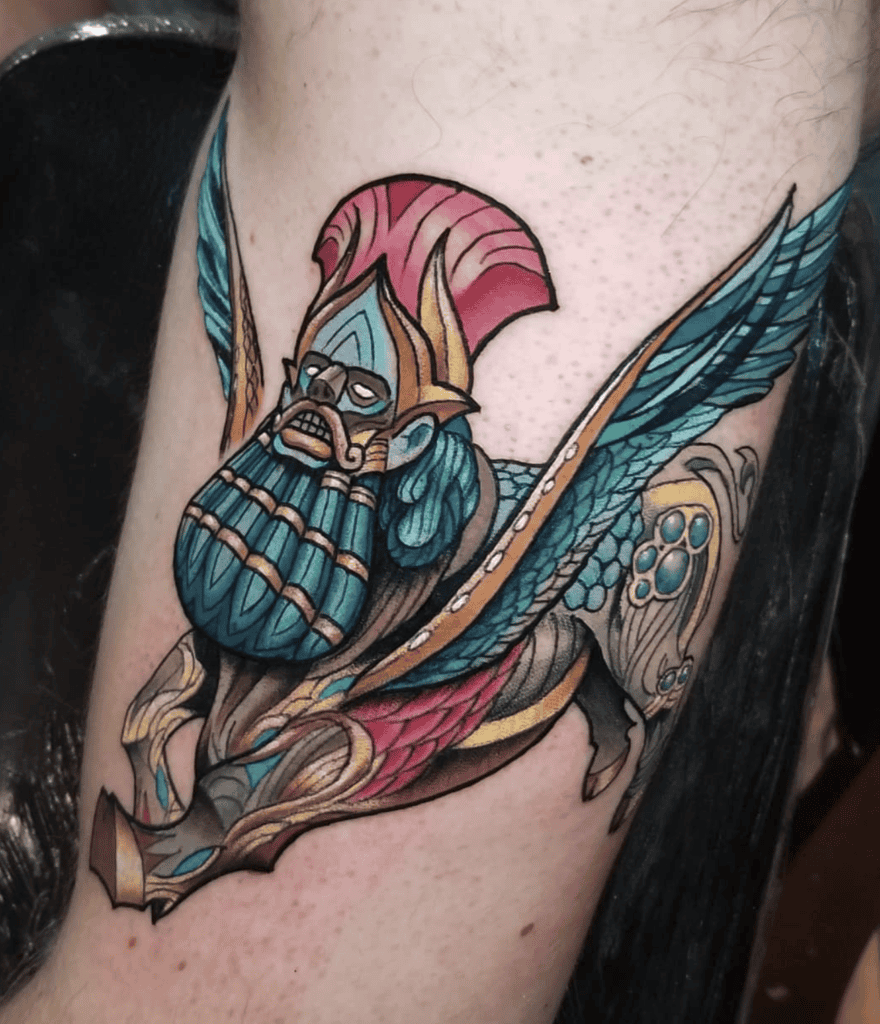
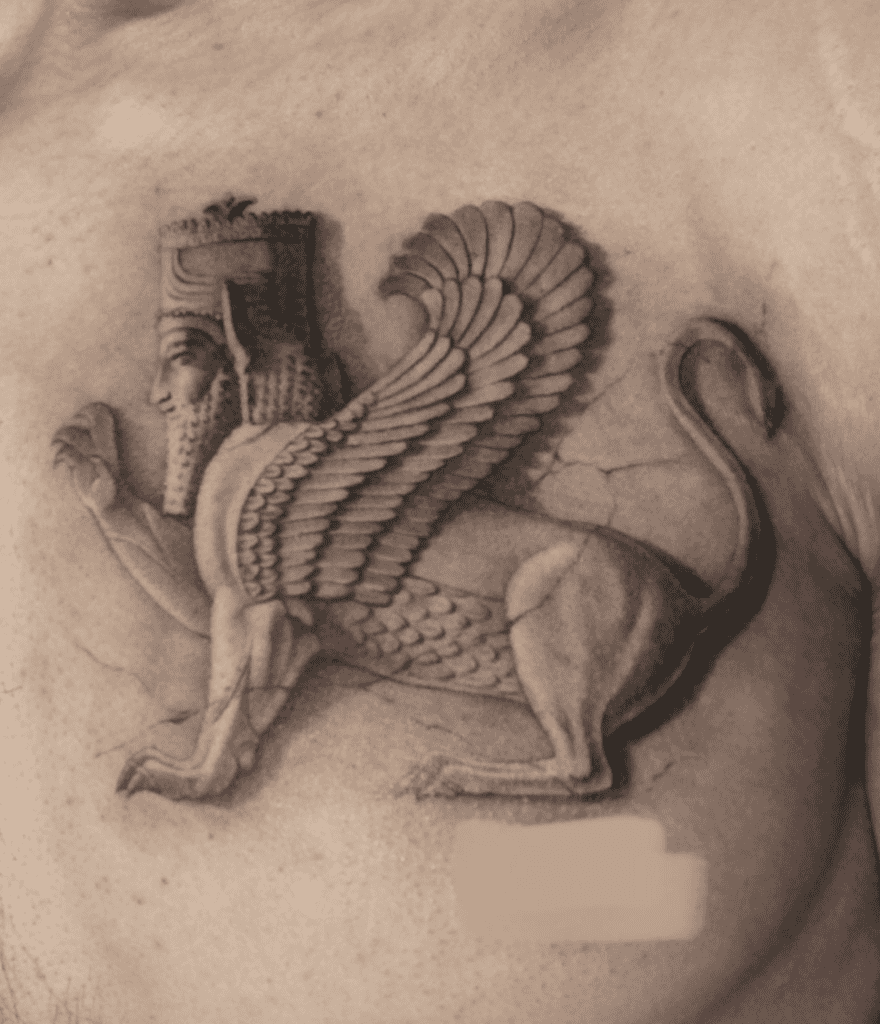
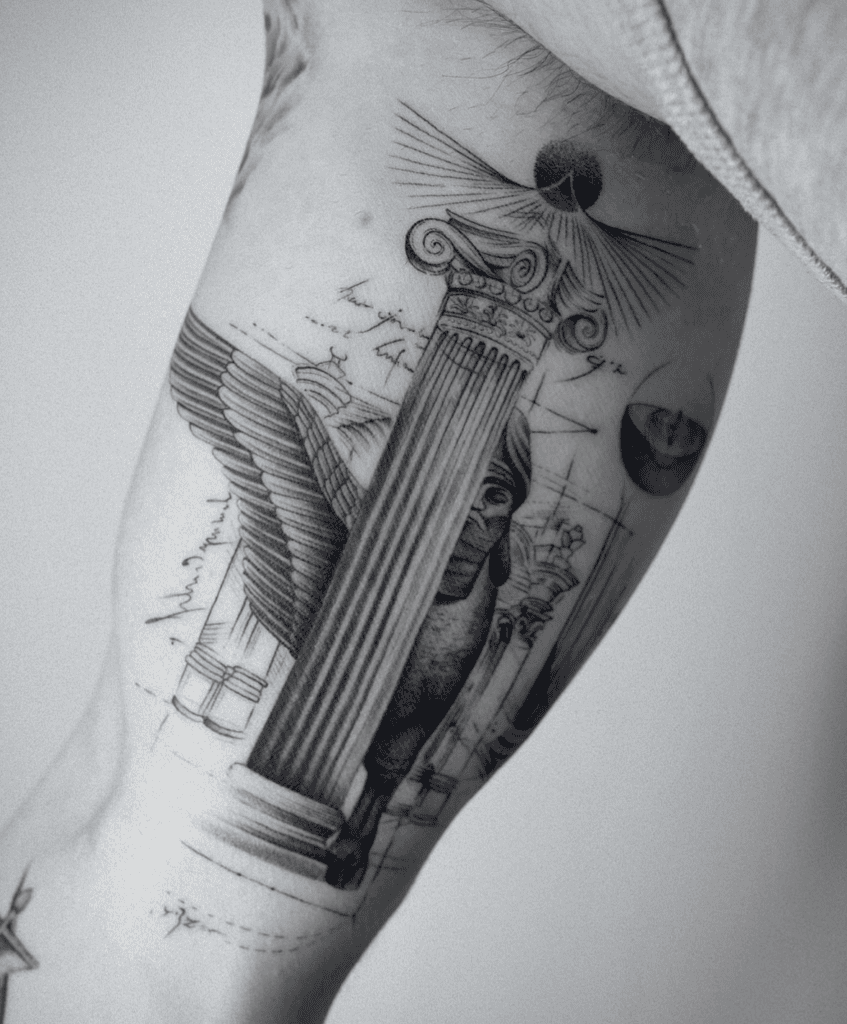
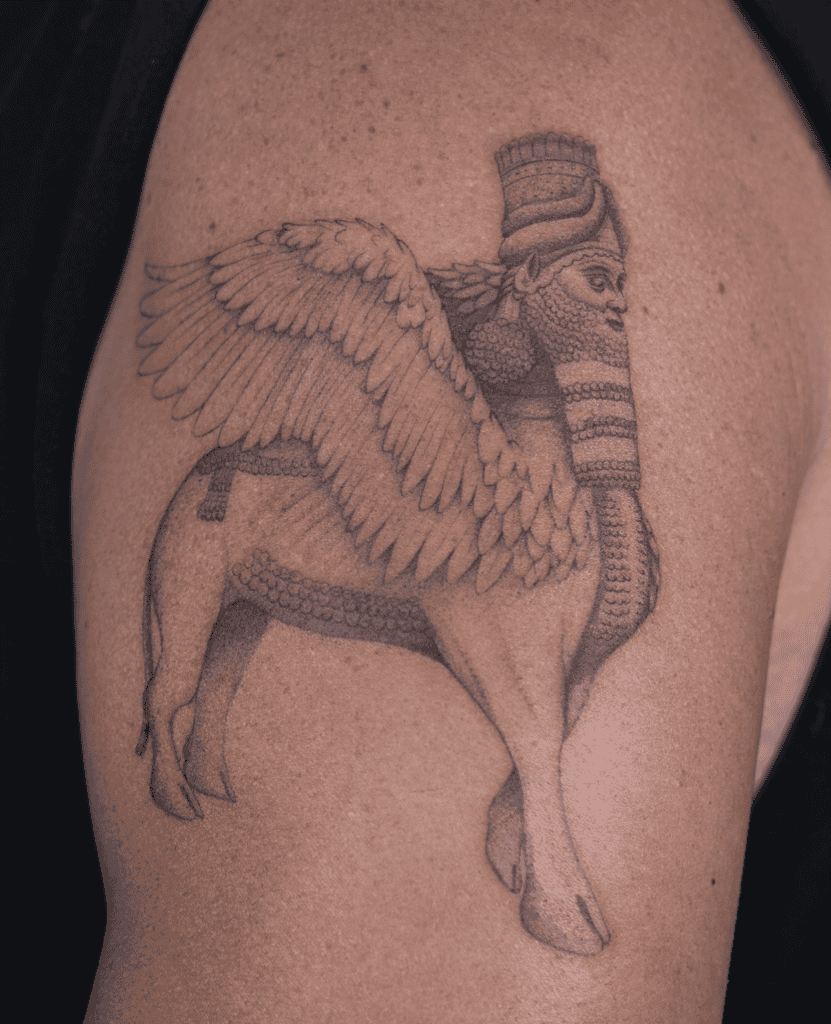
Lamassu was a protective deity and mythological guardian figure found in ancient Mesopotamian mythology, particularly in the art and architecture of the Neo-Assyrian Empire. Lamassu were believed to ward off evil, protect important places, and symbolise the strength and authority of kings.
The Lamassu combined the traits of several powerful beings into a single creature, being the head of a human, representing intelligence and wisdom, the body of a bull, symbolising strength and stability, sometimes the body of a lion, representing courage and royal power, and the wings of an eagle, signifying divinity and the ability to watch over the land.
Lamassu statues were often sculpted with five legs as viewed from the front, the Lamassu appeared to be standing still, guarding the entrance, while viewed from the side, it appeared to be walking forward, actively protecting the space.
The most famous Lamassu statues stood at the entrances of Assyrian palaces and cities. They were especially associated with rulers such as Ashurnasirpal II, Sargon II, and Sennacherib. Visitors entering royal palaces would pass between these enormous stone guardians, reinforcing the message that the king ruled under divine protection.
Pazuzu Mesopotamian Mythology Tattoo
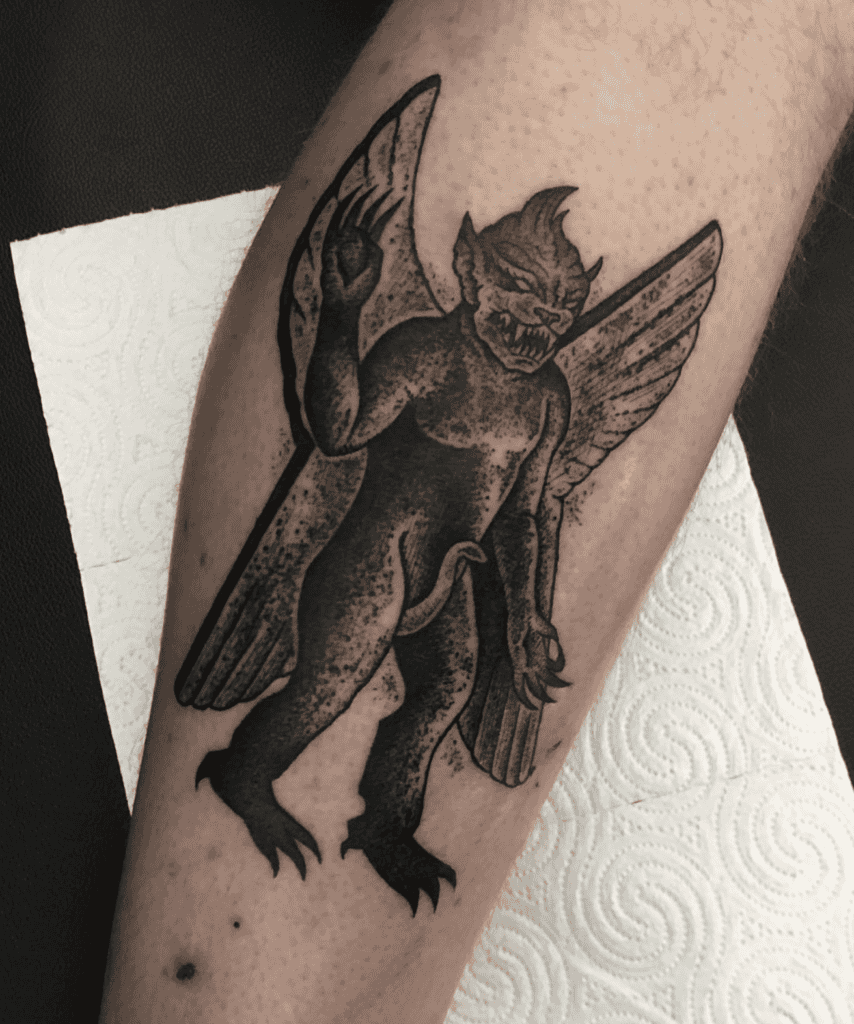
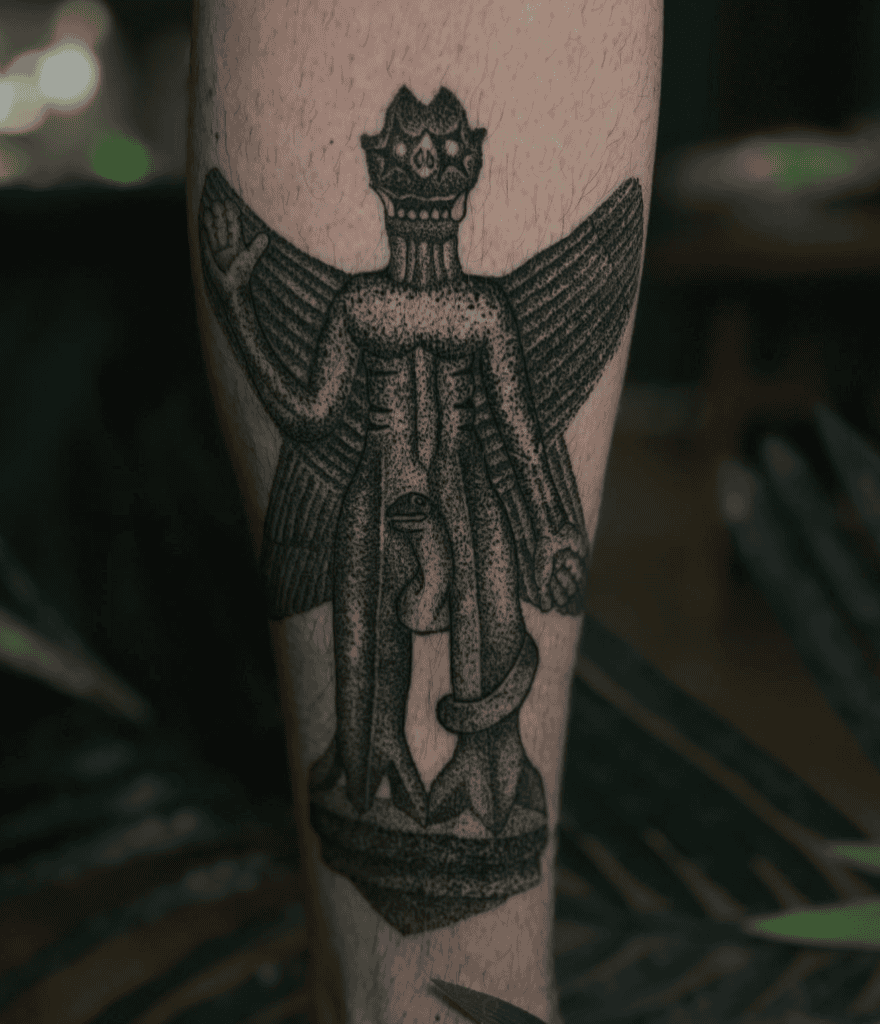
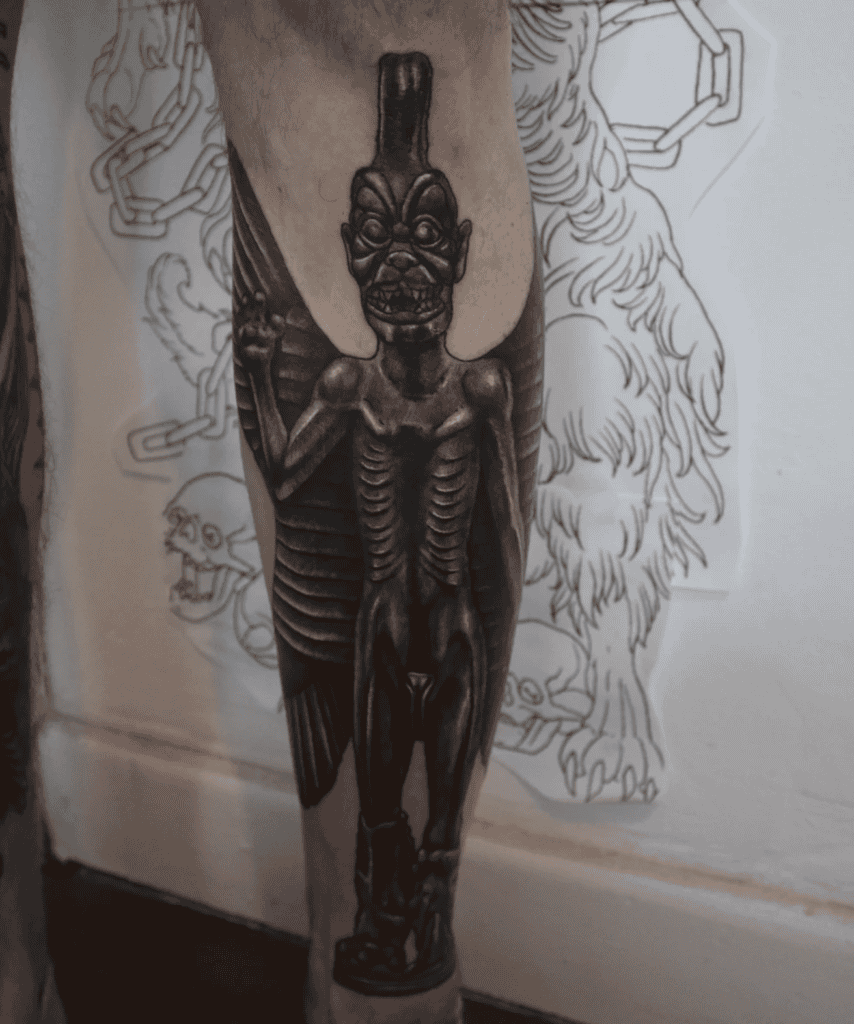
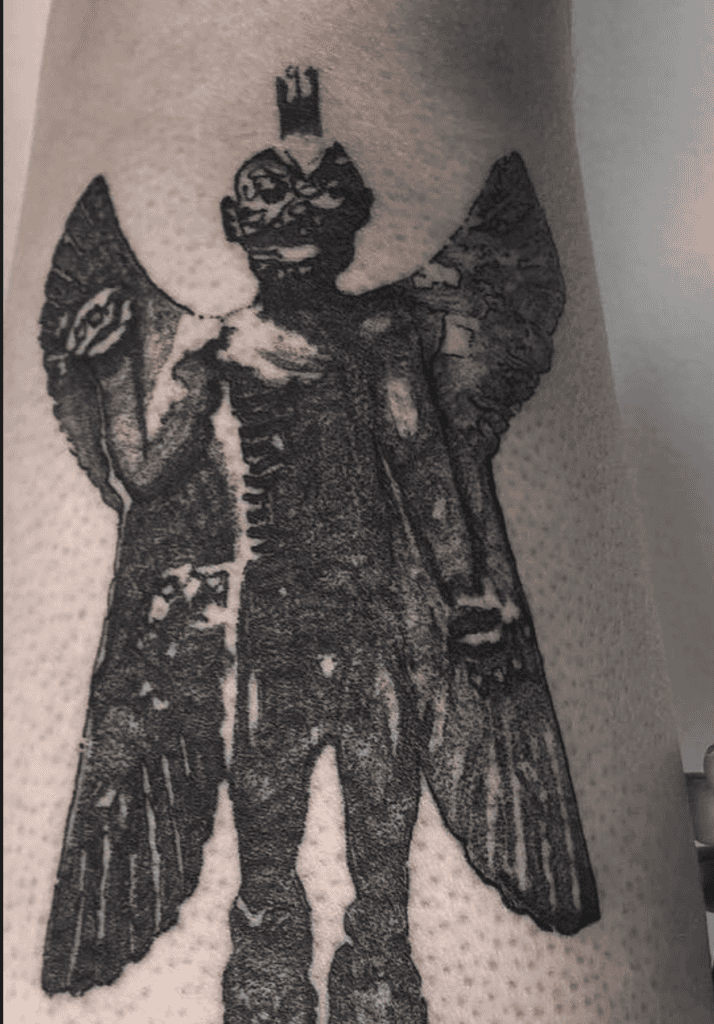
Pazuzu was a powerful demon from Mesopotamian mythology, best known as the king of the evil wind demons. He was especially associated with the southwestern wind, which could bring drought, famine, locusts, and disease. Although he was feared as a bringer of misfortune, he was also invoked as a protector against even more dangerous supernatural threats.
Pazuzu is most famous for his rivalry with Lamashtu. Lamashtu was a feared demoness believed to harm pregnant women, cause complications during childbirth and threaten infants and young children. Despite being a demon himself, Pazuzu was thought to drive Lamashtu away. As a result, people often wore Pazuzu amulets or kept small figurines of him in their homes to seek his protection.
Lamashtu Mesopotamian Mythology Tattoo

Lamashtu was a female demon associated with illness, misfortune, and harm to pregnant women and infants. Unlike many other harmful supernatural beings in Mesopotamian belief, Lamashtu was considered an independent entity who acted according to her own will, rather than serving as a subordinate to a god or demon.
She represented some of the greatest anxieties of ancient life, particularly the dangers surrounding pregnancy, childbirth, and early childhood, which were periods of high risk in the ancient world. Because infant mortality rates were high in antiquity, fears surrounding Lamashtu became deeply embedded in Mesopotamian culture.
Ancient amulets and plaques depict Lamashtu as a terrifying hybrid with the head of a lioness, the ears and teeth of a donkey, the body of a woman, bird-like talons instead of feet, snakes held in her hands, and was sometimes accompanied by a pig and a dog nursing at her breast.
Lilith Mesopotamian Mythology Tattoo
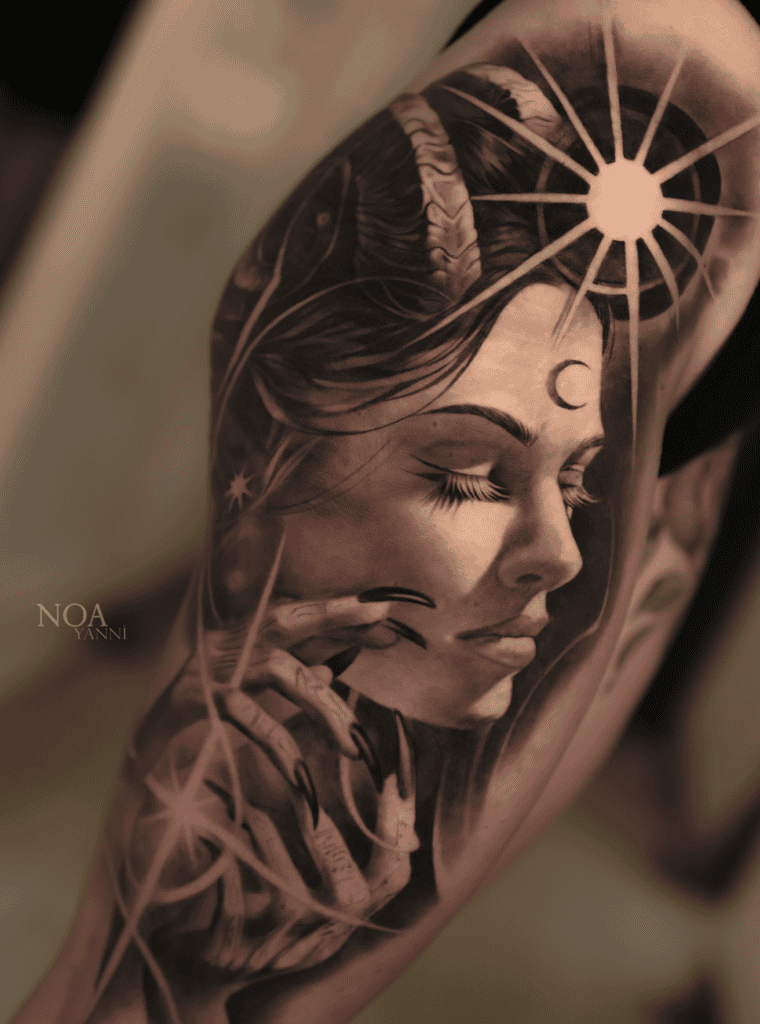
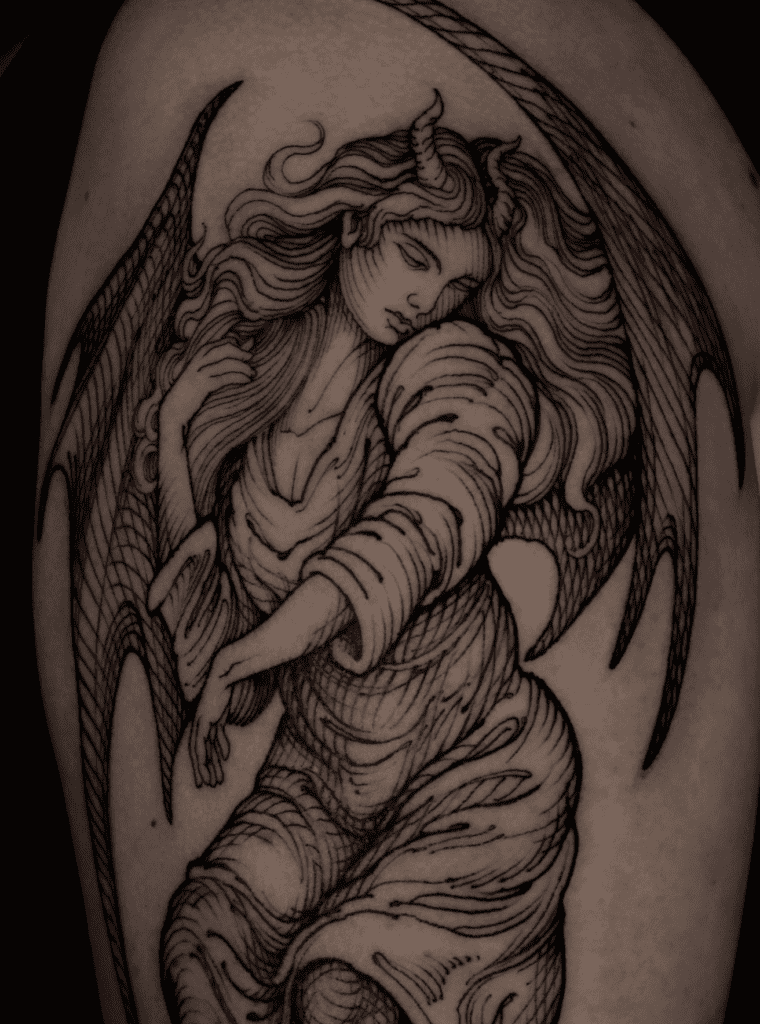
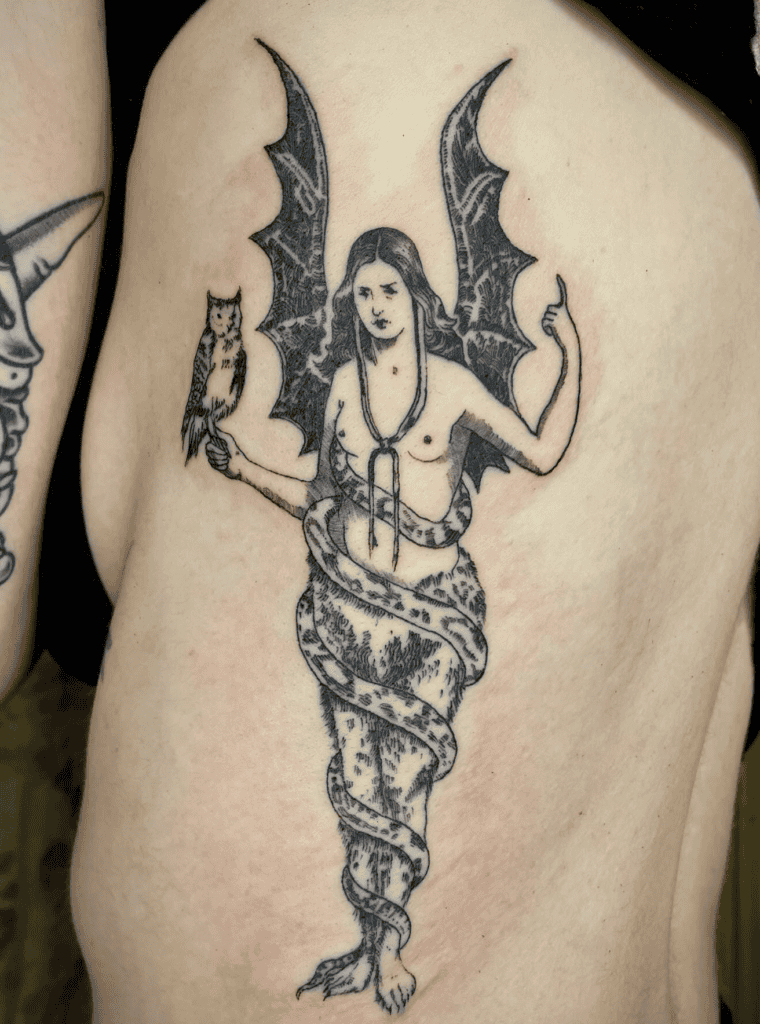
Lilith is a mythological figure most strongly associated with Jewish folklore, although her origins may trace back to much older Mesopotamian traditions involving female night spirits.
Over thousands of years, Lilith evolved dramatically. Depending on the source, she has been portrayed as a night spirit or demon, a threat to newborn children and pregnant women, a mysterious winged female figure, Adam’s first wife in later Jewish folklore, or a modern symbol of independence and female autonomy.
Some scholars believe Lilith may have been influenced by Mesopotamian spirits known as lilû, lilītu, and ardat lilî. These beings were associated with the night, wind and storms, disease and misfortune, and difficulties related to love and childbirth. However, the connection between these Mesopotamian spirits and the later Lilith of Jewish tradition remains debated among scholars.
Asag Mesopotamian Mythology Tattoo

Asag was a fearsome demon and a monstrous embodiment of chaos in Sumerian mythology. He is best known as the principal antagonist in the myth “Lugal-e” (also known as The Exploits of Ninurta), where he wages war against the gods and disrupts the natural order of the world.
Asag represented disorder, sickness, and the untamed forces that threatened civilisation itself. In a society that depended heavily on agriculture and irrigation, anything that disturbed the balance of nature could have devastating consequences.
Asag commanded an army of living stones who fought alongside him against the gods. In Mesopotamian thought, mountains were often seen as distant and potentially dangerous places outside the boundaries of civilisation. Asag’s connection with stones and mountains may therefore symbolise the threatening forces beyond the ordered world of cities and farmland.
When Asag unleashed chaos upon the world, Ninurta rose to confront him. Initially, the struggle proved difficult, but with encouragement from his enchanted weapon, Sharur, Ninurta ultimately defeated Asag in a mighty battle, restoring stability to the cosmos.
Marduk Mesopotamian Mythology Tattoo
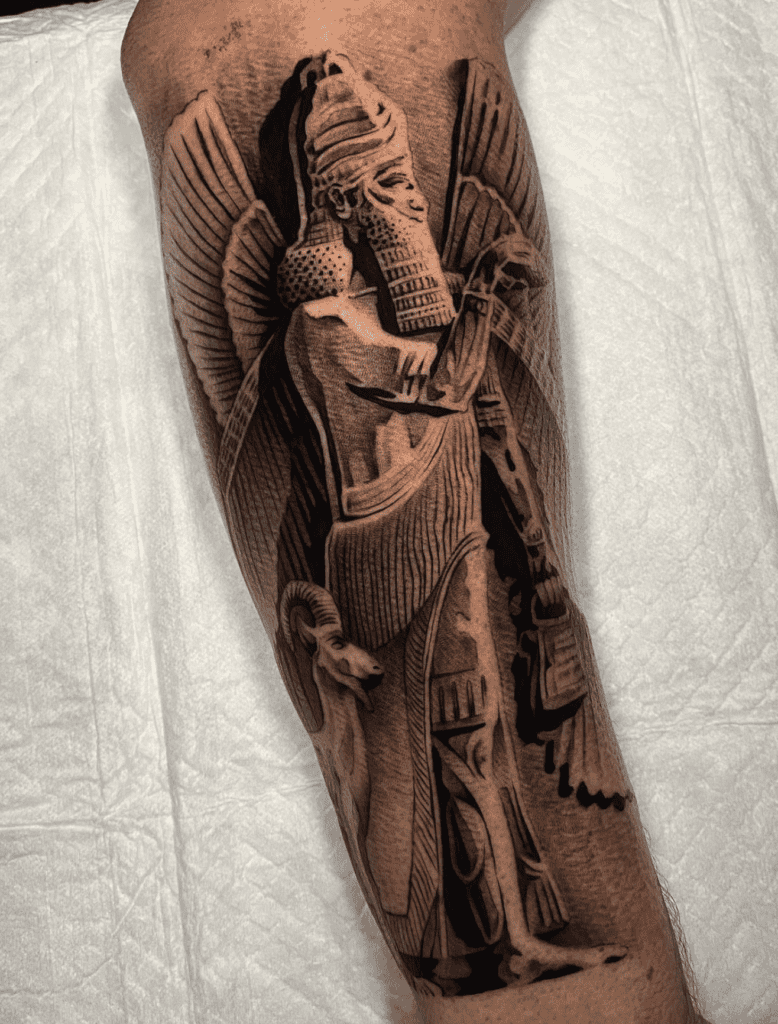
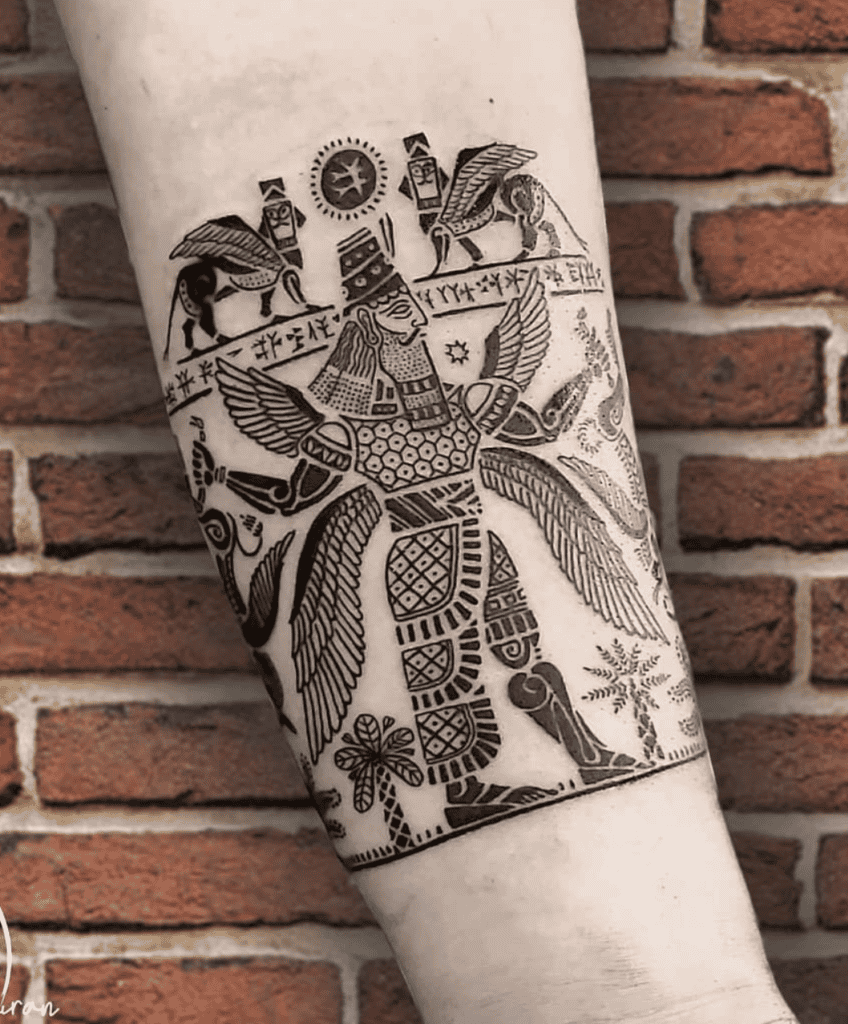
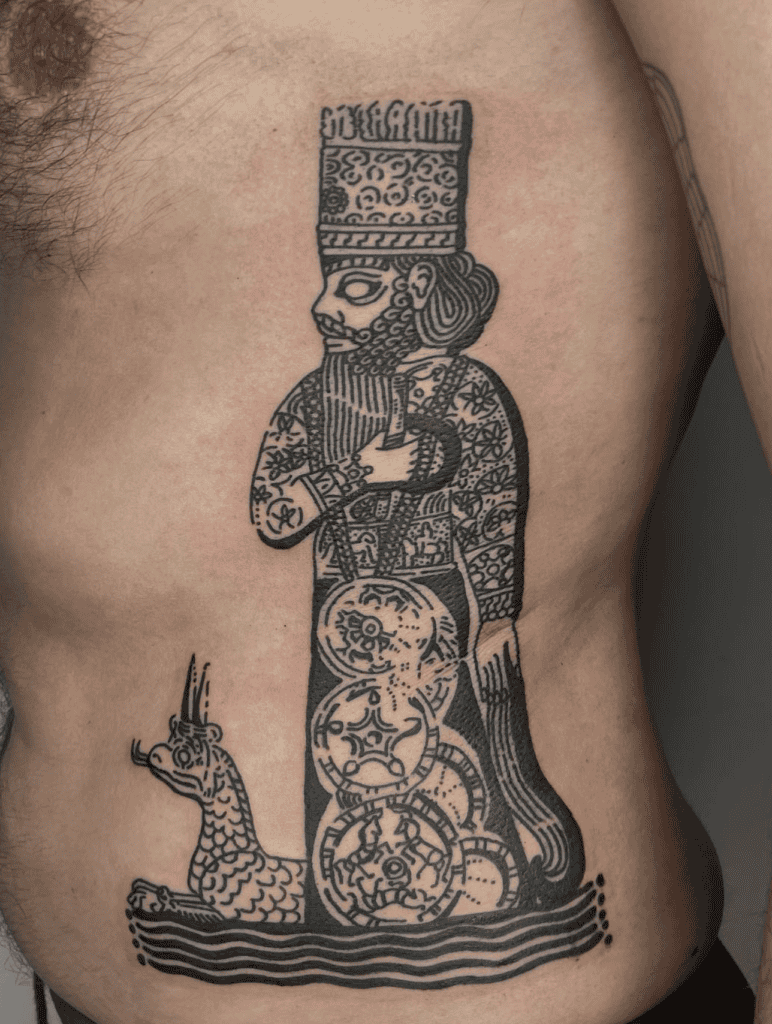
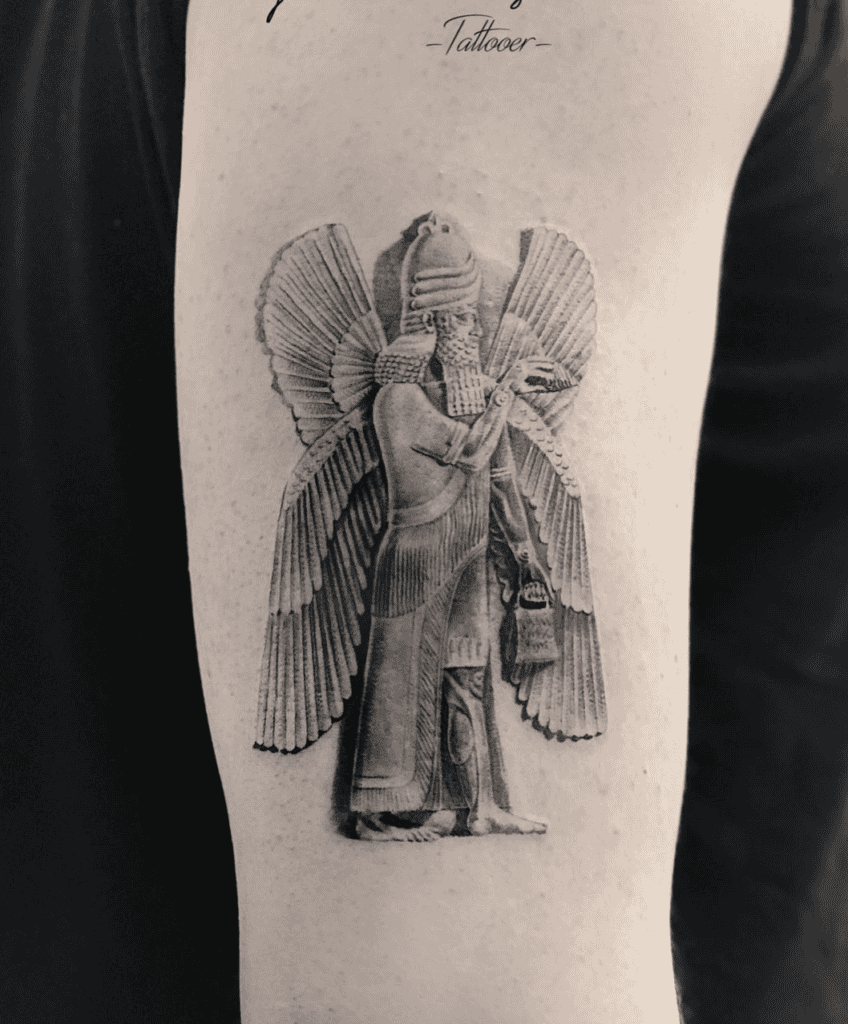
Marduk was the patron god of Babylon and the supreme deity of the Babylonian pantheon. Over time, he rose from being a relatively local god to becoming the king of the gods, associated with creation, kingship, justice, wisdom, and divine authority.
Marduk is best known as the hero of the Babylonian creation epic, the Enuma Elish, where he defeats the primordial goddess Tiamat and fashions the cosmos from her remains. As his importance grew, he gradually absorbed qualities and responsibilities once associated with other gods.
Nabu Mesopotamian Mythology Tattoo

Nabu was the Babylonian god of wisdom, writing, literacy, and scribes, regarded as the divine patron of knowledge and record-keeping, overseeing everything from royal decrees and scholarly learning to the destinies of individuals.
As Babylonian civilisation placed great importance on administration, law, and education, Nabu became one of the most beloved and influential deities in Mesopotamia.
One of Nabu’s most important functions involved the writing of destinies. Mesopotamians believed that Nabu recorded the decisions and fates decreed by the gods. In some traditions, he was connected with the Tablet of Destinies, though this powerful object is more commonly linked with myths involving Enlil, Anzû, and Marduk.
Nisroch Mesopotamian Mythology Tattoo
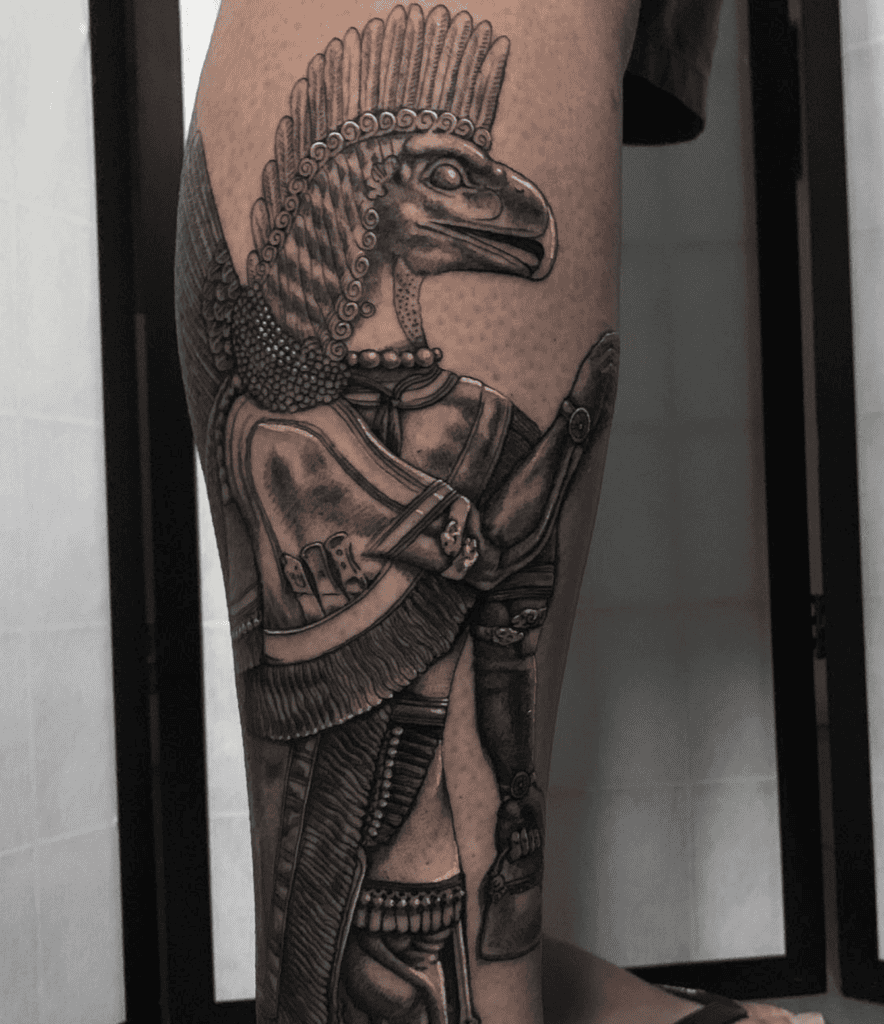
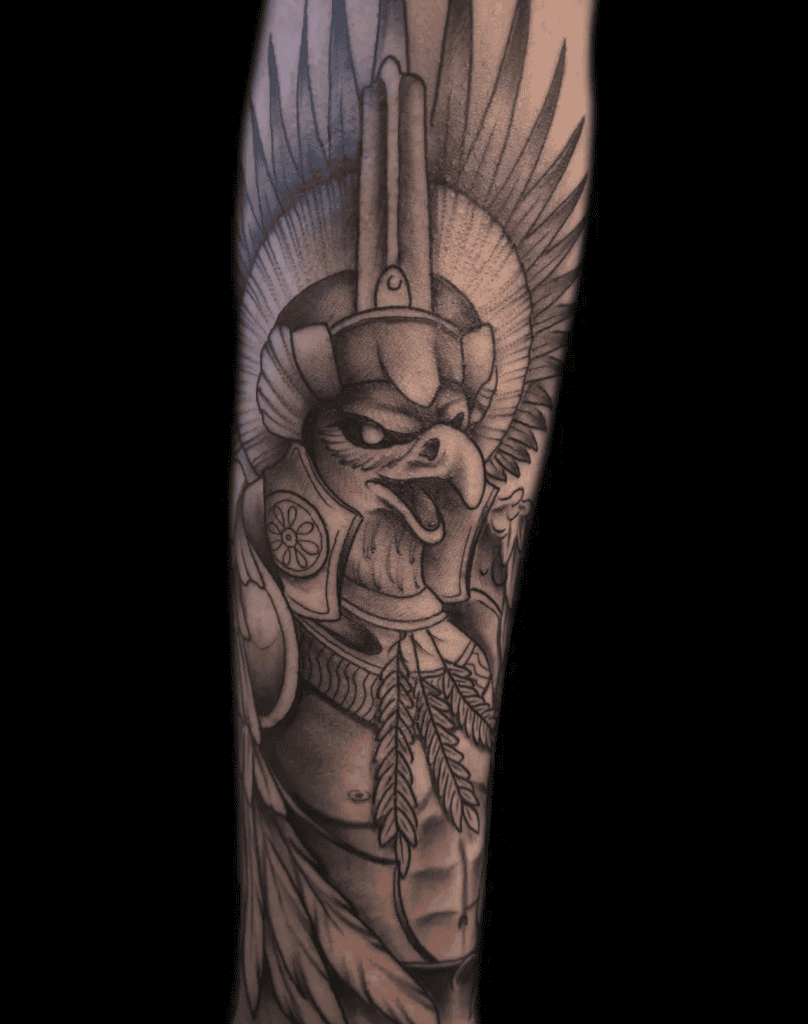
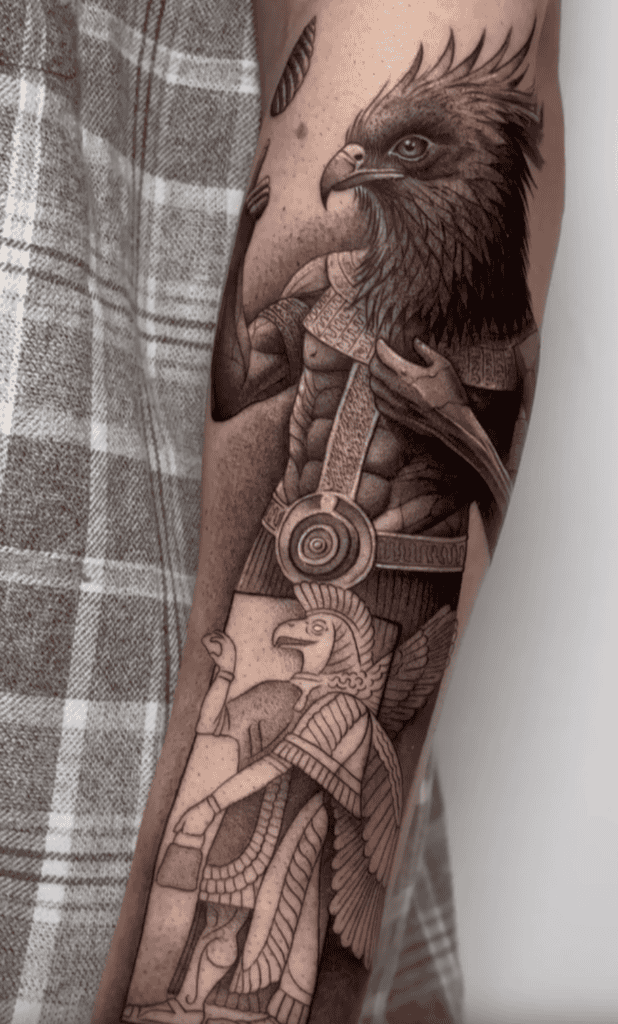
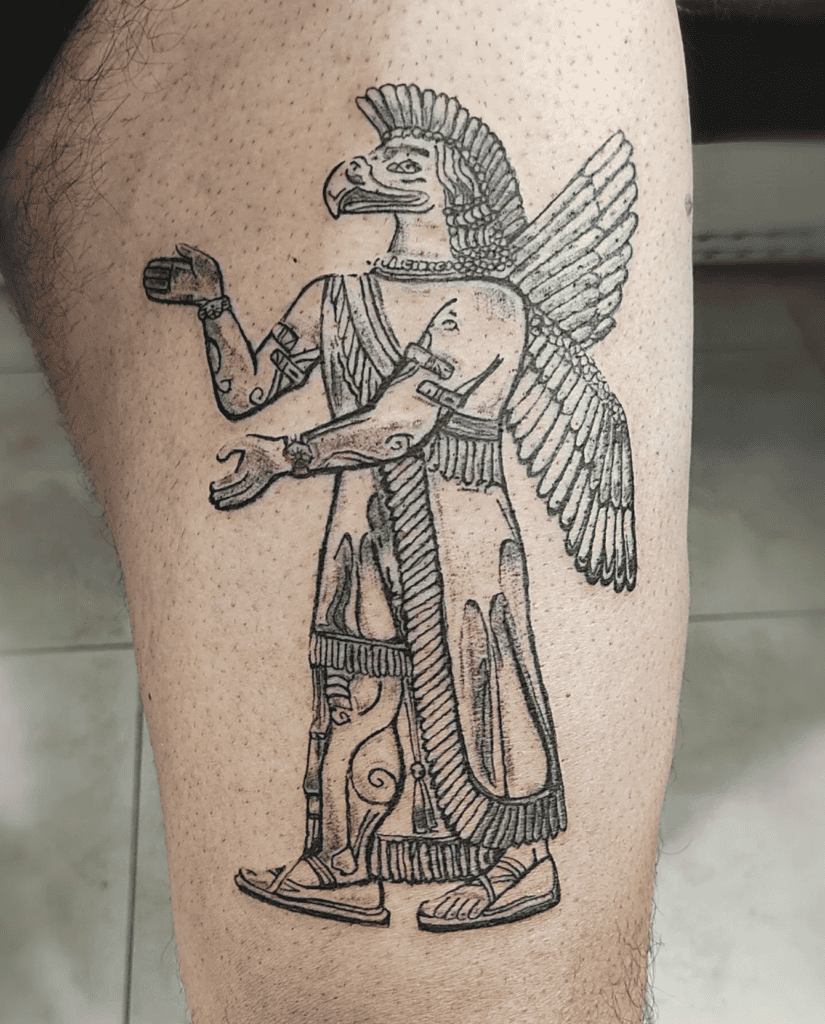
Nisroch is a mysterious figure mentioned in the Hebrew Bible, traditionally described as a god worshipped by the Assyrians. However, unlike deities such as Marduk, Ishtar, or Nabu, very little is known about Nisroch, and scholars continue to debate his true identity.
Nisroch appears in two parallel passages in the Hebrew Bible: Second Book of Kings (2 Kings 19:37) and Book of Isaiah (Isaiah 37:38). According to these texts, after the Assyrian king Sennacherib returned to Nineveh, he was assassinated by two of his sons while worshipping in the temple of Nisroch.
Sennacherib was worshipping in the house of Nisroch, his god, when he was struck down by his sons. This brief mention is the primary source for Nisroch’s existence. Despite extensive evidence for Assyrian religion, no major Assyrian deity named Nisroch has been definitively identified.
Some researchers believe that “Nisroch” may have resulted from a copying mistake over centuries of manuscript transmission. If true, the original name may have referred to another Assyrian god.
Ashur Mesopotamian Mythology Tattoo
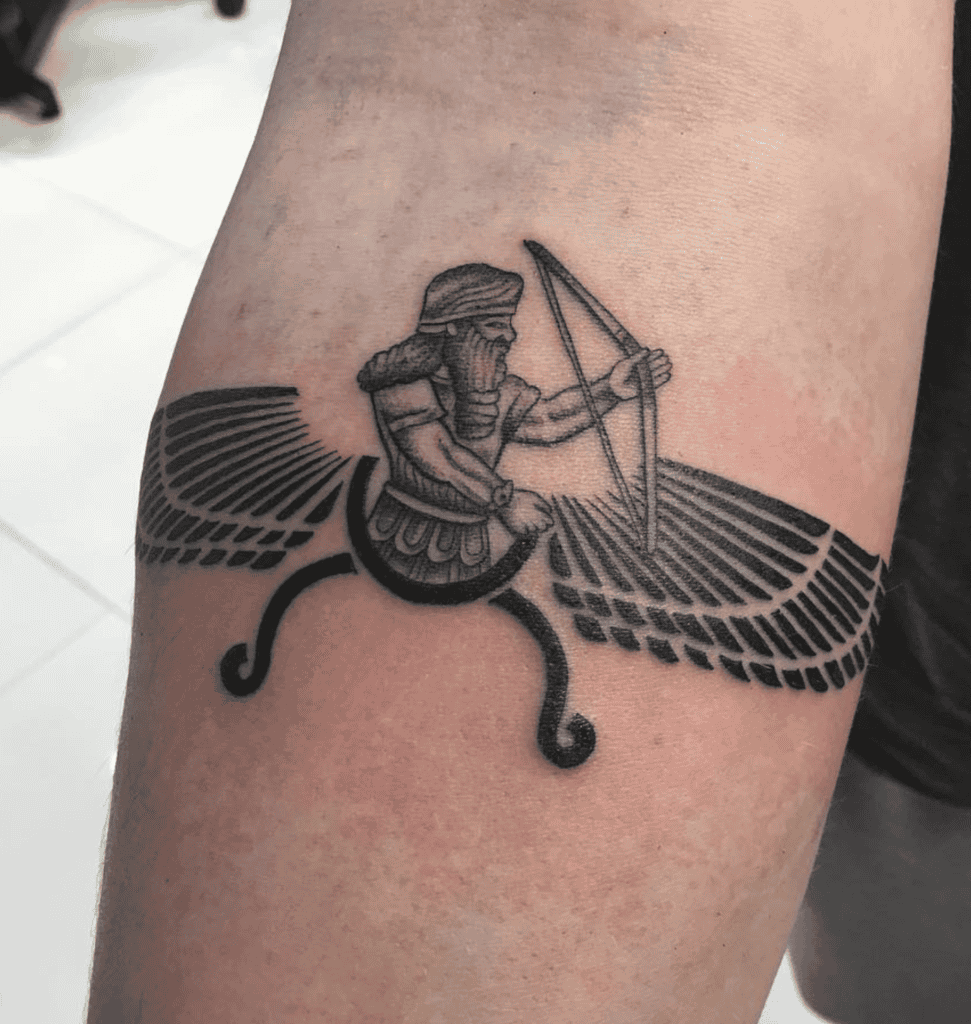
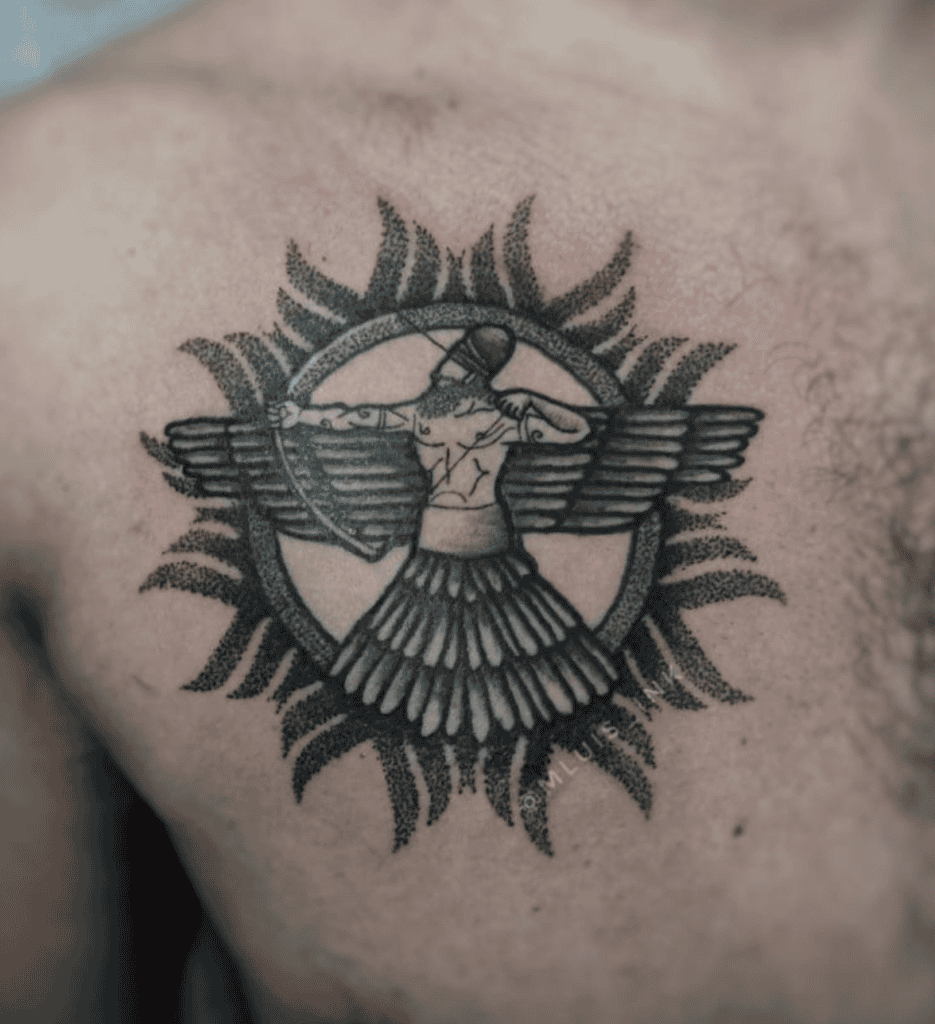
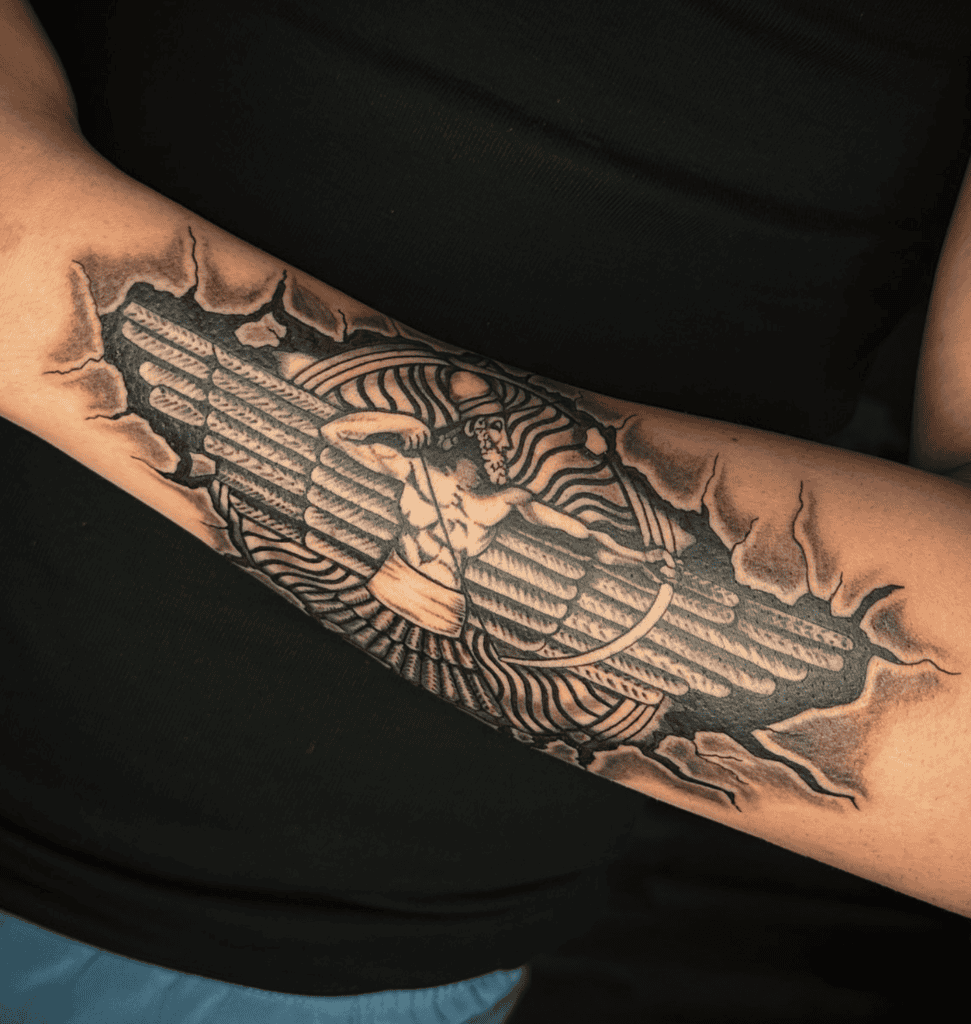
Ashur (also spelt Aššur or Assur) was the supreme deity of the Assyrian people and the patron god of the Assyrian Empire. Just as Marduk became closely associated with Babylon, Ashur became the divine embodiment of Assyria itself.
Unlike many Mesopotamian gods who had extensive mythological narratives, Ashur was especially important as a national deity, representing kingship, military success, justice, and the destiny of the Assyrian state.
Ashur appears to have originated as the deified spirit of the city of Ashur, one of the oldest and most important Assyrian settlements. As Assyria expanded from a city-state into a powerful empire, Ashur’s status grew as well. Eventually, he became the king of the gods in Assyrian religion, protector of Assyria, guardian of justice and order, and the patron of Assyrian military campaigns.
Assyrian kings did not usually claim to be gods themselves. Instead, they described themselves as “the representative” or “vice-regent” of Ashur, meaning that kings ruled on behalf of the god.
As Assyria interacted with Babylonian traditions, Ashur adopted characteristics similar to those of Marduk. In some Assyrian versions of Babylonian myths, Ashur effectively took Marduk’s place, becoming the champion who defeated cosmic chaos.
Ashurbanipal Mesopotamian Mythology Tattoo
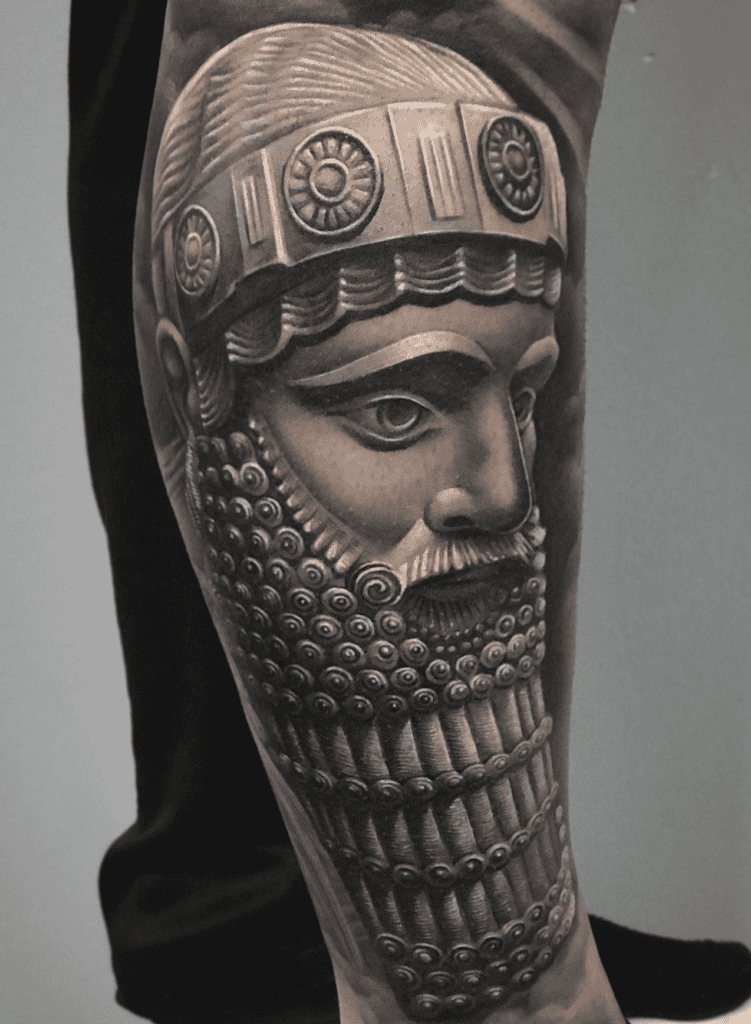
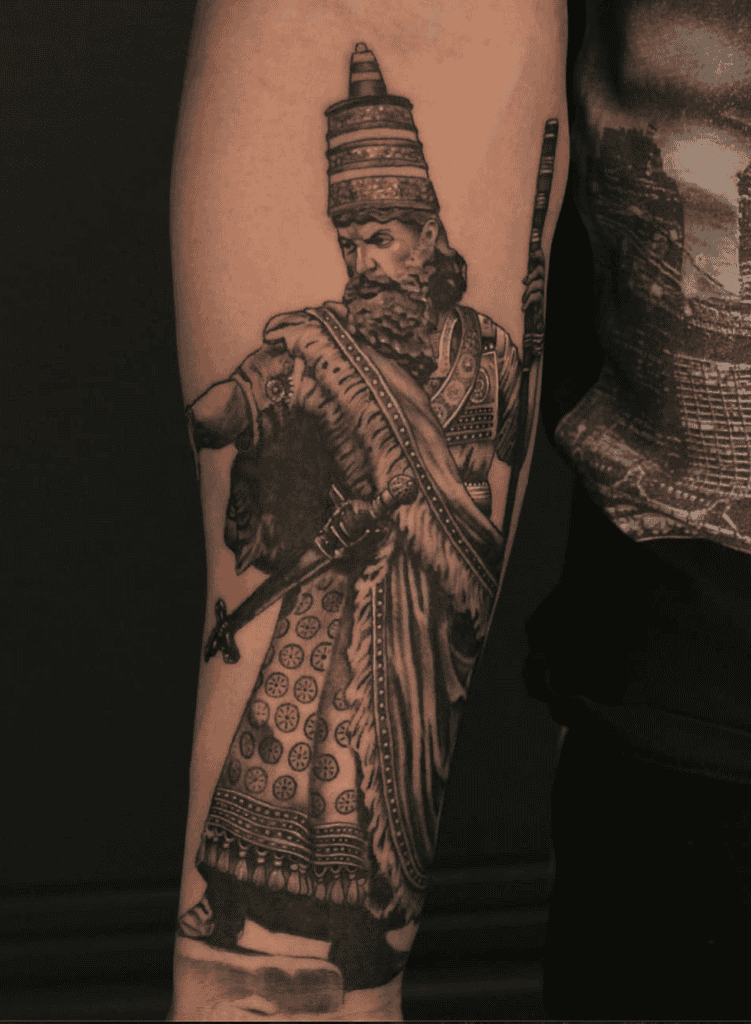
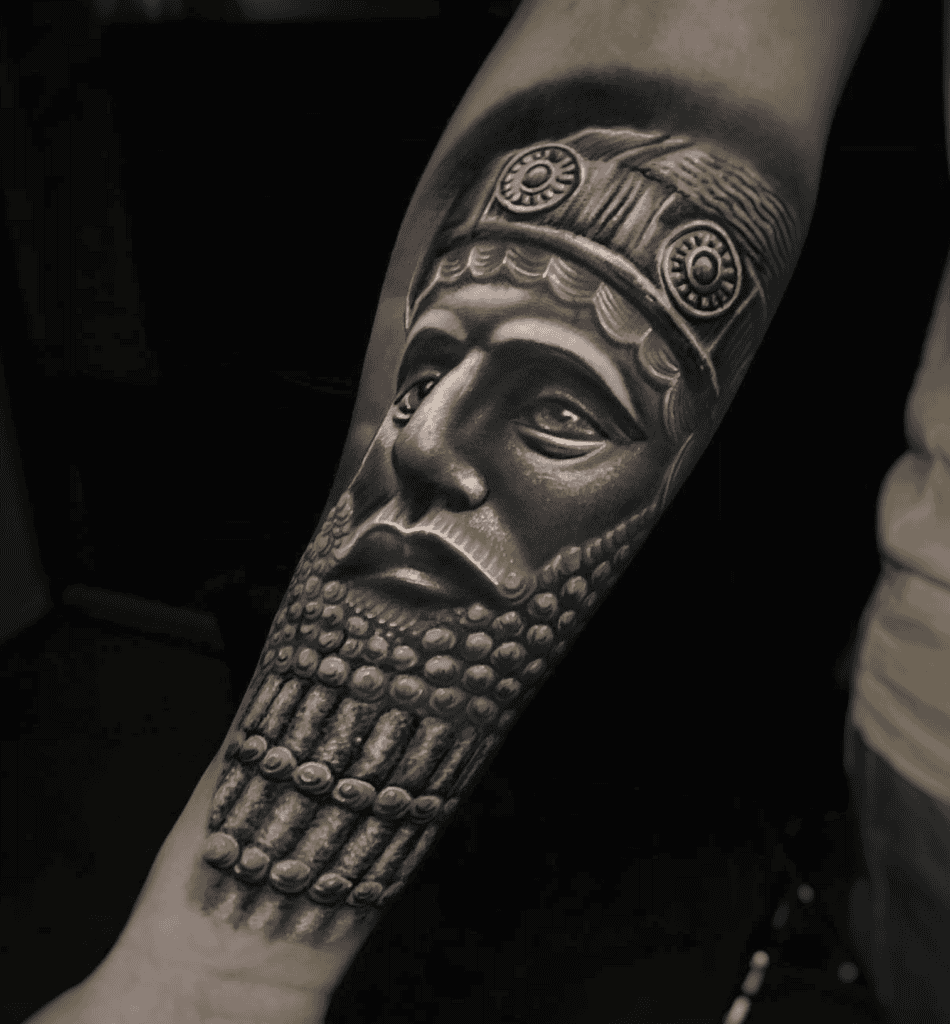
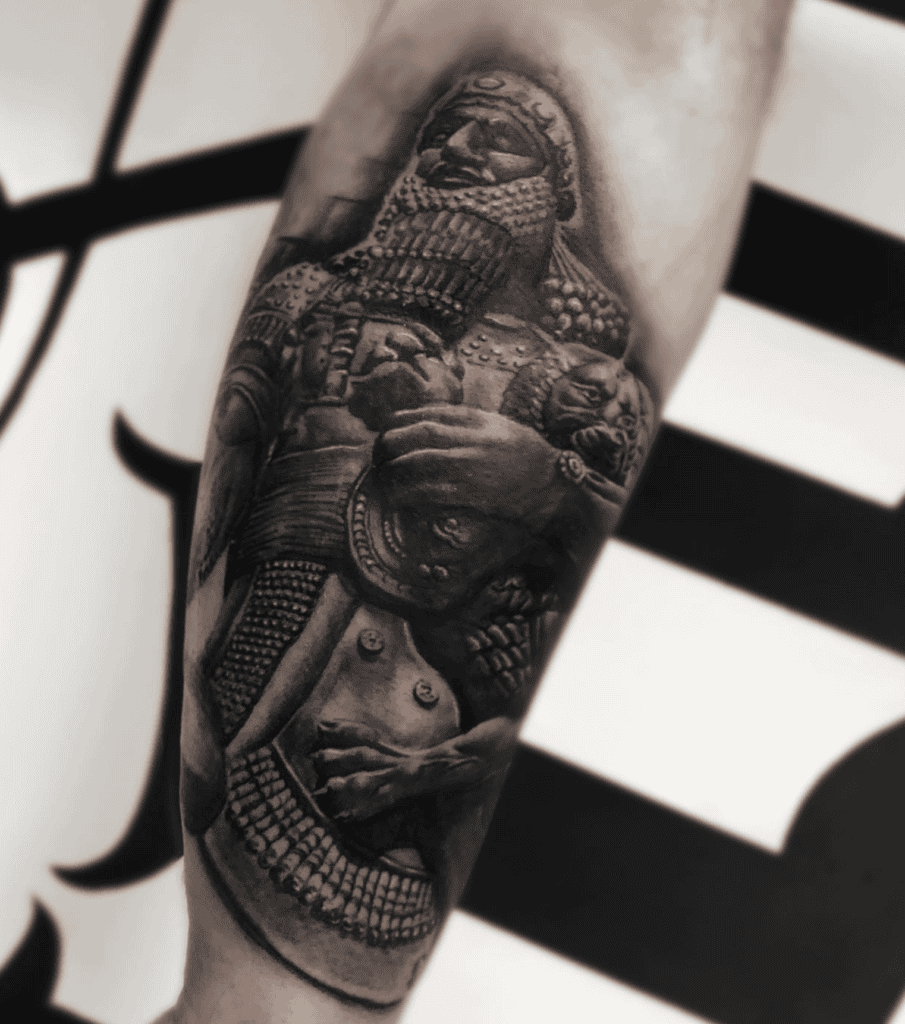
Ashurbanipal was the last great king of the Neo-Assyrian Empire, reigning from approximately 669 to 631 BCE. He is remembered both as a powerful military ruler and as one of the ancient world’s greatest patrons of knowledge.
Unlike many kings of his era, Ashurbanipal took pride not only in his battlefield achievements but also in his ability to read and write, which was a rare skill among rulers of the ancient Near East.
Today, he is perhaps best known for creating the famous Library of Ashurbanipal, which preserved thousands of cuneiform tablets and helped ensure that many Mesopotamian myths survived into the modern age.
Sargon of Akkad Mesopotamian Mythology Tattoo
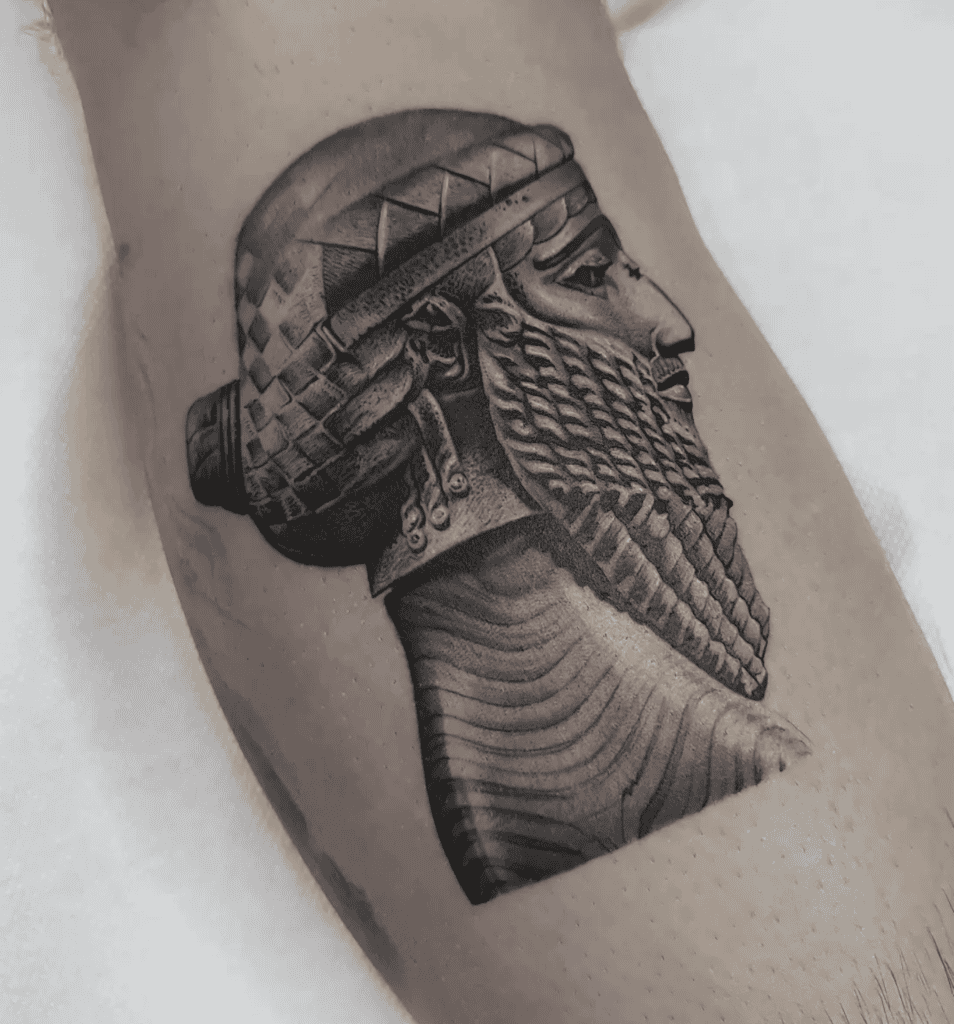
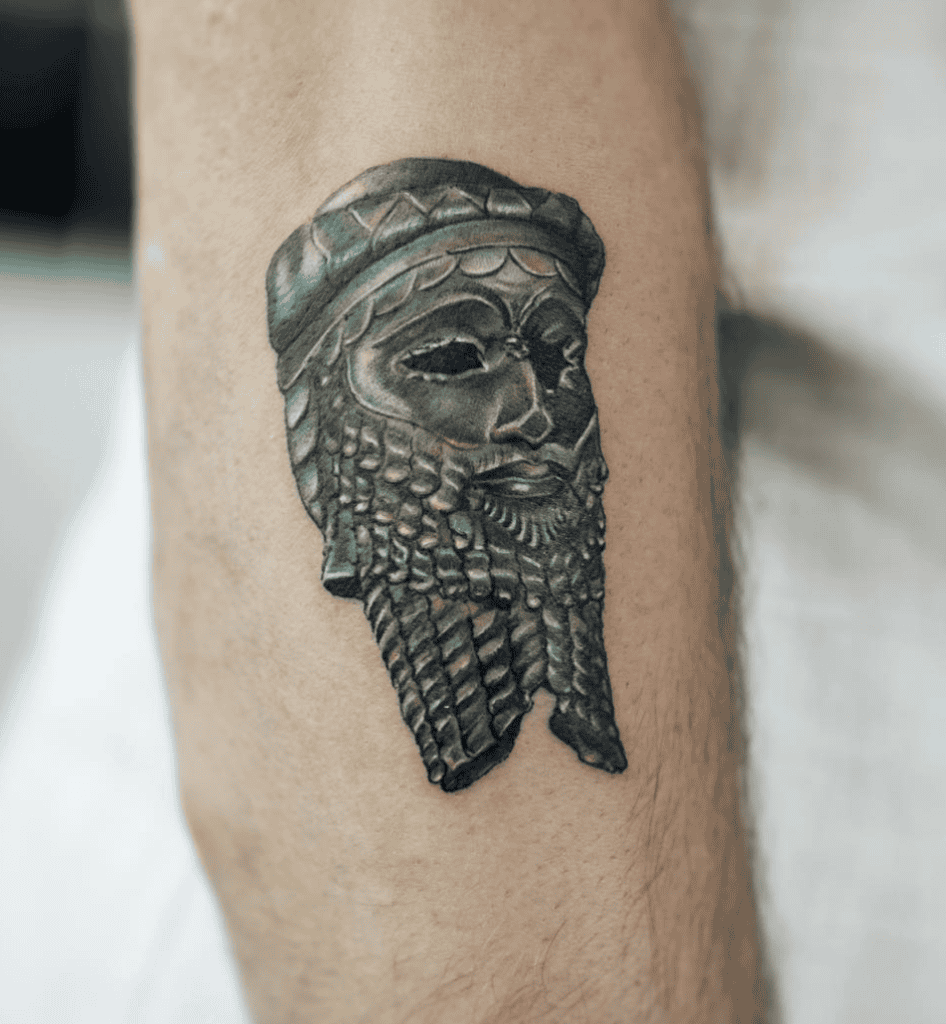
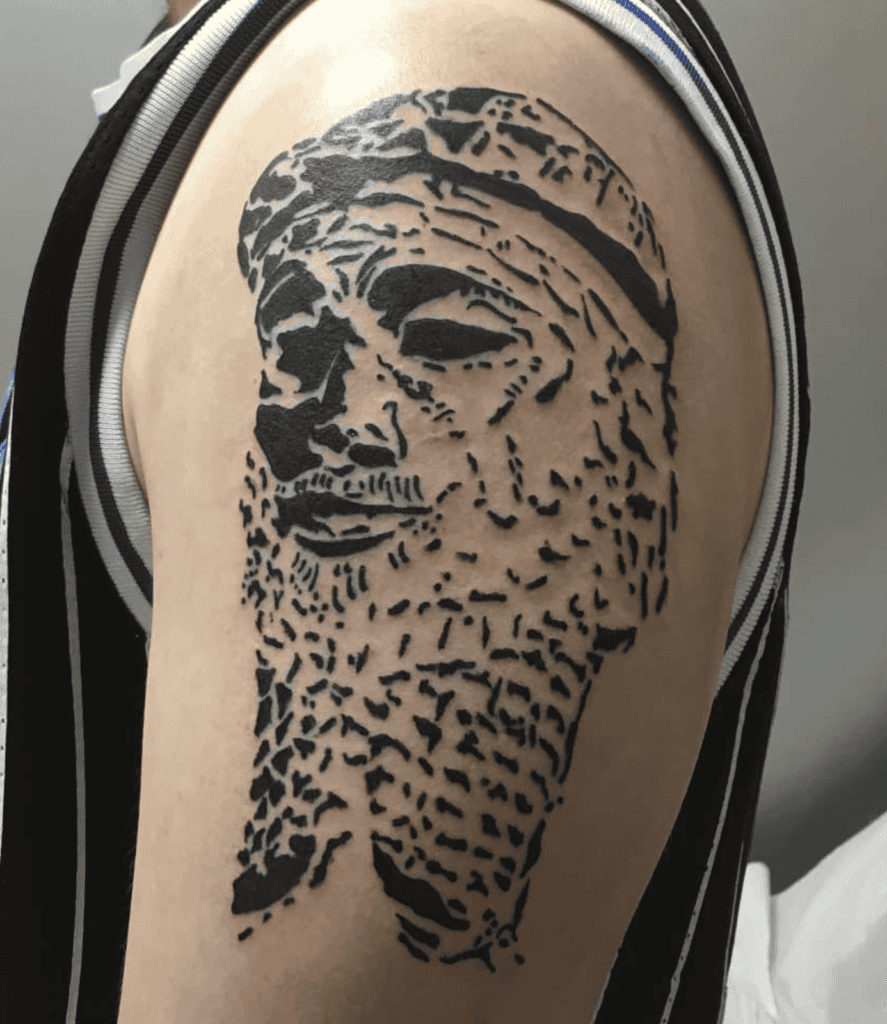
Sargon of Akkad (reigned c. 2334–2279 BCE, according to the Middle Chronology) was the founder of the Akkadian Empire, which is often regarded as the world’s first multinational empire.
He united numerous Sumerian city-states under a single ruler and expanded his authority across much of Mesopotamia and beyond. Because of his remarkable achievements, Sargon became one of the most famous kings of the ancient Near East, and later generations looked back on him as a model conqueror.
The name Sargon comes from the Akkadian Šarru-kīn, which means “The legitimate king” or “the true king.” According to later Mesopotamian legends, Sargon was born to a high-ranking priestess and was placed in a basket made of reeds. The basket was set afloat on a river, and he was rescued and raised by a gardener named Aqqi.
Historical records suggest that Sargon initially served as a cupbearer to King Ur-Zababa of Kish. In the ancient Near East, a cupbearer was often a trusted official rather than merely a servant.
At some point, Sargon rebelled against existing rulers and seized power. One of his most famous victories was against Lugal-zagesi, who had united much of Sumer before Sargon’s rise. After defeating Lugal-zagesi, Sargon consolidated control over the region.
Sargon established the Akkadian Empire, which stretched across large parts of Mesopotamia. At its height, his empire likely extended into areas corresponding to parts of modern Iraq, Syria, Turkey, and Iran. Sargon’s rule helped shift Mesopotamia from a collection of independent city-states toward a more centralised imperial system.
Conclusion
Thanks for joining us on this journey through the cradle of civilisation. We hope the Tablets of Destiny will guide you on your faith toward your perfect Mesopotamian Mythology Tattoo designs. But if Mesopotamian Tattoos still aren’t epic enough for you, why not scale Mount Olympus with these Greek Mythology Tattoos designs, cross the vast desert with these Persian Mythology Tattoos, or take a journey to the east with these Chinese Mythology Tattoos.
- Cartoon Tattoo Ideas - September 7, 2026
- Courage the Cowardly Dog Tattoo Ideas - September 3, 2026
- JoJo’s Bizarre Adventure Tattoo Ideas - September 1, 2026