

Norse Mythology Tattoo Ideas

Do you feel like you’re caught in an endless chase across the skies in your quest for some of the most legendary Tattoo Clues? Well, worry not—we’ve got some of the most electrifying Norse Mythology Tattoo Designs the Nine Realms have to offer.
What Is Norse Mythology
Norse mythology is a collection of ancient stories, beliefs, and legends that come from the Norse people of Scandinavia (modern-day Norway, Sweden, Denmark, and Iceland) during the Viking Age (roughly 800–1100 AD). These myths were originally passed down orally before being written in texts like the Poetic Edda and Prose Edda.
Norse mythology stands out because it’s not just about powerful gods—it’s about fate, struggle, and inevitability. The gods are not immortal forever, as everything is moving toward an inevitable event called Ragnarök, which is the end—and rebirth—of the world. This gives Norse mythology a darker, more realistic tone compared to many other mythologies.
Best Norse Mythology Tattoo Artists


thrudtattoo_rougebarbe
French based Tattoo artist specialising in “Epic and brutal Dwarven/Norse Tattoos.”

badgerkingtattoo
Nordic and Celtic Freehand Tattoo based in Rugby, United Kingdom.

Shogantattoo
Jersey, United Kingdom Tattoo artist specialising in Nordic & Celtic Tattooing.

Noromaor
Normandie, Beuzeville based Tattoo artists specialising in Nordic – Viking Tattoos.

Wovnwyrm.tattoo
Copenhagen Tattoo artist specialising in historical Nordic/Pagan influenced ornamental design as well as illustrations inspired by nature, folklore and history.
Best Norse Mythology Tattoo Ideas
Now that we know a little about Norse Mythology, let’s take a look at some of the best Norse Mythology Tattoos the internet has to offer.
Odin Norse Mythology Tattoo
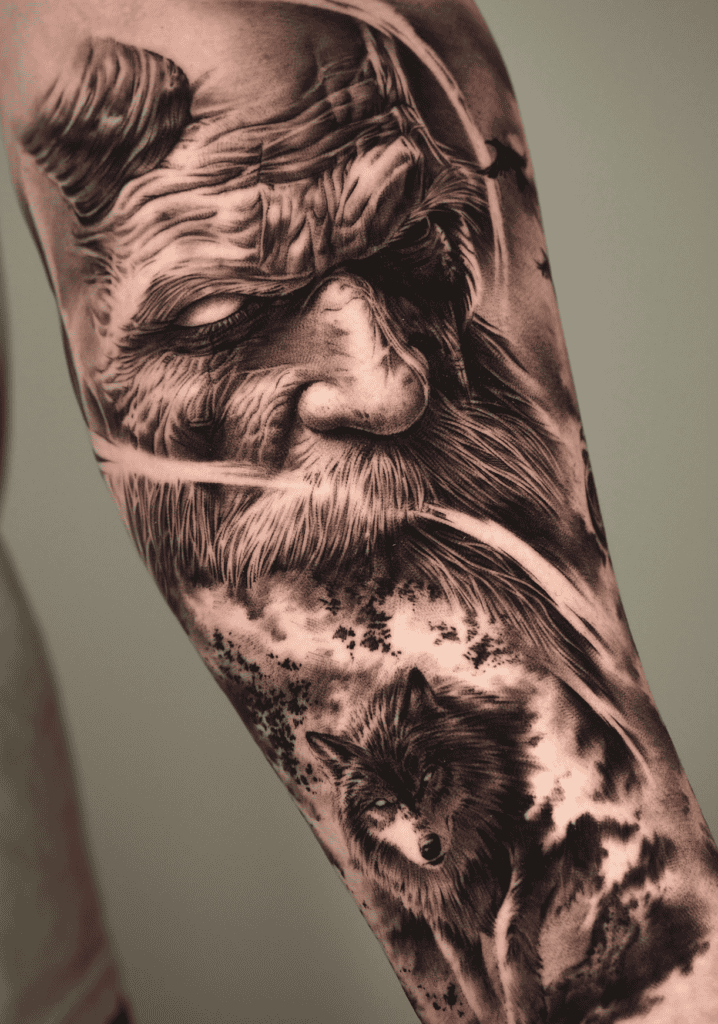
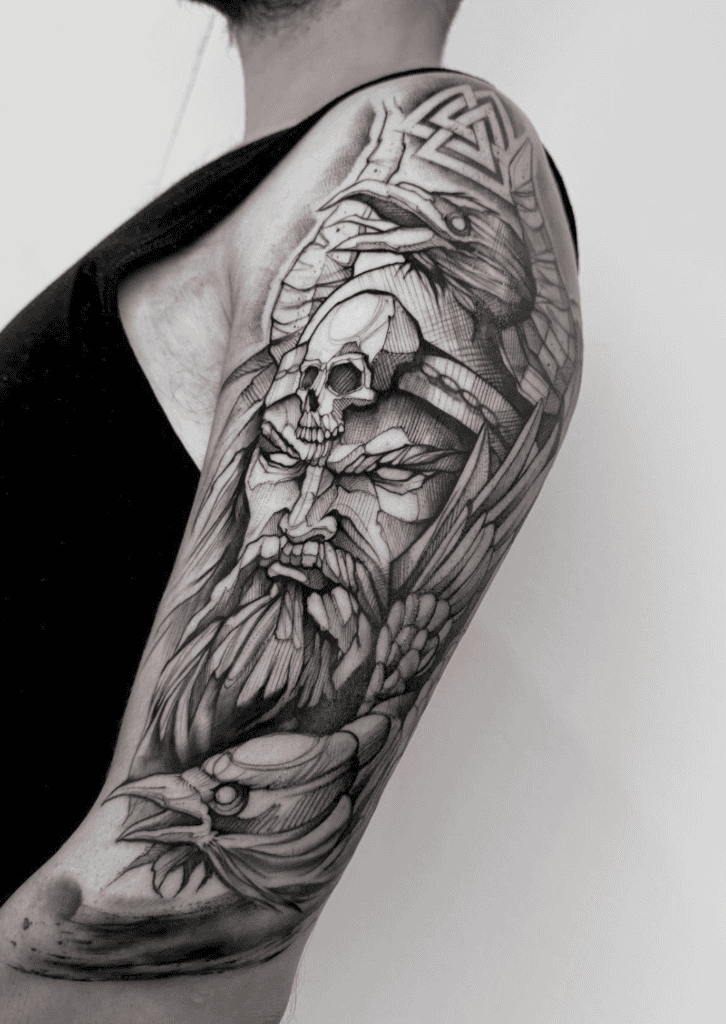
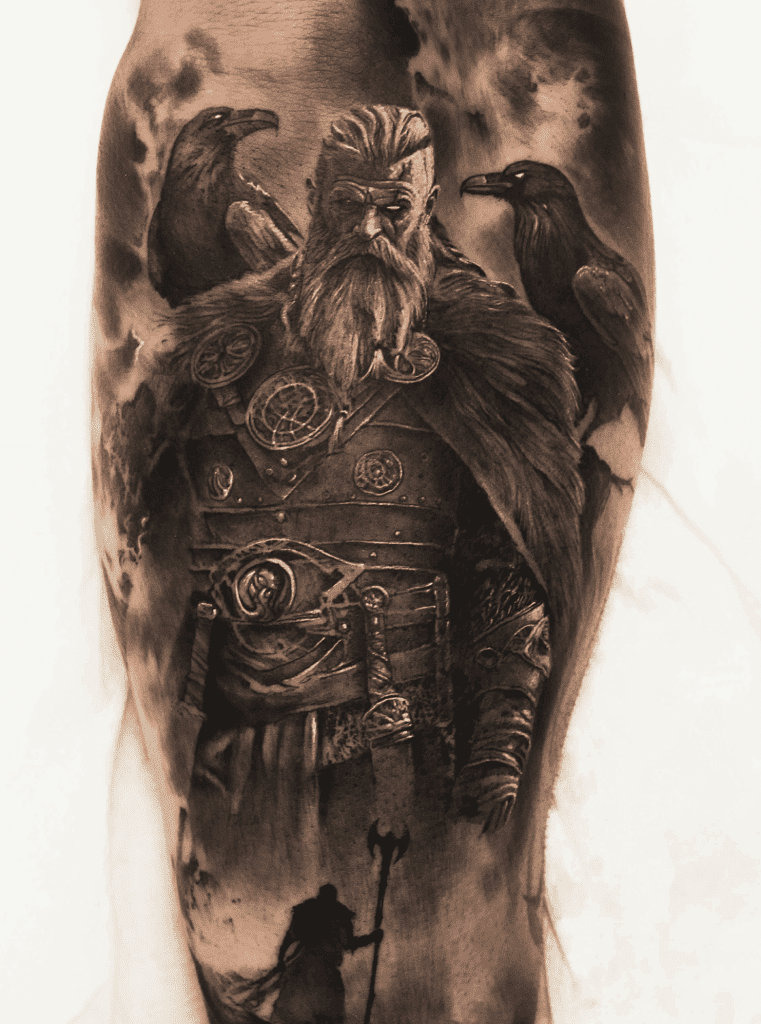
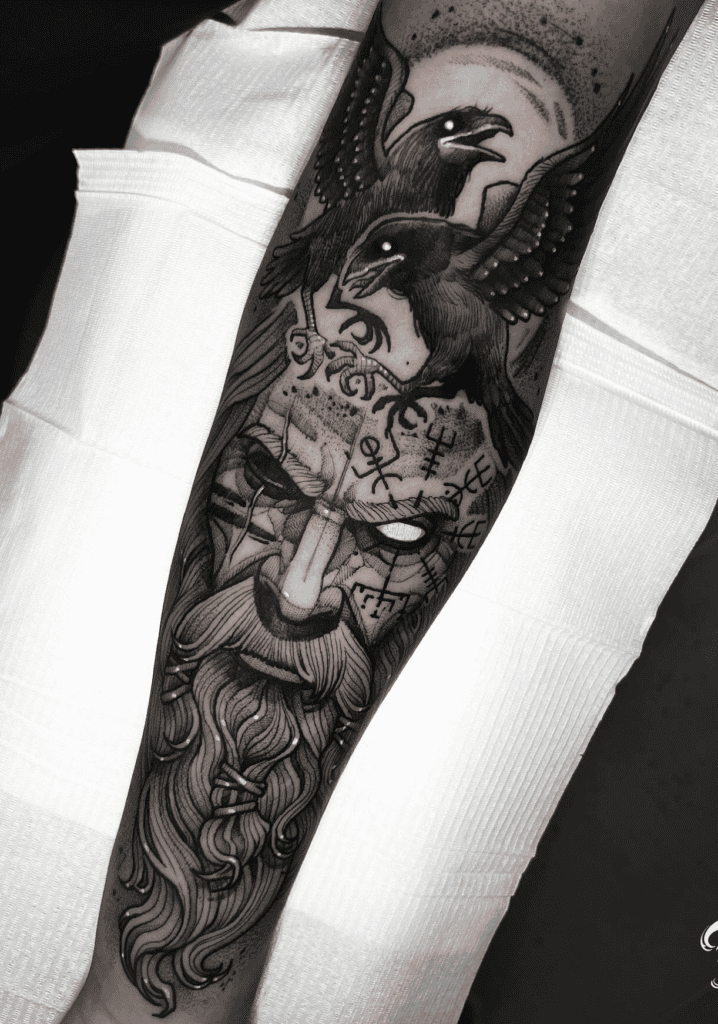
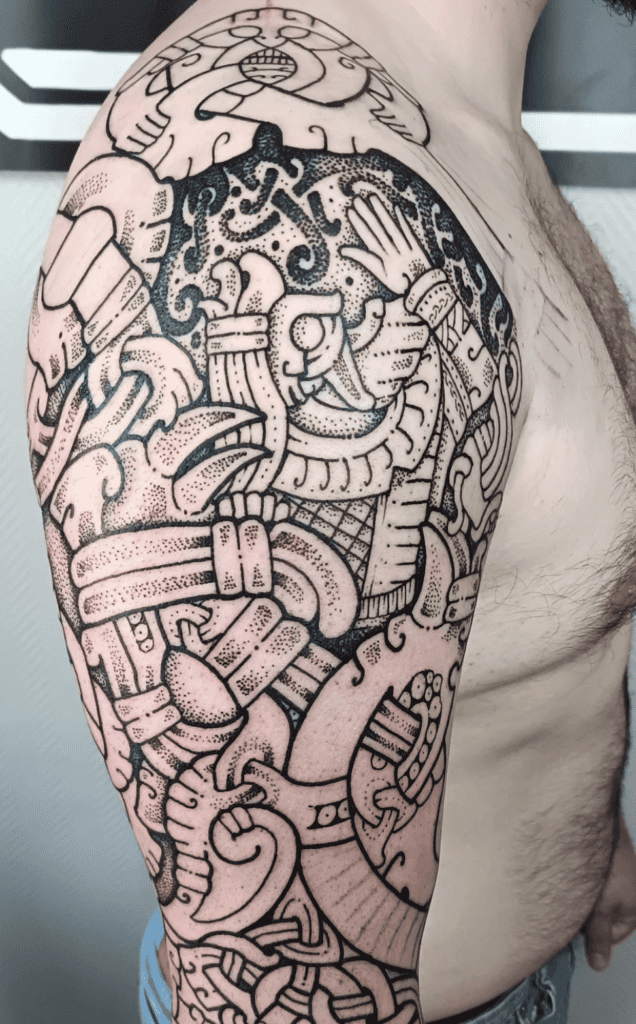
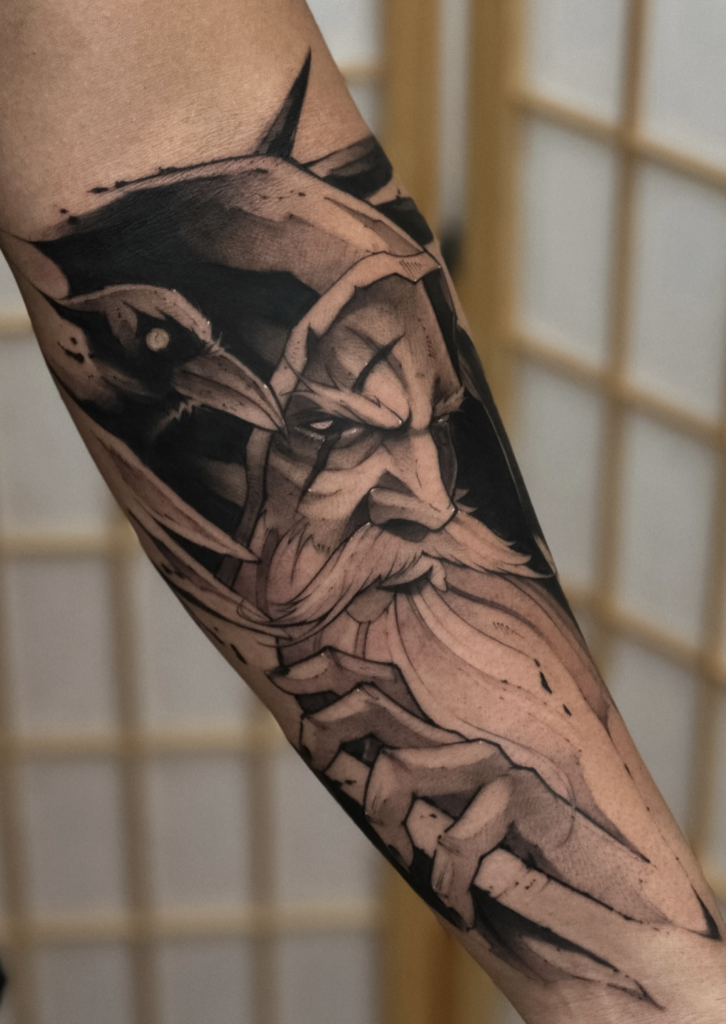
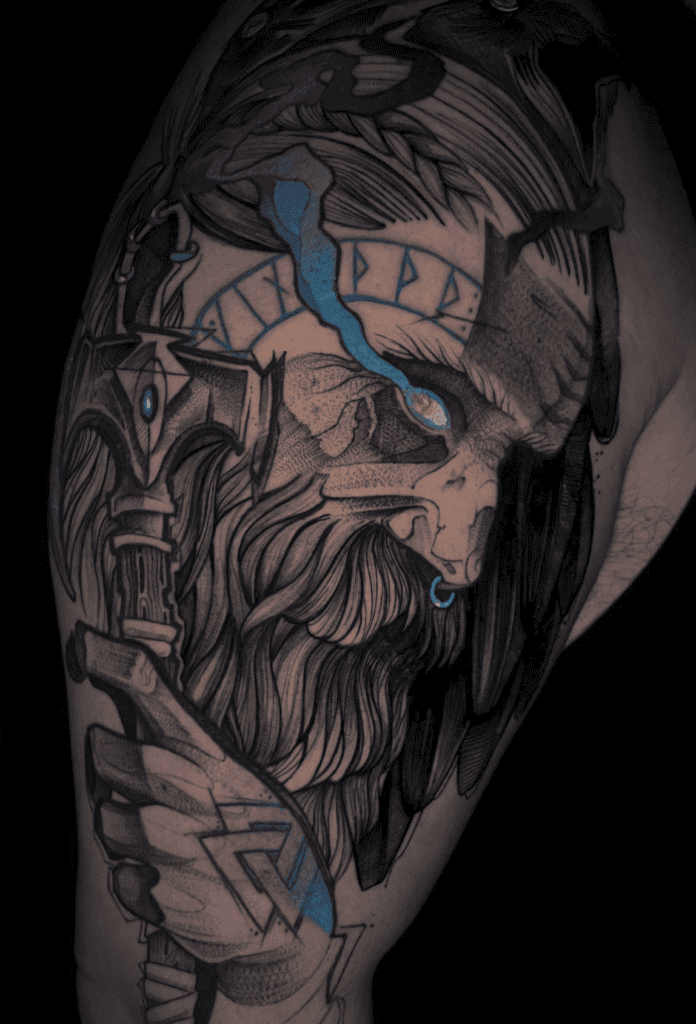
Odin is the chief god of Norse mythology, often referred to as the Allfather. He rules over Asgard, the realm of the gods, and unlike many mythological rulers who rely purely on strength or authority, Odin is defined by his relentless pursuit of wisdom, knowledge, and understanding. He is a complex figure who embodies war, magic, poetry, and death, and is someone willing to sacrifice anything to uncover the deeper truths of the world.
One of the most defining aspects of Odin’s story is the price he pays for knowledge. In his quest for wisdom, he gives up one of his eyes in exchange for a drink from the Well of Wisdom, gaining insight beyond that of any other god. However, his hunger for knowledge didn’t stop there. Odin also hangs himself from Yggdrasil, enduring this self-inflicted trial to unlock the secrets of the runes, the magical symbols that hold power over fate and reality. This act transforms him into a figure of sacrifice and enlightenment, showing that true knowledge often comes at great personal cost.
Thor Norse Mythology Tattoo
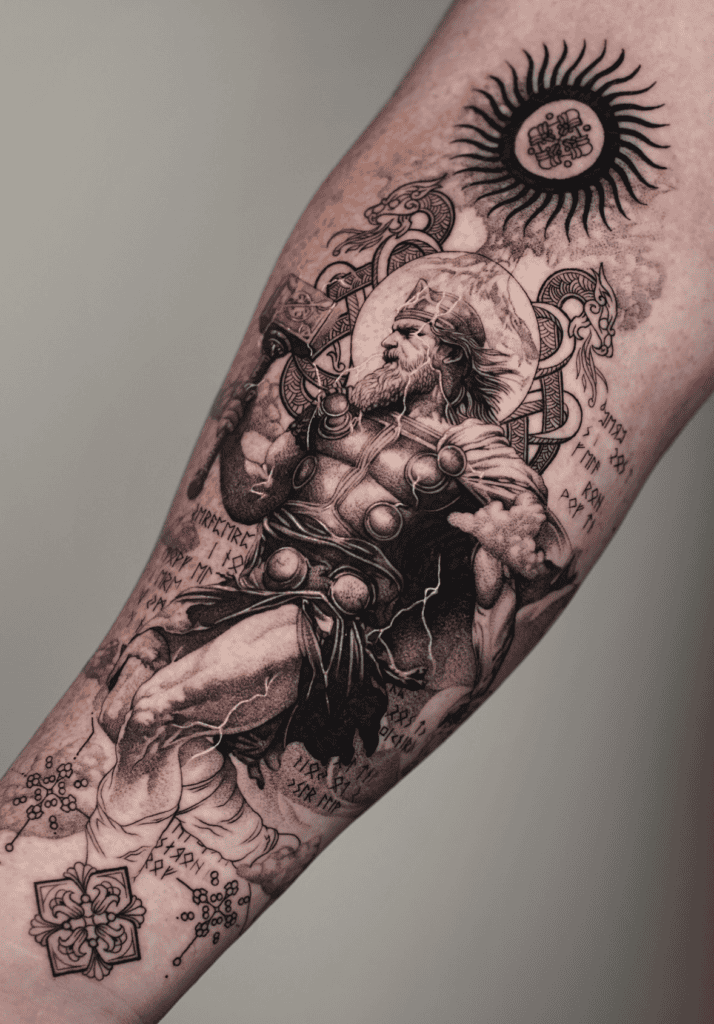
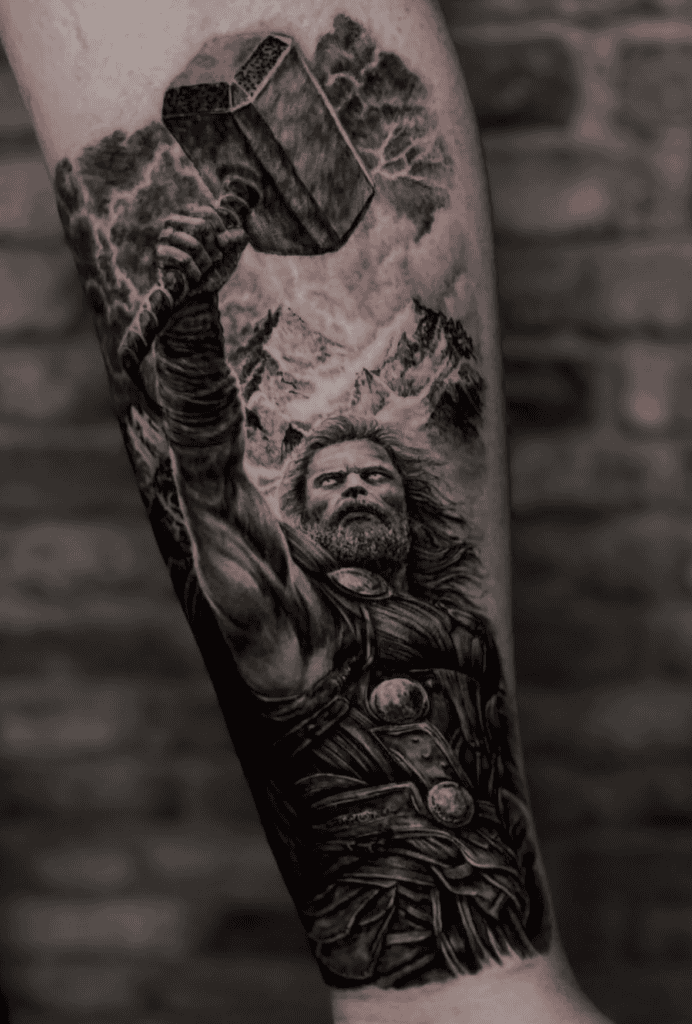
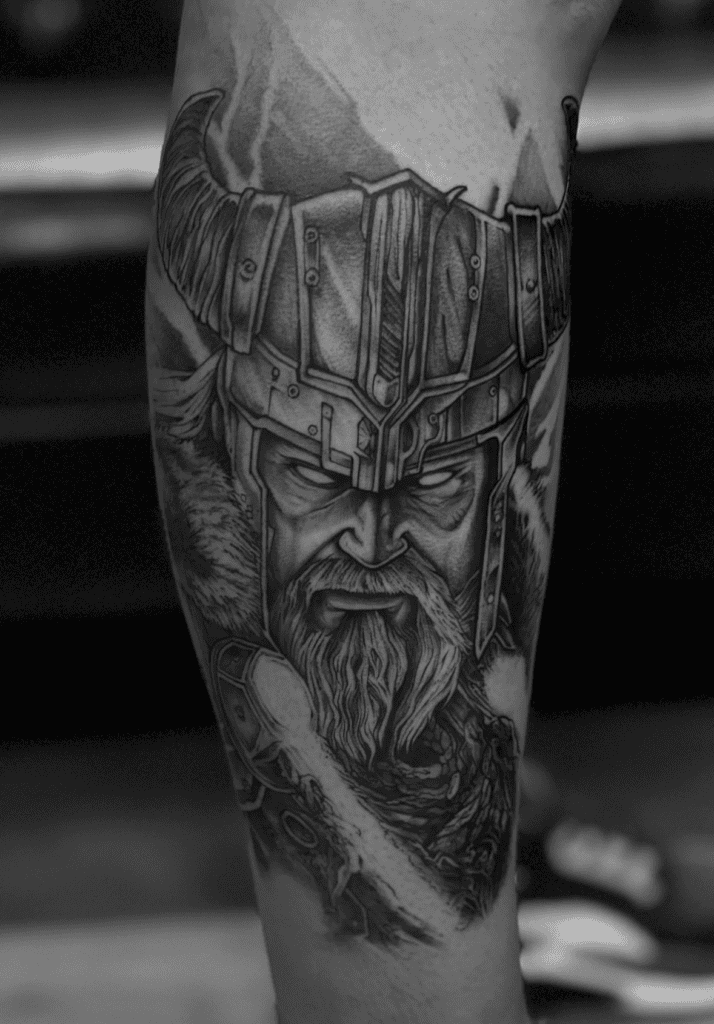
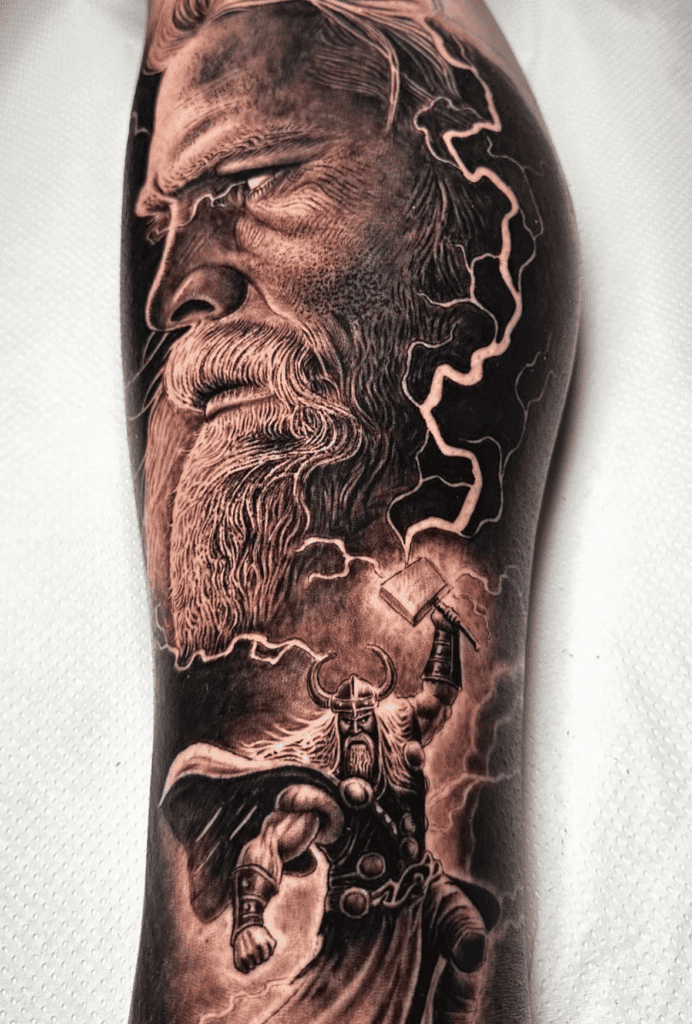
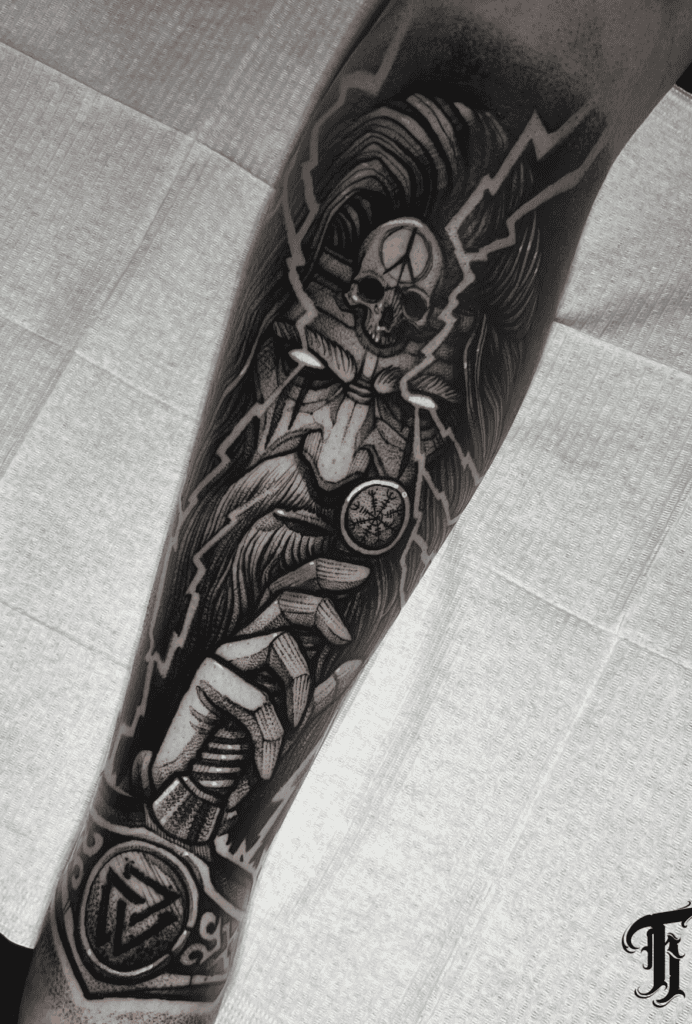
Thor is the son of Odin and one of the most powerful and widely recognised gods in Norse mythology. He is known as the god of thunder, storms, and protection, and he is deeply tied to his ongoing conflict with giants, known as the Jötnar. These beings represent chaos and the untamed forces of nature, and Thor’s battles against them are constant and relentless.
Rather than seeking knowledge or manipulating events like Odin, Thor confronts danger head-on. His stories are filled with physical challenges, feats of strength, and moments where his straightforward nature contrasts with the more cunning figures around him.
Despite his immense power, Thor is not portrayed as distant or unapproachable. He is often seen as more grounded and relatable than many of the other gods. His personality is direct, sometimes hot-headed, but always driven by a strong sense of duty and loyalty.
Magni Norse Mythology Tattoo

Magni is one of the sons of Thor in Norse mythology, and his name literally means “strength.” One of the most famous stories involving Magni takes place after Thor defeats the giant Hrungnir. During the battle, Hrungnir falls, but his massive body traps Thor beneath one of his legs. Despite all of Thor’s immense power, he is unable to free himself. It is Magni, still only a child at the time, who steps forward and lifts the giant’s leg with ease, freeing his father.
Because of this act, Thor rewards Magni by giving him Hrungnir’s horse, a powerful and prized possession. What makes this detail interesting is that Odin disapproves of the gift, believing such a reward should have gone to a more “deserving” god. This small conflict hints at a deeper theme in Norse mythology, where the older generation does not always recognise or accept the rise of the next.
Magni, alongside his brother Modi, are some of the only survivors of Ragnarok, with Magni inheriting Thor’s Mjölnir. This passing of the hammer symbolises continuity, showing that even though the old world ends, something new rises from it.
Loki Norse Mythology Tattoo
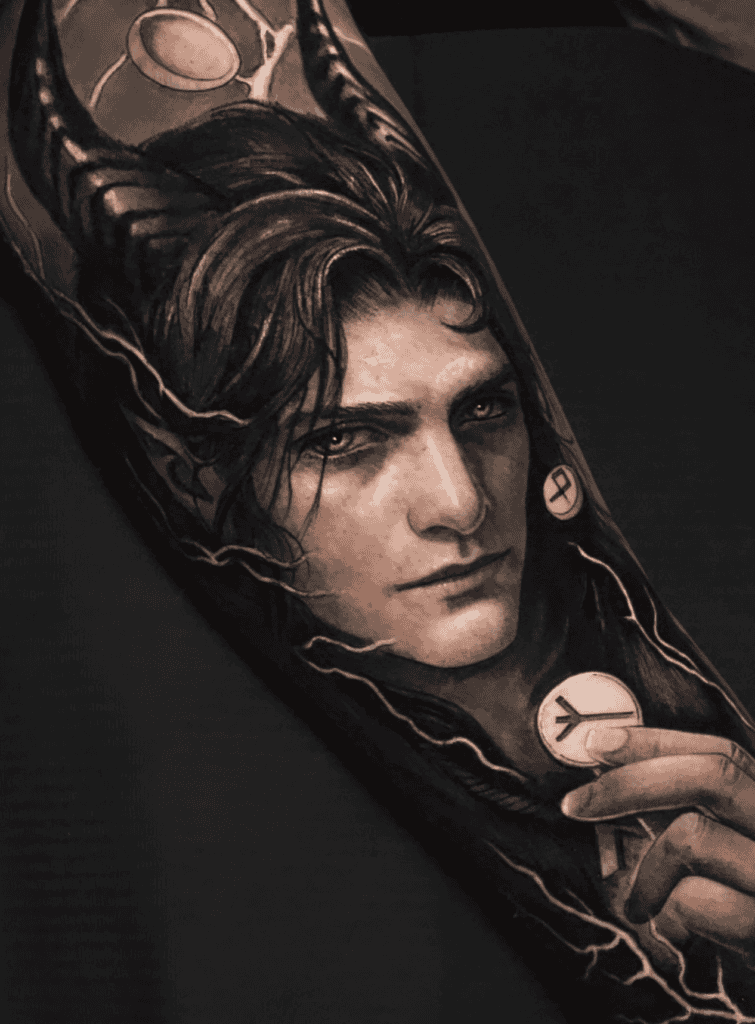
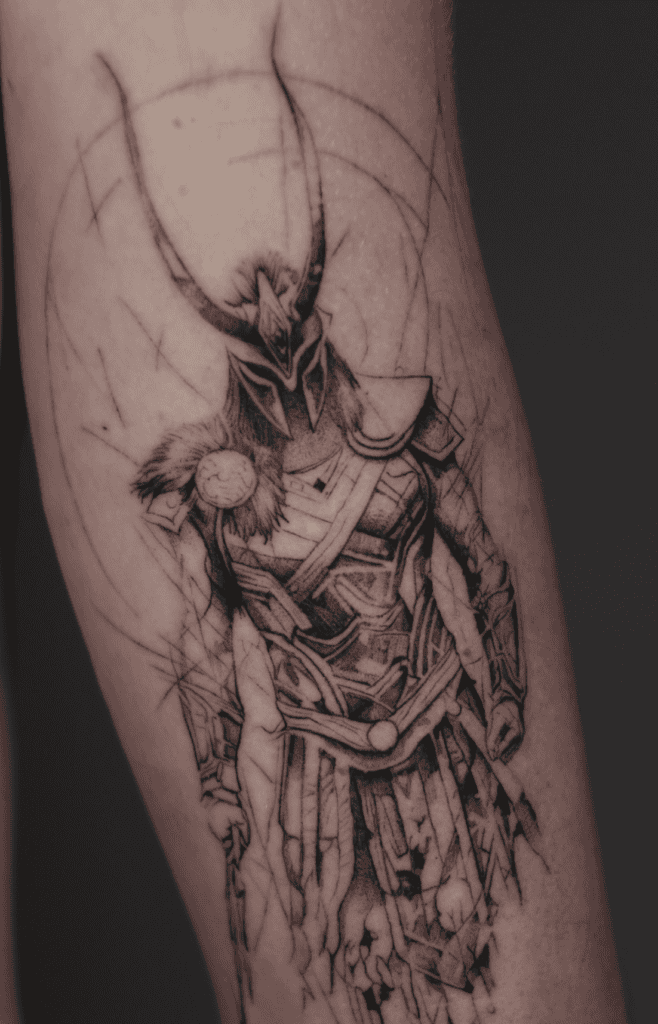
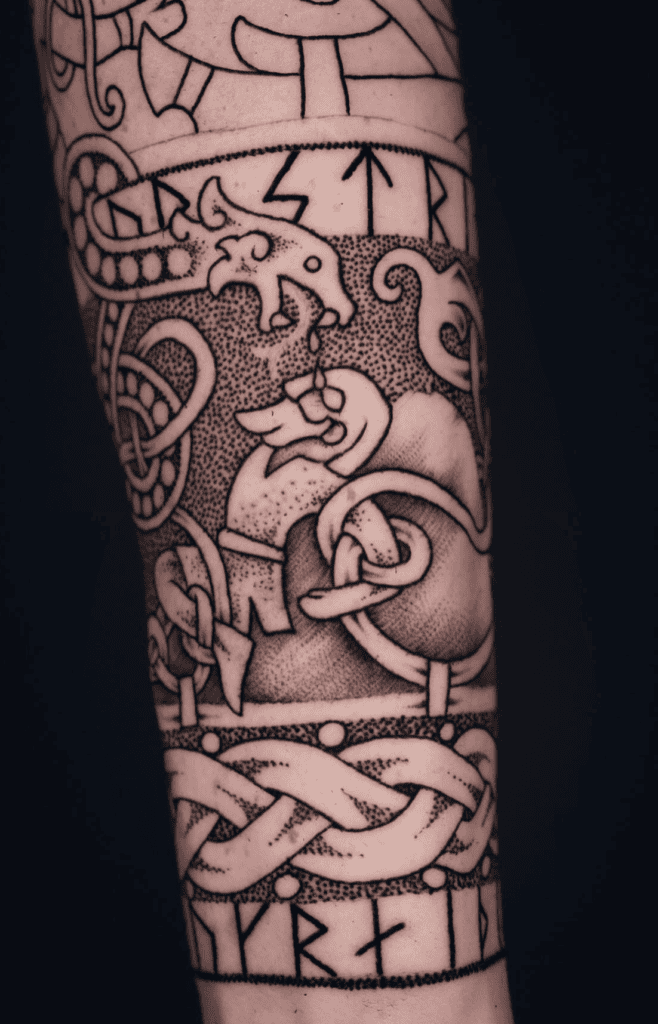
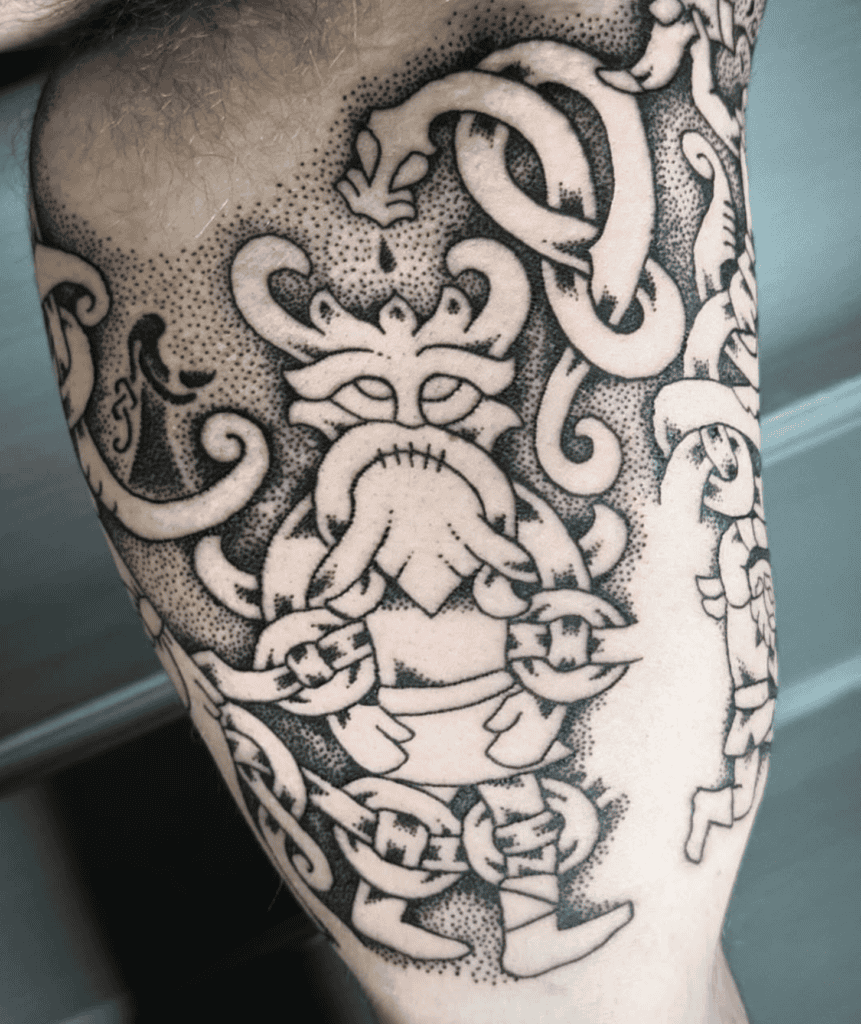
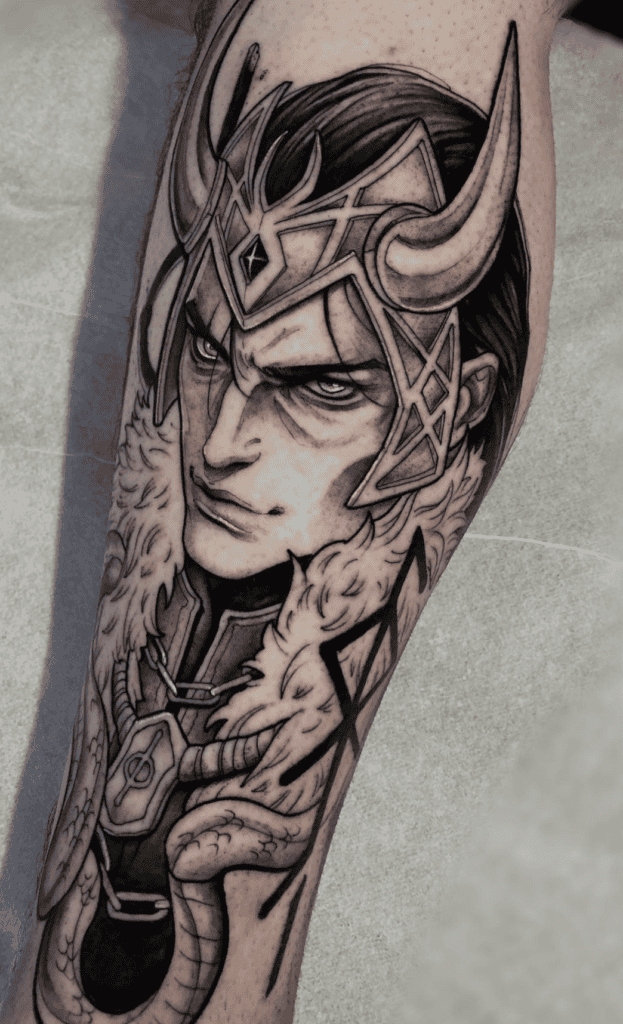
Born of giants yet living among the gods in Asgard, Loki is a figure from the Norse mythos who exists as an outsider, both trusted and feared. He is known as the trickster, a master of deception and transformation, capable of shifting not only his form but also the course of events.
At times, he helps the gods, using his cunning to solve problems no one else can, with many of the gods’ greatest treasures, including Thor’s hammer Mjölnir, coming into existence because of Loki’s schemes—although often he is also the cause of the problem in the first place.
Despite his cleverness, Loki’s actions grow darker over time, leading to one of the most tragic events in Norse mythology: the death of Baldr. Through manipulation and deceit, Loki orchestrates the circumstances that lead to Baldr’s death, breaking the sense of harmony among the gods. This act marks a turning point, transforming Loki from a mischievous ally into a true enemy.
As punishment, Loki is captured and bound in a cave using the entrails of his own son, while a serpent is placed above him, dripping venom onto his face. His wife, Sigyn, remains by his side, catching the venom in a bowl, but whenever she must empty it, the poison strikes Loki, causing him to writhe in pain, with the convulsions said to be the cause of earthquakes.
During Ragnarök, Loki breaks free from his bonds and leads the forces of chaos against the gods. He fights against Heimdall, and the two ultimately kill each other. In this final act, Loki fully embraces his role as a bringer of destruction, helping to bring about the end of the world.
Sigyn Norse Mythology Tattoo
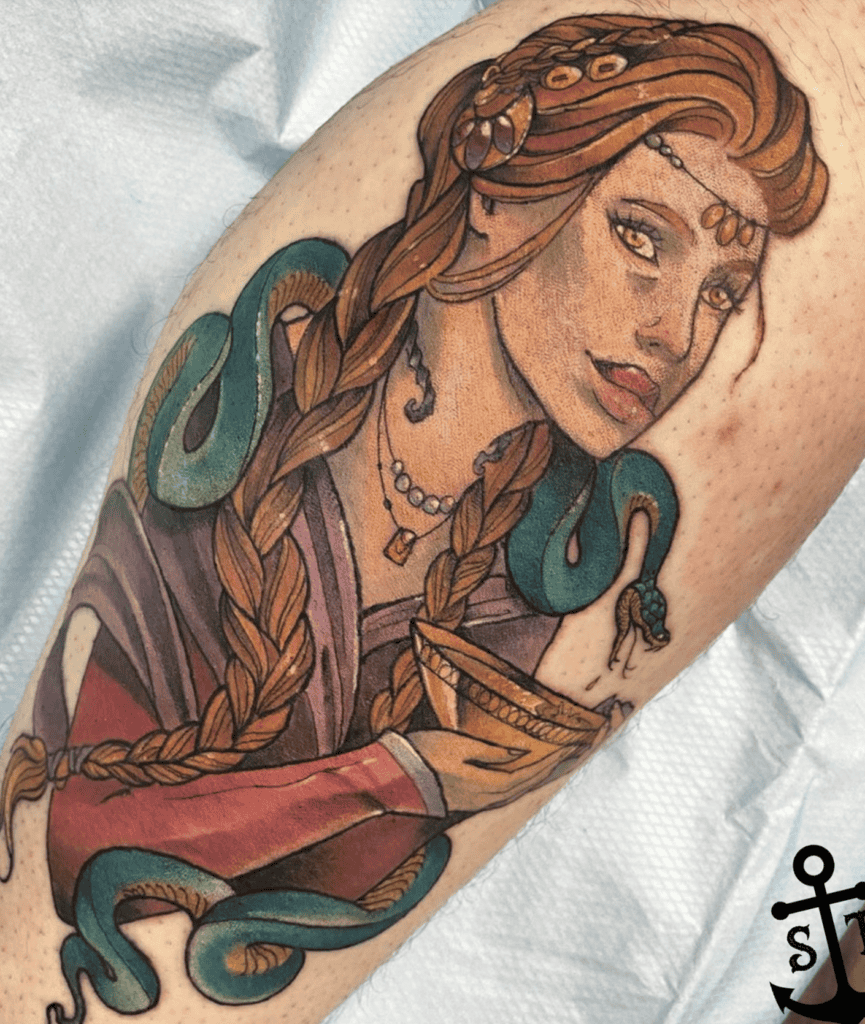
Sigyn is a goddess in Norse mythology and the wife of Loki, defined by quiet strength, loyalty, and unwavering devotion. While Loki’s story is filled with chaos and transformation, Sigyn’s role is steady and deeply human, making her one of the most emotionally compelling figures in the entire mythology.
Sigyn’s story becomes most significant after Loki is punished for his role in the death of Baldr. As a consequence of his actions, Loki is captured by the gods and bound deep within a cave. A serpent is placed above him, dripping venom onto his face as a form of eternal punishment.
Rather than abandoning Loki for what he has done, Sigyn chooses to remain by his side. She holds a bowl above him, catching the venom as it falls, preventing it from striking him. For as long as she holds the bowl, Loki is spared the pain. However, the bowl eventually fills, and Sigyn must leave briefly to empty it. In those moments, when she is gone, the venom falls onto Loki’s face, causing him to writhe in agony.
Týr Norse Mythology Tattoo
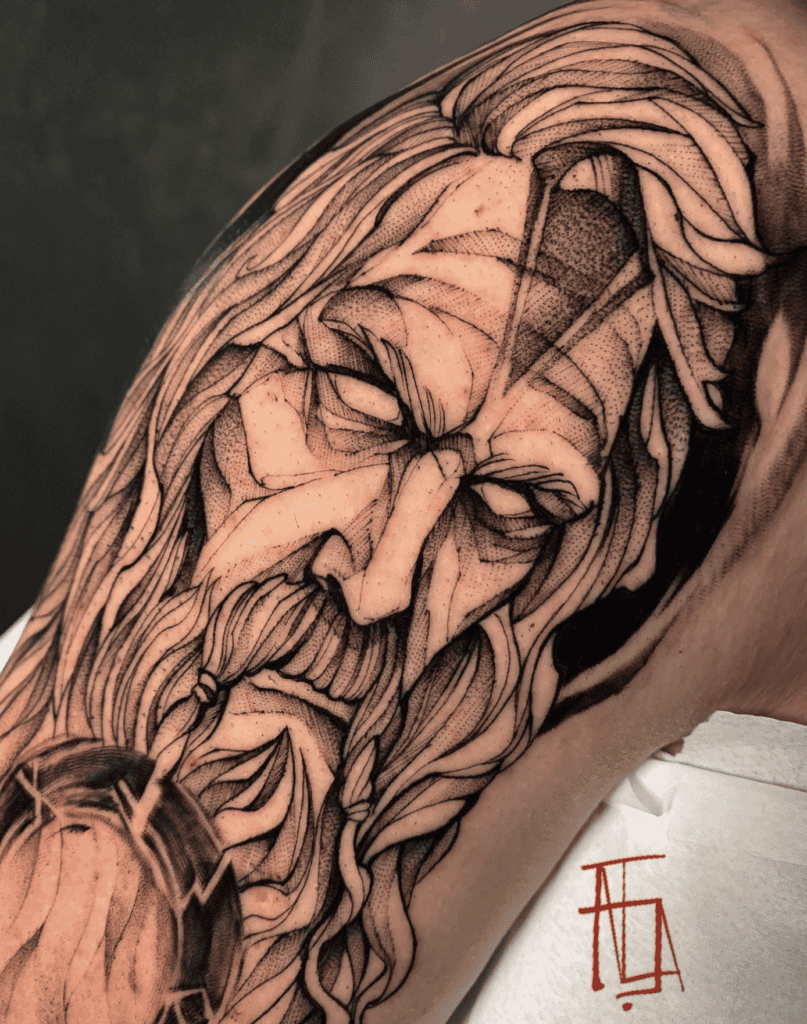
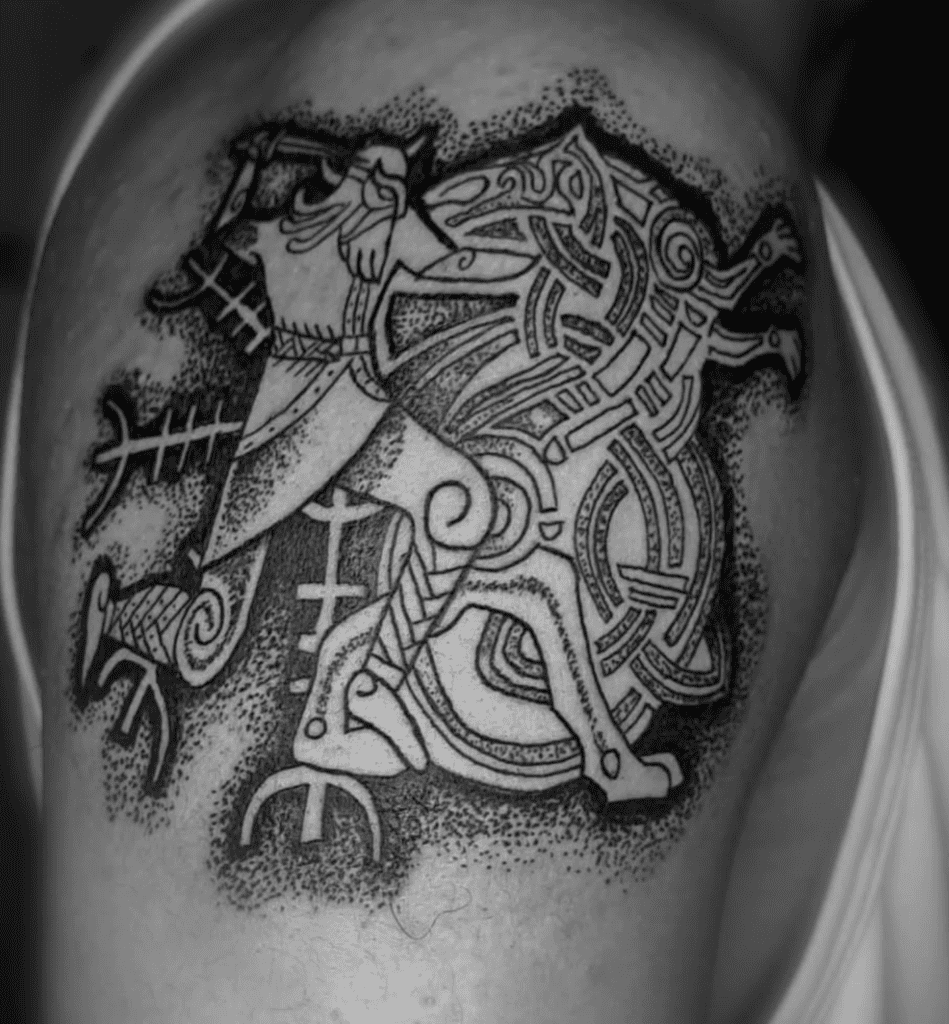
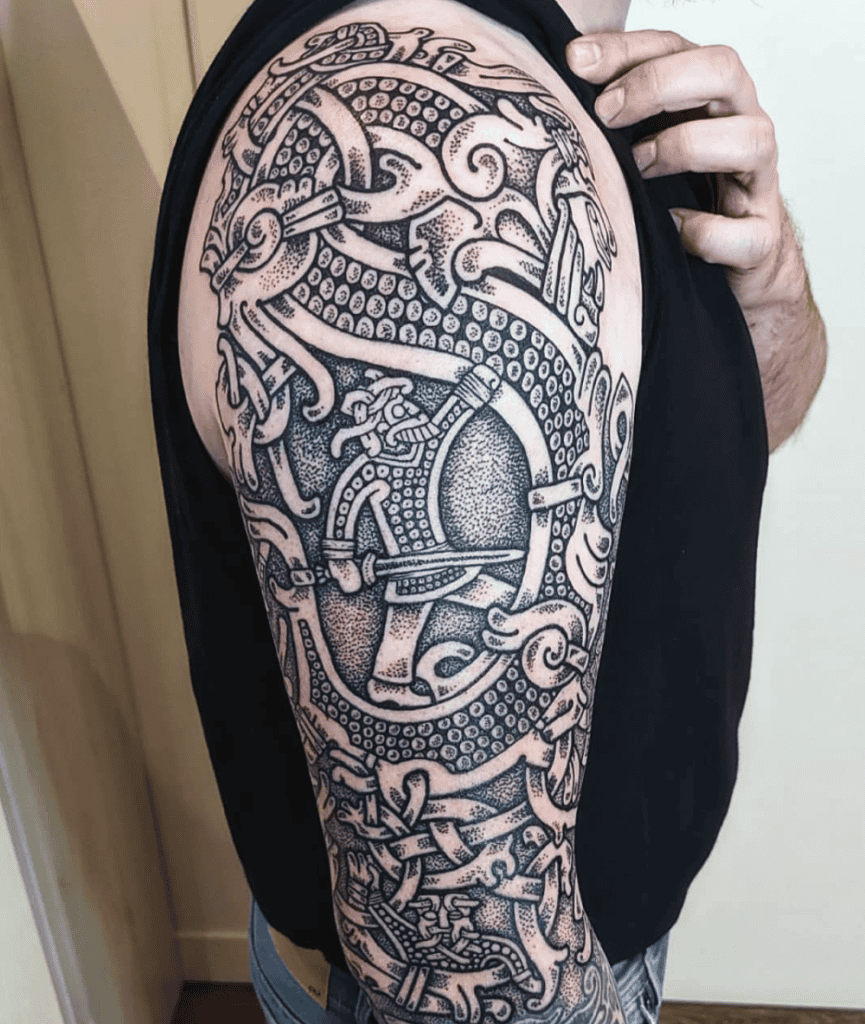
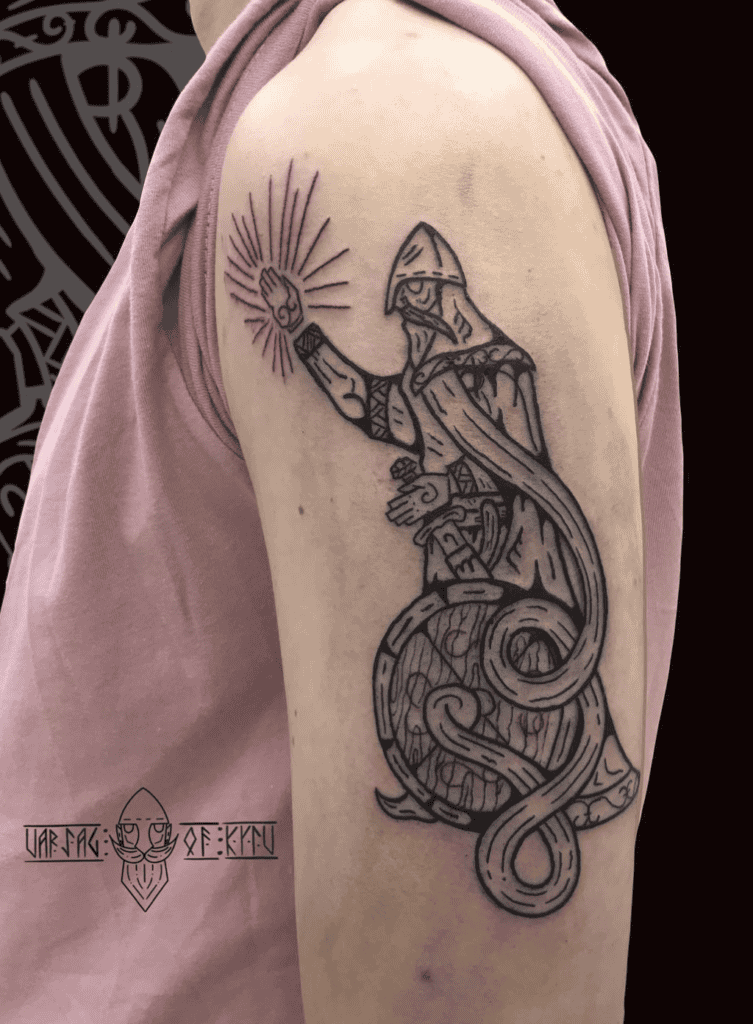
Týr is the Norse god of war, who represents justice, law, and honour. He is a god who values fairness and order above all else, making him one of the most principled figures in Norse mythology. While other gods rely on power or cunning, Týr stands for truth and the courage to uphold it.
His story is most famously tied to the binding of Fenrir, the monstrous wolf destined to bring destruction during Ragnarök. As Fenrir grew stronger, the gods realised he would eventually become unstoppable, so they decided to bind him before it was too late. However, Fenrir was not easily deceived. He agreed to be bound only if one of the gods placed a hand in his mouth as a sign of trust, knowing that if the binding was a trick, he would bite it off.
None of the gods were willing to take that risk, except for Týr. Understanding the danger and the cost, Týr stepped forward and placed his hand in Fenrir’s jaws. When the magical binding Gleipnir held firm and Fenrir realised he had been deceived, he bit down, severing Týr’s hand. Týr accepted this loss without hesitation, knowing it was necessary to protect the world from chaos.
During the final battle, Týr is destined to fight Garmr, the monstrous hound associated with the underworld. Their confrontation ends with both of them killing each other, reinforcing the theme that even the most honourable figures cannot escape their fate.
Heimdall Norse Mythology Tattoo
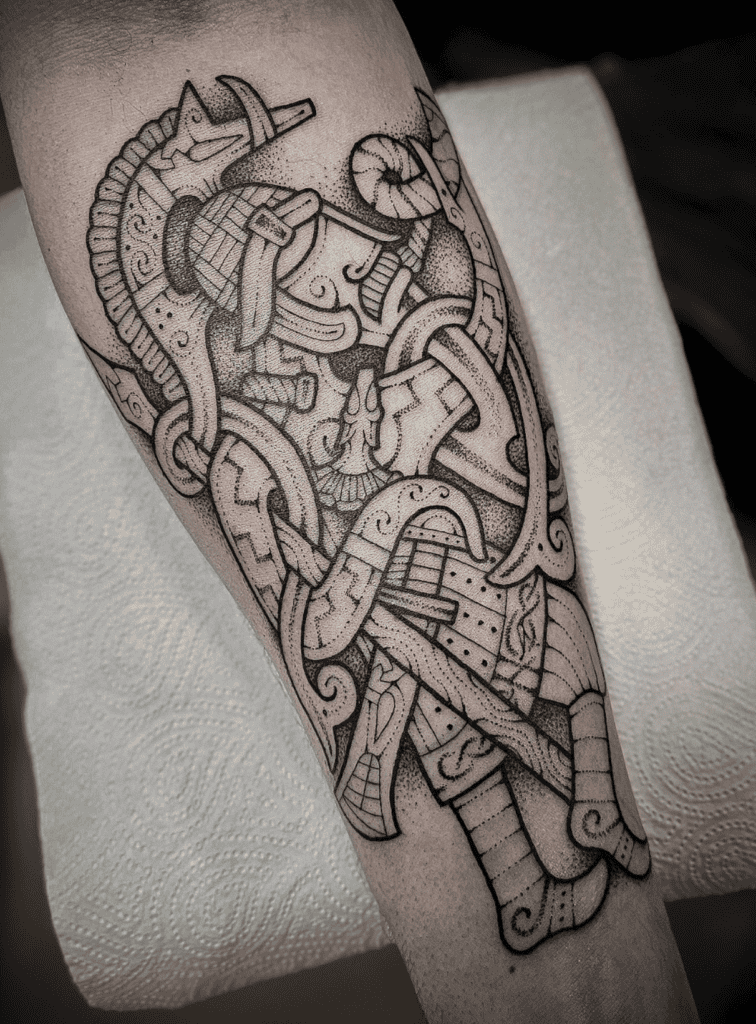
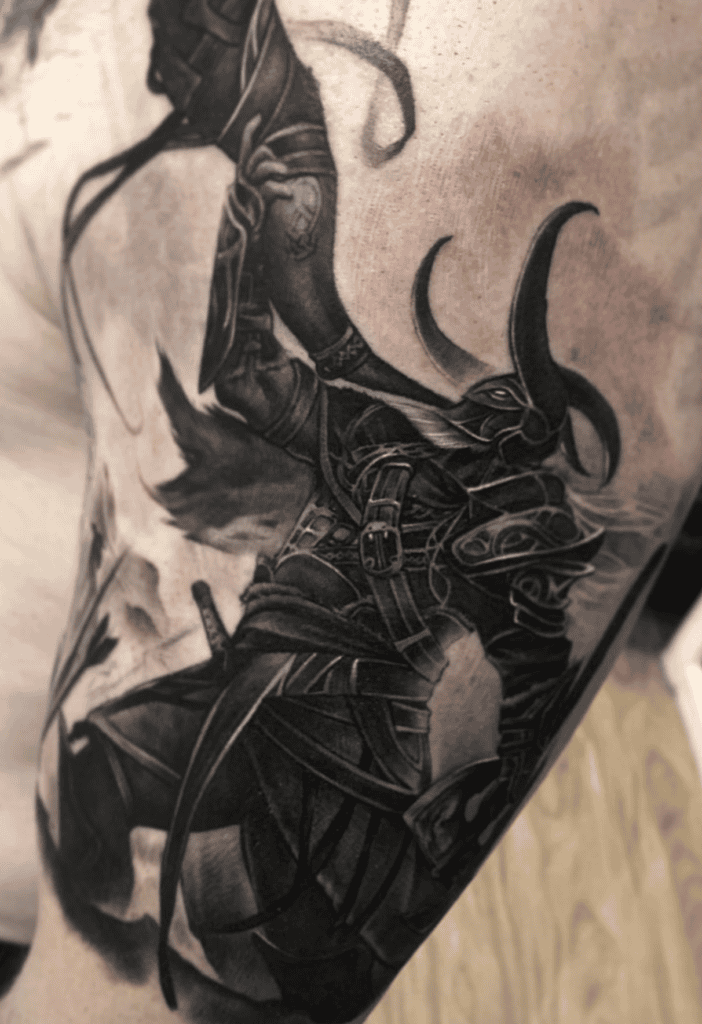
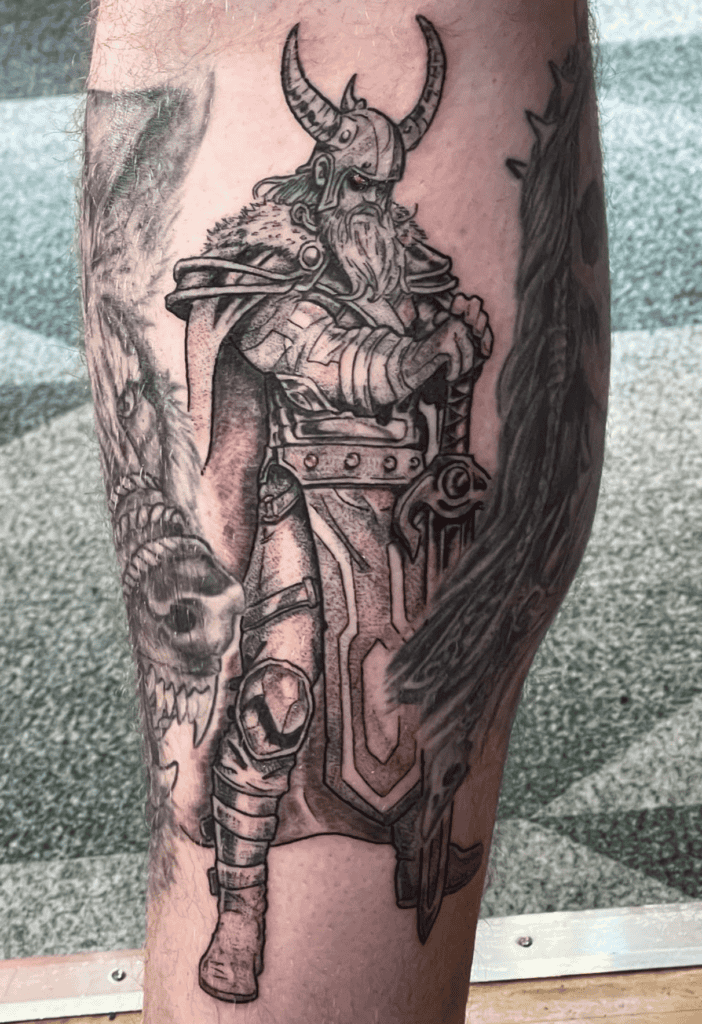
Heimdall is the guardian of the Bifröst, the rainbow bridge that connects Asgard, the realm of the gods, to the other worlds. He stands at the edge of the gods’ domain, watching constantly for any sign of danger, ensuring that no enemy crosses into Asgard unnoticed.
What sets Heimdall apart is his extraordinary senses. He is said to see for miles across the land and sky, with vision so sharp that nothing escapes his notice. His hearing is just as remarkable, allowing him to detect the faintest sounds, even something as subtle as grass growing.
Heimdall never abandons his post or falters in his responsibilities; he endures and watches, ready for the moment when he is needed most. When the final battle begins, Heimdall’s role is to sound the Gjallarhorn, a mighty horn whose call echoes across all the realms, signalling that the end has begun. After fulfilling his duty, Heimdall joins the battle itself, where he faces Loki. The two are destined enemies, representing opposing forces of order and chaos, and their confrontation ends with both of them killing each other.
Baldr Norse Mythology Tattoo
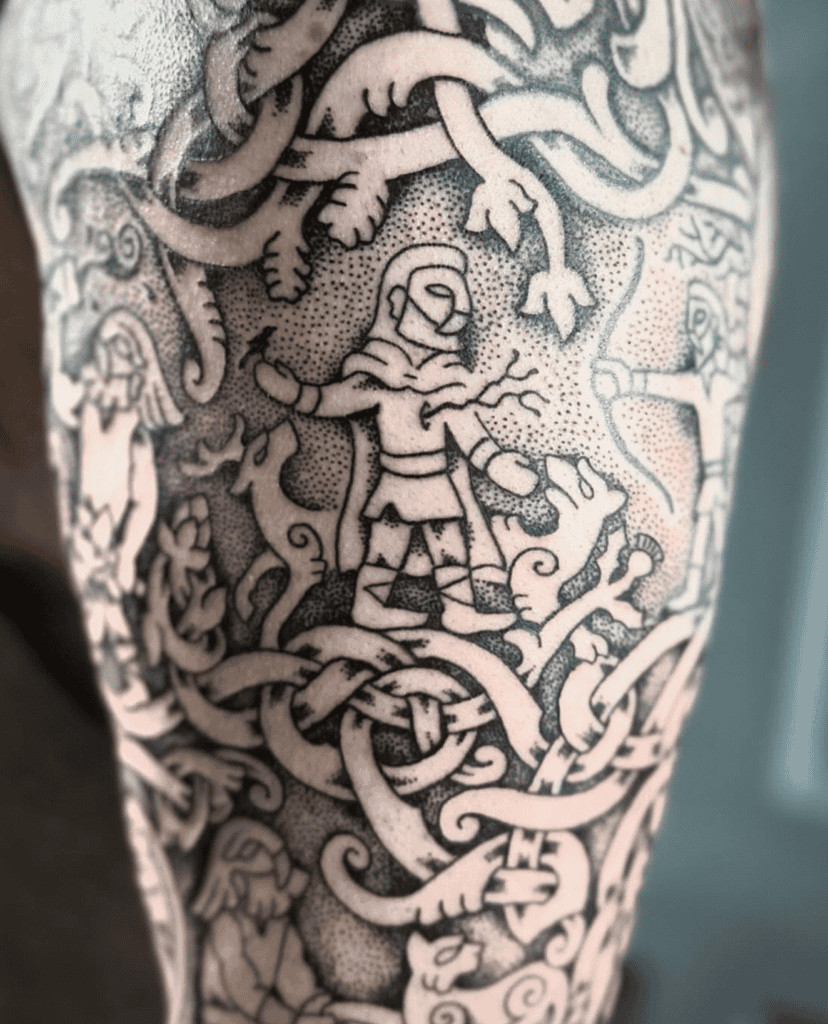

Baldr, often spelt Baldur, is the son of Odin and Frigg, and he is widely regarded as the most beloved of all the gods. He is associated with light, beauty, purity, and goodness, and his presence is said to bring warmth and joy to Asgard. He is admired not only for his appearance but for his gentle nature and the sense of peace he brings to those around him.
Baldr begins to have dreams of his own death. These dreams trouble both him and the other gods, as they suggest that something is wrong in a world where Baldr seems untouchable. In response, his mother Frigg travels across the realms, extracting promises from all things—objects, plants, animals, and elements—that they will never harm her son. With these promises secured, Baldr appears to be invulnerable.
The gods, reassured by this protection, turn it into a kind of game. They throw weapons and objects at Baldr, watching as everything harmlessly bounces off him. It becomes a strange celebration of his invincibility, reinforcing the idea that he cannot be harmed. However, there is one small exception. Frigg overlooked mistletoe, considering it too insignificant to pose any danger.
Loki discovers this weakness and sees an opportunity. He crafts a dart or spear from mistletoe and approaches Höðr, Baldr’s blind brother. Taking advantage of Höðr’s inability to see and his exclusion from the gods’ game, Loki guides his hand and directs him to throw the mistletoe weapon. The dart strikes Baldr, and because it is the one thing not bound by Frigg’s protection, it kills him instantly.
Baldr’s death sends shockwaves through the Norse world. The gods are overcome with grief, and his passing is seen as one of the first major signs that Ragnarök, the end of the world, is approaching. Attempts are made to bring him back from the realm of the dead, but they ultimately fail due to Loki’s interference, sealing Baldr’s fate.
Höðr Norse Mythology Tattoo
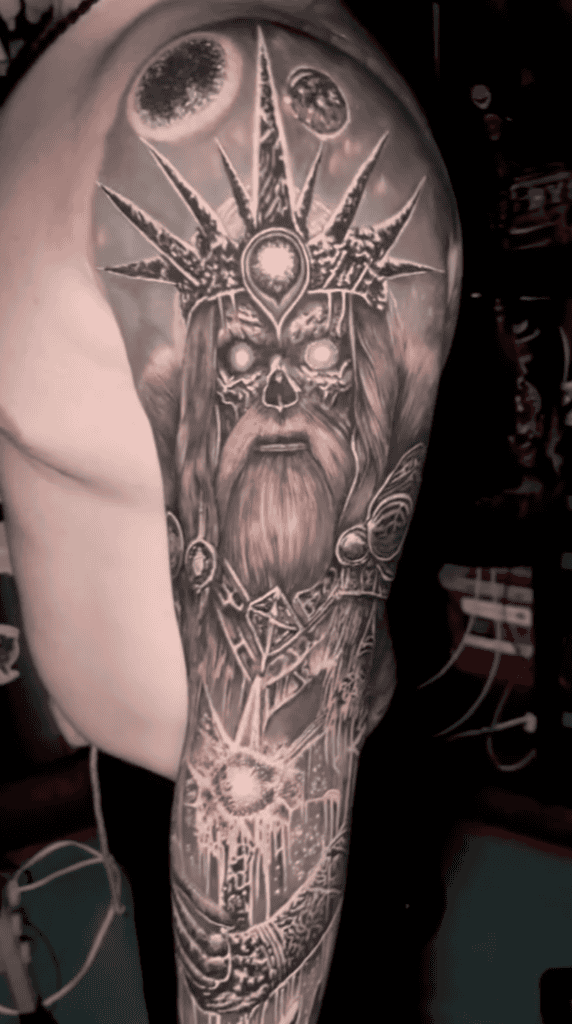
Höðr, sometimes spelt Hodur, is the blind god of darkness and the twin or brother of Baldr, the god of light. His story becomes central during the events leading to Baldr’s death. Because of his blindness, he does not take part in Baldr’s test of invincibility, standing apart from the others, unable to join in. Seeing an opportunity, Loki offers to guide Höðr’s hand so he can join the others in the game. Trusting Loki and unaware of any danger, Höðr accepts.
Loki then places a small weapon made of mistletoe into Höðr’s hand, and guided by Loki, Höðr throws the weapon, striking Baldr and killing him instantly. In that moment, Höðr unknowingly becomes the one responsible for the death of the most beloved god.
Manipulated and used as a tool in Loki’s scheme, he only realises the consequences after it is too late. His story reflects a powerful theme in Norse mythology: that fate can unfold through even the most innocent actions, and that not all tragedies are born from malice.
After Baldr’s death, Höðr is later killed by Váli, a son of Odin who is born specifically to avenge Baldr. This act of vengeance reinforces the harsh, unforgiving nature of justice in Norse myth, where balance is restored, but often at the cost of more loss.
Vidar Norse Mythology Tattoo
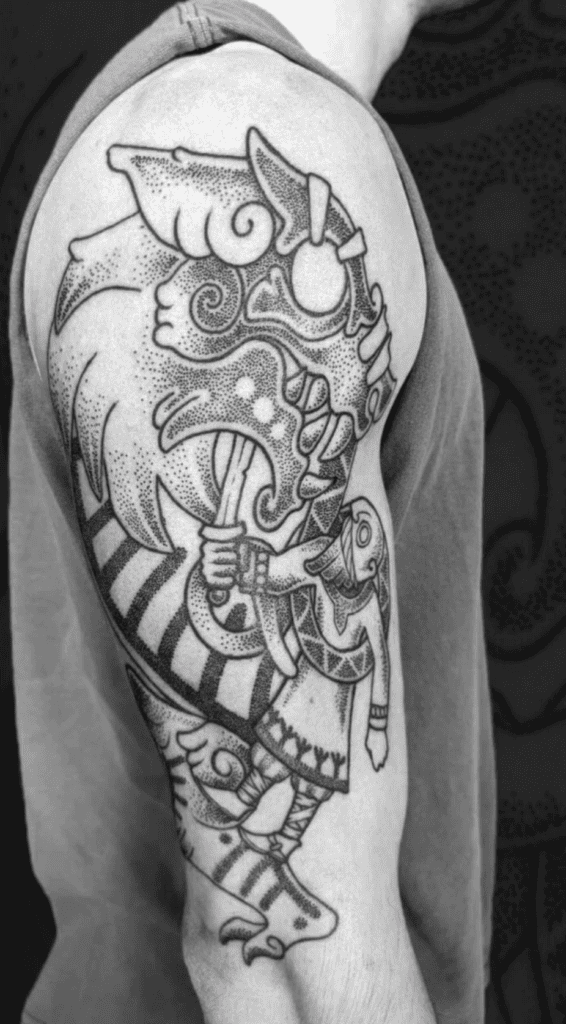
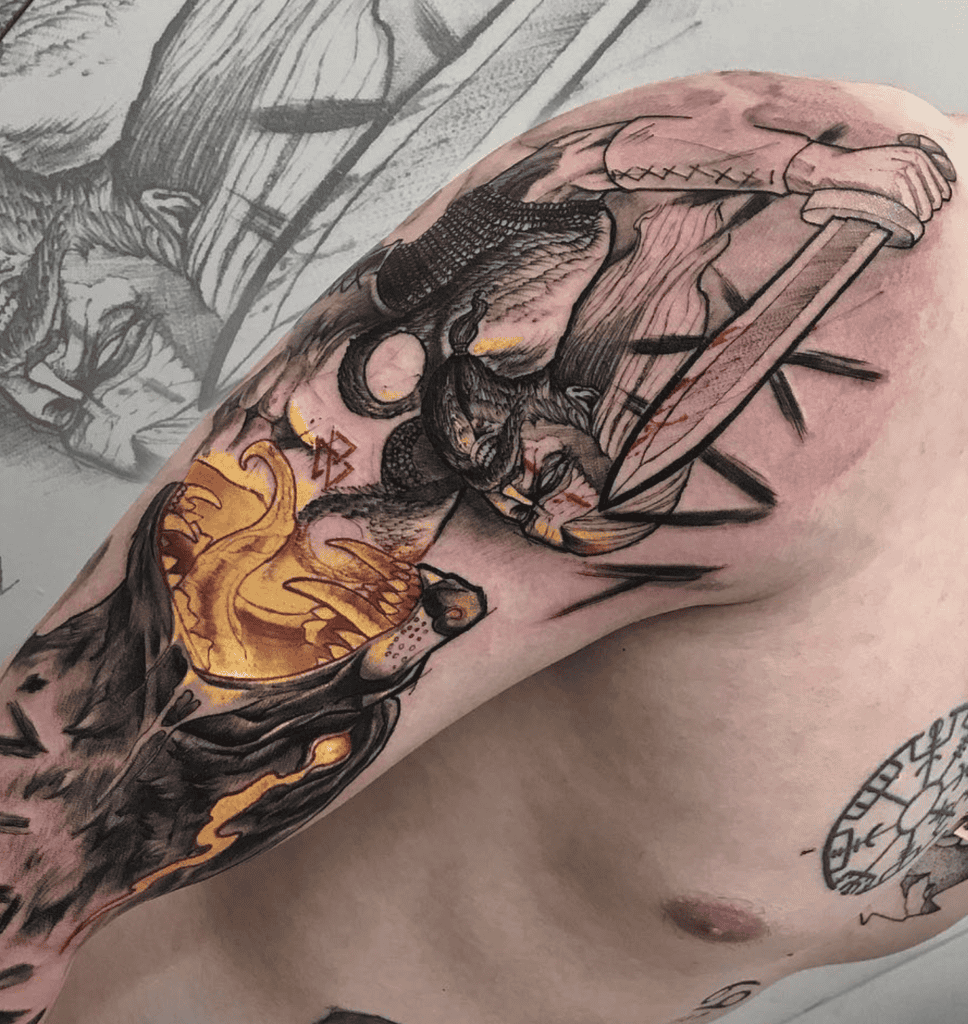
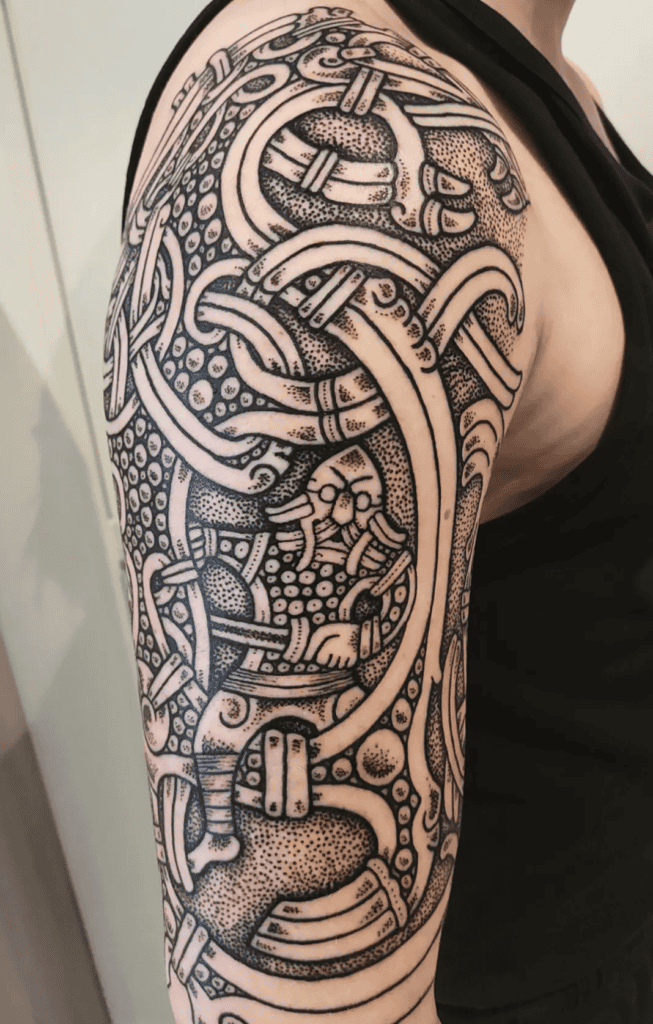
Vidar is the son of Odin and is often described as the silent or quiet god, a figure who speaks little but carries immense strength. He is a god of patience and purpose, waiting for the moment when his role becomes unavoidable.
Unlike Thor or Loki, Vidar does not appear frequently in the myths, but his presence is deeply tied to one of the most important events in Norse mythology—Ragnarök. When the great wolf Fenrir fulfils his destiny by killing Odin, Vidar is one of the few who survive, and he plays a crucial role in avenging his father. Armed with immense strength and a special shoe said to be made from scraps of leather gathered over time, Vidar confronts Fenrir directly. Vidar plants his foot firmly on the wolf’s lower jaw and forces its mouth open, tearing it apart and killing it.
After Ragnarök, Vidar is among the gods who survive and help rebuild the world. This positions him not only as a god of vengeance, but also as a symbol of renewal and continuation.
Bragi Norse Mythology Tattoo
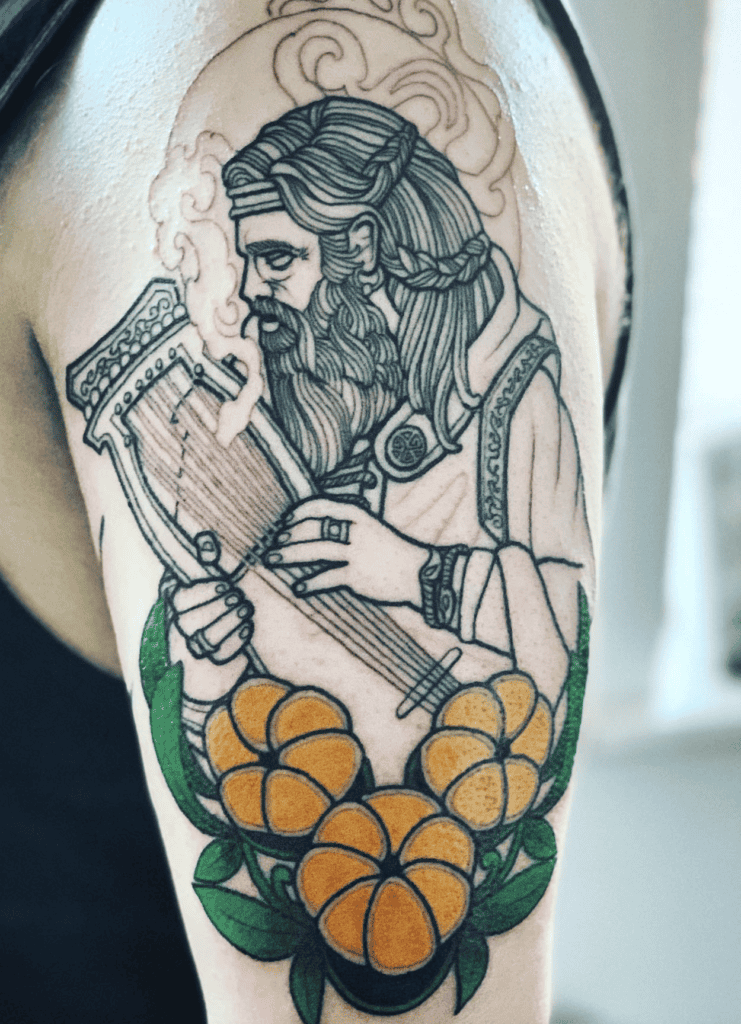
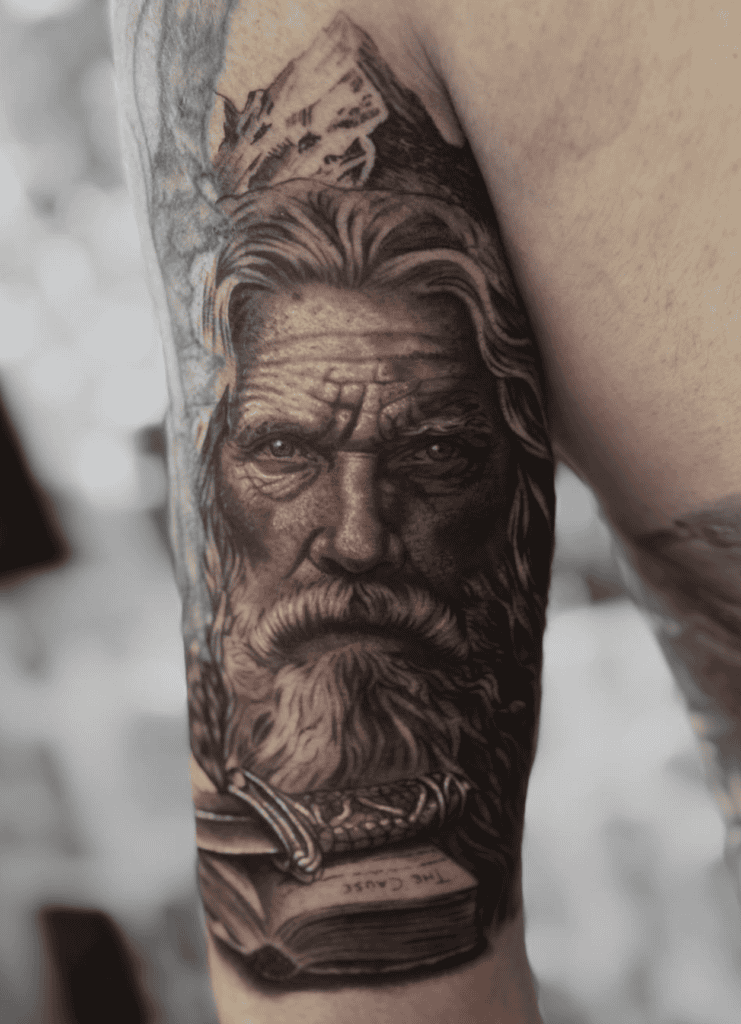
Bragi is the Norse god of poetry, music, and storytelling, a figure who represents the power of words and the art of expression. He is often described as wise, eloquent, and deeply respected among the gods, not because of physical strength or battle prowess, but because of his ability to inspire, entertain, and preserve knowledge through language.
He is closely associated with the tradition of skalds, the poets of the Viking Age who composed and recited verses in honour of kings, heroes, and gods. These poets were highly valued in Norse society, as they carried history and legend through generations.
Bragi is often depicted as an older figure with a long beard, symbolising wisdom and experience. He is also said to be married to Idunn, the goddess who guards the apples of youth. His presence is most strongly felt in Valhalla, Odin’s great hall, where fallen warriors are welcomed after death. Bragi is said to greet these warriors and share stories, songs, and poetry with them, helping to honour their deeds and ensure they are remembered.
Forseti Norse Mythology Tattoo
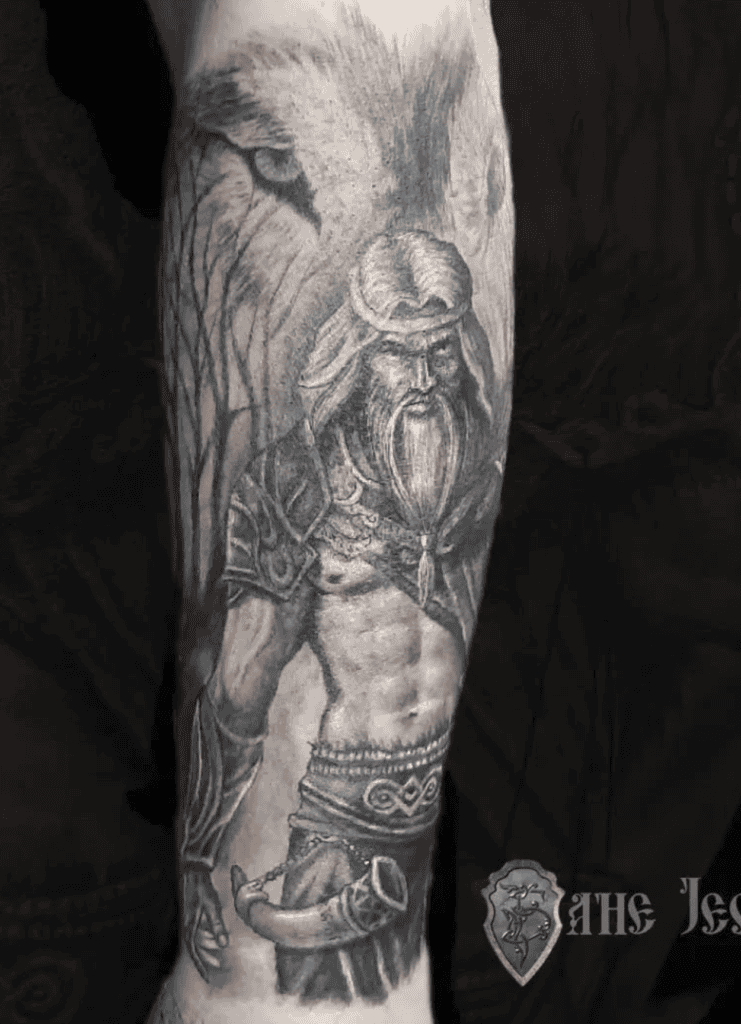
Forseti is the god of justice, law, and reconciliation, and is often seen as one of the most peaceful and fair-minded figures in Norse mythology. He is the son of Baldr and is most closely associated with a hall called Glitnir, a radiant place said to shine with gold and silver. This hall serves as a kind of divine court, where people come to settle disputes. Unlike many other gods who rely on strength or authority, Forseti listens carefully to both sides, seeking solutions that bring peace rather than victory.
What makes Forseti stand out is his approach to justice. In a mythology filled with revenge, fate, and inevitable conflict, Forseti represents the possibility of resolution without violence. He does not act out of anger or pride, but with patience and clarity, ensuring that all parties are heard. This makes him one of the few figures in Norse mythology who consistently brings calm into a world otherwise defined by tension and struggle.
Ullr Norse Mythology Tattoo
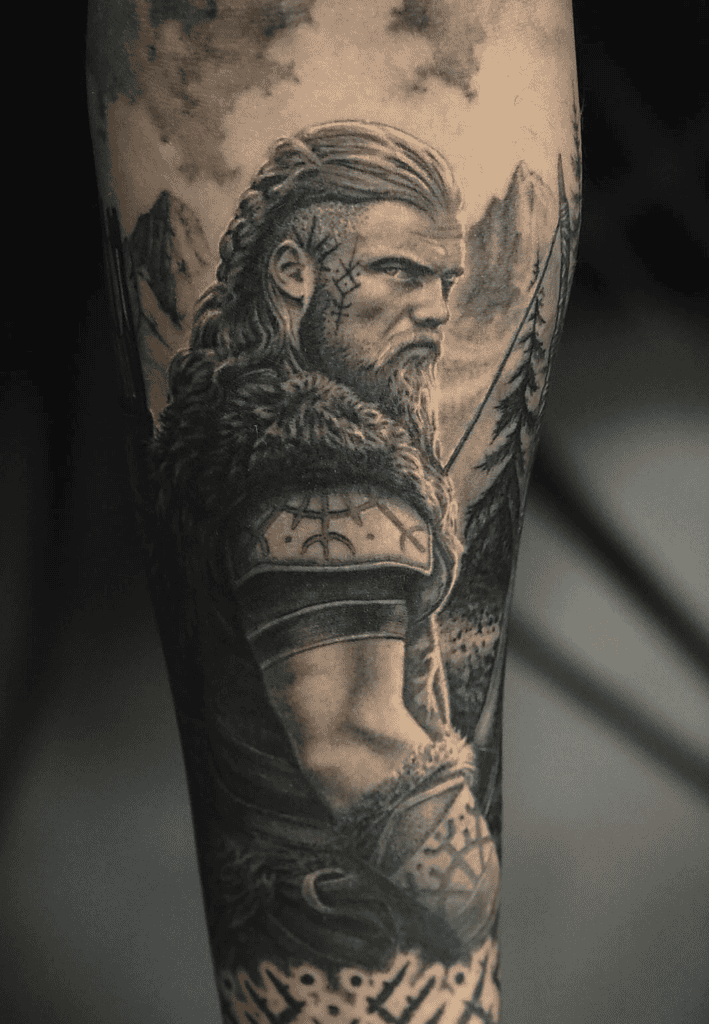
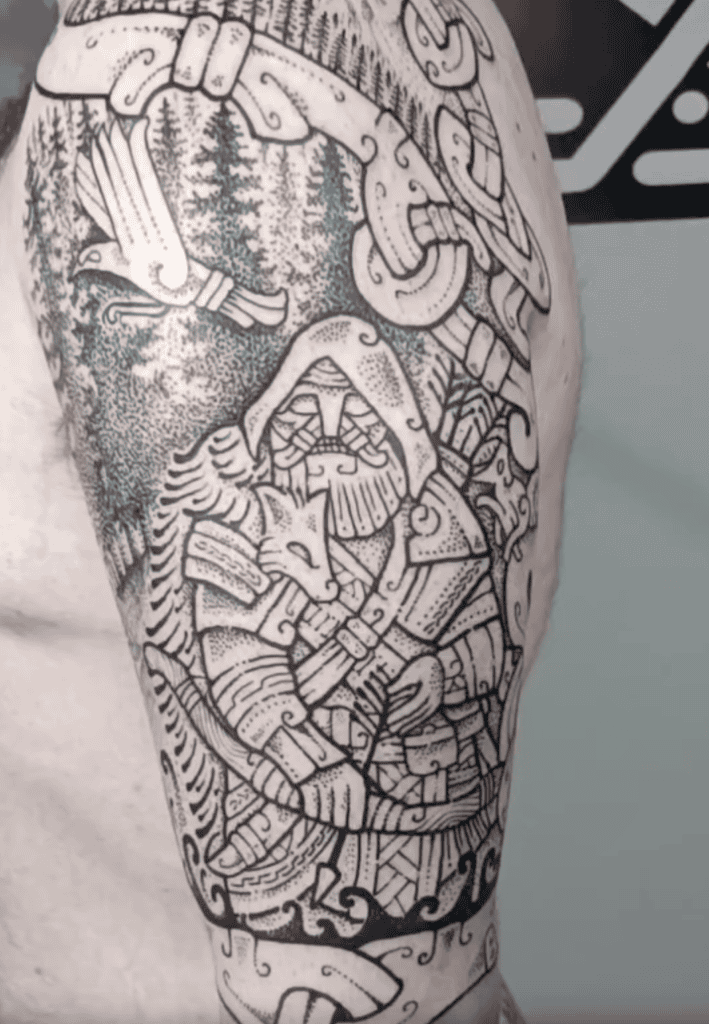
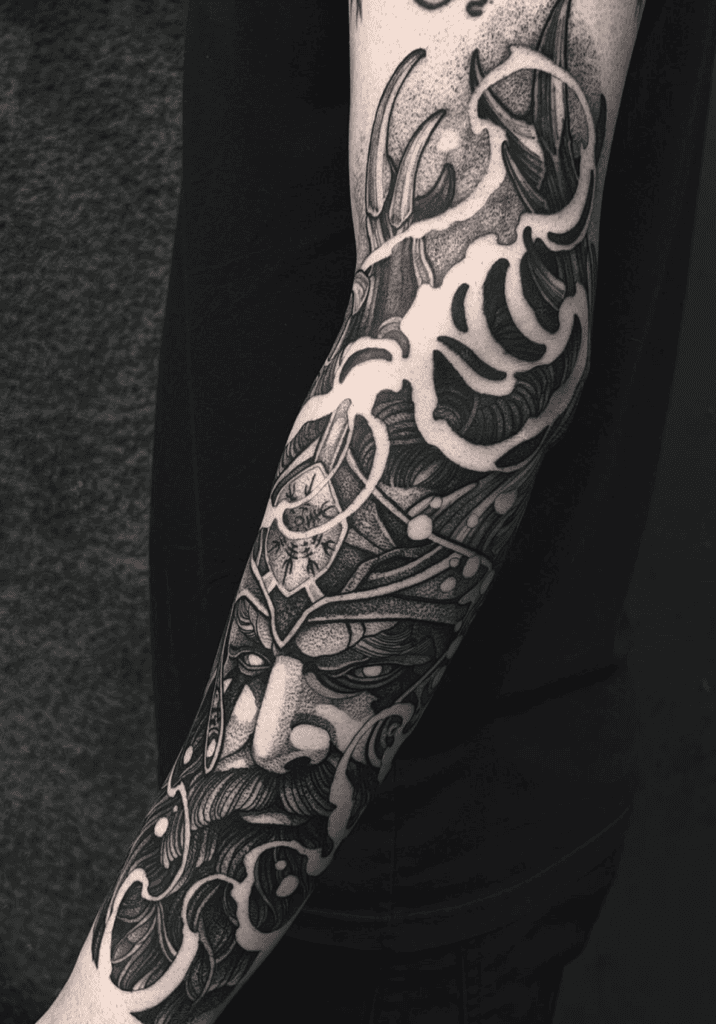
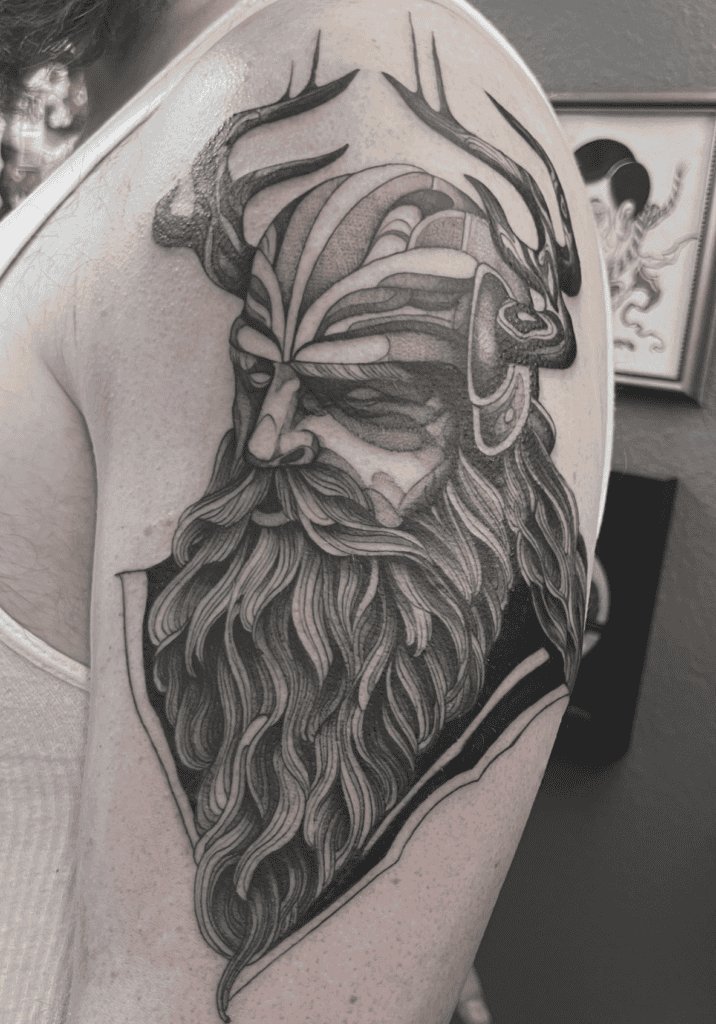
Ullr is a god associated with winter, hunting, archery, and survival in the harsh northern landscape. While he is not as widely featured in surviving myths as gods like Odin or Thor, he was clearly an important figure in Norse culture, especially in regions where survival depended on skill, endurance, and adaptability in cold environments.
He is often described as a master archer and a skilled skier, which reflects the realities of life in Scandinavia during the Viking Age. Ullr is not a god of grand speeches or complex schemes, but one of precision, focus, and quiet capability. He represents the kind of strength that comes from experience and discipline, rather than raw power or chaos.
Ullr is also connected to shields, which were sometimes referred to as “Ullr’s ship,” suggesting a link between protection and travel across icy terrain. This association adds another layer to his character, positioning him as both a hunter and a protector, someone who can navigate danger while also defending against it.
Eir Norse Mythology Tattoo
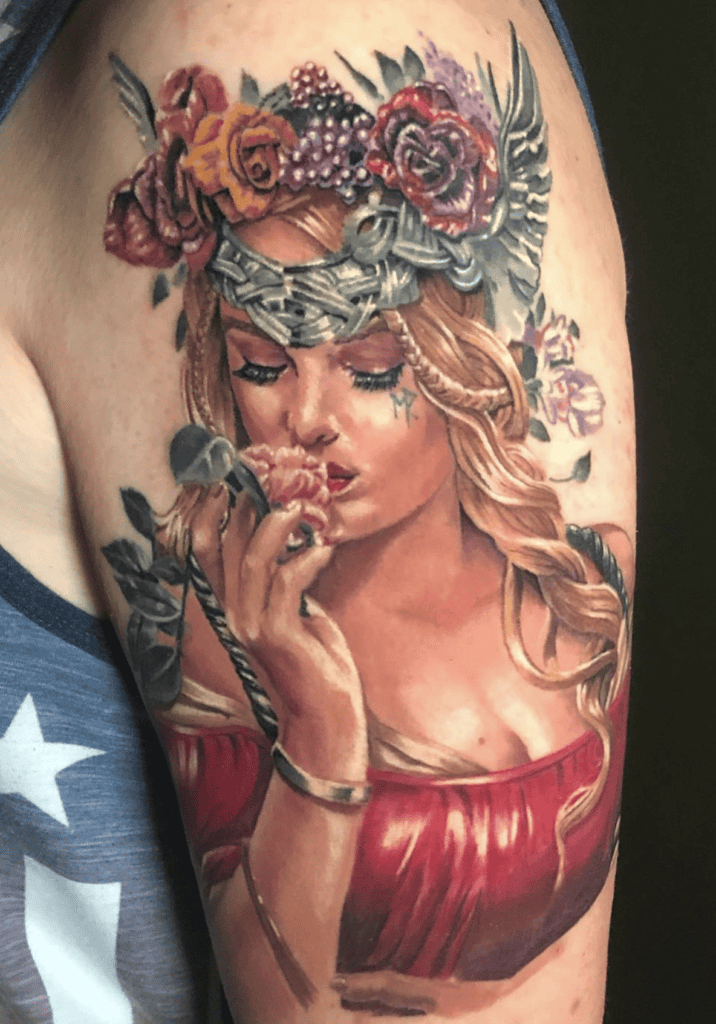
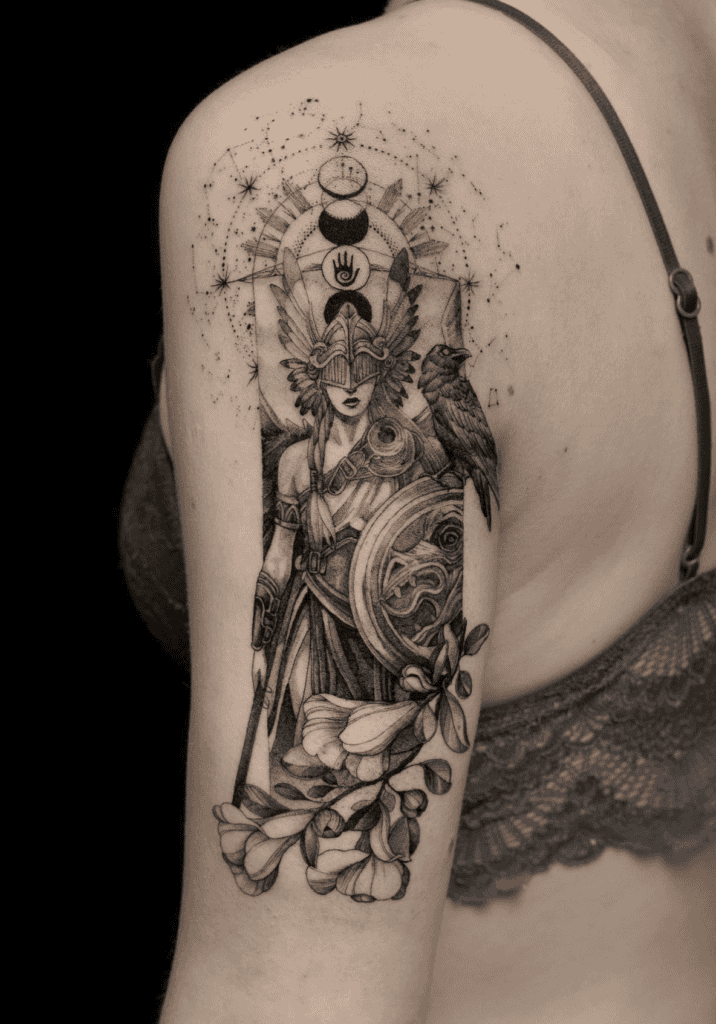
Eir is known as a goddess associated with healing, medicine, and mercy, making her one of the most compassionate figures in Norse mythology. She is often connected to a place called Lyfjaberg, meaning “Healing Mountain,” where it is said she helps those who seek aid.
In some traditions, Eir is also described as one of the handmaidens of Frigg, which places her among the higher ranks of the gods in Asgard. In others, she is associated with the Valkyries, suggesting that her role may extend beyond healing the living to caring for warriors in a deeper, more spiritual sense. These varying interpretations add a layer of mystery to her character, as her exact role shifts depending on the source.
What makes Eir particularly interesting is how she represents a different kind of power. In a mythology where strength is often measured through combat or dominance, Eir shows that there is strength in healing, patience, and compassion. Her presence reminds us that survival is not only about fighting, but also about recovery and care.
Freyja Norse Mythology Tattoo
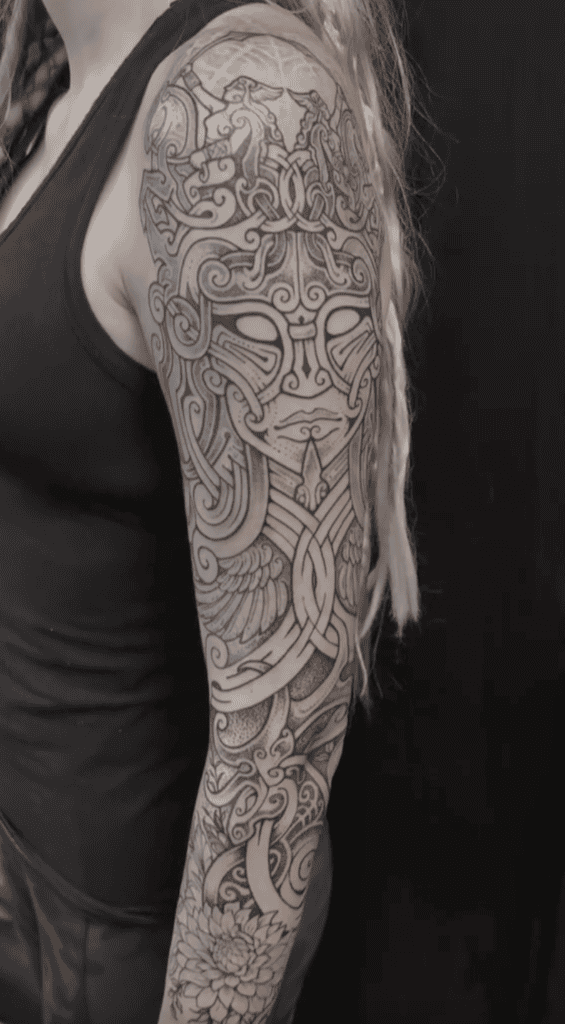
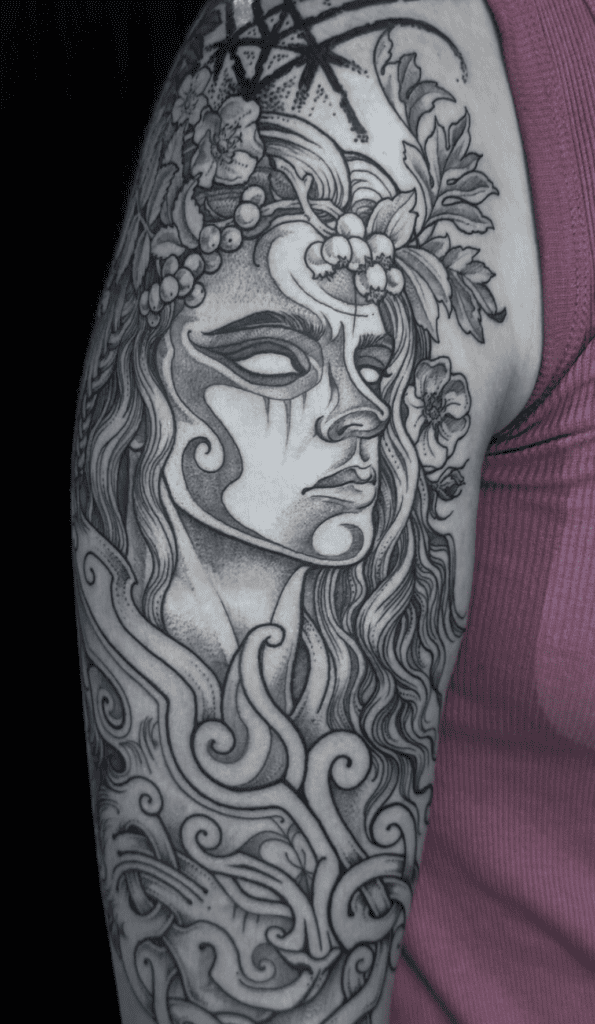
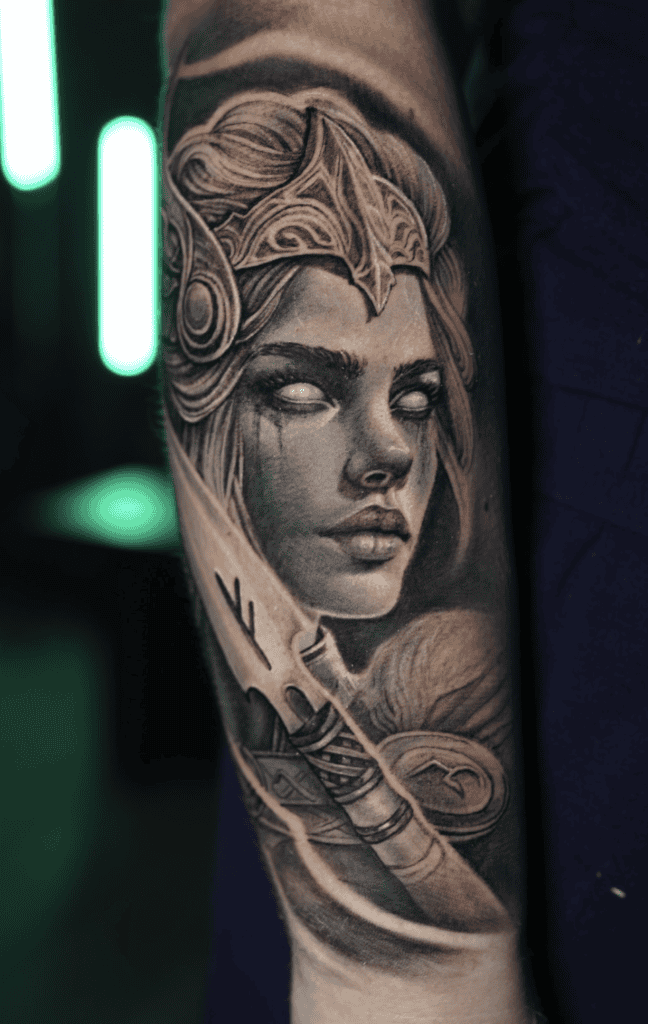
Freyja is one of the most important goddesses in Norse mythology and a leading member of the Vanir, a group of gods associated with nature, fertility, and prosperity. She is the sister of Freyr and the daughter of Njörðr, who embodies love and desire on one hand, and war and death on the other.
She is most commonly known as the goddess of love, beauty, and fertility, often associated with passion, attraction, and emotional depth. Freyja is also deeply connected to magic, particularly a form known as seiðr, a powerful and mysterious practice that allows her to shape fate and influence the world in unseen ways. She is said to have taught this magic to Odin himself, which highlights just how influential she truly is.
What makes Freyja especially unique is her connection to both life and death. While Odin is known for choosing warriors to take to Valhalla, Freyja also claims half of those who die in battle, bringing them to her own hall, Fólkvangr. This dual role places her at the centre of both love and loss, creation and destruction, making her one of the most balanced and complex figures in Norse mythology.
Another well-known aspect of Freyja’s story is her deep emotional capacity. She is said to weep tears of gold when searching for her lost husband, Óðr.
Freyr Norse Mythology Tattoo
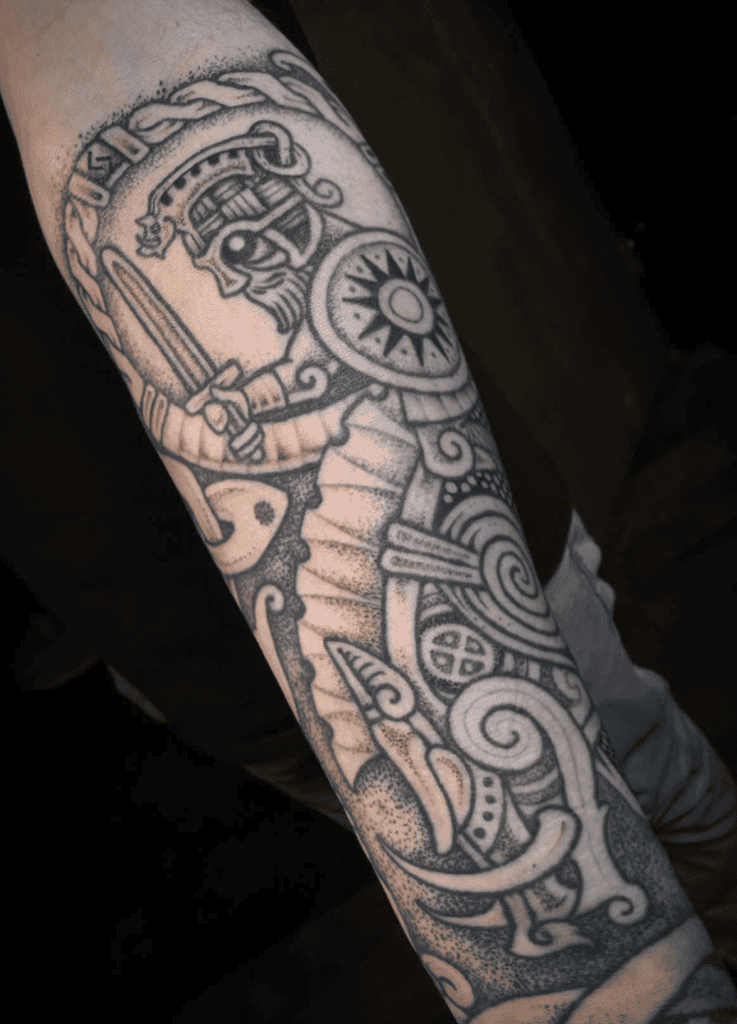
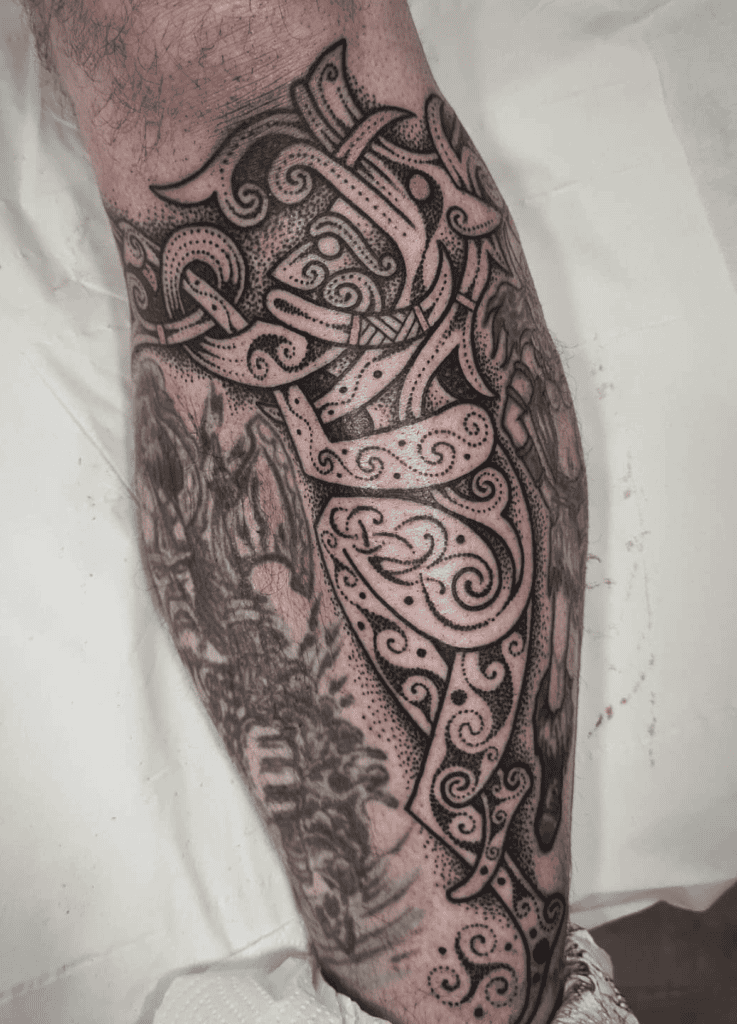
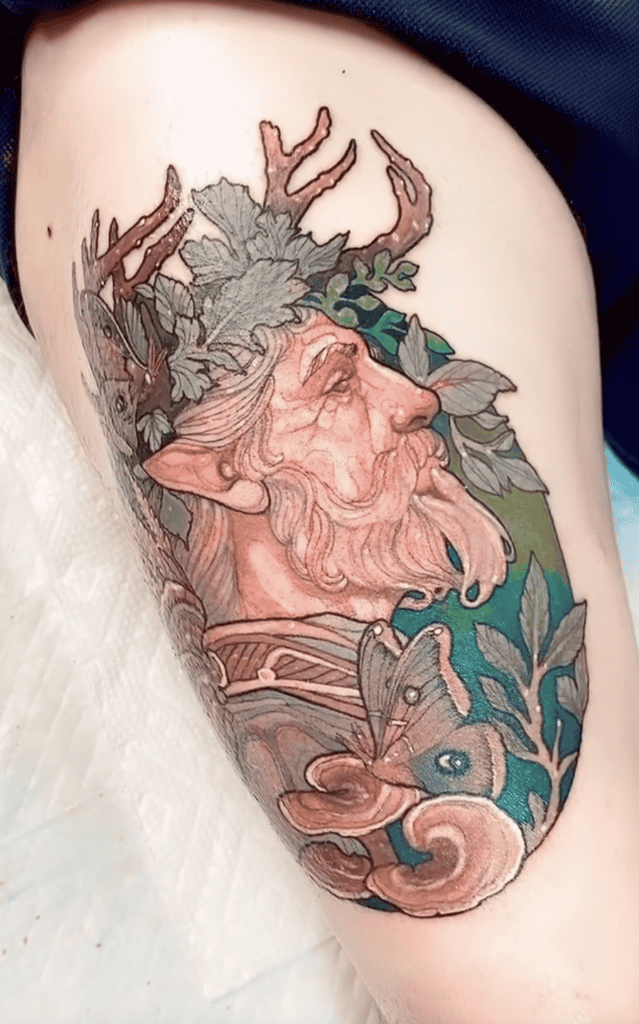
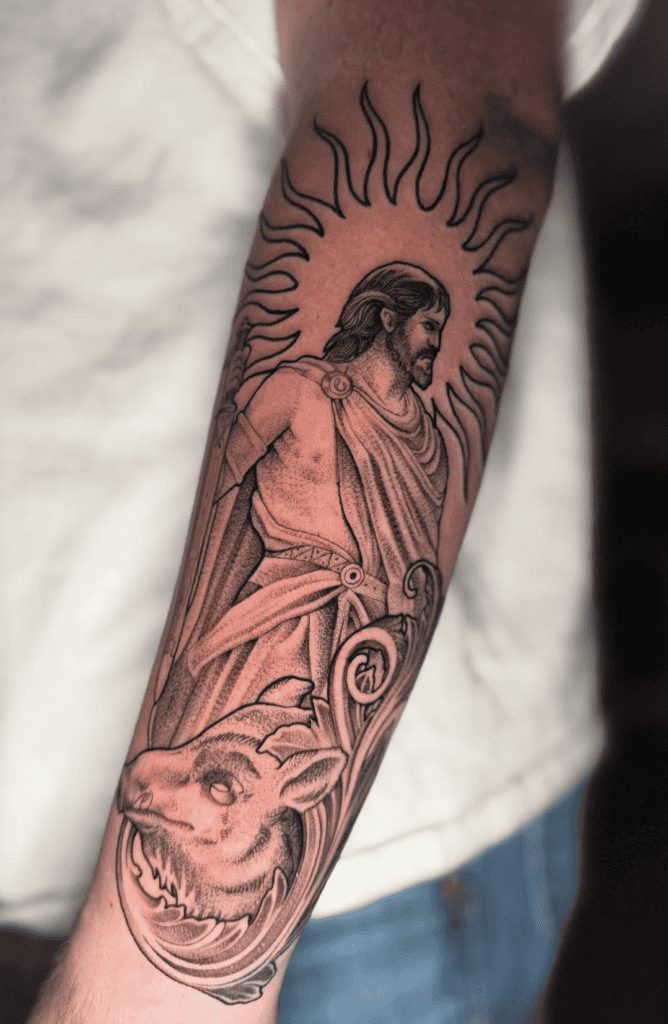
Freyr is a major god of the Vanir, a group associated with fertility, nature, and abundance, and is the brother of Freyja and the son of Njörðr. He is a god of growth, prosperity, and peace, closely linked to the cycles of nature and the well-being of both the land and the people who depend on it.
He is often associated with sunlight, harvests, and good seasons, making him an important figure for farmers and communities who relied on the land to survive. Freyr’s presence is said to bring abundance and stability, ensuring that crops grow, animals thrive, and life continues in balance.
Freyr’s story takes a significant turn when he falls deeply in love with the giantess Gerðr. In order to win her hand, he gives up his magical sword, sacrificing a powerful advantage for the sake of love.
This sacrifice becomes especially important during Ragnarök. Without his sword, Freyr is unable to fully defend himself in the final battle and is ultimately killed by Surtr, the fire giant.
Njörðr Norse Mythology Tattoo
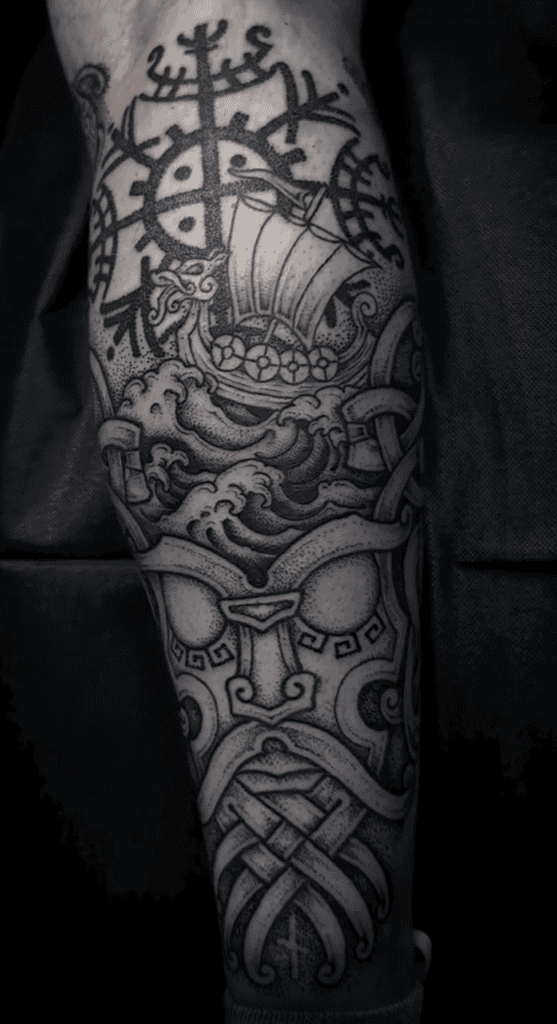
Njörðr is a god of the Vanir and is closely tied to the sea, the wind, and the wealth that comes from them, making him an especially important figure for sailors, traders, and coastal communities.
Njörðr has a calm and steady presence, associated with peace and prosperity, embodying the idea that true wealth comes not just from gold or treasure, but from stability, good fortune, and harmony with the natural world. His home is said to be Nóatún, a hall by the sea, where ships can safely come and go, reinforcing his role as a protector of those who travel across the waters.
One of the most well-known aspects of Njörðr’s story is his marriage to Skadi, a giantess associated with mountains, winter, and hunting. Their relationship is marked by contrast, as Njörðr belongs to the sea while Skadi is deeply connected to the mountains. They attempt to live together by alternating between their homes, spending time in the mountains and then by the sea. However, neither is truly comfortable in the other’s world as Njörðr dislikes the cold and isolation of the mountains, while Skadi finds the sound of the sea and seabirds unsettling.
This story highlights an important theme in Norse mythology: the tension between different worlds and ways of life. Despite their efforts, Njörðr and Skadi ultimately separate, showing that even gods cannot always reconcile opposing natures. It is a more grounded and relatable story compared to the epic battles of other myths, focusing instead on compatibility and the limits of compromise.
Ymir Norse Mythology Tattoo
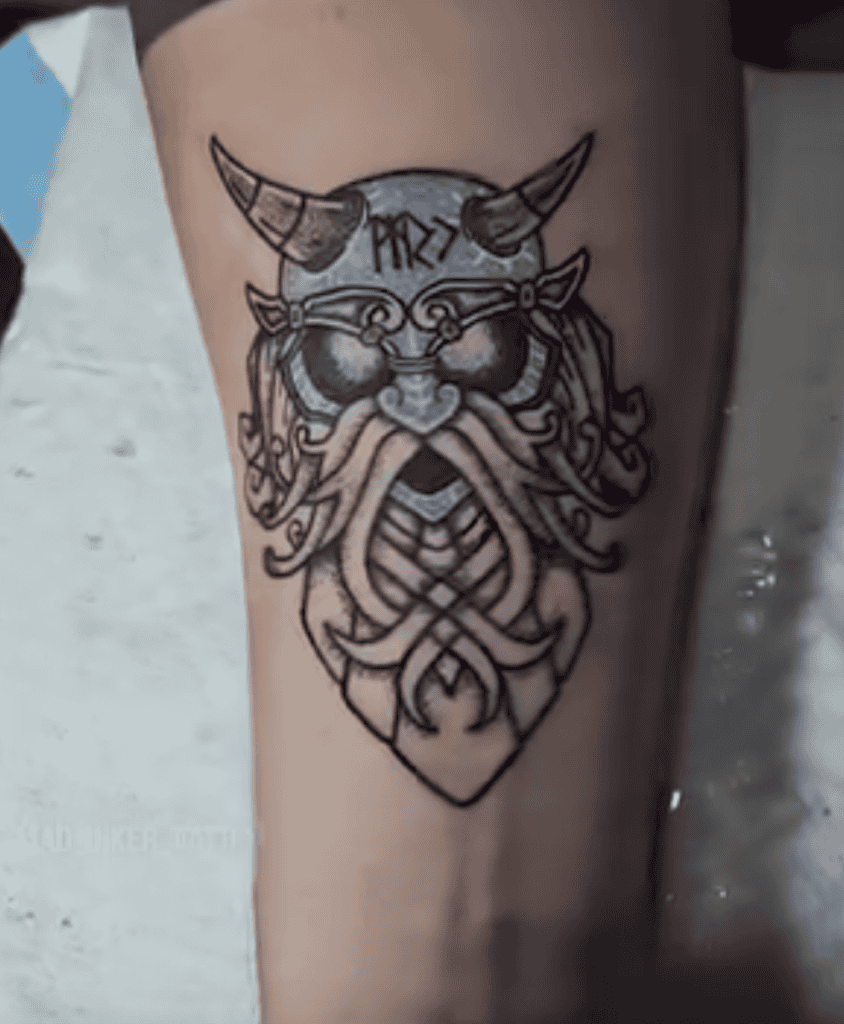
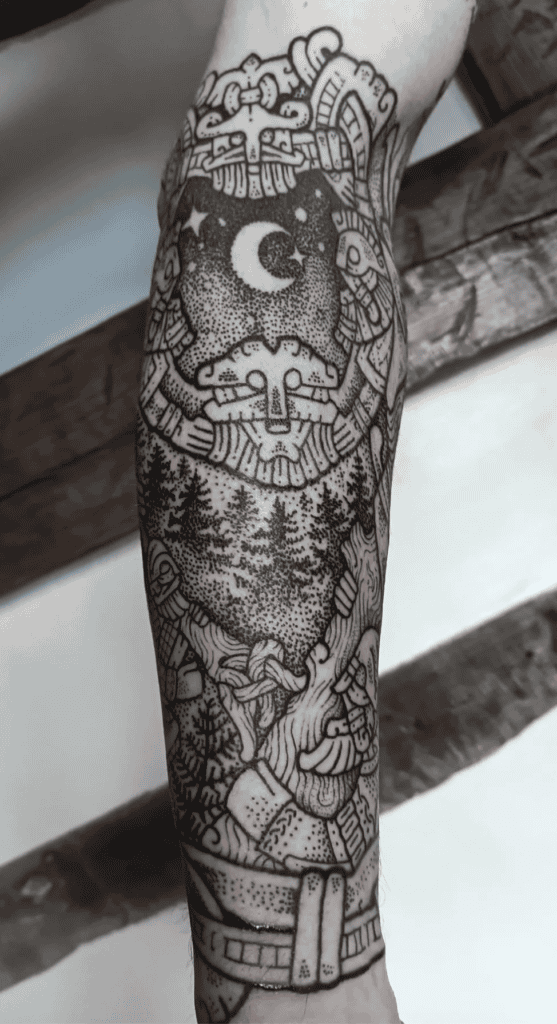
Ymir is the first being in Norse mythology, a primordial giant who existed before the world itself was fully formed. He emerged in the vast emptiness known as Ginnungagap, a void that lay between the icy realm of Niflheim and the fiery realm of Muspelheim. When the freezing cold met the intense heat, the ice began to melt, and from those drops, Ymir came into existence.
Ymir is not a god, but a giant, and from him all other giants, known as the Jötnar, are descended. In a strange and symbolic way, life begins through him, as other beings are said to form from his body while he sleeps. This makes Ymir less of a character with a story and more of a force of nature, representing the raw, chaotic beginnings of existence before order was established.
Álfar Norse Mythology Tattoo
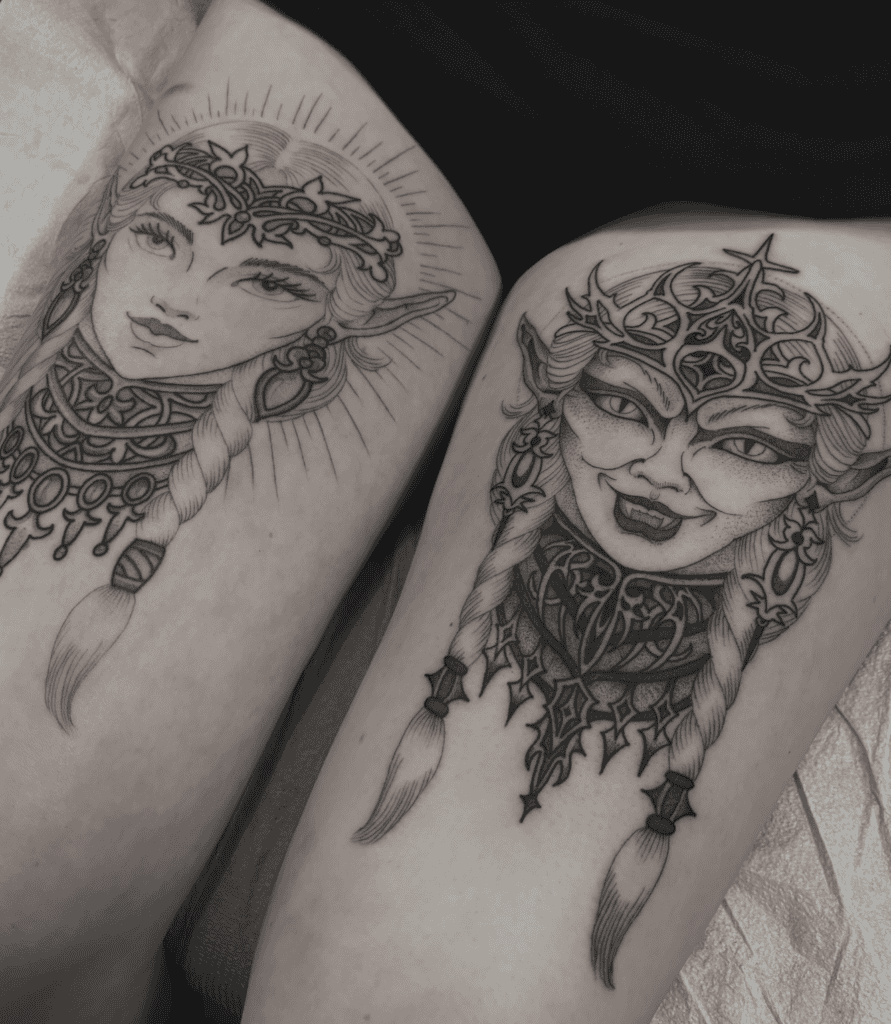
Álfar, or elves, are a group of supernatural beings in Norse mythology who exist somewhere between gods and spirits. They are often associated with nature, light, and magic, and are considered powerful in subtle and mysterious ways. Unlike the more clearly defined gods, the Álfar are less understood, appearing more like forces of the natural and spiritual world than individual characters with detailed stories.
They are usually divided into two main groups: the Light Elves and the Dark Elves. The Light Elves, known as Ljósálfar, are said to live in Alfheim, a radiant realm connected to beauty, fertility, and life. They are often described as luminous, graceful beings whose presence is linked to growth and harmony in the natural world. Their connection to Freyr, who rules over Alfheim, reinforces their association with prosperity and the life-giving aspects of nature.
In contrast, the Dark Elves, sometimes referred to as Dökkálfar or Svartálfar, are associated with the underground and shadowed places of the world. They are often linked with craftsmanship and hidden knowledge, and in some interpretations, they overlap with dwarves, the master smiths of Norse mythology. These darker elves are not necessarily evil, but they are more secretive and connected to the unseen forces beneath the surface.
What makes the Álfar particularly interesting is how they blur the line between the physical and spiritual worlds. They are not as dominant or central as the gods, but they are ever-present, influencing the world in quiet ways. In some traditions, they are even connected to ancestral spirits, suggesting that they may represent a bridge between the living and those who came before.
Dwarves (Dvergar) Norse Mythology Tattoo
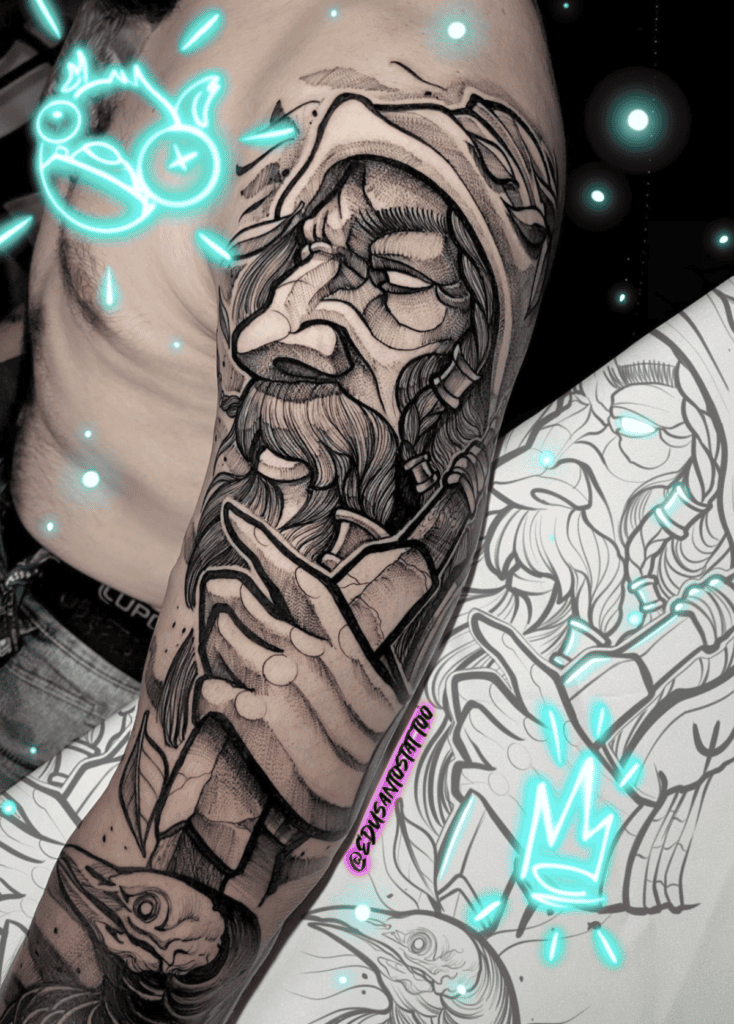
The Dvergar, or dwarves, are a race of master craftsmen in Norse mythology, known for their unmatched skill in forging powerful weapons, magical items, and legendary artefacts. They dwell deep beneath the earth, often in vast underground halls filled with fire, metal, and the constant sound of hammer striking anvil. Unlike the gods, who rule the realms, or the giants, who represent chaos, the Dvergar shape the world through creation.
The dwarves are said to have formed from the body of Ymir, the primordial giant, emerging from his flesh after the world was created. This connection ties them directly to the foundations of existence, reinforcing the idea that they are born from the very substance of the world itself.
What truly defines the Dvergar is their craftsmanship. Many of the most iconic objects in Norse mythology exist because of them. Thor’s hammer, Mjölnir, Odin’s spear, Gungnir, and the golden ring Draupnir are all forged by dwarves. These items are not just tools or weapons, but symbols of power, identity, and fate.
Despite their incredible skill, the Dvergar are not always portrayed as noble or kind. They are often depicted as proud, secretive, and sometimes vengeful. Their creations can come with conditions, and their interactions with the gods are not always straightforward. In some stories, they are tricked or manipulated, while in others, they outsmart those who underestimate them. This complexity makes them feel less like simple helpers and more like independent forces with their own motives.
Brokkr And Sindri Norse Mythology Tattoo
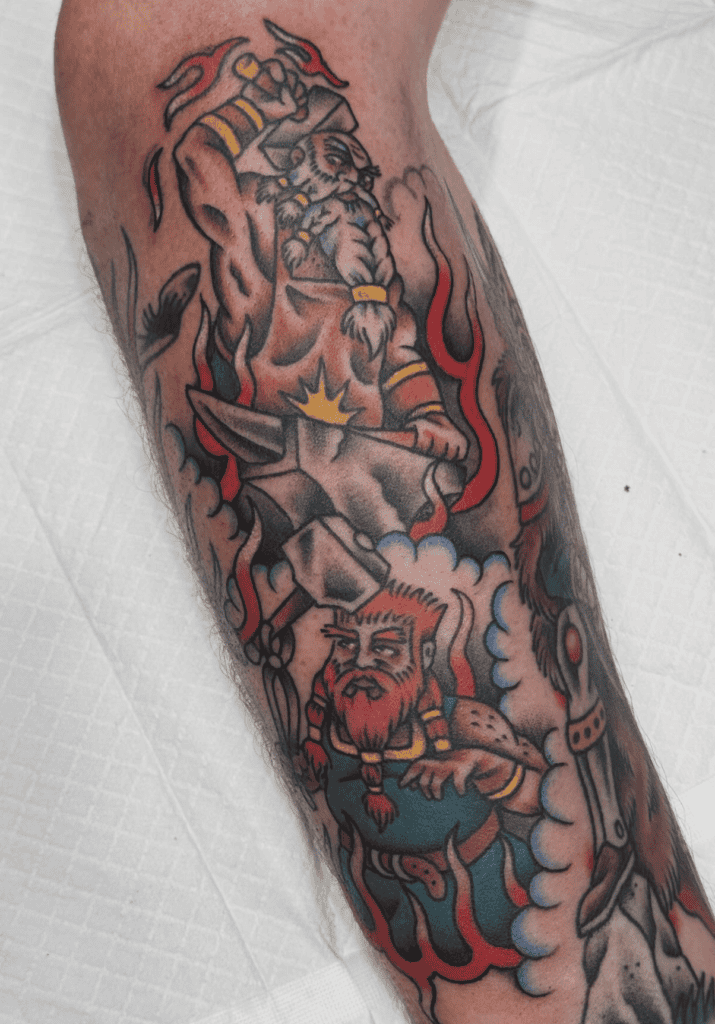
Brokkr and Sindri, sometimes called Eitri, are two dwarf brothers known as the greatest craftsmen in all of Norse mythology. While the Dvergar as a whole are famed for their skill, these two stand above the rest, responsible for creating some of the most powerful and recognisable artefacts used by the gods themselves.
Their story begins with Loki, whose mischief leads him into trouble once again. After cutting off the golden hair of Sif, Thor’s wife, Loki is forced to make amends. He seeks out a group of dwarves known as the Sons of Ivaldi, who forge magnificent treasures to appease the gods. However, Loki’s arrogance gets the better of him, and he boasts that no other dwarves could create anything to match their work.
This is where Brokkr and Sindri enter the story. Offended by Loki’s claim, they accept the challenge and agree to forge three items that will surpass anything the Sons of Ivaldi have made. A wager is set, with Loki risking his own head if they succeed.
Sindri begins the work, placing materials into the forge while Brokkr operates the bellows, keeping the fire at the perfect intensity. Sindri warns his brother not to stop, no matter what happens. Sensing danger, Loki transforms into a fly and attempts to sabotage their work. He bites Brokkr repeatedly, trying to disrupt the process, but Brokkr endures, refusing to stop the bellows.
Despite Loki’s interference, the brothers succeed in forging three incredible items. The first is Gullinbursti, a golden boar whose glowing mane can light the darkest paths. The second is Draupnir, a ring that multiplies itself, symbolising endless wealth and power. The third and most famous is Mjölnir, Thor’s hammer, one of the most powerful weapons in all mythology.
Valkyries Norse Mythology Tattoo
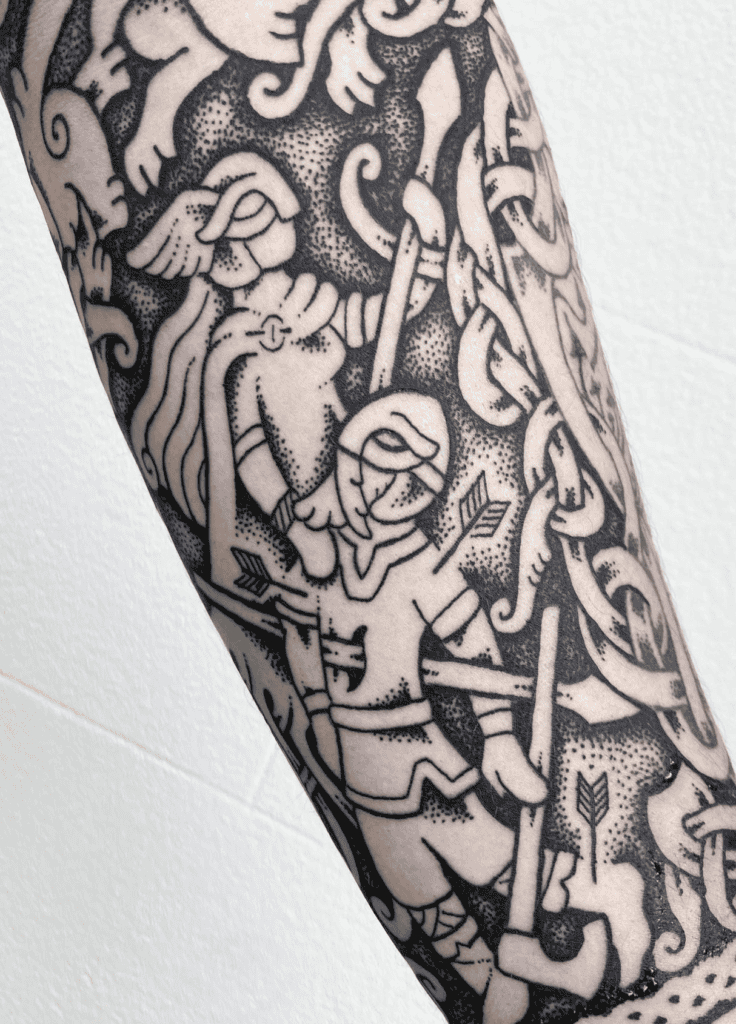
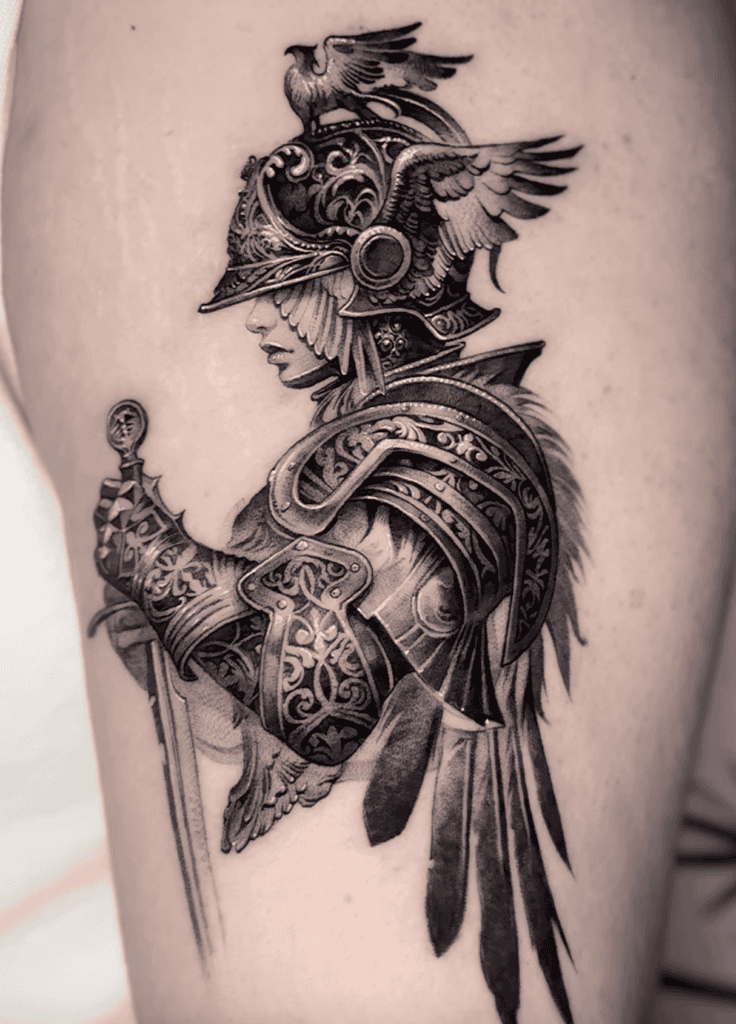
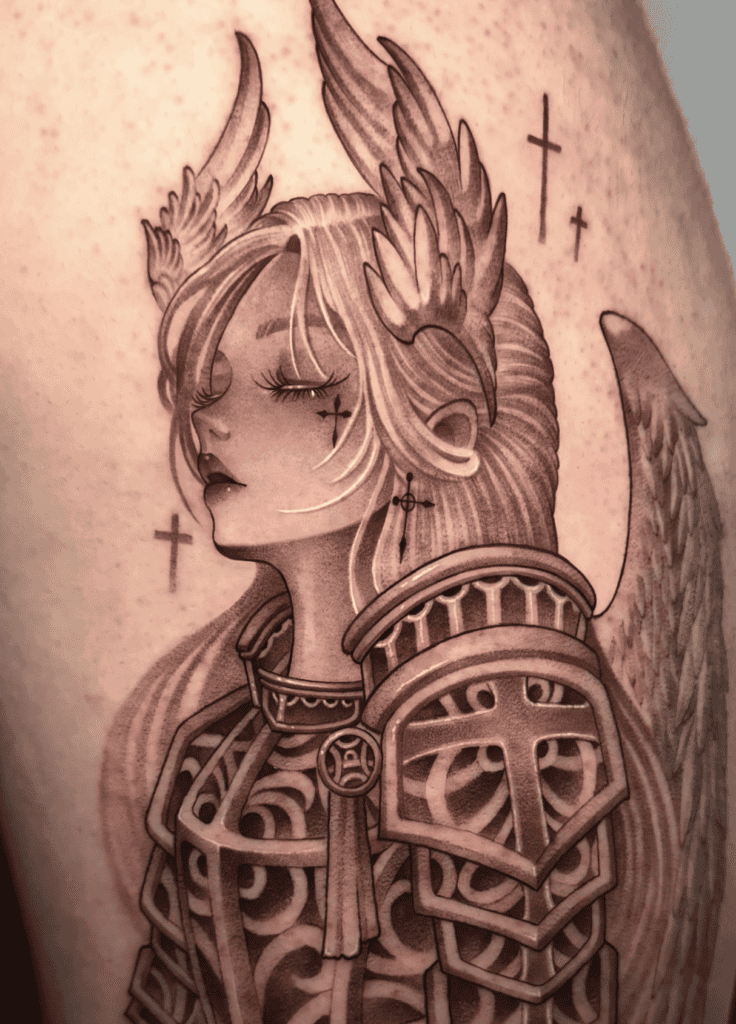
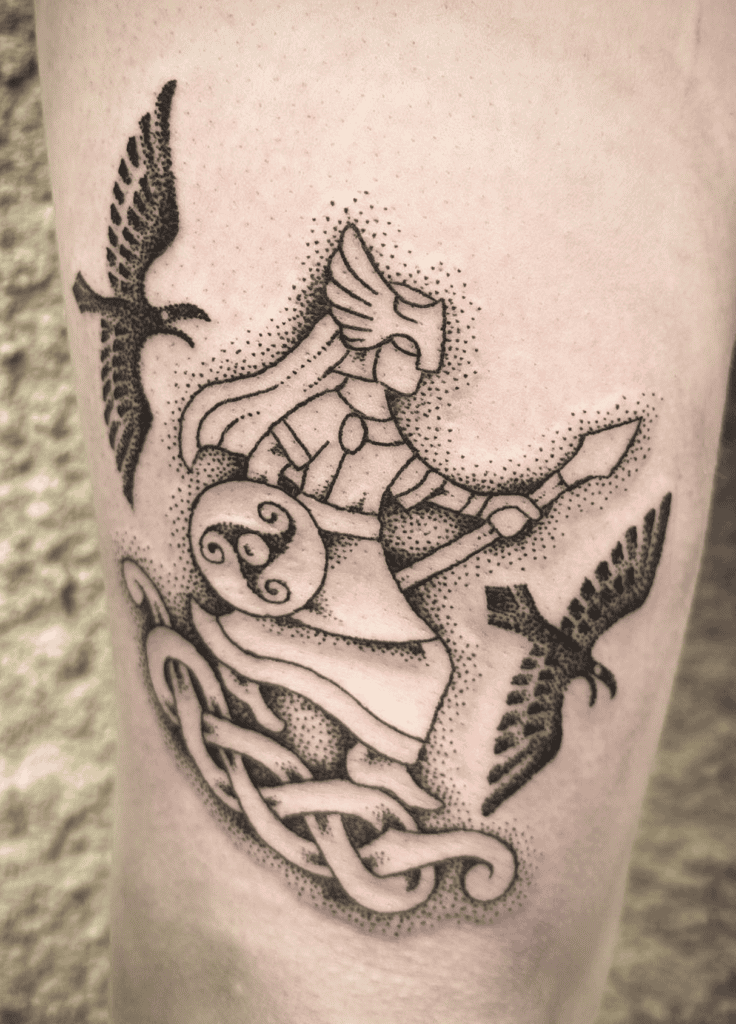
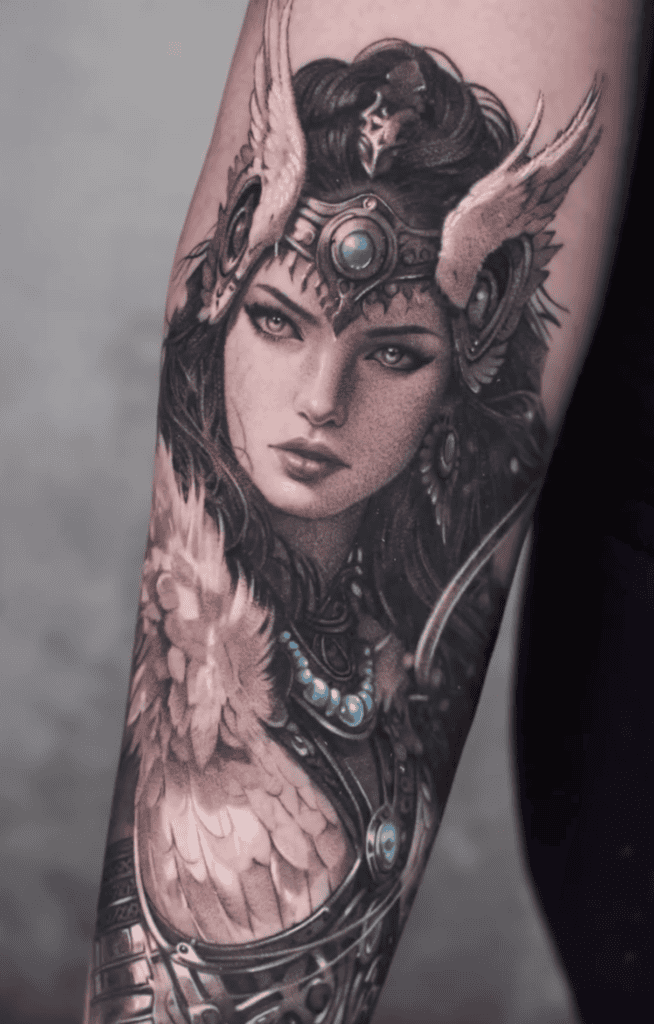
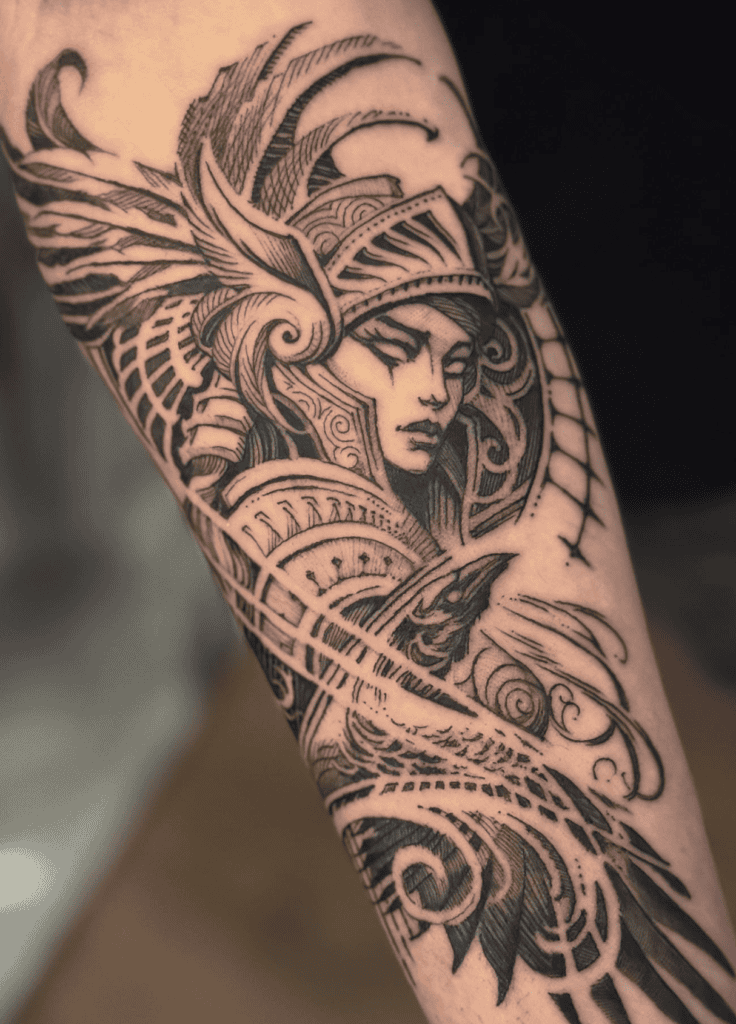
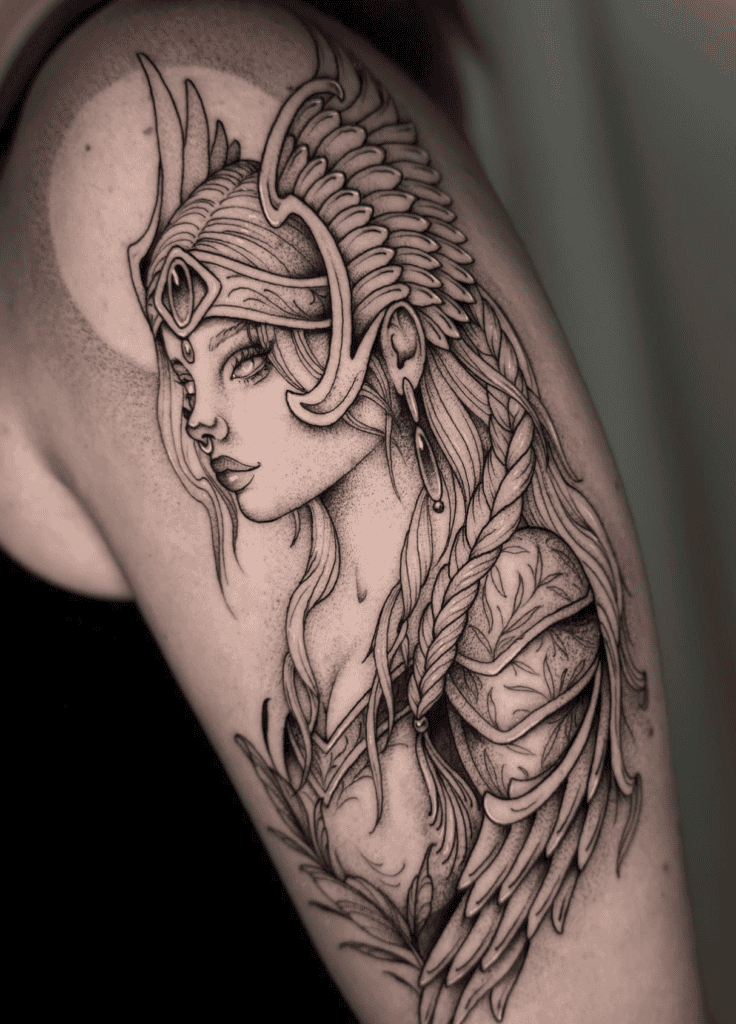
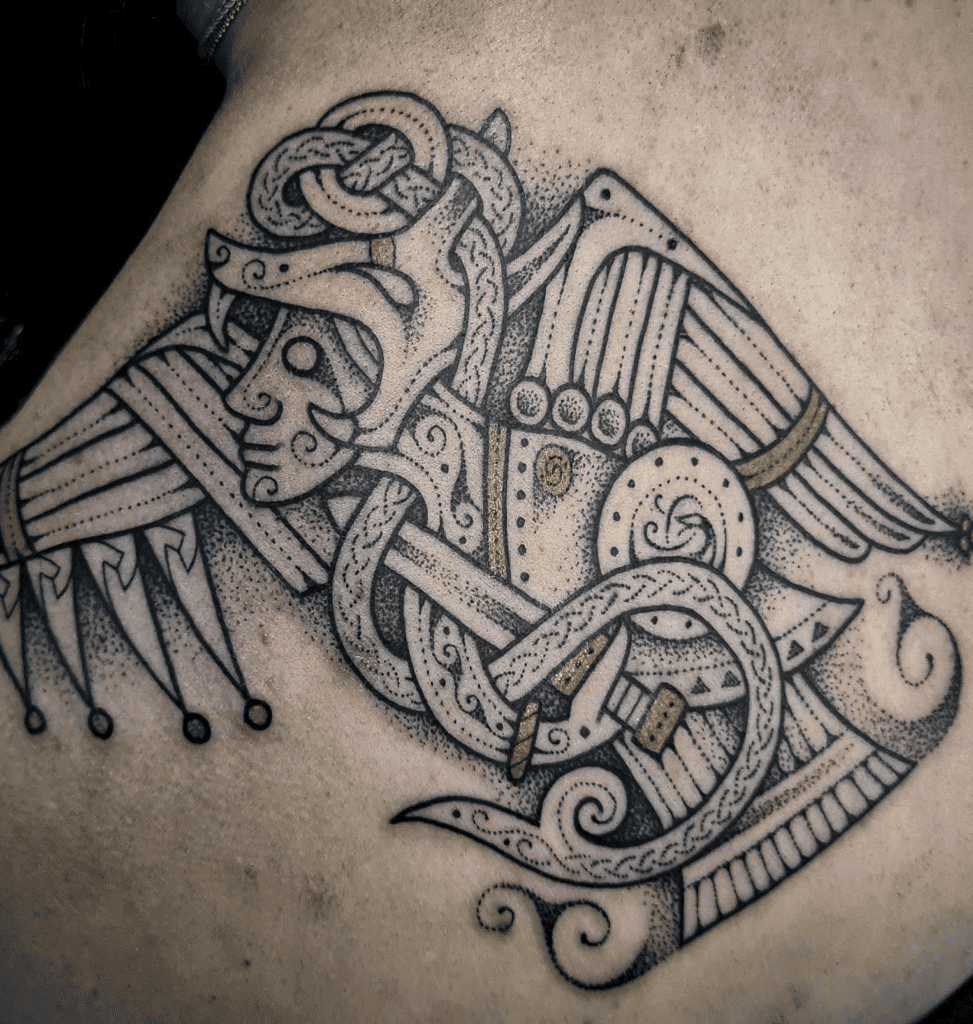
The Valkyries are powerful female figures in Norse mythology whose name means “choosers of the slain.” They serve Odin and play a crucial role in deciding the fate of warriors on the battlefield. When battles unfold, it is the Valkyries who determine which warriors will live and which will die, guiding the souls of the bravest fallen to Valhalla, Odin’s great hall.
They are often depicted as fierce and radiant warriors, riding through the skies or across battlefields, sometimes clad in armour and sometimes described with more ethereal, almost otherworldly beauty. Their presence is both awe-inspiring and unsettling, as they represent the thin line between life and death. To see a Valkyrie is to know that fate is being decided.
Once they bring fallen warriors to Valhalla, their role shifts. In Odin’s hall, they serve and honour these warriors, preparing them for Ragnarök, the final battle. The chosen warriors, known as the Einherjar, spend their time training, fighting, and feasting, and the Valkyries are part of this cycle, guiding them both in death and in preparation for what is to come.
What makes the Valkyries particularly interesting is their connection to fate. In some interpretations, they are closely linked to the Norns, the beings who weave destiny, suggesting that the Valkyries do not simply choose at random, but act according to a greater design.
Some Valkyries, such as Brynhildr, have their own individual stories, adding depth to their role. These tales often explore themes of love, betrayal, and independence, showing that while Valkyries serve a purpose, they are not without their own identities and emotions.
Norns Norse Mythology Tattoo
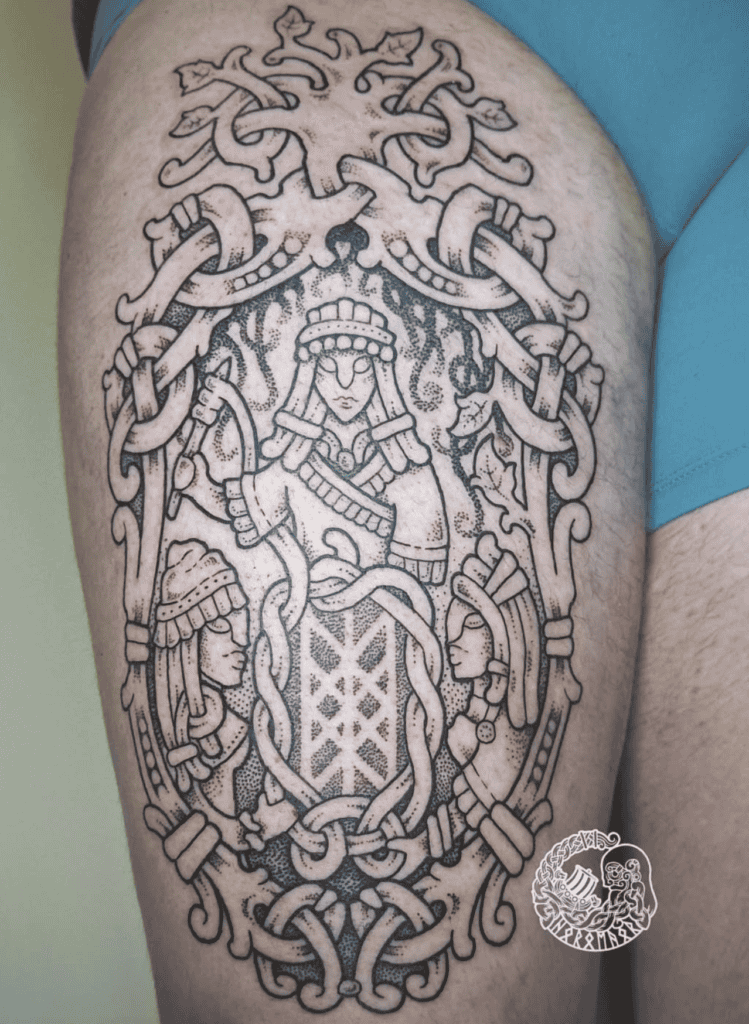
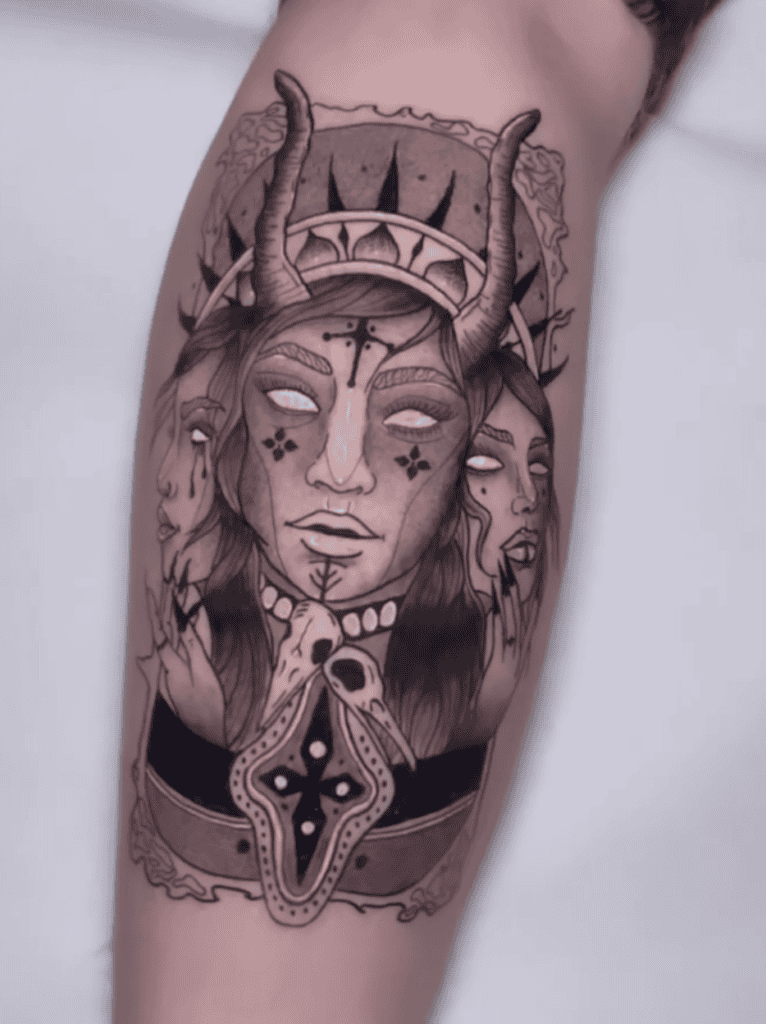
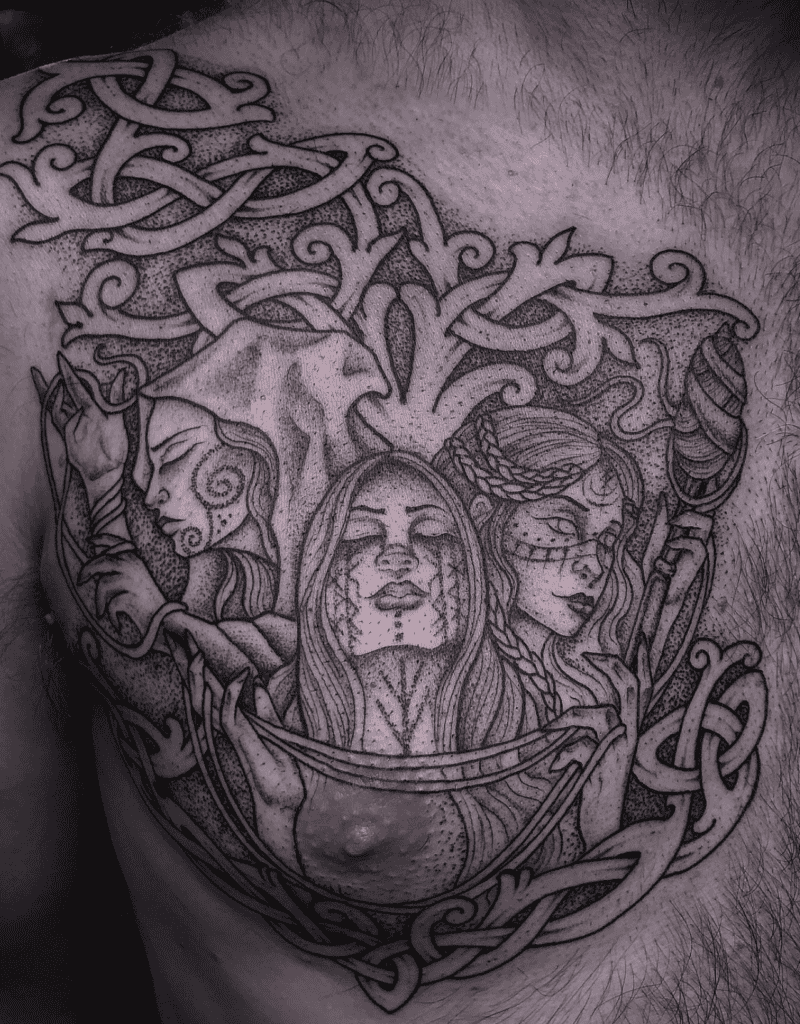
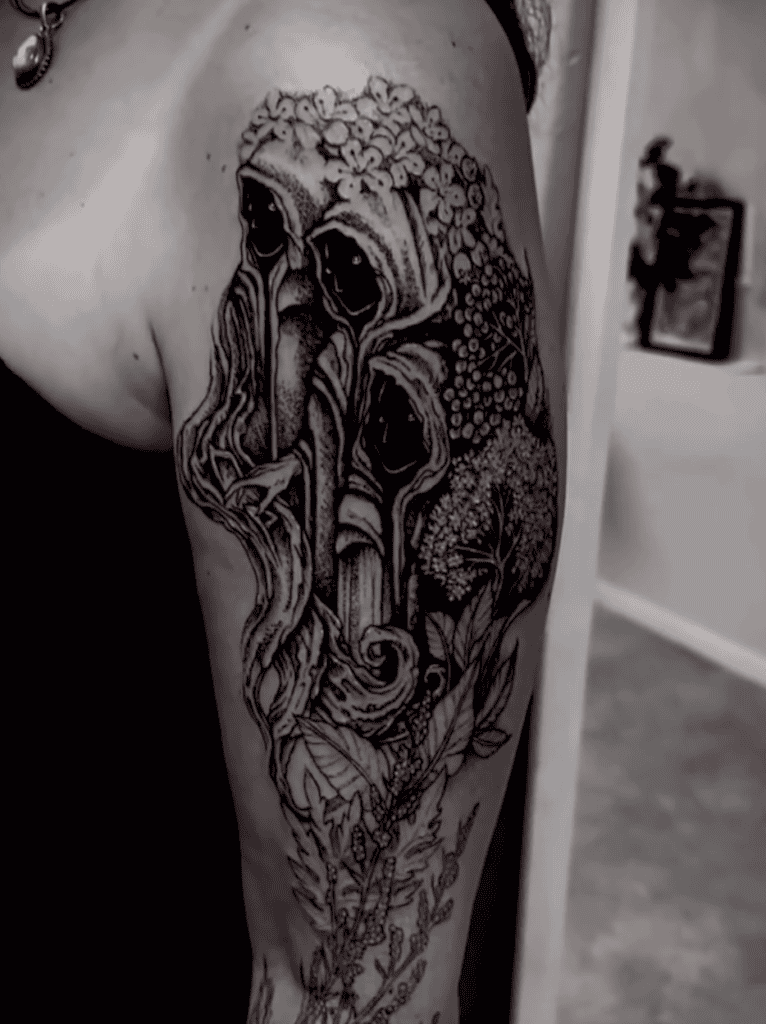
The Norns are powerful beings who control fate in Norse mythology, shaping the destinies of gods, giants, and humans alike. They exist beyond the authority of even the gods, making them some of the most influential figures in the entire Norse cosmos.
They are most often described as three central figures named Urðr, Verðandi, and Skuld. These names are closely tied to time itself, representing what has been, what is, and what is yet to come. Rather than simply predicting the future, the Norns actively shape it, weaving the threads of fate into a pattern that cannot be escaped.
The Norns reside near the roots of Yggdrasil, the great World Tree that connects all the realms. At the Well of Urðr, they tend to the tree, drawing water and nurturing it to ensure the stability of the cosmos. This connection reinforces their role as caretakers of existence itself, not just passive observers of destiny. Their actions help maintain the balance of the world while also guiding its inevitable path.
What makes the Norns especially fascinating is that their power extends even over the gods. Figures like Odin may seek knowledge and attempt to understand fate, but they cannot change what has already been woven. This creates a central theme in Norse mythology, where even the most powerful beings must accept their destiny, no matter how tragic it may be.
Surtr Norse Mythology Tattoo
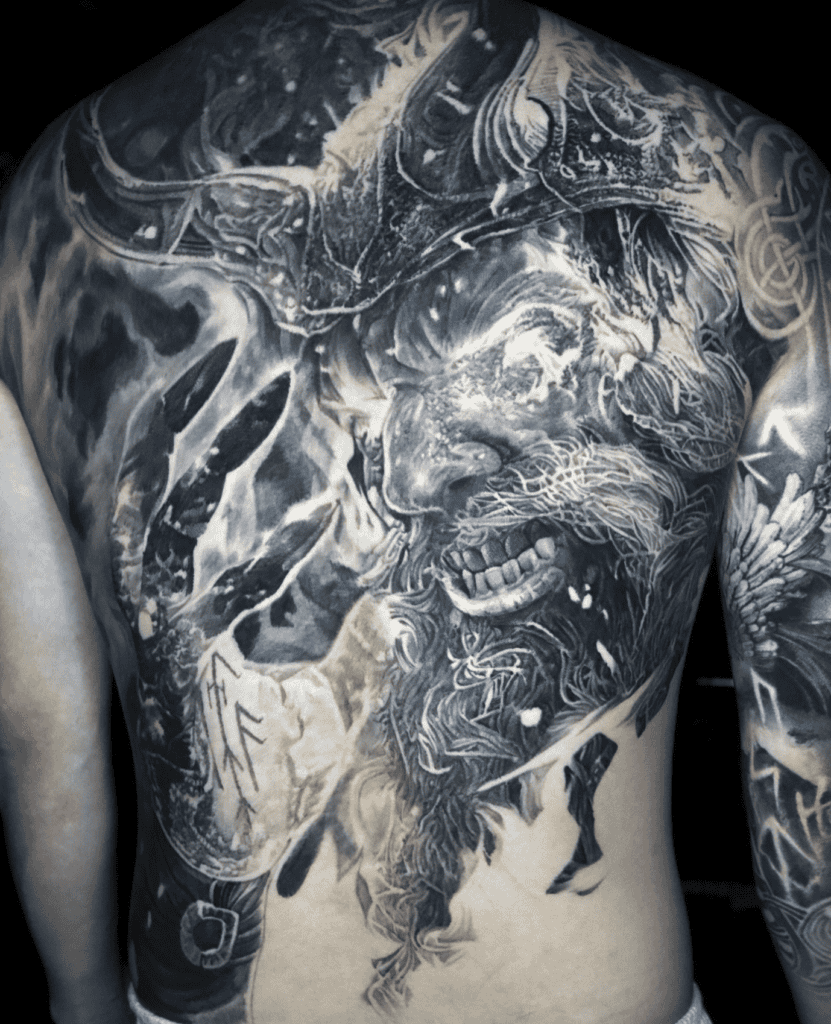
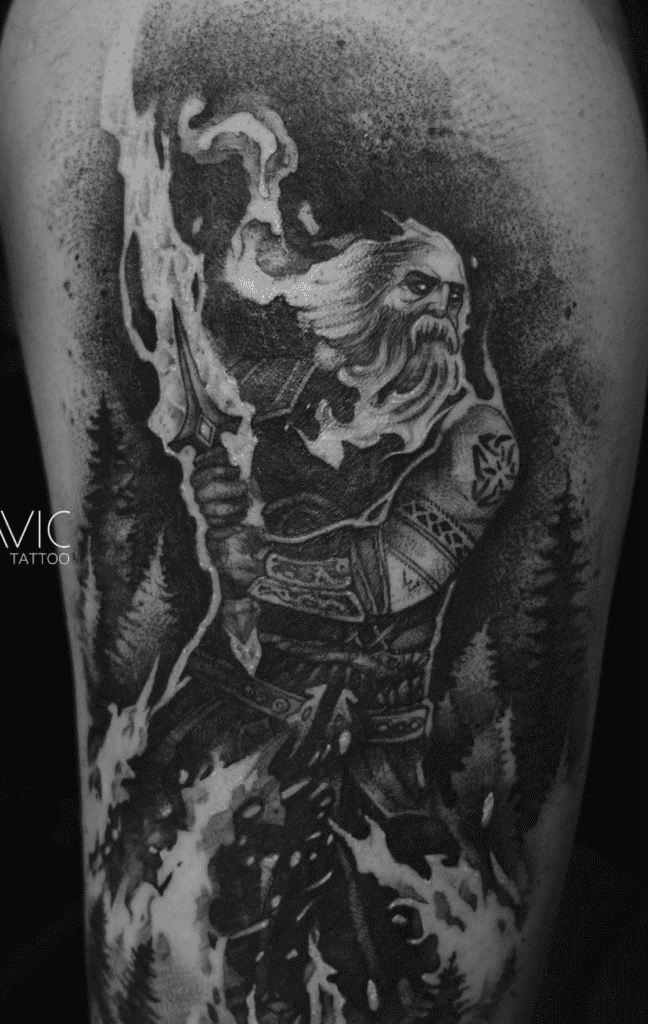
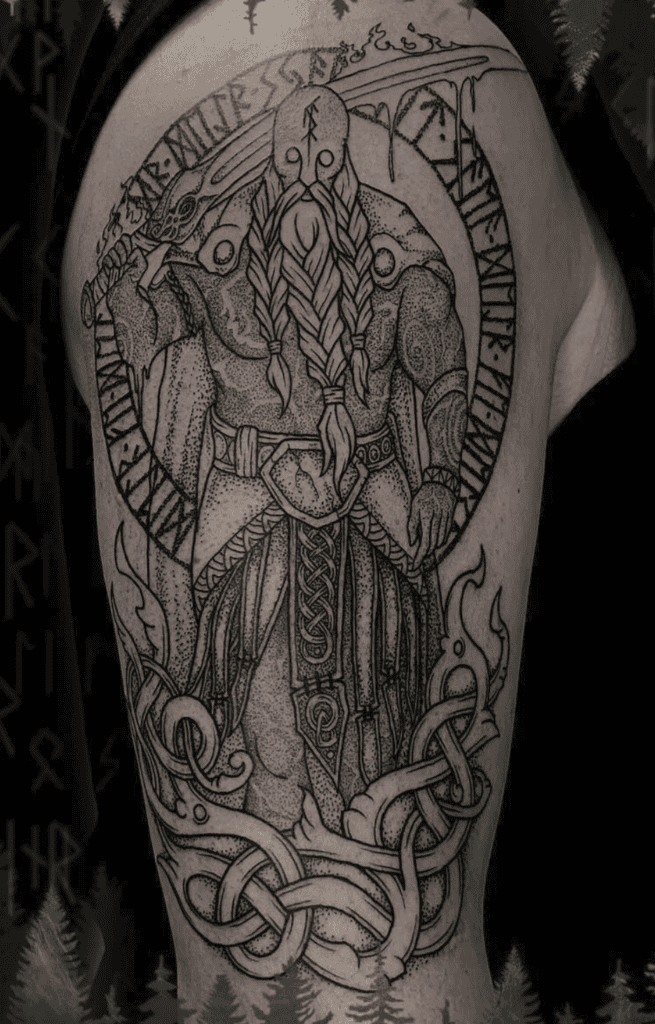
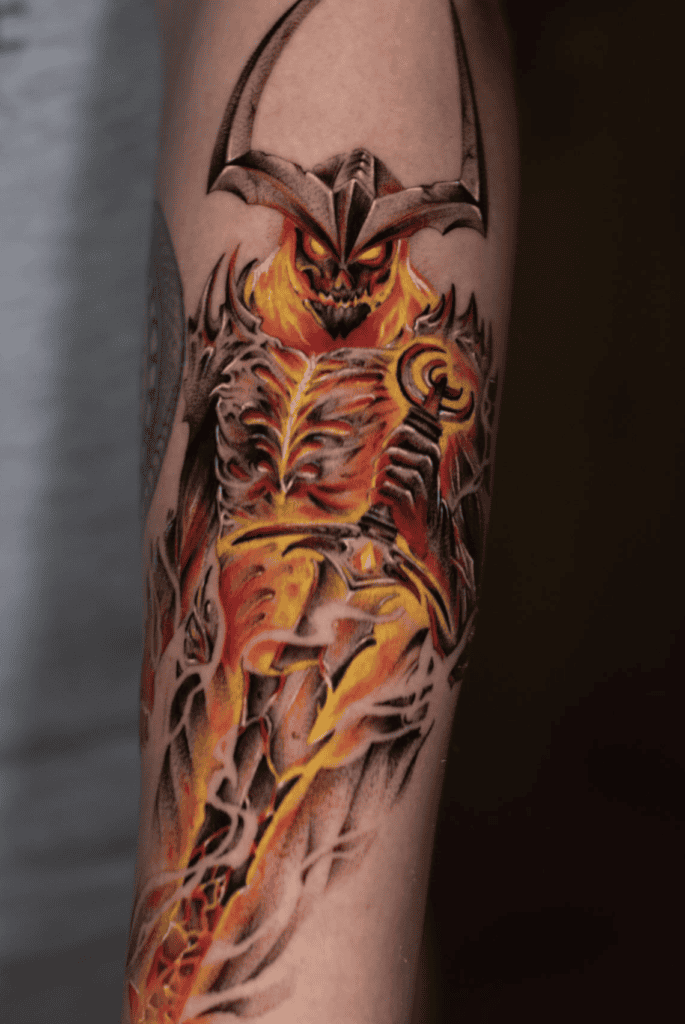
Surtr is a primordial fire giant and ruler of Muspelheim, the realm of fire, one of the oldest and most dangerous regions in Norse mythology. From the very beginning of the cosmos, Surtr stands at the edge of this fiery world, guarding it with a blazing sword and waiting for the moment when he will fulfil his role in the destruction of everything.
Unlike many other figures who grow into their destiny, Surtr feels inevitable from the start. He is not a character who changes or develops over time, but a constant presence, representing the unstoppable force of destruction that exists alongside creation. His very name is associated with blackness and burning, reinforcing his identity as a being tied to fire and ruin.
His importance becomes fully realised during Ragnarök. When this event begins, Surtr leads the forces of Muspelheim against the gods, crossing the Bifröst and setting the cosmos ablaze. His arrival marks a turning point, as the destruction he brings is not just part of the battle—it is the beginning of the end itself.
During Ragnarök, Surtr faces Freyr, the god of fertility and peace. Their confrontation is symbolic, as it represents the clash between life and destruction, growth and annihilation. Without his magical sword, which he gave up long before, Freyr is unable to defeat Surtr and is ultimately killed. This moment highlights how even the forces of life cannot withstand the inevitability of destruction.
After the battle, Surtr’s role does not end. He unleashes flames that consume the entire world, reducing everything to ash. However, this destruction is not purely an ending. In Norse mythology, the world is later reborn from the ashes, suggesting that Surtr’s fire is part of a larger cycle. He does not just destroy—he clears the way for something new to emerge.
Skadi Norse Mythology Tattoo
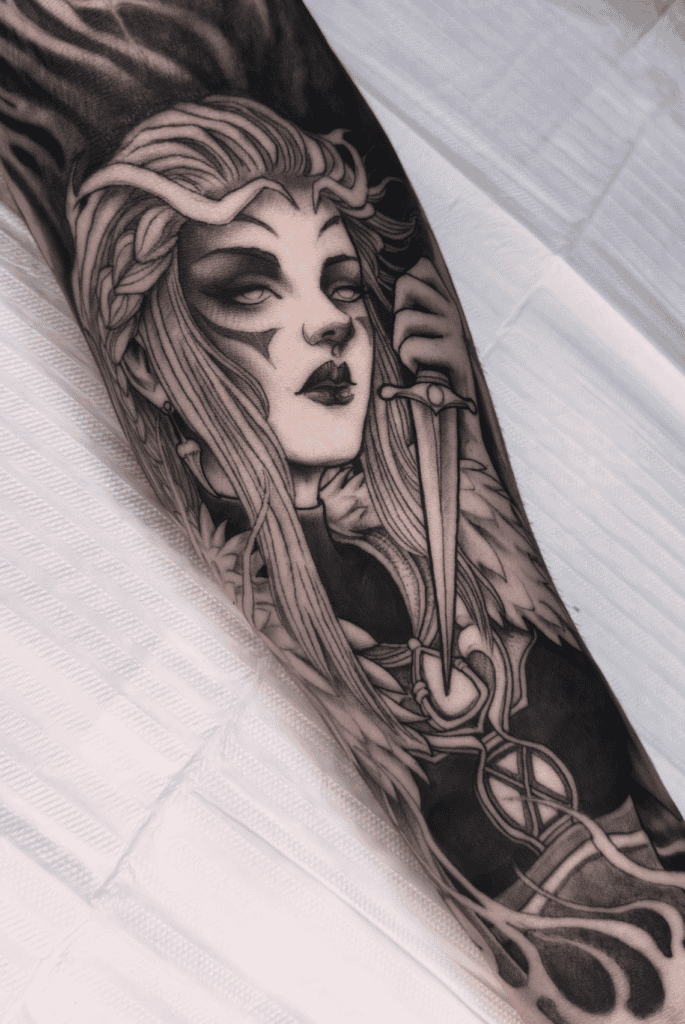
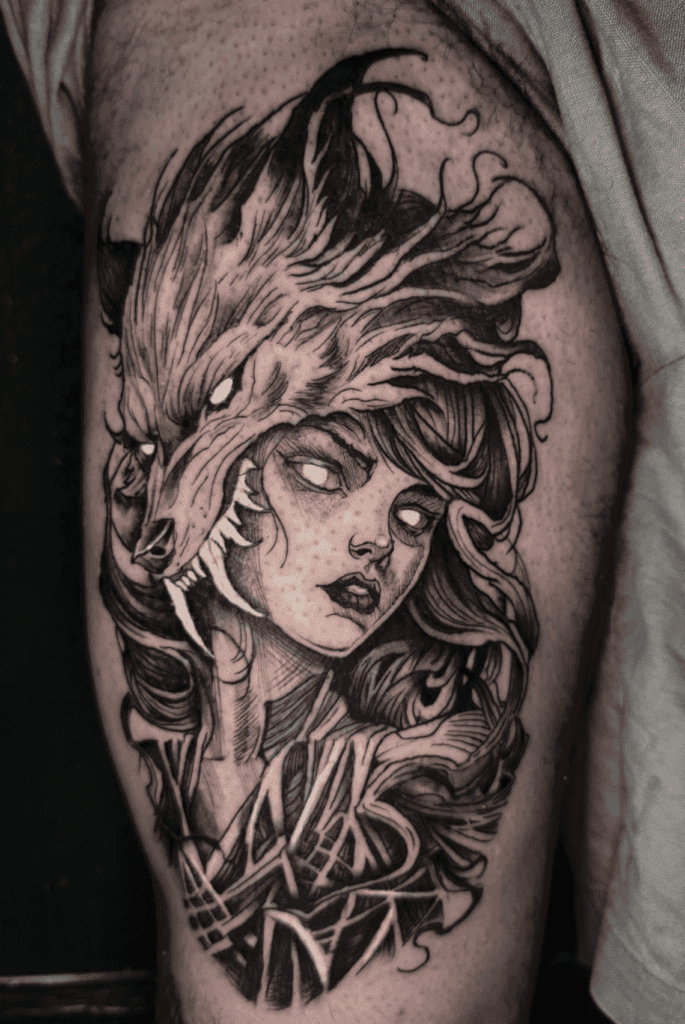
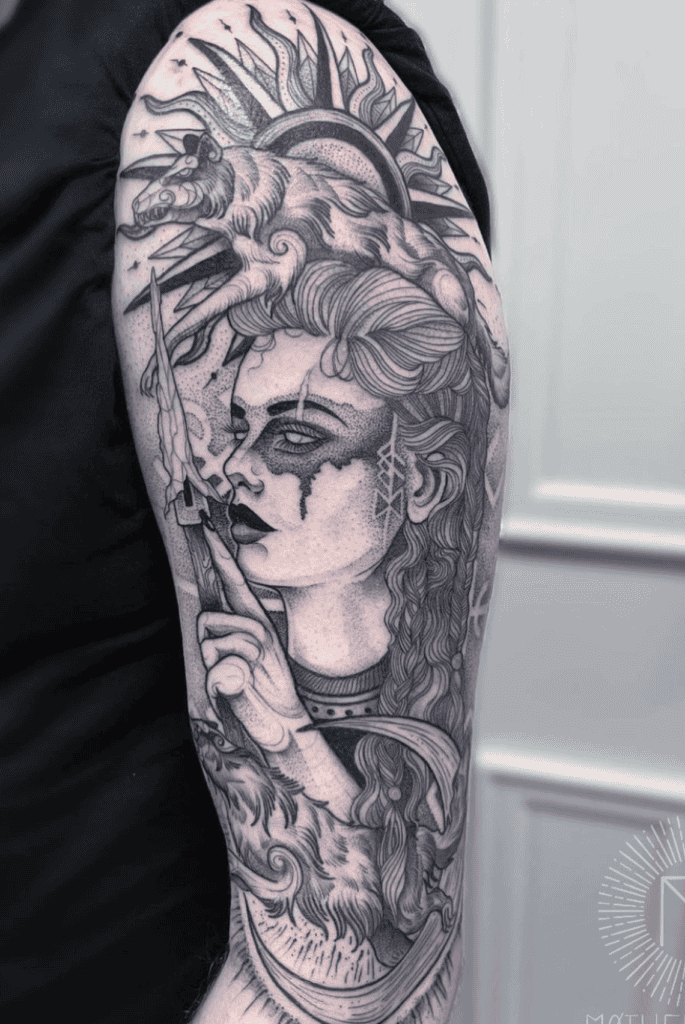
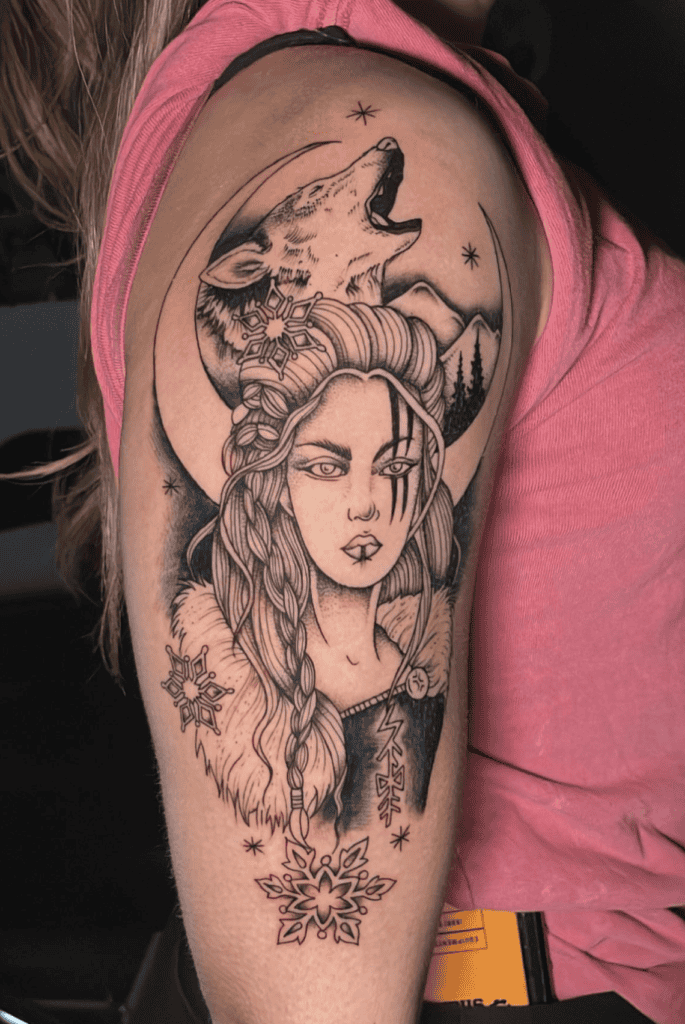
Skadi is a giantess associated with winter, mountains, skiing, and the hunt, and she stands out as one of the most independent and formidable female figures in Norse mythology. Unlike many others who are born into the world of the gods, Skadi comes from the realm of the giants, yet she boldly enters Asgard on her own terms, demanding justice rather than seeking acceptance.
Her story begins with the death of her father, the giant Thjazi, who is killed by the gods. Determined to avenge him, Skadi arms herself and travels to Asgard, ready for conflict. However, instead of meeting her with violence, the gods offer her compensation to prevent further bloodshed. This moment is important, as it shows Skadi’s strength not just in battle, but in her ability to stand her ground and force the gods to negotiate.
As part of the settlement, Skadi is allowed to choose a husband from among the gods, but with one unusual condition—she may only look at their feet while making her choice. Hoping to choose Baldr, the most beautiful of the gods, she instead selects Njörðr, the god of the sea. This leads to a marriage built on contrast rather than compatibility.
Their relationship becomes one of the most memorable in Norse mythology because of how different they are. Skadi belongs to the mountains, thriving in the cold, silence, and isolation of winter landscapes, while Njörðr is tied to the sea, preferring the sound of waves and the life of the coast. They attempt to make their marriage work by alternating between their homes, but neither can fully adapt to the other’s world. Skadi finds the sea loud and unsettling, while Njörðr dislikes the harshness of the mountains. Eventually, they part ways, each returning to the place where they truly belong.
Thrym Norse Mythology Tattoo
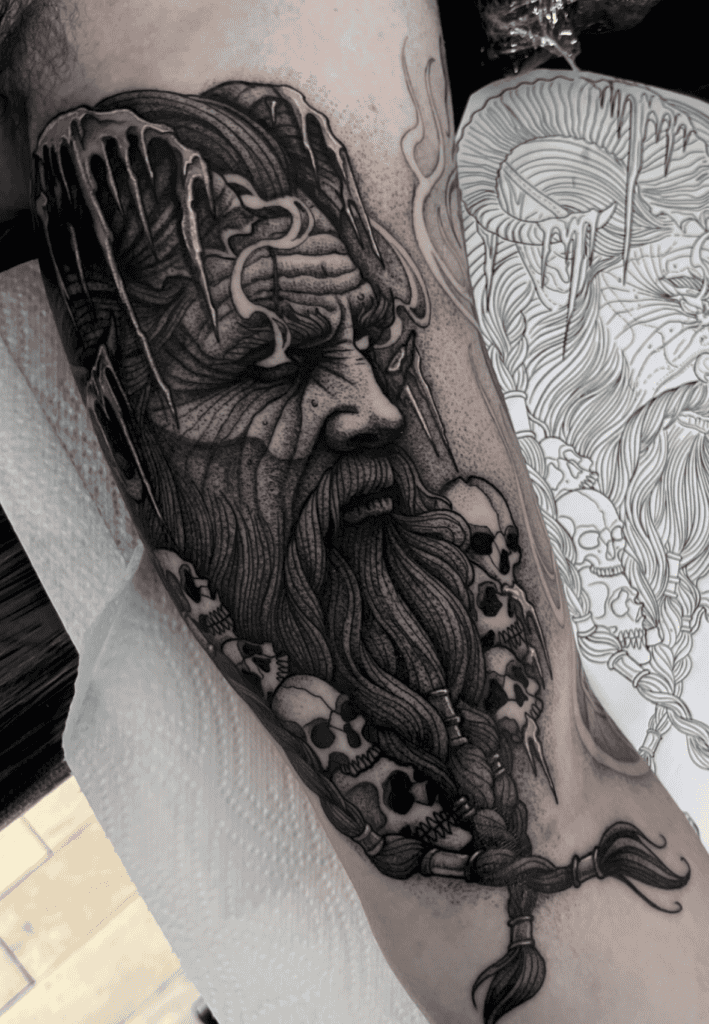
Thrym is a giant, or Jötunn, best known for stealing Thor’s hammer, Mjölnir, one of the most powerful weapons in Norse mythology. The story begins when Thor wakes up to discover that his hammer is missing. Without Mjölnir, the gods are vulnerable, as the hammer serves as a key line of defence against the giants. Loki soon discovers that Thrym is the one responsible and has hidden the hammer deep within the earth.
When confronted, Thrym reveals his condition for returning it. He demands that Freyja, the goddess of love and beauty, be given to him as his bride. This creates an immediate problem, as Freyja refuses outright, and the gods cannot afford to lose her or the hammer.
The solution that follows is one of the most famous and unusual moments in Norse mythology. Loki suggests that Thor disguise himself as Freyja and travel to Thrym’s hall to retrieve the hammer. Reluctantly, Thor agrees, dressing as a bride while Loki accompanies him in disguise as a handmaiden.
During the wedding feast, Thor struggles to maintain the disguise. He eats an enormous amount of food and drinks heavily, behaviour that surprises Thrym. Loki quickly explains it away by claiming that “Freyja” has not eaten for days out of excitement for the wedding. Despite these suspicious moments, the plan continues.
The turning point comes when Thrym brings out Mjölnir to bless the marriage. The moment the hammer is placed in Thor’s hands, the disguise no longer matters. Thor immediately reveals himself and uses Mjölnir to defeat Thrym and the other giants, reclaiming the weapon and restoring balance.
Aegir Norse Mythology Tattoo
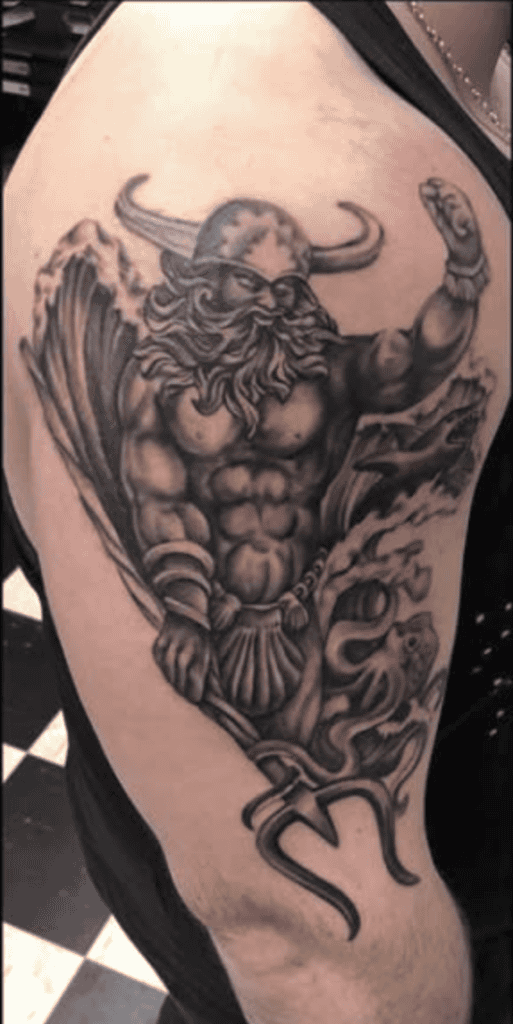
Ægir is a powerful sea giant in Norse mythology, closely associated with the ocean, its depths, and its unpredictable nature. Unlike many giants who are portrayed as enemies of the gods, Ægir occupies a more complex position. He is both respected and feared, known not only for his connection to the sea, but also for his role as a host who welcomes the gods into his hall.
He is often depicted as a figure who embodies the ocean itself. Just as the sea can be calm and inviting one moment, and violent and overwhelming the next, Ægir reflects this dual nature. He is not inherently hostile, but there is always a sense of power beneath the surface, a reminder that the sea is never fully under control.
One of the most well-known aspects of Ægir’s story is his role as a host of great feasts for the gods. His hall is said to be a place where the gods gather to drink and celebrate, with endless ale flowing from a massive cauldron. This detail highlights a different side of Norse mythology, one focused on community, storytelling, and shared experience rather than conflict. However, even these gatherings are not without tension, as seen in stories where Loki causes disruption during one of Ægir’s feasts.
Ægir is also closely connected to his wife, Rán, who represents the darker side of the sea. While Ægir may host and welcome, Rán is associated with the dangers of the ocean, using her net to capture those who are lost at sea. Together, they reflect the full nature of the ocean—both its generosity and its danger.
In some traditions, Ægir is also considered a god rather than a giant, which further blurs the line between these two groups in Norse mythology. This ambiguity adds to his mystique, positioning him as a figure who exists between worlds, much like the sea itself connects distant lands.
Auðumbla Norse Mythology Tattoo
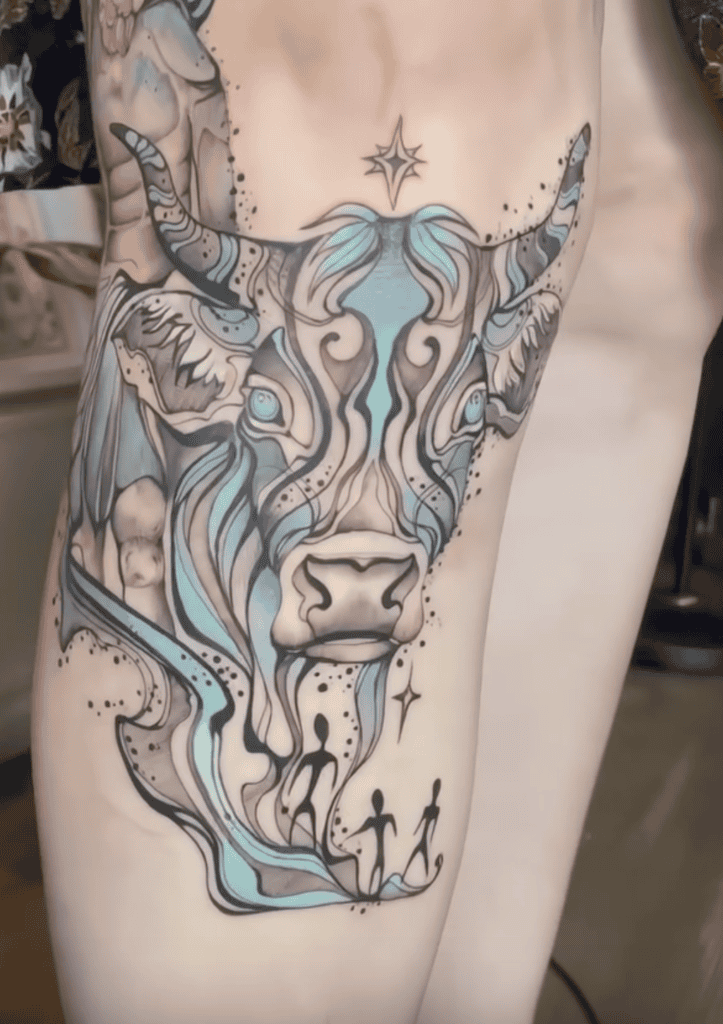
Auðumbla is a primordial being who exists at the very start of Norse mythology. She emerges in Ginnungagap, the vast, empty void where the icy cold of Niflheim meets the fiery heat of Muspelheim. In this space of opposing forces, life begins to form, and Auðumbla plays a central role in sustaining it.
She is described as a great cosmic cow whose milk nourishes Ymir, the first giant. From her flows the sustenance that allows life to continue in this early, chaotic stage of existence. While Ymir represents the raw and untamed beginnings of life, Auðumbla represents something more stable and nurturing, a force that supports and sustains rather than dominates.
Her role becomes even more important through a simple but powerful action. As she feeds, Auðumbla licks the salty ice around her. Over time, this act reveals another being hidden within the ice—Búri, the ancestor of the gods. This moment is incredibly significant, as it marks the transition from the chaotic origins of the world toward the emergence of order and structure through the lineage of the gods.
Jörmungandr Norse Mythology Tattoo
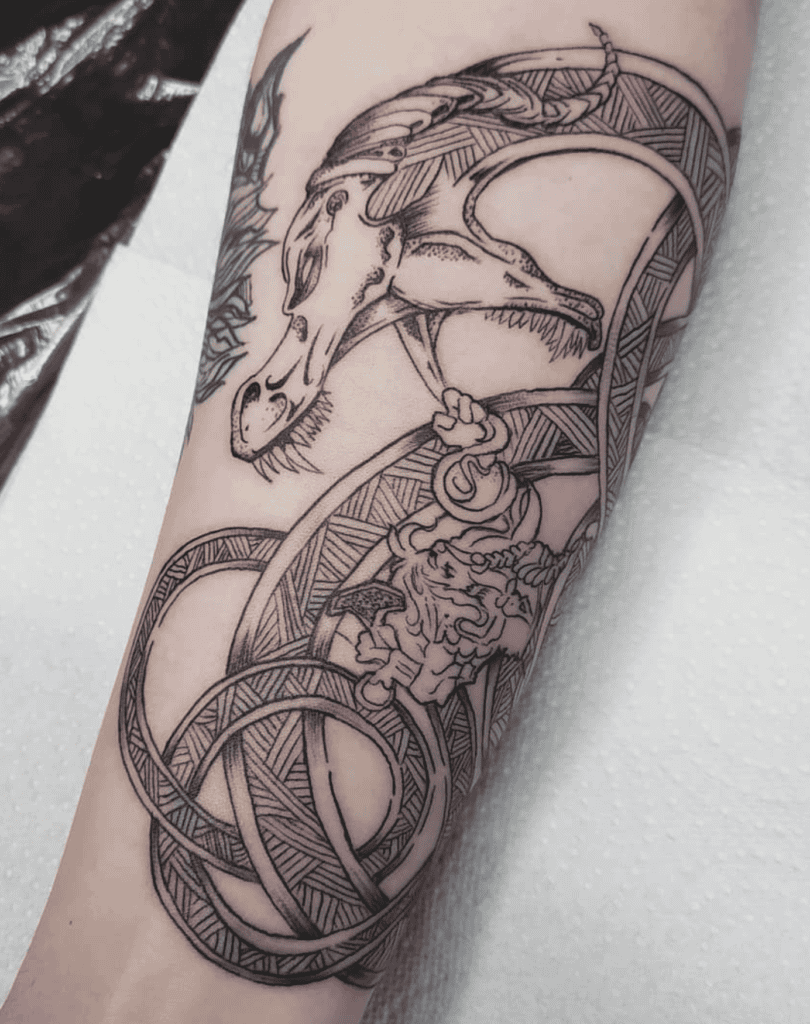
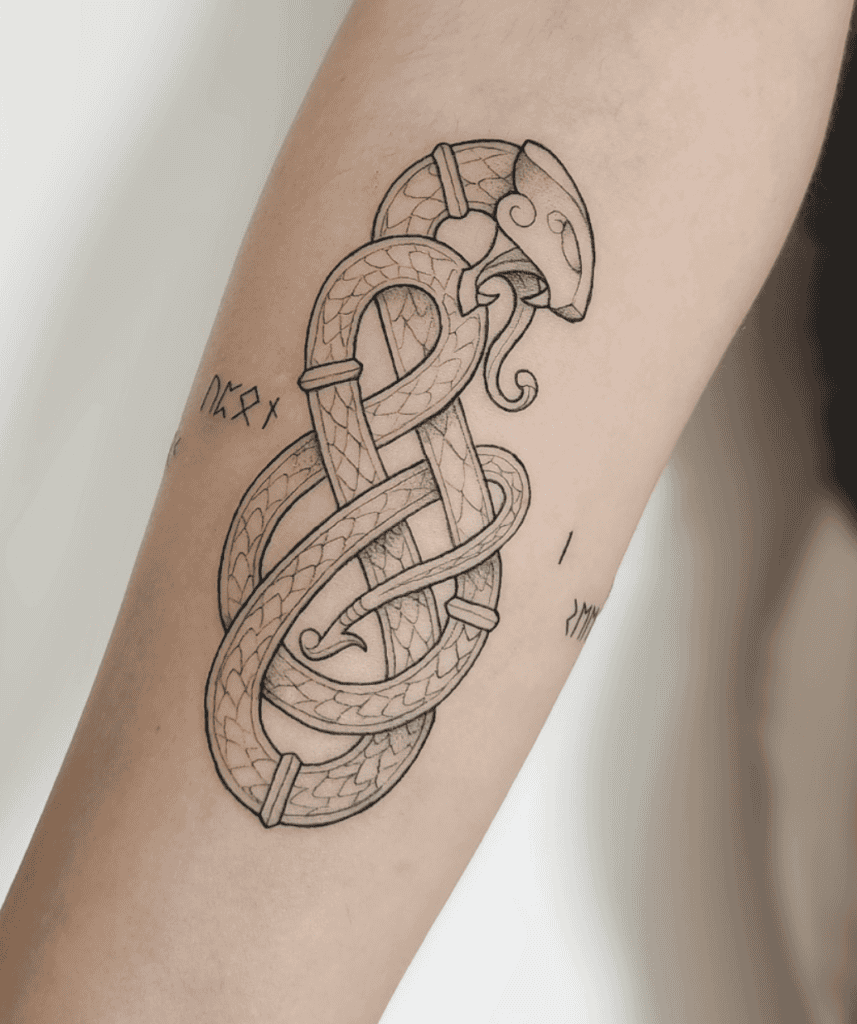
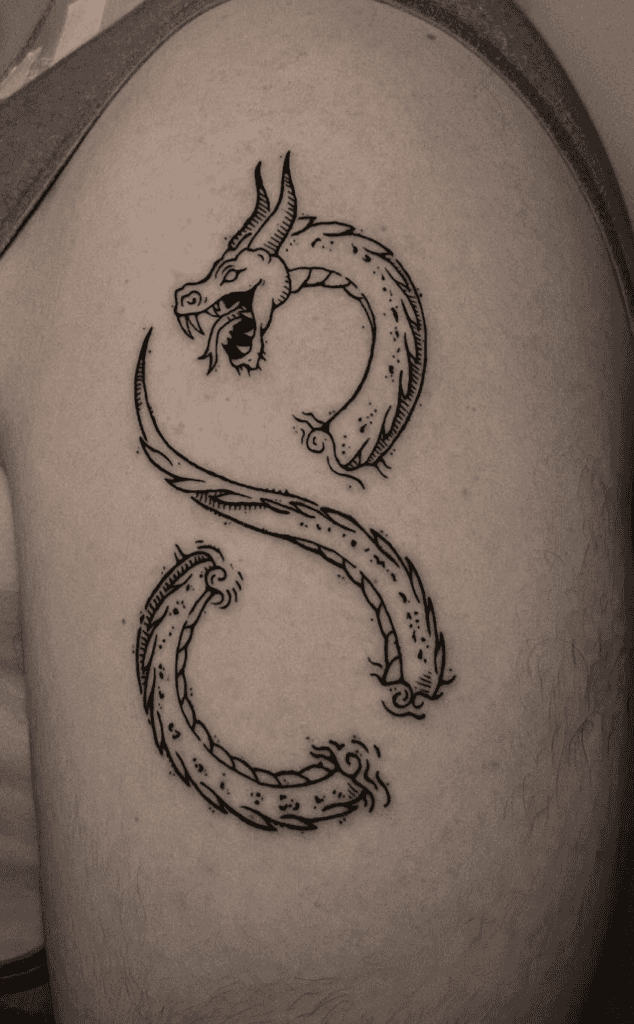
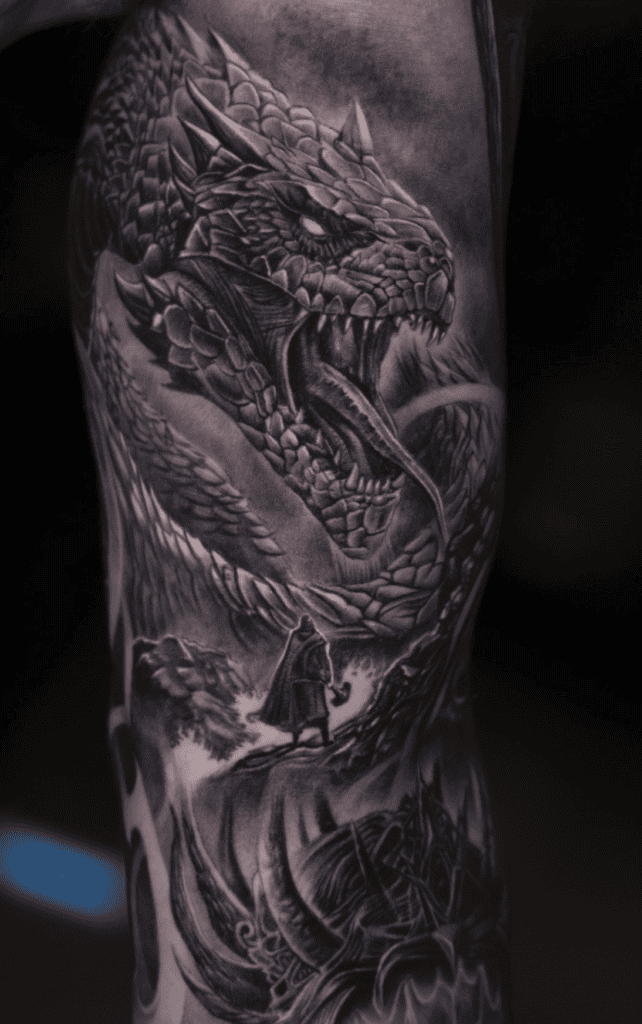
Jörmungandr, also known as the Midgard Serpent, is one of the three monstrous children of Loki, alongside Fenrir and Hel. He is cast into the ocean surrounding Midgard, the world of humans, where he grows so large that he encircles the entire world, biting his own tail.
His story is closely tied to Thor, the god of thunder, and the two share a powerful and inevitable rivalry. One of their most famous encounters occurs when Thor goes fishing and unknowingly hooks Jörmungandr from the depths of the ocean. As the serpent rises, the tension between them becomes clear. Thor prepares to strike him with Mjölnir, but the line is cut before the final blow can land, leaving their conflict unresolved.
This unfinished encounter sets the stage for Ragnarök, where Thor and Jörmungandr are destined to face each other once again. During the final battle, Thor succeeds in killing the serpent, but the victory comes at a cost. After taking only a few steps away, Thor succumbs to the serpent’s venom and dies as well. Their mutual destruction reflects one of the central themes of Norse mythology, where even the strongest forces cannot escape fate.
Fenrir Norse Mythology Tattoo
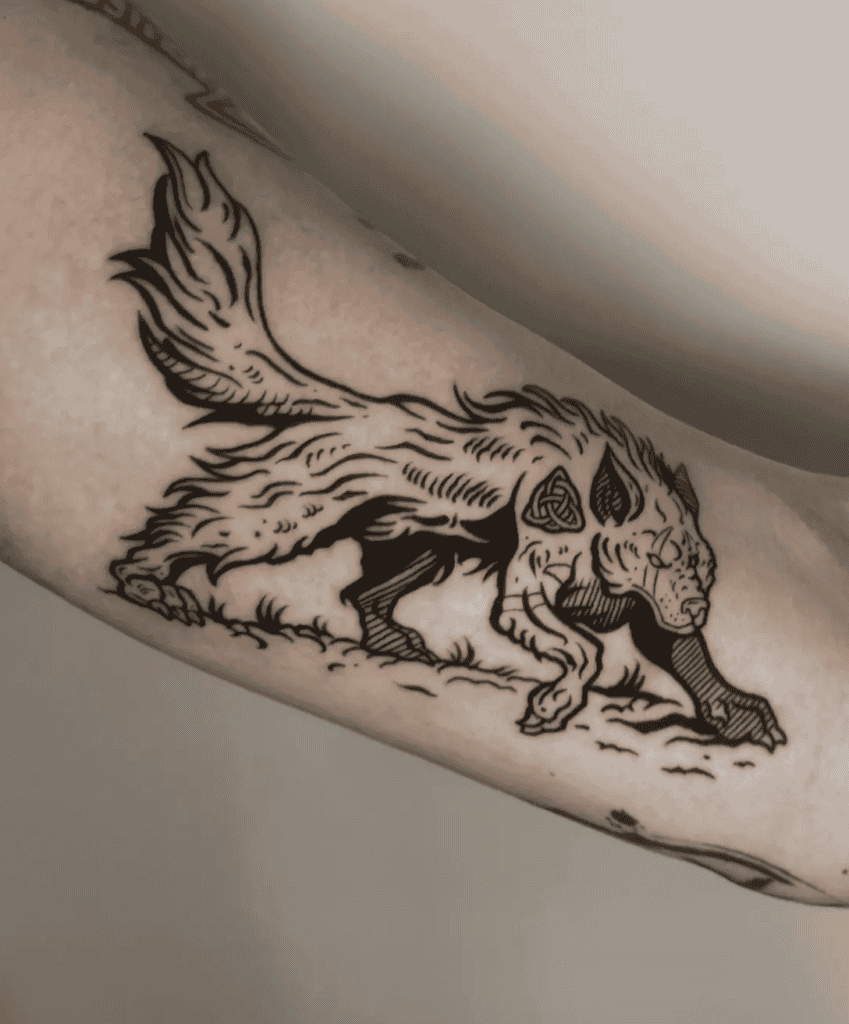
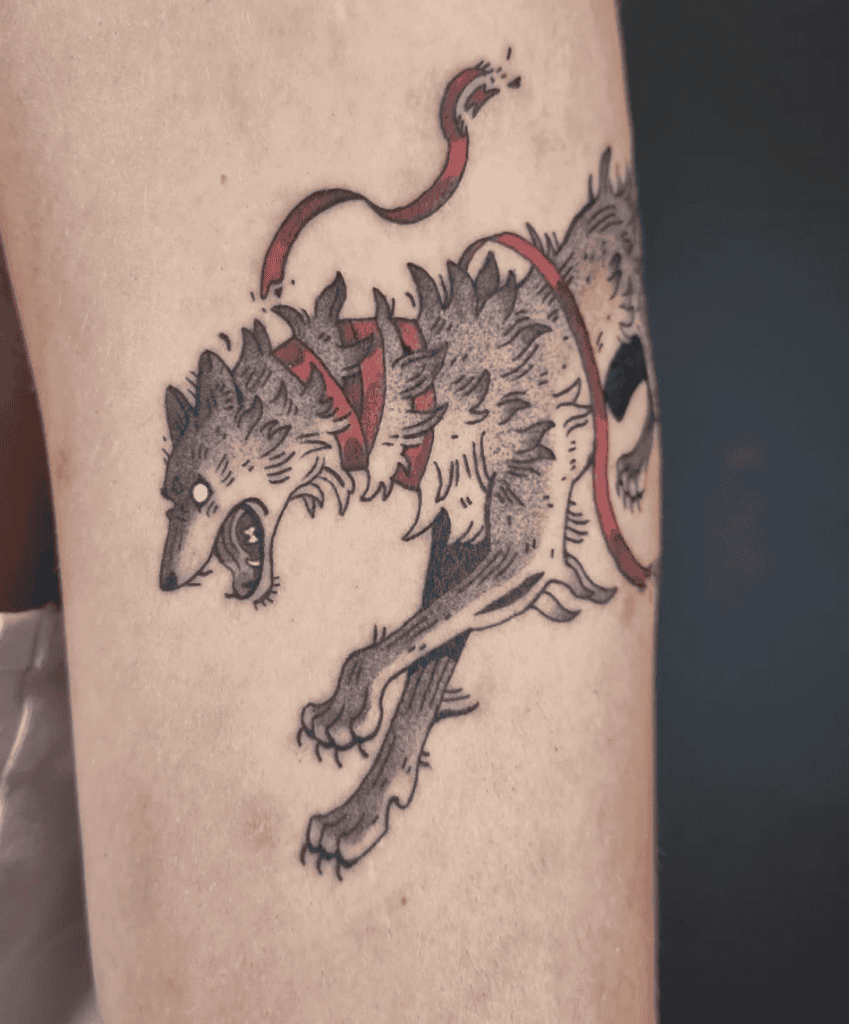
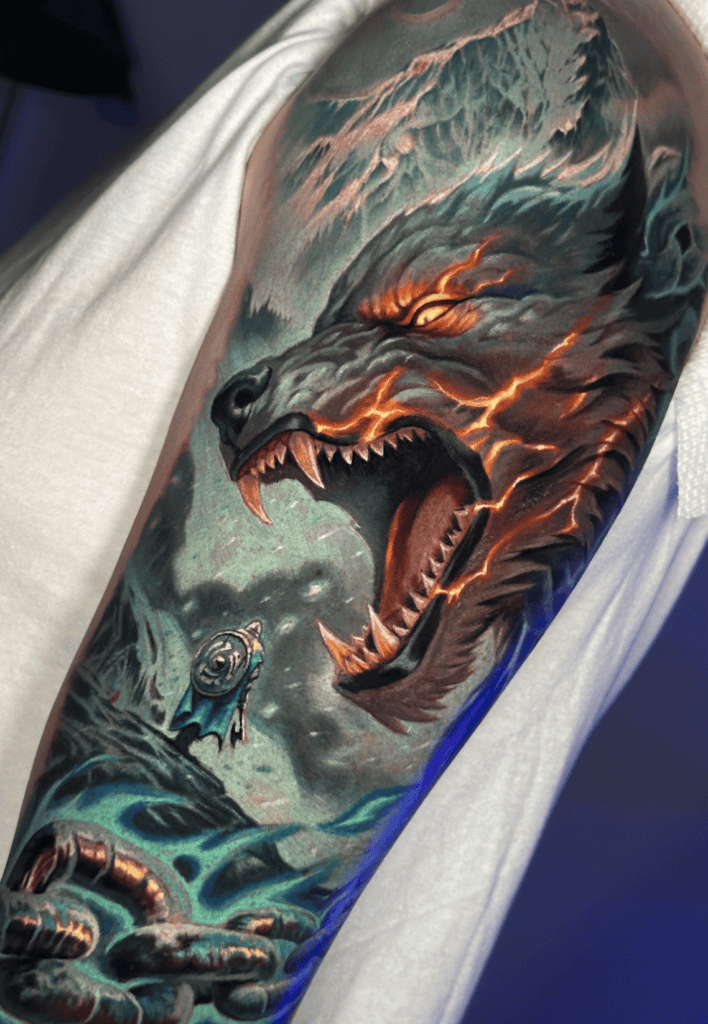
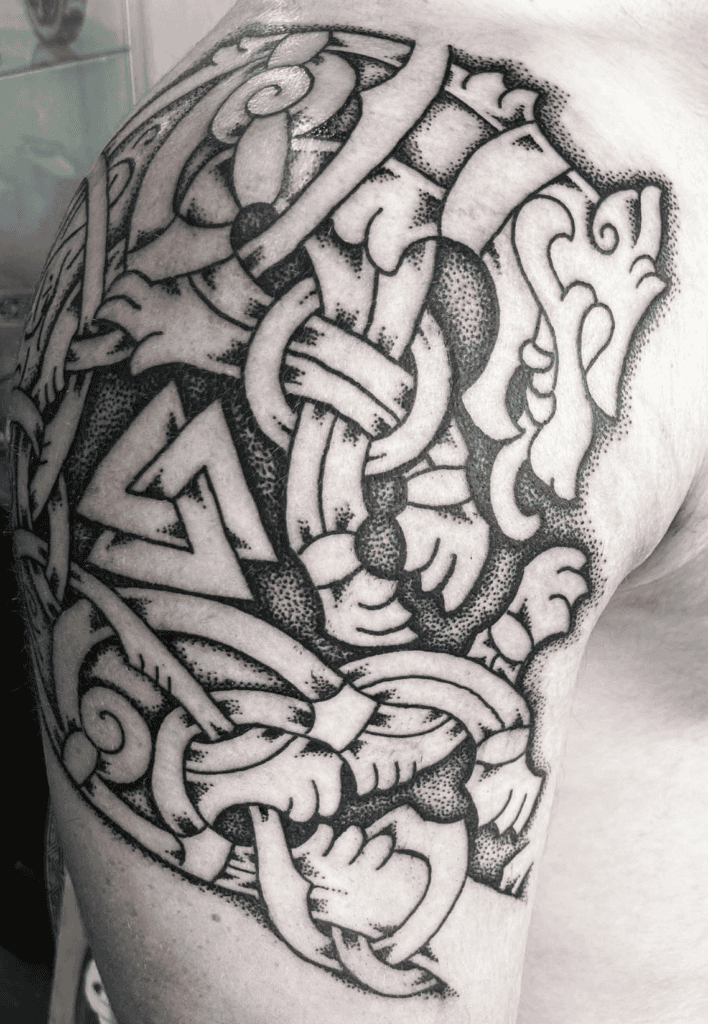
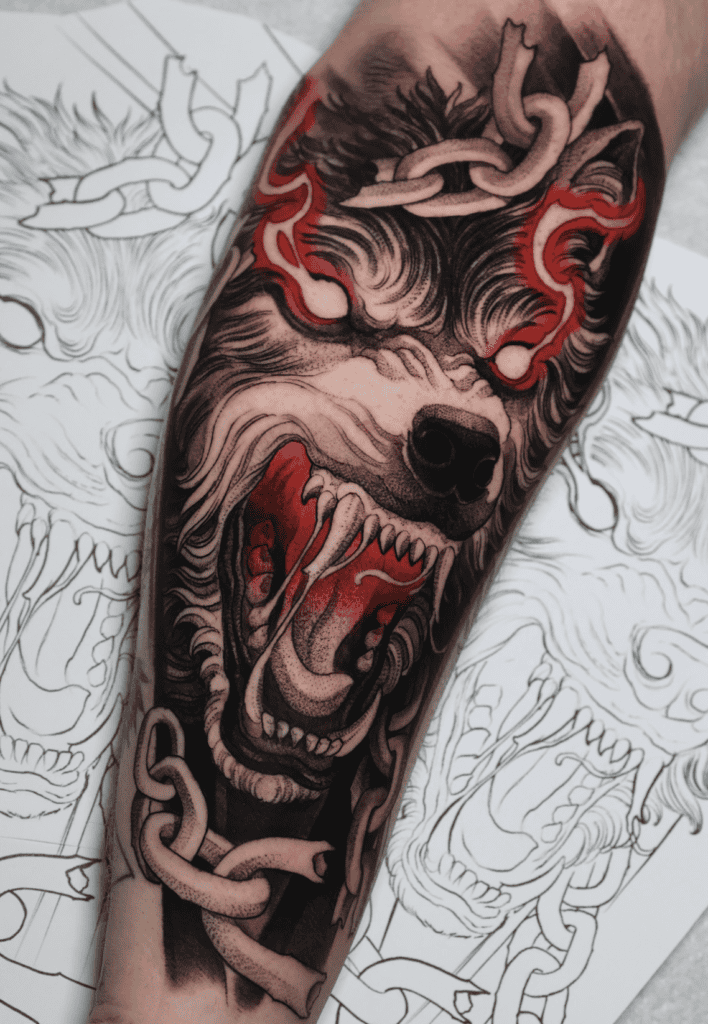
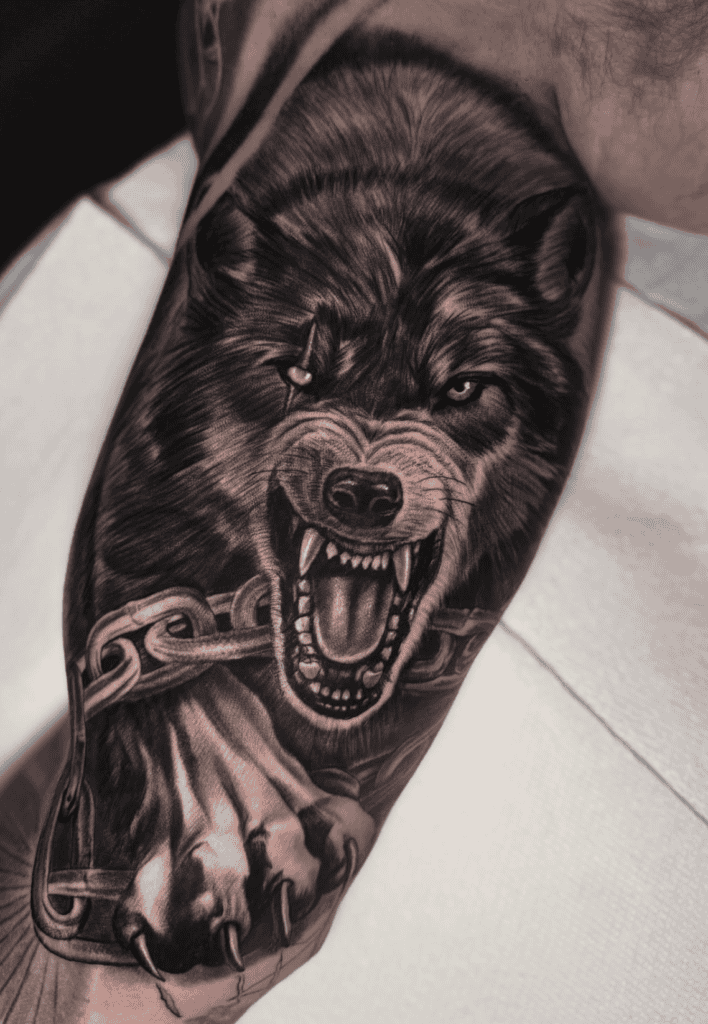
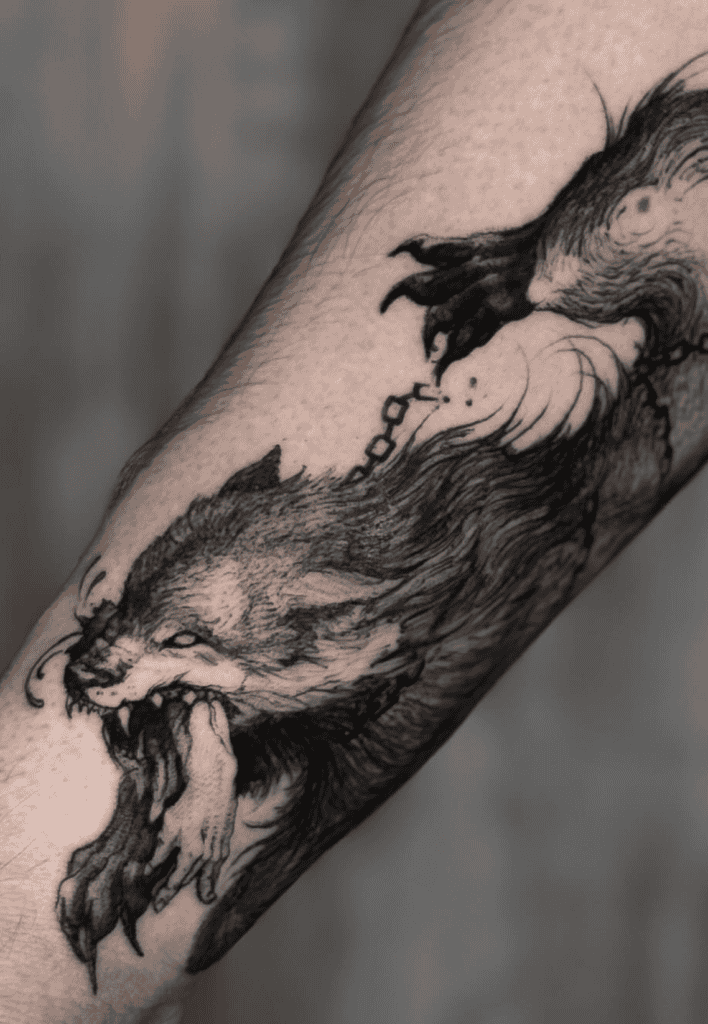
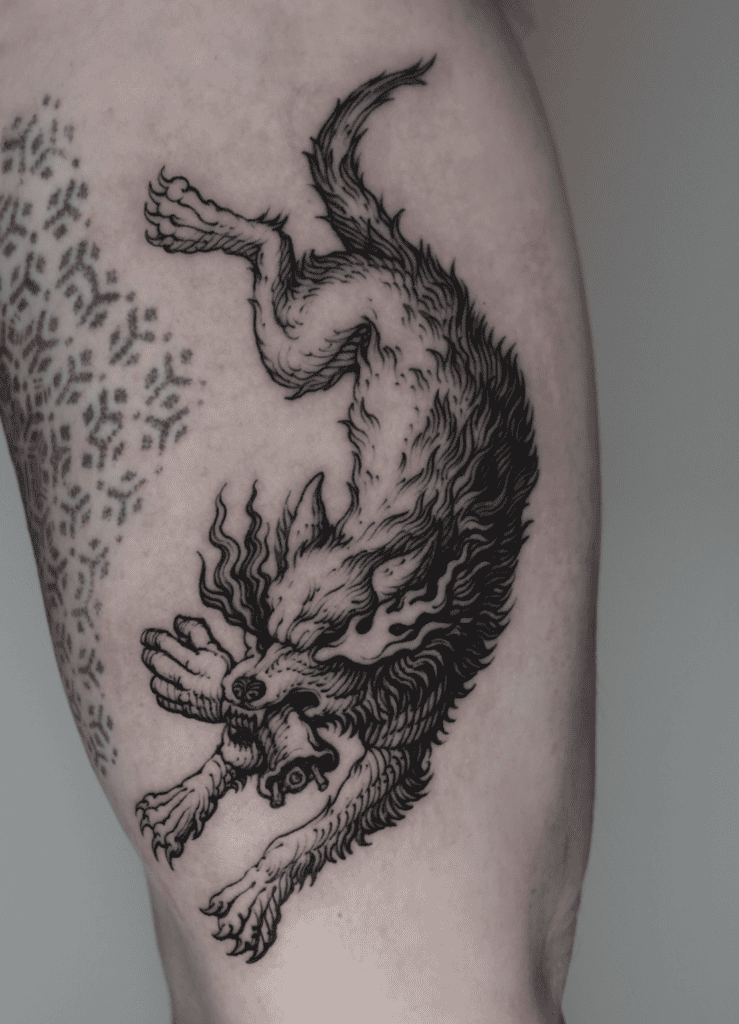
Fenrir is a monstrous wolf and one of the three children of Loki, alongside Jörmungandr and Hel. From the moment of his birth, the gods recognise that he is destined to play a role in the destruction of the world. As he grows, so does their fear, as Fenrir becomes larger, stronger, and more difficult to control.
At first, the gods attempt to raise him among them in Asgard, but as his power becomes undeniable, they begin to seek ways to contain him. They challenge Fenrir to test his strength by breaking free from chains, presenting it as a game. Each time, Fenrir easily snaps the restraints, proving that nothing forged by the gods alone can hold him.
Realising they need something beyond ordinary means, the gods turn to the dwarves, who create Gleipnir, a magical binding made from impossible elements, including the sound of a cat’s footsteps and the roots of mountains. Despite its delicate appearance, Gleipnir is unbreakable.
Fenrir, however, senses deception. He agrees to be bound only if one of the gods places a hand in his mouth as a sign of trust. Knowing the cost, Týr steps forward and offers his hand. When Fenrir is unable to break free and realises he has been tricked, he bites down, severing Týr’s hand. In that moment, Fenrir is bound, but the price of that victory is clear.
During Ragnarök, Fenrir breaks free from his bindings, growing to an enormous size as he joins the forces of chaos. In one of the most dramatic moments in Norse mythology, he confronts Odin and ultimately devours him, fulfilling the prophecy that has loomed over the gods from the beginning.
Hel Norse Mythology Tattoo
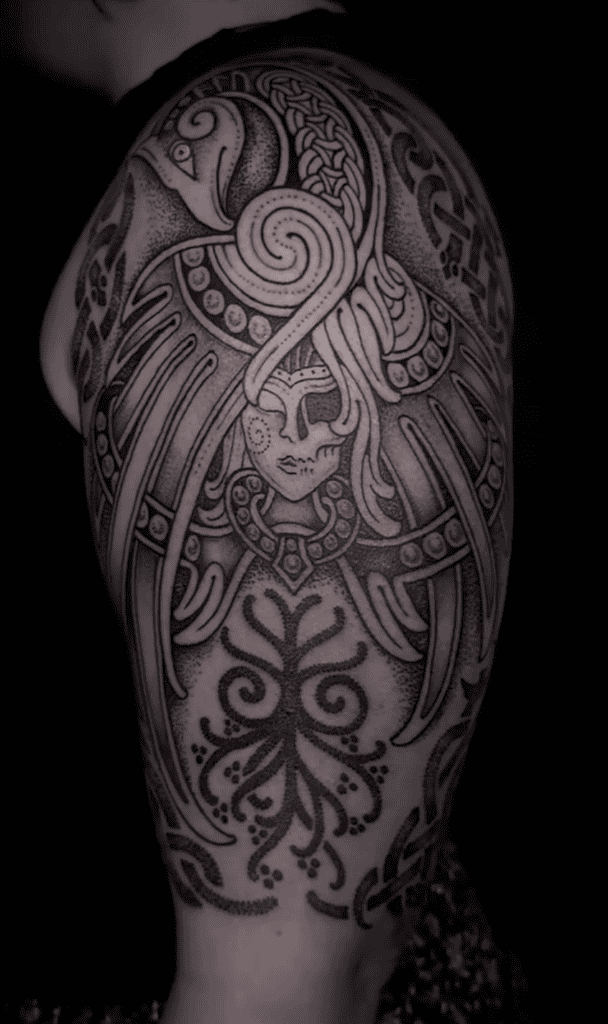
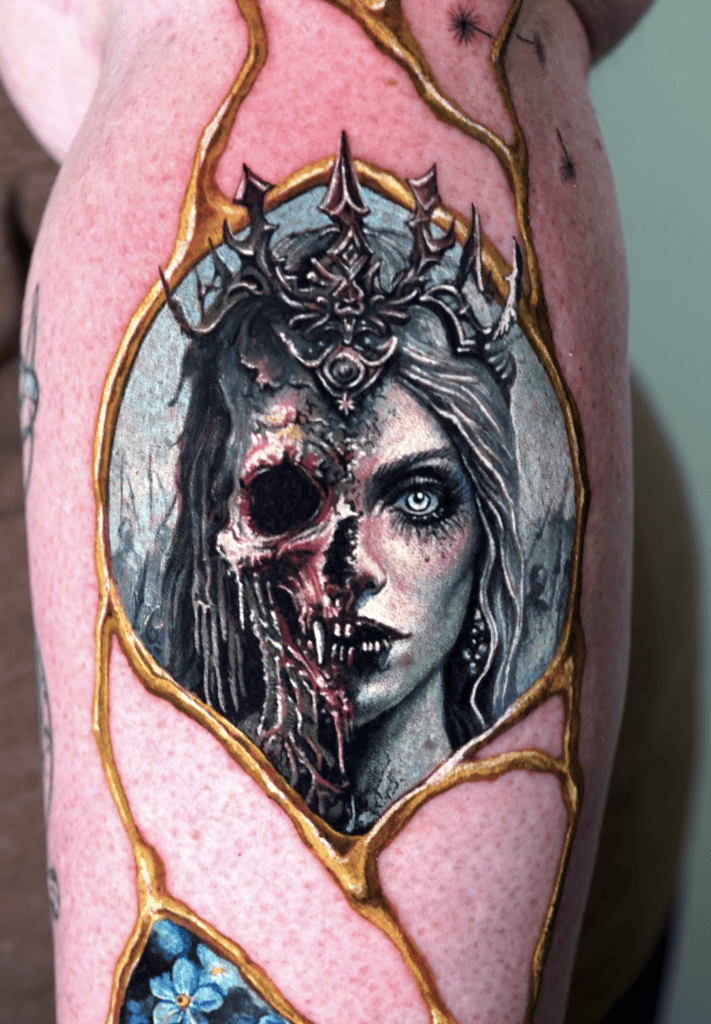
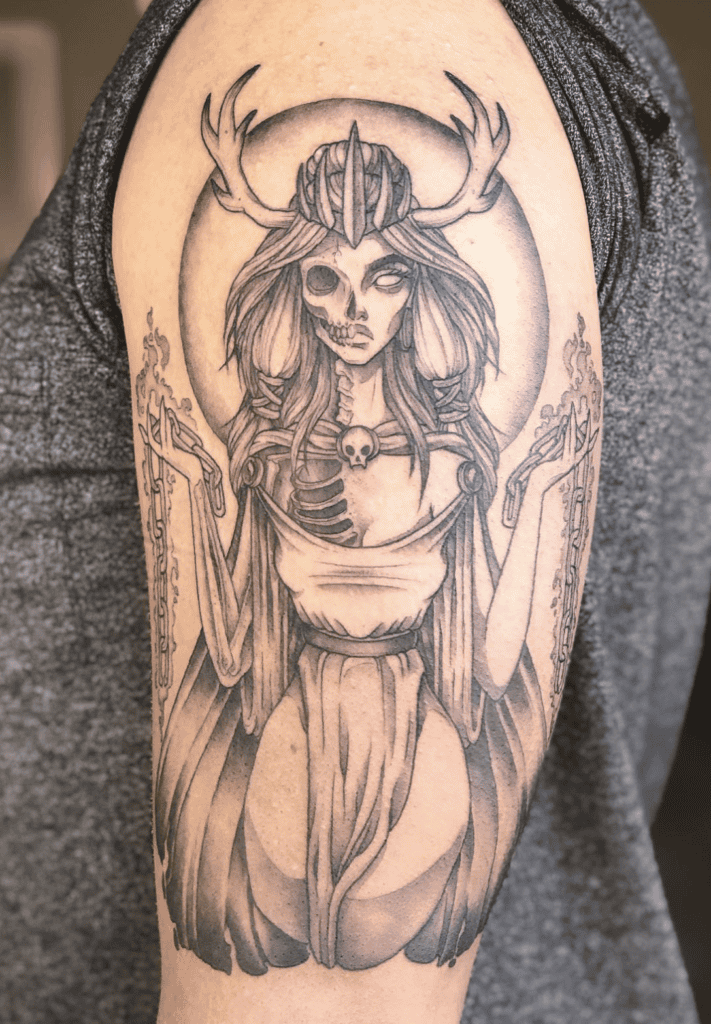
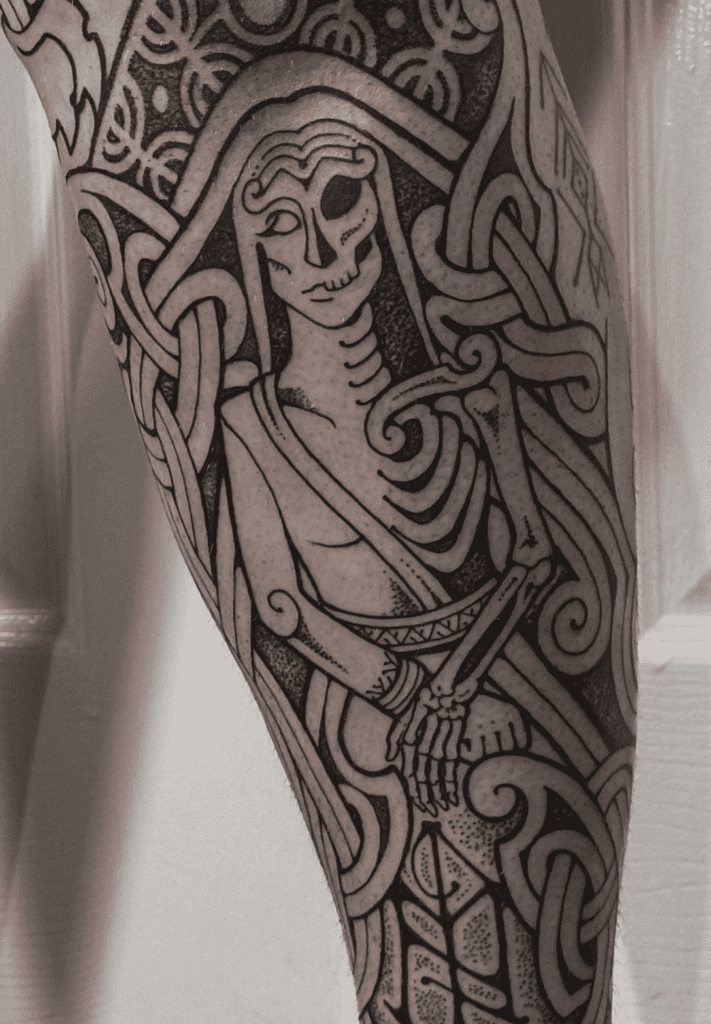
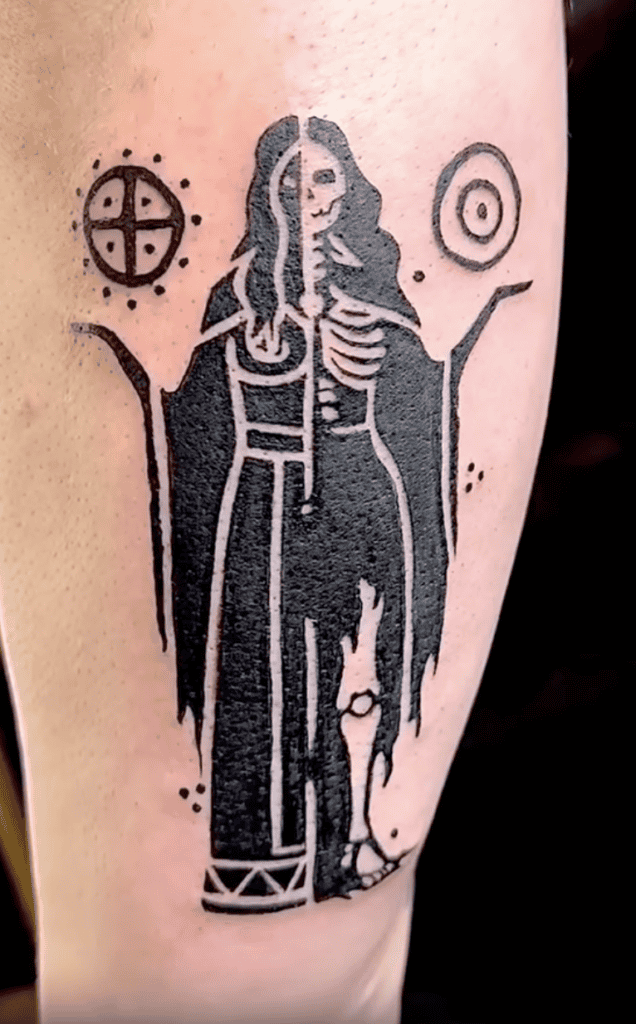
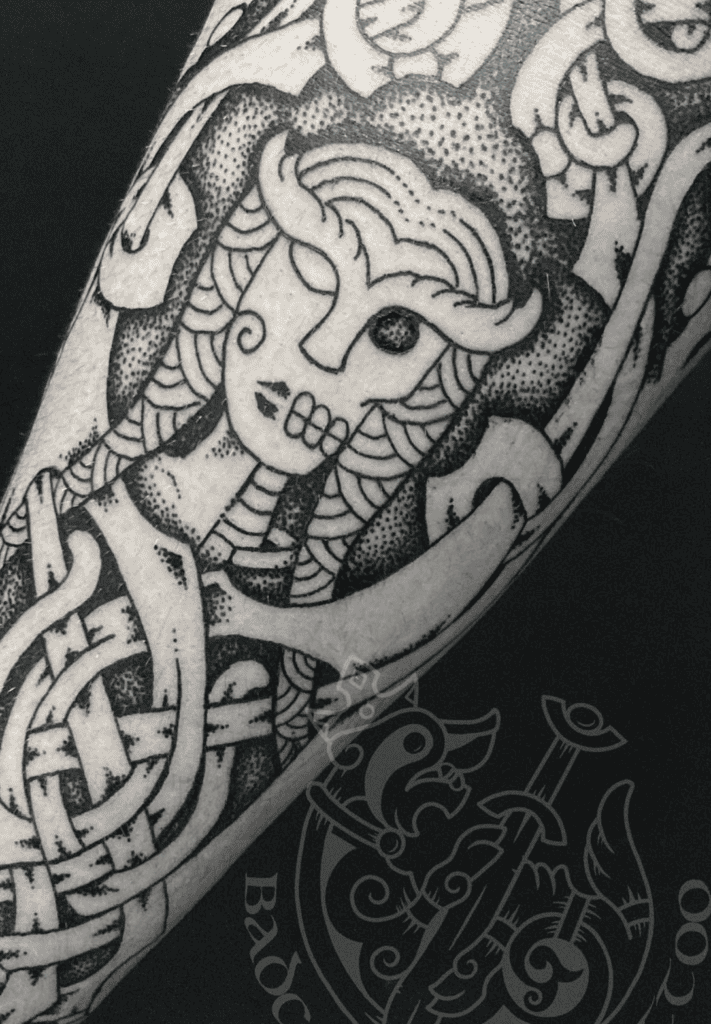
Hel is the daughter of Loki and the sister of Fenrir and Jörmungandr, placing her among some of the most powerful and feared beings in Norse mythology. She rules over Helheim, the realm of the dead, where those who do not die in battle are sent.
Her appearance reflects her connection to death. She is often described as being half alive and half dead, with one side of her body appearing normal while the other is pale, decayed, or corpse-like. This duality makes her a living representation of the boundary between life and death, embodying both at once.
Helheim itself is not a place of fiery punishment, as seen in some other mythologies, but rather a cold, shadowed realm. It is a place of stillness and inevitability, where souls exist after death without the glory associated with Valhalla. Those who die of illness, old age, or other non-heroic means are sent to Hel, making her domain an essential part of the Norse understanding of the afterlife.
What makes Hel particularly interesting is her role as a ruler. She is not cruel or chaotic, but firm and unyielding. She governs her realm with authority, ensuring that those who enter it remain there. When the gods attempt to bring Baldr back from the dead, Hel agrees to release him only if every being in the world mourns for him. When Loki refuses, the condition is not met, and Baldr remains in her realm.
Despite her association with death, Hel is not portrayed as evil. She represents a natural and unavoidable part of existence. In a mythology where fate governs all things, her realm is simply one of the destinations along that path. Her calm and controlled nature contrasts with the more violent aspects of death seen elsewhere in the myths.
Hel also plays a role in Ragnarök, where she is said to send forces from her realm to join the final battle. This reinforces her connection not just to death, but to the larger cycle of destruction and renewal that defines Norse mythology.
Sleipnir Norse Mythology Tattoo
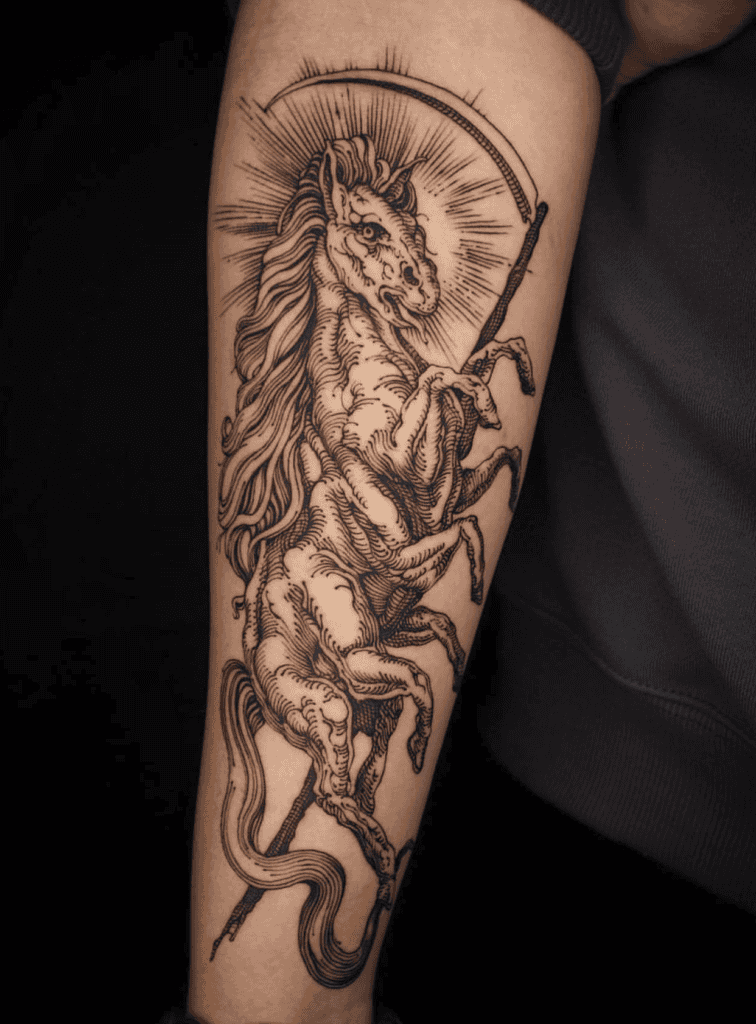
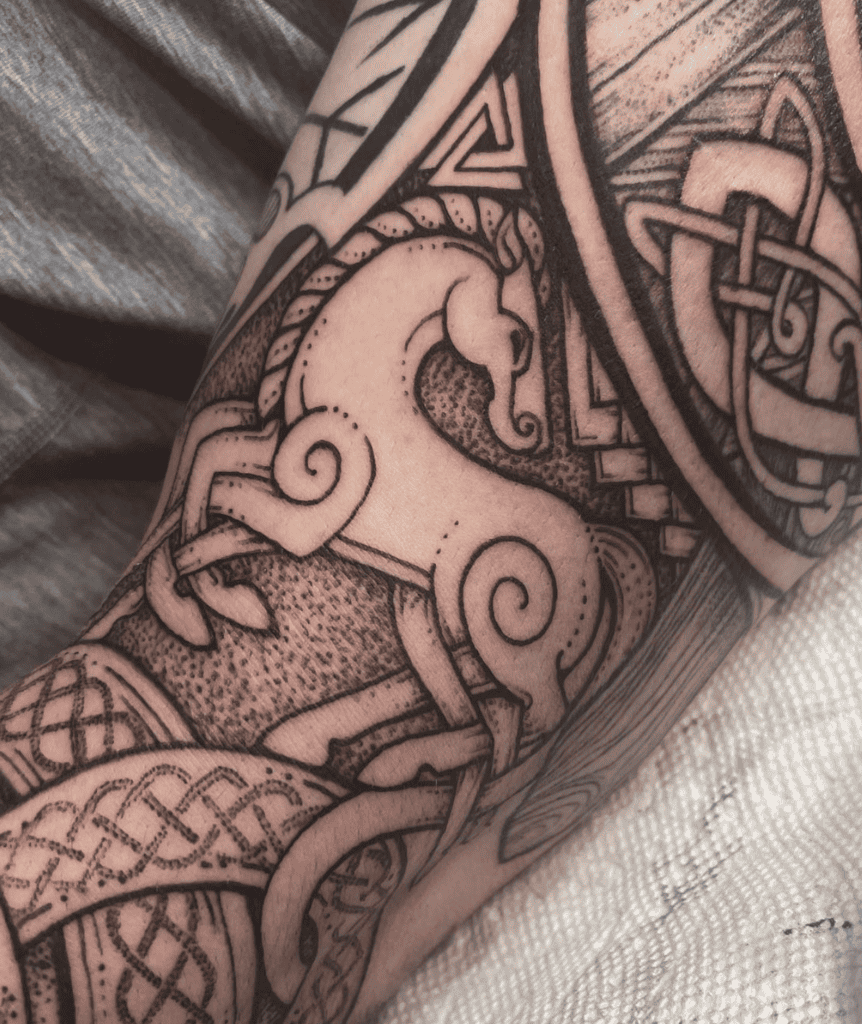
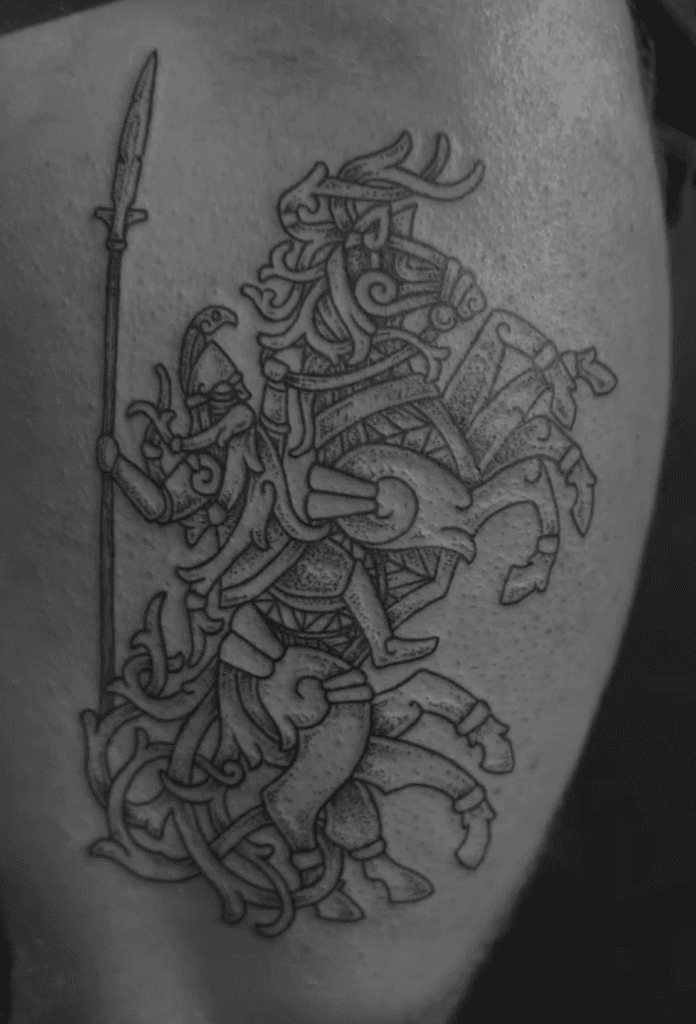
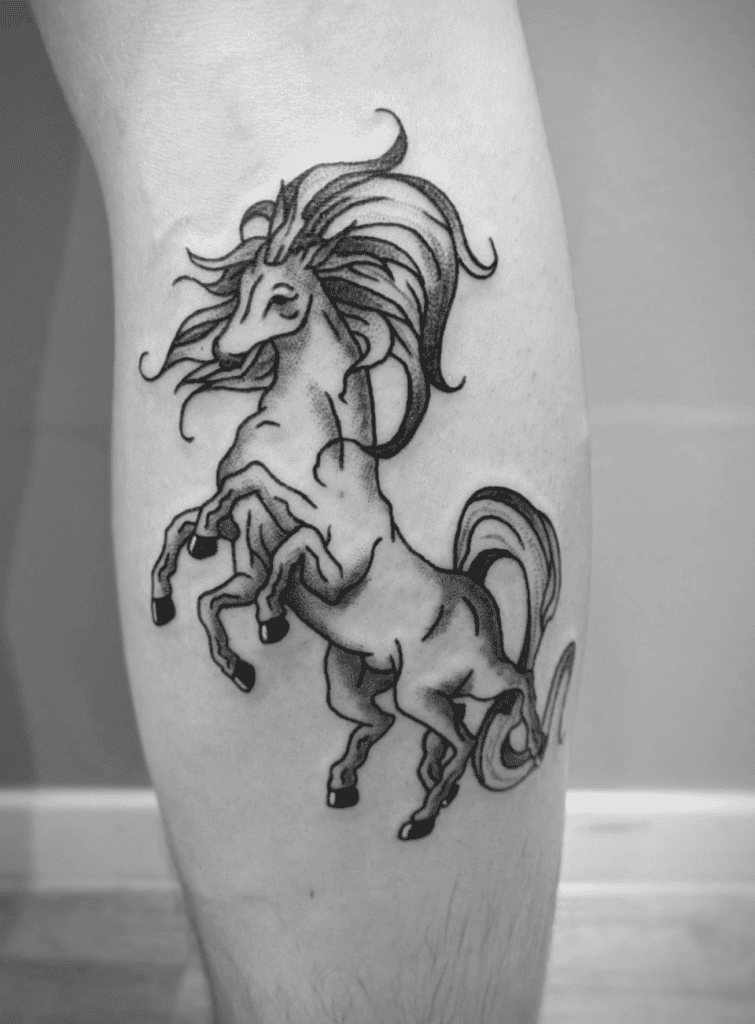
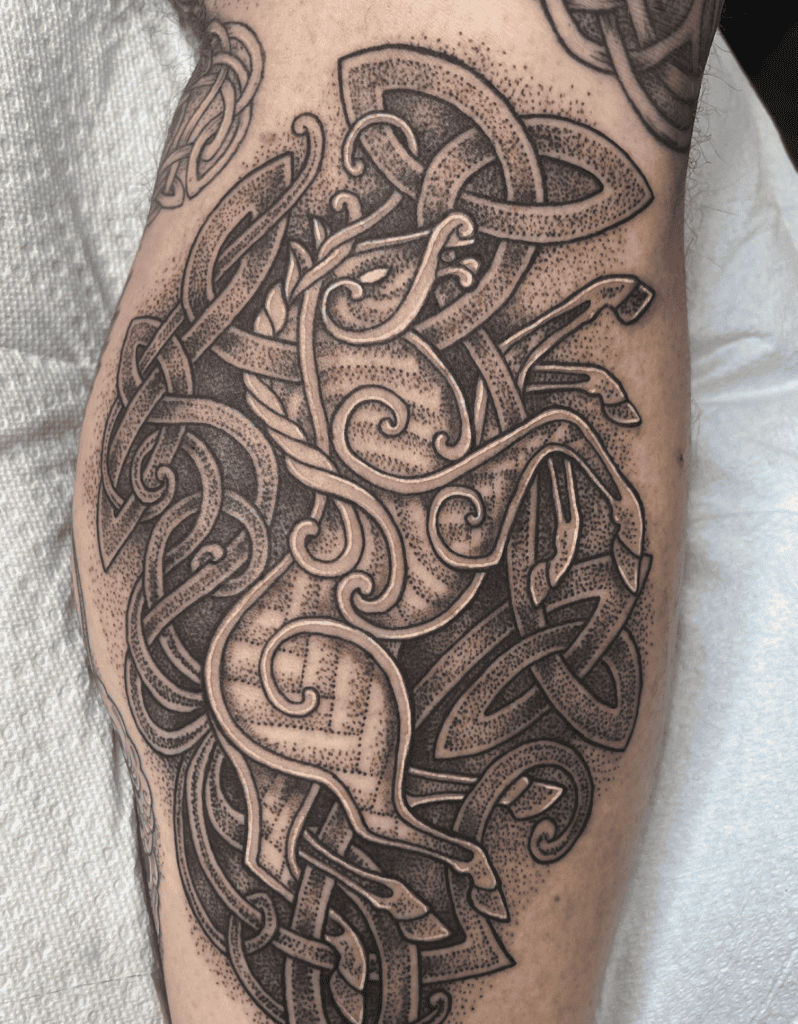
Sleipnir is the legendary horse of Odin, known for his extraordinary eight legs and his unmatched speed. He is often described as the fastest and most powerful steed in all of Norse mythology, capable of travelling not just across the land, but between worlds. With Sleipnir, Odin can move freely between the Nine Realms, reinforcing his role as a god who exists beyond boundaries and constantly seeks knowledge.
What makes Sleipnir especially unique is his origin. He is the child of Loki, who, in one of the strangest stories in Norse mythology, transforms into a mare. Loki does this to distract a powerful stallion that is helping a giant complete a task for the gods. The plan works, but it leads to Loki giving birth to Sleipnir, who is then presented to Odin.
Sleipnir’s eight legs are often interpreted as a symbol of his supernatural ability. They allow him to move faster than any other creature and to traverse realms that would otherwise be unreachable. He is not limited to the physical world, making him a bridge between life and death, the divine and the mortal. This connection is especially important in Odin’s journeys, as he often travels to seek knowledge, communicate with the dead, or explore distant realms.
Níðhöggr Norse Mythology Tattoo
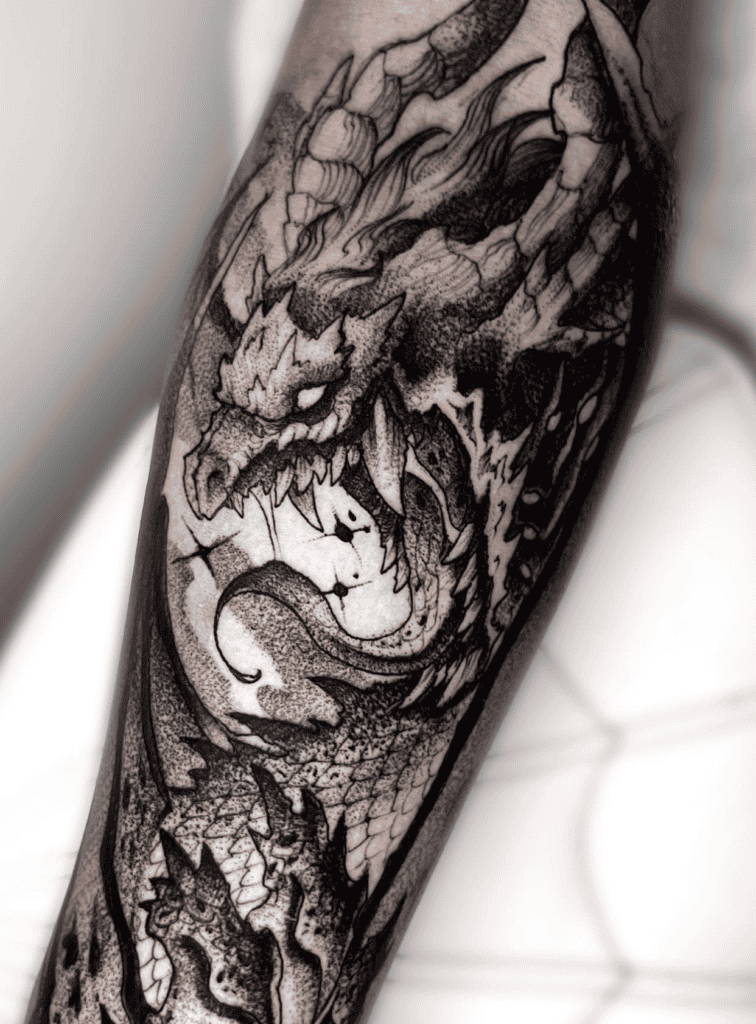
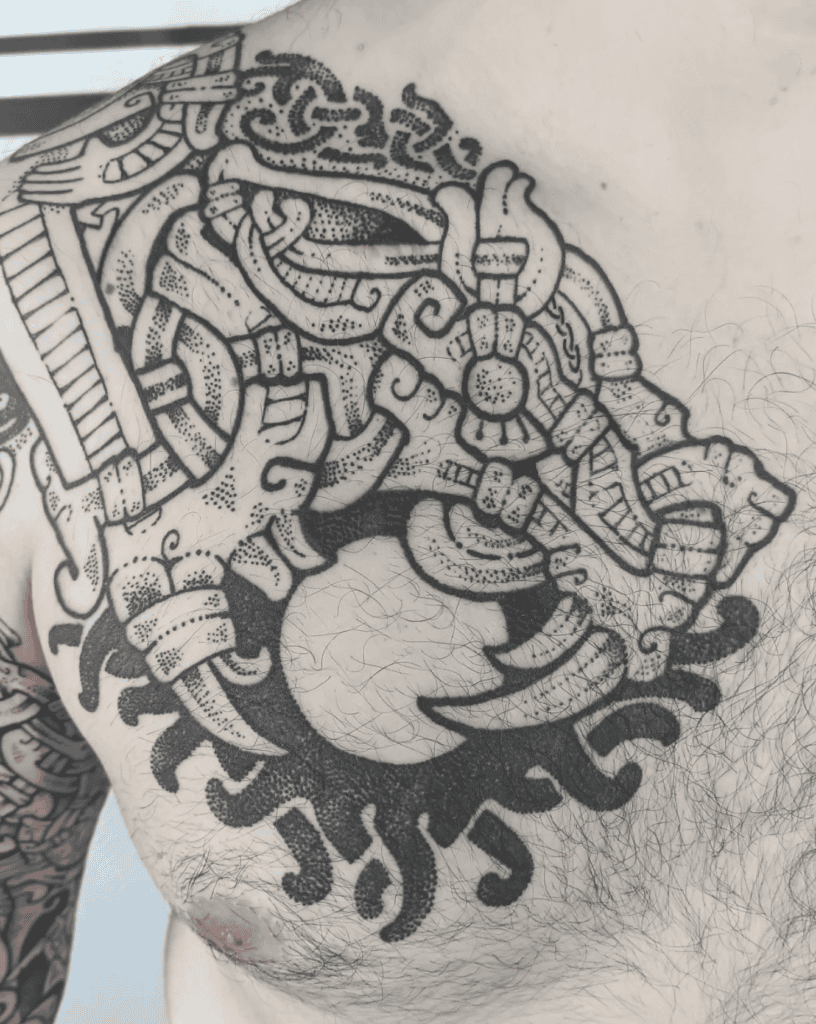
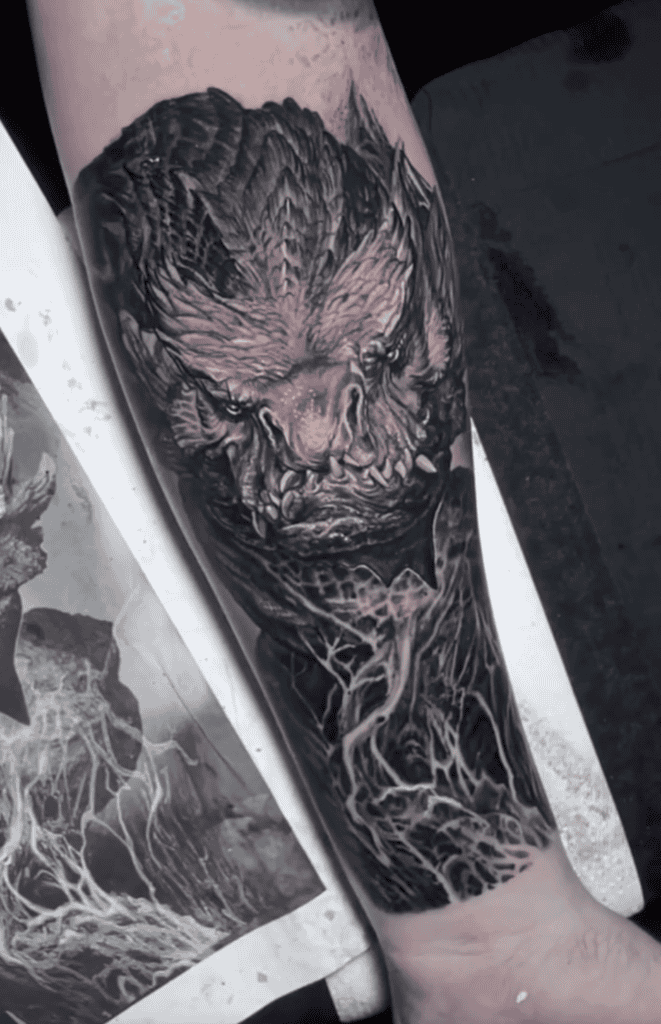
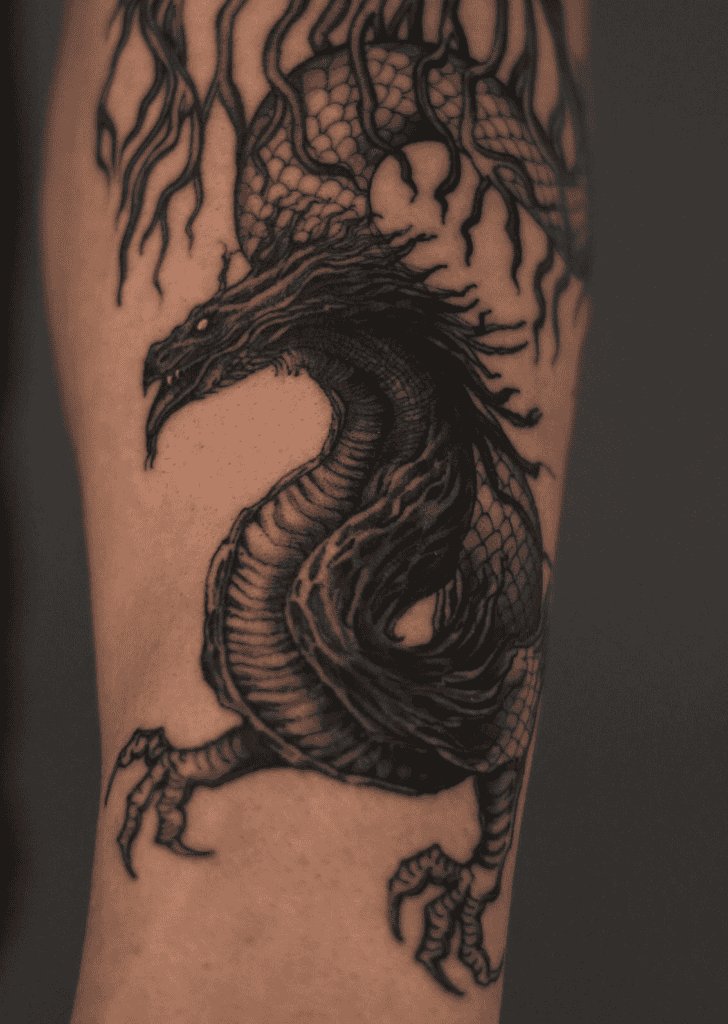
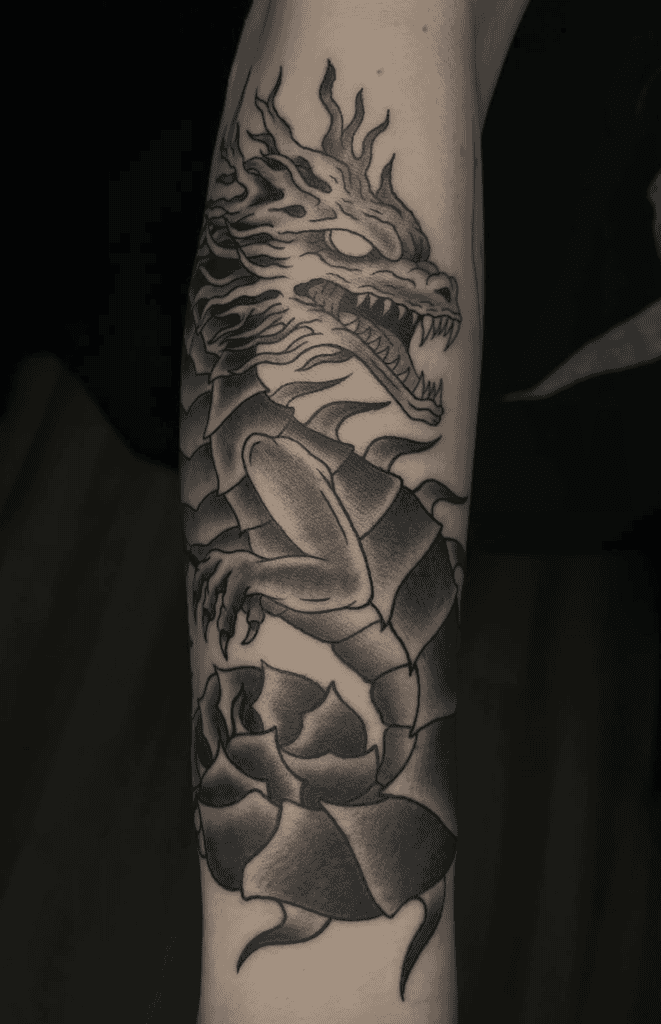
Níðhöggr is a fearsome dragon or serpent that lives beneath Yggdrasil, the great World Tree that connects all nine realms in Norse mythology. While many creatures exist within or around the tree, Níðhöggr occupies one of the darkest positions, dwelling at its roots in the shadowy regions associated with death and decay.
His most defining trait is that he gnaws continuously at the roots of Yggdrasil. This act is deeply symbolic, as Yggdrasil represents the structure of the entire cosmos. By slowly chewing away at its roots, Níðhöggr embodies the idea that destruction is always present, even at the very foundation of existence.
Níðhöggr is also associated with the dead, particularly those who have lived dishonourable lives. He is said to feed on corpses in the underworld, reinforcing his connection to decay, corruption, and the consequences of wrongdoing. This gives him a more sinister role, as he is not just a creature of destruction, but one tied to moral judgement and the darker side of existence.
An interesting dynamic exists between Níðhöggr and Ratatoskr, the squirrel that runs up and down Yggdrasil. Ratatoskr carries insults between Níðhöggr and the eagle that sits at the top of the tree, creating a constant flow of conflict between the highest and lowest points of the cosmos. This interaction highlights the tension that exists throughout the world, from its roots to its highest branches.
Garmr Norse Mythology Tattoo
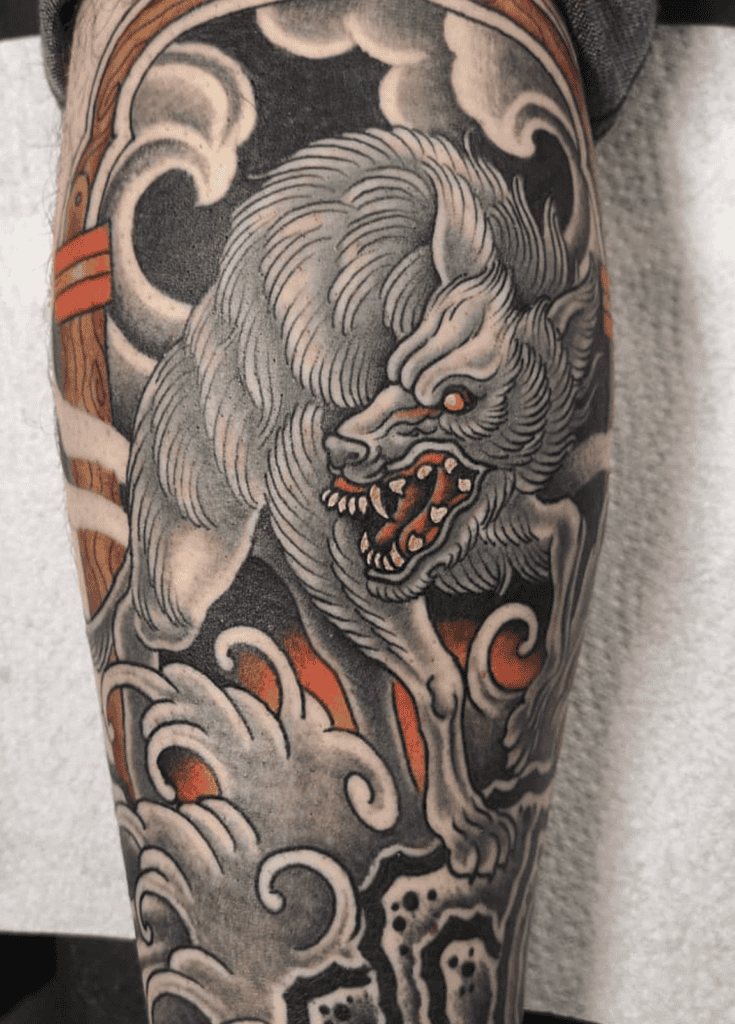
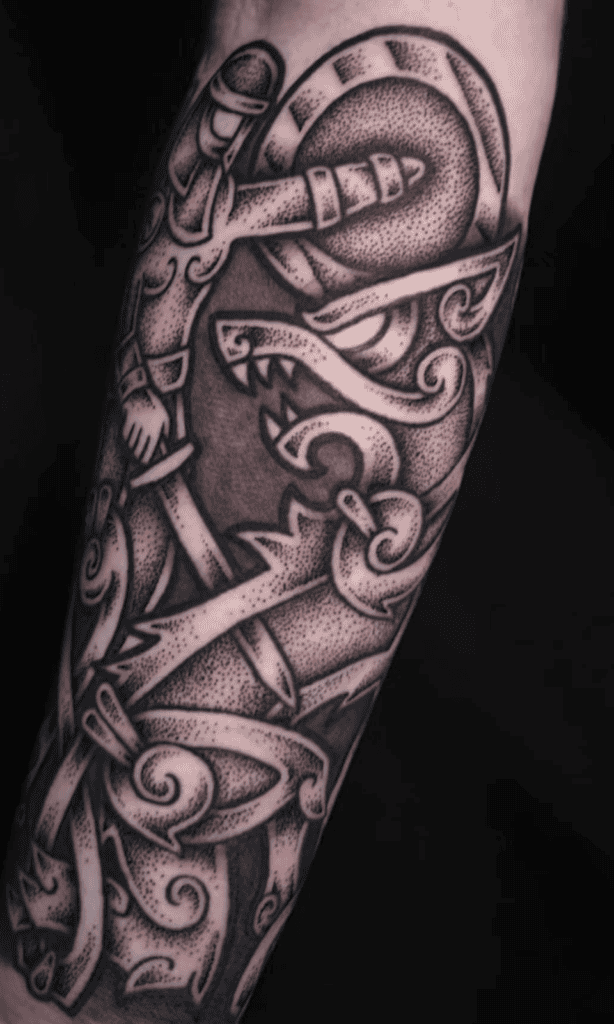
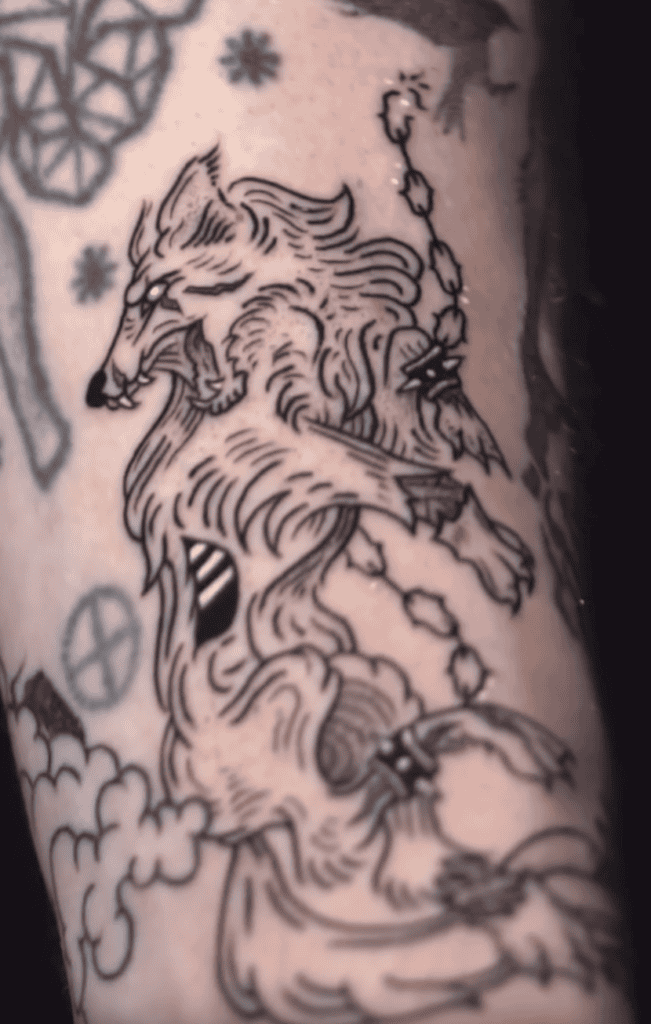
Garmr is a monstrous hound associated with Hel and is often described as one of the most fearsome creatures in Norse mythology. He is said to dwell at the entrance of Helheim, guarding the gates and ensuring that those who enter do not leave.
Garmr is often described as being chained, much like Fenrir, which suggests that even in the underworld, there are forces that must be restrained. However, these restraints are not permanent. As Ragnarök approaches, Garmr breaks free from his bonds, just as many other bound forces of chaos do. This moment signals that the boundaries between worlds are collapsing, and that what was once contained can no longer be held back.
During Ragnarök, Garmr plays a significant role in the final battles. He confronts Týr, the god of justice and sacrifice, and the two engage in a fierce fight. Their battle ends in mutual destruction, with both Garmr and Týr killing each other.
Gullinbursti Norse Mythology Tattoo
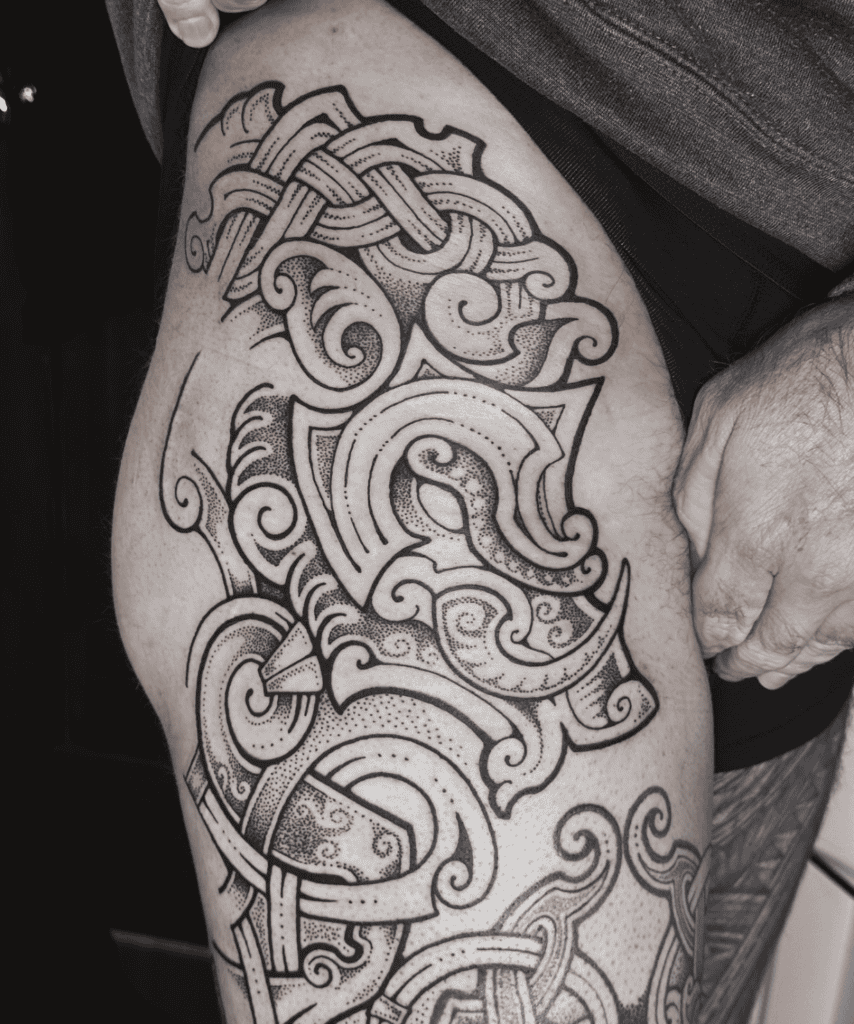
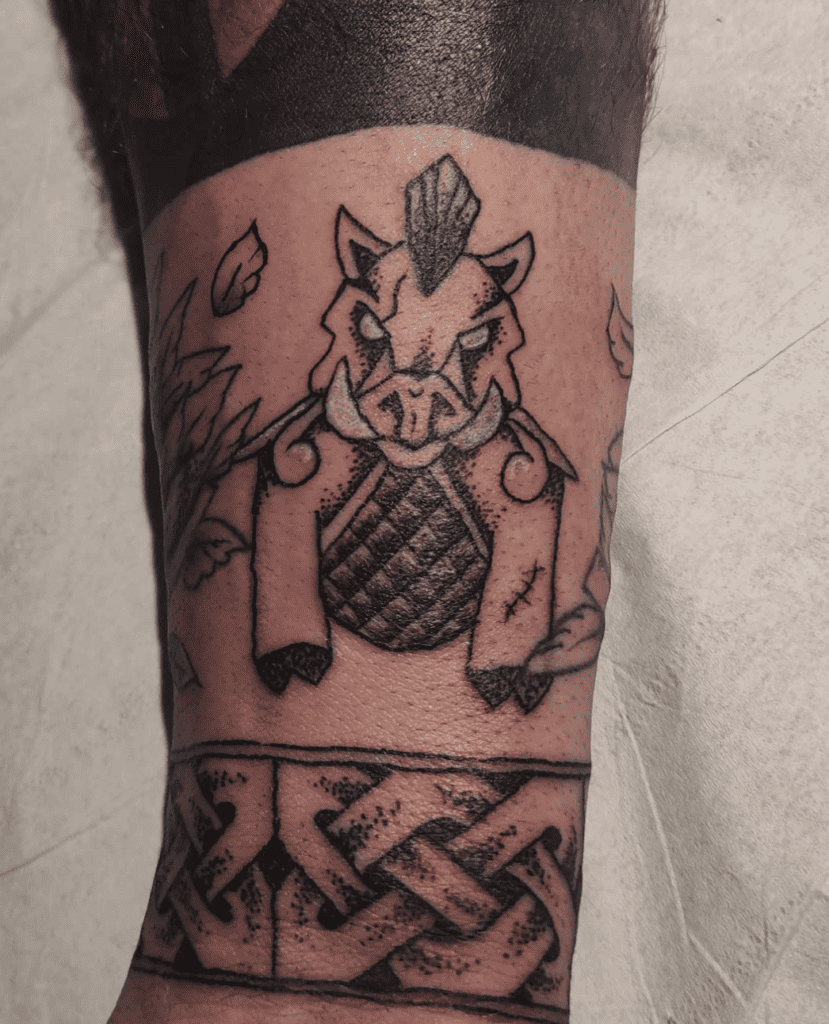
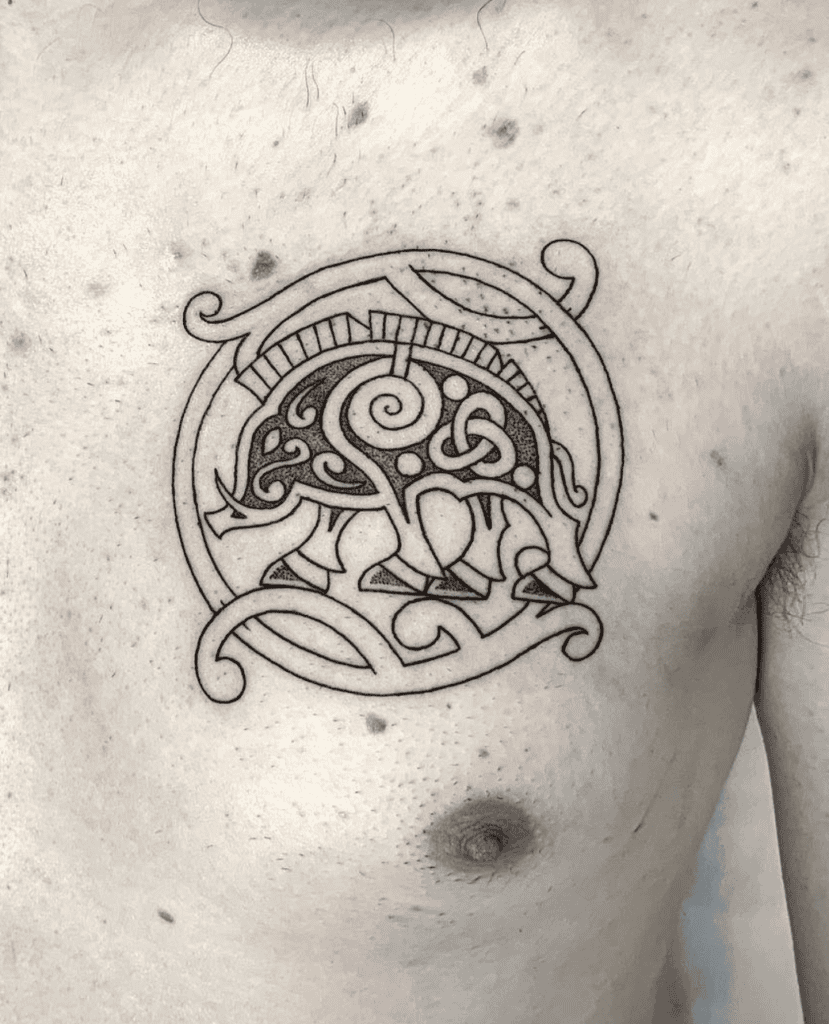
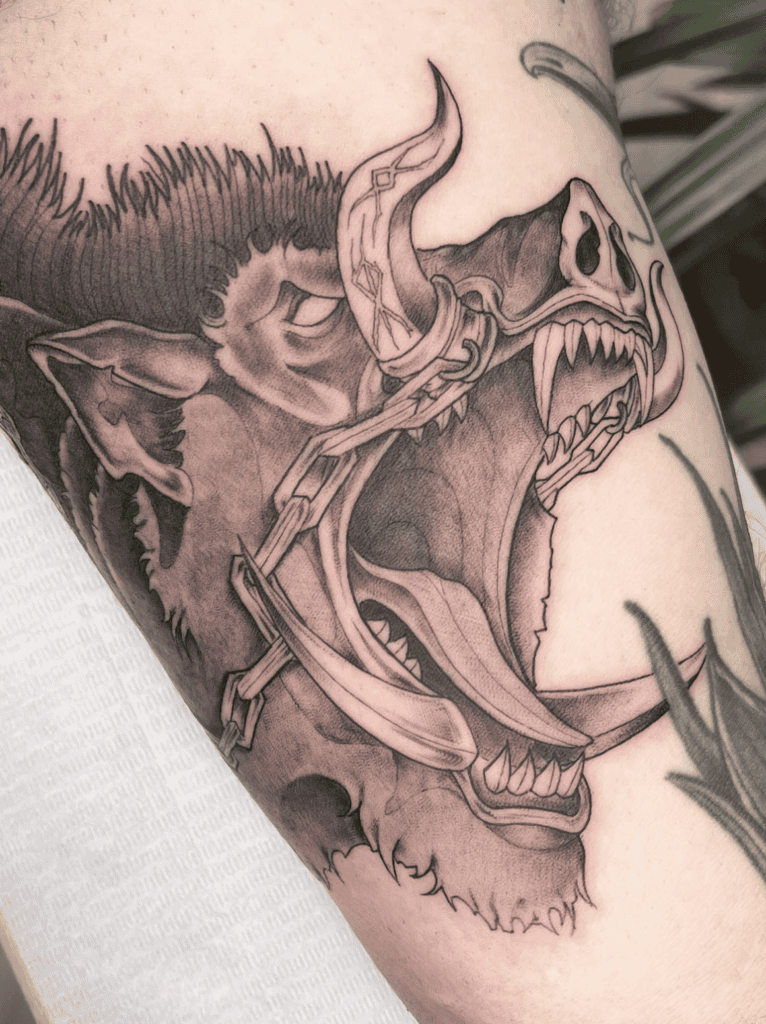
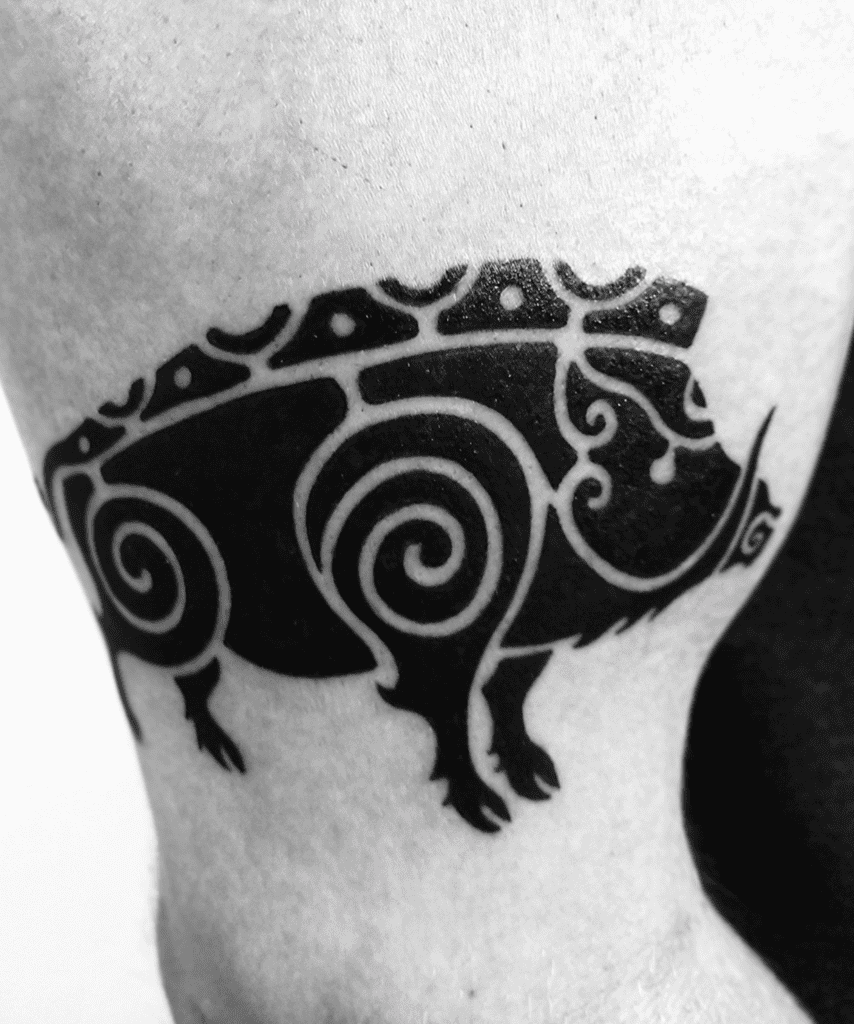
Gullinbursti, whose name means “Golden Bristles,” is a magical boar created by the dwarf brothers Brokkr and Sindri. He is one of the great treasures forged for the gods and is closely associated with Freyr, the god of fertility, prosperity, and peace.
Gullinbursti’s golden bristles shine with such intensity that they can light the darkest paths, allowing him to travel through night, shadow, or even other realms without difficulty. He can run across land, sea, and air with unmatched speed, making him a perfect companion for Freyr. This ability reflects Freyr’s connection to movement, growth, and the natural cycles of the world, as Gullinbursti seems to carry that energy wherever he goes.
His creation story is tied to one of the most famous tales involving the dwarves and Loki. As part of a wager, Brokkr and Sindri forge several legendary items, including Gullinbursti. Despite Loki’s attempts to sabotage their work, the dwarves succeed, and Gullinbursti becomes one of the greatest creations in Norse mythology.
Saehrímnir Norse Mythology Tattoo
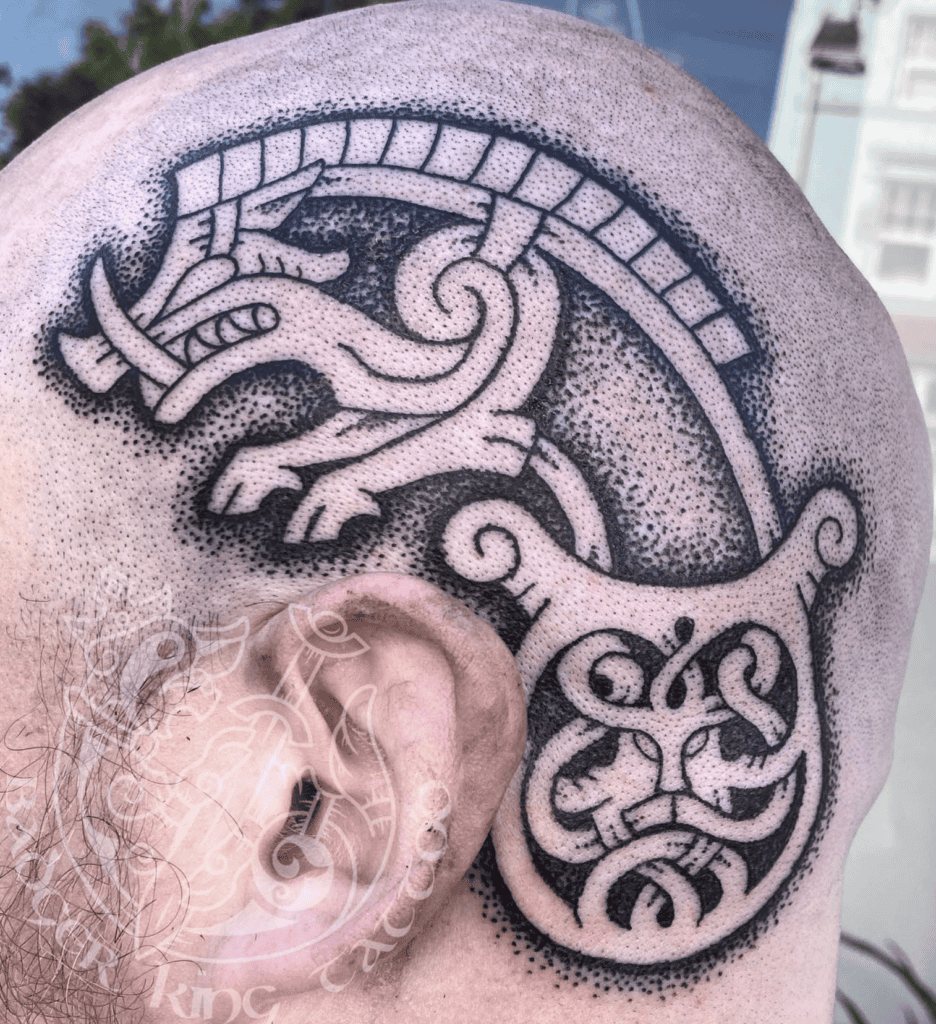
Sæhrímnir is a magical creature in Norse mythology, often described as a boar that is cooked and eaten every day in Valhalla, only to be restored again the next day. His story is closely tied to the daily life of the Einherjar, the fallen warriors who reside in Odin’s hall as they prepare for Ragnarök.
Each day, the warriors of Valhalla feast on Sæhrímnir, whose meat provides an endless source of nourishment. After the feast, he is brought back to life, whole once again, ready to be cooked and eaten the following day. This cycle repeats endlessly, creating a symbol of abundance that never runs dry.
The preparation of Sæhrímnir is carried out by Andhrímnir, the cook of the gods, who uses a great cauldron known as Eldhrímnir. Together, these elements create a ritual that reflects both the warrior culture of the Norse people and their view of the afterlife.
Fafnir Norse Mythology Tattoo
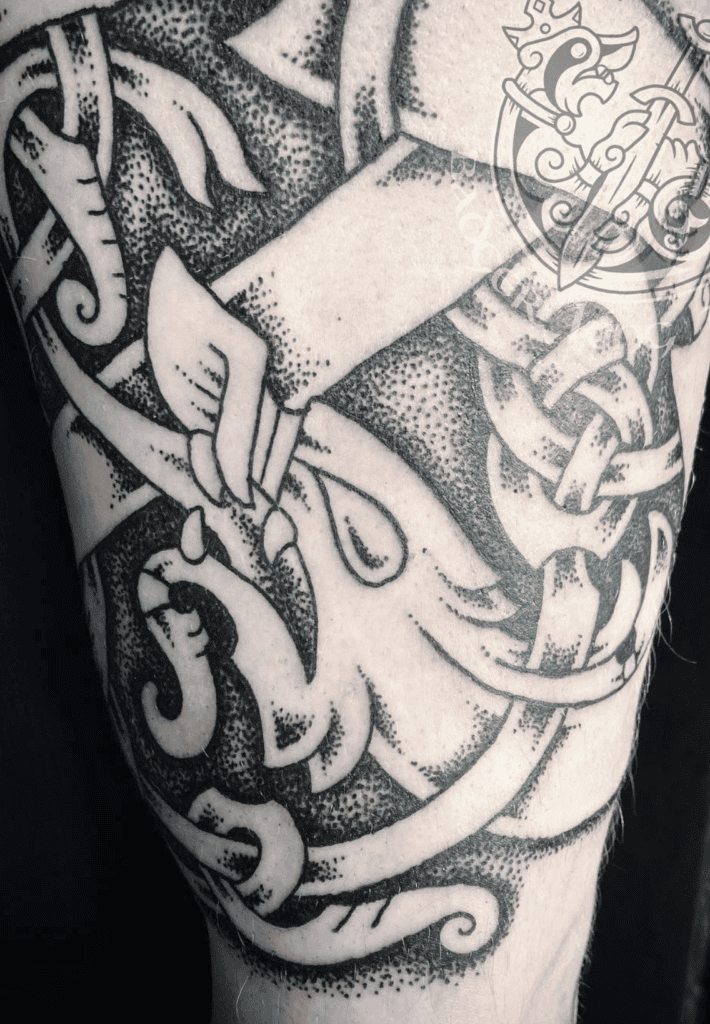
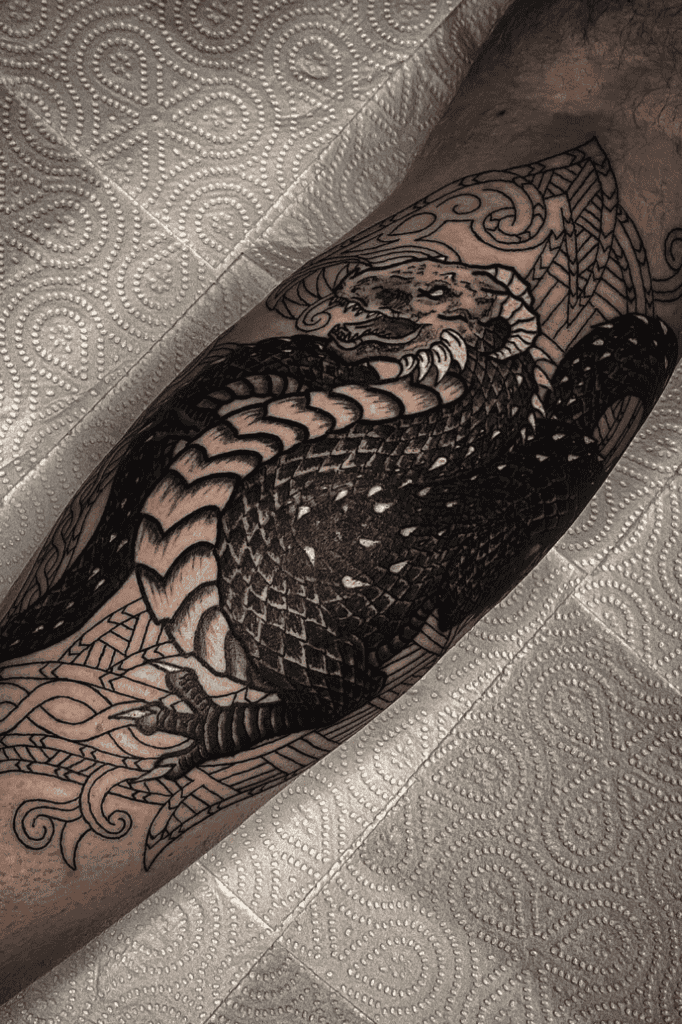
Fáfnir begins his story not as a dragon, but as a dwarf, the son of Hreidmar and the brother of Regin. Unlike many monsters in Norse mythology, his transformation into a dragon is not natural, but the result of overwhelming greed.
The turning point comes when Fáfnir and his family come into possession of a vast treasure hoard, including a cursed gold ring known as Andvaranaut. The treasure is said to bring misfortune and destruction to anyone who possesses it, but Fáfnir’s desire for it overrides all caution. Consumed by greed, he kills his own father to claim the treasure for himself.
As his obsession grows, Fáfnir withdraws from the world and takes on the form of a dragon, retreating into the wilderness to guard his hoard. He becomes a creature defined entirely by what he owns, isolated, powerful, and consumed by the very thing he sought to possess. The dragon form reflects how greed has stripped away his humanity, leaving behind something monstrous.
Fáfnir’s story is closely tied to the hero Sigurd, who is guided by Fáfnir’s brother Regin to slay the dragon. Sigurd digs a pit along the path Fáfnir travels and strikes him from below as he passes overhead. As Fáfnir lies dying, he speaks to Sigurd, warning him of the curse of the treasure and the danger it brings. Even in death, the consequences of greed remain present.
After killing Fáfnir, Sigurd gains not only the treasure but also knowledge. By tasting the dragon’s blood, he gains the ability to understand the speech of birds, further tying the story to themes of transformation and insight. However, the curse of the gold continues to affect those who come into contact with it, reinforcing the idea that some things are not meant to be possessed.
Huginn & Muninn Norse Mythology Tattoo
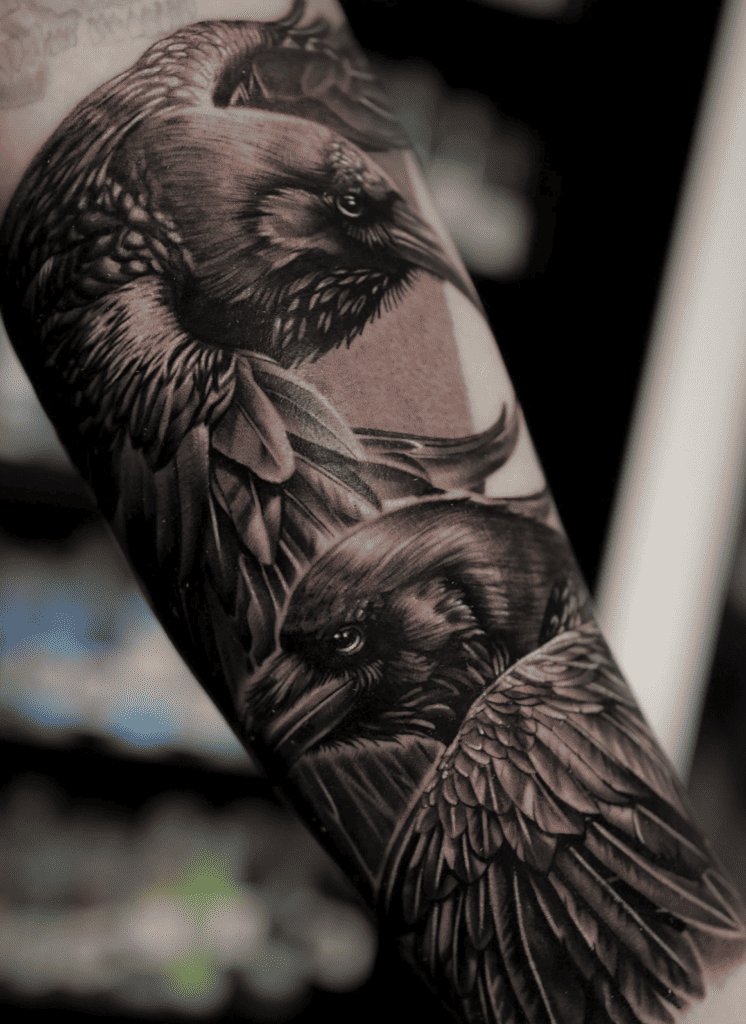
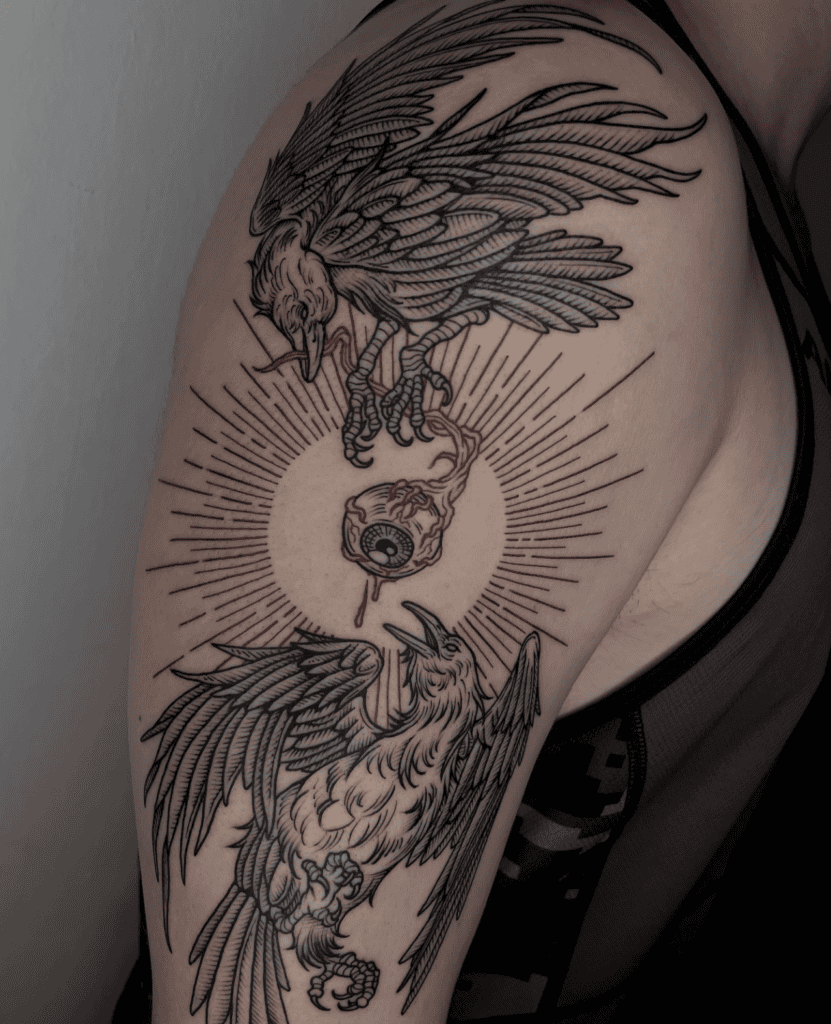
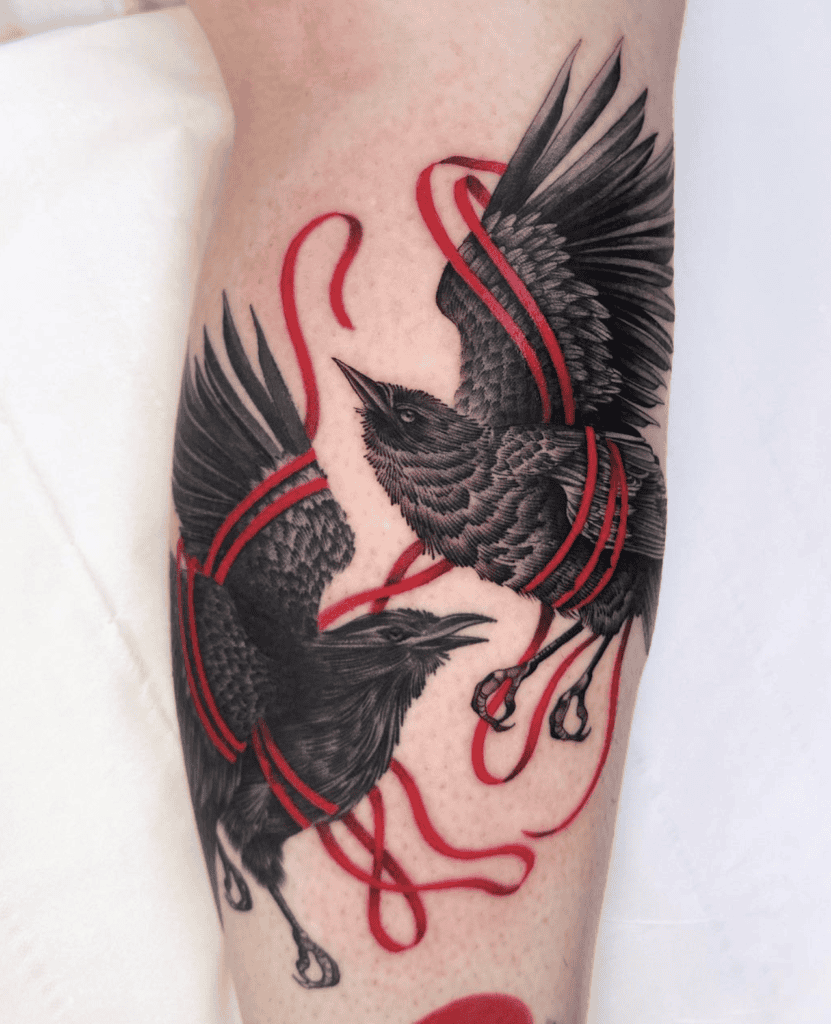
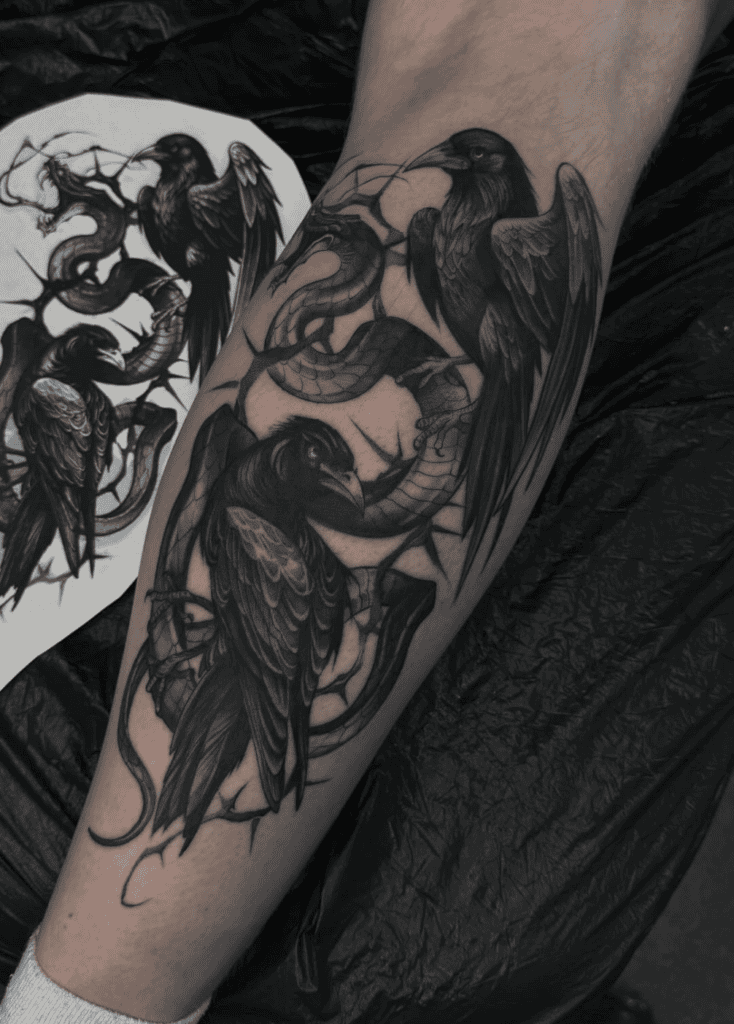
Huginn and Muninn are the two ravens that accompany Odin, the Allfather, playing a vital role in how he gathers knowledge about the world. Their names translate to “Thought” and “Memory,” which immediately reveals their deeper significance. They are not just animals, but extensions of Odin’s mind, representing the way he perceives and understands everything around him.
Each day, Huginn and Muninn fly out across the Nine Realms, observing events, listening to conversations, and gathering information from every corner of existence. By the end of the day, they return to Odin and whisper everything they have seen and heard into his ears. Through them, Odin is able to maintain awareness of the world without physically being present everywhere at once.
Ratatoskr Norse Mythology Tattoo
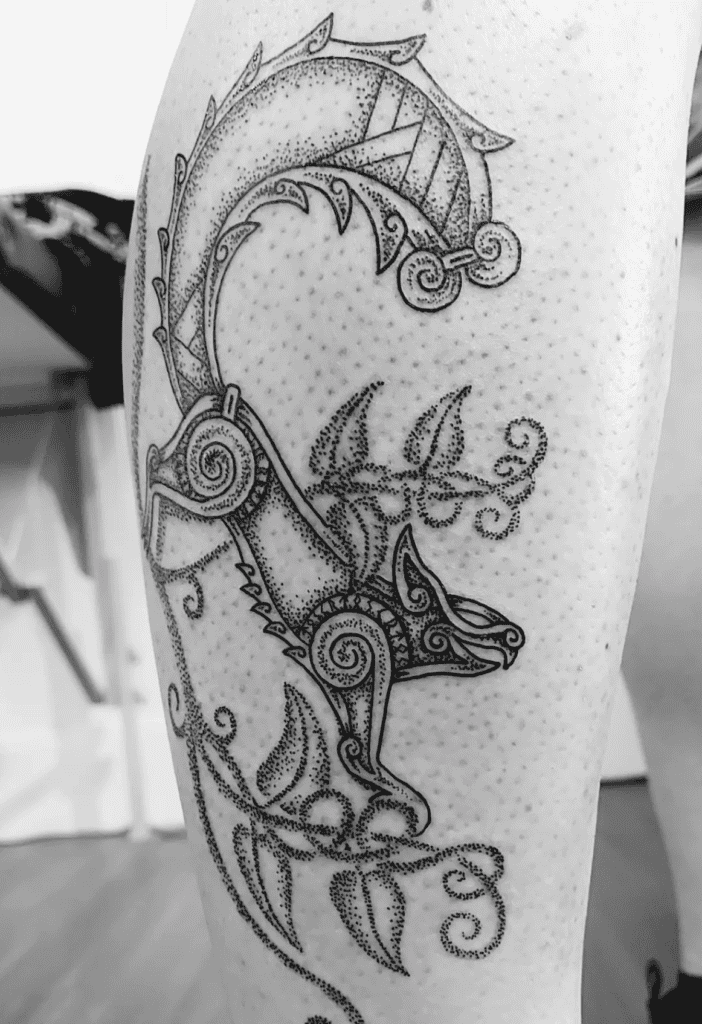
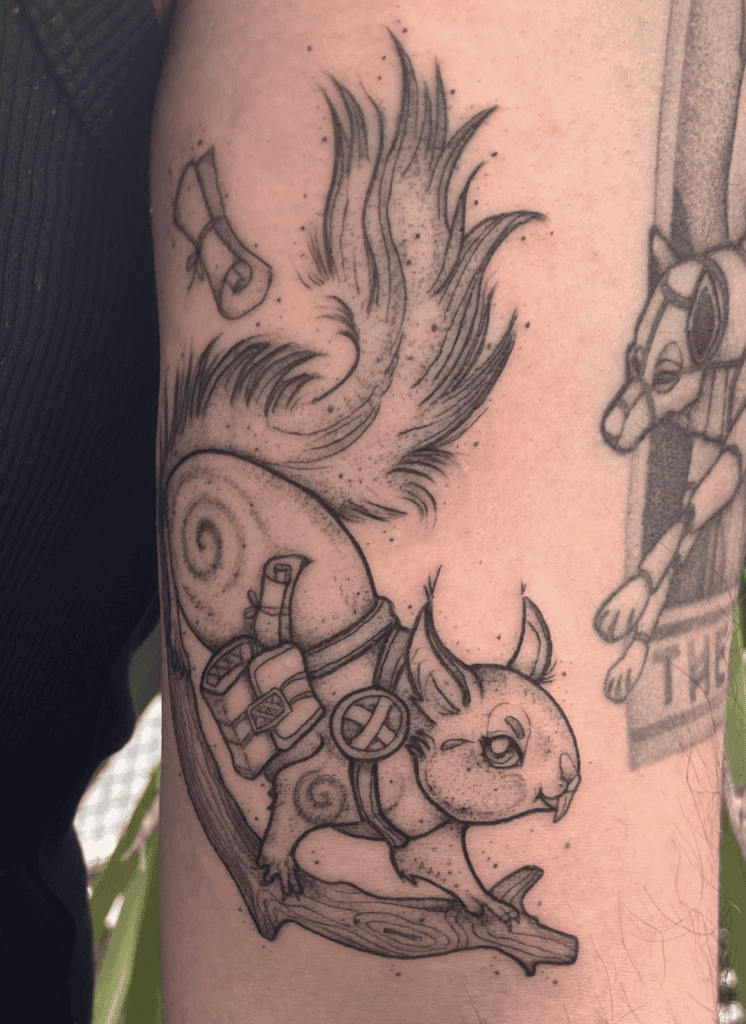
Ratatoskr is a squirrel who lives on Yggdrasil, the great World Tree that connects all the realms in Norse mythology. While he may seem like a minor creature at first glance, his role is surprisingly important, as he constantly travels up and down the tree, carrying messages between its highest and lowest points.
At the top of Yggdrasil sits a great eagle, while at the roots below dwells the dragon Níðhöggr. Ratatoskr runs between them, delivering messages—but not peaceful ones. Instead of acting as a neutral messenger, he carries insults and taunts, fuelling hostility between the two. This makes him less of a simple communicator and more of a provocateur, someone who keeps tension alive through his words.
What makes Ratatoskr so interesting is how he represents communication in its most chaotic form. In a world already filled with conflict and fate, he adds another layer by spreading discord rather than resolving it. His actions may seem small, but they contribute to the constant friction that exists throughout the cosmos.
Sköll & Hati Norse Mythology Tattoo
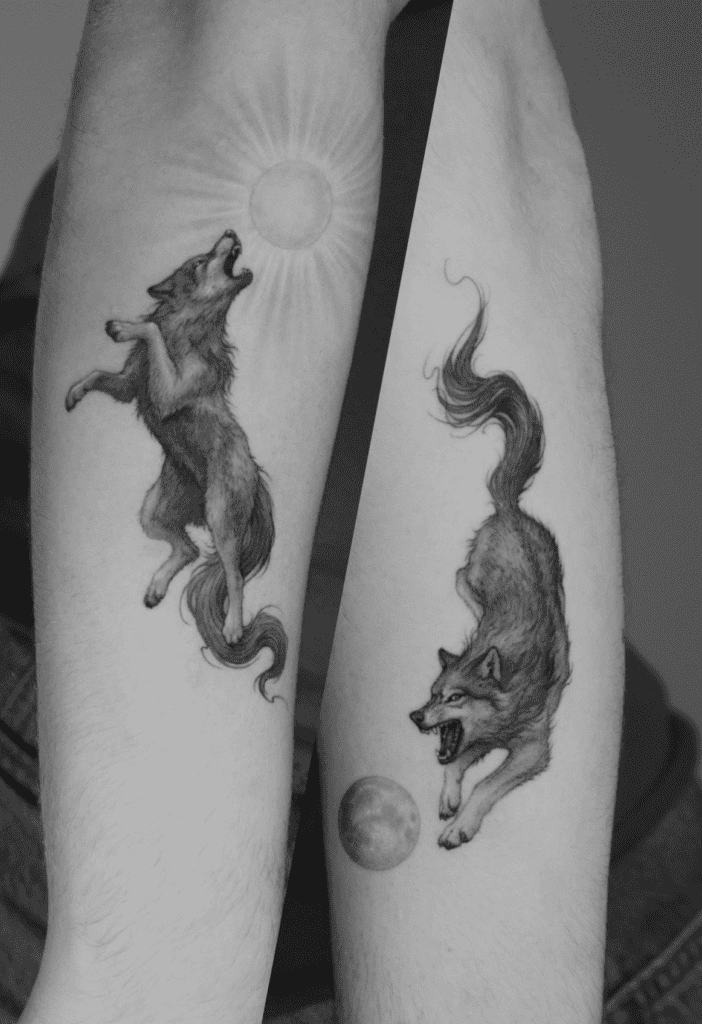
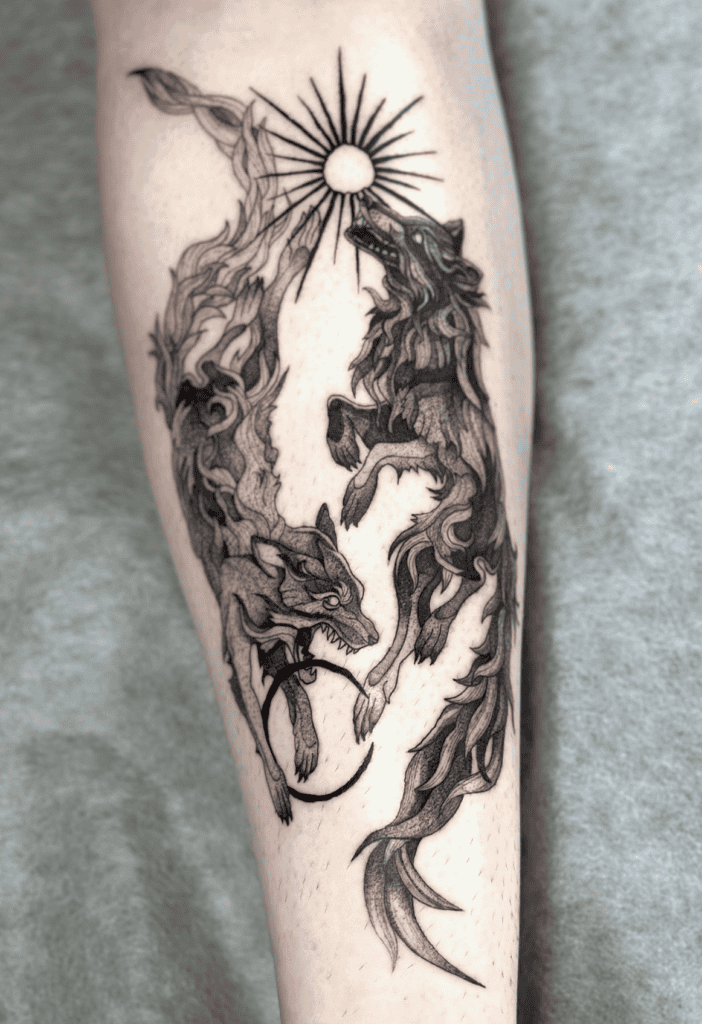
Sköll and Hati are two wolves whose existence is defined by an endless pursuit across the sky. They are said to chase celestial bodies as they move across the heavens, creating a constant sense of motion and urgency within the Norse cosmos. This chase is deeply tied to the structure of the world itself, representing a cycle that never truly stops.
What makes their story so compelling is the idea of inevitability. No matter how long the chase continues, there is always the looming possibility that it will one day end. That moment arrives during Ragnarök, when both wolves finally catch what they have been pursuing. This act is not just a victory, but a turning point, signalling the collapse of the natural order and the beginning of the world’s destruction.
Tanngrisnir & Tanngnjóstr Norse Mythology Tattoo
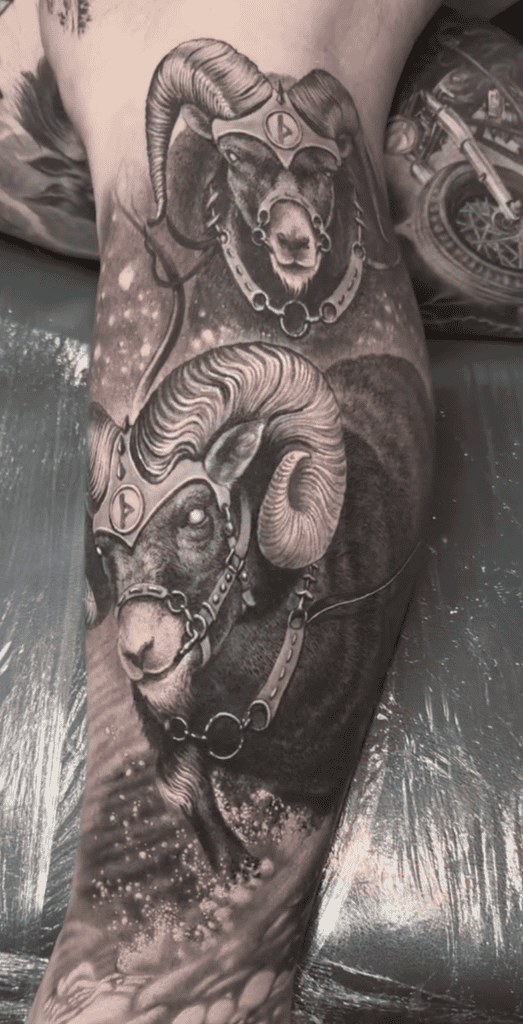
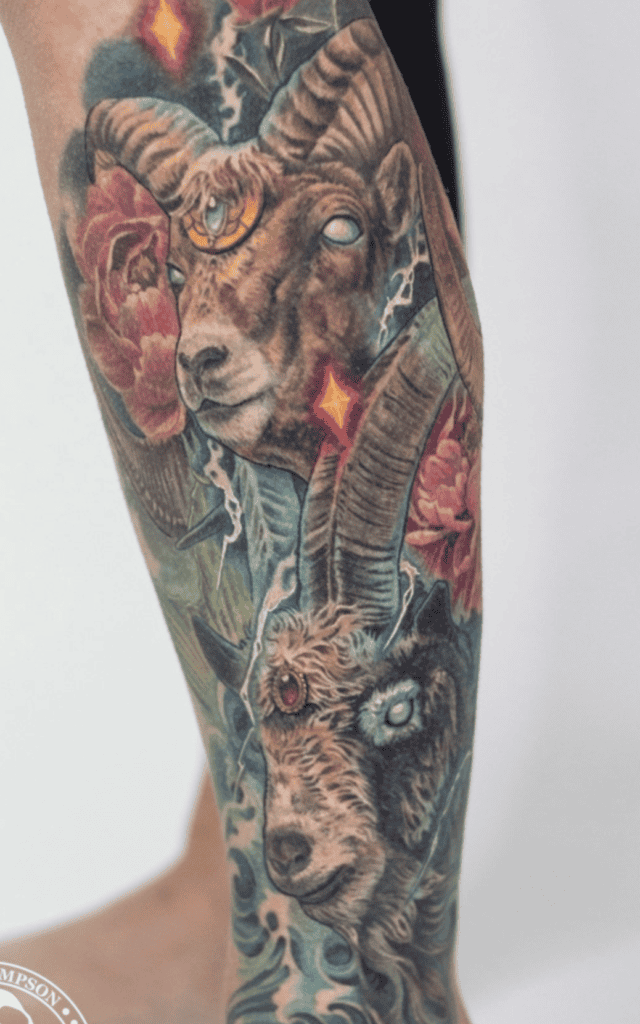
Tanngrisnir and Tanngnjóstr are the two magical goats that pull Thor’s chariot across the sky. Whenever Thor travels, especially when thunder rolls across the heavens, it is said to be the sound of his chariot being drawn by these powerful creatures.
What makes these goats particularly fascinating is their unusual ability to return from death. When Thor travels among humans, he sometimes slaughters the goats to provide food. After the meal, he carefully gathers their bones and places them back into their skins. By the next day, the goats are fully restored to life, ready to pull his chariot once again.
During one of Thor’s visits to a human household, he warns the family not to break the goats’ bones when eating them. However, one of the children ignores this and cracks a bone to eat the marrow inside. When Thor resurrects the goats the next day, one of them is left with a damaged leg. Angered by this, Thor nearly punishes the family severely, but instead accepts their children as servants to make up for the mistake.
Draugr Norse Mythology Tattoo
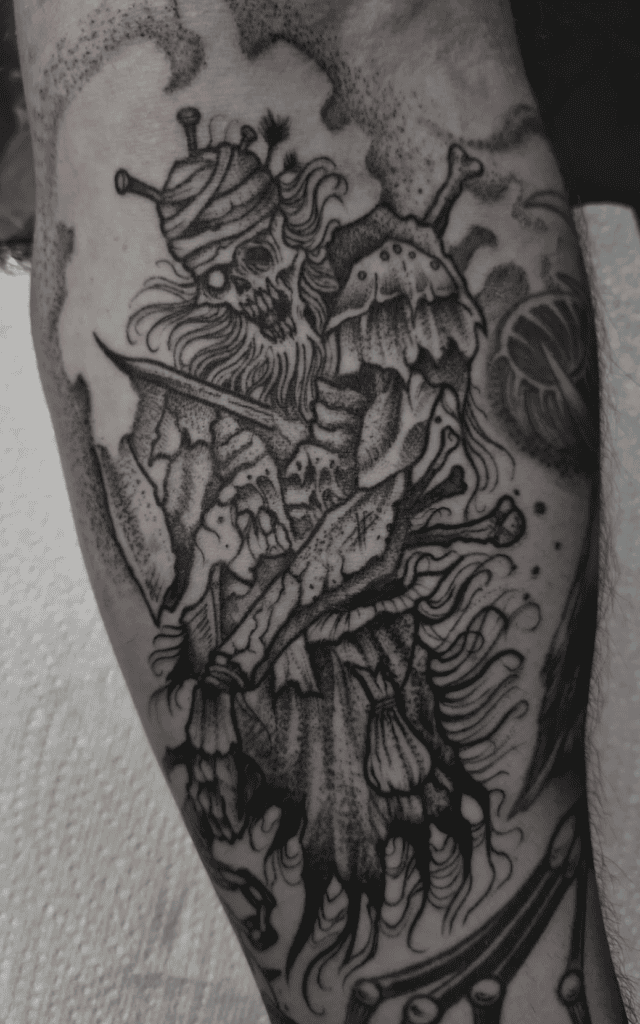
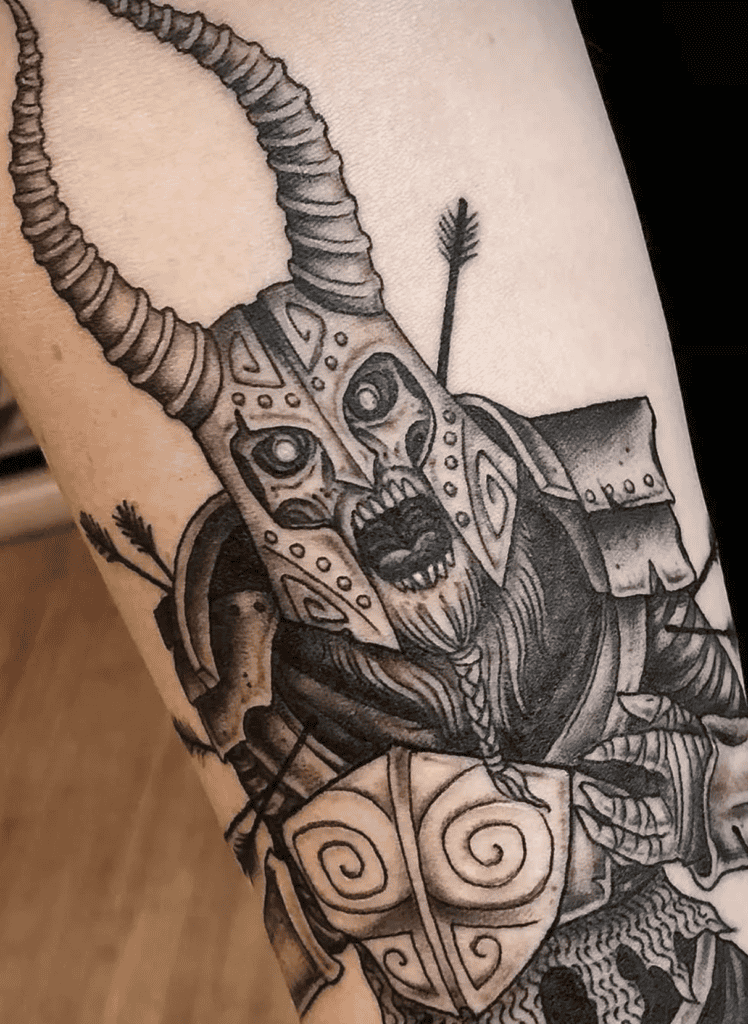
The Draugr are undead beings in Norse mythology, often described as reanimated corpses that rise from their graves. Unlike typical ghosts or spirits, Draugr have a physical presence. They inhabit their burial mounds and can interact with the world, making them far more dangerous than something that simply lingers unseen.
They are most commonly associated with greed, anger, or unfinished business. Many Draugr were once powerful individuals in life who refused to let go of their wealth or status, even in death. As a result, they remain tied to their tombs, guarding treasure or territory with violent intent. This connection to greed gives them a strong symbolic link to figures like Fáfnir, showing how obsession can persist beyond death.
Mjölnir Norse Mythology Tattoo
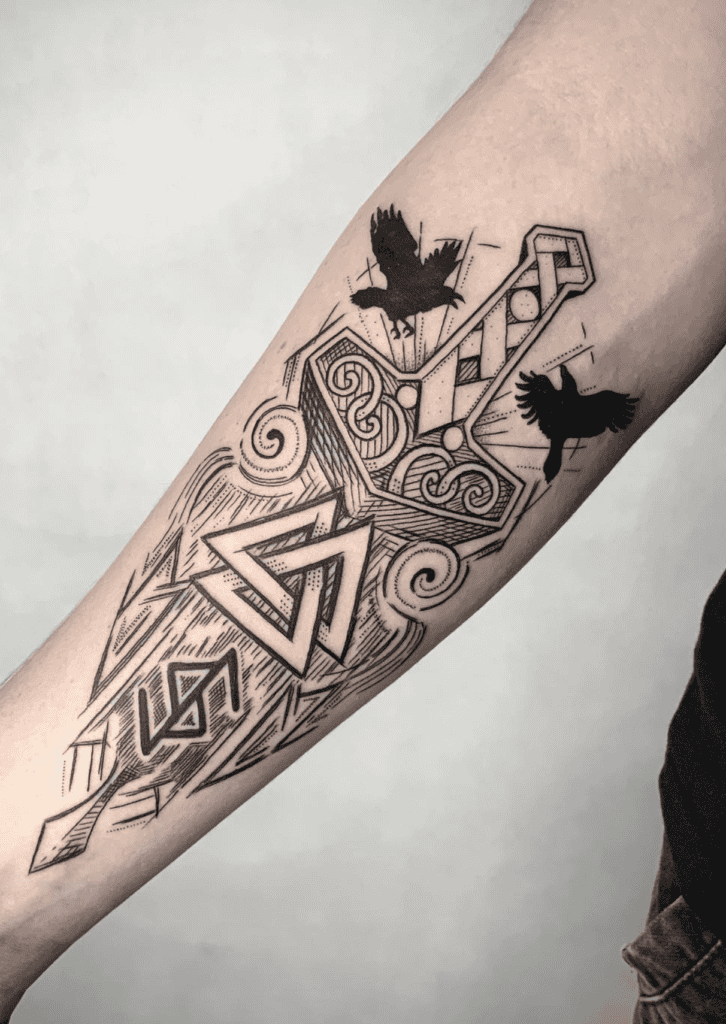
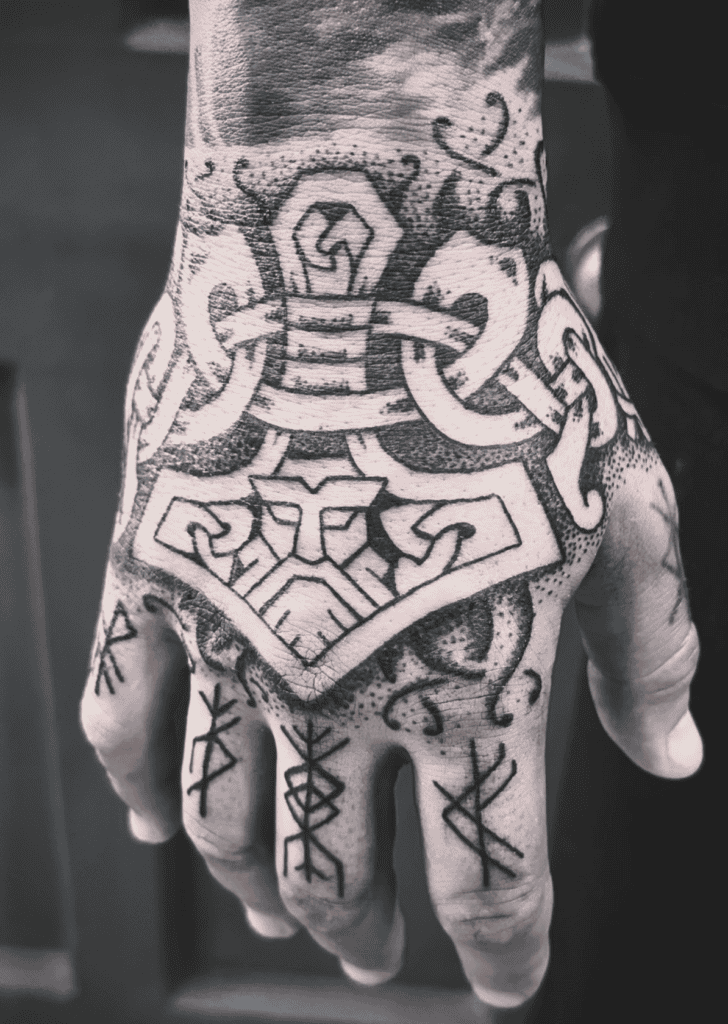
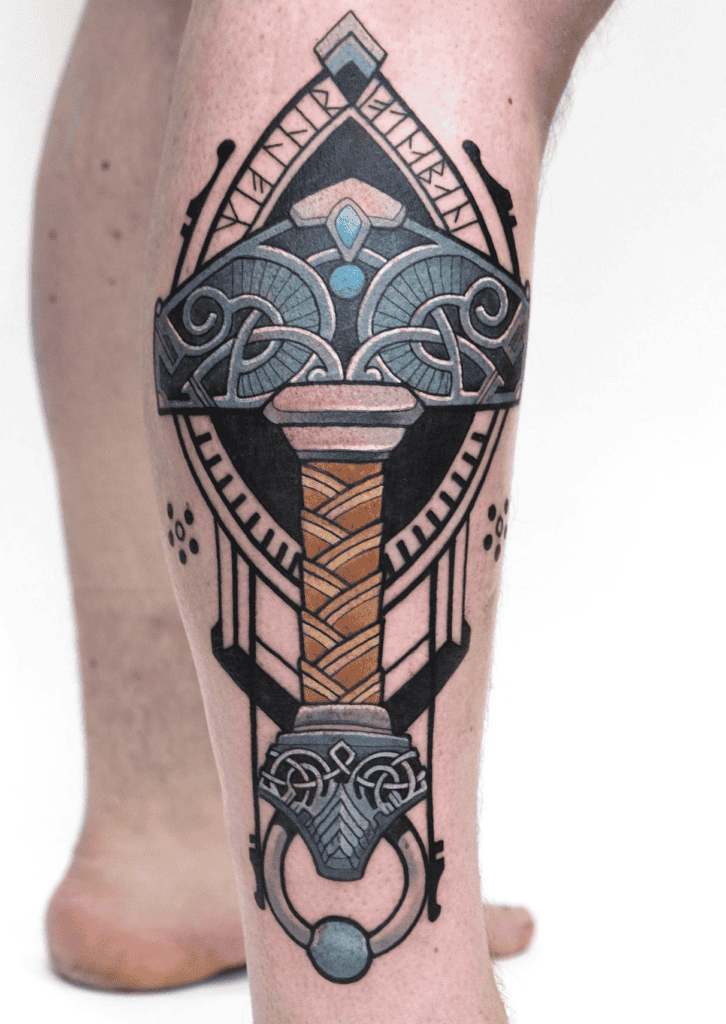
Mjölnir is the legendary hammer wielded by Thor, the god of thunder, and it stands as one of the most powerful and recognisable objects in Norse mythology.
Forged by the dwarf brothers Brokkr and Sindri, Mjölnir was created as part of a wager involving Loki. During its creation, Loki attempted to sabotage the process, and while the hammer was successfully completed, its handle ended up shorter than intended. Despite this flaw, Mjölnir became the greatest of all the treasures crafted by the dwarves, surpassing even the most perfect creations.
When thrown, it never misses its target and always returns to Thor’s hand, making it both a devastating weapon and a reliable one. It is capable of levelling mountains, summoning lightning, and striking fear into giants and enemies alike. Yet, despite its destructive potential, Mjölnir is also used for blessing and protection. It is said to consecrate marriages, sanctify important moments, and act as a symbol of divine protection over people and places.
Gungnir Norse Mythology Tattoo
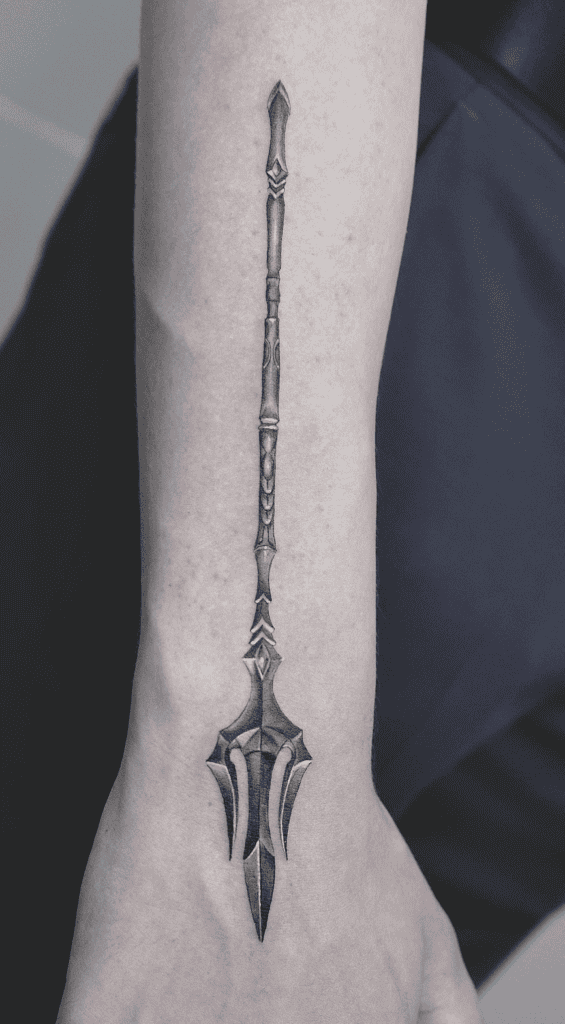
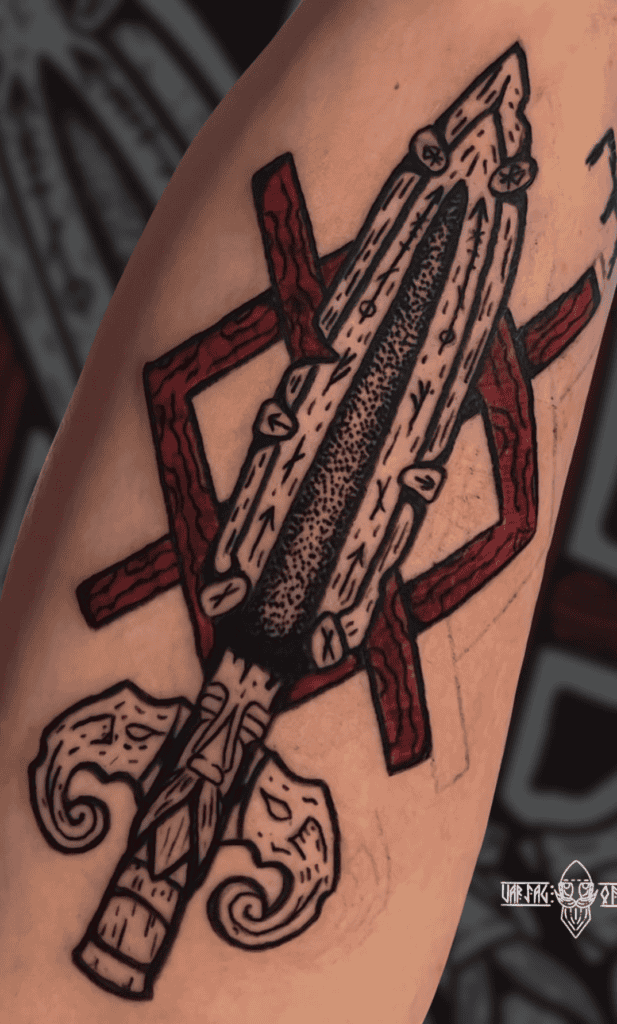
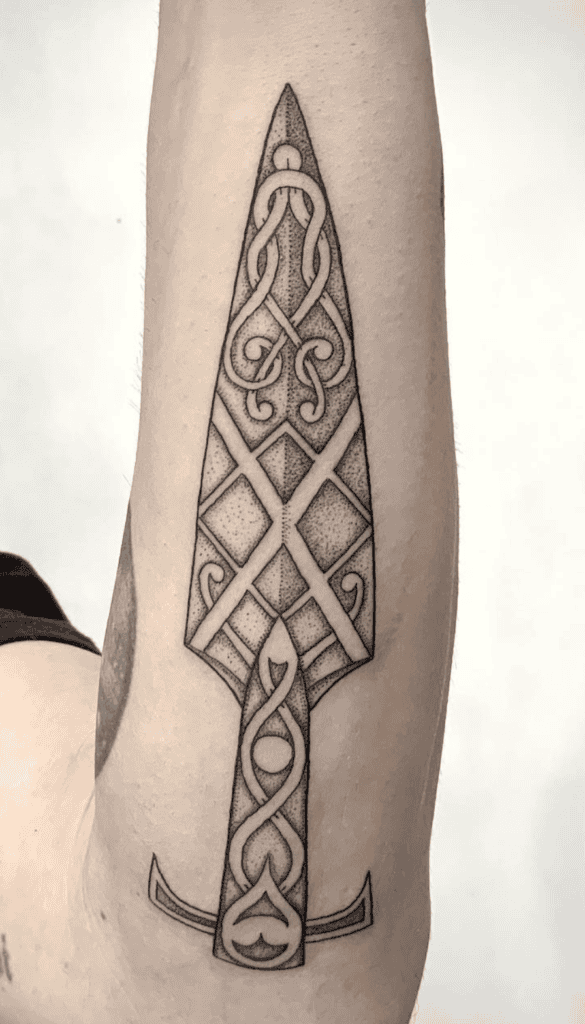
Gungnir is the legendary spear of Odin, the Allfather, and it is known for never misses its target. No matter how far it is thrown or how difficult the aim, Gungnir always strikes true.
Like many of the most powerful artefacts in Norse mythology, Gungnir was forged by dwarves, specifically the Sons of Ivaldi, whose craftsmanship is renowned across the myths. The spear is said to be inscribed with runes, which enhance its magical properties and tie it directly to Odin’s deep connection with knowledge, magic, and the hidden forces of the world.
The spear also carries strong symbolic meaning in relation to war and leadership. Odin is known to cast Gungnir over enemy lines at the start of a battle, a ritual act that dedicates the conflict to him and marks his influence over the outcome.
Draupnir Norse Mythology Tattoo
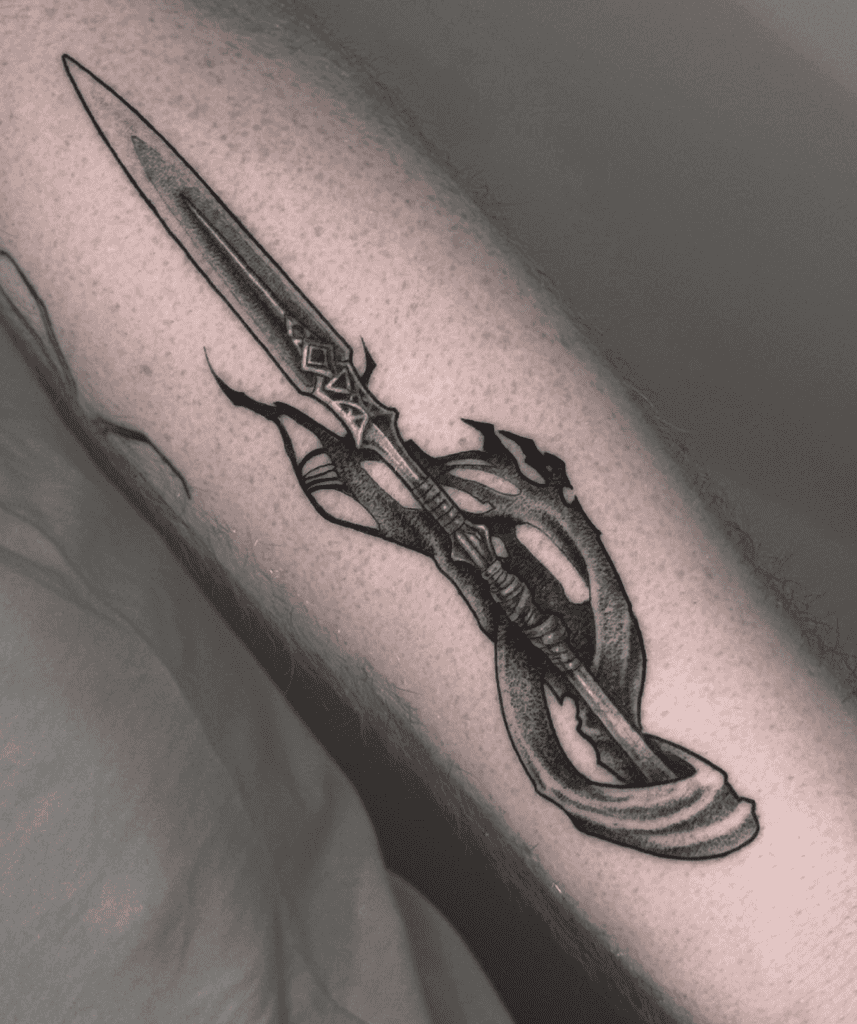
Draupnir is a magical gold ring belonging to Odin, known for its extraordinary ability to multiply itself. Every ninth night, the ring produces eight identical copies, each just as valuable and real as the original.
Like many legendary objects in Norse mythology, Draupnir was forged by the dwarf brothers Brokkr and Sindri. Its creation is tied to the same story that brought Mjölnir and Gullinbursti into existence, reinforcing the importance of the dwarves as master craftsmen whose work shapes the fate of gods and worlds alike.
What makes Draupnir particularly interesting is that its value goes beyond simple wealth. It represents cycles and repetition, especially through its connection to the number nine, which holds deep significance in Norse mythology. Odin himself hung from Yggdrasil for nine nights, and many key events in the myths are tied to this number. Draupnir’s ability to produce new rings every ninth night reflects this pattern, linking it to the broader rhythm of the cosmos.
Brísingamen Norse Mythology Tattoo
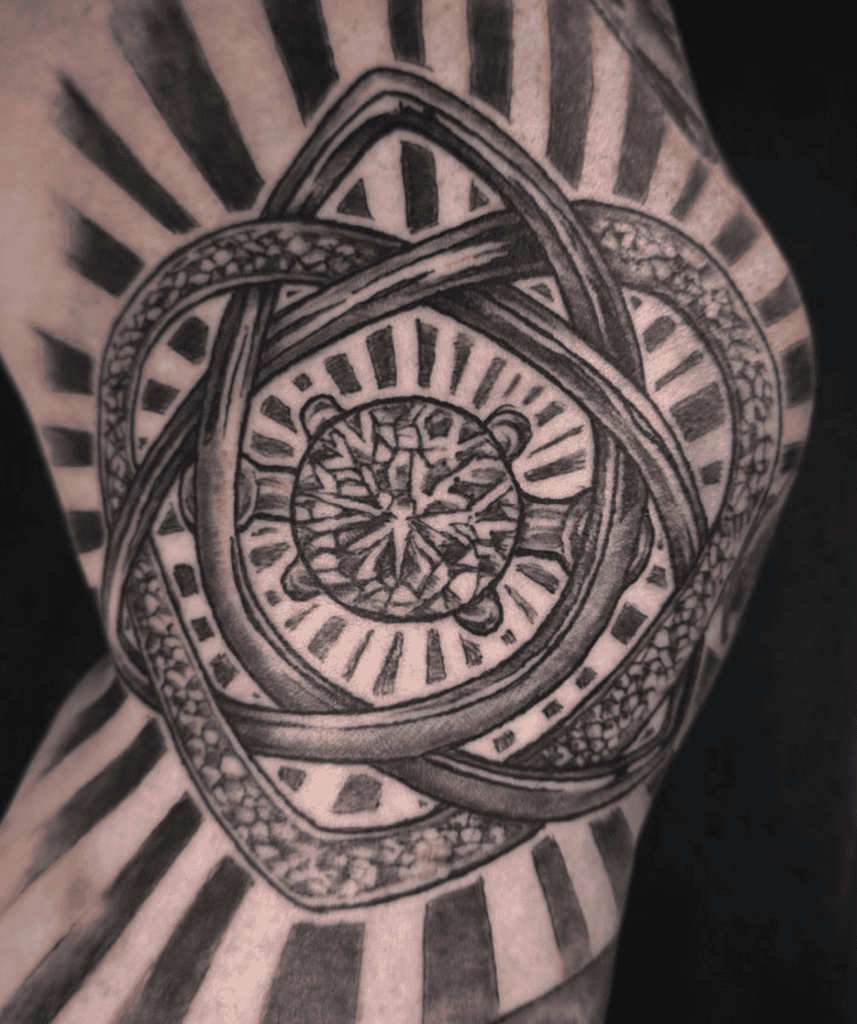
Brísingamen is the legendary necklace of Freyja, the goddess of love, beauty, and magic, and it is considered one of the most treasured items in Norse mythology. Its name is often interpreted as “the necklace of the Brísings,” referring to the dwarves who crafted it.
The story of how Freyja obtains Brísingamen adds depth to its meaning. According to one version of the myth, she desires the necklace so greatly that she agrees to spend a night with each of the dwarves who made it in exchange for possessing it. This part of the story highlights themes of desire, value, and the lengths one might go to obtain something truly meaningful. Rather than diminishing Freyja, it reinforces her independence and her willingness to make her own choices, even when they come with complexity.
Brísingamen is more than just an ornament. It is closely tied to Freyja’s identity, representing beauty, power, and status. When she wears it, it enhances her presence and reflects her connection to both love and magic. In a mythology where objects often carry deep symbolic weight, Brísingamen stands as a representation of personal power as much as physical beauty.
Yggdrasil Norse Mythology Tattoo
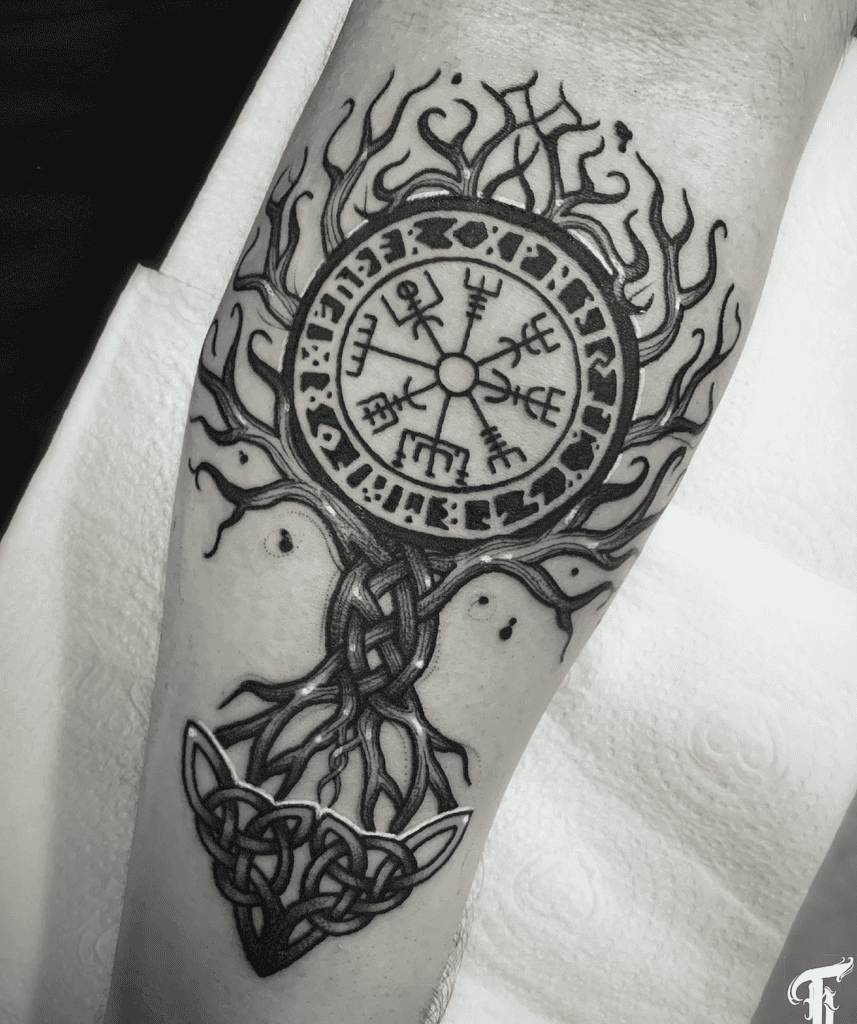
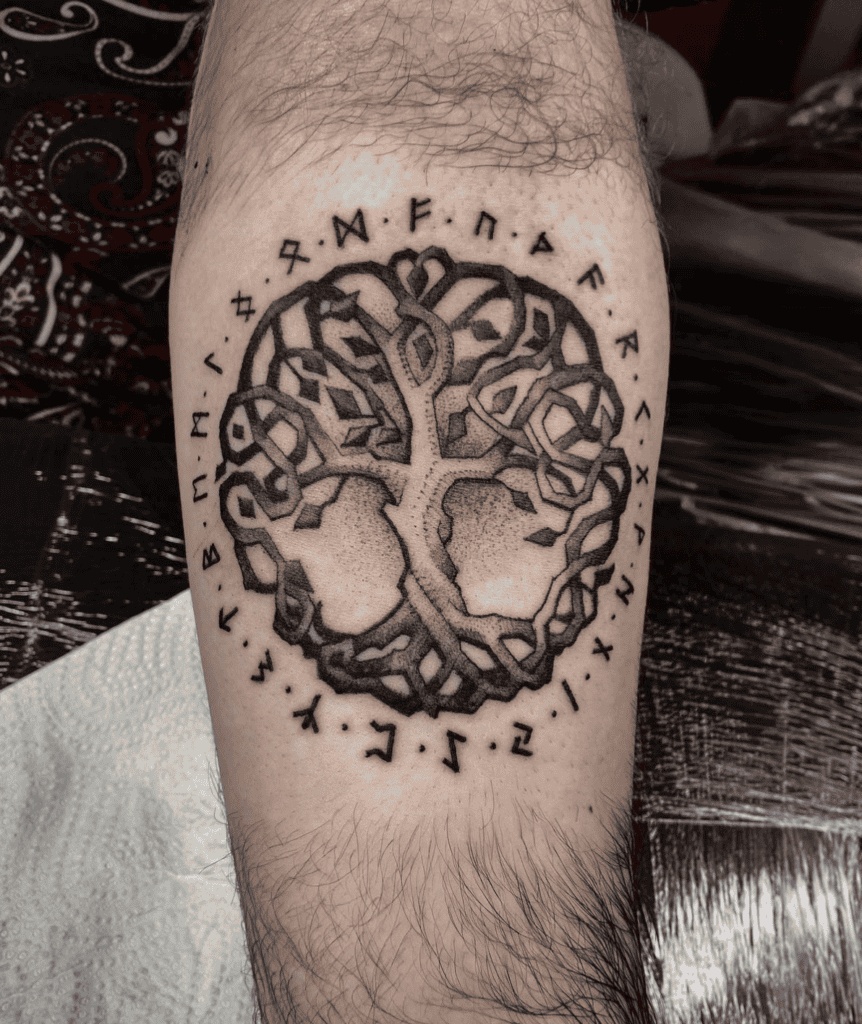
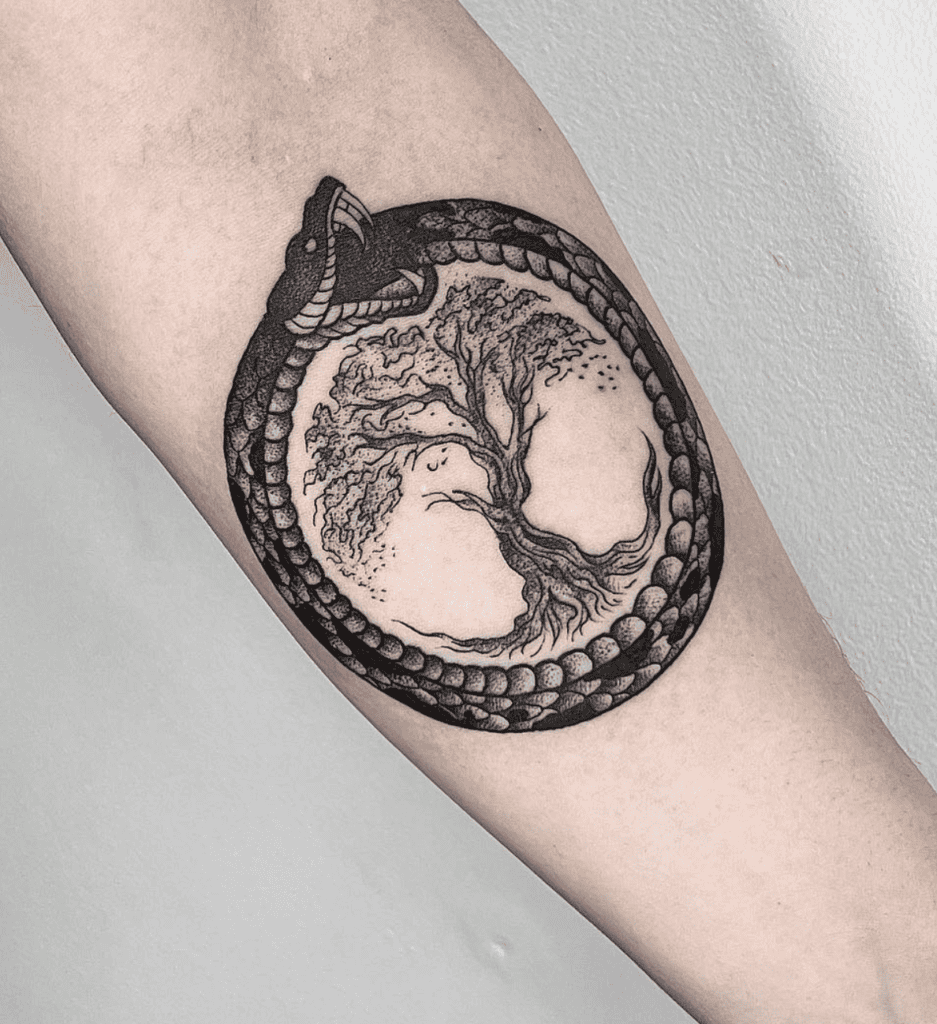
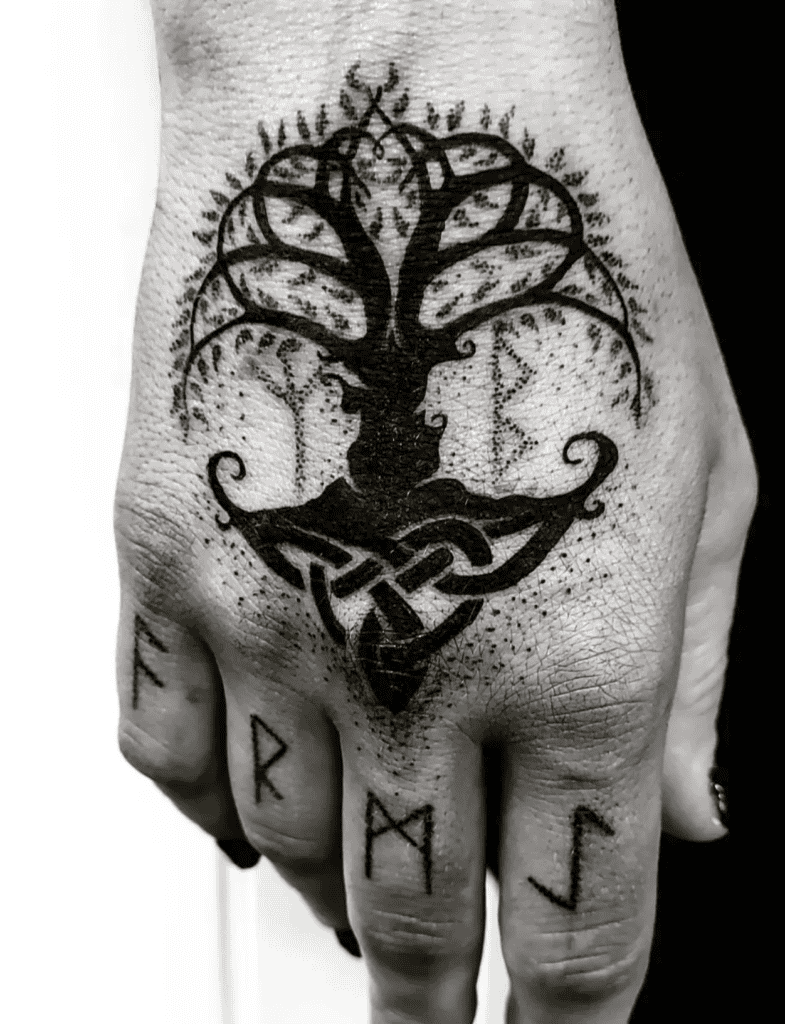
Yggdrasil is the great World Tree at the centre of Norse mythology, a vast and ancient tree that connects all nine realms of existence. It is not just a part of the world—it is the structure of the world itself. Everything, from the realm of the gods to the lands of humans and the depths of the underworld, is linked through its branches, trunk, and roots.
The tree is often described as an enormous ash tree, stretching across the cosmos, with roots that reach into different realms and branches that extend far beyond what can be seen. At its base lies the Well of Urðr, where the Norns shape the fate of all beings, while other roots connect to places of knowledge and primordial forces. This makes Yggdrasil not just a physical structure, but a symbol of the entire system of existence, where everything is interconnected.
What makes Yggdrasil particularly fascinating is that it is not a static or perfect structure. It is constantly under strain. Creatures live within and around it, each playing a role in its condition. At its roots, the dragon Níðhöggr gnaws away, slowly eroding its foundation. At its top sits an eagle, watching over the worlds, while Ratatoskr, the mischievous squirrel, runs up and down the trunk, carrying insults between them. These interactions create tension throughout the tree, reflecting the constant conflict and movement within the cosmos.
Despite this, Yggdrasil endures. It is sustained and cared for by the Norns, who tend to its roots and ensure that it continues to stand. This balance between decay and maintenance reflects a central theme in Norse mythology—the idea that existence is not permanent or unchanging, but something that must constantly be supported to survive.
Valknut Norse Mythology Tattoo
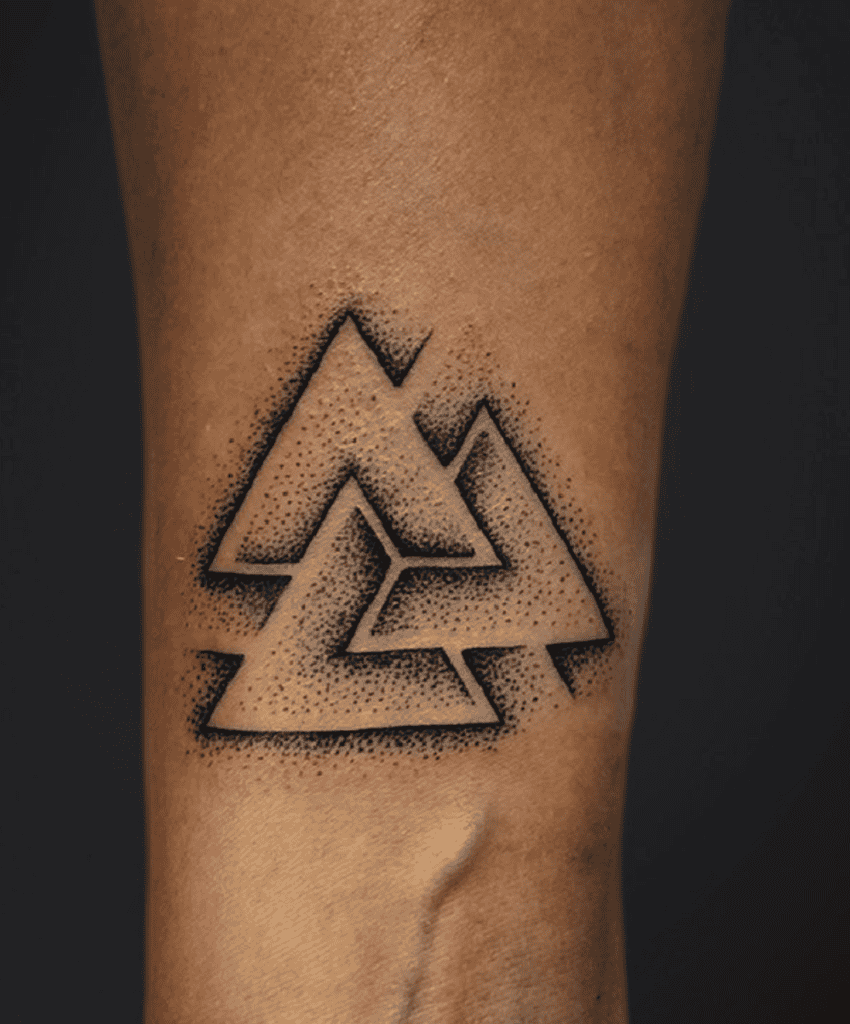
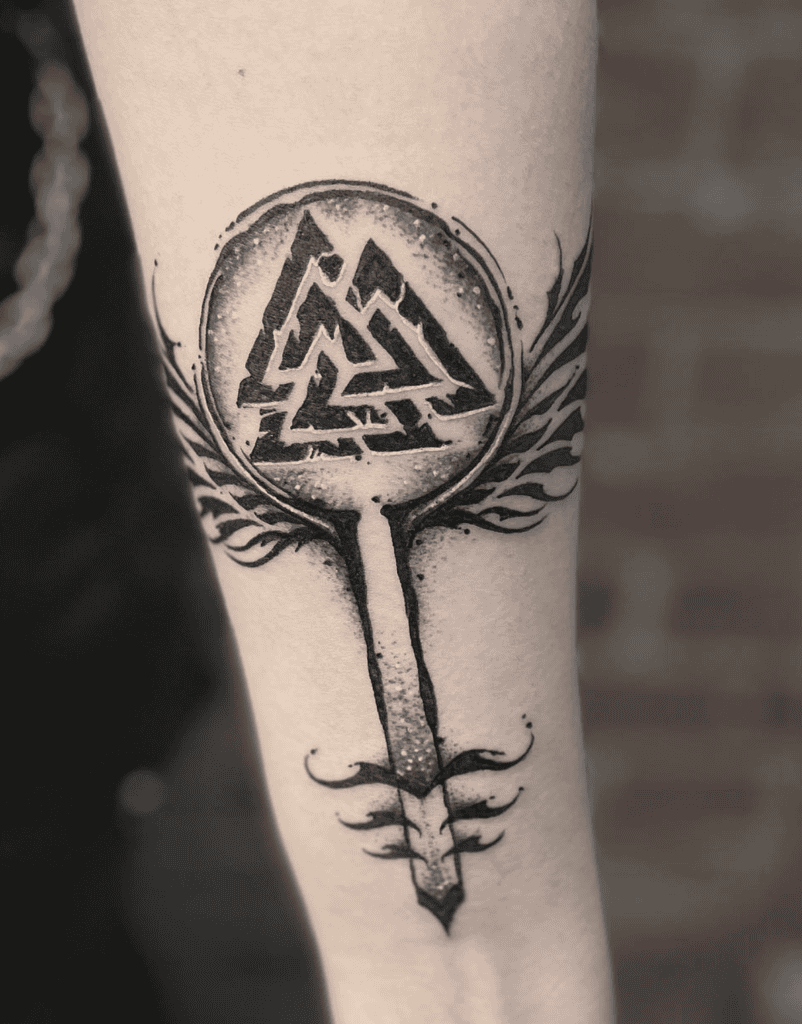
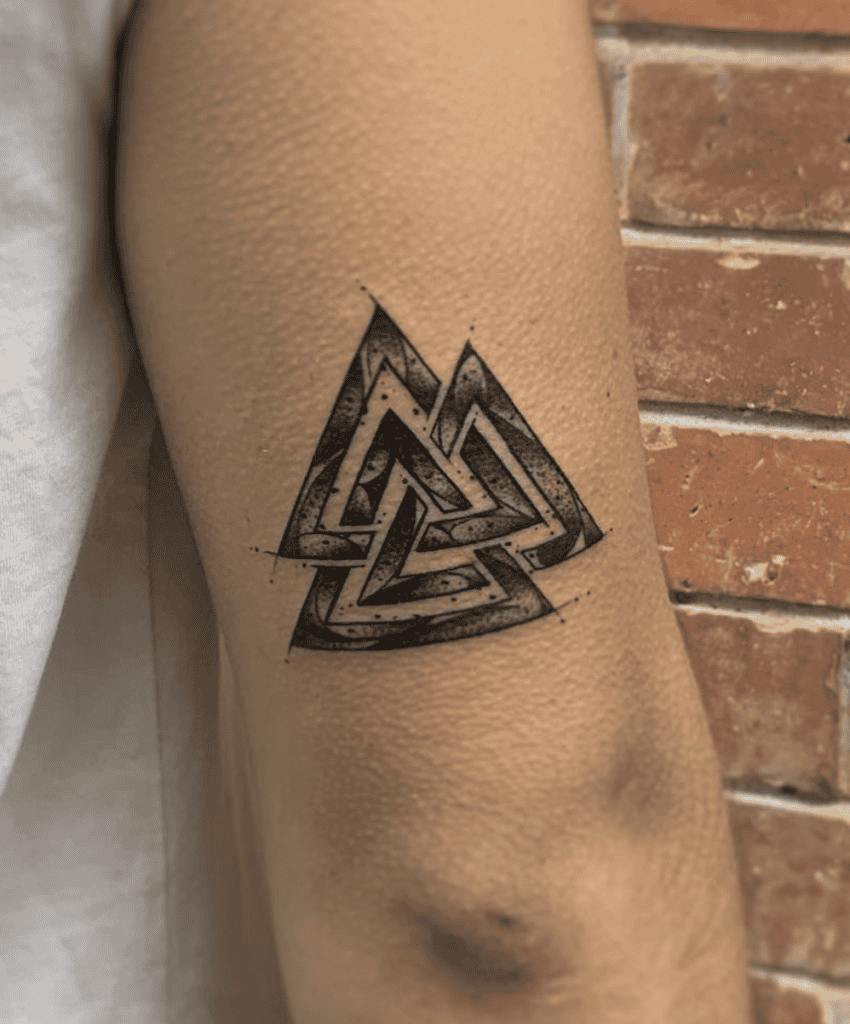
The Valknut is a symbol made up of three interlocking triangles, and it is most commonly associated with Odin, the god of war, wisdom, and death. Its name is a modern term that roughly translates to “knot of the slain,” which reflects its strong connection to fallen warriors and the afterlife.
Unlike many elements in Norse mythology, the Valknut does not come with a single clear story explaining its meaning. Instead, it appears in archaeological findings such as runestones and burial sites, often in scenes that depict death, battle, or figures believed to be Odin. Because of this, its meaning is interpreted through context rather than a specific myth.
One of the strongest associations of the Valknut is with those who die in battle. It is often linked to the warriors chosen by Odin, the ones taken to Valhalla to prepare for Ragnarök. This connection gives the symbol a powerful meaning tied to honour, sacrifice, and the transition from life to death. It represents not just dying, but being chosen, marked as part of something greater.
Runes Norse Mythology Tattoo
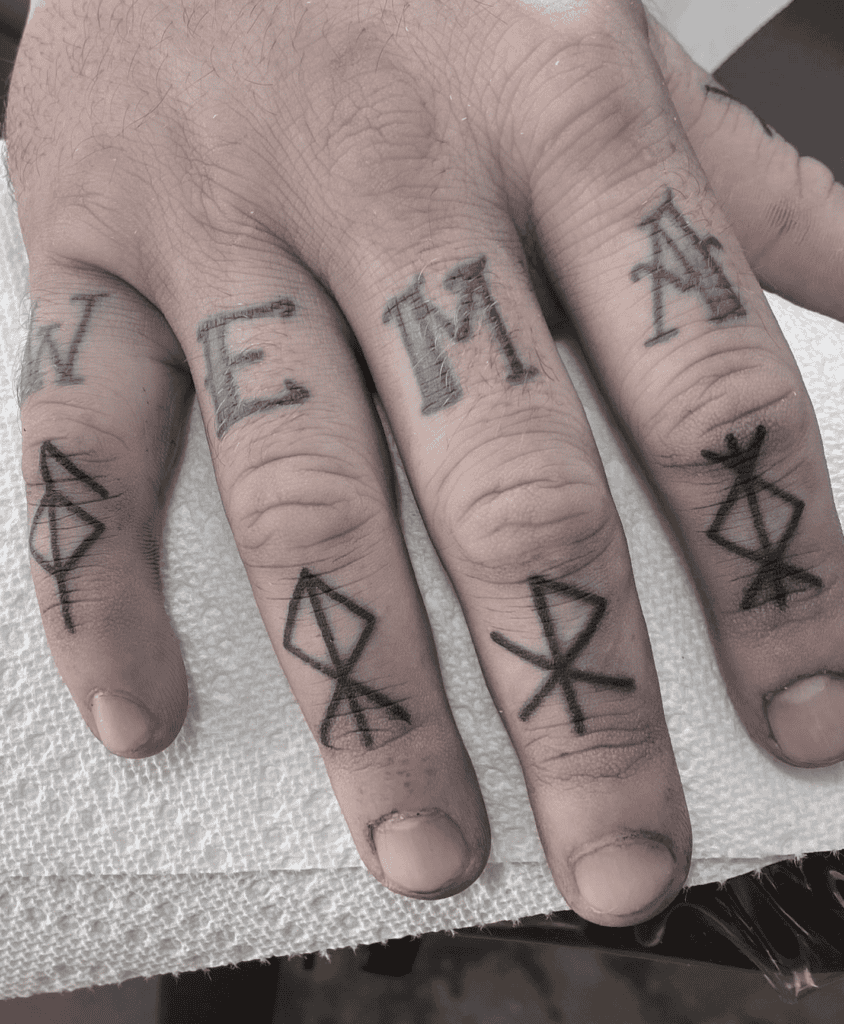
Runes are the ancient symbols used by the Norse people as both a writing system and a form of magic. Known as the runic alphabet, the most famous version is the Elder Futhark, made up of a series of angular characters that were carved into stone, wood, and metal. However, runes were never just letters. They were believed to carry deeper meaning, each one holding its own symbolic power connected to the world around it.
In Norse mythology, the origin of runes is closely tied to Odin. In his relentless pursuit of knowledge, Odin sacrifices himself by hanging from Yggdrasil, the World Tree, for nine nights. During this ordeal, he gains insight into the runes, not by being taught, but by discovering them through suffering and revelation. This connection makes runes more than a human invention—they are seen as something fundamental to the structure of reality, uncovered rather than created.
Each rune represents not only a sound, but also a concept or force. Some are linked to ideas such as strength, protection, journey, or transformation. Because of this, runes were often used in ways that went beyond simple communication. They could be carved into weapons for victory, into objects for protection, or used in rituals to influence outcomes. This belief in their power made them an important part of both everyday life and spiritual practice.
Vegvisir Norse Mythology Tattoo
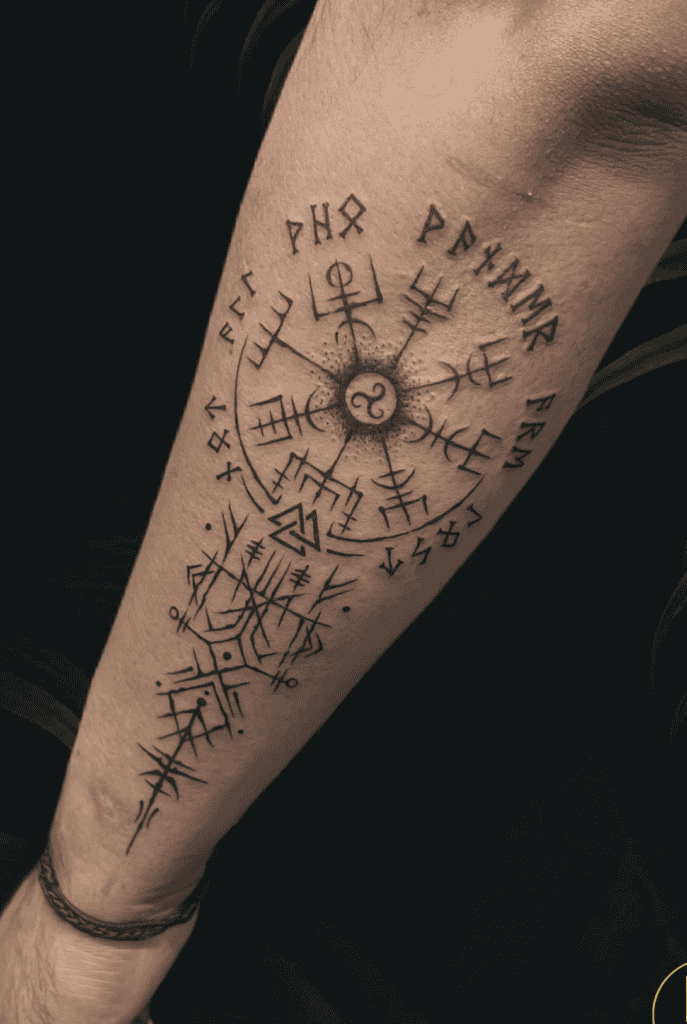
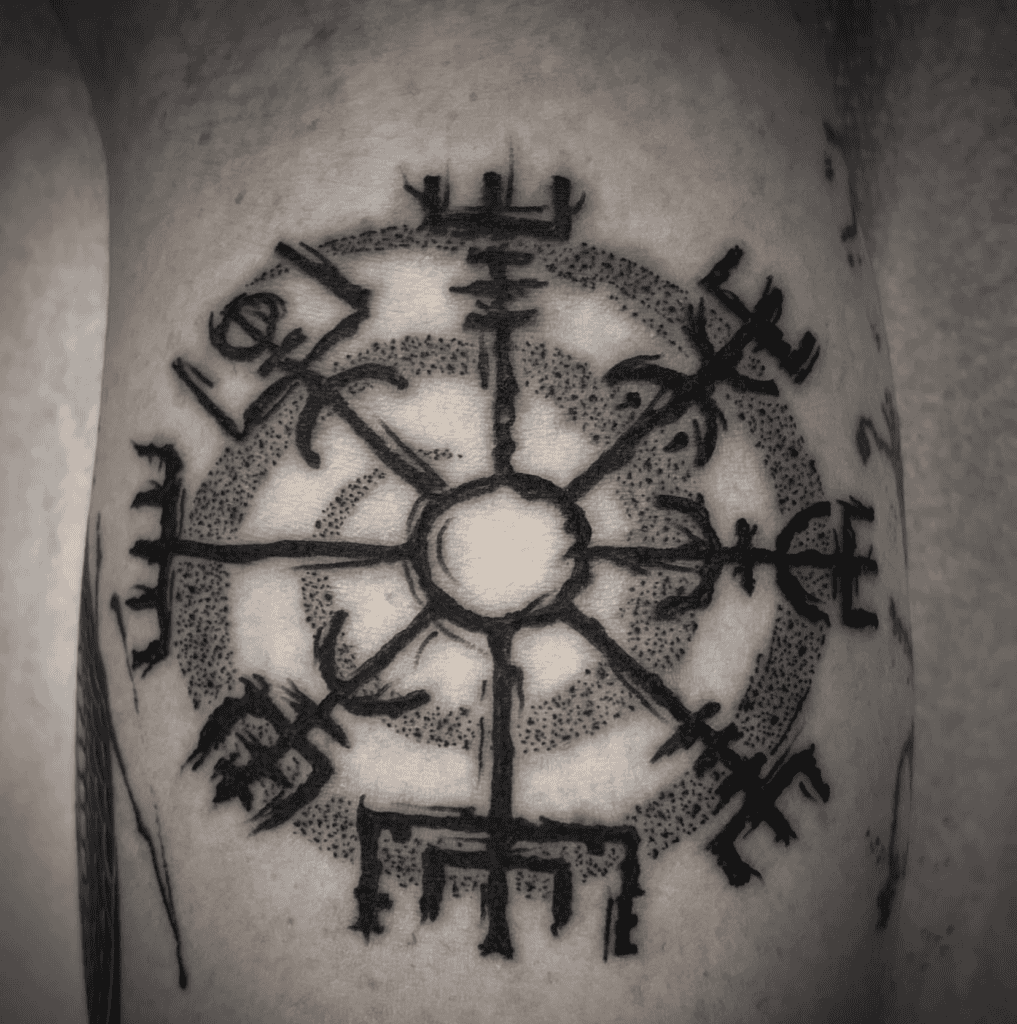
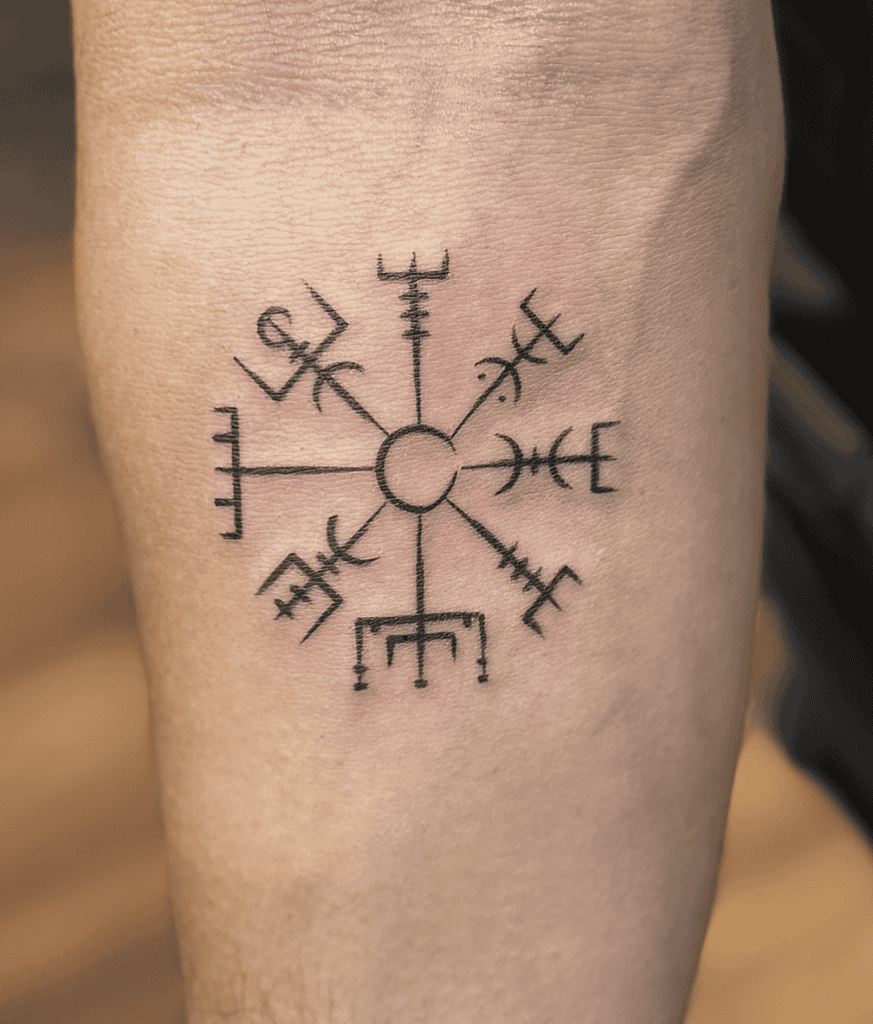
Vegvísir, often called the “Norse compass,” is a symbol made up of eight directional staves radiating from a central point. It is widely believed to represent guidance and protection, especially during difficult journeys. The idea behind the symbol is simple but powerful: if you carry or follow Vegvísir, you will not lose your way, even when the path ahead is unclear.
Interestingly, Vegvísir does not come directly from the Viking Age like many other Norse symbols. It appears in Icelandic manuscripts from a later period, particularly within magical texts known as grimoires. Despite this, it is heavily inspired by Norse culture and belief systems, which is why it is so often associated with Viking mythology today.
The symbol itself is designed to represent direction in all forms, not just physical travel. While it may have been used to guide someone across land or sea, its meaning extends much deeper. Vegvísir is often interpreted as a guide through life’s challenges, helping someone stay on their path even when faced with uncertainty, hardship, or confusion.
Each of the eight arms of the symbol can be seen as a different direction or possibility, reinforcing the idea that no matter which way you turn, there is a path forward. This makes Vegvísir a powerful symbol of resilience and trust in one’s journey.
Helm of Awe Norse Mythology Tattoo
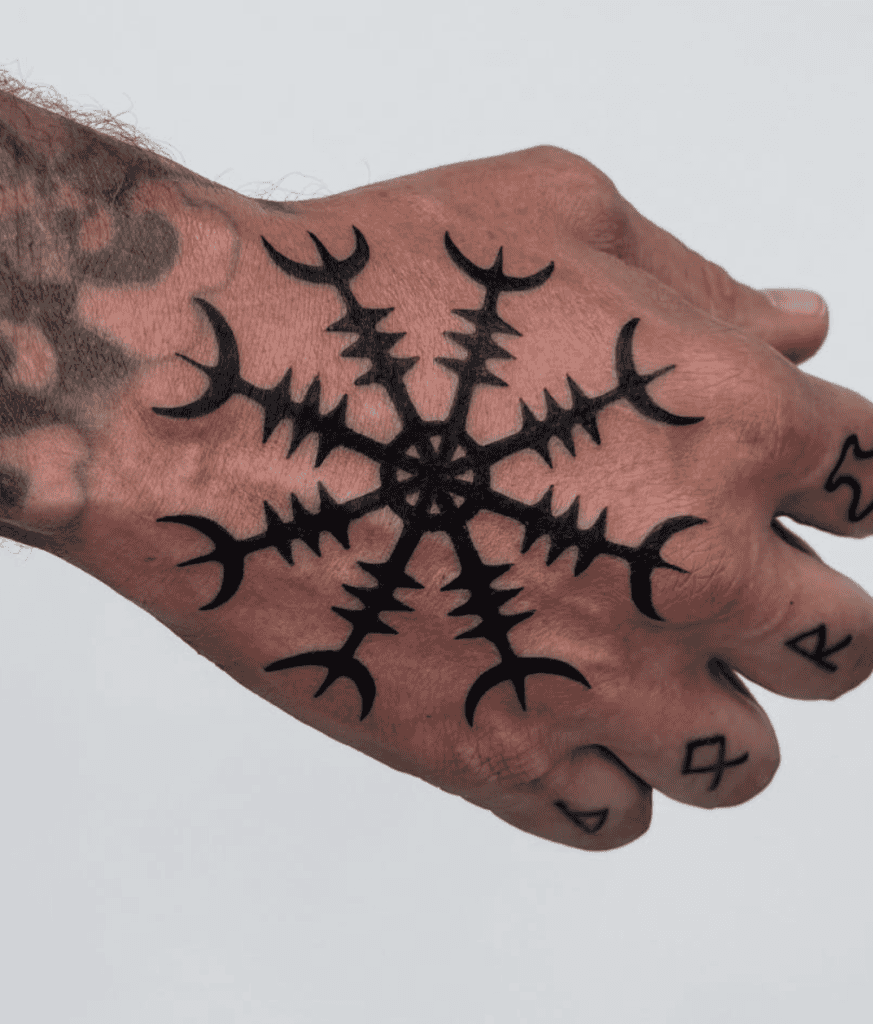
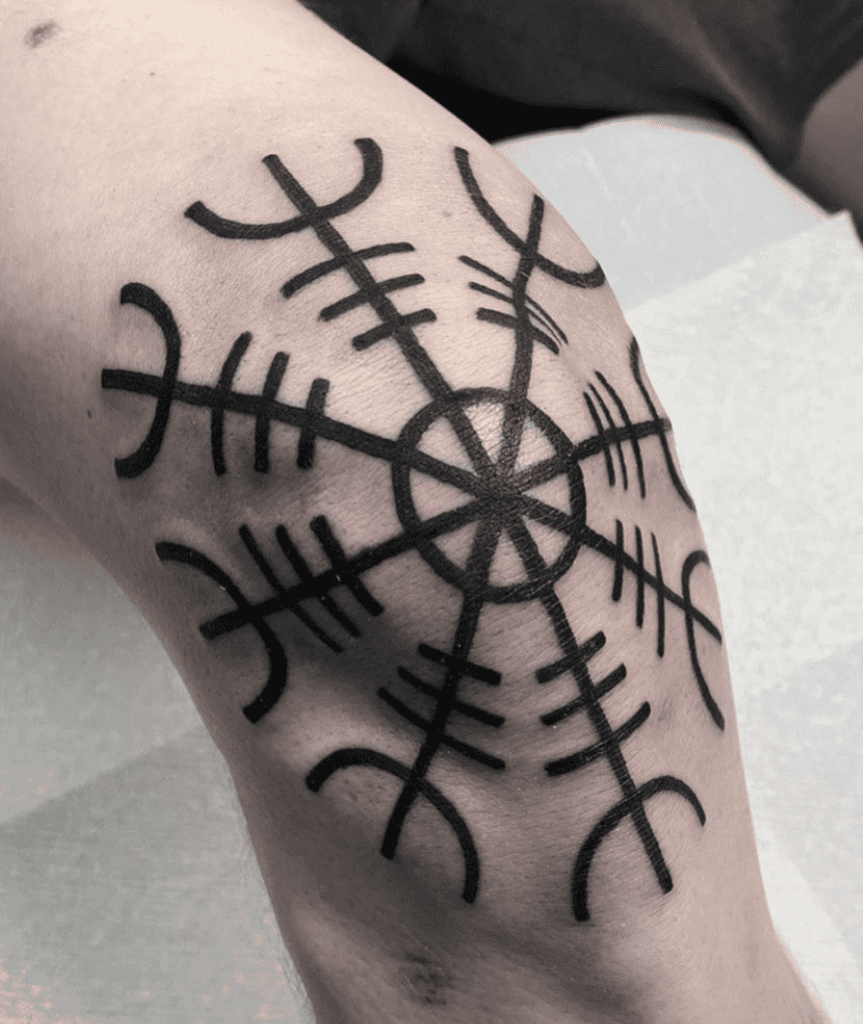
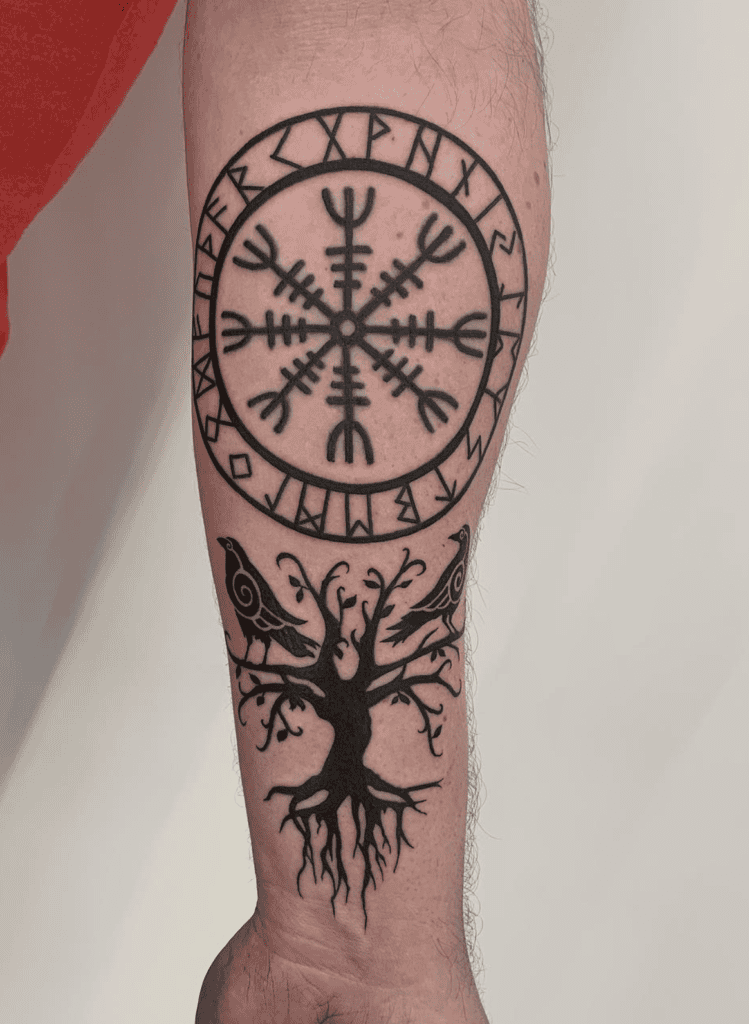
The Helm of Awe, known in Old Norse as Ægishjálmur, is a symbol associated with protection, strength, and the ability to inspire fear in others. It is typically depicted as a circular design made up of eight arms radiating outward, each ending in forked or trident-like shapes.
Unlike many symbols that come directly from the Viking Age, the Helm of Awe is preserved in later Icelandic magical texts, similar to Vegvísir. These texts describe it not just as a symbol, but as a magical stave, something that could be drawn, worn, or invoked to harness its power. Despite its later documentation, its themes strongly align with Norse beliefs about strength, fate, and the unseen forces that shape reality.
The name “Helm of Awe” reflects its purpose. It is not a physical helmet, but a form of protection that surrounds the wearer, creating an aura of fear and invincibility. Those who carry or display the symbol are believed to gain the ability to strike fear into their enemies while remaining protected themselves. It is both offensive and defensive at the same time, making it a unique and powerful concept.
One of the most famous references to the Helm of Awe appears in the story of Fáfnir. The dragon is said to possess this symbol, using it to instil terror and guard his treasure.
Sigurd (Siegfried) Norse Mythology Tattoo
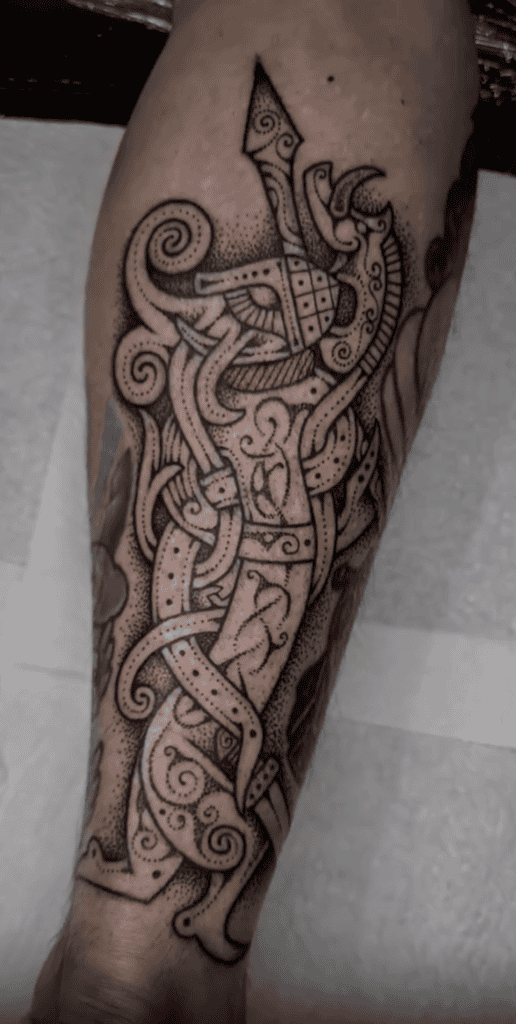
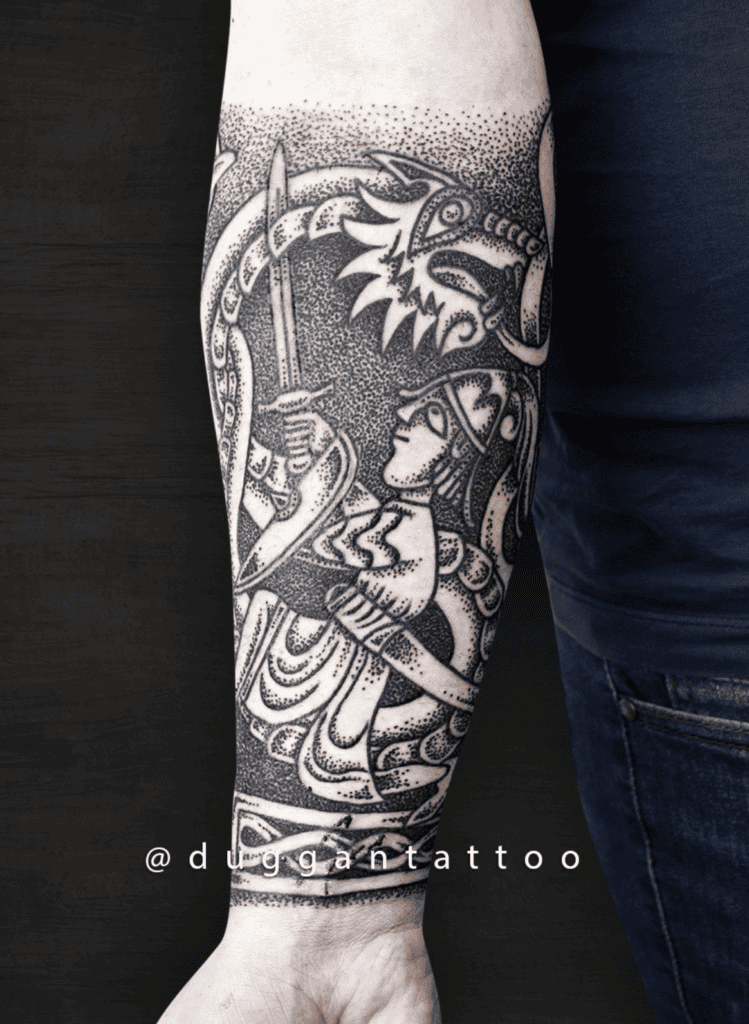
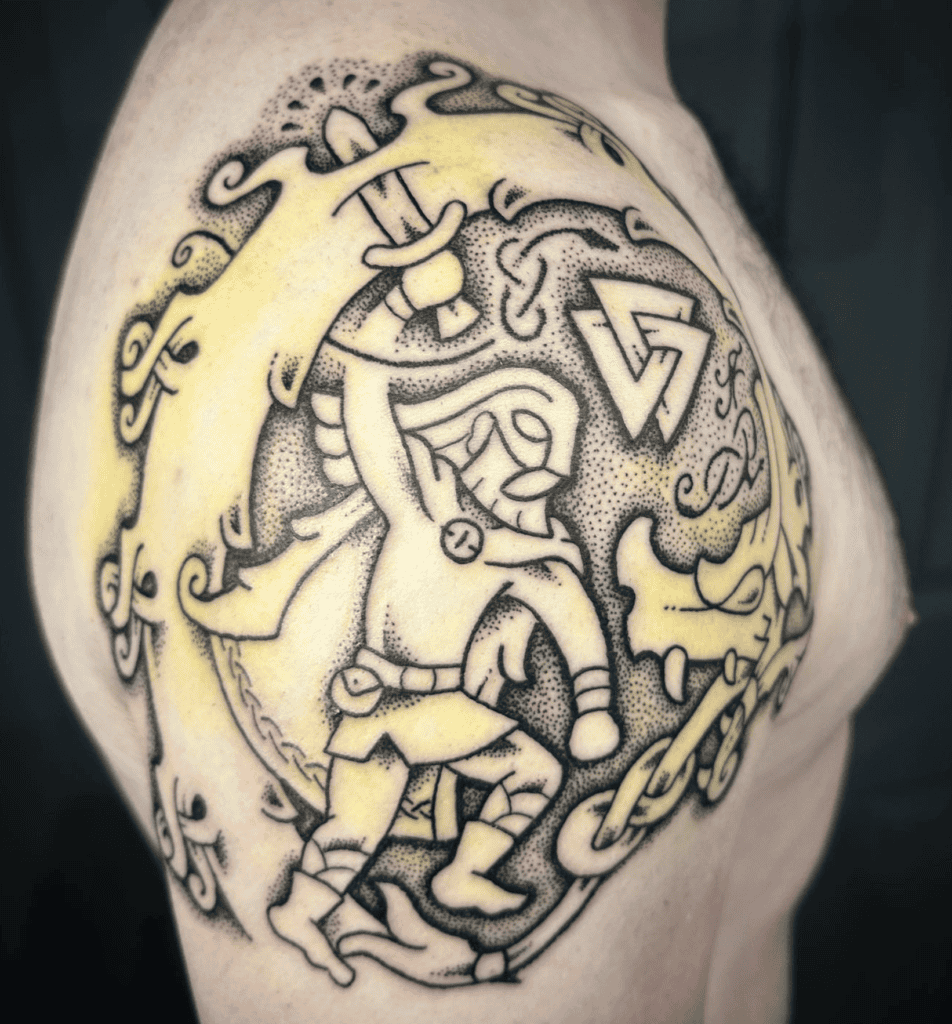
Sigurd, also known as Siegfried in some versions of the legend, is one of the most famous heroes in Norse mythology and Germanic legend, best known for slaying the dragon Fáfnir.
Sigurd is raised by the dwarf Regin, who becomes both his mentor and manipulator. Regin urges him to kill Fáfnir, who guards a vast treasure hoard that once belonged to their family. To accomplish this, Sigurd reforges a powerful sword called Gram, a weapon capable of piercing even the strongest defences. Armed with this blade, he sets out to face the dragon.
Rather than confronting Fáfnir head-on, Sigurd uses strategy. He digs a pit along the path where the dragon travels and hides within it. As Fáfnir passes overhead, Sigurd thrusts his sword upward, striking the dragon from below and delivering a fatal blow. This moment defines him as both brave and intelligent, showing that true heroism is not just about strength, but also about understanding how to face overwhelming challenges.
As Fáfnir lies dying, he warns Sigurd about the cursed treasure he guards, but Sigurd presses on. After killing the dragon, Sigurd tastes its blood, and this act grants him the ability to understand the speech of birds. Through them, he learns that Regin plans to betray him and take the treasure for himself. Acting quickly, Sigurd kills Regin, ensuring his own survival but also becoming further entangled in the curse surrounding the gold.
Sigurd’s story then becomes more complex as it intertwines with themes of love and betrayal. He meets the Valkyrie Brynhildr, and the two share a powerful connection. However, through manipulation and deception, Sigurd is later led into a series of tragic events that ultimately result in his death. Like many figures in Norse mythology, his fate is sealed despite his strength and heroism.
Brynhildr Norse Mythology Tattoo
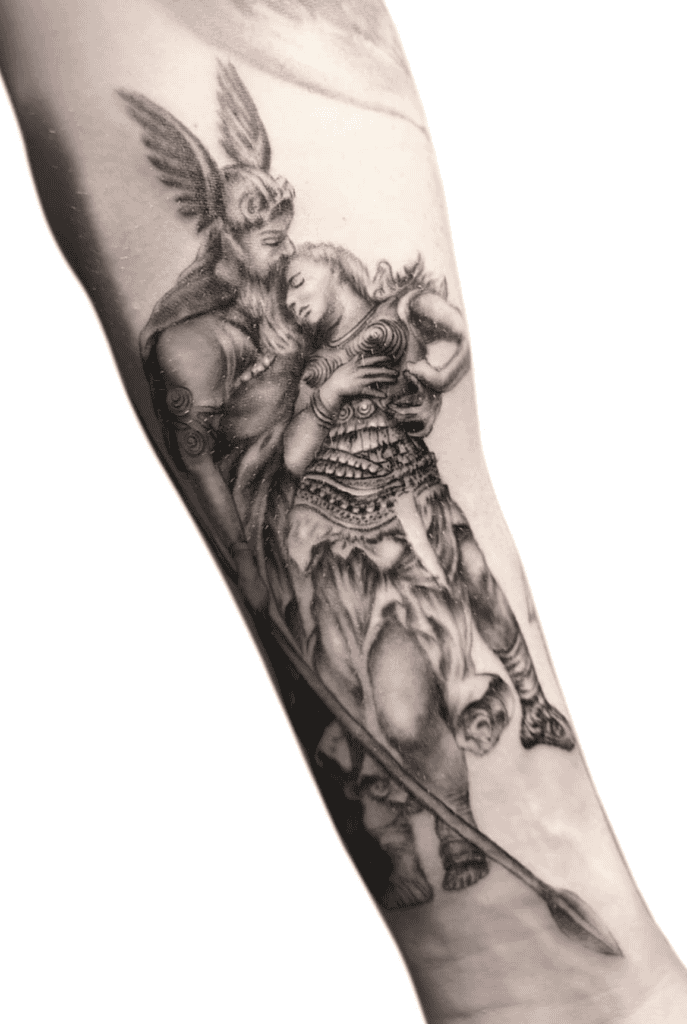
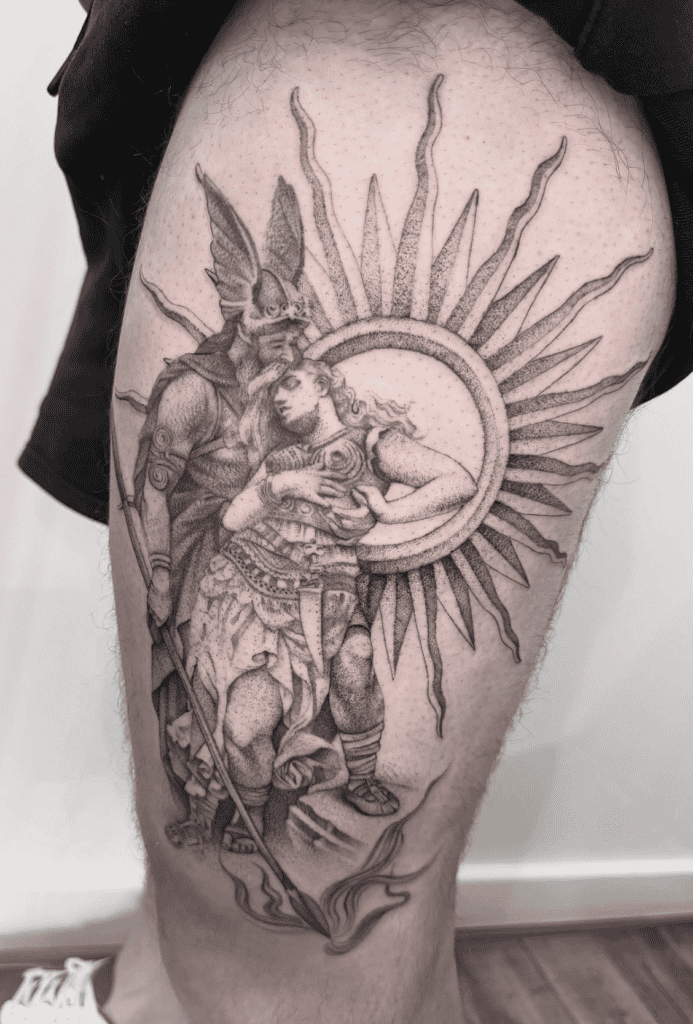
Brynhildr is a legendary Valkyrie, a warrior chosen by Odin to decide the fate of those who fall in battle. Unlike many Valkyries who remain distant and dutiful, Brynhildr’s story is deeply personal, shaped by her choices and the consequences that follow.
Her story begins with defiance. Brynhildr disobeys Odin by choosing the wrong side in a battle, granting victory to a warrior Odin had not favoured. In response, Odin punishes her by stripping her of her Valkyrie status and placing her into a deep sleep, surrounded by a ring of fire. This punishment is not just about discipline, but about removing her from the role of shaping fate and forcing her into a more human existence.
She remains in this enchanted sleep until she is discovered by the hero Sigurd, who rides through the flames and awakens her. Their meeting is one of the most powerful moments in Norse legend, as the two form a deep bond, often interpreted as love. Brynhildr, once a figure of divine authority, now finds herself connected to a mortal life, bringing new emotional depth to her character.
However, their story does not end in happiness. Through a series of manipulations, misunderstandings, and betrayals—often involving magic and deception—Sigurd is led to marry another, while Brynhildr is deceived into a different marriage. When the truth is revealed, the emotional fallout is devastating. Brynhildr’s response is driven by both heartbreak and honour, leading to actions that ultimately result in Sigurd’s death.
Conclusion
Thanks for joining us on this fate-woven journey through the mythical world of Norse Mythology Tattoo Design. We hope you’ve found something destined to guide you on your own tattooing adventure. But if Norse Mythology Tattoos still don’t call you to battle you, why not find Karmic balance with these Hindu Mythology Tattoo Designs, learn about balance, truth, and harmony with these Egyptian Mythology Tattoos Ideas, or embrace wisdom with these Chinese Mythology Tattoos.
- Pokémon Tattoo Ideas - March 30, 2026
- Norse Mythology Tattoo Ideas - March 23, 2026
- Lunar Zodiac Tattoo Ideas - March 21, 2026


