
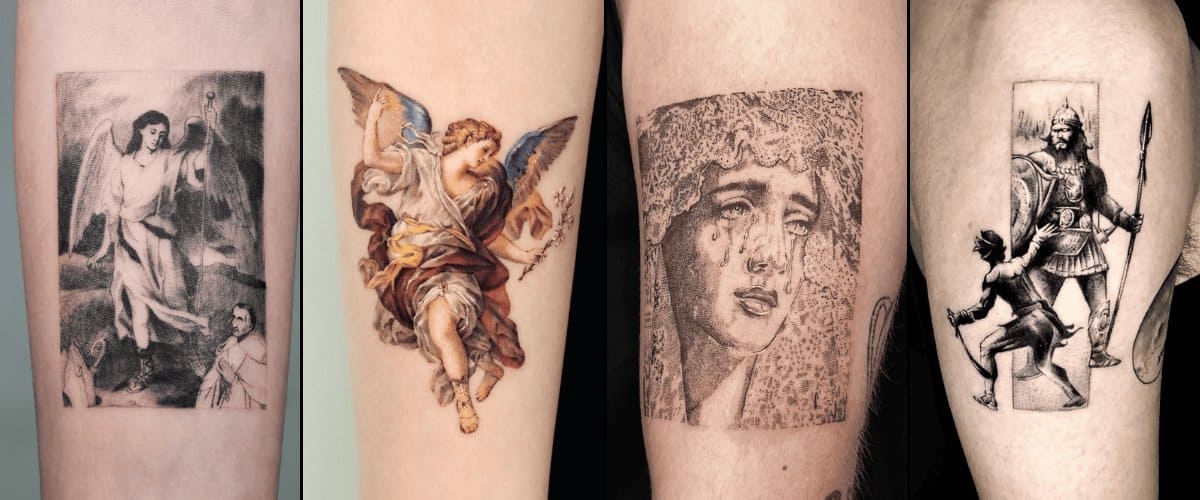
Christian Mythology Tattoo Ideas

Do you feel like you’re walking in darkness while searching for the perfect Tattoo Clues? Worry not, we’re about to offer a revelation as we bring you some heaven-sent Christian mythology tattoos to help you begin a new Genesis.
What Is Christian Mythology
Christian mythology refers to the collection of sacred stories, symbolic narratives, supernatural beings, and legendary traditions connected to Christianity. These stories come primarily from the Bible, but they are also shaped by apocryphal texts, medieval theology, folklore, and centuries of Christian storytelling. Together, they form a mythological framework that explains the origins of the world, the struggle between good and evil, divine intervention in human history, and the promise of salvation.
Christian mythology centres on the belief in a single God and the story of humanity’s relationship with the divine. The narrative begins with creation in the Book of Genesis, where the first humans, Adam and Eve, are placed in the Garden of Eden. Their fall from grace introduces the idea of sin and sets the stage for the long story of redemption that runs throughout the Bible. The central figure of this narrative is Jesus Christ, whose life, death, and resurrection form the foundation of Christian belief.
Christian mythology also includes a rich cast of supernatural beings. Heavenly messengers such as Michael and Gabriel serve as protectors and heralds of divine messages, while fallen angels such as Lucifer represent rebellion against God. The cosmic struggle between good and evil is personified by Satan, who appears as a tempter and adversary throughout scripture.
The term “Christian mythology” does not imply that believers consider these stories fictional. Instead, it is often used academically to describe the mythic structure, symbols, and legendary narratives within Christian tradition, much like scholars discuss Greek, Norse, or Egyptian mythology. These narratives help explain humanity’s origins, morality, divine justice, and the ultimate destiny of the world.
Top Christian Mythology Tattoo Artists

shinnyeong tattoo
Brisbane based Korean Tattoo artists specialising in Realism Tattoos.

heavyink tirana
Tirana, Albania Tattoo Studio specialising in a variety of Tattoo Styles.

yoshi tattooer
Austin, Texas Tattoo artist specialising in traditional japanese Irezumi, fine line, blackwork, and Christian Tattoos.
Best Christian Mythology Tattoo Designs
Now that we know a little about Christian Mythology, let’s take a look at some of the best Christian Mythology Tattoos the heaven’s have to offer.
God Christian Mythology Tattoo

In Christian mythology, God is the supreme creator and ruler of the universe. He is believed to be eternal, all-powerful, all-knowing, and the ultimate source of life, morality, and divine authority. Christian tradition teaches that God exists beyond time and space, yet remains deeply involved in the world and the lives of humanity.
According to the Book of Genesis, God formed the heavens, the earth, and all living creatures. The creation story describes how God brought the universe into existence through divine command, famously declaring, “Let there be light.” Over six days, the world was shaped and filled with life before God rested on the seventh day.
One of the most distinctive aspects of Christian belief is the concept of the Holy Trinity. Christians believe that God exists as three persons in one divine essence:
the Father, the Son, and the Holy Spirit.
The Son refers to Jesus Christ, who Christians believe is God incarnate in human form. The Holy Spirit represents God’s spiritual presence in the world, guiding and inspiring believers. Although these three are distinct, they are understood to be united as one God.
Jesus Christ Christian Mythology Tattoo
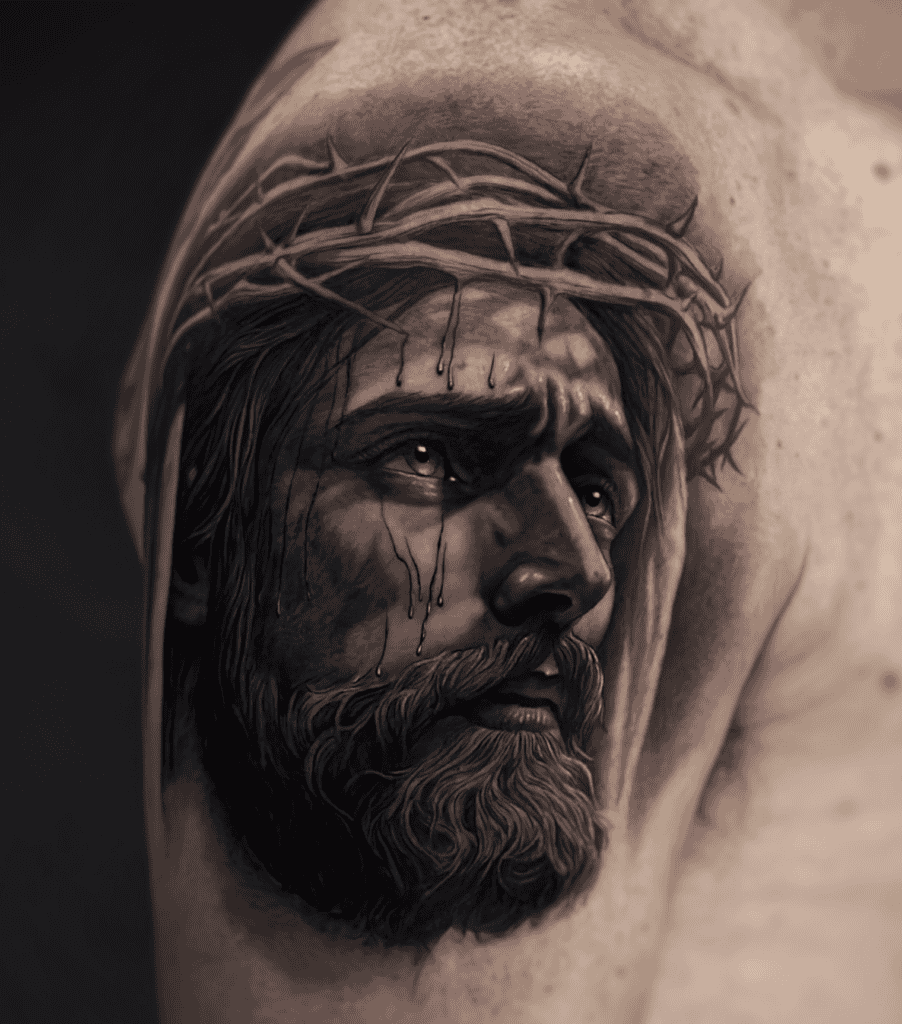
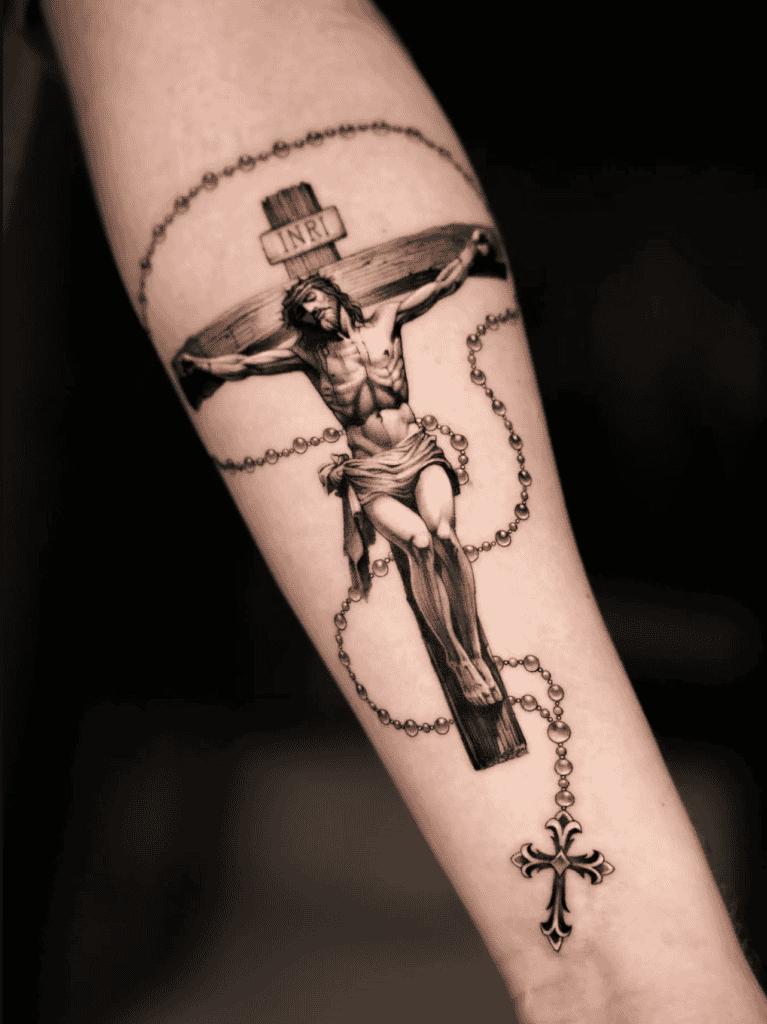
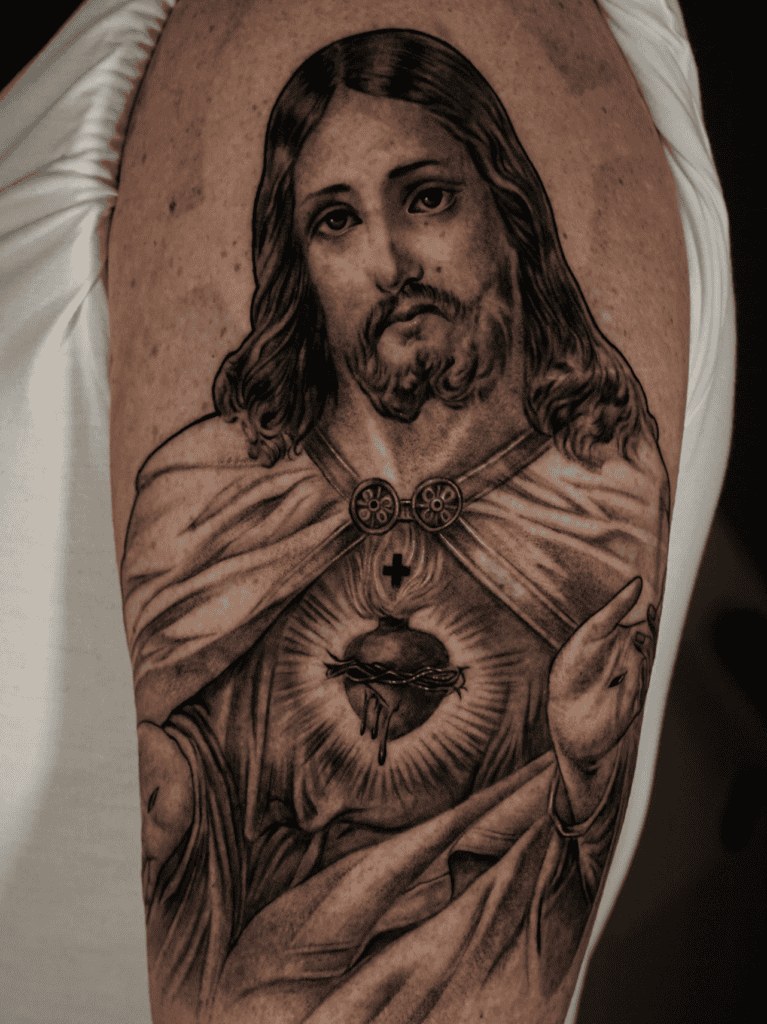
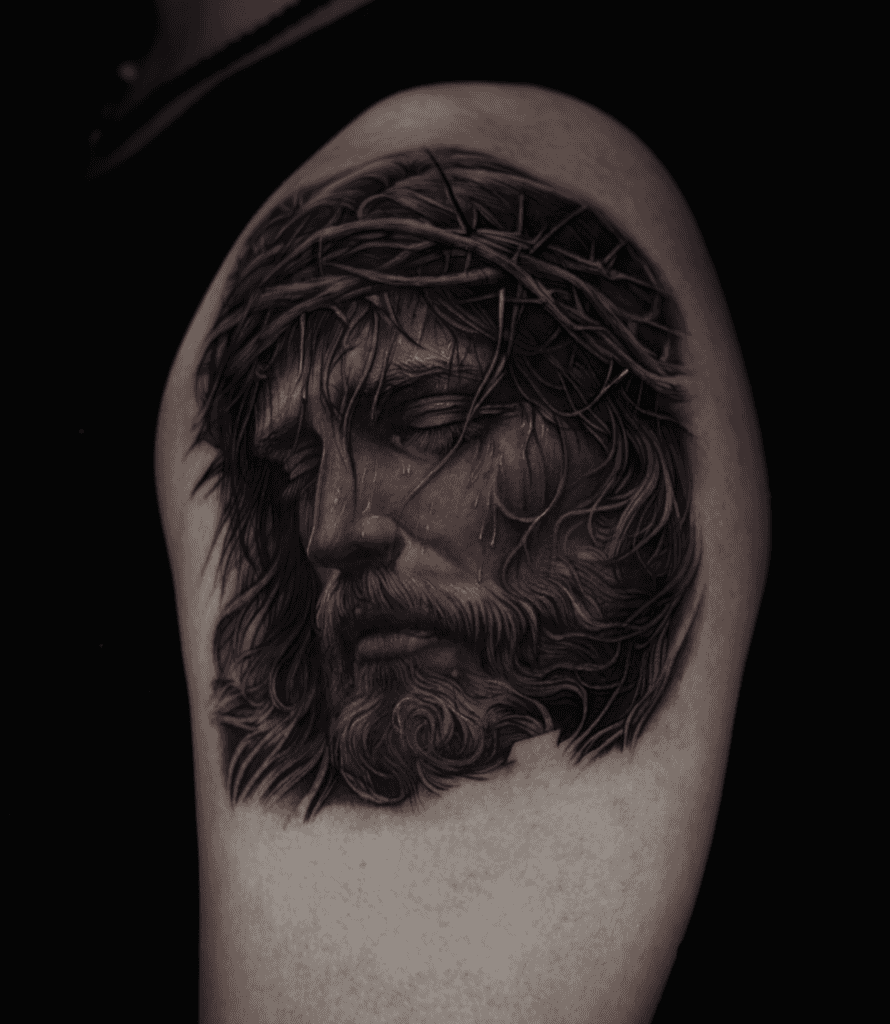
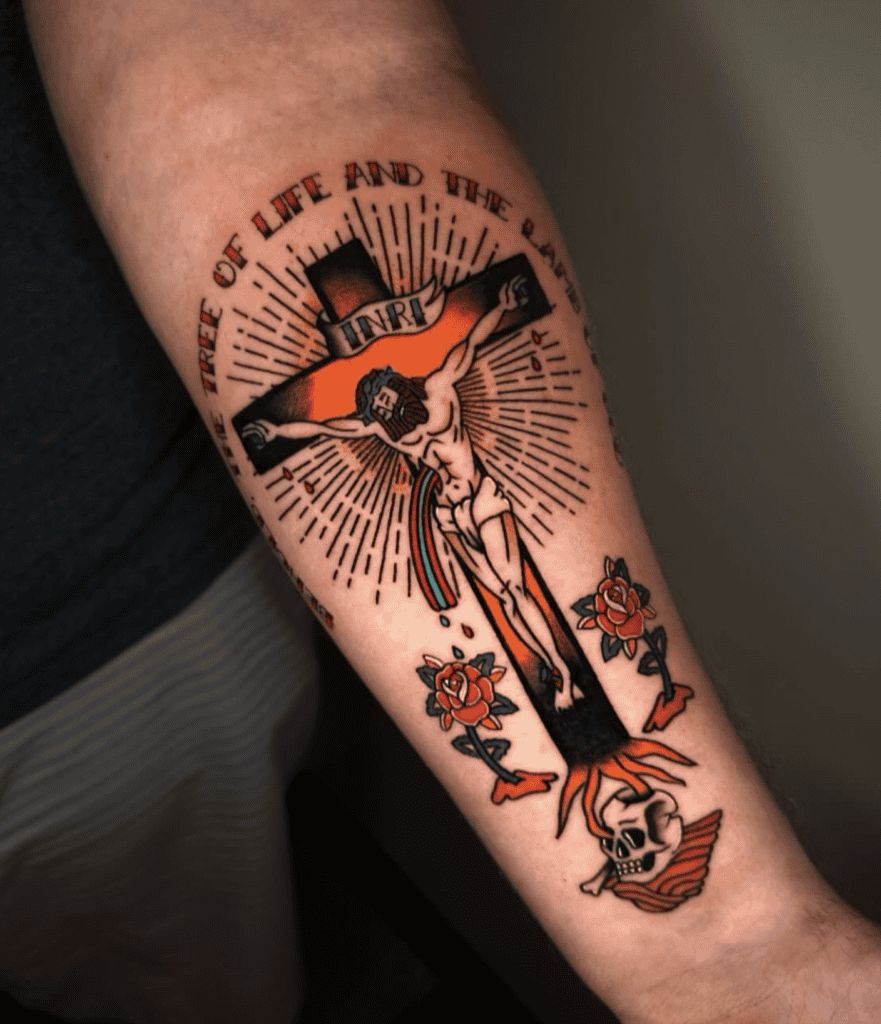
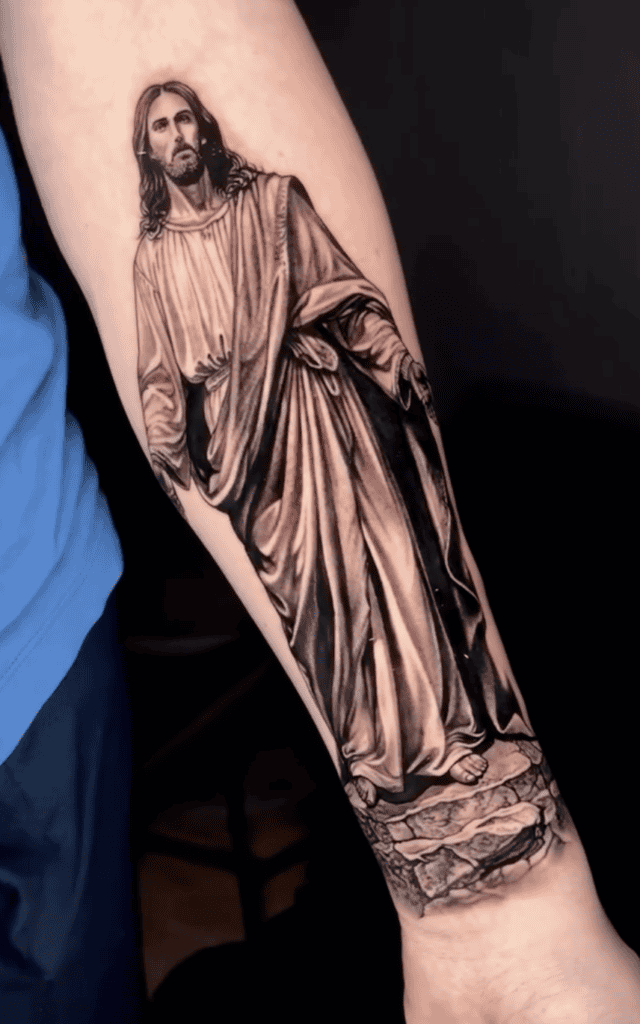
In Christian mythology, Jesus Christ is the central figure of the Christian faith and the embodiment of God’s presence on Earth. Christians believe that Jesus is both fully human and fully divine, the Son of God who came into the world to teach, perform miracles, and ultimately bring salvation to humanity.
According to the Gospels, Jesus was born to Virgin Mary, who conceived through divine intervention. His birth is often portrayed as humble and symbolic, as he was said to have been born in a stable and laid in a manger, emphasising themes of humility and divine purpose.
As an adult, Jesus became known as a teacher and spiritual leader who travelled through Judea and Galilee preaching about love, forgiveness, and faith in God, with his teachings often delivered through parables.
Jesus was arrested and condemned by Roman authorities, ultimately being executed by crucifixion. In Christian belief, this event represents the ultimate sacrifice, as Jesus willingly suffered and died for the sins of humanity. According to the Gospels, Jesus rose from the dead three days after his crucifixion, an event known as the Resurrection, which symbolises victory over sin and death.
Virgin Mary Christian Mythology Tattoo
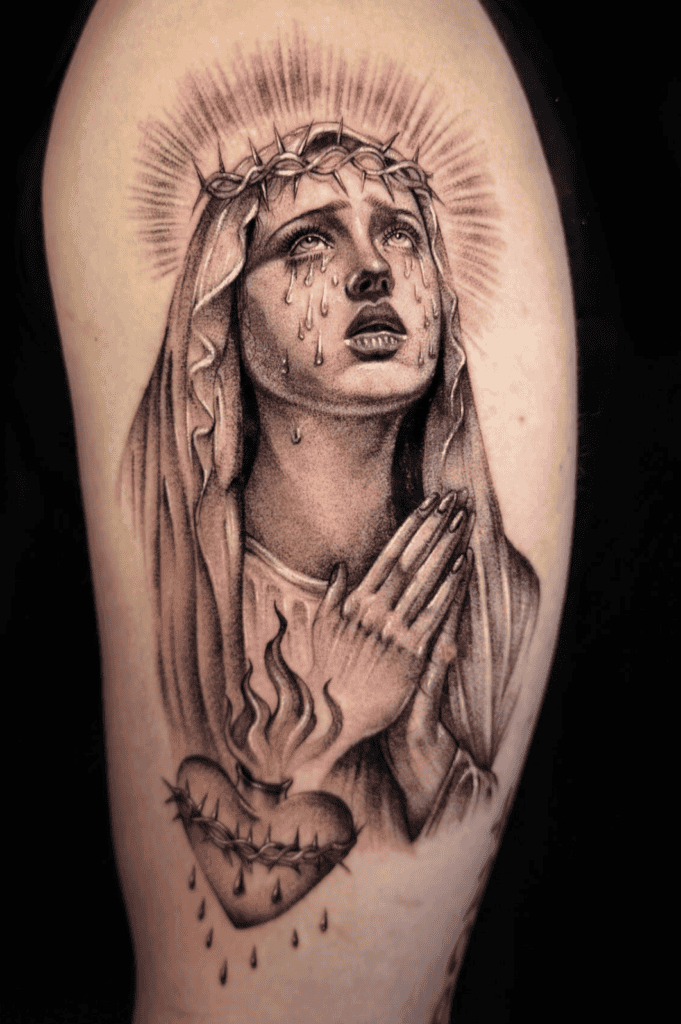
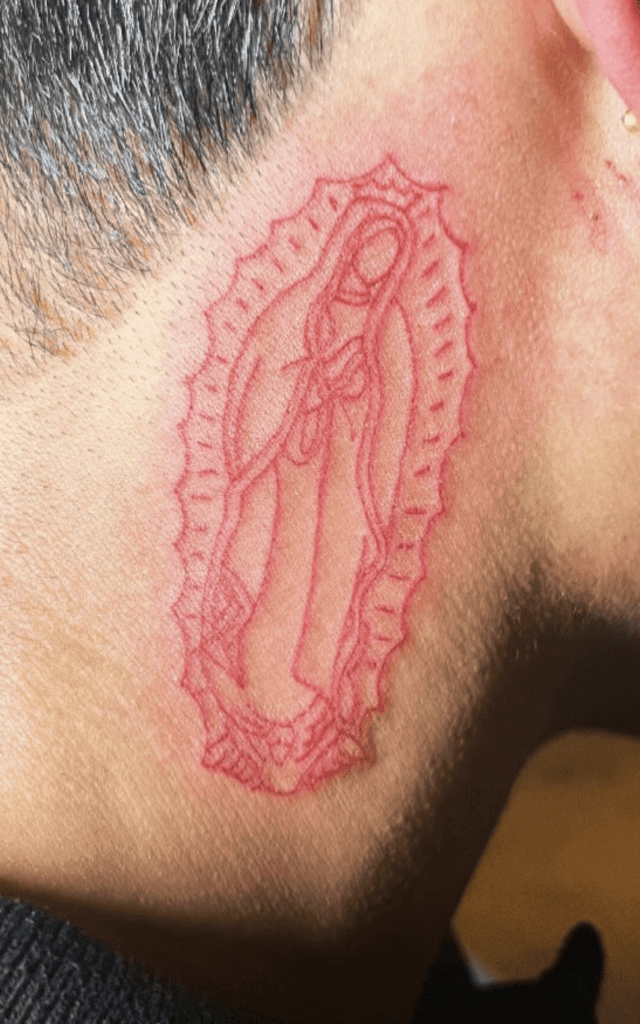
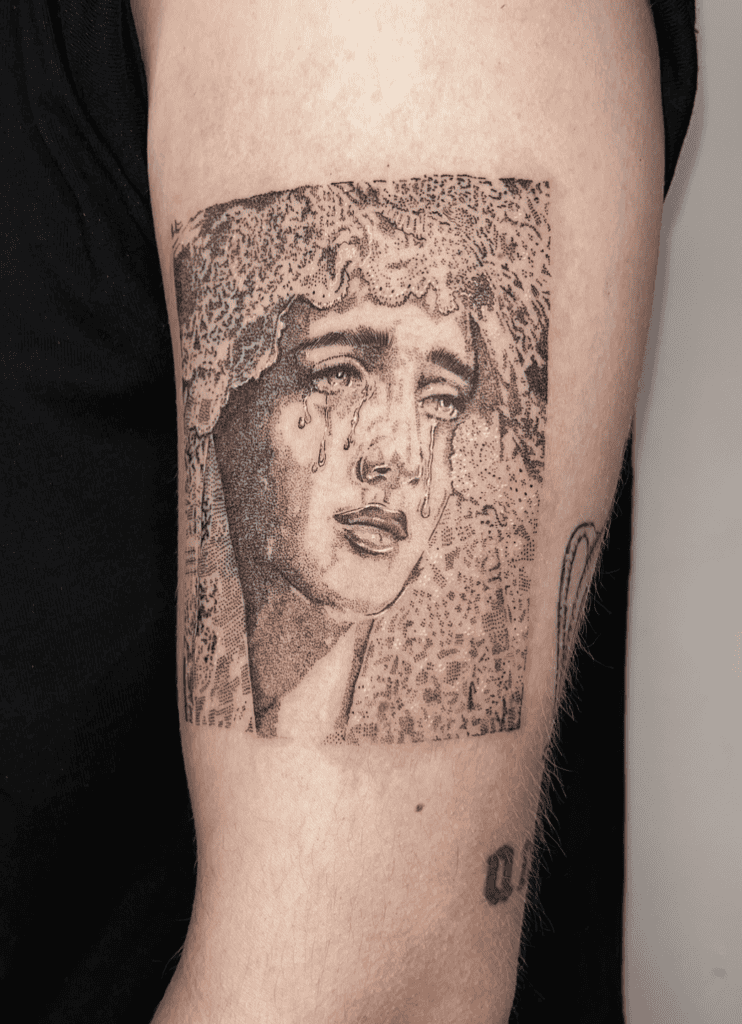
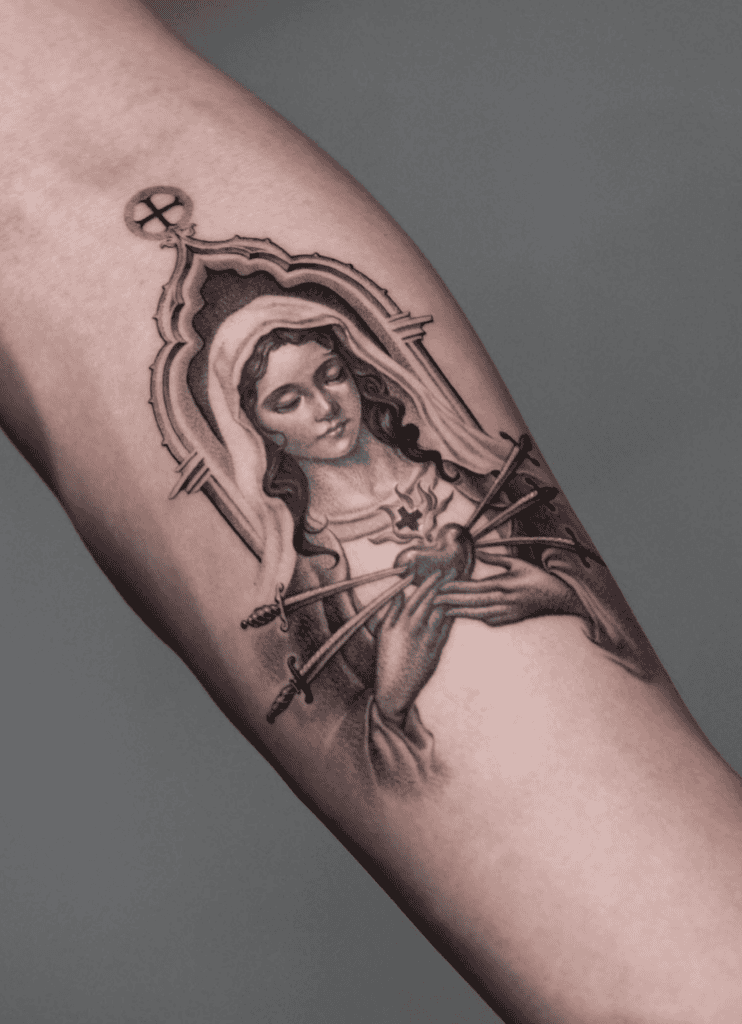
The Virgin Mary is the mother of Jesus Christ, chosen by God to give birth to the saviour of humanity. Across centuries of Christian storytelling, Mary has come to symbolise purity, humility, compassion, and unwavering faith.
Mary’s story begins with the Annunciation, when the angel Gabriel appeared to her with a divine message. Gabriel told Mary that she had been chosen by God to give birth to the Son of God.
According to the Gospel narrative, Mary conceived through the power of the Holy Spirit, rather than through ordinary human means. This miraculous conception is why she is often referred to as the Virgin Mary. Despite the uncertainty and difficulty this news would bring to her life, Mary accepted her role with humility and faith.
Mary later travelled to Bethlehem with her husband, Joseph, where she gave birth to Jesus. Mary appears throughout the life of Jesus in several important moments, witnessing his early miracles, including the famous wedding at Cana, where Jesus turned water into wine.
One of the most powerful scenes involving Mary occurs during the crucifixion, where she stands near the cross as Jesus is executed. This moment is often depicted in art as Mary in sorrow, representing both maternal grief and spiritual devotion.
Saint Joseph of Nazareth Christian Mythology Tattoo
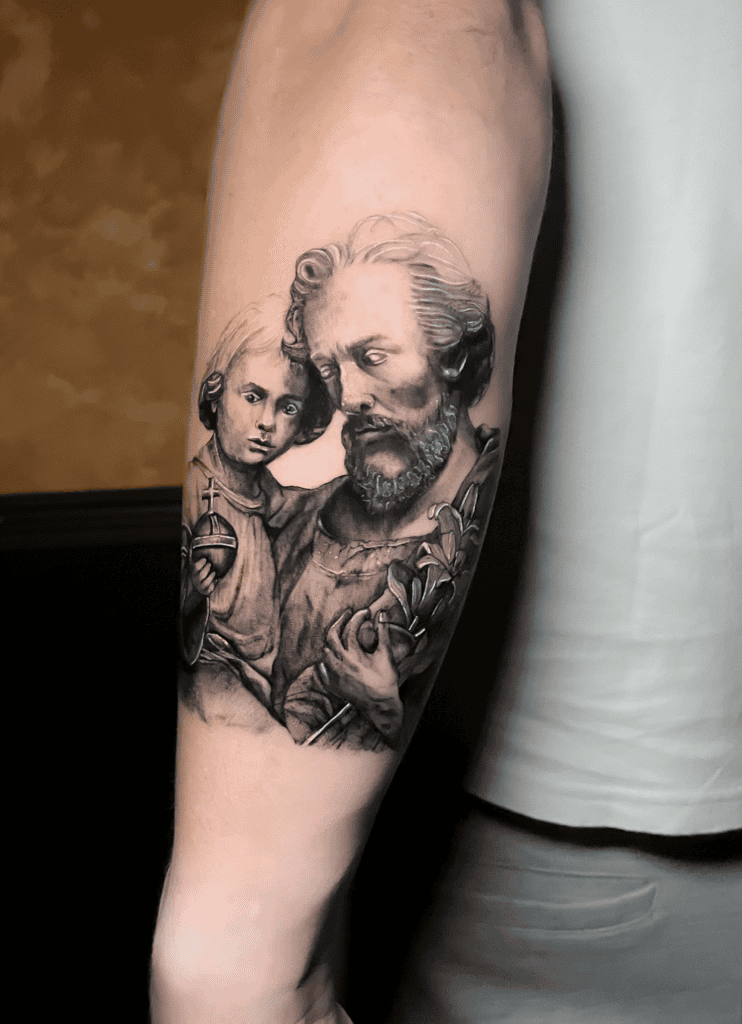
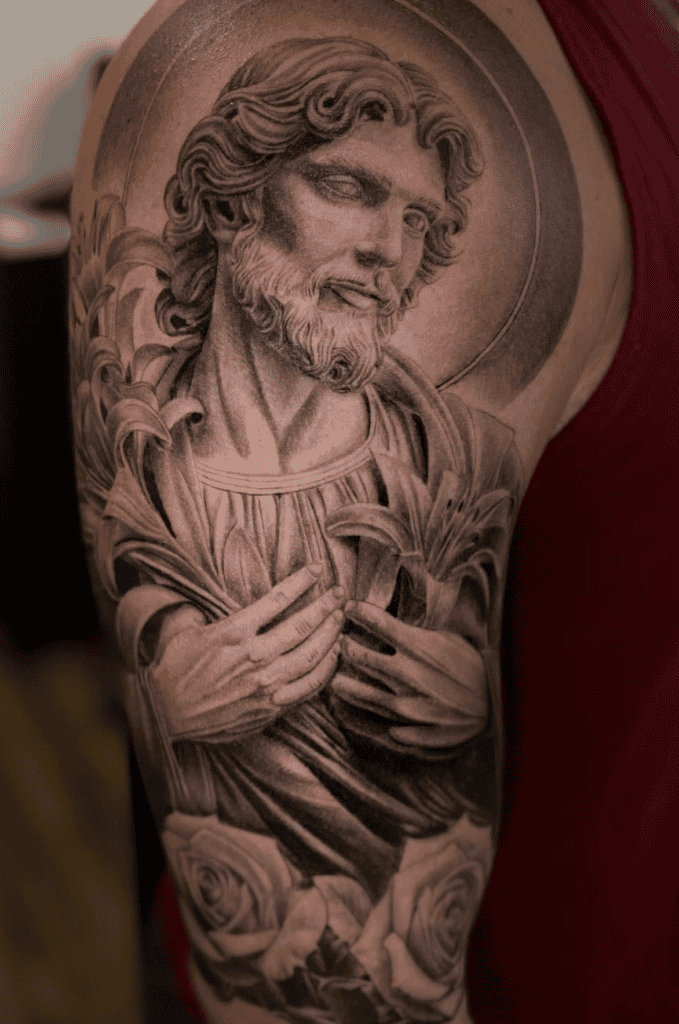
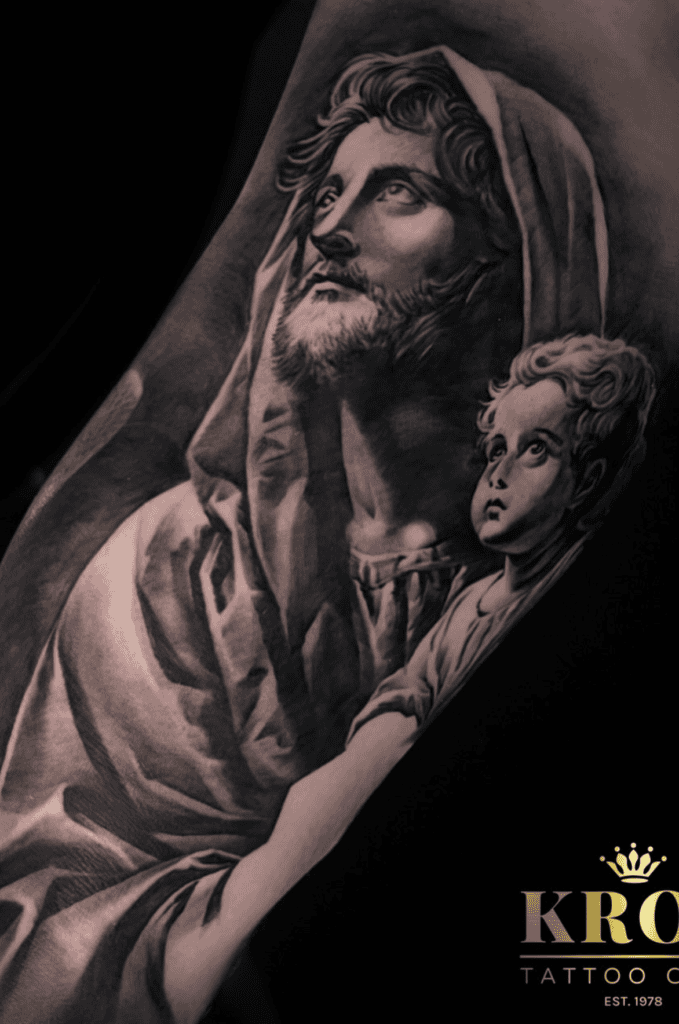
Joseph, often called Saint Joseph, is the earthly father and protector of Jesus Christ. Although Joseph does not speak in the biblical accounts, his actions and devotion make him an important figure in the story of Jesus’ birth and childhood. He is widely remembered as a symbol of humility, faith, responsibility, and quiet strength.
Joseph first appears in the Gospel narratives as the betrothed husband of the Virgin Mary. When Mary became pregnant through divine intervention, Joseph initially struggled to understand the situation. According to the biblical story, an angel appeared to him in a dream and explained that Mary’s child had been conceived through the power of God.
After this revelation, Joseph chose to support Mary and accept the role of raising the child who would become the saviour of humanity. His decision demonstrates deep faith and loyalty, as he chose compassion and trust over fear or social judgment.
Joseph played a crucial role in protecting Mary and the young Jesus during their early lives. According to the Gospel of Matthew, Joseph was warned in a dream that King Herod intended to kill the newborn child. In response, Joseph took Mary and Jesus and fled to Egypt, keeping them safe until the danger had passed.
Christian tradition describes Joseph as a carpenter or craftsman, a humble profession that emphasises his modest lifestyle. He likely taught Jesus practical skills and raised him within a simple household. Because of this, Joseph later became known as the patron saint of workers, craftsmen, and fathers, representing dedication to family and honest labour.
Archangel Michael Christian Mythology Tattoo
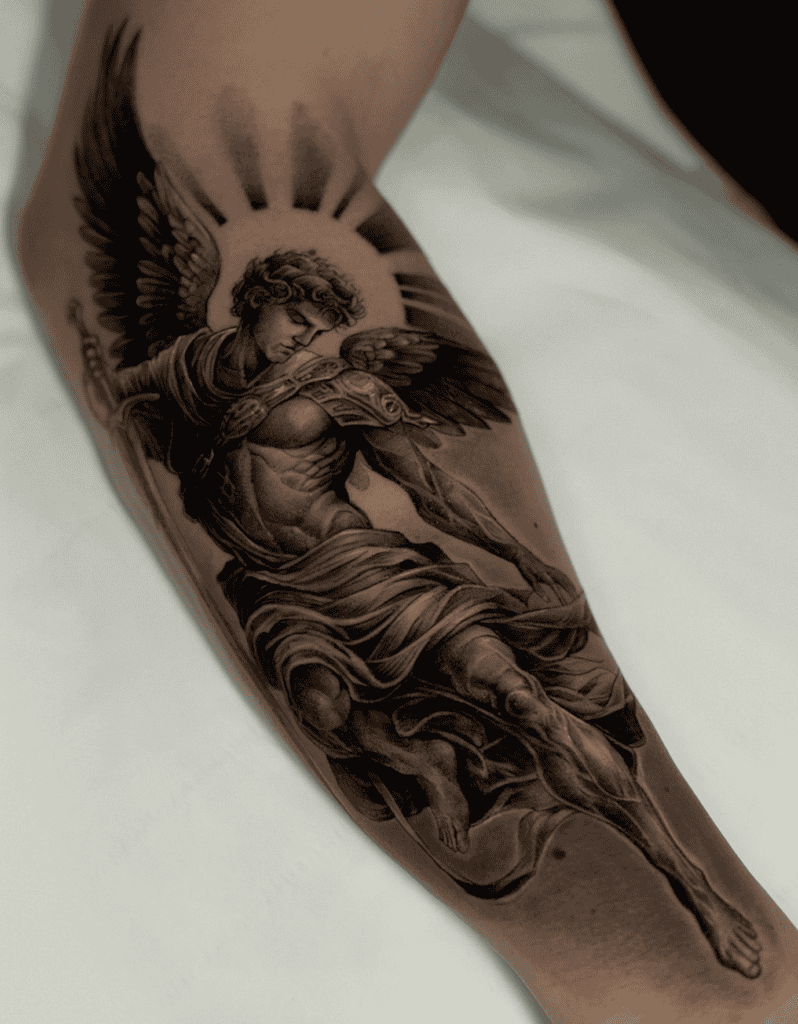
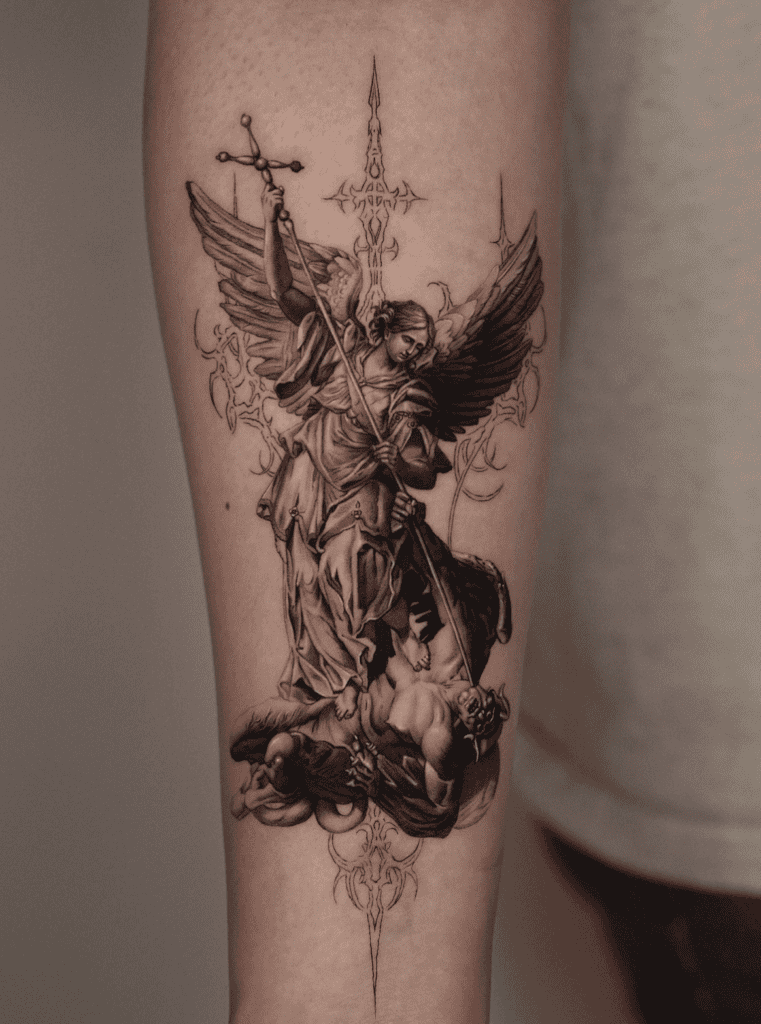
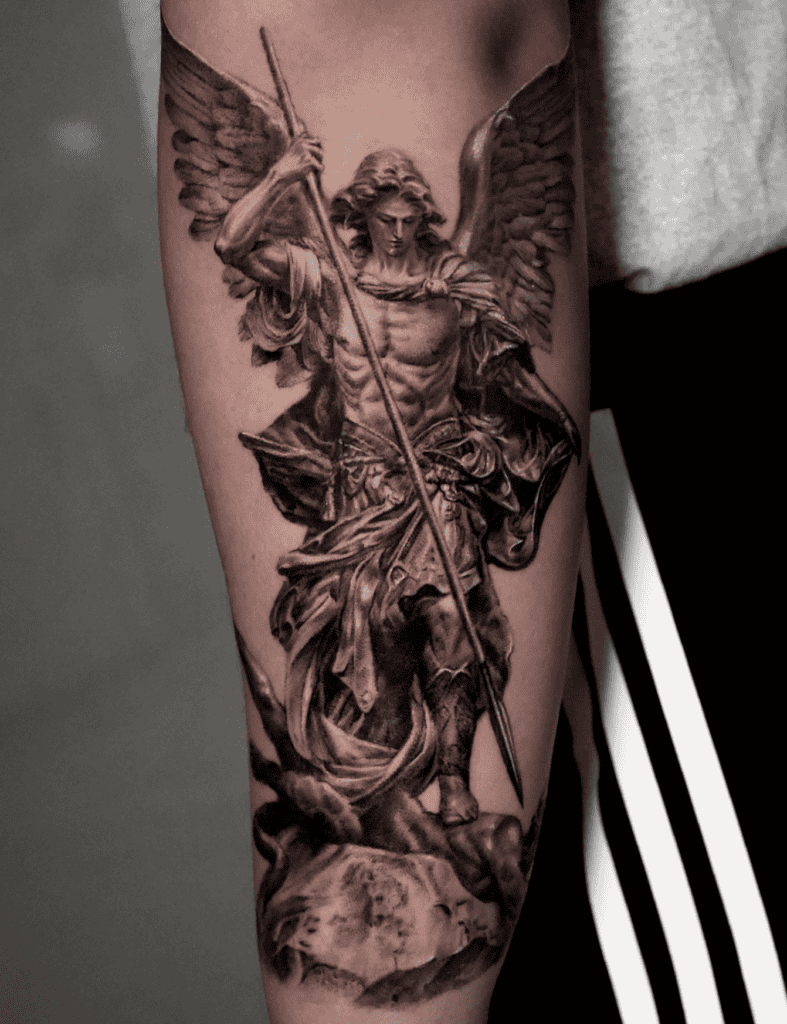
Michael, commonly known as Archangel Michael, is one of the most powerful and important angels in heaven. He is widely recognised as a warrior of God, a protector of the faithful, and the leader of the heavenly armies in the battle against evil. Michael’s name comes from the Hebrew phrase “Mi-ka-el,” meaning “Who is like God?”—a rhetorical question that reflects humility before divine authority.
One of the most famous stories involving Michael appears in the Book of Revelation. In this apocalyptic vision, Michael leads the armies of heaven in a cosmic battle against the fallen angel Satan, sometimes associated with Lucifer. According to the story, Michael and his angels defeat Satan and cast him out of heaven. This victory symbolises the triumph of divine order over rebellion and chaos.
Throughout Christian tradition, Michael is considered a guardian and protector of humanity. Many believers see him as the defender of the faithful, particularly during times of spiritual struggle. He is sometimes called upon in prayers for protection against evil, temptation, and danger. In many traditions, Michael is also believed to guide souls safely to heaven after death.
Archangel Gabriel Christian Mythology Tattoo
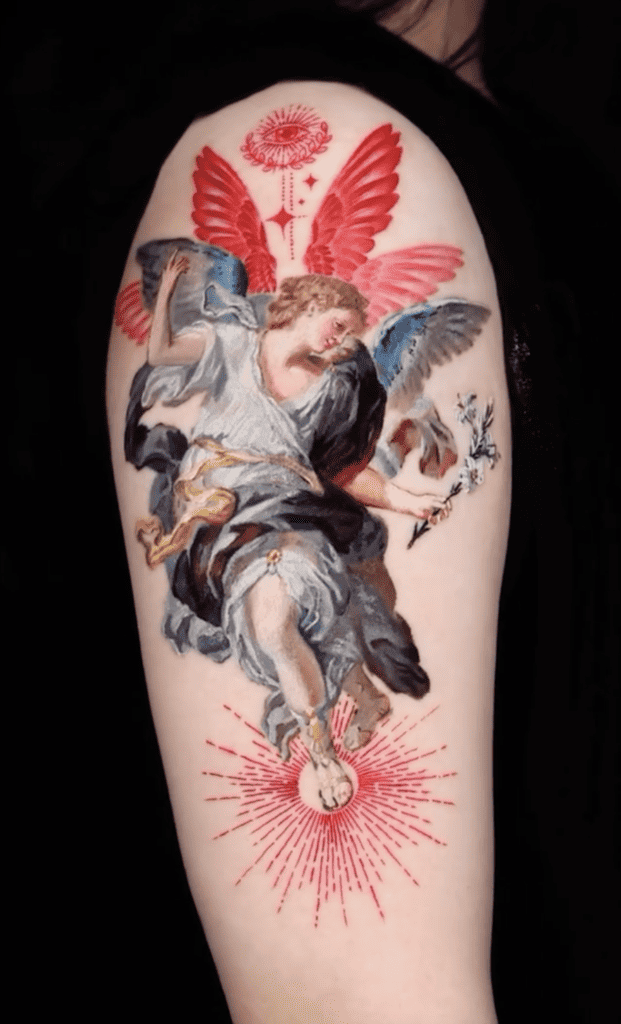
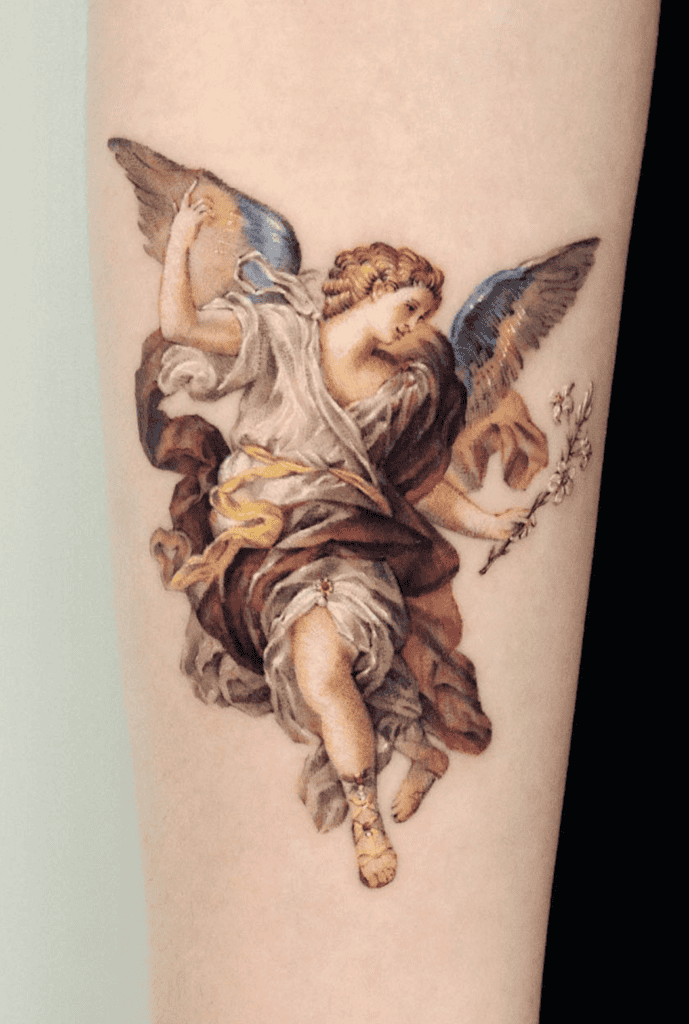
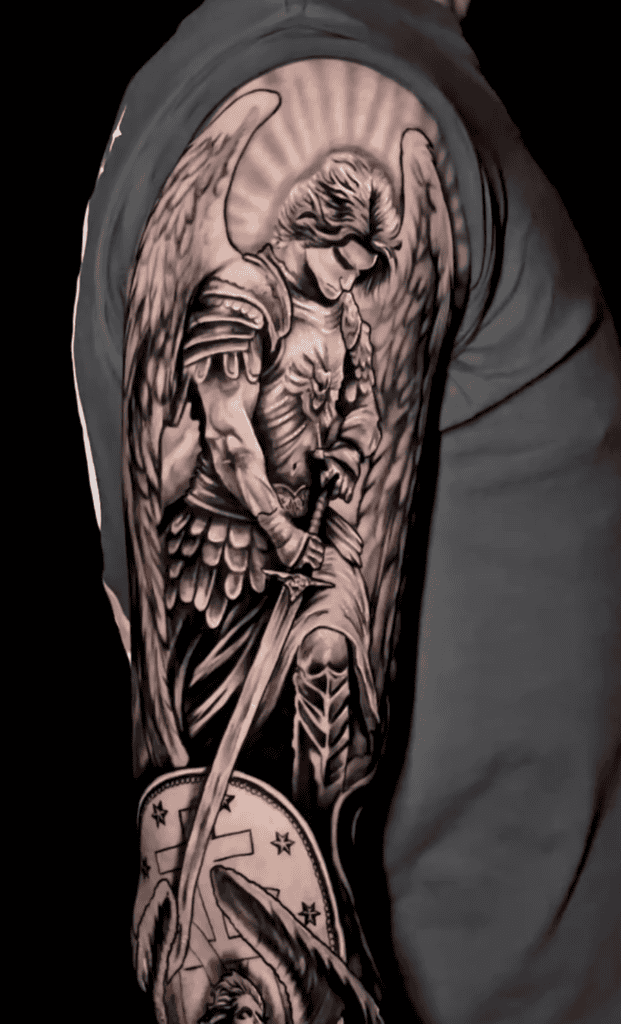
In Christian mythology, Gabriel is one of the most important angels and is widely known as God’s messenger. Gabriel plays a central role in delivering divine announcements and revelations to humanity, often appearing at key moments in biblical history to communicate God’s will.
The name Gabriel comes from Hebrew and is usually interpreted to mean “God is my strength.” This title reflects the angel’s role as a powerful servant who faithfully carries out divine messages.
Gabriel is best known for delivering some of the most important messages in Christian mythology. One of the most famous moments involving Gabriel is the Annunciation, when the angel appeared to the Virgin Mary.
During this encounter, Gabriel revealed that Mary had been chosen by God to give birth to Jesus Christ, the saviour of humanity. This announcement marks one of the most significant events in the Christian narrative, as it begins the story of Jesus’ birth. Because of this role, Gabriel is often associated with revelation, prophecy, and divine communication.
Archangel Raphael Christian Mythology Tattoo
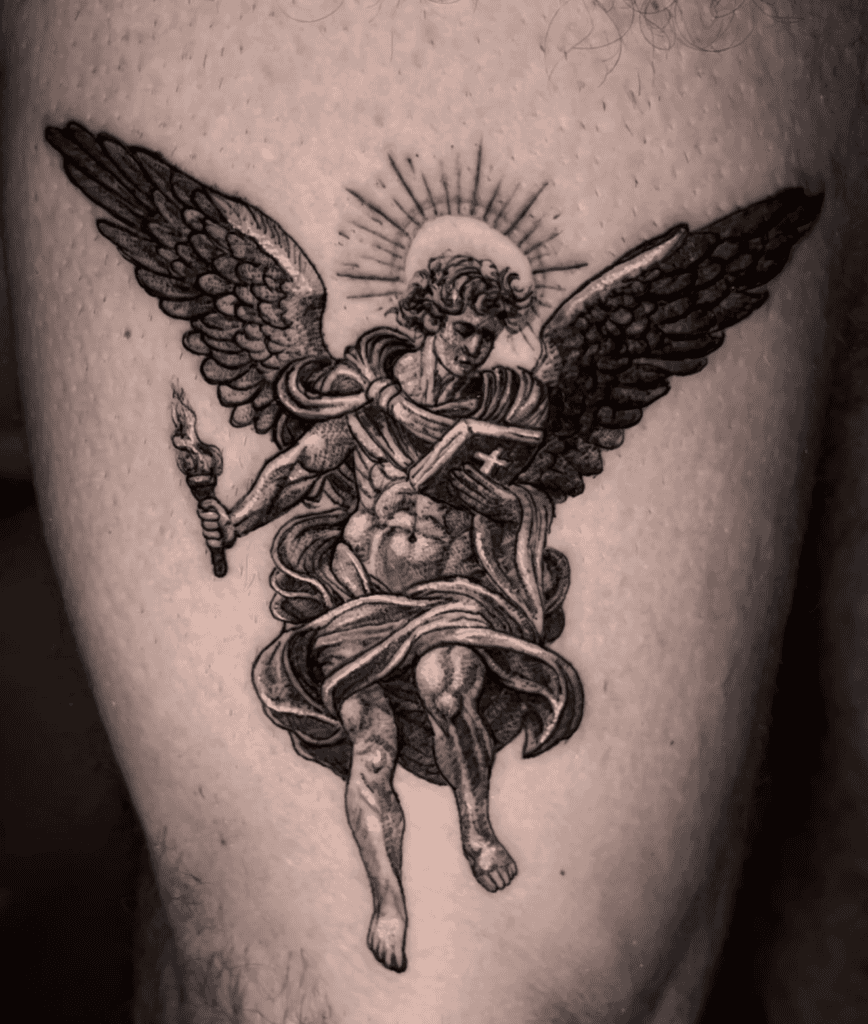
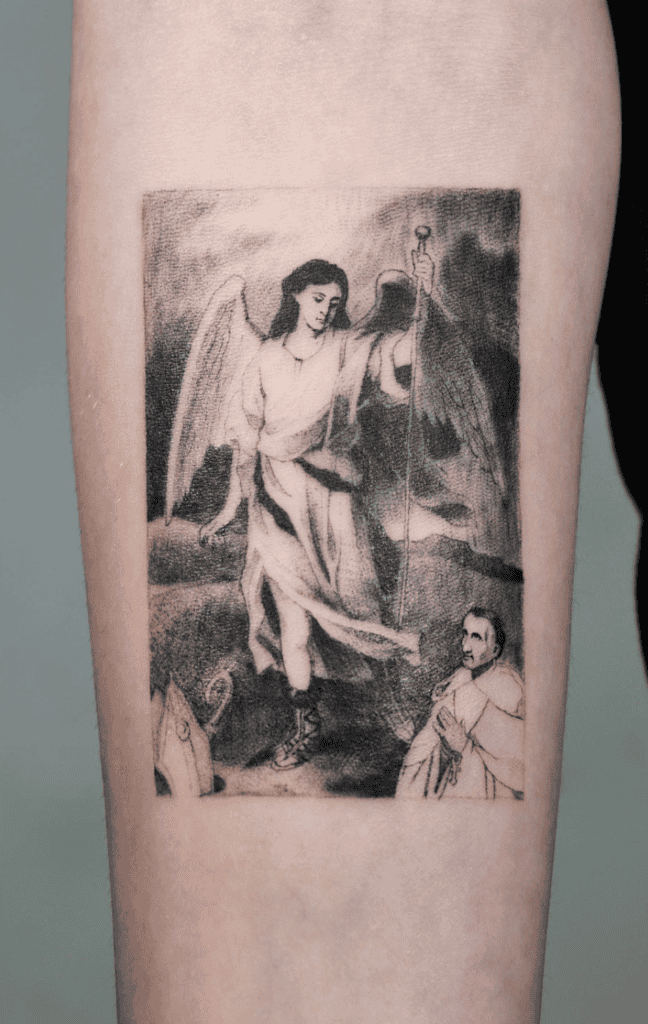
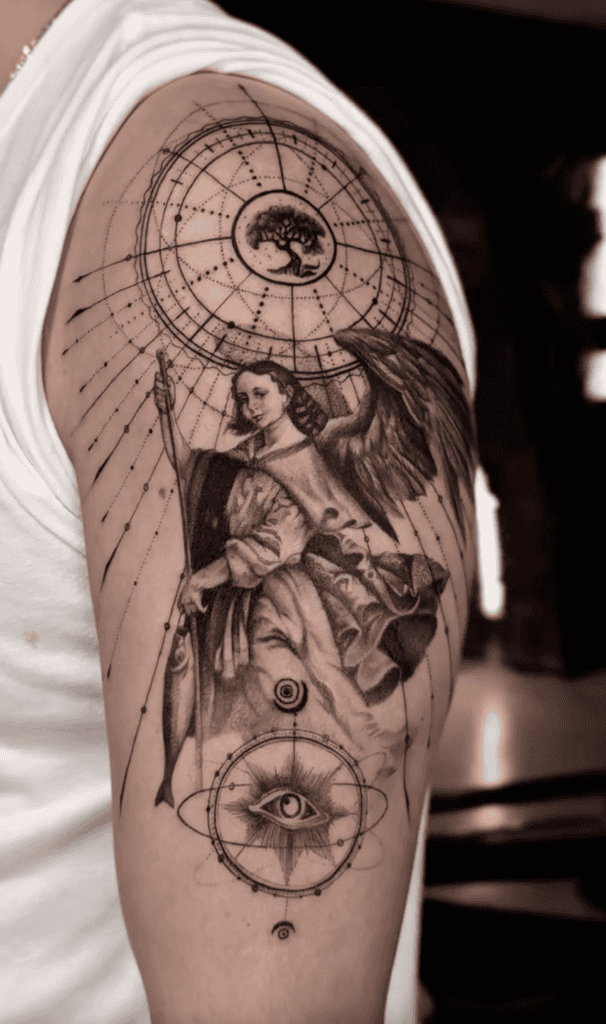
Raphael is known as the archangel of healing, guidance, and protection. Raphael’s name comes from the Hebrew phrase “Rafa-El,” meaning “God heals.” Because of this meaning, Raphael is traditionally associated with healing both physical illness and spiritual suffering.
Raphael is one of the few angels mentioned by name in biblical tradition and is especially known for his role in the Book of Tobit, where he appears as a companion and guide to a young man named Tobias.
Raphael’s most famous story appears in the Book of Tobit, a text included in the Catholic and Orthodox biblical canon. In this story, Raphael disguises himself as a human traveller and accompanies Tobias on a long journey.
During their travels, Raphael protects Tobias from danger and provides guidance along the way. One of the most memorable moments occurs when Raphael instructs Tobias to catch a large fish and use parts of it to cure illness and drive away evil spirits.
Through Raphael’s guidance, Tobias successfully heals his father’s blindness and helps free his future wife from a demon that had plagued her. Only after the journey is complete does Raphael reveal his true identity as an archangel sent by God.
Raphael is often viewed as the angel who brings comfort and healing to those who are suffering. For this reason, Raphael is sometimes considered the patron angel of travellers, healers, and physicians, representing protection during journeys and recovery from illness.
Archangel Uriel Christian Mythology Tattoo
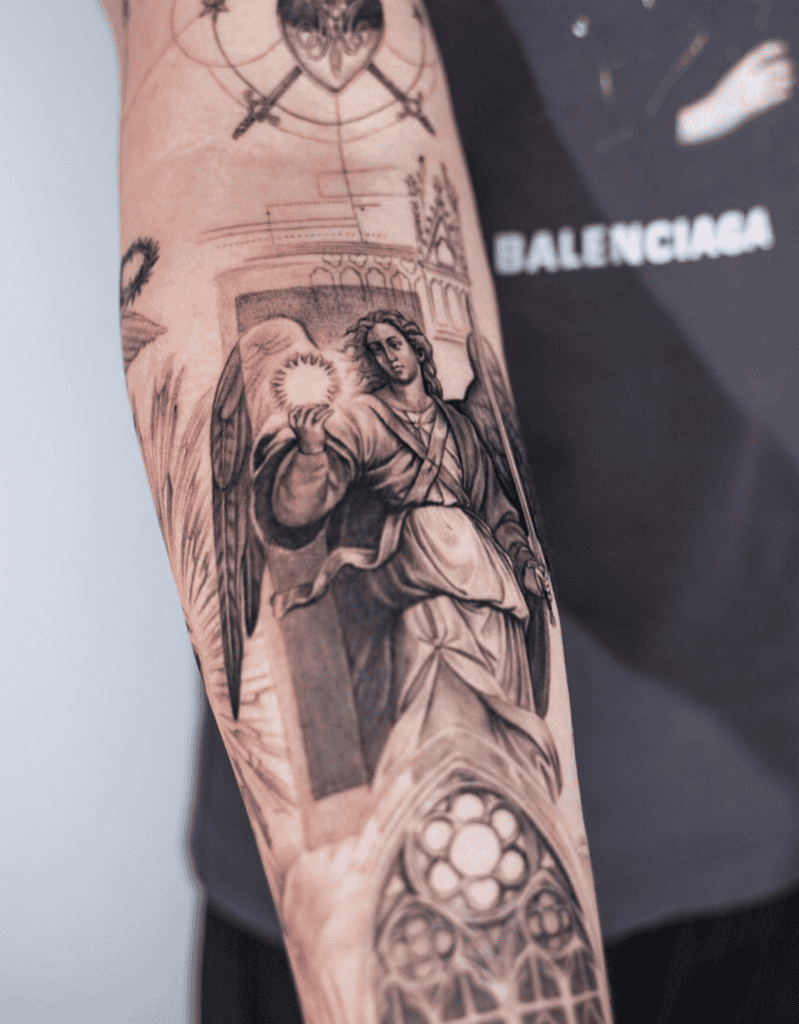
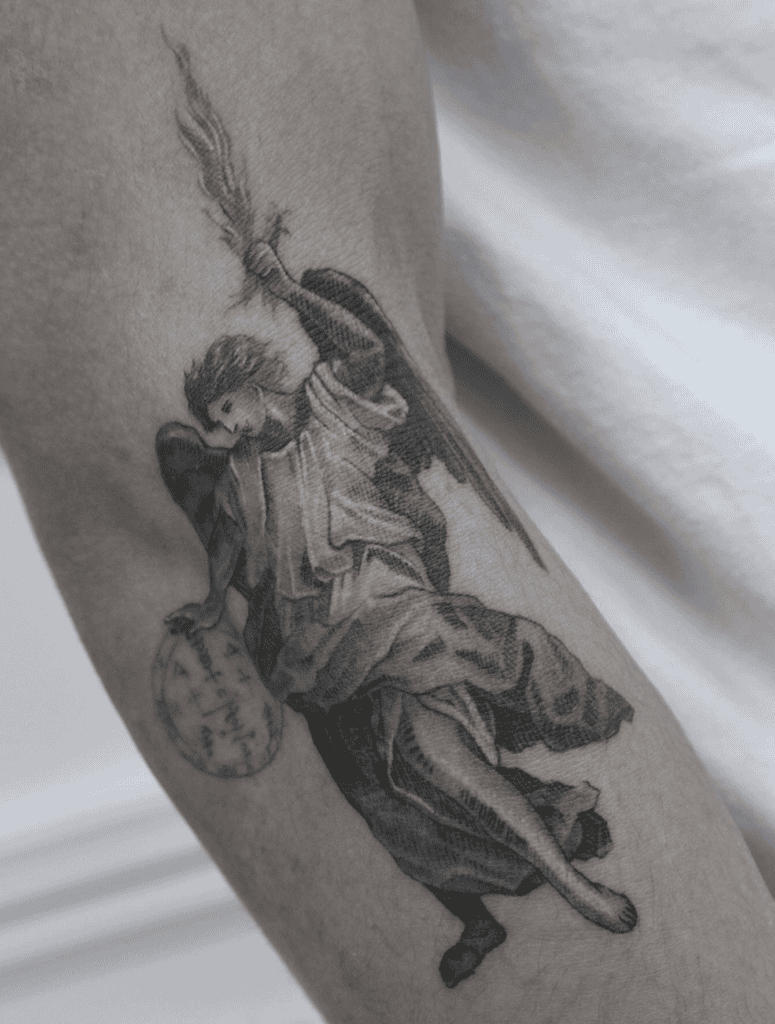
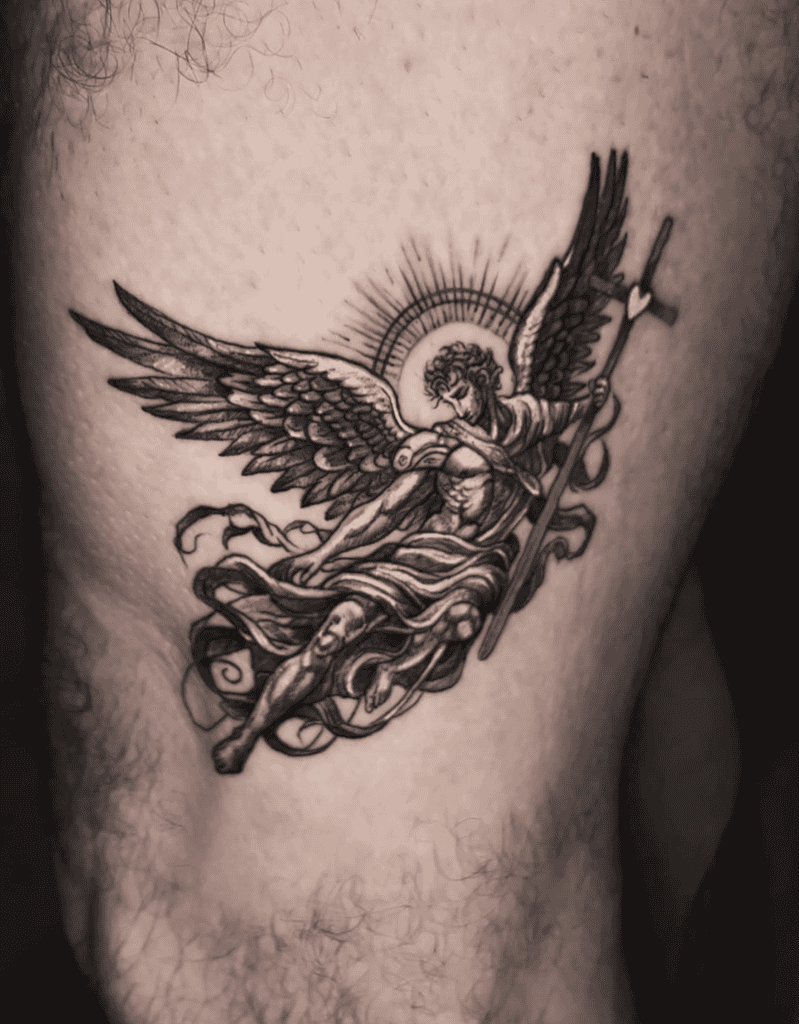
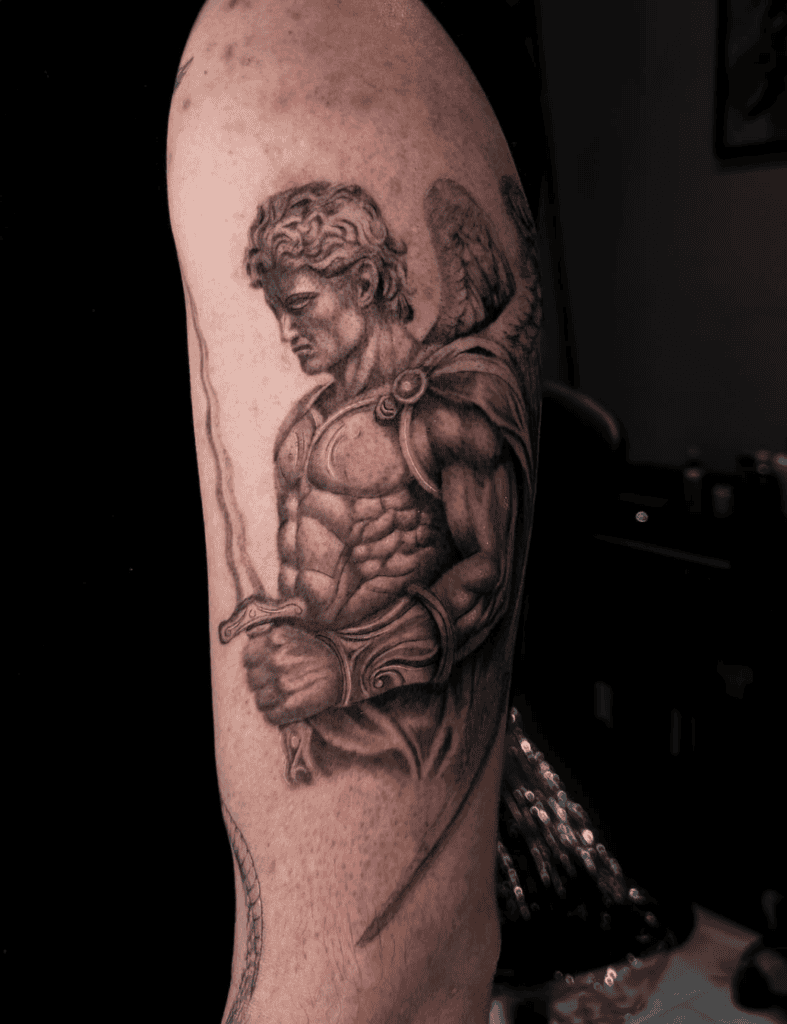
Uriel is often described as the angel of wisdom, knowledge, and divine illumination. His name comes from Hebrew and is usually translated as “God is my light” or “Light of God.” Because of this meaning, Uriel is commonly associated with enlightenment, understanding, and the revelation of divine truth.
Although Uriel does not appear in the canonical books of the Bible as prominently as some other angels, he plays an important role in apocryphal and early Christian writings, where he is portrayed as a powerful and wise heavenly messenger.
Uriel is often described as the angel who brings clarity and understanding to humanity. In some traditions, he is believed to illuminate the minds of prophets and guide people toward truth. Because of this role, Uriel is sometimes called the angel of wisdom or the angel of knowledge, helping humanity understand divine mysteries and spiritual truths.
Uriel appears in several ancient texts outside the traditional biblical canon, such as the Book of Enoch and other early religious writings. In these stories, Uriel is portrayed as a heavenly guide who explains visions and reveals hidden knowledge about the universe and God’s plans. In some traditions, Uriel is said to have warned the righteous man Noah about the coming flood, demonstrating his role as a messenger of divine warning and guidance.
Uriel is sometimes listed alongside other famous archangels such as Michael, Gabriel, and Raphael. While Michael is seen as the warrior, Gabriel the messenger, and Raphael the healer, Uriel represents wisdom and spiritual insight. Because of this association, Uriel is often linked with learning, philosophy, and intellectual discovery.
Archangel Metatron Christian Mythology Tattoo
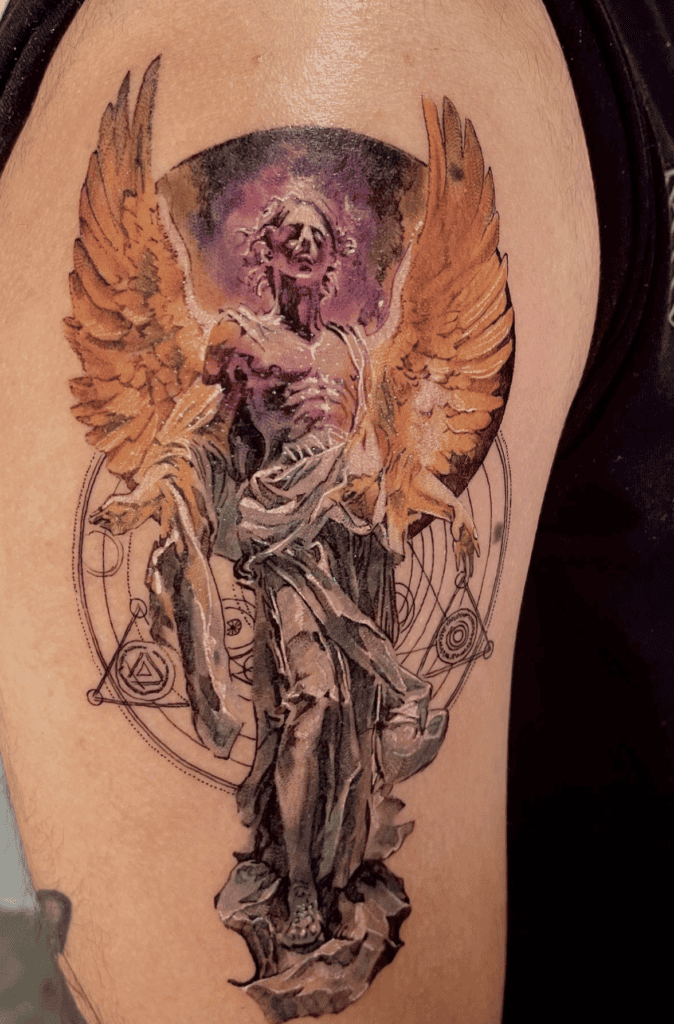
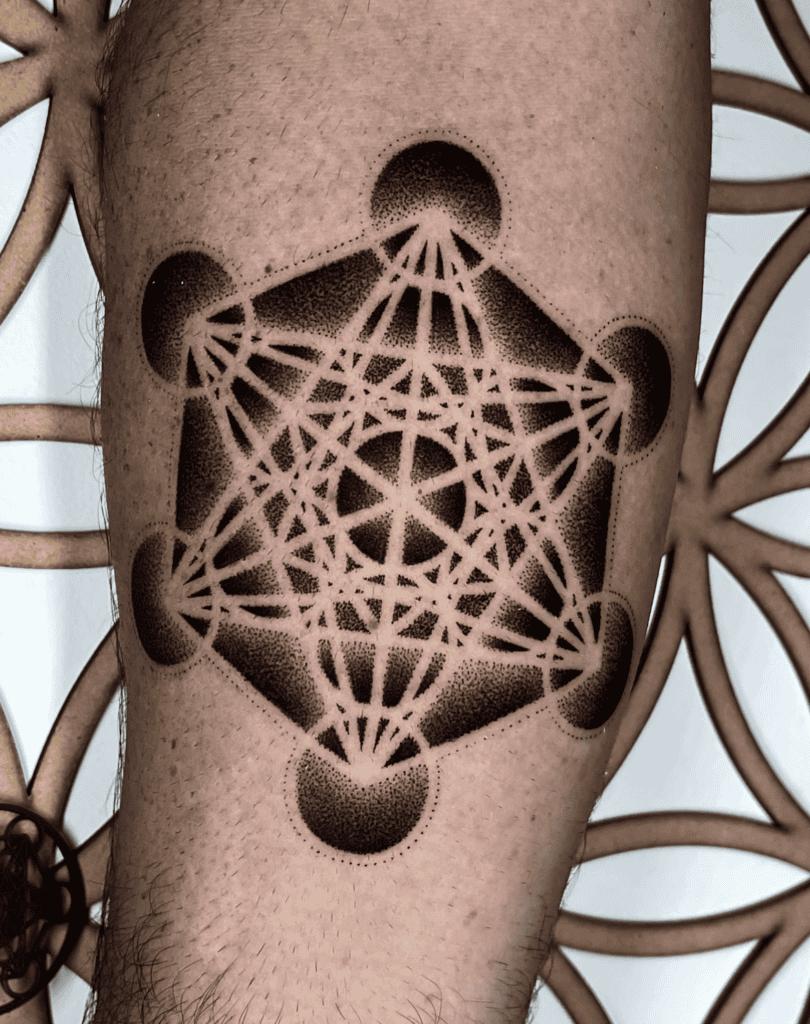
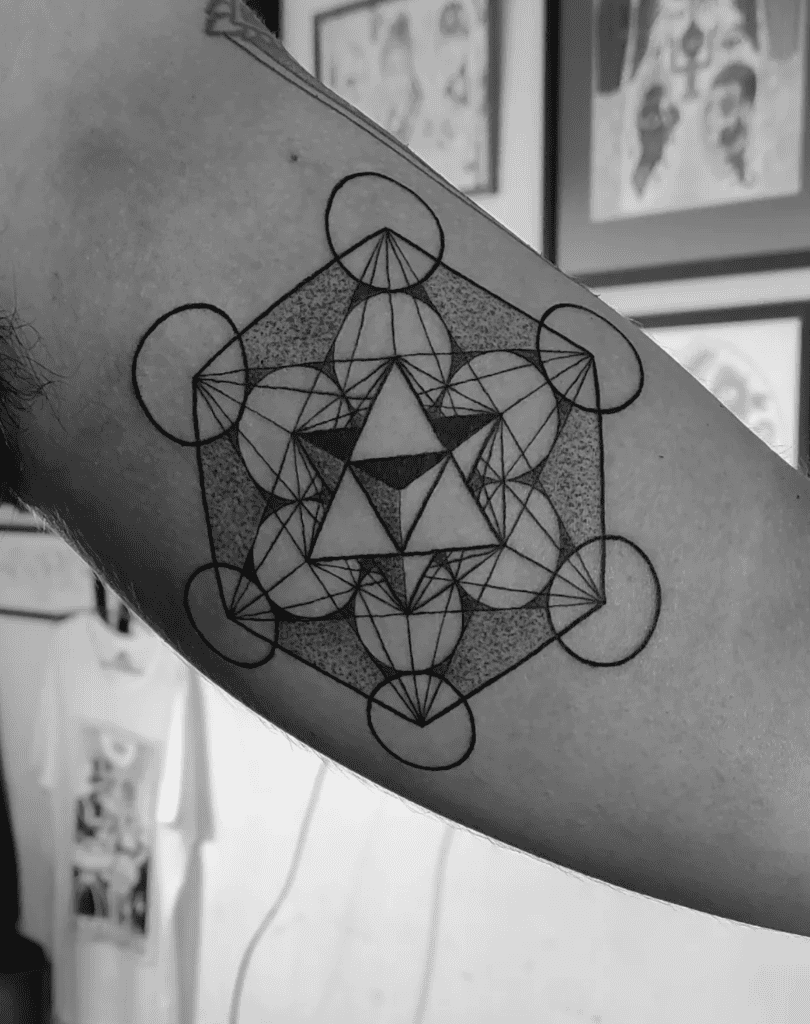
Metatron is often described as one of the highest-ranking angels in heaven. Although Metatron does not appear directly in the canonical Bible, the figure appears in Jewish mystical writings, apocryphal texts, and later Christian traditions, where he is portrayed as a powerful celestial being who serves close to the throne of God. Metatron is sometimes called the “scribe of heaven” or the “voice of God,” because he is believed to record the deeds of humanity and convey divine knowledge.
One of Metatron’s most famous roles is that of a celestial recorder. In mystical traditions, Metatron is believed to write down the actions of humanity, keeping a divine record of good and evil. Because of this responsibility, Metatron is sometimes described as the angel who maintains the Book of Life, a sacred record associated with divine judgment.
One of the most fascinating traditions about Metatron is the belief that he was once human. According to certain ancient writings, the biblical figure Enoch was taken into heaven by God and transformed into the angel Metatron. This story describes Enoch being elevated to an extraordinary status among the angels, becoming a heavenly being who serves as a bridge between humanity and the divine.
In mystical texts, Metatron is sometimes described as the prince of angels or the angel closest to God’s throne. Because of this status, he is occasionally portrayed as the leader of other angels or as a guide who helps interpret divine mysteries.
Metatron is often associated with divine knowledge, sacred geometry, and the structure of the universe. In later mystical symbolism, he is linked to the famous geometric figure known as Metatron’s Cube, which represents harmony and cosmic order.
Seraphim Christian Mythology Tattoo
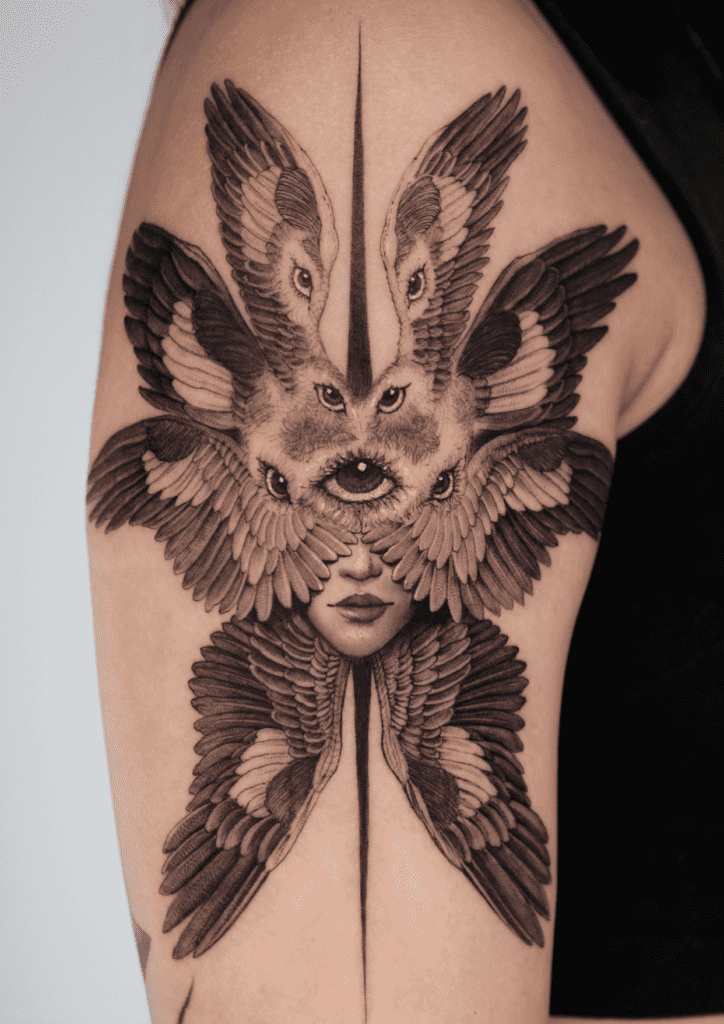
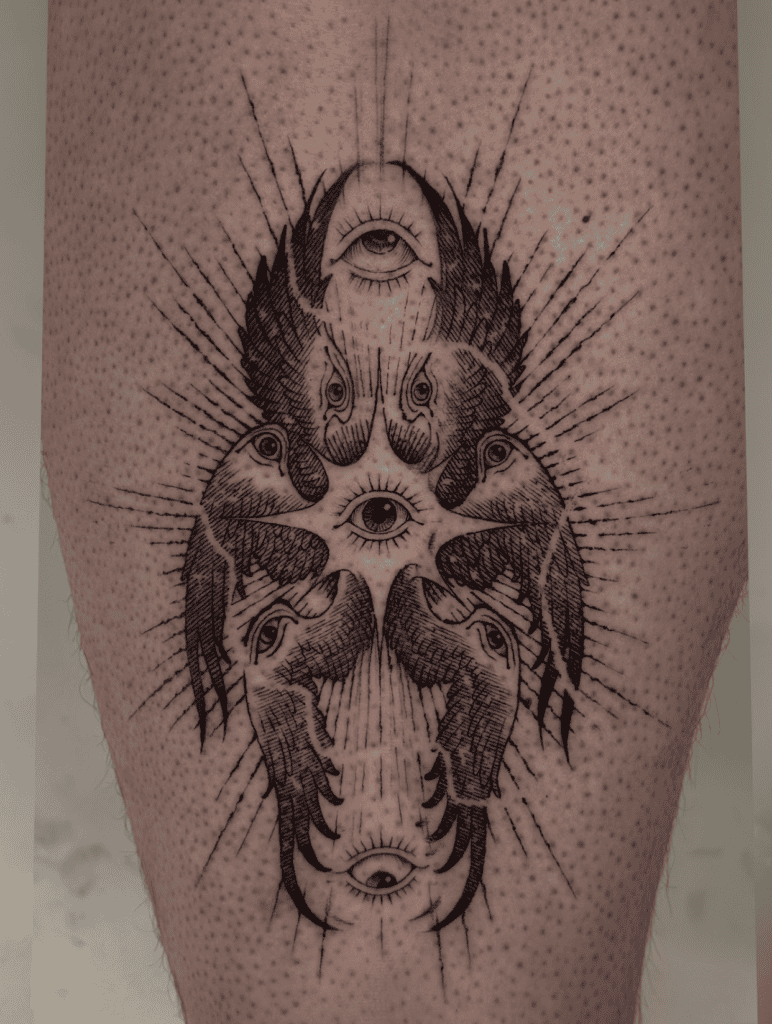
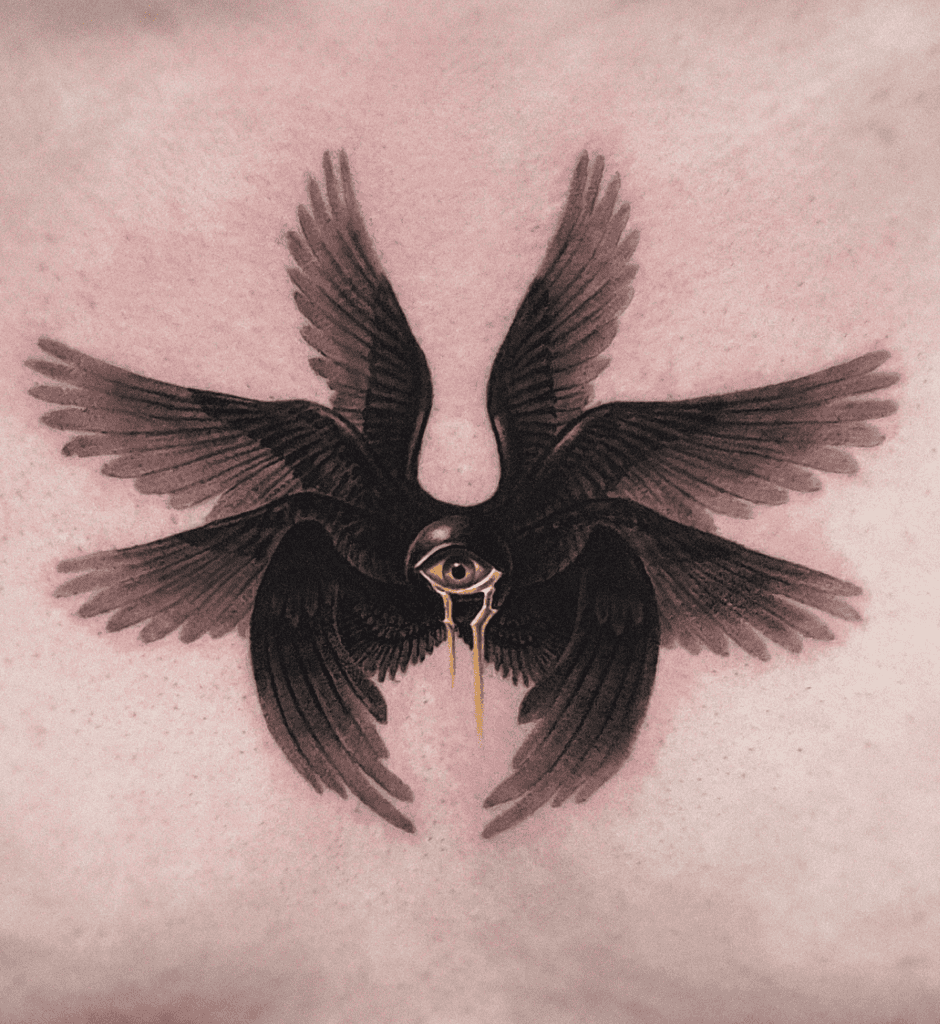
In Christian mythology and theology, the Seraphim are considered the highest order of angels in the heavenly hierarchy. They are believed to dwell closest to the throne of God, constantly praising and worshipping the divine. The name Seraphim comes from a Hebrew word meaning “burning ones,” reflecting their association with divine fire, purity, and intense spiritual energy.
One of the most famous descriptions of the Seraphim appears in the Book of Isaiah. In this vision, the prophet Isaiah describes seeing God seated upon a heavenly throne surrounded by powerful angels.
These angels are described as having six wings. Two wings cover their faces, two cover their feet, and two allow them to fly. As they circle the throne of God, they continuously proclaim: “Holy, holy, holy is the Lord of hosts; the whole earth is full of his glory.”
The term Seraphim is often interpreted as referring to burning or fiery beings. This fire is not destructive but symbolic of purification and divine power. In Isaiah’s vision, one of the Seraphim takes a burning coal from the heavenly altar and touches the prophet’s lips, cleansing him and preparing him to deliver God’s message. This story reinforces the idea that the Seraphim represent purification, spiritual transformation, and divine authority.
Medieval Christian theology organised angels into a hierarchy known as the Nine Choirs of Angels. Within this system, the Seraphim occupy the highest rank. Below them are the Cherubim, followed by the Thrones. These highest orders of angels are believed to remain closest to God, continually praising and reflecting divine glory.
While archangels such as Michael and Gabriel interact more directly with humanity, the Seraphim remain primarily focused on the worship of God.
Cherubim Christian Mythology Tattoo
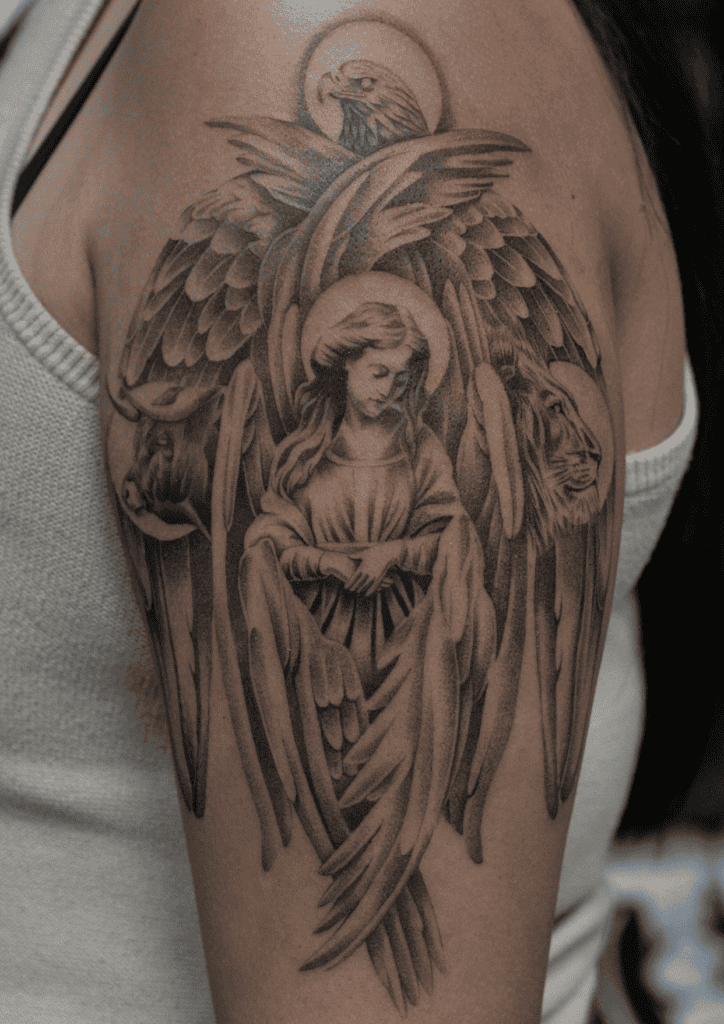
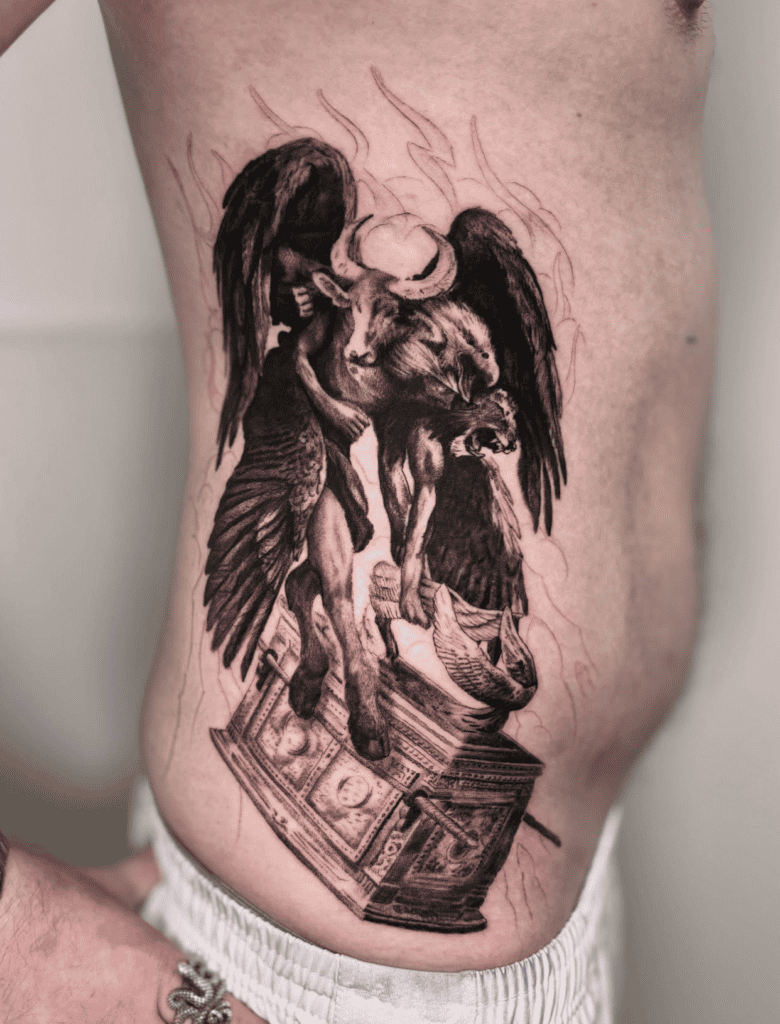
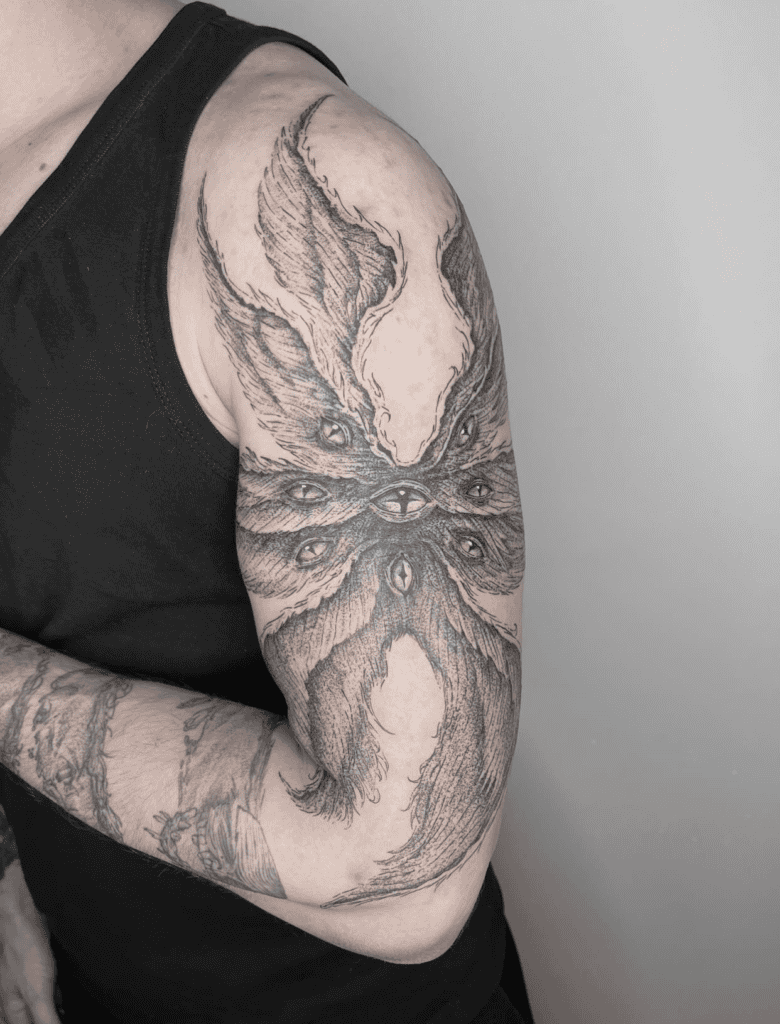
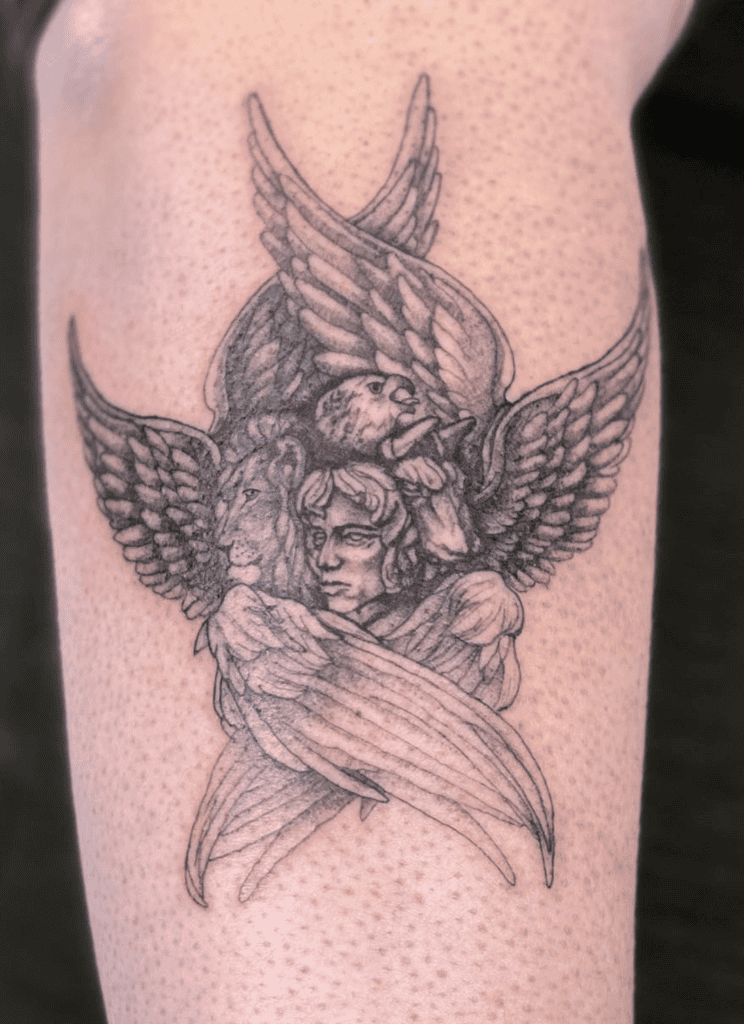
In Christian mythology and theology, the Cherubim are powerful heavenly beings who serve near the throne of God. They are traditionally ranked among the highest orders of angels, just below the Seraphim, and are often associated with divine knowledge, protection, and the presence of God.
Although the word cherub is sometimes used today to describe cute winged babies in art, the original biblical descriptions of Cherubim are far more mysterious and awe-inspiring. One of the earliest mentions of the Cherubim appears in the Book of Genesis. After the first humans, Adam and Eve, were expelled from the Garden of Eden, God placed Cherubim at the entrance to guard the path to the Tree of Life.
These celestial guardians were depicted with a flaming sword, ensuring that no human could return to the sacred garden. This story established the Cherubim as protectors of holy spaces and divine mysteries.
One of the most striking descriptions of Cherubim appears in the prophetic vision of the prophet Ezekiel. In this vision, the Cherubim are described as extraordinary creatures with four faces and multiple wings. Each being possessed the faces of a human, a lion, an ox, and an eagle, symbolising different aspects of creation and divine power. Their bodies were surrounded by brilliant light and accompanied by mysterious, moving wheels that reflected the glory of heaven. This vivid imagery later influenced many interpretations of angelic beings in Christian theology and art.
Cherubim are also closely connected with the throne of God. In biblical symbolism, they are sometimes described as carrying or surrounding the divine throne, representing the presence and majesty of God. In ancient Israelite tradition, the Ark of the Covenant—the sacred chest containing the Ten Commandments—was decorated with two golden Cherubim whose wings stretched over the lid of the ark. This imagery reinforced the idea that Cherubim guard sacred knowledge and divine authority.
Ophanim Christian Mythology Tattoo
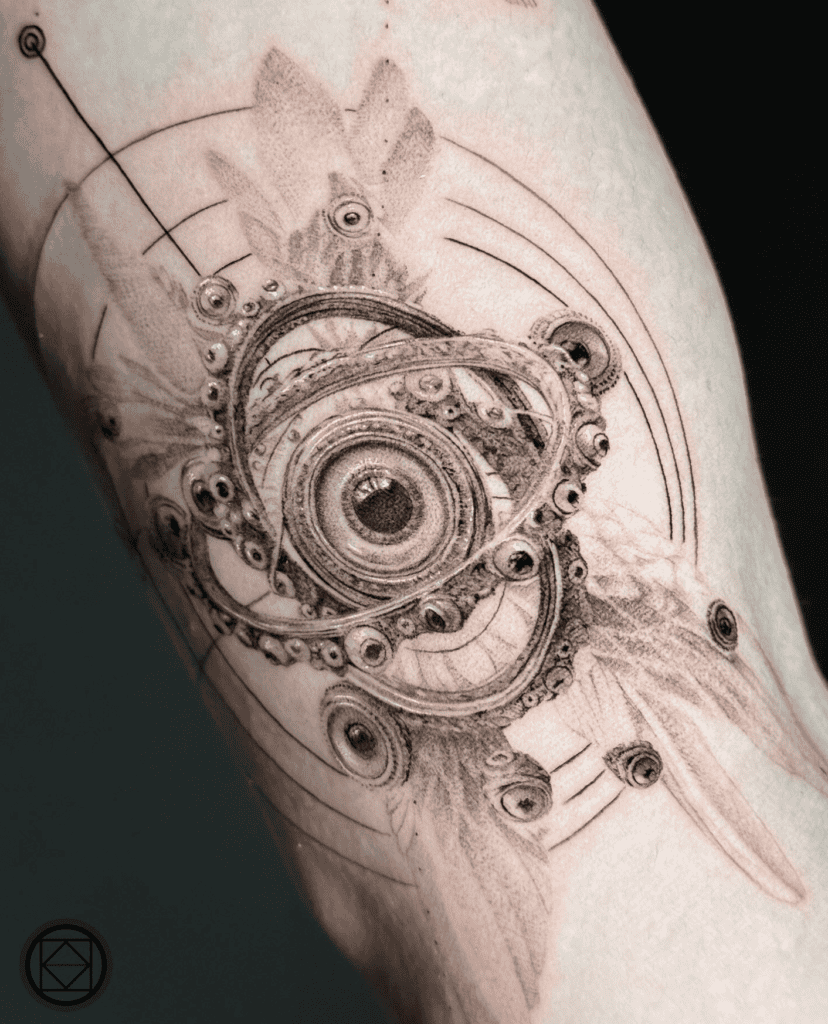
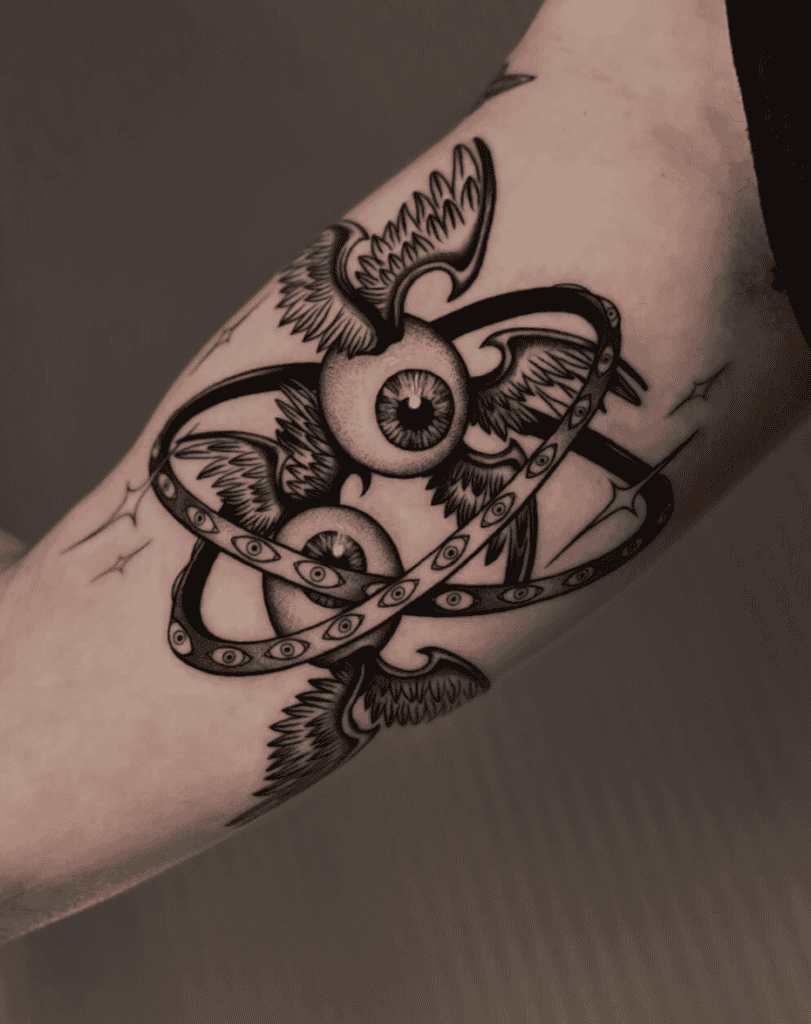
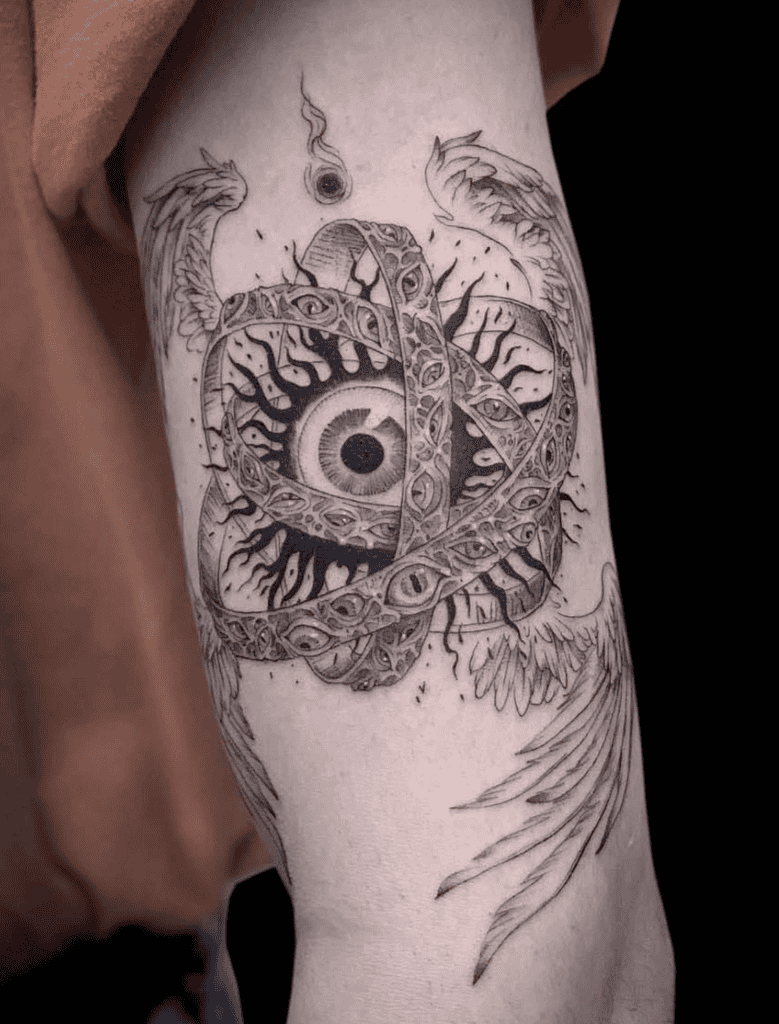
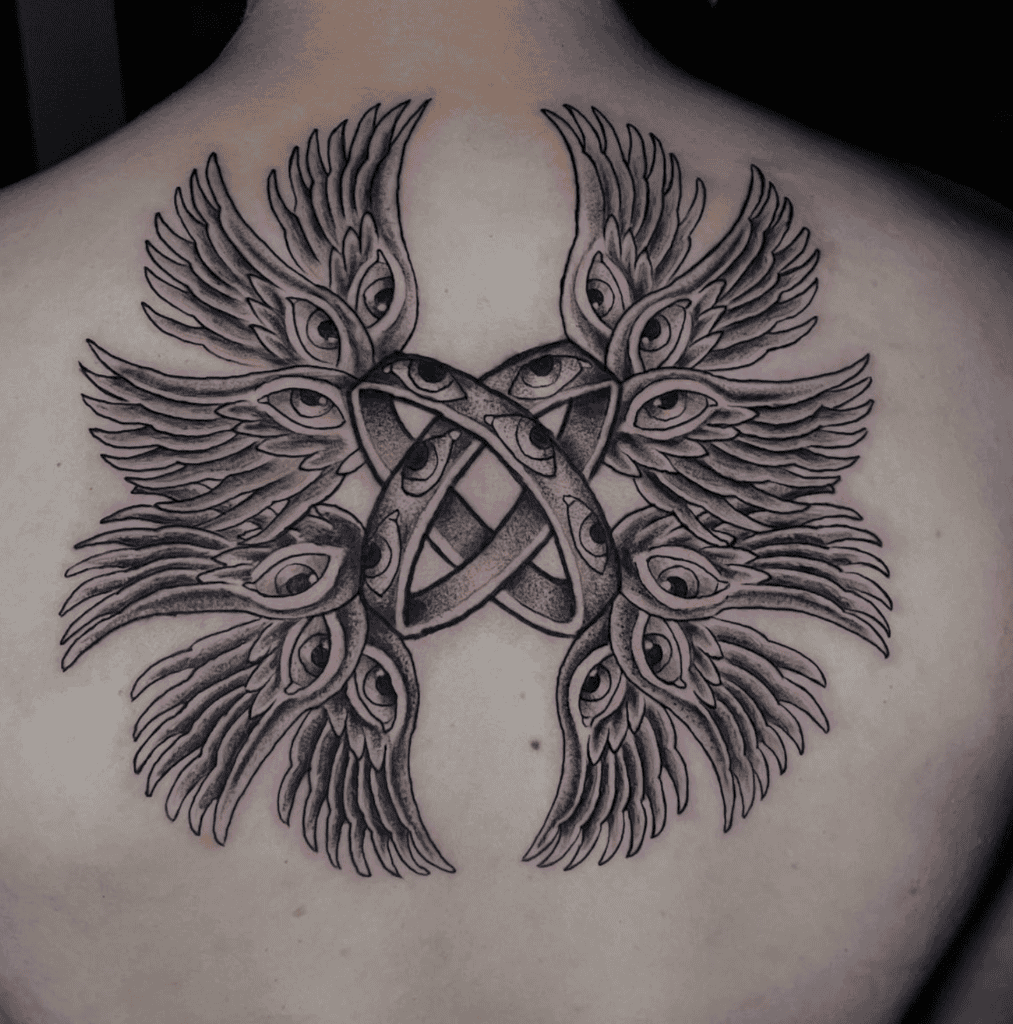
In Christian mythology and angelic theology, the Thrones, often referred to as Ophanim, are one of the highest orders of angels. Their name comes from the Hebrew word ophan, meaning “wheel.” These beings are among the most mysterious and visually striking angels described in biblical visions. Unlike the more human-like angels often depicted in art, the Ophanim are described as living wheels filled with eyes, symbolising divine awareness and cosmic order.
The most famous description of the Ophanim appears in the prophetic vision of Ezekiel. In this vision, Ezekiel sees a heavenly chariot carrying the presence of God. Alongside the Cherubim are extraordinary wheels that move in perfect harmony with them. These wheels are described as being covered in countless eyes and capable of moving in any direction without turning. Whenever the Cherubim move, the wheels move with them, suggesting that they function as part of a divine mechanism supporting God’s throne.
The eyes that cover the Ophanim symbolise complete awareness and divine knowledge. In Christian symbolism, this imagery represents God’s ability to see and understand everything in the universe. Rather than being frightening or monstrous, the eyes reflect the idea that nothing escapes divine perception.
Angel Christian Mythology Tattoo
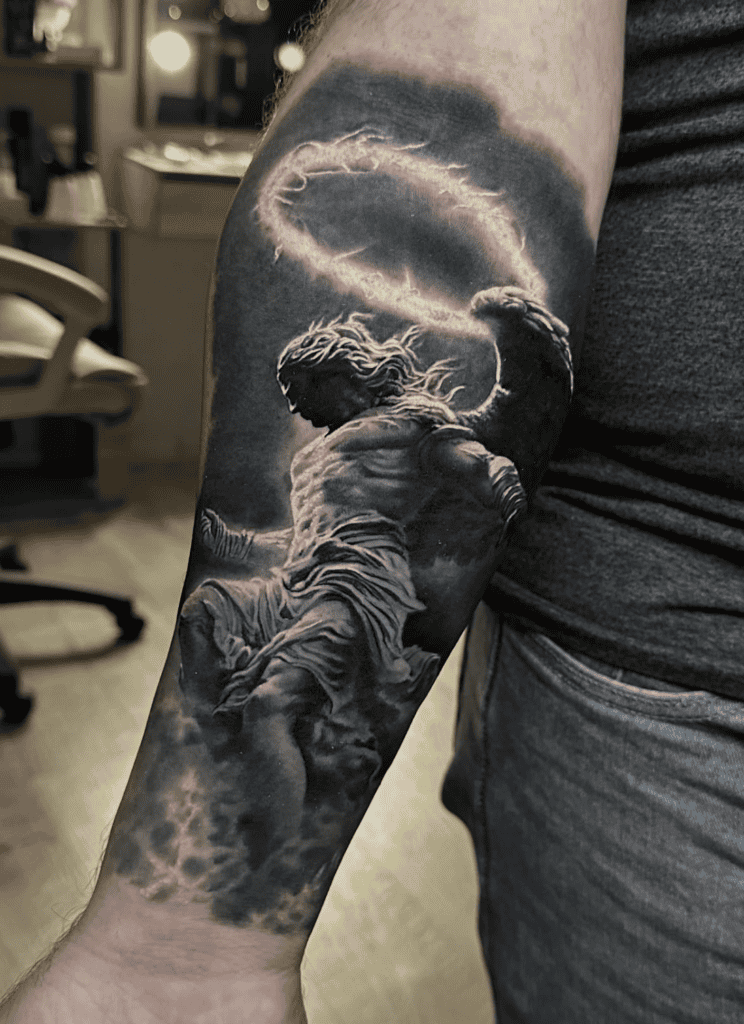
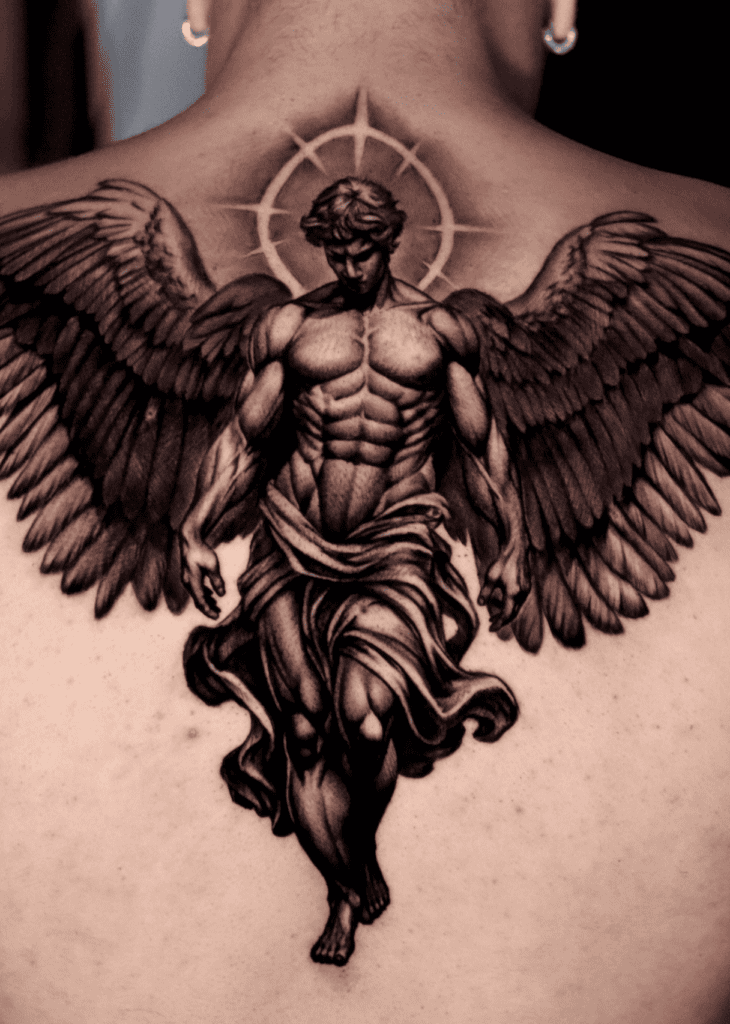
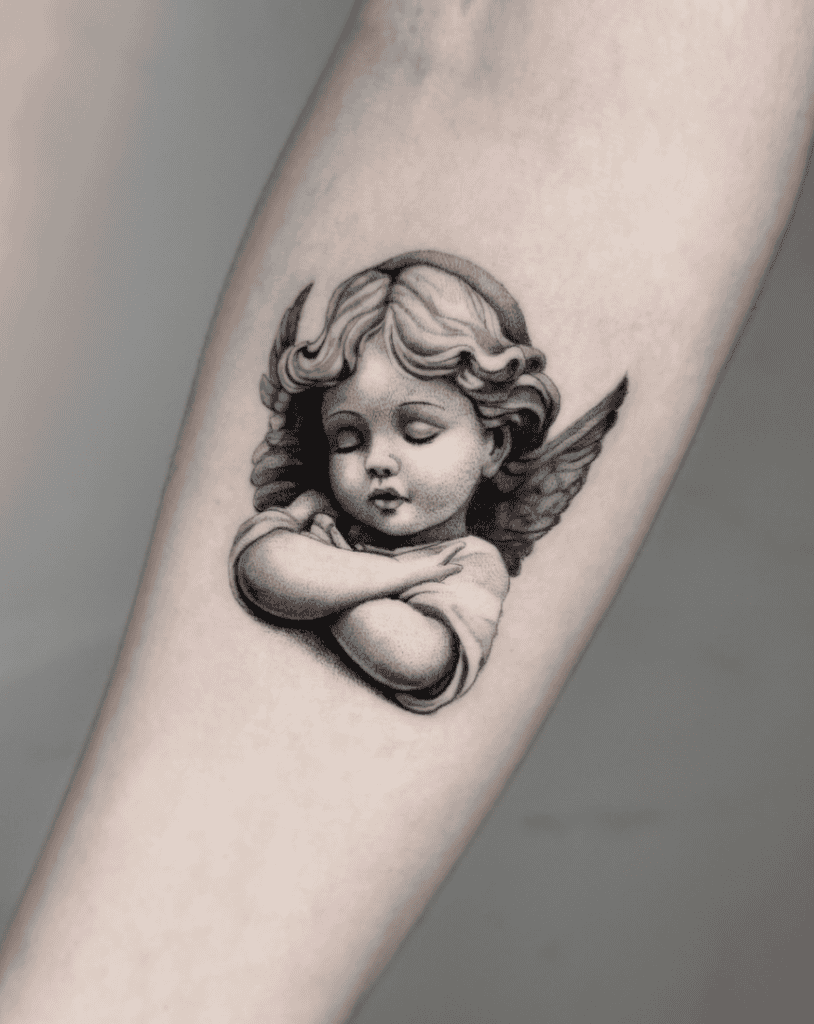
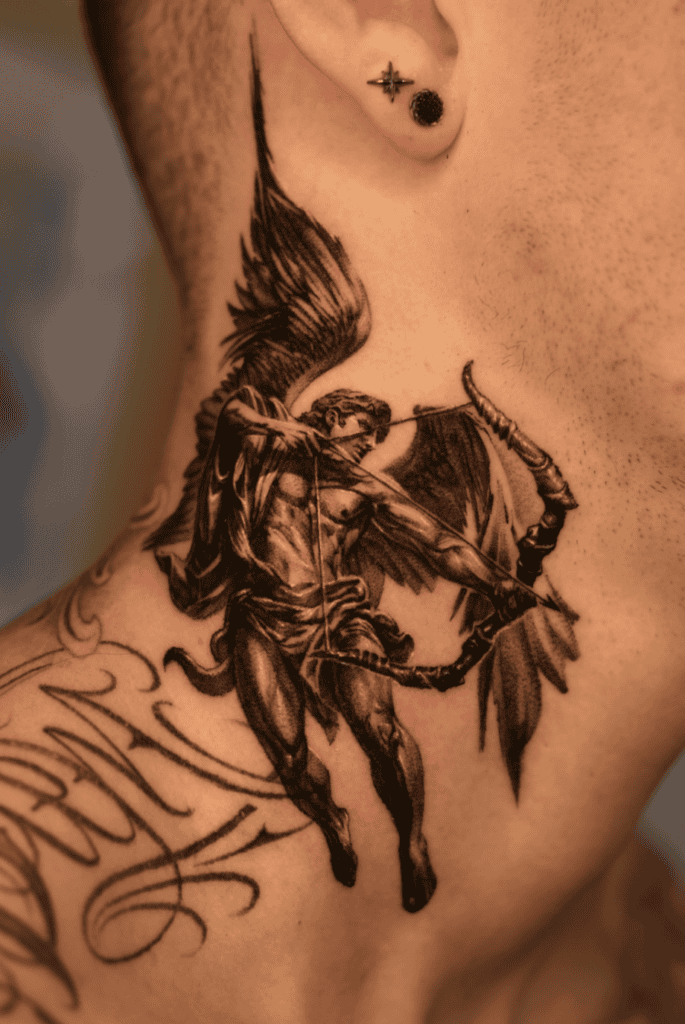
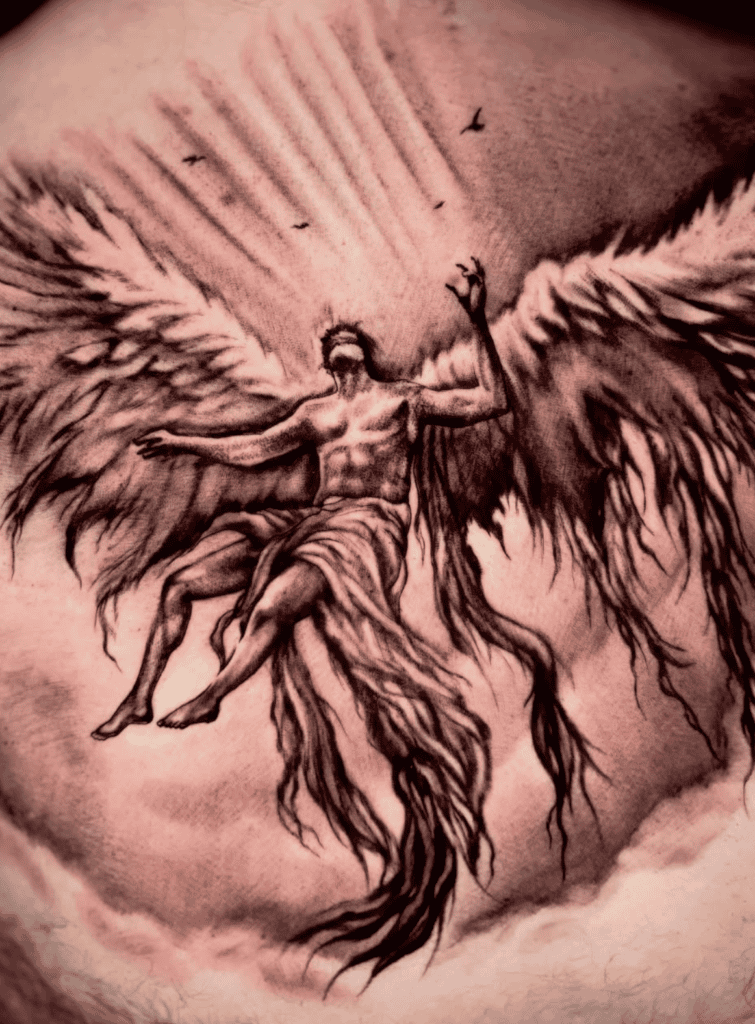
In Christian angelology, angels are organised into a hierarchy known as the Nine Choirs of Angels, a structure popularised by the theologian Pseudo-Dionysius the Areopagite in the 5th–6th century. These choirs are divided into three spheres, each representing how closely angels interact with God and with humanity.
The Dominions, sometimes called Dominations, are angels associated with authority and leadership within the heavenly hierarchy. Dominions are believed to regulate the duties of lower angels and ensure that divine order is maintained throughout creation. Unlike warrior angels or messengers, they rarely interact directly with humanity. Instead, their role is to oversee the structure of heaven and make sure that the commands of God are carried out properly.
The Virtues are often described as the angels responsible for miracles and divine blessings in the physical world. Virtues are believed to control the movement of celestial bodies and channel God’s power into the world. They may inspire miracles, strengthen faith, and help maintain harmony in nature.
The Powers are often described as warrior angels who defend heaven and humanity from evil forces. Their primary role is maintaining order between heaven and the material world while fighting against demonic influence. Because of this, the Powers are sometimes portrayed as soldiers of heaven who protect the universe from chaos.
The Principalities are angels associated with guiding nations, cities, and large groups of people. These angels are believed to watch over kingdoms and institutions, helping guide leaders and protect societies from corruption or destruction.
The lowest order of angels is simply called Angels. These angels interact most closely with humanity and are believed to serve as messengers, protectors, and guides. Many Christian traditions teach the idea of guardian angels, spiritual beings assigned to protect and guide individuals throughout their lives.
Satan / Lucifer Christian Mythology Tattoo
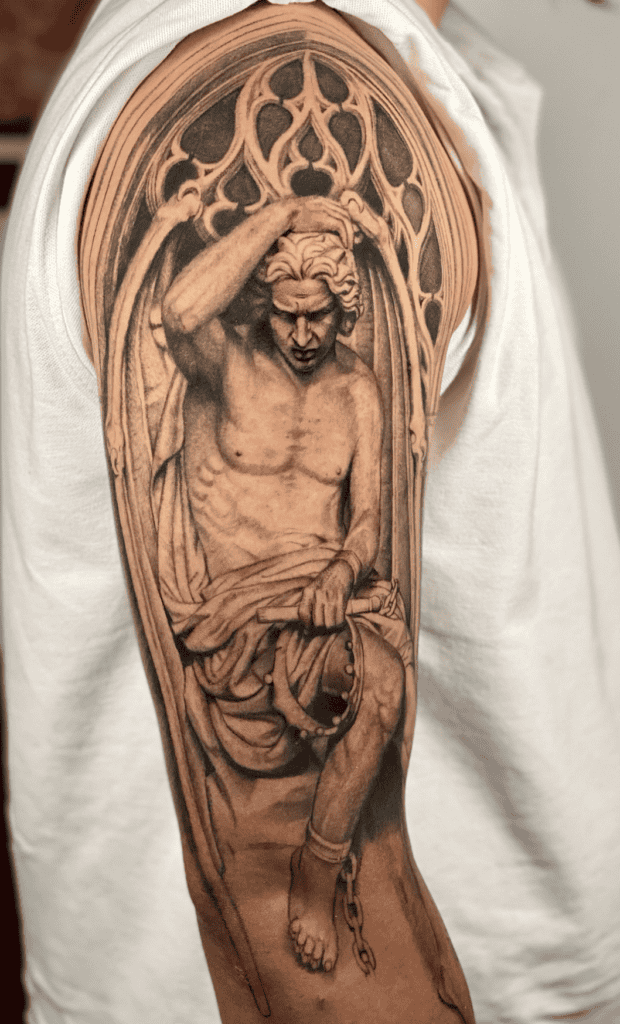
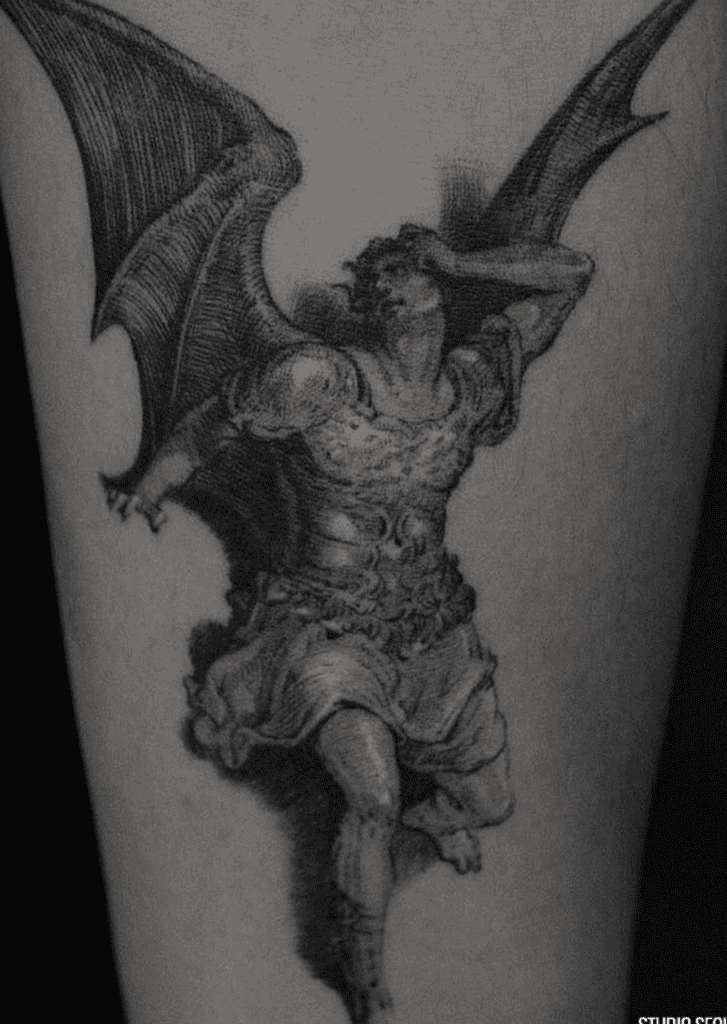
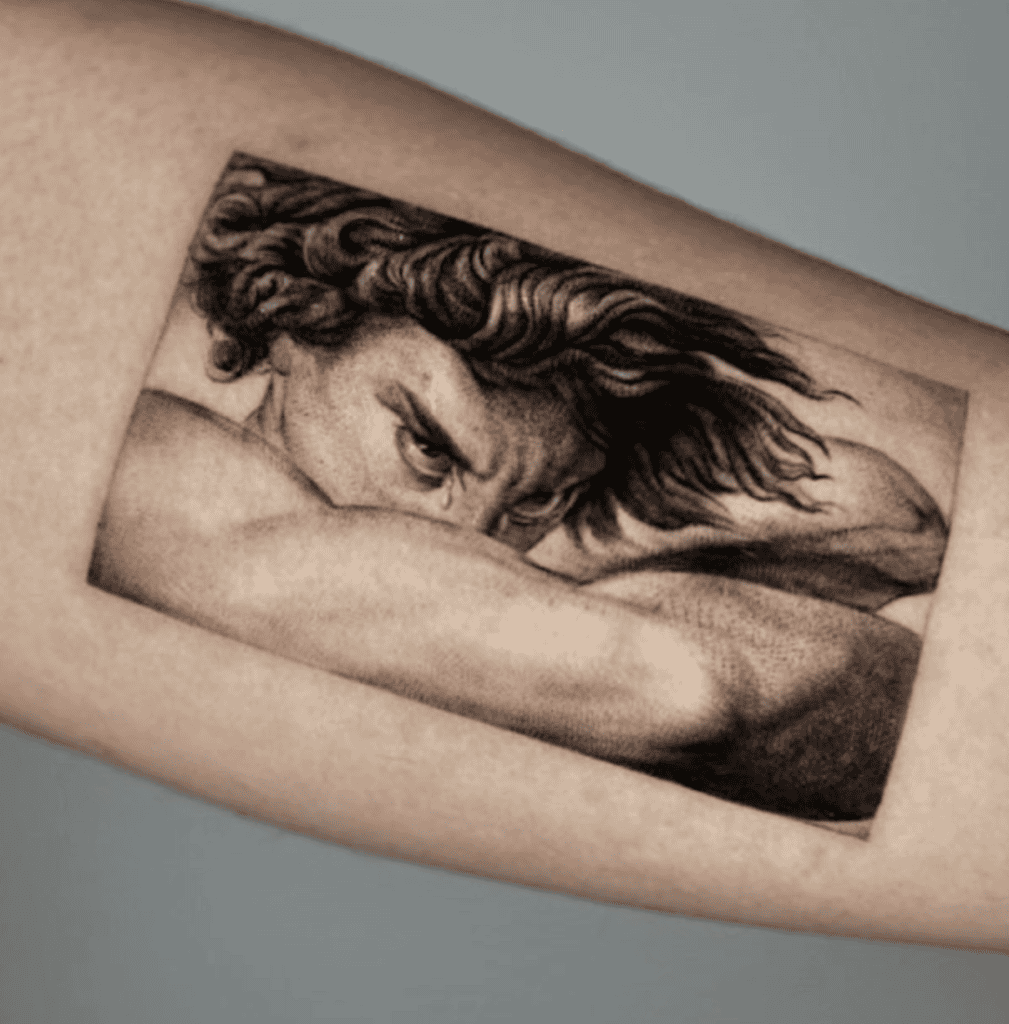
In Christian mythology, Satan—often associated with Lucifer—is the primary antagonist and the embodiment of rebellion against God. He is traditionally described as a fallen angel who defied the authority of God and was cast out of heaven. According to many Christian traditions, Lucifer was originally one of the most beautiful and powerful angels in heaven. His name comes from a Latin word meaning “light-bringer” or “morning star.”
In theological interpretations, Lucifer’s great beauty and power led to overwhelming pride. Rather than serving God humbly, he desired greater authority and attempted to elevate himself above the divine order. One of the most famous stories involving Satan appears in the Book of Revelation. In this vision, a cosmic battle breaks out in heaven between the loyal angels and those who rebelled.
The heavenly armies are led by Michael, who defeats Satan and his followers. As a result of this defeat, Satan and the fallen angels are cast out of heaven and thrown down to the earth. After his fall, Satan becomes the great adversary of humanity. In Christian mythology, he often appears as a tempter who attempts to lead people away from righteousness.
One of the earliest examples occurs in the story of Adam and Eve, where a serpent tempts Eve to eat the forbidden fruit in the Garden of Eden. Another famous moment occurs in the New Testament, when Satan attempts to tempt Jesus Christ in the wilderness. These stories portray Satan as a figure who seeks to test faith and challenge humanity’s loyalty to God.
Bezzlebub Christian Mythology Tattoo

Beelzebub is one of the most well-known demonic figures and is often described as a powerful prince of demons. Over time, Beelzebub became closely associated with Satan, sometimes being portrayed as one of Satan’s highest-ranking servants or even as another name for the devil himself.
The name Beelzebub has ancient origins and is commonly translated as “Lord of the Flies.” His name is believed to come from the ancient Philistine deity Baal, specifically a title known as Baal-Zebub, meaning “lord of the flies” or possibly “lord of the high place.”
In biblical tradition, this name was sometimes used mockingly to refer to false gods worshipped by neighbouring cultures. Over time, Christian writers reinterpreted Beelzebub as a demonic figure representing corruption, decay, and evil influence.
Beelzebub appears in the New Testament when critics accuse Jesus Christ of casting out demons using the power of Beelzebub. In response, Jesus challenges this accusation and argues that evil cannot stand if it is divided against itself.
In later Christian writings and medieval demonology, Beelzebub was often ranked as one of the highest demons in hell, sometimes second only to Satan. Some traditions portray him as a ruler of corruption and temptation, influencing human behaviour and spreading chaos. Because of his association with flies and decay, Beelzebub came to symbolise rot, corruption, and moral decay, reinforcing the idea that evil spreads like disease.
Belial Christian Mythology Tattoo

Belial is often portrayed as a powerful demon or fallen angel associated with wickedness, lawlessness, and corruption. Over time, Belial became one of the prominent figures in Christian descriptions of the demonic hierarchy, sometimes ranked among the most influential princes of hell alongside figures like Satan and Beelzebub.
The name Belial originates from Hebrew and is generally interpreted as meaning “worthless,” “wicked,” or “without value.” Because of this meaning, the term was often used in ancient texts to describe people who behaved in morally corrupt or destructive ways.
In the Old Testament, the word “Belial” was not originally the name of a specific demon. Instead, it was used as a descriptive term referring to wicked or lawless individuals. Phrases such as “sons of Belial” appeared in scripture to describe people who acted dishonourably or opposed divine law.
Over time, however, this concept evolved into the idea of Belial as a distinct supernatural figure representing evil and rebellion against God. In later Jewish and Christian writings, Belial began to appear as a powerful demonic entity rather than just a symbolic term. Some traditions portray him as a fallen angel who joined the rebellion led by Lucifer.
Mammon Christian Mythology Tattoo


Mammon is commonly associated with wealth, greed, and material obsession. Unlike some demonic figures who represent violence or chaos, Mammon symbolises the corrupting power of money and the dangers of valuing riches above spiritual devotion. Over time, Mammon came to be seen as a demonic personification of avarice, one of the most destructive human temptations.
The name Mammon appears in the teachings of Jesus Christ, particularly in a famous warning about the dangers of wealth. In the Gospel of Matthew, Jesus teaches that a person cannot serve two masters at the same time, declaring that it is impossible to serve both God and Mammon.
In this context, Mammon represents material wealth and worldly desire, standing in opposition to devotion to God. The teaching emphasises that excessive attachment to money can distract people from spiritual values.
Although the Bible originally uses Mammon as a symbol of wealth, later Christian writers and medieval demonologists began to portray Mammon as an actual demonic being. In these traditions, Mammon became known as the demon or prince of greed, encouraging humans to pursue riches, power, and luxury at the expense of morality.
Asmodeus Christian Mythology Tattoo


In Christian mythology and demonology, Asmodeus is often described as a powerful demon associated with lust, jealousy, and destructive desire. Over time, Asmodeus became known as one of the most notorious demonic figures, frequently appearing in religious writings, folklore, and medieval demonology.
The name Asmodeus is believed to originate from ancient Persian mythology, where a similar demon named Aeshma-daeva represented wrath and violent passion. This connection later influenced Jewish and Christian traditions, where the figure evolved into a powerful demon of temptation.
One of the most famous stories involving Asmodeus appears in the Book of Tobit. In this narrative, the demon becomes obsessed with a woman named Sarah and kills each of her husbands on their wedding night out of jealousy.
Eventually, Sarah becomes engaged to Tobias, the son of Tobit. With the help of the archangel Raphael, Tobias follows special instructions to drive the demon away. Using the smoke from a burning fish’s organs, Tobias successfully repels Asmodeus, allowing the marriage to proceed safely.
Leviathan Christian Mythology Tattoo
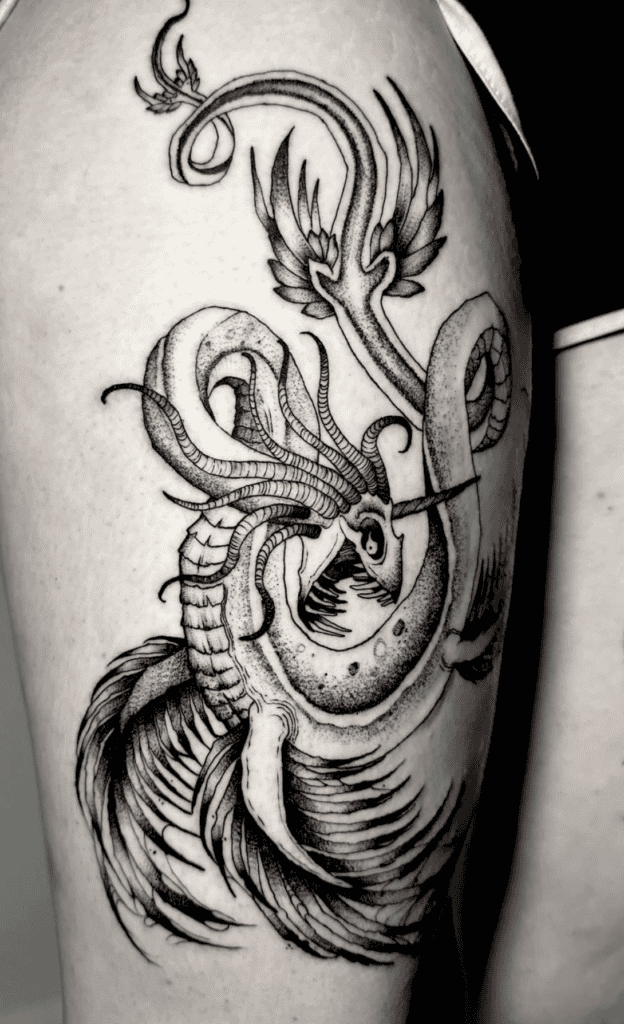
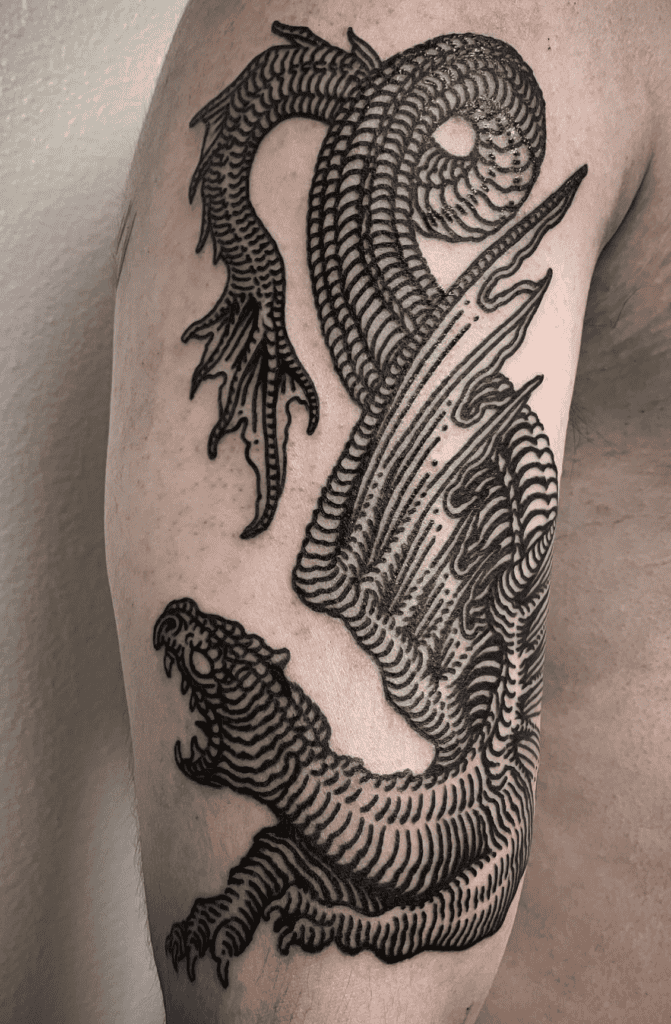
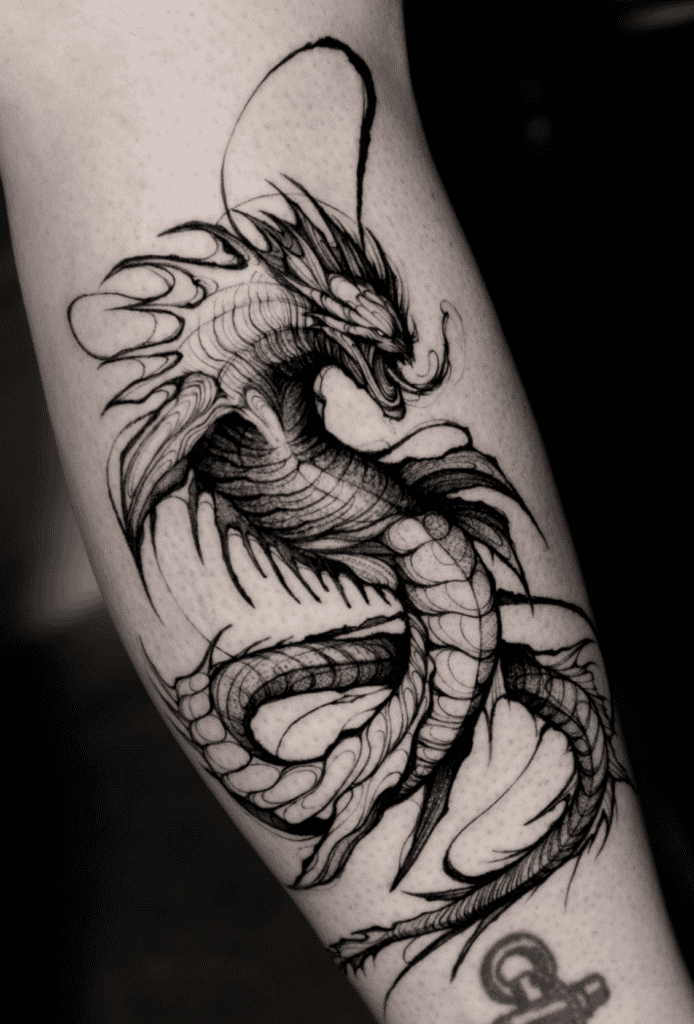
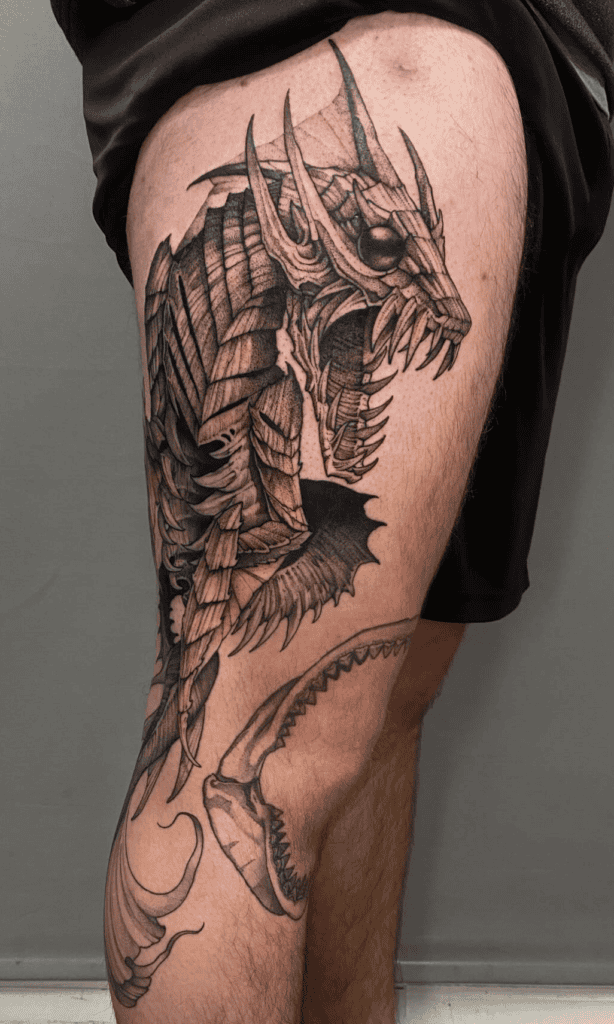
In Christian mythology, Leviathan is a legendary sea creature representing immense power, chaos, and the untamed forces of the ocean. Leviathan is one of the most famous creatures described in the Bible and is often portrayed as a gigantic serpent or dragon-like monster that dwells in the depths of the sea. The name Leviathan comes from a Hebrew word that roughly means “twisted” or “coiled,” which reflects the creature’s serpentine form.
Leviathan is mentioned in several biblical passages, particularly in the Book of Job. In this text, Leviathan is described as a terrifying creature whose strength and size make it impossible for humans to control.
The description portrays Leviathan as a creature with powerful scales, sharp teeth, and a body so strong that no weapon can easily harm it. Some passages even describe the creature breathing fire or smoke, giving it an almost dragon-like appearance.
Ziz Christian Mythology Tattoo
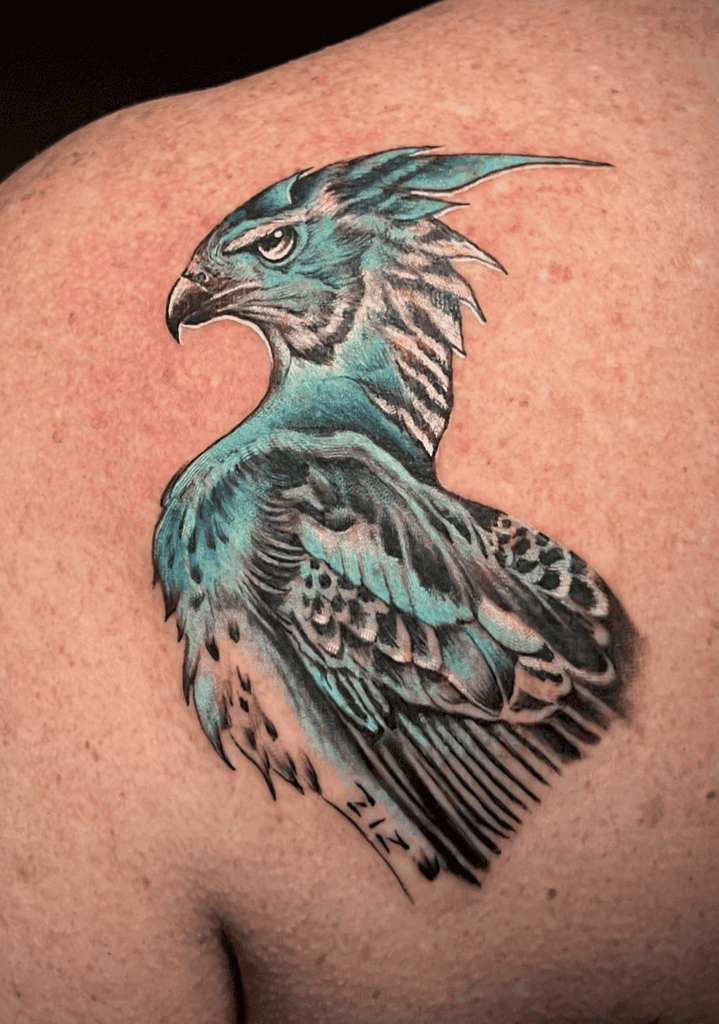
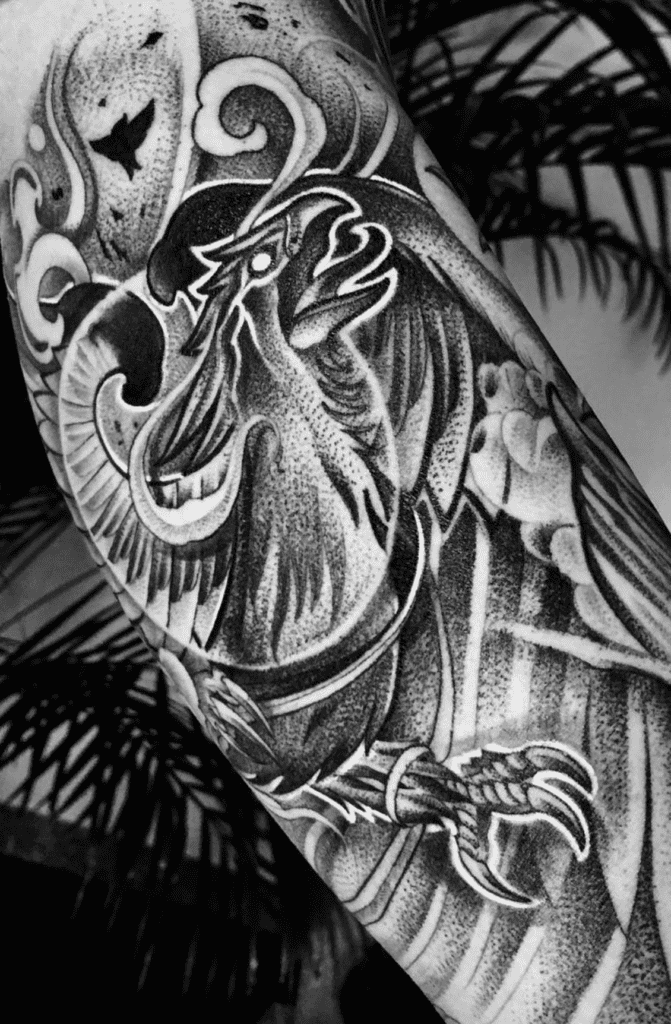
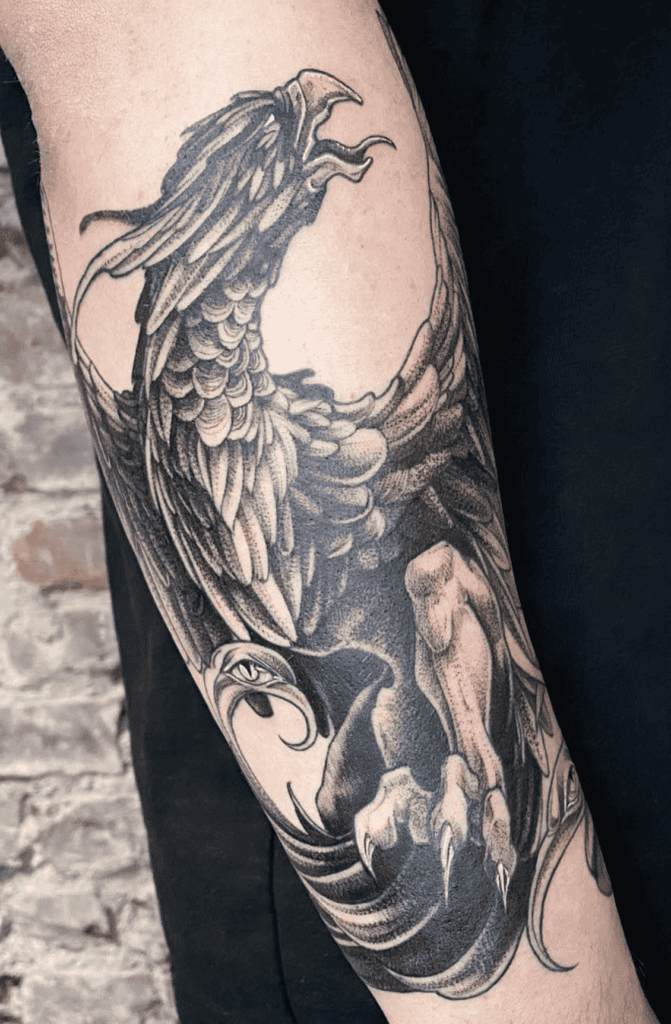
In biblical and Christian-adjacent mythology, Ziz is a gigantic legendary bird said to rule the skies. Ziz is often described alongside the Leviathan, the ruler of the sea, and Behemoth, the ruler of the land. Together, these three creatures symbolise the dominion of God over the entire natural world—sky, sea, and earth.
Although Ziz does not appear prominently in the canonical Bible, it is mentioned in Jewish folklore and later religious traditions, where it became a powerful symbol of the heavens.
Ziz is usually described as a bird of unimaginable size, so large that its wings could stretch across the sky. Some legends claim that when Ziz spreads its wings, it can block out the sun. Other stories say that its head reaches the heavens while its feet stand upon the earth.
Cockatrice Christian Mythology Tattoo


In Christian mythology and medieval folklore, the Cockatrice is a terrifying legendary monster often described as a hybrid of a rooster and a serpent or dragon. The creature became famous in medieval bestiaries and religious symbolism as a representation of evil, corruption, and deadly sin.
Although the cockatrice does not appear directly in the canonical Bible as a fully developed creature, references to serpent-like monsters in biblical translations and medieval interpretations helped inspire the legend.
The cockatrice is usually depicted with the head and comb of a rooster, the body of a dragon or serpent, and sometimes bat-like wings. Its strange appearance reflects its unnatural origin and symbolic connection to evil.
One of the most famous legends about the cockatrice explains how it is created. According to medieval folklore, the creature is born when a rooster lays an egg—an unnatural and impossible event. This egg must then be incubated by a toad or serpent, eventually hatching into the monstrous cockatrice.
Like the basilisk, the cockatrice was believed to possess a deadly power. Many legends claimed that the creature could kill with a single glance or breath, making it one of the most feared monsters in medieval mythology. Some stories also claimed that its poisonous breath could wither plants, kill animals, or contaminate the land.
Whore of Babylon Christian Mythology Tattoo
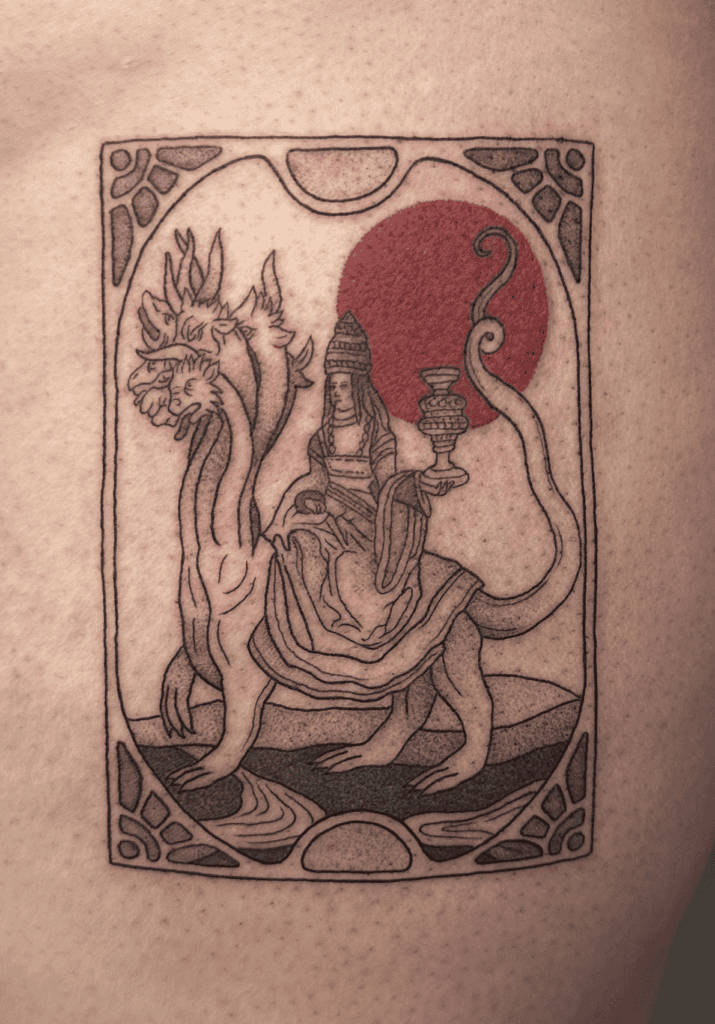
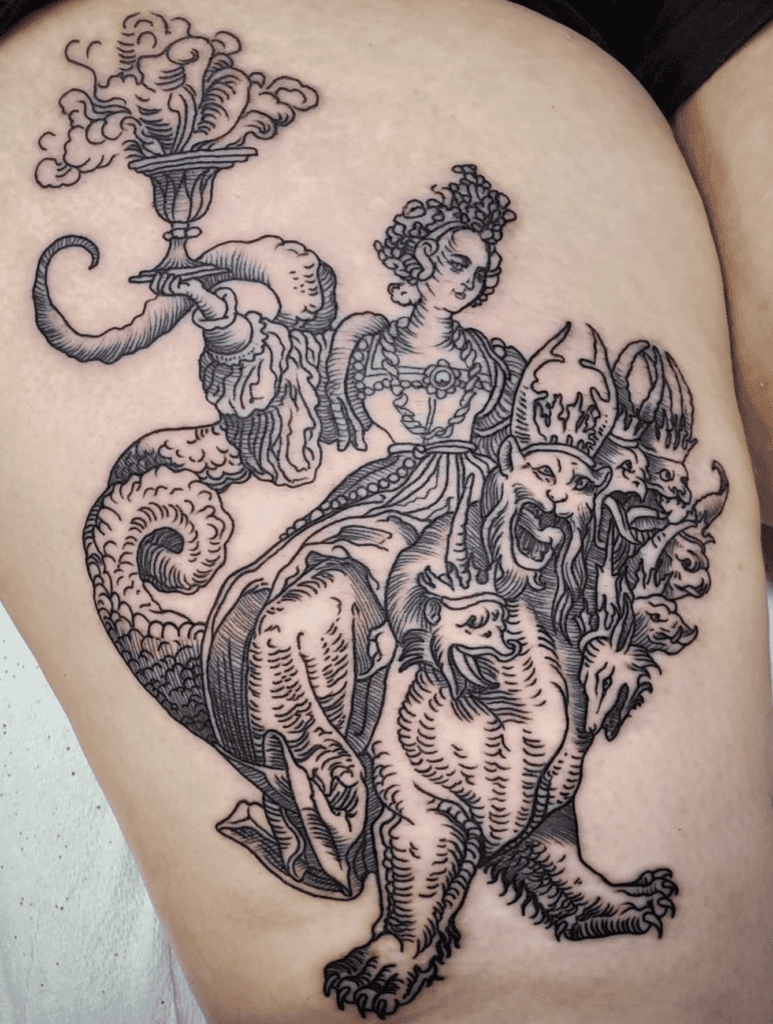
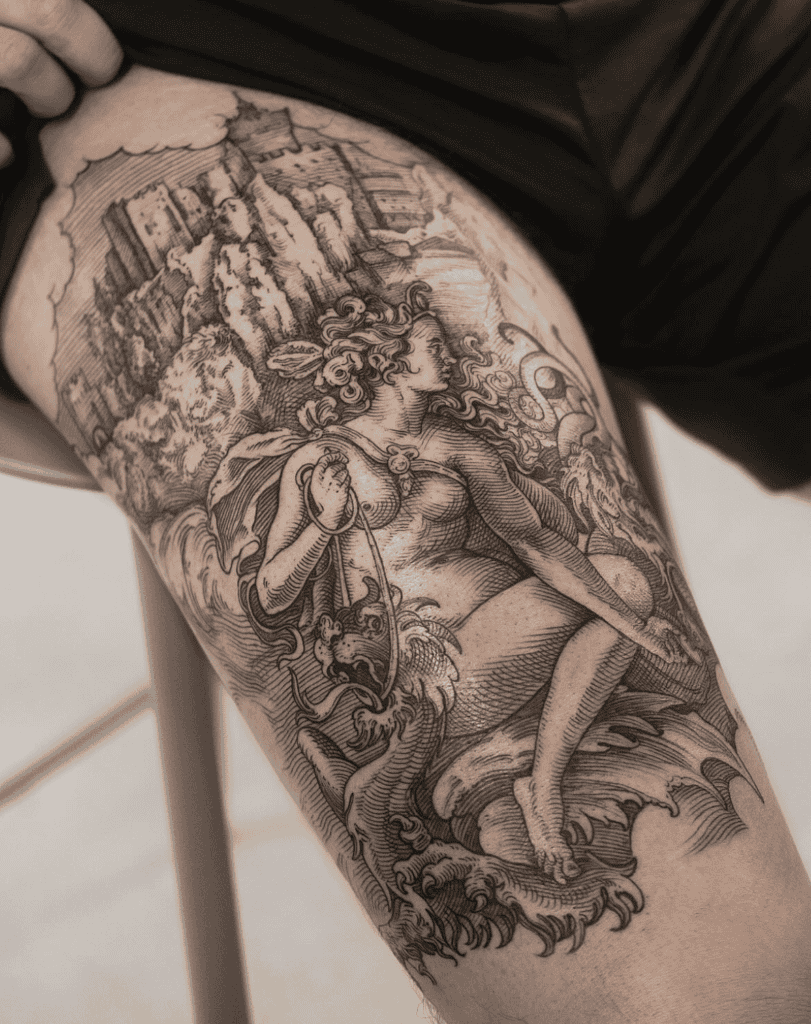
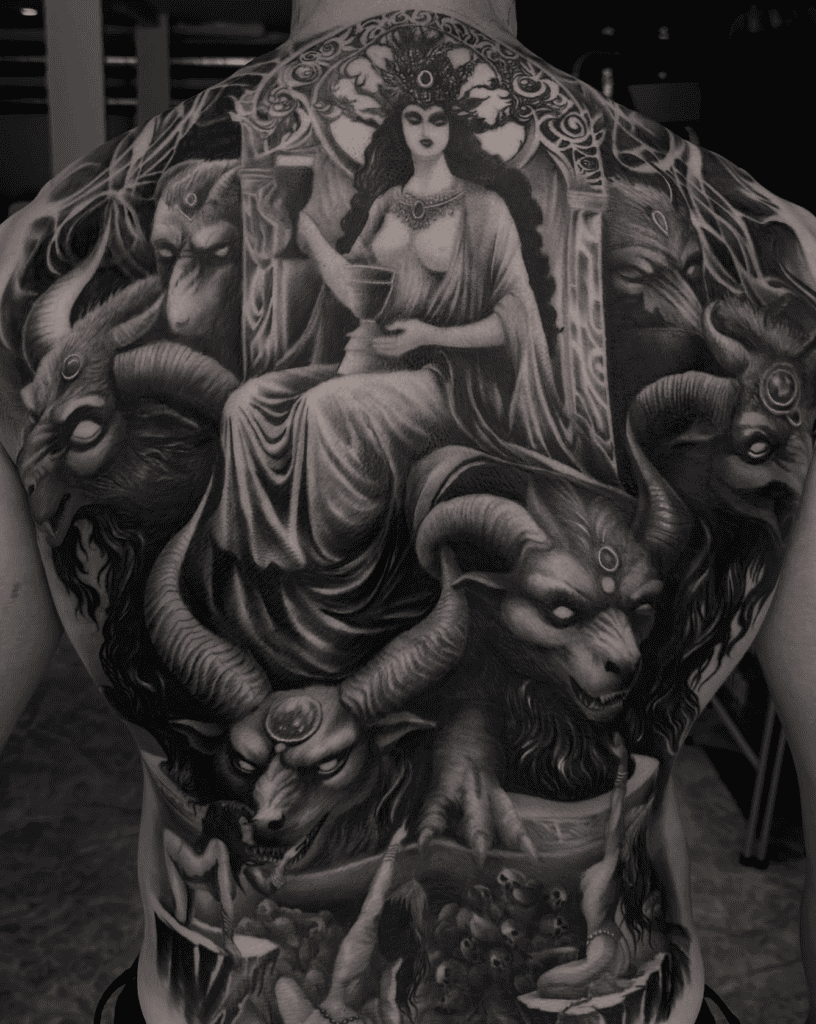
In Christian mythology and biblical prophecy, the Whore of Babylon, also called the Scarlet Woman or Babylon the Great, is a symbolic figure described in the Book of Revelation. She represents corruption, moral decadence, and the seductive power of worldly empires that oppose God. The figure appears as part of the apocalyptic visions revealed to John the Apostle, portraying the downfall of evil powers before the final judgment.
In Revelation, the Whore of Babylon is described as a powerful and mysterious woman dressed in luxurious clothing. She is said to wear purple and scarlet garments, adorned with gold, jewels, and pearls, symbolising immense wealth and influence.
She rides upon a terrifying creature known as the The Beast, which has multiple heads and horns. This imagery represents a corrupt political power that supports her influence. The woman also holds a golden cup filled with abominations, symbolising moral corruption and spiritual deception.
The name “Babylon” carries deep symbolic meaning in Christian mythology. In the Bible, Babylon was an ancient empire known for its wealth, power, and opposition to God’s people. Because of this history, the name became a metaphor for worldly arrogance, oppression, and spiritual corruption. In Revelation, the Whore of Babylon represents the ultimate symbol of such corruption—an empire or system that seduces humanity away from righteousness through luxury, power, and excess.
Adam and Eve Christian Mythology Tattoo
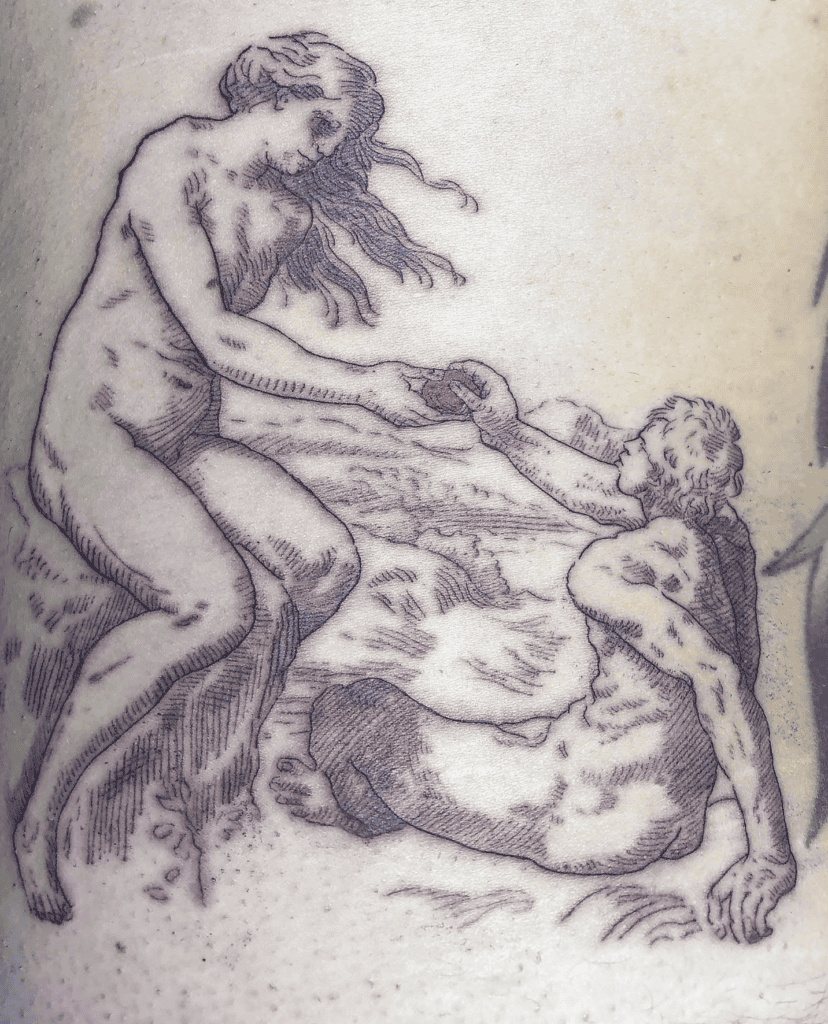
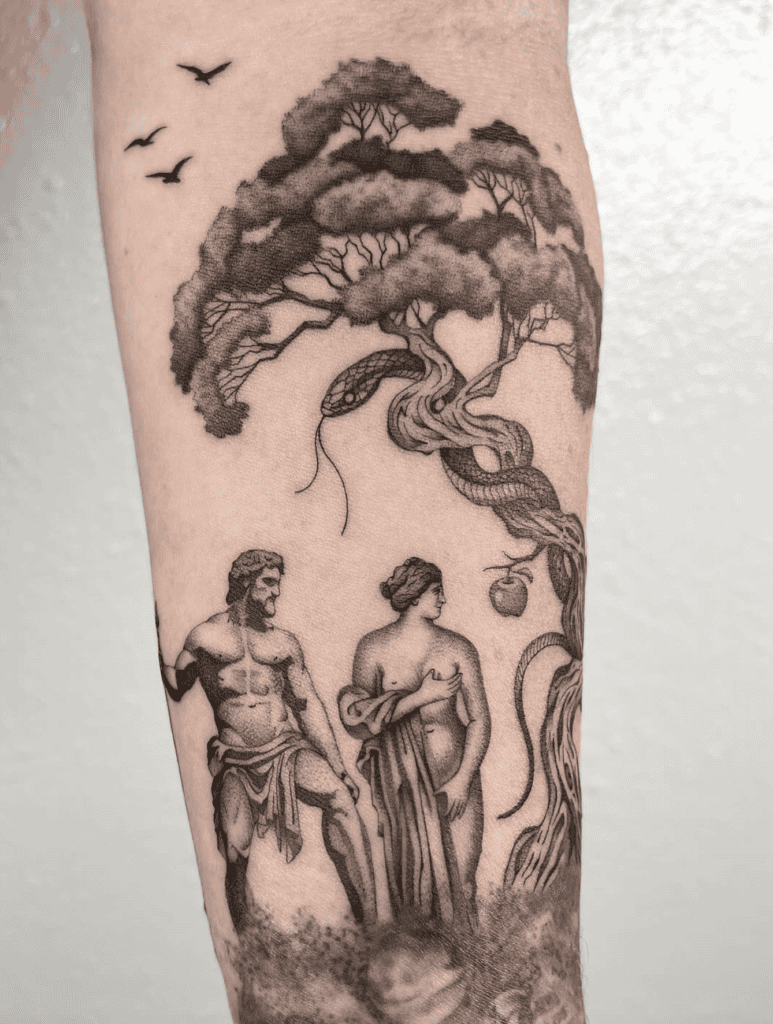
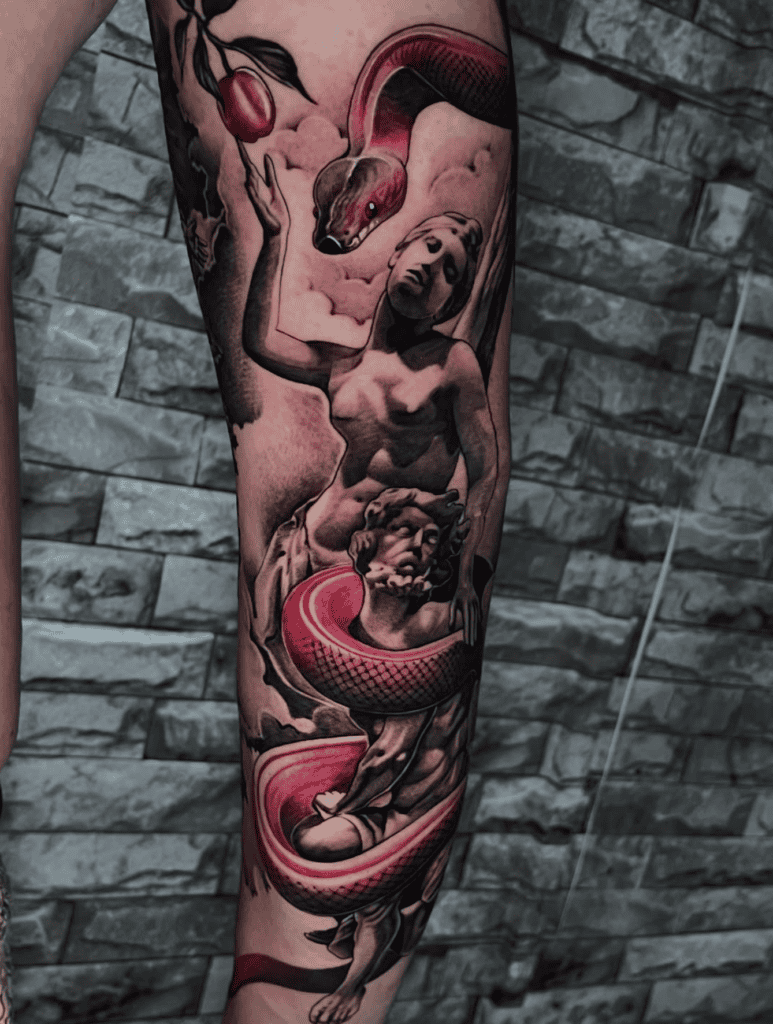
In Christian mythology and biblical tradition, Adam and Eve are considered the first humans created by God. Their story appears in the Book of Genesis and forms the foundation of the Christian understanding of humanity’s origins, the introduction of sin into the world, and the relationship between humans and God.
According to the biblical account, God first created Adam from the dust of the earth and breathed life into him. Adam was placed in a paradise known as the Garden of Eden. Later, God created Eve from one of Adam’s ribs to be his companion. Together, they were entrusted with caring for the garden and enjoying its abundance. However, they were given one important command: they were forbidden to eat fruit from the Tree of the Knowledge of Good and Evil.
The story takes a dramatic turn when a serpent appears in the garden. The serpent persuades Eve to eat the forbidden fruit, claiming that doing so will grant knowledge and make her like God.
After eating the fruit, Eve shares it with Adam, and he eats it as well. This act of disobedience is often referred to as the Fall of Man, because it introduces sin and moral awareness into the world. After eating the forbidden fruit, Adam and Eve suddenly become aware of their vulnerability and shame. When God confronts them about their actions, the consequences of their disobedience are revealed.
They are expelled from the Garden of Eden and must now live in a world filled with hardship, suffering, and mortality. According to the story, this moment marks the beginning of the human condition as we know it.
Garden of Eden Christian Mythology Tattoo

In Christian mythology and biblical tradition, the Garden of Eden is the original paradise created by God as the home of the first humans, Adam and Eve. Described in the Book of Genesis, Eden represents a perfect world where humanity lived in harmony with nature, free from suffering, death, or hardship.
The Garden of Eden is one of the most famous locations in religious mythology and symbolises innocence, divine creation, and the original state of humanity before the introduction of sin. According to the biblical account, God planted the Garden of Eden as a lush and abundant paradise filled with trees, rivers, and animals. Adam and Eve were placed there to live peacefully and care for the garden.
The garden contained many beautiful trees that produced fruit for food. Among them were two especially important trees: the Tree of Life, which symbolised eternal life, and the Tree of the Knowledge of Good and Evil, which represented moral awareness and the power of choice.
The Book of Genesis describes four rivers flowing from the Garden of Eden, nourishing the surrounding lands. These rivers are named as Pishon, Gihon, Tigris, and Euphrates. Two of these rivers—the Tigris and Euphrates—are real rivers in the Middle East, which has led some scholars and historians to speculate about possible real-world inspirations for the Eden story.
Ark of the Covenant Christian Mythology Tattoo

The Ark of the Covenant is one of the most sacred and mysterious objects described in the Bible. It is a golden chest created to hold the stone tablets of the Ten Commandments that God gave to Moses. The Ark symbolised the presence of God among the people of Israel and played a central role in many biblical stories.
According to the Book of Exodus, God instructed Moses to build the Ark using acacia wood and to cover it inside and out with pure gold. The chest was designed to be both sacred and portable so it could be carried by priests during the Israelites’ journey through the wilderness.
The lid of the Ark, called the Mercy Seat, was decorated with two golden Cherubim facing each other with their wings spread outward. The space between these figures symbolised the place where God’s presence would appear. Inside the Ark were the stone tablets containing the Ten Commandments, which represented the covenant between God and humanity.
The Ark of the Covenant was considered so holy that it was kept in the innermost chamber of the Tabernacle, and later the Temple in Jerusalem. Only the high priest was allowed to approach it, and only on special occasions.
In biblical stories, the Ark is often associated with miraculous events and divine power. It was carried into battle, guided the Israelites during their journey, and symbolised God’s protection. One famous story describes how the Ark was carried around the city of Jericho, after which the city’s walls collapsed. Because the Ark represented the presence of God, it was believed to possess immense power. Several biblical stories warn that improper contact with the Ark could lead to severe consequences.
One of the greatest mysteries surrounding the Ark of the Covenant is its eventual disappearance. After the destruction of Jerusalem and its temple by the Babylonians in the 6th century BCE, the Ark was no longer mentioned in historical records. Its fate remains unknown, and many legends and theories have emerged about where it might have been taken or hidden.
Noah’s Ark Christian Mythology Tattoo
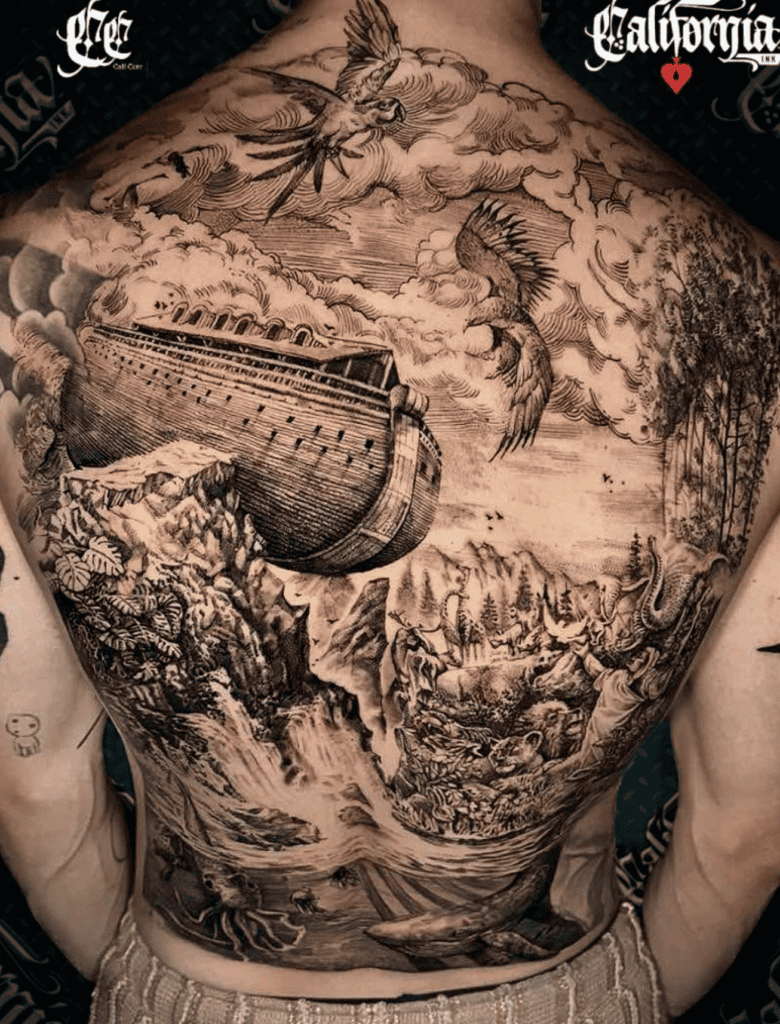
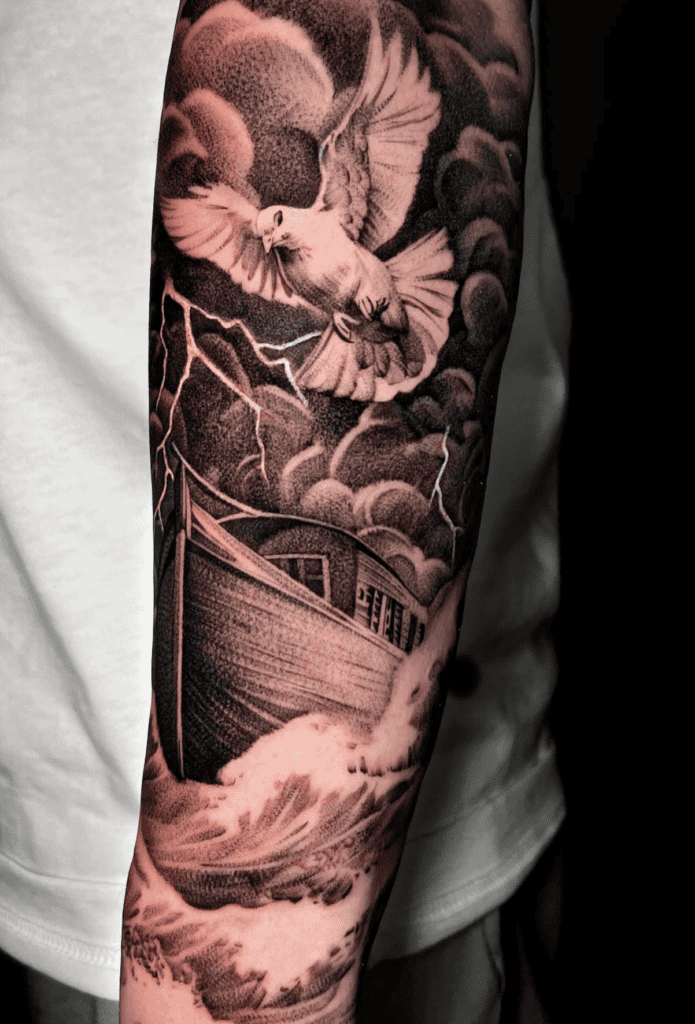
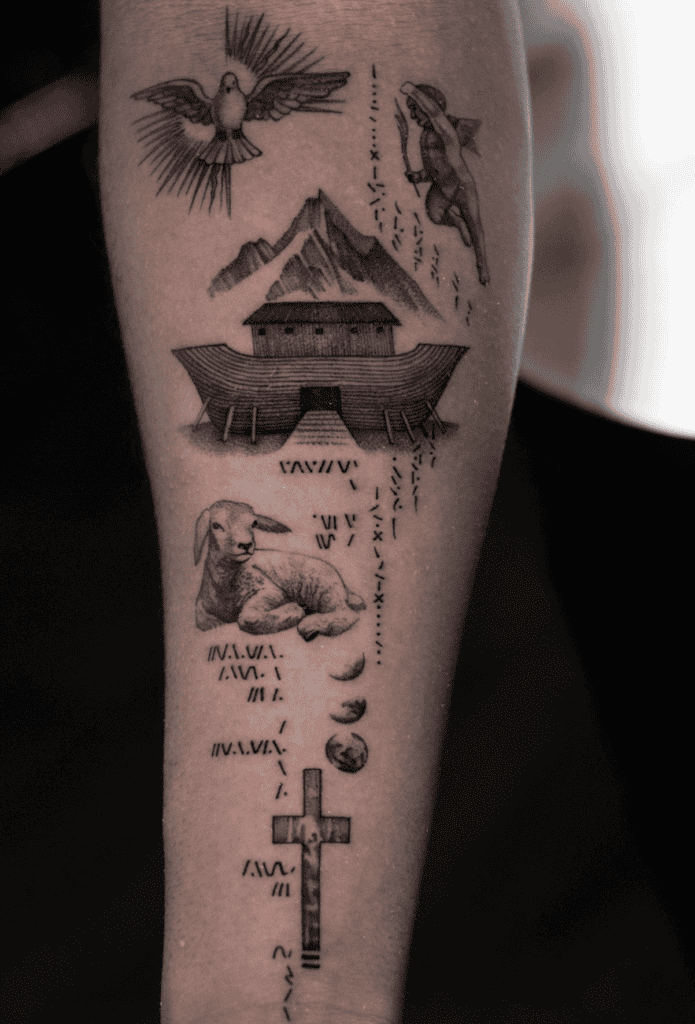
Noah’s Ark is the great vessel built by Noah to survive the catastrophic flood sent by God. The ark was built to preserve Noah, his family, and pairs of every kind of animal during a massive flood meant to cleanse the earth of corruption and wickedness.
According to the biblical story, humanity had become deeply corrupt and violent that God decided to send a great flood to cleanse the earth. However, Noah was described as a righteous man who remained faithful, so God chose him to preserve life and instructed him to build a massive ark.
The ark was to be made from strong wood, sealed with pitch to make it waterproof, and built with several levels and compartments. In Genesis 7:2–3, God commands Noah to bring seven pairs of every clean animal, one pair of every unclean animal, and seven pairs of every kind of bird.
The phrase “two by two” comes from another part of the Genesis narrative (Genesis 6:19–20), where animals are described entering the ark in pairs. Over time, this simplified phrase became the most famous version of the story in art, children’s books, and popular culture.
Once the ark was complete, the rains began to fall, and floodwaters rose across the earth for forty days and forty nights, covering the land and mountains. When the waters began to recede, the ark came to rest on the mountains of Ararat. To determine whether the land had become safe again, Noah released birds from the ark. First, he sent a raven, which did not return and later a dove, which returned carrying an olive leaf. This olive leaf became a symbol that the floodwaters had subsided and that life on earth could begin again.
After leaving the ark, Noah offered thanks to God. In response, God made a covenant with humanity, promising never to destroy the earth by flood again. As a sign of this promise, God placed the rainbow in the sky, which became a lasting symbol of hope, mercy, and renewal.
Moses Christian Mythology Tattoo
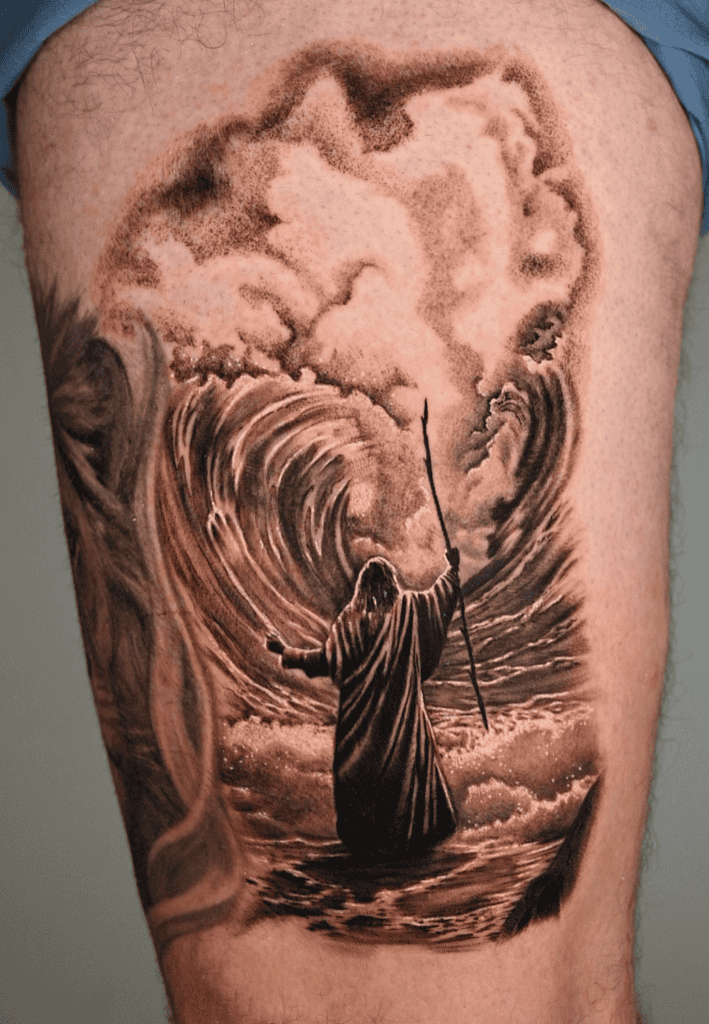
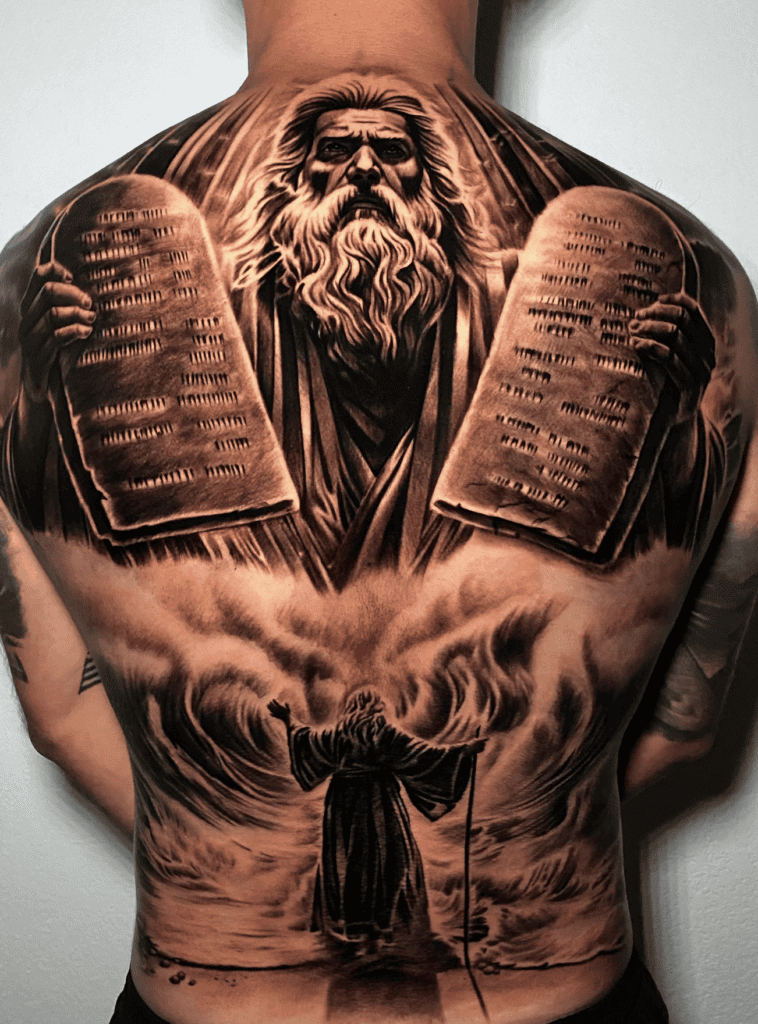
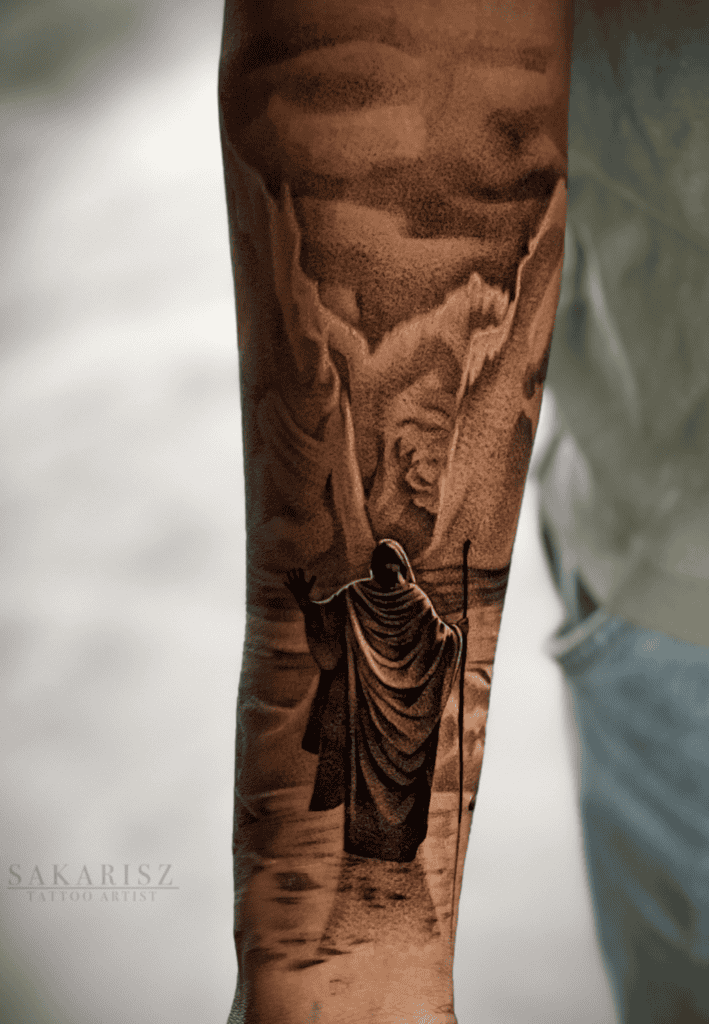
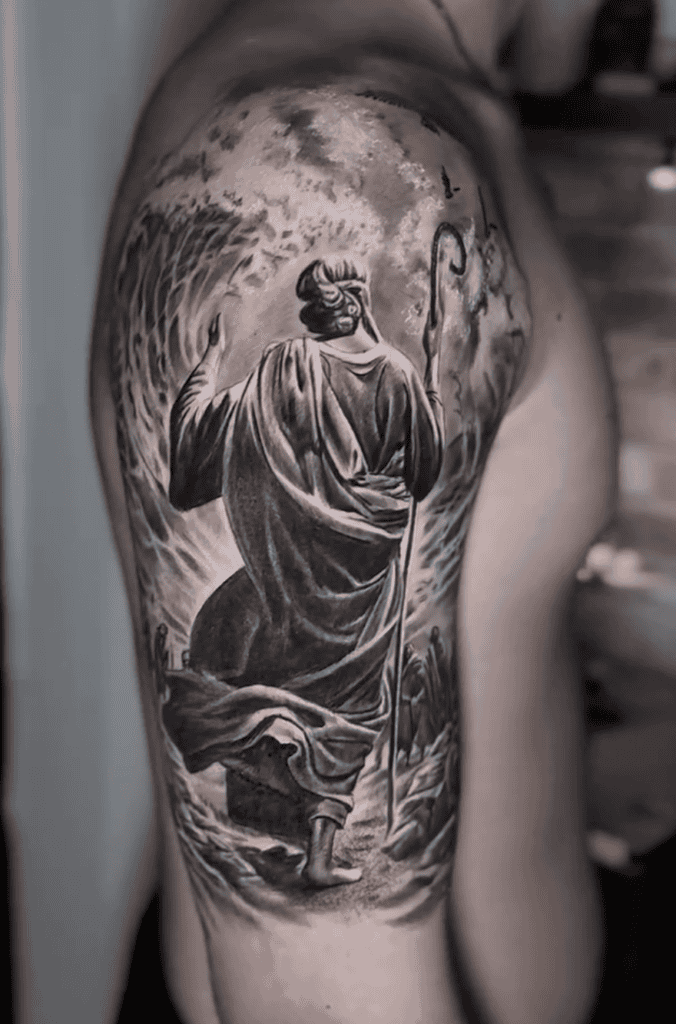
In Christian mythology and biblical tradition, Moses is one of the most important figures in the Bible. He is remembered as the prophet who led the Israelites out of slavery in Egypt, received the Ten Commandments from God, and helped establish the laws and covenant that shaped the early religious identity of the people of Israel.
According to the biblical story, Moses was born during a time when the Egyptian ruler had ordered that Hebrew male infants be killed. To protect her child, Moses’ mother placed him in a basket and set him afloat on the Nile River. The baby was discovered and adopted by the daughter of the Egyptian Pharaoh, allowing Moses to grow up within the royal household while still belonging to the Hebrew people.
One of the most famous moments in Moses’ story occurs when he encounters a mysterious burning bush while tending sheep in the wilderness. The bush appears to burn without being consumed. From within the flame, God speaks to Moses and commands him to return to Egypt and free the Israelites from slavery.
Moses confronts Pharaoh and demands the release of the Israelites. When Pharaoh refuses, a series of devastating events—known as the Ten Plagues—strike Egypt. After the final plague, Pharaoh finally allows the Israelites to leave. Moses then leads his people out of Egypt in an event known as the Exodus. One of the most famous moments of this journey occurs when Moses parts the Red Sea, allowing the Israelites to cross safely before the waters close behind them.
Later in the journey, Moses climbs Mount Sinai where he receives the Ten Commandments, sacred laws that define the covenant between God and the Israelites. These commandments become a foundational element of biblical law and morality, influencing religious and ethical traditions for centuries. The tablets containing these commandments were later placed inside the Ark of the Covenant, which symbolised God’s presence among the people.
Throughout the journey in the wilderness, Moses serves as a guide and mediator between God and the Israelites. Despite many hardships and moments of doubt among the people, he continues to lead them toward the Promised Land. However, according to the biblical story, Moses himself does not enter the Promised Land. Instead, he views it from Mount Nebo before his death, leaving the final stage of the journey to the next generation.
King David Christian Mythology Tattoo
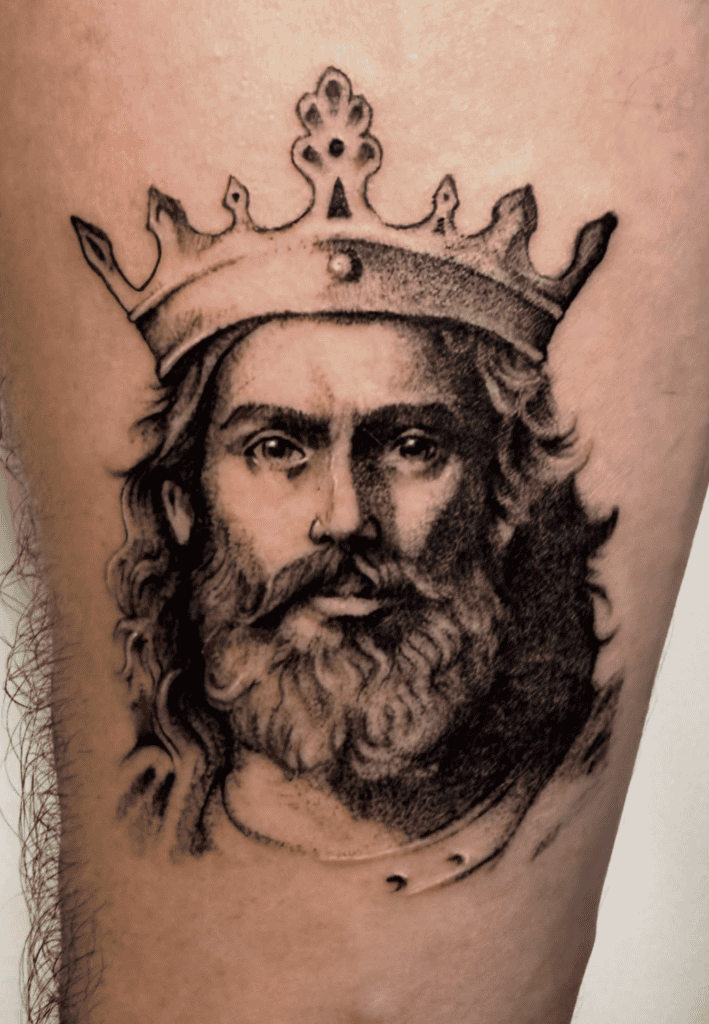
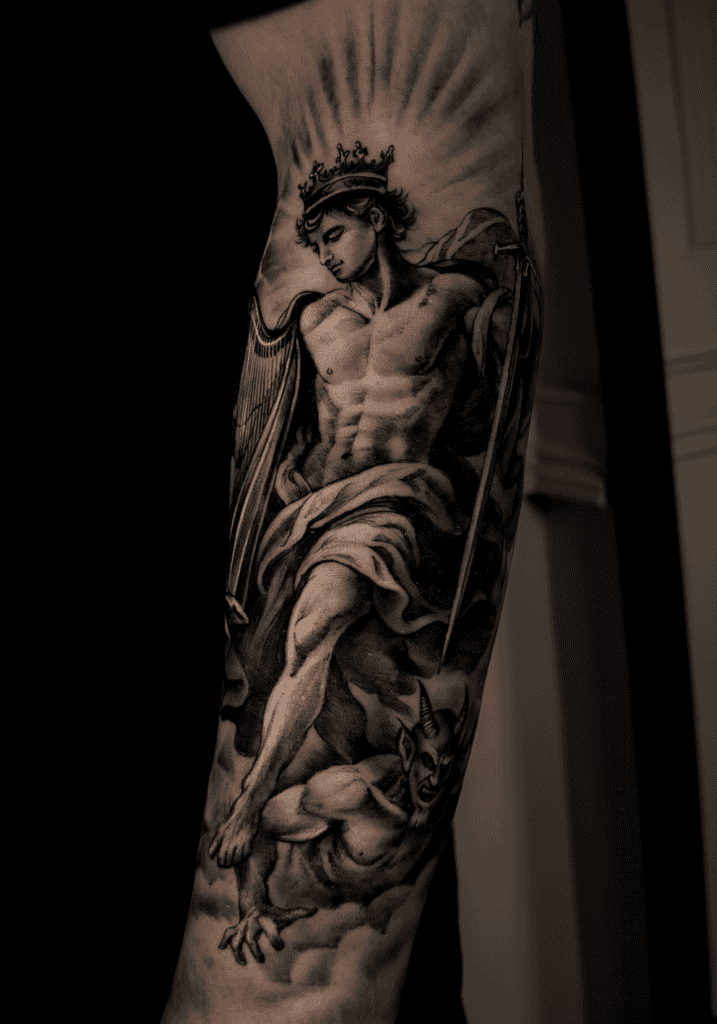
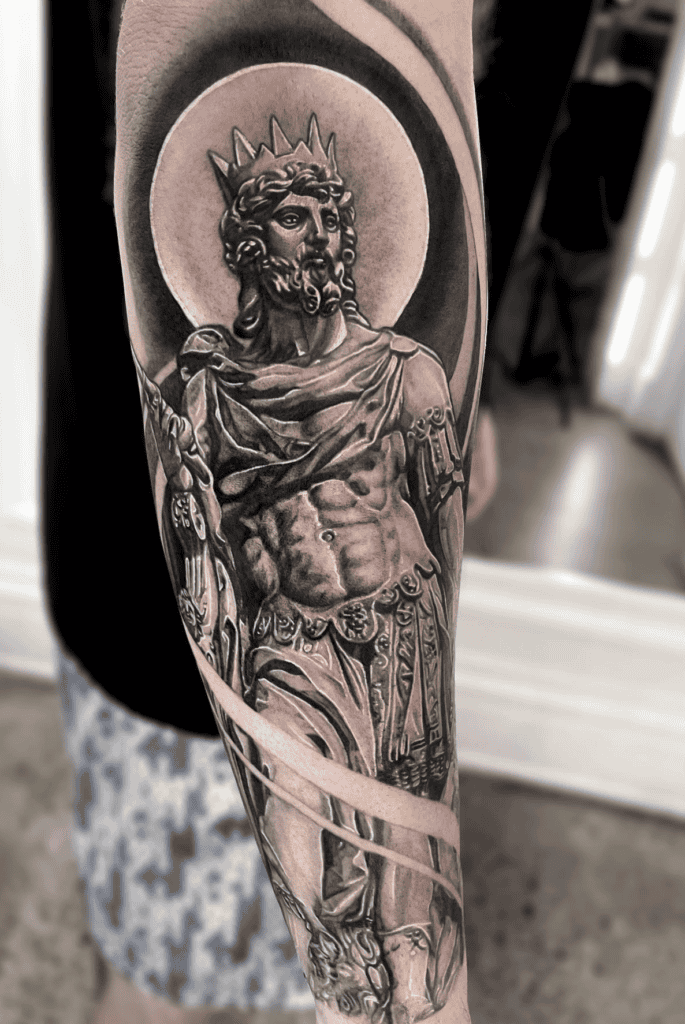
King David is one of the most important and legendary rulers of ancient Israel. He is remembered as a warrior, poet, musician, and king who united the tribes of Israel and established Jerusalem as the centre of his kingdom. David is also significant because Christian tradition sees him as an ancestor of Jesus Christ, linking his royal line to later religious prophecy.
David’s story begins as the youngest son in a humble family of shepherds. According to the Bible, the prophet Samuel was guided by God to anoint David as the future king of Israel, even though he appeared to be an unlikely choice. At this time Israel was ruled by King Saul, and David initially served in Saul’s court as a musician who played the harp to soothe the troubled king.
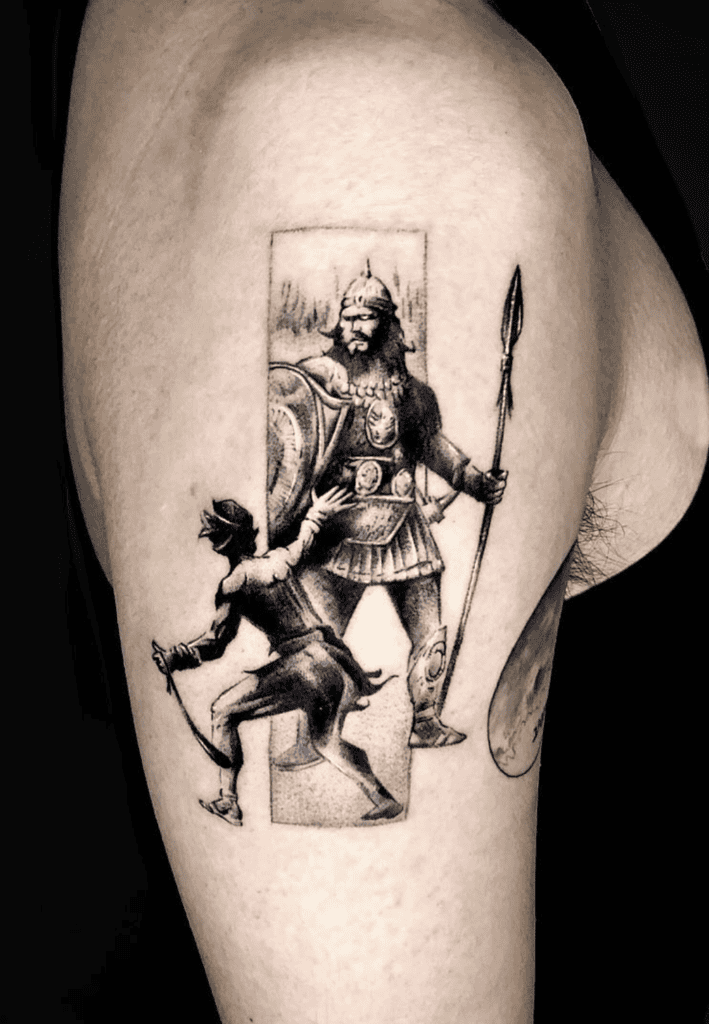
One of the most famous stories in the Bible tells of David’s battle with the giant Goliath. When the Philistine army challenged Israel, Goliath—an enormous warrior—offered to fight a single champion to decide the battle.
Despite being only a young shepherd, David volunteered to face him. Armed only with a sling and a stone, David struck Goliath in the forehead, defeating the giant and securing victory for Israel.
After years of conflict and political struggle following Saul’s death, David eventually became king. He united the tribes of Israel and established Jerusalem as the capital of his kingdom. David also brought the sacred Ark of the Covenant to Jerusalem, reinforcing the city’s role as both the political and religious centre of Israel. His reign is often remembered as a golden age of strength and unity for the kingdom.
King Solomon Christian Mythology Tattoo


Solomon was the son of King David and one of the most famous rulers of ancient Israel, remembered for his extraordinary wisdom, wealth, and the construction of the first great temple in Jerusalem.
One of the most famous stories about Solomon describes how he became known for his wisdom. According to the biblical account, God appeared to Solomon in a dream and offered to grant him anything he desired. Instead of asking for wealth or power, Solomon asked for wisdom to govern his people well. Pleased by this humble request, God granted Solomon exceptional wisdom and understanding, along with great wealth and honour.
Perhaps the most famous example of Solomon’s wisdom appears in the story known as the Judgment of Solomon. Two women came before the king, each claiming to be the mother of the same child. To determine the truth, Solomon proposed cutting the child in half and giving each woman a portion. The real mother immediately begged the king to give the child to the other woman to save its life. Recognising her compassion, Solomon declared her to be the true mother.
One of Solomon’s greatest achievements was building the magnificent Temple in Jerusalem, often called Solomon’s Temple. This temple became the central place of worship for the Israelites and housed the sacred Ark of the Covenant, which represented the presence of God among the people.
Despite his wisdom, Solomon’s later years were marked by spiritual decline. According to the biblical story, he formed alliances through many marriages to foreign princesses. Over time, these influences led him to allow the worship of other gods within his kingdom. This shift eventually contributed to political tension and the weakening of the kingdom after his death.
Samson Christian Mythology Tattoo
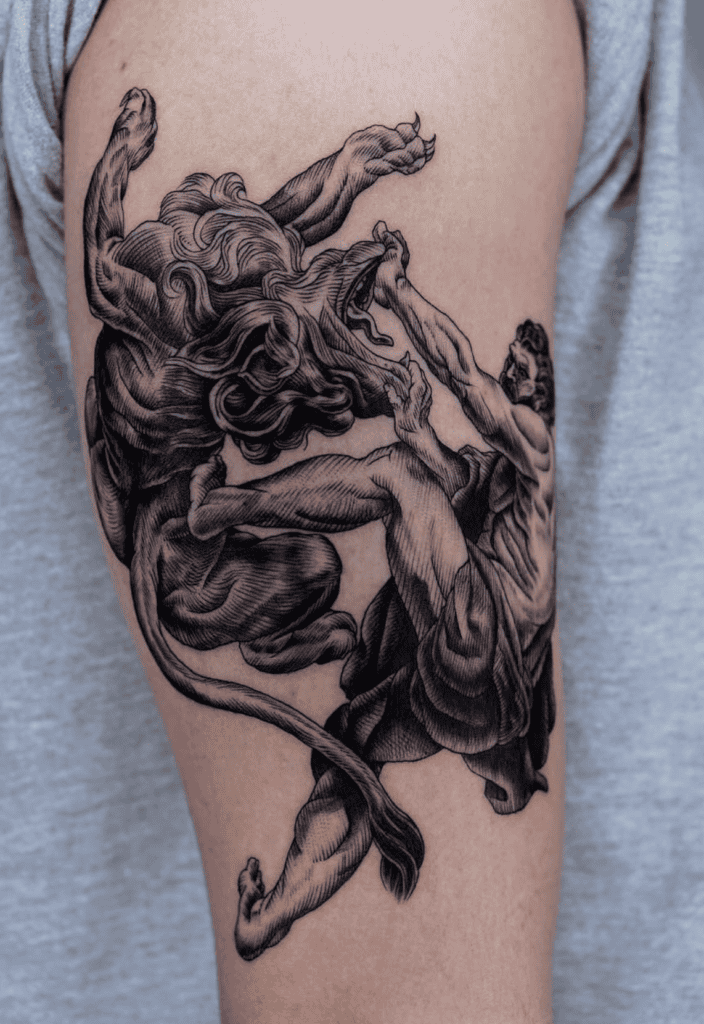
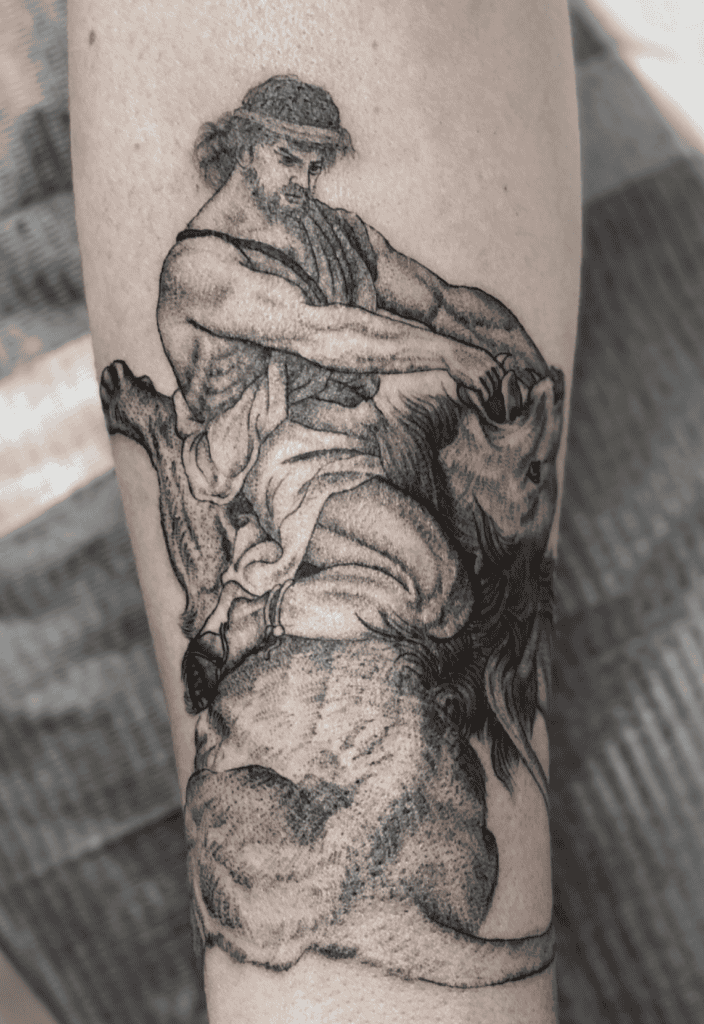
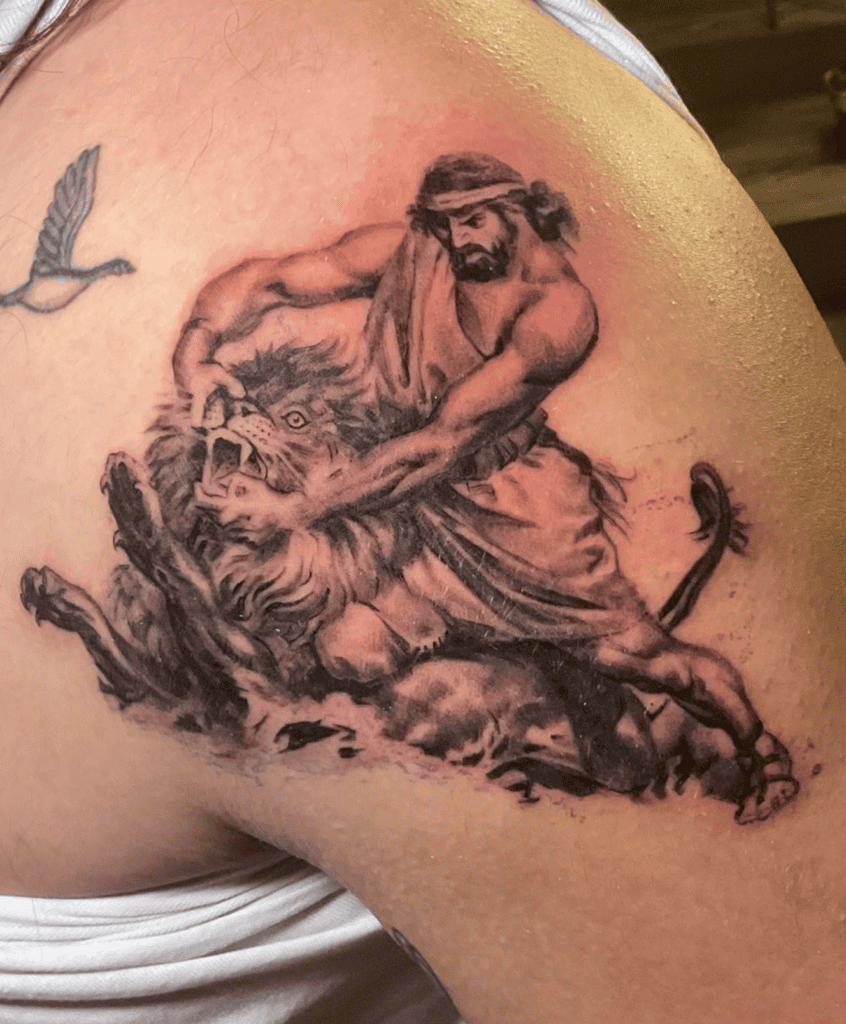
Samson is one of the most famous heroes of ancient Israel. His story appears in the Book of Judges and is known for its dramatic themes of strength, betrayal, and redemption. Samson was said to possess extraordinary physical power granted by God, making him one of the strongest figures in biblical history.
Samson’s story begins with a divine promise. His mother, who had previously been unable to have children, was visited by an angel who foretold that she would give birth to a son destined to deliver Israel from its enemies. The child was to be raised as a Nazirite, meaning he was dedicated to God from birth. As part of this vow, Samson was never to cut his hair, drink alcohol, or touch anything unclean.
Throughout his life, Samson demonstrated astonishing feats of strength. One famous story tells of how he killed a lion with his bare hands. In another episode, he defeated an entire group of enemies using only the jawbone of a donkey. Samson also once tore the gates of a city from their hinges and carried them away, demonstrating the extraordinary power granted to him.
One of the most well-known parts of Samson’s story involves his relationship with Delilah. Delilah was persuaded by the Philistines to discover the secret of Samson’s strength. After repeatedly questioning him, Samson eventually revealed that his power came from his Nazirite vow and his uncut hair. While he slept, Delilah arranged for his hair to be cut, causing him to lose his strength. The Philistines then captured Samson, blinded him, and imprisoned him.
Despite his downfall, Samson’s story ends with a dramatic moment of redemption. While imprisoned, his hair began to grow again, symbolising the return of his connection to God.
During a public gathering in a Philistine temple, Samson prayed for strength one final time. He pushed against the pillars supporting the structure, causing the entire building to collapse. This act destroyed the temple and defeated many of Israel’s enemies, marking Samson’s final sacrifice.
John the Baptist Christian Mythology Tattoo


John the Baptist is a prophetic figure who prepared the way for the ministry of Jesus Christ. He is remembered as a powerful preacher who called people to repentance and performed baptisms as a sign of spiritual renewal. He is considered one of the last great prophets before the appearance of Jesus and plays an important role in the transition from the Old Testament prophetic tradition to the New Testament story.
John’s birth was foretold by an angel to his father, Zechariah, who was a priest in the Temple of Jerusalem. His mother, Elizabeth, was said to be a relative of Mary. Like several other important biblical figures, John’s birth was seen as miraculous because his parents were elderly and had previously been unable to have children.
John became known for preaching in the wilderness of Judea. He lived a very simple life, wearing clothing made from camel’s hair and eating food such as locusts and wild honey.
His message focused on repentance and preparation for the coming of God’s kingdom. Many people travelled from cities and villages to hear him preach. John baptised people in the Jordan River, symbolising the cleansing of sins and a fresh start in their spiritual lives.
One of the most significant moments in the New Testament occurs when Jesus comes to John to be baptised. At first, John hesitates, believing that he himself should be baptised by Jesus. However, he eventually agrees. According to the Gospel accounts, when Jesus is baptised, the heavens open and the Spirit of God descends like a dove.
John’s bold preaching eventually brought him into conflict with Herod Antipas, the ruler of Galilee. John publicly criticised Herod for marrying Herodias, the wife of his brother. Because of this criticism, John was arrested and imprisoned.
John’s story ends with a dramatic and tragic event. During a banquet held by Herod, a dance performed by Herodias’s daughter pleased the ruler. As a reward, he promised to grant her any request. At the urging of her mother, she asked for the head of John the Baptist. Although reluctant, Herod ordered the execution, and John was beheaded.
St. Peter Christian Mythology Tattoo
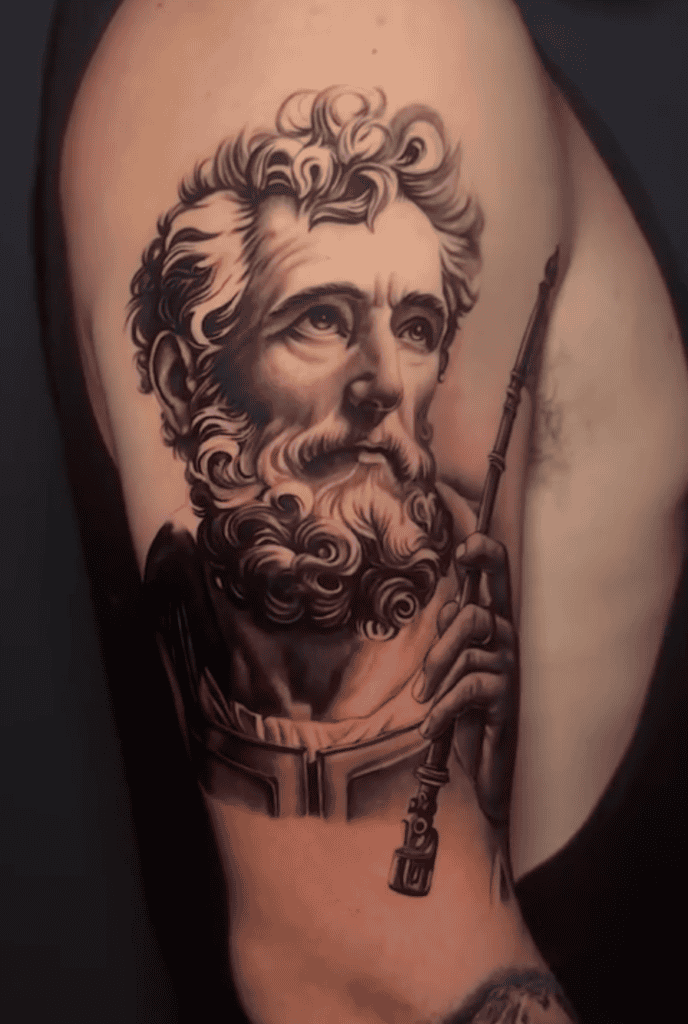
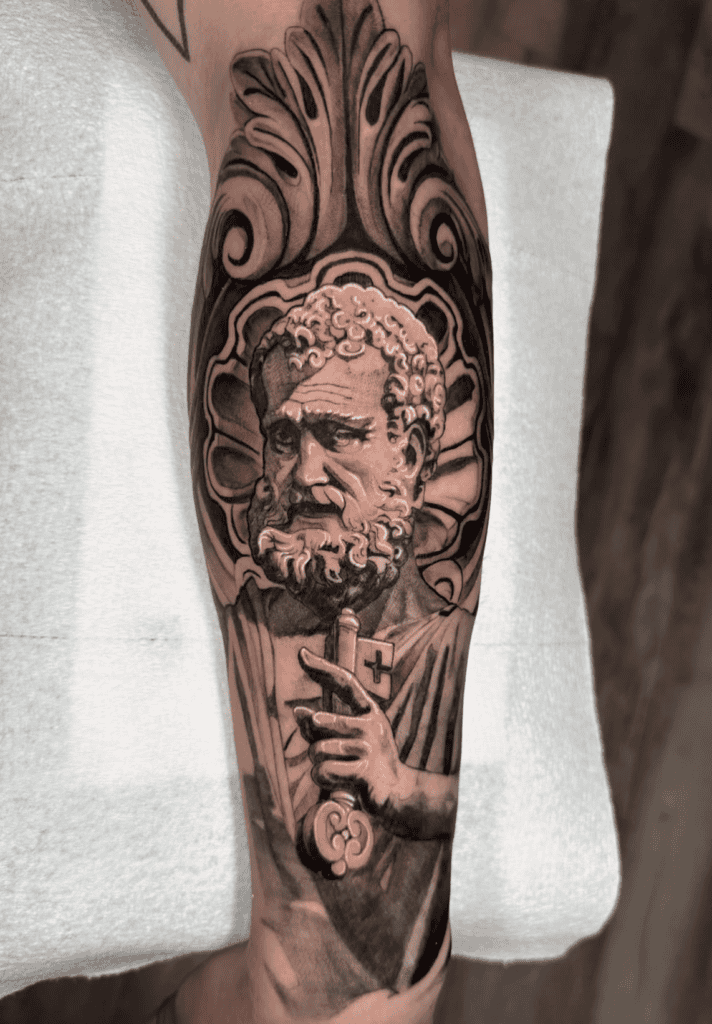
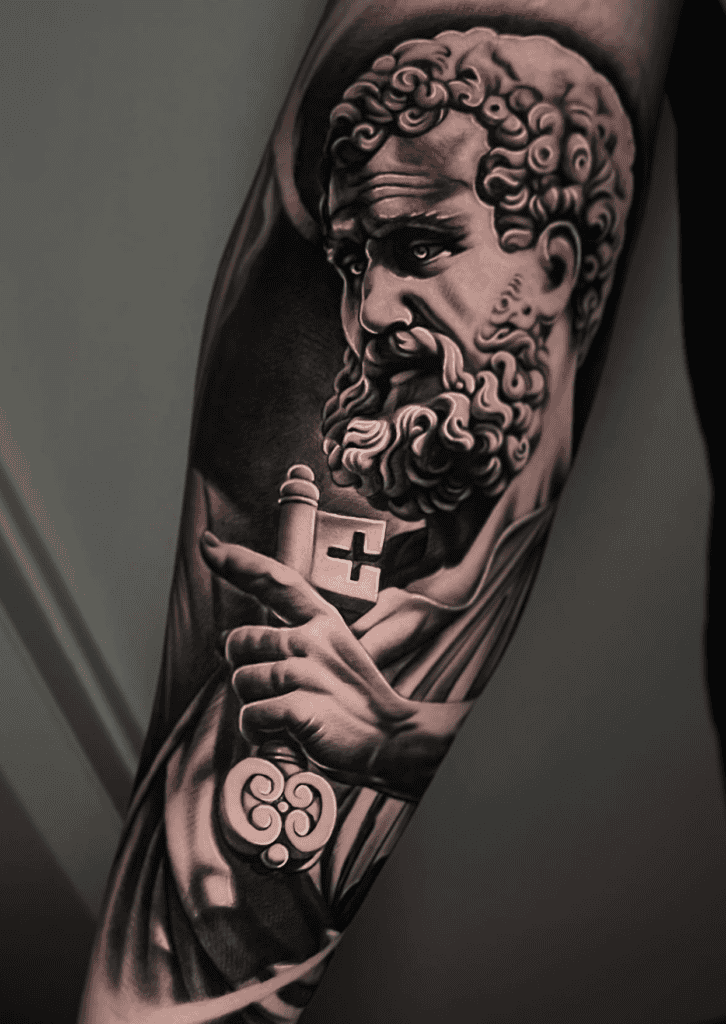
Peter the Apostle, commonly known as Saint Peter, is one of the most important disciples of Jesus Christ. He is often regarded as the leader of the apostles and a foundational figure in the early Christian church. Originally a fisherman named Simon, he was given the name Peter, meaning “rock,” symbolising the strength and leadership he would bring to the Christian community.
Peter lived as a fisherman on the Sea of Galilee before meeting Jesus. According to the Gospel accounts, Jesus called Peter and his brother Andrew to follow him, promising that they would become “fishers of men.” Peter quickly became one of Jesus’ closest followers and frequently appears in key moments throughout the New Testament.
Peter is often portrayed as passionate and impulsive. In one famous story, he steps out of a boat and briefly walks on water toward Jesus before losing faith and beginning to sink. Another well-known moment occurs during the arrest of Jesus. Although Peter had promised unwavering loyalty, he later denied knowing Jesus three times out of fear. Despite this failure, Peter later repents and becomes one of the most influential leaders among Jesus’ followers.
One of the most significant moments in Peter’s story occurs when Jesus declares that Peter will become the foundation of the church. Jesus tells him that he will receive the “keys of the kingdom of heaven.” Because of this passage, Peter is often depicted in Christian art holding two keys, symbolising spiritual authority and leadership.
After the death and resurrection of Jesus, Peter became a leading figure among the apostles. He preached widely, spreading the teachings of Christianity and helping establish early Christian communities. According to Christian tradition, Peter eventually travelled to Rome, where he continued his ministry and played a key role in the growth of the early church.
Peter’s life is believed to have ended during a period of persecution under the Roman Empire. According to tradition, he was sentenced to death by crucifixion. However, Peter reportedly asked to be crucified upside down, believing that he was not worthy to die in the same manner as Jesus.
St. Paul Christian Mythology Tattoo
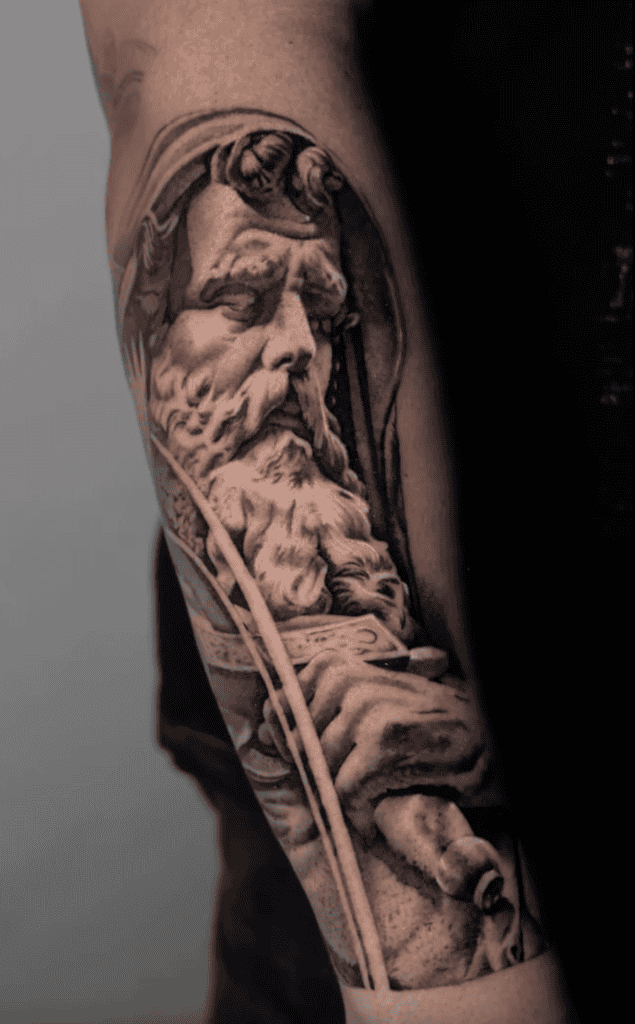
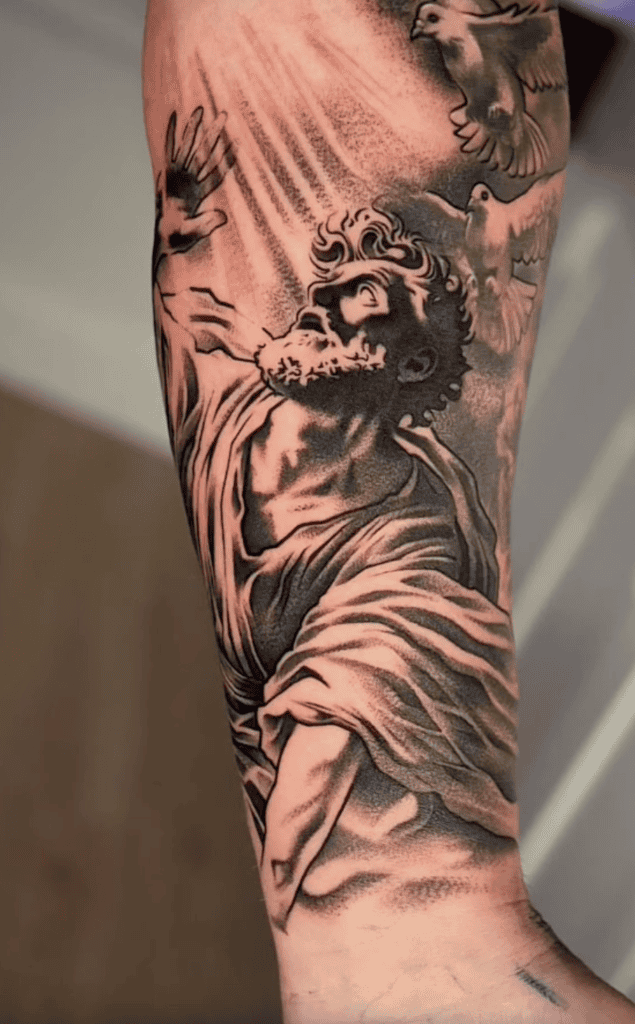
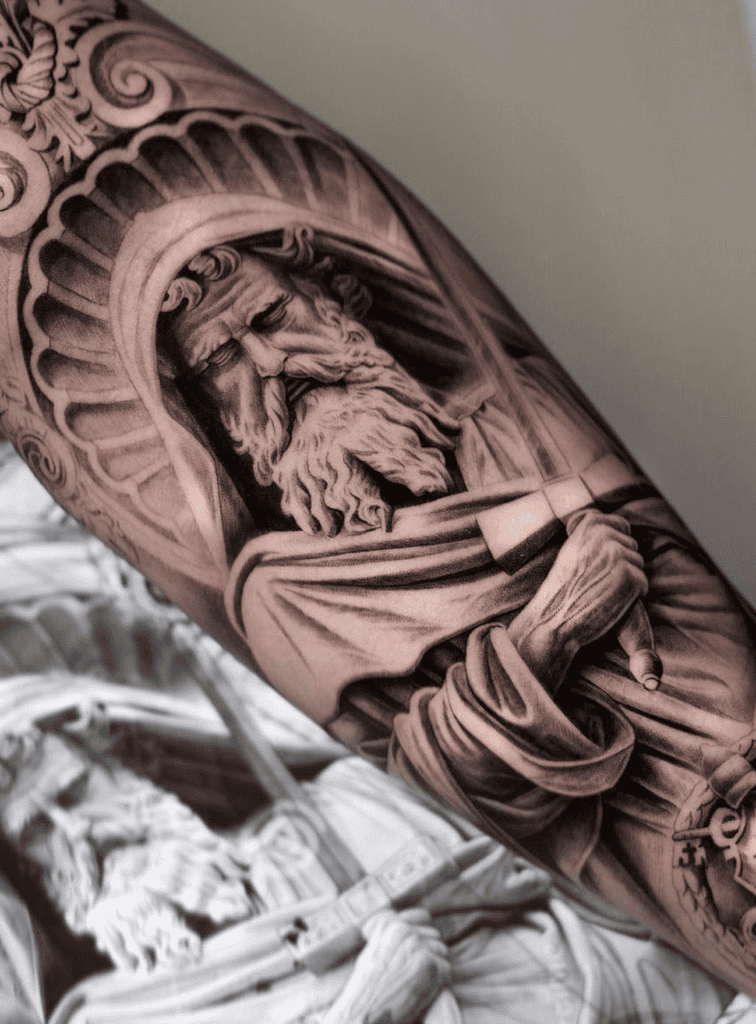
Paul the Apostle, often called Saint Paul, was not one of the original twelve disciples of Jesus Christ, but played a crucial role in spreading Christian teachings throughout the Roman world. Paul was originally known as Saul of Tarsus, a Jewish Pharisee who strongly opposed the early Christian movement. At first, he actively persecuted followers of Jesus and supported efforts to stop the spread of Christianity. However, his life changed dramatically during a journey to the city of Damascus.
According to the New Testament, Saul experienced a powerful vision while travelling to Damascus. A bright light from heaven suddenly surrounded him, and he heard the voice of Jesus asking why he was persecuting him.
The experience left Saul temporarily blind and deeply shaken. After regaining his sight, he embraced Christianity and was baptised, transforming from a persecutor of Christians into one of their most passionate advocates. After this event, he became widely known as Paul.
Paul travelled extensively throughout the eastern Roman Empire, preaching the message of Christianity and establishing early Christian communities. His journeys took him through regions such as Asia Minor, Greece, and eventually Rome.
He faced many hardships during these travels, including imprisonment, persecution, and dangerous journeys by land and sea. Despite these challenges, Paul’s teachings helped spread Christianity far beyond its original Jewish context.
According to Christian tradition, Paul was eventually arrested and taken to Rome during a time of persecution against Christians. Unlike Peter the Apostle, who was crucified, Paul was believed to have been executed by beheading, a form of execution often given to Roman citizens.
Mary Magdalene Christian Mythology Tattoo


Mary Magdalene is one of the most prominent female followers of Jesus Christ, remembered for her devotion and loyalty, and for being one of the first witnesses to the resurrection of Jesus. Her name “Magdalene” refers to the town of Magdala, a fishing village on the Sea of Galilee, indicating where she likely came from.
According to the Gospels, Mary Magdalene became a follower of Jesus after he healed her from spiritual afflictions. She then travelled with Jesus and his disciples, supporting his ministry along with several other women. Unlike many followers who fled during difficult moments, Mary Magdalene remained present during some of the most important events in the New Testament story.
Mary Magdalene is described as being present during the crucifixion of Jesus. While many of the disciples had fled in fear, she remained near the cross along with a small group of followers.
One of the most significant roles Mary Magdalene plays in Christian tradition occurs after the burial of Jesus. She visits the tomb where Jesus had been placed and discovers that the stone covering the entrance has been rolled away. According to the Gospel accounts, she encounters the resurrected Jesus and becomes the first person to witness his return.
Judas Iscariot Christian Mythology Tattoo

Judas Iscariot is remembered as the disciple who betrayed Jesus Christ. He was one of the twelve apostles chosen to follow Jesus, yet his actions ultimately led to Jesus’ arrest and crucifixion. Judas Iscariot was originally a trusted member of Jesus’ inner circle. As one of the twelve apostles, he travelled with Jesus and participated in the ministry that spread throughout Judea and Galilee.
The most famous event involving Judas occurs shortly before the arrest of Jesus. Judas secretly agrees to help the religious authorities identify Jesus in exchange for thirty pieces of silver. Because Jesus often travelled with many followers, the authorities needed a way to confirm his identity. Judas leads the guards to Jesus and identifies him with a kiss—a moment now famously known as the “Kiss of Judas.” This act signals the soldiers to arrest Jesus.
After Jesus is condemned, Judas is described as feeling deep remorse for his actions. According to the Gospel of Matthew, he returns the silver he had received and throws it into the temple. Overcome with guilt, Judas ultimately takes his own life. The field purchased with the returned silver later became known as the Field of Blood, a place associated with the tragic outcome of his betrayal.
Cross Christian Mythology Tattoo
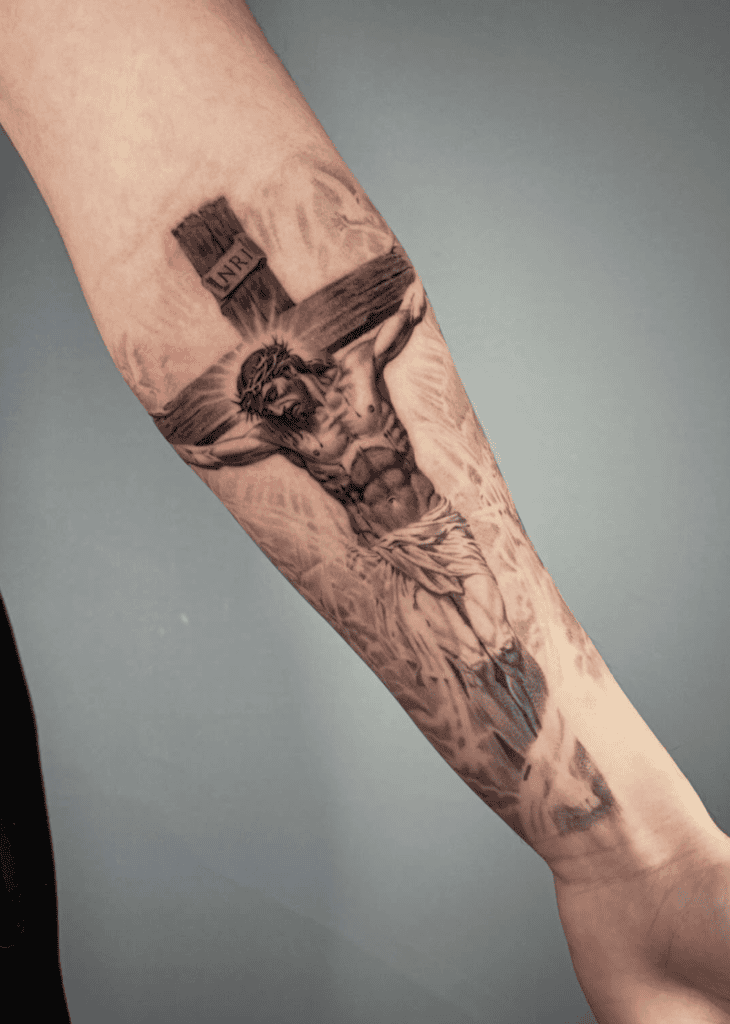
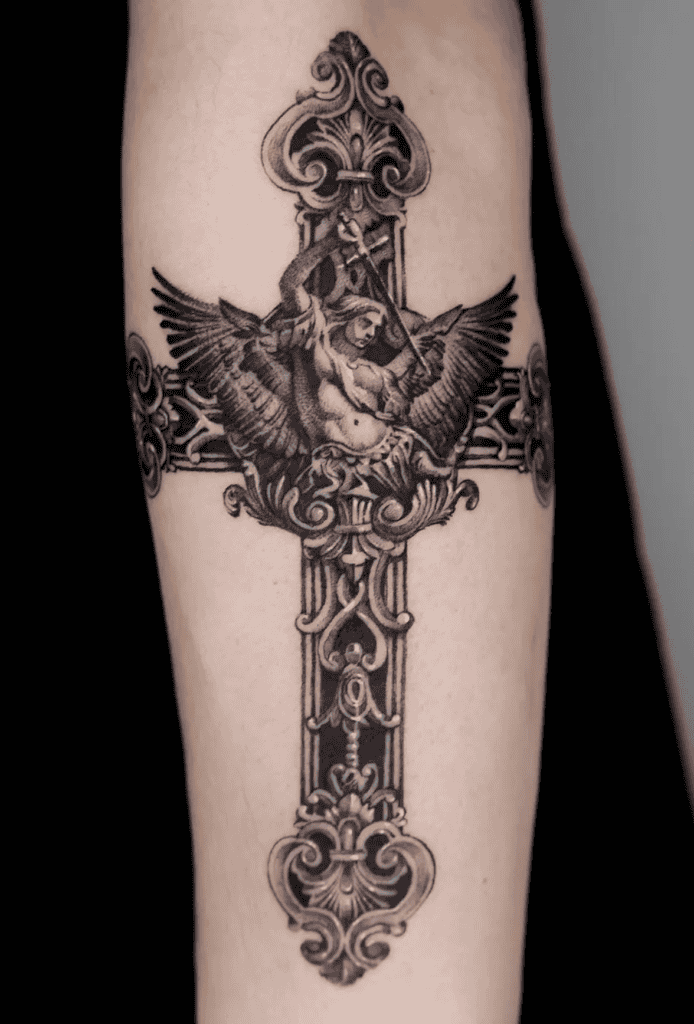
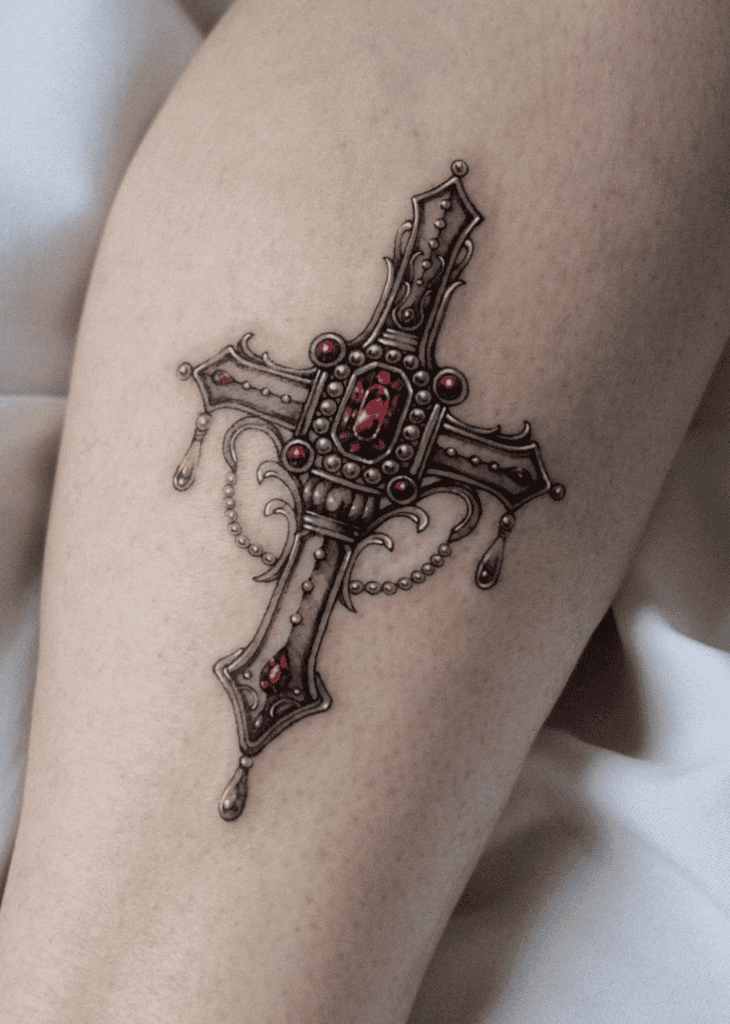
The Christian Cross represents the crucifixion of Jesus Christ, as well as the ideas of sacrifice, redemption, and salvation. Although the cross originally served as a Roman method of execution, it eventually became a powerful symbol of hope and spiritual transformation within Christianity.
The cross is most closely associated with the crucifixion of Jesus, which took place under the authority of Pontius Pilate. According to the New Testament, Jesus was sentenced to death by crucifixion and carried the wooden cross to the place of execution.
This event is considered central to Christian belief, as Christians understand Jesus’ death on the cross as an act of sacrifice for humanity’s sins. Because of this meaning, the cross became a lasting symbol of forgiveness, redemption, and divine love.
Ichthys Christian Mythology Tattoo


In Christian mythology and religious symbolism, the Ichthys—often called the Christian fish—is one of the earliest symbols used by followers of Jesus Christ. The symbol is typically drawn as a simple outline of a fish and has been associated with Christianity for nearly two thousand years.
The name Ichthys comes from the Greek word for “fish”, but it also carries a deeper meaning through an acronym used by early Christians.
In ancient Greek, the letters that spell Ichthys (ΙΧΘΥΣ) form an acronym representing a short statement of faith:
I – Iēsous (Jesus)
CH – Christos (Christ)
TH – Theou (of God)
Y – Yios (Son)
S – Sōtēr (Saviour)
Together, the phrase translates to “Jesus Christ, Son of God, Saviour.”
Lamb of God Christian Mythology Tattoo
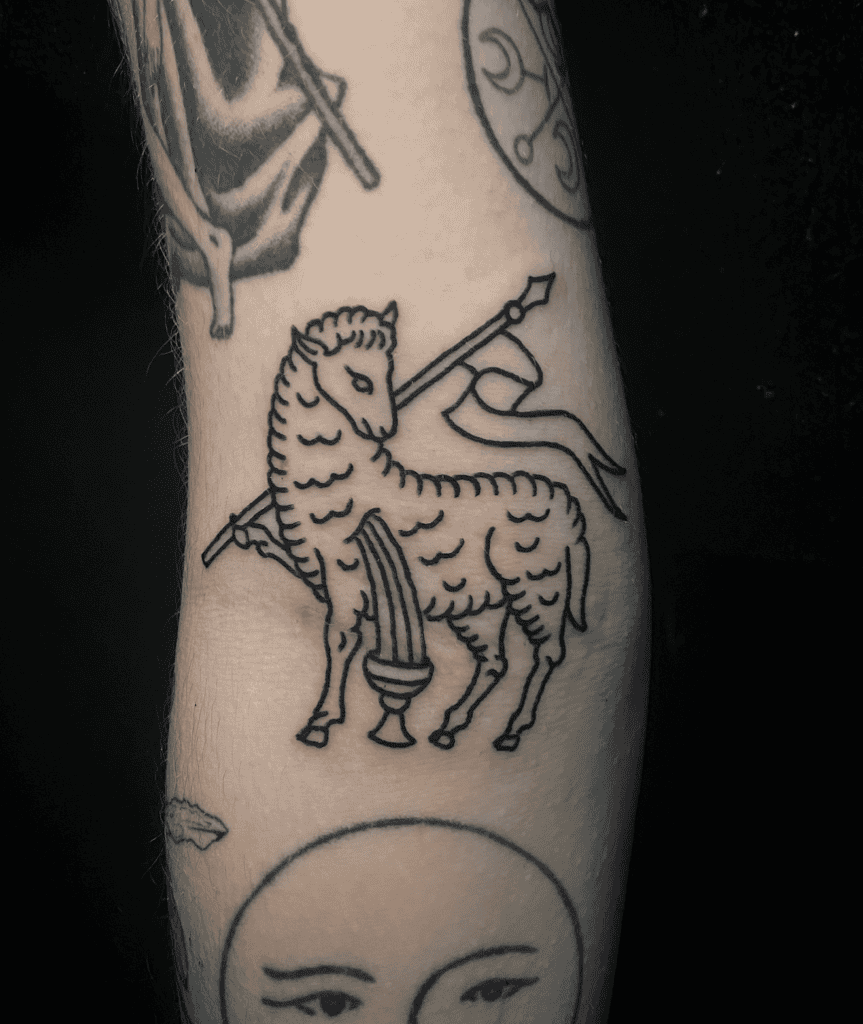
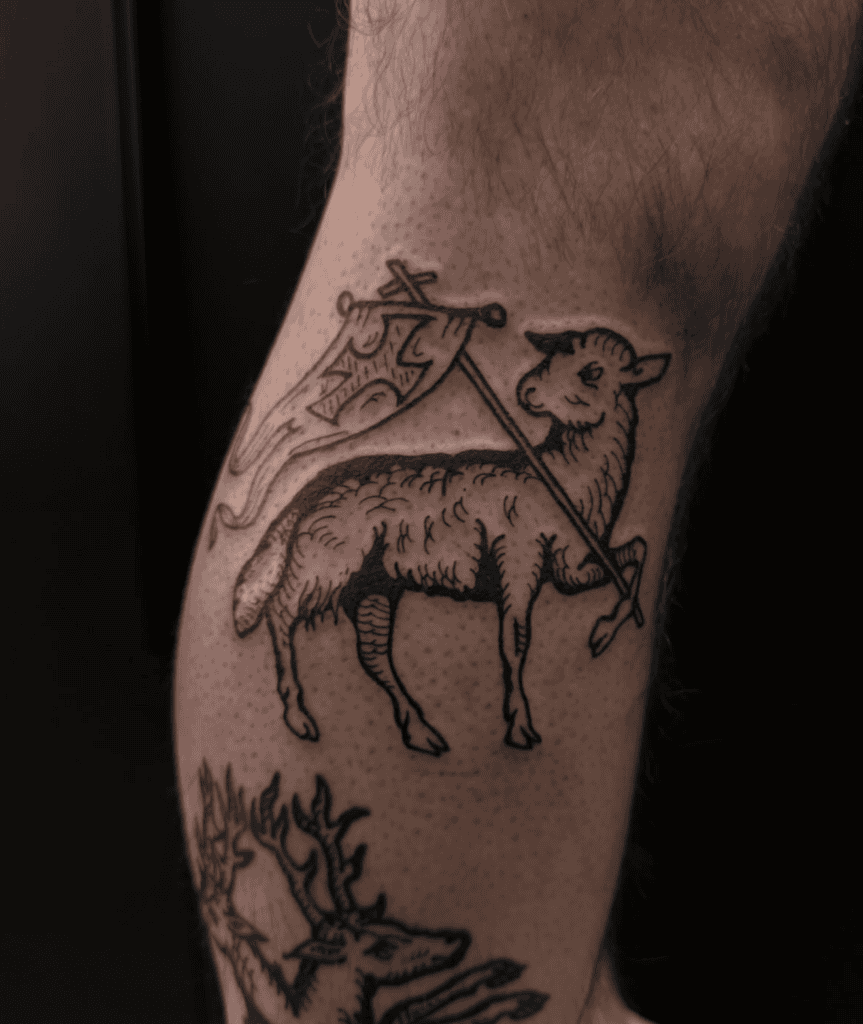
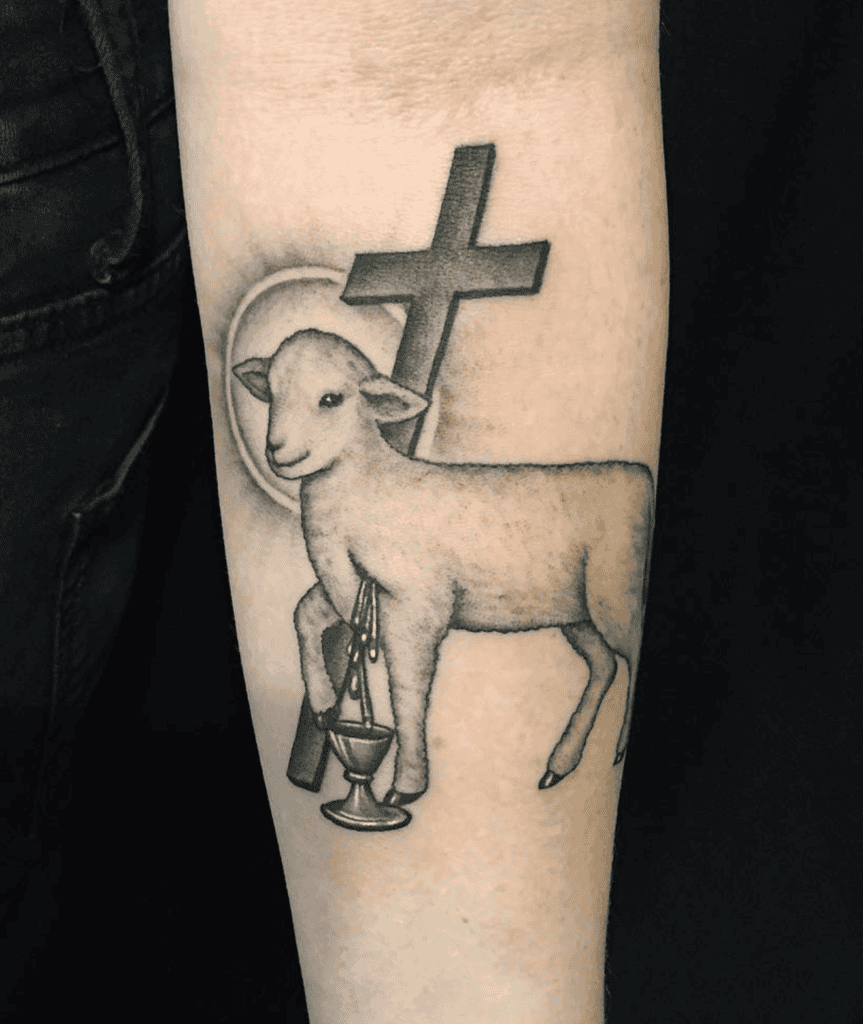
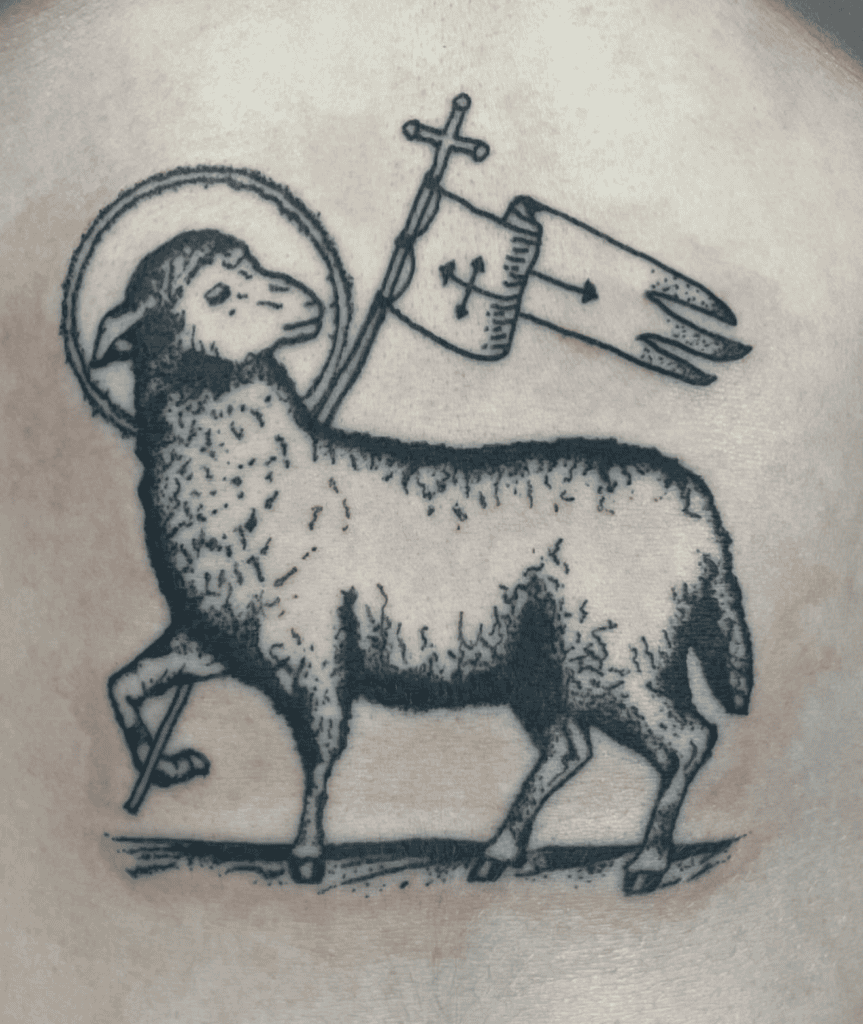
The Lamb of God (Latin: Agnus Dei) is a powerful title and symbol associated with Jesus Christ. The phrase expresses the belief that Jesus sacrificed himself to redeem humanity from sin, much like a sacrificial lamb in ancient religious traditions. The image of the lamb became one of the most enduring symbols of Christian faith, representing innocence, sacrifice, and salvation.
The title “Lamb of God” appears in the New Testament when John the Baptist sees Jesus and declares: “Behold the Lamb of God, who takes away the sin of the world.”
Alpha and Omega Christian Mythology Tattoo

In Christian mythology and symbolism, Alpha and Omega represents the eternal nature and supreme authority of Jesus Christ and God. The phrase comes from the first and last letters of the Greek alphabet—Alpha (Α) and Omega (Ω)—symbolising the idea that God is the beginning and the end of all things. This symbol expresses the belief that divine existence spans all of time and creation.
The phrase “Alpha and Omega” appears in the Book of Revelation, the final book of the New Testament. In this apocalyptic vision, Christ declares: “I am the Alpha and the Omega, the beginning and the end.”
Sacred Heart Christian Mythology Tattoo
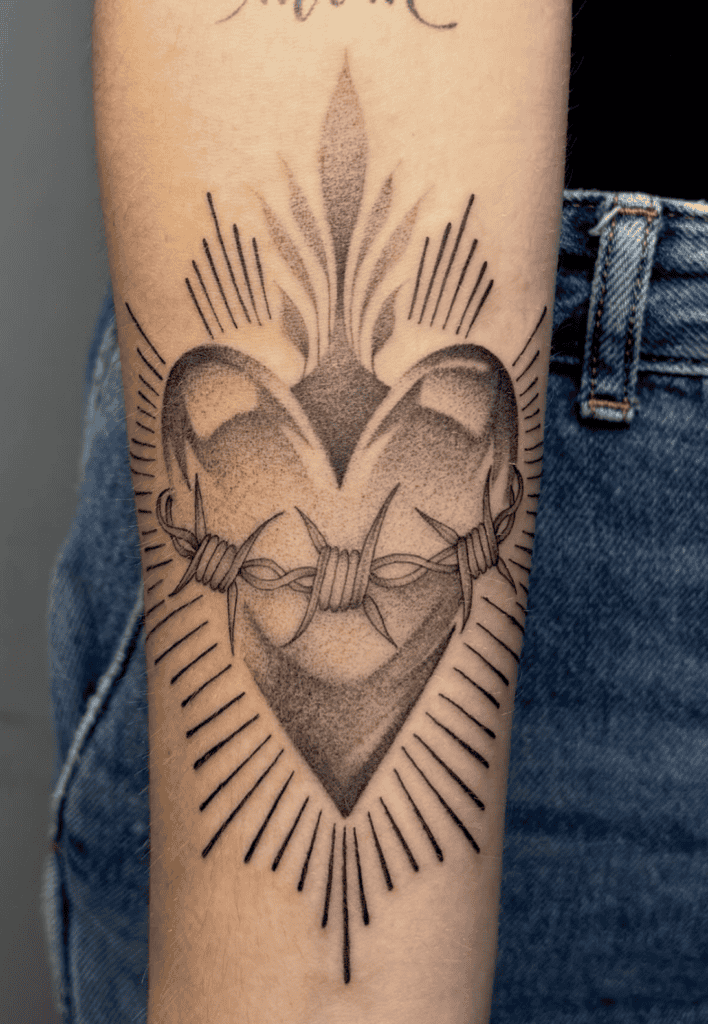
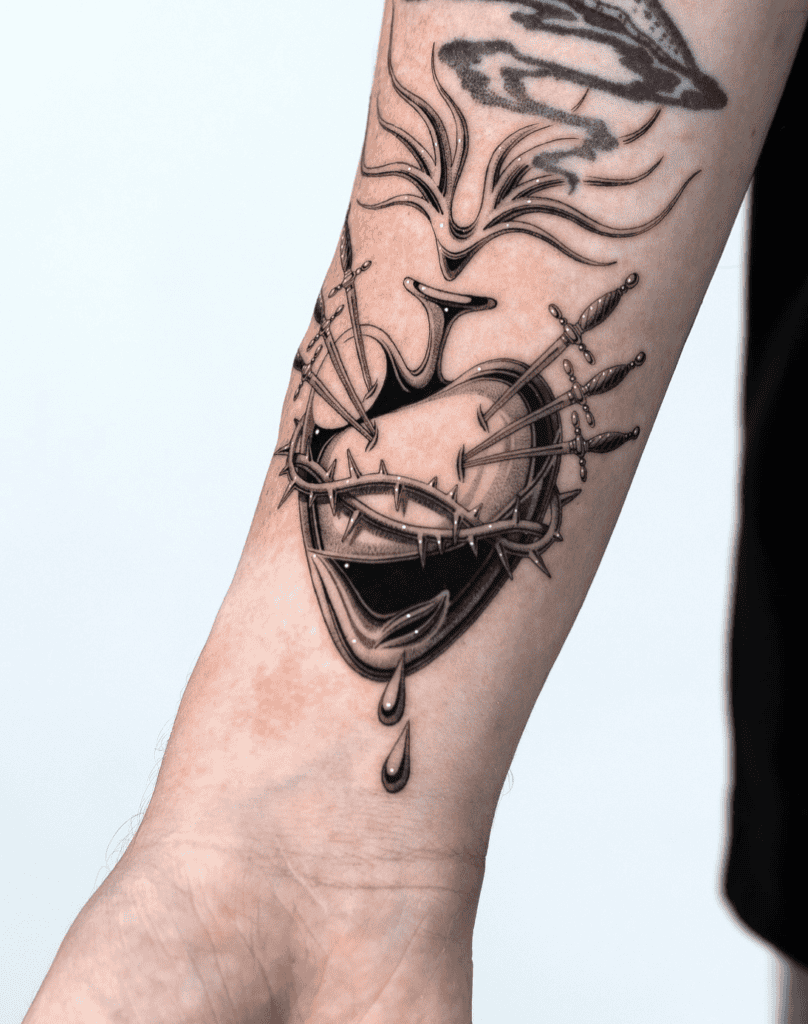
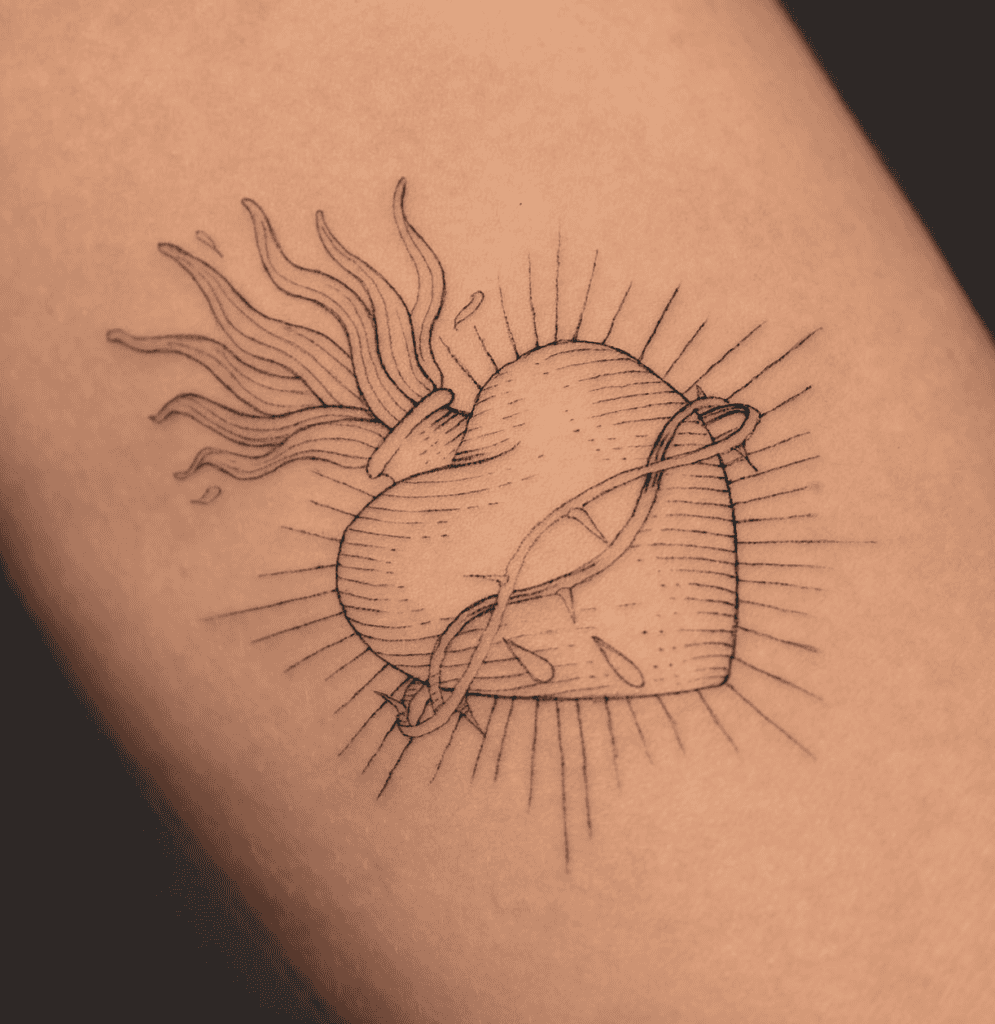
The Sacred Heart represents the compassionate and sacrificial love of Jesus Christ for humanity. The symbol focuses on the heart of Christ as a representation of divine mercy, suffering, and boundless love.
The Sacred Heart symbolises the emotional and spiritual love that Jesus has for humanity. In Christian belief, it reflects both the compassion Christ showed during his life and the suffering he endured during the crucifixion.
The heart itself is often shown surrounded by a crown of thorns, representing the suffering Jesus endured during the crucifixion. Flames rising from the heart symbolise passionate divine love and spiritual transformation. A cross placed above the heart reflects the sacrifice of Christ, while rays of light surrounding it represent holiness and divine glory.
Holy Grail Tattoo Christian Mythology Tattoo


The Holy Grail is a sacred cup believed to have been used by Jesus Christ during the Last Supper. Over time, the Grail became one of the most famous legendary relics in Western mythology, associated with divine grace, spiritual enlightenment, and the quest for holiness.
According to Christian tradition, the Holy Grail is the cup used by Jesus during the Last Supper when he shared wine with his disciples and established the ritual of communion.
Some later traditions claim that the Grail was also used by Joseph of Arimathea to collect the blood of Jesus after the crucifixion. Because of this connection, the cup came to symbolise sacrifice, redemption, and the spiritual power of Christ.
Hell Christian Mythology Tattoo


In Christian mythology and theology, Hell is traditionally described as a place of punishment or separation from God after death. It is often associated with suffering, fire, darkness, and the consequences of rejecting divine guidance.
Several different words in the Bible contributed to the concept of Hell. One important term is Gehenna, a valley outside ancient Jerusalem that was associated with fire and destruction. Over time, it became a symbolic image for divine judgment.
Another term is Hades, which referred to the realm of the dead in ancient Greek thought and was later used in some biblical texts to describe the place where souls awaited judgment. Through centuries of interpretation, these ideas gradually developed into the concept of Hell as a place of eternal punishment.
Conclusion
Thanks for joining us on this incredible pilgrimage through the radiant world of the Christian Mythology Tattoo Idea. We hope we’ve given you divine inspiration for your next tattooing journey. But if Christian Mythology Tattoos still don’t inspire you, why not check out these Hindu Mythology Tattoos Ideas, these Chinese Mythology Tattoo Designs, or these Persian Mythology Tattoos.
- Lion Tattoo Ideas - October 19, 2026
- Persona Tattoo Ideas - October 15, 2026
- Spider Tattoo Ideas - October 8, 2026