

Persian Mythology Tattoo Ideas
Do you feel like you’re lost in a vast desert on your search for the best Mithra-logical Tattoo Clues? Well, no need to make any Arash decisions, as we have some of the Cyrus-ly best Persian Mythology Tattoo Designs that we hope you’ll find Huma-rous.
What is Persian Mythology
Persian mythology is the collection of ancient myths, legends, religious beliefs, and heroic stories that originated in ancient Iran. It blends early Indo-Iranian traditions, religious teachings, and epic storytelling into a rich mythological system that influenced Persian culture for thousands of years.
It is deeply connected to Zoroastrianism, one of the world’s oldest monotheistic religions, and is preserved in sacred texts and epic literature such as the Avesta and the Shahnameh.
At the heart of Persian mythology is the religion founded by the prophet Zoroaster (also called Zarathustra). The central deity is Ahura Mazda, the Wise Lord, god of truth, light, and order, whose main opposing force is Angra Mainyu (Ahriman), the destructive spirit of chaos and darkness.
Persian mythology is built around a cosmic struggle between truth (asha) and falsehood (druj). Unlike many mythologies filled with morally ambiguous gods, Persian mythology presents a strong dualism between good and evil.
Best Persian Mythology Tattoo Ideas
Now that we know a little about Persian Mythology, let’s take a look at some of the best Persian Mythology Tattoos the internet has to offer.
Ahura Mazda Persian Mythology Tattoo
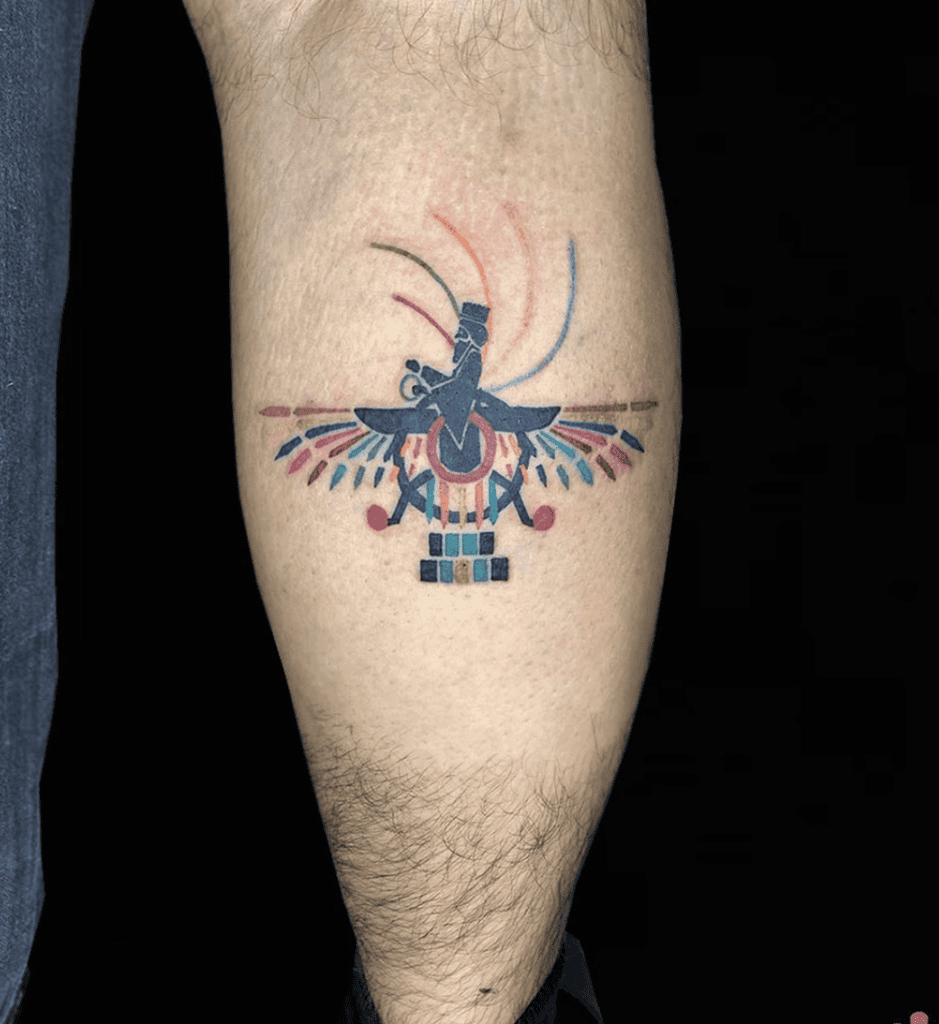
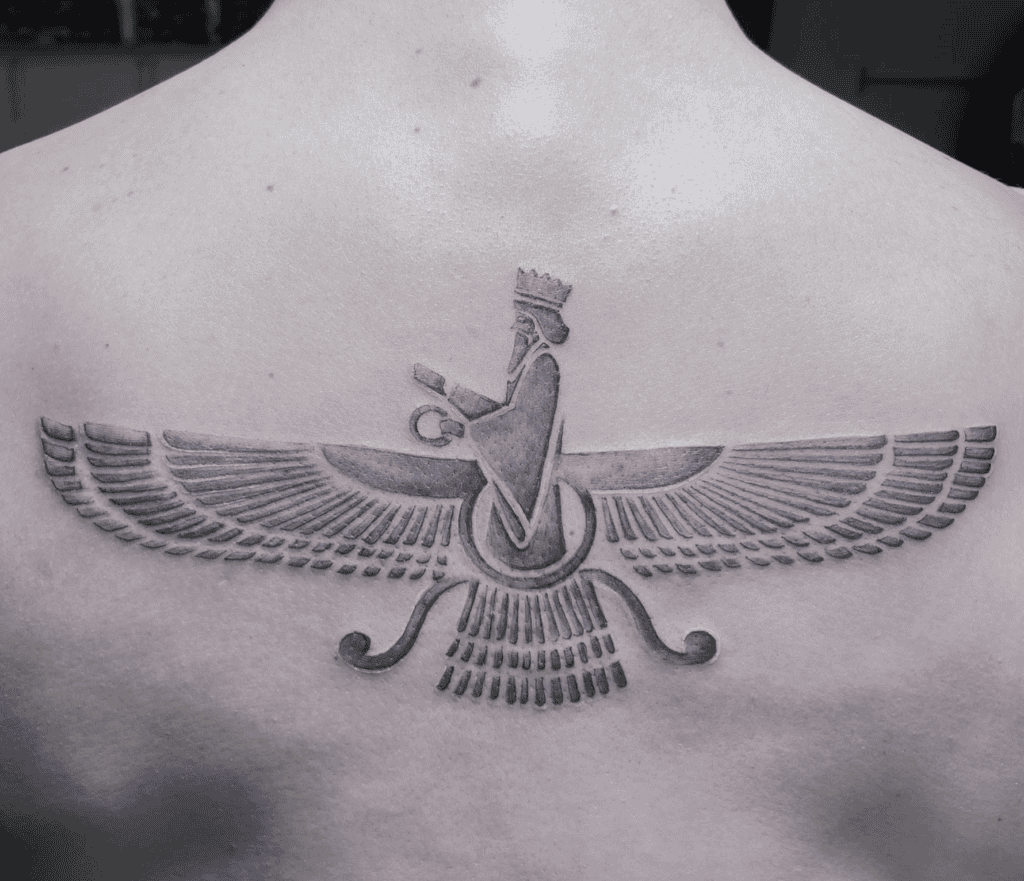
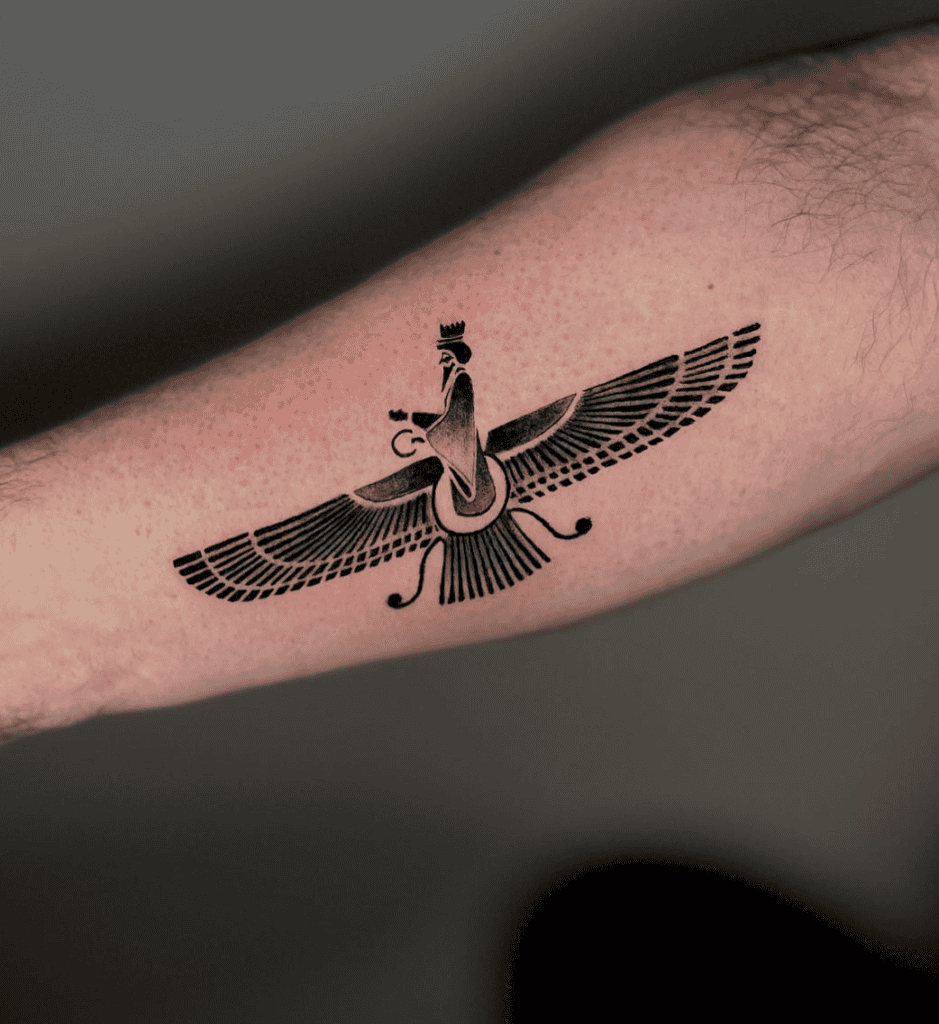
Ahura Mazda, meaning “Wise Lord,” is the supreme god of Zoroastrianism and the central divine figure in Persian mythology. He represents truth, light, wisdom, order, and creation. He is not just a powerful god among many, but is the creator of the universe and the source of all that is good.
Ahura Mazda was revealed to the prophet Zoroaster, who taught that Ahura Mazda is the one true god and the embodiment of asha (cosmic truth and order). Ahura Mazda’s main opponent is Angra Mainyu (also called Ahriman)
However, unlike equal rivals in some mythologies, Ahura Mazda is ultimately destined to win. The universe moves toward a final restoration where good triumphs permanently.
Angra Mainyu Persian Mythology Tattoo


Angra Mainyu (depicted as the beast in both tattoos) is the destructive spirit in Persian mythology and the primary adversary of Ahura Mazda. While Ahura Mazda represents truth, order, and light, Angra Mainyu embodies chaos, deception, darkness, and corruption.
Angra Mainyu is not simply a trickster or mischievous god, but is the cosmic force of corruption and decay. In Zoroastrian belief, the universe is a battleground between Ahura Mazda’s principles of truth and order and Angra Mainyu’s principles of lies and chaos.
However, Angra Mainyu is not equal in power to Ahura Mazda. Zoroastrianism teaches that evil is powerful but ultimately temporary.
Mithra Persian Mythology Tattoo

Mithra is one of the most important and fascinating figures in ancient Iranian religion. Originally an Indo-Iranian deity, Mithra became a major deity in the Persian tradition and later inspired the Roman mystery religion known as Mithraism.
Mithra is primarily associated with light, truth, contracts and oaths, justice and protection. In early Iranian belief (preserved in the Avesta), Mithra is a powerful yazata (worthy of worship), not the supreme creator like Ahura Mazda, but an important divine guardian.
He watches over agreements between people, promises and treaties, and moral behaviour. Breaking an oath was not just dishonourable; it invited Mithra’s punishment. Mithra is closely tied to asha (truth and cosmic order). He is described as all-seeing, thousand-eared, and thousand-eyed.
Anahita Persian Mythology Tattoo


Anahita (full name Aredvi Sura Anahita) is the ancient Persian goddess of water, fertility, healing, and wisdom. She is one of the most important female deities in Persian mythology and was widely worshipped across the Iranian world.
In ancient Iran, water was sacred. Much of the land is dry, so rivers and springs meant survival. Anahita was believed to control rivers and rainfall, grant fertility to women and the earth, bring health and purification, and bless warriors with strength.
Anahita became especially prominent during the Achaemenid Empire and later the Sasanian Empire. Kings such as Artaxerxes II promoted her worship and built temples in her honour. One of the most famous sites associated with her is the Temple of Anahita at Kangavar in western Iran.
Unlike early Zoroastrian tradition, which discouraged idol worship, Anahita sometimes had statues and shrines dedicated to her, suggesting she held a special cultural position.
Rostam Persian Mythology Tattoo
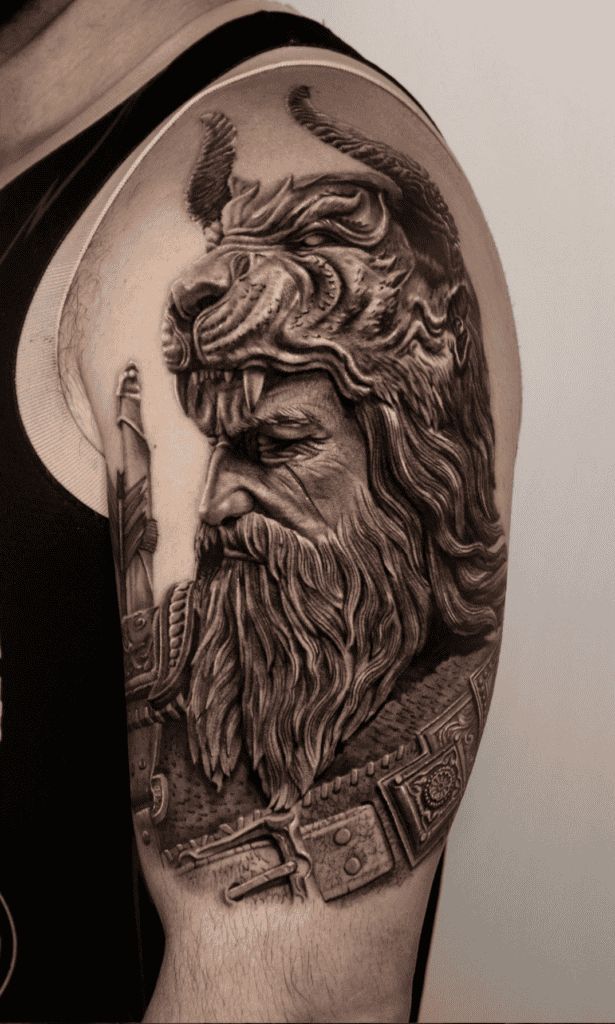
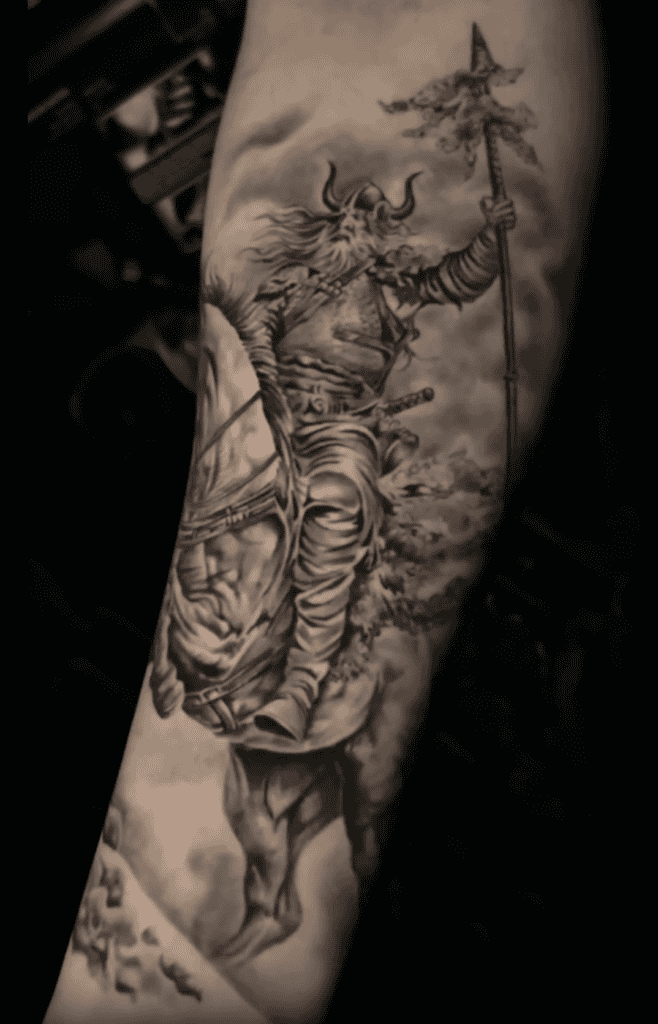
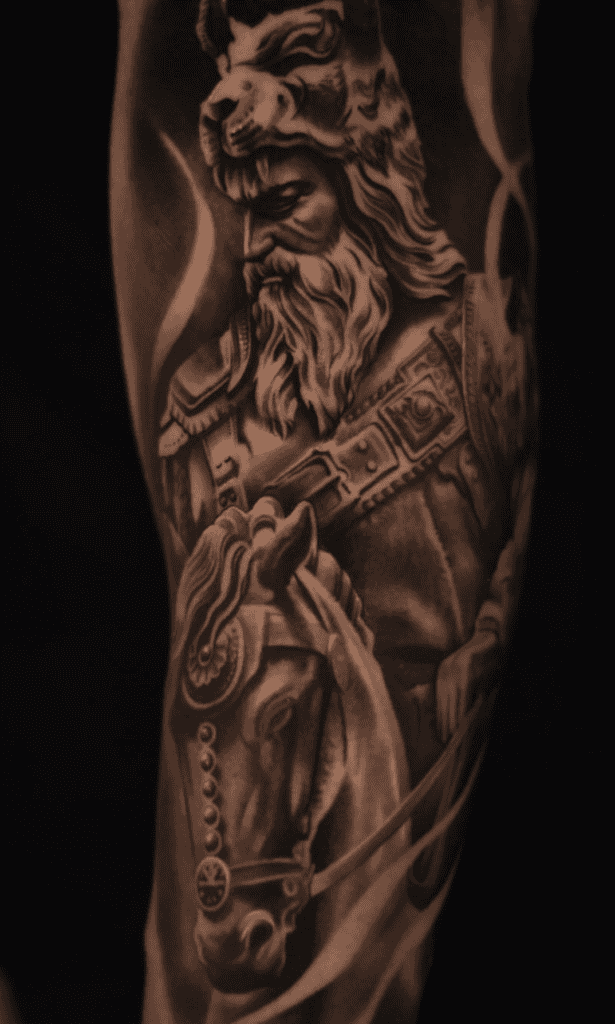
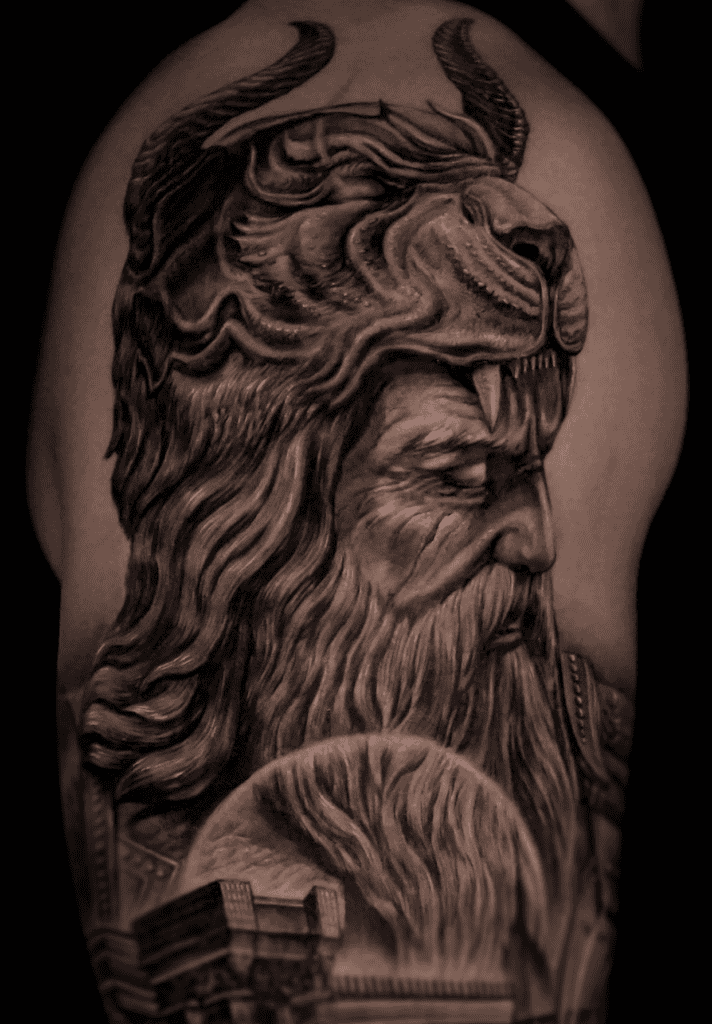
Rostam is the greatest hero of Persian mythology and the central champion of the epic Shahnameh, written by Ferdowsi around 1000 CE. Rostam was born to the noble warrior Zal and Princess Rudabeh. His birth was difficult and required a mythical surgical procedure (sometimes described as an early form of Caesarean section), guided by the magical bird Simurgh.
From birth, Rostam was incredibly strong and destined for greatness. His loyal horse, Rakhsh, is almost as famous as he is. Together, they are inseparable in battle. One of Rostam’s most famous adventures is the Seven Labours, similar to Heracles’ labours in Greek mythology. Rostam’s seven labours included defeating a lion, overcoming desert thirst, slaying a dragon, defeating a sorceress, killing the White Demon (Div-e Sepid) and rescuing a captured king.
Raksh Persian Mythology Tattoo


Rakhsh is the legendary horse of Rostam, and one of the most beloved animal companions in Persian mythology. His name means “lightning” or “radiance,” reflecting his speed, power, and striking appearance.
According to the Shahnameh, young Rostam searched far and wide for a horse strong enough to carry him. Many horses collapsed under his weight, but Rakhsh did not.
Rakhsh was described as exceptionally strong, fearless in battle, intelligent and loyal, and beautifully marked. Rakhsh fights alongside Rostam in many legendary battles where he kicks and tramples enemies, bites attackers, warns Rostam of danger and endures harsh journeys across deserts and mountains.
When Rostam is betrayed and falls into a hidden spear-filled pit, Rakhsh falls with him. Both are fatally wounded. Their deaths together symbolise their inseparable bond, hero and horse united until the very end.
Sohrab Persian Mythology Tattoo

Sohrab is one of the most tragic figures in Persian mythology and a central character in the epic Shahnameh, written by Ferdowsi. He is the son of Rostam, though neither father nor son initially knows this, and that misunderstanding leads to one of the most heartbreaking stories in world epic literature.
Sohrab was born after Rostam unknowingly left his lover, Princess Tahmineh. She did not tell Rostam she was pregnant, and he never knew he had a son. Sohrab grows up strong and brave, gifted in combat, and curious about his father’s identity. He eventually learns that his father is a great Persian hero, but he never learned his name.
As a young warrior, Sohrab is manipulated into leading an army against Persia. His goal is not conquest, but the hope of finding his father on the battlefield. Instead, fate brings him face-to-face with Rostam, where they fight in single combat.
Several times, Sohrab suspects Rostam might be his father and even asks him directly. But Rostam denies it, partly out of pride, partly out of caution. On their final duel, Rostam fatally wounds Sohrab, and only then does Sohrab reveal a token given to him by his mother, proof of his true identity.cRostam realises the truth too late, and Sohrab dies in his father’s arms.
Kaykavus Persian Mythology Tattoo

Kay Kavus (also written Kay Kāvus or Kai Kaus) is a legendary king of Iran in the epic Shahnameh, written by Ferdowsi. Unlike heroic figures such as Rostam, Kay Kavus is remembered less for wisdom and more for pride, ambition, and reckless decisions. His story often serves as a warning about the dangers of arrogance in leadership.
Kay Kavus belongs to the Kayanian dynasty, a line of semi-mythical Persian rulers. He inherits a powerful kingdom, but instead of ruling cautiously, he repeatedly makes impulsive and dangerous choices.
He is often overconfident, easily persuaded, ambitious beyond reason, and dependent on his champions (especially Rostam). One of his most famous (and absurd) stories involves his attempt to fly to the heavens. Inspired by pride, Kay Kavus orders eagles to be tied to his throne, with meat held above them so they will fly upward. The eagles lift him into the sky, but eventually grow tired, and he crashes down in the wilderness.
Kay Kavus also foolishly invades the land of Mazandaran against wise advice. He and his army are defeated and captured by demons (Divs), including the White Demon. His rescue forms part of Rostam’s Seven Labours, further reinforcing the idea that the king’s survival depends on his hero.
Aion Persian Mythology Tattoo

Aion is a deity associated with eternal time, cosmic cycles, and infinity in late Greek, Hellenistic, and Roman religious thought. Unlike gods who represent seasons or days, Aion symbolises time without beginning or end.
His name literally means “eternity” or “age.” Aion is not the ticking of a clock, as that would be Chronos, so instead, Aion represents eternal time, the endless cycle of the cosmos, the zodiac and celestial order.
Aion became especially important in Mithraism, a mystery religion influenced by Persian beliefs surrounding Mithra. In Mithraic iconography, a lion-headed figure wrapped in a serpent — often identified with Aion — represents boundless time, cosmic necessity, and the structure of the universe. Although Aion himself is Greek in origin, his later imagery blends Hellenistic and Persian religious ideas.
Kaveh Persian Mythology Tattoo


Kaveh (Kāveh) the Blacksmith, is one of the most powerful symbols of resistance in Persian mythology. Unlike kings and warriors, Kaveh is an ordinary man who rises up against tyranny.
Kaveh lived during the reign of the cruel king Zahhak, a ruler with two serpents growing from his shoulders. To feed the snakes, Zahhak’s regime executed young men and used their brains as food, with Kaveh losing many of his own sons to this horror.
When Zahhak demanded public support, Kaveh tore up the royal decree in defiance. He then raised his blacksmith’s leather apron on a spear as a banner of rebellion. This makeshift flag became known as the Derafsh Kaviani, later transformed into a royal standard of Persia.
Kaveh joined forces with the young hero Fereydun, who was destined to overthrow Zahhak. With the people rallying behind him, Zahhak was defeated and imprisoned. Kaveh did not seek power or a throne. His role was to ignite the rebellion, and he returned to being a blacksmith afterwards.
Derafsh Kaviani Persian Mythology Tattoo

The Derafsh Kaviani is the legendary royal banner of ancient Iran and one of the most powerful symbols in Persian mythology. Its origins began as the leather apron of Kaveh the Blacksmith, raised in defiance against the tyrant Zahhak.
According to the Shahnameh, when Zahhak’s oppression became unbearable, Kaveh tore up the royal decree and lifted his blacksmith’s apron on a spear as a banner of revolt.
After Zahhak was overthrown with the help of the hero Fereydun, the apron was transformed into a royal standard — adorned with jewels and silk — becoming the Derafsh Kaviani. What began as a worker’s apron became the emblem of kingship.
Simurgh Persian Mythology Tattoo
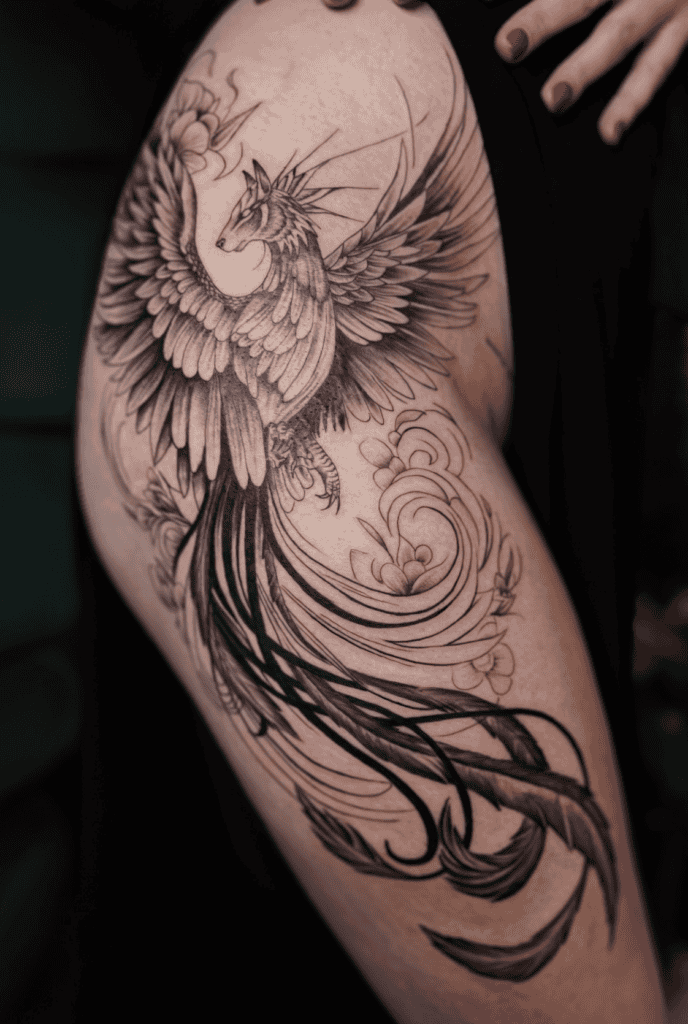
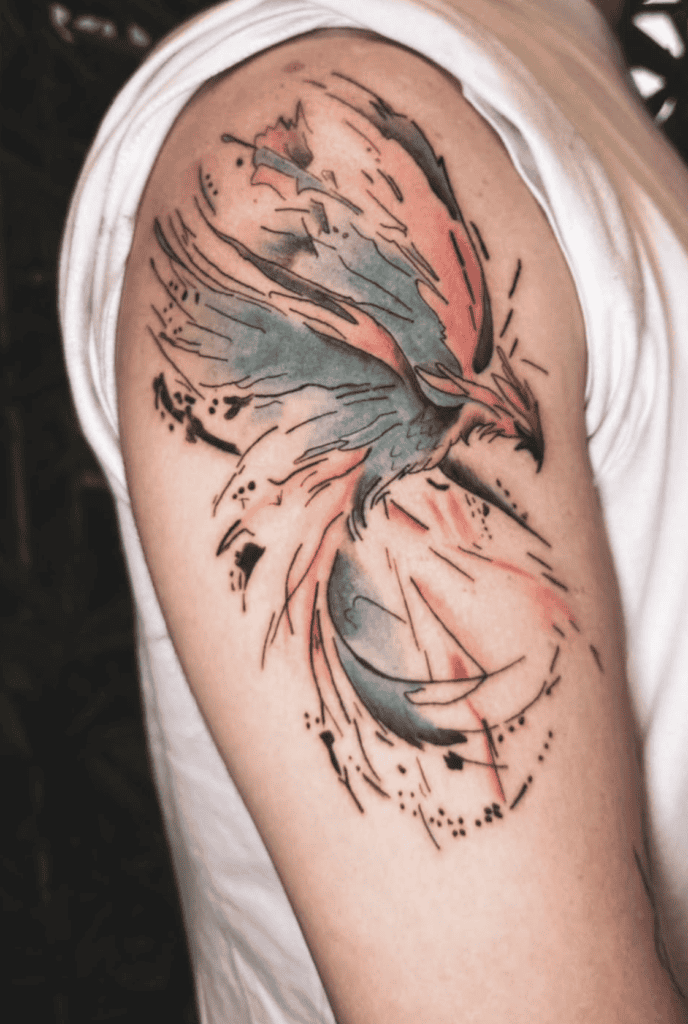
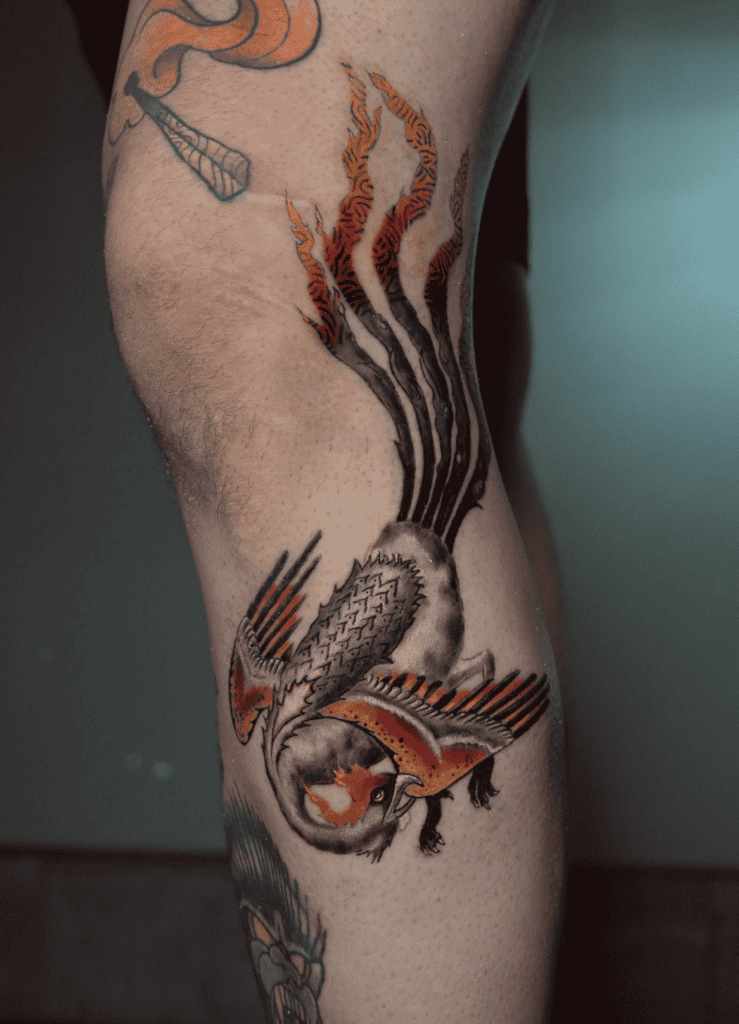
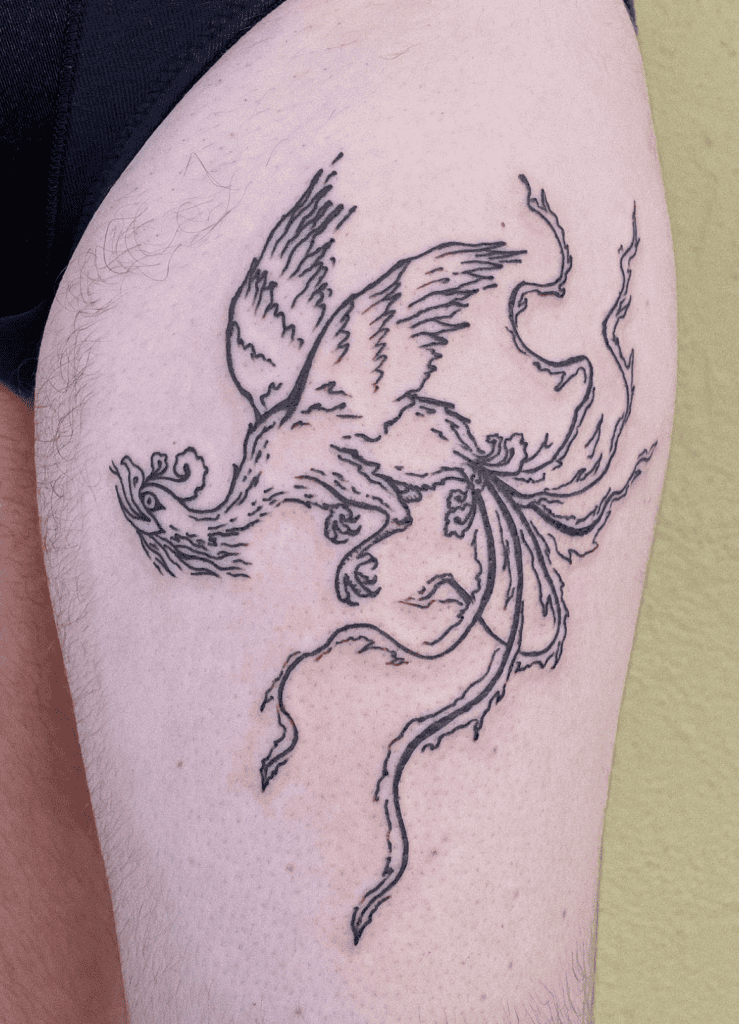
The Simurgh is one of the most majestic and mysterious creatures in Persian mythology, being a giant, wise, and benevolent bird often compared to a phoenix. Unlike many mythical beasts, the Simurgh is not destructive. She represents wisdom, healing, protection, and cosmic knowledge.
In ancient Persian belief, the Simurgh is said to dwell in the Tree of Life, a sacred tree that contains the seeds of all plants in the world. She is described as enormous in size, covered in radiant feathers, ancient beyond measure, and sometimes with features of a dog or lion (in older imagery).
One of her most famous roles appears in the epic Shahnameh by Ferdowsi. When the albino child Zal is abandoned by his father, the Simurgh rescues and raises him on her mountain nest. She nurtures him and later gives him a magical feather. Whenever burned, it summons her for help.
Zahhak Persian Mythology Tattoo

Zahhak (also called Azhi Dahaka in older texts) is one of the most terrifying villains in Persian mythology. His story appears in the epic Shahnameh by Ferdowsi, and his legend stretches back to ancient Iranian religious traditions.
Zahhak was not born a monster; in early versions of the myth, he is corrupted by evil and sometimes influenced directly by Angra Mainyu (Ahriman). After making a dark pact, two serpents grow from his shoulders. These snakes cannot be removed, demand human brains for food and cause Zahhak constant suffering. To feed them, Zahhak orders young men to be killed daily.
In some versions of the myth, Zahhak rules for a thousand years until the blacksmith Kaveh loses his sons to Zahhak’s cruelty and leads a rebellion. He raises his apron as a banner, which becomes the legendary Derafsh Kaviani, and unites the people behind the young hero Fereydun, who confronts Zahhak.
Fereydun defeats him and imprisons him in Mount Damavand, where he remains chained. In some traditions, he will struggle until the end of time.
Manticore Persian Mythology Tattoo
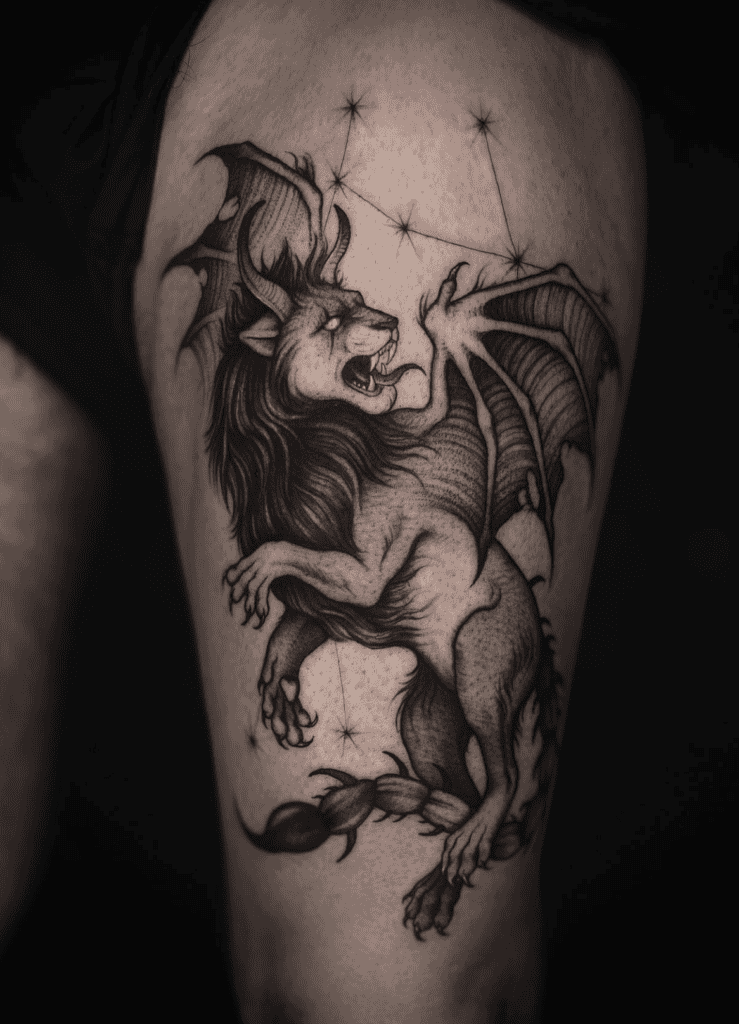
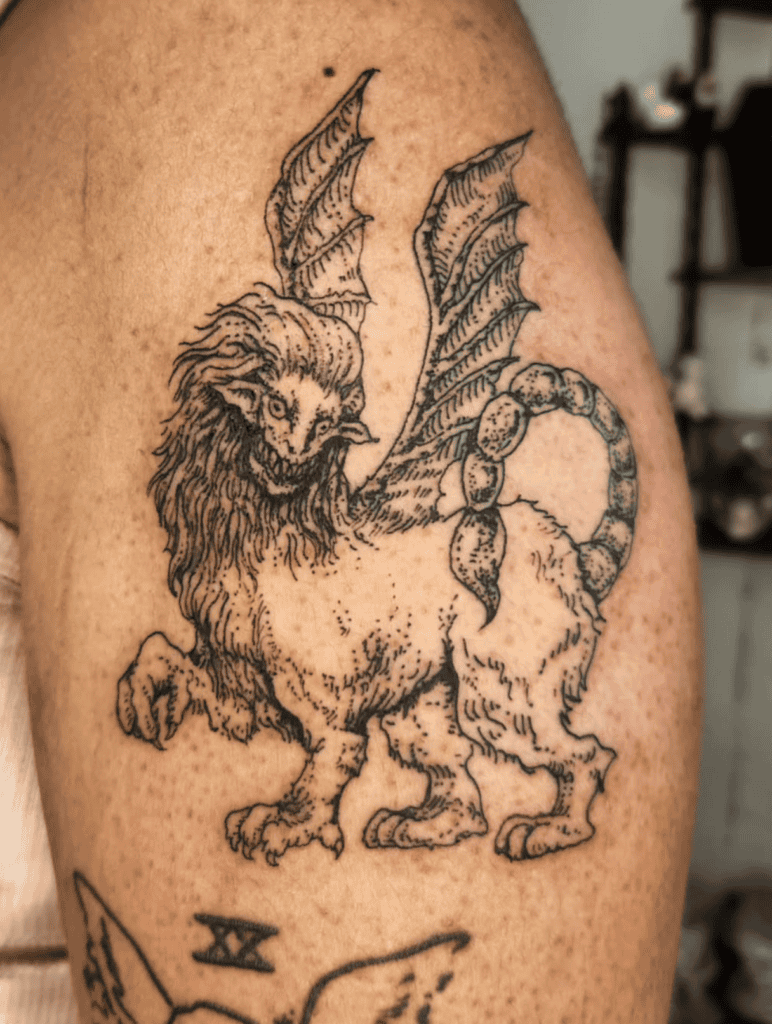
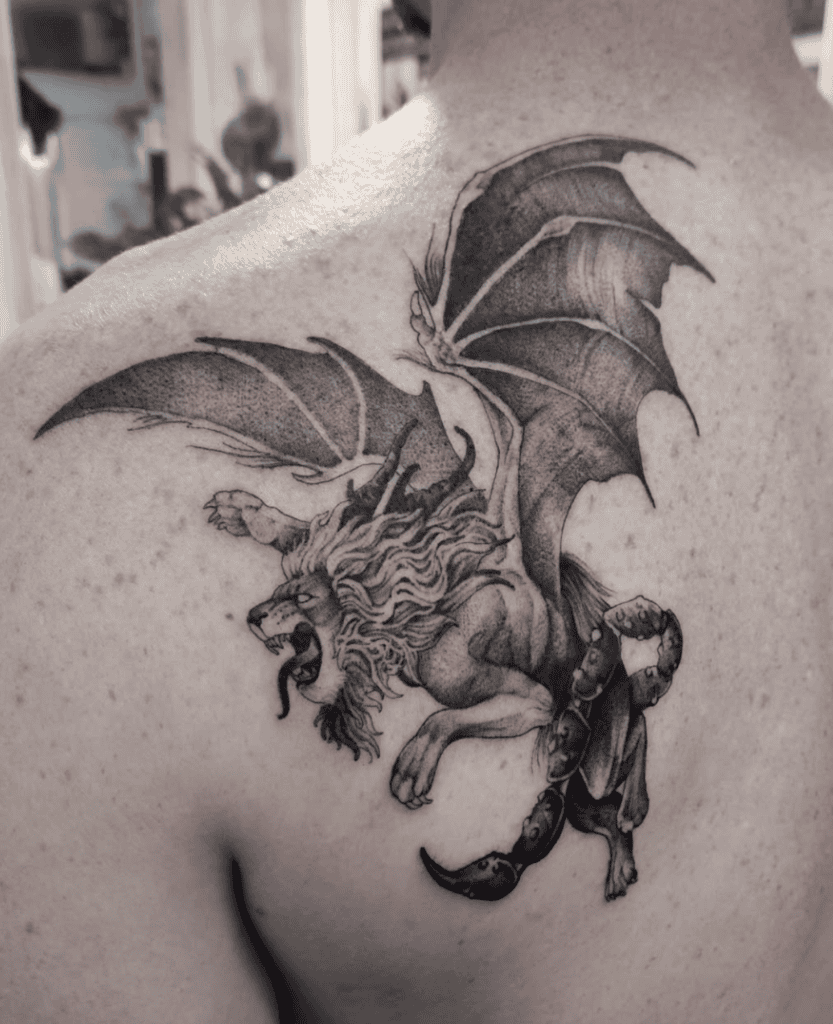
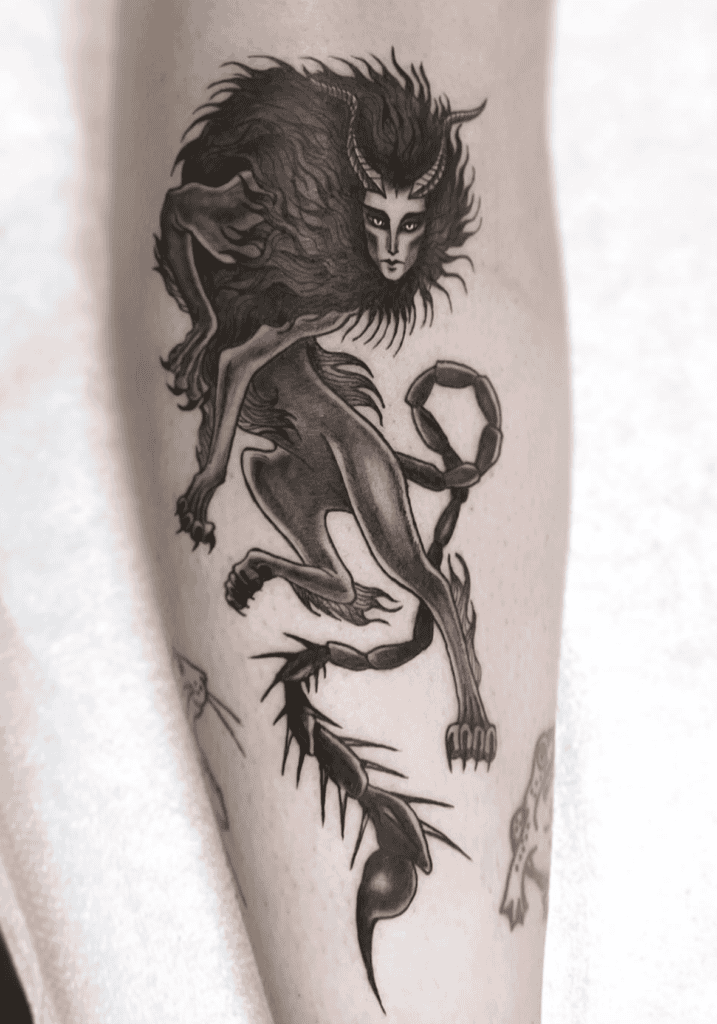
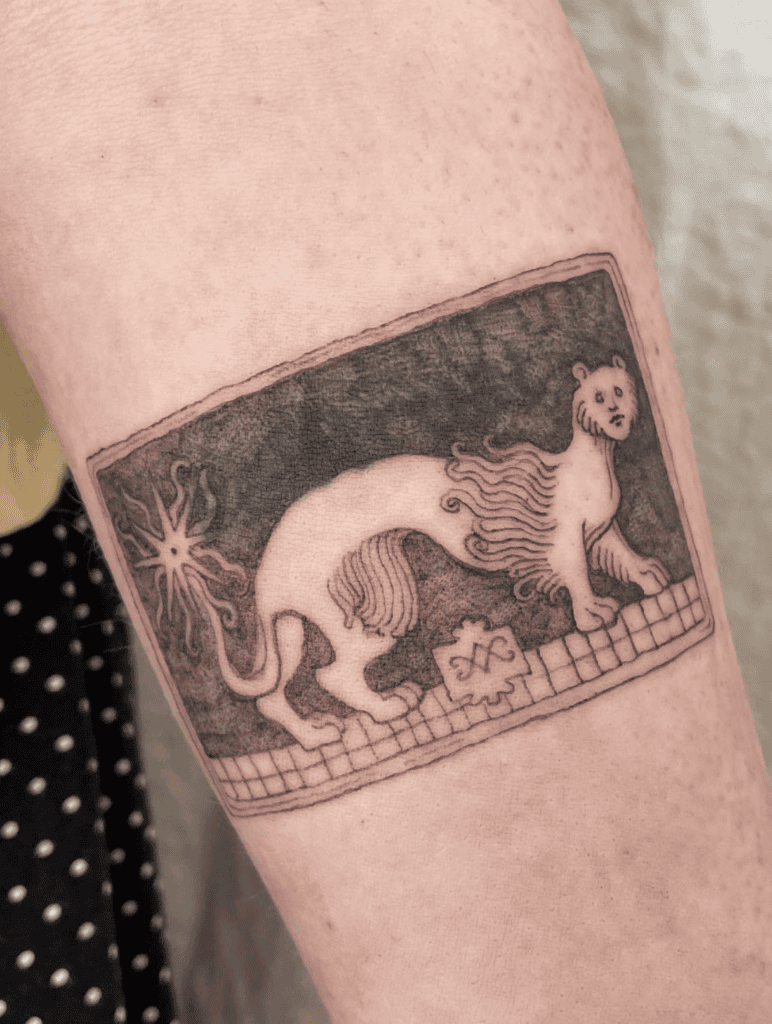
The Manticore is a fearsome creature that originates in ancient Persian lore and later appears in Greek and medieval European bestiaries. Its name comes from the Old Persian martiya-khvar, meaning “man-eater.”
Classical descriptions (recorded by Greek writers who heard of it from Persia) describe the Manticore as having the body of a lion, a human-like face, three rows of sharp teeth, a scorpion’s tail, and a voice that was said to sound like a mix between a flute and a trumpet.
The Manticore likely comes from ancient Iranian traditions about dangerous wilderness creatures. Greek historian Ctesias, who lived in Persia in the 5th century BCE, wrote one of the earliest known descriptions.
Over time, the creature became more exaggerated in Western imagination. Unlike heroes such as Rostam, the Manticore does not have a large role in Persian epic literature like the Shahnameh. Instead, it is more prominent in later retellings and medieval European lore.
Huma Bird Persian Mythology Tattoo
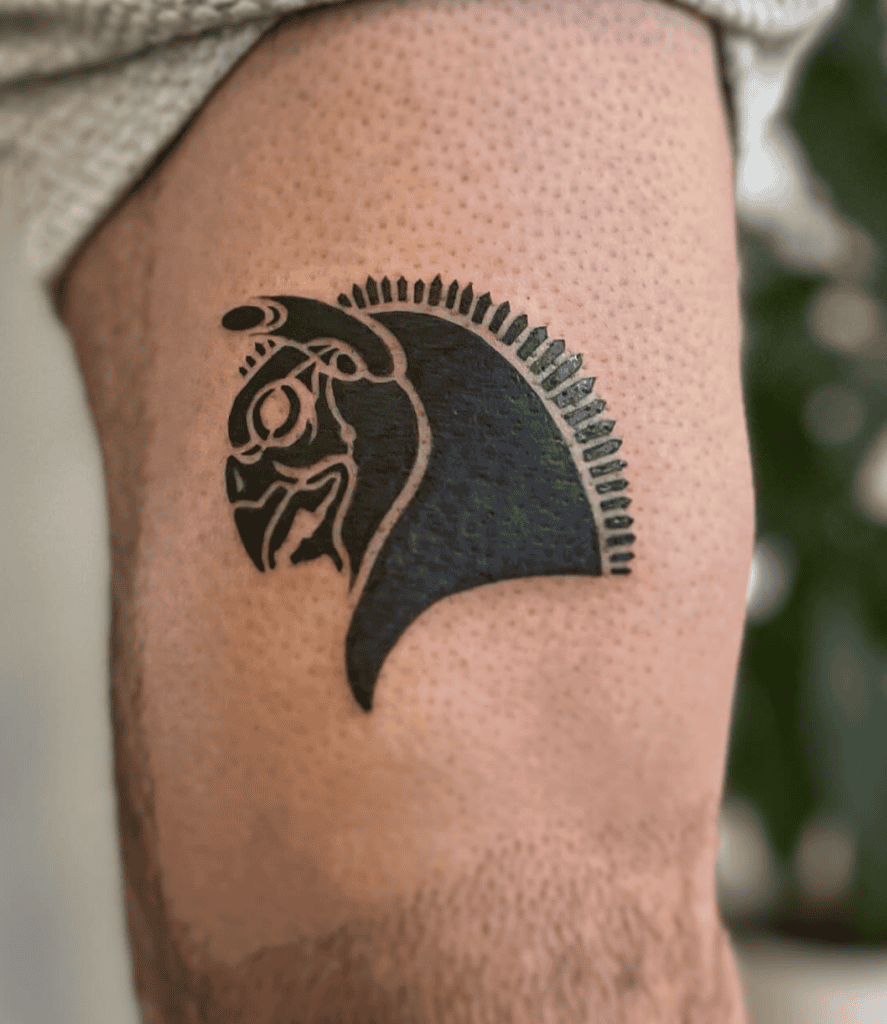
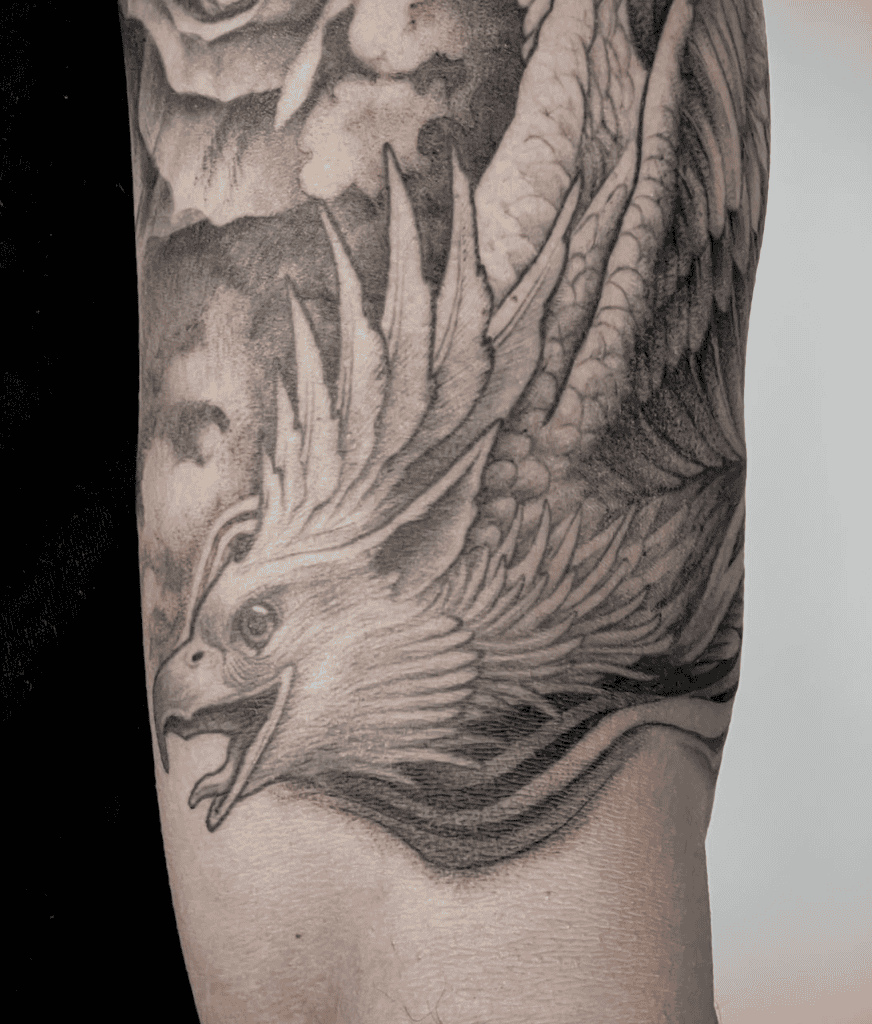
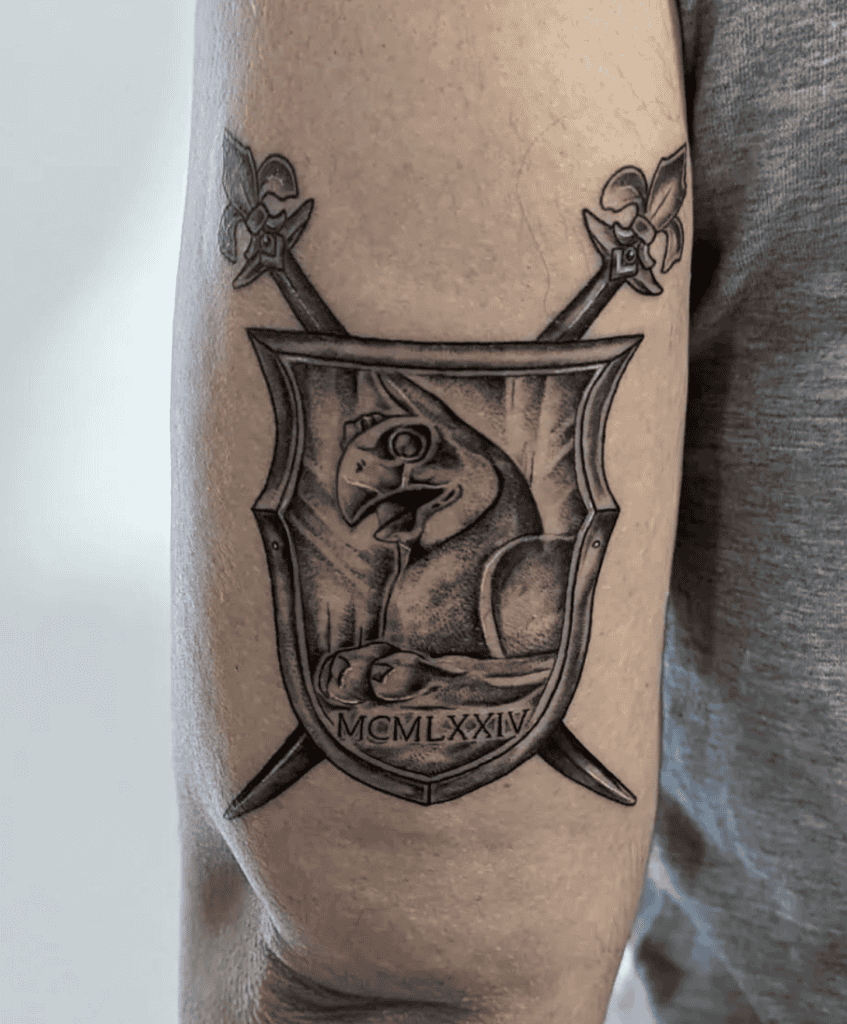
The Huma (or Homa) Bird is a legendary bird in Persian mythology associated with fortune, kingship, and divine blessing. Often called the “Bird of Paradise” in Persian folklore, it is a bird said to never land.
One of the most famous beliefs about the Huma is that it never touches the ground as it lives high in the sky, casting a shadow that brings luck. If the Huma’s shadow falls upon someone, that person is said to be destined for greatness, sometimes even kingship. Because of this, the bird became strongly associated with royal legitimacy.
Shirdal Persian Mythology Tattoo

The Shirdal (literally meaning “Lion-Eagle” in Persian) is a powerful hybrid creature in ancient Iranian art and mythology. It combines the body of a lion with the wings (and sometimes head) of an eagle. It is closely related to the Griffin of Near Eastern and Mediterranean traditions, but in Persian culture, it carries a distinctive symbolic meaning.
The Shirdal appears prominently in the art of the Achaemenid Empire, especially at Persepolis. You can find lion-eagle creatures carved into the palace columns, relief sculptures and the decorative capitals, symbolising royal authority and divine protection.
Peri Persian Mythology Tattoo


The Peri (also spelt Pairi or Pari) is a beautiful, winged spirit in Persian mythology. Over time, the Peri evolved from a darker being into one of the most graceful and benevolent figures in Persian folklore. Today, the Peri is often thought of as a fairy-like celestial being associated with beauty, kindness, and light.
In older Zoroastrian tradition, the word pairika referred to seductive or misleading spirits connected to deception. However, over centuries, especially in later Persian poetry, the Peri transformed into something much gentler.
In Persian art and literature, Peris are described as radiantly beautiful, winged, graceful and luminous, and often dressed in flowing garments. They are sometimes compared to angels, but they are not exactly the same. Peris are more poetic and romantic figures than strictly religious ones.
Persepolis Persian Mythology Tattoo

Persepolis was the ceremonial capital of the ancient Persian Empire and one of the most magnificent cities of the ancient world. Built in the 6th century BCE, it symbolised the power, organisation, and multicultural reach of the Persian kings. Its original Old Persian name was Parsa, meaning “City of the Persians.”
Persepolis was founded by Darius I around 518 BCE during the height of the Achaemenid Empire. It was later expanded by Xerxes I and Artaxerxes I. Rather than being a typical everyday capital, Persepolis functioned mainly as a ceremonial and symbolic centre, especially for New Year celebrations (Nowruz).
Persepolis was built on a massive stone terrace at the foot of the Zagros Mountains. The relief carvings show delegations from across the empire bringing tribute — demonstrating Persia’s vast multicultural rule stretching from India to Egypt and beyond.
In 330 BCE, Persepolis was captured and burned by Alexander the Great. The burning is sometimes described as revenge for earlier Persian invasions of Greece. Whether politically motivated or symbolic, the destruction marked the end of the Achaemenid Empire’s golden age.
Persian Immortals Persian Mythology Tattoo
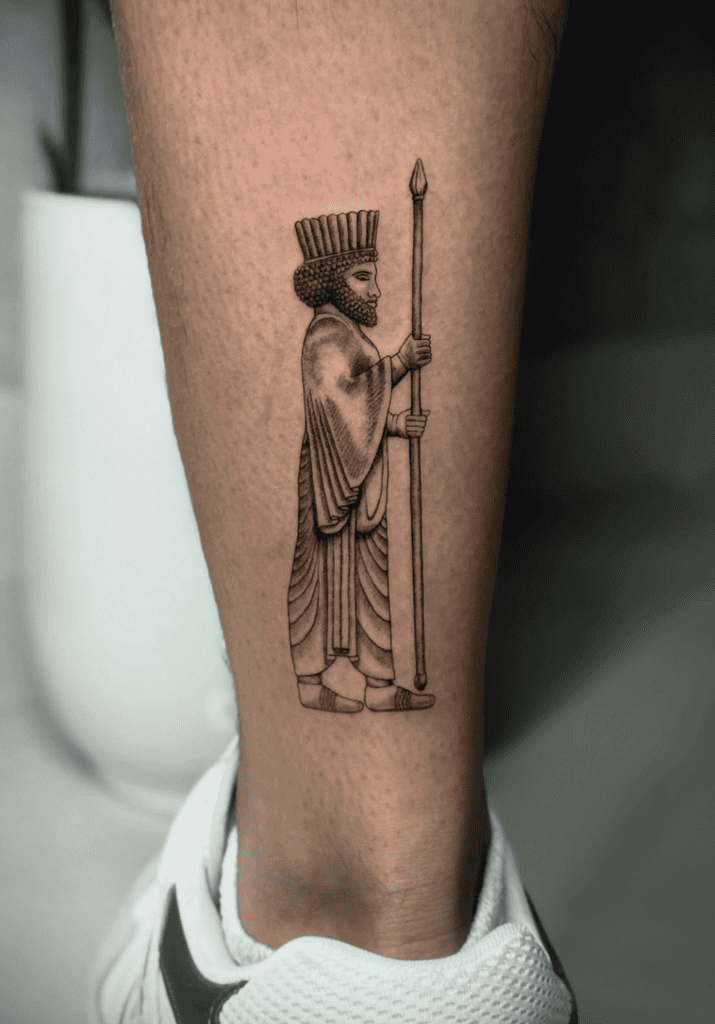
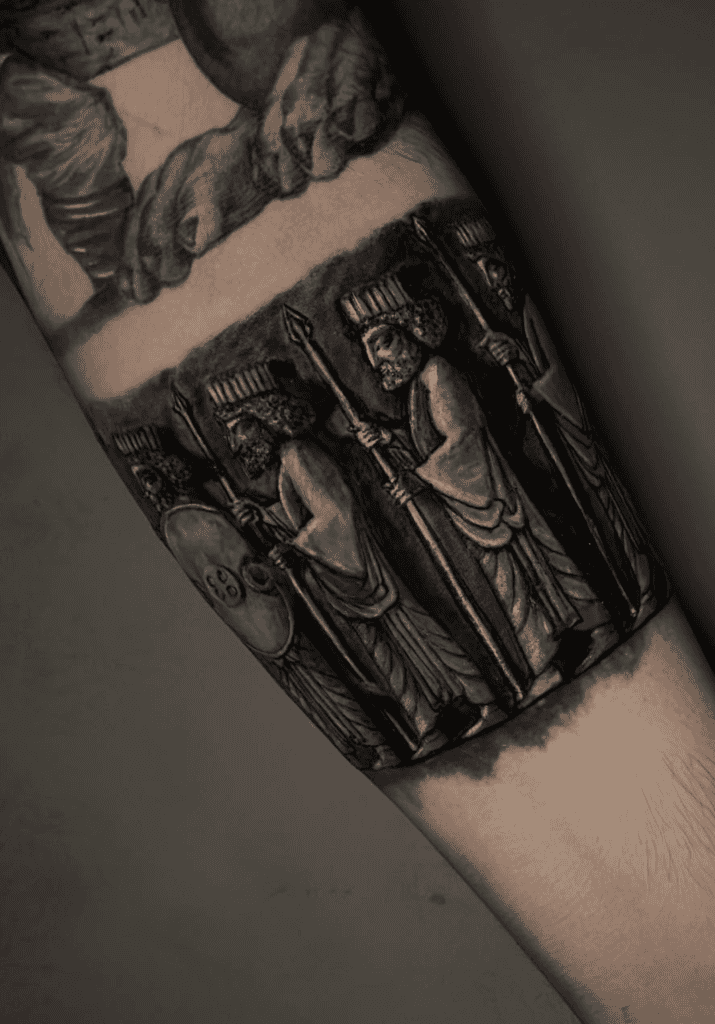
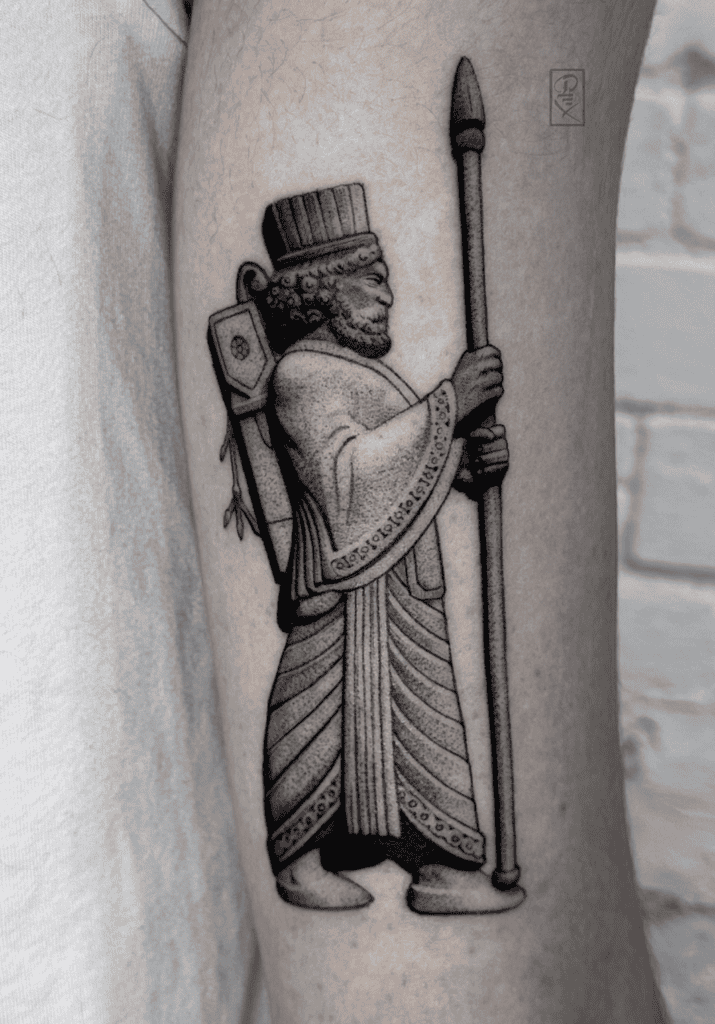
The Persian Immortals were an elite military unit of the ancient Persian Empire. They served as both the emperor’s personal guard and a highly trained standing army during the Achaemenid Empire (c. 550–330 BCE).
Their name comes from the Greek historian Herodotus, who claimed the unit always maintained exactly 10,000 soldiers. If one died or was wounded, he was immediately replaced. To outsiders, it appeared as if their numbers never changed — hence, “Immortals.”
Qajar Angel Persian Mythology Tattoo

The Qajar Angel is not a figure from ancient mythology, but an artistic motif from the Qajar dynasty (1789–1925) in Iran. These angels appear in paintings, murals, manuscripts, palace decorations, and lacquer art of the period. They are one of the most recognisable symbols of Qajar-era Persian art.
Qajar angels are usually depicted as youthful and androgynous, pale-faced with large expressive eyes, wearing flowing robes, possessing colourful, often oversized wings, and sometimes holding flowers, swords, or banners.
Their style blends Persian miniature tradition with European artistic influence, especially after increased contact with Europe in the 19th century.
Shahmaran Persian Mythology Tattoo
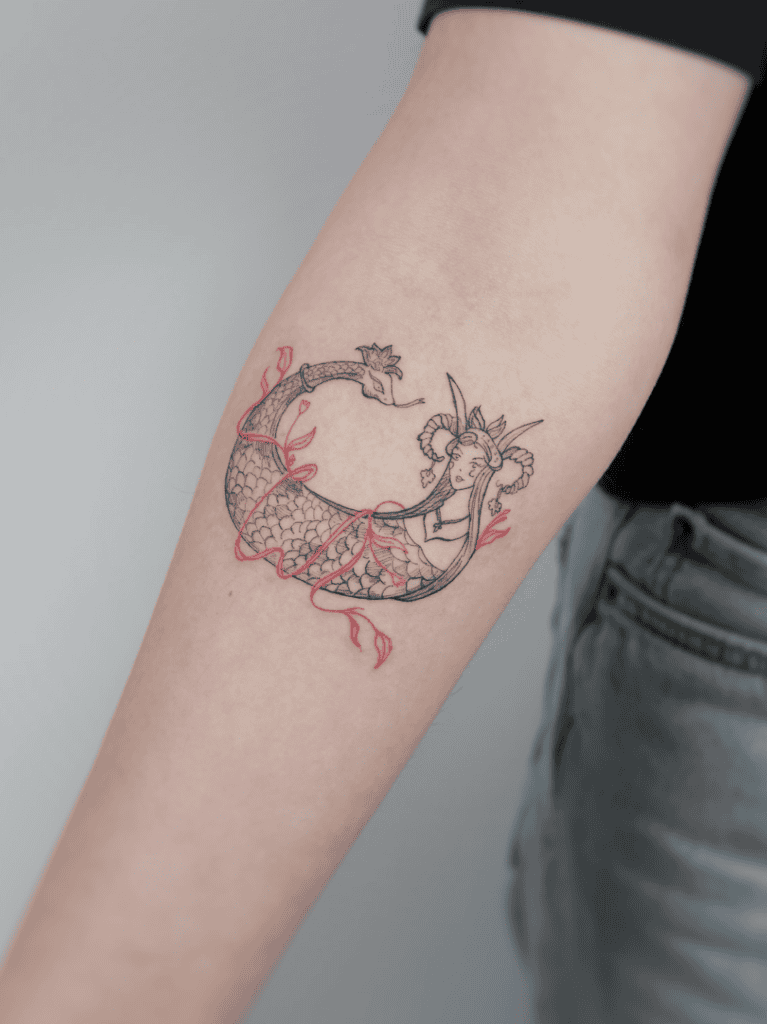
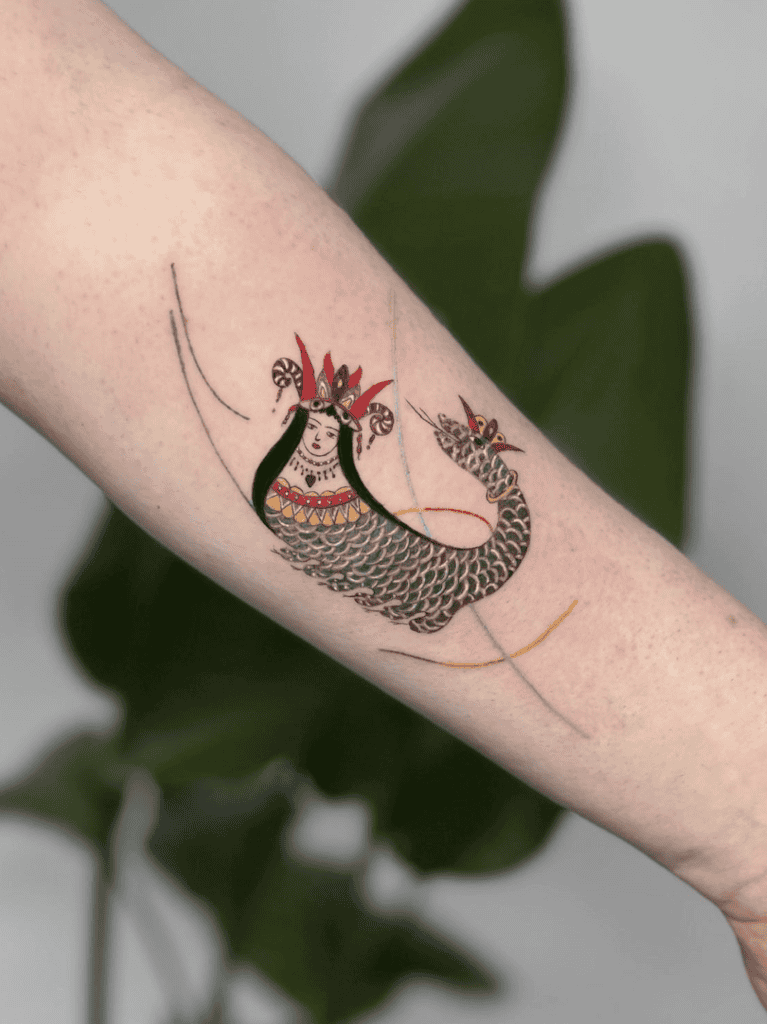
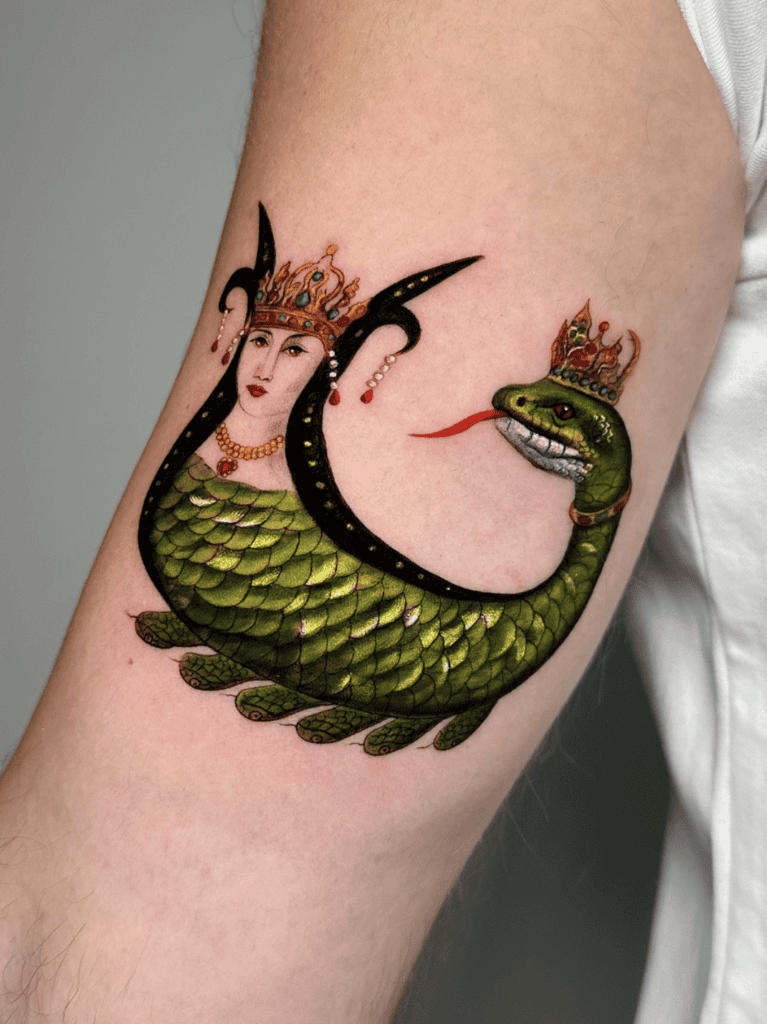
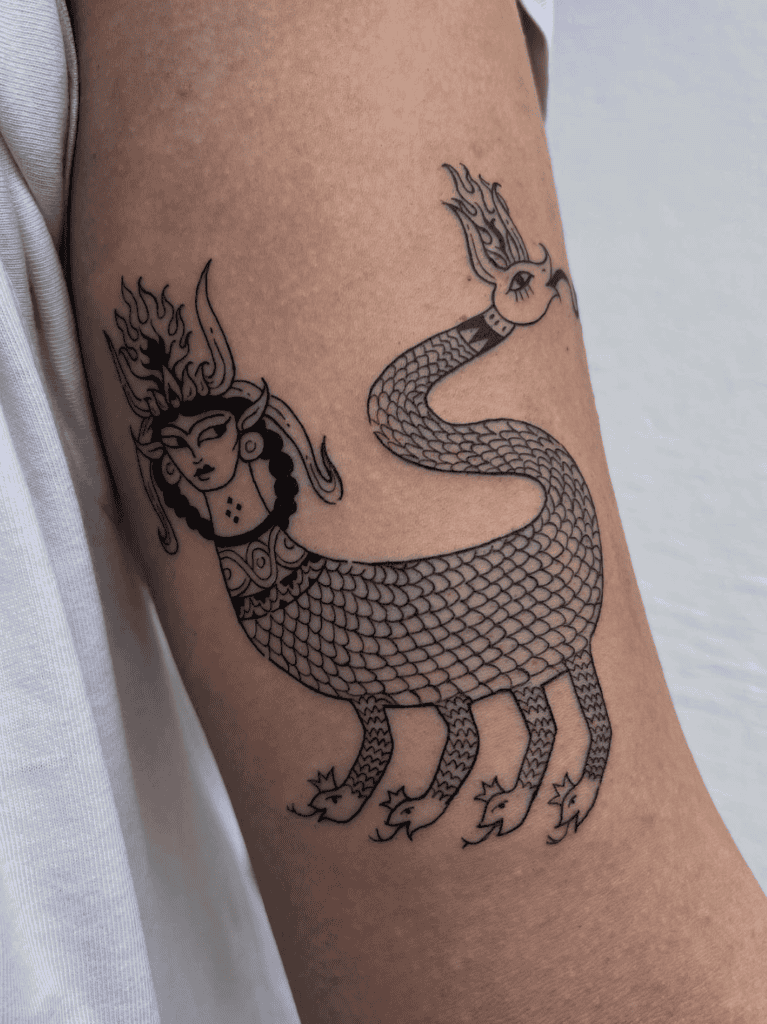
Shahmaran is a legendary serpent queen found in Persian, Anatolian, and Kurdish folklore. She is usually depicted as a woman from the waist up, a serpent from the waist down, crowned or adorned with jewels, and surrounded by snakes.
The most famous version of her story tells of a young man named Camasb who accidentally discovers her hidden underground realm. Instead of harming him, Shahmaran welcomes him, shares her wisdom, and trusts him.
Eventually, Camasb returns to the surface world and is forced to reveal her location. Shahmaran is betrayed and captured. Before her death, she shared medical knowledge and healing secrets, and her story ends in sacrifice, but with her wisdom enduring.
Azhdaha Persian Mythology Tattoo

The Azhdaha (also spelt Azhi Dahaka in older texts) is a dragon-like creature in Persian mythology. Over time, the term came to mean “dragon” in Persian folklore. The word comes from the ancient Iranian Azhi Dahaka, a three-headed serpent-like demon mentioned in early Zoroastrian texts.
In later epic tradition — especially in the Shahnameh by Ferdowsi — the Azhdaha becomes more dragon-like and less abstract. Interestingly, the tyrant Zahhak is believed to be a humanised form of Azhi Dahaka in later storytelling.
Descriptions vary, but the Azhdaha is usually portrayed as a massive serpent or dragon that is sometimes multi-headed, is capable of fire-breathing (in later folklore), and lives in mountains, caves, or water. In some stories, it can grow so large that it blocks rivers or devours entire villages.
Arash The Archer Persian Mythology Tattoo


Arash the Archer (Ārash-e Kamāngir) is one of the most heroic and self-sacrificing figures in Persian mythology. His story is about national survival, courage, and ultimate sacrifice. Unlike epic warriors such as Rostam, Arash’s legend centres on a single, world-changing act.
According to legend, after a long war between Iran and Turan, both sides agreed to settle their border peacefully. To settle the border, an Iranian archer would shoot an arrow, and wherever the arrow landed would mark the new boundary.
Iran had lost much territory, so if the arrow did not travel far, Persia would remain small and weakened. Arash, known for his unmatched skill, volunteered. He climbed Mount Damavand, drew his bow with all his strength, and released the arrow.
The arrow flew for an entire day — some versions say it travelled from dawn to sunset — crossing vast lands before finally landing far to the east, restoring great territory to Iran.
But the act drained Arash completely. In many versions of the myth, his body disintegrates as he dies immediately after the shot, with his life force becoming one with the land he saved.
Cyrus The Great Persian Mythology Tattoo


Cyrus the Great (c. 600–530 BCE) was the founder of the Achaemenid Empire, the first Persian Empire and one of the largest empires the world had seen up to that point. Unlike mythological heroes such as Rostam or Arash, Cyrus was a real historical ruler, but his legacy became legendary.
Cyrus began as ruler of a relatively small Persian kingdom. Through a series of military campaigns, he defeated the Medes, conquered Lydia (in modern Turkey), and captured Babylon in 539 BCE. At its height under Cyrus and his successors, the empire stretched from India to the Mediterranean.
One of Cyrus’ most famous achievements was the peaceful capture of Babylon. Instead of destroying the city, he respected local traditions, allowed religious freedom, and restored temples. The Cyrus Cylinder, often called the “first charter of human rights” (though that label is debated by historians), records his policies of tolerance and restoration.
Cyrus is particularly significant in Jewish history. After conquering Babylon, he allowed Jewish exiles to return to Jerusalem and rebuild their temple. He is even mentioned in the Hebrew Bible as a divinely appointed ruler. This policy of tolerance became a defining feature of Persian rule.
Darius the Great Persian Mythology Tattoo

Darius I (r. 522–486 BCE), known as Darius the Great, was one of the most powerful and capable rulers of the Achaemenid Empire. Darius was not the direct son of Cyrus. After political turmoil and rebellions across the empire, Darius seized power and consolidated control.
To legitimise his rule, he carved the famous Behistun Inscription into a cliff face. The inscription recounts his account of how he defeated false kings and restored order by the will of Ahura Mazda.
Darius transformed Persia from a vast conquered territory into a well-organised superpower. He divided the empire into satrapies (provinces), appointed governors (satraps), standardised taxation, introduced a uniform legal framework, and improved record-keeping. This administrative system helped Persia govern lands stretching from India to Egypt.
Darius began construction of Persepolis, turning it into a ceremonial capital of extraordinary scale. Its grand halls and reliefs symbolised imperial unity, multicultural governance. and royal authority. Like Cyrus, Darius respected local religions but strongly promoted loyalty to Ahura Mazda in his royal inscriptions.
Ferdowsi the Great Persian Mythology Tattoo

Ferdowsi (c. 940–1020 CE) is one of the greatest poets in world literature and the author of the epic masterpiece Shahnameh (“The Book of Kings”). Ferdowsi spent around 30 years composing the Shahnameh, a monumental epic of roughly 50,000 couplets.
The poem recounts the creation of the world, mythical kings and heroes, legendary figures like Rostam, Sohrab, and Zahhak, and the fall of the Sasanian Empire. It blends myth, legend, and early history into a continuous national narrative.
After the Arab conquest of Persia in the 7th century, Arabic became dominant in administration and scholarship. Ferdowsi deliberately wrote the Shahnameh in pure Persian, avoiding Arabic vocabulary as much as possible.
His work helped preserve the Persian language, strengthen Iranian cultural identity, and safeguard pre-Islamic myths and history. Without Ferdowsi, much of ancient Iranian mythology might have been lost.
Lamassu Persian Mythology Tattoo
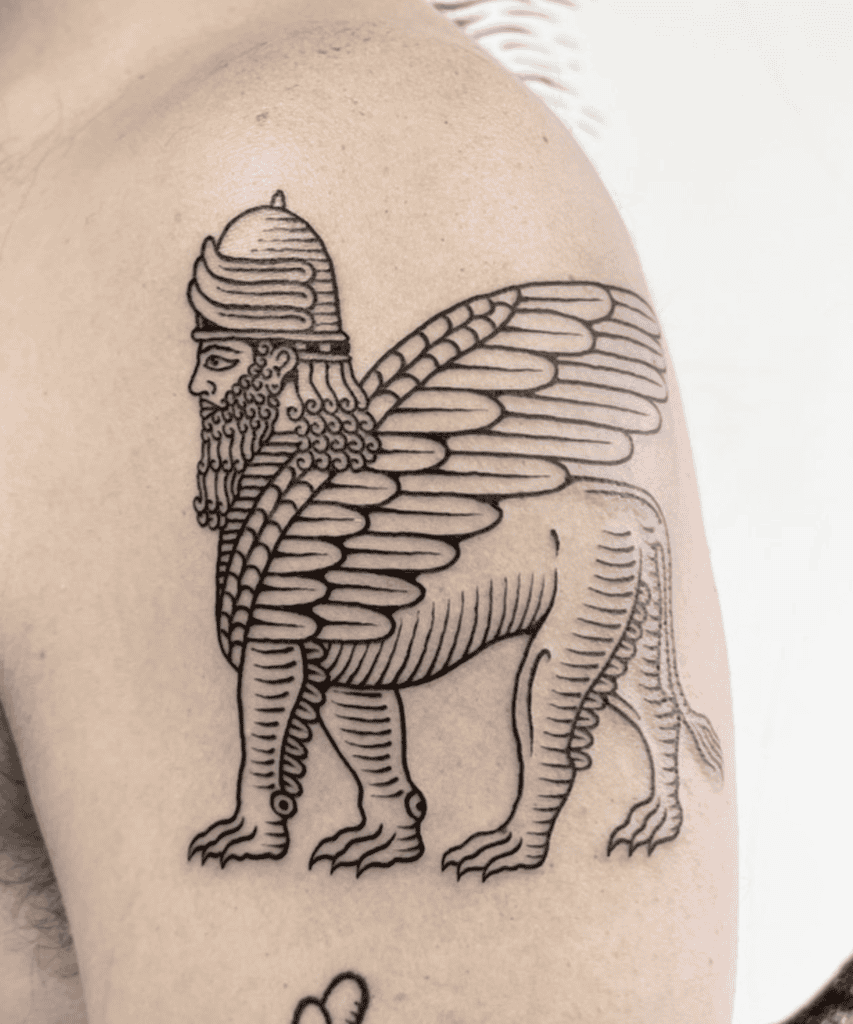
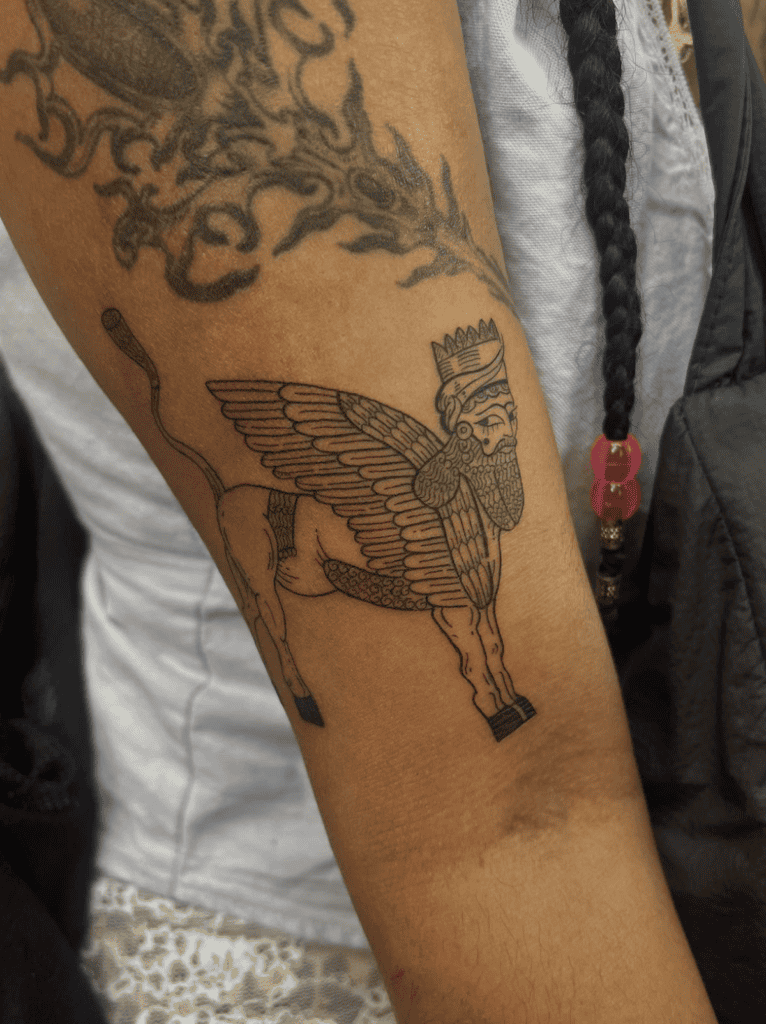
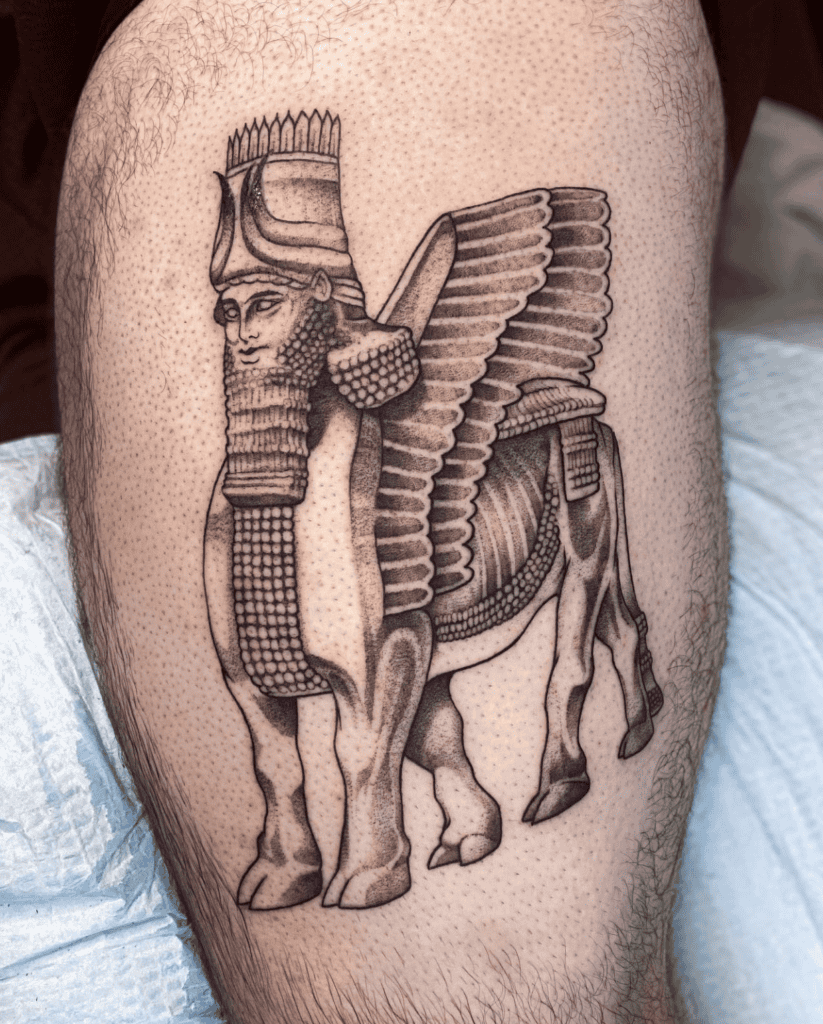
The Lamassu is a powerful protective being from ancient Mesopotamian mythology, especially associated with Assyrian and Babylonian culture. Although not originally Persian, Lamassu imagery influenced the wider Near Eastern world — including regions later ruled by Persian empires.
The Lamassu is a striking hybrid creature combining the body of a bull (strength), the wings of an eagle (divine power and protection), and a human head (intelligence and authority), often wearing a royal crown.
These statues were enormous, sometimes over 4 metres tall, and interestingly, they were carved with five legs, so from the front they appear standing still, but from the side they appear walking. This was an artistic illusion.
Lamassu statues were placed at palace entrances, city gates, and temples. Their role was to ward off evil spirits, protect rulers, display royal power, and intimidate enemies.
Lion And Sun Persian Mythology Tattoo


The Lion and the Sun is one of the most famous historical symbols of Iran. It is not originally a mythological creature, but a powerful royal and astrological emblem that evolved over centuries.
For hundreds of years, it appeared on Persian flags, coins, and royal insignia, especially before the 1979 Iranian Revolution. The symbol began appearing prominently during the Safavid Empire (16th century) and later became strongly associated with the Qajar dynasty.
However, its roots are older and connected to astrology, royal imagery, and Persian artistic traditions. The Lion represents the zodiac sign Leo, and the Sun represents cosmic authority and divine radiance. In medieval Islamic astrology, the Sun is considered exalted in Leo. This celestial pairing likely influenced the emblem’s development.
Over time, the symbol gained political meaning. The lion came to represent strength, courage, and kingship. The sun came to symbolise divine glory, enlightenment, and royal authority. Together, they conveyed the idea that the ruler’s power was both strong and divinely favoured.
The Lion and Sun remained Iran’s national emblem until 1979, when it was replaced after the Islamic Revolution. Today, it is still used by some as a cultural or historical symbol of Iran’s pre-revolution identity.
Shahbaz Persian Mythology Tattoo

The Shahbaz (literally “Royal Falcon” or “King Falcon”) is a powerful bird symbol in Persian culture. While not a mythological creature like the Simurgh, it represents royal authority, vision, and divine favour.
Although we don’t have a perfectly preserved flag from Cyrus’ reign, historical and artistic evidence suggests that an eagle or falcon standard was associated with early Achaemenid rulers.
Ancient sources and later traditions describe a royal banner featuring a golden eagle (or falcon), with spread wings and mounted on a spear or pole. This bird emblem is sometimes referred to as the Shahbaz standard.
Shirzan Persian Mythology Tattoo

Shirzan (شیرزن) is a Persian term that literally translates to “lioness” or “lion woman”. It is used to describe a woman who is exceptionally brave, courageous, and noble, often referring to women who fight for justice, possess great inner fortitude, and refuse to be silenced.
Conclusion
Thanks for joining us on this Simurgh-ing adventure through the incredible world of the Persian Mythology Tattoo. We hope these designs have Rakhsh-ed your world and inspired you to go on your own Persian Tattoo adventure. But if these Tattoo Clues still don’t inspire you, why not check out even more Mythological Tattoos, climb Mount Olympus with these Greek Mythology Tattoos, or start a cycle anew with these Egyptian Mythology Tattoo Ideas.
- Berserk Tattoo Ideas - February 19, 2026
- Galar Pokémon Tattoo Ideas - February 14, 2026
- Persian Mythology Tattoo Ideas - February 13, 2026


