

Greek Mythology Tattoo Ideas

Do you feel like you’re stuck at the bottom of Mount Olympus, looking up for the perfect Tattoo Clues? Not to worry, hop aboard our Pegasus and take flight toward these incredible Greek Mythology Tattoo Designs that are fit for the Gods.
What is Greek Mythology
Greek mythology is a collection of ancient stories created by the people of Ancient Greece to explain the world around them. These myths describe gods, goddesses, heroes, monsters, and spirits, and they were used to make sense of life, nature, morality, and human emotions long before modern science or organised religion.
Rather than being a single book, Greek mythology comes from oral storytelling, poems, plays, and later written works. Stories were passed down for generations and evolved over time, which is why many myths exist in multiple versions.
Best Greek Mythology Tattoo Artists


Best Greek Mythology Tattoo Ideas
Now that we know a little about Greek Mythology, let’s take a look at some of the best Greek Mythology Tattoo Ideas the internet has to offer.
Zeus Greek Mythology Tattoo
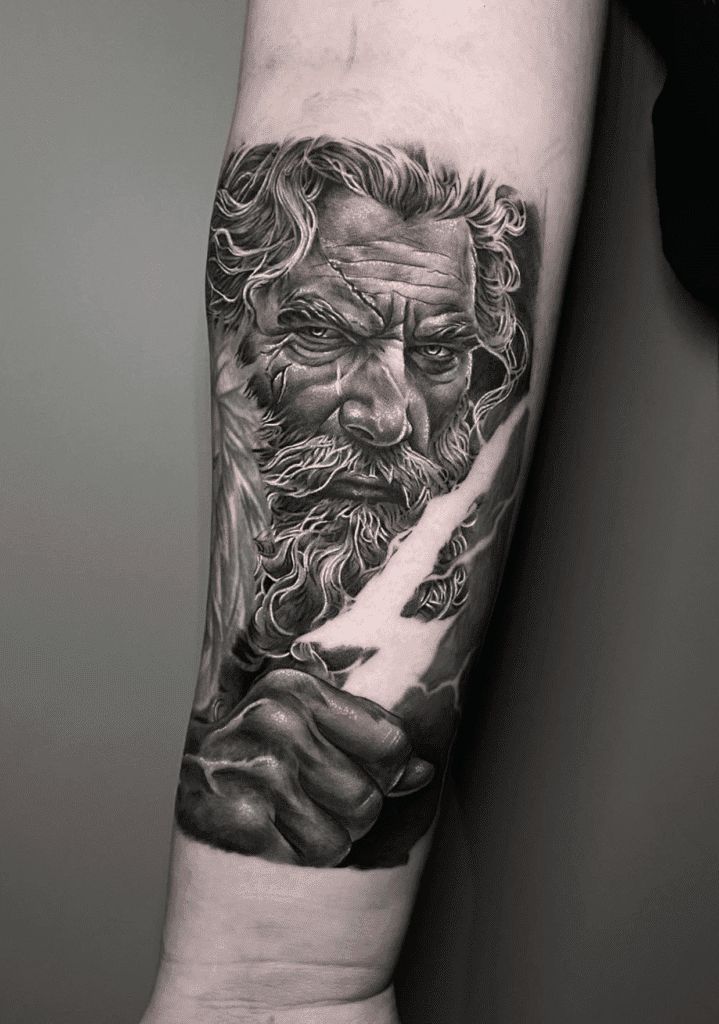
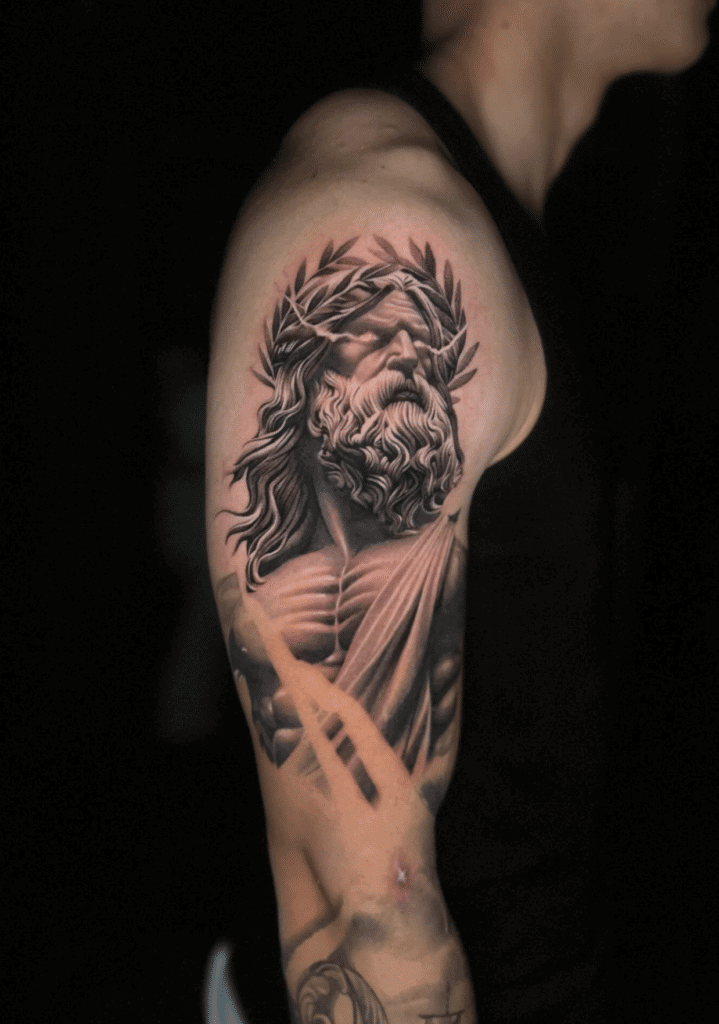
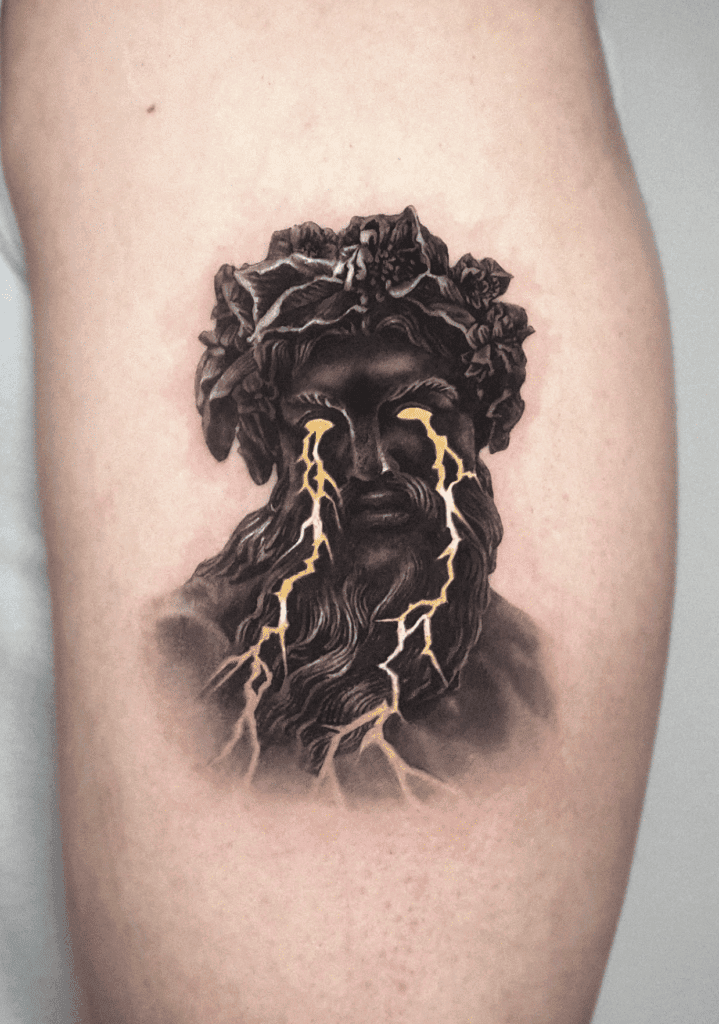
Zeus is the youngest son of the Titan Cronus and Rhea. Fearing a prophecy that one of his children would overthrow him, Cronus swallowed each child at birth. Zeus was saved and hidden away by his mother, and upon reaching adulthood, Zeus returned, forced Cronus to free his siblings, and led a massive war against the Titans known as the Titanomachy.
After victory, Zeus became king of the gods, dividing the cosmos with his brothers: the sky for Zeus, the sea for Poseidon, and the underworld for Hades.
Hera Greek Mythology Tattoo
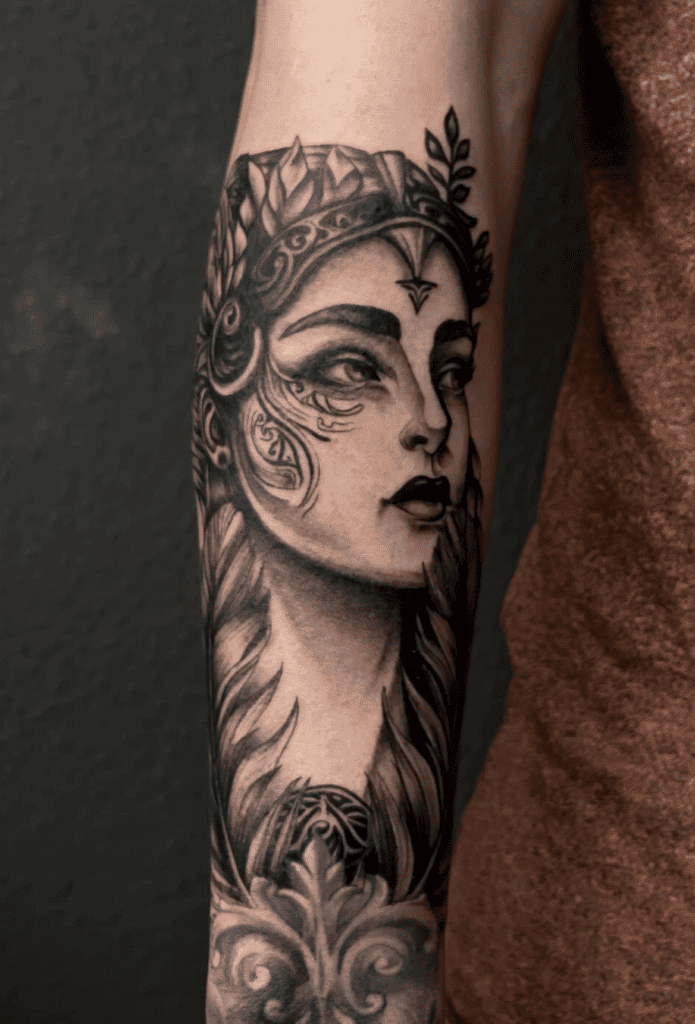
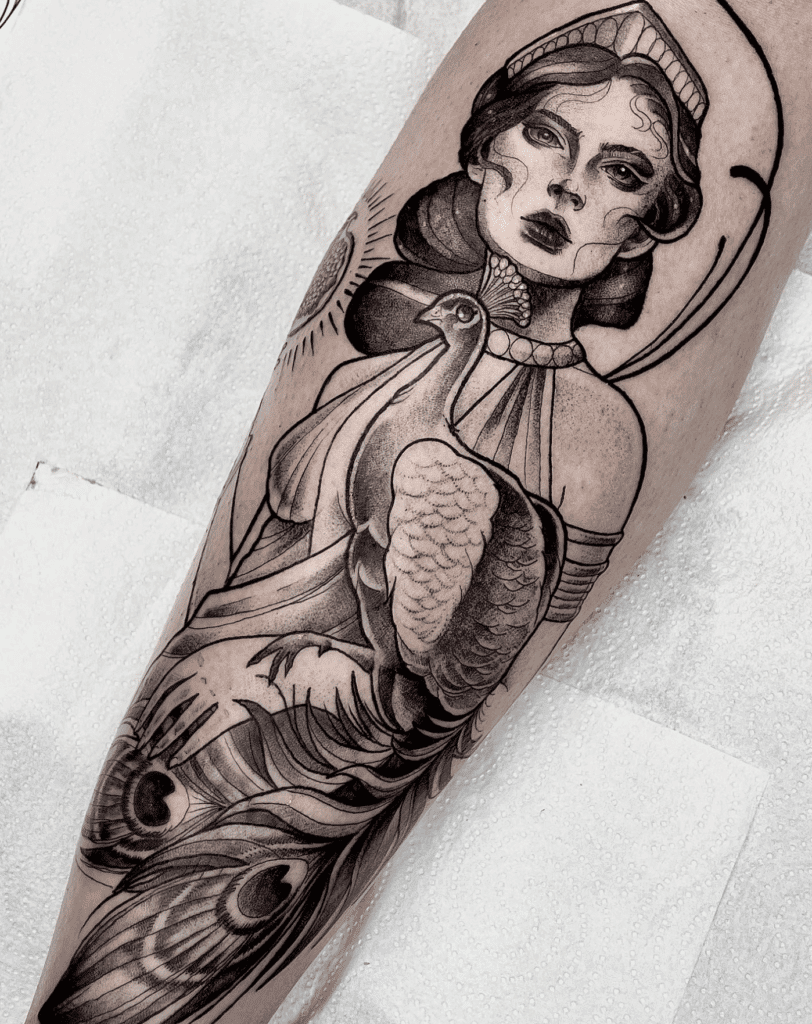
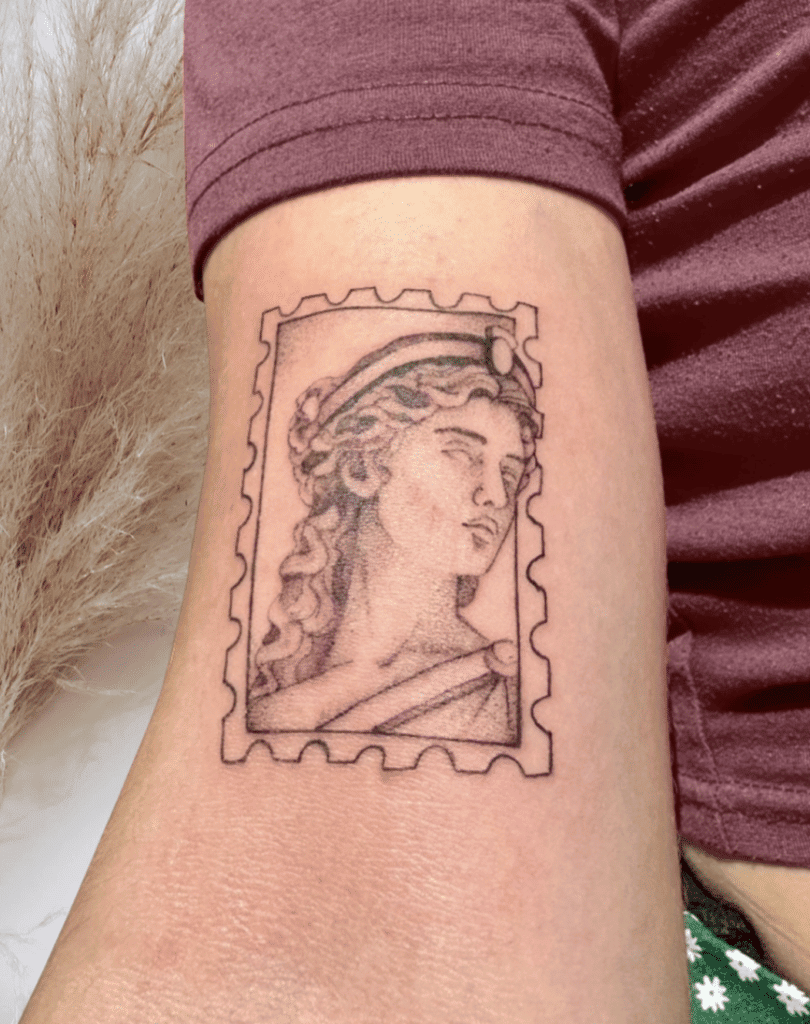
Hera is the queen of the Olympian gods and the goddess of marriage, family, childbirth, and royal authority. As the wife of Zeus, she holds immense status on Mount Olympus, ruling alongside him and presiding over the sacred bonds that hold society together.
Hera is the daughter of the Titans Cronus and Rhea, and one of the original Olympians. After the fall of the Titans, she became both sister and wife to Zeus, cementing her position as queen of the gods. Worshipped widely across ancient Greece, Hera was often honoured as a protector of women, marriage rites, and lawful succession.
Poseidon Greek Mythology Tattoo
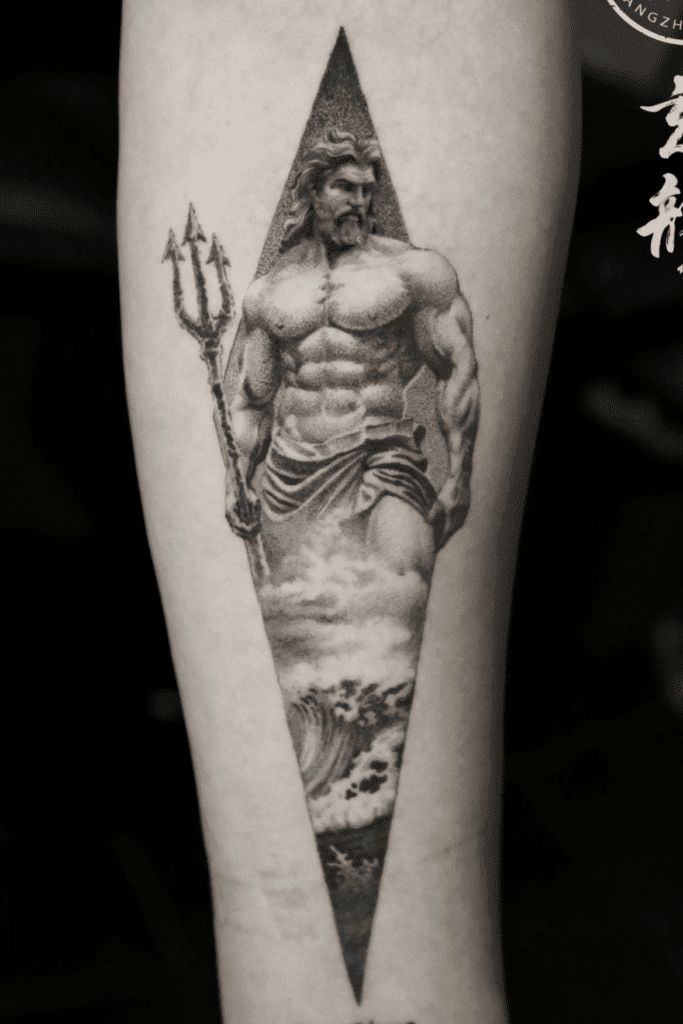
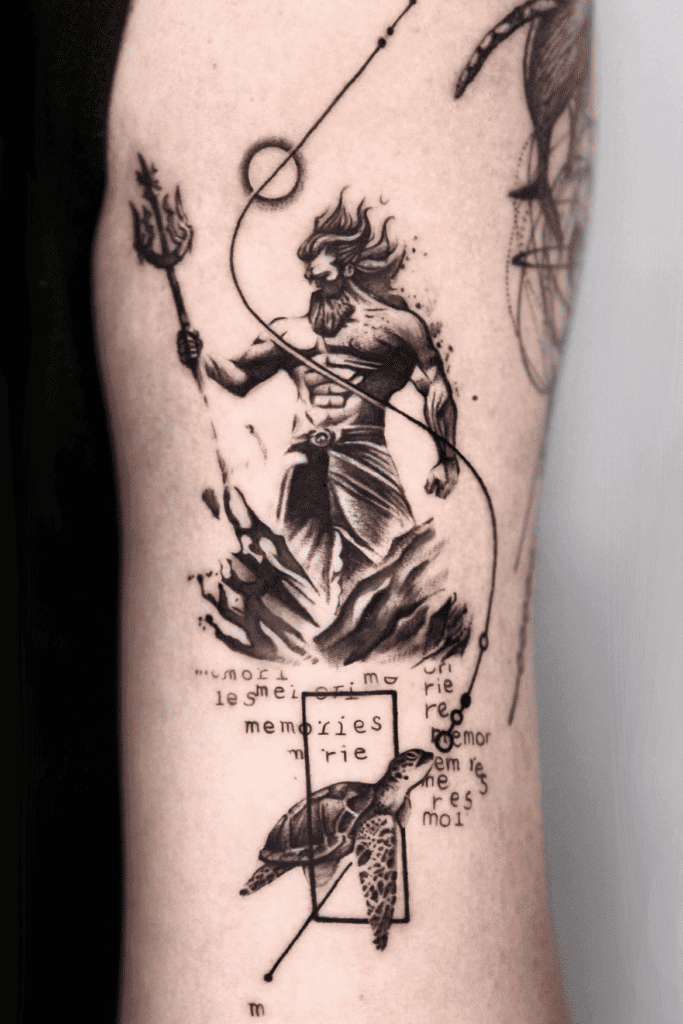
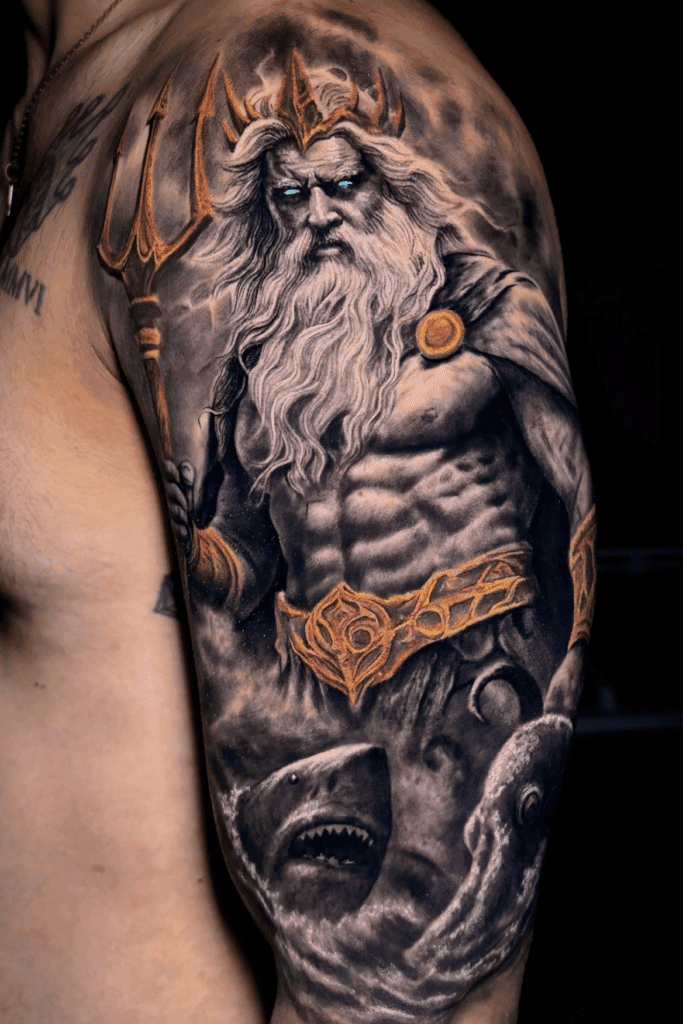
Poseidon is one of the most powerful Olympian gods, ruling over the sea, storms, earthquakes, and horses. As brother to Zeus and Hades, he represents the raw, unpredictable forces of nature, embodying chaos, emotion, and untamed power.
Poseidon is another son of the Titans Cronus and Rhea. Like his siblings, he was swallowed by Cronus at birth and later freed by Zeus. After the Titans were defeated, the three brothers divided the universe by lot. Poseidon received dominion over the oceans and all waters, making him the ruler of seas, rivers, lakes, and coastal lands.
His palace was said to lie beneath the waves, a glittering realm of coral and gold, hidden from mortal eyes.
Demeter Greek Mythology Tattoo
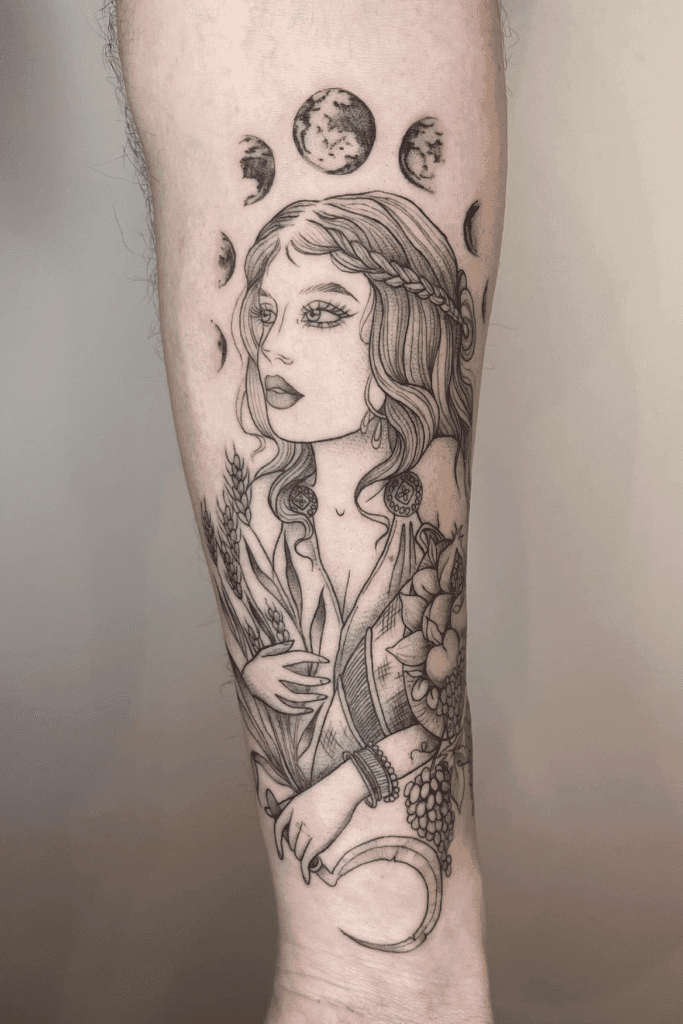
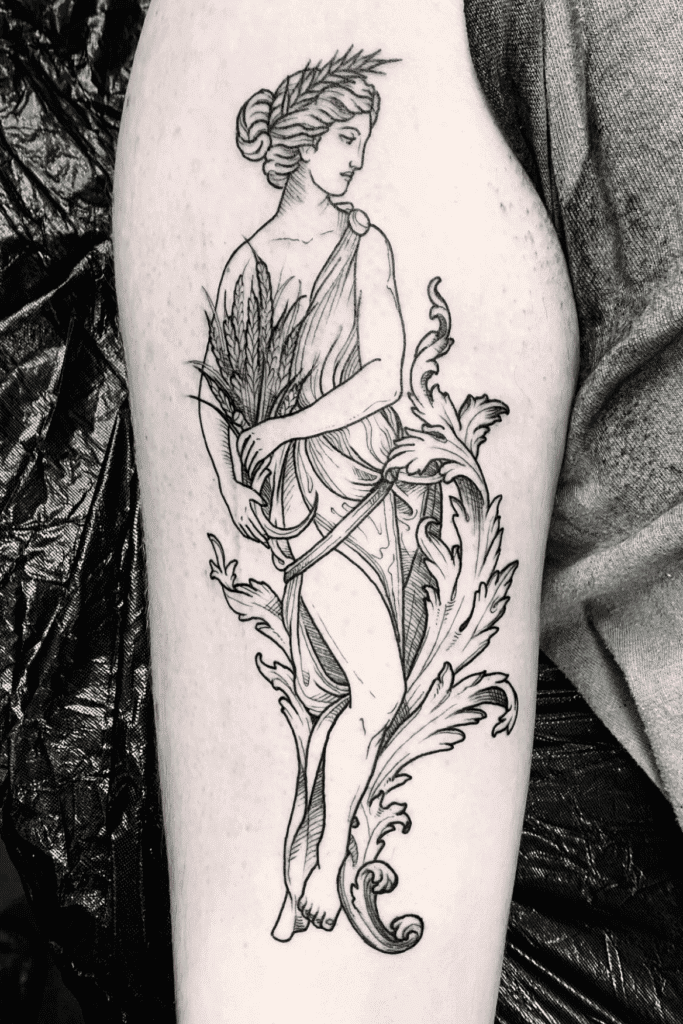
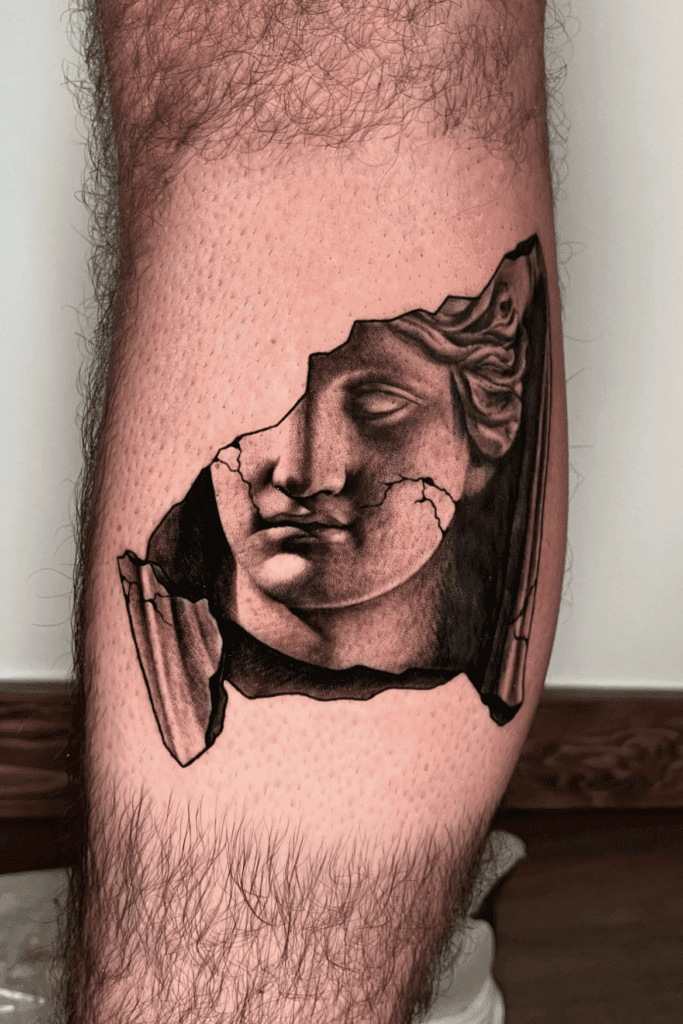
Demeter is the Greek goddess of agriculture, fertility, grain, and the harvest, and one of the most vital deities in Greek mythology. Demeter is one of the daughters of the Titans Cronus and Rhea. As an Olympian goddess, her power is deeply tied to the earth and its natural cycles. Ancient Greeks honoured her not only as a goddess, but as a protector of civilisation, since farming marked the foundation of settled human life.
Athena Greek Mythology Tattoo
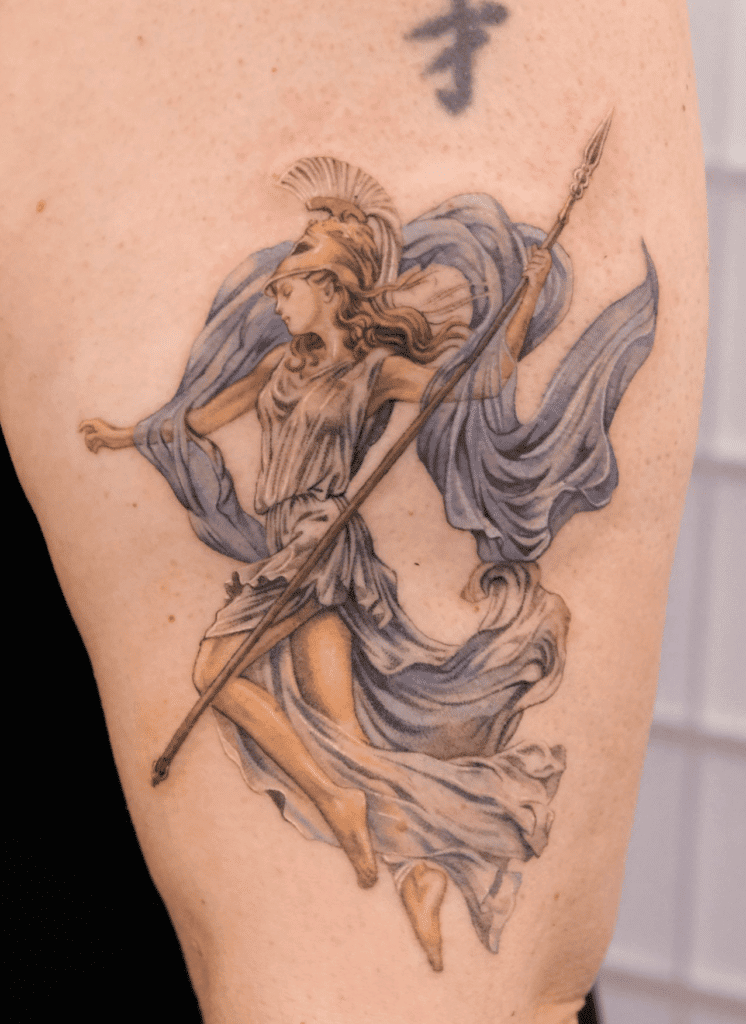
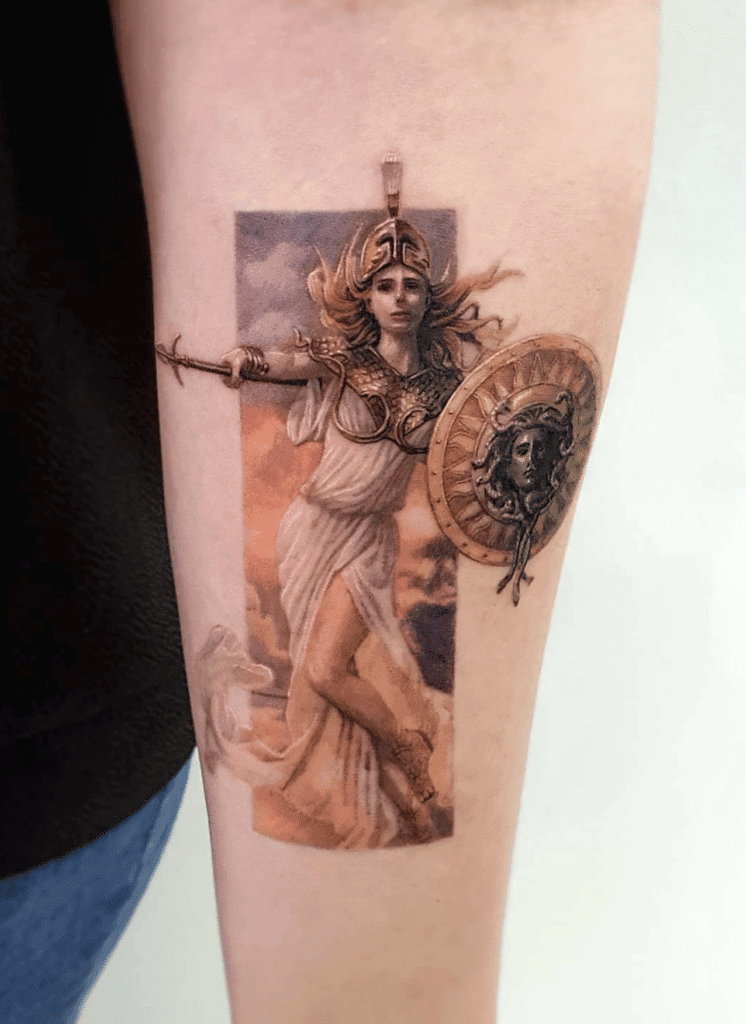
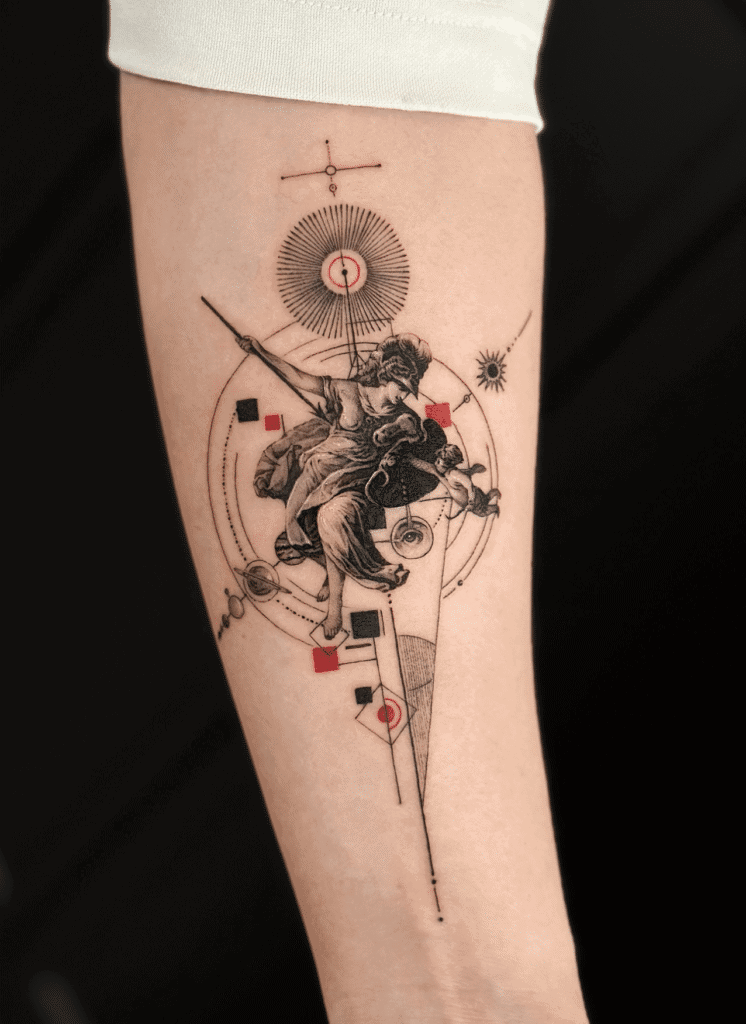
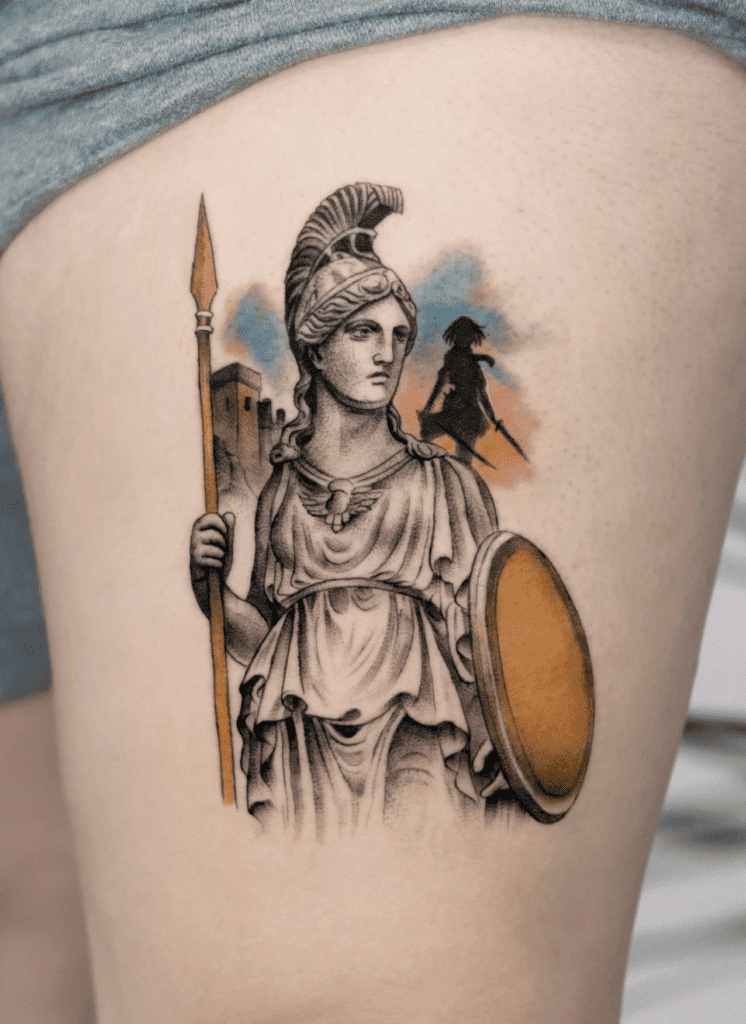
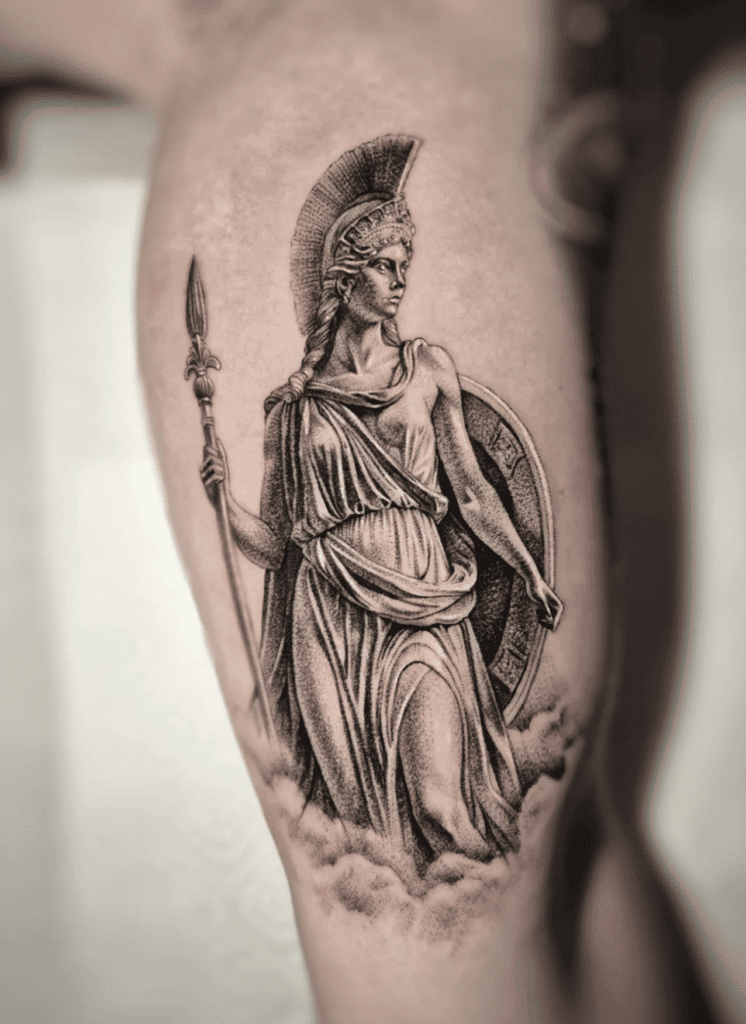
Athena is the Greek goddess of wisdom, strategy, justice, and skilled warfare, revered as one of the most intelligent and disciplined Olympians. Athena represents reason, foresight, and thoughtful action. She is a protector of cities, a guide to heroes, and a symbol of civilisation itself.
Athena was born fully grown and fully armoured from the head of Zeus, after he swallowed her mother, Metis, the goddess of wisdom. This unusual origin symbolises Athena’s nature—pure intellect, clarity, and strategic thought, rather than passion or impulse.
As Zeus’s favoured daughter, Athena holds a unique position among the gods, often acting as his counsellor and moral compass.
Apollo Greek Mythology Tattoo
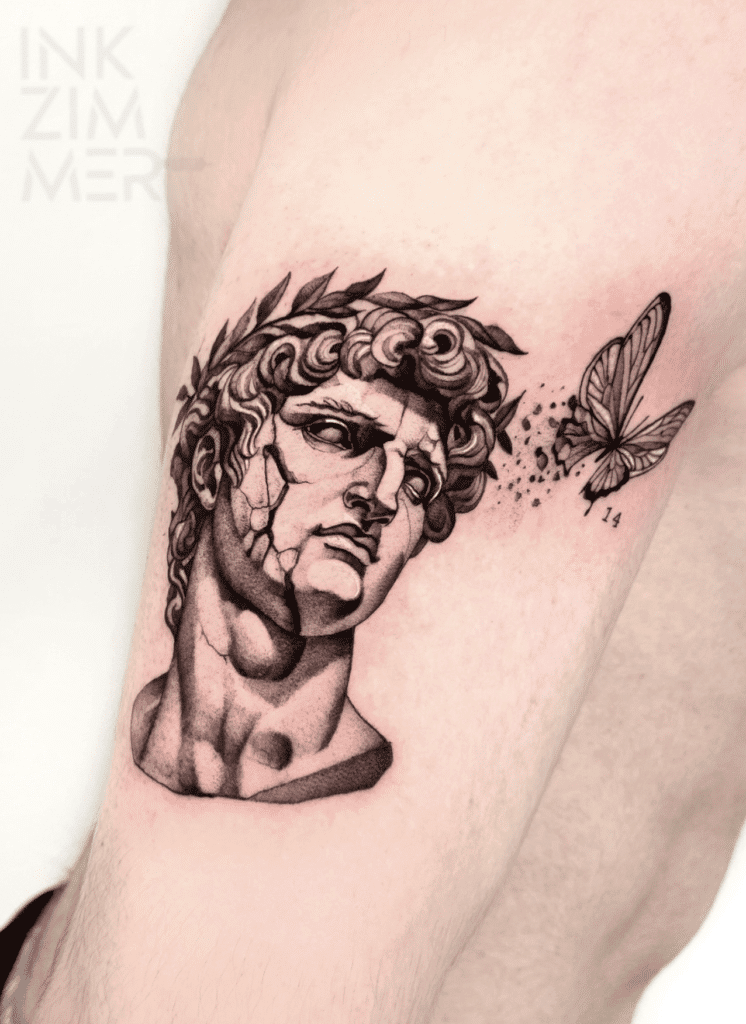
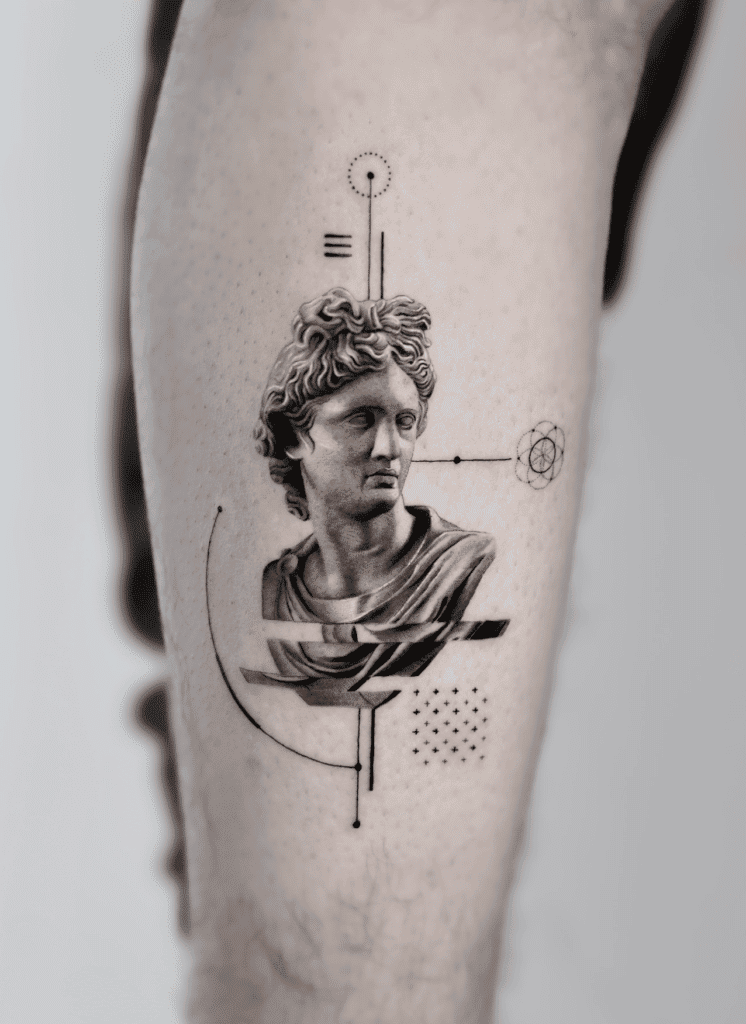
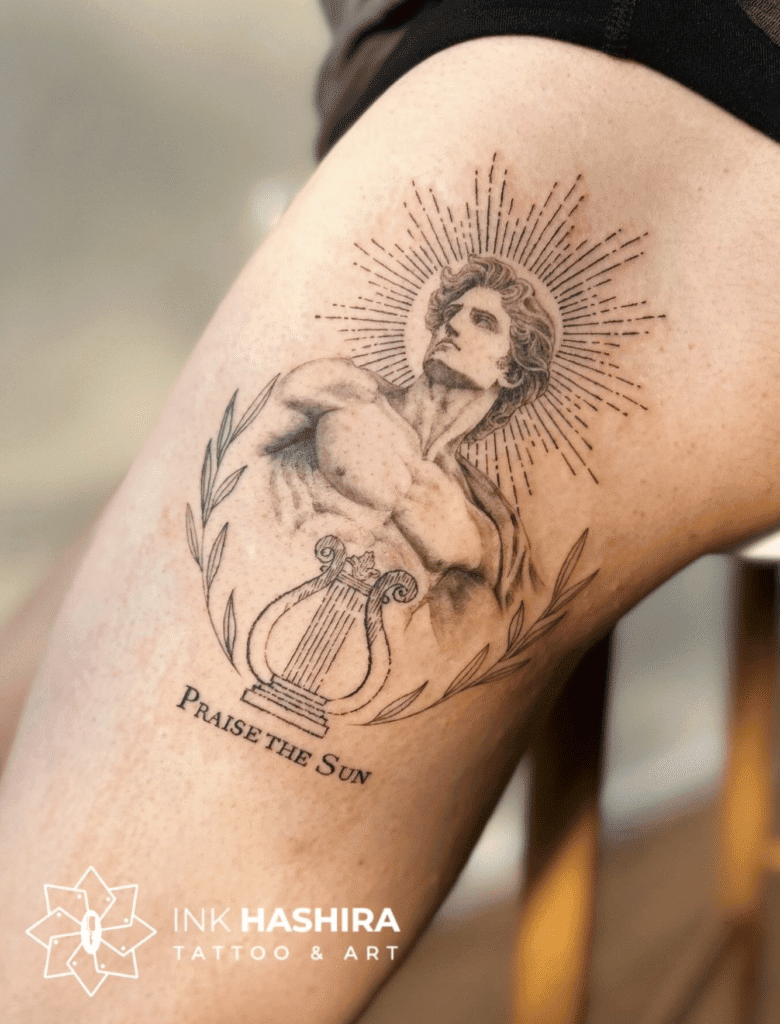
Apollo is one of the most complex and admired gods in Greek mythology, ruling over light, the sun, prophecy, music, poetry, healing, and truth. He is the son of Zeus and Leto, and the twin brother of Artemis. Born on the island of Delos after Leto endured great hardship, Apollo quickly grew into a powerful and radiant god. From early myths, he is portrayed as youthful, beautiful, and calm—an image that would define classical ideals of masculine perfection.
Artemis Greek Mythology Tattoo
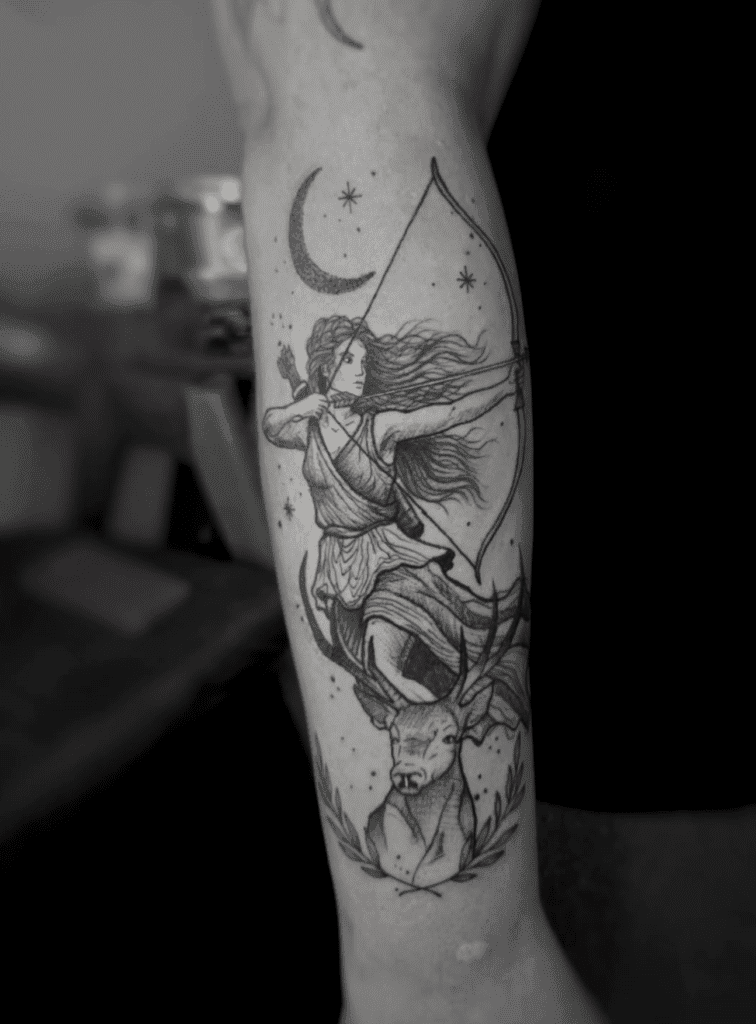
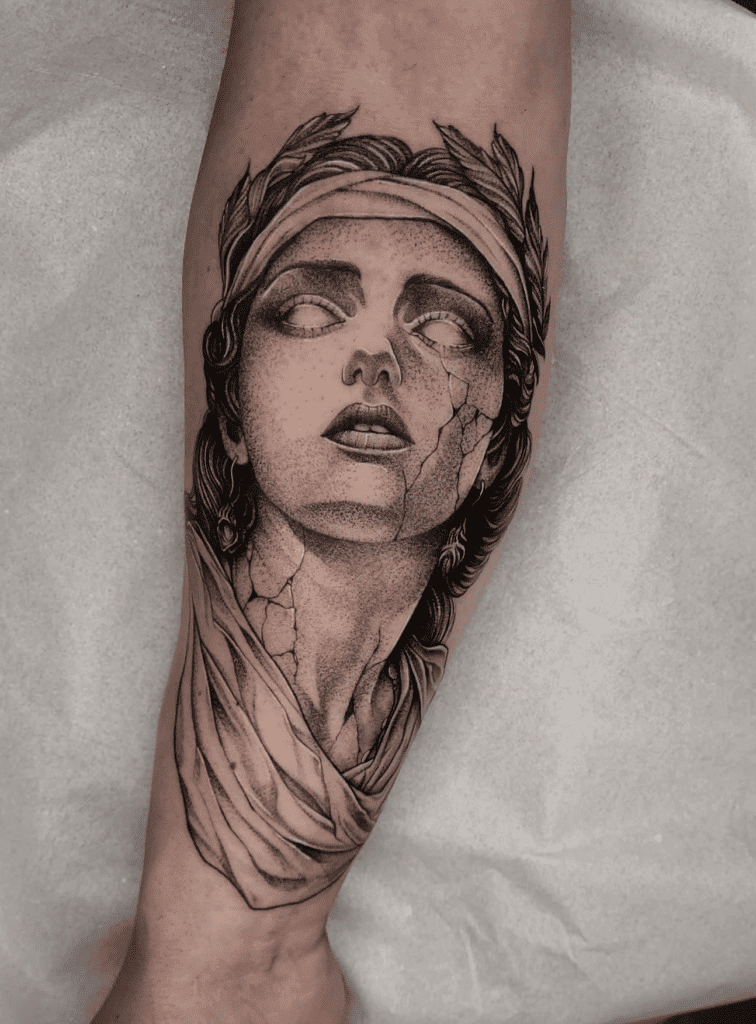
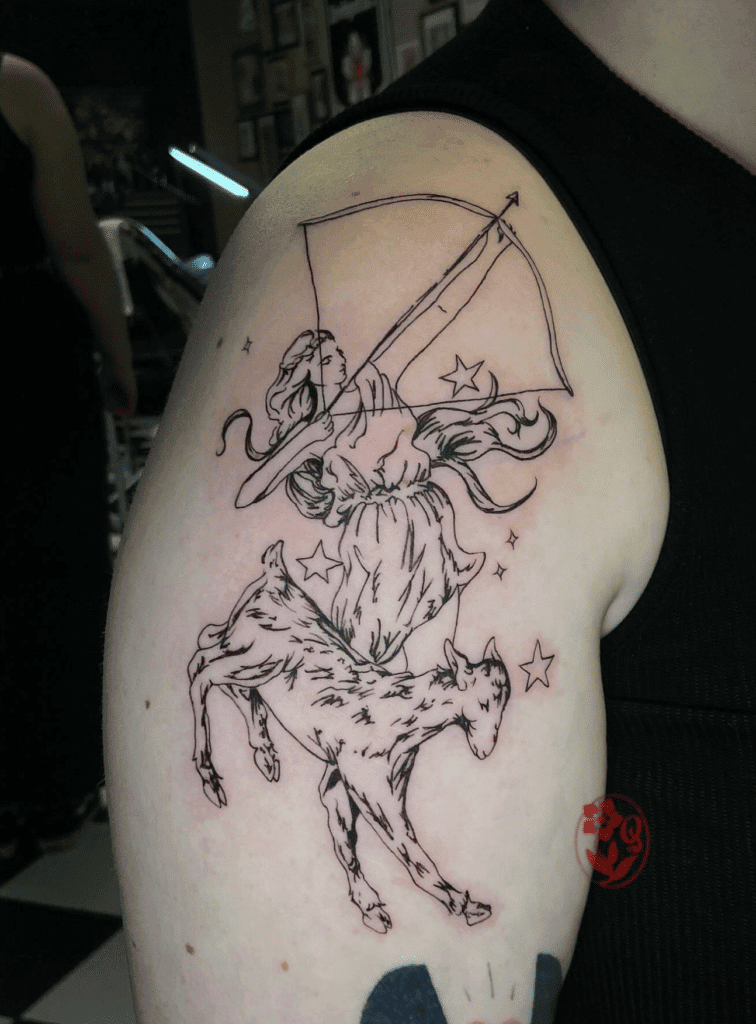
Artemis is the Greek goddess of the hunt, wilderness, animals, and the moon, embodying independence, precision, and untamed freedom. As a protector of the wild and a guardian of young women, Artemis stands apart from many Olympian gods as she values self-sufficiency, personal boundaries, and balance with nature above all else.
Artemis is the daughter of Zeus and Leto, and the twin sister of Apollo. According to myth, she was born first and immediately helped her mother give birth to Apollo, foreshadowing her role as a goddess of childbirth and protection, despite her vow of eternal virginity.
She roams forests, mountains, and moonlit landscapes, accompanied by nymphs and sacred animals.
Ares Greek Mythology Tattoo
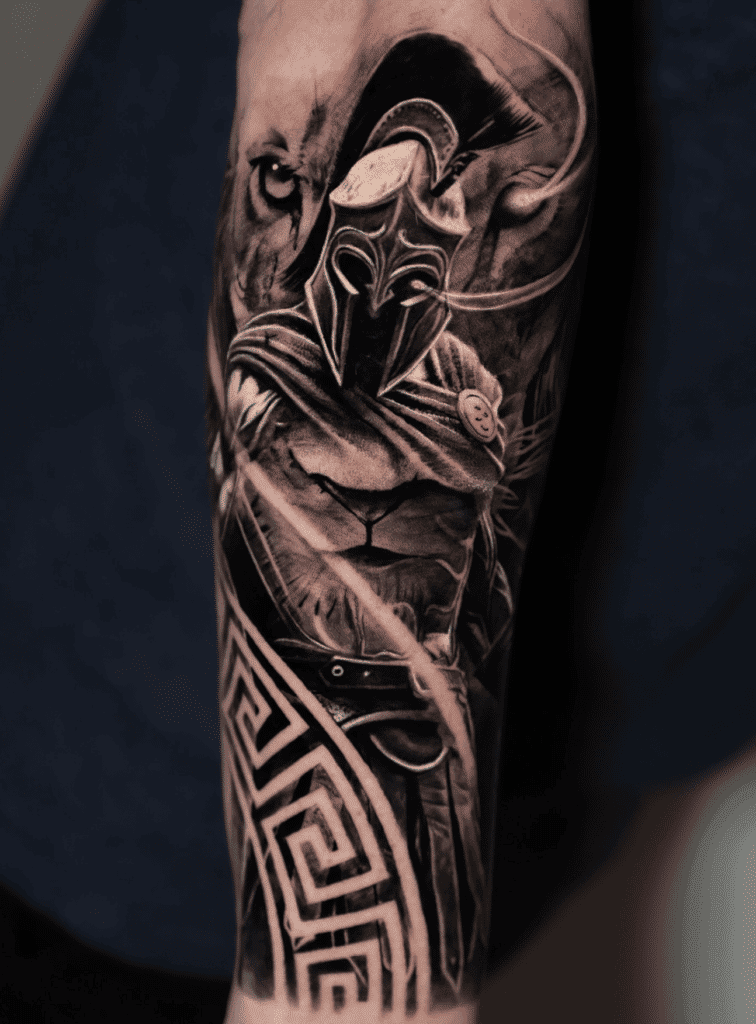
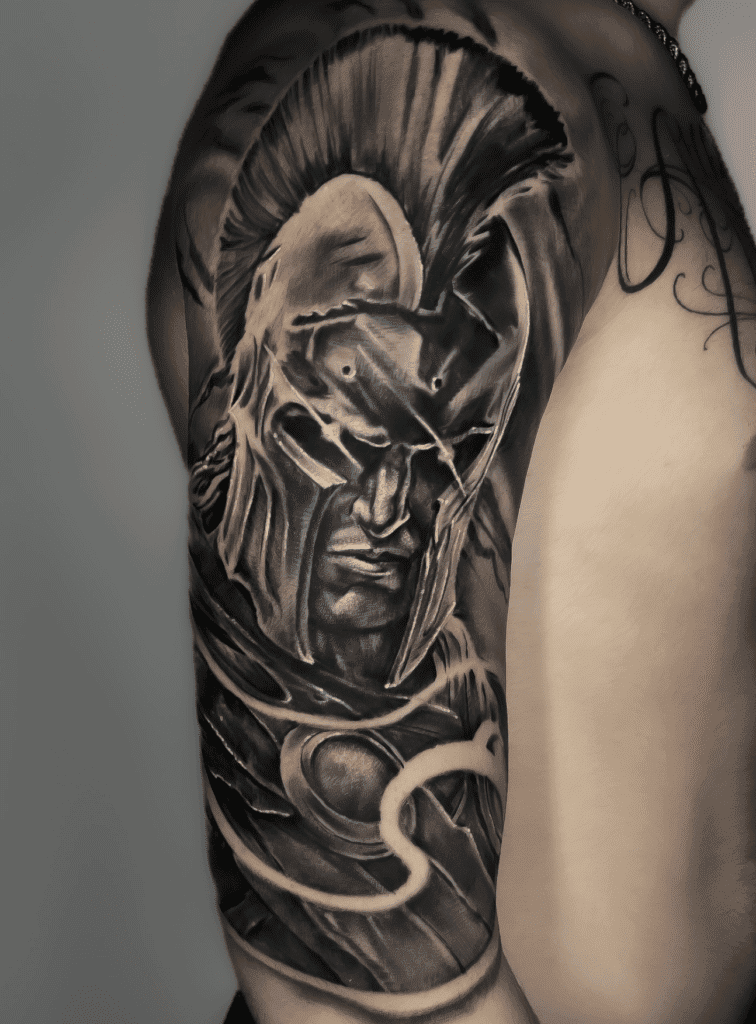
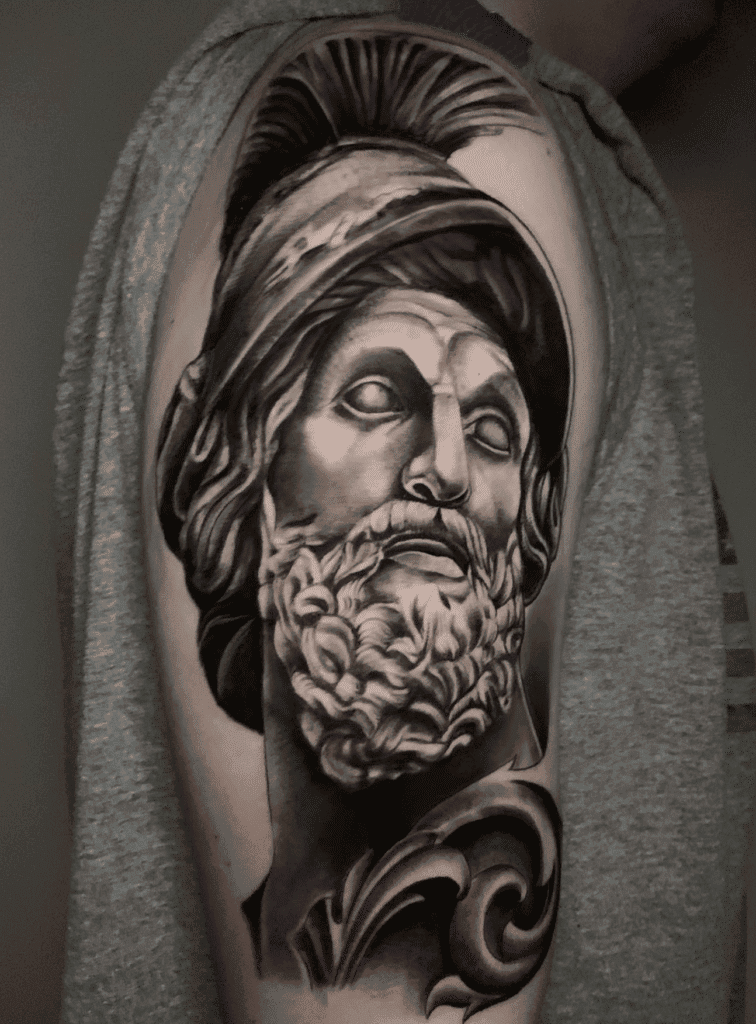
Ares is the Greek god of war, specifically representing its brutal, violent, and chaotic aspects. Unlike Athena, who embodies strategy and disciplined warfare, Ares personifies rage, bloodlust, and the thrill of combat.
Ares is the son of Zeus and Hera, making him a full Olympian by birth. Despite this, he was one of the least beloved gods, disliked by both mortals and fellow deities for his impulsive nature and love of conflict. Even Zeus openly criticised him, viewing Ares as reckless and destabilising.
Aphrodite Greek Mythology Tattoo
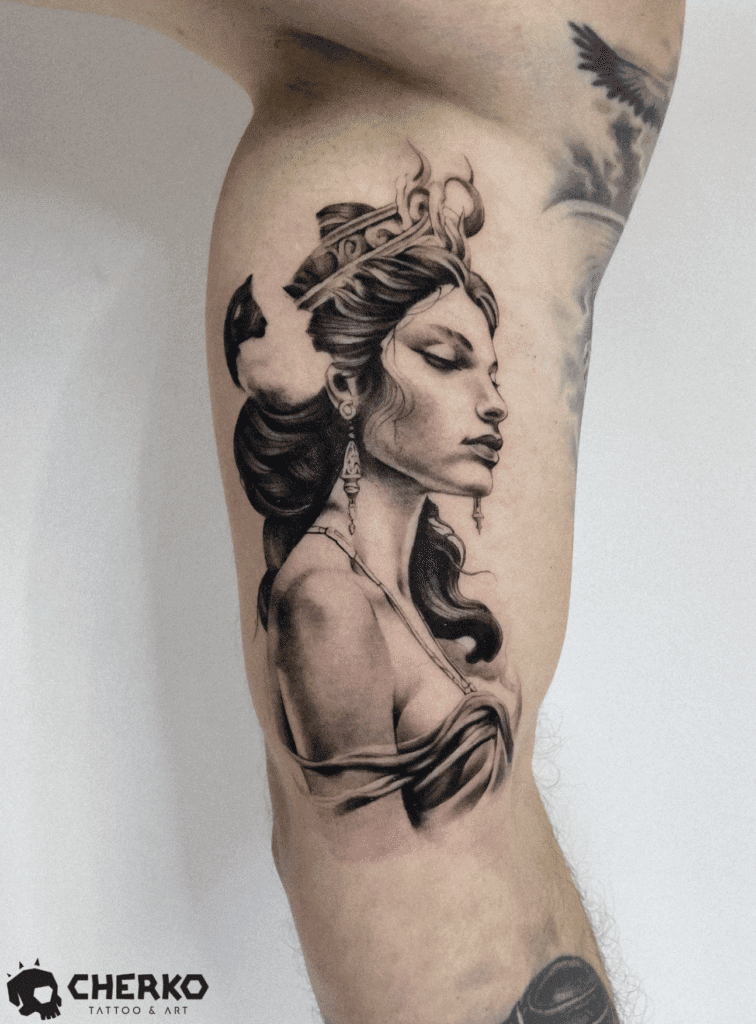
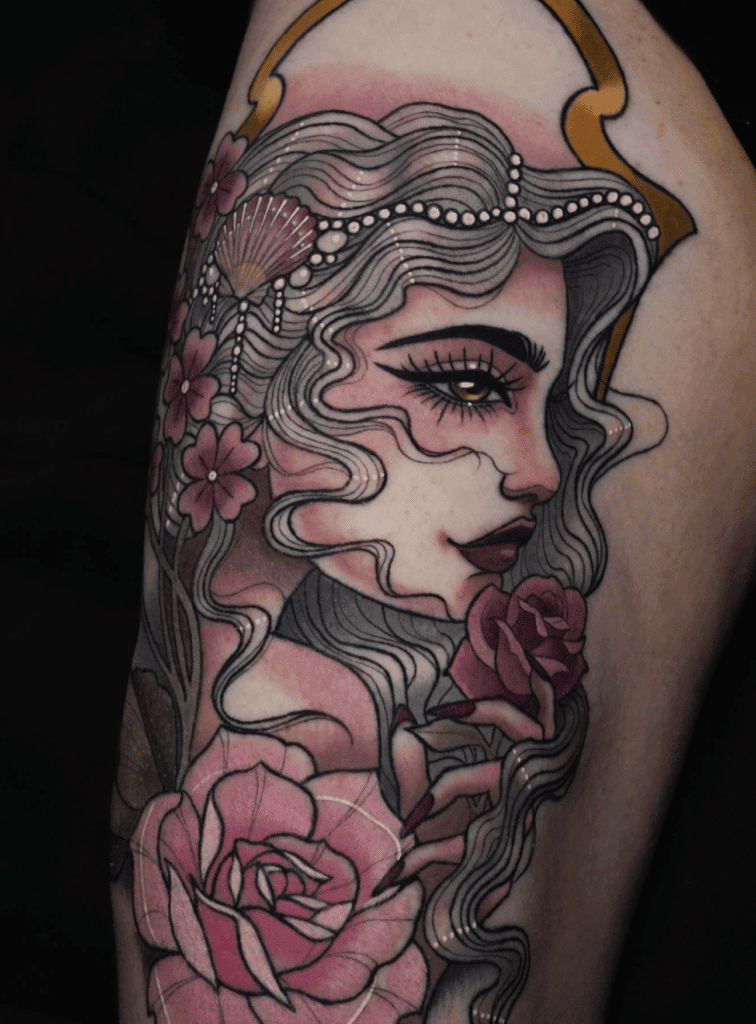
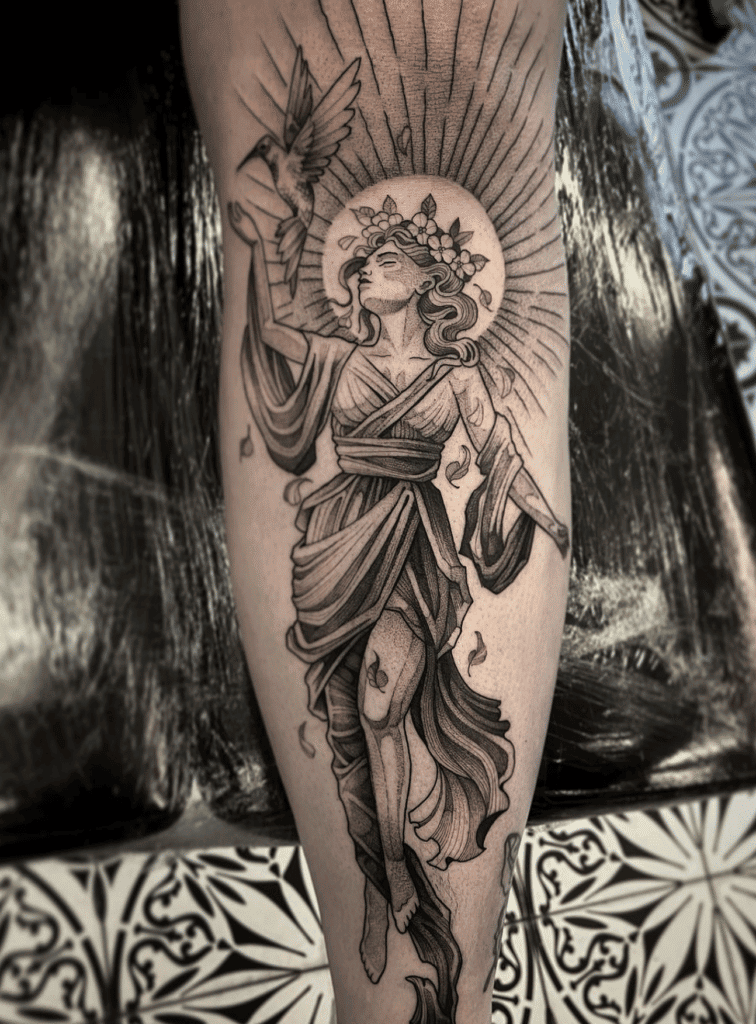
Aphrodite is the Greek goddess of love, beauty, desire, and attraction, ruling over romance in all its forms. She embodies the irresistible force of love itself, capable of inspiring devotion, obsession, jealousy, and transformation. Among the Olympians, Aphrodite wields one of the most subtle yet powerful forms of influence: the ability to move hearts and shape fate through desire.
Aphrodite’s origins are among the most poetic in Greek mythology. According to one tradition, she was born from sea foam, rising from the waves fully formed—an image that has inspired art for centuries. Other myths describe her as the daughter of Zeus and Dione. Both origins emphasise her divine nature as something ancient, elemental, and unavoidable.
Hephaestus Greek Mythology Tattoo
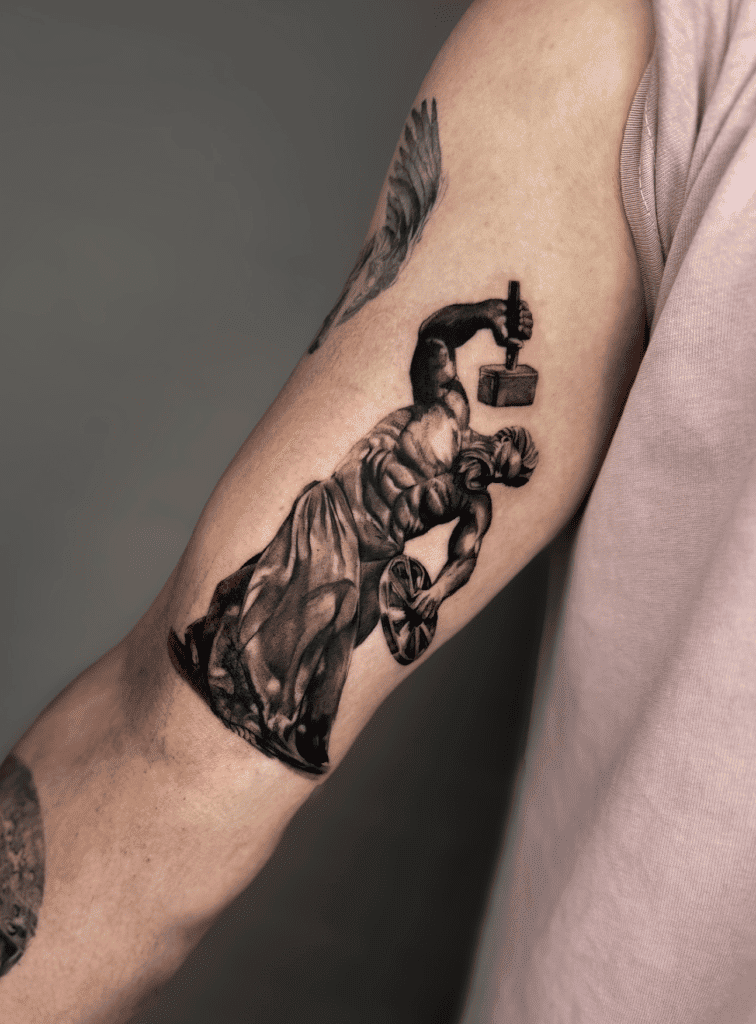
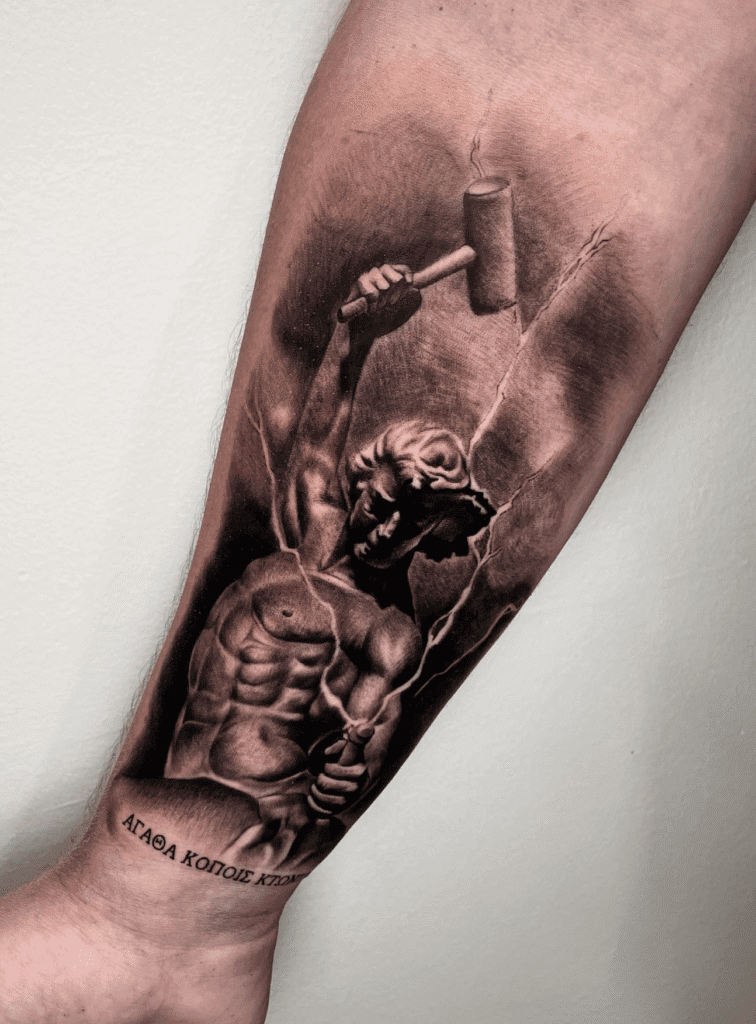
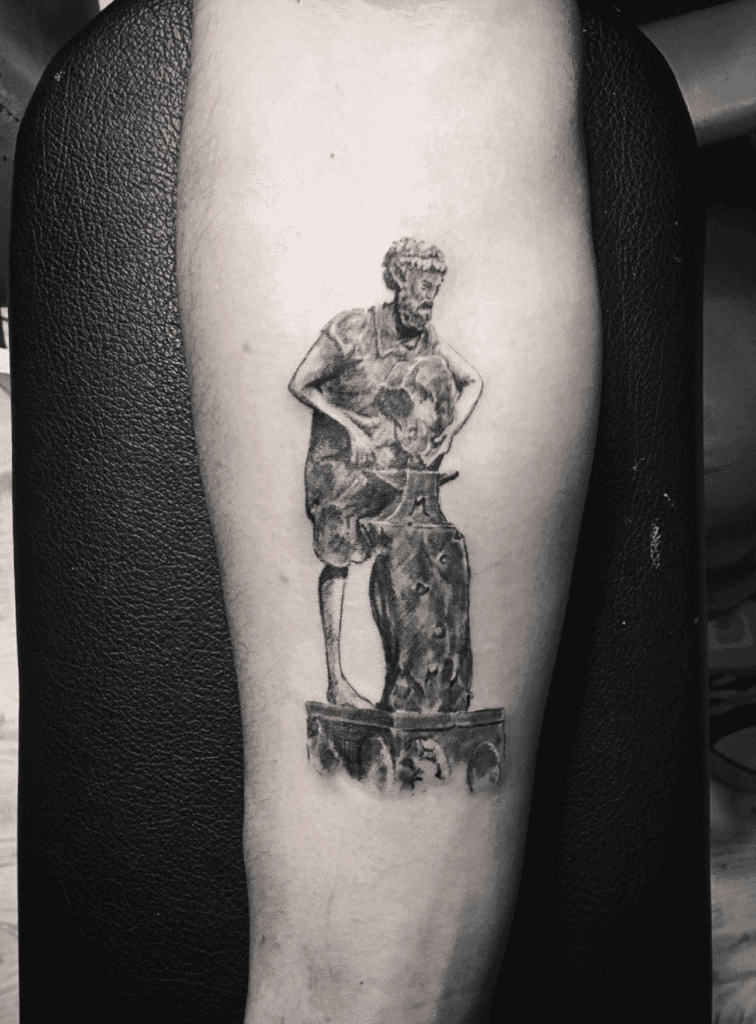
Hephaestus is the Greek god of fire, metalworking, craftsmanship, and invention, standing apart from the other Olympians through skill rather than beauty or brute force. Hephaestus is the son of Hera, and in some versions, also of Zeus. Unlike the radiant gods of Olympus, Hephaestus was born physically imperfect, and in several myths, he is cast from Olympus. The fall leaves him lame, but it also forges his resilience and independence.
Hermes Greek Mythology Tattoo
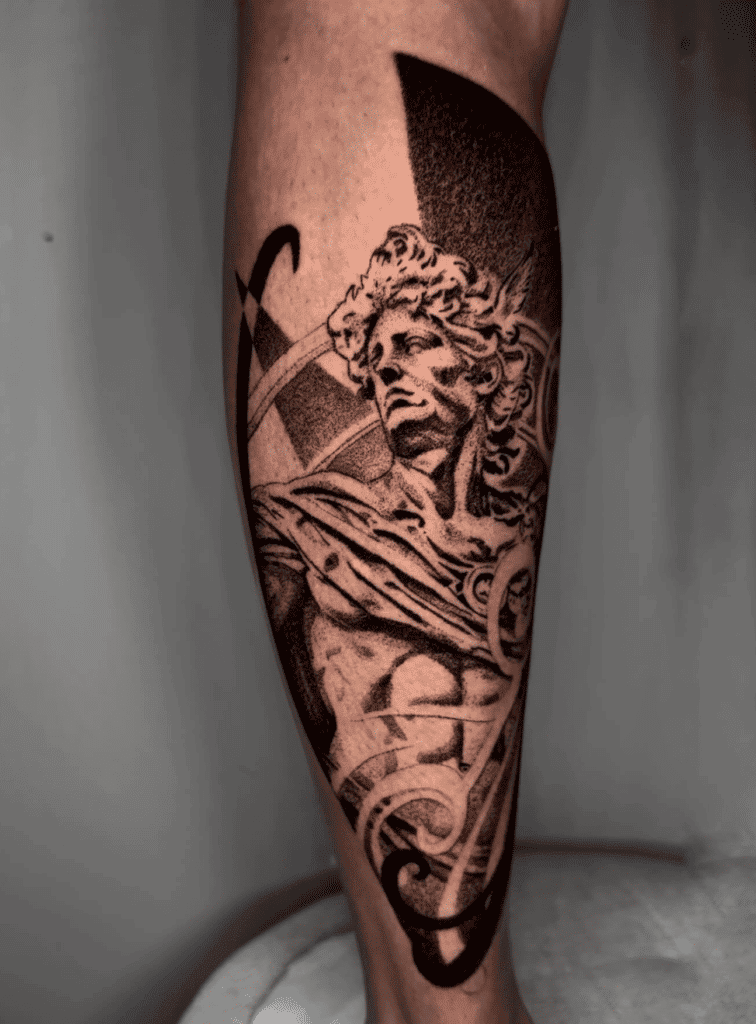
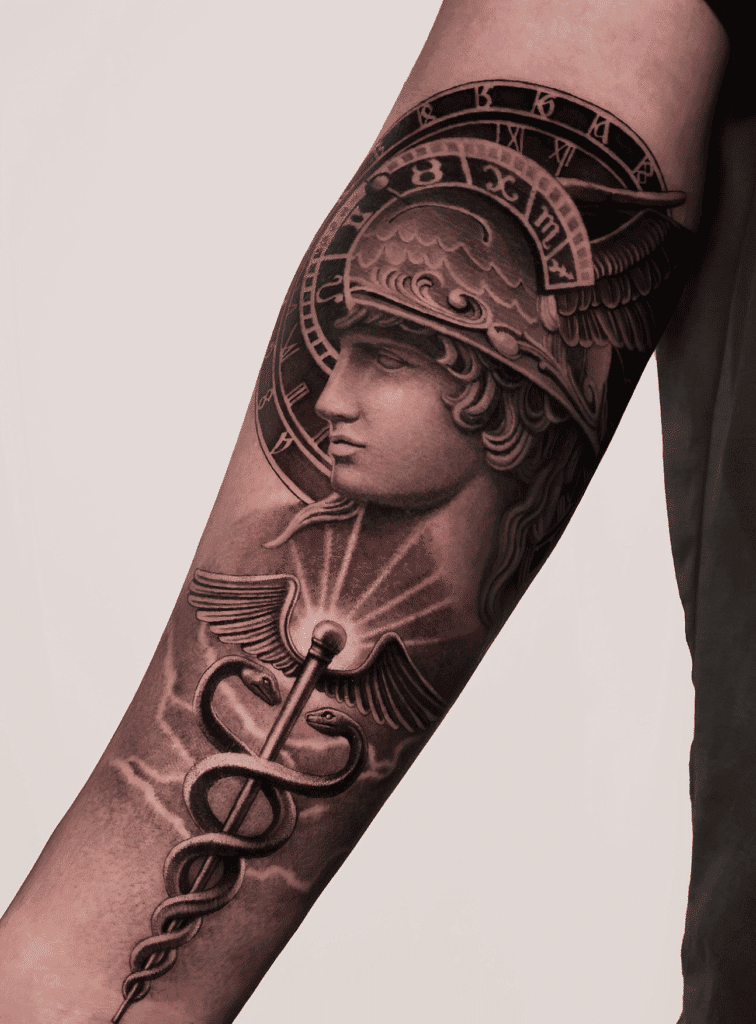
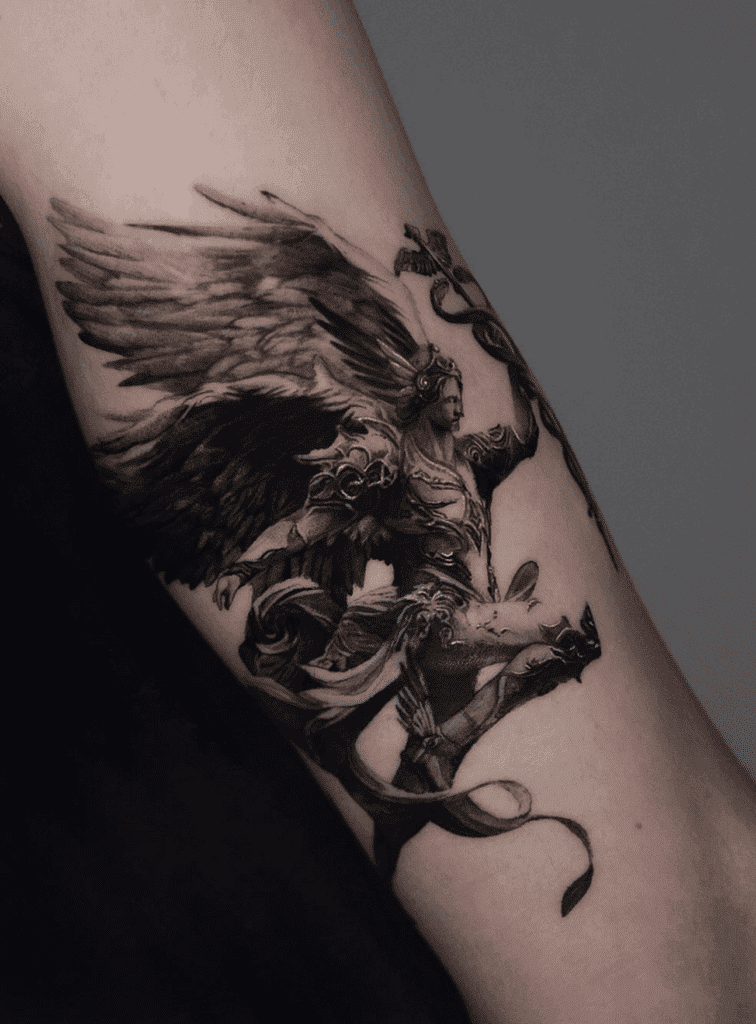
Hermes is the Greek god of communication, travel, trade, boundaries, and trickery, best known as the messenger of the gods. Fast-thinking and faster-moving, Hermes acts as the bridge between worlds—Olympus, Earth, and the Underworld—carrying messages, guiding souls, and keeping the universe connected.
Hermes is the son of Zeus and the nymph Maia. From the moment he was born, Hermes showed extraordinary intelligence and cunning. On his very first day of life, he escaped his cradle, stole Apollo’s cattle, invented the lyre, and talked his way out of punishment, establishing himself as a god of wit, invention, and charm.
Hestia Greek Mythology Tattoo
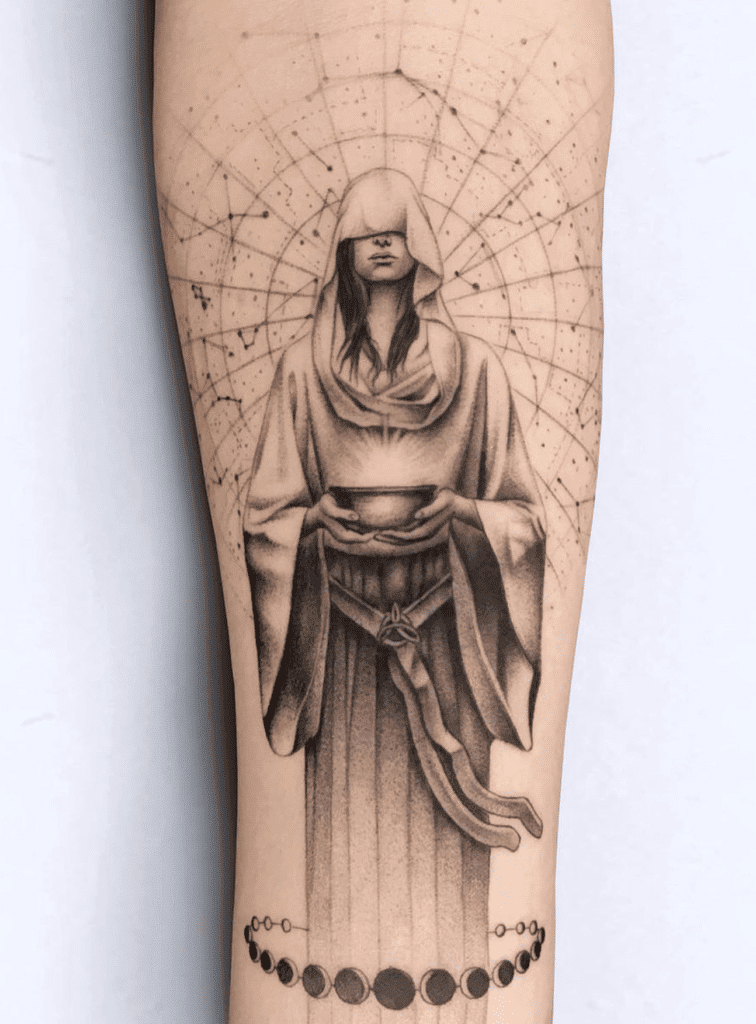
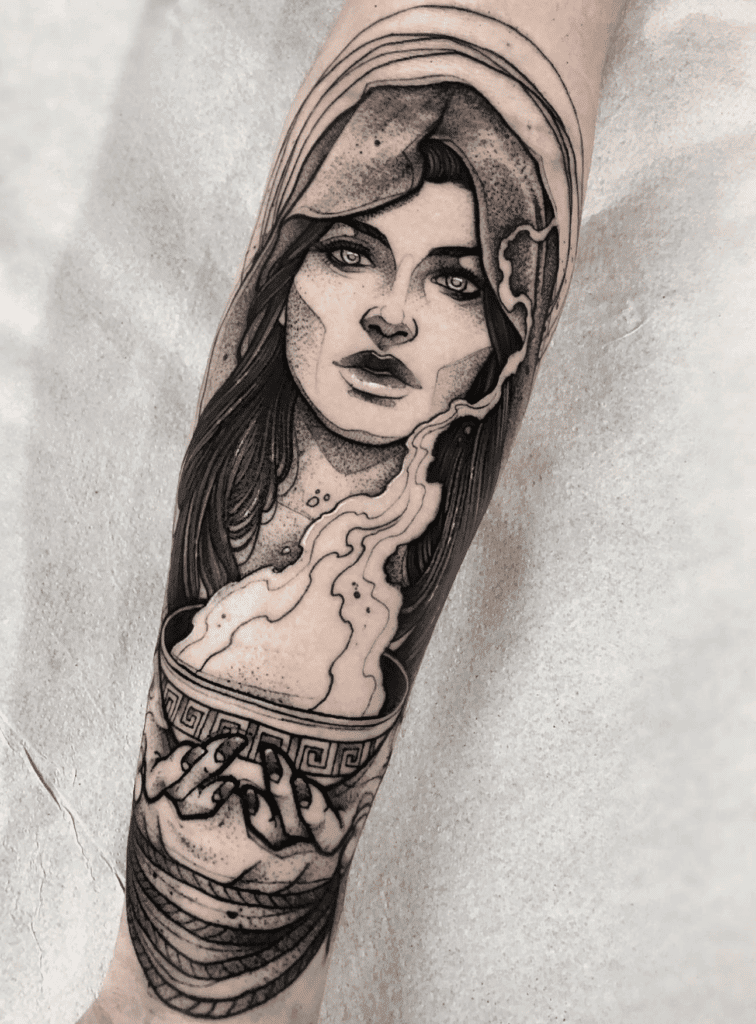
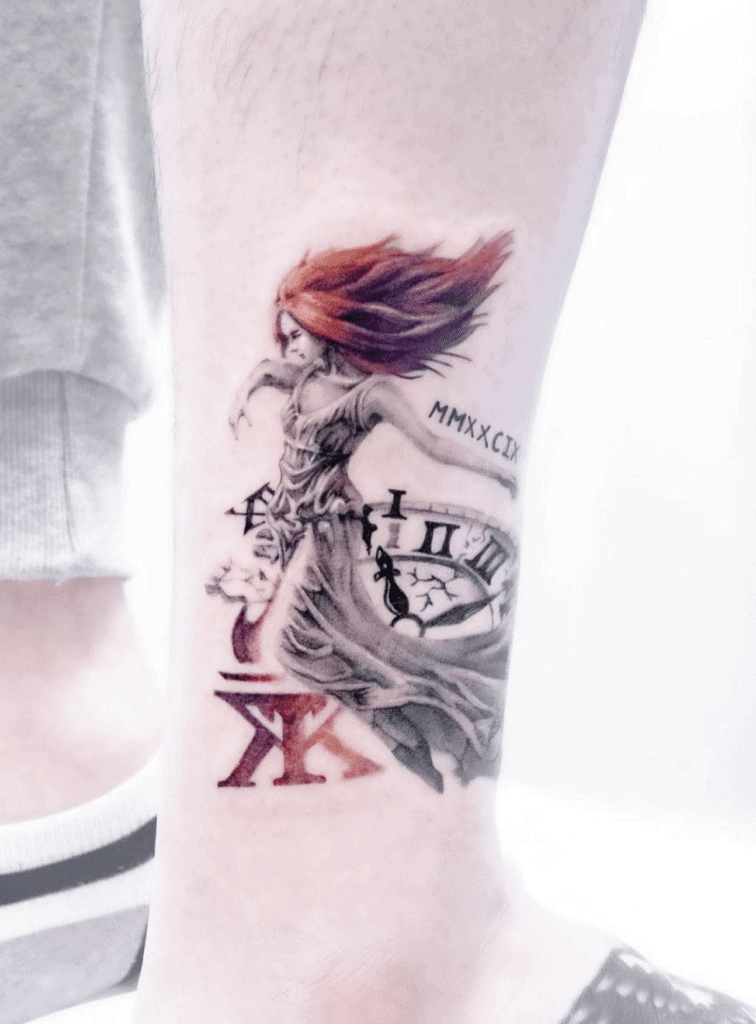
Hestia is the Greek goddess of the hearth, home, and domestic life, representing warmth, stability, and sacred order. Hestia is the eldest daughter of the Titans Cronus and Rhea, making her the first to be swallowed by Cronus and the last to be freed. As one of the original Olympians, she chose a unique path: rather than ruling over a dramatic domain or engaging in power struggles, Hestia became the guardian of sacred space.
In many traditions, she willingly gave up her throne on Olympus to Dionysus, choosing peace and service over status.
Dionysus Greek Mythology Tattoo
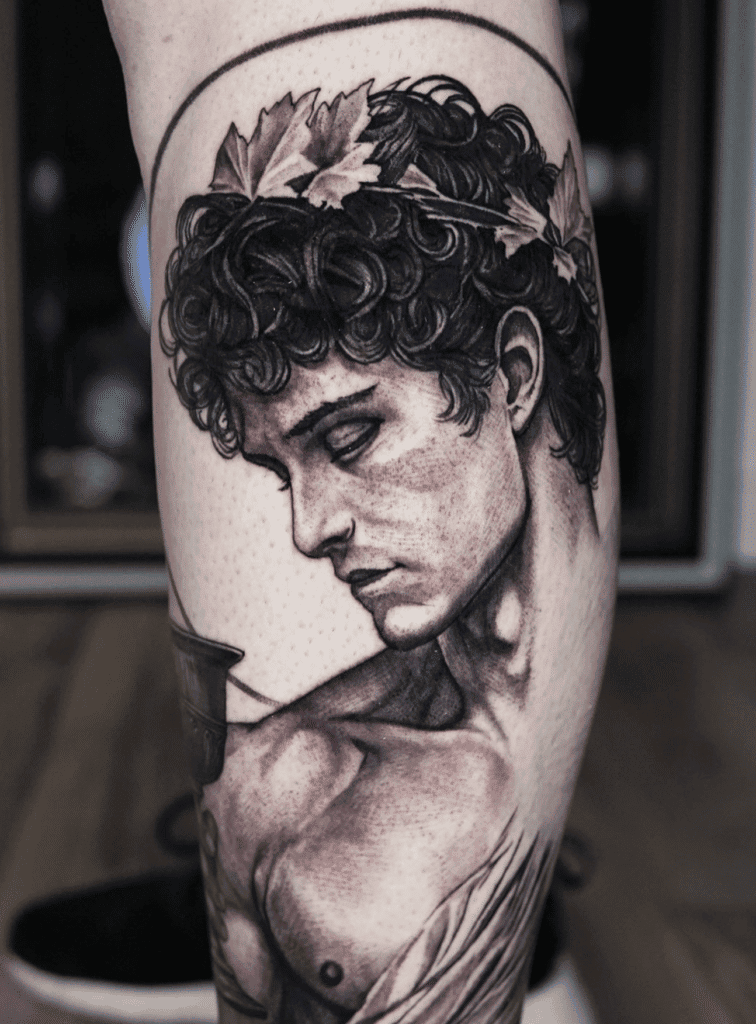
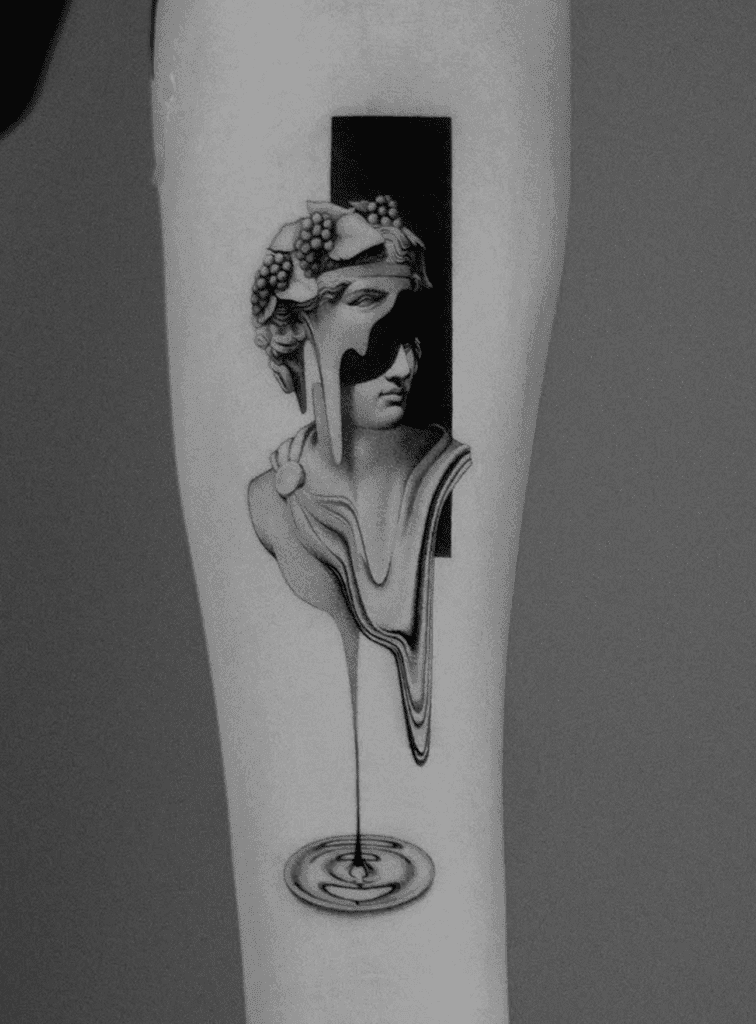
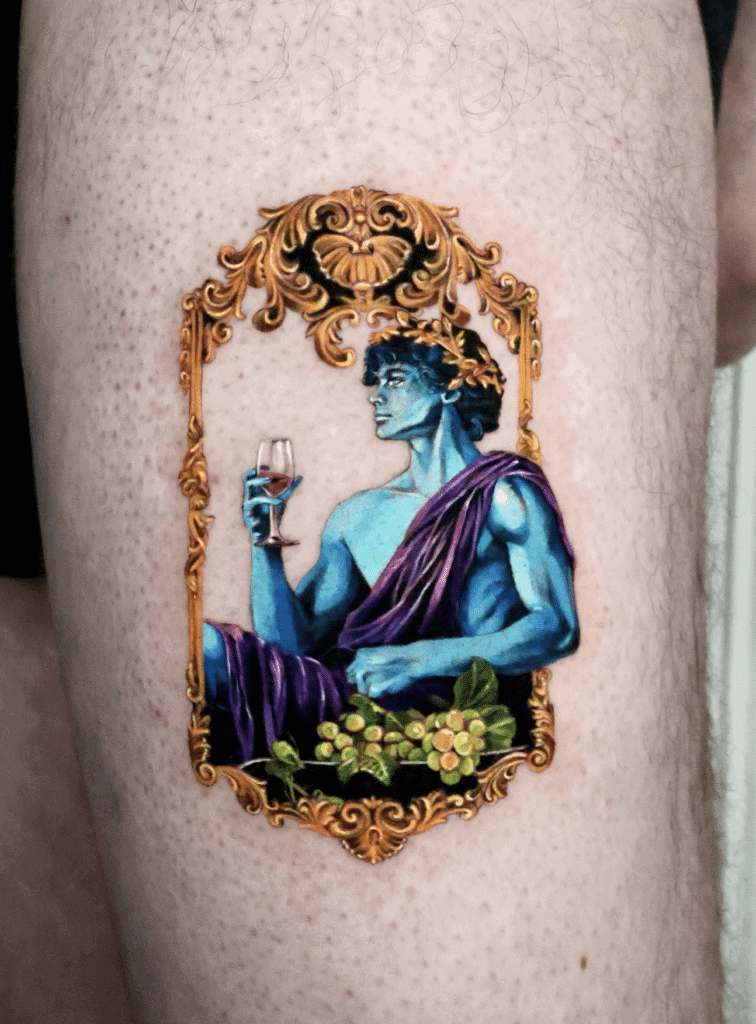
Dionysus is the Greek god of wine, pleasure, madness, theatre, and transformation, standing apart from all other Olympians in both nature and spirit. Dionysus is the son of Zeus and the mortal woman Semele, making him one of the few Olympians with a mortal parent. When Semele was destroyed by Zeus’s divine form, Zeus saved the unborn Dionysus by sewing him into his thigh until he was ready to be born, earning Dionysus the title “twice-born.”
Gaia Greek Mythology Tattoo
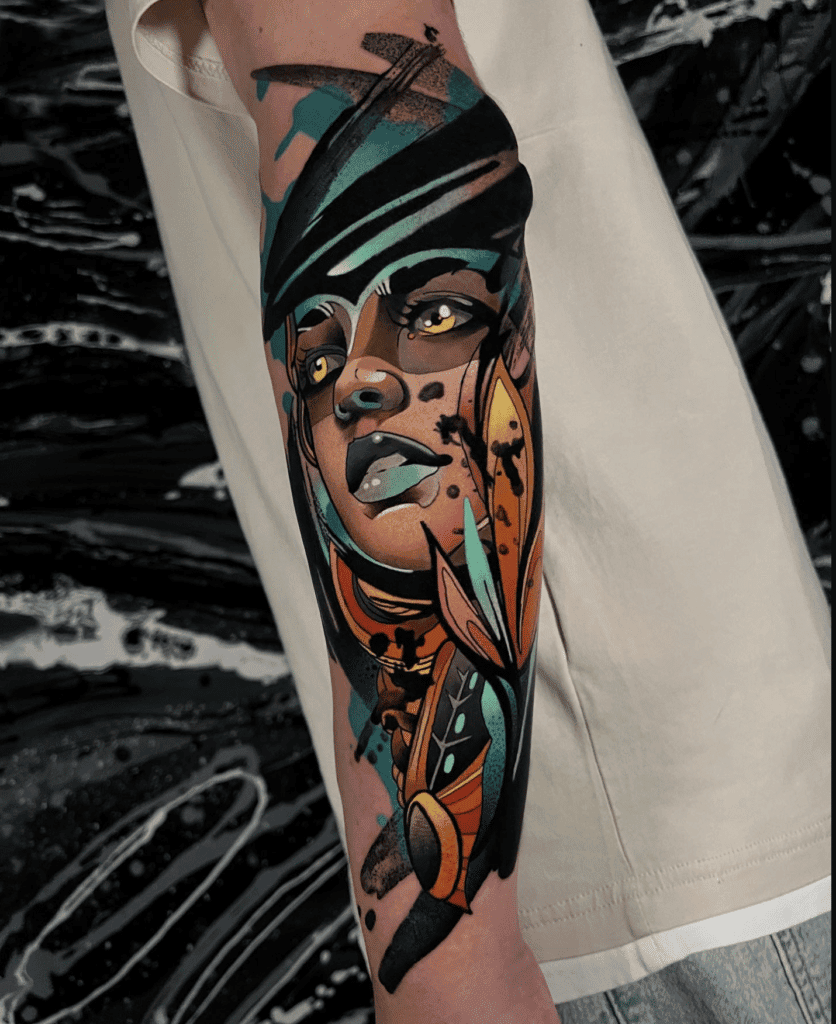
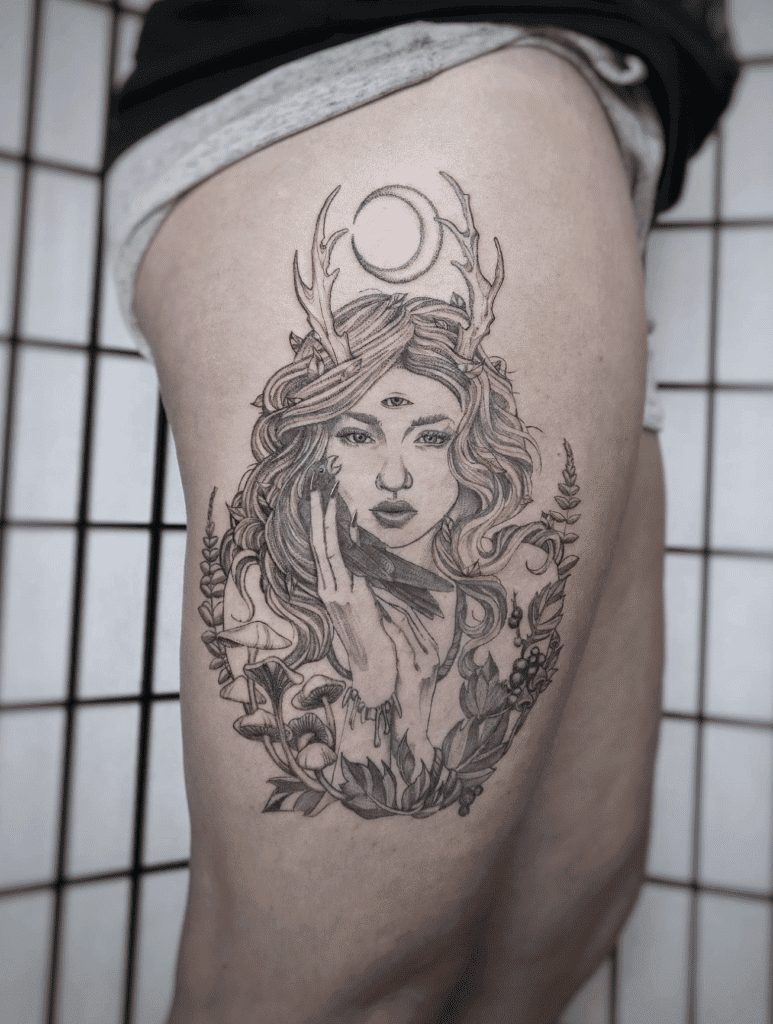
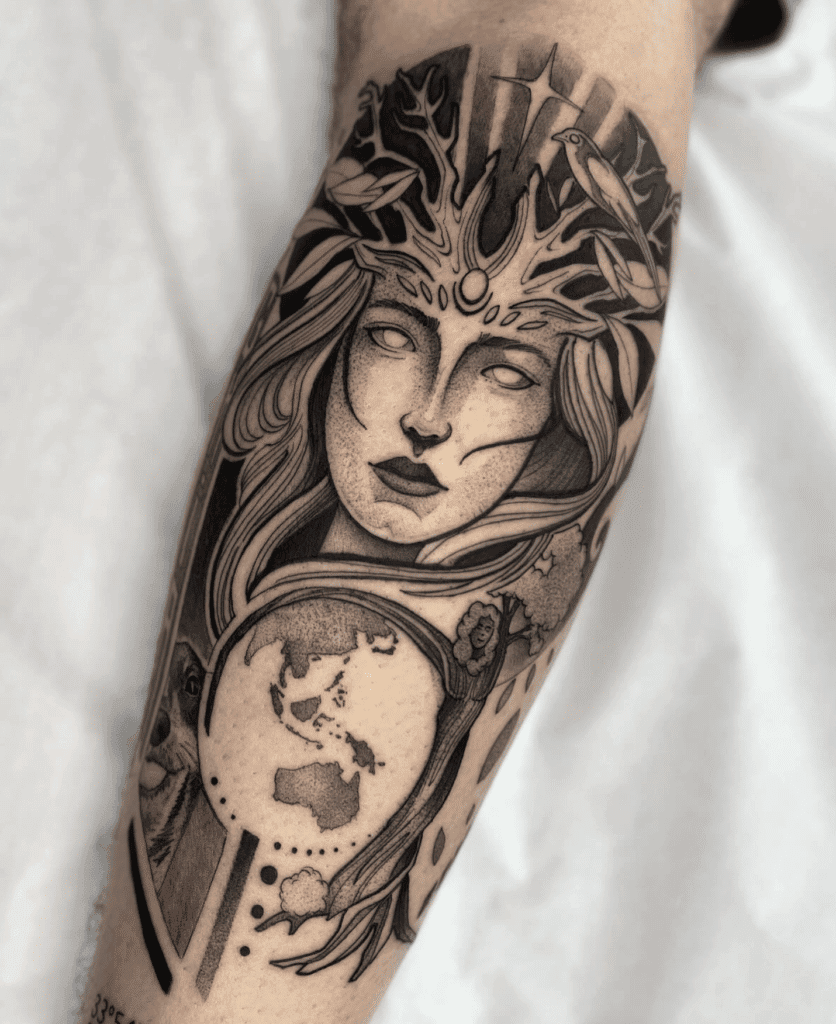
Gaia is the primordial goddess of the Earth, the living foundation of Greek mythology and one of the very first beings to exist. She is not merely a goddess who controls the land, as she is the land itself. Mountains rise from her body, seas lap against her edges, and all life ultimately traces back to her.
Gaia emerged at the dawn of creation, born directly from Chaos, the original void. From herself, she gave birth to Uranus (the Sky), Pontus (the Sea), and Ourea (the Mountains), establishing the structure of the world.
She is both creator and creation, mother and matter, the eternal presence beneath every myth that followed.
Uranus Greek Mythology Tattoo


Uranus is the primordial god of the sky, and one of the very first beings to exist in Greek mythology. He represents the vast heavens, stretching endlessly above the Earth, enclosing the world in his presence. Where Gaia is the living ground beneath all things, Uranus is the infinite dome above.
Eros Greek Mythology Tattoo
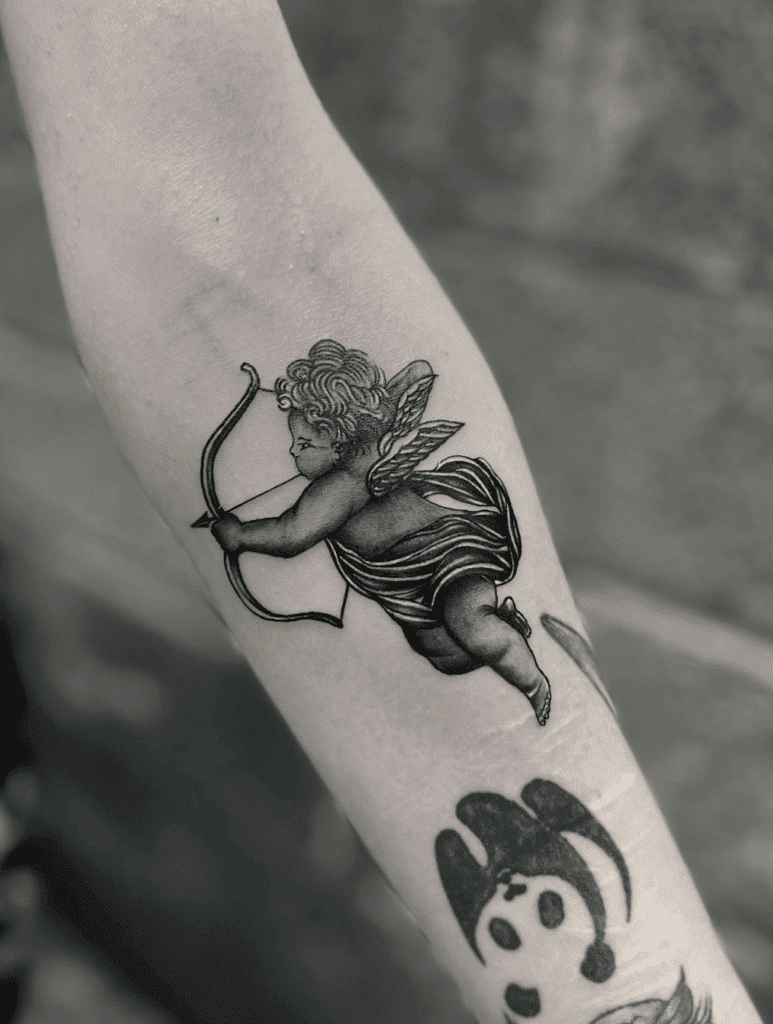
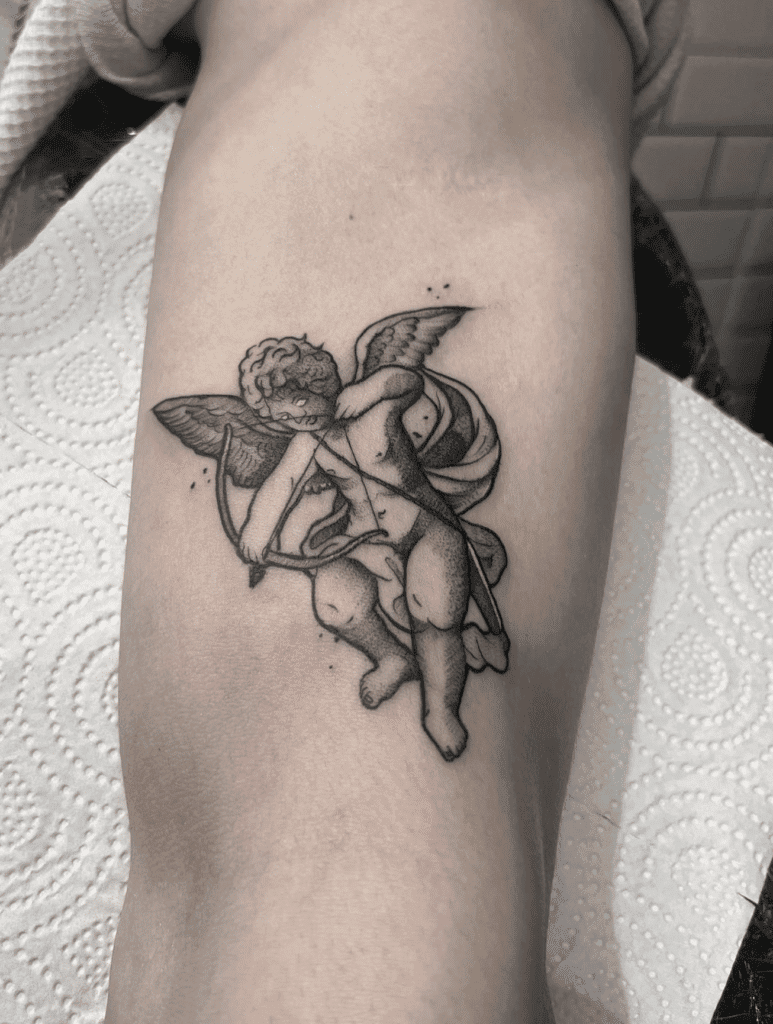
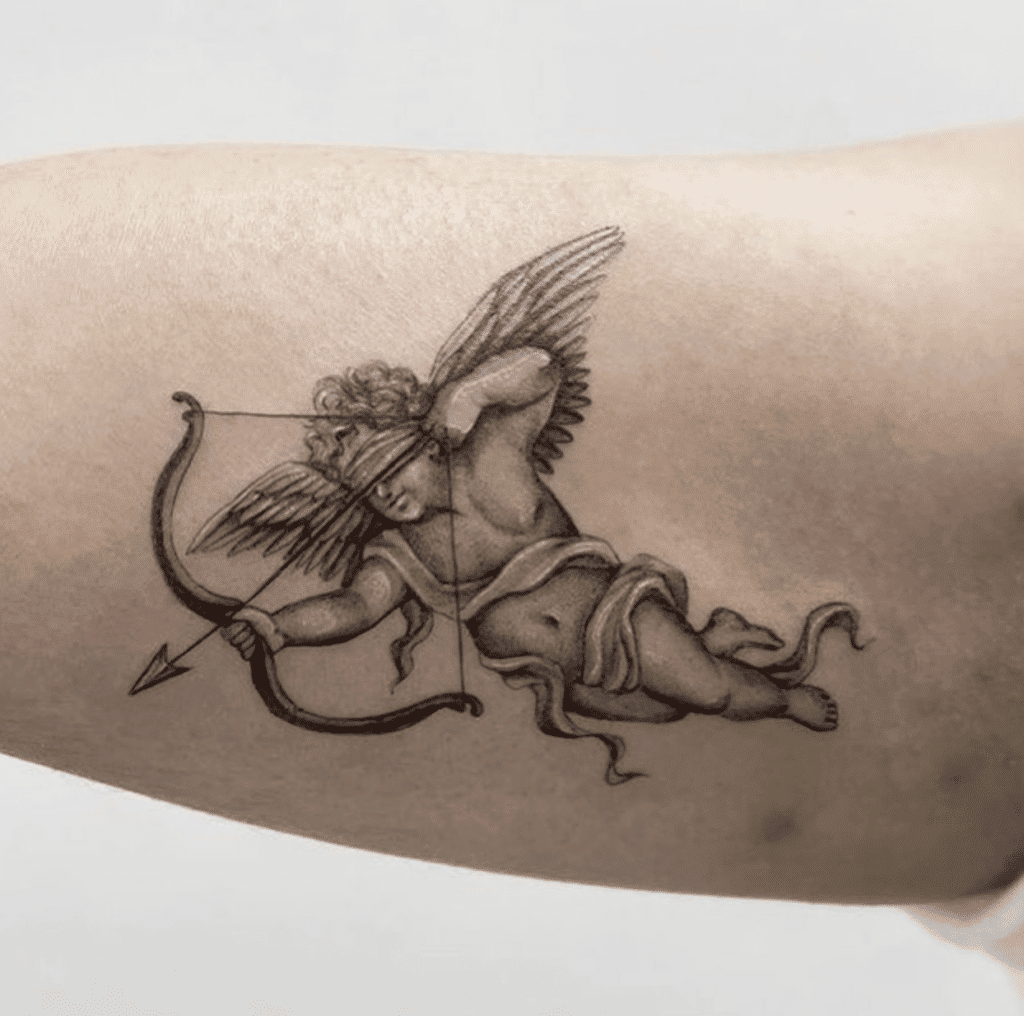
Eros is the Greek god of love, desire, attraction, and creation, but his role in mythology goes far beyond romance. In the earliest Greek traditions, Eros was not a playful cherub; he was a primordial cosmic force, one of the first beings to exist, responsible for drawing the universe together and setting creation into motion.
In early myths, Eros emerged alongside Chaos, Gaia, and Tartarus. He represents the irresistible pull that binds matter, the force that causes gods, humans, and nature to seek union.
Nyx Greek Mythology Tattoo
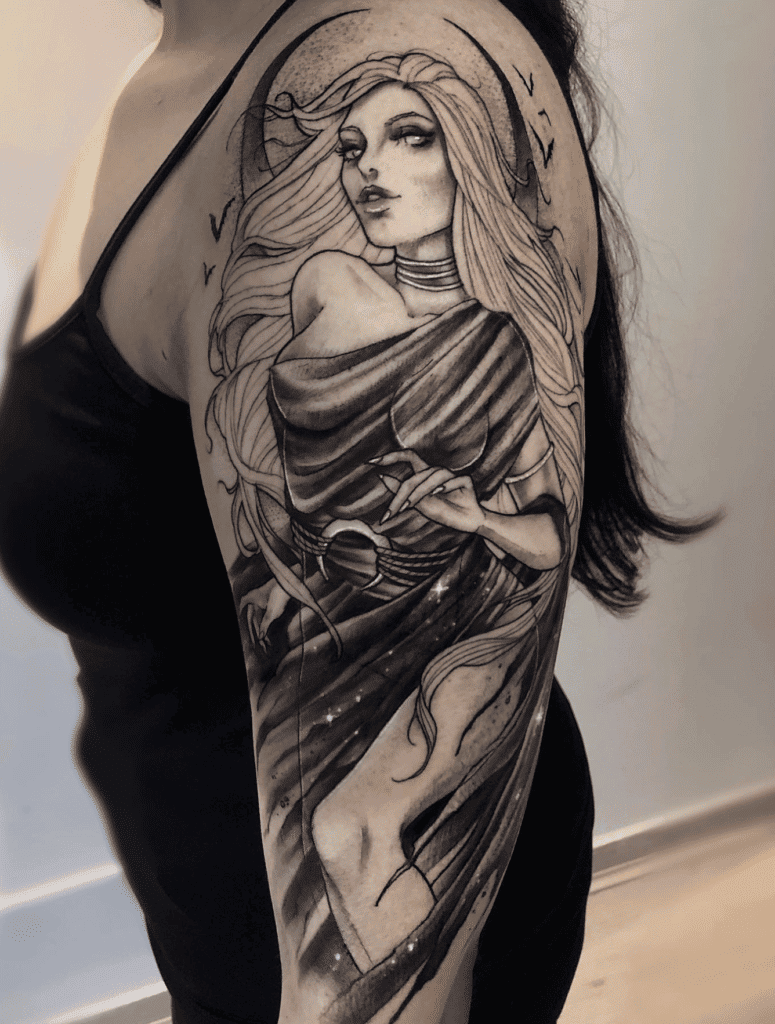
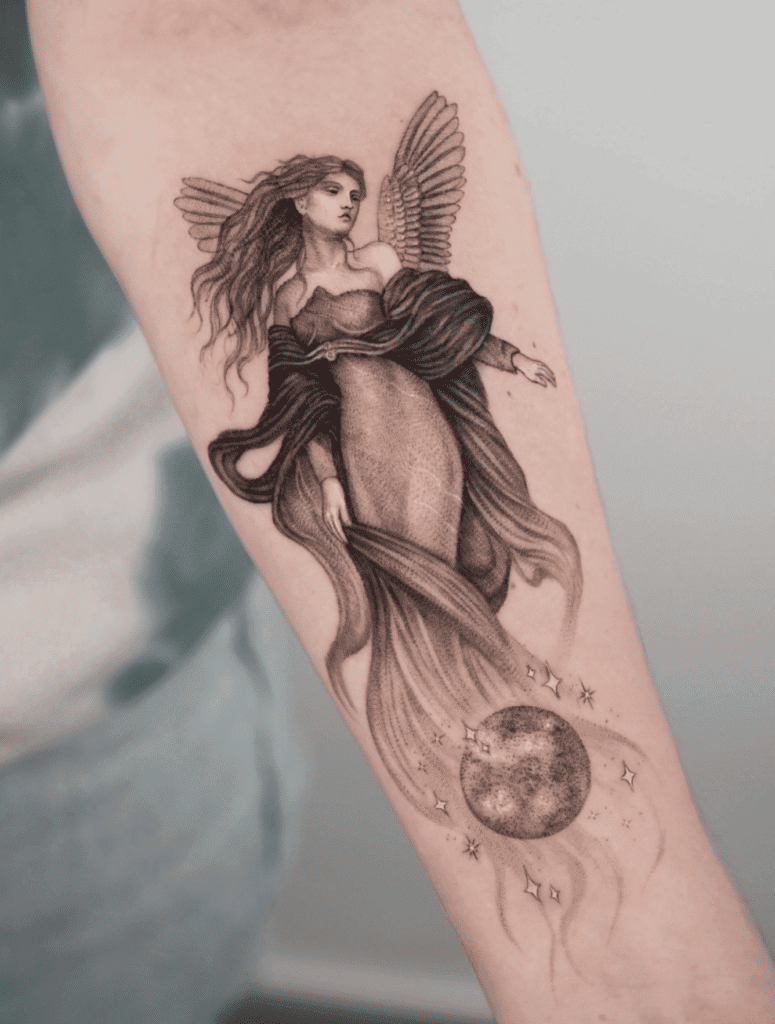
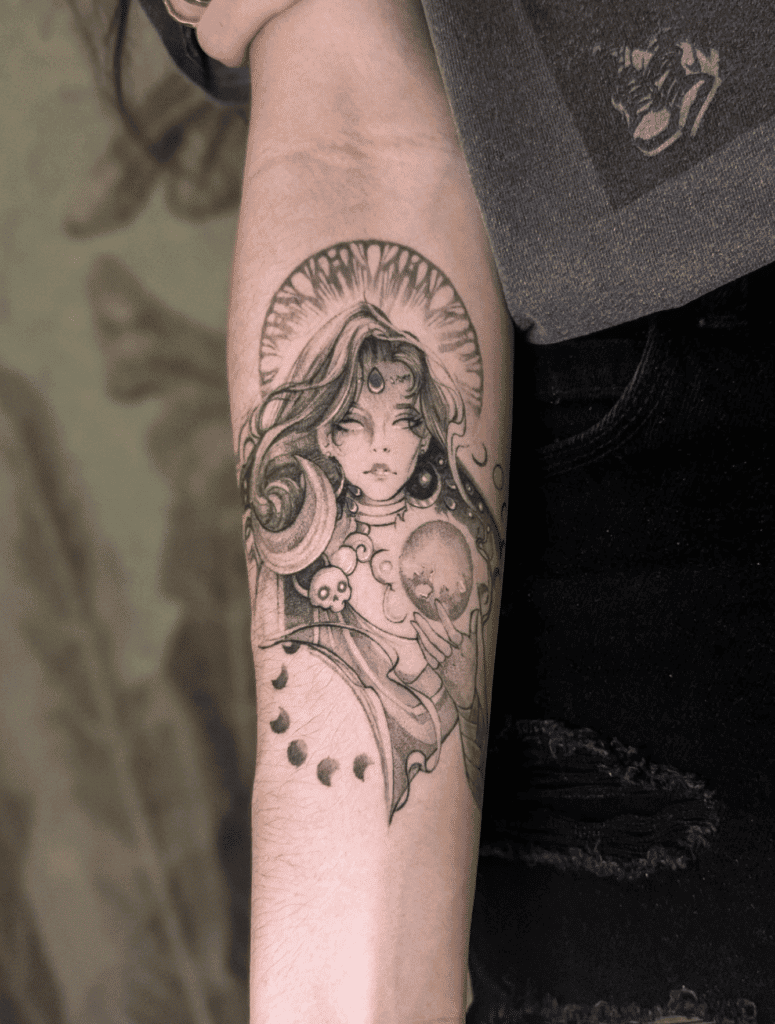
Nyx is the primordial goddess of the night, one of the most ancient and powerful beings in Greek mythology. She is not merely a goddess who rules darkness—she is the night itself, the living embodiment of shadow, silence, and the vast unknown that falls over the world when the sun disappears, whom even the king of the gods fears.
Nyx emerged directly from Chaos, the original void, at the very beginning of existence. From her came night, mystery, rest, and the boundaries between worlds. She is older than the Olympians, older than the Titans, and exists beyond their authority.
Each evening, Nyx is said to rise from the depths of the cosmos and spread her cloak of darkness across the sky, retreating only when day returns.
Erebus Greek Mythology Tattoo

Erebus is the primordial god of darkness and shadow, representing the deep gloom that filled the universe at the dawn of creation. He is not night itself, but the thick, suffocating darkness that exists beneath light, before form, and beyond sight. Erebus embodies the shadow between worlds, where shape dissolves, and certainty fades.
Aether Greek Mythology Tattoo

Aether is the primordial god of light, clarity, and the pure upper air, representing the bright essence that fills the heavens beyond clouds and darkness. He is not sunlight in the physical sense, but the divine brightness that makes light possible.
Aether was born from Nyx (Night) and Erebus (Darkness), a powerful reminder in Greek mythology that light emerges from darkness. Alongside his sister Hemera (Day), Aether helps bring balance to the cosmos.
Each day, Hemera disperses Nyx’s veil of night, allowing Aether’s brilliant air to fill the sky. When night falls, Aether retreats, restoring the cosmic cycle.
Cronus Greek Mythology Tattoo


Cronus is the Titan god of time, harvest, and destructive cycles, best known as the ruler of the universe before the Olympian gods. He represents the inevitable passage of time, the rise and fall of power, and the fear of being overthrown by one’s own legacy. In Greek mythology, Cronus is a tragic figure shaped by prophecy, fear, and repetition.
Cronus is the youngest son of Uranus and Gaia. When Uranus imprisoned his monstrous children deep within Gaia, she sought revenge and armed Cronus with a sickle. Cronus ambushed his father and overthrew him, separating sky from earth and ending the first era of cosmic rule.
Under Cronus’s reign, the world entered the Golden Age of humanity—a time of peace, abundance, and harmony. Humans lived without suffering, labour, or war. Nature provided freely, and death came gently.
However, Cronus learned of a prophecy foretelling that one of his children would overthrow him, just as he had overthrown his father. Terrified of losing power, Cronus began swallowing his children at birth, imprisoning them within his body and halting the cycle of succession.
Rhea Greek Mythology Tattoo
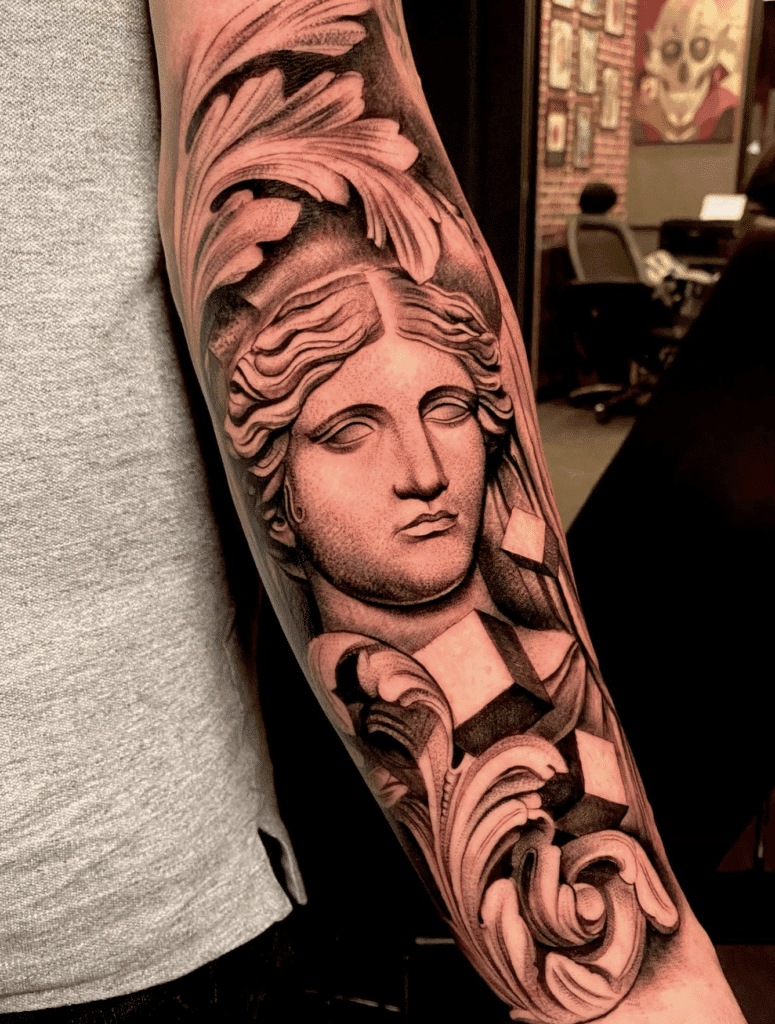
Rhea is the Titan goddess of motherhood, fertility, and generation, best known as the mother of the Olympian gods. In Greek mythology, she represents nurturing strength, endurance, and the quiet power of protection. While her partner Cronus ruled through fear and control, Rhea embodied life, continuity, and resistance against tyranny.
Rhea is the daughter of Uranus and Gaia, placing her at the very heart of the cosmic lineage. She became the sister and wife of Cronus, sharing the throne during the Titan Age.
Rhea’s most famous role is bound to tragedy. When Cronus learned of a prophecy that one of his children would overthrow him, he swallowed each newborn whole. When Rhea became pregnant with her sixth child, Zeus, she defied Cronus by secretly giving birth on the island of Crete and hiding Zeus away. She presented Cronus with a stone wrapped in cloth, which he swallowed, believing it to be his son.
This act of deception was one of the most important moments in Greek mythology, preserving the future king of the gods.
Oceanus Greek Mythology Tattoo


Oceanus is the Titan god of the great world-ocean, the vast, endless river believed by the ancient Greeks to encircle the entire world. Unlike Poseidon, who rules the seas with storms and fury, Oceanus represents calm, continuity, and the eternal flow of life.
Oceanus is the son of Uranus and Gaia, placing him among the first generation of Titans. From the very beginning, he embodies the idea of the world as a contained, ordered space, surrounded by a living, flowing boundary.
Rather than dwelling on Olympus or ruling through force, Oceanus exists at the edge of the cosmos, marking the line between the known world and the unknown beyond.
Tethys Greek Mythology Tattoo

Tethys is the Titan goddess of fresh water, associated with rivers, springs, fountains, and the life-giving nourishment they provide. Where Oceanus forms the great boundary of the world, Tethys governs the gentler waters within it—the streams that sustain crops, the springs that quench thirst, and the currents that bring fertility to the land.
Tethys is a daughter of Uranus and Gaia, making her one of the original Titans. She became the wife of Oceanus, and together they ruled over all the waters of the world in perfect balance—Oceanus as the vast encircling flow, and Tethys as the nourishing source within.
Theia Greek Mythology Tattoo

Theia is the Titan goddess of light, brilliance, and shining matter, embodying the radiant essence that allows the world to be seen and admired. She governs not just physical light, but the glimmer, clarity, and value that light reveals—making gold gleam, gemstones sparkle, and the heavens glow.
Where Aether represents divine air, and Apollo embodies solar clarity, Theia is the source of radiance itself. Theia is a daughter of Uranus and Gaia, placing her among the first generation of Titans. Her domain lies at the intersection of heaven and earth—light as a connecting force, revealing form, beauty, and worth.
Coeus Greek Mythology Tattoo

Coeus is the Titan god of intellect, rational thought, and divine inquiry, representing the search for knowledge and the axis of the heavens. Among the Titans, Coeus is one of the most abstract and philosophical—less concerned with ruling the physical world and more focused on understanding it.
Coeus is another son of Uranus and Gaia, making him part of the first generation of Titans. His name is often linked to concepts of intelligence, questioning, and awareness, suggesting a role tied to the mental framework of the cosmos rather than its material elements.
In some interpretations, Coeus represents the north pillar of the sky, anchoring the heavens and giving structure to the universe.
Atlas Greek Mythology Tattoo
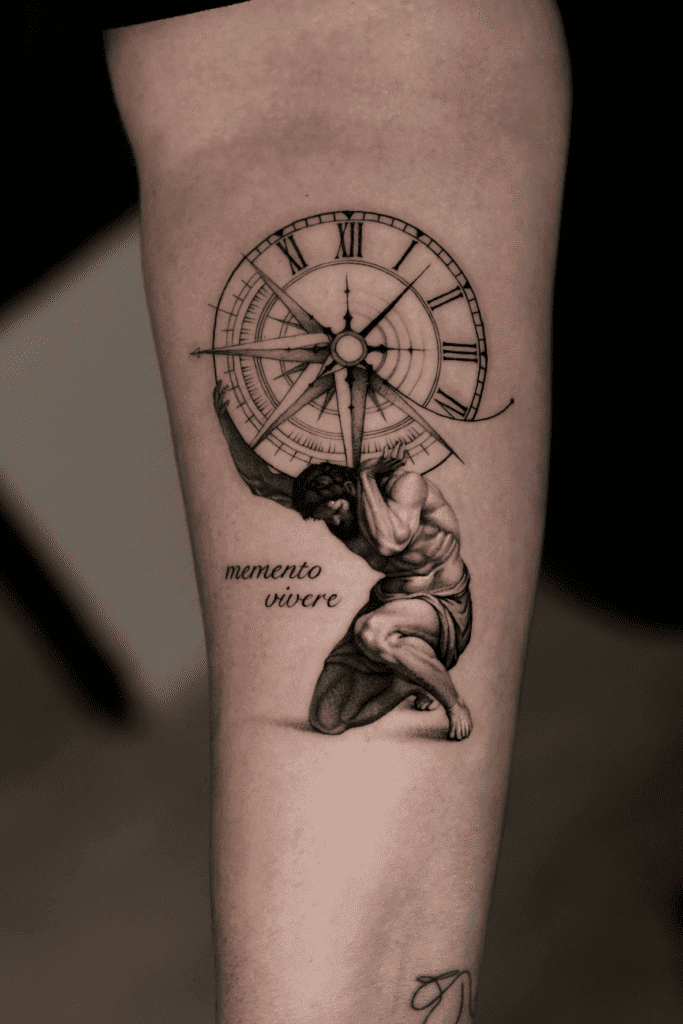
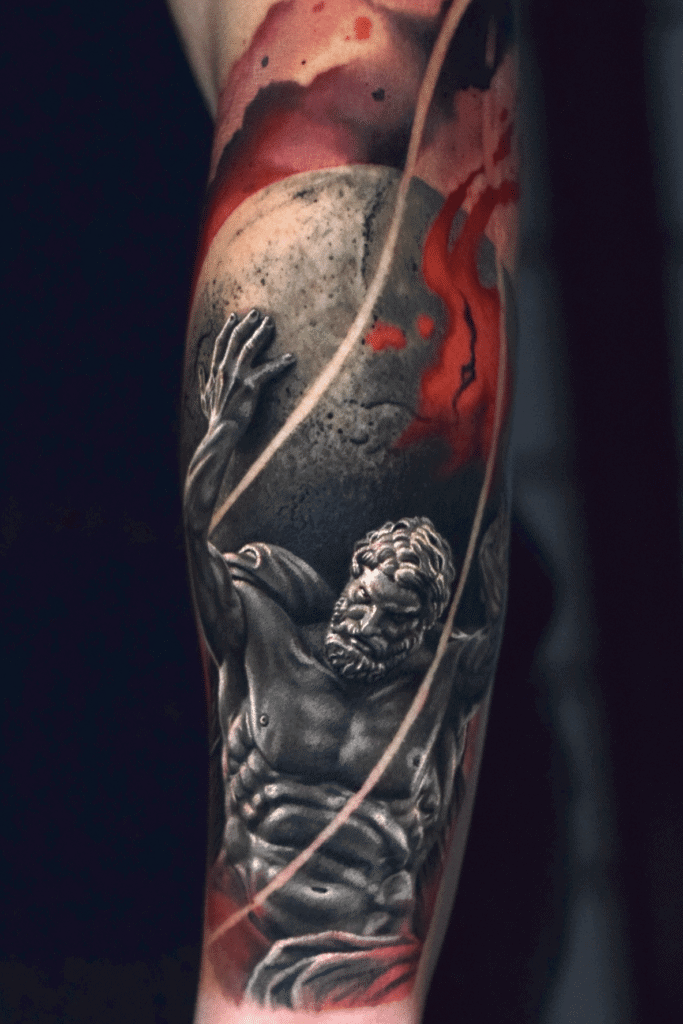
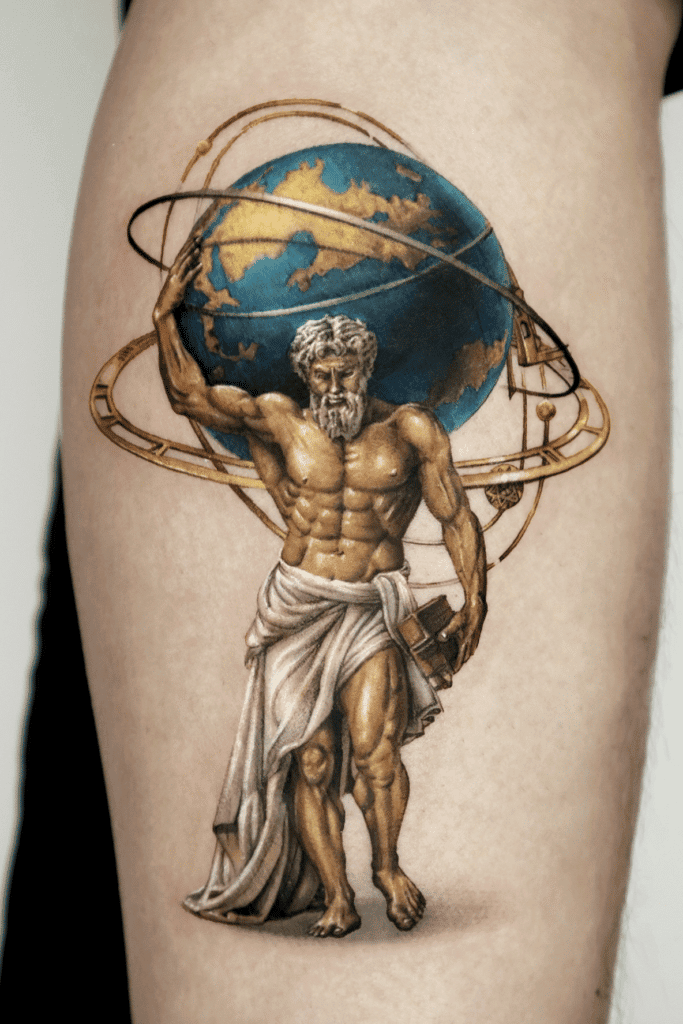
Atlas is the Titan condemned to hold up the sky for eternity, a symbol of endurance, punishment, and immense strength. Unlike other Titans who fade into myth after their defeat, Atlas remains physically present, eternally straining beneath the weight of the heavens at the edge of the world.
Atlas is the son of the Titan Iapetus and the Oceanid Clymene (or Asia, in some traditions). His brothers include Prometheus, Epimetheus, and Menoetius. From the beginning, Atlas was associated with strength and endurance, qualities that would define his fate.
During the great war between the Titans and Olympians, Atlas fought fiercely against Zeus and his allies. After the Olympians’ victory, Zeus chose a punishment worse than imprisonment: Atlas was condemned to stand at the western edge of the world and hold up the sky, forever separating heaven from earth.
Prometheus Greek Mythology Tattoo
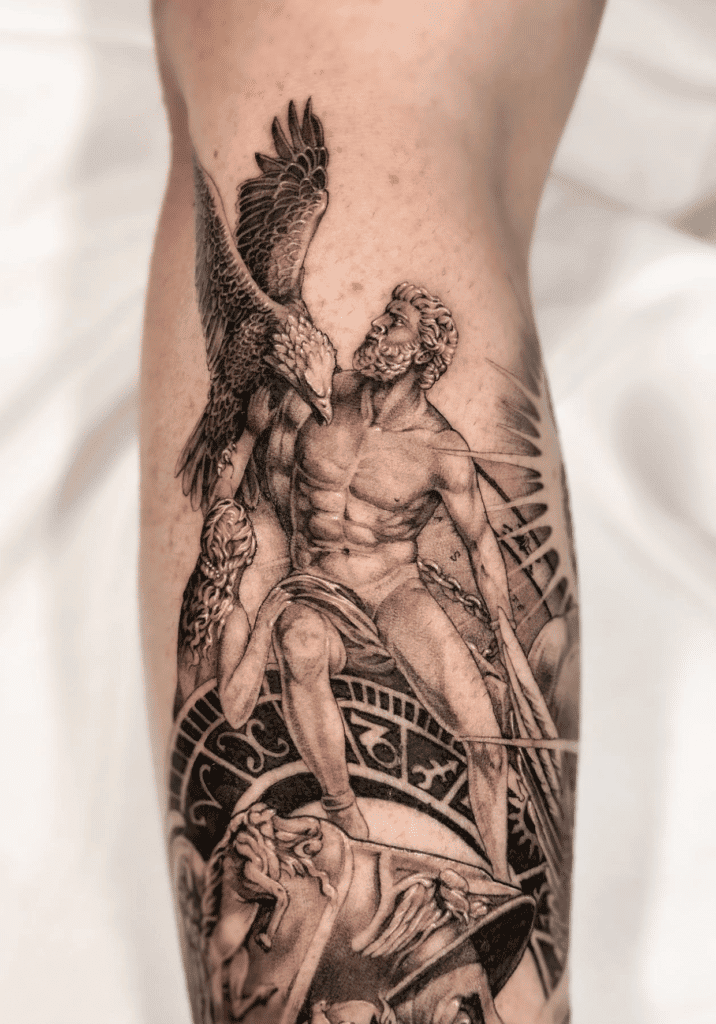
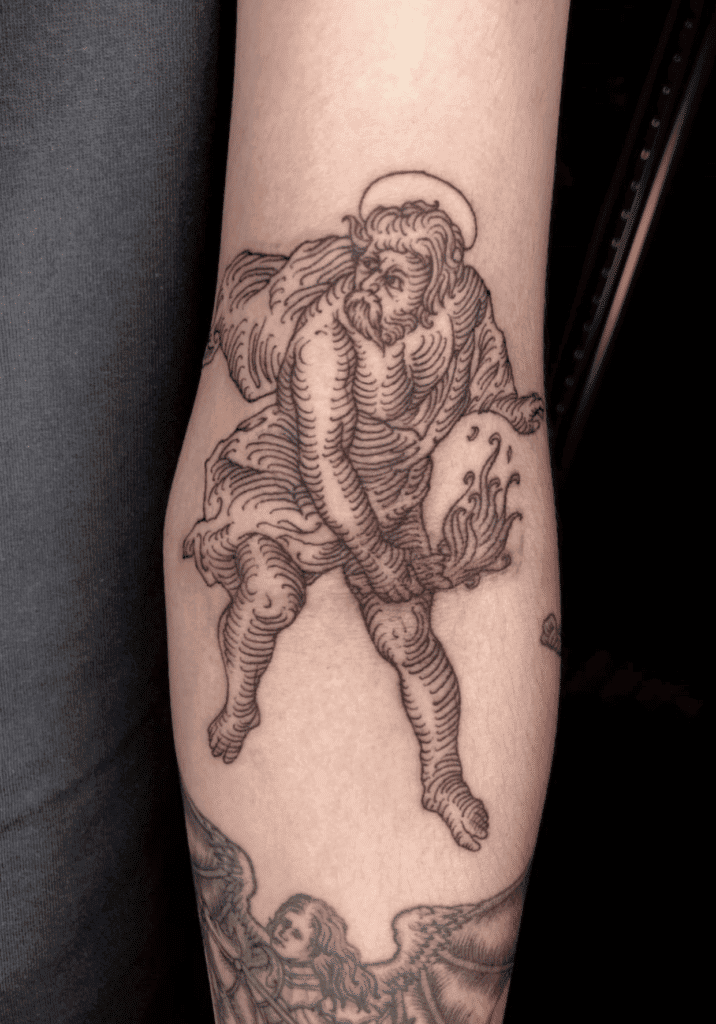
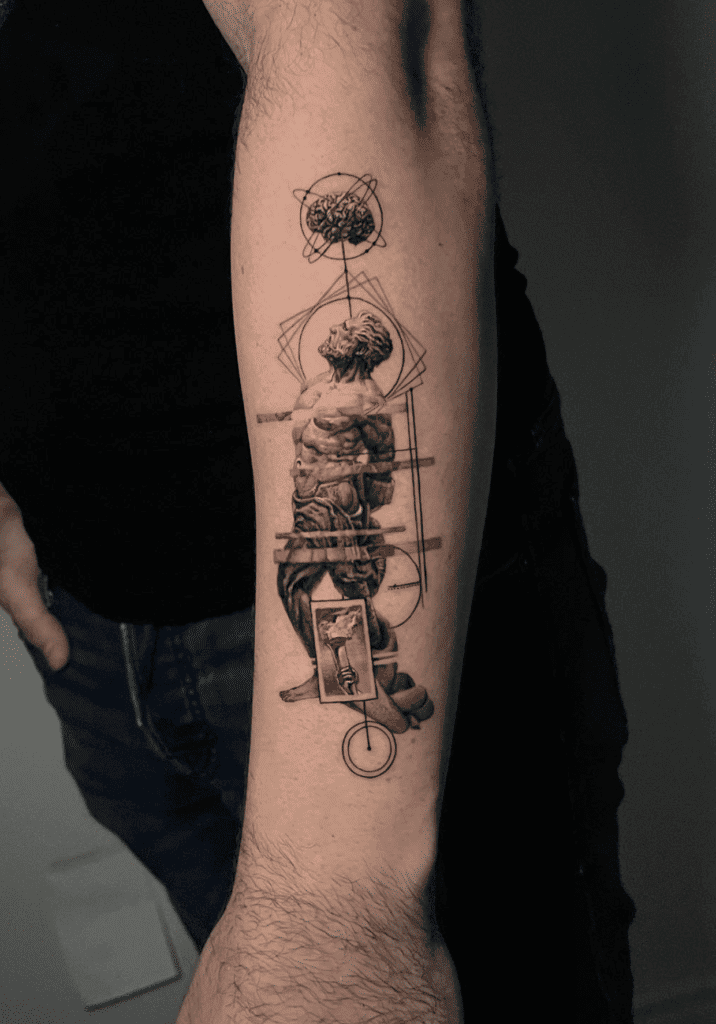
Prometheus is the Titan god of foresight, intelligence, and rebellion, best known as the divine benefactor of humankind. Unlike most gods and Titans, Prometheus sides not with power, but with human survival and progress, willingly defying Zeus to give humanity the tools needed to thrive.
Prometheus is the son of the Titan Iapetus and the Oceanid Clymene (or Asia). His brothers—Atlas, Epimetheus, and Menoetius—each represent different aspects of fate and consequence. Prometheus alone is defined by foresight, the ability to see what lies ahead and act before disaster strikes.
In many myths, Prometheus is credited with creating humanity from clay, shaping humans in the image of the gods. Seeing their weakness and vulnerability, he becomes their champion, teaching them skills, knowledge, and civilisation.
Prometheus’s most famous act is the theft of fire from Olympus, a symbol of knowledge, technology, craftsmanship, survival, and independence from the gods. By stealing fire and giving it to humanity, Prometheus elevated mortals beyond animals, allowing civilisation to exist.
Hades Greek Mythology Tattoo
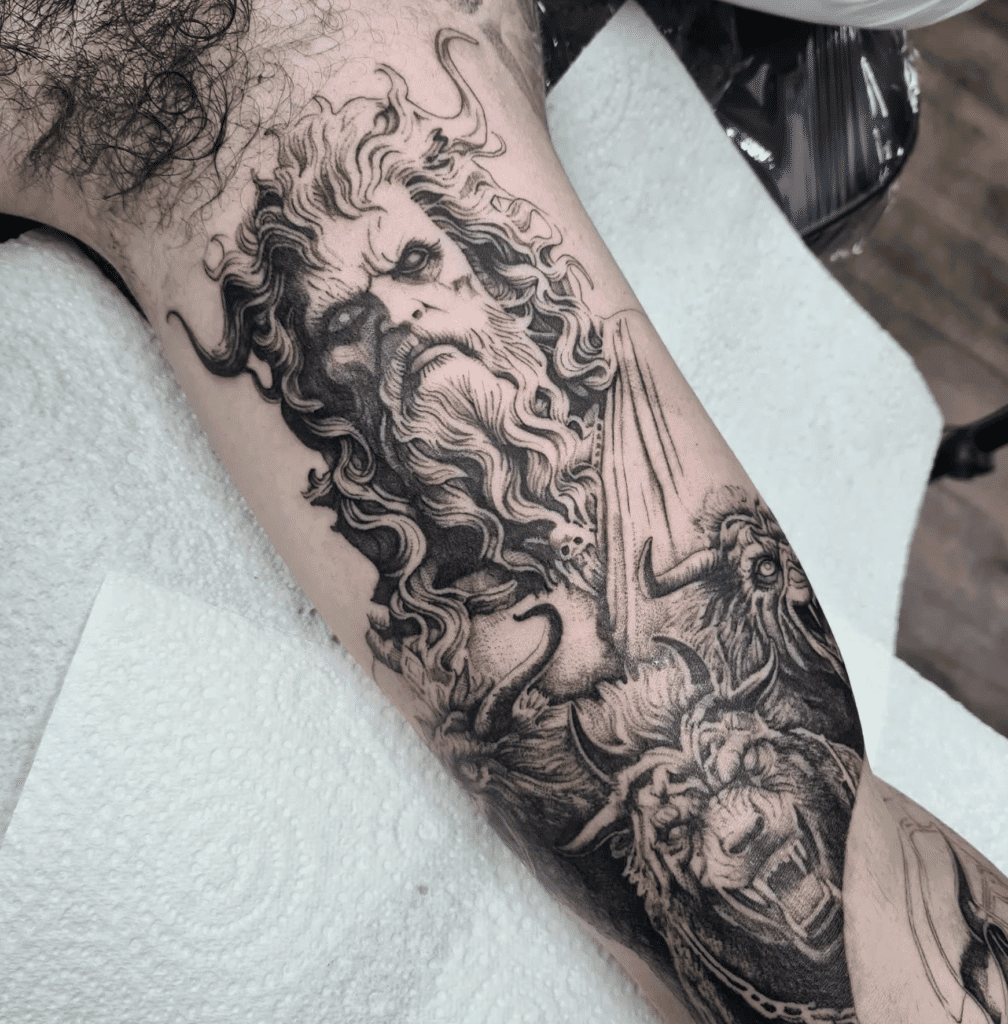
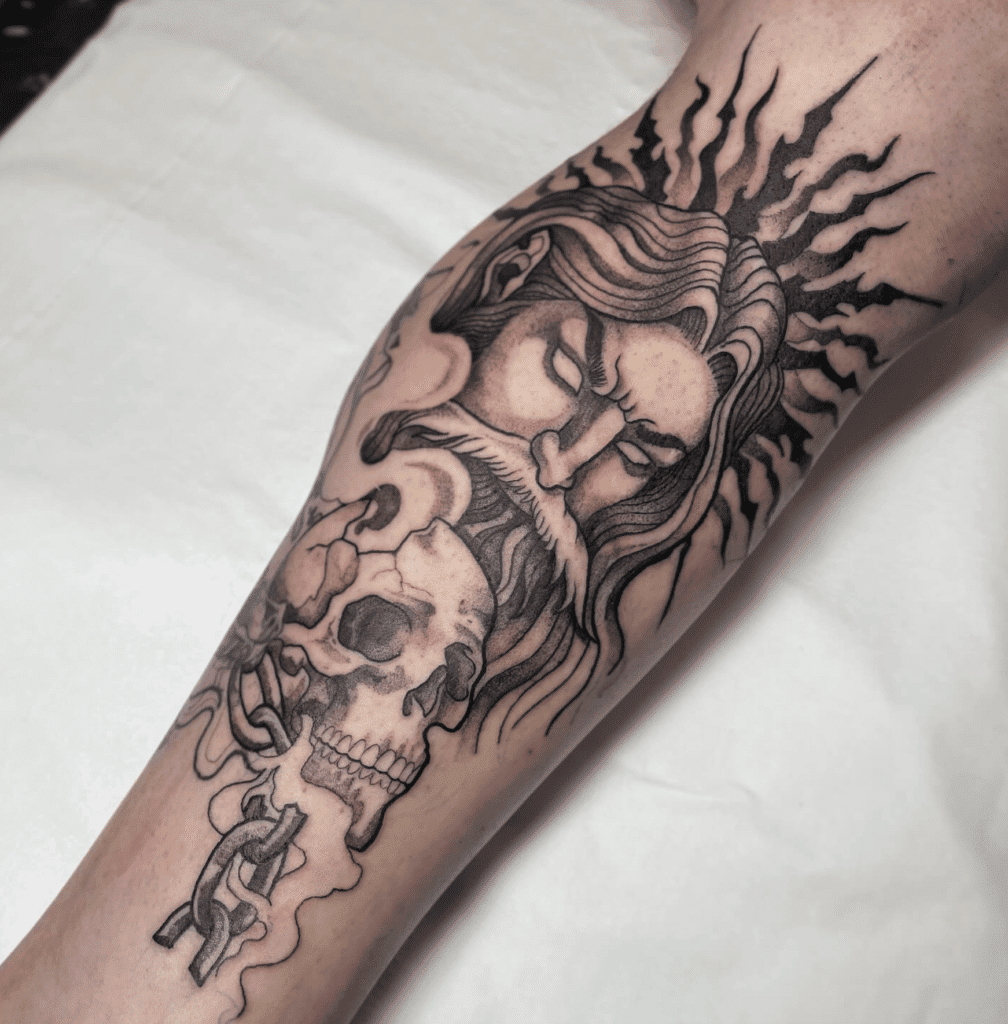
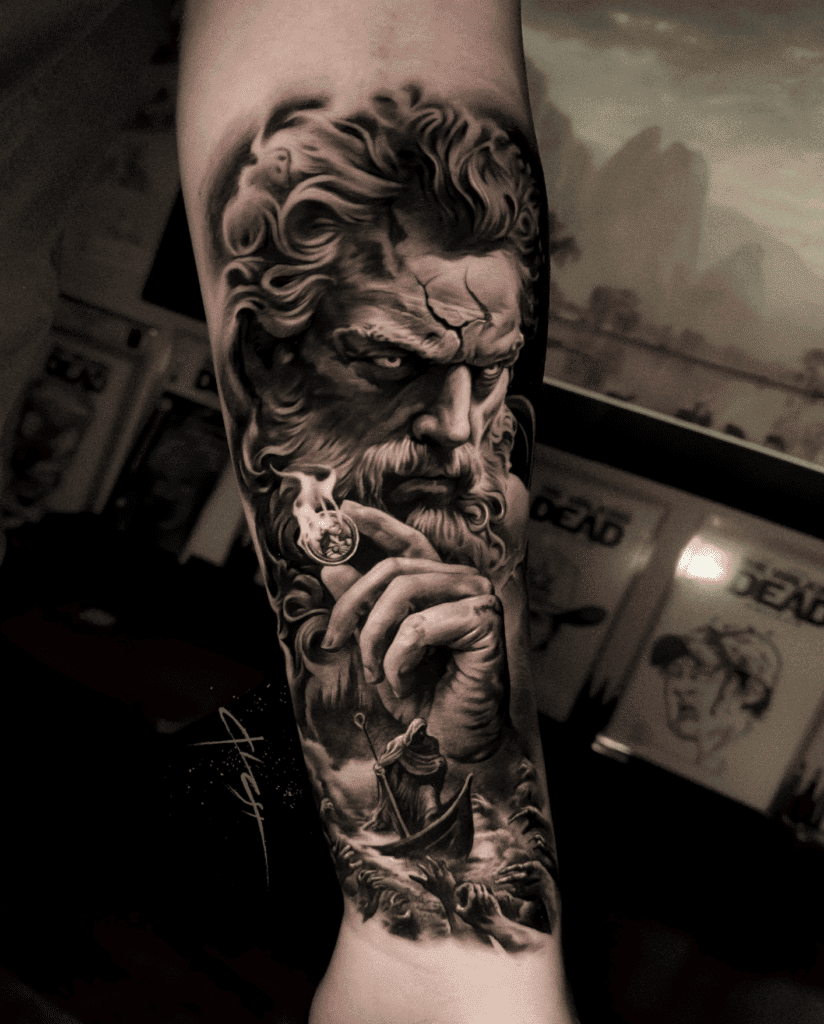
Hades is the Greek god of the Underworld, ruler of the realm of the dead and guardian of the natural boundary between life and death. Though often misunderstood as evil, Hades is one of the fairest and most disciplined gods in Greek mythology. He does not cause death; instead, he governs what comes after it, ensuring balance in the cosmos.
Hades is the son of Cronus and Rhea, and brother to Zeus, Poseidon, Hera, Demeter, and Hestia. After the defeat of the Titans, the three brothers divided the universe by lot. Zeus received the sky, Poseidon the sea, and Hades the Underworld.
Persephone Greek Mythology Tattoo
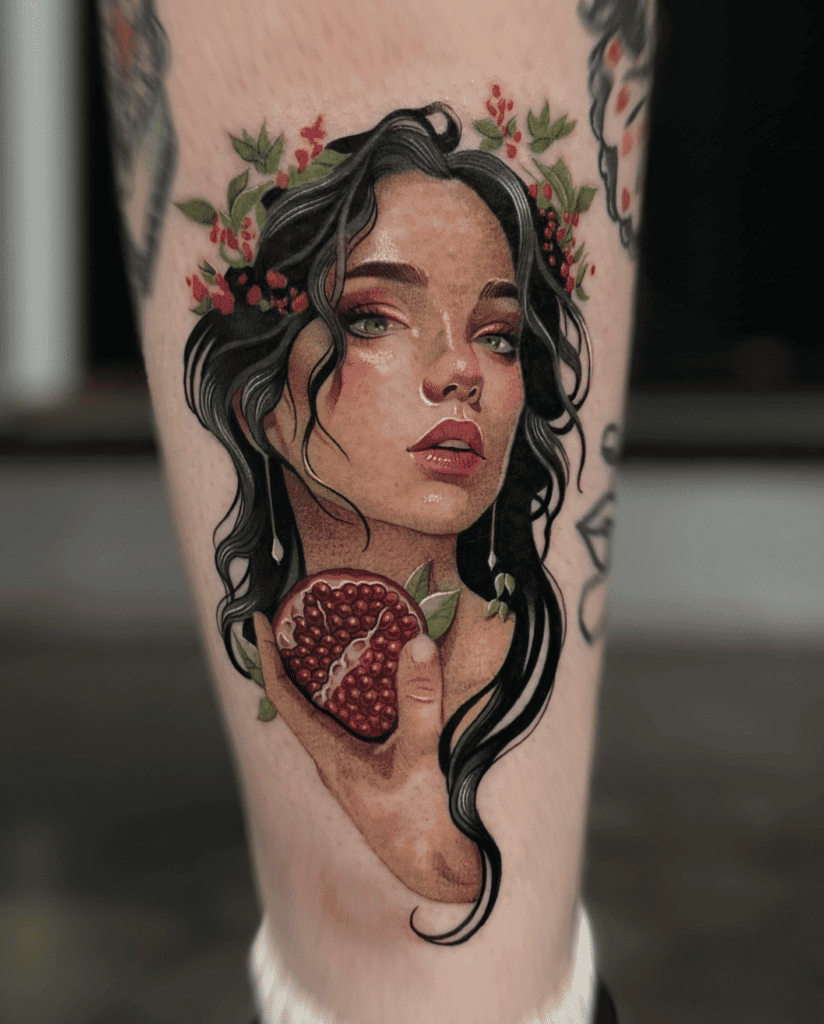
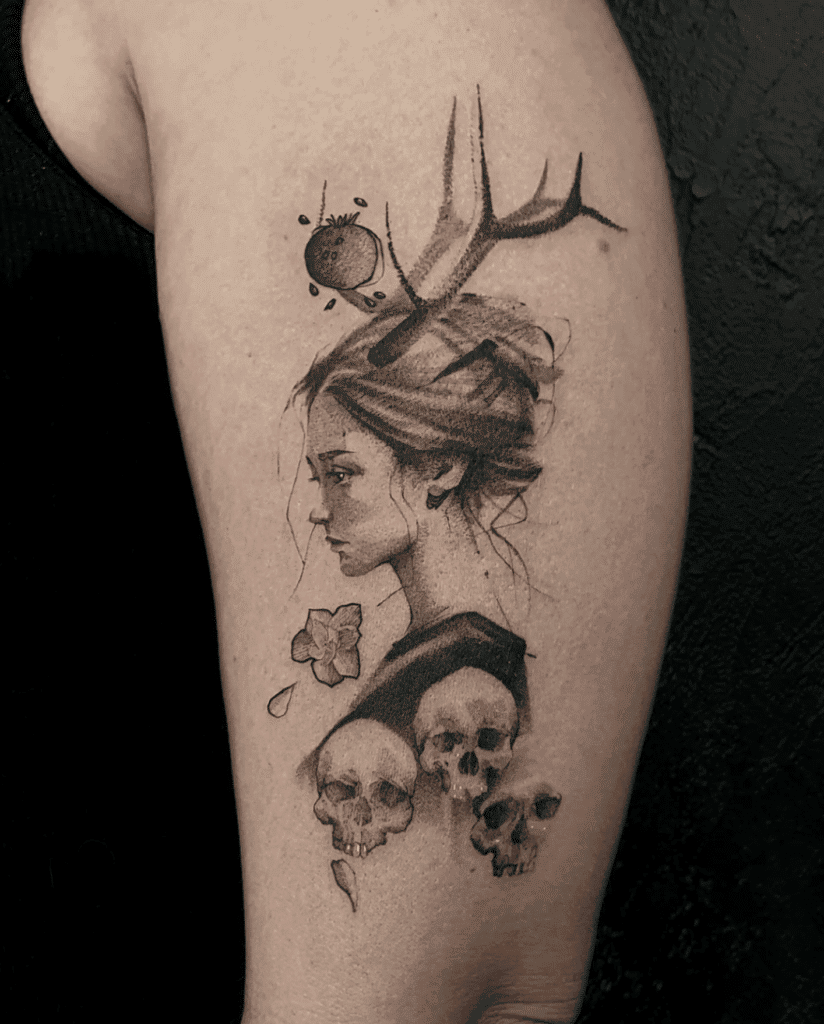
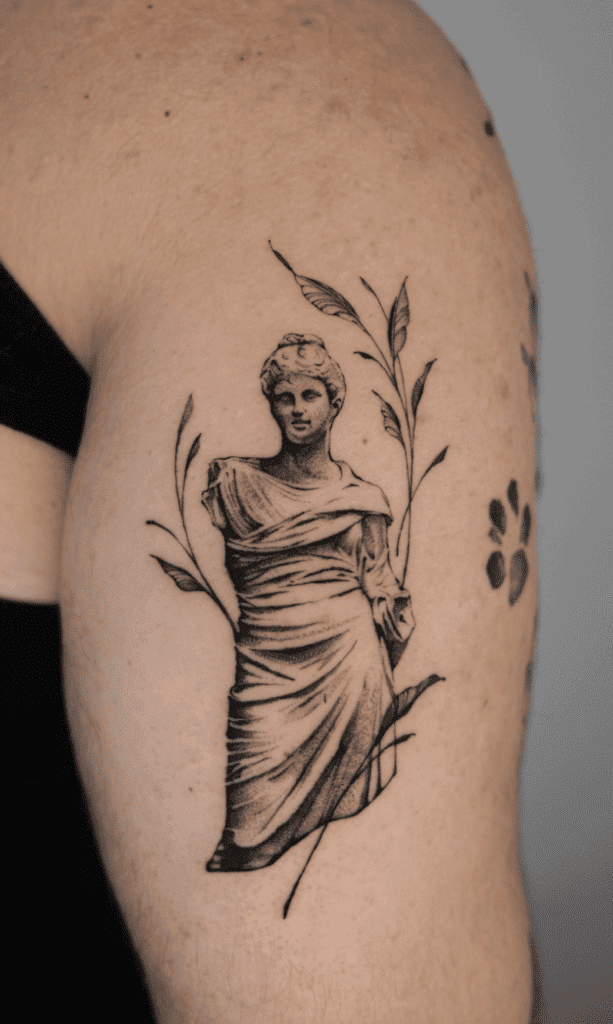
Persephone is one of the most complex and symbolic figures in Greek mythology. She is both the goddess of spring and renewal and the queen of the Underworld, embodying the delicate balance between life and death, innocence and power, growth and decay.
Persephone is the daughter of Demeter, goddess of agriculture, and Zeus. In her earliest myths, she is known as Kore, meaning “the maiden,” a symbol of youth, fertility, and untouched life. She spends her days among flowers, fields, and sunlight, closely bound to her mother and the rhythms of the earth.
Persephone’s story changes forever when Hades abducts her and brings her to the Underworld to rule as his queen. Demeter’s grief causes the earth to become barren, halting all growth and threatening humanity itself.
To restore balance, a compromise is reached: Persephone must spend part of the year in the Underworld and part of the year above ground. This agreement explains the seasons—her return brings spring and summer, while her descent marks autumn and winter.
Thanatos Greek Mythology Tattoo
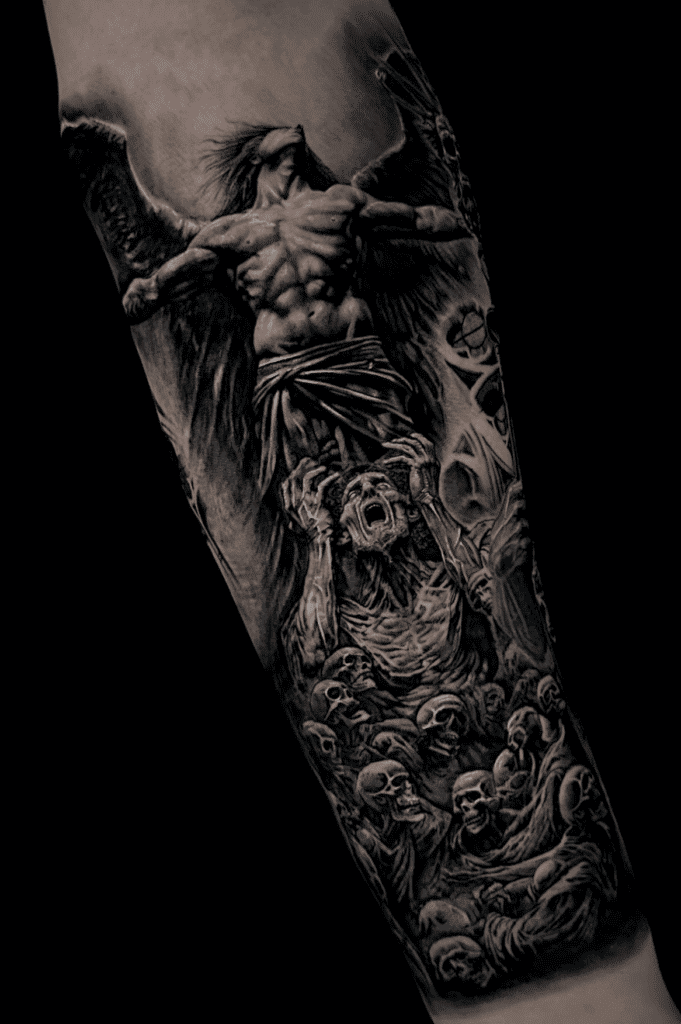

Thanatos is the Greek personification of death, representing peaceful, inevitable passing rather than violence or punishment. Unlike monstrous depictions of death found in later traditions, Thanatos is calm, silent, and impartial.
Thanatos is the son of Nyx (Night) and, in many traditions, Erebus (Darkness). He is the twin brother of Hypnos, the god of sleep—a pairing that reflects the ancient belief that sleep and death are closely related states of rest and release. While Hades rules the realm of the dead, Thanatos is the one who escorts the soul from life to death.
Hypnos Greek Mythology Tattoo
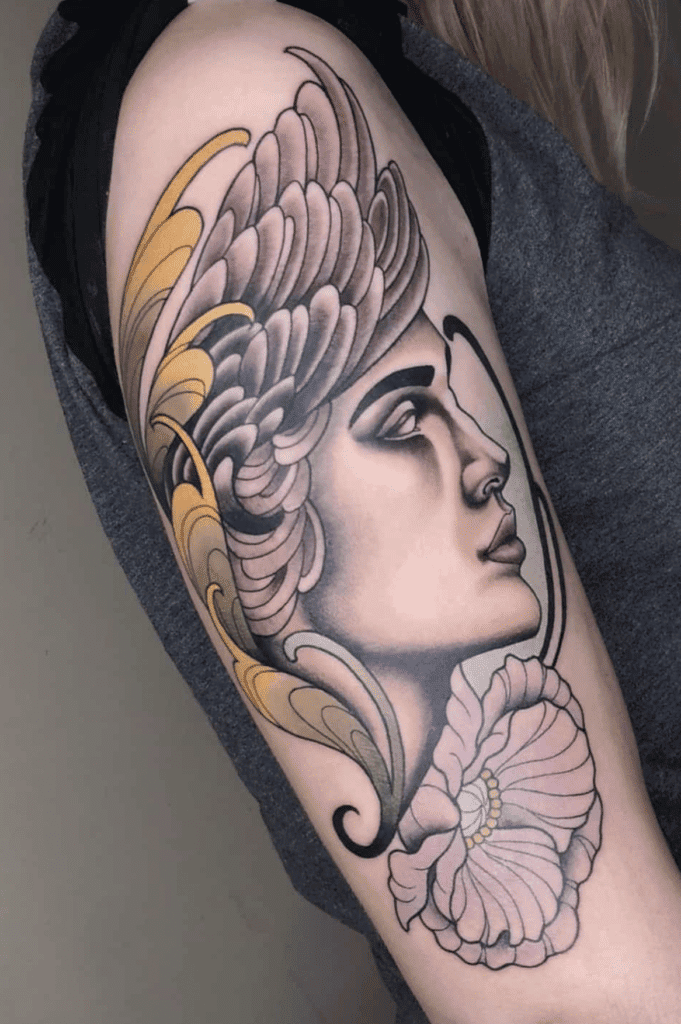
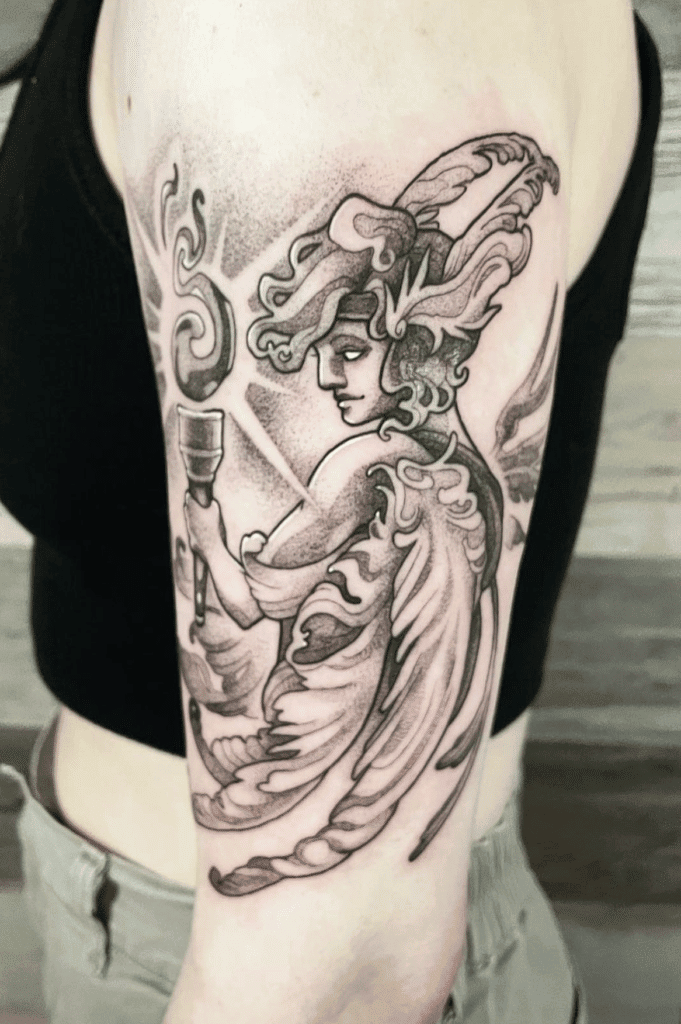
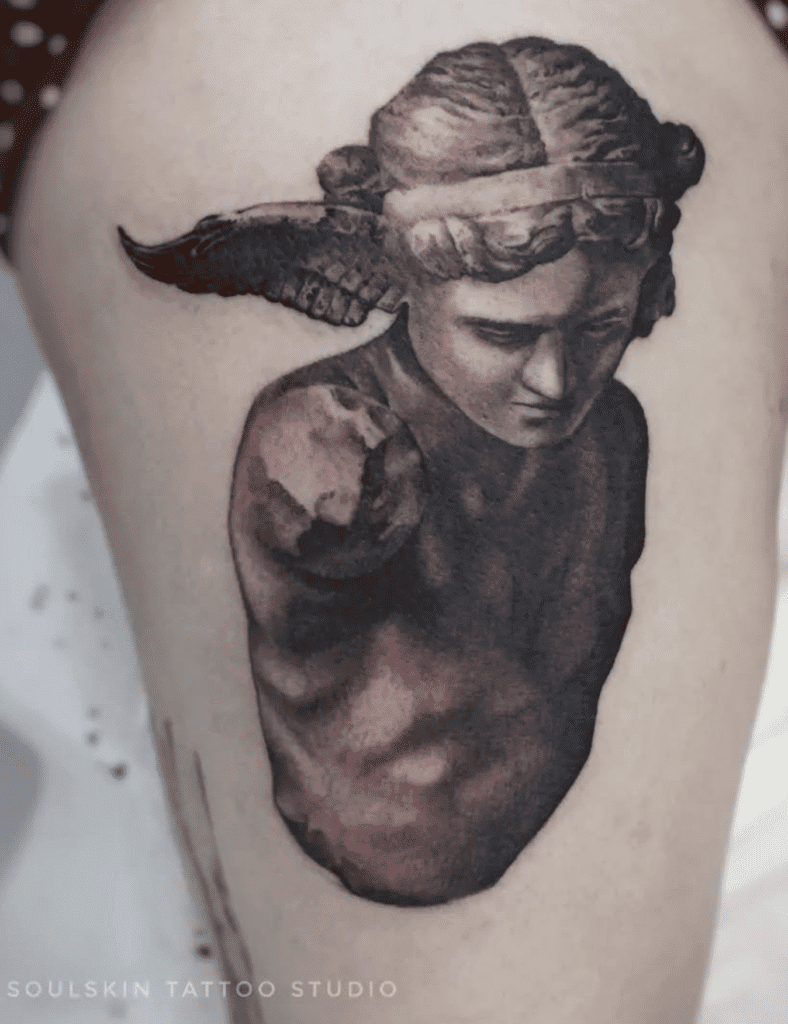
Hypnos is the Greek god of sleep, embodying rest, stillness, and the gentle release from waking consciousness. He is the son of Nyx (Night) and, in many traditions, Erebus (Darkness). He is the twin brother of Thanatos (Death), a pairing that reflects the ancient belief that sleep and death are closely related states—both transitions away from consciousness.
Charon Greek Mythology Tattoo
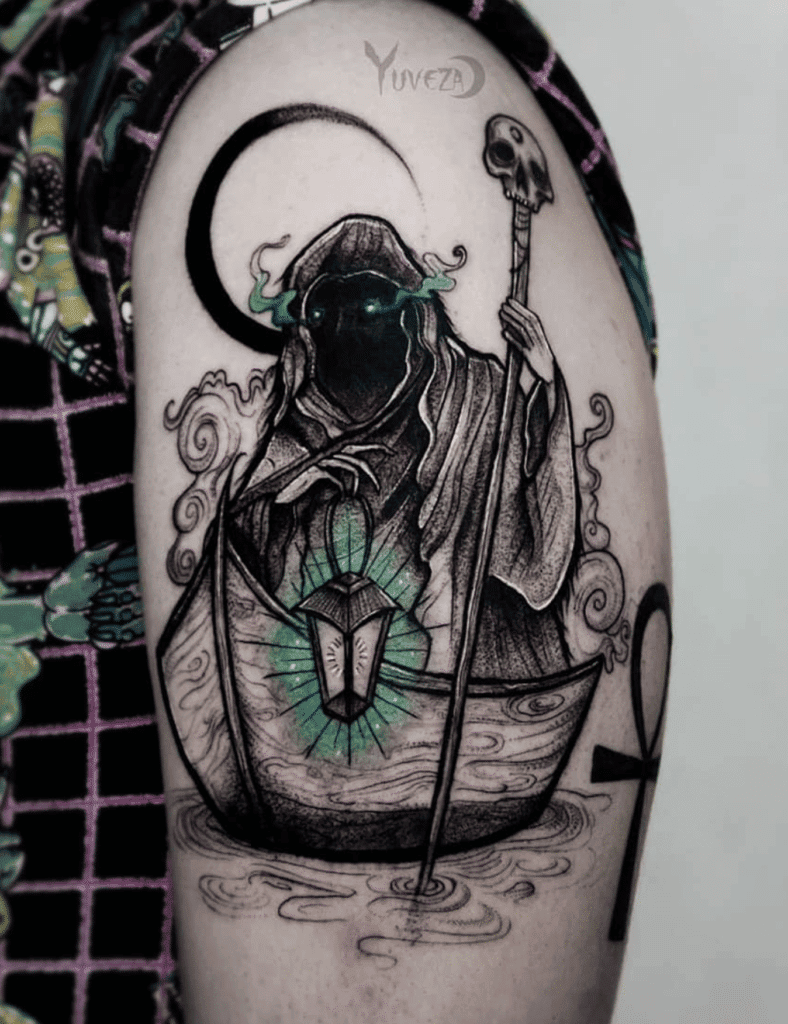
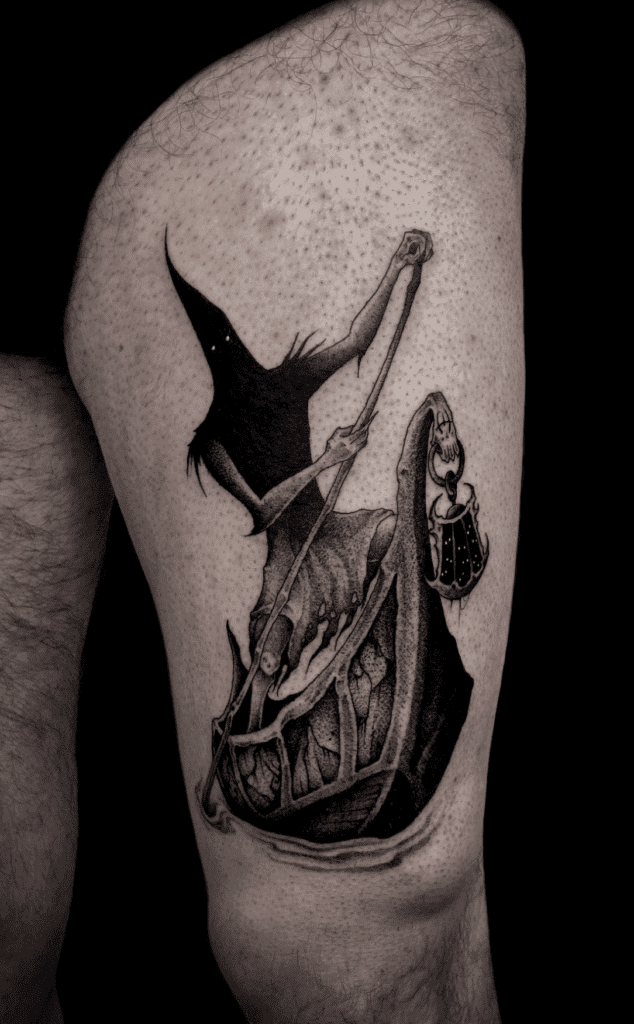
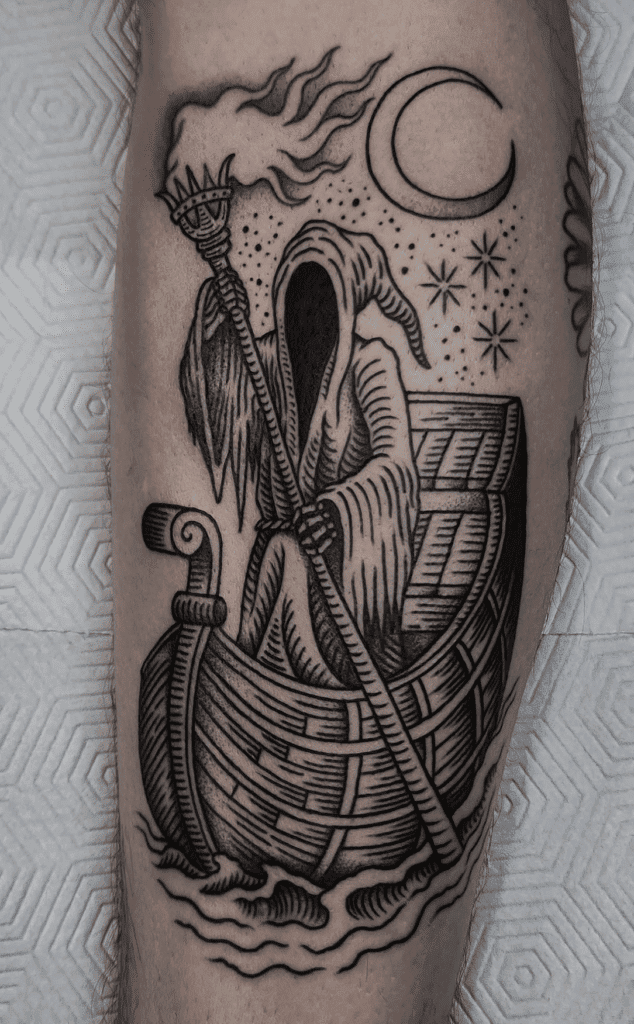
Charon is the grim ferryman of the Underworld, responsible for transporting the souls of the dead across the dark rivers that separate the world of the living from the realm of Hades. Silent, stern, and unwavering, Charon is the gatekeeper of transition, ensuring that death’s boundary is crossed properly and irrevocably.
Charon serves Hades, ferrying newly dead souls across the River Styx (and sometimes the Acheron), guiding them from mortal existence into the realm of the dead. His boat moves slowly through black waters, carrying only those who meet the ancient requirements of passage.
To board Charon’s boat, a soul must pay a coin, traditionally an obol, placed in or on the mouth of the deceased during burial. This funerary custom was essential in ancient Greece; without it, the dead were believed to roam the riverbanks for one hundred years before being allowed to cross.
Cerberus Greek Mythology Tattoo
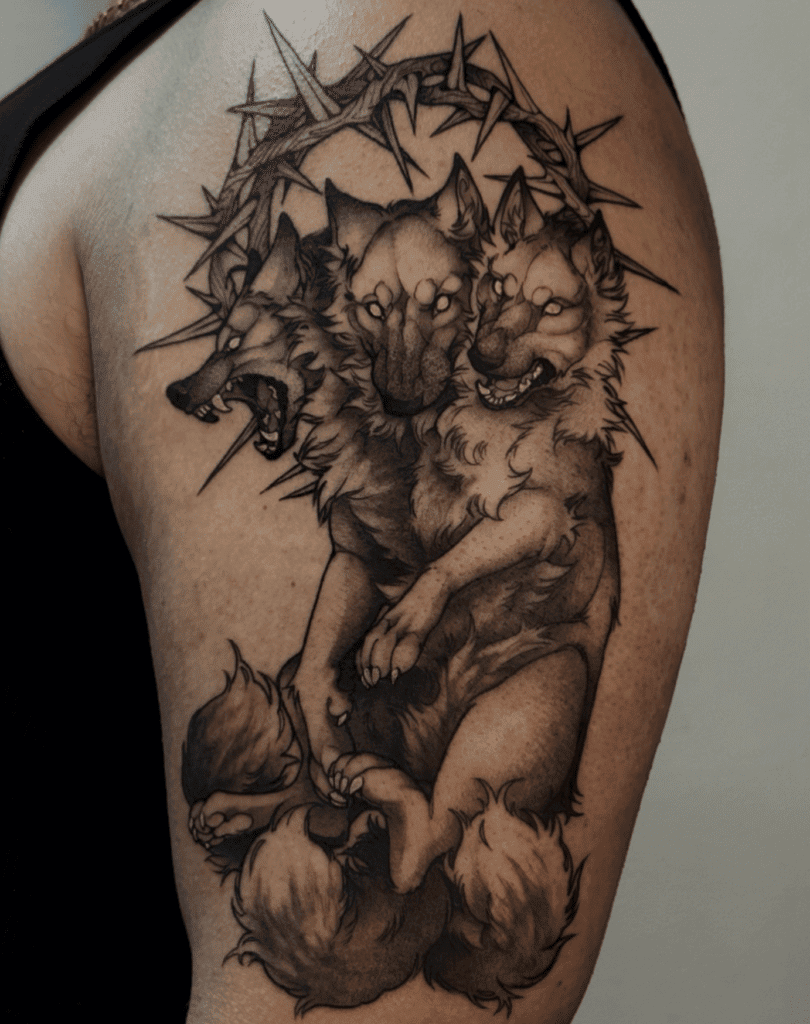
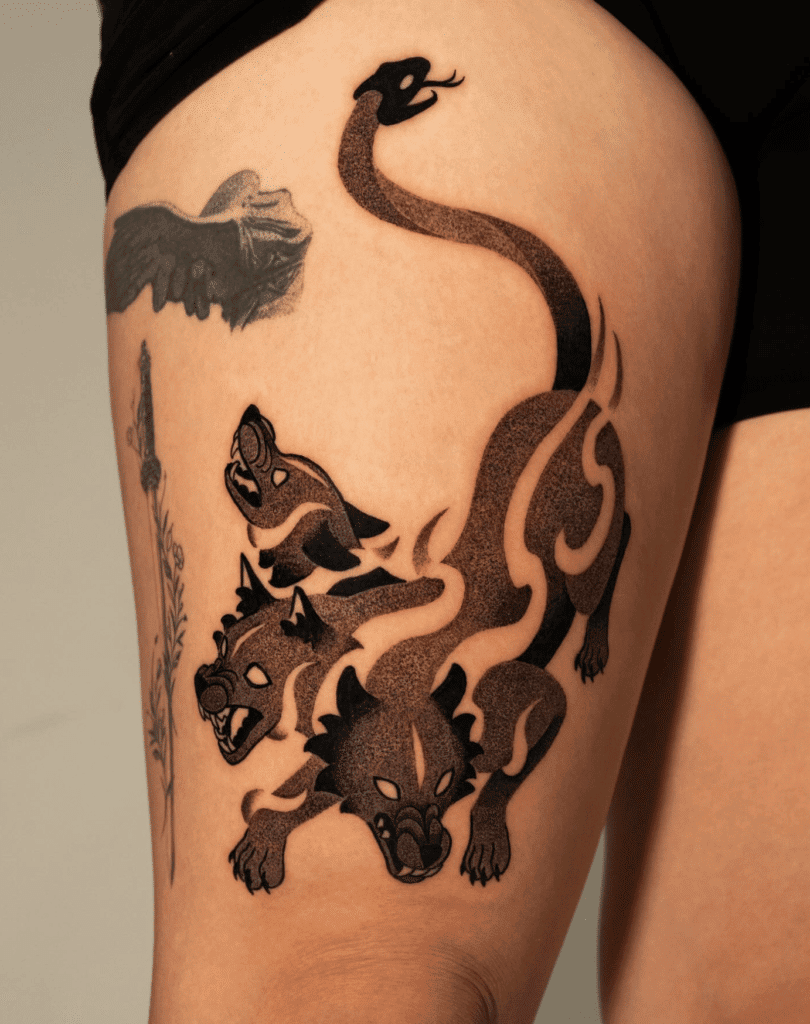
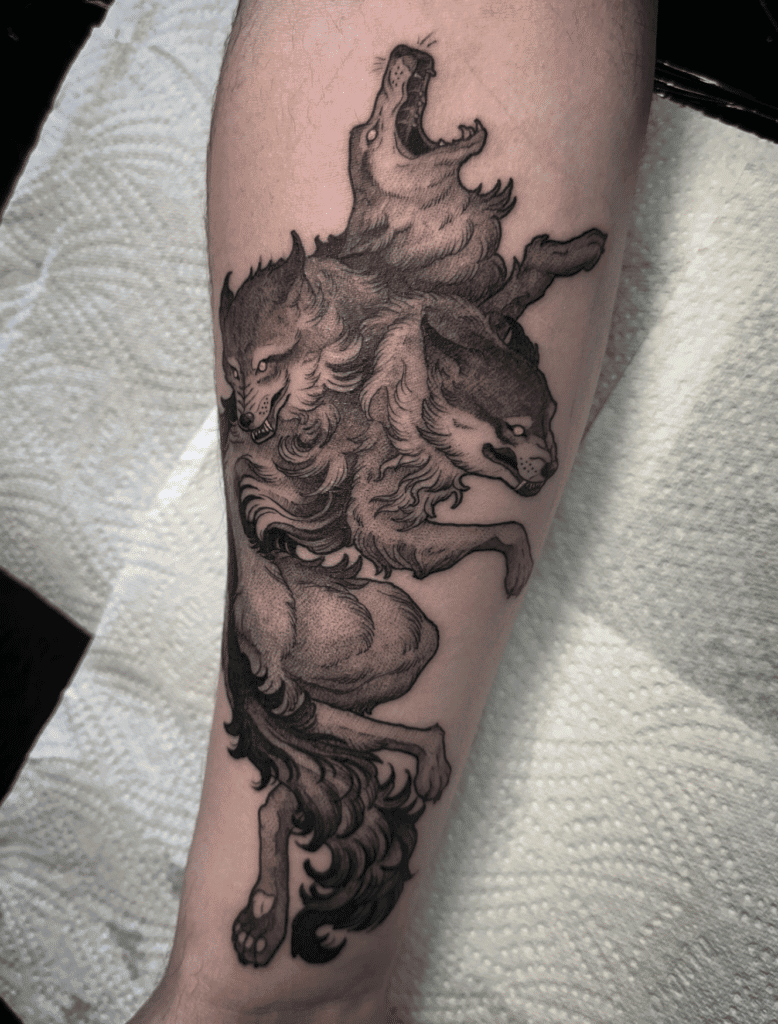
Cerberus is the fearsome guardian of the Underworld, a monstrous hound tasked with one singular duty: to keep the dead inside and the living out. Stationed at the gates of Hades, Cerberus embodies the final boundary between life and death.
Cerberus is the offspring of two of Greek mythology’s most terrifying beings: Typhon, the storm giant, and Echidna, the mother of monsters. This lineage makes Cerberus kin to creatures like the Hydra, Chimera, and Orthrus.
Born from chaos and terror, Cerberus was perfectly suited to guard the most sacred threshold in existence.
Erinyes Greek Mythology Tattoo

The Erinyes are the ancient goddesses of vengeance, embodiments of moral law, retribution, and inescapable guilt. Older than the Olympian order, they exist to punish crimes that violate the most sacred bonds—especially murder within families, betrayal of kin, and broken oaths.
In the oldest traditions, the Erinyes were born from the blood of Uranus when he was overthrown by Cronus, binding them to primal justice and cosmic balance. In other versions, they are daughters of Nyx (Night), reinforcing their role as beings older than law, older than mercy.
Minotaur Greek Mythology Tattoo
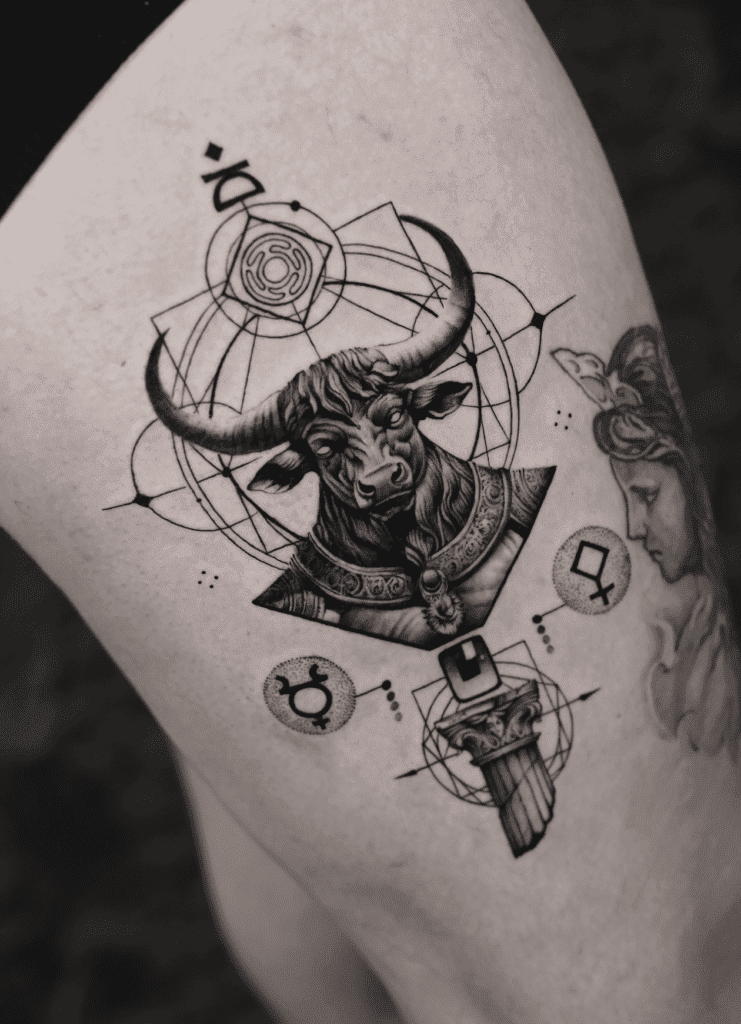
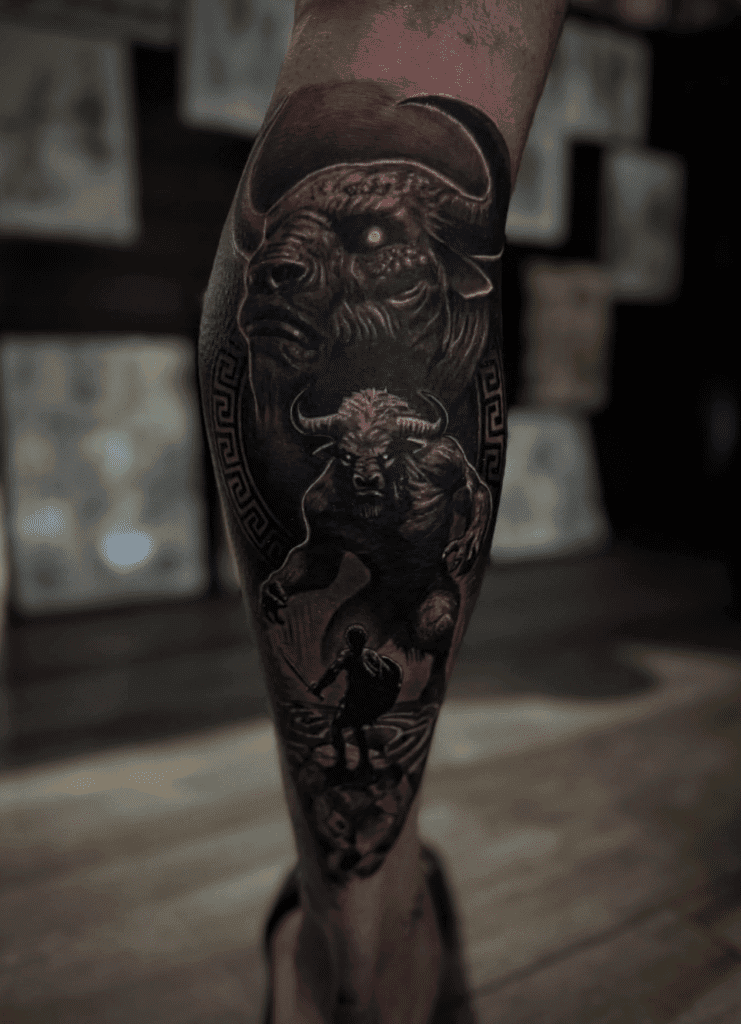
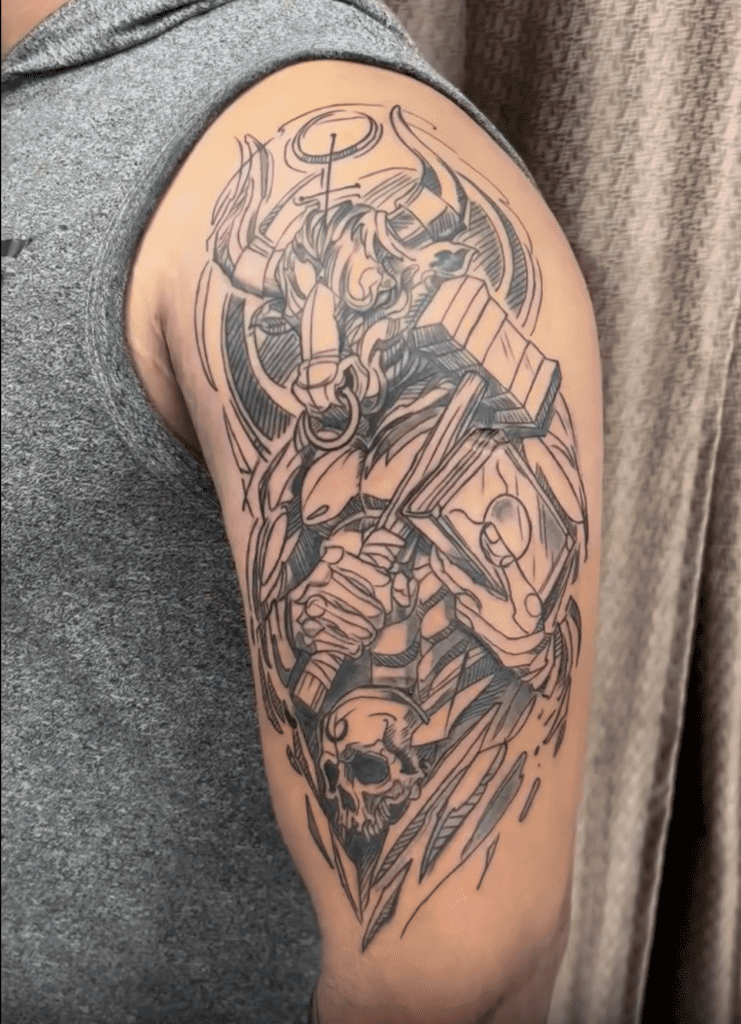
The Minotaur is a terrifying hybrid creature, with the body of a man and the head of a bull, imprisoned deep within the Labyrinth of Crete. The Minotaur’s story begins with King Minos of Crete, who offended the god Poseidon by refusing to sacrifice a sacred bull. As punishment, Poseidon caused Minos’s wife, Pasiphaë, to fall unnaturally in love with the bull. From this union, the Minotaur was born.
Ashamed and horrified, Minos ordered the master craftsman Daedalus to construct an inescapable maze known as the Labyrinth to imprison the creature. The Minotaur was named Asterion, meaning “starry one,” hinting at the tragedy hidden beneath his monstrous form.
Medusa Greek Mythology Tattoo
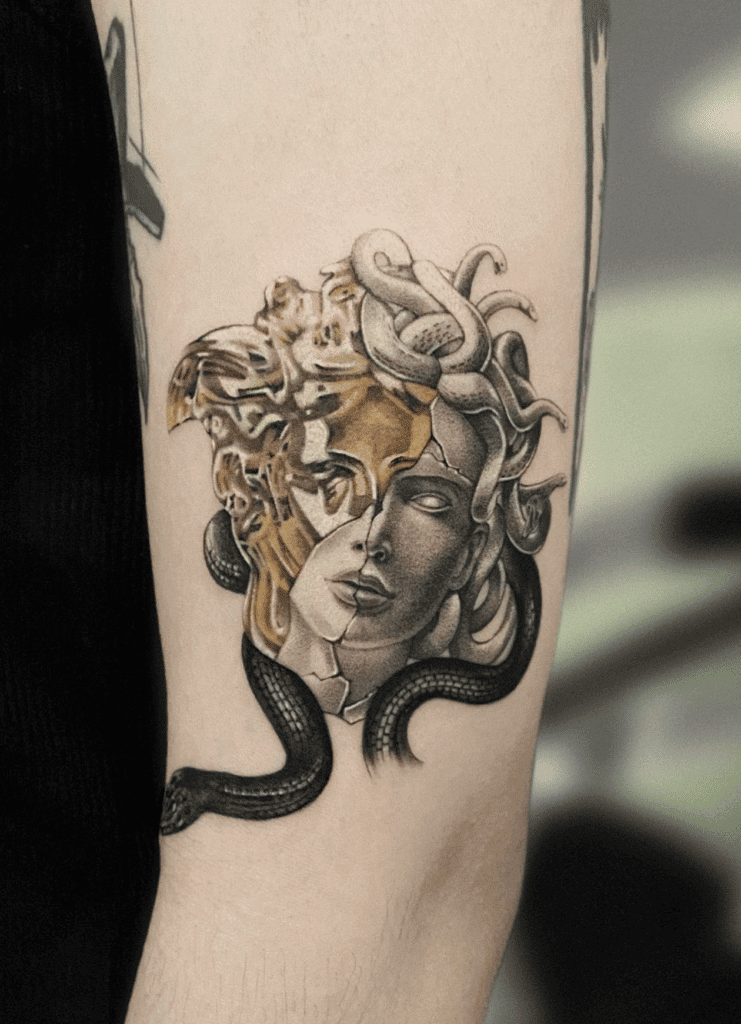
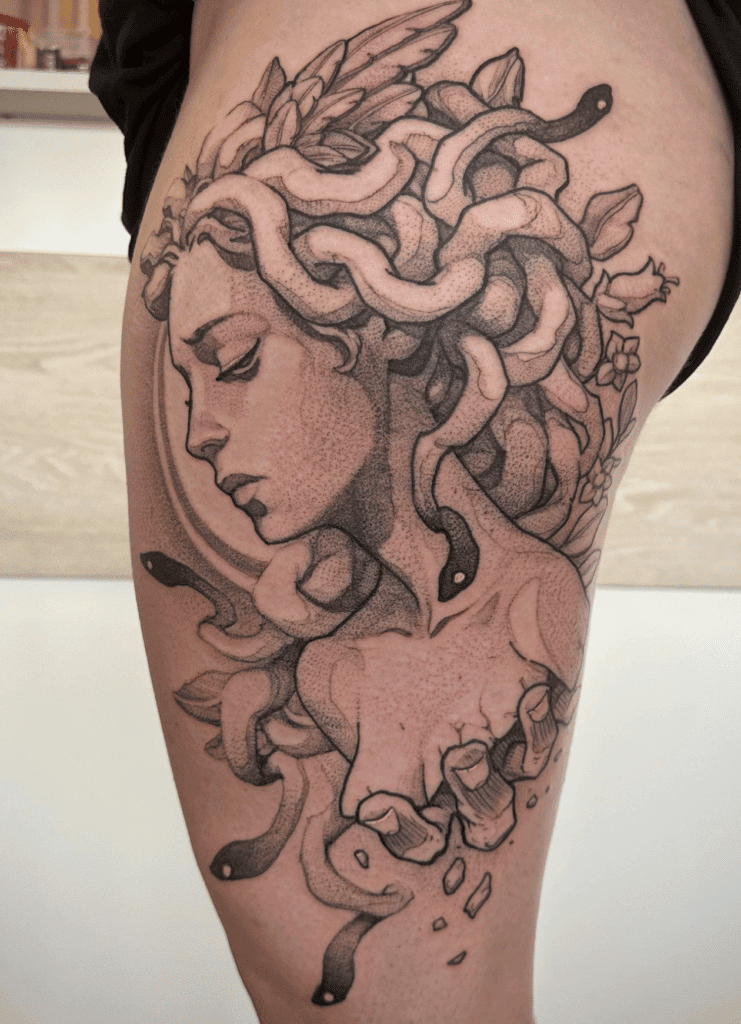
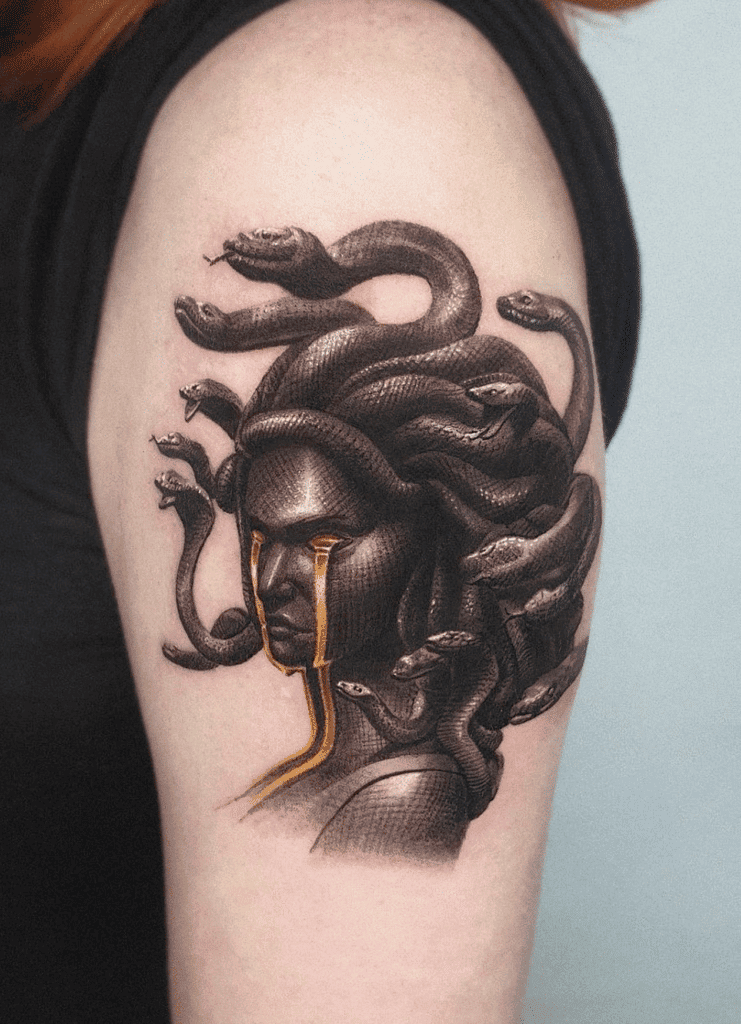
Medusa is a Gorgon, a being with living snakes for hair, and whose gaze could turn anyone to stone. Often portrayed as a monster, Medusa’s story is far more tragic than terrifying.
In earlier myths, Medusa was once a beautiful mortal woman, unlike her immortal Gorgon sisters, Stheno and Euryale. She served as a priestess of Athena, devoted to the goddess and bound by vows of purity. Her beauty was said to be so extraordinary that it became the source of her downfall.
Medusa was assaulted by Poseidon in Athena’s temple. Rather than punishing the god who violated her sacred space, Athena cursed Medusa instead, transforming her hair into snakes and giving her a gaze so deadly that no one could look upon her without turning to stone.
This curse turned Medusa into a monster in the eyes of the world—banished, feared, and hunted.
Hydra Greek Mythology Tattoo
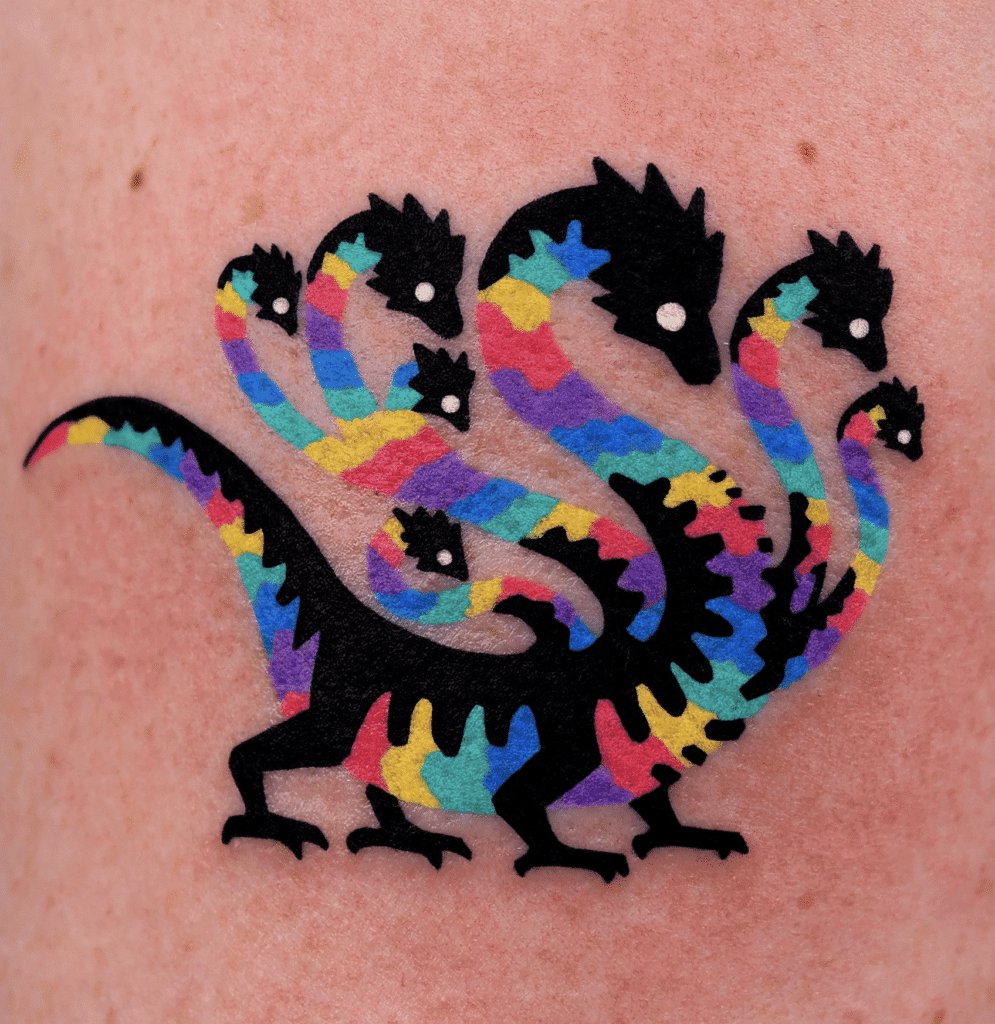
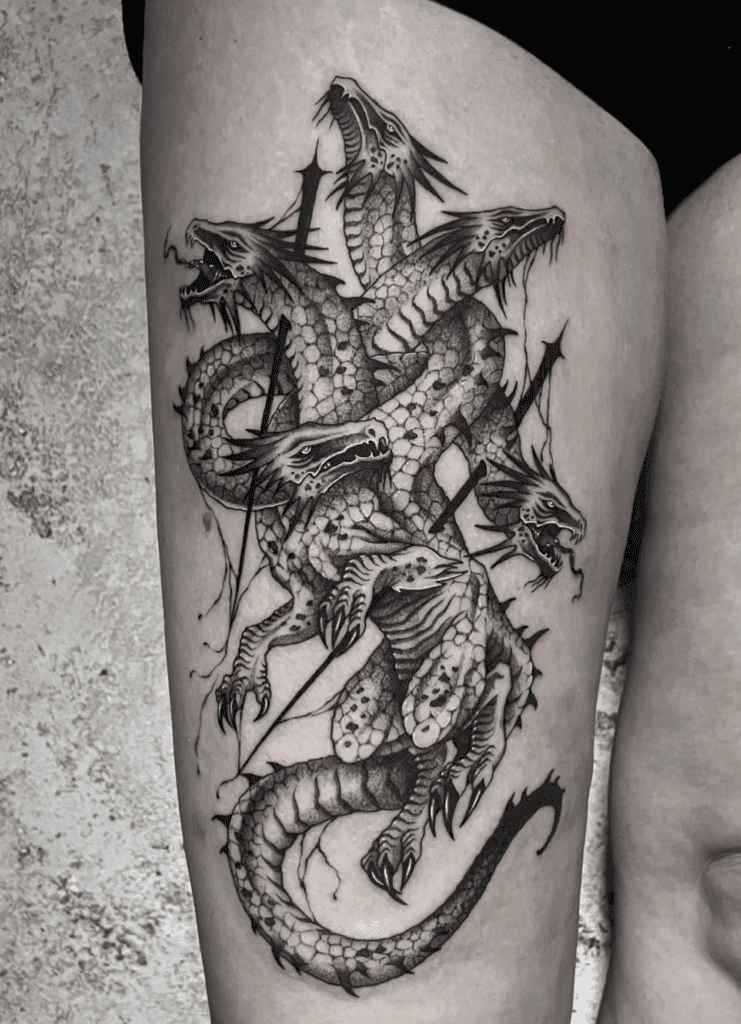
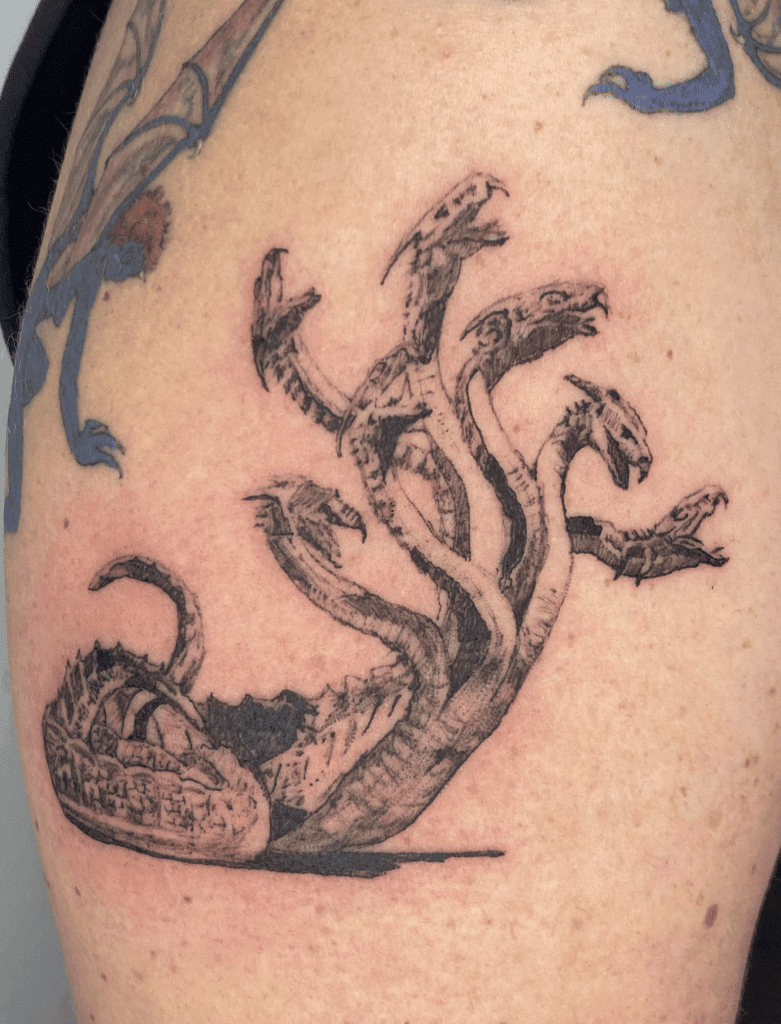
The Hydra is a monstrous, multi-headed serpent that dwelled in the swamps of Lerna, spreading poison and death wherever it crawled. Unlike many Greek monsters that rely on brute strength, the Hydra is feared for its endless regeneration, as for every head cut off, two more would grow in its place (often mistaken for Medusa’s hair).
The Hydra is the offspring of Typhon and Echidna, the same monstrous parents as Cerberus, Chimera, and Orthrus. This lineage marks the Hydra as a being born from chaos and imbalance, designed to challenge gods and heroes alike.
One of the Hydra’s heads was immortal, making it impossible to defeat through strength alone. The Hydra is best known as the foe of Heracles during his Second Labour. Each time Heracles cut off a head, two more grew back, turning victory into futility.
Only with the help of his nephew Iolaus, who cauterised each wound with fire, was Heracles able to stop the regeneration. The immortal head was buried beneath a massive rock, finally ending the monster’s reign.
Chimera Greek Mythology Tattoo
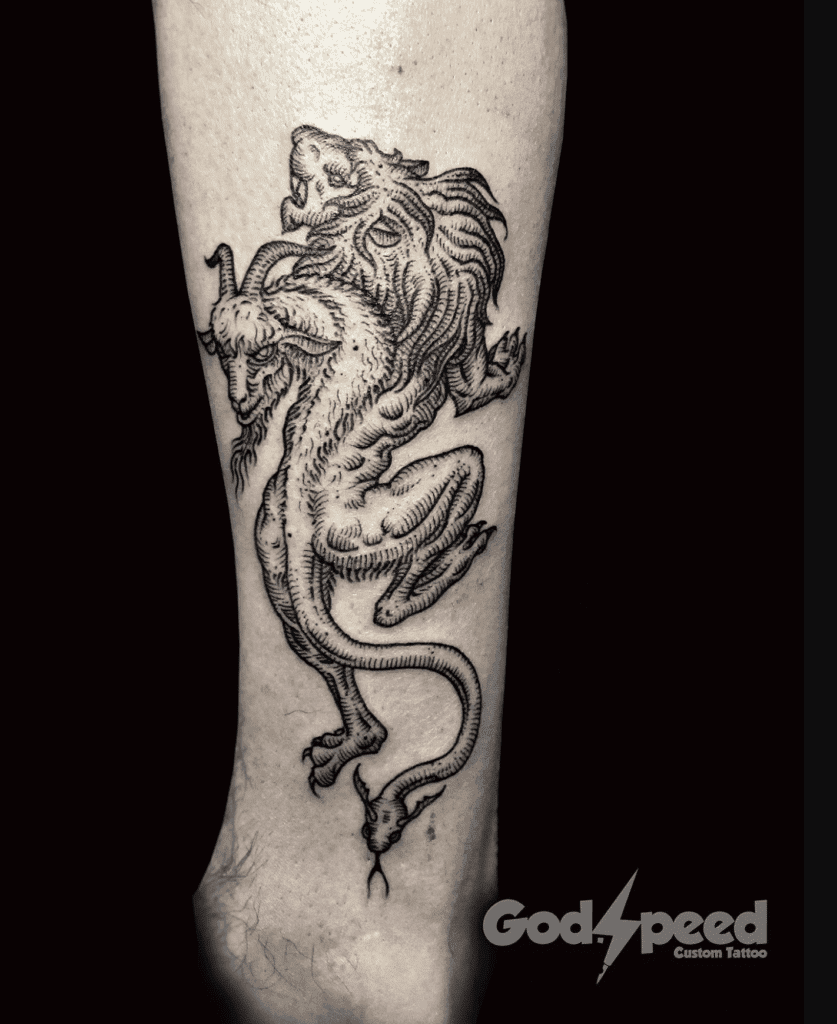
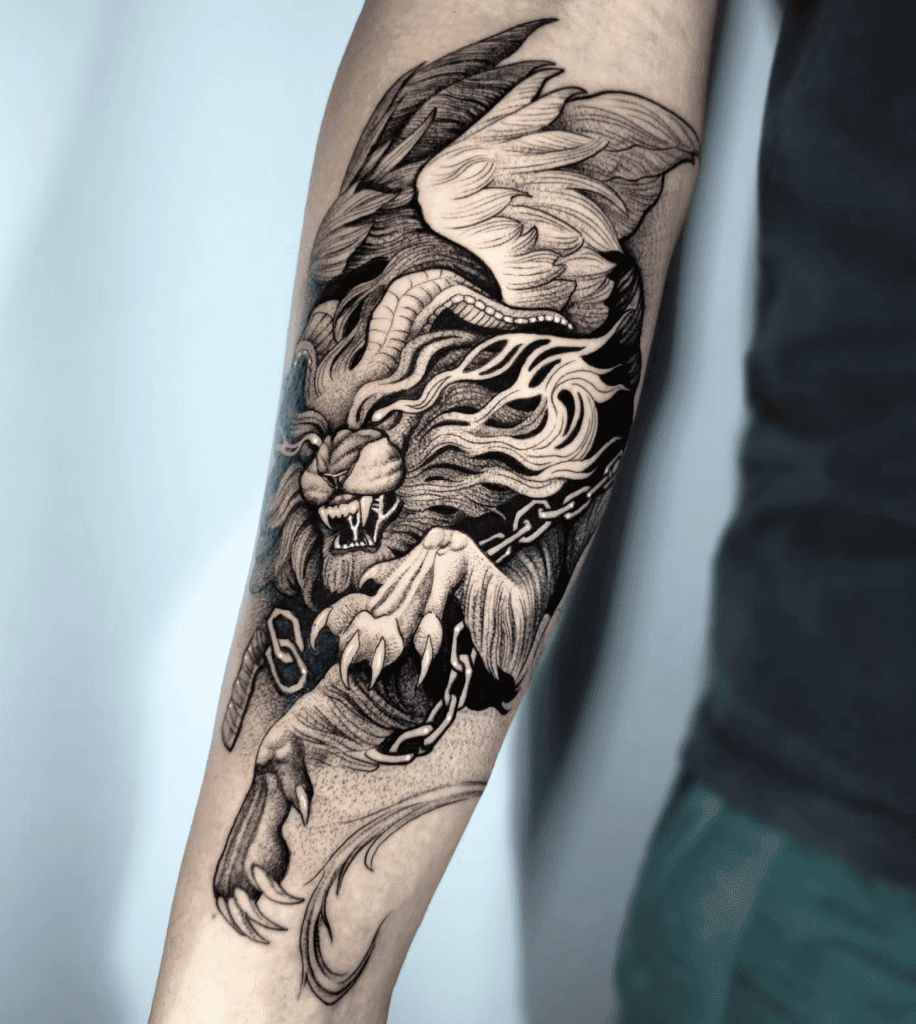
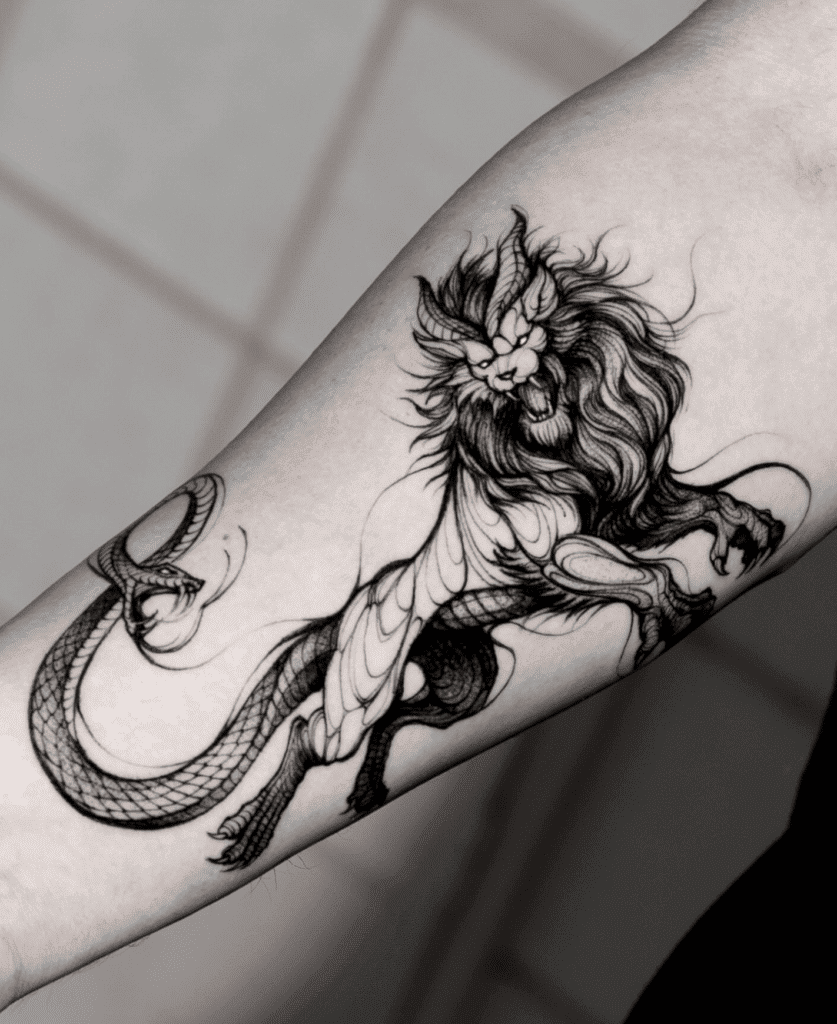
The Chimera is a terrifying hybrid monster, famed for its unnatural form and destructive power. Described as a creature with the body of a lion, a goat’s head rising from its back, and a serpent or dragon for a tail, the Chimera embodies chaos given flesh.
The Chimera is the offspring of Typhon and Echidna, making it sibling to some of the most fearsome creatures in Greek mythology, including Cerberus, the Hydra, and Orthrus. This lineage marks the Chimera as a being born not of nature, but of cosmic imbalance. It was said to roam the region of Lycia, devastating villages and turning fertile land into ash.
Sphinx Greek Mythology Tattoo

The Greek Sphinx is a deadly guardian of knowledge, feared not for brute strength alone, but for her intellect and cruelty. With the body of a lion, the wings of a bird, and the face of a woman, she represents a fusion of power, mystery, and danger.
In Greek mythology, the Sphinx is often described as the daughter of Typhon and Echidna, placing her among the most terrifying monster families, alongside the Hydra and Chimera. She was sent by the gods—often Hera—to punish the city of Thebes for past crimes.
The Sphinx is most famous for her riddle, posed to all who passed: “What walks on four legs in the morning, two at noon, and three in the evening?” Those who failed to answer were killed and devoured. The riddle is not a trick—it is a test of self-awareness, forcing humans to recognise the stages of their own lives.
The correct answer is man.
Cyclops Greek Mythology Tattoo


The Cyclopes are giant, one-eyed beings, instantly recognisable by the single eye in the centre of their foreheads. Their name literally means “round-eyed.” Though often remembered as savage monsters, the Cyclopes actually exist in two very different forms in Greek mythology: divine craftsmen and brutal giants.
The earliest Cyclopes were primordial giants, born from Uranus and Gaia. These Cyclopes were not mindless monsters and, instead, were master craftsmen of incredible intelligence and strength.
The three original Cyclopes, Brontes, Steropes, and Arges, forged the most powerful weapons in the cosmos: Zeus’s thunderbolts, Poseidon’s tridend and Hades’ helm of invisibility. Imprisoned by Uranus and later freed by Zeus, they played a crucial role in the Titanomachy, helping the Olympians secure victory.
Scylla Greek Mythology Tattoo
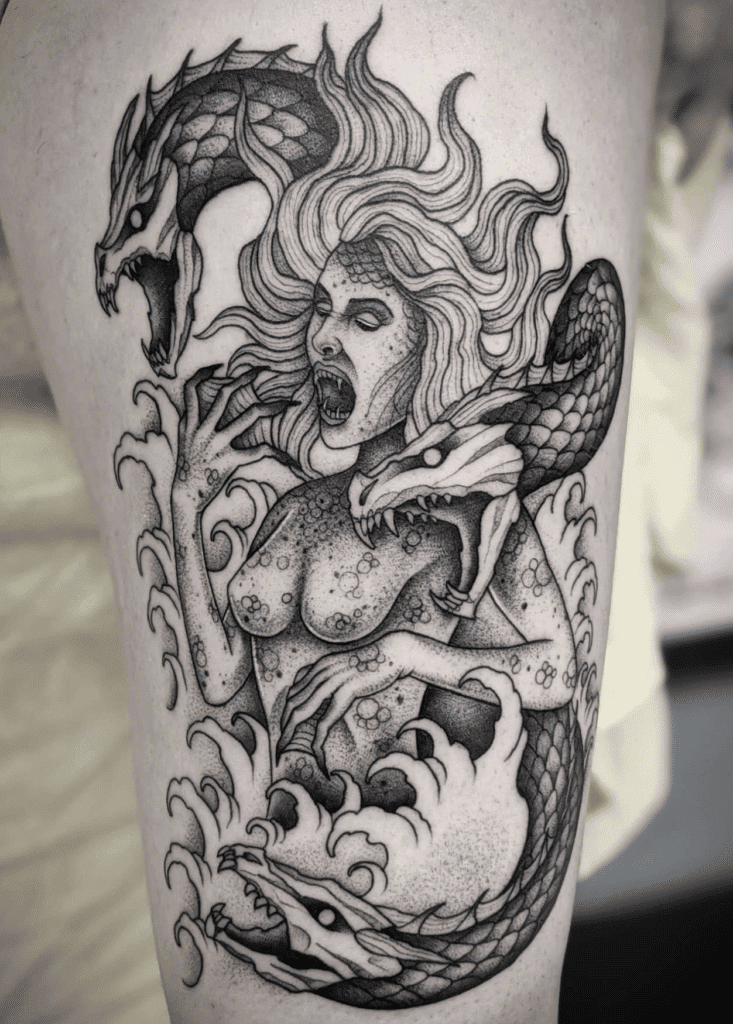

Charybdis is a terrifying sea monster that takes the form of a massive, living whirlpool, capable of swallowing entire ships in a single surge. In early myths, Charybdis was once a daughter of Poseidon, entrusted with guarding the seas. Her downfall came through greed—she stole land or swallowed territory to expand her father’s domain. For this transgression, Zeus struck her down, condemning her to exist eternally as a monster beneath the waves.
Harpies Greek Mythology Tattoo


The Harpies are winged spirits of wind and storm, feared for their speed, savagery, and association with divine punishment. Part woman, part bird, they descend without warning, snatching food, spreading filth, and vanishing as suddenly as they appear.
In early Greek mythology, the Harpies were not purely monstrous. They were personifications of violent winds, born from Thaumas (a sea god of wonders) and Electra, an Oceanid. Their name comes from the Greek harpazein, meaning “to snatch away.”
Over time, their image darkened from swift wind spirits to punishers of the guilty, enforcing the will of the gods.
Sirens Greek Mythology Tattoo
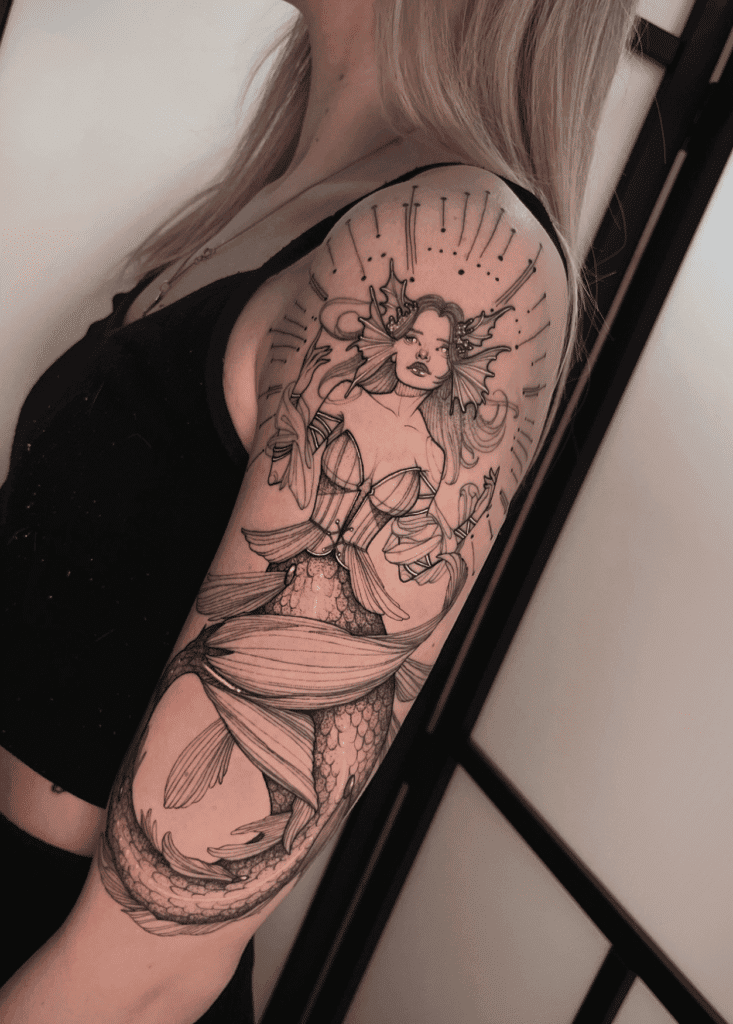
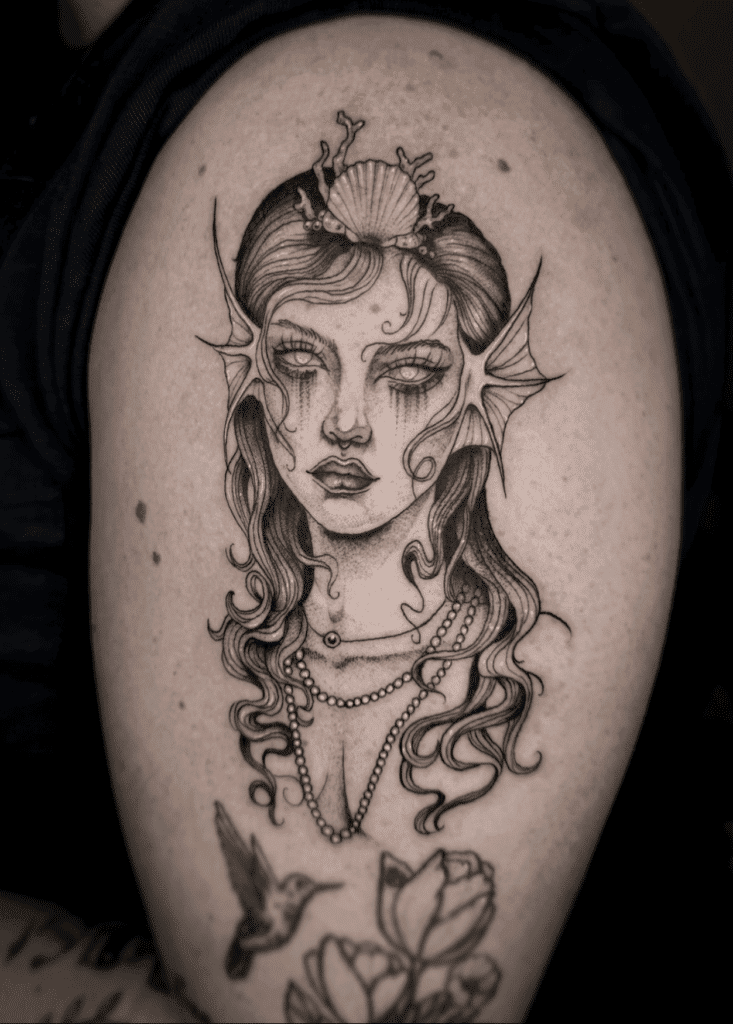
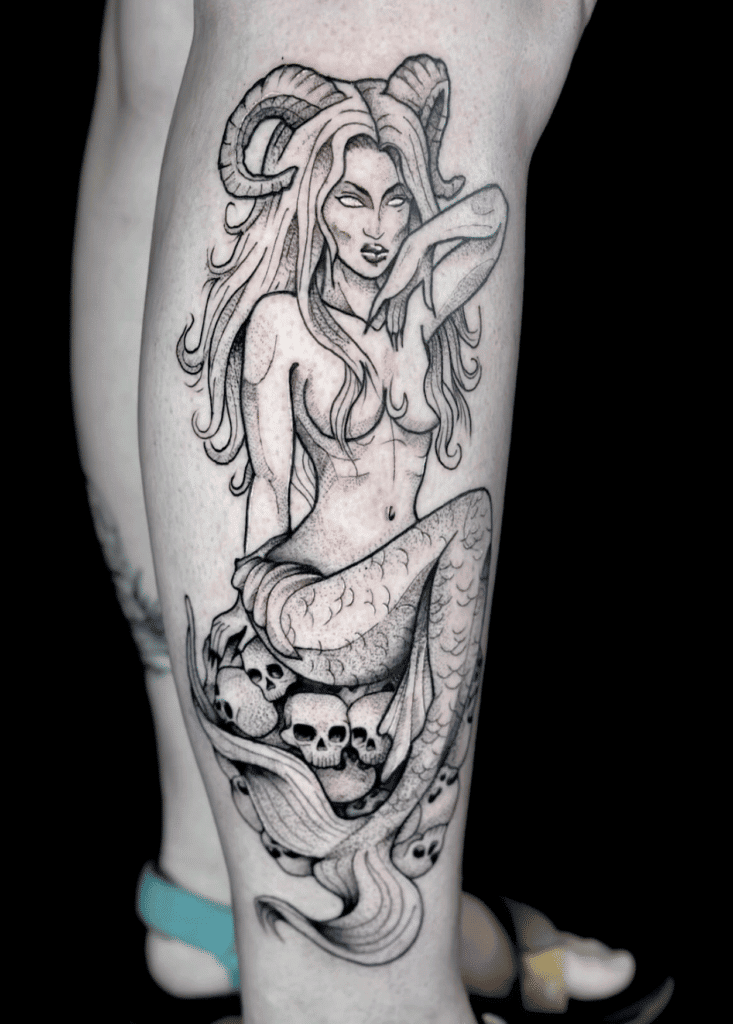
The Sirens are enchanting yet lethal beings, famed for their irresistible songs that draw sailors toward rocky shores and certain death. In early Greek mythology, the Sirens are often described as daughters of the river god Achelous and a Muse (commonly Melpomene or Terpsichore), linking them to art, knowledge, and divine inspiration. Their origin explains why their song is not crude temptation, but something far more dangerous: truth wrapped in beauty.
Typhon Greek Mythology Tattoo
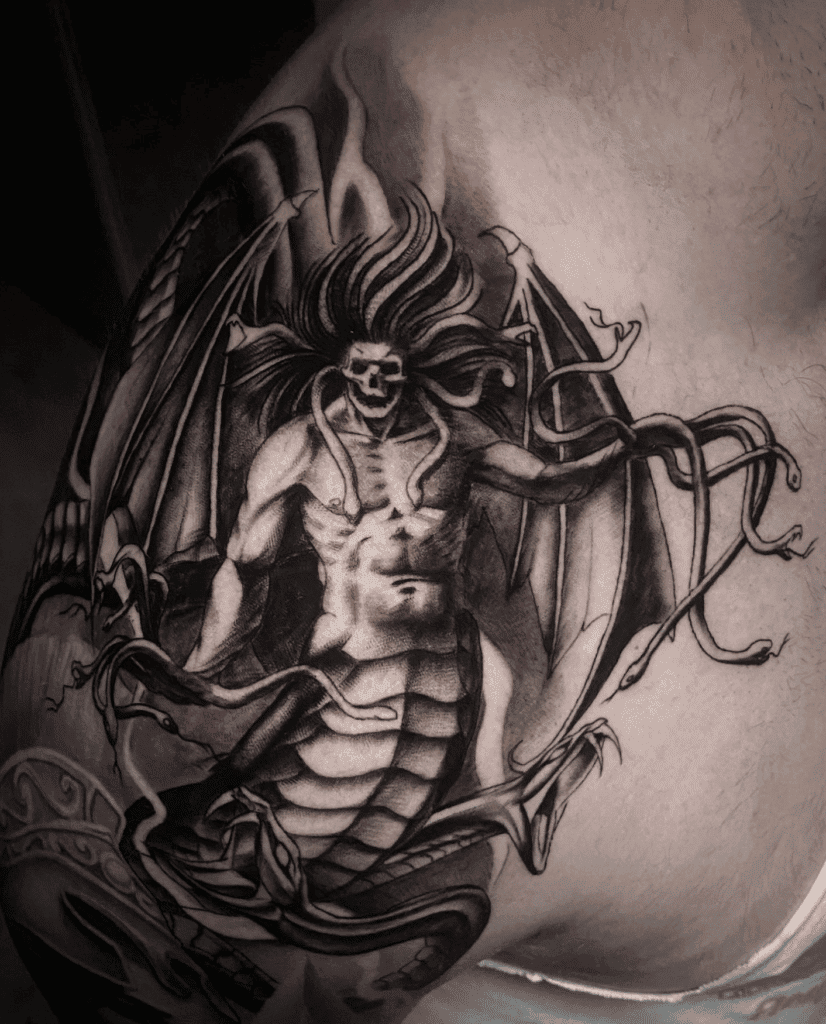
Typhon is the most powerful and terrifying monster in all of Greek mythology—a being so immense and destructive that he nearly overthrew Zeus himself. Typhon was born from Gaia and Tartarus, conceived as a final act of vengeance against the Olympian gods after the defeat of the Titans. Gaia, enraged by Zeus’s rule, created Typhon as a weapon, the last and greatest challenge to divine order.
Echidna Greek Mythology Tattoo
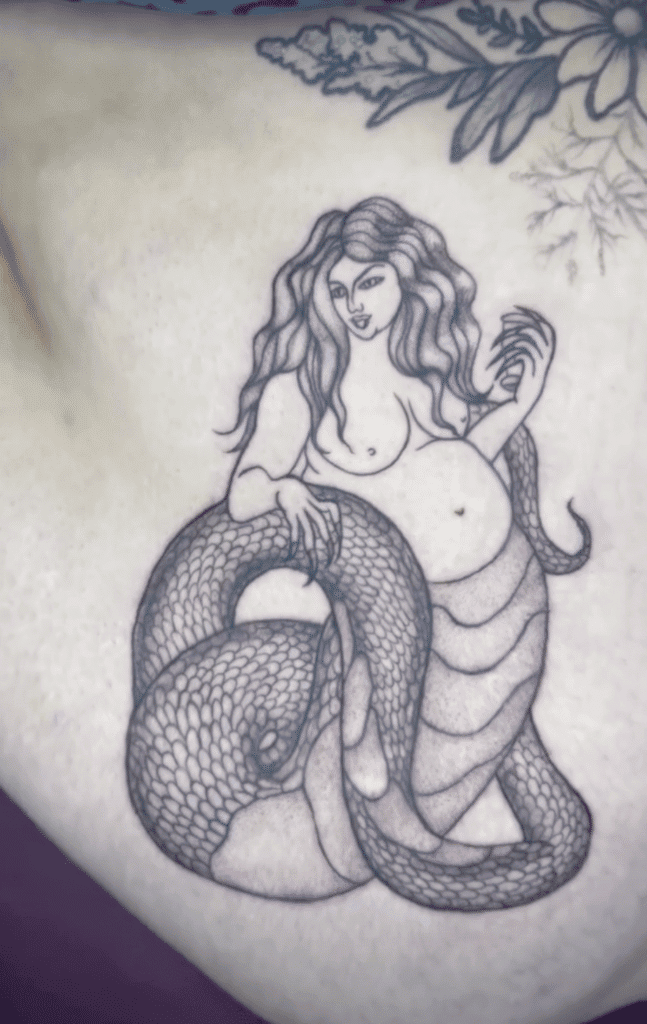
Echidna is the mother of nearly all the great monsters of Greek mythology, a being both beautiful and horrifying. She is described as half woman and half serpent, dwelling in deep caves or remote lands far from civilisation.
Echidna’s origins vary by tradition. She is often said to be the daughter of Phorcys and Ceto, ancient sea deities, or born directly from Gaia. Regardless of lineage, Echidna is always portrayed as ancient, chthonic, and immortal, untouched by time.
She exists beneath the world, in shadows and earth, where monsters are born and hidden away.
Ladon Greek Mythology Tattoo

Ladon is the immortal dragon tasked with guarding the Golden Apples of the Hesperides, sacred fruits that granted immortality and divine power. Ladon’s parentage varies across myths. He is often described as the child of Phorcys and Ceto, ancient sea deities -Typhon and Echidna, linking him to the great monster lineage – Or even Gaia herself, emphasising his chthonic, earthbound nature.
Regardless of origin, Ladon is always portrayed as ancient, serpentine, and immortal.
Ladon guards the sacred tree in the garden of the Hesperides, nymphs who tend the apples but rely on Ladon for protection. His many coils wrap around the trunk, and his hundreds of eyes are said to never close, making theft nearly impossible.
The apples themselves were a wedding gift from Gaia to Hera, placing Ladon firmly within the divine order rather than outside it.
Ladon meets his end during Heracles’ Eleventh Labour, when the hero is tasked with retrieving the Golden Apples. In some versions, Heracles slays Ladon with poisoned arrows; in others, Atlas retrieves the apples, sparing Ladon entirely.
Where Ladon is killed, his death is portrayed as tragic rather than triumphant. After Ladon’s defeat, Hera places him among the stars as the constellation Draco, ensuring that his watch never truly ends. Even in death, Ladon remains a guardian—now circling the heavens instead of a garden.
Dryads Greek Mythology Tattoo


Dryads are tree nymphs, gentle nature spirits who embody the life, soul, and consciousness of trees. To the ancient Greeks, forests were not empty wilderness; they were alive, watched over by Dryads who felt every cut of bark and every whisper of wind.
Dryads are bound to trees, especially oak trees, which were sacred to Zeus. They are not immortal in the way gods are, but they are long-lived, fading only when their tree dies. Their lives are measured in seasons, growth, and decay rather than years.
Satyrs Greek Mythology Tattoo
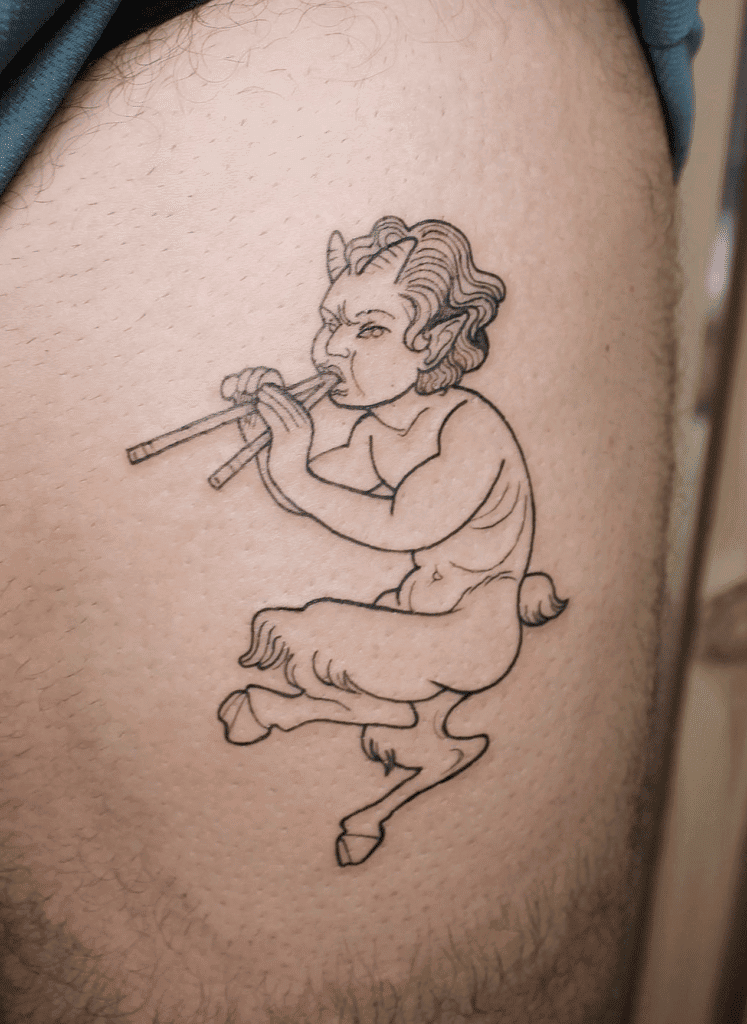
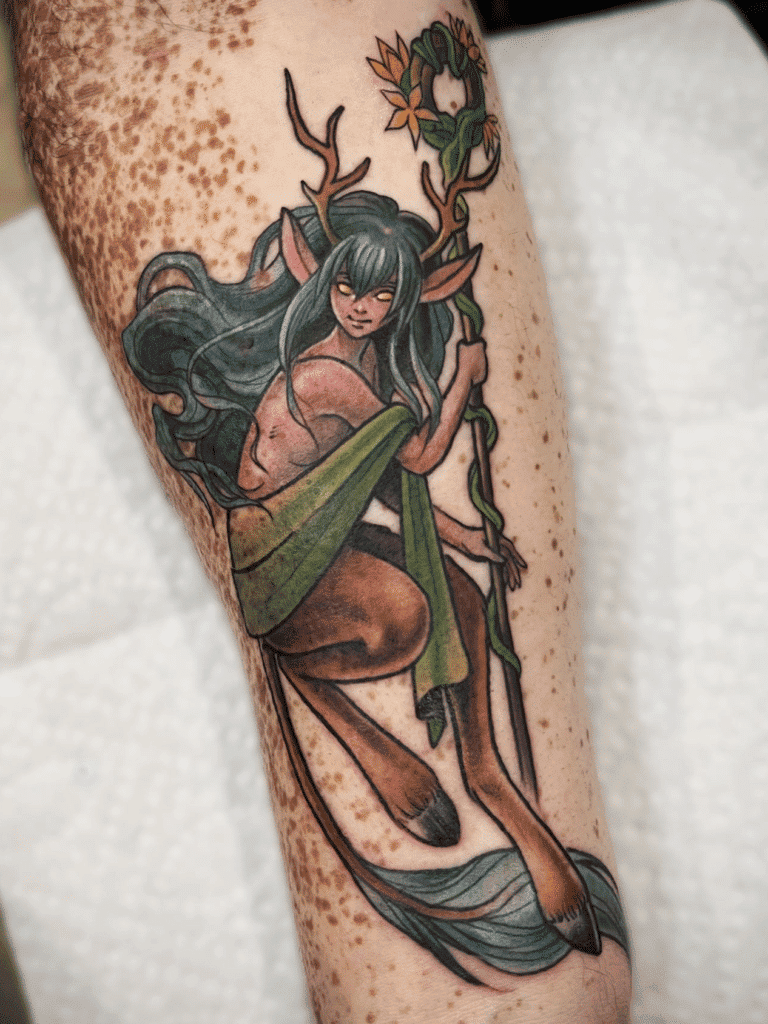
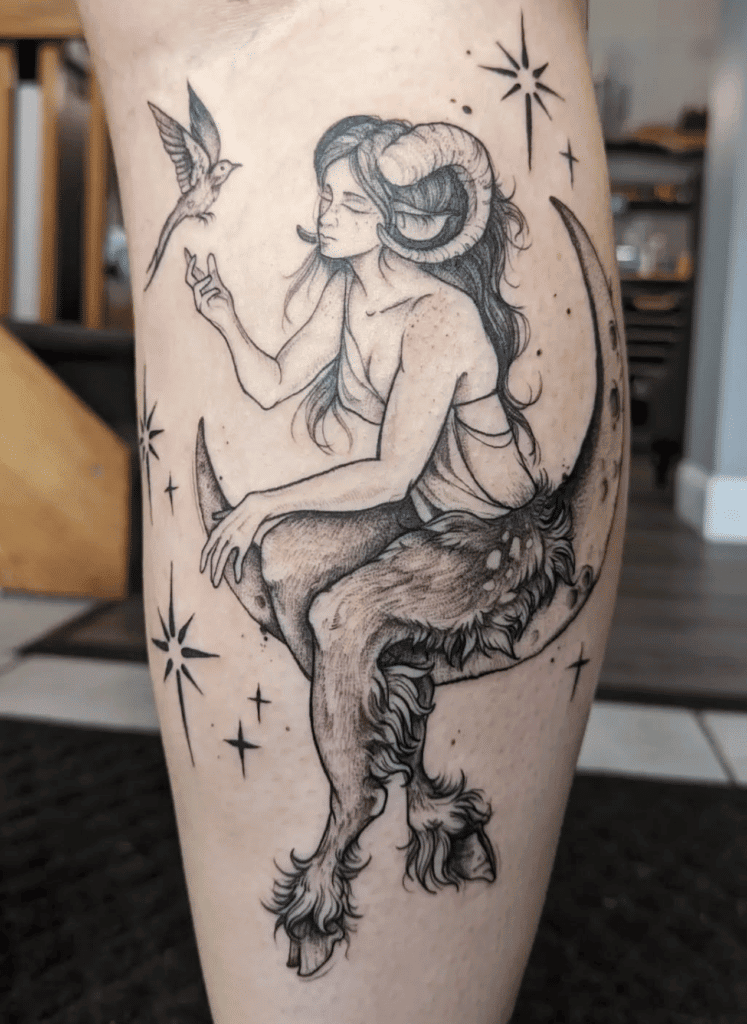
Satyrs are half-human, half-goat nature spirits, known for their boundless energy, unruly behaviour, and love of pleasure. They roam forests and mountains, drinking wine, playing music, chasing nymphs, and laughing loudly at the seriousness of gods and mortals alike.
Satyrs are companions of Dionysus, the god of wine, ecstasy, and madness. They embody the raw forces released during Dionysian rites—celebrations where order dissolved, and people surrendered to music, intoxication, and emotion.
Unlike gods, Satyrs are not worshipped as rulers. They are manifestations of wild nature, existing on the fringes of society.
Pan Greek Mythology Tattoo
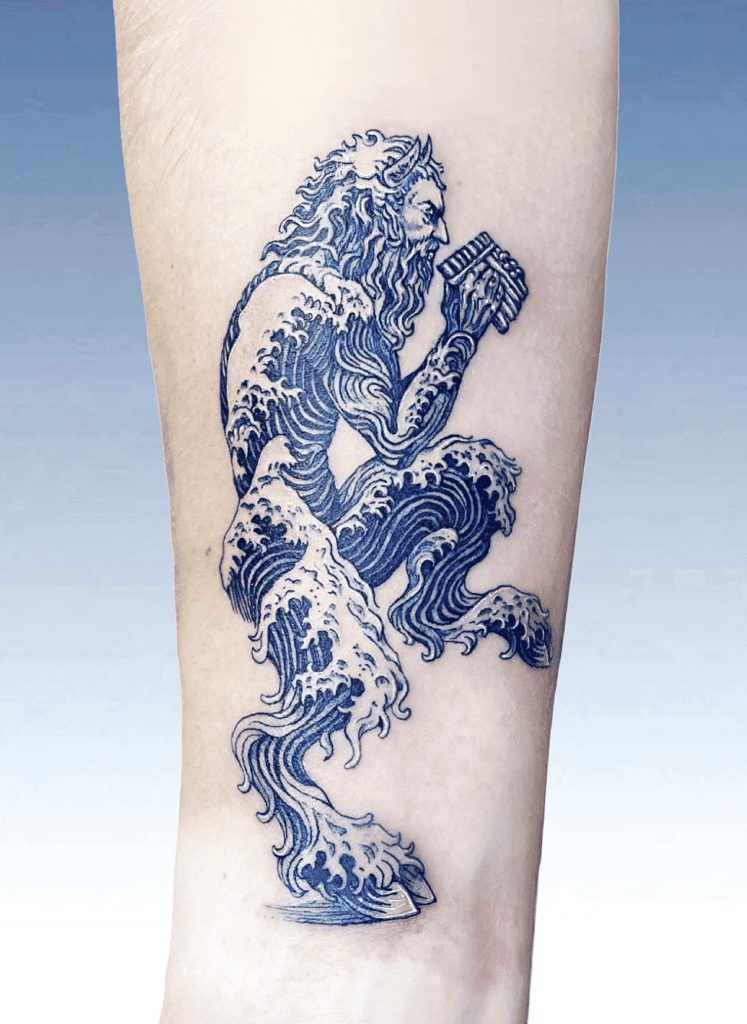

Pan is the Greek god of the wild, ruling over forests, mountains, shepherds, flocks, and untamed places beyond civilisation. Pan’s parentage varies by myth, but he is most often described as the son of Hermes and a nymph. From birth, his unusual appearance caused shock—even his mother fled at the sight of him. Hermes, however, delighted in Pan and carried him to Olympus, where the gods laughed and welcomed him.
Despite this, Pan never truly belonged among the Olympians. His home was always the wilderness. Pan is inseparable from his instrument, the pan flute (syrinx), created from reeds transformed from the nymph Syrinx, whom Pan loved and pursued. When she fled and was changed into reeds, Pan cut them and bound them together, turning loss into music.
The word “panic” comes directly from Pan. He was believed to cause sudden, irrational fear, especially in lonely places or at night. This terror was not malicious but instinctual, the same fear animals feel when danger is near.
Centaur Greek Mythology Tattoo
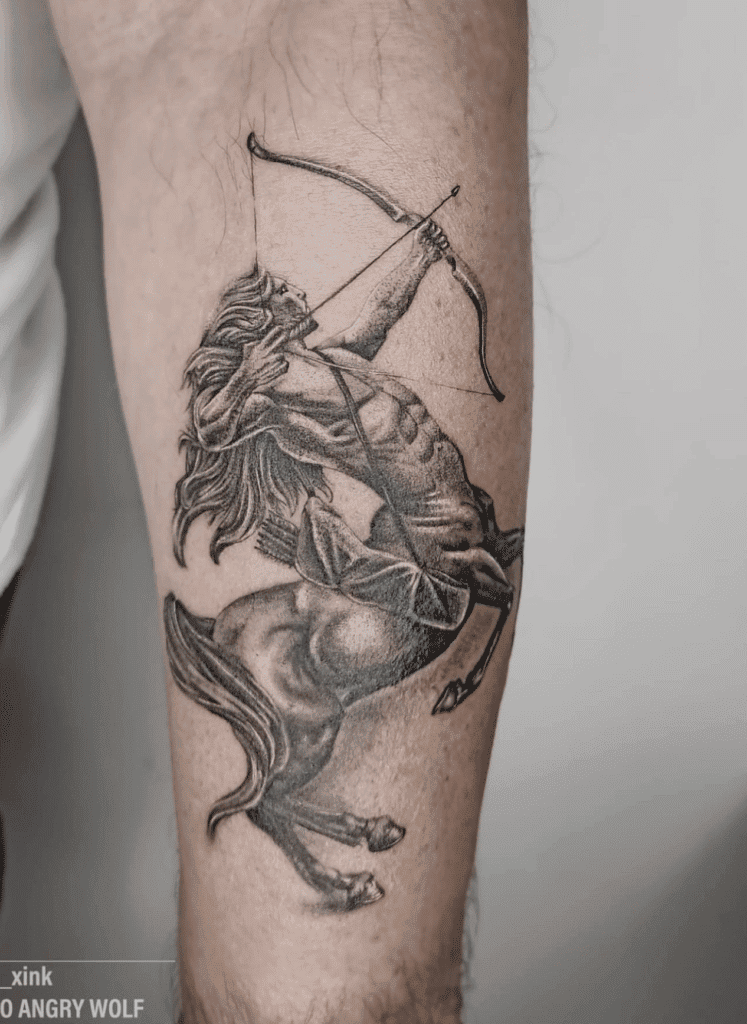
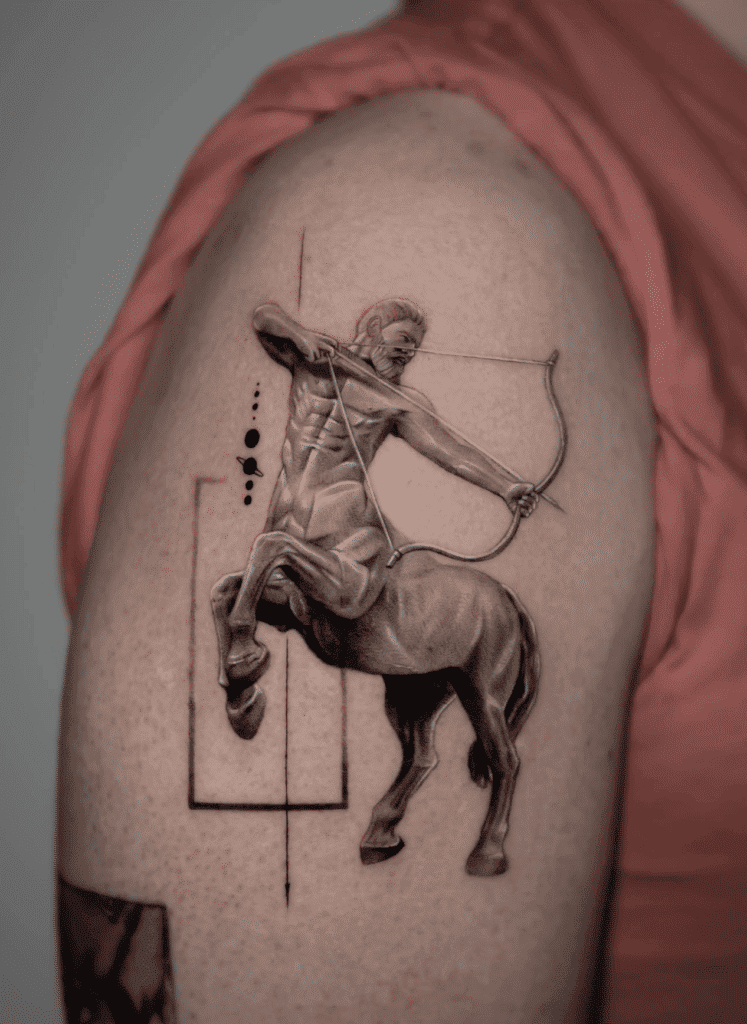
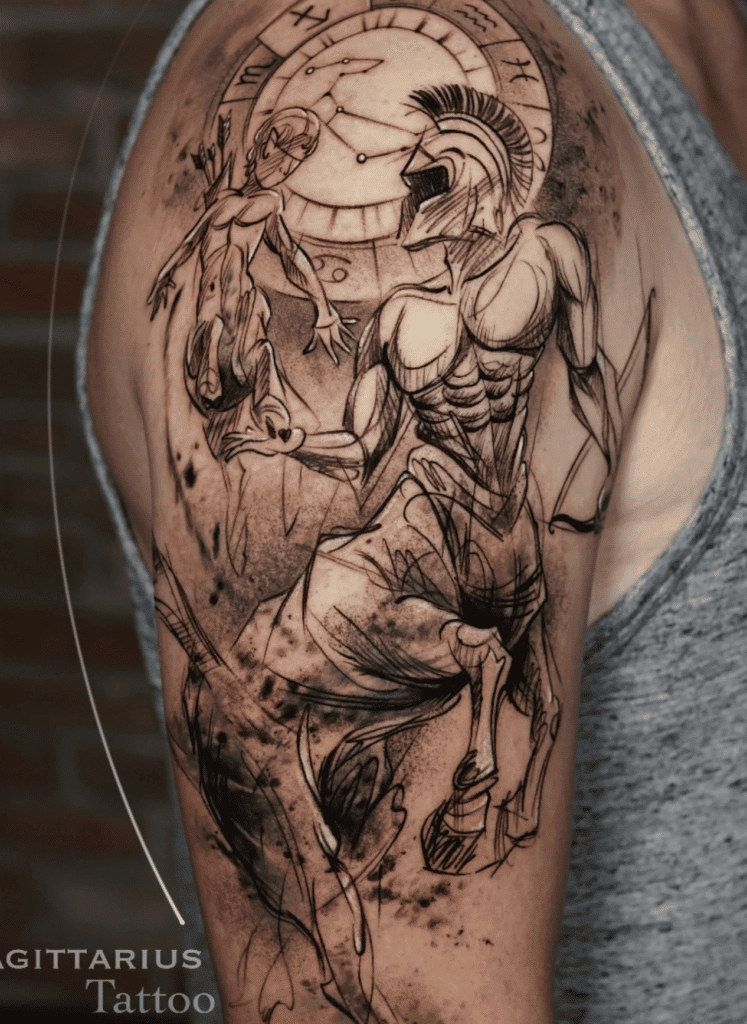
Centaurs are half-human, half-horse beings, combining the upper body of a man with the body and legs of a horse. More than almost any other creature in Greek mythology, Centaurs represent inner conflict—the struggle between civilisation and instinct, intellect and impulse.
Centaurs are often said to descend from Centaurus, a figure born of taboo and isolation, whose offspring inherited a wild, unruly nature. They lived mostly in mountainous and forested regions, far from cities, where laws and customs held little meaning.
Heracles Greek Mythology Tattoo
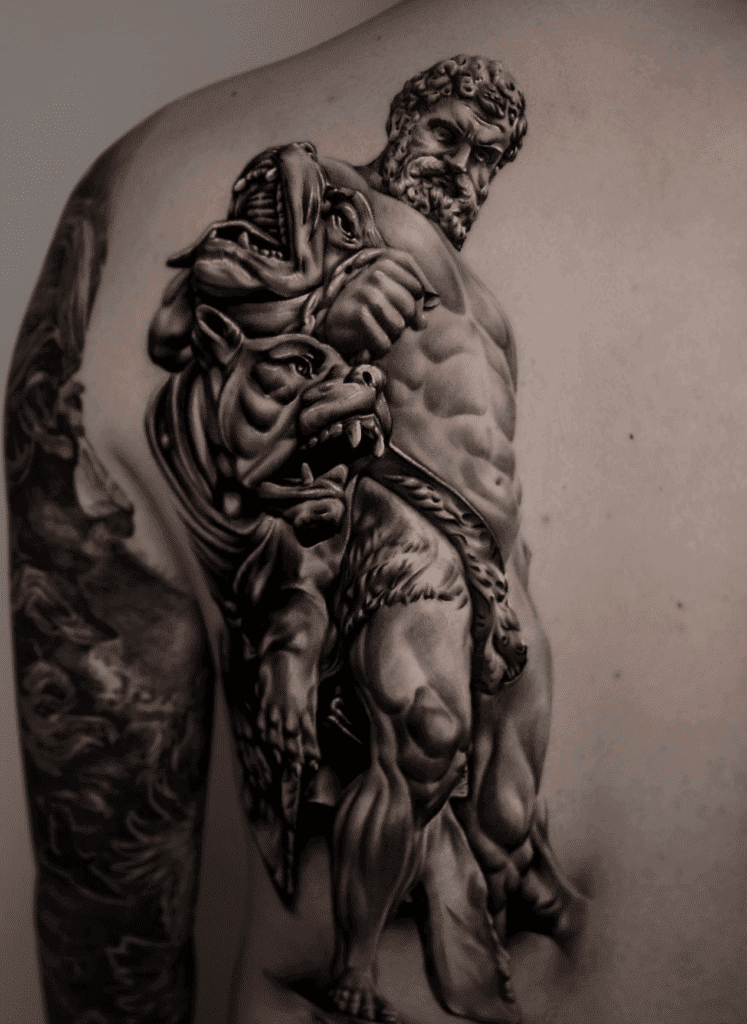
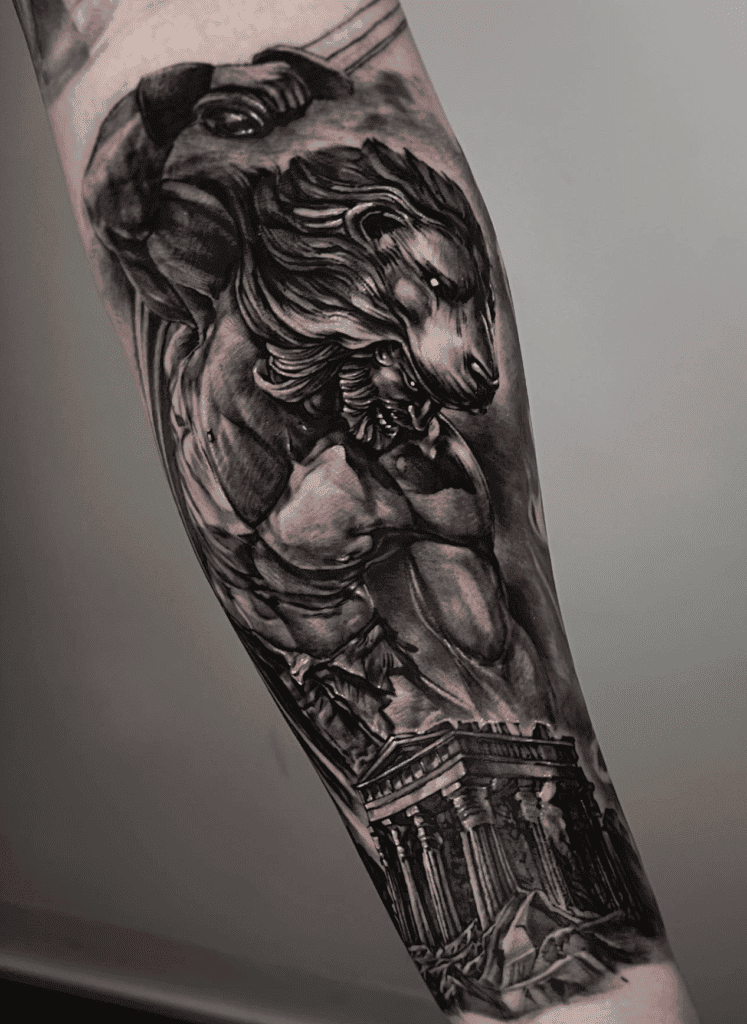
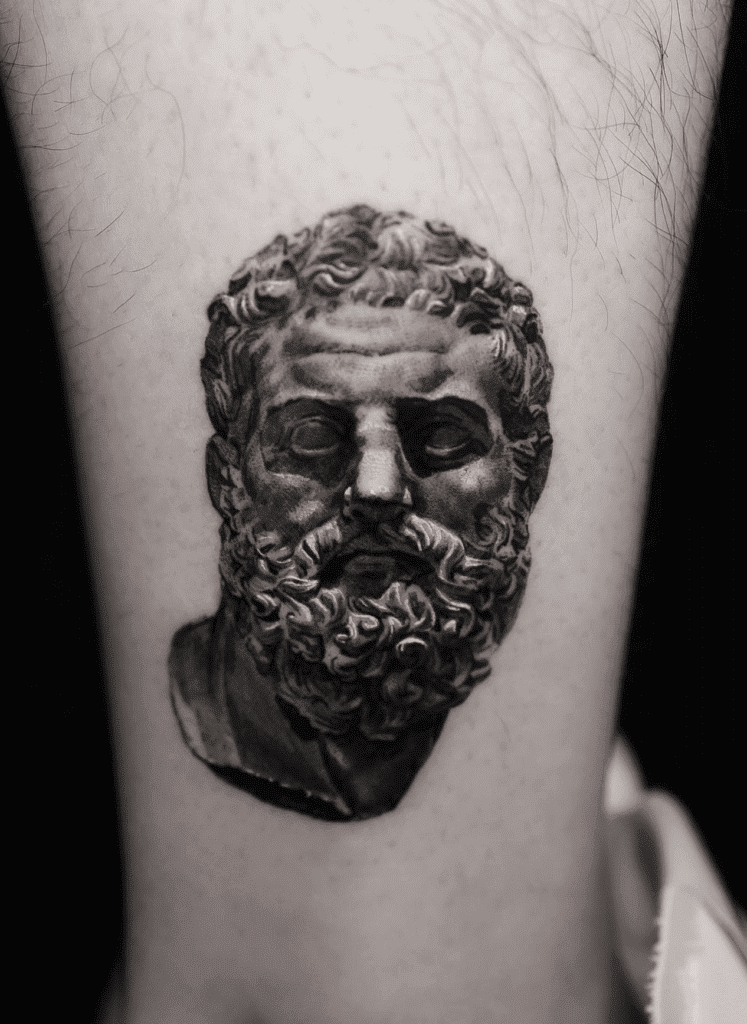
Heracles is the ultimate Greek hero and demigod of unmatched strength whose life is defined as much by suffering and madness as by victory. Heracles is the son of Zeus and the mortal woman Alcmene. From the moment of his birth, he becomes the target of Hera’s hatred, enraged by Zeus’s infidelity. Even as an infant, Heracles displays his divine strength by strangling two serpents sent by Hera to kill him.
In one of the darkest moments of Greek myth, Hera drives Heracles mad, causing him to kill his wife Megara and their children. When sanity returns, Heracles is overwhelmed by guilt. Seeking purification and redemption, he submits himself to King Eurystheus, who assigns him a series of near-impossible tasks.
These tasks become known as the Twelve Labours of Heracles. Heracles’ labours pit him against the greatest threats in Greek mythology, including the Nemean Lion, the Lernaean Hydra, Cerberus, and Ladon. Each labour test not just strength, but cleverness, patience, and resilience, with Heracles ultimately triumphing.
Achilles Greek Mythology Tattoo

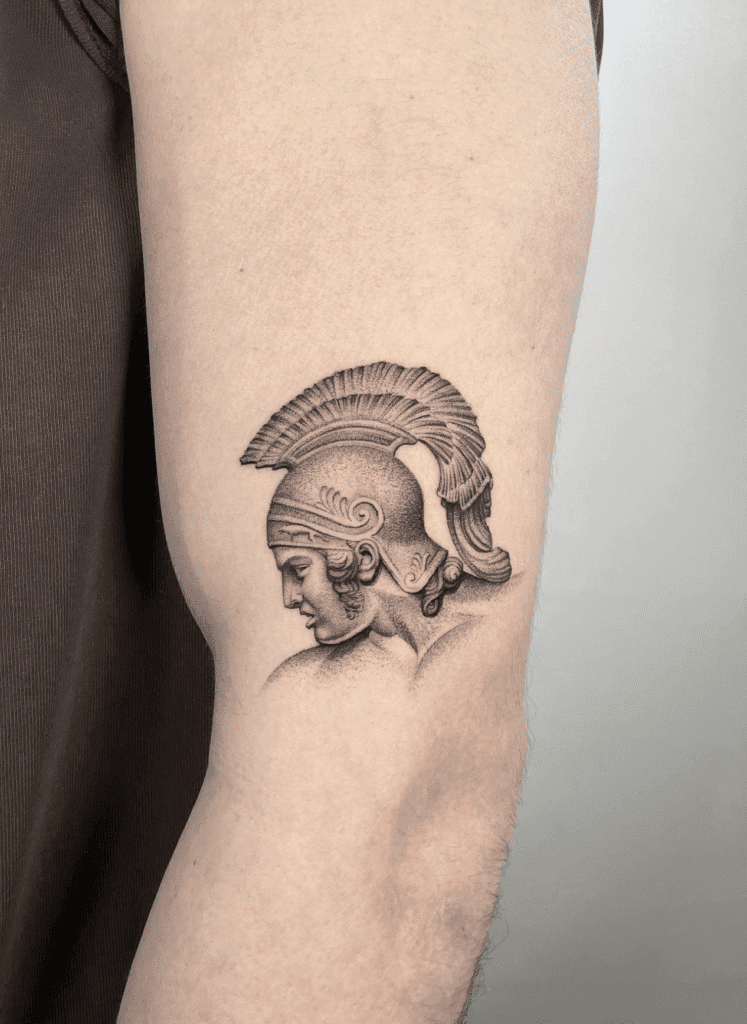
Achilles is the supreme warrior of Greek mythology, unmatched in combat and feared by gods and mortals alike. Yet despite his near-invincibility, his story is not one of triumph, but of rage, loss, and an inescapable fate.
Achilles is the son of Thetis, a sea nymph, and Peleus, a mortal king. Knowing her son was destined for either a long, forgotten life or a short, glorious one, Thetis attempted to make Achilles immortal by dipping him into the River Styx. However, she held him by the heel, leaving that single point untouched.
Achilles was raised and trained by the wise centaur Chiron, who taught him combat, medicine, music, and honour. This education shaped Achilles to become a hero bound by personal codes of pride and loyalty.
Achilles fought for the Greeks during the Trojan War, where his presence alone turned the tide of battle. But Achilles’s greatest enemy, Agamemnon, insulted his honour, causing Achilles to withdraw from battle.
When Achilles refuses to fight, his closest companion, Patroclus, enters battle wearing Achilles’ armour. He is killed by Hector, prince of Troy, a loss that shatters Achilles completely. Achilles returns to the battlefield in a fury, slaughtering Trojans without mercy before confronting Hector in single combat.
Achilles kills Hector and, consumed by grief and rage, drags Hector’s body behind his chariot, dishonouring him. Only when King Priam, Hector’s father, begs Achilles for his son’s body does Achilles finally break, recognising shared humanity in grief.
Achilles’ fate is sealed when Paris, aided by Apollo, shoots an arrow into Achilles’ vulnerable heel. Achilles falls not through lack of strength, but through inevitable destiny. His death fulfils the prophecy he always knew but could never escape.
Perseus Greek Mythology Tattoo
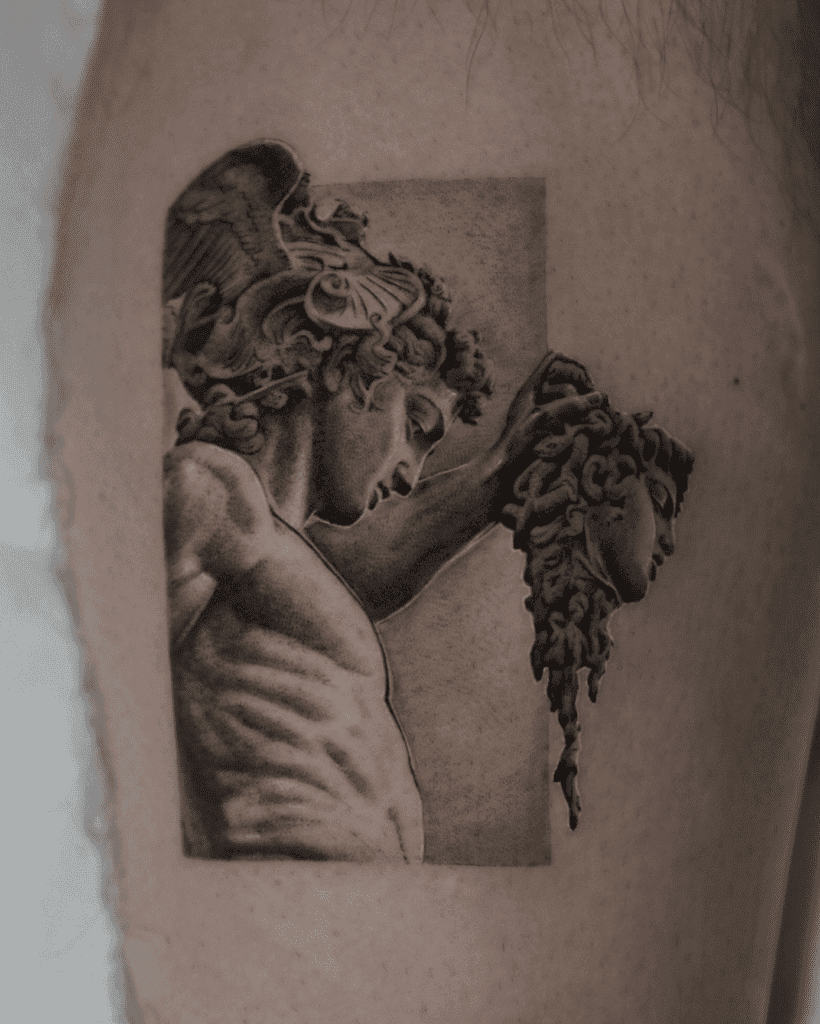
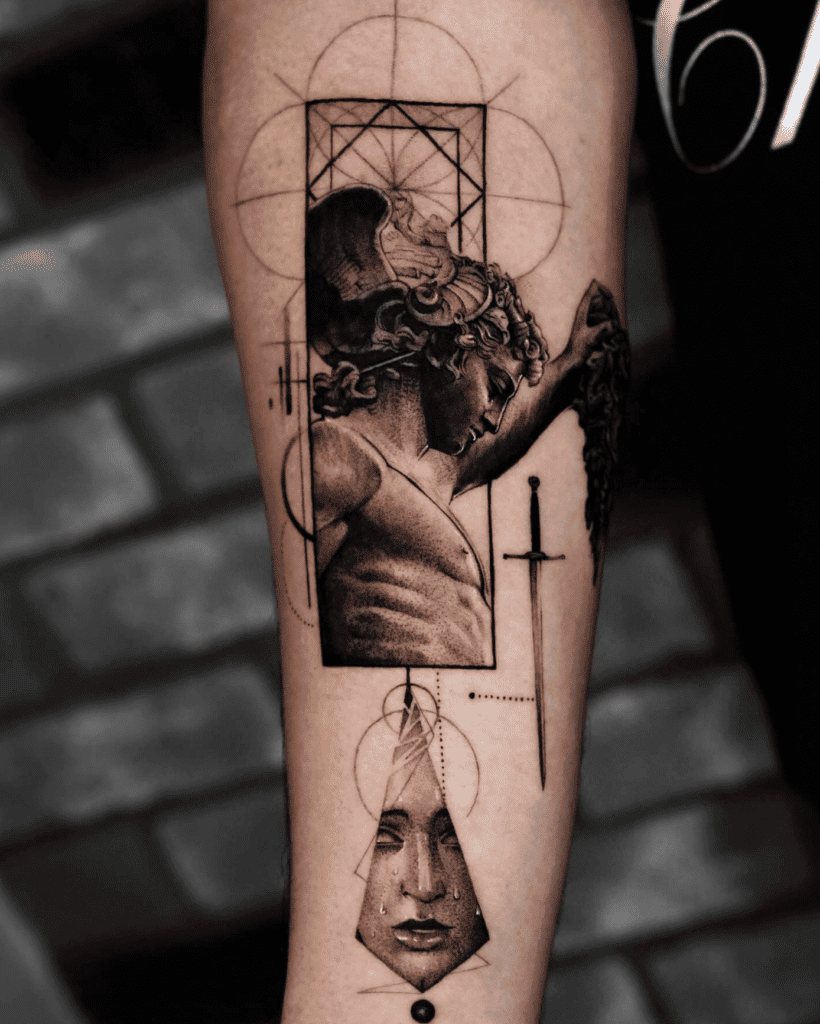
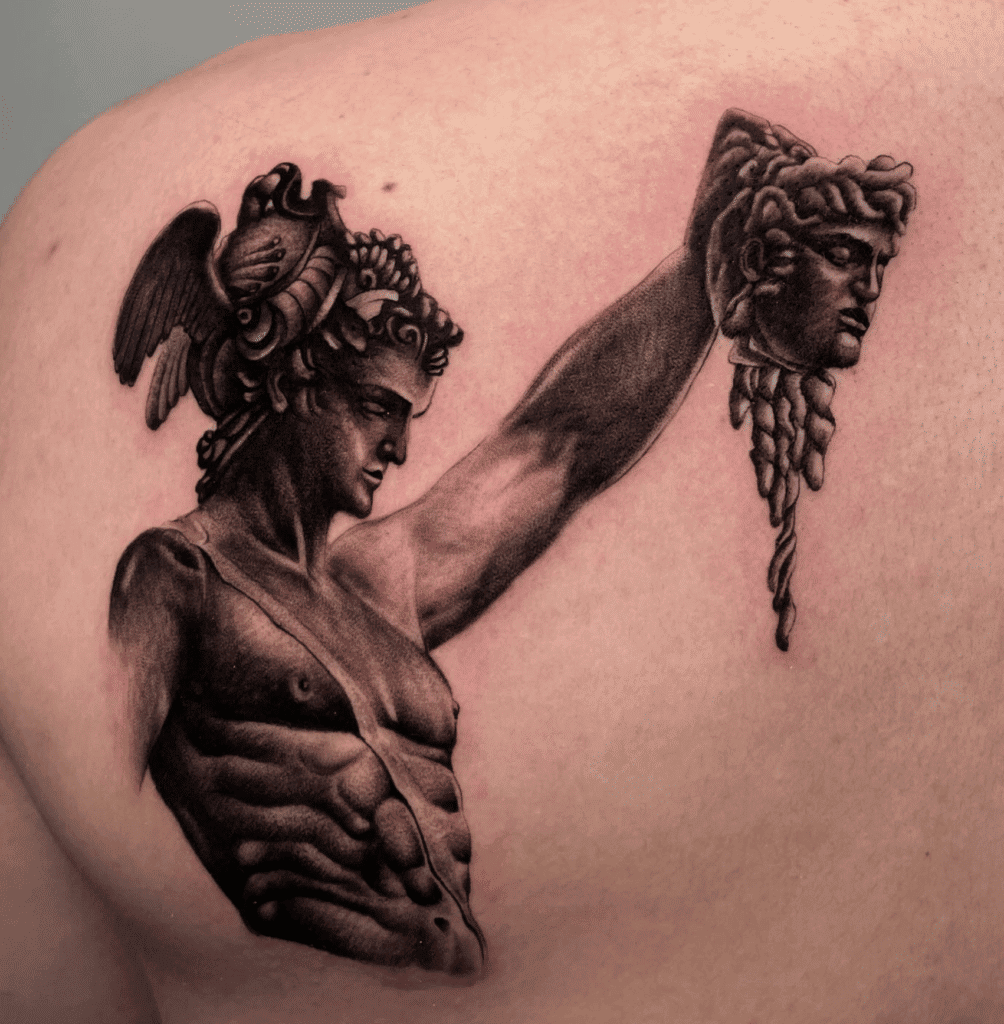
Perseus is one of Greek mythology’s most resourceful heroes, remembered not for overwhelming strength, but for intelligence, restraint, and divine favour. Perseus is the son of Zeus and the mortal princess Danaë. His grandfather, Acrisius, learns of a prophecy that Perseus will one day kill him. In fear, Acrisius imprisons Danaë, but Zeus reaches her in the form of golden rain, and Perseus is born.
Unable to kill the child directly, Acrisius casts Danaë and Perseus out to sea in a chest. They survive, proving early on that fate cannot be outrun.
Perseus’ most famous feat is the slaying of Medusa, the only mortal Gorgon whose gaze turns living beings to stone. Sent on this impossible quest by King Polydectes, Perseus succeeds only because he accepts help from the gods.
He is gifted a mirrored shield from Athena, a curved blade from Hermes, winged sandals for flight, Hades’ helm of invisibility, and a magical bag to contain Medusa’s head. Using the shield’s reflection, Perseus beheads Medusa without ever meeting her gaze.
Even after death, Medusa’s head retains its petrifying power. Perseus uses it sparingly, turning enemies to stone when escape or mercy is impossible. On his journey home, Perseus encounters Andromeda, chained to a rock as a sacrifice to a sea monster. Perseus slays the beast (sometimes with Medusa’s head, sometimes through combat) and rescues Andromeda, later marrying her.
Despite all efforts to avoid it, Perseus ultimately fulfils the prophecy. During a sporting event, he accidentally strikes Acrisius with a discus, killing him. The act is unintentional—but fate is absolute.
After his death, Perseus is honoured among the constellations, alongside Andromeda and other figures from his myth. Unlike heroes consumed by tragedy, Perseus achieves peace, legacy, and honour.
Theseus Greek Mythology Tattoo
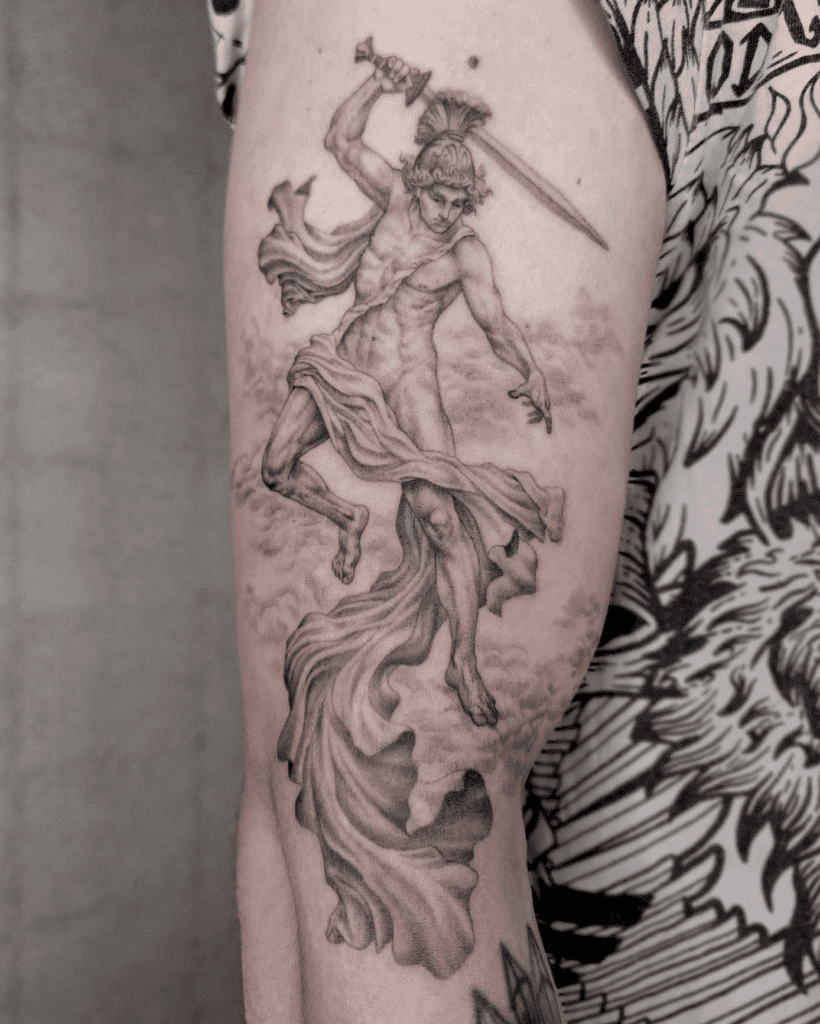

Theseus is one of Greek mythology’s most important heroes, celebrated not just for slaying monsters, but for transforming a city into a civilisation. Theseus is born to Aethra, a mortal woman, and has two possible fathers, either it was Aegeus, king of Athens, or Poseidon, god of the sea.
This dual parentage reflects Theseus’ nature—half civic ruler, half wild hero. Raised away from Athens, Theseus proves his strength by lifting a massive stone to reclaim his father’s sword and sandals, symbols of his royal destiny.
On his journey to Athens, Theseus chooses the most dangerous route, defeating bandits and killers who preyed on travellers. Rather than killing randomly, he punishes them using their own methods, restoring safety and justice.
Theseus’ most famous feat is slaying the Minotaur imprisoned in the Labyrinth of Crete. With the help of Ariadne, who gives him a thread to navigate the maze, Theseus kills the Minotaur and escapes, ending Crete’s dominance over Athens.
Despite Ariadne’s help, Theseus abandons her on the island of Naxos. Whether through forgetfulness, fear, or divine influence, this act marks a shift in his character. The hero who freed Athens fails personally, revealing that greatness does not guarantee loyalty or compassion.
Theseus promised his father, Aegeus, to raise white sails if he survived Crete. However, he forgets, and seeing black sails return, Aegeus throws himself into the sea. Now, as king, Theseus is credited with uniting Attica, strengthening democratic ideals, and establishing Athens as a cultural centre. He becomes a symbol of the city itself—bold, intelligent, ambitious, but not without consequence.
Odysseus Greek Mythology Tattoo
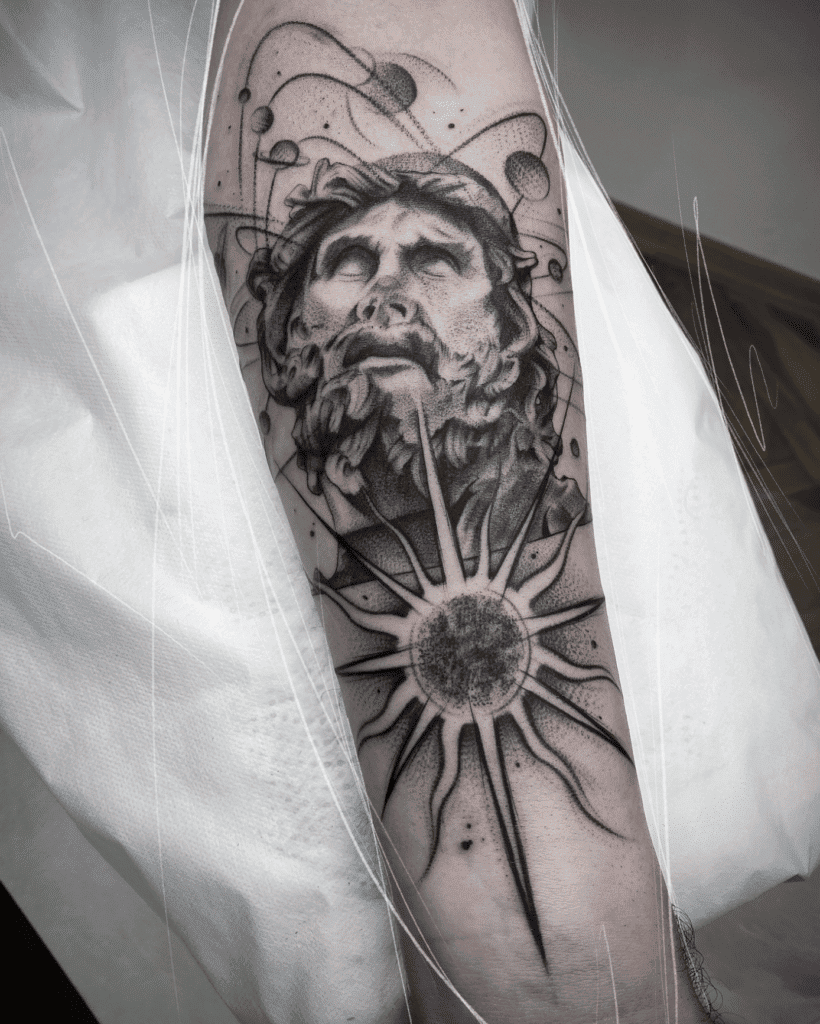
Odysseus is the most intellect-driven hero in Greek mythology. Odysseus is the king of Ithaca, a small but rugged island kingdom. Though not the strongest or noblest of the Greek leaders, he is widely respected for his sharp mind and persuasive speech. Even before the Trojan War, Odysseus was known as a strategist capable of outthinking kings and gods alike.
During the Trojan War, Odysseus proves essential to the Greeks’ victory, not only on the battlefield but also behind the scenes. He retrieves Achilles, exposes traitors, and repeatedly saves the Greek army through strategy.
The Odyssey follows Odysseus’ ten-year struggle to return home after the war. Along the way, he faces nearly every kind of danger imaginable. One of Odysseus’ most famous moments comes when he tells Polyphemus his name is “Nobody.” When the Cyclops cries for help, no one comes as “nobody” is hurting him.
Despite the temptations of immortality, pleasure, and power, Odysseus remains devoted to Penelope and his home. Penelope herself mirrors his intelligence, delaying unwanted suitors through her own clever schemes.
Jason Greek Mythology Tattoo

Jason is the hero of the Golden Fleece, remembered not as the strongest or cleverest warrior, but as a leader, unifier, and catalyst. Jason is the rightful heir to the throne of Iolcus, but his uncle Pelias seizes power and sends Jason away as a child. Raised in secret and trained by the wise centaur Chiron, Jason grows into a capable hero, though never the most exceptional in raw talent.
When Jason returns to reclaim his throne, Pelias sets him an impossible task: retrieve the Golden Fleece from the distant land of Colchis, a mission meant to ensure his death.
To complete the quest, Jason assembles the Argonauts, a legendary crew of heroes including Heracles, Orpheus, Atalanta, Castor and Pollux, and many others. Their ship, the Argo, is said to be partially divine, capable of speech and prophecy.
Guarded by a sleepless dragon and owned by King Aeëtes, the Fleece is unreachable by strength alone. Jason’s success hinges on Medea, a powerful sorceress and daughter of Aeëtes. Struck by love (often through divine manipulation), Medea betrays her family to help Jason. She uses magic to subdue fire-breathing bulls, defeat earth-born warriors and put the dragon guarding the Fleece to sleep.
Jason returns to Iolcus with the Golden Fleece, but Pelias refuses to surrender the throne. Medea intervenes again, deceiving Pelias’ daughters into killing him. Though Jason regains power briefly, the act taints his victory, forcing Jason and Medea into exile.
Jason’s downfall comes when he abandons Medea to marry another woman for political gain. In one of Greek mythology’s darkest turns, Medea takes brutal revenge, destroying Jason’s future completely.
Atalanta Greek Mythology Tattoo

Atalanta stands apart in Greek mythology as a female hero who refuses to be defined by marriage, submission, or domestic fate. Atalanta is born to a king who desires a son. Disappointed, he abandons her on a mountainside to die. Instead, she is rescued and raised by a she-bear, symbolically claimed by the wild rather than civilisation.
Growing up in forests and mountains, Atalanta becomes a master hunter, exceptionally fast and agile, devoted to Artemis, goddess of the hunt, and determined to remain independent. She rejects traditional feminine roles and chooses a life of skill, movement, and self-reliance.
Atalanta earns widespread fame during the hunt for the Calydonian Boar, a monstrous beast sent by Artemis to punish a king’s arrogance. Many heroes participate, but it is Atalanta who draws first blood, striking the boar before anyone else.
This moment is crucial: Atalanta proves she is not a novelty, but a true equal among heroes.
Refusing marriage, Atalanta declares she will only wed a man who can outrun her. Any who fail will die. Many try. All lose, until Hippomenes (or Melanion) seeks help from Aphrodite, who gives him three golden apples. During the race, Hippomenes drops the apples one by one. Atalanta, curious and momentarily distracted, stops to collect them, only to lose.
In some versions of the myth, Atalanta and Hippomenes later offend the gods and are transformed into lions, bound together forever.
Bellerophon Greek Mythology Tattoo
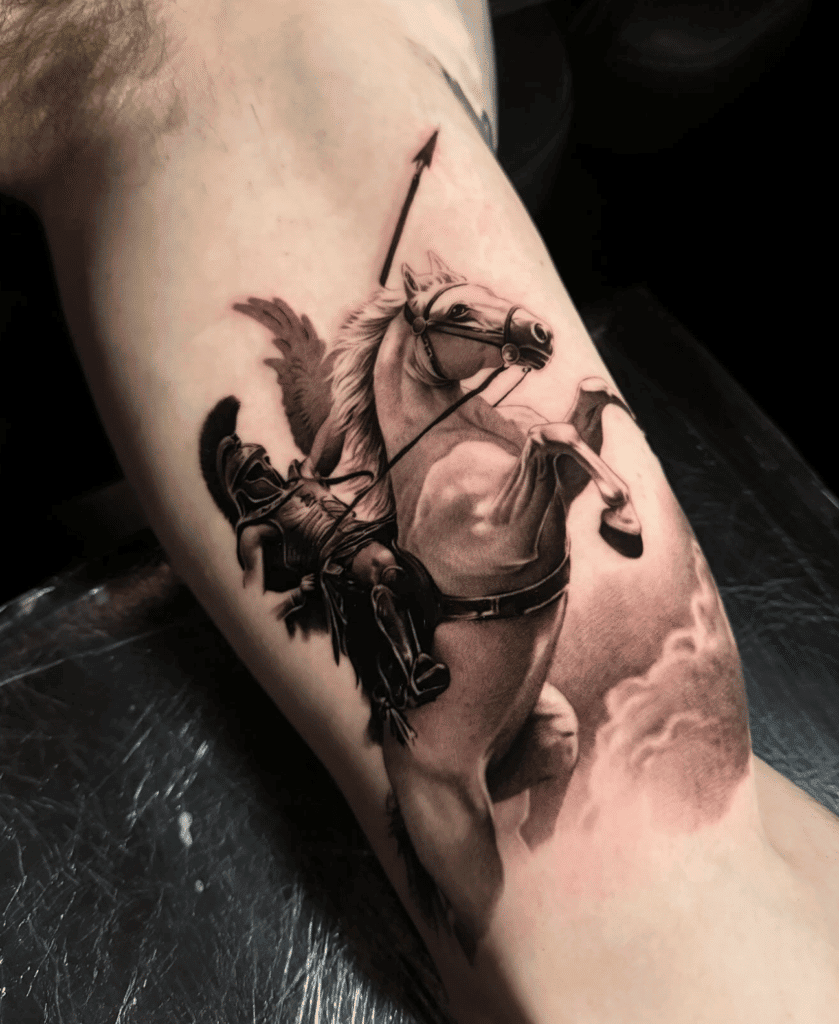
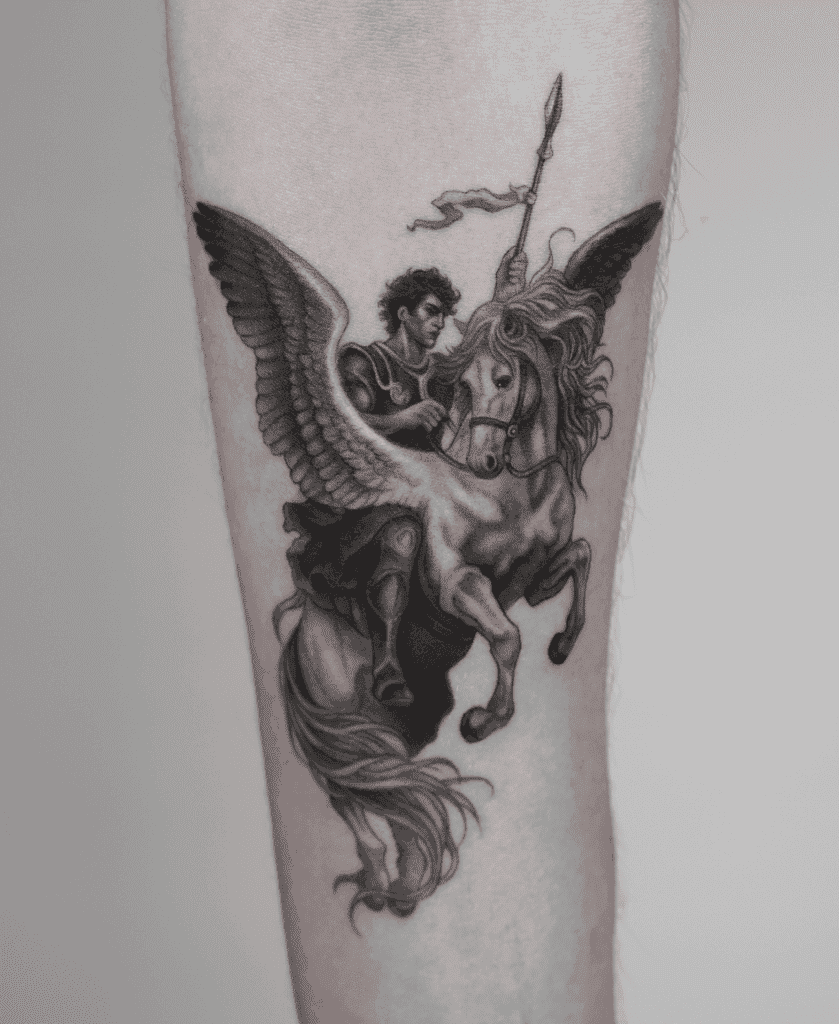
Bellerophon is one of Greek mythology’s great heroes, celebrated for his courage, skill, and legendary partnership with Pegasus, the winged horse. Bellerophon is the son of Glaucus, king of Corinth, and in many versions also a child of Poseidon, granting him divine favour. Despite his noble blood, Bellerophon’s life is marked by misfortune and accusation, forcing him to wander far from home in search of redemption.
Bellerophon’s greatest achievement is taming Pegasus, the immortal winged horse born from the blood of Medusa. No mortal could mount Pegasus until Athena aided Bellerophon by gifting him a golden bridle, symbolising discipline over raw power.
Bellerophon’s most famous feat is defeating the Chimera, a monstrous hybrid that breathed fire and devastated entire regions. By attacking from the air, Bellerophon succeeds where others failed, striking the Chimera from above while avoiding its flames. The victory cements him as one of Greece’s greatest monster-slayers.
Over time, Bellerophon begins to believe he deserves a place among the gods. In an act of supreme hubris, he attempts to ride Pegasus to Mount Olympus, seeking immortality. Zeus intervenes, sending a gadfly to sting Pegasus. Thrown from the sky, Bellerophon falls back to earth with his body broken and his spirit shattered.
Unlike many heroes who die gloriously, Bellerophon survives his fall but lives on crippled, isolated, and forgotten, wandering alone and shunned by both gods and mortals.
Orpheus Greek Mythology Tattoo

Orpheus is the son of Apollo, god of music and prophecy, and Calliope, the Muse of epic poetry (in some versions). From them, he inherits a voice and lyre capable of reshaping reality.
Orpheus joins Jason and the Argonauts on the quest for the Golden Fleece. Though not the strongest hero aboard, he saves the crew repeatedly through music—most famously by drowning out the Sirens’ song, preventing the Argonauts from steering toward destruction.
Orpheus’s greatest story begins with love. He marries Eurydice, a nymph whose life is cut short when she is bitten by a snake. Overwhelmed by grief, Orpheus does what no mortal dares and travels to the Underworld to bring her back.
Orpheus’ song moves Hades and Persephone, rulers of the dead, to mercy. They agree to release Eurydice on one condition: Orpheus must lead her out without looking back until both reach the surface.
As Orpheus nears the exit, doubt overwhelms him. Fearing Eurydice is not truly there, he turns to look and in that moment, she vanishes forever. After losing Eurydice a second time, Orpheus withdraws from society, rejecting love and companionship. In some versions, he is torn apart by Maenads, followers of Dionysus, for spurning their rites. His head and lyre continue to sing even after death—carried by the river until they come to rest.
Keres Greek Mythology Tattoo
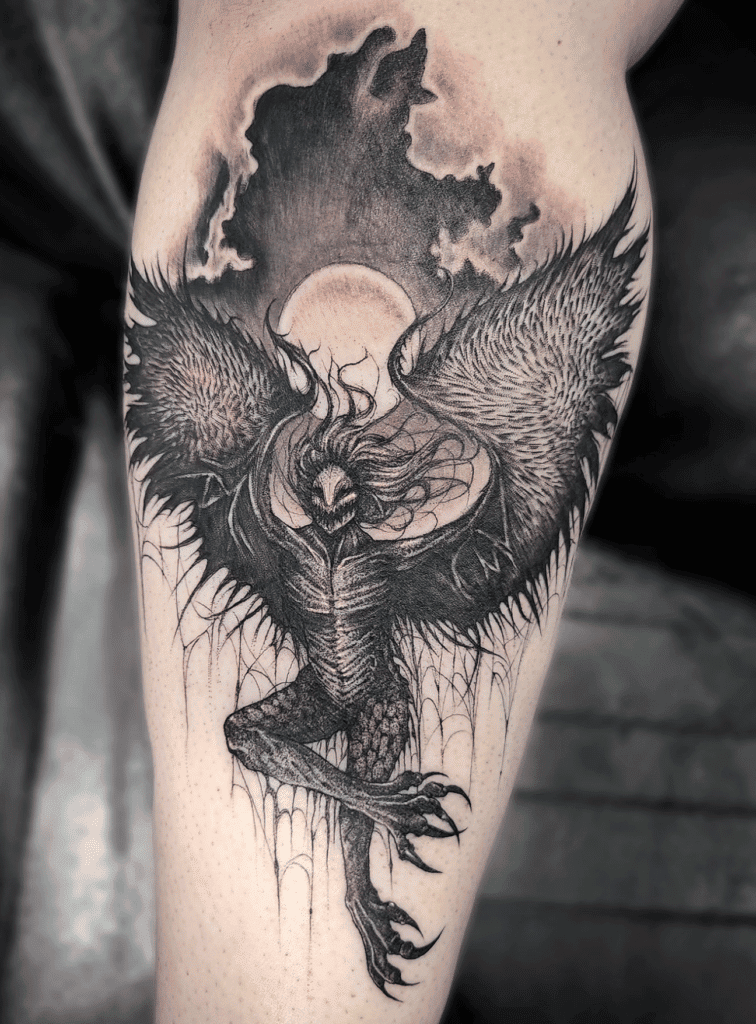
The Keres are female death spirits, embodying the brutal, inescapable fate of violent death. The Keres are daughters of Nyx, and like many of Nyx’s children, they represent dark, unavoidable forces that even the Olympian gods hesitate to interfere with.
The Keres are closely tied to war and slaughter, especially in Homer’s Iliad. They stalk the battlefield, waiting for warriors to fall, sometimes weighing fates or competing for victims.
Graeae Greek Mythology Tattoo

The Graeae are ancient prophetic sisters, feared not for strength or violence, but for their unnerving wisdom and otherworldly existence. They are born old, remain old, and embody knowledge that predates gods and heroes alike. Most disturbingly, they share a single eye and a single tooth, passing them between one another.
The Graeae are daughters of Phorcys and Ceto, primordial sea deities associated with hidden dangers and monsters. They are sisters to some of Greek mythology’s most terrifying beings, including the Gorgons.
From birth, the Graeae are described as grey-haired, wrinkled, and ancient, making them unique in myth. The Graeae possess one eye and one tooth, shared between all sisters, that they take turns using the eye to see and the tooth to speak or eat. This shared anatomy symbolises fragmented perception—no single Graea can see or act alone.
The Graeae are most famous for their encounter with Perseus. Seeking the location of the Gorgons, Perseus steals their shared eye while they pass it between them. Blind and helpless, the Graeae are forced to bargain, revealing the path Perseus must take.
Conclusion
As we reach the summit of Mt. Olympus, our epic has come to an end. Before Zeus strikes us down, why not continue with a 13th Labour by checking out even more incredible Tattoo Designs such as these Egyptian Mythology Tattoos Ideas, these Chinese Mythology Tattoo Designs , or these Persian Mythology Tattoos.
- Ape and Monkey Tattoo Ideas - April 6, 2026
- Pokémon Tattoo Ideas - March 30, 2026
- Norse Mythology Tattoo Ideas - March 23, 2026


