
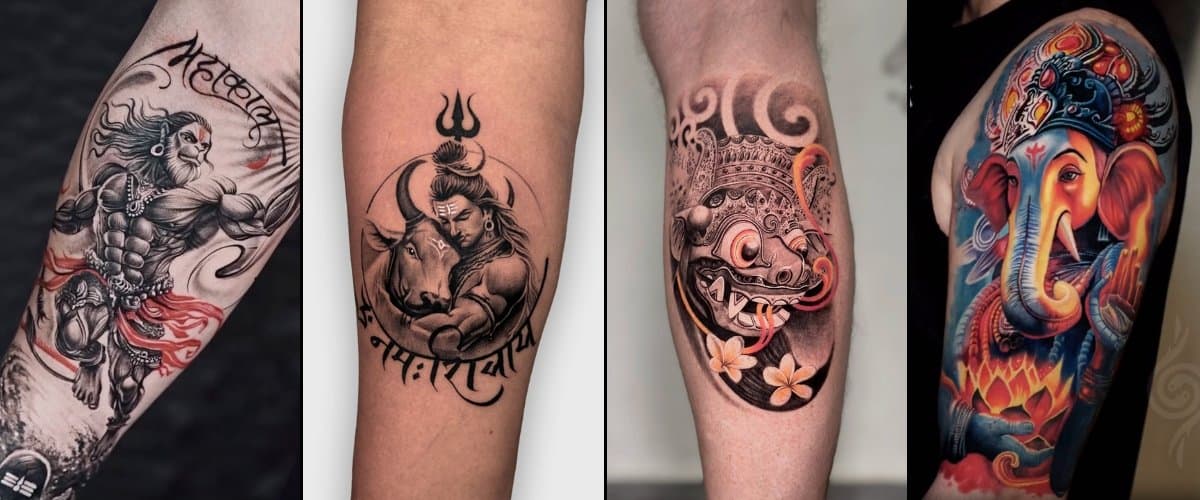
Hindu Mythology Tattoo Ideas
Are you looking for enlightenment on your search for the perfect Tattoo Design? Worry not, we will help to move your obstacles as we bring you some of the best Hindu Mythology to bring you balance.
What is Hindu Mythology
Hindu mythology is the vast collection of sacred stories, legends, cosmology, gods, heroes, and philosophical teachings that developed within Hinduism, one of the world’s oldest living religions, dating back over 3,000 years.
These stories explain the creation and destruction of the universe, the nature of good and evil, life, death, rebirth, and karma, the purpose of human existence, and the divine forces that govern reality. Unlike many mythologies that are no longer practised religiously, Hindu mythology is still deeply woven into daily spiritual life today.
Hindu mythology is drawn from several ancient texts:
The Vedas (1500–500 BCE)
The oldest sacred scriptures. They introduce early gods like Indra, Agni, and Varuna.
The Upanishads
Philosophical texts exploring the soul (Atman), ultimate reality (Brahman), and cosmic truth.
The Puranas
Myth-heavy texts describing gods, avatars, cosmic cycles, and divine genealogies.
The Ramayana
The story of Rama, his wife Sita, and the demon king Ravana.
The Mahabharata
A massive epic centred around the Pandavas, including Arjuna, and the divine guidance of Krishna. It contains the Bhagavad Gita, one of the most important spiritual texts in the world.

sweta finazgaman
Dubai, India, Tattoo Artist specialising in Indian Mythology Tattoos.

paarth vasani
Mumbai, India, Tattoo Artist Specialising in Hyper Realistic Portrait and Hindu Mythology Tattoos.

stigmarte ttt
Bali, Indonesia Tattoo Artist specialising in Geometric, Fine-Line, Hindu, and Bali Hindu Mythology Tattoos.
Best Hindu Mythology Tattoo Ideas
Now that we know a little about Hindu Mythology, let’s take a look at some of the best Hindu Mythology Tattoo Designs the internet has to offer.
Brahma Hindu Mythology Tattoo
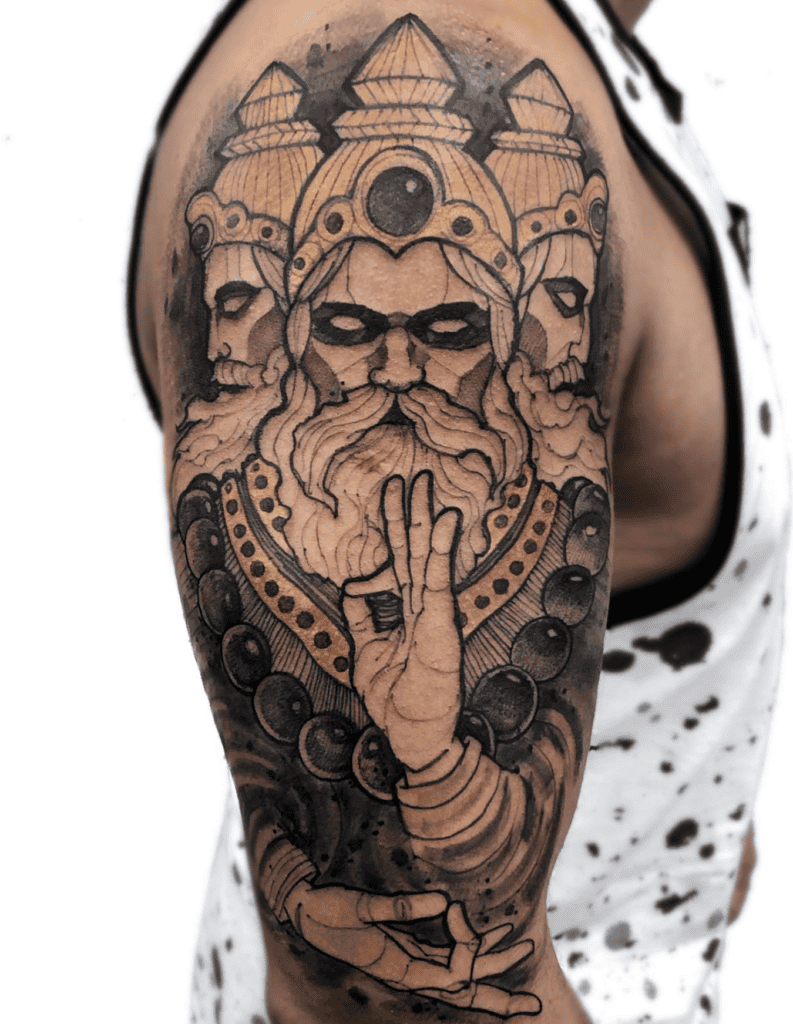
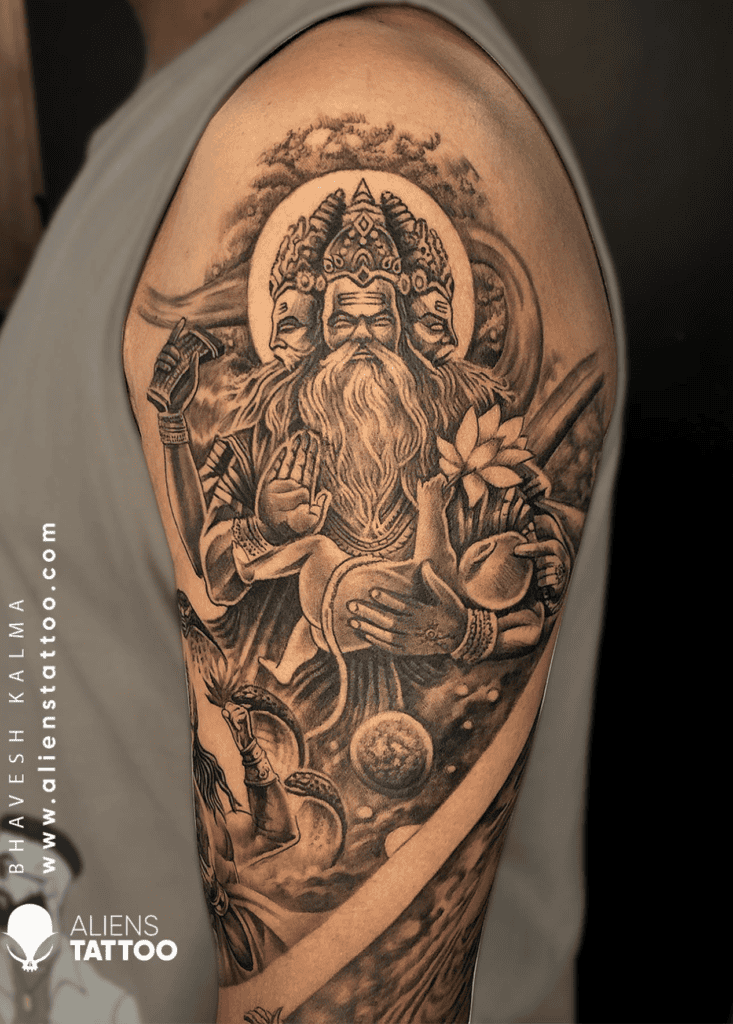
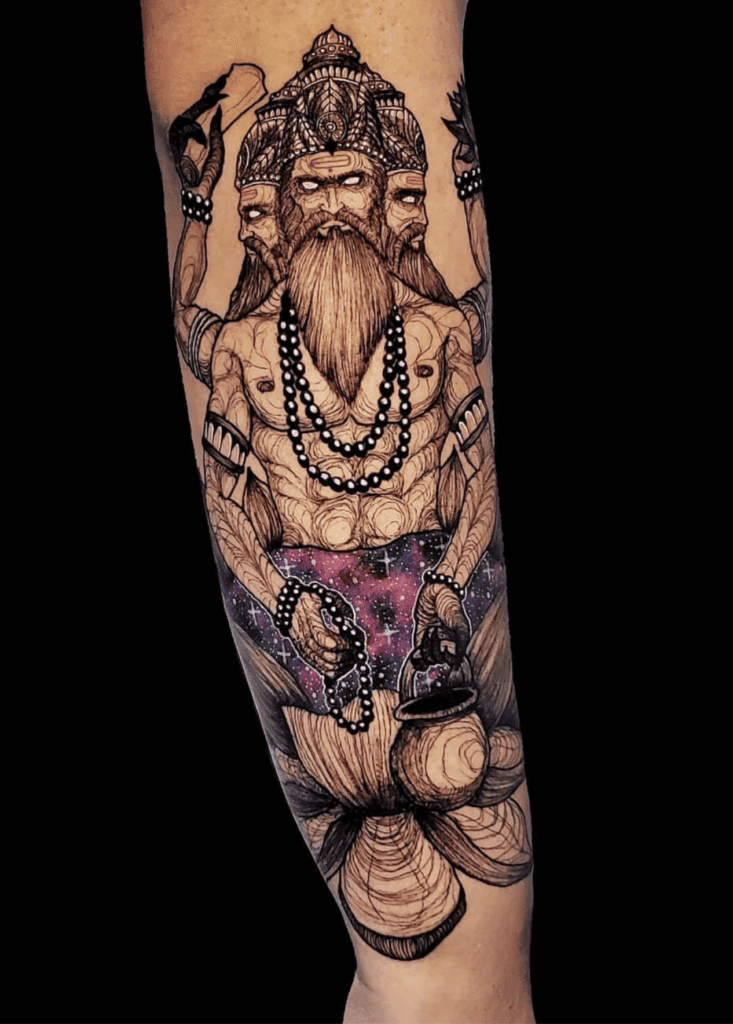
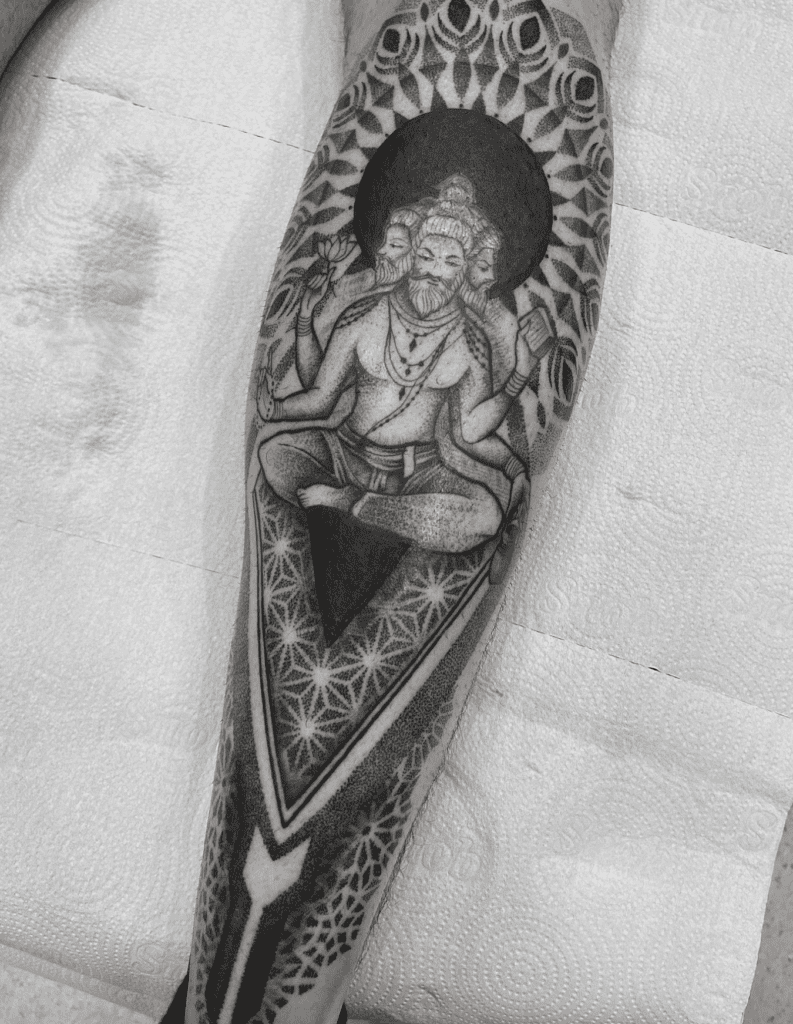
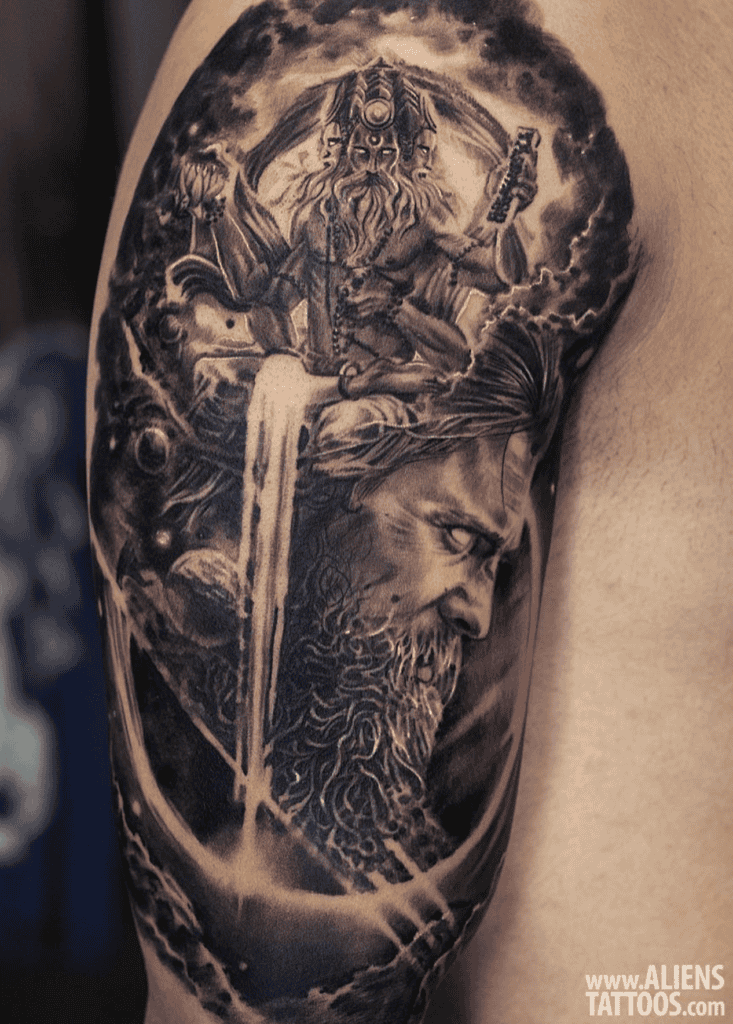
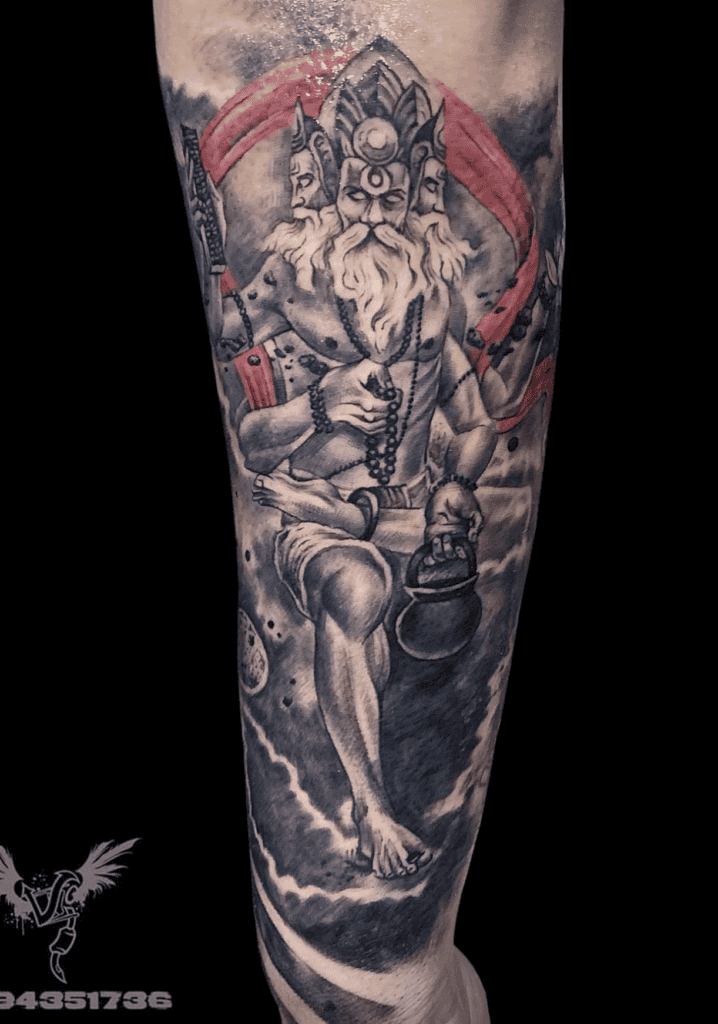
Brahma is the Creator god in Hindu mythology and part of the divine trinity known as the Trimurti. He is responsible for bringing the universe and all living beings into existence at the beginning of each cosmic cycle.
Brahma is usually shown with four heads, each facing a different direction. They symbolise the four Vedas, Yugas (cosmic ages), directions, and the total knowledge of creation. In some myths, he originally had five heads, but one was removed by Shiva after a disagreement.
According to many Puranic traditions, Brahma was born from a lotus flower that emerged from the navel of Vishnu while Vishnu rested on the cosmic serpent Ananta in the primordial ocean.
Brahma created the heavens and earth, time and cosmic order, the first sages (Rishis), the ancestors of humanity, and the gods and many beings of the universe. Despite being the creator, Brahma has very few temples dedicated to him, the most famous of which is in Pushkar, India.
Several myths explain why. He lied during a dispute with Shiva, became arrogant, and a curse from his wife Saraswati limited his worship. Unlike Vishnu and Shiva, whose roles continue in daily life, Brahma’s work is considered “complete” once creation begins, so he is less actively worshipped.
Vishnu Hindu Mythology Tattoo
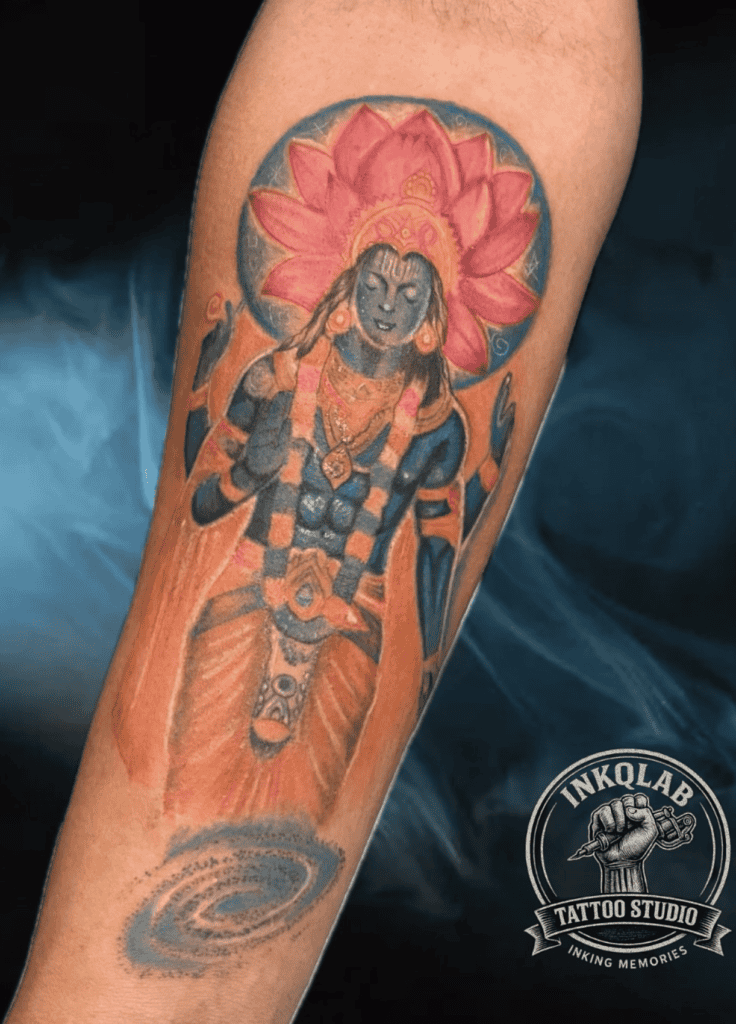
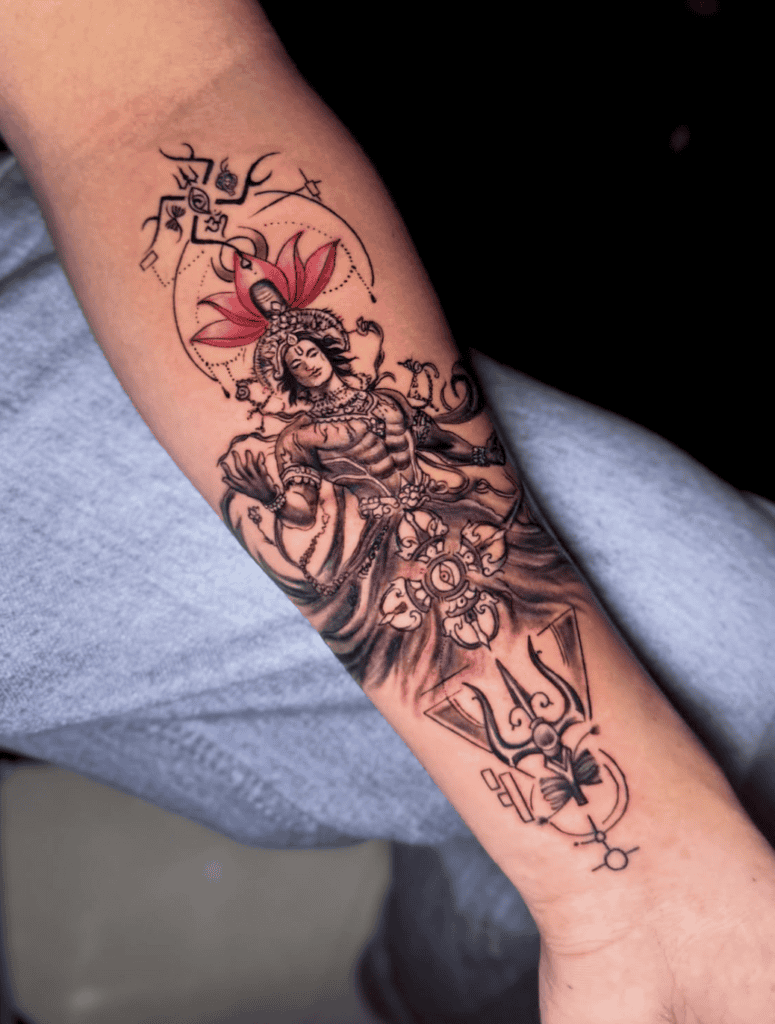
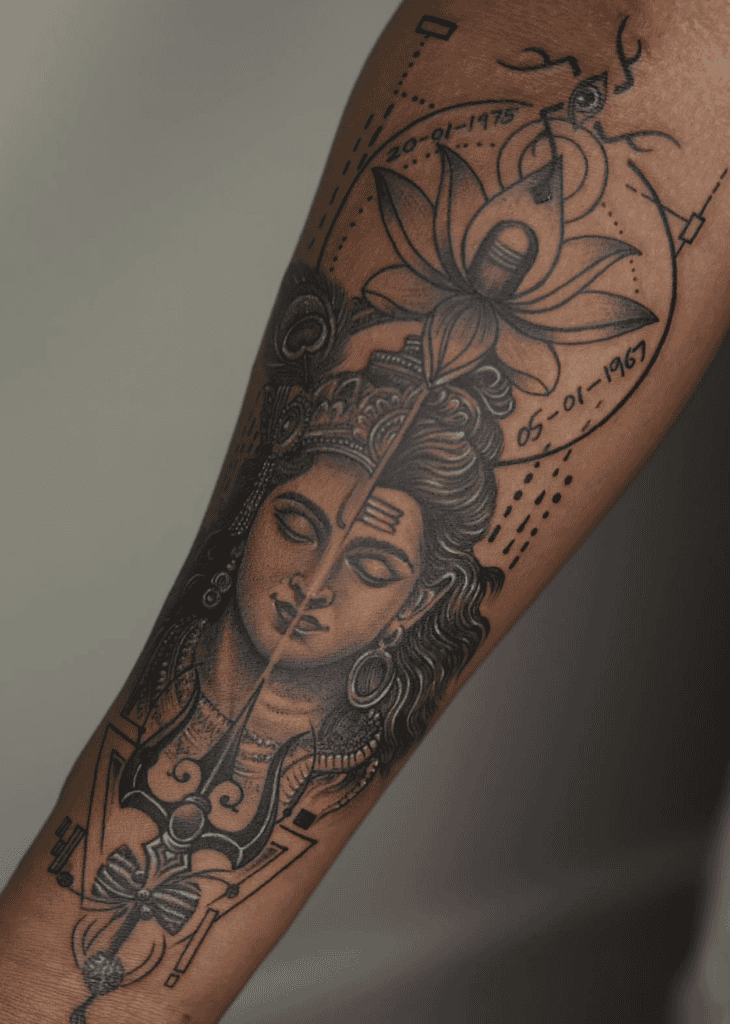
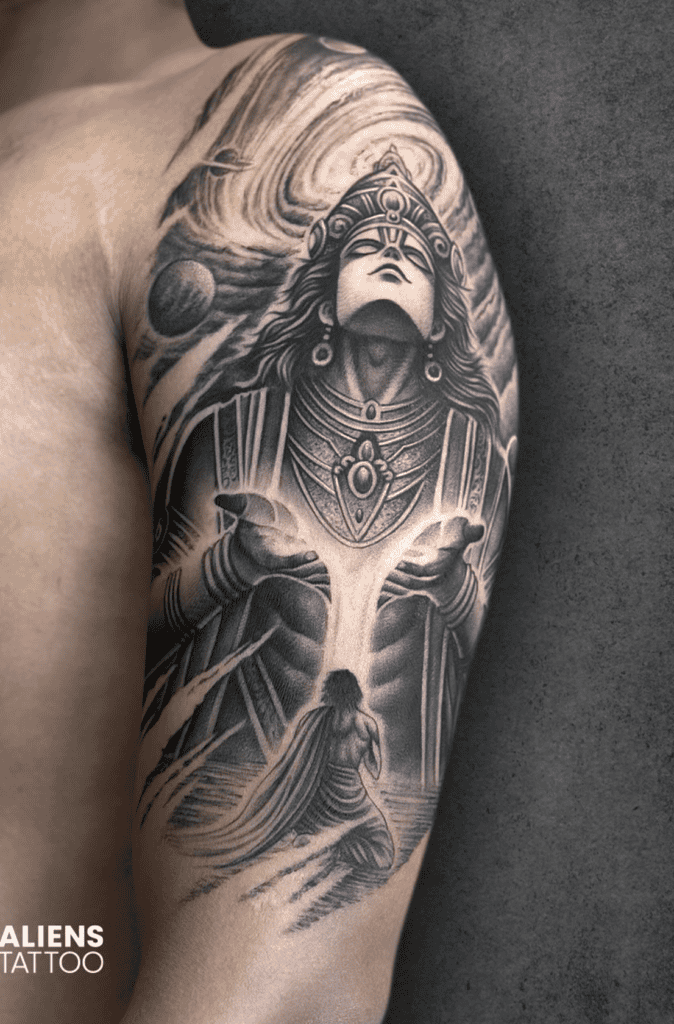
Vishnu is the Preserver and Protector of the universe and part of the Trimurti. Whenever cosmic balance is threatened by chaos or evil forces, Vishnu often intervenes by descending to Earth in physical form.
One of the most fascinating aspects of Vishnu is his avatars, the divine incarnations taken to restore balance. Each avatar appears when the world is out of balance, not to destroy everything but to correct it.
When the universe dissolves at the end of a cosmic cycle, Vishnu rests in the cosmic ocean. From him, creation begins again, and he is present in every age.
Shiva Hindu Mythology Tattoo
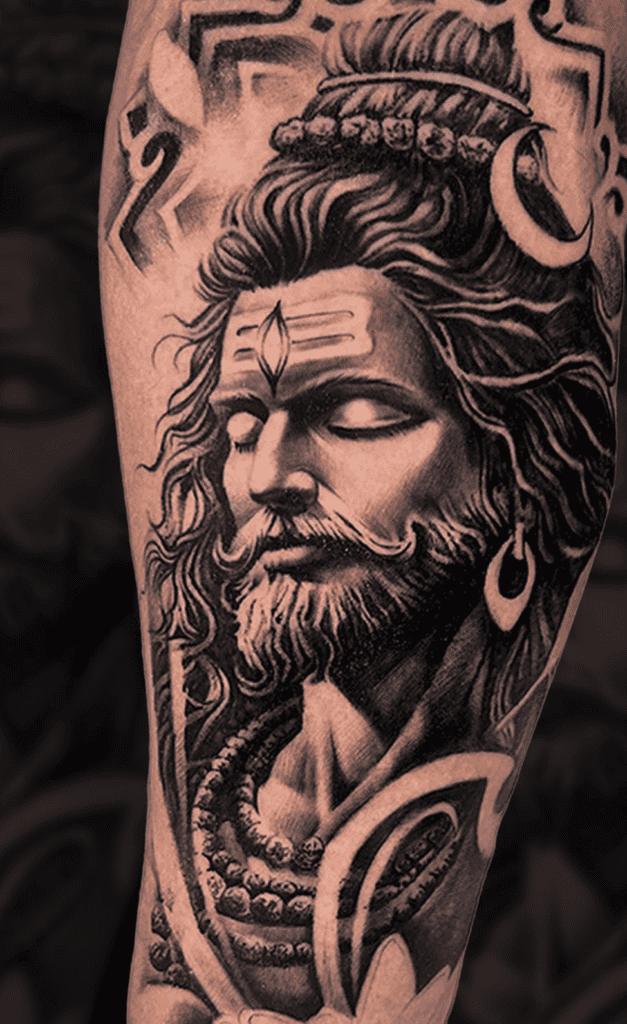
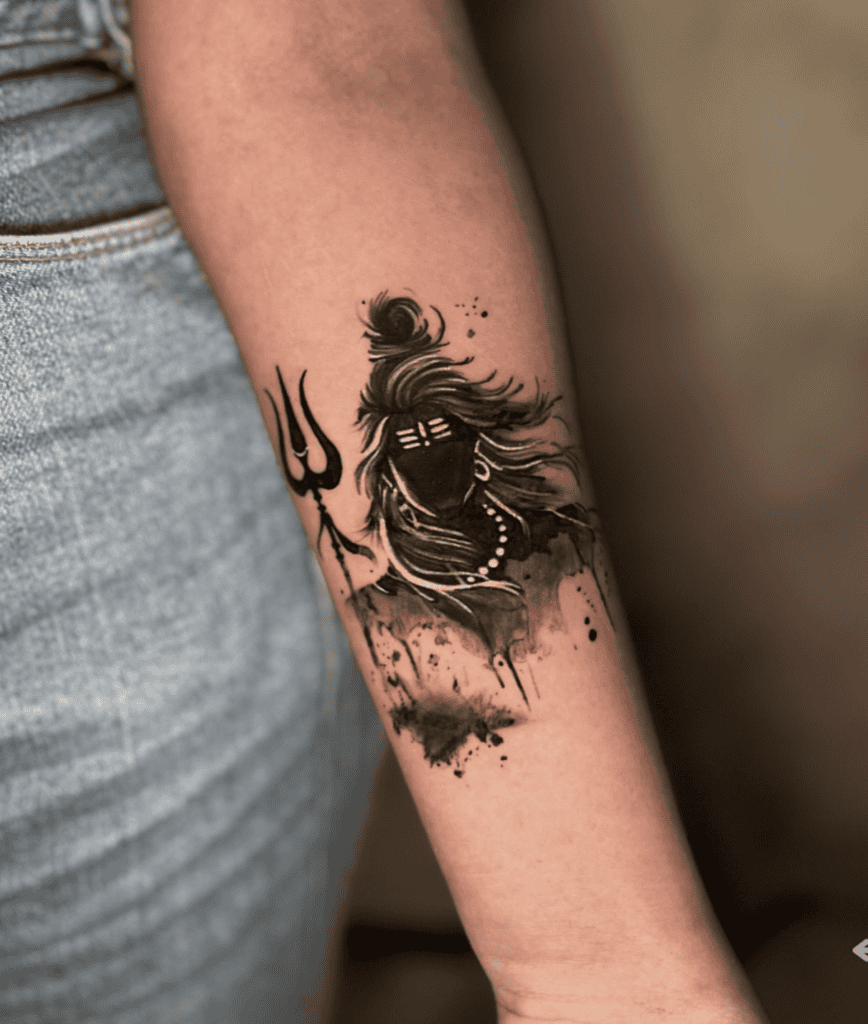
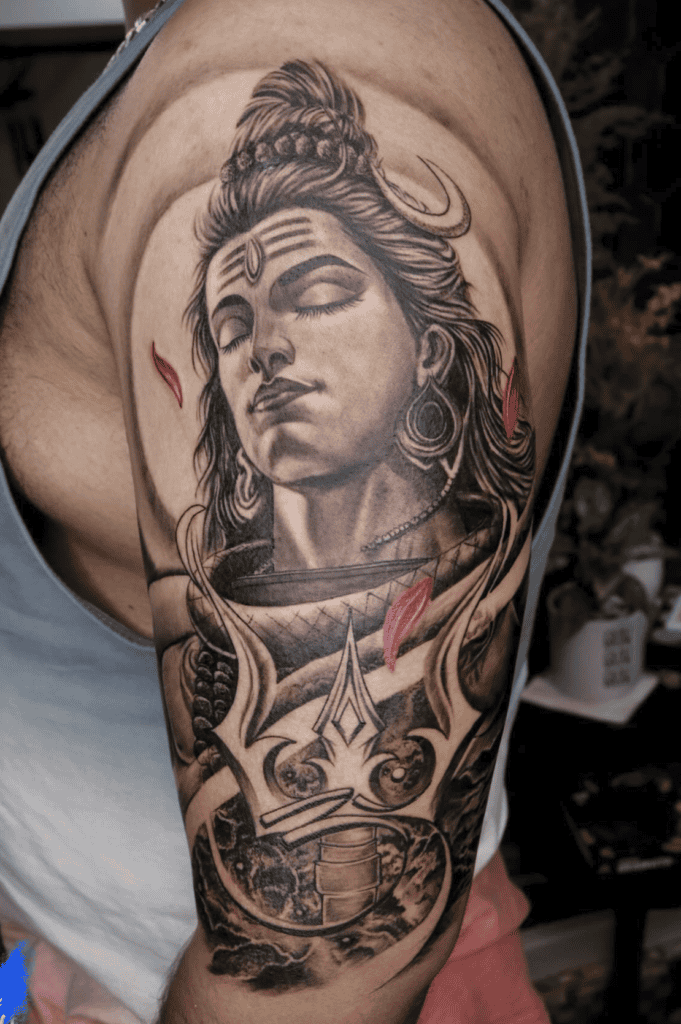
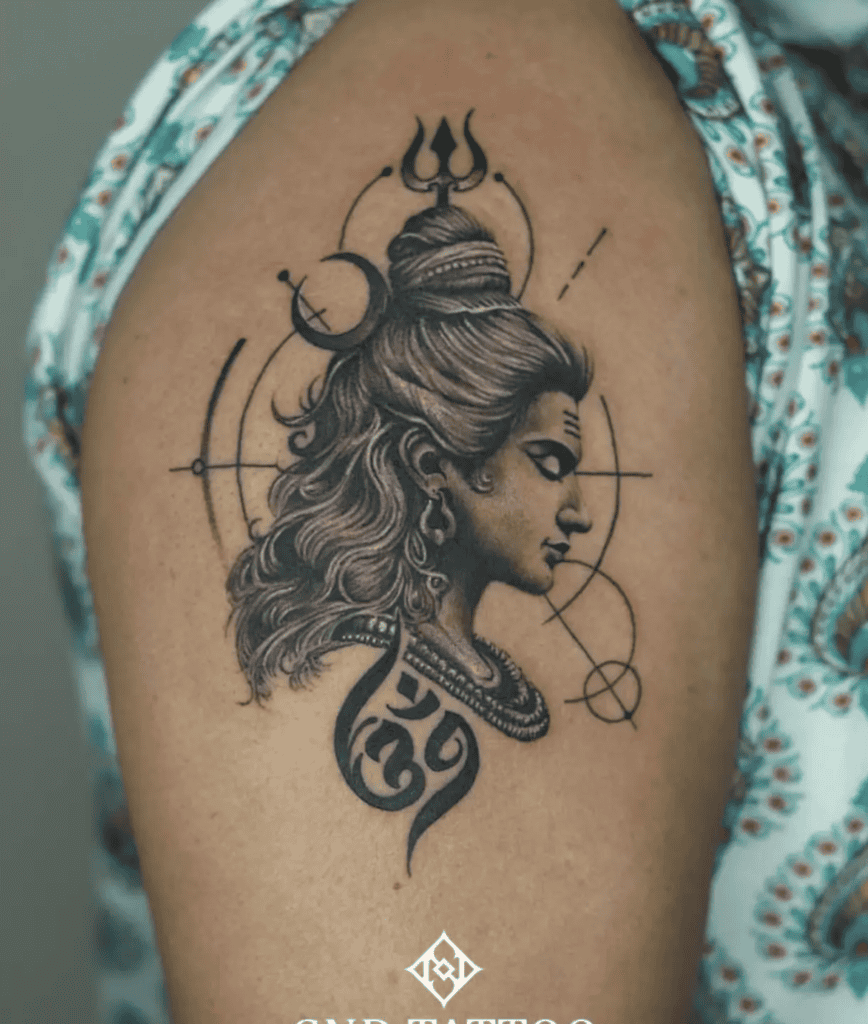
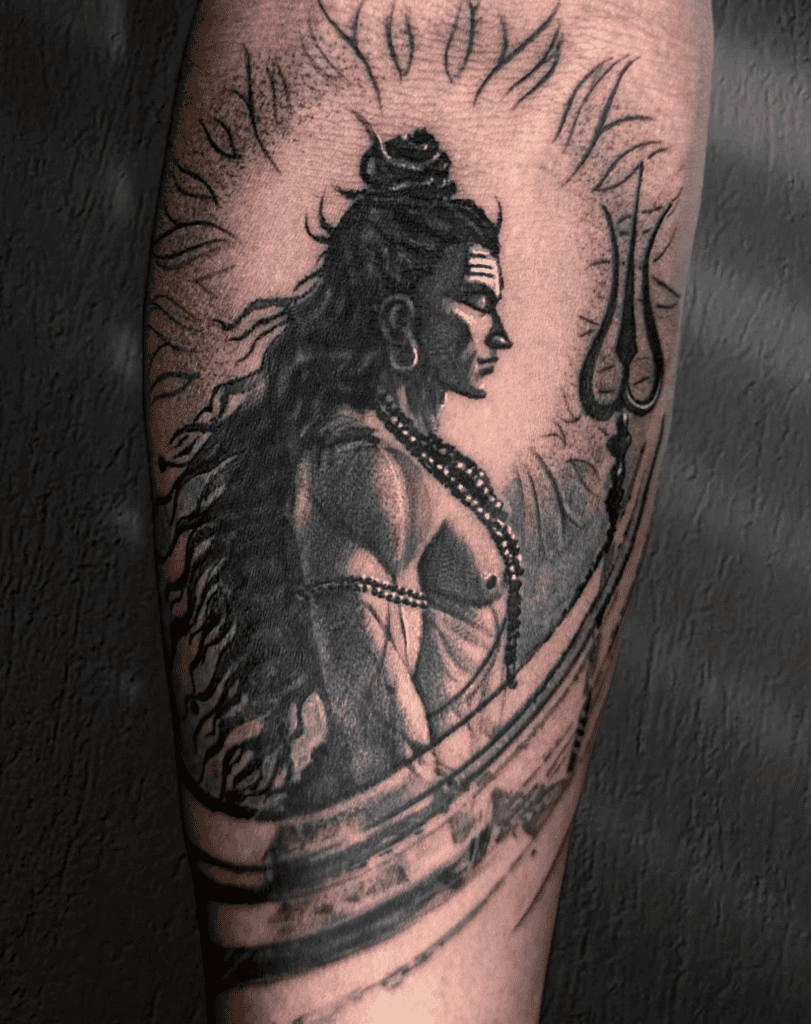
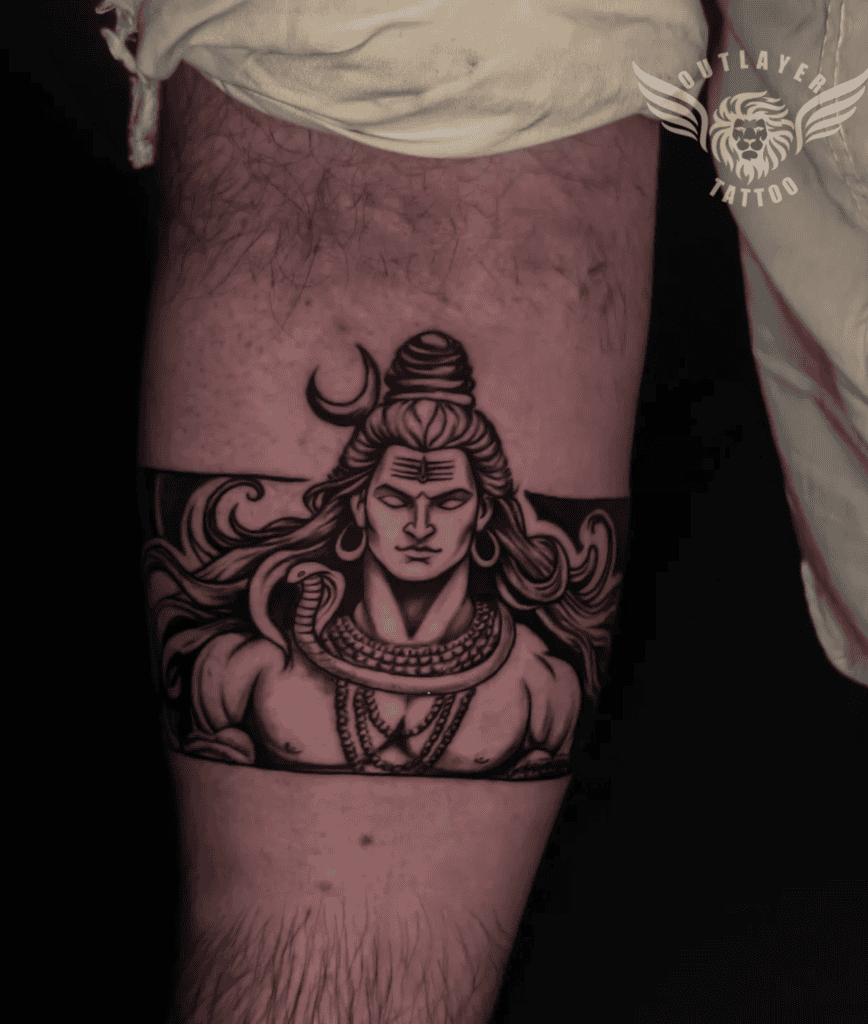
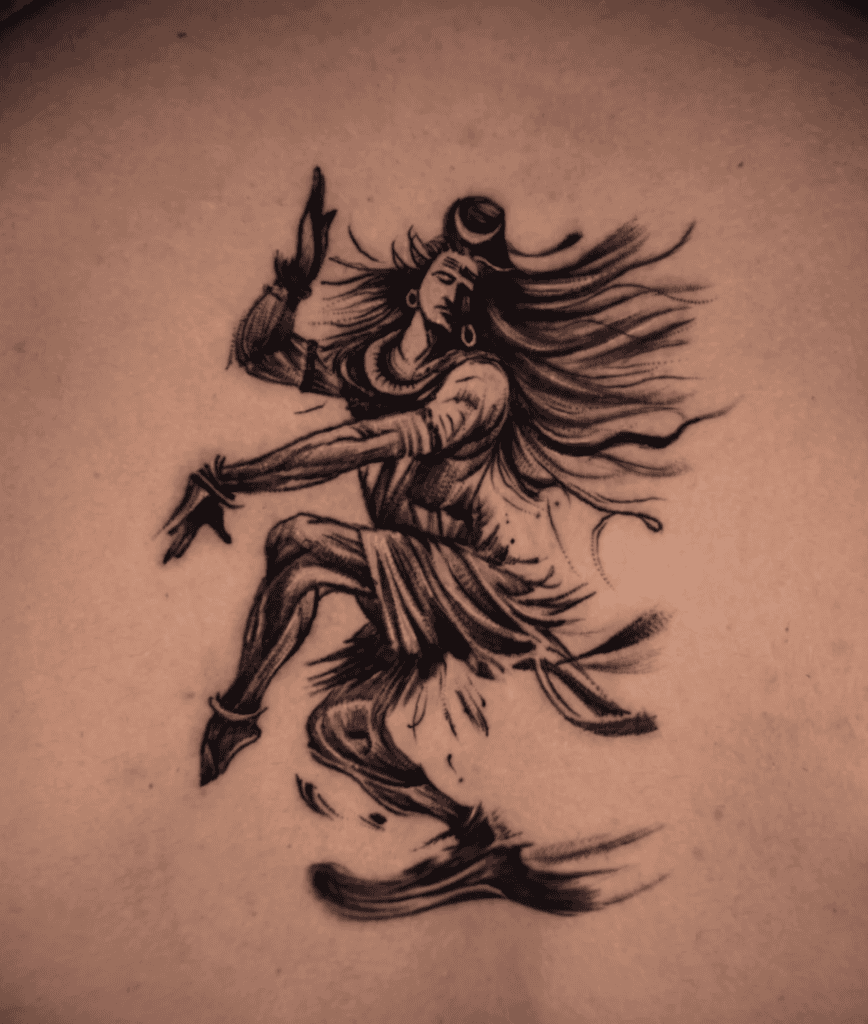
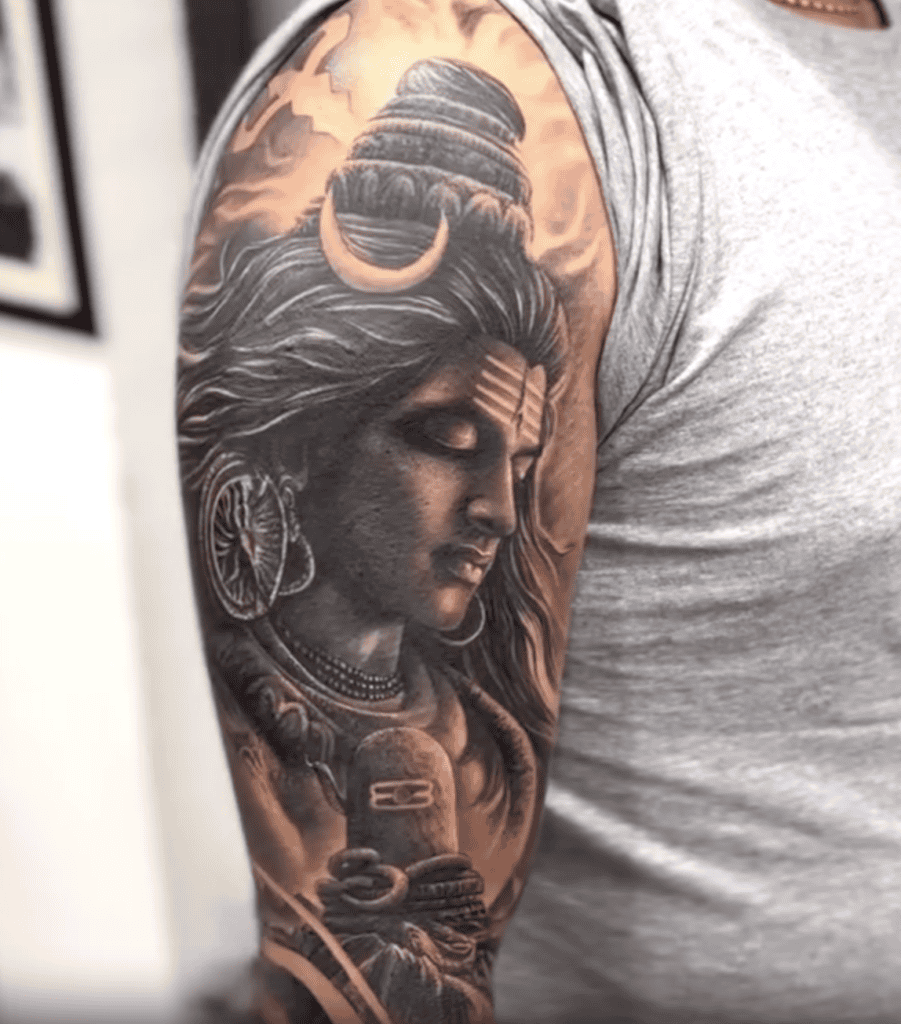
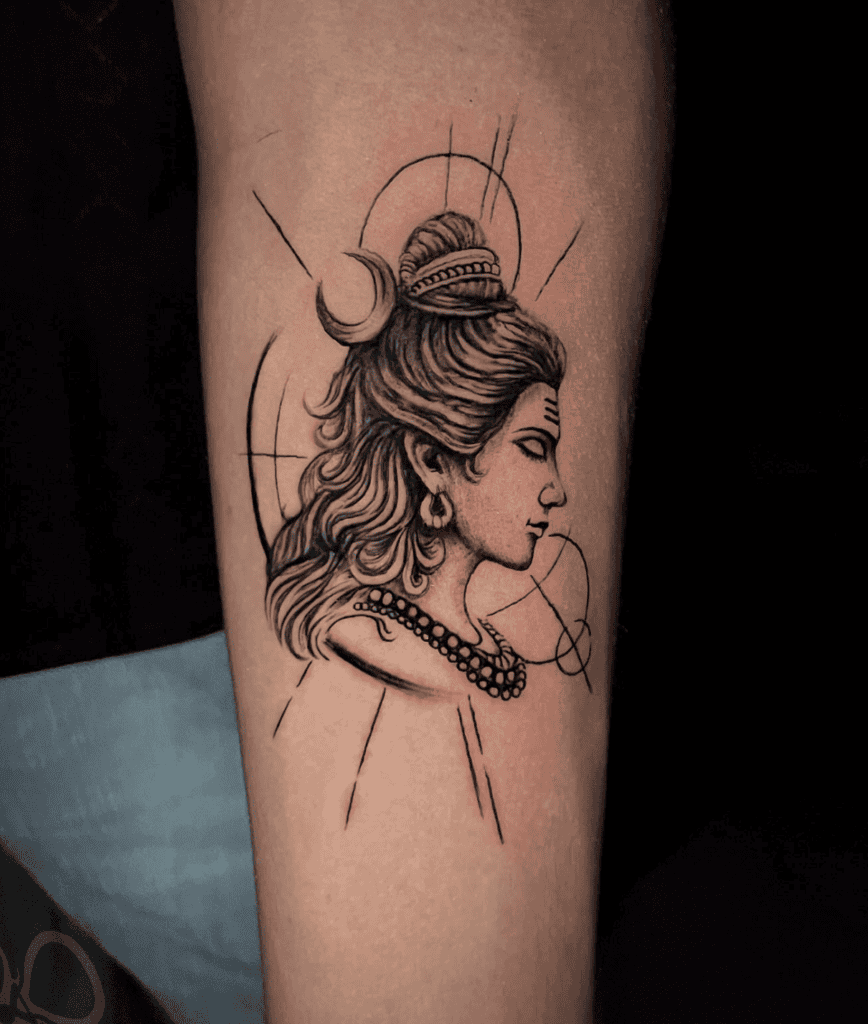
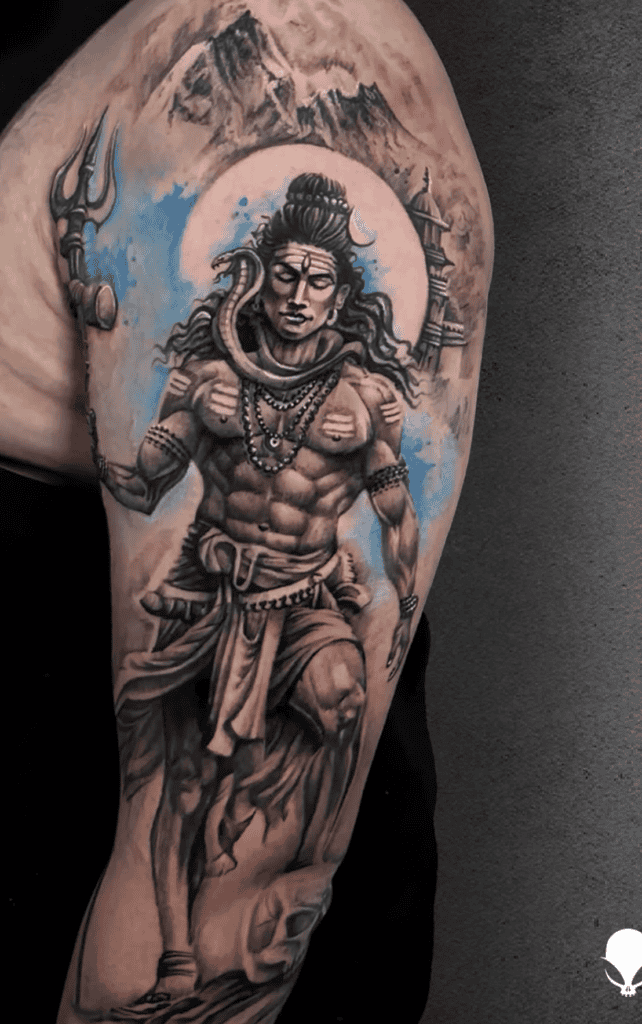
Shiva is part of the Trimurti, representing the end of cycles, but also the beginning of new ones. In many traditions, Shiva is not just a god, but the ultimate reality itself in dynamic form.
Shiva is often shown meditating in the Himalayas, covered in ash (symbol of mortality), wearing a tiger skin (mastery over desire), with a serpent around his neck (power over fear and death) and a crescent moon in his hair (control over time). He is a fierce god of destruction who is also a peaceful meditation master.
One of the most famous forms of Shiva is Nataraja, the cosmic dancer. In this form, he dances inside a ring of fire (the universe), one foot crushes ignorance, one hand beats a drum (creation begins), and another holds fire (destruction). The dance symbolises that the universe is in constant motion, creation and destruction happening simultaneously.
In a famous myth, during the churning of the cosmic ocean, deadly poison emerged. To save the universe, Shiva drank it. His wife, Parvati, stopped the poison from spreading, trapping it in his throat, turning it blue. This earned him the name Neelkanth (“Blue-Throated One”), symbolising sacrifice and protection.
Lakshmi Hindu Mythology Tattoo
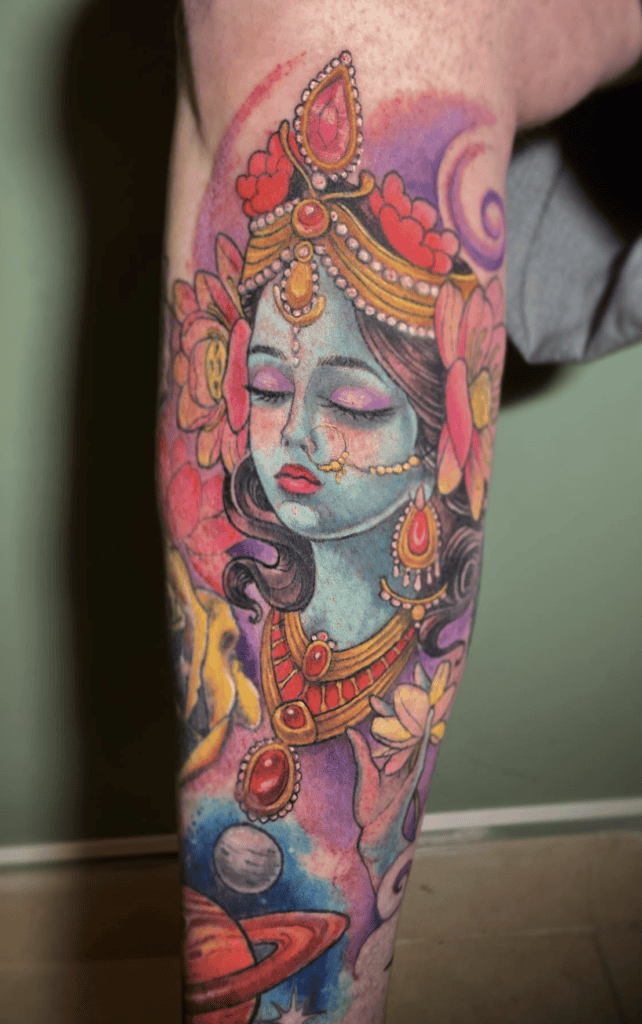
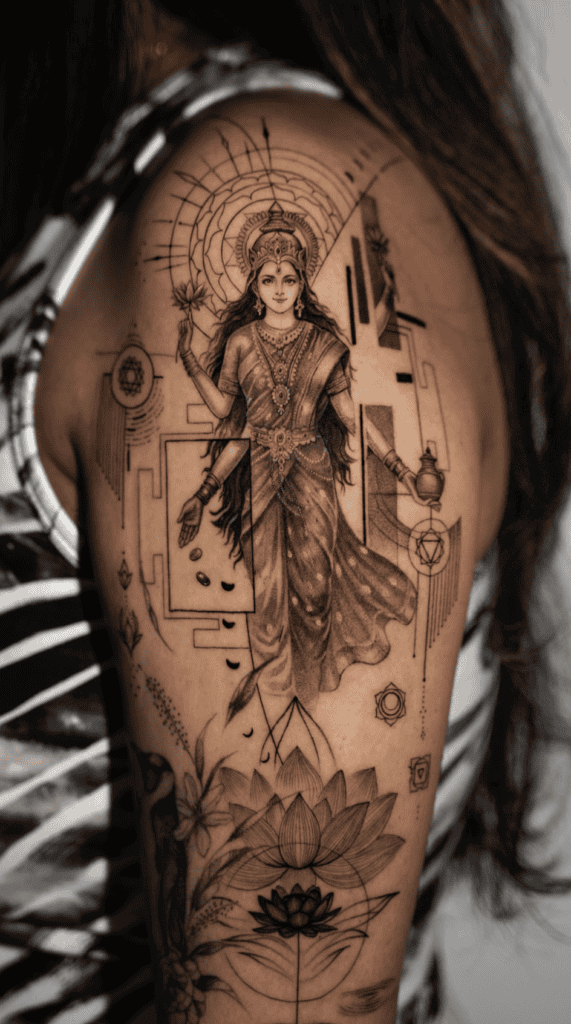
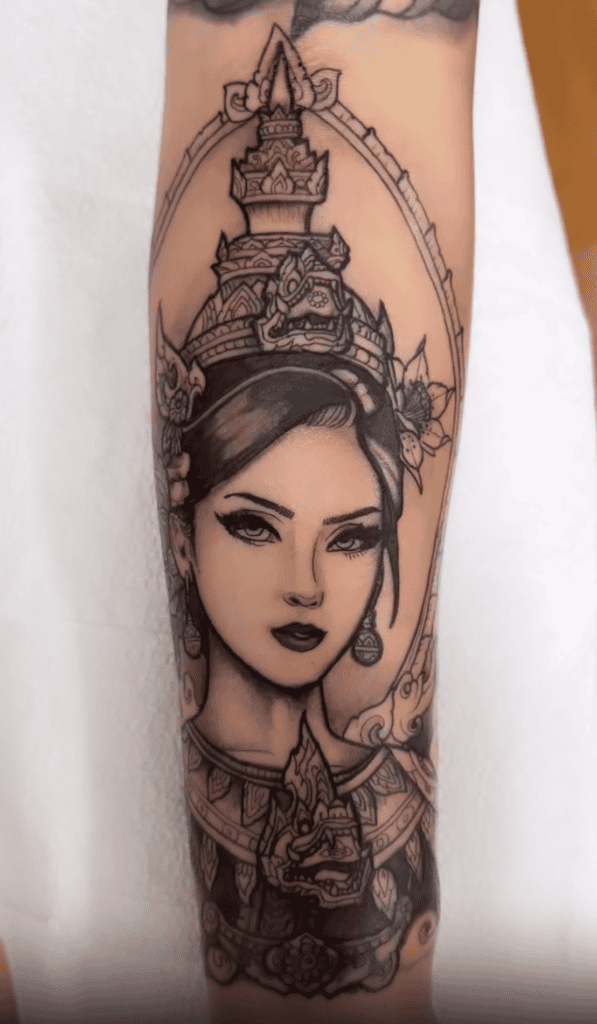
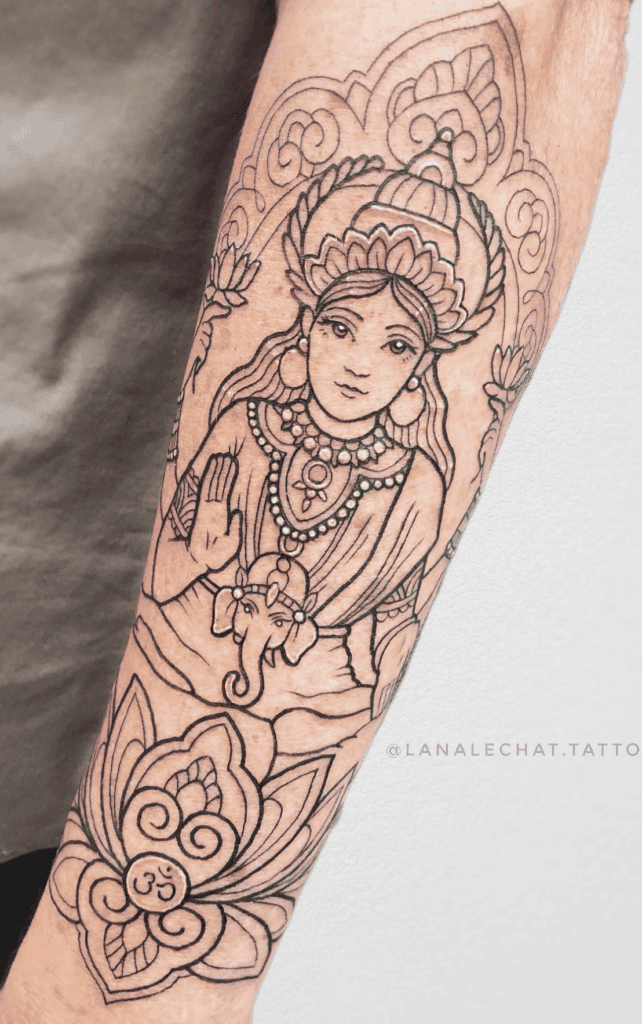
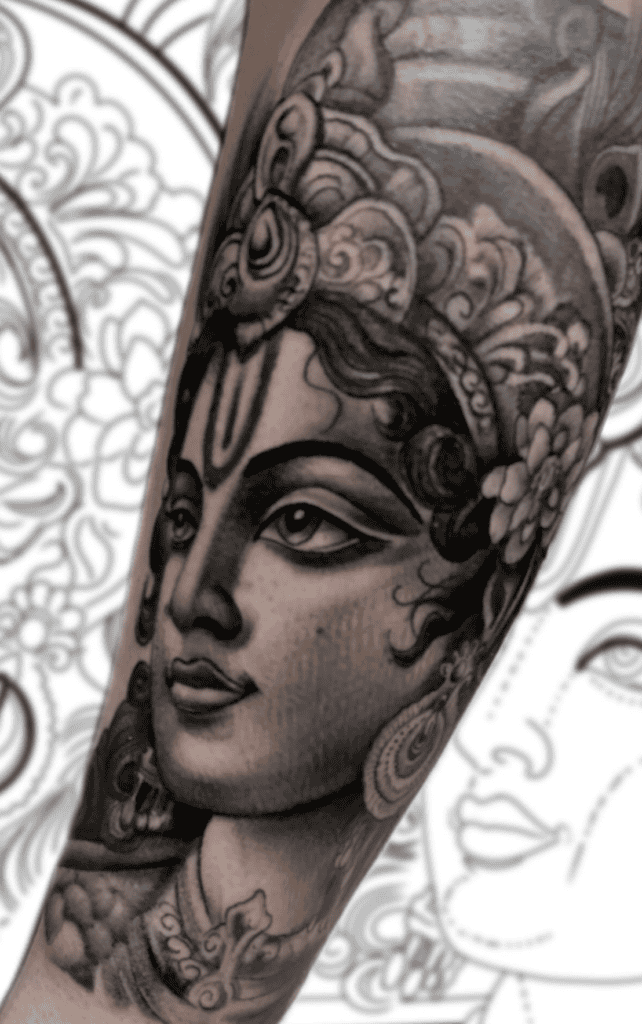
Lakshmi is one of the principal goddesses of Hindu mythology and the divine consort of Vishnu. Whenever Vishnu incarnates on Earth, Lakshmi incarnates alongside him. According to myth, Lakshmi emerged during the Churning of the Ocean of Milk (Samudra Manthan). When gods and demons churned the cosmic ocean to obtain immortality nectar, many treasures arose, including Lakshmi herself, radiant and seated upon a lotus.
Lakshmi represents material wealth, spiritual wealth, beauty, fortune, fertility, success, and harmony. Importantly, wealth in Hindu philosophy isn’t just money, it includes knowledge, health, relationships, and virtue.
Lakshmi is especially worshipped during Diwali, the festival of lights. Homes are cleaned, lamps are lit, and offerings are made to invite prosperity into the household. Lakshmi is believed to visit only homes that are clean, peaceful, and honest, meaning prosperity follows righteousness.
Saraswati Hindu Mythology Tattoo
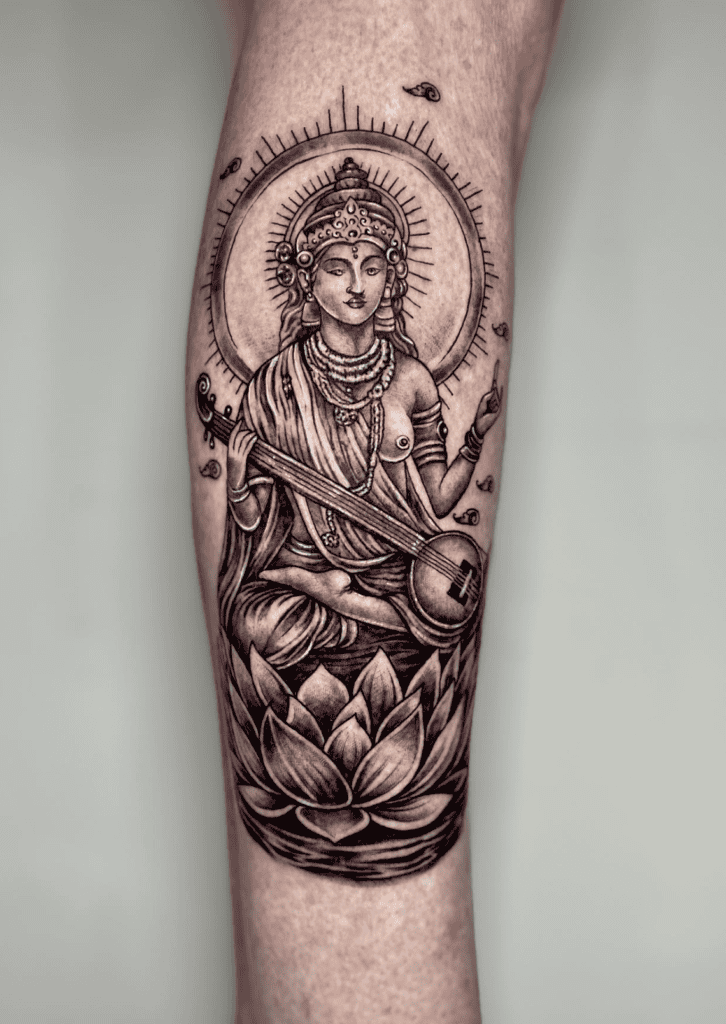
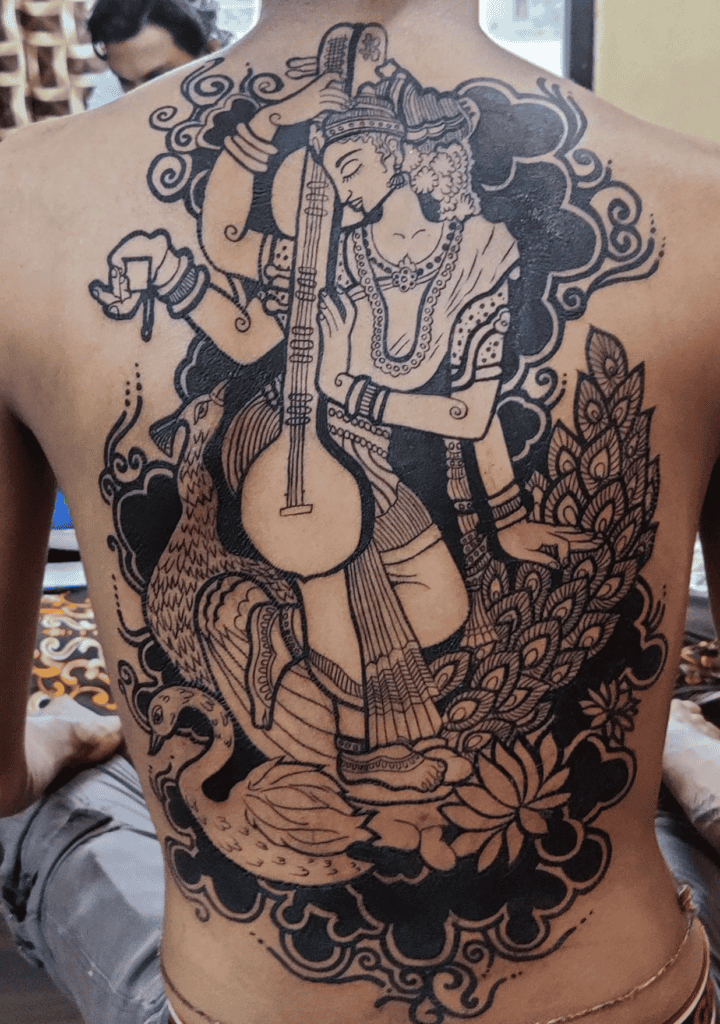
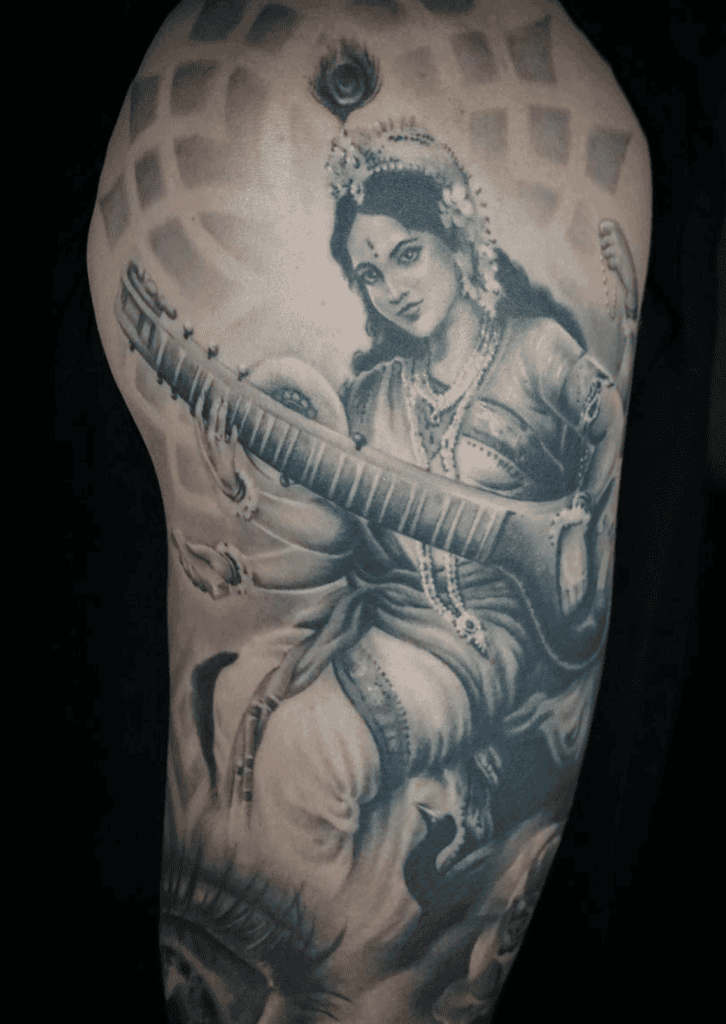
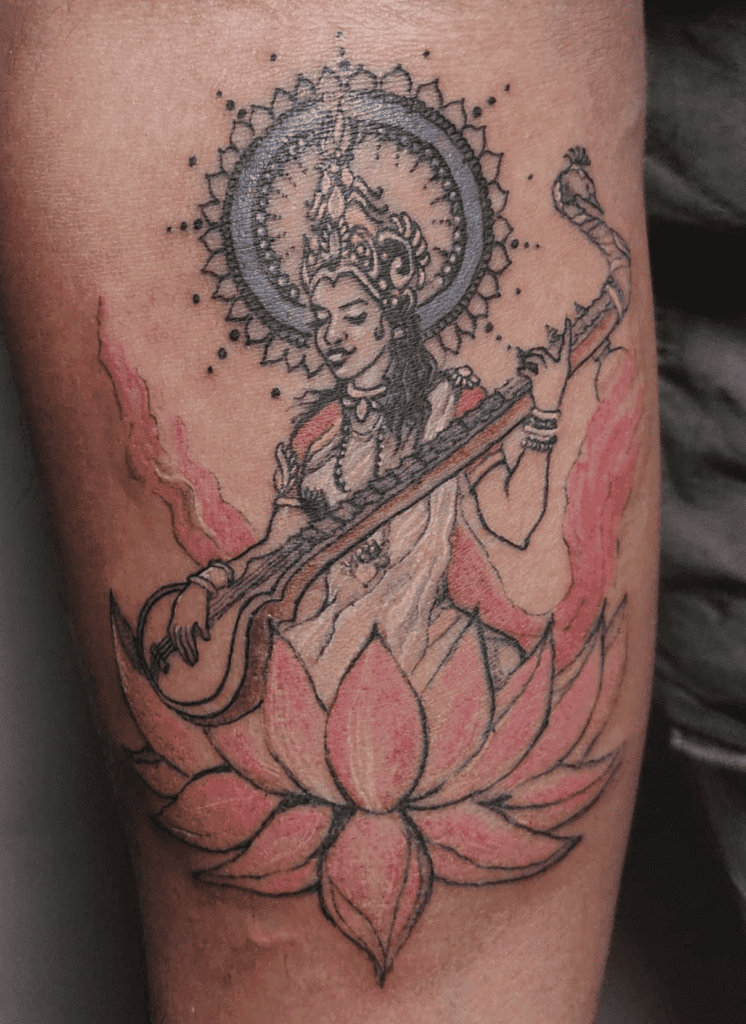
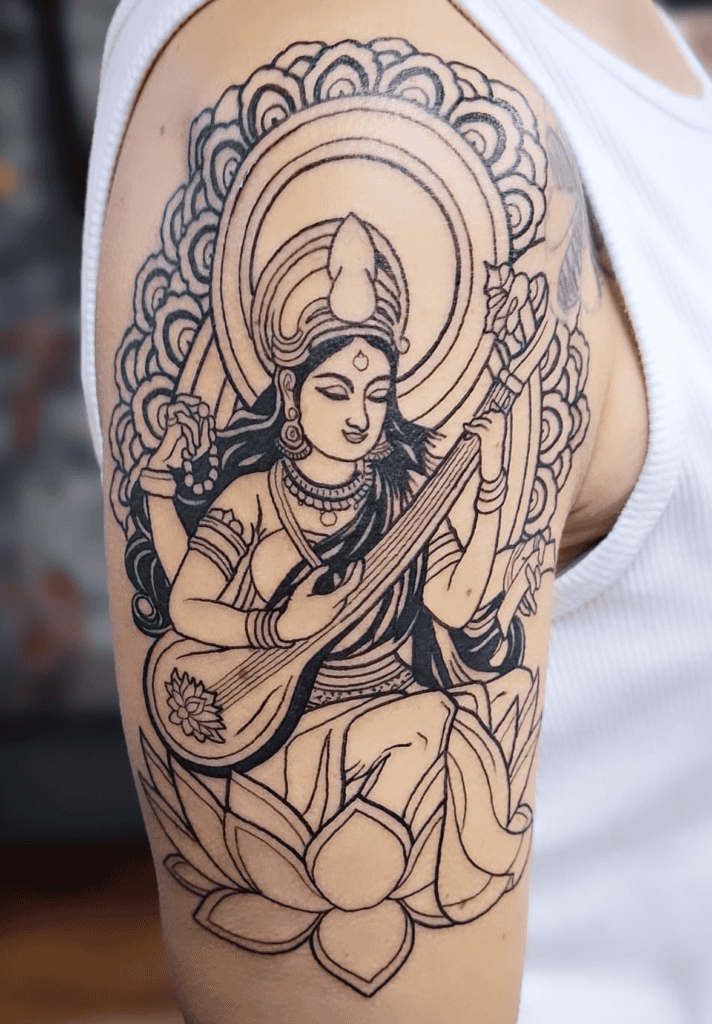
Saraswati is the goddess of knowledge, learning, wisdom, music, poetry, art, and speech. Her name is linked to an ancient river and originally meant “the flowing one,” symbolising the flow of knowledge and consciousness.
In many traditions, Saraswati is associated with Brahma, the creator, as creation (Brahma) requires knowledge (Saraswati), and without wisdom, creation would be chaotic. She represents the intelligence behind existence, the order, structure, and harmony of the cosmos.
Students, artists, musicians, and scholars often pray to Saraswati before exams, performances, or new creative projects. She is especially worshipped during Vasant Panchami, a spring festival dedicated to learning and artistic growth. Books and instruments are placed before her image as offerings.
Parvati Hindu Mythology Tattoo
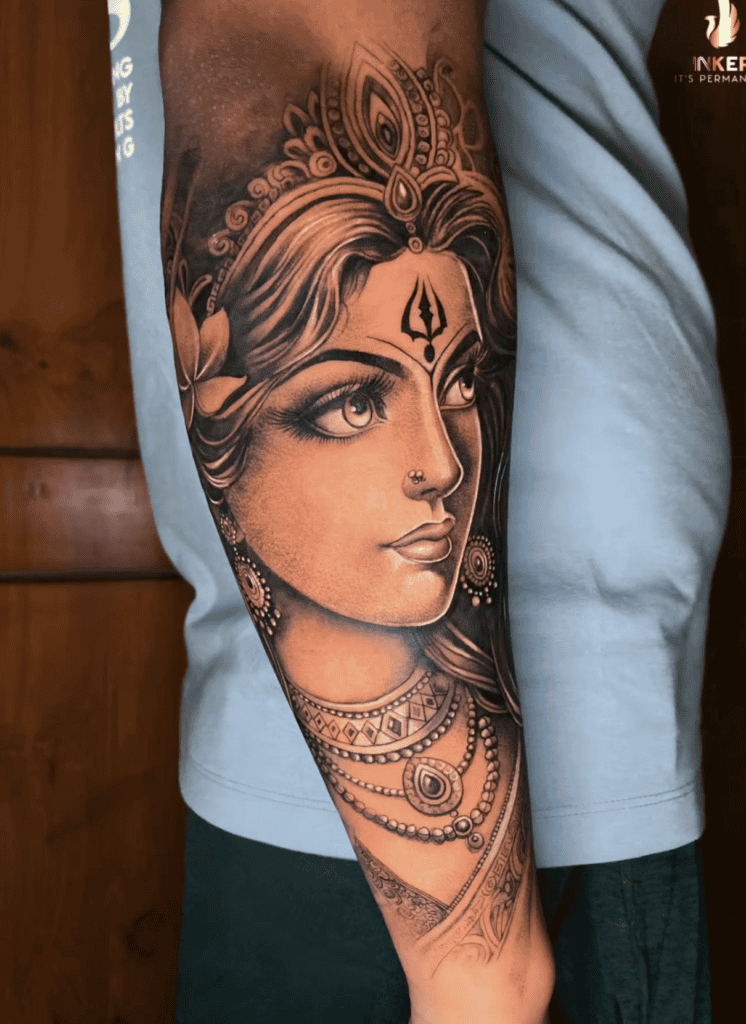
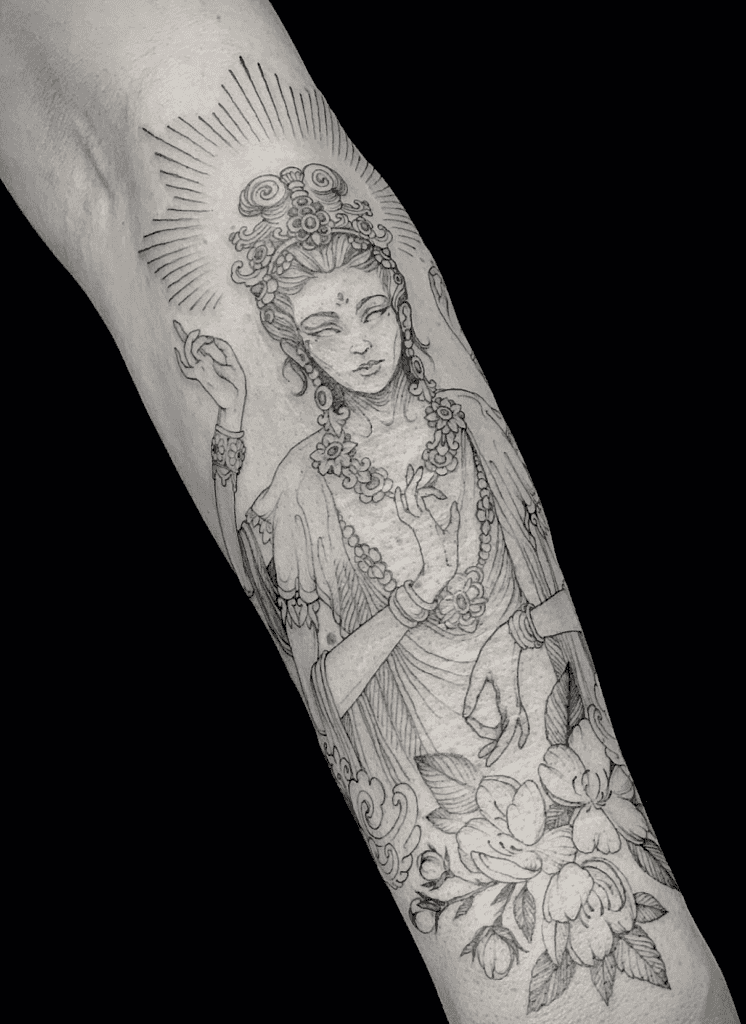
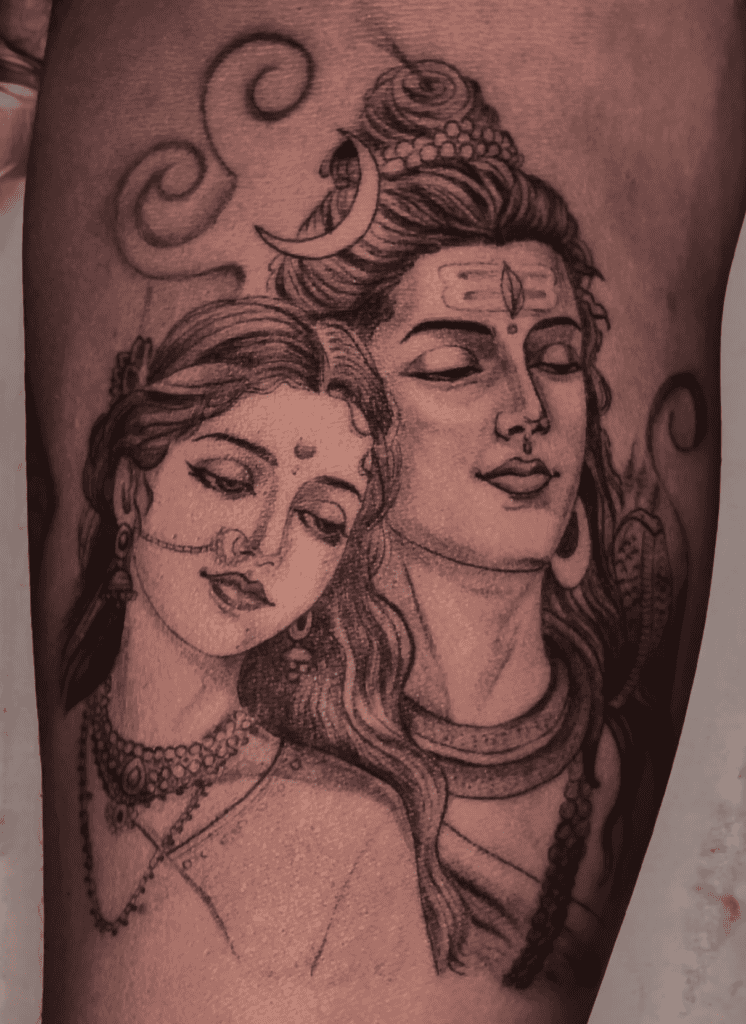
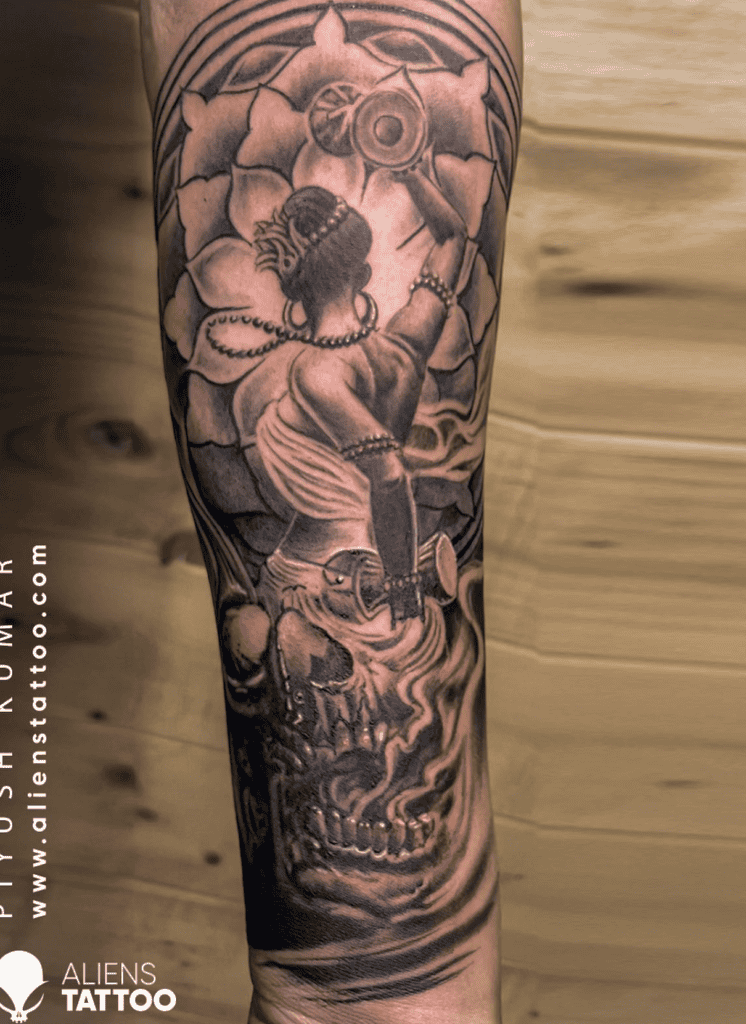
Parvati is the goddess of love, devotion, fertility, marriage, power, and divine motherhood. She is the consort of Shiva and the mother of Ganesha and Kartikeya. Her name means “Daughter of the Mountain,” as she was born to Himavan, the personification of the Himalayas.
One of the most beautiful myths about Parvati is her intense devotion. Shiva, the detached ascetic, lived in deep meditation. Parvati performed years of penance and spiritual discipline to win his love. Her devotion eventually moved Shiva, symbolising that love and dedication can awaken even the most withdrawn consciousness.
In Hindu philosophy, Shiva without Parvati is powerless. Shiva represents consciousness, and Parvati represents energy. Without energy, consciousness cannot act, and together, they form the complete cosmic balance.
Parvati has both gentle and fierce manifestations. These are not separate beings and are aspects of her power, showing how she contains softness and ferocity in equal measure.
Durga Hindu Mythology Tattoo
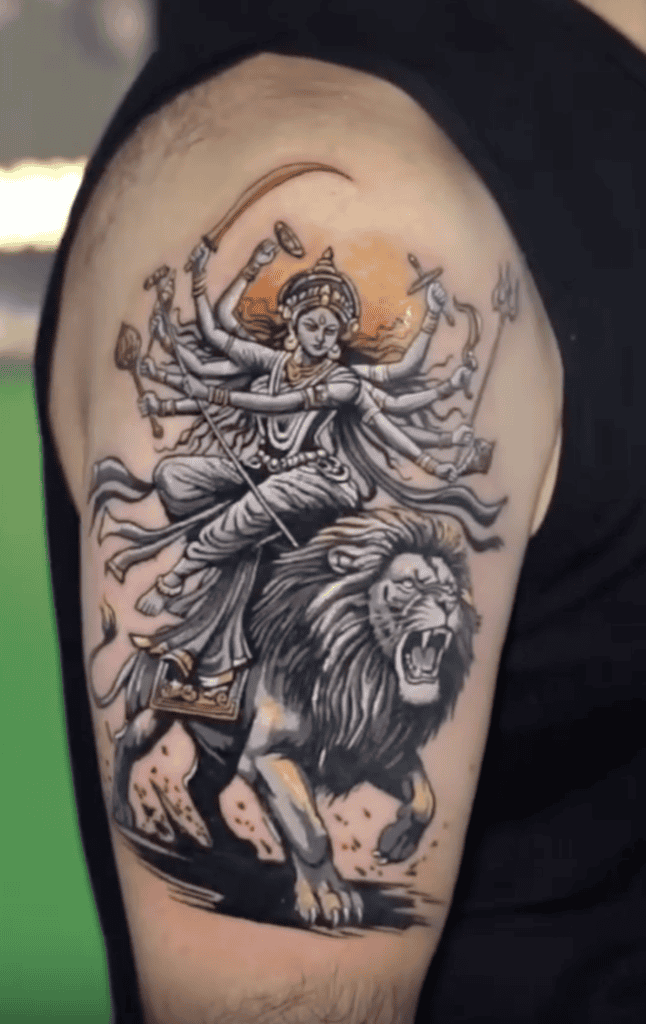
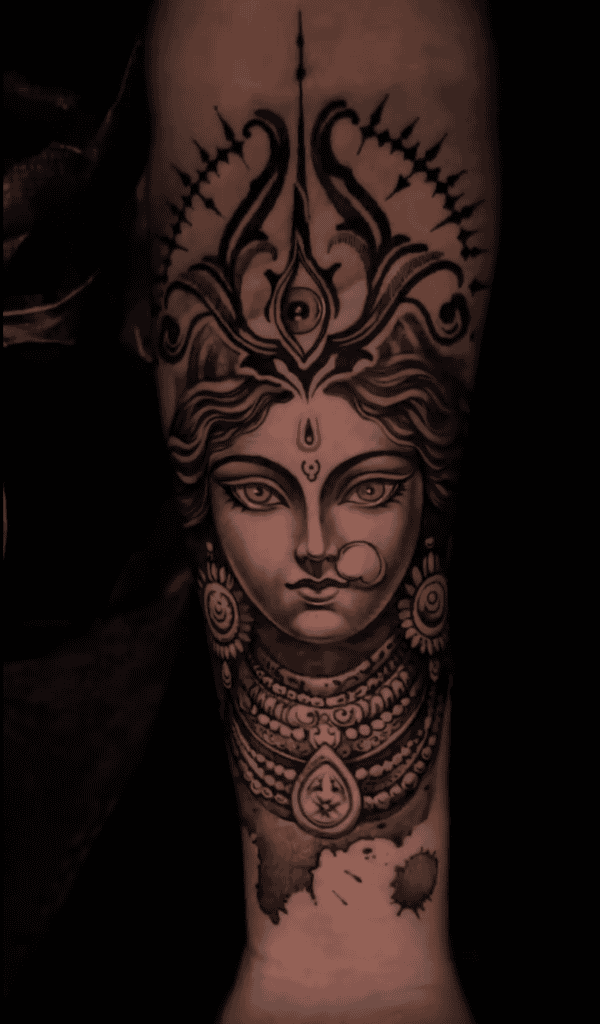
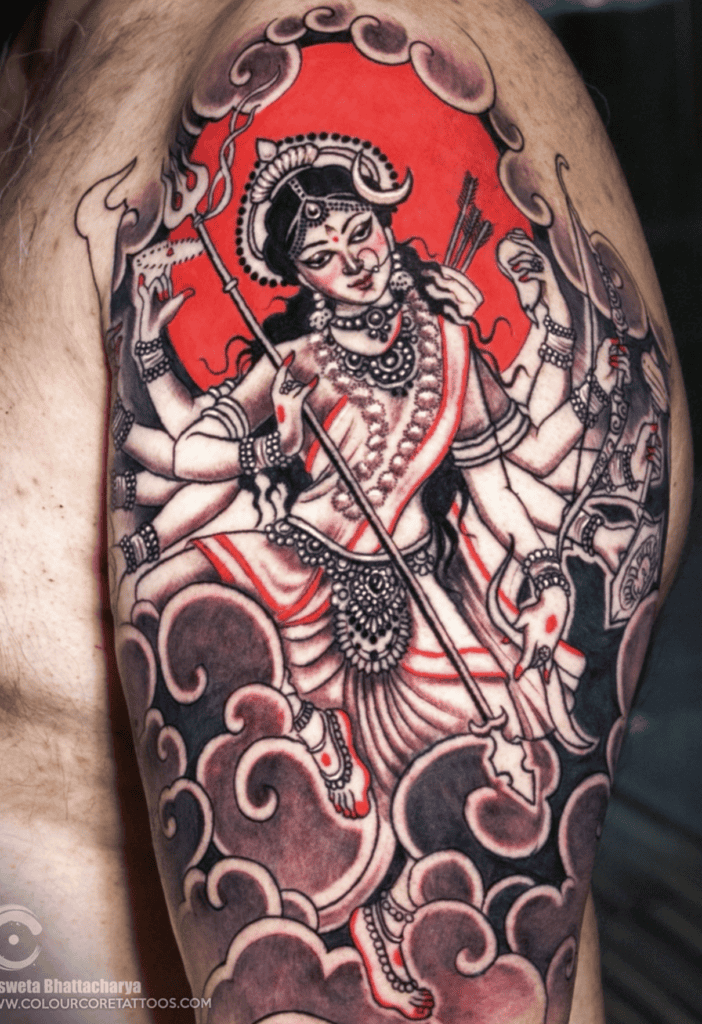
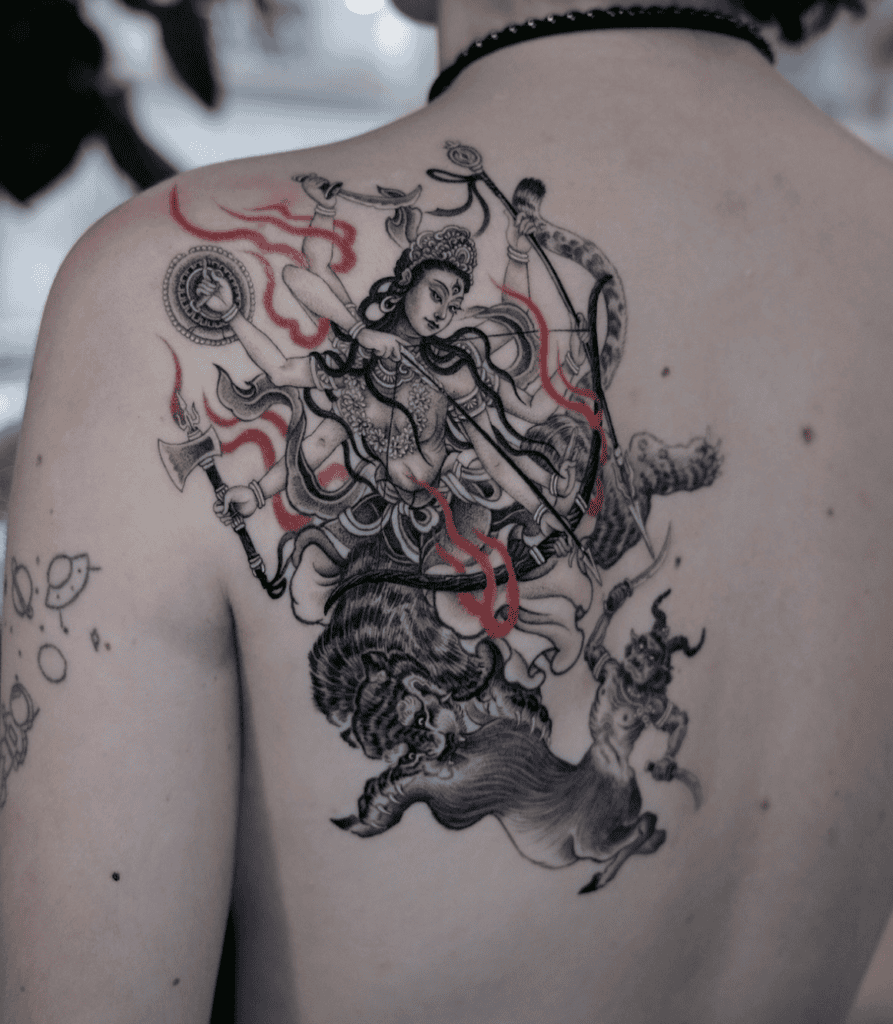
Durga is the fierce form of Parvati, created to defeat forces that even the gods could not overcome. According to myth, a powerful demon named Mahishasura became nearly invincible. He had a boon that no man or god could kill him, so the gods combined their divine energies to create a warrior goddess, Durga.
Durga was born from pure divine light, armed with weapons from every god. She fought Mahishasura for nine days and nights, and on the tenth day, she defeated him. Even though she is fierce in battle, Durga is also called “Ma Durga” (Mother Durga). She protects her devotees like a mother protects her children with her anger not being cruelty, but protective power.
Kali Hindu Mythology Tattoo
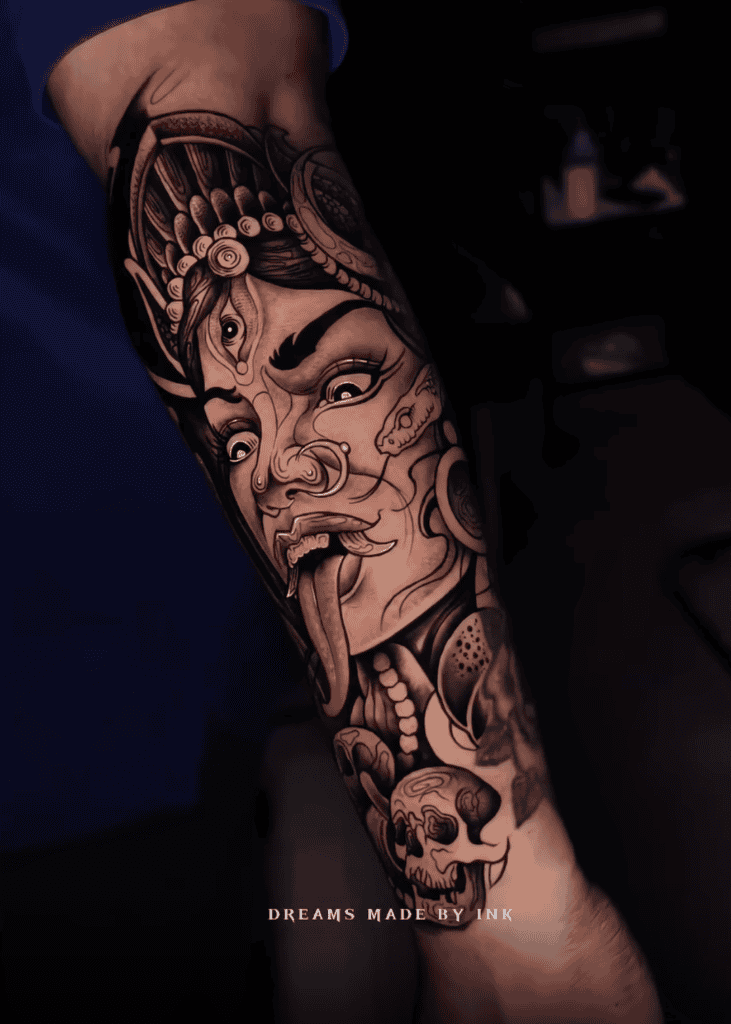
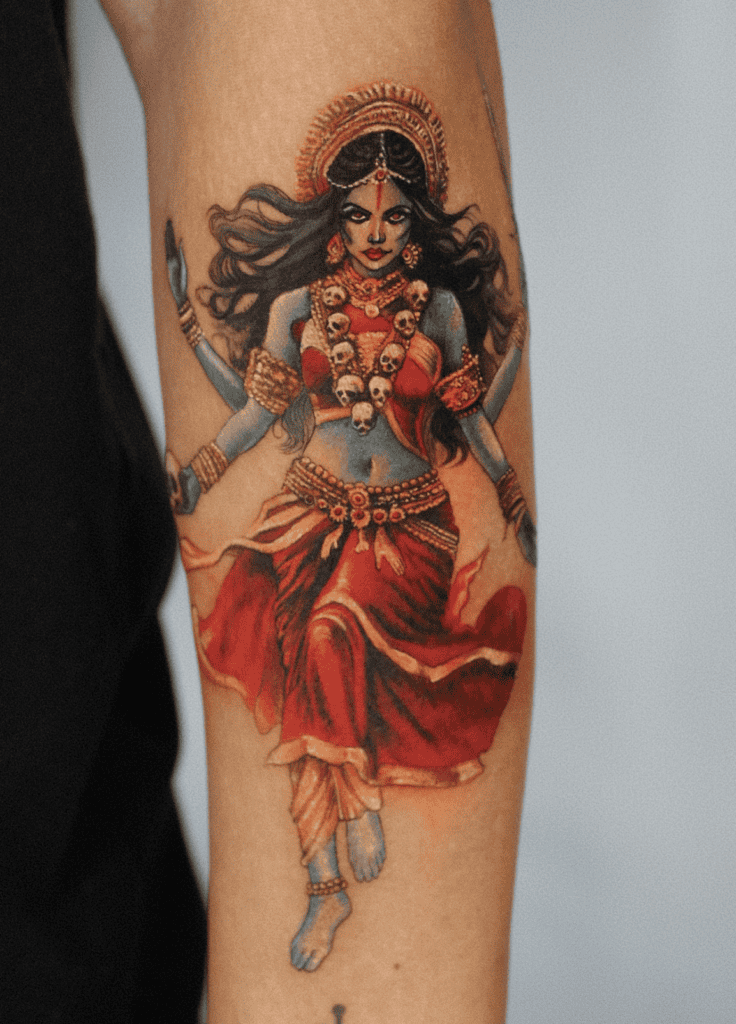
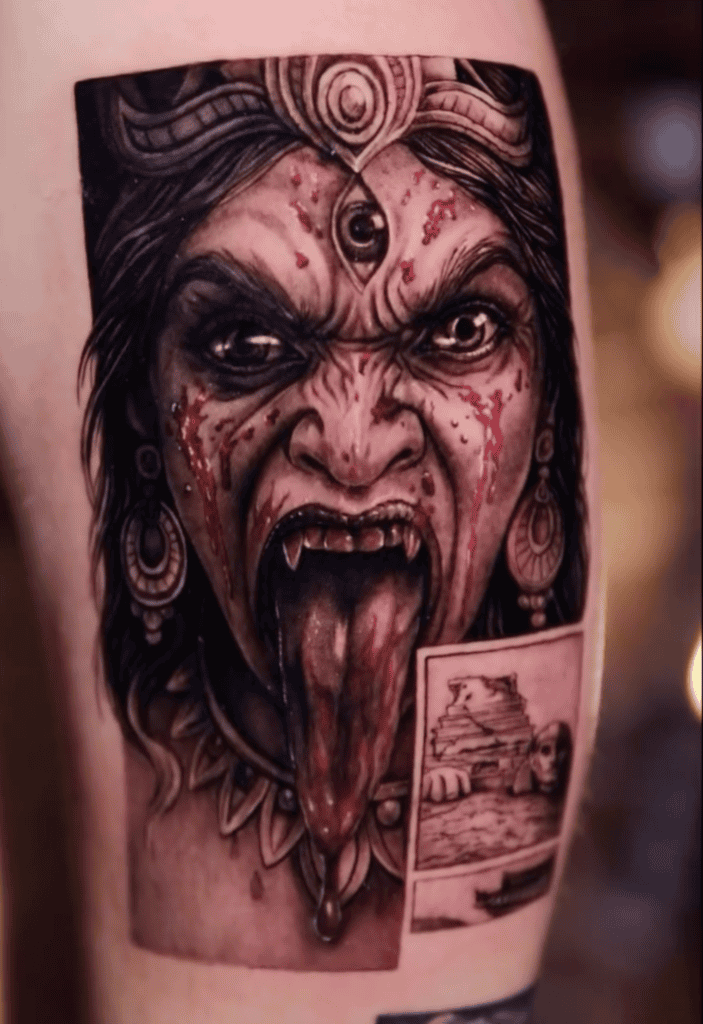
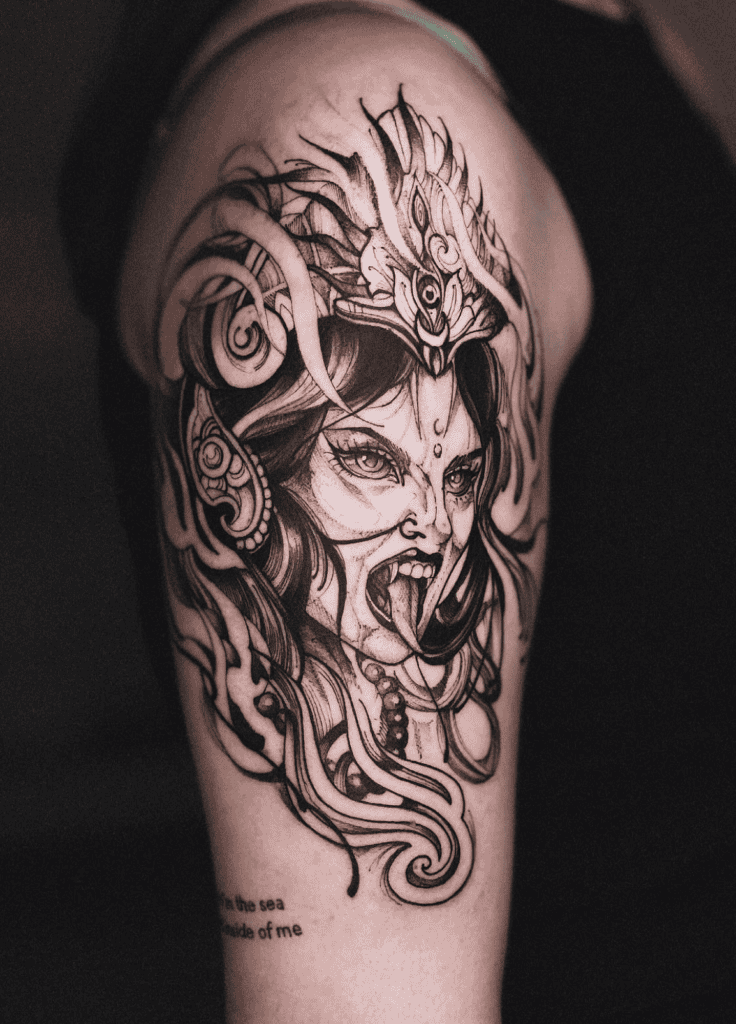
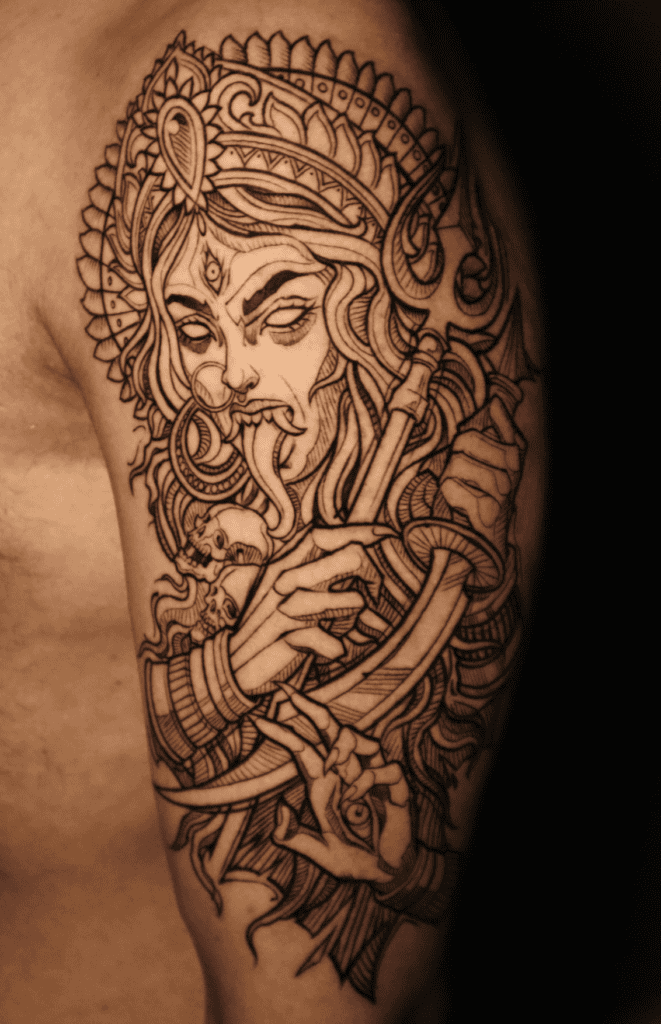
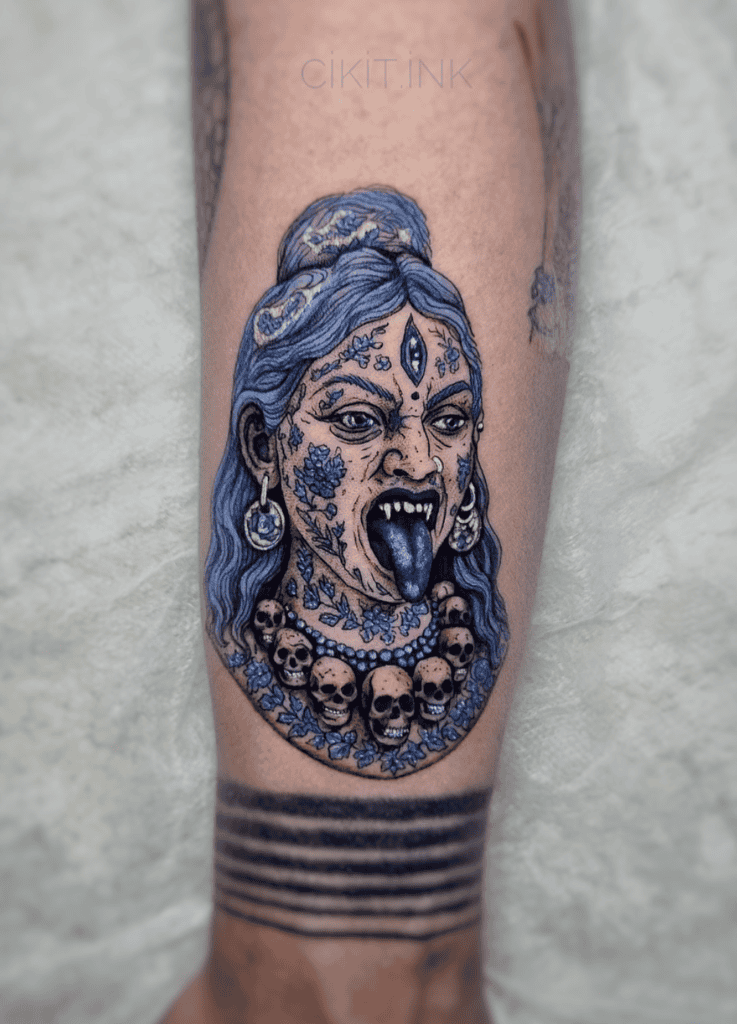
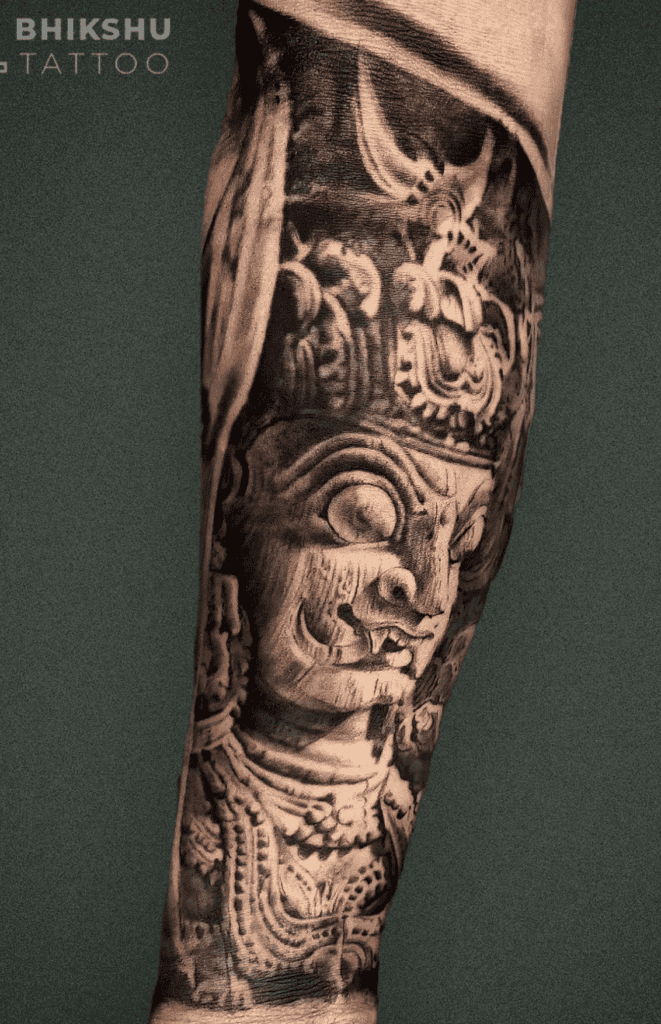
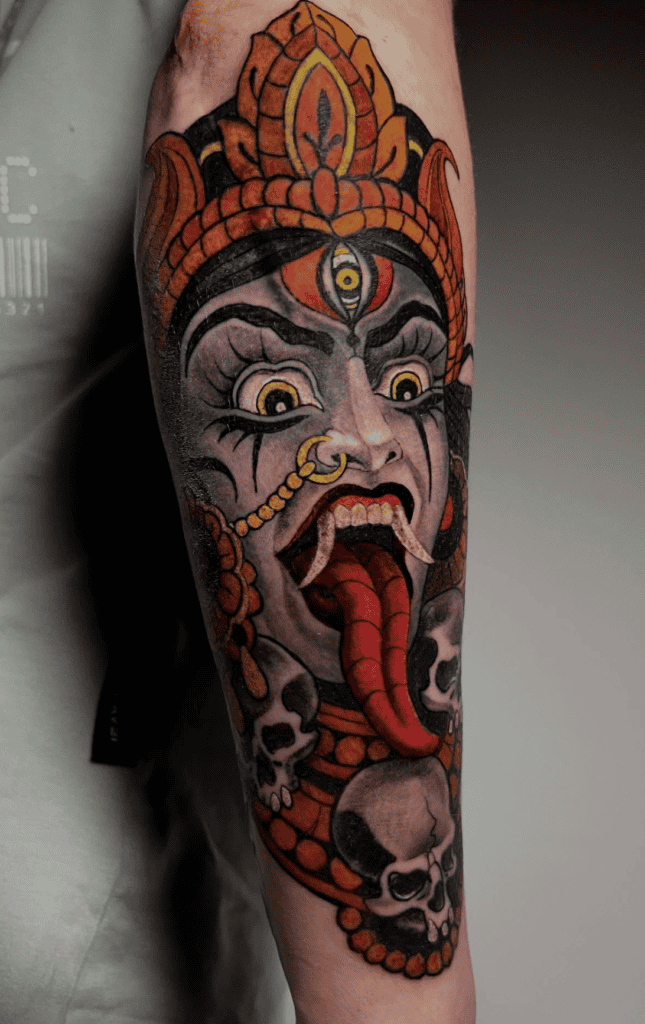
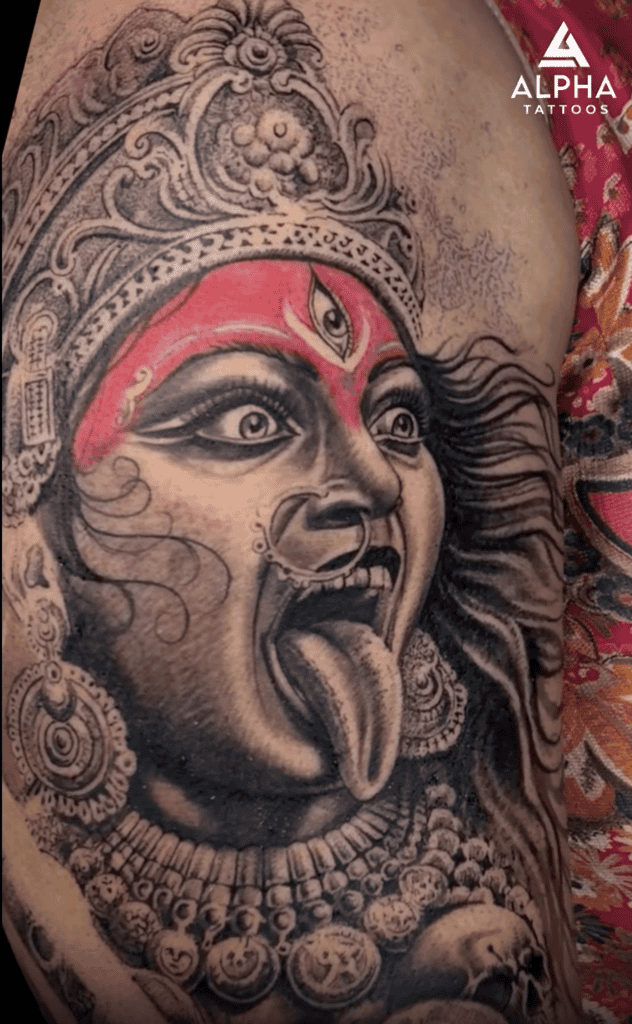
Kali is a fierce form of Parvati whose name comes from “Kala,” meaning time. She is the goddess of time, destroyer of ego, force of transformation, and the mother who removes illusion. She doesn’t destroy creation, but falsehoods.
In one myth, Kali becomes so consumed by battle fury that she nearly destroys everything. Shiva lies beneath her feet to stop her, and when she realises she is standing on him, she sticks out her tongue in shock, calming her rage.
Another famous story tells of the demon Raktabija. Every drop of his blood that touched the ground created another demon. To defeat him, Kali drank his blood before it could fall, preventing his multiplication.
Ganesha Hindu Mythology Tattoo
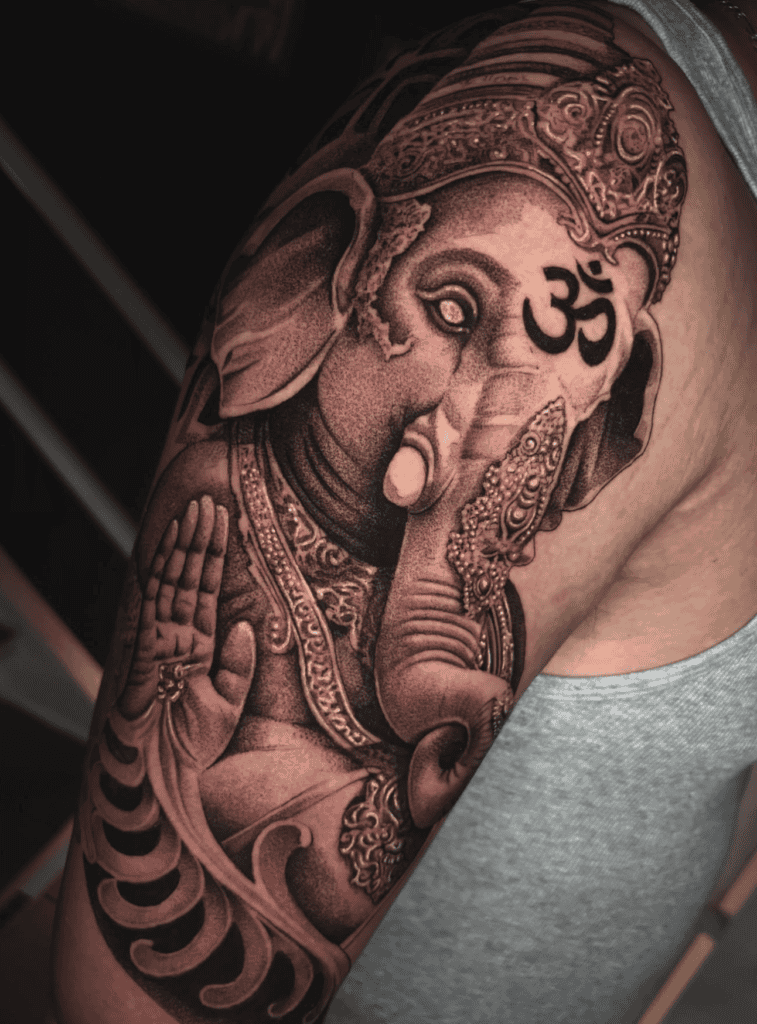
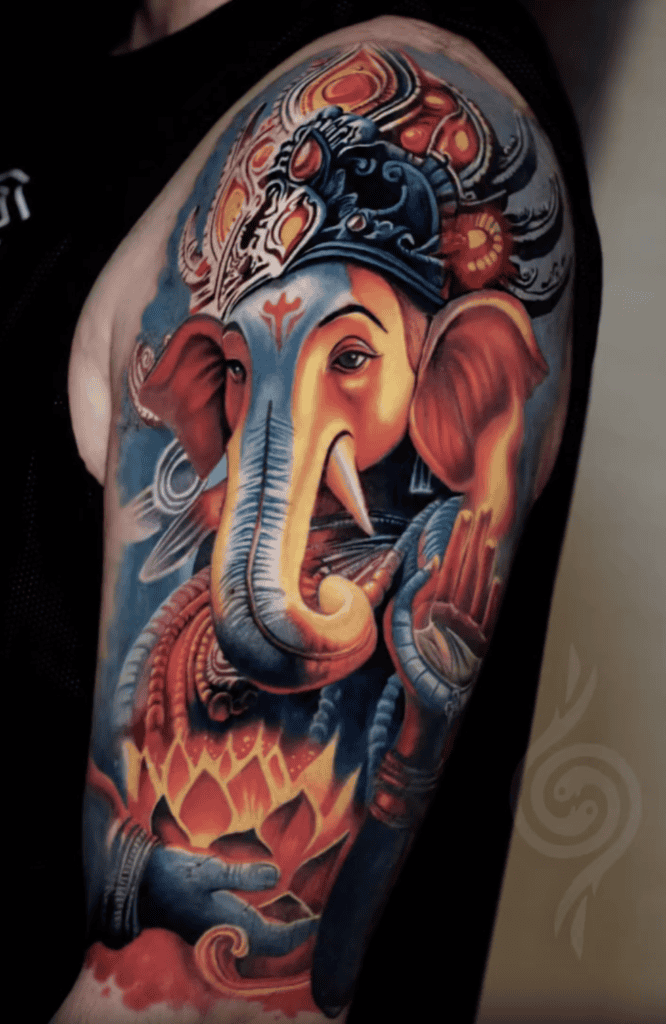
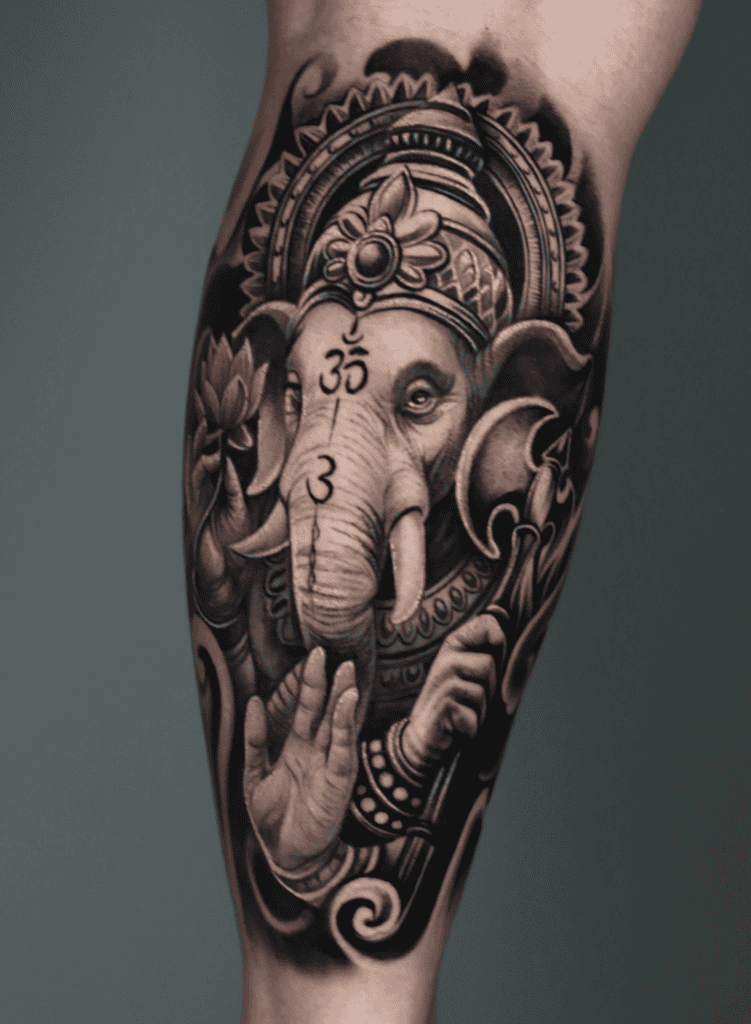
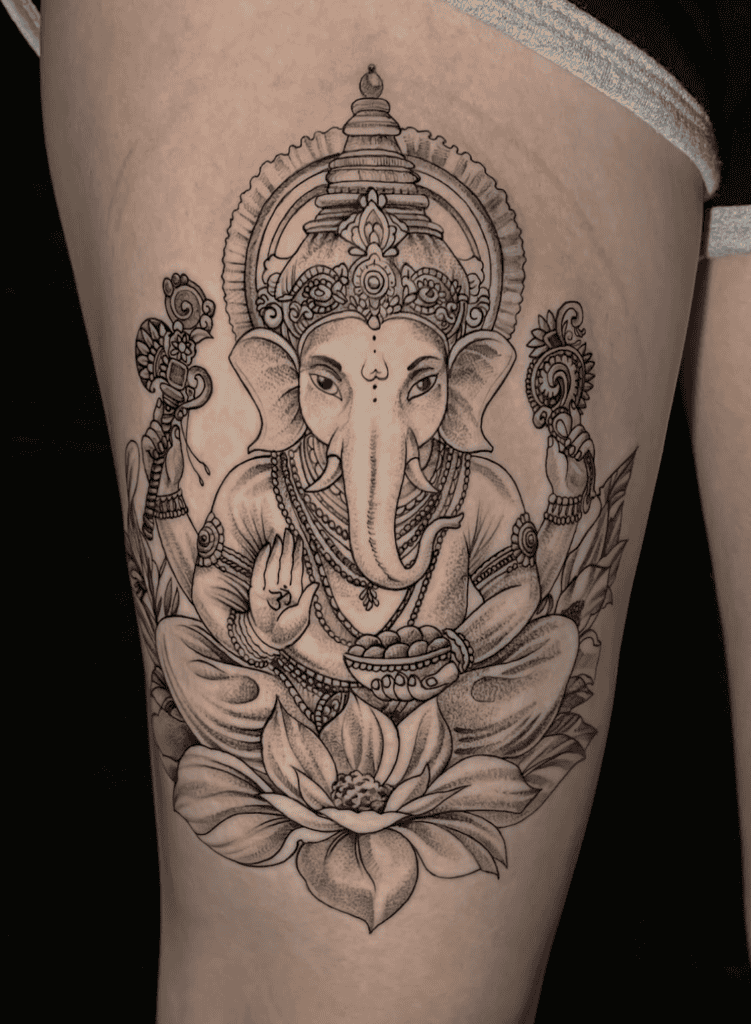
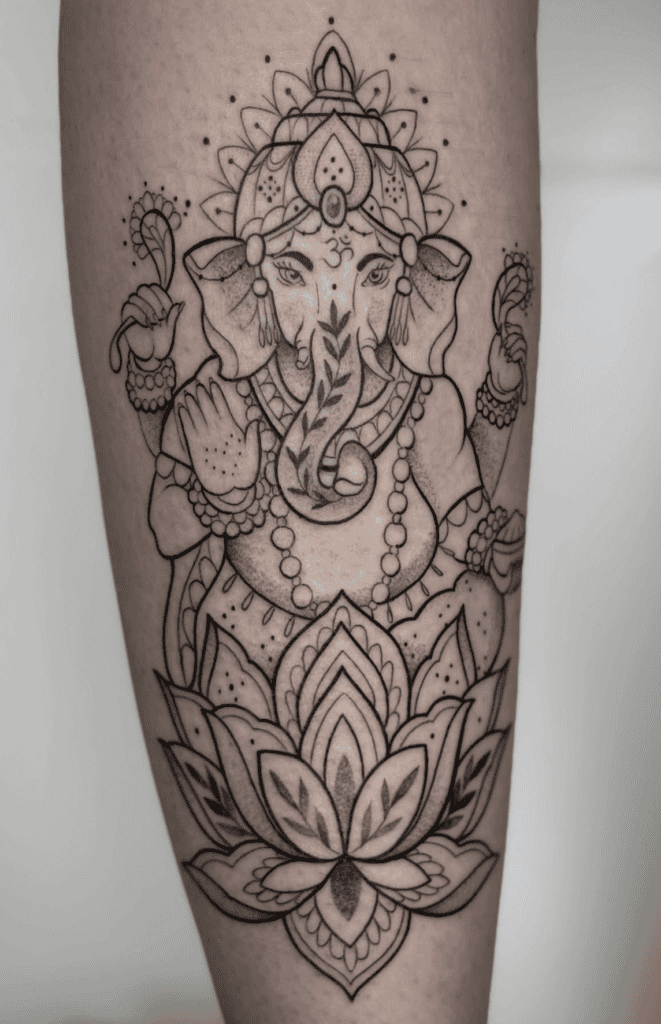
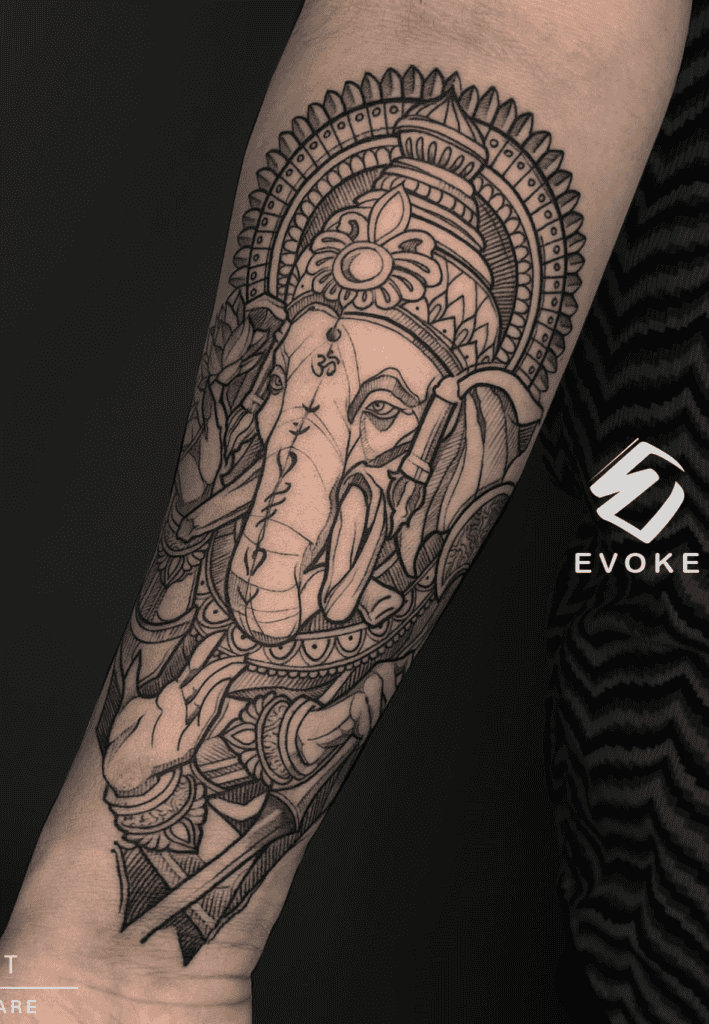
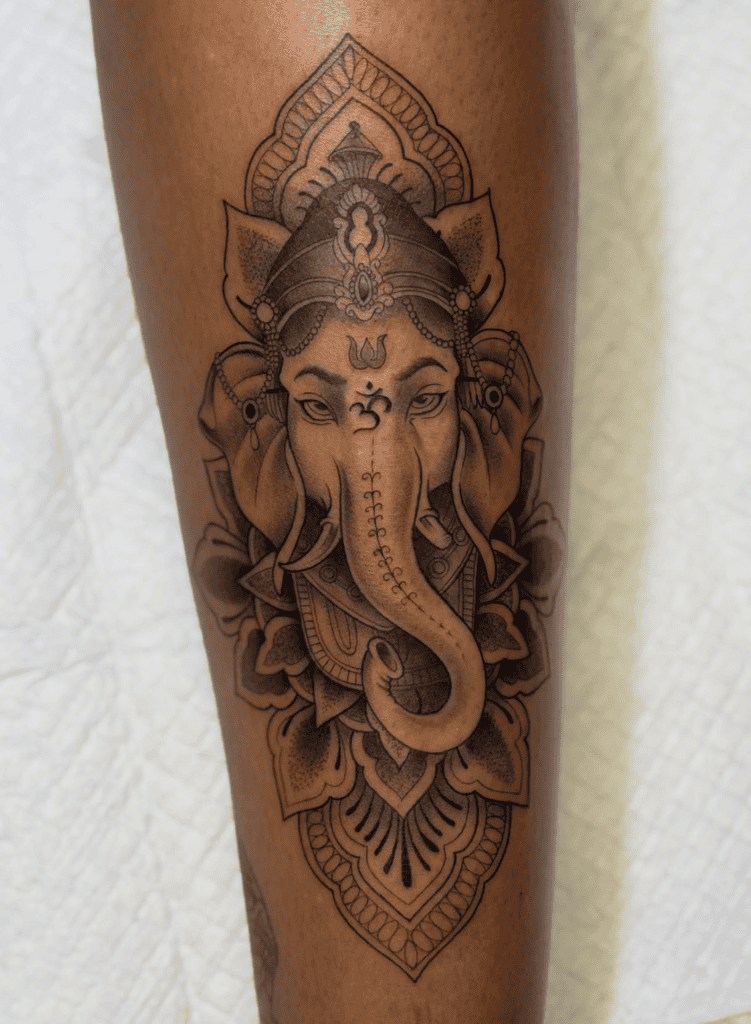
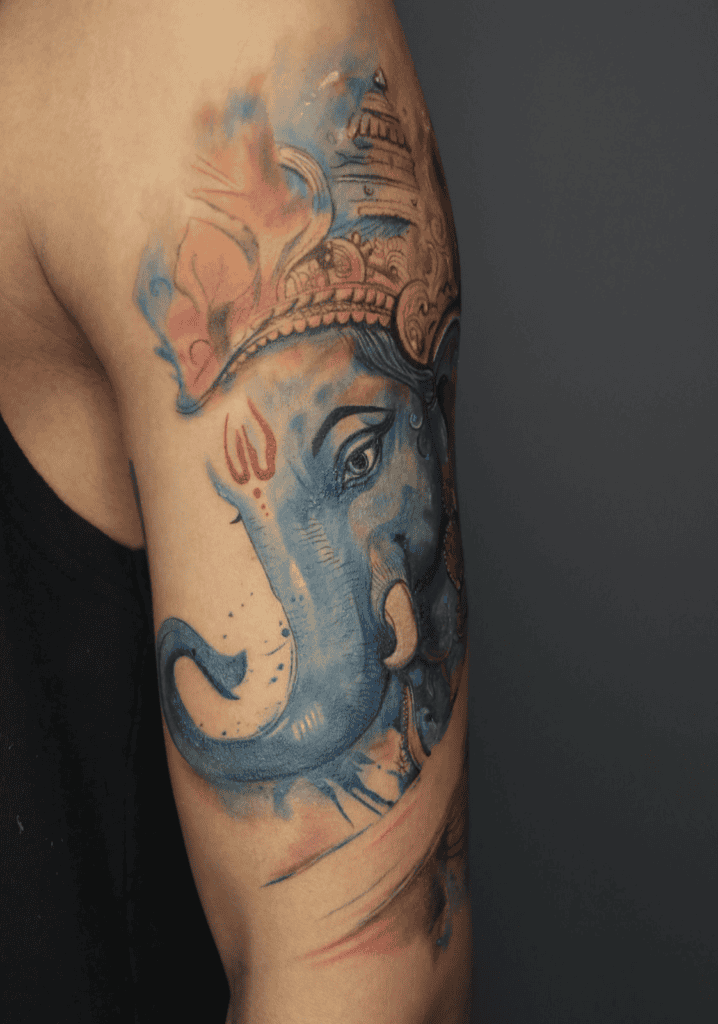
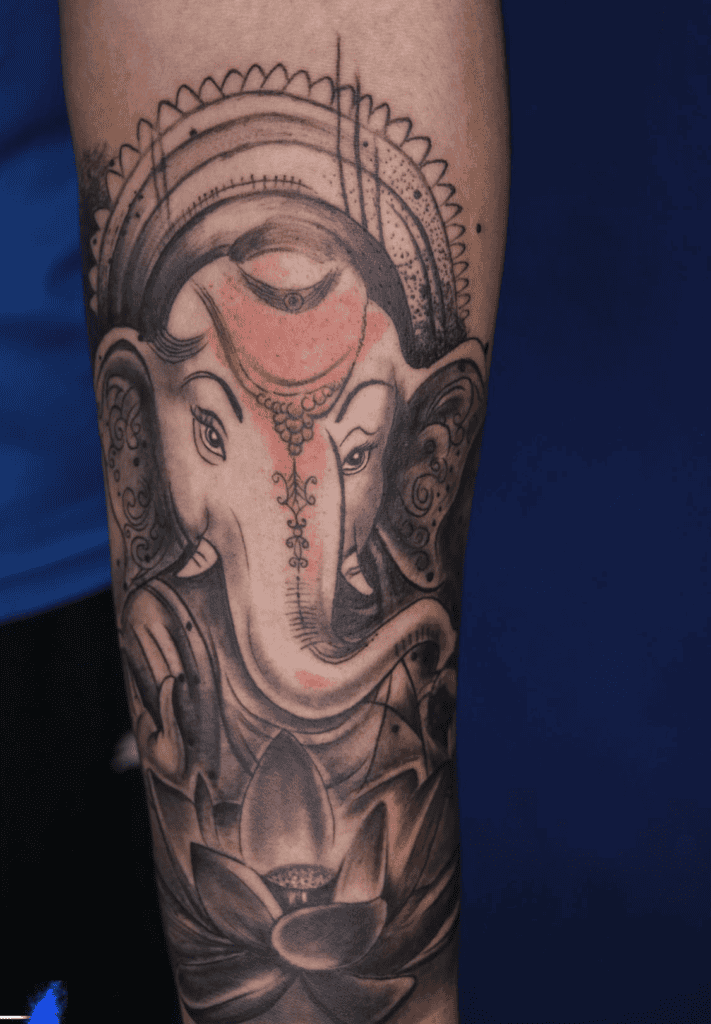
Ganesha is the remover of obstacles, lord of beginnings, patron of wisdom & intellect, guardian of thresholds, and the god of writing. Son of Shiva and Parvati, his name means “Leader of the Ganas” (divine attendants).
Parvati brought Ganesha to life from clay and told him to guard her while she bathed. When Shiva returned and tried to enter, Ganesha blocked him. Angered, Shiva cut off his head, and when Parvati discovered this, she was devastated. To restore him, Shiva replaced his head with that of the first living creature found, being that of an elephant. Symbolically, the elephant head represents wisdom, strength, and memory.
Hanuman Hindu Mythology Tattoo
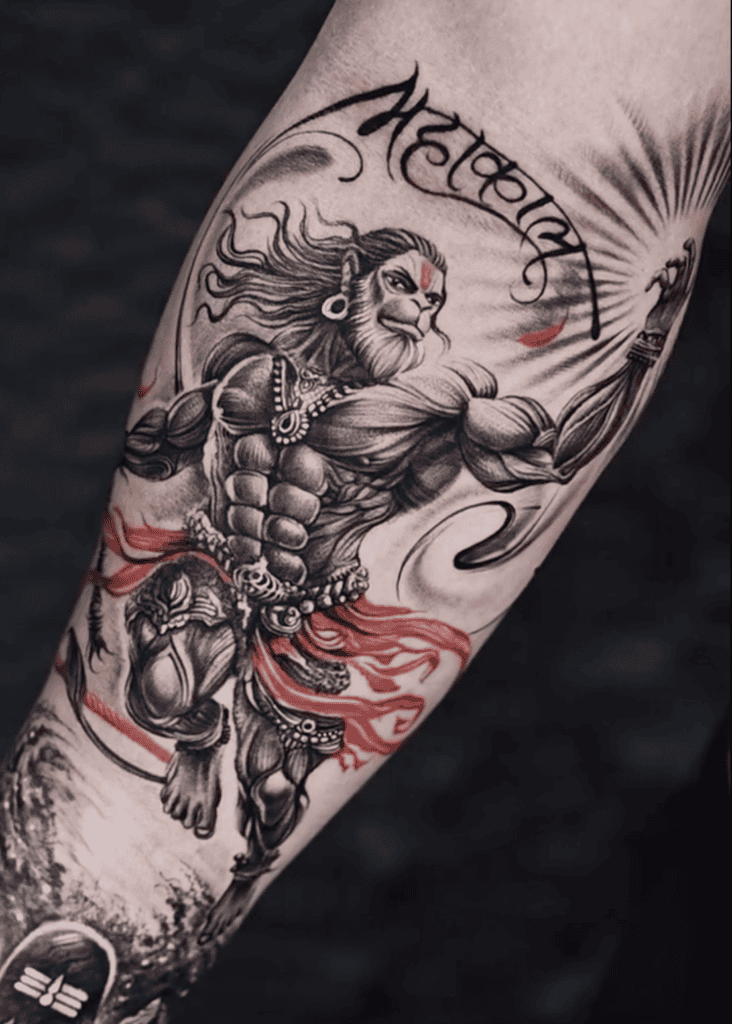
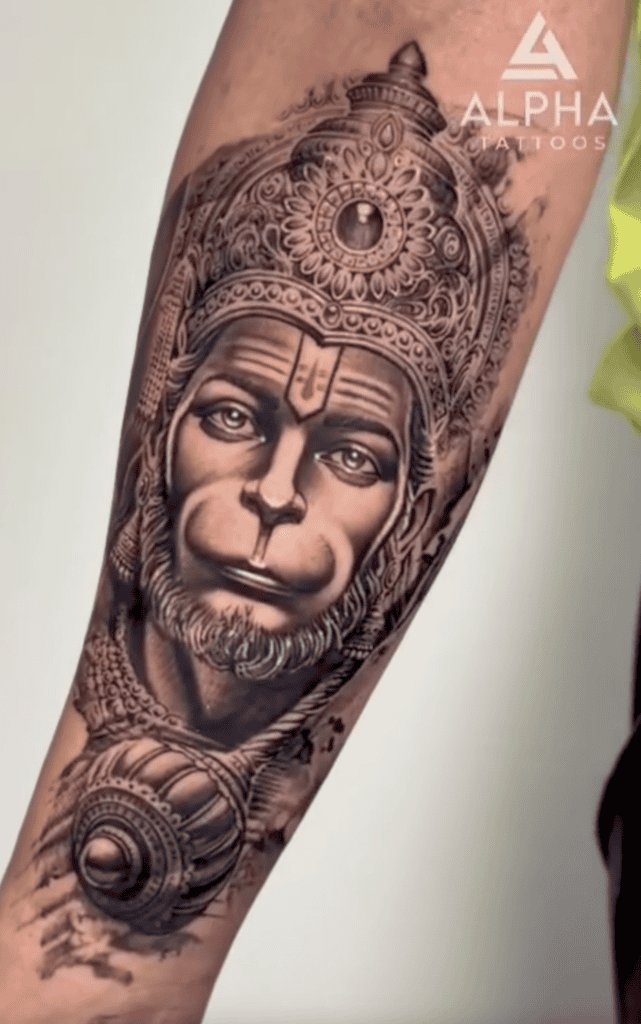
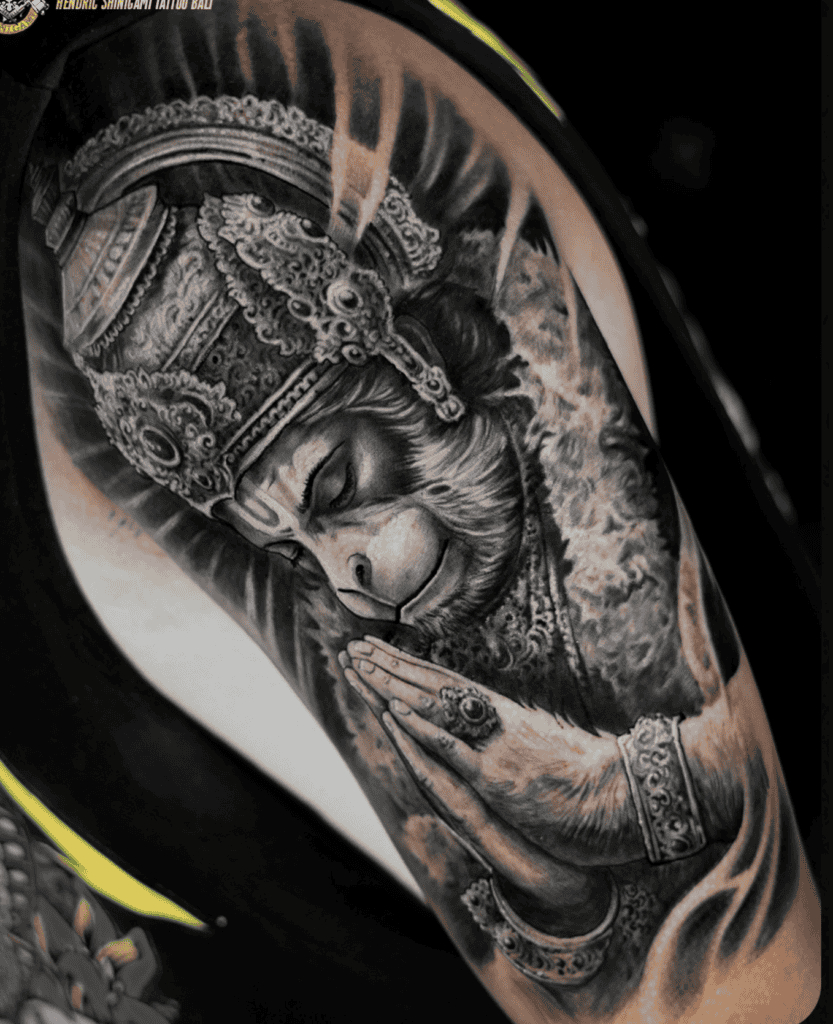
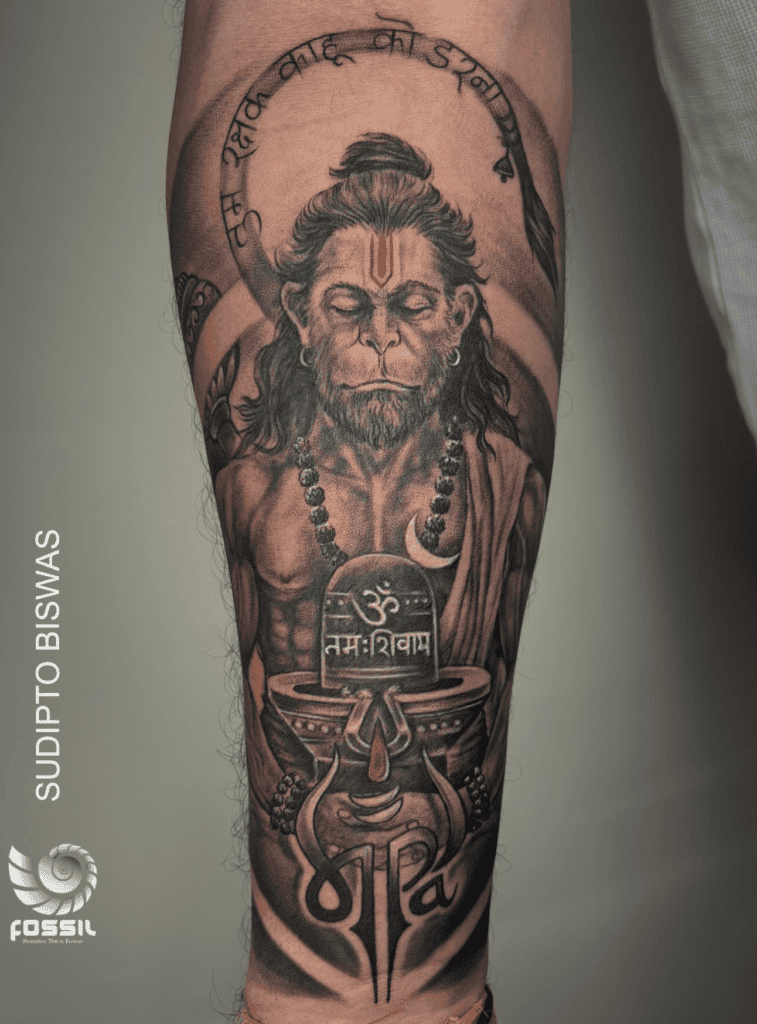
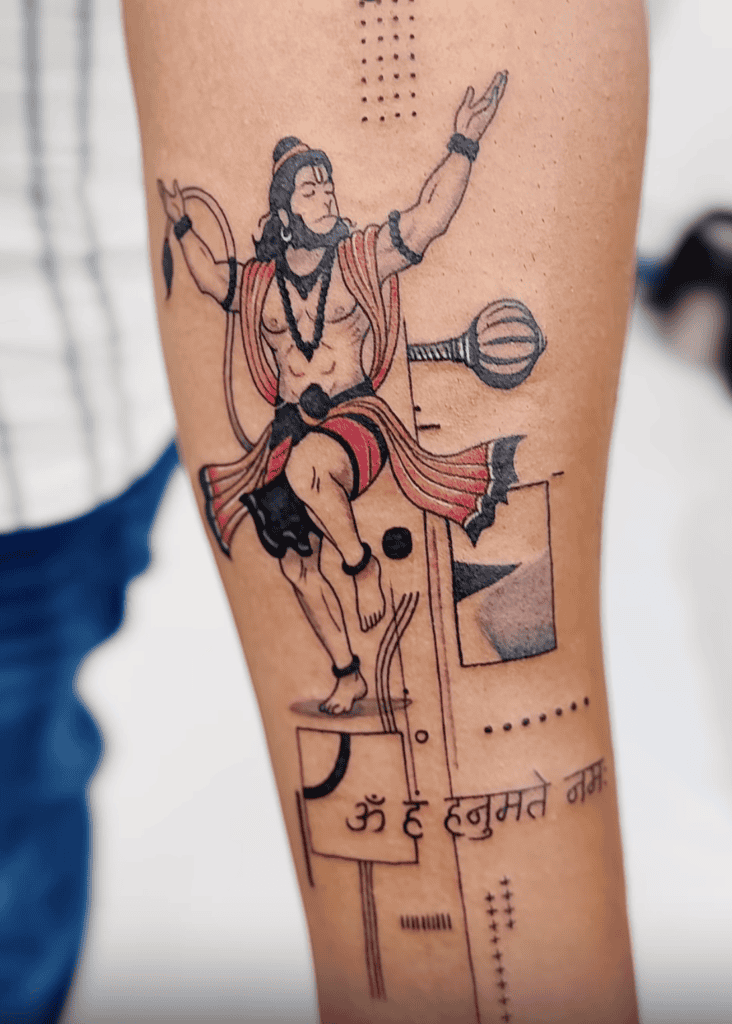
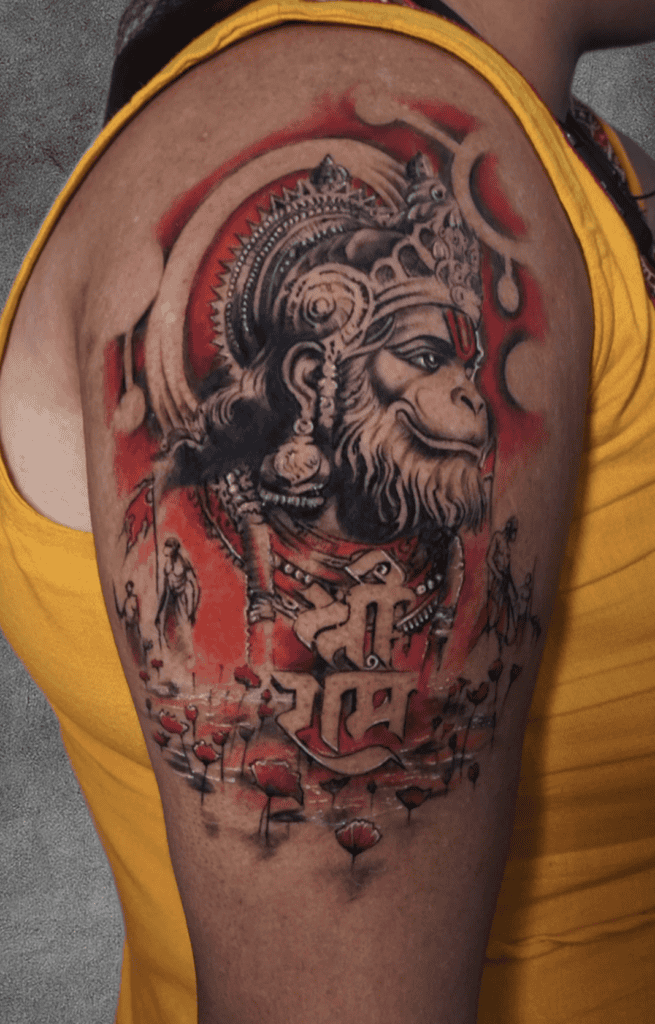
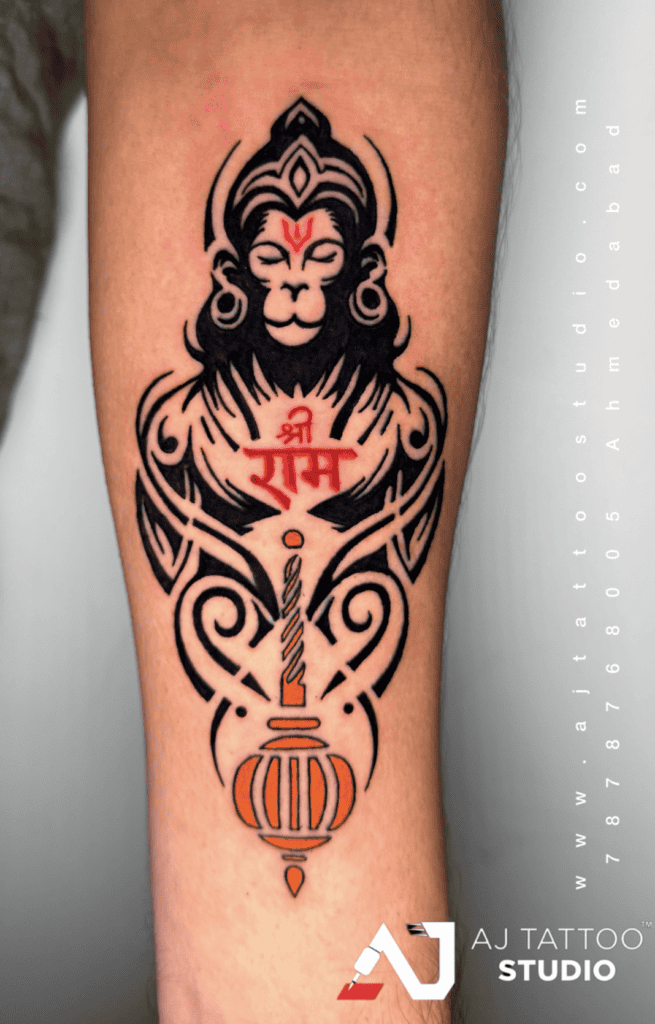
Hanuman is the monkey god and the greatest devotee of Rama, one of the avatars of Vishnu. He represents absolute loyalty, not blind obedience, but conscious devotion rooted in love and righteousness.
Hanuman is considered the son of the wind god Vayu. This connection explains his superhuman speed, ability to fly, immense strength, and boundless energy. The wind symbolises prana (life force), making Hanuman the embodiment of vitality.
When Lakshmana (Rama’s brother) was gravely wounded in battle, Hanuman was sent to fetch a rare healing herb from a distant mountain. Unable to identify the herb, he lifted the entire mountain and carried it back, symbolising his absolute devotion.
Hanuman belongs to the Vanara race (monkey-like beings). Symbolically, the monkey represents restlessness of the mind, but Hanuman shows that even the restless mind can be disciplined through devotion and focus.
Krishna Hindu Mythology Tattoo
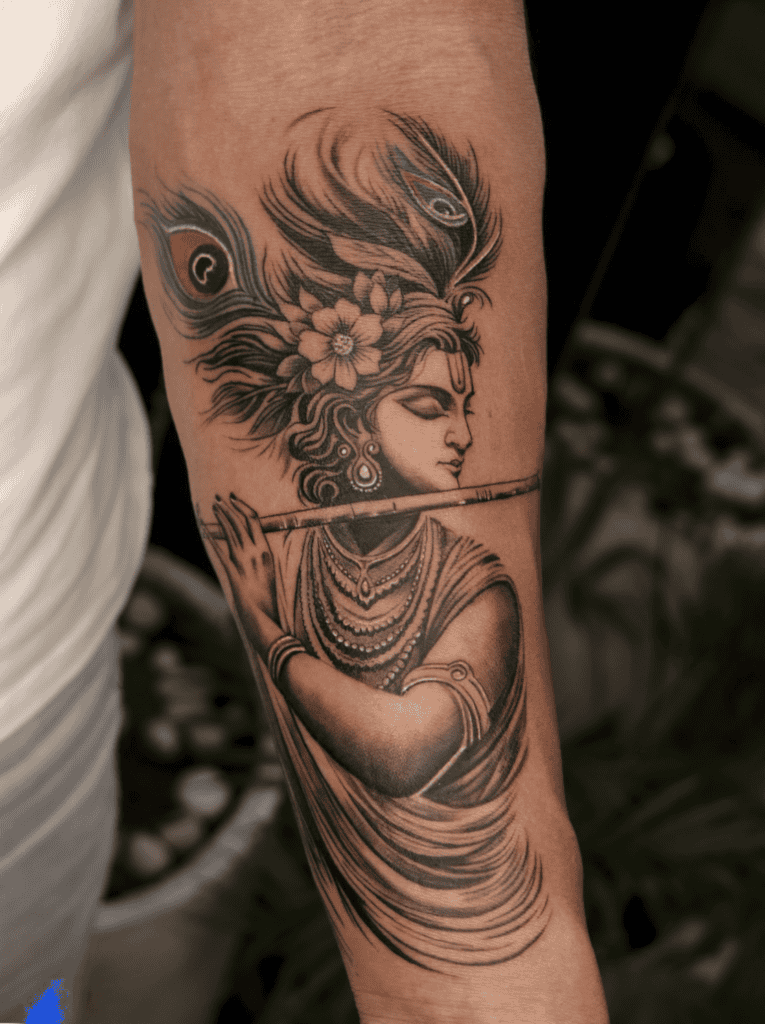
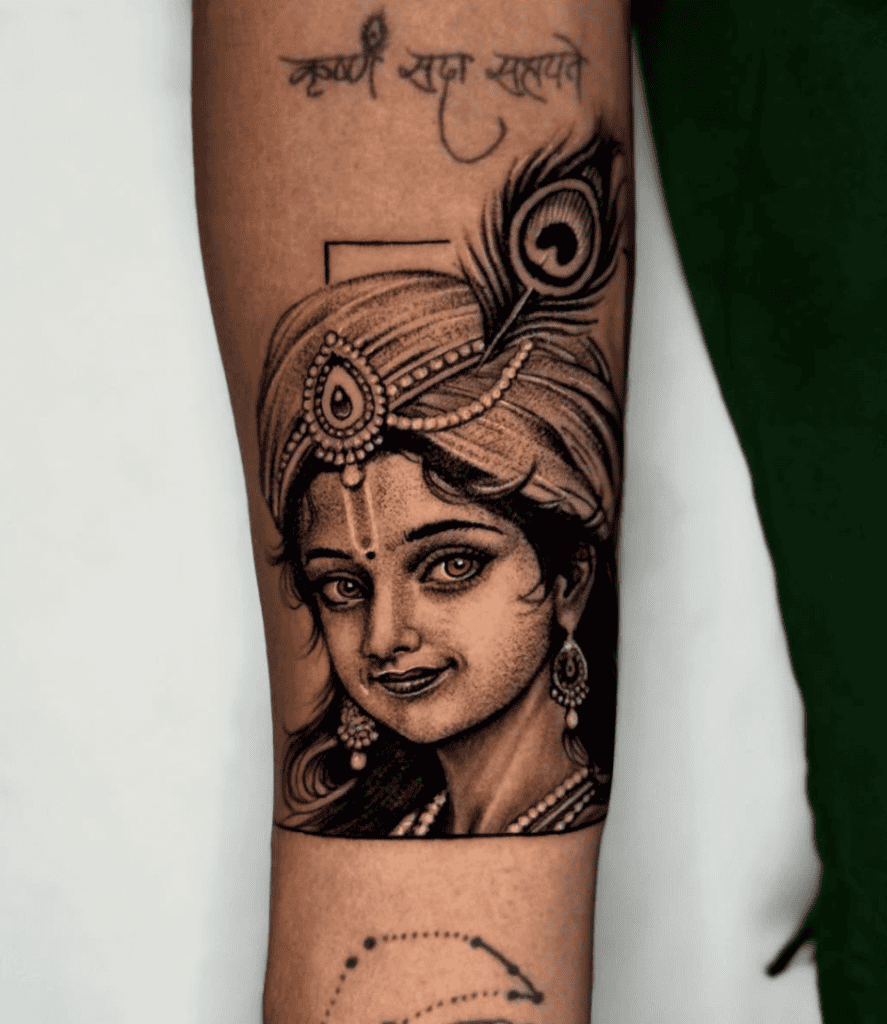
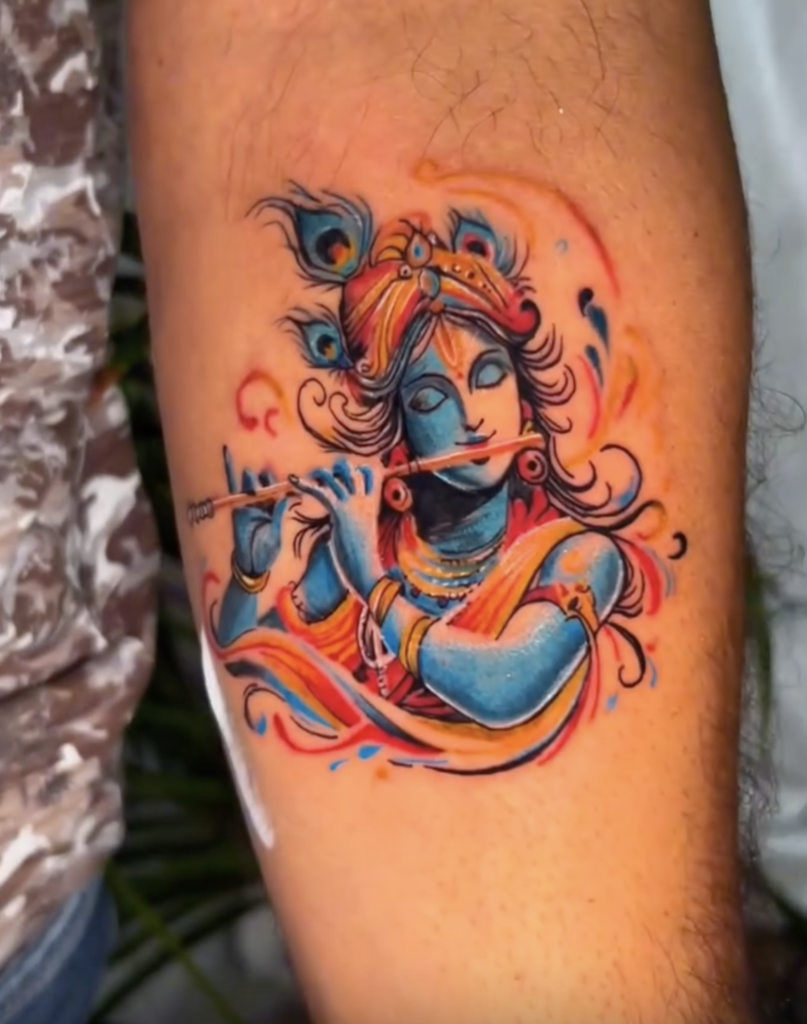
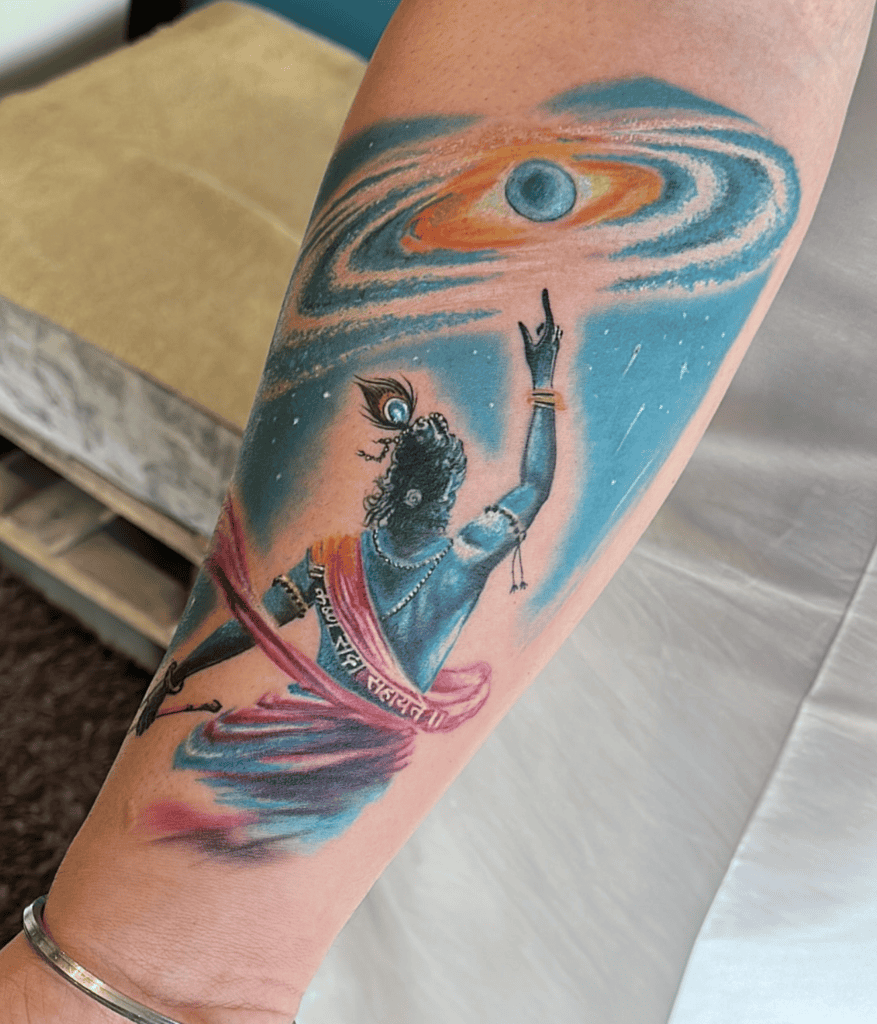
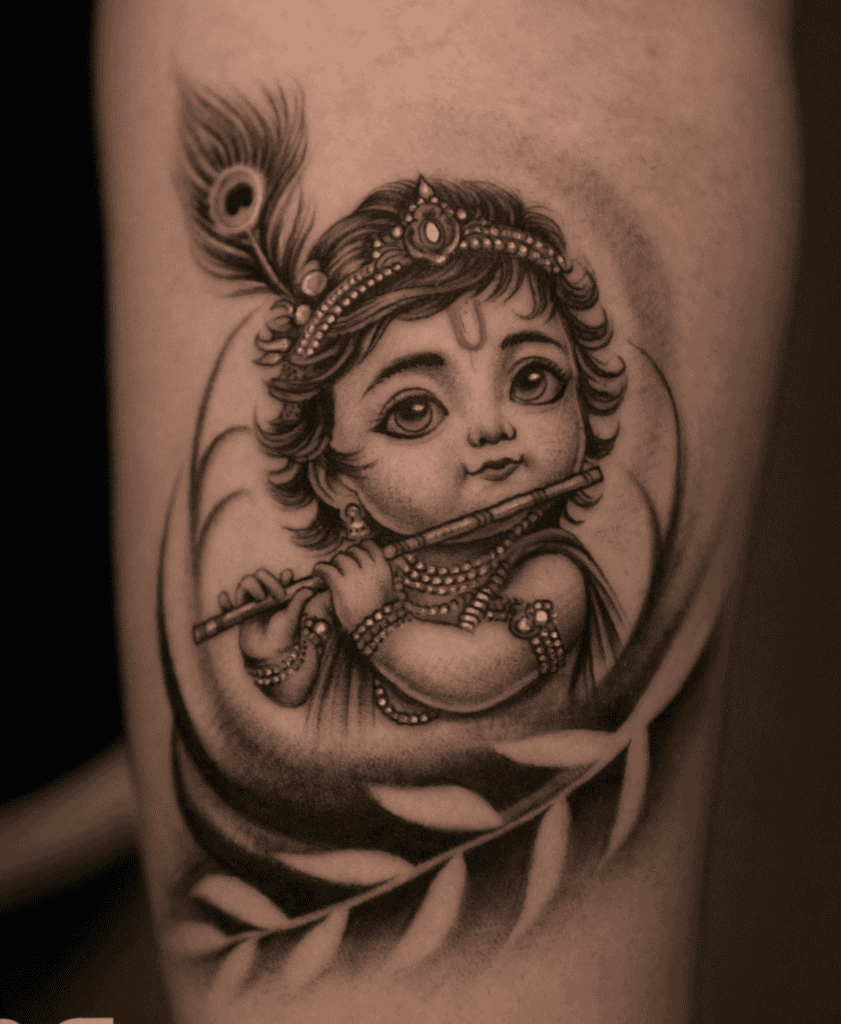
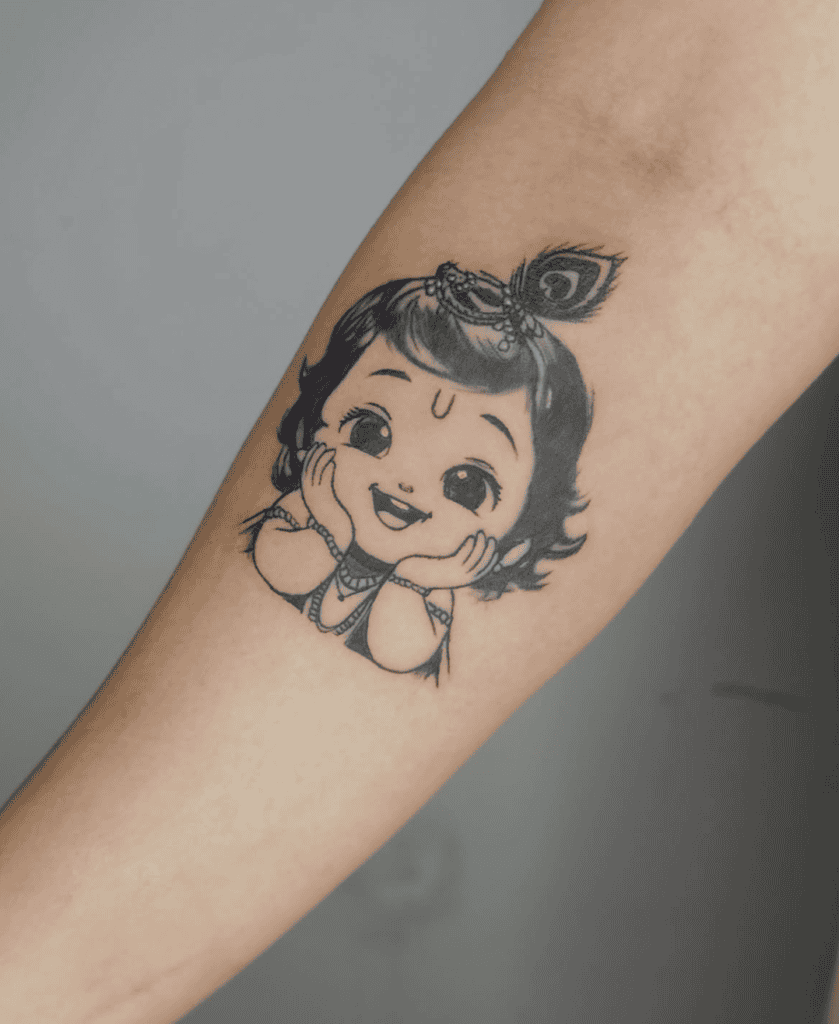
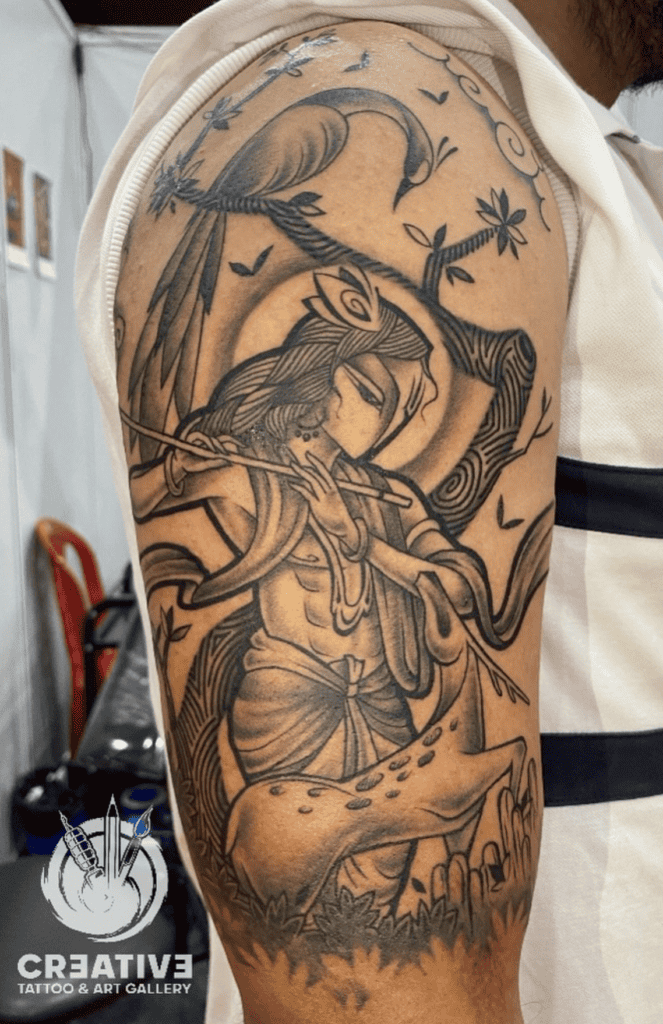
Krishna is an avatar of Vishnu, who combines joy and depth in a way few mythological figures do. Krishna’s early life is full of charm and mischief. As a child, he stole butter from villagers, played the flute beautifully, danced with the Gopis (cowherd maidens), and defeated demons sent to kill him. He was born to defeat the tyrant King Kamsa, who feared a prophecy that Krishna would overthrow him.
In the epic Mahabharata, Krishna serves as the charioteer and guide to the warrior Arjuna. Before the battle, Arjuna hesitates, overwhelmed by the idea of fighting his own relatives. Krishna then delivers the Bhagavad Gita, one of the most influential spiritual texts in the world.
In the Gita, Krishna teaches to perform your duty (Dharma), act without attachment to results, that the soul is eternal, and that true wisdom transcends fear. One of the most powerful moments is when Krishna reveals his Vishvarupa (cosmic form), showing Arjuna the infinite universe within himself.
Krishna’s flute symbolises harmony, divine attraction, and the call of the soul. The flute makes no sound on its own and becomes music only when played. This symbolises surrender to divine guidance.
Rama Hindu Mythology Tattoo


Rama is the prince (and later king) of Ayodhya, the hero of the epic Ramayana, the embodiment of Dharma, and asymbol of honour, loyalty, and sacrifice. He is often called Maryada Purushottama — “The Perfect Man” or “The Ideal Human.”
Rama was born to defeat the demon king Ravana, ruler of Lanka. But before that destiny unfolds, Rama faces immense trials. When he is about to be crowned king, his stepmother demands that he be exiled for 14 years. Without complaint, Rama accepts exile, placing duty above personal desire.
His wife Sita and his loyal brother Lakshmana join him, and during his exile, Ravana kidnaps Sita. Rama forms an alliance with Hanuman and the Vanara army, leading to the epic battle in Lanka, where he defeats Ravana and rescues Sita.
Kartikeya Hindu Mythology Tattoo
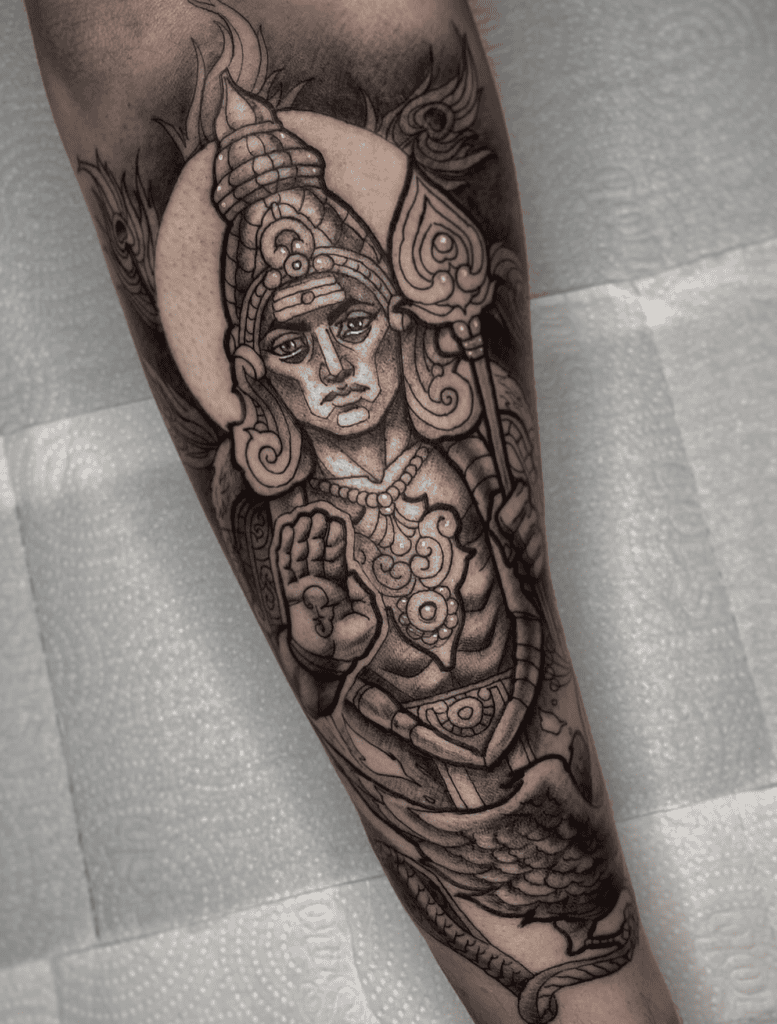
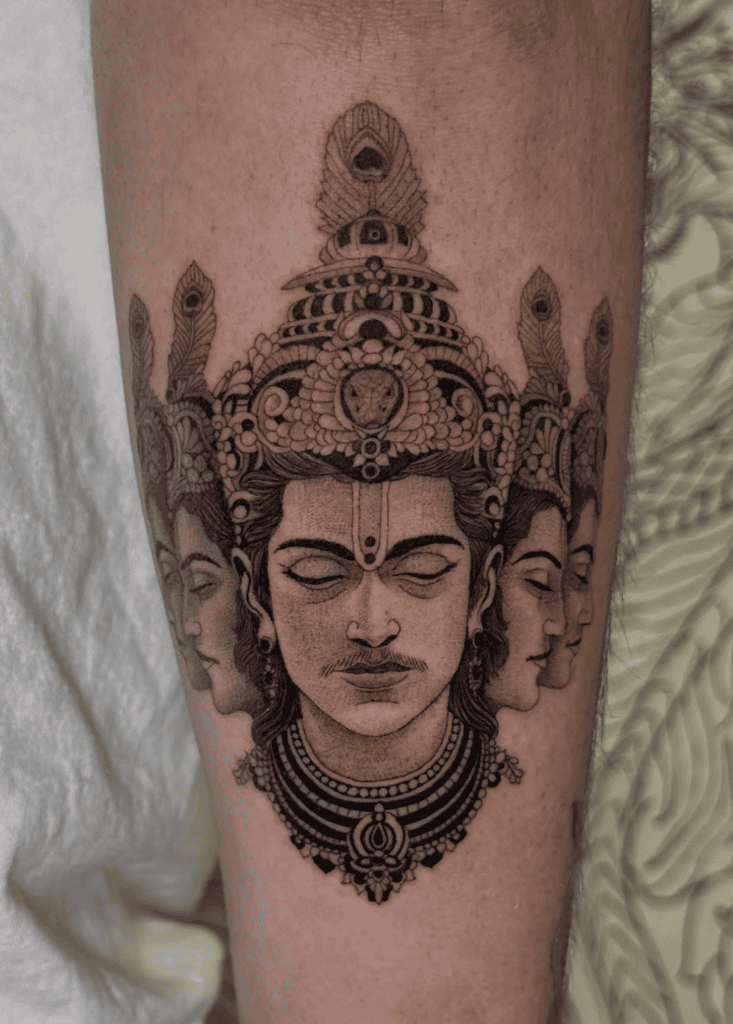
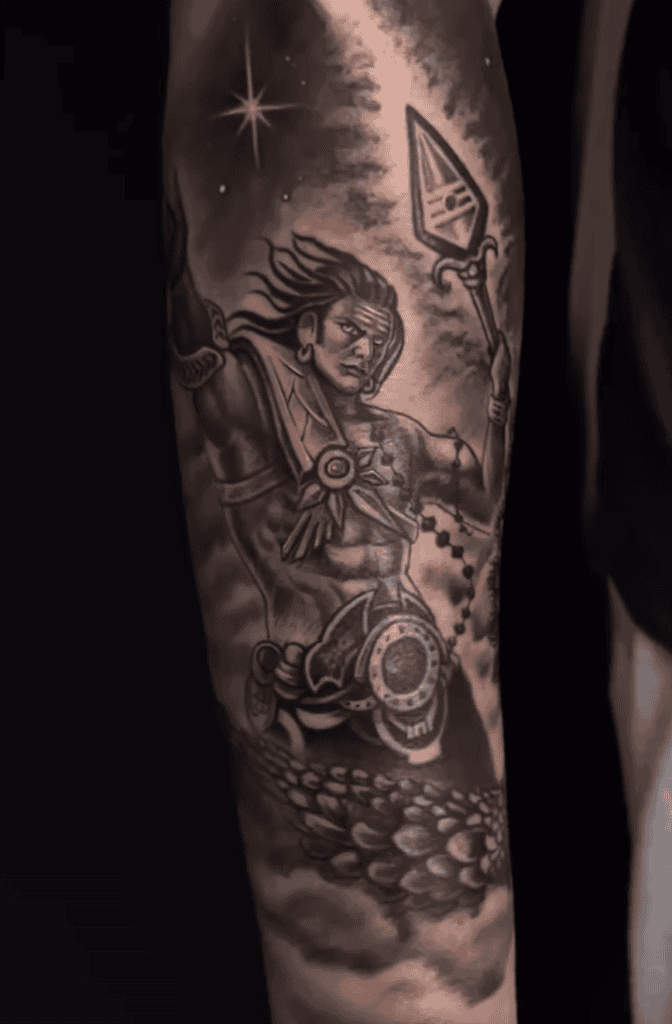
Kartikeya (also known as Skanda or Murugan) is the god of war, commander of the divine armies, symbol of youth and vitality, protector against evil, and embodiment of courage and discipline. He is especially revered in South India, Sri Lanka, and Tamil traditions.
When a powerful demon named Tarakasura could only be defeated by Shiva’s son, the gods needed a divine warrior. From Shiva’s fiery energy, sparks emerged and were carried by the river goddess Ganga, forming Kartikeya. He was raised by the Krittika (a group of celestial mothers), which is why he is sometimes called Kartikeya, “son of the Krittikas.”
Matsya Hindu Mythology Tattoo


Matsya is the fish incarnation of Vishnu. He appears at the end of a cosmic age, when the universe is about to be destroyed by a massive flood. The myth tells of a righteous king named Manu. One day, Manu finds a tiny fish asking for protection. He places it in a jar, but it keeps growing, so he moves it to a pond… then a river… then the ocean.
The fish reveals itself as Vishnu, and Matsya warns Manu that a great flood will soon destroy the world. He instructs Manu to build a boat and gather seeds of life, sages, and sacred knowledge. When the flood comes, Matsya pulls the boat to safety using a serpent as a rope, and after the waters recede, creation begins again.
Varaha Hindu Mythology Tattoo
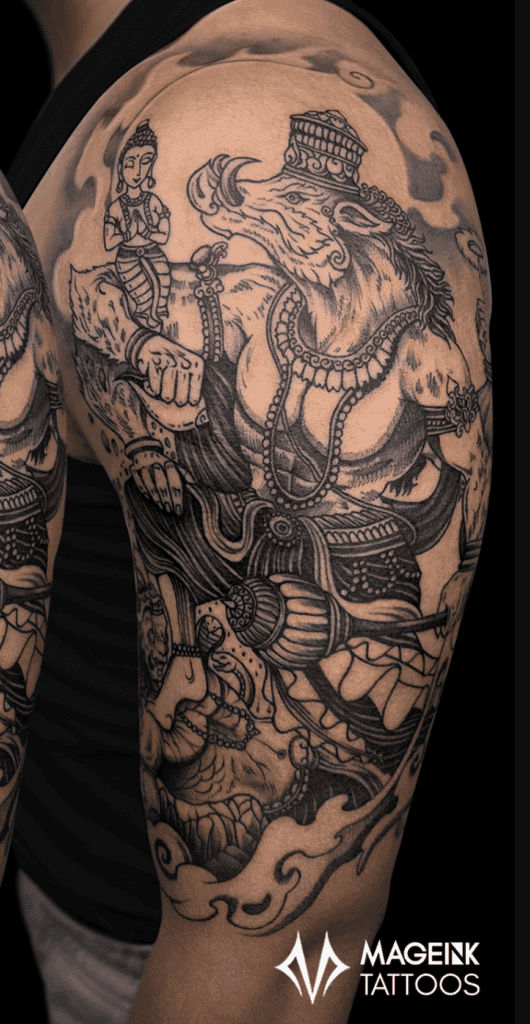
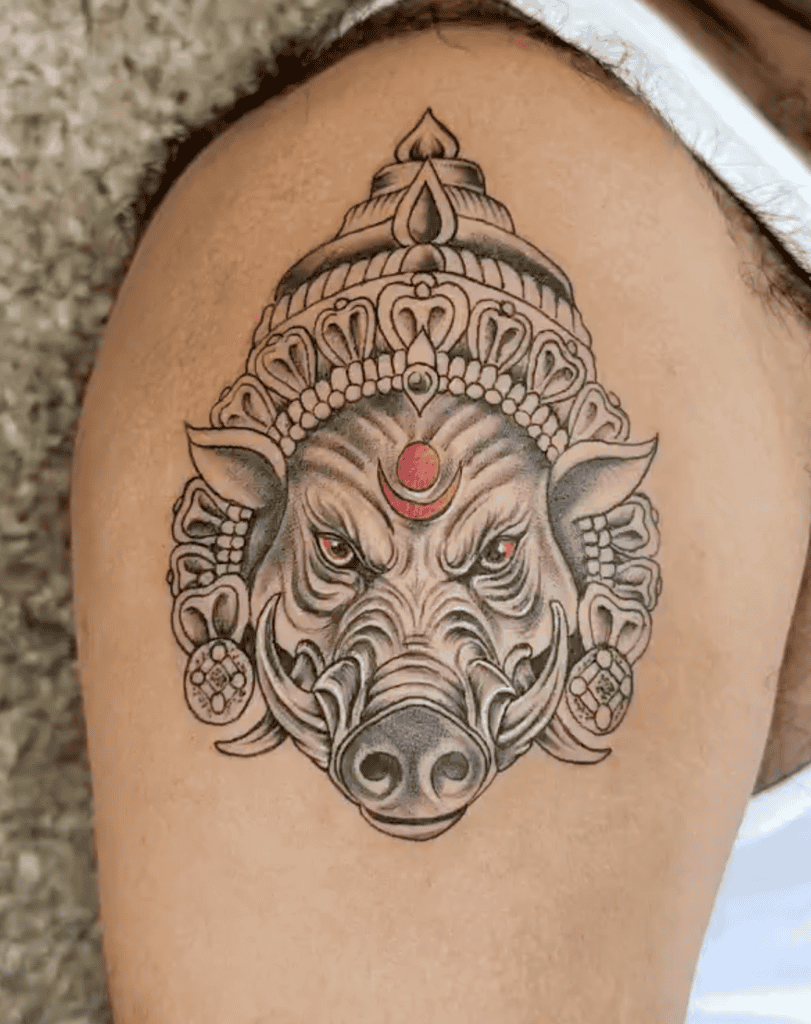
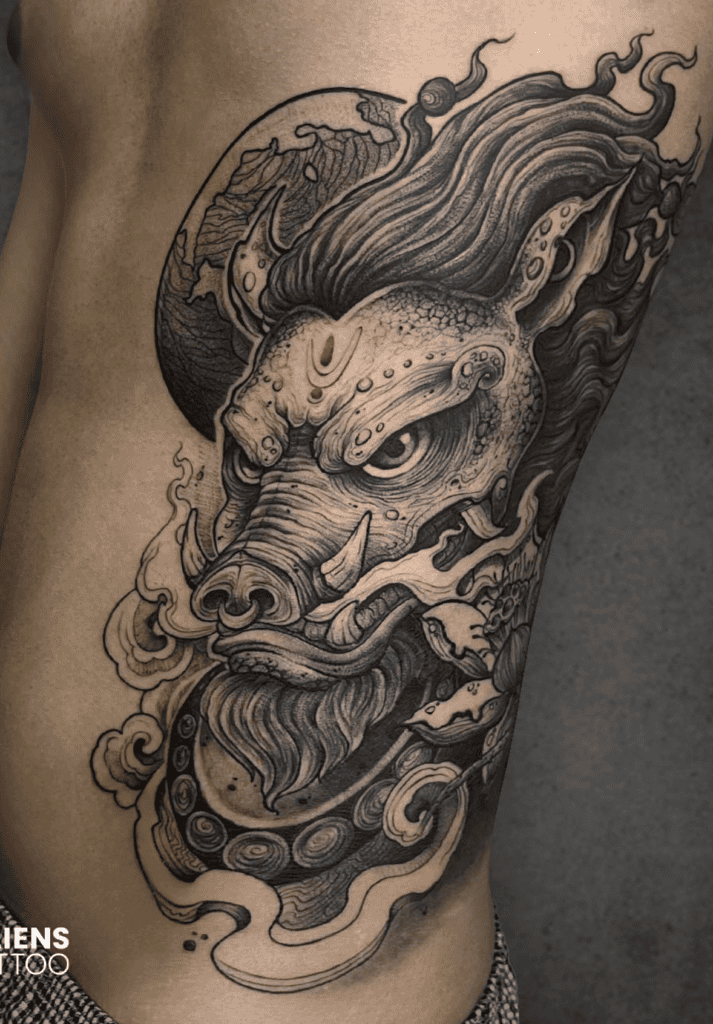
Varaha is the boar incarnation of Vishnu. He appears when the Earth (personified as the goddess Bhudevi) is dragged into the cosmic ocean by the demon Hiranyaksha. Without the Earth, life cannot continue, so Vishnu incarnates as a mighty boar to restore balance.
The myth tells that Hiranyaksha, an Asura (anti-god), overpowered the gods and submerged the Earth into the depths of the cosmic ocean. To rescue her, Vishnu took the form of a gigantic boar, dove into the primal waters, fought the demon in an epic battle, and lifted the Earth on his tusks. After defeating Hiranyaksha, Varaha raised the Earth back to its rightful place in the cosmos.
At first glance, a boar may seem unusual for a divine form, but symbolically, it makes sense. Boars dig into the earth, are incredibly strong, and represent primal force and resilience. Varaha represents raw power guided by divine purpose.
Narasimha Hindu Mythology Tattoo
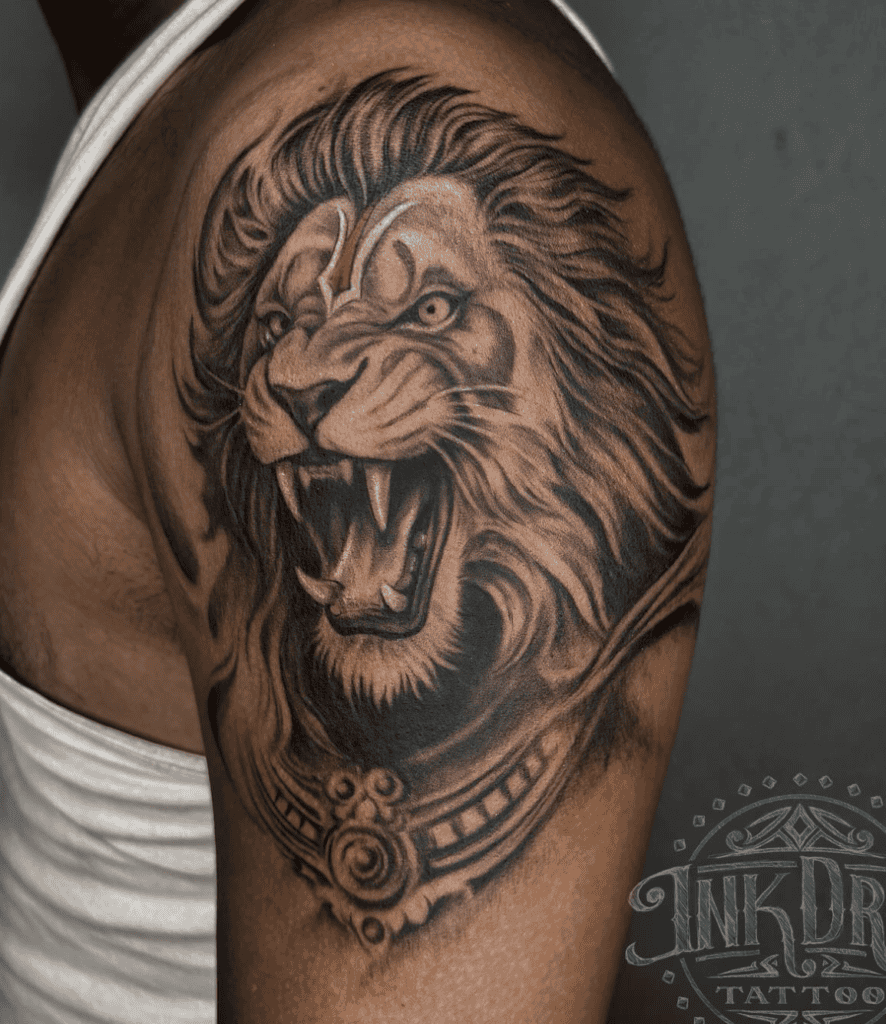
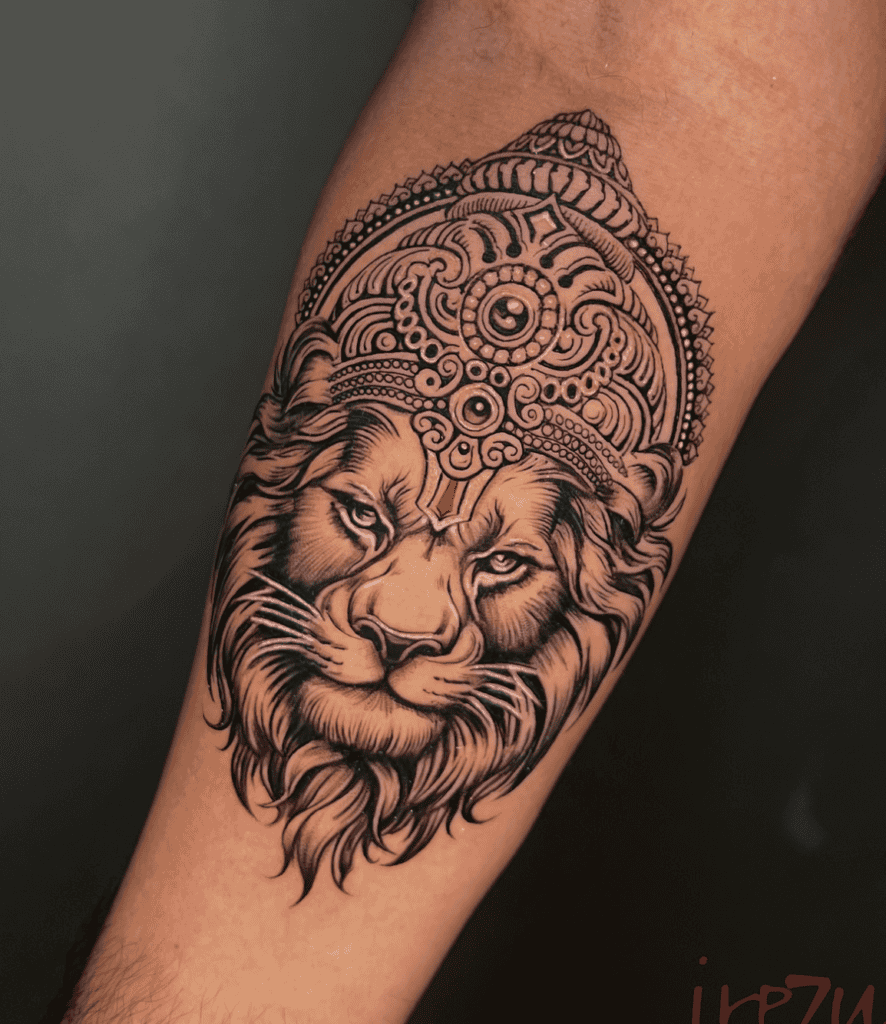
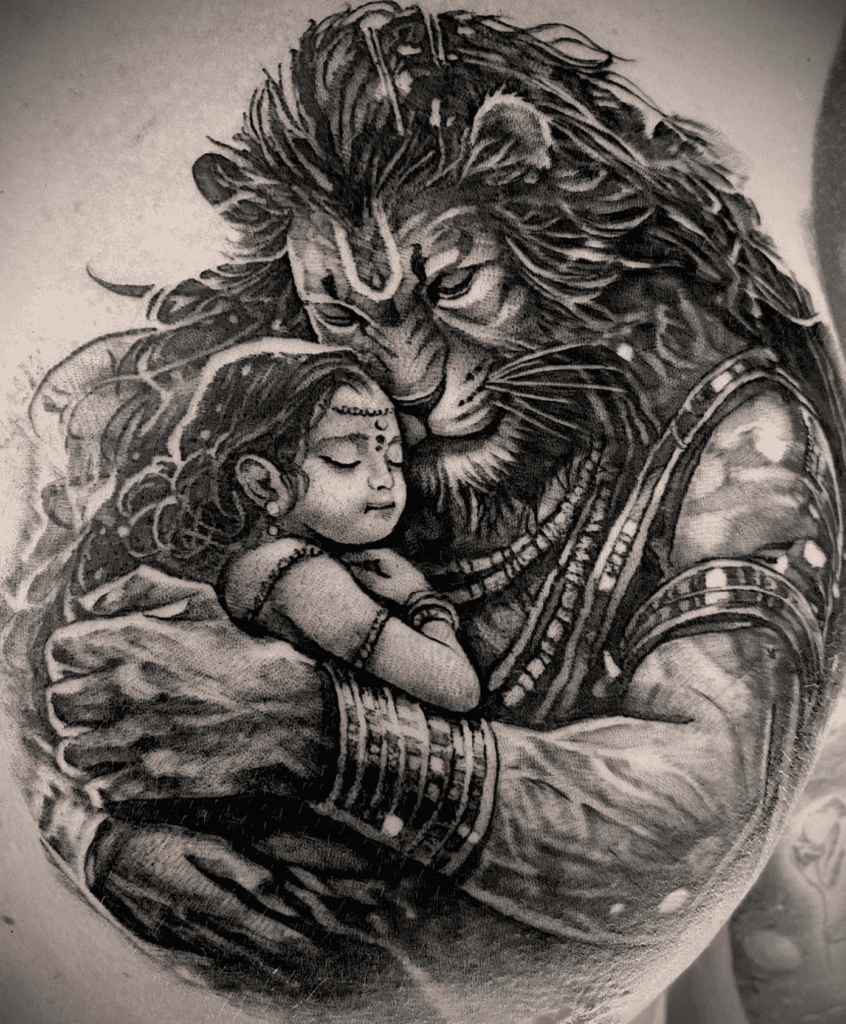
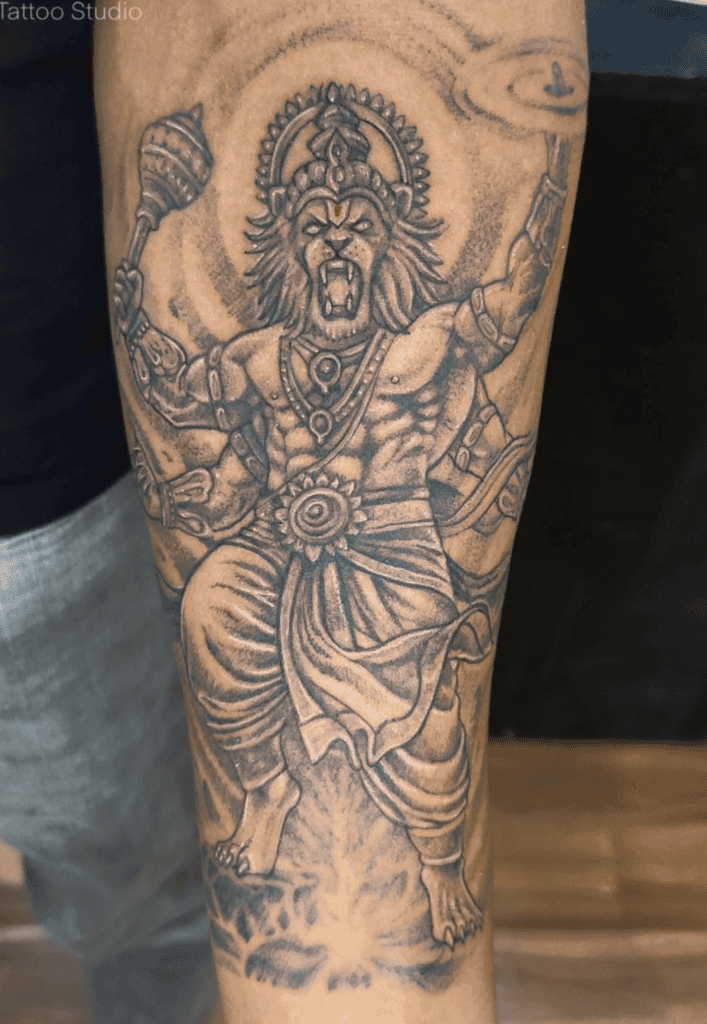
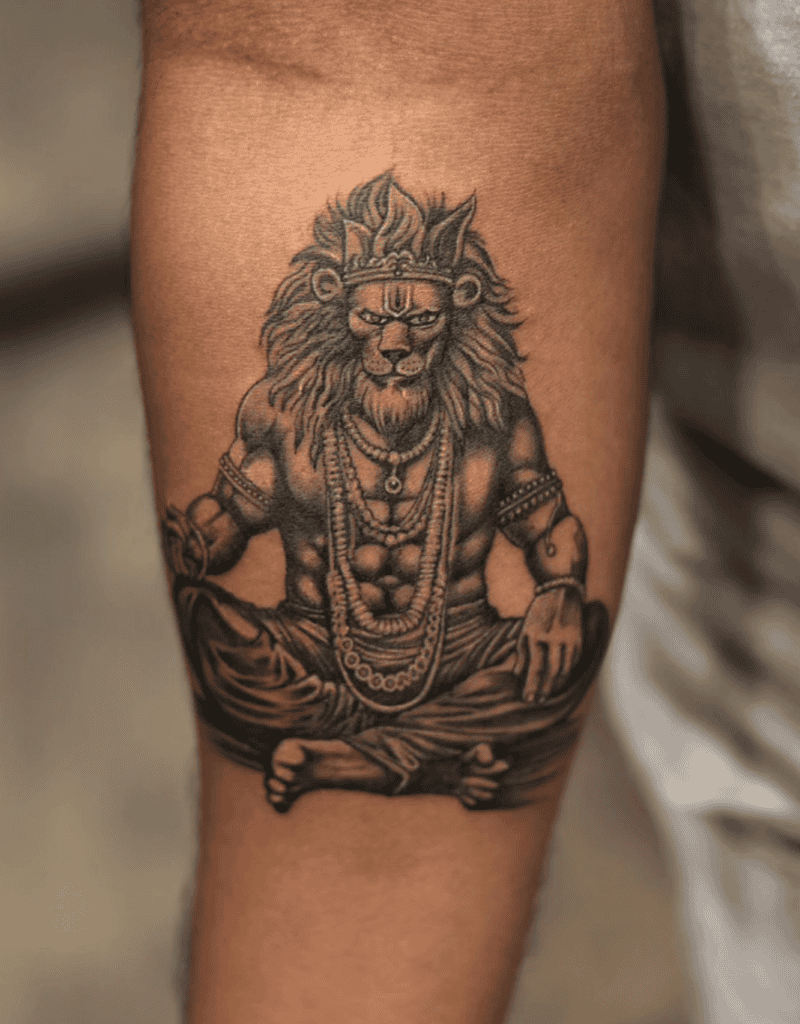
Narasimha is the man-lion incarnation of Vishnu. He appears to defeat the tyrant demon king Hiranyakashipu, who believed himself to be invincible.
Hiranyakashipu gained a powerful boon that he could not be killed by man or beast, inside or outside, during day or night, on earth or in the sky, or by any weapon. Convinced he was immortal, he declared himself superior to the gods. However, his own son, Prahlada, remained a devoted follower of Vishnu. Furious at his son’s devotion, the demon king tried repeatedly to kill him, but failed.
To bypass the boon, Vishnu incarnated as Narasimha, half man, half lion. At twilight (neither day nor night), on a palace threshold (neither inside nor outside), placing the demon on his lap (neither earth nor sky), and using claws (not a weapon), Narasimha tore Hiranyakashipu apart.
Parashurama Hindu Mythology Tattoo


Parashurama is the sixth avatar of Vishnu, whose name literally means “Rama with the axe.” Unlike other avatars, Parashurama is fully human, but empowered by divine purpose.
The central story of Parashurama revolves around corrupt warrior kings (Kshatriyas). A powerful king named Kartavirya Arjuna wrongfully killed Parashurama’s father. In response, Parashurama took up his axe and began a campaign against tyrannical rulers. According to legend, he defeated oppressive Kshatriyas 21 times, restoring balance between social classes.
Parashurama appears in later stories as well. He encounters Rama, testing his strength and is said to have trained great warriors like Bhishma and Karna in the Mahabharata. A famous regional legend says Parashurama threw his axe into the sea, and the waters retreated, forming the land of Kerala in South India.
Buddha Hindu Mythology Tattoo
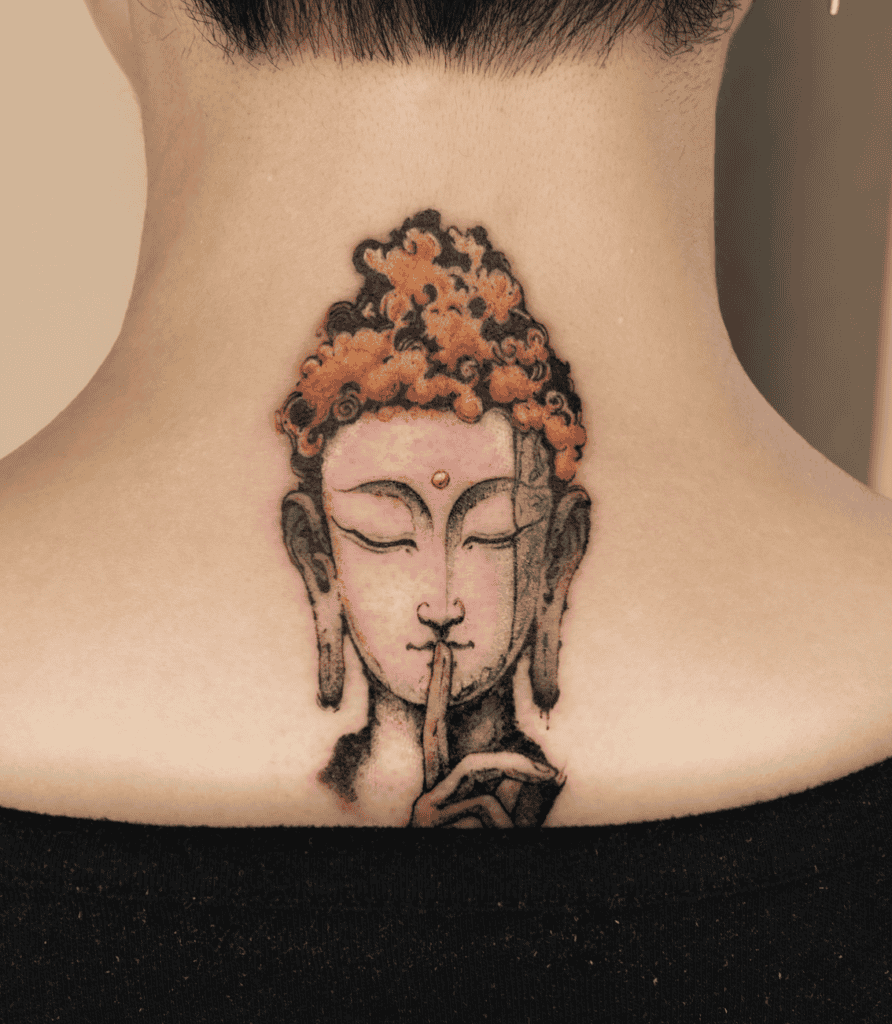
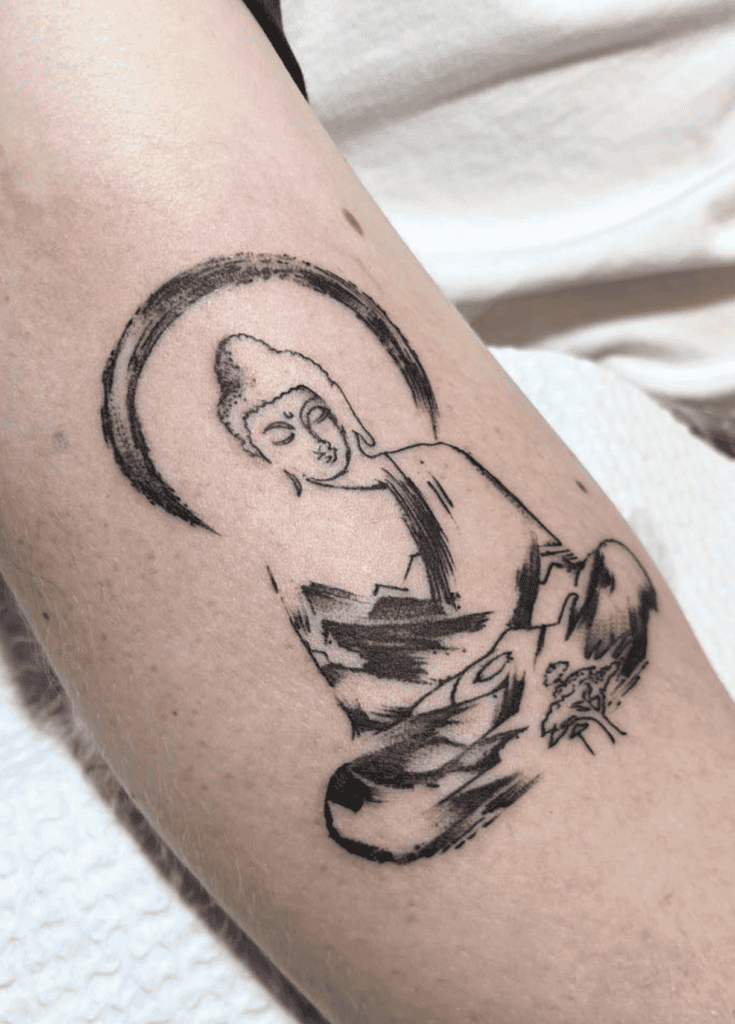
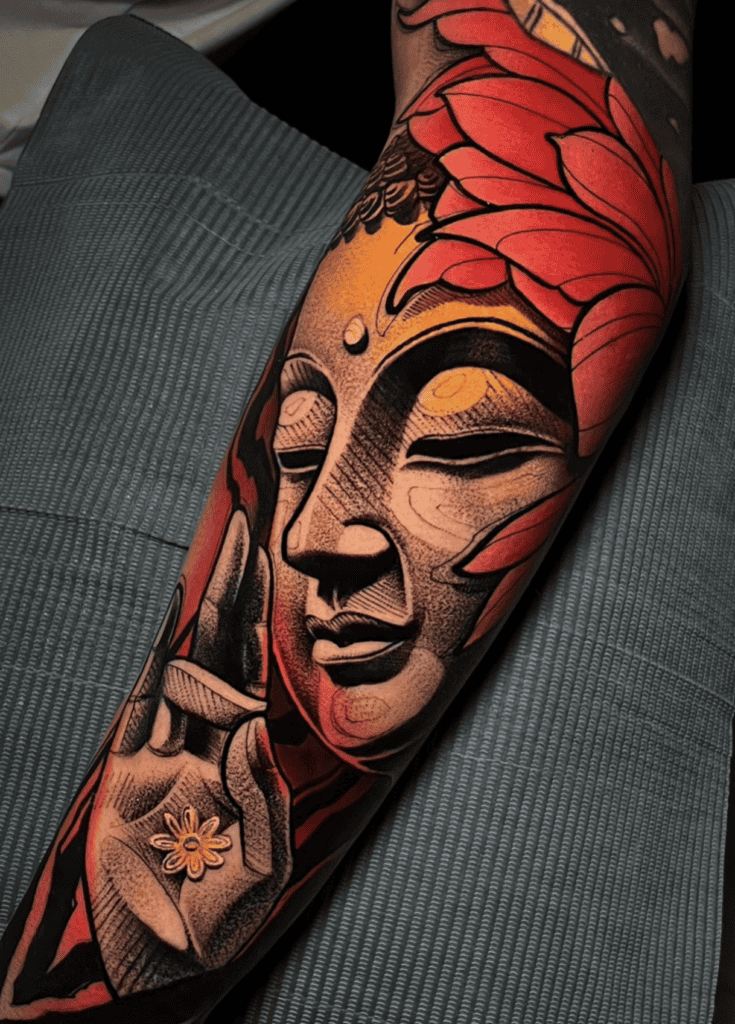
Among the ten traditional avatars of Vishnu, some Hindu traditions include Buddha as an incarnation. In certain Puranic texts, Vishnu incarnates as Buddha to restore balance, redirect spiritual practice, prevent misuse of sacred rituals, and guide beings toward compassion.
Some Hindu texts portray this avatar as acompassionate teacher promoting non-violence, a reformer discouraging animal sacrifice, and in some older interpretations, a strategic incarnation meant to mislead demons away from Vedic power.
Kalki Hindu Mythology Tattoo
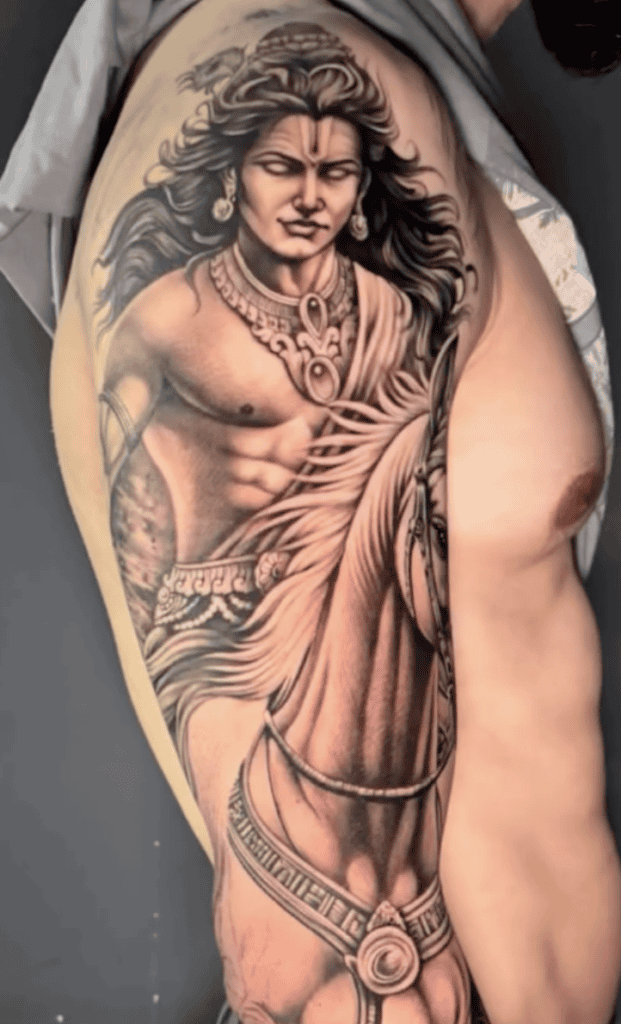
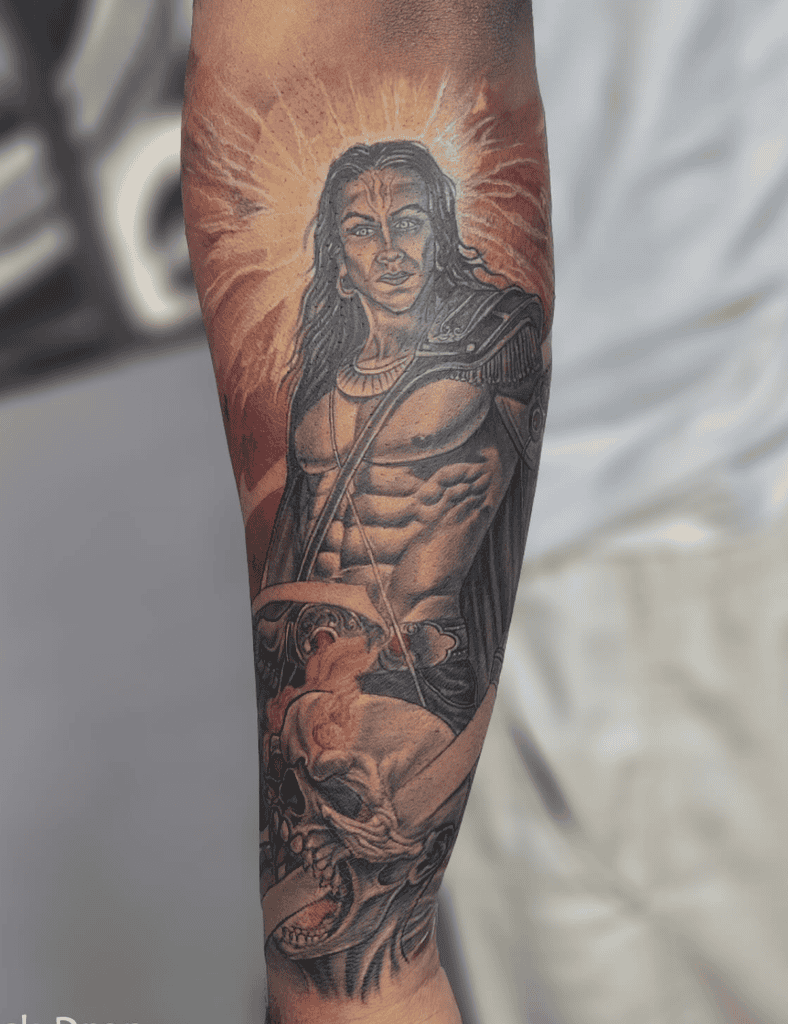
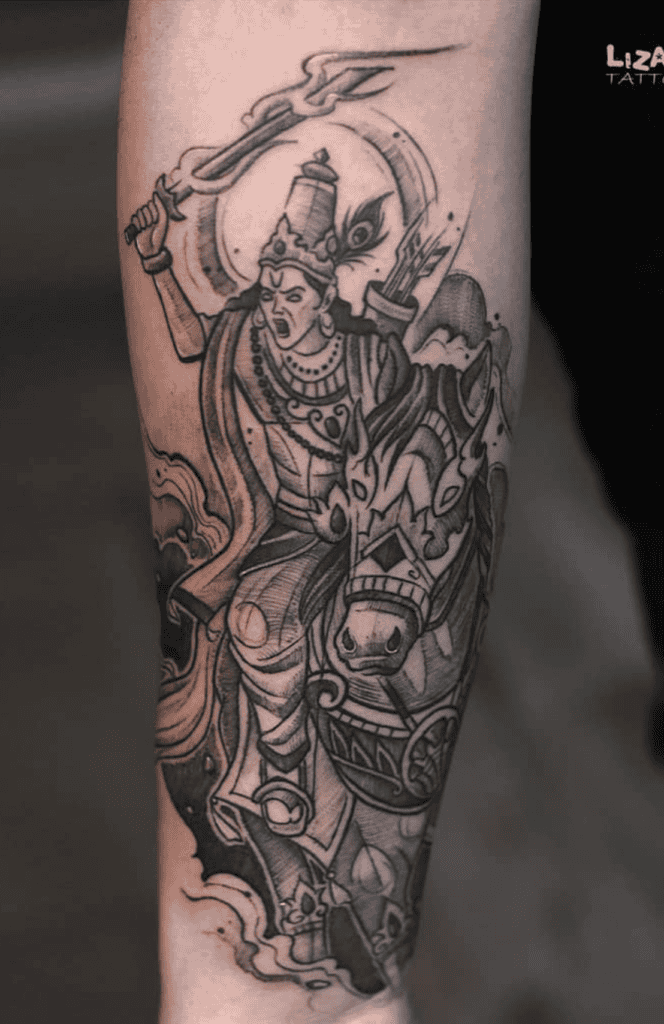
Kalki is the future and final avatar of Vishnu, destined to appear at the end of the current age. Hindu cosmology divides time into four ages (Yugas). Satya Yuga is the age of truth, Treta Yuga is the age of virtue, Dvapara Yuga is the age of decline, and Kali Yuga is the current age of darkness and moral decay.
Kalki will appear at the very end of this era, riding a white horse, destroying corruption and evil, ending Kali Yuga, restoring righteousness, and beginning a new Satya Yuga. Unlike earlier avatars who corrected imbalance within a cycle, Kalki resets the entire cycle.
Lakshmana Hindu Mythology Tattoo

Lakshmana is the younger brother of Rama, son of King Dasharatha, a prince of Ayodhya, a fierce warrior, and a symbol of loyalty and sacrifice. He voluntarily accompanied Rama during his 14-year exile without hesitation.
When Rama was banished, Lakshmana insisted on joining him and Sita. During exile, Lakshmana built shelters, protected Rama and Sita, and remained constantly vigilant.
One of the most famous moments involving Lakshmana is the drawing of the Lakshman Rekha (a protective boundary). Before leaving to help Rama, Lakshmana drew a magical line around the hut, instructing Sita not to cross it. When Sita stepped beyond the boundary (deceived by Ravana), she was abducted.
During the war against Ravana, Lakshmana defeated Ravana’s mighty son Indrajit, fought bravely on the battlefield, was severely wounded and revived by the healing herb brought by Hanuman.
Ravana Hindu Mythology Tattoo
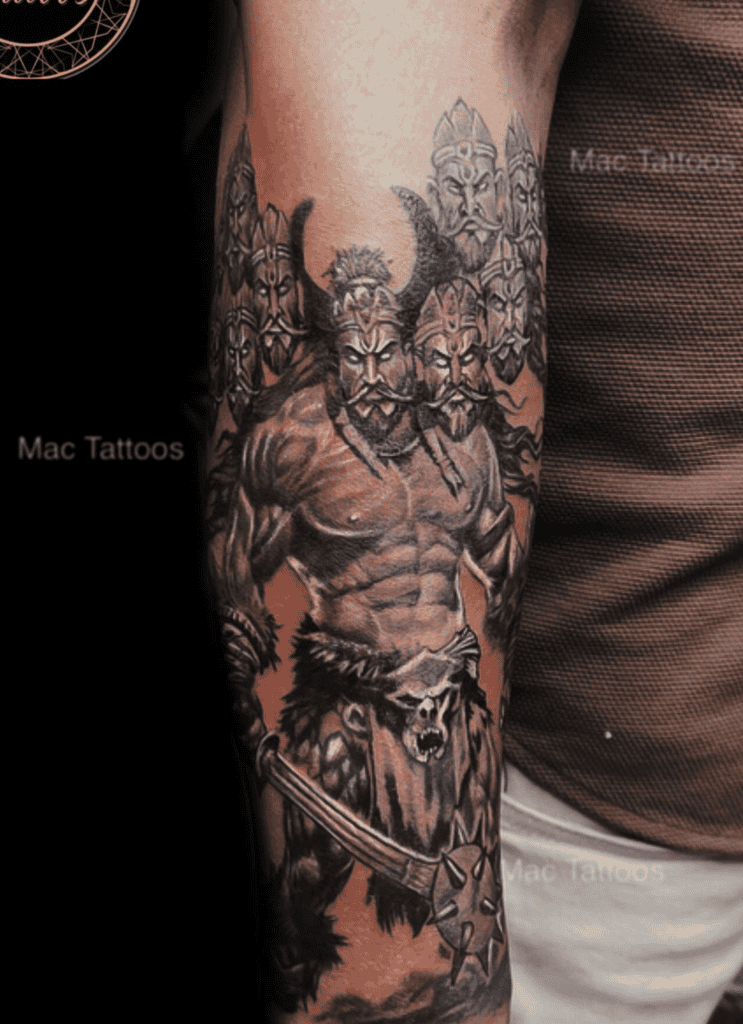
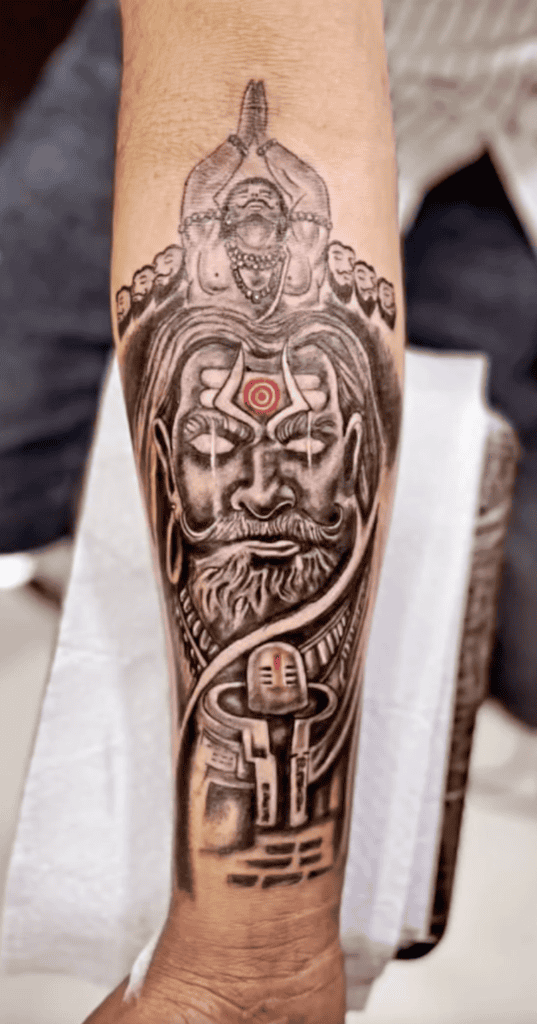
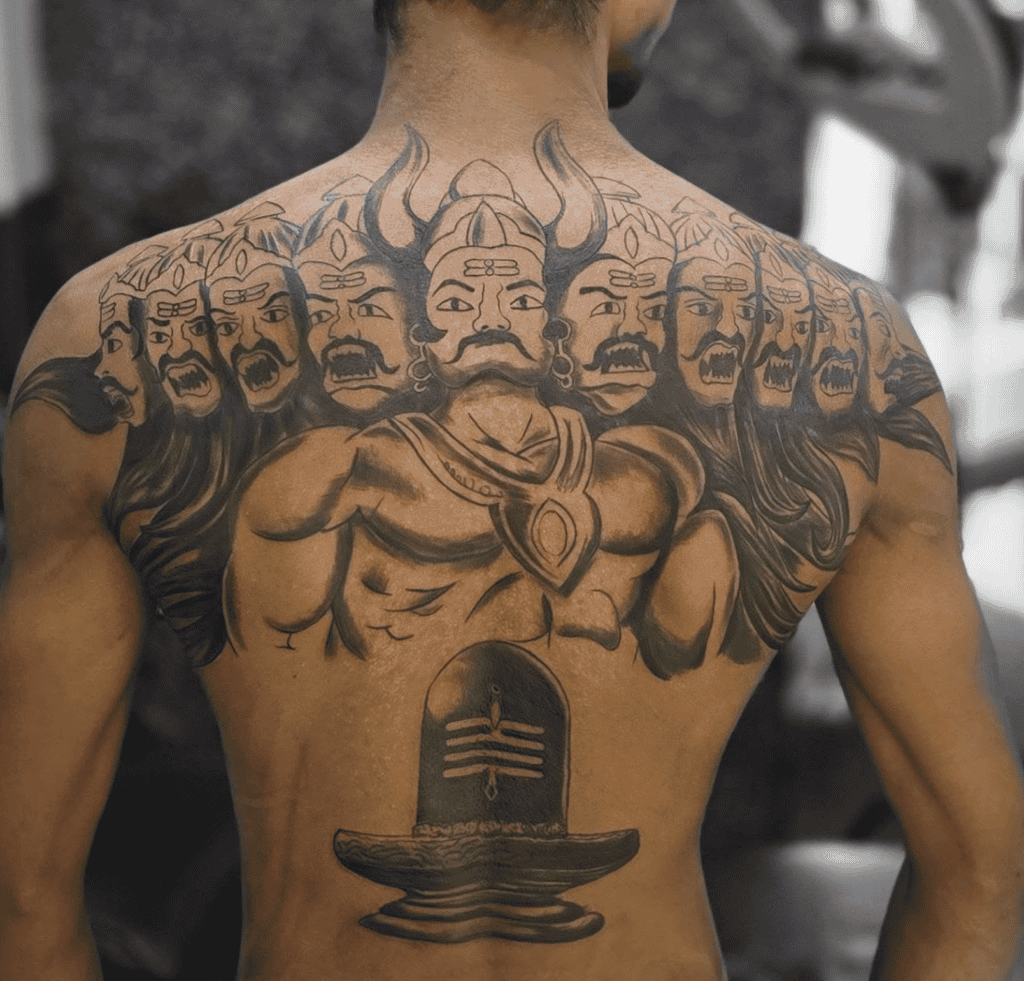
Ravana is the king of Lanka, a powerful Rakshasa, a master scholar, a devotee of Shiva, and the primary antagonist of Rama. He is usually depicted with ten heads and twenty arms, symbolising immense knowledge and power.
Before becoming Rama’s enemy, Ravana was a brilliant Brahmin, a musician who played the veena, a devotee of Shiva, and aruler of a prosperous golden kingdom. Some traditions even credit him with authoring ancient texts on astrology and medicine.
The turning point of his story is the abduction of Sita, wife of Rama. Driven by revenge and desire, Ravana kidnaps her and takes her to Lanka. Importantly, in many versions of the story, Ravana never touches Sita without consent, showing he follows certain moral codes despite his wrongdoing.
Ravana’s refusal to return Sita leads to the great war in Lanka. Despite warnings from his own brother Vibhishana, Ravana refuses to surrender his pride and is ultimately defeated in battle.
Arjuna Hindu Mythology Tattoo
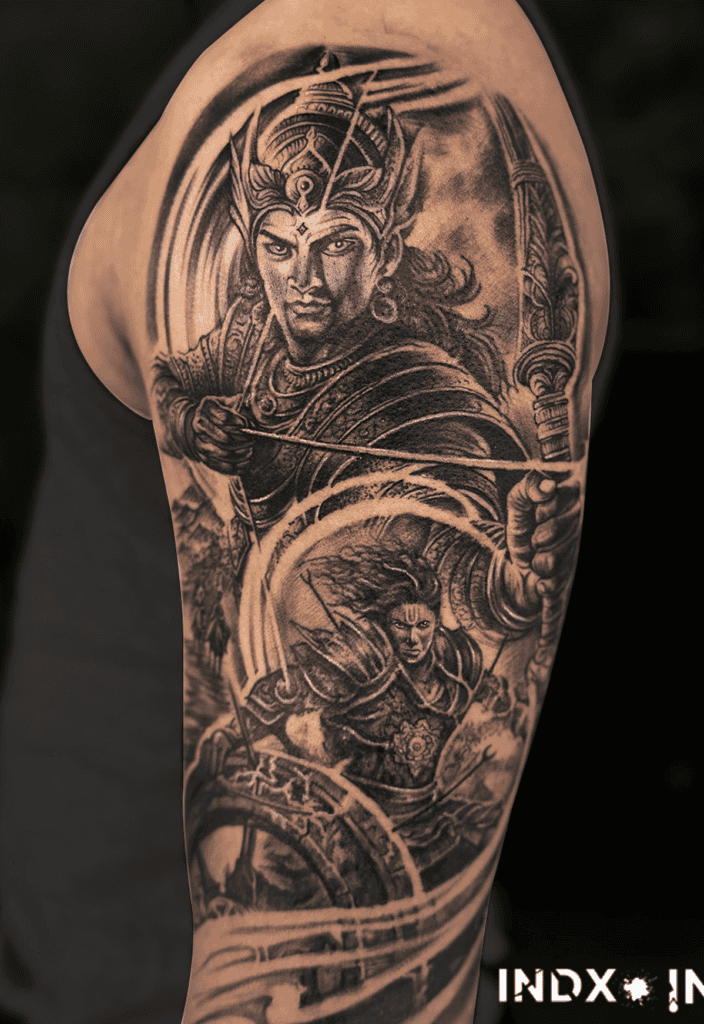
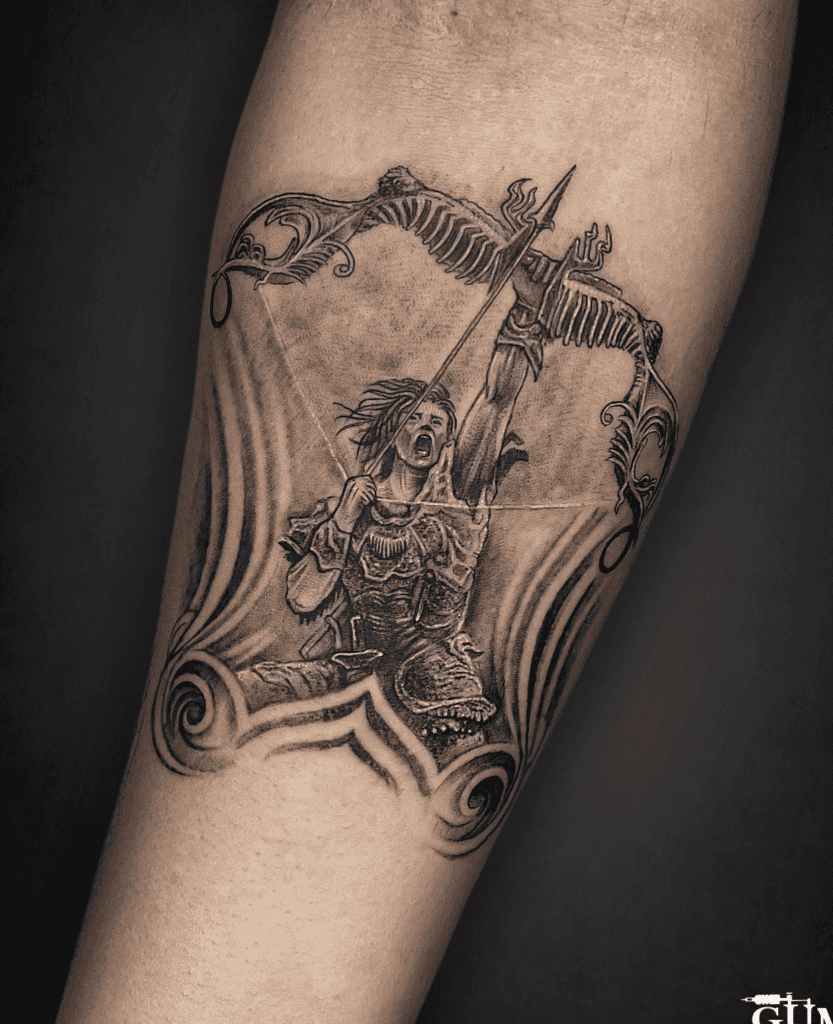
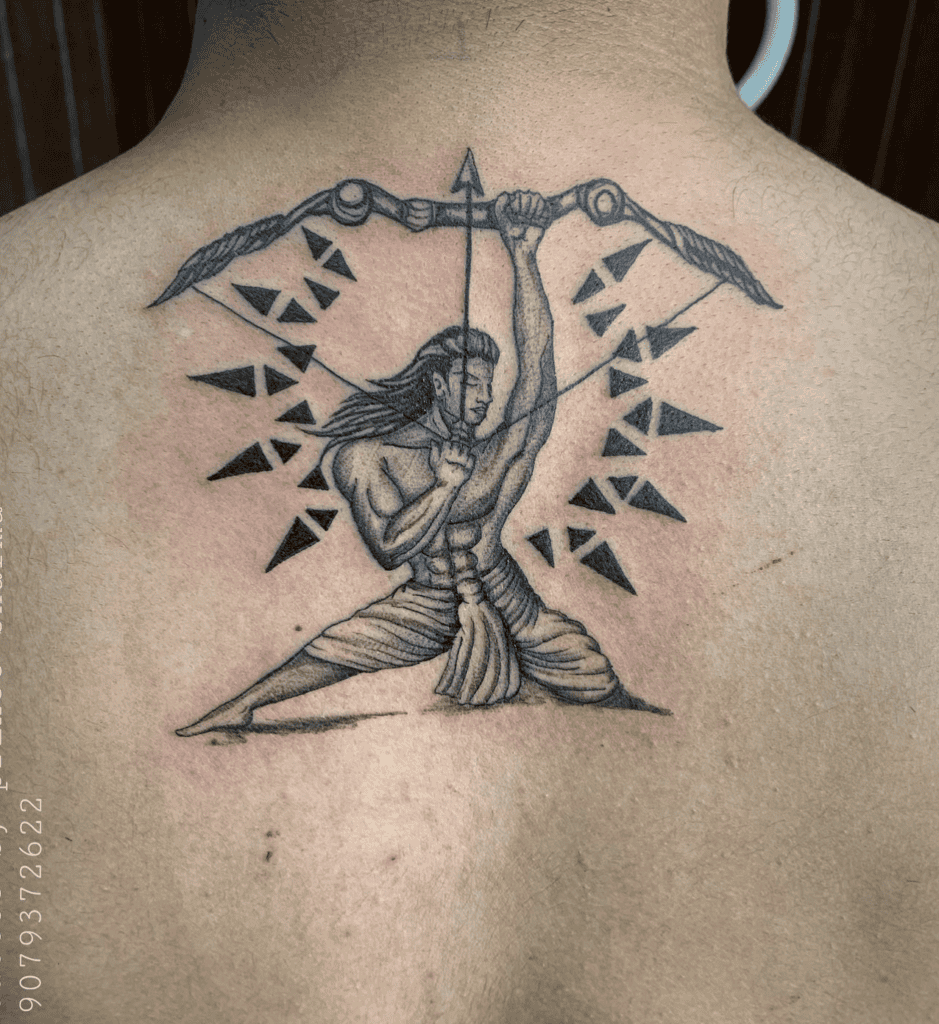
Arjuna is one of the five Pandava brothers, a central hero of the Mahabharata, the greatest archer of his age, a student of the master teacher Drona, and the closest friend and devotee of Krishna
Arjuna possessed the legendary bow Gandiva and was known for extraordinary focus. When asked what he saw while aiming at a bird, others described the tree, branches, and sky, but Arjuna said, “I see only the eye of the bird,” proving his unparalleled focus.
The most important moment of Arjuna’s life occurs before the great war at Kurukshetra. Facing his own relatives, teachers, and friends on the opposing side, Arjuna is overwhelmed. He lowers his bow and questions the morality of war, the meaning of duty, and the value of victory. It is in this moment that Krishna delivers the Bhagavad Gita.
Yudhishthira Hindu Mythology Tattoo

Yudhishthira is the eldest of the five Pandava brothers, the rightful heir to the Kuru throne, son of Dharma, and known as “Dharmaraja” – King of Righteousness
Yudhishthira is famous for never lying, speaking truth even when painful, and valuing righteousness over victory. He represents adherence to Dharma, even when it costs him everything. However, this unwavering morality also creates complications.
One of the most tragic events in the Mahabharata is the dice game. Yudhishthira, bound by royal duty and personal weakness, accepts a gambling challenge from the Kauravas.
He loses his wealth, kingdom, brothers, himself, and finally Draupadi. This leads to the Pandavas’ exile and eventually the great war. During exile, Yudhishthira faces a mystical being known as a Yaksha. His brothers fall unconscious after ignoring the Yaksha’s warning, and Yudhishthira answers a series of deep philosophical questions about life, duty, and morality. Impressed, the Yaksha revives his brothers.
Unlike Arjuna, Yudhishthira is not driven by battle glory and fights because duty demands it. After the war, he is devastated by the destruction and questions whether victory was worth the cost. His grief reflects the epic’s deeper theme that war solves conflict, but never without loss.
At the end of his life, Yudhishthira and his brothers journey toward heaven. One by one, his brothers fall, with only Yudhishthira continuing, accompanied by a loyal dog. When offered entry into heaven without the dog, he refuses.
The dog reveals itself to be Dharma, testing him, and because he chose loyalty over reward, he ascends. This is one of the most powerful moral moments in Hindu mythology.
Karna Hindu Mythology Tattoo

Karna is a master archer, the son of the sun god Surya, who was raised by a charioteer family, the loyal friend of Duryodhana, and the rival of Arjuna.
However, Karna was actually the eldest son of Kunti, making him the older brother of the Pandavas, but he never knew this until much later. Before her marriage, Kunti received a boon that allowed her to summon the gods. Out of curiosity, she invoked Surya, and Karna was born with divine golden armour and earrings (Kavacha and Kundala).
Fearing shame, she set the baby afloat on a river, and he was raised by humble parents. Despite his talent, Karna was mocked for being a charioteer’s son, and when he challenged Arjuna in a public contest, his low birth was used against him.
Only Duryodhana stood by him, crowning him king of Anga. This act of acceptance created unbreakable loyalty. Even when he later learned the Pandavas were his brothers, Karna refused to betray Duryodhana, as loyalty mattered more than blood.
In one of the most famous acts of generosity in mythology, the god Indra (Arjuna’s father) disguised himself as a beggar. He asked Karna for his divine armour and earrings. Karna knew it was a trick, but gave them anyway, symbolising his extreme generosity, pride in honour, and tragic nobility.
The final battle between Karna and Arjuna is one of the epic’s emotional peaks. During combat, Karna’s chariot wheel gets stuck in the ground. Bound by warrior ethics, he asks for a pause. Krishna reminds Arjuna of Karna’s past role in Draupadi’s humiliation, and Arjuna strikes him down.
Draupadi Hindu Mythology Tattoo

Draupadi emerged from a sacred fire ritual performed by King Drupada, along with her brother Dhrishtadyumna. Because of this, she is often called Yajnaseni (“daughter of the sacrifice”). Born at a time of rising conflict, her life would ignite a war.
Draupadi’s marriage begins with a challenge. At her swayamvara (self-choice ceremony), princes competed in an archery test. Arjuna was the victor, but in a dramatic twist, Draupadi became the wife of all five Pandava brothers due to a vow made by their mother.
One of the most pivotal moments in the Mahabharata is Draupadi’s humiliation in the royal court. After Yudhishthira loses everything in a dice game, Draupadi is dragged into court. The Kauravas attempt to disrobe her publicly, and she calls upon Krishna for protection. Through Krishna, her garment becomes endless, preventing her dishonour, and her humiliation becomes the spark that leads to Kurukshetra.
Draupadi questions the legality of the dice game, the morality of the elders’ silence, and the authority of those in power and demands justice. She vows that her hair will remain unbound until it is washed in the blood of those who humiliated her, with her fury not being selfish, but rooted in Dharma.
Naga Hindu Mythology Tattoo
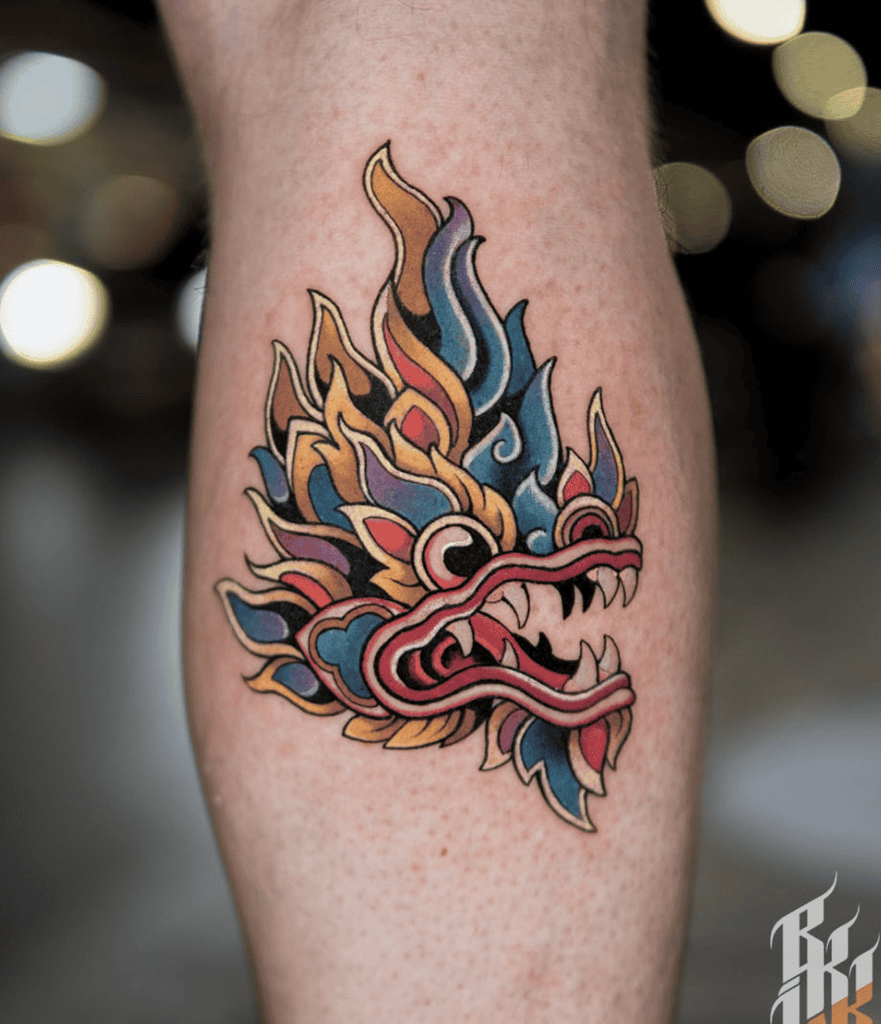
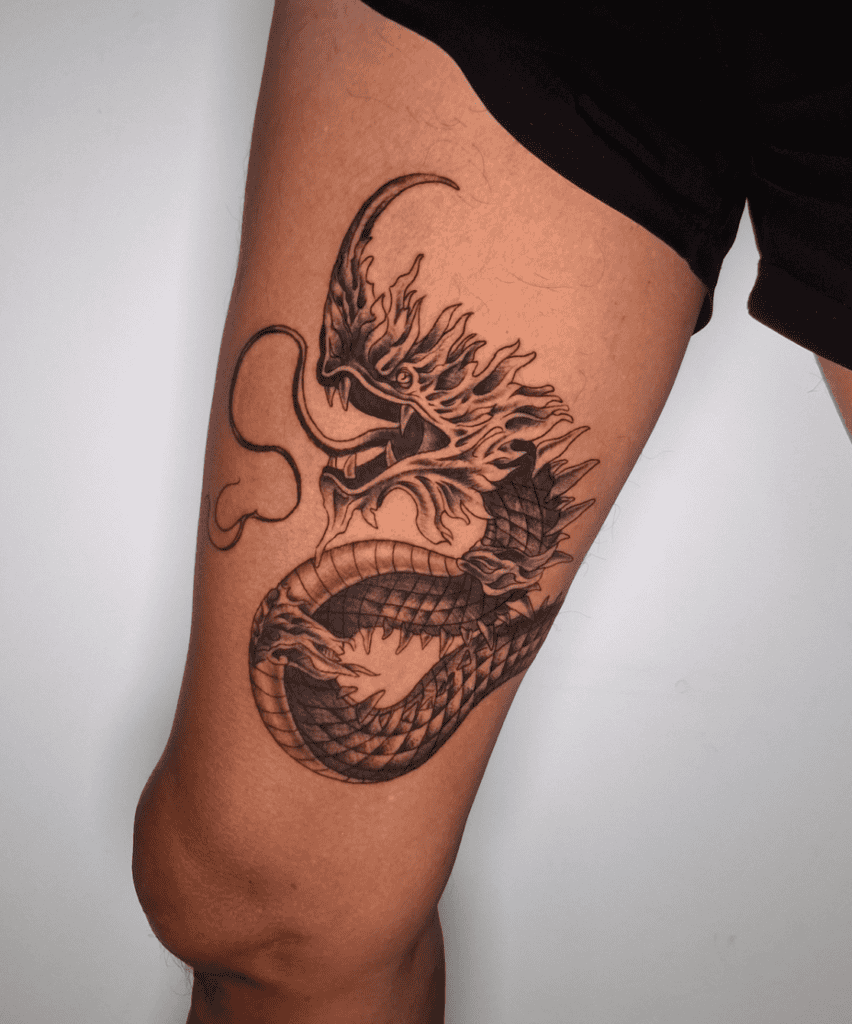
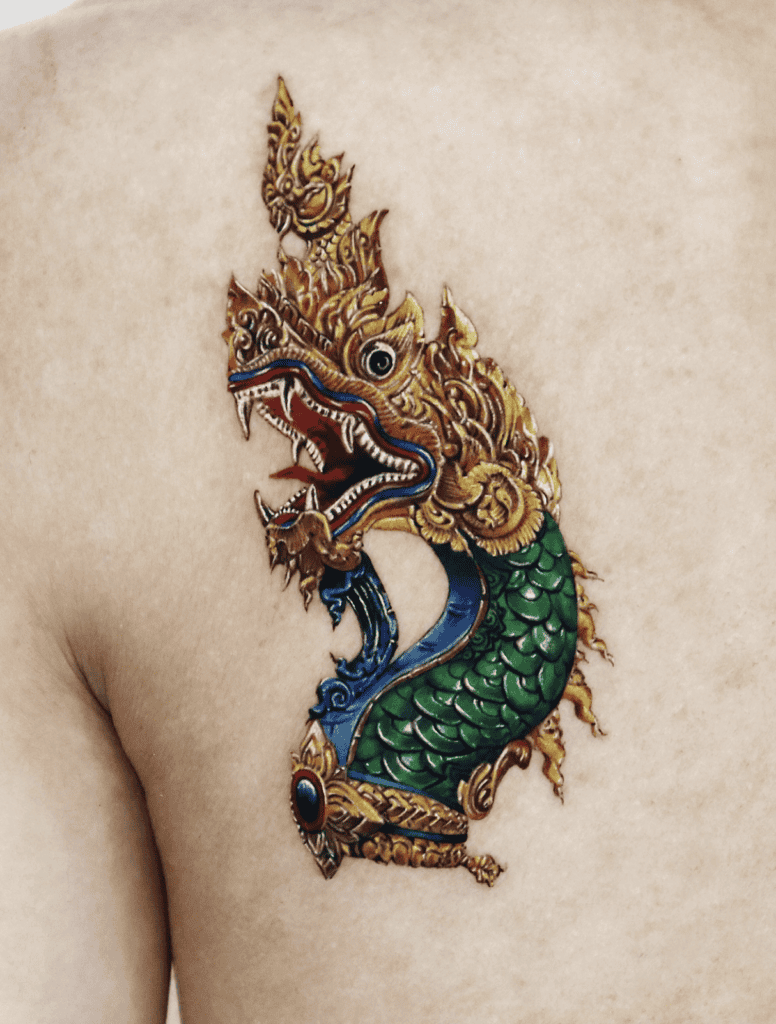
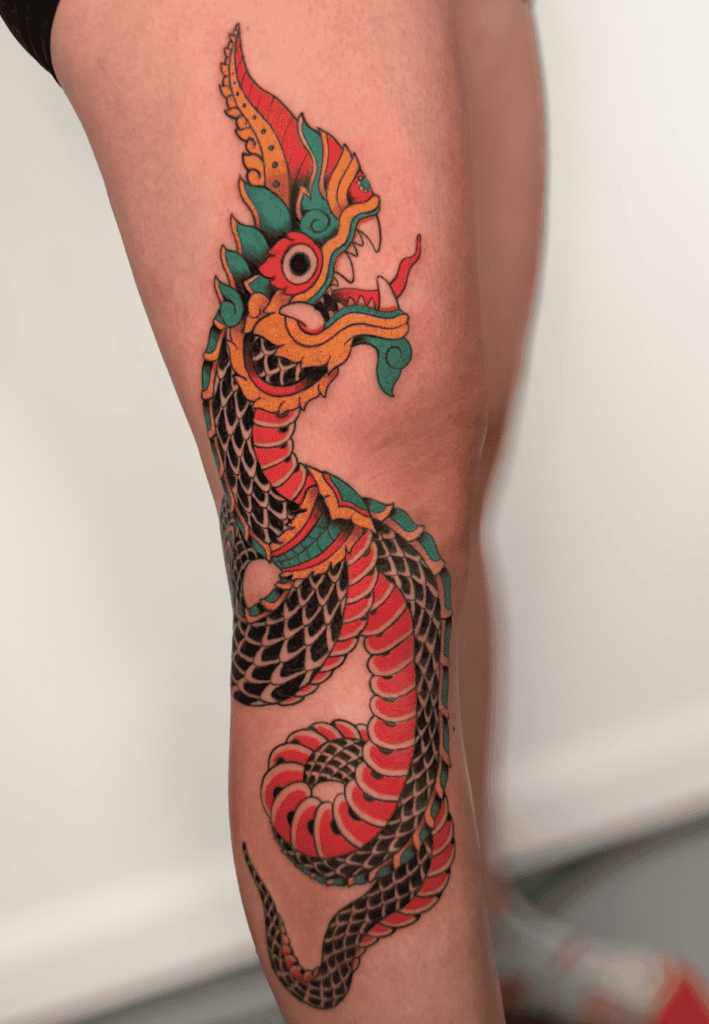
Nagās are serpent spirits that inhabit a mystical realm called Naga-loka. They are guardians of treasures, protectors of water sources, and semi-divine beings living in subterranean realms. They are often depicted as giant cobras, humans with serpent hoods, ot multi-headed serpents.
Garuda Hindu Mythology Tattoo
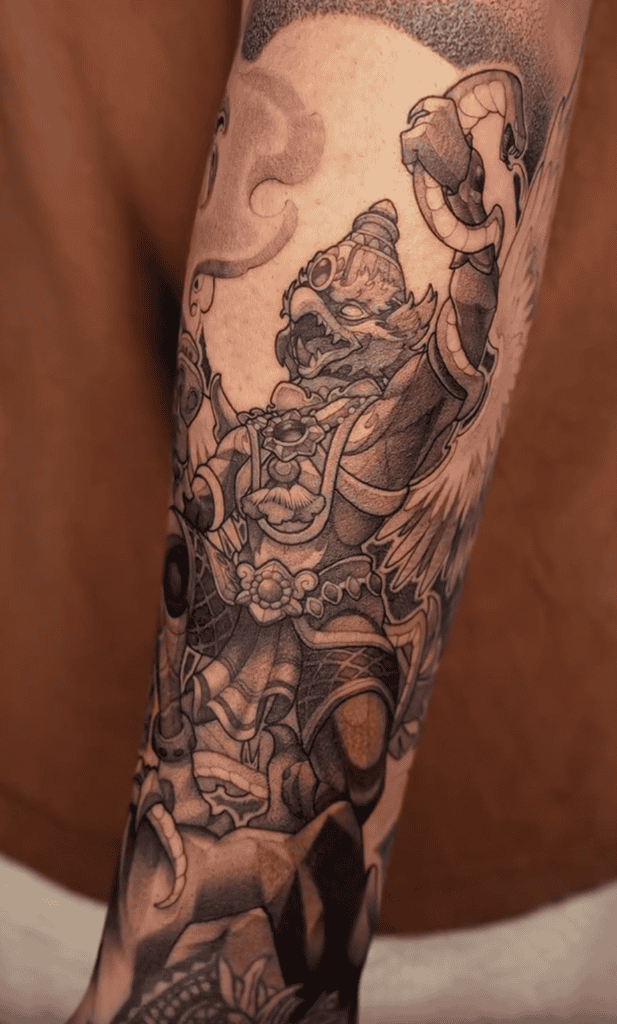
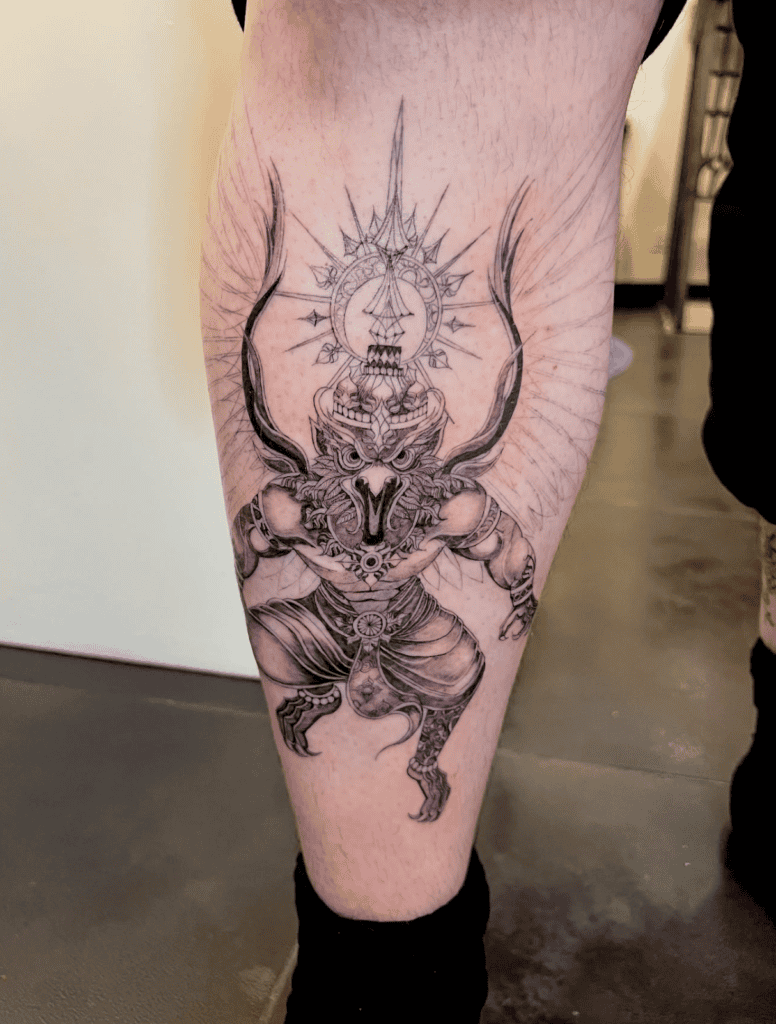
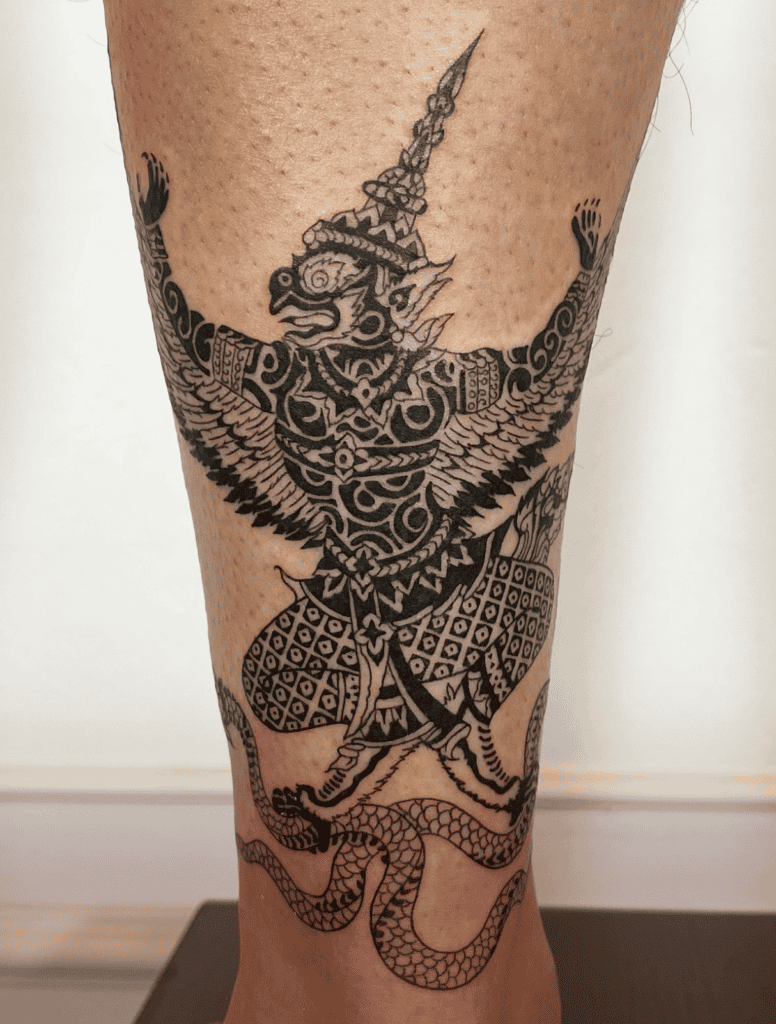
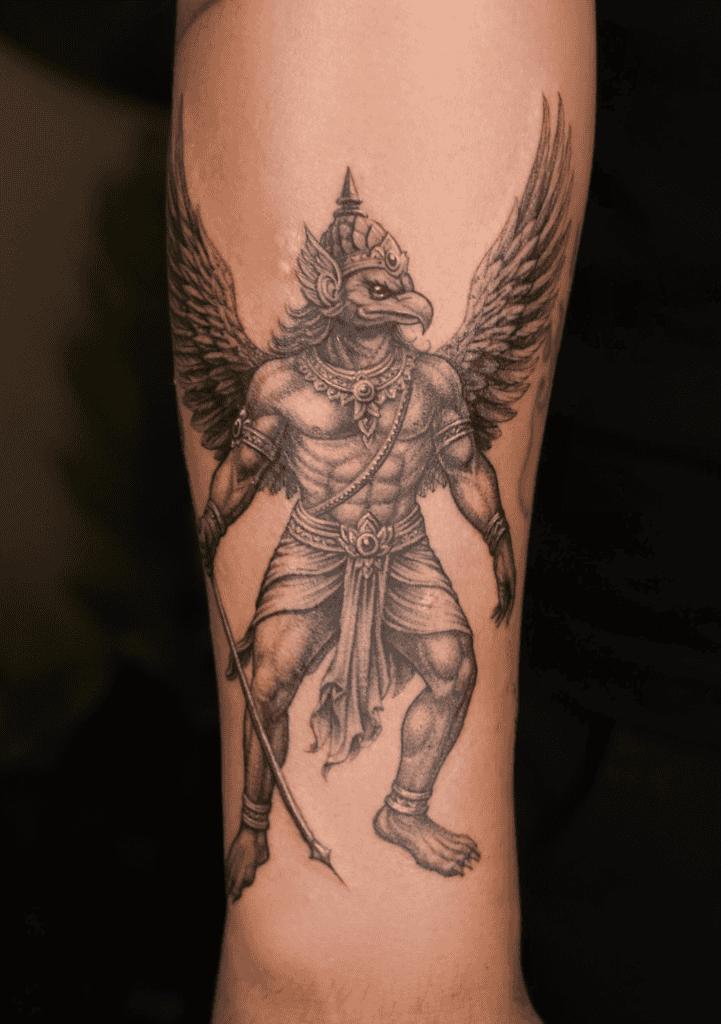
Garuda is the mount of Vishnu, the king of birds, and the eternal enemy of serpents (Nagas). Garuda’s rivalry with the Nagas comes from his birth story. His mother, Vinata, was enslaved by her co-wife, mother of the Nagas. To free his mother, Garuda agreed to bring the Nagas the nectar of immortality (amrita). He succeeded, but cleverly prevented them from consuming it.
Nandi Hindu Mythology Tattoo
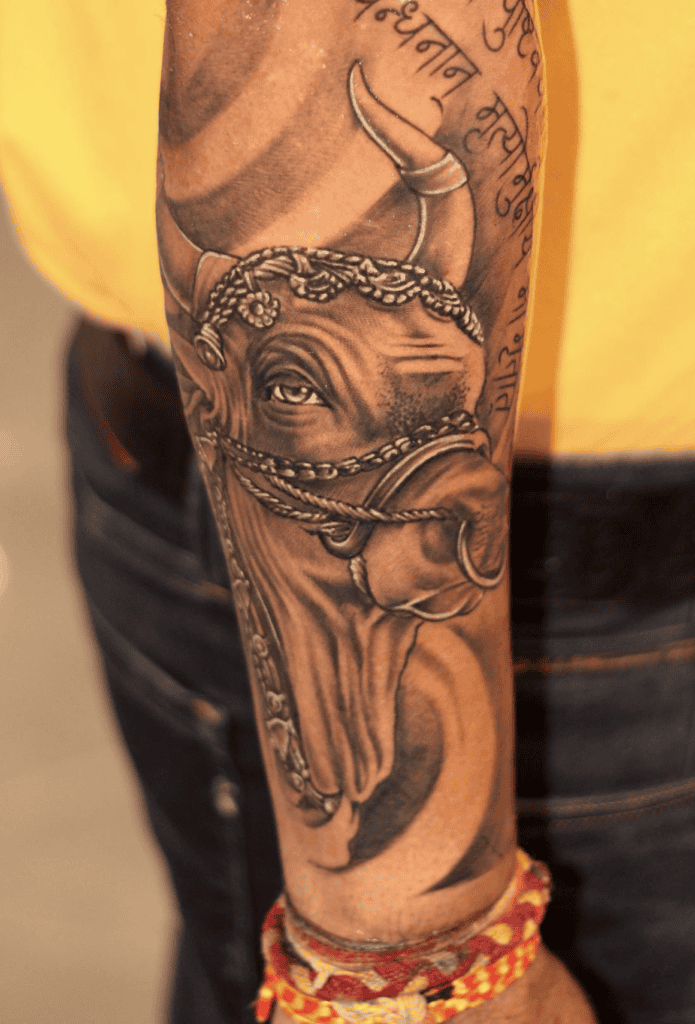
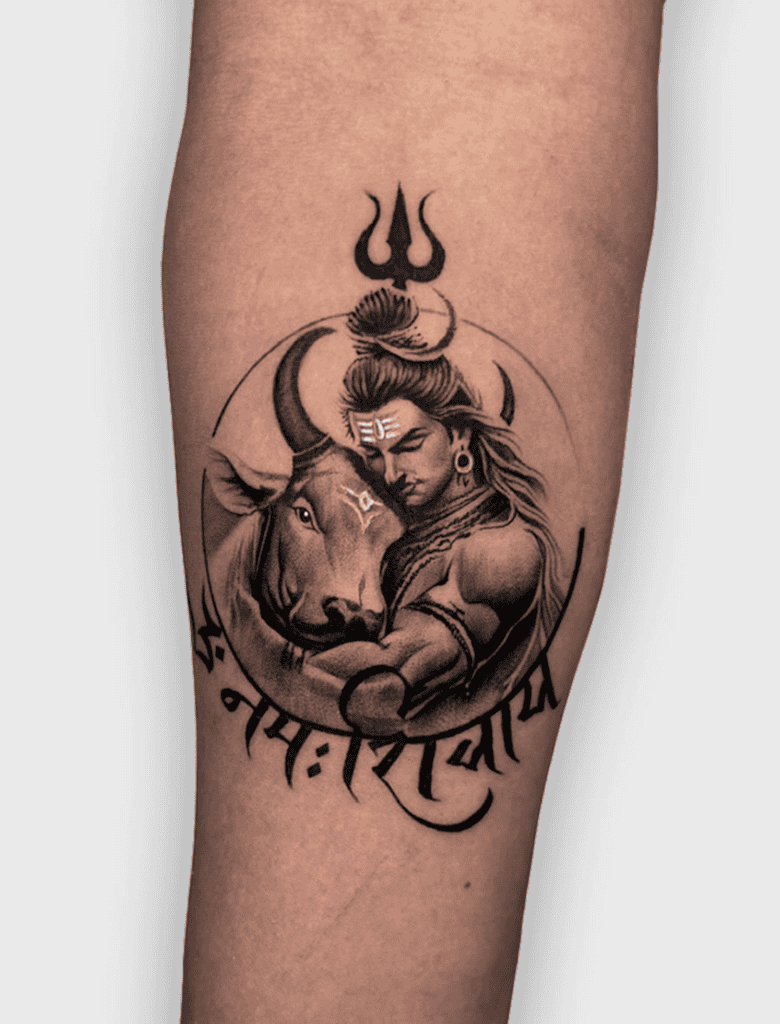
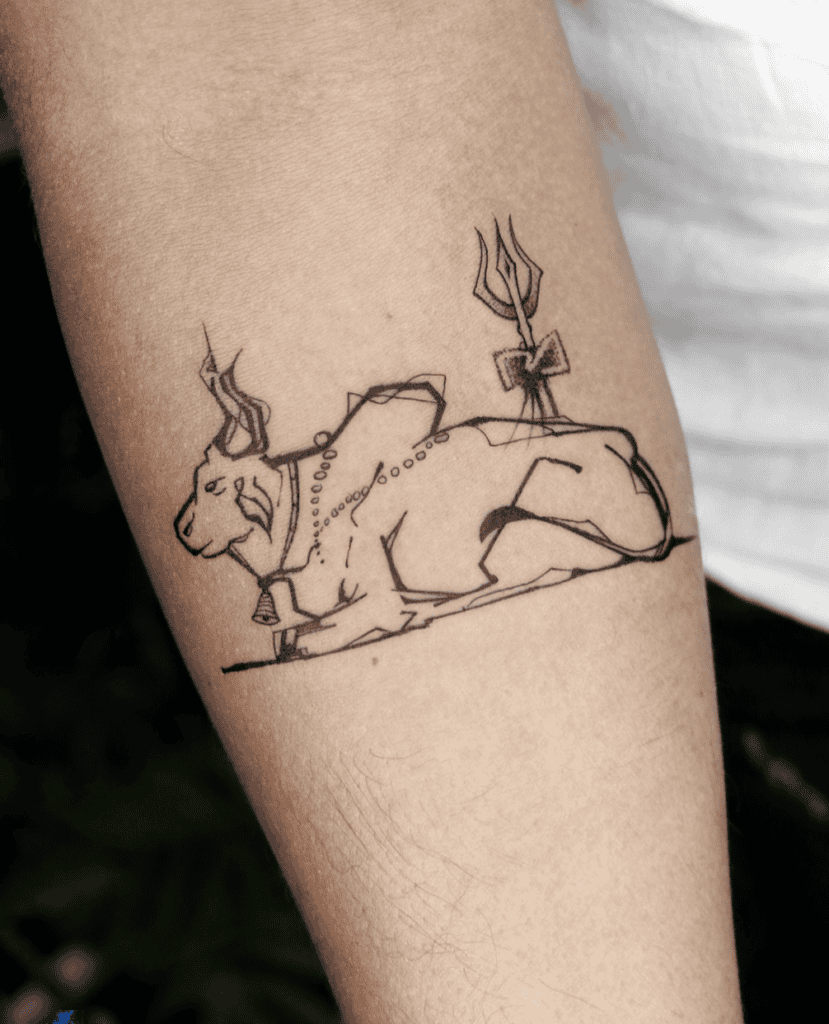
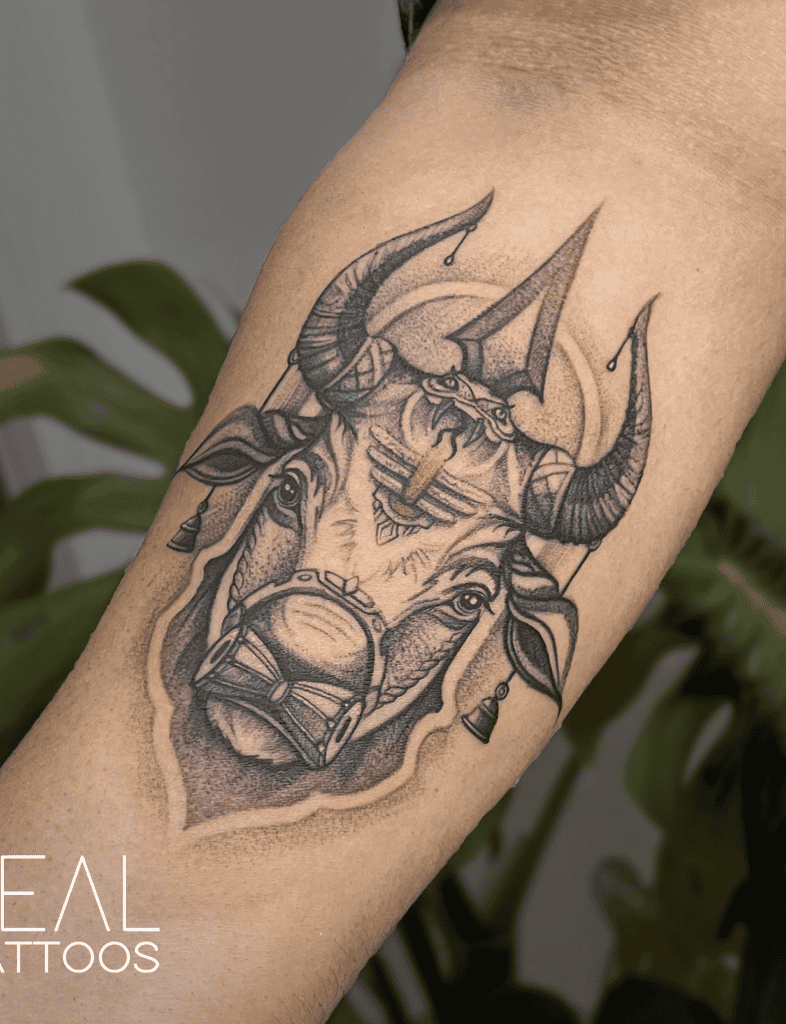
Nandi is the divine bull of Shiva, the gatekeeper of Mount Kailash, guardian of Shiva’s temples, and a symbol of strength and devotion. His name means “Joyful” or “Blissful,” and he represents quiet loyalty rather than dramatic power.
In almost every Shiva temple, you’ll find a statue of Nandi seated directly facing the Shiva Lingam. He always looks toward Shiva, representing his unwavering focus, devotion without distraction, and alignment with divine consciousness. Many devotees whisper prayers into Nandi’s ear, believing he will carry them to Shiva.
In one popular legend, Nandi was born as a human boy to a sage. Through intense devotion to Shiva, he was transformed into the sacred bull and granted immortality as Shiva’s companion. In some traditions, Nandi is also chief of Shiva’s attendants (the Ganas).
Timingila Hindu Mythology Tattoo

Timingila is described as a colossal ocean creature so massive that it can swallow whales whole. In Sanskrit, Timi means whale, and Gila means swallower, making Timingila literally meaning “The Swallower of Whales.”
Timingila is referenced in the Mahabharata, Puranic texts, and in descriptions of the cosmic ocean. It often appears symbolically in discussions of overwhelming danger or unstoppable force. Sometimes it’s used metaphorically, representing something so vast that even giants are small before it.
Gandaberunda Hindu Mythology Tattoo

Gandaberunda is a colossal two-headed bird whose name roughly translates to something like “the terrible two-headed one.” In certain South Indian traditions, Gandaberunda is linked to Narasimha, with some legends describing how, after Narasimha defeated Hiranyakashipu, his fury remained uncontrollable.
To calm or counterbalance this raging energy, an even more powerful form appeared — Gandaberunda.
In some interpretations, Gandaberunda is a form of Vishnu, while in others, it is a manifestation of Shiva’s power. In some regional myths, it battles another fierce creature called Sharabha, but while the mythology varies, the theme remains consistent.
Shesha Hindu Mythology Tattoo
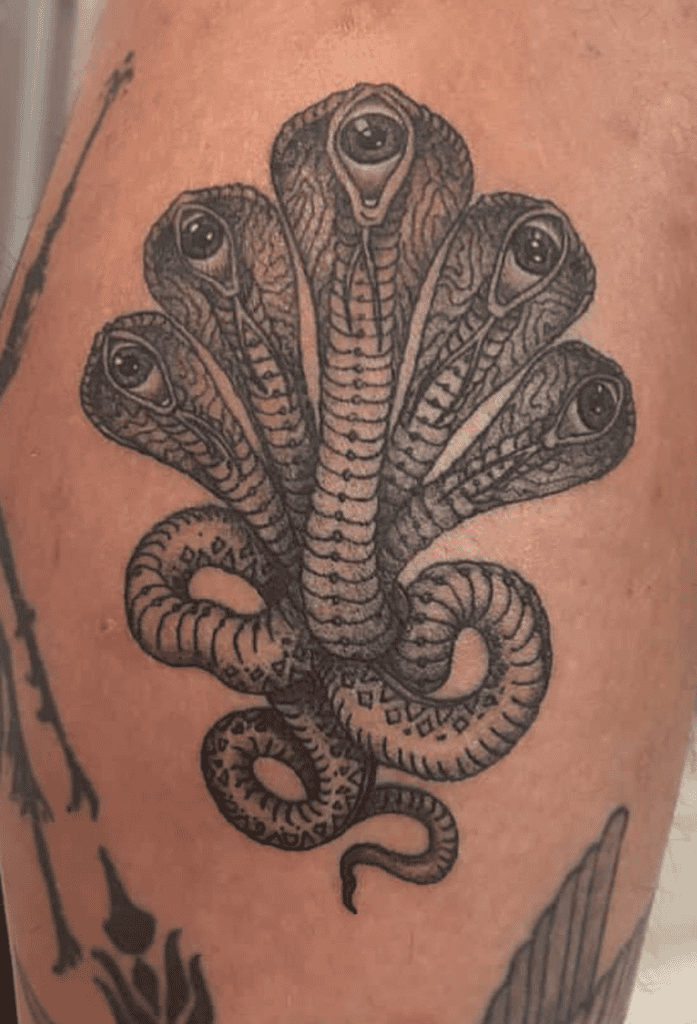
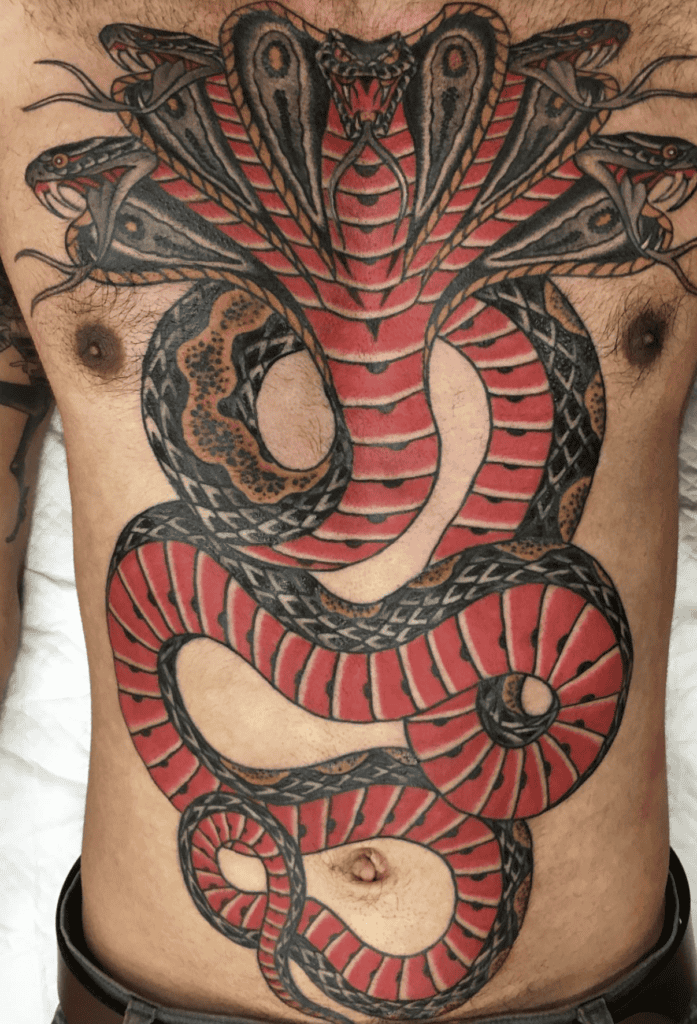
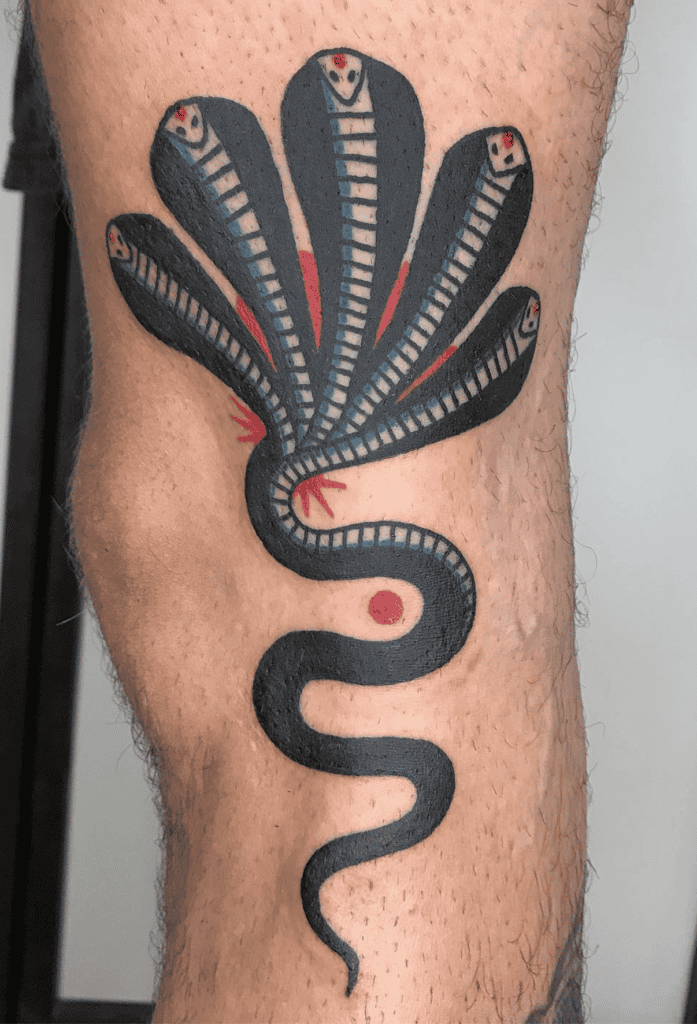
Shesha, also called Ananta, is the king of the Nagas, the cosmic serpent and the being upon whom Vishnu rests. His name means “that which remains”, referencing how, when everything dissolves at the end of a cosmic cycle, Shesha remains.
In many depictions, Vishnu is shown reclining peacefully on Shesha’s coiled body, floating upon the cosmic ocean. This image symbolises stillness within chaos, stability beneath creation, and eternity supporting time. When the universe dissolves, Vishnu rests on Shesha until the next creation begins.
Some traditions say the entire Earth rests upon Shesha’s coils, and when he shifts, earthquakes occur. This reinforces the idea that he represents the hidden structure beneath reality.
Yaksha Hindu Mythology Tattoo
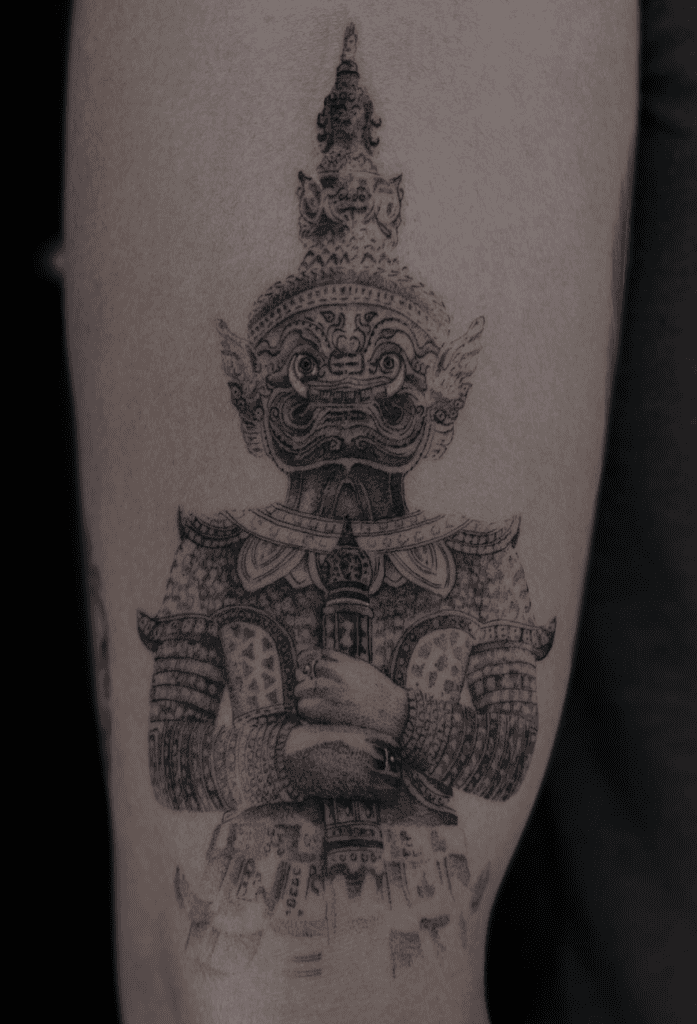
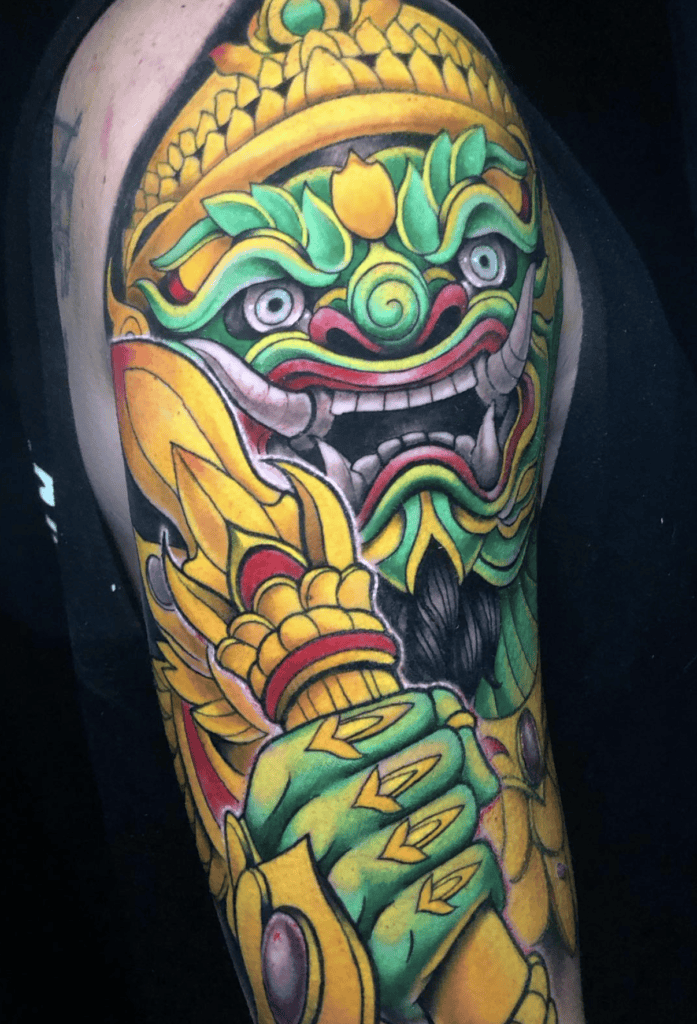
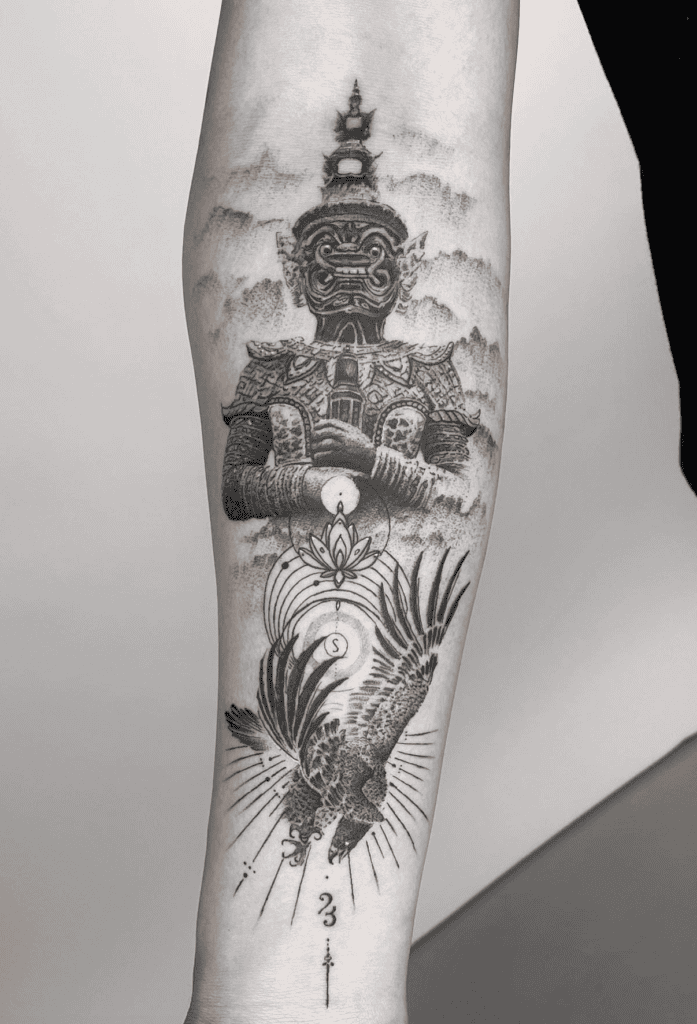
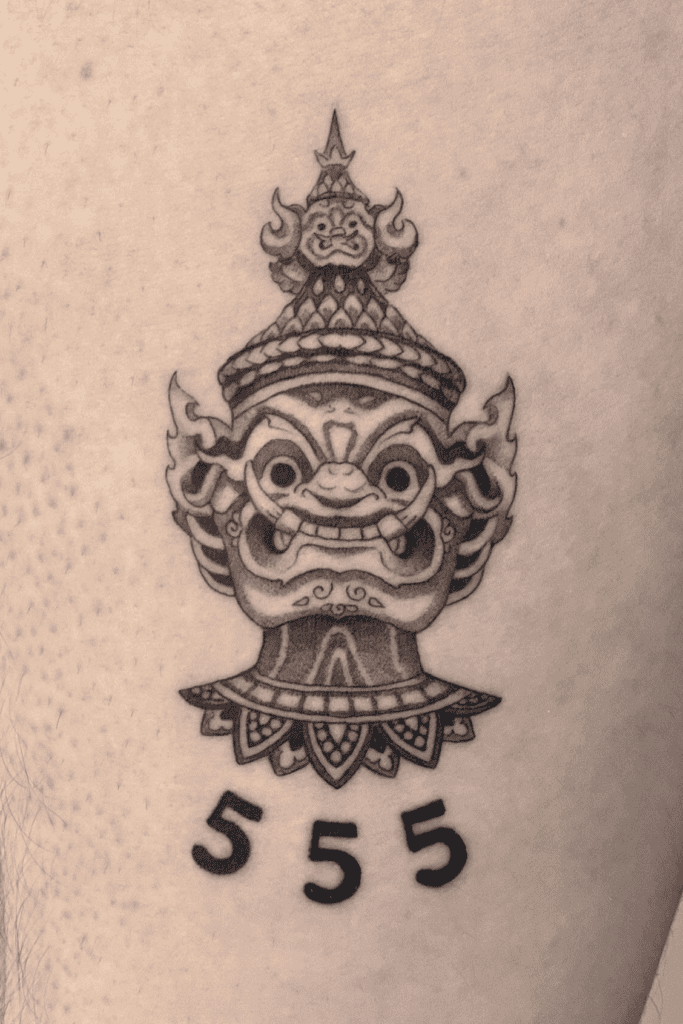
Yakshas are nature spirits, commonly associated with Kubera, the god of wealth and riches. In early Indian art (like at Bharhut and Sanchi), they were often carved as tree spirits.
One of the most famous Yaksha appearances occurs in the Mahabharata. When the Pandavas are thirsty, they find a lake guarded by a mysterious Yaksha. Ignoring his warning, four brothers drink and fall unconscious. Only Yudhishthira answers the Yaksha’s philosophical questions. Impressed by his wisdom, the Yaksha revives his brothers.
Thai Yakshas (called Yak in Thai) evolved from the Indian concept of Yaksha, but in Thailand, they transformed into giant temple guardians. Unlike the more nature-spirit style Yakshas of India, Thai Yakshas are usually depicted as giant humanoid figures wearing elaborate crowns and armour.
Thai Yakshas appear prominently in the Ramakien, Thailand’s adaptation of the Indian Ramayana, with the most famous Thai Yaksha being Tosakanth, the Thai version of Ravana. He is a multi-faced giant king and ruler of demons who is not always portrayed as purely evil; he is sometimes depicted as noble but flawed.
In Thai tradition, Yakshas are often classified as giants (sometimes translated as demons), but they are not the same as Western “devils.” They are powerful beings with complex personalities. Some are antagonists, some are protectors, and some switch roles depending on the story.
Navagunjara Hindu Mythology Tattoo
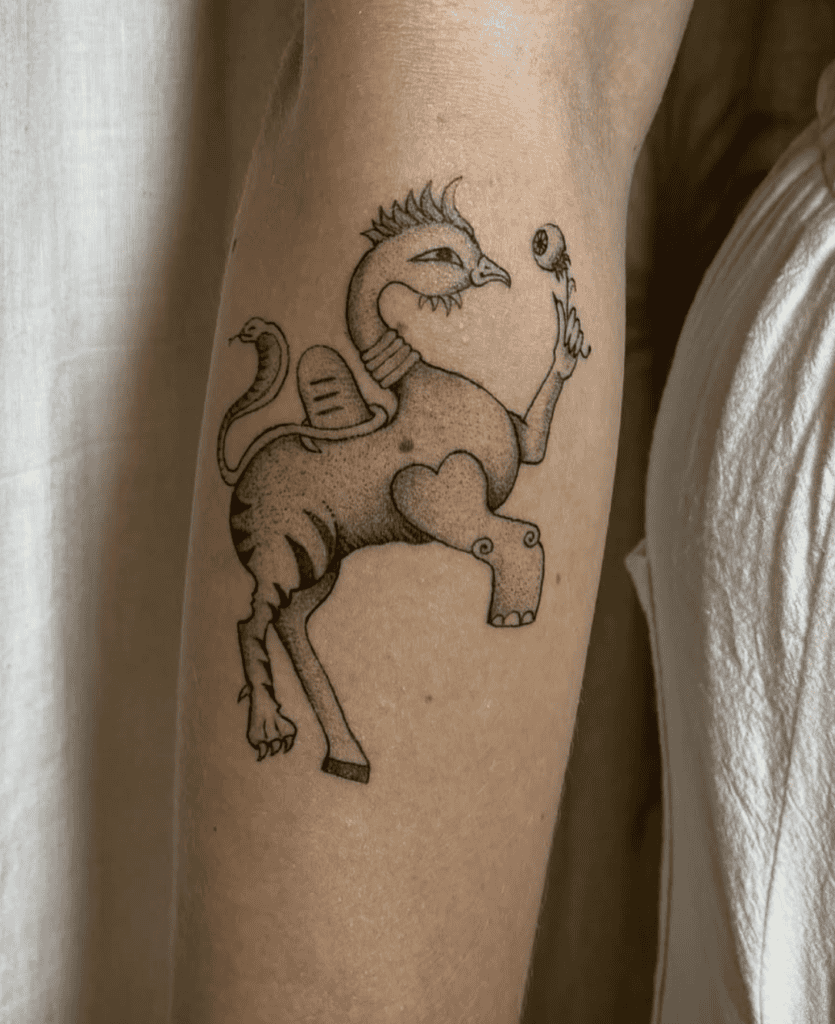
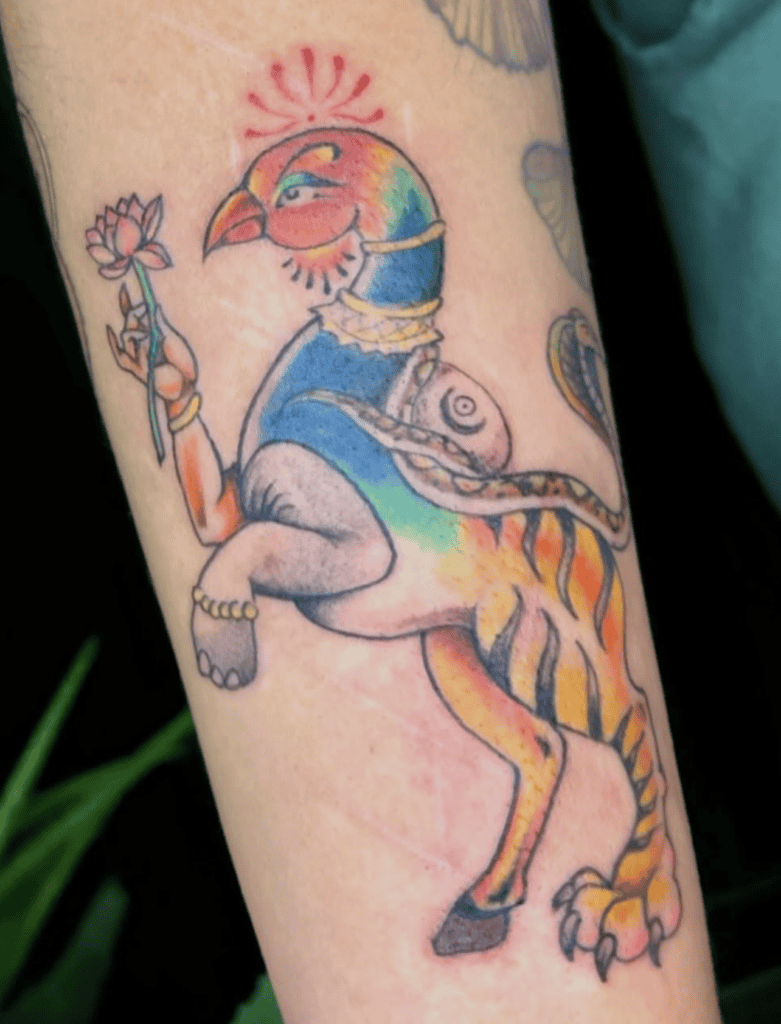
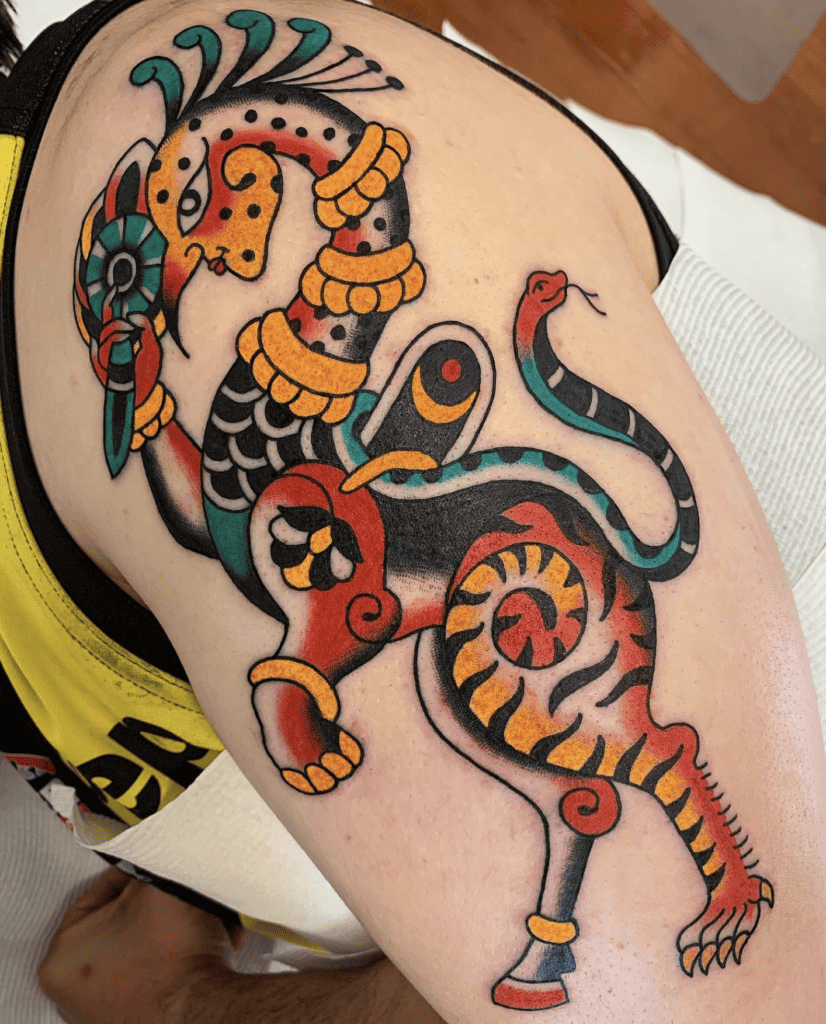
Navagunjara is a composite creature made from nine different animals. Nava means nine, and Gunjara means composite sound/form. It is a mythical creature composed of parts from nine different animals, typically including a rooster, peacock, bull, lion, elephant, serpent, deer, tiger, and human.
Navagunjara appears in certain regional retellings of the Mahabharata, particularly in Odia (Odisha) traditions. In this story, the creature appears before Arjuna. As Arjuna prepares to shoot it with his bow, he recognises it as a divine manifestation of Krishna and bows to it in reverence.
Navagunjara represents unity within diversity and the complexity of divine form. Each animal part symbolises different qualities, making it a visual metaphor for divine totality.
Gandharva Hindu Mythology Tattoo

Gandharvas are celestial musicians, court attendants of the gods, masters of music and sound, and the guardians of Soma (the sacred drink) in early Vedic texts. They dwell in the heavenly realms (Svarga), often serving Indra, king of the gods.
In Hindu thought, sound (Nāda) is sacred. The universe itself is said to originate from primordial sound (“Om”). Gandharvas symbolise the harmony of creation, divine art, cosmic vibration, and spiritual ecstasy. They are not merely entertainers and represent the idea that music is divine.
Apsara Hindu Mythology Tattoo


Apsaras are heavenly nymphs, dancers of the divine courts, companions of the gods, and embodiments of beauty and charm. They dwell in Svarga (heaven), often entertaining Indra, king of the gods and are closely associated with Gandharva, who provide the music for their dances.
Many Apsaras are said to have emerged during the Churning of the Ocean of Milk, alongside treasures and divine beings. Their name is sometimes interpreted as “moving in the waters,” connecting them to fluidity and grace.
Asura Hindu Mythology Tattoo
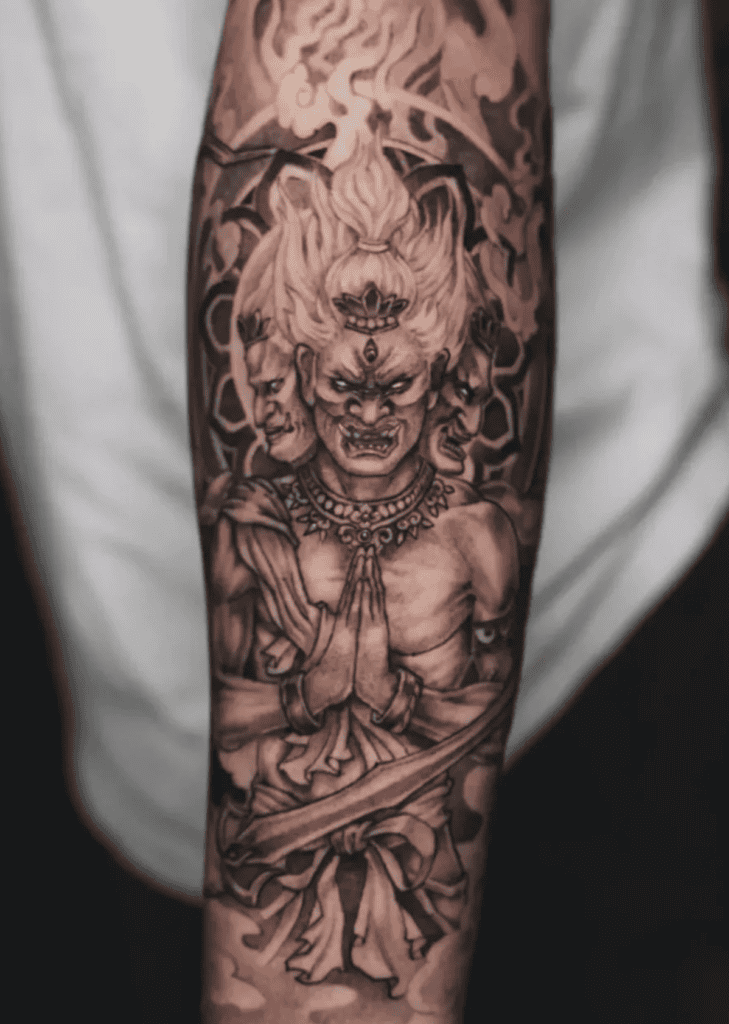
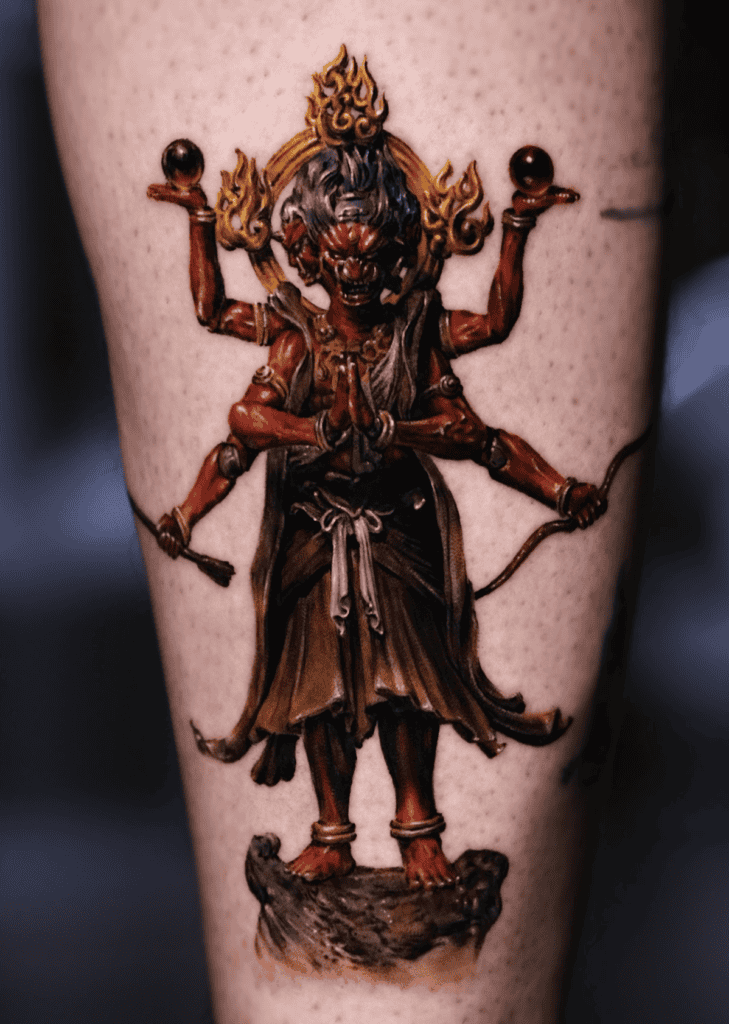
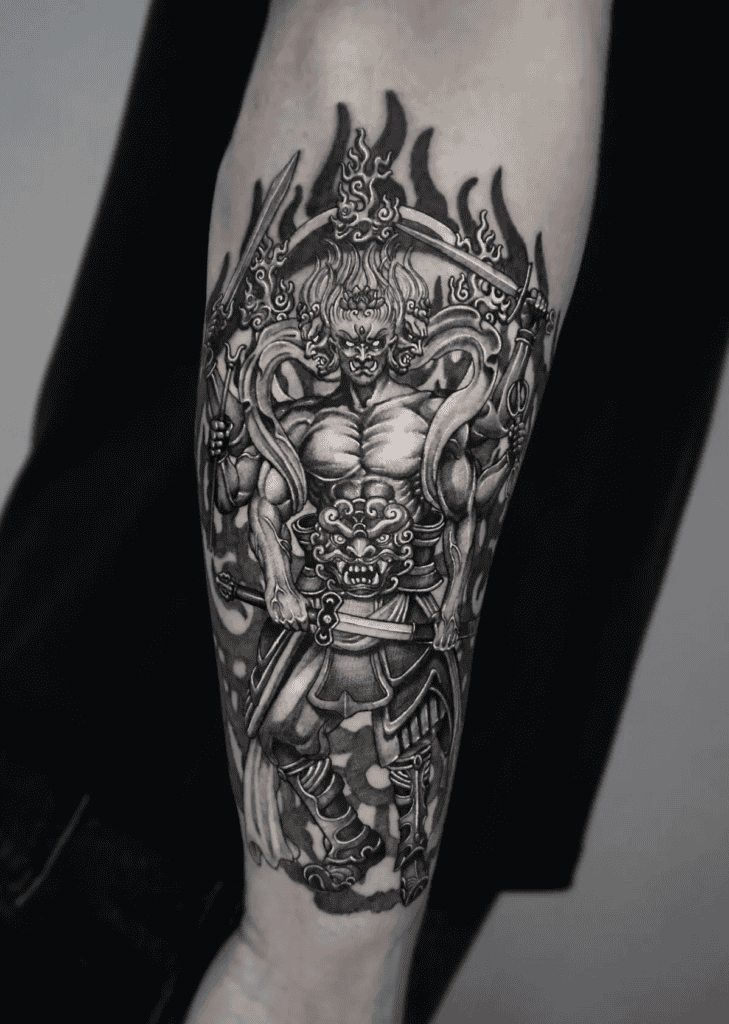
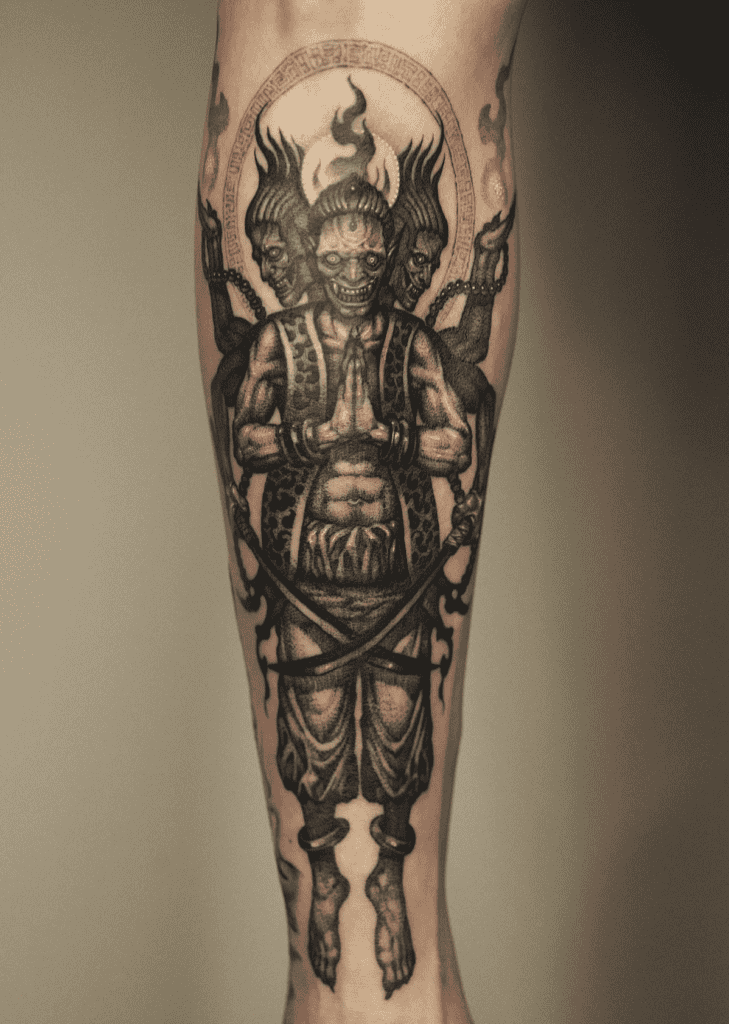
Asuras are often translated as “demons,” but that word doesn’t fully capture who they are. They are not mindless monsters but powerful beings who are often brilliant, disciplined, and ambitious, who stand in opposition to the gods.
In early Vedic texts, “Asura” didn’t always mean evil. Some deities were even called Asura in a positive sense, but over time, the word evolved to describe cosmic opponents of the gods.
The central mythic conflict in Hindu cosmology is between Devas, representing order, light, and cosmic balance, and Asuras, representing ambition, ego, and a challenge to divine order. However, this isn’t a simple good vs evil story.
Rakshasa Hindu Mythology Tattoo


Rakshasas are often translated as “demons,” but like Asuras, they’re more complex than simple villains. They are powerful, shape-shifting beings who often dwell in forests, wilderness, and shadowed realms.
These supernatural beings are often flesh-eating or fear-inducing, masters of illusion and disguise, and are sometimes intelligent rulers and warriors. The word “Rakshasa” comes from a root meaning “to guard” or “to protect.” Interestingly, some early traditions suggest they were originally guardian spirits before evolving into more fearsome figures.
Makara Hindu Mythology Tattoo
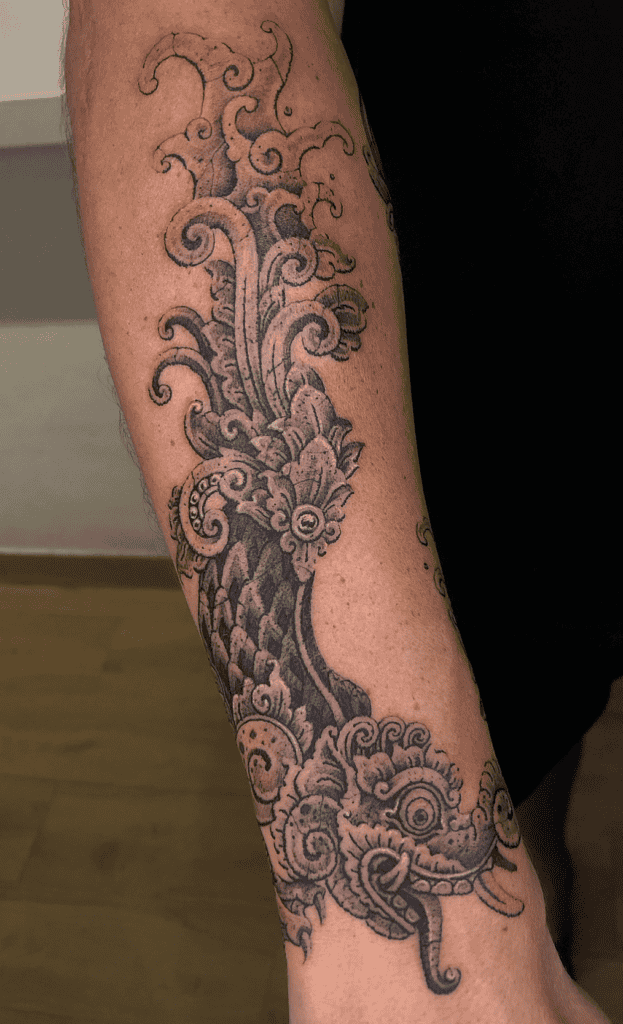
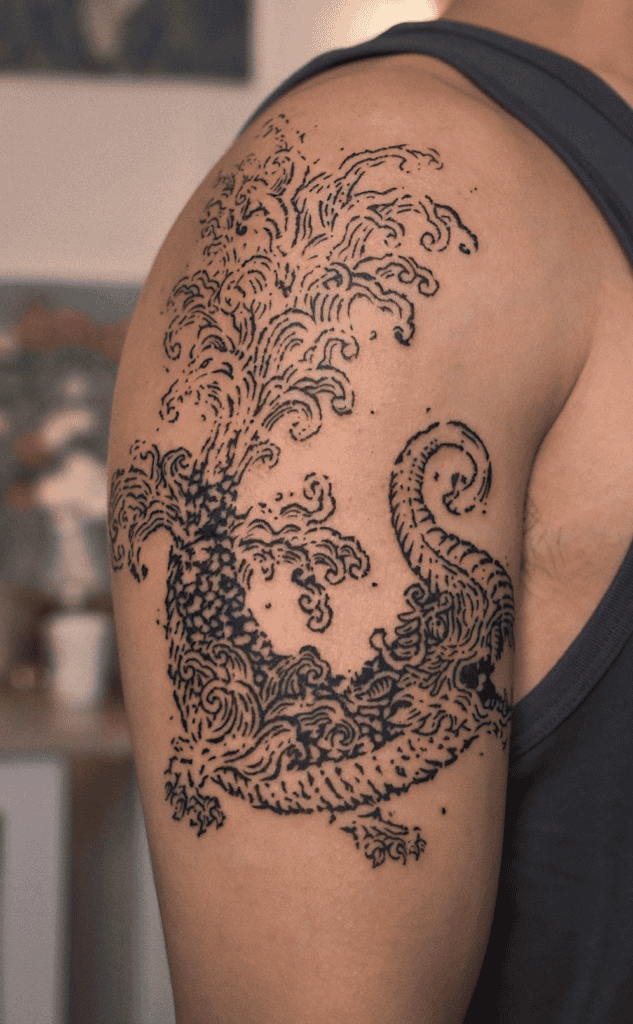
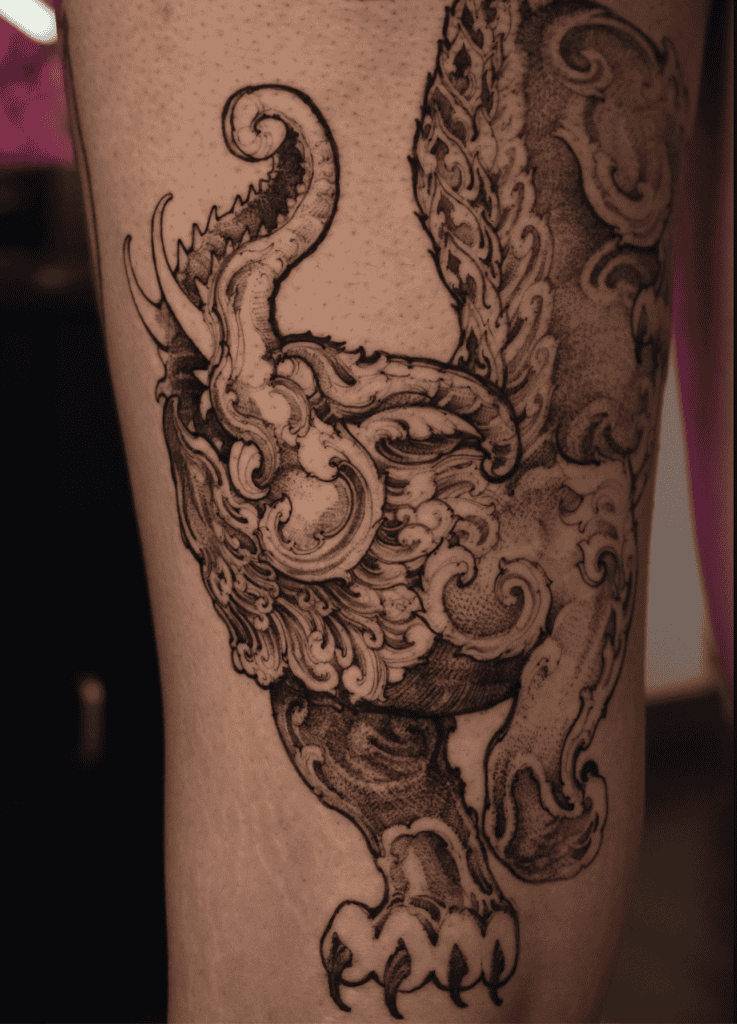
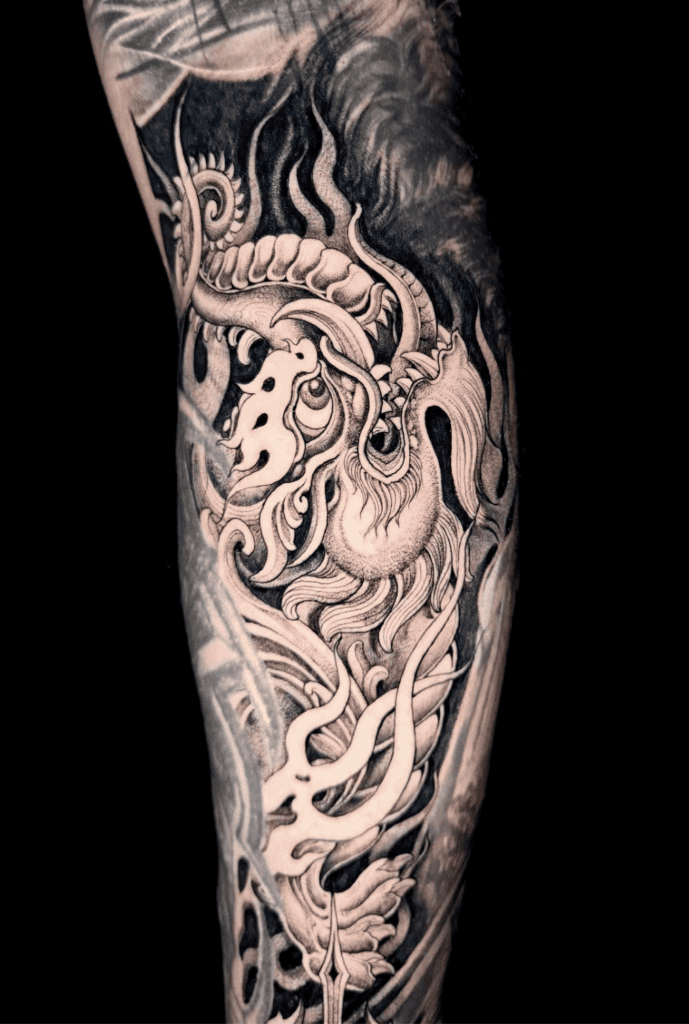
Makara is one of the most fascinating aquatic creatures in Hindu mythology, who is part crocodile, part elephant, part fish, sometimes part dragon. He is the vehicle of certain deities, a guardian figure in temple architecture, and a symbol of water’s power.
Makara is most famously associated with Varuna, the god of the oceans, and Ganga, the goddess of the Ganges. As their mount, Makara symbolises the depth of water, the unpredictable force of the sea, and the mystery of the unknown.
Airavata Hindu Mythology Tattoo
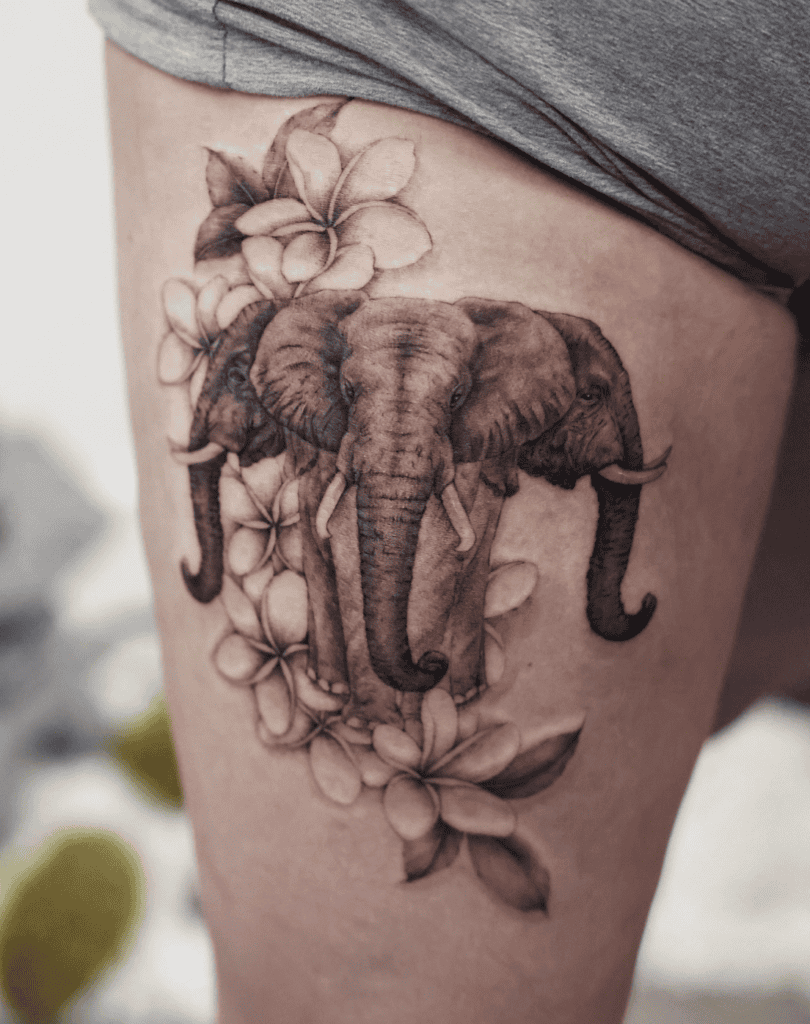
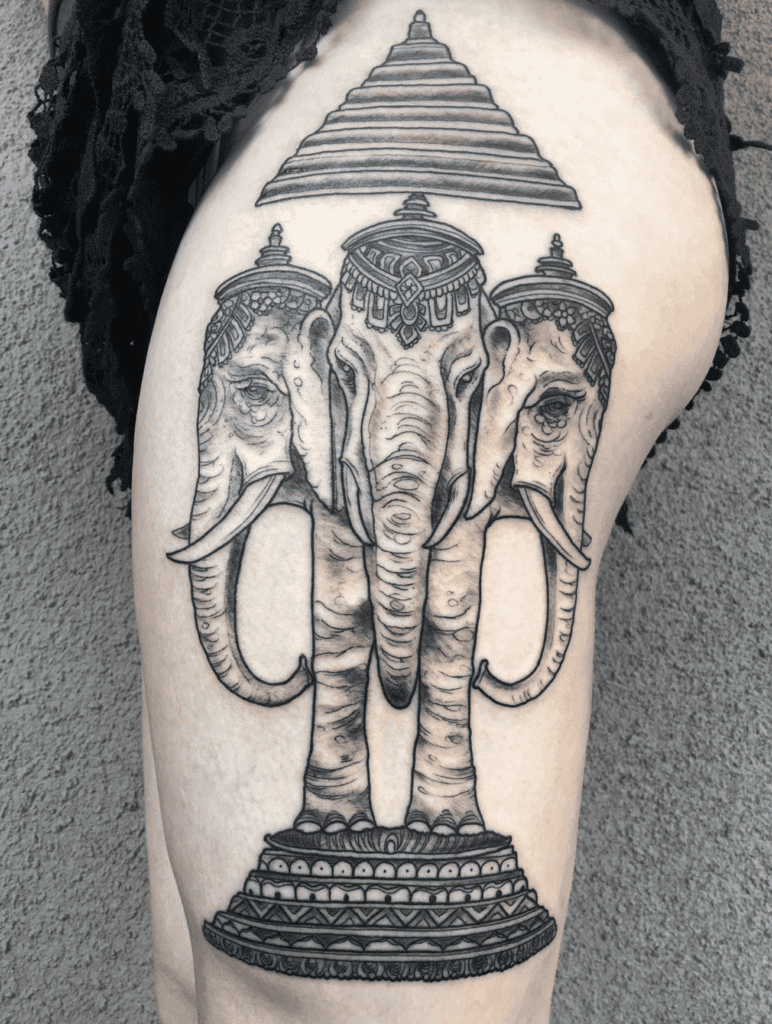
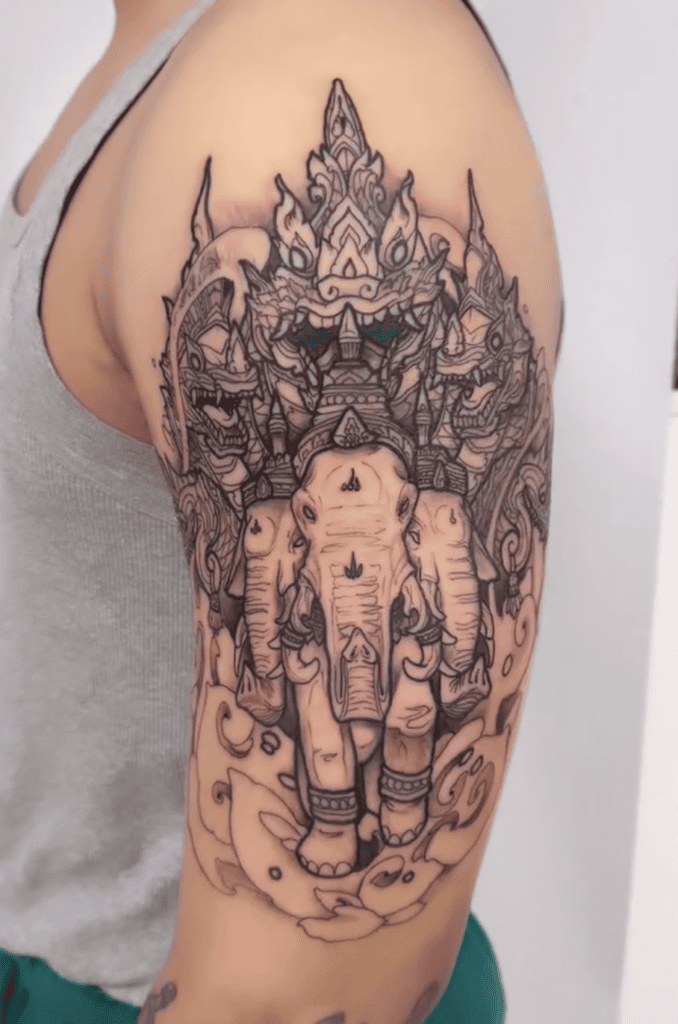
Airavata is a divine white elephant who is the king of all elephants, the mount of Indra, and a symbol of royalty and rain. Airavata emerged during the Churning of the Ocean of Milk, alongside treasures and divine beings.
As Indra’s mount, Airavata is strongly linked to storms, thunder, and rainfall, with some legends saying he draws water from the underworld with his trunk and releases it as rain.
Kamadhenu Hindu Mythology Tattoo
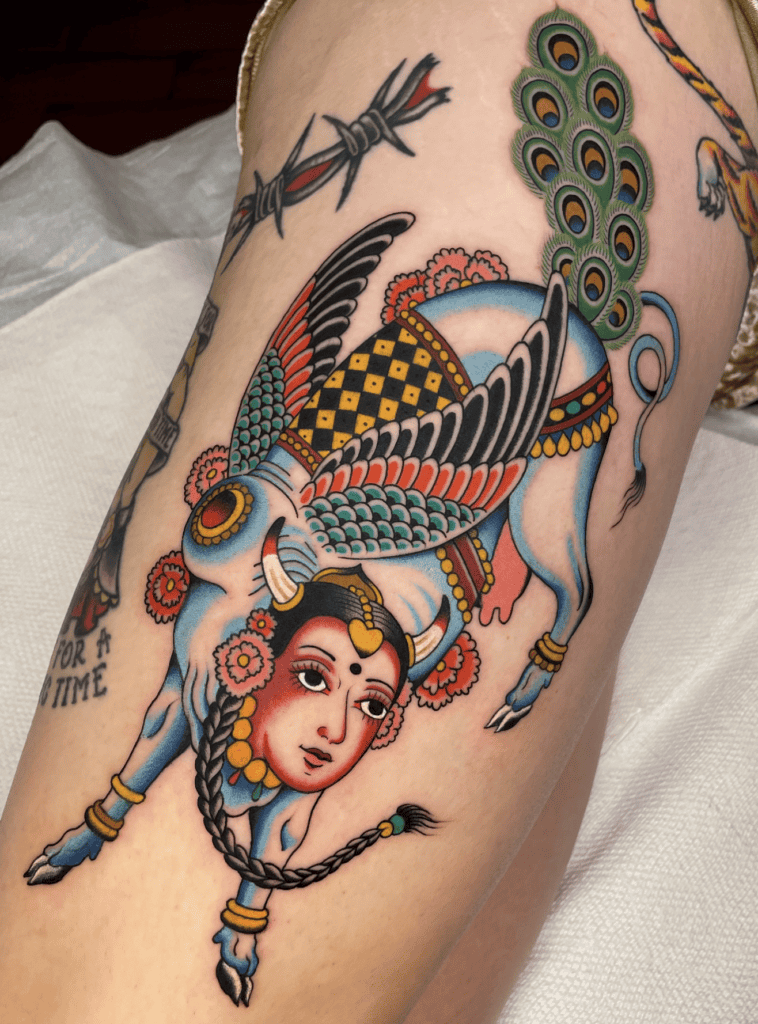
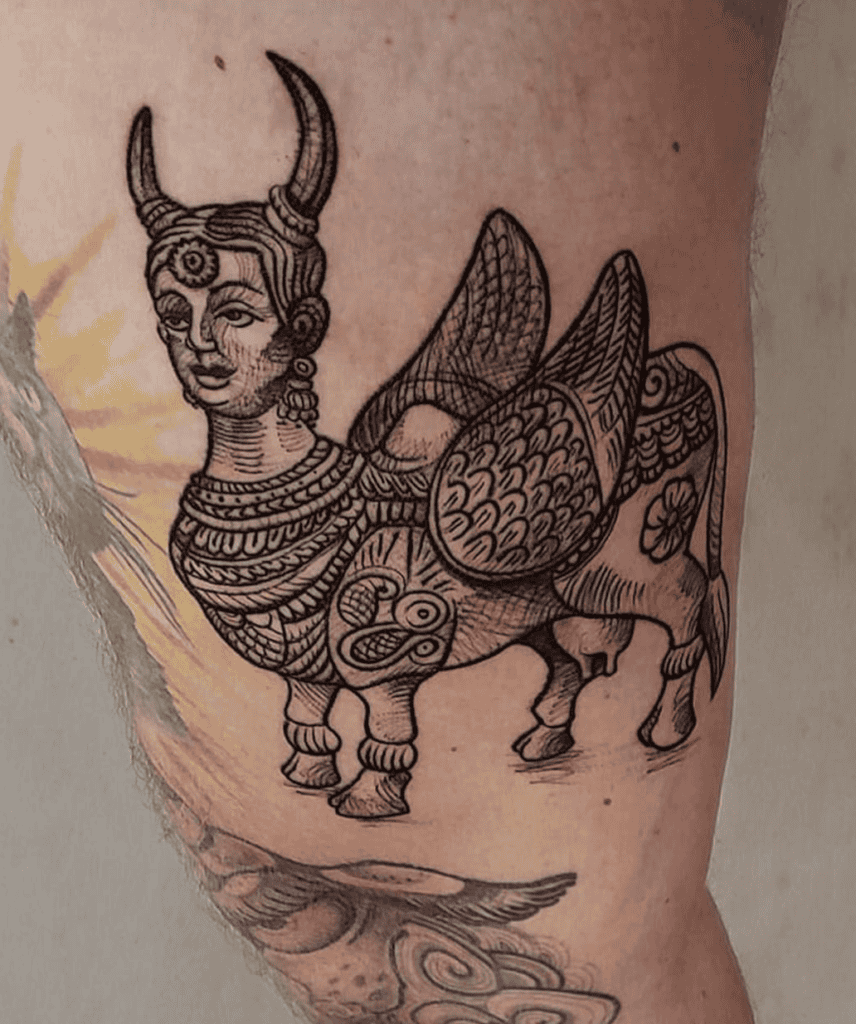
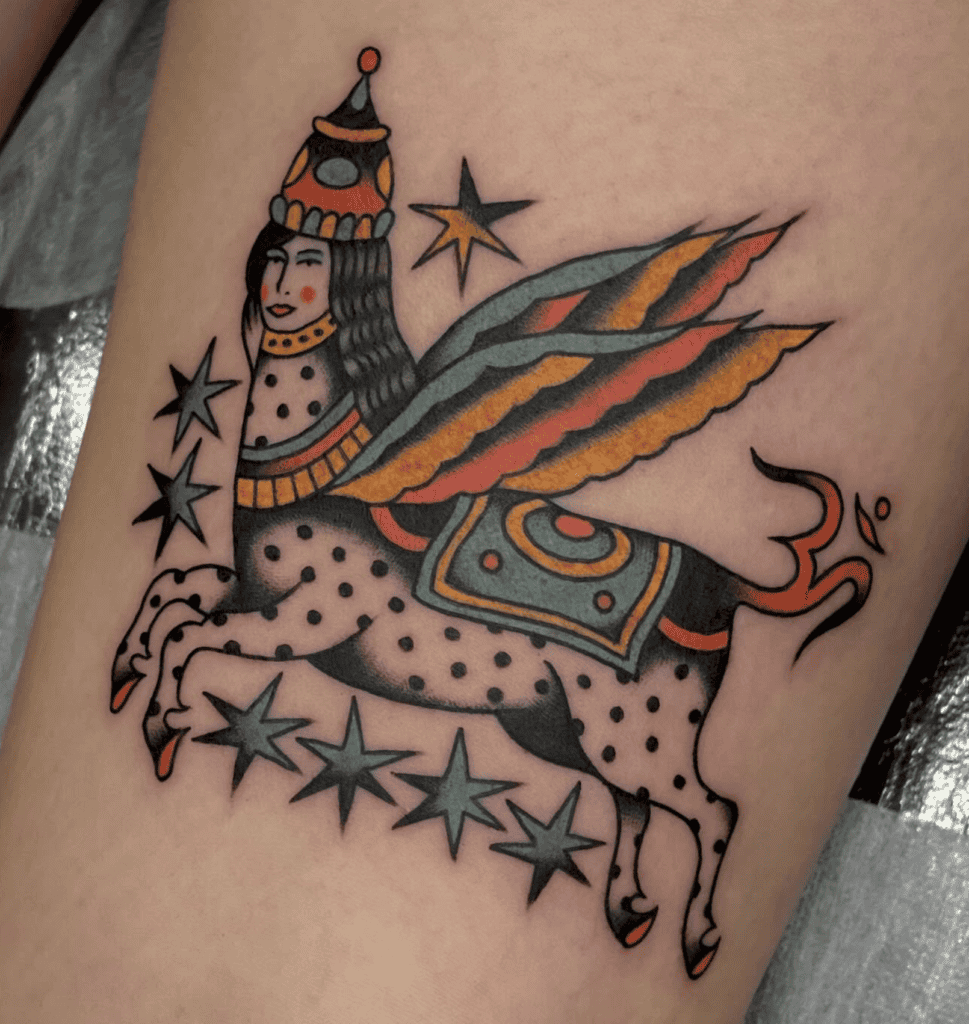
Kamadhenu (also called Surabhi) is a divine cow, the mother of all cattle, a fulfiller of wishes, and a symbol of abundance and prosperity. Her name roughly means “Desire (Kama) Cow (Dhenu).
In some traditions, Kamadhenu emerged during the Churning of the Ocean of Milk, alongside beings like Airavata. In other stories, she resides in the hermitage of sages, especially the sage Vashistha. Wherever she is, prosperity follows.
Kamadhenu can produce endless milk, manifest food and wealth, grant any wish, and create armies from her body (in some legends), thereby representing inexhaustible giving. One famous story tells of a king attempting to seize Kamadhenu from Sage Vashistha. The cow refuses to be taken and produces warriors to defend the sage.
Sharabha Hindu Mythology Tattoo


Sharabha is one of the most dramatic and lesser-known mythic creatures in Hindu tradition, being a composite beast said to be even more powerful than a lion or elephant, and in some legends is powerful enough to confront Narasimha.
Sharabha is described as a massive composite creature with eight legs. It is part lion, part bird and sometimes with wings. In certain Shaiva traditions, Sharabha appears after Narasimha defeats Hiranyakashipu. Narasimha’s rage is said to be so intense that it threatens cosmic balance. To calm or counter this unstoppable fury, Shiva manifests as Sharabha.
In some versions, Sharabha subdues Narasimha, while in others, Narasimha transforms further and overcomes Sharabha. The interpretation depends on the sectarian tradition.
Indra Hindu Mythology Tattoo
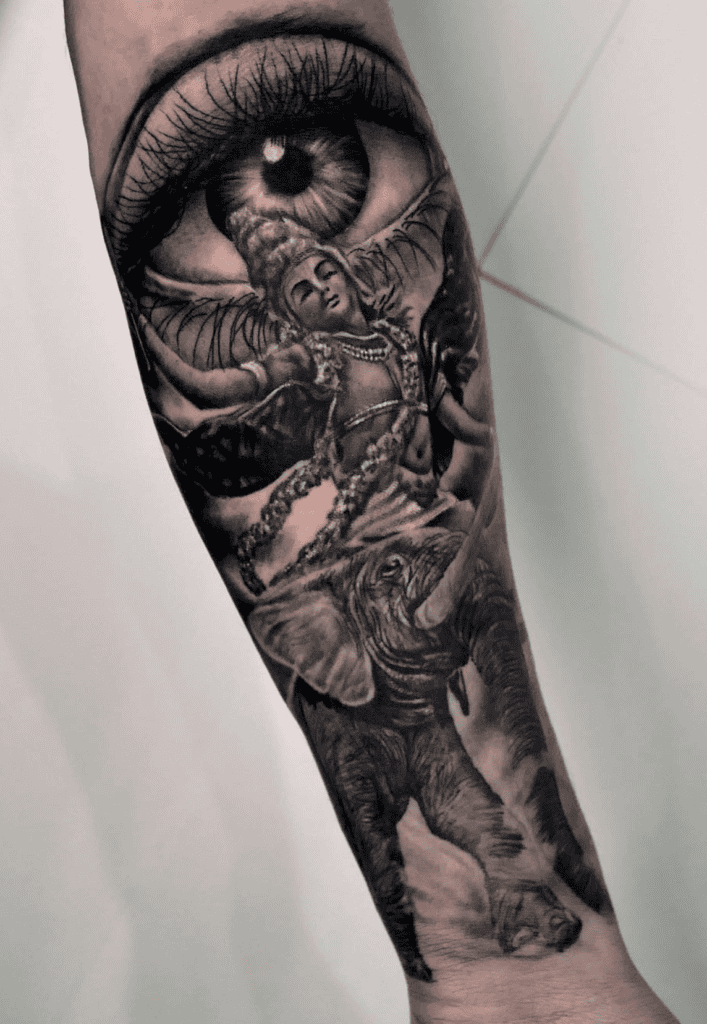
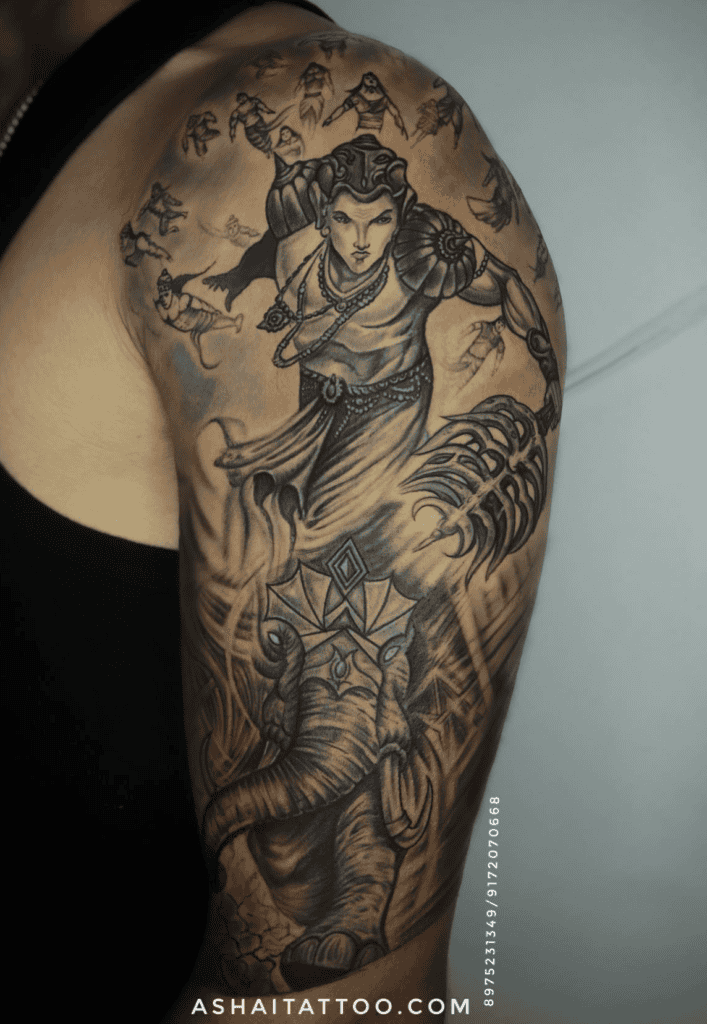
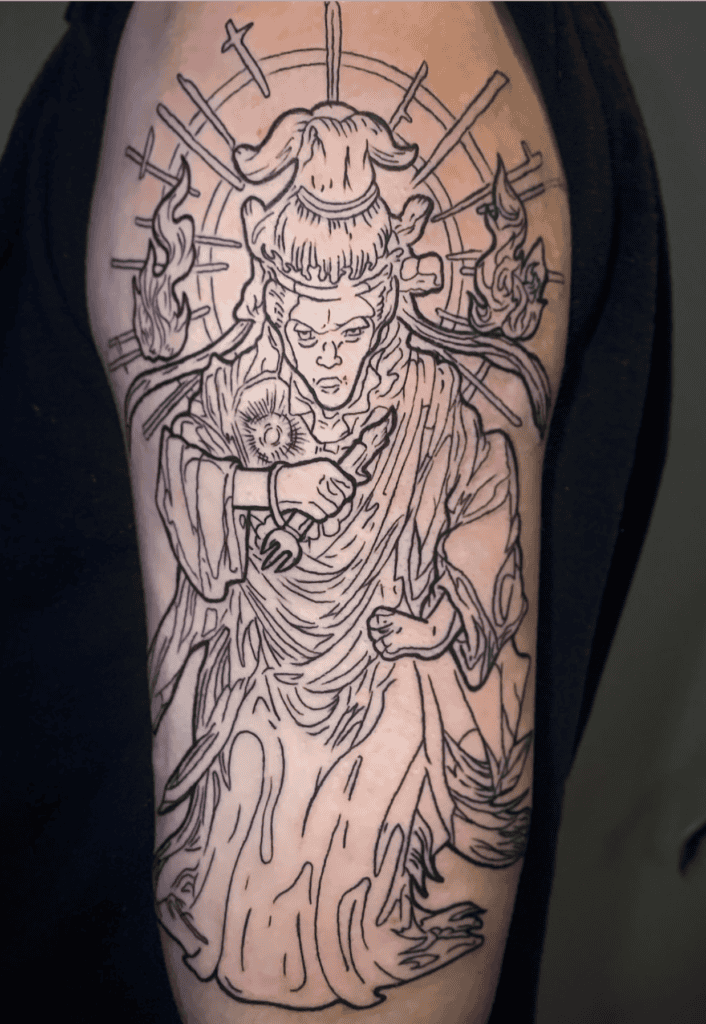
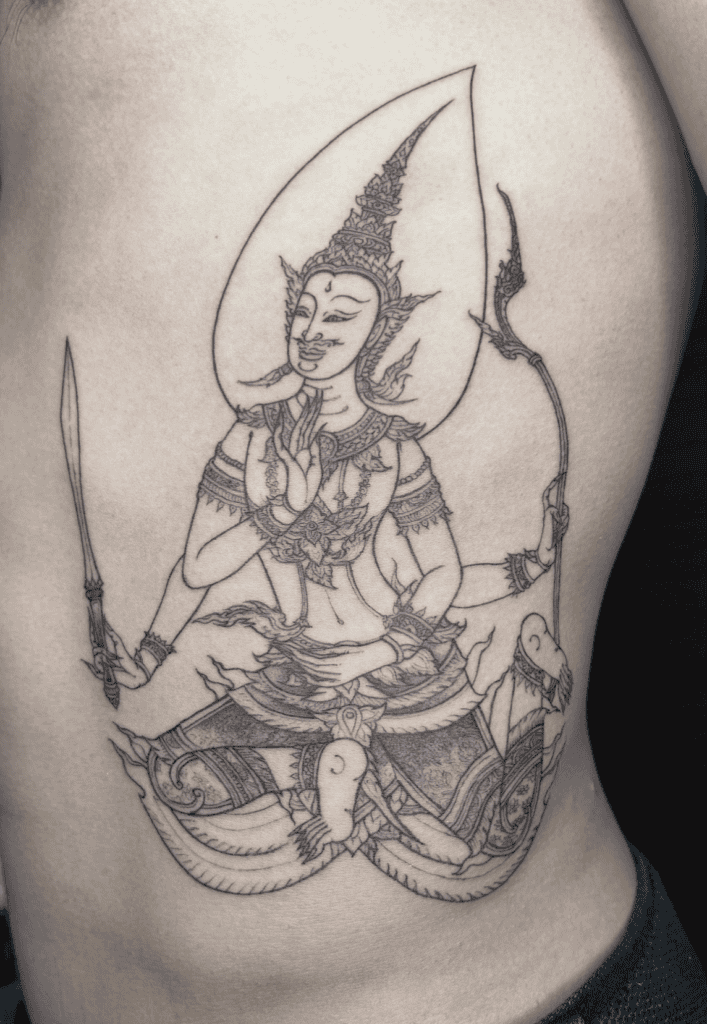
Indra is the king of the Devas, the god of thunder, lightning, and storms, wielder of the Vajra (thunderbolt weapon), and the Ruler of Svarga. He rides the majestic white elephant Airavata, symbolising royal authority and rain.
Indra’s most famous myth is his battle against the serpent-dragon Vritra. Vritra had imprisoned the world’s waters, and Indra used his thunderbolt to defeat Vritra and release the rivers, which is among the foundational myths of the Rigveda.
Indra rules Svarga, the celestial paradise where Devas reside, Apsaras dance, and Gandharvas sing. He is often surrounded by luxury and divine splendour, but unlike Vishnu or Shiva, Indra is not beyond flaw.
Agni Hindu Mythology Tattoo

Agni i rhe god of fire, the divine priest of the gods, the messenger between humans and heaven, and one of the most invoked Vedic deities. While his name literally means “fire,” this fire is not just physical flame, but a sacred transformation.
In Vedic rituals (Yajna), offerings are placed into fire, and Agni carries these offerings to the gods. When something enters fire, it changes form, and Agni symbolises transformation from material to spiritual.
Agni is said to be born repeatedly whenever fire is lit, and he is sometimes described as having seven tongues.
Varuna Hindu Mythology Tattoo

Before Vishnu and Shiva became central in later Hinduism, Varuna was one of the most powerful deities of the Vedic age. Varuna is a Vedic god of water and oceans, the guardian of cosmic law (Rta), and is associated with the sky and celestial waters. He rides the mythic sea creature Makara, symbolising mastery over the ocean’s depths.
Varuna governs oceans, rivers, rain, and cosmic waters, but in Vedic thought, “waters” also symbolise creation, fertility, life-source, and primordial existence.
Governing truth, moral law, natural cycles, and universal harmony, Varuna sees everything, punishes falsehood and rewards truth. He is often depicted holding a noose (Pasha) that symbolises binding those who break the moral law, capturing wrongdoers, and enforcing cosmic justice.
Surya Hindu Mythology Tattoo

Surya is the Hindu god of the Sun, a Vedic solar deity, the giver of light and life, and a symbol of truth and vitality. He rides a golden chariot pulled by seven horses, representing the seven days of the week, the seven colours of light, the seven chakras, and the seven meters of Vedic hymns
His charioteer is Aruna, the personification of dawn.
Surya plays important roles in the Mahabharata. He is the divine father of Karna, the radiant warrior born with golden armour, and unlike many mythic deities, Surya is actively worshipped in daily rituals.
Rangda Bali Hindu Mythology Tattoo
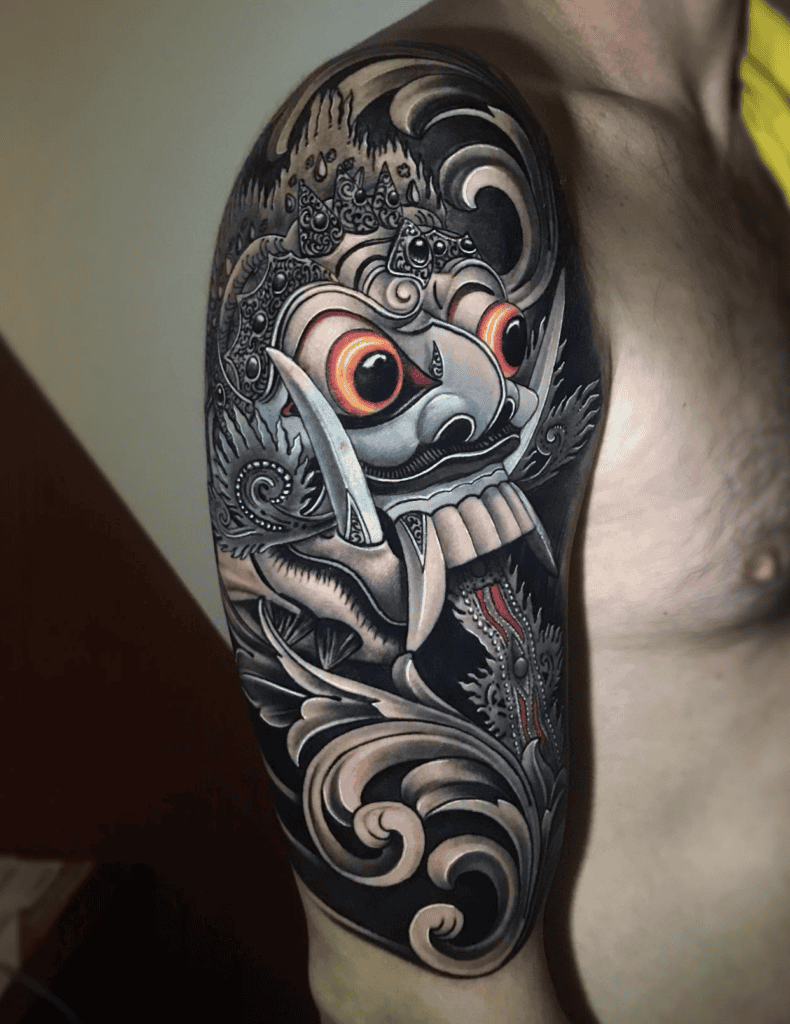
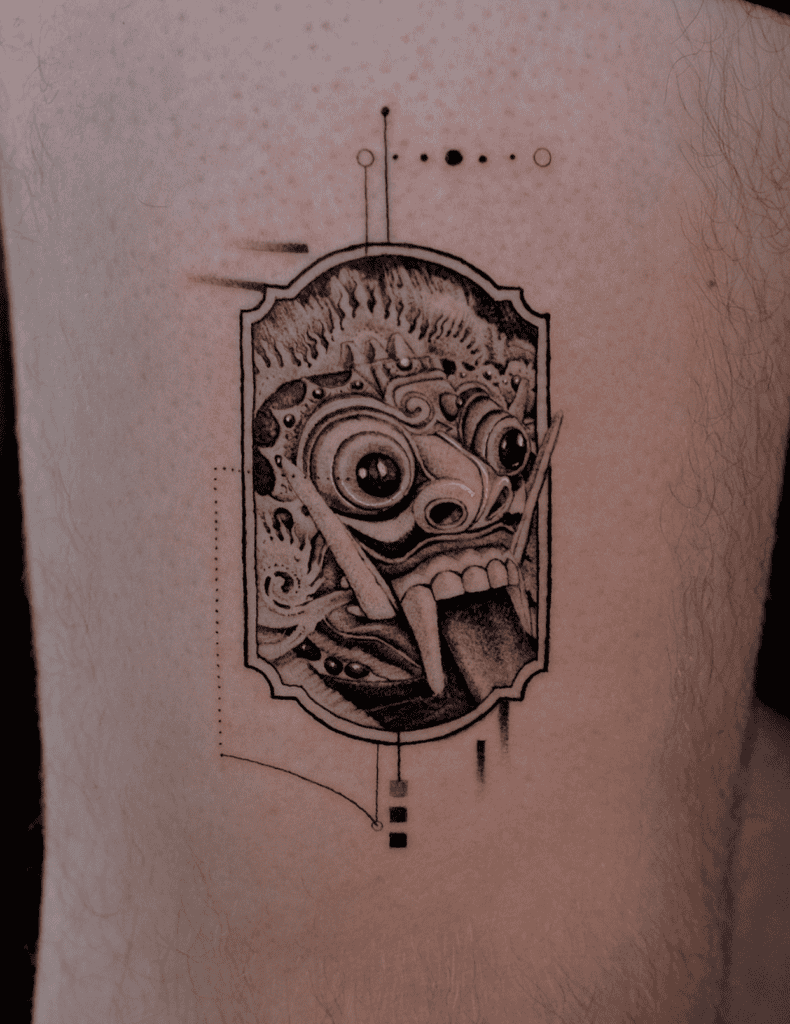
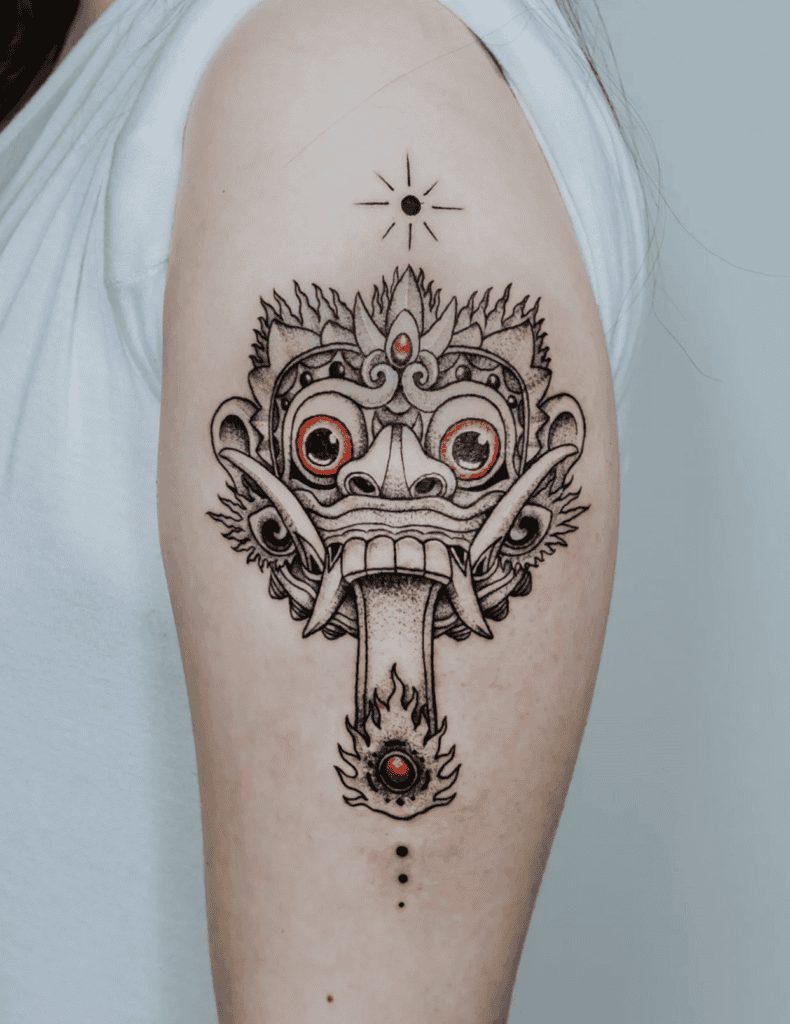
Rangda is not originally from classical Indian Hindu texts, but she emerges from Balinese Hindu tradition, which blends Hindu mythology with indigenous beliefs.
Rangda is the demon queen of Bali, leader of the Leyaks, a powerful embodiment of dark magic, and the eternal rival of Barong. Her name roughly means “widow” and she is often depicted as wild-haired, long-fanged, with bulging eyes, long claw-like nails, and a frightening mask and costume.
In Balinese philosophy, Rangda is not simply “evil.” She represents destructive energy, death, chaos, and the shadow side of nature. But destruction is part of cosmic balance, and without darkness, light cannot exist.
Rangda’s most famous mythic role is her battle with Barong.
Barong Bali Hindu Mythology Tattoo
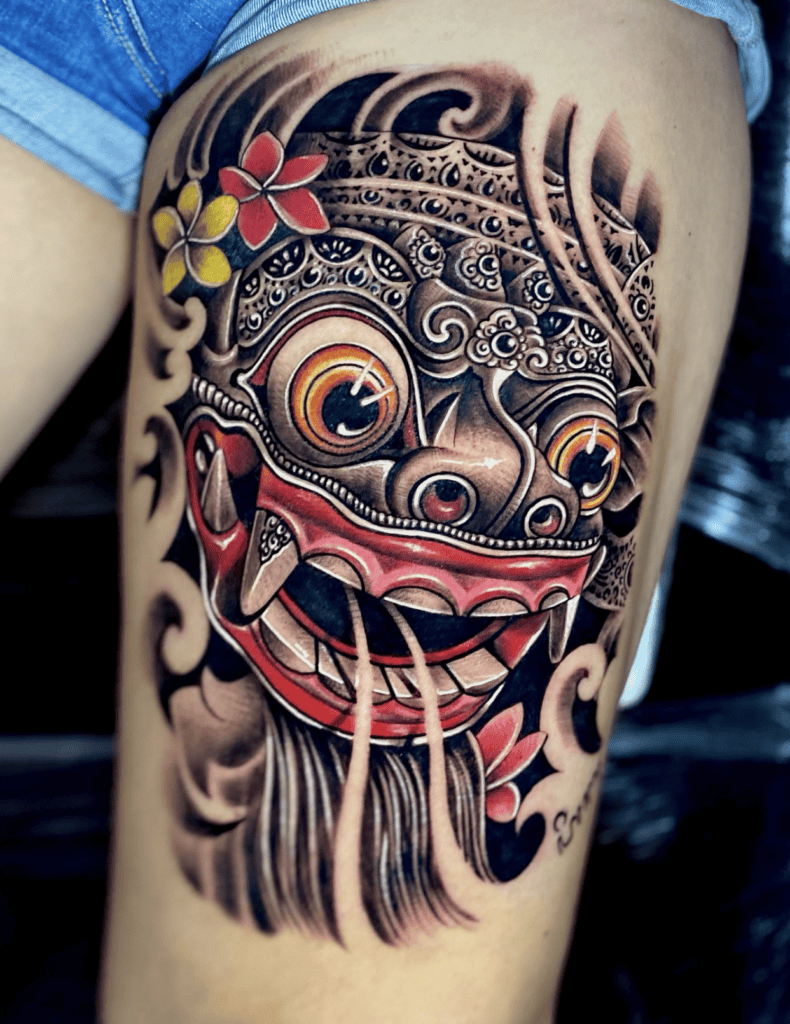
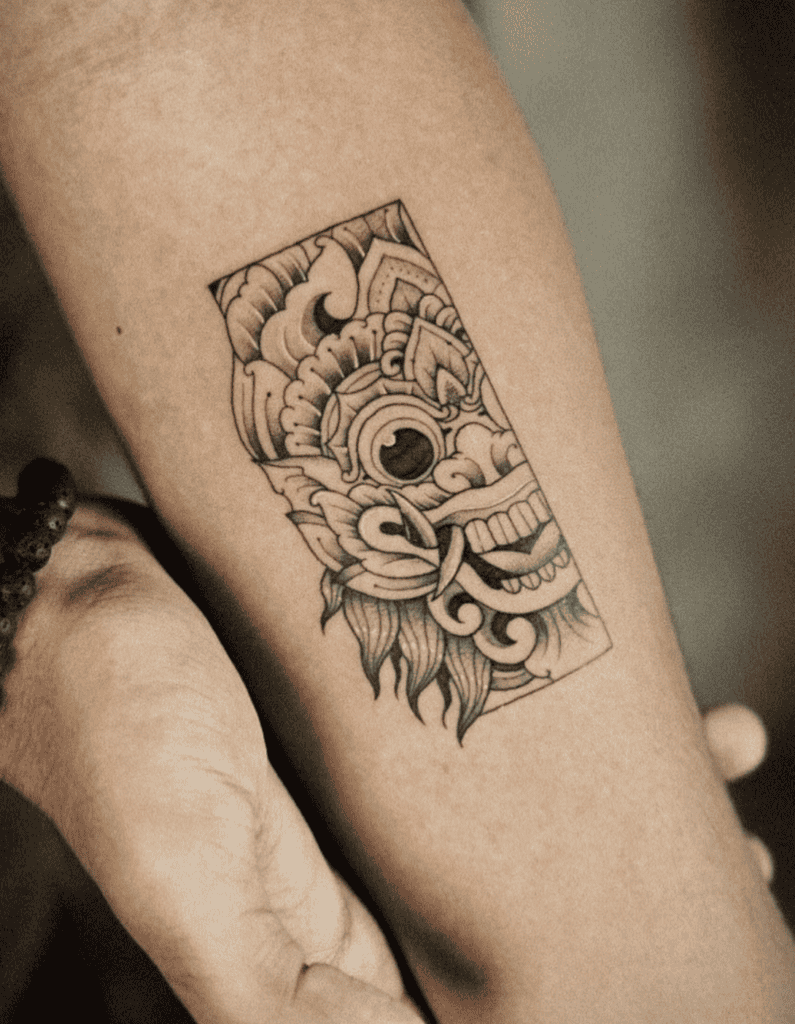
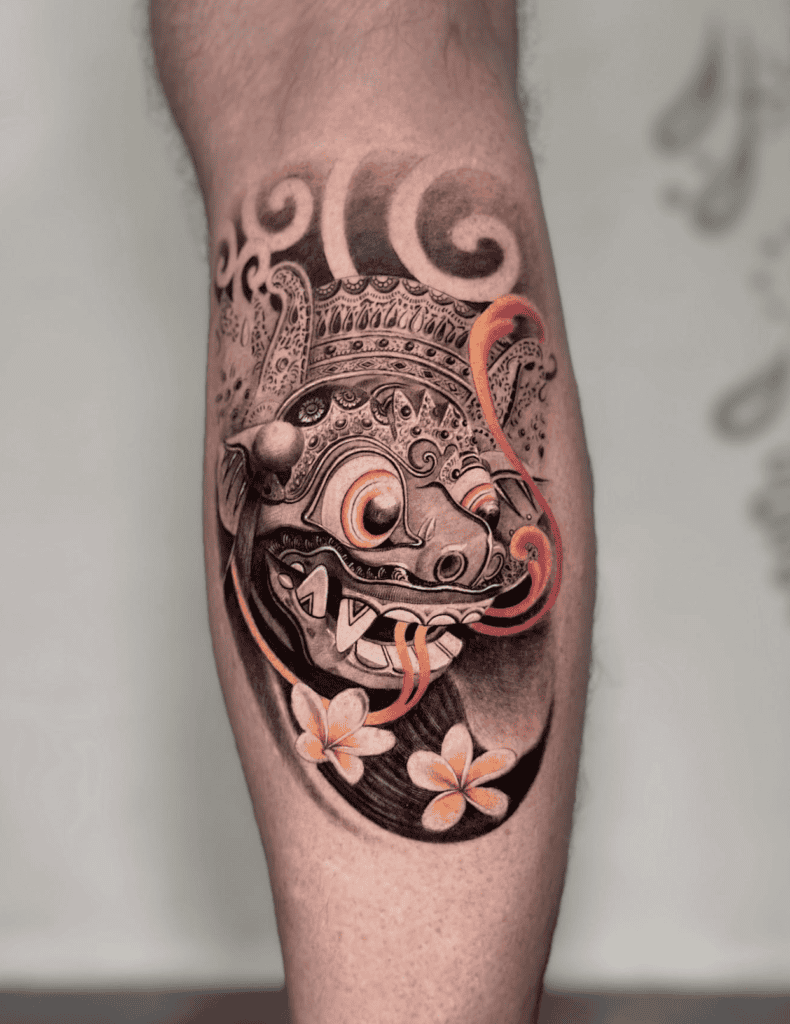
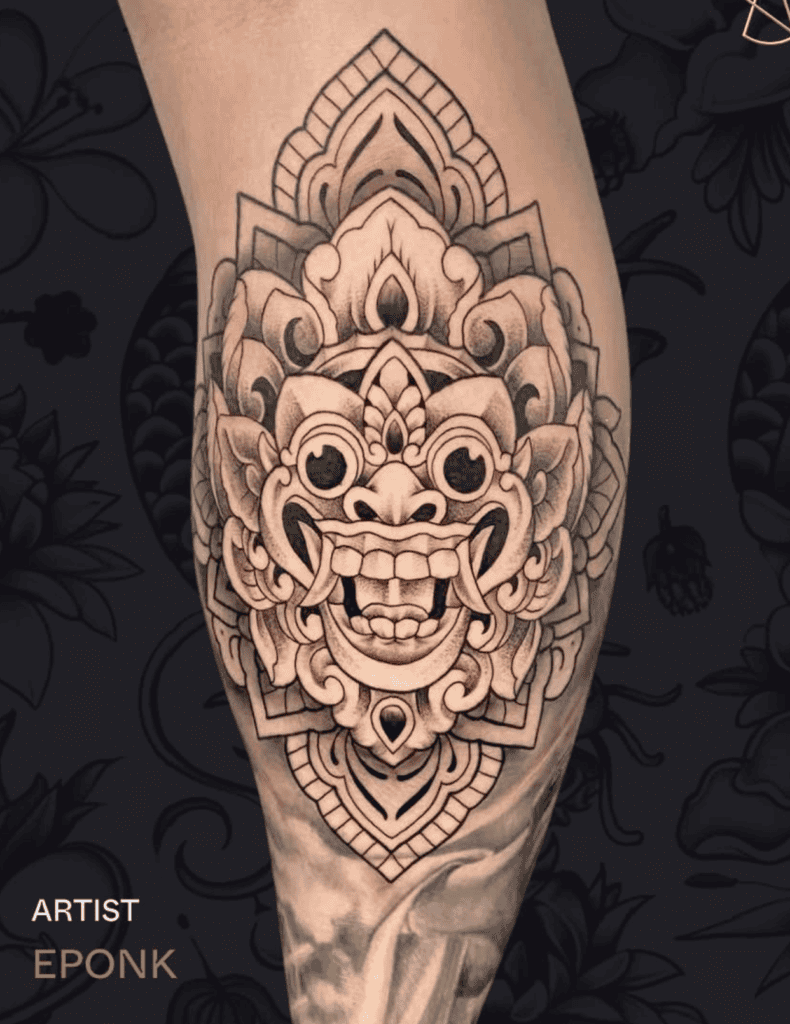
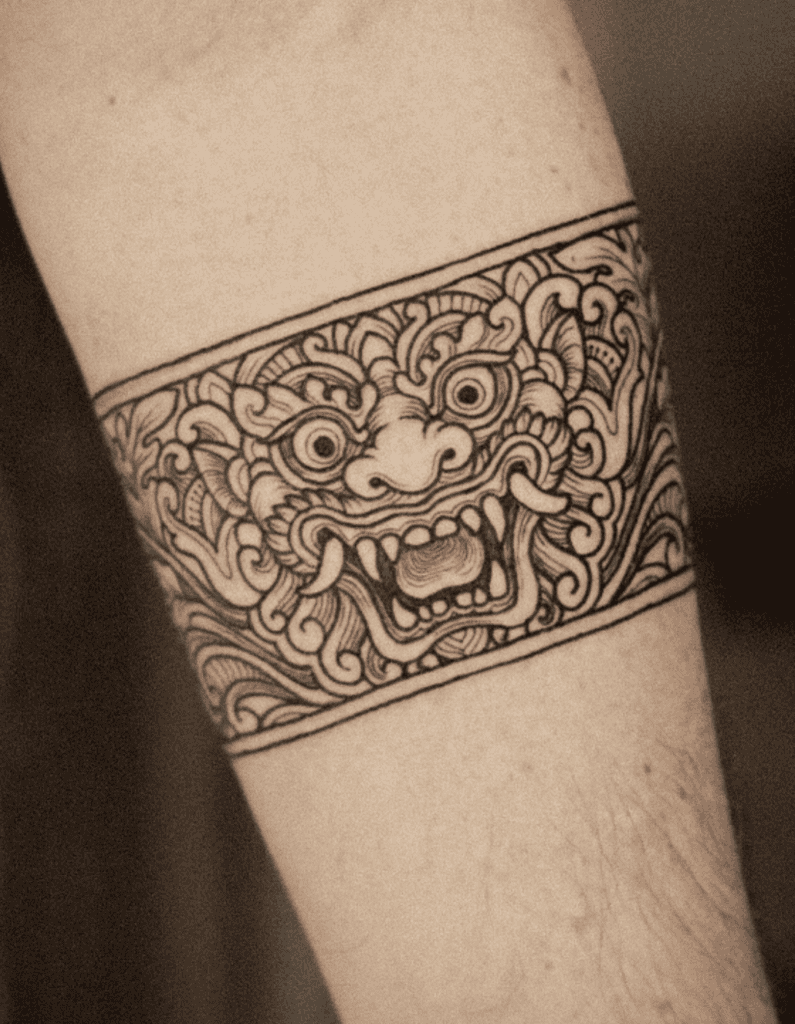
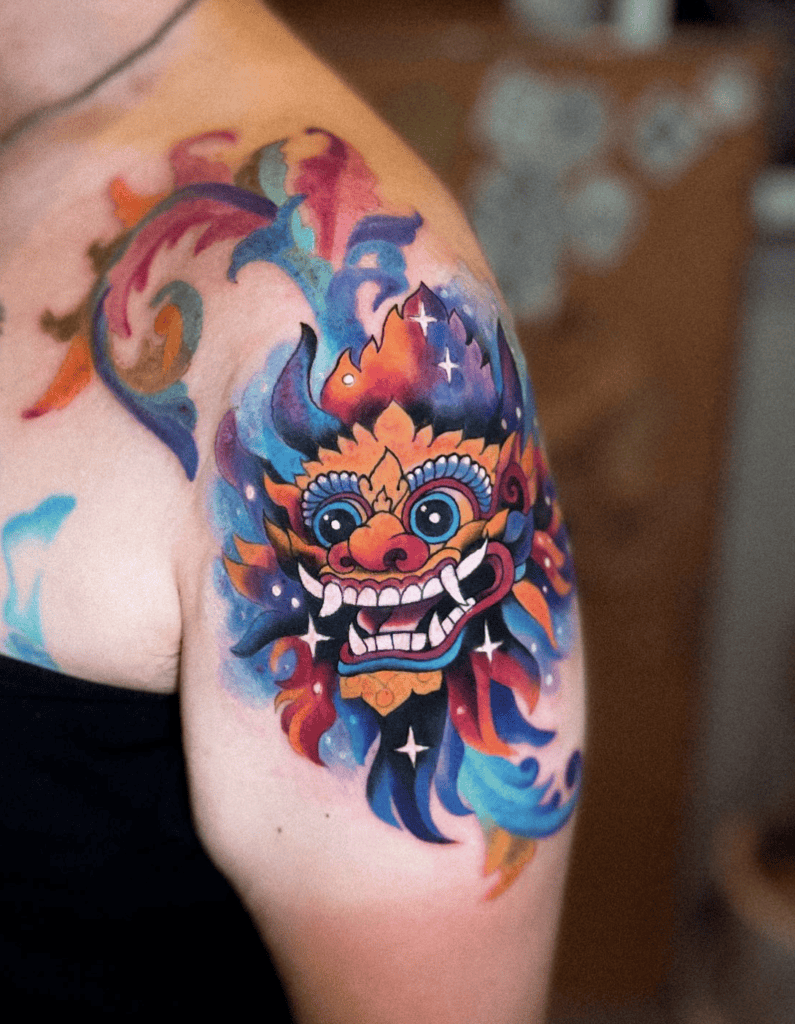
Barong is a protective spirit, a guardian of villages, a symbol of goodness and order, and the eternal opponent of Rangda. Unlike many Hindu beings, Barong is not a single defined deity and is more of a spirit archetype representing benevolent power.
Barong’s most iconic role is in the ritual dance battle with Rangda. Rangda represents destructive chaos and Barong represents protective balance. Their battle symbolises the eternal struggle between opposing forces. Barong never permanently defeats Rangda as balance, not victory is the ultimate goal.
Leyak Bali Hindu Mythology Tattoo

Leyaks are witch-like supernatural beings, masters of black magic, and servants or followers of Rangda. By day, a Leyak may appear human, and by night, it transforms into a flying head, with glowing eyes, a long tongue and has its internal organs dangling beneath.
According to Balinese folklore, Leyaks feed on spiritual energy, target pregnant women or newborns (in some tales), spread illness, and practise dark sorcery. However, these stories serve a deeper symbolic role by representing fear of unseen forces.
Jero Gede Macaling Bali Hindu Mythology Tattoo


Jero Gede Macaling is a powerful Balinese spirit-king who is often associated with plague and illness. He is linked to Nusa Penida island and is a supernatural ruler connected to Rangda traditions. His name roughly translates to something like “Great Elder Macaling.”
Macaling is strongly associated with Nusa Penida, an island southeast of Bali. In Balinese belief, he rules from there spiritually. When disease or epidemics spread, people historically believed it was connected to his influence. However, he is not purely evil and is a force that must be respected and appeased.
Celuluk Bali Hindu Mythology Tattoo
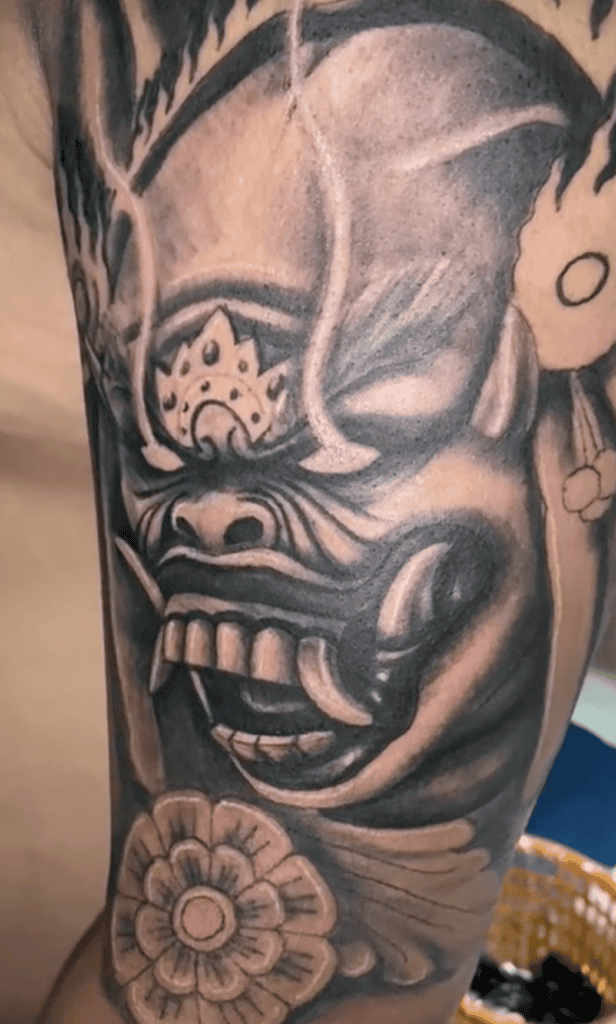
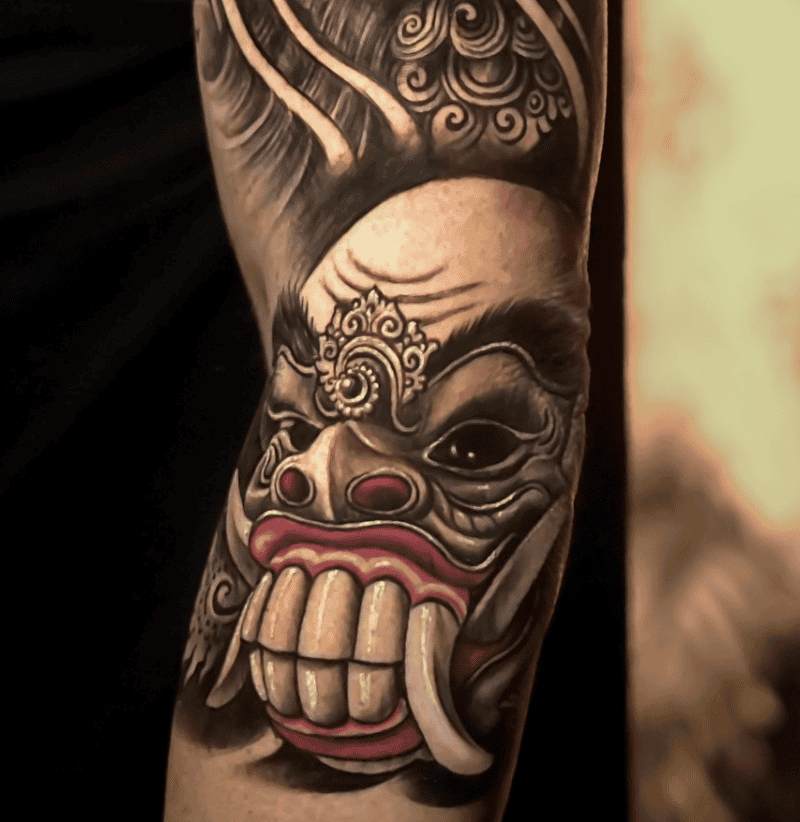
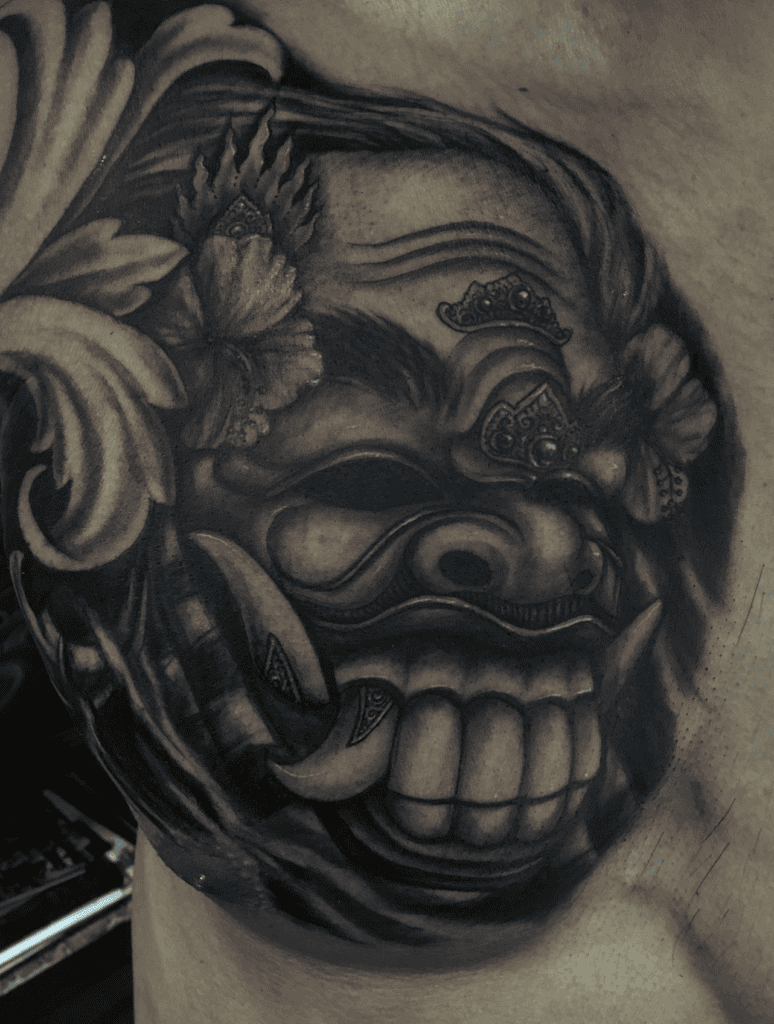
Celuluk is a demon spirit in Balinese mythology often associated with Rangda. He is a follower of dark forces and a being of mischief and disturbance. He is not usually portrayed as a supreme ruler and is more like a disruptive agent.
In folklore, Celuluk spreads disturbance, causes confusion or illness, assists dark magic rituals and appears in night performances. But like many Balinese spirits, his role is symbolic. He represents smaller-scale disruption and not cosmic destruction.
Conclusion
Thanks for joining us on this Karmic adventure through the Hindu Mythology Tattoo. We Vish-nu a good luck on your tattooing adventure and hope no Naga-tive influence disrupts your balance. But before you go, Rama-ber, we still have some amazing Persian Mythology Tattoo Ideas, Greek Mythology Tattoo Designs, or Egyptian Mythology Tattoos to check out.
- Animal Tattoo Ideas - September 10, 2026
- Cartoon Tattoo Ideas - September 7, 2026
- Courage the Cowardly Dog Tattoo Ideas - September 3, 2026