
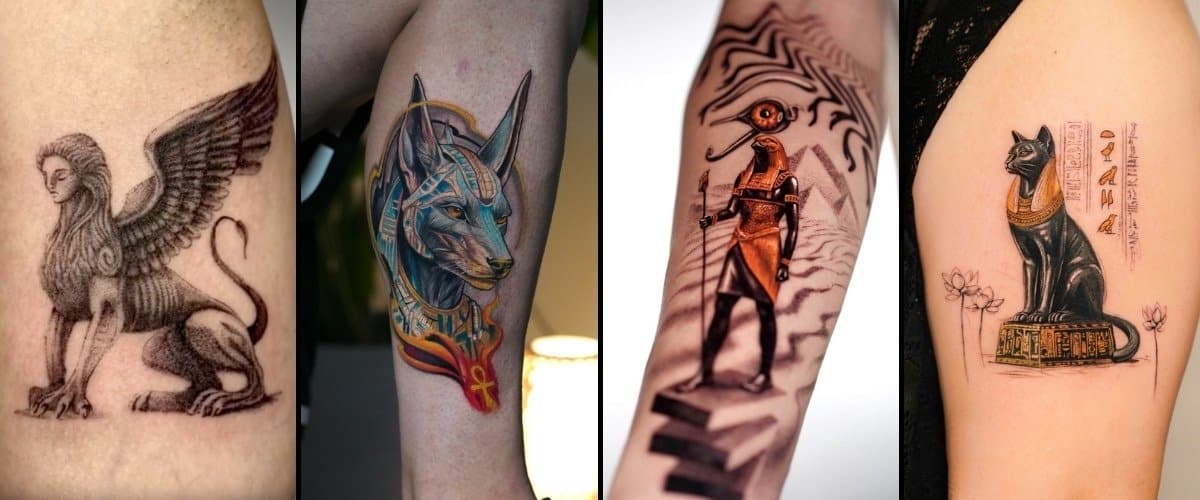
Egyptian Mythology Tattoo Ideas

Do you feel like you’re lost in a vast desert on your search for the best Tattoo Clues? Worry not, we’ve travelled back in time and pulled out some of the greatest Egyptian Mythology Tattoo designs from the primeval waters of chaos to start your Tattoo journey anew.
What is Egyptian Mythology
Egyptian mythology is the ancient belief system of Ancient Egypt, developed along the Nile River over more than three thousand years. It explains how the world was created, how it is maintained, and what happens after death, using gods, symbols, and stories to describe the forces that shape existence.
At its core, Egyptian mythology is about order versus chaos. The universe was believed to function only as long as Ma’at — balance, truth, and harmony — was upheld. Gods such as Ra, Osiris, Isis, and Horus were responsible for maintaining this order, while forces like chaos, darkness, and disorder constantly threatened it. Life was seen as a daily effort to keep balance intact, not just by gods, but by humans as well.
Best Egyptian Mythology Tattoo Artists


paskull
Napoli Black Work Tattooer tattooing a variety of myths including Egyptian Mythology.

kimkong.ink
Eindhoven based Animal Tattoo artists with Egyptian Mythology Animal Designs
Best Egyptian Mythology Tattoo Ideas
Now that we know a little about Egyptian Mythology, let’s journey through the best Egyptian Mythology Tattoo Clues time and space has to offer.
Amun Ra Egyptian Mythology Tattoo
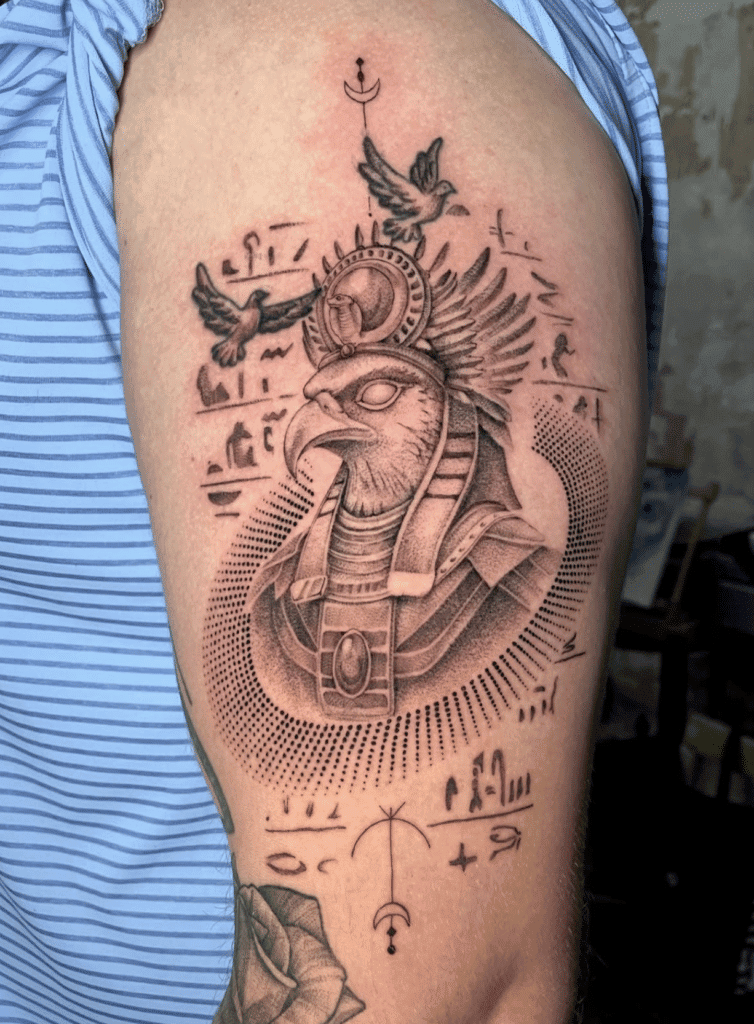
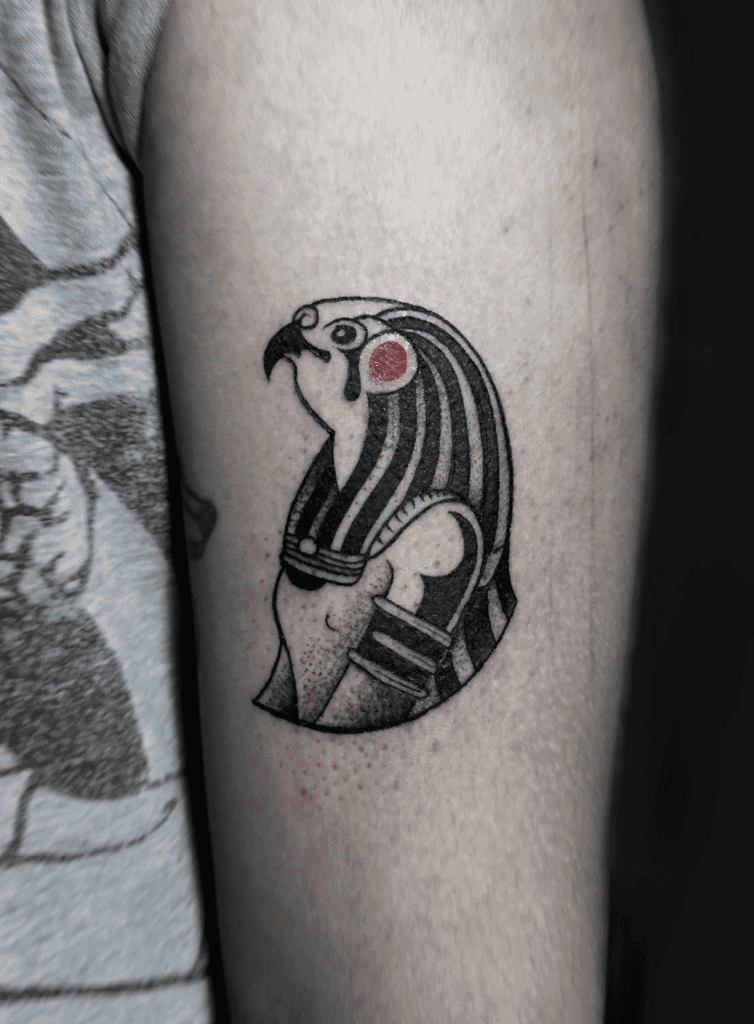
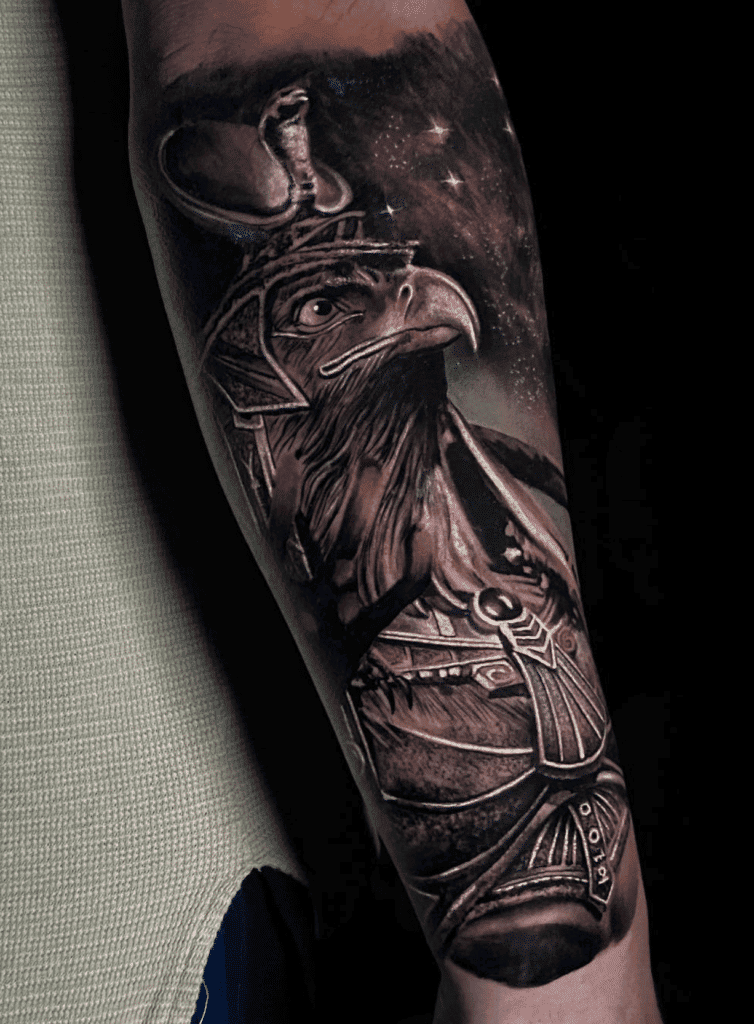
Amun-Ra is a fusion of both Gods Ra and Amun. This fusion rose to prominence during the New Kingdom (around 1550–1070 BCE), when Thebes became Egypt’s political and religious heart.
Amun was elevated to supreme status and merged with Ra to reflect the idea that the universe required both an invisible source and a visible expression. Amun-Ra was not just a god among others; he was the king of the gods, the ultimate creator, and the cosmic authority above all divine forces.
As Amun-Ra, he embodied creation itself. He was believed to have brought the world into being through thought and will, existing before form, before light, and before time. Spiritually and symbolically, Amun-Ra stands for absolute authority, divine legitimacy, creation through will, hidden strength, and eternal renewal.
Ra Egyptian Mythology Tattoo
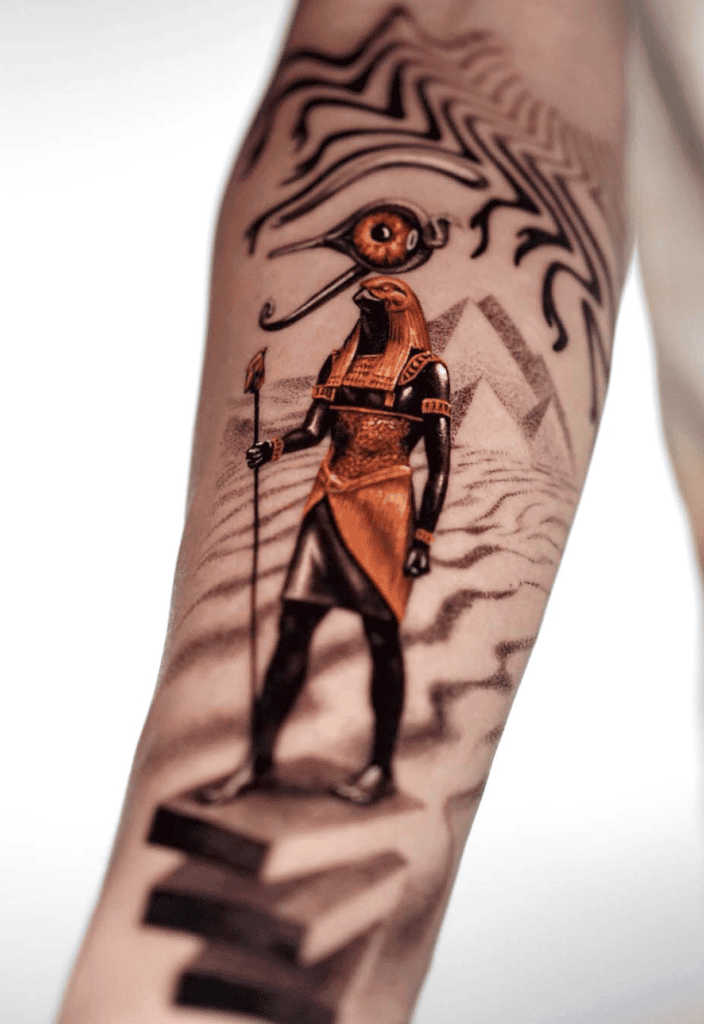
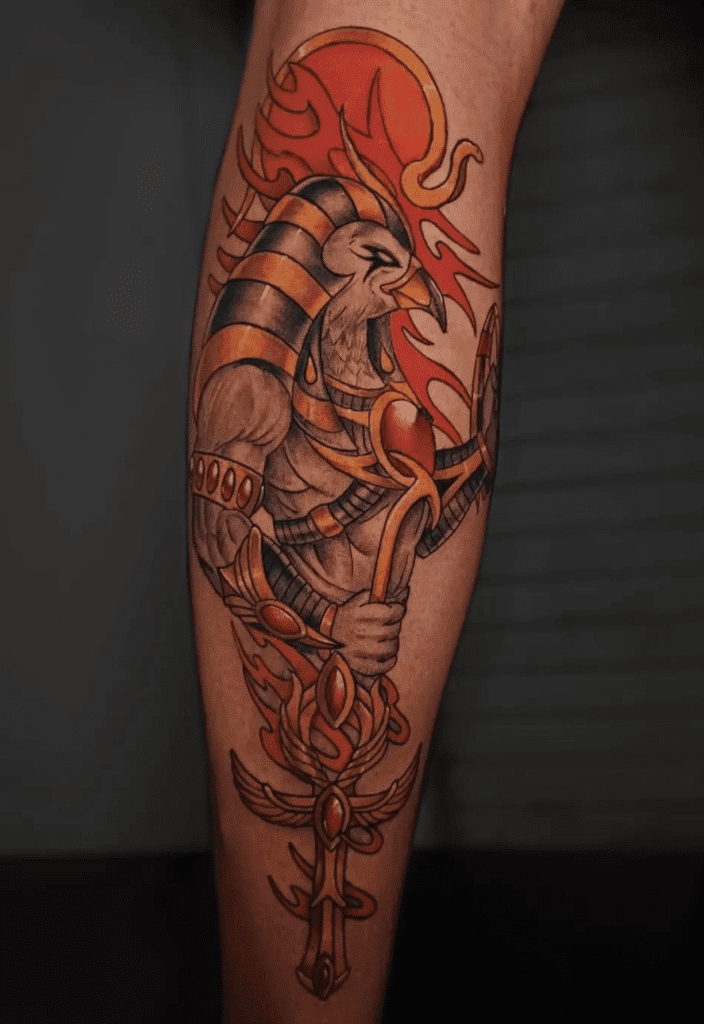
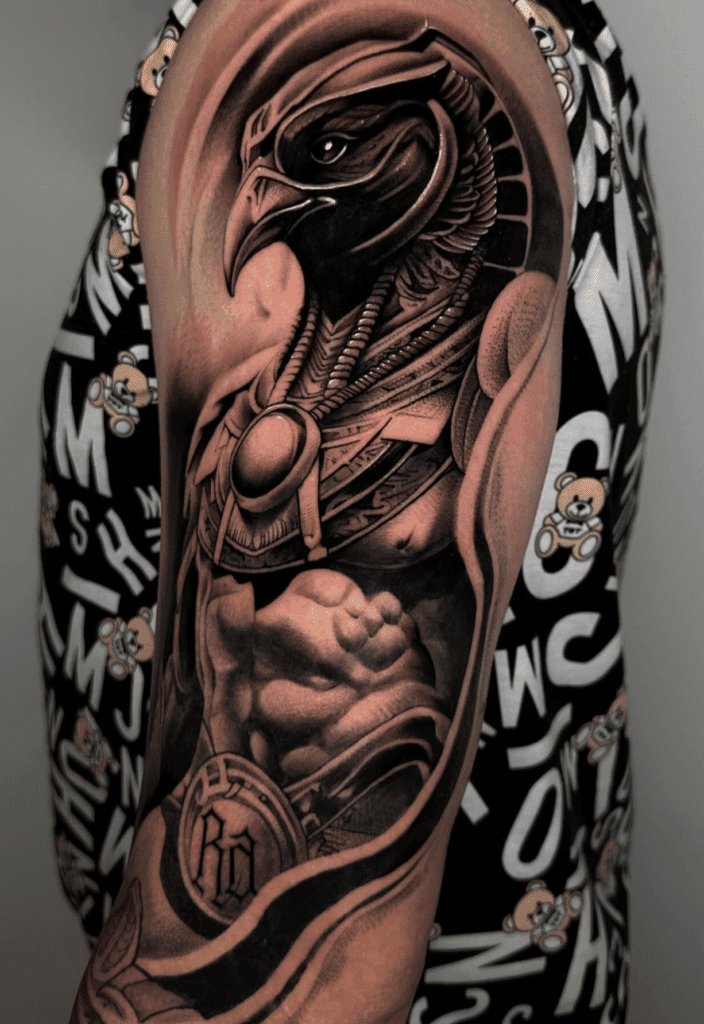
Ra is one of the oldest and most powerful gods in Egyptian mythology, revered as the creator of life and the divine force behind the sun itself. To the ancient Egyptians, Ra was the sun itself, the burning heart of existence, light, time, and cosmic order.
Ra was believed to have emerged at the dawn of creation from the primeval waters of chaos, bringing light where there had only been darkness. Through his presence, the world took shape, and through his will, life continued.
Every sunrise was seen as Ra being reborn, and every sunset as his descent into the underworld, making him a living symbol of eternal renewal.
By day, Ra travelled across the sky in his solar barque, illuminating the land and sustaining life. By night, he journeyed through the underworld, where he faced terrifying forces of chaos — most notably the great serpent Apep. Each night was a cosmic battle with dawn marking Ra’s victory, ensuring that order triumphed over destruction once again.
Ra was closely tied to Ma’at, the principle of truth, harmony, and justice. Pharaohs ruled as his earthly representatives, maintaining order in the human world just as Ra maintained order in the heavens. Because of this, Ra also became deeply connected to kingship and divine authority.
Amun Egyptian Mythology Tattoo


Amun, whose name means “the Hidden One,” began as an almost invisible presence and rose to become the supreme god of an empire. He likely emerged as a local deity in Thebes around the early Middle Kingdom (roughly 2000 BCE). At first, he was a quiet god of air, breath, and the unseen forces, representing what could not be seen but could still be felt.
As Thebes grew in political power, so did Amun. By the time of the New Kingdom, he was elevated to the highest divine status and merged with the sun god Ra, becoming Amun-Ra, a fusion that symbolised both invisibility and absolute radiance. Through this union, Amun became the hidden force behind the sun — not the visible light itself, but the divine power that made it rise each day.
Amun was seen as a creator god who did not need to reveal himself. He was believed to exist beyond form, beyond names, and beyond comprehension.
This made him uniquely adaptable: he could be worshipped by common people as a personal god who listened to prayers, and by kings as the cosmic authority that granted them legitimacy. Pharaohs claimed to rule by his divine will, and many were said to be his literal offspring.
In art, Amun is usually shown as a human figure wearing a tall crown with two vertical plumes, sometimes with blue or black skin to symbolise creation, fertility, and the depths of the unseen world. He was also associated with the ram, an animal representing strength, vitality, and divine authority.
Spiritually, Amun represents mystery, hidden strength, inner power, divine authority, and faith without certainty. He is the god of what lies behind reality rather than on its surface — a reminder that the greatest forces are often unseen, and that true power does not always announce itself.
Horus Egyptian Mythology Tattoo
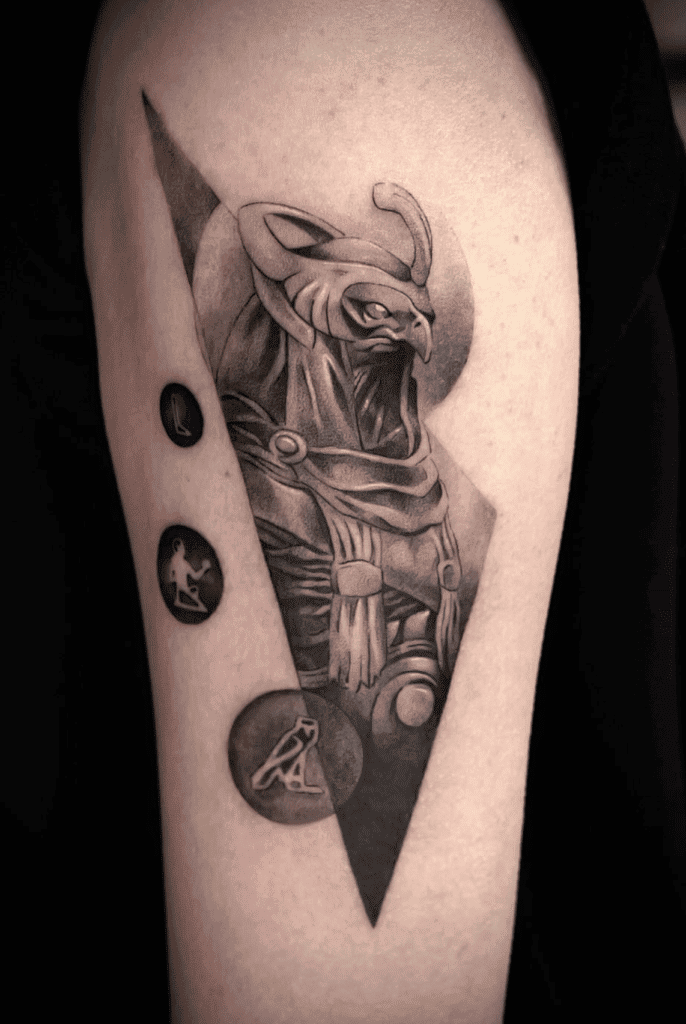
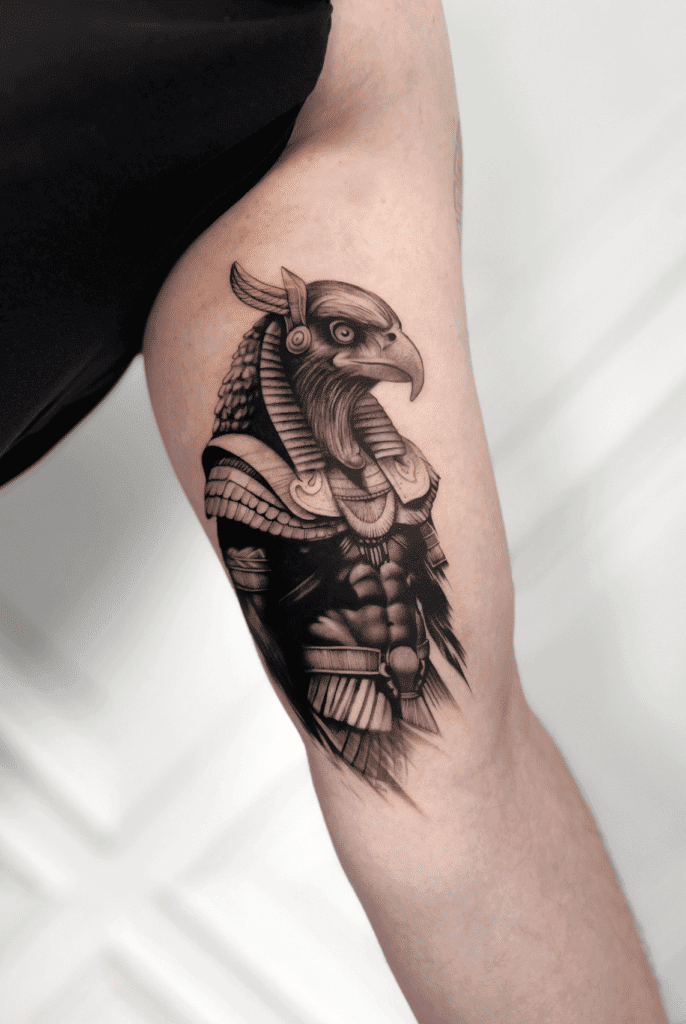
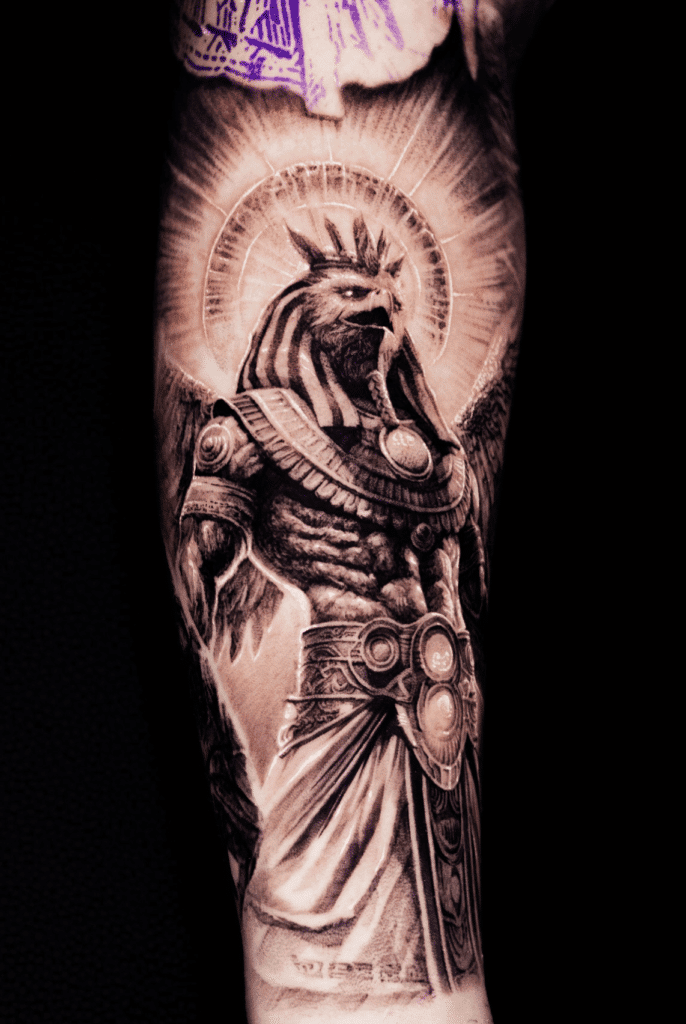
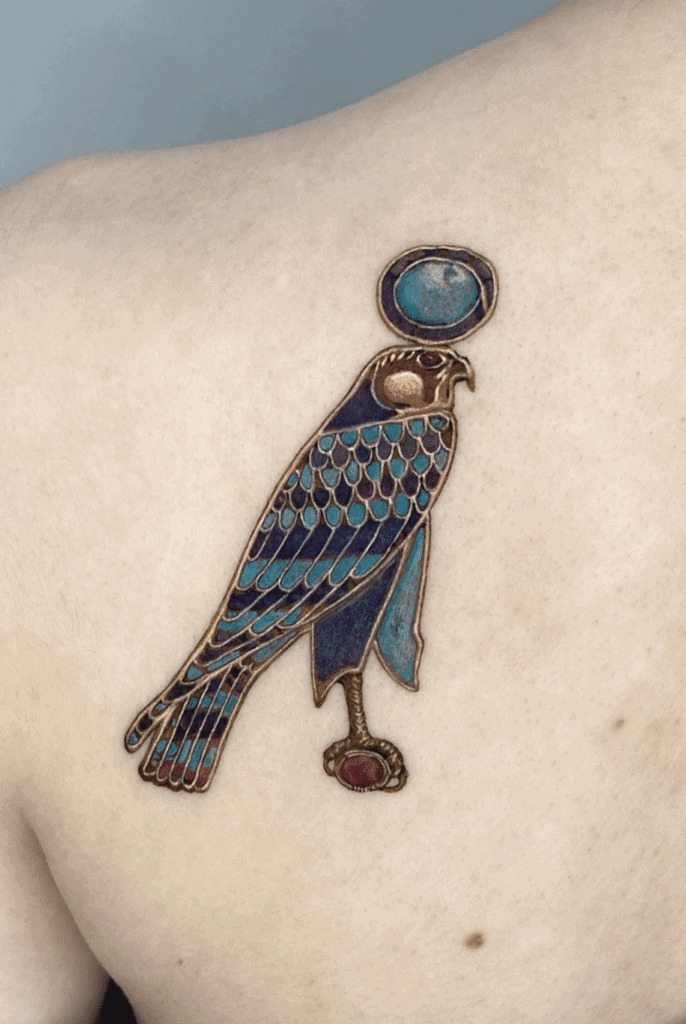
Horus embodies kingship, protection, justice, and the eternal triumph of order over chaos. He is the sky god whose eyes were believed to be the sun and the moon, watching over the world from above, ever vigilant.
Horus is best known as the son of Osiris and Isis, born into a world already torn by betrayal. After Osiris was murdered by his brother Set, Horus was raised in secret by Isis and protected until he was strong enough to claim his birthright.
The central myth of Horus is his long and brutal conflict with Set. Horus ultimately defeats Set and takes his place as the rightful ruler, becoming the divine prototype of the pharaoh. Upon death, pharaohs would unite with Osiris in the afterlife, while the next king became Horus anew. This cycle tied Horus directly to kingship, succession, and the continuity of the state.
Set Egyptian Mythology Tattoo
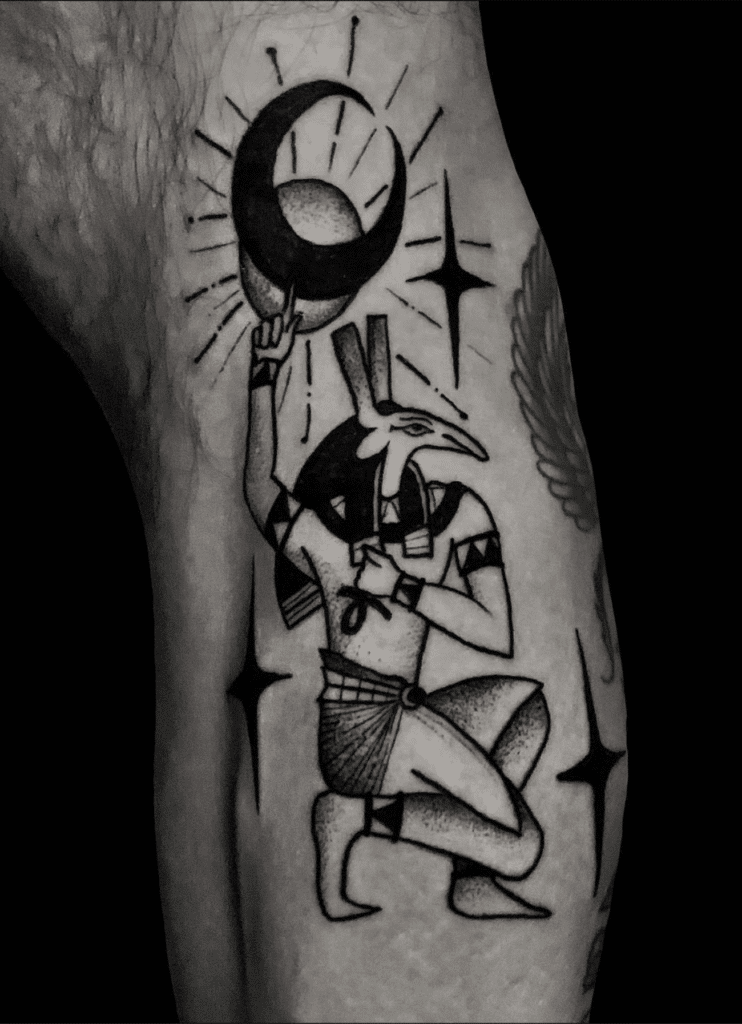
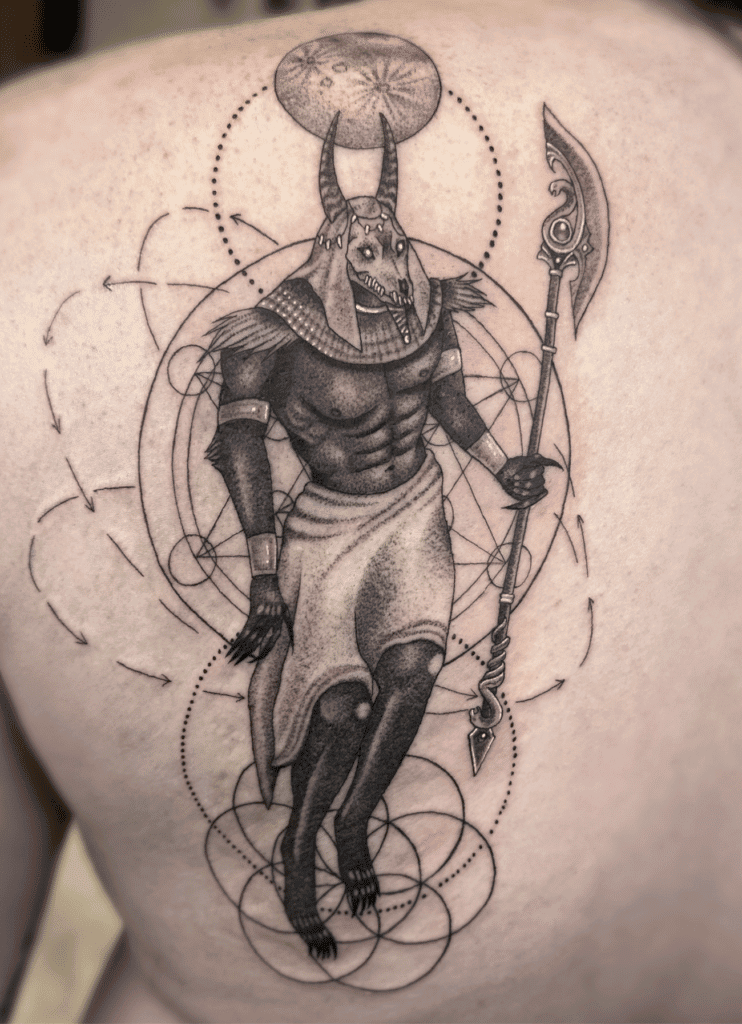
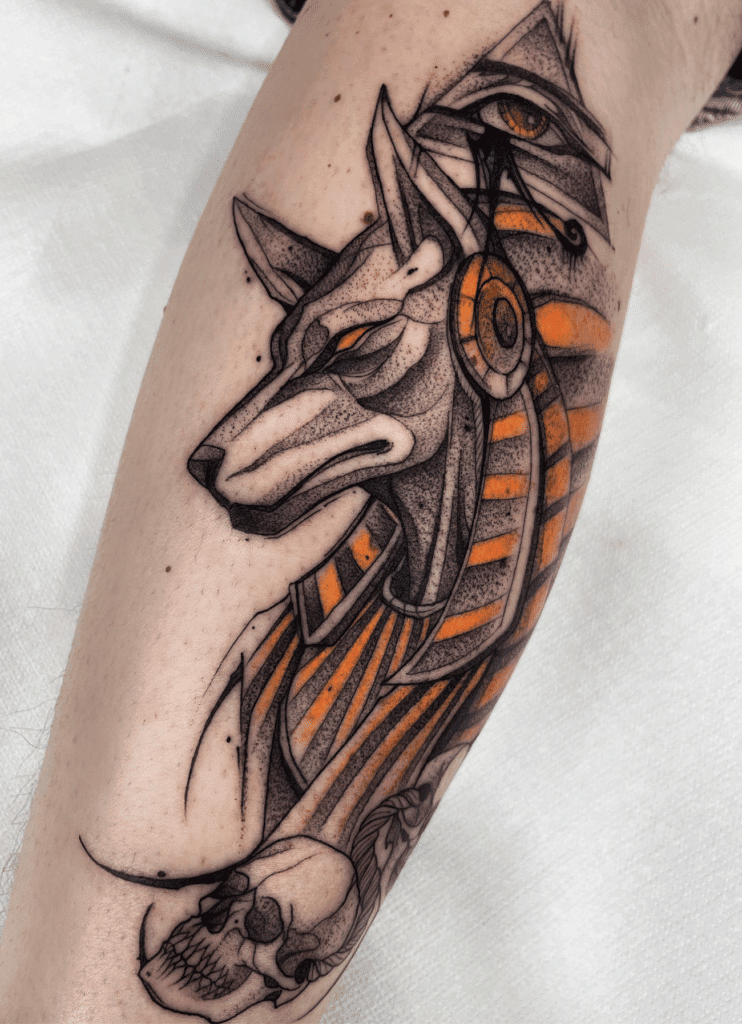
Set is the embodiment of chaos, storms, deserts, and disruption, meaning he is not evil in a simple sense, but the dangerous, necessary force that exists outside order.
In the earliest periods of Egyptian belief, Set was not purely a villain. He represented the wild places beyond civilisation: scorching deserts, violent storms, foreign lands, and raw strength. Though feared, they were also respected. Without chaos, order had no meaning.
Set’s most famous role comes from the myth of Osiris. Driven by jealousy and ambition, Set murdered his brother Osiris and seized the throne. This act shattered cosmic balance and set in motion one of the central conflicts of Egyptian mythology: Set versus Horus, the son of Osiris.
Despite his reputation, Set was not always condemned. In some traditions, he was a necessary defender of the cosmos. Each night, as Ra travelled through the underworld, Set stood at the prow of the solar barque, using his strength to fight off the chaos serpent Apep. In this role, Set became a protector — proof that even destructive forces can serve a greater purpose when directed.
Over time, especially during periods of foreign invasion and political instability, Set’s image darkened. He became increasingly associated with outsiders, tyranny, and disorder, eventually cast as a near-demonic figure. Yet this shift says as much about Egypt’s fears as it does about Set himself.
Isis Egyptian Mythology Tattoo
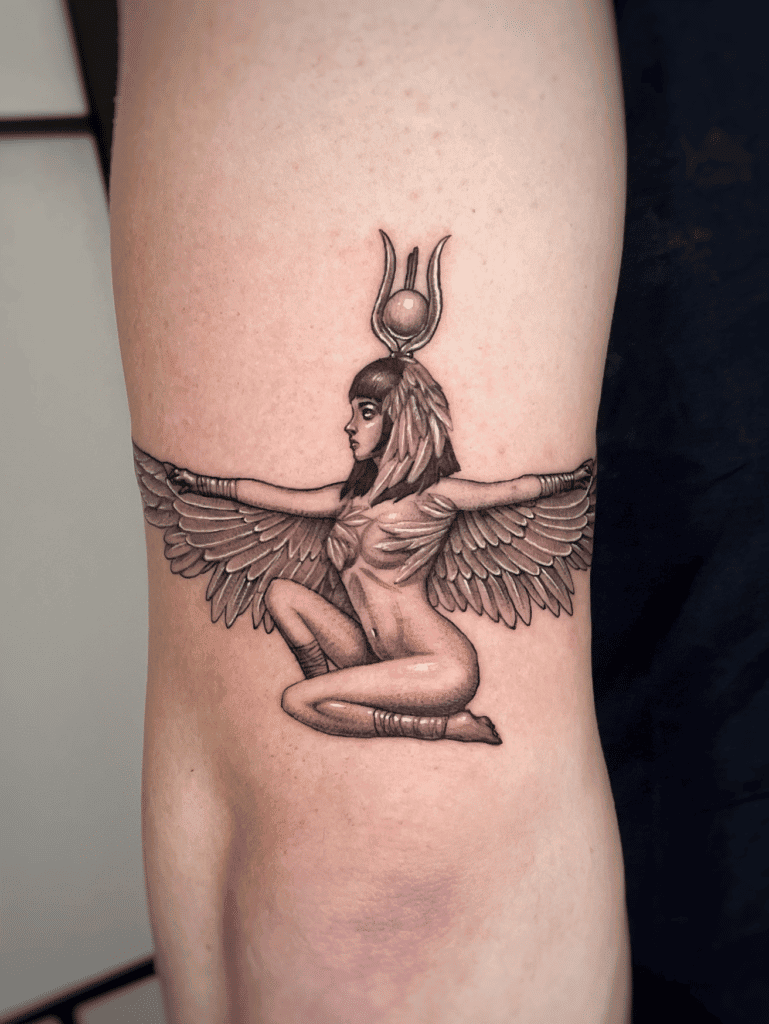
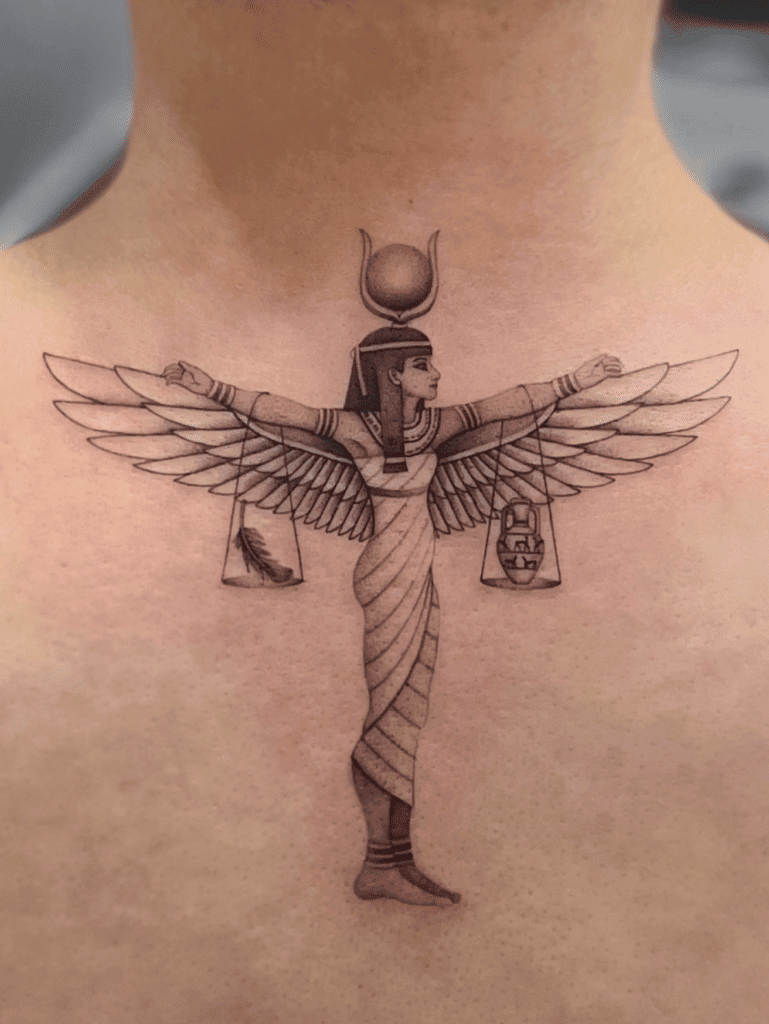
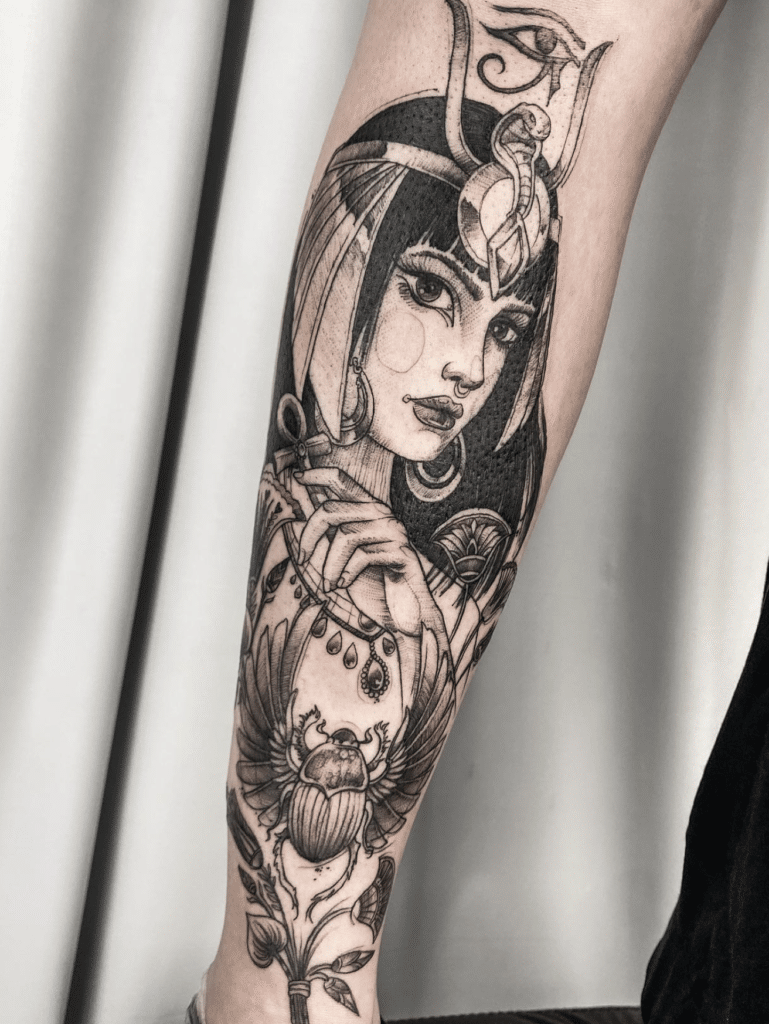
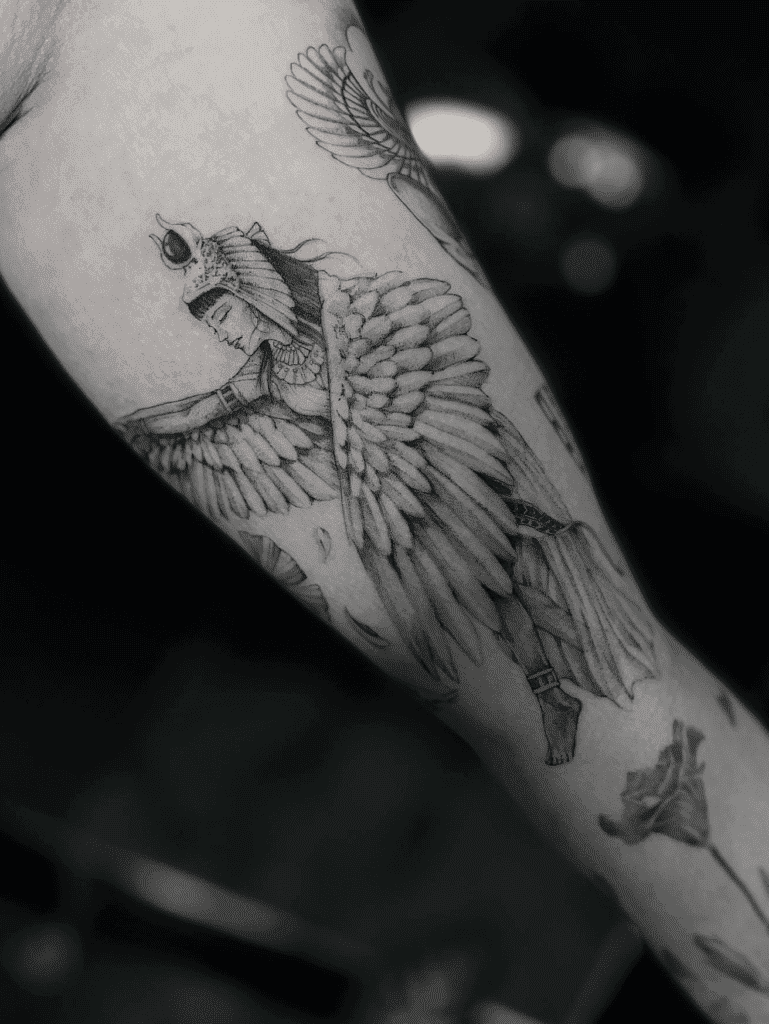
Isis is revered as the goddess of magic, healing, motherhood, and devotion. More than almost any other deity, Isis represents the power of love, intelligence, and perseverance.
Isis was believed to possess unparalleled magical knowledge. Her magic was not chaotic or destructive, but precise and purposeful, rooted in understanding the hidden names and forces that shaped reality. Through this knowledge, she could heal the sick, protect the vulnerable, and even influence the gods themselves.
Her most famous story is inseparable from Osiris. After her husband was betrayed and murdered by Set, Isis refused to accept the loss as final. She searched tirelessly for Osiris’s scattered body, travelling across Egypt and beyond, guided by grief and determination. Through ritual, magic, and sheer will, she restored him long enough to conceive their son, Horus.
She raised Horus in secrecy, shielding him from Set’s wrath until he was ready to claim his rightful place. Images of Isis nursing the infant Horus became some of the most sacred and widely recognised in Egyptian art, symbolising maternal care, protection, and the nurturing force behind kingship itself.
Thoth Egyptian Mythology Tattoo
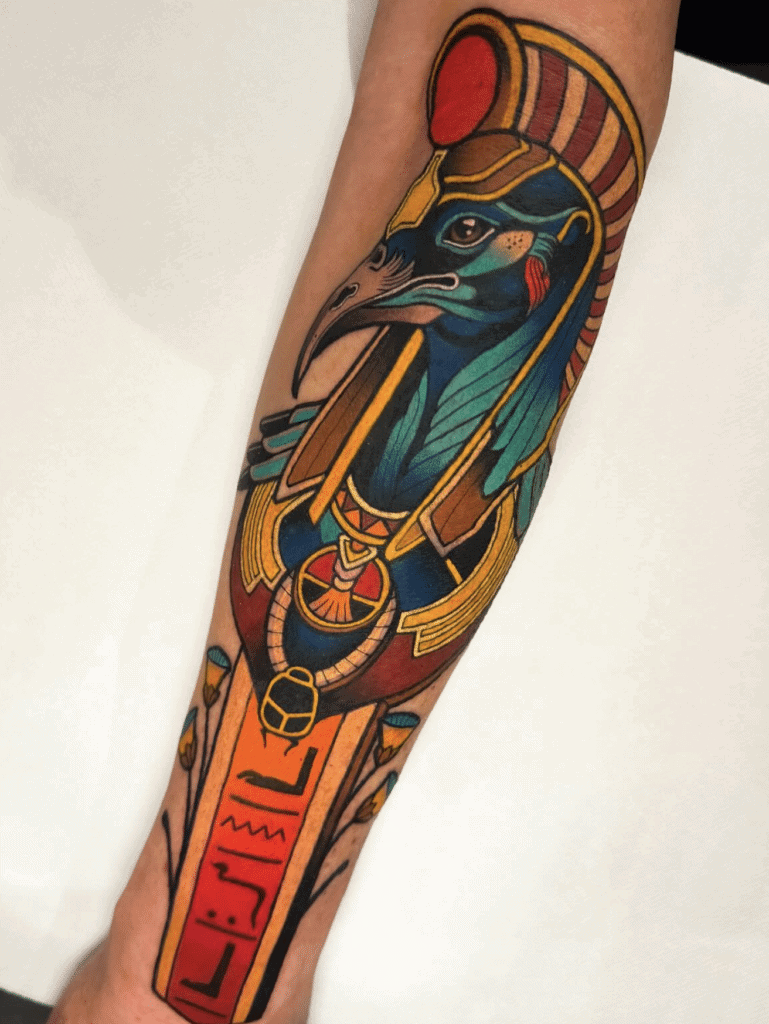
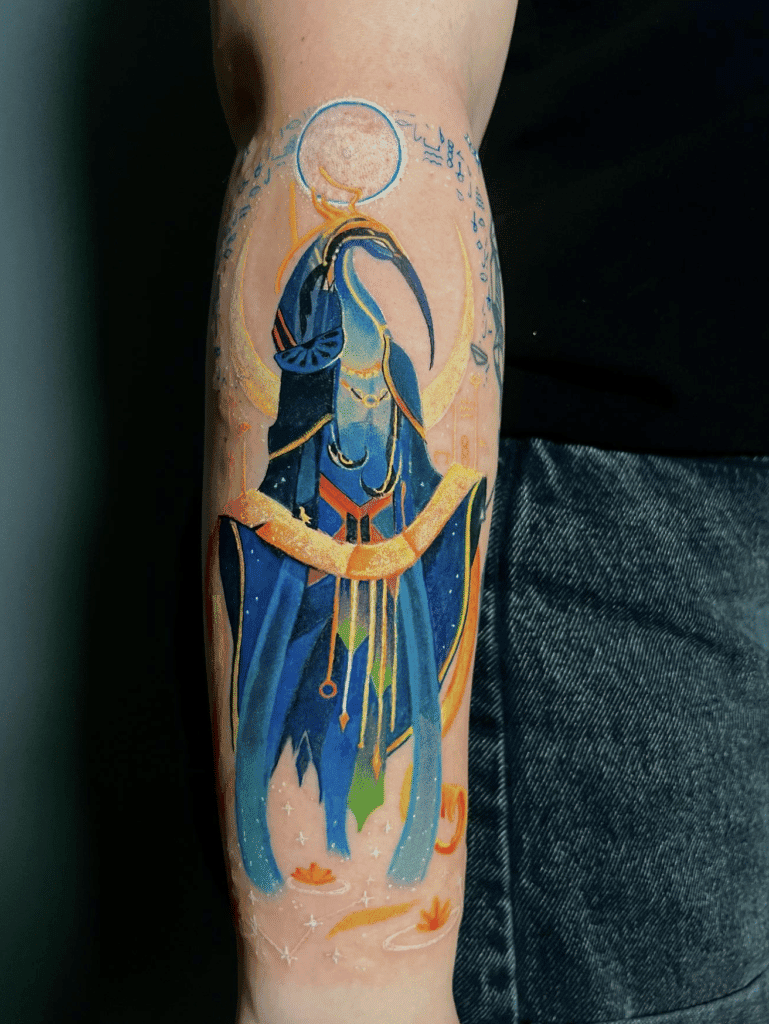
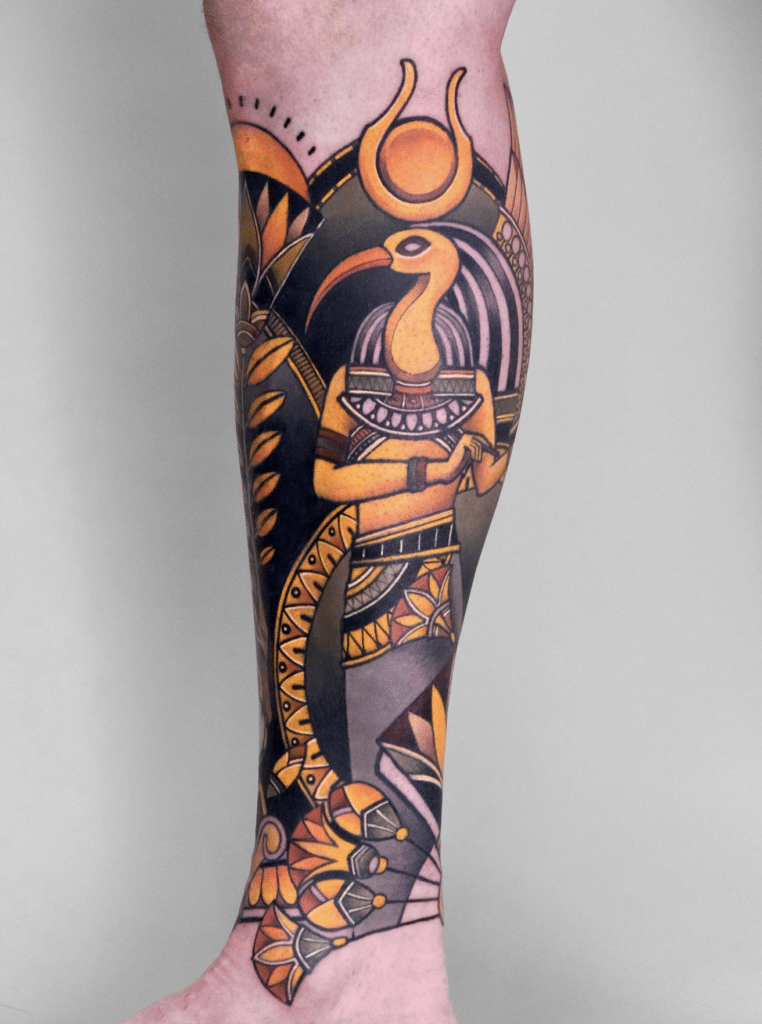
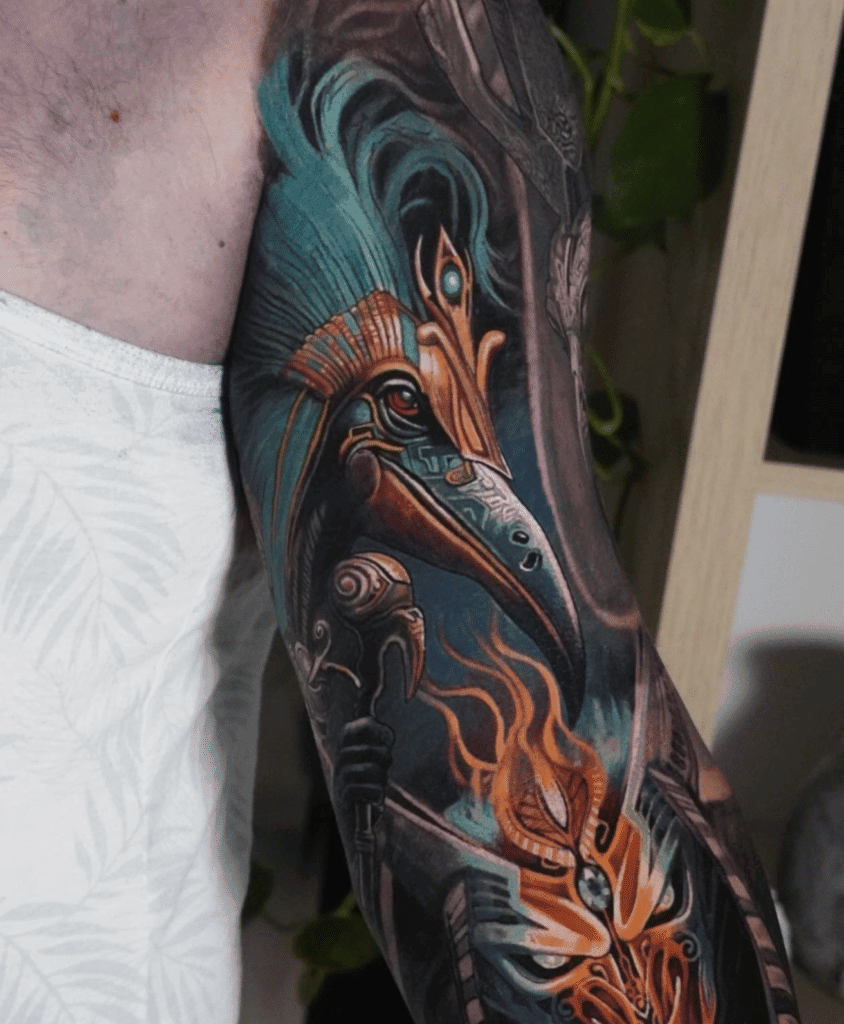
Thoth was believed to be the mind behind the universe — the one who understood its laws, recorded its events, and ensured that order was preserved through reason rather than violence.
Thoth was the god of writing, mathematics, science, and sacred speech. The Egyptians believed that words had power, and Thoth was the one who mastered that power completely. He was said to have invented hieroglyphs, numbers, calendars, and ritual language, making him essential to both daily life and divine order.
In myth, Thoth often appears as a mediator rather than a warrior. During the great conflict between Horus and Set, it was Thoth who judged disputes, recorded verdicts, healed wounds, and restored balance. When Horus lost his eye in battle, Thoth was the one who magically restored it.
Thoth was also deeply tied to the afterlife. In the Hall of Judgment, he stood beside the scales as the heart of the deceased was weighed against the Feather of Ma’at. Thoth recorded the result with absolute impartiality. He did not judge emotionally or morally — he documented truth as it was.
Anubis Egyptian Mythology Tattoo
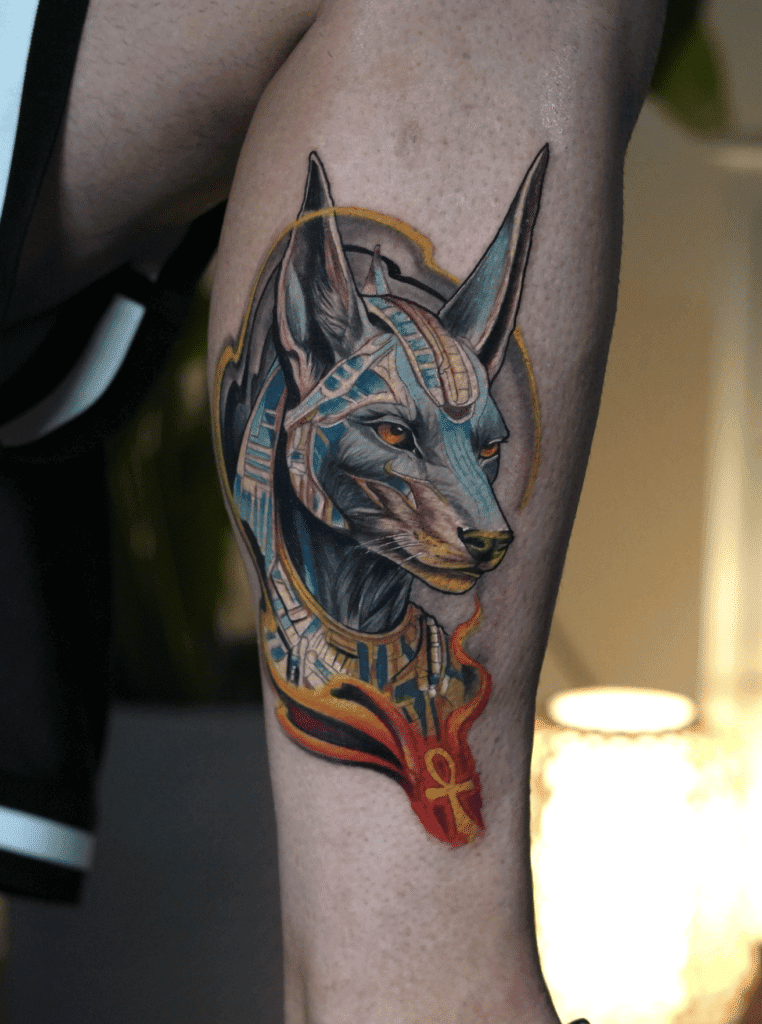
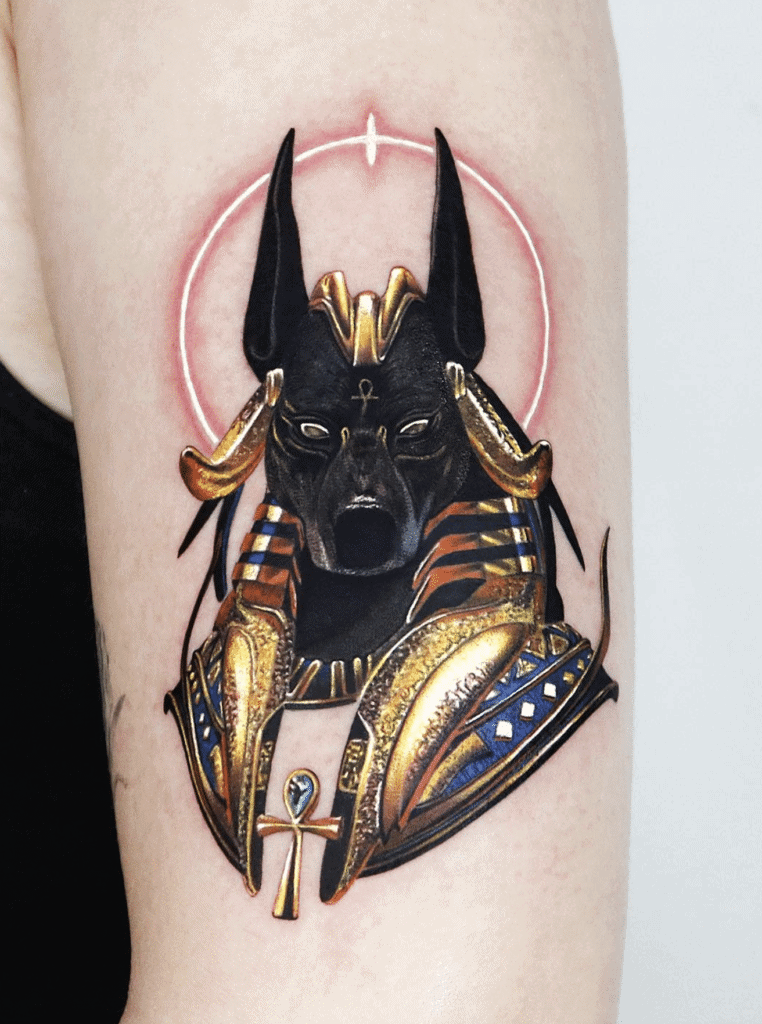
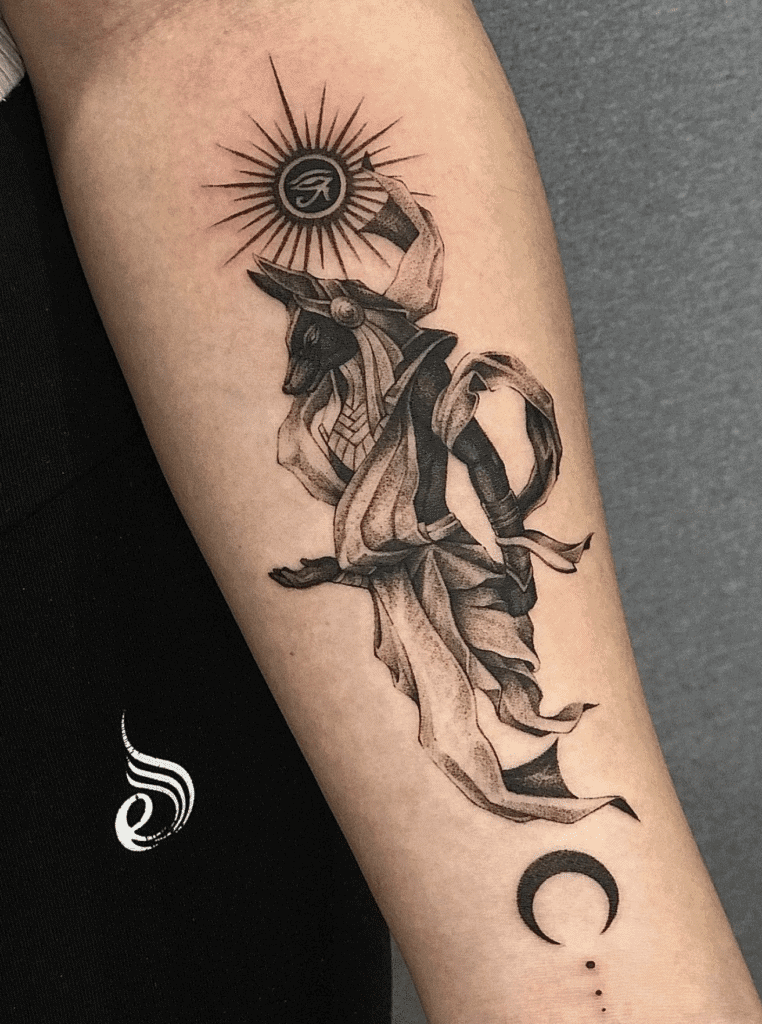
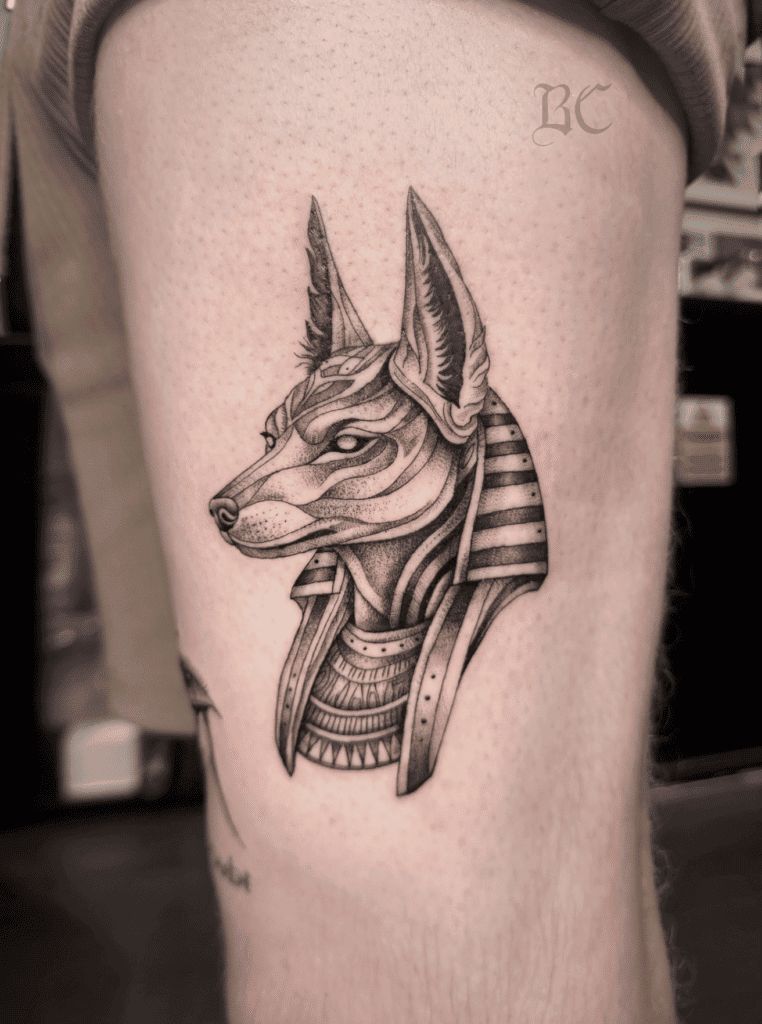
Anubis is the guardian of the dead, the protector of tombs, and the divine guide who ensures that souls pass safely from the mortal world into the afterlife.
Anubis is among the oldest Egyptian gods, worshipped long before Osiris rose to prominence. In early belief, Anubis was the primary god of the dead, ruling over burial rites and the journey beyond death. Even after Osiris became lord of the underworld, Anubis retained his crucial role as caretaker and guide.
His most sacred duty was mummification. Egyptians believed the body needed to be preserved so the soul could recognise and return to it in the afterlife. Anubis oversaw this process, sanctifying embalming rituals and guarding the body from decay, desecration, and evil forces. Every embalmer worked symbolically “under Anubis’s hand,” and priests often wore jackal masks during funerary rites to invoke his presence.
Anubis also guided souls through the underworld, leading them to the Hall of Judgment. There, he presided over the weighing of the heart against the Feather of Ma’at. Anubis adjusted the scales with absolute precision, ensuring fairness and balance. He did not judge the soul himself — that role belonged to Ma’at and Osiris — but without Anubis, judgment could not occur.
Osiris Egyptian Mythology Tattoo
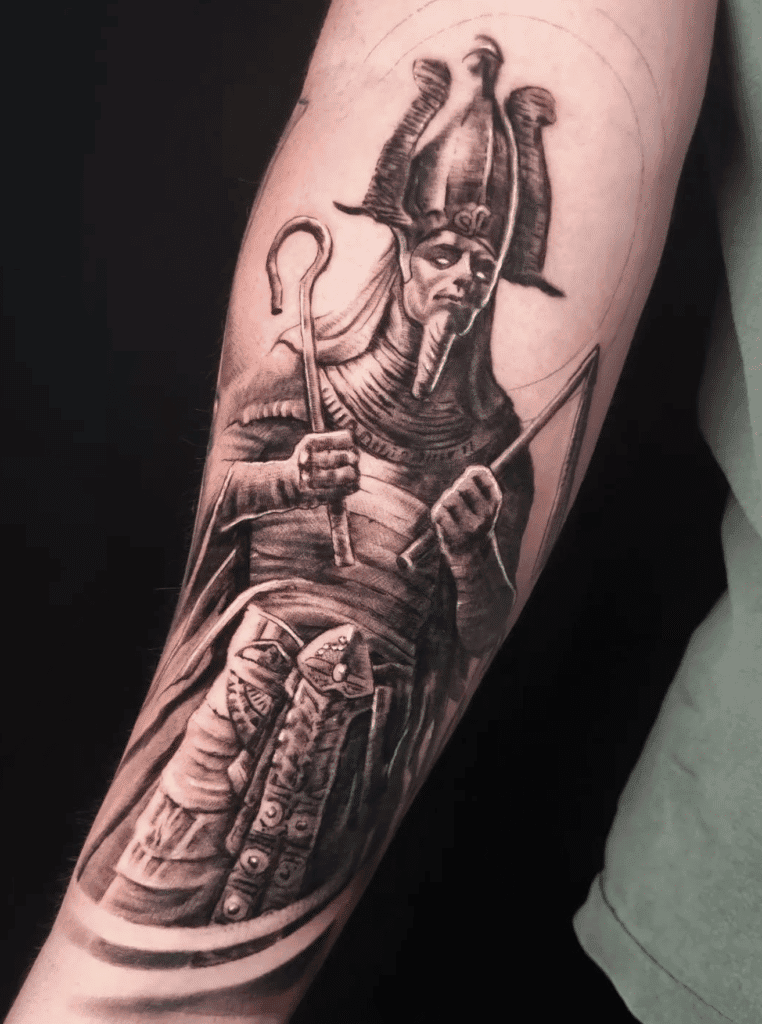
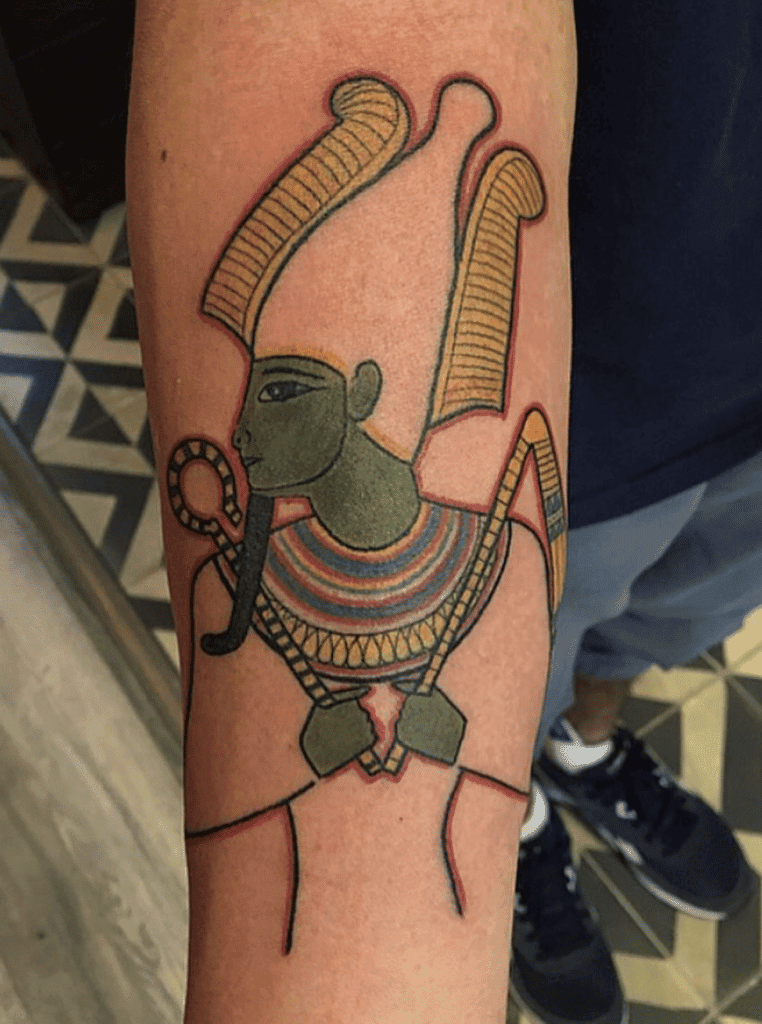
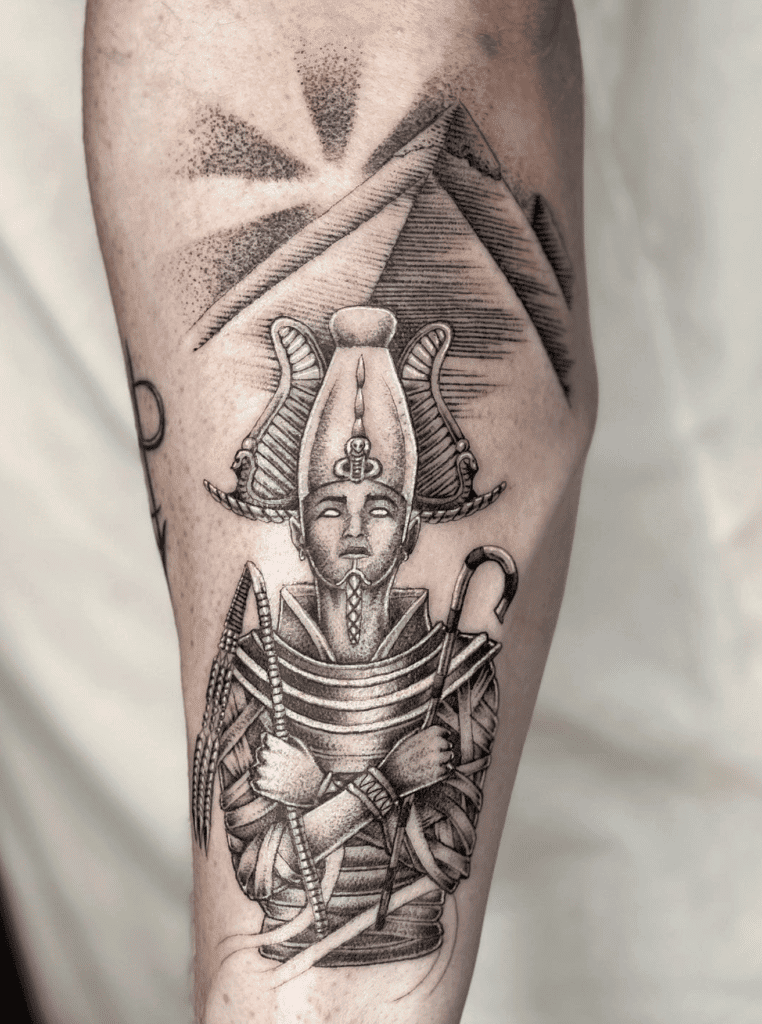
Osiris is the god of death, resurrection, and eternal renewal. He is not a god of terror or finality, but of continuity and the promise that life does not end, it transforms.
Osiris was believed to have once ruled Egypt as a just and benevolent king, teaching humanity agriculture, law, and civilisation. Under his reign, the land flourished and harmony prevailed. This golden age ended when his brother Set, driven by jealousy and hunger for power, betrayed and murdered him. Osiris’s death caused a cosmic rupture, in which order collapsed, and the natural balance of the world was broken.
Through the devotion and magic of Isis, his body was recovered, restored, and reanimated long enough for him to conceive Horus. Although Osiris could no longer live among the living, he was reborn as the ruler of the underworld, becoming the lord of the dead and the judge of souls.
In the afterlife, Osiris presided over judgment. Souls who lived in harmony with Ma’at were welcomed into eternal peace, while those who failed were denied continuation.
Hathor Egyptian Mythology Tattoo
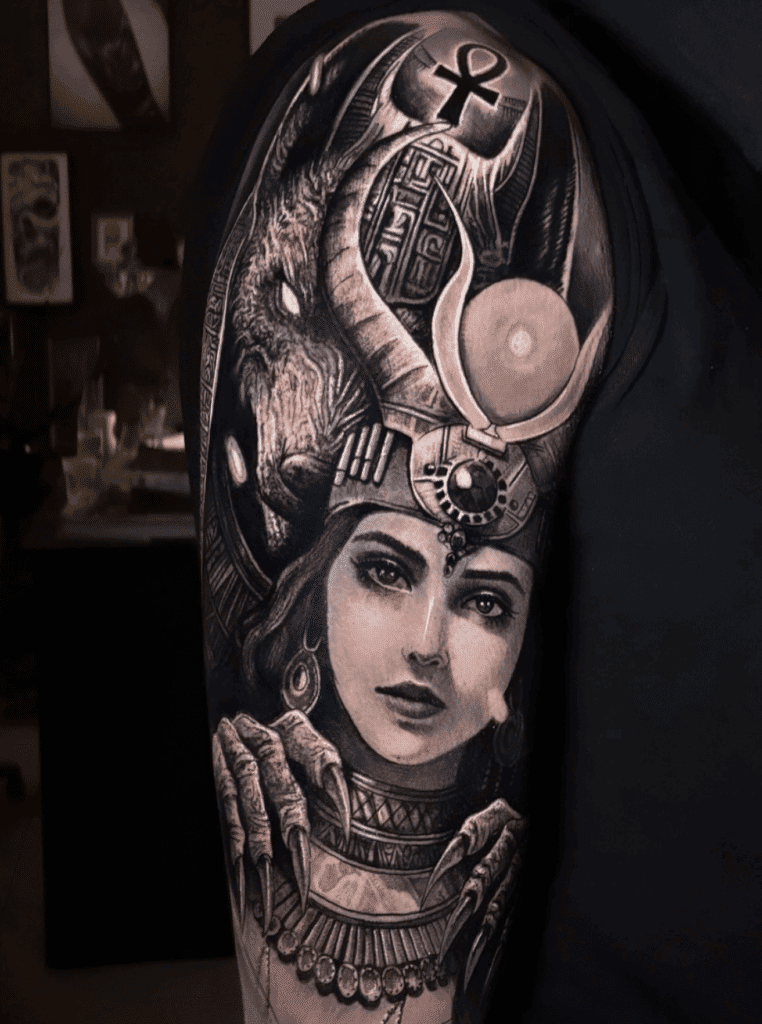
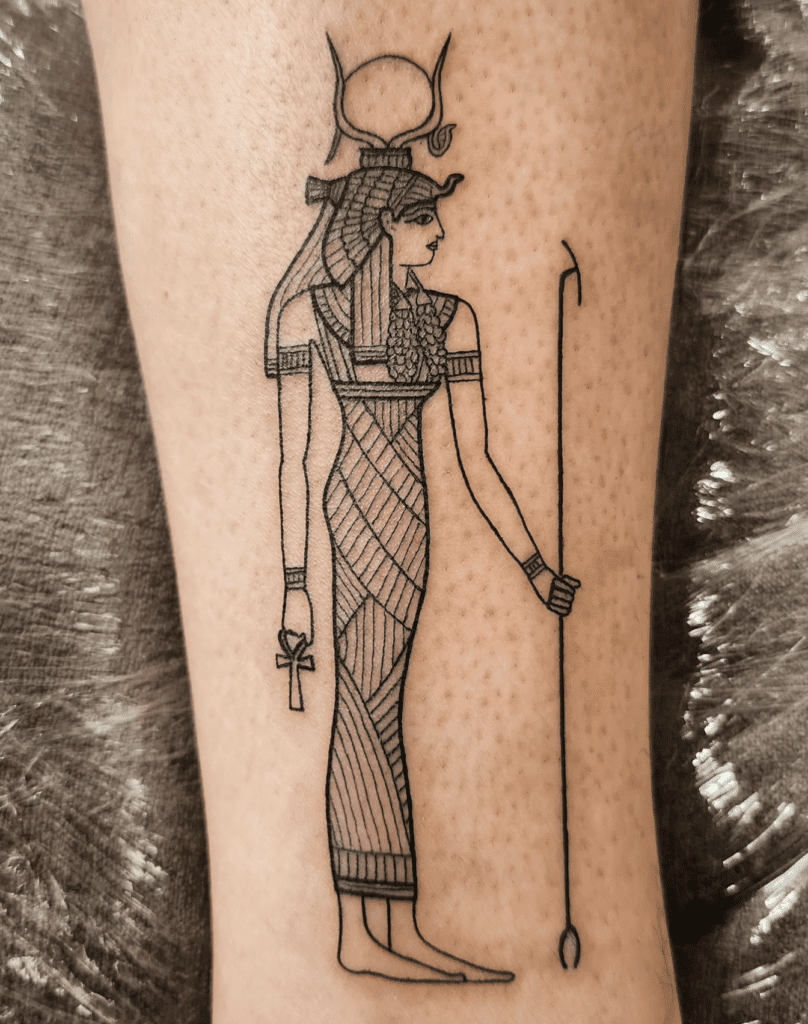
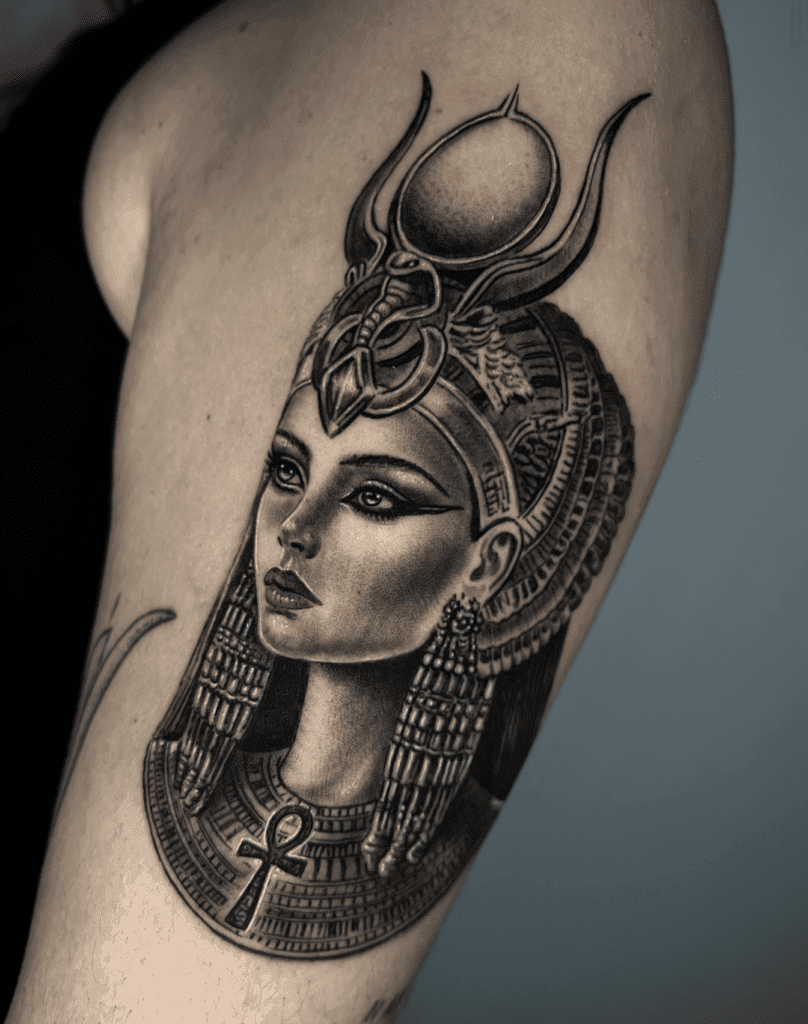
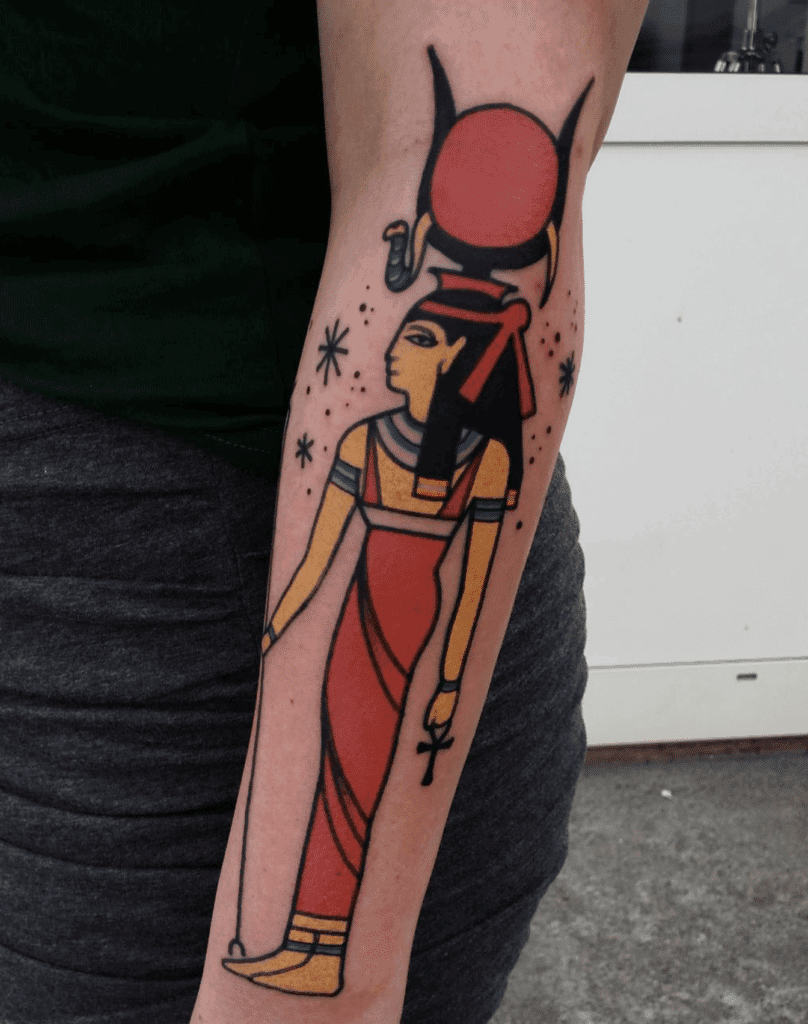
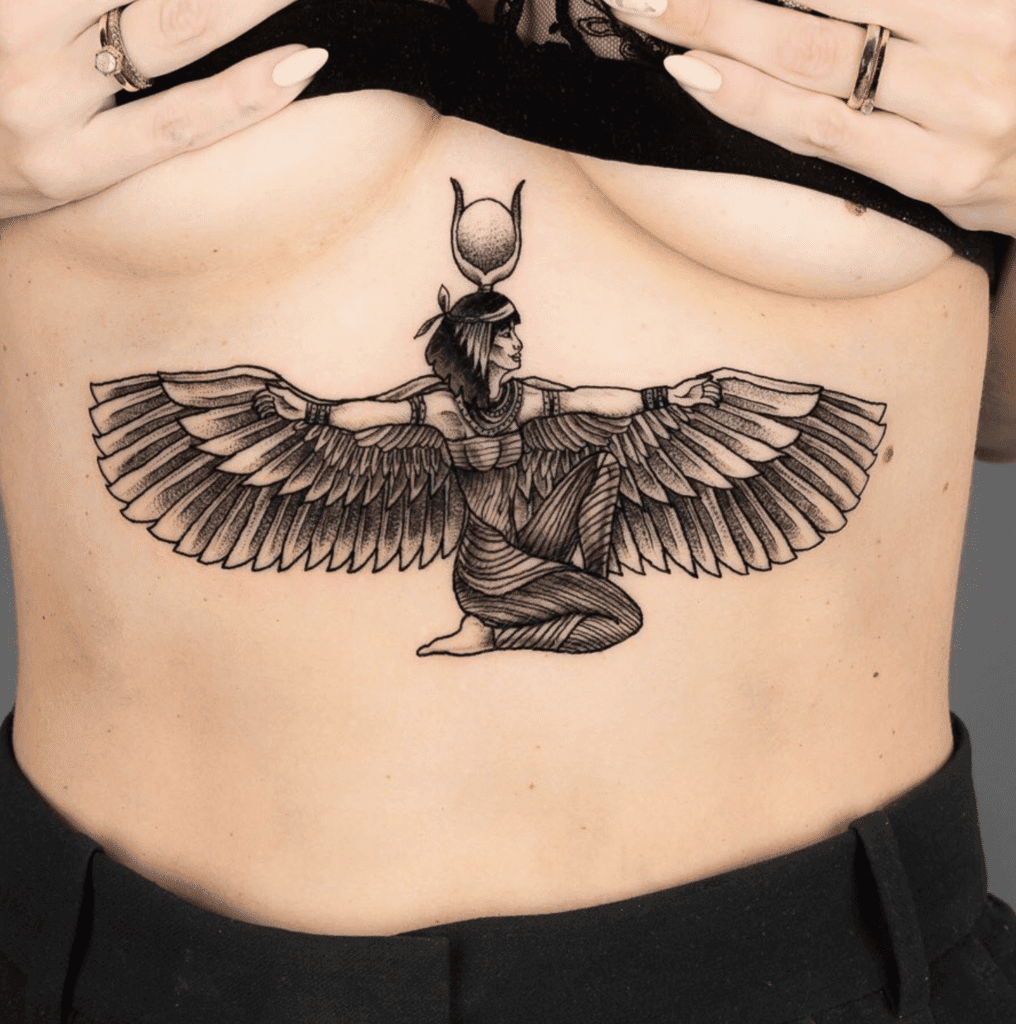
Hathor embodies love, joy, music, fertility, beauty, and motherhood — but also wrath, protection, and divine justice.
Hathor was believed to be a cosmic goddess who existed from the earliest moments of creation. She was associated with the sky, the sun, and the life-giving warmth that allows the world to flourish. Often described as the “House of Horus,” her name reflects her role as a celestial mother and protector, embracing the falcon god within the heavens themselves.
As a goddess of joy, Hathor presided over music, dance, celebration, sexuality, and pleasure. Festivals in her honour were filled with song, intoxication, laughter, and freedom — not as excess, but as sacred release. The Egyptians believed joy itself was divine, and Hathor was the god who made life worth living.
Yet Hathor also possessed a darker, fearsome side. In the myth of humanity’s rebellion against Ra, Hathor transforms into the lioness Sekhmet, unleashed to punish mankind.
Hathor was also closely connected to death and the afterlife. She welcomed souls into the next world, offering comfort, nourishment, and guidance. She was believed to appear as a cow emerging from the western mountains — the land of the dead — greeting the departed with compassion rather than judgment.
Sekhmet Egyptian Mythology Tattoo
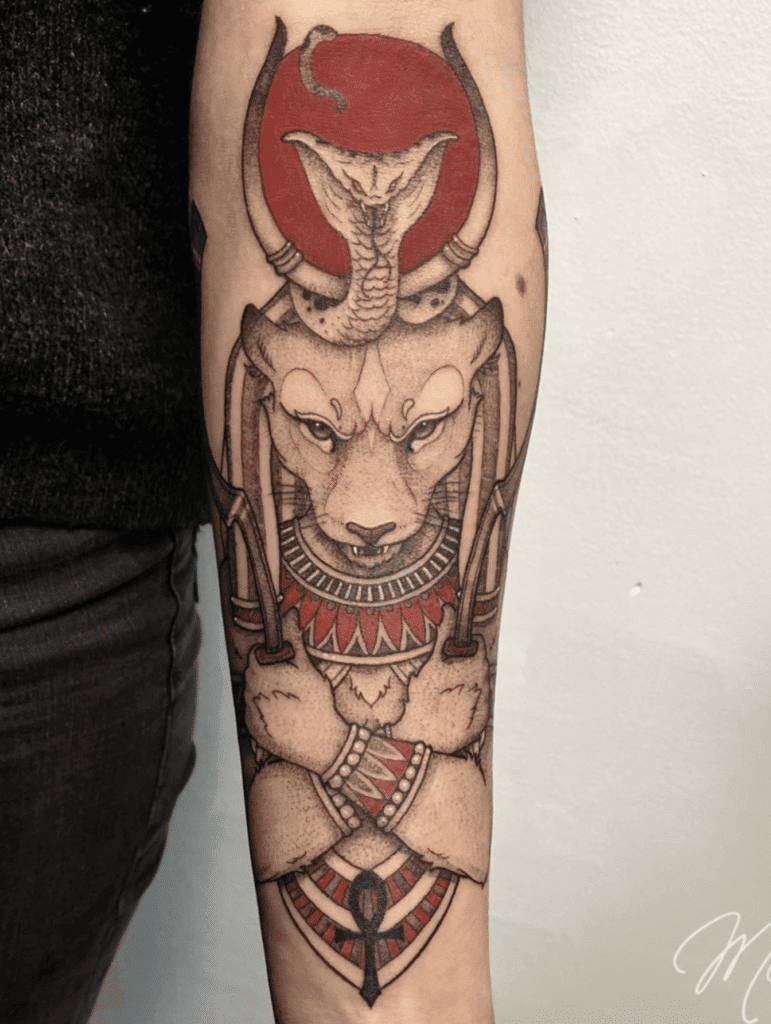
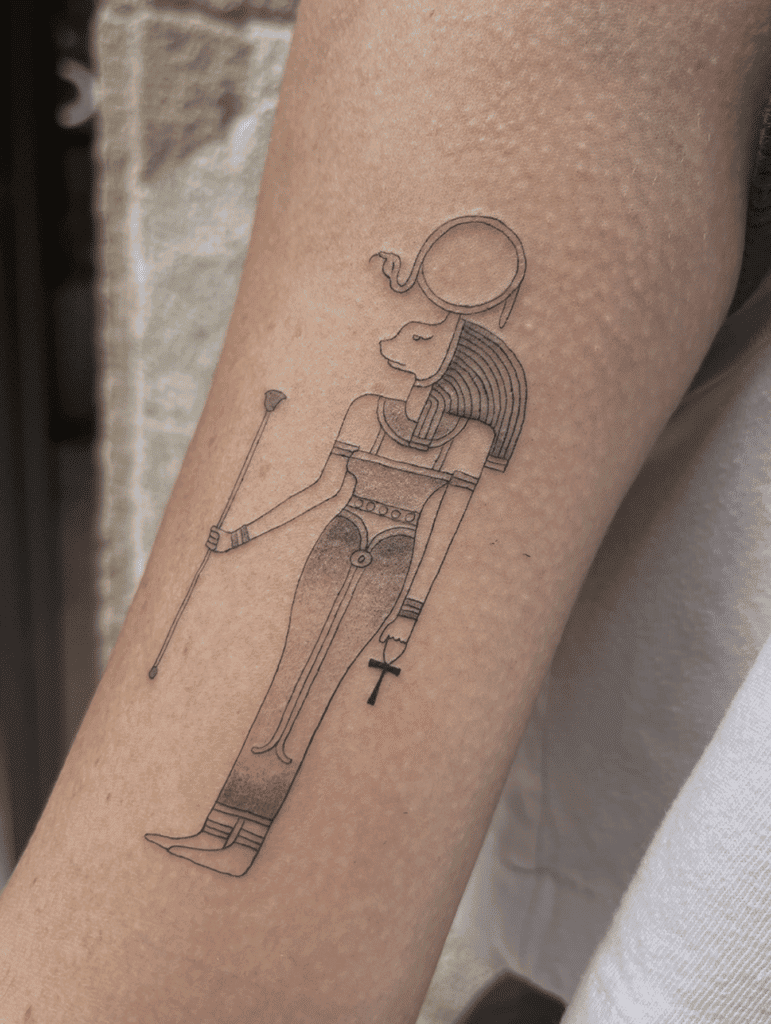
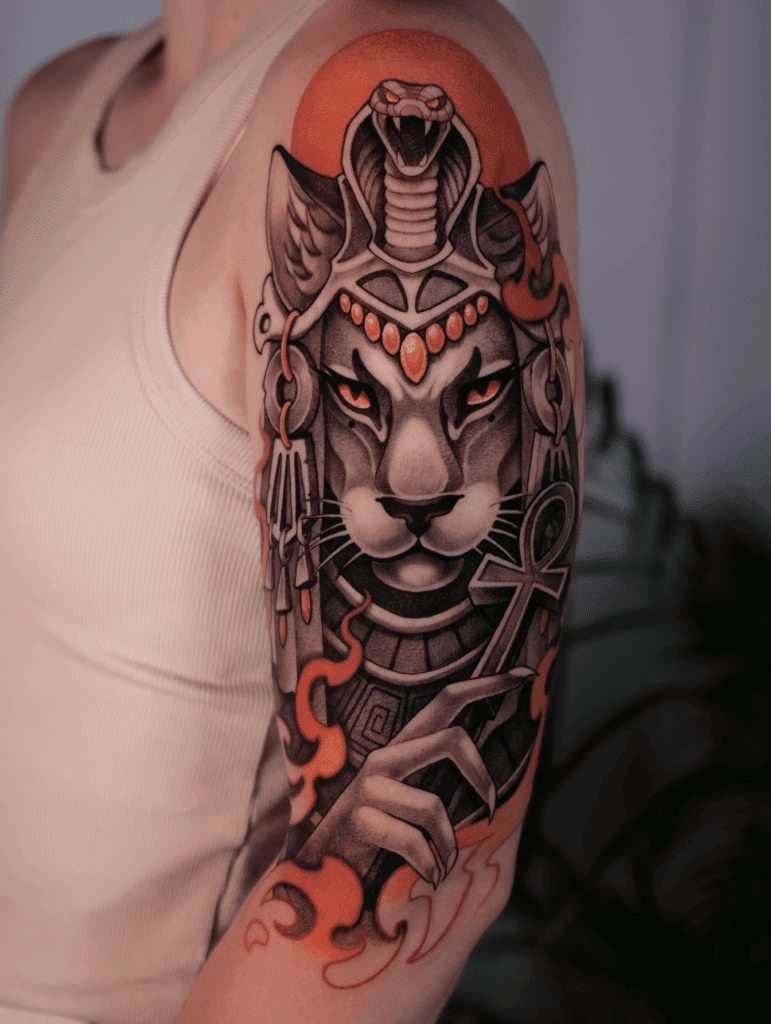
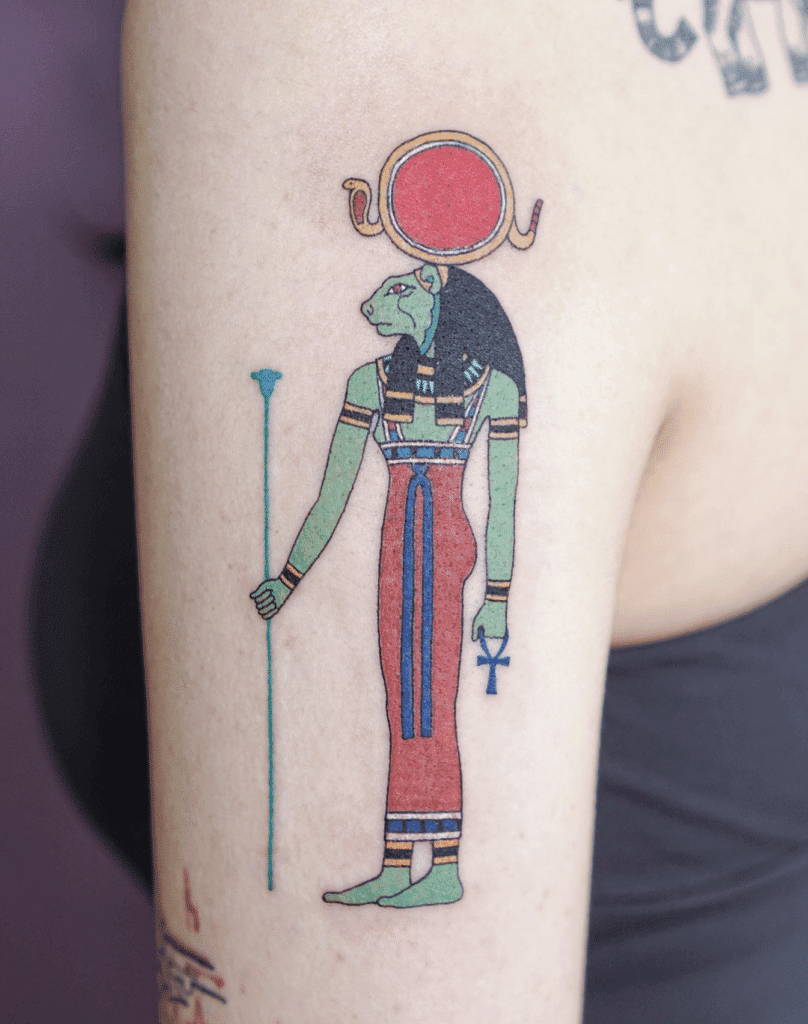
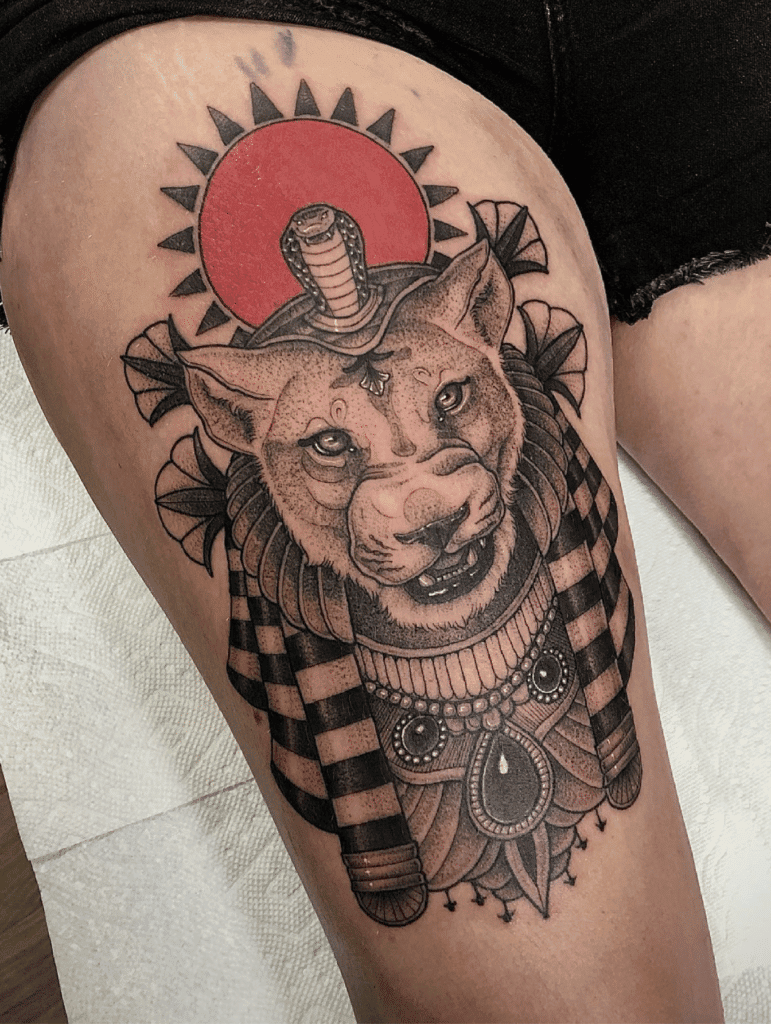
Sekhmet is the fearsome goddess of war, destruction, plague, and healing. She was believed to be born from the Eye of Ra, created as his weapon of vengeance when humanity rebelled against divine order. Unleashed upon the world, she slaughtered relentlessly, her bloodlust reflecting the sun’s merciless heat.
This myth does not portray her as evil, but as an absolute force. When her rage threatened to wipe out all life, the gods intervened, tricking her into drinking beer dyed red like blood. Intoxicated, her fury subsided, and she transformed back into the gentler goddess Hathor.
As a lioness, Sekhmet symbolised dominance, precision, and lethal protection. She was invoked by pharaohs before battle, believed to march beside armies, spreading panic among enemies.
Yet Sekhmet was also a goddess of healing and medicine, a paradox that made her especially feared and respected. The same power that brought disease could also cure it. Egyptian physicians were known as “priests of Sekhmet,” calling upon her to avert plagues and restore health.
Bastet Egyptian Mythology Tattoo
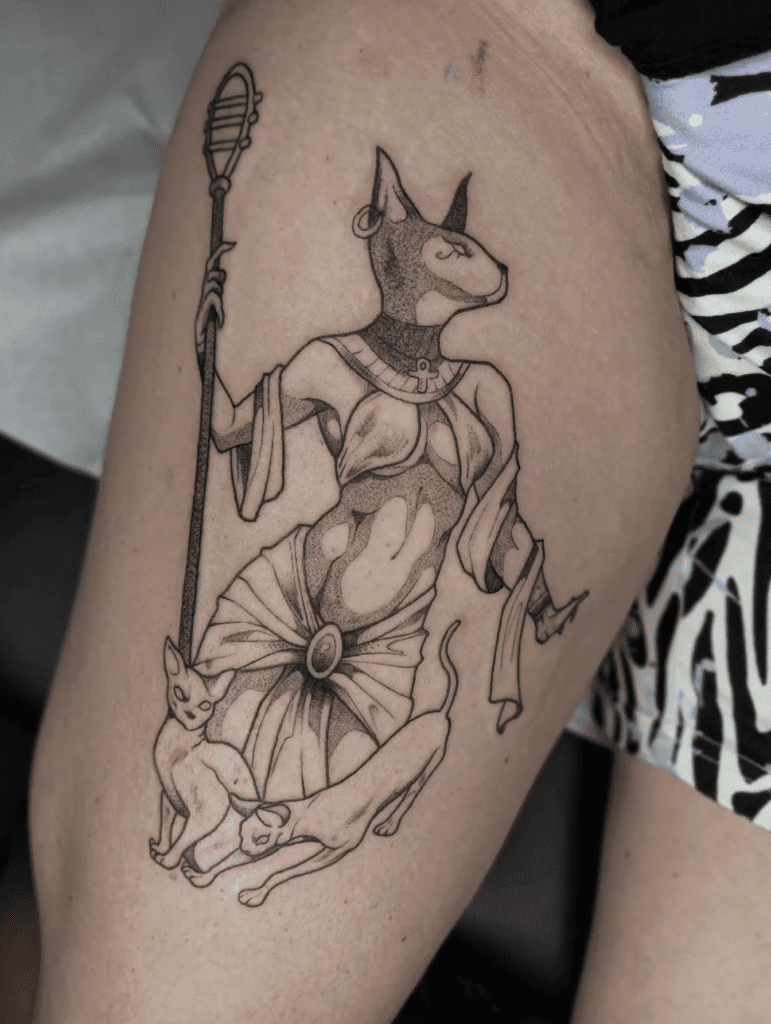
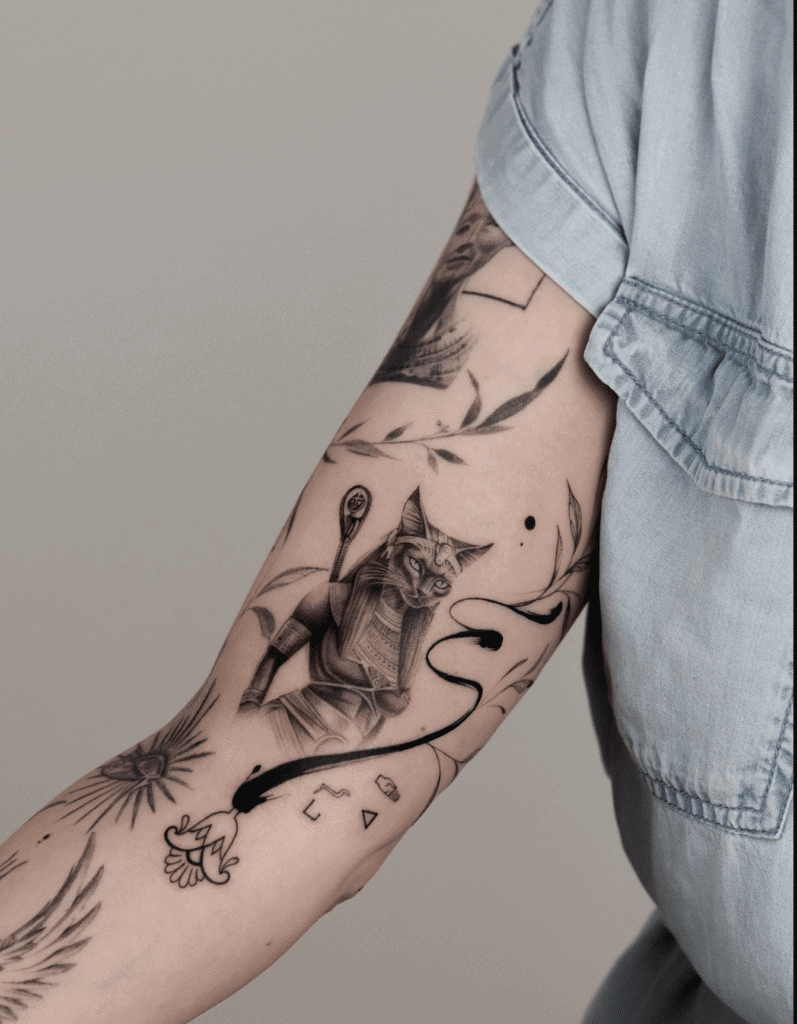
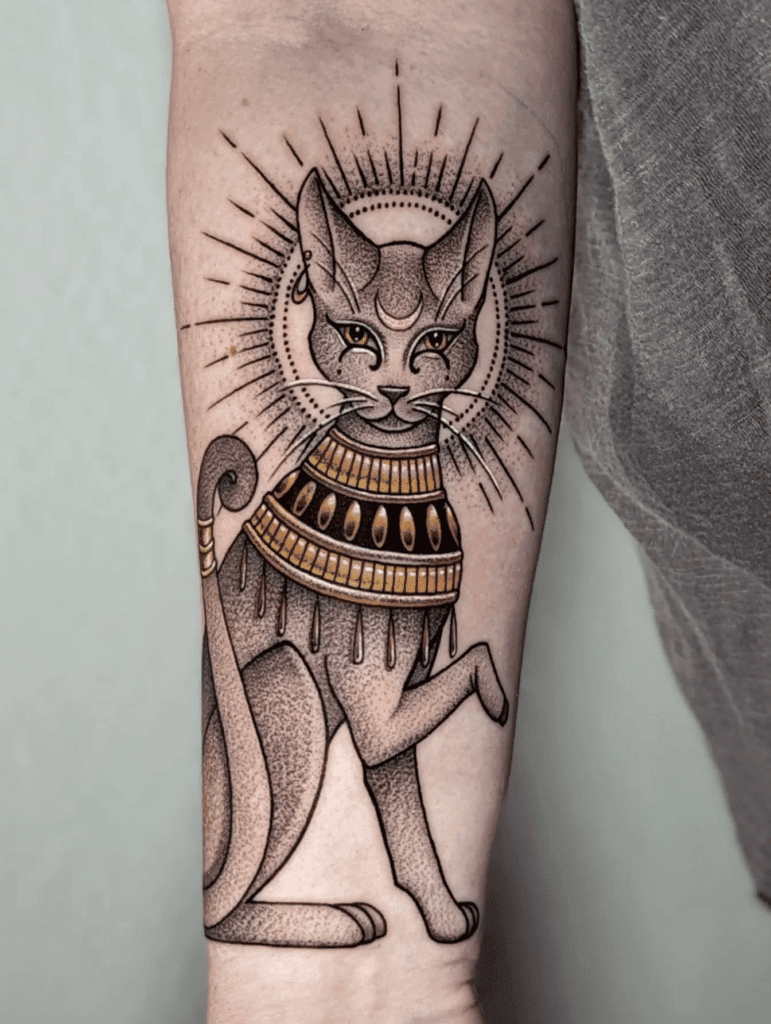
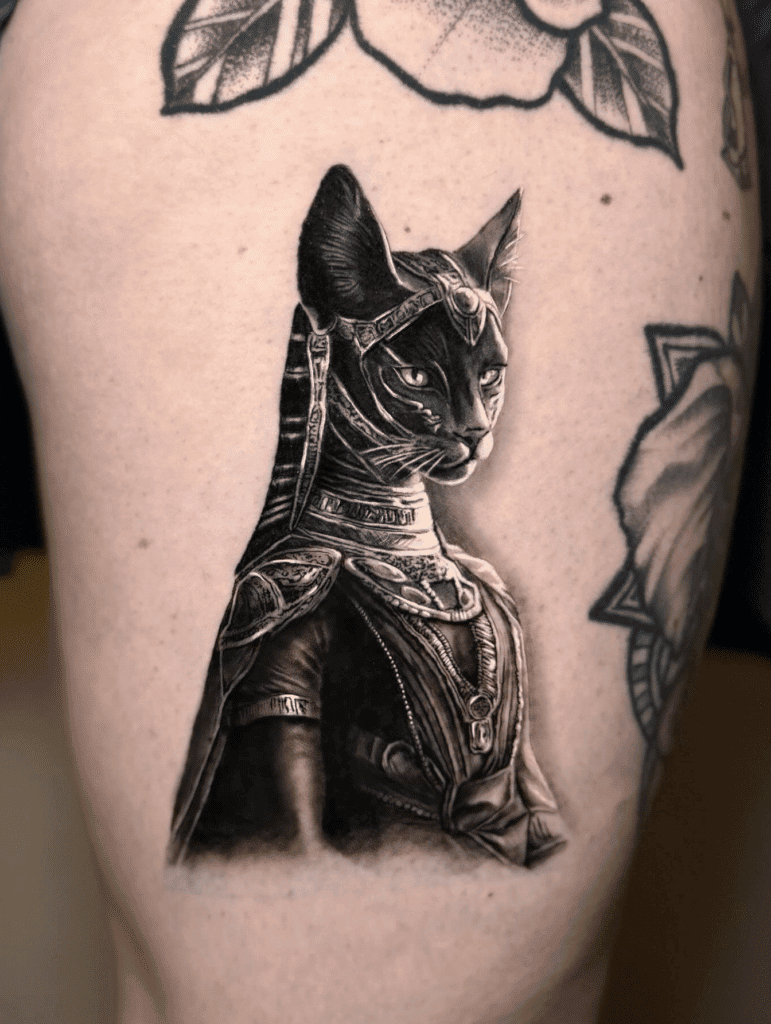
Bastet is the goddess of protection, home, fertility, joy, and gentle warmth. Her origins trace back to an earlier, more ferocious form as a lioness goddess, much like Sekhmet. Over time, her nature softened, and she became closely associated with domestic cats, animals revered in Egypt for their grace, independence, and fierce protectiveness of the home.
As a goddess of the home, Bastet protected households from illness, evil spirits, and misfortune. She was especially invoked by women, mothers, and families, guarding childbirth, fertility, and daily life. Cats themselves were considered living vessels of her protection, and harming one was a serious crime.
Bastet was also a goddess of pleasure and celebration. Music, dance, perfume, and sensuality all fell under her influence. Festivals in her honour, particularly at Bubastis, were famously joyful, filled with laughter, music, and communal freedom. To the Egyptians, joy was not frivolous; it was sacred, and Bastet was its guardian.
Despite her gentleness, Bastet was never weak. Like a cat, she could shift instantly from calm to lethal. When the home was threatened, she became a fierce defender, her lioness heritage rising to the surface. This duality made her deeply relatable — loving, playful, and nurturing, yet utterly ruthless when those she protected were endangered.
Ptah Egyptian Mythology Tattoo
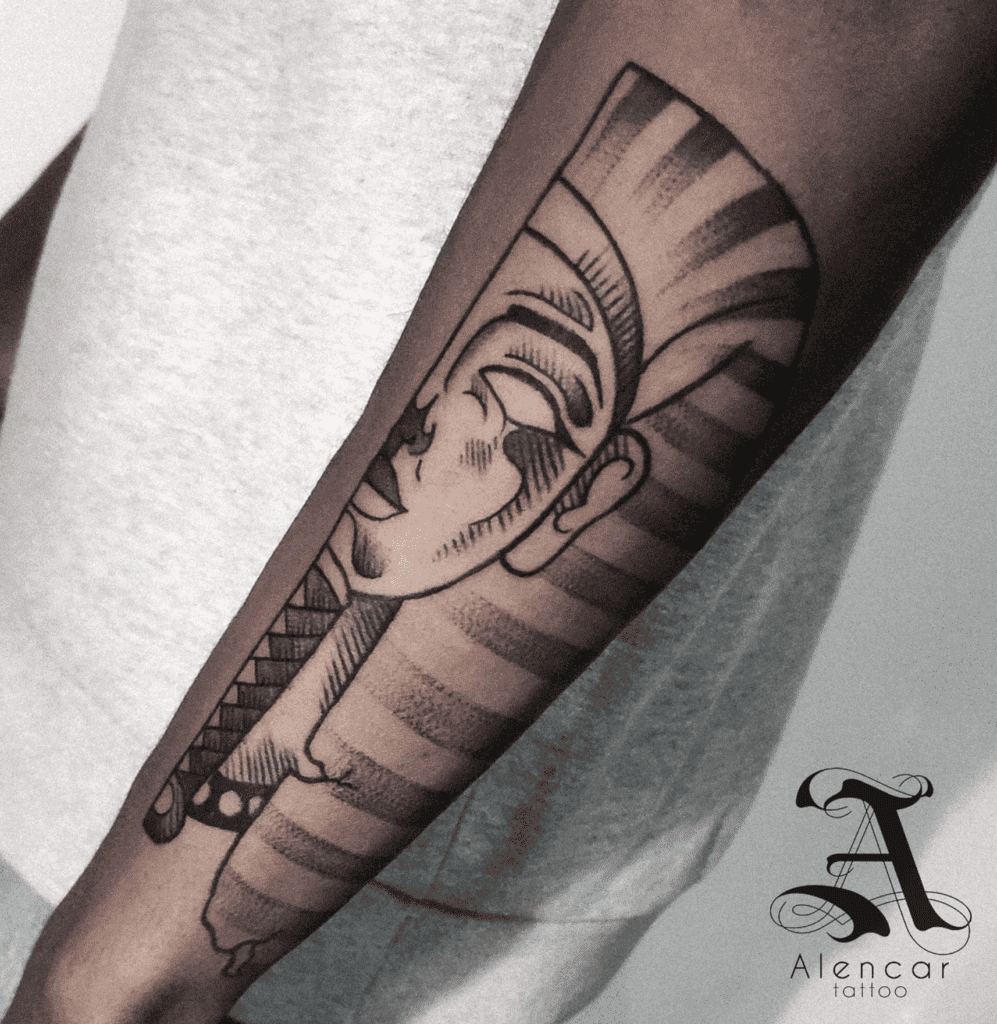
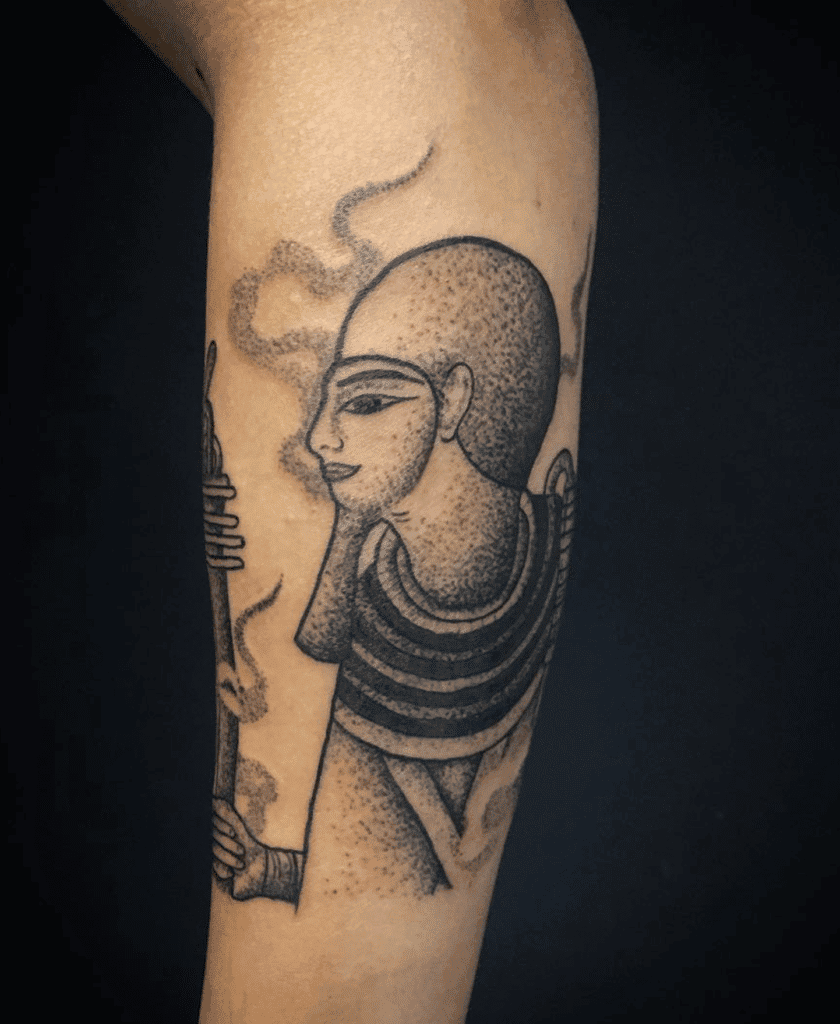
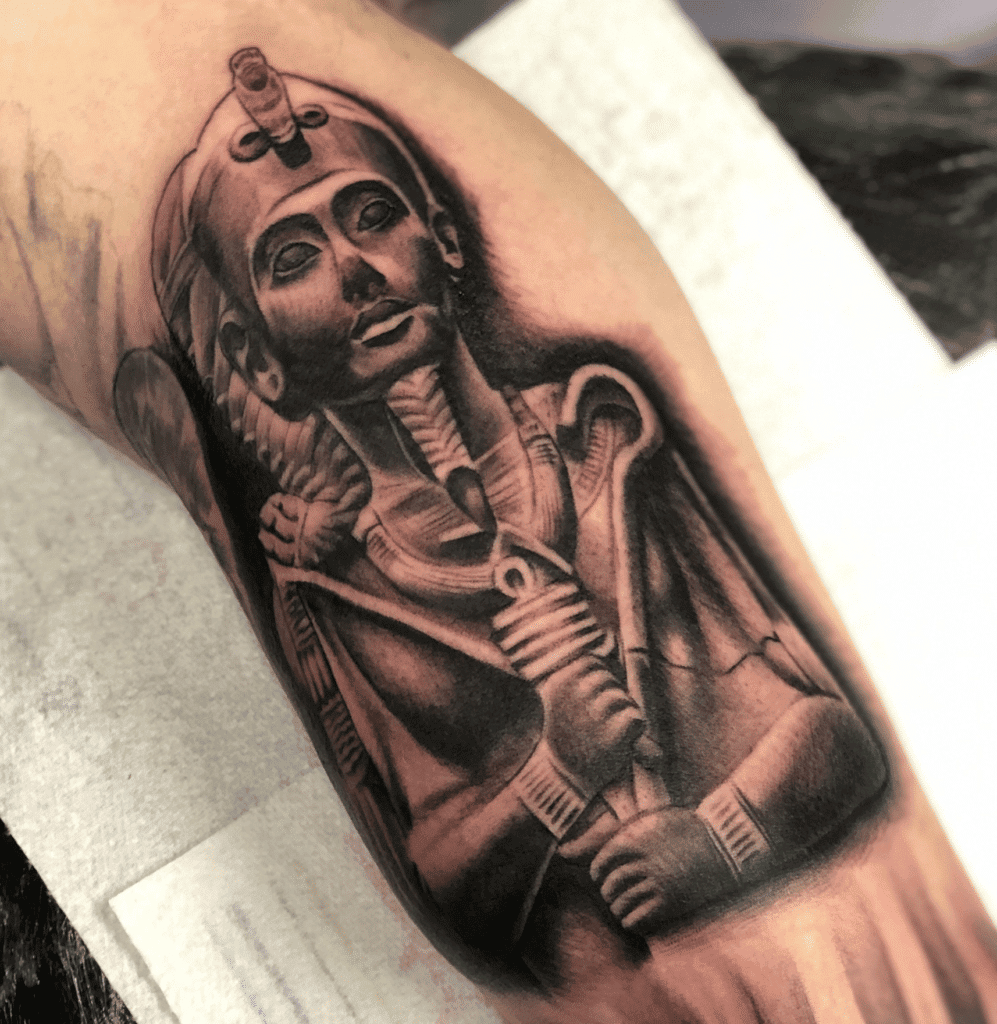
Ptah is the quiet architect of Egyptian mythology — a creator who builds the universe through thought, intention, and spoken word.
Ptah was revered as the creator god of Memphis, one of Egypt’s most important ancient cities, and his theology is among the most philosophically sophisticated in the ancient world. According to Memphite belief, Ptah conceived the world in his heart — the seat of thought and will — and brought it into existence by speaking its name.
Because of this, Ptah became the divine patron of craftsmen, architects, builders, sculptors, and artisans, with every temple, statue, and monument believed to be created under his guidance.
Unlike many gods, Ptah is not shown in dynamic poses. He appears as a mummiform figure, wrapped tightly, holding a staff that combines the ankh (life), was (power), and djed (stability). This stillness is deliberate, showing how he doesn’t act through motion but through permanence.
Ptah was also part of a powerful divine family. Alongside Sekhmet and Nefertum, Ptah formed the Memphite Triad. Together, they represented creation, destruction, and renewal — the full cycle of existence. Ptah conceived the world, Sekhmet defended it with fire, and Nefertum restored beauty and life.
Sobek Egyptian Mythology Tattoo
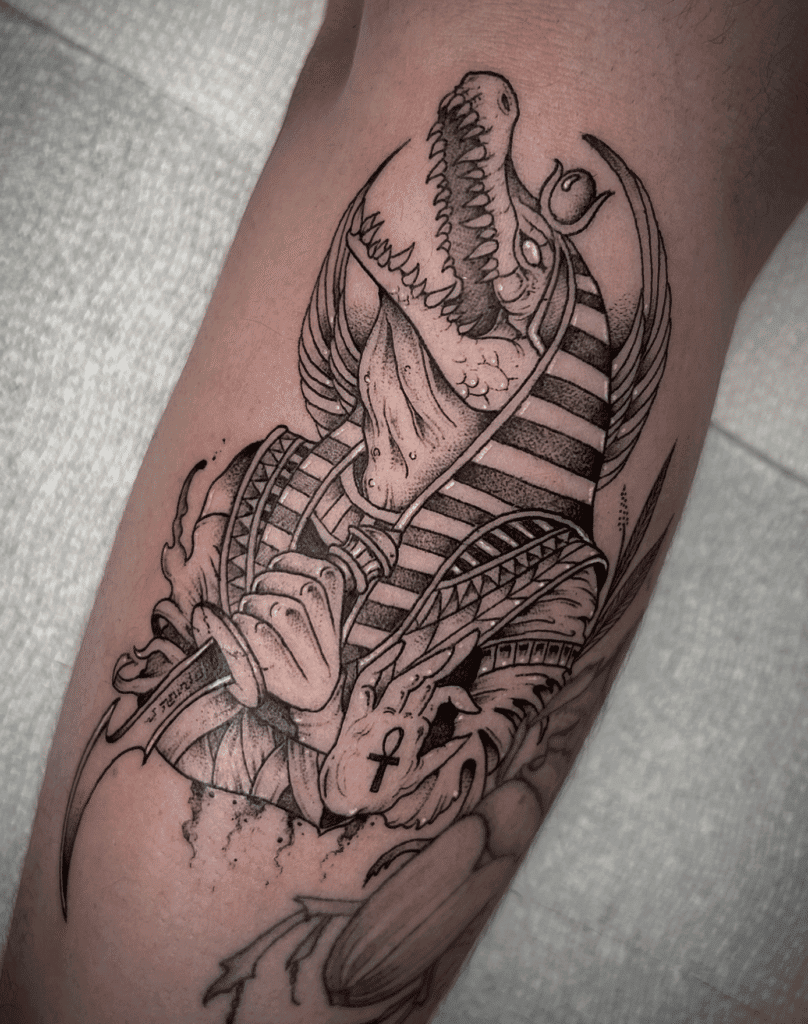
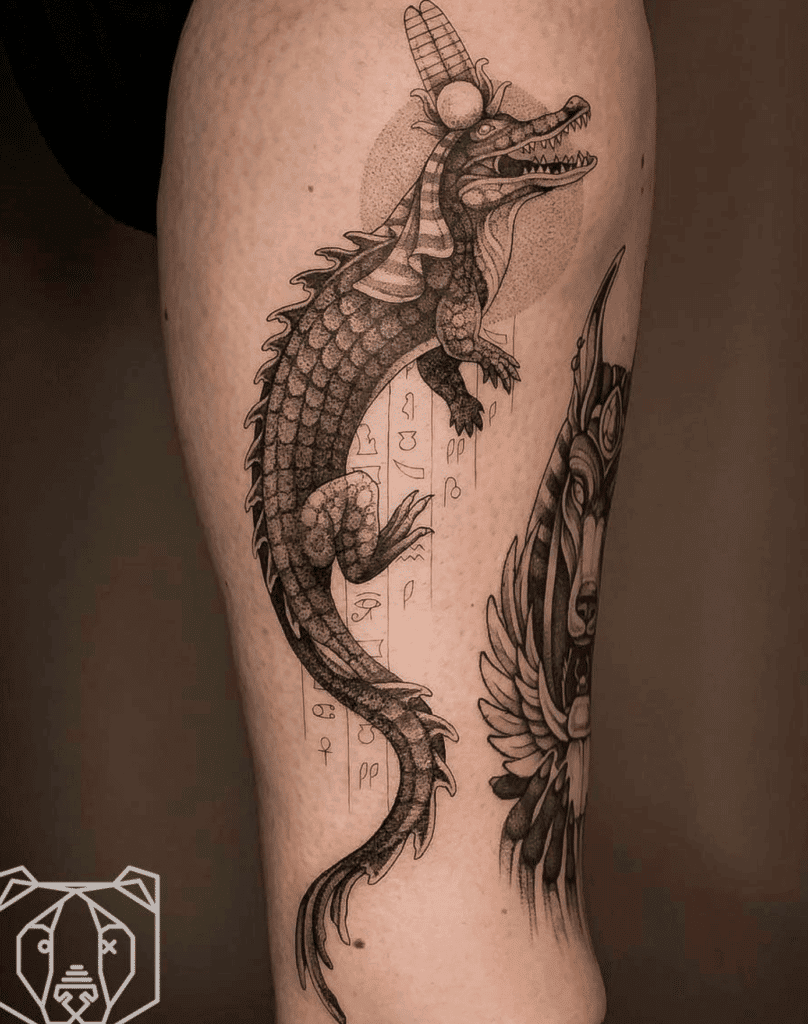
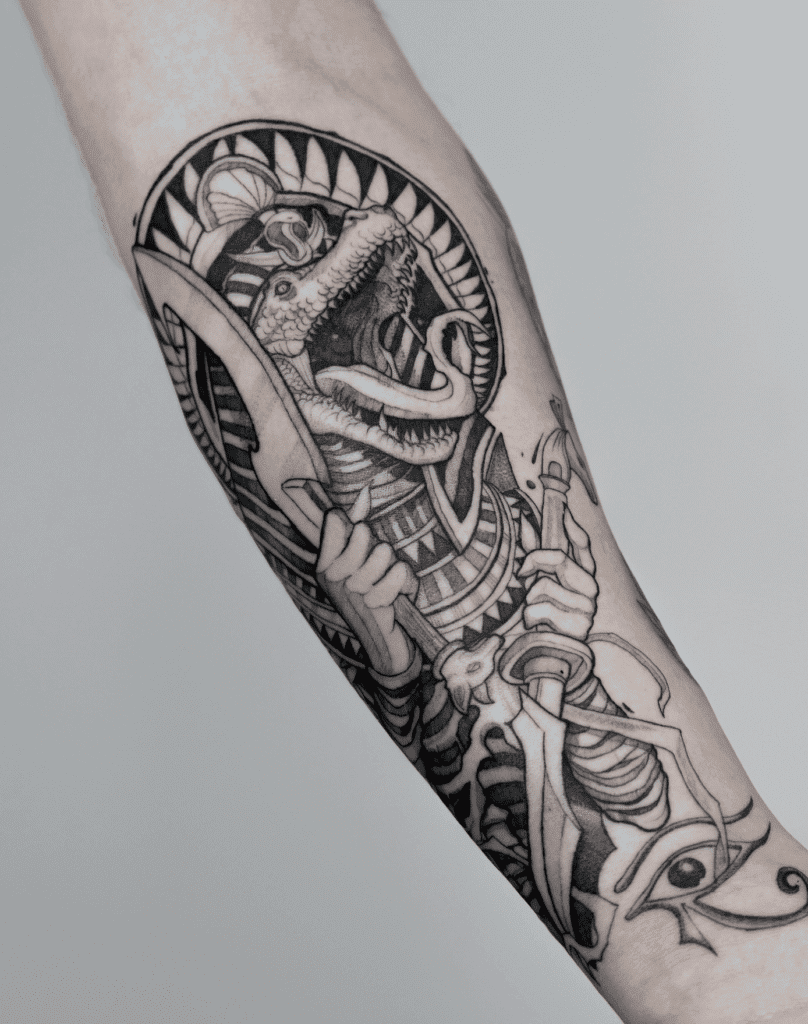
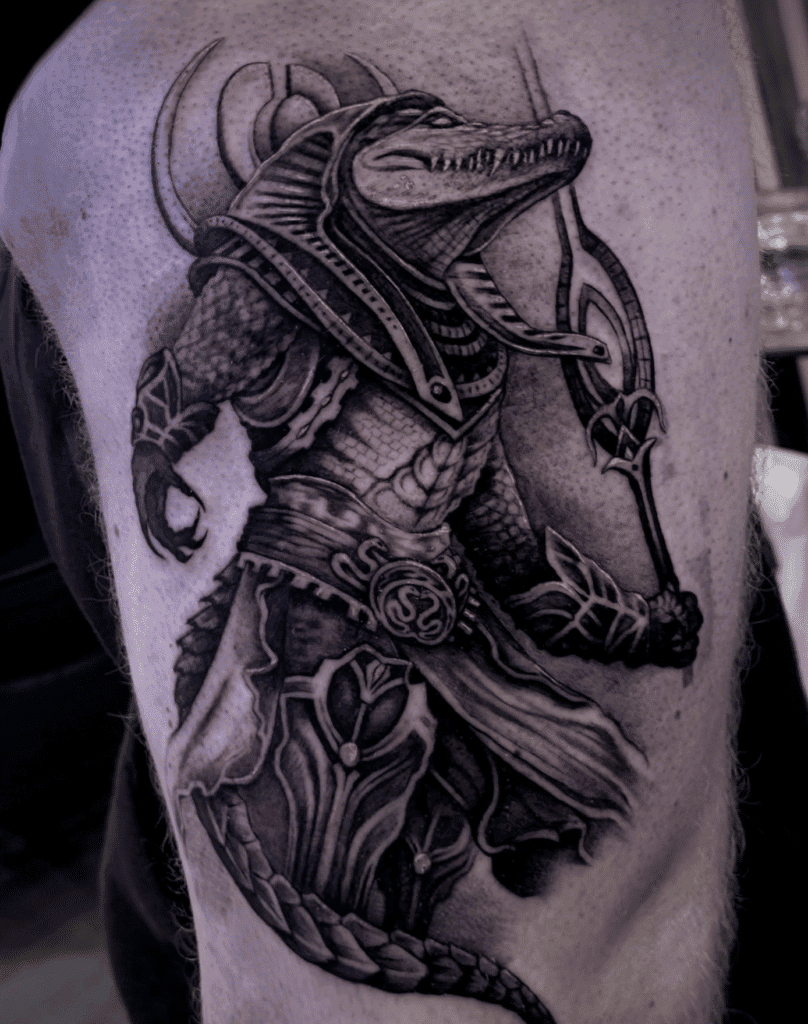
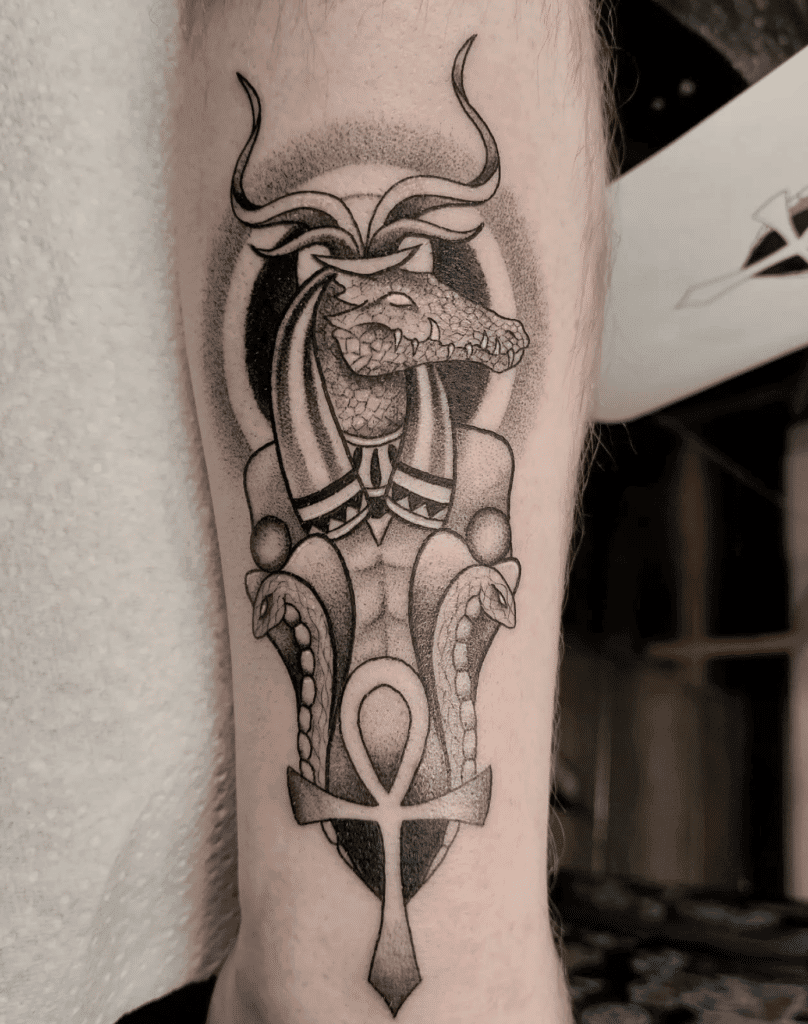
Sobek is the god of raw strength, fertility, protection, and the untamed power of nature. Feared and respected in equal measure, Sobek embodied the Nile River’s most dangerous and life-giving qualities — a force that could nourish the land or destroy it without warning.
Sobek was closely associated with the Nile, the lifeline of ancient Egypt. The river’s annual floods brought fertile soil and abundance, but its waters also hid deadly threats, most notably crocodiles. Sobek personified this duality. He was not a gentle god of growth, but a reminder that life depends on forces that cannot be fully controlled.
In myth, Sobek was a god of creation and fertility. Some traditions claim he emerged from the primeval waters at the dawn of time, helping shape the world itself. He was believed to promote agricultural abundance, male virility, and physical vitality.
Sobek was also a protector of pharaohs. Kings aligned themselves with his ferocity, believing his power made them unstoppable in battle. In war, Sobek represented ruthless efficiency — swift, decisive, and merciless when provoked. Living crocodiles were sometimes kept in sacred pools, mummified after death, and honoured as manifestations of Sobek himself.
Nut Egyptian Mythology Tattoo
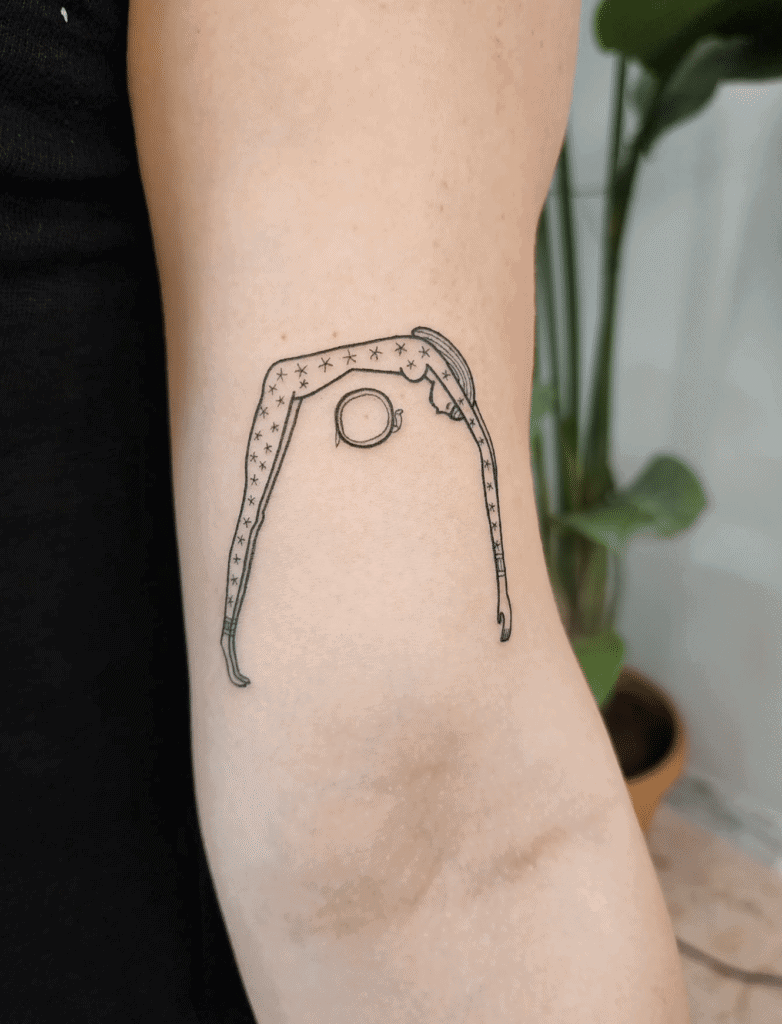
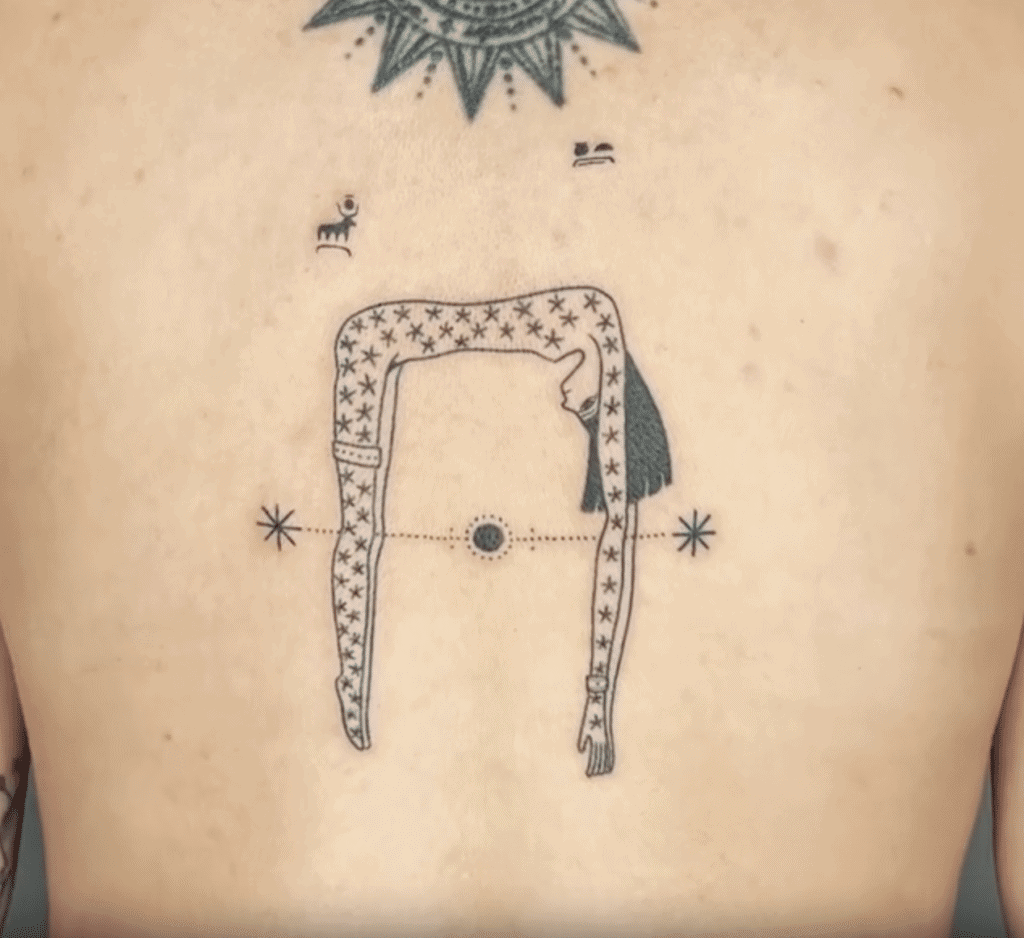
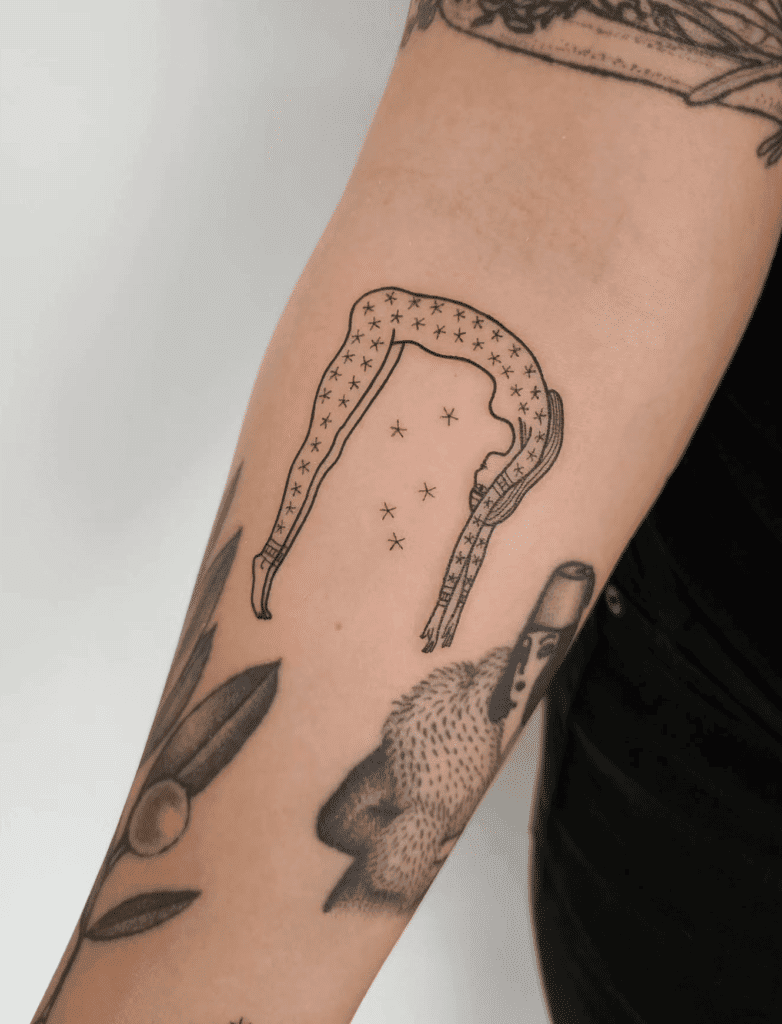
Nut is the vast, cosmic mother of the heavens, usually depicted as a nude woman arched over the earth, symbolising openness and totality. She embodies protection, rebirth, eternity, and the infinite rhythm of the universe.
Nut was believed to arch over the earth god Geb, her body forming the dome of the sky. Her fingers and toes touched the horizons, marking the edges of the world, while stars glittered across her skin. Between Nut and Geb lay the realm of humanity, held safely between earth and sky.
One of Nut’s most important roles was her relationship with the sun god Ra. Each evening, Nut swallowed the sun as it set, carrying it through her body during the night. At dawn, she gave birth to it once more, allowing daylight to return.
Nut was also the mother of some of Egypt’s most important gods: Osiris, Isis, Set, and Nephthys. Through her children, she became the source of both harmony and conflict, life and death, love and chaos.
In funerary belief, Nut was a powerful protector of the dead. Coffins and tomb ceilings were often painted with her star-covered form so the deceased would rest within her body, just as the sun did each night. To die was to return to Nut’s embrace, awaiting rebirth.
Geb Egyptian Mythology Tattoo
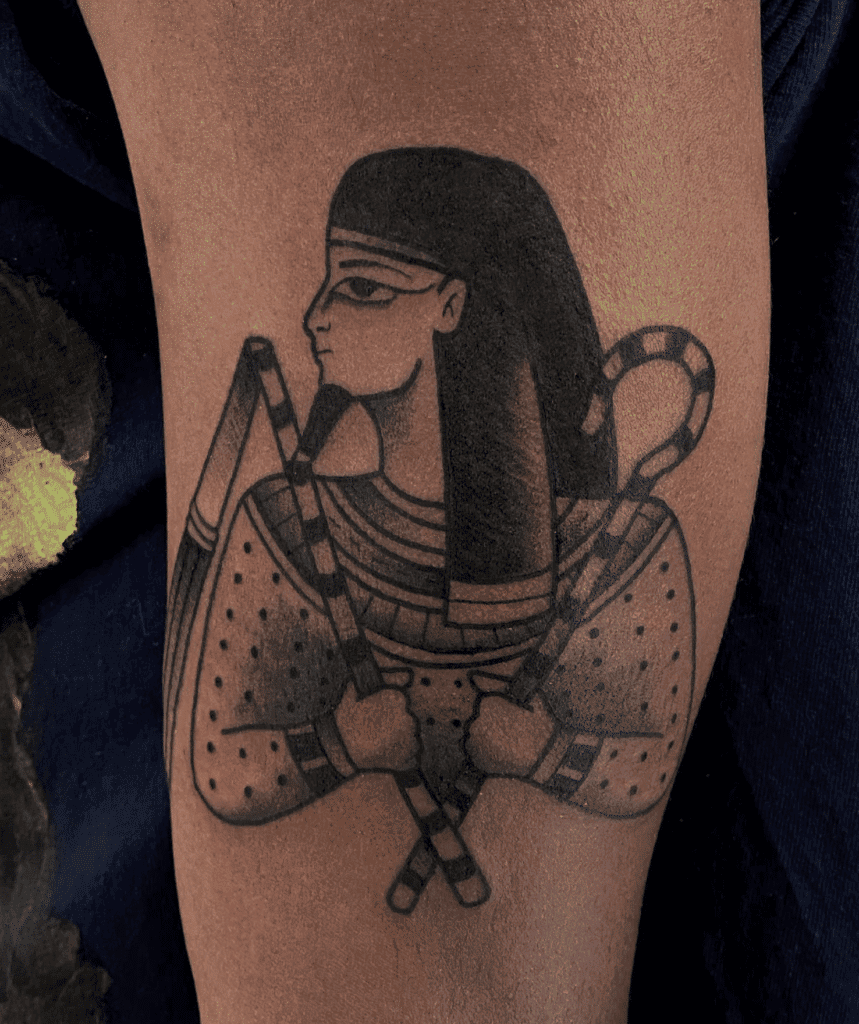
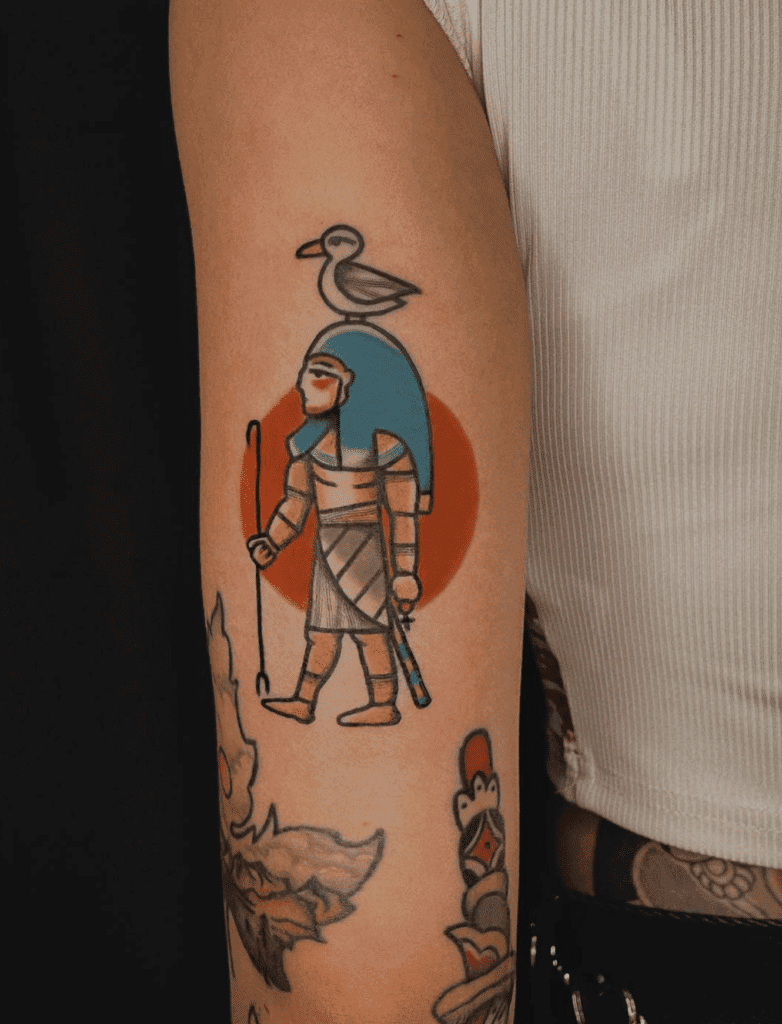
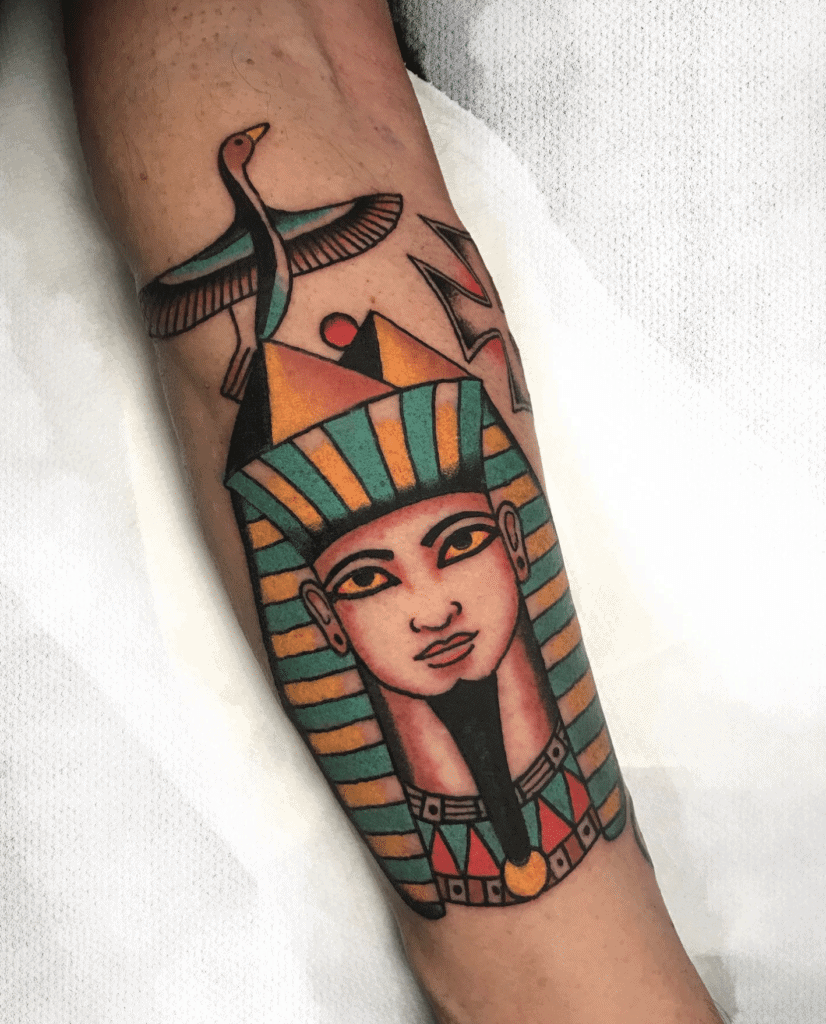
Geb is the living embodiment of the earth itself in Egyptian mythology. He was believed to lie beneath Nut, his sister and consort, their bodies once tightly entwined in a cosmic embrace, symbolising a time when sky and earth were inseparable. To allow life to exist, Shu, the god of air, was commanded to separate them, lifting Nut into the heavens and leaving Geb below. This act created space — air, movement, and the world as humans know it.
As the god of the earth, Geb ruled over fertility, growth, vegetation, and natural abundance. Crops sprouted from his body, animals lived upon his back, and the dead were laid within him. Returning to the earth after death was not seen as a loss but as a reunion.
Geb was also a god of kingship. Egyptian pharaohs were said to inherit their right to rule from him, ruling over the land just as Geb ruled over the earth itself. In myths, Geb acts as a judge during divine disputes, including the conflict between Horus and Set.
Ma’at Egyptian Mythology Tattoo
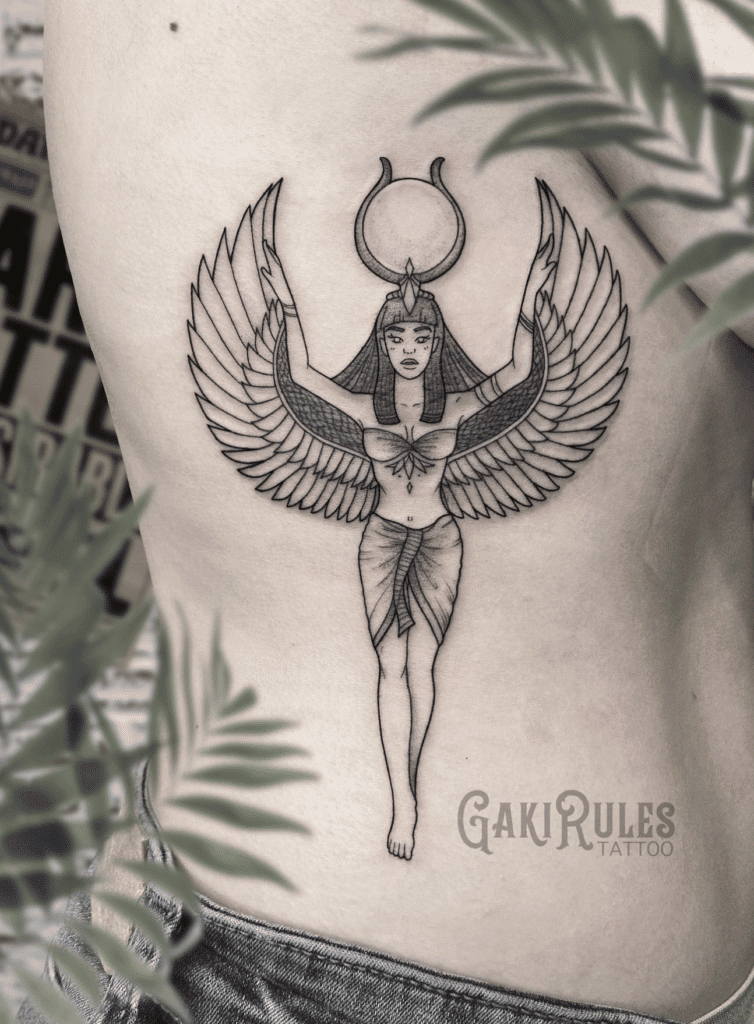
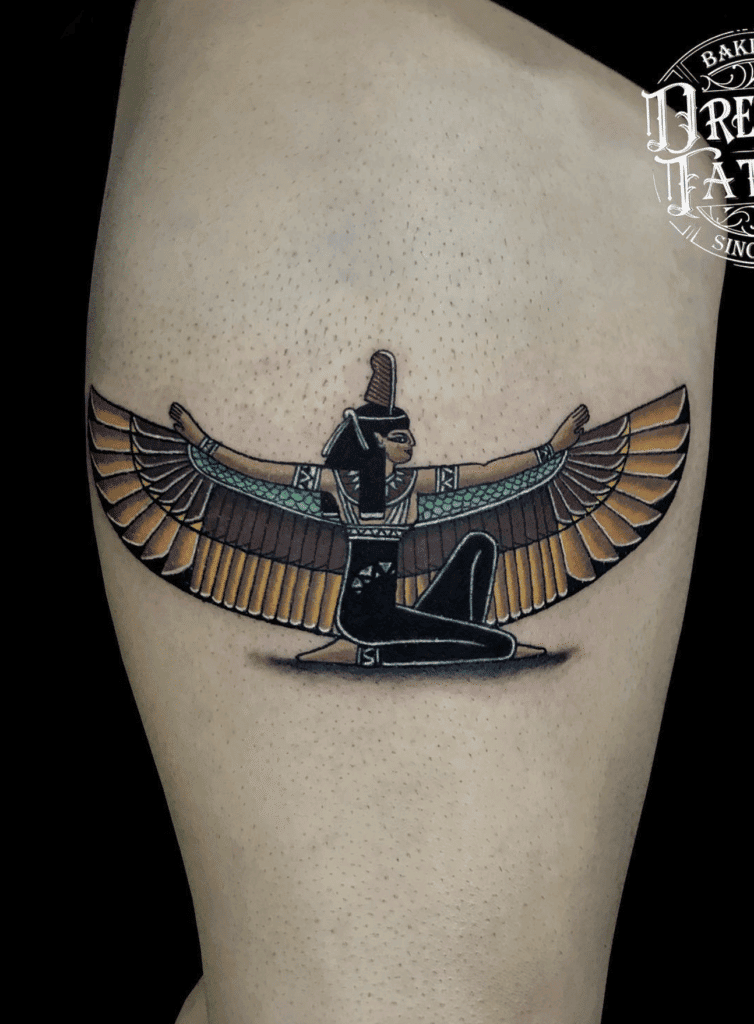
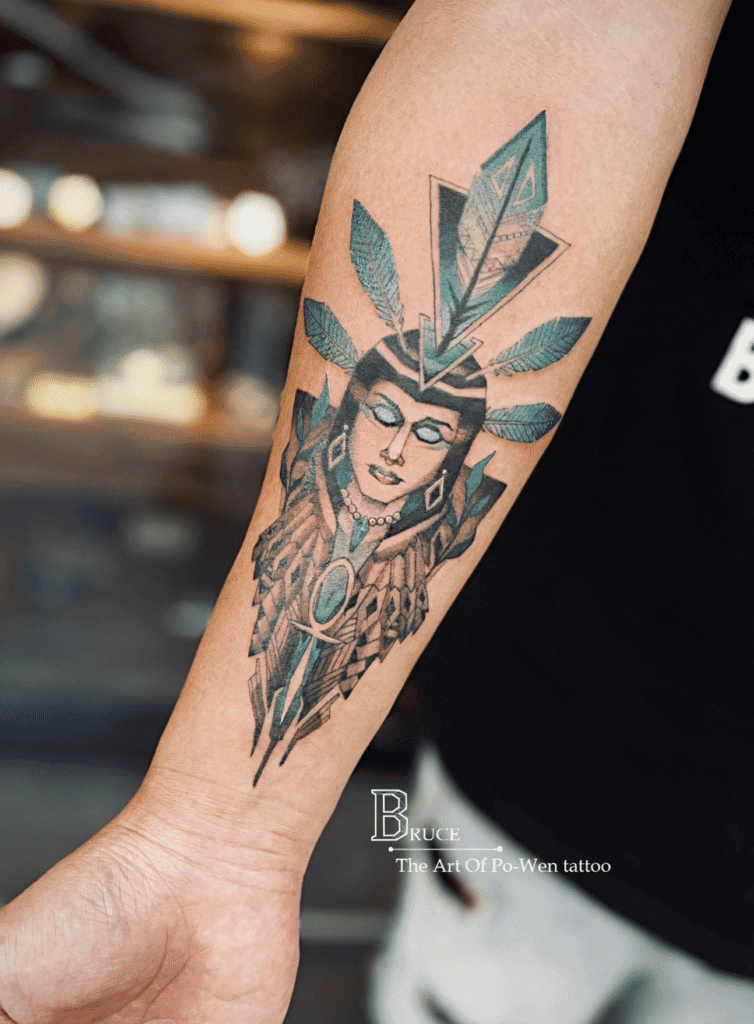
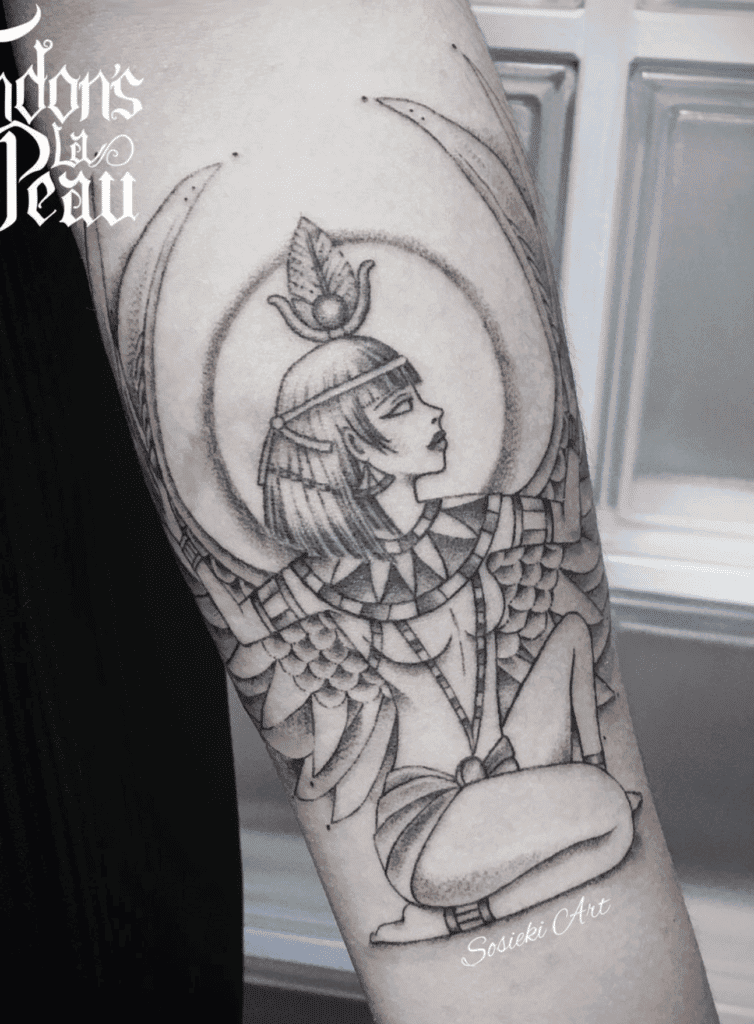
Ma’at is not just a goddess, but the principle that holds the universe together. She represents truth, balance, justice, harmony, and cosmic order.
From the moment the world came into being, Ma’at existed as its foundation. She governed the movement of the stars, the rhythm of the Nile, the cycle of life and death, and the moral conduct of both gods and humans. Without Ma’at, the universe would collapse back into chaos. Even the gods were bound by her — no divine will stood above her law.
Her most powerful role appears in the afterlife. In the Hall of Judgment, the heart of the deceased was weighed against Ma’at’s feather. This was not a test of obedience, but of truth. A heart burdened by deceit, cruelty, or imbalance would outweigh the feather and be devoured, ending the soul’s journey. A heart in harmony with Ma’at was light — honest, balanced, and worthy of eternal life.
Khonsu Egyptian Mythology Tattoo
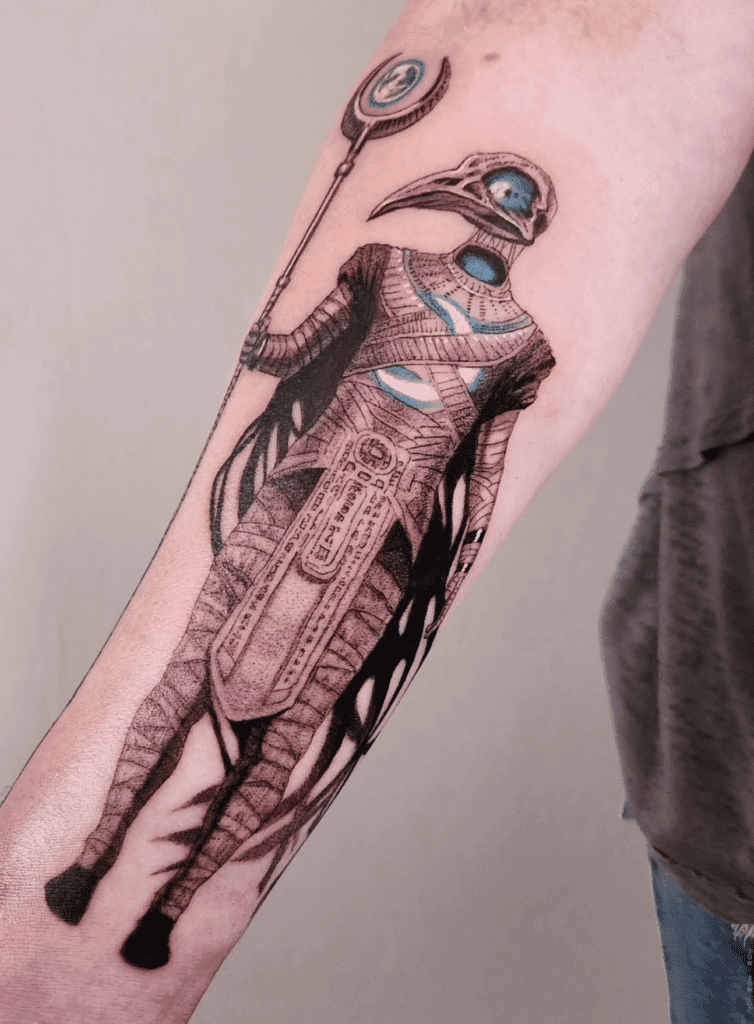
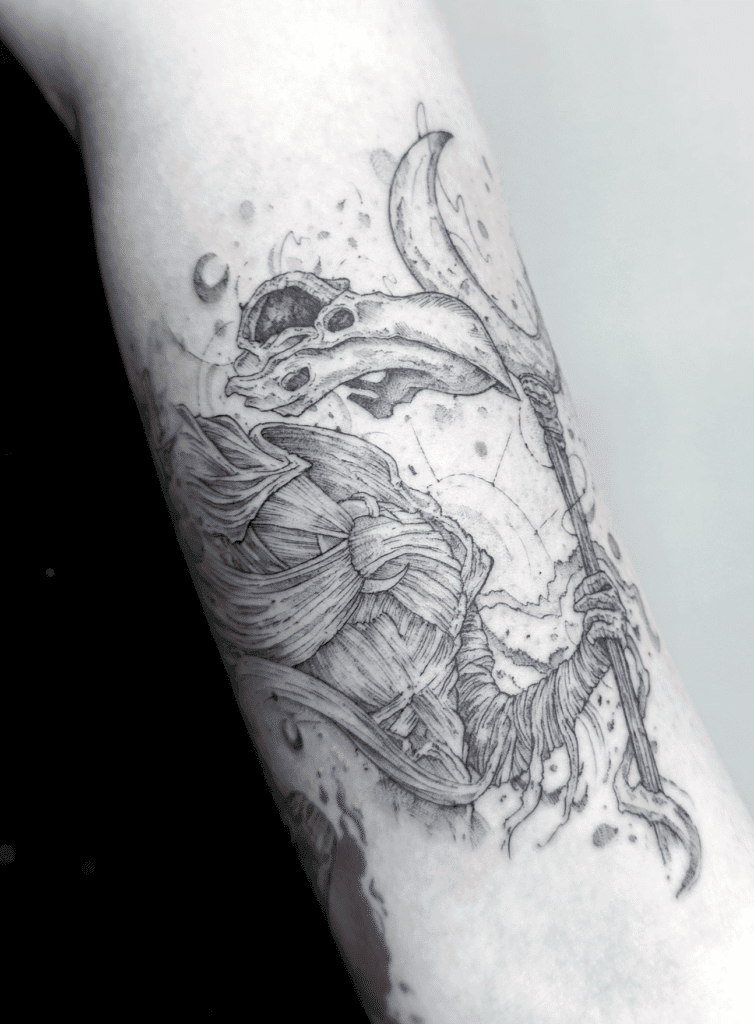
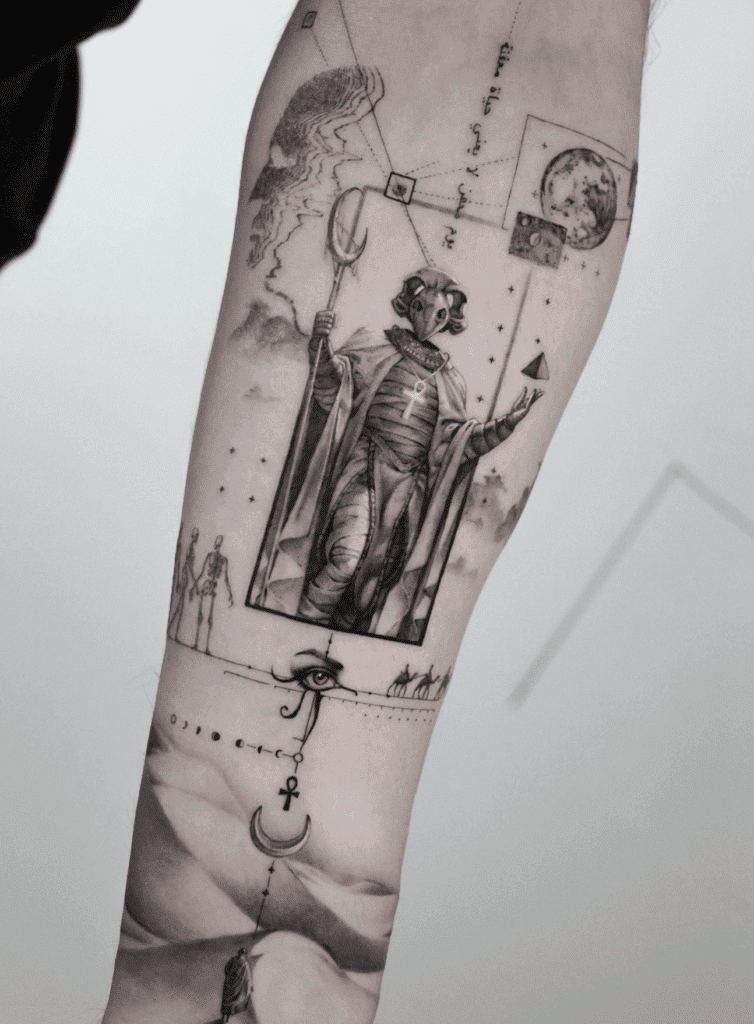
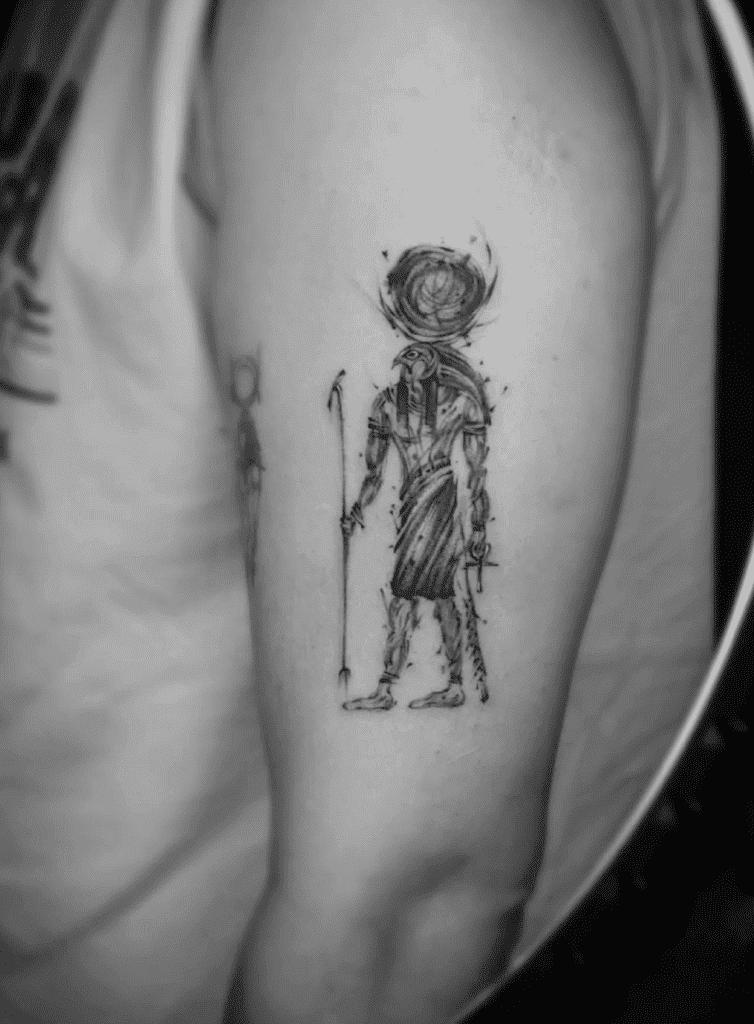
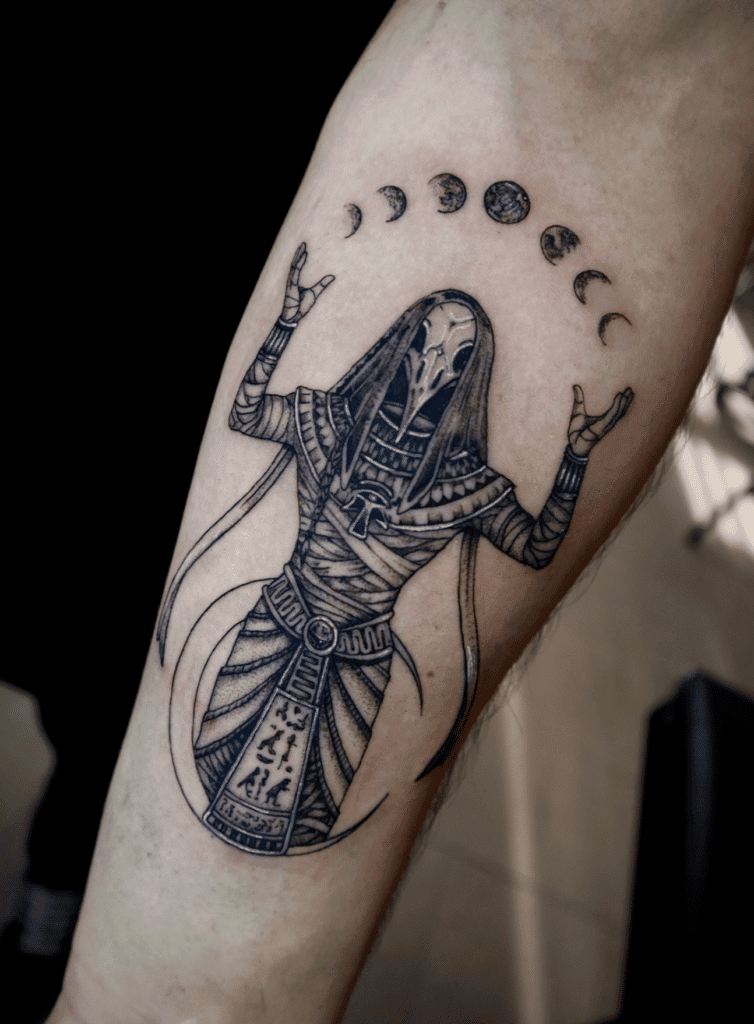
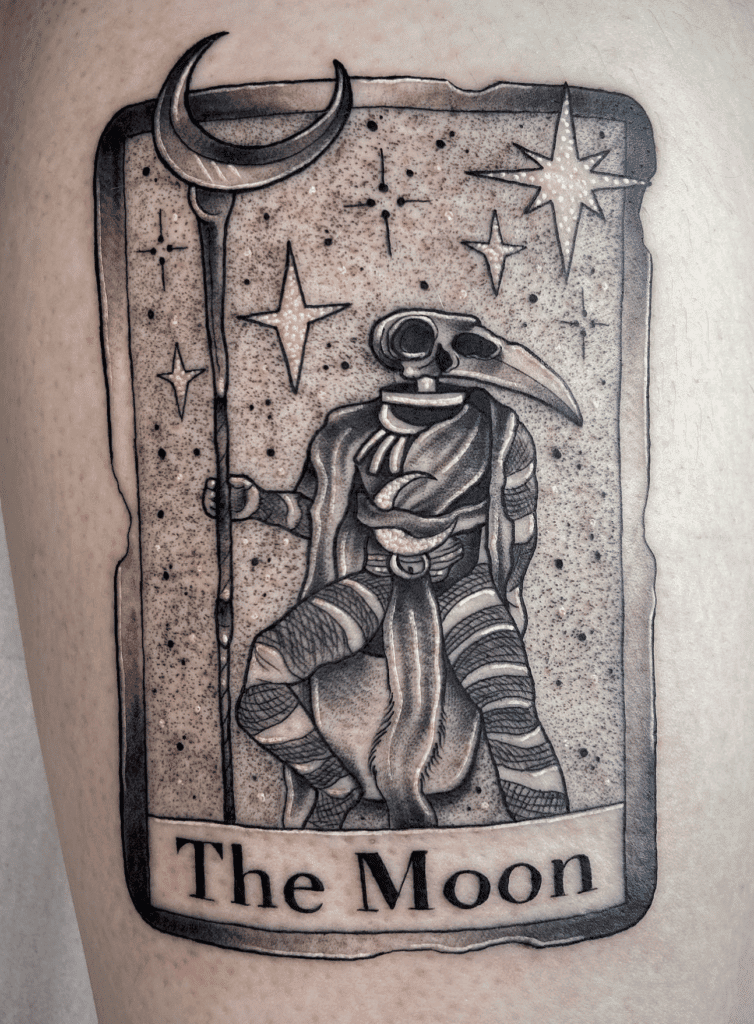
Khonsu is the Egyptian god of the moon, time, healing, and protection. His name means “the Traveller,” perfectly reflecting the moon’s nightly journey across the sky and Khonsu’s role as a god of motion, change, and renewal.
Khonsu rose to prominence during the New Kingdom as part of the Theban Triad, alongside Amun and Mut. Where Amun represented hidden cosmic power, and Mut embodied divine motherhood, Khonsu represented time in motion — the force that measures days, months, and the rhythms of life itself. To the Egyptians, the moon governed not just the night, but fertility cycles, healing periods, and the flow of events.
As a moon god, Khonsu was associated with restoration and healing. The waxing and waning moon symbolised recovery after loss, strength returning after weakness. Khonsu was invoked to cure illness, protect travellers, and ward off evil spirits. In one famous myth, his power is said to drive out a possessing spirit, reinforcing his reputation as a divine healer and protector against unseen threats.
Despite this benevolent role, Khonsu was not always gentle. Early myths portray him as fierce and dangerous, even describing him as a god who fed on hearts or wielded violent lunar power. Over time, this darker edge was softened, but never erased.
Nephthys Egyptian Mythology Tattoo
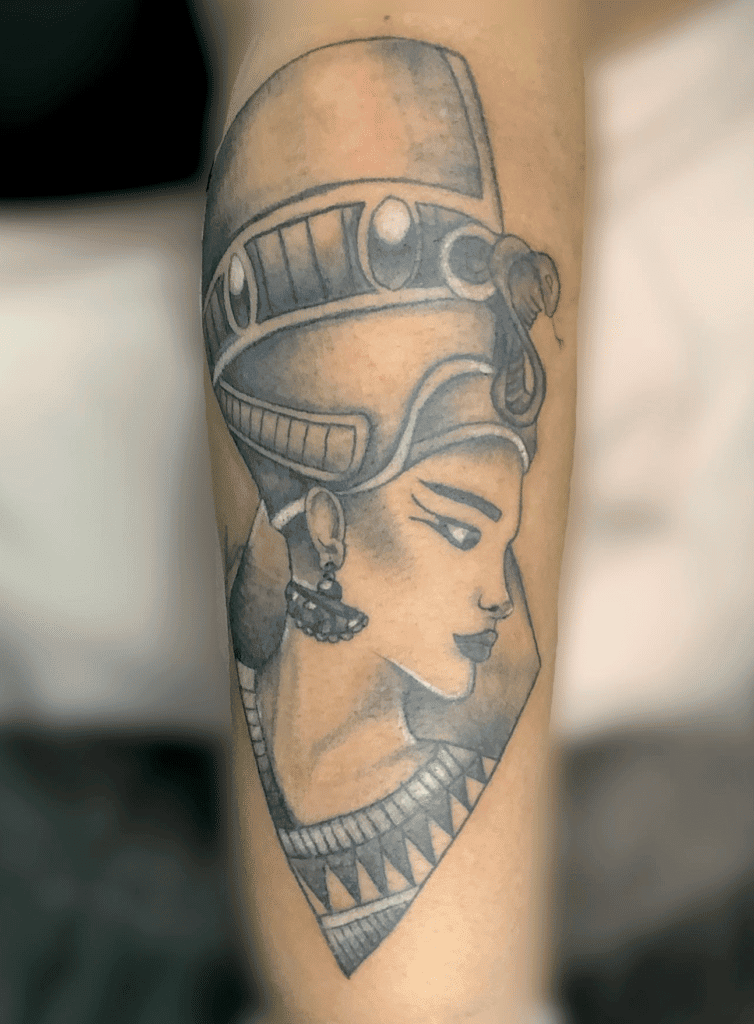
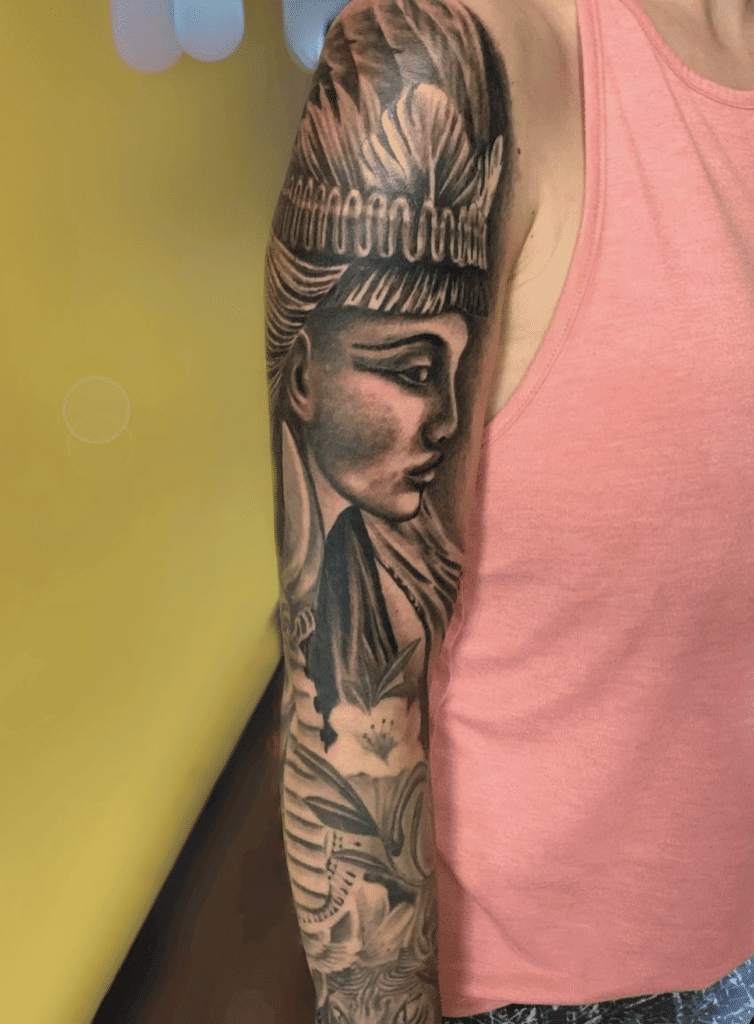
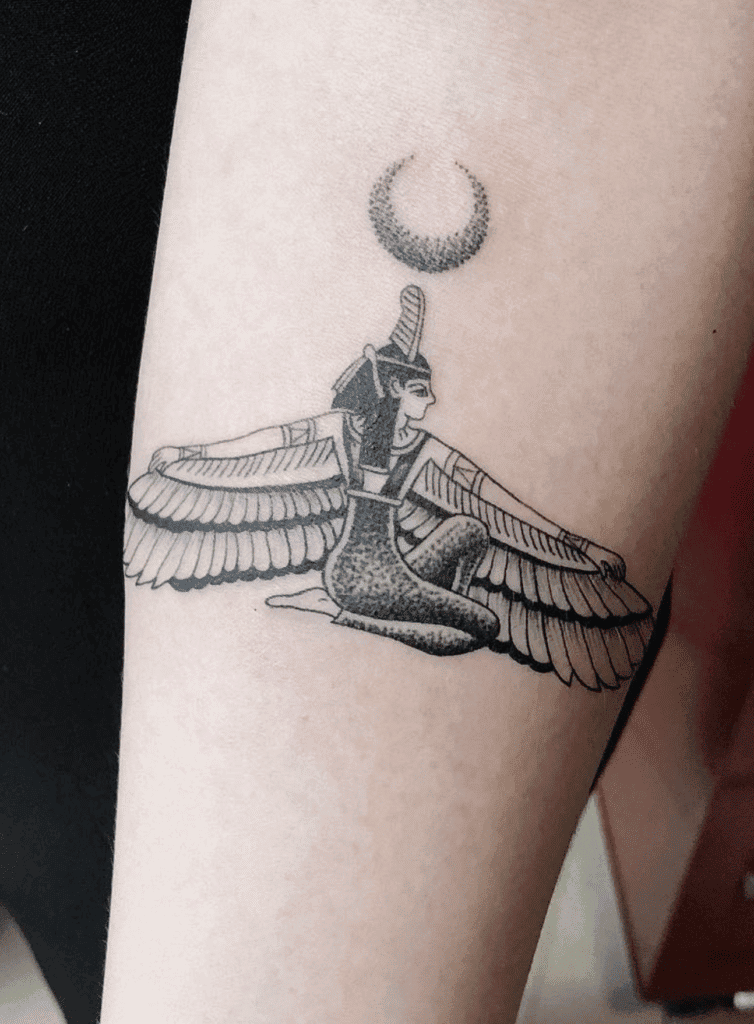
Nephthys is the goddess of mourning, protection, night, and liminal spaces. She is the sister of Isis and Osiris, and the consort of Set, though she is fundamentally unlike him. Her domain is not chaos or domination, but the threshold — dusk and dawn, life and afterlife, presence and absence. She represents what lies just beyond sight, the stillness that follows loss, and the unseen care given when grief is at its heaviest.
In the myth of Osiris, Nephthys plays a deeply compassionate role. Though married to Set, she sides with Isis after Osiris’s murder. Together, the two sisters mourn him, search for his body, and protect it from further harm. Their shared grief was believed to have magical power, helping to resurrect Osiris and secure the future birth of Horus.
Nephthys was closely associated with funerary rites. She guarded coffins, tombs, and the souls of the dead, often depicted standing at the head of a sarcophagus while Isis stood at the feet.
Apep Egyptian Mythology Tattoo

Apep (also known as Apophis) is the irreconcilable serpent and embodiment of absolute chaos, darkness, and non-existence in Egyptian mythology. Apep existed outside Ma’at and was believed to have emerged from the primeval waters of chaos that existed before creation, making him older than the world itself.
Each night, as Ra travelled through the underworld in his solar barque, Apep lay in wait. The serpent would attempt to stop the sun’s journey, swallowing light, time, and order. This nightly battle was one of the most important myths in Egyptian belief. If Ra failed, the sun would not rise, and the world would end. Every dawn was therefore a victory over Apep, proof that chaos had once again been restrained.
Apep was so dangerous that he was rarely worshipped. Instead, he was ritually attacked. Priests performed spells, curses, and symbolic executions against him — stabbing effigies, burning images, and reciting texts meant to weaken him.
Atum Egyptian Mythology Tattoo

Atum is the god of beginnings and endings, the self-created source from which the universe first unfolded. He was believed to have arisen alone from the primeval waters of Nun, standing upon the Benben, the first mound of land to emerge from chaos. With no parents and no equals, he created himself through sheer will. From this solitary state, Atum brought forth the first divine pair, Shu and Tefnut, beginning the chain of creation that would lead to the cosmos, the gods, and humanity.
Unlike Ra, who represents the sun in its daily journey, Atum is closely associated with the setting sun. He symbolises completion, return, and dissolution rather than youthful energy.
Atum was also associated with transformation. He could appear as a man, a serpent, or a primordial being returning to chaos at the end of time. Egyptian texts describe a future where even the gods dissolve back into Nun, with Atum surviving as a serpent alongside Osiris.
Montu Egyptian Mythology Tattoo
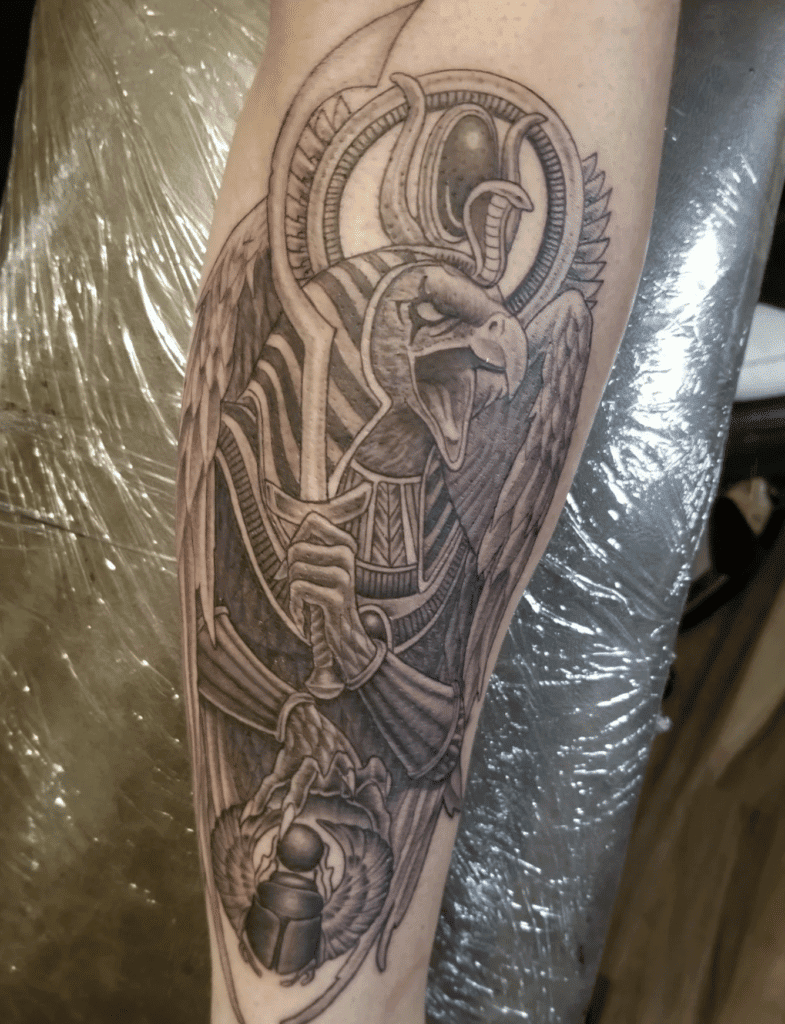
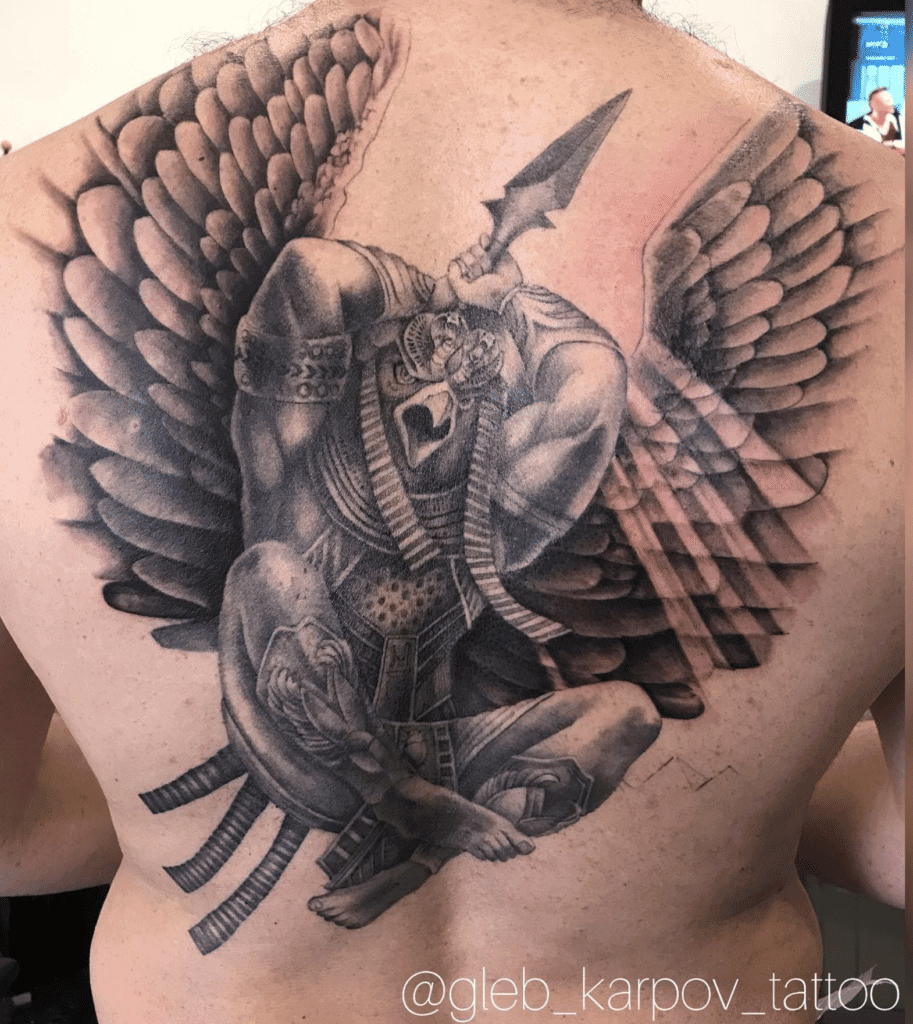
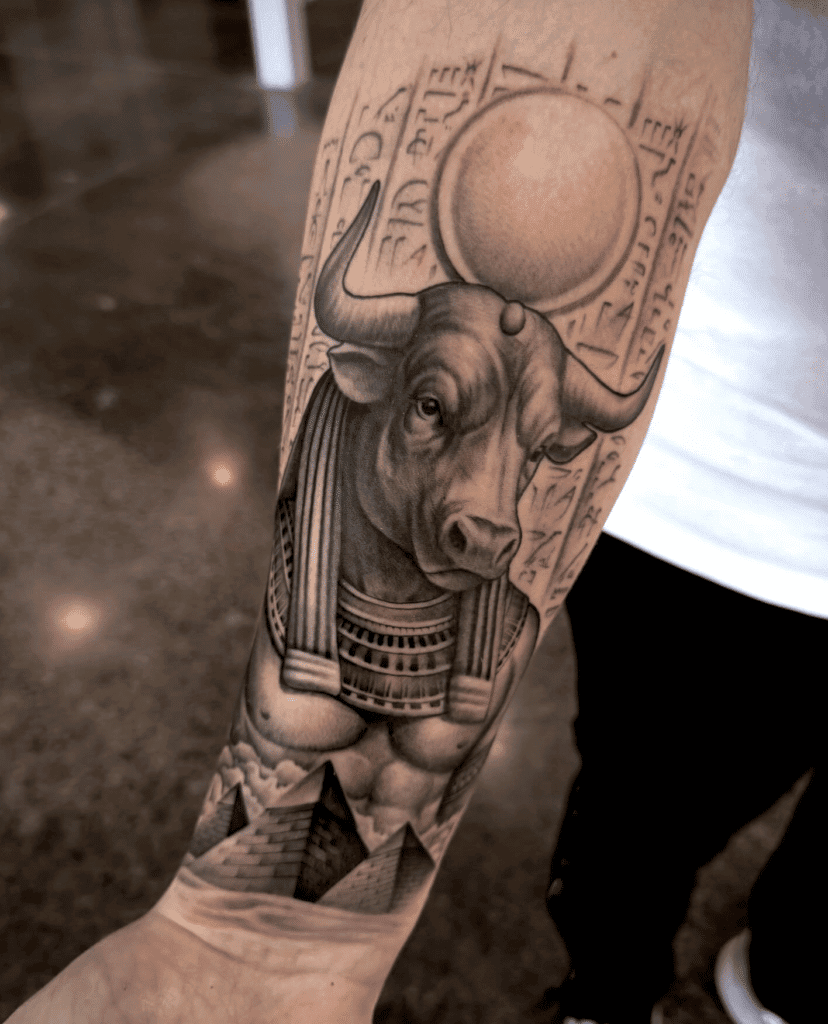
Montu is the god of war, strength, and unrelenting victory. Montu emerged early in Egyptian history, particularly in Upper Egypt and cities such as Armant, Thebes, and Medamud. Long before Amun rose to supremacy, Montu was revered as a primary martial deity, especially during periods of expansion and conflict.
Unlike chaotic violence, Montu’s aggression was focused and righteous. He fought to preserve order by destroying threats to it. Kings described themselves as “Montu on the battlefield,” claiming his ferocity, speed, and fearlessness.
Montu was strongly linked to the sun, particularly its burning, destructive heat. He was also closely associated with the bull, especially the sacred Buchis bull, which embodied Montu’s raw strength, virility, and unstoppable charge. The bull symbol reinforced Montu’s physicality — power rooted in muscle, speed, and impact rather than magic or strategy alone.
Tefnut Egyptian Mythology Tattoo


Tefnut is the goddess of moisture, rain, dew, and the life-giving balance between dryness and abundance. She was one of the first gods, born directly from the creator Atum at the dawn of existence, alongside her twin brother Shu. Together, they formed the first balance in the universe: Shu as air and space, Tefnut as moisture and fluidity.
As a goddess of moisture, Tefnut governed rain, humidity, dew, and the subtle wetness that fertilised the land. In a desert civilisation like Egypt, this role was sacred. Moisture meant crops, survival, and stability.
Tefnut was also associated with the Eye of Ra, linking her to divine authority and fiery retribution. In some myths, she becomes enraged and leaves Egypt, withdrawing her life-giving moisture and plunging the land into drought. Only when she is calmed and returned does balance resume.
Tefnut is also the mother of Nut and Geb, making her the grandmother of Osiris, Isis, Set, and Nephthys. Through this lineage, she stands at the heart of Egyptian cosmology.
Khepri Egyptian Mythology Tattoo


Khepri is the god of becoming, transformation, and the rising sun. Khepri was believed to push the sun across the sky each morning just as the scarab beetle rolls its ball of dung across the ground. To the ancient Egyptians, this was not a metaphor but a revelation of cosmic truth: life generates itself, moves itself, and renews itself through unseen forces.
As a form of the sun god, Khepri embodied youth, potential, and transformation. Each sunrise was Khepri’s triumph — the world being remade again and again. This made him a powerful symbol not just of cosmic renewal, but of personal change, resilience, and the promise that no state is permanent.
Khepri was also deeply connected to the afterlife. Scarab amulets were placed over the hearts of the dead to prevent the heart from betraying the soul during judgment. These “heart scarabs” invoked Khepri’s power of renewal, ensuring that the deceased could be reborn into eternal life. In this way, Khepri bridged daily rebirth and eternal rebirth — dawn and immortality.
Serket Egyptian Mythology Tattoo
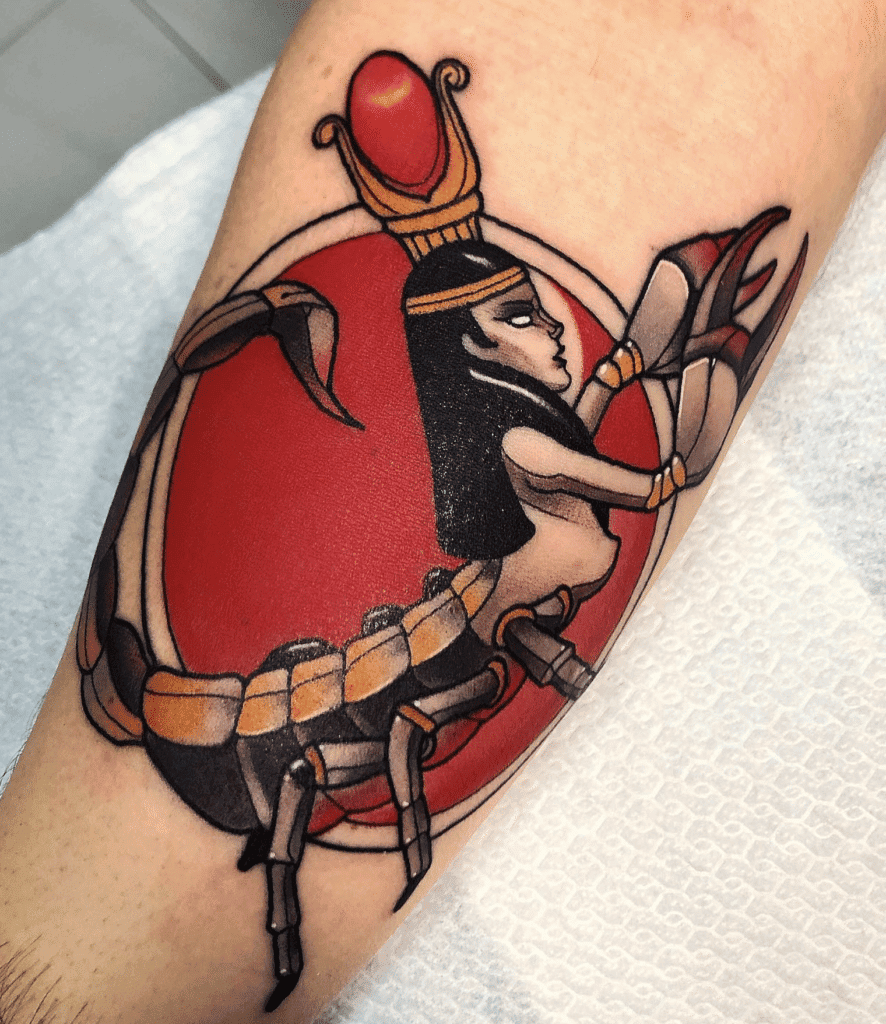
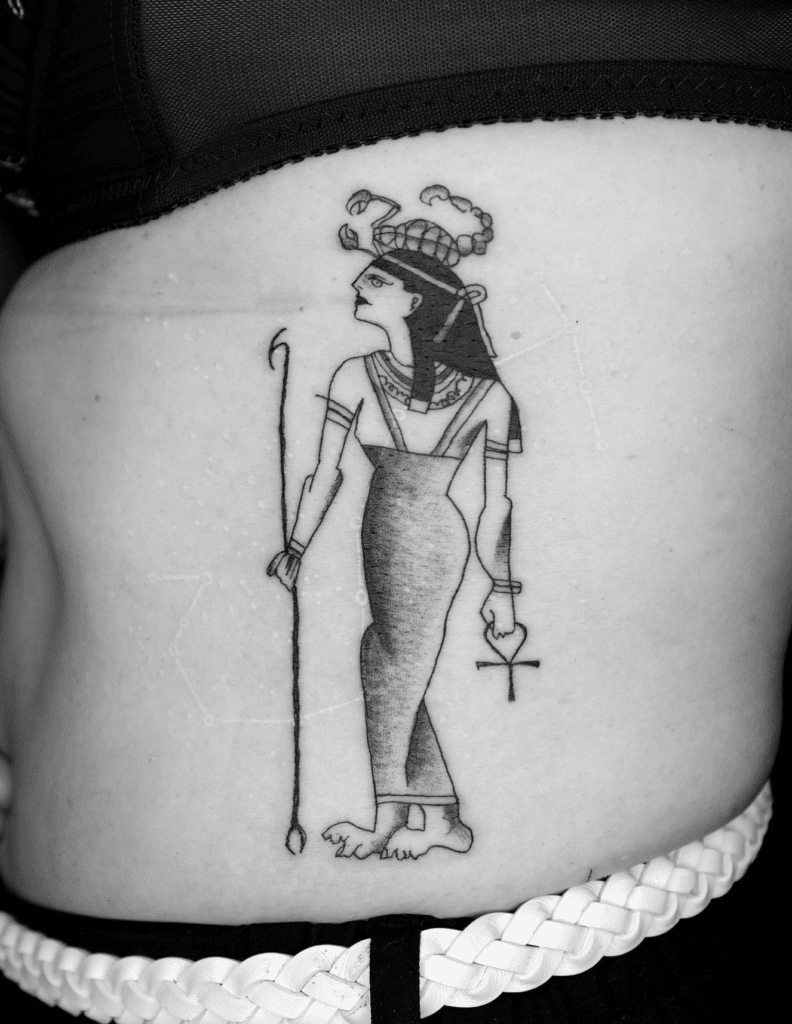
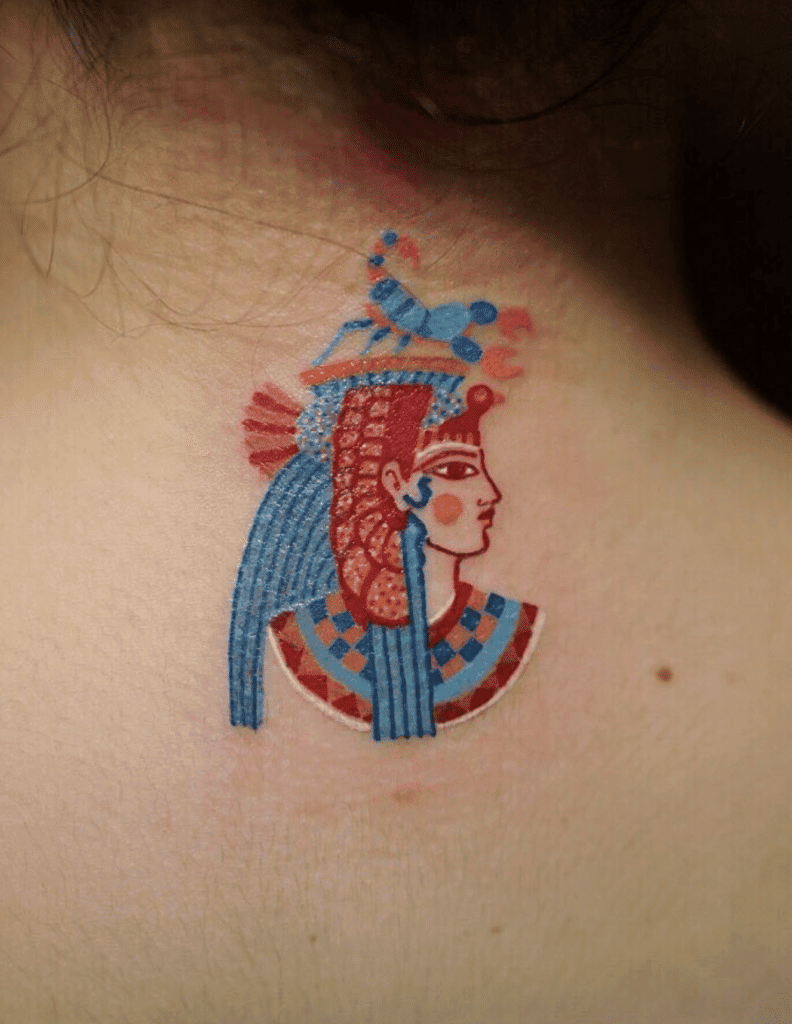
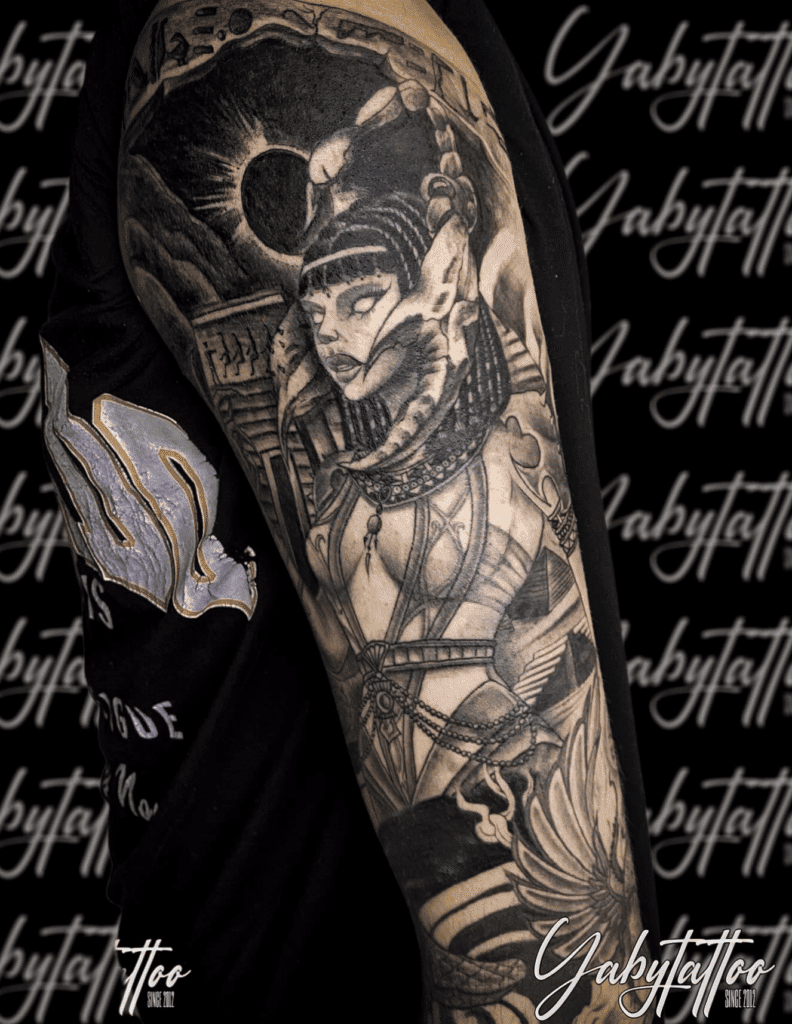
Serket (also spelt Selket) is the goddess of scorpions, venom, healing, and protection. Serket’s earliest role was protective, where she was invoked to prevent poison, neutralise venom, and guard against sudden death.
She was closely associated with healing magic and medicine, with Egyptian healers praying to her when treating venomous wounds, believing she could either calm or command poison within the body.
Serket was also a vital funerary goddess. She was one of the four protective deities of the canopic jars, guarding the lungs of the deceased. Alongside Isis, Nephthys, and Neith, she stood at the edges of the sarcophagus, arms raised in protection. In death as in life, Serket ensured that nothing unseen could strike unexpectedly.
Wadjet Egyptian Mythology Tattoo


Wadjet is the ancient goddess of protection, royal authority, and Lower Egypt. She is one of the oldest deities in Egyptian mythology, with roots reaching back to the earliest periods of kingship. Wadjet was originally a local goddess of the Nile Delta, deeply associated with papyrus marshes, fertility, and the life-giving waters of Lower Egypt, but over time, her protective nature elevated her from a regional deity to a symbol of the entire Egyptian state.
As a cobra goddess, Wadjet embodied alertness, precision, and lethal defence. When depicted on the pharaoh’s brow, she was believed to spit fire or venom at enemies, destroying threats before they could even approach.
Wadjet was closely linked to royal legitimacy. Alongside Nekhbet she formed the “Two Ladies,” divine protectors of the unified kingdom. Every crowned ruler symbolically stood under their joint protection, ruling both lands in balance.
She was also associated with the Eye of Ra, acting as its fiery, defensive aspect. In this role, Wadjet became an extension of solar power — a force that burned away disorder and upheld Ma’at.
Nekhbet Egyptian Mythology Tattoo


Nekhbet is the ancient goddess of protection, motherhood, and royal authority, and the divine guardian of Upper Egypt. She is one of Egypt’s earliest deities, originating in Upper Egypt near the city of Elkab. From the very beginning of Egyptian civilisation, she was revered as a protector of life, especially of mothers, children, and the pharaoh himself.
As a vulture goddess, Nekhbet symbolised maternal protection and guardianship. To modern eyes, vultures may seem ominous, but to the Egyptians they were sacred symbols of care and devotion. Vultures were believed to be fiercely protective mothers, and their soaring presence linked earth to the heavens.
Nekhbet was one of the Two Ladies, paired with Wadjet, who together represented the unity of the Two Lands. Every pharaoh ruled under their combined protection, often wearing symbols of both goddesses.
Heka Egyptian Mythology Tattoo


Heka is the personification of magic itself in Egyptian mythology who existed before creation. Egyptian texts describe him as present at the beginning of time, empowering the creator gods to shape reality. Even Ra, the sun god, relied on Heka to bring the world into being and to defend it against chaos.
To the ancient Egyptians, magic was not supernatural; it was natural law. Just as gravity governs motion, Heka governed cause and effect through words, symbols, and intention. Spells worked because the universe was designed to respond to them. This belief made Heka central to daily life.
Heka played a vital role in both life and death. Physicians combined medicine with spells, calling on Heka to activate remedies. In the afterlife, magical knowledge protected the soul from dangers, opened gates, and ensured safe passage. Amulets, spoken formulas, and written spells were all expressions of Heka in action.
Khnum Egyptian Mythology Tattoo


Khnum is the divine craftsman of life, the god who shapes existence with care, patience, and precision. He was believed to dwell at the source of the Nile, near Elephantine, where the river’s waters first emerged to nourish Egypt. Because the Nile’s floods determined fertility and survival, Khnum became a god of creation, abundance, and renewal.
His most famous role is as the potter of humanity. Khnum was said to shape human bodies on his potter’s wheel, forming both the physical body and the ka (life force or spirit) before placing them into the womb.
Khnum’s ram imagery symbolised vitality, fertility, strength, and generative power. Rams were associated with creative force and endurance, making them the perfect animal form for a god who continually brings life into being.
Khnum was often paired with goddesses such as Satet and Anuket, forming a local triad connected to the Nile’s flow and fertility. Together, they governed the river’s life-giving cycle, reinforcing the idea that creation requires balance, regulation, and cooperation.
Taweret Egyptian Mythology Tattoo


Taweret is the fierce protector of childbirth, motherhood, and the home — a goddess whose terrifying appearance was meant to frighten danger away, not invite it. Taweret’s form is deliberately intimidating; she is part hippopotamus, part lion, part crocodile, standing upright like a human. To the ancient Egyptians, this was not monstrous — it was practical. Hippos were among the most dangerous animals in Egypt, especially mothers defending their young. Taweret channelled that same unstoppable maternal ferocity, making her the perfect guardian of pregnant women and newborns.
Childbirth in ancient Egypt was extremely dangerous, and Taweret was one of the most widely invoked household deities. Unlike distant temple gods, she lived inside the home. Amulets, furniture carvings, headrests, cosmetic tools, and walls bore her image to ward off evil spirits, complications, and unseen threats.
Taweret was closely associated with magic and demons, not because she caused harm, but because she fought it. She stood at the boundary between chaos and life, using fear against fear. In this role, she worked alongside gods like Bes, defending families from malevolent forces during the night, when danger was believed to be greatest.
Despite her fearsome appearance, Taweret was a goddess of warmth and care. She was sometimes shown holding the sa symbol of protection or resting her hands on her swollen belly, reinforcing her nurturing role.
Ammit Egyptian Mythology Tattoo
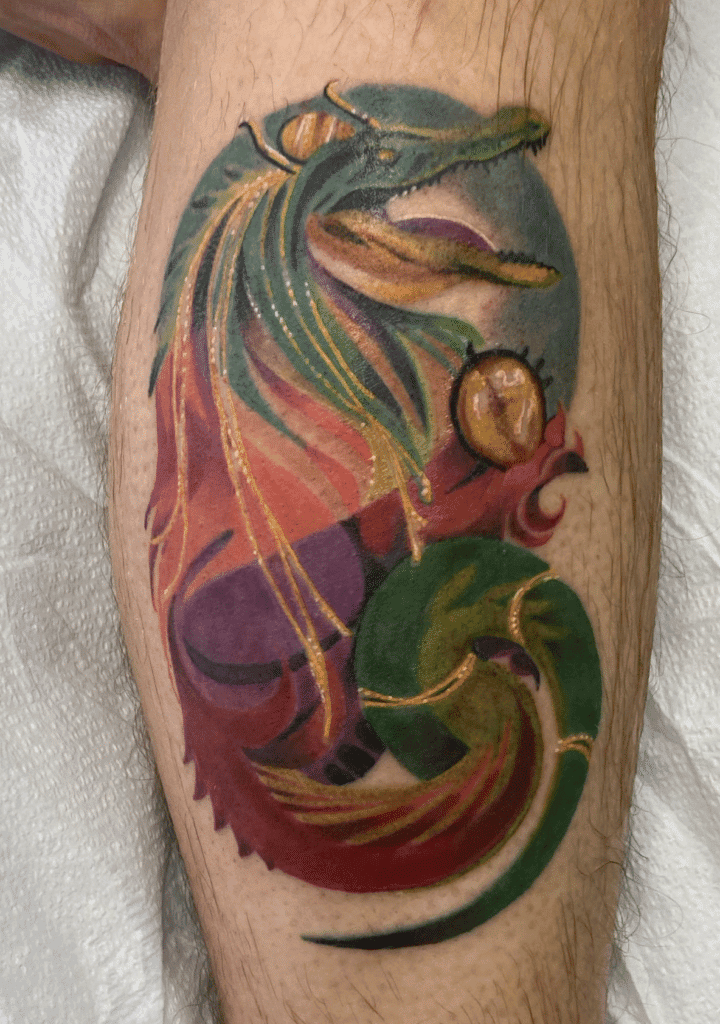
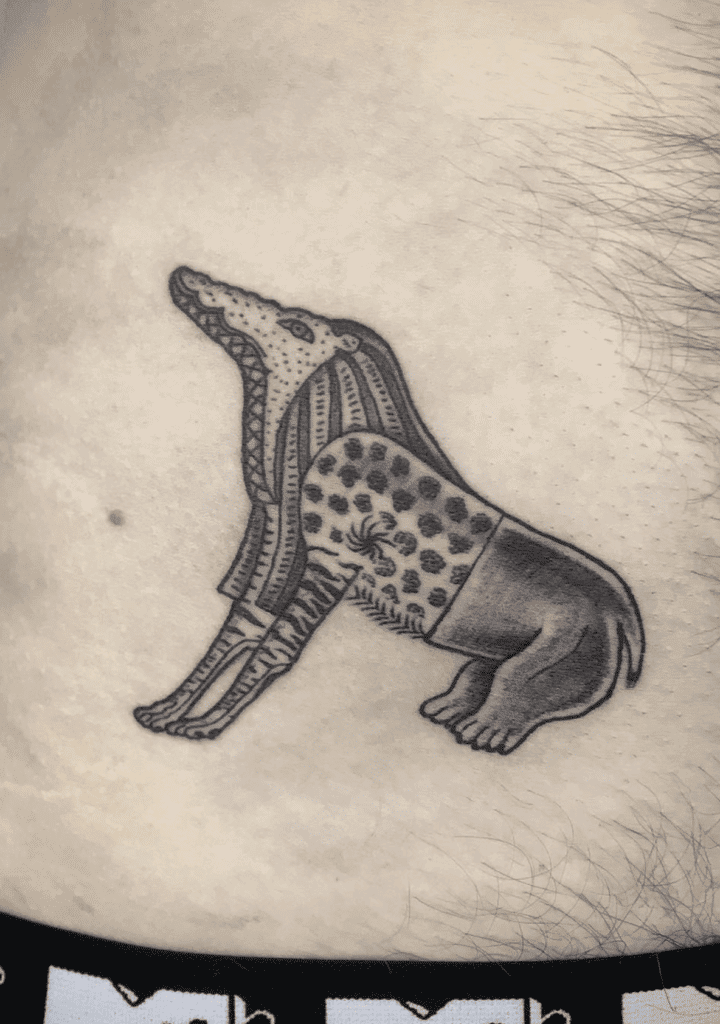
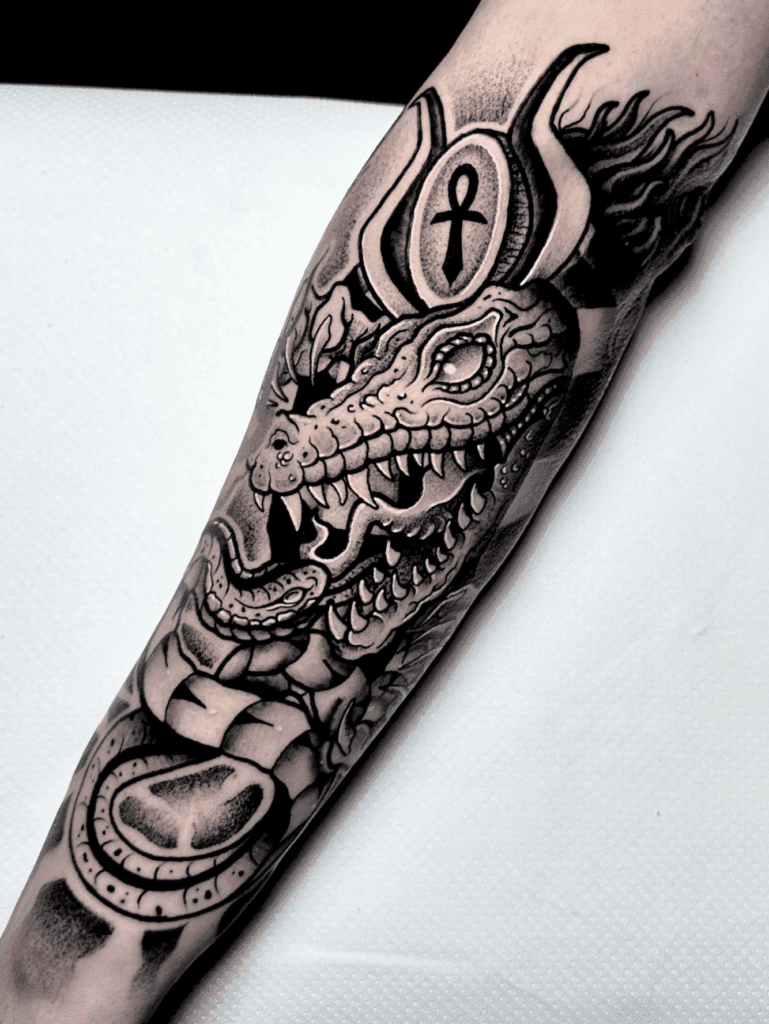
Ammit is the fearsome Devourer of the Dead — a being who represents final judgment and annihilation rather than punishment or evil in the usual sense. She is not a goddess who rules or commands; she is the consequence of a life lived in opposition to Ma’at.
Ammit appears in the Hall of Judgment, where the heart of the deceased is weighed against the Feather of Ma’at. If the heart is heavier — burdened by lies, cruelty, and imbalance — Ammit consumes it. This act does not send the soul to torment or suffering. Instead, it ends the soul completely.
Her terrifying form is deliberate. Ammit is a composite of three of Egypt’s most dangerous animals: the crocodile’s head, lion’s forequarters, and hippopotamus’s hindquarters. Each animal symbolised deadly power in its own domain — water, land, and raw physical force. Ammit embodies danger from every direction, leaving no escape once judgment is passed.
Despite her monstrous appearance, Ammit was not evil or chaotic like Apep. She did not rebel against order — she served it. She acted only after judgment was complete, enforcing Ma’at with absolute finality. In this sense, she was a necessary part of cosmic balance. Without Ammit, judgment would have no consequence.
Bennu Egyptian Mythology Tattoo
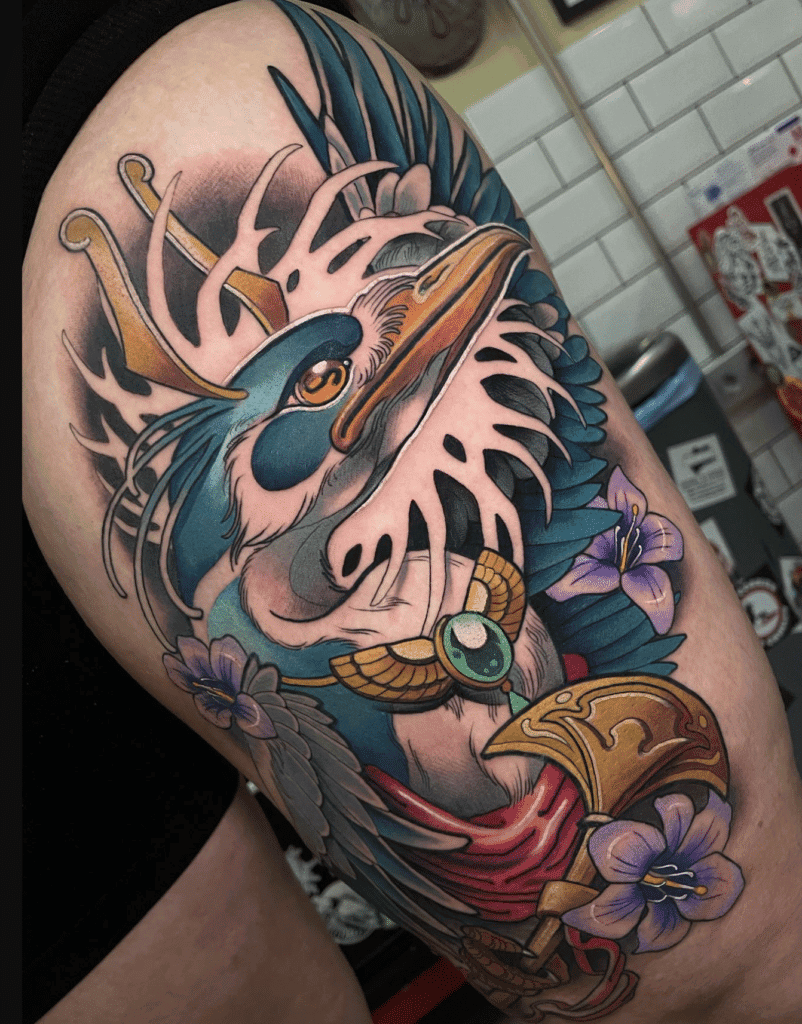
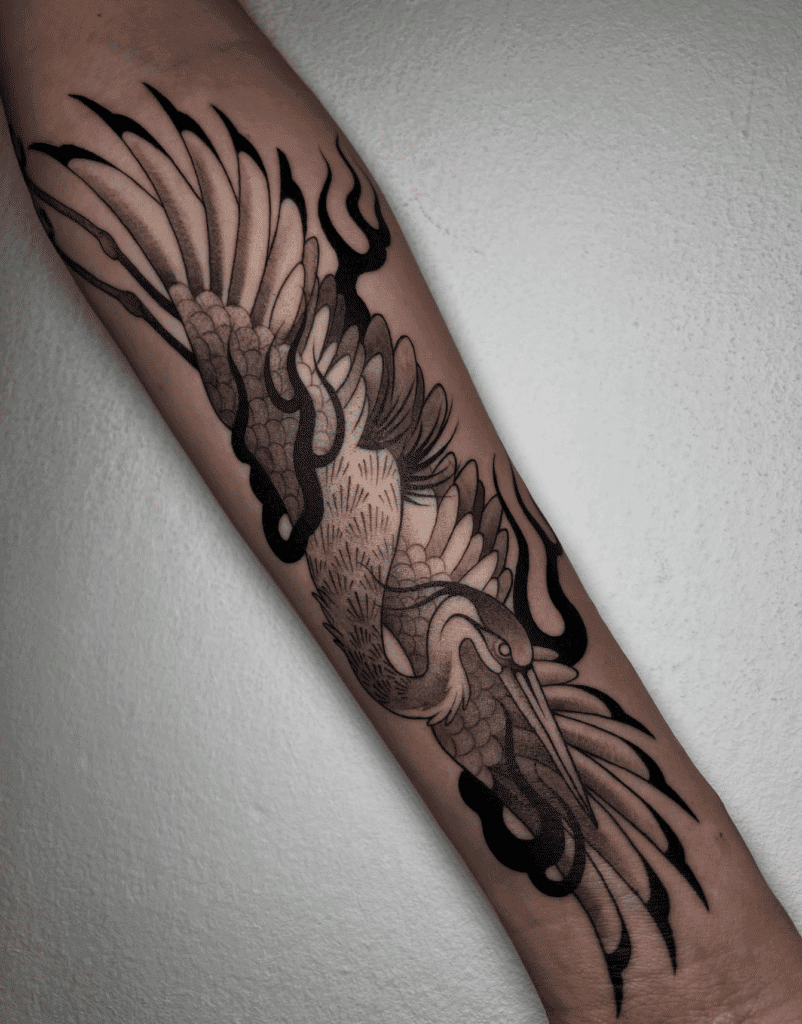
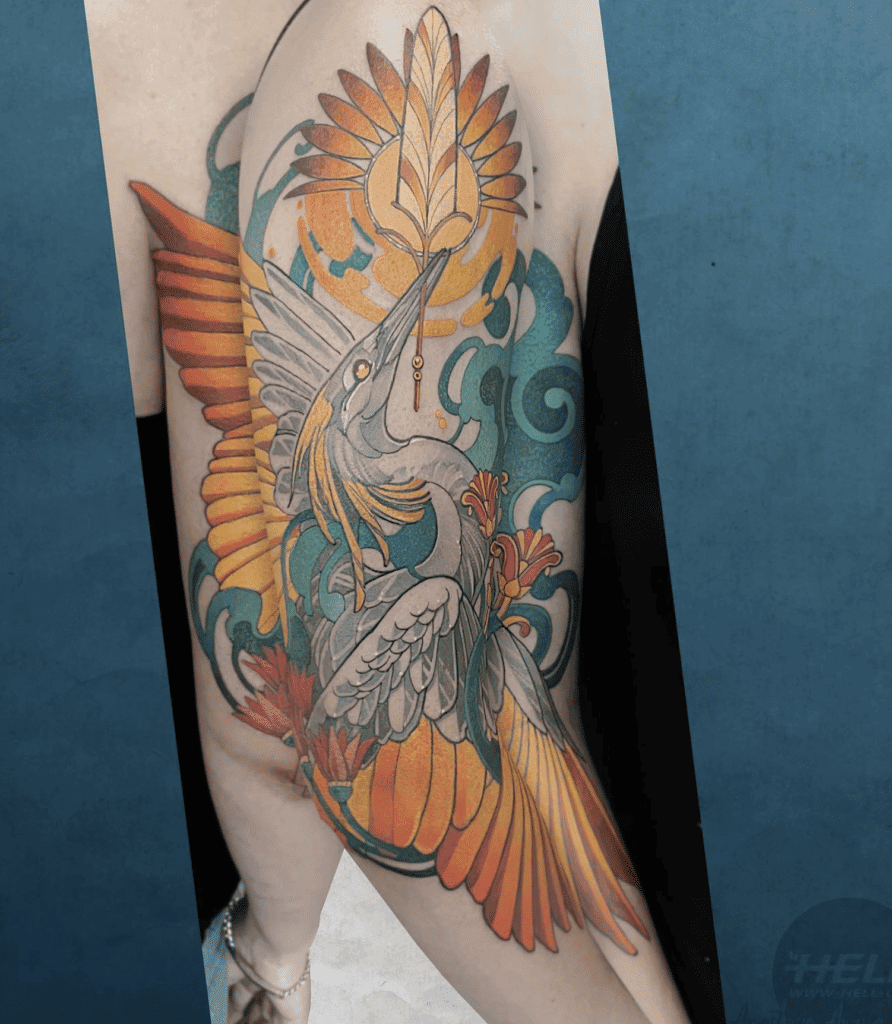
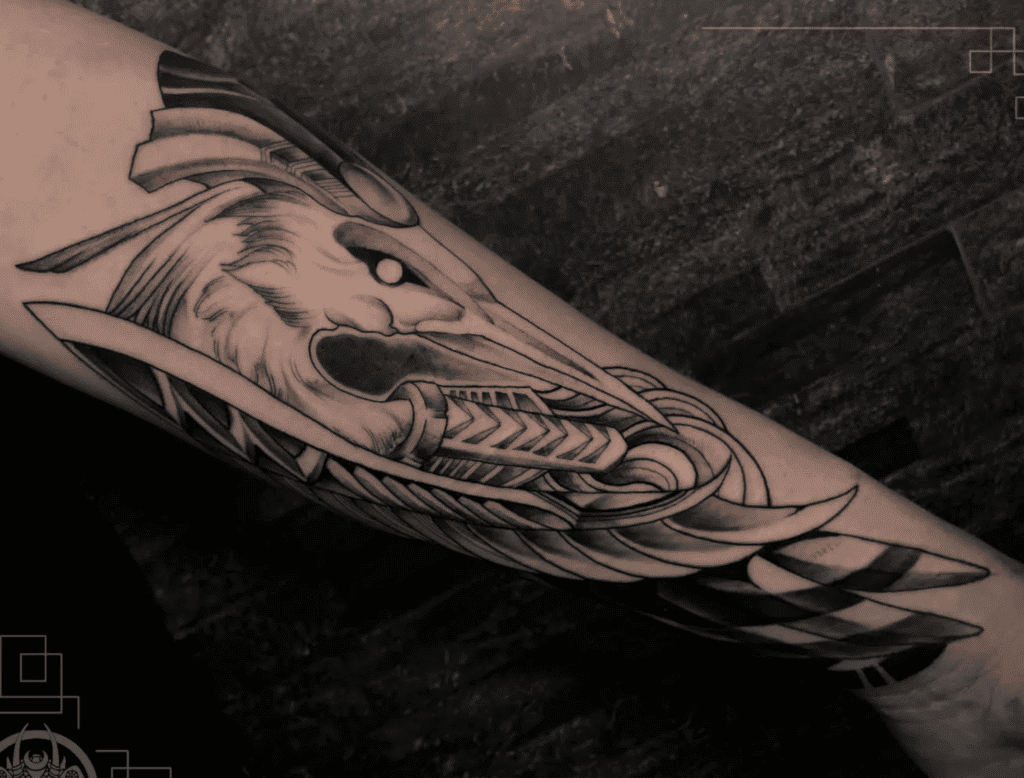
Bennu is the ancient Egyptian symbol of rebirth, creation, and eternal renewal, and the mythological forerunner of the later Greek phoenix. Bennu was closely tied to the act of creation itself. In Egyptian belief, he first appeared at the dawn of time, emerging from the primeval waters of Nun and alighting on the Benben stone, the original mound of land that rose from chaos. His cry was said to mark the beginning of creation, making Bennu not just a symbol of rebirth, but a trigger of existence.
As a solar bird, Bennu was associated with Ra and the daily cycle of the sun. Just as the sun rises each morning after darkness, Bennu embodied renewal after endings. Over time, he also became linked with Osiris, reinforcing his role in resurrection and the promise of life beyond death. In this way, Bennu bridged cosmic rebirth and personal immortality.
Unlike later depictions of the phoenix bursting into flame, Bennu’s renewal was quiet and dignified. His power came from endurance rather than destruction. He did not need to burn to be reborn — he returned naturally, again and again, mirroring the eternal rhythms of the universe.
Serpopard Egyptian Mythology Tattoo

Serpopard is one of the most mysterious creatures in Egyptian mythology and art. It was a symbol of untamed chaos, foreign danger, and the wild forces that civilisation must control. Unlike later gods with detailed myths, the Serpopard exists almost entirely through symbolism.
The Serpopard is a hybrid creature, combining the body of a leopard with the long, serpentine neck of a snake. This unnatural fusion immediately marks it as something wrong.
Leopards represented speed, ferocity, and predatory dominance, while serpents symbolised chaos, danger, and the unknown. Together, they formed a creature that embodied unrestrained, alien power.
Serpopards appear primarily in early Egyptian art, especially during the Predynastic and Early Dynastic periods (around 3200–3000 BCE). Their most famous depiction is on the Palette of Narmer, where two Serpopards are shown with their long necks intertwined, restrained by human handlers. This image is deeply symbolic, representing chaos being bound, order being imposed, and the rise of kingship and civilisation.
Importantly, the Serpopard is not native to later Egyptian religious mythology. Its imagery likely came from Mesopotamian and Near Eastern influences, reinforcing its association with foreign lands and external threats. To the Egyptians, chaos often came from beyond their borders, and the Serpopard visually embodied that fear.
Unlike Apep, who threatens the cosmos itself, the Serpopard represents earthly, political, and primal chaos — disorder that can be controlled through authority, unity, and strength. This is why Serpopards are almost always shown being restrained. They are dangerous, but not unstoppable.
The Serpopard never became a worshipped deity; its role was symbolic — a warning rather than a being to appease. Over time, as Egyptian religious imagery became more formalised and stable, the Serpopard faded from use, replaced by more defined representations of chaos like Set and Apep.
Uraeus Egyptian Mythology Tattoo
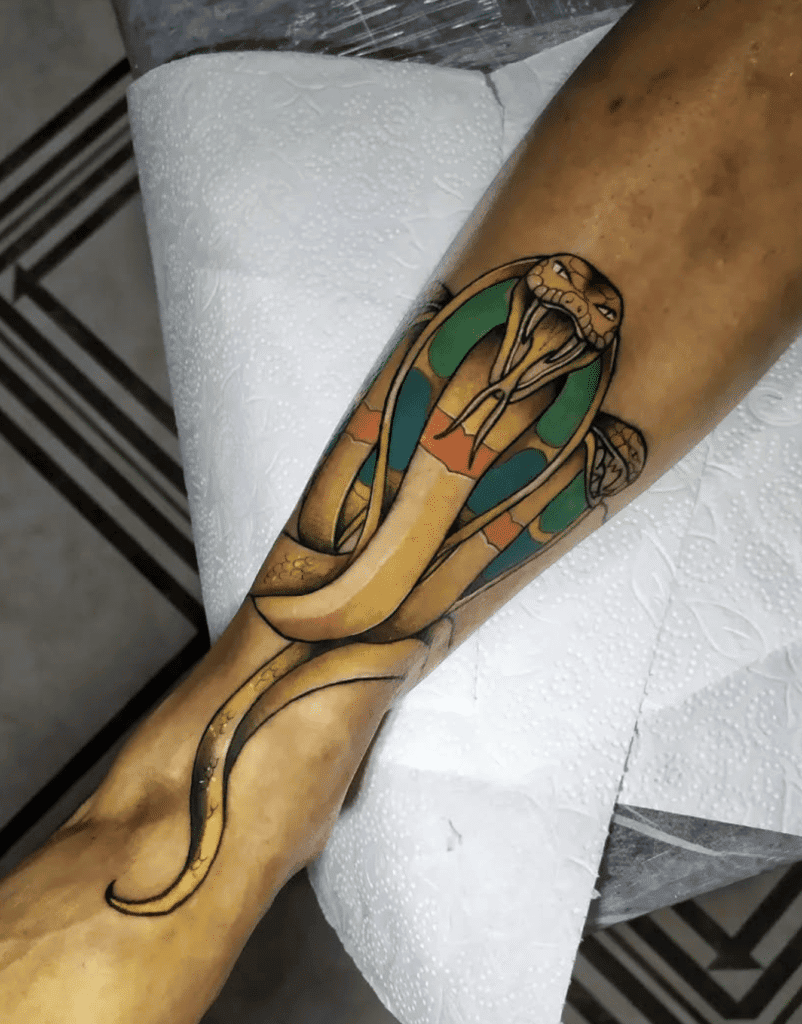
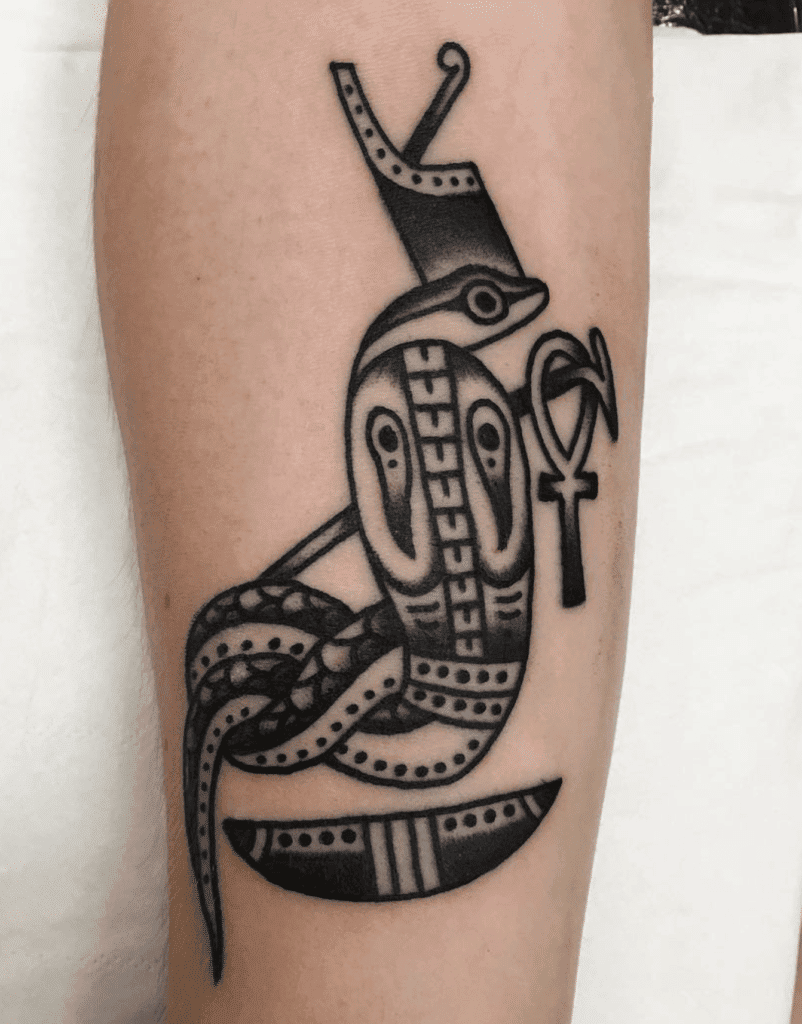
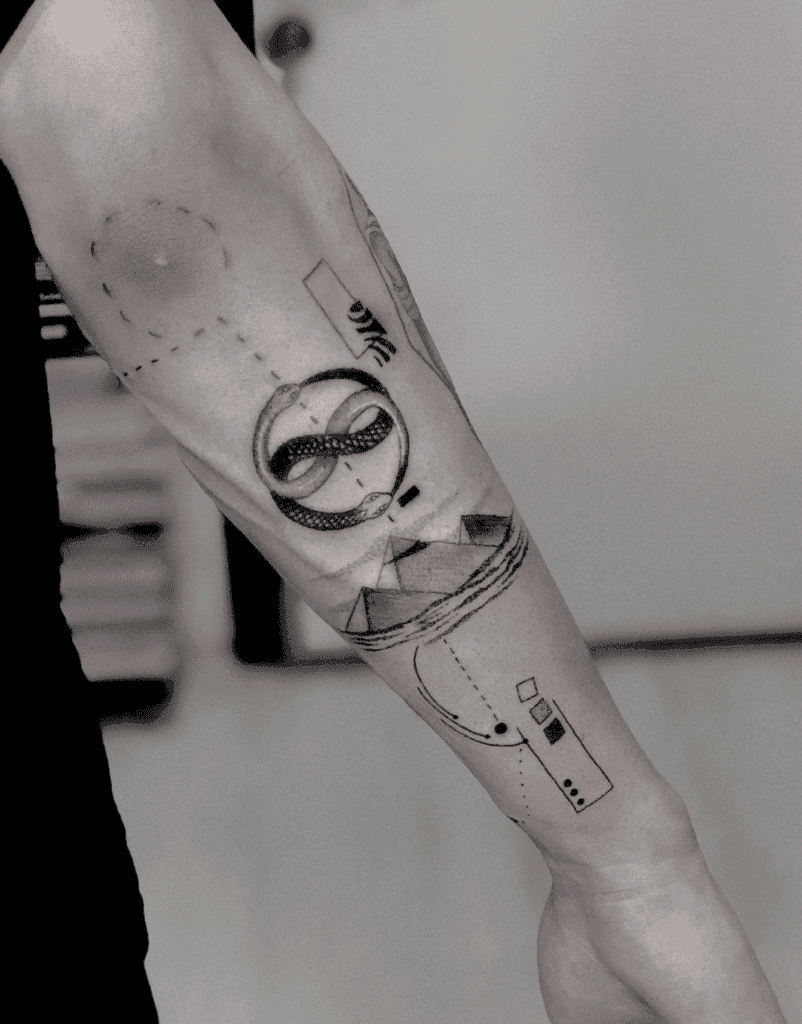
Uraeus is one of the most powerful and recognisable symbols in ancient Egyptian belief, representing active divine protection, royal authority, and the ever-present readiness to destroy threats to cosmic order.
The Uraeus is most closely associated with Wadjet, the cobra goddess of Lower Egypt, but over time it became a broader symbol of kingship itself. When worn on a crown, the Uraeus signified that the ruler was not merely human — they were divinely sanctioned and under supernatural protection.
Unlike passive protective symbols, the Uraeus is aggressive by nature. Egyptian texts describe it as spitting fire, venom, or solar heat at the king’s enemies. This imagery reflects the cobra’s real-world behaviour: calm and motionless until provoked, then instantly lethal. The Uraeus, therefore, symbolised absolute vigilance — protection that never sleeps.
The Uraeus was also deeply connected to the Eye of Ra, acting as its weaponised form. In this role, it became an extension of solar power itself, burning away chaos and enforcing Ma’at. Gods like Ra, Sekhmet, and even pharaohs were shown wearing the Uraeus to indicate their authority to punish disorder and maintain balance.
Sphinx Egyptian Mythology Tattoo

Sphinx is one of the most iconic and enigmatic figures of Egyptian mythology — a symbol of guardianship, divine kingship, hidden knowledge, and timeless authority. Half lion and half human, the Sphinx embodies the fusion of raw power and conscious intelligence.
In ancient Egypt, the Sphinx was not a riddling trickster as it later became in Greek myth, but a protector. With the body of a lion and the head of a human, often a pharaoh, the Sphinx represented strength guided by reason.
The most famous example, the Great Sphinx of Giza, is believed to represent Pharaoh Khafre, carved directly from the living rock of the plateau. This alone carries immense symbolic weight. The Sphinx is not built on the land — it is the land, rising from the earth like a divine sentinel. Facing the rising sun, it reinforces its solar connection, aligning the king with cosmic order and eternal renewal.
Spiritually, the Sphinx guarded sacred thresholds. It was placed near temples, tombs, and ceremonial avenues to protect holy spaces from chaos and unworthy intrusion. To pass the Sphinx was not merely to walk forward, but to symbolically enter a realm of divine law, kingship, and mystery.
Ankh Egyptian Mythology Tattoo
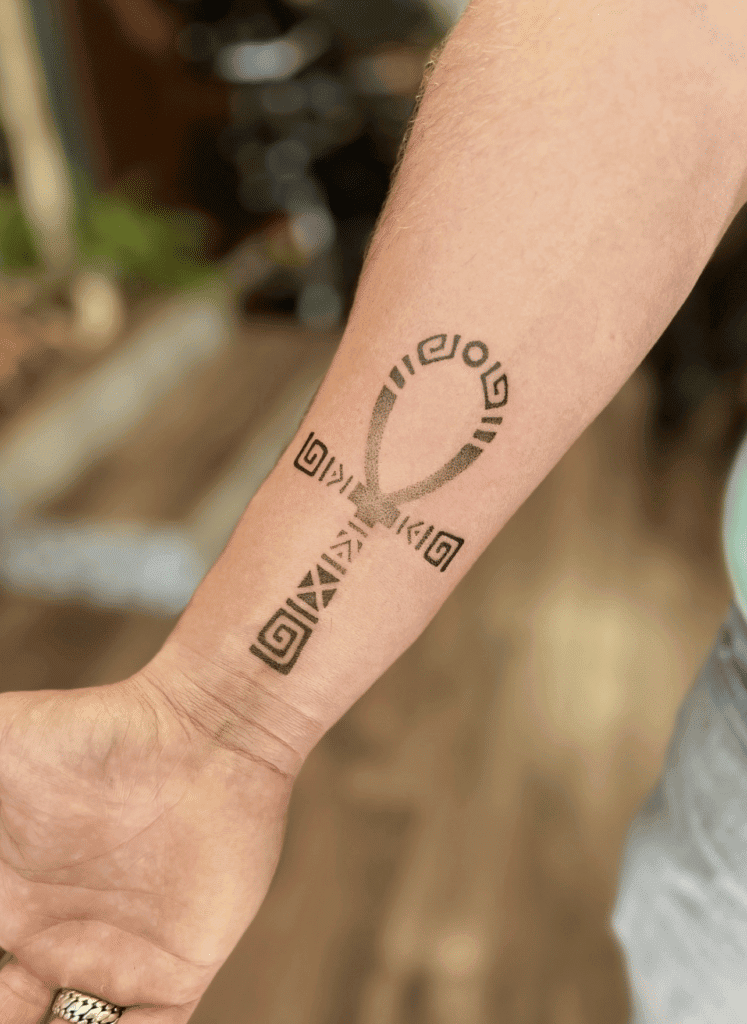
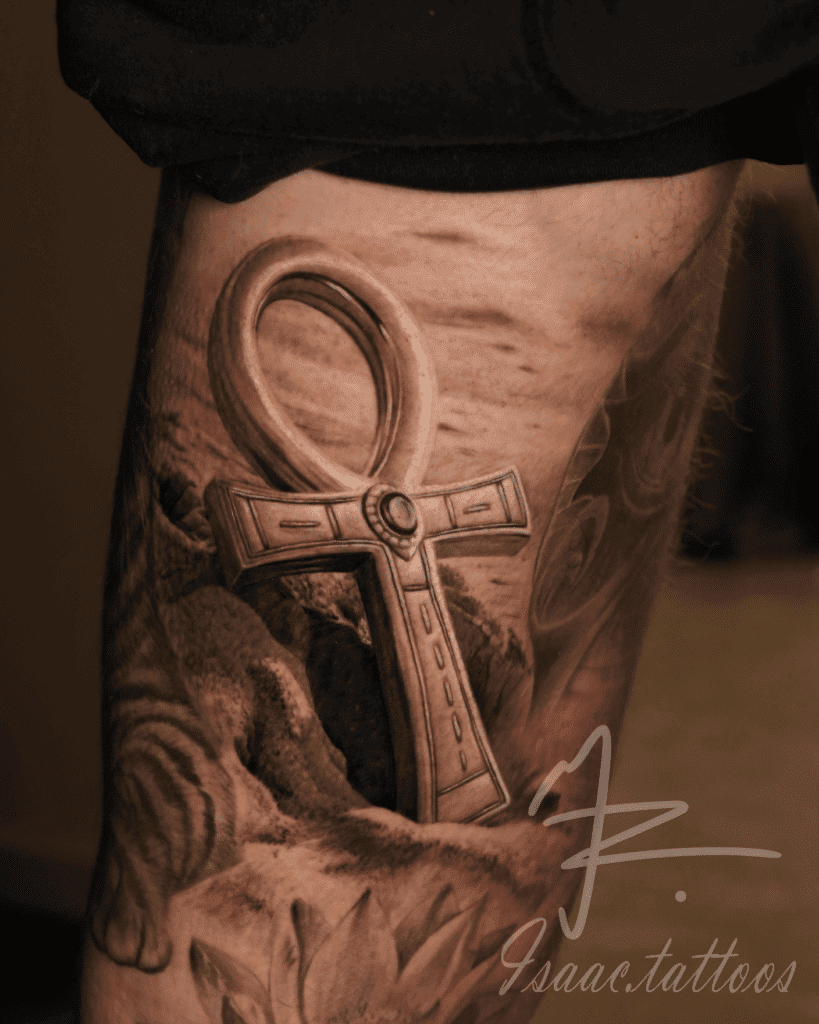
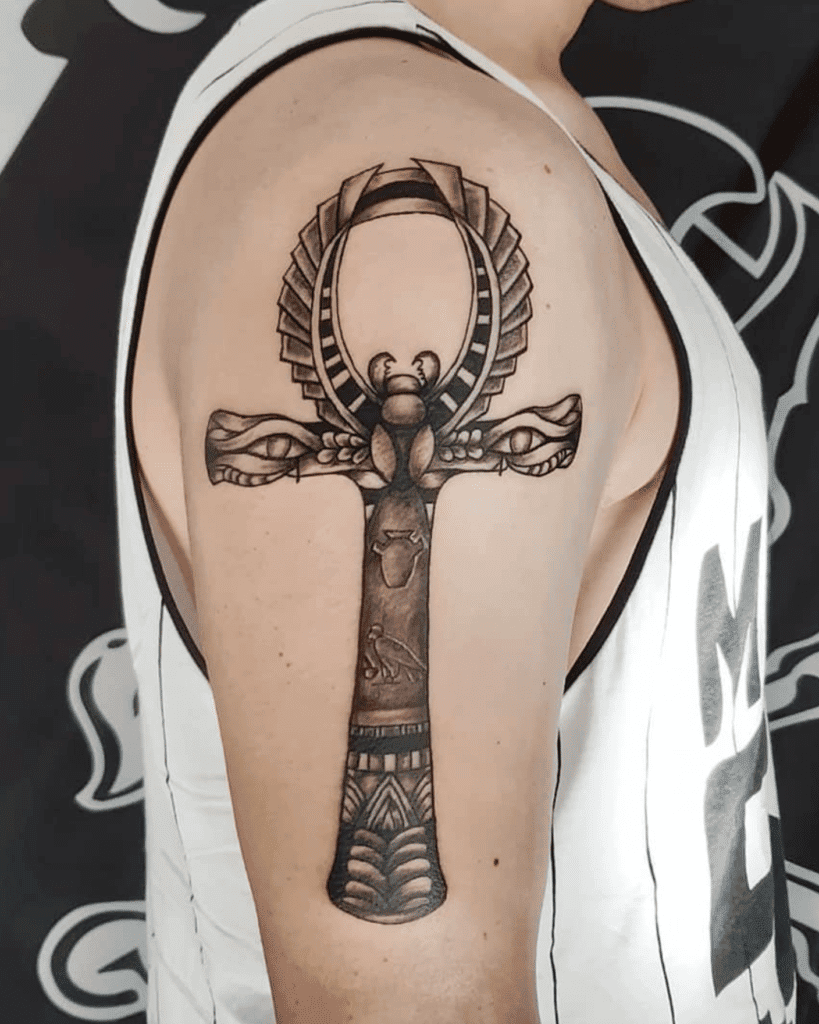
Ankh is the most iconic symbol of ancient Egypt, representing life, breath, vitality, and eternal existence. Often called the “Key of Life” or “Cross of Life,” the Ankh symbolised life that continues beyond death.
To the ancient Egyptians, life did not end at the grave. The Ankh embodied this belief completely. Its looped top is often interpreted as eternity or the soul, while the vertical and horizontal arms represent physical existence and balance. Together, they form a unified symbol of mortal life sustained by an immortal essence.
Gods are frequently shown holding the Ankh to the noses or lips of humans and pharaohs, symbolising the breath of life. This was not metaphorical — breath itself was sacred. To receive an Ankh from a god meant divine favour, protection, and the promise of continued existence in both this world and the next. Pharaohs, in particular, were depicted surrounded by Ankhs to reinforce their divine right to rule and their eternal nature.
The Ankh was also deeply connected to the afterlife. It appeared constantly in tombs, coffins, and funerary art, ensuring that the deceased would live again in the Field of Reeds. Unlike symbols of resurrection that imply death first, the Ankh emphasised continuity.
Eye of Horus Egyptian Mythology Tattoo
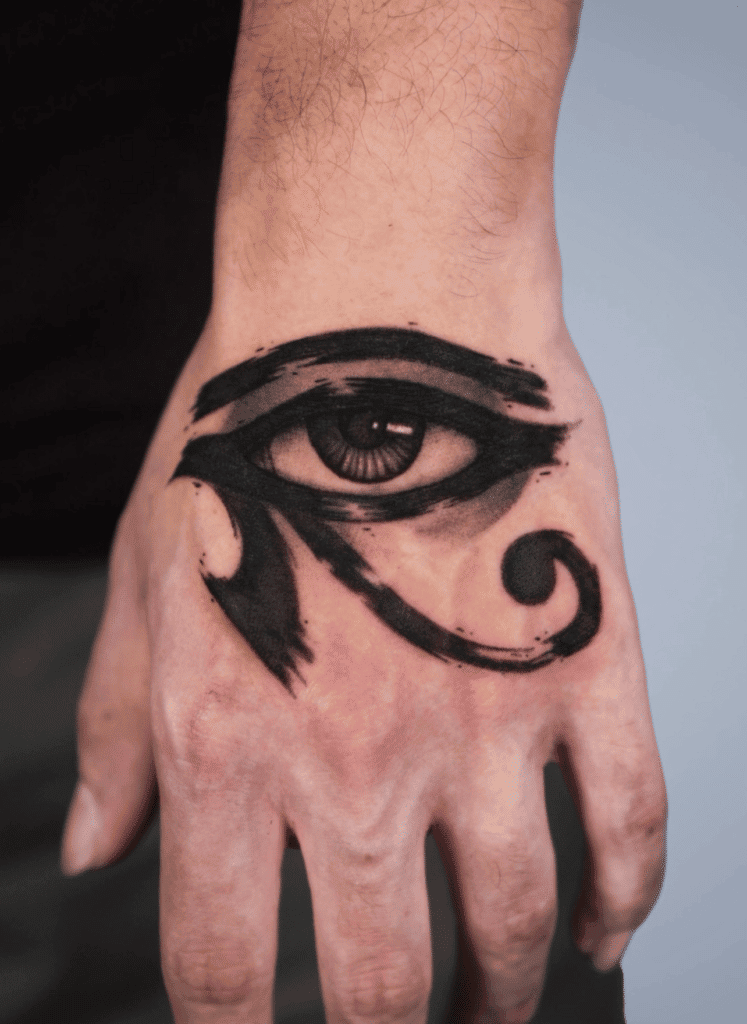
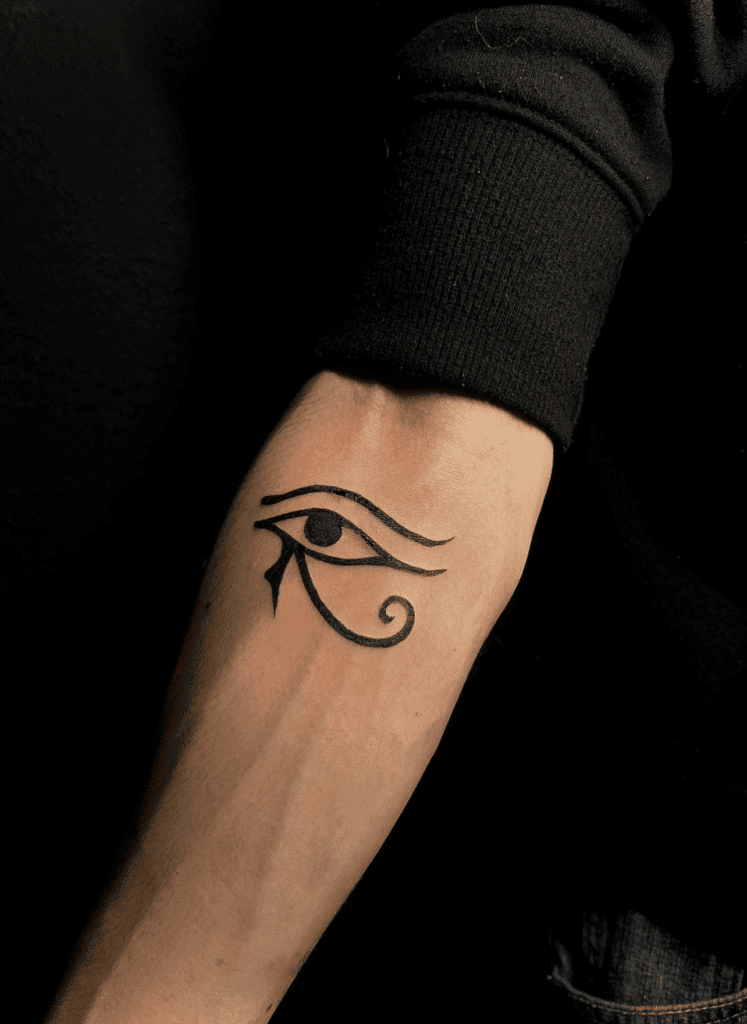
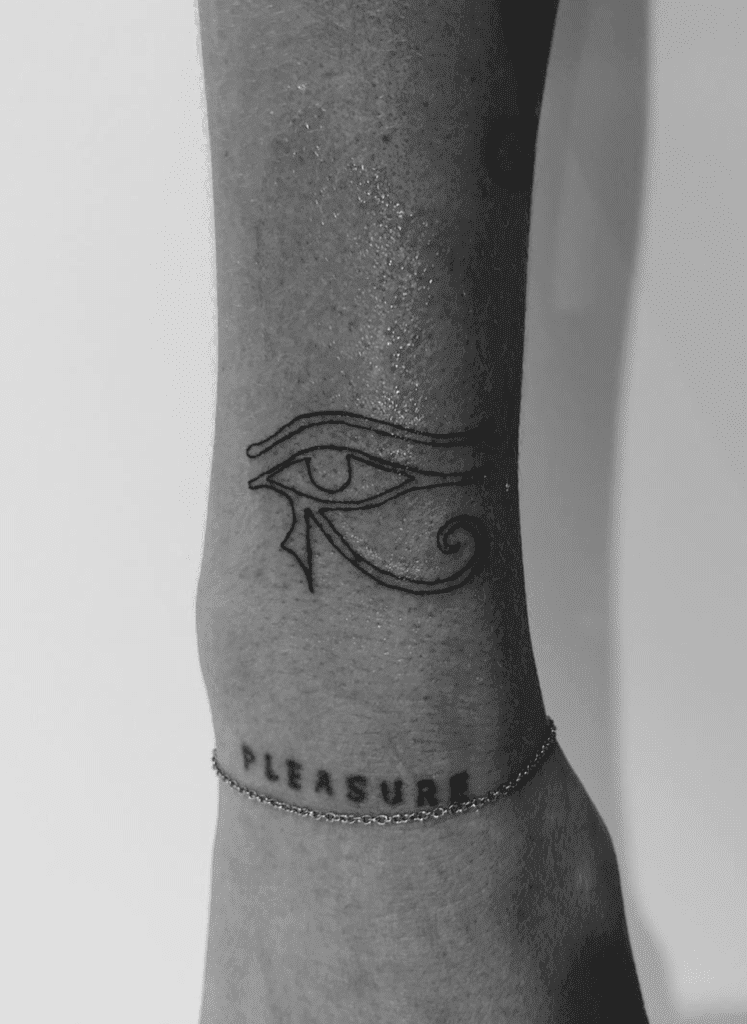
Eye of Horus (also called the Wedjat Eye) represents protection, healing, wholeness, and restoration after loss. The symbol originates in the myth of Horus and Set. During their long and violent struggle for kingship, Horus’s eye was torn out or shattered by Set. This injury symbolised the damage chaos inflicts on order — not just physical harm, but cosmic imbalance. The eye was later restored through divine intervention, most often attributed to Thoth, and once healed, Horus offered the restored eye to Osiris, helping resurrect him in the afterlife.
The restored eye — the Wedjat — represents wholeness regained, not perfection untouched. Its power lies precisely in the fact that it was once broken. For the Egyptians, this made it an ideal symbol of protection: it had already survived chaos and emerged stronger. Wearing or displaying the Eye of Horus was believed to guard against illness, violence, and misfortune, because it embodied recovery itself.
The Eye of Horus also carried deep mathematical and cosmic meaning. Its individual markings were associated with fractions used to measure grain and offerings, linking the symbol to order, precision, and sustenance.
In daily life and the afterlife, the Eye of Horus was everywhere. It was worn as an amulet, carved into tombs, painted on coffins, and placed on the bodies of the dead. For the living, it offered protection and health. For the dead, it ensured safe passage and spiritual completeness. In funerary belief, it helped the deceased become whole again, just as Osiris had been.
Cat Egyptian Mythology Tattoo
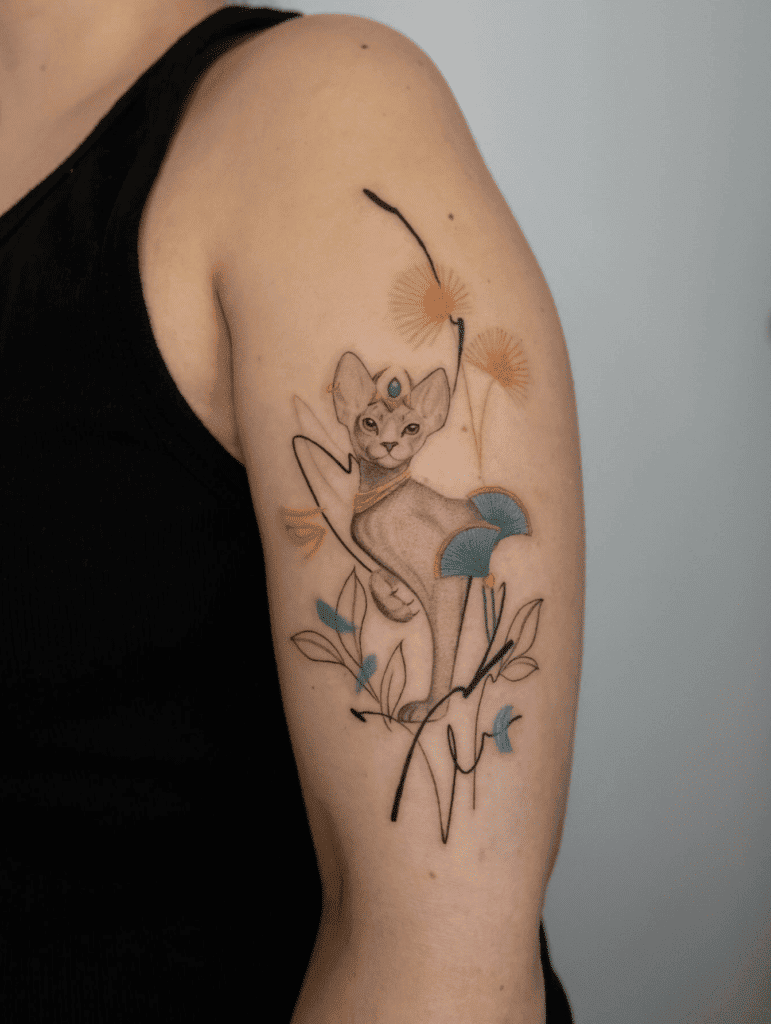
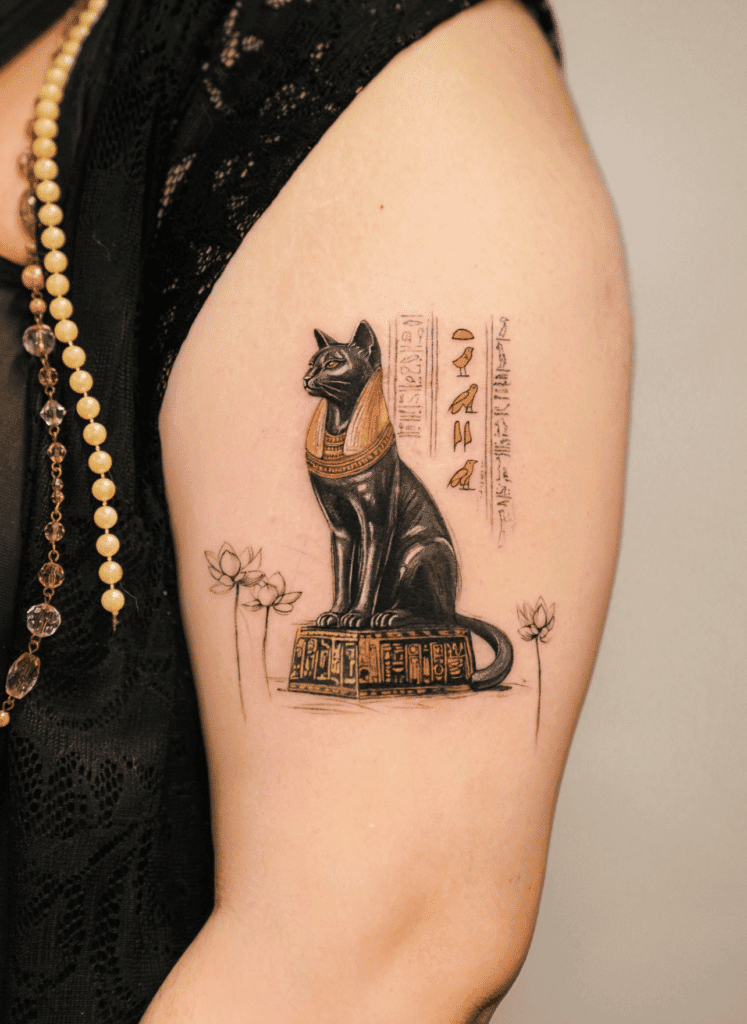
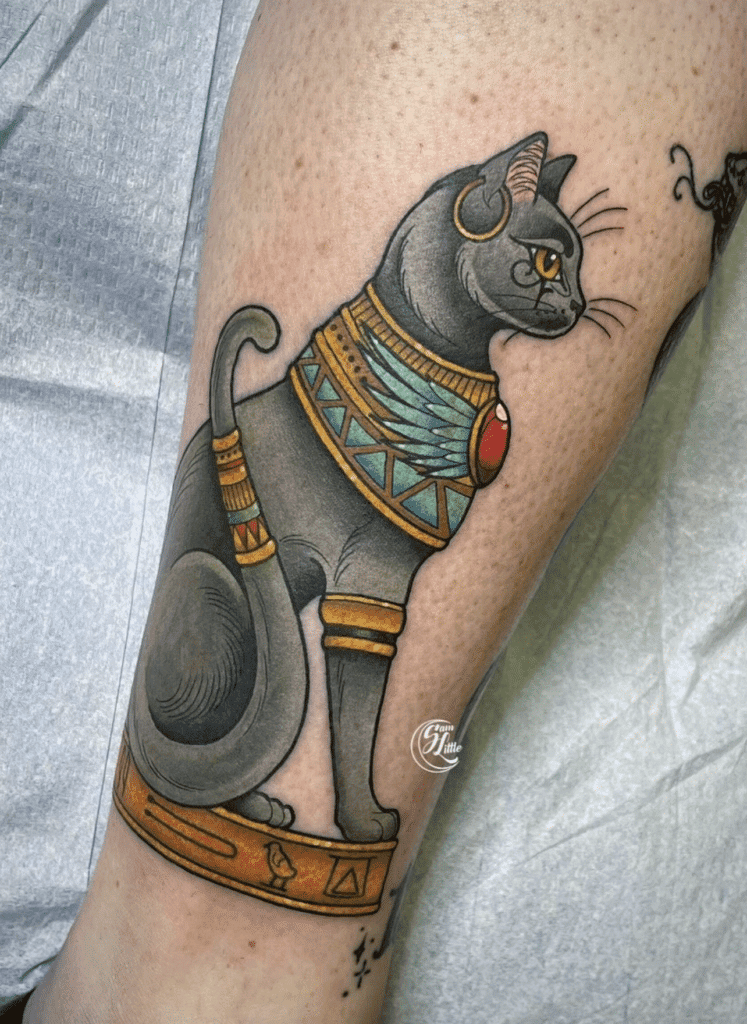
Cats held a uniquely sacred place in Egyptian mythology, occupying the space between household companion, divine protector, and living symbol of cosmic balance. To the ancient Egyptians, cats were manifestations of divine order walking among humans, most famously associated with Bastet and Sekhmet.
Cats earned their sacred status through both myth and daily life. They protected grain stores by hunting snakes, mice, and rats — creatures associated with chaos, disease, and destruction. In mythological terms, cats were seen as defenders of Ma’at, keeping order intact by eliminating threats before they could spread.
Because cats were considered sacred, harming one — even accidentally — was a serious crime, sometimes punishable by death. When a household cat died, families mourned deeply, even shaving their eyebrows as a sign of grief. Cats were frequently mummified and buried with honour, often accompanied by offerings, toys, and prayers.
Cities like Bubastis, the cult centre of Bastet, became famous for massive cat sanctuaries and festivals filled with music, celebration, and joy. Cats there lived as revered creatures, cared for by priests and worshippers alike.
Spiritually, cats symbolised liminality — the space between worlds. Their silent movement, glowing eyes in darkness, and independent nature made them appear half-seen, half-unseen. Egyptians believed cats could sense spirits, ward off malevolent forces, and move effortlessly between the mundane and the sacred.
Scarab Egyptian Mythology Tattoo


The Scarab is one of the most powerful and hopeful symbols in Egyptian mythology, representing rebirth, transformation, self-creation, and the eternal cycle of life. To the ancient Egyptians, the humble scarab beetle revealed a cosmic truth: life renews itself again and again, even when its origins are hidden.
This symbolism came from close observation of nature. Scarab beetles roll balls of dung across the ground, within which they lay their eggs. To Egyptian eyes, new life seemed to appear spontaneously from the earth. This mysterious emergence made the scarab a living emblem of self-generation and becoming, perfectly mirroring the daily rebirth of the sun.
Because of this, the scarab became inseparable from Khepri, the god of the rising sun. Just as the beetle pushes its sphere forward, Khepri was believed to push the sun into the sky each morning. Every dawn was therefore a scarab moment — darkness giving way to light through persistence rather than force.
The scarab’s meaning extended far beyond the sky and into the afterlife. Scarab amulets were among the most common and sacred objects placed with the dead. The most important of these was the heart scarab, laid over the chest of the deceased. Inscribed with protective spells, it was meant to prevent the heart from speaking against its owner during judgment.
Unlike symbols associated with fear or punishment, the scarab carried a deeply optimistic worldview. It promised that nothing is truly lost — only transformed. Death was not annihilation, but a pause before renewal. Even decay, represented by dung itself, was part of the creative cycle. This made the scarab one of the clearest expressions of Egyptian belief in continuity rather than finality.
Conclusion
So ends our amazing journey across the cosmos of the Egyptian Mythology Tattoo. However, much like the Scarab, things do not end here. Come back again when we will be further exploring the myths of other kingdoms, restarting the cycle of renewal. But before then, why not find balance with these Chinese Mythology Tattoo Designs, , find truth and light with these Persian Mythology Tattoos or climb Mount Olympus with these Greek Mythology Tattoo Ideas?
- Bear Tattoo Ideas - October 22, 2026
- Lion Tattoo Ideas - October 19, 2026
- Persona Tattoo Ideas - October 15, 2026