

Pheasant and Chicken Tattoo Ideas

Do you feel cooped up in your search for the perfect Tattoo Clues? Worry not, don’t crack under the pressure and take flight with some of these egg-straordinary Pheasant and Chicken Tattoos that are sure to hatch some new inspiration.
Pheasant and Chicken Tattoo Meaning
Now that we know a little about Pheasant and Chicken Tattoos, let’s take a look at some of the best Pheasant and Chicken Tattoos the internet has to offer.
Red Junglefowl Chicken Tattoo
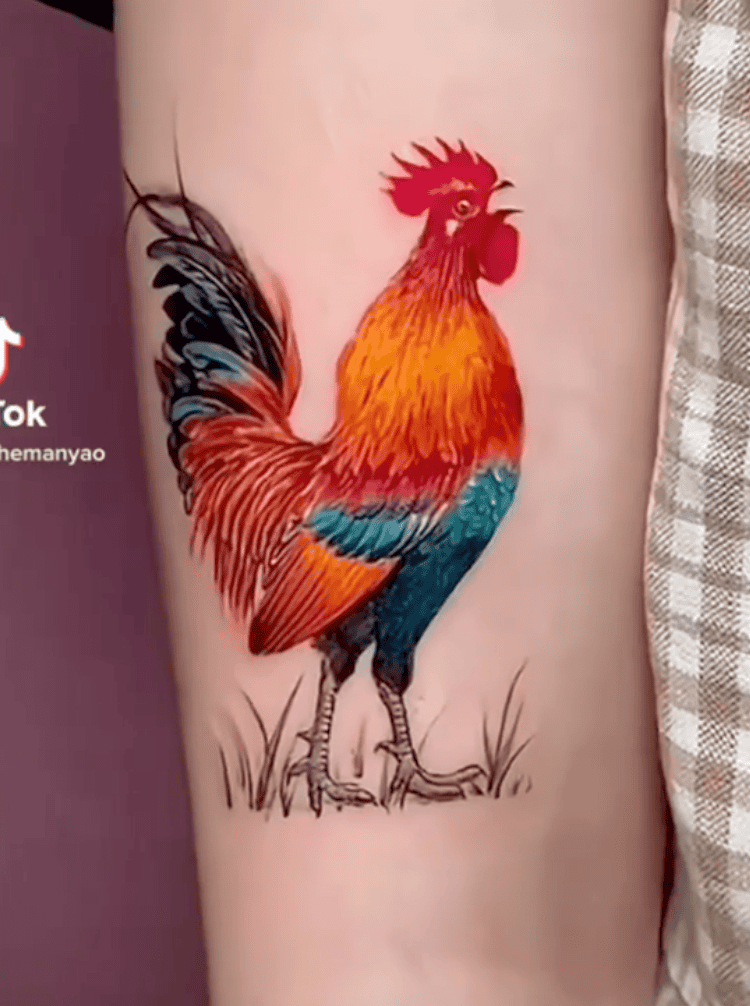
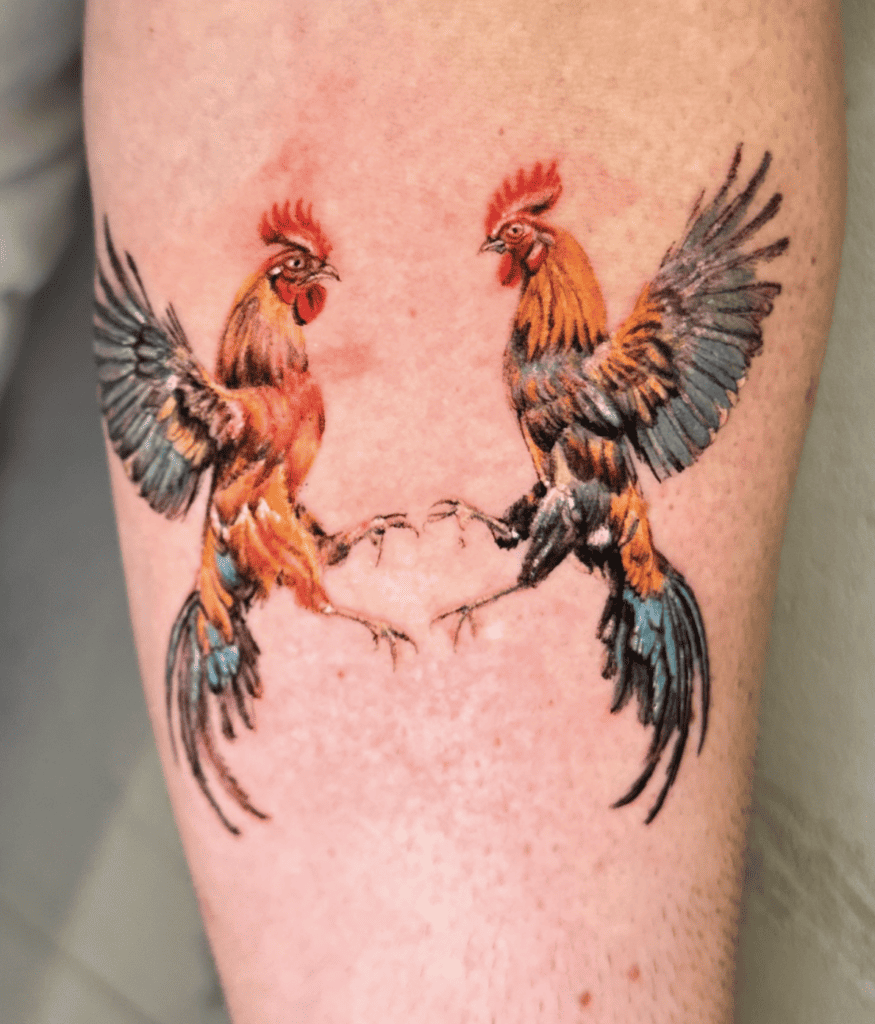
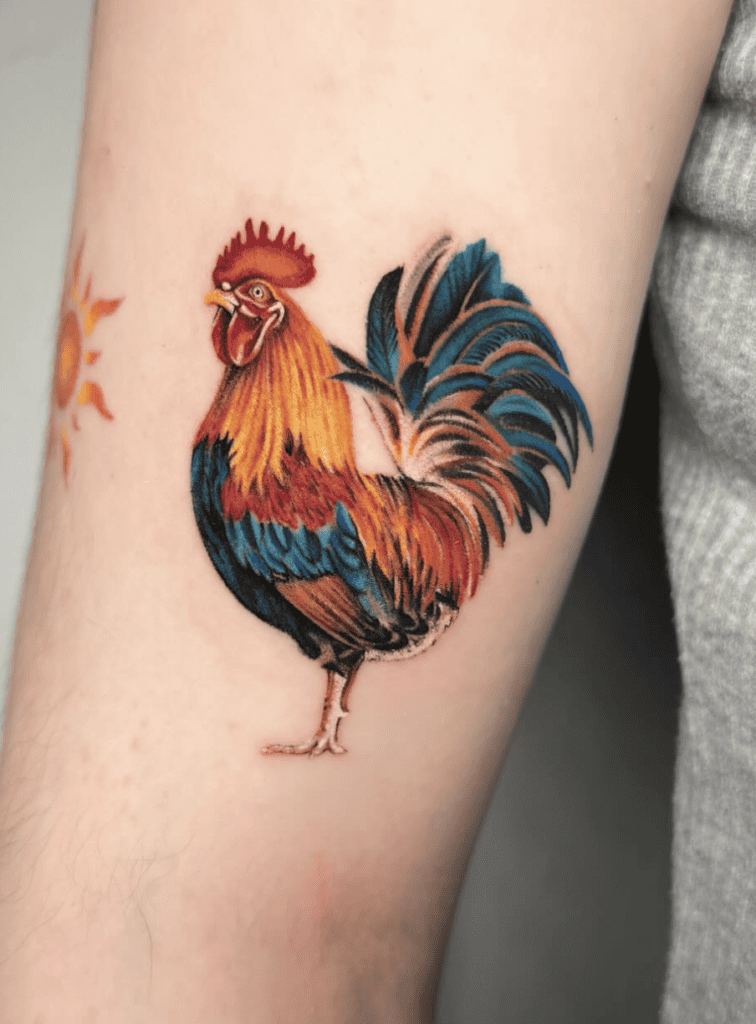
The Red Junglefowl is the wild ancestor of every domestic chicken you see today. Native to Southeast Asia, including places like Vietnam, Thailand, and Indonesia, it lives in forests, bamboo thickets, and scrubland, often staying close to the edges where jungle meets open ground.
The Red Junglefowl look like a more refined version of a rooster, with glowing red, orange, and gold feathers, a shimmering green-black tail, and a confident upright stance. The females, on the other hand, have soft, brown, mottled feathers that help them blend into their surroundings and remain hidden from predators.
Unlike domestic chickens, Red Junglefowl are strong fliers over short distances. They often roost in trees at night for safety and spend their days foraging on the forest floor, scratching for seeds, insects, and fallen fruit. Their behaviour is cautious and alert, which reflects their life in the wild where survival depends on quick reactions and awareness.
One of the most interesting things about them is how closely they are tied to human history. The domestication of chickens began over 8,000 years ago, and it all traces back to this species. Over time, selective breeding transformed the Red Junglefowl into the hundreds of chicken breeds we have today, changing their size, behaviour, and egg-laying ability, but their roots are still clearly visible.
Rhoad Island Red Chicken Tattoo

The Rhode Island Red is one of the most famous and reliable chicken breeds in the world, known for its rich reddish-brown feathers and hardworking nature. Originally developed in the United States in the late 1800s, this breed was created with practicality in mind, combining strong egg production with a sturdy build that also made it suitable for meat.
The Rhode Island Red is an egg-laying machine, often producing around 250 or more brown eggs per year, but it’s also tough, adaptable, and able to handle a wide range of climates. This makes it especially popular with backyard chicken keepers who want a dependable, low-maintenance bird. Rhode Island Reds are often described as confident and assertive. They’re active birds that enjoy foraging and exploring, and while they can be friendly, they also tend to establish a clear pecking order within a flock.
Leghorn Chicken Tattoo
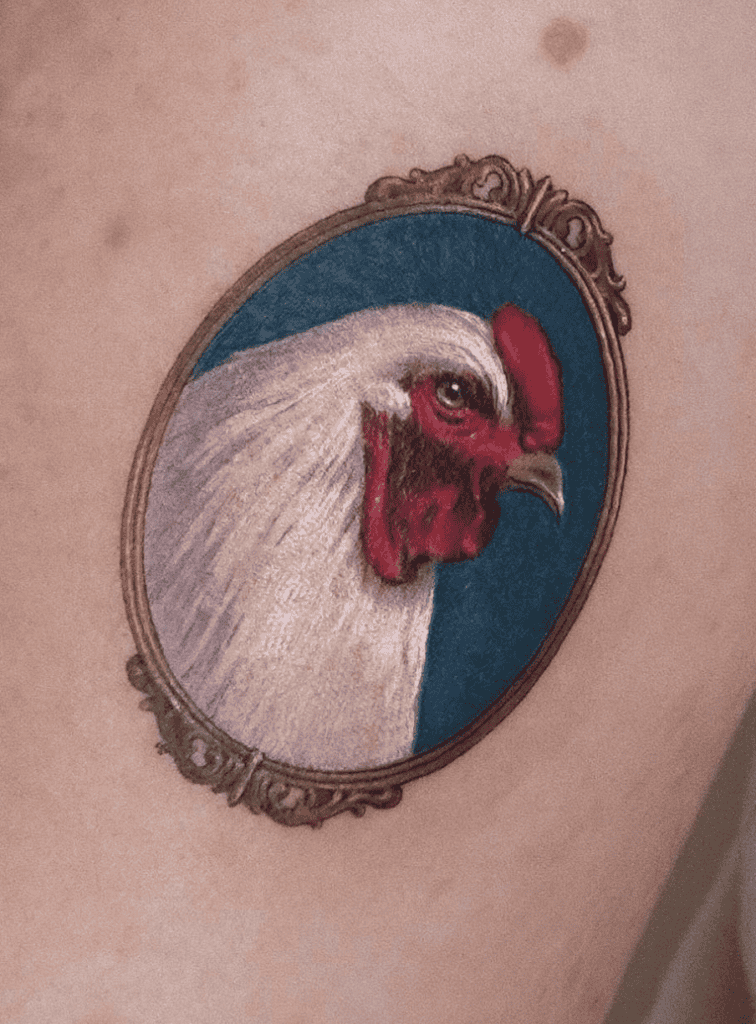
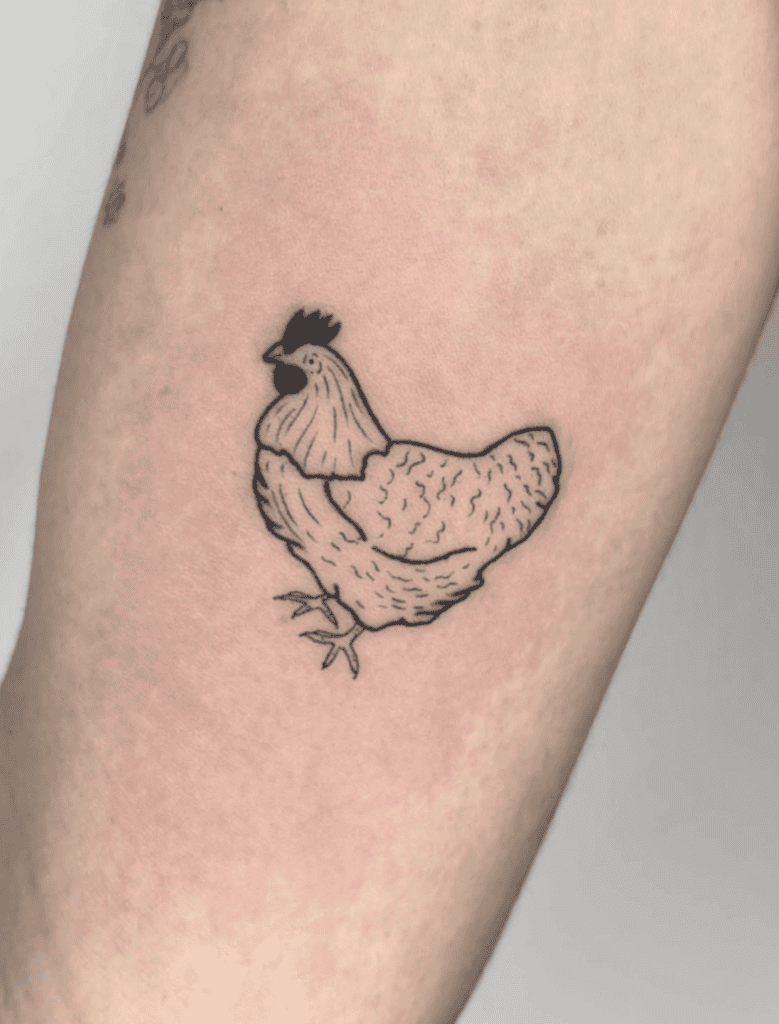
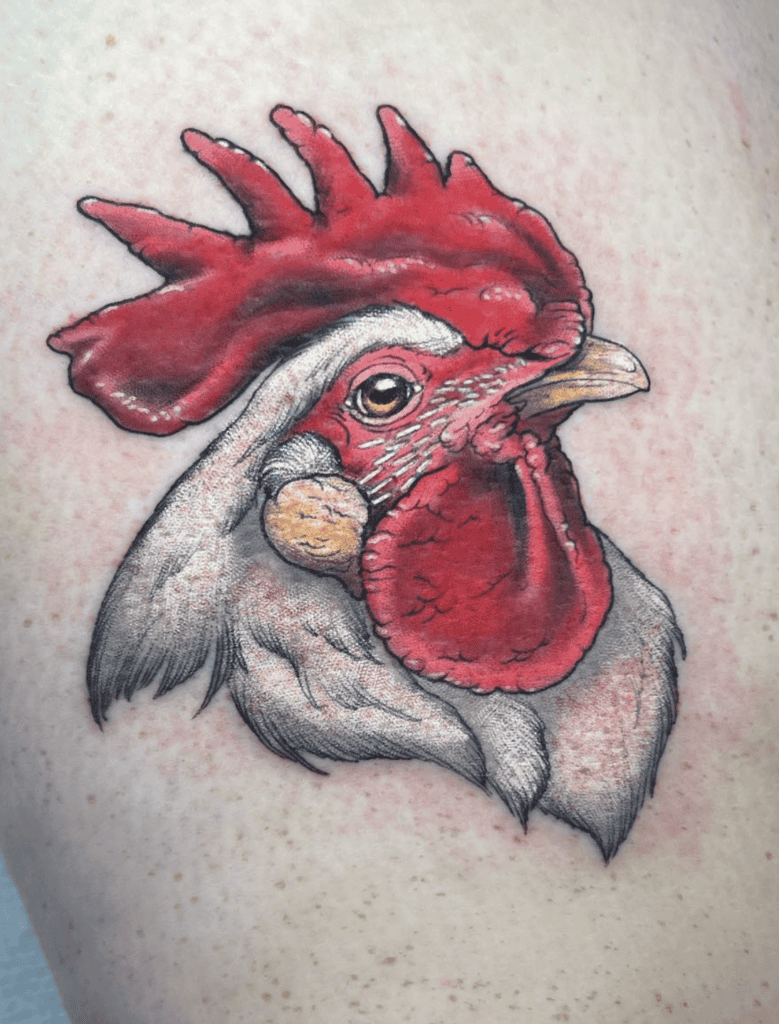
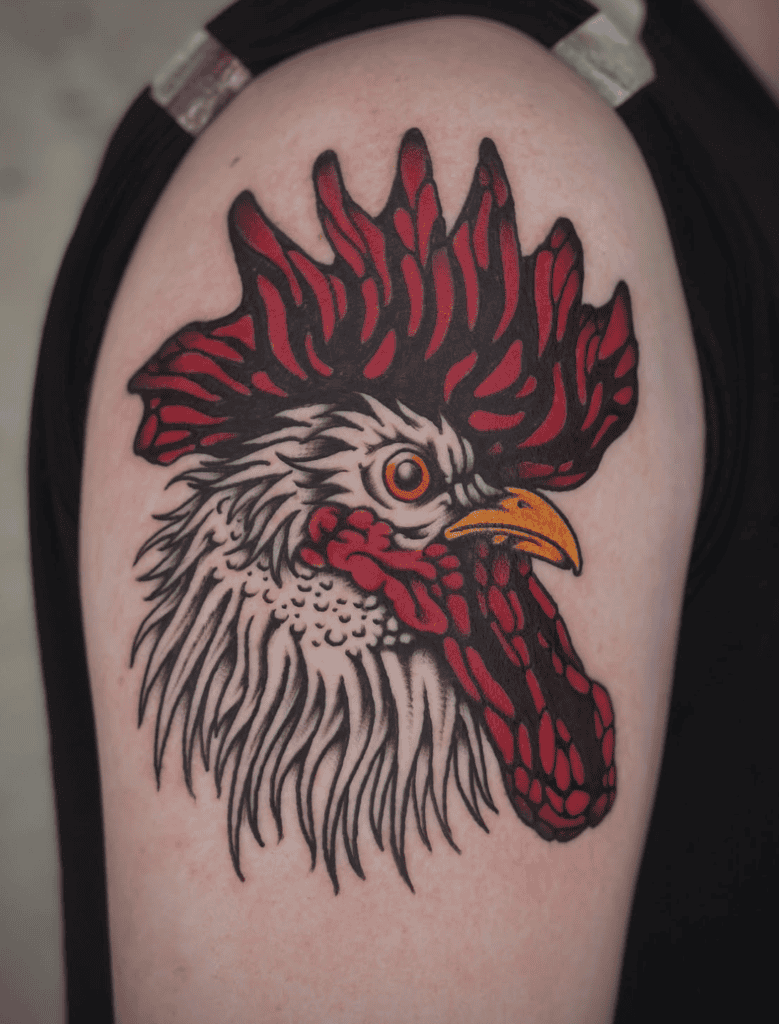
The Leghorn is one of the most well-known and widely used chicken breeds in the world, especially when it comes to egg production. Originally developed in Italy and later refined in the United States, the Leghorn has become the foundation of modern commercial egg-laying chickens.
These birds are famous for producing large numbers of white eggs, often laying well over 250 eggs a year under the right conditions. Unlike heavier breeds, they have a slim, lightweight body that allows them to convert food into eggs very efficiently, making them one of the most productive breeds available.
Their personality is quite different from that of more docile backyard breeds, as Leghorns tend to be independent and less affectionate, often preferring to roam and forage rather than interact closely with humans. They are also strong flyers compared to many other domestic chickens, which adds to their lively and sometimes unpredictable behaviour.
Australorp Chicken Tattoo
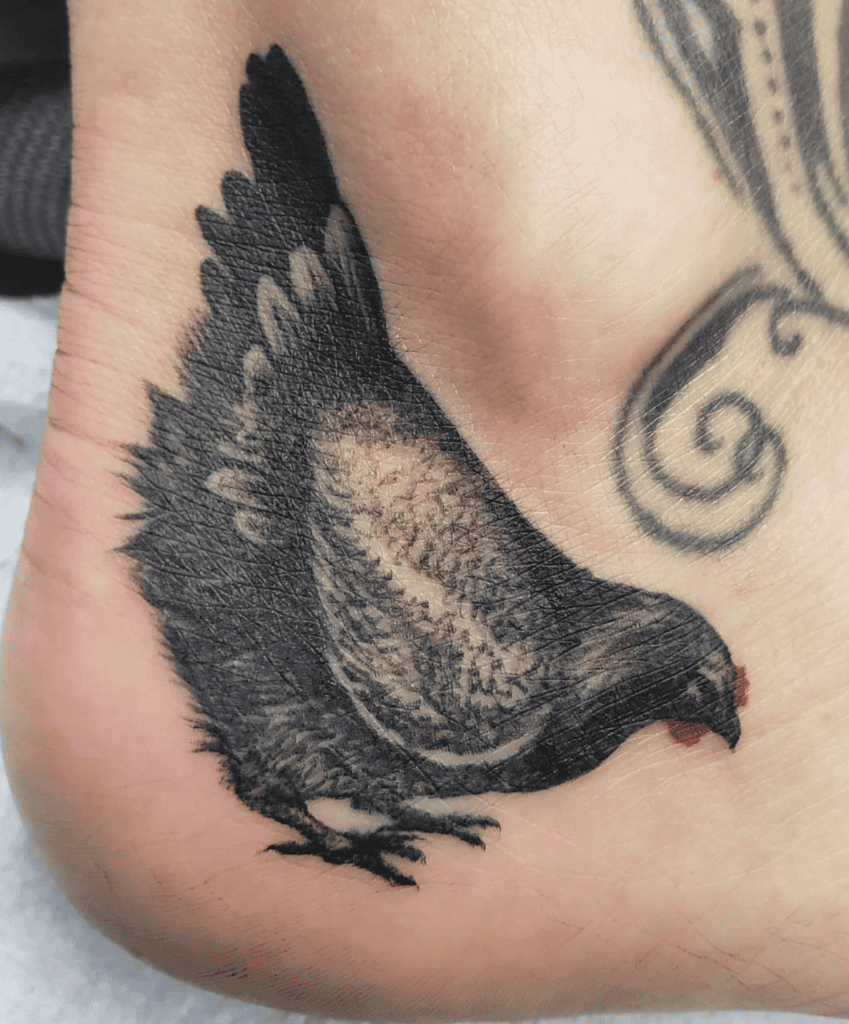
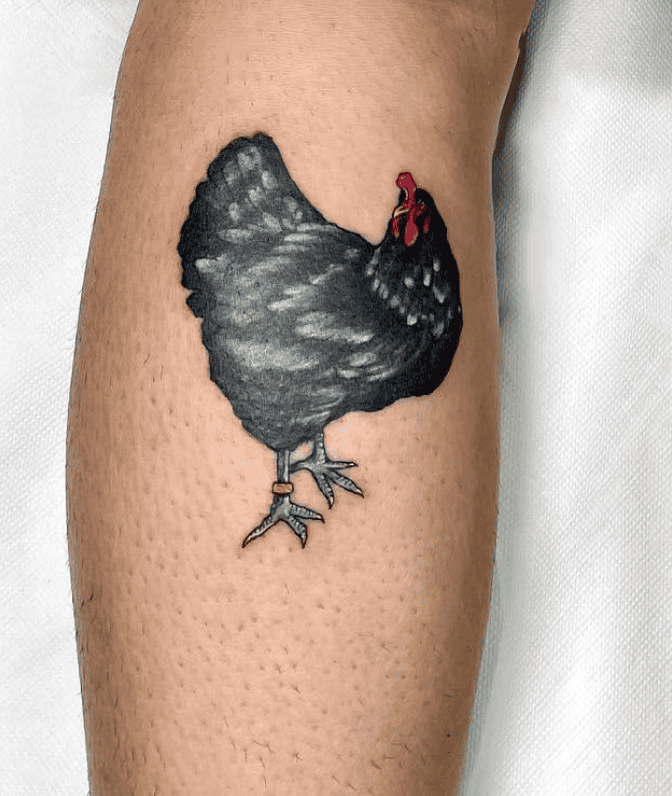
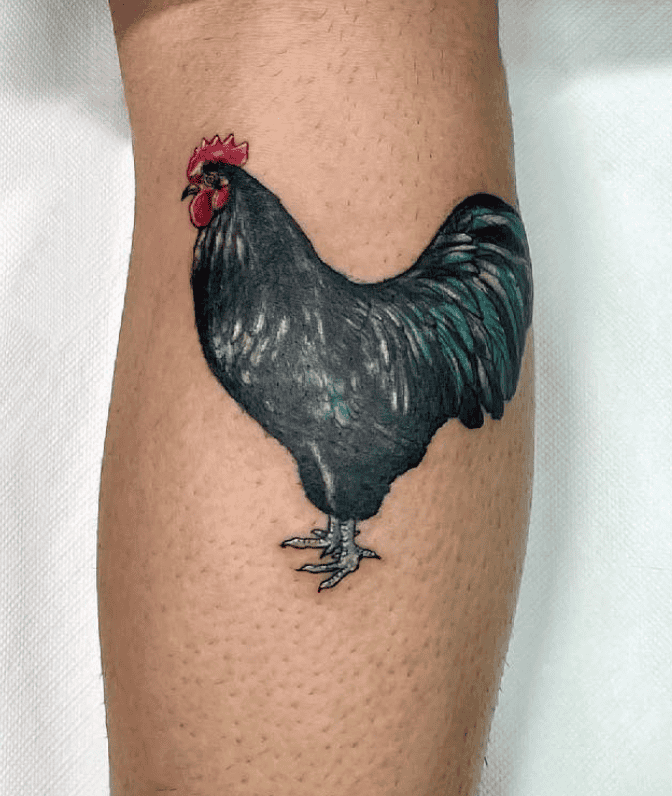
The Australorp is widely regarded as one of the best egg-laying chickens in the world, combining productivity with a calm and approachable nature. Originally developed in Australia from Black Orpington stock, this breed was carefully refined to produce high numbers of eggs while remaining hardy and easy to manage.
The Australorp holds a historical record for egg production, with one hen famously laying over 300 eggs in a single year under controlled conditions. Even in a typical backyard setting, Australorps are known to produce a steady supply of large brown eggs, making them a favourite among both beginners and experienced keepers.
Australorps are known for being gentle, friendly, and easygoing. They tend to adapt well to different environments and are comfortable in both free-range and confined spaces. Unlike more flighty breeds, they are often calm around people, which makes them ideal for backyard flocks or families.
Plymouth Rock Chicken Tattoo


The Plymouth Rock is one of the most classic and recognisable chicken breeds, known for its distinctive black-and-white barred feathers and dependable, all-round performance. Developed in the United States in the 19th century, it quickly became a staple on farms thanks to its balance of egg production, meat quality, and easygoing temperament.
The Plymouth Rock is so popular because of its versatility. It’s considered a true dual-purpose breed, meaning it provides both a steady supply of brown eggs and a solid body for meat. This made it especially valuable in traditional farming, where reliability and practicality were essential. Even today, it remains a favourite for backyard keepers who want a well-rounded, low-maintenance chicken.
Plymouth Rocks are known for being calm, friendly, and easy to handle. They tend to integrate well into flocks and are generally less aggressive than some other breeds, making them a great choice for beginners or families. They are also good foragers, happily exploring their surroundings without being overly flighty.
Silkie Chicken Tattoo
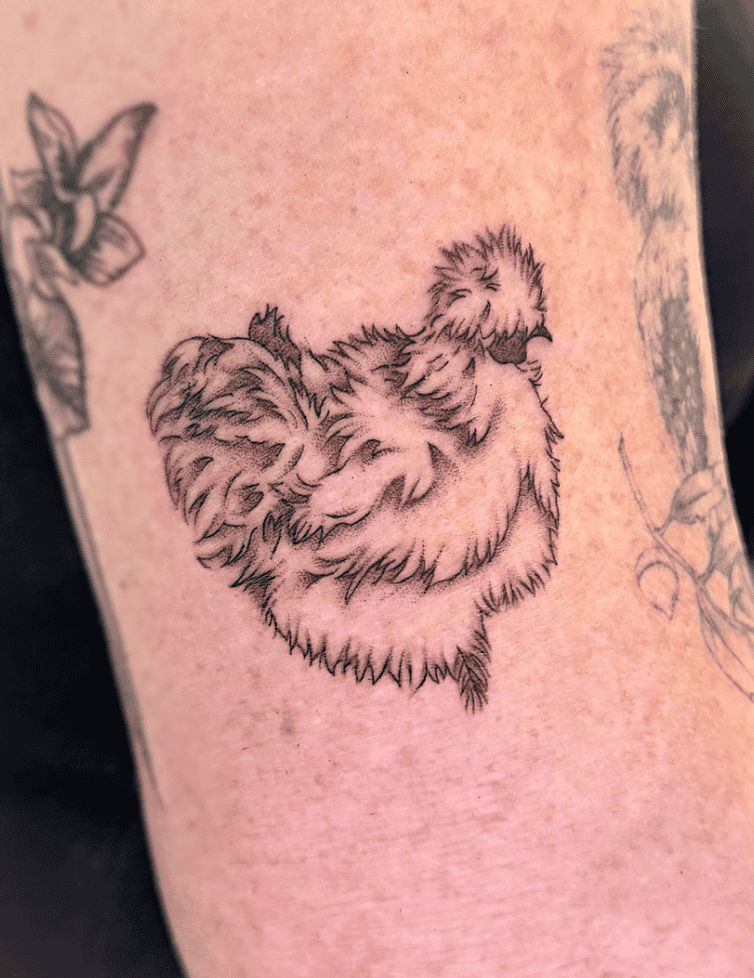
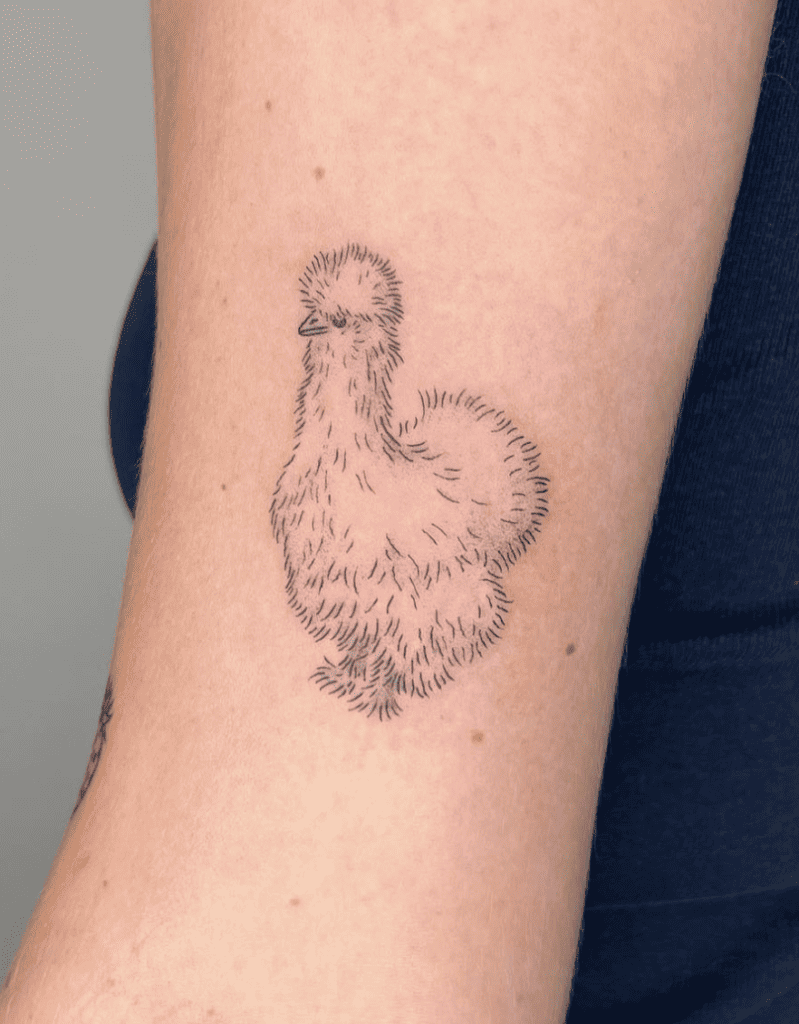
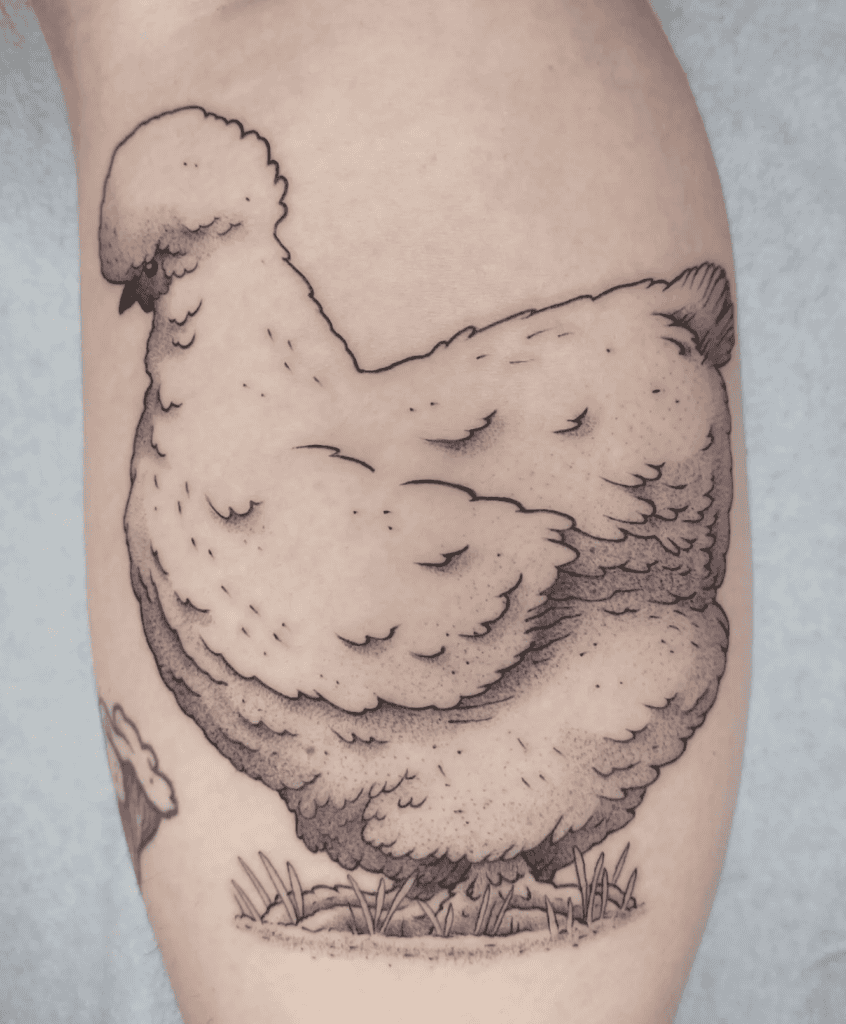
The Silkie is one of the most unique and instantly recognisable chicken breeds in the world, known for its incredibly soft, fluffy feathers that look more like fur than traditional plumage. Originally believed to have originated in ancient China, Silkies have been admired for centuries not only for their unusual appearance but also for their gentle, friendly nature.
Unlike most chickens, whose feathers are structured for flight and protection, Silkie feathers lack the usual hook-like barbules. This gives them their signature “silk-like” softness, making them appear almost like walking clouds. Silkies also have black skin, bones, and even dark-coloured internal tissues, which sets them apart from nearly every other chicken breed.
Silkies are known for being calm, affectionate, and incredibly docile, often described as one of the best breeds for companionship, as they tend to enjoy human interaction and are easy to handle. Because of this, they are commonly kept as pets rather than for productivity, although they do lay small, cream-coloured eggs.
Another defining trait of the Silkie is its strong maternal instinct. These chickens are famously broody, meaning they are very willing to sit on eggs and care for chicks, even those from other breeds. This nurturing behaviour has made them valuable for hatching and raising young birds.
Brahma Chicken Tattoo
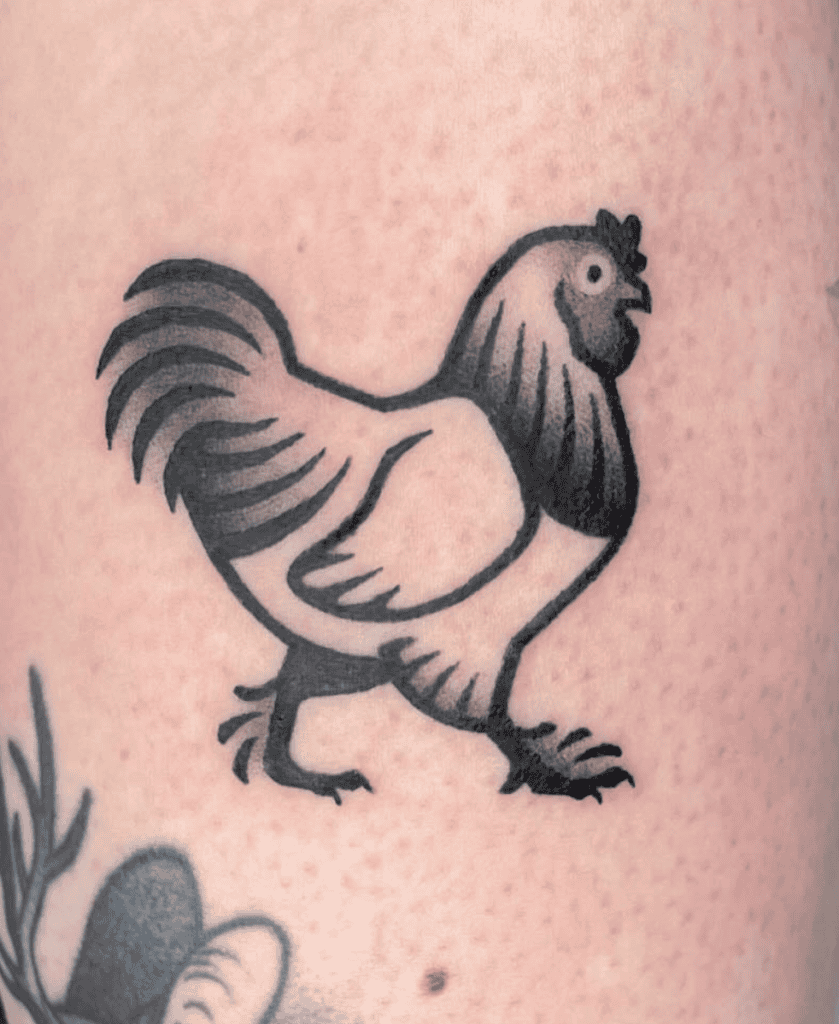
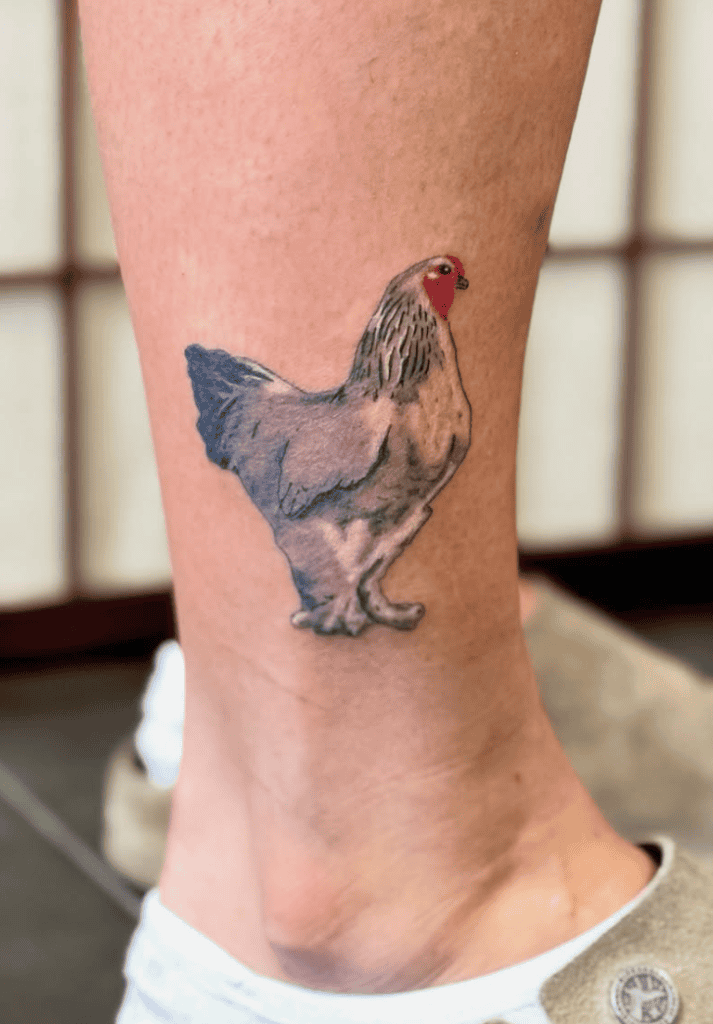
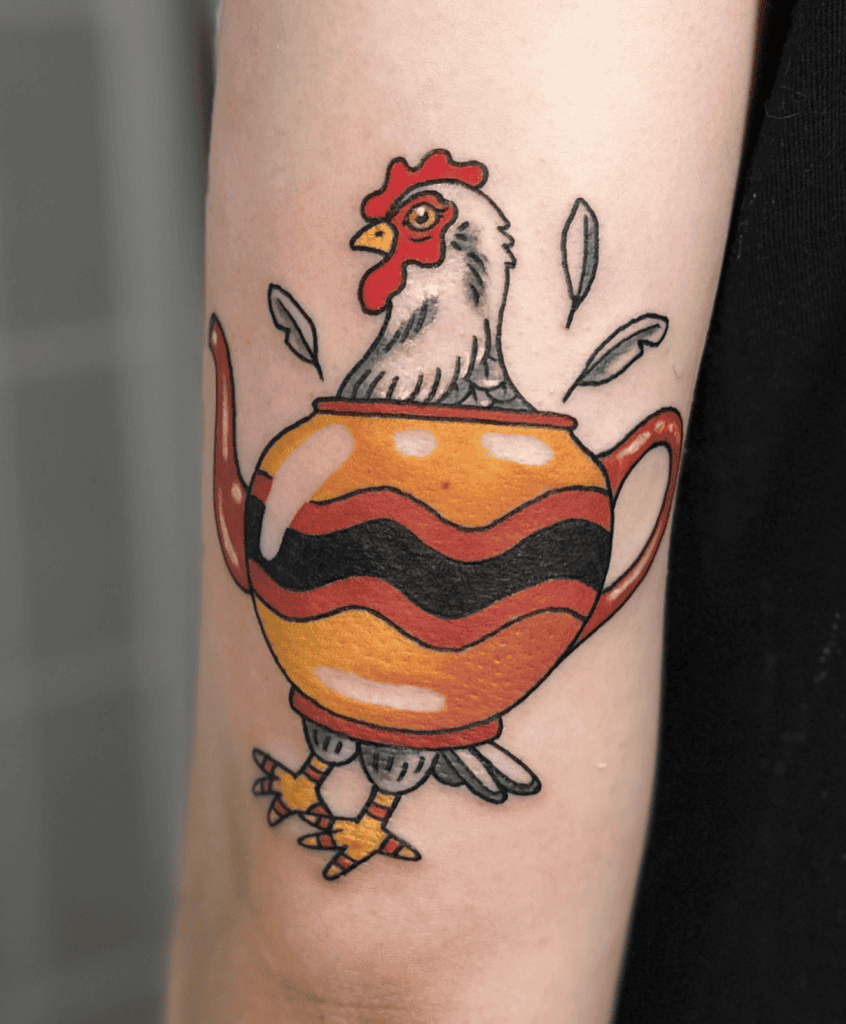
The Brahma is one of the largest and most impressive chicken breeds, often referred to as the “gentle giant” of the poultry world. Originally developed in the United States from birds with Asian ancestry, the Brahma quickly became popular for its size, strength, and calm temperament.
What makes the Brahma so distinctive is its sheer presence. These chickens are noticeably larger than most other breeds, with broad bodies, tall posture, and heavily feathered legs that give them a powerful yet elegant appearance. In terms of personality, Brahmas are known for being calm, patient, and easygoing. They tend to be friendly with both humans and other chickens, making them an excellent choice for backyard flocks, especially for those looking for a more relaxed and manageable breed.
Brahmas are also well-suited to colder climates. Their thick plumage and feathered legs provide natural insulation, allowing them to remain comfortable in cooler weather where other breeds might struggle. While they are not the most prolific egg layers, they do produce a steady number of medium to large brown eggs, particularly during the winter months when other breeds slow down. Brahmas were once so large and valued in the 19th century that they were known as the “King of Chickens,” and their popularity helped spark a major poultry craze in the United States and Europe.
Polish Chicken Tattoo


The Polish Chicken is one of the most distinctive and eye-catching chicken breeds, instantly recognisable by the large crest of feathers that forms a dramatic “hairstyle” on top of its head. Despite its name, the exact origins of the breed are somewhat uncertain, though it has been present in Europe for centuries and is often associated with ornamental poultry keeping.
Polish chicken feathers grow outward and upward in a rounded shape, sometimes covering the bird’s eyes and giving it a charming, almost comical appearance. These chickens tend to be gentle but slightly more cautious than other breeds. Because their crest can limit their vision, they are often more easily startled and rely on calm environments where they feel safe. With regular handling, however, they can become friendly and comfortable around people, especially when they learn to recognise voices and routines.
Unlike highly productive breeds, Polish chickens are not typically kept for egg-laying or meat. They do produce small white eggs, but their true value lies in their ornamental appeal. They are often chosen by enthusiasts who appreciate their unique look and quirky personality rather than their practicality.
Ayam Cemani Chicken Tattoo

The Ayam Cemani is one of the rarest and most striking chicken breeds in the world, instantly recognised for its completely black appearance. Originating from Indonesia, this breed is unlike almost any other, with black feathers, black skin, black comb, and even dark-coloured internal organs, all caused by a genetic condition known as fibromelanosis.
The Ayam Cemani’s colour absorbs light, giving the bird a deep, almost shadow-like presence. In certain lighting, its feathers can show a subtle green or purple sheen, adding a quiet elegance beneath its otherwise solid black appearance.
Ayam Cemani chickens are generally alert, intelligent, and slightly more reserved than some domestic breeds. They tend to be independent and aware of their surroundings, reflecting a closer connection to their natural instincts. While they can become accustomed to people, they often retain a sense of distance that adds to their mysterious character.
Culturally, the Ayam Cemani holds deep significance in Indonesian tradition, where it is often associated with spiritual beliefs and ritual practices. It has been regarded as a symbol of power, protection, and the unseen world, which contributes to its almost legendary reputation.
Prairie Chicken Tattoo


The Prairie Chicken is a fascinating bird native to the grasslands of North America, known less for its incredible behaviour. Males gather in open areas known as leks, where they perform a remarkable mating ritual where they stamp their feet, lower their heads, and inflate bright orange air sacs on their necks while producing a deep, booming sound. This display is both visual and vocal, creating one of the most distinctive wildlife spectacles in the bird world.
In terms of behaviour, prairie chickens are deeply connected to their environment. They spend most of their lives on the ground, moving through grasses in search of seeds, insects, and vegetation. Their survival depends on awareness and camouflage, making them highly attuned to their surroundings.
The prairie chicken’s repeated seasonal displays highlight cycles of life, growth, and renewal, making it a powerful symbol of staying connected to natural rhythms and trusting the process over time. The booming sound made by male prairie chickens during their display can carry over long distances across the plains, helping them attract mates even when visibility is limited by tall grass.
Golden Pheasant Tattoo
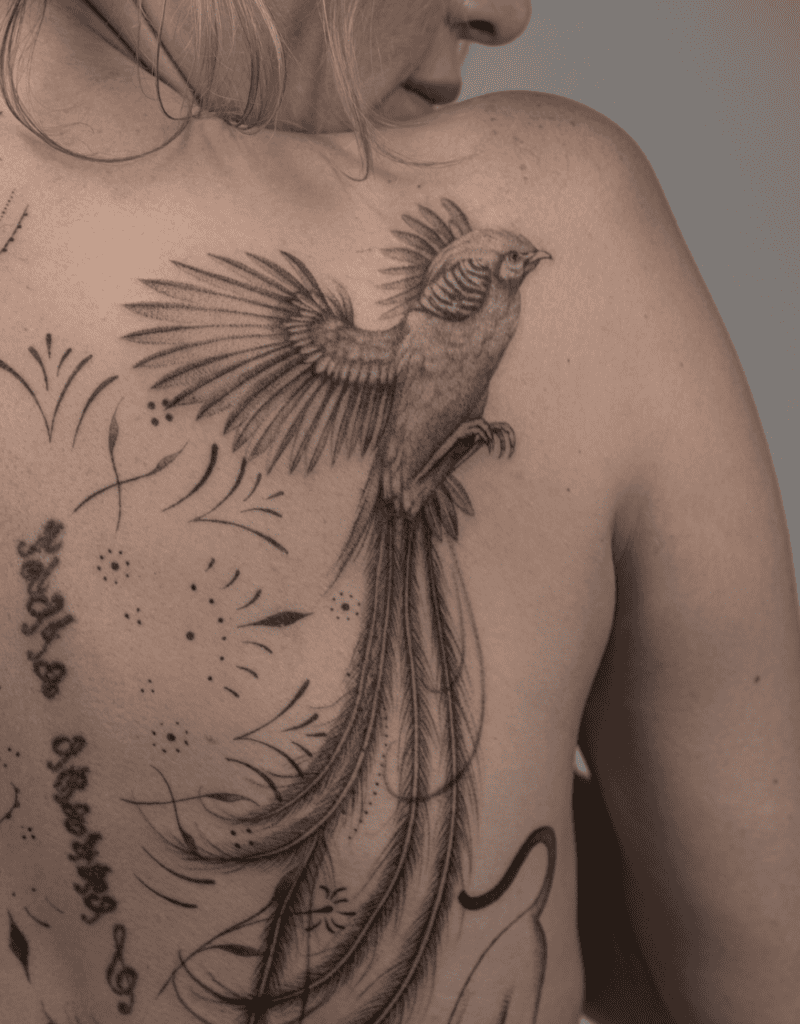
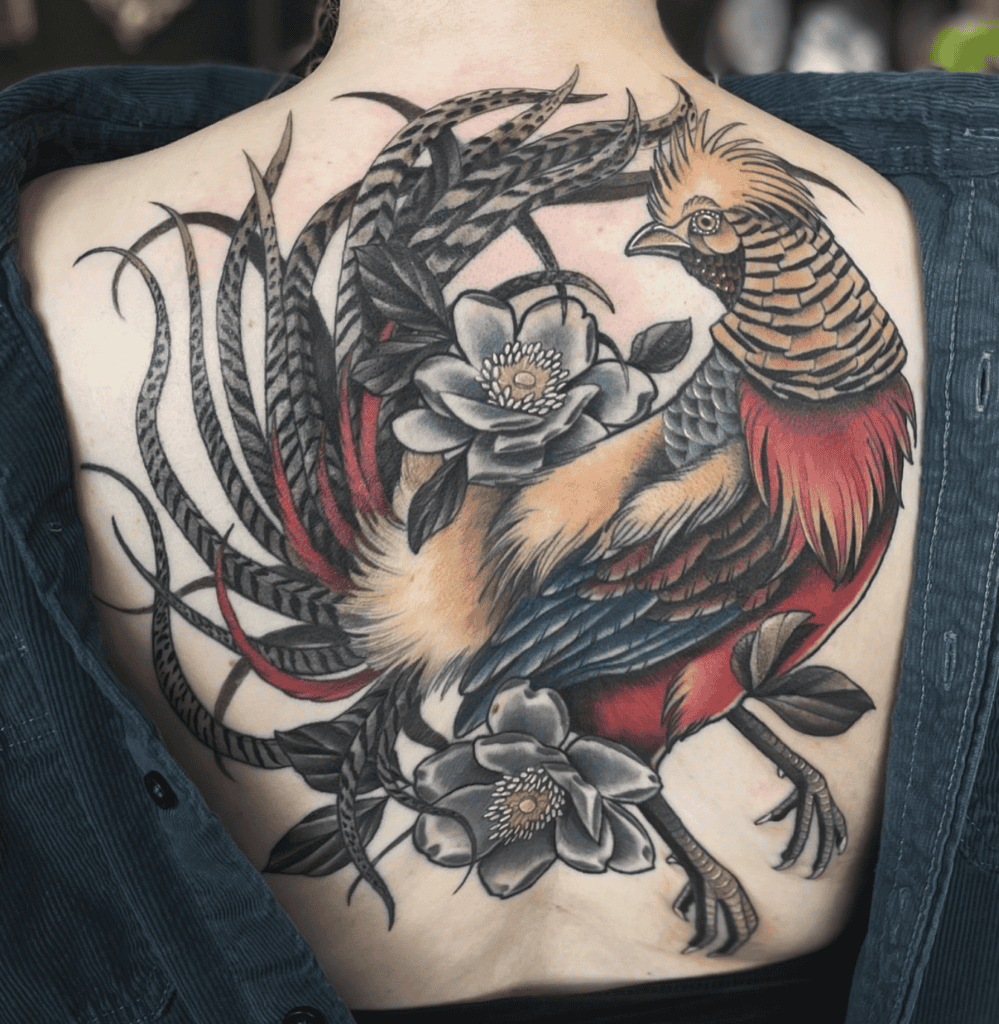
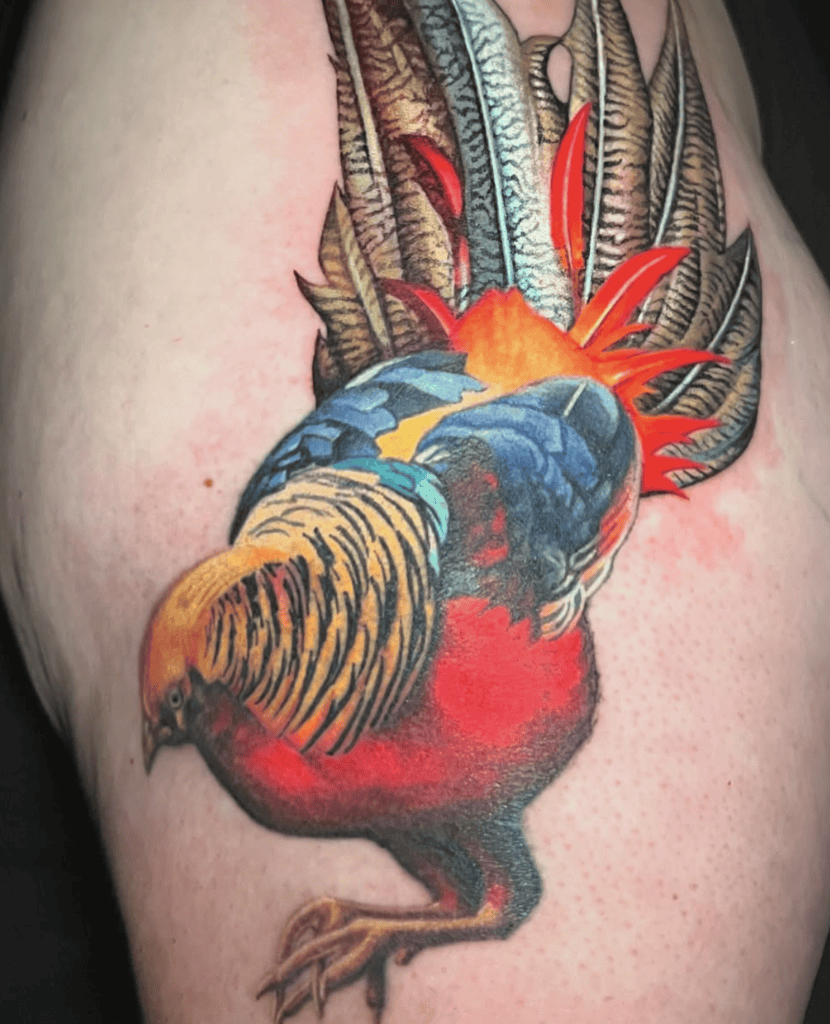
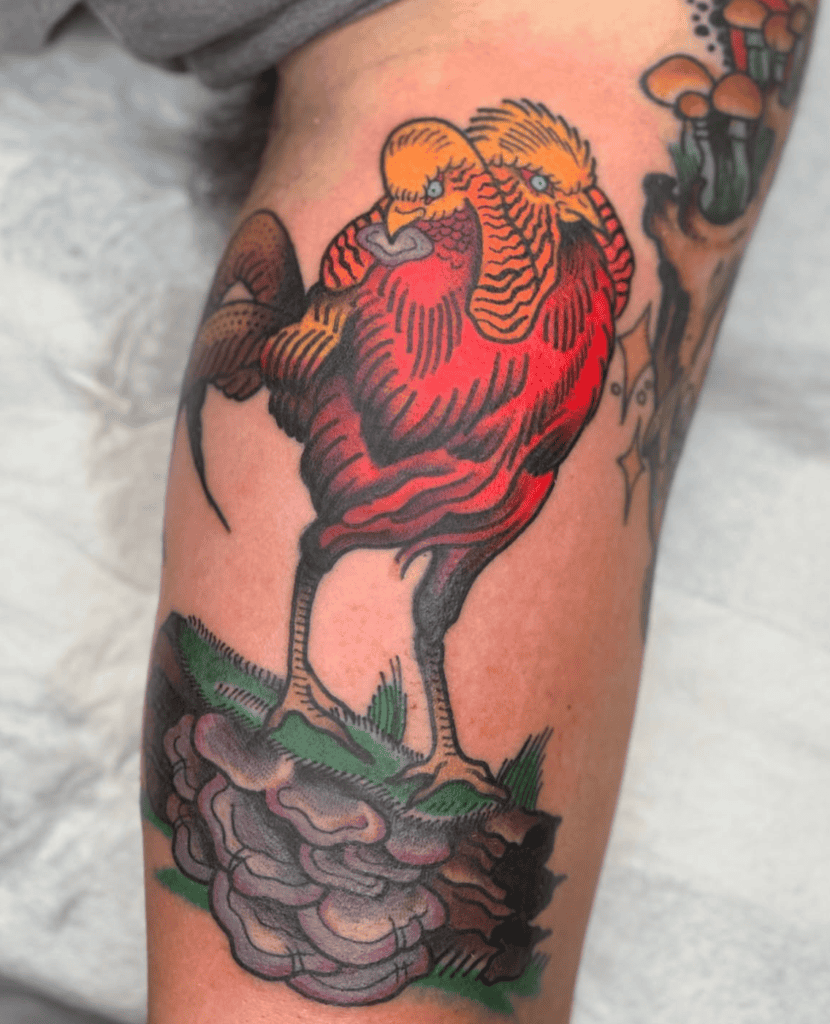
The Golden Pheasant is one of the most visually striking birds in the world, often admired for its vivid colours and almost surreal appearance. Native to the mountainous forests of western China, it thrives in dense woodland environments where its bright plumage contrasts beautifully with the darker surroundings.
What makes the Golden Pheasant so captivating is its incredible colour palette. The males are especially dramatic, with a golden-yellow crest that fans over the head, a rich red body, deep blue wings, and a long, patterned tail. Each colour seems to flow into the next, giving the bird a layered, almost painted look. The females, by comparison, are far more subtle, with brown and mottled feathers that provide effective camouflage in the wild.
Despite its bold appearance, the Golden Pheasant is actually quite shy and elusive. It spends much of its time on the ground, foraging for seeds, insects, and vegetation, and prefers to stay hidden within forest cover. The Golden Pheasant is sometimes called the “Chinese Pheasant” and has been introduced to other parts of the world, including small populations in the UK, where it can occasionally be spotted in the wild.
Green Pheasant Tattoo

The Green Pheasant is a beautifully understated yet striking bird native to Japan, where it is so culturally significant that it has been designated the country’s national bird. Closely related to the Common Pheasant, it carries a similar shape and posture, but its colouring sets it apart in a more refined and natural way.
What makes the Green Pheasant unique is its deep, iridescent plumage. Males display rich green feathers across the chest and body, often with subtle blue and bronze tones that shift in the light. This gives the bird a more muted elegance compared to brighter pheasants like the Golden Pheasant, but no less beautiful. Its red facial skin and long tail feathers add contrast, creating a balanced and harmonious appearance. Females, as with many pheasant species, are far more subdued, with brown and patterned feathers that allow them to blend into their surroundings.
Green Pheasants are adaptable and comfortable living in a variety of environments, from woodlands and grasslands to agricultural areas such as rice fields. They spend much of their time on the ground, foraging for seeds, insects, and small plants, and rely on awareness and quick movement rather than long flights to stay safe.
Lady Amherst’s Pheasant Tattoo

The Lady Amherst’s Pheasant is one of the most elegant and visually intricate pheasants in the world, known for its dramatic contrast of colours and its incredibly long, patterned tail. Native to the forests of southwestern China and northern Myanmar, this bird carries a refined beauty that feels almost ornamental in nature.
What makes Lady Amherst’s Pheasant so distinctive is its striking combination of colours and patterns. The males feature a bold red crest, a shimmering green back, and a black-and-white cape that can be fanned out around the neck like a shield. This cape, with its layered, scale-like pattern, is one of its most recognisable features. Extending behind it is a long white tail marked with dark bars, giving the bird a sense of length and grace that is hard to ignore. The females, by contrast, are much more subdued, with soft brown plumage that helps them remain hidden in their woodland environment.
Despite its ornate appearance, this pheasant is naturally shy and prefers to stay within dense forest cover. It spends most of its time on the ground, quietly foraging for seeds, insects, and vegetation, only taking flight when necessary. Lady Amherst’s Pheasant has been introduced to parts of the United Kingdom, where small wild populations exist, though they remain elusive and are rarely seen despite their striking appearance.
Common Pheasant Tattoo
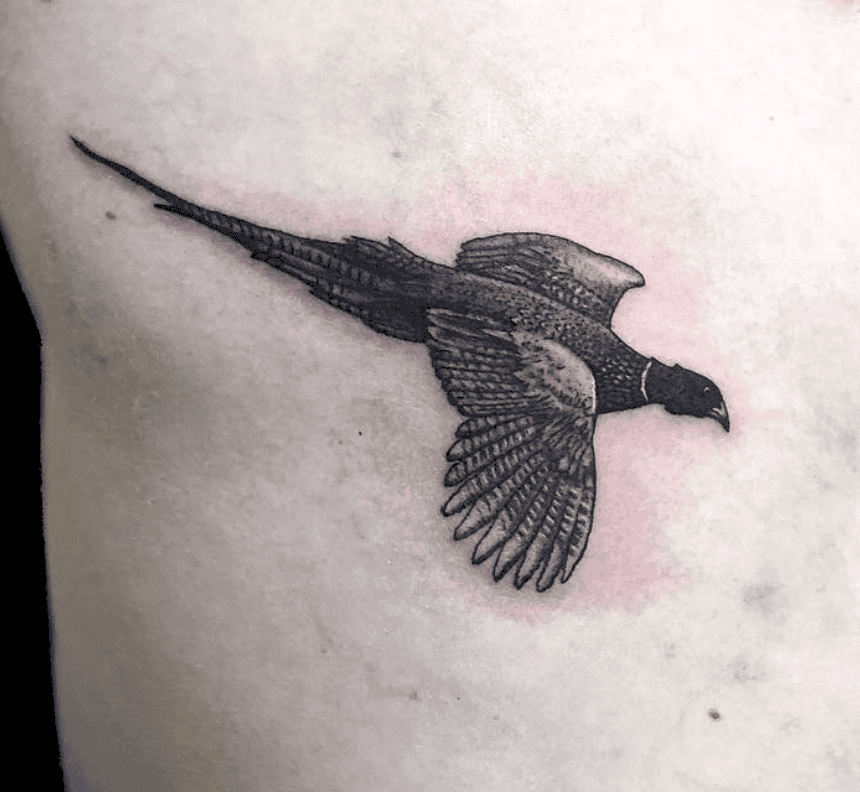
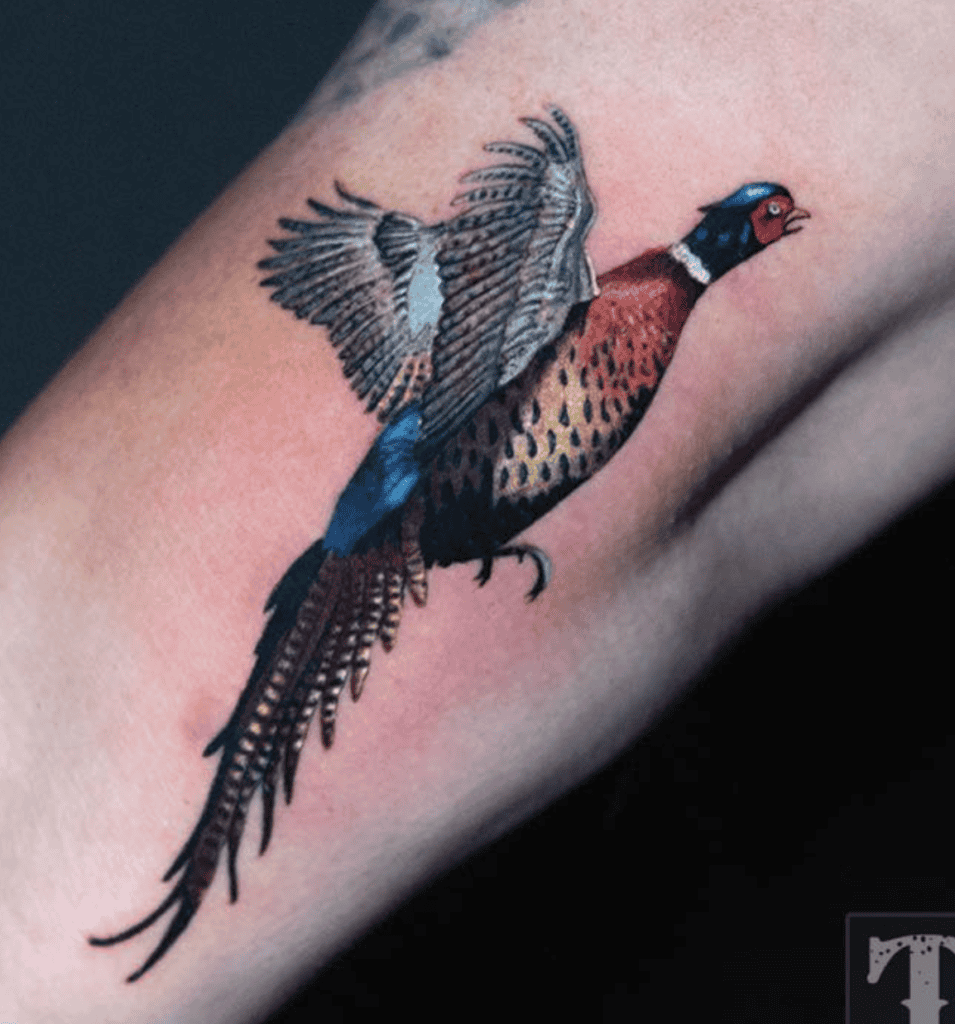
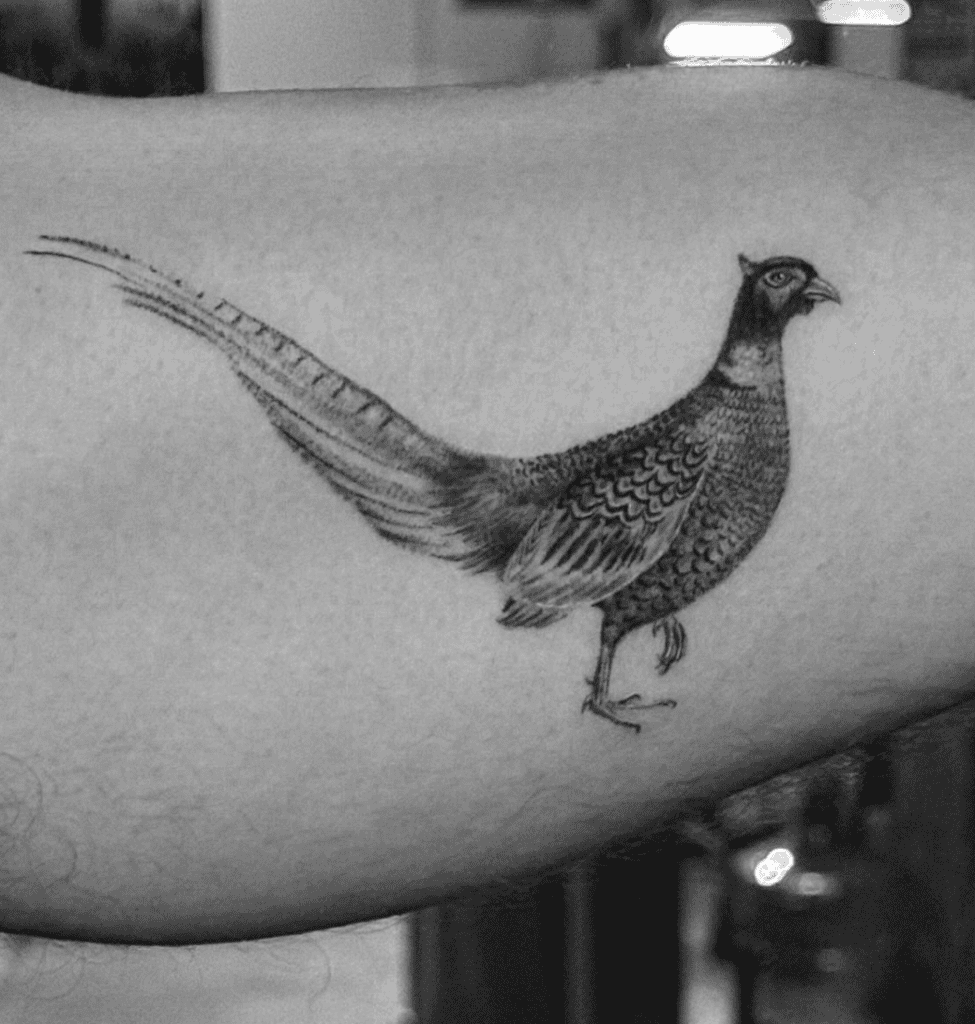
The Common Pheasant is one of the most widespread and recognisable pheasant species in the world. Originally native to Asia, it has been introduced across Europe and North America, where it is now commonly seen in farmland, grasslands, and woodland edges. Its adaptability has allowed it to thrive in a wide range of environments, making it one of the most familiar game birds globally.
What makes the Common Pheasant so distinctive is the strong contrast between males and females. Males are vibrant and eye-catching, with a glossy green head, bright red facial skin, a white neck ring, and a rich mix of copper, gold, and brown tones across the body. Their long, pointed tail adds to their elegant silhouette. Females, on the other hand, are much more understated, with soft brown and mottled feathers that provide excellent camouflage, helping them stay hidden from predators.
The Common Pheasant spends most of its time on the ground, foraging for seeds, grains, insects, and small plants. It is a cautious and alert bird, often relying on quick bursts of flight rather than sustained flying to escape danger. Despite its ability to fly, it is most comfortable moving through grasses and fields where it can remain partially concealed. The Common Pheasant was introduced to many countries for hunting, and in places like the UK, it has become so widespread that it is now considered a familiar part of the countryside landscape.
Silver Pheasant Tattoo


The Silver Pheasant is a striking and elegant bird native to Southeast Asia, found in forests across countries such as China, Thailand, and Vietnam. It is especially admired for its bold contrast of colours and its composed, almost regal presence in the wild.
What makes the Silver Pheasant so distinctive is its dramatic black-and-white plumage. The males display bright white feathers across the back and tail, each delicately marked with fine black lines, creating a layered, almost engraved appearance. This contrasts sharply with their deep black chest and wings, as well as their vivid red facial skin. The overall effect is clean, structured, and highly refined. Females, in contrast, are more subdued, with brown and patterned feathers that help them blend seamlessly into forest environments.
The Silver Pheasant is naturally cautious and prefers to remain within dense woodland. It spends most of its time on the ground, quietly foraging for seeds, fruits, and insects, and will only take flight when necessary. The Silver Pheasant is known to have many subspecies across its range, with slight variations in pattern and colouring depending on the region, making it one of the more diverse pheasants within its group.
Himalayan Monal Pheasant Tattoo

The Himalayan Monal is one of the most breathtakingly colourful birds in the pheasant family, native to the high-altitude regions of the Himalayas. Found across countries such as Nepal, India, and Bhutan, it inhabits alpine meadows and forested mountain slopes, often at elevations where few other birds can thrive.
What makes the Himalayan Monal so extraordinary is its iridescent plumage. The males display a dazzling spectrum of colours, including metallic greens, blues, purples, and fiery copper tones that shift depending on the light. This gives the bird an almost jewel-like quality, as though its feathers are constantly changing. In contrast, the females are far more subdued, with mottled brown plumage that allows them to blend into rocky and forested terrain.
Despite its vivid appearance, the Himalayan Monal is well adapted to its harsh environment. It spends much of its time on the ground, using its strong beak to dig into soil and snow in search of roots, insects, and seeds. It is a resilient and resourceful bird, capable of surviving cold temperatures and rugged landscapes.
Culturally, the Himalayan Monal holds special significance in Nepal, where it is known as the national bird. It is often associated with pride, natural beauty, and a deep connection to the mountainous landscape, making it a symbol of both identity and heritage. Its feathers were historically used in traditional headwear and decorations, valued for their vibrant, iridescent colours that catch the light in stunning ways.
Siamese Fireback Pheasant Tattoo

The Siamese Fireback is a striking pheasant native to Southeast Asia and is recognised as the national bird of Thailand. Found in forests, woodlands, and lowland habitats across countries like Thailand, Cambodia, and Vietnam, it carries a strong connection to the region’s natural and cultural identity.
What makes the Siamese Fireback so distinctive is its refined yet bold appearance. Males display a beautiful mix of metallic blue, grey, and black feathers, with a long, elegant tail and a vivid red facial patch that adds a sharp contrast. A small crest sits atop the head, giving the bird a composed and almost regal look. Unlike some pheasants that rely on bright, multi-coloured displays, the Fireback’s beauty comes from its balance of colour and structure, making it feel both powerful and controlled. Females are more understated, with brown and patterned feathers that help them blend into forest surroundings.
The Siamese Fireback is typically shy and prefers to remain within dense vegetation. It spends much of its time on the ground, foraging for seeds, insects, and plant matter, while staying alert to potential threats. Its movements are measured and deliberate, reflecting a cautious and aware nature. The Siamese Fireback’s Thai name translates roughly to “fire-backed bird,” a reference to the subtle warm tones and sheen that can appear across its plumage in certain lighting conditions.
Indian Peafowl Pheasant Tattoo
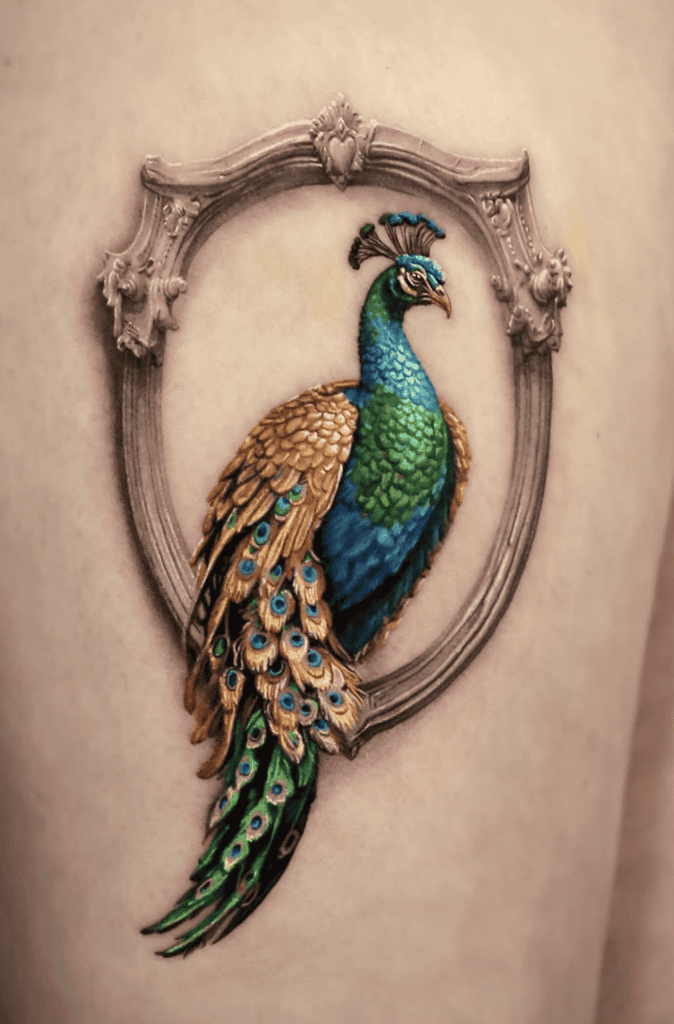
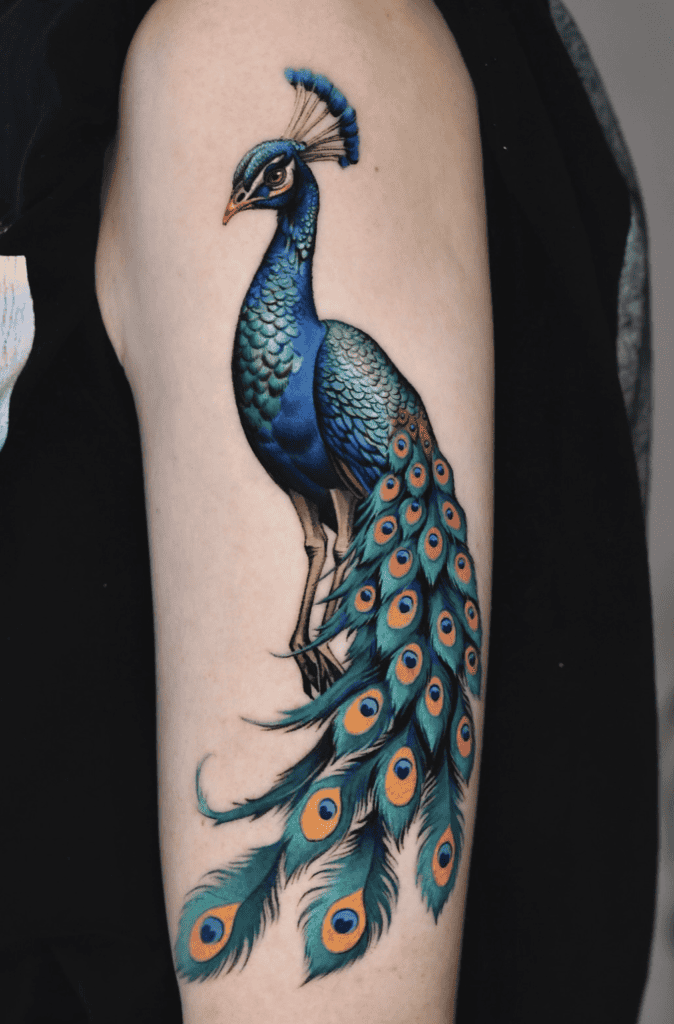
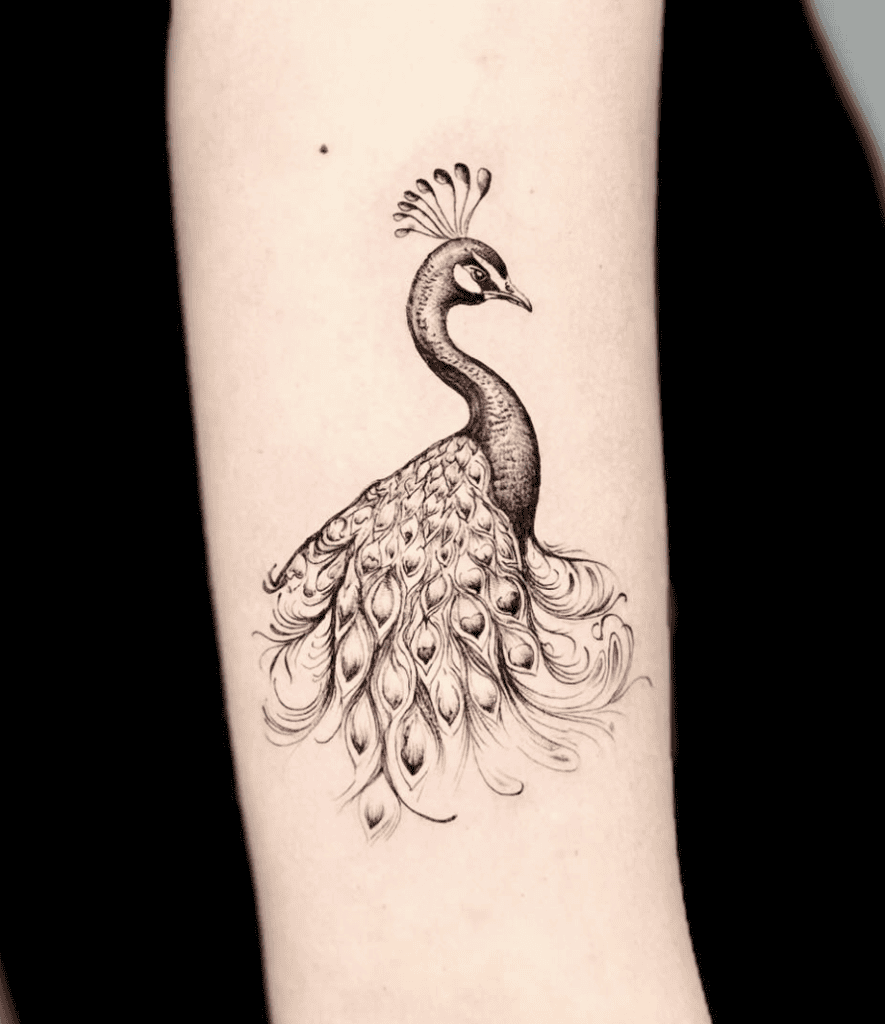
The Indian Peafowl, often simply called the peacock (referring specifically to the male), is one of the most iconic and recognisable birds in the world. Native to the Indian subcontinent, it is widely admired for its extraordinary beauty and elaborate courtship display, and it has become a powerful cultural and symbolic figure across many traditions.
What makes the Indian Peafowl truly unforgettable is the male’s spectacular train of feathers. When displayed, these long tail feathers fan out into a shimmering arc filled with iridescent blues, greens, and golds, each marked with distinctive eye-like patterns known as ocelli. This display is used to attract mates, but it has also made the bird a global symbol of beauty and attention. In contrast, the female, known as the peahen, has more subdued brown and green tones, allowing her to remain camouflaged and protected in natural environments.
The Indian Peafowl can thrive in forests, farmland, and even near human settlements, where it forages for seeds, insects, and small creatures. Its loud, distinctive call is often heard before the bird is seen, adding to its strong presence in its environment. The Indian Peafowl is the national bird of India, and its feathers have been used in art, decoration, and symbolism for centuries due to their vibrant colours and intricate patterns.
Quail Tattoo
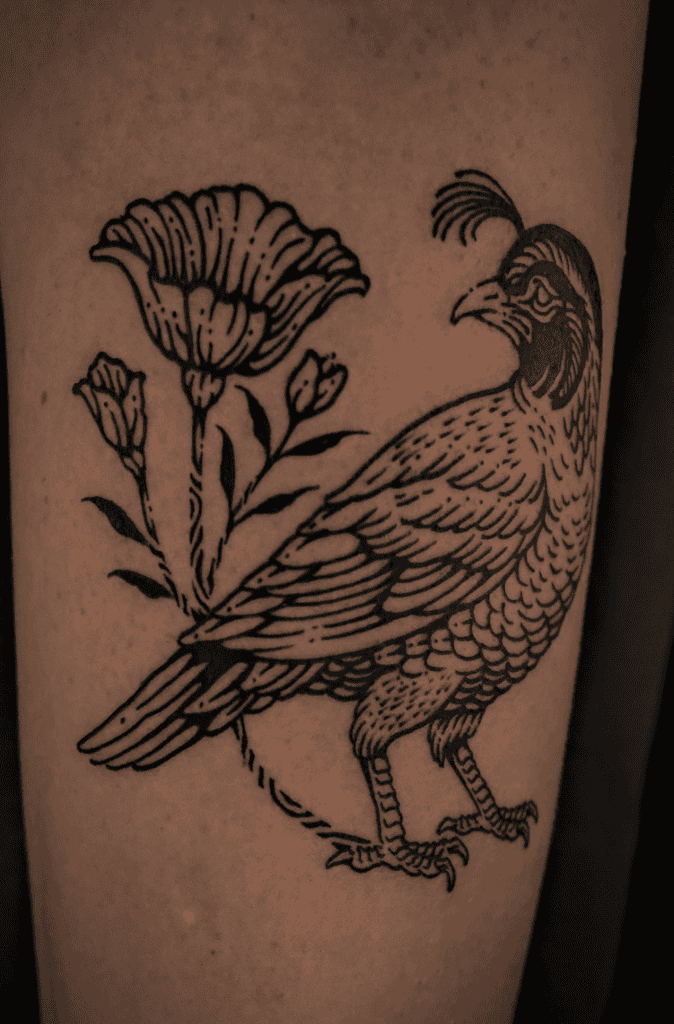
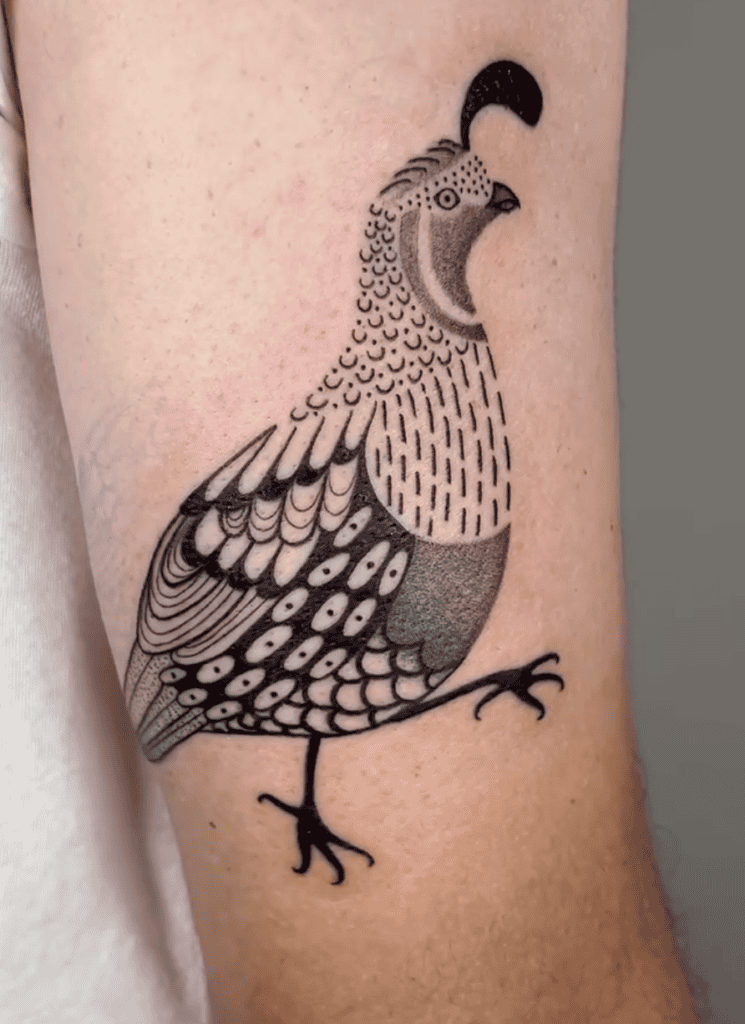
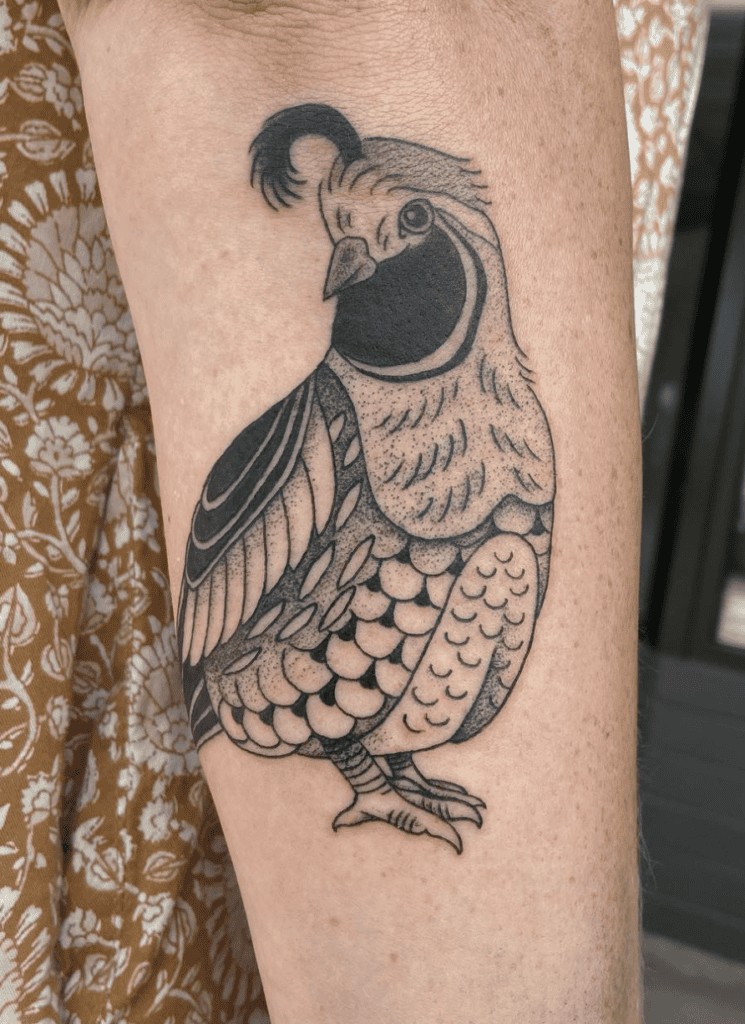
The Quail is a small, ground-dwelling bird known for its subtle beauty, quick movements, and strong connection to the earth. Found across many parts of the world, including Europe, Asia, Africa, and the Americas, quail thrive in grasslands, farmland, and scrubby environments where their natural camouflage helps them stay hidden from predators.
Rather than bright colours, they are covered in soft browns, creams, and speckled patterns that blend seamlessly into their surroundings. This natural camouflage reflects their lifestyle, as quail spend most of their time on the ground, foraging for seeds, grains, and insects while staying low and alert.
Quail are known for their quick bursts of flight and their tendency to move in groups, often called coveys. They rely heavily on awareness and speed rather than long-distance flight, making them highly responsive to their environment. Despite their small size, they are resilient birds, capable of surviving in a variety of conditions. Some quail species, such as the Japanese quail, are widely raised for their eggs, which are small but highly nutritious and often considered a delicacy in many cuisines around the world.
Cockatrice Chicken Tattoo


The Cockatrice is a legendary creature from European folklore, often described as a strange and unsettling mix between a rooster and a serpent or dragon. It typically has the head and body of a rooster, wings, and a long, reptilian tail, blending familiar farm imagery with something far more dangerous and mythical.
In traditional stories, it was believed that the cockatrice could kill with a single glance, turning people or animals to stone or causing instant death. Some legends even claimed that its breath or touch was poisonous, making it a creature to be feared rather than admired. These traits gave it a strong association with danger, power, and the unknown.
The origins of the cockatrice are tied to medieval beliefs and superstition. It was said to be born from an unnatural event, often involving a rooster laying an egg that was then hatched by a serpent or toad. This strange origin added to its symbolism, representing things that go against the natural order or the consequences of imbalance.
A cockatrice represents power, fear, and transformation. Its ability to turn others to stone can be interpreted as a metaphor for paralysis, control, or the overwhelming force of something that cannot be ignored. As a fusion of bird and reptile, the cockatrice represents the merging of two opposing forces, the familiar and the monstrous, the natural and the unnatural. The cockatrice is closely related to another legendary creature, the basilisk, and in some traditions, the two are considered variations of the same myth, both sharing the infamous ability to kill with their gaze.
Knight Chicken Tattoo

A Knight was a mounted warrior in medieval Europe, typically serving a lord or king. Knights were not just soldiers, but also part of a social class, often trained from a young age in combat, discipline, and courtly behaviour. They followed a code known as chivalry, which emphasised values such as loyalty, honour, courage, and the protection of the weak. While the reality of knighthood could be harsh and political, the idealised image of a knight is that of a noble, brave, and duty-driven figure.
The rooster has long been associated with vigilance and courage because it crows at dawn, signalling the start of a new day. In medieval Europe, this made it a symbol of watchfulness and awakening, qualities that align closely with the ideals of a knight who must remain alert and ready to defend.
Chica FNAF Chicken Tattoo
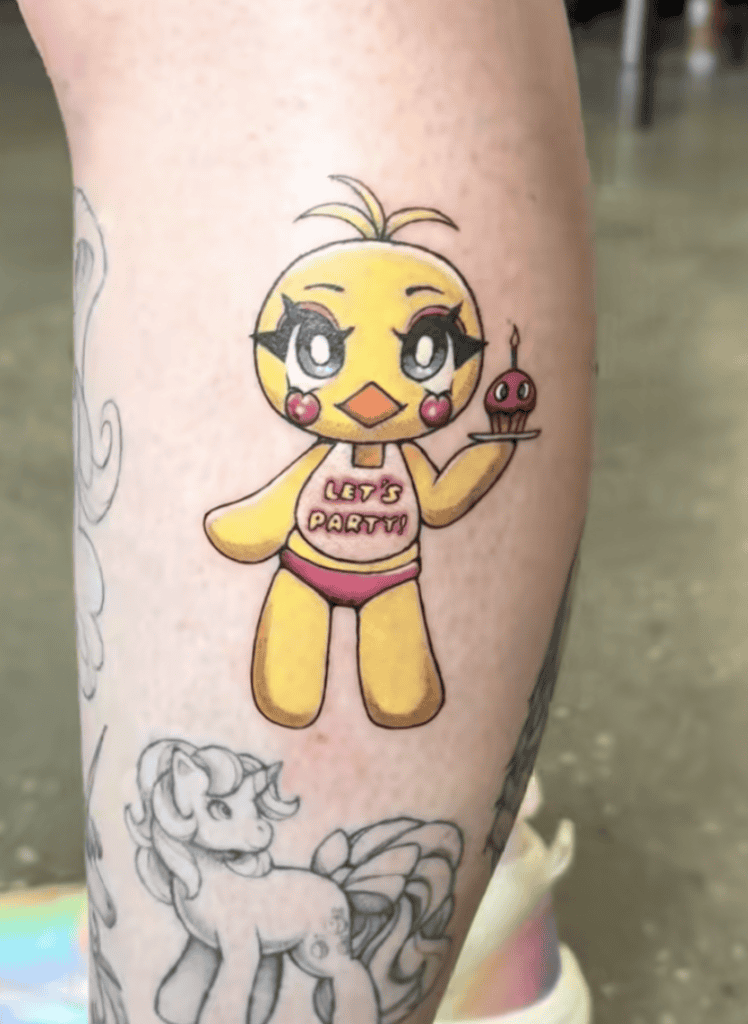
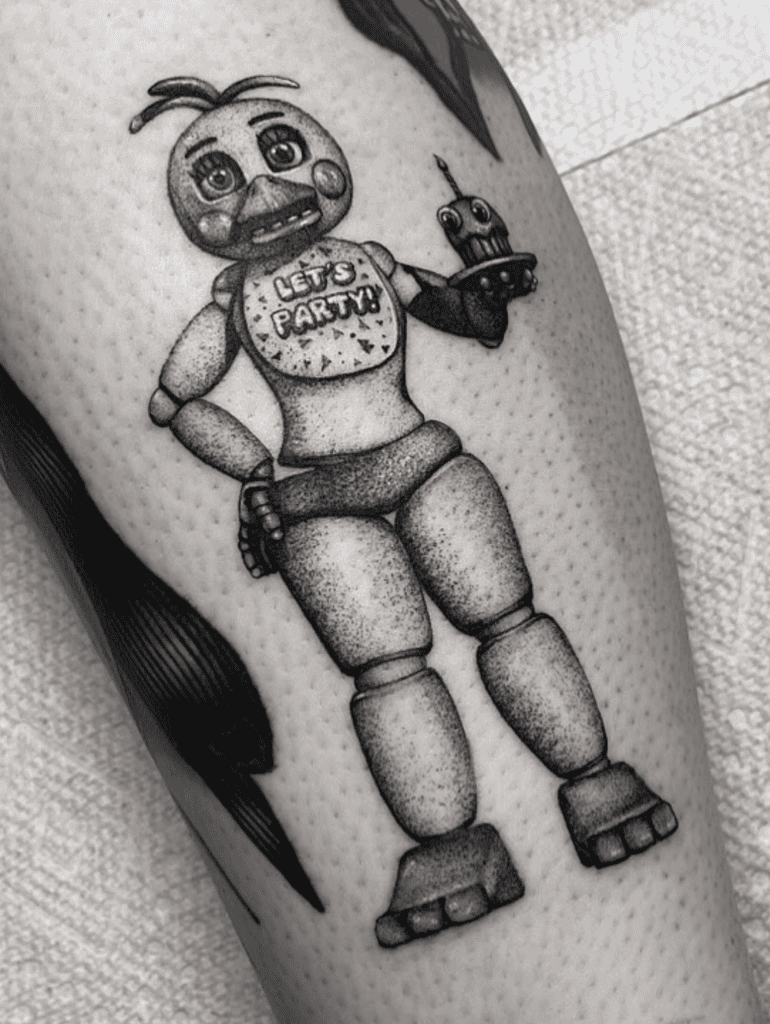
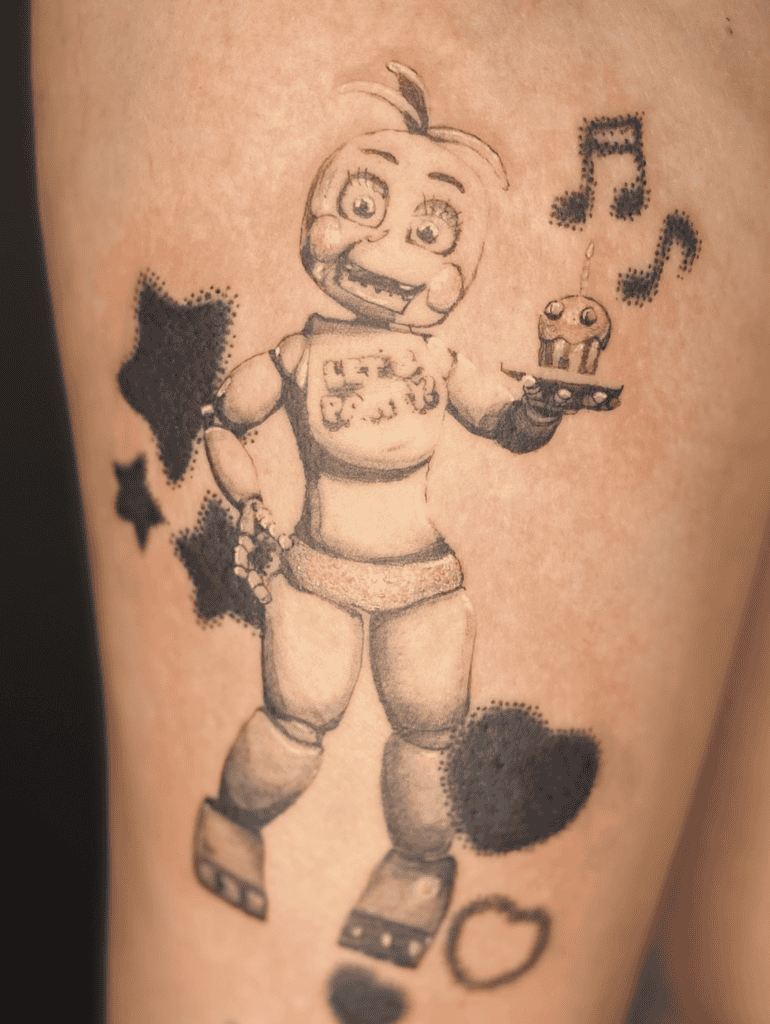
Chica is one of the main animatronic characters from the horror game series Five Nights at Freddy’s, created by Scott Cawthon. She appears as a yellow chicken animatronic and is part of the original group alongside Freddy, Bonnie, and Foxy.
At first glance, Chica has a playful and slightly goofy design. She wears a white bib with the phrase “Let’s Eat!!!” written on it, and she is often seen holding or accompanied by a small cupcake character with eyes. Like the other animatronics, she was originally designed to entertain children in a pizzeria setting.
However, beneath her cheerful appearance lies something much darker. In the game, Chica becomes active at night and roams the building, creating tension and fear for the player. Her behaviour is unpredictable, and her wide, staring eyes and stiff movements make her one of the more eerie characters in the series. She represents that classic horror contrast of something meant to be friendly becoming deeply unsettling.
Cow and Chicken Tattoo
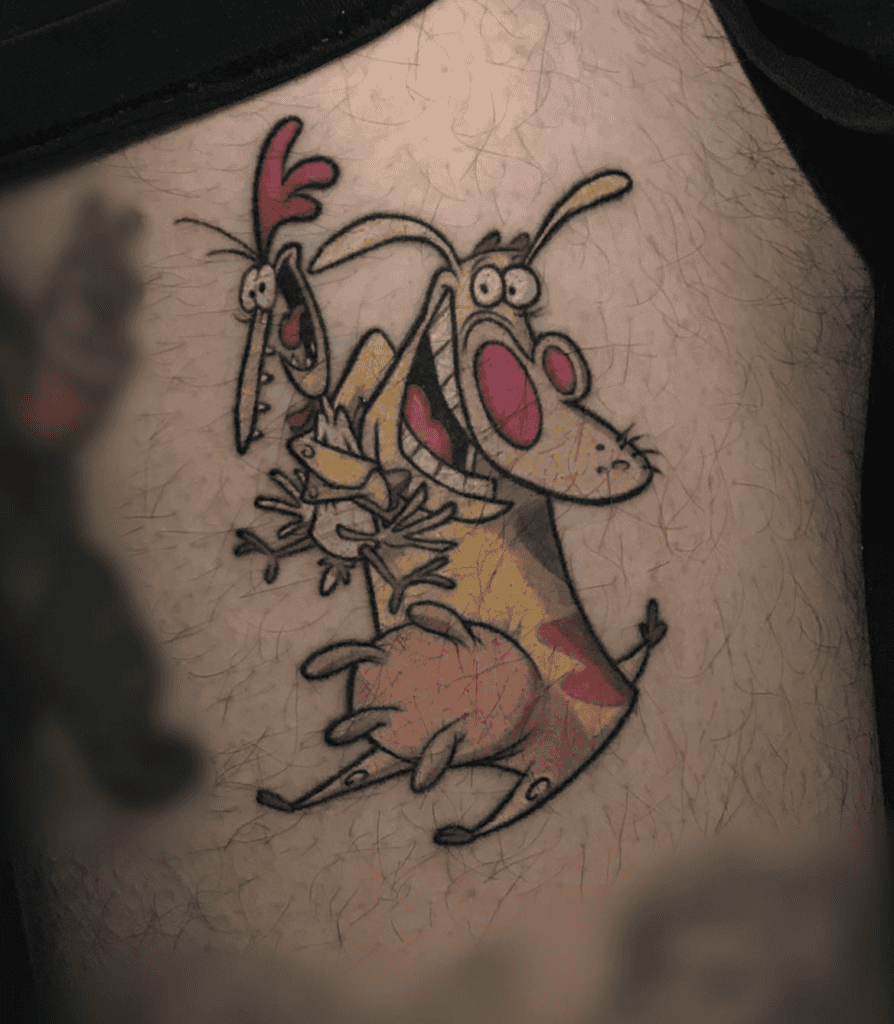
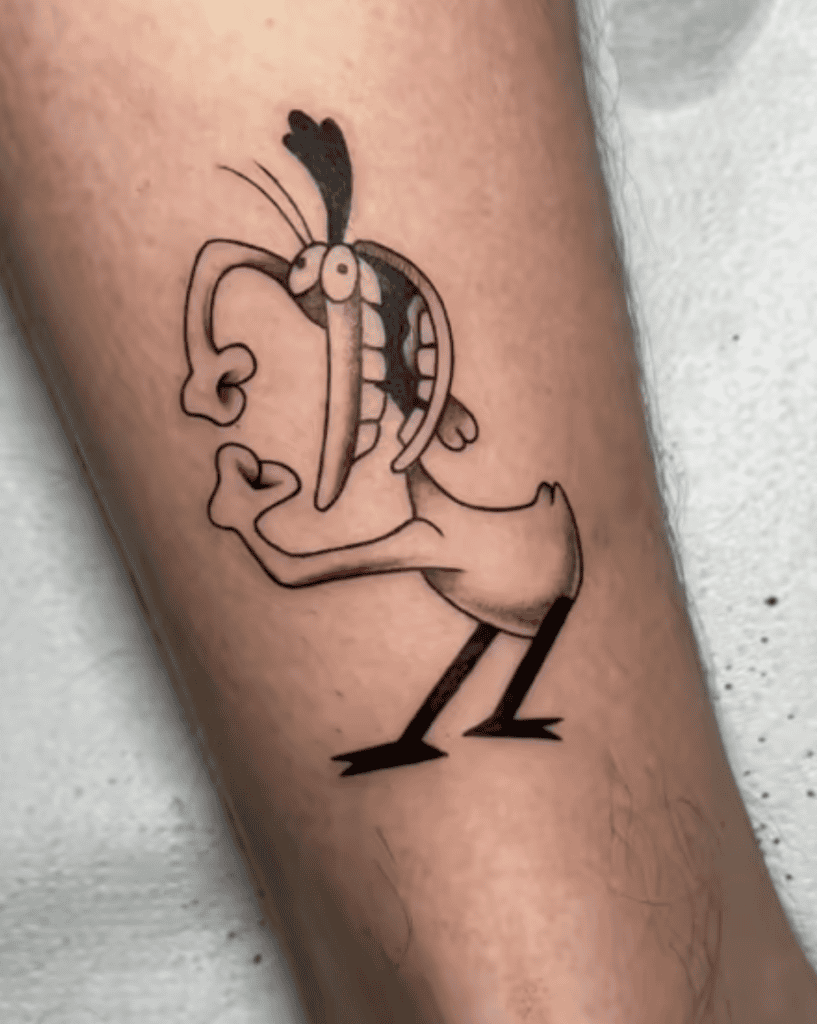
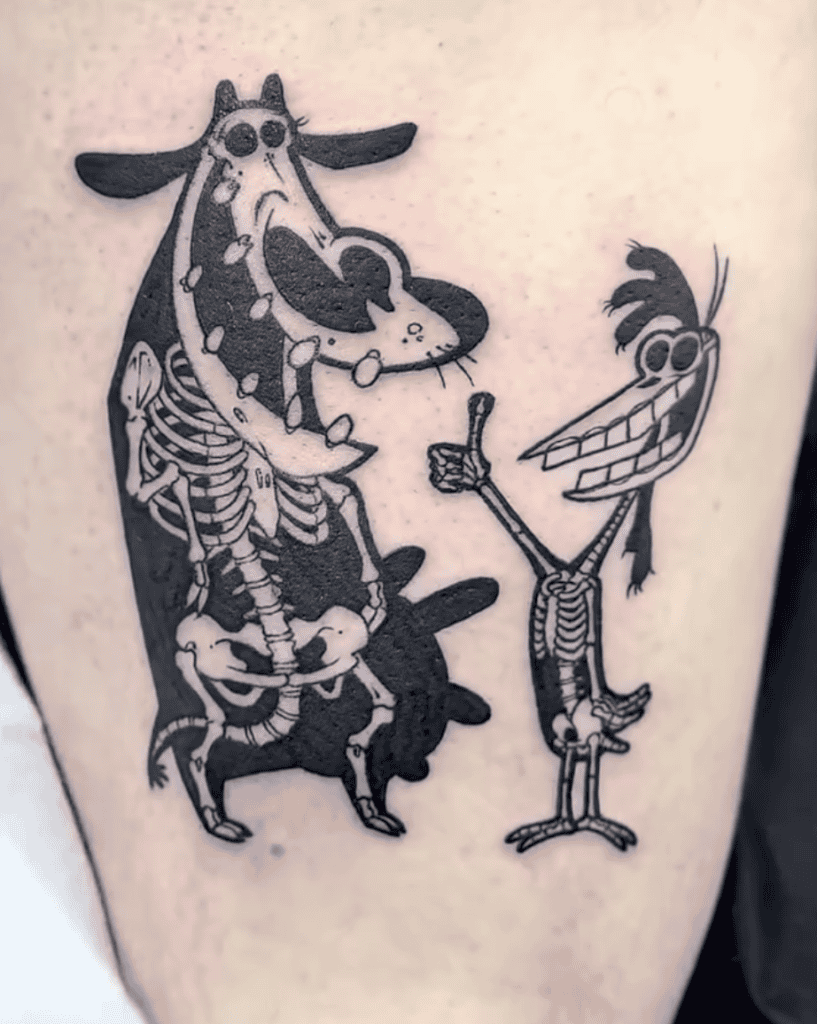
Cow and Chicken is a surreal and comedic animated series that aired on Cartoon Network in the late 1990s. Created by David Feiss, the show follows the bizarre adventures of two siblings, Cow and Chicken, who live in a strange, exaggerated world full of absurd humour and over-the-top situations.
Cow is a sweet, kind-hearted, and slightly naive character, while Chicken is more cynical, easily frustrated, and often caught up in ridiculous problems. Their dynamic creates much of the show’s humour, as Cow’s optimism clashes with Chicken’s more grounded and reactive personality. Cow and Chicken originally started as a short segment on the animated showcase What a Cartoon! before becoming its own full series due to its popularity.
Chuck Chicken Tattoo

Chuck Chicken is a Malaysian animated action-comedy series created by Edmund Chan and Raye Lee and produced by Animasia Studio. The show is set on Rocky Perch, a world populated by bird characters. The story follows Chuck Adoodledoo, who gains powers from a Golden Egg and becomes a kung-fu-style hero protecting the citizens of the island. His adventures mix superhero action, comedy, and martial-arts-inspired powers.
Alan-a-Dale the Rooster Chicken Tattoo

Alan-a-Dale is the musical narrator from Disney’s Robin Hood, produced by Walt Disney Productions. Portrayed as a cheerful rooster with a lute, he guides the audience through the story with songs and commentary, giving the film its warm, storytelling tone.
Alan-a-Dale is inspired by a character from the original Robin Hood legends, where he appears as a wandering minstrel and member of Robin Hood’s band. In the Disney version, this idea is reimagined in a playful way by turning him into a rooster, tying his musical nature to the classic imagery of a bird that “announces” the day.
Coco Chicken Tattoo


Coco is one of the most memorable and chaotic characters from Foster’s Home for Imaginary Friends, created by Craig McCracken. She is a strange, bird-like imaginary friend who looks like a mix between a palm tree, an aeroplane, and a chicken, with long stick-like legs, a beak, and colourful, abstract features.
What makes Coco so unique is her behaviour and way of communicating. She doesn’t speak in full sentences, instead repeating her name—“Coco, coco, coco”—in different tones and rhythms. Despite this, the other characters somehow understand her perfectly, which adds to her quirky charm and surreal presence in the show.
Ernie the Giant Chicken Tattoo
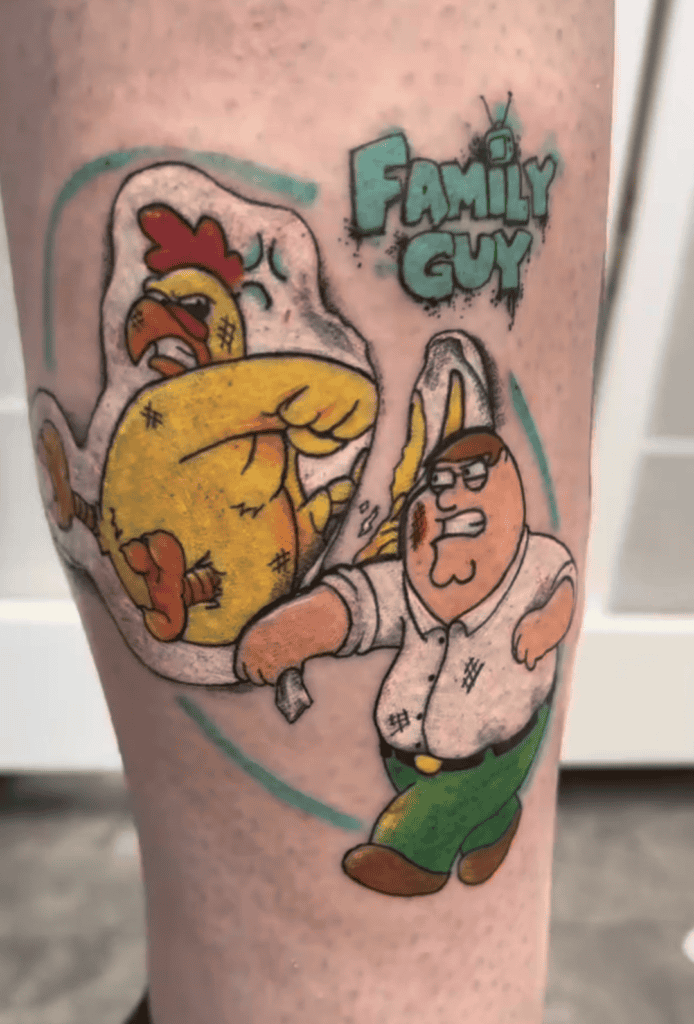
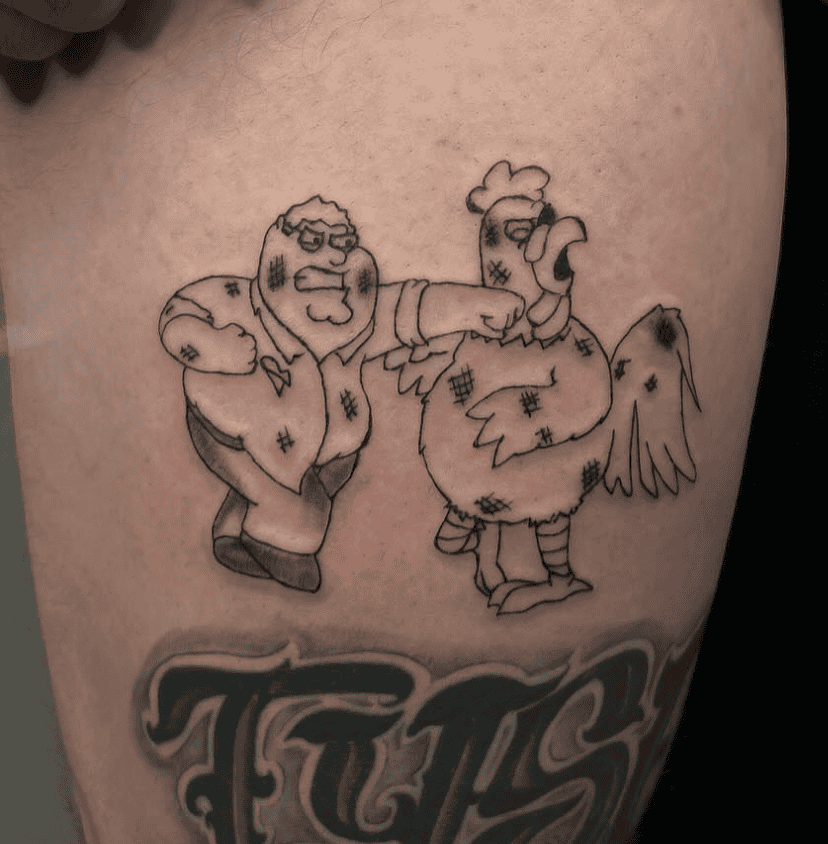
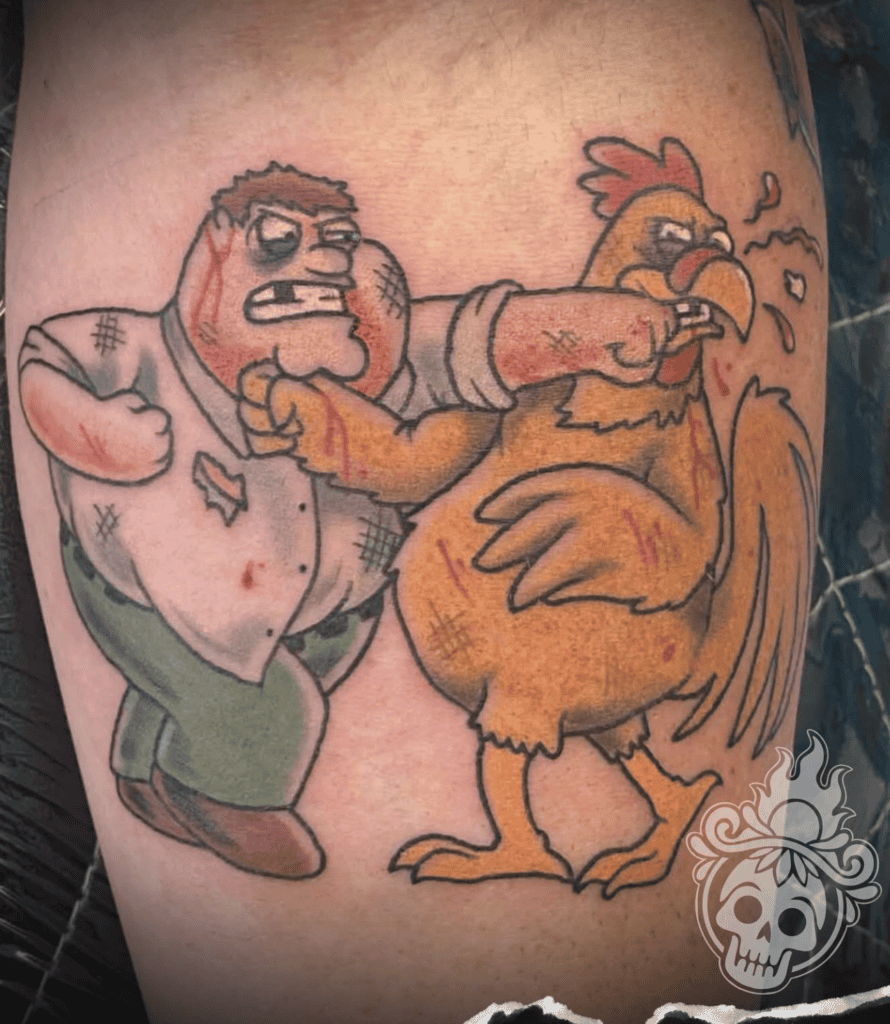
Ernie the Giant Chicken is a recurring gag character from the animated sitcom Family Guy. He is best known for his absurdly long, destructive fight scenes with Peter Griffin, which have become one of the show’s most iconic running jokes.
Ernie first appears in what seems like a minor moment involving a coupon dispute, but it quickly escalates into a full-blown, over-the-top brawl. From that point on, every time he shows up, it triggers another exaggerated fight sequence that often stretches far beyond what anyone would expect, moving through different locations and causing massive chaos along the way.
Heihei Chicken Tattoo
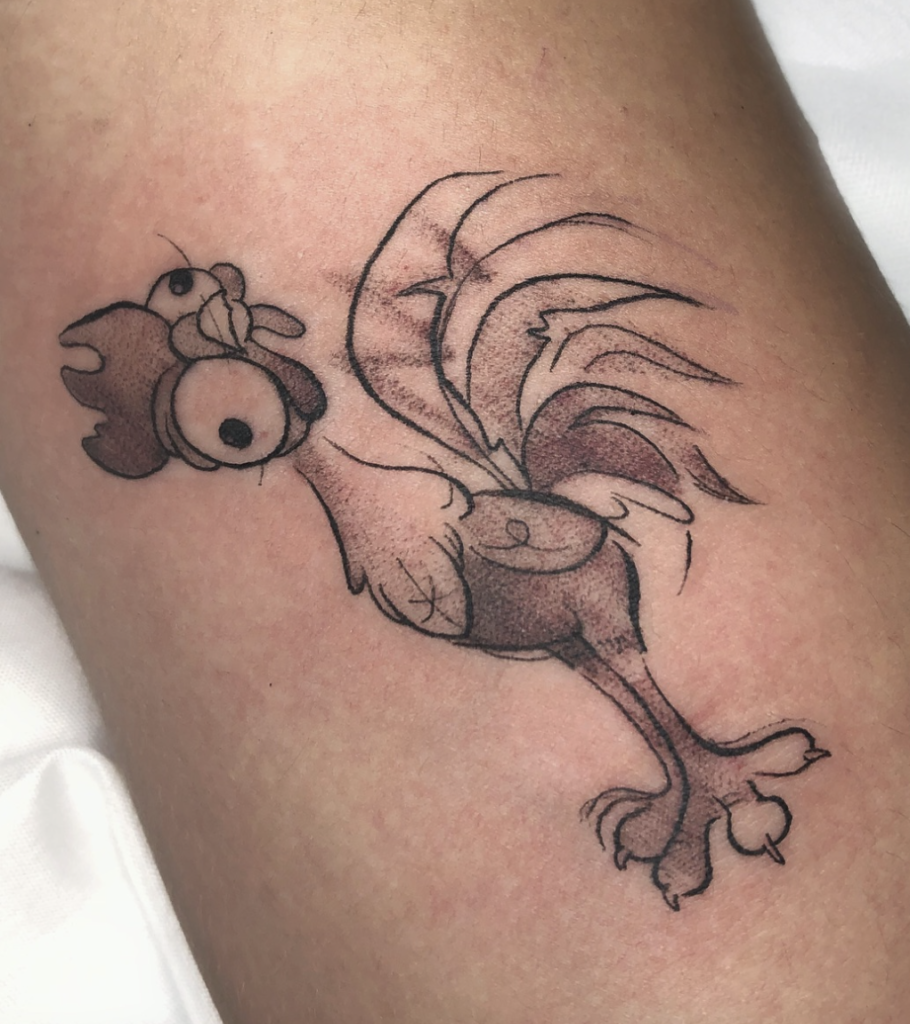
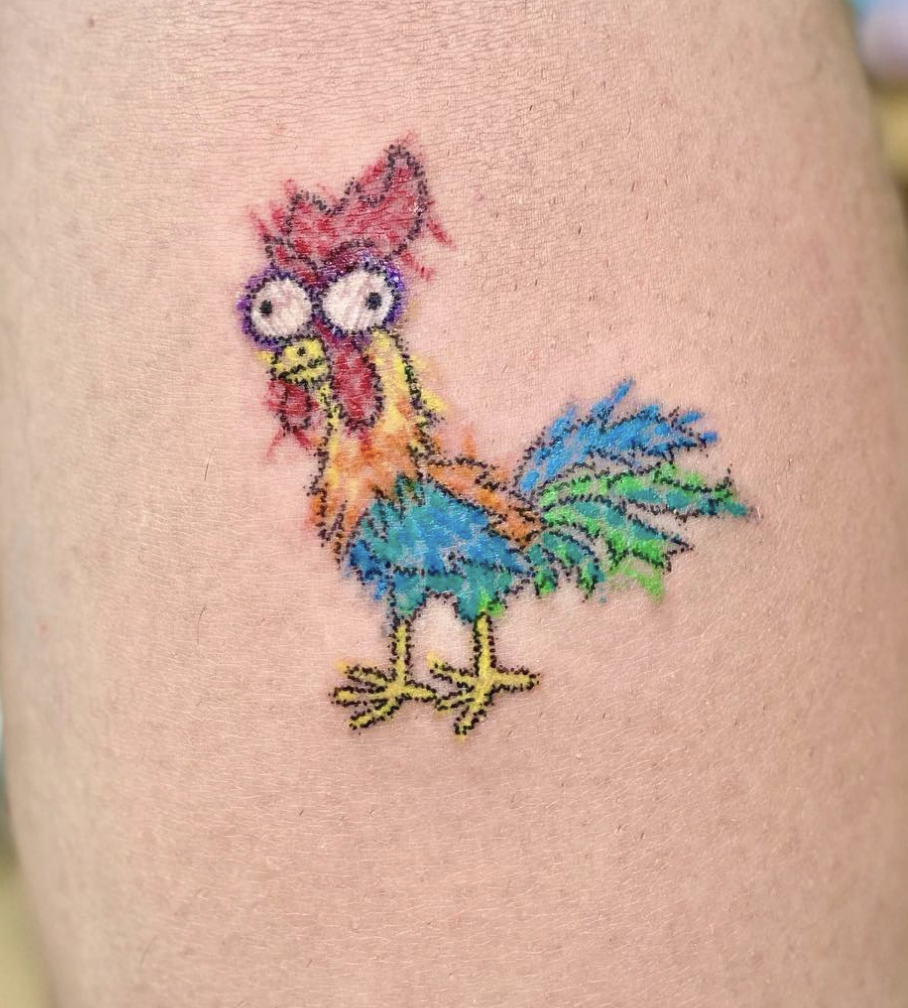
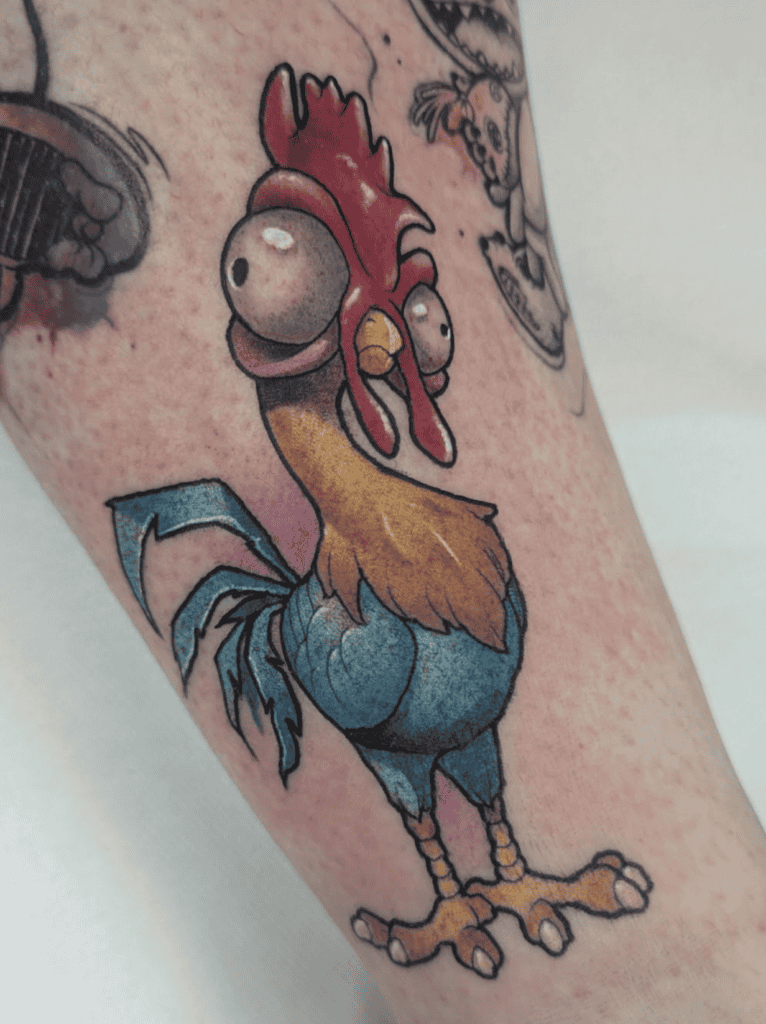
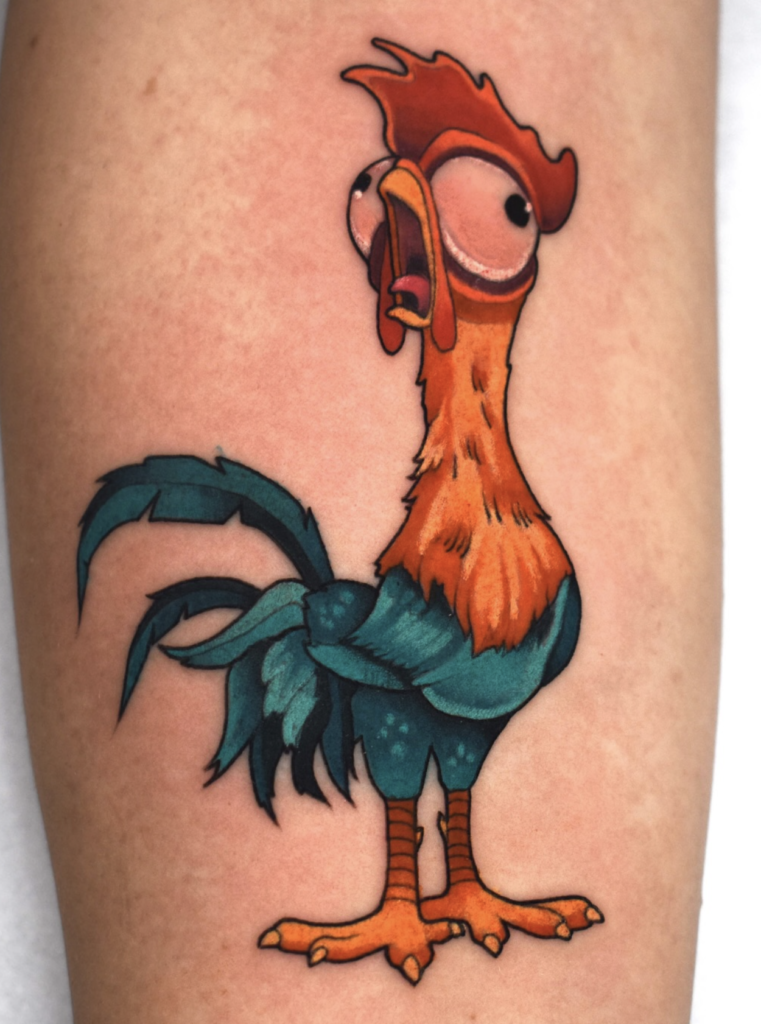
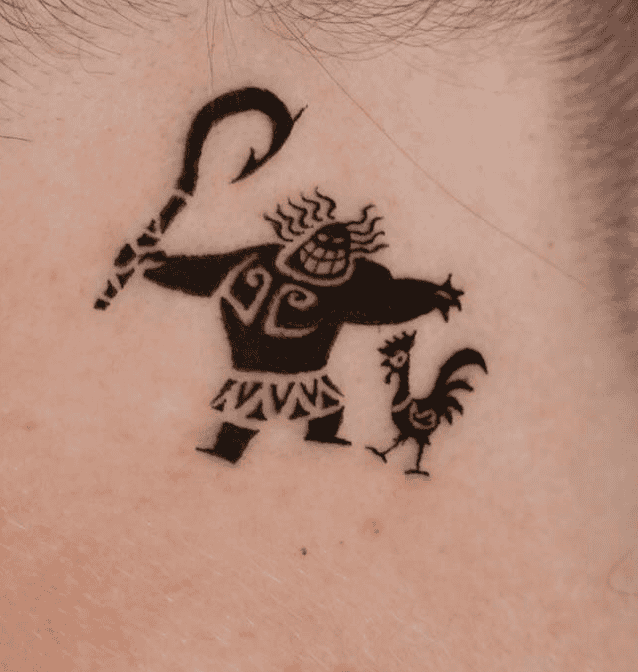
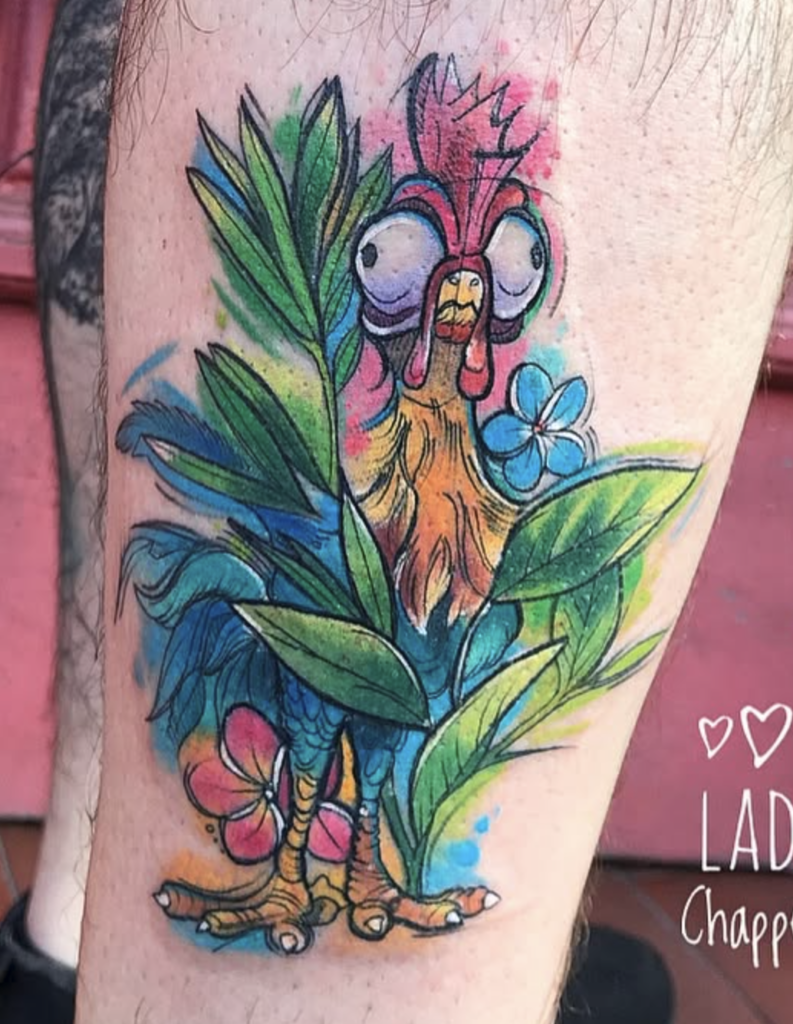
Heihei is the clueless rooster from Disney’s Moana, produced by Walt Disney Animation Studios. Unlike most animal sidekicks, Heihei stands out not because of intelligence or bravery, but because of how completely unaware and chaotic he is.
What makes Heihei so memorable is his personality, or lack of it in the traditional sense. He often seems confused about everything around him, reacting to situations with wide-eyed panic or total indifference. Whether he’s staring blankly at the ocean or accidentally putting himself in danger, his behaviour creates a lot of the film’s comedic moments.
Despite this, Heihei still ends up accompanying Moana on her journey across the ocean, often by accident rather than choice. While he doesn’t actively contribute to solving problems in the way a typical sidekick might, his presence adds a layer of unpredictability and humour to the story.
Interestingly, Heihei wasn’t always meant to be this way. Early versions of the character were written to be more competent, but during development, the creators leaned into his silliness, which ultimately made him far more iconic and entertaining.
Pokémon Chicken Tattoo
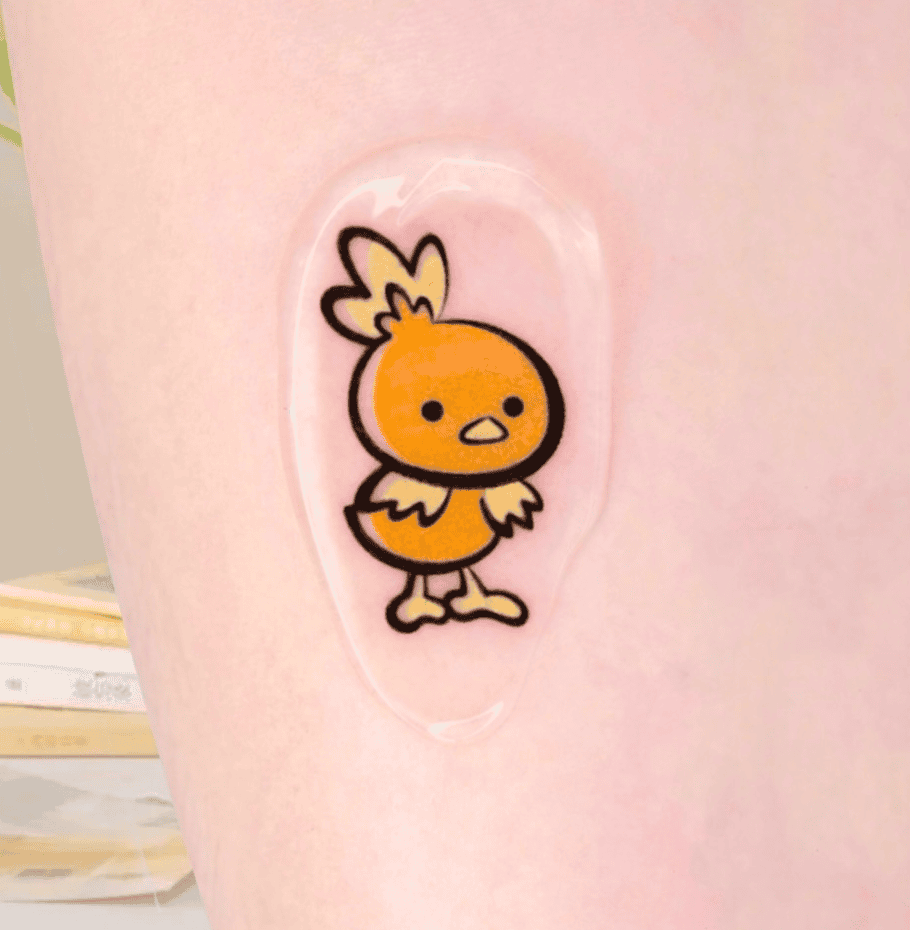
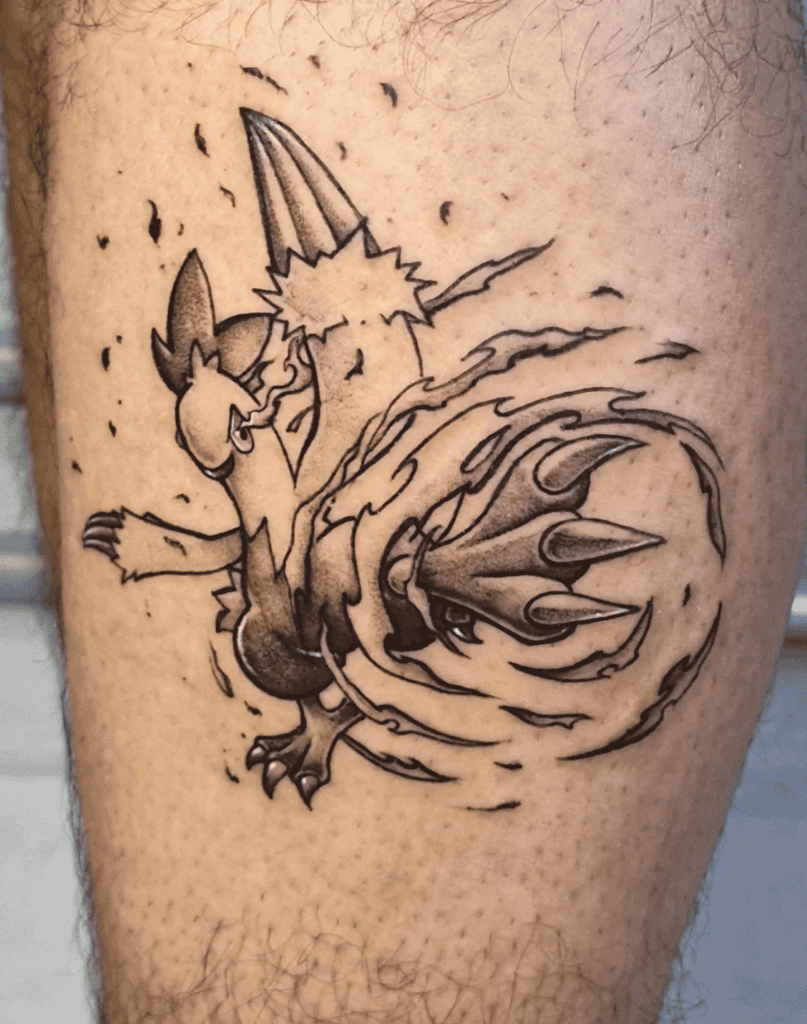
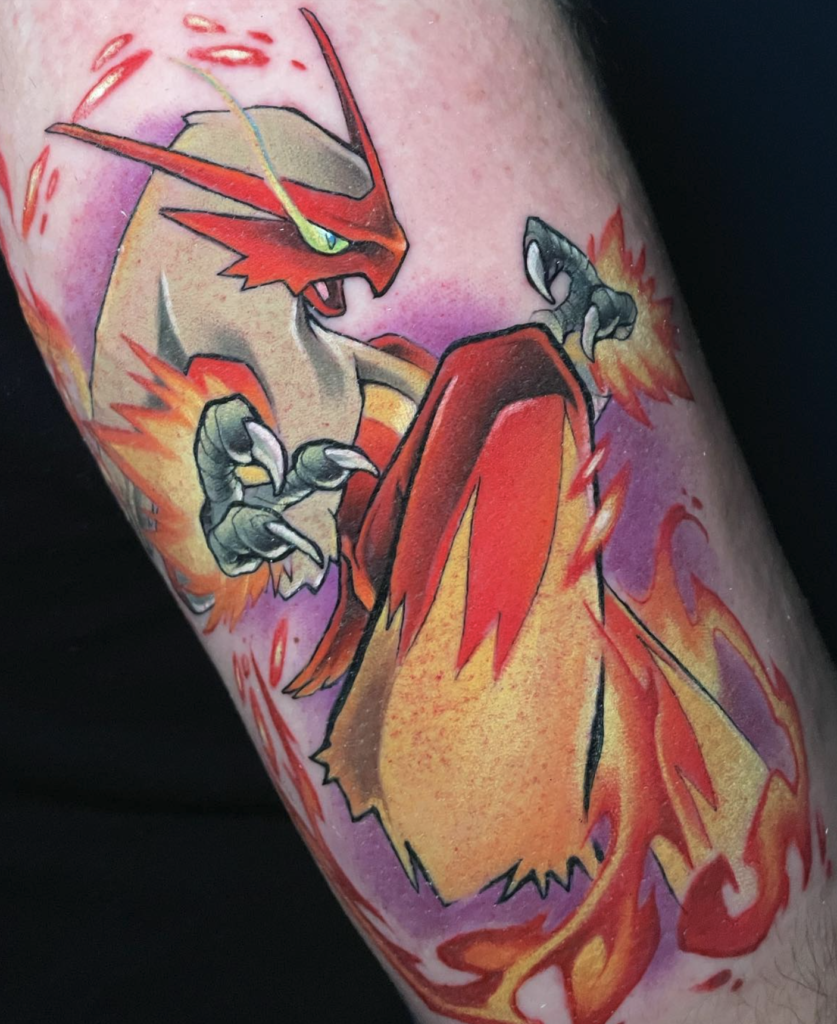
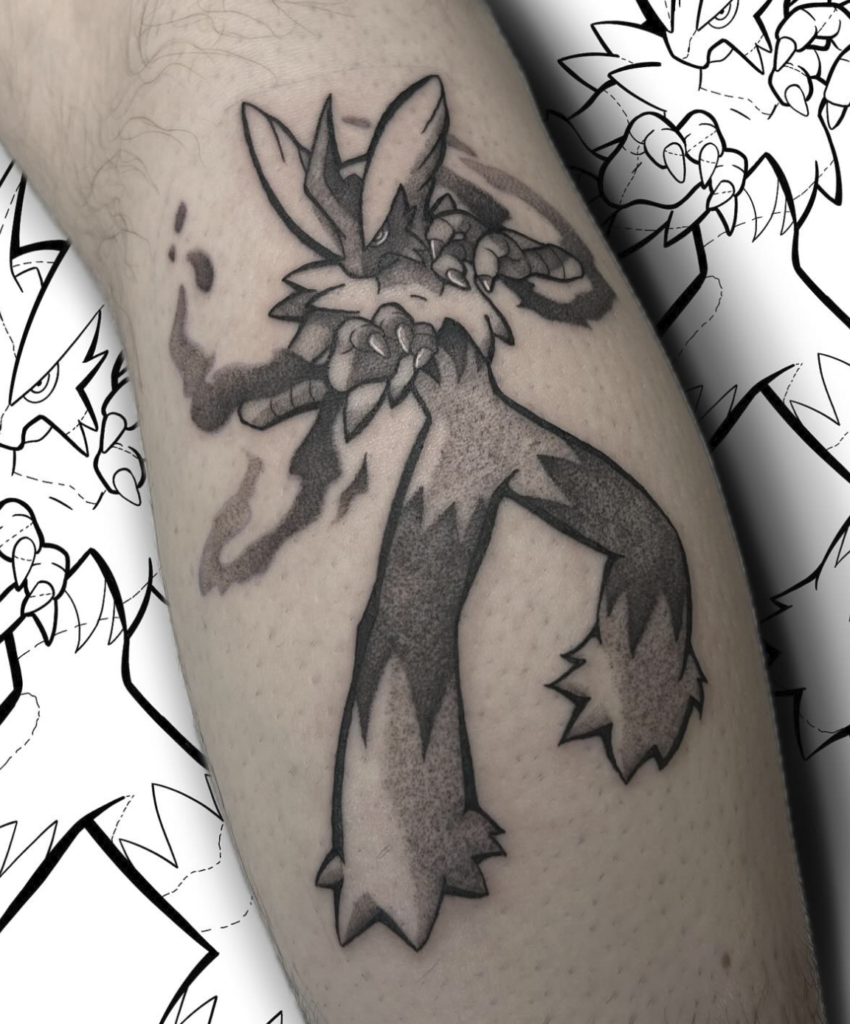
Currently, the Torchic, Combusken, and Blaziken line is the only Pokémon evolutionary line explicitly based on chickens, with Unfeezant being the only Pheasant-type Pokémon.
The Torchic line (specifically Combusken and Blaziken) takes inspiration from Shamo chickens, a breed known for its upright posture and history in cockfighting. While Torchic looks like a standard baby chick, its evolutions become bipedal, fighting-type roosters.
Cucco Chicken Tattoo


Cuccos are recurring chicken-like creatures from the The Legend of Zelda franchise. While they seem like harmless farm animals found in villages across the series, they have become one of the most iconic and unexpected elements in the games.
What makes Cuccos so memorable is their famous behaviour when provoked. If the player repeatedly attacks a Cucco, it will call in a swarm of other Cuccos, which then aggressively attack in large numbers. These swarms are relentless and nearly impossible to defeat, often forcing the player to run away. This mechanic has become a long-running joke and a beloved feature of the series.
Stardew Valley Chicken Tattoo
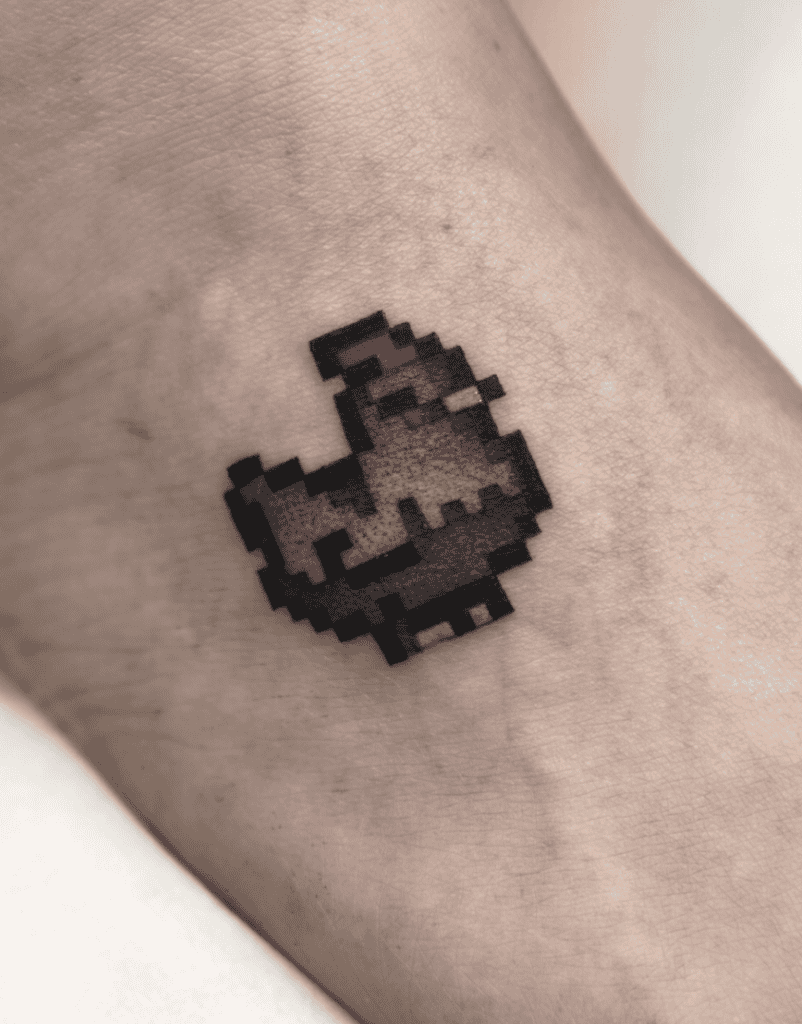
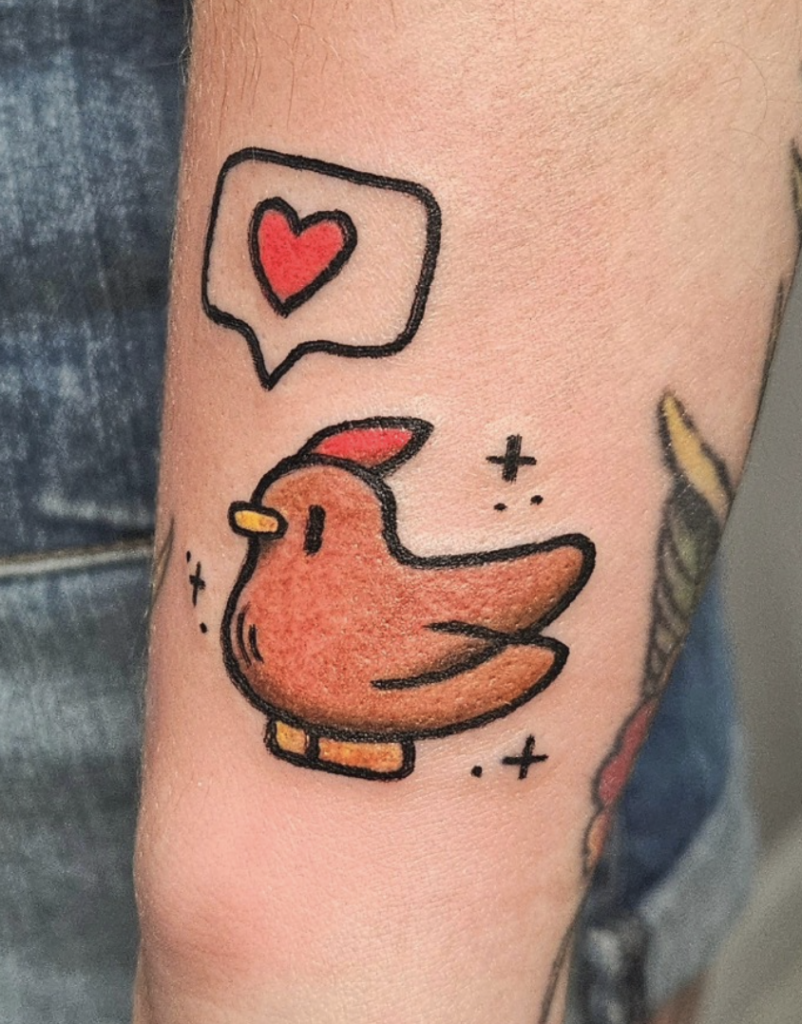
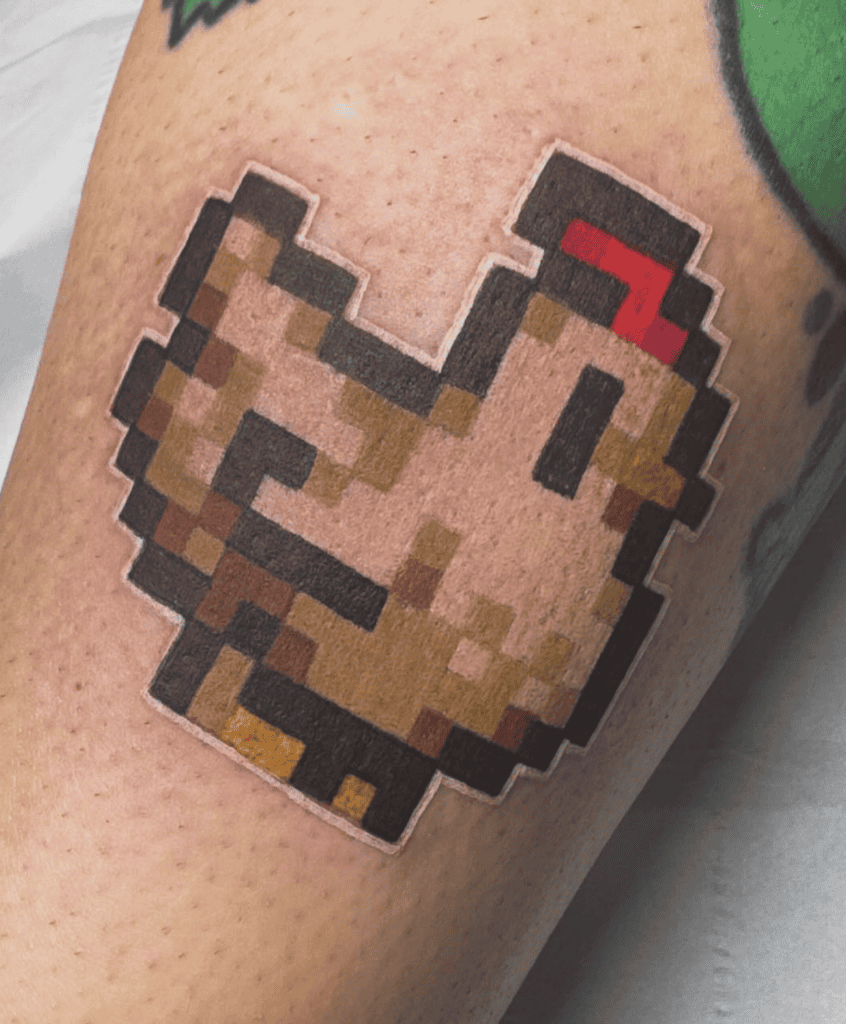
Stardew Valley is a beloved farming simulation game created by Eric Barone, where players leave behind a stressful modern life to start fresh on a quiet farm in a place called Pelican Town.
The game is about building a life at your own pace. You begin with a run-down farm and gradually grow it into something thriving by planting crops, raising animals, fishing, mining, and forming relationships with the townspeople. There’s no strict pressure or fixed path, which makes the experience feel relaxing and personal.
Chickens in Stardew Valley are one of the first animals players can raise, and they quickly become a core part of farm life. Once you build a coop, you can purchase chickens and begin caring for them daily, feeding them, petting them, and making sure they’re happy and safe.
Chocobo Chicken Tattoo
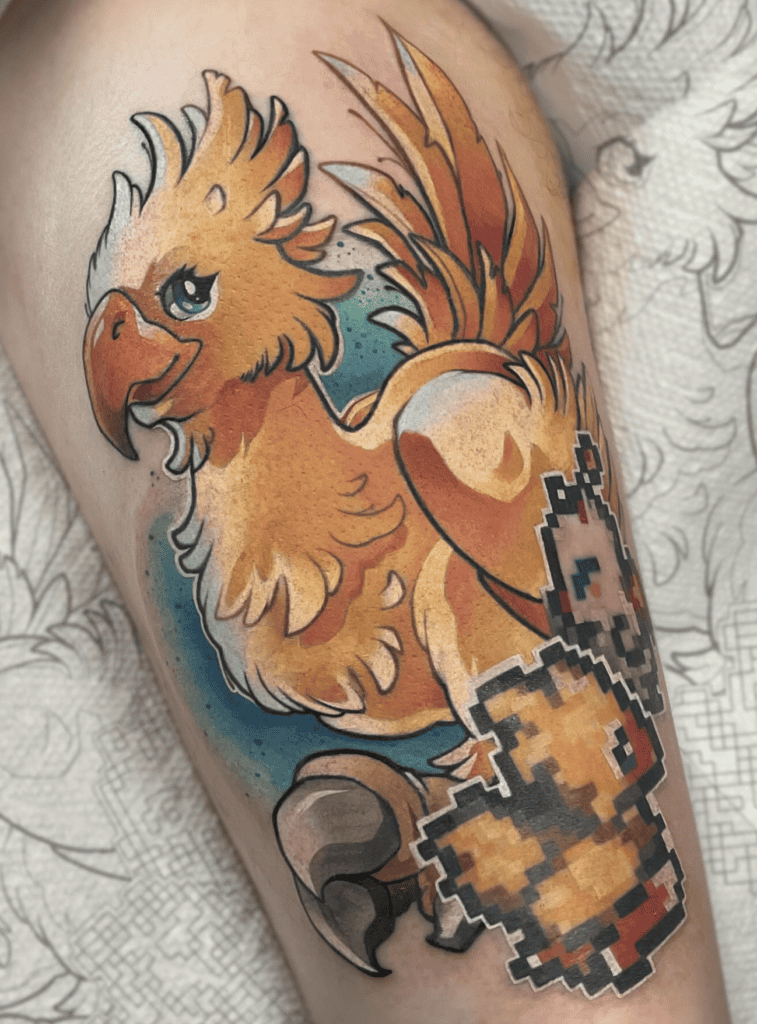
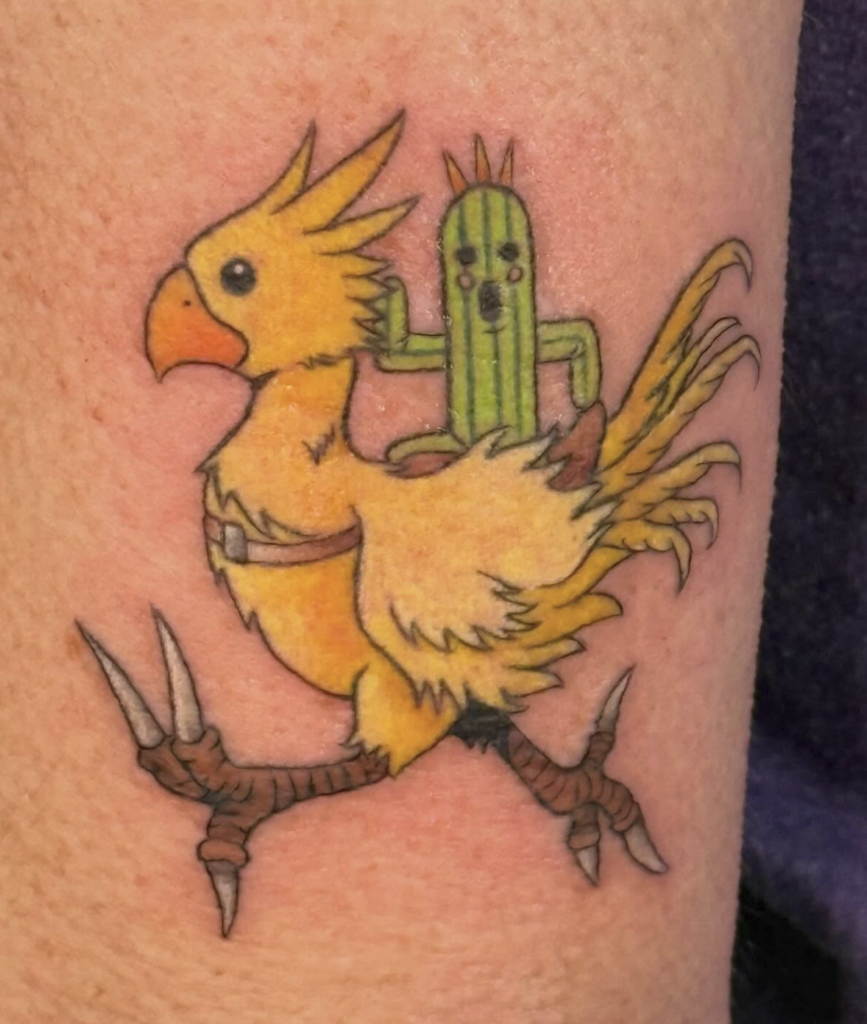
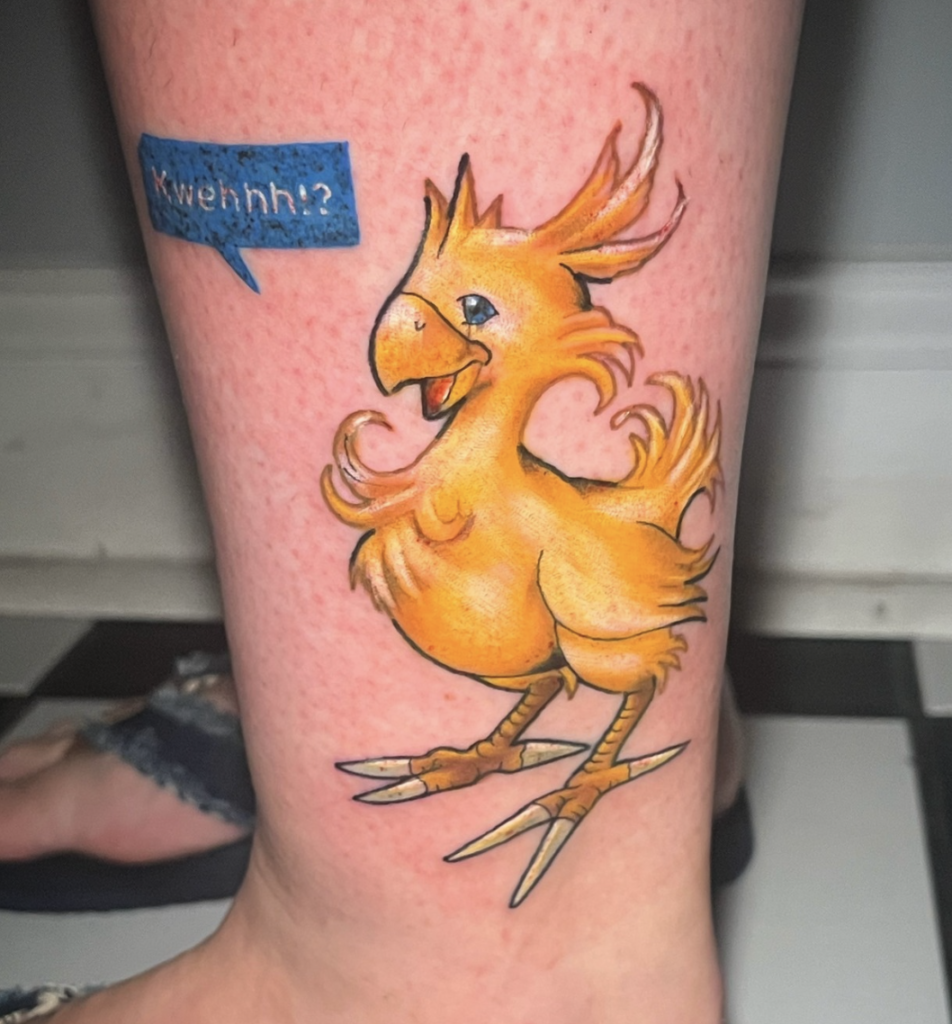
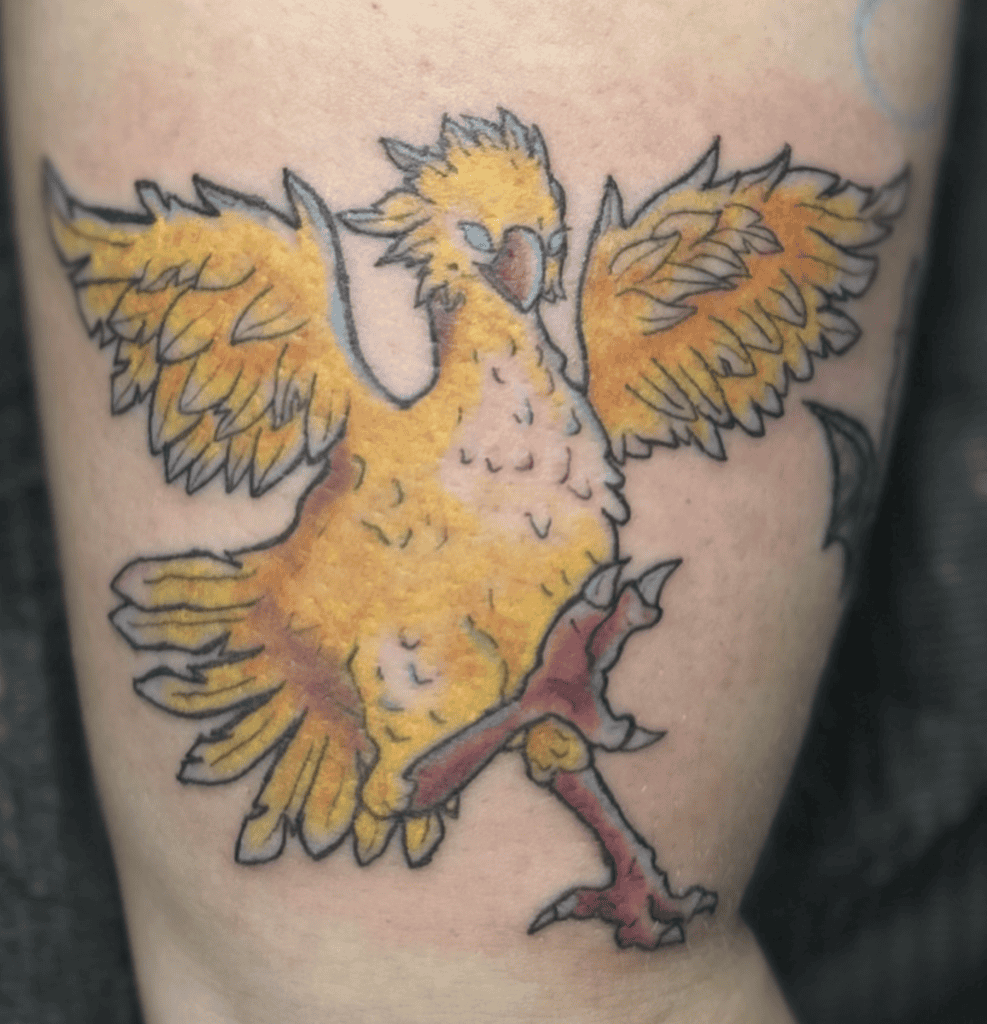
The Chocobo is one of the most iconic creatures from Final Fantasy. These large, bird-like creatures resemble a mix between a chicken and an ostrich, and they have become a beloved symbol of the franchise.
Chocobos are best known for their role as mounts. Characters often ride them to travel across vast landscapes, allowing them to move faster and access areas that would otherwise be difficult to reach. Their speed and reliability make them essential companions rather than just background creatures.
The most recognisable version is the bright yellow Chocobo, but there are many variations across the series. Some can fly, others can traverse water or mountains, and certain rare types even have special abilities.
Robot Chicken Tattoo

Robot Chicken is a stop-motion animated comedy series that airs on Adult Swim, created by Seth Green and Matthew Senreich. The show is known for its fast-paced sketch format, where each episode is made up of short, often chaotic parodies of pop culture, movies, TV shows, and video games.
The concept of the show is built around a darkly comedic premise. It follows a chicken that has been turned into a cyborg and is forced to watch endless television channels as a form of torment. The sketches that make up each episode are presented as the content the chicken is being forced to watch, which explains the rapid, channel-surfing style of storytelling.
Chicken Run Tattoo
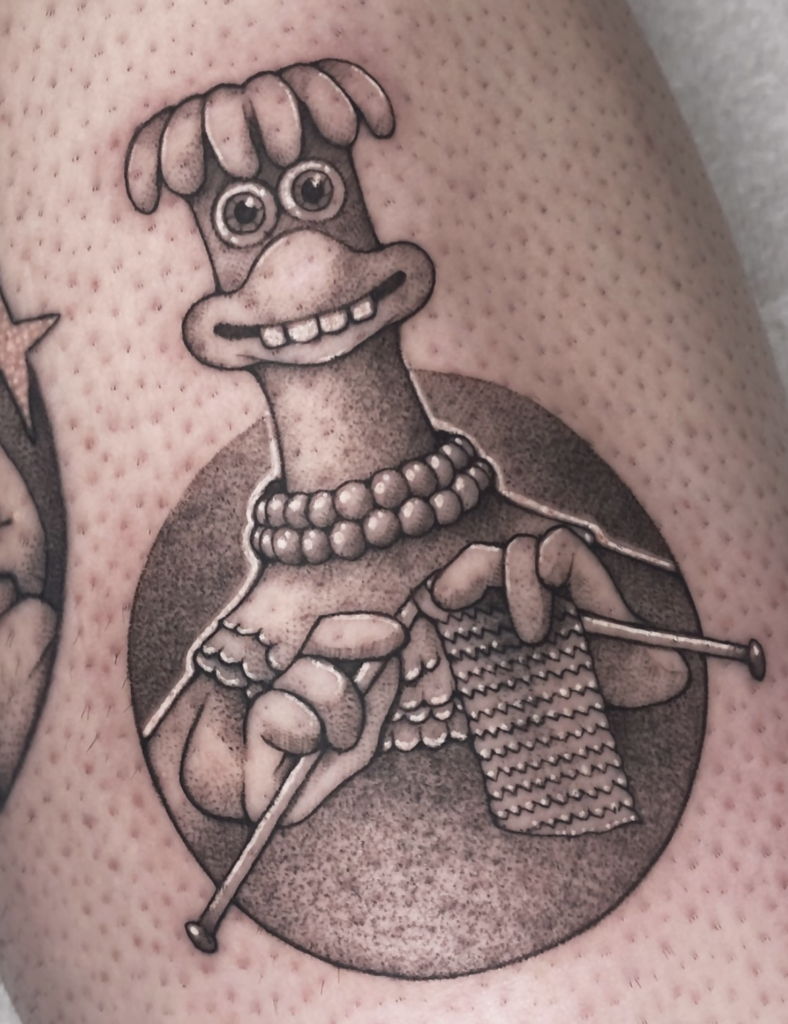
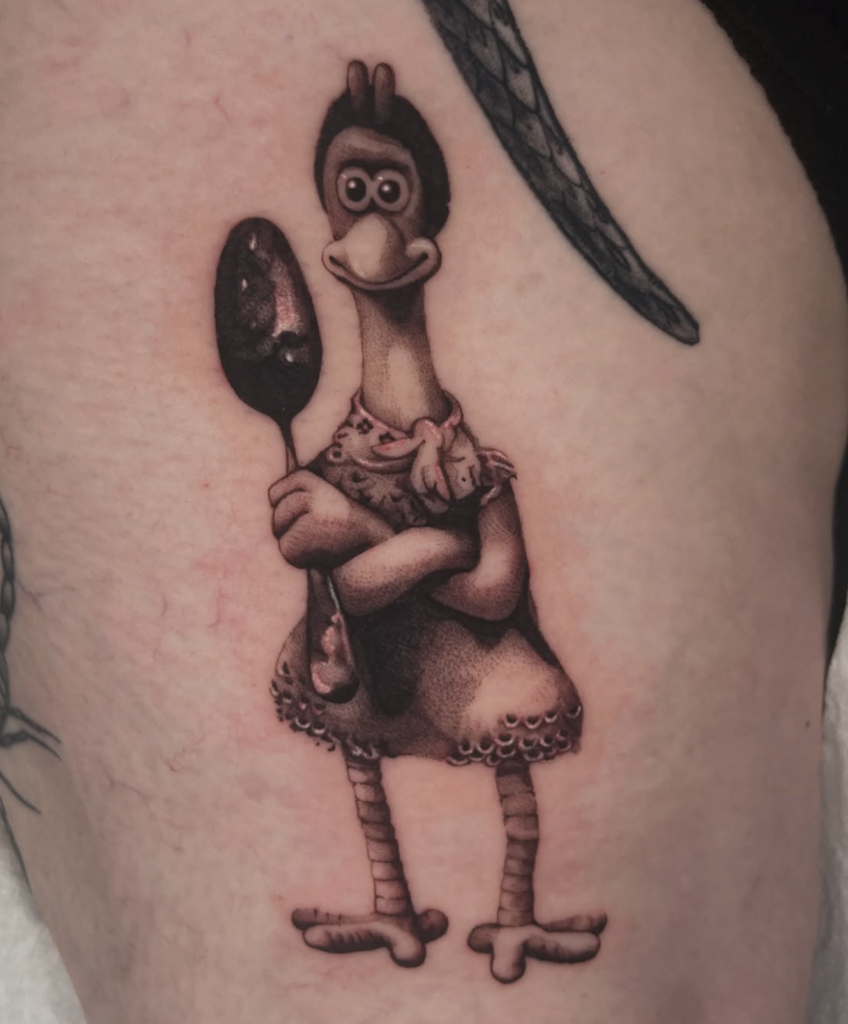
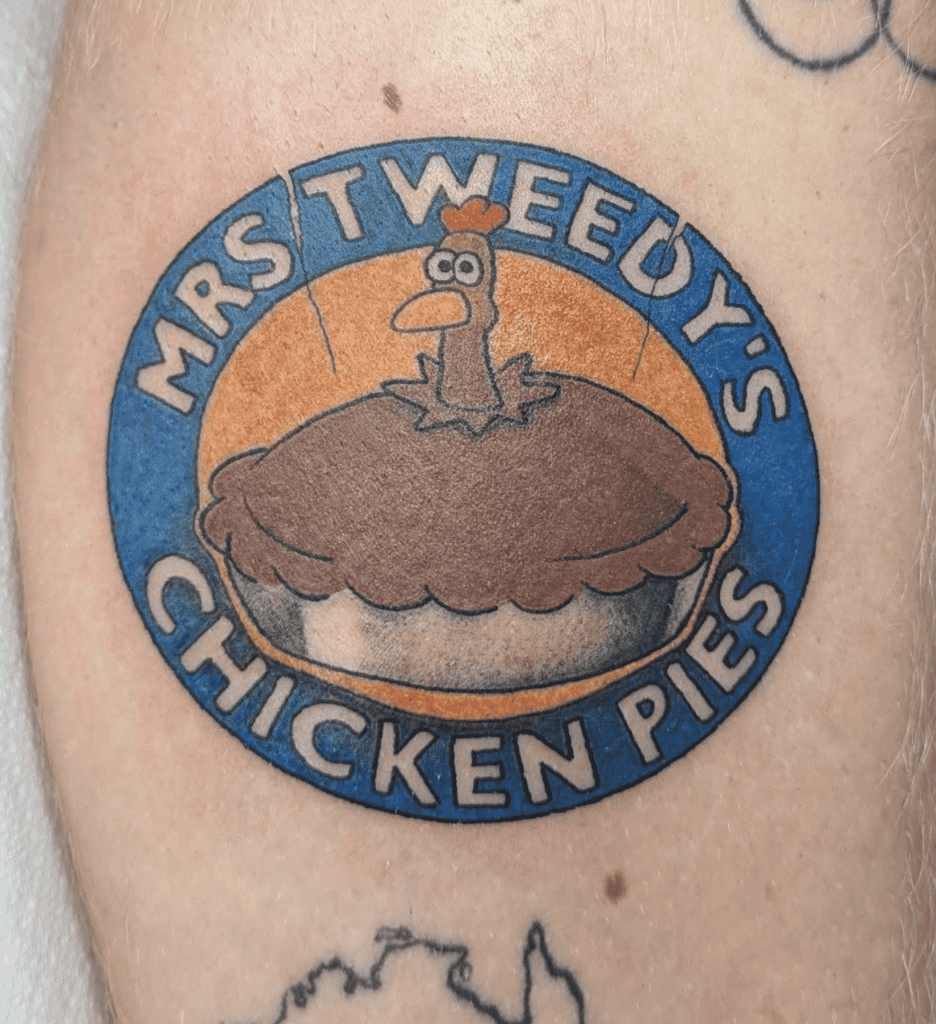
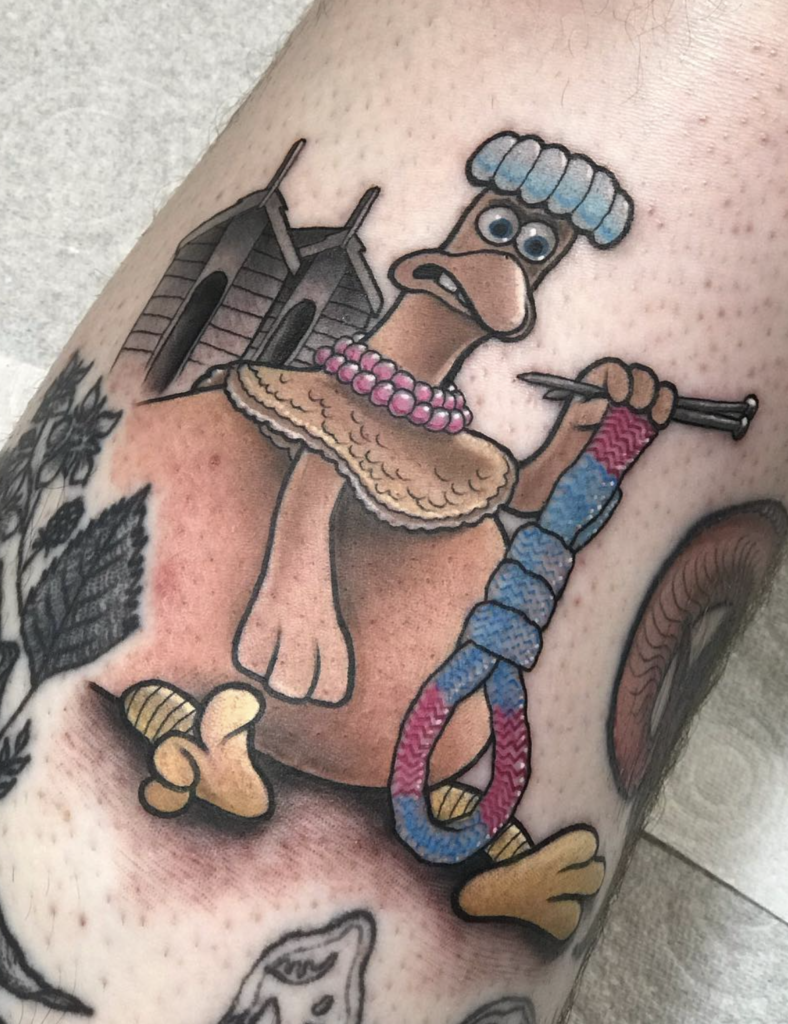
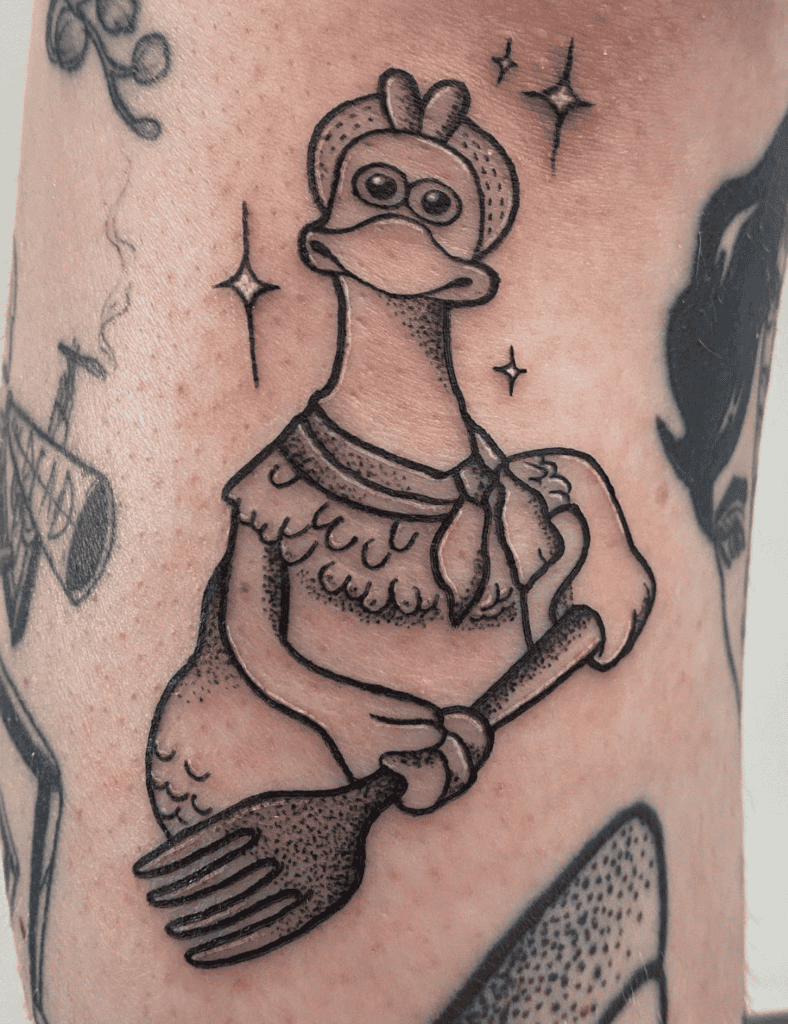
Chicken Run is a stop-motion animated film created by Aardman Animations in collaboration with DreamWorks. Released in 2000, it became one of the most successful stop-motion films ever made and is widely loved for its humour, charm, and surprisingly intense story.
The film is set on a chicken farm where the chickens are constantly under threat of being turned into pies. The story follows Ginger, a determined hen who dreams of escaping the farm and finding freedom for herself and the rest of the flock. Her repeated escape attempts fail until a rooster named Rocky arrives, leading the chickens to believe he can teach them how to fly.
What makes Chicken Run stand out is how it blends comedy with a much deeper theme. Beneath its light-hearted surface, the film is essentially a prison escape story, often compared to classic war films like The Great Escape. The chickens are not just farm animals and are portrayed as individuals with personalities, fears, and hopes, which makes their struggle feel meaningful.
Feathers McGraw Chicken Tattoo


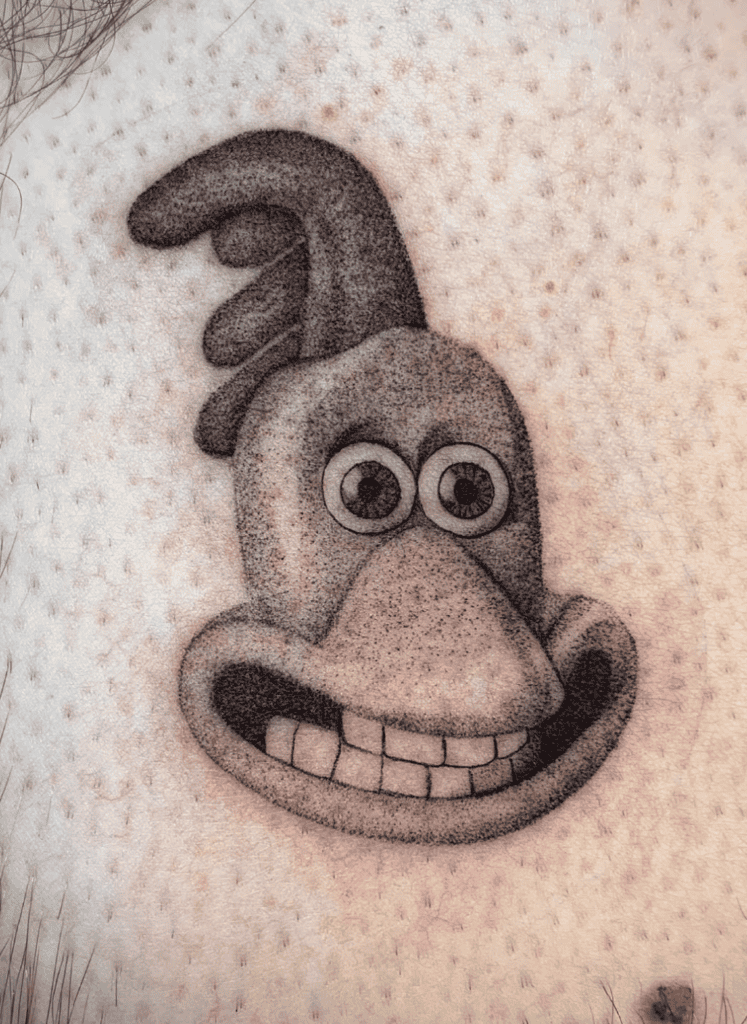
A Chicken?, ok, not really, but Feathers McGraw is the silent but unforgettable villain from The Wrong Trousers, part of the Wallace and Gromit. Feathers McGraw looks like a simple, expressionless penguin; however, this understated design is exactly what makes him so effective as a villain. He rarely shows emotion and never speaks, yet his presence is tense and commanding. His blank stare and slow, deliberate movements create a sense of quiet menace that contrasts sharply with the more comedic tone of the series.
One of his most iconic traits is his disguise: by placing a red rubber glove on his head, he is mistaken for a chicken. This simple but clever visual gag plays into the humour of the film while also highlighting his deceptive nature. Beneath this disguise, he is calculating, intelligent, and highly manipulative.
Foghorn Leghorn Chicken Tattoo
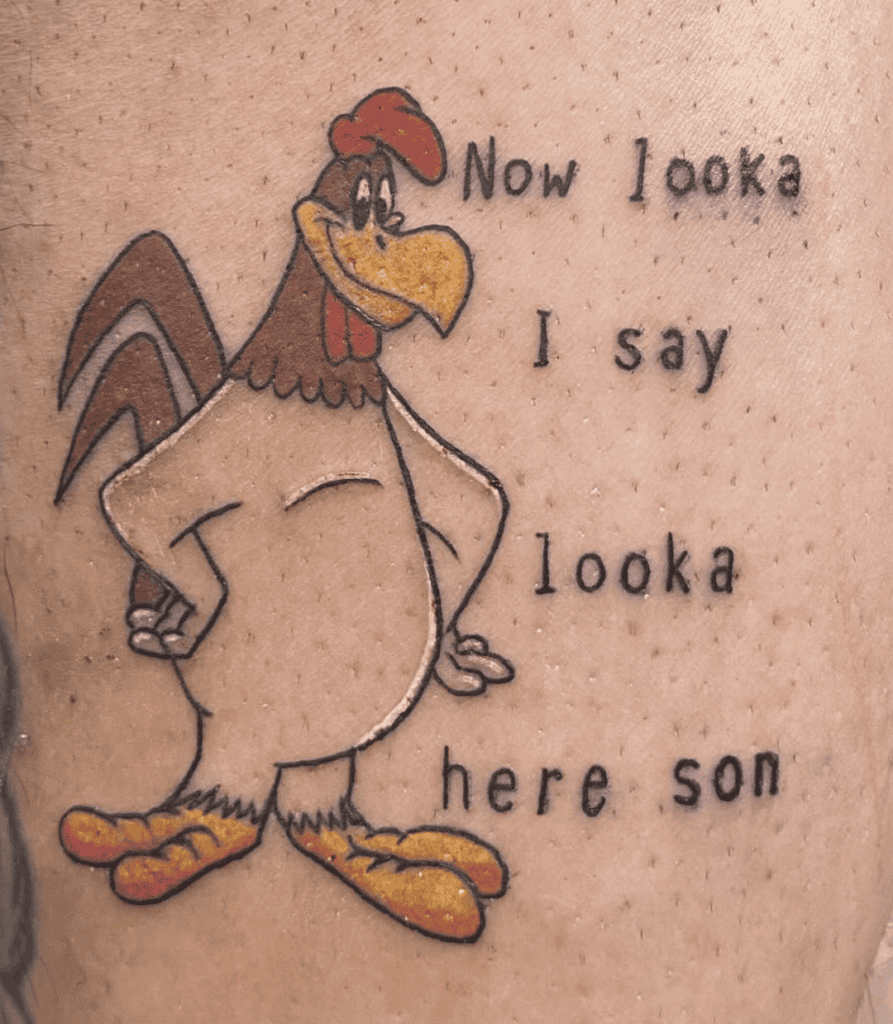
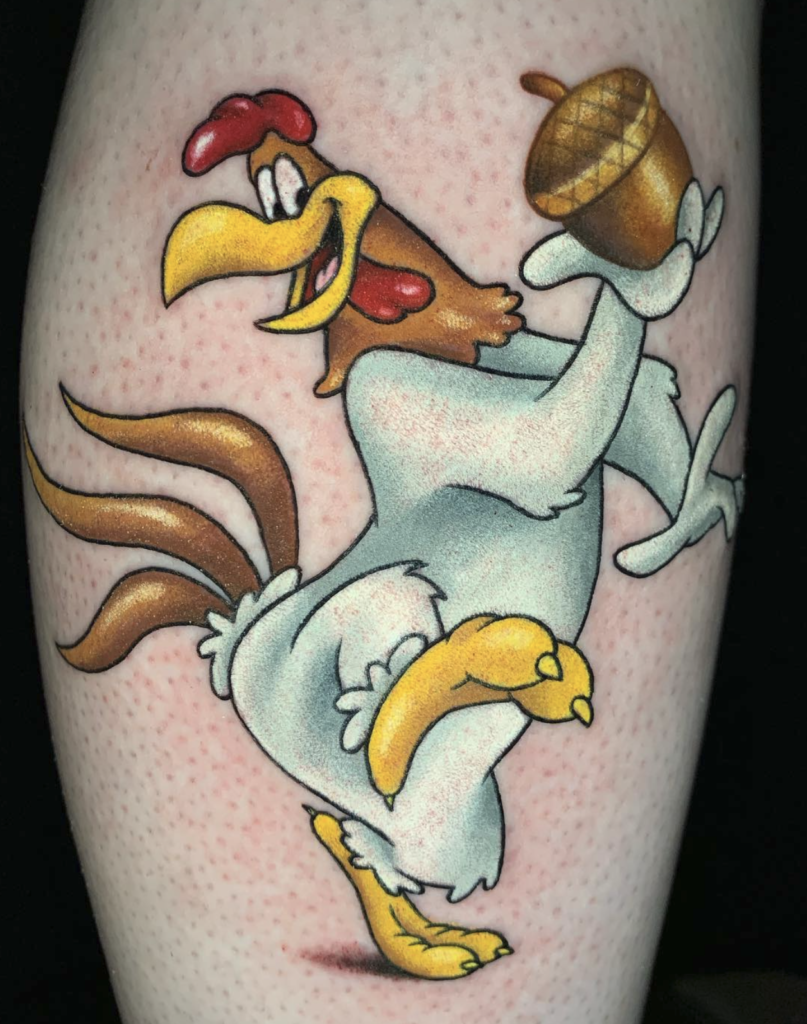
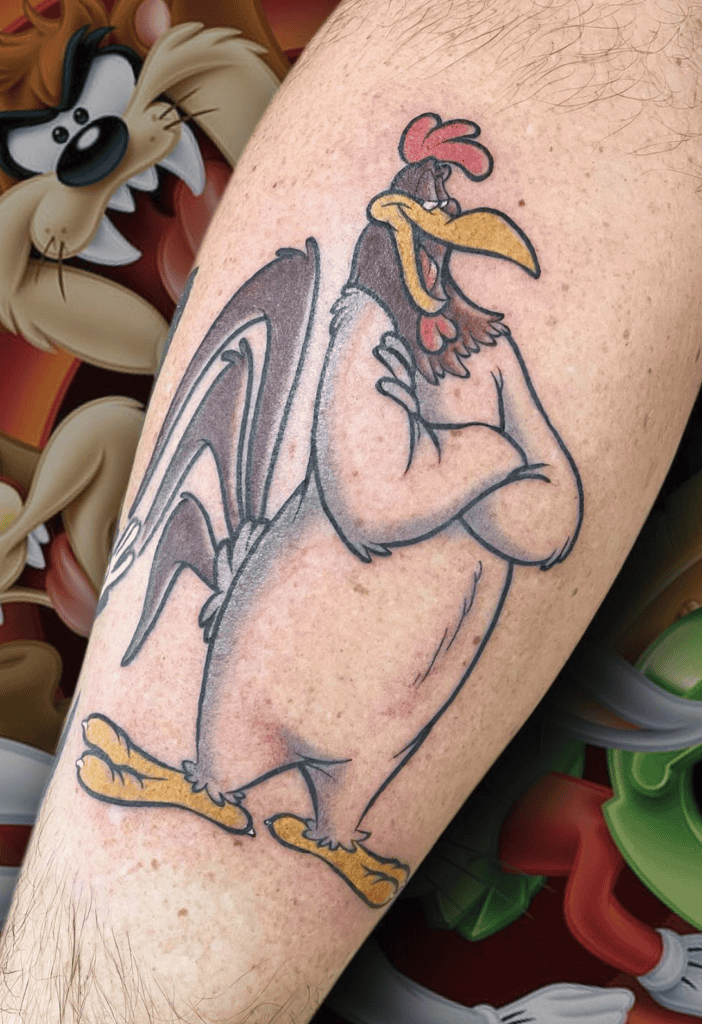
Foghorn Leghorn is one of the most iconic rooster characters from the Looney Tunes universe. He first appeared in the 1940s and quickly became known for his loud personality, fast-talking dialogue, and unmistakable Southern-style accent.
What makes Foghorn Leghorn so memorable is his larger-than-life presence. He is constantly talking, often repeating himself with phrases like “I say, I say…,” and tends to dominate every conversation he’s in. His humour comes from a mix of confidence, exaggeration, and misunderstanding, as he often believes he’s the smartest character in the room, even when things clearly aren’t going his way.
Despite his bold personality, Foghorn is frequently outsmarted by other characters, especially the clever barnyard dog or the young chicken hawk, Henery Hawk. This contrast between his confidence and the reality of his situations creates much of the comedy, as his plans often backfire in unexpected ways.
Eggbert Jr. Chicken Tattoo

Eggbert, a tiny yellow chick who appears in classic Looney Tunes cartoons, usually alongside the loud and larger-than-life rooster Foghorn Leghorn. He is the complete opposite of Foghorn in both size and personality. While Foghorn is noisy, confident, and constantly talking, Eggbert is small, quiet, and often confused about what’s going on around him. This contrast creates a lot of the humour in their scenes, as Eggbert reacts to Foghorn’s exaggerated behaviour in a more innocent and straightforward way.
Chicken Little Tattoo
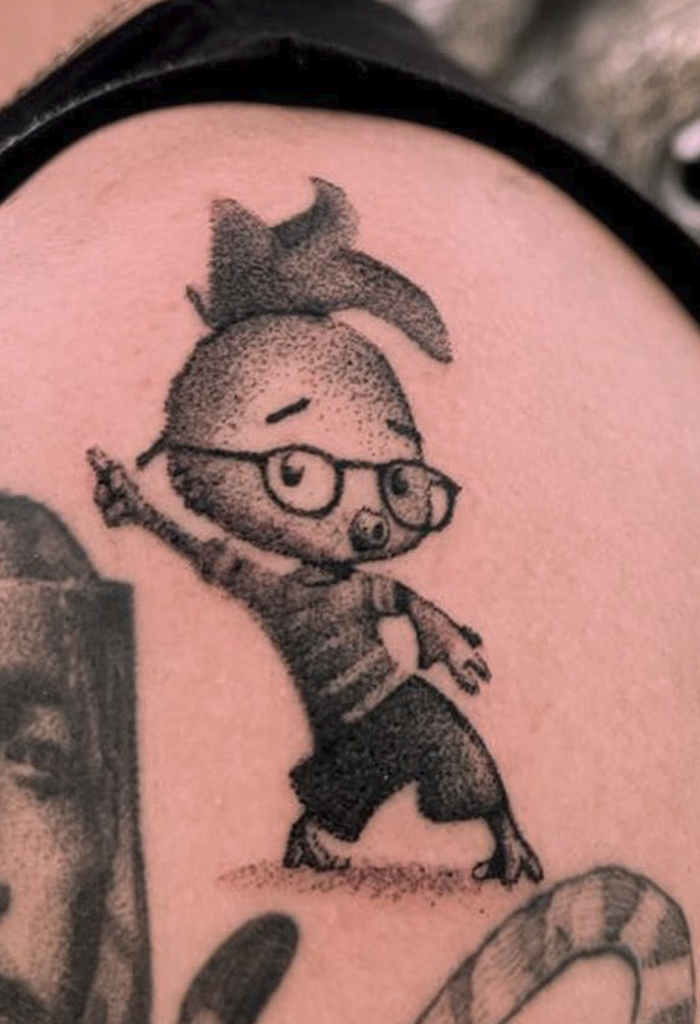
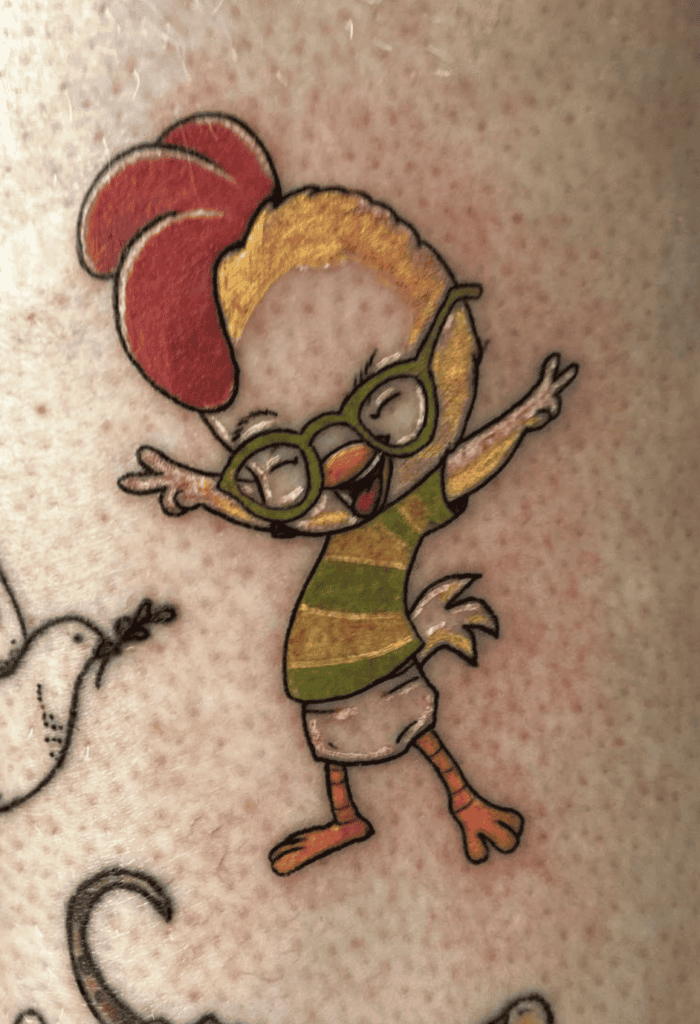
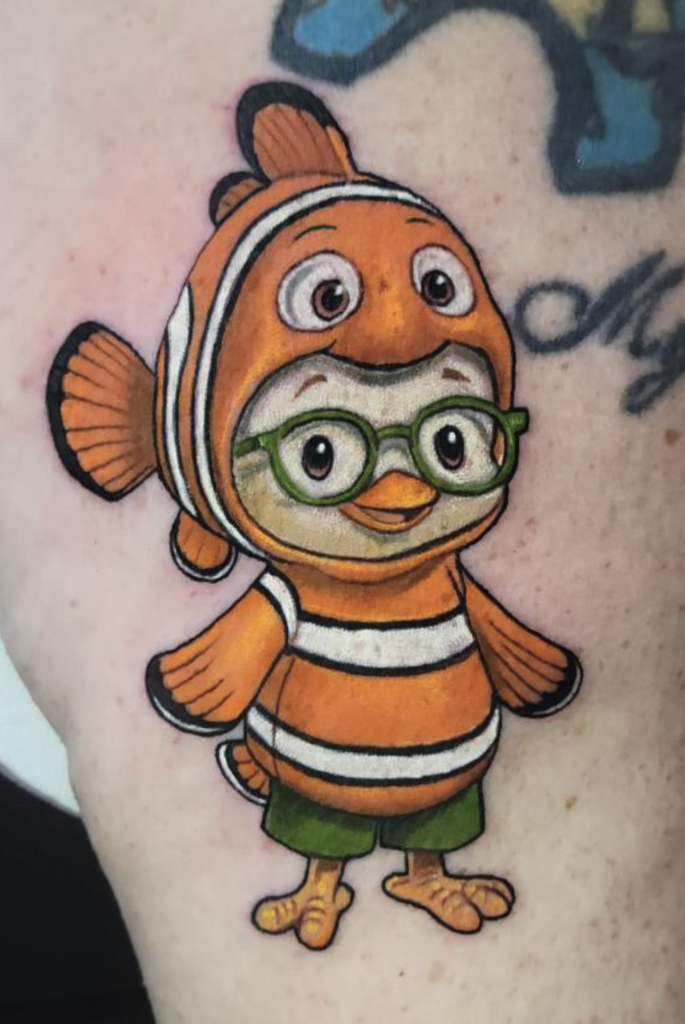
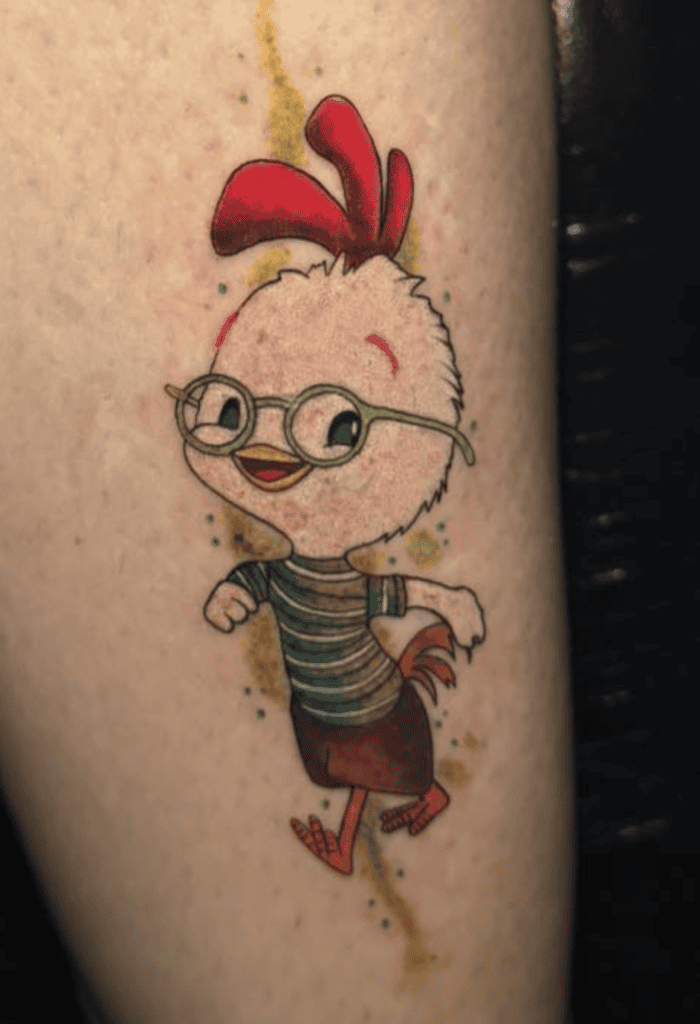
Chicken Little is the main character of Disney’s Chicken Little, inspired by the classic folk tale about a chicken who believes the sky is falling. The story has been told in many forms over the years, but Disney’s version reimagines it as a heartfelt and comedic story about reputation, courage, and redemption.
In the film, Chicken Little is a small, anxious, and often misunderstood character who once caused panic in his town after mistakenly thinking the sky was falling. Because of this, he struggles with being taken seriously and wants to prove himself, especially to his father and the rest of the community. When a real threat eventually appears, he must overcome his fears and self-doubt to do the right thing.
Minecraft Chicken Tattoo

The Chicken is one of the most common passive animals in Minecraft, developed by Mojang Studios. Known for its simple, blocky design and constant egg-laying, the chicken plays a small but essential role in the game’s survival and farming systems.
Visually, the Minecraft chicken is instantly recognisable with its white cube-shaped body, yellow beak, red wattle, and tiny wings. Its design perfectly matches the game’s pixelated style, making it both simple and charming.
In terms of gameplay, chickens are incredibly useful. They lay eggs regularly, which can be used for cooking, crafting, or even spawning more chickens. When raised in farms, they become a reliable source of food and materials, especially feathers for arrows. This makes them one of the first animals that players often domesticate and rely on.
One of the most memorable aspects of Minecraft chickens is their unexpected interactions with other mobs. A famous example is the “chicken jockey,” where a baby zombie rides a chicken, creating a rare and slightly chaotic enemy encounter. This adds a layer of unpredictability to an otherwise peaceful creature.
Camilla Chicken Tattoo


Camilla the Chicken is a recurring character from The Muppets. She is best known as the loyal companion (and often implied love interest) of Gonzo, one of the franchise’s most eccentric and unpredictable characters.
At first glance, Camilla might seem like a simple chicken, but she has a surprisingly expressive personality. Unlike many of the more talkative Muppets, she doesn’t speak in full dialogue; instead, communicating through clucks, gestures, and reactions. Despite this, her emotions are clear, and she often plays off Gonzo’s antics in a way that adds humour and warmth to their relationship.
One Piece Chicken Tattoo

One Piece is a hugely popular anime and manga series created by Eiichiro Oda. It follows the journey of Monkey D. Luffy, a young pirate with a dream of finding the legendary treasure known as the “One Piece” and becoming the Pirate King.
The story takes place in a vast ocean world filled with islands, strange creatures, and powerful pirates. Luffy gathers a crew known as the Straw Hat Pirates, each with their own unique abilities and personal goals, and together they travel across dangerous seas in search of adventure and freedom.
If you want a more official One Piece Chicken Tattoo, then you can go for a Baron Tamago Tattoo, the user of the Tama Tama no Mi (Egg Egg Fruit) that allows him to transform into a Chicken.
The Three Poisons Chicken Tattoo


The Three Poisons are three fundamental negative states in Buddhist teaching that are believed to be the root of suffering. These are ignorance, attachment, and aversion, and they are often depicted symbolically at the centre of the Wheel of Life (Bhavachakra).
Each poison is represented by an animal. The pig symbolises ignorance or delusion, reflecting a lack of understanding about the true nature of reality. The rooster represents attachment or desire, associated with craving, greed, and the constant pursuit of pleasure. The snake represents aversion, linked to anger, hatred, and rejection.
These three forces are shown chasing or biting one another in a circle, illustrating how they are interconnected and continuously reinforce each other. For example, ignorance can lead to desire, desire can lead to frustration, and frustration can turn into anger, creating a cycle that keeps individuals trapped in suffering.
The rooster’s role is particularly interesting. As a symbol of desire and craving, it represents the pull toward things we want but cannot always have. This connects to the idea of constantly seeking satisfaction without ever feeling truly fulfilled.
Lunar New Year Rooster Tattoo

The Rooster is one of the 12 animals in the Chinese zodiac, playing an important role in Lunar New Year traditions. Each year is associated with one of these animals, and people born in a Rooster year are believed to carry certain personality traits and symbolic meanings tied to this animal.
In the context of Lunar New Year, the rooster is seen as a symbol of confidence, punctuality, and awareness. This comes from its natural behaviour, especially its crowing at dawn, which signals the start of a new day. Because of this, the rooster is often associated with new beginnings, vigilance, and readiness, making it a powerful symbol during a time that celebrates renewal and fresh starts.
The rooster is also linked to honesty and directness. In traditional interpretations, people born under this zodiac sign are thought to be straightforward, observant, and not afraid to speak their minds. There is a strong sense of self-assurance tied to the rooster, reflecting its proud stance and bold presence.
Dinosaur Chicken Tattoo

Chickens, including species like the Red Junglefowl, are actually descendants of a group of dinosaurs called theropods. These are the same type of dinosaurs that include famous predators like Velociraptor and Tyrannosaurus rex.
Over millions of years, certain small theropod dinosaurs evolved feathers, lighter bones, and eventually the ability to glide and fly. One of the most well-known transitional fossils is Archaeopteryx, which shows a mix of dinosaur and bird features, such as teeth and claws alongside feathers and wings.
Miscellaneous Chicken Tattoos
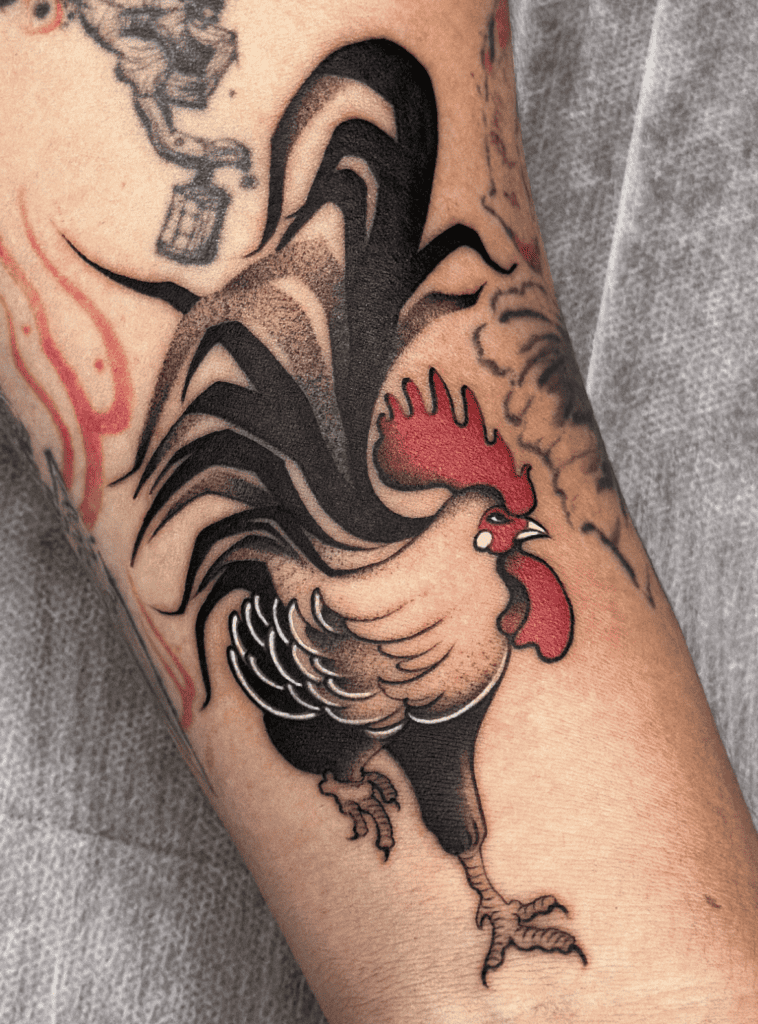
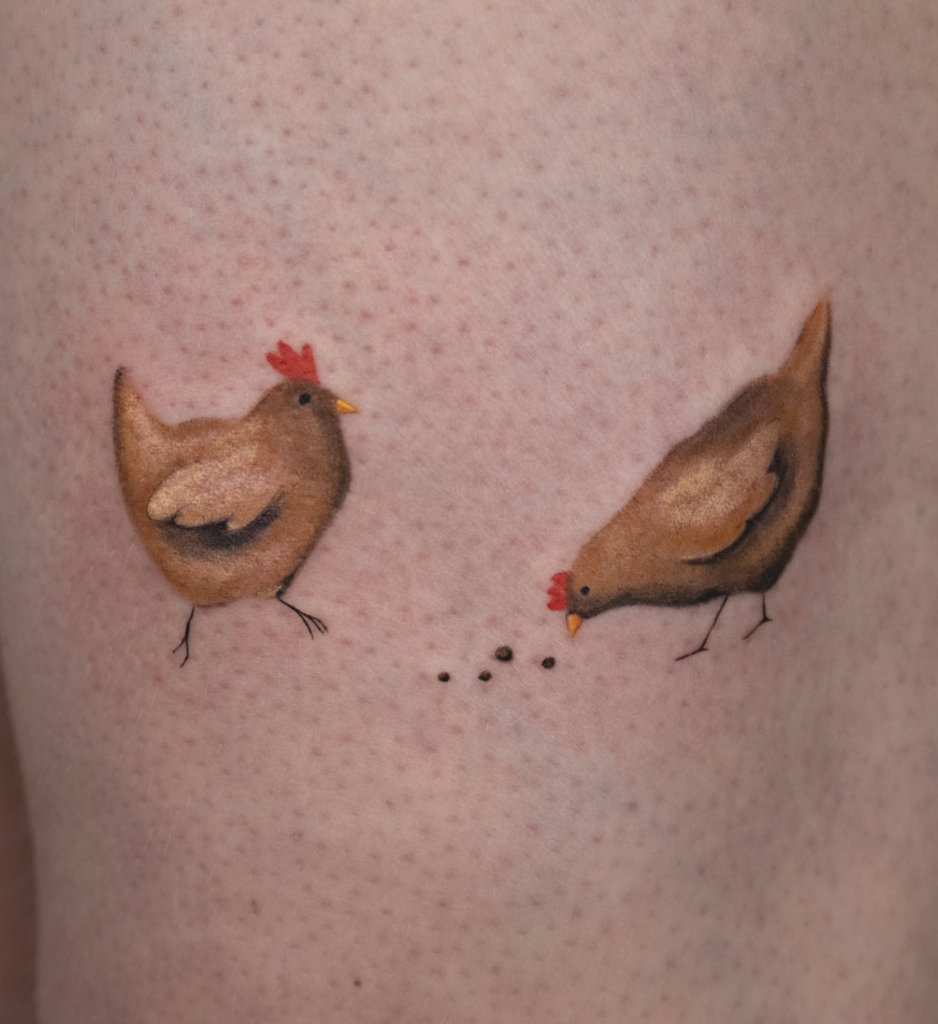
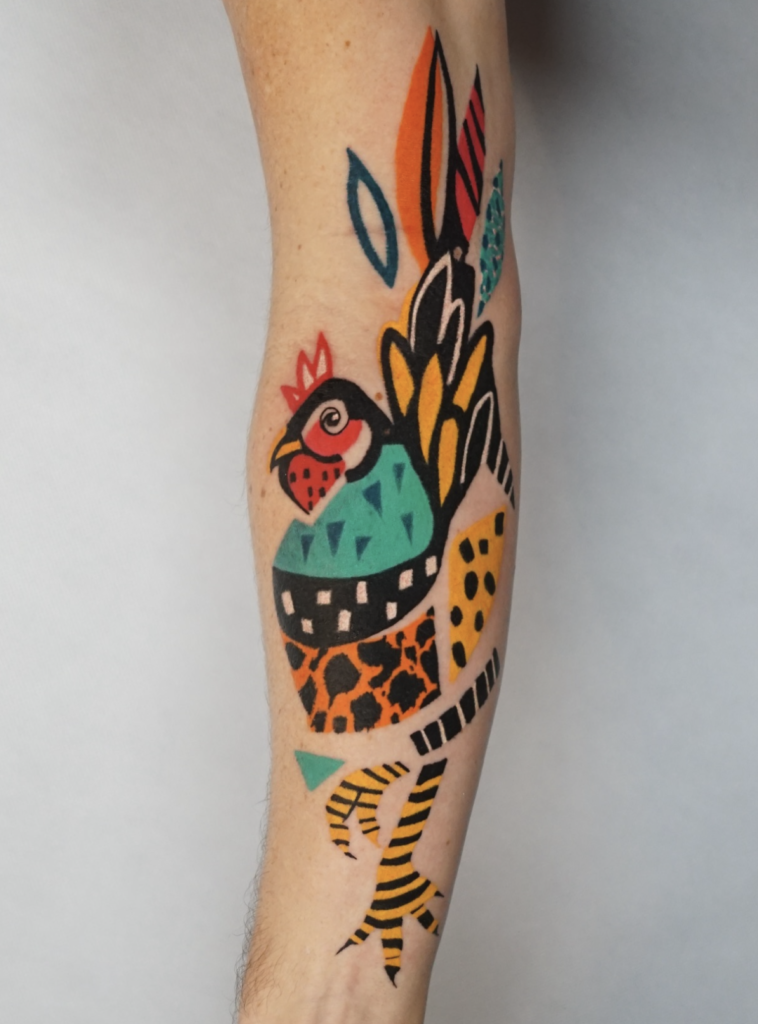
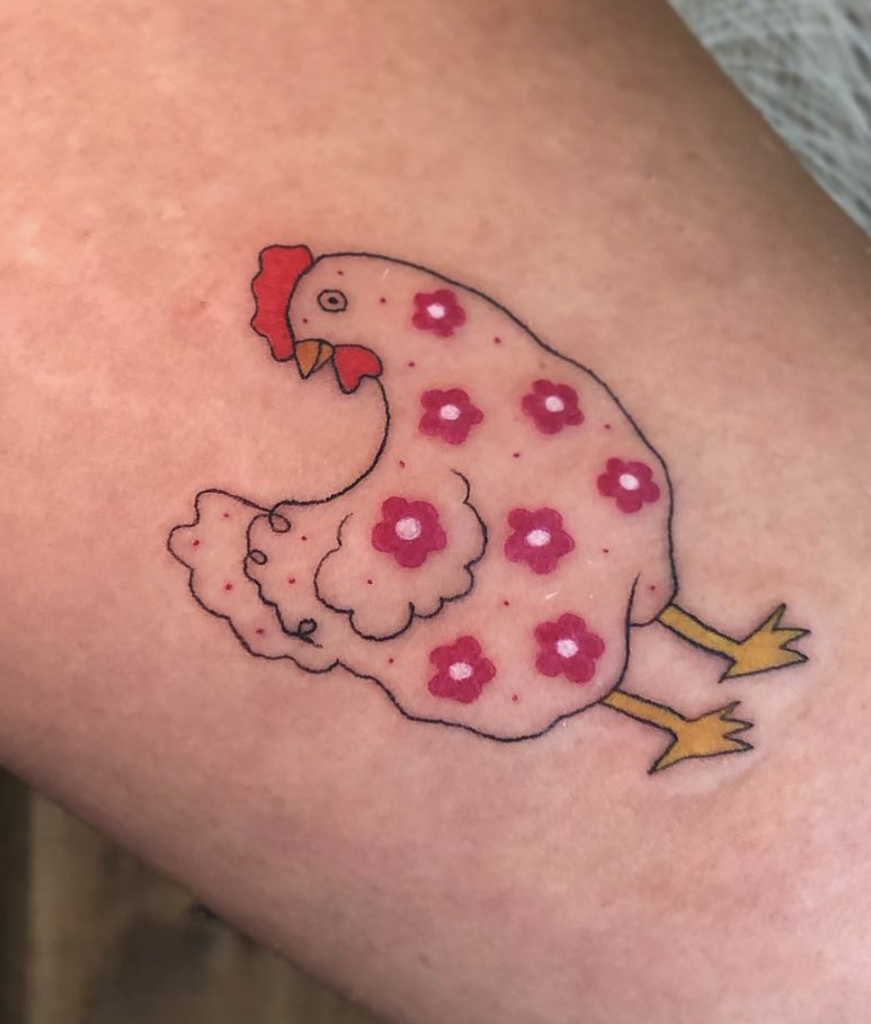
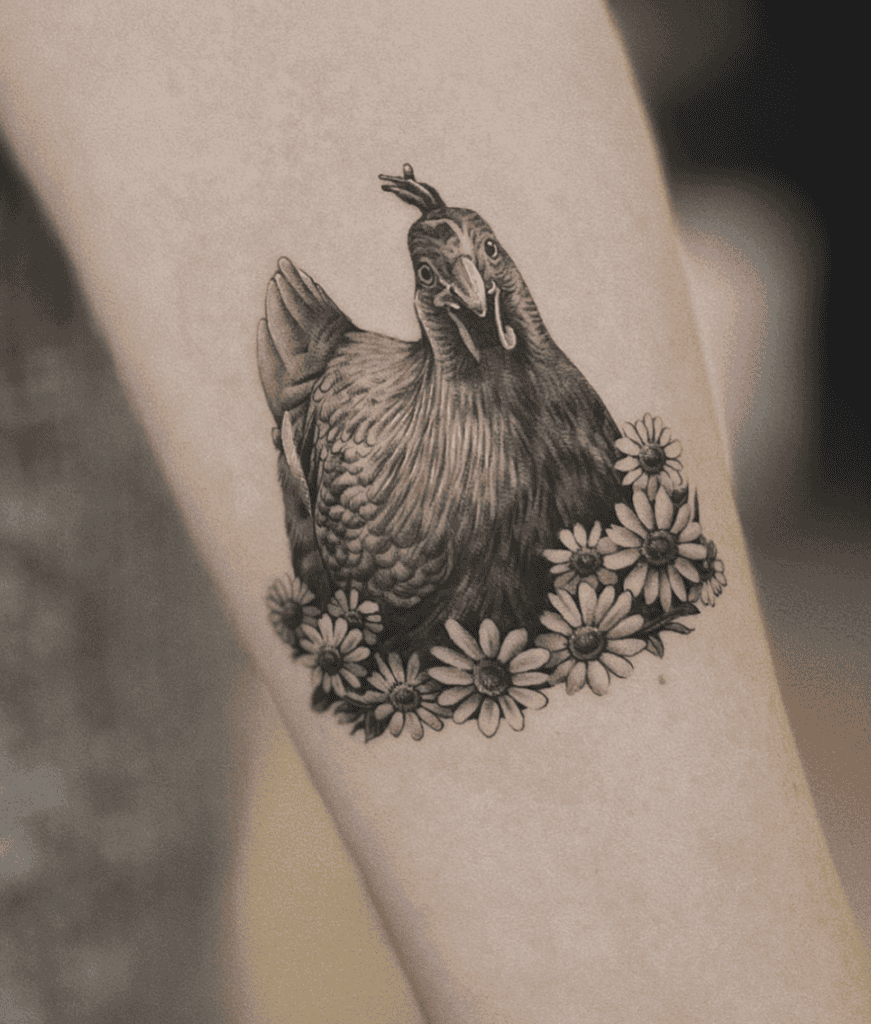
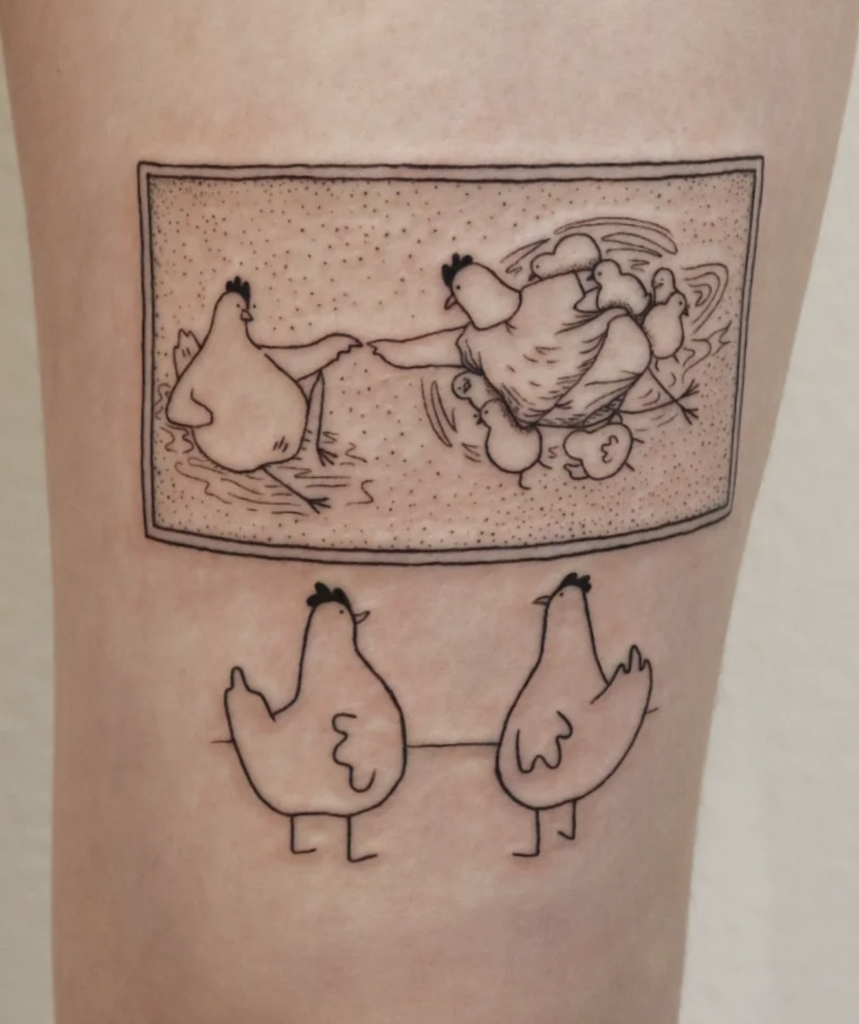
If none of the Chicken Tattoos we’ve already shown interest you, then check out a few of these miscellaneous Chicken Tattoos that can add a bit of style or fun to your ink.
Conclusion
Thanks for joining us on this feather-filled journey through the cluck-tastic world of Chicken Tattoo Design. We hope you’ve found something egg-sactly right to guide your own tattooing adventure. But if Chicken Tattoos still don’t quite scratch that creative itch, why not swing into these Monkey Tattoo Ideas, these Norse Mythology Tattoo Ideas, or these Star Wars Tattoos.
- Lion Tattoo Ideas - October 19, 2026
- Persona Tattoo Ideas - October 15, 2026
- Spider Tattoo Ideas - October 8, 2026